EP2269331B1 - Kanalüberwachung - Google Patents
Kanalüberwachung Download PDFInfo
- Publication number
- EP2269331B1 EP2269331B1 EP08750458.5A EP08750458A EP2269331B1 EP 2269331 B1 EP2269331 B1 EP 2269331B1 EP 08750458 A EP08750458 A EP 08750458A EP 2269331 B1 EP2269331 B1 EP 2269331B1
- Authority
- EP
- European Patent Office
- Prior art keywords
- channel
- power
- memory
- detection
- transmitter
- Prior art date
- Legal status (The legal status is an assumption and is not a legal conclusion. Google has not performed a legal analysis and makes no representation as to the accuracy of the status listed.)
- Active
Links
Images

Classifications
-
- H—ELECTRICITY
- H04—ELECTRIC COMMUNICATION TECHNIQUE
- H04K—SECRET COMMUNICATION; JAMMING OF COMMUNICATION
- H04K3/00—Jamming of communication; Counter-measures
- H04K3/20—Countermeasures against jamming
- H04K3/22—Countermeasures against jamming including jamming detection and monitoring
- H04K3/224—Countermeasures against jamming including jamming detection and monitoring with countermeasures at transmission and/or reception of the jammed signal, e.g. stopping operation of transmitter or receiver, nulling or enhancing transmitted power in direction of or at frequency of jammer
- H04K3/226—Selection of non-jammed channel for communication
-
- H—ELECTRICITY
- H04—ELECTRIC COMMUNICATION TECHNIQUE
- H04B—TRANSMISSION
- H04B17/00—Monitoring; Testing
- H04B17/20—Monitoring; Testing of receivers
- H04B17/26—Monitoring; Testing of receivers using historical data, averaging values or statistics
-
- H—ELECTRICITY
- H04—ELECTRIC COMMUNICATION TECHNIQUE
- H04B—TRANSMISSION
- H04B17/00—Monitoring; Testing
- H04B17/30—Monitoring; Testing of propagation channels
- H04B17/309—Measuring or estimating channel quality parameters
- H04B17/318—Received signal strength
- H04B17/327—Received signal code power [RSCP]
-
- H—ELECTRICITY
- H04—ELECTRIC COMMUNICATION TECHNIQUE
- H04B—TRANSMISSION
- H04B17/00—Monitoring; Testing
- H04B17/30—Monitoring; Testing of propagation channels
- H04B17/382—Monitoring; Testing of propagation channels for resource allocation, admission control or handover
-
- H—ELECTRICITY
- H04—ELECTRIC COMMUNICATION TECHNIQUE
- H04W—WIRELESS COMMUNICATION NETWORKS
- H04W72/00—Local resource management
- H04W72/02—Selection of wireless resources by user or terminal
-
- H—ELECTRICITY
- H04—ELECTRIC COMMUNICATION TECHNIQUE
- H04W—WIRELESS COMMUNICATION NETWORKS
- H04W16/00—Network planning, e.g. coverage or traffic planning tools; Network deployment, e.g. resource partitioning or cells structures
- H04W16/14—Spectrum sharing arrangements between different networks
-
- H—ELECTRICITY
- H04—ELECTRIC COMMUNICATION TECHNIQUE
- H04W—WIRELESS COMMUNICATION NETWORKS
- H04W24/00—Supervisory, monitoring or testing arrangements
- H04W24/10—Scheduling measurement reports ; Arrangements for measurement reports
-
- H—ELECTRICITY
- H04—ELECTRIC COMMUNICATION TECHNIQUE
- H04W—WIRELESS COMMUNICATION NETWORKS
- H04W72/00—Local resource management
- H04W72/50—Allocation or scheduling criteria for wireless resources
- H04W72/54—Allocation or scheduling criteria for wireless resources based on quality criteria
- H04W72/542—Allocation or scheduling criteria for wireless resources based on quality criteria using measured or perceived quality
-
- Y—GENERAL TAGGING OF NEW TECHNOLOGICAL DEVELOPMENTS; GENERAL TAGGING OF CROSS-SECTIONAL TECHNOLOGIES SPANNING OVER SEVERAL SECTIONS OF THE IPC; TECHNICAL SUBJECTS COVERED BY FORMER USPC CROSS-REFERENCE ART COLLECTIONS [XRACs] AND DIGESTS
- Y02—TECHNOLOGIES OR APPLICATIONS FOR MITIGATION OR ADAPTATION AGAINST CLIMATE CHANGE
- Y02D—CLIMATE CHANGE MITIGATION TECHNOLOGIES IN INFORMATION AND COMMUNICATION TECHNOLOGIES [ICT], I.E. INFORMATION AND COMMUNICATION TECHNOLOGIES AIMING AT THE REDUCTION OF THEIR OWN ENERGY USE
- Y02D30/00—Reducing energy consumption in communication networks
- Y02D30/70—Reducing energy consumption in communication networks in wireless communication networks
Definitions
- the invention relates to monitoring channels in a radio system, particularly in a cognitive radio system.
- Cognitive radio belongs to an SDR platform where a radio automatically searches for an unused channel for its transmission.
- the transmitter has an adaptive software which does the searching and enables the radio to reconfigure its communication parameters when an unused channel is found.
- the radio starts its operation by performing an LBT (Listen Before Transmission) scheme for a free channel.
- the radio may also jump from a channel, whose quality of service may be deteriorating, to a new channel lightning fast without causing an interruption in its transmission.
- Document US 2005026610 presents a method for scanning radio frequency channels.
- An object of the invention is to provide an improved monitoring solution.
- communication method of a cognitive radio further comprises selecting, from a memory including information on a plurality of channels, a channel which is determined free, for power measurement; measuring the received power from the selected channel; comparing the measured power and a power of the same channel saved in the memory; selecting the channel for detection if the power in the channel is within a predetermined range from the power saved in the memory; performing detection of the channel as a response to the selection for detection; selecting the channel for communication if the channel is detected unoccupied on the basis of detection; and communicating in the channel as a response to the selection for communication.
- a transmitter of a cognitive radio comprises a power meter, a power selector, a detector, a detection selector, a memory and a channel selector; the power selector being configured to select from a memory including information on a plurality of channels, a channel which is determined free, for a power measurement; the power meter being configured to measure the received power from the selected channel; detection selector being configured to compare the measured power and a power of the same channel saved in the memory and to select the channel for detection if the power in the channel is within a predetermined range from the power saved in the memory; the detector being configured to perform detection of the channel as a response to the selection for detection; the channel selector being configured to select the channel for communication if the channel is detected unoccupied on the basis of detection; and the transmitter being configured to communicate in the channel as a response to the selection for communication.
- a computer program product encoding a computer program of instructions for executing a computer process for communication method of a cognitive radio.
- the computer process comprises selecting, from a memory including information on a plurality of channels, a channel, which is determined free, for a power measurement; measuring the received power from the selected channel; comparing the measured power and a power of the same channel saved in the memory; selecting the channel for detection if the power in the channel is within a predetermined range from the power saved in the memory; performing detection of the channel as a response to the selection for detection; selecting the channel for communication if the channel is detected unoccupied on the basis of detection; and performing communication in the channel as a response to the selection for communication.
- a computer program distribution medium readable by a computer and encoding a computer program of instructions for executing a computer process for communication method of a cognitive radio.
- the computer process comprises selecting, from a memory including information on a plurality of channels, a channel, which is determined free, for a power measurement; measuring the received power from the selected channel; comparing the measured power and a power of the same channel saved in the memory; selecting the channel for detection if the power in the channel is within a predetermined range from the power saved in the memory; performing detection of the channel as a response to the selection for detection; selecting the channel for communication if the channel is detected unoccupied on the basis of detection; and performing communication in the channel as a response to the selection for communication.
- the invention provides several advantages.
- the search process for an available channel becomes fast and reliable. This makes adaptation to the environment quick and increases spectral efficiency.
- a transmitter 100 may be a cognitive radio transmitter which may be about to start its transmission or is already transmitting.
- Another transmitter 102 may transmit in a channel suitable for the cognitive radio transmitter 100.
- the receivers 104 may be capable of receiving the transmission from the cognitive radio transmitter 100.
- the cognitive radio transmitter 100 performs an LBT (Listen Before Transmission) operation during which the transmitter 100 searches for an unoccupied channel by measuring, for example, signal strengths in potential channels.
- a potential channel for a cognitive radio transmitter 100 may be at least one path through which information can be communicated.
- a channel may also be defined by, for example, a specified time, frequency or code division to transmit and receive electromagnetic signals.
- Possible transmission techniques may be, for example, TDM (Time Division Multiplexing), FDM (Frequency Division Multiplexing), (W)CDM ((Wide-band) Code Division Multiplexing), OFDM (Orthogonal Frequency Division Multiplexing), a combination of at least two of these, etc.
- the channel of the transmitter 102 is not available for the cognitive radio transmitter 100. In general, there may be a lot of other transmitters transmitting and occupying a large range of potential channels. After a free channel which is not used by any other transmitter inside the coverage has been found, the transmitter 100 may start its transmission and the receivers 104 may start listening the transmission.
- the transmitter 100 performs the LBT if the transmitter 100 is going to change its transmission channel due to, for example, interference.
- the relation between a measured power level and an actual channel occupancy is not the same in all radio channels. Since some channels may have higher background noise than others, the power level alone in a channel may not be enough to decide whether a channel is occupied or not. Thus, the found channel(s) may finally prove unavailable. It is important that the transmitter not be allowed to interfere other transmitters.
- the cognitive radio transmitter 100 may test the occupancy of each channel in two stages. First, the cognitive radio transmitter 100 may receive signals from channels and measure the received power level in each channel. Second, the cognitive radio transmitter 100 may perform detection operation of a channel in order to find out whether there is a detectable signal in the channel, i.e. whether some other transmitter is already transmitting in the channel or not. In detection operation the RF (Radio Frequency) signal is mixed to a base band signal, demultiplexed, demodulated and decoded in order to retrieve the transmitted bits.
- RF Radio Frequency
- Signal detection deals with a delectability of signals. Signals need to be separated from the background noise. In a classical approach based on a matched filter, detection tries to maximize the signal-to-noise ratio. The performance of this approach depends on the effectiveness of the system to eliminate the noise from the desired signal.
- the alternative approach for example, is to define the problem of signal detection as the problem of feature extraction and pattern classification. Other signal detection methods are, for example Bayes principle, minimax rule, Neyman-Pearson rule and locally and universally most powerful tests.
- the sequence of bits is random, no signal is detected. If, for example, the sequence of bits includes information, a signal is detected.
- the number of channels to be tested in the second stage may be limited by performing detection operation for only such a channel or channels whose received power is at an acceptable level.
- the measurement of the power level of a channel may be carried out much faster than detection of a signal in a channel. Further, an advantage of performing the LBT in two stages is that detection of a signal in a channel may be performed only to a channel or channels which are most likely unoccupied on the basis of the power level measurements.
- the LBT may still take quite a while to complete, the LBT operation may still be made faster while increasing its reliability.
- Background noise may mislead the decision of a channel's availability on the basis of the measurement of the power level in a channel.
- the problem may be solved by saving the measurement and/or detection information and using the historical records of each channel.
- the measurements and detections may be performed at the moments of time which are cyclical in at least one manner and each cycle may define a predetermined period.
- a controller 210 which may include a processor, a memory and a suitable computer program, may control the transmitter 100.
- the selectors 2000, 2004 and 208 may be parts of the controller 210 or separate selectors controlled by the controller 210.
- the predetermined number of channels refers to all or some channels potentially available for the transmitter.
- a new search may be performed such that the power selector 2000 does not make selection of channels since no channel information is available from the memory 206.
- a power meter 2002 measures powers in each channel according to a predetermined rule or randomly. Information on the power in each measured channel may be time stamped with time information from a clock 204 in the marker 202 and the information on power and timing may be saved in the memory 206. After the power measurement, detection may be performed for the channel.
- the detection selector 2004 may not perform selection when the memory 206 is empty or information on a predetermined number of channels has not yet been saved in the memory 206.
- Information on occupation (occupied or unoccupied) of each channel may be time stamped in the marker 202 and the information on occupation and timing may be saved in the memory 206.
- the power selector 2000 may select a channel which was determined free earlier at the same time when saving the information in the memory 206 for power measurement.
- the memory 206 may include the status "unoccupied” or "free” for a channel which had no detectable signal during detection.
- the power meter 2002 the power of the selected channel may be measured.
- a marker 202 may time stamp the power information on the measured channel with a time signal from the clock 204.
- the detection selector 2004 the power of the channel may be compared to the temporally corresponding power of the same channel whose information is saved in the memory 206.
- the predetermined range includes an allowed variation in the power saved in the memory 206. If the measured power level is outside the predetermined range, a new channel will be selected from the memory 206.
- the range may be a power range from a minimum power Pmin to a maximum power Pmax.
- the minimum power Pmin may be zero or have some non-zero value. When the minimum power Pmin is zero it means that there is no lower limit in the power comparison.
- the maximum power Pmax may be the power saved in the memory or a power higher than that saved in the memory 206.
- the maximum power Pmax may be, for example, 1 dB higher than the power saved in the memory in a case the channel was free when the power data was saved.
- the predetermined range may be adaptive. If there is no new channel available in the memory 206, a new search is performed.
- detection is performed for the channel in a detector 2006 to check whether the channel is free or occupied.
- the information on the detected channel may then be time stamped in the marker 202.
- the information on the channel including the occupation and the timing may be saved in the memory 206.
- the channel selector 208 may select it for a transmission. Then the transmitter 100 may communicate using the channel selected by the channel selector 208.
- the memory 206 may be updated constantly during the cognitive radio's normal operation.
- the power meter 2002 of the transmitter 100 may perform measurements of the received power regularly and the transmitter 100 may save the information on the measurements of the channels in the memory 206.
- the detector 2006 may detect whether channels are occupied or not during the cognitive radio's normal operation. The transmitter 100 may then save the information on detections of the channels in the memory 206. Detection selector 2004 may (or may not) be used to select only such channels for detection whose power level is in a predetermined range from an earlier measurement.
- the transmitter 100 may time stamp the saved information with the time of the day and select for communication only such a channel whose time stamping is in a predetermined range from the time of the day of the selection for detection.
- the range may be, for example, one minute. In general, the range may vary from, for example, seconds to hours.
- the transmitter 100 may time stamp the saved information with the time of the day and select for communication only such a channel whose time stamping is in a predetermined range from the time of the day of the selection for communication.
- the range may be, for example, one hour. In general, the range may vary from, for example, seconds to hours.
- the transmitter 100 may keep the saved information in the memory 206 only for a predetermined period.
- the predetermined period may be, for example, a week. In general, the predetermined period may vary from, for example, hours to years.
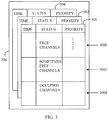
- Figure 3 presents tables in the memory 206.
- the tables may be formed on the basis of the operations of power measurements, detections and time stamping.
- the cognitive radio When the cognitive radio needs to find an unoccupied channel, it may refer to its own database to find unoccupied channels, for example, during the previous days at about the same time. In many cases, the occupancy of a radio channel follows the same temporal pattern, and therefore a channel that was occupied at the same time during previous days is most likely occupied also today.
- the historical record may be used to select the most promising channels for power level measurement and also for detection.
- the channels may be divided into three categories according to their statuses, for instance. In general, the number of statuses and their names may vary. It may also be possible that there are no statuses at all.
- the channels may be processed also by the probability of being free. Each channel which is always free may have a probability 1. Each channel which is always occupied may have a probability 0. All other channels which are sometimes free and sometimes occupied may have a probability which is between 0 and 1. A channel which has a probability 1 may first be selected to be checked.
- the channels may be arranged so that first there is a channel which has the lowest power level, and last there is the channel which has the highest power level. Then, the first channel is selected to be checked first by the power selector 2000, and if it can not selected by the channel selector 208, the second channel is selected next to be checked by the power selector 2000 etc.
- a first table 300 may include a part 3000 having information on available channels, a part 3002 having information on channels sometimes available and a part 3004 having information on channels which are not available at about t 0 , for example.
- a second table 302 may include similar information at t 1 .
- a third table 304 may include similar information at t 2 and so on. The times t 0 , t 1 , t 2 and so on refer to the time of the day, for example.
- the day of the week may also be taken into account in the comparison. It may also be possible to take into account whether it is question of a working day, a day at the weekend, Sunday and/or a holiday.
- a channel or channels may be selected from the parts 3000 and 3002 for the test including at least the measurement of a power level.
- a channel or channels may be selected from the part 3000 and only if part 3000 is empty a channel or channels may be selected from the part 3002.
- a present measurement result may be compared to earlier results in the memory 206. If the information in the memory 206 reveals that the same power level in the same channel resulted earlier in an occupied channel, the transmitter may skip the time consuming signal detection and select some other promising channel from the memory 206 for consideration. If, however, the information in the memory 206 reveals that the same power level in the same channel at the same time resulted earlier in a free channel, the signal detection can be performed to check that the channel is really unoccupied.
- a channel or channels may be selected from the table 3000 for communication.
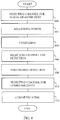
- Figure 4 presents a flow chart of the method.
- step 400 from a memory including information on a plurality of channels, a channel which was determined free is selected for power measurement.
- the received power from the selected channel is measured.
- step 404 the measured power and a power of the same channel saved in the memory is compared.
- step 406 the channel is selected for detection if the power in the measured channel is within a predetermined range from the power saved in the memory.
- detection of the channel is performed.
- step 410 on the basis of detection, the channel for communication is selected if the channel is detected unoccupied.
- step 412 communicating is performed in the channel.
- the embodiments described in the method steps may be implemented as a computer program comprising instructions for executing a computer process for communication method of a cognitive radio.
- the computer program may be stored on a computer program distribution medium readable by a computer or a processor.
- the computer program medium may be, for example but not limited to, an electric, magnetic, optical, infrared or semiconductor system, device or transmission medium.
- the computer program medium may include at least one of the following media: a computer readable medium, a program storage medium, a record medium, a computer readable memory, a random access memory, an erasable programmable read-only memory, a computer readable software distribution package, a computer readable signal, a computer readable telecommunications signal, computer readable printed matter, and a computer readable compressed software package.
Landscapes
- Engineering & Computer Science (AREA)
- Computer Networks & Wireless Communication (AREA)
- Signal Processing (AREA)
- Physics & Mathematics (AREA)
- Electromagnetism (AREA)
- Radar, Positioning & Navigation (AREA)
- Remote Sensing (AREA)
- Quality & Reliability (AREA)
- Probability & Statistics with Applications (AREA)
- Mobile Radio Communication Systems (AREA)
Claims (15)
- Kommunikationsverfahren einer kognitiven Funkeinrichtung, wobei das Verfahren umfasst
Auswählen (400), aus einem Speicher (206), der Information über mehrere Kanäle enthält, eines Kanals, der als frei ermittelt wird, zur Leistungsmessung,
gekennzeichnet durch
Messen (402) der empfangenen Leistung aus dem ausgewählten Kanal;
Vergleichen (404) der gemessenen Leistung und einer Leistung des gleichen Kanals, die in dem Speicher (206) gespeichert ist;
Auswählen (406) des Kanals für das Detektieren, wenn die Leistung in dem Kanal innerhalb eines vorbestimmten Bereichs der in dem Speicher (206) gespeicherten Leistung liegt;
Ausführen (408) der Detektierung des Kanals als Reaktion auf die Auswahl zum Detektieren; Auswählen (410) des Kanals zur Kommunikation, wenn der Kanal auf der Grundlage der Detektierung als unbesetzt ermittelt wird; und
Ausführen einer Kommunikation (412) in dem Kanal als Reaktion auf die Auswahl zur Kommunikation. - Verfahren nach Anspruch 1, wobei das Verfahren ferner umfasst:Speichern von Information über jeden gemessenen Kanal in dem Speicher (206).
- Verfahren nach Anspruch 1, wobei das Verfahren ferner Speichern von Information über jeden detektierten Kanal in dem Speicher (206) umfasst.
- Verfahren nach Anspruch 2 oder 3, wobei das Verfahren ferner regelmäßiges Ausführen von Messungen bezüglich der empfangenen Leistung umfasst.
- Verfahren nach Anspruch 2 oder 3, wobei das Verfahren regelmäßiges Ausführen einer Detektierung von Kanälen umfasst.
- Verfahren nach Anspruch 2 oder 3, wobei das Verfahren ferner umfasst: Versehen der gespeicherten Information mit einem Zeitstempel mit Tageszeit und Auswählen eines Kanals für die Kommunikation, dessen Zeitstempel in einem vorbestimmten Bereich der Tageszeit der Auswahl zur Kommunikation liegt.
- Verfahren nach Anspruch 2 oder 3, wobei das Verfahren ferner umfasst: Halten der gespeicherten Information in dem Speicher (206) nur für eine vorbestimmte Zeitdauer.
- Sender einer kognitiven Funkeinrichtung, wobei der Sender (100) aufweist
ein Leistungsmessgerät (2002), eine Leistungsauswahleinheit (2000), einen Detektor (2006), eine Detektierauswahleinheit (2004), einen Speicher (206) und eine Kanalauswahleinheit (208);
wobei die Leistungsauswahleinheit (2000) ausgebildet ist, aus einem Speicher (206), der Information über mehrere Kanäle enthält, einen Kanal, der als frei ermittelt wird, für eine Leistungsmessung auszuwählen,
dadurch gekennzeichnet, dass
das Leistungsmessgerät (2002) ausgebildet ist, die empfangene Leistung aus dem ausgewählten Kanal zu messen;
die Detektierauswahleinheit (2004) ausgebildet ist, die gemessene Leistung und eine Leistung des gleichen Kanals, die in dem Speicher (206) gespeichert ist, zu vergleichen und den Kanal zum Detektieren auszuwählen, wenn die Leistung in dem Kanal innerhalb eines vorbestimmten Bereichs der in dem Speicher (206) gespeicherten Leistung liegt;
der Detektor (2006) ausgebildet ist, das Detektieren des Kanals als Reaktion auf die Auswahl zum Detektieren auszuführen;
die Kanalauswahleinheit (208) ausgebildet ist, den Kanal zur Kommunikation auszuwählen, wenn der Kanal auf der Grundlage des Detektierens als nicht besetzt erfasst wird; und
der Sender (100) ausgebildet ist, in dem Kanal als Reaktion auf die Auswahl zur Kommunikation zu kommunizieren. - Sender nach Anspruch 8, wobei
der Speicher (206) ausgebildet ist, Information über jeden gemessenen Kanal zu speichern. - Sender nach Anspruch 8, wobei
der Speicher (206) ausgebildet ist, Information über jeden detektierten Kanal zu speichern. - Sender nach Anspruch 9, wobei der Sender ferner eine Markiereinheit (202) und eine Uhr (204) aufweist, wobei die Markiereinheit (202) ausgebildet ist, die gespeicherte Information mit einem Zeitstempel mit der Tageszeit, die von der Uhr (204) bereitgestellt wird, zu versehen, wobei die Leistungsauswahleinheit (2000) ausgebildet ist, für das Detektieren nur einen derartigen Kanal auszuwählen, dessen Zeitstempel in einem vorbestimmten Bereich der Tageszeit der Auswahl für das Detektieren liegt.
- Sender nach Anspruch 10, wobei der Sender ferner eine Markiereinheit (202) und eine Uhr (204) aufweist, wobei die Markiereinheit (202) ausgebildet ist, die gespeicherte Information mit einem Zeitstempel mit der Tageszeit, die von der Uhr (204) bereitgestellt wird, zu versehen, wobei die Detektierauswahleinheit (2004) ausgebildet ist, für die Kommunikation nur einen derartigen Kanal auszuwählen, dessen Zeitstempel in einem vorbestimmten Bereich der Tageszeit der Auswahl der Kommunikation liegt.
- Sender nach Anspruch 9, wobei das Leistungsmessgerät (2002) ausgebildet ist, Messungen der empfangenen Leistung regelmäßig auszuführen.
- Sender nach Anspruch 10, wobei der Detektor (2006) ausgebildet ist, die Detektierung von Kanälen regelmäßig auszuführen.
- Sender nach Anspruch 8, wobei der Speicher (206) ausgebildet ist, die gespeicherte Information nur für eine vorbestimmte Zeitdauer zu speichern.
Priority Applications (2)
| Application Number | Priority Date | Filing Date | Title |
|---|---|---|---|
| PL08750458T PL2269331T3 (pl) | 2008-04-23 | 2008-04-23 | Monitorowanie kanałów |
| PT87504585T PT2269331T (pt) | 2008-04-23 | 2008-04-23 | Monitorização de canais |
Applications Claiming Priority (1)
| Application Number | Priority Date | Filing Date | Title |
|---|---|---|---|
| PCT/FI2008/050215 WO2009130361A1 (en) | 2008-04-23 | 2008-04-23 | Monitoring channels |
Publications (3)
| Publication Number | Publication Date |
|---|---|
| EP2269331A1 EP2269331A1 (de) | 2011-01-05 |
| EP2269331A4 EP2269331A4 (de) | 2017-03-08 |
| EP2269331B1 true EP2269331B1 (de) | 2018-04-11 |
Family
ID=41216465
Family Applications (1)
| Application Number | Title | Priority Date | Filing Date |
|---|---|---|---|
| EP08750458.5A Active EP2269331B1 (de) | 2008-04-23 | 2008-04-23 | Kanalüberwachung |
Country Status (6)
| Country | Link |
|---|---|
| US (1) | US8219031B2 (de) |
| EP (1) | EP2269331B1 (de) |
| ES (1) | ES2672004T3 (de) |
| PL (1) | PL2269331T3 (de) |
| PT (1) | PT2269331T (de) |
| WO (1) | WO2009130361A1 (de) |
Families Citing this family (6)
| Publication number | Priority date | Publication date | Assignee | Title |
|---|---|---|---|---|
| FR2903213B1 (fr) * | 2006-07-03 | 2008-10-03 | Somfy Sas | Procede de communication par radiofrequences dans une installation domotique |
| US20110105036A1 (en) * | 2009-11-04 | 2011-05-05 | Motorola, Inc. | Method and apparatus for sensing presence of an incumbent signal on a secondary radio channel |
| US20120052827A1 (en) * | 2010-08-26 | 2012-03-01 | Qualcomm Incorporated | Decision directed antenna diversity in radio frequency receivers |
| US8812676B2 (en) * | 2010-09-03 | 2014-08-19 | Qualcomm Incorporated | Methods and apparatus to select and to reselect a resource for peer discovery in peer-to-peer networks |
| FI20115590A0 (fi) | 2011-06-14 | 2011-06-14 | Toni Linden | Kanavan valinta langattomassa tiedonsiirrossa |
| US20140313890A1 (en) * | 2011-11-01 | 2014-10-23 | Curtis Kent Shrote | Profiling wi-fi channel congestion and interference to optimize channel selection |
Family Cites Families (7)
| Publication number | Priority date | Publication date | Assignee | Title |
|---|---|---|---|---|
| WO1992019982A1 (en) | 1991-05-02 | 1992-11-12 | THE COMMONWEALTH OF AUSTRALIA c/o THE SECRETARY, DEPARTMENT OF DEFENCE | Operational channel selection |
| US5280630A (en) * | 1992-01-21 | 1994-01-18 | Motorola, Inc. | Method and apparatus for dynamic channel allocation |
| JP2000022712A (ja) | 1998-07-06 | 2000-01-21 | Nec Corp | チャネル選択方法 |
| US7215661B2 (en) * | 2003-02-24 | 2007-05-08 | Autocell Laboratories, Inc. | Method for associating access points with stations in a wireless network |
| US20040242149A1 (en) * | 2003-05-28 | 2004-12-02 | Louis Luneau | Flexible mobile base station |
| KR100538775B1 (ko) * | 2004-04-09 | 2005-12-23 | 전자부품연구원 | 무선통신 시스템에서의 다양한 간섭신호에 대한 지능형채널 선택 방법 및 장치 및 이를 이용한 수신기 |
| US7818011B2 (en) * | 2006-07-13 | 2010-10-19 | Motorola, Inc. | Method and apparatus for channel selection |
-
2008
- 2008-04-23 PL PL08750458T patent/PL2269331T3/pl unknown
- 2008-04-23 EP EP08750458.5A patent/EP2269331B1/de active Active
- 2008-04-23 WO PCT/FI2008/050215 patent/WO2009130361A1/en not_active Ceased
- 2008-04-23 PT PT87504585T patent/PT2269331T/pt unknown
- 2008-04-23 US US12/988,337 patent/US8219031B2/en not_active Expired - Fee Related
- 2008-04-23 ES ES08750458.5T patent/ES2672004T3/es active Active
Non-Patent Citations (1)
| Title |
|---|
| None * |
Also Published As
| Publication number | Publication date |
|---|---|
| US8219031B2 (en) | 2012-07-10 |
| EP2269331A4 (de) | 2017-03-08 |
| PT2269331T (pt) | 2018-05-07 |
| PL2269331T3 (pl) | 2018-07-31 |
| WO2009130361A1 (en) | 2009-10-29 |
| ES2672004T3 (es) | 2018-06-12 |
| US20110159827A1 (en) | 2011-06-30 |
| EP2269331A1 (de) | 2011-01-05 |
Similar Documents
| Publication | Publication Date | Title |
|---|---|---|
| EP1575322B1 (de) | Aufteilung des Spektrums im nicht lizenzierten Band | |
| US8219031B2 (en) | Monitoring channels | |
| EP2605435B1 (de) | Verfahren und vorrichtung zur übertragung von dowlink-steuerinformationen, verfahren und vorrichtung für den empfang von dowlink-steuerinformationen | |
| KR101109577B1 (ko) | 무선기, 무선통신시스템 및 무선전파의 검출방법 | |
| US7149205B2 (en) | Interference detection method and interference avoidance system for wireless communication links | |
| EP1374618B1 (de) | Methode und gerät zur steuerung einer dynamischen frequenzauswahl in einem mobilfunksystem | |
| US9094898B2 (en) | Method and apparatus for scanning multi-mode wireless communication environments | |
| EP2415317B1 (de) | Auswahl von betriebsfrequenzkanälen in einem drahtlosen kommunikationssystem | |
| US8630636B2 (en) | Radio base station and radio communication method | |
| EP2692176B1 (de) | Schnelle funkzugangstechnologieerkennung für zellensuche | |
| RU2006116888A (ru) | Способы и устройство поиска несущей частоты | |
| RU2008150490A (ru) | Обнаружение сигнала для систем беспроводной связи | |
| CN102484795B (zh) | 认知无线通信中的信息共享方法、认知无线通信装置以及认知无线通信系统 | |
| RU2009136418A (ru) | Конфигурирование повторителя | |
| WO2003024129A1 (en) | Assembly, and associated method, for facilitating channel frequency selection in a communication system utilizing a dynamic frequency selection scheme | |
| CN101682374A (zh) | 在一个或多个网络可共存的环境下确定特定信道是否可用的方法、接收用于检测的信号的方法和与不同类型的网络共存通信的方法 | |
| CN113691333B (zh) | 通信信道优化方法和装置、电子设备、存储介质 | |
| Vartiainen et al. | Priority channel selection based on detection history database | |
| KR101129795B1 (ko) | 지능형 무선 인지 기술에서의 효율적인 스펙트럼 감지 방법및 절차 | |
| EP1376911B1 (de) | Druckgerät, diagnoseverfahren für druckgerät und diagnoseprogramm für druckgerät | |
| CN104184882A (zh) | 一种设置PA blanking工作模式的方法和装置 | |
| EP2966464B1 (de) | Mobiles etikettenleserportal | |
| CN103546939A (zh) | 一种多通道无线通信系统小区搜索的方法和终端 | |
| CN101370250B (zh) | 终端接入认知系统的方法及装置 | |
| JP3704495B2 (ja) | 移動通信システムにおける制御信号送信方法 |
Legal Events
| Date | Code | Title | Description |
|---|---|---|---|
| PUAI | Public reference made under article 153(3) epc to a published international application that has entered the european phase |
Free format text: ORIGINAL CODE: 0009012 |
|
| 17P | Request for examination filed |
Effective date: 20101029 |
|
| AK | Designated contracting states |
Kind code of ref document: A1 Designated state(s): AT BE BG CH CY CZ DE DK EE ES FI FR GB GR HR HU IE IS IT LI LT LU LV MC MT NL NO PL PT RO SE SI SK TR |
|
| AX | Request for extension of the european patent |
Extension state: AL BA MK RS |
|
| DAX | Request for extension of the european patent (deleted) | ||
| RA4 | Supplementary search report drawn up and despatched (corrected) |
Effective date: 20170207 |
|
| RIC1 | Information provided on ipc code assigned before grant |
Ipc: H04W 88/08 20090101ALI20170201BHEP Ipc: H04B 7/26 20060101ALI20170201BHEP Ipc: H04W 74/00 20090101ALI20170201BHEP Ipc: H04B 17/00 20150101AFI20170201BHEP Ipc: H04W 24/02 20090101ALI20170201BHEP Ipc: H04W 88/02 20090101ALI20170201BHEP |
|
| GRAP | Despatch of communication of intention to grant a patent |
Free format text: ORIGINAL CODE: EPIDOSNIGR1 |
|
| INTG | Intention to grant announced |
Effective date: 20171107 |
|
| GRAS | Grant fee paid |
Free format text: ORIGINAL CODE: EPIDOSNIGR3 |
|
| GRAA | (expected) grant |
Free format text: ORIGINAL CODE: 0009210 |
|
| AK | Designated contracting states |
Kind code of ref document: B1 Designated state(s): AT BE BG CH CY CZ DE DK EE ES FI FR GB GR HR HU IE IS IT LI LT LU LV MC MT NL NO PL PT RO SE SI SK TR |
|
| RAP1 | Party data changed (applicant data changed or rights of an application transferred) |
Owner name: BITTIUM WIRELESS OY |
|
| REG | Reference to a national code |
Ref country code: GB Ref legal event code: FG4D |
|
| REG | Reference to a national code |
Ref country code: CH Ref legal event code: EP |
|
| REG | Reference to a national code |
Ref country code: AT Ref legal event code: REF Ref document number: 989086 Country of ref document: AT Kind code of ref document: T Effective date: 20180415 |
|
| REG | Reference to a national code |
Ref country code: FR Ref legal event code: PLFP Year of fee payment: 11 |
|
| REG | Reference to a national code |
Ref country code: IE Ref legal event code: FG4D |
|
| REG | Reference to a national code |
Ref country code: PT Ref legal event code: SC4A Ref document number: 2269331 Country of ref document: PT Date of ref document: 20180507 Kind code of ref document: T Free format text: AVAILABILITY OF NATIONAL TRANSLATION Effective date: 20180424 |
|
| REG | Reference to a national code |
Ref country code: DE Ref legal event code: R096 Ref document number: 602008054786 Country of ref document: DE |
|
| REG | Reference to a national code |
Ref country code: CH Ref legal event code: NV Representative=s name: GEVERS SA, CH |
|
| REG | Reference to a national code |
Ref country code: ES Ref legal event code: FG2A Ref document number: 2672004 Country of ref document: ES Kind code of ref document: T3 Effective date: 20180612 |
|
| REG | Reference to a national code |
Ref country code: SE Ref legal event code: TRGR |
|
| REG | Reference to a national code |
Ref country code: NL Ref legal event code: FP |
|
| REG | Reference to a national code |
Ref country code: NO Ref legal event code: T2 Effective date: 20180411 |
|
| REG | Reference to a national code |
Ref country code: LT Ref legal event code: MG4D |
|
| PG25 | Lapsed in a contracting state [announced via postgrant information from national office to epo] |
Ref country code: LT Free format text: LAPSE BECAUSE OF FAILURE TO SUBMIT A TRANSLATION OF THE DESCRIPTION OR TO PAY THE FEE WITHIN THE PRESCRIBED TIME-LIMIT Effective date: 20180411 Ref country code: BG Free format text: LAPSE BECAUSE OF FAILURE TO SUBMIT A TRANSLATION OF THE DESCRIPTION OR TO PAY THE FEE WITHIN THE PRESCRIBED TIME-LIMIT Effective date: 20180711 |
|
| PG25 | Lapsed in a contracting state [announced via postgrant information from national office to epo] |
Ref country code: GR Free format text: LAPSE BECAUSE OF FAILURE TO SUBMIT A TRANSLATION OF THE DESCRIPTION OR TO PAY THE FEE WITHIN THE PRESCRIBED TIME-LIMIT Effective date: 20180712 Ref country code: LV Free format text: LAPSE BECAUSE OF FAILURE TO SUBMIT A TRANSLATION OF THE DESCRIPTION OR TO PAY THE FEE WITHIN THE PRESCRIBED TIME-LIMIT Effective date: 20180411 Ref country code: HR Free format text: LAPSE BECAUSE OF FAILURE TO SUBMIT A TRANSLATION OF THE DESCRIPTION OR TO PAY THE FEE WITHIN THE PRESCRIBED TIME-LIMIT Effective date: 20180411 |
|
| REG | Reference to a national code |
Ref country code: BE Ref legal event code: MM Effective date: 20180430 |
|
| REG | Reference to a national code |
Ref country code: DE Ref legal event code: R097 Ref document number: 602008054786 Country of ref document: DE |
|
| REG | Reference to a national code |
Ref country code: IE Ref legal event code: MM4A |
|
| PG25 | Lapsed in a contracting state [announced via postgrant information from national office to epo] |
Ref country code: CZ Free format text: LAPSE BECAUSE OF FAILURE TO SUBMIT A TRANSLATION OF THE DESCRIPTION OR TO PAY THE FEE WITHIN THE PRESCRIBED TIME-LIMIT Effective date: 20180411 Ref country code: RO Free format text: LAPSE BECAUSE OF FAILURE TO SUBMIT A TRANSLATION OF THE DESCRIPTION OR TO PAY THE FEE WITHIN THE PRESCRIBED TIME-LIMIT Effective date: 20180411 Ref country code: MC Free format text: LAPSE BECAUSE OF FAILURE TO SUBMIT A TRANSLATION OF THE DESCRIPTION OR TO PAY THE FEE WITHIN THE PRESCRIBED TIME-LIMIT Effective date: 20180411 Ref country code: SK Free format text: LAPSE BECAUSE OF FAILURE TO SUBMIT A TRANSLATION OF THE DESCRIPTION OR TO PAY THE FEE WITHIN THE PRESCRIBED TIME-LIMIT Effective date: 20180411 Ref country code: DK Free format text: LAPSE BECAUSE OF FAILURE TO SUBMIT A TRANSLATION OF THE DESCRIPTION OR TO PAY THE FEE WITHIN THE PRESCRIBED TIME-LIMIT Effective date: 20180411 Ref country code: LU Free format text: LAPSE BECAUSE OF NON-PAYMENT OF DUE FEES Effective date: 20180423 Ref country code: EE Free format text: LAPSE BECAUSE OF FAILURE TO SUBMIT A TRANSLATION OF THE DESCRIPTION OR TO PAY THE FEE WITHIN THE PRESCRIBED TIME-LIMIT Effective date: 20180411 |
|
| PLBE | No opposition filed within time limit |
Free format text: ORIGINAL CODE: 0009261 |
|
| STAA | Information on the status of an ep patent application or granted ep patent |
Free format text: STATUS: NO OPPOSITION FILED WITHIN TIME LIMIT |
|
| PG25 | Lapsed in a contracting state [announced via postgrant information from national office to epo] |
Ref country code: BE Free format text: LAPSE BECAUSE OF NON-PAYMENT OF DUE FEES Effective date: 20180430 |
|
| 26N | No opposition filed |
Effective date: 20190114 |
|
| PG25 | Lapsed in a contracting state [announced via postgrant information from national office to epo] |
Ref country code: IE Free format text: LAPSE BECAUSE OF NON-PAYMENT OF DUE FEES Effective date: 20180423 |
|
| PG25 | Lapsed in a contracting state [announced via postgrant information from national office to epo] |
Ref country code: SI Free format text: LAPSE BECAUSE OF FAILURE TO SUBMIT A TRANSLATION OF THE DESCRIPTION OR TO PAY THE FEE WITHIN THE PRESCRIBED TIME-LIMIT Effective date: 20180411 |
|
| REG | Reference to a national code |
Ref country code: CH Ref legal event code: NV Representative=s name: BOVARD SA NEUCHATEL CONSEILS EN PROPRIETE INTE, CH |
|
| PG25 | Lapsed in a contracting state [announced via postgrant information from national office to epo] |
Ref country code: MT Free format text: LAPSE BECAUSE OF NON-PAYMENT OF DUE FEES Effective date: 20180423 |
|
| PG25 | Lapsed in a contracting state [announced via postgrant information from national office to epo] |
Ref country code: TR Free format text: LAPSE BECAUSE OF FAILURE TO SUBMIT A TRANSLATION OF THE DESCRIPTION OR TO PAY THE FEE WITHIN THE PRESCRIBED TIME-LIMIT Effective date: 20180411 |
|
| PG25 | Lapsed in a contracting state [announced via postgrant information from national office to epo] |
Ref country code: HU Free format text: LAPSE BECAUSE OF FAILURE TO SUBMIT A TRANSLATION OF THE DESCRIPTION OR TO PAY THE FEE WITHIN THE PRESCRIBED TIME-LIMIT; INVALID AB INITIO Effective date: 20080423 |
|
| PG25 | Lapsed in a contracting state [announced via postgrant information from national office to epo] |
Ref country code: CY Free format text: LAPSE BECAUSE OF FAILURE TO SUBMIT A TRANSLATION OF THE DESCRIPTION OR TO PAY THE FEE WITHIN THE PRESCRIBED TIME-LIMIT Effective date: 20180411 |
|
| PG25 | Lapsed in a contracting state [announced via postgrant information from national office to epo] |
Ref country code: IS Free format text: LAPSE BECAUSE OF FAILURE TO SUBMIT A TRANSLATION OF THE DESCRIPTION OR TO PAY THE FEE WITHIN THE PRESCRIBED TIME-LIMIT Effective date: 20180811 |
|
| REG | Reference to a national code |
Ref country code: AT Ref legal event code: UEP Ref document number: 989086 Country of ref document: AT Kind code of ref document: T Effective date: 20180411 |
|
| PGFP | Annual fee paid to national office [announced via postgrant information from national office to epo] |
Ref country code: NL Payment date: 20230419 Year of fee payment: 16 |
|
| PGFP | Annual fee paid to national office [announced via postgrant information from national office to epo] |
Ref country code: PT Payment date: 20230413 Year of fee payment: 16 Ref country code: NO Payment date: 20230421 Year of fee payment: 16 Ref country code: IT Payment date: 20230426 Year of fee payment: 16 Ref country code: ES Payment date: 20230627 Year of fee payment: 16 Ref country code: CH Payment date: 20230502 Year of fee payment: 16 |
|
| PGFP | Annual fee paid to national office [announced via postgrant information from national office to epo] |
Ref country code: FI Payment date: 20230419 Year of fee payment: 16 Ref country code: AT Payment date: 20230420 Year of fee payment: 16 |
|
| PGFP | Annual fee paid to national office [announced via postgrant information from national office to epo] |
Ref country code: PL Payment date: 20230321 Year of fee payment: 16 |
|
| REG | Reference to a national code |
Ref country code: CH Ref legal event code: PL |
|
| REG | Reference to a national code |
Ref country code: NL Ref legal event code: MM Effective date: 20240501 |
|
| PG25 | Lapsed in a contracting state [announced via postgrant information from national office to epo] |
Ref country code: PT Free format text: LAPSE BECAUSE OF NON-PAYMENT OF DUE FEES Effective date: 20241023 |
|
| REG | Reference to a national code |
Ref country code: AT Ref legal event code: MM01 Ref document number: 989086 Country of ref document: AT Kind code of ref document: T Effective date: 20240423 |
|
| PG25 | Lapsed in a contracting state [announced via postgrant information from national office to epo] |
Ref country code: PT Free format text: LAPSE BECAUSE OF NON-PAYMENT OF DUE FEES Effective date: 20241023 |
|
| PG25 | Lapsed in a contracting state [announced via postgrant information from national office to epo] |
Ref country code: NO Free format text: LAPSE BECAUSE OF NON-PAYMENT OF DUE FEES Effective date: 20240430 |
|
| PG25 | Lapsed in a contracting state [announced via postgrant information from national office to epo] |
Ref country code: NL Free format text: LAPSE BECAUSE OF NON-PAYMENT OF DUE FEES Effective date: 20240501 Ref country code: FI Free format text: LAPSE BECAUSE OF NON-PAYMENT OF DUE FEES Effective date: 20240423 |
|
| PG25 | Lapsed in a contracting state [announced via postgrant information from national office to epo] |
Ref country code: AT Free format text: LAPSE BECAUSE OF NON-PAYMENT OF DUE FEES Effective date: 20240423 |
|
| PG25 | Lapsed in a contracting state [announced via postgrant information from national office to epo] |
Ref country code: NO Free format text: LAPSE BECAUSE OF NON-PAYMENT OF DUE FEES Effective date: 20240430 Ref country code: NL Free format text: LAPSE BECAUSE OF NON-PAYMENT OF DUE FEES Effective date: 20240501 Ref country code: FI Free format text: LAPSE BECAUSE OF NON-PAYMENT OF DUE FEES Effective date: 20240423 Ref country code: AT Free format text: LAPSE BECAUSE OF NON-PAYMENT OF DUE FEES Effective date: 20240423 Ref country code: CH Free format text: LAPSE BECAUSE OF NON-PAYMENT OF DUE FEES Effective date: 20240430 |
|
| PG25 | Lapsed in a contracting state [announced via postgrant information from national office to epo] |
Ref country code: PL Free format text: LAPSE BECAUSE OF NON-PAYMENT OF DUE FEES Effective date: 20240423 |
|
| PG25 | Lapsed in a contracting state [announced via postgrant information from national office to epo] |
Ref country code: IT Free format text: LAPSE BECAUSE OF NON-PAYMENT OF DUE FEES Effective date: 20240423 |
|
| REG | Reference to a national code |
Ref country code: ES Ref legal event code: FD2A Effective date: 20250530 |
|
| PGFP | Annual fee paid to national office [announced via postgrant information from national office to epo] |
Ref country code: DE Payment date: 20250422 Year of fee payment: 18 |
|
| PG25 | Lapsed in a contracting state [announced via postgrant information from national office to epo] |
Ref country code: ES Free format text: LAPSE BECAUSE OF NON-PAYMENT OF DUE FEES Effective date: 20240424 |
|
| PGFP | Annual fee paid to national office [announced via postgrant information from national office to epo] |
Ref country code: GB Payment date: 20250423 Year of fee payment: 18 |
|
| PGFP | Annual fee paid to national office [announced via postgrant information from national office to epo] |
Ref country code: FR Payment date: 20250424 Year of fee payment: 18 |
|
| PGFP | Annual fee paid to national office [announced via postgrant information from national office to epo] |
Ref country code: SE Payment date: 20250429 Year of fee payment: 18 |