EP2267985B1 - Intelligenter Router für drahtlose Sensornetze - Google Patents
Intelligenter Router für drahtlose Sensornetze Download PDFInfo
- Publication number
- EP2267985B1 EP2267985B1 EP10002096A EP10002096A EP2267985B1 EP 2267985 B1 EP2267985 B1 EP 2267985B1 EP 10002096 A EP10002096 A EP 10002096A EP 10002096 A EP10002096 A EP 10002096A EP 2267985 B1 EP2267985 B1 EP 2267985B1
- Authority
- EP
- European Patent Office
- Prior art keywords
- packet
- message
- router
- network hub
- communication failure
- Prior art date
- Legal status (The legal status is an assumption and is not a legal conclusion. Google has not performed a legal analysis and makes no representation as to the accuracy of the status listed.)
- Not-in-force
Links
- 238000004891 communication Methods 0.000 claims description 72
- 238000000034 method Methods 0.000 claims description 26
- 230000008569 process Effects 0.000 claims description 13
- 238000012544 monitoring process Methods 0.000 claims description 5
- 230000005540 biological transmission Effects 0.000 claims description 3
- 230000004044 response Effects 0.000 claims description 3
- 238000010276 construction Methods 0.000 description 10
- 230000009471 action Effects 0.000 description 9
- 230000008901 benefit Effects 0.000 description 5
- 239000000779 smoke Substances 0.000 description 3
- 230000003247 decreasing effect Effects 0.000 description 2
- 238000005562 fading Methods 0.000 description 2
- UGFAIRIUMAVXCW-UHFFFAOYSA-N Carbon monoxide Chemical compound [O+]#[C-] UGFAIRIUMAVXCW-UHFFFAOYSA-N 0.000 description 1
- 229910002091 carbon monoxide Inorganic materials 0.000 description 1
- 230000001419 dependent effect Effects 0.000 description 1
- 238000013461 design Methods 0.000 description 1
- 238000005265 energy consumption Methods 0.000 description 1
- 238000001914 filtration Methods 0.000 description 1
- 230000000977 initiatory effect Effects 0.000 description 1
- 230000007246 mechanism Effects 0.000 description 1
- 238000012986 modification Methods 0.000 description 1
- 230000004048 modification Effects 0.000 description 1
- 230000002688 persistence Effects 0.000 description 1
- 238000012545 processing Methods 0.000 description 1
- 230000002459 sustained effect Effects 0.000 description 1
- 230000001360 synchronised effect Effects 0.000 description 1
- 230000001052 transient effect Effects 0.000 description 1
Images



Classifications
-
- H—ELECTRICITY
- H04—ELECTRIC COMMUNICATION TECHNIQUE
- H04L—TRANSMISSION OF DIGITAL INFORMATION, e.g. TELEGRAPHIC COMMUNICATION
- H04L1/00—Arrangements for detecting or preventing errors in the information received
- H04L1/12—Arrangements for detecting or preventing errors in the information received by using return channel
- H04L1/16—Arrangements for detecting or preventing errors in the information received by using return channel in which the return channel carries supervisory signals, e.g. repetition request signals
- H04L1/18—Automatic repetition systems, e.g. Van Duuren systems
- H04L1/1803—Stop-and-wait protocols
-
- H—ELECTRICITY
- H04—ELECTRIC COMMUNICATION TECHNIQUE
- H04L—TRANSMISSION OF DIGITAL INFORMATION, e.g. TELEGRAPHIC COMMUNICATION
- H04L1/00—Arrangements for detecting or preventing errors in the information received
- H04L1/20—Arrangements for detecting or preventing errors in the information received using signal quality detector
-
- H—ELECTRICITY
- H04—ELECTRIC COMMUNICATION TECHNIQUE
- H04L—TRANSMISSION OF DIGITAL INFORMATION, e.g. TELEGRAPHIC COMMUNICATION
- H04L41/00—Arrangements for maintenance, administration or management of data switching networks, e.g. of packet switching networks
- H04L41/06—Management of faults, events, alarms or notifications
- H04L41/0681—Configuration of triggering conditions
-
- H—ELECTRICITY
- H04—ELECTRIC COMMUNICATION TECHNIQUE
- H04L—TRANSMISSION OF DIGITAL INFORMATION, e.g. TELEGRAPHIC COMMUNICATION
- H04L43/00—Arrangements for monitoring or testing data switching networks
- H04L43/08—Monitoring or testing based on specific metrics, e.g. QoS, energy consumption or environmental parameters
- H04L43/0805—Monitoring or testing based on specific metrics, e.g. QoS, energy consumption or environmental parameters by checking availability
- H04L43/0811—Monitoring or testing based on specific metrics, e.g. QoS, energy consumption or environmental parameters by checking availability by checking connectivity
-
- H—ELECTRICITY
- H04—ELECTRIC COMMUNICATION TECHNIQUE
- H04L—TRANSMISSION OF DIGITAL INFORMATION, e.g. TELEGRAPHIC COMMUNICATION
- H04L67/00—Network arrangements or protocols for supporting network services or applications
- H04L67/01—Protocols
- H04L67/12—Protocols specially adapted for proprietary or special-purpose networking environments, e.g. medical networks, sensor networks, networks in vehicles or remote metering networks
-
- H—ELECTRICITY
- H04—ELECTRIC COMMUNICATION TECHNIQUE
- H04L—TRANSMISSION OF DIGITAL INFORMATION, e.g. TELEGRAPHIC COMMUNICATION
- H04L67/00—Network arrangements or protocols for supporting network services or applications
- H04L67/50—Network services
- H04L67/56—Provisioning of proxy services
- H04L67/564—Enhancement of application control based on intercepted application data
-
- H—ELECTRICITY
- H04—ELECTRIC COMMUNICATION TECHNIQUE
- H04L—TRANSMISSION OF DIGITAL INFORMATION, e.g. TELEGRAPHIC COMMUNICATION
- H04L67/00—Network arrangements or protocols for supporting network services or applications
- H04L67/50—Network services
- H04L67/56—Provisioning of proxy services
- H04L67/59—Providing operational support to end devices by off-loading in the network or by emulation, e.g. when they are unavailable
-
- H—ELECTRICITY
- H04—ELECTRIC COMMUNICATION TECHNIQUE
- H04L—TRANSMISSION OF DIGITAL INFORMATION, e.g. TELEGRAPHIC COMMUNICATION
- H04L69/00—Network arrangements, protocols or services independent of the application payload and not provided for in the other groups of this subclass
- H04L69/40—Network arrangements, protocols or services independent of the application payload and not provided for in the other groups of this subclass for recovering from a failure of a protocol instance or entity, e.g. service redundancy protocols, protocol state redundancy or protocol service redirection
-
- H—ELECTRICITY
- H04—ELECTRIC COMMUNICATION TECHNIQUE
- H04L—TRANSMISSION OF DIGITAL INFORMATION, e.g. TELEGRAPHIC COMMUNICATION
- H04L1/00—Arrangements for detecting or preventing errors in the information received
- H04L2001/0092—Error control systems characterised by the topology of the transmission link
- H04L2001/0097—Relays
Definitions
- the present invention relates to wireless sensor networks, and more particularly, to wireless sensor networks used, for example, in security systems with improved communication reliability.
- Some wireless networks experience communication failures due to transient external factors.
- a loss of connectivity between the sensors or devices can be caused by phenomena such as multipath fading, structural interference (such as that caused by a wall, building, or other object), and the like.
- Torsten Braun et al. "TCP support for sensor networks", Wierless on Demand Network Systems and Services, 2007, WONS '07, Fourth Annual Conference On, IEEE, PI , discloses a system for supporting communications in sensor networks, where intermediate sensor nodes cache TCP data segments between sending and receiving sensors.
- While wireless systems have drawbacks such as a loss of connectivity due to interference, such networks do have advantages.
- One of the advantages is that a wireless network may be implemented without the need to route wire between the devices. It is useful to implement building and home security systems using wireless communications, in part, to avoid the need to route wire throughout a building.
- a loss of connectivity in a security system results in a loss of protection.
- a high-quality wireless security system should include a mechanism to help reduce or respond to a loss of connectivity.
- Connectivity problems can be addressed by using repeater networks or mesh networks.
- One drawback of these types of networks is that they require a relatively large amount of energy and increase the number of messages that are sent to achieve a desired communication. As a consequence, it is desirable to provide an alternative method of ensuring connectivity and functionality that is both energy- and message-efficient.
- the invention provides a system for routing packets in a wireless security system.
- the system includes a network hub that wirelessly sends and receives packets, at least one sensor that wirelessly sends and receives packets to and from the network hub, and a packet router that monitors the packet communications between the network hub and the at least one sensor.
- the packet router determines when a communication failure occurs, and the packet router is configured to send a first message packet to the network hub if a first type of communication failure occurs.
- the first type of communication failure is a failed packet delivery from the sensor to the network hub.
- the router is also configured to send a second message packet to the at least one sensor if a second type of communication failure occurs.
- the second type of communication failure is a failed packet delivery from the system hub to the sensor.
- the invention provides a method of routing packets in a wireless security system.
- the method includes monitoring packet communications between a first device and a second device, detecting a failed communication of a first message packet, identifying one of the first device and the second device as a receiving device intended to receive the first message packet, and transmitting a second message packet to the receiving device.
- the invention provides a method for routing packets in a wireless security system.
- the method includes monitoring packet communications between a plurality of devices, detecting a failed communication of a message packet, identifying a first device responsible for sending the message packet, identifying a second device intended to receive the message packet, and assisting the communication between the first device and the second device.
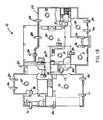
- Fig. 1A illustrates a wireless security system 10 in a building 14.
- the security system 10 includes a network hub 18, a control panel 22, a plurality of sensors 26, 30, and 34, at least one alarm annunciator 38, and at least one intelligent packet router 42.
- the network hub 18 is typically installed in a central location in a building 14 and is configured to wirelessly communicate with the plurality of sensors 26, 30, and 34.
- the network hub 18 is connected to a control panel 22. A user may enter information, perform diagnostics, or perform other functions by using the control panel 22 to communicate with the security system 10.
- Wireless communication in the security system 10 is achieved through the wireless transmission of packets on designated radio-frequency (RF) channels according to a defined network protocol such as the BOSCH wLSN protocol or others which may employ single frequency, frequency hopping, TDMA, or synchronous time slotting for point-to-point and point-to-multipoint communications that defines the operation of the security system 10.
- Packets sometimes referred to as message packets, are groups of bits or characters that typically contain a preamble, a start word, payload data, and an error check.
- the payload data may be divided into a device ID, a message type, and message specific data.
- Some message types include alarm messages, acknowledgement messages, and control messages.
- other network protocols may use a different number of message types or may use different message types.
- the wireless security system 10 includes various types of sensors including contact sensors 26, smoke sensors 30, and motion sensors 34.
- the sensors 26, 30, and 34 are configured to send and receive packets and are typically dispersed throughout the building within wireless range of the network hub 18.
- the contact sensors 26 are configured to detect when contact is broken (e.g., opening of a door or window) and emit an alarm message packet in response.
- smoke sensors 30 emit an alarm message packet when they detect smoke
- motion sensors 34 emit an alarm message packet when they detect motion.
- the sensors 26, 30, and 34 are powered by batteries or similar power sources because they do not require sustained power for long periods of time.
- the sensors 26, 30, and 34 may be connected to the power supply for the building 14.
- additional sensors may be employed (e.g., carbon monoxide sensors, vibration sensors, temperature sensors, position sensors etc.) or only one type of sensor may be employed.
- the alarm annunciators 38 are located throughout the building and are configured to send and receive packets. For example, an annunciator 38 may receive a packet from the network hub 18, process the information, and emit a sound as an alarm. Typically, the annunciators 38 are connected to the power supply for the building 14 because enough power should be available to maintain the annunciation for an unknown period of time.
- the packet router 42 monitors the communications between devices in the system 10.
- the packet router 42 is configured to assist the communication, as described with respect to Figs. 2-4 when a failed communication is detected.
- Fig. 1B illustrates a second embodiment of the invention in which one of the annunciators 38 has a dual-functionality.
- the annunciator 38 is also configured as a packet router 42.
- Other devices e.g., sensors, network hub 18, external devices, etc.
- the system 10 could also be configured to act as packet routers 42.
- Fig. 2 illustrates the communication that may occur between two devices.
- communication between the network hub 18 and a wireless sensor 30 is illustrated.
- the wireless sensor 30 may send an alarm message packet to the network hub 18.
- the network hub 18 receives the alarm message packet, processes it, and sends an acknowledgement message packet back to the wireless sensor 30.
- the packet router 42 monitors the communications but takes no other action during normal operation.
- a communication failure may occur.
- the failed communication may be caused by phenomena such as multipath fading, structural interference (such as that caused by a wall, building, or other object), and the like.
- the wireless sensor 30 is configured to send a message packet to the network hub 18 and wait for an acknowledgement message packet from the network hub 18. If a certain amount of time passes and the wireless sensor 30 does not receive an acknowledgement message packet, the wireless sensor 30 will perform a retry or attempt to resend the message packet to the network hub 18. Repeated retries are undesirable because they result in excessive energy consumption by the sending device and any other device that may be listening for the same type of incoming message.
- the packet router 42 assumes a communication failure 54 (as described below) between the wireless sensor 30 and the network hub 18.
- the packet router 42 intercepts the alarm message packet from the wireless sensor 30 and forwards the intercepted alarm message packet to the network hub 18.
- the network hub 18 receives the forwarded alarm message packet, processes it, and transmits an acknowledgement message packet back to the wireless sensor 30.
- the acknowledgement message packet may be received by the packet router 42 and forwarded by the packet router 42 to the wireless sensor 30, thus completing the message transaction, in a manner transparent to the network hub 18 and wireless sensor 30.
- the packet router 42 may assist the communication in a different way.
- the packet router 42 may intercept the alarm message packet from the wireless sensor 30 and send an acknowledgement message packet to wireless sensor 30, allowing the sensor 30 to take appropriate action (e.g., the cessation of re-sending of the alarm message packet).
- the packet router 42 may then forward the intercepted alarm message packet to the network hub 18, as if the packet router 42 was the initiating wireless sensor 30.
- the network hub 18 receives the forwarded alarm message packet, processes it as if it came directly from the wireless sensor 30, and transmits an acknowledgement message packet that is intended for the wireless sensor 30 but is intercepted by the packet router 42, thus completing the message transaction, in a manner transparent to the network hub 18 and wireless sensor 30.
- the assisted packet communications may be considered transparent to the network hub 18 and the wireless sensor 30 because the forwarded packets contain data that is substantially equal to the original packet data.
- the packet router 42 does not insert, delete, or otherwise modify packets.
- the network hub 18 and the wireless sensor 30 do not require any additional software that is designed to handle different types of packets (e.g., packets that contain a different data format than expected in the current system).
- the network hub 18 processes messages received from the packet router 42 in the same manner as the network hub 18 processes messages received directly from the wireless sensor 30.
- the wireless sensor 30 processes packets received from the packet router 42 in the same manner as the wireless sensor 30 processes packets from the network hub 18.
- a packet router 42 according to the first embodiment may be implemented in almost any preexisting wireless communication system without a requirement for adding additional software to any of the devices not designated as packet routers and without making modifications to preexisting databases.
- Fig. 3 illustrates one example of logic that may be employed by the packet router 42.
- the packet router 42 monitors the RF channels for network messages or packets. When a packet is detected by the packet router 42, the packet router 42 processes the information to identify the attempt number (i.e., the number of times the message has been sent) of the packet. If the attempt number is greater than a threshold value (e.g., three), the packet router 42 assumes a failed communication. Although the communication failure is assumed when the attempt number is greater than a predetermined threshold, it is possible that the communication did not fail. Thus, it is possible that the packet router 42 may incorrectly assume a failed communication.
- a threshold value e.g., three
- the threshold value may be higher or lower than three. For example, the threshold may be increased if the system has ample bandwidth available and the threshold may be decreased if the system has a lot of traffic and little bandwidth available.
- the packet router 42 After a failed communication is assumed, the packet router 42 identifies the receiving device and forwards the packet to the intended receiving device without substantially modifying or altering the packet. Then, the packet router 42 resumes scanning of the RF channels for network messages or packets.
- the packet routers 42 may process the packets in a different way. As illustrated in the flowchart of Fig. 3 , the packet router 42 monitors the RF channels. When a message packet is detected by the packet router 42, the packet router 42 processes the information to identify the sending device and the message type (e.g., control message, alarm message, acknowledgement message, etc.) by having inherent knowledge of the protocol being supported. Some examples of protocol specific information that can be used are message type, time slot, explicit origin, destination addressing, etc.
- the message type e.g., control message, alarm message, acknowledgement message, etc.
- the packet router 42 has access to a Message/Device Database containing information such as the identification codes for each device in the security system 10, definitions of the message types, device-specific instructions, message-specific instructions, etc.
- the Message/Device Database may also contain information regarding the network protocol (e.g., alternate network channels, pre-defined sub slots in a Time Division Multiple Access (TDMA) protocol implementation, etc.).
- the sending and receiving device IDs are located within each packet.
- only the sending device is located within each packet. For example, in star networks, a central device sends and receives messages from all other devices in the network. The devices (e.g., sensors) only send messages to the central device.
- the device ID located in the packets corresponds to the sending device, and the receiving device is defined to be the central hub.
- time slotting may be used to determine the recipient. For example, after the central device receives a message packet, a certain period of time is defined by the protocol during which an acknowledgement message packet is sent back to the sending device and no other communications are allowed. In this way, the intended receiver is defined by the time slot in which the message is sent.
- the packet router 42 may increment a message counter or tag the message in a manner allowing tracking and temporary persistence. For example, if the packet router 42 detects a message packet, the packet router 42 increments the message counter that corresponds to the identified sending device. After the message counter is incremented, the packet router 42 compares the value of the message counter to a pre-defined threshold. In the illustrated construction, the message counter is compared to a threshold of three such that when the message counter is greater than three, the packet router 42 takes further action (see Fig. 4 ) and when the message counter is less than or equal to three, the packet router 42 takes no action and continues to scan the RF channels. In some embodiments, the threshold for the message counters is higher or lower than three.
- the packet router 42 looks up the sending device identification and message in the Message/Device Database to determine whether it should assist packet routing. For example, if the message is an alarm message sent from a wireless sensor 30 to the network hub 18, the packet router 42 determines that assistance should be provided to ensure the alarm message is received by the network hub 18. In other instances, the Message/Device Database contains instructions to ignore packets sent by a particular device or to ignore specified messages sent by any device.
- the packet router 42 After the packet router 42 determines that it should take action, the packet router 42 sends an acknowledgement message packet to the sending device.
- the acknowledgement message packet contains the same information that would be received from the receiving device and may also include the identification code of the packet router 42.
- the sending device receives the acknowledgement message packet and interprets it. Thus, the sending device stops trying to resend the original message packet to the receiving device while the packet router 42 assists communication.
- the packet router 42 repackages the original message packet into a new message packet (e.g., repackaged message packet) that contains the same information as the original message packet and further includes the identification code of the packet router 42.
- the packet router 42 sends the repackaged message packet to the receiving device, and the receiving device processes the message packet.
- the receiving device transmits an acknowledgement message packet to the packet router 42 that also contains the identification code of the sending device.
- the packet router 42 uses this information to determine that the repackaged message packet has been received and no further action is required.
- the packet router 42 clears the corresponding message counter for the sending device and continues to monitor the RF channels.
- the packet router 42 may operate in a similar manner as the second embodiment.
- the packet router 42 may be configured to store exact copies of each packet it monitors or reads for comparison with subsequent packets read by the packet router 42.
- the packet router 42 may track the messages by counting the number of times it reads the same packet.
- the packet router 42 may interpret two messages as being equal when they exactly match each other, when the payload data is exactly the same, or in response to a comparison of a different portion of the data contained in the packet.
- the packet router 42 reads the same message packet multiple times (e.g., three times), it may assume a communication failure has occurred and assist the packet communication using one of the methods described above, or a different method.
- the packet router 42 may perform similar actions as discussed above, in a different order. For example, when the packet router 42 determines that it should take action, the packet router 42 may first repackage the original message packet into a new message packet containing the same information and further including the identification code of the packet router 42. The packet router 42 sends the repackaged message packet to the receiving device, where it is received and processed by the receiving device. The receiving device sends an acknowledgement message packet to the packet router 42. The packet router receives the acknowledgement message packet from the receiving device and repackages it into a new acknowledgement message packet (e.g., repackaged acknowledgement message packet). The packet router 42 sends the repackaged acknowledgement message packet to the sending device, where it is processed by the sending device.
- a new acknowledgement message packet e.g., repackaged acknowledgement message packet
- multiple devices may be employed to act as packet routers 42. Operation of such systems in which multiple devices act as packet routers 42 is similar to operation of the constructions described above. During the design of the system 10, placement of the packet routers 42 and the number of packet routers 42 acting in the system 10 is considered. For example, if two packet routers 42 are located near each other, the packet routers 42 may be within wireless range of the same devices. Thus, the packet routers 42 may monitor and assist the same communications, resulting in redundancy. For example, if two packet routers 42 detect the same communication failure, each will forward the message packet to the appropriate device, and the receiving device will receive the two forwarded message packets containing the same message. Preferably, a wireless protocol having redundant-packet filtering is used so that one of the redundant messages is discarded or ignored.
- multiple packet routers 42 may be employed that do not monitor the same communications.
- Each packet router 42 may be assigned to monitor specific RF channels, such that redundancy is substantially decreased.
- the packet routers 42 may take advantage of unused network time, alternate network channels, or pre-defined sub slots in the TDMA protocol implementation when sending repackaged message packets.
- Implementation of a packet router 42 or a plurality of packet routers 42 in a security system 10 provides more efficient use of network bandwidth, more efficient energy usage, and a simplified software implementation as compared to alternative methods of ensuring connectivity.
Landscapes
- Engineering & Computer Science (AREA)
- Computer Networks & Wireless Communication (AREA)
- Signal Processing (AREA)
- Health & Medical Sciences (AREA)
- Computing Systems (AREA)
- General Health & Medical Sciences (AREA)
- Medical Informatics (AREA)
- Computer Security & Cryptography (AREA)
- Environmental & Geological Engineering (AREA)
- Quality & Reliability (AREA)
- Mobile Radio Communication Systems (AREA)
Claims (17)
- Drahtloses Sicherheitssystem (10), wobei das System umfasst:einen Netzhub (18), der dazu ausgelegt ist, drahtlos Nachrichtenpakete zu senden und zu empfangen;mindestens einen Sensor (26, 30, 34), der dazu ausgelegt ist, Nachrichtenpakete zum Netzhub (18) zu senden und vom Netzhub (18) zu empfangen; undeinen Datenpaket-Router (42), der dazu ausgelegt ist, Datenpaketübertragungen vom Netzhub (18) zu dem mindestens einen Sensor (26, 30, 34) und von dem mindestens einen Sensor (26, 30, 34) zu dem Netzhub (18) zu überwachen, wobei der Datenpaket-Router (42) konfiguriert ist, um:eine Nachrichtenart und ein Sendegerät zu identifizieren;einen Nachrichtenzähler, der zu einem identifizierten Sendegerät gehört, zu erhöhen undden Wert des Nachrichtenzählers mit einem vorher festgelegten Schwellenwert zu vergleichen;zu ermitteln, wann eine erste Art von Datenübertragungs-Misserfolg auftritt, wobei die erste Art von Datenübertragungs-Misserfolg eine Störung eines vom Netzhub (18) zu empfangenden Nachrichtenpakets von dem mindestens einen Sensor (26, 30, 34) ist, und ein erstes Nachrichtenpaket zu senden, das dasselbe ist wie das Nachrichtenpaket von dem mindestens einen Sensor (26, 30, 34) zu dem Netzhub (18), wenn die erste Art von Datenübertragungs-Misserfolg auftritt; undzu ermitteln, wann eine zweite Art von Datenübertragungs-Misserfolg auftritt, wobei die zweite Art von Datenübertragungs-Misserfolg eine Störung eines von dem mindestens einen Sensor (26, 30, 34) zu empfangenden Nachrichtenpakets vom Netzhub (18) ist, und ein zweites Nachrichtenpaket zu senden, das dasselbe ist wie das Nachrichtenpaket vom Netzhub (18) zu dem mindestens einen Sensor (26, 30, 34), wenn die zweite Art von Datenübertragungs-Misserfolg auftritt.
- System (10) nach Anspruch 1, wobei der Datenpaket-Router (42) ferner konfiguriert ist, um:ein erstes Bestätigungs-Datenpaket zu dem mindestens einen Sensor (26, 30, 34) zu senden, wenn die erste Art von Datenübertragungs-Misserfolg auftritt; undein zweites Bestätigungs-Datenpaket zu dem Netzhub (18) zu senden, wenn die zweite Art von Datenübertragungs-Misserfolg auftritt.
- System (10) nach Anspruch 1, wobei der Datenpaket-Router (42) ferner konfiguriert ist, zu ermitteln, wann ein Datenübertragungs-Misserfolg auftritt, indem er mehrere misslungene Datenübertragungen eines Nachrichtenpakets detektiert.
- System (10) nach Anspruch 1, wobei ein Nachrichtenpaket einen zu dem Empfängergerät gehörenden Identifikationscode enthält.
- System (10) nach Anspruch 1, wobei der Datenpaket-Router (42) konfiguriert ist, um innerhalb eines Netzes transparent zu funktionieren, wobei der Netzhub (18) und der mindestens eine Sensor (26, 30, 34) keine Kenntnis von dem Datenpaket-Router (42) haben.
- System (10) nach Anspruch 1, wobei der Datenpaket-Router (42) ferner konfiguriert ist, eine Nachricht neu zu verpacken, um einen Identifikationscode des Datenpaket-Routers (42) mit einzuschließen.
- System (10) nach Anspruch 6, wobei der Netzhub (18) und der mindestens eine Sensor (26, 30, 34) zusätzliche Software enthalten, um Nachrichtenpakete zu verarbeiten, die den Identifikationscode des Datenpaket-Routers (42) enthalten.
- System (10) nach Anspruch 1, wobei der Datenpaket-Router (42) ein erster Datenpaket-Router ist und wobei das System ferner einen zweiten Datenpaket-Router (42) enthält, der konfiguriert ist, um die Datenpaket-Übertragungen zwischen dem Netzhub (18) und dem mindestens einen Sensor (26, 30, 34) zu überwachen und zu ermitteln, wann ein Datenübertragungs-Misserfolg auftritt, wobei der zweite Datenpaket-Router ferner konfiguriert ist, um:ein drittes Nachrichtenpaket zum Netzhub (18) zu senden, wenn der erste Datenübertragungs-Misserfolg auftritt; undein viertes Nachrichtenpaket zu dem mindestens einen Sensor (26, 30, 34) zu senden, wenn der zweite Datenübertragungs-Misserfolg auftritt.
- System (10) nach Anspruch 8, wobei der erste Datenpaket-Router (42) konfiguriert ist, um die Datenpaket-Übertragung innerhalb eines ersten Umkreises zu überwachen und der zweite Datenpaket-Router (42) konfiguriert ist, um die Datenpaket-Übertragung innerhalb eines zweiten Umkreises zu überwachen.
- System (10) nach Anspruch 9, wobei sich der erste Umkreis und der zweiten Umkreis nicht überdecken.
- System (10) nach Anspruch 9, wobei sich der erste Umkreis und der zweite Umkreis überdecken und wobei der Netzhub (18) und der mindestens eine Sensor (26, 30, 34) ferner betreibbar sind, die Datenpakete in Reaktion auf den Empfang zu filtern, wenn sie dieselben Nachrichtenpakete vom ersten Datenpaket-Router (42) und vom zweiten Datenpaket-Router (42) empfangen.
- System (10) nach Anspruch 8, wobei die Datenpaket-Router (42) konfiguriert sind, um die Datenpakete unter Verwendung von Hochfrequenzkanälen zu übertragen.
- System (10) nach Anspruch 12, wobei der erste Datenpaket-Router (42) konfiguriert ist, um die Datenpaket-Übertragungen in einer ersten Menge von festgelegten Hochfrequenzkanälen zu überwachen, und der zweite Datenpaket-Router (42) konfiguriert ist, um die Datenpaket-Übertragungen in einer zweiten Menge von festgelegten Hochfrequenzkanälen zu überwachen.
- Verfahren für das Routing von Datenpaketen in einem drahtlosen Sicherheitssystem (10), wobei das Verfahren umfasst:Überwachen von Datenpaket-Übertragungen zwischen einem ersten Gerät und einem zweiten Gerät;Identifizieren einer Nachrichtenart und eines Sendegeräts;Erhöhen eines Nachrichtenzählers, der zu einem identifizierten Sendegerät gehört, undVergleichen des Werts des Nachrichtenzählers mit einem vorher festgelegten Schwellwert;Ermitteln, wann eine erste Art von Datenübertragungs-Misserfolg auftritt, wobei die erste Art von Datenübertragungs-Misserfolg eine Störung eines vom zweiten Gerät zu empfangenden Nachrichtenpakets vom ersten Gerät ist, und Senden eines ersten Nachrichtenpakets, das dasselbe ist wie das Nachrichtenpaket vom ersten Gerät zum zweiten Gerät, wenn die erste Art von Datenübertragungs-Misserfolg auftritt; undErmitteln, wann eine zweite Art von Datenübertragungs-Misserfolg auftritt, wobei die zweite Art von Datenübertragungs-Misserfolg eine Störung eines vom ersten Gerät zu empfangenden Nachrichtenpakets vom zweiten Gerät ist, und Senden eines zweiten Nachrichtenpakets, das dasselbe ist wie das Nachrichtenpaket des zweiten Geräts zum ersten Gerät, wenn die zweite Art von Datenübertragungs-Misserfolg auftritt.
- Verfahren nach Anspruch 14, wobei das Detektieren einer misslungenen Datenübertragung ferner das Ermitteln der Anzahl der misslungenen Übertragungen des Nachrichtenpakets und das Annehmen einer misslungenen Datenübertragungen anhand der Anzahl der misslungenen Übertragungen umfasst.
- Verfahren nach Anspruch 14, wobei das Überwachen von Datenpaketübertragungen ferner das Überwachen einer Menge von festgelegten Hochfrequenzkanälen beinhaltet.
- Verfahren nach Anspruch 14, das ferner das Neuverpacken des Nachrichtenpakets in das erste oder das zweite Nachrichtenpaket, um einen zu einem Datenpaket-Router (42) gehörenden Identifikationscode einzuschließen, umfasst.
Applications Claiming Priority (1)
| Application Number | Priority Date | Filing Date | Title |
|---|---|---|---|
| US12/396,545 US7995487B2 (en) | 2009-03-03 | 2009-03-03 | Intelligent router for wireless sensor network |
Publications (2)
| Publication Number | Publication Date |
|---|---|
| EP2267985A1 EP2267985A1 (de) | 2010-12-29 |
| EP2267985B1 true EP2267985B1 (de) | 2012-05-16 |
Family
ID=42678183
Family Applications (1)
| Application Number | Title | Priority Date | Filing Date |
|---|---|---|---|
| EP10002096A Not-in-force EP2267985B1 (de) | 2009-03-03 | 2010-03-02 | Intelligenter Router für drahtlose Sensornetze |
Country Status (3)
| Country | Link |
|---|---|
| US (1) | US7995487B2 (de) |
| EP (1) | EP2267985B1 (de) |
| ES (1) | ES2383499T3 (de) |
Families Citing this family (6)
| Publication number | Priority date | Publication date | Assignee | Title |
|---|---|---|---|---|
| US10769923B2 (en) | 2011-05-24 | 2020-09-08 | Verna Ip Holdings, Llc | Digitized voice alerts |
| US8265938B1 (en) | 2011-05-24 | 2012-09-11 | Verna Ip Holdings, Llc | Voice alert methods, systems and processor-readable media |
| US8970400B2 (en) | 2011-05-24 | 2015-03-03 | Verna Ip Holdings, Llc | Unmanned vehicle civil communications systems and methods |
| US9973626B2 (en) * | 2013-12-06 | 2018-05-15 | Vivint, Inc. | Redundancy for back-end failure |
| US10038608B2 (en) * | 2014-07-21 | 2018-07-31 | Cisco Technology, Inc. | Leapfrog communications in a TSCH network |
| US12309739B2 (en) * | 2018-06-14 | 2025-05-20 | Nextivity, Inc. | Sensing and communicating situational awareness data with distributed antenna systems |
Family Cites Families (20)
| Publication number | Priority date | Publication date | Assignee | Title |
|---|---|---|---|---|
| CA2310872A1 (en) * | 1999-12-22 | 2001-06-22 | Nortel Networks Corporation | Automatic protection switching using link-level redundancy supporting multi-protocol label switching |
| US6694469B1 (en) * | 2000-04-14 | 2004-02-17 | Qualcomm Incorporated | Method and an apparatus for a quick retransmission of signals in a communication system |
| US20020093954A1 (en) * | 2000-07-05 | 2002-07-18 | Jon Weil | Failure protection in a communications network |
| WO2002065668A1 (en) * | 2001-02-13 | 2002-08-22 | Motorola, Inc., A Corporation Of The State Of Delaware | Intelligent repeater and method to provide increased signaling |
| CA2498037C (en) * | 2002-09-09 | 2010-07-06 | Sheer Networks Inc. | Root cause correlation in connectionless networks |
| US7567174B2 (en) * | 2002-10-08 | 2009-07-28 | Woodard Jon A | Combination alarm device with enhanced wireless notification and position location features |
| US20050176368A1 (en) * | 2003-03-07 | 2005-08-11 | Spotwave Wireless Inc. | Distributed adaptive repeater system |
| WO2005098781A1 (en) * | 2004-04-01 | 2005-10-20 | Dana Corporation | Intelligent transportation system |
| US7586930B2 (en) * | 2005-05-10 | 2009-09-08 | Harris Corporation | Multicast data communication method and network |
| US7590756B2 (en) * | 2005-05-13 | 2009-09-15 | Itt Manufacturing Enterprises, Inc. | Method and system for transferring data in a communications network using redundant communication paths |
| EP1734663B1 (de) * | 2005-06-17 | 2011-06-15 | Fujitsu Limited | Mehrstrecken-Kommunikationssystem |
| TW201018130A (en) | 2005-12-29 | 2010-05-01 | Interdigital Tech Corp | Method and system for implementing H-ARQ-assisted ARQ operation |
| CN101375540B (zh) * | 2006-01-17 | 2012-03-21 | 诺基亚公司 | 中继网络中带宽高效的harq方案 |
| US7975199B2 (en) * | 2006-04-03 | 2011-07-05 | Nokia Siemens Networks Gmbh & Co. Kg | Relay-assisted HARQ transmission system |
| US8892704B2 (en) * | 2006-04-07 | 2014-11-18 | The Mitre Corporaton | Dynamic rule-based distributed network operation for wireless sensor networks |
| US20070264938A1 (en) * | 2006-05-10 | 2007-11-15 | Bhaskar Srinivasan | Method and system for adaptive link monitoring in wireless sensor networks |
| US7848770B2 (en) * | 2006-08-29 | 2010-12-07 | Lgc Wireless, Inc. | Distributed antenna communications system and methods of implementing thereof |
| JP4790544B2 (ja) * | 2006-08-31 | 2011-10-12 | 富士通株式会社 | リレー通信システムにおける再送制御方法及びリレー局装置 |
| US8051353B2 (en) * | 2006-11-08 | 2011-11-01 | Motorola Mobility, Inc. | HARQ transmission feedback for higher layer protocols in a communication system |
| US9444587B2 (en) * | 2008-10-16 | 2016-09-13 | Qualcomm Incorporated | Incremental redundancy relays for wireless communication |
-
2009
- 2009-03-03 US US12/396,545 patent/US7995487B2/en not_active Expired - Fee Related
-
2010
- 2010-03-02 EP EP10002096A patent/EP2267985B1/de not_active Not-in-force
- 2010-03-02 ES ES10002096T patent/ES2383499T3/es active Active
Also Published As
| Publication number | Publication date |
|---|---|
| US7995487B2 (en) | 2011-08-09 |
| US20100226259A1 (en) | 2010-09-09 |
| EP2267985A1 (de) | 2010-12-29 |
| ES2383499T3 (es) | 2012-06-21 |
Similar Documents
| Publication | Publication Date | Title |
|---|---|---|
| EP2267985B1 (de) | Intelligenter Router für drahtlose Sensornetze | |
| EP1770923B1 (de) | Verfahren zur Initialisierung von einem drahtlosen Netzwerk | |
| EP1886452B1 (de) | Verfahren und System für redundant verbundene drahtlose Sensoren | |
| US8526415B2 (en) | Method and system for providing acknowledged broadcast and multicast communication | |
| US8633806B2 (en) | Two directional information flow in real time location sensing RFID networks | |
| US7848223B2 (en) | Redundantly connected wireless sensor networking methods | |
| US7613146B2 (en) | Method and system for reliable data transmission in wireless networks | |
| EP2279585B1 (de) | Verfahren und Vorrichtung zur Multicast-Gruppenverwaltung | |
| KR101679060B1 (ko) | 배터리 없는 지그비 디바이스를 포함한 네트워크에서 통신하기 위한 방법, 그것을 위한 네트워크 및 디바이스 | |
| JPH07312597A (ja) | 無線ローカルエリアネットワーク・システム | |
| US20120256728A1 (en) | Hierarchical fast collection procedure | |
| JP2008520146A (ja) | 複数のノード間におけるイベントトリガ型通信の装置および方法 | |
| CN102318316A (zh) | 用于在包括无电池ZigBee设备的网络中通信的方法及其网络与设备 | |
| US20150019718A1 (en) | Method for service discovery in wireless personal area network | |
| US8686849B2 (en) | Method of alarm handling in wireless sensor networks | |
| JP2008086014A (ja) | 非常報知システムの無線セルにおける無線伝送方法 | |
| US20100165916A1 (en) | Wireless Star Network with Standby Central Node | |
| JP4297096B2 (ja) | 通信端末装置 | |
| CN113938348A (zh) | 一种基于LoRa技术的无线通讯方法及通讯系统 | |
| US8488584B2 (en) | Method and apparatus for efficient data broadcast within beaconing network | |
| EP3949519B1 (de) | Algorithmus zum selektiven routing auf basis von hintergrundrauschen | |
| KR102899452B1 (ko) | 양방향 포워딩 감지 패킷 길이 전환 방법, 장치 및 저장 매체 | |
| JP2025125471A (ja) | パーシャルネットワーク冗長装置およびネットワークシステム | |
| US20220021739A1 (en) | Network Connection and Maintenance | |
| JP2004007080A (ja) | 無線通信システム及び収容装置並びに収容装置選定方法及びプログラム |
Legal Events
| Date | Code | Title | Description |
|---|---|---|---|
| PUAI | Public reference made under article 153(3) epc to a published international application that has entered the european phase |
Free format text: ORIGINAL CODE: 0009012 |
|
| AK | Designated contracting states |
Kind code of ref document: A1 Designated state(s): AT BE BG CH CY CZ DE DK EE ES FI FR GB GR HR HU IE IS IT LI LT LU LV MC MK MT NL NO PL PT RO SE SI SK SM TR |
|
| AX | Request for extension of the european patent |
Extension state: AL BA ME RS |
|
| 17P | Request for examination filed |
Effective date: 20110629 |
|
| 17Q | First examination report despatched |
Effective date: 20110721 |
|
| RIC1 | Information provided on ipc code assigned before grant |
Ipc: H04L 29/14 20060101AFI20110819BHEP Ipc: H04L 1/20 20060101ALI20110819BHEP Ipc: H04L 1/00 20060101ALI20110819BHEP Ipc: H04L 29/08 20060101ALI20110819BHEP Ipc: H04L 12/26 20060101ALI20110819BHEP Ipc: H04L 12/24 20060101ALI20110819BHEP Ipc: H04L 1/18 20060101ALI20110819BHEP Ipc: H04W 40/00 20090101ALI20110819BHEP |
|
| GRAP | Despatch of communication of intention to grant a patent |
Free format text: ORIGINAL CODE: EPIDOSNIGR1 |
|
| GRAS | Grant fee paid |
Free format text: ORIGINAL CODE: EPIDOSNIGR3 |
|
| GRAA | (expected) grant |
Free format text: ORIGINAL CODE: 0009210 |
|
| AK | Designated contracting states |
Kind code of ref document: B1 Designated state(s): AT BE BG CH CY CZ DE DK EE ES FI FR GB GR HR HU IE IS IT LI LT LU LV MC MK MT NL NO PL PT RO SE SI SK SM TR |
|
| REG | Reference to a national code |
Ref country code: GB Ref legal event code: FG4D |
|
| REG | Reference to a national code |
Ref country code: CH Ref legal event code: EP |
|
| REG | Reference to a national code |
Ref country code: AT Ref legal event code: REF Ref document number: 558537 Country of ref document: AT Kind code of ref document: T Effective date: 20120615 |
|
| REG | Reference to a national code |
Ref country code: IE Ref legal event code: FG4D |
|
| REG | Reference to a national code |
Ref country code: ES Ref legal event code: FG2A Ref document number: 2383499 Country of ref document: ES Kind code of ref document: T3 Effective date: 20120621 |
|
| REG | Reference to a national code |
Ref country code: DE Ref legal event code: R096 Ref document number: 602010001527 Country of ref document: DE Effective date: 20120712 |
|
| REG | Reference to a national code |
Ref country code: NL Ref legal event code: VDEP Effective date: 20120516 |
|
| REG | Reference to a national code |
Ref country code: LT Ref legal event code: MG4D Effective date: 20120516 |
|
| PG25 | Lapsed in a contracting state [announced via postgrant information from national office to epo] |
Ref country code: PL Free format text: LAPSE BECAUSE OF FAILURE TO SUBMIT A TRANSLATION OF THE DESCRIPTION OR TO PAY THE FEE WITHIN THE PRESCRIBED TIME-LIMIT Effective date: 20120516 Ref country code: FI Free format text: LAPSE BECAUSE OF FAILURE TO SUBMIT A TRANSLATION OF THE DESCRIPTION OR TO PAY THE FEE WITHIN THE PRESCRIBED TIME-LIMIT Effective date: 20120516 Ref country code: IS Free format text: LAPSE BECAUSE OF FAILURE TO SUBMIT A TRANSLATION OF THE DESCRIPTION OR TO PAY THE FEE WITHIN THE PRESCRIBED TIME-LIMIT Effective date: 20120916 Ref country code: SE Free format text: LAPSE BECAUSE OF FAILURE TO SUBMIT A TRANSLATION OF THE DESCRIPTION OR TO PAY THE FEE WITHIN THE PRESCRIBED TIME-LIMIT Effective date: 20120516 Ref country code: LT Free format text: LAPSE BECAUSE OF FAILURE TO SUBMIT A TRANSLATION OF THE DESCRIPTION OR TO PAY THE FEE WITHIN THE PRESCRIBED TIME-LIMIT Effective date: 20120516 Ref country code: CY Free format text: LAPSE BECAUSE OF FAILURE TO SUBMIT A TRANSLATION OF THE DESCRIPTION OR TO PAY THE FEE WITHIN THE PRESCRIBED TIME-LIMIT Effective date: 20120516 Ref country code: NO Free format text: LAPSE BECAUSE OF FAILURE TO SUBMIT A TRANSLATION OF THE DESCRIPTION OR TO PAY THE FEE WITHIN THE PRESCRIBED TIME-LIMIT Effective date: 20120816 |
|
| REG | Reference to a national code |
Ref country code: AT Ref legal event code: MK05 Ref document number: 558537 Country of ref document: AT Kind code of ref document: T Effective date: 20120516 |
|
| PG25 | Lapsed in a contracting state [announced via postgrant information from national office to epo] |
Ref country code: GR Free format text: LAPSE BECAUSE OF FAILURE TO SUBMIT A TRANSLATION OF THE DESCRIPTION OR TO PAY THE FEE WITHIN THE PRESCRIBED TIME-LIMIT Effective date: 20120817 Ref country code: HR Free format text: LAPSE BECAUSE OF FAILURE TO SUBMIT A TRANSLATION OF THE DESCRIPTION OR TO PAY THE FEE WITHIN THE PRESCRIBED TIME-LIMIT Effective date: 20120516 Ref country code: LV Free format text: LAPSE BECAUSE OF FAILURE TO SUBMIT A TRANSLATION OF THE DESCRIPTION OR TO PAY THE FEE WITHIN THE PRESCRIBED TIME-LIMIT Effective date: 20120516 Ref country code: SI Free format text: LAPSE BECAUSE OF FAILURE TO SUBMIT A TRANSLATION OF THE DESCRIPTION OR TO PAY THE FEE WITHIN THE PRESCRIBED TIME-LIMIT Effective date: 20120516 Ref country code: PT Free format text: LAPSE BECAUSE OF FAILURE TO SUBMIT A TRANSLATION OF THE DESCRIPTION OR TO PAY THE FEE WITHIN THE PRESCRIBED TIME-LIMIT Effective date: 20120917 |
|
| PG25 | Lapsed in a contracting state [announced via postgrant information from national office to epo] |
Ref country code: CZ Free format text: LAPSE BECAUSE OF FAILURE TO SUBMIT A TRANSLATION OF THE DESCRIPTION OR TO PAY THE FEE WITHIN THE PRESCRIBED TIME-LIMIT Effective date: 20120516 Ref country code: SK Free format text: LAPSE BECAUSE OF FAILURE TO SUBMIT A TRANSLATION OF THE DESCRIPTION OR TO PAY THE FEE WITHIN THE PRESCRIBED TIME-LIMIT Effective date: 20120516 Ref country code: EE Free format text: LAPSE BECAUSE OF FAILURE TO SUBMIT A TRANSLATION OF THE DESCRIPTION OR TO PAY THE FEE WITHIN THE PRESCRIBED TIME-LIMIT Effective date: 20120516 Ref country code: DK Free format text: LAPSE BECAUSE OF FAILURE TO SUBMIT A TRANSLATION OF THE DESCRIPTION OR TO PAY THE FEE WITHIN THE PRESCRIBED TIME-LIMIT Effective date: 20120516 Ref country code: RO Free format text: LAPSE BECAUSE OF FAILURE TO SUBMIT A TRANSLATION OF THE DESCRIPTION OR TO PAY THE FEE WITHIN THE PRESCRIBED TIME-LIMIT Effective date: 20120516 Ref country code: AT Free format text: LAPSE BECAUSE OF FAILURE TO SUBMIT A TRANSLATION OF THE DESCRIPTION OR TO PAY THE FEE WITHIN THE PRESCRIBED TIME-LIMIT Effective date: 20120516 Ref country code: NL Free format text: LAPSE BECAUSE OF FAILURE TO SUBMIT A TRANSLATION OF THE DESCRIPTION OR TO PAY THE FEE WITHIN THE PRESCRIBED TIME-LIMIT Effective date: 20120516 |
|
| PG25 | Lapsed in a contracting state [announced via postgrant information from national office to epo] |
Ref country code: IT Free format text: LAPSE BECAUSE OF FAILURE TO SUBMIT A TRANSLATION OF THE DESCRIPTION OR TO PAY THE FEE WITHIN THE PRESCRIBED TIME-LIMIT Effective date: 20120516 |
|
| PLBE | No opposition filed within time limit |
Free format text: ORIGINAL CODE: 0009261 |
|
| STAA | Information on the status of an ep patent application or granted ep patent |
Free format text: STATUS: NO OPPOSITION FILED WITHIN TIME LIMIT |
|
| 26N | No opposition filed |
Effective date: 20130219 |
|
| REG | Reference to a national code |
Ref country code: DE Ref legal event code: R097 Ref document number: 602010001527 Country of ref document: DE Effective date: 20130219 |
|
| PG25 | Lapsed in a contracting state [announced via postgrant information from national office to epo] |
Ref country code: BG Free format text: LAPSE BECAUSE OF FAILURE TO SUBMIT A TRANSLATION OF THE DESCRIPTION OR TO PAY THE FEE WITHIN THE PRESCRIBED TIME-LIMIT Effective date: 20120816 |
|
| PG25 | Lapsed in a contracting state [announced via postgrant information from national office to epo] |
Ref country code: MC Free format text: LAPSE BECAUSE OF NON-PAYMENT OF DUE FEES Effective date: 20130331 |
|
| REG | Reference to a national code |
Ref country code: IE Ref legal event code: MM4A |
|
| PG25 | Lapsed in a contracting state [announced via postgrant information from national office to epo] |
Ref country code: IE Free format text: LAPSE BECAUSE OF NON-PAYMENT OF DUE FEES Effective date: 20130302 |
|
| PG25 | Lapsed in a contracting state [announced via postgrant information from national office to epo] |
Ref country code: MT Free format text: LAPSE BECAUSE OF FAILURE TO SUBMIT A TRANSLATION OF THE DESCRIPTION OR TO PAY THE FEE WITHIN THE PRESCRIBED TIME-LIMIT Effective date: 20120516 |
|
| REG | Reference to a national code |
Ref country code: CH Ref legal event code: PL |
|
| PG25 | Lapsed in a contracting state [announced via postgrant information from national office to epo] |
Ref country code: LI Free format text: LAPSE BECAUSE OF NON-PAYMENT OF DUE FEES Effective date: 20140331 Ref country code: CH Free format text: LAPSE BECAUSE OF NON-PAYMENT OF DUE FEES Effective date: 20140331 |
|
| REG | Reference to a national code |
Ref country code: FR Ref legal event code: PLFP Year of fee payment: 6 |
|
| PG25 | Lapsed in a contracting state [announced via postgrant information from national office to epo] |
Ref country code: SM Free format text: LAPSE BECAUSE OF FAILURE TO SUBMIT A TRANSLATION OF THE DESCRIPTION OR TO PAY THE FEE WITHIN THE PRESCRIBED TIME-LIMIT Effective date: 20120516 |
|
| PG25 | Lapsed in a contracting state [announced via postgrant information from national office to epo] |
Ref country code: TR Free format text: LAPSE BECAUSE OF FAILURE TO SUBMIT A TRANSLATION OF THE DESCRIPTION OR TO PAY THE FEE WITHIN THE PRESCRIBED TIME-LIMIT Effective date: 20120516 |
|
| PG25 | Lapsed in a contracting state [announced via postgrant information from national office to epo] |
Ref country code: LU Free format text: LAPSE BECAUSE OF NON-PAYMENT OF DUE FEES Effective date: 20130302 Ref country code: MK Free format text: LAPSE BECAUSE OF FAILURE TO SUBMIT A TRANSLATION OF THE DESCRIPTION OR TO PAY THE FEE WITHIN THE PRESCRIBED TIME-LIMIT Effective date: 20120516 Ref country code: HU Free format text: LAPSE BECAUSE OF FAILURE TO SUBMIT A TRANSLATION OF THE DESCRIPTION OR TO PAY THE FEE WITHIN THE PRESCRIBED TIME-LIMIT; INVALID AB INITIO Effective date: 20100302 |
|
| REG | Reference to a national code |
Ref country code: FR Ref legal event code: PLFP Year of fee payment: 7 |
|
| REG | Reference to a national code |
Ref country code: FR Ref legal event code: PLFP Year of fee payment: 8 |
|
| REG | Reference to a national code |
Ref country code: FR Ref legal event code: PLFP Year of fee payment: 9 |
|
| PGFP | Annual fee paid to national office [announced via postgrant information from national office to epo] |
Ref country code: GB Payment date: 20190325 Year of fee payment: 10 Ref country code: FR Payment date: 20190326 Year of fee payment: 10 |
|
| PGFP | Annual fee paid to national office [announced via postgrant information from national office to epo] |
Ref country code: BE Payment date: 20190321 Year of fee payment: 10 |
|
| PGFP | Annual fee paid to national office [announced via postgrant information from national office to epo] |
Ref country code: ES Payment date: 20190424 Year of fee payment: 10 Ref country code: DE Payment date: 20190520 Year of fee payment: 10 |
|
| REG | Reference to a national code |
Ref country code: DE Ref legal event code: R119 Ref document number: 602010001527 Country of ref document: DE |
|
| REG | Reference to a national code |
Ref country code: BE Ref legal event code: MM Effective date: 20200331 |
|
| PG25 | Lapsed in a contracting state [announced via postgrant information from national office to epo] |
Ref country code: FR Free format text: LAPSE BECAUSE OF NON-PAYMENT OF DUE FEES Effective date: 20200331 Ref country code: DE Free format text: LAPSE BECAUSE OF NON-PAYMENT OF DUE FEES Effective date: 20201001 |
|
| PG25 | Lapsed in a contracting state [announced via postgrant information from national office to epo] |
Ref country code: BE Free format text: LAPSE BECAUSE OF NON-PAYMENT OF DUE FEES Effective date: 20200331 |
|
| GBPC | Gb: european patent ceased through non-payment of renewal fee |
Effective date: 20200302 |
|
| PG25 | Lapsed in a contracting state [announced via postgrant information from national office to epo] |
Ref country code: GB Free format text: LAPSE BECAUSE OF NON-PAYMENT OF DUE FEES Effective date: 20200302 |
|
| REG | Reference to a national code |
Ref country code: ES Ref legal event code: FD2A Effective date: 20210727 |
|
| PG25 | Lapsed in a contracting state [announced via postgrant information from national office to epo] |
Ref country code: ES Free format text: LAPSE BECAUSE OF NON-PAYMENT OF DUE FEES Effective date: 20200303 |