EP2267663A2 - Verfahren zum Aufzeichnen der Leistung eines Fahrzeugaufhängungssystems - Google Patents
Verfahren zum Aufzeichnen der Leistung eines Fahrzeugaufhängungssystems Download PDFInfo
- Publication number
- EP2267663A2 EP2267663A2 EP10001647A EP10001647A EP2267663A2 EP 2267663 A2 EP2267663 A2 EP 2267663A2 EP 10001647 A EP10001647 A EP 10001647A EP 10001647 A EP10001647 A EP 10001647A EP 2267663 A2 EP2267663 A2 EP 2267663A2
- Authority
- EP
- European Patent Office
- Prior art keywords
- vehicle
- electronic
- timestamp
- weighing system
- suspension
- Prior art date
- Legal status (The legal status is an assumption and is not a legal conclusion. Google has not performed a legal analysis and makes no representation as to the accuracy of the status listed.)
- Granted
Links
Images



Classifications
-
- G—PHYSICS
- G07—CHECKING-DEVICES
- G07C—TIME OR ATTENDANCE REGISTERS; REGISTERING OR INDICATING THE WORKING OF MACHINES; GENERATING RANDOM NUMBERS; VOTING OR LOTTERY APPARATUS; ARRANGEMENTS, SYSTEMS OR APPARATUS FOR CHECKING NOT PROVIDED FOR ELSEWHERE
- G07C5/00—Registering or indicating the working of vehicles
- G07C5/08—Registering or indicating performance data other than driving, working, idle, or waiting time, with or without registering driving, working, idle or waiting time
- G07C5/0841—Registering performance data
- G07C5/085—Registering performance data using electronic data carriers
-
- B—PERFORMING OPERATIONS; TRANSPORTING
- B60—VEHICLES IN GENERAL
- B60G—VEHICLE SUSPENSION ARRANGEMENTS
- B60G17/00—Resilient suspensions having means for adjusting the spring or vibration-damper characteristics, for regulating the distance between a supporting surface and a sprung part of vehicle or for locking suspension during use to meet varying vehicular or surface conditions, e.g. due to speed or load
- B60G17/015—Resilient suspensions having means for adjusting the spring or vibration-damper characteristics, for regulating the distance between a supporting surface and a sprung part of vehicle or for locking suspension during use to meet varying vehicular or surface conditions, e.g. due to speed or load the regulating means comprising electric or electronic elements
Definitions
- the present invention relates to vehicle suspension systems and in particular to a method for logging the performance of a vehicle suspension system in reaction to impulsive loads applied thereto.
- Automotive vehicles commonly employ a suspension system connected between the road wheels and the body of the vehicle.
- Conventional shock absorbers typically have a limited operating life, and therefore may need to be replaced when they no longer function properly.
- the simplest and most widely used conventional diagnostic testing approach typically involves a technician applying force to the vehicle fender, or elsewhere on the vehicle body, and visually detecting the rocking movement response of the vehicle. The resulting oscillations are often counted visually or by an oscillation measuring device attached to the vehicle.
- the conventional suspension testing approach therefore involves subjective interpretation by the technician which may not be consistently reliable.
- Another test which may be applied is the European Drop Test, in which a set of axles is mounted on a test rig and is driven over an inclined ramp with a sheer drop of approximately 80 mm on its facing edge. The damping ratio and frequency of the suspension is then measured using load cells attached to the test rig.
- shock absorbers Other known devices for testing shock absorbers test the dynamic reactions of suspension. Some of these devices require the removal of the shock absorbers from the vehicle. This practice is highly impractical for two reasons. First, labour costs involved in the shock absorber's removal for testing and subsequent reinstallation are prohibitive, in that such costs may be equal to or greater than the cost of replacement shock absorbers. This is particularly true with shock absorbers founded in MacPherson-type suspensions wherein removal of the shock absorber necessitates the disassembly of other suspension components, such as the spring, balljoint and brake assembly.
- shock absorber testing is believed to be unsatisfactory as its dampening ability is measured against an arbitrary standard rather than relative to the suspension system of which it is a part.
- the performance of the shock absorber in conjunction with the rest of the suspension system affects the handling, ride, suspension performance, stability and safety of the vehicle
- the practice of shock absorber testing as an isolated component can be seen to be unsatisfactory as a method of determining in-service performance of the suspension, or a suspension group as a whole unit in an operating environment.
- the shock absorber must be removed from the vehicle in order to test its performance using this test, the vehicle must be removed from service for the length of the tests. This results in a loss of profits for the owner operator while the vehicle cannot be used during the period of downtime.
- a “road friendly suspension” may be one which functions within predetermined limits for one or more of the parameters, and attaining or complying with “road friendliness” may provide advantages for the owner/operator of the vehicle such as the ability to carry heavier loads or access to roads which non-compliant vehicles may be restricted from using.
- the road friendly performance of the suspension/s will affect the working life of the road itself with attendant reduction in maintenance costs and increased safety to all road users, with the economic benefits of such savings flowing on to the general community.
- the compliance of the suspension is generally tested periodically over the life of the vehicle or of the vehicle suspension.
- the present invention is directed to a method for logging the performance of a vehicle suspension system, which may at least partially overcome the abovementioned disadvantages or provide the consumer with a useful or commercial choice.
- the invention resides in a method for logging the performance of a vehicle suspension system including the steps of measuring the dynamic effect of an impulsive load with an electronic weighing system, wherein the electronic weighing system is mounted onboard the vehicle, and determining one or more parameters selected from the group consisting of the dampening ratio of the suspension, the oscillation frequency of the suspension and the impact loading of the vehicle.
- the method given above is preferably used to test the "road friendliness" of a suspension of vehicles.
- “Road friendliness” is assessed by the National Road Transport Commission (NRTC), and once a road friendly standard has been attained, the vehicle is generally allowed increased mass limits.
- NRTC National Road Transport Commission
- the road friendliness of a suspension or suspension group, that is two or more axles connected together for load sharing as defined in the guidelines of the Higher Mass Limits (HML) is generally assessed under the current Higher Mass Limits (HML), currently in force, according to two criteria, namely the damping ratio of the suspension and the frequency of oscillation of suspension in response to an impulsive load.
- suspensions In order to be considered road friendly, suspensions must have a damping ratio of greater than 20 percent, meaning that the reduction in the amplitude of oscillations which suspension undergoes in response to an impulsive load should decrease by greater than 20 percent each oscillation.
- suspensions should have a frequency of oscillation of less than 2 Hz.
- components of an electronic weighing system mounted on board the vehicle may be used to measure and/or collect the data used according to the method of the present invention to calculate the damping ratio and frequency of oscillation.
- Typical electronic weighing systems may comprise at least one load measuring element, usually a load cell or pressure transducer, each associated with one or more suspension component.
- Each load cell or pressure transducer may also be associated with a signal amplifier.
- Each signal amplifier may be associated with a central power module and a meter to display the data and/or the collated results of the tests performed.
- the signal amplifiers used according to the present invention may be "smart" amplifiers. These amplifiers may be capable of storing the results of calibration testing produced according to the invention. In this way, the calibration results are stored in each "smart" amplifier associated with each load cell or pressure transducer and are therefore not dependent on information storage in the meter.
- the meter may preferably include a display, generally located in the cabin of the vehicle allowing review or the data or results by a driver.
- the meter may also be associated with one or more remote display units and/or meters such as a computer allowing review of the information gathered according to the method of the present invention, from a location remote from the meter located in the cabin of the vehicle.
- each suspension component may be provided with a load cell or pressure transducer.
- a central meter may be provided to which all load cells or pressure transducers transmit the data. Such transmission may be along cabling or may be wireless transmission of data.
- the meter may be a multi-channel meter capable of receiving information from up to eight or more channels.
- each of the channels may receive data from an axle grouping.
- up to eight or more load cells and/or pressure transducers may provide information to the meter on each channel. Therefore, a single meter may be capable of receiving and recording information from a total of up to at least 64 load cells or pressure transducers.
- Each meter or system may preferably comprise an on-board storage device either built into the system or attached thereto such as a data log/logger which suitably receives and records all information from all associated load cells or pressure transducers.
- the data log/logger may preferably allow the tracking of the information collected according to dates, times, and particular dynamic parameters such as G-force and time, both of which can be either pre-set or varied to suit particular operating conditions and/or test conditions which may be varied to allow/achieve certain or specific data, according to either the owner's interests or that of a particular authority or body who has a right to such information. Accordingly, all data collected may be provided with an identification code allowing the tracking of the data.
- the meter from a single vehicle may be capable of communication with a tool for analysis of the collected information, the analysis tool may be on-board either as a separate tool or built in to the system.
- the meter or system in general, may be provided with a means for transmitting and/or receiving information.
- the means for transmitting and/or receiving information may preferably be in the form of an interconnecting cable, radio frequency data link, a telephonic link or any other type of the means for transmitting and receiving information.
- each vehicle utilising the method of the present invention may be provided with a vehicle locating means.
- the vehicle locating means may preferably be a satellite global positioning system.
- other locating means such as trip meters, may be used according to the invention.
- the method may utilise one or more remote interrogation units adapted to allow remote access to the meter provided in a vehicle.
- the remote interrogation units may allow the viewing and /or analysis of information collected on a real time basis, or on a later time basis, that is, at the discretion of the operator or the body requiring such data.
- the performance of the vehicle suspension system is logged over a standard or specific road section at different times.
- This performance logging may be termed an "axle test".
- the purpose of the axle test may be to test the performance of an individual axle or group of axles to an impulsive load and compare the results of the performance to the standards specified for road friendliness.
- the axle test may be performed when the suspension is new in order to establish compliance with the road friendliness criteria and to act as a reference to measure the suspension or suspension group's compliance and wear over a period of time.
- the axle test may be conducted at various periods throughout the life of the suspension in order to ensure that the performance of the suspension remains within the accepted standards.
- the axle test may be conducted while the vehicle is in service and therefore may be termed "in service compliance" testing.
- Each of the parameters may be calculated from the data collected during any or all of the tests.
- the axle test may comprise a step test in which a specified height step downward is used to create a negative step input to the vehicle suspension for the purpose of determining damping ratio and fundamental frequency of axle-to-body bounce of the suspension.
- the step test may be conducted over a predetermined height step and also at a predetermined speed of passing over the step.
- the method may further allow the adaptation of the data to allow for differences in the speed and height of the step when calculating the tested parameters.
- a second test which may suitably be used in axle testing is a bump test.
- This test may generally comprise a series of tests performed by driving a combination test rig vehicle over a nominal 50mm bump (or other predetermined dimension) at approximately 5 km/h or at some other speed, as deemed necessary.
- the bump may extend upwardly or downwardly and may provide an approximation to a positive impulse signal applied to the suspension of the combination test rig vehicle.
- a third test which may be performed may be a road test.
- the variation in the mass signal may be recorded as the combination test rig vehicle travels along a normal, uneven road at speed.
- the speed may be up to 60km/h or may be higher or lower if required.
- the GPS location device may be linked to the data collected, to precisely locate the portion of road upon which the test was conducted for future comparison of the test conditions as well as the road condition to determine the degradation in either or both.
- Any one or more of the three tests described above may be conducted in order to assess the performance of the suspension as well as the condition of the road itself.
- the performance of the vehicle suspension system is logged over a variable road section at different times, the position of the vehicle being identifiable at all times during the logging process.
- trip test This testing procedure may be termed a "trip test".
- the trip test may preferably allow data to be collected about the condition of the roads which a test vehicle travels over whilst gathering data in the form of the axle test for analysis, at the same time.
- Each trip test may be expanded into a series of axle tests for such purposes. For example, an impulsive load may be imposed on the suspension if the test vehicle drives over a pothole in the road. If a test vehicle uses the same route, it would generally traverse the same pothole on different trips. By assessing the performance of the suspension in response to the impulsive load applied to the suspension on different trips, a user may determine whether the pothole is getting larger or deeper or whether it has been repaired or not.
- the trip test may be triggered by the application of a particular preset magnitude impulsive load.
- the test may further require that the location of the vehicle be ascertainable with precision. This may be accomplished using locating means such as GPS devices linked to the system.
- the system may begin to record the performance of the suspension and the position of the vehicle when the test was triggered.
- the method of the present invention may be utilised to collect and analyse data in order to log the performance of the suspension of a vehicle.
- Individual components of the suspension may be tested or groups of components may be tested.
- the system allows the logging of information relating to the dynamic effect of impulsive loads applied to suspensions and the compliance of the suspension to parameters adapted to ascertain the effectiveness of the suspension in dampening the impulsive load applied.
- the present invention resides in a method for logging the performance of a vehicle suspension system by testing dynamic performance of at least one vehicle suspension system component, the method including the steps of:
- a further feature of the system is the ability to use the electronic data to capture an electronic signature or electronic fingerprint of each transducer or load cell connected either individually or collectively to each smart-amp so that each vehicle can be monitored for tampering as well as accuracy.
- the data log When operated according to this embodiment, the data log will record if the calibration of the system has been changed or tampered with in some way as to either decrease or increase the output for a known load.
- Tampering with the transducers/load cells causes the displayed weight to change accordingly.
- the purpose of tampering is reduce costs or increase revenue accordingly.
- the dynamic data can be captured at random or at specific times and at a specific position/s and compared with the data acquired from a set of test results at time of calibration when a known load is driven over a known section of road and the dynamic data is captured at that time as the original reference data for each system or vehicle accordingly.
- the electronic data log typically includes a timepiece having time and date information.
- the timepiece will normally be connected to the system and will maintain the time and date, once initialised.
- the timepiece may be embedded in the system of the present invention but may be a separate system.
- the electronic data log will preferably record an installation timestamp with corresponding time identifier at the initialisation of the electronic weighing system.
- the electronic data log will then preferably update or record the timestamp in the electronic data log against the corresponding raw data using the date and time information from the timepiece and also increments the time identifier, whenever the time or date of the electronic weighing system is changed.
- the system automatically records any change in the system date and time using an incrementing numeric sequence which is also time/date stamped recording the time and date of the change.
- the timestamp typically includes both date and time data.
- the time identifier stored in the raw data preferably increments numerically upon a change being made.
- the electronic data log preferably stores all information from each load measuring element in a raw data form with corresponding timestamp data and stores the time identifier whenever the time or date of the electronic weighing system is changed. Therefore, the raw data will normally be stored and will typically be flagged with timestamp and time identifier data whenever a change is made.
- the electronic weighing system may store information from each load measuring element separately with the timestamp being updated and the time identifier incremented in the electronic data log for each load measuring element separately.
- the timestamp may be updated and the time identifier incremented in the electronic data log whenever information from any load measuring element is changed.
- the electronic data log will also preferably include calibration information generated when the electronic weighing system is calibrated. This information will then typically be stored in the electronic data log by recording an initial calibration timestamp with corresponding time identifier at the initial calibration of the electronic weighing system. The system will also preferably update the calibration timestamp and increments the time identifier whenever the calibration information is changed.
- the time identifier increments numerically upon a change being made.
- the electronic data log stores all information from the electronic weighing system in a raw form with corresponding timestamp data and updates the calibration timestamp and increments the time identifier whenever the calibration data of the electronic weighing system is changed.
- the calibration timestamp may be updated and the time identifier incremented in the electronic data log for each load measuring element separately or alternatively, the calibration timestamp may be updated and the time identifier incremented in the electronic data log whenever the calibration information is changed for any of the load measuring elements.
- a method for logging the performance of a vehicle suspension system in reaction to impulsive loads applied thereto is provided.
- trucks and trailers and other heavy haulage vehicles are equipped with self-levelling suspension systems.
- the systems are designed to compensate for changes in the load by modifying the springing or dynamic characteristics of the suspension so that the vehicle(s), always remain approximately the same height off the road, whether empty, partially loaded, or fully loaded.
- the systems are designed to ensure that, even when the vehicle is fully laden, the full upward travel of the suspension system is available for absorbing bumps.
- Other related effects are things such as the headlights are kept in proper focusing alignment, whatever the distribution of the load.
- Any form of self-leveling is generally operated by one or more load-sensing devices which measure the vertical distance between, for example the trailer bed and the suspension arm. The greater the load, the smaller this distance tends to become.
- An initial variation in the distance operates a valve which controls the height-adjusting system.
- height adjustment takes place at both ends of vehicle, and in particular generally takes place at each axle or group of axles.
- Air suspensions are relatively simple in principle. Collapsible, pressurized air containers take the place of conventional springs or shock absorbers; the upward movement of the wheel reduces the volume of the air spring, raising its pressure, so that it tries to extend itself again. If the air spring is inflated more, it can carry a heavier load before contracting to a given height.
- a height-control valve connects the air spring to a high-pressure air reservoir when the load is increased, and pressure is released through the valve to the atmosphere when the load is reduced.
- Air suspensions generally also comprise dampers, often referred to as "shock absorbers". Dampers are designed to damp out vibrations so that the suspension does not continuously bounce up and down in response to an impulsive load. The purpose of dampers is to reduce oscillation by absorption of energy stored in the suspension. A damper may be single action or double action in which damping is controlled in both directions.
- FIG. 1 A typical installation of the components of air suspension on an articulated vehicle such as a truck and trailer, which are also used according to the method of the present invention, is illustrated in Figure 1 .
- the system has a meter 11 connected to a power supply 12 for the system usually including a battery 14.
- the meter 11 is also associated with a data transmitter/receiver 13 which is capable of transmitting data which is captured by the system to a remote location and receiving data and/or commands from a remote source.
- An example of a remote interrogation unit 15 is also illustrated in Figure 1 . This unit is adapted for use to query the meter 11 onboard the truck when the truck is moving. Generally, radio frequency waves are used as a carrier signal to accomplish the data transfer.
- the system also has at least one and generally more than one smart amplifier 16 each associated with an air pressure transducer (APT) 17, or load cell or combinations of these, to acquire information regarding the gross and nett weights of the vehicle.
- APT air pressure transducer
- Each pressure transducer 17 is associated with a component of the vehicle suspension.
- each APT 17 is associated with an air spring which is associated with an axle.
- Each APT 17 provides feedback to the meter 11 regarding the response of the suspension to an impulsive load by measuring the movement of the suspension.
- each axle is generally provided with an APT 17 so that the movement at each axle in response to an impulsive load may be monitored.
- the meter 11 and power module 12 are generally located in the truck or prime mover of the vehicle. These components are directly connected to the each APT 17 associated with the truck axles.
- the APT's 17 and the associated smart amplifiers 16 which monitor the trailer axles are connected to the meter 11 and power module 12 on the truck using a quick release connector 18 so that different trailer may be connected to the one prime mover without loss of monitoring functions.
- Providing the system with a handheld remote transceiver 19 allows the vehicle operator to remain safe distance from the vehicle while the vehicle is being loaded and still monitor the weights displayed on the remote receiver 19. Examples of some of the information which may be collected include gross weight, net weight, load pick up and delivery, front end weight, rear end weight, weight distribution, and mass management and suspension compliance testing.
- the truck 21 and trailer 22 are shown with smart amplifiers 16 in place.
- Each smart amplifier 16 is associated with the in-cab hardware which allows a driver to monitor the performance of the suspension system of the truck and trailer combination which they are driving.
- the smart amplifiers 16 are connected to a data logger 23.
- the data logger 23 is responsible for capturing and collating all of the information transmitted from the smart amplifiers 16 and the associated APT's.
- the data logger 23 is in turn associated with a computer 24 which is responsible for the use of the raw information collected to create useable information regarding the parameters of the suspension which are to be monitored or tested.
- the system is also provided with a means to transmit and/or receive data or commands to and from a remote location 25, together with a locating means such as a GPS locator 26. The analysis of the information collected may take place at a remote location and the results transmitted back to the vehicle.
- the system collects weight information from air pressure transducers 17 connected to air bag suspensions, and/or load cells mounted on the vehicle. The information is then sent to the meter 11 where it is displayed in kilograms of weight applied at each individual axle or group of axles, as well as total weights. This allows the operator to check the weights on each axle group being used, as well as the axle group combinations and total weights as required on a display associated with the meter 11.
- All information is date and time stamped and can be downloaded to a laptop 24 or a printer 27 in order to produce a hard copy on demand. All data is stored in an associated data log 23 which cannot be deleted without a specific set of instructions (and password) from the operator.
- the applicants have subjected the system and method to testing and analysis of the air suspension of a newly constructed, 34 tonne, four-axle trailer.
- the analysis is compared with the European Union (EU) requirements for "road-friendly suspensions" on heavy vehicles. Feasibility of determining road-friendliness of air suspensions for heavy vehicles without recourse to laboratory or workshop facilities was also explored.
- EU European Union
- the truck was a standard KENWORTH ® prime mover with air suspension on the drive axles coupled to a 4-axle trailer with air suspension.
- PBS Performance Based Standards
- NRTC National Road Transport Commission
- the trailer was built by O'Phee Trailers and the combination is owned and operated by a commercial carrying service.
- the truck/trailer combination has been on the road since mid-February 2003 operating under permit.
- One of the conditions of the permit was that the vehicle was to be monitored for mass and position.
- the Gross Combination Masses (GCM) permitted is dependant on the position of the combination test rig.
- the freight task is general freight/general access when the GCM is not to exceed 42.5 tonne which is described as Higher Mass Limits (HML) and the GCM is not to exceed 50 tonne on a particular route between Acacia ridge and Lytton in Brisbane.
- HML Higher Mass Limits
- the combination rig was tracked using Global Positioning System (GPS) position fixes from a C-Track GPS reporting system relayed back to a base station at the premises of Digicore Pty Ltd, a third party service provider which compiled and stored the data.
- GPS Global Positioning System
- the C-Track system reports every hour via a mobile phone link.
- the report contains the position of the vehicle at various intervals on a real time basis.
- the prime mover was equipped, before this trial, with the GPS reporting system for fleet management purposes.
- Mass data from the drive axles of the prime mover and the trailer group is measured indirectly, but proportional to, air pressure in the high pressure air lines to the air suspension.
- Air pressure is converted to a mass signal by a mass measurement system which sends the mass signals to the C-Track system as well as displaying the mass of the prime mover and the trailer on a display in the cabin.
- 40kg increments have been assigned to the digital mass measurement by the mass measurement system.
- the mass on the prime-mover is determined by the mass measurement system apportioning a mass value to the steer axle and adding this to the measured value of air pressure on the drive group axle air line, proportional to the mass on that group.
- the trailer has a YORK ® control system which raises the front axle when the trailer is empty and drops the axle when a load is on board.
- the EU test uses an 80mm step down to create a negative step input to the vehicle suspension for purposes of determining damping ratio and fundamental frequency of axle-to-/body bounce.
- a second series of tests was performed by driving the combination test rig over a 50mm nominal diameter pipe at approximately 5km/h.
- the pipe had a bar welded to either end to prevent rotation as the tyres moved over it.
- the pipe provided an approximation to a positive impulse signal applied to the suspension of the combination.
- a final test was performed by driving the combination test rig over some roads near the freight depot.
- the variation in the mass signal was recorded as the combination test rig travelled along normal, uneven roads at speeds up to 60km/h.
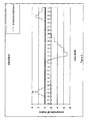
- FIG. 3 shows the test signal as measured for the first 2 axles, the first axle signal on the left 40 and the entirety of the signal on the right (from 2.25 s to beyond 4.92s) is from the second axle.
- the other 2 axles produced a similar shape to axle 1 and have not been included for brevity.
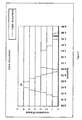
- the bump test yielded data that lent itself to more meaningful analysis and this data is shown in Figure 4 .
- the three signals caused by the tyres from the 2 nd , 3 rd and 4 th axles travelling over the pipe are shown in the Figure from left to right (41, 42, 43) respectively.
- the second axle created the first excursion on the left of the graph.
- the signal generated by the fust axle perturbation is not plotted here as it was similar to the two caused by axles 3 and 4, shown as the other two positive excursions in Figure 4 .
- the step test did not yield any data that could be analysed in a meaningful way. It is noted that the EU test differs from the step test conducted in that it is usually conducted at much a higher speed than those used for this testing, it is done for one axle only and the drop is 80mm, not 65mm as used for this testing.
- the applicants surmise that the effect of the air lines equalising the pressure differential between the air bags on differing axles caused the signal to behave in the manner shown in Figure 3 , particularly for axle 2. It was thought that the 3 axles were restraining the first axle in the vertical plane as it went over the step but when the second axle encountered the step the applicants thought that that was the point of equilibrium of the axle group and the group then teetered like a see-saw, giving the resultant aberrant signal. The applicants also surmise that this was why the EU test was performed with only one axle and at relatively higher speeds.
- the EU Standard is 20% or greater so it can be seen that this trailer meets the EU Standard for "road-friendly suspension' dampers. Further, this exercise shows that, by using a simple test of driving over a 50mm pipe and analysing the data provided by the on-board mass measurement system, the damping ratio may be determined by simple calculation.
- the system By subjecting the data from the on road test to Fourier analysis, the system is able to determine the trailer's body-to-axle-group frequencies induced by the dynamic forces on the combination. For this analysis, it was assumed that the signal derived from driving the vehicle on normal roads approximated to a random signal. Fourier analysis of an output, or derived, signal after it has been generated from a random input signal of uniform amplitude to any system allows determination of the transfer function of the system as expressed by the frequencies present in the output signal.
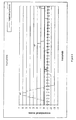
- the plot illustrated in Figure 6 is a Fast Fourier Transform (FFT) that is, by definition, lumpy and does not yield pure and clean plots on the magnitude axis. Even allowing for the overall noise created by the FFT process, it can be seen that the greatest frequency magnitude 46 present in the FFT of the on-road signal is that of 1.5 Hz - 2 Hz. Given that the EU standard for body bounce is > 2.0 Hz, it is statistically probable that this parameter is met by the suspension tested and reflected on this plot. It is to be noted that some lower frequencies appear to be present and that there are greater magnitude frequencies at approx. 4 Hz, 8 Hz and 15 Hz. Axle hop appears to be the explanation for the 15Hz signal. Further research is needed for the 4 & 8 Hz signals.
- FFT Fast Fourier Transform
- Figure 7 shows a system 30 of the invention coupled to an on-board personal computer (OBPC) 31, OBPC 31 is connected to an RF transmitter 32. Transmitter 32 allows data from the system 30 to be downloaded via a radio link. A printer 32 is connected to the OBPC 31. A docking station 33 allows a host computer 34 to be coupled to the OBPC 31 or devices other than a computer 34 to be connected to OBPC 31. Computer 34 may download data from the system 30.
- OBPC on-board personal computer
- FIG 8 shows a block diagram of an alternative way to that of figure 7 in which a system 30 may be coupled to other components to allow data to be downloaded from the system 30.
- a serial memory unit (SMU) 40 is coupled to the system 30.
- a printer 41 and various communication devices 42 are connected to SMU 40.
- An on-board personal computer (OBPC) 43 is connected to the SMU 40 and this OBPC 43 is coupled to an RF transmitter 44 and a docking station 45.
- the docking station 45 allows a host computer 46 or other devices to be coupled to the OBPC 43 for downloading data.
- a memory unit 47 may be coupled to the computer 46 to provide for data downloaded from the system 30 to be backed up in case of failure of the OBPC 43.
- the AAU illustrated in box 47 with an additional SMU provides additional data back-up capabilities at the same time providing additional serial data ports to connect to various peripheral devices which are used by various operators of this system in various applications or end uses.
- the SMU/AAU 47 is also used to store the data which is collected when performing the tests.
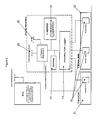
- Figure 9 is a detailed block diagram of the system of the invention illustrated in schematic form in Figures 7 and 8 .
- the system of the present invention also provides the ability to use the electronic data to capture an electronic signature or electronic fingerprint of each transducer or load cell connected either individually or collectively to each of the smart amplifiers 16 so that each vehicle can be monitored for tampering as well as accuracy.
- the dynamic data can be captured at random or at specific times and at a specific position/s and compared with the data acquired from a set of test results at time of calibration when a known load is driven over a known section of road and the dynamic data is captured at that time as the original reference data for each system or vehicle, accordingly.
- the Time and Date is set and the system records this as T1 and attaches a date stamp to it e.g. 13 th January 2008 is attached as 13/01/08 OR it can be attached as 01/12/08, depending on the way in which various countries express the date. If for some reason the date, or the time, or both are changed the system automatically increments this change in an incrementing numeric sequence which is also time/date stamped, as follows.
- the internal security system displays T2 15/01/08 if the change was done on May 15 th , 2008.
- the unit is calibrated and the secure data for calibration will display as C1 13/01/08 and, if the system has been tampered with or recalibrated for various reasons the unit will display C2 12/03/08, say, then C3 14/06/08 , say , and so on, each time the calibration is changed.
- Time/Date and the Calibrate functions are independent of one another but increment numerically with a time/date stamp as and when either one is changed.
- a typical 3 channel system for a B-Double is as follows and shows the secure data feature.
- any tampering with the system is monitored both by the electronic hardware or component and/or the software as well as the dynamic data output from each vehicle or channel and are linked one to the other, accordingly.
Landscapes
- Engineering & Computer Science (AREA)
- Mechanical Engineering (AREA)
- Physics & Mathematics (AREA)
- General Physics & Mathematics (AREA)
- Vehicle Body Suspensions (AREA)
Applications Claiming Priority (1)
| Application Number | Priority Date | Filing Date | Title |
|---|---|---|---|
| AU2009200620A AU2009200620B2 (en) | 2004-08-19 | 2009-02-18 | A Method for Logging the Performance of a Vehicle Suspension System |
Publications (3)
| Publication Number | Publication Date |
|---|---|
| EP2267663A2 true EP2267663A2 (de) | 2010-12-29 |
| EP2267663A3 EP2267663A3 (de) | 2014-04-09 |
| EP2267663B1 EP2267663B1 (de) | 2019-01-16 |
Family
ID=42123106
Family Applications (1)
| Application Number | Title | Priority Date | Filing Date |
|---|---|---|---|
| EP10001647.6A Active EP2267663B1 (de) | 2009-02-18 | 2010-02-18 | Verfahren zum Aufzeichnen der Leistung eines Fahrzeugaufhängungssystems |
Country Status (4)
| Country | Link |
|---|---|
| EP (1) | EP2267663B1 (de) |
| CA (1) | CA2693515C (de) |
| NZ (1) | NZ583407A (de) |
| ZA (1) | ZA201001195B (de) |
Cited By (1)
| Publication number | Priority date | Publication date | Assignee | Title |
|---|---|---|---|---|
| CN103175696A (zh) * | 2013-01-21 | 2013-06-26 | 山东交通学院 | 汽车偏频试验装置 |
Family Cites Families (2)
| Publication number | Priority date | Publication date | Assignee | Title |
|---|---|---|---|---|
| US7877607B2 (en) * | 2002-08-30 | 2011-01-25 | Hewlett-Packard Development Company, L.P. | Tamper-evident data management |
| US7512520B2 (en) * | 2003-08-19 | 2009-03-31 | Tramanco Pty Ltd. | Method for logging the performance of a vehicle suspension system |
-
2010
- 2010-02-18 ZA ZA201001195A patent/ZA201001195B/en unknown
- 2010-02-18 NZ NZ583407A patent/NZ583407A/en not_active IP Right Cessation
- 2010-02-18 EP EP10001647.6A patent/EP2267663B1/de active Active
- 2010-02-18 CA CA2693515A patent/CA2693515C/en active Active
Non-Patent Citations (1)
| Title |
|---|
| None |
Cited By (2)
| Publication number | Priority date | Publication date | Assignee | Title |
|---|---|---|---|---|
| CN103175696A (zh) * | 2013-01-21 | 2013-06-26 | 山东交通学院 | 汽车偏频试验装置 |
| CN103175696B (zh) * | 2013-01-21 | 2016-06-15 | 山东交通学院 | 汽车偏频试验装置 |
Also Published As
| Publication number | Publication date |
|---|---|
| EP2267663A3 (de) | 2014-04-09 |
| NZ583407A (en) | 2010-04-30 |
| CA2693515C (en) | 2017-09-12 |
| EP2267663B1 (de) | 2019-01-16 |
| ZA201001195B (en) | 2010-10-27 |
| CA2693515A1 (en) | 2010-08-18 |
Similar Documents
| Publication | Publication Date | Title |
|---|---|---|
| US8321177B2 (en) | Method for logging the performance of a vehicle suspension system | |
| US7512520B2 (en) | Method for logging the performance of a vehicle suspension system | |
| EP2537007B1 (de) | System und verfahren zur überwachung von fahrzeugmassenfälschungen | |
| Potter et al. | Assessing ‘road-friendliness’: a review | |
| Lamb et al. | On the parameters that influence road vehicles vibration levels | |
| Decker et al. | Measurement and analysis of wheel loads for design and fatigue evaluation of vehicle chassis components | |
| AU2024204420A1 (en) | Odometer system for a recreational vehicle | |
| AU2009200620B2 (en) | A Method for Logging the Performance of a Vehicle Suspension System | |
| EP2267663B1 (de) | Verfahren zum Aufzeichnen der Leistung eines Fahrzeugaufhängungssystems | |
| AU2004264997B9 (en) | A method for logging the performance of a vehicle suspension system | |
| Davis et al. | Suspension testing of 3 heavy vehicles-methodology and preliminary frequency analysis | |
| Davis et al. | Heavy vehicle suspensions-testing and analysis. A literature review. | |
| Davis et al. | Further development of in-service suspension testing for heavy vehicles | |
| Wannenburg | A study of fatigue loading on automotive and transport structures | |
| EP4190603A1 (de) | Verfahren und system zur überwachung von schwingungen | |
| Elischer et al. | Dynamic wheel loads of heavy vehicles—preliminary analysis | |
| Zuieback et al. | Calibration of Weigh-in-Motion Systems, Volume I: Summary and Recommendations | |
| Davis et al. | In-Service Testing of Heavy Vehicle Suspensions-Background Report for the NTC Project | |
| Lamoreaux et al. | Truck and rail shock and vibration environments during normal transport |
Legal Events
| Date | Code | Title | Description |
|---|---|---|---|
| PUAI | Public reference made under article 153(3) epc to a published international application that has entered the european phase |
Free format text: ORIGINAL CODE: 0009012 |
|
| AK | Designated contracting states |
Kind code of ref document: A2 Designated state(s): AT BE BG CH CY CZ DE DK EE ES FI FR GB GR HR HU IE IS IT LI LT LU LV MC MK MT NL NO PL PT RO SE SI SK SM TR |
|
| AX | Request for extension of the european patent |
Extension state: AL BA RS |
|
| PUAL | Search report despatched |
Free format text: ORIGINAL CODE: 0009013 |
|
| AK | Designated contracting states |
Kind code of ref document: A3 Designated state(s): AT BE BG CH CY CZ DE DK EE ES FI FR GB GR HR HU IE IS IT LI LT LU LV MC MK MT NL NO PL PT RO SE SI SK SM TR |
|
| AX | Request for extension of the european patent |
Extension state: AL BA RS |
|
| RIC1 | Information provided on ipc code assigned before grant |
Ipc: B60G 17/015 20060101ALI20140228BHEP Ipc: G07C 5/08 20060101AFI20140228BHEP |
|
| 17P | Request for examination filed |
Effective date: 20141009 |
|
| RAX | Requested extension states of the european patent have changed |
Extension state: AL Payment date: 20141009 Extension state: RS Payment date: 20141009 Extension state: BA Payment date: 20141009 |
|
| RBV | Designated contracting states (corrected) |
Designated state(s): AT BE BG CH CY CZ DE DK EE ES FI FR GB GR HR HU IE IS IT LI LT LU LV MC MK MT NL NO PL PT RO SE SI SK SM TR |
|
| 17Q | First examination report despatched |
Effective date: 20160919 |
|
| STAA | Information on the status of an ep patent application or granted ep patent |
Free format text: STATUS: EXAMINATION IS IN PROGRESS |
|
| GRAP | Despatch of communication of intention to grant a patent |
Free format text: ORIGINAL CODE: EPIDOSNIGR1 |
|
| STAA | Information on the status of an ep patent application or granted ep patent |
Free format text: STATUS: GRANT OF PATENT IS INTENDED |
|
| INTG | Intention to grant announced |
Effective date: 20171017 |
|
| GRAJ | Information related to disapproval of communication of intention to grant by the applicant or resumption of examination proceedings by the epo deleted |
Free format text: ORIGINAL CODE: EPIDOSDIGR1 |
|
| STAA | Information on the status of an ep patent application or granted ep patent |
Free format text: STATUS: EXAMINATION IS IN PROGRESS |
|
| INTC | Intention to grant announced (deleted) | ||
| GRAP | Despatch of communication of intention to grant a patent |
Free format text: ORIGINAL CODE: EPIDOSNIGR1 |
|
| STAA | Information on the status of an ep patent application or granted ep patent |
Free format text: STATUS: GRANT OF PATENT IS INTENDED |
|
| INTG | Intention to grant announced |
Effective date: 20180103 |
|
| GRAJ | Information related to disapproval of communication of intention to grant by the applicant or resumption of examination proceedings by the epo deleted |
Free format text: ORIGINAL CODE: EPIDOSDIGR1 |
|
| STAA | Information on the status of an ep patent application or granted ep patent |
Free format text: STATUS: EXAMINATION IS IN PROGRESS |
|
| GRAJ | Information related to disapproval of communication of intention to grant by the applicant or resumption of examination proceedings by the epo deleted |
Free format text: ORIGINAL CODE: EPIDOSDIGR1 |
|
| GRAP | Despatch of communication of intention to grant a patent |
Free format text: ORIGINAL CODE: EPIDOSNIGR1 |
|
| GRAP | Despatch of communication of intention to grant a patent |
Free format text: ORIGINAL CODE: EPIDOSNIGR1 |
|
| STAA | Information on the status of an ep patent application or granted ep patent |
Free format text: STATUS: GRANT OF PATENT IS INTENDED |
|
| INTC | Intention to grant announced (deleted) | ||
| INTG | Intention to grant announced |
Effective date: 20180517 |
|
| GRAS | Grant fee paid |
Free format text: ORIGINAL CODE: EPIDOSNIGR3 |
|
| GRAF | Information related to payment of grant fee modified |
Free format text: ORIGINAL CODE: EPIDOSCIGR3 |
|
| GRAA | (expected) grant |
Free format text: ORIGINAL CODE: 0009210 |
|
| STAA | Information on the status of an ep patent application or granted ep patent |
Free format text: STATUS: THE PATENT HAS BEEN GRANTED |
|
| AK | Designated contracting states |
Kind code of ref document: B1 Designated state(s): AT BE BG CH CY CZ DE DK EE ES FI FR GB GR HR HU IE IS IT LI LT LU LV MC MK MT NL NO PL PT RO SE SI SK SM TR |
|
| AX | Request for extension of the european patent |
Extension state: AL BA RS |
|
| REG | Reference to a national code |
Ref country code: GB Ref legal event code: FG4D |
|
| REG | Reference to a national code |
Ref country code: CH Ref legal event code: EP |
|
| REG | Reference to a national code |
Ref country code: IE Ref legal event code: FG4D |
|
| REG | Reference to a national code |
Ref country code: AT Ref legal event code: REF Ref document number: 1090290 Country of ref document: AT Kind code of ref document: T Effective date: 20190215 |
|
| REG | Reference to a national code |
Ref country code: DE Ref legal event code: R096 Ref document number: 602010056535 Country of ref document: DE |
|
| REG | Reference to a national code |
Ref country code: NL Ref legal event code: MP Effective date: 20190116 |
|
| REG | Reference to a national code |
Ref country code: LT Ref legal event code: MG4D |
|
| PG25 | Lapsed in a contracting state [announced via postgrant information from national office to epo] |
Ref country code: NL Free format text: LAPSE BECAUSE OF FAILURE TO SUBMIT A TRANSLATION OF THE DESCRIPTION OR TO PAY THE FEE WITHIN THE PRESCRIBED TIME-LIMIT Effective date: 20190116 |
|
| REG | Reference to a national code |
Ref country code: AT Ref legal event code: MK05 Ref document number: 1090290 Country of ref document: AT Kind code of ref document: T Effective date: 20190116 |
|
| PG25 | Lapsed in a contracting state [announced via postgrant information from national office to epo] |
Ref country code: NO Free format text: LAPSE BECAUSE OF FAILURE TO SUBMIT A TRANSLATION OF THE DESCRIPTION OR TO PAY THE FEE WITHIN THE PRESCRIBED TIME-LIMIT Effective date: 20190416 Ref country code: LT Free format text: LAPSE BECAUSE OF FAILURE TO SUBMIT A TRANSLATION OF THE DESCRIPTION OR TO PAY THE FEE WITHIN THE PRESCRIBED TIME-LIMIT Effective date: 20190116 Ref country code: FI Free format text: LAPSE BECAUSE OF FAILURE TO SUBMIT A TRANSLATION OF THE DESCRIPTION OR TO PAY THE FEE WITHIN THE PRESCRIBED TIME-LIMIT Effective date: 20190116 Ref country code: SE Free format text: LAPSE BECAUSE OF FAILURE TO SUBMIT A TRANSLATION OF THE DESCRIPTION OR TO PAY THE FEE WITHIN THE PRESCRIBED TIME-LIMIT Effective date: 20190116 Ref country code: PL Free format text: LAPSE BECAUSE OF FAILURE TO SUBMIT A TRANSLATION OF THE DESCRIPTION OR TO PAY THE FEE WITHIN THE PRESCRIBED TIME-LIMIT Effective date: 20190116 Ref country code: PT Free format text: LAPSE BECAUSE OF FAILURE TO SUBMIT A TRANSLATION OF THE DESCRIPTION OR TO PAY THE FEE WITHIN THE PRESCRIBED TIME-LIMIT Effective date: 20190516 Ref country code: ES Free format text: LAPSE BECAUSE OF FAILURE TO SUBMIT A TRANSLATION OF THE DESCRIPTION OR TO PAY THE FEE WITHIN THE PRESCRIBED TIME-LIMIT Effective date: 20190116 |
|
| PG25 | Lapsed in a contracting state [announced via postgrant information from national office to epo] |
Ref country code: GR Free format text: LAPSE BECAUSE OF FAILURE TO SUBMIT A TRANSLATION OF THE DESCRIPTION OR TO PAY THE FEE WITHIN THE PRESCRIBED TIME-LIMIT Effective date: 20190417 Ref country code: BG Free format text: LAPSE BECAUSE OF FAILURE TO SUBMIT A TRANSLATION OF THE DESCRIPTION OR TO PAY THE FEE WITHIN THE PRESCRIBED TIME-LIMIT Effective date: 20190416 Ref country code: HR Free format text: LAPSE BECAUSE OF FAILURE TO SUBMIT A TRANSLATION OF THE DESCRIPTION OR TO PAY THE FEE WITHIN THE PRESCRIBED TIME-LIMIT Effective date: 20190116 Ref country code: LV Free format text: LAPSE BECAUSE OF FAILURE TO SUBMIT A TRANSLATION OF THE DESCRIPTION OR TO PAY THE FEE WITHIN THE PRESCRIBED TIME-LIMIT Effective date: 20190116 Ref country code: IS Free format text: LAPSE BECAUSE OF FAILURE TO SUBMIT A TRANSLATION OF THE DESCRIPTION OR TO PAY THE FEE WITHIN THE PRESCRIBED TIME-LIMIT Effective date: 20190516 |
|
| REG | Reference to a national code |
Ref country code: CH Ref legal event code: PL |
|
| REG | Reference to a national code |
Ref country code: DE Ref legal event code: R097 Ref document number: 602010056535 Country of ref document: DE |
|
| PG25 | Lapsed in a contracting state [announced via postgrant information from national office to epo] |
Ref country code: AT Free format text: LAPSE BECAUSE OF FAILURE TO SUBMIT A TRANSLATION OF THE DESCRIPTION OR TO PAY THE FEE WITHIN THE PRESCRIBED TIME-LIMIT Effective date: 20190116 Ref country code: MC Free format text: LAPSE BECAUSE OF FAILURE TO SUBMIT A TRANSLATION OF THE DESCRIPTION OR TO PAY THE FEE WITHIN THE PRESCRIBED TIME-LIMIT Effective date: 20190116 Ref country code: EE Free format text: LAPSE BECAUSE OF FAILURE TO SUBMIT A TRANSLATION OF THE DESCRIPTION OR TO PAY THE FEE WITHIN THE PRESCRIBED TIME-LIMIT Effective date: 20190116 Ref country code: DK Free format text: LAPSE BECAUSE OF FAILURE TO SUBMIT A TRANSLATION OF THE DESCRIPTION OR TO PAY THE FEE WITHIN THE PRESCRIBED TIME-LIMIT Effective date: 20190116 Ref country code: LU Free format text: LAPSE BECAUSE OF NON-PAYMENT OF DUE FEES Effective date: 20190218 Ref country code: SK Free format text: LAPSE BECAUSE OF FAILURE TO SUBMIT A TRANSLATION OF THE DESCRIPTION OR TO PAY THE FEE WITHIN THE PRESCRIBED TIME-LIMIT Effective date: 20190116 Ref country code: IT Free format text: LAPSE BECAUSE OF FAILURE TO SUBMIT A TRANSLATION OF THE DESCRIPTION OR TO PAY THE FEE WITHIN THE PRESCRIBED TIME-LIMIT Effective date: 20190116 Ref country code: RO Free format text: LAPSE BECAUSE OF FAILURE TO SUBMIT A TRANSLATION OF THE DESCRIPTION OR TO PAY THE FEE WITHIN THE PRESCRIBED TIME-LIMIT Effective date: 20190116 Ref country code: CZ Free format text: LAPSE BECAUSE OF FAILURE TO SUBMIT A TRANSLATION OF THE DESCRIPTION OR TO PAY THE FEE WITHIN THE PRESCRIBED TIME-LIMIT Effective date: 20190116 |
|
| REG | Reference to a national code |
Ref country code: BE Ref legal event code: MM Effective date: 20190228 |
|
| PLBE | No opposition filed within time limit |
Free format text: ORIGINAL CODE: 0009261 |
|
| STAA | Information on the status of an ep patent application or granted ep patent |
Free format text: STATUS: NO OPPOSITION FILED WITHIN TIME LIMIT |
|
| REG | Reference to a national code |
Ref country code: IE Ref legal event code: MM4A |
|
| PG25 | Lapsed in a contracting state [announced via postgrant information from national office to epo] |
Ref country code: SM Free format text: LAPSE BECAUSE OF FAILURE TO SUBMIT A TRANSLATION OF THE DESCRIPTION OR TO PAY THE FEE WITHIN THE PRESCRIBED TIME-LIMIT Effective date: 20190116 |
|
| 26N | No opposition filed |
Effective date: 20191017 |
|
| PG25 | Lapsed in a contracting state [announced via postgrant information from national office to epo] |
Ref country code: LI Free format text: LAPSE BECAUSE OF NON-PAYMENT OF DUE FEES Effective date: 20190228 Ref country code: CH Free format text: LAPSE BECAUSE OF NON-PAYMENT OF DUE FEES Effective date: 20190228 |
|
| PG25 | Lapsed in a contracting state [announced via postgrant information from national office to epo] |
Ref country code: IE Free format text: LAPSE BECAUSE OF NON-PAYMENT OF DUE FEES Effective date: 20190218 |
|
| PG25 | Lapsed in a contracting state [announced via postgrant information from national office to epo] |
Ref country code: BE Free format text: LAPSE BECAUSE OF NON-PAYMENT OF DUE FEES Effective date: 20190228 Ref country code: SI Free format text: LAPSE BECAUSE OF FAILURE TO SUBMIT A TRANSLATION OF THE DESCRIPTION OR TO PAY THE FEE WITHIN THE PRESCRIBED TIME-LIMIT Effective date: 20190116 |
|
| PG25 | Lapsed in a contracting state [announced via postgrant information from national office to epo] |
Ref country code: TR Free format text: LAPSE BECAUSE OF FAILURE TO SUBMIT A TRANSLATION OF THE DESCRIPTION OR TO PAY THE FEE WITHIN THE PRESCRIBED TIME-LIMIT Effective date: 20190116 |
|
| PG25 | Lapsed in a contracting state [announced via postgrant information from national office to epo] |
Ref country code: MT Free format text: LAPSE BECAUSE OF NON-PAYMENT OF DUE FEES Effective date: 20190218 |
|
| PG25 | Lapsed in a contracting state [announced via postgrant information from national office to epo] |
Ref country code: CY Free format text: LAPSE BECAUSE OF FAILURE TO SUBMIT A TRANSLATION OF THE DESCRIPTION OR TO PAY THE FEE WITHIN THE PRESCRIBED TIME-LIMIT Effective date: 20190116 |
|
| PG25 | Lapsed in a contracting state [announced via postgrant information from national office to epo] |
Ref country code: HU Free format text: LAPSE BECAUSE OF FAILURE TO SUBMIT A TRANSLATION OF THE DESCRIPTION OR TO PAY THE FEE WITHIN THE PRESCRIBED TIME-LIMIT; INVALID AB INITIO Effective date: 20100218 |
|
| PG25 | Lapsed in a contracting state [announced via postgrant information from national office to epo] |
Ref country code: MK Free format text: LAPSE BECAUSE OF FAILURE TO SUBMIT A TRANSLATION OF THE DESCRIPTION OR TO PAY THE FEE WITHIN THE PRESCRIBED TIME-LIMIT Effective date: 20190116 |
|
| PGFP | Annual fee paid to national office [announced via postgrant information from national office to epo] |
Ref country code: GB Payment date: 20260206 Year of fee payment: 17 |
|
| PGFP | Annual fee paid to national office [announced via postgrant information from national office to epo] |
Ref country code: DE Payment date: 20260218 Year of fee payment: 17 |
|
| PGFP | Annual fee paid to national office [announced via postgrant information from national office to epo] |
Ref country code: FR Payment date: 20260224 Year of fee payment: 17 |