EP2267441A1 - Electrode module - Google Patents
Electrode module Download PDFInfo
- Publication number
- EP2267441A1 EP2267441A1 EP09732155A EP09732155A EP2267441A1 EP 2267441 A1 EP2267441 A1 EP 2267441A1 EP 09732155 A EP09732155 A EP 09732155A EP 09732155 A EP09732155 A EP 09732155A EP 2267441 A1 EP2267441 A1 EP 2267441A1
- Authority
- EP
- European Patent Office
- Prior art keywords
- electrode
- chip
- well
- module
- working
- Prior art date
- Legal status (The legal status is an assumption and is not a legal conclusion. Google has not performed a legal analysis and makes no representation as to the accuracy of the status listed.)
- Withdrawn
Links
Images




Classifications
-
- G—PHYSICS
- G01—MEASURING; TESTING
- G01N—INVESTIGATING OR ANALYSING MATERIALS BY DETERMINING THEIR CHEMICAL OR PHYSICAL PROPERTIES
- G01N27/00—Investigating or analysing materials by the use of electric, electrochemical, or magnetic means
- G01N27/26—Investigating or analysing materials by the use of electric, electrochemical, or magnetic means by investigating electrochemical variables; by using electrolysis or electrophoresis
- G01N27/403—Cells and electrode assemblies
Definitions
- the present invention relates to a compact, low-cost electrode module used for electrochemical measuring instruments.
- an electrochemical measuring method is an extremely simple, inexpensive measuring method that can detect a measuring object if there are simply present electrodes serving to measurement, and a system for applying voltage and current.
- a method of electrochemically detecting and measuring a specified substance in a liquid specimen by a method of using a working electrode, a counter electrode and a reference electrode is well-known (e.g., see Patent Documents 1 and 2), and also it is widely known that this method is applied to detection and measurement of DNA (e.g., see Patent Documents 3 and 4).
- a general construction uses a rod-shaped electrode, for example, a gold electrode as a working electrode, for example, a silver-silver chloride electrode as a reference electrode, and for example, rod-shaped platinum as a counter electrode.
- Fig. 1 is an explanatory view for indicating the entire construction for a conventional electrochemical measurement method.
- Reference numeral 1 refers to a beaker (container for retaining an electrolytic solution), reference numeral 2 refers to an electrolytic solution, reference numeral 3 refers to a working electrode (e.g., a gold electrode), reference numeral 4 refers to a reference electrode (e.g., a silver-silver chloride electrode), and reference numeral 5 refers to a counter electrode (e.g., a platinum electrode).
- a commercially available beaker is used as the container for retaining the electrolytic solution, and as shown in Fig. 1 , the various electrodes are maintained from above and placed in the electrolytic solution for electrochemical measurement.
- the structure of the rod-shaped gold electrode as the working electrode uses for the tip end a material produced by molding, for example, rod-shaped gold with PEEK (polyether ether ketone) resin.
- PEEK polyether ether ketone
- This electrode can be repeatedly used by cleaning.
- diamond for polishing and an alumina abrasive are used to polish the surface like a mirror finished surface on a glass plate for use.
- a printed electrode is known that involves formation of three electrodes, i.e., a working electrode 7, counter electrode 8, and reference electrode 9 on the surface of a glass substrate 6 by a printing technique, for example, as shown in Fig. 2 , as improvement measures for the above problems.
- a working electrode 7, counter electrode 8, and reference electrode 9 on the surface of a glass substrate 6 by a printing technique, for example, as shown in Fig. 2 .
- Such electrode is problematic in that the price is very expensive, the repeated reuse is limited, and the like.
- an electrode configured to integrate analysis electrodes and an address electrode in a container (cuvette) for an electrolytic solution is proposed in Patent Document 5.
- this electrode also has a complex construction and might be extremely high in cost.
- Patent Document 6 a complex sensor array for analyzing small amounts of multicomponents made by microfabrication and the like are proposed (Patent Document 6), the problems of electrode modules as described above are not solved yet.
- the subject to be solved in the present invention is to provide a simple and easy, inexpensive apparatus by solving all the problems of poor maintenance of an electrode section including a working electrode, high cost, poor handleability due to a large shape, poor efficiency in repeated reuse, etc. presently included in devices such as electrodes used in electrochemical measurement.
- the invention described in claim 1 is an electrode module including a working electrode, a counter electrode, a reference electrode and a well (container) for retaining an electrolytic solution, used in an electrochemical measuring instrument, wherein the electrode module is produced by integrating the above well with at least one of the above working electrode, counter electrode and reference electrode, wherein the integrated electrode includes a chip-like electrode (electrode chip) having a thin membrane of an electrode material formed on the surface of a chip-like base metal, and wherein the chip-like electrode is disposed on and integrated with the bottom of the above well in a detachable manner.
- the electrode module is produced by integrating the above well with at least one of the above working electrode, counter electrode and reference electrode, wherein the integrated electrode includes a chip-like electrode (electrode chip) having a thin membrane of an electrode material formed on the surface of a chip-like base metal, and wherein the chip-like electrode is disposed on and integrated with the bottom of the above well in a detachable manner.
- the electrode module in the invention stands for a collectively replaceable part or component including at least an electrode and a well (container) in an electrochemical measuring apparatus.
- the electrode module in the invention includes, in addition to the electrode and the well, a material produced by combining or incorporating an electrode presser for fixing an electrode tip, an electrode holding ruler, an electrode holder or the like, for holding electrodes or the like.
- chip-like in the invention means thin piece-like.
- the integration of an electrode with a well stands for a state in which the electrode is integrally and structurally freely detachably combined with the well.
- the invention described in claim 2 is the electrode module described in claim 1, wherein the chip-like electrode is formed on the surface of a chip-like base metal in thin film shape using an electrode material by any one method of depositing, sputtering and printing.
- the invention described in claim 3 is the electrode module described in claim 1 or 2, wherein the working electrode and/or the counter electrode is integrated with the well.
- the invention described in claim 4 is the electrode module described in claim 1 or 2, wherein the working electrode, the counter electrode and the reference electrode are all integrated with the well.
- the invention described in claim 5 is an electrode chip including a thin membrane of an electrode material formed on the surface of a chip-like base metal, for the electrode module described in claim 1.
- the working electrode a chip-like material made by forming a metal to be an electrode on the surface of a metal to be a base in thin film shape.
- This chip-like electrode is used to integrate with a well for use.
- This electrode chip is detached from the well and is formed into a structure so as to be replaceable readily in itself.
- the deposited metal surface can be greatly smoothed by polishing the surface of the metal to be the base, so that the electrode has the advantage of being able to be also used, for example, in an experiment in which DNA is immobilized to the gold surface to identify an enzyme or the like.
- the thickness of gold to be deposited is very thin, and therefore the amount of gold used for the electrode is very small, whereby the electrode has the advantage of be able to be fabricated at a low cost.
- the electrode chip is integrated with the well and only the electrode chip is configured to be easily replaceable, so that a container such as a beaker is also not needed to be used and thus the electrode section is very compact, offering the advantage of being capable of improvement in operability.
- the electrode chip of the invention is reusable by cleaning the electrode module, when the electrode chip surface is damaged, only the electrode chip made relatively inexpensively may be changed.
- the electrode chip of the invention has a simple structure and is also recyclable after recovery. This makes it possible to provide an electrode module that does not need maintenance such as polishing and is repeatedly reusable.
- An electrochemical measuring apparatus in the invention includes a well for retaining a working electrode, a counter electrode, a reference electrode and an electrolytic solution, and is used to measure the electrochemical response of a specific substance included in the electrolytic solution.
- Various amperometry and voltammetry modes are suitable although the method of measuring the electrochemical response is not particularly limited.
- Amperometry is an approach that measures and analyzes the current flowing through electrodes to the potential step against time and is widely used in quantitative analysis on electrochemically active species in an electrolytic solution.
- Voltammetry is widely used as an approach that measures the response current when the electrode potential is changed.
- the examples of voltammetry include cyclic voltammetry that changes the electrode potential linearly and pulse voltammetry that changes the electrode potential by pulse.
- the resulting response current value depends on the concentration of an electrochemically active species in an electrolytic solution.
- the electrochemical measuring apparatus in the invention measures the electrochemical responses of various activated substrates generated in an electrolytic solution by using such well-known electrochemical process and means, and carries out qualitative or quantitative analysis of a specific substance.
- the electrode module of the invention used in the above electrochemical measuring instrument is made by integrating the above well with at least one of the above working electrode, counter electrode and reference electrode, the integrated electrode includes a chip-like electrode (electrode chip) having an electrode material thin membrane formed on the surface of a chip-like base metal, and the chip-like electrode is disposed on and integrated with the bottom of the above well in a detachable manner (freely detachable).
- the electrode module of the invention will be described with reference to drawings.
- Fig. 3 is an explanatory view that shows one example of the structure of the electrode chip used in the invention.
- Reference numeral 11 is a chip-like base metal such as titanium
- reference numeral 10 is a thin membrane of an electrode material such as gold formed on its surface, for example, by deposition.
- the method of forming a thin membrane of an electrode material is not particularly limited; however, the membrane is preferably formed in thin film shape by any method of depositing, sputtering or printing. Well-known methods of physical vapor deposition (PVD) and chemical vapor deposition (CVD), etc. can be utilized as deposition.
- the thin membrane may be formed by a sputtering technique, a kind of physical vapor deposition.
- the thin membrane can also be formed using a well-known printing technique.
- the electrode module of the invention is a collectively replaceable part or a component, including an electrode, in an electrochemical measuring apparatus, and more specifically a part or a component integrally combined with a well on the bottom of which is disposed in a detachable manner at least one of a working electrode, counter electrode and reference electrode comprising the above electrode chip.
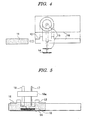
- Figs. 4 and 5 illustrate an example making up of the electrode module of the invention in which the working electrode (as in the case of the counter electrode) is integrated with the well.
- Figs. 4 and 5 are schematic diagrams depicting the construction of the electrode module.
- reference numeral 12 indicates a well (container)
- reference numeral 13 indicates a working electrode (working electrode chip)
- reference numeral 14 indicates an electrode presser
- reference numeral 15 indicates an electrode holding ruler
- reference numeral 16 indicates an electrode holder.
- the electrode holding ruler 15 is used to immobilize the working electrode chip 13 to the well, if the electrode presser 14 made from an elastic, electrically conductive resin rubber (doom-like) is used medially, the working electrode chip 13 can be uniformly pressed and fixed to the well 12, as shown in Fig. 5 .
- reference numeral 16a indicates an electrode holder (measuring instrument side)
- reference numeral 17 indicates a counter electrode (measuring instrument side)
- reference numeral 18 indicates a reference electrode (measuring instrument side).
- Fig. 6 is a diagram illustrating one example of how to assemble the electrode module schematically shown in Figs. 4 and 5 above.
- the electrode holding ruler 15 has a shape that holds the underside of the working electrode 13 and electrode presser 14 till the well 12 and is slid to the electrode holder 16 for installation.
- an electrode conductive plate 19 for electrode conduction can also be inserted into the underside of the electrode presser 14.
- the electrode module of the invention is preferably a module in which a working electrode or counter electrode is integrated with a well as illustrated in Figs. 4 and 5 .
- an electrode module in which a working electrode and a counter electrode are both integrated with a well is also preferred.
- FIG. 7 schematically shows a plan view and a sectional view of such electrode module
- reference numeral 13 indicates a working electrode (electrode chip)
- reference numeral 17 indicates a counter electrode
- reference numeral 18 indicates a reference electrode
- reference numeral 12 indicates a well
- reference numeral 14 indicates an electrode presser
- reference numeral 15 indicates an electrode holding ruler
- reference numeral 16 indicates an electrode holder.
- telomerase enzyme that works actively in most cancer cells is detected using the electrode module of the invention.
- telomerase enzymes repair the telomere.
- a primer of being a part of a DNA structure is fixed onto the gold electrode surface and then a telomerase enzyme is reacted therewith to elongate the DNA.
- FND a molecule having electrochemical activity
- the current value is changed depending on the length of the DNA. Determination of the change of the current value makes it possible to detect the presence or absence of telomerase enzymes, i.e., cancer cells.
- An electrode module of the invention in which a working electrode is integrated with a well was set to an electrochemical measurement device as shown in Fig. 5 .
- Reference numeral 16a indicates an electrode holder of the device and reference numerals 17 and 18 indicate a counter electrode and a reference electrode, respectively, which are set to the holder.
- the amount of an electrolytic solution that should be retained to a well 12 is sufficiently an extremely small amount (about 300 ⁇ L).
- a working electrode chip 13 was used in which one side of titanium foil polished to a mirror finished surface (membrane thickness: 50 ⁇ m, weight: about 11 mg) was degreased and then gold (99.99% or more pure) was formed thereon at a thin membrane thickness of about 700 to 800 angstroms (weight: about 0.08 mg) by sputtering.
- An electrode presser 14 is a doom-like, elastic, electrically conductive resin rubber and plays the role of uniformly suppressing the working electrode chip 13 for restraining liquid leakage.
- An electrode holding ruler 15 and the well 12 are made of polypropylene resin and inexpensive and exhibit durability both chemically and physically.
- a primer of being a part of a DNA structure is fixed onto the gold electrode surface and then a telomerase enzyme is reacted therewith, causing the elongation of the DNA.
- a molecule having electrochemical activity called FND is reacted with therewith and a voltage is applied to the working electrode, the current value is changed depending on the length of the DNA.
- Fig. 8 shows DPV measurement waveforms before and after the DNA elongation.
- FIG. 7 schematically shows a plan view and a sectional view of such electrode module, and reference numeral 7 indicates the working electrode (electrode chip), reference numeral 8 indicates the counter electrode, reference numeral 9 indicates a reference electrode, reference numeral 12 indicates the well, reference numeral 14 indicates an electrode presser, reference numeral 15 indicates the electrode holding ruler, and reference numeral 16 indicates an electrode holder.
- the working electrode and the counter electrode used respectively, electrodes made by forming thin membranes of gold and platinum on the surfaces of titanium, and the reference electrode used an electrode chip having a thin membrane of silver and silver chloride formed on the surface of titanium to thereby form a module. This made it possible to further miniaturize the device.
- the electrode module of the invention makes it possible to achieve miniaturization of an electrochemical measuring apparatus that has been difficult so far and to materialize it as various chemical substance analyzers of a handy type.
Landscapes
- Chemical & Material Sciences (AREA)
- Life Sciences & Earth Sciences (AREA)
- Health & Medical Sciences (AREA)
- Physics & Mathematics (AREA)
- Chemical Kinetics & Catalysis (AREA)
- Electrochemistry (AREA)
- Molecular Biology (AREA)
- Analytical Chemistry (AREA)
- Biochemistry (AREA)
- General Health & Medical Sciences (AREA)
- General Physics & Mathematics (AREA)
- Immunology (AREA)
- Pathology (AREA)
- Apparatus Associated With Microorganisms And Enzymes (AREA)
Abstract
Description
- The present invention relates to a compact, low-cost electrode module used for electrochemical measuring instruments.
- Recently, needs for techniques of carrying out diagnosis or analysis inexpensively in a short time are greatly increasing in the fields of bedside diagnosis carrying out medical diagnosis near a patient, various DNA diagnoses, etc. Of these, an electrochemical measuring method is an extremely simple, inexpensive measuring method that can detect a measuring object if there are simply present electrodes serving to measurement, and a system for applying voltage and current. In addition, a method of electrochemically detecting and measuring a specified substance in a liquid specimen by a method of using a working electrode, a counter electrode and a reference electrode is well-known (e.g., see
Patent Documents 1 and 2), and also it is widely known that this method is applied to detection and measurement of DNA (e.g., see Patent Documents 3 and 4). - In conventional electrodes used in electrochemical measurement, a general construction uses a rod-shaped electrode, for example, a gold electrode as a working electrode, for example, a silver-silver chloride electrode as a reference electrode, and for example, rod-shaped platinum as a counter electrode.
Fig. 1 is an explanatory view for indicating the entire construction for a conventional electrochemical measurement method.Reference numeral 1 refers to a beaker (container for retaining an electrolytic solution),reference numeral 2 refers to an electrolytic solution, reference numeral 3 refers to a working electrode (e.g., a gold electrode),reference numeral 4 refers to a reference electrode (e.g., a silver-silver chloride electrode), andreference numeral 5 refers to a counter electrode (e.g., a platinum electrode). A commercially available beaker is used as the container for retaining the electrolytic solution, and as shown inFig. 1 , the various electrodes are maintained from above and placed in the electrolytic solution for electrochemical measurement. - The structure of the rod-shaped gold electrode as the working electrode uses for the tip end a material produced by molding, for example, rod-shaped gold with PEEK (polyether ether ketone) resin. This electrode can be repeatedly used by cleaning. Moreover, when the golf surface is deteriorated with flaws or the like, or in an experiment needed for uniformity of the gold surface such as immobilization of DNA, diamond for polishing and an alumina abrasive are used to polish the surface like a mirror finished surface on a glass plate for use.
- In addition, in the case where the frequency in use is limited and there is relatively much time, for example, the electrode is experimentally used in a laboratory or the like, even such construction is sufficient in practical use. However, even in the use in such laboratory, when the frequency in use is high and there is little time in laboratory work, posing the problem of poor maintenance such as polishing. Moreover, considering the case where a measuring instrument using such electrode is used in the market as a product, there is a large obstacle for commercialization also from the viewpoints of cost performance, operability and maintenance.
- A printed electrode is known that involves formation of three electrodes, i.e., a working electrode 7, counter electrode 8, and reference electrode 9 on the surface of a glass substrate 6 by a printing technique, for example, as shown in
Fig. 2 , as improvement measures for the above problems. However, such electrode is problematic in that the price is very expensive, the repeated reuse is limited, and the like. Moreover, an electrode configured to integrate analysis electrodes and an address electrode in a container (cuvette) for an electrolytic solution is proposed inPatent Document 5. However, this electrode also has a complex construction and might be extremely high in cost. In addition, although a complex sensor array for analyzing small amounts of multicomponents made by microfabrication and the like are proposed (Patent Document 6), the problems of electrode modules as described above are not solved yet. - Patent Document 1: Japanese Patent Laid-Open Publication No.
05-79989 - Patent Document 2: Japanese Patent Laid-Open Publication No.
05-95223 - Patent Document 3: Japanese Patent Laid-Open Publication No.
09-40372 - Patent Document 4: Japanese Patent Laid-Open Publication No.
09-288080 - Patent Document 5: Japanese Patent Laid-Open Publication No.
11-14584 - Patent Document 6: Japanese Unexamined Patent Application Publication No.
2005-530179 - Thus, the subject to be solved in the present invention is to provide a simple and easy, inexpensive apparatus by solving all the problems of poor maintenance of an electrode section including a working electrode, high cost, poor handleability due to a large shape, poor efficiency in repeated reuse, etc. presently included in devices such as electrodes used in electrochemical measurement.
- The subject of the above present invention is achieved by the present invention described in
claims 1 to 6 in the claim. - The invention described in
claim 1 is an electrode module including a working electrode, a counter electrode, a reference electrode and a well (container) for retaining an electrolytic solution, used in an electrochemical measuring instrument, wherein the electrode module is produced by integrating the above well with at least one of the above working electrode, counter electrode and reference electrode, wherein the integrated electrode includes a chip-like electrode (electrode chip) having a thin membrane of an electrode material formed on the surface of a chip-like base metal, and wherein the chip-like electrode is disposed on and integrated with the bottom of the above well in a detachable manner. - The electrode module in the invention stands for a collectively replaceable part or component including at least an electrode and a well (container) in an electrochemical measuring apparatus. As is apparent from the description below, the electrode module in the invention includes, in addition to the electrode and the well, a material produced by combining or incorporating an electrode presser for fixing an electrode tip, an electrode holding ruler, an electrode holder or the like, for holding electrodes or the like. Additionally, chip-like in the invention means thin piece-like. Moreover, the integration of an electrode with a well stands for a state in which the electrode is integrally and structurally freely detachably combined with the well.
- The invention described in
claim 2 is the electrode module described inclaim 1, wherein the chip-like electrode is formed on the surface of a chip-like base metal in thin film shape using an electrode material by any one method of depositing, sputtering and printing. - The invention described in claim 3 is the electrode module described in
claim - The invention described in
claim 4 is the electrode module described inclaim - The invention described in
claim 5 is an electrode chip including a thin membrane of an electrode material formed on the surface of a chip-like base metal, for the electrode module described inclaim 1. - In addition, there is provided an electrochemical measuring instrument using the electrode module described in
claim 1. - In the electrode module of the invention, for example, as the working electrode is used a chip-like material made by forming a metal to be an electrode on the surface of a metal to be a base in thin film shape. This chip-like electrode is used to integrate with a well for use. This electrode chip is detached from the well and is formed into a structure so as to be replaceable readily in itself. In addition, in this working electrode, for example, the deposited metal surface can be greatly smoothed by polishing the surface of the metal to be the base, so that the electrode has the advantage of being able to be also used, for example, in an experiment in which DNA is immobilized to the gold surface to identify an enzyme or the like. Additionally, the thickness of gold to be deposited is very thin, and therefore the amount of gold used for the electrode is very small, whereby the electrode has the advantage of be able to be fabricated at a low cost.
- In the present invention, the electrode chip is integrated with the well and only the electrode chip is configured to be easily replaceable, so that a container such as a beaker is also not needed to be used and thus the electrode section is very compact, offering the advantage of being capable of improvement in operability. Although the electrode chip of the invention is reusable by cleaning the electrode module, when the electrode chip surface is damaged, only the electrode chip made relatively inexpensively may be changed. Moreover, the electrode chip of the invention has a simple structure and is also recyclable after recovery. This makes it possible to provide an electrode module that does not need maintenance such as polishing and is repeatedly reusable.
-
Fig. 1 is an entire block diagram of an electrode used for general electrochemical measurement. -
Fig. 2 is a block diagram of a glass electrode chip. -
Fig. 3 is a block diagram of an electrode chip in the invention. -
Fig. 4 is a diagram for depicting the structure of one example of the electrode module of the invention. -
Fig. 5 is a block diagram of an electrochemical measuring apparatus that uses the electrode module of the invention. -
Fig. 6 is a diagram illustrating one example of how to assemble the electrode module of the invention. -
Fig. 7 is a block diagram of the electrode module that coplanarly distributes a working electrode, a counter electrode and a reference electrode of the invention. -
Fig. 8 is a DPV waveform diagram measured before and after DNA elongation reaction. - An electrochemical measuring apparatus in the invention includes a well for retaining a working electrode, a counter electrode, a reference electrode and an electrolytic solution, and is used to measure the electrochemical response of a specific substance included in the electrolytic solution. Various amperometry and voltammetry modes are suitable although the method of measuring the electrochemical response is not particularly limited.
- Amperometry is an approach that measures and analyzes the current flowing through electrodes to the potential step against time and is widely used in quantitative analysis on electrochemically active species in an electrolytic solution. Voltammetry is widely used as an approach that measures the response current when the electrode potential is changed. The examples of voltammetry include cyclic voltammetry that changes the electrode potential linearly and pulse voltammetry that changes the electrode potential by pulse. The resulting response current value depends on the concentration of an electrochemically active species in an electrolytic solution. The electrochemical measuring apparatus in the invention measures the electrochemical responses of various activated substrates generated in an electrolytic solution by using such well-known electrochemical process and means, and carries out qualitative or quantitative analysis of a specific substance.
- The electrode module of the invention used in the above electrochemical measuring instrument is made by integrating the above well with at least one of the above working electrode, counter electrode and reference electrode, the integrated electrode includes a chip-like electrode (electrode chip) having an electrode material thin membrane formed on the surface of a chip-like base metal, and the chip-like electrode is disposed on and integrated with the bottom of the above well in a detachable manner (freely detachable). Hereinafter, the electrode module of the invention will be described with reference to drawings.
-
Fig. 3 is an explanatory view that shows one example of the structure of the electrode chip used in the invention. Reference numeral 11 is a chip-like base metal such as titanium, andreference numeral 10 is a thin membrane of an electrode material such as gold formed on its surface, for example, by deposition. The method of forming a thin membrane of an electrode material is not particularly limited; however, the membrane is preferably formed in thin film shape by any method of depositing, sputtering or printing. Well-known methods of physical vapor deposition (PVD) and chemical vapor deposition (CVD), etc. can be utilized as deposition. Moreover, the thin membrane may be formed by a sputtering technique, a kind of physical vapor deposition. Alternatively, the thin membrane can also be formed using a well-known printing technique. - The electrode module of the invention is a collectively replaceable part or a component, including an electrode, in an electrochemical measuring apparatus, and more specifically a part or a component integrally combined with a well on the bottom of which is disposed in a detachable manner at least one of a working electrode, counter electrode and reference electrode comprising the above electrode chip.
-
Figs. 4 and 5 illustrate an example making up of the electrode module of the invention in which the working electrode (as in the case of the counter electrode) is integrated with the well.Figs. 4 and 5 are schematic diagrams depicting the construction of the electrode module. InFig. 4 ,reference numeral 12 indicates a well (container),reference numeral 13 indicates a working electrode (working electrode chip),reference numeral 14 indicates an electrode presser,reference numeral 15 indicates an electrode holding ruler, andreference numeral 16 indicates an electrode holder. Although theelectrode holding ruler 15 is used to immobilize the workingelectrode chip 13 to the well, if theelectrode presser 14 made from an elastic, electrically conductive resin rubber (doom-like) is used medially, the workingelectrode chip 13 can be uniformly pressed and fixed to the well 12, as shown inFig. 5 . - Moreover, the working
electrode chip 13 is slidable on the well with one touch and thus simply installable and detachable. InFig. 5 ,reference numeral 16a indicates an electrode holder (measuring instrument side),reference numeral 17 indicates a counter electrode (measuring instrument side) andreference numeral 18 indicates a reference electrode (measuring instrument side). -
Fig. 6 is a diagram illustrating one example of how to assemble the electrode module schematically shown inFigs. 4 and 5 above. Theelectrode holding ruler 15 has a shape that holds the underside of the workingelectrode 13 andelectrode presser 14 till the well 12 and is slid to theelectrode holder 16 for installation. In this case, an electrodeconductive plate 19 for electrode conduction can also be inserted into the underside of theelectrode presser 14. - The electrode module of the invention is preferably a module in which a working electrode or counter electrode is integrated with a well as illustrated in
Figs. 4 and 5 . In addition, as not shown in a drawing particularly, an electrode module in which a working electrode and a counter electrode are both integrated with a well is also preferred. - Another preferred embodiment of the invention is an electrode module in which a working electrode, a counter electrode and a reference electrode are all integrated with a well as shown in
Fig. 7. Fig. 7 schematically shows a plan view and a sectional view of such electrode module, andreference numeral 13 indicates a working electrode (electrode chip),reference numeral 17 indicates a counter electrode,reference numeral 18 indicates a reference electrode,reference numeral 12 indicates a well,reference numeral 14 indicates an electrode presser,reference numeral 15 indicates an electrode holding ruler, andreference numeral 16 indicates an electrode holder. - Hereafter, examples are shown in which the telomerase enzyme that works actively in most cancer cells is detected using the electrode module of the invention.
- Cancer cells infinitely grow without extinction since telomerase enzymes repair the telomere. For example, a primer of being a part of a DNA structure is fixed onto the gold electrode surface and then a telomerase enzyme is reacted therewith to elongate the DNA. When a molecule having electrochemical activity called FND is reacted with therewith and a voltage is applied to the working electrode, the current value is changed depending on the length of the DNA. Determination of the change of the current value makes it possible to detect the presence or absence of telomerase enzymes, i.e., cancer cells.
- An electrode module of the invention in which a working electrode is integrated with a well was set to an electrochemical measurement device as shown in
Fig. 5 .Reference numeral 16a indicates an electrode holder of the device andreference numerals electrode chip 13 was used in which one side of titanium foil polished to a mirror finished surface (membrane thickness: 50 µm, weight: about 11 mg) was degreased and then gold (99.99% or more pure) was formed thereon at a thin membrane thickness of about 700 to 800 angstroms (weight: about 0.08 mg) by sputtering. Anelectrode presser 14 is a doom-like, elastic, electrically conductive resin rubber and plays the role of uniformly suppressing the workingelectrode chip 13 for restraining liquid leakage. Anelectrode holding ruler 15 and the well 12 are made of polypropylene resin and inexpensive and exhibit durability both chemically and physically. - A primer of being a part of a DNA structure is fixed onto the gold electrode surface and then a telomerase enzyme is reacted therewith, causing the elongation of the DNA. When a molecule having electrochemical activity called FND is reacted with therewith and a voltage is applied to the working electrode, the current value is changed depending on the length of the DNA. Hence, determination of the change of the current value makes it possible to detect the presence or absence of telomerase enzymes.
Fig. 8 shows DPV measurement waveforms before and after the DNA elongation. - An electrode module of another aspect of the electrode chip of the invention was fabricated. The electrode module is fabricated by integrating all the working electrode, the counter electrode and the reference electrode with the well, as shown in
Fig. 7. Fig. 7 schematically shows a plan view and a sectional view of such electrode module, and reference numeral 7 indicates the working electrode (electrode chip), reference numeral 8 indicates the counter electrode, reference numeral 9 indicates a reference electrode,reference numeral 12 indicates the well,reference numeral 14 indicates an electrode presser,reference numeral 15 indicates the electrode holding ruler, andreference numeral 16 indicates an electrode holder. The working electrode and the counter electrode used, respectively, electrodes made by forming thin membranes of gold and platinum on the surfaces of titanium, and the reference electrode used an electrode chip having a thin membrane of silver and silver chloride formed on the surface of titanium to thereby form a module. This made it possible to further miniaturize the device. - Use of the electrode module of the invention makes it possible to achieve miniaturization of an electrochemical measuring apparatus that has been difficult so far and to materialize it as various chemical substance analyzers of a handy type.
Claims (6)
- An electrode module comprising:a working electrode;a counter electrode;a reference electrode; anda well (container) for retaining an electrolytic solution,the electrode module being used in an electrochemical measuring instrument, wherein the electrode module is produced by integrating the well with at least one of the working electrode, the counter electrode and the reference electrode, wherein the integrated electrode comprises a chip-like electrode having a thin membrane of an electrode material formed on the surface of a chip-like base metal, and wherein the chip-like electrode is disposed on and integrated with the bottom of the well in a detachable manner.
- The electrode module according to claim 1, wherein the chip-like electrode is formed on the surface of a chip-like base metal in thin film shape using an electrode material by any one method of depositing, sputtering and printing.
- The electrode module according to claim 1 or 2, wherein the working electrode and/or the counter electrode is integrated with the well.
- The electrode module according to claim 1 or 2, wherein the working electrode, the counter electrode and the reference electrode are all integrated with the well.
- An electrode chip comprising:a thin membrane of an electrode material formed on the surface of a chip-like base metal, for the electrode module according to claim 1.
- An electrochemical measuring instrument using the electrode module according to claim 1.
Applications Claiming Priority (2)
| Application Number | Priority Date | Filing Date | Title |
|---|---|---|---|
| JP2008108731 | 2008-04-18 | ||
| PCT/JP2009/056862 WO2009128346A1 (en) | 2008-04-18 | 2009-04-02 | Electrode module |
Publications (2)
| Publication Number | Publication Date |
|---|---|
| EP2267441A1 true EP2267441A1 (en) | 2010-12-29 |
| EP2267441A4 EP2267441A4 (en) | 2015-07-22 |
Family
ID=41199044
Family Applications (1)
| Application Number | Title | Priority Date | Filing Date |
|---|---|---|---|
| EP09732155.8A Withdrawn EP2267441A4 (en) | 2008-04-18 | 2009-04-02 | ELECTRODE MODULE |
Country Status (4)
| Country | Link |
|---|---|
| US (1) | US8623183B2 (en) |
| EP (1) | EP2267441A4 (en) |
| JP (1) | JP5083921B2 (en) |
| WO (1) | WO2009128346A1 (en) |
Cited By (1)
| Publication number | Priority date | Publication date | Assignee | Title |
|---|---|---|---|---|
| CN119322107A (en) * | 2024-12-18 | 2025-01-17 | 浙江大学 | Handheld dropper experiment system for urine health detection |
Families Citing this family (4)
| Publication number | Priority date | Publication date | Assignee | Title |
|---|---|---|---|---|
| KR101104398B1 (en) * | 2009-06-02 | 2012-01-16 | 주식회사 세라젬메디시스 | Apparatus for Measuring Biomaterials and Manufacturing Method Thereof |
| JP6095105B2 (en) * | 2012-12-27 | 2017-03-15 | 国立研究開発法人産業技術総合研究所 | Microelectrode and method of manufacturing microelectrode |
| AU2015302235A1 (en) * | 2014-08-13 | 2017-02-16 | Arizona Board Of Regents On Behalf Of Arizona State University | Noninvasive body fluid stress sensing |
| CN111912777B (en) * | 2020-07-15 | 2022-03-01 | 中国核动力研究设计院 | Sample fixing device for high-temperature and high-pressure electrochemical experiment and mounting method thereof |
Family Cites Families (18)
| Publication number | Priority date | Publication date | Assignee | Title |
|---|---|---|---|---|
| US5200051A (en) * | 1988-11-14 | 1993-04-06 | I-Stat Corporation | Wholly microfabricated biosensors and process for the manufacture and use thereof |
| JP3149255B2 (en) | 1991-02-19 | 2001-03-26 | ティーディーケイ株式会社 | Method for analyzing an electrochemiluminescent substance and apparatus therefor |
| JP3059260B2 (en) | 1991-10-01 | 2000-07-04 | 株式会社トキメック | Slot waveguide |
| JPH0940372A (en) | 1995-07-21 | 1997-02-10 | Tadano Ltd | Jig installing and removing device of crain |
| JP3233851B2 (en) | 1996-04-24 | 2001-12-04 | 繁織 竹中 | Electrochemical detection method of gene and its device |
| FR2764385B1 (en) | 1997-06-06 | 1999-07-16 | Commissariat Energie Atomique | MICROSYSTEM FOR ANALYZING LIQUIDS WITH INTEGRATED CUP |
| US6153070A (en) * | 1998-05-07 | 2000-11-28 | Honeywell Inc | Sensor packaging using heat staking technique |
| JP2001281198A (en) * | 2000-03-28 | 2001-10-10 | Nec Corp | Apparatus and method for measuring liquid sample |
| DE60141359D1 (en) * | 2001-04-25 | 2010-04-01 | Hitachi Ltd | CAPILLARARRAY ELECTROPHORESE DEVICE AND AUTO-SAMPLER USED FOR EQUIPMENT |
| US6758951B2 (en) * | 2001-10-11 | 2004-07-06 | Symyx Technologies, Inc. | Synthesis and characterization of materials for electrochemical cells |
| AU2003259038A1 (en) | 2002-06-19 | 2004-01-06 | Becton, Dickinson And Company | Microfabricated sensor arrays |
| CN100372920C (en) * | 2003-06-27 | 2008-03-05 | 松下电器产业株式会社 | Pharmacological assay device and system, and well container used therein |
| US7393450B2 (en) * | 2003-11-26 | 2008-07-01 | Silveri Michael A | System for maintaining pH and sanitizing agent levels of water in a water feature |
| US7341834B2 (en) | 2003-12-15 | 2008-03-11 | Geneohn Sciences, Inc. | Multiplexed electrochemical detection system and method |
| US7687234B2 (en) * | 2003-12-15 | 2010-03-30 | Geneohm Sciences, Inc. | Carbon electrode surface for attachment of DNA and protein molecules |
| DE102004020829B4 (en) * | 2004-04-28 | 2006-05-18 | Fraunhofer-Gesellschaft zur Förderung der angewandten Forschung e.V. | Sensor for the detection of ingredients of liquids, in particular biological materials, and detection device containing this sensor |
| JP4143046B2 (en) | 2004-06-02 | 2008-09-03 | 株式会社東芝 | Nucleic acid detection substrate and nucleic acid detection method using the apparatus |
| DE102004059280B4 (en) * | 2004-12-09 | 2007-08-16 | Dräger Safety AG & Co. KGaA | Electrochemical gas sensor |
-
2009
- 2009-04-02 US US12/988,285 patent/US8623183B2/en not_active Expired - Fee Related
- 2009-04-02 JP JP2010508168A patent/JP5083921B2/en not_active Expired - Fee Related
- 2009-04-02 EP EP09732155.8A patent/EP2267441A4/en not_active Withdrawn
- 2009-04-02 WO PCT/JP2009/056862 patent/WO2009128346A1/en not_active Ceased
Non-Patent Citations (1)
| Title |
|---|
| See references of WO2009128346A1 * |
Cited By (1)
| Publication number | Priority date | Publication date | Assignee | Title |
|---|---|---|---|---|
| CN119322107A (en) * | 2024-12-18 | 2025-01-17 | 浙江大学 | Handheld dropper experiment system for urine health detection |
Also Published As
| Publication number | Publication date |
|---|---|
| US8623183B2 (en) | 2014-01-07 |
| US20110100812A1 (en) | 2011-05-05 |
| JPWO2009128346A1 (en) | 2011-08-04 |
| JP5083921B2 (en) | 2012-11-28 |
| EP2267441A4 (en) | 2015-07-22 |
| WO2009128346A1 (en) | 2009-10-22 |
Similar Documents
| Publication | Publication Date | Title |
|---|---|---|
| Suzuki | Advances in the microfabrication of electrochemical sensors and systems | |
| JP4298269B2 (en) | Method for determining suitability of sample volume in a biosensor device | |
| JP4646477B2 (en) | Measuring system | |
| KR100968354B1 (en) | Determination of Appropriate Sample Volumes in Biosensor Devices | |
| CN1160563C (en) | Electrochemical analysis for determining the initial time of sample detection | |
| US20040126814A1 (en) | Sensor having molecularly imprinted polymers | |
| CN113330305A (en) | Portable electrochemical sensor system for analyzing health condition of user and method thereof | |
| EP1946091A1 (en) | Electrochemical sensor and method for determining the concentration of an analyte in a sample | |
| JPWO2001061341A1 (en) | Measurement System | |
| EP0540691A4 (en) | Method for analytically utilizing microfabricated sensors during wet-up | |
| CN1424578A (en) | Timing passive sample test | |
| WO2008157325A2 (en) | Devices, systems, and methods for measuring glucose | |
| US8623183B2 (en) | Electrode module | |
| US20180230524A1 (en) | Integrated electrochemical nucleic acid based sensors and related platforms | |
| US10016154B2 (en) | Placeable sensor and method of using same | |
| US20060180479A1 (en) | Method, system and device for obtaining electrochemical measurements | |
| Wittstock et al. | Evaluation of microelectrode arrays for amperometric detection by scanning electrochemical microscopy | |
| JP7175129B2 (en) | Measuring method and measuring device | |
| US20230111302A1 (en) | Monolithic microfluidic electrochemical sensor | |
| EP1650564B1 (en) | Mechanochemical type sensor | |
| CN109781821B (en) | Blood sugar detector | |
| JP2011033485A (en) | Biological fluid measurement apparatus and biological fluid measurement method | |
| Gao | Microfabricated devices for single cell analysis |
Legal Events
| Date | Code | Title | Description |
|---|---|---|---|
| PUAI | Public reference made under article 153(3) epc to a published international application that has entered the european phase |
Free format text: ORIGINAL CODE: 0009012 |
|
| 17P | Request for examination filed |
Effective date: 20101015 |
|
| AK | Designated contracting states |
Kind code of ref document: A1 Designated state(s): AT BE BG CH CY CZ DE DK EE ES FI FR GB GR HR HU IE IS IT LI LT LU LV MC MK MT NL NO PL PT RO SE SI SK TR |
|
| AX | Request for extension of the european patent |
Extension state: AL BA RS |
|
| RAP1 | Party data changed (applicant data changed or rights of an application transferred) |
Owner name: KYUSHU INSTITUTE OF TECHNOLOGY |
|
| DAX | Request for extension of the european patent (deleted) | ||
| RIC1 | Information provided on ipc code assigned before grant |
Ipc: G01N 27/403 20060101ALI20150520BHEP Ipc: G01N 27/28 20060101ALI20150520BHEP Ipc: G01N 27/416 20060101AFI20150520BHEP Ipc: G01N 27/30 20060101ALI20150520BHEP |
|
| RIC1 | Information provided on ipc code assigned before grant |
Ipc: G01N 27/28 20060101ALI20150611BHEP Ipc: G01N 27/30 20060101ALI20150611BHEP Ipc: G01N 27/403 20060101ALI20150611BHEP Ipc: G01N 27/416 20060101AFI20150611BHEP |
|
| RA4 | Supplementary search report drawn up and despatched (corrected) |
Effective date: 20150619 |
|
| STAA | Information on the status of an ep patent application or granted ep patent |
Free format text: STATUS: THE APPLICATION IS DEEMED TO BE WITHDRAWN |
|
| 18D | Application deemed to be withdrawn |
Effective date: 20160119 |