EP2267071A1 - Rubber composition and use thereof - Google Patents
Rubber composition and use thereof Download PDFInfo
- Publication number
- EP2267071A1 EP2267071A1 EP08739423A EP08739423A EP2267071A1 EP 2267071 A1 EP2267071 A1 EP 2267071A1 EP 08739423 A EP08739423 A EP 08739423A EP 08739423 A EP08739423 A EP 08739423A EP 2267071 A1 EP2267071 A1 EP 2267071A1
- Authority
- EP
- European Patent Office
- Prior art keywords
- rubber composition
- group
- olefin
- ethylene
- copolymer
- Prior art date
- Legal status (The legal status is an assumption and is not a legal conclusion. Google has not performed a legal analysis and makes no representation as to the accuracy of the status listed.)
- Granted
Links
- 229920001971 elastomer Polymers 0.000 title claims abstract description 197
- 239000005060 rubber Substances 0.000 title claims abstract description 192
- 239000000203 mixture Substances 0.000 title claims abstract description 155
- 238000007789 sealing Methods 0.000 claims abstract description 67
- 229920001577 copolymer Polymers 0.000 claims abstract description 64
- 239000004711 α-olefin Substances 0.000 claims abstract description 45
- VGGSQFUCUMXWEO-UHFFFAOYSA-N Ethene Chemical compound C=C VGGSQFUCUMXWEO-UHFFFAOYSA-N 0.000 claims abstract description 39
- 239000005977 Ethylene Substances 0.000 claims abstract description 39
- 229910052623 talc Inorganic materials 0.000 claims abstract description 36
- 239000000454 talc Substances 0.000 claims abstract description 35
- VYPSYNLAJGMNEJ-UHFFFAOYSA-N Silicium dioxide Chemical class O=[Si]=O VYPSYNLAJGMNEJ-UHFFFAOYSA-N 0.000 claims description 92
- 150000001875 compounds Chemical class 0.000 claims description 57
- -1 norbornene compound Chemical class 0.000 claims description 41
- 229920005989 resin Polymers 0.000 claims description 39
- 239000011347 resin Substances 0.000 claims description 39
- 239000000377 silicon dioxide Substances 0.000 claims description 34
- 239000006229 carbon black Substances 0.000 claims description 32
- 238000000465 moulding Methods 0.000 claims description 32
- 239000000446 fuel Substances 0.000 claims description 31
- 125000004432 carbon atom Chemical group C* 0.000 claims description 28
- 238000000034 method Methods 0.000 claims description 24
- 150000004291 polyenes Chemical class 0.000 claims description 22
- 239000002245 particle Substances 0.000 claims description 19
- ZCYVEMRRCGMTRW-UHFFFAOYSA-N 7553-56-2 Chemical compound [I] ZCYVEMRRCGMTRW-UHFFFAOYSA-N 0.000 claims description 15
- 229910052740 iodine Inorganic materials 0.000 claims description 15
- 239000011630 iodine Substances 0.000 claims description 15
- NNBZCPXTIHJBJL-UHFFFAOYSA-N decalin Chemical compound C1CCCC2CCCCC21 NNBZCPXTIHJBJL-UHFFFAOYSA-N 0.000 claims description 10
- 125000000962 organic group Chemical group 0.000 claims description 10
- 150000002430 hydrocarbons Chemical group 0.000 claims description 9
- 125000004435 hydrogen atom Chemical group [H]* 0.000 claims description 9
- 125000000217 alkyl group Chemical group 0.000 claims description 7
- 125000002029 aromatic hydrocarbon group Chemical group 0.000 claims description 6
- 229930195734 saturated hydrocarbon Natural products 0.000 claims description 6
- PXXNTAGJWPJAGM-UHFFFAOYSA-N vertaline Natural products C1C2C=3C=C(OC)C(OC)=CC=3OC(C=C3)=CC=C3CCC(=O)OC1CC1N2CCCC1 PXXNTAGJWPJAGM-UHFFFAOYSA-N 0.000 claims description 5
- 125000004430 oxygen atom Chemical group O* 0.000 claims description 4
- 238000007906 compression Methods 0.000 abstract description 35
- 230000006835 compression Effects 0.000 abstract description 31
- 238000006243 chemical reaction Methods 0.000 abstract description 10
- 239000002253 acid Substances 0.000 abstract description 8
- 239000003054 catalyst Substances 0.000 description 35
- OKKJLVBELUTLKV-UHFFFAOYSA-N Methanol Chemical compound OC OKKJLVBELUTLKV-UHFFFAOYSA-N 0.000 description 30
- 238000004132 cross linking Methods 0.000 description 30
- 239000000047 product Substances 0.000 description 26
- BASFCYQUMIYNBI-UHFFFAOYSA-N platinum Chemical group [Pt] BASFCYQUMIYNBI-UHFFFAOYSA-N 0.000 description 22
- 229920001296 polysiloxane Polymers 0.000 description 19
- 239000003431 cross linking reagent Substances 0.000 description 18
- 239000012744 reinforcing agent Substances 0.000 description 17
- 230000003712 anti-aging effect Effects 0.000 description 15
- 239000003795 chemical substances by application Substances 0.000 description 15
- 125000000391 vinyl group Chemical group [H]C([*])=C([H])[H] 0.000 description 13
- 150000001451 organic peroxides Chemical class 0.000 description 11
- 239000000243 solution Substances 0.000 description 11
- 229910052697 platinum Inorganic materials 0.000 description 9
- 125000005234 alkyl aluminium group Chemical group 0.000 description 8
- 230000000052 comparative effect Effects 0.000 description 8
- 239000000945 filler Substances 0.000 description 8
- 238000002156 mixing Methods 0.000 description 8
- 239000002683 reaction inhibitor Substances 0.000 description 8
- 239000002904 solvent Substances 0.000 description 8
- 238000006116 polymerization reaction Methods 0.000 description 7
- 230000003014 reinforcing effect Effects 0.000 description 7
- 239000000126 substance Substances 0.000 description 7
- 229910052717 sulfur Inorganic materials 0.000 description 7
- 238000004073 vulcanization Methods 0.000 description 7
- PPBRXRYQALVLMV-UHFFFAOYSA-N Styrene Chemical compound C=CC1=CC=CC=C1 PPBRXRYQALVLMV-UHFFFAOYSA-N 0.000 description 6
- NINIDFKCEFEMDL-UHFFFAOYSA-N Sulfur Chemical compound [S] NINIDFKCEFEMDL-UHFFFAOYSA-N 0.000 description 6
- 239000000654 additive Substances 0.000 description 6
- 125000001931 aliphatic group Chemical group 0.000 description 6
- 150000001993 dienes Chemical class 0.000 description 6
- IPCSVZSSVZVIGE-UHFFFAOYSA-N hexadecanoic acid Chemical compound CCCCCCCCCCCCCCCC(O)=O IPCSVZSSVZVIGE-UHFFFAOYSA-N 0.000 description 6
- 239000011256 inorganic filler Substances 0.000 description 6
- 229910003475 inorganic filler Inorganic materials 0.000 description 6
- 239000007788 liquid Substances 0.000 description 6
- 238000004519 manufacturing process Methods 0.000 description 6
- 239000000463 material Substances 0.000 description 6
- 125000001997 phenyl group Chemical group [H]C1=C([H])C([H])=C(*)C([H])=C1[H] 0.000 description 6
- 238000002360 preparation method Methods 0.000 description 6
- 230000008569 process Effects 0.000 description 6
- 239000011593 sulfur Substances 0.000 description 6
- 238000011282 treatment Methods 0.000 description 6
- 239000006057 Non-nutritive feed additive Substances 0.000 description 5
- 239000000853 adhesive Substances 0.000 description 5
- 230000001070 adhesive effect Effects 0.000 description 5
- 150000001298 alcohols Chemical class 0.000 description 5
- 125000002915 carbonyl group Chemical group [*:2]C([*:1])=O 0.000 description 5
- 235000014113 dietary fatty acids Nutrition 0.000 description 5
- 239000000806 elastomer Substances 0.000 description 5
- 125000001495 ethyl group Chemical group [H]C([H])([H])C([H])([H])* 0.000 description 5
- 239000000194 fatty acid Substances 0.000 description 5
- 229930195729 fatty acid Natural products 0.000 description 5
- 239000007789 gas Substances 0.000 description 5
- 229910052751 metal Inorganic materials 0.000 description 5
- 239000002184 metal Substances 0.000 description 5
- 125000002496 methyl group Chemical group [H]C([H])([H])* 0.000 description 5
- 239000012763 reinforcing filler Substances 0.000 description 5
- 229920002379 silicone rubber Polymers 0.000 description 5
- VXNZUUAINFGPBY-UHFFFAOYSA-N 1-Butene Chemical compound CCC=C VXNZUUAINFGPBY-UHFFFAOYSA-N 0.000 description 4
- KBPLFHHGFOOTCA-UHFFFAOYSA-N 1-Octanol Chemical compound CCCCCCCCO KBPLFHHGFOOTCA-UHFFFAOYSA-N 0.000 description 4
- LIKMAJRDDDTEIG-UHFFFAOYSA-N 1-hexene Chemical compound CCCCC=C LIKMAJRDDDTEIG-UHFFFAOYSA-N 0.000 description 4
- KWKAKUADMBZCLK-UHFFFAOYSA-N 1-octene Chemical compound CCCCCCC=C KWKAKUADMBZCLK-UHFFFAOYSA-N 0.000 description 4
- INYHZQLKOKTDAI-UHFFFAOYSA-N 5-ethenylbicyclo[2.2.1]hept-2-ene Chemical compound C1C2C(C=C)CC1C=C2 INYHZQLKOKTDAI-UHFFFAOYSA-N 0.000 description 4
- VTYYLEPIZMXCLO-UHFFFAOYSA-L Calcium carbonate Chemical compound [Ca+2].[O-]C([O-])=O VTYYLEPIZMXCLO-UHFFFAOYSA-L 0.000 description 4
- 230000032683 aging Effects 0.000 description 4
- 239000007864 aqueous solution Substances 0.000 description 4
- 230000004888 barrier function Effects 0.000 description 4
- 229910052799 carbon Inorganic materials 0.000 description 4
- POULHZVOKOAJMA-UHFFFAOYSA-N dodecanoic acid Chemical compound CCCCCCCCCCCC(O)=O POULHZVOKOAJMA-UHFFFAOYSA-N 0.000 description 4
- 230000000694 effects Effects 0.000 description 4
- 150000004665 fatty acids Chemical class 0.000 description 4
- 238000004898 kneading Methods 0.000 description 4
- 230000004048 modification Effects 0.000 description 4
- 238000012986 modification Methods 0.000 description 4
- 125000005375 organosiloxane group Chemical group 0.000 description 4
- 239000003208 petroleum Substances 0.000 description 4
- 229920000642 polymer Polymers 0.000 description 4
- 229920005604 random copolymer Polymers 0.000 description 4
- 238000011084 recovery Methods 0.000 description 4
- RMAQACBXLXPBSY-UHFFFAOYSA-N silicic acid Chemical compound O[Si](O)(O)O RMAQACBXLXPBSY-UHFFFAOYSA-N 0.000 description 4
- 235000012239 silicon dioxide Nutrition 0.000 description 4
- 239000004945 silicone rubber Substances 0.000 description 4
- 238000004381 surface treatment Methods 0.000 description 4
- WVDDGKGOMKODPV-UHFFFAOYSA-N Benzyl alcohol Chemical compound OCC1=CC=CC=C1 WVDDGKGOMKODPV-UHFFFAOYSA-N 0.000 description 3
- LFQSCWFLJHTTHZ-UHFFFAOYSA-N Ethanol Chemical compound CCO LFQSCWFLJHTTHZ-UHFFFAOYSA-N 0.000 description 3
- KWYHDKDOAIKMQN-UHFFFAOYSA-N N,N,N',N'-tetramethylethylenediamine Chemical compound CN(C)CCN(C)C KWYHDKDOAIKMQN-UHFFFAOYSA-N 0.000 description 3
- 229920000459 Nitrile rubber Polymers 0.000 description 3
- 235000021314 Palmitic acid Nutrition 0.000 description 3
- ISWSIDIOOBJBQZ-UHFFFAOYSA-N Phenol Chemical compound OC1=CC=CC=C1 ISWSIDIOOBJBQZ-UHFFFAOYSA-N 0.000 description 3
- 238000007259 addition reaction Methods 0.000 description 3
- 125000003342 alkenyl group Chemical group 0.000 description 3
- 150000001412 amines Chemical class 0.000 description 3
- 125000001797 benzyl group Chemical group [H]C1=C([H])C([H])=C(C([H])=C1[H])C([H])([H])* 0.000 description 3
- 125000000484 butyl group Chemical group [H]C([*])([H])C([H])([H])C([H])([H])C([H])([H])[H] 0.000 description 3
- 239000008119 colloidal silica Substances 0.000 description 3
- 239000003086 colorant Substances 0.000 description 3
- 125000000113 cyclohexyl group Chemical group [H]C1([H])C([H])([H])C([H])([H])C([H])(*)C([H])([H])C1([H])[H] 0.000 description 3
- 125000001511 cyclopentyl group Chemical group [H]C1([H])C([H])([H])C([H])([H])C([H])(*)C1([H])[H] 0.000 description 3
- 230000001627 detrimental effect Effects 0.000 description 3
- DMBHHRLKUKUOEG-UHFFFAOYSA-N diphenylamine Chemical class C=1C=CC=CC=1NC1=CC=CC=C1 DMBHHRLKUKUOEG-UHFFFAOYSA-N 0.000 description 3
- 238000001035 drying Methods 0.000 description 3
- HQQADJVZYDDRJT-UHFFFAOYSA-N ethene;prop-1-ene Chemical group C=C.CC=C HQQADJVZYDDRJT-UHFFFAOYSA-N 0.000 description 3
- 238000005187 foaming Methods 0.000 description 3
- XPFVYQJUAUNWIW-UHFFFAOYSA-N furfuryl alcohol Chemical compound OCC1=CC=CO1 XPFVYQJUAUNWIW-UHFFFAOYSA-N 0.000 description 3
- 238000010438 heat treatment Methods 0.000 description 3
- 125000004051 hexyl group Chemical group [H]C([H])([H])C([H])([H])C([H])([H])C([H])([H])C([H])([H])C([H])([H])* 0.000 description 3
- 238000001746 injection moulding Methods 0.000 description 3
- 239000003446 ligand Substances 0.000 description 3
- 238000005259 measurement Methods 0.000 description 3
- VLKZOEOYAKHREP-UHFFFAOYSA-N n-Hexane Chemical compound CCCCCC VLKZOEOYAKHREP-UHFFFAOYSA-N 0.000 description 3
- WQEPLUUGTLDZJY-UHFFFAOYSA-N n-Pentadecanoic acid Natural products CCCCCCCCCCCCCCC(O)=O WQEPLUUGTLDZJY-UHFFFAOYSA-N 0.000 description 3
- IFYYERYAOQBKQI-UHFFFAOYSA-N octanal;platinum Chemical compound [Pt].CCCCCCCC=O IFYYERYAOQBKQI-UHFFFAOYSA-N 0.000 description 3
- 125000002347 octyl group Chemical group [H]C([*])([H])C([H])([H])C([H])([H])C([H])([H])C([H])([H])C([H])([H])C([H])([H])C([H])([H])[H] 0.000 description 3
- 230000000737 periodic effect Effects 0.000 description 3
- 239000004014 plasticizer Substances 0.000 description 3
- 125000001436 propyl group Chemical group [H]C([*])([H])C([H])([H])C([H])([H])[H] 0.000 description 3
- QQONPFPTGQHPMA-UHFFFAOYSA-N propylene Natural products CC=C QQONPFPTGQHPMA-UHFFFAOYSA-N 0.000 description 3
- 125000004805 propylene group Chemical group [H]C([H])([H])C([H])([*:1])C([H])([H])[*:2] 0.000 description 3
- WBHHMMIMDMUBKC-QJWNTBNXSA-N ricinoleic acid Chemical compound CCCCCC[C@@H](O)C\C=C/CCCCCCCC(O)=O WBHHMMIMDMUBKC-QJWNTBNXSA-N 0.000 description 3
- 229960003656 ricinoleic acid Drugs 0.000 description 3
- FEUQNCSVHBHROZ-UHFFFAOYSA-N ricinoleic acid Natural products CCCCCCC(O[Si](C)(C)C)CC=CCCCCCCCC(=O)OC FEUQNCSVHBHROZ-UHFFFAOYSA-N 0.000 description 3
- 239000011163 secondary particle Substances 0.000 description 3
- 238000012360 testing method Methods 0.000 description 3
- 229920002725 thermoplastic elastomer Polymers 0.000 description 3
- 150000003682 vanadium compounds Chemical class 0.000 description 3
- OOCCDEMITAIZTP-QPJJXVBHSA-N (E)-cinnamyl alcohol Chemical compound OC\C=C\C1=CC=CC=C1 OOCCDEMITAIZTP-QPJJXVBHSA-N 0.000 description 2
- MYRTYDVEIRVNKP-UHFFFAOYSA-N 1,2-Divinylbenzene Chemical compound C=CC1=CC=CC=C1C=C MYRTYDVEIRVNKP-UHFFFAOYSA-N 0.000 description 2
- ZGEGCLOFRBLKSE-UHFFFAOYSA-N 1-Heptene Chemical compound CCCCCC=C ZGEGCLOFRBLKSE-UHFFFAOYSA-N 0.000 description 2
- VQOXUMQBYILCKR-UHFFFAOYSA-N 1-Tridecene Chemical compound CCCCCCCCCCCC=C VQOXUMQBYILCKR-UHFFFAOYSA-N 0.000 description 2
- AFFLGGQVNFXPEV-UHFFFAOYSA-N 1-decene Chemical compound CCCCCCCCC=C AFFLGGQVNFXPEV-UHFFFAOYSA-N 0.000 description 2
- CRSBERNSMYQZNG-UHFFFAOYSA-N 1-dodecene Chemical compound CCCCCCCCCCC=C CRSBERNSMYQZNG-UHFFFAOYSA-N 0.000 description 2
- QYLFHLNFIHBCPR-UHFFFAOYSA-N 1-ethynylcyclohexan-1-ol Chemical compound C#CC1(O)CCCCC1 QYLFHLNFIHBCPR-UHFFFAOYSA-N 0.000 description 2
- ADOBXTDBFNCOBN-UHFFFAOYSA-N 1-heptadecene Chemical compound CCCCCCCCCCCCCCCC=C ADOBXTDBFNCOBN-UHFFFAOYSA-N 0.000 description 2
- GQEZCXVZFLOKMC-UHFFFAOYSA-N 1-hexadecene Chemical compound CCCCCCCCCCCCCCC=C GQEZCXVZFLOKMC-UHFFFAOYSA-N 0.000 description 2
- JRZJOMJEPLMPRA-UHFFFAOYSA-N 1-nonene Chemical compound CCCCCCCC=C JRZJOMJEPLMPRA-UHFFFAOYSA-N 0.000 description 2
- PJLHTVIBELQURV-UHFFFAOYSA-N 1-pentadecene Chemical compound CCCCCCCCCCCCCC=C PJLHTVIBELQURV-UHFFFAOYSA-N 0.000 description 2
- HFDVRLIODXPAHB-UHFFFAOYSA-N 1-tetradecene Chemical compound CCCCCCCCCCCCC=C HFDVRLIODXPAHB-UHFFFAOYSA-N 0.000 description 2
- DCTOHCCUXLBQMS-UHFFFAOYSA-N 1-undecene Chemical compound CCCCCCCCCC=C DCTOHCCUXLBQMS-UHFFFAOYSA-N 0.000 description 2
- XGIDEUICZZXBFQ-UHFFFAOYSA-N 1h-benzimidazol-2-ylmethanethiol Chemical compound C1=CC=C2NC(CS)=NC2=C1 XGIDEUICZZXBFQ-UHFFFAOYSA-N 0.000 description 2
- RNFJDJUURJAICM-UHFFFAOYSA-N 2,2,4,4,6,6-hexaphenoxy-1,3,5-triaza-2$l^{5},4$l^{5},6$l^{5}-triphosphacyclohexa-1,3,5-triene Chemical compound N=1P(OC=2C=CC=CC=2)(OC=2C=CC=CC=2)=NP(OC=2C=CC=CC=2)(OC=2C=CC=CC=2)=NP=1(OC=1C=CC=CC=1)OC1=CC=CC=C1 RNFJDJUURJAICM-UHFFFAOYSA-N 0.000 description 2
- 125000001340 2-chloroethyl group Chemical group [H]C([H])(Cl)C([H])([H])* 0.000 description 2
- 125000000094 2-phenylethyl group Chemical group [H]C1=C([H])C([H])=C(C([H])=C1[H])C([H])([H])C([H])([H])* 0.000 description 2
- 125000003903 2-propenyl group Chemical group [H]C([*])([H])C([H])=C([H])[H] 0.000 description 2
- WSSSPWUEQFSQQG-UHFFFAOYSA-N 4-methyl-1-pentene Chemical compound CC(C)CC=C WSSSPWUEQFSQQG-UHFFFAOYSA-N 0.000 description 2
- ZVQPLXXHYUUJRX-UHFFFAOYSA-N 5-but-3-enylbicyclo[2.2.1]hept-2-ene Chemical compound C1C2C(CCC=C)CC1C=C2 ZVQPLXXHYUUJRX-UHFFFAOYSA-N 0.000 description 2
- MQDNYFXEIACBQP-UHFFFAOYSA-N 5-hept-6-enylbicyclo[2.2.1]hept-2-ene Chemical compound C1C2C(CCCCCC=C)CC1C=C2 MQDNYFXEIACBQP-UHFFFAOYSA-N 0.000 description 2
- UWAQOKCAUJGLQO-UHFFFAOYSA-N 5-hex-5-enylbicyclo[2.2.1]hept-2-ene Chemical compound C1C2C(CCCCC=C)CC1C=C2 UWAQOKCAUJGLQO-UHFFFAOYSA-N 0.000 description 2
- XHBNZTYPSQZAIY-UHFFFAOYSA-N 5-oct-7-enylbicyclo[2.2.1]hept-2-ene Chemical compound C1C2C(CCCCCCC=C)CC1C=C2 XHBNZTYPSQZAIY-UHFFFAOYSA-N 0.000 description 2
- RZTQYTKFARGVKP-UHFFFAOYSA-N 5-pent-4-enylbicyclo[2.2.1]hept-2-ene Chemical compound C1C2C(CCCC=C)CC1C=C2 RZTQYTKFARGVKP-UHFFFAOYSA-N 0.000 description 2
- UAKPCRIFCXQISY-UHFFFAOYSA-N 5-prop-2-enylbicyclo[2.2.1]hept-2-ene Chemical compound C1C2C(CC=C)CC1C=C2 UAKPCRIFCXQISY-UHFFFAOYSA-N 0.000 description 2
- IJGRMHOSHXDMSA-UHFFFAOYSA-N Atomic nitrogen Chemical compound N#N IJGRMHOSHXDMSA-UHFFFAOYSA-N 0.000 description 2
- 0 CCS(*)(*)(**C)N Chemical compound CCS(*)(*)(**C)N 0.000 description 2
- OKTJSMMVPCPJKN-UHFFFAOYSA-N Carbon Chemical compound [C] OKTJSMMVPCPJKN-UHFFFAOYSA-N 0.000 description 2
- 244000043261 Hevea brasiliensis Species 0.000 description 2
- RRHGJUQNOFWUDK-UHFFFAOYSA-N Isoprene Chemical compound CC(=C)C=C RRHGJUQNOFWUDK-UHFFFAOYSA-N 0.000 description 2
- 239000005639 Lauric acid Substances 0.000 description 2
- KDLHZDBZIXYQEI-UHFFFAOYSA-N Palladium Chemical compound [Pd] KDLHZDBZIXYQEI-UHFFFAOYSA-N 0.000 description 2
- 239000005062 Polybutadiene Substances 0.000 description 2
- XUIMIQQOPSSXEZ-UHFFFAOYSA-N Silicon Chemical group [Si] XUIMIQQOPSSXEZ-UHFFFAOYSA-N 0.000 description 2
- 235000021355 Stearic acid Nutrition 0.000 description 2
- 238000007792 addition Methods 0.000 description 2
- XXROGKLTLUQVRX-UHFFFAOYSA-N allyl alcohol Chemical compound OCC=C XXROGKLTLUQVRX-UHFFFAOYSA-N 0.000 description 2
- AGXUVMPSUKZYDT-UHFFFAOYSA-L barium(2+);octadecanoate Chemical compound [Ba+2].CCCCCCCCCCCCCCCCCC([O-])=O.CCCCCCCCCCCCCCCCCC([O-])=O AGXUVMPSUKZYDT-UHFFFAOYSA-L 0.000 description 2
- DSVRVHYFPPQFTI-UHFFFAOYSA-N bis(ethenyl)-methyl-trimethylsilyloxysilane;platinum Chemical compound [Pt].C[Si](C)(C)O[Si](C)(C=C)C=C DSVRVHYFPPQFTI-UHFFFAOYSA-N 0.000 description 2
- 229910000019 calcium carbonate Inorganic materials 0.000 description 2
- CJZGTCYPCWQAJB-UHFFFAOYSA-L calcium stearate Chemical compound [Ca+2].CCCCCCCCCCCCCCCCCC([O-])=O.CCCCCCCCCCCCCCCCCC([O-])=O CJZGTCYPCWQAJB-UHFFFAOYSA-L 0.000 description 2
- 235000013539 calcium stearate Nutrition 0.000 description 2
- 239000008116 calcium stearate Substances 0.000 description 2
- 239000007809 chemical reaction catalyst Substances 0.000 description 2
- 239000000460 chlorine Substances 0.000 description 2
- 125000004218 chloromethyl group Chemical group [H]C([H])(Cl)* 0.000 description 2
- 239000011280 coal tar Substances 0.000 description 2
- 238000007334 copolymerization reaction Methods 0.000 description 2
- 239000007822 coupling agent Substances 0.000 description 2
- 125000004093 cyano group Chemical group *C#N 0.000 description 2
- 125000004122 cyclic group Chemical group 0.000 description 2
- 125000000392 cycloalkenyl group Chemical group 0.000 description 2
- 230000003247 decreasing effect Effects 0.000 description 2
- KPUWHANPEXNPJT-UHFFFAOYSA-N disiloxane Chemical class [SiH3]O[SiH3] KPUWHANPEXNPJT-UHFFFAOYSA-N 0.000 description 2
- 239000002270 dispersing agent Substances 0.000 description 2
- 238000010894 electron beam technology Methods 0.000 description 2
- MGDOJPNDRJNJBK-UHFFFAOYSA-N ethylaluminum Chemical compound [Al].C[CH2] MGDOJPNDRJNJBK-UHFFFAOYSA-N 0.000 description 2
- 238000001125 extrusion Methods 0.000 description 2
- 239000003063 flame retardant Substances 0.000 description 2
- 239000004088 foaming agent Substances 0.000 description 2
- 229910021472 group 8 element Inorganic materials 0.000 description 2
- FFUAGWLWBBFQJT-UHFFFAOYSA-N hexamethyldisilazane Chemical compound C[Si](C)(C)N[Si](C)(C)C FFUAGWLWBBFQJT-UHFFFAOYSA-N 0.000 description 2
- 238000003780 insertion Methods 0.000 description 2
- 230000037431 insertion Effects 0.000 description 2
- 230000010354 integration Effects 0.000 description 2
- 229920003049 isoprene rubber Polymers 0.000 description 2
- 125000001449 isopropyl group Chemical group [H]C([H])([H])C([H])(*)C([H])([H])[H] 0.000 description 2
- VNWKTOKETHGBQD-UHFFFAOYSA-N methane Chemical compound C VNWKTOKETHGBQD-UHFFFAOYSA-N 0.000 description 2
- TVMXDCGIABBOFY-UHFFFAOYSA-N n-Octanol Natural products CCCCCCCC TVMXDCGIABBOFY-UHFFFAOYSA-N 0.000 description 2
- VAMFXQBUQXONLZ-UHFFFAOYSA-N n-alpha-eicosene Natural products CCCCCCCCCCCCCCCCCCC=C VAMFXQBUQXONLZ-UHFFFAOYSA-N 0.000 description 2
- 125000000740 n-pentyl group Chemical group [H]C([H])([H])C([H])([H])C([H])([H])C([H])([H])C([H])([H])* 0.000 description 2
- 229920003052 natural elastomer Polymers 0.000 description 2
- 229920001194 natural rubber Polymers 0.000 description 2
- NHLUYCJZUXOUBX-UHFFFAOYSA-N nonadec-1-ene Chemical compound CCCCCCCCCCCCCCCCCC=C NHLUYCJZUXOUBX-UHFFFAOYSA-N 0.000 description 2
- 150000002848 norbornenes Chemical class 0.000 description 2
- QIQXTHQIDYTFRH-UHFFFAOYSA-N octadecanoic acid Chemical compound CCCCCCCCCCCCCCCCCC(O)=O QIQXTHQIDYTFRH-UHFFFAOYSA-N 0.000 description 2
- OQCDKBAXFALNLD-UHFFFAOYSA-N octadecanoic acid Natural products CCCCCCCC(C)CCCCCCCCC(O)=O OQCDKBAXFALNLD-UHFFFAOYSA-N 0.000 description 2
- 239000003921 oil Substances 0.000 description 2
- 235000019198 oils Nutrition 0.000 description 2
- 229920001084 poly(chloroprene) Polymers 0.000 description 2
- 229920002857 polybutadiene Polymers 0.000 description 2
- 239000002685 polymerization catalyst Substances 0.000 description 2
- 239000011164 primary particle Substances 0.000 description 2
- 239000010734 process oil Substances 0.000 description 2
- 239000002994 raw material Substances 0.000 description 2
- 238000007650 screen-printing Methods 0.000 description 2
- 229920002545 silicone oil Polymers 0.000 description 2
- 239000007787 solid Substances 0.000 description 2
- 229910001220 stainless steel Inorganic materials 0.000 description 2
- 239000010935 stainless steel Substances 0.000 description 2
- 239000008117 stearic acid Substances 0.000 description 2
- 238000003756 stirring Methods 0.000 description 2
- 238000009864 tensile test Methods 0.000 description 2
- 239000010936 titanium Substances 0.000 description 2
- 229910052723 transition metal Inorganic materials 0.000 description 2
- 150000003624 transition metals Chemical class 0.000 description 2
- 239000011800 void material Substances 0.000 description 2
- 150000003751 zinc Chemical class 0.000 description 2
- OJOWICOBYCXEKR-APPZFPTMSA-N (1S,4R)-5-ethylidenebicyclo[2.2.1]hept-2-ene Chemical compound CC=C1C[C@@H]2C[C@@H]1C=C2 OJOWICOBYCXEKR-APPZFPTMSA-N 0.000 description 1
- SFTGRPFSYZGXQW-GQCTYLIASA-N (4e)-3-methylhexa-1,4-diene Chemical compound C\C=C\C(C)C=C SFTGRPFSYZGXQW-GQCTYLIASA-N 0.000 description 1
- JBVMSEMQJGGOFR-FNORWQNLSA-N (4e)-4-methylhexa-1,4-diene Chemical compound C\C=C(/C)CC=C JBVMSEMQJGGOFR-FNORWQNLSA-N 0.000 description 1
- PRBHEGAFLDMLAL-GQCTYLIASA-N (4e)-hexa-1,4-diene Chemical compound C\C=C\CC=C PRBHEGAFLDMLAL-GQCTYLIASA-N 0.000 description 1
- YHMYGUUIMTVXNW-UHFFFAOYSA-N 1,3-dihydrobenzimidazole-2-thione Chemical compound C1=CC=C2NC(S)=NC2=C1 YHMYGUUIMTVXNW-UHFFFAOYSA-N 0.000 description 1
- AZQWKYJCGOJGHM-UHFFFAOYSA-N 1,4-benzoquinone Chemical compound O=C1C=CC(=O)C=C1 AZQWKYJCGOJGHM-UHFFFAOYSA-N 0.000 description 1
- KPAPHODVWOVUJL-UHFFFAOYSA-N 1-benzofuran;1h-indene Chemical compound C1=CC=C2CC=CC2=C1.C1=CC=C2OC=CC2=C1 KPAPHODVWOVUJL-UHFFFAOYSA-N 0.000 description 1
- 229940106006 1-eicosene Drugs 0.000 description 1
- FIKTURVKRGQNQD-UHFFFAOYSA-N 1-eicosene Natural products CCCCCCCCCCCCCCCCCC=CC(O)=O FIKTURVKRGQNQD-UHFFFAOYSA-N 0.000 description 1
- PPWUTZVGSFPZOC-UHFFFAOYSA-N 1-methyl-2,3,3a,4-tetrahydro-1h-indene Chemical compound C1C=CC=C2C(C)CCC21 PPWUTZVGSFPZOC-UHFFFAOYSA-N 0.000 description 1
- VETPHHXZEJAYOB-UHFFFAOYSA-N 1-n,4-n-dinaphthalen-2-ylbenzene-1,4-diamine Chemical compound C1=CC=CC2=CC(NC=3C=CC(NC=4C=C5C=CC=CC5=CC=4)=CC=3)=CC=C21 VETPHHXZEJAYOB-UHFFFAOYSA-N 0.000 description 1
- GRWZFPFQSHTXHM-UHFFFAOYSA-N 11-methyldodec-1-ene Chemical compound CC(C)CCCCCCCCC=C GRWZFPFQSHTXHM-UHFFFAOYSA-N 0.000 description 1
- LPWUGKDQSNKUOQ-UHFFFAOYSA-N 12-ethyltetradec-1-ene Chemical compound CCC(CC)CCCCCCCCCC=C LPWUGKDQSNKUOQ-UHFFFAOYSA-N 0.000 description 1
- 238000001644 13C nuclear magnetic resonance spectroscopy Methods 0.000 description 1
- HECLRDQVFMWTQS-RGOKHQFPSA-N 1755-01-7 Chemical compound C1[C@H]2[C@@H]3CC=C[C@@H]3[C@@H]1C=C2 HECLRDQVFMWTQS-RGOKHQFPSA-N 0.000 description 1
- FEEIOCGOXYNQIM-UHFFFAOYSA-N 2,3-di(propan-2-ylidene)bicyclo[2.2.1]hept-5-ene Chemical compound C1C2C=CC1C(=C(C)C)C2=C(C)C FEEIOCGOXYNQIM-UHFFFAOYSA-N 0.000 description 1
- VMAWODUEPLAHOE-UHFFFAOYSA-N 2,4,6,8-tetrakis(ethenyl)-2,4,6,8-tetramethyl-1,3,5,7,2,4,6,8-tetraoxatetrasilocane Chemical compound C=C[Si]1(C)O[Si](C)(C=C)O[Si](C)(C=C)O[Si](C)(C=C)O1 VMAWODUEPLAHOE-UHFFFAOYSA-N 0.000 description 1
- BJELTSYBAHKXRW-UHFFFAOYSA-N 2,4,6-triallyloxy-1,3,5-triazine Chemical compound C=CCOC1=NC(OCC=C)=NC(OCC=C)=N1 BJELTSYBAHKXRW-UHFFFAOYSA-N 0.000 description 1
- DOMHCBYZLIWUHE-UHFFFAOYSA-N 2-(chloromethyl)-3-prop-1-en-2-ylbicyclo[2.2.1]hept-5-ene Chemical compound C1C2C=CC1C(C(=C)C)C2CCl DOMHCBYZLIWUHE-UHFFFAOYSA-N 0.000 description 1
- WCASXYBKJHWFMY-NSCUHMNNSA-N 2-Buten-1-ol Chemical compound C\C=C\CO WCASXYBKJHWFMY-NSCUHMNNSA-N 0.000 description 1
- IOHAVGDJBFVWGE-UHFFFAOYSA-N 2-ethylidene-3-propan-2-ylidenebicyclo[2.2.1]hept-5-ene Chemical compound C1C2C=CC1C(=CC)C2=C(C)C IOHAVGDJBFVWGE-UHFFFAOYSA-N 0.000 description 1
- CMAOLVNGLTWICC-UHFFFAOYSA-N 2-fluoro-5-methylbenzonitrile Chemical compound CC1=CC=C(F)C(C#N)=C1 CMAOLVNGLTWICC-UHFFFAOYSA-N 0.000 description 1
- KXGFMDJXCMQABM-UHFFFAOYSA-N 2-methoxy-6-methylphenol Chemical compound [CH]OC1=CC=CC([CH])=C1O KXGFMDJXCMQABM-UHFFFAOYSA-N 0.000 description 1
- QQOKTZJVLQQPIC-UHFFFAOYSA-N 4-ethyl-2-methylidenebicyclo[2.2.1]hept-5-ene Chemical compound C1C2C=CC1(CC)CC2=C QQOKTZJVLQQPIC-UHFFFAOYSA-N 0.000 description 1
- FGFFXBYOSYPQJQ-UHFFFAOYSA-N 4-methyl-2-methylidenebicyclo[2.2.1]hept-5-ene Chemical compound C1C2C=CC1(C)CC2=C FGFFXBYOSYPQJQ-UHFFFAOYSA-N 0.000 description 1
- YYSBVWMOWVYMRX-UHFFFAOYSA-N 5-(2,3-dimethylbut-3-enyl)bicyclo[2.2.1]hept-2-ene Chemical compound C1C2C(CC(C)C(C)=C)CC1C=C2 YYSBVWMOWVYMRX-UHFFFAOYSA-N 0.000 description 1
- OCFDACCJDUYRMR-UHFFFAOYSA-N 5-(2-ethylbut-3-enyl)bicyclo[2.2.1]hept-2-ene Chemical compound C1C2C(CC(CC)C=C)CC1C=C2 OCFDACCJDUYRMR-UHFFFAOYSA-N 0.000 description 1
- WRVJQVKXFLBRPY-UHFFFAOYSA-N 5-(2-methylhept-6-enyl)bicyclo[2.2.1]hept-2-ene Chemical compound C1C2C(CC(CCCC=C)C)CC1C=C2 WRVJQVKXFLBRPY-UHFFFAOYSA-N 0.000 description 1
- VEZQXJBGVXZEJH-UHFFFAOYSA-N 5-(3,4-dimethylhex-5-en-2-yl)bicyclo[2.2.1]hept-2-ene Chemical compound C1C2C(C(C)C(C)C(C=C)C)CC1C=C2 VEZQXJBGVXZEJH-UHFFFAOYSA-N 0.000 description 1
- SCWOXHBWHDFMMG-UHFFFAOYSA-N 5-(3,4-dimethylpent-4-enyl)bicyclo[2.2.1]hept-2-ene Chemical compound C1C2C(CCC(C)C(C)=C)CC1C=C2 SCWOXHBWHDFMMG-UHFFFAOYSA-N 0.000 description 1
- ARHYMNAEEXOAGF-UHFFFAOYSA-N 5-(3-ethylpent-4-enyl)bicyclo[2.2.1]hept-2-ene Chemical compound C1C2C(CCC(CC)C=C)CC1C=C2 ARHYMNAEEXOAGF-UHFFFAOYSA-N 0.000 description 1
- RUVDFZMTESODJO-UHFFFAOYSA-N 5-(3-methylhept-6-en-2-yl)bicyclo[2.2.1]hept-2-ene Chemical compound C1C2C(C(C)C(CCC=C)C)CC1C=C2 RUVDFZMTESODJO-UHFFFAOYSA-N 0.000 description 1
- RTFOUXNGEUMPMP-UHFFFAOYSA-N 5-(3-methylhex-5-enyl)bicyclo[2.2.1]hept-2-ene Chemical compound C1C2C(CCC(C)CC=C)CC1C=C2 RTFOUXNGEUMPMP-UHFFFAOYSA-N 0.000 description 1
- BIARJMIFDPYGNN-UHFFFAOYSA-N 5-(5-methylideneheptyl)bicyclo[2.2.1]hept-2-ene Chemical compound C1C2C(CCCCC(=C)CC)CC1C=C2 BIARJMIFDPYGNN-UHFFFAOYSA-N 0.000 description 1
- QZBBDNPZYHGGDG-UHFFFAOYSA-N 5-but-3-en-2-ylbicyclo[2.2.1]hept-2-ene Chemical compound C1C2C(C(C=C)C)CC1C=C2 QZBBDNPZYHGGDG-UHFFFAOYSA-N 0.000 description 1
- KLAWFKRMCIXRFS-UHFFFAOYSA-N 5-ethenylidenebicyclo[2.2.1]hept-2-ene Chemical compound C1C2C(=C=C)CC1C=C2 KLAWFKRMCIXRFS-UHFFFAOYSA-N 0.000 description 1
- XDVONPLUPLWNIG-UHFFFAOYSA-N 5-hex-5-en-2-ylbicyclo[2.2.1]hept-2-ene Chemical compound C1C2C(C(CCC=C)C)CC1C=C2 XDVONPLUPLWNIG-UHFFFAOYSA-N 0.000 description 1
- VSQLAQKFRFTMNS-UHFFFAOYSA-N 5-methylhexa-1,4-diene Chemical compound CC(C)=CCC=C VSQLAQKFRFTMNS-UHFFFAOYSA-N 0.000 description 1
- WTQBISBWKRKLIJ-UHFFFAOYSA-N 5-methylidenebicyclo[2.2.1]hept-2-ene Chemical compound C1C2C(=C)CC1C=C2 WTQBISBWKRKLIJ-UHFFFAOYSA-N 0.000 description 1
- JDLAYXIQBORRED-UHFFFAOYSA-N 5-pent-4-en-2-ylbicyclo[2.2.1]hept-2-ene Chemical compound C1C2C(C(CC=C)C)CC1C=C2 JDLAYXIQBORRED-UHFFFAOYSA-N 0.000 description 1
- UGJBFMMPNVKBPX-UHFFFAOYSA-N 5-propan-2-ylidenebicyclo[2.2.1]hept-2-ene Chemical compound C1C2C(=C(C)C)CC1C=C2 UGJBFMMPNVKBPX-UHFFFAOYSA-N 0.000 description 1
- UCKITPBQPGXDHV-UHFFFAOYSA-N 7-methylocta-1,6-diene Chemical compound CC(C)=CCCCC=C UCKITPBQPGXDHV-UHFFFAOYSA-N 0.000 description 1
- QNJMAPUHMGDDBE-UHFFFAOYSA-N 9-methyldec-1-ene Chemical compound CC(C)CCCCCCC=C QNJMAPUHMGDDBE-UHFFFAOYSA-N 0.000 description 1
- NLHHRLWOUZZQLW-UHFFFAOYSA-N Acrylonitrile Chemical compound C=CC#N NLHHRLWOUZZQLW-UHFFFAOYSA-N 0.000 description 1
- FIPWRIJSWJWJAI-UHFFFAOYSA-N Butyl carbitol 6-propylpiperonyl ether Chemical compound C1=C(CCC)C(COCCOCCOCCCC)=CC2=C1OCO2 FIPWRIJSWJWJAI-UHFFFAOYSA-N 0.000 description 1
- CDUJMDNHYLCBJI-UHFFFAOYSA-N C(CCC)[O-].C(CCC)[Al+2].C(CCC)[O-].C(CCC)[O-].C(CCC)[Al+2] Chemical compound C(CCC)[O-].C(CCC)[Al+2].C(CCC)[O-].C(CCC)[O-].C(CCC)[Al+2] CDUJMDNHYLCBJI-UHFFFAOYSA-N 0.000 description 1
- PNVUKIQIHWHKAP-UHFFFAOYSA-N CC[SH2]O[Si](C(C=CC)=CC#C)(c1ccccc1)O[SiH](C)C Chemical compound CC[SH2]O[Si](C(C=CC)=CC#C)(c1ccccc1)O[SiH](C)C PNVUKIQIHWHKAP-UHFFFAOYSA-N 0.000 description 1
- NUJGJRNETVAIRJ-UHFFFAOYSA-N Caprylic Aldehyde Natural products CCCCCCCC=O NUJGJRNETVAIRJ-UHFFFAOYSA-N 0.000 description 1
- 239000004215 Carbon black (E152) Substances 0.000 description 1
- YXFVVABEGXRONW-UHFFFAOYSA-N Cc1ccccc1 Chemical compound Cc1ccccc1 YXFVVABEGXRONW-UHFFFAOYSA-N 0.000 description 1
- 239000005046 Chlorosilane Substances 0.000 description 1
- 239000004641 Diallyl-phthalate Substances 0.000 description 1
- JOYRKODLDBILNP-UHFFFAOYSA-N Ethyl urethane Chemical compound CCOC(N)=O JOYRKODLDBILNP-UHFFFAOYSA-N 0.000 description 1
- UFHFLCQGNIYNRP-UHFFFAOYSA-N Hydrogen Chemical compound [H][H] UFHFLCQGNIYNRP-UHFFFAOYSA-N 0.000 description 1
- MHAJPDPJQMAIIY-UHFFFAOYSA-N Hydrogen peroxide Chemical compound OO MHAJPDPJQMAIIY-UHFFFAOYSA-N 0.000 description 1
- 239000005909 Kieselgur Substances 0.000 description 1
- 239000004166 Lanolin Substances 0.000 description 1
- 239000004944 Liquid Silicone Rubber Substances 0.000 description 1
- PEEHTFAAVSWFBL-UHFFFAOYSA-N Maleimide Chemical compound O=C1NC(=O)C=C1 PEEHTFAAVSWFBL-UHFFFAOYSA-N 0.000 description 1
- CERQOIWHTDAKMF-UHFFFAOYSA-M Methacrylate Chemical compound CC(=C)C([O-])=O CERQOIWHTDAKMF-UHFFFAOYSA-M 0.000 description 1
- CTQNGGLPUBDAKN-UHFFFAOYSA-N O-Xylene Chemical compound CC1=CC=CC=C1C CTQNGGLPUBDAKN-UHFFFAOYSA-N 0.000 description 1
- OAICVXFJPJFONN-UHFFFAOYSA-N Phosphorus Chemical compound [P] OAICVXFJPJFONN-UHFFFAOYSA-N 0.000 description 1
- 239000002202 Polyethylene glycol Substances 0.000 description 1
- 239000004743 Polypropylene Substances 0.000 description 1
- 235000019484 Rapeseed oil Nutrition 0.000 description 1
- BLRPTPMANUNPDV-UHFFFAOYSA-N Silane Chemical compound [SiH4] BLRPTPMANUNPDV-UHFFFAOYSA-N 0.000 description 1
- ATJFFYVFTNAWJD-UHFFFAOYSA-N Tin Chemical compound [Sn] ATJFFYVFTNAWJD-UHFFFAOYSA-N 0.000 description 1
- RTAQQCXQSZGOHL-UHFFFAOYSA-N Titanium Chemical compound [Ti] RTAQQCXQSZGOHL-UHFFFAOYSA-N 0.000 description 1
- 229910021551 Vanadium(III) chloride Inorganic materials 0.000 description 1
- 229910021552 Vanadium(IV) chloride Inorganic materials 0.000 description 1
- CGRTZESQZZGAAU-UHFFFAOYSA-N [2-[3-[1-[3-(3-tert-butyl-4-hydroxy-5-methylphenyl)propanoyloxy]-2-methylpropan-2-yl]-2,4,8,10-tetraoxaspiro[5.5]undecan-9-yl]-2-methylpropyl] 3-(3-tert-butyl-4-hydroxy-5-methylphenyl)propanoate Chemical compound CC(C)(C)C1=C(O)C(C)=CC(CCC(=O)OCC(C)(C)C2OCC3(CO2)COC(OC3)C(C)(C)COC(=O)CCC=2C=C(C(O)=C(C)C=2)C(C)(C)C)=C1 CGRTZESQZZGAAU-UHFFFAOYSA-N 0.000 description 1
- SZNWCVFYBNVQOI-UHFFFAOYSA-N [O-]CC.C(C)[Al+2].[O-]CC.[O-]CC.C(C)[Al+2] Chemical compound [O-]CC.C(C)[Al+2].[O-]CC.[O-]CC.C(C)[Al+2] SZNWCVFYBNVQOI-UHFFFAOYSA-N 0.000 description 1
- 238000005299 abrasion Methods 0.000 description 1
- 239000003377 acid catalyst Substances 0.000 description 1
- 125000002723 alicyclic group Chemical group 0.000 description 1
- 150000001336 alkenes Chemical class 0.000 description 1
- 150000004703 alkoxides Chemical class 0.000 description 1
- OOCCDEMITAIZTP-UHFFFAOYSA-N allylic benzylic alcohol Natural products OCC=CC1=CC=CC=C1 OOCCDEMITAIZTP-UHFFFAOYSA-N 0.000 description 1
- 229910052782 aluminium Inorganic materials 0.000 description 1
- XAGFODPZIPBFFR-UHFFFAOYSA-N aluminium Chemical compound [Al] XAGFODPZIPBFFR-UHFFFAOYSA-N 0.000 description 1
- 125000003710 aryl alkyl group Chemical group 0.000 description 1
- 125000003118 aryl group Chemical group 0.000 description 1
- 239000010426 asphalt Substances 0.000 description 1
- 239000012298 atmosphere Substances 0.000 description 1
- 239000011324 bead Substances 0.000 description 1
- 235000013871 bee wax Nutrition 0.000 description 1
- 239000012166 beeswax Substances 0.000 description 1
- QRUDEWIWKLJBPS-UHFFFAOYSA-N benzotriazole Chemical compound C1=CC=C2N[N][N]C2=C1 QRUDEWIWKLJBPS-UHFFFAOYSA-N 0.000 description 1
- 239000012964 benzotriazole Substances 0.000 description 1
- 235000019445 benzyl alcohol Nutrition 0.000 description 1
- OHNGJKYLXUCBBU-UHFFFAOYSA-N bis(ethenyl)-ethyl-triethylsilyloxysilane Chemical compound CC[Si](CC)(CC)O[Si](CC)(C=C)C=C OHNGJKYLXUCBBU-UHFFFAOYSA-N 0.000 description 1
- BOKJWIGQJXHATF-UHFFFAOYSA-N bis(ethenyl)-ethyl-triethylsilyloxysilane;platinum Chemical compound [Pt].CC[Si](CC)(CC)O[Si](CC)(C=C)C=C BOKJWIGQJXHATF-UHFFFAOYSA-N 0.000 description 1
- FSIJKGMIQTVTNP-UHFFFAOYSA-N bis(ethenyl)-methyl-trimethylsilyloxysilane Chemical compound C[Si](C)(C)O[Si](C)(C=C)C=C FSIJKGMIQTVTNP-UHFFFAOYSA-N 0.000 description 1
- OEPFZDQOXRJUIA-UHFFFAOYSA-N bis(ethenyl)-phenyl-triphenylsilyloxysilane;platinum Chemical compound [Pt].C=1C=CC=CC=1[Si](C=C)(C=C)O[Si](C=1C=CC=CC=1)(C=1C=CC=CC=1)C1=CC=CC=C1 OEPFZDQOXRJUIA-UHFFFAOYSA-N 0.000 description 1
- FLFCLGYLMNRCQO-UHFFFAOYSA-N bis(ethenyl)-propyl-tripropylsilyloxysilane Chemical compound CCC[Si](CCC)(CCC)O[Si](CCC)(C=C)C=C FLFCLGYLMNRCQO-UHFFFAOYSA-N 0.000 description 1
- RMOAWNDZFGSZGG-UHFFFAOYSA-N bis(ethenyl)-propyl-tripropylsilyloxysilane;platinum Chemical compound [Pt].CCC[Si](CCC)(CCC)O[Si](CCC)(C=C)C=C RMOAWNDZFGSZGG-UHFFFAOYSA-N 0.000 description 1
- QUDWYFHPNIMBFC-UHFFFAOYSA-N bis(prop-2-enyl) benzene-1,2-dicarboxylate Chemical compound C=CCOC(=O)C1=CC=CC=C1C(=O)OCC=C QUDWYFHPNIMBFC-UHFFFAOYSA-N 0.000 description 1
- 230000000740 bleeding effect Effects 0.000 description 1
- 230000001680 brushing effect Effects 0.000 description 1
- 229920005549 butyl rubber Polymers 0.000 description 1
- OCFSGVNHPVWWKD-UHFFFAOYSA-N butylaluminum Chemical compound [Al].[CH2]CCC OCFSGVNHPVWWKD-UHFFFAOYSA-N 0.000 description 1
- QQHRHLXGCZWTDK-UHFFFAOYSA-L butylaluminum(2+);dibromide Chemical compound [Br-].[Br-].CCCC[Al+2] QQHRHLXGCZWTDK-UHFFFAOYSA-L 0.000 description 1
- 150000001728 carbonyl compounds Chemical class 0.000 description 1
- 239000004203 carnauba wax Substances 0.000 description 1
- 235000013869 carnauba wax Nutrition 0.000 description 1
- 239000004359 castor oil Substances 0.000 description 1
- 235000019438 castor oil Nutrition 0.000 description 1
- 230000015556 catabolic process Effects 0.000 description 1
- 238000006757 chemical reactions by type Methods 0.000 description 1
- 125000001309 chloro group Chemical group Cl* 0.000 description 1
- KOPOQZFJUQMUML-UHFFFAOYSA-N chlorosilane Chemical compound Cl[SiH3] KOPOQZFJUQMUML-UHFFFAOYSA-N 0.000 description 1
- 239000004927 clay Substances 0.000 description 1
- 229910052570 clay Inorganic materials 0.000 description 1
- 239000011294 coal tar pitch Substances 0.000 description 1
- 239000003240 coconut oil Substances 0.000 description 1
- 235000019864 coconut oil Nutrition 0.000 description 1
- 238000004040 coloring Methods 0.000 description 1
- 239000013065 commercial product Substances 0.000 description 1
- 238000000748 compression moulding Methods 0.000 description 1
- 238000009833 condensation Methods 0.000 description 1
- 230000005494 condensation Effects 0.000 description 1
- 125000000753 cycloalkyl group Chemical group 0.000 description 1
- HPXRVTGHNJAIIH-UHFFFAOYSA-N cyclohexanol Chemical compound OC1CCCCC1 HPXRVTGHNJAIIH-UHFFFAOYSA-N 0.000 description 1
- 125000000596 cyclohexenyl group Chemical group C1(=CCCCC1)* 0.000 description 1
- XCIXKGXIYUWCLL-UHFFFAOYSA-N cyclopentanol Chemical compound OC1CCCC1 XCIXKGXIYUWCLL-UHFFFAOYSA-N 0.000 description 1
- 125000002433 cyclopentenyl group Chemical group C1(=CCCC1)* 0.000 description 1
- 238000006731 degradation reaction Methods 0.000 description 1
- 238000011161 development Methods 0.000 description 1
- 230000018109 developmental process Effects 0.000 description 1
- VJRUISVXILMZSL-UHFFFAOYSA-M dibutylalumanylium;chloride Chemical compound CCCC[Al](Cl)CCCC VJRUISVXILMZSL-UHFFFAOYSA-M 0.000 description 1
- VTZJFPSWNQFPCQ-UHFFFAOYSA-N dibutylaluminum Chemical compound CCCC[Al]CCCC VTZJFPSWNQFPCQ-UHFFFAOYSA-N 0.000 description 1
- RFUDQCRVCDXBGK-UHFFFAOYSA-L dichloro(propyl)alumane Chemical compound [Cl-].[Cl-].CCC[Al+2] RFUDQCRVCDXBGK-UHFFFAOYSA-L 0.000 description 1
- HJXBDPDUCXORKZ-UHFFFAOYSA-N diethylalumane Chemical compound CC[AlH]CC HJXBDPDUCXORKZ-UHFFFAOYSA-N 0.000 description 1
- JJSGABFIILQOEY-UHFFFAOYSA-M diethylalumanylium;bromide Chemical compound CC[Al](Br)CC JJSGABFIILQOEY-UHFFFAOYSA-M 0.000 description 1
- YNLAOSYQHBDIKW-UHFFFAOYSA-M diethylaluminium chloride Chemical compound CC[Al](Cl)CC YNLAOSYQHBDIKW-UHFFFAOYSA-M 0.000 description 1
- 125000000118 dimethyl group Chemical group [H]C([H])([H])* 0.000 description 1
- 239000004205 dimethyl polysiloxane Substances 0.000 description 1
- 235000013870 dimethyl polysiloxane Nutrition 0.000 description 1
- LIKFHECYJZWXFJ-UHFFFAOYSA-N dimethyldichlorosilane Chemical compound C[Si](C)(Cl)Cl LIKFHECYJZWXFJ-UHFFFAOYSA-N 0.000 description 1
- 229920005645 diorganopolysiloxane polymer Polymers 0.000 description 1
- 238000003618 dip coating Methods 0.000 description 1
- 229940069096 dodecene Drugs 0.000 description 1
- 239000000428 dust Substances 0.000 description 1
- 238000010292 electrical insulation Methods 0.000 description 1
- 230000002708 enhancing effect Effects 0.000 description 1
- 230000007613 environmental effect Effects 0.000 description 1
- 239000003822 epoxy resin Substances 0.000 description 1
- 150000002148 esters Chemical class 0.000 description 1
- HOMYFVKFSFMSFF-UHFFFAOYSA-N ethenyl-[ethenyl(diphenyl)silyl]oxy-diphenylsilane Chemical compound C=1C=CC=CC=1[Si](C=1C=CC=CC=1)(C=C)O[Si](C=C)(C=1C=CC=CC=1)C1=CC=CC=C1 HOMYFVKFSFMSFF-UHFFFAOYSA-N 0.000 description 1
- GCPCLEKQVMKXJM-UHFFFAOYSA-N ethoxy(diethyl)alumane Chemical compound CCO[Al](CC)CC GCPCLEKQVMKXJM-UHFFFAOYSA-N 0.000 description 1
- UAIZDWNSWGTKFZ-UHFFFAOYSA-L ethylaluminum(2+);dichloride Chemical compound CC[Al](Cl)Cl UAIZDWNSWGTKFZ-UHFFFAOYSA-L 0.000 description 1
- STVZJERGLQHEKB-UHFFFAOYSA-N ethylene glycol dimethacrylate Chemical compound CC(=C)C(=O)OCCOC(=O)C(C)=C STVZJERGLQHEKB-UHFFFAOYSA-N 0.000 description 1
- 125000002534 ethynyl group Chemical group [H]C#C* 0.000 description 1
- 238000011156 evaluation Methods 0.000 description 1
- 239000010685 fatty oil Substances 0.000 description 1
- 125000001153 fluoro group Chemical group F* 0.000 description 1
- 229920001973 fluoroelastomer Polymers 0.000 description 1
- 239000006260 foam Substances 0.000 description 1
- WCASXYBKJHWFMY-UHFFFAOYSA-N gamma-methylallyl alcohol Natural products CC=CCO WCASXYBKJHWFMY-UHFFFAOYSA-N 0.000 description 1
- 239000011521 glass Substances 0.000 description 1
- ZEMPKEQAKRGZGQ-XOQCFJPHSA-N glycerol triricinoleate Natural products CCCCCC[C@@H](O)CC=CCCCCCCCC(=O)OC[C@@H](COC(=O)CCCCCCCC=CC[C@@H](O)CCCCCC)OC(=O)CCCCCCCC=CC[C@H](O)CCCCCC ZEMPKEQAKRGZGQ-XOQCFJPHSA-N 0.000 description 1
- 150000004820 halides Chemical class 0.000 description 1
- 150000002366 halogen compounds Chemical class 0.000 description 1
- 125000005843 halogen group Chemical group 0.000 description 1
- 239000012456 homogeneous solution Substances 0.000 description 1
- 150000004678 hydrides Chemical class 0.000 description 1
- 229930195733 hydrocarbon Natural products 0.000 description 1
- 239000001257 hydrogen Substances 0.000 description 1
- 229910052739 hydrogen Inorganic materials 0.000 description 1
- 230000007062 hydrolysis Effects 0.000 description 1
- 238000006460 hydrolysis reaction Methods 0.000 description 1
- 238000006459 hydrosilylation reaction Methods 0.000 description 1
- 230000001771 impaired effect Effects 0.000 description 1
- 230000006872 improvement Effects 0.000 description 1
- 238000009413 insulation Methods 0.000 description 1
- PNDPGZBMCMUPRI-UHFFFAOYSA-N iodine Chemical compound II PNDPGZBMCMUPRI-UHFFFAOYSA-N 0.000 description 1
- 150000008040 ionic compounds Chemical class 0.000 description 1
- 230000001678 irradiating effect Effects 0.000 description 1
- 239000012948 isocyanate Substances 0.000 description 1
- 150000002513 isocyanates Chemical class 0.000 description 1
- 235000019388 lanolin Nutrition 0.000 description 1
- 229940039717 lanolin Drugs 0.000 description 1
- 239000000944 linseed oil Substances 0.000 description 1
- 235000021388 linseed oil Nutrition 0.000 description 1
- 229940057995 liquid paraffin Drugs 0.000 description 1
- 239000007791 liquid phase Substances 0.000 description 1
- 239000010687 lubricating oil Substances 0.000 description 1
- 239000012968 metallocene catalyst Substances 0.000 description 1
- 238000001000 micrograph Methods 0.000 description 1
- BGQJNGISTPIALH-UHFFFAOYSA-N n,n-bis(prop-2-enyl)acetamide Chemical compound C=CCN(C(=O)C)CC=C BGQJNGISTPIALH-UHFFFAOYSA-N 0.000 description 1
- WJUWKNWIOVQEEI-UHFFFAOYSA-N n,n-bis(prop-2-enyl)benzamide Chemical compound C=CCN(CC=C)C(=O)C1=CC=CC=C1 WJUWKNWIOVQEEI-UHFFFAOYSA-N 0.000 description 1
- DZCCLNYLUGNUKQ-UHFFFAOYSA-N n-(4-nitrosophenyl)hydroxylamine Chemical compound ONC1=CC=C(N=O)C=C1 DZCCLNYLUGNUKQ-UHFFFAOYSA-N 0.000 description 1
- 229910052757 nitrogen Inorganic materials 0.000 description 1
- XKIVKIIBCJIWNU-UHFFFAOYSA-N o-[3-pentadecanethioyloxy-2,2-bis(pentadecanethioyloxymethyl)propyl] pentadecanethioate Chemical compound CCCCCCCCCCCCCCC(=S)OCC(COC(=S)CCCCCCCCCCCCCC)(COC(=S)CCCCCCCCCCCCCC)COC(=S)CCCCCCCCCCCCCC XKIVKIIBCJIWNU-UHFFFAOYSA-N 0.000 description 1
- FPLYNRPOIZEADP-UHFFFAOYSA-N octylsilane Chemical compound CCCCCCCC[SiH3] FPLYNRPOIZEADP-UHFFFAOYSA-N 0.000 description 1
- 238000010943 off-gassing Methods 0.000 description 1
- 229910052763 palladium Inorganic materials 0.000 description 1
- NFHFRUOZVGFOOS-UHFFFAOYSA-N palladium;triphenylphosphane Chemical compound [Pd].C1=CC=CC=C1P(C=1C=CC=CC=1)C1=CC=CC=C1.C1=CC=CC=C1P(C=1C=CC=CC=1)C1=CC=CC=C1.C1=CC=CC=C1P(C=1C=CC=CC=1)C1=CC=CC=C1.C1=CC=CC=C1P(C=1C=CC=CC=1)C1=CC=CC=C1 NFHFRUOZVGFOOS-UHFFFAOYSA-N 0.000 description 1
- 239000012188 paraffin wax Substances 0.000 description 1
- 239000005011 phenolic resin Substances 0.000 description 1
- 229920001568 phenolic resin Polymers 0.000 description 1
- 150000002989 phenols Chemical class 0.000 description 1
- 150000004986 phenylenediamines Chemical class 0.000 description 1
- 125000000286 phenylethyl group Chemical group [H]C1=C([H])C([H])=C(C([H])=C1[H])C([H])([H])C([H])([H])* 0.000 description 1
- 229910052698 phosphorus Inorganic materials 0.000 description 1
- 239000011574 phosphorus Substances 0.000 description 1
- 150000003018 phosphorus compounds Chemical class 0.000 description 1
- 229960005235 piperonyl butoxide Drugs 0.000 description 1
- VXNGGPNVOUPKET-UHFFFAOYSA-N platinum;tributyl-[butyl-bis(ethenyl)silyl]oxysilane Chemical compound [Pt].CCCC[Si](CCCC)(CCCC)O[Si](CCCC)(C=C)C=C VXNGGPNVOUPKET-UHFFFAOYSA-N 0.000 description 1
- 239000002574 poison Substances 0.000 description 1
- 231100000614 poison Toxicity 0.000 description 1
- 229920000435 poly(dimethylsiloxane) Polymers 0.000 description 1
- 229920000647 polyepoxide Polymers 0.000 description 1
- 229920001223 polyethylene glycol Polymers 0.000 description 1
- 239000005518 polymer electrolyte Substances 0.000 description 1
- 229920001155 polypropylene Polymers 0.000 description 1
- 239000011148 porous material Substances 0.000 description 1
- 238000010248 power generation Methods 0.000 description 1
- 238000012545 processing Methods 0.000 description 1
- 125000004368 propenyl group Chemical group C(=CC)* 0.000 description 1
- OBRKWFIGZSMARO-UHFFFAOYSA-N propylalumane Chemical compound [AlH2]CCC OBRKWFIGZSMARO-UHFFFAOYSA-N 0.000 description 1
- 150000003254 radicals Chemical class 0.000 description 1
- 238000004064 recycling Methods 0.000 description 1
- 229910052703 rhodium Inorganic materials 0.000 description 1
- 239000010948 rhodium Substances 0.000 description 1
- MHOVAHRLVXNVSD-UHFFFAOYSA-N rhodium atom Chemical compound [Rh] MHOVAHRLVXNVSD-UHFFFAOYSA-N 0.000 description 1
- 238000007151 ring opening polymerisation reaction Methods 0.000 description 1
- 150000003839 salts Chemical class 0.000 description 1
- 229920006395 saturated elastomer Polymers 0.000 description 1
- VSZWPYCFIRKVQL-UHFFFAOYSA-N selanylidenegallium;selenium Chemical compound [Se].[Se]=[Ga].[Se]=[Ga] VSZWPYCFIRKVQL-UHFFFAOYSA-N 0.000 description 1
- 229910000077 silane Inorganic materials 0.000 description 1
- 229910052710 silicon Inorganic materials 0.000 description 1
- 239000010703 silicon Substances 0.000 description 1
- 238000005507 spraying Methods 0.000 description 1
- 229920003048 styrene butadiene rubber Polymers 0.000 description 1
- 150000003464 sulfur compounds Chemical class 0.000 description 1
- 229920001059 synthetic polymer Polymers 0.000 description 1
- 239000003784 tall oil Substances 0.000 description 1
- 230000008719 thickening Effects 0.000 description 1
- 150000003606 tin compounds Chemical class 0.000 description 1
- 229910052719 titanium Inorganic materials 0.000 description 1
- 125000003944 tolyl group Chemical group 0.000 description 1
- 238000001721 transfer moulding Methods 0.000 description 1
- SNUAQKLYRCSLKS-UHFFFAOYSA-N tributyl-[butyl-bis(ethenyl)silyl]oxysilane Chemical compound CCCC[Si](CCCC)(CCCC)O[Si](CCCC)(C=C)C=C SNUAQKLYRCSLKS-UHFFFAOYSA-N 0.000 description 1
- SQBBHCOIQXKPHL-UHFFFAOYSA-N tributylalumane Chemical compound CCCC[Al](CCCC)CCCC SQBBHCOIQXKPHL-UHFFFAOYSA-N 0.000 description 1
- 150000005671 trienes Chemical class 0.000 description 1
- VOITXYVAKOUIBA-UHFFFAOYSA-N triethylaluminium Chemical compound CC[Al](CC)CC VOITXYVAKOUIBA-UHFFFAOYSA-N 0.000 description 1
- 239000013638 trimer Substances 0.000 description 1
- 125000000026 trimethylsilyl group Chemical group [H]C([H])([H])[Si]([*])(C([H])([H])[H])C([H])([H])[H] 0.000 description 1
- 239000010913 used oil Substances 0.000 description 1
- 238000001291 vacuum drying Methods 0.000 description 1
- LEONUFNNVUYDNQ-UHFFFAOYSA-N vanadium atom Chemical compound [V] LEONUFNNVUYDNQ-UHFFFAOYSA-N 0.000 description 1
- JTJFQBNJBPPZRI-UHFFFAOYSA-J vanadium tetrachloride Chemical compound Cl[V](Cl)(Cl)Cl JTJFQBNJBPPZRI-UHFFFAOYSA-J 0.000 description 1
- HQYCOEXWFMFWLR-UHFFFAOYSA-K vanadium(iii) chloride Chemical compound [Cl-].[Cl-].[Cl-].[V+3] HQYCOEXWFMFWLR-UHFFFAOYSA-K 0.000 description 1
- 229940099259 vaseline Drugs 0.000 description 1
- 239000001993 wax Substances 0.000 description 1
- 239000008096 xylene Substances 0.000 description 1
- 125000005023 xylyl group Chemical group 0.000 description 1
- 229940098697 zinc laurate Drugs 0.000 description 1
- XOOUIPVCVHRTMJ-UHFFFAOYSA-L zinc stearate Chemical compound [Zn+2].CCCCCCCCCCCCCCCCCC([O-])=O.CCCCCCCCCCCCCCCCCC([O-])=O XOOUIPVCVHRTMJ-UHFFFAOYSA-L 0.000 description 1
- GPYYEEJOMCKTPR-UHFFFAOYSA-L zinc;dodecanoate Chemical compound [Zn+2].CCCCCCCCCCCC([O-])=O.CCCCCCCCCCCC([O-])=O GPYYEEJOMCKTPR-UHFFFAOYSA-L 0.000 description 1
Images

Classifications
-
- G—PHYSICS
- G11—INFORMATION STORAGE
- G11B—INFORMATION STORAGE BASED ON RELATIVE MOVEMENT BETWEEN RECORD CARRIER AND TRANSDUCER
- G11B33/00—Constructional parts, details or accessories not provided for in the other groups of this subclass
- G11B33/14—Reducing influence of physical parameters, e.g. temperature change, moisture, dust
- G11B33/1446—Reducing contamination, e.g. by dust, debris
- G11B33/1466—Reducing contamination, e.g. by dust, debris sealing gaskets
-
- C—CHEMISTRY; METALLURGY
- C08—ORGANIC MACROMOLECULAR COMPOUNDS; THEIR PREPARATION OR CHEMICAL WORKING-UP; COMPOSITIONS BASED THEREON
- C08K—Use of inorganic or non-macromolecular organic substances as compounding ingredients
- C08K3/00—Use of inorganic substances as compounding ingredients
- C08K3/02—Elements
- C08K3/04—Carbon
-
- C—CHEMISTRY; METALLURGY
- C08—ORGANIC MACROMOLECULAR COMPOUNDS; THEIR PREPARATION OR CHEMICAL WORKING-UP; COMPOSITIONS BASED THEREON
- C08K—Use of inorganic or non-macromolecular organic substances as compounding ingredients
- C08K3/00—Use of inorganic substances as compounding ingredients
- C08K3/34—Silicon-containing compounds
-
- C—CHEMISTRY; METALLURGY
- C08—ORGANIC MACROMOLECULAR COMPOUNDS; THEIR PREPARATION OR CHEMICAL WORKING-UP; COMPOSITIONS BASED THEREON
- C08K—Use of inorganic or non-macromolecular organic substances as compounding ingredients
- C08K5/00—Use of organic ingredients
- C08K5/54—Silicon-containing compounds
- C08K5/541—Silicon-containing compounds containing oxygen
- C08K5/5415—Silicon-containing compounds containing oxygen containing at least one Si—O bond
- C08K5/5419—Silicon-containing compounds containing oxygen containing at least one Si—O bond containing at least one Si—C bond
-
- F—MECHANICAL ENGINEERING; LIGHTING; HEATING; WEAPONS; BLASTING
- F16—ENGINEERING ELEMENTS AND UNITS; GENERAL MEASURES FOR PRODUCING AND MAINTAINING EFFECTIVE FUNCTIONING OF MACHINES OR INSTALLATIONS; THERMAL INSULATION IN GENERAL
- F16J—PISTONS; CYLINDERS; SEALINGS
- F16J15/00—Sealings
- F16J15/02—Sealings between relatively-stationary surfaces
- F16J15/06—Sealings between relatively-stationary surfaces with solid packing compressed between sealing surfaces
- F16J15/10—Sealings between relatively-stationary surfaces with solid packing compressed between sealing surfaces with non-metallic packing
- F16J15/102—Sealings between relatively-stationary surfaces with solid packing compressed between sealing surfaces with non-metallic packing characterised by material
-
- H—ELECTRICITY
- H01—ELECTRIC ELEMENTS
- H01M—PROCESSES OR MEANS, e.g. BATTERIES, FOR THE DIRECT CONVERSION OF CHEMICAL ENERGY INTO ELECTRICAL ENERGY
- H01M8/00—Fuel cells; Manufacture thereof
- H01M8/02—Details
- H01M8/0271—Sealing or supporting means around electrodes, matrices or membranes
- H01M8/028—Sealing means characterised by their material
- H01M8/0284—Organic resins; Organic polymers
-
- Y—GENERAL TAGGING OF NEW TECHNOLOGICAL DEVELOPMENTS; GENERAL TAGGING OF CROSS-SECTIONAL TECHNOLOGIES SPANNING OVER SEVERAL SECTIONS OF THE IPC; TECHNICAL SUBJECTS COVERED BY FORMER USPC CROSS-REFERENCE ART COLLECTIONS [XRACs] AND DIGESTS
- Y02—TECHNOLOGIES OR APPLICATIONS FOR MITIGATION OR ADAPTATION AGAINST CLIMATE CHANGE
- Y02E—REDUCTION OF GREENHOUSE GAS [GHG] EMISSIONS, RELATED TO ENERGY GENERATION, TRANSMISSION OR DISTRIBUTION
- Y02E60/00—Enabling technologies; Technologies with a potential or indirect contribution to GHG emissions mitigation
- Y02E60/30—Hydrogen technology
- Y02E60/50—Fuel cells
Definitions
- the present invention relates to a rubber composition and uses thereof. More particularly, the present invention relates to a rubber composition which can be favorably used for a fuel cell sealing member, various gasket members such as a gasket member for LIM molding, an electric wire connector sealing member, etc., and also relates to a fuel cell sealing member, a hard disk drive top cover gasket, a gasket member for LIM molding and a sealing member for an electric wire connector each of which is obtained from the rubber composition, and main bodies comprising any of these members mounted thereon.
- various gasket members such as a gasket member for LIM molding, an electric wire connector sealing member, etc.
- Sealing parts and gasket parts used in electrical appliances are essentially required to be excellent in barrier properties, sealing properties, etc., to satisfy desired hardness, to have high heat resistance so as to be able to withstand heat generated during application of electric current and to be employable also in low-temperature environment.
- a gasket for a hard disk drive that is an electronic memory device is sometimes used in such a form that a simple rubber or a urethane foam sheet is interposed between metal covers such as stainless steel covers or aluminum covers and they are bonded with an adhesive and thereby integrated, and then used.
- metal covers such as stainless steel covers or aluminum covers and they are bonded with an adhesive and thereby integrated, and then used.
- decrease in weight and thickness of the metal covers is carried out, and therefore, if the hardness (reaction force) of the gasket is high, a problem of deformation of the covers takes place.
- Patent document 1 a styrene-based thermoplastic elastomer has been disclosed for a gasket member.
- Patent document 1 describes that the styrene-based thermoplastic elastomer has low hardness and does not need a vulcanization process differently from rubber materials, which enables simplification of the production process and recycling of the elastomer.
- the elastomer tends to be exposed to higher temperatures (particularly not lower than 80°C) in the use environment because of generation of heat due to increase in performance (high rotational speed) of hard disk drives and adoption of the elastomer in automobiles.
- the conventional styrene-based thermoplastic elastomer has a problem of permanent set at high temperatures, which is one of mechanical properties of the elastomer, and there is a limitation on the performance of the elastomer.
- Electric wire connectors have functions of connecting and branching electric wires, and comprises a pair of male and female resin frames that can be connected to each other through one-touch operation, an electric wire and a sealing member.
- the sealing member is mainly used as a dust seal between the electric wire and the resin frame.
- the sealing member used in this type of the electric wire connector requires sealing properties and insertion properties for thin electric wires, and a silicone rubber and a nitrile rubber which have low hardness and which are oil-bleeding type rubbers have been used in the past. These rubbers, however, mainly contain silicone oil as a plasticizer, and the plasticizer adheres to electrical contact points during the use, resulting in occurrence of troubles in the flow of electric current due to insulation at the electrical contact points.
- Patent document 2 has proposed a rubber composition, which is excellent in high-speed moldability, heat resistance, acid resistance and gas permeation resistance and which is favorably used for a fuel cell sealing member, a gasket member for an electronic device such as a hard disk drive, a sealing member for an electric wire connector, etc.
- This rubber composition is a liquid rubber composition which can be applied to LIM molding, and which can provide molded products of low hardness. Therefore, this rubber composition is suitable for a sealing member for a fuel cell, a gasket member for a hard disk drive, etc. for which sealing properties with low reaction force are required even under high compression.
- the rubber composition of the present invention comprises:
- theethylene/ ⁇ -olefin/non-conjugated polyene copolymer [A] preferably further satisfies the following (f):
- n is an integer of 0 to 10
- R 1 is a hydrogen atom or an alkyl group of 1 to 10 carbon atoms
- R 2 is a hydrogen atom or an alkyl group of 1 to 5 carbon atoms.
- the average particle diameter of the calcined talc [B] is preferably in the range of 2 to 15 ⁇ m
- the amount of the calcined talc [B] blended is preferably in the range of 2 to 50 parts by weight based on 100 parts by weight of the total amount of the ethylene/ ⁇ -olefin/non-conjugated polyene copolymer [A] and other resin components contained in the rubber composition.
- the rubber composition of the present invention preferably further comprises:
- the total amount of the calcined talc [B], the surface-modified silica [C] and the carbon black [D] is preferably in the range of 10 to 60 parts by weight based on 100 parts by weight of the total amount of the ethylene/ ⁇ -olefin/non-conjugated polyene copolymer [A] and other resin components contained in the rubber composition.
- the resin component contained in the rubber composition of the present invention is preferably only the ethylene/ ⁇ -olefin/non-conjugated polyene copolymer [A].
- the rubber composition of the present invention preferably further comprises a SiH group-containing compound [E] represented by the following general formula [II] and having two SiH groups in one molecule and a SiH group-containing compound [F] represented by the following general formula [III] and having three SiH groups in one molecule;
- each R 3 is a monovalent group of 1 to 10 carbon atoms, is an unsubstituted or substituted saturated hydrocarbon group or an aromatic hydrocarbon group and may be the same or different in one molecule, a is an integer of 0 to 20, b is an integer of 0 to 20, and R 4 is a divalent organic group of 1 to 30 carbon atoms or an oxygen atom,
- each R 5 is a monovalent group of 1 to 10 carbon atoms, is an unsubstituted or substituted saturated hydrocarbon group or an aromatic hydrocarbon group and may be the same or different in one molecule, a, b and c are each independently an integer of 0 to 20, and R 6 is a trivalent organic group of 1 to 30 carbon atoms.
- the fuel cell sealing member of the present invention comprises the rubber composition of the present invention.
- the fuel cell of the present invention comprises a fuel cell sealing member comprising the rubber composition of the present invention.
- the hard disk drive top cover gasket of the present invention and the gasket member for LIM molding of the present invention comprise the rubber composition of the present invention.
- the hard disk drive of the present invention comprises a hard disk drive top cover gasket comprising the rubber composition of the present invention.
- the electric wire connector sealing member of the present invention comprises the rubber composition of the present invention.
- the electric wire connector of the present invention comprises an electric wire connector sealing member comprising the rubber composition of the present invention.
- the electric wire connector of the present invention is preferably an electric wire connector for automobiles.
- the rubber composition of the present invention is suitable for LIM molding, and molded articles produced by using the rubber composition are excellent in sealing properties, heat resistance and acid resistance, have low reaction force, low hardness and low compression set and particularly have such high heat resistance that no crack occurs even when they are used under the conditions of high temperatures and high compression.
- the rubber composition of the present invention does not cause oil bleeding, blooming or the like, and can provide molded articles excellent in mechanical properties and resistance to outgassing.
- the rubber composition is molded into a connector seal for an electric wire, the seal has excellent sealing properties and insertion properties for electric wires, and the rubber composition is suitable for a fuel cell sealing member, a gasket member for LIM molding and an electric wire connector sealing member.
- the fuel cell, the hard disk drive top cover gasket, the hard disk drive, the electric wire connector, etc. of the present invention are each provided with a molded product comprising the rubber composition of the present invention, and the molded product is excellent in sealing properties, heat resistance and acid resistance, has low reaction force, low hardness and low compression set, and particularly has such high heat resistance that no crack occurs even when it is used under the conditions of high temperatures and high compression.
- the rubber composition according to the present invention comprises, as essential components, a specific ethylene/ ⁇ -olefin/non-conjugated polyene copolymer [A] and calcined talc [B], and if necessary, contains surface-modified silica [C] and/or carbon black [D], and if necessary, further contains a SiH group-containing compound [E] having two SiH groups in one molecule and a SiH group-containing compound [F] having three SiH groups in one molecule.
- copolymer [A] for use in the present invention at least satisfies the following (a) to (e), and preferably satisfies the following (a) to (f):
- the copolymer [A] according to the present invention is a copolymer of ethylene, an ⁇ -olefin of 3 to 20 carbon atoms and a non-conjugated polyene, and is preferably a random copolymer thereof.
- the ⁇ -olefin to constitute the copolymer [A] is an ⁇ -olefin of 3 to 20 carbon atoms.
- the ⁇ -olefins include propylene, 1-butene, 4-methyl-1-pentene, 1-hexene, 1-heptene, 1-octene, 1-nonene, 1-decene, 1-undecene, 1-dodecene, 1-tridecene, 1-tetradecene, 1-pentadecene, 1-hexadecene, 1-heptadecene, 1-nonadecene, 1-eicosene, 9-methyl-1-decene, 11-methyl-1-dodecene and 12-ethyl-1-tetradecene.
- ⁇ -olefins of 3 to 10 carbon atoms are more preferable, and in particular, propylene, 1-butene, 1-hexene or 1-octene is most preferably used. These ⁇ -olefins are used singly or in combination of two or more kinds.
- non-conjugated polyene to constitute the copolymer [A] is not specifically restricted, it is preferably a non-conjugated diene, more preferably at least one kind of norbornene compound represented by the following general formula [I].
- n is an integer of 0 to 10
- R 1 is a hydrogen atom or an alkyl group of 1 to 10 carbon atoms
- R 2 is a hydrogen atom or an alkyl group of 1 to 5 carbon atoms.
- Examples of the norbornene compounds represented by the general formula [I] include 5-vinyl-2-norbornene, 5-(2-propenyl)-2-norbornene, 5-(3-butenyl)-2-norbornene, 5-(1-methyl-2-propenyl)-2-norbornene, 5-(4-pentenyl)-2-norbornene, 5-(1-methyl-3-butenyl)-2-norbornene, 5-(5-hexenyl)-2-norbornene, 5-(1-methyl-4-pentenyl)-2-norbornene, 5-(2,3-dimethyl-3-butenyl)-2-norbornene, 5-(2-ethyl-3-butenyl)-2-norbornene, 5-(6-heptenyl)-2-norbornene, 5-(3-methyl-5-hexenyl)-2-norbornene, 5-(3,4-dimethyl-4-penteny
- These norbornene compounds may be used singly or in combination of two or more kinds.
- the non-conjugated polyene to constitute the copolymer [A] of the present invention may be a non-conjugated polyene other than the norbornene compound represented by the general formula [I].
- the non-conjugated polyene employable is not specifically restricted, and the following linear non-conjugated dienes, alicyclic non-conjugated dienes and triene compounds may be mentioned. These non-conjugated polyenes may be used singly or in combination of two or more kinds.
- the non-conjugated polyene other than the norbornene compound represented by the general formula [I] may be used together with the norbornene compound represented by the general formula [I].
- linear non-conjugated dienes examples include 1,4-hexadiene, 3-methyl-1,4-hexadiene, 4-methyl-1,4-hexadiene, 5-methyl-1,4-hexadiene, 4,5-dimetnyl-1,4-hexadiene and 7-methyl-1,6-octadiene.
- cyclic non-conjugated dienes examples include 5-methylene-2-norbornene, 1-methyl-5-methylene-2-norbornene, 1-ethyl-5-methylene-2-norbornene, 5-ethylidene-2-norbornene, 5-isopropylidene-2-norbornene, 5-vinylidene-2-norbornene, 6-chloromethyl-5-isopropenyl-2-norbornene, dicyclopentadiene and methyltetrahydroindene.
- non-conjugated polyenes other than the above compounds include trienes, such as 2,3-diisopropylidene-5-norbornene, 2-ethylidene-3-isopropylidene-5-norbornene and 2-propenyl-2,2-norbornadiene.
- copolymer [A] has a ratio of ethylene units to ⁇ -olefin units of in the range of 35/65 to 95/5, preferably 40/60 to 90/10, more preferably 45/55 to 85/15, particularly preferably 50/50 to 80/20, in terms of weight ratio.
- the obtainable rubber composition is capable of providing crosslinked rubber molded products which are excellent not only in heat aging resistance, strength properties and rubber elasticity but also in cold resistance and processability.
- the copolymer [A] of the present invention has an iodine value of in the range of 0.5 to 50 (g/100 g), preferably 1 to 45, more preferably 1 to 43, particularly preferably 3 to 40 (g/100 g).
- the obtainable rubber composition has high crosslinking efficiency, and is capable of providing crosslinked rubber molded products which are excellent not only in resistance to compression set but also in resistance to environmental degradation (heat aging resistance). If the iodine value exceeds the upper limit of the above range, the crosslink density sometimes becomes too high to thereby lower mechanical properties such as tensile elongation.
- the copolymer [A] according to the present invention has an intrinsic viscosity [ ⁇ ] of in the range of 0.01 to 5.0 dl/g, preferably 0.03 to 4.0 dl/g, more preferably 0.05 to 3.5 dl/g, particularly preferably 0.07 to 3.0 dl/g as measured in decalin at 135°C.
- the intrinsic viscosity [ ⁇ ] is in the above range, the obtainable rubber composition is capable of providing crosslinked rubber molded products which are excellent not only in strength properties and resistance to compression set but also in processability.
- the copolymer [A] according to the present invention desirably has a low viscosity, that is, desirably has a complex viscosity (25°C, strain: 1%) of not more than 10 5 Pa ⁇ S, preferably not more than 4000 Pa ⁇ S, more preferably not more than 2000 Pa ⁇ S, as measured by the use of a viscoelasticity measuring device MCR301 manufactured by Anton Paar (Australia).
- the copolymer [A] according to the present invention can be prepared by copolymerizing ethylene, an ⁇ -olefin and a non-conjugated polyene such as the aforesaid norbornene compound represented by the formula [I] in the presence of a polymerization catalyst.
- the copolymer can be more preferably prepared such hitherto publicly known processes as described in, for example, " Polymer Production Process” (published by Kogyo Chosakai Publishing Co., Ltd., pp. 365-378 ), Japanese Patent Laid-Open Publication No. 71617/1997 , Japanese Patent Laid-Open Publication No. 71618/1997 , Japanese Patent Laid-Open Publication No. 208615/1997 , Japanese Patent Laid-Open Publication No. 67823/1998 , Japanese Patent Laid-Open Publication No. 67824/1998 and Japanese Patent Laid-Open Publication No. 110054/1998 .
- the polymerization catalysts preferably used include: a Ziegler catalyst comprising a compound of a transition metal, such as vanadium (V), zirconium (Zr) or titanium (Ti), and an organoaluminum compound (organoaluminum oxy-compound); and a metallocene catalyst comprising a metallocene compound of a transition metal selected from group IVB of the periodic table of elements and either an organoaluminum oxy-compound or an ionizing ionic compound.
- a Ziegler catalyst comprising a compound of a transition metal, such as vanadium (V), zirconium (Zr) or titanium (Ti), and an organoaluminum compound (organoaluminum oxy-compound)
- a metallocene catalyst comprising a metallocene compound of a transition metal selected from group IVB of the periodic table of elements and either an organoaluminum oxy-compound or an ionizing ionic compound.
- the copolymer [A] according to the present invention can be preferably prepared by copolymerizing ethylene, an ⁇ -olefin and the aforesaid non-conjugated polyene, particularly preferably a norbornene compound containing a vinyl group, in the presence of a catalyst containing, as main components, a vanadium compound (a) and an organoaluminum compound (b) described below, under the conditions of a polymerization temperature of 30 to 60°C, particularly preferably 30 to 50°C, a polymerization pressure of 4 to 12 kgf/cm 2 , particularly preferably 5 to 8 kgf/cm 2 , and a molar ratio of the amount of non-conjugated polyene fed to the amount of ethylene fed (non-conjugated polyene/ethylene) ranging from 0.01 to 0.2.
- the copolymerization is preferably carried out in a hydrocarbon medium.
- the vanadium compound (a) is, for example, a vanadium compound represented by the general formula VO(OR) a X b or V(OR) c X d (wherein R is a hydrocarbon group, 0 ⁇ a ⁇ 3, 0 ⁇ b ⁇ 3, 2 ⁇ a+b ⁇ 3, 0 ⁇ c ⁇ 4, 0 ⁇ d ⁇ 4 and 3 ⁇ c+d ⁇ 4) or an electron donor adduct thereof.
- VOCl 3 VO(OC 2 H 5 )Cl 2 , VO(OC 2 H 5 ) 2 Cl, VO(O-iso-C 3 H 7 )Cl 2 , VO(O-n-C 4 H 9 )Cl 2 , VO(OC 2 H 5 ) 3 , VOBr 3 , VCl 4 , VOCl 3 , VO(O-n-C 4 H 9 ) 3 and VCl 3 ⁇ 2OC 6 H 12 OH.
- organoaluminum compounds (b) include trialkylaluminums, such as triethylaluminum, tributylaluminum and triisopropylaluminum; dialkylaluminum alkoxides, such as diethylaluminum ethoxide and dibutylaluminum butoxide; alkylaluminum sesquialkoxides, such as ethylaluminum sesquiethoxide and butylaluminum sesquibutoxide; partially alkoxylated alkylaluminums having an average composition represented by R 0.5 Al(OR) 0.5 or the like; partially halogenated alkylaluminums, e.g., dialkylaluminum halides, such as diethylaluminum chloride, dibutylaluminum chloride and diethylaluminum bromide, alkylaluminum sesquihalides, such as ethylaluminum sesquichloride, but
- the resin component contained in the rubber composition according to the present invention is preferably only the above-mentioned ethylene/ ⁇ -olefin/non-conjugated polyene copolymer [A].
- a resin component other than the ethylene/ ⁇ -olefin/non-conjugated polyene copolymer [A] may be contained in the composition within limits not detrimental to the objects of the present invention.
- the resin component other than the copolymer [A] preferably used as an arbitrary component is, for example, an organopolysiloxane.
- the organopolysiloxane has a function of improving heat aging resistance of the rubber composition and contributes to improvement in heat aging resistance of fuel cell sealing parts, hard disk top cover gaskets, and sealing members for electric wire connectors.
- the organopolysiloxane is contained in such an amount that the weight ratio of the ethylene/ ⁇ -olefin/non-conjugated polyene copolymer:organopolysiloxane is preferably in the range of 99.9:0.1 to 5: 95, more preferably 99.9:0.1 to 60:40, still more preferably 99.9:0.1 to 70:30.
- the organopolysiloxane is, for example, a compound having an average composition formula represented by the following formula (S):
- R 1 t SiO (4-t)/2 (S)
- R 1 is a monovalent hydrocarbon group of 1 to 10 carbon atoms, a part of or all of hydrogen atoms of the group may be replaced with cyano groups or halogen groups, and t is a number of 1.9 to 2.1.
- R 1 in the above formula (S) is specifically an alkyl group, such as methyl group, ethyl group, propyl group, butyl group, hexyl group or octyl group, a cycloalkyl group, such as cyclopentyl group or cyclohexyl group, an alkenyl group, such as vinyl group, allyl group or propenyl group, a cycloalkenyl group, such as cyclopentenyl group or cyclohexenyl group, an aryl group, such as phenyl group, tolyl group or xylyl group, or an aralkyl group, such as benzyl group or phenylethyl group.
- a part of or all of hydrogen atoms may be replaced with chlorine atoms, fluorine atoms or cyano groups.
- Particularly preferable organopolysiloxane include an organopolysiloxane having a dimethylsiloxane unit in its main chain, and an organopolysiloxane in which a diphenylsiloxane unit having a phenyl group, a methylvinylsiloxane unit having a vinyl group, a methyl-3,3,3-trifluoropropylsiloxane unit having a 3,3,3-trifluoropropyl group, or the like is introduced into a part of a main chain of dimethylpolysiloxane.
- the organopolysiloxane preferably has two or more aliphatic unsaturated groups, such as alkenyl groups and cycloalkenyl groups, in one molecule, and the amount of the aliphatic unsaturated groups, particularly preferably vinyl groups, in R 1 is preferably in the range of 0.01 to 20% by mol, particularly preferably 0.02 to 10% by mol.
- the aliphatic unsaturated group may be present at the end of the molecular chain, at a halfway position of the molecular chain or at both thereof, it is preferably present at least at the end of the molecular chain.
- the end of the molecular chain may be capped with a trimethylsilyl group, a dimethylphenylsilyl group, a dimethylhydroxysilyl group, a dimethylvinylsilyl group, a trivinylsilyl group or the like.
- organopolysiloxanes particularly preferably employable in the present invention include methylvinylpolysiloxane, methylphenylvinylpolysiloxane and methyltrifluoropropylvinyl-polysiloxane.
- the organopolysiloxane may be obtained by, for example, subjecting one or more kinds of organohalogenosilanes to (co) hydrolysis condensation or subjecting a cyclic polysiloxane (e.g., trimer or tetramer of siloxane) to ring-opening polymerization using an alkaline or acid catalyst.
- a cyclic polysiloxane e.g., trimer or tetramer of siloxane
- the resulting organopolysiloxane is basically a linear diorganopolysiloxane, but it may be a mixture of two or more kinds of organopolysiloxanes having different molecular structures.
- the organopolysiloxane is available as a commercial product or can be synthesized by a publicly known process disclosed.
- the degree of polymerization of the organopolysiloxane is preferably not less than 100, particularly preferably 3, 000 to 20, 000.
- the viscosity of the organopolysiloxane at 25°C is preferably not less than 100 centistokes (cSt), particularly preferably 100,000 to 100,000,000 cSt.
- the rubber composition of the present invention may contain publicly known other rubbers as other resin components in combination with the ethylene/ ⁇ -olefin/non-conjugated polyene copolymer [A], within limits not detrimental to the objects of the present invention.
- the rubbers include natural rubbers (NR), isoprene-based rubbers, such as isoprene rubber (IR), and conjugated diene-based rubbers, such as butadiene rubber (BR), styrene-butadiene rubber (SBR), acrylonitrile-butadiene rubber (NBR) and chloroprene rubber (CR).
- ethylene/ ⁇ -olefin-based copolymer rubbers such as an ethylene/propylene random copolymer (EPR), may be used, or an ethylene/ ⁇ -olefin/non-conjugated polyene copolymer other than the copolymer [A] of the present invention may be used.
- EPR ethylene/propylene random copolymer
- the calcined talc [B] for use in the present invention acts as a reinforcing filler in the rubber composition.
- the calcined talc is not specifically restricted, it is desirable to preferably use calcined talc having an average particle diameter of 2 to 15 ⁇ m, preferably 6 to 9 ⁇ m.
- the amount of the calcined talc [B] blended is desired to be preferably in the range of 2 to 50 parts by weight, more preferably 5 to 20 parts by weight, based on 100 parts by weight of the total amount of the resin components, namely the ethylene/ ⁇ -olefin/non-conjugated polyene [A] and other resin components contained in the rubber composition.
- Blending the calcined talc [B] in the amount as described above allows the complex viscosity of the rubber composition in the molding process to be not more than 10000 Pa even when a reinforcing agent (filler) other than the calcined talc [B], such as surface modified silica [C] or carbon black [D] described below, is added.
- a reinforcing agent (filler) other than the calcined talc [B] such as surface modified silica [C] or carbon black [D] described below.
- the resulting rubber composition is suitable also for LIM molding.
- the surface-modified silica [C] preferably used in the present invention is obtained by surface-modifying precipitated silica (hydrous silicic acid), and has a BET specific surface area (i.e., indication of primary particle diameter) of 30 to 80 m 2 /g, preferably 40 to 60 m 2 /g, a particle diameter as measured by the Coulter counter method (i.e., indication of secondary particle diameter), of 1 to 4 ⁇ m, preferably 1.5 to 3 ⁇ m, and an M value of not less than 50.
- BET specific surface area i.e., indication of primary particle diameter
- the Coulter counter method i.e., indication of secondary particle diameter
- precipitated silica hydro silicic acid
- gel-method silica dry-process silica (anhydrous silicic acid), colloidal silica and the like as silica.
- the gel-method silica has strong cohesive force, and secondary (agglomerated) particles of the gel-method silica are hard and difficult to separate from one another. Therefore, the gel-method silica has poor dispersibility and usually has a large BET specific surface area of 250 to 900 m 2 /g, and hence, the resulting rubber composition tends to be thickened, resulting in a problem of poor processability.
- the colloidal silica generally has a large primary particle diameter and a small BET specific surface area, and therefore, it has good processability.
- particles of the colloidal silica themselves are monodispersed, and hence, there is a problem that an effect of imparting reinforcing properties to the rubber composition cannot be expected.
- Secondary (agglomerated) particles of the dry-process silica easily become loose, but the dry-process silica has poor dispersibility in rubber and usually has a relatively large BET specific surface area of about 100 to 400 m 2 /g, resulting in a problem of insufficient processability.
- the precipitated silica is most suitable as a raw material of the surface-modified silica [C] used in the present invention.
- Examples of the surface modification treatments of the precipitated silica include surface treatments with hexamethyldisilazane, chlorosilane, alkoxysilane, dimethyldichlorosilane, octylsilane and dimethyl silicone oil. By virtue of these surface treatments, an effect of suppressing thickening of the rubber composition can be expected when the surface-modified silica [C] is added to the rubber composition.
- the surface-modified silica [C] for use in the present invention may be further subjected to mechanical treatment such as shear fracture in order to inhibit steric hindrance of the silica surface caused by the surface treatment.
- the degree of surface modification treatment of silica is represented by an M value, and the M value of the surface-modified silica [C] for use in the present invention is desirably not less than 50.
- the M value is a general indicator of the degree of surface modification treatment of silica, and is a value represented by a concentration of a methanol aqueous solution (% by volume of methanol) given when methanol aqueous solutions having different methanol concentrations are added to silica that is a measurement target and the silica begins to have affinity (begins to become wet).
- the amount of the surface-modifiedsilica [C] added is preferably in the range of 20 to 60 parts by weight based on 100 parts by weight of the resin components contained in the rubber composition.
- the carbon black [D] preferably used in the present invention has an adsorbed amount of iodine of not more than 80 mg/g, preferably 15 to 40 mg/g, an average particle diameter of not more than 250 nm, preferably 40 to 100 nm, and an absorbed amount of DBP of 10 to 300 cm 3 /100 g, preferably 40 to 150 cm 3 /100 g.
- the carbon black commercially available carbon black of FEF grade, GPF grade, SRF grade or the like may be used.
- the carbon black [D] acts as a reinforcing agent in the rubber composition.
- the adsorbed amount of iodine and the absorbed amount of DBP are typical indicators of properties of carbon black and are measured in accordance with JIS K6217.
- the adsorbed amount of iodine is an indicator of the total surface area of carbon black including pores of the carbon black.
- the absorbed amount of DBP has a correlation with the structure.
- the magnitudes of these property values have great influence on the reinforcing properties, extrusion properties, dispersibility, coloring power, viscosity and electrical conduction properties when the carbon black is added to the rubber composition.
- the particle diameter indicates an average particle diameter of small spherical components forming carbon black agglomeratedpairs, as measured and calculated with an electron microscope image of the spherical components, and closely relates to the reinforcing properties and the degree of black when the carbon black is added to the rubber composition.
- the amount of the carbon black [D] added is desired to be in the range of 5 to 60 parts by weight, preferably about 5 to 30 parts by weight, based on 100 parts by weight of the resin components contained in the rubber composition (total amount of the ethylene/ ⁇ -olefin/non-conjugated polyene [A] and other resin components contained in the rubber composition).
- the resulting rubber composition exhibits more excellent reinforcing properties, and molded products obtained from the rubber composition can be effectively prevented from occurrence of crack even under the high-compression conditions at high temperatures.
- the rubber composition of the present invention may contain a rubber reinforcing agent and a filler other than the calcined talc [B], the surface-modified silica [C] and the carbon black [D], when needed.
- the rubber reinforcing agent has an effect of enhancing mechanical properties of a crosslinked (vulcanized) rubber, such as tensile strength, tear strength and abrasion resistance.
- the rubber composition of the present invention contains the calcined talc [B], and therefore, even if the composition does not contain other reinforcing agents, reinforcing effect is exerted to a certain extent.
- the surface-modified silica [C], the carbon black [D], or other rubber reinforcing agents or fillers may be added.
- Examples of other rubber reinforcing agents that may be added include silica other than the aforesaid surface-modified silica [C], carbon black other than the aforesaid carbon black [D], and finely divided silicic acid.
- Examples of other fillers that may be added include light calcium carbonate, heavy calcium carbonate, clay, talc (uncalcined talc) and diatomaceous earth. These rubber reinforcing agents and inorganic fillers may be used singly or in combination of two or more kinds. Although the kinds and the amounts of the rubber reinforcing agents and the inorganic fillers added may be properly selected according to the use purpose and the desired properties, the total amount of other rubber reinforcing agents and fillers and the components [B], [C] and [D] is usually not more than 200 parts by weight, preferably not more than 100 parts by weight, based on 100 parts by weight of the total amount of the copolymer [A] and other resin components that are added when needed.
- the rubber composition of the present invention desirably contains a crosslinking agent.
- a crosslinking agent a publicly known crosslinking agent maybe appropriately used, but it is desirable to use a crosslinking agent which exhibits compatibility or good dispersibility in the copolymer [A].
- the non-conjugated polyene component of the copolymer [A] is the aforesaid norbornene compound represented by the formula [I]
- crosslinking agents When a compound having a SiH group to be a crosslinking point is used as a crosslinking agent, such crosslinking agents may be used singly or in combination of two or more kinds.
- each R 3 is a monovalent group of 1 to 10 carbon atoms, is anunsubstitutedor substituted saturated hydrocarbon group or an aromatic hydrocarbon group and may be the same or different in one molecule, a is an integer of 0 to 20, b is an integer of 0 to 20, and R 4 is a divalent organic group of 1 to 30 carbon atoms or an oxygen atom.
- each R 5 is a monovalent group of 1 to 10 carbon atoms, is an unsubstituted or substituted saturated hydrocarbon group or an aromatic hydrocarbon group and may be the same or different in one molecule, a, b and c are each independently an integer of 0 to 20, and R 6 is a trivalent organic group of 1 to 30 carbon atoms.
- the SiH group-containing compound [E] that is preferably used in the present invention is a compound represented by the above formula [II], has SiH groups at the both ends of a molecule and has two SiH groups per molecule.
- R 3 in the general formula [II] include methyl group, ethyl group, propyl group, isopropyl group, butyl group, amyl group, cyclopentyl group, hexyl group, cyclohexyl group, octyl group, chloromethyl group, 2-chloroethyl group, 3-chloropropyl group, phenyl group, phenylmethyl group, 2-phenylethyl group and 2-phenylpropyl group.
- a and b are each preferably not more than 10, more preferably not more than 5, particularly preferably not more than 2, and it is most preferable that a and b are equal to each other and are each not more than 2.
- SiH group-containing compounds [B] represented by the general formula [II] and having two SiH groups in one molecule are given below.
- R 4 in the general formula [II] is a divalent organic group of 1 to 30 carbon atoms or an oxygen atom, and examples of the divalent organic groups correspond to divalent groups in the compounds specifically exemplified below.
- These SiH group-containing compounds [B] may be used singly or as a mixture of two or more kinds of the compounds.
- the SiH group-containing compound [B] may be synthesized by a publicly known process disclosed.
- the SiH group-containing compound [E] having two SiH groups in one molecule is preferably contained in the rubber composition in such an amount as to give 0.2 to 10 hydrogen atoms bonded to silicon atoms based on one aliphatic unsaturated bond contained in the resin components in the rubber composition.
- the content of the SiH group-containing compound [E] having two SiH groups in one molecule is preferably in the range of 2 to 15 parts by weight, more preferably 3 to 8 parts by weight, based on 100 parts by weight of the total amount of the ethylene/ ⁇ -olefin/non-conjugated polyene copolymer [A] and other resin components, from the viewpoint of rubber hardness of the obtainable molded product, etc.
- the obtainable rubber composition can suppress crosslink density to a certain extent, and the obtainable molded product has excellent elongation properties.
- this rubber composition particularly has high compression set at a low temperature (-30°C) and is sometimes poor in recovery properties.
- the SiH group-containing compound [F] that is preferably used in the present invention is a compound represented by the aforesaid formula [III], has SiH groups at three ends of a molecule and has three SiH groups in one molecule.
- R 5 in the general formula [III] are the same as those of R 3 in the general formula [II], and there may be specifically mentioned, for example, methyl group, ethyl group, propyl group, isopropyl group, butyl group, amyl group, cyclopentyl group, hexyl group, cyclohexyl group, octyl group, chloromethyl group, 2-chloroethyl group, 3-chloropropyl group, phenyl group, phenylmethyl group, 2-phenylethyl group and 2-phenylpropyl group.
- R 6 in the general formula [III] is a trivalent organic group having 1 to 30 carbon atoms, preferably a trivalent organic group having 1 to 30 carbon atoms and containing silicon.
- SiH group-containing compounds [F] having three SiH groups in onemolecule include a compound represented by the following formula [III-1].
- the content of the SiH group-containing compound [F] having three SiH groups in one molecule is preferably in the range of 0.1 to 2 parts by weight, more preferably 0.3 to 1.4 parts by weight, based on 100 parts by weight of the total amount of the ethylene/ ⁇ -olefin/non-conjugated polyene copolymer [A] and other resin components.
- the SiH group-containing compounds [E] and [F] in combination as the crosslinking agents is preferable from the viewpoints that the resulting rubber composition has good moldability, is excellent in heat resistance, barrier properties and sealing properties, has low compression set at a high temperature and a low temperature, is excellent in recovery properties, and can be favorably used for a fuel cell sealing member, a gasket member for LIM molding, an electric wire connector sealing member, etc.
- the SiH group-containing compound [F] having three SiH groups in one molecule is added alone to the ethylene/ ⁇ -olefin/non-conjugated polyene copolymer [A], the obtainable rubber composition undergoes three-dimensional crosslinking and is enhanced in rubber properties such as mechanical strength.
- this rubber composition has high compression set at a high temperature (150°C) and a low temperature (-30°C), has poor recovery properties, tends to cause scorching and sometimes has poor handleability during molding.
- the rubber composition of the present invention contains, as essential components, a resin component essentially containing the ethylene/ ⁇ -olefin/non-conjugated polyene copolymer [A] and the calcined talc [B], and contains, if necessary, the surface-modified silica [C] and/or the carbon black [D], and crosslinking agents such as the SiH group-containing compounds [E] and [F].
- the rubber composition further contains, if necessary, the later-described other components, such as catalyst, reaction inhibiter, hitherto publicly known inorganic filler, softener, anti-aging agent, processing aid, vulcanization accelerator, organic peroxide, crosslinking assistant, foaming agent, colorant, dispersing agent and flame retardant.
- the later-described other components such as catalyst, reaction inhibiter, hitherto publicly known inorganic filler, softener, anti-aging agent, processing aid, vulcanization accelerator, organic peroxide, crosslinking assistant, foaming agent, colorant, dispersing agent and flame retardant.
- the rubber composition of the present invention does not contain the carbon black [D] that is a black filler
- the rubber composition can be made to have a desired color tone by using a colorant in combination, and by the use of this rubber composition, a molded product having a desired color tone can be produced.
- the rubber composition of the present invention may be prepared by, for example, the following process.
- the copolymer [A] and if necessary other resin components are kneaded together with the calcined talc [B] and if necessary rubber reinforcing agents and fillers including the surface-modified silica [C] and/or the carbon black [D], and other additives such as a softener, at a temperature of preferably 50 to 180°C for 3 to 10 minutes using an internal mixer (closed mixing machine), such as a Banburymixer, a kneader, aplanetary mixer or an intermix, or a kneading device, such as a two-roll mill or a three-roll mill.
- an internal mixer closed mixing machine
- a Banburymixer such as a Banburymixer, a kneader, aplanetary mixer or an intermix
- a kneading device such as a two-roll mill or a three-roll mill.
- a crosslinking agent such as a SiH group-containing compound, and if necessary, a catalyst, a reaction inhibitor, a vulcanization accelerator and a crosslinking assistant as described later are added and kneaded using a roll, such as an open roll, or a kneader at a roll temperature of not higher than 100°C for 1 to 30 minutes, followed by sheeting.
- a roll such as an open roll, or a kneader at a roll temperature of not higher than 100°C for 1 to 30 minutes, followed by sheeting.
- a catalyst used for the crosslinking is an addition reaction catalyst, and it accelerates addition reaction (e.g., hydrosilylation reaction of alkene) of an alkenyl group or the like of the resin components including the copolymer [A] with a SiH group of the SiH group-containing compound.
- the catalyst usually used is, for example, an addition reaction catalyst comprising a platinum group element, such as a platinum-based catalyst, a palladium-based catalyst or a rhodium-based catalyst, and in the present invention, a platinum-based catalyst is preferable. It is desirable to use a complex comprising a group 8 element metal of the periodic table, such as a platinum-based catalyst, particularly preferably a complex of platinum and a compound containing a vinyl group and/or a carbonyl group.
- the compound containing a carbonyl group is preferably a carbonyl compound, an octanal compound or the like.
- the complexes of the compounds and platinum include a platinum-carbonyl complex, a platinum-octanal complex, a platinum-carbonylbutylcyclosiloxane complex and a platinum-carbonylphenylcyclosiloxane complex.
- the compound containing a vinyl group is preferably a vinyl group-containing organosiloxane.
- the complexes of the compounds and platinum include a platinum-divinyltetramethyldisiloxane complex, a platinum-divinyltetraethyldisiloxane complex, a platinum-divinyltetrapropyldisiloxane complex, a platinum-divinyltetrabutyldisiloxane complex and a platinum-divinyltetraphenyldisiloxane complex.
- a vinyl group-containing cyclic organosiloxane is preferable.
- the complexes of the compounds and platinum include a platinum-vinylmethylcyclosiloxane complex, a platinum-vinylethylcyclosiloxane complex and a platinum-vinylpropylcyclosiloxane complex.
- the vinyl group-containing organosiloxane itself may be used for a ligand to a metal, and besides, it may be used as a solvent for coordinating other ligands.
- Particularly preferred as catalyst is a complex with a ligand derived from the aforesaid carbonyl group-containing compound, which complex is obtained in the presence of the vinyl group-containing organosiloxane as a solvent.
- Such complexes include a vinylmethylcyclosiloxane solution of a platinum-carbonyl complex, a vinylethylcyclosiloxane solution of a platinum-carbonyl complex, a vinylpropylcyclosiloxane solution of a platinum-carbonyl complex, a divinyltetramethyldisiloxane solution of a platinum-carbonyl complex, a divinyltetraethyldisiloxane solution of a platinum-carbonyl complex, a divinyltetrapropyldisiloxane solution of a platinum-carbonyl complex, a divinyltetrabutyldisiloxane solution of a platinum-carbonyl complex, and a divinyltetraphenyldisiloxane solution of a platinum-carbonyl complex.
- the catalysts comprising these complexes may further contain components other than the compound containing a vinyl group and/or a carbonyl group.
- the catalysts may contain a solvent other than the compound containing a vinyl group and/or a carbonyl group.
- solvents include various alcohols and xylene, though the solvents are not limited thereto.
- the alcohols include aliphatic saturated alcohols, such as methanol and ethanol; aliphatic unsaturated alcohols, such as allyl alcohol and crotyl alcohol; alicyclic alcohols, such as cyclopentanol and cyclohexanol; aromatic alcohols, such as benzyl alcohol and cinnamyl alcohol; and heterocyclic alcohols, such as furfuryl alcohol.
- aliphatic saturated alcohols such as methanol and ethanol
- aliphatic unsaturated alcohols such as allyl alcohol and crotyl alcohol
- alicyclic alcohols such as cyclopentanol and cyclohexanol
- aromatic alcohols such as benzyl alcohol and cinnamyl alcohol
- heterocyclic alcohols such as furfuryl alcohol.
- the catalyst containing an alcohol as a solvent is, for example, a platinum-octanal/octanol complex.
- the catalyst containing such a solvent has advantages in that, for example, handling of the catalyst and mixing of the catalyst with the rubber composition are facilitated.
- a vinylmethylcyclosiloxane solution of a platinum-carbonyl complex particularly preferable is a complex represented by the following chemical formula 1
- a platinum-vinylmethylcyclosiloxane complex particularly preferable is a complex represented by the following chemical formula 2
- a platinum-divinyltetramethyldisiloxane complex particularly preferable is a complex represented by the following chemical formula 3
- a platinum-octanal/octanol complex and the like from the viewpoint of practical use.
- particularly preferable is a platinum-carbonylvinylmethylcyclosiloxane complex.
- the catalyst is used in an amount of 0.1 to 100, 000 ppm by weight, preferably 0.1 to 10,000 ppm by weight, more preferably 0.1 to 5, 000 ppm by weight, particularly preferably 0.1 to 1,000 ppm by weight, based on the total amount of the resin components, that is, the total amount of the copolymer [A] and other resin components that are added when needed, though the amount of the catalyst is not specifically restricted.
- Use of the catalyst in an amount in the above range gives a rubber composition capable of forming crosslinked rubber molded products which have moderate crosslink density and are excellent in strength properties and elongation properties.
- Use of the catalyst in an amount exceeding 100,000 ppm by weight is undesirable because of disadvantageous cost.
- the crosslinked rubber molded product may be also obtained by irradiating an uncrosslinked rubber molded product of the rubber composition containing no catalyst with light, ⁇ -rays, electron beams or the like.
- both of addition crosslinking and radical crosslinking may be carried out by using an organic peroxide in addition to the above catalyst.
- the organic peroxide is used in an amount of about 0.1 to 10 parts by weight based on 100 parts by weight of the resin components.
- the organic peroxide a hitherto publicly known organic peroxide that is usually used for crosslinking of rubbers is employable.
- a reaction inhibitor is preferably used together with the above catalyst.
- the reaction inhibitors include benzotriazole, ethynyl group-containing alcohols, such as ethynylcyclohexanol, acrylonitrile, amide compounds, such as N,N-diallylacetamide, N,N-diallylbenzamide, N,N,N',N'-tetraallyl-o-phthalic acid diamide, N,N,N',N'-tetraallyl-m-phthalic acid diamide and N,N,N',N'-tetraallyl-p-phthalic acid diamide, sulfur, phosphorus, nitrogen, amine compounds, sulfur compounds, phosphorus compounds, tin, tin compounds, tetramethyltetravinylcyclotetrasiloxane, and organic peroxides, such as hydroperoxide.
- the reaction inhibitor is used in an amount of 0 to 50 parts by weight, usually 0.0001 to 50 parts by weight, preferably 0.0001 to 30 parts by weight, more preferably 0.0001 to 20 parts by weight, still more preferably 0.0001 to 10 parts by weight, particularly preferably 0.0001 to 5 parts by weight, based on 100 parts by weight of the total amount of the copolymer [A] and other resin components that are added when needed.
- Use of the reaction inhibitor in an amount exceeding 50 parts by weight is undesirable because of disadvantageous cost.
- the rubber composition of the present invention may contain additives, such as hitherto publicly known rubber reinforcing agents and inorganic fillers other than the calcined talc [B], the surface-modified silica [C] and the carbon black [D], a softener, an anti-aging agent, a processing aid, a vulcanization accelerator, an organic peroxide, a crosslinking assistant, a foaming agent, a foaming assistant, a colorant, a dispersing agent and a flame retardant according to the intended use of the crosslinked product, within limits not detrimental to the objects of the present invention.
- additives such as hitherto publicly known rubber reinforcing agents and inorganic fillers other than the calcined talc [B], the surface-modified silica [C] and the carbon black [D], a softener, an anti-aging agent, a processing aid, a vulcanization accelerator, an organic peroxide, a crosslinking assistant, a foaming agent, a foaming
- softener a publicly known softener usually used for rubbers is employable.
- softeners include petroleum-based softeners, such as process oil, lubricating oil, paraffin, liquid paraffin, petroleum asphalt and vaseline; coal tar-based softeners, such as coal tar and coal tar pitch; fatty oil-based softeners, such as castor oil, linseed oil, rapeseed oil and coconut oil; waxes, such as beeswax, carnauba wax and lanolin; fatty acids and fatty acid salts, such as ricinolic acid, palmitic acid, barium stearate, calcium stearate and zinc laurate; synthetic polymers, such as petroleum resin, atactic polypropylene and coumarone-indene resin; and other softeners, such as tall oil and factice.
- petroleum-based softeners are preferably used, and process oil is particularly preferably used. The amount of the softener added is properly selected according to the use
- any of hitherto publicly known anti-aging agents is employable, and examples thereof include amine-based anti-aging agents, hindered phenol-based anti-aging agents and sulfur-based anti-aging agents.
- the anti-aging agent is used in such an amount that the objects of the present invention are not impaired.
- the anti-aging agents given below as examples may be used singly or in combination of two or more kinds even in the same kind or different kinds of the amine-based anti-aging agents, the hindered phenol-based anti-aging agents and the sulfur-based anti-aging agents.
- amine-based anti-aging agents examples include diphenylamines and phenylenediamines.
- 4,4'-( ⁇ , ⁇ -dimethylbenzyl)diphenylamine and N,N'-di-2-naphthyl-p-phenylenediamine are preferable.
- phenolic compounds such as tetrakis[methylene-3-(3',5'-di-t-butyl-4'-hydroxyphenyl)propiona te]methane and 3,9-bis[2- ⁇ 3-(3-t-butyl-4-hydroxy-5-methylphenyl)propionyloxy ⁇ -1 ,1-dimethylethyl]-2,4,8,10-tetraoxaspiro[5,5]undecane are particularly preferable.
- 2-mercaptobenzimidazole As the sulfur-based anti-aging agents, 2-mercaptobenzimidazole, zinc salt of 2-mecaptobenzimdazole, 2-mercaptomethylbenzimidazole, zinc salt of 2-mercaptomethylbenzimidazole, and pentaerythritol-tetrakis-( ⁇ -laurylthiopropionate) are particularly preferable.
- processing aid a publicly known compound that is usually used for processing rubbers is employable.
- processing aids include higher fatty acids, such as ricinolic acid, stearic acid, palmitic acid and lauric acid; salts of high fatty acids, such as barium stearate, zinc stearate and calcium stearate; and esters of higher fatty acids such as ricinolic acid, stearic acid, palmitic acid and lauric acid.
- the processing aid is used in an amount of not more than 10 parts by weight, preferably not more than 5 parts by weight, based on 100 parts by weight of the total amount of the copolymer [A] and other resin components that are added when needed. However, it is desirable to properly determine the optimum amount according to the property values required.
- a crosslinking assistant is preferably used in combination with organic peroxide.
- the crosslinking assistants include sulfur, quinone dioxime-based compounds, such as p-quinone dioxide, methacrylate-based compounds, such as polyethylene glycol dimethacrylate, allyl-based compounds, such as diallyl phthalate and triallyl cyanurate, maleimide-based compounds, and divinylbenzene.
- Such a crosslinking assistant is used in an amount of 0.5 to 2 mol based on 1 mol of the organic peroxide used, preferably in an amount nearly equimolar to the organic peroxide.
- Fuel cell sealing member hard disk drive top cover gasket, sealing member for electric wire connector Molding and crosslinking method
- the rubber composition of the present invention described above is excellent not only in mechanical properties but also in heat resistance, it can be particularly favorably used for a fuel cell sealing member, a hard disk drive top cover gasket, a sealing member for an electric wire connector, etc.
- the rubber composition of the present invention is particularly suitable for LIMmolding, but molded products of the rubber composition may be also produced by other molding methods.
- the fuel cell sealing member, the hard disk drive top cover gasket and the sealing member for an electric wire connector of the present invention can exhibit their characteristics most markedly when they are used as crosslinked rubber molded products.
- a crosslinked rubber molded product from the rubber composition of the present invention, it is preferable that an uncrosslinked rubber composition is first prepared by the aforesaid preparation process, then the rubber composition is molded into the intended shape, and the molded product is crosslinked, similarly to the case where general rubbers are usually vulcanized (crosslinked).
- composition of the present invention prepared as above is molded into the intended shapes by various molding methods using an LIM molding machine, an injection molding machine, a transfer molding machine, a press molding machine, an extrusion molding machine, a calender roll, an ink jet forming machine, a screen printing machine and the like.
- LIM molding machine is preferable for producing the desired respective members of the present invention from the viewpoints of thickness accuracy and high-speed molding.
- injection molding and compression molding are also preferable.
- the crosslinking may be carried out simultaneously with molding of the rubber composition, or may be carried out by introducing the molded product into a vulcanizing bath.
- the rubber composition of the present invention is obtained by mixing the components using any of various kneading devices, such as a three-mill roll, an open roll, a two-open roll, a Banbury mixer, an internal mixer, a kneader, a planetary mixer and a high-shear mixer.
- various kneading devices such as a three-mill roll, an open roll, a two-open roll, a Banbury mixer, an internal mixer, a kneader, a planetary mixer and a high-shear mixer.
- the rubber composition is then molded under the crosslinking conditions of 80 to 230°C, preferably 100 to 180°C, and then, if necessary, the resulting crosslinked molded product is subjected to heat treatment (secondary vulcanization) in an air oven, such as a gear oven or a constant temperature oven, at about 100 to 230°C, preferably about 120 to 150°C, for about 0.5 to 24 hours.
- the crosslinking or the secondary crosslinking (secondary vulcanization) may be carried out by irradiation with light, ⁇ -rays, electron beams or the like, and the crosslinking may be carried out at ordinary temperature.
- the crosslinking may be carried out with or without a mold.
- the steps of molding and cross linking are usually carried out continuously.
- Usable heating means in the vulcanizing bath include a heating bath using hot air, glass bead fluidized bed, UHF (ultra-high frequency electromagnetic waves), steam and the like.
- the rubber composition of the present invention is applied particularly to LIM molding, it is preferable that preparation of a composition containing resin components including the copolymer [A] and a crosslinking agent and that of a composition containing resin components including the copolymer [A] and a catalyst are carried out and those two compositions are then mixed in an LIM molding device to prepare and mold the rubber composition of the present invention.
- components other than the resin components, the crosslinking agent and the catalyst may be contained in any one of the compositions or both of the compositions.
- the copolymer [A], other resin components, and additives, such as rubber reinforcing agents including the components [B] and [C], a crosslinking agent, an inorganic filler and a softener, are kneaded for 3 to 10 minutes by the use of an internal mixer (closed mixing machine), such as a Banbury mixer, a kneader or an intermix, or a mixing machine, such as a planetary mixer, to prepare a liquid rubber composition (1), with the proviso that the kneading machine used is properly selected according to the viscosity of the materials and the like.
- an internal mixer closed mixing machine
- a Banbury mixer such as a Banbury mixer, a kneader or an intermix
- a mixing machine such as a planetary mixer
- the copolymer [A] other resin components, additives, such as a rubber reinforcing agent, an inorganic filler and a softener, the aforesaid catalyst, and if necessary, a reaction inhibitor are kneaded for 3 to 10 minutes to prepare a liquid rubber composition (2). Defoaming is carried out, when needed. Subsequently, the liquid rubber composition (1) and the liquid rubber composition (2) are placed in an exclusive pail can that can be directly connected to an LIM molding device or a cartridge that can be directly connected to an LIM molding device, then allowed to pass through a metering device and a mixing device, and subjected to LIM molding to obtain the respective members of the present invention.
- additives such as a rubber reinforcing agent, an inorganic filler and a softener, the aforesaid catalyst, and if necessary, a reaction inhibitor are kneaded for 3 to 10 minutes to prepare a liquid rubber composition (2). Defoaming is carried out, when needed.
- the sealing member has, for example, such a shape as indicated by reference numeral 3 in Fig. 1 and Fig. 2 .
- the sealing member has such a planar outer shape as indicated by reference numeral 3 in Fig. 1 .
- reference numeral 1 indicates a carbon, metallic or resin separator
- reference numeral 3 indicates a sealing member.
- Reference numeral 2 in Fig. 1 indicates a space.
- the fuel cell sealing member of the present invention preferably has no void caused by foaming or the like, that is, the fuel cell sealing member is preferably so-called void-free.
- the fuel cell sealing member of the present invention desirably has a volume resistivity of not less than 1 ⁇ 10 10 ⁇ cm.
- the volume resistivity is one of properties required for sealing members used in electrical or electronic parts, and is an indicator of electrical insulation properties.
- the volume resistivity is more preferably not less than 1 ⁇ 10 12 ⁇ cm, and a sealing member having such a volume resistivity exhibits preferred performance as a sealing member.
- the volume resistivity is measured in accordance with SRIS2301-1969 using a sheet having a thickness of 1 mm obtained by press-crosslinking a rubber composition at a pressure of 40 kgf/cm 2 and a temperature of 150°C for 10 minutes.
- the fuel cell of the present invention comprises the fuel cell sealing member of the present invention.
- the hard disk drive top cover gasket of the present invention preferably comprises, at the gasket portion, a crosslinked rubber sheet obtained by the aforesaid method and having a compression set of not more than 50%, and the gasket exhibits sufficient sealing properties as a manufactured article.
- the crosslinked rubber sheet preferably has a tensile strength of not less than 2 MPa and a tensile elongation at break of not less than 200%, and in this case, troubles such that the rubber sheet is easily torn off in the production process is suppressed.
- the crosslinked rubber sheet preferably has a hardness (JIS K6253) of less than 70 degrees.
- the hardness is preferably not less than 10 degrees. If the hardness is less than 10 degrees, troubles such that the gasket is easily torn off, easily adheres, are brought about. The hardness is most preferably in the range of 20 to 40 degrees.
- Examples of adhesives used for integrating the hard disk drive top cover with the gasket include epoxy resin-based adhesives, phenolic resin-based adhesives, isocyanate-based coupling agents and silane-based coupling agents.
- an optimum method is selected from dip coating, spray coating, screen printing, brushing, stamping, etc. according to necessity.
- the hard disk drive top cover gasket of the present invention preferably has no void caused by foaming or the like, that is, this gasket is preferably so-called void-free.
- the electric wire connector sealing member of the present invention comprises the aforesaid rubber composition of the present invention, and is preferably, for example, a solid polymer type (solid polymer electrolyte type) electric wire connector sealing member.
- the electric wire connector seal of the present invention preferably has a durometer A hardness, which indicates a surface hardness of the cured product layer, of not more than 45.
- the durometer A hardness is an indicator of hardness and can be measured in accordance with JIS K6253.
- a durometer A hardness of not more than 45 can be obtained by variously controlling the proportions of various additives added to the composition, such as a reinforcing agent, a filler and a plasticizer, and the electric wire connector sealing member containing none of these additives also exhibits a desired low hardness.
- the lower limit of the hardness is not less than 5. If the hardness is less than the lower limit, the sealingmember is too soft and exhibits poor performance for sealing the electric wire connector. However, an electric wire connector sealing member containing, as the reinforcing agent or the filler, a substance which acts as catalyst poison, such as sulfur or a halogen compound, is undesirable.
- the electric wire connector of the present invention comprises the sealing member for an electric wire connector of the present invention.
- the electric wire connector according to the present invention is particularly preferably an electric wire connector for automobiles.
- the resulting copolymer (A-1) had an ethylene content of 52.7% by weight, a VNB content of 4.7% by weight, an iodine value of 9.5 g/100 g, a complex viscosity (complex viscosity as measured by the use of a viscoelasticity measuring device MCR301 manufactured by Anton Paar (Australia)) at 25°C of 1100 Pa ⁇ S, and an intrinsic viscosity [ ⁇ ], as measured in decalin at 135°C, of 0.28 dl/g.
- Values in composition of the copolymer (A-1) are those determined by measurement with 13 C-NMR method.
- the M value of the surface-treated precipitated silica is a general indicator of the degree of modification treatment of silica, and is a value represented by a concentration of a methanol aqueous solution (% by volume of methanol) given when methanol aqueous solutions having different methanol concentrations are added to silica that is an M value evaluation target and the silica begins to have affinity (begins to become wet).
- the resulting rubber composition was poured into a test sheet mold (140 ⁇ 100 ⁇ 2 mm) and compression molded at a hot plate preset temperature of 150°C and a mold compression pressure of 80 MPa for 5 minutes to obtain a crosslinked rubber sheet. Then, secondary vulcanization was further carried out in an air oven at 150°C for 1 hour to obtain a crosslinked rubber sheet.
- the A hardness was measured by a durometer method at a measuring temperature of 23°C.
- a tensile test was carried out under the conditions of a measuring temperature of 23°C and a strain rate of 500 mm/min to measure a tensile strength at break and an elongation at break of the crosslinked sheet. Furthermore, a tensile strength at break and an elongation at break of the crosslinked sheet were measured also at a measuring temperature of 90°C in a similar manner.
- a rubber composition and a crosslinked rubber sheet were prepared and the properties were evaluated in the same manner as in Example 1, except that 30 parts by weight of carbon black (Asahi #50HG available from Asahi Carbon Co. , Ltd. , amount of iodine adsorbed: 19 mg/g, average particle diameter: 85 nm, amount of DBP absorbed: 110 cm 3 /100 g) were used instead of the surface-treated precipitated silica.
- carbon black Asahi #50HG available from Asahi Carbon Co. , Ltd.
- amount of iodine adsorbed 19 mg/g
- average particle diameter 85 nm
- amount of DBP absorbed 110 cm 3 /100 g
- a rubber composition and a cross linked rubber sheet were prepared and the properties were evaluated in the same manner as in Example 1, except that 15 parts by weight of talc (L-1 available from Nippon Talc Co., Ltd. , BET specific surface area: 11m 2 /g, secondary particle diameter: 4.9 ⁇ m) were used instead of the calcined talc.
- talc L-1 available from Nippon Talc Co., Ltd.
- BET specific surface area 11m 2 /g
- secondary particle diameter 4.9 ⁇ m
- a rubber composition and across linked rubber sheet were prepared and the properties were evaluated in the same manner as in Comparative Example 1, except that 30 parts by weight of carbon black (Asahi #50HG available from Asahi Carbon Co., Ltd., amount of iodine adsorbed: 19 mg/g, average particle diameter: 85 nm, amount of DBP absorbed: 110 cm 3 /100 g) were used instead of the surface-treated precipitated silica.
- carbon black Asahi #50HG available from Asahi Carbon Co., Ltd., amount of iodine adsorbed: 19 mg/g, average particle diameter: 85 nm, amount of DBP absorbed: 110 cm 3 /100 g
- a rubber composition and a crosslinked rubber sheet were prepared and the properties were evaluated in the same manner as in Example 1, except that calcined talc was not used and the amount of the surface-treated precipitated silica used was changed to 45 parts by weight. The results are set forth in Table 1.
- Comparative Examples 1 and 2 in which conventional blending was carried out the viscosity was moderate and moldability was excellent, but crack occurred in the compression crack test under the high-temperature high-compression conditions. It can be also seen that in Comparative Example 3 in which the filler used was only surface-treated silica, not only crack occurred in the compression crack test under the high-temperature high-compression conditions but also the material viscosity was markedly increased and the moldability was poor.
- the rubber composition of the present invention is suitable for LIM molding and is favorably used for a fuel cell sealing member, various gasket members such as a hard disk drive top cover gasket member, a sealing member for an electric wire connector, etc.
- a sealing member or a gasket member obtained from the rubber composition of the present invention can be favorably used for a high-reaction type fuel cell or the like that is used under the conditions of high temperatures and high compression.
Landscapes
- Chemical & Material Sciences (AREA)
- Chemical Kinetics & Catalysis (AREA)
- Organic Chemistry (AREA)
- Engineering & Computer Science (AREA)
- Health & Medical Sciences (AREA)
- Medicinal Chemistry (AREA)
- Polymers & Plastics (AREA)
- General Engineering & Computer Science (AREA)
- Life Sciences & Earth Sciences (AREA)
- Mechanical Engineering (AREA)
- Manufacturing & Machinery (AREA)
- Sustainable Development (AREA)
- Sustainable Energy (AREA)
- Electrochemistry (AREA)
- General Chemical & Material Sciences (AREA)
- Compositions Of Macromolecular Compounds (AREA)
- Sealing Material Composition (AREA)
- Gasket Seals (AREA)
Abstract
Description
- The present invention relates to a rubber composition and uses thereof. More particularly, the present invention relates to a rubber composition which can be favorably used for a fuel cell sealing member, various gasket members such as a gasket member for LIM molding, an electric wire connector sealing member, etc., and also relates to a fuel cell sealing member, a hard disk drive top cover gasket, a gasket member for LIM molding and a sealing member for an electric wire connector each of which is obtained from the rubber composition, and main bodies comprising any of these members mounted thereon.
- Sealing parts and gasket parts used in electrical appliances are essentially required to be excellent in barrier properties, sealing properties, etc., to satisfy desired hardness, to have high heat resistance so as to be able to withstand heat generated during application of electric current and to be employable also in low-temperature environment.
- For example, for cell sealing members for fuel cells and the like, low-cost materials excellent in heat resistance, acid resistance, gas permeation resistance and high-speed moldability have been desired, and in the existing circumstances, a fluororubber has been adopted from the viewpoints of heat resistance and acid resistance, a butyl rubber has been adopted from the viewpoint of gas permeation resistance, and a silicone rubber has been adopted from the viewpoints of heat resistance and moldability. However, when the high-speedmoldability is required, usual materials are insufficient to meet the requirement, and studies have thus been made on a method in which a liquid silicone rubber is used and liquid injection molding (LIM) is applied. The silicone rubber is excellent in heat resistance and high-speed moldability, but it cannot be said that the silicone rubber is satisfactory in acid resistance and gas permeation resistance.
- With minimization of size and increase in performance of electronic equipments, decrease in size and thickness of their components has been desired. However, when the size of the components is decreased, assembly workability in manufacturing is deteriorated. Therefore, integration and combination of various components have been desired.
- For example, a gasket for a hard disk drive that is an electronic memory device is sometimes used in such a form that a simple rubber or a urethane foam sheet is interposed between metal covers such as stainless steel covers or aluminum covers and they are bonded with an adhesive and thereby integrated, and then used. However, simultaneously with the integration, decrease in weight and thickness of the metal covers is carried out, and therefore, if the hardness (reaction force) of the gasket is high, a problem of deformation of the covers takes place.
- Under such circumstances, a styrene-based thermoplastic elastomer has been disclosed for a gasket member (Patent document 1). This document describes that the styrene-based thermoplastic elastomer has low hardness and does not need a vulcanization process differently from rubber materials, which enables simplification of the production process and recycling of the elastomer.
- However, the elastomer tends to be exposed to higher temperatures (particularly not lower than 80°C) in the use environment because of generation of heat due to increase in performance (high rotational speed) of hard disk drives and adoption of the elastomer in automobiles. In such environment, the conventional styrene-based thermoplastic elastomer has a problem of permanent set at high temperatures, which is one of mechanical properties of the elastomer, and there is a limitation on the performance of the elastomer.
- Electric wire connectors have functions of connecting and branching electric wires, and comprises a pair of male and female resin frames that can be connected to each other through one-touch operation, an electric wire and a sealing member. The sealing member is mainly used as a dust seal between the electric wire and the resin frame. The sealing member used in this type of the electric wire connector requires sealing properties and insertion properties for thin electric wires, and a silicone rubber and a nitrile rubber which have low hardness and which are oil-bleeding type rubbers have been used in the past. These rubbers, however, mainly contain silicone oil as a plasticizer, and the plasticizer adheres to electrical contact points during the use, resulting in occurrence of troubles in the flow of electric current due to insulation at the electrical contact points.
- Under such circumstances, Patent document 2 has proposed a rubber composition, which is excellent in high-speed moldability, heat resistance, acid resistance and gas permeation resistance and which is favorably used for a fuel cell sealing member, a gasket member for an electronic device such as a hard disk drive, a sealing member for an electric wire connector, etc. This rubber composition is a liquid rubber composition which can be applied to LIM molding, and which can provide molded products of low hardness. Therefore, this rubber composition is suitable for a sealing member for a fuel cell, a gasket member for a hard disk drive, etc. for which sealing properties with low reaction force are required even under high compression.
- By the way, fuel cells have required to undergo reaction at higher temperatures and to be improved in performance of power generation. However, molded products obtained from such conventional rubber compositions as above sometimes crack when they are highly compressed at high temperatures. Therefore, when the conventional rubber compositions are used for sealing members for fuel cells having elevated reaction temperatures, there is a problem of insufficient heat resistance. Accordingly, there has been eagerly desired development of a rubber composition which can be applied to high-speed molding, is excellent in barrier properties, sealing properties and the like and is capable of providing rubber molded products satisfying desired hardness and having such further improved heat resistance that no crack occurs even when they are used under the conditions of high temperatures and high compression.
- Patent document 1: Japanese Patent No.
2961068 - Patent document 2: International Publication
WO03/057777 - It is an object of the present invention to provide a rubber composition which is excellent in sealing properties and acid resistance, has low reaction force, low hardness and low compression set and particularly has such high heat resistance that no crack occurs even when it is used under the conditions of high temperatures and high compression. It is another object of the present invention is to provide uses of the rubber composition and main bodies on which the rubber composition has been mounted.
- The rubber composition of the present invention comprises:
- an ethylene/α-olefin/non-conjugated polyene copolymer [A] satisfying the following (a) to (e):
- (a) said copolymer is a copolymer of ethylene, an α-olefin and a non-conjugated polyene,
- (b) the α-olefin has 3 to 20 carbon atoms,
- (c) the weight ratio of ethylene units to α-olefin units is in the range of 35/65 to 95/5,
- (d) the iodine value is in the range of 0.5 to 50, and
- (e) the intrinsic viscosity [η] is in the range of 0.01 to 5.0 dl/g as measured in decalin at 135°C, and
- In the rubber composition of the present invention, theethylene/ α-olefin/non-conjugated polyene copolymer [A] preferably further satisfies the following (f):
- (f) the non-conjugated polyene is at least one kind of norbornene compound represented by the following general formula [I]:
-

- wherein n is an integer of 0 to 10, R1 is a hydrogen atom or an alkyl group of 1 to 10 carbon atoms, and R2 is a hydrogen atom or an alkyl group of 1 to 5 carbon atoms.
In the rubber composition of the present invention, the average particle diameter of the calcined talc [B] is preferably in the range of 2 to 15 µm, and
the amount of the calcined talc [B] blended is preferably in the range of 2 to 50 parts by weight based on 100 parts by weight of the total amount of the ethylene/α-olefin/non-conjugated polyene copolymer [A] and other resin components contained in the rubber composition. - The rubber composition of the present invention preferably further comprises:
- surface-modified silica [C] obtained by surface-modifying precipitated silica and having a BET specific surface area of 30 to 80 m2/g, a particle diameter, as measured by the Coulter counter method, of 1 to 4 µm and an M value of not less than 50, and/or
- carbon black [D] having an adsorbed amount of iodine of not more than 80 mg/g, an average particle diameter of not more than 250 nm and an absorbed amount of DBP of 10 to 300 cm3/100 g.
- In the rubber composition of the present invention, the total amount of the calcined talc [B], the surface-modified silica [C] and the carbon black [D] is preferably in the range of 10 to 60 parts by weight based on 100 parts by weight of the total amount of the ethylene/α-olefin/non-conjugated polyene copolymer [A] and other resin components contained in the rubber composition.
- The resin component contained in the rubber composition of the present invention is preferably only the ethylene/α -olefin/non-conjugated polyene copolymer [A].
- The rubber composition of the present invention preferably further comprises a SiH group-containing compound [E] represented by the following general formula [II] and having two SiH groups in one molecule and a SiH group-containing compound [F] represented by the following general formula [III] and having three SiH groups in one molecule;
-
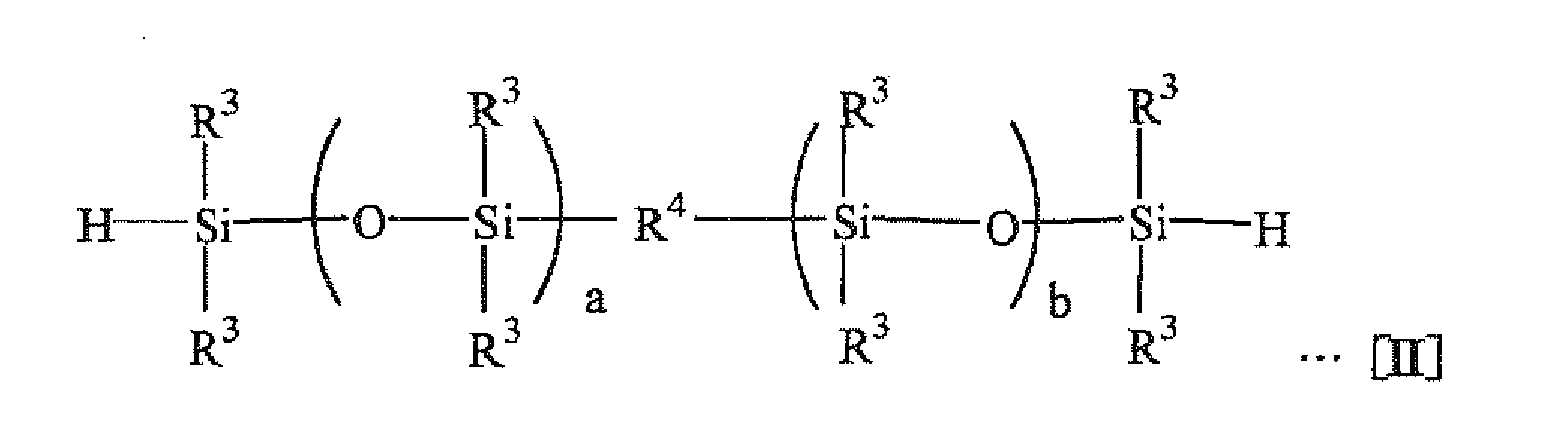
- wherein each R3 is a monovalent group of 1 to 10 carbon atoms, is an unsubstituted or substituted saturated hydrocarbon group or an aromatic hydrocarbon group and may be the same or different in one molecule, a is an integer of 0 to 20, b is an integer of 0 to 20, and R4 is a divalent organic group of 1 to 30 carbon atoms or an oxygen atom,
-

- wherein each R5 is a monovalent group of 1 to 10 carbon atoms, is an unsubstituted or substituted saturated hydrocarbon group or an aromatic hydrocarbon group and may be the same or different in one molecule, a, b and c are each independently an integer of 0 to 20, and R6 is a trivalent organic group of 1 to 30 carbon atoms.
- The fuel cell sealing member of the present invention comprises the rubber composition of the present invention.
- The fuel cell of the present invention comprises a fuel cell sealing member comprising the rubber composition of the present invention.
- The hard disk drive top cover gasket of the present invention and the gasket member for LIM molding of the present invention comprise the rubber composition of the present invention.
- The hard disk drive of the present invention comprises a hard disk drive top cover gasket comprising the rubber composition of the present invention.
- The electric wire connector sealing member of the present invention comprises the rubber composition of the present invention.
- The electric wire connector of the present invention comprises an electric wire connector sealing member comprising the rubber composition of the present invention. The electric wire connector of the present invention is preferably an electric wire connector for automobiles.
- The rubber composition of the present invention is suitable for LIM molding, and molded articles produced by using the rubber composition are excellent in sealing properties, heat resistance and acid resistance, have low reaction force, low hardness and low compression set and particularly have such high heat resistance that no crack occurs even when they are used under the conditions of high temperatures and high compression. The rubber composition of the present invention does not cause oil bleeding, blooming or the like, and can provide molded articles excellent in mechanical properties and resistance to outgassing. When the rubber composition is molded into a connector seal for an electric wire, the seal has excellent sealing properties and insertion properties for electric wires, and the rubber composition is suitable for a fuel cell sealing member, a gasket member for LIM molding and an electric wire connector sealing member. The fuel cell, the hard disk drive top cover gasket, the hard disk drive, the electric wire connector, etc. of the present invention are each provided with a molded product comprising the rubber composition of the present invention, and the molded product is excellent in sealing properties, heat resistance and acid resistance, has low reaction force, low hardness and low compression set, and particularly has such high heat resistance that no crack occurs even when it is used under the conditions of high temperatures and high compression.
-
-
Fig. 1 is a perspective view showing an example of a separator-integrated cell seal part for a fuel cell. -
Fig. 2 is a schematic cross-sectional view taken on line A-A inFig. 1 -
- 1: carbon, metallic or resin separator of separator-integrated cell for fuel cell
- 2: space
- 3: seal part of cell
- The present invention is described in detail hereinafter.
- The rubber composition according to the present invention comprises, as essential components, a specific ethylene/α -olefin/non-conjugated polyene copolymer [A] and calcined talc [B], and if necessary, contains surface-modified silica [C] and/or carbon black [D], and if necessary, further contains a SiH group-containing compound [E] having two SiH groups in one molecule and a SiH group-containing compound [F] having three SiH groups in one molecule.
- The copolymer [A] for use in the present invention at least satisfies the following (a) to (e), and preferably satisfies the following (a) to (f):
- (a) said copolymer is a copolymer of ethylene, an α-olefin and a non-conjugated polyene,
- (b) the α-olefin has 3 to 20 carbon atoms,
- (c) the weight ratio of ethylene units to α-olefin units is in the range of 35/65 to 95/5,
- (d) the iodine value is in the range of 0.5 to 50,
- (e) the intrinsic viscosity [η] is in the range of 0.01 to 5.0 dl/g as measured in decalin at 135°C, and
- (f) the non-conjugated polyene is at least one kind of norbornene compound represented by the aforesaid general formula [I].
- The copolymer [A] according to the present invention is a copolymer of ethylene, an α-olefin of 3 to 20 carbon atoms and a non-conjugated polyene, and is preferably a random copolymer thereof.
- The α-olefin to constitute the copolymer [A] is an α-olefin of 3 to 20 carbon atoms. Examples of the α-olefins include propylene, 1-butene, 4-methyl-1-pentene, 1-hexene, 1-heptene, 1-octene, 1-nonene, 1-decene, 1-undecene, 1-dodecene, 1-tridecene, 1-tetradecene, 1-pentadecene, 1-hexadecene, 1-heptadecene, 1-nonadecene, 1-eicosene, 9-methyl-1-decene, 11-methyl-1-dodecene and 12-ethyl-1-tetradecene. Of these, α-olefins of 3 to 10 carbon atoms are more preferable, and in particular, propylene, 1-butene, 1-hexene or 1-octene is most preferably used. These α-olefins are used singly or in combination of two or more kinds.
- Although the non-conjugated polyene to constitute the copolymer [A] is not specifically restricted, it is preferably a non-conjugated diene, more preferably at least one kind of norbornene compound represented by the following general formula [I].
-

- In the general formula [I], n is an integer of 0 to 10, R1 is a hydrogen atom or an alkyl group of 1 to 10 carbon atoms, and R2 is a hydrogen atom or an alkyl group of 1 to 5 carbon atoms.
Examples of the norbornene compounds represented by the general formula [I] include 5-vinyl-2-norbornene, 5-(2-propenyl)-2-norbornene, 5-(3-butenyl)-2-norbornene, 5-(1-methyl-2-propenyl)-2-norbornene, 5-(4-pentenyl)-2-norbornene, 5-(1-methyl-3-butenyl)-2-norbornene, 5-(5-hexenyl)-2-norbornene, 5-(1-methyl-4-pentenyl)-2-norbornene, 5-(2,3-dimethyl-3-butenyl)-2-norbornene, 5-(2-ethyl-3-butenyl)-2-norbornene, 5-(6-heptenyl)-2-norbornene, 5-(3-methyl-5-hexenyl)-2-norbornene, 5-(3,4-dimethyl-4-pentenyl)-2-norbornene, 5-(3-ethyl-4-pentenyl)-2-norbornene, 5-(7-octenyl)-2-norbornene, 5-(2-methyl-6-heptenyl)-2-norbornene, 5-(1,2-dimethyl-5-hexenyl)-2-norbornene, 5-(5-ethyl-5-hexenyl)-2-norbornene and 5-(1,2,3-trimethyl-4-pentenyl)-2-norbornene. - Of these, 5-vinyl-2-norbornene, 5- (2-propenyl) -2-norbornene, 5-(3-butenyl)-2-norbornene, 5-(4-pentenyl)-2-norbornene, 5-(5-hexenyl)-2-norbornene, 5-(6-heptenyl)-2-norbornene and 5-(7-octenyl)-2-norbornene are preferable. These norbornene compounds may be used singly or in combination of two or more kinds.
- The non-conjugated polyene to constitute the copolymer [A] of the present invention may be a non-conjugated polyene other than the norbornene compound represented by the general formula [I]. The non-conjugated polyene employable is not specifically restricted, and the following linear non-conjugated dienes, alicyclic non-conjugated dienes and triene compounds may be mentioned. These non-conjugated polyenes may be used singly or in combination of two or more kinds. The non-conjugated polyene other than the norbornene compound represented by the general formula [I] may be used together with the norbornene compound represented by the general formula [I].
- Examples of the linear non-conjugated dienes include 1,4-hexadiene, 3-methyl-1,4-hexadiene, 4-methyl-1,4-hexadiene, 5-methyl-1,4-hexadiene, 4,5-dimetnyl-1,4-hexadiene and 7-methyl-1,6-octadiene.
- Examples of the cyclic non-conjugated dienes include 5-methylene-2-norbornene, 1-methyl-5-methylene-2-norbornene, 1-ethyl-5-methylene-2-norbornene, 5-ethylidene-2-norbornene, 5-isopropylidene-2-norbornene, 5-vinylidene-2-norbornene, 6-chloromethyl-5-isopropenyl-2-norbornene, dicyclopentadiene and methyltetrahydroindene.
- Examples of the non-conjugated polyenes other than the above compounds include trienes, such as 2,3-diisopropylidene-5-norbornene, 2-ethylidene-3-isopropylidene-5-norbornene and 2-propenyl-2,2-norbornadiene.
- In the copolymer [A] according to the present invention has a ratio of ethylene units to α-olefin units of in the range of 35/65 to 95/5, preferably 40/60 to 90/10, more preferably 45/55 to 85/15, particularly preferably 50/50 to 80/20, in terms of weight ratio.
- When the weight ratio is in the above range, the obtainable rubber composition is capable of providing crosslinked rubber molded products which are excellent not only in heat aging resistance, strength properties and rubber elasticity but also in cold resistance and processability.
- The copolymer [A] of the present invention has an iodine value of in the range of 0.5 to 50 (g/100 g), preferably 1 to 45, more preferably 1 to 43, particularly preferably 3 to 40 (g/100 g).
- When the iodine value is in the above range, the obtainable rubber composition has high crosslinking efficiency, and is capable of providing crosslinked rubber molded products which are excellent not only in resistance to compression set but also in resistance to environmental degradation (heat aging resistance). If the iodine value exceeds the upper limit of the above range, the crosslink density sometimes becomes too high to thereby lower mechanical properties such as tensile elongation.
- The copolymer [A] according to the present invention has an intrinsic viscosity [η] of in the range of 0.01 to 5.0 dl/g, preferably 0.03 to 4.0 dl/g, more preferably 0.05 to 3.5 dl/g, particularly preferably 0.07 to 3.0 dl/g as measured in decalin at 135°C. An embodiment wherein the intrinsic viscosity [η] of the copolymer [A] is not more than 0.5 dl/g, preferably less than 0.3 dl/g, is preferable especially when the rubber composition is subjected to LIM molding. When the intrinsic viscosity [η] is in the above range, the obtainable rubber composition is capable of providing crosslinked rubber molded products which are excellent not only in strength properties and resistance to compression set but also in processability.
- The copolymer [A] according to the present invention desirably has a low viscosity, that is, desirably has a complex viscosity (25°C, strain: 1%) of not more than 105 Pa·S, preferably not more than 4000 Pa·S, more preferably not more than 2000 Pa·S, as measured by the use of a viscoelasticity measuring device MCR301 manufactured by Anton Paar (Australia).
- The copolymer [A] according to the present invention can be prepared by copolymerizing ethylene, an α-olefin and a non-conjugated polyene such as the aforesaid norbornene compound represented by the formula [I] in the presence of a polymerization catalyst. Specifically, the copolymer can be more preferably prepared such hitherto publicly known processes as described in, for example, "Polymer Production Process" (published by Kogyo Chosakai Publishing Co., Ltd., pp. 365-378), Japanese Patent Laid-Open Publication No.
71617/1997 71618/1997 208615/1997 67823/1998 67824/1998 110054/1998 - The polymerization catalysts preferably used include: a Ziegler catalyst comprising a compound of a transition metal, such as vanadium (V), zirconium (Zr) or titanium (Ti), and an organoaluminum compound (organoaluminum oxy-compound); and a metallocene catalyst comprising a metallocene compound of a transition metal selected from group IVB of the periodic table of elements and either an organoaluminum oxy-compound or an ionizing ionic compound.
- Specifically, the copolymer [A] according to the present invention can be preferably prepared by copolymerizing ethylene, an α-olefin and the aforesaid non-conjugated polyene, particularly preferably a norbornene compound containing a vinyl group, in the presence of a catalyst containing, as main components, a vanadium compound (a) and an organoaluminum compound (b) described below, under the conditions of a polymerization temperature of 30 to 60°C, particularly preferably 30 to 50°C, a polymerization pressure of 4 to 12 kgf/cm2, particularly preferably 5 to 8 kgf/cm2, and a molar ratio of the amount of non-conjugated polyene fed to the amount of ethylene fed (non-conjugated polyene/ethylene) ranging from 0.01 to 0.2. The copolymerization is preferably carried out in a hydrocarbon medium.
- The vanadium compound (a) is, for example, a vanadium compound represented by the general formula VO(OR)aXb or V(OR)cXd (wherein R is a hydrocarbon group, 0≤a≤3, 0≤b≤3, 2≤a+b≤3, 0≤c≤4, 0≤d≤4 and 3≤c+d≤4) or an electron donor adduct thereof.
- More specifically, there may be mentioned, for example, VOCl3, VO(OC2H5)Cl2, VO(OC2H5)2Cl, VO(O-iso-C3H7)Cl2, VO(O-n-C4H9)Cl2, VO(OC2H5)3, VOBr3, VCl4, VOCl3, VO(O-n-C4H9)3 and VCl3·2OC6H12OH.
- Examples of the organoaluminum compounds (b) include trialkylaluminums, such as triethylaluminum, tributylaluminum and triisopropylaluminum; dialkylaluminum alkoxides, such as diethylaluminum ethoxide and dibutylaluminum butoxide; alkylaluminum sesquialkoxides, such as ethylaluminum sesquiethoxide and butylaluminum sesquibutoxide;
partially alkoxylated alkylaluminums having an average composition represented by R0.5Al(OR)0.5 or the like; partially halogenated alkylaluminums, e.g., dialkylaluminum halides, such as diethylaluminum chloride, dibutylaluminum chloride and diethylaluminum bromide, alkylaluminum sesquihalides, such as ethylaluminum sesquichloride, butylaluminum sesquichloride and ethylaluminum sesquibromide, and alkylaluminum dihalides, such as ethylaluminum dichloride, propylaluminum dichloride and butylaluminum dibromide; partially hydrogenated alkylaluminums, e.g., dialkylaluminum hydrides, such as diethylaluminum hydride and dibutylaluminum hydride, and alkylaluminum dihydrides, such as ethylaluminum dihydride and propylaluminum dihydride; and partially alkoxylated and halogenated alkylaluminums, such as ethylaluminum ethoxychloride, butylaluminum butoxychloride and ethylaluminum ethoxybromide. - The resin component contained in the rubber composition according to the present invention is preferably only the above-mentioned ethylene/α-olefin/non-conjugated polyene copolymer [A]. However, a resin component other than the ethylene/ α-olefin/non-conjugated polyene copolymer [A] may be contained in the composition within limits not detrimental to the objects of the present invention.
- The resin component other than the copolymer [A] preferably used as an arbitrary component is, for example, an organopolysiloxane. The organopolysiloxane has a function of improving heat aging resistance of the rubber composition and contributes to improvement in heat aging resistance of fuel cell sealing parts, hard disk top cover gaskets, and sealing members for electric wire connectors.
- When the rubber composition of the present invention contains the organopolysiloxane, the organopolysiloxane is contained in such an amount that the weight ratio of the ethylene/α -olefin/non-conjugated polyene copolymer:organopolysiloxane is preferably in the range of 99.9:0.1 to 5: 95, more preferably 99.9:0.1 to 60:40, still more preferably 99.9:0.1 to 70:30.
- The organopolysiloxane is, for example, a compound having an average composition formula represented by the following formula (S):
- R1 tSiO(4-t)/2 (S)
In the formula (S), R1 is a monovalent hydrocarbon group of 1 to 10 carbon atoms, a part of or all of hydrogen atoms of the group may be replaced with cyano groups or halogen groups, and t is a number of 1.9 to 2.1.
R1 in the above formula (S) is specifically an alkyl group, such as methyl group, ethyl group, propyl group, butyl group, hexyl group or octyl group, a cycloalkyl group, such as cyclopentyl group or cyclohexyl group, an alkenyl group, such as vinyl group, allyl group or propenyl group, a cycloalkenyl group, such as cyclopentenyl group or cyclohexenyl group, an aryl group, such as phenyl group, tolyl group or xylyl group, or an aralkyl group, such as benzyl group or phenylethyl group. In these groups, a part of or all of hydrogen atoms may be replaced with chlorine atoms, fluorine atoms or cyano groups. - Particularly preferable organopolysiloxane include an organopolysiloxane having a dimethylsiloxane unit in its main chain, and an organopolysiloxane in which a diphenylsiloxane unit having a phenyl group, a methylvinylsiloxane unit having a vinyl group, a methyl-3,3,3-trifluoropropylsiloxane unit having a 3,3,3-trifluoropropyl group, or the like is introduced into a part of a main chain of dimethylpolysiloxane.
- The organopolysiloxane preferably has two or more aliphatic unsaturated groups, such as alkenyl groups and cycloalkenyl groups, in one molecule, and the amount of the aliphatic unsaturated groups, particularly preferably vinyl groups, in R1 is preferably in the range of 0.01 to 20% by mol, particularly preferably 0.02 to 10% by mol. The aliphatic unsaturated group may be present at the end of the molecular chain, at a halfway position of the molecular chain or at both thereof, it is preferably present at least at the end of the molecular chain. The end of the molecular chain may be capped with a trimethylsilyl group, a dimethylphenylsilyl group, a dimethylhydroxysilyl group, a dimethylvinylsilyl group, a trivinylsilyl group or the like.
- Examples of the organopolysiloxanes particularly preferably employable in the present invention include methylvinylpolysiloxane, methylphenylvinylpolysiloxane and methyltrifluoropropylvinyl-polysiloxane.
- The organopolysiloxane may be obtained by, for example, subjecting one or more kinds of organohalogenosilanes to (co) hydrolysis condensation or subjecting a cyclic polysiloxane (e.g., trimer or tetramer of siloxane) to ring-opening polymerization using an alkaline or acid catalyst. The resulting organopolysiloxane is basically a linear diorganopolysiloxane, but it may be a mixture of two or more kinds of organopolysiloxanes having different molecular structures.
- The organopolysiloxane is available as a commercial product or can be synthesized by a publicly known process disclosed.
- The degree of polymerization of the organopolysiloxane is preferably not less than 100, particularly preferably 3, 000 to 20, 000. The viscosity of the organopolysiloxane at 25°C is preferably not less than 100 centistokes (cSt), particularly preferably 100,000 to 100,000,000 cSt.
- The rubber composition of the present invention may contain publicly known other rubbers as other resin components in combination with the ethylene/α-olefin/non-conjugated polyene copolymer [A], within limits not detrimental to the objects of the present invention. Examples of the rubbers include natural rubbers (NR), isoprene-based rubbers, such as isoprene rubber (IR), and conjugated diene-based rubbers, such as butadiene rubber (BR), styrene-butadiene rubber (SBR), acrylonitrile-butadiene rubber (NBR) and chloroprene rubber (CR). Moreover, hitherto publicly known ethylene/ α-olefin-based copolymer rubbers, such as an ethylene/propylene random copolymer (EPR), may be used, or an ethylene/α-olefin/non-conjugated polyene copolymer other than the copolymer [A] of the present invention may be used.
- The calcined talc [B] for use in the present invention acts as a reinforcing filler in the rubber composition. Although the calcined talc is not specifically restricted, it is desirable to preferably use calcined talc having an average particle diameter of 2 to 15 µm, preferably 6 to 9 µm.
- The amount of the calcined talc [B] blended is desired to be preferably in the range of 2 to 50 parts by weight, more preferably 5 to 20 parts by weight, based on 100 parts by weight of the total amount of the resin components, namely the ethylene/α -olefin/non-conjugated polyene [A] and other resin components contained in the rubber composition. Blending the calcined talc [B] in the amount as described above allows the complex viscosity of the rubber composition in the molding process to be not more than 10000 Pa even when a reinforcing agent (filler) other than the calcined talc [B], such as surface modified silica [C] or carbon black [D] described below, is added. Furthermore, the resulting rubber composition is suitable also for LIM molding.
- The surface-modified silica [C] preferably used in the present invention is obtained by surface-modifying precipitated silica (hydrous silicic acid), and has a BET specific surface area (i.e., indication of primary particle diameter) of 30 to 80 m2/g, preferably 40 to 60 m2/g, a particle diameter as measured by the Coulter counter method (i.e., indication of secondary particle diameter), of 1 to 4 µm, preferably 1.5 to 3 µm, and an M value of not less than 50.
- As a raw material of the surface-modified silica [C] for use in the present invention, precipitated silica (hydrous silicic acid) is used. In addition to the precipitated silica, there are generally known gel-method silica, dry-process silica (anhydrous silicic acid), colloidal silica and the like as silica. The gel-method silica has strong cohesive force, and secondary (agglomerated) particles of the gel-method silica are hard and difficult to separate from one another. Therefore, the gel-method silica has poor dispersibility and usually has a large BET specific surface area of 250 to 900 m2/g, and hence, the resulting rubber composition tends to be thickened, resulting in a problem of poor processability. The colloidal silica generally has a large primary particle diameter and a small BET specific surface area, and therefore, it has good processability. However, particles of the colloidal silica themselves are monodispersed, and hence, there is a problem that an effect of imparting reinforcing properties to the rubber composition cannot be expected. Secondary (agglomerated) particles of the dry-process silica easily become loose, but the dry-process silica has poor dispersibility in rubber and usually has a relatively large BET specific surface area of about 100 to 400 m2/g, resulting in a problem of insufficient processability. For these reasons, the precipitated silica is most suitable as a raw material of the surface-modified silica [C] used in the present invention.
- Examples of the surface modification treatments of the precipitated silica include surface treatments with hexamethyldisilazane, chlorosilane, alkoxysilane, dimethyldichlorosilane, octylsilane and dimethyl silicone oil. By virtue of these surface treatments, an effect of suppressing thickening of the rubber composition can be expected when the surface-modified silica [C] is added to the rubber composition.
- In addi tion to the above surface treatment, the surface-modified silica [C] for use in the present invention may be further subjected to mechanical treatment such as shear fracture in order to inhibit steric hindrance of the silica surface caused by the surface treatment.
- The degree of surface modification treatment of silica is represented by an M value, and the M value of the surface-modified silica [C] for use in the present invention is desirably not less than 50. The M value is a general indicator of the degree of surface modification treatment of silica, and is a value represented by a concentration of a methanol aqueous solution (% by volume of methanol) given when methanol aqueous solutions having different methanol concentrations are added to silica that is a measurement target and the silica begins to have affinity (begins to become wet).
- The amount of the surface-modifiedsilica [C] added is preferably in the range of 20 to 60 parts by weight based on 100 parts by weight of the resin components contained in the rubber composition.
- The carbon black [D] preferably used in the present invention has an adsorbed amount of iodine of not more than 80 mg/g, preferably 15 to 40 mg/g, an average particle diameter of not more than 250 nm, preferably 40 to 100 nm, and an absorbed amount of DBP of 10 to 300 cm3/100 g, preferably 40 to 150 cm3/100 g. As the carbon black, commercially available carbon black of FEF grade, GPF grade, SRF grade or the like may be used. The carbon black [D] acts as a reinforcing agent in the rubber composition.
- Here, the adsorbed amount of iodine and the absorbed amount of DBP are typical indicators of properties of carbon black and are measured in accordance with JIS K6217. The adsorbed amount of iodine is an indicator of the total surface area of carbon black including pores of the carbon black. The absorbed amount of DBP has a correlation with the structure. As for the adsorbed amount of iodine and the absorbed amount of DBP, the magnitudes of these property values have great influence on the reinforcing properties, extrusion properties, dispersibility, coloring power, viscosity and electrical conduction properties when the carbon black is added to the rubber composition.
- The particle diameter indicates an average particle diameter of small spherical components forming carbon black agglomeratedpairs, as measured and calculated with an electron microscope image of the spherical components, and closely relates to the reinforcing properties and the degree of black when the carbon black is added to the rubber composition.
- On this account, when carbon black used has an adsorbed amount of iodine, an average particle diameter and an absorbed amount of DBP any one of which deviates from the above conditions, sufficient reinforcing properties cannot be exerted, or even if reinforcing properties are exerted, the viscosity of the material of the rubber composition may become too high, and the moldability in LIM molding is sometimes deteriorated.
- The amount of the carbon black [D] added is desired to be in the range of 5 to 60 parts by weight, preferably about 5 to 30 parts by weight, based on 100 parts by weight of the resin components contained in the rubber composition (total amount of the ethylene/α -olefin/non-conjugated polyene [A] and other resin components contained in the rubber composition).
- In the present invention, by using the surface-modified silica [C] and/or the carbon black [D] in combination with the calcined talc [B] to prepare a rubber composition, the resulting rubber composition exhibits more excellent reinforcing properties, and molded products obtained from the rubber composition can be effectively prevented from occurrence of crack even under the high-compression conditions at high temperatures.
- The rubber composition of the present invention may contain a rubber reinforcing agent and a filler other than the calcined talc [B], the surface-modified silica [C] and the carbon black [D], when needed.
- The rubber reinforcing agent has an effect of enhancing mechanical properties of a crosslinked (vulcanized) rubber, such as tensile strength, tear strength and abrasion resistance. The rubber composition of the present invention contains the calcined talc [B], and therefore, even if the composition does not contain other reinforcing agents, reinforcing effect is exerted to a certain extent. However, in order to further improve mechanical properties according to the desired properties, the surface-modified silica [C], the carbon black [D], or other rubber reinforcing agents or fillers may be added.
- Examples of other rubber reinforcing agents that may be added include silica other than the aforesaid surface-modified silica [C], carbon black other than the aforesaid carbon black [D], and finely divided silicic acid.
- Examples of other fillers that may be added include light calcium carbonate, heavy calcium carbonate, clay, talc (uncalcined talc) and diatomaceous earth. These rubber reinforcing agents and inorganic fillers may be used singly or in combination of two or more kinds. Although the kinds and the amounts of the rubber reinforcing agents and the inorganic fillers added may be properly selected according to the use purpose and the desired properties, the total amount of other rubber reinforcing agents and fillers and the components [B], [C] and [D] is usually not more than 200 parts by weight, preferably not more than 100 parts by weight, based on 100 parts by weight of the total amount of the copolymer [A] and other resin components that are added when needed.
- The rubber composition of the present invention desirably contains a crosslinking agent. As the crosslinking agent, a publicly known crosslinking agent maybe appropriately used, but it is desirable to use a crosslinking agent which exhibits compatibility or good dispersibility in the copolymer [A]. Especially when the non-conjugated polyene component of the copolymer [A] is the aforesaid norbornene compound represented by the formula [I], it is more preferable to use a compound having a SiH group to be a crosslinking point.
- When a compound having a SiH group to be a crosslinking point is used as a crosslinking agent, such crosslinking agents may be used singly or in combination of two or more kinds. In the present invention, it is particularly preferable to use a combination of a SiH group-containing compound [E] represented by the following general formula [II] and having two SiH groups in one molecule and a SiH group-containing compound [F] represented by the following general formula [III] and having three SiH groups in one molecule.
-

- In the formula (II), each R3 is a monovalent group of 1 to 10 carbon atoms, is anunsubstitutedor substituted saturated hydrocarbon group or an aromatic hydrocarbon group and may be the same or different in one molecule, a is an integer of 0 to 20, b is an integer of 0 to 20, and R4 is a divalent organic group of 1 to 30 carbon atoms or an oxygen atom.
-

- In the formula [III], each R5 is a monovalent group of 1 to 10 carbon atoms, is an unsubstituted or substituted saturated hydrocarbon group or an aromatic hydrocarbon group and may be the same or different in one molecule, a, b and c are each independently an integer of 0 to 20, and R6 is a trivalent organic group of 1 to 30 carbon atoms.
- The SiH group-containing compound [E] that is preferably used in the present invention is a compound represented by the above formula [II], has SiH groups at the both ends of a molecule and has two SiH groups per molecule. Examples of R3 in the general formula [II] include methyl group, ethyl group, propyl group, isopropyl group, butyl group, amyl group, cyclopentyl group, hexyl group, cyclohexyl group, octyl group, chloromethyl group, 2-chloroethyl group, 3-chloropropyl group, phenyl group, phenylmethyl group, 2-phenylethyl group and 2-phenylpropyl group. Preferable are methyl group, ethyl group and phenyl group. a is an integer of 0 to 20, and b is an integer of 0 to 20. a and b are each preferably not more than 10, more preferably not more than 5, particularly preferably not more than 2, and it is most preferable that a and b are equal to each other and are each not more than 2.
- Examples of the SiH group-containing compounds [B] represented by the general formula [II] and having two SiH groups in one molecule are given below. R4 in the general formula [II] is a divalent organic group of 1 to 30 carbon atoms or an oxygen atom, and examples of the divalent organic groups correspond to divalent groups in the compounds specifically exemplified below. These SiH group-containing compounds [B] may be used singly or as a mixture of two or more kinds of the compounds. The SiH group-containing compound [B] may be synthesized by a publicly known process disclosed.
-


-


-


-


-

-

- Of these, a compound represented by the following formula [II-1] is particularly preferable.
-

- The SiH group-containing compound [E] having two SiH groups in one molecule is preferably contained in the rubber composition in such an amount as to give 0.2 to 10 hydrogen atoms bonded to silicon atoms based on one aliphatic unsaturated bond contained in the resin components in the rubber composition.
- In the rubber composition of the present invention, the content of the SiH group-containing compound [E] having two SiH groups in one molecule is preferably in the range of 2 to 15 parts by weight, more preferably 3 to 8 parts by weight, based on 100 parts by weight of the total amount of the ethylene/α-olefin/non-conjugated polyene copolymer [A] and other resin components, from the viewpoint of rubber hardness of the obtainable molded product, etc.
- When the SiH group-containing compound [E] having two SiH groups in one molecule is added alone to the ethylene/α -olefin/non-conjugated polyene copolymer [A], the obtainable rubber composition can suppress crosslink density to a certain extent, and the obtainable molded product has excellent elongation properties. However, this rubber composition particularly has high compression set at a low temperature (-30°C) and is sometimes poor in recovery properties.
- The SiH group-containing compound [F] that is preferably used in the present invention is a compound represented by the aforesaid formula [III], has SiH groups at three ends of a molecule and has three SiH groups in one molecule. Examples of R5 in the general formula [III] are the same as those of R3 in the general formula [II], and there may be specifically mentioned, for example, methyl group, ethyl group, propyl group, isopropyl group, butyl group, amyl group, cyclopentyl group, hexyl group, cyclohexyl group, octyl group, chloromethyl group, 2-chloroethyl group, 3-chloropropyl group, phenyl group, phenylmethyl group, 2-phenylethyl group and 2-phenylpropyl group. Preferable are methyl group, ethyl group and phenyl group. a, b and c are each independently an integer of 0 to 20, and a, b and c are each preferably not more than 10, more preferably not more than 5, particularly preferably not more than 2, and it is most preferable that a, b and c are equal to one another and are each not more than 2. R6 in the general formula [III] is a trivalent organic group having 1 to 30 carbon atoms, preferably a trivalent organic group having 1 to 30 carbon atoms and containing silicon.
- Particularly preferable examples of the SiH group-containing compounds [F] having three SiH groups in onemolecule include a compound represented by the following formula [III-1].
-
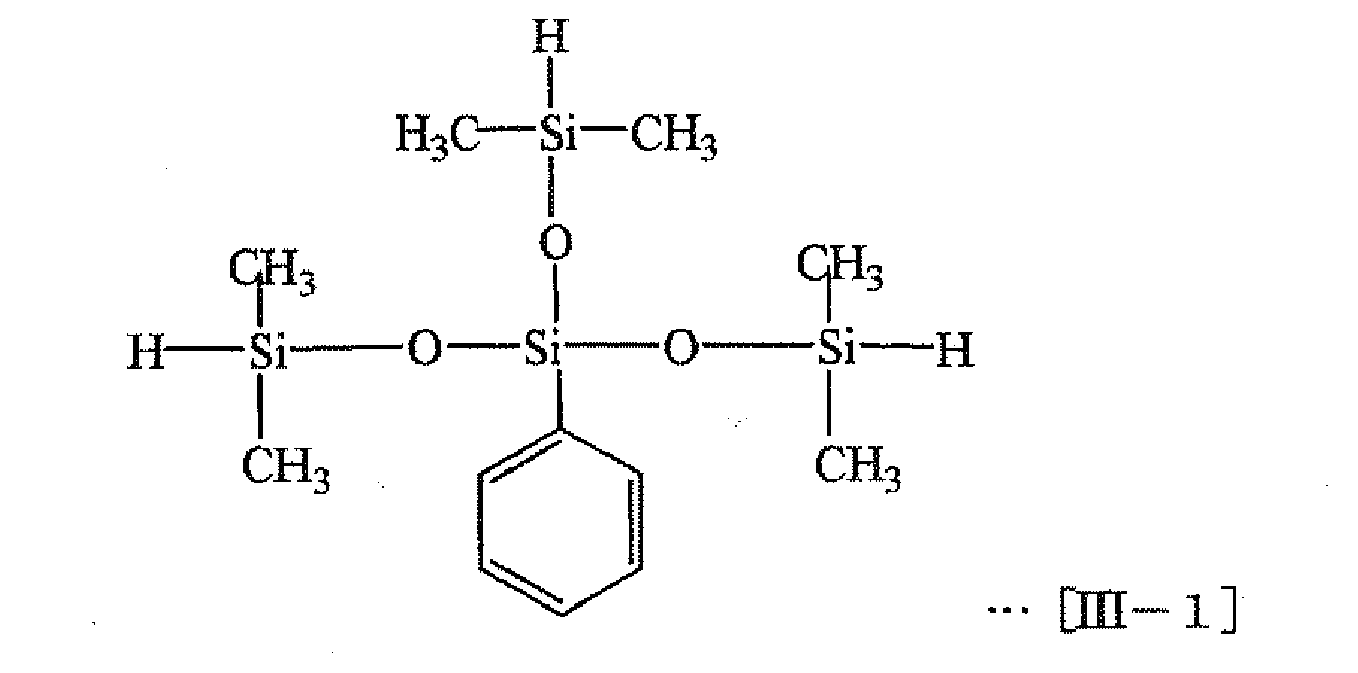
- In the rubber composition of the present invention, the content of the SiH group-containing compound [F] having three SiH groups in one molecule is preferably in the range of 0.1 to 2 parts by weight, more preferably 0.3 to 1.4 parts by weight, based on 100 parts by weight of the total amount of the ethylene/α-olefin/non-conjugated polyene copolymer [A] and other resin components.
- Use of the SiH group-containing compounds [E] and [F] in combination as the crosslinking agents is preferable from the viewpoints that the resulting rubber composition has good moldability, is excellent in heat resistance, barrier properties and sealing properties, has low compression set at a high temperature and a low temperature, is excellent in recovery properties, and can be favorably used for a fuel cell sealing member, a gasket member for LIM molding, an electric wire connector sealing member, etc.
- When the SiH group-containing compound [F] having three SiH groups in one molecule is added alone to the ethylene/α -olefin/non-conjugated polyene copolymer [A], the obtainable rubber composition undergoes three-dimensional crosslinking and is enhanced in rubber properties such as mechanical strength. However, this rubber composition has high compression set at a high temperature (150°C) and a low temperature (-30°C), has poor recovery properties, tends to cause scorching and sometimes has poor handleability during molding.
- The rubber composition of the present invention contains, as essential components, a resin component essentially containing the ethylene/α-olefin/non-conjugated polyene copolymer [A] and the calcined talc [B], and contains, if necessary, the surface-modified silica [C] and/or the carbon black [D], and crosslinking agents such as the SiH group-containing compounds [E] and [F]. Moreover, the rubber composition further contains, if necessary, the later-described other components, such as catalyst, reaction inhibiter, hitherto publicly known inorganic filler, softener, anti-aging agent, processing aid, vulcanization accelerator, organic peroxide, crosslinking assistant, foaming agent, colorant, dispersing agent and flame retardant.
- When the rubber composition of the present invention does not contain the carbon black [D] that is a black filler, the rubber composition can be made to have a desired color tone by using a colorant in combination, and by the use of this rubber composition, a molded product having a desired color tone can be produced.
- The rubber composition of the present invention may be prepared by, for example, the following process. The copolymer [A] and if necessary other resin components are kneaded together with the calcined talc [B] and if necessary rubber reinforcing agents and fillers including the surface-modified silica [C] and/or the carbon black [D], and other additives such as a softener, at a temperature of preferably 50 to 180°C for 3 to 10 minutes using an internal mixer (closed mixing machine), such as a Banburymixer, a kneader, aplanetary mixer or an intermix, or a kneading device, such as a two-roll mill or a three-roll mill. Thereafter, a crosslinking agent, such as a SiH group-containing compound, and if necessary, a catalyst, a reaction inhibitor, a vulcanization accelerator and a crosslinking assistant as described later are added and kneaded using a roll, such as an open roll, or a kneader at a roll temperature of not higher than 100°C for 1 to 30 minutes, followed by sheeting.
- When the kneading is performed at low temperature using an internal mixer, all of the components for the rubber composition may be mixed at the same time and kneaded.
- In the case where crosslinking is carried out using a crosslinking agent such as a SiH group-containing compound in the prepartion of the rubber composition of the present invention, a catalyst used for the crosslinking is an addition reaction catalyst, and it accelerates addition reaction (e.g., hydrosilylation reaction of alkene) of an alkenyl group or the like of the resin components including the copolymer [A] with a SiH group of the SiH group-containing compound.
- The catalyst usually used is, for example, an addition reaction catalyst comprising a platinum group element, such as a platinum-based catalyst, a palladium-based catalyst or a rhodium-based catalyst, and in the present invention, a platinum-based catalyst is preferable. It is desirable to use a complex comprising a group 8 element metal of the periodic table, such as a platinum-based catalyst, particularly preferably a complex of platinum and a compound containing a vinyl group and/or a carbonyl group.
- The compound containing a carbonyl group is preferably a carbonyl compound, an octanal compound or the like. Examples of the complexes of the compounds and platinum include a platinum-carbonyl complex, a platinum-octanal complex, a platinum-carbonylbutylcyclosiloxane complex and a platinum-carbonylphenylcyclosiloxane complex.
- The compound containing a vinyl group is preferably a vinyl group-containing organosiloxane. Examples of the complexes of the compounds and platinum include a platinum-divinyltetramethyldisiloxane complex, a platinum-divinyltetraethyldisiloxane complex, a platinum-divinyltetrapropyldisiloxane complex, a platinum-divinyltetrabutyldisiloxane complex and a platinum-divinyltetraphenyldisiloxane complex.
- Of the vinyl group-containing organosiloxanes, a vinyl group-containing cyclic organosiloxane is preferable. Examples of the complexes of the compounds and platinum include a platinum-vinylmethylcyclosiloxane complex, a platinum-vinylethylcyclosiloxane complex and a platinum-vinylpropylcyclosiloxane complex.
- The vinyl group-containing organosiloxane itself may be used for a ligand to a metal, and besides, it may be used as a solvent for coordinating other ligands. Particularly preferred as catalyst is a complex with a ligand derived from the aforesaid carbonyl group-containing compound, which complex is obtained in the presence of the vinyl group-containing organosiloxane as a solvent.
- Examples of such complexes include a vinylmethylcyclosiloxane solution of a platinum-carbonyl complex, a vinylethylcyclosiloxane solution of a platinum-carbonyl complex, a vinylpropylcyclosiloxane solution of a platinum-carbonyl complex, a divinyltetramethyldisiloxane solution of a platinum-carbonyl complex, a divinyltetraethyldisiloxane solution of a platinum-carbonyl complex, a divinyltetrapropyldisiloxane solution of a platinum-carbonyl complex, a divinyltetrabutyldisiloxane solution of a platinum-carbonyl complex, and a divinyltetraphenyldisiloxane solution of a platinum-carbonyl complex.
- The catalysts comprising these complexes may further contain components other than the compound containing a vinyl group and/or a carbonyl group. For example, the catalysts may contain a solvent other than the compound containing a vinyl group and/or a carbonyl group. Examples of such solvents include various alcohols and xylene, though the solvents are not limited thereto.
- Examples of the alcohols include aliphatic saturated alcohols, such as methanol and ethanol; aliphatic unsaturated alcohols, such as allyl alcohol and crotyl alcohol; alicyclic alcohols, such as cyclopentanol and cyclohexanol; aromatic alcohols, such as benzyl alcohol and cinnamyl alcohol; and heterocyclic alcohols, such as furfuryl alcohol.
- The catalyst containing an alcohol as a solvent is, for example, a platinum-octanal/octanol complex. The catalyst containing such a solvent has advantages in that, for example, handling of the catalyst and mixing of the catalyst with the rubber composition are facilitated.
- Of the above-mentioned various catalysts, preferable are a vinylmethylcyclosiloxane solution of a platinum-carbonyl complex (particularly preferable is a complex represented by the following chemical formula 1), a platinum-vinylmethylcyclosiloxane complex (particularly preferable is a complex represented by the following chemical formula 2), a platinum-divinyltetramethyldisiloxane complex (particularly preferable is a complex represented by the following chemical formula 3), a platinum-octanal/octanol complex, and the like from the viewpoint of practical use. Of these, particularly preferable is a platinum-carbonylvinylmethylcyclosiloxane complex.
-
Chemical formula 1: Pt0·CO·(CH2=CH(Me)SiO)4
Chemical formula 2: Pt0·(CH2=CH(Me)SiO)4
Chemical formula 3: Pt0-1.5[(CH2=CH(Me)2Si)2O]
The proportion of the periodic table group 8 element metal (preferably platinum) contained in these catalysts is usually in the range of 0.1 to 10% by weight, preferably 0.1 to 5% by weight, more preferably 0.1 to 4% by weight, particularly preferably 0.1 to 3.5% by weight. - The catalyst is used in an amount of 0.1 to 100, 000 ppm by weight, preferably 0.1 to 10,000 ppm by weight, more preferably 0.1 to 5, 000 ppm by weight, particularly preferably 0.1 to 1,000 ppm by weight, based on the total amount of the resin components, that is, the total amount of the copolymer [A] and other resin components that are added when needed, though the amount of the catalyst is not specifically restricted. Use of the catalyst in an amount in the above range gives a rubber composition capable of forming crosslinked rubber molded products which have moderate crosslink density and are excellent in strength properties and elongation properties. Use of the catalyst in an amount exceeding 100,000 ppm by weight is undesirable because of disadvantageous cost. The crosslinked rubber molded product may be also obtained by irradiating an uncrosslinked rubber molded product of the rubber composition containing no catalyst with light, γ-rays, electron beams or the like.
- In the crosslinking of the rubber composition of the present invention, both of addition crosslinking and radical crosslinking may be carried out by using an organic peroxide in addition to the above catalyst. The organic peroxide is used in an amount of about 0.1 to 10 parts by weight based on 100 parts by weight of the resin components. As the organic peroxide, a hitherto publicly known organic peroxide that is usually used for crosslinking of rubbers is employable.
- In the crosslinking, a reaction inhibitor is preferably used together with the above catalyst. Examples of the reaction inhibitors include benzotriazole, ethynyl group-containing alcohols, such as ethynylcyclohexanol, acrylonitrile, amide compounds, such as N,N-diallylacetamide, N,N-diallylbenzamide, N,N,N',N'-tetraallyl-o-phthalic acid diamide, N,N,N',N'-tetraallyl-m-phthalic acid diamide and N,N,N',N'-tetraallyl-p-phthalic acid diamide, sulfur, phosphorus, nitrogen, amine compounds, sulfur compounds, phosphorus compounds, tin, tin compounds, tetramethyltetravinylcyclotetrasiloxane, and organic peroxides, such as hydroperoxide.
- The reaction inhibitor is used in an amount of 0 to 50 parts by weight, usually 0.0001 to 50 parts by weight, preferably 0.0001 to 30 parts by weight, more preferably 0.0001 to 20 parts by weight, still more preferably 0.0001 to 10 parts by weight, particularly preferably 0.0001 to 5 parts by weight, based on 100 parts by weight of the total amount of the copolymer [A] and other resin components that are added when needed. Use of the reaction inhibitor in an amount exceeding 50 parts by weight is undesirable because of disadvantageous cost.
- The rubber composition of the present invention may contain additives, such as hitherto publicly known rubber reinforcing agents and inorganic fillers other than the calcined talc [B], the surface-modified silica [C] and the carbon black [D], a softener, an anti-aging agent, a processing aid, a vulcanization accelerator, an organic peroxide, a crosslinking assistant, a foaming agent, a foaming assistant, a colorant, a dispersing agent and a flame retardant according to the intended use of the crosslinked product, within limits not detrimental to the objects of the present invention.
- As the softener, a publicly known softener usually used for rubbers is employable. Examples of such softeners include petroleum-based softeners, such as process oil, lubricating oil, paraffin, liquid paraffin, petroleum asphalt and vaseline; coal tar-based softeners, such as coal tar and coal tar pitch; fatty oil-based softeners, such as castor oil, linseed oil, rapeseed oil and coconut oil; waxes, such as beeswax, carnauba wax and lanolin; fatty acids and fatty acid salts, such as ricinolic acid, palmitic acid, barium stearate, calcium stearate and zinc laurate; synthetic polymers, such as petroleum resin, atactic polypropylene and coumarone-indene resin; and other softeners, such as tall oil and factice. Of these, petroleum-based softeners are preferably used, and process oil is particularly preferably used. The amount of the softener added is properly selected according to the use purpose of the crosslinked product. These softeners may be used singly or in combination of two or more kinds.
- As the anti-aging agent, any of hitherto publicly known anti-aging agents is employable, and examples thereof include amine-based anti-aging agents, hindered phenol-based anti-aging agents and sulfur-based anti-aging agents. The anti-aging agent is used in such an amount that the objects of the present invention are not impaired. The anti-aging agents given below as examples may be used singly or in combination of two or more kinds even in the same kind or different kinds of the amine-based anti-aging agents, the hindered phenol-based anti-aging agents and the sulfur-based anti-aging agents.
- Examples of the amine-based anti-aging agents include diphenylamines and phenylenediamines. In particular, 4,4'-(α,α -dimethylbenzyl)diphenylamine and N,N'-di-2-naphthyl-p-phenylenediamine are preferable.
- As the hindered phenol-based anti-aging agents, phenolic compounds, such as tetrakis[methylene-3-(3',5'-di-t-butyl-4'-hydroxyphenyl)propiona te]methane and 3,9-bis[2-{3-(3-t-butyl-4-hydroxy-5-methylphenyl)propionyloxy}-1 ,1-dimethylethyl]-2,4,8,10-tetraoxaspiro[5,5]undecane are particularly preferable.
- As the sulfur-based anti-aging agents, 2-mercaptobenzimidazole, zinc salt of 2-mecaptobenzimdazole, 2-mercaptomethylbenzimidazole, zinc salt of 2-mercaptomethylbenzimidazole, and pentaerythritol-tetrakis-(β-laurylthiopropionate) are particularly preferable.
- As the processing aid, a publicly known compound that is usually used for processing rubbers is employable. Examples of such processing aids include higher fatty acids, such as ricinolic acid, stearic acid, palmitic acid and lauric acid; salts of high fatty acids, such as barium stearate, zinc stearate and calcium stearate; and esters of higher fatty acids such as ricinolic acid, stearic acid, palmitic acid and lauric acid. The processing aid is used in an amount of not more than 10 parts by weight, preferably not more than 5 parts by weight, based on 100 parts by weight of the total amount of the copolymer [A] and other resin components that are added when needed. However, it is desirable to properly determine the optimum amount according to the property values required.
- When an organic peroxide is used in the crosslinking of the rubber composition of the present invention, a crosslinking assistant is preferably used in combination with organic peroxide. Examples of the crosslinking assistants include sulfur, quinone dioxime-based compounds, such as p-quinone dioxide, methacrylate-based compounds, such as polyethylene glycol dimethacrylate, allyl-based compounds, such as diallyl phthalate and triallyl cyanurate, maleimide-based compounds, and divinylbenzene. Such a crosslinking assistant is used in an amount of 0.5 to 2 mol based on 1 mol of the organic peroxide used, preferably in an amount nearly equimolar to the organic peroxide.
- Since the rubber composition of the present invention described above is excellent not only in mechanical properties but also in heat resistance, it can be particularly favorably used for a fuel cell sealing member, a hard disk drive top cover gasket, a sealing member for an electric wire connector, etc. The rubber composition of the present invention is particularly suitable for LIMmolding, but molded products of the rubber composition may be also produced by other molding methods.
- The fuel cell sealing member, the hard disk drive top cover gasket and the sealing member for an electric wire connector of the present invention (referred to as "respective members of the present invention" hereinafter) can exhibit their characteristics most markedly when they are used as crosslinked rubber molded products.
- In the production of a crosslinked rubber molded product from the rubber composition of the present invention, it is preferable that an uncrosslinked rubber composition is first prepared by the aforesaid preparation process, then the rubber composition is molded into the intended shape, and the molded product is crosslinked, similarly to the case where general rubbers are usually vulcanized (crosslinked).
- The composition of the present invention prepared as above is molded into the intended shapes by various molding methods using an LIM molding machine, an injection molding machine, a transfer molding machine, a press molding machine, an extrusion molding machine, a calender roll, an ink jet forming machine, a screen printing machine and the like. Of these molding machines, the LIM molding machine is preferable for producing the desired respective members of the present invention from the viewpoints of thickness accuracy and high-speed molding. Moreover, injection molding and compression molding are also preferable.
- The crosslinking may be carried out simultaneously with molding of the rubber composition, or may be carried out by introducing the molded product into a vulcanizing bath.
- For example, molding and crosslinking may be carried out in the following manner. The rubber composition of the present invention is obtained by mixing the components using any of various kneading devices, such as a three-mill roll, an open roll, a two-open roll, a Banbury mixer, an internal mixer, a kneader, a planetary mixer and a high-shear mixer. The rubber composition is then molded under the crosslinking conditions of 80 to 230°C, preferably 100 to 180°C, and then, if necessary, the resulting crosslinked molded product is subjected to heat treatment (secondary vulcanization) in an air oven, such as a gear oven or a constant temperature oven, at about 100 to 230°C, preferably about 120 to 150°C, for about 0.5 to 24 hours. The crosslinking or the secondary crosslinking (secondary vulcanization) may be carried out by irradiation with light, γ-rays, electron beams or the like, and the crosslinking may be carried out at ordinary temperature. Through the above process, crosslinked rubber molded products, namely the respective members of the present invention, are obtained.
- In this crosslinking stage, the crosslinking may be carried out with or without a mold. When a mold is not used, the steps of molding and cross linking are usually carried out continuously. Usable heating means in the vulcanizing bath include a heating bath using hot air, glass bead fluidized bed, UHF (ultra-high frequency electromagnetic waves), steam and the like.
- In the case where the rubber composition of the present invention is applied particularly to LIM molding, it is preferable that preparation of a composition containing resin components including the copolymer [A] and a crosslinking agent and that of a composition containing resin components including the copolymer [A] and a catalyst are carried out and those two compositions are then mixed in an LIM molding device to prepare and mold the rubber composition of the present invention. Here, components other than the resin components, the crosslinking agent and the catalyst may be contained in any one of the compositions or both of the compositions.
- Specifically, the copolymer [A], other resin components, and additives, such as rubber reinforcing agents including the components [B] and [C], a crosslinking agent, an inorganic filler and a softener, are kneaded for 3 to 10 minutes by the use of an internal mixer (closed mixing machine), such as a Banbury mixer, a kneader or an intermix, or a mixing machine, such as a planetary mixer, to prepare a liquid rubber composition (1), with the proviso that the kneading machine used is properly selected according to the viscosity of the materials and the like. Separately, the copolymer [A], other resin components, additives, such as a rubber reinforcing agent, an inorganic filler and a softener, the aforesaid catalyst, and if necessary, a reaction inhibitor are kneaded for 3 to 10 minutes to prepare a liquid rubber composition (2). Defoaming is carried out, when needed. Subsequently, the liquid rubber composition (1) and the liquid rubber composition (2) are placed in an exclusive pail can that can be directly connected to an LIM molding device or a cartridge that can be directly connected to an LIM molding device, then allowed to pass through a metering device and a mixing device, and subjected to LIM molding to obtain the respective members of the present invention.
- For fuel cells, it is important to seal a cell, and this seal needs to be excellent particularly in gas barrier properties and the like. An example of the shape of the seal is described with reference to the drawings.
- The sealing member has, for example, such a shape as indicated by reference numeral 3 in
Fig. 1 and Fig. 2 . The sealing member has such a planar outer shape as indicated by reference numeral 3 inFig. 1 . InFig. 1 and Fig. 2 , reference numeral 1 indicates a carbon, metallic or resin separator, and reference numeral 3 indicates a sealing member. Reference numeral 2 inFig. 1 indicates a space. - The fuel cell sealing member of the present invention preferably has no void caused by foaming or the like, that is, the fuel cell sealing member is preferably so-called void-free.
- The fuel cell sealing member of the present invention desirably has a volume resistivity of not less than 1×10¹⁰ Ω·cm. The volume resistivity is one of properties required for sealing members used in electrical or electronic parts, and is an indicator of electrical insulation properties. The volume resistivity is more preferably not less than 1×10¹² Ω·cm, and a sealing member having such a volume resistivity exhibits preferred performance as a sealing member. The volume resistivity is measured in accordance with SRIS2301-1969 using a sheet having a thickness of 1 mm obtained by press-crosslinking a rubber composition at a pressure of 40 kgf/cm2 and a temperature of 150°C for 10 minutes.
- The fuel cell of the present invention comprises the fuel cell sealing member of the present invention.
- The hard disk drive top cover gasket of the present invention preferably comprises, at the gasket portion, a crosslinked rubber sheet obtained by the aforesaid method and having a compression set of not more than 50%, and the gasket exhibits sufficient sealing properties as a manufactured article. Moreover, the crosslinked rubber sheet preferably has a tensile strength of not less than 2 MPa and a tensile elongation at break of not less than 200%, and in this case, troubles such that the rubber sheet is easily torn off in the production process is suppressed. Furthermore, the crosslinked rubber sheet preferably has a hardness (JIS K6253) of less than 70 degrees. If the hardness is not less than 70 degrees, the reaction force given when the cover-integrated gasket is mounted on a main body is increased. As a result, the cover is deformed and sealing cannot be made completely, and thus, the sealing properties required for a gasket are sometimes deteriorated. The hardness is preferably not less than 10 degrees. If the hardness is less than 10 degrees, troubles such that the gasket is easily torn off, easily adheres, are brought about. The hardness is most preferably in the range of 20 to 40 degrees.
- Examples of adhesives used for integrating the hard disk drive top cover with the gasket include epoxy resin-based adhesives, phenolic resin-based adhesives, isocyanate-based coupling agents and silane-based coupling agents. For applying the adhesive, an optimum method is selected from dip coating, spray coating, screen printing, brushing, stamping, etc. according to necessity.
- The hard disk drive top cover gasket of the present invention preferably has no void caused by foaming or the like, that is, this gasket is preferably so-called void-free.
- The electric wire connector sealing member of the present invention comprises the aforesaid rubber composition of the present invention, and is preferably, for example, a solid polymer type (solid polymer electrolyte type) electric wire connector sealing member.
- The electric wire connector seal of the present invention preferably has a durometer A hardness, which indicates a surface hardness of the cured product layer, of not more than 45. The durometer A hardness is an indicator of hardness and can be measured in accordance with JIS K6253. A durometer A hardness of not more than 45 can be obtained by variously controlling the proportions of various additives added to the composition, such as a reinforcing agent, a filler and a plasticizer, and the electric wire connector sealing member containing none of these additives also exhibits a desired low hardness. The lower limit of the hardness is not less than 5. If the hardness is less than the lower limit, the sealingmember is too soft and exhibits poor performance for sealing the electric wire connector. However, an electric wire connector sealing member containing, as the reinforcing agent or the filler, a substance which acts as catalyst poison, such as sulfur or a halogen compound, is undesirable.
- The electric wire connector of the present invention comprises the sealing member for an electric wire connector of the present invention. The electric wire connector according to the present invention is particularly preferably an electric wire connector for automobiles.
- Hereinafter, the present invention is further described with reference to the following examples, but it should be construed that the present invention is in no way limited to those examples.
- Using a stainless steel polymerizer (stirring rotational speed: 250 rpm) having a substantial internal volume of 100 liters and equipped with a stirring blade, terpolymerization of ethylene, propylene and 5-vinyl-2-norbornene (abbreviated to VNB hereinafter) was continuously carried out. To the liquid phase in the polymerizer were continuously fed, at the side of the polymerizer, hexane at a rate of 60 1/hr, ethylene at a rate of 1.3 kg/hr, propylene at a rate of 2.5 kg/hr, VNB at a rate of 130 g/hr, hydrogen at a rate of 30 1/hr, VO(OEt)Cl2 as a catalyst at a rate of 23 mmol/hr and Al(Et)1.5Cl1.5 as a catalyst at a rate of 161 mmol/hr, and copolymerization reaction was carried out under the conditions of a polymerization temperature of 40°C and a polymerization pressure of 0.7 MPa to obtain an ethylene/propylene/VNB random copolymer (A-1) (referred to as a "copolymer (A-1)" hereinafter) in a state of a homogeneous solution. Thereafter, to the polymerization solution continuously drawn out from the bottom of the polymerizer was added a small amount of methanol to terminate the polymerization reaction. After the polymer was separated from the solvent by steam stripping treatment, the polymer was subjected to vacuum drying at 55°C for 48 hours.
- The resulting copolymer (A-1) had an ethylene content of 52.7% by weight, a VNB content of 4.7% by weight, an iodine value of 9.5 g/100 g, a complex viscosity (complex viscosity as measured by the use of a viscoelasticity measuring device MCR301 manufactured by Anton Paar (Australia)) at 25°C of 1100 Pa·S, and an intrinsic viscosity [η], as measured in decalin at 135°C, of 0.28 dl/g. Values in composition of the copolymer (A-1) are those determined by measurement with 13C-NMR method.
- In a planetary mixer having a volume of 2 liters (manufactured by Inoue MFG., INC., trade name: PLM-2 model), 100 parts by weight of the copolymer (A-1) obtained in Preparation Example 1, 15 parts by weight of calcined talc (available from Asada Milling Co., Ltd., trade name: Enstac 24, average particle diameter: 7 µm) and 30 parts by weight of surface-treated precipitated silica (SS-95 available from Tosoh Silica Corporation, BET surface area: 50 m2/g, secondary particle diameter (average particle diameter as determined by the Coulter counter method): 2.4 µm, M value: 65) were kneaded at a temperature ranging from 50 to 80°C. Subsequently, to the resulting mixture were added 0.4 part by weight of a platinum-1,3,5,7-tetravinylmethylcyclosiloxane complex (platinum concentration: 0.5% by weight, vinyl-terminated siloxane oil solution) as a catalyst, 0.1 part by weight of 1-ethynyl-1-cyclohexanol as a reaction inhibitor, 4.5 parts by weight of a compound represented by the following formula [II-1] (referred to as a "crosslinking agent 1" hereinafter) as a crosslinking agent and 0.5 part by weight of a compound represented by the following formula [III-1] (referred to as a "crosslinking agent 2" hereinafter) as a crosslinking agent, and they were mixed to prepare a rubber composition. The M value of the surface-treated precipitated silica is a general indicator of the degree of modification treatment of silica, and is a value represented by a concentration of a methanol aqueous solution (% by volume of methanol) given when methanol aqueous solutions having different methanol concentrations are added to silica that is an M value evaluation target and the silica begins to have affinity (begins to become wet).
-

- Subsequently, the resulting rubber composition was poured into a test sheet mold (140×100×2 mm) and compression molded at a hot plate preset temperature of 150°C and a mold compression pressure of 80 MPa for 5 minutes to obtain a crosslinked rubber sheet. Then, secondary vulcanization was further carried out in an air oven at 150°C for 1 hour to obtain a crosslinked rubber sheet.
- Properties of the resulting crosslinked rubber sheet were measured or evaluated by the following methods. The results are set forth in Table 1.
- In accordance with JIS K6253, the A hardness was measured by a durometer method at a measuring temperature of 23°C.
- In accordance with JIS K6251, a tensile test was carried out under the conditions of a measuring temperature of 23°C and a strain rate of 500 mm/min to measure a tensile strength at break and an elongation at break of the crosslinked sheet. Furthermore, a tensile strength at break and an elongation at break of the crosslinked sheet were measured also at a measuring temperature of 90°C in a similar manner.
- In accordance with JIS K6262 (1997), three 2-mm sheets were laminated, and a compression set was measured in air under the conditions of 150°C × 70 hours, and a compression set ratio was determined.
- From the rubber sheet having a thickness of 2 mm, a specimen of 2 mm (thickness) × 3 mm (width) × 40 mm (length) was cut out, and the specimen was 90% compressed in the direction of thickness in an atmosphere of 90°C and held for 10 minutes. Thereafter, the specimen was released from the compression, and presence or absence of crack of the specimen was confirmed. In this measurement, the number of specimens used was five (n=5).
- Complex viscosity of the rubber composition was measured at 25°C by the use of a viscoelasticity measuring device MCR301 manufactured by Anton Paar (Australia).
- A rubber composition and a crosslinked rubber sheet were prepared and the properties were evaluated in the same manner as in Example 1, except that 30 parts by weight of carbon black (Asahi #50HG available from Asahi Carbon Co. , Ltd. , amount of iodine adsorbed: 19 mg/g, average particle diameter: 85 nm, amount of DBP absorbed: 110 cm3/100 g) were used instead of the surface-treated precipitated silica.
- A rubber composition and a cross linked rubber sheet were prepared and the properties were evaluated in the same manner as in Example 1, except that 15 parts by weight of talc (L-1 available from Nippon Talc Co., Ltd. , BET specific surface area: 11m2/g, secondary particle diameter: 4.9 µm) were used instead of the calcined talc. The results are set forth in Table 1.
- A rubber composition and across linked rubber sheet were prepared and the properties were evaluated in the same manner as in Comparative Example 1, except that 30 parts by weight of carbon black (Asahi #50HG available from Asahi Carbon Co., Ltd., amount of iodine adsorbed: 19 mg/g, average particle diameter: 85 nm, amount of DBP absorbed: 110 cm3/100 g) were used instead of the surface-treated precipitated silica. The results are set forth in Table 1.
- A rubber composition and a crosslinked rubber sheet were prepared and the properties were evaluated in the same manner as in Example 1, except that calcined talc was not used and the amount of the surface-treated precipitated silica used was changed to 45 parts by weight. The results are set forth in Table 1.
-
Table 1 Ex. 1 Ex. 2 Comp. Ex. 1 Comp. Ex. 2 Comp. Ex. 3 Filler Calcined talc and surface-treated silica Calcined talc and carbon black Talc and surface-treated silica Talc and carbon black Surface-treated silica Values in ordinary state Hardness (Duro-A) 43 40 41 44 46 Tensile strength (MPa) 3.00 3.50 2.70 3.10 2.87 Elongation at break (%) 410 370 360 350 400 Compression set 150°C, 70hr (%) 10 12 15 16 17 Compression crack 90°C 90% compression OK OK NG NG OK n=5, number of cracked specimens 0/5 0/5 5/5 5/5 0/5 Viscosity
MCR301 (25°C)Complex viscosity (Pas) 5500 3000 4500 3500 11000 - From the results of the above examples and comparative examples, it can be seen that in Examples 1 and 2 the conditions of which were the same as those of Comparative Examples 1 and 2 respectively except for using calcined talc instead of talc, mechanical strength properties in ordinary state, i.e., hardness, tensile strength and elongation at break, were all improved and the compression set at a high temperature was decreased and thereby showed high recovery properties. Moreover, it can be also seen that in Examples 1 and 2, excellent rubber molded products which did not crack even under the high-temperature high-compression conditions of 90°C and 90% compression were obtained. In Comparative Examples 1 and 2 in which conventional blending was carried out, the viscosity was moderate and moldability was excellent, but crack occurred in the compression crack test under the high-temperature high-compression conditions. It can be also seen that in Comparative Example 3 in which the filler used was only surface-treated silica, not only crack occurred in the compression crack test under the high-temperature high-compression conditions but also the material viscosity was markedly increased and the moldability was poor.
- The rubber composition of the present invention is suitable for LIM molding and is favorably used for a fuel cell sealing member, various gasket members such as a hard disk drive top cover gasket member, a sealing member for an electric wire connector, etc. In particular, a sealing member or a gasket member obtained from the rubber composition of the present invention can be favorably used for a high-reaction type fuel cell or the like that is used under the conditions of high temperatures and high compression.
Claims (15)
- A rubber composition comprising:an ethylene/α-olefin/non-conjugated polyene copolymer [A] satisfying the following (a) to (e):calcined talc [B].(a) said copolymer is a copolymer of ethylene, an α-olefin and a non-conjugated polyene,(b) the α-olefin has 3 to 20 carbon atoms,(c) the weight ratio of ethylene units to α-olefin units is in the range of 35/65 to 95/5,(d) the iodine value is in the range of 0.5 to 50, and(e) the intrinsic viscosity [η] is in the range of 0.01 to 5.0 dl/g as measured in decalin at 135°C, and
- The rubber composition as claimed in claim 1, wherein the ethylene/α-olefin/non-conjugated polyene copolymer [A] further satisfies the following (f):(f) the non-conjugated polyene is at least one kind of norbornene compound represented by the following general formula [I]:

- The rubber composition as claimed in claim 1 or 2, wherein the average particle diameter of the calcined talc [B] is in the range of 2 to 15 µm, and
the amount of the calcined talc [B] blended is in the range of 2 to 50 parts by weight based on 100 parts by weight of the total amount of the ethylene/α-olefin/non-conjugated polyene copolymer [A] and other resin components contained in the rubber composition. - The rubber composition as claimed in any one of claims 1 to 3, further comprising:surface-modified silica [C] obtained by surface-modifying precipitated silica and having a BET specific surface area of 30 to 80m2/g, a particle diameter, as measured by the Coulter counter method, of 1 to 4 µm and an M value of not less than 50, and/orcarbon black [D] having an adsorbed amount of iodine of not more than 80 mg/g, an average particle diameter of not more than 250 nm and an absorbed amount of DBP of 10 to 300 cm3/100 g.
- The rubber composition as claimed in any one of claims 1 to 4, wherein the total amount of the calcined talc [B], the surface-modified silica [C] and the carbon black [D] is in the range of 10 to 60 parts by weight based on 100 parts by weight of the total amount of the ethylene/α-olefin/non-conjugated polyene copolymer [A] and other resin components contained in the rubber composition.
- The rubber composition as claimed in any one of claims 1 to 5, wherein the resin component contained in the rubber composition is only the ethylene/α-olefin/non-conjugated polyene copolymer [A].
- The rubber composition as claimed in any one of claims 1 to 6, further comprising:a SiH group-containing compound [E] represented by the following general formula [II] and having two SiH groups in one molecule, anda SiH group-containing compound [F] represented by the following general formula [III] and having three SiH groups in one molecule;


- A fuel cell sealing member comprising the rubber composition as claimed in any one of claims 1 to 7.
- A fuel cell comprising a fuel cell sealing member comprising the rubber composition as claimed in any one of claims 1 to 7.
- A hard disk drive top cover gasket comprising the rubber composition as claimed in any one of claims 1 to 7.
- A gasket member for LIM molding, comprising the rubber composition as claimed in any one of claims 1 to 7.
- A hard disk drive comprising a hard disk drive top cover gasket comprising the rubber composition as claimed in any one of claims 1 to 7.
- An electric wire connector sealing member comprising the rubber composition as claimed in any one of claims 1 to 7.
- An electric wire connector comprising an electric wire connector sealing member comprising the rubber composition as claimed in any one of claims 1 to 7.
- The electric wire connector as claimed in claim 14, which is an electric wire connector for automobiles.
Applications Claiming Priority (1)
| Application Number | Priority Date | Filing Date | Title |
|---|---|---|---|
| PCT/JP2008/056309 WO2009122487A1 (en) | 2008-03-31 | 2008-03-31 | Rubber composition and use thereof |
Publications (3)
| Publication Number | Publication Date |
|---|---|
| EP2267071A1 true EP2267071A1 (en) | 2010-12-29 |
| EP2267071A4 EP2267071A4 (en) | 2012-08-01 |
| EP2267071B1 EP2267071B1 (en) | 2013-05-01 |
Family
ID=41134908
Family Applications (1)
| Application Number | Title | Priority Date | Filing Date |
|---|---|---|---|
| EP08739423.5A Not-in-force EP2267071B1 (en) | 2008-03-31 | 2008-03-31 | Rubber composition and use thereof |
Country Status (6)
| Country | Link |
|---|---|
| US (1) | US20110054106A1 (en) |
| EP (1) | EP2267071B1 (en) |
| KR (1) | KR101156303B1 (en) |
| CN (1) | CN101981113B (en) |
| CA (1) | CA2719796C (en) |
| WO (1) | WO2009122487A1 (en) |
Cited By (4)
| Publication number | Priority date | Publication date | Assignee | Title |
|---|---|---|---|---|
| EP2615149A1 (en) * | 2012-01-10 | 2013-07-17 | Biwi S.A. | Joint and method for manufacturing such a joint |
| EP2833453A4 (en) * | 2012-03-30 | 2015-11-18 | Sumitomo Riko Co Ltd | Rubber composition and sealed fuel cell |
| EP3730554A4 (en) * | 2017-12-18 | 2021-09-01 | Mitsui Chemicals, Inc. | CROSS-LINKED MOLDED BODY, AND METHOD FOR MANUFACTURING THE SAME |
| EP3950818A4 (en) * | 2019-03-26 | 2022-12-28 | VALQUA, Ltd. | RUBBER COMPOSITION FOR SEALANT MATERIAL AND SEALANT MATERIAL USING THE SAME |
Families Citing this family (15)
| Publication number | Priority date | Publication date | Assignee | Title |
|---|---|---|---|---|
| US8344067B2 (en) * | 2008-03-31 | 2013-01-01 | Nok Corporation | Rubber composition and uses thereof |
| JP5661528B2 (en) * | 2011-03-29 | 2015-01-28 | 三井化学株式会社 | Ethylene copolymer, copolymer composition and rubber molded article |
| JP5826111B2 (en) * | 2012-05-18 | 2015-12-02 | 三井化学株式会社 | Copolymer composition for screen printing |
| JP2015017161A (en) * | 2013-07-09 | 2015-01-29 | 日立金属株式会社 | Elastomer composition, insulated wire and insulated cable using the same |
| DE102013219300A1 (en) | 2013-09-25 | 2015-03-26 | Elringklinger Ag | Intermediate plate and control unit |
| DE102013219295A1 (en) * | 2013-09-25 | 2015-03-26 | Elringklinger Ag | intermediate plate |
| US10287400B2 (en) | 2016-04-14 | 2019-05-14 | Momentive Performance Materials Inc. | Curable silicone composition and applications and uses thereof |
| DE102016107516A1 (en) * | 2016-04-22 | 2017-10-26 | Elringklinger Ag | Seal and manufacturing method for a seal |
| WO2017188059A1 (en) * | 2016-04-28 | 2017-11-02 | Nok株式会社 | Liquid silicone rubber composition and sealing component for solid polymer fuel cell separator |
| US10385210B2 (en) | 2017-06-20 | 2019-08-20 | Momentive Performance Materials Inc. | Curable silicone composition and applications and uses thereof |
| CN109651821A (en) * | 2018-12-28 | 2019-04-19 | 深圳德邦界面材料有限公司 | A kind of organosilicon foam and preparation method thereof |
| CN111234534B (en) * | 2020-03-18 | 2021-09-10 | 深圳市森日有机硅材料股份有限公司 | Self-oil-seepage low-permanent-compression-set liquid silicone rubber and preparation method thereof |
| JP7696219B2 (en) * | 2021-03-24 | 2025-06-20 | Ntn株式会社 | Seal structure and electric pump |
| JP7702297B2 (en) * | 2021-07-30 | 2025-07-03 | 三井化学株式会社 | Ethylene copolymer composition for fuel cell gasket, and fuel cell gasket made of said composition |
| JP7558909B2 (en) * | 2021-08-23 | 2024-10-01 | 信越化学工業株式会社 | Coating material composition, silicone rubber molded article, and fuel cell separator |
Family Cites Families (27)
| Publication number | Priority date | Publication date | Assignee | Title |
|---|---|---|---|---|
| FR2527620B1 (en) * | 1982-05-28 | 1986-02-21 | Rhone Poulenc Spec Chim | COMPOSITION FOR MOLDING BASED ON THERMOPLASTIC POLYMERS REINFORCED BY MINERAL FILLERS |
| JP2738640B2 (en) * | 1993-10-01 | 1998-04-08 | 株式会社日本触媒 | Oil absorbing material |
| TW383313B (en) * | 1994-12-20 | 2000-03-01 | Mitsui Petrochemical Ind | Preparation of ethylene-alpha-olefin-nonconjugate polyene random copolymers, the copolymers obtaining which, and the use of the copolymers |
| JP3388075B2 (en) | 1994-12-20 | 2003-03-17 | 三井化学株式会社 | Ethylene / α-olefin / non-conjugated polyene random copolymer, rubber composition and method for producing the same |
| JP3483176B2 (en) | 1994-12-20 | 2004-01-06 | 三井化学株式会社 | Ethylene / α-olefin / non-conjugated polyene random copolymer and use of the copolymer |
| TW383314B (en) * | 1994-12-20 | 2000-03-01 | Mitsui Petrochemical Ind | Ethylene-alpha-olefin-nonconjugated polyene random copolymer, rubber composition, and process for preparing the random copolymer |
| JP2961068B2 (en) | 1995-04-13 | 1999-10-12 | ブリヂストン化成品東京株式会社 | Gasket material |
| JPH09208615A (en) | 1995-11-28 | 1997-08-12 | Mitsui Petrochem Ind Ltd | Solid titanium catalyst component preparation method, catalyst and olefin polymerization method |
| JP3654472B2 (en) | 1996-10-04 | 2005-06-02 | 三井化学株式会社 | Composition for sponge rubber and weatherstrip sponge rubber and molded sponge rubber using the same |
| JP3803173B2 (en) * | 1997-07-25 | 2006-08-02 | 三井化学株式会社 | Rubber composition for seal packing, seal packing and capacitor sealing seal comprising the composition |
| JP2980071B2 (en) | 1997-08-22 | 1999-11-22 | 三井化学株式会社 | Anti-vibration rubber, rubber roll and cover material for tire vibrating part |
| JP3029095B2 (en) | 1997-08-22 | 2000-04-04 | 三井化学株式会社 | Applications of higher α-olefin copolymers and vulcanizates thereof |
| JP3737279B2 (en) * | 1998-05-20 | 2006-01-18 | 株式会社カネカ | Curable composition |
| WO2000043447A1 (en) * | 1999-01-22 | 2000-07-27 | Sumitomo Bakelite Company, Limited | Thermoplastic elastomer composition |
| CN1197907C (en) * | 1999-03-16 | 2005-04-20 | 三井化学株式会社 | Crosslinkable rubber composition and use thereof |
| JP2000309709A (en) * | 1999-04-27 | 2000-11-07 | Kanegafuchi Chem Ind Co Ltd | Curable conductive composition and conductive rubber roller using the same |
| JP5230881B2 (en) * | 2001-01-16 | 2013-07-10 | 株式会社ブリヂストン | Method for producing rubber composition |
| JP2002348415A (en) * | 2001-05-24 | 2002-12-04 | Jsr Corp | Thermoplastic elastomer composition and molded article thereof |
| US6403692B1 (en) * | 2001-04-19 | 2002-06-11 | Dow Global Technologies Inc. | Filled thermoplastic composition |
| JP4241383B2 (en) * | 2001-12-28 | 2009-03-18 | 三井化学株式会社 | Rubber composition for fuel cell seal parts, hard disk drive top cover gasket parts or seal parts for electric wire connectors and uses thereof |
| JP4160379B2 (en) * | 2002-12-26 | 2008-10-01 | 株式会社カネカ | Thermoplastic elastomer composition |
| JPWO2004083299A1 (en) * | 2003-03-18 | 2006-06-22 | 三井化学株式会社 | Pellet made of ethylene / α-olefin / non-conjugated polyene copolymer, method for producing thermoplastic elastomer, method for producing pellet made of ethylene / α-olefin / non-conjugated polyene copolymer |
| JP2005050666A (en) * | 2003-07-28 | 2005-02-24 | Tokai Rubber Ind Ltd | FUEL CELL HOSE MATERIAL AND FUEL CELL HOSE USING THE SAME |
| US7271218B2 (en) * | 2004-06-25 | 2007-09-18 | The Goodyear Tire & Rubber Company | Liquid polymer |
| JP2006282887A (en) * | 2005-03-31 | 2006-10-19 | Toyoda Gosei Co Ltd | Sealing part for hydraulic cylinder |
| JP4698342B2 (en) * | 2005-09-01 | 2011-06-08 | バンドー化学株式会社 | Rubber composition and conveyor belt using the rubber composition |
| JP2008024882A (en) * | 2006-07-25 | 2008-02-07 | Jsr Corp | Thermoplastic elastomer composition for sealing material, molded member, and capacitor |
-
2008
- 2008-03-31 CA CA2719796A patent/CA2719796C/en not_active Expired - Fee Related
- 2008-03-31 WO PCT/JP2008/056309 patent/WO2009122487A1/en not_active Ceased
- 2008-03-31 EP EP08739423.5A patent/EP2267071B1/en not_active Not-in-force
- 2008-03-31 CN CN2008801283477A patent/CN101981113B/en not_active Expired - Fee Related
- 2008-03-31 KR KR1020107024464A patent/KR101156303B1/en not_active Expired - Fee Related
- 2008-03-31 US US12/935,580 patent/US20110054106A1/en not_active Abandoned
Cited By (6)
| Publication number | Priority date | Publication date | Assignee | Title |
|---|---|---|---|---|
| EP2615149A1 (en) * | 2012-01-10 | 2013-07-17 | Biwi S.A. | Joint and method for manufacturing such a joint |
| EP2833453A4 (en) * | 2012-03-30 | 2015-11-18 | Sumitomo Riko Co Ltd | Rubber composition and sealed fuel cell |
| EP3730554A4 (en) * | 2017-12-18 | 2021-09-01 | Mitsui Chemicals, Inc. | CROSS-LINKED MOLDED BODY, AND METHOD FOR MANUFACTURING THE SAME |
| US11613594B2 (en) | 2017-12-18 | 2023-03-28 | Mitsui Chemicals, Inc. | Crosslinked molded article and production method thereof |
| EP3950818A4 (en) * | 2019-03-26 | 2022-12-28 | VALQUA, Ltd. | RUBBER COMPOSITION FOR SEALANT MATERIAL AND SEALANT MATERIAL USING THE SAME |
| US12264236B2 (en) | 2019-03-26 | 2025-04-01 | Valqua, Ltd. | Rubber composition for sealing material and sealing material using the same |
Also Published As
| Publication number | Publication date |
|---|---|
| CN101981113B (en) | 2013-06-05 |
| WO2009122487A1 (en) | 2009-10-08 |
| EP2267071A4 (en) | 2012-08-01 |
| CN101981113A (en) | 2011-02-23 |
| KR20100139127A (en) | 2010-12-31 |
| US20110054106A1 (en) | 2011-03-03 |
| CA2719796C (en) | 2012-05-08 |
| KR101156303B1 (en) | 2012-06-13 |
| CA2719796A1 (en) | 2009-10-08 |
| EP2267071B1 (en) | 2013-05-01 |
Similar Documents
| Publication | Publication Date | Title |
|---|---|---|
| EP2267071B1 (en) | Rubber composition and use thereof | |
| JP4241383B2 (en) | Rubber composition for fuel cell seal parts, hard disk drive top cover gasket parts or seal parts for electric wire connectors and uses thereof | |
| JP5334409B2 (en) | Rubber composition and use thereof | |
| US8344067B2 (en) | Rubber composition and uses thereof | |
| EP1905799B1 (en) | Rubber composition and use thereof | |
| US8232341B2 (en) | Rubber composition and use thereof | |
| US20130030103A1 (en) | Rubber composition and use thereof | |
| JP5261034B2 (en) | Dye-sensitized solar cell encapsulant | |
| JP4912860B2 (en) | Rubber composition and use thereof | |
| JP4912861B2 (en) | Rubber composition and use thereof |
Legal Events
| Date | Code | Title | Description |
|---|---|---|---|
| PUAI | Public reference made under article 153(3) epc to a published international application that has entered the european phase |
Free format text: ORIGINAL CODE: 0009012 |
|
| 17P | Request for examination filed |
Effective date: 20101020 |
|
| AK | Designated contracting states |
Kind code of ref document: A1 Designated state(s): AT BE BG CH CY CZ DE DK EE ES FI FR GB GR HR HU IE IS IT LI LT LU LV MC MT NL NO PL PT RO SE SI SK TR |
|
| AX | Request for extension of the european patent |
Extension state: AL BA MK RS |
|
| DAX | Request for extension of the european patent (deleted) | ||
| A4 | Supplementary search report drawn up and despatched |
Effective date: 20120628 |
|
| RIC1 | Information provided on ipc code assigned before grant |
Ipc: G11B 33/12 20060101ALI20120622BHEP Ipc: C08K 3/04 20060101ALI20120622BHEP Ipc: H01M 8/02 20060101ALI20120622BHEP Ipc: C08K 5/5415 20060101ALI20120622BHEP Ipc: C08K 13/02 20060101ALI20120622BHEP Ipc: C08L 23/16 20060101AFI20120622BHEP Ipc: C08K 3/34 20060101ALI20120622BHEP Ipc: C08F 236/20 20060101ALI20120622BHEP |
|
| GRAP | Despatch of communication of intention to grant a patent |
Free format text: ORIGINAL CODE: EPIDOSNIGR1 |
|
| GRAS | Grant fee paid |
Free format text: ORIGINAL CODE: EPIDOSNIGR3 |
|
| GRAA | (expected) grant |
Free format text: ORIGINAL CODE: 0009210 |
|
| AK | Designated contracting states |
Kind code of ref document: B1 Designated state(s): AT BE BG CH CY CZ DE DK EE ES FI FR GB GR HR HU IE IS IT LI LT LU LV MC MT NL NO PL PT RO SE SI SK TR |
|
| RAP1 | Party data changed (applicant data changed or rights of an application transferred) |
Owner name: NOK CORPORATION |
|
| REG | Reference to a national code |
Ref country code: GB Ref legal event code: FG4D |
|
| REG | Reference to a national code |
Ref country code: CH Ref legal event code: EP Ref country code: AT Ref legal event code: REF Ref document number: 609945 Country of ref document: AT Kind code of ref document: T Effective date: 20130515 |
|
| REG | Reference to a national code |
Ref country code: IE Ref legal event code: FG4D |
|
| REG | Reference to a national code |
Ref country code: DE Ref legal event code: R096 Ref document number: 602008024276 Country of ref document: DE Effective date: 20130627 |
|
| REG | Reference to a national code |
Ref country code: AT Ref legal event code: MK05 Ref document number: 609945 Country of ref document: AT Kind code of ref document: T Effective date: 20130501 |
|
| REG | Reference to a national code |
Ref country code: NL Ref legal event code: VDEP Effective date: 20130501 |
|
| REG | Reference to a national code |
Ref country code: LT Ref legal event code: MG4D |
|
| PG25 | Lapsed in a contracting state [announced via postgrant information from national office to epo] |
Ref country code: FI Free format text: LAPSE BECAUSE OF FAILURE TO SUBMIT A TRANSLATION OF THE DESCRIPTION OR TO PAY THE FEE WITHIN THE PRESCRIBED TIME-LIMIT Effective date: 20130501 Ref country code: SI Free format text: LAPSE BECAUSE OF FAILURE TO SUBMIT A TRANSLATION OF THE DESCRIPTION OR TO PAY THE FEE WITHIN THE PRESCRIBED TIME-LIMIT Effective date: 20130501 Ref country code: AT Free format text: LAPSE BECAUSE OF FAILURE TO SUBMIT A TRANSLATION OF THE DESCRIPTION OR TO PAY THE FEE WITHIN THE PRESCRIBED TIME-LIMIT Effective date: 20130501 Ref country code: PT Free format text: LAPSE BECAUSE OF FAILURE TO SUBMIT A TRANSLATION OF THE DESCRIPTION OR TO PAY THE FEE WITHIN THE PRESCRIBED TIME-LIMIT Effective date: 20130902 Ref country code: GR Free format text: LAPSE BECAUSE OF FAILURE TO SUBMIT A TRANSLATION OF THE DESCRIPTION OR TO PAY THE FEE WITHIN THE PRESCRIBED TIME-LIMIT Effective date: 20130802 Ref country code: SE Free format text: LAPSE BECAUSE OF FAILURE TO SUBMIT A TRANSLATION OF THE DESCRIPTION OR TO PAY THE FEE WITHIN THE PRESCRIBED TIME-LIMIT Effective date: 20130501 Ref country code: ES Free format text: LAPSE BECAUSE OF FAILURE TO SUBMIT A TRANSLATION OF THE DESCRIPTION OR TO PAY THE FEE WITHIN THE PRESCRIBED TIME-LIMIT Effective date: 20130812 Ref country code: NO Free format text: LAPSE BECAUSE OF FAILURE TO SUBMIT A TRANSLATION OF THE DESCRIPTION OR TO PAY THE FEE WITHIN THE PRESCRIBED TIME-LIMIT Effective date: 20130801 Ref country code: LT Free format text: LAPSE BECAUSE OF FAILURE TO SUBMIT A TRANSLATION OF THE DESCRIPTION OR TO PAY THE FEE WITHIN THE PRESCRIBED TIME-LIMIT Effective date: 20130501 Ref country code: IS Free format text: LAPSE BECAUSE OF FAILURE TO SUBMIT A TRANSLATION OF THE DESCRIPTION OR TO PAY THE FEE WITHIN THE PRESCRIBED TIME-LIMIT Effective date: 20130901 |
|
| PG25 | Lapsed in a contracting state [announced via postgrant information from national office to epo] |
Ref country code: CY Free format text: LAPSE BECAUSE OF FAILURE TO SUBMIT A TRANSLATION OF THE DESCRIPTION OR TO PAY THE FEE WITHIN THE PRESCRIBED TIME-LIMIT Effective date: 20130501 Ref country code: HR Free format text: LAPSE BECAUSE OF FAILURE TO SUBMIT A TRANSLATION OF THE DESCRIPTION OR TO PAY THE FEE WITHIN THE PRESCRIBED TIME-LIMIT Effective date: 20130501 Ref country code: PL Free format text: LAPSE BECAUSE OF FAILURE TO SUBMIT A TRANSLATION OF THE DESCRIPTION OR TO PAY THE FEE WITHIN THE PRESCRIBED TIME-LIMIT Effective date: 20130501 Ref country code: BG Free format text: LAPSE BECAUSE OF FAILURE TO SUBMIT A TRANSLATION OF THE DESCRIPTION OR TO PAY THE FEE WITHIN THE PRESCRIBED TIME-LIMIT Effective date: 20130801 |
|
| PG25 | Lapsed in a contracting state [announced via postgrant information from national office to epo] |
Ref country code: LV Free format text: LAPSE BECAUSE OF FAILURE TO SUBMIT A TRANSLATION OF THE DESCRIPTION OR TO PAY THE FEE WITHIN THE PRESCRIBED TIME-LIMIT Effective date: 20130501 |
|
| PG25 | Lapsed in a contracting state [announced via postgrant information from national office to epo] |
Ref country code: SK Free format text: LAPSE BECAUSE OF FAILURE TO SUBMIT A TRANSLATION OF THE DESCRIPTION OR TO PAY THE FEE WITHIN THE PRESCRIBED TIME-LIMIT Effective date: 20130501 Ref country code: BE Free format text: LAPSE BECAUSE OF FAILURE TO SUBMIT A TRANSLATION OF THE DESCRIPTION OR TO PAY THE FEE WITHIN THE PRESCRIBED TIME-LIMIT Effective date: 20130501 Ref country code: EE Free format text: LAPSE BECAUSE OF FAILURE TO SUBMIT A TRANSLATION OF THE DESCRIPTION OR TO PAY THE FEE WITHIN THE PRESCRIBED TIME-LIMIT Effective date: 20130501 Ref country code: DK Free format text: LAPSE BECAUSE OF FAILURE TO SUBMIT A TRANSLATION OF THE DESCRIPTION OR TO PAY THE FEE WITHIN THE PRESCRIBED TIME-LIMIT Effective date: 20130501 Ref country code: CZ Free format text: LAPSE BECAUSE OF FAILURE TO SUBMIT A TRANSLATION OF THE DESCRIPTION OR TO PAY THE FEE WITHIN THE PRESCRIBED TIME-LIMIT Effective date: 20130501 |
|
| PG25 | Lapsed in a contracting state [announced via postgrant information from national office to epo] |
Ref country code: NL Free format text: LAPSE BECAUSE OF FAILURE TO SUBMIT A TRANSLATION OF THE DESCRIPTION OR TO PAY THE FEE WITHIN THE PRESCRIBED TIME-LIMIT Effective date: 20130501 Ref country code: RO Free format text: LAPSE BECAUSE OF FAILURE TO SUBMIT A TRANSLATION OF THE DESCRIPTION OR TO PAY THE FEE WITHIN THE PRESCRIBED TIME-LIMIT Effective date: 20130501 Ref country code: IT Free format text: LAPSE BECAUSE OF FAILURE TO SUBMIT A TRANSLATION OF THE DESCRIPTION OR TO PAY THE FEE WITHIN THE PRESCRIBED TIME-LIMIT Effective date: 20130501 |
|
| PLBE | No opposition filed within time limit |
Free format text: ORIGINAL CODE: 0009261 |
|
| STAA | Information on the status of an ep patent application or granted ep patent |
Free format text: STATUS: NO OPPOSITION FILED WITHIN TIME LIMIT |
|
| 26N | No opposition filed |
Effective date: 20140204 |
|
| REG | Reference to a national code |
Ref country code: DE Ref legal event code: R097 Ref document number: 602008024276 Country of ref document: DE Effective date: 20140204 |
|
| PG25 | Lapsed in a contracting state [announced via postgrant information from national office to epo] |
Ref country code: LU Free format text: LAPSE BECAUSE OF FAILURE TO SUBMIT A TRANSLATION OF THE DESCRIPTION OR TO PAY THE FEE WITHIN THE PRESCRIBED TIME-LIMIT Effective date: 20140331 |
|
| REG | Reference to a national code |
Ref country code: CH Ref legal event code: PL |
|
| REG | Reference to a national code |
Ref country code: IE Ref legal event code: MM4A |
|
| PG25 | Lapsed in a contracting state [announced via postgrant information from national office to epo] |
Ref country code: CH Free format text: LAPSE BECAUSE OF NON-PAYMENT OF DUE FEES Effective date: 20140331 Ref country code: IE Free format text: LAPSE BECAUSE OF NON-PAYMENT OF DUE FEES Effective date: 20140331 Ref country code: LI Free format text: LAPSE BECAUSE OF NON-PAYMENT OF DUE FEES Effective date: 20140331 |
|
| REG | Reference to a national code |
Ref country code: FR Ref legal event code: PLFP Year of fee payment: 9 |
|
| PG25 | Lapsed in a contracting state [announced via postgrant information from national office to epo] |
Ref country code: MT Free format text: LAPSE BECAUSE OF FAILURE TO SUBMIT A TRANSLATION OF THE DESCRIPTION OR TO PAY THE FEE WITHIN THE PRESCRIBED TIME-LIMIT Effective date: 20130501 |
|
| PG25 | Lapsed in a contracting state [announced via postgrant information from national office to epo] |
Ref country code: MC Free format text: LAPSE BECAUSE OF FAILURE TO SUBMIT A TRANSLATION OF THE DESCRIPTION OR TO PAY THE FEE WITHIN THE PRESCRIBED TIME-LIMIT Effective date: 20130501 |
|
| PG25 | Lapsed in a contracting state [announced via postgrant information from national office to epo] |
Ref country code: HU Free format text: LAPSE BECAUSE OF FAILURE TO SUBMIT A TRANSLATION OF THE DESCRIPTION OR TO PAY THE FEE WITHIN THE PRESCRIBED TIME-LIMIT; INVALID AB INITIO Effective date: 20080331 Ref country code: TR Free format text: LAPSE BECAUSE OF FAILURE TO SUBMIT A TRANSLATION OF THE DESCRIPTION OR TO PAY THE FEE WITHIN THE PRESCRIBED TIME-LIMIT Effective date: 20130501 |
|
| REG | Reference to a national code |
Ref country code: FR Ref legal event code: PLFP Year of fee payment: 10 |
|
| REG | Reference to a national code |
Ref country code: FR Ref legal event code: PLFP Year of fee payment: 11 |
|
| PGFP | Annual fee paid to national office [announced via postgrant information from national office to epo] |
Ref country code: IT Payment date: 20181019 Year of fee payment: 7 |
|
| PGFP | Annual fee paid to national office [announced via postgrant information from national office to epo] |
Ref country code: FR Payment date: 20190213 Year of fee payment: 12 |
|
| PGFP | Annual fee paid to national office [announced via postgrant information from national office to epo] |
Ref country code: DE Payment date: 20200317 Year of fee payment: 13 |
|
| PG25 | Lapsed in a contracting state [announced via postgrant information from national office to epo] |
Ref country code: FR Free format text: LAPSE BECAUSE OF NON-PAYMENT OF DUE FEES Effective date: 20200331 |
|
| GBPC | Gb: european patent ceased through non-payment of renewal fee |
Effective date: 20200331 |
|
| PG25 | Lapsed in a contracting state [announced via postgrant information from national office to epo] |
Ref country code: GB Free format text: LAPSE BECAUSE OF NON-PAYMENT OF DUE FEES Effective date: 20200331 |
|
| REG | Reference to a national code |
Ref country code: DE Ref legal event code: R119 Ref document number: 602008024276 Country of ref document: DE |
|
| PG25 | Lapsed in a contracting state [announced via postgrant information from national office to epo] |
Ref country code: DE Free format text: LAPSE BECAUSE OF NON-PAYMENT OF DUE FEES Effective date: 20211001 |