EP2266972A1 - New chemical molecules that inhibit the splicing mechanism for treating diseases resulting from splicing anomalies - Google Patents
New chemical molecules that inhibit the splicing mechanism for treating diseases resulting from splicing anomalies Download PDFInfo
- Publication number
- EP2266972A1 EP2266972A1 EP20090305540 EP09305540A EP2266972A1 EP 2266972 A1 EP2266972 A1 EP 2266972A1 EP 20090305540 EP20090305540 EP 20090305540 EP 09305540 A EP09305540 A EP 09305540A EP 2266972 A1 EP2266972 A1 EP 2266972A1
- Authority
- EP
- European Patent Office
- Prior art keywords
- ring
- compound
- group
- atom
- splicing
- Prior art date
- Legal status (The legal status is an assumption and is not a legal conclusion. Google has not performed a legal analysis and makes no representation as to the accuracy of the status listed.)
- Withdrawn
Links
- 0 CC(*)=C(*)*=C(C(C)=*)N(*)C(C(*)=C(*)*)=*C(C)=I Chemical compound CC(*)=C(*)*=C(C(C)=*)N(*)C(C(*)=C(*)*)=*C(C)=I 0.000 description 3
- CCRKHWUMTBNRQD-UHFFFAOYSA-N CC(C(C=C1C)Nc2ccccn2)C(CCN2)=C1C2=O Chemical compound CC(C(C=C1C)Nc2ccccn2)C(CCN2)=C1C2=O CCRKHWUMTBNRQD-UHFFFAOYSA-N 0.000 description 1
- OBCDDVQKCCEDKV-UHFFFAOYSA-N Cc1cc(N(c2ccc(C(F)(F)F)cn2)c2ccc(C(F)(F)F)cn2)c(C)c2ccncc12 Chemical compound Cc1cc(N(c2ccc(C(F)(F)F)cn2)c2ccc(C(F)(F)F)cn2)c(C)c2ccncc12 OBCDDVQKCCEDKV-UHFFFAOYSA-N 0.000 description 1
Classifications
-
- C—CHEMISTRY; METALLURGY
- C07—ORGANIC CHEMISTRY
- C07D—HETEROCYCLIC COMPOUNDS
- C07D401/00—Heterocyclic compounds containing two or more hetero rings, having nitrogen atoms as the only ring hetero atoms, at least one ring being a six-membered ring with only one nitrogen atom
- C07D401/02—Heterocyclic compounds containing two or more hetero rings, having nitrogen atoms as the only ring hetero atoms, at least one ring being a six-membered ring with only one nitrogen atom containing two hetero rings
- C07D401/12—Heterocyclic compounds containing two or more hetero rings, having nitrogen atoms as the only ring hetero atoms, at least one ring being a six-membered ring with only one nitrogen atom containing two hetero rings linked by a chain containing hetero atoms as chain links
Definitions
- the invention relates to novel compounds for the preparation of compositions useful for the treatment of diseases resulting from changes in splicing processes.
- indole derivative compounds such as ellipticine derivatives and aza-ellipticine derivatives are already known as intercalating molecules for correcting dysfunctions in gene expression, notably in DNA replication. They have been more specifically described for treating diseases such as cancer, leukemia or AIDS (see in particular patents FR 2 627 493 , FR 2 645 861 , FR 2 436 786 ).
- NRTIs nucleosidic
- NRTIs non-nucleosidic
- PIs protease inhibitors
- anti-retroviral compound used for its ability to prevent viruses from entering the cell.
- entry inhibitors can be either peptides that interfere with the fusion of viral glycoproteins gp41 or gp120 with the membrane of CD4 cells or molecules that target HIV cellular co-receptors CCR5 and CXCR4.
- the absence of cellular proteins resembling HIV integrase has also been exploited to develop novel anti-HIV molecules that inhibit this enzymatic activity.
- integrase inhibitors are in the clinical trial phase, no molecule is yet available on the market.
- Theintracellular splicing process consists of eliminating introns in pre-messenger RNAs to produce mature messenger RNAs that can be used by the translation mechanism of the cell ( SHARP, Cell, vol. 77, p. 805-815, 1994 ).
- the same precursor can be the source of messenger RNAs coding for proteins with distinct functions ( BLACK, Annu. Rev. Biochem. vol. 72, p. 291-336, 2003 ).
- the precise selection of 5' and 3' splicing sites is thus a mechanism that generates diversity and that can lead to the regulation of gene expression according to the type of tissue or during the development of an organism.
- SR RNA recognition motifs
- RISPR RNA recognition motifs
- RS domain a domain rich in arginine and serine residues
- ESE exonic splicing enhancer
- ISE intronic splicing enhancer
- SR proteins are able to activate, in a dose-dependant manner, sub-optimal splicing sites and to enable the inclusion of exons ( GRAVELEY, RNA, vol. 6, p. 1197-1211, 2000 ).
- ESE exonic splicing enhancer
- ISE intra splicing enhancer
- GRAVELEY RNA, vol. 6, p. 1197-1211, 2000
- the activity of an SR protein in alternative splicing is specific insofar as the inactivation of the corresponding gene is lethal ( WANG et al., Mol. Cell, vol. 7, p. 331-342, 2001 ).
- mutations can interfere with splicing by inactivating or creating splicing sites, but also by modifying or generating regulating elements such as splicing enhancers or splicing silencers in a particular gene ( CARTEGNI et al., Nat. Rev. Genet., vol. 3, p. 285-298, 2002 ; TAZI et al., TIBS, vol. 40, p. 469-478, 2005 ).
- the compounds described have a flat structure with four rings that have the disadvantage of intercalating between DNA bases and can thus lead to cellular toxicity.
- a first object of the present invention relates to a compound of the following formula I : wherein :
- A represents a ring at position a or b of formula I, said ring A corresponding to: wherein :
- X1 represents a CR8 group when X2 represents a nitrogen group
- X2 represents a CR8 group when X1 represents a nitrogen group.
- At least one of X3 and X4 is a nitrogen atom when the cycle A is in position a.
- X3 and X4 are different, and even more preferably X3 represents a CR8 group when X2 represents a nitrogen group or a and X4 represents a CR8 group when X1 represents a nitrogen group.
- R1 represents a hydrogen atom or a methoxy group.
- R2, R3, R4 and R5 independently represent a hydrogen atom or a halogen atom or an alkyl, or benzyl, optionally substituted.
- R4 represents a hydrogen atom.
- R2 represents a hydrogen atom or a C1 to C4 alkyl group, preferably a methyl.
- R3, R5 and R6 independently represent a hydrogen atom.
- R7 represents a hydrogen, or halogen atom, more preferably a hydrogen or a chlorine atom.
- the ring A is attached at position a or b of the compound of formula I via the carbons numbered 1 and 2 in ring A.
- R4 is the carbon atom numbered 2 of the ring A, more preferably R4 is the carbon atom numbered 2 of the ring A and R10 is the carbon numbered 1.
- X4 is the carbon atom numbered 1 of the ring A, more preferably, X4 is the carbon atom numbered 1 of the ring A and R10 is the carbon numbered 2.
- the compound as described above does not include the following compounds: 5,8-Dimethyl-6-(pyridin-2-ylamino)-2 H -isoquinolin-1-one; 5, 8-diméthyl -6-(3 formulationthoxy-pyridin-2-ylamino)-isoquinolin-1-one 5,8-Dimethyl-6-(pyridin-2-ylamino)-2H-isoquinolin-1-one.
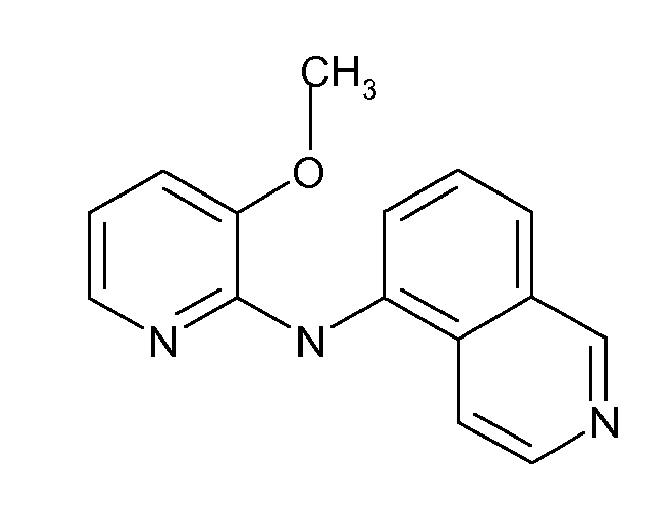
- the compound of formula I is chosen among the group comprising: Pyridin-4-yl-quinolin-3-yl-amine; (8-Chloro-quinolin-2-yl)-(4-methyl-pyridin-2-yl)-amine; (3-Methoxy-pyridin-2-yl)-quinolin-3-yl-amine ; and Isoquinolin-5-yl-(3-methoxy-pyridin-2-yl)-amine.
- a second object of the invention consists of a pharmaceutical composition comprising at least one compound as described above and, optionally, a pharmaceutically acceptable support.
- the composition can include emulsions, microemulsions, oil in water emulsions, anhydrous lipids and water in oil emulsions or other types of emulsions.
- the inventive composition can further include one or more additives such as diluents, excipients, stabilizers and preservatives.
- additives are well known to those skilled in the art and are described notably in “ Ullmann's Encyclopedia of Industrial Chemistry, 6th Ed.” (various editors, 1989-1998, Marcel Dekker ) and in “ Pharmaceutical Dosage Forms and Drug Delivery Systems” (ANSEL et al., 1994, WILLIAMS & WILKINS ).
- a third object consists of the use of at least one compound of formula I in preparing a drug to treat, in a subject, a disease resulting from at least one splicing anomaly.
- the present invention relates to a compound of formula I for preparing a drug to treat, in a subject, a disease resulting from at least one splicing anomaly.
- the term "subject” refers to a mammal such as a rodent, cat, dog, primate or human, preferably said subject is a human.
- the inventive compounds have the ability to inhibit pre-messenger RNA splicing processes that are either constitutive or, more specifically, dependent on regulating sequences known as an ESE (exonic splicing enhancer), ISE (intronic splicing enhancer), ESS (exonic splicing silencer) and ISS (intronic splicing silencer).
- ESE exonic splicing enhancer
- ISE intra splicing enhancer
- ESS exonic splicing silencer
- ISS intra splicing silencer
- splicing processes are either constitutive and/or or dependent on ESE regulating sequences.
- the present invention relates to the use of the at least one compound as described above for preparing a drug to treat, in a subject, AIDS.
- the present invention relates to a one compound as described above for treating AIDS.
- a fourth object of the invention relates to a therapeutic method for treating a subject for a genetic disease resulting from splicing anomalies comprising the administration of a therapeutically effective quantity of a pharmaceutical composition as described above.
- said genetic disease resulting from splicing anomalies is AIDS.
- a “therapeutically effective quantity” means a quantity that induces inhibition of the splicing of the pre-mRNAs of interest. Those skilled in the art will be able to determine said therapeutically effective quantity based on their general knowledge and on the methods described in the examples.
- the compounds can be administered by any mode of administration such as, for example, by intramuscular, intravenous or oral route, etc.
- said composition further includes an excipient making it possible to formulate the inventive compounds in such a way that said composition is provided in solid or liquid form to be prepared and administered by intravenous route.
- the inventive compounds preferably will be administered by intravenous route at a concentration of 80-100 mg/m 2 .
- concentration will be chosen by those skilled in the art according to the organ or tissue to be treated, the state of advancement of the disease and the targeting mode used.
- compound IDC16 (BAKKOUR et al., cited above, 2007) interacts functionally with the SF2/ASF complex and thus contributes to blocking alternative splicing during HIV replication, leading to the termination of the production of Tat protein.
- the inventors thus sought to develop novel molecules exhibiting activity comparable to IDC16, in terms of activity inhibiting HIV splicing, but while not exhibiting the characteristics of DNA intercalating agents.
- Example 3 Inhibition of HIV-1 production in infected peripheral blood mononuclear cells (PBMCs)
- the first determination is that of the concentration of compound that exhibits the fewest side effects in terms of cell viability and progression of the cell cycle.
- peripheral blood mononuclear cells of healthy donors are isolated by centrifugation on a FICOLL gradient. The cells are then cultivated to a density of 2.5 x 10 6 cells/ml with RPMI medium supplemented with 1% inactivated human AB serum, then incubated at 37 °C, 5% CO 2 for an additional hour. The peripheral blood mononuclear cells are then recovered and cultivated for two days in RPMI medium supplemented with 10% fetal calf serum.
- PBMC peripheral blood mononuclear cells
- PHA phytohemagglutinin A
- PBMCs peripheral blood mononuclear cells
- PHA and IL-2 peripheral blood mononuclear cells
- IL-2 peripheral blood mononuclear cells
- the cells are then cultivated for 14 days in the presence of the compounds of the present invention.
- Viral replication is finally determined by quantifying protein p24 by the ELISA method.
- cell viability is measured by exclusion with trypan blue in comparison with that of the untreated cells.
- macrophages can be infected by the Ada-M R5 HIV strain and treated for 18 hours with various concentrations of the compounds of the present invention.
- the culture medium is then eliminated and the cells washed with an abundance of PBS.
- the cells are then cultivated under normal conditions.
- the culture medium and the cells are then collected at days 4, 7 and 14.
- virus replication is measured indirectly by determining the level of p24 antigen in both the culture supernatant and the cellular lysate by the ELISA method.
- cell viability of the macrophages in the presence of the compounds of of the present invention is measured as before.
- HOS-CD4 + -CCR5 + cells to defective virions obtained by cotransfecting 293T cells with a plasmid encoding the R5 envelope of the AD8 strain and another plasmid containing the entire HIV-1 genome mutated in the envelope gene and harbouring a luciferase marker gene fused to nef ( Connor RI, Chen BK, Choe S, Landau NR. (1995) Vpr is required for efficient replication of human immunodeficiency virus type-1 in mononuclear phagocytes. Virology 206: 935-944 .).
- luciferase activity in cells infected with these virions reflect both the number of integrated proviruses and expression of multiply spliced species encoding nef/luc. Two days post-infection, luciferase activity in HOS-CD4+-CCR5+ infected cells was measured.
Landscapes
- Chemical & Material Sciences (AREA)
- Organic Chemistry (AREA)
- Pharmaceuticals Containing Other Organic And Inorganic Compounds (AREA)
Abstract
The present invention relates to a compound of the formula I; a pharmaceutical composition comprising at least one such compound; and the use of such compound in preparing a drug to treat, in a subject, a genetic disease resulting from at least one splicing anomaly.
Description
- The invention relates to novel compounds for the preparation of compositions useful for the treatment of diseases resulting from changes in splicing processes.
- Certain indole derivative compounds such as ellipticine derivatives and aza-ellipticine derivatives are already known as intercalating molecules for correcting dysfunctions in gene expression, notably in DNA replication. They have been more specifically described for treating diseases such as cancer, leukemia or AIDS (see in particular patents
FR 2 627 493 FR 2 645 861 FR 2 436 786 - Concerning current treatments for AIDS, the various approaches aimed at reducing viral load in patients infected by HIV utilize molecules intended to inhibit the enzymatic activity of viral reverse transcriptase or of the protease involved in virus protein maturation. Regarding reverse transcriptase inhibitors, these can be nucleosidic (NRTIs), non-nucleosidic (NNRTIs) or nucleotidic in nature. The purpose of using these compounds is to prevent a DNA copy of the retroviral genome from being produced and, consequently, from being integrated into the genome of the host cell. Protease inhibitors (PIs) interfere with the proper maturation of viral proteins and cause the production of incomplete particles with altered infectious capacities. There is another type of anti-retroviral compound used for its ability to prevent viruses from entering the cell. These entry inhibitors can be either peptides that interfere with the fusion of viral glycoproteins gp41 or gp120 with the membrane of CD4 cells or molecules that target HIV cellular co-receptors CCR5 and CXCR4. The absence of cellular proteins resembling HIV integrase has also been exploited to develop novel anti-HIV molecules that inhibit this enzymatic activity. Although a number of integrase inhibitors are in the clinical trial phase, no molecule is yet available on the market.
- Theintracellular splicing process consists of eliminating introns in pre-messenger RNAs to produce mature messenger RNAs that can be used by the translation mechanism of the cell (SHARP, Cell, vol. 77, p. 805-815, 1994). In the case of alternative splicing, the same precursor can be the source of messenger RNAs coding for proteins with distinct functions (BLACK, Annu. Rev. Biochem. vol. 72, p. 291-336, 2003). The precise selection of 5' and 3' splicing sites is thus a mechanism that generates diversity and that can lead to the regulation of gene expression according to the type of tissue or during the development of an organism. The factors involved in this selection include a family of proteins called SR, characterized by the presence of one or two RNA recognition motifs (RRM) and a domain rich in arginine and serine residues called an RS domain (MANLEY & TACKE, Genes Dev., vol. 10, p. 1569-1579, 1996). By binding to short exon or intron sequences of the pre-mRNA, called ESE (exonic splicing enhancer) or ISE (intronic splicing enhancer), SR proteins are able to activate, in a dose-dependant manner, sub-optimal splicing sites and to enable the inclusion of exons (GRAVELEY, RNA, vol. 6, p. 1197-1211, 2000). The activity of an SR protein in alternative splicing is specific insofar as the inactivation of the corresponding gene is lethal (WANG et al., Mol. Cell, vol. 7, p. 331-342, 2001).
- Sequencing of the human genome and analysis of EST (expressed sequence tag) banks has revealed that 65% of genes are expressed in the form of alternatively spliced variants (EWING & GREEN, Nat. Genet., vol. 25, p. 232-234, 2000; JOHNSON et al., Science, vol. 302, p. 2141-2144, 2003). This mechanism is thus a favored target of modifications that can affect the factors involved in regulating splicing and of mutations that affect the sequences necessary for this regulation. At present, it is estimated that roughly 50% of the point mutations responsible for genetic diseases induce aberrant splicing. These mutations can interfere with splicing by inactivating or creating splicing sites, but also by modifying or generating regulating elements such as splicing enhancers or splicing silencers in a particular gene (CARTEGNI et al., Nat. Rev. Genet., vol. 3, p. 285-298, 2002; TAZI et al., TIBS, vol. 40, p. 469-478, 2005).
- The strategies currently developed to correct these splicing defects rest on the use of various types of molecules (TAZI et al., cited above, 2005).
- One strategy aimed at developing novel molecules to correct or eliminate abnormal splicing, for example, rests on the overexpression of proteins that interfere with this type of splicing (NISSIM-RAFINIA et al., Hum. Mol. Genet., vol. 9, p. 1771-1778, 2000; HOFINANN et al., Proc. Natl. Acad. Sci. U.S.A., vol. 97, p. 9618-9623, 2000).
- Other strategies rest on the use of antisense oligonucleotides (SAZANI et al., Nat. Biotechnol., vol. 20, p. 1228-1233, 2002; SAZANI & KOLE, Prog. Mol. Subcell. Biol., vol. 31, p. 217-239, 2003) or of PNA (CARTEGNI et al., Nat. Struct. Biol., vol. 10, p. 120-125, 2003) enabling, respectively, the inhibition or activation of a splicing event.
- Yet another strategy rests on the identification of compounds that influence the splicing efficiency of the pre-mRNA of interest (ANDREASSI et al., Hum. Mol. Genet., vol. 10, p. 2841-2849, 2001).
- Lastly, a strategy based on the use of trans-splicing to replace mutant exons has been described (LIU et al., Nat. Biotechnol., vol. 20, p. 47-52, 2002).
- One of the disadvantages of the developed strategies cited above to correct or eliminate abnormal splicing is their production cost. Indeed, the cost of producing antisense oligonucleotides that must be modified to improve their stability, and that of PNA molecules, is high.
- Another disadvantage of the developed strategies cited above is that they require the use of expression vectors, such as, for example, for the strategy based on the use of trans-splicing.
- International application
WO05023255 FR0310460 FR0400973 - Thus it was recently shown that certain indole derivatives prove particularly effective in treating metastatic cancer and in treating AIDS (BAKKOUR et al., PLoS Pathogens, vol. 3, p. 1530-1539, 2007).
- However, the compounds described have a flat structure with four rings that have the disadvantage of intercalating between DNA bases and can thus lead to cellular toxicity.
- In order to minimize the risk that these indole derivatives intercalate between DNA bases, the inventors developed novel compounds that are particularly effective in treating diseases related to the splicing process, but which, in a surprising manner, have a cellular toxicity that is clearly less than the indole derivatives of the prior art. In addition, these compounds are able to selectively inhibit certain splicing events.
- A first object of the present invention relates to a compound of the following formula I :

- X1, X2 and X3 independently represent a nitrogen atom, or a CR8 group, at least one of X1 and X2 being a nitrogen atom;
- R8 represents a hydrogen atom or a halogen atom, a hydroxyl, alkyl, trifluoroalkyl, ester, ether, such as a methoxy or trifluoromethoxy group, or benzyl, optionally substituted, a nitro or a cyano group, preferably R8 represents a hydrogen atom,
- when a ring A, defined below, is in position a, X4 represents a nitrogen atom or a CR8 group, and when a ring A is in position b, X4 represents a carbon atom part of the ring A,
- R1, R2, R3 and R5 independently represent a hydrogen or a halogen atom, an alkyl, a trifluoroalkylgroup, ether, such as a methoxy or trifluoromethoxy group, or benzyl, optionally substituted, a nitro or a cyano group.
- when the ring A is at position b, R4 represents a hydrogen atom, a halogen atom or an alkyl, a trifluoroalkyl, , ester, ether group, such as a methoxy or trifluoromethoxy group, or benzyl, optionally substituted, and when the ring A is at position a, R4 is a carbon atom part of the ring A,
- R10 represents a carbon atom part of ring A,
- R6 represents a hydrogen atom or an alkyl group,
- A represents a ring at position a or b of formula I, said ring A corresponding to:

- R7 represents a hydrogen, or halogen atom or an alkyl, hydroxyl or amine group which can be linear or branched and/or unsaturated and optionally substituted,
- pharmaceutically acceptable salts of said compounds, isomers thereof and/or mixtures of the same,
- with the exception of the following compound:

"Unsaturated" means that the group comprises at least one double bond. - All the compounds disclosed in the examples are in the scope of the present invention.
- Preferably, X1 represents a CR8 group when X2 represents a nitrogen group, and
- X2 represents a CR8 group when X1 represents a nitrogen group.
- Preferably, at least one of X3 and X4 is a nitrogen atom when the cycle A is in position a.
- Preferably X3 and X4 are different, and even more preferably X3 represents a CR8 group when X2 represents a nitrogen group or a and X4 represents a CR8 group when X1 represents a nitrogen group.
- Preferably, R1 represents a hydrogen atom or a methoxy group.
- Preferably, R2, R3, R4 and R5 independently represent a hydrogen atom or a halogen atom or an alkyl, or benzyl, optionally substituted.
- Preferably, R4 represents a hydrogen atom.
- Preferably, R2 represents a hydrogen atom or a C1 to C4 alkyl group, preferably a methyl.
- Preferably, R3, R5 and R6 independently represent a hydrogen atom.
- Preferably, R7 represents a hydrogen, or halogen atom, more preferably a hydrogen or a chlorine atom.
- Preferably, the ring A is attached at position a or b of the compound of formula I via the carbons numbered 1 and 2 in ring A.
- Preferably, when the ring A is at position a, R4 is the carbon atom numbered 2 of the ring A, more preferably R4 is the carbon atom numbered 2 of the ring A and R10 is the carbon numbered 1.
- Preferably, when a ring A is in position b, X4 is the carbon atom numbered 1 of the ring A, more preferably, X4 is the carbon atom numbered 1 of the ring A and R10 is the carbon numbered 2.
- Preferably, the compound as described above does not include the following compounds:


- Advantageously, the compound of formula I is chosen among the group comprising:


- A second object of the invention consists of a pharmaceutical composition comprising at least one compound as described above and, optionally, a pharmaceutically acceptable support.
- As examples of pharmaceutically acceptable supports, the composition can include emulsions, microemulsions, oil in water emulsions, anhydrous lipids and water in oil emulsions or other types of emulsions.
- The inventive composition can further include one or more additives such as diluents, excipients, stabilizers and preservatives. Such additives are well known to those skilled in the art and are described notably in " Ullmann's Encyclopedia of Industrial Chemistry, 6th Ed." (various editors, 1989-1998, Marcel Dekker) and in "Pharmaceutical Dosage Forms and Drug Delivery Systems" (ANSEL et al., 1994, WILLIAMS & WILKINS).
- A third object consists of the use of at least one compound of formula I in preparing a drug to treat, in a subject, a disease resulting from at least one splicing anomaly.
- Therefore, the present invention relates to a compound of formula I for preparing a drug to treat, in a subject, a disease resulting from at least one splicing anomaly.
- As used in the present application, the term "subject" refers to a mammal such as a rodent, cat, dog, primate or human, preferably said subject is a human.
- Preferably, the inventive compounds have the ability to inhibit pre-messenger RNA splicing processes that are either constitutive or, more specifically, dependent on regulating sequences known as an ESE (exonic splicing enhancer), ISE (intronic splicing enhancer), ESS (exonic splicing silencer) and ISS (intronic splicing silencer).
- In a particularly preferred way, splicing processes are either constitutive and/or or dependent on ESE regulating sequences.
- Preferably, the present invention relates to the use of the at least one compound as described above for preparing a drug to treat, in a subject, AIDS.
- Therefore, the present invention relates to a one compound as described above for treating AIDS.
- A fourth object of the invention relates to a therapeutic method for treating a subject for a genetic disease resulting from splicing anomalies comprising the administration of a therapeutically effective quantity of a pharmaceutical composition as described above.
- Preferably, said genetic disease resulting from splicing anomalies is AIDS.
- A "therapeutically effective quantity" means a quantity that induces inhibition of the splicing of the pre-mRNAs of interest. Those skilled in the art will be able to determine said therapeutically effective quantity based on their general knowledge and on the methods described in the examples.
- The compounds can be administered by any mode of administration such as, for example, by intramuscular, intravenous or oral route, etc.
- In one embodiment according to the invention, said composition further includes an excipient making it possible to formulate the inventive compounds in such a way that said composition is provided in solid or liquid form to be prepared and administered by intravenous route.
- The inventive compounds preferably will be administered by intravenous route at a concentration of 80-100 mg/m2. The concentration will be chosen by those skilled in the art according to the organ or tissue to be treated, the state of advancement of the disease and the targeting mode used.
- The following examples are provided as illustrations and in no way limit the scope of this invention.
- The inventors have shown that compound IDC16 (BAKKOUR et al., cited above, 2007) interacts functionally with the SF2/ASF complex and thus contributes to blocking alternative splicing during HIV replication, leading to the termination of the production of Tat protein.
- Accordingly, the family of polycyclic indoles, to which compound IDC16 belongs, is known to exhibit the properties of DNA intercalating agents. Such compounds thus present a risk in terms of undesirable side effects.
- The inventors thus sought to develop novel molecules exhibiting activity comparable to IDC16, in terms of activity inhibiting HIV splicing, but while not exhibiting the characteristics of DNA intercalating agents.
- In their initial hypothesis, the inventors considered that the two polar heterocycles at the two ends of compound IDC16 were associated with its activity and that the two median rings were of less importance.
- Based on this hypothesis, the inventors considered that:
- the nitrogen of the indoline and of the D ring of IDC16 might act as acceptors of hydrogen bonds;
- the N-methylated 4-pyridinone motif might be preserved in the analogues;
- the flat tetracyclic geometry was not optimal and it might be wise to replace the B and C rings by other motifs to limit DNA intercalating properties.
- To a solution of halogeno compound (0.5 mmol, 1 equiv) in tert-butanol (2 mL) were added the amino moiety (0.55 mmol, 1.1 equiv), Cs2CO3 (456 mg, 1.4 mmol, 2.8 equiv), Xantphos (4,5-Bis(diphenylphosphino)-9,9-dimethylxanthene ) (5.8 mg, 0.01 mmol, 2 mol %), Pd(OAc)2 (2.2 mg, 0.01 mmol, 2 mol %). The reaction mixture was heated at 90 °C and stirred for 20 h under argon. The reaction mixture was concentrated under reduced pressure. The residue was purified by column chromatography on silica gel to yield pure compounds.

- For example this procedure permitted to synthetize the following compounds:
- Isoquinolin-5-yl-(3-methoxy-pyridin-2-yl)-amine
1H NMR (300 MHz, CDCl3) δ 9.24 (s, 1H), 8.66 (dd, J = 1.7, 6.8, 1H), 8.55 (d, J = 6.0, 1H), 7.85 (d, J = 5.0, 1H), 7.76 (d, J = 6.0, 1H), 7.69 - 7.58 (m, 2H), 7.53 (s, 1H), 7.06 (d, J = 7.7, 1H), 6.78 (dd, J = 5.1, 7.8, 1H), 3.99 (s, 3H).
13C NMR (75 MHz, CDCl3) δ 153.23, 146.60, 142.97, 142.79, 138.53, 134.82, 129.53, 129.13, 127.95, 121.66, 119.82, 115.18, 115.05, 114.09, 100.15, 55.80. - (8-Chloro-quinolin-2-yl)-(4-methyl-pyridin-2-yl)-amine
1H NMR (300 MHz, CDCl3) δ 8.82 (s, 1H), 8.17 (d, J = 5.1, 1H), 8.09 (s, 1H), 7.98 (d, J = 8.9, 1H), 7.76 (dd, J = 1.2, 7.6,1 1H), 7.61 (dd, J = 1.0, 8.0, 1H), 7.26 (t, J = 7.8, 2H), 7.15 (d, J = 8.7, 1H), 6.83 (d, J = 5.0, 1H), 2.46 (s, 3H).
13C NMR (75 MHz, CDCl3) δ 153.52, 153.14, 149.90, 147.43, 143.68, 138.08, 131.37, 129.98, 126.56, 125.58, 123.58, 119.17, 114.52, 114.02, 21.84. - (3-Methoxy-pyridin-2-yl)-quinolin-3-yl-amine
1H NMR (300 MHz, DMSO) δ 9.17 (d, J = 2.5, 1H), 8.97 (d, J = 2.4, 1H), 8.79 (s, 1H), 7.94 - 7.79 (m, 3H), 7.58 - 7.46 (m, 2H), 7.31 (d, J = 7.9, 1H), 6.88 (dd, J = 5.0, 7.9, 1H), 3.94 (s, 3H). - The first determination is that of the concentration of compound that exhibits the fewest side effects in terms of cell viability and progression of the cell cycle.
- Within this framework, the peripheral blood mononuclear cells (PBMCs) of healthy donors are isolated by centrifugation on a FICOLL gradient. The cells are then cultivated to a density of 2.5 x 10⁶ cells/ml with RPMI medium supplemented with 1% inactivated human AB serum, then incubated at 37 °C, 5% CO2 for an additional hour. The peripheral blood mononuclear cells are then recovered and cultivated for two days in RPMI medium supplemented with 10% fetal calf serum.
- Part of the peripheral blood mononuclear cells (PBMC) is then cultivated for 72 hours in the presence of tritiated thymidine and phytohemagglutinin A (PHA) and in the presence or absence of the compounds of the present invention. Cell proliferation in the presence of the compounds of the present invention is finally measured by determining the incorporation of tritiated thymidine in the cellular DNA of the treated cells.
- Another part of the peripheral blood mononuclear cells (PBMCs) that is activated (stimulated for 2 days with PHA and IL-2) is infected with HIV strains NL4.3 or Ada-M R5. The cells are then cultivated for 14 days in the presence of the compounds of the present invention. Viral replication is finally determined by quantifying protein p24 by the ELISA method. In parallel, cell viability is measured by exclusion with trypan blue in comparison with that of the untreated cells.
- In order to generalize the HIV-1 replication effect of the molecules of the present invention to other cell types, we examined various steps of the viral cycle in cells treated with the various drug at a concentration of 5 µM and submitted to one-round infection.
- For such experiences, macrophages can be infected by the Ada-M R5 HIV strain and treated for 18 hours with various concentrations of the compounds of the present invention. The culture medium is then eliminated and the cells washed with an abundance of PBS. The cells are then cultivated under normal conditions. The culture medium and the cells are then collected at days 4, 7 and 14. Finally, virus replication is measured indirectly by determining the level of p24 antigen in both the culture supernatant and the cellular lysate by the ELISA method. In parallel, cell viability of the macrophages in the presence of the compounds of of the present invention is measured as before.
- For this purpose, we exposed HOS-CD4+-CCR5+ cells to defective virions obtained by cotransfecting 293T cells with a plasmid encoding the R5 envelope of the AD8 strain and another plasmid containing the entire HIV-1 genome mutated in the envelope gene and harbouring a luciferase marker gene fused to nef (Connor RI, Chen BK, Choe S, Landau NR. (1995) Vpr is required for efficient replication of human immunodeficiency virus type-1 in mononuclear phagocytes. Virology 206: 935-944.). The amounts of luciferase activity in cells infected with these virions reflect both the number of integrated proviruses and expression of multiply spliced species encoding nef/luc. Two days post-infection, luciferase activity in HOS-CD4+-CCR5+ infected cells was measured.
- The results are shown below:
Compound Results 
+ 
- 
+ 
- 
+ 
- 
- 
- 
- 
+ 
- - The results established that the compounds of the present invention show a luciferase inhibitory effect, thus showing that these compounds inhibit viral RNA splicing.
Claims (15)
- Compound of the following formula I :
 X1, X2 and X3 independently represent a nitrogen atom, or a CR8 group, at least one of X1 and X2 being a nitrogen atom;R8 represents a hydrogen atom or a halogen atom, a hydroxyl, alkyl, trifluoroalkyl, ester, ether, such as a methoxy or trifluoromethoxy group, or benzyl, optionally substituted, a nitro or a cyano group, preferably R8 represents a hydrogen atom,when a ring A, defined below, is in position a, X4 represents a nitrogen atom or a CR8 group, and when a ring A is in position b, X4 represents a carbon atom part of the ring A,R1, R2, R3 and R5 independently represent a hydrogen or a halogen atom, an alkyl, a trifluoroalkylgroup, ether, such as a methoxy or trifluoromethoxy group, or benzyl, optionally substituted, a nitro or a cyano group,when the ring A is at position b, R4 represents a hydrogen atom, a halogen atom or an alkyl, a trifluoroalkyl, ester, ether group, such as a methoxy or trifluoromethoxy group, or benzyl, optionally substituted, and when the ring A is at position a, R4 is a carbon atom part of the ring A,R10 represents a carbon atom part of ring A,R6 represents a hydrogen atom or an alkyl group,A represents a ring at position a or b of formula I, said ring A corresponding to:
 R7 represents a hydrogen, or halogen atom or an alkyl, hydroxyl or amine group which can be linear or branched and/or unsaturated and optionally substituted,pharmaceutically acceptable salts of said compounds, isomers thereof and/or mixtures of the same,with the exception of the following compound:
- The compound of claim 1, wherein at least one of X3 and X4 is a nitrogen atom when the cycle A is in position a.
- The compound of claim 1 or 2, wherein R1 represents a hydrogen atom or a methoxy group.
- The compound of any of the previous claims, wherein R2 represents a hydrogen atom or a C1 to C4 alkyl group, preferably a methyl.
- The compound of any of the previous claims, wherein R3, R5 and R6 independently represent a hydrogen atom.
- The compound of any of the previous claims, wherein R7 represents a hydrogen or halogen atom, more preferably a hydrogen or a chlorine atom.
- The compound of any of the previous claims, wherein the ring A is attached at position a or b of the compound of formula I via the carbons numbered 1 and 2 in ring A.
- The compound according to claim 7, wherein the ring A is at position a.
- The compound according to claim 8, wherein R4 is the carbon atom numbered 1 of the ring A.
- The compound according to claim 7, wherein the ring A is in position b.
- The compound according to claim 10, wherein X4 is the carbon atom numbered 2 of the ring A.
- The compound of claim 1, characterized in that said compound is selected among the group comprising:


- A pharmaceutical composition, characterized in that it comprises at least one compound of any of claims 1 to 12 and, optionally, a pharmaceutically acceptable support.
- A compound according to any of claims 1 to 12
for preparing a drug to treat, in a subject, a disease resulting from at least one splicing anomaly. - The compound according to claim 14, characterized in that said disease is AIDS.
Priority Applications (143)
| Application Number | Priority Date | Filing Date | Title |
|---|---|---|---|
| EP20090305540 EP2266972A1 (en) | 2009-06-12 | 2009-06-12 | New chemical molecules that inhibit the splicing mechanism for treating diseases resulting from splicing anomalies |
| CN201410106644.9A CN103948594B (en) | 2009-06-12 | 2010-06-14 | Compounds for the treatment of cancer |
| CUP2015000028A CU24319B1 (en) | 2009-06-12 | 2010-06-14 | QUINOLIN-2-AMINA AND QUINOXALINE DERIVED FROM THE FORMULA (Ik) and (Ip) AND DERIVED SALTS |
| EP10728369.9A EP2440546B1 (en) | 2009-06-12 | 2010-06-14 | Compounds useful for treating premature aging and in particular progeria |
| ES19157827T ES2985082T3 (en) | 2009-06-12 | 2010-06-14 | Compounds useful for treating cancer |
| HUE10728368A HUE045548T2 (en) | 2009-06-12 | 2010-06-14 | Compounds useful for treating cancer |
| KR1020187025624A KR101973348B1 (en) | 2009-06-12 | 2010-06-14 | Compounds useful for treating premature aging in particular progeria |
| RU2011149571/04A RU2567752C2 (en) | 2009-06-12 | 2010-06-14 | Compounds suitable for cancer treatment |
| CA3070823A CA3070823C (en) | 2009-06-12 | 2010-06-14 | Quinoline and isoquinoline compounds useful for treating cancer |
| US13/377,753 US20120329796A1 (en) | 2009-06-12 | 2010-06-14 | Compounds useful for treating premature aging and in particular progeria |
| DK10728369.9T DK2440546T3 (en) | 2009-06-12 | 2010-06-14 | COMPOUNDS USEFUL IN THE TREATMENT OF PREMATURE AGING AND IN PARTICULAR PROGERIA |
| CA2764026A CA2764026C (en) | 2009-06-12 | 2010-06-14 | Compounds useful for treating aids |
| EP19157827.7A EP3517534B1 (en) | 2009-06-12 | 2010-06-14 | Compounds useful for treating cancer |
| CU2011000230A CU24093B1 (en) | 2009-06-12 | 2010-06-14 | ISOQUINOLINE DERIVATIVES LINKED TO THE CELLULAR EMPALME PROCESS |
| BRPI1010772A BRPI1010772B8 (en) | 2009-06-12 | 2010-06-14 | quinoline compounds, their pharmaceutical compositions and their uses to treat AIDS |
| CA2965791A CA2965791C (en) | 2009-06-12 | 2010-06-14 | Quinoline and isoquinoline compounds useful for treating cancer |
| ES10757474T ES2938532T3 (en) | 2009-06-12 | 2010-06-14 | New chemical molecules that inhibit the splicing mechanism for the treatment of diseases derived from splicing defects |
| AU2010258214A AU2010258214B2 (en) | 2009-06-12 | 2010-06-14 | Compounds useful for treating premature aging and in particular progeria |
| KR1020127000914A KR20120051643A (en) | 2009-06-12 | 2010-06-14 | Compounds useful for treating premature aging in particular progeria |
| BRPI1012892A BRPI1012892B8 (en) | 2009-06-12 | 2010-06-14 | compounds of formula (I), as such, pharmaceutical composition comprising them and their use in the treatment of hgps, progeria, charcot-marie-tooth disorder, werner syndrome, diabetes, osteoporosis and skin aging |
| CN201080032045.7A CN102625804B (en) | 2009-06-12 | 2010-06-14 | Compounds for the treatment of AIDS |
| CN202110307700.5A CN113004249A (en) | 2009-06-12 | 2010-06-14 | Compounds for the treatment of premature aging and especially premature aging |
| CN201080032036.8A CN102574835B (en) | 2009-06-12 | 2010-06-14 | Compounds Used to Treat Cancer |
| CUP2015000024A CU24245B1 (en) | 2009-06-12 | 2010-06-14 | QUINOLIN-6 AMINA AND QUINOLINA-7-AMINA DERIVED FROM THE FORMULA (Id) and (Go), AND SALES DERIVED |
| JP2012514585A JP6041671B2 (en) | 2009-06-12 | 2010-06-14 | Compounds useful for treating cancer |
| PL10757474.1T PL2440547T3 (en) | 2009-06-12 | 2010-06-14 | New chemical molecules that inhibit the splicing mechanism for the treatment of diseases resulting from splicing defects |
| BRPI1010768A BRPI1010768C8 (en) | 2009-06-12 | 2010-06-14 | compound of formula (i) |
| JP2012514587A JP5905385B2 (en) | 2009-06-12 | 2010-06-14 | Compounds useful for treating premature aging, especially progeria |
| MX2018009425A MX373120B (en) | 2009-06-12 | 2010-06-14 | COMPOUNDS USEFUL FOR TREATING AIDS. |
| MX2015016290A MX364282B (en) | 2009-06-12 | 2010-06-14 | COMPOUNDS USEFUL FOR TREATING PREMATURE AGING and IN PARTICULAR PROGERIA. |
| KR1020177021820A KR101863021B1 (en) | 2009-06-12 | 2010-06-14 | Compounds useful for treating cancer |
| KR1020187025625A KR101982462B1 (en) | 2009-06-12 | 2010-06-14 | Compounds useful for treating premature aging in particular progeria |
| KR1020187025626A KR101982463B1 (en) | 2009-06-12 | 2010-06-14 | Compounds useful for treating premature aging in particular progeria |
| CA2764027A CA2764027C (en) | 2009-06-12 | 2010-06-14 | Quinoline or isoquinoline compounds useful for treating premature aging and in particular progeria |
| JP2012514586A JP5826745B2 (en) | 2009-06-12 | 2010-06-14 | Compounds useful for treating AIDS |
| RU2011149572/04A RU2575845C2 (en) | 2009-06-12 | 2010-06-14 | Compounds applicable for treating aids |
| HRP20230143TT HRP20230143T1 (en) | 2009-06-12 | 2010-06-14 | New chemical molecules that inhibit the splicing mechanism for the treatment of diseases resulting from splicing defects |
| CN201710158474.2A CN106928194B (en) | 2009-06-12 | 2010-06-14 | Compounds for the treatment of premature aging and especially premature aging |
| MX2016003039A MX359575B (en) | 2009-06-12 | 2010-06-14 | Compounds useful for treating aids. |
| CN201710122014.4A CN106905232B (en) | 2009-06-12 | 2010-06-14 | Compounds for the treatment of premature aging and especially premature aging |
| PCT/IB2010/052652 WO2010143170A2 (en) | 2009-06-12 | 2010-06-14 | Compounds useful for treating premature aging and in particular progeria |
| KR1020197004604A KR102016889B1 (en) | 2009-06-12 | 2010-06-14 | Compounds useful for treating premature aging in particular progeria |
| TR2019/10781T TR201910781T4 (en) | 2009-06-12 | 2010-06-14 | Compounds useful for cancer therapy. |
| SI201032127T SI2440547T1 (en) | 2009-06-12 | 2010-06-14 | New chemical molecules that inhibit the splicing mechanism for the treatment of diseases resulting from splicing defects |
| BR122019013687A BR122019013687B1 (en) | 2009-06-12 | 2010-06-14 | compound of formula (i) |
| HRP20230248TT HRP20230248T1 (en) | 2009-06-12 | 2010-06-14 | Compounds useful for treating premature aging and in particular progeria |
| HRP20240582TT HRP20240582T1 (en) | 2009-06-12 | 2010-06-14 | Compounds useful for treating cancer |
| FIEP10728369.9T FI2440546T3 (en) | 2009-06-12 | 2010-06-14 | Compounds useful for treating premature aging and in particular progeria |
| CUP2011000229A CU24124B1 (en) | 2009-06-12 | 2010-06-14 | N-FENIL-NAFTALEN-2-AMINAS REPLACED FOR THE TREATMENT OF CANCER. |
| MX2015016291A MX364279B (en) | 2009-06-12 | 2010-06-14 | Compounds useful for treating premature aging and in particular progeria. |
| KR1020197004607A KR102016892B1 (en) | 2009-06-12 | 2010-06-14 | Compounds useful for treating premature aging in particular progeria |
| HK13100736.4A HK1173726B (en) | 2009-06-12 | 2010-06-14 | Compounds useful for treating aids |
| AU2010258295A AU2010258295B2 (en) | 2009-06-12 | 2010-06-14 | Compounds useful for treating AIDS |
| MX2011013122A MX340095B (en) | 2009-06-12 | 2010-06-14 | Compounds useful for treating aids. |
| KR1020187025623A KR101982461B1 (en) | 2009-06-12 | 2010-06-14 | Compounds useful for treating premature aging in particular progeria |
| ES10728368T ES2736198T3 (en) | 2009-06-12 | 2010-06-14 | Useful compounds to treat cancer |
| HK13100731.9A HK1173447B (en) | 2009-06-12 | 2010-06-14 | Compounds useful for treating premature aging and in particular progeria |
| CUP2015000025A CU24322B1 (en) | 2009-06-12 | 2010-06-14 | QUINOLIN-2-AMINA DERIVATIVES OF THE FORMULA (Ig) AND SALES DERIVED |
| CN201080032055.0A CN102596935B (en) | 2009-06-12 | 2010-06-14 | Compounds for the treatment of premature aging and especially premature aging |
| MX2011013120A MX338823B (en) | 2009-06-12 | 2010-06-14 | Compounds useful for treating premature aging and in particular progeria. |
| CN201510020820.1A CN104945378B (en) | 2009-06-12 | 2010-06-14 | Compounds for the treatment of premature aging and especially premature aging |
| PL10728368T PL2440545T3 (en) | 2009-06-12 | 2010-06-14 | Compounds useful for treating cancer |
| CN201510023124.6A CN104844570B (en) | 2009-06-12 | 2010-06-14 | Compounds for the treatment of premature aging and especially progeria |
| CN201510023109.1A CN104844510B (en) | 2009-06-12 | 2010-06-14 | Compounds for the treatment of premature aging and especially premature aging |
| KR1020177031675A KR101897221B1 (en) | 2009-06-12 | 2010-06-14 | Compounds useful for treating premature aging in particular progeria |
| CUP2015000027A CU24323B1 (en) | 2009-06-12 | 2010-06-14 | QUINOLIN AND QUINOXALINA DERIVED FROM THE FORMULA (Ii), (Ij), (Ij '), (Ij' ') and (Ij' '') AND SALES DERIVED |
| CN201710158473.8A CN106928205B (en) | 2009-06-12 | 2010-06-14 | Compounds for the treatment of premature aging and especially premature aging |
| US13/377,745 US20120277230A1 (en) | 2009-06-12 | 2010-06-14 | Compounds useful for treating cancer |
| HK13100514.2A HK1173153B (en) | 2009-06-12 | 2010-06-14 | Compounds useful for treating cancer |
| PT107574741T PT2440547T (en) | 2009-06-12 | 2010-06-14 | Compounds useful for treating aids |
| PL19157827.7T PL3517534T3 (en) | 2009-06-12 | 2010-06-14 | Compounds useful for treating cancer |
| CA2764024A CA2764024C (en) | 2009-06-12 | 2010-06-14 | Quinoline and isoquinoline compounds useful for treating cancer |
| MX2015016293A MX364989B (en) | 2009-06-12 | 2010-06-14 | COMPOUNDS USEFUL FOR TREATING PREMATURE AGING and IN PARTICULAR PROGERIA. |
| CN201910120757.7A CN109776496B (en) | 2009-06-12 | 2010-06-14 | Compounds for the treatment of premature aging and especially premature aging |
| EP22193611.5A EP4198022A1 (en) | 2009-06-12 | 2010-06-14 | Preparation of compounds useful for treating aids |
| FIEP10757474.1T FI2440547T3 (en) | 2009-06-12 | 2010-06-14 | New chemical molecules that inhibit the splicing mechanism for the treatment of diseases resulting from splicing defects |
| HUE10757474A HUE061262T2 (en) | 2009-06-12 | 2010-06-14 | New chemical molecules that inhibit the splicing mechanism for the treatment of diseases resulting from splicing defects |
| MX2015016292A MX364280B (en) | 2009-06-12 | 2010-06-14 | COMPOUNDS USEFUL FOR TREATING PREMATURE AGING and IN PARTICULAR PROGERIA. |
| PT10728368T PT2440545T (en) | 2009-06-12 | 2010-06-14 | Compounds useful for treating cancer |
| PCT/IB2010/052651 WO2010143169A2 (en) | 2009-06-12 | 2010-06-14 | Compounds useful for treating aids |
| DK19157827.7T DK3517534T3 (en) | 2009-06-12 | 2010-06-14 | COMPOUNDS USEFUL IN THE TREATMENT OF CANCER |
| MX2016007353A MX367601B (en) | 2009-06-12 | 2010-06-14 | Compounds useful for treating cancer. |
| EP19157824.4A EP3521283B1 (en) | 2009-06-12 | 2010-06-14 | Compounds useful for treating cancer |
| MX2011013119A MX353776B (en) | 2009-06-12 | 2010-06-14 | Compounds useful for treating cancer. |
| CN201510021597.2A CN104945379B (en) | 2009-06-12 | 2010-06-14 | Compounds for the treatment of premature aging and especially premature aging |
| PT107283699T PT2440546T (en) | 2009-06-12 | 2010-06-14 | Compounds useful for treating premature aging and in particular progeria |
| DK10757474.1T DK2440547T3 (en) | 2009-06-12 | 2010-06-14 | New chemical molecules that inhibit the splicing mechanism to treat diseases caused by splicing defects |
| EP10757474.1A EP2440547B1 (en) | 2009-06-12 | 2010-06-14 | New chemical molecules that inhibit the splicing mechanism for the treatment of diseases resulting from splicing defects |
| HRP20191460 HRP20191460T1 (en) | 2009-06-12 | 2010-06-14 | COMPOUNDS USEFUL FOR TREATMENT OF CANCER |
| ES10728369T ES2940885T3 (en) | 2009-06-12 | 2010-06-14 | Compounds useful for treating premature aging and in particular progeria |
| PL10728369.9T PL2440546T3 (en) | 2009-06-12 | 2010-06-14 | Compounds useful for treating premature aging and in particular progeria |
| PT191578277T PT3517534T (en) | 2009-06-12 | 2010-06-14 | Compounds useful for treating cancer |
| AU2010258294A AU2010258294B2 (en) | 2009-06-12 | 2010-06-14 | Compounds useful for treating cancer |
| KR1020197004608A KR102016893B1 (en) | 2009-06-12 | 2010-06-14 | Compounds useful for treating premature aging in particular progeria |
| KR1020197004606A KR102016891B1 (en) | 2009-06-12 | 2010-06-14 | Compounds useful for treating premature aging in particular progeria |
| FIEP19157827.7T FI3517534T3 (en) | 2009-06-12 | 2010-06-14 | Compounds useful for treating cancer |
| PCT/IB2010/052650 WO2010143168A2 (en) | 2009-06-12 | 2010-06-14 | Compounds useful for treating cancer |
| LTEPPCT/IB2010/052651T LT2440547T (en) | 2009-06-12 | 2010-06-14 | New chemical molecules that inhibit the splicing mechanism for the treatment of diseases resulting from splicing defects |
| EP10728368.1A EP2440545B1 (en) | 2009-06-12 | 2010-06-14 | Compounds useful for treating cancer |
| KR1020197004605A KR102016890B1 (en) | 2009-06-12 | 2010-06-14 | Compounds useful for treating premature aging in particular progeria |
| US13/377,760 US9145367B2 (en) | 2009-06-12 | 2010-06-14 | Compounds useful for treating AIDS |
| KR1020127000915A KR101789275B1 (en) | 2009-06-12 | 2010-06-14 | Compounds useful for treating AIDS |
| BR122019013686-6A BR122019013686B1 (en) | 2009-06-12 | 2010-06-14 | COMPOUND OF FORMULA (I), COMPOUND OF FORMULA (IQ) AND PHARMACEUTICAL COMPOSITION |
| DK10728368.1T DK2440545T3 (en) | 2009-06-12 | 2010-06-14 | Compounds useful for treating cancer |
| CU2011000228A CU24461B1 (en) | 2009-06-12 | 2010-06-14 | USEFUL COMPOUNDS TO TREAT PREMATURE AGING AND IN PARTICULAR PROGERIA |
| KR1020127000916A KR101769616B1 (en) | 2009-06-12 | 2010-06-14 | Compounds useful for treating cancer |
| MX2019008390A MX2019008390A (en) | 2009-06-12 | 2011-12-07 | Compounds useful for treating cancer. |
| ZA2011/09031A ZA201109031B (en) | 2009-06-12 | 2011-12-08 | Compounds useful for treating aids |
| ZA2011/09032A ZA201109032B (en) | 2009-06-12 | 2011-12-08 | Compounds useful for treating premature aging and in particular progeria |
| HK16100761.9A HK1212702B (en) | 2009-06-12 | 2013-01-17 | Compounds useful for treating premature aging and in particular progeria |
| HK16101079.4A HK1213246B (en) | 2009-06-12 | 2013-01-17 | Compounds useful for treating premature aging and in particular progeria |
| HK16101060.5A HK1212990B (en) | 2009-06-12 | 2013-01-17 | Compounds useful for treating premature aging and in particular progeria |
| HK16101080.1A HK1213247B (en) | 2009-06-12 | 2013-01-17 | Compounds useful for treating premature aging and in particular progeria |
| US14/087,762 US9108919B2 (en) | 2009-06-12 | 2013-11-22 | Compounds useful for treating cancer |
| US14/256,334 US9908869B2 (en) | 2009-06-12 | 2014-04-18 | Compounds useful for treating aids |
| HK15101062.4A HK1200363B (en) | 2009-06-12 | 2015-01-30 | Compounds useful for treating cancer |
| JP2015090437A JP2015155453A (en) | 2009-06-12 | 2015-04-27 | Compound useful for treating cancer |
| JP2015120567A JP6158250B2 (en) | 2009-06-12 | 2015-06-15 | Compounds useful for treating AIDS |
| JP2015120566A JP2015187150A (en) | 2009-06-12 | 2015-06-15 | Compounds useful for treating aids |
| JP2015120568A JP6158251B2 (en) | 2009-06-12 | 2015-06-15 | Compounds useful for treating AIDS |
| AU2015203256A AU2015203256B2 (en) | 2009-06-12 | 2015-06-16 | Compounds useful for treating cancer |
| US14/789,149 US9637475B2 (en) | 2009-06-12 | 2015-07-01 | Compounds for treating cancer |
| US14/789,250 US10017498B2 (en) | 2009-06-12 | 2015-07-01 | Compounds useful for treating AIDS |
| JP2016006101A JP6149127B2 (en) | 2009-06-12 | 2016-01-15 | Compounds useful for treating premature aging, especially progeria |
| JP2016006105A JP6150445B2 (en) | 2009-06-12 | 2016-01-15 | Compounds useful for treating premature aging, especially progeria |
| JP2016006103A JP6154922B2 (en) | 2009-06-12 | 2016-01-15 | Compounds useful for treating premature aging, especially progeria |
| JP2016006102A JP6149128B2 (en) | 2009-06-12 | 2016-01-15 | Compounds useful for treating premature aging, especially progeria |
| JP2016006104A JP6149129B2 (en) | 2009-06-12 | 2016-01-15 | Compounds useful for treating premature aging, especially progeria |
| JP2017071704A JP6336650B2 (en) | 2009-06-12 | 2017-03-31 | Compounds useful for treating cancer |
| JP2017070251A JP6419243B2 (en) | 2009-06-12 | 2017-03-31 | Compounds useful for treating AIDS |
| US15/486,836 US10253020B2 (en) | 2009-06-12 | 2017-04-13 | Compounds for preventing, inhibiting, or treating cancer, AIDS and/or premature aging |
| AU2017202500A AU2017202500B2 (en) | 2009-06-12 | 2017-04-18 | Compounds useful for treating cancer |
| JP2017101011A JP6378802B2 (en) | 2009-06-12 | 2017-05-22 | Compounds useful for treating premature aging, especially progeria |
| JP2018119762A JP6606577B2 (en) | 2009-06-12 | 2018-06-25 | Compounds useful for treating AIDS |
| JP2018119761A JP6694476B2 (en) | 2009-06-12 | 2018-06-25 | Compounds useful for treating AIDS |
| JP2018119763A JP2018162292A (en) | 2009-06-12 | 2018-06-25 | Compounds useful for treating AIDS |
| US16/050,551 US10683284B2 (en) | 2009-06-12 | 2018-07-31 | Compounds for preventing, inhibiting, or treating cancer, aids and/or premature aging |
| AU2019203896A AU2019203896B2 (en) | 2009-06-12 | 2019-06-04 | Compounds useful for treating cancer |
| US16/502,663 US10975063B2 (en) | 2009-06-12 | 2019-07-03 | Compound, and production method thereof, and methods of treatment using the compound |
| JP2019191500A JP7042245B2 (en) | 2009-06-12 | 2019-10-18 | Compounds useful for treating AIDS |
| US16/787,471 US11014918B2 (en) | 2009-06-12 | 2020-02-11 | Compounds and pharmaceutical compositions containing at least one of the compounds |
| US17/327,079 US20220127253A1 (en) | 2009-06-12 | 2021-05-21 | Compounds for preventing, inhibiting, or treating cancer, aids and/or premature aging |
| US18/435,619 US20240343716A1 (en) | 2009-06-12 | 2024-02-07 | Compounds for preventing, inhibiting, or treating cancer, aids and/or premature aging |
Applications Claiming Priority (1)
| Application Number | Priority Date | Filing Date | Title |
|---|---|---|---|
| EP20090305540 EP2266972A1 (en) | 2009-06-12 | 2009-06-12 | New chemical molecules that inhibit the splicing mechanism for treating diseases resulting from splicing anomalies |
Publications (1)
| Publication Number | Publication Date |
|---|---|
| EP2266972A1 true EP2266972A1 (en) | 2010-12-29 |
Family
ID=41112595
Family Applications (1)
| Application Number | Title | Priority Date | Filing Date |
|---|---|---|---|
| EP20090305540 Withdrawn EP2266972A1 (en) | 2009-06-12 | 2009-06-12 | New chemical molecules that inhibit the splicing mechanism for treating diseases resulting from splicing anomalies |
Country Status (1)
| Country | Link |
|---|---|
| EP (1) | EP2266972A1 (en) |
Cited By (6)
| Publication number | Priority date | Publication date | Assignee | Title |
|---|---|---|---|---|
| WO2015001518A1 (en) * | 2013-07-05 | 2015-01-08 | Splicos | Bicyclic compounds useful for treating diseases caused by retroviruses |
| US9637475B2 (en) | 2009-06-12 | 2017-05-02 | Abivax | Compounds for treating cancer |
| US10253020B2 (en) | 2009-06-12 | 2019-04-09 | Abivax | Compounds for preventing, inhibiting, or treating cancer, AIDS and/or premature aging |
| US11441181B2 (en) | 2013-01-17 | 2022-09-13 | Abivax | miRNA-124 as a biomarker |
| US11649210B2 (en) | 2014-07-17 | 2023-05-16 | Abivax | Use of quinoline derivatives for the treatment of inflammatory diseases |
| US11992499B2 (en) | 2018-12-20 | 2024-05-28 | Abivax | Quinoline derivatives for use in the treatment of inflammation diseases |
Citations (8)
| Publication number | Priority date | Publication date | Assignee | Title |
|---|---|---|---|---|
| FR2387229A1 (en) * | 1977-04-13 | 1978-11-10 | Anvar | DIPYRIDO (4,3-B) (3,4-F) INDOLES, PROCESS FOR OBTAINING, THERAPEUTIC APPLICATION AND PHARMACEUTICAL COMPOSITIONS CONTAINING THEM |
| FR2436786A1 (en) | 1978-09-21 | 1980-04-18 | Anvar | NOVEL PYRIDO (4,3-B) CARBAZOLES (ELLIPTICINS) DERIVATIVES, SUBSTITUTED IN POSITION 1 BY A POLYAMINE CHAIN, THEIR OBTAINMENT AND THEIR APPLICATION AS MEDICAMENTS |
| FR2627493A1 (en) | 1988-02-23 | 1989-08-25 | Sanofi Sa | PROCESS FOR THE PREPARATION OF ISOQUINOLINE DERIVATIVES |
| FR2645861A1 (en) | 1989-04-17 | 1990-10-19 | Inst Nat Sante Rech Med | USE OF DIPYRIDO (4,3-B) (3,4-F) INDOLES FOR THE PREPARATION OF MEDICAMENTS USEFUL FOR THE TREATMENT OF AIDS |
| US20040038969A1 (en) * | 2002-05-22 | 2004-02-26 | Doherty Elizabeth M. | Vanilloid receptor ligands and their use in treatments |
| WO2005023255A2 (en) | 2003-09-04 | 2005-03-17 | Centre National De La Recherche Scientifique (Cnrs) | Use of indole-derived compounds for the preparation of a medicament that can be used to treat diseases related to the splicing process |
| WO2008101935A2 (en) * | 2007-02-19 | 2008-08-28 | Centre National De La Recherche Scientifique (Cnrs) | New indole derivative compounds and pharmaceutical compositions containing the same |
| WO2009087238A2 (en) * | 2008-01-10 | 2009-07-16 | Centre National De La Recherche Scientifique (Cnrs) | Chemical molecules that inhibit the slicing mechanism for treating diseases resulting from splicing anomalies |
-
2009
- 2009-06-12 EP EP20090305540 patent/EP2266972A1/en not_active Withdrawn
Patent Citations (9)
| Publication number | Priority date | Publication date | Assignee | Title |
|---|---|---|---|---|
| FR2387229A1 (en) * | 1977-04-13 | 1978-11-10 | Anvar | DIPYRIDO (4,3-B) (3,4-F) INDOLES, PROCESS FOR OBTAINING, THERAPEUTIC APPLICATION AND PHARMACEUTICAL COMPOSITIONS CONTAINING THEM |
| FR2436786A1 (en) | 1978-09-21 | 1980-04-18 | Anvar | NOVEL PYRIDO (4,3-B) CARBAZOLES (ELLIPTICINS) DERIVATIVES, SUBSTITUTED IN POSITION 1 BY A POLYAMINE CHAIN, THEIR OBTAINMENT AND THEIR APPLICATION AS MEDICAMENTS |
| FR2627493A1 (en) | 1988-02-23 | 1989-08-25 | Sanofi Sa | PROCESS FOR THE PREPARATION OF ISOQUINOLINE DERIVATIVES |
| FR2645861A1 (en) | 1989-04-17 | 1990-10-19 | Inst Nat Sante Rech Med | USE OF DIPYRIDO (4,3-B) (3,4-F) INDOLES FOR THE PREPARATION OF MEDICAMENTS USEFUL FOR THE TREATMENT OF AIDS |
| EP0394112A2 (en) * | 1989-04-17 | 1990-10-24 | Institut National De La Sante Et De La Recherche Medicale (Inserm) | Use of dipyrido(4,3-b)(3,4-f) indoles for the preparation of medicaments for the treatment of AIDS |
| US20040038969A1 (en) * | 2002-05-22 | 2004-02-26 | Doherty Elizabeth M. | Vanilloid receptor ligands and their use in treatments |
| WO2005023255A2 (en) | 2003-09-04 | 2005-03-17 | Centre National De La Recherche Scientifique (Cnrs) | Use of indole-derived compounds for the preparation of a medicament that can be used to treat diseases related to the splicing process |
| WO2008101935A2 (en) * | 2007-02-19 | 2008-08-28 | Centre National De La Recherche Scientifique (Cnrs) | New indole derivative compounds and pharmaceutical compositions containing the same |
| WO2009087238A2 (en) * | 2008-01-10 | 2009-07-16 | Centre National De La Recherche Scientifique (Cnrs) | Chemical molecules that inhibit the slicing mechanism for treating diseases resulting from splicing anomalies |
Non-Patent Citations (41)
| Title |
|---|
| "Ullmann's Encyclopedia of Industrial Chemistry", 1989, MARCEL DEKKER |
| ANDREASSI ET AL., HUM. MOL. GENET., vol. 10, 2001, pages 2841 - 2849 |
| ANSEL ET AL.: "Pharmaceutical Dosage Forms and Drug Delivery Systems", 1994, WILLIAMS & WILKINS |
| ANTI-CANCER DRUG DESIGN , 10(4), 277-97 CODEN: ACDDEA; ISSN: 0266-9536, 1995 * |
| BAKKOUR ET AL., PLOS PATHOGENS, vol. 3, 2007, pages 1530 - 1539 |
| BLACK, ANNU. REV. BIOCHEM., vol. 72, 2003, pages 291 - 336 |
| BOGANYI, BORBALA ET AL: "Syntheses of new quinoline-containing heterocyclic scaffolds using inter- and intramolecular Pd-catalyzed amination", JOURNAL OF HETEROCYCLIC CHEMISTRY , 46(1), 33-38 CODEN: JHTCAD; ISSN: 0022-152X, 2009, XP002556224 * |
| BULLETIN DE L'ACADEMIE POLONAISE DES SCIENCES, SERIE DES SCIENCES CHIMIQUES , 8(5), 219-22 CODEN: BAPCAQ; ISSN: 0001-4095, 1960 * |
| CARTEGNI ET AL., NAT. REV. GENET., vol. 3, 2002, pages 285 - 298 |
| CARTEGNI ET AL., NAT. STRUCT. BIOL., vol. 10, 2003, pages 120 - 125 |
| CONNOR RI ET AL.: "Vpr is required for efficient replication of human immunodeficiency virus type-1 in mononuclear phagocytes", VIROLOGY, vol. 206, 1995, pages 935 - 944 |
| DATABASE CA [online] CHEMICAL ABSTRACTS SERVICE, COLUMBUS, OHIO, US; BAKLANOV, M. V. ET AL: "Photocyclization of (o-haloaryl)hetarylamines", XP002556231, retrieved from STN Database accession no. 1991:583180 * |
| DATABASE CA [online] CHEMICAL ABSTRACTS SERVICE, COLUMBUS, OHIO, US; CHI HUNG NGUYEN ET AL: "Synthesis and biological evaluation of amino-substituted benzo[f]pyrido[4,3-b] and pyrido[3,4-b]quinoxalines: a new class of antineoplastic agents", XP002556230, retrieved from STN Database accession no. 1995:661774 * |
| DATABASE CA [online] CHEMICAL ABSTRACTS SERVICE, COLUMBUS, OHIO, US; DEUERLEIN, WITH E.: "Dipyridyl-, diquinolyl-, and pyridylquinolylamines", XP002556236, retrieved from STN Database accession no. 1923:25990 * |
| DATABASE CA [online] CHEMICAL ABSTRACTS SERVICE, COLUMBUS, OHIO, US; DUCROCQ, CLAIRE ET AL: "Synthesis of 10-substituted 5H-pyrido[3',4':4,5]pyrrolo[2,3- g]isoquinolines", XP002556232, retrieved from STN Database accession no. 1979:491528 * |
| DATABASE CA [online] CHEMICAL ABSTRACTS SERVICE, COLUMBUS, OHIO, US; GROUT, R. J. ET AL: "Polyazabenzo[a]pyrenes", XP002556234, retrieved from STN Database accession no. 1969:3873 * |
| DATABASE CA [online] CHEMICAL ABSTRACTS SERVICE, COLUMBUS, OHIO, US; PROSTAKOV, N. S. ET AL: "Schiff bases in syntheses of substituted naphthylamines, naphthyridines, azophenanthrenes, and benzocarbazole", XP002556233, retrieved from STN Database accession no. 1973:29586 * |
| DATABASE CA [online] CHEMICAL ABSTRACTS SERVICE, COLUMBUS, OHIO, US; TALIK, Z. ET AL: "2-Chloro-3,5-dinitropyridine. I. Exchange reactions of the chlorine atom", XP002556235, retrieved from STN Database accession no. 1964:52653 * |
| EWING; GREEN, NAT. GENET., vol. 25, 2000, pages 232 - 234 |
| FORS, BRETT P. ET AL: "An Efficient Process for Pd-Catalyzed C-N Cross-Coupling Reactions of Aryl Iodides: Insight Into Controlling Factors", JOURNAL OF THE AMERICAN CHEMICAL SOCIETY , 131(16), 5766-5768 CODEN: JACSAT; ISSN: 0002-7863, 2009, XP002556223 * |
| GRAVELEY, RNA, vol. 6, 2000, pages 1197 - 1211 |
| HOFINANN ET AL., PROC. NATL. ACAD. SCI. U.S.A., vol. 97, 2000, pages 9618 - 9623 |
| JOHNSON ET AL., SCIENCE, vol. 302, 2003, pages 2141 - 2144 |
| JONCKERS, T. H. M. ET AL: "Selective palladium-catalyzed aminations of dichloropyridines", TETRAHEDRON , 57(32), 7027-7034 CODEN: TETRAB; ISSN: 0040-4020, 2001, XP004275162 * |
| JOURNAL FUER PRAKTISCHE CHEMIE (LEIPZIG) , 106, 53-65 CODEN: JPCEAO; ISSN: 0021-8383, 1923 * |
| JOURNAL OF THE CHEMICAL SOCIETY [SECTION] C: ORGANIC , (21), 2689-93 CODEN: JSOOAX; ISSN: 0022-4952, 1968 * |
| JOURNAL OF THE CHEMICAL SOCIETY, PERKIN TRANSACTIONS 1: ORGANIC AND BIO-ORGANIC CHEMISTRY (1972-1999) , (1), 142-5 CODEN: JCPRB4; ISSN: 0300-922X, 1979 * |
| KACZMAREK, LUKASZ ET AL: "Cancerostatics. VI. Synthesis and antineoplastic properties of some benzoiso-.alpha.-carbolines", ARCHIV DER PHARMAZIE (WEINHEIM, GERMANY) , 321(8), 463-7 CODEN: ARPMAS; ISSN: 0365-6233, 1988, XP002556228 * |
| KHIMIYA GETEROTSIKLICHESKIKH SOEDINENII , (10), 1400-3 CODEN: KGSSAQ; ISSN: 0132-6244, 1972 * |
| KRISTOF T.J. LOONES AND CO: "Synthesis of pyrido[2',1':2,3]imidazo[4,5-b]quinoline and pyrido[1',2':1,2]imidazo[4,5-b]quinoline and their benzo and aza analogs via tandem catalysis", TETRAHEDRON, vol. 63, 2007, pages 8954 - 8961, XP002556229 * |
| LIU ET AL., NAT. BIOTECHNOL., vol. 20, 2002, pages 47 - 52 |
| LOONES, KRISTOF T. J. ET AL: "Examination of the mechanism of the intramolecular amination of N-(3-bromopyridin-2-yl)azaheteroarylamines and N-(2-chloropyridin-3-yl)azaheteroarylamines: a Pd-catalyzed amination and/or a base-assisted nucleophilic aromatic substitution?", TETRAHEDRON , 63(18), 3818-3825 CODEN: TETRAB; ISSN: 0040-4020, 2007, XP022009166 * |
| MANLEY; TACKE, GENES DEV., vol. 10, 1996, pages 1569 - 1579 |
| NISSIM-RAFINIA ET AL., HUM. MOL. GENET., vol. 9, 2000, pages 1771 - 1778 |
| SAZANI ET AL., NAT. BIOTECHNOL., vol. 20, 2002, pages 1228 - 1233 |
| SAZANI; KOLE, PROG. MOL. SUBCELL. BIOL., vol. 31, 2003, pages 217 - 239 |
| SHARP, CELL, vol. 77, 1994, pages 805 - 815 |
| SOLEKHOVA, M. A. ET AL: "Reductive Amination of Quinoline N-Oxide with Aminopyridines and Their N-Tosyl Derivatives", RUSSIAN JOURNAL OF ORGANIC CHEMISTRY (TRANSLATION OF ZHURNAL ORGANICHESKOI KHIMII) , 38(8), 1192-1194 CODEN: RJOCEQ; ISSN: 1070-4280, 2002, XP002556226 * |
| TAZI ET AL., TIBS, vol. 40, 2005, pages 469 - 478 |
| WANG ET AL., MOL. CELL, vol. 7, 2001, pages 331 - 342 |
| ZHURNAL ORGANICHESKOI KHIMII , 27(3), 638-49 CODEN: ZORKAE; ISSN: 0514-7492, 1991 * |
Cited By (17)
| Publication number | Priority date | Publication date | Assignee | Title |
|---|---|---|---|---|
| US10683284B2 (en) | 2009-06-12 | 2020-06-16 | Abivax | Compounds for preventing, inhibiting, or treating cancer, aids and/or premature aging |
| US9637475B2 (en) | 2009-06-12 | 2017-05-02 | Abivax | Compounds for treating cancer |
| US11014918B2 (en) | 2009-06-12 | 2021-05-25 | Abivax | Compounds and pharmaceutical compositions containing at least one of the compounds |
| US9908869B2 (en) | 2009-06-12 | 2018-03-06 | Abivax | Compounds useful for treating aids |
| US10017498B2 (en) | 2009-06-12 | 2018-07-10 | Abivax | Compounds useful for treating AIDS |
| US10975063B2 (en) | 2009-06-12 | 2021-04-13 | Abivax | Compound, and production method thereof, and methods of treatment using the compound |
| US10253020B2 (en) | 2009-06-12 | 2019-04-09 | Abivax | Compounds for preventing, inhibiting, or treating cancer, AIDS and/or premature aging |
| US11441181B2 (en) | 2013-01-17 | 2022-09-13 | Abivax | miRNA-124 as a biomarker |
| RU2681943C9 (en) * | 2013-07-05 | 2019-05-16 | Абивакс | Compounds useful for treating diseases caused by retroviruses |
| AU2014285733B2 (en) * | 2013-07-05 | 2019-05-16 | Abivax | Bicyclic compounds useful for treating diseases caused by retroviruses |
| RU2681943C2 (en) * | 2013-07-05 | 2019-03-14 | Абивакс | Compounds useful for treating diseases caused by retroviruses |
| US9827237B2 (en) | 2013-07-05 | 2017-11-28 | Abivax | Compounds useful for treating diseases caused by retroviruses |
| WO2015001518A1 (en) * | 2013-07-05 | 2015-01-08 | Splicos | Bicyclic compounds useful for treating diseases caused by retroviruses |
| US11649210B2 (en) | 2014-07-17 | 2023-05-16 | Abivax | Use of quinoline derivatives for the treatment of inflammatory diseases |
| US11649211B2 (en) | 2014-07-17 | 2023-05-16 | Abivax | Use of quinoline derivatives for the treatment of inflammatory diseases |
| US12202804B2 (en) | 2014-07-17 | 2025-01-21 | Abivax | In vitro or ex vivo methods for screening a quinoline derivative |
| US11992499B2 (en) | 2018-12-20 | 2024-05-28 | Abivax | Quinoline derivatives for use in the treatment of inflammation diseases |
Similar Documents
| Publication | Publication Date | Title |
|---|---|---|
| JP7042245B2 (en) | Compounds useful for treating AIDS | |
| CA2819317C (en) | Compounds useful for treating aids | |
| ES2816178T3 (en) | Chemical molecules that inhibit the shear mechanism to treat diseases caused by splice abnormalities | |
| JP6606577B2 (en) | Compounds useful for treating AIDS | |
| JP2007504205A (en) | Use of indole derivative compounds to prepare pharmaceuticals effective in the treatment of diseases associated with the splicing process | |
| HK40086860A (en) | Preparation of compounds useful for treating aids | |
| RU2575845C2 (en) | Compounds applicable for treating aids | |
| HK1173726B (en) | Compounds useful for treating aids |
Legal Events
| Date | Code | Title | Description |
|---|---|---|---|
| PUAI | Public reference made under article 153(3) epc to a published international application that has entered the european phase |
Free format text: ORIGINAL CODE: 0009012 |
|
| AK | Designated contracting states |
Kind code of ref document: A1 Designated state(s): AT BE BG CH CY CZ DE DK EE ES FI FR GB GR HR HU IE IS IT LI LT LU LV MC MK MT NL NO PL PT RO SE SI SK TR |
|
| AX | Request for extension of the european patent |
Extension state: AL BA RS |
|
| STAA | Information on the status of an ep patent application or granted ep patent |
Free format text: STATUS: THE APPLICATION IS DEEMED TO BE WITHDRAWN |
|
| 18D | Application deemed to be withdrawn |
Effective date: 20110630 |