EP2266949A1 - "Fast, high-efficiency quantitative synthesis of paracetamol" - Google Patents
"Fast, high-efficiency quantitative synthesis of paracetamol" Download PDFInfo
- Publication number
- EP2266949A1 EP2266949A1 EP09425226A EP09425226A EP2266949A1 EP 2266949 A1 EP2266949 A1 EP 2266949A1 EP 09425226 A EP09425226 A EP 09425226A EP 09425226 A EP09425226 A EP 09425226A EP 2266949 A1 EP2266949 A1 EP 2266949A1
- Authority
- EP
- European Patent Office
- Prior art keywords
- paracetamol
- neopentyl
- formation
- ether
- reaction
- Prior art date
- Legal status (The legal status is an assumption and is not a legal conclusion. Google has not performed a legal analysis and makes no representation as to the accuracy of the status listed.)
- Granted
Links
- RZVAJINKPMORJF-UHFFFAOYSA-N Acetaminophen Chemical compound CC(=O)NC1=CC=C(O)C=C1 RZVAJINKPMORJF-UHFFFAOYSA-N 0.000 title claims abstract description 30
- 229960005489 paracetamol Drugs 0.000 title claims abstract description 30
- 230000015572 biosynthetic process Effects 0.000 title claims abstract description 27
- 238000003786 synthesis reaction Methods 0.000 title description 8
- RTZKZFJDLAIYFH-UHFFFAOYSA-N Diethyl ether Chemical compound CCOCC RTZKZFJDLAIYFH-UHFFFAOYSA-N 0.000 claims abstract description 18
- CQWYAXCOVZKLHY-UHFFFAOYSA-N 1-bromo-2,2-dimethylpropane Chemical compound CC(C)(C)CBr CQWYAXCOVZKLHY-UHFFFAOYSA-N 0.000 claims abstract description 12
- CJTZXIJETZZARD-UHFFFAOYSA-N 1-iodo-2,2-dimethylpropane Chemical compound CC(C)(C)CI CJTZXIJETZZARD-UHFFFAOYSA-N 0.000 claims abstract description 12
- 238000004519 manufacturing process Methods 0.000 claims abstract description 12
- IUODYPVRVRQQHT-UHFFFAOYSA-N 2,2-dimethylpropoxybenzene Chemical compound CC(C)(C)COC1=CC=CC=C1 IUODYPVRVRQQHT-UHFFFAOYSA-N 0.000 claims abstract description 9
- 239000002904 solvent Substances 0.000 claims abstract description 9
- 239000007795 chemical reaction product Substances 0.000 claims abstract description 8
- BMYNFMYTOJXKLE-UHFFFAOYSA-N 3-azaniumyl-2-hydroxypropanoate Chemical compound NCC(O)C(O)=O BMYNFMYTOJXKLE-UHFFFAOYSA-N 0.000 claims abstract description 7
- ISWSIDIOOBJBQZ-UHFFFAOYSA-N Phenol Chemical compound OC1=CC=CC=C1 ISWSIDIOOBJBQZ-UHFFFAOYSA-N 0.000 claims abstract description 7
- 239000012442 inert solvent Substances 0.000 claims abstract description 7
- 239000001257 hydrogen Substances 0.000 claims abstract description 6
- 229910052739 hydrogen Inorganic materials 0.000 claims abstract description 6
- MGAXYKDBRBNWKT-UHFFFAOYSA-N (5-oxooxolan-2-yl)methyl 4-methylbenzenesulfonate Chemical compound C1=CC(C)=CC=C1S(=O)(=O)OCC1OC(=O)CC1 MGAXYKDBRBNWKT-UHFFFAOYSA-N 0.000 claims abstract description 5
- 238000010531 catalytic reduction reaction Methods 0.000 claims abstract description 5
- 238000004821 distillation Methods 0.000 claims abstract description 5
- XMBWDFGMSWQBCA-UHFFFAOYSA-N hydrogen iodide Chemical compound I XMBWDFGMSWQBCA-UHFFFAOYSA-N 0.000 claims abstract description 5
- 230000000802 nitrating effect Effects 0.000 claims abstract description 5
- PAYRUJLWNCNPSJ-UHFFFAOYSA-N Aniline Chemical compound NC1=CC=CC=C1 PAYRUJLWNCNPSJ-UHFFFAOYSA-N 0.000 claims abstract description 4
- UFHFLCQGNIYNRP-UHFFFAOYSA-N Hydrogen Chemical compound [H][H] UFHFLCQGNIYNRP-UHFFFAOYSA-N 0.000 claims abstract description 4
- 230000000397 acetylating effect Effects 0.000 claims abstract description 4
- 238000001914 filtration Methods 0.000 claims abstract description 4
- 238000006243 chemical reaction Methods 0.000 description 30
- WFDIJRYMOXRFFG-UHFFFAOYSA-N Acetic anhydride Chemical compound CC(=O)OC(C)=O WFDIJRYMOXRFFG-UHFFFAOYSA-N 0.000 description 12
- ZMANZCXQSJIPKH-UHFFFAOYSA-N Triethylamine Chemical compound CCN(CC)CC ZMANZCXQSJIPKH-UHFFFAOYSA-N 0.000 description 12
- 238000000034 method Methods 0.000 description 9
- 239000000047 product Substances 0.000 description 9
- PLIKAWJENQZMHA-UHFFFAOYSA-N 4-aminophenol Chemical compound NC1=CC=C(O)C=C1 PLIKAWJENQZMHA-UHFFFAOYSA-N 0.000 description 8
- JUJWROOIHBZHMG-UHFFFAOYSA-N Pyridine Chemical compound C1=CC=NC=C1 JUJWROOIHBZHMG-UHFFFAOYSA-N 0.000 description 8
- FAPWRFPIFSIZLT-UHFFFAOYSA-M Sodium chloride Chemical compound [Na+].[Cl-] FAPWRFPIFSIZLT-UHFFFAOYSA-M 0.000 description 6
- 230000021736 acetylation Effects 0.000 description 6
- 238000006640 acetylation reaction Methods 0.000 description 6
- QVGXLLKOCUKJST-UHFFFAOYSA-N atomic oxygen Chemical compound [O] QVGXLLKOCUKJST-UHFFFAOYSA-N 0.000 description 6
- 238000006396 nitration reaction Methods 0.000 description 6
- 239000001301 oxygen Substances 0.000 description 6
- 229910052760 oxygen Inorganic materials 0.000 description 6
- JHJLBTNAGRQEKS-UHFFFAOYSA-M sodium bromide Chemical compound [Na+].[Br-] JHJLBTNAGRQEKS-UHFFFAOYSA-M 0.000 description 6
- 239000006227 byproduct Substances 0.000 description 5
- XLYOFNOQVPJJNP-UHFFFAOYSA-N water Substances O XLYOFNOQVPJJNP-UHFFFAOYSA-N 0.000 description 5
- IJGRMHOSHXDMSA-UHFFFAOYSA-N Atomic nitrogen Chemical compound N#N IJGRMHOSHXDMSA-UHFFFAOYSA-N 0.000 description 4
- WETWJCDKMRHUPV-UHFFFAOYSA-N acetyl chloride Chemical compound CC(Cl)=O WETWJCDKMRHUPV-UHFFFAOYSA-N 0.000 description 4
- 239000012346 acetyl chloride Substances 0.000 description 4
- 230000000694 effects Effects 0.000 description 4
- 125000001997 phenyl group Chemical group [H]C1=C([H])C([H])=C(*)C([H])=C1[H] 0.000 description 4
- UMJSCPRVCHMLSP-UHFFFAOYSA-N pyridine Natural products COC1=CC=CN=C1 UMJSCPRVCHMLSP-UHFFFAOYSA-N 0.000 description 4
- BTJIUGUIPKRLHP-UHFFFAOYSA-N 4-nitrophenol Chemical compound OC1=CC=C([N+]([O-])=O)C=C1 BTJIUGUIPKRLHP-UHFFFAOYSA-N 0.000 description 3
- QTBSBXVTEAMEQO-UHFFFAOYSA-N Acetic acid Chemical compound CC(O)=O QTBSBXVTEAMEQO-UHFFFAOYSA-N 0.000 description 3
- UHOVQNZJYSORNB-UHFFFAOYSA-N Benzene Chemical compound C1=CC=CC=C1 UHOVQNZJYSORNB-UHFFFAOYSA-N 0.000 description 3
- CDBYLPFSWZWCQE-UHFFFAOYSA-L Sodium Carbonate Chemical compound [Na+].[Na+].[O-]C([O-])=O CDBYLPFSWZWCQE-UHFFFAOYSA-L 0.000 description 3
- 125000002887 hydroxy group Chemical group [H]O* 0.000 description 3
- AOJFQRQNPXYVLM-UHFFFAOYSA-N pyridin-1-ium;chloride Chemical compound [Cl-].C1=CC=[NH+]C=C1 AOJFQRQNPXYVLM-UHFFFAOYSA-N 0.000 description 3
- 239000000376 reactant Substances 0.000 description 3
- 239000011780 sodium chloride Substances 0.000 description 3
- SEVPGNFKEDEULZ-UHFFFAOYSA-M 1-pyridin-1-ium-1-ylethanone;chloride Chemical compound [Cl-].CC(=O)[N+]1=CC=CC=C1 SEVPGNFKEDEULZ-UHFFFAOYSA-M 0.000 description 2
- OFBQJSOFQDEBGM-UHFFFAOYSA-N Pentane Chemical compound CCCCC OFBQJSOFQDEBGM-UHFFFAOYSA-N 0.000 description 2
- QAOWNCQODCNURD-UHFFFAOYSA-N Sulfuric acid Chemical compound OS(O)(=O)=O QAOWNCQODCNURD-UHFFFAOYSA-N 0.000 description 2
- WYURNTSHIVDZCO-UHFFFAOYSA-N Tetrahydrofuran Chemical compound C1CCOC1 WYURNTSHIVDZCO-UHFFFAOYSA-N 0.000 description 2
- 125000000217 alkyl group Chemical group 0.000 description 2
- 125000003277 amino group Chemical group 0.000 description 2
- 238000010533 azeotropic distillation Methods 0.000 description 2
- 238000003776 cleavage reaction Methods 0.000 description 2
- 230000007613 environmental effect Effects 0.000 description 2
- 125000000449 nitro group Chemical group [O-][N+](*)=O 0.000 description 2
- 229910052757 nitrogen Inorganic materials 0.000 description 2
- 125000004430 oxygen atom Chemical group O* 0.000 description 2
- 230000007017 scission Effects 0.000 description 2
- GRYLNZFGIOXLOG-UHFFFAOYSA-N Nitric acid Chemical compound O[N+]([O-])=O GRYLNZFGIOXLOG-UHFFFAOYSA-N 0.000 description 1
- 238000007792 addition Methods 0.000 description 1
- 150000001408 amides Chemical class 0.000 description 1
- 238000007796 conventional method Methods 0.000 description 1
- 238000006900 dealkylation reaction Methods 0.000 description 1
- 230000000994 depressogenic effect Effects 0.000 description 1
- 230000007062 hydrolysis Effects 0.000 description 1
- 238000006460 hydrolysis reaction Methods 0.000 description 1
- 125000001971 neopentyl group Chemical group [H]C([*])([H])C(C([H])([H])[H])(C([H])([H])[H])C([H])([H])[H] 0.000 description 1
- 229910017604 nitric acid Inorganic materials 0.000 description 1
- -1 nitronium cation Chemical class 0.000 description 1
- 230000000269 nucleophilic effect Effects 0.000 description 1
- 230000001590 oxidative effect Effects 0.000 description 1
- CPJSUEIXXCENMM-UHFFFAOYSA-N phenacetin Chemical class CCOC1=CC=C(NC(C)=O)C=C1 CPJSUEIXXCENMM-UHFFFAOYSA-N 0.000 description 1
- 150000002989 phenols Chemical class 0.000 description 1
- 239000002243 precursor Substances 0.000 description 1
- 238000011084 recovery Methods 0.000 description 1
- 238000006722 reduction reaction Methods 0.000 description 1
- 238000001308 synthesis method Methods 0.000 description 1
- YLQBMQCUIZJEEH-UHFFFAOYSA-N tetrahydrofuran Natural products C=1C=COC=1 YLQBMQCUIZJEEH-UHFFFAOYSA-N 0.000 description 1
- NRTLTGGGUQIRRT-UHFFFAOYSA-N triethylazanium;bromide Chemical compound [Br-].CC[NH+](CC)CC NRTLTGGGUQIRRT-UHFFFAOYSA-N 0.000 description 1
- 239000002699 waste material Substances 0.000 description 1
Classifications
-
- C—CHEMISTRY; METALLURGY
- C07—ORGANIC CHEMISTRY
- C07C—ACYCLIC OR CARBOCYCLIC COMPOUNDS
- C07C231/00—Preparation of carboxylic acid amides
- C07C231/14—Preparation of carboxylic acid amides by formation of carboxamide groups together with reactions not involving the carboxamide groups
Definitions
- the present invention relates to a method for the production of paracetamol.
- Paracetamol is an active metabolite of phenacetin resulting from the oxidizing reaction of O-dealkylation.
- paracetamol is produced by nitration of phenol with formation of para-nitrophenol 1 and subsequent reduction and acetylation of this one with formation of paracetamol, according to the following reaction scheme:
- acetyl chloride costs much less than acetic anhydride and having a molecular weight lesser than acetic anhydride, the weight being equal one has more moles of acetyl chloride and then the economic advantage increases, achieving the objects of the present invention.
- a disadvantage of the traditional synthesis of paracetamol is that in order to avoid the acetylation of oxygen, in this case one having to acetylate a para-amino phenol, one is to use acetic anhydride, which is much less reactive than acetyl pyridinium chloride; the reaction is to be carried out under particular conditions in order to avoid the acetylation of the hydroxyl and therefore the product is not quantitative.
- oxygen is an attractor of electrons, it is the amino group, which is lesse electronegative, that tends to have the conjugative effect with the benzene ring of para-amino phenol.
- Pyridine chloride can be titrated with soda and thereafter, once the sodium chloride removed, the pyridine can be recovered by azeotropic distillation. In this way there is a recovery of the solvent and one has no environmental effect in wasting the residues of the synthesis, these ones being water and sodium chloride, achieving the inventive objects;
- the inventive method further includes the stage of:
- the inventive method for producing paracetamol includes five reactions.
- the first reaction is a reaction between phenol and neopentyl bromide in triethylamine, with formation of neopentylphenyl ether and triethyl ammonium bromide. In the first reaction also hydrobromic acid is formed.
- the solvent (triethylamine), protonated by hydrobromic acid, may be recovered by titrating it with soda, which forms sodium bromide and water, and by simply separating it after filtering sodium bromide, as water and triethylamine are not miscible with each other, and in case one would proceed by distillation, they do not form an azeotrope and therefore the distillation is simple to be brought to its end, and so the triethylamine re-enters the production cycle and waste products are not polluting, being water and sodium bromide, so the inventive objects being achieved.
- the phenol may also be under the form of the derivative of phenol composed of sodium phenoxide, reacted with neopentyl iodide in a suitable solvent.
- the second reaction is a nitration of neopentyl phenyl ether formed in the first reaction.
- the nitration can be carried out with the known nitrating mix, composed of nitric acid and sulfuric acid in an inert solvent, such as e.g. tetrahydrofuran or the cheaper like.
- Oxygen in the ethereal form always keeps a conjugative effect with benzene ring which is orto- and para- orientating. Rather, the union of an electron release alkyl group increases the conjugative effect, whereby the reaction proceeds in an even more efficient way.
- the product of this second reaction is predominatingly in position para-. Without willing to be bound to any theory, it is held that this ensues from two factors: (1st) the high directive power of neopentyl group, owing to the high steric encumbrance thereof.
- the third reaction is a catalytic reduction with hydrogen of the reaction product of the second reaction, i.e. of the nitration of neopentyl phenyl ether.
- the fourth reaction is an acetylation, in position para-, of the reaction product of the third reaction, of catalytic reduction.
- the fourth reaction takes place with formation of an ether.
- the fourth reaction may be carried out with acetyl chloride in anhydrous pyridine, becaise oxygen, blocked in ethereal form, cannot be acetylated.
- the fifth reaction is the final one, which brings to the formation of pure paracetamol. It is a simple cleavage of an ether with hydrobromic acid in pentane, benzene or another solvent. Particularly a solvent that is cheap and has minimum environmental impact and disposal costs may be selected for the purpose. Water not being present in the reaction environment one does not have the hydrolysis of the amide.
- the cleavage of the ether is carried out with hydriodic acid, with formation of neopentyl iodide, which can be returned to the first reaction.
- the disclosed method is suitable for producing paracetamol industrially.
Landscapes
- Chemical & Material Sciences (AREA)
- Organic Chemistry (AREA)
- Chemical Kinetics & Catalysis (AREA)
- Organic Low-Molecular-Weight Compounds And Preparation Thereof (AREA)
Abstract
(a) reacting phenol and neopentyl bromide or sodium phenoxide and neopentyl iodide in a solvent, with formation of neopentylphenyl ether;
(b) nitrating the neopentylphenyl ether with formation of a phenylamine;
(c) catalytically reducing the phenylamine with hydrogen;
(d) acetylating the reaction product of the catalytic reduction, in position para-, with formation of an ether;
(e) cleaving the ether with hydrobromic acid in an inert solvent or respectively with hydriodic acid in an inert solvent, with formation of paracetamol and neopentyl bromide or respectively neopentyl iodide, and advantageously
(f) recovering the paracetamol by filtration, and recovering the neopentyl bromide or respectively neopentyl iodide by distillation and returning it to stage (a).
Description
- The present invention relates to a method for the production of paracetamol.
- Paracetamol is an active metabolite of phenacetin resulting from the oxidizing reaction of O-dealkylation.
- Traditionally paracetamol is produced by nitration of phenol with formation of para-nitrophenol 1 and subsequent reduction and acetylation of this one with formation of paracetamol, according to the following reaction scheme:
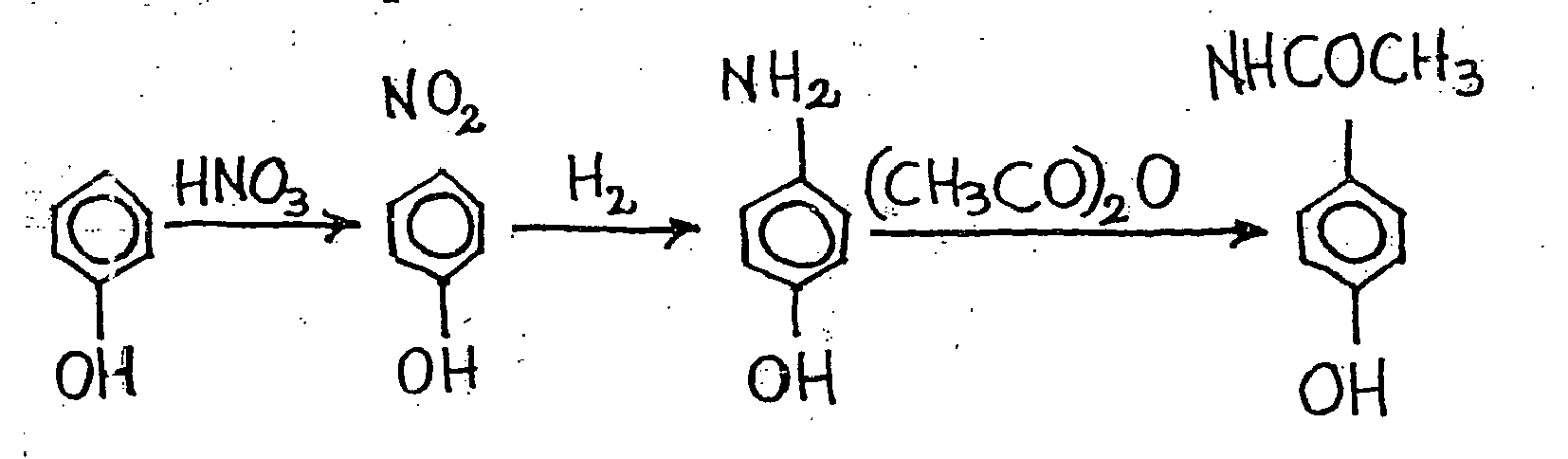
- However, the traditional method for producing paracetamol is affected by two basic shortcomings:
- (1st) the reactions that take place in it are not quantitative with respect to paracetamol, owing to the fact that in the nitration of phenol - to obtain the para-nitrophenol of interest, this one being the precursor of paracetamol - however the reaction product in the position orto- of phenyl ring, is equal to as much as 66%, both because one has two equivalent attachment positions in the position orto- and only one in the position para-, and for the formation of a hydrogen bond between hydroxyl and one of the two oxygen atoms of nitro group (-NO2), which bring a partial negative charge and therefore in this case form a very strong hydrogen bond, energetically favouring orto-nitrophenol with respect to para-nitrophenol of interest;
- (2nd) it results in byproducts which can hardly be separated and are polluting.
- In view of the shortcomings referred above, it is the object of the present invention to provide a method for a fast, high-efficiency quantitative synthesis for the production of paracetamol.
- It is a further object of the present invention to provide a synthesis method for the production of paracetamol, that is also not polluting.
- Such objects are achieved according to the present invention with a method for the production of paracetamol including the stages of:
- (a) reacting phenol and neopentyl bromide or sodium phenoxide and neopentyl iodide in a solvent, with formation of neopentylphenyl ether;
- (b) nitrating said neopentylphenyl ether with formation of a phenylamine;
the nitration gives a strong prevalence of reaction product in the position para-, so that all subsequent stages are quantitative and fast reactions, without polluting or hardly separable byproducts such as in the acetylation which takes place in the traditional synthesis of paracetamol, which is not quantitative and brings to many products to be separated; - (c) catalytically reducing said phenylammine with hydrogen;
- (d) acetylating the reaction product of said catalytic reduction, in position para-, with formation of an ether;
- Moreover, acetyl chloride costs much less than acetic anhydride and having a molecular weight lesser than acetic anhydride, the weight being equal one has more moles of acetyl chloride and then the economic advantage increases, achieving the objects of the present invention.
- A disadvantage of the traditional synthesis of paracetamol is that in order to avoid the acetylation of oxygen, in this case one having to acetylate a para-amino phenol, one is to use acetic anhydride, which is much less reactive than acetyl pyridinium chloride; the reaction is to be carried out under particular conditions in order to avoid the acetylation of the hydroxyl and therefore the product is not quantitative. Moreover, though not willing to be bound to any theory, the Inventor holds that as oxygen is an attractor of electrons, it is the amino group, which is lesse electronegative, that tends to have the conjugative effect with the benzene ring of para-amino phenol. For this reason the nucleophility is depressed, and moreover in the resonance form, in which nitrogen conjugates the doublet with the benzene ring, one has a negative charge of 33% in position para- in which oxygen is bound. Therefore, oxygen becomes richer of electrons and therefore more nucleophilic. The Inventor holds therefore that hydroxyl is acetilated too in a minimum portion, so a lot of products resulting, to be separated: non-acetylated para-amino phenol, the paracetamol of interest, para-amino phenol acetate and acetic acid, which is the byproduct of acetic anhydride. As opposite, in the inventive method one only has insoluble pyridinium chloride as the byproduct of the fourth reaction in the environment, and the pure product soluble in pyridine.
- Pyridine chloride can be titrated with soda and thereafter, once the sodium chloride removed, the pyridine can be recovered by azeotropic distillation. In this way there is a recovery of the solvent and one has no environmental effect in wasting the residues of the synthesis, these ones being water and sodium chloride, achieving the inventive objects;
- (e) cleaving said ether with hydrobromic acid in an inert solvent or respectively with hydriodic acid in an inert solvent, with formation of paracetamol and neopentyl bromide or respectively neopentyl iodide.
- Advantageously, the inventive method further includes the stage of:
- (f) recovering said paracetamol by filtration, and recovering said neopentyl bromide or respectively neopentyl iodide by distillation and returning it to stage (a).
- By virtue of returning neopentyl bromide or neopentyl iodide to the first reaction, though the inventive method envisages two additional stages with respect to the traditional method, however one does not have an economic loss as regards the initial reactant, this one being recovered pure in the final reaction.
- The synthesis of paracetamol taught by the present invention turns out to be of a high efficiency, and advantagoeus from the economical standpoint, because the only additional reactant that is employed is hydrobromic acid or hydriodic acid, which is a low-cost product.
- The advantages of the inventive method, definitely, derive from the fact that whilst in traditional synthesis attachments are predominatingly formed in position orto-, in the inventive synthesis attachments in position para- are predominatingly obtained.
- Therefore, it is the subject of the present invention a method for producing paracetamol according to annexed Claim 1.
- It is also the subject of the present invention a method for producing paracetamol according to annexed Claim 2.
- The present invention will be fully understood based on the following detailed description of a preferred embodiment thereof, only given as a matter of example, absolutely not of restriction of the teaching provided thereby.
- The inventive method for producing paracetamol includes five reactions.
- The first reaction is a reaction between phenol and neopentyl bromide in triethylamine, with formation of neopentylphenyl ether and triethyl ammonium bromide. In the first reaction also hydrobromic acid is formed. The solvent (triethylamine), protonated by hydrobromic acid, may be recovered by titrating it with soda, which forms sodium bromide and water, and by simply separating it after filtering sodium bromide, as water and triethylamine are not miscible with each other, and in case one would proceed by distillation, they do not form an azeotrope and therefore the distillation is simple to be brought to its end, and so the triethylamine re-enters the production cycle and waste products are not polluting, being water and sodium bromide, so the inventive objects being achieved.
- It is envisaged that the phenol may also be under the form of the derivative of phenol composed of sodium phenoxide, reacted with neopentyl iodide in a suitable solvent.
- The second reaction is a nitration of neopentyl phenyl ether formed in the first reaction. The nitration can be carried out with the known nitrating mix, composed of nitric acid and sulfuric acid in an inert solvent, such as e.g. tetrahydrofuran or the cheaper like.
- Oxygen in the ethereal form always keeps a conjugative effect with benzene ring which is orto- and para- orientating. Rather, the union of an electron release alkyl group increases the conjugative effect, whereby the reaction proceeds in an even more efficient way. The product of this second reaction is predominatingly in position para-. Without willing to be bound to any theory, it is held that this ensues from two factors: (1st) the high directive power of neopentyl group, owing to the high steric encumbrance thereof. During the reaction, it makes the attachment more difficult of nitronium cation on positions orto-; (2nd) a repulsive effect between alkyl groups donors of electrons and the two partially negative oxygen atoms present on nitrogen when the product in position orto- is formed, which moreover restricts the rotational degrees of freedom and therefore tyhe product in position orto- is energetically unfavoured. The solvent and the nitrating mix are recovered and disposed of by conventional methods.
- The third reaction is a catalytic reduction with hydrogen of the reaction product of the second reaction, i.e. of the nitration of neopentyl phenyl ether.
- The fourth reaction is an acetylation, in position para-, of the reaction product of the third reaction, of catalytic reduction. The fourth reaction takes place with formation of an ether. The fourth reaction may be carried out with acetyl chloride in anhydrous pyridine, becaise oxygen, blocked in ethereal form, cannot be acetylated.
- As the byproduct of the fourth reaction only pyridinium chloride is formed, which can be titrated with soda and thereafter, once sodium chloride removed, pyridine can be recovered by azeotropic distillation.
- The fifth reaction is the final one, which brings to the formation of pure paracetamol. It is a simple cleavage of an ether with hydrobromic acid in pentane, benzene or another solvent. Particularly a solvent that is cheap and has minimum environmental impact and disposal costs may be selected for the purpose. Water not being present in the reaction environment one does not have the hydrolysis of the amide.
- In this reaction pure paracetamol and neopentyl bromide is formed. As this one constitutes the reactant of use in the first reaction, it may be returned to the first reaction.
- In the embodiment referred above of the use of sodium phenoxide, the cleavage of the ether is carried out with hydriodic acid, with formation of neopentyl iodide, which can be returned to the first reaction.
- The present invention has been disclosed referring to preferred embodiments thereof, but variations, additions or omissions can be made without departing from the scope of protection relevant thereto, which only remains defined by the enclosed Claims.
- The disclosed method is suitable for producing paracetamol industrially.
Claims (2)
- Method for producing paracetamol including the stages of:(a) reacting phenol and neopentyl bromide or sodium phenoxide and neopentyl iodide in a solvent, with formation of neopentylphenyl ether;(b) nitrating said neopentylphenyl ether with formation of a phenylamine;(c) catalytically reducing said phenylammine with hydrogen;(d) acetylating the reaction product of said catalytic reduction, in position para-, with formation of an ether;(e) cleaving said ether with hydrobromic acid in an inert solvent or respectively with hydriodic acid in an inert solvent, with formation of paracetamol and neopentyl bromide or respectively neopentyl iodide.
- Method for producing paracetamol according to Claim 1, further including the stage of:(f) recovering said paracetamol by filtration, and recovering said neopentyl bromide or respectively neopentyl iodide by distillation and returning it to stage (a).
Priority Applications (1)
| Application Number | Priority Date | Filing Date | Title |
|---|---|---|---|
| EP20090425226 EP2266949B1 (en) | 2009-06-10 | 2009-06-10 | "Fast, high-efficiency quantitative synthesis of paracetamol" |
Applications Claiming Priority (1)
| Application Number | Priority Date | Filing Date | Title |
|---|---|---|---|
| EP20090425226 EP2266949B1 (en) | 2009-06-10 | 2009-06-10 | "Fast, high-efficiency quantitative synthesis of paracetamol" |
Publications (2)
| Publication Number | Publication Date |
|---|---|
| EP2266949A1 true EP2266949A1 (en) | 2010-12-29 |
| EP2266949B1 EP2266949B1 (en) | 2013-05-29 |
Family
ID=41168682
Family Applications (1)
| Application Number | Title | Priority Date | Filing Date |
|---|---|---|---|
| EP20090425226 Not-in-force EP2266949B1 (en) | 2009-06-10 | 2009-06-10 | "Fast, high-efficiency quantitative synthesis of paracetamol" |
Country Status (1)
| Country | Link |
|---|---|
| EP (1) | EP2266949B1 (en) |
Cited By (2)
| Publication number | Priority date | Publication date | Assignee | Title |
|---|---|---|---|---|
| FR3109581A1 (en) | 2020-04-27 | 2021-10-29 | Ipsomedic | Continuous paracetamol synthesis process |
| CN115385818A (en) * | 2022-09-01 | 2022-11-25 | 江苏海洋大学 | Paracetamol impurity and preparation method thereof |
Citations (3)
| Publication number | Priority date | Publication date | Assignee | Title |
|---|---|---|---|---|
| US4080505A (en) * | 1975-06-09 | 1978-03-21 | Takeda Chemical Industries | α-Chlorocarboxylic acids |
| EP0435263A1 (en) * | 1989-12-27 | 1991-07-03 | MITSUI TOATSU CHEMICALS, Inc. | Production of p-acetylamino-phenol from p-aminophenyl acetate |
| US20040138509A1 (en) * | 2002-09-19 | 2004-07-15 | The Texas A&M University System | Method of producing organic compounds in presence of oxyethylene ether catalyst and in a solvent minimized environment |
-
2009
- 2009-06-10 EP EP20090425226 patent/EP2266949B1/en not_active Not-in-force
Patent Citations (3)
| Publication number | Priority date | Publication date | Assignee | Title |
|---|---|---|---|---|
| US4080505A (en) * | 1975-06-09 | 1978-03-21 | Takeda Chemical Industries | α-Chlorocarboxylic acids |
| EP0435263A1 (en) * | 1989-12-27 | 1991-07-03 | MITSUI TOATSU CHEMICALS, Inc. | Production of p-acetylamino-phenol from p-aminophenyl acetate |
| US20040138509A1 (en) * | 2002-09-19 | 2004-07-15 | The Texas A&M University System | Method of producing organic compounds in presence of oxyethylene ether catalyst and in a solvent minimized environment |
Non-Patent Citations (5)
| Title |
|---|
| "Ullmann's Encyclopedia of Industrial Chemistry, volume 2, 6th ed.", 2003, WILEY-VCH, WEINHEIM, XP002551387 * |
| ARZNEIMITTEL FORSCHUNG, vol. 30, no. 5, 1980, pages 751 - 758 * |
| DATABASE BEILSTEIN [online] BEILSTEIN INSTITUTE FOR ORGANIC CHEMISTRY, FRANKFURT-MAIN, DE; XP002551396, Database accession no. 2240154 (BRN) * |
| DATABASE BEILSTEIN [online] BEILSTEIN INSTITUTE FOR ORGANIC CHEMISTRY, FRANKFURT-MAIN, DE; XP002551397, Database accession no. 2329887, 2356843 (BRNs) * |
| LIEBIGS ANNALEN DER CHEMIE, vol. 6, 1990, pages 509 - 512 * |
Cited By (6)
| Publication number | Priority date | Publication date | Assignee | Title |
|---|---|---|---|---|
| FR3109581A1 (en) | 2020-04-27 | 2021-10-29 | Ipsomedic | Continuous paracetamol synthesis process |
| FR3109580A1 (en) | 2020-04-27 | 2021-10-29 | Ipsomedic | Continuous paracetamol synthesis process |
| WO2021219647A1 (en) | 2020-04-27 | 2021-11-04 | Ipsomedic | Method for the continuous synthesis of paracetamol |
| JP2023523344A (en) * | 2020-04-27 | 2023-06-02 | イプソメディック | Continuous Synthesis of Paracetamol |
| CN115385818A (en) * | 2022-09-01 | 2022-11-25 | 江苏海洋大学 | Paracetamol impurity and preparation method thereof |
| CN115385818B (en) * | 2022-09-01 | 2023-09-29 | 江苏海洋大学 | A kind of paracetamol impurity and preparation method |
Also Published As
| Publication number | Publication date |
|---|---|
| EP2266949B1 (en) | 2013-05-29 |
Similar Documents
| Publication | Publication Date | Title |
|---|---|---|
| US20060264669A1 (en) | Method for manufacturing diethylene triamine pentaacetic acid derivative | |
| EP3066071B1 (en) | Process for the preparation of iopamidol | |
| BR112012001937B1 (en) | METHOD FOR THE PRODUCTION OF 2,2-DIFLUOROETHYLAMINE | |
| EP2266949B1 (en) | "Fast, high-efficiency quantitative synthesis of paracetamol" | |
| WO2010067589A1 (en) | Method for producing β-alkoxypropionamide | |
| CN102603800A (en) | Preparation method of phosphonitrile flame retardant | |
| CN100593536C (en) | Method for synthesizing N-fluorene methoxycarbonyl-N-trityl-D-glutamine | |
| EP1777215B1 (en) | Method for producing 2-amino-5-iodobenzoic acid | |
| CN102816076B (en) | Synthetic method of p-hydroxyphenylglycine | |
| JP5374895B2 (en) | Process for producing optically active fluoroamines | |
| CN103641706A (en) | Preparation method for trimesoyl chloride | |
| CN102234221B (en) | Preparation method of fluorobenzene | |
| CN1657516A (en) | Process for preparing high-purity orthoformate | |
| JP2010512392A5 (en) | ||
| US20110319649A1 (en) | Intermediate for producing lacosamide and a process for its preparation and conversion to lacosamide | |
| EP2814806B1 (en) | An improved process for the preparation of aliskiren | |
| JP2011016782A (en) | Method for producing glycolic acid, and glycolic acid-containing composition | |
| CA2479643C (en) | Process for preparing alkyl 2,2-dichloro- or dibromophenylacetates | |
| CN114394916A (en) | Preparation method of O-3-chloro-2-propenyl hydroxylamine | |
| EP1468983B1 (en) | Process for producing 2,5-bis(trifluoromethyl)nitrobenzene | |
| CN113735712B (en) | Preparation method of o-nitrobenzaldehyde | |
| CN117142934B (en) | Preparation method of (S) -3-cyclohexene-1-formic acid and intermediate thereof | |
| CN115477596B (en) | Sulfate ester compound and preparation method thereof | |
| CN119638584B (en) | A kind of preparation method of L-serine | |
| CN117105790B (en) | Method for preparing p-nitrobenzaldehyde from p-nitrobenzyl halide |
Legal Events
| Date | Code | Title | Description |
|---|---|---|---|
| PUAI | Public reference made under article 153(3) epc to a published international application that has entered the european phase |
Free format text: ORIGINAL CODE: 0009012 |
|
| AK | Designated contracting states |
Kind code of ref document: A1 Designated state(s): AT BE BG CH CY CZ DE DK EE ES FI FR GB GR HR HU IE IS IT LI LT LU LV MC MK MT NL NO PL PT RO SE SI SK TR |
|
| AX | Request for extension of the european patent |
Extension state: AL BA RS |
|
| 17P | Request for examination filed |
Effective date: 20110331 |
|
| 17Q | First examination report despatched |
Effective date: 20110505 |
|
| GRAP | Despatch of communication of intention to grant a patent |
Free format text: ORIGINAL CODE: EPIDOSNIGR1 |
|
| GRAS | Grant fee paid |
Free format text: ORIGINAL CODE: EPIDOSNIGR3 |
|
| GRAA | (expected) grant |
Free format text: ORIGINAL CODE: 0009210 |
|
| AK | Designated contracting states |
Kind code of ref document: B1 Designated state(s): AT BE BG CH CY CZ DE DK EE ES FI FR GB GR HR HU IE IS IT LI LT LU LV MC MK MT NL NO PL PT RO SE SI SK TR |
|
| REG | Reference to a national code |
Ref country code: GB Ref legal event code: FG4D |
|
| REG | Reference to a national code |
Ref country code: CH Ref legal event code: EP |
|
| REG | Reference to a national code |
Ref country code: AT Ref legal event code: REF Ref document number: 614314 Country of ref document: AT Kind code of ref document: T Effective date: 20130615 |
|
| REG | Reference to a national code |
Ref country code: IE Ref legal event code: FG4D |
|
| REG | Reference to a national code |
Ref country code: DE Ref legal event code: R096 Ref document number: 602009015987 Country of ref document: DE Effective date: 20130725 |
|
| REG | Reference to a national code |
Ref country code: AT Ref legal event code: MK05 Ref document number: 614314 Country of ref document: AT Kind code of ref document: T Effective date: 20130529 |
|
| REG | Reference to a national code |
Ref country code: LT Ref legal event code: MG4D |
|
| PG25 | Lapsed in a contracting state [announced via postgrant information from national office to epo] |
Ref country code: NO Free format text: LAPSE BECAUSE OF FAILURE TO SUBMIT A TRANSLATION OF THE DESCRIPTION OR TO PAY THE FEE WITHIN THE PRESCRIBED TIME-LIMIT Effective date: 20130829 Ref country code: LT Free format text: LAPSE BECAUSE OF FAILURE TO SUBMIT A TRANSLATION OF THE DESCRIPTION OR TO PAY THE FEE WITHIN THE PRESCRIBED TIME-LIMIT Effective date: 20130529 Ref country code: SI Free format text: LAPSE BECAUSE OF FAILURE TO SUBMIT A TRANSLATION OF THE DESCRIPTION OR TO PAY THE FEE WITHIN THE PRESCRIBED TIME-LIMIT Effective date: 20130529 Ref country code: ES Free format text: LAPSE BECAUSE OF FAILURE TO SUBMIT A TRANSLATION OF THE DESCRIPTION OR TO PAY THE FEE WITHIN THE PRESCRIBED TIME-LIMIT Effective date: 20130909 Ref country code: FI Free format text: LAPSE BECAUSE OF FAILURE TO SUBMIT A TRANSLATION OF THE DESCRIPTION OR TO PAY THE FEE WITHIN THE PRESCRIBED TIME-LIMIT Effective date: 20130529 Ref country code: SE Free format text: LAPSE BECAUSE OF FAILURE TO SUBMIT A TRANSLATION OF THE DESCRIPTION OR TO PAY THE FEE WITHIN THE PRESCRIBED TIME-LIMIT Effective date: 20130529 Ref country code: GR Free format text: LAPSE BECAUSE OF FAILURE TO SUBMIT A TRANSLATION OF THE DESCRIPTION OR TO PAY THE FEE WITHIN THE PRESCRIBED TIME-LIMIT Effective date: 20130830 Ref country code: IS Free format text: LAPSE BECAUSE OF FAILURE TO SUBMIT A TRANSLATION OF THE DESCRIPTION OR TO PAY THE FEE WITHIN THE PRESCRIBED TIME-LIMIT Effective date: 20130929 Ref country code: PT Free format text: LAPSE BECAUSE OF FAILURE TO SUBMIT A TRANSLATION OF THE DESCRIPTION OR TO PAY THE FEE WITHIN THE PRESCRIBED TIME-LIMIT Effective date: 20130930 Ref country code: AT Free format text: LAPSE BECAUSE OF FAILURE TO SUBMIT A TRANSLATION OF THE DESCRIPTION OR TO PAY THE FEE WITHIN THE PRESCRIBED TIME-LIMIT Effective date: 20130529 |
|
| REG | Reference to a national code |
Ref country code: NL Ref legal event code: VDEP Effective date: 20130529 |
|
| PG25 | Lapsed in a contracting state [announced via postgrant information from national office to epo] |
Ref country code: BG Free format text: LAPSE BECAUSE OF FAILURE TO SUBMIT A TRANSLATION OF THE DESCRIPTION OR TO PAY THE FEE WITHIN THE PRESCRIBED TIME-LIMIT Effective date: 20130829 Ref country code: PL Free format text: LAPSE BECAUSE OF FAILURE TO SUBMIT A TRANSLATION OF THE DESCRIPTION OR TO PAY THE FEE WITHIN THE PRESCRIBED TIME-LIMIT Effective date: 20130529 Ref country code: HR Free format text: LAPSE BECAUSE OF FAILURE TO SUBMIT A TRANSLATION OF THE DESCRIPTION OR TO PAY THE FEE WITHIN THE PRESCRIBED TIME-LIMIT Effective date: 20130529 |
|
| PG25 | Lapsed in a contracting state [announced via postgrant information from national office to epo] |
Ref country code: LV Free format text: LAPSE BECAUSE OF FAILURE TO SUBMIT A TRANSLATION OF THE DESCRIPTION OR TO PAY THE FEE WITHIN THE PRESCRIBED TIME-LIMIT Effective date: 20130529 |
|
| PG25 | Lapsed in a contracting state [announced via postgrant information from national office to epo] |
Ref country code: EE Free format text: LAPSE BECAUSE OF FAILURE TO SUBMIT A TRANSLATION OF THE DESCRIPTION OR TO PAY THE FEE WITHIN THE PRESCRIBED TIME-LIMIT Effective date: 20130529 Ref country code: BE Free format text: LAPSE BECAUSE OF FAILURE TO SUBMIT A TRANSLATION OF THE DESCRIPTION OR TO PAY THE FEE WITHIN THE PRESCRIBED TIME-LIMIT Effective date: 20130529 Ref country code: CZ Free format text: LAPSE BECAUSE OF FAILURE TO SUBMIT A TRANSLATION OF THE DESCRIPTION OR TO PAY THE FEE WITHIN THE PRESCRIBED TIME-LIMIT Effective date: 20130529 Ref country code: DK Free format text: LAPSE BECAUSE OF FAILURE TO SUBMIT A TRANSLATION OF THE DESCRIPTION OR TO PAY THE FEE WITHIN THE PRESCRIBED TIME-LIMIT Effective date: 20130529 Ref country code: SK Free format text: LAPSE BECAUSE OF FAILURE TO SUBMIT A TRANSLATION OF THE DESCRIPTION OR TO PAY THE FEE WITHIN THE PRESCRIBED TIME-LIMIT Effective date: 20130529 |
|
| REG | Reference to a national code |
Ref country code: CH Ref legal event code: PL |
|
| PG25 | Lapsed in a contracting state [announced via postgrant information from national office to epo] |
Ref country code: IT Free format text: LAPSE BECAUSE OF FAILURE TO SUBMIT A TRANSLATION OF THE DESCRIPTION OR TO PAY THE FEE WITHIN THE PRESCRIBED TIME-LIMIT Effective date: 20130529 Ref country code: NL Free format text: LAPSE BECAUSE OF FAILURE TO SUBMIT A TRANSLATION OF THE DESCRIPTION OR TO PAY THE FEE WITHIN THE PRESCRIBED TIME-LIMIT Effective date: 20130529 Ref country code: RO Free format text: LAPSE BECAUSE OF FAILURE TO SUBMIT A TRANSLATION OF THE DESCRIPTION OR TO PAY THE FEE WITHIN THE PRESCRIBED TIME-LIMIT Effective date: 20130529 Ref country code: MC Free format text: LAPSE BECAUSE OF FAILURE TO SUBMIT A TRANSLATION OF THE DESCRIPTION OR TO PAY THE FEE WITHIN THE PRESCRIBED TIME-LIMIT Effective date: 20130529 |
|
| REG | Reference to a national code |
Ref country code: IE Ref legal event code: MM4A |
|
| REG | Reference to a national code |
Ref country code: DE Ref legal event code: R119 Ref document number: 602009015987 Country of ref document: DE Effective date: 20140101 |
|
| PLBE | No opposition filed within time limit |
Free format text: ORIGINAL CODE: 0009261 |
|
| STAA | Information on the status of an ep patent application or granted ep patent |
Free format text: STATUS: NO OPPOSITION FILED WITHIN TIME LIMIT |
|
| GBPC | Gb: european patent ceased through non-payment of renewal fee |
Effective date: 20130829 |
|
| PG25 | Lapsed in a contracting state [announced via postgrant information from national office to epo] |
Ref country code: CH Free format text: LAPSE BECAUSE OF NON-PAYMENT OF DUE FEES Effective date: 20130630 Ref country code: LI Free format text: LAPSE BECAUSE OF NON-PAYMENT OF DUE FEES Effective date: 20130630 Ref country code: IE Free format text: LAPSE BECAUSE OF NON-PAYMENT OF DUE FEES Effective date: 20130610 Ref country code: DE Free format text: LAPSE BECAUSE OF NON-PAYMENT OF DUE FEES Effective date: 20140101 |
|
| 26N | No opposition filed |
Effective date: 20140303 |
|
| REG | Reference to a national code |
Ref country code: FR Ref legal event code: ST Effective date: 20140414 |
|
| PG25 | Lapsed in a contracting state [announced via postgrant information from national office to epo] |
Ref country code: GB Free format text: LAPSE BECAUSE OF NON-PAYMENT OF DUE FEES Effective date: 20130829 |
|
| PG25 | Lapsed in a contracting state [announced via postgrant information from national office to epo] |
Ref country code: FR Free format text: LAPSE BECAUSE OF NON-PAYMENT OF DUE FEES Effective date: 20130729 |
|
| PG25 | Lapsed in a contracting state [announced via postgrant information from national office to epo] |
Ref country code: MT Free format text: LAPSE BECAUSE OF FAILURE TO SUBMIT A TRANSLATION OF THE DESCRIPTION OR TO PAY THE FEE WITHIN THE PRESCRIBED TIME-LIMIT Effective date: 20130529 |
|
| PG25 | Lapsed in a contracting state [announced via postgrant information from national office to epo] |
Ref country code: CY Free format text: LAPSE BECAUSE OF FAILURE TO SUBMIT A TRANSLATION OF THE DESCRIPTION OR TO PAY THE FEE WITHIN THE PRESCRIBED TIME-LIMIT Effective date: 20130529 Ref country code: TR Free format text: LAPSE BECAUSE OF FAILURE TO SUBMIT A TRANSLATION OF THE DESCRIPTION OR TO PAY THE FEE WITHIN THE PRESCRIBED TIME-LIMIT Effective date: 20130529 |
|
| PG25 | Lapsed in a contracting state [announced via postgrant information from national office to epo] |
Ref country code: HU Free format text: LAPSE BECAUSE OF FAILURE TO SUBMIT A TRANSLATION OF THE DESCRIPTION OR TO PAY THE FEE WITHIN THE PRESCRIBED TIME-LIMIT; INVALID AB INITIO Effective date: 20090610 Ref country code: LU Free format text: LAPSE BECAUSE OF NON-PAYMENT OF DUE FEES Effective date: 20130610 Ref country code: MK Free format text: LAPSE BECAUSE OF FAILURE TO SUBMIT A TRANSLATION OF THE DESCRIPTION OR TO PAY THE FEE WITHIN THE PRESCRIBED TIME-LIMIT Effective date: 20130529 |