EP2266940A1 - Catechol manufacturing method - Google Patents
Catechol manufacturing method Download PDFInfo
- Publication number
- EP2266940A1 EP2266940A1 EP09731392A EP09731392A EP2266940A1 EP 2266940 A1 EP2266940 A1 EP 2266940A1 EP 09731392 A EP09731392 A EP 09731392A EP 09731392 A EP09731392 A EP 09731392A EP 2266940 A1 EP2266940 A1 EP 2266940A1
- Authority
- EP
- European Patent Office
- Prior art keywords
- catechol
- trihydroxy
- cyclohexene
- reaction
- scyllo
- Prior art date
- Legal status (The legal status is an assumption and is not a legal conclusion. Google has not performed a legal analysis and makes no representation as to the accuracy of the status listed.)
- Withdrawn
Links
- YCIMNLLNPGFGHC-UHFFFAOYSA-N catechol Chemical compound OC1=CC=CC=C1O YCIMNLLNPGFGHC-UHFFFAOYSA-N 0.000 title claims abstract description 300
- 238000004519 manufacturing process Methods 0.000 title claims abstract description 56
- UDGPTYYVDNKAPG-OTWZMJIISA-N (4s,5r,6s)-4,5,6-trihydroxycyclohex-2-en-1-one Chemical compound O[C@H]1C=CC(=O)[C@@H](O)[C@@H]1O UDGPTYYVDNKAPG-OTWZMJIISA-N 0.000 claims abstract description 89
- 238000010438 heat treatment Methods 0.000 claims abstract description 39
- 238000005580 one pot reaction Methods 0.000 claims abstract description 13
- GZYCZKBRQBKGJW-UHFFFAOYSA-N DOI Natural products OC1CC(=O)C(O)C(O)C1O GZYCZKBRQBKGJW-UHFFFAOYSA-N 0.000 claims description 73
- GZYCZKBRQBKGJW-FSZQNWAESA-N 2-deoxy-scyllo-inosose Chemical compound O[C@@H]1CC(=O)[C@@H](O)[C@H](O)[C@H]1O GZYCZKBRQBKGJW-FSZQNWAESA-N 0.000 claims description 71
- 239000003054 catalyst Substances 0.000 claims description 57
- OKTJSMMVPCPJKN-UHFFFAOYSA-N Carbon Chemical compound [C] OKTJSMMVPCPJKN-UHFFFAOYSA-N 0.000 claims description 53
- KDLHZDBZIXYQEI-UHFFFAOYSA-N Palladium Chemical compound [Pd] KDLHZDBZIXYQEI-UHFFFAOYSA-N 0.000 claims description 50
- 229910052751 metal Inorganic materials 0.000 claims description 41
- 239000002184 metal Substances 0.000 claims description 41
- DPLYFDISYFWXOA-OTWZMJIISA-N (2s,3r,4s)-2,3,4-trihydroxycyclohexan-1-one Chemical compound O[C@H]1CCC(=O)[C@@H](O)[C@@H]1O DPLYFDISYFWXOA-OTWZMJIISA-N 0.000 claims description 34
- UFHFLCQGNIYNRP-UHFFFAOYSA-N Hydrogen Chemical compound [H][H] UFHFLCQGNIYNRP-UHFFFAOYSA-N 0.000 claims description 30
- 229910052739 hydrogen Inorganic materials 0.000 claims description 30
- 239000001257 hydrogen Substances 0.000 claims description 30
- 238000006297 dehydration reaction Methods 0.000 claims description 25
- 229910021536 Zeolite Inorganic materials 0.000 claims description 22
- HNPSIPDUKPIQMN-UHFFFAOYSA-N dioxosilane;oxo(oxoalumanyloxy)alumane Chemical compound O=[Si]=O.O=[Al]O[Al]=O HNPSIPDUKPIQMN-UHFFFAOYSA-N 0.000 claims description 22
- 239000010457 zeolite Substances 0.000 claims description 22
- PNEYBMLMFCGWSK-UHFFFAOYSA-N aluminium oxide Inorganic materials [O-2].[O-2].[O-2].[Al+3].[Al+3] PNEYBMLMFCGWSK-UHFFFAOYSA-N 0.000 claims description 18
- 229910052763 palladium Inorganic materials 0.000 claims description 14
- 239000011973 solid acid Substances 0.000 claims description 14
- 238000005984 hydrogenation reaction Methods 0.000 claims description 10
- -1 platinum group metals Chemical class 0.000 claims description 10
- 229920000557 Nafion® Polymers 0.000 claims description 9
- 239000007864 aqueous solution Substances 0.000 claims description 9
- 239000004927 clay Substances 0.000 claims description 9
- 238000006243 chemical reaction Methods 0.000 description 105
- 238000000034 method Methods 0.000 description 54
- QTBSBXVTEAMEQO-UHFFFAOYSA-N Acetic acid Chemical compound CC(O)=O QTBSBXVTEAMEQO-UHFFFAOYSA-N 0.000 description 39
- 239000002904 solvent Substances 0.000 description 32
- WEVYAHXRMPXWCK-UHFFFAOYSA-N Acetonitrile Chemical compound CC#N WEVYAHXRMPXWCK-UHFFFAOYSA-N 0.000 description 30
- XLYOFNOQVPJJNP-UHFFFAOYSA-N water Substances O XLYOFNOQVPJJNP-UHFFFAOYSA-N 0.000 description 29
- OKKJLVBELUTLKV-UHFFFAOYSA-N Methanol Chemical compound OC OKKJLVBELUTLKV-UHFFFAOYSA-N 0.000 description 24
- 238000006722 reduction reaction Methods 0.000 description 24
- 239000002253 acid Substances 0.000 description 19
- IJGRMHOSHXDMSA-UHFFFAOYSA-N Atomic nitrogen Chemical compound N#N IJGRMHOSHXDMSA-UHFFFAOYSA-N 0.000 description 18
- XEKOWRVHYACXOJ-UHFFFAOYSA-N Ethyl acetate Chemical compound CCOC(C)=O XEKOWRVHYACXOJ-UHFFFAOYSA-N 0.000 description 18
- 238000004128 high performance liquid chromatography Methods 0.000 description 16
- YMWUJEATGCHHMB-UHFFFAOYSA-N Dichloromethane Chemical compound ClCCl YMWUJEATGCHHMB-UHFFFAOYSA-N 0.000 description 15
- LFQSCWFLJHTTHZ-UHFFFAOYSA-N Ethanol Chemical compound CCO LFQSCWFLJHTTHZ-UHFFFAOYSA-N 0.000 description 15
- WMFOQBRAJBCJND-UHFFFAOYSA-M Lithium hydroxide Chemical compound [Li+].[OH-] WMFOQBRAJBCJND-UHFFFAOYSA-M 0.000 description 15
- ZMXDDKWLCZADIW-UHFFFAOYSA-N N,N-Dimethylformamide Chemical compound CN(C)C=O ZMXDDKWLCZADIW-UHFFFAOYSA-N 0.000 description 15
- MUBZPKHOEPUJKR-UHFFFAOYSA-N Oxalic acid Chemical compound OC(=O)C(O)=O MUBZPKHOEPUJKR-UHFFFAOYSA-N 0.000 description 15
- KWYUFKZDYYNOTN-UHFFFAOYSA-M Potassium hydroxide Chemical compound [OH-].[K+] KWYUFKZDYYNOTN-UHFFFAOYSA-M 0.000 description 15
- VYPSYNLAJGMNEJ-UHFFFAOYSA-N Silicium dioxide Chemical compound O=[Si]=O VYPSYNLAJGMNEJ-UHFFFAOYSA-N 0.000 description 15
- HEMHJVSKTPXQMS-UHFFFAOYSA-M Sodium hydroxide Chemical compound [OH-].[Na+] HEMHJVSKTPXQMS-UHFFFAOYSA-M 0.000 description 15
- YXFVVABEGXRONW-UHFFFAOYSA-N Toluene Chemical compound CC1=CC=CC=C1 YXFVVABEGXRONW-UHFFFAOYSA-N 0.000 description 15
- ZMANZCXQSJIPKH-UHFFFAOYSA-N Triethylamine Chemical compound CCN(CC)CC ZMANZCXQSJIPKH-UHFFFAOYSA-N 0.000 description 15
- 239000000654 additive Substances 0.000 description 15
- 230000000996 additive effect Effects 0.000 description 15
- 238000004458 analytical method Methods 0.000 description 15
- KRKNYBCHXYNGOX-UHFFFAOYSA-N citric acid Chemical compound OC(=O)CC(O)(C(O)=O)CC(O)=O KRKNYBCHXYNGOX-UHFFFAOYSA-N 0.000 description 15
- VLKZOEOYAKHREP-UHFFFAOYSA-N n-Hexane Chemical compound CCCCCC VLKZOEOYAKHREP-UHFFFAOYSA-N 0.000 description 15
- 229910052757 nitrogen Inorganic materials 0.000 description 15
- PXHVJJICTQNCMI-UHFFFAOYSA-N Nickel Chemical compound [Ni] PXHVJJICTQNCMI-UHFFFAOYSA-N 0.000 description 14
- NBIIXXVUZAFLBC-UHFFFAOYSA-N Phosphoric acid Chemical compound OP(O)(O)=O NBIIXXVUZAFLBC-UHFFFAOYSA-N 0.000 description 14
- QAOWNCQODCNURD-UHFFFAOYSA-N Sulfuric acid Chemical compound OS(O)(=O)=O QAOWNCQODCNURD-UHFFFAOYSA-N 0.000 description 14
- 239000000203 mixture Substances 0.000 description 14
- BASFCYQUMIYNBI-UHFFFAOYSA-N platinum Chemical compound [Pt] BASFCYQUMIYNBI-UHFFFAOYSA-N 0.000 description 14
- 239000000741 silica gel Substances 0.000 description 14
- 229910002027 silica gel Inorganic materials 0.000 description 14
- IAZDPXIOMUYVGZ-UHFFFAOYSA-N Dimethylsulphoxide Chemical compound CS(C)=O IAZDPXIOMUYVGZ-UHFFFAOYSA-N 0.000 description 13
- 235000011054 acetic acid Nutrition 0.000 description 13
- 230000015572 biosynthetic process Effects 0.000 description 13
- 239000000126 substance Substances 0.000 description 13
- 238000003786 synthesis reaction Methods 0.000 description 13
- DTQVDTLACAAQTR-UHFFFAOYSA-N Trifluoroacetic acid Chemical compound OC(=O)C(F)(F)F DTQVDTLACAAQTR-UHFFFAOYSA-N 0.000 description 12
- 238000001914 filtration Methods 0.000 description 12
- QJGQUHMNIGDVPM-UHFFFAOYSA-N nitrogen group Chemical group [N] QJGQUHMNIGDVPM-UHFFFAOYSA-N 0.000 description 12
- 239000000243 solution Substances 0.000 description 12
- 239000002994 raw material Substances 0.000 description 11
- HEDRZPFGACZZDS-UHFFFAOYSA-N Chloroform Chemical compound ClC(Cl)Cl HEDRZPFGACZZDS-UHFFFAOYSA-N 0.000 description 10
- XTHFKEDIFFGKHM-UHFFFAOYSA-N Dimethoxyethane Chemical compound COCCOC XTHFKEDIFFGKHM-UHFFFAOYSA-N 0.000 description 10
- CPELXLSAUQHCOX-UHFFFAOYSA-N Hydrogen bromide Chemical compound Br CPELXLSAUQHCOX-UHFFFAOYSA-N 0.000 description 10
- AFVFQIVMOAPDHO-UHFFFAOYSA-N Methanesulfonic acid Chemical compound CS(O)(=O)=O AFVFQIVMOAPDHO-UHFFFAOYSA-N 0.000 description 10
- LRHPLDYGYMQRHN-UHFFFAOYSA-N N-Butanol Chemical compound CCCCO LRHPLDYGYMQRHN-UHFFFAOYSA-N 0.000 description 10
- JUJWROOIHBZHMG-UHFFFAOYSA-N Pyridine Chemical compound C1=CC=NC=C1 JUJWROOIHBZHMG-UHFFFAOYSA-N 0.000 description 10
- CDBYLPFSWZWCQE-UHFFFAOYSA-L Sodium Carbonate Chemical compound [Na+].[Na+].[O-]C([O-])=O CDBYLPFSWZWCQE-UHFFFAOYSA-L 0.000 description 10
- UIIMBOGNXHQVGW-UHFFFAOYSA-M Sodium bicarbonate Chemical compound [Na+].OC([O-])=O UIIMBOGNXHQVGW-UHFFFAOYSA-M 0.000 description 10
- WYURNTSHIVDZCO-UHFFFAOYSA-N Tetrahydrofuran Chemical compound C1CCOC1 WYURNTSHIVDZCO-UHFFFAOYSA-N 0.000 description 10
- WPYMKLBDIGXBTP-UHFFFAOYSA-N benzoic acid Chemical compound OC(=O)C1=CC=CC=C1 WPYMKLBDIGXBTP-UHFFFAOYSA-N 0.000 description 10
- XBDQKXXYIPTUBI-UHFFFAOYSA-N dimethylselenoniopropionate Natural products CCC(O)=O XBDQKXXYIPTUBI-UHFFFAOYSA-N 0.000 description 10
- JVTAAEKCZFNVCJ-UHFFFAOYSA-N lactic acid Chemical compound CC(O)C(O)=O JVTAAEKCZFNVCJ-UHFFFAOYSA-N 0.000 description 10
- BDAGIHXWWSANSR-UHFFFAOYSA-N methanoic acid Natural products OC=O BDAGIHXWWSANSR-UHFFFAOYSA-N 0.000 description 10
- FBSFWRHWHYMIOG-UHFFFAOYSA-N methyl 3,4,5-trihydroxybenzoate Chemical compound COC(=O)C1=CC(O)=C(O)C(O)=C1 FBSFWRHWHYMIOG-UHFFFAOYSA-N 0.000 description 10
- BWHMMNNQKKPAPP-UHFFFAOYSA-L potassium carbonate Chemical compound [K+].[K+].[O-]C([O-])=O BWHMMNNQKKPAPP-UHFFFAOYSA-L 0.000 description 10
- 238000004445 quantitative analysis Methods 0.000 description 10
- 230000002829 reductive effect Effects 0.000 description 10
- JOXIMZWYDAKGHI-UHFFFAOYSA-N toluene-4-sulfonic acid Chemical compound CC1=CC=C(S(O)(=O)=O)C=C1 JOXIMZWYDAKGHI-UHFFFAOYSA-N 0.000 description 10
- 239000013078 crystal Substances 0.000 description 9
- 150000002739 metals Chemical class 0.000 description 9
- WQZGKKKJIJFFOK-GASJEMHNSA-N Glucose Natural products OC[C@H]1OC(O)[C@H](O)[C@@H](O)[C@@H]1O WQZGKKKJIJFFOK-GASJEMHNSA-N 0.000 description 8
- GGNQRNBDZQJCCN-UHFFFAOYSA-N benzene-1,2,4-triol Chemical compound OC1=CC=C(O)C(O)=C1 GGNQRNBDZQJCCN-UHFFFAOYSA-N 0.000 description 8
- 230000035484 reaction time Effects 0.000 description 8
- NWUYHJFMYQTDRP-UHFFFAOYSA-N 1,2-bis(ethenyl)benzene;1-ethenyl-2-ethylbenzene;styrene Chemical compound C=CC1=CC=CC=C1.CCC1=CC=CC=C1C=C.C=CC1=CC=CC=C1C=C NWUYHJFMYQTDRP-UHFFFAOYSA-N 0.000 description 7
- KJTLSVCANCCWHF-UHFFFAOYSA-N Ruthenium Chemical compound [Ru] KJTLSVCANCCWHF-UHFFFAOYSA-N 0.000 description 7
- 229910000147 aluminium phosphate Inorganic materials 0.000 description 7
- 238000001816 cooling Methods 0.000 description 7
- 239000000706 filtrate Substances 0.000 description 7
- XMBWDFGMSWQBCA-UHFFFAOYSA-N hydrogen iodide Chemical compound I XMBWDFGMSWQBCA-UHFFFAOYSA-N 0.000 description 7
- 238000009776 industrial production Methods 0.000 description 7
- 239000003456 ion exchange resin Substances 0.000 description 7
- 229920003303 ion-exchange polymer Polymers 0.000 description 7
- 229910052741 iridium Inorganic materials 0.000 description 7
- GKOZUEZYRPOHIO-UHFFFAOYSA-N iridium atom Chemical compound [Ir] GKOZUEZYRPOHIO-UHFFFAOYSA-N 0.000 description 7
- 239000000463 material Substances 0.000 description 7
- 229910052759 nickel Inorganic materials 0.000 description 7
- 229910052697 platinum Inorganic materials 0.000 description 7
- 229910052703 rhodium Inorganic materials 0.000 description 7
- 239000010948 rhodium Substances 0.000 description 7
- MHOVAHRLVXNVSD-UHFFFAOYSA-N rhodium atom Chemical compound [Rh] MHOVAHRLVXNVSD-UHFFFAOYSA-N 0.000 description 7
- 229910052707 ruthenium Inorganic materials 0.000 description 7
- WBIQQQGBSDOWNP-UHFFFAOYSA-N 2-dodecylbenzenesulfonic acid Chemical compound CCCCCCCCCCCCC1=CC=CC=C1S(O)(=O)=O WBIQQQGBSDOWNP-UHFFFAOYSA-N 0.000 description 6
- RYGMFSIKBFXOCR-UHFFFAOYSA-N Copper Chemical compound [Cu] RYGMFSIKBFXOCR-UHFFFAOYSA-N 0.000 description 6
- 229910052802 copper Inorganic materials 0.000 description 6
- 239000010949 copper Substances 0.000 description 6
- 230000018044 dehydration Effects 0.000 description 6
- 229940060296 dodecylbenzenesulfonic acid Drugs 0.000 description 6
- 238000003756 stirring Methods 0.000 description 6
- RYHBNJHYFVUHQT-UHFFFAOYSA-N 1,4-Dioxane Chemical compound C1COCCO1 RYHBNJHYFVUHQT-UHFFFAOYSA-N 0.000 description 5
- OSWFIVFLDKOXQC-UHFFFAOYSA-N 4-(3-methoxyphenyl)aniline Chemical compound COC1=CC=CC(C=2C=CC(N)=CC=2)=C1 OSWFIVFLDKOXQC-UHFFFAOYSA-N 0.000 description 5
- 239000005711 Benzoic acid Substances 0.000 description 5
- DKPFZGUDAPQIHT-UHFFFAOYSA-N Butyl acetate Natural products CCCCOC(C)=O DKPFZGUDAPQIHT-UHFFFAOYSA-N 0.000 description 5
- 239000004215 Carbon black (E152) Substances 0.000 description 5
- ZAFNJMIOTHYJRJ-UHFFFAOYSA-N Diisopropyl ether Chemical compound CC(C)OC(C)C ZAFNJMIOTHYJRJ-UHFFFAOYSA-N 0.000 description 5
- VEXZGXHMUGYJMC-UHFFFAOYSA-N Hydrochloric acid Chemical compound Cl VEXZGXHMUGYJMC-UHFFFAOYSA-N 0.000 description 5
- CTQNGGLPUBDAKN-UHFFFAOYSA-N O-Xylene Chemical compound CC1=CC=CC=C1C CTQNGGLPUBDAKN-UHFFFAOYSA-N 0.000 description 5
- 239000005456 alcohol based solvent Substances 0.000 description 5
- 150000001412 amines Chemical class 0.000 description 5
- 235000010233 benzoic acid Nutrition 0.000 description 5
- 239000003153 chemical reaction reagent Substances 0.000 description 5
- 235000015165 citric acid Nutrition 0.000 description 5
- 239000003759 ester based solvent Substances 0.000 description 5
- 239000004210 ether based solvent Substances 0.000 description 5
- 235000019253 formic acid Nutrition 0.000 description 5
- 229910052736 halogen Inorganic materials 0.000 description 5
- 150000002367 halogens Chemical class 0.000 description 5
- FUZZWVXGSFPDMH-UHFFFAOYSA-N hexanoic acid Chemical compound CCCCCC(O)=O FUZZWVXGSFPDMH-UHFFFAOYSA-N 0.000 description 5
- 229930195733 hydrocarbon Natural products 0.000 description 5
- 150000002430 hydrocarbons Chemical class 0.000 description 5
- 229910000042 hydrogen bromide Inorganic materials 0.000 description 5
- IXCSERBJSXMMFS-UHFFFAOYSA-N hydrogen chloride Substances Cl.Cl IXCSERBJSXMMFS-UHFFFAOYSA-N 0.000 description 5
- 229910000041 hydrogen chloride Inorganic materials 0.000 description 5
- 150000007529 inorganic bases Chemical class 0.000 description 5
- 239000004310 lactic acid Substances 0.000 description 5
- 235000014655 lactic acid Nutrition 0.000 description 5
- 229940098779 methanesulfonic acid Drugs 0.000 description 5
- IBKQQKPQRYUGBJ-UHFFFAOYSA-N methyl gallate Natural products CC(=O)C1=CC(O)=C(O)C(O)=C1 IBKQQKPQRYUGBJ-UHFFFAOYSA-N 0.000 description 5
- 150000007522 mineralic acids Chemical class 0.000 description 5
- 239000012046 mixed solvent Substances 0.000 description 5
- 150000007524 organic acids Chemical class 0.000 description 5
- 235000005985 organic acids Nutrition 0.000 description 5
- 235000006408 oxalic acid Nutrition 0.000 description 5
- 229910000027 potassium carbonate Inorganic materials 0.000 description 5
- 235000019260 propionic acid Nutrition 0.000 description 5
- UMJSCPRVCHMLSP-UHFFFAOYSA-N pyridine Natural products COC1=CC=CN=C1 UMJSCPRVCHMLSP-UHFFFAOYSA-N 0.000 description 5
- IUVKMZGDUIUOCP-BTNSXGMBSA-N quinbolone Chemical compound O([C@H]1CC[C@H]2[C@H]3[C@@H]([C@]4(C=CC(=O)C=C4CC3)C)CC[C@@]21C)C1=CCCC1 IUVKMZGDUIUOCP-BTNSXGMBSA-N 0.000 description 5
- 238000001953 recrystallisation Methods 0.000 description 5
- 150000003839 salts Chemical class 0.000 description 5
- 229910000030 sodium bicarbonate Inorganic materials 0.000 description 5
- 235000017557 sodium bicarbonate Nutrition 0.000 description 5
- 229910000029 sodium carbonate Inorganic materials 0.000 description 5
- YLQBMQCUIZJEEH-UHFFFAOYSA-N tetrahydrofuran Natural products C=1C=COC=1 YLQBMQCUIZJEEH-UHFFFAOYSA-N 0.000 description 5
- 239000008096 xylene Substances 0.000 description 5
- OKKJLVBELUTLKV-MZCSYVLQSA-N Deuterated methanol Chemical compound [2H]OC([2H])([2H])[2H] OKKJLVBELUTLKV-MZCSYVLQSA-N 0.000 description 4
- 239000008103 glucose Substances 0.000 description 4
- 229910000043 hydrogen iodide Inorganic materials 0.000 description 4
- 238000007086 side reaction Methods 0.000 description 4
- 239000005909 Kieselgur Substances 0.000 description 3
- 239000007810 chemical reaction solvent Substances 0.000 description 3
- 229910017052 cobalt Inorganic materials 0.000 description 3
- 239000010941 cobalt Substances 0.000 description 3
- GUTLYIVDDKVIGB-UHFFFAOYSA-N cobalt atom Chemical compound [Co] GUTLYIVDDKVIGB-UHFFFAOYSA-N 0.000 description 3
- GUJOJGAPFQRJSV-UHFFFAOYSA-N dialuminum;dioxosilane;oxygen(2-);hydrate Chemical compound O.[O-2].[O-2].[O-2].[Al+3].[Al+3].O=[Si]=O.O=[Si]=O.O=[Si]=O.O=[Si]=O GUJOJGAPFQRJSV-UHFFFAOYSA-N 0.000 description 3
- 238000004821 distillation Methods 0.000 description 3
- 230000000694 effects Effects 0.000 description 3
- 239000007789 gas Substances 0.000 description 3
- 229910002804 graphite Inorganic materials 0.000 description 3
- 239000010439 graphite Substances 0.000 description 3
- 229940071870 hydroiodic acid Drugs 0.000 description 3
- 229910052901 montmorillonite Inorganic materials 0.000 description 3
- 239000000047 product Substances 0.000 description 3
- 239000008262 pumice Substances 0.000 description 3
- 238000005160 1H NMR spectroscopy Methods 0.000 description 2
- CURLTUGMZLYLDI-UHFFFAOYSA-N Carbon dioxide Chemical compound O=C=O CURLTUGMZLYLDI-UHFFFAOYSA-N 0.000 description 2
- MHAJPDPJQMAIIY-UHFFFAOYSA-N Hydrogen peroxide Chemical compound OO MHAJPDPJQMAIIY-UHFFFAOYSA-N 0.000 description 2
- ISWSIDIOOBJBQZ-UHFFFAOYSA-N Phenol Chemical compound OC1=CC=CC=C1 ISWSIDIOOBJBQZ-UHFFFAOYSA-N 0.000 description 2
- PQLVXDKIJBQVDF-UHFFFAOYSA-N acetic acid;hydrate Chemical compound O.CC(O)=O PQLVXDKIJBQVDF-UHFFFAOYSA-N 0.000 description 2
- 150000007513 acids Chemical class 0.000 description 2
- 230000002349 favourable effect Effects 0.000 description 2
- 238000000855 fermentation Methods 0.000 description 2
- 230000004151 fermentation Effects 0.000 description 2
- 239000005431 greenhouse gas Substances 0.000 description 2
- 239000003112 inhibitor Substances 0.000 description 2
- 239000012264 purified product Substances 0.000 description 2
- 239000000758 substrate Substances 0.000 description 2
- UDGPTYYVDNKAPG-PYWDMBMJSA-N (4r,5s,6r)-4,5,6-trihydroxycyclohex-2-en-1-one Chemical compound O[C@@H]1C=CC(=O)[C@H](O)[C@H]1O UDGPTYYVDNKAPG-PYWDMBMJSA-N 0.000 description 1
- 238000001644 13C nuclear magnetic resonance spectroscopy Methods 0.000 description 1
- BMYNFMYTOJXKLE-UHFFFAOYSA-N 3-azaniumyl-2-hydroxypropanoate Chemical compound NCC(O)C(O)=O BMYNFMYTOJXKLE-UHFFFAOYSA-N 0.000 description 1
- ZCYVEMRRCGMTRW-UHFFFAOYSA-N 7553-56-2 Chemical compound [I] ZCYVEMRRCGMTRW-UHFFFAOYSA-N 0.000 description 1
- 239000003905 agrochemical Substances 0.000 description 1
- 150000001336 alkenes Chemical class 0.000 description 1
- 150000001720 carbohydrates Chemical class 0.000 description 1
- 239000001569 carbon dioxide Substances 0.000 description 1
- 229910002092 carbon dioxide Inorganic materials 0.000 description 1
- 125000002915 carbonyl group Chemical group [*:2]C([*:1])=O 0.000 description 1
- 238000009833 condensation Methods 0.000 description 1
- 230000005494 condensation Effects 0.000 description 1
- 238000010276 construction Methods 0.000 description 1
- 239000012043 crude product Substances 0.000 description 1
- 239000011630 iodine Substances 0.000 description 1
- 229910052740 iodine Inorganic materials 0.000 description 1
- 238000002955 isolation Methods 0.000 description 1
- 244000005700 microbiome Species 0.000 description 1
- JRZJOMJEPLMPRA-UHFFFAOYSA-N olefin Natural products CCCCCCCC=C JRZJOMJEPLMPRA-UHFFFAOYSA-N 0.000 description 1
- 230000003647 oxidation Effects 0.000 description 1
- 238000007254 oxidation reaction Methods 0.000 description 1
- 230000001590 oxidative effect Effects 0.000 description 1
- 239000002304 perfume Substances 0.000 description 1
- 239000000825 pharmaceutical preparation Substances 0.000 description 1
- 229940127557 pharmaceutical product Drugs 0.000 description 1
- 238000006116 polymerization reaction Methods 0.000 description 1
- 230000002265 prevention Effects 0.000 description 1
- 238000000746 purification Methods 0.000 description 1
- 238000010992 reflux Methods 0.000 description 1
- JXOHGGNKMLTUBP-HSUXUTPPSA-N shikimic acid Chemical compound O[C@@H]1CC(C(O)=O)=C[C@@H](O)[C@H]1O JXOHGGNKMLTUBP-HSUXUTPPSA-N 0.000 description 1
- JXOHGGNKMLTUBP-JKUQZMGJSA-N shikimic acid Natural products O[C@@H]1CC(C(O)=O)=C[C@H](O)[C@@H]1O JXOHGGNKMLTUBP-JKUQZMGJSA-N 0.000 description 1
- 239000007858 starting material Substances 0.000 description 1
- 230000001629 suppression Effects 0.000 description 1
- 230000002194 synthesizing effect Effects 0.000 description 1
- 238000010792 warming Methods 0.000 description 1
Classifications
-
- C—CHEMISTRY; METALLURGY
- C07—ORGANIC CHEMISTRY
- C07B—GENERAL METHODS OF ORGANIC CHEMISTRY; APPARATUS THEREFOR
- C07B53/00—Asymmetric syntheses
-
- C—CHEMISTRY; METALLURGY
- C07—ORGANIC CHEMISTRY
- C07C—ACYCLIC OR CARBOCYCLIC COMPOUNDS
- C07C37/00—Preparation of compounds having hydroxy or O-metal groups bound to a carbon atom of a six-membered aromatic ring
- C07C37/06—Preparation of compounds having hydroxy or O-metal groups bound to a carbon atom of a six-membered aromatic ring by conversion of non-aromatic six-membered rings or of such rings formed in situ into aromatic six-membered rings, e.g. by dehydrogenation
- C07C37/07—Preparation of compounds having hydroxy or O-metal groups bound to a carbon atom of a six-membered aromatic ring by conversion of non-aromatic six-membered rings or of such rings formed in situ into aromatic six-membered rings, e.g. by dehydrogenation with simultaneous reduction of C=O group in that ring
-
- C—CHEMISTRY; METALLURGY
- C07—ORGANIC CHEMISTRY
- C07C—ACYCLIC OR CARBOCYCLIC COMPOUNDS
- C07C45/00—Preparation of compounds having >C = O groups bound only to carbon or hydrogen atoms; Preparation of chelates of such compounds
- C07C45/61—Preparation of compounds having >C = O groups bound only to carbon or hydrogen atoms; Preparation of chelates of such compounds by reactions not involving the formation of >C = O groups
- C07C45/62—Preparation of compounds having >C = O groups bound only to carbon or hydrogen atoms; Preparation of chelates of such compounds by reactions not involving the formation of >C = O groups by hydrogenation of carbon-to-carbon double or triple bonds
-
- C—CHEMISTRY; METALLURGY
- C07—ORGANIC CHEMISTRY
- C07C—ACYCLIC OR CARBOCYCLIC COMPOUNDS
- C07C45/00—Preparation of compounds having >C = O groups bound only to carbon or hydrogen atoms; Preparation of chelates of such compounds
- C07C45/61—Preparation of compounds having >C = O groups bound only to carbon or hydrogen atoms; Preparation of chelates of such compounds by reactions not involving the formation of >C = O groups
- C07C45/65—Preparation of compounds having >C = O groups bound only to carbon or hydrogen atoms; Preparation of chelates of such compounds by reactions not involving the formation of >C = O groups by splitting-off hydrogen atoms or functional groups; by hydrogenolysis of functional groups
- C07C45/66—Preparation of compounds having >C = O groups bound only to carbon or hydrogen atoms; Preparation of chelates of such compounds by reactions not involving the formation of >C = O groups by splitting-off hydrogen atoms or functional groups; by hydrogenolysis of functional groups by dehydration
-
- C—CHEMISTRY; METALLURGY
- C07—ORGANIC CHEMISTRY
- C07C—ACYCLIC OR CARBOCYCLIC COMPOUNDS
- C07C51/00—Preparation of carboxylic acids or their salts, halides or anhydrides
-
- C—CHEMISTRY; METALLURGY
- C07—ORGANIC CHEMISTRY
- C07C—ACYCLIC OR CARBOCYCLIC COMPOUNDS
- C07C2601/00—Systems containing only non-condensed rings
- C07C2601/12—Systems containing only non-condensed rings with a six-membered ring
- C07C2601/14—The ring being saturated
-
- C—CHEMISTRY; METALLURGY
- C07—ORGANIC CHEMISTRY
- C07C—ACYCLIC OR CARBOCYCLIC COMPOUNDS
- C07C2601/00—Systems containing only non-condensed rings
- C07C2601/12—Systems containing only non-condensed rings with a six-membered ring
- C07C2601/16—Systems containing only non-condensed rings with a six-membered ring the ring being unsaturated
Definitions
- the present invention relates to a novel method for producing catechol from 2-deoxy-scyllo-inosose via an intermediate of (4S,5R,6S)-4,5,6-trihydroxy-2-cyclohexene-1-one.
- Catechol is a general-purpose substance which has been used as a raw material for polymerization inhibitors, pharmaceutical products, agricultural chemicals, perfumes and the like, or as an oxidation inhibitor or a rubber vulcanizer, and is produced mainly by oxidizing phenol with hydrogen peroxide.
- catechol is one of the chemicals which has been earnestly desired to be produced from renewable resources.
- Non-patent Document 1 there has been known a method for obtaining catechol at a yield of 33% from D-glucose via shikimic acid by microorganisms.
- Non-patent Document 2 there has been known a method for obtaining catechol at a yield of 59% by conducting a reductive dehydration reaction with hydroiodic acid in acetic acid from D-glucose via 2-deoxy-scyllo-inosose.
- Non-patent Document 2 there is a problem in Non-patent Document 2 such that expensive and highly corrosive hydroiodic acid must be used in large quantities. Accordingly, special facilities are needed due to its corrosive property so that it is not easy to industrially produce catechol.
- the present invention aims to enable the production of catechol that is a commodity chemical in an industrially suitable manner.
- the present invention comprises the following embodiments.
- catechol from (4S,5R,6S)-4,5,6-trihydroxy-2-cyclohexene-1-one. According to this method, it is possible to produce catechol by reduction of olefin in (4S,5R,6S)-4,5,6-trihydroxy-2-cyclohexene-1-one and by dehydration of two molecules of water. Accordingly, it is possible to obtain catechol under mild conditions without using a corrosive reagent, and to achieve the production of catechol suitable for industrial production with less load to the environment.
- catechol that is a commodity chemical by the method suitable for industrial production with less load to the environment.
- the present embodiment relates to a method for producing catechol from (4S,5R,6S)-4,5,6-trihydroxy-2-cyclohexene-1-one represented by the following formula (1).
- catechol is produced by the reaction represented by the formula (5).
- the present embodiment relates to a method for producing catechol by reacting (4S,5R,6S)-4,5,6-trihydroxy-2-cyclohexene-1-one under hydrogen-reducing conditions while heating.
- catechol is produced in a one-pot from (4S,5R,6S)-4,5,6-trihydroxy-2-cyclohexene-1-one.
- One-pot mentioned herein means that a number of reactions are conducted in the same reaction vessel, specifically, referring to a reduction reaction and a dehydration reaction.
- reaction "under hydrogen-reducing conditions” refers to the reaction of (4S,5R,6S)-4,5,6-trihydroxy-2-cyclohexene-1-one dissolved in a solvent in the presence of a reduction catalyst under hydrogen atmosphere.
- the solvent is not particularly limited as long as it does not hinder the progress of the reaction.
- examples thereof include water or alcohol solvents such as methanol, ethanol, butanol and the like; hydrocarbon solvents such as hexane, toluene, xylene and the like; ester solvents such as ethyl acetate, butyl acetate and the like; ether solvents such as diisopropyl ether, dioxane, ethylene glycol dimethyl ether, tetrahydrofuran and the like; halogen solvents such as chloroform, dichloromethane and the like; acetonitrile, dimethylformamide, dimethyl sulfoxide and the like.
- These solvents can be used singly or two or more kinds can be used as a mixed solvent at any ratio. However, it is preferable to use water.
- the concentration of (4S,5R,6S)-4,5,6-trihydroxy-2-cyclohexene-1-one to be introduced is not particularly restricted. However, it is preferably, for example, equal to or more than 1 w/v % and equal to or less than 30 w/v%.
- While heating means an increase of the reaction temperature to an atmospheric temperature or higher, and as necessary, also contains the concept of change of the temperature as the time elapses during the reaction.
- the reaction temperature is usually in the range of equal to or more than 30 degrees centigrade and equal to or less than 300 degrees centigrade.
- the reaction temperature is low, the reaction rate of the dehydration reaction is reduced.
- the reaction temperature is high, the side reaction proceeds. Accordingly, by heating at a temperature of equal to or more than 30 degrees centigrade and equal to or less than 300 degrees centigrade, catechol can be produced with good efficiency.
- the reaction temperature is more preferably equal to or more than 35 and equal to or less than 240 degrees centigrade and further preferably equal to or more than 70 and equal to or less than 200 degrees centigrade.
- the reaction time is not particularly limited, but it is from several minutes to 48 hours and preferably in the range of 30 minutes to 24 hours. Thus, it is possible to surely conduct reduction and dehydration of (4S,5R,6S)-4,5,6-trihydroxy-2-cyclohexene-1-one, and to produce catechol with good efficiency.
- metals selected from platinum group metals such as palladium, rhodium, ruthenium, platinum, iridium and the like, and from iron group metals such as nickel, cobalt and the like; and metals such as copper and the like. These metals may be used singly or may be loaded in activated carbon, silica gel, alumina, graphite, diatomaceous earth, pumice, montmorillonite, zeolite or the like.
- the amount of the metal loaded is usually in the range of 0.01 to 50 weight % based on the carrier.
- the amount of the reduction catalyst added is preferably in the range of 0.1 to 10 weight %.
- Under hydrogen atmosphere means a reaction performed in a reactor filled with gas containing hydrogen of from atmospheric pressure to 10 MPa, and is preferably between atmospheric pressure and 1 MPa. Hydrogen may be used singly or in mixture with nitrogen or the like.
- the reaction can be conducted by heating even in the absence of a catalyst, but an additive can be added for the reaction in order to promote the reaction.
- an additive there can be used an acid, a base or salts thereof.
- Examples of the acid in use include inorganic acids such as hydrogen chloride, hydrogen bromide, sulfuric acid, phosphoric acid and the like; organic acids such as formic acid, acetic acid, propionic acid, oxalic acid, citric acid, lactic acid, benzoic acid, trifluoroacetic acid, p-toluenesulfonic acid, methanesulfonic acid, dodecylbenzenesulfonic acid and the like; and solid acids such as zeolite, silica gel, alumina, activated clay, Nafion (registered trademark), ion exchange resin and the like.
- the amount of the acid added is preferably in the range of 1 to 2,000 weight %.
- Examples of the base in use include inorganic bases such as lithium hydroxide, sodium hydroxide, potassium hydroxide, sodium carbonate, potassium carbonate, sodium hydrogen carbonate and the like; and organic amine bases such as triethylamine, pyridine, 1,8-diazabicycloundecene and the like.
- inorganic bases such as lithium hydroxide, sodium hydroxide, potassium hydroxide, sodium carbonate, potassium carbonate, sodium hydrogen carbonate and the like
- organic amine bases such as triethylamine, pyridine, 1,8-diazabicycloundecene and the like.
- a reduction catalyst or an inhomogeneous additive is removed from the reaction solution by filtration, and then the filtrate is concentrated, whereby crude purified catechol can be obtained as a crystal.
- Crude purified catechol can be purified by distillation or recrystallization to obtain much purified catechol.
- the heated reaction solution is cooled after conducting solvent concentration to some extent to precipitate catechol as a crystal, whereby catechol can be obtained by filtration.
- a solvent which hardly dissolves catechol is added to precipitate catechol as a crystal, whereby catechol can also be obtained by filtration.
- a suitable solvent can be added to the reaction solvent to extract. The extract is treated in the same manner as above, whereby much purified catechol can be obtained.
- the present embodiment relates to a method for producing catechol by dehydrating 2-deoxy-scyllo-inosose represented by the following formula (2) to produce (4S,5R,6S)-4,5,6-trihydroxy-2-cyclohexene-1-one and further conducting hydrogenation and dehydration reactions of the (4S,5R,6S)-4,5,6-trihydroxy-2-cyclohexene-1-one.
- catechol is produced by the reaction represented by the formula (6).
- catechol is produced in a one-pot by reacting 2-deoxy-scyllo-inosose under hydrogen-reducing conditions while heating via (4S,5R,6S)-4,5,6-trihydroxy-2-cyclohexene-1-one.
- 2-deoxy-scyllo-inosose is dehydrated to produce (4S,5R,6S)-4,5,6-trihydroxy-2-cyclohexene-1-one which is further reacted under hydrogen-reducing conditions while heating, whereby catechol is produced.
- catechol is produced in a one-pot from 2-deoxy-scyllo-inosose.
- the solvent is not particularly limited as long as it does not hinder the progress of the reaction.
- examples thereof include water or alcohol solvents such as methanol, ethanol, butanol and the like; hydrocarbon solvents such as hexane, toluene, xylene and the like; ester solvents such as ethyl acetate, butyl acetate and the like; ether solvents such as diisopropyl ether, dioxane, ethylene glycol dimethyl ether, tetrahydrofuran and the like; halogen solvents such as chloroform, dichloromethane and the like; acetonitrile, dimethylformamide, dimethyl sulfoxide and the like.
- These solvents can be used singly or two or more kinds can be used as a mixed solvent at any ratio. However, it is preferable to use water.
- the concentration of 2-deoxy-scyllo-inosose to be introduced is not particularly restricted, but it is preferably, for example, equal to or more than 1 w/v% and equal to or less than 30 w/v%.
- While heating means an increase of the reaction temperature to an atmospheric temperature or higher, and as necessary, also contains the concept of change of the temperature as the time elapses during the reaction.
- the reaction temperature is usually in the range of equal to or more than 30 degrees centigrade and equal to or less than 300 degrees centigrade.
- the reaction temperature is low, the reaction rate of the dehydration reaction is reduced.
- the reaction temperature is high, the side reaction proceeds. Accordingly, by heating at a temperature of equal to or more than 30 degrees centigrade and equal to or less than 300 degrees centigrade, catechol can be produced with good efficiency.
- the reaction temperature is more preferably equal to or more than 60 degrees centigrade and equal to or less than 240 degrees centigrade and further preferably equal to or more than 70 degrees centigrade and equal to or less than 200 degrees centigrade.
- the reaction time is not particularly limited, but it is from several minutes to 48 hours and preferably in the range of 1 to 24 hours.
- the reaction time is not particularly limited, but it is from several minutes to 48 hours and preferably in the range of 1 to 24 hours.
- metals selected from platinum group metals such as palladium, rhodium, ruthenium, platinum, iridium and the like, and from iron group metals such as nickel, cobalt and the like; and metals such as copper and the like. These metals may be used singly or may be loaded in activated carbon, silica gel, alumina, graphite, diatomaceous earth, pumice, montmorillonite, zeolite or the like.
- the amount of the metal loaded is usually in the range of 0.01 to 50 weight % based on the carrier.
- the amount of the reduction catalyst added is preferably in the range of 0.1 to 10 weight %.
- Under hydrogen atmosphere means a reaction performed in a reactor filled with gas containing hydrogen of from atmospheric pressure to 10 MPa, and is preferably between atmospheric pressure and 1 MPa. Hydrogen may be used singly or in mixture with nitrogen or the like.
- the reaction can be conducted by heating even in the absence of a catalyst, but an additive can be added for the reaction in order to promote the reaction.
- an additive there can be used an acid, a base or salts thereof.
- Examples of the acid in use include inorganic acids such as hydrogen chloride, hydrogen bromide, sulfuric acid, phosphoric acid and the like; organic acids such as formic acid, acetic acid, propionic acid, oxalic acid, citric acid, lactic acid, benzoic acid, trifluoroacetic acid, p-toluenesulfonic acid, methanesulfonic acid, dodecylbenzenesulfonic acid and the like; and solid acids such as zeolite, silica gel, alumina, activated clay, Nafion (registered trademark), ion exchange resin and the like.
- the amount of the acid added is preferably in the range of 1 to 2,000 weight %.
- Examples of the base in use include inorganic bases such as lithium hydroxide, sodium hydroxide, potassium hydroxide, sodium carbonate, potassium carbonate, sodium hydrogen carbonate and the like; and organic amine bases such as triethylamine, pyridine, 1,8-diazabicycloundecene and the like.
- inorganic bases such as lithium hydroxide, sodium hydroxide, potassium hydroxide, sodium carbonate, potassium carbonate, sodium hydrogen carbonate and the like
- organic amine bases such as triethylamine, pyridine, 1,8-diazabicycloundecene and the like.
- one-pot means that a number of reactions are conducted in the same reaction vessel, specifically, referring to a reduction reaction and a dehydration reaction.
- Non-patent Document 2 2-deoxy-scyllo-inosose used in the present embodiment obtained from D-glucose by fermentation has been known by Non-patent Document 2, Non-patent Document 3 and WO 2006/112000 .
- a reduction catalyst or an inhomogeneous additive is removed from the reaction solution by filtration, and then the filtrate is concentrated, whereby crude purified catechol can be obtained as a crystal.
- Crude purified catechol can be purified by distillation or recrystallization to obtain much purified catechol.
- the heated reaction solution is cooled after conducting solvent concentration to some extent to precipitate catechol as a crystal, whereby catechol can be obtained by filtration.
- a solvent which hardly dissolves catechol is added to precipitate catechol as a crystal, whereby catechol can also be obtained by filtration.
- a suitable solvent can be added to the reaction solvent to extract. The extract is treated in the same manner as above, whereby much purified catechol can be obtained.
- catechol by reacting 2-deoxy-scyllo-inosose under hydrogen-reducing conditions while heating in a one-pot.
- catechol can be produced from D-glucose that is a renewable resource at a low cost without using a corrosive reagent. Accordingly, it is possible to achieve the production of catechol suitable for industrial production.
- catechol by reacting 2-deoxy-scyllo-inosose easily obtained from a renewable resource of glucose by fermentation under hydrogen-reducing conditions while heating via (4S,5R,6S)-4,5,6-trihydroxy-2-cyclohexene-1-one. Accordingly, catechol can be easily produced by conducting hydrogen-addition reduction and dehydration reactions at the same time in a one-pot.
- Non-patent Document 2 there has been known a method for obtaining catechol at a yield of 59% by conducting a reductive dehydration reaction of 2-deoxy-scyllo-inosose in acetic acid by hydrogen iodide.
- this reaction requires 2 molecules of hydrogen iodide for 2-deoxy-scyllo-inosose. That is, catechol is considered to be generated by attaching 1 molecule of hydrogen iodide to a carbonyl group and subsequently reacting with the other 1 molecule of hydrogen iodide to reduce 2-deoxy-scyllo-inosose by eliminating iodine and water, and further conducting dehydration. Accordingly, there is a problem such that 2 equivalents of hydroiodic acid which is highly corrosive and expensive must be used even in an ideal reaction.
- catechol in the method of the present embodiment, ideally, hydrogen in a molar amount equivalent to a substrate and a catalyst in a small amount are only required. Further, because of (4S,5R,6S)-4,5,6-trihydroxy-2-cyclohexene-1-one passing through, catechol can be synthesized under mild conditions. Accordingly, it is possible to produce catechol at a low cost with ease without using a corrosive reagent, and to achieve the production of catechol suitable for industrial production.
- the method of the present embodiment it is possible to conduct the hydrogen reduction reaction using a metal catalyst. Accordingly, the material cost becomes cheaper so that the method is favorable for industrial production. Since a corrosive reagent in large quantities is not used, this method is also good to the environment.
- catechol that is a commodity chemical by using 2-deoxy-scyllo-inosose easily produced from glucose, i.e. , a renewable resource, or the like as a raw material.
- glucose i.e. , a renewable resource, or the like
- it is useful for the decrease of use of fossil resources, suppression of discharge of greenhouse gas and prevention of global warming.
- the present embodiment relates a method for producing catechol in which 2-deoxy-scyllo-inosose is dehydrated while heating to give (4S,5R,6S)-4,5,6-trihydroxy-2-cyclohexene-1-one, and then the (4S,5R,6S)-4,5,6-trihydroxy-2-cyclohexene-1-one is reduced with hydrogen in the presence of a metal catalyst to give (2S,3R,4S)-2,3,4-trihydroxycyclohexane-1-one represented by the following formula (3), and then the (2S,3R,4S)-2,3,4-trihydroxycyclohexane-1-one is dehydrated while heating.
- catechol is produced by the reaction represented by the formula (7).
- the first process is a process of producing (4S,5R,6S)-4,5,6-trihydroxy-2-cyclohexene-1-one by dehydrating 2-deoxy-scyllo-inosose.
- the reaction temperature can be equal to or more than 30 degrees centigrade and equal to or less than 300 degrees centigrade.
- the reaction temperature is low, the reaction rate of the dehydration reaction is reduced.
- the reaction temperature is high, the side reaction proceeds. Accordingly, by heating at a temperature of equal to or more than 30 degrees centigrade and equal to or less than 300 degrees centigrade, (4S,5R,6S)-4,5,6-trihydroxy-2-cyclohexene-1-one can be produced with good efficiency.
- the reaction temperature is more preferably in the range of equal to or more than 100 degrees centigrade and equal to or less than 240 degrees centigrade.
- the solvent is not particularly limited as long as it does not hinder the progress of the reaction.
- examples thereof include water or alcohol solvents such as methanol, ethanol, butanol and the like; hydrocarbon solvents such as hexane, toluene, xylene and the like; ester solvents such as ethyl acetate, butyl acetate and the like; ether solvents such as diisopropyl ether, dioxane, ethylene glycol dimethyl ether, tetrahydrofuran and the like; halogen solvents such as chloroform, dichloromethane and the like; acetonitrile, dimethylformamide, dimethyl sulfoxide and the like.
- These solvents can be used singly or two or more kinds can be used as a mixed solvent at any ratio. However, it is preferable to use water.
- the reaction time is not particularly limited, but it is from several minutes to 48 hours and preferably in the range of 15 minutes to 24 hours. Thus, it is possible to surely conduct dehydration of 2-deoxy-scyllo-inosose, and to produce (4S,5R,6S)-4,5,6-trihydroxy-2-cyclohexene-1-one with good efficiency.
- the reaction can be conducted by heating even in the absence of a catalyst.
- an additive in order to promote the reaction there can be used an acid, a base or salts thereof.
- Examples of the acid in use include inorganic acids such as hydrogen chloride, hydrogen bromide, sulfuric acid, phosphoric acid and the like; organic acids such as formic acid, acetic acid, propionic acid, oxalic acid, citric acid, lactic acid, benzoic acid, trifluoroacetic acid, p-toluenesulfonic acid, methanesulfonic acid, dodecylbenzenesulfonic acid and the like; and solid acids such as zeolite, silica gel, alumina, activated clay, Nafion (registered trademark), an ion exchange resin and the like.
- the amount of the acid added is preferably in the range of 1 to 2,000 weight %.
- Examples of the base in use include inorganic bases such as lithium hydroxide, sodium hydroxide, potassium hydroxide, sodium carbonate, potassium carbonate, sodium hydrogen carbonate and the like; and organic amine bases such as triethylamine, pyridine, 1,8-diazabicycloundecene and the like.
- inorganic bases such as lithium hydroxide, sodium hydroxide, potassium hydroxide, sodium carbonate, potassium carbonate, sodium hydrogen carbonate and the like
- organic amine bases such as triethylamine, pyridine, 1,8-diazabicycloundecene and the like.
- Non-patent Document 3 when two molecules of water are dehydrated from 2-deoxy-scyllo-inosose, 1,2,4-trihydroxybenzene is generated. Accordingly, in order to obtain (4S,5R,6S)-4,5,6-trihydroxy-2-cyclohexene-1-one in high yield, the reaction temperature, reaction time and catalyst need to be controlled. More specifically, when the reaction is conducted at a high temperature, the reaction is conducted with a weak catalyst or in the absence of a catalyst within a short period of time, or when the reaction is conducted at a low temperature, the reaction is conducted using a strong catalyst for a long period of time, whereby generation of 1,2,4-trihydroxybenzene can be suppressed.
- the catalyst refers to an additive exemplified in acids or bases.
- the catalyst can be reacted as a strong catalyst by increasing the concentration in a catalyst solution, or can be reacted as a weak catalyst by lowering the concentration in a catalyst solution.
- the catalyst in case of using a catalyst of the different kind, for example, as pH of a solution containing water as a solvent is far from 7, the catalyst can act as a strong catalyst, while as pH is close to 7, it can act as a weak catalyst.
- the reaction temperature and time are controlled while properly changing the catalyst, whereby (4S,5R,6S)-4,5,6-trihydroxy-2-cyclohexene-1-one can be synthesized with good efficiency.
- 2-deoxy-scyllo-inosose used for the present invention is available as described in the second embodiment.
- the second process is a process of producing (2S,3R,4S)-2,3,4-trihydroxycyclohexane-1-one by reducing (4S,5R,6S)-4,5,6-trihydroxy-2-cyclohexene-1-one with hydrogen in the presence of a metal catalyst.
- metals selected from platinum group metals such as palladium, rhodium, ruthenium, platinum, iridium or the like, and from iron group metals such as nickel, cobalt or the like; and metals such as copper and the like. These metals may be used singly or may be loaded in activated carbon, silica gel, alumina, graphite, diatomaceous earth, pumice, montmorillonite, zeolite or the like.
- Examples thereof include palladium/activated carbon, palladium/silica gel, palladium/alumina, palladium/zeolite, nickel/alumina, copper/alumina, ruthenium/activated carbon, rhodium/activated carbon, platinum/activated carbon, iridium/activated carbon and the like.
- the amount of the metal loaded is usually in the range of 0.01 to 50 weight % based on the carrier.
- the amount of the reduction catalyst added is preferably in the range of 0.1 to 10 weight %.
- Under hydrogen atmosphere means a reaction performed in a reactor filled with gas containing hydrogen of from atmospheric pressure to 10 MPa, and is preferably between atmospheric pressure and 1 MPa. Hydrogen may be used singly or in mixture with nitrogen or the like.
- the solvent is not particularly limited as long as it does not hinder the progress of the reaction.
- examples thereof include water or alcohol solvents such as methanol, ethanol, butanol and the like; hydrocarbon solvents such as hexane, toluene, xylene and the like; ester solvents such as ethyl acetate, butyl acetate and the like; ether solvents such as diisopropyl ether, dioxane, ethylene glycol dimethyl ether, tetrahydrofuran and the like; halogen solvents such as chloroform, dichloromethane and the like; acetonitrile, dimethylformamide, dimethyl sulfoxide and the like.
- solvents can be used singly or two or more kinds can be used as a mixed solvent at any ratio.
- the dehydration reaction can be suppressed by using methanol so that (2S,3R,4S)-2,3,4-trihydroxycyclohexane-1-one can be produced with good efficiency; therefore, methanol is preferable.
- the concentration of (4S,5R,6S)-4,5,6-trihydroxy-2-cyclohexene-1-one to be introduced is not particularly restricted. However, it is preferably, for example, equal to or more than 1 w/v% and equal to or less than 30 w/v%.
- an additive can be added for the reaction in order to promote the reaction.
- the additive there can be used an acid, a base or salts thereof.
- Examples of the acid in use include inorganic acids such as hydrogen chloride, hydrogen bromide, sulfuric acid, phosphoric acid and the like; organic acids such as formic acid, acetic acid, propionic acid, oxalic acid, citric acid, lactic acid, benzoic acid, trifluoroacetic acid, p-toluenesulfonic acid, methanesulfonic acid, dodecylbenzenesulfonic acid and the like; and solid acids such as zeolite, silica gel, alumina, activated clay, Nafion (registered trademark), ion exchange resin and the like.
- the amount of the acid added is preferably in the range of 1 to 2,000 weight %.
- Examples of the base in use include inorganic bases such as lithium hydroxide, sodium hydroxide, potassium hydroxide, sodium carbonate, potassium carbonate, sodium hydrogen carbonate and the like; and organic amine bases such as triethylamine, pyridine, 1,8-diazabicycloundecene and the like.
- inorganic bases such as lithium hydroxide, sodium hydroxide, potassium hydroxide, sodium carbonate, potassium carbonate, sodium hydrogen carbonate and the like
- organic amine bases such as triethylamine, pyridine, 1,8-diazabicycloundecene and the like.
- the reaction can be conducted at a temperature of from room temperature (25 degrees centigrade) to 300 degrees centigrade, and preferably in the range of equal to or more than 60 degrees centigrade and equal to or less than 240 degrees centigrade.
- the reaction time is not particularly limited, but it is from several minutes to 48 hours and preferably in the range of 10 minutes to 24 hours. Thus, it is possible to surely conduct reduction of (4S,5R,6S)-4,5,6-trihydroxy-2-cyclohexene-1-one.
- (2S,3R,4S)-2,3,4-trihydroxycyclohexane-1-one can be obtained by removing the reduction catalyst by filtration and concentrating the filtrate. As necessary, much higher purity (2S,3R,4S)-2,3,4-trihydroxycyclohexane-1-one can be obtained by recrystallization.
- the third process is a process of producing catechol by dehydrating (2S,3R,4S)-2,3,4-trihydroxycyclohexane-1-one while heating.
- the solvent is not particularly limited as long as it does not hinder the progress of the reaction.
- examples thereof include water or alcohol solvents such as methanol, ethanol, butanol and the like; hydrocarbon solvents such as hexane, toluene, xylene and the like; ester solvents such as ethyl acetate, butyl acetate and the like; ether solvents such as diisopropyl ether, dioxane, ethylene glycol dimethyl ether, tetrahydrofuran and the like; halogen solvents such as chloroform, dichloromethane and the like; acetonitrile, dimethylformamide, dimethyl sulfoxide and the like.
- These solvents can be used singly or two or more kinds can be used as a mixed solvent at any ratio. However, it is preferable to use water.
- the concentration of (2S,3R,4S)-2,3,4-trihydroxycyclohexane-1-one to be introduced is not particularly restricted. However, it is preferably, for example, equal to or more than 1 w/v% and equal to or less than 30 w/v%.
- an additive can be added for the reaction in order to promote the reaction.
- the additive there can be used an acid, a base or salts thereof.
- Examples of the acid in use include inorganic acids such as hydrogen chloride, hydrogen bromide, sulfuric acid, phosphoric acid and the like; organic acids such as formic acid, acetic acid, propionic acid, oxalic acid, citric acid, lactic acid, benzoic acid, trifluoroacetic acid, p-toluenesulfonic acid, methanesulfonic acid, dodecylbenzenesulfonic acid and the like; and solid acids such as zeolite, silica gel, alumina, activated clay, Nafion (registered trademark), ion exchange resin and the like.
- the amount of the acid added is preferably in the range of 1 to 2,000 weight %.
- Examples of the base in use include inorganic bases such as lithium hydroxide, sodium hydroxide, potassium hydroxide, sodium carbonate, potassium carbonate, sodium hydrogen carbonate and the like; and organic amine bases such as triethylamine, pyridine, 1,8-diazabicycloundecene and the like.
- inorganic bases such as lithium hydroxide, sodium hydroxide, potassium hydroxide, sodium carbonate, potassium carbonate, sodium hydrogen carbonate and the like
- organic amine bases such as triethylamine, pyridine, 1,8-diazabicycloundecene and the like.
- While heating means an increase of the reaction temperature to an atmospheric temperature or higher, and as necessary, also contains the concept of change of the temperature as the time elapses during the reaction.
- the reaction can proceed step by step. It refers to heating at a temperature of equal to or more than 30 degrees centigrade and equal to or less than 300 degrees centigrade.
- the reaction temperature is low, the reaction rate is reduced.
- the reaction temperature is high, the side reaction proceeds. Accordingly, by heating at a temperature of equal to or more than 30 degrees centigrade and equal to or less than 300 degrees centigrade, catechol can be produced.
- the reaction temperature is more preferably equal to or more than 60 degrees centigrade and equal to or less than 240 degrees centigrade and further preferably equal to or more than 70 degrees centigrade and equal to or less than 200 degrees centigrade.
- the reaction time is not particularly limited, but it is from several minutes to 48 hours and preferably in the range of 10 minutes to 24 hours. Thus, it is possible to surely conduct dehydration of (2S,3R,4S)-2,3,4-trihydroxycyclohexane-1-one.
- a reduction catalyst or an inhomogeneous additive is removed from the reaction solution by filtration, and then the filtrate is concentrated, whereby crude purified catechol can be obtained as a crystal.
- Crude purified catechol can be purified by distillation or recrystallization to obtain much purified catechol.
- the heated reaction solution is cooled after conducting solvent concentration to some extent to precipitate catechol as a crystal, whereby catechol can be obtained by filtration.
- a solvent which hardly dissolves catechol is added to precipitate catechol as a crystal, whereby catechol can also be obtained by filtration.
- a suitable solvent can be added to the reaction solvent to extract. The extract is treated in the same manner as above, whereby much purified catechol can be obtained.
- 2-deoxy-scyllo-inosose is dehydrated and the obtained (4S,5R,6S)-4,5,6-trihydroxy-2-cyclohexene-1-one is reduced to give (2S,3R,4S)-2,3,4-trihydroxycyclohexane-1-one which is then dehydrated, whereby catechol can be obtained. Accordingly, catechol which is useful as a commodity chemical can be easily produced from renewable resources such as glucose or the like.
- Non-patent Document 3 2-deoxy-scyllo-inosose is heated in a 0.5M phosphoric acid aqueous solution to dehydrate two molecules of water to give 1,2,4-trihydroxybenzene.
- 2-deoxy-scyllo-inosose is reacted by controlling the reaction temperature, time, catalyst and the like to dehydrate one molecule of water, whereby (4S,5R,6S)-4,5,6-trihydroxy-2-cyclohexene-1-one can be produced.
- the reaction when the reaction is conducted at a high temperature, the reaction is conducted with a weak catalyst or in the absence of a catalyst within a short period of time, or when the reaction is conducted at a low temperature, the reaction is conducted using a strong catalyst for a long period of time, whereby generation of 1,2,4-trihydroxybenzene can be suppressed. Accordingly, it is possible to easily produce (4S,5R,6S)-4,5,6-trihydroxy-2-cyclohexene-1-one that is an important intermediate for the production of catechol which is useful as a commodity chemical.
- This substance is an intermediate useful for the purpose of production of catechol, and its double bonds are easily reduced with hydrogen in the presence of a catalyst to give (2S,3R,4S)-2,3,4-trihydroxycyclohexane-1-one and the (2S,3R,4S)-2,3,4-trihydroxycyclohexane-1-one is further dehydrated in the presence or absence of a catalyst, whereby catechol can be obtained. Accordingly, (4S,5R,6S)-4,5,6-trihydroxy-2-cyclohexene-1-one can be produced, so that it is possible to easily produce catechol which is useful as a commodity chemical.
- catechol can be produced by dehydrating (2S,3R,4S)-2,3,4-trihydroxycyclohexane-1-one while heating. Accordingly, catechol which is useful as a commodity chemical can be produced from renewable resources such as glucose or the like.
- the second embodiment and the third embodiment describe methods for producing catechol using 2-deoxy-scyllo-inosose as a starting material.
- 2,3,4,5-tetrahydroxy-cyclohexane-1-one represented by the following formula (4) can also be applied in place of 2-deoxy-scyllo-inosose.
- Example 9 The respective reactions were carried out in the same manner as in Example 9, except that catalysts shown in Table 1 were used instead of 5 weight % Pd/C used in Example 9, and the reaction temperatures and reaction times were changed to those shown in Table 1, and analysis was conducted. Yields of catechol are also shown in Table 1.
Landscapes
- Chemical & Material Sciences (AREA)
- Organic Chemistry (AREA)
- Chemical Kinetics & Catalysis (AREA)
- Engineering & Computer Science (AREA)
- Oil, Petroleum & Natural Gas (AREA)
- Organic Low-Molecular-Weight Compounds And Preparation Thereof (AREA)
- Low-Molecular Organic Synthesis Reactions Using Catalysts (AREA)
Abstract
Description
- The present invention relates to a novel method for producing catechol from 2-deoxy-scyllo-inosose via an intermediate of (4S,5R,6S)-4,5,6-trihydroxy-2-cyclohexene-1-one.
- Catechol is a general-purpose substance which has been used as a raw material for polymerization inhibitors, pharmaceutical products, agricultural chemicals, perfumes and the like, or as an oxidation inhibitor or a rubber vulcanizer, and is produced mainly by oxidizing phenol with hydrogen peroxide. However, in late years, from the viewpoints of escalating prices or a problem of exhaustion of fossil resources, and reduction of the emission of carbon dioxide as greenhouse gas, catechol is one of the chemicals which has been earnestly desired to be produced from renewable resources.
- Various attempts have already been made. For example, as disclosed in Non-patent Document 1, there has been known a method for obtaining catechol at a yield of 33% from D-glucose via shikimic acid by microorganisms.
- Furthermore, as disclosed in Non-patent Document 2, there has been known a method for obtaining catechol at a yield of 59% by conducting a reductive dehydration reaction with hydroiodic acid in acetic acid from D-glucose via 2-deoxy-scyllo-inosose.
- Non-patent Document 1: J. Am. Chem. Soc. K. M. Draths and J. W. Frost, 1995, 117, pp. 2395-2400
- Non-patent Document 2: Tetrahedron Letters, Katsumi Kakinuma et. al, 2000, 41, pp. 1935-1938
- Non-patent Document 3: J. Am. Chem. Soc. C. A. Hansen and J. W. Frost, 2002, 124, pp. 5926-5927
- Non-patent Document 4: Carbohydrate Research A. Lubineau and I. Billault, 1999, 320, pp. 49-60
- However, there is a problem in Non-patent Document 2 such that expensive and highly corrosive hydroiodic acid must be used in large quantities. Accordingly, special facilities are needed due to its corrosive property so that it is not easy to industrially produce catechol.
- Under the above circumstances, the present invention aims to enable the production of catechol that is a commodity chemical in an industrially suitable manner.
- According to the present invention, there is provided a method for producing catechol from (4S,5R,6S)-4,5,6-trihydroxy-2-cyclohexene-1-one represented by the following formula (1).
-
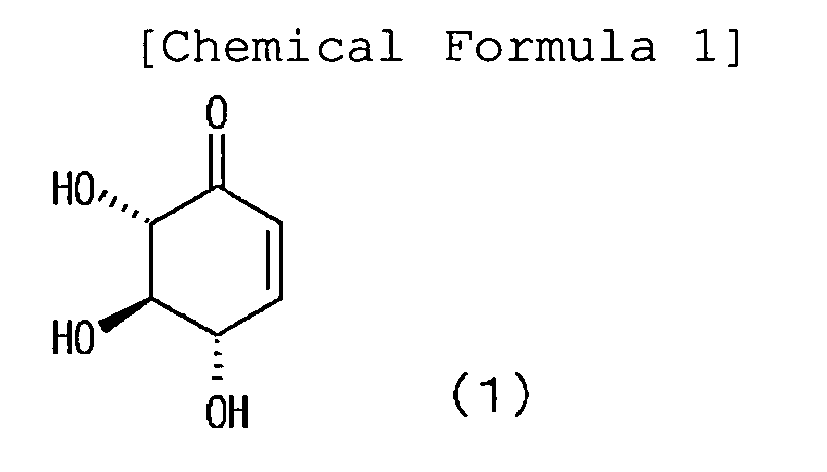
- The present invention comprises the following embodiments.
- (1) The method for producing catechol as described above, by dehydrating 2-deoxy-scyllo-inosose represented by the following formula (2) to produce (4S,5R,6S)-4,5,6-trihydroxy-2-cyclohexene-1-one, and further conducting hydrogenation and dehydration reactions of the (4S,5R,6S)-4,5,6-trihydroxy-2-cyclohexene-1-one.
-

-
- (2) The method for producing catechol as described above, by reacting 2-deoxy-scyllo-inosose under hydrogen-reducing conditions while heating via (4S,5R,6S)-4,5,6-trihydroxy-2-cyclohexene-1-one.
- (3) The method for producing catechol as described above, by reacting (4S,5R,6S)-4,5,6-trihydroxy-2-cyclohexene-1-one under hydrogen-reducing conditions while heating.
- (4) The method for producing catechol as described above, by dehydrating 2-deoxy-scyllo-inosose to produce (4S,5R,6S)-4,5,6-trihydroxy-2-cyclohexene-1-one, and further reacting the (4S,5R,6S)-4,5,6-trihydroxy-2-cyclohexene-1-one under hydrogen-reducing conditions while heating.
- (5) The method for producing catechol as described above, by reacting (4S,5R,6S)-4,5,6-trihydroxy-2-cyclohexene-1-one in the presence of a metal catalyst.
- (6) The method for producing catechol as described above, wherein the metal catalyst contains a metal selected from the group consisting of platinum group metals or the group consisting of iron group metals.
- (7) The method for producing catechol as described above, wherein the metal catalyst contains palladium.
- (8) The method for producing catechol as described above, wherein a metal component contained in the metal catalyst is loaded in activated carbon, alumina or zeolite.
- (9) The method for producing catechol as described above, by reacting (4S,5R,6S)-4,5,6-trihydroxy-2-cyclohexene-1-one in an aqueous solution.
- (10) The method for producing catechol as described above, in a one-pot from 2-deoxy-scyllo-inosose.
- (11) The method for producing catechol as described above, from 2-deoxy-scyllo-inosose in the presence of a solid acid.
- (12) The method for producing catechol as described above, wherein the solid acid is selected from the group consisting of zeolite, activated clay and Nafion (registered trademark).
- (13) The method for producing catechol as described above, by reducing (4S,5R,6S)-4,5,6-trihydroxy-2-cyclohexene-1-one with hydrogen to produce (2S,3R,4S)-2,3,4-trihydroxycyclohexane-1-one represented by the following formula (3), and dehydrating the (2S,3R,4S)-2,3,4-trihydroxycyclohexane-1-one.
-

- (14) The method for producing catechol as described above, by dehydrating 2-deoxy-scyllo-inosose while heating to give (4S,5R,6S)-4,5,6-trihydroxy-2-cyclohexene-1-one, and then reducing the (4S,5R,6S)-4,5,6-trihydroxy-2-cyclohexene-1-one with hydrogen in the presence of a metal catalyst to give (2S,3R,4S)-2,3,4-trihydroxycyclohexane-1-one, and then further dehydrating the (2S,3R,4S)-2,3,4-trihydroxycyclohexane-1-one while heating.
- Furthermore, according to the present invention, there is provided a method for producing (4S,5R,6S)-4,5,6-trihydroxy-2-cyclohexene-1-one by dehydrating 2-deoxy-scyllo-inosose.
- Furthermore, according to the present invention, there is provided (4S,5R,6S)-4,5,6-trihydroxy-2-cyclohexene-1-one.
- Furthermore, according to the present invention, there is provided a method for producing catechol by dehydrating (2S,3R,4S)-2,3,4-trihydroxycyclohexane-1-one while heating.
- Furthermore, according to the present invention, there is provided a method for producing (2S,3R,4S)-2,3,4-trihydroxycyclohexane-1-one by reducing (4S,5R,6S)-4,5,6-trihydroxy-2-cyclohexene-1-one with hydrogen.
- Furthermore, according to the present invention, there is provided a method for producing catechol by reacting 2,3,4,5-tetrahydroxy-cyclohexane-1-one represented by the following formula (4) under hydrogen-reducing conditions while heating.
-

- According to the present invention, it is possible to produce catechol from (4S,5R,6S)-4,5,6-trihydroxy-2-cyclohexene-1-one. According to this method, it is possible to produce catechol by reduction of olefin in (4S,5R,6S)-4,5,6-trihydroxy-2-cyclohexene-1-one and by dehydration of two molecules of water. Accordingly, it is possible to obtain catechol under mild conditions without using a corrosive reagent, and to achieve the production of catechol suitable for industrial production with less load to the environment.
- According to the present invention, it is possible to produce catechol that is a commodity chemical by the method suitable for industrial production with less load to the environment.
- The present invention will be described in more detail below.
- The present embodiment relates to a method for producing catechol from (4S,5R,6S)-4,5,6-trihydroxy-2-cyclohexene-1-one represented by the following formula (1).
-

- According to this method, catechol is produced by the reaction represented by the formula (5).
-

- Specifically, the present embodiment relates to a method for producing catechol by reacting (4S,5R,6S)-4,5,6-trihydroxy-2-cyclohexene-1-one under hydrogen-reducing conditions while heating.
- In the present embodiment, catechol is produced in a one-pot from (4S,5R,6S)-4,5,6-trihydroxy-2-cyclohexene-1-one. "One-pot" mentioned herein means that a number of reactions are conducted in the same reaction vessel, specifically, referring to a reduction reaction and a dehydration reaction.
- When catechol is produced from (4S,5R,6S)-4,5,6-trihydroxy-2-cyclohexene-1-one, the reaction "under hydrogen-reducing conditions" refers to the reaction of (4S,5R,6S)-4,5,6-trihydroxy-2-cyclohexene-1-one dissolved in a solvent in the presence of a reduction catalyst under hydrogen atmosphere.
- The solvent is not particularly limited as long as it does not hinder the progress of the reaction. Examples thereof include water or alcohol solvents such as methanol, ethanol, butanol and the like; hydrocarbon solvents such as hexane, toluene, xylene and the like; ester solvents such as ethyl acetate, butyl acetate and the like; ether solvents such as diisopropyl ether, dioxane, ethylene glycol dimethyl ether, tetrahydrofuran and the like; halogen solvents such as chloroform, dichloromethane and the like; acetonitrile, dimethylformamide, dimethyl sulfoxide and the like. These solvents can be used singly or two or more kinds can be used as a mixed solvent at any ratio. However, it is preferable to use water.
- The concentration of (4S,5R,6S)-4,5,6-trihydroxy-2-cyclohexene-1-one to be introduced is not particularly restricted. However, it is preferably, for example, equal to or more than 1 w/v % and equal to or less than 30 w/v%.
- "While heating" mentioned in the present embodiment means an increase of the reaction temperature to an atmospheric temperature or higher, and as necessary, also contains the concept of change of the temperature as the time elapses during the reaction. By changing the temperature, the reaction can proceed step by step. The reaction temperature is usually in the range of equal to or more than 30 degrees centigrade and equal to or less than 300 degrees centigrade. When the reaction temperature is low, the reaction rate of the dehydration reaction is reduced. When the reaction temperature is high, the side reaction proceeds. Accordingly, by heating at a temperature of equal to or more than 30 degrees centigrade and equal to or less than 300 degrees centigrade, catechol can be produced with good efficiency. The reaction temperature is more preferably equal to or more than 35 and equal to or less than 240 degrees centigrade and further preferably equal to or more than 70 and equal to or less than 200 degrees centigrade. Thus, it is possible to make the dehydration reaction to proceed at a suitable reaction rate, and to produce catechol with better efficiency.
- The reaction time is not particularly limited, but it is from several minutes to 48 hours and preferably in the range of 30 minutes to 24 hours. Thus, it is possible to surely conduct reduction and dehydration of (4S,5R,6S)-4,5,6-trihydroxy-2-cyclohexene-1-one, and to produce catechol with good efficiency.
- As the reduction catalyst, there can be used metals selected from platinum group metals such as palladium, rhodium, ruthenium, platinum, iridium and the like, and from iron group metals such as nickel, cobalt and the like; and metals such as copper and the like. These metals may be used singly or may be loaded in activated carbon, silica gel, alumina, graphite, diatomaceous earth, pumice, montmorillonite, zeolite or the like. Concrete examples include palladium/activated carbon, palladium/silica gel, palladium/alumina, palladium/zeolite, nickel/alumina, copper/alumina, ruthenium/activated carbon, rhodium/activated carbon, platinum/activated carbon, iridium/activated carbon and the like. Furthermore, the amount of the metal loaded is usually in the range of 0.01 to 50 weight % based on the carrier. Thus, it is possible to make the reduction reaction to suitably proceed. The amount of the reduction catalyst added is preferably in the range of 0.1 to 10 weight %.
- "Under hydrogen atmosphere" means a reaction performed in a reactor filled with gas containing hydrogen of from atmospheric pressure to 10 MPa, and is preferably between atmospheric pressure and 1 MPa. Hydrogen may be used singly or in mixture with nitrogen or the like.
- A method for producing (4S,5R,6S)-4,5,6-trihydroxy-2-cyclohexene-1-one will be described later, but (4S,5R,6S)-4,5,6-trihydroxy-2-cyclohexene-1-one can be produced by dehydrating 2-deoxy-scyllo-inosose.
- Furthermore, the reaction can be conducted by heating even in the absence of a catalyst, but an additive can be added for the reaction in order to promote the reaction. As the additive, there can be used an acid, a base or salts thereof.
- Examples of the acid in use include inorganic acids such as hydrogen chloride, hydrogen bromide, sulfuric acid, phosphoric acid and the like; organic acids such as formic acid, acetic acid, propionic acid, oxalic acid, citric acid, lactic acid, benzoic acid, trifluoroacetic acid, p-toluenesulfonic acid, methanesulfonic acid, dodecylbenzenesulfonic acid and the like; and solid acids such as zeolite, silica gel, alumina, activated clay, Nafion (registered trademark), ion exchange resin and the like. The amount of the acid added is preferably in the range of 1 to 2,000 weight %.
- Examples of the base in use include inorganic bases such as lithium hydroxide, sodium hydroxide, potassium hydroxide, sodium carbonate, potassium carbonate, sodium hydrogen carbonate and the like; and organic amine bases such as triethylamine, pyridine, 1,8-diazabicycloundecene and the like.
- As a method for obtaining catechol after the completion of the reaction, a reduction catalyst or an inhomogeneous additive is removed from the reaction solution by filtration, and then the filtrate is concentrated, whereby crude purified catechol can be obtained as a crystal. Crude purified catechol can be purified by distillation or recrystallization to obtain much purified catechol. Or the heated reaction solution is cooled after conducting solvent concentration to some extent to precipitate catechol as a crystal, whereby catechol can be obtained by filtration. A solvent which hardly dissolves catechol is added to precipitate catechol as a crystal, whereby catechol can also be obtained by filtration. Further, a suitable solvent can be added to the reaction solvent to extract. The extract is treated in the same manner as above, whereby much purified catechol can be obtained.
- Next, the effect of the present embodiment will be described. The present inventors have conducted an extensive study and as a result, have found that catechol is easily obtained by conducting hydrogenation and dehydration reactions of (4S,5R,6S)-4,5,6-trihydroxy-2-cyclohexene-1-one obtained from 2-deoxy-scyllo-inosose.
- According to the method in the present embodiment, since (4S,5R,6S)-4,5,6-trihydroxy-2-cyclohexene-1-one is reacted under hydrogen atmosphere while heating, it is possible to conduct by hydrogen-addition reduction and dehydration reactions at the same time in a one-pot. Accordingly, ideally, catechol can be produced by using hydrogen in a molar amount equivalent to a substrate, and a catalyst in a small amount. Accordingly, it is possible to produce catechol at a low cost under mild conditions without using a corrosive reagent. Thus, it is possible to achieve the production of catechol suitable for industrial production with ease.
- The present embodiment relates to a method for producing catechol by dehydrating 2-deoxy-scyllo-inosose represented by the following formula (2) to produce (4S,5R,6S)-4,5,6-trihydroxy-2-cyclohexene-1-one and further conducting hydrogenation and dehydration reactions of the (4S,5R,6S)-4,5,6-trihydroxy-2-cyclohexene-1-one. According to this method, catechol is produced by the reaction represented by the formula (6).
-

-

- Specifically, catechol is produced in a one-pot by reacting 2-deoxy-scyllo-inosose under hydrogen-reducing conditions while heating via (4S,5R,6S)-4,5,6-trihydroxy-2-cyclohexene-1-one.
- In this method, 2-deoxy-scyllo-inosose is dehydrated to produce (4S,5R,6S)-4,5,6-trihydroxy-2-cyclohexene-1-one which is further reacted under hydrogen-reducing conditions while heating, whereby catechol is produced.
- In the present embodiment, catechol is produced in a one-pot from 2-deoxy-scyllo-inosose.
- In the present embodiment, when catechol is produced from 2-deoxy-scyllo-inosose via (4S,5R,6S)-4,5,6-trihydroxy-2-cyclohexene-1-one, "reacting under hydrogen-reducing conditions while heating" refers to the reaction of 2-deoxy-scyllo-inosose dissolved in a solvent in the presence of a reduction catalyst under hydrogen atmosphere while heating.
- The solvent is not particularly limited as long as it does not hinder the progress of the reaction. Examples thereof include water or alcohol solvents such as methanol, ethanol, butanol and the like; hydrocarbon solvents such as hexane, toluene, xylene and the like; ester solvents such as ethyl acetate, butyl acetate and the like; ether solvents such as diisopropyl ether, dioxane, ethylene glycol dimethyl ether, tetrahydrofuran and the like; halogen solvents such as chloroform, dichloromethane and the like; acetonitrile, dimethylformamide, dimethyl sulfoxide and the like. These solvents can be used singly or two or more kinds can be used as a mixed solvent at any ratio. However, it is preferable to use water.
- The concentration of 2-deoxy-scyllo-inosose to be introduced is not particularly restricted, but it is preferably, for example, equal to or more than 1 w/v% and equal to or less than 30 w/v%.
- "While heating" mentioned in the present embodiment means an increase of the reaction temperature to an atmospheric temperature or higher, and as necessary, also contains the concept of change of the temperature as the time elapses during the reaction. By changing the temperature, the reaction can proceed step by step. The reaction temperature is usually in the range of equal to or more than 30 degrees centigrade and equal to or less than 300 degrees centigrade. When the reaction temperature is low, the reaction rate of the dehydration reaction is reduced. When the reaction temperature is high, the side reaction proceeds. Accordingly, by heating at a temperature of equal to or more than 30 degrees centigrade and equal to or less than 300 degrees centigrade, catechol can be produced with good efficiency. The reaction temperature is more preferably equal to or more than 60 degrees centigrade and equal to or less than 240 degrees centigrade and further preferably equal to or more than 70 degrees centigrade and equal to or less than 200 degrees centigrade. Thus, it is possible to make the dehydration reaction to proceed at a suitable reaction rate, and to produce catechol with better efficiency.
- The reaction time is not particularly limited, but it is from several minutes to 48 hours and preferably in the range of 1 to 24 hours. Thus, it is possible to surely conduct dehydration of 2-deoxy-scyllo-inosose and reduction of an intermediate of (4S,5R,6S)-4,5,6-trihydroxy-2-cyclohexene-1-one, and to produce catechol with good efficiency.
- As the reduction catalyst, there can be used metals selected from platinum group metals such as palladium, rhodium, ruthenium, platinum, iridium and the like, and from iron group metals such as nickel, cobalt and the like; and metals such as copper and the like. These metals may be used singly or may be loaded in activated carbon, silica gel, alumina, graphite, diatomaceous earth, pumice, montmorillonite, zeolite or the like. Concrete examples include palladium/activated carbon, palladium/silica gel, palladium/alumina, palladium/zeolite, nickel/alumina, copper/alumina, ruthenium/activated carbon, rhodium/activated carbon, platinum/activated carbon, iridium/activated carbon and the like. Furthermore, the amount of the metal loaded is usually in the range of 0.01 to 50 weight % based on the carrier. Thus, it is possible to make the reduction reaction to suitably proceed. The amount of the reduction catalyst added is preferably in the range of 0.1 to 10 weight %.
- "Under hydrogen atmosphere" means a reaction performed in a reactor filled with gas containing hydrogen of from atmospheric pressure to 10 MPa, and is preferably between atmospheric pressure and 1 MPa. Hydrogen may be used singly or in mixture with nitrogen or the like.
- Furthermore, the reaction can be conducted by heating even in the absence of a catalyst, but an additive can be added for the reaction in order to promote the reaction. As the additive, there can be used an acid, a base or salts thereof.
- Examples of the acid in use include inorganic acids such as hydrogen chloride, hydrogen bromide, sulfuric acid, phosphoric acid and the like; organic acids such as formic acid, acetic acid, propionic acid, oxalic acid, citric acid, lactic acid, benzoic acid, trifluoroacetic acid, p-toluenesulfonic acid, methanesulfonic acid, dodecylbenzenesulfonic acid and the like; and solid acids such as zeolite, silica gel, alumina, activated clay, Nafion (registered trademark), ion exchange resin and the like. The amount of the acid added is preferably in the range of 1 to 2,000 weight %.
- Examples of the base in use include inorganic bases such as lithium hydroxide, sodium hydroxide, potassium hydroxide, sodium carbonate, potassium carbonate, sodium hydrogen carbonate and the like; and organic amine bases such as triethylamine, pyridine, 1,8-diazabicycloundecene and the like.
- Furthermore, "one-pot" mentioned herein means that a number of reactions are conducted in the same reaction vessel, specifically, referring to a reduction reaction and a dehydration reaction.
- Incidentally, 2-deoxy-scyllo-inosose used in the present embodiment obtained from D-glucose by fermentation has been known by Non-patent Document 2, Non-patent Document 3 and
WO 2006/112000 . - As a method for obtaining catechol after the completion of the reaction, a reduction catalyst or an inhomogeneous additive is removed from the reaction solution by filtration, and then the filtrate is concentrated, whereby crude purified catechol can be obtained as a crystal. Crude purified catechol can be purified by distillation or recrystallization to obtain much purified catechol. Or the heated reaction solution is cooled after conducting solvent concentration to some extent to precipitate catechol as a crystal, whereby catechol can be obtained by filtration. A solvent which hardly dissolves catechol is added to precipitate catechol as a crystal, whereby catechol can also be obtained by filtration. Further, a suitable solvent can be added to the reaction solvent to extract. The extract is treated in the same manner as above, whereby much purified catechol can be obtained.
- Next, the effect of the present embodiment will be described.
- According to the present embodiment, it is possible to obtain catechol by reacting 2-deoxy-scyllo-inosose under hydrogen-reducing conditions while heating in a one-pot. Thus, catechol can be produced from D-glucose that is a renewable resource at a low cost without using a corrosive reagent. Accordingly, it is possible to achieve the production of catechol suitable for industrial production.
- According to the present embodiment, it is possible to obtain catechol by reacting 2-deoxy-scyllo-inosose easily obtained from a renewable resource of glucose by fermentation under hydrogen-reducing conditions while heating via (4S,5R,6S)-4,5,6-trihydroxy-2-cyclohexene-1-one. Accordingly, catechol can be easily produced by conducting hydrogen-addition reduction and dehydration reactions at the same time in a one-pot.
- In Non-patent Document 2 as described above, there has been known a method for obtaining catechol at a yield of 59% by conducting a reductive dehydration reaction of 2-deoxy-scyllo-inosose in acetic acid by hydrogen iodide. However, this reaction requires 2 molecules of hydrogen iodide for 2-deoxy-scyllo-inosose. That is, catechol is considered to be generated by attaching 1 molecule of hydrogen iodide to a carbonyl group and subsequently reacting with the other 1 molecule of hydrogen iodide to reduce 2-deoxy-scyllo-inosose by eliminating iodine and water, and further conducting dehydration. Accordingly, there is a problem such that 2 equivalents of hydroiodic acid which is highly corrosive and expensive must be used even in an ideal reaction.
- On the other hand, in the method of the present embodiment, ideally, hydrogen in a molar amount equivalent to a substrate and a catalyst in a small amount are only required. Further, because of (4S,5R,6S)-4,5,6-trihydroxy-2-cyclohexene-1-one passing through, catechol can be synthesized under mild conditions. Accordingly, it is possible to produce catechol at a low cost with ease without using a corrosive reagent, and to achieve the production of catechol suitable for industrial production.
- Meanwhile, in the method of the present embodiment, it is possible to conduct the hydrogen reduction reaction using a metal catalyst. Accordingly, the material cost becomes cheaper so that the method is favorable for industrial production. Since a corrosive reagent in large quantities is not used, this method is also good to the environment.
- According to the method in the present embodiment, it is possible to produce catechol in a one-pot by reacting 2-deoxy-scyllo-inosose. Accordingly, there is no need to conduct isolation and purification in each step so that the method is further favorable for industrial production.
- Furthermore, according to the method in the present embodiment, it is possible to produce catechol that is a commodity chemical by using 2-deoxy-scyllo-inosose easily produced from glucose, i.e. , a renewable resource, or the like as a raw material. Thus, it is useful for the decrease of use of fossil resources, suppression of discharge of greenhouse gas and prevention of global warming.
- The present embodiment relates a method for producing catechol in which 2-deoxy-scyllo-inosose is dehydrated while heating to give (4S,5R,6S)-4,5,6-trihydroxy-2-cyclohexene-1-one, and then the (4S,5R,6S)-4,5,6-trihydroxy-2-cyclohexene-1-one is reduced with hydrogen in the presence of a metal catalyst to give (2S,3R,4S)-2,3,4-trihydroxycyclohexane-1-one represented by the following formula (3), and then the (2S,3R,4S)-2,3,4-trihydroxycyclohexane-1-one is dehydrated while heating. In the method of this Embodiment, catechol is produced by the reaction represented by the formula (7).
-

-

- In the second embodiment, a method for producing catechol in a one-pot was illustrated. In the present embodiment, the following three processes are respectively conducted to produce catechol:
- (First process) a process of producing (4S,5R,6S)-4,5,6-trihydroxy-2-cyclohexene-1-one from 2-deoxy-scyllo-inosose;
- (Second process) a process of producing (2S,3R,4S)-2,3,4-trihydroxycyclohexane-1-one from (4S,5R,6S)-4,5,6-trihydroxy-2-cyclohexene-1-one; and (Third process) a process of producing catechol from (2S,3R,4S)-2,3,4-trihydroxycyclohexane-1-one.
- The first process is a process of producing (4S,5R,6S)-4,5,6-trihydroxy-2-cyclohexene-1-one by dehydrating 2-deoxy-scyllo-inosose.
- When (4S,5R,6S)-4,5,6-trihydroxy-2-cyclohexene-1-one is produced by dehydrating 2-deoxy-scyllo-inosose, the reaction temperature can be equal to or more than 30 degrees centigrade and equal to or less than 300 degrees centigrade. When the reaction temperature is low, the reaction rate of the dehydration reaction is reduced. When the reaction temperature is high, the side reaction proceeds. Accordingly, by heating at a temperature of equal to or more than 30 degrees centigrade and equal to or less than 300 degrees centigrade, (4S,5R,6S)-4,5,6-trihydroxy-2-cyclohexene-1-one can be produced with good efficiency. The reaction temperature is more preferably in the range of equal to or more than 100 degrees centigrade and equal to or less than 240 degrees centigrade. Thus, it is possible to make the dehydration reaction to proceed at a suitable reaction rate, and to produce (4S,5R,6S)-4,5,6-trihydroxy-2-cyclohexene-1-one with better efficiency.
- The solvent is not particularly limited as long as it does not hinder the progress of the reaction. Examples thereof include water or alcohol solvents such as methanol, ethanol, butanol and the like; hydrocarbon solvents such as hexane, toluene, xylene and the like; ester solvents such as ethyl acetate, butyl acetate and the like; ether solvents such as diisopropyl ether, dioxane, ethylene glycol dimethyl ether, tetrahydrofuran and the like; halogen solvents such as chloroform, dichloromethane and the like; acetonitrile, dimethylformamide, dimethyl sulfoxide and the like. These solvents can be used singly or two or more kinds can be used as a mixed solvent at any ratio. However, it is preferable to use water.
- The reaction time is not particularly limited, but it is from several minutes to 48 hours and preferably in the range of 15 minutes to 24 hours. Thus, it is possible to surely conduct dehydration of 2-deoxy-scyllo-inosose, and to produce (4S,5R,6S)-4,5,6-trihydroxy-2-cyclohexene-1-one with good efficiency.
- The reaction can be conducted by heating even in the absence of a catalyst. However, as an additive in order to promote the reaction, there can be used an acid, a base or salts thereof.
- Examples of the acid in use include inorganic acids such as hydrogen chloride, hydrogen bromide, sulfuric acid, phosphoric acid and the like; organic acids such as formic acid, acetic acid, propionic acid, oxalic acid, citric acid, lactic acid, benzoic acid, trifluoroacetic acid, p-toluenesulfonic acid, methanesulfonic acid, dodecylbenzenesulfonic acid and the like; and solid acids such as zeolite, silica gel, alumina, activated clay, Nafion (registered trademark), an ion exchange resin and the like. The amount of the acid added is preferably in the range of 1 to 2,000 weight %.
- Examples of the base in use include inorganic bases such as lithium hydroxide, sodium hydroxide, potassium hydroxide, sodium carbonate, potassium carbonate, sodium hydrogen carbonate and the like; and organic amine bases such as triethylamine, pyridine, 1,8-diazabicycloundecene and the like.
- However, as disclosed in Non-patent Document 3, when two molecules of water are dehydrated from 2-deoxy-scyllo-inosose, 1,2,4-trihydroxybenzene is generated. Accordingly, in order to obtain (4S,5R,6S)-4,5,6-trihydroxy-2-cyclohexene-1-one in high yield, the reaction temperature, reaction time and catalyst need to be controlled. More specifically, when the reaction is conducted at a high temperature, the reaction is conducted with a weak catalyst or in the absence of a catalyst within a short period of time, or when the reaction is conducted at a low temperature, the reaction is conducted using a strong catalyst for a long period of time, whereby generation of 1,2,4-trihydroxybenzene can be suppressed.
- Incidentally, the catalyst refers to an additive exemplified in acids or bases. In case of using a catalyst of the same kind, the catalyst can be reacted as a strong catalyst by increasing the concentration in a catalyst solution, or can be reacted as a weak catalyst by lowering the concentration in a catalyst solution. Furthermore, in case of using a catalyst of the different kind, for example, as pH of a solution containing water as a solvent is far from 7, the catalyst can act as a strong catalyst, while as pH is close to 7, it can act as a weak catalyst. The reaction temperature and time are controlled while properly changing the catalyst, whereby (4S,5R,6S)-4,5,6-trihydroxy-2-cyclohexene-1-one can be synthesized with good efficiency.
- Furthermore, 2-deoxy-scyllo-inosose used for the present invention is available as described in the second embodiment.
- For (4S,5R,6S)-4,5,6-trihydroxy-2-cyclohexene-1-one after the completion of the reaction, it is possible to obtain a crude product by concentrating the reaction solution. As necessary, pH can be adjusted to near the neutrality (pH of 6 to 8). Also, when an inhomogeneous additive is used, the additive is removed from the reaction solution by filtration and the filtrate is concentrated in the same manner, whereby a crude purified product can be obtained. Further, the crude purified product is purified by recrystallization or silica gel column, whereby it is possible to obtain high purity (4S,5R,6S)-4,5,6-trihydroxy-2-cyclohexene-1-one.
- The second process is a process of producing (2S,3R,4S)-2,3,4-trihydroxycyclohexane-1-one by reducing (4S,5R,6S)-4,5,6-trihydroxy-2-cyclohexene-1-one with hydrogen in the presence of a metal catalyst.
- As the metal catalyst mentioned herein, there can be used metals selected from platinum group metals such as palladium, rhodium, ruthenium, platinum, iridium or the like, and from iron group metals such as nickel, cobalt or the like; and metals such as copper and the like. These metals may be used singly or may be loaded in activated carbon, silica gel, alumina, graphite, diatomaceous earth, pumice, montmorillonite, zeolite or the like. Concrete examples thereof include palladium/activated carbon, palladium/silica gel, palladium/alumina, palladium/zeolite, nickel/alumina, copper/alumina, ruthenium/activated carbon, rhodium/activated carbon, platinum/activated carbon, iridium/activated carbon and the like. The amount of the metal loaded is usually in the range of 0.01 to 50 weight % based on the carrier. The amount of the reduction catalyst added is preferably in the range of 0.1 to 10 weight %.
- "Under hydrogen atmosphere" means a reaction performed in a reactor filled with gas containing hydrogen of from atmospheric pressure to 10 MPa, and is preferably between atmospheric pressure and 1 MPa. Hydrogen may be used singly or in mixture with nitrogen or the like.
- The solvent is not particularly limited as long as it does not hinder the progress of the reaction. Examples thereof include water or alcohol solvents such as methanol, ethanol, butanol and the like; hydrocarbon solvents such as hexane, toluene, xylene and the like; ester solvents such as ethyl acetate, butyl acetate and the like; ether solvents such as diisopropyl ether, dioxane, ethylene glycol dimethyl ether, tetrahydrofuran and the like; halogen solvents such as chloroform, dichloromethane and the like; acetonitrile, dimethylformamide, dimethyl sulfoxide and the like. These solvents can be used singly or two or more kinds can be used as a mixed solvent at any ratio. However, the dehydration reaction can be suppressed by using methanol so that (2S,3R,4S)-2,3,4-trihydroxycyclohexane-1-one can be produced with good efficiency; therefore, methanol is preferable.
- The concentration of (4S,5R,6S)-4,5,6-trihydroxy-2-cyclohexene-1-one to be introduced is not particularly restricted. However, it is preferably, for example, equal to or more than 1 w/v% and equal to or less than 30 w/v%.
- Meanwhile, an additive can be added for the reaction in order to promote the reaction. As the additive, there can be used an acid, a base or salts thereof.
- Examples of the acid in use include inorganic acids such as hydrogen chloride, hydrogen bromide, sulfuric acid, phosphoric acid and the like; organic acids such as formic acid, acetic acid, propionic acid, oxalic acid, citric acid, lactic acid, benzoic acid, trifluoroacetic acid, p-toluenesulfonic acid, methanesulfonic acid, dodecylbenzenesulfonic acid and the like; and solid acids such as zeolite, silica gel, alumina, activated clay, Nafion (registered trademark), ion exchange resin and the like. The amount of the acid added is preferably in the range of 1 to 2,000 weight %.
- Examples of the base in use include inorganic bases such as lithium hydroxide, sodium hydroxide, potassium hydroxide, sodium carbonate, potassium carbonate, sodium hydrogen carbonate and the like; and organic amine bases such as triethylamine, pyridine, 1,8-diazabicycloundecene and the like.
- The reaction can be conducted at a temperature of from room temperature (25 degrees centigrade) to 300 degrees centigrade, and preferably in the range of equal to or more than 60 degrees centigrade and equal to or less than 240 degrees centigrade. Thus, it is possible to make the reduction reaction to proceed at a suitable reaction rate, and to suppress the progress of the dehydration reaction. Accordingly, (2S,3R,4S)-2,3,4-trihydroxycyclohexane-1-one can be produced with better efficiency.
- The reaction time is not particularly limited, but it is from several minutes to 48 hours and preferably in the range of 10 minutes to 24 hours. Thus, it is possible to surely conduct reduction of (4S,5R,6S)-4,5,6-trihydroxy-2-cyclohexene-1-one.
- (2S,3R,4S)-2,3,4-trihydroxycyclohexane-1-one can be obtained by removing the reduction catalyst by filtration and concentrating the filtrate. As necessary, much higher purity (2S,3R,4S)-2,3,4-trihydroxycyclohexane-1-one can be obtained by recrystallization.
- The third process is a process of producing catechol by dehydrating (2S,3R,4S)-2,3,4-trihydroxycyclohexane-1-one while heating.
- The solvent is not particularly limited as long as it does not hinder the progress of the reaction. Examples thereof include water or alcohol solvents such as methanol, ethanol, butanol and the like; hydrocarbon solvents such as hexane, toluene, xylene and the like; ester solvents such as ethyl acetate, butyl acetate and the like; ether solvents such as diisopropyl ether, dioxane, ethylene glycol dimethyl ether, tetrahydrofuran and the like; halogen solvents such as chloroform, dichloromethane and the like; acetonitrile, dimethylformamide, dimethyl sulfoxide and the like. These solvents can be used singly or two or more kinds can be used as a mixed solvent at any ratio. However, it is preferable to use water.
- The concentration of (2S,3R,4S)-2,3,4-trihydroxycyclohexane-1-one to be introduced is not particularly restricted. However, it is preferably, for example, equal to or more than 1 w/v% and equal to or less than 30 w/v%.
- Meanwhile, an additive can be added for the reaction in order to promote the reaction. As the additive, there can be used an acid, a base or salts thereof.
- Examples of the acid in use include inorganic acids such as hydrogen chloride, hydrogen bromide, sulfuric acid, phosphoric acid and the like; organic acids such as formic acid, acetic acid, propionic acid, oxalic acid, citric acid, lactic acid, benzoic acid, trifluoroacetic acid, p-toluenesulfonic acid, methanesulfonic acid, dodecylbenzenesulfonic acid and the like; and solid acids such as zeolite, silica gel, alumina, activated clay, Nafion (registered trademark), ion exchange resin and the like. The amount of the acid added is preferably in the range of 1 to 2,000 weight %.
- Examples of the base in use include inorganic bases such as lithium hydroxide, sodium hydroxide, potassium hydroxide, sodium carbonate, potassium carbonate, sodium hydrogen carbonate and the like; and organic amine bases such as triethylamine, pyridine, 1,8-diazabicycloundecene and the like.
- "While heating" mentioned in the present embodiment means an increase of the reaction temperature to an atmospheric temperature or higher, and as necessary, also contains the concept of change of the temperature as the time elapses during the reaction. By changing the temperature, the reaction can proceed step by step. It refers to heating at a temperature of equal to or more than 30 degrees centigrade and equal to or less than 300 degrees centigrade. When the reaction temperature is low, the reaction rate is reduced. When the reaction temperature is high, the side reaction proceeds. Accordingly, by heating at a temperature of equal to or more than 30 degrees centigrade and equal to or less than 300 degrees centigrade, catechol can be produced. The reaction temperature is more preferably equal to or more than 60 degrees centigrade and equal to or less than 240 degrees centigrade and further preferably equal to or more than 70 degrees centigrade and equal to or less than 200 degrees centigrade. Thus, it is possible to make the dehydration reaction to proceed at a suitable reaction rate, and to produce catechol with better efficiency.
- The reaction time is not particularly limited, but it is from several minutes to 48 hours and preferably in the range of 10 minutes to 24 hours. Thus, it is possible to surely conduct dehydration of (2S,3R,4S)-2,3,4-trihydroxycyclohexane-1-one.
- As a method for obtaining catechol after the completion of the reaction, a reduction catalyst or an inhomogeneous additive is removed from the reaction solution by filtration, and then the filtrate is concentrated, whereby crude purified catechol can be obtained as a crystal. Crude purified catechol can be purified by distillation or recrystallization to obtain much purified catechol. Or the heated reaction solution is cooled after conducting solvent concentration to some extent to precipitate catechol as a crystal, whereby catechol can be obtained by filtration. A solvent which hardly dissolves catechol is added to precipitate catechol as a crystal, whereby catechol can also be obtained by filtration. Further, a suitable solvent can be added to the reaction solvent to extract. The extract is treated in the same manner as above, whereby much purified catechol can be obtained.
- Next, the effect of the present embodiment will be described.
- According to the present embodiment, 2-deoxy-scyllo-inosose is dehydrated and the obtained (4S,5R,6S)-4,5,6-trihydroxy-2-cyclohexene-1-one is reduced to give (2S,3R,4S)-2,3,4-trihydroxycyclohexane-1-one which is then dehydrated, whereby catechol can be obtained. Accordingly, catechol which is useful as a commodity chemical can be easily produced from renewable resources such as glucose or the like.
- According to the method of the first process in the present embodiment, it is possible to produce (4S,5R,6S)-4,5,6-trihydroxy-2-cyclohexene-1-one by dehydrating 2-deoxy-scyllo-inosose while heating. Accordingly, it is possible to easily produce (4S,5R,6S)-4,5,6-trihydroxy-2-cyclohexene-1-one that is an important intermediate for the production of catechol which is useful as a commodity chemical.
- More specifically, there has been known that 2-deoxy-scyllo-inosose is heated in a 0.5M phosphoric acid aqueous solution to dehydrate two molecules of water to give 1,2,4-trihydroxybenzene (Non-patent Document 3). However, 2-deoxy-scyllo-inosose is reacted by controlling the reaction temperature, time, catalyst and the like to dehydrate one molecule of water, whereby (4S,5R,6S)-4,5,6-trihydroxy-2-cyclohexene-1-one can be produced. That is, when the reaction is conducted at a high temperature, the reaction is conducted with a weak catalyst or in the absence of a catalyst within a short period of time, or when the reaction is conducted at a low temperature, the reaction is conducted using a strong catalyst for a long period of time, whereby generation of 1,2,4-trihydroxybenzene can be suppressed. Accordingly, it is possible to easily produce (4S,5R,6S)-4,5,6-trihydroxy-2-cyclohexene-1-one that is an important intermediate for the production of catechol which is useful as a commodity chemical.
- According to the method of the second process in the present embodiment, it is possible to produce (2S,3R,4S)-2,3,4-trihydroxycyclohexane-1-one by reducing (4S,5R,6S)-4,5,6-trihydroxy-2-cyclohexene-1-one. Accordingly, it is possible to easily produce (2S,3R,4S)-2,3,4-trihydroxycyclohexane-1-one that is an important intermediate for the production of catechol which is useful as a commodity chemical.
- In the past, there has been known (4R,5S,6R)-4,5,6-trihydroxy-2-cyclohexene-1-one having a configuration opposite to that of (4S,5R,6S)-4,5,6-trihydroxy-2-cyclohexene-1-one (Non-patent Document 4 and the like). However, a method for synthesizing (4S,5R,6S)-4,5,6-trihydroxy-2-cyclohexene-1-one has not been known. This substance is an intermediate useful for the purpose of production of catechol, and its double bonds are easily reduced with hydrogen in the presence of a catalyst to give (2S,3R,4S)-2,3,4-trihydroxycyclohexane-1-one and the (2S,3R,4S)-2,3,4-trihydroxycyclohexane-1-one is further dehydrated in the presence or absence of a catalyst, whereby catechol can be obtained. Accordingly, (4S,5R,6S)-4,5,6-trihydroxy-2-cyclohexene-1-one can be produced, so that it is possible to easily produce catechol which is useful as a commodity chemical.
- According to the method of the third process in the present embodiment, catechol can be produced by dehydrating (2S,3R,4S)-2,3,4-trihydroxycyclohexane-1-one while heating. Accordingly, catechol which is useful as a commodity chemical can be produced from renewable resources such as glucose or the like.
- Although the present invention has been described by way of embodiments as described above, such embodiments are exemplified in the present invention and other various constructions can also be adopted.
- For example, the second embodiment and the third embodiment describe methods for producing catechol using 2-deoxy-scyllo-inosose as a starting material. However, 2,3,4,5-tetrahydroxy-cyclohexane-1-one represented by the following formula (4) can also be applied in place of 2-deoxy-scyllo-inosose.
-

- The present invention is now illustrated in detail below with reference to Examples. However, the present invention is not restricted to these Examples.
- 150 mg of 2-deoxy-scyllo-inosose synthesized according to the method described in
WO 2006/112000 was dissolved in 3 mL of 0.5 N acetic acid, and the resulting mixture was introduced into an autoclave. Furthermore, 3 mg (50 weight % of water contained) of 5 weight % Pd/C (palladium/activated carbon) was introduced thereinto, and the reactor was replaced with nitrogen. The resulting material was heated to 100 degrees centigrade by applying hydrogen pressure of 0.35 MPa with stirring to conduct a hydrogenation reaction for 19 hours. After cooling, the reactor was replaced with nitrogen and a quantitative analysis was carried out using HPLC. As a result, the raw material was lost, and catechol was obtained at a yield of 56%.
Analysis conditions for HPLC: 10 mM acetic acid aqueous solution/acetonitrile = 94/6, 1.2 mL/min., UV = 220 nm, column in use; ODS-AQ, internal standard; methyl gallate. - 150 mg of 2-deoxy-scyllo-inosose synthesized according to the method described in
WO 2006/112000 was dissolved in 3 mL of water, and the resulting mixture was introduced into an autoclave. Furthermore, 3 mg (50 weight % of water contained) of 5 weight % Pd/C was introduced thereinto, and the reactor was replaced with nitrogen. The resulting material was heated to 170 degrees centigrade by applying hydrogen pressure of 0.1 MPa with stirring to conduct a hydrogenation reaction. During the reaction, the reaction solution was collected and analyzed using HPLC and as a result, existence of (4S,5R,6S)-4,5,6-trihydroxy-2-cyclohexene-1-one was confirmed. The reaction was conducted for 4 hours in total for cooling, and then the reactor was replaced with nitrogen, and a quantitative analysis was carried out using HPLC. As a result, the raw material was lost, and catechol was obtained at a yield of 23%. Analysis conditions were the same as in Example 1. - 1.64 g of 2-deoxy-scyllo-inosose synthesized according to the method described in
WO 2006/112000 and 5 mL of an ion exchange resin IR120B were added to 13.6 mL of water, and the resulting mixture was heated at reflux for 20 hours. After the completion of the reaction, the ion exchange resin was filtered and the filtrate was concentrated under a reduced pressure. The condensation residue was purified with silica gel column (ethyl acetate), whereby 604 mg (yield: 41%) of (4S,5R,6S)-4,5,6-trihydroxy-2-cyclohexene-1-one was obtained.
1H-NMR(CD3OD) ; δ6.91 (dd, 1H, J=2.3, 11.5Hz), 6.02 (dd, 1H, J=2.7, 11.5Hz), 4.35 (dt,J=2.3,8.2Hz), 3.57 (dd, 1H, J=8.2, 11.5Hz)
13C-NMR(CD3OD); δ200.18, 153.32, 127.51, 79.93, 78.12, 73.06 - 205 mg of (4S,5R,6S)-4,5,6-trihydroxy-2-cyclohexene-1-one obtained in Example 3 was dissolved in 3.5 mL of methanol. 20 mg (50 weight % of water contained) of 5 weight % Pd/C was added thereto and hydrogenated at room temperature (25 degrees centigrade) under ordinary pressure (1 atm). After the completion of the reaction, the catalyst was removed by filtration, and the filtrate was concentrated to obtain 198 mg (yield: 96%) of (2S,3R,4S)-2,3,4-trihydroxycyclohexane-1-one.
1H-NMR(DMSO); δ5.21(d,1H, OH), 4.91(d,1H, OH), 4.87(d,1H, OH), 3.88(m, 1H), 3.63(m, 1H), 3.07(m, 1H), 2.48(m, 1H), 2.14(m, 1H), 1.33(m, 1H) - 29.2 mg of (2S,3R,4S)-2,3,4-trihydroxycyclohexane-1-one obtained in Example 4 was dissolved in 1 mL of 33 w/v% phosphoric acid aqueous solution, and the resulting mixture was heated at 100 degrees centigrade for 2 hours. A quantitative analysis was carried out using HPLC and as a result, catechol was obtained at a yield of 86%.
Analysis conditions for HPLC: 10 mM acetic acid aqueous solution/acetonitrile = 94/6, 1.2 mL/min., UV = 220 nm, column in use; ODS-AQ, internal standard; methyl gallate. - 0.15 g of 2-deoxy-scyllo-inosose synthesized according to the method described in
WO 2006/112000 was added to 1.35 mL of 0.5 N acetic acid water, and the resulting mixture was heated at 120 degrees centigrade for 1 hour. After the completion of the reaction, a quantitative analysis was carried out using HPLC and as a result, (4S,5R,6S)-4,5,6-trihydroxy-2-cyclohexene-1-one was obtained at a yield of 33%. At this time, 44% of the raw material of 2-deoxy-scyllo-inosose was collected.
Analysis conditions for HPLC: 10 mM acetic acid aqueous solution/acetonitrile = 94/6, 1.2 mL/min., UV = 220 nm, column in use; ODS-AQ, internal standard; methyl gallate. - 0.05 g of 2-deoxy-scyllo-inosose synthesized according to the method described in
WO 2006/112000 was added to 1 mL of 5 N acetic acid water, and the resulting mixture was heated at 100 degrees centigrade for 2 hours. After the completion of the reaction, a quantitative analysis was carried out using HPLC and as a result, (4S,5R,6S)-4,5,6-trihydroxy-2-cyclohexene-1-one was obtained at a yield of 48%. At this time, 35% of the raw material of 2-deoxy-scyllo-inosose was collected.
Analysis conditions for HPLC: 10 mM acetic acid aqueous solution/acetonitrile = 94/6, 1.2 mL/min., UV = 220 nm, column in use; ODS-AQ, internal standard; methyl gallate. - 0.5 g of 2-deoxy-scyllo-inosose synthesized according to the method described in
WO 2006/112000 and 100 mg of silica gel (Merck Kieselgel 60) were added to 1 mL of water, and the resulting mixture was heated at 150 degrees centigrade for 2 hours. After the completion of the reaction, a quantitative analysis was carried out using HPLC and as a result, (4S,5R,6S)-4,5,6-trihydroxy-2-cyclohexene-1-one was obtained at a yield of 50%. At this time, 15% of the raw material of 2-deoxy-scyllo-inosose was collected.
Analysis conditions for HPLC: 10 mM acetic acid aqueous solution/acetonitrile = 94/6, 1.2 mL/min., UV = 220 nm, column in use; ODS-AQ, internal standard; methyl gallate. - 150 mg of 2-deoxy-scyllo-inosose synthesized according to the method described in
WO 2006/112000 was dissolved in 3 mL of water, and the resulting mixture was introduced into an autoclave. Furthermore, 7 mg (50 weight % of water contained) of 5 weight % Pd/C was introduced thereinto, and the reactor was replaced with nitrogen. The resulting material was heated to 130 degrees centigrade by applying hydrogen pressure of 0.3 MPa with stirring to conduct a hydrogenation reaction for 3 hours. After cooling, the reactor was replaced with nitrogen and a quantitative analysis was carried out using HPLC. As a result, the raw material was lost, and catechol was obtained at a yield of 29%. Analysis conditions were the same as in Example 1. - The respective reactions were carried out in the same manner as in Example 9, except that catalysts shown in Table 1 were used instead of 5 weight % Pd/C used in Example 9, and the reaction temperatures and reaction times were changed to those shown in Table 1, and analysis was conducted. Yields of catechol are also shown in Table 1.
-
(Table 1) Example Catalyst Reaction Temp.
(°C)Reaction Time
(hour)Yield of catechol
(%)Kind Amount of metal loaded
(weight %)Weight
(mg)10 Ruthenium/ Activated Carbon 5 1.7 130 3 24 11 Rhodium/ Activated Carbon 5 1.3 120 10 43 12 Platinum/ Activated Carbon 2 3.8 130 3 35 13 Nickel/ Alumina 40 2.0 100 10 23 14 Iridium/ Activated Carbon 5 7.8 100 48 47 15 Palladium/ α alumina 2 7.3 130 3 44 16 Palladium/ Zeolite 5 7.7 130 3 54 - 150 mg of 2-deoxy-scyllo-inosose synthesized according to the method described in
WO 2006/112000 was dissolved in 3 mL of water, and the resulting mixture was introduced into an autoclave. Furthermore, 1.8 mg (50 weight % of water contained) of 5 weight % Pd/C was introduced thereinto, and the reactor was replaced with nitrogen. The resulting material was heated to 130 degrees centigrade by applying hydrogen pressure of 0.3 MPa with stirring to conduct a hydrogenation reaction for 3 hours. After cooling, the reactor was replaced with nitrogen and a quantitative analysis was carried out using HPLC. As a result, the raw material was lost, and catechol was obtained at a yield of 39%. Analysis conditions were the same as in Example 1. - 150 mg of 2-deoxy-scyllo-inosose synthesized according to the method described in
WO 2006/112000 was dissolved in 3 mL of water, and the resulting mixture was introduced into an autoclave. Furthermore, 1.5 mg (50 weight % of water contained) of 5 weight % Pd/C and 155 mg of sulfuric acid were introduced thereinto, and the reactor was replaced with nitrogen. The resulting material was heated to 70 degrees centigrade by applying hydrogen pressure of 0.3 MPa with stirring to conduct a hydrogenation reaction for 10 hours. After cooling, the reactor was replaced with nitrogen, and a quantitative analysis was carried out using HPLC. As a result, the raw material was lost, and catechol was obtained at a yield of 41%. Analysis conditions were the same as in Example 1. - The respective reactions were carried out in the same manner as in Example 18, except that acids shown in Table 2 were used instead of sulfuric acid used in Example 18, and the reaction temperatures were changed to 90 degrees centigrade, and analysis was conducted. Yields of catechol are also shown in Table 2.
-
(Table 2) Examples Acid Weight of Acid (mg) Yield of Catechol (%) 19 Trifluoroacetic Acid 150 49 20 Dodecylbenzene-sulfonic Acid 150 46 21 47% Hydrobromic Acid 156 25 - 150 mg of 2-deoxy-scyllo-inosose synthesized according to the method described in
WO 2006/112000 was dissolved in 3 mL of water, and the resulting mixture was introduced into an autoclave. Furthermore, 1.6 mg (50 weight % of water contained) of 5 weight % Pd/C and 152 mg of zeolite Hβ (a product of N.E. Chemcat Corporation) were introduced thereinto, and the reactor was replaced with nitrogen. The resulting material was heated to 130 degrees centigrade by applying hydrogen pressure of 0.3 MPa with stirring to conduct a hydrogenation reaction for 10 hours. After cooling, the reactor was replaced with nitrogen, heated again to 170 degrees centigrade, and stirred for 2 hours. After cooling, a quantitative analysis was carried out using HPLC. As a result, the raw material was lost, and catechol was obtained at a yield of 57%. Analysis conditions were the same as in Example 1. - The reaction was carried out in the same manner as in Example 22, except that 155 mg of zeolite HZSM5 (a product of N.E. Chemcat Corporation) was used instead of zeolite Hβ as a solid acid, and analysis was conducted. The results are shown in Table 3.
- The reaction was carried out in the same manner as in Example 22, except that 153 mg of activated clay (a product of Wako Pure Chemical Industries, Ltd. ) was used instead of zeolite Hβ as a solid acid, and analysis was conducted. The results are shown in Table 3.
- The reaction was carried out in the same manner as in Example 22, except that 155 mg of Nafion (registered trademark) was used instead of zeolite Hβ as a solid acid, and analysis was conducted. The results are shown in Table 3.
-
(Table 3) Examples Solid Acid Catalyst Weight of Solid Acid Catalyst (mg) Yield of Catechol (%) 23 Zeolite HZSM-5 155 54 24 Activated Clay 153 49 25 Nafion 155 57
Claims (20)
- A method for producing catechol from (4S,5R,6S)-4,5,6-trihydroxy-2-cyclohexene-1-one represented by the following formula (1).

- The method for producing catechol as set forth in claim 1, by dehydrating 2-deoxy-scyllo-inosose represented by the following formula (2) to produce (4S,5R,6S)-4,5,6-trihydroxy-2-cyclohexene-1-one, and further conducting hydrogenation and dehydration reactions of the (4S,5R,6S)-4,5,6-trihydroxy-2-cyclohexene-1-one.

- The method for producing catechol as set forth in claim 1 or 2, by reacting 2-deoxy-scyllo-inosose under hydrogen-reducing conditions while heating via (4S,5R,6S)-4,5,6-trihydroxy-2-cyclohexene-1-one.
- The method for producing catechol as set forth in any one of claims 1 to 3, by reacting (4S,5R,6S)-4,5,6-trihydroxy-2-cyclohexene-1-one under hydrogen-reducing conditions while heating.
- The method for producing catechol as set forth in any one of claims 1 to 4, by dehydrating 2-deoxy-scyllo-inosose to produce (4S,5R,6S)-4,5,6-trihydroxy-2-cyclohexene-1-one, and further reacting the (4S,5R,6S)-4,5,6-trihydroxy-2-cyclohexene-1-one under hydrogen-reducing conditions while heating.
- The method for producing catechol as set forth in any one of claims 1 to 5, by reacting (4S,5R,6S)-4,5,6-trihydroxy-2-cyclohexene-1-one in the presence of a metal catalyst.
- The method for producing catechol as set forth in claim 6, wherein said metal catalyst contains a metal selected from the group consisting of platinum group metals or the group consisting of iron group metals.
- The method for producing catechol as set forth in claim 7, wherein said metal catalyst contains palladium.
- The method for producing catechol as set forth in any one of claims 6 to 8, wherein a metal component contained in said metal catalyst is loaded in activated carbon, alumina or zeolite.
- The method for producing catechol as set forth in any one of claims 1 to 9, by reacting (4S,5R,6S)-4,5,6-trihydroxy-2-cyclohexene-1-one in an aqueous solution.
- The method for producing catechol as set forth in any one of claims 1 to 10, in a one-pot from 2-deoxy-scyllo-inosose.
- The method for producing catechol as set forth in claim 11, from 2-deoxy-scyllo-inosose in the presence of a solid acid.
- The method for producing catechol as set forth in claim 12, wherein said solid acid is selected from the group consisting of zeolite, activated clay and Nafion (registered trademark).
- The method for producing catechol as set forth in claim 1, by reducing (4S,5R,6S)-4,5,6-trihydroxy-2-cyclohexene-1-one with hydrogen to produce (2S,3R,4S)-2,3,4-trihydroxycyclohexane-1-one represented by the following formula (3), and dehydrating the (2S,3R,4S)-2,3,4-trihydroxycyclohexane-1-one.
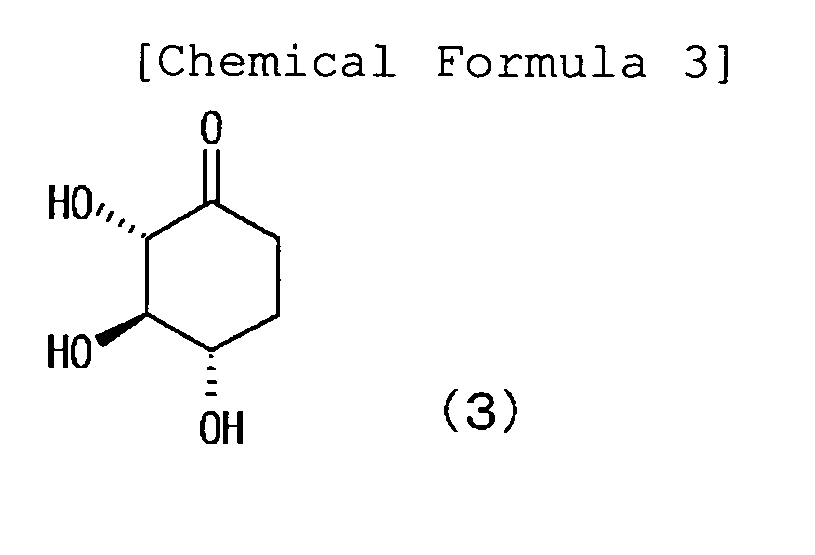
- The method for producing catechol as set forth in claim 14, by dehydrating 2-deoxy-scyllo-inosose while heating to give (4S,5R,6S)-4,5,6-trihydroxy-2-cyclohexene-1-one, and then reducing the (4S,5R,6S)-4,5,6-trihydroxy-2-cyclohexene-1-one with hydrogen in the presence of a metal catalyst to give (2S,3R,4S)-2,3,4-trihydroxycyclohexane-1-one, and then further dehydrating the (2S,3R,4S)-2,3,4-trihydroxycyclohexane-1-one while heating.
- A method for producing (4S,5R,6S)-4,5,6-trihydroxy-2-cyclohexene-1-one by dehydrating 2-deoxy-scyllo-inosose.
- (4S,5R,6S)-4,5,6-trihydroxy-2-cyclohexene-1-one.
- A method for producing catechol by dehydrating (2S,3R,4S)-2,3,4-trihydroxycyclohexane-1-one while heating.
- A method for producing (2S,3R,4S)-2,3,4-trihydroxycyclohexane-1-one by reducing (4S,5R,6S)-4,5,6-trihydroxy-2-cyclohexene-1-one with hydrogen.
- A method for producing catechol by reacting 2,3,4,5-tetrahydroxy-cyclohexane-1-one represented by the following formula (4) under hydrogen-reducing conditions while heating.


Applications Claiming Priority (2)
| Application Number | Priority Date | Filing Date | Title |
|---|---|---|---|
| JP2008104034 | 2008-04-11 | ||
| PCT/JP2009/001607 WO2009125581A1 (en) | 2008-04-11 | 2009-04-07 | Catechol manufacturing method |
Publications (2)
| Publication Number | Publication Date |
|---|---|
| EP2266940A1 true EP2266940A1 (en) | 2010-12-29 |
| EP2266940A4 EP2266940A4 (en) | 2014-10-29 |
Family
ID=41161718
Family Applications (1)
| Application Number | Title | Priority Date | Filing Date |
|---|---|---|---|
| EP09731392.8A Withdrawn EP2266940A4 (en) | 2008-04-11 | 2009-04-07 | Catechol manufacturing method |
Country Status (7)
| Country | Link |
|---|---|
| US (1) | US8378146B2 (en) |
| EP (1) | EP2266940A4 (en) |
| JP (1) | JP5433568B2 (en) |
| KR (1) | KR101230198B1 (en) |
| CN (1) | CN101990528B (en) |
| BR (1) | BRPI0909009A2 (en) |
| WO (1) | WO2009125581A1 (en) |
Families Citing this family (3)
| Publication number | Priority date | Publication date | Assignee | Title |
|---|---|---|---|---|
| JP5373066B2 (en) | 2009-04-28 | 2013-12-18 | 三井化学株式会社 | Process for producing polyphenols |
| JP7260872B2 (en) * | 2018-10-25 | 2023-04-19 | 株式会社Ihi | System for producing trihydroxybenzene |
| WO2021251248A1 (en) * | 2020-06-12 | 2021-12-16 | エヌ・イーケムキャット株式会社 | Hydrocracking catalyst, and method for producing organic compound product by hydrocracking carbon-heteroatom bond |
Family Cites Families (1)
| Publication number | Priority date | Publication date | Assignee | Title |
|---|---|---|---|---|
| WO2006112000A1 (en) | 2005-03-30 | 2006-10-26 | The Niigata Institute Of Science And Technology | Method of synthesizing 2-deoxy-scyllo-inosose by modified strain of e. coli, method of purifying the same and obtained 2-deoxy-scyllo-inosose |
-
2009
- 2009-04-07 JP JP2010507150A patent/JP5433568B2/en active Active
- 2009-04-07 CN CN2009801126697A patent/CN101990528B/en active Active
- 2009-04-07 KR KR1020107022409A patent/KR101230198B1/en active Active
- 2009-04-07 EP EP09731392.8A patent/EP2266940A4/en not_active Withdrawn
- 2009-04-07 BR BRPI0909009A patent/BRPI0909009A2/en active Search and Examination
- 2009-04-07 WO PCT/JP2009/001607 patent/WO2009125581A1/en not_active Ceased
- 2009-04-07 US US12/936,269 patent/US8378146B2/en active Active
Non-Patent Citations (2)
| Title |
|---|
| No further relevant documents disclosed * |
| See also references of WO2009125581A1 * |
Also Published As
| Publication number | Publication date |
|---|---|
| EP2266940A4 (en) | 2014-10-29 |
| KR101230198B1 (en) | 2013-02-06 |
| WO2009125581A1 (en) | 2009-10-15 |
| JP5433568B2 (en) | 2014-03-05 |
| US8378146B2 (en) | 2013-02-19 |
| JPWO2009125581A1 (en) | 2011-07-28 |
| BRPI0909009A2 (en) | 2015-09-22 |
| KR20100120719A (en) | 2010-11-16 |
| CN101990528A (en) | 2011-03-23 |
| CN101990528B (en) | 2013-07-31 |
| US20110034735A1 (en) | 2011-02-10 |
Similar Documents
| Publication | Publication Date | Title |
|---|---|---|
| AU2015282633B2 (en) | Process for the preparation of ethylene glycol from sugars | |
| US10077222B2 (en) | Process for the preparation of ethylene glycol from sugars | |
| TW200900376A (en) | Method for producing 4-aminomethylbenzoic acid | |
| US8378146B2 (en) | Method for producing catechol | |
| CN102256918B (en) | Catalytic method for the production of diol compounds | |
| CN111848495B (en) | Synthesis method of 1-benzyl-3-piperidinol | |
| US7795438B2 (en) | Processes for producing 1-benzyl-4-[(5,6-dimethoxy-1indanon)-2-yl]methylpiperidine and hydrochloride | |
| CN108026048A (en) | The manufacture method of epsilon-caprolactams | |
| JP5569928B2 (en) | Method for producing Schiff base of aldose or derivative thereof, and method for producing aldose or derivative thereof | |
| CN107501159B (en) | Synthesis method of vilazodone intermediate 3- (4-chlorobutyl) -5-cyanoindole | |
| CN114394908B (en) | Method for preparing 2-hydroxy-3-aminoacetophenone | |
| JP2003261535A (en) | Method for producing 2-hydroxy-5-methylpyridine | |
| EP1780205A1 (en) | Method for producing 3-aminomethyltetrahydrofuran derivative | |
| EP2417118B1 (en) | A process for manufacturing zeranol | |
| JP5194692B2 (en) | Process for producing N, N-dimethylcyclohexylamine | |
| EP1721887A1 (en) | Optically active 1-aryl-2-fluoro-substituted ethylamine and method for producing same | |
| CN102276661A (en) | Method for preparing L-ribose by reducing ketose by catalytic hydrogenation method | |
| US10252999B2 (en) | Process for preparing alkyl esters of 4-(5-(bis(2-hydroxyethyl)amino-1-methyl-1H-benzo[D]imidazol-2-yl)butyric acid | |
| KR100710558B1 (en) | Continuous production method of optically pure (S) -4-hydroxy-2-pyrrolidone | |
| EP1893556B1 (en) | Process for preparing tetrafluorobenzene carbaldehyde alkyl acetal | |
| CN118206450A (en) | Method for synthesizing 3-hydroxybutyric acid glyceride | |
| CN1247565C (en) | Process for producing L-(S) propylidene glycerin aldehyde solution | |
| US20120029216A1 (en) | Scalable synthetic process for making terameprocol | |
| KR20110095007A (en) | Method of manufacturing zanamivir | |
| EP3415500A1 (en) | Method for preparing methylpyrrolidones |
Legal Events
| Date | Code | Title | Description |
|---|---|---|---|
| PUAI | Public reference made under article 153(3) epc to a published international application that has entered the european phase |
Free format text: ORIGINAL CODE: 0009012 |
|
| 17P | Request for examination filed |
Effective date: 20101012 |
|
| AK | Designated contracting states |
Kind code of ref document: A1 Designated state(s): AT BE BG CH CY CZ DE DK EE ES FI FR GB GR HR HU IE IS IT LI LT LU LV MC MK MT NL NO PL PT RO SE SI SK TR |
|
| AX | Request for extension of the european patent |
Extension state: AL BA RS |
|
| DAX | Request for extension of the european patent (deleted) | ||
| A4 | Supplementary search report drawn up and despatched |
Effective date: 20140930 |
|
| RIC1 | Information provided on ipc code assigned before grant |
Ipc: C07C 39/08 20060101ALI20140924BHEP Ipc: C07C 51/00 20060101ALI20140924BHEP Ipc: C07C 37/07 20060101AFI20140924BHEP Ipc: C07B 53/00 20060101ALI20140924BHEP Ipc: C07C 49/497 20060101ALI20140924BHEP Ipc: C07C 45/66 20060101ALI20140924BHEP Ipc: C07C 45/62 20060101ALI20140924BHEP Ipc: C07C 49/713 20060101ALI20140924BHEP |
|
| GRAP | Despatch of communication of intention to grant a patent |
Free format text: ORIGINAL CODE: EPIDOSNIGR1 |
|
| RIC1 | Information provided on ipc code assigned before grant |
Ipc: C07C 45/66 20060101ALI20150722BHEP Ipc: C07B 53/00 20060101ALI20150722BHEP Ipc: C07C 51/00 20060101ALI20150722BHEP Ipc: C07C 49/713 20060101ALI20150722BHEP Ipc: C07C 49/497 20060101ALI20150722BHEP Ipc: C07C 45/62 20060101ALI20150722BHEP Ipc: C07C 37/07 20060101AFI20150722BHEP Ipc: C07C 39/08 20060101ALI20150722BHEP |
|
| INTG | Intention to grant announced |
Effective date: 20150814 |
|
| STAA | Information on the status of an ep patent application or granted ep patent |
Free format text: STATUS: THE APPLICATION IS DEEMED TO BE WITHDRAWN |
|
| 18D | Application deemed to be withdrawn |
Effective date: 20160105 |