EP2264006A1 - Process for the preparation of tertiary amines from primary amines and nitriles - Google Patents
Process for the preparation of tertiary amines from primary amines and nitriles Download PDFInfo
- Publication number
- EP2264006A1 EP2264006A1 EP10179198A EP10179198A EP2264006A1 EP 2264006 A1 EP2264006 A1 EP 2264006A1 EP 10179198 A EP10179198 A EP 10179198A EP 10179198 A EP10179198 A EP 10179198A EP 2264006 A1 EP2264006 A1 EP 2264006A1
- Authority
- EP
- European Patent Office
- Prior art keywords
- nitrile
- amines
- hydrogen
- amine
- nitriles
- Prior art date
- Legal status (The legal status is an assumption and is not a legal conclusion. Google has not performed a legal analysis and makes no representation as to the accuracy of the status listed.)
- Withdrawn
Links
- 150000003512 tertiary amines Chemical class 0.000 title claims description 25
- 150000002825 nitriles Chemical class 0.000 title abstract description 43
- 238000000034 method Methods 0.000 title abstract description 36
- 150000003141 primary amines Chemical class 0.000 title abstract description 24
- 238000002360 preparation method Methods 0.000 title description 5
- -1 tertiary amine compounds Chemical class 0.000 abstract description 37
- 239000003054 catalyst Substances 0.000 abstract description 28
- UFHFLCQGNIYNRP-UHFFFAOYSA-N Hydrogen Chemical compound [H][H] UFHFLCQGNIYNRP-UHFFFAOYSA-N 0.000 abstract description 22
- 239000000203 mixture Substances 0.000 abstract description 9
- 229910052751 metal Inorganic materials 0.000 abstract description 8
- 239000002184 metal Substances 0.000 abstract description 7
- 229910052799 carbon Inorganic materials 0.000 abstract description 6
- 150000004985 diamines Chemical class 0.000 abstract description 4
- 239000001257 hydrogen Substances 0.000 description 31
- 229910052739 hydrogen Inorganic materials 0.000 description 31
- KDLHZDBZIXYQEI-UHFFFAOYSA-N Palladium Chemical compound [Pd] KDLHZDBZIXYQEI-UHFFFAOYSA-N 0.000 description 29
- 125000001931 aliphatic group Chemical group 0.000 description 24
- BAVYZALUXZFZLV-UHFFFAOYSA-N Methylamine Chemical compound NC BAVYZALUXZFZLV-UHFFFAOYSA-N 0.000 description 22
- 125000000623 heterocyclic group Chemical group 0.000 description 22
- 150000001412 amines Chemical class 0.000 description 21
- 229910052763 palladium Inorganic materials 0.000 description 18
- BTGRAWJCKBQKAO-UHFFFAOYSA-N adiponitrile Chemical compound N#CCCCCC#N BTGRAWJCKBQKAO-UHFFFAOYSA-N 0.000 description 16
- 125000000217 alkyl group Chemical group 0.000 description 14
- 239000000047 product Substances 0.000 description 14
- 125000003118 aryl group Chemical group 0.000 description 13
- 125000003545 alkoxy group Chemical group 0.000 description 12
- 125000003282 alkyl amino group Chemical group 0.000 description 12
- 125000001769 aryl amino group Chemical group 0.000 description 12
- 125000004104 aryloxy group Chemical group 0.000 description 12
- 150000001875 compounds Chemical class 0.000 description 12
- 125000004663 dialkyl amino group Chemical group 0.000 description 12
- 125000004986 diarylamino group Chemical group 0.000 description 12
- 125000003106 haloaryl group Chemical group 0.000 description 12
- 150000002431 hydrogen Chemical class 0.000 description 12
- 125000004356 hydroxy functional group Chemical group O* 0.000 description 12
- 125000001181 organosilyl group Chemical group [SiH3]* 0.000 description 12
- IJGRMHOSHXDMSA-UHFFFAOYSA-N Atomic nitrogen Chemical compound N#N IJGRMHOSHXDMSA-UHFFFAOYSA-N 0.000 description 10
- 238000006243 chemical reaction Methods 0.000 description 10
- BASFCYQUMIYNBI-UHFFFAOYSA-N platinum Chemical compound [Pt] BASFCYQUMIYNBI-UHFFFAOYSA-N 0.000 description 8
- PJPSVWZXJIWXJP-UHFFFAOYSA-N 6-[5-cyanopentyl(methyl)amino]hexanenitrile Chemical compound N#CCCCCCN(C)CCCCCC#N PJPSVWZXJIWXJP-UHFFFAOYSA-N 0.000 description 7
- OKTJSMMVPCPJKN-UHFFFAOYSA-N Carbon Chemical compound [C] OKTJSMMVPCPJKN-UHFFFAOYSA-N 0.000 description 7
- PNEYBMLMFCGWSK-UHFFFAOYSA-N aluminium oxide Inorganic materials [O-2].[O-2].[O-2].[Al+3].[Al+3] PNEYBMLMFCGWSK-UHFFFAOYSA-N 0.000 description 7
- XZMCDFZZKTWFGF-UHFFFAOYSA-N Cyanamide Chemical compound NC#N XZMCDFZZKTWFGF-UHFFFAOYSA-N 0.000 description 6
- OAKJQQAXSVQMHS-UHFFFAOYSA-N Hydrazine Chemical compound NN OAKJQQAXSVQMHS-UHFFFAOYSA-N 0.000 description 6
- GWEVSGVZZGPLCZ-UHFFFAOYSA-N Titan oxide Chemical compound O=[Ti]=O GWEVSGVZZGPLCZ-UHFFFAOYSA-N 0.000 description 6
- 229910052757 nitrogen Inorganic materials 0.000 description 6
- 239000000843 powder Substances 0.000 description 6
- 229920000642 polymer Polymers 0.000 description 5
- VYPSYNLAJGMNEJ-UHFFFAOYSA-N Silicium dioxide Chemical compound O=[Si]=O VYPSYNLAJGMNEJ-UHFFFAOYSA-N 0.000 description 4
- MCMNRKCIXSYSNV-UHFFFAOYSA-N Zirconium dioxide Chemical compound O=[Zr]=O MCMNRKCIXSYSNV-UHFFFAOYSA-N 0.000 description 4
- 238000004458 analytical method Methods 0.000 description 4
- QVGXLLKOCUKJST-UHFFFAOYSA-N atomic oxygen Chemical compound [O] QVGXLLKOCUKJST-UHFFFAOYSA-N 0.000 description 4
- 230000015572 biosynthetic process Effects 0.000 description 4
- ZUOUZKKEUPVFJK-UHFFFAOYSA-N diphenyl Chemical compound C1=CC=CC=C1C1=CC=CC=C1 ZUOUZKKEUPVFJK-UHFFFAOYSA-N 0.000 description 4
- 239000001301 oxygen Substances 0.000 description 4
- 229910052760 oxygen Inorganic materials 0.000 description 4
- 229910052697 platinum Inorganic materials 0.000 description 4
- 239000011541 reaction mixture Substances 0.000 description 4
- 230000002829 reductive effect Effects 0.000 description 4
- 229910052703 rhodium Inorganic materials 0.000 description 4
- 239000010948 rhodium Substances 0.000 description 4
- HZAXFHJVJLSVMW-UHFFFAOYSA-N 2-Aminoethan-1-ol Chemical compound NCCO HZAXFHJVJLSVMW-UHFFFAOYSA-N 0.000 description 3
- WEVYAHXRMPXWCK-UHFFFAOYSA-N Acetonitrile Chemical compound CC#N WEVYAHXRMPXWCK-UHFFFAOYSA-N 0.000 description 3
- CPLXHLVBOLITMK-UHFFFAOYSA-N Magnesium oxide Chemical compound [Mg]=O CPLXHLVBOLITMK-UHFFFAOYSA-N 0.000 description 3
- OKKJLVBELUTLKV-UHFFFAOYSA-N Methanol Chemical compound OC OKKJLVBELUTLKV-UHFFFAOYSA-N 0.000 description 3
- 125000004966 cyanoalkyl group Chemical group 0.000 description 3
- 229910052741 iridium Inorganic materials 0.000 description 3
- GKOZUEZYRPOHIO-UHFFFAOYSA-N iridium atom Chemical compound [Ir] GKOZUEZYRPOHIO-UHFFFAOYSA-N 0.000 description 3
- 125000000250 methylamino group Chemical group [H]N(*)C([H])([H])[H] 0.000 description 3
- MHOVAHRLVXNVSD-UHFFFAOYSA-N rhodium atom Chemical compound [Rh] MHOVAHRLVXNVSD-UHFFFAOYSA-N 0.000 description 3
- 239000002904 solvent Substances 0.000 description 3
- BPPNDEHTCKDVJK-UHFFFAOYSA-N 6-[5-cyanopentyl(propyl)amino]hexanenitrile Chemical compound N#CCCCCCN(CCC)CCCCCC#N BPPNDEHTCKDVJK-UHFFFAOYSA-N 0.000 description 2
- QPLDLSVMHZLSFG-UHFFFAOYSA-N Copper oxide Chemical compound [Cu]=O QPLDLSVMHZLSFG-UHFFFAOYSA-N 0.000 description 2
- 239000005751 Copper oxide Substances 0.000 description 2
- ROSDSFDQCJNGOL-UHFFFAOYSA-N Dimethylamine Chemical compound CNC ROSDSFDQCJNGOL-UHFFFAOYSA-N 0.000 description 2
- LFQSCWFLJHTTHZ-UHFFFAOYSA-N Ethanol Chemical compound CCO LFQSCWFLJHTTHZ-UHFFFAOYSA-N 0.000 description 2
- SECXISVLQFMRJM-UHFFFAOYSA-N N-Methylpyrrolidone Chemical compound CN1CCCC1=O SECXISVLQFMRJM-UHFFFAOYSA-N 0.000 description 2
- KJTLSVCANCCWHF-UHFFFAOYSA-N Ruthenium Chemical compound [Ru] KJTLSVCANCCWHF-UHFFFAOYSA-N 0.000 description 2
- WYURNTSHIVDZCO-UHFFFAOYSA-N Tetrahydrofuran Chemical compound C1CCOC1 WYURNTSHIVDZCO-UHFFFAOYSA-N 0.000 description 2
- 235000010290 biphenyl Nutrition 0.000 description 2
- 239000004305 biphenyl Substances 0.000 description 2
- 229910000431 copper oxide Inorganic materials 0.000 description 2
- 239000012043 crude product Substances 0.000 description 2
- 238000004817 gas chromatography Methods 0.000 description 2
- ZTOMUSMDRMJOTH-UHFFFAOYSA-N glutaronitrile Chemical compound N#CCCCC#N ZTOMUSMDRMJOTH-UHFFFAOYSA-N 0.000 description 2
- 239000000395 magnesium oxide Substances 0.000 description 2
- 239000000178 monomer Substances 0.000 description 2
- 125000002560 nitrile group Chemical group 0.000 description 2
- 239000002243 precursor Substances 0.000 description 2
- WGYKZJWCGVVSQN-UHFFFAOYSA-N propylamine Chemical compound CCCN WGYKZJWCGVVSQN-UHFFFAOYSA-N 0.000 description 2
- 238000006268 reductive amination reaction Methods 0.000 description 2
- 150000003335 secondary amines Chemical class 0.000 description 2
- HBMJWWWQQXIZIP-UHFFFAOYSA-N silicon carbide Chemical compound [Si+]#[C-] HBMJWWWQQXIZIP-UHFFFAOYSA-N 0.000 description 2
- 229910010271 silicon carbide Inorganic materials 0.000 description 2
- 239000000377 silicon dioxide Substances 0.000 description 2
- 239000000126 substance Substances 0.000 description 2
- 239000000758 substrate Substances 0.000 description 2
- 238000003786 synthesis reaction Methods 0.000 description 2
- XFNJVJPLKCPIBV-UHFFFAOYSA-N trimethylenediamine Chemical compound NCCCN XFNJVJPLKCPIBV-UHFFFAOYSA-N 0.000 description 2
- MHMIICKCHQITOX-UHFFFAOYSA-N 2-chloropentanenitrile Chemical compound CCCC(Cl)C#N MHMIICKCHQITOX-UHFFFAOYSA-N 0.000 description 1
- UCGVQKNCVKZITE-UHFFFAOYSA-N 6-(5-cyanopentylamino)hexanenitrile Chemical compound N#CCCCCCNCCCCCC#N UCGVQKNCVKZITE-UHFFFAOYSA-N 0.000 description 1
- 238000005033 Fourier transform infrared spectroscopy Methods 0.000 description 1
- 0 N#CCCCCC*(CCCCCC#N)CCO Chemical compound N#CCCCCC*(CCCCCC#N)CCO 0.000 description 1
- GYMNWXNNJPTXTF-UHFFFAOYSA-N NCCO.C(CCCCC#N)#N Chemical compound NCCO.C(CCCCC#N)#N GYMNWXNNJPTXTF-UHFFFAOYSA-N 0.000 description 1
- 239000000654 additive Substances 0.000 description 1
- 150000001298 alcohols Chemical class 0.000 description 1
- 150000001408 amides Chemical class 0.000 description 1
- 125000003277 amino group Chemical group 0.000 description 1
- 230000000259 anti-tumor effect Effects 0.000 description 1
- 230000000975 bioactive effect Effects 0.000 description 1
- 239000000872 buffer Substances 0.000 description 1
- 230000003197 catalytic effect Effects 0.000 description 1
- 238000005260 corrosion Methods 0.000 description 1
- 230000007797 corrosion Effects 0.000 description 1
- 229910052593 corundum Inorganic materials 0.000 description 1
- SSJXIUAHEKJCMH-UHFFFAOYSA-N cyclohexane-1,2-diamine Chemical compound NC1CCCCC1N SSJXIUAHEKJCMH-UHFFFAOYSA-N 0.000 description 1
- 150000002009 diols Chemical class 0.000 description 1
- 150000002170 ethers Chemical class 0.000 description 1
- 125000000524 functional group Chemical group 0.000 description 1
- 239000007789 gas Substances 0.000 description 1
- 239000008187 granular material Substances 0.000 description 1
- 238000010438 heat treatment Methods 0.000 description 1
- 238000005984 hydrogenation reaction Methods 0.000 description 1
- 238000010348 incorporation Methods 0.000 description 1
- 239000003112 inhibitor Substances 0.000 description 1
- WOFDVDFSGLBFAC-UHFFFAOYSA-N lactonitrile Chemical group CC(O)C#N WOFDVDFSGLBFAC-UHFFFAOYSA-N 0.000 description 1
- AXZKOIWUVFPNLO-UHFFFAOYSA-N magnesium;oxygen(2-) Chemical compound [O-2].[Mg+2] AXZKOIWUVFPNLO-UHFFFAOYSA-N 0.000 description 1
- 239000000463 material Substances 0.000 description 1
- 150000002739 metals Chemical class 0.000 description 1
- RCZLVPFECJNLMZ-UHFFFAOYSA-N n,n,n',n'-tetraethylpropane-1,3-diamine Chemical compound CCN(CC)CCCN(CC)CC RCZLVPFECJNLMZ-UHFFFAOYSA-N 0.000 description 1
- TXXWBTOATXBWDR-UHFFFAOYSA-N n,n,n',n'-tetramethylhexane-1,6-diamine Chemical compound CN(C)CCCCCCN(C)C TXXWBTOATXBWDR-UHFFFAOYSA-N 0.000 description 1
- GNVRJGIVDSQCOP-UHFFFAOYSA-N n-ethyl-n-methylethanamine Chemical compound CCN(C)CC GNVRJGIVDSQCOP-UHFFFAOYSA-N 0.000 description 1
- 229930014626 natural product Natural products 0.000 description 1
- YUTHOFNNBDODRQ-UHFFFAOYSA-N oxocopper oxygen(2-) zirconium(4+) Chemical compound [O-2].[Zr+4].[Cu]=O.[O-2] YUTHOFNNBDODRQ-UHFFFAOYSA-N 0.000 description 1
- 239000008188 pellet Substances 0.000 description 1
- 230000000704 physical effect Effects 0.000 description 1
- 229920002635 polyurethane Polymers 0.000 description 1
- 239000004814 polyurethane Substances 0.000 description 1
- 238000010926 purge Methods 0.000 description 1
- 229910052707 ruthenium Inorganic materials 0.000 description 1
- 239000002002 slurry Substances 0.000 description 1
- 238000003756 stirring Methods 0.000 description 1
- 239000004094 surface-active agent Substances 0.000 description 1
- YLQBMQCUIZJEEH-UHFFFAOYSA-N tetrahydrofuran Natural products C=1C=COC=1 YLQBMQCUIZJEEH-UHFFFAOYSA-N 0.000 description 1
- 125000005270 trialkylamine group Chemical group 0.000 description 1
- XLYOFNOQVPJJNP-UHFFFAOYSA-N water Substances O XLYOFNOQVPJJNP-UHFFFAOYSA-N 0.000 description 1
- 229910001845 yogo sapphire Inorganic materials 0.000 description 1
Classifications
-
- C—CHEMISTRY; METALLURGY
- C07—ORGANIC CHEMISTRY
- C07C—ACYCLIC OR CARBOCYCLIC COMPOUNDS
- C07C209/00—Preparation of compounds containing amino groups bound to a carbon skeleton
- C07C209/44—Preparation of compounds containing amino groups bound to a carbon skeleton by reduction of carboxylic acids or esters thereof in presence of ammonia or amines, or by reduction of nitriles, carboxylic acid amides, imines or imino-ethers
- C07C209/48—Preparation of compounds containing amino groups bound to a carbon skeleton by reduction of carboxylic acids or esters thereof in presence of ammonia or amines, or by reduction of nitriles, carboxylic acid amides, imines or imino-ethers by reduction of nitriles
-
- C—CHEMISTRY; METALLURGY
- C07—ORGANIC CHEMISTRY
- C07C—ACYCLIC OR CARBOCYCLIC COMPOUNDS
- C07C253/00—Preparation of carboxylic acid nitriles
- C07C253/30—Preparation of carboxylic acid nitriles by reactions not involving the formation of cyano groups
-
- C—CHEMISTRY; METALLURGY
- C07—ORGANIC CHEMISTRY
- C07C—ACYCLIC OR CARBOCYCLIC COMPOUNDS
- C07C209/00—Preparation of compounds containing amino groups bound to a carbon skeleton
-
- C—CHEMISTRY; METALLURGY
- C07—ORGANIC CHEMISTRY
- C07C—ACYCLIC OR CARBOCYCLIC COMPOUNDS
- C07C209/00—Preparation of compounds containing amino groups bound to a carbon skeleton
- C07C209/82—Purification; Separation; Stabilisation; Use of additives
- C07C209/90—Stabilisation; Use of additives
-
- C—CHEMISTRY; METALLURGY
- C07—ORGANIC CHEMISTRY
- C07C—ACYCLIC OR CARBOCYCLIC COMPOUNDS
- C07C213/00—Preparation of compounds containing amino and hydroxy, amino and etherified hydroxy or amino and esterified hydroxy groups bound to the same carbon skeleton
- C07C213/02—Preparation of compounds containing amino and hydroxy, amino and etherified hydroxy or amino and esterified hydroxy groups bound to the same carbon skeleton by reactions involving the formation of amino groups from compounds containing hydroxy groups or etherified or esterified hydroxy groups
-
- C—CHEMISTRY; METALLURGY
- C07—ORGANIC CHEMISTRY
- C07C—ACYCLIC OR CARBOCYCLIC COMPOUNDS
- C07C255/00—Carboxylic acid nitriles
- C07C255/01—Carboxylic acid nitriles having cyano groups bound to acyclic carbon atoms
- C07C255/24—Carboxylic acid nitriles having cyano groups bound to acyclic carbon atoms containing cyano groups and singly-bound nitrogen atoms, not being further bound to other hetero atoms, bound to the same saturated acyclic carbon skeleton
-
- C—CHEMISTRY; METALLURGY
- C07—ORGANIC CHEMISTRY
- C07C—ACYCLIC OR CARBOCYCLIC COMPOUNDS
- C07C2601/00—Systems containing only non-condensed rings
- C07C2601/12—Systems containing only non-condensed rings with a six-membered ring
- C07C2601/14—The ring being saturated
Definitions
- the present invention relates to a method for the preparation of tertiary amines from primary amines and nitrile moieties under reductive conditions, and products made by such method.
- New techniques for efficiently preparing common or novel chemicals are continuously sought after by the chemical industry.
- any improvements in the synthesis of tertiary amines would be highly valuable, as there are many applications. These applications include use as bioactives, buffers, precursors for surfactants, corrosion inhibitors, and polyurethane catalysts.
- the ability to incorporate additional functionality, such as nitriles, alcohols, ethers, amides, additional tertiary amine centers, aryl groups, and fluorinated alkyl groups would also be desirable.
- the additional functionality would allow for the incorporation of a highly functionalized substrate into a polymer backbone, affording the polymer unique properties.
- 3,673,251 discloses the formation of secondary amines by the reaction of primary amines with a nitrile.
- 1,1'-di-(N-methylaminomethyl)biphenyl-3,3' can be obtained from the reaction of methylamine and 1,1'-dicyanobiphenyl-3,3'.
- tertiary amines Since there has been no disclosure of the preparation of tertiary amines directly from primary amines and nitriles, tertiary amines that would be useful in similar applications are unavailable because there are no commercially viable routes to these compounds.
- a novel route to known tertiary amines and novel tertiary amines prepared from primary amines and nitriles is needed to increase the availability of these types of compounds.
- tertiary amine compounds prepared by the method described above.
- the present invention discloses a method for preparing tertiary amines from a primary amine and a nitrile moiety under reductive conditions.
- the method is carried out by contacting at least one nitrile compound with at least one primary amine compound. It is preferred that the nitrile is used in molar excess of the primary amine.
- the method can be described generally by equation A.
- a few of the many types of compounds that can be prepared by this process include simple trialkyl amines, where one can vary the identity of the alkyl chains around the nitrogen center, making, in the simplest of cases, diethylmethylamine from acetonitrile and methylamine.
- a diamine such as 1,3-diaminopropane, can also be reacted in the same manner with acetronitrile to obtain N,N,N',N'-tetraethyl-1,3-propanediamine.
- Diols with an internal tertiary amine can be formed by reacting cyano-alkanols with primary amines, under the conditions described herein.
- Another class of compounds afforded efficiently by this invention is bis(cyanoalkyl)aminoalkanes, which are formed by the reaction of dinitriles with primary amines.
- bis(cyanoalkyl)aminoalkanes which are formed by the reaction of dinitriles with primary amines.
- Suitable starting nitriles that can be used in the method of the present invention are depicted in structure (II) below. These compounds can be mono- or bi- or multi-functional. That is, they may contain one or more nitrile groups, and may have one or more other functional groups.
- the R group is a C1 to C12 straight or branched aliphatic, cycloaliphatic, or heterocyclic moiety.
- the A group is hydrogen, cyano, amide, straight or branched aliphatic, cycloaliphatic, aromatic, heterocyclic, alkoxy, aryloxy, hydroxy, alkylamino, dialkylamino, arylamino, diarylamino, haloaryl, fluorinated alkyl, or silyl moiety.
- Suitable starting amines for the present invention can be monoprimary amines or diprimary amines of the structure (III) below, where R' is a C1-C12 straight or branched aliphatic, cycloaliphatic, or heterocyclic moiety; and where A' is hydrogen, amino, amide, straight or branched aliphatic, cycloaliphatic, aromatic, heterocyclic, alkoxy, aryloxy, hydroxy, alkylamino, dialkylamino, arylamino, diarylamino, haloaryl, fluorinated alkyl, or a silyl moiety.
- R' is a C1-C12 straight or branched aliphatic, cycloaliphatic, or heterocyclic moiety
- A' is hydrogen, amino, amide, straight or branched aliphatic, cycloaliphatic, aromatic, heterocyclic, alkoxy, aryloxy, hydroxy, alkylamino, dialkylamino
- the present invention can be carried out using a 1:1 molar ratio of nitrile to amine. Preferred is an excess of the nitrile to the amine, from about 2:1 to about 5:1. Most preferred is a nitrile to amine ratio of about 2:1 to about 4:1.
- Primary amines that may be used in the present invention can be diamines (having two amine groups, for example, 1,2-diaminocyclohexane).
- the nitrile of the present invention may be a dinitrile (having two nitrile groups, for example, adiponitrile).
- the combinations of starting amines and starting nitriles may be varied.
- either a monoamine or a diamine may be used in the method of the present invention with either a mononitrile or a dinitrile.
- one or more primary amines may be used with a combination of nitriles; or one or more nitriles with a combination of amines.
- Table 1 The use of a combination of nitriles is exemplified in Table 1 below, but is not intended to limit the scope of the invention described herein.
- Suitable catalysts for the present invention comprise the metal elements selected from the group consisting of palladium, rhodium, platinum, and iridium.
- Preferred catalysts are catalysts comprising palladium.
- Examples of catalysts comprising palladium include, but are not limited to, palladium black or palladium on a support, wherein the palladium content on the support is between about 0.1 and 10 wt. % loading.
- the catalyst also can be comprised of mixed metal compositions.
- the catalyst may comprise palladium with between about 0.1 and 10% of at least one additional metal.
- the preferred elements for the mixed metal compositions to be used with palladium are selected from the group consisting of rhodium, platinum, iridium and ruthenium.
- a support material can be used with the catayst of the present invention.
- Suitable supports include, but are not limited to, activated carbon, silicon carbide and oxidic supports, (for example, alumina, silica, titania, zirconia, magnesia, copper oxide).
- the catalyst can be used in any desired form, including but not limited to extrudate, large granules, pellet, sphere, slurry or dry powder.
- the method of the present invention is carried out under hydrogen pressure of between about 100 and about 1500 psig. Hydrogen pressures between about 500 and 1000 psig are most preferred.
- the temperature should be maintained between about 50°C and about 200°C, with about 80°C to about 130°C being preferred.
- Solvents are not necessary to carry out the method. However solvents such as water, methanol, ethanol, tertiary-butyl ether, tetrahydrofuran, and N-methylpyrrolidinone and other solvents known to dissolve the starting amine and nitrile compounds are suitable. Also, the present invention may be carried out batchwise or in a continuous reactor. The final alkylated amine product can be purified in a conventional manner.
- Example 1 Using 4:1 molar ratio of nitrile and primary amine to prepare bis(5-cyanopentyl)aminomethane (shown below as structure (VIII)) (IUPAC name: 6-[(5-Cyano-pentyl)-methyl-amino]hexanenitrile).
- Example 2 Using 2:1 molar ratio of nitrile and primary amine to prepare bis(5-cyanopentyl)aminomethane (IUPAC name: 6-[(5-Cyano-pentyl)-methyl-amino]-hexanenitrile).
- Examples 4-8 in Table 1 demonstrate the disclosed method using different or a combination of nitriles with various amines.
- the examples were carried out in batch mode, using 1 part 5 wt. % Pd/Al 2 O 3 catalyst to 20 parts of starting nitrile; and a hydrogen pressure of 500 psig and a temperature of 100°C were maintained for 3 hours.
- the unique tertiary amine products of Examples 4, 6 and 8 were analyzed by IR using a Perkin Elmer 1600 Series Fourier Transform Infrared Instrument and a Hewlett Packard 5971 Series Mass Selective Detector in conjunction with a Hewlett Packard 5890 Series Gas Chromatograph.
- Example 15 Using 1:1 molar ratio of nitrile to primary amine
- the crude product mixture comprised 4% adiponitrile, 52% BCPAM, and other products.
- the selectivity to BCPAM was 62%.
- Example 16 1:2 molar ratio of adiponitrile to primary amine
Landscapes
- Chemical & Material Sciences (AREA)
- Organic Chemistry (AREA)
- Chemical Kinetics & Catalysis (AREA)
- Organic Low-Molecular-Weight Compounds And Preparation Thereof (AREA)
- Low-Molecular Organic Synthesis Reactions Using Catalysts (AREA)
Abstract
Description
- The present invention relates to a method for the preparation of tertiary amines from primary amines and nitrile moieties under reductive conditions, and products made by such method.
- New techniques for efficiently preparing common or novel chemicals are continuously sought after by the chemical industry. In particular, any improvements in the synthesis of tertiary amines would be highly valuable, as there are many applications. These applications include use as bioactives, buffers, precursors for surfactants, corrosion inhibitors, and polyurethane catalysts. The ability to incorporate additional functionality, such as nitriles, alcohols, ethers, amides, additional tertiary amine centers, aryl groups, and fluorinated alkyl groups would also be desirable. The additional functionality would allow for the incorporation of a highly functionalized substrate into a polymer backbone, affording the polymer unique properties.
- It is known in the art that under reductive conditions nitriles react with amines to form alkylated amine products. For example, excess dimethylamine, when reacted with adiponitrile under catalytic reductive conditions, undergoes a single reductive amination onto each nitrile to give N,N,N',N'-tetramethylhexamethylenediamine (
U.S. 5,463,130 ,U.S. 5,557,011 andU.S. 5,894,074 ). In addition to tertiary amine formation from the reaction of a secondary amine with a nitrile,U.S. 3,673,251 discloses the formation of secondary amines by the reaction of primary amines with a nitrile. For example, 1,1'-di-(N-methylaminomethyl)biphenyl-3,3' can be obtained from the reaction of methylamine and 1,1'-dicyanobiphenyl-3,3'. However, there has been no disclosure of a method for preparing a tertiary amine directly from a primary amine and a nitrile. - There is also need for a method that will efficiently provide bis(cyanoalkyl)aminoalkanes, as these compounds are useful precursors for natural products, for substrates that exhibit antitumor activity, and for polymer dye-site additives. To date, these targets have been synthesized by multi-step processes that require the use of an expensive halo-alkylnitrile as an intermediate. For example, Russian researchers (Vasil'eva, E.I.; Freidlina, R.Kh. Izvestiya Akademii Nauk SSR, Seriya Khimicheskaya, No.2, pp. 237-240, February, 1966) disclose the synthesis of bis(5-cyanobutyl)aminomethane, where methylamine reacts with two equivalents of chlorovaleronitrile.
- Since there has been no disclosure of the preparation of tertiary amines directly from primary amines and nitriles, tertiary amines that would be useful in similar applications are unavailable because there are no commercially viable routes to these compounds. A novel route to known tertiary amines and novel tertiary amines prepared from primary amines and nitriles is needed to increase the availability of these types of compounds.
- Disclosed herein is a method for preparing at least one tertiary amine product having the formula

- wherein R and R' independently are C1-C12 substituents selected from the group consisting of straight or branched aliphatic, cycloaliphatic, and heterocyclic moieties; and
- wherein A is selected from the group consisting of hydrogen, cyano, amide, straight or branched aliphatic, cycloaliphatic, aromatic, heterocyclic, alkoxy, aryloxy, hydroxy, alkylamino, dialkylamino, arylamino, diarylamino, haloaryl, fluorinated alkyl, and silyl moieties;
- wherein A' is selected from the group consisting of hydrogen, amino, amide, straight or branched aliphatic, cycloaliphatic, aromatic, heterocyclic, alkoxy, aryloxy, hydroxy, alkylamino, dialkylamino, arylamino, diarylamino, haloaryl, fluorinated alkyl, and silyl;
- said method comprising contacting a primary amine having the general formula
H2N-R'-A' (III)
wherein R' is a C1-C12 substituent selected from the group consisting of straight or branched aliphatic, cycloaliphatic, and heterocyclic moieties; - wherein A' is selected from the group consisting of hydrogen, amino, amide, straight or branched aliphatic, cycloaliphatic, aromatic, heterocyclic, alkoxy, aryloxy, hydroxy, alkylamino, dialkylamino, arylamino, diarylamino, haloaryl, fluorinated alkyl, and silyl moieties;
- with at least one nitrile having the general formula
A-R-CN (II)
- wherein R is a C1-C12 substituent selected from the group consisting of straight or branched aliphatic, cycloaliphatic, and heterocyclic moieties;
- wherein A is selected from the group consisting of hydrogen, cyano, amide, straight or branched aliphatic, cycloaliphatic, aromatic, heterocyclic, alkoxy, aryloxy, hydroxy, alkylamino, dialkylamino, arylamino, diarylamino, haloaryl, fluorinated alkyl, and silyl moieties;
- in the presence of hydrogen gas and a catalyst at a temperature from about 50°C to about 200°C and at a pressure from about 100 psig to 1500 psig.
- Also disclosed are tertiary amine compounds prepared by the method described above.
- A further disclosure of the present invention are novel tertiary amine compounds having the formulae:


- The present invention discloses a method for preparing tertiary amines from a primary amine and a nitrile moiety under reductive conditions. The method is carried out by contacting at least one nitrile compound with at least one primary amine compound. It is preferred that the nitrile is used in molar excess of the primary amine. The method can be described generally by equation A.

- wherein R and R' independently are C1-C12 straight or branched aliphatic, cycloaliphatic, or heterocyclic; and
- wherein A is selected from the group consisting of hydrogen, cyano, amide, straight or branched aliphatic, cycloaliphatic, aromatic, heterocyclic, alkoxy, aryloxy, hydroxy, alkylamino, dialkylamino, arylamino, diarylamino, haloaryl, fluorinated alkyl, and silyl;
- wherein A' is selected from the group consisting of hydrogen, amino, amide, straight or branched aliphatic, cycloaliphatic, aromatic, heterocyclic, alkoxy, aryloxy, hydroxy, alkylamino, dialkylamino, arylamino, diarylamino, haloaryl, fluorinated alkyl, and silyl.
- A few of the many types of compounds that can be prepared by this process include simple trialkyl amines, where one can vary the identity of the alkyl chains around the nitrogen center, making, in the simplest of cases, diethylmethylamine from acetonitrile and methylamine. A diamine, such as 1,3-diaminopropane, can also be reacted in the same manner with acetronitrile to obtain N,N,N',N'-tetraethyl-1,3-propanediamine. Diols with an internal tertiary amine can be formed by reacting cyano-alkanols with primary amines, under the conditions described herein. Another class of compounds afforded efficiently by this invention is bis(cyanoalkyl)aminoalkanes, which are formed by the reaction of dinitriles with primary amines. By varying the functionality on the primary amine and subsequent hydrogenation of the resulting nitriles, one can produce unique monomers that have a tertiary amine and two primary amines. These unique monomers can then be incorporated into polymers to give the polymers unique physical properties.
- Some of the suitable starting nitriles that can be used in the method of the present invention are depicted in structure (II) below. These compounds can be mono- or bi- or multi-functional. That is, they may contain one or more nitrile groups, and may have one or more other functional groups. The R group is a C1 to C12 straight or branched aliphatic, cycloaliphatic, or heterocyclic moiety. The A group is hydrogen, cyano, amide, straight or branched aliphatic, cycloaliphatic, aromatic, heterocyclic, alkoxy, aryloxy, hydroxy, alkylamino, dialkylamino, arylamino, diarylamino, haloaryl, fluorinated alkyl, or silyl moiety.
A-R-CN (II)
- Suitable starting amines for the present invention can be monoprimary amines or diprimary amines of the structure (III) below, where R' is a C1-C12 straight or branched aliphatic, cycloaliphatic, or heterocyclic moiety; and where A' is hydrogen, amino, amide, straight or branched aliphatic, cycloaliphatic, aromatic, heterocyclic, alkoxy, aryloxy, hydroxy, alkylamino, dialkylamino, arylamino, diarylamino, haloaryl, fluorinated alkyl, or a silyl moiety.
A'-R'-NH2 (III)
- The present invention can be carried out using a 1:1 molar ratio of nitrile to amine. Preferred is an excess of the nitrile to the amine, from about 2:1 to about 5:1. Most preferred is a nitrile to amine ratio of about 2:1 to about 4:1.
- Primary amines that may be used in the present invention can be diamines (having two amine groups, for example, 1,2-diaminocyclohexane). Similarly, the nitrile of the present invention may be a dinitrile (having two nitrile groups, for example, adiponitrile). Also, the combinations of starting amines and starting nitriles may be varied. For example, either a monoamine or a diamine may be used in the method of the present invention with either a mononitrile or a dinitrile. Additionally, one or more primary amines may be used with a combination of nitriles; or one or more nitriles with a combination of amines. The use of a combination of nitriles is exemplified in Table 1 below, but is not intended to limit the scope of the invention described herein.
- Suitable catalysts for the present invention comprise the metal elements selected from the group consisting of palladium, rhodium, platinum, and iridium. Preferred catalysts are catalysts comprising palladium. Examples of catalysts comprising palladium include, but are not limited to, palladium black or palladium on a support, wherein the palladium content on the support is between about 0.1 and 10 wt. % loading. The catalyst also can be comprised of mixed metal compositions. For example the catalyst may comprise palladium with between about 0.1 and 10% of at least one additional metal. The preferred elements for the mixed metal compositions to be used with palladium are selected from the group consisting of rhodium, platinum, iridium and ruthenium.
- Other catalyst systems, such as copper oxide-zirconium oxide, which are known to promote single reductive amination reactions can be used also.
- A support material can be used with the catayst of the present invention. Suitable supports include, but are not limited to, activated carbon, silicon carbide and oxidic supports, (for example, alumina, silica, titania, zirconia, magnesia, copper oxide).
- The catalyst can be used in any desired form, including but not limited to extrudate, large granules, pellet, sphere, slurry or dry powder.
- The method of the present invention is carried out under hydrogen pressure of between about 100 and about 1500 psig. Hydrogen pressures between about 500 and 1000 psig are most preferred. The temperature should be maintained between about 50°C and about 200°C, with about 80°C to about 130°C being preferred.
- Solvents are not necessary to carry out the method. However solvents such as water, methanol, ethanol, tertiary-butyl ether, tetrahydrofuran, and N-methylpyrrolidinone and other solvents known to dissolve the starting amine and nitrile compounds are suitable. Also, the present invention may be carried out batchwise or in a continuous reactor. The final alkylated amine product can be purified in a conventional manner.
- The following examples were carried out in batch mode.
-
- BCPAM means bis(5-cyanopentyl)aminomethane
- ADN means adiponitrile
- To a 300 cc pressure autoclave reactor were charged 2.77g of 5% Pd / alumina powder catalyst( 2.3% or 42:1 nitrile to catalyst), 20.8g of 40% (w/w) aqueous methylamine (0.27 mol), and 116.0g of ADN (1.1 mol). The reactor was sealed and purged with nitrogen and hydrogen to remove oxygen. The reaction was conducted at 110°C under 500 psig of hydrogen. The consumed hydrogen was constantly replenished from a 1-liter vessel. After 120 min the reaction mixture comprised 47% ADN, 41 % BCPAM and other products. The selectivity to BCPAM was 79%.

- To a 300 cc pressure autoclave reactor were charged 5.46g of 5% Pd / alumina powder catalyst, 41.6g of 40% (w/w) aqueous methylamine (0.54 mol), and 116.0g of ADN (1.1 mol). The reactor was sealed and purged with nitrogen and hydrogen to remove oxygen. The reaction was conducted at 110°C under 500 psig of hydrogen. The consumed hydrogen was constantly replenished from a 1-liter vessel. After 575 min the reaction mixture comprised 6% ADN, 67% BCPAM and other products. The selectivity to BCPAM was 72%.
- 116.0g of adiponitrile and 15.7 mL of propylamine, (4 to 1 ratio of dinitrile to primary amine) were charged to a 300 cc autoclave along with 2.8 grams of catalyst (5 wt. % Pd on alumina powder). After purging with nitrogen, the reaction was pressurized to 50 psig with hydrogen and heating was commenced. Hydrogen was continuously replenished. After the temperature reached 110°C, stirring was increased to 1000 rpm and the hydrogen pressure was increased to 500 psig. The temperature and pressure were maintained for 1.5 hours. The product mixture comprised of 39% bis(cyanopentyl)aminopropane and 36% unconverted adiponitrile.
- Examples 4-8 in Table 1 demonstrate the disclosed method using different or a combination of nitriles with various amines. The examples were carried out in batch mode, using 1 part 5 wt. % Pd/Al2O3 catalyst to 20 parts of starting nitrile; and a hydrogen pressure of 500 psig and a temperature of 100°C were maintained for 3 hours. The unique tertiary amine products of Examples 4, 6 and 8 were analyzed by IR using a Perkin Elmer 1600 Series Fourier Transform Infrared Instrument and a Hewlett Packard 5971 Series Mass Selective Detector in conjunction with a Hewlett Packard 5890 Series Gas Chromatograph.
- Analyses demonstrate the preparation of unique tertiary amines having the following structures:
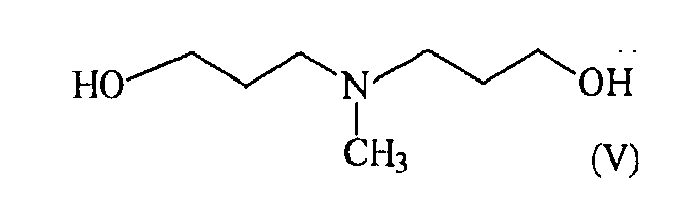
Example Structure 4 
6 
8 
TABLE 1 Ex. No./ Nitrile to Amine Molar Ratio Conv. Starting Nitrile Starting Amine Tertiary Amine
Product IUPAC nameTertiary Amine Yield 4
2 to 186% Hydroxy Propionitrile Methylamine bis(3-hydroxypropyl) aminomethane 31% 5
4 to 1>99% Acetonitrile Propanediamine N,N,N',N'-tetraethyl-1,3-propanediamine 74% 6
2 to 182% Adiponitrile 2-aminoethanol 3-bis(cyanopentyl) amino-ethanol 51% 7
4 to 1>99% Acetonitrile 1,2-diaminocyclohexane N,N,N'-triethyl-1,2-diaminocyclo-hexane 40% 8
2 to 195% 1:1 mixture of adiponitrile and glutaronitrile Methylamine mixture of tertiary amines, including cyanobutyl-cyanopentylamino-methane 58% - The examples in Table 2 demonstrate the use of different catalysts in the disclosed method. The following examples were carried out in batch mode, using 1 part catalyst to 20 parts of adiponitrile. The molar ratio of methylamine (40 wt.% aq.) to adiponitrile was 1 to 4 in each case. Hydrogen pressure of 500 psig and temperature of 100°C were maintained for 3 hours.
TABLE 2 Ex. Catalyst Used Conversions Tertiary Amine Yield 9 5% Pd/Carbon >99% 71% 10 4% Pd / 1 % Pt on Carbon >99% 58% 11 4.5% Pd / 0.5% Ru on Carbon >99% 63% 12 5% Pd/Titania >99% 75% 13 5% Pt/Carbon 86% 19% 14 5% Rh/Carbon >99% 6% - To a 300 cc pressure autoclave reactor were charged 3.66g of 5% Pd / alumina powder catalyst, 55.8g of 40% (w/w) aqueous methylamine (0.72 mol), 77.7g of adiponitrile (0.72 mol) and 2.3g biphenyl (internal standard for gas chromatography analysis). The reactor was sealed and purged with nitrogen and hydrogen to remove oxygen. The reaction was conducted at 110°C under 500 psig of hydrogen. The consumed hydrogen was constantly replenished from a 1-liter vessel. After 240 min an analysis of the crude product mixture comprised 13% adiponitrile, 46% BCPAM. The selectivity was 65%.
- After 300 min the crude product mixture comprised 4% adiponitrile, 52% BCPAM, and other products. The selectivity to BCPAM was 62%.
- To a 300 cc pressure autoclave reactor were charged 2.74g of 5% Pd / alumina powder catalyst, 83.71 g of 40% (w/w) aqueous methylamine (1.1 mol), 58.3g of adiponitrile (0.54 mol) and 1.7g biphenyl (internal standard for gas chromatography analysis). The reactor was sealed and purged with nitrogen and hydrogen to remove oxygen. The reaction was conducted at 110°C under 500 psig of hydrogen. The consumed hydrogen was constantly replenished from a 1-liter vessel. After 360 min the reaction mixture comprised 12% ADN, 29% BCPAM. The selectivity was 49%. After 410 min the reaction mixture comprised 5% ADN, 31 % BCPAM. The selectivity was 44%.
-
- 1. A method for preparing at least one tertiary amine product having the formula

- wherein R is a C1-C12 substituent selected from the group consisting of straight or branched aliphatic, cycloaliphatic, and heterocyclic moieties; wherein R' is a C1-C12 substituent selected from the group consisting of straight or branched aliphatic, cycloaliphatic, and heterocyclic moieties;
- wherein A is selected from the group consisting of hydrogen, cyano, amide, straight or branched aliphatic, cycloaliphatic, aromatic, heterocyclic, alkoxy, aryloxy, hydroxy, alkylamino, dialkylamino, arylamino, diarylamino, haloaryl, fluorinated alkyl, and silyl;
- wherein A' is selected from the group consisting of hydrogen, amino, amide, straight or branched aliphatic, cycloaliphatic, aromatic, heterocyclic, alkoxy, aryloxy, hydroxy, alkylamino, dialkylamino, arylamino, diarylamino, haloaryl, fluorinated alkyl, and silyl;
- said method comprising contacting at least one primary amine having the general formula
H2N-R'-A' (III)
- wherein R' is a C1-C12 substituent selected from the group consisting of straight or branched aliphatic, cycloaliphatic, or heterocyclic moieties; and
- wherein A' is selected from the group consisting of hydrogen, amino, amide, straight or branched aliphatic, cycloaliphatic, aromatic, heterocyclic, alkoxy, aryloxy, hydroxy, alkylamino, dialkylamino, arylamino, diarylamino, haloaryl, fluorinated alkyl, and silyl moieties;
- with at least one nitrile having the general formula
A-R-CN (II)
- wherein R is a C1-C12 substituent selected from the group consisting of straight or branched aliphatic, cycloaliphatic, and heterocyclic moieties; and
- wherein A is selected from the group consisting of hydrogen, cyano, amide, straight or branched aliphatic, cycloaliphatic, aromatic, heterocyclic, alkoxy, aryloxy, hydroxy, alkylamino, dialkylamino, arylamino, diarylamino, haloaryl, fluorinated alkyl, and silyl moieties;
- with the proviso that when A is either H or straight or branched aliphatic, and R is straight or branched aliphatic, said nitrile is a C2-C7 nitrile;
- in the presence of hydrogen gas and a catalyst at a temperature from about 50°C to about 200°C and at a pressure from about 100 psig to about 1500 psig, and wherein the ratio of nitrile to amine is greater than 1:1.
- 2. The method of embodiment 1 wherein the catalyst comprises at least one metal element selected from the group consisting of palladium, iridium, rhodium, and platinum.
- 3. The method of embodiment 2 wherein the catalyst comprises palladium.
- 4. The method of embodiment 2 wherein said catalyst comprises at least two metals.
- 5. The method of embodiment 2 wherein the catalyst is supported on alumina, silica, titania, zirconia, silicon carbide, activated carbon, copper oxide or magnesium oxide.
- 6. The method of embodiment 5 wherein the catalyst is present in an amount of about 0.1 weight percent to about 10 weight percent of the support.
- 7. The method of embodiment 1 wherein more than one nitrile compound is contacted with at least one amine.
- 8. The method of embodiment 1 wherein more than one amine is contacted with at least one nitrile.
- 9. The method of embodiment 1 wherein a tertiary amine product is

- 10. A compound prepared by the method of embodiment 1.
- 11. A compound according to embodiment 10 wherein the amine is methylamine and the nitrile is adiponitrile.
- 12. A compound according to embodiment 10 wherein the amine is methylamine and the nitrile is hydroxypropionitrile.
- 13. A compound according to embodiment 10 wherein the nitrile is adiponitrile, and wherein said amine is 2-aminoethanol.
- 14. A compound according to embodiment 10 wherein said amine is methylamine, and wherein said nitrile is a mixture of a 1:1 molar ratio of adiponitrile and glutaronitrile.
- 15. A tertiary amine product having the structure (VI)

- 16. A tertiary amine product having the structure (VII)

- 17. A compound having the formula:

- 18. A method according to embodiment 1 wherein the resulting tertiary amine is a dinitrile, said method further comprising hydrogenating said dinitrile.
Claims (1)
- A tertiary amine product having the structure (VIII).

Applications Claiming Priority (3)
| Application Number | Priority Date | Filing Date | Title |
|---|---|---|---|
| US10/053,073 US6600075B1 (en) | 2001-11-13 | 2001-11-13 | Process for the preparation of tertiaŕy amines from primary amines and nitriles |
| EP07076053.3A EP1900724B1 (en) | 2001-11-13 | 2002-11-05 | Process for the preparation of tertiary amines from primary amines and nitriles |
| EP02797064A EP1444193B1 (en) | 2001-11-13 | 2002-11-05 | Process for the preparation of tertiary amines from primary amines and nitriles |
Related Parent Applications (3)
| Application Number | Title | Priority Date | Filing Date |
|---|---|---|---|
| EP02797064.9 Division | 2002-11-05 | ||
| EP07076053.3A Division-Into EP1900724B1 (en) | 2001-11-13 | 2002-11-05 | Process for the preparation of tertiary amines from primary amines and nitriles |
| EP07076053.3 Division | 2007-12-06 |
Publications (1)
| Publication Number | Publication Date |
|---|---|
| EP2264006A1 true EP2264006A1 (en) | 2010-12-22 |
Family
ID=21981760
Family Applications (3)
| Application Number | Title | Priority Date | Filing Date |
|---|---|---|---|
| EP07076053.3A Expired - Lifetime EP1900724B1 (en) | 2001-11-13 | 2002-11-05 | Process for the preparation of tertiary amines from primary amines and nitriles |
| EP10179198A Withdrawn EP2264006A1 (en) | 2001-11-13 | 2002-11-05 | Process for the preparation of tertiary amines from primary amines and nitriles |
| EP02797064A Expired - Lifetime EP1444193B1 (en) | 2001-11-13 | 2002-11-05 | Process for the preparation of tertiary amines from primary amines and nitriles |
Family Applications Before (1)
| Application Number | Title | Priority Date | Filing Date |
|---|---|---|---|
| EP07076053.3A Expired - Lifetime EP1900724B1 (en) | 2001-11-13 | 2002-11-05 | Process for the preparation of tertiary amines from primary amines and nitriles |
Family Applications After (1)
| Application Number | Title | Priority Date | Filing Date |
|---|---|---|---|
| EP02797064A Expired - Lifetime EP1444193B1 (en) | 2001-11-13 | 2002-11-05 | Process for the preparation of tertiary amines from primary amines and nitriles |
Country Status (14)
| Country | Link |
|---|---|
| US (1) | US6600075B1 (en) |
| EP (3) | EP1900724B1 (en) |
| JP (1) | JP4275533B2 (en) |
| KR (1) | KR100943123B1 (en) |
| CN (1) | CN100352799C (en) |
| AT (1) | ATE410405T1 (en) |
| AU (1) | AU2002361587A1 (en) |
| BR (1) | BR0214193A (en) |
| CA (1) | CA2466442A1 (en) |
| DE (1) | DE60229282D1 (en) |
| ES (2) | ES2312656T3 (en) |
| MX (1) | MXPA04004494A (en) |
| TW (1) | TWI255262B (en) |
| WO (1) | WO2003042134A2 (en) |
Families Citing this family (4)
| Publication number | Priority date | Publication date | Assignee | Title |
|---|---|---|---|---|
| JP4524365B2 (en) * | 2004-02-25 | 2010-08-18 | 財団法人名古屋産業科学研究所 | Method for producing asymmetric aliphatic tertiary amine |
| CN102976950A (en) * | 2012-12-18 | 2013-03-20 | 天津天智精细化工有限公司 | Improved process for preparing tertiary amine |
| CN104888800B (en) * | 2015-05-12 | 2018-04-27 | 常州鑫邦再生资源利用有限公司 | A kind of preparation method of the Pd/carbon catalyst of composition metal |
| CN115028537B (en) * | 2022-05-26 | 2023-08-11 | 万华化学集团股份有限公司 | Preparation method of aminopropyl alicyclic secondary amine |
Citations (7)
| Publication number | Priority date | Publication date | Assignee | Title |
|---|---|---|---|---|
| US3673251A (en) | 1969-04-30 | 1972-06-27 | Nat Distillers Chem Corp | Process for the catalytic reductive amination of nitriles |
| EP0346064A2 (en) * | 1988-06-09 | 1989-12-13 | Sakata Inkusu Kabushiki Kaisha | Pigment dispersing agent and offset printing ink composition employing the same |
| US5463130A (en) | 1994-03-07 | 1995-10-31 | Basf Aktiengesellschaft | Preparation of peralkylated amines |
| US5557011A (en) | 1992-11-26 | 1996-09-17 | Basf Aktiengesellschaft | Preparation of diamines |
| US5894074A (en) | 1997-04-01 | 1999-04-13 | Basf Aktiengesellschaft | Preparation of tertiary amines from nitriles and secondary amines |
| WO2001049324A2 (en) * | 1999-12-30 | 2001-07-12 | Novartis Ag | Novel colloid synthetic vectors for gene therapy |
| WO2003018689A1 (en) * | 2001-08-24 | 2003-03-06 | E.I. Du Pont De Nemours And Company | Acid dyeable polymer compositions |
Family Cites Families (10)
| Publication number | Priority date | Publication date | Assignee | Title |
|---|---|---|---|---|
| US4093657A (en) * | 1976-04-09 | 1978-06-06 | Merck & Co., Inc. | Process for preparing monomer of bile acid sequestrant polymer |
| DK149832C (en) * | 1981-07-17 | 1987-05-18 | Riemann Claus | ANTIPERSPIRANT PREPARATION CONSISTING OF TWO COMPONENTS |
| DE3403778A1 (en) * | 1984-02-03 | 1985-08-08 | Degussa Ag, 6000 Frankfurt | CYANOMETHYL- (2-CYANO-ETHYL) - (3-HYDROXY-PROPYL) -AMINE HIS USE FOR PRODUCING 1- (3-HYDROXY-PROPYL) -1,4-DIAZEPANE AND 1,4-BIS (3- (3rd , 4,5-TRIMETHOXYBENZOYLOXY) -PROPYL) -DIAZEPAN |
| JPH0241338A (en) * | 1988-08-01 | 1990-02-09 | Lion Corp | Antifoaming agent for polymer latex |
| JP2730163B2 (en) * | 1989-04-07 | 1998-03-25 | 日本合成ゴム株式会社 | Method for producing high trans low vinyl conjugated diene polymer |
| DE4423346A1 (en) | 1994-07-04 | 1996-01-11 | Basf Ag | Copper oxide / zirconium oxide catalyst |
| DE19825452A1 (en) * | 1998-06-06 | 1999-12-09 | Basf Ag | Process for the preparation of secondary or tertiary 2-methyl-1,5-pentanediamines |
| US6248925B1 (en) * | 1999-10-22 | 2001-06-19 | Air Products And Chemicals, Inc. | Selective reductive amination of nitriles |
| US6331624B1 (en) * | 2000-04-05 | 2001-12-18 | E.I. Du Pont De Nemours And Company | Process for preparing 6-aminocaproamide |
| US6399830B1 (en) * | 2000-12-13 | 2002-06-04 | Air Products And Chemicals, Inc. | Selective reductive amination of nitriles |
-
2001
- 2001-11-13 US US10/053,073 patent/US6600075B1/en not_active Expired - Lifetime
-
2002
- 2002-11-05 AT AT02797064T patent/ATE410405T1/en not_active IP Right Cessation
- 2002-11-05 MX MXPA04004494A patent/MXPA04004494A/en unknown
- 2002-11-05 CA CA002466442A patent/CA2466442A1/en not_active Abandoned
- 2002-11-05 EP EP07076053.3A patent/EP1900724B1/en not_active Expired - Lifetime
- 2002-11-05 BR BR0214193-0A patent/BR0214193A/en not_active IP Right Cessation
- 2002-11-05 ES ES02797064T patent/ES2312656T3/en not_active Expired - Lifetime
- 2002-11-05 EP EP10179198A patent/EP2264006A1/en not_active Withdrawn
- 2002-11-05 EP EP02797064A patent/EP1444193B1/en not_active Expired - Lifetime
- 2002-11-05 JP JP2003543974A patent/JP4275533B2/en not_active Expired - Fee Related
- 2002-11-05 DE DE60229282T patent/DE60229282D1/en not_active Expired - Lifetime
- 2002-11-05 WO PCT/US2002/035495 patent/WO2003042134A2/en not_active Ceased
- 2002-11-05 AU AU2002361587A patent/AU2002361587A1/en not_active Abandoned
- 2002-11-05 ES ES07076053.3T patent/ES2532673T3/en not_active Expired - Lifetime
- 2002-11-05 KR KR1020047007181A patent/KR100943123B1/en not_active Expired - Fee Related
- 2002-11-05 CN CNB028223829A patent/CN100352799C/en not_active Expired - Fee Related
- 2002-11-08 TW TW091132887A patent/TWI255262B/en not_active IP Right Cessation
Patent Citations (7)
| Publication number | Priority date | Publication date | Assignee | Title |
|---|---|---|---|---|
| US3673251A (en) | 1969-04-30 | 1972-06-27 | Nat Distillers Chem Corp | Process for the catalytic reductive amination of nitriles |
| EP0346064A2 (en) * | 1988-06-09 | 1989-12-13 | Sakata Inkusu Kabushiki Kaisha | Pigment dispersing agent and offset printing ink composition employing the same |
| US5557011A (en) | 1992-11-26 | 1996-09-17 | Basf Aktiengesellschaft | Preparation of diamines |
| US5463130A (en) | 1994-03-07 | 1995-10-31 | Basf Aktiengesellschaft | Preparation of peralkylated amines |
| US5894074A (en) | 1997-04-01 | 1999-04-13 | Basf Aktiengesellschaft | Preparation of tertiary amines from nitriles and secondary amines |
| WO2001049324A2 (en) * | 1999-12-30 | 2001-07-12 | Novartis Ag | Novel colloid synthetic vectors for gene therapy |
| WO2003018689A1 (en) * | 2001-08-24 | 2003-03-06 | E.I. Du Pont De Nemours And Company | Acid dyeable polymer compositions |
Non-Patent Citations (4)
| Title |
|---|
| BERGERON R.J. ET AL.: "Flexible synthesis of polyamine catecholamides", JOURNAL OF ORGANIC CHEMISTRY., vol. 46, no. 22, 1981, US AMERICAN CHEMICAL SOCIETY. EASTON., pages 4524 - 4529, XP002359451 * |
| BERGERON, RAYMOND J. ET AL: "Amines and polyamines from nitriles", SYNTHESIS , (9), 782-4 CODEN: SYNTBF; ISSN: 0039-7881, 1984, XP002468037 * |
| C.M. JORSTAD ET AL.: "Structural Specificity of the Spermidine Requirement of an Escherichia coli Auxotroph", JOURNAL OF BACTERIOLOGY, vol. 141, no. 2, 1980, pages 456 - 463 * |
| VASIL'EVA, E.I.; FREIDLINA, R.KH., IZVESTIYA AKADEMII NAUK SSR, SERIYA KHIMICHESKAYA, February 1966 (1966-02-01), pages 237 - 240 |
Also Published As
| Publication number | Publication date |
|---|---|
| JP4275533B2 (en) | 2009-06-10 |
| WO2003042134A2 (en) | 2003-05-22 |
| EP1900724B1 (en) | 2014-12-17 |
| TW200300135A (en) | 2003-05-16 |
| US20030135052A1 (en) | 2003-07-17 |
| EP1900724A3 (en) | 2008-03-26 |
| US6600075B1 (en) | 2003-07-29 |
| MXPA04004494A (en) | 2004-08-11 |
| DE60229282D1 (en) | 2008-11-20 |
| EP1444193A4 (en) | 2006-02-15 |
| CN100352799C (en) | 2007-12-05 |
| CN1639108A (en) | 2005-07-13 |
| AU2002361587A1 (en) | 2003-05-26 |
| CA2466442A1 (en) | 2003-05-22 |
| BR0214193A (en) | 2004-08-31 |
| EP1444193B1 (en) | 2008-10-08 |
| WO2003042134A3 (en) | 2003-11-20 |
| KR20050043787A (en) | 2005-05-11 |
| ATE410405T1 (en) | 2008-10-15 |
| JP2005511620A (en) | 2005-04-28 |
| KR100943123B1 (en) | 2010-02-18 |
| TWI255262B (en) | 2006-05-21 |
| ES2532673T3 (en) | 2015-03-30 |
| EP1900724A2 (en) | 2008-03-19 |
| ES2312656T3 (en) | 2009-03-01 |
| EP1444193A2 (en) | 2004-08-11 |
Similar Documents
| Publication | Publication Date | Title |
|---|---|---|
| US4757144A (en) | Preparing tertiary amine from formaldehyde and primary and/or secondary amine | |
| ES2201795T3 (en) | PROCEDURE FOR SEMIHYDROGENATION OF DINITRILS. | |
| EP1444193B1 (en) | Process for the preparation of tertiary amines from primary amines and nitriles | |
| US8993759B2 (en) | Transamination of nitrogen-containing compounds to make cyclic and cyclic/acyclic polyamine mixtures | |
| KR20210090657A (en) | Method for preparing substituted amino alcohols | |
| EP0449297B1 (en) | Cyanobutylation of amines with 2-pentenenitrile | |
| US6245932B1 (en) | Cyanoethylation of cycloaliphatic vicinal primary diamines | |
| US5101075A (en) | Process for the preparation of bis-and tris-(3-dimethylaminopropyl)amine | |
| US4906783A (en) | Preparation of bis(hexamethylene)triamine | |
| US6472553B1 (en) | Synthesis of new polynitriles from cycloalphatic vicinal primary diamines | |
| JP5555917B2 (en) | Process for monomethylation of aliphatic primary amines | |
| JP4822649B2 (en) | Method for producing 3-hydroxyalkanenitrile and hydroxyaminoalkane | |
| JP4323310B2 (en) | Process for semi-hydrogenation of dinitriles to aminonitriles | |
| CN113544114A (en) | Preparation of polyalkylene polyamines by reductive amination | |
| US5149809A (en) | Synthesis of 2-alkylhexahydropyrimidines from nitriles | |
| US6635781B1 (en) | Method for hemihydrogenating dinitriles to form aminonitriles | |
| US6455724B1 (en) | Aminonitrile production | |
| JP2005511620A5 (en) |
Legal Events
| Date | Code | Title | Description |
|---|---|---|---|
| PUAI | Public reference made under article 153(3) epc to a published international application that has entered the european phase |
Free format text: ORIGINAL CODE: 0009012 |
|
| AC | Divisional application: reference to earlier application |
Ref document number: 1444193 Country of ref document: EP Kind code of ref document: P Ref document number: 1900724 Country of ref document: EP Kind code of ref document: P |
|
| AK | Designated contracting states |
Kind code of ref document: A1 Designated state(s): AT BE BG CH CY CZ DE DK EE ES FI FR GB GR IE IT LI LU MC NL PT SE SK TR |
|
| 17P | Request for examination filed |
Effective date: 20110614 |
|
| 17Q | First examination report despatched |
Effective date: 20120209 |
|
| RAP1 | Party data changed (applicant data changed or rights of an application transferred) |
Owner name: INVISTA TECHNOLOGIES S.A.R.L. |
|
| STAA | Information on the status of an ep patent application or granted ep patent |
Free format text: STATUS: THE APPLICATION IS DEEMED TO BE WITHDRAWN |
|
| 18D | Application deemed to be withdrawn |
Effective date: 20150808 |