EP2260720A1 - Method for reducing surface oil, on encapsulated material - Google Patents
Method for reducing surface oil, on encapsulated material Download PDFInfo
- Publication number
- EP2260720A1 EP2260720A1 EP10251026A EP10251026A EP2260720A1 EP 2260720 A1 EP2260720 A1 EP 2260720A1 EP 10251026 A EP10251026 A EP 10251026A EP 10251026 A EP10251026 A EP 10251026A EP 2260720 A1 EP2260720 A1 EP 2260720A1
- Authority
- EP
- European Patent Office
- Prior art keywords
- oil
- encapsulated material
- encapsulated
- sio
- minutes
- Prior art date
- Legal status (The legal status is an assumption and is not a legal conclusion. Google has not performed a legal analysis and makes no representation as to the accuracy of the status listed.)
- Withdrawn
Links
- 239000000463 material Substances 0.000 title claims abstract description 122
- 238000000034 method Methods 0.000 title claims abstract description 47
- VYPSYNLAJGMNEJ-UHFFFAOYSA-N Silicium dioxide Chemical compound O=[Si]=O VYPSYNLAJGMNEJ-UHFFFAOYSA-N 0.000 claims abstract description 70
- 229910052681 coesite Inorganic materials 0.000 claims abstract description 35
- 229910052906 cristobalite Inorganic materials 0.000 claims abstract description 35
- 239000000377 silicon dioxide Substances 0.000 claims abstract description 35
- 229910052682 stishovite Inorganic materials 0.000 claims abstract description 35
- 229910052905 tridymite Inorganic materials 0.000 claims abstract description 35
- 239000002245 particle Substances 0.000 claims description 17
- 239000002904 solvent Substances 0.000 abstract description 8
- 239000003921 oil Substances 0.000 description 63
- 235000019198 oils Nutrition 0.000 description 63
- KRKNYBCHXYNGOX-UHFFFAOYSA-N citric acid Chemical compound OC(=O)CC(O)(C(O)=O)CC(O)=O KRKNYBCHXYNGOX-UHFFFAOYSA-N 0.000 description 24
- 239000000203 mixture Substances 0.000 description 24
- 239000012065 filter cake Substances 0.000 description 19
- WFMIUXMJJBBOGJ-UHFFFAOYSA-N Thymyl acetate Chemical compound CC(C)C1=CC=C(C)C=C1OC(C)=O WFMIUXMJJBBOGJ-UHFFFAOYSA-N 0.000 description 16
- 239000000843 powder Substances 0.000 description 16
- XLYOFNOQVPJJNP-UHFFFAOYSA-N water Substances O XLYOFNOQVPJJNP-UHFFFAOYSA-N 0.000 description 15
- HFPZCAJZSCWRBC-UHFFFAOYSA-N p-cymene Chemical compound CC(C)C1=CC=C(C)C=C1 HFPZCAJZSCWRBC-UHFFFAOYSA-N 0.000 description 13
- HEMHJVSKTPXQMS-UHFFFAOYSA-M Sodium hydroxide Chemical compound [OH-].[Na+] HEMHJVSKTPXQMS-UHFFFAOYSA-M 0.000 description 12
- SZYSLWCAWVWFLT-UTGHZIEOSA-N [(2s,3s,4s,5r)-3,4-dihydroxy-5-(hydroxymethyl)-2-[(2r,3r,4s,5s,6r)-3,4,5-trihydroxy-6-(hydroxymethyl)oxan-2-yl]oxyoxolan-2-yl]methyl octadecanoate Chemical compound O([C@@H]1[C@@H]([C@@H](O)[C@H](O)[C@@H](CO)O1)O)[C@]1(COC(=O)CCCCCCCCCCCCCCCCC)O[C@H](CO)[C@@H](O)[C@@H]1O SZYSLWCAWVWFLT-UTGHZIEOSA-N 0.000 description 11
- UWKAYLJWKGQEPM-UHFFFAOYSA-N linalool acetate Natural products CC(C)=CCCC(C)(C=C)OC(C)=O UWKAYLJWKGQEPM-UHFFFAOYSA-N 0.000 description 11
- 238000002156 mixing Methods 0.000 description 11
- 239000002002 slurry Substances 0.000 description 11
- 238000001035 drying Methods 0.000 description 10
- UWKAYLJWKGQEPM-LBPRGKRZSA-N linalyl acetate Chemical compound CC(C)=CCC[C@](C)(C=C)OC(C)=O UWKAYLJWKGQEPM-LBPRGKRZSA-N 0.000 description 10
- 239000000839 emulsion Substances 0.000 description 9
- GRWFGVWFFZKLTI-IUCAKERBSA-N 1S,5S-(-)-alpha-Pinene Natural products CC1=CC[C@@H]2C(C)(C)[C@H]1C2 GRWFGVWFFZKLTI-IUCAKERBSA-N 0.000 description 8
- 229920002494 Zein Polymers 0.000 description 8
- 239000004744 fabric Substances 0.000 description 8
- 239000005019 zein Substances 0.000 description 8
- 229940093612 zein Drugs 0.000 description 8
- GRWFGVWFFZKLTI-UHFFFAOYSA-N α-pinene Chemical compound CC1=CCC2C(C)(C)C1C2 GRWFGVWFFZKLTI-UHFFFAOYSA-N 0.000 description 8
- 238000000227 grinding Methods 0.000 description 7
- 238000003801 milling Methods 0.000 description 7
- 238000012216 screening Methods 0.000 description 7
- 238000000926 separation method Methods 0.000 description 7
- 229920001800 Shellac Polymers 0.000 description 5
- 239000000796 flavoring agent Substances 0.000 description 5
- 239000003094 microcapsule Substances 0.000 description 5
- 239000004208 shellac Substances 0.000 description 5
- 229940113147 shellac Drugs 0.000 description 5
- ZLGIYFNHBLSMPS-ATJNOEHPSA-N shellac Chemical compound OCCCCCC(O)C(O)CCCCCCCC(O)=O.C1C23[C@H](C(O)=O)CCC2[C@](C)(CO)[C@@H]1C(C(O)=O)=C[C@@H]3O ZLGIYFNHBLSMPS-ATJNOEHPSA-N 0.000 description 5
- 235000013874 shellac Nutrition 0.000 description 5
- 239000000341 volatile oil Substances 0.000 description 5
- 239000004480 active ingredient Substances 0.000 description 4
- MVNCAPSFBDBCGF-UHFFFAOYSA-N alpha-pinene Natural products CC1=CCC23C1CC2C3(C)C MVNCAPSFBDBCGF-UHFFFAOYSA-N 0.000 description 4
- 239000000828 canola oil Substances 0.000 description 4
- 235000019519 canola oil Nutrition 0.000 description 4
- 235000013351 cheese Nutrition 0.000 description 4
- 239000003960 organic solvent Substances 0.000 description 4
- 239000000047 product Substances 0.000 description 4
- CSCPPACGZOOCGX-UHFFFAOYSA-N Acetone Chemical compound CC(C)=O CSCPPACGZOOCGX-UHFFFAOYSA-N 0.000 description 3
- VHUUQVKOLVNVRT-UHFFFAOYSA-N Ammonium hydroxide Chemical compound [NH4+].[OH-] VHUUQVKOLVNVRT-UHFFFAOYSA-N 0.000 description 3
- 239000000908 ammonium hydroxide Substances 0.000 description 3
- 239000012530 fluid Substances 0.000 description 3
- 235000013305 food Nutrition 0.000 description 3
- VLKZOEOYAKHREP-UHFFFAOYSA-N n-Hexane Chemical compound CCCCCC VLKZOEOYAKHREP-UHFFFAOYSA-N 0.000 description 3
- 239000007787 solid Substances 0.000 description 3
- 229920001817 Agar Polymers 0.000 description 2
- LFQSCWFLJHTTHZ-UHFFFAOYSA-N Ethanol Chemical compound CCO LFQSCWFLJHTTHZ-UHFFFAOYSA-N 0.000 description 2
- 241000206672 Gelidium Species 0.000 description 2
- GUBGYTABKSRVRQ-QKKXKWKRSA-N Lactose Natural products OC[C@H]1O[C@@H](O[C@H]2[C@H](O)[C@@H](O)C(O)O[C@@H]2CO)[C@H](O)[C@@H](O)[C@H]1O GUBGYTABKSRVRQ-QKKXKWKRSA-N 0.000 description 2
- 229920000168 Microcrystalline cellulose Polymers 0.000 description 2
- 235000010419 agar Nutrition 0.000 description 2
- 238000000576 coating method Methods 0.000 description 2
- 238000001914 filtration Methods 0.000 description 2
- 235000019634 flavors Nutrition 0.000 description 2
- 239000001866 hydroxypropyl methyl cellulose Substances 0.000 description 2
- 235000010979 hydroxypropyl methyl cellulose Nutrition 0.000 description 2
- 229920003088 hydroxypropyl methyl cellulose Polymers 0.000 description 2
- UFVKGYZPFZQRLF-UHFFFAOYSA-N hydroxypropyl methyl cellulose Chemical compound OC1C(O)C(OC)OC(CO)C1OC1C(O)C(O)C(OC2C(C(O)C(OC3C(C(O)C(O)C(CO)O3)O)C(CO)O2)O)C(CO)O1 UFVKGYZPFZQRLF-UHFFFAOYSA-N 0.000 description 2
- 239000008101 lactose Substances 0.000 description 2
- 239000007788 liquid Substances 0.000 description 2
- 239000011159 matrix material Substances 0.000 description 2
- 239000012528 membrane Substances 0.000 description 2
- 239000008108 microcrystalline cellulose Substances 0.000 description 2
- 235000019813 microcrystalline cellulose Nutrition 0.000 description 2
- 229940016286 microcrystalline cellulose Drugs 0.000 description 2
- 150000003904 phospholipids Chemical class 0.000 description 2
- 229920003023 plastic Polymers 0.000 description 2
- 238000007873 sieving Methods 0.000 description 2
- 239000007921 spray Substances 0.000 description 2
- 238000005406 washing Methods 0.000 description 2
- 244000215068 Acacia senegal Species 0.000 description 1
- 102000008186 Collagen Human genes 0.000 description 1
- 108010035532 Collagen Proteins 0.000 description 1
- 108010010803 Gelatin Proteins 0.000 description 1
- 229920000084 Gum arabic Polymers 0.000 description 1
- 239000004368 Modified starch Substances 0.000 description 1
- 229920000881 Modified starch Polymers 0.000 description 1
- 235000001188 Peltandra virginica Nutrition 0.000 description 1
- 244000197580 Poria cocos Species 0.000 description 1
- 235000008599 Poria cocos Nutrition 0.000 description 1
- 108010046377 Whey Proteins Proteins 0.000 description 1
- 102000007544 Whey Proteins Human genes 0.000 description 1
- 239000000205 acacia gum Substances 0.000 description 1
- 235000010489 acacia gum Nutrition 0.000 description 1
- 230000002411 adverse Effects 0.000 description 1
- 235000010443 alginic acid Nutrition 0.000 description 1
- 239000000783 alginic acid Substances 0.000 description 1
- 229920000615 alginic acid Polymers 0.000 description 1
- 229960001126 alginic acid Drugs 0.000 description 1
- 150000004781 alginic acids Chemical class 0.000 description 1
- 235000019169 all-trans-retinol Nutrition 0.000 description 1
- 235000013361 beverage Nutrition 0.000 description 1
- 230000015556 catabolic process Effects 0.000 description 1
- 239000007795 chemical reaction product Substances 0.000 description 1
- 239000011248 coating agent Substances 0.000 description 1
- 229920001436 collagen Polymers 0.000 description 1
- 238000006731 degradation reaction Methods 0.000 description 1
- 235000014113 dietary fatty acids Nutrition 0.000 description 1
- 238000005538 encapsulation Methods 0.000 description 1
- 239000000194 fatty acid Substances 0.000 description 1
- 229930195729 fatty acid Natural products 0.000 description 1
- -1 fatty acid esters Chemical class 0.000 description 1
- 239000000706 filtrate Substances 0.000 description 1
- 238000005187 foaming Methods 0.000 description 1
- 238000004108 freeze drying Methods 0.000 description 1
- 239000008273 gelatin Substances 0.000 description 1
- 229920000159 gelatin Polymers 0.000 description 1
- 235000019322 gelatine Nutrition 0.000 description 1
- 235000011852 gelatine desserts Nutrition 0.000 description 1
- 230000001788 irregular Effects 0.000 description 1
- 238000010902 jet-milling Methods 0.000 description 1
- 238000011068 loading method Methods 0.000 description 1
- 235000019426 modified starch Nutrition 0.000 description 1
- 239000002077 nanosphere Substances 0.000 description 1
- 238000004064 recycling Methods 0.000 description 1
- 238000001694 spray drying Methods 0.000 description 1
- 239000004094 surface-active agent Substances 0.000 description 1
- 239000000725 suspension Substances 0.000 description 1
- 235000021119 whey protein Nutrition 0.000 description 1
Images
Classifications
-
- A—HUMAN NECESSITIES
- A23—FOODS OR FOODSTUFFS; TREATMENT THEREOF, NOT COVERED BY OTHER CLASSES
- A23L—FOODS, FOODSTUFFS OR NON-ALCOHOLIC BEVERAGES, NOT OTHERWISE PROVIDED FOR; PREPARATION OR TREATMENT THEREOF
- A23L5/00—Preparation or treatment of foods or foodstuffs, in general; Food or foodstuffs obtained thereby; Materials therefor
- A23L5/20—Removal of unwanted matter, e.g. deodorisation or detoxification
- A23L5/27—Removal of unwanted matter, e.g. deodorisation or detoxification by chemical treatment, by adsorption or by absorption
- A23L5/276—Treatment with inorganic compounds
-
- A—HUMAN NECESSITIES
- A23—FOODS OR FOODSTUFFS; TREATMENT THEREOF, NOT COVERED BY OTHER CLASSES
- A23P—SHAPING OR WORKING OF FOODSTUFFS, NOT FULLY COVERED BY A SINGLE OTHER SUBCLASS
- A23P10/00—Shaping or working of foodstuffs characterised by the products
- A23P10/30—Encapsulation of particles, e.g. foodstuff additives
- A23P10/35—Encapsulation of particles, e.g. foodstuff additives with oils, lipids, monoglycerides or diglycerides
Definitions
- the present invention relates to methods for removing and reducing oil on a surface of encapsulated material without use of organic solvents. More specifically, encapsulated materials are contacted with oil removing materials which are effective for reducing oil on the surface of the encapsulated material.
- flavorant material for use in orally utilized compositions. It is often desirable to provide these flavorant materials or other active ingredients in a form that is less volatile and more stable, thus avoiding loss or degradation.
- a technique commonly employed in this regard is the encapsulation of the active ingredient within a shell or matrix of a material designed to provide a complete coating around particles of the active ingredient.
- oils are the active ingredient that is being encapsulated or in processes that include oils
- some amount of oil may remain on a surface of the encapsulated material. Oils on the surface of the microcapsules tend to oxidize, which results in off-flavors.
- a common practice for removing surface oils relies on using solvents such as alcohol, hexane or other organic solvents. It is highly undesirable to use solvents in compositions intended for food use because of the difficulty in removing those solvents completely. Further, solvents may adversely affect encapsulated materials as common components used as coatings in making the encapsulated material may be soluble in solvents such as acetone and alcohol. Water alone or in combination with surfactants may have some degree of success, however, the use of water requires another drying step which increases processing costs. Further, there is a possibility of loss of active components upon additional drying steps.
- a method for removing surface oil form a surface of an encapsulated material without using any type of solvent is provided. Removal of surface oil is effective for providing encapsulated materials having reduced off-flavors and/or off-taste. Encapsulated materials having reduced off-flavors and/or off-taste provide better tasting products, especially for example in beverages.
- a method for removing surface oil from an encapsulated material includes contacting an encapsulated material having a moisture content of about 1 to about 60 weight percent, preferably about 1 to about 40 weight percent, with at least about 5 weight percent of an oil removing material.
- the encapsulated material is contacted with the oil removing material for an amount of time effective for reducing surface oil on the encapsulated material by at least about 80%, as compared to encapsulated material which has not been contacted with an oil removing material.
- the oil removing material has a particle size larger or smaller than a particle size of the encapsulated material which is effective for facilitating separation of the oil removing material from the encapsulated material.
- the oil removing material is SiO 2 .
- a method for removing surface oil from an encapsulated material where an oil removing material can be recycled and reused.
- encapsulated material is contacted with an oil removing material having a particle size larger or smaller than a particle size of the encapsulated material.
- the encapsulated material is contacted with the oil removing material for an amount of time effective for reducing surface oil on the encapsulated material by at least about 80%, as compared to encapsulated material which has not been contacted with an oil removing material.
- the oil removing material is separated from the encapsulated material and then treated to remove absorbed oil.
- a method for forming an encapsulated material having reduced surface oil includes forming an encapsulated material, screening the encapsulated material to remove excess water and form a wet filter cake, pressing the wet filter cake to remove more of the excess water and form a pressed wet filter cake, coarse milling the pressed wet filter cake, grinding and drying.
- SiO 2 may be added after forming an encapsulated material, after screening, after pressing, after coarse milling, after grinding, and/or during drying.
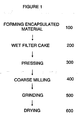
- Figure 1 illustrates a method for forming encapsulated material.
- Encapsulated materials are formed and processed that oil remaining on the surface of the microcapsules is reduced without the use of organic solvents.
- solvent free refers to encapsulated materials which include less than a detectable level of organic solvent.
- microcapsulated material generally describes spherical or irregular shaped particles which contain at least one solid or liquid core surrounded by at least one substantially continuous membrane/matrix.
- known microcapsules are the following commercial products (the membrane material is shown in brackets) Hallcrest Microcapsules (gelatin, gum arabic), Coletica Thalaspheres (maritime collagen), Lipotec Millicapseln (alginic acid, agar agar), Induchem Unispheres (lactose, microcrystalline cellulose, hydroxypropylmethyl cellulose), Unicerin C30 (lactose, microcrystalline cellulose, hydroxypropylmethyl cellulose), Kobo Glycospheres (modified starch, fatty acid esters, phospholipids), Softspheres (modified agar agar) and Kuhs Probiol Nanospheres (phospholipids).
- Encapsulated materials which may be utilized includes encapsulated materials having a moisture contents of about 1 to about 60 weight percent, and in an important aspect, about 1 to about 40 weight percent, and in a very important aspect, about 10 to about 25 weight percent. While not intending to be bound by any theory, a moisture level in the indicated ranges is needed to sufficiently hydrate the oil removing material and thus increase the oil removing efficiency of the material.
- Encapsulated material is contacted with at least about 5 weight percent of oil removing material, based on a total weight of the encapsulated material. In an important aspect, the encapsulated material is contacted with about 5 to about 50 weight percent of oil removing material, and in another aspect, about 15 to about 25 weight percent of oil removing material. In an important aspect, the oil removing material is SiO 2 .
- the oil removing material is contacted with the encapsulated material for any amount of time effective for reducing surface oil on the encapsulated materials by at least about 80%, in another aspect at least about 90%, and in another aspect at least about 98%.
- the encapsulated material is contacted with the oil removing material for at least about 5 minutes, in another aspect about 15 minutes, and in another aspect, about 1 hour.
- encapsulated material 100 may be formed using generally known methods and by methods described in co-pending U.S. Application Serial Numbers 12/479,444 and 12/479,454 , which are incorporated herein by reference.
- Encapsulated material may be recovered with known methods such as screening, sieving, centrifugal separation based on size and density, air blow separation, filtering, and mixtures thereof.
- the recovered encapsulated material may be washed, for example with re-suspension in an appropriate medium and then recovered with any of the methods indicated.
- the dried, encapsulated material will generally have a particle size in a range of 1 to 1000 microns.
- the wet filter cake may be pressed 300 using known methods to reduce the amount of liquid in the filter cake.
- the wet filter cake may be pressed using cheese cloth to provide a target moisture content.
- the wet filter cake may be coarse milled 400, ground 500 and then dried 600. Milling, grinding and drying may all be done using methods known in the art.
- Encapsulated material may be converted into a powder-form end product by drying in the form of freeze-drying or fluidized-bed drying or by the removal of water.
- a total amount of an oil removing material such as SiO 2 may be added at various steps in the method or portions of the oil removing material may be added at different steps in the method.
- SiO 2 may be added after forming an encapsulated material (see Example 4), after screening, after pressing, after coarse milling, after grinding and/or during drying.
- Encapsulated material was prepared similar to that described in Example 1 (AA091708-1), and the final powder between 75-250 ⁇ m. The moisture content was bellow 5%.
- the sample was designated # RM 081308-2A.
- 50 g of powder RM081308-2A was dry blended with 10 g of SiO 2 AB-D (smaller than 75 ⁇ m). The dry blend was tumbled for about 2 hours, then the dry blend was sifted on screen having 75 ⁇ m holes. The particulates above 75 ⁇ m were collected and then analyzed, sample # AA090908. See the Table below for reduction in surface oil treatment with SiO 2 in the final processing step.
- the emulsion was then homogenized using a IKA Works T25 Basic Ultra Turrax with 200mm x 20mm Generator at 17,500 rpm for 1 minute, then at 24,000 rpm for 5 minutes.
- the emulsion was then titrated with 3% citric acid solution until the pH reached 3.8.
- 15 g SiO 2 (Flo Guard FF, average size is 18 ⁇ m) was added in and allowed to mix for 30 minutes.
- the slurry was then filtered by pouring over a filter cloth with ⁇ 5 ⁇ m holes. The particulates on the filter cloth were then resuspended into 2000 g water containing 0.5 g citric acid, 0.5 g sucrose stearate, and 7. 5 g SiO 2 (Flo Guard FF).
- the slurry was mixed for 15 minutes and then refiltered. The washing was repeated one more time as above, then filter cake was collected.
- the filter cake was then pressed by placing in a 30 ⁇ m filter bag in a press box and squeezing in a cheese press at 20 psi for 20 minutes to remove more of the water.
- the press cake moisture was 18.8%.
- the press cake was mixed with 50 g SiO 2 (Flo Guard FF) in a 5 quart Hobart mixer with a whip at speed set at 1 for 5 minutes.
- the material from the Hobart mixer was ground in a FitzMill Model DA SO6 Comminutor with hammers forward at the highest speed using a 1532-0020 perforated plate.
- the emulsion was then homogenized using a IKA Works T25 Basic Ultra Turrax with 200mm x 20mm Generator at 17,500 rpm for 1 minute, then at 24,000 rpm for 5 minutes.
- the emulsion was then titrated with 3% citric acid solution until the pH reached 3.8.
- 15 g SiO 2 (Flo Guard FF, average size of 18 ⁇ m) was added in and allowed to mix for 30 minutes.
- the slurry was then filtered by pouring over a filter cloth with ⁇ 5 ⁇ m holes. The particulates on the filter cloth were then resuspended into 2000 g water with 1.0 g citric acid, 1.0 g sucrose stearate, and 7.5 g SiO 2 (Flo Guard FF).
- the slurry was mixed for 15 minutes and then re-filtered.
- the particulates on the filter cloth were then resuspended into 2000 g water with 1.0 g citric acid, 1.0 g sucrose stearate, and 150 g SiO 2 (Flo Guard FF), then filter cake was collected.
- the filter cake was then pressed by placing in a filter cloth with ⁇ 30 ⁇ m holes in a press box and squeezing in a cheese press at 20 psi for 20 minutes to remove more of the water.
- the press cake was then tumbled in a Patterson- Kelley 16 Quart V-Blender with the intensifier bar on for 30 minutes to break up lumps. The material lumped up even more and was too wet to proceed with further processing.
- the press cake moisture was 57.1%.
Landscapes
- Life Sciences & Earth Sciences (AREA)
- Food Science & Technology (AREA)
- Health & Medical Sciences (AREA)
- Polymers & Plastics (AREA)
- Chemical & Material Sciences (AREA)
- Engineering & Computer Science (AREA)
- Nutrition Science (AREA)
- Molecular Biology (AREA)
- Biophysics (AREA)
- Manufacturing Of Micro-Capsules (AREA)
- Edible Oils And Fats (AREA)
- Fats And Perfumes (AREA)
- Detergent Compositions (AREA)
- Solid-Sorbent Or Filter-Aiding Compositions (AREA)
- Processing Of Solid Wastes (AREA)
- General Preparation And Processing Of Foods (AREA)
- Seasonings (AREA)
Abstract
Description
- The present invention relates to methods for removing and reducing oil on a surface of encapsulated material without use of organic solvents. More specifically, encapsulated materials are contacted with oil removing materials which are effective for reducing oil on the surface of the encapsulated material.
- There has been a considerable amount of work in the field of flavorant material for use in orally utilized compositions. It is often desirable to provide these flavorant materials or other active ingredients in a form that is less volatile and more stable, thus avoiding loss or degradation. A technique commonly employed in this regard, is the encapsulation of the active ingredient within a shell or matrix of a material designed to provide a complete coating around particles of the active ingredient.
- In processes where oils are the active ingredient that is being encapsulated or in processes that include oils, some amount of oil may remain on a surface of the encapsulated material. Oils on the surface of the microcapsules tend to oxidize, which results in off-flavors. A common practice for removing surface oils relies on using solvents such as alcohol, hexane or other organic solvents. It is highly undesirable to use solvents in compositions intended for food use because of the difficulty in removing those solvents completely. Further, solvents may adversely affect encapsulated materials as common components used as coatings in making the encapsulated material may be soluble in solvents such as acetone and alcohol. Water alone or in combination with surfactants may have some degree of success, however, the use of water requires another drying step which increases processing costs. Further, there is a possibility of loss of active components upon additional drying steps.
- A method is provided for removing surface oil form a surface of an encapsulated material without using any type of solvent. Removal of surface oil is effective for providing encapsulated materials having reduced off-flavors and/or off-taste. Encapsulated materials having reduced off-flavors and/or off-taste provide better tasting products, especially for example in beverages.
- A method is provided for removing surface oil from an encapsulated material. The method includes contacting an encapsulated material having a moisture content of about 1 to about 60 weight percent, preferably about 1 to about 40 weight percent, with at least about 5 weight percent of an oil removing material. The encapsulated material is contacted with the oil removing material for an amount of time effective for reducing surface oil on the encapsulated material by at least about 80%, as compared to encapsulated material which has not been contacted with an oil removing material. The oil removing material has a particle size larger or smaller than a particle size of the encapsulated material which is effective for facilitating separation of the oil removing material from the encapsulated material. In an important aspect, the oil removing material is SiO2.
- In another aspect, a method is provided for removing surface oil from an encapsulated material where an oil removing material can be recycled and reused. In this aspect, encapsulated material is contacted with an oil removing material having a particle size larger or smaller than a particle size of the encapsulated material. The encapsulated material is contacted with the oil removing material for an amount of time effective for reducing surface oil on the encapsulated material by at least about 80%, as compared to encapsulated material which has not been contacted with an oil removing material. The oil removing material is separated from the encapsulated material and then treated to remove absorbed oil.
- In another aspect, a method for forming an encapsulated material having reduced surface oil. The method includes forming an encapsulated material, screening the encapsulated material to remove excess water and form a wet filter cake, pressing the wet filter cake to remove more of the excess water and form a pressed wet filter cake, coarse milling the pressed wet filter cake, grinding and drying. In this method, SiO2 may be added after forming an encapsulated material, after screening, after pressing, after coarse milling, after grinding, and/or during drying.
-
Figure 1 illustrates a method for forming encapsulated material. - Encapsulated materials are formed and processed that oil remaining on the surface of the microcapsules is reduced without the use of organic solvents. As used herein "solvent free" refers to encapsulated materials which include less than a detectable level of organic solvent.
- As used herein, "encapsulated material" or "microcapsules" generally describes spherical or irregular shaped particles which contain at least one solid or liquid core surrounded by at least one substantially continuous membrane/matrix. Examples of known microcapsules are the following commercial products (the membrane material is shown in brackets) Hallcrest Microcapsules (gelatin, gum arabic), Coletica Thalaspheres (maritime collagen), Lipotec Millicapseln (alginic acid, agar agar), Induchem Unispheres (lactose, microcrystalline cellulose, hydroxypropylmethyl cellulose), Unicerin C30 (lactose, microcrystalline cellulose, hydroxypropylmethyl cellulose), Kobo Glycospheres (modified starch, fatty acid esters, phospholipids), Softspheres (modified agar agar) and Kuhs Probiol Nanospheres (phospholipids).
- Encapsulated materials which may be utilized includes encapsulated materials having a moisture contents of about 1 to about 60 weight percent, and in an important aspect, about 1 to about 40 weight percent, and in a very important aspect, about 10 to about 25 weight percent. While not intending to be bound by any theory, a moisture level in the indicated ranges is needed to sufficiently hydrate the oil removing material and thus increase the oil removing efficiency of the material.
- Encapsulated material is contacted with at least about 5 weight percent of oil removing material, based on a total weight of the encapsulated material. In an important aspect, the encapsulated material is contacted with about 5 to about 50 weight percent of oil removing material, and in another aspect, about 15 to about 25 weight percent of oil removing material. In an important aspect, the oil removing material is SiO2.
- The oil removing material is contacted with the encapsulated material for any amount of time effective for reducing surface oil on the encapsulated materials by at least about 80%, in another aspect at least about 90%, and in another aspect at least about 98%. The encapsulated material is contacted with the oil removing material for at least about 5 minutes, in another aspect about 15 minutes, and in another aspect, about 1 hour.
- A method for forming encapsulated material is generally described in
Figure 1 . As shown inFigure 1 , encapsulatedmaterial 100 may be formed using generally known methods and by methods described in co-pendingU.S. Application Serial Numbers 12/479,444 and12/479,454 - Separation of the encapsulated materials is effective for providing a
wet filter cake 200. The wet filter cake may be pressed 300 using known methods to reduce the amount of liquid in the filter cake. For example, the wet filter cake may be pressed using cheese cloth to provide a target moisture content. The wet filter cake may be coarse milled 400, ground 500 and then dried 600. Milling, grinding and drying may all be done using methods known in the art. Encapsulated material may be converted into a powder-form end product by drying in the form of freeze-drying or fluidized-bed drying or by the removal of water. - In this aspect, a total amount of an oil removing material such as SiO2 may be added at various steps in the method or portions of the oil removing material may be added at different steps in the method. In this aspect, SiO2 may be added after forming an encapsulated material (see Example 4), after screening, after pressing, after coarse milling, after grinding and/or during drying.
- In a beaker, 2400 g of water was added in and then with overhead low shear mixing, 37.5 g of zein powder (F4000, from Freeman Industries) was dispersed in. 10% sodium hydroxide solution was metered in until pH reached 11.3 (to solubilize the zein powder). 450 g of pre-made 25% shellac solution (Bleached dry shellac powder from Temuss Products LTD was hydrated at 25% and pH 8 with ammonium hydroxide solution) was added in. 1.4 g sucrose stearate S-1570 (from the Mitsubishi, Kagaku Corp. Tokyo, Japan) was added in, and then 80 g essential oil blend (13% canola oil, 10% alpha pinene, 25% para-cymene, 12% Linalyl acetate, 40% Thymol acetate) was added slowly to the mix. The emulsion was then homogenized using a PowerGen 700D Homogenizing System (Fisher Scientific, Pitssburg, PA) with 200 mm x 25 mm Generator at 15000 rpm for 4 minutes, then at 20000 rpm for 1 minute. The emulsion was then titrated with 3% citric acid solution until pH reached 3.8. Then, 10 g SiO2 (Flo Guard AB-D, average size of 35 µm from PPG Industries, Pittsburg, PA) was added in and allowed to mix for 30 minutes. The slurry was then filtered by pouring over 200 mesh screen with 75 µm holes. The particulates on the top of the screen were then resuspended into 2000 g water containing 0.5 g citric acid, 0.5 g Sucrose Stearate (S-1570), and 1.25 g SiO2 (Flo Guard AB-D). The slurry was mixed for about 5 minutes and re-filtered. The washing was repeated one more time as above, then filtrate (filter cake) was collected. The filter cake was then pressed by squeezing in cheese cloth by hand to remove more of the water. The cake was then split into two portions:
- Portion 1: (control, # AA091708-1), it was crumbled, spread on a tray and allowed to dry overnight at room temperature.
- Portion 2 (Treated, # AA091708-2), the cake (100 g) was crumbled and dry blended with 10 g SiO2 that has been sifted through a 75 µm screen. The blend was pulverized in a Waring blender for few seconds to break any lumps, the dry blend was tumbled for about 10 minutes. The semi-dry material was then spread on tray to dry overnight.
- Encapsulated material was prepared similar to that described in Example 1 (AA091708-1), and the final powder between 75-250 µm. The moisture content was bellow 5%. The sample was designated # RM 081308-2A.
50 g of powder RM081308-2A was dry blended with 10 g of SiO2 AB-D (smaller than 75 µm). The dry blend was tumbled for about 2 hours, then the dry blend was sifted on screen having 75 µm holes. The particulates above 75 µm were collected and then analyzed, sample # AA090908. See the Table below for reduction in surface oil treatment with SiO2 in the final processing step. -
% a-Pinene % p-Cymene % Linalool acetate % Thymol acetate Total surface oil RM081308-2A, before 0.12 0.63 0.96 3.5 5.15 AA090908 after treatment 0.069 0.37 0.48 2.0 2.9 - In a beaker, 2400 g of water was added in and then with overhead low shear mixing, 37.5 g of zein powder was dispersed in. 10% sodium hydroxide solution was metered in until pH reached 11.3 (to solubilize the zein powder). 450 g of 25% shellac solution was added in. 1.4 g sucrose stearate (S-1570) was added in, and then 80 g essential oil blend (13% canola oil, 10% alpha pinene, 25% Para-cymene, 12% Linalyl acetate, 40% Thymol acetate) was added slowly to the mix. The emulsion was then homogenized using a IKA Works T25 Basic Ultra Turrax with 200mm x 20mm Generator at 17,500 rpm for 1 minute, then at 24,000 rpm for 5 minutes. The emulsion was then titrated with 3% citric acid solution until the pH reached 3.8. Then, 15 g SiO2 (Flo Guard FF, average size is 18 µm) was added in and allowed to mix for 30 minutes. The slurry was then filtered by pouring over a filter cloth with <5 µm holes. The particulates on the filter cloth were then resuspended into 2000 g water containing 0.5 g citric acid, 0.5 g sucrose stearate, and 7. 5 g SiO2 (Flo Guard FF). The slurry was mixed for 15 minutes and then refiltered. The washing was repeated one more time as above, then filter cake was collected. The filter cake was then pressed by placing in a 30 µm filter bag in a press box and squeezing in a cheese press at 20 psi for 20 minutes to remove more of the water. The press cake moisture was 18.8%. The press cake was mixed with 50 g SiO2 (Flo Guard FF) in a 5 quart Hobart mixer with a whip at speed set at 1 for 5 minutes. The material from the Hobart mixer was ground in a FitzMill Model DA SO6 Comminutor with hammers forward at the highest speed using a 1532-0020 perforated plate. The ground material was tumbled using jar tumblers for 60 minutes. The batch was then dried in a Uni-Glatt Fluid Bed Dryer at 40 °C for 20 minutes. The dried batch was screened and only particles between 75-250 µm were collected.
% a-Pinene % p-Cymene % Linalyl acetate % Thymol acetate Total RM102708-2 Total Loading 0.84 2.70 1.50 6.40 11.44 RM102708-2 Surface Oils <0.001 0.007 0.003 0.021 0.031 - In a beaker, 2400 g of water was added in and then with overhead low shear mixing, 37.5 g of zein powder was dispersed in, 10% sodium hydroxide solution was metered in until pH reached 11.3 (to solubilize the zein powder). 450 g of 25% shellac solution (in ammonium hydroxide) was added in, 1.4 g sucrose stearate (S-1570) was added in, and then 80 g essential oil blend (13% canola oil, 10% alpha pinene, 25% Para-cymene, 12% Linalyl acetate, 40% Thymol acetate) was added slowly to the mix. The emulsion was then homogenized using a IKA Works T25 Basic Ultra Turrax with 200mm x 20mm Generator at 17,500 rpm for 1 minute, then at 24,000 rpm for 5 minutes. The emulsion was then titrated with 3% citric acid solution until the pH reached 3.8. Then, 15 g SiO2 (Flo Guard FF, average size of 18 µm) was added in and allowed to mix for 30 minutes. The slurry was then filtered by pouring over a filter cloth with <5 µm holes. The particulates on the filter cloth were then resuspended into 2000 g water with 1.0 g citric acid, 1.0 g sucrose stearate, and 7.5 g SiO2 (Flo Guard FF). The slurry was mixed for 15 minutes and then re-filtered. The particulates on the filter cloth were then resuspended into 2000 g water with 1.0 g citric acid, 1.0 g sucrose stearate, and 150 g SiO2 (Flo Guard FF), then filter cake was collected. The filter cake was then pressed by placing in a filter cloth with <30 µm holes in a press box and squeezing in a cheese press at 20 psi for 20 minutes to remove more of the water. The press cake was then tumbled in a Patterson- Kelley 16 Quart V-Blender with the intensifier bar on for 30 minutes to break up lumps. The material lumped up even more and was too wet to proceed with further processing. The press cake moisture was 57.1%.
- Based on the results of this example, it was concluded that it was not possible to process the material when all the SiO2 was added in the slurry before pressing as compared to Example # 3 when most of the SiO2 was added to the pressed cake.
- To a clean 4000 ml plastic beaker, weigh 2400.0 g of D.I. H2O and start mixing using a LIGHTNIN G3U05R overhead mixer with a 3-pronged impeller blade. Add 32.5 g of Jet Milled Zein powder (F4000, Freeman Industries; Tuckahoe, NY) to the beaker and continue mixing until uniformly dispersed. Add 10% NaOH solution to the solution until the pH reached 11.3.
Mix until zein powder is completely dissolved and the solution is translucent. Add 20.0 g of BiPro WPI powder (Davisco Foods International; Eden Prairie, MN) slowly to avoid clumping and foaming. Mix until the powder is completely dissolved. Add 390.0 g of the pre-made shellac (Temuss #594; Ajax, ON., Canada) solution in ammonium hydroxide at 25% solids. Mix for 5-10 minutes. Confirm that the solution is homogenous. Add 151.4 g of the essential oil blend (13% canola oil, 10% alpha-pinene, 25% p-cymene, 12% linalyl acetate, and 40% thymyl acetate) while mixing. After all the oil is added, mix for 5-10 minutes. Using the Ultra-Turrax T 25 Basic, homogenize the mixture for 4 minutes at 17,500 rpm and then increase speed to 24,000 rpm for 1 additional minute to create the emulsion. Once the emulsion is formed, titrate 3% citric acid solution into the emulsion using Master Flex pump with moderate overhead mixing using same stirrer and speed setting until the pH reached 3.8, creating a slurry. Add 20.0 g of SiO2 AB-D (PPG Industries; Pittsburg, PA) to the slurry and continue mixing for 20-30 minutes. Bring pH to 2.0 by adding 5N HCl and mix for an additional 10 minutes. Filter the mixture. Collect particles >75 µm and <250 µm. Combine particles into a wet cake. To rinse the particles, in a separate, clean 4000 ml plastic beaker, weigh 2000.0 g of D.I. H2O and start mixing using a LIGHTNIN G3U05R and 3-pronged impeller blade at notch 10. Adjust the pH to 2.0 by adding 5N HCl. Add 1 g sucrose stearate, S-1570 (Mitsubishi-Kagaku Food Corp.; Tokyo, Japan), and mix until completely dissolved. Add 5.0 g of SiO2 AB-D. Re-suspend the cake in mixture and mix for 3-5 minutes. The rinsing process was repeated. The batch was then split into two equal volumes while mixing. One portion (A) was sieved on the 25 µm sieve and without pressing, the wet cake was blended with.50 g SiO2 FF (PPG Industries; Pittsburg, PA) in a Hobart mixer using the paddle blade. Due to the higher moisture content without pressing, an additional 30 g of SiO2 FF was needed to produce a fluid product. The powder was mixed for 10 minutes and then sieved through a 500 µm screen. The powder was then measured for moisture content and an appropriate amount was added to 0.2% whey protein isolate solution to form a slurry with 15% solids. While mixing, the slurry was pumped into a spray dryer equipped with a two-fluid atomizing nozzle and dried at 170°C inlet and 57°C outlet temperatures. The powder was sized above a #200 mesh, below a #60 mesh (<250 µm / >75µm) before submitting to analytical. The Table below shows that spray drying provides significantly reduced levels of surface oil.Sample # 110408nf-A % a-Pinene % p-Cymene % Linalool acetate % Thymol acetate Total essential oil % Payload 1.4 3.8 2.4 9.8 17.4 %Surface oil 0.008 0.069 0.032 .27 0.38 - The invention will now be described by reference to the following numbered clauses:
- 1. A method for removing surface oil from an encapsulated material, the method comprising:
- Contacting the encapsulated material with an oil removing material having a particle size larger or smaller than a particle size of the encapsulated material for an amount of time effective for reducing surface oil on the encapsulated material by at least about 80%;
- separating the oil removing material from the encapsulated material; and
- recycling the oil removing material.
- 2. The method of clause 1, wherein the encapsulated material is SiO2.
- 3. The method of clause 1, wherein the encapsulated material is contacted with about 5 to about 50 weight percent of oil removing material.
- 4. The method of clause 1, wherein the encapsulated material is contacted with the oil removing material for at least about 5 minutes.
- 5. The method of clause 1, wherein the surface oil on the encapsulated material is reduced by at least about 90%.
- 6. The method of clause 1, wherein the oil removing material is separated from the encapsulated material by a separation method selected from the group consisting of screening, sieving, centrifugal separation based on size and density, air blow separation, filtering, and combinations thereof.
- 7. The method of clause 1, wherein the oil removing material is recycled to remove oil.
- 8. A method for forming an encapsulated material having reduced surface oil, the method comprising:
- forming an encapsulated material;
- screening the encapsulated material to form a wet filter cake;
- pressing the wet filter cake to form a pressed wet filter cake;
- coarse milling the pressed wet filter cake;
- grinding; and
- drying;
- wherein SiO2 may be added after forming an encapsulated material, after screening, after pressing, after coarse milling, after grinding, and/or during drying.
- 9. The method of clause 8, wherein at least about 5 weight percent SiO2 is added.
- 10. The method of clause 8 wherein encapsulated material is contacted with at SiO2 for at least about 5 minutes.
- 11. The method of clause 8, wherein SiO2 is added after coarse milling and before grinding.
| % a-Pinene | % p-Cymene | % Linalool acetate | % Thymol acetate | Total | |
| AA091708-1, | |||||
| before | 0.046 | 0.26 | 0.66 | 3.3 | 4.2 |
| AA091708-2, | |||||
| after treatment | 0.002 | 0.012 | 0.005 | 0.025 | 0.045 |
Claims (6)
- A method for removing surface oil from an encapsulated material, the method comprising contacting an encapsulated material having a moisture content of about 1 to about 60 weight percent with at least about 5 weight percent of an oil removing material for an amount of time effective for reducing surface oil on the encapsulated material by at least about 80%, wherein the oil removing material has a particle size larger or smaller than a particle size of the encapsulated material.
- The method of claim 1, wherein the encapsulated material has a moisture content of about 10 to about 40 weight percent.
- The method of claim 1, wherein the encapsulated material is SiO2.
- The method of claim 1, wherein the encapsulated material is contacted with about 5 to about 50 weight percent of oil removing material.
- The method of claim 1, wherein the encapsulated material is contacted with the oil removing material for at least about 5 minutes.
- The method of claim 1, wherein the surface oil on the encapsulated material is reduced by at least about 90%.
Applications Claiming Priority (1)
| Application Number | Priority Date | Filing Date | Title |
|---|---|---|---|
| US12/479,433 US20100307542A1 (en) | 2009-06-05 | 2009-06-05 | Method of Reducing Surface Oil on Encapsulated Material |
Publications (1)
| Publication Number | Publication Date |
|---|---|
| EP2260720A1 true EP2260720A1 (en) | 2010-12-15 |
Family
ID=42543285
Family Applications (1)
| Application Number | Title | Priority Date | Filing Date |
|---|---|---|---|
| EP10251026A Withdrawn EP2260720A1 (en) | 2009-06-05 | 2010-06-02 | Method for reducing surface oil, on encapsulated material |
Country Status (12)
| Country | Link |
|---|---|
| US (1) | US20100307542A1 (en) |
| EP (1) | EP2260720A1 (en) |
| JP (1) | JP2010279353A (en) |
| KR (1) | KR20100131371A (en) |
| CN (1) | CN101905141A (en) |
| AU (1) | AU2010202291A1 (en) |
| BR (1) | BRPI1004269A2 (en) |
| CA (1) | CA2705644A1 (en) |
| IL (1) | IL205978A0 (en) |
| MX (1) | MX2010006147A (en) |
| RU (1) | RU2010122985A (en) |
| ZA (1) | ZA201003845B (en) |
Families Citing this family (2)
| Publication number | Priority date | Publication date | Assignee | Title |
|---|---|---|---|---|
| US8859005B2 (en) | 2012-12-03 | 2014-10-14 | Intercontinental Great Brands Llc | Enteric delivery of functional ingredients suitable for hot comestible applications |
| KR102033919B1 (en) * | 2018-07-13 | 2019-10-18 | 이광열 | A method for manufacturing the Brazil nut powder |
Citations (3)
| Publication number | Priority date | Publication date | Assignee | Title |
|---|---|---|---|---|
| US2727833A (en) * | 1950-11-03 | 1955-12-20 | American Cyanamid Co | Capsule finishing process |
| US20020193452A1 (en) * | 1999-12-30 | 2002-12-19 | Erich Brocker | Use of a water-soluble agent containing polyglycerols for the lubrication of extrusions, in particular strips |
| EP1721605A1 (en) * | 1997-10-14 | 2006-11-15 | Boehringer Ingelheim Pharmaceuticals, Inc. | Methods of treating capsules and dry, powdered pharmaceutical formulations |
Family Cites Families (81)
| Publication number | Priority date | Publication date | Assignee | Title |
|---|---|---|---|---|
| US3010953A (en) * | 1961-11-28 | Certification of correction | ||
| US2464204A (en) * | 1946-06-28 | 1949-03-15 | Baker Irvin | Method and means for removing oil and oily substances from solid or water surfaces |
| NL125294C (en) * | 1959-01-02 | 1900-01-01 | ||
| NL287111A (en) * | 1961-12-22 | |||
| JPS5312473B1 (en) * | 1971-05-24 | 1978-05-01 | ||
| JPS5210427B2 (en) * | 1972-07-19 | 1977-03-24 | ||
| US4518458A (en) * | 1982-09-17 | 1985-05-21 | Hanover Research Corporation | Process for removing light oil from solids |
| US4601863A (en) * | 1984-02-09 | 1986-07-22 | Kanzaki Paper Manufacturing Co., Ltd. | Process for producing powder of microcapsules |
| US4702798A (en) * | 1984-12-19 | 1987-10-27 | Hanover Research Corporation | Process for recovering dry solids from aqueous solids mixtures |
| JPS62129141A (en) * | 1985-11-29 | 1987-06-11 | Fuji Photo Film Co Ltd | Preparation of microcapsule |
| FR2608456B1 (en) * | 1986-12-18 | 1993-06-18 | Mero Rousselot Satia | MICROCAPSULES BASED ON GELATIN AND POLYSACCHARIDES AND PROCESS FOR OBTAINING THEM |
| JPS63268777A (en) * | 1987-04-25 | 1988-11-07 | Kanzaki Paper Mfg Co Ltd | Microencapsulated ink composition |
| US5051305A (en) * | 1988-12-30 | 1991-09-24 | Arcade, Inc. | Stabilized perfume-containing microcapsules and method of preparing the same |
| CA2071867A1 (en) * | 1989-11-06 | 1991-05-07 | Edith Mathiowitz | Method for producing protein microspheres |
| US5146758A (en) * | 1991-03-04 | 1992-09-15 | Herman Norman L | Process of producing soft elastic gelatin capsules |
| US5160742A (en) * | 1991-12-31 | 1992-11-03 | Abbott Laboratories | System for delivering an active substance for sustained release |
| US5686092A (en) * | 1992-11-24 | 1997-11-11 | Alkermes Controlled Therapeutics Inc. Ii | Growth promoters for animals |
| MY111234A (en) * | 1993-09-06 | 1999-09-30 | Merpro Tortek Ltd | Liquid / solid separation. |
| US5633000A (en) * | 1994-06-23 | 1997-05-27 | Axxia Technologies | Subcutaneous implant |
| US5601760A (en) * | 1994-09-01 | 1997-02-11 | The Regents Of The University Of California, A California Corporation | Milk derived whey protein-based microencapsulating agents and a method of use |
| US20050054682A1 (en) * | 1996-01-04 | 2005-03-10 | Phillips Jeffrey O. | Pharmaceutical compositions comprising substituted benzimidazoles and methods of using same |
| ES2212085T3 (en) * | 1996-10-09 | 2004-07-16 | Givaudan Sa | PROCEDURE FOR THE PREPARATION OF GRANULES AS A FOOD ADDITIVE. |
| US20020173522A1 (en) * | 1997-03-26 | 2002-11-21 | Redmon Martin P. | Pharmaceutical compositions comprising norastemizole |
| US5958388A (en) * | 1997-10-29 | 1999-09-28 | Franks; James W. | Material and method for removing sebum from human skin |
| US6541606B2 (en) * | 1997-12-31 | 2003-04-01 | Altus Biologics Inc. | Stabilized protein crystals formulations containing them and methods of making them |
| US6143170A (en) * | 1998-01-27 | 2000-11-07 | Briggs; David L. | Oil recovery system |
| DE19858253A1 (en) * | 1998-12-17 | 2000-06-21 | Aventis Pharma Gmbh | Use of KQt1 channel inhibitors for the manufacture of a medicament for the treatment of diseases caused by helminths and ectoparasites |
| US6248363B1 (en) * | 1999-11-23 | 2001-06-19 | Lipocine, Inc. | Solid carriers for improved delivery of active ingredients in pharmaceutical compositions |
| DE19920816A1 (en) * | 1999-05-05 | 2000-11-09 | Aventis Pharma Gmbh | Cephaibole, new antiparasitic drugs from Acremonium tubakii, process for their manufacture and use thereof |
| AU6218100A (en) * | 1999-07-20 | 2001-02-05 | Procter & Gamble Company, The | Improved encapsulated oil particles |
| TR200200313T2 (en) * | 1999-08-17 | 2002-04-22 | Novartis Consumer Health S.A. | Rapidly dissolving dosage form and its production process. |
| US6414036B1 (en) * | 1999-09-01 | 2002-07-02 | Van Beek Global/Ninkov Llc | Composition for treatment of infections of humans and animals |
| FR2814380B1 (en) * | 2000-09-25 | 2002-11-08 | Serobiologiques Lab Sa | MICROCAPSULES POWDER AND PROCESS FOR OBTAINING |
| GB0027047D0 (en) * | 2000-11-06 | 2000-12-20 | Ici Plc | Process for reducing the concentration of undesired compounds in a composition |
| JP2004513153A (en) * | 2000-11-09 | 2004-04-30 | イェルク・ペーター・シューア | Drug containing a bactericidal composition containing GRAS flavor or derivative thereof |
| AU9133401A (en) * | 2000-11-28 | 2002-05-30 | Rohm And Haas Company | Hydrophobic absorbing polymers and process |
| WO2002069369A2 (en) * | 2000-12-08 | 2002-09-06 | Coley Pharmaceutical Gmbh | Cpg-like nucleic acids and methods of use thereof |
| AU2002216359A1 (en) * | 2001-02-27 | 2002-09-12 | Council Of Scientific And Industrial Research | Essential oil composition for potable water disinfection |
| WO2002067874A1 (en) * | 2001-02-28 | 2002-09-06 | Kao Corporation | Cosmetics |
| TW200300140A (en) * | 2001-11-14 | 2003-05-16 | Novartis Ag | Organic compounds |
| DE10164110A1 (en) * | 2001-12-24 | 2003-07-10 | Dragoco Gerberding Co Ag | Mononuclear filled microcapsules |
| US20050100640A1 (en) * | 2002-02-11 | 2005-05-12 | Pearce Tony M. | Microcapsule edibles |
| AU2003211149A1 (en) * | 2002-02-20 | 2003-09-09 | Pharmessen Scientific, Inc. | Antimicrobial therapeutic compositions and methods of use |
| US20030175403A1 (en) * | 2002-03-14 | 2003-09-18 | Gurin Michael H. | Potentiated bioactive additives and method of use |
| US20030225003A1 (en) * | 2002-04-18 | 2003-12-04 | Dusan Ninkov | Antimicrobial therapeutic compositions for oral and topical use |
| US20030228369A1 (en) * | 2002-05-06 | 2003-12-11 | Kuhrts Eric Hauser | Process for conversion of high viscosity fluids and compositions thereof |
| WO2004004693A1 (en) * | 2002-07-05 | 2004-01-15 | Collgegium Pharmaceutical | Abuse-deterrent pharmaceutical compositions of opiods and other drugs |
| US6653288B1 (en) * | 2002-09-30 | 2003-11-25 | Virbac S.A. | Injectable anthelmintic compositions and methods for using same |
| US7670627B2 (en) * | 2002-12-09 | 2010-03-02 | Salvona Ip Llc | pH triggered targeted controlled release systems for the delivery of pharmaceutical active ingredients |
| US20040121003A1 (en) * | 2002-12-19 | 2004-06-24 | Acusphere, Inc. | Methods for making pharmaceutical formulations comprising deagglomerated microparticles |
| US20050287276A1 (en) * | 2003-01-22 | 2005-12-29 | Durafizz, Llc | Microencapsulation for sustained delivery of carbon dioxide |
| US7140567B1 (en) * | 2003-03-11 | 2006-11-28 | Primet Precision Materials, Inc. | Multi-carbide material manufacture and use as grinding media |
| JP2004310050A (en) * | 2003-03-26 | 2004-11-04 | Daicel Chem Ind Ltd | Microcapsule and method for producing the same |
| KR100473422B1 (en) * | 2003-06-12 | 2005-03-14 | 박원봉 | A composition for an enteric coating of natural product containing lectin |
| EP1675580A1 (en) * | 2003-09-26 | 2006-07-05 | Natural ASA | Natural menaquinone 7 compositions |
| AU2004277419B2 (en) * | 2003-09-30 | 2007-10-11 | Brown University Research Foundation | Nanoparticulate therapeutic biologically active agents |
| GB0402677D0 (en) * | 2003-11-06 | 2004-03-10 | Novartis Ag | Organic compounds |
| JP5008980B2 (en) * | 2003-11-21 | 2012-08-22 | コモンウェルス サイエンティフィック アンド インダストリアル リサーチ オーガニゼイション | Gastrointestinal delivery system |
| EP1541121B1 (en) * | 2003-12-11 | 2007-03-21 | Rohm And Haas Company | System and process for releasing encapsulated active ingredients |
| CA2488981C (en) * | 2003-12-15 | 2008-06-17 | Rohm And Haas Company | Oil absorbing composition and process |
| IL159729A0 (en) * | 2004-01-06 | 2004-06-20 | Doron I Friedman | Non-aqueous composition for oral delivery of insoluble bioactive agents |
| AU2005231479C1 (en) * | 2004-04-05 | 2012-03-15 | Sunovion Pharmaceuticals Inc. | (R,R)-formoterol in combination with other pharmacological agents |
| US20060147503A1 (en) * | 2004-12-30 | 2006-07-06 | 3M Innovative Properties Company | Oil absorbent wipe with high crumpability |
| US20060280795A1 (en) * | 2005-06-08 | 2006-12-14 | Dexcel Pharma Technologies, Ltd. | Specific time-delayed burst profile delivery system |
| US8074906B2 (en) * | 2005-07-07 | 2011-12-13 | Nanotherapeutics, Inc. | Process for milling and preparing powders and compositions produced thereby |
| CA2632183A1 (en) * | 2005-08-25 | 2007-03-01 | Philip R. Houle | Treatment systems for delivery of sensitizer solutions |
| JP5505760B2 (en) * | 2005-09-27 | 2014-05-28 | ティッシュテク・インコーポレーテッド | Amnion preparation and purified composition and method of use thereof |
| WO2007044437A2 (en) * | 2005-10-07 | 2007-04-19 | The Government Of The Usa, As Represented By The Secretary Of The Department Of Health And Human Services | Octanol formulations and methods of treatment using the same |
| US7803413B2 (en) * | 2005-10-31 | 2010-09-28 | General Mills Ip Holdings Ii, Llc. | Encapsulation of readily oxidizable components |
| US20070134332A1 (en) * | 2005-11-21 | 2007-06-14 | Medivas, Llc | Polymer particles for delivery of macromolecules and methods of use |
| US20070141147A1 (en) * | 2005-12-21 | 2007-06-21 | Auriga Laboratories, Inc. | Sequential release pharmaceutical formulations |
| US7442439B2 (en) * | 2005-12-28 | 2008-10-28 | Kimberly-Clark Worldwide, Inc. | Microencapsulated heat delivery vehicles |
| US20070148459A1 (en) * | 2005-12-28 | 2007-06-28 | Kimberly-Clark Worldwide, Inc. | Microencapsulated delivery vehicles |
| CN101420848B (en) * | 2006-02-15 | 2016-08-03 | 博塔诺凯普有限公司 | Applications of Microencapsulated Essential Oils |
| MX2008010547A (en) * | 2006-02-15 | 2009-01-27 | Botanocap Ltd | Applications of microencapsulated essential oils. |
| US8753676B2 (en) * | 2006-02-15 | 2014-06-17 | Botanocap Ltd. | Applications of microencapsulated essential oils |
| US20080145462A1 (en) * | 2006-06-27 | 2008-06-19 | Essam Enan | Compositions and methods for treating parasitic infections |
| TW200843802A (en) * | 2007-02-09 | 2008-11-16 | Drugtech Corp | Compositions for improving gastrointestinal nutrient and drug absorption |
| US20080207766A1 (en) * | 2007-02-27 | 2008-08-28 | Agi Therapeutics Research Ltd. | Methods and compositions for treating at least one upper gastrointestinal symptom |
| US9155703B2 (en) * | 2007-03-12 | 2015-10-13 | Board Of Regents, The University Of Texas System | Method and process for the production of multi-coated recognitive and releasing systems |
| US20100310726A1 (en) * | 2009-06-05 | 2010-12-09 | Kraft Foods Global Brands Llc | Novel Preparation of an Enteric Release System |
-
2009
- 2009-06-05 US US12/479,433 patent/US20100307542A1/en not_active Abandoned
-
2010
- 2010-05-26 IL IL205978A patent/IL205978A0/en unknown
- 2010-05-27 CA CA2705644A patent/CA2705644A1/en not_active Abandoned
- 2010-05-28 ZA ZA2010/03845A patent/ZA201003845B/en unknown
- 2010-06-02 AU AU2010202291A patent/AU2010202291A1/en not_active Abandoned
- 2010-06-02 BR BRPI1004269-5A patent/BRPI1004269A2/en not_active IP Right Cessation
- 2010-06-02 EP EP10251026A patent/EP2260720A1/en not_active Withdrawn
- 2010-06-02 JP JP2010126985A patent/JP2010279353A/en active Pending
- 2010-06-04 CN CN2010102024591A patent/CN101905141A/en active Pending
- 2010-06-04 MX MX2010006147A patent/MX2010006147A/en not_active Application Discontinuation
- 2010-06-04 KR KR1020100052645A patent/KR20100131371A/en not_active Withdrawn
- 2010-06-04 RU RU2010122985/15A patent/RU2010122985A/en unknown
Patent Citations (3)
| Publication number | Priority date | Publication date | Assignee | Title |
|---|---|---|---|---|
| US2727833A (en) * | 1950-11-03 | 1955-12-20 | American Cyanamid Co | Capsule finishing process |
| EP1721605A1 (en) * | 1997-10-14 | 2006-11-15 | Boehringer Ingelheim Pharmaceuticals, Inc. | Methods of treating capsules and dry, powdered pharmaceutical formulations |
| US20020193452A1 (en) * | 1999-12-30 | 2002-12-19 | Erich Brocker | Use of a water-soluble agent containing polyglycerols for the lubrication of extrusions, in particular strips |
Also Published As
| Publication number | Publication date |
|---|---|
| AU2010202291A1 (en) | 2010-12-23 |
| CN101905141A (en) | 2010-12-08 |
| CA2705644A1 (en) | 2010-12-05 |
| MX2010006147A (en) | 2010-12-14 |
| RU2010122985A (en) | 2011-12-10 |
| KR20100131371A (en) | 2010-12-15 |
| BRPI1004269A2 (en) | 2012-03-13 |
| US20100307542A1 (en) | 2010-12-09 |
| IL205978A0 (en) | 2010-12-30 |
| JP2010279353A (en) | 2010-12-16 |
| ZA201003845B (en) | 2011-04-28 |
Similar Documents
| Publication | Publication Date | Title |
|---|---|---|
| Roccia et al. | Influence of spray-drying operating conditions on sunflower oil powder qualities | |
| DE60221974T2 (en) | PROCESS FOR DE-TAGGLOMERATION AND HOMOGENEOUS DISPERSION OF STARCH PARTICLES | |
| FI128824B (en) | Process for producing a plant protein ingredient | |
| RU2767338C2 (en) | Method for separating/dividing of raw material components, as well as their extraction | |
| EP2654737B1 (en) | Novel preparation of an enteric release system | |
| DE10164110A1 (en) | Mononuclear filled microcapsules | |
| EP2266545B1 (en) | Microencapsulation of essential oils with an enteric matrix | |
| EP2298083B1 (en) | Delivery of functional compounds | |
| JPH0428342B2 (en) | ||
| EP4040988A1 (en) | Silica with ultra-fast dissolution properties | |
| US20100307542A1 (en) | Method of Reducing Surface Oil on Encapsulated Material | |
| EP3585186B1 (en) | Treatment of bran from the seeds of black mustard or brown indian mustard and use of the treated bran in food products | |
| EP3599901A1 (en) | Method for disintegrating/separating and decomposing plant shell materials and constituents in order to obtain and produce plant ingredients and plant fiber products | |
| Le-Tan et al. | Effect of ultrasound homogenisation on the stability of curcumin microencapsulated by spray-drying | |
| Arya et al. | Effect of carrier agents on quality parameters of spray-dried encapsulated diosgenin powder and the optimization of process parameters. Foods. 2023; 12 (12): 2330 | |
| SHIGA et al. | A simple method for determining the flaxseed or fish oil content with N, N-dimethylformamide in microcapsules prepared by spray drying | |
| CA3054255C (en) | Process for the process-economic disconnection/detachment of constituents of starting materials and their obtainment and use | |
| Ayuni et al. | Effect of antioxidant and pro-oxidant on the stability of microencapsulated squalene by spray drying | |
| DE2325996C3 (en) | Hydrotreatment of wheat, rye and types of oats | |
| Roccia Ruffinengo et al. | Influence of spray-drying operating conditions on sunflower oil powder qualities | |
| HRP921066A2 (en) | Process for the removal of cholesterol from the yolk | |
| CN103429231B (en) | New formulations of enteric release system | |
| JP2009247229A (en) | Method for producing barley bran from which bitterness component is removed and suppressed, and barley bran produced by the production method |
Legal Events
| Date | Code | Title | Description |
|---|---|---|---|
| PUAI | Public reference made under article 153(3) epc to a published international application that has entered the european phase |
Free format text: ORIGINAL CODE: 0009012 |
|
| 17P | Request for examination filed |
Effective date: 20100701 |
|
| AK | Designated contracting states |
Kind code of ref document: A1 Designated state(s): AL AT BE BG CH CY CZ DE DK EE ES FI FR GB GR HR HU IE IS IT LI LT LU LV MC MK MT NL NO PL PT RO SE SI SK SM TR |
|
| AX | Request for extension of the european patent |
Extension state: BA ME RS |
|
| RAP1 | Party data changed (applicant data changed or rights of an application transferred) |
Owner name: INTERCONTINENTAL GREAT BRANDS LLC |
|
| GRAP | Despatch of communication of intention to grant a patent |
Free format text: ORIGINAL CODE: EPIDOSNIGR1 |
|
| INTG | Intention to grant announced |
Effective date: 20140221 |
|
| STAA | Information on the status of an ep patent application or granted ep patent |
Free format text: STATUS: THE APPLICATION IS DEEMED TO BE WITHDRAWN |
|
| 18D | Application deemed to be withdrawn |
Effective date: 20140704 |