EP2259094A1 - Lightning strike simulation apparatus, method thereof, and program - Google Patents
Lightning strike simulation apparatus, method thereof, and program Download PDFInfo
- Publication number
- EP2259094A1 EP2259094A1 EP08791188A EP08791188A EP2259094A1 EP 2259094 A1 EP2259094 A1 EP 2259094A1 EP 08791188 A EP08791188 A EP 08791188A EP 08791188 A EP08791188 A EP 08791188A EP 2259094 A1 EP2259094 A1 EP 2259094A1
- Authority
- EP
- European Patent Office
- Prior art keywords
- lightning strike
- simulation
- leader
- lightning
- upward
- Prior art date
- Legal status (The legal status is an assumption and is not a legal conclusion. Google has not performed a legal analysis and makes no representation as to the accuracy of the status listed.)
- Withdrawn
Links
Images





Classifications
-
- G—PHYSICS
- G06—COMPUTING OR CALCULATING; COUNTING
- G06F—ELECTRIC DIGITAL DATA PROCESSING
- G06F30/00—Computer-aided design [CAD]
- G06F30/10—Geometric CAD
- G06F30/13—Architectural design, e.g. computer-aided architectural design [CAAD] related to design of buildings, bridges, landscapes, production plants or roads
-
- G—PHYSICS
- G06—COMPUTING OR CALCULATING; COUNTING
- G06F—ELECTRIC DIGITAL DATA PROCESSING
- G06F30/00—Computer-aided design [CAD]
- G06F30/20—Design optimisation, verification or simulation
-
- G—PHYSICS
- G06—COMPUTING OR CALCULATING; COUNTING
- G06F—ELECTRIC DIGITAL DATA PROCESSING
- G06F2111/00—Details relating to CAD techniques
- G06F2111/08—Probabilistic or stochastic CAD
-
- G—PHYSICS
- G06—COMPUTING OR CALCULATING; COUNTING
- G06F—ELECTRIC DIGITAL DATA PROCESSING
- G06F2111/00—Details relating to CAD techniques
- G06F2111/10—Numerical modelling
Definitions
- the present invention relates to a lightning strike simulation apparatus.
- a rolling sphere method has been known as a simulation model relating to lightning.
- the rolling sphere method is a common lightning shielding model based on an electro-geometric model.
- a probability of being struck by lightning is derived only from a geometrical shape of an object and a peak value of current, i.e., a parameter of lightning.
- a striking distance distance over which a lightning finally jumps
- any object within a range of the striking distance is considered to be struck by lightning (for example, see Patent Citation 1 below).
- the present invention is made to solve the above problem, and it is an object of the present invention to provide a lightning strike simulation apparatus capable of improving the accuracy of lightning strike simulation.
- the present invention provides a lightning strike simulation apparatus including: a storage unit for storing lightning strike data generated based on statistical data of a lightning strike occurred in nature; a setting unit for setting in a simulation space a simulation target, at least one or more lightning strike-receiving candidate points, a reference point, a lightning strike start position, and a lightning electric-current peak value; a downward leader advancing unit for advancing a downward leader from the lightning strike start position set by the setting unit; an upward leader advancing unit for respectively advancing upward leaders from the lightning strike-receiving candidate points set in the simulation space, when a distance between a leading edge of the downward leader and the reference point is within a first threshold value; and a lightning strike point determining unit for, when a distance between the leading edge of the downward leader and a leading edge of any one of the upward leaders is within a second threshold value, determining that a lightning strike-receiving candidate point corresponding to the any one of the upward leaders is
- the setting unit sets initial conditions such as the simulation target in the simulation space, at least one or more lightning strike-receiving candidate points, the reference point, the lightning strike start position, and the lightning electric-current peak value.
- the downward leader advancing unit advances the downward leader from the lightning strike start position.
- the downward leader is repeatedly advanced, and when the distance between the leading edge of the advanced downward leader and the reference point set by the setting unit is within the first threshold value, advance of the downward leader is stopped.
- the upward advancing unit respectively advances the upward leaders from the lightning strike-receiving candidate points.
- the lightning strike-receiving candidate point from which the upward leader is advanced is determined to be a lightning strike point by the determining unit.
- the downward leader advancing unit and the upward leader advancing unit respectively advance the downward leader and the upward leader based on the lightning strike data generated based on the statistical data of lightning occurred in the nature stored in the storage unit. Therefore, a highly accurate simulation result reflecting actual lightning strike situations can be obtained.
- the upward leader advancing unit may change advancement of the upward leader in accordance with a tendency of receiving a lightning strike at the lightning strike-receiving candidate point.
- the upward leader advancing unit makes a length of the upward leader advanced from a lightning strike-receiving candidate point on a metal material, longer than a length of the upward leader advanced from a lightning strike-receiving candidate point on an insulating material.
- the storage unit stores the lightning strike data in association with an affecting factor that affects the tendency of receiving a lightning strike, and when the setting unit sets a simulation condition, the downward leader and the upward leader may use the lightning strike data corresponding to the simulation condition to respectively advance the downward leader and the upward leader.
- the tendency of receiving a lightning strike is different according to various factors such as season and topography. Therefore, the factors affecting the tendency of receiving lightning strikes are stored in association with the lightning strike data.
- the lightning strike data associated with the affecting factor corresponding to the simulation condition setting for example, the season is summer, and the location is X city
- the downward leader advancing unit and the upward leader advancing unit respectively advance the downward leader and the upward leader, using the extracted lightning strike data. Accordingly, the lightning strike simulation is performed using only the lightning strike data corresponding to this simulation setting condition, so that the accuracy of lightning strike simulation can be further improved.
- an example of a simulation target includes a windmill.
- the setting unit may set the lightning strike start position and the lightning electric-current peak value by using a random number based on the lightning strike data stored in the storage unit.
- the lightning strike start position and the lightning electric-current peak value are set based on the lightning strike data generated from the statistical data of lightning strikes. Therefore, the accuracy of simulation can be further improved.
- the above lightning strike simulation apparatus further includes an input unit, and when the lightning strike-receiving candidate point is inputted from the input unit, the setting unit may set the lightning strike-receiving candidate point based on this input information.
- the input unit allows a user to set a lightning strike-receiving candidate point at a desired position in a simulation space.
- the present invention provides a lightning strike simulation method including the steps of: setting a simulation target in a simulation space, at least one or more lightning strike-receiving candidate points, a reference point, a lightning strike start position, and a lightning electric-current peak value; advancing a downward leader from the lightning strike start position having been set; respectively advancing upward leaders from the lightning strike-receiving candidate points set in the simulation space when a distance between a leading edge of the downward leader and the reference point is within a first threshold value; and when a distance between the leading edge of the downward leader and a leading edge of any one of the upward leaders is within a second threshold value, determining that a lightning strike-receiving candidate point corresponding to the any one of the upward leaders is a lightning strike point, wherein the downward leader and the upward leader are respectively advanced based on the lightning strike data generated based on statistical data of lightning strike occurred in nature.
- the present invention provides a lightning strike simulation program for causing a computer to execute the processings of: setting a simulation target in a simulation space, at least one or more lightning strike-receiving candidate points, a reference point, a lightning strike start position, and a lightning electric-current peak value; advancing a downward leader from the lightning strike start position based on lightning strike data generated based on statistical data of lightning strike occurred in nature; respectively advancing upward leaders from the lightning strike-receiving candidate points set in the simulation space based on the lightning strike data when a distance between a leading edge of the downward leader and the reference point is within a first threshold value; and when a distance between the leading edge of the downward leader and a leading edge of any one of the upward leaders is within a second threshold value, determining that a lightning strike-receiving candidate point corresponding to the any one of the upward leaders is a lightning strike point.
- the present invention achieves an effect of improving the accuracy of lightning strike simulation.
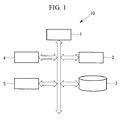
- Fig. 1 is a block diagram showing a schematic configuration of a lightning strike simulation apparatus according to a first embodiment of the present invention.
- a lightning strike simulation apparatus 10 is a computer system (calculator system), which includes a CPU (Central Processing Unit) 1, a main storage device 2 such as RAM (Random Access Memory), a ROM (Read Only Memory), an auxiliary storage device 3 such as an HDD (Hard Disk Drive), an input device 4 such as a keyboard and a mouse, an output device 5 such as a monitor and a printer, and the like.
- the auxiliary storage device 3 stores various programs.
- the CPU 1 loads programs from the auxiliary storage device 3 to the main storage device 2 such as RAM, and executes the programs, thus enabling various processings.
- Fig. 2 is an exploded functional block diagram showing functions of the lightning strike simulation apparatus 10.
- the lightning strike simulation apparatus 10 includes a storage device (storage unit) 11, a setting unit (setting unit) 12, a downward leader advancing unit 13, an upward leader advancing unit 14, and a lightning strike point determining unit 15.
- the storage device 11 stores various data necessary in carrying out lightning strike simulation.
- An example of such data includes lightning data.
- the lightning data is generated based on statistical data of lightning occurred in the nature.
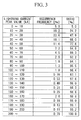
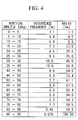
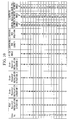
- the lightning data represent a magnitude and a frequency of lightning occurred and a direction in which the lightning is likely to advance. More specifically, the storage device 11 stores a portion of the lightning data that includes: a frequency distribution of lightning electric-current peak value, as shown in Fig. 3 , associated with lightning electric-current peak value (kA), occurrence frequency (%), and ratio (%); and a frequency distribution of an advancing vertical angle of a downward leader as shown in Fig. 4 .
- the setting unit 12 sets three-dimensional coordinates representing a windmill, i.e., a simulation target, and topography around the windmill. Further, the setting unit 12 sets at least one or more lightning strike-receiving candidate points P0 to P8 and one reference point in this simulation space. Further, the setting unit 12 sets a lightning strike start position and a lightning electric-current peak value.
- the lightning strike-receiving candidate point P0 is set as the reference point. However, the reference point may not necessarily be the same as the lightning strike-receiving candidate point.
- the lightning strike-receiving candidate points P0 to P8 and the above three dimensional coordinates representing the windmill and the topography around the windmill may be set based on, for example, three-dimensional data inputted by a user with the input device 4 of Fig. 2 when simulation is performed.
- the above data may be set upon being read from the storage device 11.
- the lightning strike start position and the lightning electric-current peak value may be set using the data inputted by the user with the input device 4 of Fig. 2 , or may be set in a statistical manner using a Monte Carlo method and the like based on the lightning strike data stored in the storage device 11.
- the Monte Carlo method is a calculation method for deriving an approximate solution by repeating simulation using random numbers many times.
- the setting unit 12 sets the lightning electric-current peak value by using the Monte Carlo method based on the frequency distribution of lightning electric-current peak value shown in Fig. 3 .
- the lightning strike start position and the lightning electric-current peak value are set by using the statistical method such as the Monte Carlo method based on statistical data of lightning actually occurred in the nature stored in the storage device 11.
- one of the lightning strike start position and the lightning electric-current peak value may be set using the lightning strike data stored in the storage device 11, and the other thereof may be set based on the data inputted with the input device 4.
- the downward leader advancing unit 13 advances the downward leader from the lightning strike start position set by the setting unit 12.
- the downward leader advancing unit 13 adds weights to occurrence frequencies based on the lightning strike data stored in the storage device 11 such as the frequency distribution of advancing vertical angle of the downward leader shown in Fig. 4 , and advances the downward leader using a probability/statistics theory such as the Monte Carlo method. More specifically, the downward leader advancing unit 13 obtains a step length Ls of the downward leader based on the following equation (1), and determines an advancing vertical angle ⁇ and a progression horizontal angle ⁇ of the downward leader by using a random number based on the frequency distribution of advancing vertical angle of the downward leader as shown in Fig. 4 .
- a and b are constants arbitrarily set, Kl is a correction coefficient arbitrarily set, and I is the lightning electric-current peak value set by the setting unit 12.
- the downward leader advancing unit 13 repeatedly advances the downward leader until a distance between a leading edge of the advanced downward leader and the reference point P0 set in the windmill, i.e., the simulation target, becomes equal to or less than a first threshold value Rs.
- the first threshold value Rs is arbitrarily set.
- the first threshold value Rs may be, for example, inputted by a user with the input device 4, or may be stored as a preset value in the storage device 11 in advance. Alternatively, the first threshold value Rs may be set based on the following equation (2).
- c and d are constants arbitrarily set, Ks is a correction coefficient arbitrarily set, and I is the lightning electric-current peak value set by the setting unit 12.
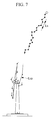
- the upward leader advancing unit 14 advances the upward leaders from the lightning strike-receiving candidate points P0 to P8 set by the setting unit 12 when a distance between the leading edge of the downward leader and the reference point P0 set in the simulation target becomes within the first threshold value Rs (see Fig. 7 ).
- the upward leader advancing unit 14 determines upward leaders that are to be advanced from the lightning strike-receiving candidate points based on the following equation (3).
- the correction coefficient Kup is a value set for each of the lightning strike-receiving candidate points, and reflects the tendency of receiving a lightning strike at the corresponding lightning strike-receiving candidate point. For example, when a lightning strike-receiving candidate point is set on an insulating object, the correction coefficient Kup(i) is set to a relatively low value. When a lightning strike-receiving candidate point is set on a metal object, the correction coefficient Kup(i) is set to a relatively high value. When a lightning strike-receiving candidate point is set on a metal object but is covered by an insulating object, the correction coefficient Kup(i) is set to a relatively low value.
- the accuracy of simulation can be improved by setting the correction coefficient Kup according to the tendency of receiving a lightning strike at each of the lightning strike-receiving candidate points.
- an angular range for example, ⁇ 5 degrees
- the advancing vertical angle ⁇ and the progression horizontal angle ⁇ of the upward leader may be determined for each lightning strike-receiving candidate point, so that the advancing vertical angle ⁇ and the progression horizontal angle ⁇ may be randomly determined within this angular range.
- the frequency distribution of advancing vertical angle of the upward leader may be set in advance for each lightning strike-receiving candidate point through simulation and the like, and the advancing vertical angle ⁇ and the progression horizontal angle ⁇ of the upward leader may be determined by using a random number based on this frequency distribution.
- the upward leader advancing unit 14 repeatedly advances the upward leader until a distance between the leading edge of the downward leader and the leading edge of the upward leader advanced from any one of the lightning strike-receiving candidate points becomes equal to or less than a second threshold value Rth.
- the second threshold value Rth is arbitrarily set.
- the second threshold value Rth may be, for example, set for each lightning strike-receiving candidate point as shown in the following equation (4).
- Ls is the final step length of the downward leader
- Lup(i) is the latest step length of the upward leader advanced from each lightning strike-receiving candidate point.
- the lightning strike point determining unit 15 determines that the lightning strike-receiving candidate point corresponding to that upward leader is a lightning strike position, and outputs the determination result.
- the lightning strike point outputted by the lightning strike point determining unit 15 is displayed on, for example, the output device 5 (see Fig. 2 ) of the lightning strike simulation apparatus 10, and is stored as a simulation result to the auxiliary storage device 3 or an external storage device (not shown).
- the lightning strike point obtained as the simulation result is stored in association with conditions under which this simulation result is obtained, namely, initial condition data set in the current simulation such as coordinate data of the lightning strike-receiving candidate points set by the setting unit 12, the lightning electric-current peak value I, a coordinate value of the lightning strike start position, and coordinate values of the downward leader and the upward leaders, and various data obtained through the processing steps in the current simulation.
- each unit of the above-described lightning strike simulation apparatus 10 will be described with reference to Fig. 9 .
- the below-described various processings performed by each unit shown in Fig. 2 are achieved by causing the CPU 1 shown in Fig. 1 to load a lightning strike simulation program stored in the auxiliary storage device 3 to the main storage device 2 and execute the lightning strike simulation program.
- a windmill is the simulation target is described by way of example.
- the setting unit 12 sets initial conditions (step SA1 of Fig. 9 ). More specifically, three-dimensional coordinates representing a windmill, i.e., a simulation target, and topography around the windmill are set in a three-dimensional simulation space. Further, the lightning strike-receiving candidate points P0 to P8 are set in this simulation space. Further, the lightning strike start position, the lightning electric-current peak value, and the reference point are set.
- the downward leader advancing unit 13 advances the downward leader form the lightning strike start position (step SA2).
- determination is made as to whether a distance L1 between the leading edge of the advanced downward leader and the reference point is equal to or less than the first threshold value Rs (step SA3).
- the program returns to step SA2, so that the downward leader is advanced again.
- the advance of the downward leader is stopped, and the upward leader advancing unit 14 begins to advance the upward leader (step SA4). Therefore, the upward leaders are advanced from the respective lightning strike-receiving candidate point P0 to P8.
- step SA5 Every time the upward leader is advanced from each of the lightning strike-receiving candidate points P0 to P8, determination is made as to whether a distance L2 between the leading edge of each of the advanced upward leaders and the leading edge of the downward leader is equal to or less than the second threshold value Rth (step SA5).
- the program returns to step SA4, and the upward leaders are advanced from the lightning strike-receiving candidate points P0 to P8 again.
- the distance L2 between the leading edge of any one of the advanced upward leaders and the leading edge of the downward leader is determined to be equal to or less than the second threshold value Rth in step SA5
- the advance of the upward leader is stopped
- the lightning strike point determining unit 15 determines that the lightning strike-receiving candidate point corresponding to the upward leader that has reached the second threshold value Rth is the lightning strike point, and outputs the determination result (step SA6).
- the simulation result is displayed on the output device 5 (see Fig. 1 ) such as a display screen, and is stored as a simulation result to the auxiliary storage device 3 or an external storage device.
- Fig. 10 shows an example of simulation calculation result obtained by calculating the simulation result according to the present invention.
- the simulation apparatus, method, and program according to the present invention perform a lightning strike simulation based on the lightning strike data generated based on raw data collected from the nature stored in the storage device 11, thus providing a highly realistic, accurate simulation result.
- the correction coefficient is set for each lightning strike-receiving candidate point, so that the tendency of receiving lightning at the lightning strike-receiving candidate point can be reflected when the upward leader is advanced. Therefore, the tendency for receiving a lightning at each lightning strike-receiving candidate point can be reflected in the simulation result.
- such a lightning strike simulation apparatus may be used in the following case: when lightning rods are arranged only at some of a plurality of lightning strike-receiving candidate points, the above lightning strike simulation is performed under this condition, and the frequencies of lightning strikes (lightning strike-receiving rates) to the lightning strike-receiving candidate points arranged with the lightning rods are determined, so that it is possible to examine whether the arrangement positions of the lightning rods are appropriate or not.
- the above simulation result may be used as input parameters to a well-known optimization method such as a Taguchi method and the like, and the optimization processing may be performed, so that the optimum arrangement positions of lightning rods and the like in a simulation space or on a simulation target can be obtained.
- the lightning strike-receiving candidate points are set only on the windmill serving as the simulation target.
- the lightning strike-receiving candidate points may also be arranged on these structures and land surfaces.
- the windmill serving as the simulation target but also the surrounding area therearound may be considered, so that probabilities of receiving lightning strikes in the surrounding area may also be obtained.
- a lightning rod tower may be constructed in the wind firm instead of arranging a lightning rod to each of the windmills. In this case, conditions of lightning strikes in the entire wind farm may be grasped by setting lightning strike-receiving candidate points on the lightning rod tower and the plurality of windmills installed in the wind firm.
- the tendency of receiving a lightning strike is different according to various factors such as season and topography. Therefore, the factors affecting the tendency of receiving lightning strikes are stored in the storage device 11 in association with lightning strike data.
- a lightning strike simulation apparatus reads from the storage device 11 the lightning strike data associated with the affecting factor corresponding to the condition under which simulation is performed (for example, the season is summer, and the location is X city), and the above simulation is performed using these lightning strike data.
- affecting factors include season, ratio of polarity, lightning discharge duration, multiple-strike lightning occurrence ratio, thundercloud altitude, thundercloud coming direction, ground flash density, and the number of days of thunderstorms in a year.
- the frequency distribution of lightning electric-current peak value as shown in Fig. 3 and the frequency distribution of advancing vertical angle of the downward leader as shown in Fig. 4 are generated for each affecting factor such as season and topography, and are stored in the storage device 11.
- simulation conditions e.g., information identifying affecting factors such as "summer” and "X city”
- the setting unit 12, the downward leader advancing unit 13, and the upward leader advancing unit 14 read the lightning strike data specified by a designated affecting factor from the storage device 11, and use the read lightning strike data to perform the setting processing and advance the downward leader and the upward leaders in the same manner as the above.
- the factor affecting the tendency of receiving lightning strikes are identified based on the simulation conditions, and the lightning strike simulation is performed using only the lightning strike data corresponding to this affecting factor, so that the accuracy of simulation can be further improved.
- the correction coefficient Kup(i) used to advance the upward leaders is optimized by using an optimization calculation method. Specifically, the lightning strike simulation according to the first embodiment is repeated a predetermined number of times, so that a lightning strike-receiving rate at each lightning strike-receiving candidate point is obtained. Then, this lightning strike-receiving rate is given as an initial value of optimization calculation, and a correction coefficient for making the lightning strike rate to be similar to a reference value is obtained for each lightning strike-receiving candidate point. As described above, the correction coefficient is optimized, so that the accuracy of lightning strike simulation can be further improved.
- topography and surrounding environment for example, topography (for example, land and sea), wind condition, altitude, relief of surrounding topography, shape and arrangement of windmill, shape and arrangement of independent lightning rod tower, shapes and arrangements of surrounding structures, blade surface condition of windmill (salt pollution state, water drop adhesion, freezing, and the like), soil resistance, grounding resistances of various facilities.
Landscapes
- Engineering & Computer Science (AREA)
- Physics & Mathematics (AREA)
- Geometry (AREA)
- Theoretical Computer Science (AREA)
- General Physics & Mathematics (AREA)
- Computer Hardware Design (AREA)
- Evolutionary Computation (AREA)
- General Engineering & Computer Science (AREA)
- Structural Engineering (AREA)
- Computational Mathematics (AREA)
- Civil Engineering (AREA)
- Mathematical Analysis (AREA)
- Mathematical Optimization (AREA)
- Pure & Applied Mathematics (AREA)
- Architecture (AREA)
- Management, Administration, Business Operations System, And Electronic Commerce (AREA)
Abstract
Description
- The present invention relates to a lightning strike simulation apparatus.
- Conventionally, a rolling sphere method has been known as a simulation model relating to lightning.
The rolling sphere method is a common lightning shielding model based on an electro-geometric model. A probability of being struck by lightning is derived only from a geometrical shape of an object and a peak value of current, i.e., a parameter of lightning. In the rolling sphere method, a striking distance (distance over which a lightning finally jumps) is uniquely determined from the peak value of current, and any object within a range of the striking distance is considered to be struck by lightning (for example, seePatent Citation 1 below). - Patent Citation 1:
- Japanese Unexamined Patent Publication No.
2005-99942
- Japanese Unexamined Patent Publication No.
- In the above-described rolling sphere method, however, a lightning strike point is estimated based only on an electro-geometric model of a structure. Therefore, there is a problem in that accuracy of lightning strike simulation is low.
- The present invention is made to solve the above problem, and it is an object of the present invention to provide a lightning strike simulation apparatus capable of improving the accuracy of lightning strike simulation.
- In order to solve the above problem, the present invention employs the following solutions.
The present invention provides a lightning strike simulation apparatus including: a storage unit for storing lightning strike data generated based on statistical data of a lightning strike occurred in nature; a setting unit for setting in a simulation space a simulation target, at least one or more lightning strike-receiving candidate points, a reference point, a lightning strike start position, and a lightning electric-current peak value; a downward leader advancing unit for advancing a downward leader from the lightning strike start position set by the setting unit; an upward leader advancing unit for respectively advancing upward leaders from the lightning strike-receiving candidate points set in the simulation space, when a distance between a leading edge of the downward leader and the reference point is within a first threshold value; and a lightning strike point determining unit for, when a distance between the leading edge of the downward leader and a leading edge of any one of the upward leaders is within a second threshold value, determining that a lightning strike-receiving candidate point corresponding to the any one of the upward leaders is a lightning strike point, wherein the downward leader advancing unit and the upward leader advancing unit respectively advance the downward leader and the upward leader based on the lightning strike data stored in the storage unit. - According to the above configuration, the setting unit sets initial conditions such as the simulation target in the simulation space, at least one or more lightning strike-receiving candidate points, the reference point, the lightning strike start position, and the lightning electric-current peak value. After the initial conditions are set, the downward leader advancing unit advances the downward leader from the lightning strike start position. The downward leader is repeatedly advanced, and when the distance between the leading edge of the advanced downward leader and the reference point set by the setting unit is within the first threshold value, advance of the downward leader is stopped. Subsequently, the upward advancing unit respectively advances the upward leaders from the lightning strike-receiving candidate points. Then, when the distance between the leading edge of any one of the upward leaders thus advanced and the leading edge of the downward leader is equal to or less than the second threshold value, the lightning strike-receiving candidate point from which the upward leader is advanced is determined to be a lightning strike point by the determining unit. In this case, the downward leader advancing unit and the upward leader advancing unit respectively advance the downward leader and the upward leader based on the lightning strike data generated based on the statistical data of lightning occurred in the nature stored in the storage unit. Therefore, a highly accurate simulation result reflecting actual lightning strike situations can be obtained.
- In the lightning strike simulation apparatus, the upward leader advancing unit may change advancement of the upward leader in accordance with a tendency of receiving a lightning strike at the lightning strike-receiving candidate point.
- In this manner, a degree of advancement of the upward leader can be changed in accordance with the tendency of receiving a lightning strike at the lightning strike-receiving candidate point (for example, lightning is more likely to strike a metal rather than an insulating object). Therefore, the tendency of actual lightning strikes can be more accurately reflected in the simulation.
For example, the upward leader advancing unit makes a length of the upward leader advanced from a lightning strike-receiving candidate point on a metal material, longer than a length of the upward leader advanced from a lightning strike-receiving candidate point on an insulating material. - In the above lightning strike simulation apparatus, the storage unit stores the lightning strike data in association with an affecting factor that affects the tendency of receiving a lightning strike, and when the setting unit sets a simulation condition, the downward leader and the upward leader may use the lightning strike data corresponding to the simulation condition to respectively advance the downward leader and the upward leader.
- For example, the tendency of receiving a lightning strike is different according to various factors such as season and topography. Therefore, the factors affecting the tendency of receiving lightning strikes are stored in association with the lightning strike data. When simulation is performed, the lightning strike data associated with the affecting factor corresponding to the simulation condition setting (for example, the season is summer, and the location is X city) are extracted from the storage device. Then, the downward leader advancing unit and the upward leader advancing unit respectively advance the downward leader and the upward leader, using the extracted lightning strike data. Accordingly, the lightning strike simulation is performed using only the lightning strike data corresponding to this simulation setting condition, so that the accuracy of lightning strike simulation can be further improved.
- In the above lightning strike simulation apparatus, an example of a simulation target includes a windmill.
- In the above lightning strike simulation apparatus, the setting unit may set the lightning strike start position and the lightning electric-current peak value by using a random number based on the lightning strike data stored in the storage unit.
- Accordingly, the lightning strike start position and the lightning electric-current peak value are set based on the lightning strike data generated from the statistical data of lightning strikes. Therefore, the accuracy of simulation can be further improved.
- The above lightning strike simulation apparatus further includes an input unit, and when the lightning strike-receiving candidate point is inputted from the input unit, the setting unit may set the lightning strike-receiving candidate point based on this input information.
- In this way, the input unit allows a user to set a lightning strike-receiving candidate point at a desired position in a simulation space.
- The present invention provides a lightning strike simulation method including the steps of: setting a simulation target in a simulation space, at least one or more lightning strike-receiving candidate points, a reference point, a lightning strike start position, and a lightning electric-current peak value; advancing a downward leader from the lightning strike start position having been set; respectively advancing upward leaders from the lightning strike-receiving candidate points set in the simulation space when a distance between a leading edge of the downward leader and the reference point is within a first threshold value; and when a distance between the leading edge of the downward leader and a leading edge of any one of the upward leaders is within a second threshold value, determining that a lightning strike-receiving candidate point corresponding to the any one of the upward leaders is a lightning strike point, wherein the downward leader and the upward leader are respectively advanced based on the lightning strike data generated based on statistical data of lightning strike occurred in nature.
- The present invention provides a lightning strike simulation program for causing a computer to execute the processings of: setting a simulation target in a simulation space, at least one or more lightning strike-receiving candidate points, a reference point, a lightning strike start position, and a lightning electric-current peak value; advancing a downward leader from the lightning strike start position based on lightning strike data generated based on statistical data of lightning strike occurred in nature; respectively advancing upward leaders from the lightning strike-receiving candidate points set in the simulation space based on the lightning strike data when a distance between a leading edge of the downward leader and the reference point is within a first threshold value; and when a distance between the leading edge of the downward leader and a leading edge of any one of the upward leaders is within a second threshold value, determining that a lightning strike-receiving candidate point corresponding to the any one of the upward leaders is a lightning strike point.
- The present invention achieves an effect of improving the accuracy of lightning strike simulation.
-
- [
FIG. 1 ] A diagram showing an example of a hardware configuration of a lightning strike simulation apparatus according to an embodiment of the present invention. - [
FIG. 2 ] An exploded block diagram showing functions of the lightning strike simulation apparatus according to the embodiment of the present invention. - [
FIG. 3 ] A table showing an example of frequency distribution of lightning electric-current peak value, which is one of lightning strike data stored in a storage device. - [
FIG. 4 ] A table showing an example of frequency distribution of advancing vertical angle of a downward leader, which is one of the lightning strike data stored in the storage device. - [
FIG. 5 ] An explanatory diagram for illustrating a windmill serving as a simulation target set in a simulation space and a plurality of lightning strike-receiving candidate points set on the windmill structure. - [
FIG. 6 ] A diagram for illustrating a method for advancing the downward leader and a first threshold value. - [
FIG. 7 ] A diagram for illustrating advance of an upward leader. - [
FIG. 8 ] A diagram for illustrating the advance of the upward leader and a second threshold value. - [
FIG. 9 ] A diagram for illustrating a flowchart of a lightning strike simulation method according to the first embodiment of the present invention. - [
FIG. 10 ] A diagram for illustrating an example of simulation calculation result obtained by calculating a simulation result according to the first embodiment of the present invention. -
- 1:
- CPU
- 2:
- Main storage device
- 3:
- Auxiliary storage device
- 4:
- Input device
- 5:
- Output device
- 10:
- Lightning strike simulation apparatus
- 11:
- Storage device
- 12:
- Setting unit
- 13:
- Downward leader advancing unit
- 14:
- Upward leader advancing unit
- 15:
- Lightning strike point determining unit
- Embodiments of a lightning strike simulation apparatus according to the present invention will be hereinafter described with reference to the attached drawings.
-
Fig. 1 is a block diagram showing a schematic configuration of a lightning strike simulation apparatus according to a first embodiment of the present invention.
As shown inFig. 1 , a lightningstrike simulation apparatus 10 according to the present invention is a computer system (calculator system), which includes a CPU (Central Processing Unit) 1, amain storage device 2 such as RAM (Random Access Memory), a ROM (Read Only Memory), anauxiliary storage device 3 such as an HDD (Hard Disk Drive), aninput device 4 such as a keyboard and a mouse, anoutput device 5 such as a monitor and a printer, and the like.
Theauxiliary storage device 3 stores various programs. TheCPU 1 loads programs from theauxiliary storage device 3 to themain storage device 2 such as RAM, and executes the programs, thus enabling various processings. -
Fig. 2 is an exploded functional block diagram showing functions of the lightningstrike simulation apparatus 10. As shown inFig. 2 , the lightningstrike simulation apparatus 10 includes a storage device (storage unit) 11, a setting unit (setting unit) 12, a downwardleader advancing unit 13, an upwardleader advancing unit 14, and a lightning strikepoint determining unit 15. - The
storage device 11 stores various data necessary in carrying out lightning strike simulation. An example of such data includes lightning data. The lightning data is generated based on statistical data of lightning occurred in the nature. For example, the lightning data represent a magnitude and a frequency of lightning occurred and a direction in which the lightning is likely to advance. More specifically, thestorage device 11 stores a portion of the lightning data that includes: a frequency distribution of lightning electric-current peak value, as shown inFig. 3 , associated with lightning electric-current peak value (kA), occurrence frequency (%), and ratio (%); and a frequency distribution of an advancing vertical angle of a downward leader as shown inFig. 4 . - As shown in
Fig. 5 , in a three-dimensional simulation space, the settingunit 12 sets three-dimensional coordinates representing a windmill, i.e., a simulation target, and topography around the windmill. Further, the settingunit 12 sets at least one or more lightning strike-receiving candidate points P0 to P8 and one reference point in this simulation space. Further, the settingunit 12 sets a lightning strike start position and a lightning electric-current peak value.
In the present embodiment, the lightning strike-receiving candidate point P0 is set as the reference point. However, the reference point may not necessarily be the same as the lightning strike-receiving candidate point.
The lightning strike-receiving candidate points P0 to P8 and the above three dimensional coordinates representing the windmill and the topography around the windmill may be set based on, for example, three-dimensional data inputted by a user with theinput device 4 ofFig. 2 when simulation is performed. Alternatively, when the above data is stored in thestorage device 11 in advance, the above data may be set upon being read from thestorage device 11. - The lightning strike start position and the lightning electric-current peak value may be set using the data inputted by the user with the
input device 4 ofFig. 2 , or may be set in a statistical manner using a Monte Carlo method and the like based on the lightning strike data stored in thestorage device 11. For example, the Monte Carlo method is a calculation method for deriving an approximate solution by repeating simulation using random numbers many times. For example, the settingunit 12 sets the lightning electric-current peak value by using the Monte Carlo method based on the frequency distribution of lightning electric-current peak value shown inFig. 3 . As described above, the lightning strike start position and the lightning electric-current peak value are set by using the statistical method such as the Monte Carlo method based on statistical data of lightning actually occurred in the nature stored in thestorage device 11. Consequently, a tendency in the nature can be reflected, and more realistic initial data can be given. Therefore, accuracy of simulation can be further improved.
Alternatively, one of the lightning strike start position and the lightning electric-current peak value may be set using the lightning strike data stored in thestorage device 11, and the other thereof may be set based on the data inputted with theinput device 4. - The downward
leader advancing unit 13 advances the downward leader from the lightning strike start position set by the settingunit 12. The downwardleader advancing unit 13 adds weights to occurrence frequencies based on the lightning strike data stored in thestorage device 11 such as the frequency distribution of advancing vertical angle of the downward leader shown inFig. 4 , and advances the downward leader using a probability/statistics theory such as the Monte Carlo method.
More specifically, the downwardleader advancing unit 13 obtains a step length Ls of the downward leader based on the following equation (1), and determines an advancing vertical angle ϕ and a progression horizontal angle θ of the downward leader by using a random number based on the frequency distribution of advancing vertical angle of the downward leader as shown inFig. 4 . -

- In the equation (1), a and b are constants arbitrarily set, Kl is a correction coefficient arbitrarily set, and I is the lightning electric-current peak value set by the setting
unit 12. As shown inFig. 6 , the downwardleader advancing unit 13 repeatedly advances the downward leader until a distance between a leading edge of the advanced downward leader and the reference point P0 set in the windmill, i.e., the simulation target, becomes equal to or less than a first threshold value Rs.
The first threshold value Rs is arbitrarily set. The first threshold value Rs may be, for example, inputted by a user with theinput device 4, or may be stored as a preset value in thestorage device 11 in advance. Alternatively, the first threshold value Rs may be set based on the following equation (2). -

- In the equation (2), c and d are constants arbitrarily set, Ks is a correction coefficient arbitrarily set, and I is the lightning electric-current peak value set by the setting
unit 12. - The upward
leader advancing unit 14 advances the upward leaders from the lightning strike-receiving candidate points P0 to P8 set by the settingunit 12 when a distance between the leading edge of the downward leader and the reference point P0 set in the simulation target becomes within the first threshold value Rs (seeFig. 7 ).
The upwardleader advancing unit 14 determines upward leaders that are to be advanced from the lightning strike-receiving candidate points based on the following equation (3). -

- In the equation (3), e and g are constants arbitrarily set, I is the lightning electric-current peak value set by the setting
unit 12, and Kup(i) is a correction coefficient for the ith lightning strike-receiving candidate point Pi. In other words, the correction coefficient Kup is a value set for each of the lightning strike-receiving candidate points, and reflects the tendency of receiving a lightning strike at the corresponding lightning strike-receiving candidate point. For example, when a lightning strike-receiving candidate point is set on an insulating object, the correction coefficient Kup(i) is set to a relatively low value. When a lightning strike-receiving candidate point is set on a metal object, the correction coefficient Kup(i) is set to a relatively high value. When a lightning strike-receiving candidate point is set on a metal object but is covered by an insulating object, the correction coefficient Kup(i) is set to a relatively low value. - As described above, the accuracy of simulation can be improved by setting the correction coefficient Kup according to the tendency of receiving a lightning strike at each of the lightning strike-receiving candidate points. For example, an angular range (for example, ±5 degrees) for the advancing vertical angle ϕ and the progression horizontal angle θ of the upward leader may be determined for each lightning strike-receiving candidate point, so that the advancing vertical angle ϕ and the progression horizontal angle θ may be randomly determined within this angular range. Alternatively, similar to the downward leader described above, the frequency distribution of advancing vertical angle of the upward leader may be set in advance for each lightning strike-receiving candidate point through simulation and the like, and the advancing vertical angle ϕ and the progression horizontal angle θ of the upward leader may be determined by using a random number based on this frequency distribution.
- As shown in
Fig. 8 , the upwardleader advancing unit 14 repeatedly advances the upward leader until a distance between the leading edge of the downward leader and the leading edge of the upward leader advanced from any one of the lightning strike-receiving candidate points becomes equal to or less than a second threshold value Rth.
The second threshold value Rth is arbitrarily set. The second threshold value Rth may be, for example, set for each lightning strike-receiving candidate point as shown in the following equation (4). -

- In this case, Ls is the final step length of the downward leader, and Lup(i) is the latest step length of the upward leader advanced from each lightning strike-receiving candidate point.
- When a distance between the leading edge of the upward leader advanced by the upward
leader advancing unit 14 and the leading edge of the downward leader becomes equal to or less than the second threshold value Rth, the lightning strikepoint determining unit 15 determines that the lightning strike-receiving candidate point corresponding to that upward leader is a lightning strike position, and outputs the determination result. - The lightning strike point outputted by the lightning strike
point determining unit 15 is displayed on, for example, the output device 5 (seeFig. 2 ) of the lightningstrike simulation apparatus 10, and is stored as a simulation result to theauxiliary storage device 3 or an external storage device (not shown). At this time, the lightning strike point obtained as the simulation result is stored in association with conditions under which this simulation result is obtained, namely, initial condition data set in the current simulation such as coordinate data of the lightning strike-receiving candidate points set by the settingunit 12, the lightning electric-current peak value I, a coordinate value of the lightning strike start position, and coordinate values of the downward leader and the upward leaders, and various data obtained through the processing steps in the current simulation. - Subsequently, the processings executed by each unit of the above-described lightning
strike simulation apparatus 10 will be described with reference toFig. 9 . It should be noted that the below-described various processings performed by each unit shown inFig. 2 are achieved by causing theCPU 1 shown inFig. 1 to load a lightning strike simulation program stored in theauxiliary storage device 3 to themain storage device 2 and execute the lightning strike simulation program.
In the present embodiment, as described above, a case where a windmill is the simulation target is described by way of example. - First, the setting
unit 12 sets initial conditions (step SA1 ofFig. 9 ). More specifically, three-dimensional coordinates representing a windmill, i.e., a simulation target, and topography around the windmill are set in a three-dimensional simulation space. Further, the lightning strike-receiving candidate points P0 to P8 are set in this simulation space. Further, the lightning strike start position, the lightning electric-current peak value, and the reference point are set. - When the initial conditions are set, the downward
leader advancing unit 13 advances the downward leader form the lightning strike start position (step SA2). On every advance of the downward leader, determination is made as to whether a distance L1 between the leading edge of the advanced downward leader and the reference point is equal to or less than the first threshold value Rs (step SA3). When the distance L1 is determined to be larger than the first threshold value Rs, the program returns to step SA2, so that the downward leader is advanced again. On the other hand, when the distance L1 between the leading edge of the advanced downward leader and the reference point is determined to be equal to or less than the first threshold value Rs in step SA3, the advance of the downward leader is stopped, and the upwardleader advancing unit 14 begins to advance the upward leader (step SA4). Therefore, the upward leaders are advanced from the respective lightning strike-receiving candidate point P0 to P8. - Every time the upward leader is advanced from each of the lightning strike-receiving candidate points P0 to P8, determination is made as to whether a distance L2 between the leading edge of each of the advanced upward leaders and the leading edge of the downward leader is equal to or less than the second threshold value Rth (step SA5). When the distance L2 is determined to be larger than the second threshold value Rth at each of the lightning strike-receiving candidate points, the program returns to step SA4, and the upward leaders are advanced from the lightning strike-receiving candidate points P0 to P8 again. On the other hand, the distance L2 between the leading edge of any one of the advanced upward leaders and the leading edge of the downward leader is determined to be equal to or less than the second threshold value Rth in step SA5, the advance of the upward leader is stopped, and the lightning strike
point determining unit 15 determines that the lightning strike-receiving candidate point corresponding to the upward leader that has reached the second threshold value Rth is the lightning strike point, and outputs the determination result (step SA6). As a result, the simulation result is displayed on the output device 5 (seeFig. 1 ) such as a display screen, and is stored as a simulation result to theauxiliary storage device 3 or an external storage device.Fig. 10 shows an example of simulation calculation result obtained by calculating the simulation result according to the present invention. - As described above, the simulation apparatus, method, and program according to the present invention perform a lightning strike simulation based on the lightning strike data generated based on raw data collected from the nature stored in the
storage device 11, thus providing a highly realistic, accurate simulation result. Further, the correction coefficient is set for each lightning strike-receiving candidate point, so that the tendency of receiving lightning at the lightning strike-receiving candidate point can be reflected when the upward leader is advanced. Therefore, the tendency for receiving a lightning at each lightning strike-receiving candidate point can be reflected in the simulation result. - For example, such a lightning strike simulation apparatus according to the present invention may be used in the following case: when lightning rods are arranged only at some of a plurality of lightning strike-receiving candidate points, the above lightning strike simulation is performed under this condition, and the frequencies of lightning strikes (lightning strike-receiving rates) to the lightning strike-receiving candidate points arranged with the lightning rods are determined, so that it is possible to examine whether the arrangement positions of the lightning rods are appropriate or not.
In addition, the above simulation result may be used as input parameters to a well-known optimization method such as a Taguchi method and the like, and the optimization processing may be performed, so that the optimum arrangement positions of lightning rods and the like in a simulation space or on a simulation target can be obtained. - In the present embodiment, the lightning strike-receiving candidate points are set only on the windmill serving as the simulation target. Alternatively, when topographic features and structures are arranged around the simulation target in the simulation space, the lightning strike-receiving candidate points may also be arranged on these structures and land surfaces. In this way, not only the windmill serving as the simulation target but also the surrounding area therearound may be considered, so that probabilities of receiving lightning strikes in the surrounding area may also be obtained.
Especially, in a case of a wind firm in which a plurality of windmills are arranged in a certain region, a lightning rod tower may be constructed in the wind firm instead of arranging a lightning rod to each of the windmills. In this case, conditions of lightning strikes in the entire wind farm may be grasped by setting lightning strike-receiving candidate points on the lightning rod tower and the plurality of windmills installed in the wind firm. - Subsequently, a second embodiment according to the present invention will be described.
For example, the tendency of receiving a lightning strike is different according to various factors such as season and topography. Therefore, the factors affecting the tendency of receiving lightning strikes are stored in thestorage device 11 in association with lightning strike data. When simulation is performed, a lightning strike simulation apparatus reads from thestorage device 11 the lightning strike data associated with the affecting factor corresponding to the condition under which simulation is performed (for example, the season is summer, and the location is X city), and the above simulation is performed using these lightning strike data. Examples of affecting factors include season, ratio of polarity, lightning discharge duration, multiple-strike lightning occurrence ratio, thundercloud altitude, thundercloud coming direction, ground flash density, and the number of days of thunderstorms in a year. - Specifically, the frequency distribution of lightning electric-current peak value as shown in
Fig. 3 and the frequency distribution of advancing vertical angle of the downward leader as shown inFig. 4 are generated for each affecting factor such as season and topography, and are stored in thestorage device 11. When simulation conditions, e.g., information identifying affecting factors such as "summer" and "X city", are inputted from the input device 4 (seeFig. 2 ) at the start of simulation, the settingunit 12, the downwardleader advancing unit 13, and the upwardleader advancing unit 14 read the lightning strike data specified by a designated affecting factor from thestorage device 11, and use the read lightning strike data to perform the setting processing and advance the downward leader and the upward leaders in the same manner as the above. - As described above, the factor affecting the tendency of receiving lightning strikes are identified based on the simulation conditions, and the lightning strike simulation is performed using only the lightning strike data corresponding to this affecting factor, so that the accuracy of simulation can be further improved.
- Subsequently, the lightning strike simulation apparatus according to a third embodiment of the present invention will be described.
In the present embodiment, the correction coefficient Kup(i) used to advance the upward leaders is optimized by using an optimization calculation method.
Specifically, the lightning strike simulation according to the first embodiment is repeated a predetermined number of times, so that a lightning strike-receiving rate at each lightning strike-receiving candidate point is obtained. Then, this lightning strike-receiving rate is given as an initial value of optimization calculation, and a correction coefficient for making the lightning strike rate to be similar to a reference value is obtained for each lightning strike-receiving candidate point. As described above, the correction coefficient is optimized, so that the accuracy of lightning strike simulation can be further improved. - When the optimization calculation is performed, it is preferable to give factors affecting the tendency of receiving a lightning strike such as topography and surrounding environment, for example, topography (for example, land and sea), wind condition, altitude, relief of surrounding topography, shape and arrangement of windmill, shape and arrangement of independent lightning rod tower, shapes and arrangements of surrounding structures, blade surface condition of windmill (salt pollution state, water drop adhesion, freezing, and the like), soil resistance, grounding resistances of various facilities.
- The embodiments according to the present invention has been described above in detail with reference to the drawings, but the specific configuration is not limited to the above embodiments. It is to be understood that design changes within the scope of the gist of the present invention are also included.
Claims (8)
- A lightning strike simulation apparatus comprising:a storage unit for storing lightning strike data generated based on statistical data of a lightning strike occurred in nature;a setting unit for setting in a simulation space a simulation target, at least one or more lightning strike-receiving candidate points, a reference point, a lightning strike start position, and a lightning electric-current peak value;a downward leader advancing unit for advancing a downward leader from the lightning strike start position set by the setting unit;an upward leader advancing unit for respectively advancing upward leaders from the lightning strike-receiving candidate points set in the simulation space, when a distance between a leading edge of the downward leader and the reference point is within a first threshold value; anda lightning strike point determining unit for, when a distance between the leading edge of the downward leader and a leading edge of any one of the upward leaders is within a second threshold value, determining that a lightning strike-receiving candidate point corresponding to the any one of the upward leaders is a lightning strike point,wherein the downward leader advancing unit and the upward leader advancing unit respectively advance the downward leader and the upward leader based on the lightning strike data stored in the storage unit.
- The lightning strike simulation apparatus according to claim 1, wherein the upward leader advancing unit changes advancement of the upward leader in accordance with a tendency of receiving a lightning strike at the lightning strike-receiving candidate point.
- The lightning strike simulation apparatus according to claim 1 or 2, wherein the storage unit stores the lightning strike data in association with an affecting factor that affects the tendency of receiving a lightning strike, and
wherein when the setting unit sets a simulation condition, the downward leader and the upward leader use the lightning strike data corresponding to the simulation condition to respectively advance the downward leader and the upward leader. - The lightning strike simulation apparatus according to any of claims 1 to 3, wherein at least one windmill is set as a simulation target in the simulation space.
- The lightning strike simulation apparatus according to any of claims 1 to 4, wherein the setting unit sets the lightning strike start position and the lightning electric-current peak value by using a random number based on the lightning strike data stored in the storage unit.
- The lightning strike simulation apparatus according to any of claims 1 to 5 further comprising an input unit,
wherein when the lightning strike-receiving candidate point is inputted from the input unit, the setting unit sets the lightning strike-receiving candidate point based on this input information. - A lightning strike simulation method comprising the steps of:setting a simulation target in a simulation space, at least one or more lightning strike-receiving candidate points, a reference point, a lightning strike start position, and a lightning electric-current peak value;advancing a downward leader from the lightning strike start position having been set;respectively advancing upward leaders from the lightning strike-receiving candidate points set in the simulation space, when a distance between a leading edge of the downward leader and the reference point is within a first threshold value; andwhen a distance between the leading edge of the downward leader and a leading edge of any one of the upward leaders is within a second threshold value, determining that a lightning strike-receiving candidate point corresponding to the any one of the upward leaders is a lightning strike point,wherein the downward leader and the upward leader are respectively advanced based on lightning strike data generated based on statistical data of lightning strike occurred in nature.
- A lightning strike simulation program for causing a computer to execute the processings of:setting a simulation target in a simulation space, at least one or more lightning strike-receiving candidate points, a reference point, a lightning strike start position, and a lightning electric-current peak value;advancing a downward leader from the lightning strike start position, based on lightning strike data generated based on statistical data of lightning strike occurred in nature;respectively advancing upward leaders from the lightning strike-receiving candidate points set in the simulation space based on the lightning strike data, when a distance between a leading edge of the downward leader and the reference point is within a first threshold value; andwhen a distance between the leading edge of the downward leader and a leading edge of any one of the upward leaders is within a second threshold value, determining that a lightning strike-receiving candidate point corresponding to the any one of the upward leaders is a lightning strike point.
Applications Claiming Priority (2)
| Application Number | Priority Date | Filing Date | Title |
|---|---|---|---|
| JP2008076548A JP5072678B2 (en) | 2008-03-24 | 2008-03-24 | Lightning strike simulation apparatus, method and program |
| PCT/JP2008/062793 WO2009118921A1 (en) | 2008-03-24 | 2008-07-16 | Lightning simulation device, its method, and program |
Publications (2)
| Publication Number | Publication Date |
|---|---|
| EP2259094A1 true EP2259094A1 (en) | 2010-12-08 |
| EP2259094A4 EP2259094A4 (en) | 2013-05-29 |
Family
ID=41113146
Family Applications (1)
| Application Number | Title | Priority Date | Filing Date |
|---|---|---|---|
| EP08791188.9A Withdrawn EP2259094A4 (en) | 2008-03-24 | 2008-07-16 | ILLUMINATION SIMULATION DEVICE, ITS METHOD, AND PROGRAM |
Country Status (10)
| Country | Link |
|---|---|
| US (1) | US8428878B2 (en) |
| EP (1) | EP2259094A4 (en) |
| JP (1) | JP5072678B2 (en) |
| KR (1) | KR101162839B1 (en) |
| CN (1) | CN101784913B (en) |
| AU (1) | AU2008353645A1 (en) |
| BR (1) | BRPI0816301A2 (en) |
| CA (1) | CA2696815A1 (en) |
| TW (1) | TWI396095B (en) |
| WO (1) | WO2009118921A1 (en) |
Families Citing this family (6)
| Publication number | Priority date | Publication date | Assignee | Title |
|---|---|---|---|---|
| EP2226497A1 (en) * | 2009-03-06 | 2010-09-08 | Lm Glasfiber A/S | Wind turbine blade with a lightning protection system |
| CN107729680B (en) * | 2017-11-03 | 2021-01-05 | 华北电力大学 | Method for evaluating lightning stroke probability of fan blade |
| CN109344356B (en) * | 2018-10-11 | 2023-06-06 | 中国人民解放军63921部队 | Method for determining direct lightning protection efficiency of high-magnitude lightning protection system |
| CN114906491A (en) * | 2021-02-08 | 2022-08-16 | 中国石油化工股份有限公司 | Direct lightning protection device and arrangement method thereof |
| CN115017732B (en) * | 2022-06-29 | 2025-06-10 | 广东电网有限责任公司 | Lightning protection analysis simulation step length calculation method, device, equipment and medium |
| CN116838549B (en) * | 2023-06-21 | 2025-10-31 | 国网福建省电力有限公司电力科学研究院 | Lightning stroke distance formula correction method and system for rotary fan |
Family Cites Families (17)
| Publication number | Priority date | Publication date | Assignee | Title |
|---|---|---|---|---|
| IT1210093B (en) * | 1984-03-28 | 1989-09-06 | Ispe Di Erminio Giana E C Sas | DEVICE FOR THE PROTECTION OF BUILDING STRUCTURES OR SIMILAR FROM LIGHTNING |
| US5036334A (en) * | 1990-02-08 | 1991-07-30 | The Research Foundation Of State University Of New York | Lightning direction finder controller (LDFC) |
| JP2678852B2 (en) | 1992-02-06 | 1997-11-19 | 北陸電力株式会社 | Lightning strike location device |
| JP3569053B2 (en) | 1995-09-18 | 2004-09-22 | 中部電力株式会社 | Ground potential detection display |
| SG105003A1 (en) * | 2002-04-15 | 2004-07-30 | Andrew Corp | Surge lightning protection device |
| JP3689416B2 (en) | 2003-09-22 | 2005-08-31 | 大阪避雷針工業株式会社 | Lightning protection simulation system, lightning protection simulation method, and lightning protection simulation program |
| FR2874757B1 (en) * | 2004-09-02 | 2006-11-10 | Helita Soc Par Actions Simplif | METHOD FOR EVALUATING THE EXTENT OF THE PROTECTIVE ZONE CONFERRED BY A LIGHTNING CAPTURE DEVICE |
| JP4649202B2 (en) | 2004-12-27 | 2011-03-09 | 中国電力株式会社 | Lightning loss compensation amount calculation system, apparatus, and method |
| US8010289B1 (en) * | 2005-07-19 | 2011-08-30 | Avidyne Corporation | Method and apparatus for detecting and processing lightning |
| CA2577974C (en) * | 2005-11-23 | 2008-04-22 | Farouk A.M. Rizk | Lightning protection device: wet/dry glow-based streamer inhibitor |
| TWI303718B (en) * | 2006-05-18 | 2008-12-01 | Univ Nat Kaohsiung Marine | A data visualization system and methods for monitoring lightning on electric power networks |
| US20100006312A1 (en) * | 2006-10-04 | 2010-01-14 | Rizk Farouk A M | Lightning protection device for a wind turbine blade: wet/dry glow-based streamer inhibitor |
| US20080095624A1 (en) * | 2006-10-19 | 2008-04-24 | Bastian Lewke | Lightning protection of wind turbines |
| CN101611655B (en) * | 2006-10-24 | 2013-01-02 | 法鲁克·A·M·里兹克 | Lightning protection device: wet/dry field sensitive lightning rod |
| US7970542B2 (en) * | 2007-04-17 | 2011-06-28 | Toa Systems, Inc. | Method of detecting, locating, and classifying lightning |
| JP5225622B2 (en) * | 2007-06-29 | 2013-07-03 | トキコテクノ株式会社 | Underground tank leak inspection system |
| US20090240434A1 (en) * | 2008-03-20 | 2009-09-24 | Nokia Corporation | Lightning detection |
-
2008
- 2008-03-24 JP JP2008076548A patent/JP5072678B2/en not_active Expired - Fee Related
- 2008-06-24 TW TW097123552A patent/TWI396095B/en not_active IP Right Cessation
- 2008-07-16 WO PCT/JP2008/062793 patent/WO2009118921A1/en not_active Ceased
- 2008-07-16 KR KR1020107003684A patent/KR101162839B1/en not_active Expired - Fee Related
- 2008-07-16 EP EP08791188.9A patent/EP2259094A4/en not_active Withdrawn
- 2008-07-16 AU AU2008353645A patent/AU2008353645A1/en not_active Abandoned
- 2008-07-16 BR BRPI0816301 patent/BRPI0816301A2/en not_active IP Right Cessation
- 2008-07-16 US US12/674,434 patent/US8428878B2/en not_active Expired - Fee Related
- 2008-07-16 CA CA2696815A patent/CA2696815A1/en not_active Abandoned
- 2008-07-16 CN CN2008801038634A patent/CN101784913B/en not_active Expired - Fee Related
Non-Patent Citations (4)
| Title |
|---|
| DELLERA L ET AL: "LIGHTNING STROKE SIMULATION BY MEANS OF THE LEADER PROGRESSION MODEL. \PART I: DESCRIPTION OF THE MODEL AND EVALUATION OF EXPOSURE OF FREE-STANDING STRUCTURES", IEEE TRANSACTIONS ON POWER DELIVERY, IEEE SERVICE CENTER, NEW YORK, NY, US, vol. 5, no. 4, 1 October 1990 (1990-10-01) , pages 2009-2022, XP000171151, ISSN: 0885-8977, DOI: 10.1109/61.103696 * |
| RYUJI IWASHITA ET AL: "the effect of lightning tower built for lightning attraction deparately from wind", INSTITUTE OF ELECTRICAL ENGINEERS OF JAPAN KENKYU SHIRYO, XX, XX, vol. ED-05, no. 134-142, 1 November 2005 (2005-11-01), pages 7-10, XP008129872, * |
| See also references of WO2009118921A1 * |
| ZHENGLONG JIANG ET AL: "Simulation model of lightning stroke to a transmission line considering the leader propagation randomicity", POWER ENGINEERING CONFERENCE, 2007. IPEC 2007. INTERNATIONAL, IEEE, PISCATAWAY, NJ, USA, 3 December 2007 (2007-12-03), pages 1282-1286, XP031264302, ISBN: 978-981-05-9423-7 * |
Also Published As
| Publication number | Publication date |
|---|---|
| CN101784913A (en) | 2010-07-21 |
| TW200939037A (en) | 2009-09-16 |
| EP2259094A4 (en) | 2013-05-29 |
| BRPI0816301A2 (en) | 2015-03-17 |
| JP5072678B2 (en) | 2012-11-14 |
| CN101784913B (en) | 2013-05-22 |
| US8428878B2 (en) | 2013-04-23 |
| TWI396095B (en) | 2013-05-11 |
| KR101162839B1 (en) | 2012-07-06 |
| KR20100044224A (en) | 2010-04-29 |
| US20110246074A1 (en) | 2011-10-06 |
| CA2696815A1 (en) | 2009-10-01 |
| WO2009118921A1 (en) | 2009-10-01 |
| JP2009229309A (en) | 2009-10-08 |
| AU2008353645A1 (en) | 2009-10-01 |
Similar Documents
| Publication | Publication Date | Title |
|---|---|---|
| Aksoy et al. | A multicase comparative assessment of the ensemble Kalman filter for assimilation of radar observations. Part II: Short-range ensemble forecasts | |
| Aksoy et al. | A multicase comparative assessment of the ensemble Kalman filter for assimilation of radar observations. Part I: Storm-scale analyses | |
| Weisse et al. | Northeast Atlantic and North Sea storminess as simulated by a regional climate model during 1958–2001 and comparison with observations | |
| Feddersen et al. | A method for statistical downscaling of seasonal ensemble predictions | |
| Sokol et al. | Areal distribution and precipitation–altitude relationship of heavy short-term precipitation in the Czech Republic in the warm part of the year | |
| US8428878B2 (en) | Lightning strike simulation apparatus, method thereof, and program | |
| Dong et al. | Assimilation of radial velocity and reflectivity data from coastal WSR‐88D radars using an ensemble Kalman filter for the analysis and forecast of landfalling hurricane Ike (2008) | |
| Horn et al. | A new combination of conditional environmental distributions | |
| Clerc et al. | A systematic method for quantifying wind flow modelling uncertainty in wind resource assessment | |
| De Winter et al. | Impact of asymmetric uncertainties in ice sheet dynamics on regional sea level projections | |
| Elfarra et al. | Estimation of electricity cost of wind energy using Monte Carlo simulations based on nonparametric and parametric probability density functions | |
| Venäläinen et al. | Estimation of the high-spatial-resolution variability in extreme wind speeds for forestry applications | |
| JP5429493B2 (en) | Investment plan evaluation method for rainfall observation facilities | |
| CN114266796A (en) | Method, device, medium and product for automatically acquiring natural shoreline based on laser point cloud data and average large-tide high-tide surface | |
| US12092789B2 (en) | Calculating a return period wind speed | |
| Maciel-Tiburcio et al. | Evaluating bias correction methods for wind power estimation using numerical meteorological models | |
| CN108399507B (en) | Typhoon disaster influence assessment method and device | |
| Pop et al. | A new method for estimating maximum wind gust speed with a given return period and a high areal resolution | |
| Raupach et al. | Object-based analysis of simulated thunderstorms in Switzerland: application and validation of automated thunderstorm tracking on simulation data | |
| Keller et al. | A new non-Gaussian evaluation method for ensemble forecasts based on analysis rank histograms | |
| CN117780569A (en) | Risk identification method and device for wind turbine hub height | |
| Hamid et al. | Rainfall projection using CIMP6 models of extreme area in Johor | |
| Frysinger et al. | A statistical sea-breeze prediction algorithm for Charleston, South Carolina | |
| CN113177702B (en) | Meteorological input data matching method and system | |
| De Lannoy et al. | Characteristics of rainstorms over a temperate region derived from multiple time series of weather radar images |
Legal Events
| Date | Code | Title | Description |
|---|---|---|---|
| PUAI | Public reference made under article 153(3) epc to a published international application that has entered the european phase |
Free format text: ORIGINAL CODE: 0009012 |
|
| 17P | Request for examination filed |
Effective date: 20100219 |
|
| AK | Designated contracting states |
Kind code of ref document: A1 Designated state(s): AT BE BG CH CY CZ DE DK EE ES FI FR GB GR HR HU IE IS IT LI LT LU LV MC MT NL NO PL PT RO SE SI SK TR |
|
| AX | Request for extension of the european patent |
Extension state: AL BA MK RS |
|
| DAX | Request for extension of the european patent (deleted) | ||
| A4 | Supplementary search report drawn up and despatched |
Effective date: 20130426 |
|
| RIC1 | Information provided on ipc code assigned before grant |
Ipc: G06F 17/50 20060101AFI20130422BHEP Ipc: G01W 1/16 20060101ALI20130422BHEP |
|
| 17Q | First examination report despatched |
Effective date: 20140319 |
|
| STAA | Information on the status of an ep patent application or granted ep patent |
Free format text: STATUS: THE APPLICATION IS DEEMED TO BE WITHDRAWN |
|
| 18D | Application deemed to be withdrawn |
Effective date: 20160202 |