EP2258477A1 - Catalyst and reaction process - Google Patents
Catalyst and reaction process Download PDFInfo
- Publication number
- EP2258477A1 EP2258477A1 EP09705661A EP09705661A EP2258477A1 EP 2258477 A1 EP2258477 A1 EP 2258477A1 EP 09705661 A EP09705661 A EP 09705661A EP 09705661 A EP09705661 A EP 09705661A EP 2258477 A1 EP2258477 A1 EP 2258477A1
- Authority
- EP
- European Patent Office
- Prior art keywords
- group
- general formula
- compound represented
- tms
- nmr
- Prior art date
- Legal status (The legal status is an assumption and is not a legal conclusion. Google has not performed a legal analysis and makes no representation as to the accuracy of the status listed.)
- Granted
Links
- 0 C*CC(C1)C1=C1[C@](C2C3)C2C3C1 Chemical compound C*CC(C1)C1=C1[C@](C2C3)C2C3C1 0.000 description 3
- WPYFLLVIJZOFFC-MUUNZHRXSA-N O=C(C[C@@H](C(C(OCc1ccccc1)=O)C(OCc1ccccc1)=O)c1ccccc1)c1ccccc1 Chemical compound O=C(C[C@@H](C(C(OCc1ccccc1)=O)C(OCc1ccccc1)=O)c1ccccc1)c1ccccc1 WPYFLLVIJZOFFC-MUUNZHRXSA-N 0.000 description 1
Classifications
-
- C—CHEMISTRY; METALLURGY
- C07—ORGANIC CHEMISTRY
- C07C—ACYCLIC OR CARBOCYCLIC COMPOUNDS
- C07C311/00—Amides of sulfonic acids, i.e. compounds having singly-bound oxygen atoms of sulfo groups replaced by nitrogen atoms, not being part of nitro or nitroso groups
- C07C311/15—Sulfonamides having sulfur atoms of sulfonamide groups bound to carbon atoms of six-membered aromatic rings
- C07C311/16—Sulfonamides having sulfur atoms of sulfonamide groups bound to carbon atoms of six-membered aromatic rings having the nitrogen atom of at least one of the sulfonamide groups bound to hydrogen atoms or to an acyclic carbon atom
-
- B—PERFORMING OPERATIONS; TRANSPORTING
- B01—PHYSICAL OR CHEMICAL PROCESSES OR APPARATUS IN GENERAL
- B01J—CHEMICAL OR PHYSICAL PROCESSES, e.g. CATALYSIS OR COLLOID CHEMISTRY; THEIR RELEVANT APPARATUS
- B01J31/00—Catalysts comprising hydrides, coordination complexes or organic compounds
- B01J31/16—Catalysts comprising hydrides, coordination complexes or organic compounds containing coordination complexes
- B01J31/18—Catalysts comprising hydrides, coordination complexes or organic compounds containing coordination complexes containing nitrogen, phosphorus, arsenic or antimony as complexing atoms, e.g. in pyridine ligands, or in resonance therewith, e.g. in isocyanide ligands C=N-R or as complexed central atoms
- B01J31/1805—Catalysts comprising hydrides, coordination complexes or organic compounds containing coordination complexes containing nitrogen, phosphorus, arsenic or antimony as complexing atoms, e.g. in pyridine ligands, or in resonance therewith, e.g. in isocyanide ligands C=N-R or as complexed central atoms the ligands containing nitrogen
-
- C—CHEMISTRY; METALLURGY
- C07—ORGANIC CHEMISTRY
- C07B—GENERAL METHODS OF ORGANIC CHEMISTRY; APPARATUS THEREFOR
- C07B53/00—Asymmetric syntheses
-
- C—CHEMISTRY; METALLURGY
- C07—ORGANIC CHEMISTRY
- C07C—ACYCLIC OR CARBOCYCLIC COMPOUNDS
- C07C201/00—Preparation of esters of nitric or nitrous acid or of compounds containing nitro or nitroso groups bound to a carbon skeleton
- C07C201/06—Preparation of nitro compounds
- C07C201/12—Preparation of nitro compounds by reactions not involving the formation of nitro groups
-
- C—CHEMISTRY; METALLURGY
- C07—ORGANIC CHEMISTRY
- C07C—ACYCLIC OR CARBOCYCLIC COMPOUNDS
- C07C67/00—Preparation of carboxylic acid esters
- C07C67/30—Preparation of carboxylic acid esters by modifying the acid moiety of the ester, such modification not being an introduction of an ester group
- C07C67/333—Preparation of carboxylic acid esters by modifying the acid moiety of the ester, such modification not being an introduction of an ester group by isomerisation; by change of size of the carbon skeleton
- C07C67/343—Preparation of carboxylic acid esters by modifying the acid moiety of the ester, such modification not being an introduction of an ester group by isomerisation; by change of size of the carbon skeleton by increase in the number of carbon atoms
- C07C67/347—Preparation of carboxylic acid esters by modifying the acid moiety of the ester, such modification not being an introduction of an ester group by isomerisation; by change of size of the carbon skeleton by increase in the number of carbon atoms by addition to unsaturated carbon-to-carbon bonds
-
- C—CHEMISTRY; METALLURGY
- C07—ORGANIC CHEMISTRY
- C07D—HETEROCYCLIC COMPOUNDS
- C07D207/00—Heterocyclic compounds containing five-membered rings not condensed with other rings, with one nitrogen atom as the only ring hetero atom
- C07D207/02—Heterocyclic compounds containing five-membered rings not condensed with other rings, with one nitrogen atom as the only ring hetero atom with only hydrogen or carbon atoms directly attached to the ring nitrogen atom
- C07D207/30—Heterocyclic compounds containing five-membered rings not condensed with other rings, with one nitrogen atom as the only ring hetero atom with only hydrogen or carbon atoms directly attached to the ring nitrogen atom having two double bonds between ring members or between ring members and non-ring members
- C07D207/32—Heterocyclic compounds containing five-membered rings not condensed with other rings, with one nitrogen atom as the only ring hetero atom with only hydrogen or carbon atoms directly attached to the ring nitrogen atom having two double bonds between ring members or between ring members and non-ring members with only hydrogen atoms, hydrocarbon or substituted hydrocarbon radicals, directly attached to ring carbon atoms
- C07D207/325—Heterocyclic compounds containing five-membered rings not condensed with other rings, with one nitrogen atom as the only ring hetero atom with only hydrogen or carbon atoms directly attached to the ring nitrogen atom having two double bonds between ring members or between ring members and non-ring members with only hydrogen atoms, hydrocarbon or substituted hydrocarbon radicals, directly attached to ring carbon atoms with substituted hydrocarbon radicals directly attached to the ring nitrogen atom
-
- C—CHEMISTRY; METALLURGY
- C07—ORGANIC CHEMISTRY
- C07D—HETEROCYCLIC COMPOUNDS
- C07D307/00—Heterocyclic compounds containing five-membered rings having one oxygen atom as the only ring hetero atom
- C07D307/02—Heterocyclic compounds containing five-membered rings having one oxygen atom as the only ring hetero atom not condensed with other rings
- C07D307/34—Heterocyclic compounds containing five-membered rings having one oxygen atom as the only ring hetero atom not condensed with other rings having two or three double bonds between ring members or between ring members and non-ring members
- C07D307/38—Heterocyclic compounds containing five-membered rings having one oxygen atom as the only ring hetero atom not condensed with other rings having two or three double bonds between ring members or between ring members and non-ring members with substituted hydrocarbon radicals attached to ring carbon atoms
- C07D307/54—Radicals substituted by carbon atoms having three bonds to hetero atoms with at the most one bond to halogen, e.g. ester or nitrile radicals
-
- C—CHEMISTRY; METALLURGY
- C07—ORGANIC CHEMISTRY
- C07D—HETEROCYCLIC COMPOUNDS
- C07D333/00—Heterocyclic compounds containing five-membered rings having one sulfur atom as the only ring hetero atom
- C07D333/02—Heterocyclic compounds containing five-membered rings having one sulfur atom as the only ring hetero atom not condensed with other rings
- C07D333/04—Heterocyclic compounds containing five-membered rings having one sulfur atom as the only ring hetero atom not condensed with other rings not substituted on the ring sulphur atom
- C07D333/06—Heterocyclic compounds containing five-membered rings having one sulfur atom as the only ring hetero atom not condensed with other rings not substituted on the ring sulphur atom with only hydrogen atoms, hydrocarbon or substituted hydrocarbon radicals, directly attached to the ring carbon atoms
- C07D333/24—Radicals substituted by carbon atoms having three bonds to hetero atoms with at the most one bond to halogen, e.g. ester or nitrile radicals
-
- B—PERFORMING OPERATIONS; TRANSPORTING
- B01—PHYSICAL OR CHEMICAL PROCESSES OR APPARATUS IN GENERAL
- B01J—CHEMICAL OR PHYSICAL PROCESSES, e.g. CATALYSIS OR COLLOID CHEMISTRY; THEIR RELEVANT APPARATUS
- B01J2231/00—Catalytic reactions performed with catalysts classified in B01J31/00
- B01J2231/30—Addition reactions at carbon centres, i.e. to either C-C or C-X multiple bonds
- B01J2231/34—Other additions, e.g. Monsanto-type carbonylations, addition to 1,2-C=X or 1,2-C-X triplebonds, additions to 1,4-C=C-C=X or 1,4-C=-C-X triple bonds with X, e.g. O, S, NH/N
- B01J2231/348—1,4-additions, e.g. conjugate additions
-
- B—PERFORMING OPERATIONS; TRANSPORTING
- B01—PHYSICAL OR CHEMICAL PROCESSES OR APPARATUS IN GENERAL
- B01J—CHEMICAL OR PHYSICAL PROCESSES, e.g. CATALYSIS OR COLLOID CHEMISTRY; THEIR RELEVANT APPARATUS
- B01J2531/00—Additional information regarding catalytic systems classified in B01J31/00
- B01J2531/20—Complexes comprising metals of Group II (IIA or IIB) as the central metal
- B01J2531/21—Beryllium
-
- B—PERFORMING OPERATIONS; TRANSPORTING
- B01—PHYSICAL OR CHEMICAL PROCESSES OR APPARATUS IN GENERAL
- B01J—CHEMICAL OR PHYSICAL PROCESSES, e.g. CATALYSIS OR COLLOID CHEMISTRY; THEIR RELEVANT APPARATUS
- B01J2531/00—Additional information regarding catalytic systems classified in B01J31/00
- B01J2531/20—Complexes comprising metals of Group II (IIA or IIB) as the central metal
- B01J2531/22—Magnesium
-
- B—PERFORMING OPERATIONS; TRANSPORTING
- B01—PHYSICAL OR CHEMICAL PROCESSES OR APPARATUS IN GENERAL
- B01J—CHEMICAL OR PHYSICAL PROCESSES, e.g. CATALYSIS OR COLLOID CHEMISTRY; THEIR RELEVANT APPARATUS
- B01J2531/00—Additional information regarding catalytic systems classified in B01J31/00
- B01J2531/20—Complexes comprising metals of Group II (IIA or IIB) as the central metal
- B01J2531/23—Calcium
-
- B—PERFORMING OPERATIONS; TRANSPORTING
- B01—PHYSICAL OR CHEMICAL PROCESSES OR APPARATUS IN GENERAL
- B01J—CHEMICAL OR PHYSICAL PROCESSES, e.g. CATALYSIS OR COLLOID CHEMISTRY; THEIR RELEVANT APPARATUS
- B01J2531/00—Additional information regarding catalytic systems classified in B01J31/00
- B01J2531/20—Complexes comprising metals of Group II (IIA or IIB) as the central metal
- B01J2531/24—Strontium
-
- B—PERFORMING OPERATIONS; TRANSPORTING
- B01—PHYSICAL OR CHEMICAL PROCESSES OR APPARATUS IN GENERAL
- B01J—CHEMICAL OR PHYSICAL PROCESSES, e.g. CATALYSIS OR COLLOID CHEMISTRY; THEIR RELEVANT APPARATUS
- B01J2531/00—Additional information regarding catalytic systems classified in B01J31/00
- B01J2531/20—Complexes comprising metals of Group II (IIA or IIB) as the central metal
- B01J2531/25—Barium
-
- B—PERFORMING OPERATIONS; TRANSPORTING
- B01—PHYSICAL OR CHEMICAL PROCESSES OR APPARATUS IN GENERAL
- B01J—CHEMICAL OR PHYSICAL PROCESSES, e.g. CATALYSIS OR COLLOID CHEMISTRY; THEIR RELEVANT APPARATUS
- B01J31/00—Catalysts comprising hydrides, coordination complexes or organic compounds
- B01J31/02—Catalysts comprising hydrides, coordination complexes or organic compounds containing organic compounds or metal hydrides
- B01J31/0201—Oxygen-containing compounds
- B01J31/0211—Oxygen-containing compounds with a metal-oxygen link
- B01J31/0212—Alkoxylates
-
- C—CHEMISTRY; METALLURGY
- C07—ORGANIC CHEMISTRY
- C07B—GENERAL METHODS OF ORGANIC CHEMISTRY; APPARATUS THEREFOR
- C07B2200/00—Indexing scheme relating to specific properties of organic compounds
- C07B2200/07—Optical isomers
-
- C—CHEMISTRY; METALLURGY
- C07—ORGANIC CHEMISTRY
- C07C—ACYCLIC OR CARBOCYCLIC COMPOUNDS
- C07C2602/00—Systems containing two condensed rings
- C07C2602/02—Systems containing two condensed rings the rings having only two atoms in common
- C07C2602/04—One of the condensed rings being a six-membered aromatic ring
- C07C2602/10—One of the condensed rings being a six-membered aromatic ring the other ring being six-membered, e.g. tetraline
Definitions
- the present invention relates to a catalyst and a reaction method.
- the present invention relates, for example, to a technology of highly enantioselective addition reaction to an enone using a malonic ester as a nucleophile.
- an object of the present invention is to provide, for example, a technology for enabling an efficient asymmetric Michael addition reaction that does not require a large amount of a malonic ester, while having a short reaction time.
- a catalyst configured using MX 2 (wherein M is Be, Mg, Ca, Sr, Ba or Ra and X is an arbitrary group) and a compound represented by the following general formula [I].
- R 7 , R 8 , R 9 , and R 10 each represents a substituted cyclic group or an unsubstituted cyclic group.
- R 9 and R 10 There are two cases for R 9 and R 10 , i.e. the case that they form a ring and the case that they do not form a ring.
- the foregoing problems are solved by the above-mentioned catalyst that is characterized in that the foregoing X is an alkoxide group.
- the foregoing problems are solved by the above-mentioned catalyst that is characterized in that the foregoing MX 2 is M(OR 5 ) 2 (M is Mg, Ca, Sr or Ba. R 5 is an alkyl group). More preferably, the foregoing problems are solved by the above-mentioned catalyst that is characterized in that the foregoing MX 2 is M(OR 5 ) 2 (M is Ca, Sr or Ba. R 5 is an alkyl group having a carbon number of 1 to 10). In particular, the foregoing problems are solved by the above-mentioned catalyst that is characterized in that the foregoing MX 2 is Sr(OR 5 ) 2 (R 5 is an alkyl group having a carbon number of 1 to 10).
- the foregoing problems are solved by the above-mentioned catalyst that is characterized in that the foregoing X is an amide group.
- the foregoing problems are solved by the above-mentioned catalyst that is characterized in that the foregoing X is hexamethyldisilazide (HMDS).
- HMDS hexamethyldisilazide
- the above-mentioned catalyst is a catalyst that is used for a reaction between a compound represented by the following general formula [II] and a compound represented by the following general formula [III].
- R 1 , R 2 , R 3 , and R 4 is an arbitrary substituent. Preferably, it is an H group or a hydrocarbon group.
- Each of the foregoing W 1 , W 2 , and W 3 is an electron-withdrawing group. Preferably, it is an ester group or a carbonyl group.
- the compound represented by the foregoing general formula [II] is, particularly, a dicarboxylate ester. Among others, it is a malonic ester.
- the compound represented by the foregoing general formula [III] is, particularly, an enone.
- a molecular sieve is preferably added to a solution of the foregoing reaction. Further, an aromatic hydrocarbon solvent is preferably used as a solvent of the foregoing reaction.
- a large amount of the compound of the foregoing general formula [II] such as a malonic ester is not required in the asymmetric Michael addition reaction between the compound of the foregoing general formula [II] (for example, a dicarboxylate ester such as a malonic ester) and the compound of the foregoing general formula [III] (for example, an enone).
- the present invention relates to a catalyst.
- the present invention relates a catalyst that is used for the reaction between the compound represented by the foregoing general formula [II] and the compound represented by the foregoing general formula [III].
- Each of the foregoing R 1 , R 2 , R 3 , and R 4 of the foregoing general formula [II] and general formula [III] is an arbitrary substituent. In particular, it is an H group or a hydrocarbon group.
- Each of the foregoing W 1 , W 2 , and W 3 of the foregoing general formula [II] and general formula [III] is an electron-withdrawing group.
- the preferable compound of the foregoing general formula [II] is a dicarboxylate ester.
- it is a malonic ester.
- R a OOCCH 2 COOR b each of R a and R b is a hydrocarbon group.
- it is a hydrocarbon group having a carbon number of 1 to 10.
- it is an alkyl group having a carbon number of 1 to 6.
- the preferable compound of the foregoing general formula [III] is an enone.
- the catalyst of the present invention is configured using a compound A and a compound B.
- the compound A is a compound represented by MX 2 (M is a member selected from a group of alkaline earth metals. X is an arbitrary group.)
- the compound B is a compound represented by the foregoing general formula [I].
- the alkaline earth metal is Be, Mg, Ca, Sr, Ba, or Ra.
- the preferable alkaline earth metal is Mg, Ca, Sr, or Ba.
- the particularly preferable alkaline earth metal is Ca, Sr, or Ba. Among others, it is Sr. Any group is acceptable as far as the group X bonded with the alkaline earth metal is concerned.
- the preferable group, out of the group X is an alkoxide group.
- it is an alkoxide group having a carbon number of 1 to 10. More preferably, it is an alkoxide group having a carbon number of 1 to 6.
- it is a propoxide group such as i-propoxide group, or a butoxide group such as a tert-butoxide group.
- An amide group is also a preferable group instead of the foregoing alkoxide group.
- HMDS hexamethyldisilazide
- hexamethyldisilazane base
- strontium hexamethyldisilazide is used as the foregoing MX 2 .
- the reaction progresses without the base added. Therefore, the above reaction is applicable to other reaction requiring the base.
- using hexamethyldisilazide allowed the reaction to progress at a high yield and highly enantioselectively, similarly to the case of using isopropoxide.
- Each of R 7 , R 8 , R 9 , and R 10 of the foregoing general formula [I] is a cyclic group. There are two cases for this cyclic group, i.e.
- the preferable cyclic group is an aromatic group. For example, it is a phenyl group. Or it is a phenyl group having a substituent.
- R 9 and R 10 there is the case that a ring is formed by R 9 and R 10 . Needless to say, there is case that no ring is formed.
- the catalyst of the present invention is configured using the foregoing compound A and the foregoing compound B. For example, mixing the foregoing compound A and the foregoing compound B allows the catalyst of the present invention to be configured.
- the catalyst (the catalysts of the present invention) assuming a structure in which the alkaline earth metal has been coordinate-bonded to an asymmetric ligand represented by the foregoing general formula [I] is configured.
- the present invention also relates to a reaction method.
- the present invention relates a reaction method of obtaining the compound represented by the foregoing general formula [IV]. That is, the method of the present invention is a method of reacting the compound represented by the foregoing general formula [II] with the compound represented by the foregoing general formula [III] in the presence of the foregoing catalyst of the present invention.
- An amount of the catalyst is 0.01 to 20 parts by mass to 100 parts by mass of a substrate. In particular, it is 0.5 to 10 parts by mass.
- the reaction is conducted at temperature of 0 °C to room temperature. Molecular sieve is preferably added to a solution of this reaction. Further, an aromatic hydrocarbon solvent such as toluene, xylene, and benzene, is preferably used as a solvent.
- Ca(O-i-Pr) 2 was procured from Sigma-Aldrich Company.
- Sr(O-i-Pr) 2 and Ba(O-t-Bu) 2 were procured from JAPAN PURE CHEMICAL CO., LTD.
- Mg(O-t-Bu) 2 was procured from Alfa Aesar Company.
- An asymmetric ligand III represented by the general formula [I] in accordance with the present invention was synthesized with the method described in the document ( Evans, D. A.; Nelson, S. G. J. Am. Chem. Soc. 1997, 119, 6452 to 6453 ).
- An asymmetric ligand I, being a comparative example was synthesized with the method described in the document ( Lowenthal., R, E.; Abiko, A.; Masamune, S. Tetrahedron Lett. 1990, 31, 6005-8 ).
- An asymmetric ligand II, being a comparative example was synthesized with the method described in the document ( Hilgraf, R.; Pfaltz, A. Adv. Synth. Catal. 2005, 347, 61- 77 ).
- a malonic ester 1a (where R is Me), a malonic ester 1b (where R is Et), a malonic ester 1c (where R is n-Pr), a malonic ester 1e (where R is n-Bu), and a malonic ester 1f (where R is Bn (benzyl group)) shown in Table 2 were procured from TOKYO CHEMICAL INDUSTRY CO., LTD. (TCI).
- a malonic ester 1d (where R is i-Pr) was procured from Wako Pure Chemical industries, LTD.
- ⁇ , ⁇ -unsaturated carbonyl compounds 2a, 2b, 2c, 2d, 2e, 2f, 2g, 2h, 2i, 2j, 2k, 21, 2m, 2n, 2o, 2p, 2q, 2t, and 2u shown in Table 3 were procured from TCI, Sigma-Aldrich Company, Alfa Aesar Company, Acros Company, and Wako Pure Chemical industries, LTD.
- An ⁇ , ⁇ -unsaturated carbonyl compound 2r shown in Table 3 was synthesized with the method described in the document ( Bhagat, S.; Sharma, R.; Sawant, D. M.; Sharma, L.; Chakraborti, A. K. J. Mol. Catal. A: Chem.
- Toluene was procured from Wako Pure Chemical industries, LTD. And, this toluene (anhydride solvent) was distilled in the presence of benzophenone and sodium.
- the complex A was prepared by stirring Sr(O-i-Pr) 2 (0.15 mmol) in one equivalent of the asymmetric ligand III, and deuterated THF (0.75 mL) for two hours.
- Enantioselectivity was determined by an HPLC analysis of the target compound.
Landscapes
- Chemical & Material Sciences (AREA)
- Organic Chemistry (AREA)
- Chemical Kinetics & Catalysis (AREA)
- Inorganic Chemistry (AREA)
- Engineering & Computer Science (AREA)
- Materials Engineering (AREA)
- Organic Low-Molecular-Weight Compounds And Preparation Thereof (AREA)
- Catalysts (AREA)
- Low-Molecular Organic Synthesis Reactions Using Catalysts (AREA)
Abstract
Description
- The present invention relates to a catalyst and a reaction method. The present invention relates, for example, to a technology of highly enantioselective addition reaction to an enone using a malonic ester as a nucleophile.
- The reaction between a malonic ester and an enone is shown in the following documents.
- Non-patent document 1: Park, S.-Y.; Morimoto, H.; Matsunaga, S.; Shibasaki, M. Tetrahedron Lett. 2007, 48, 2815-2818.
- Non-patent document 2: Chen, C.; Zhu, S.-F.; Wu, X.-Y.; Zhou, Q.-L. Tetrahedron: Asymmetry 2006, 17, 2761-2767.
- Non-patent document 3: Kumaraswamy, G.; Jena, N.; Sastry, M. N. V.; Rao, G. V.; Ankamma, K. J. Mol. Catal. A 2005, 230, 59-67.
- Non-patent document 4: Velmathi, S.; Swarnalakshmi, S.; Narasimhan, S. Tetrahedron: Asymmetry 2003, 14, 113-117.
- Non-patent document 5: Annamalai, V.; DiMauro, E. F.; Carroll, P. J.; Kozlowski, M. C. J. Org. Chem. 2003, 68, 1973-1981.
- Non-patent document 6: Xu, Y.; Ohori, K.; Ohshima, T.; Shibasaki, M. Tetrahedron 2002, 58, 2585-2588.
- Non-patent document 7: Kumaraswamy, G.; Sastry, M. N. V.; Jena, N. Tetrahedron Lett. 2001, 42, 8515-8517.
- Non-patent document 8 Kim, Y. S.; Matsunaga, S.; Das, J.; Sekine, A.; Ohshima, T.; Shibasaki, M. J. Am. Chem. Soc. 2000, 122. 6506-6507.
- Non-patent document 9: End, N.; Macko, L.; Zehnder, M.; Pfaltz, A. Chem. Eur. J. 1998, 4, 818-824.
- Non-patent document 10: Manickam, G.; Sundararajan, G. Tetrahedron: Asymmetry 1997, 8,2271-2278.
- Non-patent document 11: Sasai, H.; Arai, T.; Satow, Y.; Houk, K. N.; Shibasaki, M. J. Am. Chem. Soc. 1995, 117, 6194-8.
- Non-patent document 12: Wang, Z.; Wang, Q.; Zhang, Y.; Bao, W. Tetrahedron Lett. 2005, 46, 4657-4660.
- Non-patent document 13: Ooi, T.; Ohara, D.; Fukumoto, K.; Maruoka, K. Org. Lett. 2005, 7, 3195-3197.
- Non-patent document 14: Dere, R. T.; Pal, R. R.; Patil, P. S.; Salunkhe, M. M. Tetrahedron Lett. 2003, 44, 5351-5353.
- Non-patent document 15: Kim, D. Y.; Huh, S. C.; Kim, S. M. Tetrahedron Lett. 2001, 42, 6299-6301.
- Non-patent document 16: Wang, J.; Li, H.; Zu, L.; Jiang, W.; Xie, H.; Duan, W.; Wang, W. J. Am. Chem. Soc. 2006, 128, 12652-12653.
- Non-patent document 17: Knudsen, K. R.; Mitchell, C. E. T.; Ley, S. V. Chem. Commun. 2006, 66-68.
- Non-patent document 18: Halland, N.; Aburel, P. S.; Jorgensen, K. A. Angew. Chem., Int. Ed. 2003, 42, 661-665.
- Non-patent document 19: Yamaguchi, M.; Shiraishi, T.; Hirama, M. J. Org. Chem. 1996, 61, 3520-30.
- Non-patent document 20: Yamaguchi, M.; Shiraishi, T.; Hirama, M. Angew. Chem., Int. Ed. 1993, 32, 1176-8.
- Conventionally, an asymmetric Michael addition reaction between a malonic ester and an enone requires a large volume of a malonic ester so as to gain a high yield. Yet, a reaction time thereof is long. For this, the prior art is poor in efficiency.
- Thus, a task that the present invention is to solve, that is, an object of the present invention is to provide, for example, a technology for enabling an efficient asymmetric Michael addition reaction that does not require a large amount of a malonic ester, while having a short reaction time.
- The foregoing problems are solved by a catalyst configured using MX2 (wherein M is Be, Mg, Ca, Sr, Ba or Ra and X is an arbitrary group) and a compound represented by the following general formula [I].

- And, the foregoing problems are solved by the above-mentioned catalyst that is characterized in that the foregoing X is an alkoxide group. Among others, the foregoing problems are solved by the above-mentioned catalyst that is characterized in that the foregoing MX2 is M(OR5)2 (M is Mg, Ca, Sr or Ba. R5 is an alkyl group). More preferably, the foregoing problems are solved by the above-mentioned catalyst that is characterized in that the foregoing MX2 is M(OR5)2 (M is Ca, Sr or Ba. R5 is an alkyl group having a carbon number of 1 to 10). In particular, the foregoing problems are solved by the above-mentioned catalyst that is characterized in that the foregoing MX2 is Sr(OR5)2 (R5 is an alkyl group having a carbon number of 1 to 10).
- Further, the foregoing problems are solved by the above-mentioned catalyst that is characterized in that the foregoing X is an amide group. In particular, the foregoing problems are solved by the above-mentioned catalyst that is characterized in that the foregoing X is hexamethyldisilazide (HMDS).
- Further, the foregoing problems are solved by the above-mentioned catalyst that is characterized in that the foregoing cyclic group of the foregoing general formula [I] is an aromatic group.
- Further, the foregoing problems are solved by the above-mentioned catalyst that is characterized in that the compound represented by the foregoing general formula [I] and M of the foregoing compound MX2 are coordinate-bonded to each other.
- The above-mentioned catalyst is a catalyst that is used for a reaction between a compound represented by the following general formula [II] and a compound represented by the following general formula [III].
-


- Each of the foregoing R1, R2, R3, and R4 is an arbitrary substituent. Preferably, it is an H group or a hydrocarbon group.
- Each of the foregoing W1, W2, and W3 is an electron-withdrawing group. Preferably, it is an ester group or a carbonyl group.
- The compound represented by the foregoing general formula [II] is, particularly, a dicarboxylate ester. Among others, it is a malonic ester.
- The compound represented by the foregoing general formula [III] is, particularly, an enone.
- Further, the foregoing problems are solved by a reaction method that is characterized in reacting the compound represented by the foregoing general formula [II] with the compound represented by the foregoing general formula [III] in the presence of the foregoing catalyst.
- A molecular sieve is preferably added to a solution of the foregoing reaction. Further, an aromatic hydrocarbon solvent is preferably used as a solvent of the foregoing reaction.
- And, a compound represented by the following general formula [IV] is obtained with the above-mentioned reaction.
-

- A large amount of the compound of the foregoing general formula [II] such as a malonic ester is not required in the asymmetric Michael addition reaction between the compound of the foregoing general formula [II] (for example, a dicarboxylate ester such as a malonic ester) and the compound of the foregoing general formula [III] (for example, an enone).
- And, the reaction time was shortened.
- That is, the compound of the foregoing general formula [IV] was efficiently obtained.
- The present invention relates to a catalyst. In particularly, the present invention relates a catalyst that is used for the reaction between the compound represented by the foregoing general formula [II] and the compound represented by the foregoing general formula [III]. Each of the foregoing R1, R2, R3, and R4 of the foregoing general formula [II] and general formula [III] is an arbitrary substituent. In particular, it is an H group or a hydrocarbon group. Each of the foregoing W1, W2, and W3 of the foregoing general formula [II] and general formula [III] is an electron-withdrawing group. For example, it is an electron-withdrawing group such as an ester group, a carboxyl group, a carbonyl group, a nitrile group, a nitro group, and a hydroxyl group. The particularly preferable electron-withdrawing group is an ester group and a carbonyl group. The preferable compound of the foregoing general formula [II] is a dicarboxylate ester. Among others, it is a malonic ester. In particular, it is a malonic ester represented by RaOOCCH2COORb (each of Ra and Rb is a hydrocarbon group. In particular, it is a hydrocarbon group having a carbon number of 1 to 10. For example, it is an alkyl group having a carbon number of 1 to 6.) The preferable compound of the foregoing general formula [III] is an enone.
- The catalyst of the present invention is configured using a compound A and a compound B. The compound A is a compound represented by MX2 (M is a member selected from a group of alkaline earth metals. X is an arbitrary group.) The compound B is a compound represented by the foregoing general formula [I]. The alkaline earth metal is Be, Mg, Ca, Sr, Ba, or Ra. The preferable alkaline earth metal is Mg, Ca, Sr, or Ba. The particularly preferable alkaline earth metal is Ca, Sr, or Ba. Among others, it is Sr. Any group is acceptable as far as the group X bonded with the alkaline earth metal is concerned. The preferable group, out of the group X, is an alkoxide group. For example, it is an alkoxide group having a carbon number of 1 to 10. More preferably, it is an alkoxide group having a carbon number of 1 to 6. For example, it is a propoxide group such as i-propoxide group, or a butoxide group such as a tert-butoxide group. An amide group is also a preferable group instead of the foregoing alkoxide group. For example, hexamethyldisilazide (HMDS) is a particularly preferable group similarly to the propoxide group. That is, isopropanol is generated within a reaction system when strontium isopropoxide is used as the foregoing MX2. On the other hand, hexamethyldisilazane (base) is generated within a reaction system when strontium hexamethyldisilazide is used as the foregoing MX2. Thus, the reaction progresses without the base added. Therefore, the above reaction is applicable to other reaction requiring the base. Further, using hexamethyldisilazide allowed the reaction to progress at a high yield and highly enantioselectively, similarly to the case of using isopropoxide. Each of R7, R8, R9, and R10 of the foregoing general formula [I] is a cyclic group. There are two cases for this cyclic group, i.e. the case of having a substituent and the case of not having a substituent. The preferable cyclic group is an aromatic group. For example, it is a phenyl group. Or it is a phenyl group having a substituent. Additionally, with regard to R9 and R10, there is the case that a ring is formed by R9 and R10. Needless to say, there is case that no ring is formed. And, the catalyst of the present invention is configured using the foregoing compound A and the foregoing compound B. For example, mixing the foregoing compound A and the foregoing compound B allows the catalyst of the present invention to be configured. For example, the catalyst (the catalysts of the present invention) assuming a structure in which the alkaline earth metal has been coordinate-bonded to an asymmetric ligand represented by the foregoing general formula [I] is configured. A preferable mixture ratio of the foregoing compound A and the foregoing compound B is A:B=1:1 to 2 (mole ratio).
- The present invention also relates to a reaction method. In particularly, the present invention relates a reaction method of obtaining the compound represented by the foregoing general formula [IV]. That is, the method of the present invention is a method of reacting the compound represented by the foregoing general formula [II] with the compound represented by the foregoing general formula [III] in the presence of the foregoing catalyst of the present invention. An amount of the catalyst is 0.01 to 20 parts by mass to 100 parts by mass of a substrate. In particular, it is 0.5 to 10 parts by mass. The reaction is conducted at temperature of 0 °C to room temperature. Molecular sieve is preferably added to a solution of this reaction. Further, an aromatic hydrocarbon solvent such as toluene, xylene, and benzene, is preferably used as a solvent.
- Hereinafter, the present invention will be explained more specifically.
- As the compound A represented by MX2, calcium isopropoxide (Ca(O-i-Pr)2), strontium isopropoxide (Sr(O-i-Pr)2), barium butoxide (Ba(O-t-Bu)2), magnesium butoxide (Mg(O-t-Bu)2) were used.
- Ca(O-i-Pr)2 was procured from Sigma-Aldrich Company. Sr(O-i-Pr)2 and Ba(O-t-Bu)2 were procured from JAPAN PURE CHEMICAL CO., LTD. Mg(O-t-Bu)2 was procured from Alfa Aesar Company.
- An asymmetric ligand III represented by the general formula [I] in accordance with the present invention was synthesized with the method described in the document (Evans, D. A.; Nelson, S. G. J. Am. Chem. Soc. 1997, 119, 6452 to 6453). An asymmetric ligand I, being a comparative example, was synthesized with the method described in the document (Lowenthal., R, E.; Abiko, A.; Masamune, S. Tetrahedron Lett. 1990, 31, 6005-8). An asymmetric ligand II, being a comparative example, was synthesized with the method described in the document (Hilgraf, R.; Pfaltz, A. Adv. Synth. Catal. 2005, 347, 61- 77).
- A malonic ester 1a (where R is Me), a malonic ester 1b (where R is Et), a malonic ester 1c (where R is n-Pr), a malonic ester 1e (where R is n-Bu), and a malonic ester 1f (where R is Bn (benzyl group)) shown in Table 2 were procured from TOKYO CHEMICAL INDUSTRY CO., LTD. (TCI). A malonic ester 1d (where R is i-Pr) was procured from Wako Pure Chemical industries, LTD.
- α,β-unsaturated carbonyl compounds 2a, 2b, 2c, 2d, 2e, 2f, 2g, 2h, 2i, 2j, 2k, 21, 2m, 2n, 2o, 2p, 2q, 2t, and 2u shown in Table 3 were procured from TCI, Sigma-Aldrich Company, Alfa Aesar Company, Acros Company, and Wako Pure Chemical industries, LTD. An α,β-unsaturated carbonyl compound 2r shown in Table 3 was synthesized with the method described in the document (Bhagat, S.; Sharma, R.; Sawant, D. M.; Sharma, L.; Chakraborti, A. K. J. Mol. Catal. A: Chem. 2006, 244, 20-24). An α,β-unsaturated carbonyl compound 2s shown in Table 3 was synthesized with the method described in the document (Evans, D. A.; Borg, G.; Scheidt, K. A. Angew. Chem., Int. Ed. 2002, 41, 3188-3191). Additionally, the above-mentioned α,β-unsaturated carbonyl compounds 2b to 2u are equivalent to entries 1 to 20 of Table 3, respectively.
- Molecular sieves (powder) were procured from Aldrich Company, and activated (200 °C,
- Toluene was procured from Wako Pure Chemical industries, LTD. And, this toluene (anhydride solvent) was distilled in the presence of benzophenone and sodium.
-

1H NMR (600.2MHz, THF-D8,TMS):δ= 7.37 (s, 2H; Ar), 7.06-6.81 (m, 12H; Ar, NH), 6.72-6.67 (m, 4H; Ar), 4.43 (m, 2H, CH), 2.40 (s, 6H, CH3), 2.14 (s, 6H, CH3); 13C{1H} NMR (150.9 MHz, THF-D8, TMS): δ= 140.0, 138.2, 136.1, 134.6, 133.2, 132.7, 130.3, 128.7, 128.2, 127.9, 63.3, 20.6, 19.7;[α]21 D = +40.27 (c = 1.0 in CHCl3), for the SS enantiomer of III Evans reported [α]D = -42 (c = 0.96 in CHCl3). -

- 1H NMR (600.2 MHz, THF-D8, TMS): δ =7.40-6.60 (br m, 16H; Ar), 4.40 (br m, 2H; CH), 3.86-3.79 (m, 2H; CH free i-PrOH), 3.43 (d, 3JHH = 3.6 Hz, 2H; OH free i-PrOH), 2.53 (br s, 6H; CH3), 1.44 (br s, 6H; CH3), 1.06 (d, JHH = 6.1 Hz, 12H; CH3 free i-PrOH ); 13{1H} NMR (150.9 MHz, THF-D8, TMS): δ =145.6, 144.8, 134.9, 134.2, 131.6, 130.8, 129.7, 127.7, 125.9, 69.4, 63.6 (free i-PrOH), 25.9 (free i-PrOH), 21.1, 20.3.
-

- And, NMR thereof was observed in a solution state.
13C{1H} NMR (150.9 MHz, THF-D8, TMS) selected data: δ =174.6 (COO, coordinated malonate), 68.8 (NCH, ligand), 64.6 (CH2, malonate), 63.6 (free i-PrOH), 49.7 (OCH3, malonate), 25.9 (free i-PrOH), 20.6 (CH3, ligand), 19.8 (CH3, ligand). -

- 3-(5-Methylfuran-2-yl)-1-phenylprop-2-en-1-one
It was prepared with the method described in the document (Bhagat, S.; Sharma, R.; Sawant, D. M.; Sharma, L.; Chakraborti, A. K. J. Mol. Catal. A: Chem. 2006, 244, 20-24).
(Yield 63%), Yellow solid, Mp 57-61 °C : IR[cm-1] (KBr): 1580, 1520, 1367, 1016:1H NMR (600.2 MHz, CDCl3, TMS):δ= 8.05-8.01 (m, 2H), 7.58-7.46 (m, 4H), 7.38 (d, JHH = 15.2 Hz, 1H), 6.62 (d, JHH =3.4 Hz, 1H), 6.13 (d, JHH = 3.4 Hz, 1H), 2.39 (s, 3H); 13C{1H} NMR (150.9 MHz, CDCl3, TMS): δ= 189.8, 155.9, 150.3, 138.4, 132.5, 130.8, 128.5, 128.4, 118.3, 117.5, 109.4, 109.3, 14.0:ESI-HRMS (m/z) calcd. for C14H13O2 ((M+H)+): 213.0916, found: 213.0924, calcd. for C14H12O2Na ((M+Na)+): 235.0735, found: 235.0732. -

It was prepared with the method described in the document (Evans, D. A.; Borg, G.; Scheidt, K. A. Angew. Chem., Int. Ed. 2002, 41, 3188-3191).
White solid, Mp 101-105 °C:IR [cm-1] (KBr): 1689, 1624, 1468, 1352:1H NMR (495.1 MHz, CDCl3, TMS): δ= 7.99 (d, JHH = 15.5 Hz, 1H), 7.64-7.60 (m, 2H), 7.48-7.41 (m, 5H), 7.14 (d, JHH = 15.5 Hz, 1H), 6.36 (appearance of t, JHH = 2.4 Hz, 2H); 13C{1H} NMR (150.9 MHz, CDCl3, TMS): δ =162.9, 147.5, 134.2, 130.9, 129.0, 128.4, 119.3, 115.7, 113.4. - A flask with a capacity of 30 mL was heated and dried. A toluene (1.0 mL) suspension of Sr(O-i-Pr)2 (0.015 mmol), the foregoing ligand III (0.018 mmol), and molecular sieves MS 4A (100 mg) were poured into this flask. And it was stirred for two hours at room temperature.
- Thereafter, a toluene (1.0 mL) solution of diethyl malonate (0.36 mmol) and a toluene (1.0 mL) solution of chalcone (0.30 mmol) were sequentially added.
- After confirming the finishing of the reaction by use of TLC, a saturated ammonium chloride aqueous solution NH4Cl (10 mL) was added. And an organic phase was separated by adding methylene chloride (CH2Cl2, 10 mL), and was extracted from a water phase with methylene chloride CH2Cl2 (15 mL x 3).
- The organic phase was collected, and dried over anhydrous sodium sulfate.
- After filtering and concentration under reduced pressure, the crude product was refined with a preparative thin-layer chromatography (hexane/ethyl acetate=4/1). With this, the target compound was obtained.
- Enantioselectivity was determined by an HPLC analysis of the target compound.
- Additionally, the above-mentioned reaction formula is shown in the following Table 1 to Table 3.
-

2-(3-oxo-1,3-diphenylpropyl)malonate (table 2, entry 1)
It was synthesized in accordance with the above-mentioned manipulation.
Yield 65%, White solid, Mp 77-80 °C:IR [cm-1] (KBr): 1730, 1680, 1239, 1157:1H NMR (600.2 MHz, CDCl3, TMS):δ= 7.91-7.88 (m, 2H; Ar), 7.55-7.50 (m, 1H; Ar), 7.44-7.39 (m, 2H; Ar), 7.27-7.22 (m, 4H; Ar), 7.20-7.15 (m, 1H; Ar), 4.22-4.16 (m, 1H; CH), 3.88-3.85 (m, 1H; CH), 3.72 (s, 3H, CH3), 3.56-3.46 (m, 5H; CH2, CH3), 13C{1H} NMR (150.9 MHz, CDCl3, TMS): δ= 197.5, 168.7, 168.1, 140.4, 136.8, 133.1, 128.5, 128.5, 128.1 (from intensity corresponds to 2 peaks), 127.2, 57.3, 52.6, 42.3, 40.7:HPLC (Chiralpak AS-H, hexane/i-propanol = 19/1, flow rate 0.5mL/min, λ= 254 nm):tmajor = 38.7 min, tminor = 46.3 min, ee = 94%:[α]21 D = +27.37 (c = 2.0 in CHCl3), literature value reported by Shibasaki7 for the S enantiomer [α]4] D = +25.64 (c = 2.0 in CHCl3, 77% ee); ESI-HRMS (m/z) calcd. for C20H20O5Na ((M+Na)+): 363.1208, found: 363.1282. -

2-(3-oxo-1,3-diphenylpropyl)malonate (table 2, entry 2)
It was synthesized in accordance with the above-mentioned manipulation.
Yield 97%, White solid, Mp 62-66 °C:IR [cm-1] (KBr): 1731, 1685, 1288, 1241:1HNMR (600.2 MHz, CDCl3, TMS):δ= 7.90-7.86 (m, 2H; Ar), 7.52-7.49 (m, 1H; Ar), 7.42-7.38 (m, 2H; Ar), 7.28-7.21 (m, 4H; Ar), 7.17-7.13 (m, 1H; Ar), 4.24-4.14 (m, 3 H; CH, OCH2), 3.94 (q, 3JHH = 7.1 Hz, 2H; OCH2), 3.83 (d, 3JHH = 9.6 Hz, 1H; CH), ABM spin system (A = B = M = H, δA = 3.54, δB= 3.46, ZJAB = 16.6, 3JAM = 4.4, 3JBM = 9.1 Hz, 2H; CH2), 1.23 (t, 3JHH = 7.1 Hz, 3H; CH3), 1.00 (t,3JHH = 7.1 Hz, 3H; CH3); 13C{1H} NMR (150.9 MHz, CDCl3, TMS):δ= 197.5, 168.4, 167.1, 140.5, 136.8, 133.0, 128.5, 128.4, 128.2, 128.1, 127.1, 61.6, 61.3, 57.6, 42.6, 40.8, 14.0, 13.8:HPLC (Chiralpak AS-H, hexane/i-propanol = 19/1, flow rate 0.5 mL/min, λ= 254 nm):tmajor = 28.1 min, tminor = 31.8 min, ee = 97%
[α]22 D = +19.39 (c = 1.0 in CHCl3), [α]19 D = +6.35 (c = 2.5 in benzene), literature value reported by Koga9 for the S enantiomer [α]25 D = +5.4 (c = 2.61 in benzene, 82% ee):ESI-HRMS (m/z) calcd. for C22H24O5Na ((M+Na)+): 391.1521, found: 391.1502. -

2-(3-oxo-1,3-diphenylpropyl)malonate (table 2, entry 3)
It was synthesized in accordance with the above-mentioned manipulation.
Yield 92%, White solid, Mp 55-58 °C:IR [cm-1] (KBr): 1725, 1686, 1293, 1241, 1168:1H NMR (600.2 MHz, CDCl3, TMS):δ= 7.89-7.87 (m, 2H; Ar), 7.52-7.49 (m, 1H; Ar), 7.42-7.38 (m, 2H; Ar), 7.28-7.21 (m, 4H; Ar), 7.17-7.13 (m, 1H; Ar), 4.19 (t d, 3JHH = 4.5, 3JHH = 9.4 Hz, 1H; CH), 4.14-4.05 (m, 2H; OCH2), 3.87-3.83 (m, 3H; CH, OCH2), ABM spin system (A = B = M = H, δΛ= 3.54, δB= 3.47, 2JAB = 16.7, 3JAM = 4.6, 3JBM = 9.1 Hz, 2H; CH2), 1.63 (appearance of sext, 3JHH = 7.1 Hz, 2H; CH2CH3), 1.47-1.37 (m, 2H; CH2CH3), 0.90 (t, 3JHH = 7.3 Hz, 3H; CH3), 0.77 (t,3JHH = 7.5 Hz, 3H; CH3); 13C{1H} NMR (150.9 MHz, CDCl3: TMS): δ= 197.6, 168.5, 167.9, 140.6, 136.9, 133.0, 128.5, 128.4, 128.2, 128.1, 127.1, 67.2, 66.9, 57.6, 42.6, 40.8, 21.8, 21.6, 10.3, 10.2:HPLC (Chiralpak AS-H, hexane/i-propanol = 100/1, flow rate 0.5 mL/min, λ= 254 nm): tmajor = 47.2 min, tminor = 52.0 min, ee = 99%: [α]21 D = +24.29 (c = 1.0 in CHCl3); ESI-HRMS (m/z) calcd. for C24H28O5Na ((M+Na)+): 419.1834, found: 419.1865. -

2-(3-oxo-1,3-diphenylpropyl)malonate (table 2, entry 7)
It was synthesized in accordance with the above-mentioned manipulation.
Yield 83%, White solid, Mp 69-71 °C; IR [cm-1] (KBr): 1725, 1685, 1283, 1239, 1106; 1H NMR (600.2 MHz, CDCl3, TMS):δ= 7.90-7.86 (m, 2H; Ar), 7.52-7.48 (m, 1H; Ar), 7.40 (br t, 3JHH = 7.7 Hz, 2H; Ar), 7.27-7.19 (m, 4H; Ar), 7.16-7.12 (m, 1H; Ar), 5.07 (sept, 3JHH = 6.2 Hz, 1H; CH), 4.79 (sept, 3JHH = 6.3 Hz, 1H; CH), 4.16 (t d, 3JHH = 9.7, 3JHH = 4.1 Hz, 1H; CH), 3.78 (d, 3JHH = 9.7 Hz, 1H; CH), ABM spin system (A = B = M = H, δA = 3.53, δB = 3.43, 2JAB = 16.5, 3JAM = 4.1, 3JBM = 9.7 Hz, 2H; CH2), 1.23 (d, 3JHH = 6.3 Hz, 6H; CH3), 1.04 (d, 3JHH = 6.2 Hz, 3H; CH3), 0.96 (d, 3JHH = 6.2 Hz, 3H; CH3); 13C{1H} NMR (150.9 MHz, CDCl3, TMS): δ= 197.6, 167.9, 167.2, 140.5, 136.9, 133.0, 128.5, 128.4, 128.3, 128.1, 127.0, 69.2, 68.8. 57.9, 42.9, 40.7, 21.7, 21.5, 21.3, 21.3; HPLC (Chiracel OD-H, hexane/i-propanol = 9/1, flow rate 0.5 mL/min, λ= 254 nm): tmajor = 12.4 min, tminor = 13.7 min, ee = 89%; [α]22 D = +21.27 (c = 1.0 in CHCl3); ESI-HRMS (m/z) calcd. for C24H28O5Na ((M+Na)+): 419.1834, found: 419.1898. -

2-(3-oxo-1,3-diphenylpropyl)malonate8 (table 2, entry 8)
It was synthesized in accordance with the above-mentioned manipulation.
Yield 85%, Colorless liquid; IR [cm-1] (neat): 1733, 1687, 1254, 1223, 1158; 1H NMR (600.2 MHz, CDCl3, TMS):δ= 7.90-7.87 (m, 2H; Ar), 7.52-7.48 (m, 1H; Ar), 7.41-7.38 (m, 2H; Ar), 7.28-7.20 (m, 4H; Ar), 7.17-7.13 (m, 1H; Ar), 4.21-4.09 (m, 3H; CH, OCH2), 3.92-3.84 (m, 3H; CH, OCH2), ABM spin system (A = B = M = H, δA = 3.54, δB= 3.46, 2JAB = 16.7, 3JAM = 4.5, 3JBM = 9.3 Hz, 2H; CH2), 1.61-1.55 (m, 2H; CH2), 1.41-1.30 (m, 4H; CH2), 1.22-1.15 (m, 2H; CH2), 0.89 (t, 3JHH = 7.3 Hz, 3H; CH3), 0.82 (t, 3JHH = 7.3 Hz, 3H; CH3); 13C{1H} NMR (150.9 MHz, CDCl3, TMS): δ= 197.5, 168.5, 167.8, 140.6, 136.9, 133.0, 128.5, 128.4, 128.2, 128.1, 127.1, 65.5, 65.2, 57.6, 42.6, 40.8, 30.5, 30.3, 19.0, 18.9, 13.6, 13.6; HPLC (Chiralpak AS-H, hexane/i-propanol = 100/1, flow rate 1.0 mL/min, λ = 254 nm): tmajor = 28.2 min, tminor = 29.9 min, ee = 96%; [α]22 D = +19.65 (c = 1.0 in CHCl3); ESI-HRMS (m/z) calcd. for C26H32O5Na ((M+Na)+): 447.2147, found: 447.2145, calcd. for C26H33O5 ((M+H)+): 425.2328, found: 425.2316. -

2-(3-oxo-1,3-diphenylpropyl)malonatell (table 2, entry 9)
It was synthesized in accordance with the above-mentioned manipulation.
Yield 85%, White solid, Mp 89-92 °C: IR [cm-1] (KBr): 1735, 1682, 1230, 1154; 1H NMR (600.2 MHz, CDCl3, TMS): δ = 7.82-7.77 (m, 2H; Ar), 7.52-7.47 (m, 1H; Ar), 7.39-7.35 (m, 2H; Ar), 7.29-7.13 (m, 13H; Ar), 7.07-7.04 (m, 2H; Ar), 5.18-5.09 (m, 2H; OCH2), 4.90 (s, 2H; OCH2), 4.25-4.19 (m, 1H; CH), 3.97-3.92 (m, 1H; CH), 3.47-3.42 (m, 2H; CH2); 13C{1H} NMR (150.9 MHz, CDCl3, TMS): δ = 197.3, 168.0, 167.5, 140.3, 136.7, 135.1, 135.0, 133.0, 128.5, 128.4, 128.3, 128.1, 128.0, 127.2, 67.3, 67.1, 57.5, 42.2, 40.7; HPLC (Chiralpak AS-H, hexane/i-propanol = 19/1, flow rate 0.5 mL/min, λ = 254 nm): tmajor = 56.3 min, tminor = 63.7 min, ee = 84%; [α]21 D = +17.55 (c = 1.0 in CHCl3); ESI-HRMS (m/z) calcd. for C32H28O5Na ((M+Na)+): 515.1834, found: 515.1847. -

2-(1-(2-chlorophenyl)-3-oxo-3-phenylpropyl)malonate (table 3, entry 1)
It was synthesized in accordance with the above-mentioned manipulation.
Yield 76%, Colorless liquid; IR [cm-1] (neat): 1730, 1687, 1266, 1227, 1160, 738; 1H NMR (600.2 MHz, CDCl3, TMS): δ = 7.94-7.90 (m, 2H; Ar), 7.54-7.49 (m, 1H; Ar), 7.41 (appearance of br t, 3JHH = 7.8 Hz, 2H; Ar), 7.34-7.30 (m, 2H; Ar),7.16-7.09 (m, 2H; Ar), 4.66 (t d, 3JHH = 8.8, 3JHH = 4.3 Hz, 1H; CH), 4.13-4.00 (m, 3H; CH, OCH2), 3.94 (t, 3JHH = 6.7 Hz, 2H; OCH2), ABM spin system (A = B = M = H, δA = 3.71, δB= 3.62, 2JAB = 17.2, 3JAM = 9.1, 3JBM = 4.3 Hz, 2H; CH2), 1.63-1.45 (m, 4H; CH2CH3), 0.86 (t, 3JHH = 7.3 Hz, 3H; CH3), 0.83 (t, 3JHH = 7.5 Hz, 3H; CH3); 13C{1H} NMR (150.9 MHz, CDCl3, TMS): δ = 197.5,168.4,167.9,137.9,136.8,134.1, 133.1, 130.1, 129.4, 128.5, 128.2, 128.1, 126.8, 67.1, 67.1, 55.2, 40.3, 37.4, 21.8, 21.7, 10.2, 10.2; HPLC (Chiracel OJ-H, hexane/i-propanol = 9/1, flow rate 0.5 mL/min, λ = 254 nm): tmajor = 20.5 min, tminor = 26.6 min, ee = 92%; [α]22 D = +41.20 (c = 1.0 in CHCl3), ESI-HRMS (m/z) calcd. for C24H27ClO5Na ((M+Na)+): 453.1445, found: 453.1437. -

2-(1-(4-chlorophenyl)-3-oxo-3-phenylpropyl)malonate (table 3, entry 2)
It was synthesized in accordance with the above-mentioned manipulation.
Yield 93%, White solid, Mp 91-94 °C; IR [cm-1] (KBr): 1727, 1686, 1239;1H NMR (600.2 MHz, CDCl3, TMS): δ = 7.88 (br d, 3JHH = 7.2 Hz, 2H; Ar), 7.52 (appearance of br t, 3JHH = 7.3 Hz, 1H; Ar), 7.41 (t, 3JHH = 7.8 Hz, 2H; Ar), 7.23-7.19 (m, 4H; Ar), 4.19-4.05 (m, 3H; CH, OCH2), 3.88 (t, 3JHH = 6.6 Hz, 2H; OCH2), 3.82 (d, 3JHH = 9.5 Hz, 1H; CH), ABM spin system (A = B = M = H, δA = 3.53, δB = 3.45, 2JAB = 17.0, 3JAM = 4.2, 3JBM = 9.5 Hz, 2H; CH2), 1.64 (appearance of sext, 3JHH = 7.2 Hz, 2H; CH2CH3), 1.50-1.41 (m, 2H; CH2CH3), 0.90 (t, 3JHH = 7.3 Hz, 3H; CH3), 0.79 (t, 3JHH = 7.5 Hz, 3H; CH3); 13C{1H} NMR (150.9 MHz, CDCl3, TMS): δ = 197.3, 168.2, 167.7, 139.1, 136.7, 133.2, 132.9, 129.7, 128.6, 128.5, 128.0, 67.3, 67.1, 57.4, 42.4, 40.2, 21.8, 21.7, 10.3, 10.2; HPLC (Chiracel OJ-H, hexane/i-propanol = 19/1, flow rate 0.3 mL/min, λ = 254 nm): tmajor = 47.8 min, tminor = 54.8 min, ee = 97%; [α]22 D = +24.09 (c = 1.0 in CHCl3); ESI-HRMS (m/z) calcd. for C24H27ClO5Na ((M+Na)+): 453.1445, found: 453.1486. -

2-(1-(4-fluorophen,yl)-3-oxo-3-phenylpropyl)malonate (table 3, entry 3)
It was synthesized in accordance with the above-mentioned manipulation.
Yield 92%, White solid, Mp 35-38 °C; IR [cm-1] (neat): 1733, 1687, 1510, 1226, 1161, 739; 1H NMR (600.2 MHz, CDCl3, TMS): δ = 7.91-7.87 (m, 2H; Ar), 7.52 (appearance of br t, 3JHH = 7.5 Hz, 1H; Ar), 7.42 (t, 3JHH = 7.8 Hz, 2H; Ar), 7.27-7.23 (m, 2H; Ar), 6.92 (appearance of br t, 3JHH = 8.7 Hz, 2H; Ar), 4.20-4.06 (m, 3H; CH, OCH2), 3.87 (t, 3JHH = 6.8 Hz, 2H; OCH2), 3.82 (d, 3JHH = 9.6 Hz, 1H; CH), ABM spin system (A = B = M = H, δA = 3.53, δB = 3.44, 2JAB = 16.6, 3JAM = 4.3, 3JBM = 9.6 Hz, 2H; CH2), 1.64 (appearance of sext, 3JHH = 7.0 Hz, 2H; CH2CH3), 1.50-1.40 (m, 2H; CH2CH3), 0.91 (t, 3JHH = 7.5 Hz, 3H; CH3), 0.79 (t, 3JHH = 7.5 Hz, 3H; CH3); 13C{1H} NMR (150.9 MHz, CDCl3, TMS): δ= 197.4, 168.3, 167.8, 161.8 (d, JCF = 245.4 Hz), 136.8, 136.3, 133.1, 129.9 (d, JCF = 7.9 Hz), 128.6, 128.1, 115.2 (d, JCF = 21.2 Hz), 67.3, 67.0, 57.6, 42.6, 40.1, 21.8, 21.7, 10.3, 10.2; HPLC (Chiracel OJ-H, hexane/i-propanol = 19/1, flow rate 0.3 mL/min, λ = 254 nm): tmajor = 50.7 min, tminor = 63.1 min, ee = 98%; [α]21 D = +25.21 (c = 1.0 in CHC13); ESI-HRMS (m/z) calcd. for C24H27FO5Na ((M+Na)+): 437.1740, found: 437.1728 -

2-(1-(4-methoxyphenyl)-3-oxo-3-phenylpropyl)malonate (table 3, entry 4)
It was synthesized in accordance with the above-mentioned manipulation.
Yield 80%, White solid, Mp 41-44 °C; IR [cm-1] (KBr): 1729, 1678, 1511, 1243, 1162; 1H NMR (600.2 MHz, CDCl3, TMS): δ = 7.89 (br d, 3JHH = 7.1 Hz, 2H; Ar), 7.50 (appearance of br t, 3JHH = 7.5 Hz, 1H; Ar), 7.40 (t, 3JHH = 7.8 Hz, 2H; Ar), 7.17 (d, 3JHH = 8.7 Hz, 2H; Ar), 6.76 (d, 3JHH = 8.5 Hz, 2H; Ar), 4.16-4.05 (m, 3H; CH, OCH2), 3.86 (t, 3JHH = 6.6 Hz. 2H; OCH2), 3.82 (d, 3JHH = 9.6 Hz, 1H; CH), 3.72 (s, 3H; OCH3), ABM spin system (A = B = M = H, δA= 3.51, δ B= 3.42, 2JAB = 16.5, 3JAM = 4.2, 3JBM = 9.5 Hz, 2H; CH2), 1.64 (appearance of sext, 3JHH = 7.1 Hz, 2H; CH2CH3), 1.50-1.40 (m, 2H; CH2CH3), 0.91 (t, 3JHH = 7.5 Hz, 3H; CH3), 0.79 (t, 3JHH = 7.5 Hz, 3H; CH3); 13C{1H} NMR (150.9 MHz, CDCl3, TMS): δ= 197.7, 168.5, 167.9, 158.6, 136.9, 133.0, 132.5, 129.2, 128.5, 128.1, 113.8, 67.2, 66.9, 57.8, 55.1, 42.8, 40.2, 21.8, 21.7, 10.3, 10.2; HPLC (Chiracel OJ-H, hexane/i-propanol = 9/1, flow rate 1.5 mL/min, λ, = 254 nm): tmajor = 17.6 min, tminor = 11.0 min, ee > 99%; [α]21 D = +17.51 (c = 1.0 in CHCl3); ESI-HRMS (m/z) calcd. for C25H30O6Na ((M+Na)+): 449.1940, found: 449.1939. -

2-(1-(4-nitrophenyl)-3-oxo-3-phenylpropyl)malonate (table 3, entry 5)
It was synthesized in accordance with the above-mentioned manipulation.
Yield 98%, White solid, Mp 82-86 °C; IR [cm-1] (KBr): 1726, 1686, 1519, 1346, 1239, 1151; 1H NMR (600.2 MHz, CDCl3, TMS): δ= 8.12-8.09 (m, 2H; Ar), 7.90-7.87 (m, 2H; Ar), 7.56-7.49 (m, 3H; Ar), 7.45-7.41 (m, 2H; Ar), 4.31 (t d, 3JHH = 4.3, 3JHH = 9.4 Hz, 1H; CH), 4.17-4.07 (m, 2H; OCH2), 3.93-3.86 (m, 3H; CH, OCH2), ABM spin system (A = B = M = H, δA = 3.61, δB = 3.55, 3JAB = 17.3, 3JAM = 4.2, 3JBM = 9.5 Hz, 2H; CH2), 1.64 (appearance of sext, 3JHH = 7.0 Hz, 2H; CH2CH3), 1.52-1.43 (m, 2H; CH2CH3), 0.91 (t, 3JHH = 7.3 Hz, 3H; CH3), 0.80 (t, 3JHH = 7.4 Hz, 3H; CH3); 13C{1H} NMR (150.9 MHz, CDCl3, TMS): δ= 196.8, 167.9, 167.4, 148.6, 147.0, 136.5, 133.4, 129.4, 128.7, 128.0. 123.6, 67.5, 67.3, 56.9, 42.0, 40.4, 21.8, 21.7, 10.2, 10.2; HPLC (Chiracel OJ-H, hexane/i-propanol = 9/1, flow rate 1.0 mL/min, λ = 254 nm): tmajor = 28.5 min, tminor = 41.2 min, ee = 96%; [α]22 D = +31.37 (c = 1.0 in CHCl3); ESI-HRMS (m/z) calcd. for C24H27NO7Na ((M+Na)+): 464.1685, found: 464.1644. -

It was synthesized in accordance with the above-mentioned manipulation.
Yield 94%, Colorless liquid; IR [cm-1] (neat): 1731, 1686, 1638, 1532, 1352, 1265, 738; 1H NMR (600.2 MHz, CDCl3; TMS): δ= 8.18 (t, JHH = 1.9 Hz, 1H; Ar), 8.04 (d d, JHH = 1.8 Hz, JHH = 8.2 Hz, 1H; Ar), 7.89 (br d, JHH = 7.2 Hz, 2H; Ar), 7.71 (br d, JHH = 7.8 Hz, 1H; Ar), 7.54 ((br t, JHH = 7.3 Hz, 1H; Ar), 7.46-7.41 (m, 3H; Ar), 4.32 (t d, 3JHH = 4.3, 3JHH = 9.3 Hz, 1H; CH), 4.17-4.08 (m, 2H; OCH2), 3.92-3.88 (m, 3H; CH, OCH2), ABM spin system (A = B = M = H, δA = 3.63, δB = 3.57, 2JAB = 17.4, 3JAM = 4.4, 3JBM = 9.4 Hz, 2H; CH2), 1.64 (appearance of sext, 3JHH = 7.1 Hz, 2H; CH2CH3), 1.52-1.41 (m, 2H; CH2CH3), 0.91 (t, 3JHH = 7.5 Hz, 3H; CH3), 0.79 (t,3JHH = 7.4 Hz, 3H; CH3); 13C{1H} NMR (150.9 MHz, CDCl3. TMS): δ= 196.9, 168.0, 167.5, 148.2, 143.1, 136.5, 135.3, 133.4, 129.3, 128.7, 128.0, 123.1, 122.2, 67.5, 67.2, 57.0, 42.1, 40.2, 21.8, 21.7, 10.2, 10.1; HPLC (Chiralpak AD-H, hexane/i-propanol = 9/1, flow rate 1.0 mL/min, λ = 254 nm): tmajor = 48.9 min, tminor = 32.1 min, ee = 94%; [α]23 D = +31.81 (c = 1.0 in CHCl3); ESI-HRMS (m/z) calcd. for C24H27NO7Na ((M+Na)+): 464.1685, found: 464.1658. -

2-(1,3-bis(4-fluorophenyl)-3-oxopropyl)malonate (table 3, entry 7)
It was synthesized in accordance with the above-mentioned manipulation.
Yield 91%, Colorless liquid; IR [cm-1] (neat): 1732, 1686, 1600, 1510, 1228, 1157; 1H NMR (600.2 MHz, CDCl3, TMS): δ = 7.94-7.91 (m, 2H; Ar), 7.26-7.22 (m, 2H; Ar), 7.11-7.06 (m, 2H; Ar), 6.95-6.90 (m, 2H; Ar), 4.18-4.06 (m, 3H; CH, OCH2), 3.86 (t, 3JHH = 6.6 Hz, 2H; OCH2), 3.81 (d, 3JHH = 9.6 Hz, 1H; CH), 3.72 (s, 3H; OCH3), ABM spin system (A = B = M = H, δ A = 3.50, δ B= 3.38, 2JAB =16.4, 3JAM = 4.2, 3JBM = 9.6 Hz, 2H; CH2), 1.64 (appearance of sext, 3JHH = 7.1 Hz, 2H; CH2CH3), 1.50-1.40 (m, 2H; CH2CH3), 0.91 (t, 3JHH = 7.5 Hz, 3H; CH3), 0.79 (t, 3JHH = 7.4 Hz, 3H; CH3); 13C{1H} NMR (150.9 MHz, CDCl3, TMS): δ = 195.9, 168.4, 167.8, 165.8 (d, JCF = 254.7 Hz), 161.7 (d, JCF = 245.7 Hz), 136.1, 133.2, 130.8 (d, JCF = 9.0 Hz), 129.9 (d, JCF = 7.9 Hz), 115.7 (d, JCF = 21.8 Hz), 115.3 (d, JCF = 21.3 Hz), 67.3, 67.1, 57.6, 42.6, 40.2, 21.9, 21.7, 10.3, 10.2; HPLC (Chiralpak AS-H, hexane/i-propanol = 9/1, flow rate 0.5 mL/min, λ = 254 nm): tmajor = 20.3 min, tminor = 23.4 min, ee = 96%; [α]22 D = +21.56 (c = 1.0 in CHCl3); ESI-HRMS (m/z) calcd. for C24H26F2O5Na ((M+Na)+): 455.1646, found: 455.1668. -

2-(3-(4-fluorophenyl)-1-(4-methoxyphenyl)-3-oxopropyl)malonate (table 3, entry 8)
It was synthesized in accordance with the above-mentioned manipulation.
Yield 81%, White solid, Mp 60-63 °C; IR [cm-1] (neat): 1731, 1686, 1599, 1514, 1266, 1251, 1157, 739; 1H NMR (600.2 MHz, CDCl3, TMS): δ=7.94-7.91 (m, 2H; Ar), 7.18-7.15 (m, 2H; Ar), 7.07 (appearance of br t, 3JHH = 8.6 Hz, 2H; Ar), 6.78-6.75 (m, 2H; Ar), 4.15-4.05 (m, 3H; CH, OCH2), 3.87 (t, 3JHH = 6.7 Hz, 2H; OCH2), 3.82 (d, 3JHH = 9.6 Hz, 1H; CH), ABM spin system (A = B = M = H, δ A= 3.53, δ B = 3.40, 2JAB = 16.7, 3JAM = 4.3, 3JBM = 9.6 Hz, 2H; CH2), 1.68-1.61 (m, 2H; CH2CH3), 1.50-1.40 (m, 2H; CH2CH3), 0.91 (t, 3JHH = 7.5 Hz, 3H; CH3), 0.79 (t, 3JHH = 7.4 Hz, 3H; CH3); 13C{1H} NMR (150.9 MHz, CDCl3, TMS): δ = 196.2, 168.6, 167.9, 165.7 (d, JCF = 254.6 Hz), 158.6, 133.4, 132.3, 130.8 (d, JCF = 9.2 Hz), 129.2, 115.6 (d, JCF = 21.8 Hz), 113.9, 67.2, 67.0, 57.8, 55.1, 42.7, 40.3, 21.9, 21.7, 10.3, 10.2; HPLC (Chiracel OD-H, hexane/i-propanol = 19/1, flow rate 0.5 mL/min, λ = 254 mn): tmajor = 33.0 min, tminor = 29.4 min, ee > 99%; [α]21 D = +16.28 (c = 1.0 in CHCl3); ESI-HRMS (m/z) calcd. for C25H29FO6Na ((M+Na)+): 467.1846, found: 467.1852. -

2-(1-(3,4-dimethoxyphenyl)-3-(4-fluorophenyl)-3-oxopropyl)malonate (table 3, entry 9)
It was synthesized in accordance with the above-mentioned manipulation.
Yield 61%, Colorless liquid; IR [cm-1] (neat): 1728, 1686, 1598, 1519, 1265, 746, 705; 1H NMR (600.2 MHz, CDCl3, TMS): δ = 7.95-7.91 (m, 2H; Ar), 7.11-7.06 (m, 2H; Ar), 6.79-6.72 (m, 3H; Ar), 4.16-4.05 (m, 3H; CH, OCH2), 3.88 (t, 3JHH = 6.6 Hz, 2H; OCH2), 3.84 (d, 3JHH = 9.6 Hz, 1H; CH), 3.82 (s, 3H; OCH3), 3.80 (s, 3H; OCH3), ABM spin system (A = B = M = H, δ A = 3.50, δ B = 3.39, 2JAB = 16.3, 3JAM = 4.3, 3JBM = 9.4 Hz, 2H; CH2), 1.64 (appearance of sext, 3JHH = 7.1 Hz, 2H; CH2CH3), 1.51-1.41 (m, 2H; CH2CH3), 0.91 (t, 3JHH = 7.4 Hz, 3H; CH3), 0.80 (t, 3JHH = 7.4 Hz, 3H; CH3); 13C{1H} NMR (150.9 MHz, CDCl3, TMS): δ = 196.3, 168.5, 167.9, 165.7 (d, JCF = 254.8 Hz), 148.7, 148.1, 133.4, 132.9, 130.8 (d, ICF = 9.2 Hz), 120.0, 115.6 (d, JCF = 21.8 Hz), 111.9, 111.2, 67.2, 67.0, 57.7, 55.9, 55.8, 42.7, 40.7, 21.9, 21.7, 10.3, 10.2; HPLC (Chiralpak AS-H, hexane/i-propanol = 9/1, flow rate 1.0 mL/min, λ = 254 nm): tmajor = 16.4 min, tminor = 14.0 min, ee = 96%; [α]22 D = +17.02 (c = 0.8 in CHCl3); ESI-HRMS (m/z) calcd. for C26H31FO7Na ((M+Na)+): 497.1951, found: 497.1966. -

2-(1-(4-chlorophenyl)-3-(4-fluorophenyl)-3-oxopropyl)malonate (table 3, entry 10)
It was synthesized in accordance with the above-mentioned manipulation.
Yield 97%, White solid, Mp 69-71 °C; IR [cm-1] (KBr): 1730, 1685, 1600, 1300, 1238, 1157; 1H NMR (600.2 MHz, CDCl3, TMS): δ = 7.94-7.90 (m, 2H; Ar), 7.21 (br s, 4H; Ar), 7.11-7.07 (m, 2H; Ar), 4.17-4.05 (m, 3H; CH, OCH2), 3.88 (t, 3JHH = 6.7 Hz, 2H; OCH2), 3.82 (d, 3JHH = 9.6 Hz, 1H; CH), ABM spin system (A = B = M = H, δ A = 3.53, δ B = 3.41, 2JAB = 16.6, 3JAM = 4.2, 3JBM = 9.6 Hz, 2H; CH2), 1.64 (appearance of sext, 3JHH = 7.1 Hz, 2H; CH2CH3), 1.51-1.41 (m, 2H; CH2CH3), 0.91 (t, 3JHH = 7.3 Hz, 3H; CH3), 0.78 (t, 3JHH = 7.5 Hz, 3H; CH3); 13C{1H} NMR (150.9 MHz, CDCl3, TMS): δ = 195.7, 168.3, 167.7, 165.8 (d, JCF = 255.0 Hz), 139.0, 133.2, 133.0, 130.8 (d, JCF = 9.1 Hz), 129.7, 128.6, 115.7 (d, JCF = 21.9 Hz), 67.3, 67.1, 57.3, 42.3, 21.8, 21.7, 10.2, 10.2; HPLC (Chiracel OD-H, hexane/i-propanol = 19/1, flow rate 0.5 mL/min, λ = 254 nm): tmajor = 22.8 min, tminor = 20.1 min, ee = 97%; [α]20 D = +20.30 (c = 1.0 in CHCl3); ESI-HRMS (m/z) calcd, for C24H26ClFO5Na ((M+Na)+): 471.1350, found: 471.1350. -

2-(1-(2-chlorophenyl)-3-(4-fluorophenyl)-3-oxopropyl)malonate (table 3, entry 11)
It was synthesized in accordance with the above-mentioned manipulation.
Yield 80%, Colorless liquid; IR [cm-1] (neat): 1732, 1686, 1599, 1265, 1232, 1156, 738, 705; 1H NMR (600.2 MHz, CDCl3, TMS): δ = 7.97-7.94 (m, 2H; Ar), 7.34-7.28 (m, 2H; Ar), 7.16-7.06 (m, 4H; Ar), 4.64 (t d, 3JHH = 5.5, 3JHH = 8.3 Hz, 1H; CH), 4.12-4.01 (m, 3H; CH, OCH2), 3.94 (t, 3JHH = 6.6 Hz, 2H; OCH2), ABM spin system (A = B = M = H, δ A = 3.64, δ B = 3.60, 2JAB = 16.7, 3JAM = 8.1, 3JBM = 5.1 Hz, 2H; CH2), 1.60 (appearance of sext, 3JHH = 7.1 Hz, 2H; CH2CH3), 1.55-1.45 (m, 2H; CH2CH3), 0.87 (t, 3JHH = 7.3 Hz, 3H; CH3), 0.83 (t, 3JHH = 7.4 Hz, 3H; CH3); 13C{1H} NMR (150.9 MHz, CDCl3, TMS): δ = 196.0, 168.4, 167.9, 165.7 (d, JCF = 254.8 Hz), 137.7, 134.1, 133.3, 130.8 (d, JCF = 9.3 Hz), 130.1, 129.3, 128.3, 126.8, 115.6 (d, JCF = 21.8 Hz), 67.2, 67.1, 55.2, 40.4, 37.5, 21.8, 21.7, 10.2, 10.2; HPLC (Chiralpak AD-H, hexane/i-propanol = 9/1, flow rate 1.0 mL/min, λ = 254 nm): tmajor = 39.9 min, tminor = 16.8 min, ee = 93%; [α]22 D = +35.13 (c = 1.0 in CHCl3); ESI-HRMS (m/z) calcd. for C24H26ClFO5Na ((M+Na)+): 471.1350, found: 471.1335. -

2-(1-(4-fluorophenyl)-3-oxo-3-p-tolylpropyl)malonate (table 3, entry 12)
It was synthesized in accordance with the above-mentioned manipulation.
Yield 90%, White solid, Mp 64-67 °C; IR [cm-1] (KBr): 1727, 1673, 1606, 1513, 1296, 1242, 836; 1H NMR (600.2 MHz, CDCl3, TMS): δ = 7.78 (d, 3JHH = 8.2 Hz, 2H; Ar), 7.27-7.20 (m, 4H; Ar), 6.93-6.89 (m, 2H; Ar), 4.20-4.05 (m, 3H; CH, OCH2), 3.86 (t, 3JHH = 6.6 Hz, 2H; OCH2), 3.82 (d, 3JHH = 9.6 Hz, 1H; CH), ABM spin system (A = B = M = H, δ A = 3.49, δ B = 3.41, 2JAB = 16.6, 3JAM = 4.2, 3JBM = 9.5 Hz, 2H; CH2), 2.37 (s, 3H; CH3), 1.64 (appearance of sext, 3JHH = 7.1 Hz, 2H; CH2CH3), 1.49-1.40 (m, 2H; CH2CH3), 0.91 (t, 3JHH = 7.5 Hz, 3H; CH3), 0.79 (t, 3JHH = 7.4 Hz, 3H; CH3); 13C{1H} NMR (150.9 MHz, CDCl3, TMS): δ = 197.0, 168.3, 167.8, 161.8 (d, JCF = 245.3 Hz), 143.9, 136.3, 134.3, 129.9 (d, JCF = 7.6 Hz), 129.2, 128.2, 115.2 (d, JCF = 21.3 Hz), 67.2, 67.0, 57.6, 42.4, 40.2, 21.8, 21.6, 21.5, 10.2, 10.1; HPLC (Chiralpak AS-H, hexane/i-propanol = 9/1, flow rate 0.5 mL/min, λ = 254 nm): tmajor = 30.8 min, tminor = 33.5 min, ee = 98%; [α]21 D = +24.25 (c = 1.0 in CHCl3); ESI-HRMS (m/z) calcd. for C25H29FO5Na ((M+Na)+): 451.1897, found: 451.1859. -

2-(3-(4-chlorophenyl)-3-oxo-1-phenylpropyl)malonate (table 3, entry 13)
It was synthesized in accordance with the above-mentioned manipulation.
Yield 98%, Colorless liquid; IR [cm-1] (neat): 1731, 1687, 1589, 1265, 743, 703; 1H NMR (600.2 MHz, CDCl3, TMS): δ = 7.84-7.81 (m, 2H; Ar), 7.39-7.36 (m, 2H; Ar), 7.26-7.21 (m, 4H; Ar), 7.17-7.14 (m, 1H; Ar), 4.18-4.05 (m, 3H; CH, OCH2), 3.87-3.84 (m, 3H; CH, OCH2), ABM spin system (A = B = M = H, δ A= 3.53, δ B= 3.42, 2JAB = 16.6, 3JAM = 4.4, 3JBM = 9.4 Hz, 2H; CH2), 1.63 (appearance of sext, 3JHH = 7.0 Hz, 2H; CH2CH3), 1.47-1.38 (m, 2H; CH2CH3), 0.90 (t, 3JHH = 7.5 Hz, 3H; CH3), 0.77 (t, 3JHH = 7.4 Hz, 3H; CH3); 13C{1H} NMR (150.9 MHz, CDCl3, TMS): δ = 196.5, 168.5, 167.8, 140.3, 139.4, 135.2, 129.6, 128.8, 128.5, 128.2, 127.2, 67.2, 67.0, 57.5, 42.6, 40.9, 21.8, 21.6, 10.3, 10.2; HPLC (2 x Chiracel OJ-H, hexane/i-propanol = 9/1, flow rate 0.5 mL/min, λ = 254 nm): tmajor = 76.2 min, tminor = 68.8 min, ee = 99%; [α]21 D = +17.53 (c = 1.0 in CHCl3); ESI-HRMS (m/z) calcd. for C24H27ClO5Na ((M+Na)+): 453.1445, found: 453.1418. -

2-(3-(4-fluorophenyl)-3-oxo-1-phenylpropyl)malonate (table 3, entry 14)
It was synthesized in accordance with the above-mentioned manipulation.
Yield 92%, Colorless liquid; IR [cm-1] (neat): 1731, 1686, 1599, 1265, 1157, 745, 703; 1H NMR (600.2 MHz, CDCl3, TMS): δ = 7.94-7.90 (m, 2H; Ar), 7.27-7.21 (m, 4H; Ar), 7.18-7.14 (m, 1H; Ar), 7.09-7.05 (m, 2H; Ar), 4.19-4.05 (m, 3H; CH, OCH2), 3.87-3.83 (m, 3H; CH, OCH2), ABM spin system (A = B = M = H, δ A = 3.53, δ B= 3.43, 2JAB = 16.5, 3JAM = 4.3, 3JBM = 9.5 Hz, 2H; CH2), 1.63 (appearance of sext, 3JHH = 7.0 Hz, 2H; CH2CH3), 1.47-1.38 (m, 2H; CH2CH3), 0.90 (t, 3JHH = 7.3 Hz, 3H; CH3), 0.77 (t, 3JHH = 7.3 Hz, 3H; CH3); 13C{1H} NMR (150.9 MHz, CDCl3, TMS): δ = 196.1, 168.5, 167.8, 165.7 (d, JCF = 254.5 Hz), 140.4, 133.3, 130.8 (d, JCF = 9.2 Hz), 128.5, 128.2, 127.2, 115.6 (d, JCF = 21.9 Hz), 67.2, 67.0, 57.6, 42.5, 40.9, 21.8, 21.7, 10.3, 10.2; HPLC (Chiracel OJ-H, hexane/i-propanol = 19/1, flow rate 0.5 mL/min, λ = 254 nm): tmajor = 41.0 min, tminor = 56.7 min, ee = 99%; [α]22 D = +21.69 (c = 1.0 in CHCl3); ESI-HRMS (m/z) calcd. for C24H27FO5Na ((M+Na)+): 437.1740, found: 437.1729. -

2-(3-(4-methoxyphenyl)-3-oxo-1-phenylpropyl)malonate (table 3, entry 15)
It was synthesized in accordance with the above-mentioned manipulation.
Yield 85%, White solid, Mp 63-65 °C; IR [cm-1] (neat): 1731, 1677, 1602, 1265, 1171, 739, 702; 1H NMR (600.2 MHz, CDCl3, TMS): δ = 7.89-7.86 (m, 2H; Ar), 7.27-7.20 (m, 4H; Ar), 7.16-7.12 (m, 1H; Ar), 6.89-6.86 (m, 2H; Ar), 4.17 (t d, 3JHH = 4.6, 3JHH = 9.5 Hz, 1H; CH), 4.14-4.05 (m, 2H; OCH2), 3.87-3.83 (m, 3H; CH, OCH2), 3.82 (s, 3H; OCH3), ABM spin system (A = B = M = H, δ A= 3.45, δ B= 3.40, 2JAB = 16.3, 3JAM = 4.5, 3JBM = 9.4 Hz, 2H; CH2), 1.63 (appearance of sext, 3JHH = 7.1 Hz, 2H; CH2CH3), 1.47-1.37 (m, 2H; CH2CH3), 0.90 (t, 3JHH 7.5 Hz, 3H; CH3), 0.77 (t, 3JHH = 7.4 Hz, 3H; CH3); 13C{1H} NMR (150.9 MHz, CDCl3, TMS): δ = 196.1, 168.5, 167.9, 163.4, 140.6, 130.4, 130.0, 128.4, 128.2, 127.1, 113.7, 67.2, 66.9, 57.7, 55.4, 42.3, 41.0, 21.8, 21.6, 10.3, 10.2; HPLC (Chiracel OD-H, hexane/i-propanol = 19/1, flow rate 0.5 mL/min, λ = 254 nm): tmajor = 40.4 min, tminor = 47.3 min, ee = 99%; [δ]20 D = +20.73 (c = 1.0 in CHCl3); ESI-HRMS (m/z) calcd. for C25H30O6Na ((M+Na)+): 449.1940, found: 449.1944. -

2-(3-oxo-1,3-di(thiophen-2-yl)propyl)malonate (table 3, entry 16)
It was synthesized in accordance with the above-mentioned manipulation.
Yield 73%, Beige liquid; IR [cm-1] (neat): 1734, 1663, 1416, 1265, 736, 704; 1H NMR (600.2 MHz, CDCl3, TMS): δ = 7.75-7.73 (m, 1H; Ar), 7.61-7.58 (m, 1H; Ar), 7.11-7.08 (m, 2H; Ar), 6.93-6.91 (m, 1H; Ar), 6.86-6.83 (m, 1H; Ar), 4.53-4.48 (m, 1H; CH), 4.14-4.05 (m, 2H; OCH2), 3.99-3,93 (m, 2H; OCH2), 3.90 (d, 3JHH = 8.4 Hz, 1H; CH), 3.48 (d, 3JHH = 6.8 Hz, 2H; CH2), 1.64 (appearance of sext, 3JHH = 7.1 Hz, 2H; CH2CH3), 1.56-1.48 (m, 2H; CH2CH3), 0.91 (t, 3JHH = 7.3 Hz, 3H; CH3), 0.84 (t, 3JHH = 7.3 Hz, 3H; CH3); 13C{1H} NMR (150.9 MHz, CDCl3, TMS): δ = 190.1, 168.1, 167.7, 144.1, 143.3, 133.8, 132.1, 128.1, 126.6, 125.9, 124.2, 67.3, 67.2, 57.8, 43.8, 36.3, 21.8, 21.7, 10.3, 10.2; HPLC (Chiralpak AS-H, hexane/i-propanol = 9/1, flow rate 1.0 mL/min, λ = 254 nm): tmajor = 12.7 min, tminor = 17.3 min, ee = 97%; [α]21 D = +22.21 (c = 1.0 in CHCl3), ESI-HRMS (m/z) calcd. for C20H24O5S2Na ((M+Na)+): 431.0963, found: 431.0922. -
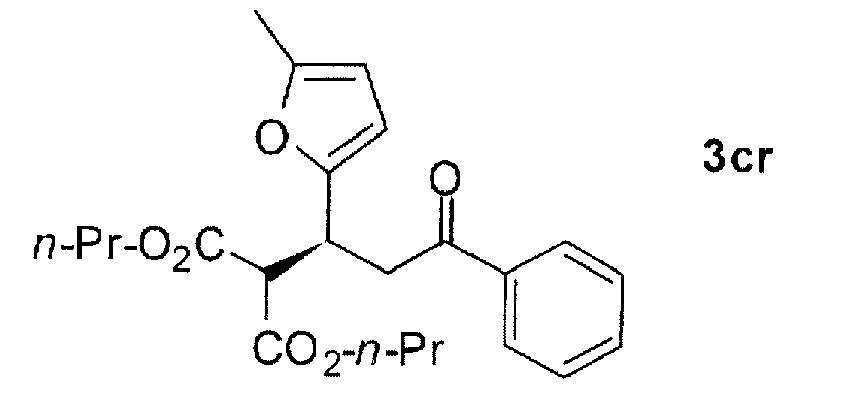
2-(1-(5-methylfuran-2-yl)-3-oxo-3-phenylpropyl)malonate (table 3, entry 17)
It was synthesized in accordance with the above-mentioned manipulation.
Yield 71%, Yellow liquid; IR [cm-1] (neat): 1735, 1686, 1265, 750; 1H NMR (600.2 MHz, CDCl3, TMS): δ = 7.95 (br d, JHH = 7.4 Hz, 2H; Ar), 7.58-7.51 (m, 1H; Ar), 7.47-7.41 (m, 2H; Ar), 5.95 (br s, 1H; Ar), 5.76 (br s, 1H; Ar), 4.29-4.23 (m, 1H; CH), 4.14-3.90 (m, 5H; CH, OCH2, OCH2), 3.58-3.41 (m, 2H; CH2), 2.17 (s, 3H, CH3), 1.68-1.53 (m, 4H; CH2CH3, CH2CH3), 0.95-0.85 (m, 6H; CH3, CH3); 13C{1H} NMR (150.9 MHz, CDCl3, TMS): δ = 197.5, 168.2, 168.0, 151.6, 151.0, 136.8, 133.1, 128.5,128.1, 107.7, 106.1, 67.1, 67.1, 55.3, 39.8, 34.4, 21.8, 21.8, 13.5, 10.3, 10.3; HPLC (Chiralpak AD-H, hexane/i-propanol = 19/1, flow rate 0.5 mL/min, λ = 254 nm): tmajor = 40.8 min, tminor = 37.2 min, ee = 96%; [α]21 D = +9.82 (c = 1.0 in CHCl3); ESI-HRMS (m/z) calcd. for C23H28O6Na ((M+Na)+): 423.1784, found: 423.1777. -

2-(3-oxo-1-phenyl-3-(1H-pyrrol-1-yl)propyl)malonate (table 3, entry 18)
It was synthesized in accordance with the above-mentioned manipulation.
Yield 93%, White solid, Mp 88-91 °C; IR [cm-1] (KBr): 1716, 1471, 1280, 1229, 1172, 748; 1H NMR (600.2 MHz, CDCl3, TMS): δ = 7.30-7.25 (m, 6H; Ar), 7.22-7.18 (m, 1H; Ar), 6.26-6.23 (m, 2H; Ar), 4.16-4.06 (m, 3H; CH, OCH2), 3.88-3.84 (m, 3H; CH, OCH2), ABM spin system (A = B = M = H, δ A= 3.45, δ B= 3.29, 2JAB = 16.3, 3JAM = 4.2, 3JBM = 9.7 Hz, 2H; CH2), 1.64 (appearance of sext, 3JHH = 7.2 Hz, 2H; CH2CH3), 1.48-1.39 (m, 2H; CH2CH3), 0.90 (t, 3JHH = 7.5 Hz, 3H; CH3), 0.78 (t, 3JHH = 7.5 Hz, 3H; CH3); 13C{1H} NMR (150.9 MHz, CDCl3, TMS): δ = 168.3, 168.2, 167.6, 139.6, 128.6, 128.1, 127.5, 119.1, 113.1, 67.3, 67.1, 57.2, 41.1, 38.7, 21.8, 21.6, 10.2, 10.2; HPLC (Chiralpak AS-H, hexane/i-propanol = 19/1, flow rate 0.5 mL/min, λ = 254 nm): tmajor = 24.4 min, tminor = 31.2 min, ee = 99%; [α]20 D = +16.38 (c = 1.0 in CHCl3); ESI-IIRMS (m/z) calcd. for C22H27NO5Na ((M+Na)+): 408.1787, found: 408.1755. -

2-(3-oxo-1,5-diphenylpent-4-enyl)malonate (table 3, entry 19)
It was synthesized in accordance with the above-mentioned manipulation.
Yield 75%, White solid, Mp 69-73 °C; IR [cm-1] (KBr): 1731, 1646, 1227, 1163, 705; 1H NMR (600.2 MHz, CDCl3, TMS): δ = 7.51-7.46 (m, 3H; Ar), 7.37-7.34 (m, 3H; Ar), 7.29-7.23 (m, 4H; Ar), 7.19-7.14 (m, 1H; Ar), 7.14 (d, 3JHH = 16.4, 1H; Ar), 4.16-4.07 (m, 3H; CH, OCH2), 3.87-3.81 (m, 3H; CH, OCH2), ABM spin system (A = B = M = H, δ A= 3.20, δ B= 3.16, 2JAB = 16.1, 3JAM = 4.6, 3JBM = 9.2 Hz, 2H; CH2), 1.65 (appearance of sext, 3JHH = 7.1 Hz, 2H; CH2CH3), 1.48-1.38 (m, 2H; CH2CH3), 0.92 (t, 3JHH = 7.5 Hz, 3H; CH3), 0.77 (t, 3JHH = 7.3 Hz, 3H; CH3); 13C{1H} NMR (150.9 MHz, CDCl3, TMS): δ = 197.4, 168.4, 167.8. 142.8, 140.4, 134.5, 130.4, 128.9, 128.4, 128.3, 128.2, 127.2, 126.0, 67.2, 66.9, 57.6, 44.8, 41.0, 21.9, 21.6, 10.3, 10.2; HPLC (Chiralpak AS-H, hexane/i-propanol = 9/1, flow rate 1.0 mL/min, λ = 254 nm): tmajor = 11.8 min, tminor = 14.4 min, ee = 86%; [α]22 D = +14.56 (c = 1.0 in CHCl3); ESI-HRMS (m/z) calcd. for C26H30O5Na ((M+Na)+): 445.1991, found: 445.1975. -

2-(5-oxo-1,5-diphenylpent-1-en-3-yl)malonate (table 3, entry 20)
It was synthesized in accordance with the above-mentioned manipulation.
Yield 46%, White solid, Mp 42-45 °C; IR [cm-1] (KBr): 1728, 1682, 1234, 754, 692; 1H NMR (600.2 MHz, CDCl3, TMS): δ = 7.98-7.94 (m, 2H; Ar), 7.56-7.52 (m, 1H; Ar), 7.47-7.43 (m, 2H; Ar), 7.29-7.22 (m, 4H; Ar), 7.20-7.16 (m, 1H; Ar), 6.46 (d, 3JHH = 15.8 Hz, 1H; Ar), 6.25 (dd, 3JHH = 15.8, 3JHH = 9.0 Hz, 1H; Ar), 4.15-4.00 (m, 4H; OCH2, OCH2), 3.78 (d, 3JHH = 7.5 Hz, 1H; CH), 3.73-3.67 (m, 1H; CH), ABM spin system (A = B = M = H, δ A= 3.40, δ B= 3.27, 2JAB = 16.8, 3JAM = 4.9. 3JBM = 7.9 Hz, 2H; CH2), 1.68-1.55 (m, 4H; CH2CH3, CH2CH3), 0.92 (t, 3JHH = 7.5 Hz, 3H; CH3), 0.87 (t, 3JHH = 7.5 Hz, 3H; CH3); 13C{1H} NMR (124.5 MHz, CDCl3, TMS): δ = 198.0, 168.4, 168.3, 137.0, 136.9, 133.1, 132.6, 128.6, 128.5, 128.4, 128.2, 127.5, 126.4, 67.1, 67.0, 55.7, 41.3, 38.8, 21.9, 21.8, 10.3, 10.3; HPLC (Chiralpak AS-H, hexane/i-propanol = 40/1, flow rate 0.5 mL/min, λ = 254 nm): tmajor = 32.5 min, tminor = 38.0 min, ee = 97%; [α]121 D = +1.20 (c = 1.0 in CHCl3); ESI-HRMS (m/z) calcd. for C26H30O5Na ((M+Na)+): 445.1991, found: 445.1988, C26H31O5 ((M+H)+): 423.2171, found: 423.2150. -
Table 1 . Effect of metal sources and chiral ligands. a 
entry metal (x mol%) ligand solv. time (h) yield (%)b ee (%)c 1 d Ca(O-i-Pr)2 (10%) I THF 24 47 4 2 d Ca(O-i-Pr)2 (10%) II THF 24 47 49 3 d Ca(O-i-Pr)2 (10%) III THF 24 89 52 4 e Ca(O-i-Pr)2 (5%) III Tol. 18 58 65 5 e Sr(O-i-Pr)2 (5%) III Tol. 18 91 97 6 e Ba(O-i-Pr)2 (5%) III Tol. 18 80 76 7 e Ba(O-t-Bu)2 (5%) III Tol. 18 82 70 
Table 2. Conjugate addition reactions of malonates 1a-1f to 2a. a 
entry Sr(O-i-Pr)2 (x mol%) R time (h) yield (%)b ee (%)c (configuration) 1 5 Me 24 65 94 (R) d 2 5 Et 18 91 97 (R) d 3 5 n-Pr 7 92 99 4 2.5 n-Pr 90 99 5 e 1 n-Pr 9 70 97 6 f 0.5 n-Pr 24 72 97 7 5 i-Pr 21 83 89 8 5 n-Bu 3 85 96 9 5 Bn 18 85 84 Table 3. Conjugate addition reactions of 1c to enones 2b-u. a 
entry R1 R2 adduct yield (%)b ee (%)c 1 2-ClC6H4 Ph 3cb 76 92 2 4-ClC6H4 Ph 3cc 93 97 3 4-FC6H4 Ph 3cd 92 98 4 4-MeOC6H4 Ph 3ce 80 >99 5 4-NO2C6H4 Ph 3cf 98 96 6 3-NO2C6H4 Ph 3cg 94 94 7 4-FC6H4 4-FC6H4 3ch 91 96 8 4-MeOC6H4 4-FC6H4 3ci 81 >99 9 3,4-di-MeOC6H3 4-FC6H4 3cj 61 96 10 4-ClC6H4 4-FC6H4 3ck 97 97 11 2-ClC6H4 4-FC6H4 3cl 80 93 12 4-FC6H4 4-MeC6H4 3cm 90 98 13 Ph 4-ClC6H4 3cn 98 99 14 Ph 4-FC6H4 3co 92 99 15 Ph 4-MeOC6H4 3cp 85 99 16 2-thienyl 2-thienyl 3cq 73 97 17 d 5-methylfuran-2-yl Ph 3cr 71 96 18 e Ph 1-pyrrolyl 3cs 90 >99 19 f Ph -CH=CHPh 3ct 97 86 20 f -CH=CH-Ph Ph 3cu 62 97 a See footnote in Table 1.
b Isolated yields.
c Determined by chiral HPLC analysis.
d redaction time 48 h.
e redaction time 24 h.
f 2.2 equivalents of malonate 1c were used. - 0.015 mmol of strontium hexamethyldisilazide (Sr(HMDS)2), 0.015 mmol of ligand, and 100 mg of molecular sieve 4A were suspended in 1 mL of toluene, and stirred for two hours at room temperature under an argon atmosphere. Thereafter, a toluene solution (1 mL) of 0.36 mmol of a malonic acid di-n-propyl ester, and a toluene solution of chalcone (0.3 mmol) were added. After the finishing of the reaction (the finishing of the reaction was confirmed by the thin-layer chromatography), a saturated ammonium chloride aqueous solution was added to the reaction solution. In addition, an organic phase was separated with dichloromethane. And a water phase was extracted with dichloromethane. The organic phase was collected and dried over anhydrous sodium sulfate. Thereafter, sodium sulfate was filtered off, and the solvent was removed by the distillation under reduced pressure. And the crude refined product was refined with the preparative thin-layer chromatography.
- An enantiometric excess of the target product (refined product) obtained in such a manner was determined with a high performance liquid chromatography.
- Additionally, Sr(HMDS)2 was synthesized with the method (Inorg. Chem., 1991, 30, 96-101) reported by Wasterhausen. Ligand was synthesized with method (J.Am. Chem. Soc., 1997, 119, 6452-6453) reported by Evans. Chalcones were procured from TOKYO CHEMICAL INDUSTRY CO., LTD. and Wako Pure Chemical industries, LTD.
-

2-((1-oxo-1,2,3,4-tetrahydronaphthalen-2-yl)(phenyl)methyl)malonate (table 5): Colorless oil; IR [cm-1] (neat): 1747, 1731, 1682, 1600, 1455, 1266, 1221, 1155, 1059, 743, 702; NMR (600.2 MHz, CDCl3, TMS): δ= 8.01-7.97 (m, 1H; Ar), 7.41-7.37 (m, 1H; Ar), 7.32-7.11 (m, 7H; Ar), 4.98 (d, 3 J HH = 12.0 Hz, 1H; CHe), 4.14-4.00 (m, 2H; OCH2), 3.85-3.75 (m, 3H; CHd, CH2), 3.11 (d t, 3 J HH = 12.9, 3 J HH = 4.1 Hz, 1H; CHc), 2.99-2.92 (m, 1H; CHa), 2.86-2.81 (m, 1H; CHa), 2.15-2.10 (m, 1H; CHb), 1.86 (appearance q d, 3 J HH = 12.9, J HH = 4.2 Hz, 1H; CHb), 1.60 (appearance of sext, 3 J HH = 7.1 Hz, 2H; CH 2CH3), 1.40-1.32 (m, 2H; CH 2CH3), 0.89 (t, 3 J HH = 7.3 Hz, 3H; CH3), 0.74 (t, 3 J HH = 7.5 Hz, 3H; CH3); 13C{1H} NMR (150.9 MHz, CDCl3, TMS): δ= 198.8, 169.2, 168.7, 143.6, 139.3, 133.3,133.2, 129.5,128.4, 128.2, 127.3, 127.0, 126.5, 67.0, 66.7, 54. 9, 49.6, 47.7, 29.5, 27.8, 21.8, 21.6, 10.2, 10.2; HPLC (Chiralpak AS-H, hexane/i-propanol = 40/1, flow rate 0.5 mL/min, λ= 254 nm): tmajor = 16.5 min, tminor = 19.6 min, ee = 96%, tmajor = 23.3 min, tminor = 26.3 min; [α]21 D = + 59.52 (c = 1.0 in CHCl3); ESI-HRMS (m/z) calcd. for C26H30O5Na [(M+Na)+]: 445.1991, found: 445.2042.Table. 4 

Strontiums Catalyst mount (mole %) Yield (%)[a] Enantiometric excess (%)[b] 1 Sr(O-i-Pr)2 5 92 99 2 Sr(HMOS)2 5 97 99 3 Sr(HMDS)2 3 99 98 4 Sr(HMDS)2 2 96 96 [a]Isolated yield
[b]Determined with chiral HPLC analysisTable. 5 
Strontiums Compound 1 (y equivalents) Yield (%)[a] Diastereomer ratio Enantiometric excess (%)[b] 1 Sr(O-i-Pr)2 2.5 50 97:3 80 2 Sr(O-i-Pr)2 5 92 97:3 66 3 Sr(O-i-Pr)2 1.2 40 97:3 88 4 Sr(HMDS)2 1.2 38 97:3 95 5 Sr(HMDS)2 1.2 26 98:2 95 6 Sr(HMDS)2 2.5 50 97:3 94 7 Sr(HMDS)2 1.2 86 98:2 60 [a]Isolated yield
[b]Determined with chiral HPLC analysisTable. 6 
Entry Subsituent R1 Substituent R2 Reaction time (time) Yield (%)[a] Enantioselectivity (%)[b] 1 2-Cl-C6H4 Ph 7 82 95 2 4-Cl-C6H4 Ph 7 93 97 3 2-Cl-C6H4 4-F-C6H4 7 92 93 4 Ph -CH=CHPh 7 95 90 5 4-Cl-C6H4 4-F-C6H4 7 94 93 6 3-NO2-C6H4 Ph 7 86 96 7 4-NO2-C6H4 Ph 7 81 97 [a]Isolated yield
[b]Determined with chiral HPLC analysis
Claims (23)
- A catalyst configured using MX2 (M is Be, Mg, Ca, Sr, Ba or Ra, and X is an arbitrary group) and a compound represented by the following general formula [I].

- A catalyst according to claim 1, wherein said MX2 is M(OR5)2 (M is Mg, Ca, Sr or Ba. R5 is an alkyl group).
- A catalyst according to claim 1, wherein said MX2 is M(OR5)2 (M is Ca, Sr or Ba. R5 is an alkyl group having a carbon number of 1 to 10).
- A catalyst according to claim 1, wherein said MX2 is Sr(OR5)2 (R5 is an alkyl group having a carbon number of 1 to 10).
- A catalyst according to claim 1, wherein said X is an amide group.
- A catalyst according to claim 1, wherein said X is hexamethyldisilazide.
- A catalyst according to claim 1, wherein said cyclic group is an aromatic group.
- A catalyst according to one of claim 1 to claim 7, wherein the compound represented by said general formula [I] and M of said compound MX2 are coordinate-bonded to each other.
- A catalyst according to one of claim 1 to claim 8, said catalyst used for a reaction between a compound represented by the following general formula [II] and a compound represented by the following general formula [III].


- A catalyst according to claim 9, wherein each of said R1, R2, R3, and R4 is an H group or a hydrocarbon group.
- A catalyst according to claim 9, wherein said electron-withdrawing group is an ester group or a carbonyl group.
- A catalyst according to claim 9, wherein the compound represented by said general formula [II] is a dicarboxylate ester.
- A catalyst according to claim 9, wherein the compound represented by said general formula [II] is a malonic ester.
- A catalyst according to claim 9, wherein the compound represented by said general formula [III] is an enone.
- A reaction method, comprising reacting a compound represented by the following general formula [II] with a compound represented by the following general formula [III] in the presence of any of the catalysts of claim 1 to claim 14.


- A reaction method according to claim 15, wherein each of said R1, R2, R3, and R4 is an H group or a hydrocarbon group.
- A reaction method according to claim 15, wherein said electron-withdrawing group is an ester group or a carbonyl group.
- A reaction method according to claim 15, wherein the compound represented by said general formula [II] is a dicarboxylate ester.
- A reaction method according to claim 15, wherein the compound represented by said general formula [II] is a malonic ester.
- A reaction method according to claim 15, wherein the compound represented by said general formula [III] is an enone.
- A reaction method according to one of claim 15 to claim 20, wherein a molecular sieve is added to a solution of said reaction.
- A reaction method according to one of claim 15 to claim 21, wherein an aromatic hydrocarbon solvent is used as a solvent of said reaction.
- A reaction method according to one of claim 15 to claim 22, said reaction method used for obtaining a compound represented by the following general formula [IV].

Applications Claiming Priority (2)
| Application Number | Priority Date | Filing Date | Title |
|---|---|---|---|
| JP2008015906 | 2008-01-28 | ||
| PCT/JP2009/051322 WO2009096409A1 (en) | 2008-01-28 | 2009-01-28 | Catalyst and reaction process |
Publications (3)
| Publication Number | Publication Date |
|---|---|
| EP2258477A1 true EP2258477A1 (en) | 2010-12-08 |
| EP2258477A4 EP2258477A4 (en) | 2012-05-09 |
| EP2258477B1 EP2258477B1 (en) | 2015-03-25 |
Family
ID=40912761
Family Applications (1)
| Application Number | Title | Priority Date | Filing Date |
|---|---|---|---|
| EP09705661.8A Not-in-force EP2258477B1 (en) | 2008-01-28 | 2009-01-28 | Catalyst and michael addition reaction process |
Country Status (4)
| Country | Link |
|---|---|
| US (1) | US8222177B2 (en) |
| EP (1) | EP2258477B1 (en) |
| JP (1) | JP5299974B2 (en) |
| WO (1) | WO2009096409A1 (en) |
Family Cites Families (2)
| Publication number | Priority date | Publication date | Assignee | Title |
|---|---|---|---|---|
| JP2001253844A (en) * | 2000-03-10 | 2001-09-18 | Japan Science & Technology Corp | Michael reaction method |
| JP4309686B2 (en) * | 2003-01-17 | 2009-08-05 | 関東化学株式会社 | Method for producing optically active compound |
-
2009
- 2009-01-28 EP EP09705661.8A patent/EP2258477B1/en not_active Not-in-force
- 2009-01-28 JP JP2009551529A patent/JP5299974B2/en not_active Expired - Fee Related
- 2009-01-28 US US12/865,053 patent/US8222177B2/en not_active Expired - Fee Related
- 2009-01-28 WO PCT/JP2009/051322 patent/WO2009096409A1/en not_active Ceased
Non-Patent Citations (4)
| Title |
|---|
| EVANS AND S G NELSON D A: "Chiral Magnesium Bis(sulfonamide) Complexes as Catalysts for the Merged Enolization and Enantioselective Amination of N- Acyloxazolidinones", JOURNAL OF THE AMERICAN CHEMICAL SOCIETY, AMERICAN CHEMICAL SOCIETY, WASHINGTON, DC; US, vol. 119, no. 27, 9 July 1997 (1997-07-09) , pages 6452-6453, XP008140188, ISSN: 0002-7863 * |
| HIROAKI SASAI: "The first heterobimetallic multifunctional asymmetric catalyst", JOURNAL OF THE AMERICAN CHEMICAL SOCIETY, AMERICAN CHEMICAL SOCIETY, WASHINGTON, DC; US, vol. 117, no. 23, 14 June 1995 (1995-06-14), pages 6194-6198, XP002085680, ISSN: 0002-7863 * |
| MAGNO AGOSTINHO AND SHÛ KOBAYASHI: "Strontium- Catalyzed Highly Enantioselective Michael Additions of Malonates to Enones", JOURNAL OF THE AMERICAN CHEMICAL SOCIETY, AMERICAN CHEMICAL SOCIETY, WASHINGTON, DC; US, vol. 130, no. 8, 27 February 2008 (2008-02-27), pages 2430-2431, XP008140189, ISSN: 0002-7863, DOI: 10.1021/JA710332H * |
| See also references of WO2009096409A1 * |
Also Published As
| Publication number | Publication date |
|---|---|
| WO2009096409A1 (en) | 2009-08-06 |
| EP2258477B1 (en) | 2015-03-25 |
| US8222177B2 (en) | 2012-07-17 |
| EP2258477A4 (en) | 2012-05-09 |
| JPWO2009096409A1 (en) | 2011-05-26 |
| US20110054190A1 (en) | 2011-03-03 |
| JP5299974B2 (en) | 2013-09-25 |
Similar Documents
| Publication | Publication Date | Title |
|---|---|---|
| Gu et al. | Highly enantioselective Michael additions of α-cyanoacetate with chalcones catalyzed by bifunctional cinchona-derived thiourea organocatalyst | |
| Wang et al. | Palladium-catalyzed α-regioselective allylic amination of Morita–Baylis–Hillman acetates with simple aromatic amines | |
| Gu et al. | Amide phosphonium salt catalyzed enantioselective Mannich addition of isoxazole-based nucleophiles to β, γ-alkynyl-α-ketimino esters | |
| CN100560555C (en) | A method for synthesizing 1,3-disubstituted-4-ene-1-pentanone compounds | |
| JP7464234B2 (en) | Method for producing highly optically active allene carboxylic acid compounds having axial asymmetry | |
| Han et al. | Chiral ferrocenyl P, S-ligands for highly efficient copper-catalyzed asymmetric [3+ 2] cycloaddition of azomethine ylides | |
| Wang et al. | New chloramphenicol Schiff base ligands for the titanium-mediated asymmetric aldol reaction of α, β-unsaturated aldehydes with diketene: a short synthesis of atorvastatin calcium | |
| WO2016039691A1 (en) | Catalysts for making chiral heterocyclic sulfoxides | |
| EP2258477B1 (en) | Catalyst and michael addition reaction process | |
| CN102234291B (en) | Bridged bis-Schiff-base-titanium complex, and synthesis method and application thereof | |
| JP4320058B2 (en) | Production method of aromatic nitrile | |
| CN118084831A (en) | Tetrasubstituted furan compounds and preparation methods thereof | |
| CN114957103B (en) | Axially chiral halogenated biaryl compound and preparation method thereof | |
| CN117024477B (en) | Preparation method of lipid chain substituted biphenyl type or phenylpyrrole type chiral monophosphine ligand | |
| CN115873047B (en) | Chiral ferrocene P,N,N-ligand with side arm, synthesis method and application thereof | |
| Gök et al. | Synthesis of a Novel C2‐Symmetric Bis‐oxazoline (= Bis [4, 5‐dihydrooxazole]) and Its Application as Chiral Ligand in Asymmetric Transition Metal Catalysis | |
| JP5685570B2 (en) | Asymmetric catalyst used for allylation of N-acylhydrazone | |
| JP5360608B2 (en) | PROLINAMIDE DERIVATIVE, ORGANIC CATALYST COMPRISING SALT OF THE SAME AND ACID, AND METHOD FOR PRODUCING β-HYDROXYcarbonyl COMPOUND USING THE ORGANIC CATALYST | |
| JP5266495B2 (en) | Cyanation catalyst and method for producing optically active cyanohydrin compounds using the same | |
| JP5246903B2 (en) | Process for producing β-aminocarbonyl compound | |
| Omote et al. | Synthesis of axially dissymmetric ligands with two chiral centers of perfluoroalkyl carbinol moiety, and their application to asymmetric syntheses | |
| KR101875169B1 (en) | A process for the preparation of isoserine derivatives | |
| CN116041354A (en) | A palladium-catalyzed decarboxylation [5+3] cycloaddition reaction | |
| CN120923522A (en) | Method for synthesizing alkyl boron compound containing remote chiral center by using novel cobalt catalyst | |
| JP2014131971A (en) | METHOD OF PRODUCING δ-AMINO-γ-BUTENOLIDE HAVING OPTICALLY-ACTIVE ASYMMETRIC TETRASUBSTITUTED CARBON |
Legal Events
| Date | Code | Title | Description |
|---|---|---|---|
| PUAI | Public reference made under article 153(3) epc to a published international application that has entered the european phase |
Free format text: ORIGINAL CODE: 0009012 |
|
| 17P | Request for examination filed |
Effective date: 20100827 |
|
| AK | Designated contracting states |
Kind code of ref document: A1 Designated state(s): AT BE BG CH CY CZ DE DK EE ES FI FR GB GR HR HU IE IS IT LI LT LU LV MC MK MT NL NO PL PT RO SE SI SK TR |
|
| AX | Request for extension of the european patent |
Extension state: AL BA RS |
|
| DAX | Request for extension of the european patent (deleted) | ||
| A4 | Supplementary search report drawn up and despatched |
Effective date: 20120411 |
|
| RIC1 | Information provided on ipc code assigned before grant |
Ipc: C07B 61/00 20060101ALI20120403BHEP Ipc: C07C 201/12 20060101ALI20120403BHEP Ipc: C07C 205/56 20060101ALI20120403BHEP Ipc: C07D 307/54 20060101ALI20120403BHEP Ipc: C07D 207/325 20060101ALI20120403BHEP Ipc: B01J 31/18 20060101ALI20120403BHEP Ipc: C07C 69/738 20060101ALI20120403BHEP Ipc: C07D 333/24 20060101ALI20120403BHEP Ipc: C07B 53/00 20060101ALI20120403BHEP Ipc: C07C 67/347 20060101ALI20120403BHEP Ipc: B01J 31/02 20060101AFI20120403BHEP |
|
| RIC1 | Information provided on ipc code assigned before grant |
Ipc: C07B 53/00 20060101ALI20121130BHEP Ipc: C07C 67/347 20060101ALI20121130BHEP Ipc: C07C 205/56 20060101ALI20121130BHEP Ipc: B01J 31/18 20060101ALI20121130BHEP Ipc: B01J 31/02 20060101AFI20121130BHEP Ipc: C07B 61/00 20060101ALI20121130BHEP Ipc: C07D 307/54 20060101ALI20121130BHEP Ipc: C07C 201/12 20060101ALI20121130BHEP Ipc: C07D 333/24 20060101ALI20121130BHEP Ipc: C07C 69/738 20060101ALI20121130BHEP Ipc: C07D 207/325 20060101ALI20121130BHEP |
|
| GRAP | Despatch of communication of intention to grant a patent |
Free format text: ORIGINAL CODE: EPIDOSNIGR1 |
|
| INTG | Intention to grant announced |
Effective date: 20140708 |
|
| GRAS | Grant fee paid |
Free format text: ORIGINAL CODE: EPIDOSNIGR3 |
|
| GRAP | Despatch of communication of intention to grant a patent |
Free format text: ORIGINAL CODE: EPIDOSNIGR1 |
|
| GRAA | (expected) grant |
Free format text: ORIGINAL CODE: 0009210 |
|
| INTG | Intention to grant announced |
Effective date: 20150210 |
|
| AK | Designated contracting states |
Kind code of ref document: B1 Designated state(s): AT BE BG CH CY CZ DE DK EE ES FI FR GB GR HR HU IE IS IT LI LT LU LV MC MK MT NL NO PL PT RO SE SI SK TR |
|
| REG | Reference to a national code |
Ref country code: GB Ref legal event code: FG4D |
|
| REG | Reference to a national code |
Ref country code: CH Ref legal event code: EP |
|
| REG | Reference to a national code |
Ref country code: IE Ref legal event code: FG4D |
|
| REG | Reference to a national code |
Ref country code: DE Ref legal event code: R096 Ref document number: 602009030161 Country of ref document: DE Effective date: 20150507 |
|
| REG | Reference to a national code |
Ref country code: AT Ref legal event code: REF Ref document number: 717541 Country of ref document: AT Kind code of ref document: T Effective date: 20150515 |
|
| REG | Reference to a national code |
Ref country code: CH Ref legal event code: NV Representative=s name: VOSSIUS AND PARTNER, CH |
|
| PG25 | Lapsed in a contracting state [announced via postgrant information from national office to epo] |
Ref country code: SE Free format text: LAPSE BECAUSE OF FAILURE TO SUBMIT A TRANSLATION OF THE DESCRIPTION OR TO PAY THE FEE WITHIN THE PRESCRIBED TIME-LIMIT Effective date: 20150325 Ref country code: FI Free format text: LAPSE BECAUSE OF FAILURE TO SUBMIT A TRANSLATION OF THE DESCRIPTION OR TO PAY THE FEE WITHIN THE PRESCRIBED TIME-LIMIT Effective date: 20150325 Ref country code: HR Free format text: LAPSE BECAUSE OF FAILURE TO SUBMIT A TRANSLATION OF THE DESCRIPTION OR TO PAY THE FEE WITHIN THE PRESCRIBED TIME-LIMIT Effective date: 20150325 Ref country code: LT Free format text: LAPSE BECAUSE OF FAILURE TO SUBMIT A TRANSLATION OF THE DESCRIPTION OR TO PAY THE FEE WITHIN THE PRESCRIBED TIME-LIMIT Effective date: 20150325 |
|
| REG | Reference to a national code |
Ref country code: AT Ref legal event code: MK05 Ref document number: 717541 Country of ref document: AT Kind code of ref document: T Effective date: 20150325 |
|
| REG | Reference to a national code |
Ref country code: LT Ref legal event code: MG4D |
|
| PG25 | Lapsed in a contracting state [announced via postgrant information from national office to epo] |
Ref country code: GR Free format text: LAPSE BECAUSE OF FAILURE TO SUBMIT A TRANSLATION OF THE DESCRIPTION OR TO PAY THE FEE WITHIN THE PRESCRIBED TIME-LIMIT Effective date: 20150626 Ref country code: LV Free format text: LAPSE BECAUSE OF FAILURE TO SUBMIT A TRANSLATION OF THE DESCRIPTION OR TO PAY THE FEE WITHIN THE PRESCRIBED TIME-LIMIT Effective date: 20150325 |
|
| PG25 | Lapsed in a contracting state [announced via postgrant information from national office to epo] |
Ref country code: NL Free format text: LAPSE BECAUSE OF FAILURE TO SUBMIT A TRANSLATION OF THE DESCRIPTION OR TO PAY THE FEE WITHIN THE PRESCRIBED TIME-LIMIT Effective date: 20150325 |
|
| PG25 | Lapsed in a contracting state [announced via postgrant information from national office to epo] |
Ref country code: PT Free format text: LAPSE BECAUSE OF FAILURE TO SUBMIT A TRANSLATION OF THE DESCRIPTION OR TO PAY THE FEE WITHIN THE PRESCRIBED TIME-LIMIT Effective date: 20150727 Ref country code: SK Free format text: LAPSE BECAUSE OF FAILURE TO SUBMIT A TRANSLATION OF THE DESCRIPTION OR TO PAY THE FEE WITHIN THE PRESCRIBED TIME-LIMIT Effective date: 20150325 Ref country code: ES Free format text: LAPSE BECAUSE OF FAILURE TO SUBMIT A TRANSLATION OF THE DESCRIPTION OR TO PAY THE FEE WITHIN THE PRESCRIBED TIME-LIMIT Effective date: 20150325 Ref country code: CZ Free format text: LAPSE BECAUSE OF FAILURE TO SUBMIT A TRANSLATION OF THE DESCRIPTION OR TO PAY THE FEE WITHIN THE PRESCRIBED TIME-LIMIT Effective date: 20150325 Ref country code: EE Free format text: LAPSE BECAUSE OF FAILURE TO SUBMIT A TRANSLATION OF THE DESCRIPTION OR TO PAY THE FEE WITHIN THE PRESCRIBED TIME-LIMIT Effective date: 20150325 Ref country code: RO Free format text: LAPSE BECAUSE OF FAILURE TO SUBMIT A TRANSLATION OF THE DESCRIPTION OR TO PAY THE FEE WITHIN THE PRESCRIBED TIME-LIMIT Effective date: 20150325 |
|
| PG25 | Lapsed in a contracting state [announced via postgrant information from national office to epo] |
Ref country code: IS Free format text: LAPSE BECAUSE OF FAILURE TO SUBMIT A TRANSLATION OF THE DESCRIPTION OR TO PAY THE FEE WITHIN THE PRESCRIBED TIME-LIMIT Effective date: 20150725 Ref country code: PL Free format text: LAPSE BECAUSE OF FAILURE TO SUBMIT A TRANSLATION OF THE DESCRIPTION OR TO PAY THE FEE WITHIN THE PRESCRIBED TIME-LIMIT Effective date: 20150325 Ref country code: AT Free format text: LAPSE BECAUSE OF FAILURE TO SUBMIT A TRANSLATION OF THE DESCRIPTION OR TO PAY THE FEE WITHIN THE PRESCRIBED TIME-LIMIT Effective date: 20150325 |
|
| REG | Reference to a national code |
Ref country code: FR Ref legal event code: PLFP Year of fee payment: 8 |
|
| REG | Reference to a national code |
Ref country code: DE Ref legal event code: R097 Ref document number: 602009030161 Country of ref document: DE |
|
| PG25 | Lapsed in a contracting state [announced via postgrant information from national office to epo] |
Ref country code: DK Free format text: LAPSE BECAUSE OF FAILURE TO SUBMIT A TRANSLATION OF THE DESCRIPTION OR TO PAY THE FEE WITHIN THE PRESCRIBED TIME-LIMIT Effective date: 20150325 |
|
| PLBE | No opposition filed within time limit |
Free format text: ORIGINAL CODE: 0009261 |
|
| STAA | Information on the status of an ep patent application or granted ep patent |
Free format text: STATUS: NO OPPOSITION FILED WITHIN TIME LIMIT |
|
| 26N | No opposition filed |
Effective date: 20160105 |
|
| PG25 | Lapsed in a contracting state [announced via postgrant information from national office to epo] |
Ref country code: IT Free format text: LAPSE BECAUSE OF FAILURE TO SUBMIT A TRANSLATION OF THE DESCRIPTION OR TO PAY THE FEE WITHIN THE PRESCRIBED TIME-LIMIT Effective date: 20150325 |
|
| PG25 | Lapsed in a contracting state [announced via postgrant information from national office to epo] |
Ref country code: BE Free format text: LAPSE BECAUSE OF NON-PAYMENT OF DUE FEES Effective date: 20160131 Ref country code: SI Free format text: LAPSE BECAUSE OF FAILURE TO SUBMIT A TRANSLATION OF THE DESCRIPTION OR TO PAY THE FEE WITHIN THE PRESCRIBED TIME-LIMIT Effective date: 20150325 |
|
| REG | Reference to a national code |
Ref country code: CH Ref legal event code: PFA Owner name: JAPAN SCIENCE AND TECHNOLOGY AGENCY, JP Free format text: FORMER OWNER: JAPAN SCIENCE AND TECHNOLOGY AGENCY, JP |
|
| PG25 | Lapsed in a contracting state [announced via postgrant information from national office to epo] |
Ref country code: LU Free format text: LAPSE BECAUSE OF FAILURE TO SUBMIT A TRANSLATION OF THE DESCRIPTION OR TO PAY THE FEE WITHIN THE PRESCRIBED TIME-LIMIT Effective date: 20160128 Ref country code: BE Free format text: LAPSE BECAUSE OF FAILURE TO SUBMIT A TRANSLATION OF THE DESCRIPTION OR TO PAY THE FEE WITHIN THE PRESCRIBED TIME-LIMIT Effective date: 20150325 |
|
| PG25 | Lapsed in a contracting state [announced via postgrant information from national office to epo] |
Ref country code: MC Free format text: LAPSE BECAUSE OF FAILURE TO SUBMIT A TRANSLATION OF THE DESCRIPTION OR TO PAY THE FEE WITHIN THE PRESCRIBED TIME-LIMIT Effective date: 20150325 |
|
| REG | Reference to a national code |
Ref country code: IE Ref legal event code: MM4A |
|
| REG | Reference to a national code |
Ref country code: FR Ref legal event code: PLFP Year of fee payment: 9 |
|
| PG25 | Lapsed in a contracting state [announced via postgrant information from national office to epo] |
Ref country code: IE Free format text: LAPSE BECAUSE OF NON-PAYMENT OF DUE FEES Effective date: 20160128 |
|
| PG25 | Lapsed in a contracting state [announced via postgrant information from national office to epo] |
Ref country code: MT Free format text: LAPSE BECAUSE OF FAILURE TO SUBMIT A TRANSLATION OF THE DESCRIPTION OR TO PAY THE FEE WITHIN THE PRESCRIBED TIME-LIMIT Effective date: 20150325 |
|
| REG | Reference to a national code |
Ref country code: FR Ref legal event code: PLFP Year of fee payment: 10 |
|
| PG25 | Lapsed in a contracting state [announced via postgrant information from national office to epo] |
Ref country code: CY Free format text: LAPSE BECAUSE OF FAILURE TO SUBMIT A TRANSLATION OF THE DESCRIPTION OR TO PAY THE FEE WITHIN THE PRESCRIBED TIME-LIMIT Effective date: 20150325 Ref country code: HU Free format text: LAPSE BECAUSE OF FAILURE TO SUBMIT A TRANSLATION OF THE DESCRIPTION OR TO PAY THE FEE WITHIN THE PRESCRIBED TIME-LIMIT; INVALID AB INITIO Effective date: 20090128 |
|
| PG25 | Lapsed in a contracting state [announced via postgrant information from national office to epo] |
Ref country code: TR Free format text: LAPSE BECAUSE OF FAILURE TO SUBMIT A TRANSLATION OF THE DESCRIPTION OR TO PAY THE FEE WITHIN THE PRESCRIBED TIME-LIMIT Effective date: 20150325 Ref country code: MK Free format text: LAPSE BECAUSE OF FAILURE TO SUBMIT A TRANSLATION OF THE DESCRIPTION OR TO PAY THE FEE WITHIN THE PRESCRIBED TIME-LIMIT Effective date: 20150325 Ref country code: NO Free format text: LAPSE BECAUSE OF NON-PAYMENT OF DUE FEES Effective date: 20150625 Ref country code: MT Free format text: LAPSE BECAUSE OF FAILURE TO SUBMIT A TRANSLATION OF THE DESCRIPTION OR TO PAY THE FEE WITHIN THE PRESCRIBED TIME-LIMIT Effective date: 20160131 |
|
| PG25 | Lapsed in a contracting state [announced via postgrant information from national office to epo] |
Ref country code: BG Free format text: LAPSE BECAUSE OF FAILURE TO SUBMIT A TRANSLATION OF THE DESCRIPTION OR TO PAY THE FEE WITHIN THE PRESCRIBED TIME-LIMIT Effective date: 20150325 |
|
| PGFP | Annual fee paid to national office [announced via postgrant information from national office to epo] |
Ref country code: GB Payment date: 20190121 Year of fee payment: 11 Ref country code: FR Payment date: 20190124 Year of fee payment: 11 Ref country code: CH Payment date: 20190123 Year of fee payment: 11 Ref country code: DE Payment date: 20190123 Year of fee payment: 11 |
|
| REG | Reference to a national code |
Ref country code: DE Ref legal event code: R119 Ref document number: 602009030161 Country of ref document: DE |
|
| REG | Reference to a national code |
Ref country code: CH Ref legal event code: PL |
|
| GBPC | Gb: european patent ceased through non-payment of renewal fee |
Effective date: 20200128 |
|
| PG25 | Lapsed in a contracting state [announced via postgrant information from national office to epo] |
Ref country code: DE Free format text: LAPSE BECAUSE OF NON-PAYMENT OF DUE FEES Effective date: 20200801 Ref country code: GB Free format text: LAPSE BECAUSE OF NON-PAYMENT OF DUE FEES Effective date: 20200128 Ref country code: FR Free format text: LAPSE BECAUSE OF NON-PAYMENT OF DUE FEES Effective date: 20200131 |
|
| PG25 | Lapsed in a contracting state [announced via postgrant information from national office to epo] |
Ref country code: LI Free format text: LAPSE BECAUSE OF NON-PAYMENT OF DUE FEES Effective date: 20200131 Ref country code: CH Free format text: LAPSE BECAUSE OF NON-PAYMENT OF DUE FEES Effective date: 20200131 |