EP2258304A1 - Production method of orthodontic bracket with positioning guide - Google Patents
Production method of orthodontic bracket with positioning guide Download PDFInfo
- Publication number
- EP2258304A1 EP2258304A1 EP10005704A EP10005704A EP2258304A1 EP 2258304 A1 EP2258304 A1 EP 2258304A1 EP 10005704 A EP10005704 A EP 10005704A EP 10005704 A EP10005704 A EP 10005704A EP 2258304 A1 EP2258304 A1 EP 2258304A1
- Authority
- EP
- European Patent Office
- Prior art keywords
- orthodontic bracket
- tooth
- photopolymerizable composition
- dentition
- gypsum model
- Prior art date
- Legal status (The legal status is an assumption and is not a legal conclusion. Google has not performed a legal analysis and makes no representation as to the accuracy of the status listed.)
- Granted
Links
Images


Classifications
-
- A—HUMAN NECESSITIES
- A61—MEDICAL OR VETERINARY SCIENCE; HYGIENE
- A61C—DENTISTRY; APPARATUS OR METHODS FOR ORAL OR DENTAL HYGIENE
- A61C7/00—Orthodontics, i.e. obtaining or maintaining the desired position of teeth, e.g. by straightening, evening, regulating, separating, or by correcting malocclusions
- A61C7/12—Brackets; Arch wires; Combinations thereof; Accessories therefor
- A61C7/14—Brackets; Fixing brackets to teeth
- A61C7/146—Positioning or placement of brackets; Tools therefor
-
- A—HUMAN NECESSITIES
- A61—MEDICAL OR VETERINARY SCIENCE; HYGIENE
- A61C—DENTISTRY; APPARATUS OR METHODS FOR ORAL OR DENTAL HYGIENE
- A61C7/00—Orthodontics, i.e. obtaining or maintaining the desired position of teeth, e.g. by straightening, evening, regulating, separating, or by correcting malocclusions
- A61C7/12—Brackets; Arch wires; Combinations thereof; Accessories therefor
Definitions
- the present invention relates to a production method of an orthodontic bracket with a positioning guide, which is bonded and fixed on a tongue side surface and/or a cheek side surface of each tooth of a patient.
- an indirect method In order to more accurately determine an installing position of an orthodontic bracket, a method called an indirect method or an indirect bonding method has been performed.
- a dental technician predetermines the installing position of an orthodontic bracket on a dentition gypsum model reproducing a dentition of a patient, adjusts the installing position so as to accurately install the orthodontic bracket to a tooth of the patient, and then, the dental technician installs the orthodontic bracket to the tooth of the patient.
- the installing position is predetermined on the dentition gypsum model as mentioned above, the orthodontic bracket easily deviates from the proper position when the dental technician actually installs the orthodontic bracket to the tooth of the patient. Thus, it is difficult to reproduce the accurate installing position.
- Japanese Patent Application Laid-Open No. 11-99161 discloses a method to solve the aforementioned problem.
- This method includes the steps of positioning an orthodontic bracket to each of teeth of a dentition gypsum model of a patient, supplying an uncured resin to each tooth of the dentition gypsum model, and forming independently for every tooth, a independent resin core for installing bracket, in which an advance part and a core part are integrally formed, the advance part is filled between a tooth and a base of the bracket positioned at the tooth, and the core part extends from the advance part to a cut edge or an occlusal surface of the tooth.
- the method further includes the steps of taking-out the independent resin core for installing bracket, which is integrated with the bracket, from each tooth of the dentition gypsum model, installing and bonding the taken-out independent resin core for installing bracket to each corresponding tooth of the patient, and removing each of the independent resin core parts for installing the bracket.
- the bracket can be installed to a proper position by only fitting the core part to each tooth of the patient so as to cover the tooth.
- a thickness of the core part is thick in a degree similar to that of the advance part, each disused core part should be removed after having installed the bracket to each tooth to be treated of the patient.
- the method needs much time and work, and has a problem that the installing position easily deviates when removing the disused core parts.
- a residual resin could damage the cut edges or the occlusal surfaces of teeth clenched at a time of occlusion.
- a normal temperature polymerizing resin is used for forming the advance part and the core part, an operation time is limited. Thus, it is hard to form the independent resin core having a shape fitting to each tooth to be treated of the patient.
- the present invention is directed to a production method of an orthodontic bracket with a positioning guide, according to which an orthodontic bracket can be easily installed at an accurate position, it is not necessary to remove a resin and the like after having installed the orthodontic bracket, a residual resin and the like do not damage a cut edge or an occlusal surface of a tooth, and the orthodontic bracket can be produced with an enough operation time.
- an orthodontic bracket with a positioning guide which is bonded and fixed on a tongue side surface and/or a cheek side surface of each tooth of a patient, is produced as follows, to complete the present invention.
- a first dental photopolymerizable composition as a base material is thinly coated on a bonding surface of each orthodontic bracket mounted to an orthodontic wire, where the bonding surface is to be bonded to a tooth surface.
- a second dental photopolymerizable composition having an adhesive property to the first dental photopolymerizable composition is built on the bonding surface of the orthodontic bracket.
- the bonding surface is adhered to a tooth surface of a dentition gypsum model reproducing a dentition of the patient, where a separating material is previously coated on the tooth surface of the dentition gypsum model and the first dental photopolymerizable composition and the second dental photopolymerizable composition are polymerized/cured by irradiating light.
- a third dental photopolymerizable composition which is easily abraded when an occlusal pressure is acted, is thinly coated on a tongue side entire surface and/or a cheek side entire surface around the orthodontic bracket on the dentition gypsum model, and is polymerized/cured so as to be integrated with at least the second dental photopolymerizable composition by irradiating light.
- the orthodontic bracket with a positioning guide which is bonded and fixed on a tongue side surface and/or a cheek side surface of each tooth of a patient can be produced.
- the orthodontic bracket can be stably installed by forming a surface fitting to ups and downs of the tooth surface, and on the tooth surface.
- the third dental photopolymerizable composition is thinly coated and cured on the tongue side entire surface and/or the cheek side entire surface around the orthodontic bracket on the dentition gypsum model, a shape of the tooth surface at which the orthodontic bracket is positioned is transferred with the second dental photopolymerizable composition, and a shape of the tooth surface of a part at which the orthodontic bracket is not positioned is transferred with the third dental photopolymerizable composition, so as to become a positioning guide part to which shapes of the tongue side entire surface and/or the cheek side entire surface are transferred.
- the third dental photopolymerizable composition coated around the orthodontic bracket is composed by a material which is easily abraded when an occlusal pressure is acted.
- the third dental photopolymerizable composition does not damage the teeth.
- the third dental photopolymerizable composition is easily abraded and removed naturally.
- the first, second, and third dental photopolymerizable compositions used in this method are photopolymerizable compositions, and are not polymerized/cured unless irradiating light.
- the orthodontic bracket with a positioning guide can be produced with an enough operation time.
- the present invention is a production method of an orthodontic bracket with a positioning guide, which is bonded and fixed on a tongue side surface and/or a cheek side surface of each tooth of a patient, the production method including processes of thinly coating a first dental photopolymerizable composition as a base material on a bonding surface of each orthodontic bracket mounted to an orthodontic wire, where the bonding surface is to be bonded to a tooth surface, building a second dental photopolymerizable composition having an adhesive property to the first dental photopolymerizable composition on the bonding surface of the orthodontic bracket, in order to fill a gap which occurs between the tooth surface and the bonding surface of the orthodontic bracket at a time of bonding the orthodontic bracket to a tooth of a patient, adhering the bonding surface to a tooth surface of a dentition gypsum model reproducing a dentition of the patient, where a separating material is previously coated on the tooth surface of the dentition gypsum model, polymerizing/curing the first dental photopol
- the dentition gypsum model reproducing a dentition of a patient is a dentition gypsum model produced based on an impression taken from the patient
- the dentition gypsum model can be accurately and easily produced, so it is preferable.
- the dentition gypsum model is a dentition gypsum model in which each tooth is separated from the dentition gypsum model produced based on the taken impression, moved to a position at which the tooth should be placed after orthodontic treatment, and fixed at the position, the installing position of the orthodontic bracket can be accurately determined based on the position at which the tooth should be finally placed after the orthodontic treatment, so it is preferable.
- a production method of an orthodontic bracket with a positioning guide is to produce an orthodontic bracket with a positioning guide which is bonded and fixed on a tongue side surface and/or a cheek side surface of each tooth of a patient, the production method including the processes of thinly coating a first dental photopolymerizable composition as a base material on a bonding surface of each orthodontic bracket mounted to an orthodontic wire, where the bonding surface is to be bonded to a tooth surface, building a second dental photopolymerizable composition having an adhesive property to the first dental photopolymerizable composition on the bonding surface of the orthodontic bracket in order to fill a gap which occurs between the tooth surface and the bonding surface of the orthodontic bracket at a time of bonding the orthodontic bracket to a tooth of a patient, adhering the bonding surface to a tooth surface of a dentition gypsum model reproducing a dentition of the patient, where a separating material is previously coated on the tooth surface of the dentition gypsum model, and polymerizing
- the orthodontic bracket can be stably installed by forming a surface fitting to ups and downs of the tooth surface on the tooth surface.
- the third dental photopolymerizable composition is thinly coated and cured on the tongue side entire surface and/or the cheek side entire surface around the orthodontic bracket on the dentition gypsum model, a shape of a part of the tooth surface at which the orthodontic bracket is positioned is transferred with the second dental photopolymerizable composition, and a shape of the tooth surface of a part at which the orthodontic bracket is not positioned is transferred with the third dental photopolymerizable composition, so as to become a positioning guide part to which shapes of the tongue side entire surface and/or the cheek side entire surface are transferred.
- the third dental photopolymerizable composition coated around the orthodontic bracket is composed by a material which is easily abraded when an occlusal pressure is acted.
- the third dental photopolymerizable composition does not damage the teeth.
- the third dental photopolymerizable composition is easily abraded and is removed naturally.
- the first, second, and third dental photopolymerizable compositions used in the production method of the orthodontic bracket with a positioning guide according to the present invention are photopolymerizable compositions, and are not polymerized/cured unless irradiating light.
- the orthodontic bracket with a positioning guide can be produced with an enough operation time.
- a dentition gypsum model reproducing a dentition of a patient is a dentition gypsum model produced based on an impression taken from the patient
- the dentition gypsum model can be accurately and easily produced, so it is preferable.
- the dentition gypsum model is a dentition gypsum model in which each tooth is separated from the dentition gypsum model produced based on the taken impression, moved to a position at which the tooth should be placed after orthodontic treatment, and fixed at the position, the installing position of the orthodontic bracket can be accurately determined based on the position at which the tooth should be finally placed after the orthodontic treatment, so it is preferable.
- an orthodontic wire W an orthodontic bracket B mounted to the orthodontic wire W, and an orthodontic bracket with a poisoning guide GB are illustrated.
- a first dental photopolymerizable composition 1 as a base material is thinly coated on a bonding surface Ba of each of the orthodontic brackets B mounted to the orthodontic wire W, where the bonding surface Ba is to be bonded to a tooth surface.
- the first dental photopolymerizable composition 1 could be a composition which mainly includes a (meth)acrylate compound and inorganic filler and also includes a small amount of a photopolymerization catalyst.
- a composition having a low viscosity is preferably used since the composition is thinly coated as a base material.
- a second dental photopolymerizable composition 2 has an adhesive property to the first dental photopolymerizable composition 1.
- the second dental photopolymerizable composition 2 is built on the bonding surface Ba of the orthodontic bracket B in order to fill a gap between a tooth surface and the bonding surface Ba of the orthodontic bracket B, where the gap occurs when the orthodontic bracket B is bonded to a tooth of a patient.
- the second dental photopolymerizable composition 2 can also mainly include a (meth) acrylate compound and inorganic filler, and include a small amount of a photopolymerization catalyst.
- the second dental photopolymerizable composition 2 should be built on the bonding surface Ba of the orthodontic bracket B in order to fill the gap between the tooth surface and the bonding surface Ba of the orthodontic bracket B, the second dental photopolymerizable composition 2 having high viscosity is preferably used.
- a dentition gypsum model 3 reproduces a dentition of a patient.
- the dentition gypsum model reproducing a dentition of a patient is a dentition gypsum model produced based on an impression taken from the patient, the dentition gypsum model can be accurately and easily produced, so it is preferable.
- the dentition gypsum model is a dentition gypsum model in which each tooth is separated from the dentition gypsum model produced based on the taken impression, moved to a position at which the tooth should be placed after orthodontic treatment, and fixed at the position, the installing position of the orthodontic bracket can be accurately determined based on the position at which the tooth should be finally placed after the orthodontic treatment, so it is preferable.
- a third dental photopolymerizable composition 4 is thinly coated on a tongue side entire surface and/or a cheek side entire surface around the orthodontic bracket B on the dentition gypsum model 3.
- the third dental photopolymerizable composition 4 is obtained by adding an organic filler to a (meth)acrylate compound so as to be easily abraded when an occlusal pressure is acted.
- the third dental photopolymerizable composition 4 can include an inorganic filler in such an amount as to obtain sufficient strength and rigidity, when the strength and rigidity is insufficient, and include a small amount of a photopolymerization catalyst.
- the (meth)acrylate compound included in the first dental photopolymerizable composition 1, the second dental photopolymerizable composition 2, and the third dental photopolymerizable composition 4 according to the present invention means various kinds of acrylate or methacrylate monomers, oligomers, and prepolymers.
- the (meth)acrylate compound could be methyl (meth)acrylate, ethyl (meth) acrylate, isopropyl (meth)acrylate, n-butyl (meth)acrylate, isobutyl (meth)acrylate, hydroxypropyl (meth)acrylate, tetrahydrofurfryl (meth)acrylate, glycidyl (meth)acrylate, 2-hydroxyethyl (meth)acrylate, 2-hydroxypropyl (meth)acrylate, 3-hydroxypropyl (meth)acrylate, 2-methoxyethyl (meth)acrylate, 2-ethoxyethyl (meth)acrylate, 2-ethylhexyl (meth)acrylate, benzyl (meth)acrylate, 2-hydroxy-1, 3-di(meth)acryloxy propane, ethylene glycol di(meth)acrylate, diethylene glycol di(meth)acrylate, triethylene glycol di(meth)
- a monomer, oligomer, and prepolymer of these compounds can be preferably used.
- (meth)acrylate having urethane bond di-2-(meth)acryloxyethyl-2, 2, 4-trimethylhexamethylene dicarbamate, 1, 3, 5-tris [1, 3-bis ⁇ (meth)acryloyloxy ⁇ -2-propoxycarbonylaminohexane] -1, 3, 5-(1H, 3H, 5H) triazine-2, 4, 6- trione, and 2, 2-bis-4-(3-(meth)acryloyloxy-2-hydroxypropyl)-phenylpropane, can be used.
- (meth)acrylate of urethane oligomer including 2, 2'-di(4-hydroxycyclohexyl) propane, 2-oxypanone, hexamethylene diisocyanate, and 2-hydroxyethyl (meth)acrylate and (meth)acrylate of urethane oligomer including 1, 3-butanediol, hexamethylene diisocyanate, and 2-hydroxyethyl (meth)acrylate can be used. These (can be used independently or by mixing two or more kinds.
- the inorganic filler included in the first dental photopolymerizable composition 1, the second dental photopolymerizable composition 2 and the third dental photopolymerizable composition 4 could be powders of as anhydrous silicic acid, glasses, such as barium glass, strontium glass, alumina glass, potassium glass, fluoroaluminosilicate glass, and the like, synthetic zeolite, calcium phosphate, feldspar, fumed silica, aluminum silicate, calcium silicate, magnesium carbonate, alumina, zirconia, magnesia, titania, hydrous silicic acid, hydrous calcium silicate, hydrous aluminum silicate, quartz, or the like.
- a non-porous colloidal silica by the atomized method a non-porous colloidal alumina, non-porous colloidal titania, or a non-porous colloidal silica by the wetting method can be used.
- the organic filler included in the third dental photopolymerizable composition 4 could be a methacrylate, acrylate, or styrene homopolymer including a bridging agent, or its copolymer. More particularly, the organic filler could be trimethylolpropane trimethylmethacrylate or its acrylate, or a homopolymer bridged with other bridging agents or the like or its copolymer.
- the filler can be subjected to a surface treatment with a silane coupling agent, such as ⁇ -methacryloxypropyltrimethoxysilane, vinyltrichlorosilane, vinyltriethoxysilane, vinyltrimethoxysilane, vinyltriacetoxysilane, vinyltri (methoxyethoxy) silane, or the like.
- a silane coupling agent such as ⁇ -methacryloxypropyltrimethoxysilane, vinyltrichlorosilane, vinyltriethoxysilane, vinyltrimethoxysilane, vinyltriacetoxysilane, vinyltri (methoxyethoxy) silane, or the like.
- the photopolymerization catalyst included in the first dental photopolymerizable composition 1, the second dental photopolymerizable composition 2, and the third dental photopolymerizable composition 4 could be a combination of an initiator and a reducing agent.
- the initiator could be camphorquinone, benzyl, diacetyl, benzyl dimethyl ketal, benzyl diethyl ketal, benzyl di(2-methoxyethyl) ketal, 4,4'-dimethylbenzyl-dimethyl ketal, anthraquinone, 1-chloroanthraquinone, 2-chloroanthraquinone, 1,2-benzanthraquinone, 1-hydroxyanthraquinone, 1-methylanthraquinone, 2-ethylanthraquinone, 1-bromoanthraquinone, thioxanthone, 2-isopropylthioxanthone, 2-nitrothio
- tert-amine or the like is used.
- the tert-amine could be N,N-dimethyl-p-toluidine, N,N-dimethylaminoethylmethacrylate, triethanol amine, 4-dimethylamino benzoic acid methyl, 4-dimethylamino benzoic acid ethyl, or 4-dimethylamino benzoic acid isoamyl.
- a benzoyl peroxide, a sodium sulfinate derivative, an organic metallic compound, or the like can be used.
- the dentition gypsum model 3 reproducing a dentition of a patient is firstly produced.
- a dentition of the patient can be accurately and easily reproduced.
- a dentition of the dentition gypsum model 3 is the same as the current dentition of the patient.
- the position of the orthodontic bracket B can be determined very accurately.
- the orthodontic bracket with a positioning guide GB produced by the production method according to the present invention has a positioning guide and accurately reproduces the position determined in the dentition gypsum model 3 on a real tooth of the patient.
- the dentition gypsum model 3 produced based on the impression taken from the patient represents a dentition state before an orthodontic treatment.
- a dentist should adjust an orthodontic wire and the like so as to apply proper force to each tooth before the orthodontic treatment, while imaging the dentition state after the orthodontic treatment. Therefore, this adjustment is very hard.
- the dentition gypsum model 3 in which each tooth is once separated from the dentition gypsum model 3 after the dentition gypsum model 3 is produced based on the impression taken from the patient, and moved to the position at which the tooth should be placed after the orthodontic treatment, can be used.
- the orthodontic bracket B after determining the position of the orthodontic bracket B in this dentition gypsum model 3 having an ideal dentition state, the orthodontic bracket B is installed to the tooth of the patient before the actual orthodontic treatment. Therefore, the installing position of the orthodontic bracket B becomes ideal.
- the dentition gypsum model 3 having such the ideal dentition state can be used because the orthodontic bracket with a positioning guide GB produced by the production method according to the present invention has a positioning guide and can accurately reproduce the position determined in the dentition gypsum model 3 on the real tooth of the patient.
- each orthodontic bracket B previously mounted to the orthodontic wire W is prepared first. Then, as illustrated in Fig. 1 , the first dental photopolymerizable composition 1 as a base material is thinly coated on the bonding surface Ba of the orthodontic bracket B.
- the second dental photopolymerizable composition 2 having an adhesive property to the first dental photopolymerizable composition 1 is built as illustrated in Fig. 2 .
- the orthodontic bracket B is adhered, through the second dental photopolymerizable composition 2, to and temporarily fixed on a tongue side surface of a tooth, on which a separating material is previously coated on the dentition gypsum model 3, as illustrated in Fig. 3 .
- the first dental photopolymerizable composition 1 and the second dental photopolymerizable composition 2 are polymerized/cured by irradiating light to the orthodontic bracket B, the installing position of which has been determined, as illustrated in Fig. 4 .
- the third dental photopolymerizable composition 4 is thinly coated on the tongue side entire surface around the orthodontic bracket B on the dentition gypsum model 3.
- the third dental photopolymerizable composition 4 is then polymerized/cured by irradiating light so as to be integrated with at least the second dental photopolymerizable composition 2. Therefore, when the orthodontic bracket B is removed from the dentition gypsum model 3, the orthodontic bracket B can be removed in a state of integrally having the three dental photopolymerizable compositions as a whole.
- a shape of a tongue side surface at which the orthodontic bracket B is positioned is transferred with the second dental photopolymerizable composition 2, and a shape of the tongue side surface of a part at which the orthodontic bracket B is not positioned is transferred with the third dental photopolymerizable composition 4. Since a shape of an entire surface of the tongue side surface is thus transferred to these photoplymerizable compositions, the orthodontic bracket with a positioning guide GB can be stably installed to an accurate installing position by coating a bonding agent to the positioning guide and installing it so as to fit the tongue side surface of a real tooth.
- the orthodontic bracket with a positioning guide GB to be installed to a cheek side surface of a tooth can be similarly produced by the production method according to the present invention.
- the orthodontic bracket with a positioning guide GB when the orthodontic bracket with a positioning guide GB is installed to a front tooth, appearance of which is concerned, the orthodontic bracket with a positioning guide GB can be installed to a tongue side surface of the front tooth.
- the orthodontic bracket with a positioning guide GB when the orthodontic bracket with a positioning guide GB is installed to a molar tooth, the orthodontic bracket with a positioning guide GB can be installed to a cheek side surface of the molar tooth, for which an installing operation or the like is easy. Further it can be installed only to a cheek side surface, for which an installing operation or the like is easy. Embodiments of these examples are not illustrated in the drawings.
- a combination of an orthodontic tube and an orthodontic pendulum can be used instead of the combination of the orthodontic bracket B and the orthodontic wire W, where the shapes and mounting states of these combinations are approximately similar.
- the orthodontic tube has a shape approximately similar to the shape of the orthodontic bracket B.
- the state of mounting the orthodontic tube to the orthodontic pendulum is approximately similar to the state of mounting the orthodontic bracket B to the orthodontic wire W. Therefore, the production method of the present invention can be applied to both the combinations without a difference at all. While the orthodontic tube is generally mounted on the tongue side surface of a tooth, the orthodontic tube to be mounted on the tongue side surface can also be easily produced by the production method according to the present invention.
Landscapes
- Health & Medical Sciences (AREA)
- Oral & Maxillofacial Surgery (AREA)
- Dentistry (AREA)
- Epidemiology (AREA)
- Life Sciences & Earth Sciences (AREA)
- Animal Behavior & Ethology (AREA)
- General Health & Medical Sciences (AREA)
- Public Health (AREA)
- Veterinary Medicine (AREA)
- Dental Tools And Instruments Or Auxiliary Dental Instruments (AREA)
Abstract
Description
- The present invention relates to a production method of an orthodontic bracket with a positioning guide, which is bonded and fixed on a tongue side surface and/or a cheek side surface of each tooth of a patient.
- In an orthodontic treatment, since a movement of a tooth changes greatly with a slight difference of an installing position of an orthodontic bracket, it is very important to install the orthodontic bracket at a proper position.
- In order to more accurately determine an installing position of an orthodontic bracket, a method called an indirect method or an indirect bonding method has been performed. In the indirect bonding method, a dental technician predetermines the installing position of an orthodontic bracket on a dentition gypsum model reproducing a dentition of a patient, adjusts the installing position so as to accurately install the orthodontic bracket to a tooth of the patient, and then, the dental technician installs the orthodontic bracket to the tooth of the patient. However, even though the installing position is predetermined on the dentition gypsum model as mentioned above, the orthodontic bracket easily deviates from the proper position when the dental technician actually installs the orthodontic bracket to the tooth of the patient. Thus, it is difficult to reproduce the accurate installing position.
- For example, Japanese Patent Application Laid-Open No.
11-99161 - According to this installing method, since the core part independently formed at each tooth has a shape matching the cut edge or occlusal surface of each tooth of the patient, the bracket can be installed to a proper position by only fitting the core part to each tooth of the patient so as to cover the tooth. However, in this method, since a thickness of the core part is thick in a degree similar to that of the advance part, each disused core part should be removed after having installed the bracket to each tooth to be treated of the patient. Thus, the method needs much time and work, and has a problem that the installing position easily deviates when removing the disused core parts. Further, if the core parts are not completely removed, a residual resin could damage the cut edges or the occlusal surfaces of teeth clenched at a time of occlusion. Furthermore, since a normal temperature polymerizing resin is used for forming the advance part and the core part, an operation time is limited. Thus, it is hard to form the independent resin core having a shape fitting to each tooth to be treated of the patient.
- Taking into consideration the problem mentioned above, the present invention is directed to a production method of an orthodontic bracket with a positioning guide, according to which an orthodontic bracket can be easily installed at an accurate position, it is not necessary to remove a resin and the like after having installed the orthodontic bracket, a residual resin and the like do not damage a cut edge or an occlusal surface of a tooth, and the orthodontic bracket can be produced with an enough operation time.
- Present inventors carried out earnest works to solve the aforementioned problems, and as a result, they found out that an orthodontic bracket with a positioning guide, which is bonded and fixed on a tongue side surface and/or a cheek side surface of each tooth of a patient, is produced as follows, to complete the present invention. A first dental photopolymerizable composition as a base material is thinly coated on a bonding surface of each orthodontic bracket mounted to an orthodontic wire, where the bonding surface is to be bonded to a tooth surface. In order to fill a gap which occurs between the tooth surface and the bonding surface of the orthodontic bracket at a time of bonding the orthodontic bracket to a tooth of a patient, a second dental photopolymerizable composition having an adhesive property to the first dental photopolymerizable composition is built on the bonding surface of the orthodontic bracket. The bonding surface is adhered to a tooth surface of a dentition gypsum model reproducing a dentition of the patient, where a separating material is previously coated on the tooth surface of the dentition gypsum model and the first dental photopolymerizable composition and the second dental photopolymerizable composition are polymerized/cured by irradiating light. Then, a third dental photopolymerizable composition, which is easily abraded when an occlusal pressure is acted, is thinly coated on a tongue side entire surface and/or a cheek side entire surface around the orthodontic bracket on the dentition gypsum model, and is polymerized/cured so as to be integrated with at least the second dental photopolymerizable composition by irradiating light. By performing these processes, the orthodontic bracket with a positioning guide, which is bonded and fixed on a tongue side surface and/or a cheek side surface of each tooth of a patient can be produced. According to this orthodontic bracket with a positioning guide, since the second dental photopolymerizable composition is built and cured between the tooth surface on the dentition gypsum model and the bonding surface of the orthodontic bracket on which the base material is previously coated, the orthodontic bracket can be stably installed by forming a surface fitting to ups and downs of the tooth surface, and on the tooth surface.
- In addition, since the third dental photopolymerizable composition is thinly coated and cured on the tongue side entire surface and/or the cheek side entire surface around the orthodontic bracket on the dentition gypsum model, a shape of the tooth surface at which the orthodontic bracket is positioned is transferred with the second dental photopolymerizable composition, and a shape of the tooth surface of a part at which the orthodontic bracket is not positioned is transferred with the third dental photopolymerizable composition, so as to become a positioning guide part to which shapes of the tongue side entire surface and/or the cheek side entire surface are transferred. By installing the orthodontic bracket to the actual tooth surface in a manner that the guide part is fitted, the orthodontic bracket can be steadily installed to an accurate position. Further, since there is no thick core part at a cut edge or an occlusal surface of a tooth, it is not necessary to spend time and work to remove disused parts. Particularly, the third dental photopolymerizable composition coated around the orthodontic bracket is composed by a material which is easily abraded when an occlusal pressure is acted. Thus, even when the third dental photopolymerizable composition is in contact with cut edges of- clenched teeth at a time of occlusion, the third dental photopolymerizable composition does not damage the teeth. Further, even when occlusion becomes unsmooth by the third dental photopolymerizable composition, the third dental photopolymerizable composition is easily abraded and removed naturally. Furthermore, the first, second, and third dental photopolymerizable compositions used in this method are photopolymerizable compositions, and are not polymerized/cured unless irradiating light. Thus, the orthodontic bracket with a positioning guide can be produced with an enough operation time.
- That is, the present invention is a production method of an orthodontic bracket with a positioning guide, which is bonded and fixed on a tongue side surface and/or a cheek side surface of each tooth of a patient, the production method including processes of thinly coating a first dental photopolymerizable composition as a base material on a bonding surface of each orthodontic bracket mounted to an orthodontic wire, where the bonding surface is to be bonded to a tooth surface, building a second dental photopolymerizable composition having an adhesive property to the first dental photopolymerizable composition on the bonding surface of the orthodontic bracket, in order to fill a gap which occurs between the tooth surface and the bonding surface of the orthodontic bracket at a time of bonding the orthodontic bracket to a tooth of a patient, adhering the bonding surface to a tooth surface of a dentition gypsum model reproducing a dentition of the patient, where a separating material is previously coated on the tooth surface of the dentition gypsum model, polymerizing/curing the first dental photopolymerizable composition and the second dental photopolymerizable composition by irradiating light, then thinly coating a third dental photopolymerizable composition, which is easily abraded when an occlusal pressure is acted, on a tongue side entire surface and/or a cheek side entire surface around the orthodontic bracket on the dentition gypsum model, and polymerizing/curing the third dental photopolymerizable composition by irradiating light so as to be integrated with at least the second dental photopolymerizable composition.
- When the dentition gypsum model reproducing a dentition of a patient is a dentition gypsum model produced based on an impression taken from the patient, the dentition gypsum model can be accurately and easily produced, so it is preferable. Further, when the dentition gypsum model is a dentition gypsum model in which each tooth is separated from the dentition gypsum model produced based on the taken impression, moved to a position at which the tooth should be placed after orthodontic treatment, and fixed at the position, the installing position of the orthodontic bracket can be accurately determined based on the position at which the tooth should be finally placed after the orthodontic treatment, so it is preferable.
- A production method of an orthodontic bracket with a positioning guide according to the present invention is to produce an orthodontic bracket with a positioning guide which is bonded and fixed on a tongue side surface and/or a cheek side surface of each tooth of a patient, the production method including the processes of thinly coating a first dental photopolymerizable composition as a base material on a bonding surface of each orthodontic bracket mounted to an orthodontic wire, where the bonding surface is to be bonded to a tooth surface, building a second dental photopolymerizable composition having an adhesive property to the first dental photopolymerizable composition on the bonding surface of the orthodontic bracket in order to fill a gap which occurs between the tooth surface and the bonding surface of the orthodontic bracket at a time of bonding the orthodontic bracket to a tooth of a patient, adhering the bonding surface to a tooth surface of a dentition gypsum model reproducing a dentition of the patient, where a separating material is previously coated on the tooth surface of the dentition gypsum model, and polymerizing/curing the first dental photopolymerizable composition and the second dental photopolymerizable composition by irradiating light, then, thinly coating a third dental photopolymerizable composition, which is easily abraded when an occlusal pressure is acted, on a tongue side entire surface and/or a cheek side entire surface around the orthodontic bracket on the dentition gypsum model, and is polymerizing/curing the third dental photopolymerizable composition by irradiating light so as to be integrated with at least the second dental photopolymerizable composition. According to this orthodontic bracket with a positioning guide produced, since the second dental photopolymerizable composition is built and cured between the tooth surface on the dentition gypsum model and the bonding surface of the orthodontic bracket on which the base material is previously coated, the orthodontic bracket can be stably installed by forming a surface fitting to ups and downs of the tooth surface on the tooth surface. In addition, since the third dental photopolymerizable composition is thinly coated and cured on the tongue side entire surface and/or the cheek side entire surface around the orthodontic bracket on the dentition gypsum model, a shape of a part of the tooth surface at which the orthodontic bracket is positioned is transferred with the second dental photopolymerizable composition, and a shape of the tooth surface of a part at which the orthodontic bracket is not positioned is transferred with the third dental photopolymerizable composition, so as to become a positioning guide part to which shapes of the tongue side entire surface and/or the cheek side entire surface are transferred. By installing the orthodontic bracket to the actual tooth surface in a manner that the guide part is fitted, the orthodontic bracket can be steadily installed to an accurate position. Further, since there is no thick core part at a cut edge or an occlusal surface of a tooth, it is not necessary to spend time and work to remove disused portions. Particularly, the third dental photopolymerizable composition coated around the orthodontic bracket is composed by a material which is easily abraded when an occlusal pressure is acted. Thus, even when the third dental photopolymerizable composition is in contact with cut edges of clenched teeth at a time of occlusion, the third dental photopolymerizable composition does not damage the teeth. Further, even when occlusion becomes unsmooth by the third dental photopolymerizable composition, the third dental photopolymerizable composition is easily abraded and is removed naturally. Furthermore, the first, second, and third dental photopolymerizable compositions used in the production method of the orthodontic bracket with a positioning guide according to the present invention are photopolymerizable compositions, and are not polymerized/cured unless irradiating light. Thus, the orthodontic bracket with a positioning guide can be produced with an enough operation time.
- Further, when a dentition gypsum model reproducing a dentition of a patient is a dentition gypsum model produced based on an impression taken from the patient, the dentition gypsum model can be accurately and easily produced, so it is preferable. Further, when the dentition gypsum model is a dentition gypsum model in which each tooth is separated from the dentition gypsum model produced based on the taken impression, moved to a position at which the tooth should be placed after orthodontic treatment, and fixed at the position, the installing position of the orthodontic bracket can be accurately determined based on the position at which the tooth should be finally placed after the orthodontic treatment, so it is preferable.
-
Fig. 1 is a perspective view illustrating a state that a first dental photopolymerizable composition as a base material is thinly coated on a bonding surface of an orthodontic bracket mounted to an orthodontic wire, where the bonding surface is to be bonded to a tooth surface. -
Fig. 2 is a perspective view illustrating a state that a second dental photopolymerizable composition is built after the first dental photopolymerizable composition has been coated. -
Fig. 3 is a perspective view illustrating a state that the orthodontic bracket illustrated inFig. 2 is adhered to a tongue side surface of a tooth of a dentition gypsum model and is positioned, where the tooth is separated from the dentition gypsum model produced based on an impression taken from a patient, moved to a position at which the tooth should be placed after orthodontic treatment, and fixed at the position. -
Fig. 4 is a perspective view illustrating a state that the orthodontic bracket illustrated inFig. 3 is irradiated with light for polymerizing/curing. -
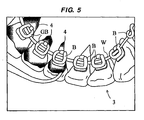
Fig. 5 is a perspective view illustrating a state that a third dental photopolymerizable composition is thinly coated on a tongue side entire surface around an orthodontic bracket. - A production method of an orthodontic bracket with a positioning guide according to the present invention will be described in detail below with reference to the drawings.
- In the drawings, an orthodontic wire W, an orthodontic bracket B mounted to the orthodontic wire W, and an orthodontic bracket with a poisoning guide GB are illustrated.
- A first dental photopolymerizable composition 1 as a base material is thinly coated on a bonding surface Ba of each of the orthodontic brackets B mounted to the orthodontic wire W, where the bonding surface Ba is to be bonded to a tooth surface. The first dental photopolymerizable composition 1 could be a composition which mainly includes a (meth)acrylate compound and inorganic filler and also includes a small amount of a photopolymerization catalyst. Particularly, a composition having a low viscosity is preferably used since the composition is thinly coated as a base material.
- A second dental
photopolymerizable composition 2 has an adhesive property to the first dental photopolymerizable composition 1. The second dentalphotopolymerizable composition 2 is built on the bonding surface Ba of the orthodontic bracket B in order to fill a gap between a tooth surface and the bonding surface Ba of the orthodontic bracket B, where the gap occurs when the orthodontic bracket B is bonded to a tooth of a patient. The second dentalphotopolymerizable composition 2 can also mainly include a (meth) acrylate compound and inorganic filler, and include a small amount of a photopolymerization catalyst. However, since the second dentalphotopolymerizable composition 2 should be built on the bonding surface Ba of the orthodontic bracket B in order to fill the gap between the tooth surface and the bonding surface Ba of the orthodontic bracket B, the second dentalphotopolymerizable composition 2 having high viscosity is preferably used. - A
dentition gypsum model 3 reproduces a dentition of a patient. As for such a dentition gypsum model, when the dentition gypsum model reproducing a dentition of a patient is a dentition gypsum model produced based on an impression taken from the patient, the dentition gypsum model can be accurately and easily produced, so it is preferable. Further, when the dentition gypsum model is a dentition gypsum model in which each tooth is separated from the dentition gypsum model produced based on the taken impression, moved to a position at which the tooth should be placed after orthodontic treatment, and fixed at the position, the installing position of the orthodontic bracket can be accurately determined based on the position at which the tooth should be finally placed after the orthodontic treatment, so it is preferable. - A third dental
photopolymerizable composition 4 is thinly coated on a tongue side entire surface and/or a cheek side entire surface around the orthodontic bracket B on thedentition gypsum model 3. The third dentalphotopolymerizable composition 4 is obtained by adding an organic filler to a (meth)acrylate compound so as to be easily abraded when an occlusal pressure is acted. However, preferably, the thirddental photopolymerizable composition 4 can include an inorganic filler in such an amount as to obtain sufficient strength and rigidity, when the strength and rigidity is insufficient, and include a small amount of a photopolymerization catalyst. - The (meth)acrylate compound included in the first dental photopolymerizable composition 1, the second
dental photopolymerizable composition 2, and the thirddental photopolymerizable composition 4 according to the present invention means various kinds of acrylate or methacrylate monomers, oligomers, and prepolymers. - More particularly, the (meth)acrylate compound could be methyl (meth)acrylate, ethyl (meth) acrylate, isopropyl (meth)acrylate, n-butyl (meth)acrylate, isobutyl (meth)acrylate, hydroxypropyl (meth)acrylate, tetrahydrofurfryl (meth)acrylate, glycidyl (meth)acrylate, 2-hydroxyethyl (meth)acrylate, 2-hydroxypropyl (meth)acrylate, 3-hydroxypropyl (meth)acrylate, 2-methoxyethyl (meth)acrylate, 2-ethoxyethyl (meth)acrylate, 2-ethylhexyl (meth)acrylate, benzyl (meth)acrylate, 2-hydroxy-1, 3-di(meth)acryloxy propane, ethylene glycol di(meth)acrylate, diethylene glycol di(meth)acrylate, triethylene glycol di(meth)acrylate, butylene glycol di(meth)acrylate, neopentyl glycol di(meth)acrylate, 1, 3-butanediol di(meth)acrylate, 1, 4-butanediol di(meth)acrylate, 1, 6-hexanediol di(meth)acrylate, trimethylolpropane tri(meth)acrylate, trimethylolethane tri(meth)acrylate, pentaerythritol tri(meth)acrylate, trimethylolmethane tri(meth)acrylate, pentaerythritol tetra(meth)acrylate, polybutylene glycol di(meth)acrylate, or bisphenol A diglycidyl (meth)acrylate. A monomer, oligomer, and prepolymer of these compounds can be preferably used. Further, as for (meth)acrylate having urethane bond, di-2-(meth)acryloxyethyl-2, 2, 4-trimethylhexamethylene dicarbamate, 1, 3, 5-tris [1, 3-bis{(meth)acryloyloxy}-2-propoxycarbonylaminohexane] -1, 3, 5-(1H, 3H, 5H) triazine-2, 4, 6- trione, and 2, 2-bis-4-(3-(meth)acryloyloxy-2-hydroxypropyl)-phenylpropane, can be used. In addition, (meth)acrylate of urethane oligomer including 2, 2'-di(4-hydroxycyclohexyl) propane, 2-oxypanone, hexamethylene diisocyanate, and 2-hydroxyethyl (meth)acrylate, and (meth)acrylate of urethane oligomer including 1, 3-butanediol, hexamethylene diisocyanate, and 2-hydroxyethyl (meth)acrylate can be used. These (can be used independently or by mixing two or more kinds.
- The inorganic filler included in the first dental photopolymerizable composition 1, the second
dental photopolymerizable composition 2 and the thirddental photopolymerizable composition 4 could be powders of as anhydrous silicic acid, glasses, such as barium glass, strontium glass, alumina glass, potassium glass, fluoroaluminosilicate glass, and the like, synthetic zeolite, calcium phosphate, feldspar, fumed silica, aluminum silicate, calcium silicate, magnesium carbonate, alumina, zirconia, magnesia, titania, hydrous silicic acid, hydrous calcium silicate, hydrous aluminum silicate, quartz, or the like. In addition, a non-porous colloidal silica by the atomized method, a non-porous colloidal alumina, non-porous colloidal titania, or a non-porous colloidal silica by the wetting method can be used. - The organic filler included in the third
dental photopolymerizable composition 4 could be a methacrylate, acrylate, or styrene homopolymer including a bridging agent, or its copolymer. More particularly, the organic filler could be trimethylolpropane trimethylmethacrylate or its acrylate, or a homopolymer bridged with other bridging agents or the like or its copolymer. - In order to bond with (meth)acrylate, the filler can be subjected to a surface treatment with a silane coupling agent, such as γ-methacryloxypropyltrimethoxysilane, vinyltrichlorosilane, vinyltriethoxysilane, vinyltrimethoxysilane, vinyltriacetoxysilane, vinyltri (methoxyethoxy) silane, or the like.
- In general, the photopolymerization catalyst included in the first dental photopolymerizable composition 1, the second
dental photopolymerizable composition 2, and the thirddental photopolymerizable composition 4 could be a combination of an initiator and a reducing agent. The initiator could be camphorquinone, benzyl, diacetyl, benzyl dimethyl ketal, benzyl diethyl ketal, benzyl di(2-methoxyethyl) ketal, 4,4'-dimethylbenzyl-dimethyl ketal, anthraquinone, 1-chloroanthraquinone, 2-chloroanthraquinone, 1,2-benzanthraquinone, 1-hydroxyanthraquinone, 1-methylanthraquinone, 2-ethylanthraquinone, 1-bromoanthraquinone, thioxanthone, 2-isopropylthioxanthone, 2-nitrothioxanthone, 2-methylthioxanthone, 2,4-dimethylthioxanthone, 2,4-diethylthioxanthone, 2,4-diisopropylthioxanthone, 2-chloro-7-trifluorothioxanthone,
thioxanthone-10,10-dioxide, thioxanthone-10-oxide, benzoin methyl ether, benzoin ethyl ether, isopropyl ether, benzoin isobutyl ether, benzophenone, bis(4-dimethylaminophenyl) ketone, 4,4'-bisdiethylaminobenzophenone, a derivative of acylphosphine oxide, and a compound including an azide group, or the like. These are used independently or by mixing two or more kinds. Generally, as the reducing agent, tert-amine or the like is used. Preferably, the tert-amine could be N,N-dimethyl-p-toluidine, N,N-dimethylaminoethylmethacrylate, triethanol amine, 4-dimethylamino benzoic acid methyl, 4-dimethylamino benzoic acid ethyl, or 4-dimethylamino benzoic acid isoamyl. As for other reducing agents, a benzoyl peroxide, a sodium sulfinate derivative, an organic metallic compound, or the like can be used. - A production method of the orthodontic bracket with a positioning guide GB according to the present invention will be described. The
dentition gypsum model 3 reproducing a dentition of a patient is firstly produced. When thedentition gypsum model 3 is produced based on an impression previously taken from the patient, a dentition of the patient can be accurately and easily reproduced. A dentition of thedentition gypsum model 3 is the same as the current dentition of the patient. Thus, based on thedentition gypsum model 3, the position of the orthodontic bracket B can be determined very accurately. Further, the orthodontic bracket with a positioning guide GB produced by the production method according to the present invention has a positioning guide and accurately reproduces the position determined in thedentition gypsum model 3 on a real tooth of the patient. - The
dentition gypsum model 3 produced based on the impression taken from the patient represents a dentition state before an orthodontic treatment. Thus, in an actual treatment, a dentist should adjust an orthodontic wire and the like so as to apply proper force to each tooth before the orthodontic treatment, while imaging the dentition state after the orthodontic treatment. Therefore, this adjustment is very hard. - Hence, the
dentition gypsum model 3 in which each tooth is once separated from thedentition gypsum model 3 after thedentition gypsum model 3 is produced based on the impression taken from the patient, and moved to the position at which the tooth should be placed after the orthodontic treatment, can be used. - In this case, after determining the position of the orthodontic bracket B in this
dentition gypsum model 3 having an ideal dentition state, the orthodontic bracket B is installed to the tooth of the patient before the actual orthodontic treatment. Therefore, the installing position of the orthodontic bracket B becomes ideal. Thedentition gypsum model 3 having such the ideal dentition state can be used because the orthodontic bracket with a positioning guide GB produced by the production method according to the present invention has a positioning guide and can accurately reproduce the position determined in thedentition gypsum model 3 on the real tooth of the patient. - In order to produce the orthodontic bracket with a positioning guide GB by using such the
dentition gypsum model 3, each orthodontic bracket B previously mounted to the orthodontic wire W is prepared first. Then, as illustrated inFig. 1 , the first dental photopolymerizable composition 1 as a base material is thinly coated on the bonding surface Ba of the orthodontic bracket B. - In the state that the first dental photopolymerizable composition 1 is coated to form a primer layer for the second
dental photopolymerizable composition 2 on the bonding surface Ba of the orthodontic bracket B, the seconddental photopolymerizable composition 2 having an adhesive property to the first dental photopolymerizable composition 1 is built as illustrated inFig. 2 . - In the state that the second
dental photopolymerizable composition 2 is built on the bonding surface Ba of the orthodontic bracket B as mentioned above, the orthodontic bracket B is adhered, through the seconddental photopolymerizable composition 2, to and temporarily fixed on a tongue side surface of a tooth, on which a separating material is previously coated on thedentition gypsum model 3, as illustrated inFig. 3 . Then, the first dental photopolymerizable composition 1 and the seconddental photopolymerizable composition 2 are polymerized/cured by irradiating light to the orthodontic bracket B, the installing position of which has been determined, as illustrated inFig. 4 . - Next, as illustrated in
Fig. 5 , the thirddental photopolymerizable composition 4 is thinly coated on the tongue side entire surface around the orthodontic bracket B on thedentition gypsum model 3. The thirddental photopolymerizable composition 4 is then polymerized/cured by irradiating light so as to be integrated with at least the seconddental photopolymerizable composition 2. Therefore, when the orthodontic bracket B is removed from thedentition gypsum model 3, the orthodontic bracket B can be removed in a state of integrally having the three dental photopolymerizable compositions as a whole. - Accordingly, a shape of a tongue side surface at which the orthodontic bracket B is positioned is transferred with the second
dental photopolymerizable composition 2, and a shape of the tongue side surface of a part at which the orthodontic bracket B is not positioned is transferred with the thirddental photopolymerizable composition 4. Since a shape of an entire surface of the tongue side surface is thus transferred to these photoplymerizable compositions, the orthodontic bracket with a positioning guide GB can be stably installed to an accurate installing position by coating a bonding agent to the positioning guide and installing it so as to fit the tongue side surface of a real tooth. - Further, the orthodontic bracket with a positioning guide GB to be installed to a cheek side surface of a tooth can be similarly produced by the production method according to the present invention. For example, when the orthodontic bracket with a positioning guide GB is installed to a front tooth, appearance of which is worried, the orthodontic bracket with a positioning guide GB can be installed to a tongue side surface of the front tooth. When the orthodontic bracket with a positioning guide GB is installed to a molar tooth, the orthodontic bracket with a positioning guide GB can be installed to a cheek side surface of the molar tooth, for which an installing operation or the like is easy. Further it can be installed only to a cheek side surface, for which an installing operation or the like is easy. Embodiments of these examples are not illustrated in the drawings.
- In an orthodontic treatment, a combination of an orthodontic tube and an orthodontic pendulum can be used instead of the combination of the orthodontic bracket B and the orthodontic wire W, where the shapes and mounting states of these combinations are approximately similar. The orthodontic tube has a shape approximately similar to the shape of the orthodontic bracket B. The state of mounting the orthodontic tube to the orthodontic pendulum is approximately similar to the state of mounting the orthodontic bracket B to the orthodontic wire W. Therefore, the production method of the present invention can be applied to both the combinations without a difference at all. While the orthodontic tube is generally mounted on the tongue side surface of a tooth, the orthodontic tube to be mounted on the tongue side surface can also be easily produced by the production method according to the present invention.
Claims (2)
- A production method of an orthodontic bracket with a positioning guide, which is bonded and fixed on a tongue side surface and/or a cheek side surface of each tooth of a patient, the production method comprising processes of:thinly coating a first dental photopolymerizable composition as a base material on a bonding surface of each orthodontic bracket mounted to an orthodontic wire, where the bonding surface is to be bonded to a tooth surface;building a second dental photopolymerizable composition having an adhesive property to said first dental photopolymerizable composition, on the bonding surface of the orthodontic bracket, in order to fill a gap which occurs between the tooth surface and the bonding surface of the orthodontic bracket at a time of bonding the orthodontic bracket to a tooth of the patient;adhering the bonding surface to a tooth surface of a dentition gypsum model reproducing a dentition of the patient, where a separating material is previously coated on the tooth surface of the dentition gypsum model;polymerizing/curing said first dental photopolymerizable composition and said second dental photopolymerizable composition by irradiating light;thinly coating a third dental photopolymerizable composition, which is easily abraded when a occlusal pressure is acted on a tongue side entire surface and/or a cheek side entire surface around the orthodontic bracket on the dentition gypsum model; andpolymerizing/curing the third dental photopolymerizable composition by irradiating light so as to be integrated with at least the second dental photopolymerizable composition.
- The production method of an orthodontic bracket with a positioning guide as claimed in claim 1, wherein the dentition gypsum model reproducing the dentition of the patient is a dentition gypsum model produced based on an impression taken from the patient, or
wherein the dentition gypsum model is a dentition gypsum model in which each tooth is separated from the dentition gypsum model produced based on the impression taken from the patient, moved to a position at which the tooth should be placed after an orthodontic treatment, and fixed at the position.
Applications Claiming Priority (1)
| Application Number | Priority Date | Filing Date | Title |
|---|---|---|---|
| JP2009132466A JP5323586B2 (en) | 2009-06-01 | 2009-06-01 | Manufacturing method of orthodontic bracket with positioning guide |
Publications (2)
| Publication Number | Publication Date |
|---|---|
| EP2258304A1 true EP2258304A1 (en) | 2010-12-08 |
| EP2258304B1 EP2258304B1 (en) | 2013-08-14 |
Family
ID=42651114
Family Applications (1)
| Application Number | Title | Priority Date | Filing Date |
|---|---|---|---|
| EP10005704.1A Active EP2258304B1 (en) | 2009-06-01 | 2010-06-01 | Production method of orthodontic bracket with positioning guide |
Country Status (3)
| Country | Link |
|---|---|
| US (1) | US8734690B2 (en) |
| EP (1) | EP2258304B1 (en) |
| JP (1) | JP5323586B2 (en) |
Cited By (3)
| Publication number | Priority date | Publication date | Assignee | Title |
|---|---|---|---|---|
| WO2016071508A1 (en) * | 2014-11-07 | 2016-05-12 | Ortho Caps Gmbh | Method for producing a prestressed tooth repositioning device |
| FR3120783A1 (en) * | 2021-03-16 | 2022-09-23 | 3C | Method of manufacturing a seating assembly of an orthodontic appliance and associated seating assembly |
| DE102024129737A1 (en) | 2024-10-14 | 2026-04-16 | Nadine Gomolka | Positioning aid, system and procedure for it |
Families Citing this family (17)
| Publication number | Priority date | Publication date | Assignee | Title |
|---|---|---|---|---|
| EP3545901B1 (en) | 2012-10-30 | 2021-03-03 | University of Southern California | Orthodontic appliance with snap fitted, non-sliding archwire |
| TW201442691A (en) * | 2013-05-02 | 2014-11-16 | Ezbond Co Ltd | Method for positioning orthodontic braces |
| KR101641497B1 (en) * | 2014-11-21 | 2016-07-21 | 조선대학교산학협력단 | Mould type jig for bonding orthodontic tube, mould type jig and bonding method of orthodontic tube |
| KR101580444B1 (en) * | 2015-07-09 | 2015-12-28 | 홍경재 | Positioner and method for producing positioner |
| EP3445273B1 (en) | 2016-04-18 | 2023-03-08 | Swift Health Systems Inc. | Orthodontic appliance with non-sliding, tied archwire |
| CN110177521A (en) | 2016-12-02 | 2019-08-27 | 斯威夫特健康系统有限公司 | Indirect Orthodontic bonding system and method for bracket placement |
| WO2018144634A1 (en) | 2017-01-31 | 2018-08-09 | Swift Health Systems Inc. | Hybrid orthodontic archwires |
| CN113952052A (en) | 2017-04-21 | 2022-01-21 | 斯威夫特健康系统有限公司 | Indirect-bonded tray, non-slip orthodontic appliance and registration system using the same |
| JP6942783B2 (en) | 2019-01-04 | 2021-09-29 | 澄祥 洪 | Improved indirect bonding method for orthodontic brackets |
| CN113710191A (en) | 2019-03-01 | 2021-11-26 | 斯威夫特健康系统有限公司 | Indirect adhesive tray with integration of occlusal attachments and orthodontic aids |
| KR102242491B1 (en) * | 2019-09-10 | 2021-04-20 | 오스템임플란트 주식회사 | Dental orthodontic appliance indirect bonding device |
| US12053346B2 (en) | 2019-10-31 | 2024-08-06 | Swift Health Systems Inc. | Indirect orthodontic bonding systems and methods |
| CA3186703A1 (en) | 2020-06-11 | 2021-12-16 | Swift Health Systems Inc. | Orthodontic appliance with non-sliding archform |
| US12268571B2 (en) | 2021-03-12 | 2025-04-08 | Swift Health Systems Inc. | Indirect orthodontic bonding systems and methods |
| EP4395687A4 (en) | 2021-09-03 | 2025-07-02 | Swift Health Systems Inc | Orthodontic appliance with non-sliding arch shape |
| WO2023033870A1 (en) | 2021-09-03 | 2023-03-09 | Swift Health Systems Inc. | Method of administering adhesive to bond orthodontic brackets |
| USD1043994S1 (en) | 2022-01-06 | 2024-09-24 | Swift Health Systems Inc. | Archwire |
Citations (2)
| Publication number | Priority date | Publication date | Assignee | Title |
|---|---|---|---|---|
| JPH1199161A (en) | 1997-09-26 | 1999-04-13 | Toshiaki Ko | Bracket installing method of orthodontic device |
| WO2005065568A1 (en) * | 2003-12-19 | 2005-07-21 | 3M Innovative Properties Company | Multi-layer adhesives and methods for bonding orthodontic appliances to tooth structure |
Family Cites Families (6)
| Publication number | Priority date | Publication date | Assignee | Title |
|---|---|---|---|---|
| US4892478A (en) * | 1988-03-21 | 1990-01-09 | Dentsply Research & Development Corp. | Method of preparing dental appliances |
| JPH08113B2 (en) * | 1992-03-26 | 1996-01-10 | チカミミルテック株式会社 | Orthodontic device |
| JPH1180593A (en) * | 1997-09-12 | 1999-03-26 | Sankin Kogyo Kk | Primer composition for bracket made of plastic and usage of the same composition |
| JP3265478B2 (en) * | 1999-08-26 | 2002-03-11 | 照夫 江花 | Orthodontic bracket mounting device |
| JP4783617B2 (en) * | 2005-11-09 | 2011-09-28 | 株式会社トクヤマ | Denture base resin composition |
| US8026296B2 (en) * | 2005-12-20 | 2011-09-27 | 3M Innovative Properties Company | Dental compositions including a thermally labile component, and the use thereof |
-
2009
- 2009-06-01 JP JP2009132466A patent/JP5323586B2/en active Active
-
2010
- 2010-06-01 EP EP10005704.1A patent/EP2258304B1/en active Active
- 2010-06-01 US US12/791,497 patent/US8734690B2/en active Active
Patent Citations (3)
| Publication number | Priority date | Publication date | Assignee | Title |
|---|---|---|---|---|
| JPH1199161A (en) | 1997-09-26 | 1999-04-13 | Toshiaki Ko | Bracket installing method of orthodontic device |
| EP0941710A1 (en) * | 1997-09-26 | 1999-09-15 | Toshiaki Hiro | Method of fitting bracket for orthodontic appliance |
| WO2005065568A1 (en) * | 2003-12-19 | 2005-07-21 | 3M Innovative Properties Company | Multi-layer adhesives and methods for bonding orthodontic appliances to tooth structure |
Cited By (4)
| Publication number | Priority date | Publication date | Assignee | Title |
|---|---|---|---|---|
| WO2016071508A1 (en) * | 2014-11-07 | 2016-05-12 | Ortho Caps Gmbh | Method for producing a prestressed tooth repositioning device |
| FR3120783A1 (en) * | 2021-03-16 | 2022-09-23 | 3C | Method of manufacturing a seating assembly of an orthodontic appliance and associated seating assembly |
| DE102024129737A1 (en) | 2024-10-14 | 2026-04-16 | Nadine Gomolka | Positioning aid, system and procedure for it |
| DE102024129737B4 (en) | 2024-10-14 | 2026-05-21 | Nadine Gomolka | Positioning aid, system and procedure for it |
Also Published As
| Publication number | Publication date |
|---|---|
| US20100300615A1 (en) | 2010-12-02 |
| EP2258304B1 (en) | 2013-08-14 |
| JP5323586B2 (en) | 2013-10-23 |
| US8734690B2 (en) | 2014-05-27 |
| JP2010274061A (en) | 2010-12-09 |
Similar Documents
| Publication | Publication Date | Title |
|---|---|---|
| EP2258304B1 (en) | Production method of orthodontic bracket with positioning guide | |
| CN111407442B (en) | Manufacturing method of positioning guide and dental appliance | |
| US9339352B2 (en) | Orthodontic article having partially hardened composition and related method | |
| US5971754A (en) | Indirect bonding method and adhesive for orthodontic treatment | |
| US20090280450A1 (en) | Pre-formed hard-shell attachment devices for dental appliances | |
| US20080286710A1 (en) | Packaged orthodontic appliance and adhesive material | |
| JPH1179925A (en) | Resin composition for orthodontia of photopolymerization type | |
| US9877811B2 (en) | Method for producing temporary prosthesis | |
| US20030118970A1 (en) | Removable dental models | |
| CN116710023A (en) | Bondable orthodontic component and method for bonding | |
| JP2016034920A (en) | Dental curable composition | |
| JP3668660B2 (en) | Bracket mounting core for orthodontics | |
| JP7120506B2 (en) | Denture base, method for manufacturing denture base, attached denture, and method for manufacturing attached denture | |
| JP2004065578A (en) | Prosthesis for dental surface | |
| JP2811725B2 (en) | Method for producing denture and denture-producing light-cured laminated resin sheet | |
| JPH09295913A (en) | Dental adhesive kit | |
| HK40026269B (en) | Method of producing a positioning guide, and a dental appliance | |
| JPH01155843A (en) | Connected artificial teeth | |
| US20080305449A1 (en) | Method of preparing a surface for attaching of an orthodontic device | |
| JPH01145058A (en) | Artificial tooth |
Legal Events
| Date | Code | Title | Description |
|---|---|---|---|
| PUAI | Public reference made under article 153(3) epc to a published international application that has entered the european phase |
Free format text: ORIGINAL CODE: 0009012 |
|
| AK | Designated contracting states |
Kind code of ref document: A1 Designated state(s): AL AT BE BG CH CY CZ DE DK EE ES FI FR GB GR HR HU IE IS IT LI LT LU LV MC MK MT NL NO PL PT RO SE SI SK SM TR |
|
| AX | Request for extension of the european patent |
Extension state: BA ME RS |
|
| 17P | Request for examination filed |
Effective date: 20110512 |
|
| GRAP | Despatch of communication of intention to grant a patent |
Free format text: ORIGINAL CODE: EPIDOSNIGR1 |
|
| GRAS | Grant fee paid |
Free format text: ORIGINAL CODE: EPIDOSNIGR3 |
|
| GRAA | (expected) grant |
Free format text: ORIGINAL CODE: 0009210 |
|
| AK | Designated contracting states |
Kind code of ref document: B1 Designated state(s): AL AT BE BG CH CY CZ DE DK EE ES FI FR GB GR HR HU IE IS IT LI LT LU LV MC MK MT NL NO PL PT RO SE SI SK SM TR |
|
| REG | Reference to a national code |
Ref country code: GB Ref legal event code: FG4D |
|
| REG | Reference to a national code |
Ref country code: AT Ref legal event code: REF Ref document number: 626318 Country of ref document: AT Kind code of ref document: T Effective date: 20130815 Ref country code: CH Ref legal event code: EP |
|
| REG | Reference to a national code |
Ref country code: SE Ref legal event code: TRGR |
|
| REG | Reference to a national code |
Ref country code: IE Ref legal event code: FG4D |
|
| REG | Reference to a national code |
Ref country code: DE Ref legal event code: R096 Ref document number: 602010009297 Country of ref document: DE Effective date: 20131010 |
|
| REG | Reference to a national code |
Ref country code: AT Ref legal event code: MK05 Ref document number: 626318 Country of ref document: AT Kind code of ref document: T Effective date: 20130814 Ref country code: NL Ref legal event code: VDEP Effective date: 20130814 |
|
| REG | Reference to a national code |
Ref country code: LT Ref legal event code: MG4D |
|
| PG25 | Lapsed in a contracting state [announced via postgrant information from national office to epo] |
Ref country code: NO Free format text: LAPSE BECAUSE OF FAILURE TO SUBMIT A TRANSLATION OF THE DESCRIPTION OR TO PAY THE FEE WITHIN THE PRESCRIBED TIME-LIMIT Effective date: 20131114 Ref country code: CY Free format text: LAPSE BECAUSE OF FAILURE TO SUBMIT A TRANSLATION OF THE DESCRIPTION OR TO PAY THE FEE WITHIN THE PRESCRIBED TIME-LIMIT Effective date: 20130911 Ref country code: IS Free format text: LAPSE BECAUSE OF FAILURE TO SUBMIT A TRANSLATION OF THE DESCRIPTION OR TO PAY THE FEE WITHIN THE PRESCRIBED TIME-LIMIT Effective date: 20131214 Ref country code: PT Free format text: LAPSE BECAUSE OF FAILURE TO SUBMIT A TRANSLATION OF THE DESCRIPTION OR TO PAY THE FEE WITHIN THE PRESCRIBED TIME-LIMIT Effective date: 20131216 Ref country code: AT Free format text: LAPSE BECAUSE OF FAILURE TO SUBMIT A TRANSLATION OF THE DESCRIPTION OR TO PAY THE FEE WITHIN THE PRESCRIBED TIME-LIMIT Effective date: 20130814 Ref country code: LT Free format text: LAPSE BECAUSE OF FAILURE TO SUBMIT A TRANSLATION OF THE DESCRIPTION OR TO PAY THE FEE WITHIN THE PRESCRIBED TIME-LIMIT Effective date: 20130814 Ref country code: HR Free format text: LAPSE BECAUSE OF FAILURE TO SUBMIT A TRANSLATION OF THE DESCRIPTION OR TO PAY THE FEE WITHIN THE PRESCRIBED TIME-LIMIT Effective date: 20130814 |
|
| PG25 | Lapsed in a contracting state [announced via postgrant information from national office to epo] |
Ref country code: FI Free format text: LAPSE BECAUSE OF FAILURE TO SUBMIT A TRANSLATION OF THE DESCRIPTION OR TO PAY THE FEE WITHIN THE PRESCRIBED TIME-LIMIT Effective date: 20130814 Ref country code: PL Free format text: LAPSE BECAUSE OF FAILURE TO SUBMIT A TRANSLATION OF THE DESCRIPTION OR TO PAY THE FEE WITHIN THE PRESCRIBED TIME-LIMIT Effective date: 20130814 Ref country code: SI Free format text: LAPSE BECAUSE OF FAILURE TO SUBMIT A TRANSLATION OF THE DESCRIPTION OR TO PAY THE FEE WITHIN THE PRESCRIBED TIME-LIMIT Effective date: 20130814 Ref country code: GR Free format text: LAPSE BECAUSE OF FAILURE TO SUBMIT A TRANSLATION OF THE DESCRIPTION OR TO PAY THE FEE WITHIN THE PRESCRIBED TIME-LIMIT Effective date: 20131115 Ref country code: LV Free format text: LAPSE BECAUSE OF FAILURE TO SUBMIT A TRANSLATION OF THE DESCRIPTION OR TO PAY THE FEE WITHIN THE PRESCRIBED TIME-LIMIT Effective date: 20130814 |
|
| PG25 | Lapsed in a contracting state [announced via postgrant information from national office to epo] |
Ref country code: CY Free format text: LAPSE BECAUSE OF FAILURE TO SUBMIT A TRANSLATION OF THE DESCRIPTION OR TO PAY THE FEE WITHIN THE PRESCRIBED TIME-LIMIT Effective date: 20130814 |
|
| PG25 | Lapsed in a contracting state [announced via postgrant information from national office to epo] |
Ref country code: DK Free format text: LAPSE BECAUSE OF FAILURE TO SUBMIT A TRANSLATION OF THE DESCRIPTION OR TO PAY THE FEE WITHIN THE PRESCRIBED TIME-LIMIT Effective date: 20130814 Ref country code: CZ Free format text: LAPSE BECAUSE OF FAILURE TO SUBMIT A TRANSLATION OF THE DESCRIPTION OR TO PAY THE FEE WITHIN THE PRESCRIBED TIME-LIMIT Effective date: 20130814 Ref country code: EE Free format text: LAPSE BECAUSE OF FAILURE TO SUBMIT A TRANSLATION OF THE DESCRIPTION OR TO PAY THE FEE WITHIN THE PRESCRIBED TIME-LIMIT Effective date: 20130814 Ref country code: NL Free format text: LAPSE BECAUSE OF FAILURE TO SUBMIT A TRANSLATION OF THE DESCRIPTION OR TO PAY THE FEE WITHIN THE PRESCRIBED TIME-LIMIT Effective date: 20130814 Ref country code: SK Free format text: LAPSE BECAUSE OF FAILURE TO SUBMIT A TRANSLATION OF THE DESCRIPTION OR TO PAY THE FEE WITHIN THE PRESCRIBED TIME-LIMIT Effective date: 20130814 Ref country code: RO Free format text: LAPSE BECAUSE OF FAILURE TO SUBMIT A TRANSLATION OF THE DESCRIPTION OR TO PAY THE FEE WITHIN THE PRESCRIBED TIME-LIMIT Effective date: 20130814 |
|
| PG25 | Lapsed in a contracting state [announced via postgrant information from national office to epo] |
Ref country code: ES Free format text: LAPSE BECAUSE OF FAILURE TO SUBMIT A TRANSLATION OF THE DESCRIPTION OR TO PAY THE FEE WITHIN THE PRESCRIBED TIME-LIMIT Effective date: 20130814 Ref country code: IT Free format text: LAPSE BECAUSE OF FAILURE TO SUBMIT A TRANSLATION OF THE DESCRIPTION OR TO PAY THE FEE WITHIN THE PRESCRIBED TIME-LIMIT Effective date: 20130814 |
|
| PLBE | No opposition filed within time limit |
Free format text: ORIGINAL CODE: 0009261 |
|
| STAA | Information on the status of an ep patent application or granted ep patent |
Free format text: STATUS: NO OPPOSITION FILED WITHIN TIME LIMIT |
|
| 26N | No opposition filed |
Effective date: 20140515 |
|
| REG | Reference to a national code |
Ref country code: DE Ref legal event code: R097 Ref document number: 602010009297 Country of ref document: DE Effective date: 20140515 |
|
| PG25 | Lapsed in a contracting state [announced via postgrant information from national office to epo] |
Ref country code: MC Free format text: LAPSE BECAUSE OF FAILURE TO SUBMIT A TRANSLATION OF THE DESCRIPTION OR TO PAY THE FEE WITHIN THE PRESCRIBED TIME-LIMIT Effective date: 20130814 Ref country code: LU Free format text: LAPSE BECAUSE OF FAILURE TO SUBMIT A TRANSLATION OF THE DESCRIPTION OR TO PAY THE FEE WITHIN THE PRESCRIBED TIME-LIMIT Effective date: 20140601 |
|
| REG | Reference to a national code |
Ref country code: CH Ref legal event code: PL |
|
| REG | Reference to a national code |
Ref country code: IE Ref legal event code: MM4A |
|
| PG25 | Lapsed in a contracting state [announced via postgrant information from national office to epo] |
Ref country code: LI Free format text: LAPSE BECAUSE OF NON-PAYMENT OF DUE FEES Effective date: 20140630 Ref country code: IE Free format text: LAPSE BECAUSE OF NON-PAYMENT OF DUE FEES Effective date: 20140601 Ref country code: CH Free format text: LAPSE BECAUSE OF NON-PAYMENT OF DUE FEES Effective date: 20140630 |
|
| PG25 | Lapsed in a contracting state [announced via postgrant information from national office to epo] |
Ref country code: MT Free format text: LAPSE BECAUSE OF FAILURE TO SUBMIT A TRANSLATION OF THE DESCRIPTION OR TO PAY THE FEE WITHIN THE PRESCRIBED TIME-LIMIT Effective date: 20130814 |
|
| PG25 | Lapsed in a contracting state [announced via postgrant information from national office to epo] |
Ref country code: SM Free format text: LAPSE BECAUSE OF FAILURE TO SUBMIT A TRANSLATION OF THE DESCRIPTION OR TO PAY THE FEE WITHIN THE PRESCRIBED TIME-LIMIT Effective date: 20130814 |
|
| REG | Reference to a national code |
Ref country code: FR Ref legal event code: PLFP Year of fee payment: 7 |
|
| PG25 | Lapsed in a contracting state [announced via postgrant information from national office to epo] |
Ref country code: BG Free format text: LAPSE BECAUSE OF FAILURE TO SUBMIT A TRANSLATION OF THE DESCRIPTION OR TO PAY THE FEE WITHIN THE PRESCRIBED TIME-LIMIT Effective date: 20130814 |
|
| PG25 | Lapsed in a contracting state [announced via postgrant information from national office to epo] |
Ref country code: HU Free format text: LAPSE BECAUSE OF FAILURE TO SUBMIT A TRANSLATION OF THE DESCRIPTION OR TO PAY THE FEE WITHIN THE PRESCRIBED TIME-LIMIT; INVALID AB INITIO Effective date: 20100601 Ref country code: TR Free format text: LAPSE BECAUSE OF FAILURE TO SUBMIT A TRANSLATION OF THE DESCRIPTION OR TO PAY THE FEE WITHIN THE PRESCRIBED TIME-LIMIT Effective date: 20130814 |
|
| REG | Reference to a national code |
Ref country code: FR Ref legal event code: PLFP Year of fee payment: 8 |
|
| REG | Reference to a national code |
Ref country code: FR Ref legal event code: PLFP Year of fee payment: 9 |
|
| PG25 | Lapsed in a contracting state [announced via postgrant information from national office to epo] |
Ref country code: MK Free format text: LAPSE BECAUSE OF FAILURE TO SUBMIT A TRANSLATION OF THE DESCRIPTION OR TO PAY THE FEE WITHIN THE PRESCRIBED TIME-LIMIT Effective date: 20130814 |
|
| PG25 | Lapsed in a contracting state [announced via postgrant information from national office to epo] |
Ref country code: AL Free format text: LAPSE BECAUSE OF FAILURE TO SUBMIT A TRANSLATION OF THE DESCRIPTION OR TO PAY THE FEE WITHIN THE PRESCRIBED TIME-LIMIT Effective date: 20130814 |
|
| P01 | Opt-out of the competence of the unified patent court (upc) registered |
Effective date: 20230502 |
|
| PGFP | Annual fee paid to national office [announced via postgrant information from national office to epo] |
Ref country code: DE Payment date: 20250626 Year of fee payment: 16 |
|
| PGFP | Annual fee paid to national office [announced via postgrant information from national office to epo] |
Ref country code: GB Payment date: 20250626 Year of fee payment: 16 |
|
| PGFP | Annual fee paid to national office [announced via postgrant information from national office to epo] |
Ref country code: BE Payment date: 20250617 Year of fee payment: 16 |
|
| PGFP | Annual fee paid to national office [announced via postgrant information from national office to epo] |
Ref country code: FR Payment date: 20250626 Year of fee payment: 16 |
|
| PGFP | Annual fee paid to national office [announced via postgrant information from national office to epo] |
Ref country code: SE Payment date: 20250618 Year of fee payment: 16 |