EP2253467A1 - Decorative sheet for three-dimensional work - Google Patents
Decorative sheet for three-dimensional work Download PDFInfo
- Publication number
- EP2253467A1 EP2253467A1 EP08721941A EP08721941A EP2253467A1 EP 2253467 A1 EP2253467 A1 EP 2253467A1 EP 08721941 A EP08721941 A EP 08721941A EP 08721941 A EP08721941 A EP 08721941A EP 2253467 A1 EP2253467 A1 EP 2253467A1
- Authority
- EP
- European Patent Office
- Prior art keywords
- decorative sheet
- layer
- dimensional processing
- meth
- thermoplastic resin
- Prior art date
- Legal status (The legal status is an assumption and is not a legal conclusion. Google has not performed a legal analysis and makes no representation as to the accuracy of the status listed.)
- Withdrawn
Links
- 239000011241 protective layer Substances 0.000 claims abstract description 57
- 238000012545 processing Methods 0.000 claims abstract description 41
- 238000000465 moulding Methods 0.000 claims abstract description 40
- 239000011342 resin composition Substances 0.000 claims abstract description 31
- 238000000034 method Methods 0.000 claims abstract description 24
- 230000005865 ionizing radiation Effects 0.000 claims abstract description 18
- 238000004132 cross linking Methods 0.000 claims abstract description 13
- 239000010410 layer Substances 0.000 claims description 150
- 229920005989 resin Polymers 0.000 claims description 149
- 239000011347 resin Substances 0.000 claims description 149
- 229920006352 transparent thermoplastic Polymers 0.000 claims description 43
- 229920005992 thermoplastic resin Polymers 0.000 claims description 41
- 238000010894 electron beam technology Methods 0.000 claims description 18
- 238000003860 storage Methods 0.000 claims description 18
- 238000010438 heat treatment Methods 0.000 claims description 3
- 230000000977 initiatory effect Effects 0.000 claims description 3
- 238000005299 abrasion Methods 0.000 abstract description 32
- 239000002904 solvent Substances 0.000 abstract description 30
- NIXOWILDQLNWCW-UHFFFAOYSA-M Acrylate Chemical compound [O-]C(=O)C=C NIXOWILDQLNWCW-UHFFFAOYSA-M 0.000 description 57
- -1 ethylene oxide-modified phosphoric acid Chemical class 0.000 description 53
- 239000012790 adhesive layer Substances 0.000 description 27
- 238000000576 coating method Methods 0.000 description 22
- 239000000463 material Substances 0.000 description 22
- 239000000178 monomer Substances 0.000 description 22
- PPBRXRYQALVLMV-UHFFFAOYSA-N Styrene Chemical compound C=CC1=CC=CC=C1 PPBRXRYQALVLMV-UHFFFAOYSA-N 0.000 description 20
- 229920001577 copolymer Polymers 0.000 description 20
- 239000011248 coating agent Substances 0.000 description 18
- VVQNEPGJFQJSBK-UHFFFAOYSA-N Methyl methacrylate Chemical compound COC(=O)C(C)=C VVQNEPGJFQJSBK-UHFFFAOYSA-N 0.000 description 12
- 239000004743 Polypropylene Substances 0.000 description 11
- NIXOWILDQLNWCW-UHFFFAOYSA-N acrylic acid group Chemical group C(C=C)(=O)O NIXOWILDQLNWCW-UHFFFAOYSA-N 0.000 description 11
- 229920000122 acrylonitrile butadiene styrene Polymers 0.000 description 11
- 239000003086 colorant Substances 0.000 description 11
- 150000001875 compounds Chemical class 0.000 description 11
- 238000007756 gravure coating Methods 0.000 description 11
- 229920001155 polypropylene Polymers 0.000 description 11
- BAPJBEWLBFYGME-UHFFFAOYSA-N Methyl acrylate Chemical compound COC(=O)C=C BAPJBEWLBFYGME-UHFFFAOYSA-N 0.000 description 10
- 230000001070 adhesive effect Effects 0.000 description 10
- 229920002803 thermoplastic polyurethane Polymers 0.000 description 10
- 230000000873 masking effect Effects 0.000 description 9
- 239000006096 absorbing agent Substances 0.000 description 8
- 230000001133 acceleration Effects 0.000 description 8
- 230000000052 comparative effect Effects 0.000 description 8
- 230000000694 effects Effects 0.000 description 8
- 238000001746 injection moulding Methods 0.000 description 8
- 239000007788 liquid Substances 0.000 description 8
- VZCYOOQTPOCHFL-UHFFFAOYSA-N trans-butenedioic acid Natural products OC(=O)C=CC(O)=O VZCYOOQTPOCHFL-UHFFFAOYSA-N 0.000 description 8
- 238000011282 treatment Methods 0.000 description 8
- OFOBLEOULBTSOW-UHFFFAOYSA-N Propanedioic acid Natural products OC(=O)CC(O)=O OFOBLEOULBTSOW-UHFFFAOYSA-N 0.000 description 7
- BZHJMEDXRYGGRV-UHFFFAOYSA-N Vinyl chloride Chemical compound ClC=C BZHJMEDXRYGGRV-UHFFFAOYSA-N 0.000 description 7
- 230000008859 change Effects 0.000 description 7
- 239000003795 chemical substances by application Substances 0.000 description 7
- VZCYOOQTPOCHFL-UPHRSURJSA-N maleic acid Chemical compound OC(=O)\C=C/C(O)=O VZCYOOQTPOCHFL-UPHRSURJSA-N 0.000 description 7
- 239000011976 maleic acid Substances 0.000 description 7
- 239000000049 pigment Substances 0.000 description 7
- 238000007639 printing Methods 0.000 description 7
- CERQOIWHTDAKMF-UHFFFAOYSA-N Methacrylic acid Chemical compound CC(=C)C(O)=O CERQOIWHTDAKMF-UHFFFAOYSA-N 0.000 description 6
- 150000001252 acrylic acid derivatives Chemical class 0.000 description 6
- 239000003822 epoxy resin Substances 0.000 description 6
- 229920000647 polyepoxide Polymers 0.000 description 6
- TXBCBTDQIULDIA-UHFFFAOYSA-N 2-[[3-hydroxy-2,2-bis(hydroxymethyl)propoxy]methyl]-2-(hydroxymethyl)propane-1,3-diol Chemical compound OCC(CO)(CO)COCC(CO)(CO)CO TXBCBTDQIULDIA-UHFFFAOYSA-N 0.000 description 5
- 239000004593 Epoxy Substances 0.000 description 5
- GWEVSGVZZGPLCZ-UHFFFAOYSA-N Titan oxide Chemical compound O=[Ti]=O GWEVSGVZZGPLCZ-UHFFFAOYSA-N 0.000 description 5
- 238000013461 design Methods 0.000 description 5
- 239000003999 initiator Substances 0.000 description 5
- 238000004519 manufacturing process Methods 0.000 description 5
- 239000000203 mixture Substances 0.000 description 5
- 229920005668 polycarbonate resin Polymers 0.000 description 5
- 239000004431 polycarbonate resin Substances 0.000 description 5
- 229920000728 polyester Polymers 0.000 description 5
- 229920001225 polyester resin Polymers 0.000 description 5
- 239000004645 polyester resin Substances 0.000 description 5
- 238000012360 testing method Methods 0.000 description 5
- UQSXHKLRYXJYBZ-UHFFFAOYSA-N Iron oxide Chemical compound [Fe]=O UQSXHKLRYXJYBZ-UHFFFAOYSA-N 0.000 description 4
- SECXISVLQFMRJM-UHFFFAOYSA-N N-Methylpyrrolidone Chemical compound CN1CCCC1=O SECXISVLQFMRJM-UHFFFAOYSA-N 0.000 description 4
- 239000004698 Polyethylene Substances 0.000 description 4
- 239000000654 additive Substances 0.000 description 4
- 239000000853 adhesive Substances 0.000 description 4
- IPZIVCLZBFDXTA-UHFFFAOYSA-N ethyl n-prop-2-enoylcarbamate Chemical compound CCOC(=O)NC(=O)C=C IPZIVCLZBFDXTA-UHFFFAOYSA-N 0.000 description 4
- LNEPOXFFQSENCJ-UHFFFAOYSA-N haloperidol Chemical compound C1CC(O)(C=2C=CC(Cl)=CC=2)CCN1CCCC(=O)C1=CC=C(F)C=C1 LNEPOXFFQSENCJ-UHFFFAOYSA-N 0.000 description 4
- 125000002887 hydroxy group Chemical group [H]O* 0.000 description 4
- 238000002347 injection Methods 0.000 description 4
- 239000007924 injection Substances 0.000 description 4
- 239000004611 light stabiliser Substances 0.000 description 4
- 239000002245 particle Substances 0.000 description 4
- 230000000704 physical effect Effects 0.000 description 4
- 229920000573 polyethylene Polymers 0.000 description 4
- 229920000139 polyethylene terephthalate Polymers 0.000 description 4
- 239000005020 polyethylene terephthalate Substances 0.000 description 4
- 229920005672 polyolefin resin Polymers 0.000 description 4
- 239000002356 single layer Substances 0.000 description 4
- 239000004129 EU approved improving agent Substances 0.000 description 3
- 239000005977 Ethylene Substances 0.000 description 3
- LYCAIKOWRPUZTN-UHFFFAOYSA-N Ethylene glycol Chemical compound OCCO LYCAIKOWRPUZTN-UHFFFAOYSA-N 0.000 description 3
- 239000004793 Polystyrene Substances 0.000 description 3
- DNIAPMSPPWPWGF-UHFFFAOYSA-N Propylene glycol Chemical compound CC(O)CO DNIAPMSPPWPWGF-UHFFFAOYSA-N 0.000 description 3
- VYPSYNLAJGMNEJ-UHFFFAOYSA-N Silicium dioxide Chemical compound O=[Si]=O VYPSYNLAJGMNEJ-UHFFFAOYSA-N 0.000 description 3
- XTXRWKRVRITETP-UHFFFAOYSA-N Vinyl acetate Chemical compound CC(=O)OC=C XTXRWKRVRITETP-UHFFFAOYSA-N 0.000 description 3
- ISAOCJYIOMOJEB-UHFFFAOYSA-N benzoin Chemical compound C=1C=CC=CC=1C(O)C(=O)C1=CC=CC=C1 ISAOCJYIOMOJEB-UHFFFAOYSA-N 0.000 description 3
- 238000005227 gel permeation chromatography Methods 0.000 description 3
- 238000007646 gravure printing Methods 0.000 description 3
- 125000002496 methyl group Chemical group [H]C([H])([H])* 0.000 description 3
- 230000003647 oxidation Effects 0.000 description 3
- 238000007254 oxidation reaction Methods 0.000 description 3
- WXZMFSXDPGVJKK-UHFFFAOYSA-N pentaerythritol Chemical compound OCC(CO)(CO)CO WXZMFSXDPGVJKK-UHFFFAOYSA-N 0.000 description 3
- 229920003229 poly(methyl methacrylate) Polymers 0.000 description 3
- 229920000098 polyolefin Polymers 0.000 description 3
- 229920006324 polyoxymethylene Polymers 0.000 description 3
- 229920002223 polystyrene Polymers 0.000 description 3
- 229920002635 polyurethane Polymers 0.000 description 3
- 239000004814 polyurethane Substances 0.000 description 3
- 229920005604 random copolymer Polymers 0.000 description 3
- 239000000758 substrate Substances 0.000 description 3
- 238000004381 surface treatment Methods 0.000 description 3
- JHPBZFOKBAGZBL-UHFFFAOYSA-N (3-hydroxy-2,2,4-trimethylpentyl) 2-methylprop-2-enoate Chemical compound CC(C)C(O)C(C)(C)COC(=O)C(C)=C JHPBZFOKBAGZBL-UHFFFAOYSA-N 0.000 description 2
- MYRTYDVEIRVNKP-UHFFFAOYSA-N 1,2-Divinylbenzene Chemical compound C=CC1=CC=CC=C1C=C MYRTYDVEIRVNKP-UHFFFAOYSA-N 0.000 description 2
- AZQWKYJCGOJGHM-UHFFFAOYSA-N 1,4-benzoquinone Chemical compound O=C1C=CC(=O)C=C1 AZQWKYJCGOJGHM-UHFFFAOYSA-N 0.000 description 2
- VXNZUUAINFGPBY-UHFFFAOYSA-N 1-Butene Chemical compound CCC=C VXNZUUAINFGPBY-UHFFFAOYSA-N 0.000 description 2
- NJWGQARXZDRHCD-UHFFFAOYSA-N 2-methylanthraquinone Chemical compound C1=CC=C2C(=O)C3=CC(C)=CC=C3C(=O)C2=C1 NJWGQARXZDRHCD-UHFFFAOYSA-N 0.000 description 2
- WZSFTHVIIGGDOI-UHFFFAOYSA-N 4,5,6,7-tetrachloro-3-[2-methyl-3-[(4,5,6,7-tetrachloro-3-oxoisoindol-1-yl)amino]anilino]isoindol-1-one Chemical compound ClC1=C(Cl)C(Cl)=C(Cl)C2=C1C(NC1=CC=CC(NC=3C4=C(C(=C(Cl)C(Cl)=C4Cl)Cl)C(=O)N=3)=C1C)=NC2=O WZSFTHVIIGGDOI-UHFFFAOYSA-N 0.000 description 2
- KWOLFJPFCHCOCG-UHFFFAOYSA-N Acetophenone Chemical compound CC(=O)C1=CC=CC=C1 KWOLFJPFCHCOCG-UHFFFAOYSA-N 0.000 description 2
- PNEYBMLMFCGWSK-UHFFFAOYSA-N Alumina Chemical compound [O-2].[O-2].[O-2].[Al+3].[Al+3] PNEYBMLMFCGWSK-UHFFFAOYSA-N 0.000 description 2
- 229930185605 Bisphenol Natural products 0.000 description 2
- KAKZBPTYRLMSJV-UHFFFAOYSA-N Butadiene Chemical compound C=CC=C KAKZBPTYRLMSJV-UHFFFAOYSA-N 0.000 description 2
- VTYYLEPIZMXCLO-UHFFFAOYSA-L Calcium carbonate Chemical compound [Ca+2].[O-]C([O-])=O VTYYLEPIZMXCLO-UHFFFAOYSA-L 0.000 description 2
- LFQSCWFLJHTTHZ-UHFFFAOYSA-N Ethanol Chemical compound CCO LFQSCWFLJHTTHZ-UHFFFAOYSA-N 0.000 description 2
- JOYRKODLDBILNP-UHFFFAOYSA-N Ethyl urethane Chemical compound CCOC(N)=O JOYRKODLDBILNP-UHFFFAOYSA-N 0.000 description 2
- 239000004606 Fillers/Extenders Substances 0.000 description 2
- VZCYOOQTPOCHFL-OWOJBTEDSA-N Fumaric acid Chemical compound OC(=O)\C=C\C(O)=O VZCYOOQTPOCHFL-OWOJBTEDSA-N 0.000 description 2
- QIGBRXMKCJKVMJ-UHFFFAOYSA-N Hydroquinone Chemical compound OC1=CC=C(O)C=C1 QIGBRXMKCJKVMJ-UHFFFAOYSA-N 0.000 description 2
- VQTUBCCKSQIDNK-UHFFFAOYSA-N Isobutene Chemical compound CC(C)=C VQTUBCCKSQIDNK-UHFFFAOYSA-N 0.000 description 2
- RRHGJUQNOFWUDK-UHFFFAOYSA-N Isoprene Chemical compound CC(=C)C=C RRHGJUQNOFWUDK-UHFFFAOYSA-N 0.000 description 2
- CERQOIWHTDAKMF-UHFFFAOYSA-M Methacrylate Chemical compound CC(=C)C([O-])=O CERQOIWHTDAKMF-UHFFFAOYSA-M 0.000 description 2
- 239000004952 Polyamide Substances 0.000 description 2
- 239000005062 Polybutadiene Substances 0.000 description 2
- 239000002202 Polyethylene glycol Substances 0.000 description 2
- 239000004721 Polyphenylene oxide Substances 0.000 description 2
- NRCMAYZCPIVABH-UHFFFAOYSA-N Quinacridone Chemical compound N1C2=CC=CC=C2C(=O)C2=C1C=C1C(=O)C3=CC=CC=C3NC1=C2 NRCMAYZCPIVABH-UHFFFAOYSA-N 0.000 description 2
- 206010040844 Skin exfoliation Diseases 0.000 description 2
- 244000028419 Styrax benzoin Species 0.000 description 2
- 235000000126 Styrax benzoin Nutrition 0.000 description 2
- 235000008411 Sumatra benzointree Nutrition 0.000 description 2
- 229920002433 Vinyl chloride-vinyl acetate copolymer Polymers 0.000 description 2
- XLOMVQKBTHCTTD-UHFFFAOYSA-N Zinc monoxide Chemical compound [Zn]=O XLOMVQKBTHCTTD-UHFFFAOYSA-N 0.000 description 2
- 239000011354 acetal resin Substances 0.000 description 2
- 229920003180 amino resin Polymers 0.000 description 2
- TZCXTZWJZNENPQ-UHFFFAOYSA-L barium sulfate Chemical compound [Ba+2].[O-]S([O-])(=O)=O TZCXTZWJZNENPQ-UHFFFAOYSA-L 0.000 description 2
- 229960002130 benzoin Drugs 0.000 description 2
- 239000011230 binding agent Substances 0.000 description 2
- IISBACLAFKSPIT-UHFFFAOYSA-N bisphenol A Chemical compound C=1C=C(O)C=CC=1C(C)(C)C1=CC=C(O)C=C1 IISBACLAFKSPIT-UHFFFAOYSA-N 0.000 description 2
- 229920001400 block copolymer Polymers 0.000 description 2
- IAQRGUVFOMOMEM-UHFFFAOYSA-N but-2-ene Chemical compound CC=CC IAQRGUVFOMOMEM-UHFFFAOYSA-N 0.000 description 2
- WERYXYBDKMZEQL-UHFFFAOYSA-N butane-1,4-diol Chemical compound OCCCCO WERYXYBDKMZEQL-UHFFFAOYSA-N 0.000 description 2
- 239000006229 carbon black Substances 0.000 description 2
- 150000001735 carboxylic acids Chemical class 0.000 description 2
- 229920006026 co-polymeric resin Polymers 0.000 description 2
- XCJYREBRNVKWGJ-UHFFFAOYSA-N copper(II) phthalocyanine Chemical compound [Cu+2].C12=CC=CC=C2C(N=C2[N-]C(C3=CC=CC=C32)=N2)=NC1=NC([C]1C=CC=CC1=1)=NC=1N=C1[C]3C=CC=CC3=C2[N-]1 XCJYREBRNVKWGJ-UHFFFAOYSA-N 0.000 description 2
- 238000003851 corona treatment Methods 0.000 description 2
- 239000003431 cross linking reagent Substances 0.000 description 2
- 125000000113 cyclohexyl group Chemical group [H]C1([H])C([H])([H])C([H])([H])C([H])(*)C([H])([H])C1([H])[H] 0.000 description 2
- 239000000975 dye Substances 0.000 description 2
- 229920001971 elastomer Polymers 0.000 description 2
- 150000002148 esters Chemical class 0.000 description 2
- SUPCQIBBMFXVTL-UHFFFAOYSA-N ethyl 2-methylprop-2-enoate Chemical compound CCOC(=O)C(C)=C SUPCQIBBMFXVTL-UHFFFAOYSA-N 0.000 description 2
- UHESRSKEBRADOO-UHFFFAOYSA-N ethyl carbamate;prop-2-enoic acid Chemical compound OC(=O)C=C.CCOC(N)=O UHESRSKEBRADOO-UHFFFAOYSA-N 0.000 description 2
- 238000011156 evaluation Methods 0.000 description 2
- 239000000945 filler Substances 0.000 description 2
- 239000012530 fluid Substances 0.000 description 2
- 239000011888 foil Substances 0.000 description 2
- 125000000524 functional group Chemical group 0.000 description 2
- 235000019382 gum benzoic Nutrition 0.000 description 2
- 229920001519 homopolymer Polymers 0.000 description 2
- 239000003112 inhibitor Substances 0.000 description 2
- 150000002484 inorganic compounds Chemical class 0.000 description 2
- 239000012948 isocyanate Substances 0.000 description 2
- 150000002513 isocyanates Chemical class 0.000 description 2
- ZFSLODLOARCGLH-UHFFFAOYSA-N isocyanuric acid Chemical compound OC1=NC(O)=NC(O)=N1 ZFSLODLOARCGLH-UHFFFAOYSA-N 0.000 description 2
- 239000004579 marble Substances 0.000 description 2
- 238000005259 measurement Methods 0.000 description 2
- QSHDDOUJBYECFT-UHFFFAOYSA-N mercury Chemical compound [Hg] QSHDDOUJBYECFT-UHFFFAOYSA-N 0.000 description 2
- 229910052753 mercury Inorganic materials 0.000 description 2
- 229920003986 novolac Polymers 0.000 description 2
- IEQIEDJGQAUEQZ-UHFFFAOYSA-N phthalocyanine Chemical compound N1C(N=C2C3=CC=CC=C3C(N=C3C4=CC=CC=C4C(=N4)N3)=N2)=C(C=CC=C2)C2=C1N=C1C2=CC=CC=C2C4=N1 IEQIEDJGQAUEQZ-UHFFFAOYSA-N 0.000 description 2
- 239000004014 plasticizer Substances 0.000 description 2
- 229920002037 poly(vinyl butyral) polymer Polymers 0.000 description 2
- 229920002647 polyamide Polymers 0.000 description 2
- 229920002857 polybutadiene Polymers 0.000 description 2
- 229920001707 polybutylene terephthalate Polymers 0.000 description 2
- 229920000570 polyether Polymers 0.000 description 2
- 229920001223 polyethylene glycol Polymers 0.000 description 2
- 229920001721 polyimide Polymers 0.000 description 2
- 229920001228 polyisocyanate Polymers 0.000 description 2
- 239000005056 polyisocyanate Substances 0.000 description 2
- 238000006116 polymerization reaction Methods 0.000 description 2
- 229920005862 polyol Polymers 0.000 description 2
- 150000003077 polyols Chemical class 0.000 description 2
- 229920001296 polysiloxane Polymers 0.000 description 2
- WQGWDDDVZFFDIG-UHFFFAOYSA-N pyrogallol Chemical compound OC1=CC=CC(O)=C1O WQGWDDDVZFFDIG-UHFFFAOYSA-N 0.000 description 2
- 238000007788 roughening Methods 0.000 description 2
- 239000005060 rubber Substances 0.000 description 2
- 238000006748 scratching Methods 0.000 description 2
- 230000002393 scratching effect Effects 0.000 description 2
- 239000012798 spherical particle Substances 0.000 description 2
- 229920001187 thermosetting polymer Polymers 0.000 description 2
- 235000010215 titanium dioxide Nutrition 0.000 description 2
- OGIDPMRJRNCKJF-UHFFFAOYSA-N titanium oxide Inorganic materials [Ti]=O OGIDPMRJRNCKJF-UHFFFAOYSA-N 0.000 description 2
- 229920002554 vinyl polymer Polymers 0.000 description 2
- 239000001993 wax Substances 0.000 description 2
- 230000037303 wrinkles Effects 0.000 description 2
- DTGKSKDOIYIVQL-WEDXCCLWSA-N (+)-borneol Chemical group C1C[C@@]2(C)[C@@H](O)C[C@@H]1C2(C)C DTGKSKDOIYIVQL-WEDXCCLWSA-N 0.000 description 1
- RLUFBDIRFJGKLY-UHFFFAOYSA-N (2,3-dichlorophenyl)-phenylmethanone Chemical compound ClC1=CC=CC(C(=O)C=2C=CC=CC=2)=C1Cl RLUFBDIRFJGKLY-UHFFFAOYSA-N 0.000 description 1
- OJOWICOBYCXEKR-KRXBUXKQSA-N (5e)-5-ethylidenebicyclo[2.2.1]hept-2-ene Chemical compound C1C2C(=C/C)/CC1C=C2 OJOWICOBYCXEKR-KRXBUXKQSA-N 0.000 description 1
- XKSUVRWJZCEYQQ-UHFFFAOYSA-N 1,1-dimethoxyethylbenzene Chemical compound COC(C)(OC)C1=CC=CC=C1 XKSUVRWJZCEYQQ-UHFFFAOYSA-N 0.000 description 1
- MSAHTMIQULFMRG-UHFFFAOYSA-N 1,2-diphenyl-2-propan-2-yloxyethanone Chemical compound C=1C=CC=CC=1C(OC(C)C)C(=O)C1=CC=CC=C1 MSAHTMIQULFMRG-UHFFFAOYSA-N 0.000 description 1
- DKEGCUDAFWNSSO-UHFFFAOYSA-N 1,8-dibromooctane Chemical compound BrCCCCCCCCBr DKEGCUDAFWNSSO-UHFFFAOYSA-N 0.000 description 1
- XIRPMPKSZHNMST-UHFFFAOYSA-N 1-ethenyl-2-phenylbenzene Chemical group C=CC1=CC=CC=C1C1=CC=CC=C1 XIRPMPKSZHNMST-UHFFFAOYSA-N 0.000 description 1
- 239000012956 1-hydroxycyclohexylphenyl-ketone Substances 0.000 description 1
- HIDBROSJWZYGSZ-UHFFFAOYSA-N 1-phenylpyrrole-2,5-dione Chemical compound O=C1C=CC(=O)N1C1=CC=CC=C1 HIDBROSJWZYGSZ-UHFFFAOYSA-N 0.000 description 1
- IGGDKDTUCAWDAN-UHFFFAOYSA-N 1-vinylnaphthalene Chemical compound C1=CC=C2C(C=C)=CC=CC2=C1 IGGDKDTUCAWDAN-UHFFFAOYSA-N 0.000 description 1
- HECLRDQVFMWTQS-RGOKHQFPSA-N 1755-01-7 Chemical compound C1[C@H]2[C@@H]3CC=C[C@@H]3[C@@H]1C=C2 HECLRDQVFMWTQS-RGOKHQFPSA-N 0.000 description 1
- GIMQKKFOOYOQGB-UHFFFAOYSA-N 2,2-diethoxy-1,2-diphenylethanone Chemical compound C=1C=CC=CC=1C(OCC)(OCC)C(=O)C1=CC=CC=C1 GIMQKKFOOYOQGB-UHFFFAOYSA-N 0.000 description 1
- CZZVAVMGKRNEAT-UHFFFAOYSA-N 2,2-dimethylpropane-1,3-diol;3-hydroxy-2,2-dimethylpropanoic acid Chemical compound OCC(C)(C)CO.OCC(C)(C)C(O)=O CZZVAVMGKRNEAT-UHFFFAOYSA-N 0.000 description 1
- BTJPUDCSZVCXFQ-UHFFFAOYSA-N 2,4-diethylthioxanthen-9-one Chemical compound C1=CC=C2C(=O)C3=CC(CC)=CC(CC)=C3SC2=C1 BTJPUDCSZVCXFQ-UHFFFAOYSA-N 0.000 description 1
- LCHAFMWSFCONOO-UHFFFAOYSA-N 2,4-dimethylthioxanthen-9-one Chemical compound C1=CC=C2C(=O)C3=CC(C)=CC(C)=C3SC2=C1 LCHAFMWSFCONOO-UHFFFAOYSA-N 0.000 description 1
- 150000003923 2,5-pyrrolediones Chemical class 0.000 description 1
- ZMWRRFHBXARRRT-UHFFFAOYSA-N 2-(benzotriazol-2-yl)-4,6-bis(2-methylbutan-2-yl)phenol Chemical compound CCC(C)(C)C1=CC(C(C)(C)CC)=CC(N2N=C3C=CC=CC3=N2)=C1O ZMWRRFHBXARRRT-UHFFFAOYSA-N 0.000 description 1
- UMLWXYJZDNNBTD-UHFFFAOYSA-N 2-(dimethylamino)-1-phenylethanone Chemical compound CN(C)CC(=O)C1=CC=CC=C1 UMLWXYJZDNNBTD-UHFFFAOYSA-N 0.000 description 1
- XOGPDSATLSAZEK-UHFFFAOYSA-N 2-Aminoanthraquinone Chemical compound C1=CC=C2C(=O)C3=CC(N)=CC=C3C(=O)C2=C1 XOGPDSATLSAZEK-UHFFFAOYSA-N 0.000 description 1
- WMYINDVYGQKYMI-UHFFFAOYSA-N 2-[2,2-bis(hydroxymethyl)butoxymethyl]-2-ethylpropane-1,3-diol Chemical compound CCC(CO)(CO)COCC(CC)(CO)CO WMYINDVYGQKYMI-UHFFFAOYSA-N 0.000 description 1
- DZZAHLOABNWIFA-UHFFFAOYSA-N 2-butoxy-1,2-diphenylethanone Chemical compound C=1C=CC=CC=1C(OCCCC)C(=O)C1=CC=CC=C1 DZZAHLOABNWIFA-UHFFFAOYSA-N 0.000 description 1
- ZCDADJXRUCOCJE-UHFFFAOYSA-N 2-chlorothioxanthen-9-one Chemical compound C1=CC=C2C(=O)C3=CC(Cl)=CC=C3SC2=C1 ZCDADJXRUCOCJE-UHFFFAOYSA-N 0.000 description 1
- KMNCBSZOIQAUFX-UHFFFAOYSA-N 2-ethoxy-1,2-diphenylethanone Chemical compound C=1C=CC=CC=1C(OCC)C(=O)C1=CC=CC=C1 KMNCBSZOIQAUFX-UHFFFAOYSA-N 0.000 description 1
- SJEBAWHUJDUKQK-UHFFFAOYSA-N 2-ethylanthraquinone Chemical compound C1=CC=C2C(=O)C3=CC(CC)=CC=C3C(=O)C2=C1 SJEBAWHUJDUKQK-UHFFFAOYSA-N 0.000 description 1
- YJQMXVDKXSQCDI-UHFFFAOYSA-N 2-ethylthioxanthen-9-one Chemical compound C1=CC=C2C(=O)C3=CC(CC)=CC=C3SC2=C1 YJQMXVDKXSQCDI-UHFFFAOYSA-N 0.000 description 1
- XMLYCEVDHLAQEL-UHFFFAOYSA-N 2-hydroxy-2-methyl-1-phenylpropan-1-one Chemical compound CC(C)(O)C(=O)C1=CC=CC=C1 XMLYCEVDHLAQEL-UHFFFAOYSA-N 0.000 description 1
- BQZJOQXSCSZQPS-UHFFFAOYSA-N 2-methoxy-1,2-diphenylethanone Chemical compound C=1C=CC=CC=1C(OC)C(=O)C1=CC=CC=C1 BQZJOQXSCSZQPS-UHFFFAOYSA-N 0.000 description 1
- LWRBVKNFOYUCNP-UHFFFAOYSA-N 2-methyl-1-(4-methylsulfanylphenyl)-2-morpholin-4-ylpropan-1-one Chemical compound C1=CC(SC)=CC=C1C(=O)C(C)(C)N1CCOCC1 LWRBVKNFOYUCNP-UHFFFAOYSA-N 0.000 description 1
- MYISVPVWAQRUTL-UHFFFAOYSA-N 2-methylthioxanthen-9-one Chemical compound C1=CC=C2C(=O)C3=CC(C)=CC=C3SC2=C1 MYISVPVWAQRUTL-UHFFFAOYSA-N 0.000 description 1
- 125000003504 2-oxazolinyl group Chemical class O1C(=NCC1)* 0.000 description 1
- YTPSFXZMJKMUJE-UHFFFAOYSA-N 2-tert-butylanthracene-9,10-dione Chemical compound C1=CC=C2C(=O)C3=CC(C(C)(C)C)=CC=C3C(=O)C2=C1 YTPSFXZMJKMUJE-UHFFFAOYSA-N 0.000 description 1
- AYKYXWQEBUNJCN-UHFFFAOYSA-N 3-methylfuran-2,5-dione Chemical compound CC1=CC(=O)OC1=O AYKYXWQEBUNJCN-UHFFFAOYSA-N 0.000 description 1
- JIGUICYYOYEXFS-UHFFFAOYSA-N 3-tert-butylbenzene-1,2-diol Chemical compound CC(C)(C)C1=CC=CC(O)=C1O JIGUICYYOYEXFS-UHFFFAOYSA-N 0.000 description 1
- HRPVXLWXLXDGHG-UHFFFAOYSA-N Acrylamide Chemical compound NC(=O)C=C HRPVXLWXLXDGHG-UHFFFAOYSA-N 0.000 description 1
- 239000004925 Acrylic resin Substances 0.000 description 1
- 229920000178 Acrylic resin Polymers 0.000 description 1
- NLHHRLWOUZZQLW-UHFFFAOYSA-N Acrylonitrile Chemical compound C=CC#N NLHHRLWOUZZQLW-UHFFFAOYSA-N 0.000 description 1
- 229920002799 BoPET Polymers 0.000 description 1
- 229910001369 Brass Inorganic materials 0.000 description 1
- ZTQSAGDEMFDKMZ-UHFFFAOYSA-N Butyraldehyde Chemical compound CCCC=O ZTQSAGDEMFDKMZ-UHFFFAOYSA-N 0.000 description 1
- OKTJSMMVPCPJKN-UHFFFAOYSA-N Carbon Chemical compound [C] OKTJSMMVPCPJKN-UHFFFAOYSA-N 0.000 description 1
- VYZAMTAEIAYCRO-UHFFFAOYSA-N Chromium Chemical compound [Cr] VYZAMTAEIAYCRO-UHFFFAOYSA-N 0.000 description 1
- IMROMDMJAWUWLK-UHFFFAOYSA-N Ethenol Chemical compound OC=C IMROMDMJAWUWLK-UHFFFAOYSA-N 0.000 description 1
- JIGUQPWFLRLWPJ-UHFFFAOYSA-N Ethyl acrylate Chemical compound CCOC(=O)C=C JIGUQPWFLRLWPJ-UHFFFAOYSA-N 0.000 description 1
- WHNWPMSKXPGLAX-UHFFFAOYSA-N N-Vinyl-2-pyrrolidone Chemical compound C=CN1CCCC1=O WHNWPMSKXPGLAX-UHFFFAOYSA-N 0.000 description 1
- AFCARXCZXQIEQB-UHFFFAOYSA-N N-[3-oxo-3-(2,4,6,7-tetrahydrotriazolo[4,5-c]pyridin-5-yl)propyl]-2-[[3-(trifluoromethoxy)phenyl]methylamino]pyrimidine-5-carboxamide Chemical compound O=C(CCNC(=O)C=1C=NC(=NC=1)NCC1=CC(=CC=C1)OC(F)(F)F)N1CC2=C(CC1)NN=N2 AFCARXCZXQIEQB-UHFFFAOYSA-N 0.000 description 1
- 239000000020 Nitrocellulose Substances 0.000 description 1
- CBENFWSGALASAD-UHFFFAOYSA-N Ozone Chemical compound [O-][O+]=O CBENFWSGALASAD-UHFFFAOYSA-N 0.000 description 1
- 229930040373 Paraformaldehyde Natural products 0.000 description 1
- 239000004642 Polyimide Substances 0.000 description 1
- RTAQQCXQSZGOHL-UHFFFAOYSA-N Titanium Chemical compound [Ti] RTAQQCXQSZGOHL-UHFFFAOYSA-N 0.000 description 1
- ZJCCRDAZUWHFQH-UHFFFAOYSA-N Trimethylolpropane Chemical compound CCC(CO)(CO)CO ZJCCRDAZUWHFQH-UHFFFAOYSA-N 0.000 description 1
- 239000007983 Tris buffer Substances 0.000 description 1
- QYKIQEUNHZKYBP-UHFFFAOYSA-N Vinyl ether Chemical class C=COC=C QYKIQEUNHZKYBP-UHFFFAOYSA-N 0.000 description 1
- 229910000004 White lead Inorganic materials 0.000 description 1
- 230000002159 abnormal effect Effects 0.000 description 1
- DHKHKXVYLBGOIT-UHFFFAOYSA-N acetaldehyde Diethyl Acetal Natural products CCOC(C)OCC DHKHKXVYLBGOIT-UHFFFAOYSA-N 0.000 description 1
- 150000001241 acetals Chemical class 0.000 description 1
- 238000010306 acid treatment Methods 0.000 description 1
- 125000005396 acrylic acid ester group Chemical group 0.000 description 1
- 239000004676 acrylonitrile butadiene styrene Substances 0.000 description 1
- XECAHXYUAAWDEL-UHFFFAOYSA-N acrylonitrile butadiene styrene Chemical compound C=CC=C.C=CC#N.C=CC1=CC=CC=C1 XECAHXYUAAWDEL-UHFFFAOYSA-N 0.000 description 1
- 125000003647 acryloyl group Chemical group O=C([*])C([H])=C([H])[H] 0.000 description 1
- 125000002947 alkylene group Chemical group 0.000 description 1
- XYLMUPLGERFSHI-UHFFFAOYSA-N alpha-Methylstyrene Chemical compound CC(=C)C1=CC=CC=C1 XYLMUPLGERFSHI-UHFFFAOYSA-N 0.000 description 1
- 229910052782 aluminium Inorganic materials 0.000 description 1
- XAGFODPZIPBFFR-UHFFFAOYSA-N aluminium Chemical compound [Al] XAGFODPZIPBFFR-UHFFFAOYSA-N 0.000 description 1
- WNROFYMDJYEPJX-UHFFFAOYSA-K aluminium hydroxide Chemical compound [OH-].[OH-].[OH-].[Al+3] WNROFYMDJYEPJX-UHFFFAOYSA-K 0.000 description 1
- 150000001412 amines Chemical class 0.000 description 1
- 230000003667 anti-reflective effect Effects 0.000 description 1
- 239000002518 antifoaming agent Substances 0.000 description 1
- GHPGOEFPKIHBNM-UHFFFAOYSA-N antimony(3+);oxygen(2-) Chemical compound [O-2].[O-2].[O-2].[Sb+3].[Sb+3] GHPGOEFPKIHBNM-UHFFFAOYSA-N 0.000 description 1
- 239000002216 antistatic agent Substances 0.000 description 1
- 239000007864 aqueous solution Substances 0.000 description 1
- 150000001541 aziridines Chemical class 0.000 description 1
- IRERQBUNZFJFGC-UHFFFAOYSA-L azure blue Chemical compound [Na+].[Na+].[Na+].[Na+].[Na+].[Na+].[Na+].[Na+].[Al+3].[Al+3].[Al+3].[Al+3].[Al+3].[Al+3].[S-]S[S-].[O-][Si]([O-])([O-])[O-].[O-][Si]([O-])([O-])[O-].[O-][Si]([O-])([O-])[O-].[O-][Si]([O-])([O-])[O-].[O-][Si]([O-])([O-])[O-].[O-][Si]([O-])([O-])[O-] IRERQBUNZFJFGC-UHFFFAOYSA-L 0.000 description 1
- 239000010953 base metal Substances 0.000 description 1
- 239000011324 bead Substances 0.000 description 1
- RWCCWEUUXYIKHB-UHFFFAOYSA-N benzophenone Chemical compound C=1C=CC=CC=1C(=O)C1=CC=CC=C1 RWCCWEUUXYIKHB-UHFFFAOYSA-N 0.000 description 1
- 239000012965 benzophenone Substances 0.000 description 1
- QRUDEWIWKLJBPS-UHFFFAOYSA-N benzotriazole Chemical compound C1=CC=C2N[N][N]C2=C1 QRUDEWIWKLJBPS-UHFFFAOYSA-N 0.000 description 1
- 239000012964 benzotriazole Substances 0.000 description 1
- RSOILICUEWXSLA-UHFFFAOYSA-N bis(1,2,2,6,6-pentamethylpiperidin-4-yl) decanedioate Chemical compound C1C(C)(C)N(C)C(C)(C)CC1OC(=O)CCCCCCCCC(=O)OC1CC(C)(C)N(C)C(C)(C)C1 RSOILICUEWXSLA-UHFFFAOYSA-N 0.000 description 1
- MQDJYUACMFCOFT-UHFFFAOYSA-N bis[2-(1-hydroxycyclohexyl)phenyl]methanone Chemical compound C=1C=CC=C(C(=O)C=2C(=CC=CC=2)C2(O)CCCCC2)C=1C1(O)CCCCC1 MQDJYUACMFCOFT-UHFFFAOYSA-N 0.000 description 1
- QDVNNDYBCWZVTI-UHFFFAOYSA-N bis[4-(ethylamino)phenyl]methanone Chemical compound C1=CC(NCC)=CC=C1C(=O)C1=CC=C(NCC)C=C1 QDVNNDYBCWZVTI-UHFFFAOYSA-N 0.000 description 1
- 239000010951 brass Substances 0.000 description 1
- 239000011449 brick Substances 0.000 description 1
- 125000000484 butyl group Chemical group [H]C([*])([H])C([H])([H])C([H])([H])C([H])([H])[H] 0.000 description 1
- 229910052793 cadmium Inorganic materials 0.000 description 1
- BDOSMKKIYDKNTQ-UHFFFAOYSA-N cadmium atom Chemical compound [Cd] BDOSMKKIYDKNTQ-UHFFFAOYSA-N 0.000 description 1
- 229910000019 calcium carbonate Inorganic materials 0.000 description 1
- 229910052799 carbon Inorganic materials 0.000 description 1
- 150000001244 carboxylic acid anhydrides Chemical class 0.000 description 1
- 239000003054 catalyst Substances 0.000 description 1
- 229920002301 cellulose acetate Polymers 0.000 description 1
- 229910000420 cerium oxide Inorganic materials 0.000 description 1
- 239000013522 chelant Substances 0.000 description 1
- 229910052804 chromium Inorganic materials 0.000 description 1
- 239000011651 chromium Substances 0.000 description 1
- 239000004927 clay Substances 0.000 description 1
- 229910052570 clay Inorganic materials 0.000 description 1
- 239000010941 cobalt Substances 0.000 description 1
- 229910017052 cobalt Inorganic materials 0.000 description 1
- GUTLYIVDDKVIGB-UHFFFAOYSA-N cobalt atom Chemical compound [Co] GUTLYIVDDKVIGB-UHFFFAOYSA-N 0.000 description 1
- 238000004040 coloring Methods 0.000 description 1
- 239000002131 composite material Substances 0.000 description 1
- 238000007334 copolymerization reaction Methods 0.000 description 1
- 239000007822 coupling agent Substances 0.000 description 1
- 150000001925 cycloalkenes Chemical class 0.000 description 1
- 230000006866 deterioration Effects 0.000 description 1
- 229910003460 diamond Inorganic materials 0.000 description 1
- 239000010432 diamond Substances 0.000 description 1
- 239000012954 diazonium Substances 0.000 description 1
- 238000007865 diluting Methods 0.000 description 1
- 239000003085 diluting agent Substances 0.000 description 1
- XNMQEEKYCVKGBD-UHFFFAOYSA-N dimethylacetylene Natural products CC#CC XNMQEEKYCVKGBD-UHFFFAOYSA-N 0.000 description 1
- 239000006185 dispersion Substances 0.000 description 1
- 238000009826 distribution Methods 0.000 description 1
- 150000004662 dithiols Chemical class 0.000 description 1
- 125000003438 dodecyl group Chemical group [H]C([H])([H])C([H])([H])C([H])([H])C([H])([H])C([H])([H])C([H])([H])C([H])([H])C([H])([H])C([H])([H])C([H])([H])C([H])([H])C([H])([H])* 0.000 description 1
- MCPKSFINULVDNX-UHFFFAOYSA-N drometrizole Chemical compound CC1=CC=C(O)C(N2N=C3C=CC=CC3=N2)=C1 MCPKSFINULVDNX-UHFFFAOYSA-N 0.000 description 1
- 230000002708 enhancing effect Effects 0.000 description 1
- 230000007613 environmental effect Effects 0.000 description 1
- 125000001495 ethyl group Chemical group [H]C([H])([H])C([H])([H])* 0.000 description 1
- FKRCODPIKNYEAC-UHFFFAOYSA-N ethyl propionate Chemical compound CCOC(=O)CC FKRCODPIKNYEAC-UHFFFAOYSA-N 0.000 description 1
- 239000004744 fabric Substances 0.000 description 1
- XUCNUKMRBVNAPB-UHFFFAOYSA-N fluoroethene Chemical compound FC=C XUCNUKMRBVNAPB-UHFFFAOYSA-N 0.000 description 1
- 239000001530 fumaric acid Substances 0.000 description 1
- 230000009477 glass transition Effects 0.000 description 1
- 230000036541 health Effects 0.000 description 1
- XXMIOPMDWAUFGU-UHFFFAOYSA-N hexane-1,6-diol Chemical compound OCCCCCCO XXMIOPMDWAUFGU-UHFFFAOYSA-N 0.000 description 1
- 125000004051 hexyl group Chemical group [H]C([H])([H])C([H])([H])C([H])([H])C([H])([H])C([H])([H])C([H])([H])* 0.000 description 1
- 230000002209 hydrophobic effect Effects 0.000 description 1
- UCNNJGDEJXIUCC-UHFFFAOYSA-L hydroxy(oxo)iron;iron Chemical compound [Fe].O[Fe]=O.O[Fe]=O UCNNJGDEJXIUCC-UHFFFAOYSA-L 0.000 description 1
- 229910010272 inorganic material Inorganic materials 0.000 description 1
- 239000001023 inorganic pigment Substances 0.000 description 1
- 230000001678 irradiating effect Effects 0.000 description 1
- NLYAJNPCOHFWQQ-UHFFFAOYSA-N kaolin Chemical compound O.O.O=[Al]O[Si](=O)O[Si](=O)O[Al]=O NLYAJNPCOHFWQQ-UHFFFAOYSA-N 0.000 description 1
- 229910052622 kaolinite Inorganic materials 0.000 description 1
- 150000002576 ketones Chemical class 0.000 description 1
- 238000010030 laminating Methods 0.000 description 1
- 238000003475 lamination Methods 0.000 description 1
- MOUPNEIJQCETIW-UHFFFAOYSA-N lead chromate Chemical compound [Pb+2].[O-][Cr]([O-])(=O)=O MOUPNEIJQCETIW-UHFFFAOYSA-N 0.000 description 1
- RYZCLUQMCYZBJQ-UHFFFAOYSA-H lead(2+);dicarbonate;dihydroxide Chemical compound [OH-].[OH-].[Pb+2].[Pb+2].[Pb+2].[O-]C([O-])=O.[O-]C([O-])=O RYZCLUQMCYZBJQ-UHFFFAOYSA-H 0.000 description 1
- 239000006224 matting agent Substances 0.000 description 1
- 229910052751 metal Inorganic materials 0.000 description 1
- 239000002184 metal Substances 0.000 description 1
- 229910001507 metal halide Inorganic materials 0.000 description 1
- 150000005309 metal halides Chemical class 0.000 description 1
- 239000010445 mica Substances 0.000 description 1
- 229910052618 mica group Inorganic materials 0.000 description 1
- SLCVBVWXLSEKPL-UHFFFAOYSA-N neopentyl glycol Chemical compound OCC(C)(C)CO SLCVBVWXLSEKPL-UHFFFAOYSA-N 0.000 description 1
- 229920001220 nitrocellulos Polymers 0.000 description 1
- 150000002848 norbornenes Chemical class 0.000 description 1
- JRZJOMJEPLMPRA-UHFFFAOYSA-N olefin Natural products CCCCCCCC=C JRZJOMJEPLMPRA-UHFFFAOYSA-N 0.000 description 1
- 150000002894 organic compounds Chemical class 0.000 description 1
- 239000012860 organic pigment Substances 0.000 description 1
- 125000000466 oxiranyl group Chemical group 0.000 description 1
- BMMGVYCKOGBVEV-UHFFFAOYSA-N oxo(oxoceriooxy)cerium Chemical compound [Ce]=O.O=[Ce]=O BMMGVYCKOGBVEV-UHFFFAOYSA-N 0.000 description 1
- NWVVVBRKAWDGAB-UHFFFAOYSA-N p-methoxyphenol Chemical compound COC1=CC=C(O)C=C1 NWVVVBRKAWDGAB-UHFFFAOYSA-N 0.000 description 1
- 230000035515 penetration Effects 0.000 description 1
- 125000001147 pentyl group Chemical group C(CCCC)* 0.000 description 1
- PNJWIWWMYCMZRO-UHFFFAOYSA-N pent‐4‐en‐2‐one Natural products CC(=O)CC=C PNJWIWWMYCMZRO-UHFFFAOYSA-N 0.000 description 1
- LYXOWKPVTCPORE-UHFFFAOYSA-N phenyl-(4-phenylphenyl)methanone Chemical compound C=1C=C(C=2C=CC=CC=2)C=CC=1C(=O)C1=CC=CC=C1 LYXOWKPVTCPORE-UHFFFAOYSA-N 0.000 description 1
- 239000003504 photosensitizing agent Substances 0.000 description 1
- 229920001490 poly(butyl methacrylate) polymer Polymers 0.000 description 1
- 229920001200 poly(ethylene-vinyl acetate) Polymers 0.000 description 1
- 229920000747 poly(lactic acid) Polymers 0.000 description 1
- 229920006122 polyamide resin Polymers 0.000 description 1
- 229920000515 polycarbonate Polymers 0.000 description 1
- 239000004417 polycarbonate Substances 0.000 description 1
- 229920005906 polyester polyol Polymers 0.000 description 1
- 229920013716 polyethylene resin Polymers 0.000 description 1
- 239000009719 polyimide resin Substances 0.000 description 1
- 239000004626 polylactic acid Substances 0.000 description 1
- 230000000379 polymerizing effect Effects 0.000 description 1
- 239000004926 polymethyl methacrylate Substances 0.000 description 1
- 230000008569 process Effects 0.000 description 1
- 238000003672 processing method Methods 0.000 description 1
- NHARPDSAXCBDDR-UHFFFAOYSA-N propyl 2-methylprop-2-enoate Chemical compound CCCOC(=O)C(C)=C NHARPDSAXCBDDR-UHFFFAOYSA-N 0.000 description 1
- 125000001436 propyl group Chemical group [H]C([*])([H])C([H])([H])C([H])([H])[H] 0.000 description 1
- PNXMTCDJUBJHQJ-UHFFFAOYSA-N propyl prop-2-enoate Chemical compound CCCOC(=O)C=C PNXMTCDJUBJHQJ-UHFFFAOYSA-N 0.000 description 1
- QQONPFPTGQHPMA-UHFFFAOYSA-N propylene Natural products CC=C QQONPFPTGQHPMA-UHFFFAOYSA-N 0.000 description 1
- 230000001681 protective effect Effects 0.000 description 1
- 229940079877 pyrogallol Drugs 0.000 description 1
- 230000005855 radiation Effects 0.000 description 1
- 238000011160 research Methods 0.000 description 1
- 238000007763 reverse roll coating Methods 0.000 description 1
- 239000011435 rock Substances 0.000 description 1
- 239000004576 sand Substances 0.000 description 1
- 229920006395 saturated elastomer Polymers 0.000 description 1
- HBMJWWWQQXIZIP-UHFFFAOYSA-N silicon carbide Chemical compound [Si+]#[C-] HBMJWWWQQXIZIP-UHFFFAOYSA-N 0.000 description 1
- 229910010271 silicon carbide Inorganic materials 0.000 description 1
- 239000000377 silicon dioxide Substances 0.000 description 1
- 150000003384 small molecules Chemical class 0.000 description 1
- 239000007787 solid Substances 0.000 description 1
- 239000003381 stabilizer Substances 0.000 description 1
- 125000004079 stearyl group Chemical group [H]C([*])([H])C([H])([H])C([H])([H])C([H])([H])C([H])([H])C([H])([H])C([H])([H])C([H])([H])C([H])([H])C([H])([H])C([H])([H])C([H])([H])C([H])([H])C([H])([H])C([H])([H])C([H])([H])C([H])([H])C([H])([H])[H] 0.000 description 1
- PJANXHGTPQOBST-UHFFFAOYSA-N stilbene Chemical group C=1C=CC=CC=1C=CC1=CC=CC=C1 PJANXHGTPQOBST-UHFFFAOYSA-N 0.000 description 1
- 239000000126 substance Substances 0.000 description 1
- 150000005846 sugar alcohols Polymers 0.000 description 1
- 229920003002 synthetic resin Polymers 0.000 description 1
- 239000000057 synthetic resin Substances 0.000 description 1
- 239000000454 talc Substances 0.000 description 1
- 229910052623 talc Inorganic materials 0.000 description 1
- 238000009864 tensile test Methods 0.000 description 1
- 229920006027 ternary co-polymer Polymers 0.000 description 1
- 150000003512 tertiary amines Chemical class 0.000 description 1
- NZNAAUDJKMURFU-UHFFFAOYSA-N tetrakis(2,2,6,6-tetramethylpiperidin-4-yl) butane-1,2,3,4-tetracarboxylate Chemical compound C1C(C)(C)NC(C)(C)CC1OC(=O)CC(C(=O)OC1CC(C)(C)NC(C)(C)C1)C(C(=O)OC1CC(C)(C)NC(C)(C)C1)CC(=O)OC1CC(C)(C)NC(C)(C)C1 NZNAAUDJKMURFU-UHFFFAOYSA-N 0.000 description 1
- 229920006230 thermoplastic polyester resin Polymers 0.000 description 1
- 150000003573 thiols Chemical class 0.000 description 1
- 239000013008 thixotropic agent Substances 0.000 description 1
- 239000010936 titanium Substances 0.000 description 1
- 229910052719 titanium Inorganic materials 0.000 description 1
- 239000004408 titanium dioxide Substances 0.000 description 1
- 235000013799 ultramarine blue Nutrition 0.000 description 1
- 239000011787 zinc oxide Substances 0.000 description 1
Images
Classifications
-
- B—PERFORMING OPERATIONS; TRANSPORTING
- B44—DECORATIVE ARTS
- B44C—PRODUCING DECORATIVE EFFECTS; MOSAICS; TARSIA WORK; PAPERHANGING
- B44C1/00—Processes, not specifically provided for elsewhere, for producing decorative surface effects
- B44C1/10—Applying flat materials, e.g. leaflets, pieces of fabrics
-
- B—PERFORMING OPERATIONS; TRANSPORTING
- B29—WORKING OF PLASTICS; WORKING OF SUBSTANCES IN A PLASTIC STATE IN GENERAL
- B29C—SHAPING OR JOINING OF PLASTICS; SHAPING OF MATERIAL IN A PLASTIC STATE, NOT OTHERWISE PROVIDED FOR; AFTER-TREATMENT OF THE SHAPED PRODUCTS, e.g. REPAIRING
- B29C45/00—Injection moulding, i.e. forcing the required volume of moulding material through a nozzle into a closed mould; Apparatus therefor
- B29C45/14—Injection moulding, i.e. forcing the required volume of moulding material through a nozzle into a closed mould; Apparatus therefor incorporating preformed parts or layers, e.g. injection moulding around inserts or for coating articles
- B29C45/1418—Injection moulding, i.e. forcing the required volume of moulding material through a nozzle into a closed mould; Apparatus therefor incorporating preformed parts or layers, e.g. injection moulding around inserts or for coating articles the inserts being deformed or preformed, e.g. by the injection pressure
-
- B—PERFORMING OPERATIONS; TRANSPORTING
- B29—WORKING OF PLASTICS; WORKING OF SUBSTANCES IN A PLASTIC STATE IN GENERAL
- B29C—SHAPING OR JOINING OF PLASTICS; SHAPING OF MATERIAL IN A PLASTIC STATE, NOT OTHERWISE PROVIDED FOR; AFTER-TREATMENT OF THE SHAPED PRODUCTS, e.g. REPAIRING
- B29C45/00—Injection moulding, i.e. forcing the required volume of moulding material through a nozzle into a closed mould; Apparatus therefor
- B29C45/14—Injection moulding, i.e. forcing the required volume of moulding material through a nozzle into a closed mould; Apparatus therefor incorporating preformed parts or layers, e.g. injection moulding around inserts or for coating articles
- B29C45/14688—Coating articles provided with a decoration
-
- B—PERFORMING OPERATIONS; TRANSPORTING
- B32—LAYERED PRODUCTS
- B32B—LAYERED PRODUCTS, i.e. PRODUCTS BUILT-UP OF STRATA OF FLAT OR NON-FLAT, e.g. CELLULAR OR HONEYCOMB, FORM
- B32B27/00—Layered products comprising a layer of synthetic resin
- B32B27/06—Layered products comprising a layer of synthetic resin as the main or only constituent of a layer, which is next to another layer of the same or of a different material
-
- B—PERFORMING OPERATIONS; TRANSPORTING
- B32—LAYERED PRODUCTS
- B32B—LAYERED PRODUCTS, i.e. PRODUCTS BUILT-UP OF STRATA OF FLAT OR NON-FLAT, e.g. CELLULAR OR HONEYCOMB, FORM
- B32B27/00—Layered products comprising a layer of synthetic resin
- B32B27/06—Layered products comprising a layer of synthetic resin as the main or only constituent of a layer, which is next to another layer of the same or of a different material
- B32B27/08—Layered products comprising a layer of synthetic resin as the main or only constituent of a layer, which is next to another layer of the same or of a different material of synthetic resin
-
- B—PERFORMING OPERATIONS; TRANSPORTING
- B32—LAYERED PRODUCTS
- B32B—LAYERED PRODUCTS, i.e. PRODUCTS BUILT-UP OF STRATA OF FLAT OR NON-FLAT, e.g. CELLULAR OR HONEYCOMB, FORM
- B32B27/00—Layered products comprising a layer of synthetic resin
- B32B27/16—Layered products comprising a layer of synthetic resin specially treated, e.g. irradiated
-
- B—PERFORMING OPERATIONS; TRANSPORTING
- B32—LAYERED PRODUCTS
- B32B—LAYERED PRODUCTS, i.e. PRODUCTS BUILT-UP OF STRATA OF FLAT OR NON-FLAT, e.g. CELLULAR OR HONEYCOMB, FORM
- B32B27/00—Layered products comprising a layer of synthetic resin
- B32B27/18—Layered products comprising a layer of synthetic resin characterised by the use of special additives
- B32B27/20—Layered products comprising a layer of synthetic resin characterised by the use of special additives using fillers, pigments, thixotroping agents
-
- B—PERFORMING OPERATIONS; TRANSPORTING
- B32—LAYERED PRODUCTS
- B32B—LAYERED PRODUCTS, i.e. PRODUCTS BUILT-UP OF STRATA OF FLAT OR NON-FLAT, e.g. CELLULAR OR HONEYCOMB, FORM
- B32B27/00—Layered products comprising a layer of synthetic resin
- B32B27/28—Layered products comprising a layer of synthetic resin comprising synthetic resins not wholly covered by any one of the sub-groups B32B27/30 - B32B27/42
- B32B27/281—Layered products comprising a layer of synthetic resin comprising synthetic resins not wholly covered by any one of the sub-groups B32B27/30 - B32B27/42 comprising polyimides
-
- B—PERFORMING OPERATIONS; TRANSPORTING
- B32—LAYERED PRODUCTS
- B32B—LAYERED PRODUCTS, i.e. PRODUCTS BUILT-UP OF STRATA OF FLAT OR NON-FLAT, e.g. CELLULAR OR HONEYCOMB, FORM
- B32B27/00—Layered products comprising a layer of synthetic resin
- B32B27/30—Layered products comprising a layer of synthetic resin comprising vinyl (co)polymers; comprising acrylic (co)polymers
- B32B27/302—Layered products comprising a layer of synthetic resin comprising vinyl (co)polymers; comprising acrylic (co)polymers comprising aromatic vinyl (co)polymers, e.g. styrenic (co)polymers
-
- B—PERFORMING OPERATIONS; TRANSPORTING
- B32—LAYERED PRODUCTS
- B32B—LAYERED PRODUCTS, i.e. PRODUCTS BUILT-UP OF STRATA OF FLAT OR NON-FLAT, e.g. CELLULAR OR HONEYCOMB, FORM
- B32B27/00—Layered products comprising a layer of synthetic resin
- B32B27/30—Layered products comprising a layer of synthetic resin comprising vinyl (co)polymers; comprising acrylic (co)polymers
- B32B27/304—Layered products comprising a layer of synthetic resin comprising vinyl (co)polymers; comprising acrylic (co)polymers comprising vinyl halide (co)polymers, e.g. PVC, PVDC, PVF, PVDF
-
- B—PERFORMING OPERATIONS; TRANSPORTING
- B32—LAYERED PRODUCTS
- B32B—LAYERED PRODUCTS, i.e. PRODUCTS BUILT-UP OF STRATA OF FLAT OR NON-FLAT, e.g. CELLULAR OR HONEYCOMB, FORM
- B32B27/00—Layered products comprising a layer of synthetic resin
- B32B27/30—Layered products comprising a layer of synthetic resin comprising vinyl (co)polymers; comprising acrylic (co)polymers
- B32B27/306—Layered products comprising a layer of synthetic resin comprising vinyl (co)polymers; comprising acrylic (co)polymers comprising vinyl acetate or vinyl alcohol (co)polymers
-
- B—PERFORMING OPERATIONS; TRANSPORTING
- B32—LAYERED PRODUCTS
- B32B—LAYERED PRODUCTS, i.e. PRODUCTS BUILT-UP OF STRATA OF FLAT OR NON-FLAT, e.g. CELLULAR OR HONEYCOMB, FORM
- B32B27/00—Layered products comprising a layer of synthetic resin
- B32B27/30—Layered products comprising a layer of synthetic resin comprising vinyl (co)polymers; comprising acrylic (co)polymers
- B32B27/308—Layered products comprising a layer of synthetic resin comprising vinyl (co)polymers; comprising acrylic (co)polymers comprising acrylic (co)polymers
-
- B—PERFORMING OPERATIONS; TRANSPORTING
- B32—LAYERED PRODUCTS
- B32B—LAYERED PRODUCTS, i.e. PRODUCTS BUILT-UP OF STRATA OF FLAT OR NON-FLAT, e.g. CELLULAR OR HONEYCOMB, FORM
- B32B27/00—Layered products comprising a layer of synthetic resin
- B32B27/32—Layered products comprising a layer of synthetic resin comprising polyolefins
-
- B—PERFORMING OPERATIONS; TRANSPORTING
- B32—LAYERED PRODUCTS
- B32B—LAYERED PRODUCTS, i.e. PRODUCTS BUILT-UP OF STRATA OF FLAT OR NON-FLAT, e.g. CELLULAR OR HONEYCOMB, FORM
- B32B27/00—Layered products comprising a layer of synthetic resin
- B32B27/32—Layered products comprising a layer of synthetic resin comprising polyolefins
- B32B27/325—Layered products comprising a layer of synthetic resin comprising polyolefins comprising polycycloolefins
-
- B—PERFORMING OPERATIONS; TRANSPORTING
- B32—LAYERED PRODUCTS
- B32B—LAYERED PRODUCTS, i.e. PRODUCTS BUILT-UP OF STRATA OF FLAT OR NON-FLAT, e.g. CELLULAR OR HONEYCOMB, FORM
- B32B27/00—Layered products comprising a layer of synthetic resin
- B32B27/36—Layered products comprising a layer of synthetic resin comprising polyesters
-
- B—PERFORMING OPERATIONS; TRANSPORTING
- B32—LAYERED PRODUCTS
- B32B—LAYERED PRODUCTS, i.e. PRODUCTS BUILT-UP OF STRATA OF FLAT OR NON-FLAT, e.g. CELLULAR OR HONEYCOMB, FORM
- B32B27/00—Layered products comprising a layer of synthetic resin
- B32B27/36—Layered products comprising a layer of synthetic resin comprising polyesters
- B32B27/365—Layered products comprising a layer of synthetic resin comprising polyesters comprising polycarbonates
-
- B—PERFORMING OPERATIONS; TRANSPORTING
- B32—LAYERED PRODUCTS
- B32B—LAYERED PRODUCTS, i.e. PRODUCTS BUILT-UP OF STRATA OF FLAT OR NON-FLAT, e.g. CELLULAR OR HONEYCOMB, FORM
- B32B27/00—Layered products comprising a layer of synthetic resin
- B32B27/40—Layered products comprising a layer of synthetic resin comprising polyurethanes
-
- B—PERFORMING OPERATIONS; TRANSPORTING
- B32—LAYERED PRODUCTS
- B32B—LAYERED PRODUCTS, i.e. PRODUCTS BUILT-UP OF STRATA OF FLAT OR NON-FLAT, e.g. CELLULAR OR HONEYCOMB, FORM
- B32B7/00—Layered products characterised by the relation between layers; Layered products characterised by the relative orientation of features between layers, or by the relative values of a measurable parameter between layers, i.e. products comprising layers having different physical, chemical or physicochemical properties; Layered products characterised by the interconnection of layers
- B32B7/04—Interconnection of layers
- B32B7/12—Interconnection of layers using interposed adhesives or interposed materials with bonding properties
-
- B—PERFORMING OPERATIONS; TRANSPORTING
- B32—LAYERED PRODUCTS
- B32B—LAYERED PRODUCTS, i.e. PRODUCTS BUILT-UP OF STRATA OF FLAT OR NON-FLAT, e.g. CELLULAR OR HONEYCOMB, FORM
- B32B2250/00—Layers arrangement
- B32B2250/24—All layers being polymeric
-
- B—PERFORMING OPERATIONS; TRANSPORTING
- B32—LAYERED PRODUCTS
- B32B—LAYERED PRODUCTS, i.e. PRODUCTS BUILT-UP OF STRATA OF FLAT OR NON-FLAT, e.g. CELLULAR OR HONEYCOMB, FORM
- B32B2255/00—Coating on the layer surface
- B32B2255/10—Coating on the layer surface on synthetic resin layer or on natural or synthetic rubber layer
-
- B—PERFORMING OPERATIONS; TRANSPORTING
- B32—LAYERED PRODUCTS
- B32B—LAYERED PRODUCTS, i.e. PRODUCTS BUILT-UP OF STRATA OF FLAT OR NON-FLAT, e.g. CELLULAR OR HONEYCOMB, FORM
- B32B2255/00—Coating on the layer surface
- B32B2255/26—Polymeric coating
-
- B—PERFORMING OPERATIONS; TRANSPORTING
- B32—LAYERED PRODUCTS
- B32B—LAYERED PRODUCTS, i.e. PRODUCTS BUILT-UP OF STRATA OF FLAT OR NON-FLAT, e.g. CELLULAR OR HONEYCOMB, FORM
- B32B2307/00—Properties of the layers or laminate
- B32B2307/40—Properties of the layers or laminate having particular optical properties
- B32B2307/402—Coloured
- B32B2307/4023—Coloured on the layer surface, e.g. ink
-
- B—PERFORMING OPERATIONS; TRANSPORTING
- B32—LAYERED PRODUCTS
- B32B—LAYERED PRODUCTS, i.e. PRODUCTS BUILT-UP OF STRATA OF FLAT OR NON-FLAT, e.g. CELLULAR OR HONEYCOMB, FORM
- B32B2307/00—Properties of the layers or laminate
- B32B2307/40—Properties of the layers or laminate having particular optical properties
- B32B2307/402—Coloured
- B32B2307/4026—Coloured within the layer by addition of a colorant, e.g. pigments, dyes
-
- B—PERFORMING OPERATIONS; TRANSPORTING
- B32—LAYERED PRODUCTS
- B32B—LAYERED PRODUCTS, i.e. PRODUCTS BUILT-UP OF STRATA OF FLAT OR NON-FLAT, e.g. CELLULAR OR HONEYCOMB, FORM
- B32B2307/00—Properties of the layers or laminate
- B32B2307/40—Properties of the layers or laminate having particular optical properties
- B32B2307/412—Transparent
-
- B—PERFORMING OPERATIONS; TRANSPORTING
- B32—LAYERED PRODUCTS
- B32B—LAYERED PRODUCTS, i.e. PRODUCTS BUILT-UP OF STRATA OF FLAT OR NON-FLAT, e.g. CELLULAR OR HONEYCOMB, FORM
- B32B2307/00—Properties of the layers or laminate
- B32B2307/40—Properties of the layers or laminate having particular optical properties
- B32B2307/414—Translucent
-
- B—PERFORMING OPERATIONS; TRANSPORTING
- B32—LAYERED PRODUCTS
- B32B—LAYERED PRODUCTS, i.e. PRODUCTS BUILT-UP OF STRATA OF FLAT OR NON-FLAT, e.g. CELLULAR OR HONEYCOMB, FORM
- B32B2307/00—Properties of the layers or laminate
- B32B2307/50—Properties of the layers or laminate having particular mechanical properties
-
- B—PERFORMING OPERATIONS; TRANSPORTING
- B32—LAYERED PRODUCTS
- B32B—LAYERED PRODUCTS, i.e. PRODUCTS BUILT-UP OF STRATA OF FLAT OR NON-FLAT, e.g. CELLULAR OR HONEYCOMB, FORM
- B32B2307/00—Properties of the layers or laminate
- B32B2307/50—Properties of the layers or laminate having particular mechanical properties
- B32B2307/51—Elastic
-
- B—PERFORMING OPERATIONS; TRANSPORTING
- B32—LAYERED PRODUCTS
- B32B—LAYERED PRODUCTS, i.e. PRODUCTS BUILT-UP OF STRATA OF FLAT OR NON-FLAT, e.g. CELLULAR OR HONEYCOMB, FORM
- B32B2307/00—Properties of the layers or laminate
- B32B2307/50—Properties of the layers or laminate having particular mechanical properties
- B32B2307/554—Wear resistance
-
- B—PERFORMING OPERATIONS; TRANSPORTING
- B32—LAYERED PRODUCTS
- B32B—LAYERED PRODUCTS, i.e. PRODUCTS BUILT-UP OF STRATA OF FLAT OR NON-FLAT, e.g. CELLULAR OR HONEYCOMB, FORM
- B32B2307/00—Properties of the layers or laminate
- B32B2307/50—Properties of the layers or laminate having particular mechanical properties
- B32B2307/584—Scratch resistance
-
- B—PERFORMING OPERATIONS; TRANSPORTING
- B32—LAYERED PRODUCTS
- B32B—LAYERED PRODUCTS, i.e. PRODUCTS BUILT-UP OF STRATA OF FLAT OR NON-FLAT, e.g. CELLULAR OR HONEYCOMB, FORM
- B32B2307/00—Properties of the layers or laminate
- B32B2307/70—Other properties
- B32B2307/714—Inert, i.e. inert to chemical degradation, corrosion
-
- B—PERFORMING OPERATIONS; TRANSPORTING
- B32—LAYERED PRODUCTS
- B32B—LAYERED PRODUCTS, i.e. PRODUCTS BUILT-UP OF STRATA OF FLAT OR NON-FLAT, e.g. CELLULAR OR HONEYCOMB, FORM
- B32B2307/00—Properties of the layers or laminate
- B32B2307/70—Other properties
- B32B2307/738—Thermoformability
-
- B—PERFORMING OPERATIONS; TRANSPORTING
- B32—LAYERED PRODUCTS
- B32B—LAYERED PRODUCTS, i.e. PRODUCTS BUILT-UP OF STRATA OF FLAT OR NON-FLAT, e.g. CELLULAR OR HONEYCOMB, FORM
- B32B2307/00—Properties of the layers or laminate
- B32B2307/70—Other properties
- B32B2307/748—Releasability
-
- B—PERFORMING OPERATIONS; TRANSPORTING
- B32—LAYERED PRODUCTS
- B32B—LAYERED PRODUCTS, i.e. PRODUCTS BUILT-UP OF STRATA OF FLAT OR NON-FLAT, e.g. CELLULAR OR HONEYCOMB, FORM
- B32B2307/00—Properties of the layers or laminate
- B32B2307/70—Other properties
- B32B2307/75—Printability
-
- B—PERFORMING OPERATIONS; TRANSPORTING
- B32—LAYERED PRODUCTS
- B32B—LAYERED PRODUCTS, i.e. PRODUCTS BUILT-UP OF STRATA OF FLAT OR NON-FLAT, e.g. CELLULAR OR HONEYCOMB, FORM
- B32B2419/00—Buildings or parts thereof
-
- B—PERFORMING OPERATIONS; TRANSPORTING
- B32—LAYERED PRODUCTS
- B32B—LAYERED PRODUCTS, i.e. PRODUCTS BUILT-UP OF STRATA OF FLAT OR NON-FLAT, e.g. CELLULAR OR HONEYCOMB, FORM
- B32B2419/00—Buildings or parts thereof
- B32B2419/06—Roofs, roof membranes
-
- B—PERFORMING OPERATIONS; TRANSPORTING
- B32—LAYERED PRODUCTS
- B32B—LAYERED PRODUCTS, i.e. PRODUCTS BUILT-UP OF STRATA OF FLAT OR NON-FLAT, e.g. CELLULAR OR HONEYCOMB, FORM
- B32B2451/00—Decorative or ornamental articles
-
- B—PERFORMING OPERATIONS; TRANSPORTING
- B32—LAYERED PRODUCTS
- B32B—LAYERED PRODUCTS, i.e. PRODUCTS BUILT-UP OF STRATA OF FLAT OR NON-FLAT, e.g. CELLULAR OR HONEYCOMB, FORM
- B32B2471/00—Floor coverings
-
- B—PERFORMING OPERATIONS; TRANSPORTING
- B32—LAYERED PRODUCTS
- B32B—LAYERED PRODUCTS, i.e. PRODUCTS BUILT-UP OF STRATA OF FLAT OR NON-FLAT, e.g. CELLULAR OR HONEYCOMB, FORM
- B32B2509/00—Household appliances
-
- B—PERFORMING OPERATIONS; TRANSPORTING
- B32—LAYERED PRODUCTS
- B32B—LAYERED PRODUCTS, i.e. PRODUCTS BUILT-UP OF STRATA OF FLAT OR NON-FLAT, e.g. CELLULAR OR HONEYCOMB, FORM
- B32B2605/00—Vehicles
-
- B—PERFORMING OPERATIONS; TRANSPORTING
- B32—LAYERED PRODUCTS
- B32B—LAYERED PRODUCTS, i.e. PRODUCTS BUILT-UP OF STRATA OF FLAT OR NON-FLAT, e.g. CELLULAR OR HONEYCOMB, FORM
- B32B2605/00—Vehicles
- B32B2605/08—Cars
-
- B—PERFORMING OPERATIONS; TRANSPORTING
- B32—LAYERED PRODUCTS
- B32B—LAYERED PRODUCTS, i.e. PRODUCTS BUILT-UP OF STRATA OF FLAT OR NON-FLAT, e.g. CELLULAR OR HONEYCOMB, FORM
- B32B2607/00—Walls, panels
-
- Y—GENERAL TAGGING OF NEW TECHNOLOGICAL DEVELOPMENTS; GENERAL TAGGING OF CROSS-SECTIONAL TECHNOLOGIES SPANNING OVER SEVERAL SECTIONS OF THE IPC; TECHNICAL SUBJECTS COVERED BY FORMER USPC CROSS-REFERENCE ART COLLECTIONS [XRACs] AND DIGESTS
- Y10—TECHNICAL SUBJECTS COVERED BY FORMER USPC
- Y10T—TECHNICAL SUBJECTS COVERED BY FORMER US CLASSIFICATION
- Y10T428/00—Stock material or miscellaneous articles
- Y10T428/26—Web or sheet containing structurally defined element or component, the element or component having a specified physical dimension
- Y10T428/263—Coating layer not in excess of 5 mils thick or equivalent
- Y10T428/264—Up to 3 mils
- Y10T428/265—1 mil or less
-
- Y—GENERAL TAGGING OF NEW TECHNOLOGICAL DEVELOPMENTS; GENERAL TAGGING OF CROSS-SECTIONAL TECHNOLOGIES SPANNING OVER SEVERAL SECTIONS OF THE IPC; TECHNICAL SUBJECTS COVERED BY FORMER USPC CROSS-REFERENCE ART COLLECTIONS [XRACs] AND DIGESTS
- Y10—TECHNICAL SUBJECTS COVERED BY FORMER USPC
- Y10T—TECHNICAL SUBJECTS COVERED BY FORMER US CLASSIFICATION
- Y10T428/00—Stock material or miscellaneous articles
- Y10T428/31504—Composite [nonstructural laminate]
-
- Y—GENERAL TAGGING OF NEW TECHNOLOGICAL DEVELOPMENTS; GENERAL TAGGING OF CROSS-SECTIONAL TECHNOLOGIES SPANNING OVER SEVERAL SECTIONS OF THE IPC; TECHNICAL SUBJECTS COVERED BY FORMER USPC CROSS-REFERENCE ART COLLECTIONS [XRACs] AND DIGESTS
- Y10—TECHNICAL SUBJECTS COVERED BY FORMER USPC
- Y10T—TECHNICAL SUBJECTS COVERED BY FORMER US CLASSIFICATION
- Y10T428/00—Stock material or miscellaneous articles
- Y10T428/31504—Composite [nonstructural laminate]
- Y10T428/31507—Of polycarbonate
-
- Y—GENERAL TAGGING OF NEW TECHNOLOGICAL DEVELOPMENTS; GENERAL TAGGING OF CROSS-SECTIONAL TECHNOLOGIES SPANNING OVER SEVERAL SECTIONS OF THE IPC; TECHNICAL SUBJECTS COVERED BY FORMER USPC CROSS-REFERENCE ART COLLECTIONS [XRACs] AND DIGESTS
- Y10—TECHNICAL SUBJECTS COVERED BY FORMER USPC
- Y10T—TECHNICAL SUBJECTS COVERED BY FORMER US CLASSIFICATION
- Y10T428/00—Stock material or miscellaneous articles
- Y10T428/31504—Composite [nonstructural laminate]
- Y10T428/31855—Of addition polymer from unsaturated monomers
Definitions
- the present invention relates to a decorative sheet for three-dimensional processing used for decorative molded matters in uses such as interior materials or exterior materials for vehicles such as cars, fixture members such as base boards, dressed lumbers and the like, fittings for window frames, door frames and the like, interior materials for buildings such as walls, floors, ceilings and the like, housings for home electric appliances such as TV receivers, air conditioners and the like, vessels and the like.
- Decorative molded matters produced by molding sheets obtained by decorating the surfaces of adherends such as resin molded matters and the like have so far been used for various applications.
- Decorative molded matters having surfaces decorated by the above decorative sheet molding method are obtained. Accordingly, a decorative sheet used for the above production method is decorated after expending a sheet, and therefore not only such molding performance that cracks and the like are not produced on the surface in molding is required, but also the abrasion resistance, the solvent resistance and the like are required to be excellent as well from a viewpoint in uses of the molded matters.
- a patent document 1 Proposed in, for example, a patent document 1 is a laminated sheet for covering a surface of an injection molded matter which is obtained by laminating a clear cured layer of a cross-linkable composition having a specific glass transition temperature and a specific cross-linking density on a sheet-shaped substrate of a thermoplastic resin and which has a breaking elongation of 30 to 300 %.
- the existing situation is that a breaking elongation of 30 to 300 % is not satisfactory in order to prevent a decorative sheet from being cracked in three-dimensional processing and that a sheet which can be stretched by 300 % or more is inferior in die release and inferior as well in an abrasion resistance and a solvent resistance. Accordingly, a molding property in three-dimensional processing, die release, an abrasion resistance, a solvent resistance and the like are required to be further improved.
- Patent document 1 Japanese Patent Application Laid-Open No. 202975/2000
- an object of the present invention is to provide a decorative sheet for three-dimensional processing which is improved in a molding property and has good die release and does not produce cracks and scratches on a surface in molding and which is improved as well in an abrasion resistance and a solvent resistance.
- the present invention comprises the following essential points.
- the decorative sheet for three-dimensional processing according to the present invention is excellent in a molding property and die release, does not produce cracks and scratches on a surface in molding and has a high abrasion resistance and a high solvent resistance.
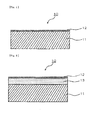
- FIG. 1 is a schematic drawing showing a cross section of the embodiment of the decorative sheet for three-dimensional processing according to the present invention.
- a decorative sheet 10 for three-dimensional processing according to the present invention comprises a support 11 and at least a surface protective layer 12 laminated thereon.
- An elongation property of the decorative sheet 10 of the present invention is affected to a large extent by an elongation property of the support 11. Accordingly, the decorative sheet 10 has to have a breaking elongation exceeding 300 % at temperature higher by 40°C than a thermal deformation temperature of the support 11 measured by an ASTM D648 method. This is because in three-dimensional processing of a complicated form, the decorative sheet 10 is prevented from being cracked or broken on a surface.
- the breaking elongation is preferably 380 % or more from the above point of view. Also, it is preferably 500 % or less because of the reasons that the required film thickness can be secured even after stretched and that the form holding property is improved.
- the support 11 used for the decorative sheet 10 of the present invention may comprise either a single layer or plural layers.
- the surface protective layer 12 provided on the decorative sheet 10 of the present invention has to have a film thickness of 0.2 to 6.0 ⁇ m. If the film thickness is less than 0.2 ⁇ m, the abrasion resistance and the solvent resistance are reduced, and if it exceeds 6.0 ⁇ m, the molding property, the breaking elongation and the abrasion resistance are reduced.
- the film thickness is preferably 0.7 to 6.0 ⁇ m from the above point of view.
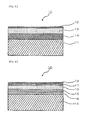
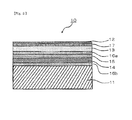
- Fig. 2 to Fig. 5 are schematic drawings showing the cross sections of another embodiments of the decorative sheet for three-dimensional processing according to the present invention.
- the decorative sheet for three-dimensional processing shall not be restricted to the above embodiments.
- a transparent thermoplastic resin layer 13 is further provided between the support 11 and the surface protective layer 12.
- thermoplastic resin layer 14 is further provided between the support 11 and the transparent thermoplastic resin layer 13.
- an adhesive layer 16, a print layer 15, a transparent thermoplastic resin layer 13, a primer layer 17 and a surface protective layer 12 are laminated on a support 11.
- the print layer 15 may be laminated on either a front side or a back side of the transparent thermoplastic resin layer 13 or may be laminated on the surface of the support 11.
- an adhesive layer 16b, a second thermoplastic resin layer 14, a print layer 15, an adhesive layer 16a, a transparent thermoplastic resin layer 13, a primer layer 17 and a surface protective layer 12 are laminated on a support 11.
- the print layer 15 may be laminated on either a front side or a back side of the transparent thermoplastic resin layer 13.
- the print layer 15 may be laminated on a surface of the support 11 or a back side of the second thermoplastic resin layer 14.
- the adhesive layers 16a and 16b may be formed by using the same material or different materials.
- the surface protective layer 12 has to be formed by cross-linking and curing an ionizing radiation curable resin composition in order to fulfill a surface protective performance of an abrasion resistance and a solvent resistance.
- the ionizing radiation curable resin means a resin which is cross-linked and cured by irradiating with a ray having an energy quantum capable of cross-linking and curing molecules among electromagnetic waves or charged particle beams, that is, a UV ray or an electron beam.
- resins suitably selected from polymerizable monomers, polymerizable oligomers and prepolymers which have so far conventionally been used as ionizing radiation curable resins.
- the surface protective layer 12 has preferably a storage elastic modulus falling in a range of 7.7 ⁇ 10 5 to 1.2 ⁇ 10 8 Pa. If the storage elastic modulus is 1.2 ⁇ 10 8 Pa or less, molding can be carried out without producing cracks on the surface protective layer in vacuum molding.
- the resin is a cross-linking type
- the polymerizable monomers used as ionizing radiation curable resins are suitably (meth)acrylate base monomers having a radically polymerizable unsaturated group in a molecule, and among them, two or higher multifunctional (meth)acrylates are preferred.
- (meth)acrylate means "acrylate” and "methacrylate”, and other similar monomers have the same meaning.
- the multifunctional (meth)acrylates shall not specifically be restricted as long as they have two or more ethylenically unsaturated bonds in a molecule.
- they include ethylene glycol di(meth)acrylate, propylene glycol di(meth)acrylate, 1,4-butanediol di(meth)acrylate, 1,6-hexanediol di(meth)acrylate, neopentyl glycol di(meth)acrylate, polyethylene glycol di(meth)acrylate, hydroxypivalic acid neopentyl glycol di(meth)acrylate, dicyclopentanyl di(meth)acrylate, caprolactone-modified dicyclopentenyl di(meth)acrylate, ethylene oxide-modified phosphoric acid di(meth)acrylate, allylated cyclohexyl di(meth)acrylate, isocyanurate di(meth)acrylate, trimethylolpropane tri(meth)acrylate, ethylene oxide-modified trimethylolpropane tri(meth)acrylate, dipentaerythritol tri(meth)
- monofunctional (meth)acrylates can suitably be used in combination with the multifunctional (meth)acrylate described above for the purpose of reducing a viscosity of the multifunctional (meth)acrylate as long as the effects of the present invention are not damaged.
- the monofunctional (meth)acrylates include, for example, methyl (meth)acrylate, ethyl (meth)acrylate, propyl (meth)acrylate, butyl (meth)acrylate, pentyl (math)acrylate, hexyl (meth)acrylate, cyclohexyl (meth)acrylate, 2-ethylhexyl (meth)acrylate, lauryl (meth)acrylate, stearyl (meth)acrylate, isobornyl (meth)acrylate and the like.
- the above monofunctional (meth)acrylates may be used alone or in combination of two or more kinds thereof.
- the polymerizable oligomers include oligomers having radically polymerizable unsaturated groups in a molecule (difunctional, trifunctional, tetrafunctional or higher multifunctional oligomers), for example, epoxy (meth)acrylate base oligomers, urethane (meth)acrylate base oligomers, polyester (meth)acrylate base oligomers, polyether (meth)acrylate base oligomers and the like.
- the epoxy (meth)acrylate base oligomers can be obtained, for example, by reacting an oxirane ring of a relatively low molecular weight bisphenol type epoxy resin or novolak type epoxy resin with (meth)acrylic acid to esterify it.
- carboxyl-modified epoxy (meth)acrylate oligomers obtained by partially modifying the above epoxy (meth)acrylate base oligomers with dibasic carboxylic anhydrides.
- the urethane (meth)acrylate base oligomers can be obtained, for example, by reacting polyetherpolyols or polyesterpolyols with polyisocyanates to obtain polyurethane oligomers and esterifying the polyurethane oligomers thus obtained with (meth)acrylic acid.
- the polyester (meth)acrylate base oligomers can be obtained, for example, by condensing polyvalent carboxylic acids with polyhydric alcohols to obtain polyester oligomers having hydroxyl groups at both ends and esterifying the hydroxyl groups of the polyester oligomers thus obtained with (meth)acrylic acid, or by adding alkylene oxides to polyvalent carboxylic acids to obtain oligomers and esterifying hydroxyl group of the oligomers thus obtained at an end with (meth) acrylic acid.
- the polyether (meth)acrylate base oligomers can be obtained, for example, by esterifying hydroxyl groups of polyetherpolyols with (meth)acrylic acid.
- the polymerizable oligomers include, in addition to the above compounds, polybutadiene (meth)acrylate base oligomers having a high hydrophobic property in which a polybutadiene oligomer has a (meth)acrylate group on a side chain, silicone (meth)acrylate base oligomers having a polysiloxane bond on a main chain, aminoplast resin (meth)acrylate base oligomers obtained by modifying an aminoplast resin having a large number of reactive groups in a small molecule thereof and oligomers having a cationically polymerizable functional group in a molecule such as novolak type epoxy resins, bisphenol type epoxy resins, aliphatic vinyl ethers, aromatic vinyl ethers and the like.
- a photopolymerization initiator is preferably added thereto in an amount of about 0.1 to 5 weight parts per 100 weight parts of the resin.
- the photopolymerization initiator shall not specifically be restricted and can suitably be selected from conventionally used compounds.
- the photopolymerization initiator used for polymerizable monomers or polymerizable oligomers having radically polymerizable unsaturated groups in molecules thereof include, for example, benzoin, benzoin methyl ether, benzoin ethyl ether, benzoin isopropyl ether, benzoin n-butyl ether, benzoin isobutyl ether, acetophenone, dimethylaminoacetophenone, 2,2-dimethaxy-2-phenylaoetophenone, 2,2-diethoxy-2-phenylacetophenone, 2-hydroxy-2-methyl-1-phenylpropane-1-one, 1-hydroxycyclohexyl phenyl ketone, 2-methyl-1-[4-(methylthio)phenyl]-2-morpholino-propane-1-one, 4-(2-hydroxyethoxy)phenyl-2-(hydroxy-2-propyl) ketone, benzophenone, p-phenylbenzophenone, 4,
- the photopolymerization initiator used for polymerizable oligomers having cationically polymerizable functional groups in molecules thereof include aromatic sulfonium salts, aromatic diazonium salts, aromatic iodonium salts, metallocene compounds, benzoin sulfonic esters and the like. Also, p-dimethylbenzoic esters, tertiary amines, thiol base sensitizers and the like can be used as a photosensitizer.
- An electron beam-curable resin composition is preferably used as the ionizing radiation-curable resin composition according to the present invention.
- the electron beam-curable resin composition can be used in the absence of a solvent and is more preferred from the viewpoint of environmental protection and human health. Further, it does not require a photopolymerization initiator and provides a stable curing property.
- the ionizing radiation-curable resin composition is preferably a resin composition comprising an ionizing radiation-curable resin and a thermoplastic resin in a ratio (weight ratio) of 75 : 25 to 20 : 80. If the ratio falls in the above range, the molding property, the abrasion resistance and the solvent resistance after cross-linked and cured to form the surface protective layer are well balanced. From this point of view, a weight ratio of the ionizing radiation-curable resin to the thermoplastic resin falls in a range of more preferably 60 : 40 to 20 : 80, particularly preferably 60 : 40 to 25 : 75.
- the thermoplastic resin used for the ionizing radiation-curable resin composition according to the present invention includes (meth)acryl base resins such as poly-(math)acrylic acid esters and the like, polyvinyl acetal (butyral resins) such as polyvinyl butyral and the like, polyester resins such as polyethylene terephthalate, polybutylene terephthalate and the like, vinyl chloride resins, urethane resins, polyolefins such as polyethylene, polypropylene and the like, styrene base resins such as polystyrene, poly- ⁇ -methylstyrene, polyamide, polycarbonate, acetal resins such as polyoxymethylene and the like, fluororesins such as ethylene-ethylene tetrafluoride copolymers and the like, polyimide, polylactic acid, polyvinyl acetal resins, liquid crystalline polyester resins and the like. They may be used alone or in combination of two or more kinds thereof. When
- thermoplastic resins described above resins comprising (meth)acryl base resins as principal components are preferred in the present invention, and among them, resins obtained by polymerizing monomers comprising at least (meth)acrylic esters as a monomer component are preferred.
- resins obtained by polymerizing monomers comprising at least (meth)acrylic esters as a monomer component are preferred.
- homopolymers of (meth)acrylic esters, copolymers of two or more kinds of different (meth)acrylic ester monomers and copolymers of (meth)acrylic esters with other monomers are preferred.
- the (meth)acrylic esters include, for example, methyl acrylate, methyl methacrylate, ethyl acrylate, ethyl methacrylate, propyl acrylate, propyl methacrylate and the like. Among them, methyl methacrylate is most preferred.
- copolymers of two or more kinds of (meth)acrylic ester monomers selected from the above monomers shown as the examples are shown as the examples of the copolymers of two or more kinds of different (meth)acrylic ester monomers.
- the monomers comprising methyl methacrylate as a principal component are preferred. That is, the copolymers of methyl methacrylate with other (meth)acrylic ester monomers are preferred, and the copolymers of methyl methacrylate with methyl acrylate, the copolymers of methyl methacrylate with ethyl methacrylate and the like are shown as the examples thereof.
- the above copolymers may be either random copolymers or block copolymers.
- a constitutional unit originating in the other methacrylic ester monomers falls preferably in a range of 0.1 to 200 mole based on 100 mole of a constitutional unit originating in methyl methacrylate. If the constitutional unit originating in the other methacrylic ester monomers falls in the range described above based on 100 mole of the constitutional unit originating in methyl methacrylate, the abrasion resistance and the solvent resistance are improved.
- the other monomers in the copolymers of (meth)acrylic esters with the other monomers shall not specifically be restricted as long as they can be copolymerized with (meth)acrylic esters.
- they include (meth)acrylic acid, styrene, (anhydrous) maleic acid, fumaric acid, divinylbenzene, vinylbiphenyl, vinylnaphthalene, diphenylethylene, vinyl acetate, vinyl chloride, vinyl fluoride, vinyl alcohol, acrylonitrile, acrylamide, butadiene, isoprene, isobutene, 1-butene, 2-butene, alicyclic olefin monomers such as N-vinyl-2-pyrrolidone, dicyclopentadiene, ethylidenenorbornene, norbornenes and the kike, vinylcaprolactum, citraconic anhydride, maleimides such as N-phenylmaleimide, vinyl ethers
- styrene and (anhydrous) maleic acid are suited as the copolymerization components. That is, suited are the binary copolymers of (meth)acrylic esters with styrene or(anhydrous) maleic acid and the ternary copolymers of (meth)acrylic esters with styrene and (anhydrous) maleic acid.
- the copolymers of (meth)aorylic esters with the other monomers may be either random copolymers or block copolymers.
- a constitutional unit originating in styrene and/or (anhydrous) maleic acid falls preferably in a range of 0.1 to 200 mole based on 100 mole of a constitutional unit originating in the (meth)acrylic esters. If the constitutional unit originating in styrene and/or (anhydrous) maleic acid falls in the range described above based on 100 mole of the constitutional unit originating in the (meth)acrylic esters, the abrasion resistance and the solvent resistance are improved as well.
- the (meth)acryl base resin described above has a weight average molecular weight falling preferably in a range of 60,000 to 150,000. If the weight average molecular weight falls in the above range, all of the molding property and the abrasion resistance and the solvent resistance on the surface after cross-linked and cured to form the surface protective layer can be obtained at high levels.
- the weight average molecular weight was measured by gel permeation chromatography (GPC). A high speed GPC apparatus manufactured by Tosoh Corp. was used for the measurement, wherein a column TSK gel ⁇ M (trade name) manufactured by Tosoh Corp.
- NMP N-methyl-2-pyrrolidinone
- the ionizing radiation-curable resin composition according to the present invention can be blended with various additives according to the required physical properties of the cured resin layer obtained.
- the above additives include, for example, weatherability improving agents, abrasion resistance improving agents, polymerization inhibitors, cross-linking agents, IR absorbing agents, antistatic agents, adhesion improving agents, leveling agents, thixotropic agents, coupling agents, plasticizers, defoaming agents, fillers, solvents, colorants and the like.
- UV absorbing agents and light stabilizers can be used as the weatherability improving agent.
- the UV absorbing agents may be either inorganic or organic compounds.
- Titanium oxide, cerium oxide and zinc oxide each having an average particle diameter of 5 to 120 nm can be used as the inorganic UV absorbing agent.
- the organic UV absorbing agent includes, for example, benzotriazole base compounds, to be specific, 2-(2-hydroxy-5-methylphenyl)benzotriazole, 2-(2-hydroxy-3,5-di-tert-amylphenyl)benzotriazole, 3-[3-(benzotriazole-2-yl)-5-tert-butyl-4-hydroxyphenyl]propionic ester of polyethylene glycol and the like.
- the light stabilizer include, for example, hindered amine base compounds, to be specific, bis(1,2,2,6,6-pentamethyl-4-piperizyl) 2-(3,5-di-tert-butyl-4-hydroxybenzyl)-2'-n-butylmalonate, bis(1,2,2,6,6-pentamethyl-4-piperidyl) sebacate, tetrakis(2,2,6,6-tetramethyl-4-piperidyl)-1,2,3,4-butanetetracarboxylate and the like.
- reactive UV absorbing agents and light stabilizers having polymerizable groups such as a (meth)acryloyl group in molecules thereof can also be used as the UV absorbing agent and the light stabilizer.
- the abrasion resistance improving agent includes, for example, in the case of the inorganic compounds, spherical particles of ⁇ -alumina, silica, kaolinite, iron oxide, diamond, silicon carbide and the like.
- the particle form shall not specifically be restricted and includes a spherical shape, an ellipsoidal shape, a polyhedral shape, a scale-like shape and the like, and the spherical shape is preferred.
- the organic abrasion resistance improving agent includes beads of waxes such as polyethylene wax, synthetic resins such as cross-linked acrylic resins, polycarbonate resins and the like.
- the particle diameter thereof is usually 30 to 200% of the film thickness.
- spherical ⁇ -alumina is particularly preferred in terms of a high hardness, a large effect of enhancing the abrasion resistance and relatively easily obtaining the spherical particles.
- the polymerization inhibitor are, for example, hydroquinone, p-benzoquinone, hydroquinone monomethyl ether, pyrogallol, t-butyl catechol and the like.
- Used as the cross-linking agent are, for example, polyisocyanate compounds, epoxy compounds, metal chelate compounds, aziridine compounds, oxazoline compounds and the like.
- Used as the filler are, for example, barium sulfate, talc, clay, calcium carbonate, aluminum hydroxide and the like.
- Used as the colorant are, for example, publicly known coloring pigments such as quinacridone red, isoindolinone yellow, phthalocyanine blue, phthalocyanine green, titanium oxide, carbon black and the like.
- Used as the IR absorbing agent are, for example, dithiol base metal complexes, phthalocyanine base compounds, diimmonium compounds and the like.
- Various additives can be added according to the desired physical properties of the surface protective layer 12 obtained by curing the ionizing radiation-curable resin composition according to the present invention to thereby impart various functions, for example, a so-called hard coat function providing a high hardness and an abrasion resistance, a defogging coat function, a stain resistant coat function, a glare-proof coat function, an antireflective coat function, a UV shielding coat function, an IR shielding coat function and the like.
- a transparent thermoplastic resin layer 13 laminated, if necessary, on the decorative sheet 10 of the present invention for the purpose of expanding a design effect is selected considering a transparency and a vacuum molding aptitude, and to be representative, it is formed preferably in the form of a single layer sheet of a resin film comprising a thermoplastic resin or a plural layer sheet comprising the same kind of a resin or different kinds of resins.
- thermoplastic resin used for the transparent thermoplastic resin layer 13 are acryl resins, polyolefin base resins such as polypropylene, polyethylene and the like, polycarbonate resins, acrylonitrile-butadienestyrene resins (hereinafter referred to as ABS resins), polyester resins such as polyethylene terephthalate, polybutylene terephthalate and the like, vinyl chloride resins, cycloolefin resins, polyimide resins and the like.
- ABS resins acryl resins, polypropylene resins, polyethylene resins, polycarbonate resins, ABS resins or polyester resins are preferred in terms of a transparency and a molding property.
- the acryl resins include, for example, acryl resins such as polymethyl (meth)acrylate, polyethyl (meth)aorylate, polybutyl (meth)acrylate, methyl (meth)acrylate-butyl (meth)acrylate copolymers, methyl (meth)acrylate-styrene copolymers and the like ((meth)acrylate means acrylate and methacrylate).
- a thickness of the transparent thermoplastic resin layer 13 is selected according to the uses, and it is usually 20 to 1,000 ⁇ m and preferably 50 to 500 ⁇ m considering the cost and the like.
- the transparent thermoplastic resin layer 13 according to the present invention can be subjected on one surface or both surfaces thereof, if necessary, to physical or chemical surface treatment by an oxidation method or a roughening method in order to enhance adhesion thereof to a layer provided thereon.
- the oxidation method described above includes, for example, corona discharge treatment, chromium oxidation treatment, flame treatment, hot air treatment, ozone/UV ray treatment and the like.
- the roughening method includes, for example, a sand blast method, a solvent treatment method and the like.
- the above surface treatments are suitably selected according to the kind of the substrate, and in general, the corona discharge treatment method is preferably used in terms of an effect and an operating property.
- the transparent thermoplastic resin layer 13 may be subjected, if necessary, to treatment such as forming a primer layer 17, and coating may be carried out in order to adjust the color, or a pattern may be formed in advance in the form of a print layer 15 from the viewpoint of a design.
- a second thermoplastic resin layer 14 laminated, if necessary, on the decorative sheet 10 of the present invention is formed, to be representative, preferably in the form of a single layer sheet of a resin film comprising a thermoplastic resin or a plural layer sheet comprising the same kind of a resin or different kinds of resins.
- the second thermoplastic resin layer 14 may be provided in the form of a colored thermoplastic resin layer for the purpose of providing a masking property or aiming at a design effect or may be provided in the form of a transparent or translucent thermoplastic resin layer aiming at another design effects.
- the thermoplastic resin used for the second thermoplastic resin layer 14 includes the same resins used for the transparent thermoplastic resin layer 13.
- the coloring agent used for the colored thermoplastic resin layer includes coloring agents used for a print layer described later.
- a thickness of the second thermoplastic resin layer 14 is selected according to the uses, and it is usually 20 to 1,000 ⁇ m and preferably 50 to 500 ⁇ m considering the cost and the like.
- the support 11 used for the decorative sheet 10 of the present invention comprises preferably an ABS resin, a polyolefin resin, a styrene resin, an acryl resin, a vinyl chloride resin, a polycarbonate resin and the like.
- a polypropylene resin is more preferred.
- an ABS resin and a polypropylene resin are more preferred, and an ABS resin is particularly preferred in order to prevent cracks and scratches on the surface of the molded matter.
- the support 11 is used in order to reinforce the decorative sheet 10 and hold the form of the integrated matter, and therefore it has preferably a thickness of 100 to 500 ⁇ m.
- the support 11 may comprise either a single layer or plural layers, and a case of the plural layers includes, for example, a case in which the surface of the support 11 is subjected to blocking-preventing treatment, primer treatment or acid treatment and in which a blocking-preventing layer, a primer layer or an acid-modifying layer is formed on the surface.
- a resin layer containing a pigment and a matting agent for example, a mat resin layer may be formed between the support 11 and the surface protective layer 12.
- the print layer 15 laminated if necessary which is shown in Fig. 4 or 5 comprises preferably a picture layer and/or a masking layer.
- the picture layer serves for providing the resin molded matter with a decorative property, and it is formed by printing various patterns with an ink using a printer.
- the patterns include woodgrain patterns, stone-grain patterns imitating the surfaces of rocks such as a marble pattern (for example, travertine marble patterns) and the like, fabric patterns imitating a blanket texture pattern and a cloth-like pattern, tiling patterns, brick work patterns and the like, and they include as well composite patterns thereof such as parquetry patterns, patchwork patterns and the like.
- the above patterns are formed by multi-color printing with process colors including usual yellow, red, blue and black colors, and in addition thereto, they are formed as well by multi-color printing with special colors using plates of individual colors constituting the patterns.
- Materials prepared by appropriately mixing a binder with a colorant such as a pigment and a dye, an extender pigment, a solvent, a stabilizer, a plasticizer, a catalyst, a hardening agent and the like are used as a picture ink used for the picture layer.
- the above binder shall not specifically be restricted, and optional ones selected from, for example, polyurethane base resins, vinyl chloride/vinyl acetate base copolymer resins, vinyl chloride/vinyl acetate/acryl resin base copolymer resins, chlorinated polypropylene base resins, acryl base resins, polyester base resins, polyamide base resins, butyral base resins, polystyrene base resins, nitrocellulose base resins, cellulose acetate base resins and the like are used alone or in a mixture of two or more kinds thereof.
- inorganic pigments such as carbon black (Japanese ink), iron black, titanium white, antimony white, chrome yellow, titanium yellow, iron oxide red, cadmium red, ultramarine blue, cobalt blue and the like, organic pigments and dyes such as quinacridone red, isoindolinone yellow, phthalocyanine blue and the like, metallic pigments comprising scale-like foil pieces of aluminum, brass and the like and pearlescent (pearl) pigments comprising scale-like foil pieces of titanium dioxide-coated mica, basic lead carbonate and the like.
- inorganic pigments such as carbon black (Japanese ink), iron black, titanium white, antimony white, chrome yellow, titanium yellow, iron oxide red, cadmium red, ultramarine blue, cobalt blue and the like
- organic pigments and dyes such as quinacridone red, isoindolinone yellow, phthalocyanine blue and the like
- metallic pigments comprising scale-like foil pieces of aluminum, brass and the like
- the masking layer is a layer provided if necessary, and it is provided in many cases for the purpose of preventing an effect from being exerted on colors of patterns in the decorative sheet by a change and a dispersion in the color of the surface of the support 11.
- the masking layer is formed in an opaque color in many cases, and a so-called solid print layer having a thickness of 1 to 20 ⁇ m is suitably used as the masking layer.
- the masking layer is formed by a publicly known printing or coating method such as gravure printing, roll coating and the like.
- an adhesive layer 16 may be provided, if necessary, between the respective layers in order to enhance an adhesive property between the respective layers.
- adhesive layers 16, 16b can be provided between the support 11 and the print layer 15 in order to enhance an adhesive property between the support 11 and the print layer 15.
- an adhesive layer 16a can be provided, if necessary, between the transparent thermoplastic resin layer 13 and the print layer 15 in order to enhance an adhesive property between the transparent thermoplastic resin layer 13 and the print layer 15.
- a thermoplastic resin or a thermosetting resin is used for the adhesive layer depending on the injection resin.
- the thermoplastic resin includes acryl resins, acryl-modified polyolefin resins, chlorinated polyolefin resins, vinyl chloride-vinyl acetate copolymers, thermoplastic urethane resins, thermoplastic polyester resins, polyamide resins, rubber base resins and the like. They can be used alone or in a mixture of two or more kinds thereof. Further, the thermoplastic resin includes urethane resins (for example, two-component curing type comprising an isocyanate curing agent and various polyols), epoxy resins and the like. A thickness of the adhesive layer may be a suited thickness according to the required physical properties and the like, and it is usually 1 to 100 ⁇ m.
- a forming method of the adhesive layer shall not specifically be restricted, and it is usually formed by a publicly known printing or coating method such as gravure printing, roll coating and the like, wherein an ink or a coating liquid comprising a resin liquid obtained by diluting the resins described above with a diluent solvent is used.
- auxiliary materials for example, various additives such as extender pigments and the like may further be added, if necessary, to the adhesive layer in order to control or enhance various physical properties such as a printing (or coating) aptitude and the like in the ink (or the coating liquid).
- a primer layer 17 can suitably be provided in order to enhance an adhesive property between the surface protective layer 12 and the transparent thermoplastic resin layer 13.
- a material for the above primer layer 17 which is provided if necessary includes, for example, acryl resins, urethane resins (for example, two-component curing type comprising an isocyanate curing agent and various polyols), acryl urethane resins, vinyl chloride-vinyl acetate copolymers, ethylene-vinyl acetate copolymers and the like.
- Two-component curable urethane resins are preferred from the viewpoints that an adhesive property between the surface protective layer 12 and the transparent thermoplastic resin layer 13 as well as a weatherability thereof are enhanced and that the adhesive property is scarcely reduced with the passage of time.
- the surface protective layer 12 can be formed by preparing a coating liquid containing the foregoing ionizing radiation-curable resin composition according to the present invention and coating the above coating liquid on the surface of the support 11 or the transparent thermoplastic resin layer 13 or via the primer layer 17 to cross-link and cure it.
- a viscosity of the above coating liquid shall not specifically be restricted as long as it is a viscosity at which an uncured resin layer can be formed on a surface of the substrate by a coating method described later.
- the coating liquid prepared is applied on a surface of the transparent thermoplastic resin layer 13 by a publicly known method such as gravure coating, bar coating, roll coating, reverse roll coating, comma coating and the like, preferably gravure coating so that the thickness described above is obtained after cured, whereby an uncured resin layer is formed.
- a publicly known method such as gravure coating, bar coating, roll coating, reverse roll coating, comma coating and the like, preferably gravure coating so that the thickness described above is obtained after cured, whereby an uncured resin layer is formed.
- the uncured resin layer thus formed is irradiated with an ionizing radiation such as an electron beam, a UV ray and the like to cure the above uncured resin layer.
- an ionizing radiation such as an electron beam, a UV ray and the like
- an acceleration voltage thereof can suitably be selected according to the resin used and a thickness of the layer, and the uncured resin layer is preferably cured at an acceleration voltage of usually 70 to 300 kV.
- An irradiation dosage of the electron beam is preferably an amount in which a cross-linking density of the resin layer is saturated, and it is selected in a range of usually 5 to 300 kGy (0.5 to 30 Mrad) preferably 10 to 50 kGy (1 to 5 Mrad).
- the electron beam source shall not specifically be restricted, and capable of being used are various electron beam accelerators such as a Cockroft-Walton type accelerator, a Van de Graft type accelerator, a resonance transformer type accelerator, an insulating core transformer type accelerator, a linear type accelerator, a Dynamitron type accelerator, a high frequency type accelerator and the like.
- the radiation containing a UV ray having a wavelength of 190 to 380 nm is radiated.
- the UV ray source shall not specifically be restricted, and used are, for example, a high pressure mercury lamp, a low pressure mercury lamp, a metal halide lamp, a carbon arc lamp and the like.
- the decorative sheet 10 for three-dimensional processing according to the present invention can be produced by a method in which the surface protective layer 12 is printed or coated on the surface of the support 11.
- the surface protective layer 12 is laminated, for example, on the surface of the transparent thermoplastic resin layer 13, and the second thermoplastic resin layer 14 and the support 11 are laminated in order on the rear surface thereof.
- the primer layer 17 is laminated, for example, on the surface side of the transparent thermoplastic resin layer 13, and the surface protective layer 12 is further laminated on the surface thereof.
- the print layer 15, that is, the picture layer and/or the masking layer are laminated in order on the rear surface side of the transparent thermoplastic resin layer 13.
- the adhesive layer 16 is laminated on the print layer 15, and then the support 11 is laminated thereon.
- the second thermoplastic resin layer 14 is provided as is the case with Fig. 5 shall be shown.
- the primer layer 17 is laminated on the surface side of the transparent thermoplastic resin layer 13, and the surface protective layer 12 is further laminated on the surface thereof.
- the print layer 15 is laminated on the surface side of the second thermoplastic resin layer 14, and the adhesive layer 16a is further laminated on the surface thereof.
- the rear surface side of the transparent thermoplastic resin layer 13 and the adhesive layer 16a on the surface side of the second thermoplastic resin layer 14 are stuck together with a laminate and the like.
- the adhesive layer 16b is laminated on the rear surface side of the second thermoplastic resin layer 14 by coating, and it is stuck on the support 11.
- the transparent thermoplastic resin layer 13 or the surface protective layer 12 and the support 11 comprise the same resin material in, for example, Fig. 2 , 3 or 5
- the adhesive layer 16 is not required in a certain case.
- the transparent thermoplastic resin layer 13 and the second thermoplastic resin layer 14 comprise the same resin material in, for example, Fig. 3
- the adhesive layer 16 is not required in a certain case.
- the coating order described above may suitably be changed for the sake of convenience in the production.
- the laminations described above are carried out by a publicly known printing or coating method such as gravure printing, roll coating and the like.
- the decorative sheet 10 of the present invention is vacuum-molded in advance into a surface form of the molded matter by means of a vacuum molding die in a vacuum molding step, and then excess parts are trimmed, if necessary, to obtain a molded sheet.
- This molded sheet is inserted into an injection molding die to clamp the injection molding die, and a resin staying in a fluid state is injected into the die and then solidified.
- the decorative sheet is integrated with an outer surface of the resin molded matter to produce a decorative resin molded matter.
- thermoplastic resins including polyolefin base resins such as polyethylene, polypropylene and the like, ABS resins, styrene resins, polycarbonate resins, acryl resins, vinyl chloride resins and the like are representative. Further, thermosetting resins such as urethane resins, epoxy resins and the like can be used as well according to the uses.
- the decorative resin molded matter thus produced does not have cracks and breaks produced on a surface in a molding step, and the surface thereof has a high abrasion resistance and a high solvent resistance. Further, in the production process of the present invention, the surface protective layer is completely cured in a production stage of the decorative sheet, and therefore a step for cross-linking and curing the surface protective layer after producing the decorative resin molded matter is not required.
- a molding property, a breaking elongation, a storage elastic modulus E' of the surface protective layer at 140°C, an abrasion resistance, a solvent resistance and a die release property of the decorative sheet were measured according to the following methods.
- the thickest layer was regarded as the support to set up a measuring temperature condition.
- an acryl urethane base primer 1 ⁇ m was formed by gravure coating on a surface of a support comprising a colored ABS resin sheet having a thickness of 400 ⁇ m in which a thermal deformation temperature measured by an ASTM D648 method was 80°C, and the electron beam-curable resin composition described above was coated on the primer-coated surface by gravure coating so that values described in Table 1 were obtained.
- the above uncured resin layer was irradiated with an electron beam having an acceleration voltage of 165 kV and an irradiation dose of 50 kGy (5 Mrad) to cure the electron beam-curable resin composition and form a surface protective layer, whereby a decorative sheet for three-dimensional processing was obtained.
- a molding property, a breaking elongation, a storage elastic modulus E' of the surface protective layer at 140°C, an abrasion resistance, a solvent resistance and a die release property of six kinds of the decorative sheets thus obtained were evaluated according to the methods described above. The results thereof are shown in Table 1.
- a print layer was formed on a transparent thermoplastic resin layer shown in Table 1.
- the same acryl urethane base primer as in Examples 1 and 2 was coated on the transparent thermoplastic resin layer at a side opposite to the print layer by gravure coating to form a primer layer, and the electron beam-curable resin composition shown in Table 1 was coated on the primer layer by gravure coating.
- the electron beam-curable resin composition shown in Table 1 was coated on the transparent thermoplastic resin layer at a side opposite to the print layer by gravure coating without forming a primer layer.
- the above uncured resin layers were irradiated with an electron beam having an acceleration voltage of 165 kV and an irradiation dose of 50 kGy (5 Mrad) to cure the electron beam-curable resin compositions and form surface protective layers.
- a two-component curable urethane resin adhesive was coated on the print layer to form an adhesive layer, and it was adhered to a support comprising the same colored ABS resin sheet as in Examples 1 and 2.
- the sheet thus obtained was cured at 40°C for 3 days to accelerate curing of the adhesive layer 16b, whereby a decorative sheet 10 was obtained.
- a molding property, a breaking elongation, a storage elastic modulus E' of the surface protective layer at 140°C, an abrasion resistance, a solvent resistance and a die release property of six kinds of the decorative sheets thus obtained were evaluated according to the methods described above. The results thereof are shown in Table 1.
- a print layer was formed on a surface of a second thermoplastic resin layer 14 which was a colored polypropylene film having a thickness of 60 ⁇ m, and on the other hand, a two-component curable urethane resin adhesive was coated in a thickness of about 5 ⁇ m on a surface of a transparent thermoplastic resin layer 13 which was a transparent polypropylene film having a thickness of 60 ⁇ m by gravure coating to form an adhesive layer 16a.
- thermoplastic resin layer 14 was adhered onto an adhesive layer 16a side on the transparent thermoplastic resin layer 13.
- the same acryl urethane base primer as in Examples 1 and 2 was coated on the surface of the transparent thermoplastic resin layer 13 of the laminated matter thus obtained by gravure coating to form a primer layer, and the electron beam-curable resin composition shown in Table 1 was coated on the primer layer by gravure coating.
- the above uncured resin layer was irradiated with an electron beam having an acceleration voltage of 165 kV and an irradiation dose of 50 kGy (5 Mrad) to cure the electron beam-curable resin composition and form a surface protective layer.
- a two-component curable urethane resin adhesive was coated on a second thermoplastic resin layer 14 side of the laminated matter obtained by gravure coating to form an adhesive layer 16b having a thickness of 10 ⁇ m, and it was adhered to a support comprising the same colored ABS resin sheet as in Examples 1 and 2.
- the sheet thus obtained was cured at 40°C for 3 days to accelerate curing of the adhesive layer 16b, whereby a decorative sheet 10 was obtained.
- Example 9 A molding property, a breaking elongation, a storage elastic modulus E' of the surface protective layer at 140°C, an abrasion resistance, a solvent resistance and a die release property of six kinds of the decorative sheets thus obtained in Example 9 were evaluated according to the methods described above. The results thereof are shown in Table 1.
- EB is tetrafunctional urethane acrylate
- PMMA-1 is described above
- PUMA-2 is a methyl methacrylate (MMA) homopolymer (weight average molecular weight (Mw) : 1.1 X 1.0 5 , number average molecular weight (Mn): 0.64 ⁇ 10 5 , degree of polydispersion (Mw/Mn): 1.72);
- polyester-1 is a polyester resin (weight average molecular weight (Mw): 0.86 ⁇ 10 5 , number average molecular weight (Mn): 0.41 ⁇ 10 5 , degree of polydispersion (Mw/Mn): 2.1).
- the decorative sheets prepared in Examples 1 to 9 are excellent in all of a molding property, a breaking elongation, an abrasion resistance and a solvent resistance, and a storage elastic modulus E' of the surface protective layer at 140°C fell in a range of 7.7 ⁇ 10 5 to 1.2 ⁇ 10 8 Pa.
- a storage elastic modulus E' of the surface protective layer at 140°C fell in a range of 7.7 ⁇ 10 5 to 1.2 ⁇ 10 8 Pa, and the breaking elongation was high.
- a thickness of the surface protective layer was too small, and therefore both of the abrasion resistance and the solvent resistance were inferior.
- a storage elastic modulus E' of the surface protective layer at 140°C fell in a range of 7.7 ⁇ 10 5 to 1.2 ⁇ 10 8 Pa, and the solvent resistance was good.
- the breaking elongation was low, and the abrasion resistance was inferior as well.
- a die release property of the molded matter after vacuum molding and a die release property of the molded matter after injection molding were evaluated to result in finding that both of the die release properties after vacuum molding and after injection molding were good in Examples 1 to 9 and Comparative Examples 1 to 4.
- the decorative sheet for three-dimensional processing according to the present invention is suitably used for decorative molded matters in uses such as interior materials or exterior materials for vehicles such as cars, fixture members such as base boards, dressed lumbers and the like, fittings for window frames, door frames and the like, interior materials for buildings such as walls, floors, ceilings and the like, housings for home electric appliances such as TV receivers, air conditioners and the like, vessels and the like.
Landscapes
- Engineering & Computer Science (AREA)
- Manufacturing & Machinery (AREA)
- Mechanical Engineering (AREA)
- Laminated Bodies (AREA)
Abstract
Description
- The present invention relates to a decorative sheet for three-dimensional processing used for decorative molded matters in uses such as interior materials or exterior materials for vehicles such as cars, fixture members such as base boards, dressed lumbers and the like, fittings for window frames, door frames and the like, interior materials for buildings such as walls, floors, ceilings and the like, housings for home electric appliances such as TV receivers, air conditioners and the like, vessels and the like.
- Decorative molded matters produced by molding sheets obtained by decorating the surfaces of adherends such as resin molded matters and the like have so far been used for various applications. Decorative molded matters having surfaces decorated by the above decorative sheet molding method are obtained. Accordingly, a decorative sheet used for the above production method is decorated after expending a sheet, and therefore not only such molding performance that cracks and the like are not produced on the surface in molding is required, but also the abrasion resistance, the solvent resistance and the like are required to be excellent as well from a viewpoint in uses of the molded matters.
Proposed in, for example, a patent document 1 is a laminated sheet for covering a surface of an injection molded matter which is obtained by laminating a clear cured layer of a cross-linkable composition having a specific glass transition temperature and a specific cross-linking density on a sheet-shaped substrate of a thermoplastic resin and which has a breaking elongation of 30 to 300 %.
However, the existing situation is that a breaking elongation of 30 to 300 % is not satisfactory in order to prevent a decorative sheet from being cracked in three-dimensional processing and that a sheet which can be stretched by 300 % or more is inferior in die release and inferior as well in an abrasion resistance and a solvent resistance.
Accordingly, a molding property in three-dimensional processing, die release, an abrasion resistance, a solvent resistance and the like are required to be further improved. - Patent document 1: Japanese Patent Application Laid-Open No.
202975/2000 - In light of the above situation, an object of the present invention is to provide a decorative sheet for three-dimensional processing which is improved in a molding property and has good die release and does not produce cracks and scratches on a surface in molding and which is improved as well in an abrasion resistance and a solvent resistance.
- Intensive researches repeated by the present inventors in order to achieve the object described above have resulted in finding that the object can be achieved by improving the surface protective layer. The present invention has been completed based the above knowledge. That is, the present invention comprises the following essential points.
- 1. A decorative sheet for three-dimensional processing comprising a support and at least a surface protective layer laminated thereon, wherein the above decorative sheet for three-dimensional processing has a breaking elongation (according to JIS K 7127) exceeding 300 % at temperature higher by 40°C than a thermal deformation temperature of the above support measured by an ASTM D648 method, and the above surface protective layer is obtained by cross-linking and curing an ionizing radiation curable resin composition and has a film thickness of 0.2 to 6.0 µm.
- 2. The decorative sheet for three-dimensional processing as described in the above item 1, wherein the above surface protective layer has a storage elastic modulus falling in a range of 7.7 × 10⁵ to 1.2 × 10⁸ Pa at 140°C which is measured on measuring conditions shown below:
- measuring conditions of the storage elastic modulus: a sheet having a width of 10 mm and a thickness of 15 µm produced by cross-linking and curing the above ionizing radiation curable resin composition is measured at a cramp-to-cramp distance of 10 mm, an initiating temperature of 30°C, a terminating temperature of 180°C, a heating rate of 5°C/minute and a measuring frequency of 1 Hz according to JIS K7244-1 and K7244-4.
- 3. The decorative sheet for three-dimensional processing as described in the above item 1 or 2, wherein the ionizing radiation curable resin composition is a resin composition comprising an ionizing radiation curable resin and a thermoplastic resin in a ratio (weight ratio) of 75 : 25 to 20 : 80.
- 4. The decorative sheet for three-dimensional processing as described in any of the above items 1 to 3, wherein a transparent thermoplastic resin layer is further provided between the support and the surface protective layer.
- 5. The decorative sheet for three-dimensional processing as described in the above item 4, wherein a second thermoplastic resin layer is further provided between the support and the transparent thermoplastic resin layer.
- 6. The decorative sheet for three-dimensional processing as described in any of the above items 3 to 5, wherein the above ionizing radiation curable resin composition is an electron beam curable resin.
- 7. The decorative sheet for three-dimensional processing as described in any of the above items 1 to 6, wherein the three-dimensional processing is insert molding.
- 8. A decorative resin molded matter integrated with the decorative sheet for three-dimensional processing as described in any of the above items 1 to 7.
- The decorative sheet for three-dimensional processing according to the present invention is excellent in a molding property and die release, does not produce cracks and scratches on a surface in molding and has a high abrasion resistance and a high solvent resistance.
-
-
Fig. 1 is a schematic drawing showing a cross section of the embodiment of the decorative sheet for three-dimensional processing according to the present invention. -
Fig. 2 is a schematic drawing showing a cross section of another embodiment of the decorative sheet for three-dimensional processing according to the present invention. -
Fig. 3 is a schematic drawing showing a cross section of another embodiment of the decorative sheet for three-dimensional processing according to the present invention. -
Fig. 4 is a schematic drawing showing a cross section of another embodiment of the decorative sheet for three-dimensional processing according to the present invention. -
Fig. 5 is a schematic drawing showing a cross section of another embodiment of the decorative sheet for three-dimensional processing according to the present invention. -
- 10
- Decorative sheet
- 11
- Support
- 12
- Surface protective layer
- 13
- Transparent thermoplastic resin layer
- 14
- Second thermoplastic resin layer
- 15
- Print layer
- 16
- Adhesive layer
- 17
- Primer layer
- The present invention shall be explained below with reference to the drawings.
Fig. 1 is a schematic drawing showing a cross section of the embodiment of the decorative sheet for three-dimensional processing according to the present invention.
Adecorative sheet 10 for three-dimensional processing according to the present invention comprises asupport 11 and at least a surfaceprotective layer 12 laminated thereon.
An elongation property of thedecorative sheet 10 of the present invention is affected to a large extent by an elongation property of thesupport 11. Accordingly, thedecorative sheet 10 has to have a breaking elongation exceeding 300 % at temperature higher by 40°C than a thermal deformation temperature of thesupport 11 measured by an ASTM D648 method. This is because in three-dimensional processing of a complicated form, thedecorative sheet 10 is prevented from being cracked or broken on a surface. The breaking elongation is preferably 380 % or more from the above point of view. Also, it is preferably 500 % or less because of the reasons that the required film thickness can be secured even after stretched and that the form holding property is improved. Thesupport 11 used for thedecorative sheet 10 of the present invention may comprise either a single layer or plural layers.
The surfaceprotective layer 12 provided on thedecorative sheet 10 of the present invention has to have a film thickness of 0.2 to 6.0 µm. If the film thickness is less than 0.2 µm, the abrasion resistance and the solvent resistance are reduced, and if it exceeds 6.0 µm, the molding property, the breaking elongation and the abrasion resistance are reduced. The film thickness is preferably 0.7 to 6.0 µm from the above point of view. -
Fig. 2 to Fig. 5 are schematic drawings showing the cross sections of another embodiments of the decorative sheet for three-dimensional processing according to the present invention. However, the decorative sheet for three-dimensional processing shall not be restricted to the above embodiments. - In the second embodiment of the
decorative sheet 10 of the present invention shown inFig. 2 , a transparentthermoplastic resin layer 13 is further provided between thesupport 11 and the surfaceprotective layer 12. - In the third embodiment of the
decorative sheet 10 of the present invention shown inFig. 3 , a secondthermoplastic resin layer 14 is further provided between thesupport 11 and the transparentthermoplastic resin layer 13. - In the fourth embodiment of the
decorative sheet 10 of the present invention shown inFig. 4 , anadhesive layer 16, aprint layer 15, a transparentthermoplastic resin layer 13, aprimer layer 17 and a surfaceprotective layer 12 are laminated on asupport 11. In this regard, theprint layer 15 may be laminated on either a front side or a back side of the transparentthermoplastic resin layer 13 or may be laminated on the surface of thesupport 11. - In the fifth embodiment of the
decorative sheet 10 of the present invention shown inFig. 5 , anadhesive layer 16b, a secondthermoplastic resin layer 14, aprint layer 15, anadhesive layer 16a, a transparentthermoplastic resin layer 13, aprimer layer 17 and a surfaceprotective layer 12 are laminated on asupport 11. In this regard, theprint layer 15 may be laminated on either a front side or a back side of the transparentthermoplastic resin layer 13. When the secondthermoplastic resin layer 14 is transparent or translucent, theprint layer 15 may be laminated on a surface of thesupport 11 or a back side of the secondthermoplastic resin layer 14. Theadhesive layers - The surface
protective layer 12 according to the present invention has to be formed by cross-linking and curing an ionizing radiation curable resin composition in order to fulfill a surface protective performance of an abrasion resistance and a solvent resistance. In this respect, the ionizing radiation curable resin means a resin which is cross-linked and cured by irradiating with a ray having an energy quantum capable of cross-linking and curing molecules among electromagnetic waves or charged particle beams, that is, a UV ray or an electron beam. To be specific, resins suitably selected from polymerizable monomers, polymerizable oligomers and prepolymers which have so far conventionally been used as ionizing radiation curable resins. - The surface
protective layer 12 according to the present invention has preferably a storage elastic modulus falling in a range of 7.7 × 10⁵ to 1.2 × 10⁸ Pa. If the storage elastic modulus is 1.2 × 10⁸ Pa or less, molding can be carried out without producing cracks on the surface protective layer in vacuum molding. When the resin is a cross-linking type, the higher the storage elastic modulus in a rubber state is, the lower the average inter-cross-linking point molecular weight is, that is, the cross-linking density is high, and therefore the abrasion resistance and the solvent resistance on the surface are enhanced. Accordingly, if the storage elastic modulus falls in the above range, obtained is a decorative sheet which is balanced to such an extent that a molding property and an abrasion resistance on a surface after forming a surface protective layer are satisfactory at a high level. - The polymerizable monomers used as ionizing radiation curable resins are suitably (meth)acrylate base monomers having a radically polymerizable unsaturated group in a molecule, and among them, two or higher multifunctional (meth)acrylates are preferred. In this case, "(meth)acrylate" means "acrylate" and "methacrylate", and other similar monomers have the same meaning. The multifunctional (meth)acrylates shall not specifically be restricted as long as they have two or more ethylenically unsaturated bonds in a molecule. To be specific, they include ethylene glycol di(meth)acrylate, propylene glycol di(meth)acrylate, 1,4-butanediol di(meth)acrylate, 1,6-hexanediol di(meth)acrylate, neopentyl glycol di(meth)acrylate, polyethylene glycol di(meth)acrylate, hydroxypivalic acid neopentyl glycol di(meth)acrylate, dicyclopentanyl di(meth)acrylate, caprolactone-modified dicyclopentenyl di(meth)acrylate, ethylene oxide-modified phosphoric acid di(meth)acrylate, allylated cyclohexyl di(meth)acrylate, isocyanurate di(meth)acrylate, trimethylolpropane tri(meth)acrylate, ethylene oxide-modified trimethylolpropane tri(meth)acrylate, dipentaerythritol tri(meth)acrylate, propionic acid-modified dipentaerythritol tri(meth)acrylate, pentaerythritol tri(meth)acrylate, propylene oxide-modified trimethylolpropane tri(meth)acrylate, tris(acryloxyethyl) isocyanurate, pentaerythritol ethoxytetra(meth)acrylate, ditrimethylolpropane tetra(meth)acrylate, pentaerythritol tetra(meth)acrylate, propionic acid-modified dipentaerythritol penta(meth)acrylate, dipentaerythritol hexa(moth)acrylate, ethylene oxide-modified dipentaerythritol hexa(meth)acrylate, caprolactone-modified dipentaerythritol hexa(meth)acrylate and the like. The above multifunctional (meth)acrylates may be used alone or in combination of two or more kinds thereof.
- In the present invention, monofunctional (meth)acrylates can suitably be used in combination with the multifunctional (meth)acrylate described above for the purpose of reducing a viscosity of the multifunctional (meth)acrylate as long as the effects of the present invention are not damaged. The monofunctional (meth)acrylates include, for example, methyl
(meth)acrylate, ethyl (meth)acrylate, propyl (meth)acrylate, butyl (meth)acrylate, pentyl (math)acrylate, hexyl (meth)acrylate, cyclohexyl (meth)acrylate, 2-ethylhexyl (meth)acrylate, lauryl (meth)acrylate, stearyl (meth)acrylate, isobornyl (meth)acrylate and the like. The above monofunctional (meth)acrylates may be used alone or in combination of two or more kinds thereof. - Next, the polymerizable oligomers include oligomers having radically polymerizable unsaturated groups in a molecule (difunctional, trifunctional, tetrafunctional or higher multifunctional oligomers), for example, epoxy (meth)acrylate base oligomers, urethane (meth)acrylate base oligomers, polyester (meth)acrylate base oligomers, polyether (meth)acrylate base oligomers and the like. In this respect, the epoxy (meth)acrylate base oligomers can be obtained, for example, by reacting an oxirane ring of a relatively low molecular weight bisphenol type epoxy resin or novolak type epoxy resin with (meth)acrylic acid to esterify it. Further, capable of being used as well are carboxyl-modified epoxy (meth)acrylate oligomers obtained by partially modifying the above epoxy (meth)acrylate base oligomers with dibasic carboxylic anhydrides. The urethane (meth)acrylate base oligomers can be obtained, for example, by reacting polyetherpolyols or polyesterpolyols with polyisocyanates to obtain polyurethane oligomers and esterifying the polyurethane oligomers thus obtained with (meth)acrylic acid. The polyester (meth)acrylate base oligomers can be obtained, for example, by condensing polyvalent carboxylic acids with polyhydric alcohols to obtain polyester oligomers having hydroxyl groups at both ends and esterifying the hydroxyl groups of the polyester oligomers thus obtained with (meth)acrylic acid, or by adding alkylene oxides to polyvalent carboxylic acids to obtain oligomers and esterifying hydroxyl group of the oligomers thus obtained at an end with (meth) acrylic acid. The polyether (meth)acrylate base oligomers can be obtained, for example, by esterifying hydroxyl groups of polyetherpolyols with (meth)acrylic acid.
- Further, the polymerizable oligomers include, in addition to the above compounds, polybutadiene (meth)acrylate base oligomers having a high hydrophobic property in which a polybutadiene oligomer has a (meth)acrylate group on a side chain, silicone (meth)acrylate base oligomers having a polysiloxane bond on a main chain, aminoplast resin (meth)acrylate base oligomers obtained by modifying an aminoplast resin having a large number of reactive groups in a small molecule thereof and oligomers having a cationically polymerizable functional group in a molecule such as novolak type epoxy resins, bisphenol type epoxy resins, aliphatic vinyl ethers, aromatic vinyl ethers and the like.
- When a UV-curable resin is used as the ionizing radiation-curable resin, a photopolymerization initiator is preferably added thereto in an amount of about 0.1 to 5 weight parts per 100 weight parts of the resin. The photopolymerization initiator shall not specifically be restricted and can suitably be selected from conventionally used compounds. The photopolymerization initiator used for polymerizable monomers or polymerizable oligomers having radically polymerizable unsaturated groups in molecules thereof include, for example, benzoin, benzoin methyl ether, benzoin ethyl ether, benzoin isopropyl ether, benzoin n-butyl ether, benzoin isobutyl ether, acetophenone, dimethylaminoacetophenone, 2,2-dimethaxy-2-phenylaoetophenone, 2,2-diethoxy-2-phenylacetophenone, 2-hydroxy-2-methyl-1-phenylpropane-1-one, 1-hydroxycyclohexyl phenyl ketone, 2-methyl-1-[4-(methylthio)phenyl]-2-morpholino-propane-1-one, 4-(2-hydroxyethoxy)phenyl-2-(hydroxy-2-propyl) ketone, benzophenone, p-phenylbenzophenone, 4,4'-diethylaminobenzophenone, dichlorobenzophenone, 2-methylanthraquinone, 2-ethylanthraquinone, 2-tert-butylanthraquinone, 2-aminoanthraquinone, 2-methylthioxanthone, 2-ethylthioxanthone, 2-chlorothioxanthone, 2,4-dimethylthioxanthone, 2,4-diethylthioxanthone, benzyl dimethyl ketal, acetophenone dimethyl ketal and the like.
The photopolymerization initiator used for polymerizable oligomers having cationically polymerizable functional groups in molecules thereof include aromatic sulfonium salts,
aromatic diazonium salts, aromatic iodonium salts, metallocene compounds, benzoin sulfonic esters and the like.
Also, p-dimethylbenzoic esters, tertiary amines, thiol base sensitizers and the like can be used as a photosensitizer. - An electron beam-curable resin composition is preferably used as the ionizing radiation-curable resin composition according to the present invention. The electron beam-curable resin composition can be used in the absence of a solvent and is more preferred from the viewpoint of environmental protection and human health. Further, it does not require a photopolymerization initiator and provides a stable curing property.
- In the present invention, the ionizing radiation-curable resin composition is preferably a resin composition comprising an ionizing radiation-curable resin and a thermoplastic resin in a ratio (weight ratio) of 75 : 25 to 20 : 80. If the ratio falls in the above range, the molding property, the abrasion resistance and the solvent resistance after cross-linked and cured to form the surface protective layer are well balanced. From this point of view, a weight ratio of the ionizing radiation-curable resin to the thermoplastic resin falls in a range of more preferably 60 : 40 to 20 : 80, particularly preferably 60 : 40 to 25 : 75.
- The thermoplastic resin used for the ionizing radiation-curable resin composition according to the present invention includes (meth)acryl base resins such as poly-(math)acrylic acid esters and the like, polyvinyl acetal (butyral resins) such as polyvinyl butyral and the like, polyester resins such as polyethylene terephthalate, polybutylene terephthalate and the like, vinyl chloride resins, urethane resins, polyolefins such as polyethylene, polypropylene and the like, styrene base resins such as polystyrene, poly-α-methylstyrene, polyamide, polycarbonate, acetal resins such as polyoxymethylene and the like, fluororesins such as ethylene-ethylene tetrafluoride copolymers and the like, polyimide, polylactic acid, polyvinyl acetal resins, liquid crystalline polyester resins and the like. They may be used alone or in combination of two or more kinds thereof. When used in combination of two or more kinds thereof, they may be copolymers of monomers constituting the above resins, or the mixtures of the respective resins may be used.
- Among the thermoplastic resins described above, resins comprising (meth)acryl base resins as principal components are preferred in the present invention, and among them, resins obtained by polymerizing monomers comprising at least (meth)acrylic esters as a monomer component are preferred.
To be more specific, homopolymers of (meth)acrylic esters, copolymers of two or more kinds of different (meth)acrylic ester monomers and copolymers of (meth)acrylic esters with other monomers are preferred. - In this connection, the (meth)acrylic esters include, for example, methyl acrylate, methyl methacrylate, ethyl acrylate, ethyl methacrylate, propyl acrylate, propyl methacrylate and the like. Among them, methyl methacrylate is most preferred.
- Next, copolymers of two or more kinds of (meth)acrylic ester monomers selected from the above monomers shown as the examples are shown as the examples of the copolymers of two or more kinds of different (meth)acrylic ester monomers. Also in the above copolymers, the monomers comprising methyl methacrylate as a principal component are preferred. That is, the copolymers of methyl methacrylate with other (meth)acrylic ester monomers are preferred, and the copolymers of methyl methacrylate with methyl acrylate, the copolymers of methyl methacrylate with ethyl methacrylate and the like are shown as the examples thereof. Among them, particularly the copolymers of methyl methacrylate with methyl acrylate are most preferred from the viewpoint of effects. The above copolymers may be either random copolymers or block copolymers.
In the copolymers of methyl methacrylate with the other (meth)acrylic ester monomers, a constitutional unit originating in the other methacrylic ester monomers falls preferably in a range of 0.1 to 200 mole based on 100 mole of a constitutional unit originating in methyl methacrylate. If the constitutional unit originating in the other methacrylic ester monomers falls in the range described above based on 100 mole of the constitutional unit originating in methyl methacrylate, the abrasion resistance and the solvent resistance are improved. - Next, the other monomers in the copolymers of (meth)acrylic esters with the other monomers shall not specifically be restricted as long as they can be copolymerized with (meth)acrylic esters. In the present invention, they include (meth)acrylic acid, styrene, (anhydrous) maleic acid, fumaric acid, divinylbenzene, vinylbiphenyl, vinylnaphthalene, diphenylethylene, vinyl acetate, vinyl chloride, vinyl fluoride, vinyl alcohol, acrylonitrile, acrylamide, butadiene, isoprene, isobutene, 1-butene, 2-butene, alicyclic olefin monomers such as N-vinyl-2-pyrrolidone, dicyclopentadiene, ethylidenenorbornene, norbornenes and the kike, vinylcaprolactum, citraconic anhydride, maleimides such as N-phenylmaleimide, vinyl ethers and the kike. In particular, styrene and (anhydrous) maleic acid are suited as the copolymerization components. That is, suited are the binary copolymers of (meth)acrylic esters with styrene or(anhydrous) maleic acid and the ternary copolymers of (meth)acrylic esters with styrene and (anhydrous) maleic acid.
The copolymers of (meth)aorylic esters with the other monomers may be either random copolymers or block copolymers. - In the copolymers of (meth)acrylic esters with styrene and/or (anhydrous) maleic acid, a constitutional unit originating in styrene and/or (anhydrous) maleic acid falls preferably in a range of 0.1 to 200 mole based on 100 mole of a constitutional unit originating in the (meth)acrylic esters. If the constitutional unit originating in styrene and/or (anhydrous) maleic acid falls in the range described above based on 100 mole of the constitutional unit originating in the (meth)acrylic esters, the abrasion resistance and the solvent resistance are improved as well.
- The (meth)acryl base resin described above has a weight average molecular weight falling preferably in a range of 60,000 to 150,000. If the weight average molecular weight falls in the above range, all of the molding property and the abrasion resistance and the solvent resistance on the surface after cross-linked and cured to form the surface protective layer can be obtained at high levels.
In this connection, the weight average molecular weight was measured by gel permeation chromatography (GPC). A high speed GPC apparatus manufactured by Tosoh Corp. was used for the measurement, wherein a column TSK gel αM (trade name) manufactured by Tosoh Corp. was used; N-methyl-2-pyrrolidinone (NMP) was used for a solvent; and measurement was carried out at a column temperature of 40°C and a flow rate of 0.5 ml/minute. The molecular weight and the molecular weight distribution were reduced to polystyrene. - The ionizing radiation-curable resin composition according to the present invention can be blended with various additives according to the required physical properties of the cured resin layer obtained. The above additives include, for example, weatherability improving agents, abrasion resistance improving agents, polymerization inhibitors, cross-linking agents, IR absorbing agents, antistatic agents, adhesion improving agents, leveling agents, thixotropic agents, coupling agents, plasticizers, defoaming agents, fillers, solvents, colorants and the like.
In this respect, UV absorbing agents and light stabilizers can be used as the weatherability improving agent. The UV absorbing agents may be either inorganic or organic compounds. Titanium oxide, cerium oxide and zinc oxide each having an average particle diameter of 5 to 120 nm can be used as the inorganic UV absorbing agent. The organic UV absorbing agent includes, for example, benzotriazole base compounds, to be specific, 2-(2-hydroxy-5-methylphenyl)benzotriazole, 2-(2-hydroxy-3,5-di-tert-amylphenyl)benzotriazole, 3-[3-(benzotriazole-2-yl)-5-tert-butyl-4-hydroxyphenyl]propionic ester of polyethylene glycol and the like. On the other hand, the light stabilizer include, for example, hindered amine base compounds, to be specific, bis(1,2,2,6,6-pentamethyl-4-piperizyl) 2-(3,5-di-tert-butyl-4-hydroxybenzyl)-2'-n-butylmalonate, bis(1,2,2,6,6-pentamethyl-4-piperidyl) sebacate, tetrakis(2,2,6,6-tetramethyl-4-piperidyl)-1,2,3,4-butanetetracarboxylate and the like. Further, reactive UV absorbing agents and light stabilizers having polymerizable groups such as a (meth)acryloyl group in molecules thereof can also be used as the UV absorbing agent and the light stabilizer. - The abrasion resistance improving agent includes, for example, in the case of the inorganic compounds, spherical particles of α-alumina, silica, kaolinite, iron oxide, diamond, silicon carbide and the like. The particle form shall not specifically be restricted and includes a spherical shape, an ellipsoidal shape, a polyhedral shape, a scale-like shape and the like, and the spherical shape is preferred. The organic abrasion resistance improving agent includes beads of waxes such as polyethylene wax, synthetic resins such as cross-linked acrylic resins, polycarbonate resins and the like. The particle diameter thereof is usually 30 to 200% of the film thickness. Among the above compounds, spherical α-alumina is particularly preferred in terms of a high hardness, a large effect of enhancing the abrasion resistance and relatively easily obtaining the spherical particles.
Used as the polymerization inhibitor are, for example, hydroquinone, p-benzoquinone, hydroquinone monomethyl ether, pyrogallol, t-butyl catechol and the like. Used as the cross-linking agent are, for example, polyisocyanate compounds, epoxy compounds, metal chelate compounds, aziridine compounds, oxazoline compounds and the like.
Used as the filler are, for example, barium sulfate, talc, clay, calcium carbonate, aluminum hydroxide and the like.
Used as the colorant are, for example, publicly known coloring pigments such as quinacridone red, isoindolinone yellow, phthalocyanine blue, phthalocyanine green, titanium oxide, carbon black and the like.
Used as the IR absorbing agent are, for example, dithiol base metal complexes, phthalocyanine base compounds, diimmonium compounds and the like. - Various additives can be added according to the desired physical properties of the surface
protective layer 12 obtained by curing the ionizing radiation-curable resin composition according to the present invention to thereby impart various functions, for example, a so-called hard coat function providing a high hardness and an abrasion resistance, a defogging coat function, a stain resistant coat function, a glare-proof coat function, an antireflective coat function, a UV shielding coat function, an IR shielding coat function and the like. - A transparent
thermoplastic resin layer 13 laminated, if necessary, on thedecorative sheet 10 of the present invention for the purpose of expanding a design effect is selected considering a transparency and a vacuum molding aptitude, and to be representative, it is formed preferably in the form of a single layer sheet of a resin film comprising a thermoplastic resin or a plural layer sheet comprising the same kind of a resin or different kinds of resins.
Preferably used as the thermoplastic resin used for the transparentthermoplastic resin layer 13 are acryl resins, polyolefin base resins such as polypropylene, polyethylene and the like, polycarbonate resins, acrylonitrile-butadienestyrene resins (hereinafter referred to as ABS resins), polyester resins such as polyethylene terephthalate, polybutylene terephthalate and the like, vinyl chloride resins, cycloolefin resins, polyimide resins and the like. Among them, acryl resins, polypropylene resins, polyethylene resins, polycarbonate resins, ABS resins or polyester resins are preferred in terms of a transparency and a molding property.
The acryl resins include, for example, acryl resins such as polymethyl (meth)acrylate, polyethyl (meth)aorylate, polybutyl (meth)acrylate, methyl (meth)acrylate-butyl (meth)acrylate copolymers, methyl (meth)acrylate-styrene copolymers and the like ((meth)acrylate means acrylate and methacrylate).
A thickness of the transparentthermoplastic resin layer 13 is selected according to the uses, and it is usually 20 to 1,000 µm and preferably 50 to 500 µm considering the cost and the like. - The transparent
thermoplastic resin layer 13 according to the present invention can be subjected on one surface or both surfaces thereof, if necessary, to physical or chemical surface treatment by an oxidation method or a roughening method in order to enhance adhesion thereof to a layer provided thereon.
The oxidation method described above includes, for example, corona discharge treatment, chromium oxidation treatment, flame treatment, hot air treatment, ozone/UV ray treatment and the like. The roughening method includes, for example, a sand blast method, a solvent treatment method and the like. The above surface treatments are suitably selected according to the kind of the substrate, and in general, the corona discharge treatment method is preferably used in terms of an effect and an operating property.
Further, the transparentthermoplastic resin layer 13 may be subjected, if necessary, to treatment such as forming aprimer layer 17, and coating may be carried out in order to adjust the color, or a pattern may be formed in advance in the form of aprint layer 15 from the viewpoint of a design. - A second
thermoplastic resin layer 14 laminated, if necessary, on thedecorative sheet 10 of the present invention is formed, to be representative, preferably in the form of a single layer sheet of a resin film comprising a thermoplastic resin or a plural layer sheet comprising the same kind of a resin or different kinds of resins. The secondthermoplastic resin layer 14 may be provided in the form of a colored thermoplastic resin layer for the purpose of providing a masking property or aiming at a design effect or may be provided in the form of a transparent or translucent thermoplastic resin layer aiming at another design effects.
The thermoplastic resin used for the secondthermoplastic resin layer 14 includes the same resins used for the transparentthermoplastic resin layer 13. The coloring agent used for the colored thermoplastic resin layer includes coloring agents used for a print layer described later.
A thickness of the secondthermoplastic resin layer 14 is selected according to the uses, and it is usually 20 to 1,000 µm and preferably 50 to 500 µm considering the cost and the like. - The
support 11 used for thedecorative sheet 10 of the present invention comprises preferably an ABS resin, a polyolefin resin, a styrene resin, an acryl resin, a vinyl chloride resin, a polycarbonate resin and the like. In the polyolefin resin, a polypropylene resin is more preferred. Among the above resins, an ABS resin and a polypropylene resin are more preferred, and an ABS resin is particularly preferred in order to prevent cracks and scratches on the surface of the molded matter. Thesupport 11 is used in order to reinforce thedecorative sheet 10 and hold the form of the integrated matter, and therefore it has preferably a thickness of 100 to 500 µm.
As described above, thesupport 11 may comprise either a single layer or plural layers, and a case of the plural layers includes, for example, a case in which the surface of thesupport 11 is subjected to blocking-preventing treatment, primer treatment or acid treatment and in which a blocking-preventing layer, a primer layer or an acid-modifying layer is formed on the surface.
Further, in order to provide a design property which can not be displayed only by theprint layer 15, a resin layer containing a pigment and a matting agent, for example, a mat resin layer may be formed between thesupport 11 and the surfaceprotective layer 12. - The
print layer 15 laminated if necessary which is shown inFig. 4 or5 comprises preferably a picture layer and/or a masking layer.
The picture layer serves for providing the resin molded matter with a decorative property, and it is formed by printing various patterns with an ink using a printer. The patterns include woodgrain patterns, stone-grain patterns imitating the surfaces of rocks such as a marble pattern (for example, travertine marble patterns) and the like, fabric patterns imitating a blanket texture pattern and a cloth-like pattern, tiling patterns, brick work patterns and the like, and they include as well composite patterns thereof such as parquetry patterns, patchwork patterns and the like. The above patterns are formed by multi-color printing with process colors including usual yellow, red, blue and black colors, and in addition thereto, they are formed as well by multi-color printing with special colors using plates of individual colors constituting the patterns. - Materials prepared by appropriately mixing a binder with a colorant such as a pigment and a dye, an extender pigment, a solvent, a stabilizer, a plasticizer, a catalyst, a hardening agent and the like are used as a picture ink used for the picture layer. The above binder shall not specifically be restricted, and optional ones selected from, for example, polyurethane base resins, vinyl chloride/vinyl acetate base copolymer resins, vinyl chloride/vinyl acetate/acryl resin base copolymer resins, chlorinated polypropylene base resins, acryl base resins, polyester base resins, polyamide base resins, butyral base resins, polystyrene base resins, nitrocellulose base resins, cellulose acetate base resins and the like are used alone or in a mixture of two or more kinds thereof.
Used as the colorant are inorganic pigments such as carbon black (Japanese ink), iron black, titanium white, antimony white, chrome yellow, titanium yellow, iron oxide red, cadmium red, ultramarine blue, cobalt blue and the like, organic pigments and dyes such as quinacridone red, isoindolinone yellow, phthalocyanine blue and the like, metallic pigments comprising scale-like foil pieces of aluminum, brass and the like and pearlescent (pearl) pigments comprising scale-like foil pieces of titanium dioxide-coated mica, basic lead carbonate and the like. - In general, the masking layer is a layer provided if necessary, and it is provided in many cases for the purpose of preventing an effect from being exerted on colors of patterns in the decorative sheet by a change and a dispersion in the color of the surface of the
support 11. Usually, the masking layer is formed in an opaque color in many cases, and a so-called solid print layer having a thickness of 1 to 20 µm is suitably used as the masking layer. The masking layer is formed by a publicly known printing or coating method such as gravure printing, roll coating and the like.
When the secondthermoplastic resin layer 14 described above is laminated as the colored thermoplastic resin layer to provide a masking property, the masking layer as theprint layer 15 may not be provide. - In the present invention, an
adhesive layer 16 may be provided, if necessary, between the respective layers in order to enhance an adhesive property between the respective layers. As shown inFig. 4 and5 , for example,adhesive layers support 11 and theprint layer 15 in order to enhance an adhesive property between thesupport 11 and theprint layer 15. Further, as shown inFig. 5 , anadhesive layer 16a can be provided, if necessary, between the transparentthermoplastic resin layer 13 and theprint layer 15 in order to enhance an adhesive property between the transparentthermoplastic resin layer 13 and theprint layer 15.
A thermoplastic resin or a thermosetting resin is used for the adhesive layer depending on the injection resin. The thermoplastic resin includes acryl resins, acryl-modified polyolefin resins, chlorinated polyolefin resins, vinyl chloride-vinyl acetate copolymers, thermoplastic urethane resins, thermoplastic polyester resins, polyamide resins, rubber base resins and the like. They can be used alone or in a mixture of two or more kinds thereof. Further, the thermoplastic resin includes urethane resins (for example, two-component curing type comprising an isocyanate curing agent and various polyols), epoxy resins and the like.
A thickness of the adhesive layer may be a suited thickness according to the required physical properties and the like, and it is usually 1 to 100 µm. A forming method of the adhesive layer shall not specifically be restricted, and it is usually formed by a publicly known printing or coating method such as gravure printing, roll coating and the like, wherein an ink or a coating liquid comprising a resin liquid obtained by diluting the resins described above with a diluent solvent is used. Other auxiliary materials, for example, various additives such as extender pigments and the like may further be added, if necessary, to the adhesive layer in order to control or enhance various physical properties such as a printing (or coating) aptitude and the like in the ink (or the coating liquid). - In the present invention, a
primer layer 17 can suitably be provided in order to enhance an adhesive property between the surfaceprotective layer 12 and the transparentthermoplastic resin layer 13. A material for theabove primer layer 17 which is provided if necessary includes, for example, acryl resins, urethane resins (for example, two-component curing type comprising an isocyanate curing agent and various polyols), acryl urethane resins, vinyl chloride-vinyl acetate copolymers, ethylene-vinyl acetate copolymers and the like. Two-component curable urethane resins are preferred from the viewpoints that an adhesive property between the surfaceprotective layer 12 and the transparentthermoplastic resin layer 13 as well as a weatherability thereof are enhanced and that the adhesive property is scarcely reduced with the passage of time. - The surface
protective layer 12 can be formed by preparing a coating liquid containing the foregoing ionizing radiation-curable resin composition according to the present invention and coating the above coating liquid on the surface of thesupport 11 or the transparentthermoplastic resin layer 13 or via theprimer layer 17 to cross-link and cure it. A viscosity of the above coating liquid shall not specifically be restricted as long as it is a viscosity at which an uncured resin layer can be formed on a surface of the substrate by a coating method described later.
In the present invention, the coating liquid prepared is applied on a surface of the transparentthermoplastic resin layer 13 by a publicly known method such as gravure coating, bar coating, roll coating, reverse roll coating, comma coating and the like, preferably gravure coating so that the thickness described above is obtained after cured, whereby an uncured resin layer is formed. - In the present invention, the uncured resin layer thus formed is irradiated with an ionizing radiation such as an electron beam, a UV ray and the like to cure the above uncured resin layer. In this regard, when an electron beam is used as the ionizing radiation, an acceleration voltage thereof can suitably be selected according to the resin used and a thickness of the layer, and the uncured resin layer is preferably cured at an acceleration voltage of usually 70 to 300 kV.
In irradiation of the electron beam, the higher the acceleration voltage is, the more the penetrability of the electron beam is increased, and therefore when a resin which is deteriorated by an electron beam is used for the transparentthermoplastic resin layer 13, the acceleration voltage is selected so that a depth of penetration of the electron beam is substantially the same as a thickness of the resin layer, whereby the electron beam can be inhibited from being irradiated excessively onto the transparentthermoplastic resin layer 13, and deterioration of the resin caused by irradiation with an excessive amount of the electron beam can be allowed to stay in a minimum level.
An irradiation dosage of the electron beam is preferably an amount in which a cross-linking density of the resin layer is saturated, and it is selected in a range of usually 5 to 300 kGy (0.5 to 30 Mrad) preferably 10 to 50 kGy (1 to 5 Mrad).
Further, the electron beam source shall not specifically be restricted, and capable of being used are various electron beam accelerators such as a Cockroft-Walton type accelerator, a Van de Graft type accelerator, a resonance transformer type accelerator, an insulating core transformer type accelerator,
a linear type accelerator, a Dynamitron type accelerator, a high frequency type accelerator and the like. - When a UV ray is used as the ionizing radiation, the radiation containing a UV ray having a wavelength of 190 to 380 nm is radiated. The UV ray source shall not specifically be restricted, and used are, for example, a high pressure mercury lamp, a low pressure mercury lamp, a metal halide lamp, a carbon arc lamp and the like.
- In the case of
Fig. 1 , thedecorative sheet 10 for three-dimensional processing according to the present invention can be produced by a method in which the surfaceprotective layer 12 is printed or coated on the surface of thesupport 11. In the case ofFig. 3 , the surfaceprotective layer 12 is laminated, for example, on the surface of the transparentthermoplastic resin layer 13, and the secondthermoplastic resin layer 14 and thesupport 11 are laminated in order on the rear surface thereof.
In the case ofFig. 4 , theprimer layer 17 is laminated, for example, on the surface side of the transparentthermoplastic resin layer 13, and the surfaceprotective layer 12 is further laminated on the surface thereof. In addition thereto, theprint layer 15, that is, the picture layer and/or the masking layer are laminated in order on the rear surface side of the transparentthermoplastic resin layer 13. Thereafter, theadhesive layer 16 is laminated on theprint layer 15, and then thesupport 11 is laminated thereon.
One example of a production method in a case where the secondthermoplastic resin layer 14 is provided as is the case withFig. 5 shall be shown. As is the case withFig. 4 , theprimer layer 17 is laminated on the surface side of the transparentthermoplastic resin layer 13, and the surfaceprotective layer 12 is further laminated on the surface thereof. Also, theprint layer 15 is laminated on the surface side of the secondthermoplastic resin layer 14, and theadhesive layer 16a is further laminated on the surface thereof. Then, the rear surface side of the transparentthermoplastic resin layer 13 and theadhesive layer 16a on the surface side of the secondthermoplastic resin layer 14 are stuck together with a laminate and the like. Thereafter, theadhesive layer 16b is laminated on the rear surface side of the secondthermoplastic resin layer 14 by coating, and it is stuck on thesupport 11.
Usually, when the transparentthermoplastic resin layer 13 or the surfaceprotective layer 12 and thesupport 11 comprise the same resin material in, for example,Fig. 2 ,3 or5 , theadhesive layer 16 is not required in a certain case. Further, when the transparentthermoplastic resin layer 13 and the secondthermoplastic resin layer 14 comprise the same resin material in, for example,Fig. 3 , theadhesive layer 16 is not required in a certain case.
The coating order described above may suitably be changed for the sake of convenience in the production.
The laminations described above are carried out by a publicly known printing or coating method such as gravure printing, roll coating and the like. - In an insert molding method which is suited as a three-dimensional processing method using the
decorative sheet 10 of the present invention, thedecorative sheet 10 of the present invention is vacuum-molded in advance into a surface form of the molded matter by means of a vacuum molding die in a vacuum molding step, and then excess parts are trimmed, if necessary, to obtain a molded sheet. This molded sheet is inserted into an injection molding die to clamp the injection molding die, and a resin staying in a fluid state is injected into the die and then solidified. The decorative sheet is integrated with an outer surface of the resin molded matter to produce a decorative resin molded matter. - Resins according to the uses are used as the injection resin, and thermoplastic resins including polyolefin base resins such as polyethylene, polypropylene and the like, ABS resins, styrene resins, polycarbonate resins, acryl resins, vinyl chloride resins and the like are representative. Further, thermosetting resins such as urethane resins, epoxy resins and the like can be used as well according to the uses.
- The decorative resin molded matter thus produced does not have cracks and breaks produced on a surface in a molding step, and the surface thereof has a high abrasion resistance and a high solvent resistance. Further, in the production process of the present invention, the surface protective layer is completely cured in a production stage of the decorative sheet, and therefore a step for cross-linking and curing the surface protective layer after producing the decorative resin molded matter is not required.
- Next, the present invention shall be explained in further details with reference to examples, but the present invention shall by no means be restricted by these examples. A molding property, a breaking elongation, a storage elastic modulus E' of the surface protective layer at 140°C, an abrasion resistance, a solvent resistance and a die release property of the decorative sheet were measured according to the following methods.
-
- The decorative sheets obtained in the respective examples and comparative examples were subjected to insert molding by a method shown below and evaluated by appearances thereof after molding. The evaluation criteria are shown below.
○: nothing abnormal in appearance
△: slight change in gloss or cracks produced in a large part of a three-dimensional form part or a 300 % stretched part
×: marked change in gloss or cracks produced in a whole part of a stretched part - Inset molding:
- The decorative sheet was heated at 140 to 160°C by means of an infrared heater and softened. Next, a die having the same form as that of a female die for injection molding was used to carry out vacuum molding, and it was molded to an inside form of the die. The decorative sheet was released from the die, and unnecessary parts were trimmed to obtain a molded sheet. This molded sheet was inserted into an injection molding die to clamp the injection molding die, and a heat resistant ABS resin staying in a fluid state was injected into the die at an injection resin temperature of 230°C and then solidified to produce a decorative resin molded matter.
- A stretching property of the
decorative sheet 10 of the present invention is affected by a stretching property of thesupport 11 to a large extent, and therefore a tensile test according to JIS K 7127 was carried out at temperature higher by 40°C than a thermal deformation temperature of the support measured by an ASTM D648 method to determine the breaking elongation according to the following equation, wherein an initial length of a sample piece of the decorative sheet was set to L0, and a length of the sample piece when visible cracks were produced on the sample piece of the decorative sheet or when the sample piece was broken (a case in which the sample piece was broken without producing cracks) was set to L1:
Measuring conditions: the sample piece having a width of 25 mm and a length of 120 mm was used, and the conditions were a drawing speed of 50 mm/minute, a chuck-to-chuck distance of 80 mm and a marked line-to-marked line distance of 50 mm. - When the support had plural layers, the thickest layer was regarded as the support to set up a measuring temperature condition.
-
- The resin compositions produced in the respective examples and comparative examples were coated on a polyethylene terephthalate (hereinafter referred to as PET) film which was not subjected to surface treatment so that a film thickness after cross-linked and cured was about 15 µm. The above uncured resin layer was irradiated with an electron beam having an acceleration voltage of 165 kV and an irradiation dose of 50 kGy (5 Mrad) to cure the electron beam-curable resin composition. The cured film was peeled off from the PET film, and a test piece having a width of 10 mm and a length of 20 mm was cut out therefrom. The above test piece was used to measure a storage elastic modulus E' at 140°C according to JIS K7244-1 and 7244-4 by means of a dynamic viscoelasticity measuring apparatus ("RSA II" manufactured by Rheometric Scientific FE Co., Ltd.). It was measured at a clamp-to-clamp distance of 10 mm, an initiation temperature of 30°C, a termination temperature of 180°C, a heating rate of 5°C/minute and a measuring frequency of 1 Hz.
-
- The decorative sheets produced in the respective examples and comparative examples were subjected to a test (load- 500 g, 100 times) according to JI5 L0849 (abrasion tester II type (Color Fastness Rubbing Tester)) to evaluate an abrasion resistance according to the following criteria. An equipment used for the test is Color Fastness Rubbing Tester manufactured by Tester Sangyo Co., Ltd. The evaluation criteria are shown below.
○: no scratching
×: scratching or gloss change was caused -
- An ethanol 50 % aqueous solution was dropped on the surface of the decorative sheet and then wiped off after one minute passed, and the presence of a change in a coating film of the surface protective layer was visually judged to evaluate a solvent resistance according to the following criteria.
○: no change
×: change observed -
- A die release property of the molded matter after vacuum molding and a die release property of the molded matter after injection molding were evaluated. A case in which when the die was taken out from the die, wrinkles, blisters, peelings and the like were not visually observed on the surface protective layer to bring about no problems in terms of appearance was rated as good (○), and a case in which die release was inferior and in which wrinkles, blisters, peelings and the like were visually observed on the surface protective layer to bring about problems in terms of appearance was rated as inferior (×). Molding was carried out so that the die and the surface protective layer were disposed oppositely, and a die release property of the vacuum-molded matter was evaluated.
- Tetrafunctional urethane acrylate 33 weight parts which was an electron beam-curable resin (hereinafter referred to as "EB") was mixed with a copolymer (hereinafter referred to as "PMMA-1", weight average molecular weight (Mw): 1.0 × 10⁵, number average molecular weight (Mn): 0.60 × 10⁵) 67 weight parts of methyl methacrylate (MMA) and methyl acrylate (MA) in a mole ratio 100 : 5 to obtain an electron beam-curable resin composition. A weight ratio of EB to PMMA-1 was 33 : 67.
- Next, an acryl urethane base primer 1 µm was formed by gravure coating on a surface of a support comprising a colored ABS resin sheet having a thickness of 400 µm in which a thermal deformation temperature measured by an ASTM D648 method was 80°C, and the electron beam-curable resin composition described above was coated on the primer-coated surface by gravure coating so that values described in Table 1 were obtained. The above uncured resin layer was irradiated with an electron beam having an acceleration voltage of 165 kV and an irradiation dose of 50 kGy (5 Mrad) to cure the electron beam-curable resin composition and form a surface protective layer, whereby a decorative sheet for three-dimensional processing was obtained.
- A molding property, a breaking elongation, a storage elastic modulus E' of the surface protective layer at 140°C, an abrasion resistance, a solvent resistance and a die release property of six kinds of the decorative sheets thus obtained were evaluated according to the methods described above. The results thereof are shown in Table 1.
- A print layer was formed on a transparent thermoplastic resin layer shown in Table 1. In Examples 3, 4, 7 and 8, the same acryl urethane base primer as in Examples 1 and 2 was coated on the transparent thermoplastic resin layer at a side opposite to the print layer by gravure coating to form a primer layer, and the electron beam-curable resin composition shown in Table 1 was coated on the primer layer by gravure coating. Further, in Examples 5 and 6, the electron beam-curable resin composition shown in Table 1 was coated on the transparent thermoplastic resin layer at a side opposite to the print layer by gravure coating without forming a primer layer. The above uncured resin layers were irradiated with an electron beam having an acceleration voltage of 165 kV and an irradiation dose of 50 kGy (5 Mrad) to cure the electron beam-curable resin compositions and form surface protective layers.
- Next, a two-component curable urethane resin adhesive was coated on the print layer to form an adhesive layer, and it was adhered to a support comprising the same colored ABS resin sheet as in Examples 1 and 2. The sheet thus obtained was cured at 40°C for 3 days to accelerate curing of the
adhesive layer 16b, whereby adecorative sheet 10 was obtained. - A molding property, a breaking elongation, a storage elastic modulus E' of the surface protective layer at 140°C, an abrasion resistance, a solvent resistance and a die release property of six kinds of the decorative sheets thus obtained were evaluated according to the methods described above. The results thereof are shown in Table 1.
- A print layer was formed on a surface of a second
thermoplastic resin layer 14 which was a colored polypropylene film having a thickness of 60 µm, and on the other hand, a two-component curable urethane resin adhesive was coated in a thickness of about 5 µm on a surface of a transparentthermoplastic resin layer 13 which was a transparent polypropylene film having a thickness of 60 µm by gravure coating to form anadhesive layer 16a. - Next, a print layer side on the second
thermoplastic resin layer 14 was adhered onto anadhesive layer 16a side on the transparentthermoplastic resin layer 13. The same acryl urethane base primer as in Examples 1 and 2 was coated on the surface of the transparentthermoplastic resin layer 13 of the laminated matter thus obtained by gravure coating to form a primer layer, and the electron beam-curable resin composition shown in Table 1 was coated on the primer layer by gravure coating. The above uncured resin layer was irradiated with an electron beam having an acceleration voltage of 165 kV and an irradiation dose of 50 kGy (5 Mrad) to cure the electron beam-curable resin composition and form a surface protective layer. - A two-component curable urethane resin adhesive was coated on a second
thermoplastic resin layer 14 side of the laminated matter obtained by gravure coating to form anadhesive layer 16b having a thickness of 10 µm, and it was adhered to a support comprising the same colored ABS resin sheet as in Examples 1 and 2. The sheet thus obtained was cured at 40°C for 3 days to accelerate curing of theadhesive layer 16b, whereby adecorative sheet 10 was obtained. - A molding property, a breaking elongation, a storage elastic modulus E' of the surface protective layer at 140°C, an abrasion resistance, a solvent resistance and a die release property of six kinds of the decorative sheets thus obtained in Example 9 were evaluated according to the methods described above. The results thereof are shown in Table 1.
-
Table 1 Example Comparative Example 1 2 3 4 5 6 7 8 9 1 2 3 4 Thickness of surface protective layer (µm) 0.9 4.5 3.0 3.0 3.0 3.0 6.0 6.0 3.0 0.1 7.2 9.0 13.5 Material of surface protective layer A A B C C B B C B A A A A Presence and thickness of primer layer (µm) 1 1 1 1 None None 1 1 1 1 1 1 1 Presence and thickness of transparent thermoplastic resin layer (µm) None None 60 60 75 75 100 100 60 None None None None Material of transparent thermoplastic resin layer - - D D E E D D D - - - - Presence and thickness of adhesive layer (µm) None None None None None None None Nane 5 None None None None Presence of adhesive layer of adhesive None None Present Present Present Present Present Present Present None None None None Presence and thickness of second thermoplastic resin layer (µm) None None None None None None None None 60 None None None None Presence and thickness of adhesive layer (µm) None None 10 10 10 10 10 10 10 None None None None Thickness of support (µm) 400 400 400 400 400 400 400 400 400 400 400 400 400 Molding property ○ ○ ○ ○ ○ ○ ○ ○ ○ ○ Δ Δ × Breaking elongation 387< 387< 387< 387< 387< 387< 387< 387< 387< 387< 120 100 90 Storage elastic modulus E' of surface protective layer (140°C) (Pa) 8.3 × 10⁶ 8.3 × 10⁵ 3.1 × 10⁶ 2.3 × 10⁶ 2.3 × 10⁶ 3.1 × 10⁶ 3.1 × 10⁶ 2.3 × 10⁶ 3.1 × 10⁶ 8.3 × 10⁶ 8.3 × 10⁶ 8.3 × 10⁶ 8.3 × 10⁶ Abrasion resistance ○ ○ ○ ○ ○ ○ ○ ○ ○ × × × × Solvent resistance ○ ○ ○ ○ ○ ○ ○ ○ ○ × ○ ○ ○ Die release property ○ ○ ○ ○ ○ ○ ○ ○ ○ ○ ○ ○ ○ - Remarks:
- In the breaking elongation (%), "387<" shows that the test was finished after it was confirmed that the breaking elongation exceeded 387 %.
- Composition contents of the materials A to C of the surface protective layer and the materials D to E of the transparent thermoplastic resin layer:
- material A of the surface protective layer: (EB/PMMA-1) = (33/67) (weight parts)
- material B of the surface protective layer; (EB/PMMA-2) = (33/67) (weight parts)
- material C of the surface protective layer: (EB/polyester-1) = (25/75) (weight parts)
- material D of the transparent thermoplastic resin layer: polypropylene resin non-stretched polypropylene (propyleneethylene random copolymer), softening point: 125°C, haze (cloudiness value): 7.0
- material E of the transparent thermoplastic resin layer: acryl resin methyl methacrylate resin (PMMA), softening point: 105°C, haze (cloudiness value): 0.5
- In this regard, EB is tetrafunctional urethane acrylate; PMMA-1 is described above; PUMA-2 is a methyl methacrylate (MMA) homopolymer (weight average molecular weight (Mw) : 1.1 X 1.05, number average molecular weight (Mn): 0.64 × 10⁵, degree of polydispersion (Mw/Mn): 1.72); and polyester-1 is a polyester resin (weight average molecular weight (Mw): 0.86 × 10⁵, number average molecular weight (Mn): 0.41 × 10⁵, degree of polydispersion (Mw/Mn): 2.1).
- As can be found from Table 1, the decorative sheets prepared in Examples 1 to 9 are excellent in all of a molding property, a breaking elongation, an abrasion resistance and a solvent resistance, and a storage elastic modulus E' of the surface protective layer at 140°C fell in a range of 7.7 × 10⁵ to 1.2 × 10⁸ Pa.
In contrast with this, in the decorative sheet prepared in Comparative Example 1, a storage elastic modulus E' of the surface protective layer at 140°C fell in a range of 7.7 × 10⁵ to 1.2 × 10⁸ Pa, and the breaking elongation was high. However, a thickness of the surface protective layer was too small, and therefore both of the abrasion resistance and the solvent resistance were inferior.
Further, in the decorative sheets prepared in Comparative Examples 2 to 4, a storage elastic modulus E' of the surface protective layer at 140°C fell in a range of 7.7 × 10⁵ to 1.2 × 10⁸ Pa, and the solvent resistance was good. However, the breaking elongation was low, and the abrasion resistance was inferior as well.
Further, a die release property of the molded matter after vacuum molding and a die release property of the molded matter after injection molding were evaluated to result in finding that both of the die release properties after vacuum molding and after injection molding were good in Examples 1 to 9 and Comparative Examples 1 to 4. - The decorative sheet for three-dimensional processing according to the present invention is suitably used for decorative molded matters in uses such as interior materials or exterior materials for vehicles such as cars, fixture members such as base boards, dressed lumbers and the like, fittings for window frames, door frames and the like, interior materials for buildings such as walls, floors, ceilings and the like, housings for home electric appliances such as TV receivers, air conditioners and the like, vessels and the like.
Claims (8)
- A decorative sheet for three-dimensional processing comprising a support and at least a surface protective layer laminated thereon, wherein the above decorative sheet for three-dimensional processing has a breaking elongation (according to JIS K 7127) exceeding 300 % at temperature higher by 40°C than a thermal deformation temperature of the above support measured by an ASTM D648 method, and the above surface protective layer is obtained by cross-linking and curing an ionizing radiation curable resin composition and has a film thickness of 0.2 to 6.0 µm.
- The decorative sheet for three-dimensional processing as described in claim 1, wherein the above surface protective layer has a storage elastic modulus falling in a range of 7.7 × 10⁵ to 1.2 × 10⁸ Pa at 140°C which is measured on measuring conditions shown below:measuring conditions of the storage elastic modulus: a sheet having a width of 10 mm and a thickness of 15 µm produced by cross-linking and curing the above ionizing radiation curable resin composition is measured at a cramp-to-cramp distance of 10 mm, an initiating temperature of 30°C, a terminating temperature of 180°C, a heating rate of 5°C/minute and a measuring frequency of 1 Hz according to JIS K7244-1 and K7244-4.
- The decorative sheet for three-dimensional processing as described in claim 1 or 2, wherein the ionizing radiation curable resin composition is a resin composition comprising an ionizing radiation curable resin and a thermoplastic resin in a ratio (weight ratio) of 75 : 25 to 20 : 80.
- The decorative sheet for three-dimensional processing as described in any of claims 1 to 3, wherein a transparent thermoplastic resin layer is further provided between the support and the surface protective layer.
- The decorative sheet for three-dimensional processing as described in claim 4, wherein a second thermoplastic resin layer is further provided between the support and the transparent thermoplastic resin layer.
- The decorative sheet for three-dimensional processing as described in any of claims 3 to 5, wherein the above ionizing radiation curable resin composition is an electron beam curable resin.
- The decorative sheet for three-dimensional processing as described in any of claims 1 to 6, wherein the three-dimensional processing is insert molding.
- A decorative resin molded matter integrated with the decorative sheet for three-dimensional processing as described in any of claims 1 to 7.
Applications Claiming Priority (1)
| Application Number | Priority Date | Filing Date | Title |
|---|---|---|---|
| PCT/JP2008/054525 WO2009113168A1 (en) | 2008-03-12 | 2008-03-12 | Decorative sheet for three-dimensional work |
Publications (2)
| Publication Number | Publication Date |
|---|---|
| EP2253467A1 true EP2253467A1 (en) | 2010-11-24 |
| EP2253467A4 EP2253467A4 (en) | 2013-01-16 |
Family
ID=41064848
Family Applications (1)
| Application Number | Title | Priority Date | Filing Date |
|---|---|---|---|
| EP08721941A Withdrawn EP2253467A4 (en) | 2008-03-12 | 2008-03-12 | Decorative sheet for three-dimensional work |
Country Status (5)
| Country | Link |
|---|---|
| US (1) | US8603626B2 (en) |
| EP (1) | EP2253467A4 (en) |
| KR (1) | KR20100124291A (en) |
| CN (1) | CN101970228A (en) |
| WO (1) | WO2009113168A1 (en) |
Cited By (4)
| Publication number | Priority date | Publication date | Assignee | Title |
|---|---|---|---|---|
| EP2556956A4 (en) * | 2010-04-08 | 2014-04-09 | Lg Hausys Ltd | Multilayer sheet for molding which is highly glossy even after a molding process, and method for preparing same |
| GB2546746A (en) * | 2016-01-26 | 2017-08-02 | Reco Surfaces Ltd | Method for mounting wall panels & wall panel system |
| EP3752333A4 (en) * | 2018-02-15 | 2021-12-29 | Strong Industries Inc. | Cover for a spa and method of fabricating a cover for a spa |
| EP4556650A3 (en) * | 2014-03-19 | 2025-07-30 | Unilin, BV | Floor panel for forming a floor covering and method for manufacturing such floor panels |
Families Citing this family (43)
| Publication number | Priority date | Publication date | Assignee | Title |
|---|---|---|---|---|
| AU2009229406A1 (en) * | 2008-03-24 | 2009-10-01 | Biovation, Llc | Biolaminate composite assembly and related methods |
| US8389107B2 (en) | 2008-03-24 | 2013-03-05 | Biovation, Llc | Cellulosic biolaminate composite assembly and related methods |
| US20110123809A1 (en) * | 2008-03-24 | 2011-05-26 | Biovation, Llc | Biolaminate composite assembly and related methods |
| JP2009262532A (en) * | 2008-03-31 | 2009-11-12 | Dainippon Printing Co Ltd | Decorative sheet |
| BRPI0921248B1 (en) | 2008-11-26 | 2019-08-20 | 3M Innovative Properties Company. | Surface film for composite structures |
| JP5831086B2 (en) * | 2010-09-29 | 2015-12-09 | 大日本印刷株式会社 | Decorative sheet and decorative molded product |
| US10265895B2 (en) * | 2011-03-25 | 2019-04-23 | Dai Nippon Printing Co., Ltd. | Decorative sheet for three-dimensional molding and method for producing same, and decorative molded article using decorative sheet and method for producing same |
| JP5799268B2 (en) * | 2011-05-24 | 2015-10-21 | パナソニックIpマネジメント株式会社 | Decorative sheet |
| US20130177729A1 (en) * | 2012-01-05 | 2013-07-11 | GM Global Technology Operations LLC | Article attachable to an exterior surface of a vehicle and method of forming the article |
| CN104812564B (en) * | 2012-11-28 | 2017-04-12 | 理研科技株式会社 | Article having glass-like design |
| EP3008137B1 (en) * | 2013-06-14 | 2019-08-14 | Covestro Deutschland AG | Radiation-curable coating composition |
| US20160115322A1 (en) * | 2013-06-14 | 2016-04-28 | Covestro Deutschland Ag | Radiation-curable coating composition |
| JP5839066B2 (en) * | 2014-03-19 | 2016-01-06 | 大日本印刷株式会社 | Decorative sheet and decorative member using the same |
| JP6574207B2 (en) | 2014-05-05 | 2019-09-11 | スリーディー グラス ソリューションズ,インク3D Glass Solutions,Inc | 2D and 3D inductors, antennas, and transformers for manufacturing photoactive substrates |
| JP6636776B2 (en) * | 2014-11-11 | 2020-01-29 | 凸版印刷株式会社 | Decorative sheet and method for manufacturing decorative sheet |
| JP5975118B2 (en) * | 2015-01-05 | 2016-08-23 | 大日本印刷株式会社 | Three-dimensional decorative sheet, method for producing the decorative sheet, decorative resin molded product, and method for producing decorative resin molded product |
| CN108026730B (en) * | 2015-07-24 | 2019-11-22 | 明和科技(唐山)股份有限公司 | Lightweight environment-friendly polypropylene composite floor and preparation method thereof |
| US12165809B2 (en) | 2016-02-25 | 2024-12-10 | 3D Glass Solutions, Inc. | 3D capacitor and capacitor array fabricating photoactive substrates |
| AU2017223993B2 (en) | 2016-02-25 | 2019-07-04 | 3D Glass Solutions, Inc. | 3D capacitor and capacitor array fabricating photoactive substrates |
| JP6756136B2 (en) * | 2016-03-31 | 2020-09-16 | 大日本印刷株式会社 | Manufacturing method of decorative sheet and decorative resin molded product |
| WO2017177171A1 (en) | 2016-04-08 | 2017-10-12 | 3D Glass Solutions, Inc. | Methods of fabricating photosensitive substrates suitable for optical coupler |
| JP6690384B2 (en) * | 2016-04-26 | 2020-04-28 | 大日本印刷株式会社 | Moisture-proof film for building materials |
| US20170360224A1 (en) * | 2016-06-15 | 2017-12-21 | Kelvin Shane Mitchell | Thermoplastic polymer image display device |
| US10889040B2 (en) * | 2016-06-28 | 2021-01-12 | John B. Troendle | Method of producing a glueless dustless composite flooring material system |
| JP6977294B2 (en) * | 2017-03-31 | 2021-12-08 | 大日本印刷株式会社 | Decorative sheet and decorative material using it |
| US11101532B2 (en) | 2017-04-28 | 2021-08-24 | 3D Glass Solutions, Inc. | RF circulator |
| KR102418671B1 (en) | 2017-07-07 | 2022-07-12 | 3디 글래스 솔루션즈 인코포레이티드 | 2d and 3d rf lumped element devices for rf system in a package photoactive glass substrates |
| KR102614826B1 (en) | 2017-12-15 | 2023-12-19 | 3디 글래스 솔루션즈 인코포레이티드 | Coupled transmission line resonate rf filter |
| KR102600200B1 (en) | 2018-01-04 | 2023-11-10 | 3디 글래스 솔루션즈 인코포레이티드 | Impedance matching conductive structure for high-efficiency RF circuits |
| US11076489B2 (en) | 2018-04-10 | 2021-07-27 | 3D Glass Solutions, Inc. | RF integrated power condition capacitor |
| US10903545B2 (en) | 2018-05-29 | 2021-01-26 | 3D Glass Solutions, Inc. | Method of making a mechanically stabilized radio frequency transmission line device |
| US11139582B2 (en) | 2018-09-17 | 2021-10-05 | 3D Glass Solutions, Inc. | High efficiency compact slotted antenna with a ground plane |
| WO2020075561A1 (en) * | 2018-10-12 | 2020-04-16 | 大日本印刷株式会社 | Decorative sheet, transparent resin film, and decorative sheet production method |
| KR102493538B1 (en) | 2018-12-28 | 2023-02-06 | 3디 글래스 솔루션즈 인코포레이티드 | Heterogenous integration for rf, microwave and mm wave systems in photoactive glass substrates |
| US11270843B2 (en) | 2018-12-28 | 2022-03-08 | 3D Glass Solutions, Inc. | Annular capacitor RF, microwave and MM wave systems |
| EP3950326B1 (en) | 2019-03-27 | 2026-04-29 | Dai Nippon Printing Co., Ltd. | Transparent resin film, decorative material, and method for producing decorative material |
| KR20210147040A (en) | 2019-04-05 | 2021-12-06 | 3디 글래스 솔루션즈 인코포레이티드 | Glass-Based Blank Substrate Integrated Waveguide Device |
| KR102601781B1 (en) | 2019-04-18 | 2023-11-14 | 3디 글래스 솔루션즈 인코포레이티드 | High efficiency die dicing and release |
| JP2020179517A (en) * | 2019-04-23 | 2020-11-05 | 凸版印刷株式会社 | Decorative sheet |
| JP6850446B2 (en) * | 2020-02-20 | 2021-03-31 | 大日本印刷株式会社 | Moisture-proof film for building materials |
| CA3177603C (en) | 2020-04-17 | 2024-01-09 | 3D Glass Solutions, Inc. | Broadband induction |
| US12690457B2 (en) | 2021-07-15 | 2026-07-21 | 3D Glass Solutions, Inc. | Thermal transfer, management and integrated control structure |
| CN114643183B (en) * | 2022-03-09 | 2023-03-31 | 东风商用车有限公司 | Front cover paint spraying method for realizing lamplight decoration effect |
Family Cites Families (8)
| Publication number | Priority date | Publication date | Assignee | Title |
|---|---|---|---|---|
| JP3666279B2 (en) | 1999-01-18 | 2005-06-29 | 東洋インキ製造株式会社 | Laminated sheet for surface coating of thermoplastic resin injection molded body and use of the laminated sheet |
| JP3388437B2 (en) | 2000-02-18 | 2003-03-24 | 大日本印刷株式会社 | Decorative sheet |
| US6984440B2 (en) * | 2002-02-07 | 2006-01-10 | C.I. Kasei Company, Limited | Decorative sheet and method for producing the same |
| JP5055707B2 (en) * | 2005-03-28 | 2012-10-24 | 大日本印刷株式会社 | Decorative sheet for molding, manufacturing method of decorative molded product |
| JP5223222B2 (en) | 2006-03-31 | 2013-06-26 | 大日本印刷株式会社 | Resin composition and decorative sheet using the resin composition |
| JP4899998B2 (en) * | 2006-03-31 | 2012-03-21 | 大日本印刷株式会社 | Decorative sheet, decorative resin molded product manufacturing method, and decorative resin molded product |
| JP5272322B2 (en) | 2006-03-31 | 2013-08-28 | 大日本印刷株式会社 | Resin composition and decorative sheet using the resin composition |
| CN101588970B (en) * | 2007-01-26 | 2011-10-05 | 东洋制罐株式会社 | High Gloss Multilayer Plastic Containers |
-
2008
- 2008-03-12 CN CN2008801279518A patent/CN101970228A/en active Pending
- 2008-03-12 KR KR1020107020311A patent/KR20100124291A/en not_active Ceased
- 2008-03-12 EP EP08721941A patent/EP2253467A4/en not_active Withdrawn
- 2008-03-12 US US12/921,681 patent/US8603626B2/en not_active Expired - Fee Related
- 2008-03-12 WO PCT/JP2008/054525 patent/WO2009113168A1/en not_active Ceased
Cited By (6)
| Publication number | Priority date | Publication date | Assignee | Title |
|---|---|---|---|---|
| EP2556956A4 (en) * | 2010-04-08 | 2014-04-09 | Lg Hausys Ltd | Multilayer sheet for molding which is highly glossy even after a molding process, and method for preparing same |
| EP4556650A3 (en) * | 2014-03-19 | 2025-07-30 | Unilin, BV | Floor panel for forming a floor covering and method for manufacturing such floor panels |
| GB2546746A (en) * | 2016-01-26 | 2017-08-02 | Reco Surfaces Ltd | Method for mounting wall panels & wall panel system |
| WO2017129974A1 (en) * | 2016-01-26 | 2017-08-03 | Reco Surfaces Limited | Method for mounting wall panels & wall panel system |
| GB2546746B (en) * | 2016-01-26 | 2020-04-01 | Reco Surfaces Ltd | Method for mounting wall panels & wall panel system |
| EP3752333A4 (en) * | 2018-02-15 | 2021-12-29 | Strong Industries Inc. | Cover for a spa and method of fabricating a cover for a spa |
Also Published As
| Publication number | Publication date |
|---|---|
| US8603626B2 (en) | 2013-12-10 |
| KR20100124291A (en) | 2010-11-26 |
| US20110045284A1 (en) | 2011-02-24 |
| CN101970228A (en) | 2011-02-09 |
| EP2253467A4 (en) | 2013-01-16 |
| WO2009113168A1 (en) | 2009-09-17 |
Similar Documents
| Publication | Publication Date | Title |
|---|---|---|
| US8603626B2 (en) | Decorative sheet for three-dimensional work | |
| JP4985288B2 (en) | Decorative sheet for 3D processing | |
| US8597793B2 (en) | Decorative sheet, process for producing decorative resin molded product, and decorative resin molded product | |
| US11123969B2 (en) | Process for producing decorative sheet, decorative sheet, production process for a decorated resin molded article, and decorative molded article obtained using same | |
| JP4899998B2 (en) | Decorative sheet, decorative resin molded product manufacturing method, and decorative resin molded product | |
| JP5200818B2 (en) | Decorative sheet, decorative resin molded product manufacturing method, and decorative resin molded product | |
| JP5332258B2 (en) | Resin composition and decorative sheet using the resin composition | |
| JP5417726B2 (en) | Decorative sheet for three-dimensional processing and decorative molded product using the same | |
| JP5267018B2 (en) | Decorative sheet, decorative resin molded product manufacturing method, and decorative resin molded product | |
| JP5267017B2 (en) | Decorative sheet, decorative resin molded product manufacturing method, and decorative resin molded product | |
| JP5228448B2 (en) | Decorative sheet, decorative resin molded product manufacturing method, and decorative resin molded product | |
| JP5012433B2 (en) | Decorative sheet, decorative resin molded product manufacturing method, and decorative resin molded product | |
| JP5223222B2 (en) | Resin composition and decorative sheet using the resin composition | |
| JP5272322B2 (en) | Resin composition and decorative sheet using the resin composition | |
| JP5012434B2 (en) | Decorative sheet, decorative resin molded product manufacturing method, and decorative resin molded product | |
| JP5240012B2 (en) | Decorative sheet, decorative resin molded product manufacturing method, and decorative resin molded product | |
| JP2012116200A (en) | Decorative sheet for three-dimensional processing | |
| JP5152388B2 (en) | Decorative sheet, decorative resin molded product manufacturing method, and decorative resin molded product | |
| JP5310896B2 (en) | Decorative sheet, decorative resin molded product manufacturing method, and decorative resin molded product | |
| JP5012435B2 (en) | Decorative sheet, decorative resin molded product manufacturing method, and decorative resin molded product |
Legal Events
| Date | Code | Title | Description |
|---|---|---|---|
| PUAI | Public reference made under article 153(3) epc to a published international application that has entered the european phase |
Free format text: ORIGINAL CODE: 0009012 |
|
| 17P | Request for examination filed |
Effective date: 20100910 |
|
| AK | Designated contracting states |
Kind code of ref document: A1 Designated state(s): AT BE BG CH CY CZ DE DK EE ES FI FR GB GR HR HU IE IS IT LI LT LU LV MC MT NL NO PL PT RO SE SI SK TR |
|
| AX | Request for extension of the european patent |
Extension state: AL BA MK RS |
|
| DAX | Request for extension of the european patent (deleted) | ||
| A4 | Supplementary search report drawn up and despatched |
Effective date: 20121219 |
|
| RIC1 | Information provided on ipc code assigned before grant |
Ipc: B29C 45/14 20060101AFI20121213BHEP Ipc: B32B 27/32 20060101ALI20121213BHEP Ipc: B32B 27/16 20060101ALI20121213BHEP Ipc: B32B 27/00 20060101ALI20121213BHEP Ipc: B32B 27/30 20060101ALI20121213BHEP |
|
| STAA | Information on the status of an ep patent application or granted ep patent |
Free format text: STATUS: THE APPLICATION IS DEEMED TO BE WITHDRAWN |
|
| 18D | Application deemed to be withdrawn |
Effective date: 20130718 |