EP2252597B1 - Pyrazine derivatives and their use as protein kinase inhibitors - Google Patents
Pyrazine derivatives and their use as protein kinase inhibitors Download PDFInfo
- Publication number
- EP2252597B1 EP2252597B1 EP09706385.3A EP09706385A EP2252597B1 EP 2252597 B1 EP2252597 B1 EP 2252597B1 EP 09706385 A EP09706385 A EP 09706385A EP 2252597 B1 EP2252597 B1 EP 2252597B1
- Authority
- EP
- European Patent Office
- Prior art keywords
- compound
- leukemia
- flt3
- use according
- disorders
- Prior art date
- Legal status (The legal status is an assumption and is not a legal conclusion. Google has not performed a legal analysis and makes no representation as to the accuracy of the status listed.)
- Active
Links
- 229940045988 antineoplastic drug protein kinase inhibitors Drugs 0.000 title 1
- 239000003909 protein kinase inhibitor Substances 0.000 title 1
- 150000003216 pyrazines Chemical class 0.000 title 1
- 150000001875 compounds Chemical class 0.000 claims description 83
- JLRIJKVMMZEKDF-UHFFFAOYSA-N 3-n-(1h-indol-5-yl)-5-pyridin-4-ylpyrazine-2,3-diamine Chemical compound N1=C(NC=2C=C3C=CNC3=CC=2)C(N)=NC=C1C1=CC=NC=C1 JLRIJKVMMZEKDF-UHFFFAOYSA-N 0.000 claims description 23
- 208000032839 leukemia Diseases 0.000 claims description 21
- 208000024893 Acute lymphoblastic leukemia Diseases 0.000 claims description 19
- 208000014697 Acute lymphocytic leukaemia Diseases 0.000 claims description 19
- 238000011282 treatment Methods 0.000 claims description 18
- 206010066476 Haematological malignancy Diseases 0.000 claims description 14
- 208000006664 Precursor Cell Lymphoblastic Leukemia-Lymphoma Diseases 0.000 claims description 13
- 206010028980 Neoplasm Diseases 0.000 claims description 11
- 201000011510 cancer Diseases 0.000 claims description 11
- 239000008194 pharmaceutical composition Substances 0.000 claims description 11
- 238000002360 preparation method Methods 0.000 claims description 11
- 150000003839 salts Chemical class 0.000 claims description 11
- 208000017520 skin disease Diseases 0.000 claims description 11
- 230000001154 acute effect Effects 0.000 claims description 10
- 239000003795 chemical substances by application Substances 0.000 claims description 10
- 208000023275 Autoimmune disease Diseases 0.000 claims description 9
- 208000014767 Myeloproliferative disease Diseases 0.000 claims description 9
- 201000010902 chronic myelomonocytic leukemia Diseases 0.000 claims description 8
- 229940127089 cytotoxic agent Drugs 0.000 claims description 7
- 239000002254 cytotoxic agent Substances 0.000 claims description 7
- 231100000599 cytotoxic agent Toxicity 0.000 claims description 7
- 238000009115 maintenance therapy Methods 0.000 claims description 7
- 210000001744 T-lymphocyte Anatomy 0.000 claims description 6
- 210000003719 b-lymphocyte Anatomy 0.000 claims description 6
- 238000011321 prophylaxis Methods 0.000 claims description 6
- 206010012438 Dermatitis atopic Diseases 0.000 claims description 5
- 201000004681 Psoriasis Diseases 0.000 claims description 5
- 201000008937 atopic dermatitis Diseases 0.000 claims description 5
- 238000002560 therapeutic procedure Methods 0.000 claims description 4
- 208000023661 Haematological disease Diseases 0.000 claims 1
- 210000000130 stem cell Anatomy 0.000 claims 1
- 102000004632 fms-Like Tyrosine Kinase 3 Human genes 0.000 description 43
- 108010003374 fms-Like Tyrosine Kinase 3 Proteins 0.000 description 43
- WEVYAHXRMPXWCK-UHFFFAOYSA-N Acetonitrile Chemical compound CC#N WEVYAHXRMPXWCK-UHFFFAOYSA-N 0.000 description 34
- 208000037265 diseases, disorders, signs and symptoms Diseases 0.000 description 29
- 229910001868 water Inorganic materials 0.000 description 27
- 238000000034 method Methods 0.000 description 26
- XLYOFNOQVPJJNP-UHFFFAOYSA-N water Substances O XLYOFNOQVPJJNP-UHFFFAOYSA-N 0.000 description 25
- 210000004027 cell Anatomy 0.000 description 24
- 208000035475 disorder Diseases 0.000 description 24
- YMWUJEATGCHHMB-UHFFFAOYSA-N Dichloromethane Chemical compound ClCCl YMWUJEATGCHHMB-UHFFFAOYSA-N 0.000 description 23
- 108091000080 Phosphotransferase Proteins 0.000 description 23
- 239000000203 mixture Substances 0.000 description 23
- 102000020233 phosphotransferase Human genes 0.000 description 23
- 230000000694 effects Effects 0.000 description 20
- IAZDPXIOMUYVGZ-UHFFFAOYSA-N Dimethylsulphoxide Chemical compound CS(C)=O IAZDPXIOMUYVGZ-UHFFFAOYSA-N 0.000 description 19
- 239000012071 phase Substances 0.000 description 17
- XEKOWRVHYACXOJ-UHFFFAOYSA-N Ethyl acetate Chemical compound CCOC(C)=O XEKOWRVHYACXOJ-UHFFFAOYSA-N 0.000 description 12
- DTQVDTLACAAQTR-UHFFFAOYSA-N Trifluoroacetic acid Chemical compound OC(=O)C(F)(F)F DTQVDTLACAAQTR-UHFFFAOYSA-N 0.000 description 11
- 108091008598 receptor tyrosine kinases Proteins 0.000 description 11
- 102000027426 receptor tyrosine kinases Human genes 0.000 description 11
- 239000003112 inhibitor Substances 0.000 description 10
- 239000003814 drug Substances 0.000 description 9
- 230000035899 viability Effects 0.000 description 9
- 239000003153 chemical reaction reagent Substances 0.000 description 8
- 230000002062 proliferating effect Effects 0.000 description 8
- 108090000623 proteins and genes Proteins 0.000 description 8
- 102000004169 proteins and genes Human genes 0.000 description 8
- 210000004369 blood Anatomy 0.000 description 7
- 239000008280 blood Substances 0.000 description 7
- 108090000765 processed proteins & peptides Proteins 0.000 description 7
- 230000035755 proliferation Effects 0.000 description 7
- 239000000758 substrate Substances 0.000 description 7
- OKKJLVBELUTLKV-MZCSYVLQSA-N Deuterated methanol Chemical compound [2H]OC([2H])([2H])[2H] OKKJLVBELUTLKV-MZCSYVLQSA-N 0.000 description 6
- OKKJLVBELUTLKV-UHFFFAOYSA-N Methanol Chemical compound OC OKKJLVBELUTLKV-UHFFFAOYSA-N 0.000 description 6
- ZMANZCXQSJIPKH-UHFFFAOYSA-N Triethylamine Chemical compound CCN(CC)CC ZMANZCXQSJIPKH-UHFFFAOYSA-N 0.000 description 6
- 239000002253 acid Substances 0.000 description 6
- 230000005764 inhibitory process Effects 0.000 description 6
- 238000006366 phosphorylation reaction Methods 0.000 description 6
- 239000011535 reaction buffer Substances 0.000 description 6
- 125000004169 (C1-C6) alkyl group Chemical group 0.000 description 5
- DTLBKXRFWUERQN-UHFFFAOYSA-N 3,5-dibromopyrazin-2-amine Chemical compound NC1=NC=C(Br)N=C1Br DTLBKXRFWUERQN-UHFFFAOYSA-N 0.000 description 5
- 102000001253 Protein Kinase Human genes 0.000 description 5
- 230000004913 activation Effects 0.000 description 5
- 150000001412 amines Chemical class 0.000 description 5
- 238000003556 assay Methods 0.000 description 5
- 239000012267 brine Substances 0.000 description 5
- 239000012895 dilution Substances 0.000 description 5
- 238000010790 dilution Methods 0.000 description 5
- 201000010099 disease Diseases 0.000 description 5
- 230000035772 mutation Effects 0.000 description 5
- 230000026731 phosphorylation Effects 0.000 description 5
- 230000008569 process Effects 0.000 description 5
- 108060006633 protein kinase Proteins 0.000 description 5
- 102000005962 receptors Human genes 0.000 description 5
- 108020003175 receptors Proteins 0.000 description 5
- 238000012552 review Methods 0.000 description 5
- 230000019491 signal transduction Effects 0.000 description 5
- HPALAKNZSZLMCH-UHFFFAOYSA-M sodium;chloride;hydrate Chemical compound O.[Na+].[Cl-] HPALAKNZSZLMCH-UHFFFAOYSA-M 0.000 description 5
- 230000001225 therapeutic effect Effects 0.000 description 5
- 239000003981 vehicle Substances 0.000 description 5
- 238000005160 1H NMR spectroscopy Methods 0.000 description 4
- HBAQYPYDRFILMT-UHFFFAOYSA-N 8-[3-(1-cyclopropylpyrazol-4-yl)-1H-pyrazolo[4,3-d]pyrimidin-5-yl]-3-methyl-3,8-diazabicyclo[3.2.1]octan-2-one Chemical class C1(CC1)N1N=CC(=C1)C1=NNC2=C1N=C(N=C2)N1C2C(N(CC1CC2)C)=O HBAQYPYDRFILMT-UHFFFAOYSA-N 0.000 description 4
- 102000004190 Enzymes Human genes 0.000 description 4
- 108090000790 Enzymes Proteins 0.000 description 4
- AEMRFAOFKBGASW-UHFFFAOYSA-N Glycolic acid Chemical compound OCC(O)=O AEMRFAOFKBGASW-UHFFFAOYSA-N 0.000 description 4
- 241001465754 Metazoa Species 0.000 description 4
- VYPSYNLAJGMNEJ-UHFFFAOYSA-N Silicium dioxide Chemical compound O=[Si]=O VYPSYNLAJGMNEJ-UHFFFAOYSA-N 0.000 description 4
- 238000006069 Suzuki reaction reaction Methods 0.000 description 4
- 230000003213 activating effect Effects 0.000 description 4
- WPYMKLBDIGXBTP-UHFFFAOYSA-N benzoic acid Chemical compound OC(=O)C1=CC=CC=C1 WPYMKLBDIGXBTP-UHFFFAOYSA-N 0.000 description 4
- 125000004432 carbon atom Chemical group C* 0.000 description 4
- 229940079593 drug Drugs 0.000 description 4
- 238000002875 fluorescence polarization Methods 0.000 description 4
- 230000003834 intracellular effect Effects 0.000 description 4
- 239000003446 ligand Substances 0.000 description 4
- 238000004519 manufacturing process Methods 0.000 description 4
- 239000012074 organic phase Substances 0.000 description 4
- BWHMMNNQKKPAPP-UHFFFAOYSA-L potassium carbonate Chemical compound [K+].[K+].[O-]C([O-])=O BWHMMNNQKKPAPP-UHFFFAOYSA-L 0.000 description 4
- 239000000047 product Substances 0.000 description 4
- 239000011541 reaction mixture Substances 0.000 description 4
- 230000001105 regulatory effect Effects 0.000 description 4
- QTBSBXVTEAMEQO-UHFFFAOYSA-N Acetic acid Chemical compound CC(O)=O QTBSBXVTEAMEQO-UHFFFAOYSA-N 0.000 description 3
- LFQSCWFLJHTTHZ-UHFFFAOYSA-N Ethanol Chemical compound CCO LFQSCWFLJHTTHZ-UHFFFAOYSA-N 0.000 description 3
- 208000033833 Myelomonocytic Chronic Leukemia Diseases 0.000 description 3
- 201000007224 Myeloproliferative neoplasm Diseases 0.000 description 3
- MUBZPKHOEPUJKR-UHFFFAOYSA-N Oxalic acid Chemical compound OC(=O)C(O)=O MUBZPKHOEPUJKR-UHFFFAOYSA-N 0.000 description 3
- OFOBLEOULBTSOW-UHFFFAOYSA-N Propanedioic acid Natural products OC(=O)CC(O)=O OFOBLEOULBTSOW-UHFFFAOYSA-N 0.000 description 3
- 108090000315 Protein Kinase C Proteins 0.000 description 3
- 102000003923 Protein Kinase C Human genes 0.000 description 3
- KYQCOXFCLRTKLS-UHFFFAOYSA-N Pyrazine Chemical compound C1=CN=CC=N1 KYQCOXFCLRTKLS-UHFFFAOYSA-N 0.000 description 3
- YXFVVABEGXRONW-UHFFFAOYSA-N Toluene Chemical compound CC1=CC=CC=C1 YXFVVABEGXRONW-UHFFFAOYSA-N 0.000 description 3
- 230000009471 action Effects 0.000 description 3
- 239000013543 active substance Substances 0.000 description 3
- 239000012148 binding buffer Substances 0.000 description 3
- 210000003969 blast cell Anatomy 0.000 description 3
- 239000000872 buffer Substances 0.000 description 3
- 238000012512 characterization method Methods 0.000 description 3
- 238000006243 chemical reaction Methods 0.000 description 3
- KRKNYBCHXYNGOX-UHFFFAOYSA-N citric acid Chemical compound OC(=O)CC(O)(C(O)=O)CC(O)=O KRKNYBCHXYNGOX-UHFFFAOYSA-N 0.000 description 3
- 239000012043 crude product Substances 0.000 description 3
- 230000004069 differentiation Effects 0.000 description 3
- 238000009472 formulation Methods 0.000 description 3
- 238000000021 kinase assay Methods 0.000 description 3
- 229940043355 kinase inhibitor Drugs 0.000 description 3
- NFHFRUOZVGFOOS-UHFFFAOYSA-N palladium;triphenylphosphane Chemical compound [Pd].C1=CC=CC=C1P(C=1C=CC=CC=1)C1=CC=CC=C1.C1=CC=CC=C1P(C=1C=CC=CC=1)C1=CC=CC=C1.C1=CC=CC=C1P(C=1C=CC=CC=1)C1=CC=CC=C1.C1=CC=CC=C1P(C=1C=CC=CC=1)C1=CC=CC=C1 NFHFRUOZVGFOOS-UHFFFAOYSA-N 0.000 description 3
- 239000003757 phosphotransferase inhibitor Substances 0.000 description 3
- 238000002953 preparative HPLC Methods 0.000 description 3
- 238000000746 purification Methods 0.000 description 3
- -1 pyrazine compound Chemical class 0.000 description 3
- QLULGIRFKAWHOJ-UHFFFAOYSA-N pyridin-4-ylboronic acid Chemical compound OB(O)C1=CC=NC=C1 QLULGIRFKAWHOJ-UHFFFAOYSA-N 0.000 description 3
- 238000013207 serial dilution Methods 0.000 description 3
- 239000007787 solid Substances 0.000 description 3
- 230000004083 survival effect Effects 0.000 description 3
- 238000003786 synthesis reaction Methods 0.000 description 3
- 239000003643 water by type Substances 0.000 description 3
- 125000006274 (C1-C3)alkoxy group Chemical group 0.000 description 2
- RYHBNJHYFVUHQT-UHFFFAOYSA-N 1,4-Dioxane Chemical compound C1COCCO1 RYHBNJHYFVUHQT-UHFFFAOYSA-N 0.000 description 2
- ZCBIFHNDZBSCEP-UHFFFAOYSA-N 1H-indol-5-amine Chemical compound NC1=CC=C2NC=CC2=C1 ZCBIFHNDZBSCEP-UHFFFAOYSA-N 0.000 description 2
- SEJWVDCVNSZQJS-UHFFFAOYSA-N 5-bromo-3-n-(1h-indol-5-yl)pyrazine-2,3-diamine Chemical compound NC1=NC=C(Br)N=C1NC1=CC=C(NC=C2)C2=C1 SEJWVDCVNSZQJS-UHFFFAOYSA-N 0.000 description 2
- USFZMSVCRYTOJT-UHFFFAOYSA-N Ammonium acetate Chemical compound N.CC(O)=O USFZMSVCRYTOJT-UHFFFAOYSA-N 0.000 description 2
- 239000005695 Ammonium acetate Substances 0.000 description 2
- CIWBSHSKHKDKBQ-JLAZNSOCSA-N Ascorbic acid Chemical compound OC[C@H](O)[C@H]1OC(=O)C(O)=C1O CIWBSHSKHKDKBQ-JLAZNSOCSA-N 0.000 description 2
- IJGRMHOSHXDMSA-UHFFFAOYSA-N Atomic nitrogen Chemical compound N#N IJGRMHOSHXDMSA-UHFFFAOYSA-N 0.000 description 2
- 102100023995 Beta-nerve growth factor Human genes 0.000 description 2
- 108091003079 Bovine Serum Albumin Proteins 0.000 description 2
- 108050007372 Fibroblast Growth Factor Proteins 0.000 description 2
- 102000018233 Fibroblast Growth Factor Human genes 0.000 description 2
- VZCYOOQTPOCHFL-OWOJBTEDSA-N Fumaric acid Chemical compound OC(=O)\C=C\C(O)=O VZCYOOQTPOCHFL-OWOJBTEDSA-N 0.000 description 2
- WQZGKKKJIJFFOK-GASJEMHNSA-N Glucose Natural products OC[C@H]1OC(O)[C@H](O)[C@@H](O)[C@@H]1O WQZGKKKJIJFFOK-GASJEMHNSA-N 0.000 description 2
- CPELXLSAUQHCOX-UHFFFAOYSA-N Hydrogen bromide Chemical compound Br CPELXLSAUQHCOX-UHFFFAOYSA-N 0.000 description 2
- 108010044467 Isoenzymes Proteins 0.000 description 2
- 108010024121 Janus Kinases Proteins 0.000 description 2
- 102000015617 Janus Kinases Human genes 0.000 description 2
- 108091054455 MAP kinase family Proteins 0.000 description 2
- 102000043136 MAP kinase family Human genes 0.000 description 2
- TWRXJAOTZQYOKJ-UHFFFAOYSA-L Magnesium chloride Chemical compound [Mg+2].[Cl-].[Cl-] TWRXJAOTZQYOKJ-UHFFFAOYSA-L 0.000 description 2
- 238000005481 NMR spectroscopy Methods 0.000 description 2
- 108010025020 Nerve Growth Factor Proteins 0.000 description 2
- PCNDJXKNXGMECE-UHFFFAOYSA-N Phenazine Natural products C1=CC=CC2=NC3=CC=CC=C3N=C21 PCNDJXKNXGMECE-UHFFFAOYSA-N 0.000 description 2
- 102000004160 Phosphoric Monoester Hydrolases Human genes 0.000 description 2
- 108090000608 Phosphoric Monoester Hydrolases Proteins 0.000 description 2
- NBIIXXVUZAFLBC-UHFFFAOYSA-N Phosphoric acid Chemical compound OP(O)(O)=O NBIIXXVUZAFLBC-UHFFFAOYSA-N 0.000 description 2
- 108010038512 Platelet-Derived Growth Factor Proteins 0.000 description 2
- 102000010780 Platelet-Derived Growth Factor Human genes 0.000 description 2
- 229920001213 Polysorbate 20 Polymers 0.000 description 2
- 102000004022 Protein-Tyrosine Kinases Human genes 0.000 description 2
- 108090000412 Protein-Tyrosine Kinases Proteins 0.000 description 2
- 241000508269 Psidium Species 0.000 description 2
- LCTONWCANYUPML-UHFFFAOYSA-N Pyruvic acid Chemical compound CC(=O)C(O)=O LCTONWCANYUPML-UHFFFAOYSA-N 0.000 description 2
- CDBYLPFSWZWCQE-UHFFFAOYSA-L Sodium Carbonate Chemical compound [Na+].[Na+].[O-]C([O-])=O CDBYLPFSWZWCQE-UHFFFAOYSA-L 0.000 description 2
- PXIPVTKHYLBLMZ-UHFFFAOYSA-N Sodium azide Chemical compound [Na+].[N-]=[N+]=[N-] PXIPVTKHYLBLMZ-UHFFFAOYSA-N 0.000 description 2
- HEDRZPFGACZZDS-MICDWDOJSA-N Trichloro(2H)methane Chemical compound [2H]C(Cl)(Cl)Cl HEDRZPFGACZZDS-MICDWDOJSA-N 0.000 description 2
- DTQVDTLACAAQTR-UHFFFAOYSA-M Trifluoroacetate Chemical compound [O-]C(=O)C(F)(F)F DTQVDTLACAAQTR-UHFFFAOYSA-M 0.000 description 2
- 108010073929 Vascular Endothelial Growth Factor A Proteins 0.000 description 2
- 102000005789 Vascular Endothelial Growth Factors Human genes 0.000 description 2
- 108010019530 Vascular Endothelial Growth Factors Proteins 0.000 description 2
- 150000007513 acids Chemical class 0.000 description 2
- 238000013019 agitation Methods 0.000 description 2
- 125000003545 alkoxy group Chemical group 0.000 description 2
- 235000019257 ammonium acetate Nutrition 0.000 description 2
- 229940043376 ammonium acetate Drugs 0.000 description 2
- 230000035578 autophosphorylation Effects 0.000 description 2
- 230000033228 biological regulation Effects 0.000 description 2
- 230000015572 biosynthetic process Effects 0.000 description 2
- 230000037396 body weight Effects 0.000 description 2
- ZADPBFCGQRWHPN-UHFFFAOYSA-N boronic acid Chemical compound OBO ZADPBFCGQRWHPN-UHFFFAOYSA-N 0.000 description 2
- 238000000423 cell based assay Methods 0.000 description 2
- 230000024245 cell differentiation Effects 0.000 description 2
- 238000001516 cell proliferation assay Methods 0.000 description 2
- 238000002512 chemotherapy Methods 0.000 description 2
- 230000001684 chronic effect Effects 0.000 description 2
- 230000001419 dependent effect Effects 0.000 description 2
- 238000011161 development Methods 0.000 description 2
- 230000018109 developmental process Effects 0.000 description 2
- 239000003937 drug carrier Substances 0.000 description 2
- 230000008482 dysregulation Effects 0.000 description 2
- 238000000119 electrospray ionisation mass spectrum Methods 0.000 description 2
- 239000003480 eluent Substances 0.000 description 2
- VFRSADQPWYCXDG-LEUCUCNGSA-N ethyl (2s,5s)-5-methylpyrrolidine-2-carboxylate;2,2,2-trifluoroacetic acid Chemical compound OC(=O)C(F)(F)F.CCOC(=O)[C@@H]1CC[C@H](C)N1 VFRSADQPWYCXDG-LEUCUCNGSA-N 0.000 description 2
- 238000002474 experimental method Methods 0.000 description 2
- 239000012091 fetal bovine serum Substances 0.000 description 2
- 229940126864 fibroblast growth factor Drugs 0.000 description 2
- 238000003818 flash chromatography Methods 0.000 description 2
- 238000000684 flow cytometry Methods 0.000 description 2
- 230000014509 gene expression Effects 0.000 description 2
- 239000008103 glucose Substances 0.000 description 2
- 229960004275 glycolic acid Drugs 0.000 description 2
- 239000008187 granular material Substances 0.000 description 2
- 230000036541 health Effects 0.000 description 2
- 208000014951 hematologic disease Diseases 0.000 description 2
- 238000004128 high performance liquid chromatography Methods 0.000 description 2
- 238000000338 in vitro Methods 0.000 description 2
- 238000000099 in vitro assay Methods 0.000 description 2
- 230000002401 inhibitory effect Effects 0.000 description 2
- NOESYZHRGYRDHS-UHFFFAOYSA-N insulin Chemical compound N1C(=O)C(NC(=O)C(CCC(N)=O)NC(=O)C(CCC(O)=O)NC(=O)C(C(C)C)NC(=O)C(NC(=O)CN)C(C)CC)CSSCC(C(NC(CO)C(=O)NC(CC(C)C)C(=O)NC(CC=2C=CC(O)=CC=2)C(=O)NC(CCC(N)=O)C(=O)NC(CC(C)C)C(=O)NC(CCC(O)=O)C(=O)NC(CC(N)=O)C(=O)NC(CC=2C=CC(O)=CC=2)C(=O)NC(CSSCC(NC(=O)C(C(C)C)NC(=O)C(CC(C)C)NC(=O)C(CC=2C=CC(O)=CC=2)NC(=O)C(CC(C)C)NC(=O)C(C)NC(=O)C(CCC(O)=O)NC(=O)C(C(C)C)NC(=O)C(CC(C)C)NC(=O)C(CC=2NC=NC=2)NC(=O)C(CO)NC(=O)CNC2=O)C(=O)NCC(=O)NC(CCC(O)=O)C(=O)NC(CCCNC(N)=N)C(=O)NCC(=O)NC(CC=3C=CC=CC=3)C(=O)NC(CC=3C=CC=CC=3)C(=O)NC(CC=3C=CC(O)=CC=3)C(=O)NC(C(C)O)C(=O)N3C(CCC3)C(=O)NC(CCCCN)C(=O)NC(C)C(O)=O)C(=O)NC(CC(N)=O)C(O)=O)=O)NC(=O)C(C(C)CC)NC(=O)C(CO)NC(=O)C(C(C)O)NC(=O)C1CSSCC2NC(=O)C(CC(C)C)NC(=O)C(NC(=O)C(CCC(N)=O)NC(=O)C(CC(N)=O)NC(=O)C(NC(=O)C(N)CC=1C=CC=CC=1)C(C)C)CC1=CN=CN1 NOESYZHRGYRDHS-UHFFFAOYSA-N 0.000 description 2
- 150000002500 ions Chemical class 0.000 description 2
- JVTAAEKCZFNVCJ-UHFFFAOYSA-N lactic acid Chemical compound CC(O)C(O)=O JVTAAEKCZFNVCJ-UHFFFAOYSA-N 0.000 description 2
- HQKMJHAJHXVSDF-UHFFFAOYSA-L magnesium stearate Chemical compound [Mg+2].CCCCCCCCCCCCCCCCCC([O-])=O.CCCCCCCCCCCCCCCCCC([O-])=O HQKMJHAJHXVSDF-UHFFFAOYSA-L 0.000 description 2
- 239000003550 marker Substances 0.000 description 2
- BDAGIHXWWSANSR-UHFFFAOYSA-N methanoic acid Natural products OC=O BDAGIHXWWSANSR-UHFFFAOYSA-N 0.000 description 2
- XQIHTBSPXOZYMH-UHFFFAOYSA-N n-(6-chloropyrazin-2-yl)-1h-indol-6-amine Chemical compound ClC1=CN=CC(NC=2C=C3NC=CC3=CC=2)=N1 XQIHTBSPXOZYMH-UHFFFAOYSA-N 0.000 description 2
- FONMNZDZDKPXAM-UHFFFAOYSA-N n-(6-pyridin-4-ylpyrazin-2-yl)-1h-indol-6-amine Chemical compound C=1C=C2C=CNC2=CC=1NC(N=1)=CN=CC=1C1=CC=NC=C1 FONMNZDZDKPXAM-UHFFFAOYSA-N 0.000 description 2
- 239000002105 nanoparticle Substances 0.000 description 2
- 229940053128 nerve growth factor Drugs 0.000 description 2
- 231100000252 nontoxic Toxicity 0.000 description 2
- 230000003000 nontoxic effect Effects 0.000 description 2
- 230000003287 optical effect Effects 0.000 description 2
- KDLHZDBZIXYQEI-UHFFFAOYSA-N palladium Substances [Pd] KDLHZDBZIXYQEI-UHFFFAOYSA-N 0.000 description 2
- 239000000546 pharmaceutical excipient Substances 0.000 description 2
- 239000000256 polyoxyethylene sorbitan monolaurate Substances 0.000 description 2
- 235000010486 polyoxyethylene sorbitan monolaurate Nutrition 0.000 description 2
- 229910000027 potassium carbonate Inorganic materials 0.000 description 2
- 125000006239 protecting group Chemical group 0.000 description 2
- 125000003373 pyrazinyl group Chemical group 0.000 description 2
- YGSDEFSMJLZEOE-UHFFFAOYSA-N salicylic acid Chemical compound OC(=O)C1=CC=CC=C1O YGSDEFSMJLZEOE-UHFFFAOYSA-N 0.000 description 2
- 239000000243 solution Substances 0.000 description 2
- 239000002904 solvent Substances 0.000 description 2
- 239000011550 stock solution Substances 0.000 description 2
- UCSJYZPVAKXKNQ-HZYVHMACSA-N streptomycin Chemical compound CN[C@H]1[C@H](O)[C@@H](O)[C@H](CO)O[C@H]1O[C@@H]1[C@](C=O)(O)[C@H](C)O[C@H]1O[C@@H]1[C@@H](NC(N)=N)[C@H](O)[C@@H](NC(N)=N)[C@H](O)[C@H]1O UCSJYZPVAKXKNQ-HZYVHMACSA-N 0.000 description 2
- 208000024891 symptom Diseases 0.000 description 2
- 239000003826 tablet Substances 0.000 description 2
- 238000012360 testing method Methods 0.000 description 2
- VZCYOOQTPOCHFL-UHFFFAOYSA-N trans-butenedioic acid Natural products OC(=O)C=CC(O)=O VZCYOOQTPOCHFL-UHFFFAOYSA-N 0.000 description 2
- 238000013518 transcription Methods 0.000 description 2
- 230000035897 transcription Effects 0.000 description 2
- 230000009466 transformation Effects 0.000 description 2
- 238000000844 transformation Methods 0.000 description 2
- RIOQSEWOXXDEQQ-UHFFFAOYSA-N triphenylphosphine Chemical compound C1=CC=CC=C1P(C=1C=CC=CC=1)C1=CC=CC=C1 RIOQSEWOXXDEQQ-UHFFFAOYSA-N 0.000 description 2
- 238000003026 viability measurement method Methods 0.000 description 2
- 125000006273 (C1-C3) alkyl group Chemical group 0.000 description 1
- 125000004178 (C1-C4) alkyl group Chemical group 0.000 description 1
- 125000006527 (C1-C5) alkyl group Chemical group 0.000 description 1
- BJEPYKJPYRNKOW-REOHCLBHSA-N (S)-malic acid Chemical compound OC(=O)[C@@H](O)CC(O)=O BJEPYKJPYRNKOW-REOHCLBHSA-N 0.000 description 1
- KZPYGQFFRCFCPP-UHFFFAOYSA-N 1,1'-bis(diphenylphosphino)ferrocene Chemical compound [Fe+2].C1=CC=C[C-]1P(C=1C=CC=CC=1)C1=CC=CC=C1.C1=CC=C[C-]1P(C=1C=CC=CC=1)C1=CC=CC=C1 KZPYGQFFRCFCPP-UHFFFAOYSA-N 0.000 description 1
- 125000004343 1-phenylethyl group Chemical group [H]C1=C([H])C([H])=C(C([H])=C1[H])C([H])(*)C([H])([H])[H] 0.000 description 1
- 238000001644 13C nuclear magnetic resonance spectroscopy Methods 0.000 description 1
- MIMYTSWNVBMNRH-UHFFFAOYSA-N 1h-indol-6-amine Chemical compound NC1=CC=C2C=CNC2=C1 MIMYTSWNVBMNRH-UHFFFAOYSA-N 0.000 description 1
- WOVYZKPLWIMRAI-UHFFFAOYSA-N 2,6-dichloropyrazine;2,2,2-trifluoroacetic acid Chemical compound OC(=O)C(F)(F)F.ClC1=CN=CC(Cl)=N1 WOVYZKPLWIMRAI-UHFFFAOYSA-N 0.000 description 1
- LBLYYCQCTBFVLH-UHFFFAOYSA-N 2-Methylbenzenesulfonic acid Chemical compound CC1=CC=CC=C1S(O)(=O)=O LBLYYCQCTBFVLH-UHFFFAOYSA-N 0.000 description 1
- QKNYBSVHEMOAJP-UHFFFAOYSA-N 2-amino-2-(hydroxymethyl)propane-1,3-diol;hydron;chloride Chemical compound Cl.OCC(N)(CO)CO QKNYBSVHEMOAJP-UHFFFAOYSA-N 0.000 description 1
- WGFCNCNTGOFBBF-UHFFFAOYSA-N 2-bromopyrazine Chemical compound BrC1=CN=CC=N1 WGFCNCNTGOFBBF-UHFFFAOYSA-N 0.000 description 1
- 125000000094 2-phenylethyl group Chemical group [H]C1=C([H])C([H])=C(C([H])=C1[H])C([H])([H])C([H])([H])* 0.000 description 1
- CXYIBOLPZHYDHX-UHFFFAOYSA-N 3-n-[2-(1h-indol-3-yl)ethyl]-5-pyridin-4-ylpyrazine-2,3-diamine Chemical compound N1=C(NCCC=2C3=CC=CC=C3NC=2)C(N)=NC=C1C1=CC=NC=C1 CXYIBOLPZHYDHX-UHFFFAOYSA-N 0.000 description 1
- OSWFIVFLDKOXQC-UHFFFAOYSA-N 4-(3-methoxyphenyl)aniline Chemical compound COC1=CC=CC(C=2C=CC(N)=CC=2)=C1 OSWFIVFLDKOXQC-UHFFFAOYSA-N 0.000 description 1
- IMLXLGZJLAOKJN-UHFFFAOYSA-N 4-aminocyclohexan-1-ol Chemical compound NC1CCC(O)CC1 IMLXLGZJLAOKJN-UHFFFAOYSA-N 0.000 description 1
- WUBBRNOQWQTFEX-UHFFFAOYSA-N 4-aminosalicylic acid Chemical compound NC1=CC=C(C(O)=O)C(O)=C1 WUBBRNOQWQTFEX-UHFFFAOYSA-N 0.000 description 1
- DKQJTMVROWGNAG-UHFFFAOYSA-N 5-bromo-3-n-[2-(1h-indol-3-yl)ethyl]pyrazine-2,3-diamine Chemical compound NC1=NC=C(Br)N=C1NCCC1=CNC2=CC=CC=C12 DKQJTMVROWGNAG-UHFFFAOYSA-N 0.000 description 1
- HJCMDXDYPOUFDY-WHFBIAKZSA-N Ala-Gln Chemical compound C[C@H](N)C(=O)N[C@H](C(O)=O)CCC(N)=O HJCMDXDYPOUFDY-WHFBIAKZSA-N 0.000 description 1
- 108700028369 Alleles Proteins 0.000 description 1
- 239000005711 Benzoic acid Substances 0.000 description 1
- 241000283690 Bos taurus Species 0.000 description 1
- 102100026008 Breakpoint cluster region protein Human genes 0.000 description 1
- PJLSSLIIFBCYHB-HDJSIYSDSA-N C1=CC(C(=O)N)=CC=C1C1=CN=CC(N[C@@H]2CC[C@@H](O)CC2)=N1 Chemical compound C1=CC(C(=O)N)=CC=C1C1=CN=CC(N[C@@H]2CC[C@@H](O)CC2)=N1 PJLSSLIIFBCYHB-HDJSIYSDSA-N 0.000 description 1
- BQVKKXOXDFRWGB-ZKCHVHJHSA-N C1C[C@@H](O)CC[C@@H]1NC1=CN=CC(Cl)=N1 Chemical compound C1C[C@@H](O)CC[C@@H]1NC1=CN=CC(Cl)=N1 BQVKKXOXDFRWGB-ZKCHVHJHSA-N 0.000 description 1
- OYPRJOBELJOOCE-UHFFFAOYSA-N Calcium Chemical compound [Ca] OYPRJOBELJOOCE-UHFFFAOYSA-N 0.000 description 1
- 208000005623 Carcinogenesis Diseases 0.000 description 1
- 102000000844 Cell Surface Receptors Human genes 0.000 description 1
- 108010001857 Cell Surface Receptors Proteins 0.000 description 1
- FEWJPZIEWOKRBE-JCYAYHJZSA-N Dextrotartaric acid Chemical compound OC(=O)[C@H](O)[C@@H](O)C(O)=O FEWJPZIEWOKRBE-JCYAYHJZSA-N 0.000 description 1
- 239000006144 Dulbecco’s modified Eagle's medium Substances 0.000 description 1
- 241000283073 Equus caballus Species 0.000 description 1
- 241000282326 Felis catus Species 0.000 description 1
- 108010010803 Gelatin Proteins 0.000 description 1
- 208000002250 Hematologic Neoplasms Diseases 0.000 description 1
- 101000932478 Homo sapiens Receptor-type tyrosine-protein kinase FLT3 Proteins 0.000 description 1
- 101001059454 Homo sapiens Serine/threonine-protein kinase MARK2 Proteins 0.000 description 1
- 101000997835 Homo sapiens Tyrosine-protein kinase JAK1 Proteins 0.000 description 1
- VEXZGXHMUGYJMC-UHFFFAOYSA-N Hydrochloric acid Chemical compound Cl VEXZGXHMUGYJMC-UHFFFAOYSA-N 0.000 description 1
- 102000004877 Insulin Human genes 0.000 description 1
- 108090001061 Insulin Proteins 0.000 description 1
- 102000001702 Intracellular Signaling Peptides and Proteins Human genes 0.000 description 1
- 108010068964 Intracellular Signaling Peptides and Proteins Proteins 0.000 description 1
- AYFVYJQAPQTCCC-GBXIJSLDSA-N L-threonine Chemical compound C[C@@H](O)[C@H](N)C(O)=O AYFVYJQAPQTCCC-GBXIJSLDSA-N 0.000 description 1
- GUBGYTABKSRVRQ-QKKXKWKRSA-N Lactose Natural products OC[C@H]1O[C@@H](O[C@H]2[C@H](O)[C@@H](O)C(O)O[C@@H]2CO)[C@H](O)[C@@H](O)[C@H]1O GUBGYTABKSRVRQ-QKKXKWKRSA-N 0.000 description 1
- AFVFQIVMOAPDHO-UHFFFAOYSA-N Methanesulfonic acid Chemical compound CS(O)(=O)=O AFVFQIVMOAPDHO-UHFFFAOYSA-N 0.000 description 1
- 229920000168 Microcrystalline cellulose Polymers 0.000 description 1
- 101100335081 Mus musculus Flt3 gene Proteins 0.000 description 1
- 102000042846 PKC family Human genes 0.000 description 1
- 108091082203 PKC family Proteins 0.000 description 1
- 229930182555 Penicillin Natural products 0.000 description 1
- JGSARLDLIJGVTE-MBNYWOFBSA-N Penicillin G Chemical compound N([C@H]1[C@H]2SC([C@@H](N2C1=O)C(O)=O)(C)C)C(=O)CC1=CC=CC=C1 JGSARLDLIJGVTE-MBNYWOFBSA-N 0.000 description 1
- 241000009328 Perro Species 0.000 description 1
- JUJWROOIHBZHMG-UHFFFAOYSA-N Pyridine Chemical group C1=CC=NC=C1 JUJWROOIHBZHMG-UHFFFAOYSA-N 0.000 description 1
- MTCFGRXMJLQNBG-UHFFFAOYSA-N Serine Natural products OCC(N)C(O)=O MTCFGRXMJLQNBG-UHFFFAOYSA-N 0.000 description 1
- 102100028904 Serine/threonine-protein kinase MARK2 Human genes 0.000 description 1
- PMZURENOXWZQFD-UHFFFAOYSA-L Sodium Sulfate Chemical compound [Na+].[Na+].[O-]S([O-])(=O)=O PMZURENOXWZQFD-UHFFFAOYSA-L 0.000 description 1
- 229920002472 Starch Polymers 0.000 description 1
- KDYFGRWQOYBRFD-UHFFFAOYSA-N Succinic acid Natural products OC(=O)CCC(O)=O KDYFGRWQOYBRFD-UHFFFAOYSA-N 0.000 description 1
- QAOWNCQODCNURD-UHFFFAOYSA-N Sulfuric acid Chemical compound OS(O)(=O)=O QAOWNCQODCNURD-UHFFFAOYSA-N 0.000 description 1
- FEWJPZIEWOKRBE-UHFFFAOYSA-N Tartaric acid Natural products [H+].[H+].[O-]C(=O)C(O)C(O)C([O-])=O FEWJPZIEWOKRBE-UHFFFAOYSA-N 0.000 description 1
- AYFVYJQAPQTCCC-UHFFFAOYSA-N Threonine Natural products CC(O)C(N)C(O)=O AYFVYJQAPQTCCC-UHFFFAOYSA-N 0.000 description 1
- 239000004473 Threonine Substances 0.000 description 1
- 102100033438 Tyrosine-protein kinase JAK1 Human genes 0.000 description 1
- 235000011054 acetic acid Nutrition 0.000 description 1
- 239000012190 activator Substances 0.000 description 1
- 239000004480 active ingredient Substances 0.000 description 1
- 239000000654 additive Substances 0.000 description 1
- 125000000217 alkyl group Chemical group 0.000 description 1
- 230000003281 allosteric effect Effects 0.000 description 1
- BJEPYKJPYRNKOW-UHFFFAOYSA-N alpha-hydroxysuccinic acid Natural products OC(=O)C(O)CC(O)=O BJEPYKJPYRNKOW-UHFFFAOYSA-N 0.000 description 1
- 229910052782 aluminium Inorganic materials 0.000 description 1
- XAGFODPZIPBFFR-UHFFFAOYSA-N aluminium Chemical compound [Al] XAGFODPZIPBFFR-UHFFFAOYSA-N 0.000 description 1
- 229910000147 aluminium phosphate Inorganic materials 0.000 description 1
- 150000001408 amides Chemical class 0.000 description 1
- 150000001413 amino acids Chemical class 0.000 description 1
- 229960004909 aminosalicylic acid Drugs 0.000 description 1
- 238000004458 analytical method Methods 0.000 description 1
- 208000007502 anemia Diseases 0.000 description 1
- 125000003118 aryl group Chemical group 0.000 description 1
- 235000010323 ascorbic acid Nutrition 0.000 description 1
- 239000011668 ascorbic acid Substances 0.000 description 1
- 229960005070 ascorbic acid Drugs 0.000 description 1
- 239000012298 atmosphere Substances 0.000 description 1
- SRSXLGNVWSONIS-UHFFFAOYSA-N benzenesulfonic acid Chemical compound OS(=O)(=O)C1=CC=CC=C1 SRSXLGNVWSONIS-UHFFFAOYSA-N 0.000 description 1
- 235000010233 benzoic acid Nutrition 0.000 description 1
- 125000001797 benzyl group Chemical group [H]C1=C([H])C([H])=C(C([H])=C1[H])C([H])([H])* 0.000 description 1
- MUALRAIOVNYAIW-UHFFFAOYSA-N binap Chemical compound C1=CC=CC=C1P(C=1C(=C2C=CC=CC2=CC=1)C=1C2=CC=CC=C2C=CC=1P(C=1C=CC=CC=1)C=1C=CC=CC=1)C1=CC=CC=C1 MUALRAIOVNYAIW-UHFFFAOYSA-N 0.000 description 1
- 238000010170 biological method Methods 0.000 description 1
- 230000036983 biotransformation Effects 0.000 description 1
- 230000000903 blocking effect Effects 0.000 description 1
- 210000000601 blood cell Anatomy 0.000 description 1
- 210000001185 bone marrow Anatomy 0.000 description 1
- KDYFGRWQOYBRFD-NUQCWPJISA-N butanedioic acid Chemical compound O[14C](=O)CC[14C](O)=O KDYFGRWQOYBRFD-NUQCWPJISA-N 0.000 description 1
- 239000011575 calcium Substances 0.000 description 1
- 229910052791 calcium Inorganic materials 0.000 description 1
- FUFJGUQYACFECW-UHFFFAOYSA-L calcium hydrogenphosphate Chemical compound [Ca+2].OP([O-])([O-])=O FUFJGUQYACFECW-UHFFFAOYSA-L 0.000 description 1
- 230000036952 cancer formation Effects 0.000 description 1
- 239000002775 capsule Substances 0.000 description 1
- 125000002915 carbonyl group Chemical group [*:2]C([*:1])=O 0.000 description 1
- 231100000504 carcinogenesis Toxicity 0.000 description 1
- 239000003054 catalyst Substances 0.000 description 1
- 238000004113 cell culture Methods 0.000 description 1
- 230000022131 cell cycle Effects 0.000 description 1
- 230000004663 cell proliferation Effects 0.000 description 1
- 230000009134 cell regulation Effects 0.000 description 1
- 239000006285 cell suspension Substances 0.000 description 1
- 230000001413 cellular effect Effects 0.000 description 1
- 230000006364 cellular survival Effects 0.000 description 1
- 230000008859 change Effects 0.000 description 1
- 125000003636 chemical group Chemical group 0.000 description 1
- 239000012829 chemotherapy agent Substances 0.000 description 1
- 238000013375 chromatographic separation Methods 0.000 description 1
- 210000000349 chromosome Anatomy 0.000 description 1
- 235000015165 citric acid Nutrition 0.000 description 1
- 229940075614 colloidal silicon dioxide Drugs 0.000 description 1
- 238000004440 column chromatography Methods 0.000 description 1
- 238000007906 compression Methods 0.000 description 1
- 230000006835 compression Effects 0.000 description 1
- 238000007796 conventional method Methods 0.000 description 1
- 230000009849 deactivation Effects 0.000 description 1
- 230000030609 dephosphorylation Effects 0.000 description 1
- 238000006209 dephosphorylation reaction Methods 0.000 description 1
- 238000013461 design Methods 0.000 description 1
- 150000001982 diacylglycerols Chemical class 0.000 description 1
- 238000002405 diagnostic procedure Methods 0.000 description 1
- 235000019700 dicalcium phosphate Nutrition 0.000 description 1
- 230000037213 diet Effects 0.000 description 1
- 235000005911 diet Nutrition 0.000 description 1
- IJKVHSBPTUYDLN-UHFFFAOYSA-N dihydroxy(oxo)silane Chemical compound O[Si](O)=O IJKVHSBPTUYDLN-UHFFFAOYSA-N 0.000 description 1
- 239000003085 diluting agent Substances 0.000 description 1
- 238000006471 dimerization reaction Methods 0.000 description 1
- 229960001760 dimethyl sulfoxide Drugs 0.000 description 1
- XBDQKXXYIPTUBI-UHFFFAOYSA-N dimethylselenoniopropionate Natural products CCC(O)=O XBDQKXXYIPTUBI-UHFFFAOYSA-N 0.000 description 1
- 230000003292 diminished effect Effects 0.000 description 1
- 239000002552 dosage form Substances 0.000 description 1
- 231100000673 dose–response relationship Toxicity 0.000 description 1
- 239000000890 drug combination Substances 0.000 description 1
- 238000009510 drug design Methods 0.000 description 1
- 239000012636 effector Substances 0.000 description 1
- 230000008030 elimination Effects 0.000 description 1
- 238000003379 elimination reaction Methods 0.000 description 1
- 239000003995 emulsifying agent Substances 0.000 description 1
- 150000002148 esters Chemical class 0.000 description 1
- 125000003754 ethoxycarbonyl group Chemical group C(=O)(OCC)* 0.000 description 1
- 125000001495 ethyl group Chemical group [H]C([H])([H])C([H])([H])* 0.000 description 1
- 230000005284 excitation Effects 0.000 description 1
- 230000029142 excretion Effects 0.000 description 1
- 239000000796 flavoring agent Substances 0.000 description 1
- GNBHRKFJIUUOQI-UHFFFAOYSA-N fluorescein Chemical compound O1C(=O)C2=CC=CC=C2C21C1=CC=C(O)C=C1OC1=CC(O)=CC=C21 GNBHRKFJIUUOQI-UHFFFAOYSA-N 0.000 description 1
- 235000013355 food flavoring agent Nutrition 0.000 description 1
- 235000019253 formic acid Nutrition 0.000 description 1
- 238000001640 fractional crystallisation Methods 0.000 description 1
- 239000001530 fumaric acid Substances 0.000 description 1
- 235000011087 fumaric acid Nutrition 0.000 description 1
- 108020001507 fusion proteins Proteins 0.000 description 1
- 102000037865 fusion proteins Human genes 0.000 description 1
- 239000008273 gelatin Substances 0.000 description 1
- 229920000159 gelatin Polymers 0.000 description 1
- 235000019322 gelatine Nutrition 0.000 description 1
- 235000011852 gelatine desserts Nutrition 0.000 description 1
- 238000005469 granulation Methods 0.000 description 1
- 230000003179 granulation Effects 0.000 description 1
- 239000001963 growth medium Substances 0.000 description 1
- 229940093915 gynecological organic acid Drugs 0.000 description 1
- 125000004051 hexyl group Chemical group [H]C([H])([H])C([H])([H])C([H])([H])C([H])([H])C([H])([H])C([H])([H])* 0.000 description 1
- 238000004896 high resolution mass spectrometry Methods 0.000 description 1
- 229940088597 hormone Drugs 0.000 description 1
- 239000005556 hormone Substances 0.000 description 1
- 102000049850 human FLT3 Human genes 0.000 description 1
- 150000004677 hydrates Chemical class 0.000 description 1
- 125000004435 hydrogen atom Chemical group [H]* 0.000 description 1
- 229910000042 hydrogen bromide Inorganic materials 0.000 description 1
- IXCSERBJSXMMFS-UHFFFAOYSA-N hydrogen chloride Substances Cl.Cl IXCSERBJSXMMFS-UHFFFAOYSA-N 0.000 description 1
- 229910000041 hydrogen chloride Inorganic materials 0.000 description 1
- XMBWDFGMSWQBCA-UHFFFAOYSA-N hydrogen iodide Chemical compound I XMBWDFGMSWQBCA-UHFFFAOYSA-N 0.000 description 1
- 229910000043 hydrogen iodide Inorganic materials 0.000 description 1
- 125000002887 hydroxy group Chemical group [H]O* 0.000 description 1
- 238000005462 in vivo assay Methods 0.000 description 1
- 238000011534 incubation Methods 0.000 description 1
- 239000007924 injection Substances 0.000 description 1
- 238000002347 injection Methods 0.000 description 1
- 229940125396 insulin Drugs 0.000 description 1
- 230000010354 integration Effects 0.000 description 1
- 230000003993 interaction Effects 0.000 description 1
- 125000000959 isobutyl group Chemical group [H]C([H])([H])C([H])(C([H])([H])[H])C([H])([H])* 0.000 description 1
- 125000001449 isopropyl group Chemical group [H]C([H])([H])C([H])(*)C([H])([H])[H] 0.000 description 1
- 125000005928 isopropyloxycarbonyl group Chemical group [H]C([H])([H])C([H])(OC(*)=O)C([H])([H])[H] 0.000 description 1
- 239000004310 lactic acid Substances 0.000 description 1
- 235000014655 lactic acid Nutrition 0.000 description 1
- 229960000448 lactic acid Drugs 0.000 description 1
- 239000008101 lactose Substances 0.000 description 1
- 229960001375 lactose Drugs 0.000 description 1
- 238000004895 liquid chromatography mass spectrometry Methods 0.000 description 1
- 239000012669 liquid formulation Substances 0.000 description 1
- 229910001629 magnesium chloride Inorganic materials 0.000 description 1
- 235000019359 magnesium stearate Nutrition 0.000 description 1
- VZCYOOQTPOCHFL-UPHRSURJSA-N maleic acid Chemical compound OC(=O)\C=C/C(O)=O VZCYOOQTPOCHFL-UPHRSURJSA-N 0.000 description 1
- 239000011976 maleic acid Substances 0.000 description 1
- 229940098895 maleic acid Drugs 0.000 description 1
- 239000001630 malic acid Substances 0.000 description 1
- 235000011090 malic acid Nutrition 0.000 description 1
- 239000000463 material Substances 0.000 description 1
- 239000012528 membrane Substances 0.000 description 1
- 230000002503 metabolic effect Effects 0.000 description 1
- 229910052751 metal Inorganic materials 0.000 description 1
- 239000002184 metal Substances 0.000 description 1
- 229910021645 metal ion Inorganic materials 0.000 description 1
- 125000001160 methoxycarbonyl group Chemical group [H]C([H])([H])OC(*)=O 0.000 description 1
- 125000002496 methyl group Chemical group [H]C([H])([H])* 0.000 description 1
- 229940016286 microcrystalline cellulose Drugs 0.000 description 1
- 235000019813 microcrystalline cellulose Nutrition 0.000 description 1
- 239000008108 microcrystalline cellulose Substances 0.000 description 1
- 150000007522 mineralic acids Chemical class 0.000 description 1
- 239000003226 mitogen Substances 0.000 description 1
- 238000002156 mixing Methods 0.000 description 1
- 210000001167 myeloblast Anatomy 0.000 description 1
- 201000000050 myeloid neoplasm Diseases 0.000 description 1
- 230000007498 myristoylation Effects 0.000 description 1
- DUWWHGPELOTTOE-UHFFFAOYSA-N n-(5-chloro-2,4-dimethoxyphenyl)-3-oxobutanamide Chemical compound COC1=CC(OC)=C(NC(=O)CC(C)=O)C=C1Cl DUWWHGPELOTTOE-UHFFFAOYSA-N 0.000 description 1
- 125000004108 n-butyl group Chemical group [H]C([H])([H])C([H])([H])C([H])([H])C([H])([H])* 0.000 description 1
- 125000004123 n-propyl group Chemical group [H]C([H])([H])C([H])([H])C([H])([H])* 0.000 description 1
- 208000004235 neutropenia Diseases 0.000 description 1
- 229910052757 nitrogen Inorganic materials 0.000 description 1
- 210000004940 nucleus Anatomy 0.000 description 1
- 231100000590 oncogenic Toxicity 0.000 description 1
- 230000002246 oncogenic effect Effects 0.000 description 1
- 150000007524 organic acids Chemical class 0.000 description 1
- 235000005985 organic acids Nutrition 0.000 description 1
- 239000012044 organic layer Substances 0.000 description 1
- 235000006408 oxalic acid Nutrition 0.000 description 1
- YJVFFLUZDVXJQI-UHFFFAOYSA-L palladium(ii) acetate Chemical compound [Pd+2].CC([O-])=O.CC([O-])=O YJVFFLUZDVXJQI-UHFFFAOYSA-L 0.000 description 1
- WLJNZVDCPSBLRP-UHFFFAOYSA-N pamoic acid Chemical compound C1=CC=C2C(CC=3C4=CC=CC=C4C=C(C=3O)C(=O)O)=C(O)C(C(O)=O)=CC2=C1 WLJNZVDCPSBLRP-UHFFFAOYSA-N 0.000 description 1
- FJKROLUGYXJWQN-UHFFFAOYSA-N papa-hydroxy-benzoic acid Natural products OC(=O)C1=CC=C(O)C=C1 FJKROLUGYXJWQN-UHFFFAOYSA-N 0.000 description 1
- 238000007911 parenteral administration Methods 0.000 description 1
- 229940049954 penicillin Drugs 0.000 description 1
- 125000001147 pentyl group Chemical group C(CCCC)* 0.000 description 1
- 229940124531 pharmaceutical excipient Drugs 0.000 description 1
- 230000000144 pharmacologic effect Effects 0.000 description 1
- 230000035479 physiological effects, processes and functions Effects 0.000 description 1
- 230000003389 potentiating effect Effects 0.000 description 1
- 239000000843 powder Substances 0.000 description 1
- 230000002265 prevention Effects 0.000 description 1
- 125000002924 primary amino group Chemical group [H]N([H])* 0.000 description 1
- 239000000651 prodrug Substances 0.000 description 1
- 229940002612 prodrug Drugs 0.000 description 1
- 230000000750 progressive effect Effects 0.000 description 1
- 235000019260 propionic acid Nutrition 0.000 description 1
- 229940107700 pyruvic acid Drugs 0.000 description 1
- 230000009467 reduction Effects 0.000 description 1
- 238000010992 reflux Methods 0.000 description 1
- 230000028981 regulation of cellular metabolic process Effects 0.000 description 1
- 239000013557 residual solvent Substances 0.000 description 1
- 229960004889 salicylic acid Drugs 0.000 description 1
- 125000002914 sec-butyl group Chemical group [H]C([H])([H])C([H])([H])C([H])(*)C([H])([H])[H] 0.000 description 1
- 238000000926 separation method Methods 0.000 description 1
- 239000004017 serum-free culture medium Substances 0.000 description 1
- 230000011664 signaling Effects 0.000 description 1
- 239000000377 silicon dioxide Substances 0.000 description 1
- 229910000029 sodium carbonate Inorganic materials 0.000 description 1
- HEMHJVSKTPXQMS-UHFFFAOYSA-M sodium hydroxide Substances [OH-].[Na+] HEMHJVSKTPXQMS-UHFFFAOYSA-M 0.000 description 1
- 229940079832 sodium starch glycolate Drugs 0.000 description 1
- 229920003109 sodium starch glycolate Polymers 0.000 description 1
- 239000008109 sodium starch glycolate Substances 0.000 description 1
- 229910052938 sodium sulfate Inorganic materials 0.000 description 1
- 235000011152 sodium sulphate Nutrition 0.000 description 1
- MFRIHAYPQRLWNB-UHFFFAOYSA-N sodium tert-butoxide Chemical compound [Na+].CC(C)(C)[O-] MFRIHAYPQRLWNB-UHFFFAOYSA-N 0.000 description 1
- 239000012453 solvate Substances 0.000 description 1
- 238000001228 spectrum Methods 0.000 description 1
- 238000005507 spraying Methods 0.000 description 1
- 239000003381 stabilizer Substances 0.000 description 1
- 238000011255 standard chemotherapy Methods 0.000 description 1
- 229940032147 starch Drugs 0.000 description 1
- 239000008107 starch Substances 0.000 description 1
- 235000019698 starch Nutrition 0.000 description 1
- 239000007858 starting material Substances 0.000 description 1
- 229960005322 streptomycin Drugs 0.000 description 1
- 238000013337 sub-cultivation Methods 0.000 description 1
- 239000000126 substance Substances 0.000 description 1
- 125000001424 substituent group Chemical group 0.000 description 1
- 239000001117 sulphuric acid Substances 0.000 description 1
- 235000011149 sulphuric acid Nutrition 0.000 description 1
- 239000000829 suppository Substances 0.000 description 1
- 239000000725 suspension Substances 0.000 description 1
- 230000002194 synthesizing effect Effects 0.000 description 1
- 239000006188 syrup Substances 0.000 description 1
- 235000020357 syrup Nutrition 0.000 description 1
- 239000000454 talc Substances 0.000 description 1
- 235000012222 talc Nutrition 0.000 description 1
- 229910052623 talc Inorganic materials 0.000 description 1
- 239000011975 tartaric acid Substances 0.000 description 1
- 235000002906 tartaric acid Nutrition 0.000 description 1
- 125000000999 tert-butyl group Chemical group [H]C([H])([H])C(*)(C([H])([H])[H])C([H])([H])[H] 0.000 description 1
- 238000010998 test method Methods 0.000 description 1
- CZDYPVPMEAXLPK-UHFFFAOYSA-N tetramethylsilane Chemical compound C[Si](C)(C)C CZDYPVPMEAXLPK-UHFFFAOYSA-N 0.000 description 1
- 238000013519 translation Methods 0.000 description 1
- 230000005945 translocation Effects 0.000 description 1
- 125000001493 tyrosinyl group Chemical group [H]OC1=C([H])C([H])=C(C([H])=C1[H])C([H])([H])C([H])(N([H])[H])C(*)=O 0.000 description 1
- VBEQCZHXXJYVRD-GACYYNSASA-N uroanthelone Chemical compound C([C@@H](C(=O)N[C@H](C(=O)N[C@@H](CS)C(=O)N[C@@H](CC(N)=O)C(=O)N[C@@H](CS)C(=O)N[C@H](C(=O)N[C@@H]([C@@H](C)CC)C(=O)NCC(=O)N[C@@H](CC=1C=CC(O)=CC=1)C(=O)N[C@@H](CO)C(=O)NCC(=O)N[C@@H](CC(O)=O)C(=O)N[C@@H](CCCNC(N)=N)C(=O)N[C@@H](CS)C(=O)N[C@@H](CCC(N)=O)C(=O)N[C@@H]([C@@H](C)O)C(=O)N[C@@H](CCCNC(N)=N)C(=O)N[C@@H](CC(O)=O)C(=O)N[C@@H](CC(C)C)C(=O)N[C@@H](CCCNC(N)=N)C(=O)N[C@@H](CC=1C2=CC=CC=C2NC=1)C(=O)N[C@@H](CC=1C2=CC=CC=C2NC=1)C(=O)N[C@@H](CCC(O)=O)C(=O)N[C@@H](CC(C)C)C(=O)N[C@@H](CCCNC(N)=N)C(O)=O)C(C)C)[C@@H](C)O)NC(=O)[C@H](CO)NC(=O)[C@H](CC(O)=O)NC(=O)[C@H](CC(C)C)NC(=O)[C@H](CO)NC(=O)[C@H](CCC(O)=O)NC(=O)[C@@H](NC(=O)[C@H](CC=1NC=NC=1)NC(=O)[C@H](CCSC)NC(=O)[C@H](CS)NC(=O)[C@@H](NC(=O)CNC(=O)CNC(=O)[C@H](CC(N)=O)NC(=O)[C@H](CC(C)C)NC(=O)[C@H](CS)NC(=O)[C@H](CC=1C=CC(O)=CC=1)NC(=O)CNC(=O)[C@H](CC(O)=O)NC(=O)[C@H](CC=1C=CC(O)=CC=1)NC(=O)[C@H](CO)NC(=O)[C@H](CO)NC(=O)[C@H]1N(CCC1)C(=O)[C@H](CS)NC(=O)CNC(=O)[C@H]1N(CCC1)C(=O)[C@H](CC=1C=CC(O)=CC=1)NC(=O)[C@H](CO)NC(=O)[C@@H](N)CC(N)=O)C(C)C)[C@@H](C)CC)C1=CC=C(O)C=C1 VBEQCZHXXJYVRD-GACYYNSASA-N 0.000 description 1
- 239000000080 wetting agent Substances 0.000 description 1
- 239000012224 working solution Substances 0.000 description 1
Classifications
-
- A—HUMAN NECESSITIES
- A61—MEDICAL OR VETERINARY SCIENCE; HYGIENE
- A61K—PREPARATIONS FOR MEDICAL, DENTAL OR TOILETRY PURPOSES
- A61K31/00—Medicinal preparations containing organic active ingredients
- A61K31/33—Heterocyclic compounds
- A61K31/395—Heterocyclic compounds having nitrogen as a ring hetero atom, e.g. guanethidine or rifamycins
- A61K31/495—Heterocyclic compounds having nitrogen as a ring hetero atom, e.g. guanethidine or rifamycins having six-membered rings with two or more nitrogen atoms as the only ring heteroatoms, e.g. piperazine or tetrazines
- A61K31/4965—Non-condensed pyrazines
- A61K31/497—Non-condensed pyrazines containing further heterocyclic rings
-
- A—HUMAN NECESSITIES
- A61—MEDICAL OR VETERINARY SCIENCE; HYGIENE
- A61K—PREPARATIONS FOR MEDICAL, DENTAL OR TOILETRY PURPOSES
- A61K31/00—Medicinal preparations containing organic active ingredients
- A61K31/33—Heterocyclic compounds
- A61K31/395—Heterocyclic compounds having nitrogen as a ring hetero atom, e.g. guanethidine or rifamycins
- A61K31/495—Heterocyclic compounds having nitrogen as a ring hetero atom, e.g. guanethidine or rifamycins having six-membered rings with two or more nitrogen atoms as the only ring heteroatoms, e.g. piperazine or tetrazines
- A61K31/4965—Non-condensed pyrazines
-
- A—HUMAN NECESSITIES
- A61—MEDICAL OR VETERINARY SCIENCE; HYGIENE
- A61P—SPECIFIC THERAPEUTIC ACTIVITY OF CHEMICAL COMPOUNDS OR MEDICINAL PREPARATIONS
- A61P17/00—Drugs for dermatological disorders
-
- A—HUMAN NECESSITIES
- A61—MEDICAL OR VETERINARY SCIENCE; HYGIENE
- A61P—SPECIFIC THERAPEUTIC ACTIVITY OF CHEMICAL COMPOUNDS OR MEDICINAL PREPARATIONS
- A61P17/00—Drugs for dermatological disorders
- A61P17/06—Antipsoriatics
-
- A—HUMAN NECESSITIES
- A61—MEDICAL OR VETERINARY SCIENCE; HYGIENE
- A61P—SPECIFIC THERAPEUTIC ACTIVITY OF CHEMICAL COMPOUNDS OR MEDICINAL PREPARATIONS
- A61P35/00—Antineoplastic agents
-
- A—HUMAN NECESSITIES
- A61—MEDICAL OR VETERINARY SCIENCE; HYGIENE
- A61P—SPECIFIC THERAPEUTIC ACTIVITY OF CHEMICAL COMPOUNDS OR MEDICINAL PREPARATIONS
- A61P35/00—Antineoplastic agents
- A61P35/02—Antineoplastic agents specific for leukemia
-
- A—HUMAN NECESSITIES
- A61—MEDICAL OR VETERINARY SCIENCE; HYGIENE
- A61P—SPECIFIC THERAPEUTIC ACTIVITY OF CHEMICAL COMPOUNDS OR MEDICINAL PREPARATIONS
- A61P37/00—Drugs for immunological or allergic disorders
- A61P37/02—Immunomodulators
-
- A—HUMAN NECESSITIES
- A61—MEDICAL OR VETERINARY SCIENCE; HYGIENE
- A61P—SPECIFIC THERAPEUTIC ACTIVITY OF CHEMICAL COMPOUNDS OR MEDICINAL PREPARATIONS
- A61P37/00—Drugs for immunological or allergic disorders
- A61P37/02—Immunomodulators
- A61P37/06—Immunosuppressants, e.g. drugs for graft rejection
-
- A—HUMAN NECESSITIES
- A61—MEDICAL OR VETERINARY SCIENCE; HYGIENE
- A61P—SPECIFIC THERAPEUTIC ACTIVITY OF CHEMICAL COMPOUNDS OR MEDICINAL PREPARATIONS
- A61P37/00—Drugs for immunological or allergic disorders
- A61P37/08—Antiallergic agents
-
- A—HUMAN NECESSITIES
- A61—MEDICAL OR VETERINARY SCIENCE; HYGIENE
- A61P—SPECIFIC THERAPEUTIC ACTIVITY OF CHEMICAL COMPOUNDS OR MEDICINAL PREPARATIONS
- A61P43/00—Drugs for specific purposes, not provided for in groups A61P1/00-A61P41/00
-
- A—HUMAN NECESSITIES
- A61—MEDICAL OR VETERINARY SCIENCE; HYGIENE
- A61P—SPECIFIC THERAPEUTIC ACTIVITY OF CHEMICAL COMPOUNDS OR MEDICINAL PREPARATIONS
- A61P7/00—Drugs for disorders of the blood or the extracellular fluid
-
- C—CHEMISTRY; METALLURGY
- C07—ORGANIC CHEMISTRY
- C07D—HETEROCYCLIC COMPOUNDS
- C07D241/00—Heterocyclic compounds containing 1,4-diazine or hydrogenated 1,4-diazine rings
- C07D241/02—Heterocyclic compounds containing 1,4-diazine or hydrogenated 1,4-diazine rings not condensed with other rings
- C07D241/10—Heterocyclic compounds containing 1,4-diazine or hydrogenated 1,4-diazine rings not condensed with other rings having three double bonds between ring members or between ring members and non-ring members
- C07D241/14—Heterocyclic compounds containing 1,4-diazine or hydrogenated 1,4-diazine rings not condensed with other rings having three double bonds between ring members or between ring members and non-ring members with hetero atoms or with carbon atoms having three bonds to hetero atoms with at the most one bond to halogen, e.g. ester or nitrile radicals, directly attached to ring carbon atoms
- C07D241/20—Nitrogen atoms
-
- C—CHEMISTRY; METALLURGY
- C07—ORGANIC CHEMISTRY
- C07D—HETEROCYCLIC COMPOUNDS
- C07D401/00—Heterocyclic compounds containing two or more hetero rings, having nitrogen atoms as the only ring hetero atoms, at least one ring being a six-membered ring with only one nitrogen atom
- C07D401/02—Heterocyclic compounds containing two or more hetero rings, having nitrogen atoms as the only ring hetero atoms, at least one ring being a six-membered ring with only one nitrogen atom containing two hetero rings
- C07D401/04—Heterocyclic compounds containing two or more hetero rings, having nitrogen atoms as the only ring hetero atoms, at least one ring being a six-membered ring with only one nitrogen atom containing two hetero rings directly linked by a ring-member-to-ring-member bond
-
- C—CHEMISTRY; METALLURGY
- C07—ORGANIC CHEMISTRY
- C07D—HETEROCYCLIC COMPOUNDS
- C07D401/00—Heterocyclic compounds containing two or more hetero rings, having nitrogen atoms as the only ring hetero atoms, at least one ring being a six-membered ring with only one nitrogen atom
- C07D401/14—Heterocyclic compounds containing two or more hetero rings, having nitrogen atoms as the only ring hetero atoms, at least one ring being a six-membered ring with only one nitrogen atom containing three or more hetero rings
-
- C—CHEMISTRY; METALLURGY
- C07—ORGANIC CHEMISTRY
- C07D—HETEROCYCLIC COMPOUNDS
- C07D403/00—Heterocyclic compounds containing two or more hetero rings, having nitrogen atoms as the only ring hetero atoms, not provided for by group C07D401/00
- C07D403/02—Heterocyclic compounds containing two or more hetero rings, having nitrogen atoms as the only ring hetero atoms, not provided for by group C07D401/00 containing two hetero rings
- C07D403/12—Heterocyclic compounds containing two or more hetero rings, having nitrogen atoms as the only ring hetero atoms, not provided for by group C07D401/00 containing two hetero rings linked by a chain containing hetero atoms as chain links
-
- C—CHEMISTRY; METALLURGY
- C07—ORGANIC CHEMISTRY
- C07D—HETEROCYCLIC COMPOUNDS
- C07D405/00—Heterocyclic compounds containing both one or more hetero rings having oxygen atoms as the only ring hetero atoms, and one or more rings having nitrogen as the only ring hetero atom
- C07D405/14—Heterocyclic compounds containing both one or more hetero rings having oxygen atoms as the only ring hetero atoms, and one or more rings having nitrogen as the only ring hetero atom containing three or more hetero rings
-
- C—CHEMISTRY; METALLURGY
- C07—ORGANIC CHEMISTRY
- C07D—HETEROCYCLIC COMPOUNDS
- C07D409/00—Heterocyclic compounds containing two or more hetero rings, at least one ring having sulfur atoms as the only ring hetero atoms
- C07D409/14—Heterocyclic compounds containing two or more hetero rings, at least one ring having sulfur atoms as the only ring hetero atoms containing three or more hetero rings
-
- C—CHEMISTRY; METALLURGY
- C07—ORGANIC CHEMISTRY
- C07D—HETEROCYCLIC COMPOUNDS
- C07D417/00—Heterocyclic compounds containing two or more hetero rings, at least one ring having nitrogen and sulfur atoms as the only ring hetero atoms, not provided for by group C07D415/00
- C07D417/14—Heterocyclic compounds containing two or more hetero rings, at least one ring having nitrogen and sulfur atoms as the only ring hetero atoms, not provided for by group C07D415/00 containing three or more hetero rings
Definitions
- the present invention relates the pyrazine compound N3-1H-indol-5-yl-5-pyridin-4-ylpyrazine-2,3-diamine that act as inhibitors of protein kinases, specially the Fms-like tyrosine kinase 3 (FLT3).
- the invention further relates to pharmaceutical compositions comprising this compound, and to the use of the compound for the preparation of a medicament for the treatment of hematological malignancies like AML, MLL, T-ALL, B-ALL and CMML, myeloproliferative disorders, other proliferative disorders like cancer, autoimmune disorders and skin disorders like psoriasis and atopic dermatitis.
- Protein kinases are involved in the regulation of cellular metabolism, proliferation, differentiation and survival. Protein kinases phosphorylate proteins on serine/threonine or tyrosine residues. Activation of one class of kinase typically leads to activation of more than one signaling pathway through signaling crosstalk.
- the receptor tyrosine kinases are a major type of cell-surface receptors, where the intracellular part of the receptor has a kinase domain.
- the activating ligands are peptide/protein hormones, like the FL-ligand, Vascular Endothelial Growth factor (VEGF), Epidermal Growth factor (EGF).
- Fibroblast growth factor FGF
- nerve growth factor NGF
- PDGF platelet-derived growth factor
- FGF Fibroblast growth factor
- Binding of a ligand to the extracellular domain of an RTK results in receptor dimerisation and a conformational change that activates the kinase site on the intracellular domain.
- the kinase activity leads to a signal-transduction cascade by phosphorylation of other proteins that regulates cellular physiology and patterns of gene expression (for a review see Schlessinger, J. (2000) Cell 103: 211-225 ; and Blume-Jensen P. & Hunter T. (2001) Nature 411: 355-365 ).
- the intracellular signaling proteins activated in the signaling cascade can be other kinases and/or proteins involved in transcription and translation.
- the Janus kinase (JAK) family of tyrosine kinases (JAK1, 2, 3, and Thyl) are activated through interaction with other proteins (see O'Shea, J.J. et al. (2002) Cell 109 (Suppl.) 121-131 and references therein).
- Serine/threonine kinases like the protein kinase C (PKC) family of isozymes and the mitogen activated kinases (MAP-kinase family) are also involved in the regulation of cell survival, proliferation and differentiation.
- PKC protein kinase C
- MAP-kinase family mitogen activated kinases
- the PKC-isozymes are activated by calcium, and diacylglycerol is an allosteric activator of some of the members of the PKC family (alpha beta gamma).
- Intracellular kinases interact with other proteins and are often translocated to other compartments upon activation (see Manning, G. et al. (2002) Science 298: 1912-1934 ; Martin. P.M. & Hussaini I.M. (2005) Expert Opin. Ther. Targets 9(2) 299-313 and references therein).
- Membrane association can be regulated by myristoylation, as in the case of PKC isozymes.
- Nuclear association has been described for several different classes of kinases.
- MAP-kinases are activated by other proteins and capable of translocating to the nucleus, where proteins involved in transcription and regulators of cell-cycle and differentiation becomes phosphorylated.
- US 2006/0148824 discloses compounds based upon a disubstituted pyrazine scaffold that are inhibitiors of protein kinases.
- the pyrazine scaffold lacks a pyridine substituent.
- kinase activation and deactivation is tightly regulated.
- Oncogenic mutations leading to constitutively active kinases, can transform normal cells to cancer cells.
- An activating mutation can be the result of a chromosome translocation giving rise to a fusion protein, for example as in chronic myeloic leukemia where the ABL-tyrosine kinase domain is fused to the BCR protein (for a review see ⁇ stman, A. (2007) Helix Review Series Oncology 2: 2-9 ; and Deininger, M. et al. (2005) Blood 105: 2640-2653 ).
- FLT3 is active at the myeloblast stage, but the FLT3 activity is then switched off upon normal hematopoetic differentiation to mature blood cells ( Gilliand, D.G, & Griffin, J.D. (2002) Blood 100: 1532-1542 ; Shoesl, K.C. et al. (2007) Ann. N.Y. Acad. Sci. 1106: 190-196 ).
- AML acute myeloic leukemia
- the FLT3 expression is high in the majority of patients (70-90%) ( Carow, C.E. et al. (1996) Blood 87 (3): 1089-1096 ; and Rosnet, O. et al (1993) Crit. Rev.
- FLT3 kinase activity is upregulated in one third of the patients due to an internal tandem duplication in the juxtamembrane position (FLT3-ITD), resulting in a ligand independent receptor dimerization and a constitutively active kinase.
- FLT3-ITD is a prognostic marker, with a statistically significant reduction in survival in the patient population harboring the mutation, specially if both alleles are affected.
- FLT3-PM activating point mutations
- FLT3-ITD or FLT3-PM has been found in subsets of patients with other lymphoid or myeloid malignancies such as MLL, T-ALL and CMML, and a high FLT3-activity has been described in B-ALL (for a review see Lee, B.H. et al. (2007) Cancer Cell 12: 367-380 .
- FLT3 activity is part of the normal hematopoesis. If the proliferation of immature blast cells in the bone marrow is dysregulated, by an overstimulation of kinases like FLT3, this might result in a depletion of other hematopoetic cells. Blast cells then enter the bloodstream, instead of mature differentiated cells. The acute leukemic state results in anemia and neutropenia. Thus, blocking unfavorable kinase activity could reduce the proliferation of blast cells, and reduce the leukemic state.
- FLT3 kinase inhibitor has been tested in models of AML and in clinical indications where FLT3 is involved ( Cheng, Y. & Paz, K.
- the AML cell-line MV4-11 carries the FLT3-ITD.
- This cell-line is very sensitive in viability/proliferation assays to inhibitors of FLT3 activity.
- molecules activated downstream of the FLT3 receptor can also be activated by other kinases. Knapper et al 2006 showed that even though the autophosphorylation of FLT3 was down-regulated in patient cells after exposure to FLT3 inhibitors, the phosphorylation state of the downstream effectors STAT and ERK were not diminished, possibly due to dysregulation of other signaling pathways apart from FLT3-phosphorylation.
- the activity of FLT3 and other RTK is regulated by autophosphorylation and internalisation, the phosphorylation of the receptor is then removed by specific phosphatases that are also subject to regulation.
- a dysregulation of the internalization process and the dephosphorylation of the phosphatases could also have an impact on the RTK-activity and thus alter viability and proliferation of cells.
- a kinase inhibitor needs to have a certain profile regarding its target specificity and mode of action to effectively inhibit proliferation and viability in cancer or a proliferative disorder.
- This invention relates generally to a certain pyrazine compound that can act as inhibitor of the receptor tyrosine kinase FLT3 and related pharmaceutical compositions and methods.
- haematological malignancies such as acute myeloic leukemia (AML); mixed lineage leukemia (MLL); T-cell type acute lymphocytic leukemia (T-ALL); B-cell type acute lymphocytic leukemia (B-ALL); chronic myelomonocytic leukemia (CMML); myeloproliferative disorders; other proliferative disorders, such as cancer; autoimmune disorders; and skin disorders, such as psoriasis and atopic dermatitis.
- haematological malignancies such as acute myeloic leukemia (AML); mixed lineage leukemia (MLL); T-cell type acute lymphocytic leukemia (T-ALL); B-cell type acute lymphocytic leukemia (B-ALL); chronic myelomonocytic leukemia (CMML); myeloproliferative disorders; other proliferative disorders, such as cancer; autoimmune disorders; and skin disorders, such as psorias
- the compound can further be used in conjunction with molecularly targeted agent, such as a conventional cytotoxic agent, or a compound used in postchemotherapy, stem-cell-directed maintenance therapy and in MLL-rearranged infant acute lymphoblastic leukaemia.
- molecularly targeted agent such as a conventional cytotoxic agent, or a compound used in postchemotherapy, stem-cell-directed maintenance therapy and in MLL-rearranged infant acute lymphoblastic leukaemia.
- the invention relates to N3-1H-indol-5-yl-5-pyridin-4-ylpyrazine-2,3-diamine.
- the present invention relates to the compound N3-1H-indol-5-yl-5-pyridin-4-ylpyrazine-2,3-diamine for use in therapy, especially for use in the treatment or prophylaxis of a FLT3 related disorder.
- FLT3 related disorders include acute myeloic leukemia (AML); mixed lineage leukemia (MLL); T-cell type acute lymphocytic leukemia (T-ALL); B-cell type acute lymphocytic leukemia (B-ALL); chronic myclomonocytic leukemia (CMML).
- the present invention also relates to the compound N3-1H-indol-5-yl-5-pyridin-4-ylpyrazine-2,3-diamine for use in the treatment or prophylaxis of hematological disorders related to dysregulated kinase activity such as myeloproliferative disorders; other proliferative disorders, such as cancer; autoimmune disorders; and skin disorders, such as psoriasis and atopic dermatitis.
- the present invention relates to a pharmaceutical formulation
- a pharmaceutical formulation comprising the compound N3-1H-indol-5-yl-5-pyridin-4-ylpyrazine-2,3-diamine as active ingredient, in combination with a pharmaceutically acceptable diluent or carrier, especially for use in the treatment or prophylaxis of a FLT3 related disorder.
- the present invention relates to the compound for use in a method for treating a human or animal subject suffering from a FLT3 related disorder.
- the present invention relates to the compound for use in a method for treating a human or animal subject suffering from haematological malignancies such as acute myeloic leukemia (AML); mixed lineage leukemia (MLL); T-cell type acute lymphocytic leukemia (T-ALL); B-cell type acute lymphocytic leukemia (B-ALL); chronic myelomonocytic leukemia (CMML), and other hematological disorders like myeloproliferative disorders; other proliferative disorders, such as cancer; autoimmune disorders; and skin disorders, such as psoriasis and atopic dermatitis.
- haematological malignancies such as acute myeloic leukemia (AML); mixed lineage leukemia (MLL); T-cell type acute lymphocytic leukemia (T-ALL); B-cell type acute
- the method can include administering to a subject (e.g., a human or an animal, dog, cat, horse, cow) in need thereof an effective amount of the compounds N3-1H-indol-5-yl-5-pyridin-4-ylpyrazine-2,3-diamine, its salts, or compositions containing the compounds or salts.
- a subject e.g., a human or an animal, dog, cat, horse, cow
- Methods delineated herein include those wherein the subject is identified as in need of a particular stated treatment. Identifying a subject in need of such treatment can be in the judgment of a subject or a health care professional and can be subjective (e.g. opinion) or objective (e.g. measurable by a test or diagnostic method).
- the invention provides the compound N3-1H-indol-5-yl-5-pyridin-4-ylpyrazine-2,3-diamine for use in a method of treating a subject suffering from or susceptible to a FLT3 related disorder or disease, comprising administering to said subject in need thereof, an effective amount of the compound N3-1H-indol-5-yl-5-pyridin-4-ylpyrazine-2,3-diamine or pharmaceutical composition thereof, such that said subject is treated for said disorder or disease.
- this invention relates to of the compound N3-1H-indol-5-yl-5-pyridin-4-ylpyrazine-2,3-diamine (e.g., as a medicament) for the treatment of a disease, disorder, or condition related to undesired activity of FLT3 kinase as described herein.
- this invention relates to the use of the compound N3-1H-indol-5-yl-5-pyridin-4-ylpyrazine-2,3-diamine in the manufacture of a medicament containing a compound of formula I for the treatment of a disease, disorder, or condition related to undesired activity of FLT3 kinase as described herein.
- One aspect of the present invention provides a pharmaceutical composition
- a pharmaceutical composition comprising an effective amount of a combination of the inhibitor of the receptor tyrosine kinase FLT3 N3-1H-indol-5-yl-5-pyridin-4-ylpyrazine-2,3-diamine and another molecularly targeted agent, preferably a conventional cytotoxic agent, or a compound used in postchemotherapy, stem-cell-directed maintenance therapy and in MLL-rearranged infant acute lymphoblastic leukaemia; and optionally a pharmaceutically acceptable carrier.
- Another aspect of the invention provides the compound N3-1H-indol-5-yl-5-pyridin-4-ylpyrazine-2,3-diamine for use in a method of preventing or treating haematological malignancies, myeloproliferative disorder, other proliferative disorders, autoimmune disorders and skin disorders, comprising administering to a human or animal subject in need thereof the inhibitor of the receptor tyrosine kinase FLT3 N3-1H-indol-5yl-5-pyridin-4-ylpyrazine-2,3-diamine simultaneously or sequentially with another molecularly targeted agent, preferably a conventional cytotoxic agent, or a compound used in postchemotherapy, stem-cell-directed maintenance therapy and in MLL-rearranged infant acute lymphoblastic leukaemia;in sufficient amounts to provide a therapeutic effect.
- another molecularly targeted agent preferably a conventional cytotoxic agent, or a compound used in postchemotherapy, stem-cell-directed maintenance therapy and
- Still another aspect of the invention provides the use of the inhibitor of the receptor tyrosine kinase FLT3 N3-1H-indol-5yl-5-pyridin-4-ylpyrazine-2,3-diamine together with another molecularly targeted agent, such as a conventional cytotoxic agent, or a compound used in postchemotherapy, stem-cell-directed maintenance therapy and in MLL-rearranged infant acute lymphoblastic leukaemia; for the manufacture of a medicament for the treatment of haematological malignancies, myeloproliferative disorder, other proliferative disorders, autoimmune disorders and skin disorders.
- another molecularly targeted agent such as a conventional cytotoxic agent, or a compound used in postchemotherapy, stem-cell-directed maintenance therapy and in MLL-rearranged infant acute lymphoblastic leukaemia
- Another aspect of the invention provides a process for preparing a pharmaceutical composition, wherein the inhibitor of the receptor tyrosine kinase FLT3 N3-1H-indol-5yl-5-pyridin-4-ylpyrazine-2,3-diamine and another molecularly targeted agent, such as a conventional cytotoxic agent, or a compound used in postchemotherapy, stem-cell-directed maintenance therapy and in MLL-rearranged infant acute lymphoblastic leukaemia; in a combined therapeutic amount are intimately mixed with a pharmaceutically acceptable carrier.
- a conventional cytotoxic agent or a compound used in postchemotherapy, stem-cell-directed maintenance therapy and in MLL-rearranged infant acute lymphoblastic leukaemia
- Yet another aspect of the invention provides a product containing the inhibitor of the receptor tyrosine kinase FLT3 N3-1H-indol-5yl-5-pyridin-4-ylpyrazine-2,3-diamine further comprising another mo lecularly targeted agent, such as a conventional cytotoxic agent, or a compound used in post-chemotherapy, stem-cell-directed maintenance therapy and in MLL-rean-anged infant acute lymphoblastic leukaemia; as a combined preparation for simultaneous, separate or sequential use in therapy of haematological malignancies, myeloproliferative disorder, other proliferative disorders, autoimmune disorders and skin disorders.
- another mo lecularly targeted agent such as a conventional cytotoxic agent, or a compound used in post-chemotherapy, stem-cell-directed maintenance therapy and in MLL-rean-anged infant acute lymphoblastic leukaemia
- Another aspect of the present invention is a process for the preparation of the compound N3-1H-indol-5yl-5-pyridin-4-ylpyrazine-2,3-diamine of the invention comprising reacting 2-amino-3,5-dibromo-pyrazin and the appropriate amine followed by a Suzuki coupling.
- the process for the preparation of the compound N3-1H-indol-5yl-5-pyridin-4-ylpyrazine-2,3-diamine of the invention com-prising one or more of the following steps: 2-amino-3,5-dibromo-pyrazin (3 equiv) and the appropriate amine is dissolved in 4 mL water and the resulting mixture heated to 195 °C for 1 hour. Water and ethyl acetate is added and the phases separated. The water phase is extracted once more with ethyl acetate. The combined organic phases is washed (water and brine) and concentrated to yield a crude mixture of product and unreacted amine or alcohol. This crude mixture is used without further purification or characterization in the subsequent Suzuki reaction which is performed according to typical Suzuki protocols published in the literature.
- the chemicals used in the synthetic routes delineated herein may include, for example, solvents, reagents, catalysts, and protecting group and deprotecting group reagents.
- the methods described above may also additionally include steps, either before or after the steps described specifically herein, to add or remove suitable protecting groups in order to ultimately allow synthesis of the compounds.
- various synthetic steps may be performed in an alternate sequence or order to give the desired compounds.
- Synthetic chemistry transformations useful in synthesizing applicable compounds are known in the art and include, for example, those described in R. Larock, Comprehensive Organic Transformations, VCH Publishers (1989 ); L. Fieser and M. Fieser, Fieser and Fieser's Reagents for Organic Synthesis, John Wiley and Sons (1994 ); and L. Paquette, ed., Encyclopedia of Reagents for Organic Synthesis, John Wiley and Sons (1995 ) and subsequent editions thereof.
- the necessary starting materials for preparing the compound N3-1H-indol-5-yl-5-pyridin-4-ylpyrazine-2,3-diamine are either known or may be prepared in analogy with the preparation of known compounds.
- the compound N3-1H-indol-5-yl-5-pyridin-4-ylpyrazine-2,3-diamine may possess one or more chiral carbon atoms, and they may therefore be obtained in the form of optical isomers, e.g. as a pure enantiomer, or as a mixture of enantiomers (racemate) or as a mixture containing diastereomers.
- the compound N3-1H-indol-5-yl-5-pyridin-4-ylpyrazine-2,3-diamine may be used as such or, where appropriate, as pharmacologically acceptable salts (acid) thereof.
- pharmacologically acceptable addition salts mentioned above are meant to comprise the therapeutically active non-toxic acid and base addition salt forms that the compounds are able to form.
- Compounds that have basic properties can be converted to their pharmaceutically acceptable acid addition salts by treating the base form with an appropriate acid.
- Exemplary acids include inorganic acids, such as hydrogen chloride, hydrogen bromide, hydrogen iodide, sulphuric acid, phosphoric acid; and organic acids such as formic acid, acetic acid, propanoic acid, hydroxyacetic acid, lactic acid, pyruvic acid, glycolic acid, maleic acid, malonic acid, oxalic acid, benzenesulphonic acid, toluenesulphonic acid, methanesulphonic acid, trifluoroacetic acid, fumaric acid, succinic acid, malic acid, tartaric acid, citric acid, salicylic acid, p -aminosalicylic acid, pamoic acid, benzoic acid, ascorbic acid and the like.
- the term addition salt as used herein also comprises solvates which the compound and salts thereof are able to form, such as, for example, hydrates, alcoholates and the like.
- the compound of the invention is formulated into pharmaceutical formulations for oral, rectal, parenteral or other mode of administration.
- Pharmaceutical formulations are usually prepared by mixing the active substance, or a pharmaceutically acceptable salt thereof, with conventional pharmaceutical excipients.
- excipients are water, gelatin, gum arabicum, lactose, microcrystalline cellulose, starch, sodium starch glycolate, calcium hydrogen phosphate, magnesium stearate, talcum, colloidal silicon dioxide, and the like.
- Such formulations may also contain other pharmacologically active agents, and conventional additives, such as stabilizers, wetting agents, emulsifiers, flavouring agents, buffers, and the like.
- the amount of active compounds is between 0.1-95% by weight of the preparation, preferably between 0.2-20% by weight in preparations for parenteral use and more preferably between 1-50% by weight in preparations for oral administration.
- the formulations can be further prepared by known methods such as granulation, compression, microencapsulation, spray coating, etc.
- the formulations may be prepared by conventional methods in the dosage form of tablets, capsules, granules, powders, syrups, suspensions, suppositories or injections.
- Liquid formulations may be prepared by dissolving or suspending the active substance in water or other suitable vehicles. Tablets and granules may be coated in a conventional manner.
- the dose level and frequency of dosage of the specific compound will vary depending on a variety of factors including the potency of the specific compound employed, the metabolic stability and length of action of that compound, the patient's age, body weight, general health, sex, diet, mode and time of administration, rate of excretion, drug combination, the severity of the condition to be treated, and the patient undergoing therapy.
- the daily dosage may, for example, range from about 0.001 mg to about 100 mg per kilo of body weight, administered singly or multiply in doses, e.g. from about 0.01 mg to about 1000 mg each. Normally, such a dosage is given orally but parenteral administration may also be chosen.
- FLT3 related disorder and “disorder or condition related to undesired activity of FLT3”, have been used interchangeably herein to denote any disorder or symptom wherein the FLT3 is involved in the process or presentation of the disorder or the symptom.
- the FLT3 related disorders thus e.g. include, but are not limited to, haematological malignancies, such as acute myeloic leukemia (AML); mixed lineage leukemia (MLL); T-cell type acute lymphocytic leukemia (T-ALL); B-cell type acute lymphocytic leukemia (B-ALL) and chronic myelomonocytic leukemia (CMML).
- haematological malignancies such as acute myeloic leukemia (AML); mixed lineage leukemia (MLL); T-cell type acute lymphocytic leukemia (T-ALL); B-cell type acute lymphocytic leukemia (B-ALL) and chronic myelomonocytic leukemia (
- C 1-6 -alkyl denotes a straight or branched alkyl group having from 1 to 6 carbon atoms.
- Examples of said C 1-6 -alkyl include methyl, ethyl, n-propyl, iso-propyl, n-butyl, iso-butyl, sec-butyl, t-butyl and straight- and branched-chain pentyl and hexyl.
- C 1-6 -alkyl For parts of the range "C 1-6 -alkyl" all subgroups thereof are contemplated such as C 1-5 -alkyl, C 1-4 -alkyl, C 1-3 -alkyl, C 1-2 -alkyl, C 2-6 -alkyl, C 2-5 -alkyl, C 2-4 -alkyl, C 2-3 -alkyl, C 3-6 -alkyl, C 4-5 -alkyl, etc.
- aryl-C 1-6 -alkyl means a C 1-6 -alkyl group substituted by an aryl group. Examples include benzyl, 2-phenylethyl, 1-phenylethyl and 1-naphthylmethyl.
- C 1-3 -alkoxy denotes a straight or branched alkoxy group having from 1 to 3 carbon atoms. Examples of said C 1-3 - alkoxy include methoxy, ethoxy, n-propoxy, iso-propoxy. For parts of the range “C 1-3 -alkoxy” all subgroups thereof are contemplated such as C 1-2 -alkoxy and C 2-3 -alkoxy.
- C 1-3 -alkoxy-carbonyl denotes a straight or branched alkoxy group having from 1 to 3 carbon atoms connected to an carbonyl group.
- Examples of said C 1-3 -alkoxy-carbonyl include methoxycarbonyl, ethoxycarbonyl, iso-propoxycarbonyl.
- C 1-3 -alkoxy-carbonyl all subgroups thereof are contemplated such as C 1-2 -alkoxy-carbonyl and C 2-3 -alkoxycarbonyl.
- “Pharmaceutically acceptable” means being useful in preparing a pharmaceutical composition that is generally safe, non-toxic and neither biologically nor otherwise undesirable and includes being useful for veterinary use as well as human pharmaceutical use.
- Treatment includes prophylaxis of the named disorder or condition, or amelioration or elimination of the disorder once it has been established.
- “An effective amount” refers to an amount of a compound that confers a therapeutic effect on the treated subject.
- the therapeutic effect may be objective (i.e., measurable by some test or marker) or subjective (i.e., subject gives an indication of or feels an effect).
- prodrug forms means a pharmacologically acceptable derivative, such as an ester or an amide, which derivative is biotransformed in the body to form the active drug. Reference is made to Goodman and Gilman's, The Pharmacological basis of Therapeutics, 8th ed., Mc-Graw-Hill, Int. Ed. 1992, “Biotransformation of Drugs", p. 13-15 ; and " The Organic Chemistry of Drug Design and Drug Action” by Richard B. Silverman. Chapter 8, p 352. (Academic Press, Inc. 1992. ISBN 0-12-643730-0 ).
- stable refers to compounds which possess stability sufficient to allow manufacture and which maintains the integrity of the compound for a sufficient period of time to be useful for the purposes detailed herein (e.g., therapeutic administration to a subject for the treatment of a FLT3 related disorder or disease (including those delineated herein), e.g.
- haematological malignancies such as acute myeloic leukemia (AML); mixed lineage leukemia (MLL); T-cell type acute lymphocytic leukemia (T-ALL); B-cell type acute lymphocytic leukemia (B-ALL) and chronic myelomonocytic leukemia (CMML)).
- AML acute myeloic leukemia
- MML mixed lineage leukemia
- T-ALL T-cell type acute lymphocytic leukemia
- B-ALL B-cell type acute lymphocytic leukemia
- CMML chronic myelomonocytic leukemia
- the structures depicted herein may contain certain -NH-, -NH 2 (amino) and -OH (hydroxyl) groups where the corresponding hydrogen atom(s) do not explicitly appear; however they are to be read as -NH-, -NH 2 or -OH as the case may be.
- High-resolution electrospray ionization mass spectra were obtained on an Agilent LC/MSD TOF connected to an Agilent 1100 LC-system, Ion Source: ESI, Ion polarity: pos, Data: profile mode, Scan range: 100- 1100 Da, MS parameters: Fragmentor 215V, Skimmer 560V och OCT RF (octpole rods) 250 V.; Reference Masses 121.050873 and 922.009798 (Agilent reference Mix); LC: A 15 mM ammonium acetate; B 100 MeCN; flow 400 ⁇ L/min isocratic. Flash chromatography was performed on Merck silica gel 60 (230-400 mesh).
- Microwave irradiations were carried out using the Smith Creator or Optimizer (Personal Chemistry) using 0.5-2 mL or 2-5 mL Smith Process vials fitted with aluminum caps and septa. The compounds were automatically named using ACD/NAME 6.0 (Advanced Chemistry Development, Inc., Toronto, Canada).
- 2-Amino-3,5-dibromo-pyrazine, triethylamine (3 equiv) and the appropiate amine or alcohol (3 equiv) were dissolved in 4 mL water and the resulting mixture was heated to 195 °C for 1 hour. Water and ethyl acetate were added and the phases separated. The water phase was extracted once more with ethyl acetate. The combined organic phases were washed (water and brine) and concentrated to yield a crude mixture of product and unreacted amine or alcohol. This crude mixture was used without further purification or characterization in the subsequent Suzuki reaction.
- the ability of compound of the invention to inhibit FLT3 can be determined using in vitro and in vivo assays known in the art.
- in vitro kinase assays for FLT3 inhibition have been described in the literature using cloned kinase domain and measuring phosphorylation of a substrate peptide.
- cell-lines expressing FLT3 have been used to measure the effect on viability and proliferation in a cellular assay.
- the compounds according to the invention were evaluated for their inhibition of FLT3 by the following method:
- kinase activity is measured by incubating a fluorescent peptide substrate with the kinase domain. After completion of the kinase reaction a binding buffer is added. Upon phosphorylation of the substrate, the fluorescent peptide gains the ability to bind to a metal-coated nanoparticle. When the substrate is bound to the nanoparticle, the rotational speed of the peptide is reduced, and thus the fluorescence polarization (fp) becomes high. Compounds inhibiting the kinase activity of the enzyme will result in a low degree of phosphorylated substrate and a low fp-signal.
- IMAP Buffer kit with Progressive Binding System (Molecular Devices, #R8124): Reaction buffer: 10 mM Tris-HCL pH 7.2 with 10 mM MgCl2, 0.05% NaN3 and 0.01% Tween 20. Prior to use DTT was added to 1 mM DTT final concentration (complete reaction buffer).
- Binding solution was prepared from buffer kit according to the manufactures recommendations. Binding Reagent was diluted 1:1500 in 40 % Binding buffer A and 60 % Binding buffer B.
- FLT3 enzyme used was recombinant human FLT3 from Upstate (#14-500) 7.2 U/ml, N-terminal GST tagged, amino acids 564 - end.
- Substrate peptide used FAM-CSKtide from Molecular Devices (#R7269) 20 ⁇ M, 5FAM-KKKKEEIYFFFG-NH2.
- ATP stock solution 10 mM DTT stock solution 100 mM
- Compound dilutions 0.01% Tween20 + 1% DMSO in reaction buffer. Reagents were diluted in complete reaction buffer to working solutions.
- Compound dose response eleven step dilution 1:3, concentration range 25000 - 0.42 nM, 5000 - 0.085 nM, resp. 500 - 0.0085 nM depending of the potency of compound.
- test compounds were made at 10 mM in 100 % DMSO.
- compounds were tested in single point at 10 and 1 micromolar, diluted in reaction buffer as described above.
- Compounds with an inhibitory activity greater than 60 % inhibition at 1 micromolar were subsequently tested in dose-respons for IC 50 determinations, using an eleven point dilution range with 1:3 dilution steps (typically from 25000 nM to 0.42 nM, more potent compounds were assayed from 500 nM to 0.0085 nM).
- IC 50 values were obtained by the equation (A+((B-A)/(1+((C/x) ⁇ D)))) where A equals min, B equals max, C equals IC 50 and D equals Hill slope.
- the compounds in accordance with the invention can display IC 50 values between 1 nM and 2 ⁇ M (e.g. between 1 nM and 1 ⁇ M, between 1 nM and 500 nM, between 1 nM and 100 nM, between 1 nM and 25 nM, between 1 nM and 10 nM).
- 1 nM and 2 ⁇ M e.g. between 1 nM and 1 ⁇ M, between 1 nM and 500 nM, between 1 nM and 100 nM, between 1 nM and 25 nM, between 1 nM and 10 nM.
- AML cell-line MV4-11 carries the FLT3-internal tandem duplication. This cell-line has been widely used for evaluating the effect of FLT3-kinase inhibitors on viability and proliferation.
- cells are seeded at a low density into 96-well plates. Serial dilution of compounds is added and the cells are incubated for 72 hours. Total number of viable cells is measured using flow cytometry at the end of treatment, and the effect of the compounds is calculated as % inhibition compared to vehicle treated cells.
- AML-cell line MV4-11 was cultured in DMEM Glutamax high glucose (4500g/l glucose) supplemented with 10 % Fetal Bovine Serum (FBS) from Invitrogen. Cells were subcultured twice weakly, growing to a density of approx 2 million cells per ml prior to subcultivation.
- FBS Fetal Bovine Serum
- Example IC50 (nM) 15 60 20 159 24 560
- Table 2 EC 50 values determined in AML-cell line.
- Example Cell data MV4-11 (nM) 15 184 20 178 24 373
Landscapes
- Chemical & Material Sciences (AREA)
- Organic Chemistry (AREA)
- Health & Medical Sciences (AREA)
- Veterinary Medicine (AREA)
- Public Health (AREA)
- General Health & Medical Sciences (AREA)
- Animal Behavior & Ethology (AREA)
- Life Sciences & Earth Sciences (AREA)
- Medicinal Chemistry (AREA)
- Pharmacology & Pharmacy (AREA)
- Chemical Kinetics & Catalysis (AREA)
- General Chemical & Material Sciences (AREA)
- Nuclear Medicine, Radiotherapy & Molecular Imaging (AREA)
- Bioinformatics & Cheminformatics (AREA)
- Engineering & Computer Science (AREA)
- Immunology (AREA)
- Epidemiology (AREA)
- Dermatology (AREA)
- Hematology (AREA)
- Pulmonology (AREA)
- Diabetes (AREA)
- Oncology (AREA)
- Transplantation (AREA)
- Pharmaceuticals Containing Other Organic And Inorganic Compounds (AREA)
- Plural Heterocyclic Compounds (AREA)
- Nitrogen Condensed Heterocyclic Rings (AREA)
Description
- The present invention relates the pyrazine compound N3-1H-indol-5-yl-5-pyridin-4-ylpyrazine-2,3-diamine that act as inhibitors of protein kinases, specially the Fms-like tyrosine kinase 3 (FLT3). The invention further relates to pharmaceutical compositions comprising this compound, and to the use of the compound for the preparation of a medicament for the treatment of hematological malignancies like AML, MLL, T-ALL, B-ALL and CMML, myeloproliferative disorders, other proliferative disorders like cancer, autoimmune disorders and skin disorders like psoriasis and atopic dermatitis.
- Protein kinases are involved in the regulation of cellular metabolism, proliferation, differentiation and survival. Protein kinases phosphorylate proteins on serine/threonine or tyrosine residues. Activation of one class of kinase typically leads to activation of more than one signaling pathway through signaling crosstalk. The receptor tyrosine kinases (RTKs) are a major type of cell-surface receptors, where the intracellular part of the receptor has a kinase domain. The activating ligands are peptide/protein hormones, like the FL-ligand, Vascular Endothelial Growth factor (VEGF), Epidermal Growth factor (EGF). Fibroblast growth factor (FGF), nerve growth factor (NGF), platelet-derived growth factor (PDGF), insulin, etc. Binding of a ligand to the extracellular domain of an RTK results in receptor dimerisation and a conformational change that activates the kinase site on the intracellular domain. The kinase activity leads to a signal-transduction cascade by phosphorylation of other proteins that regulates cellular physiology and patterns of gene expression (for a review see Schlessinger, J. (2000) Cell 103: 211-225; and Blume-Jensen P. & Hunter T. (2001) Nature 411: 355-365). The intracellular signaling proteins activated in the signaling cascade can be other kinases and/or proteins involved in transcription and translation. There are several families of intracellular kinases. The Janus kinase (JAK) family of tyrosine kinases (JAK1, 2, 3, and Thyl) are activated through interaction with other proteins (see O'Shea, J.J. et al. (2002) Cell 109 (Suppl.) 121-131 and references therein). Serine/threonine kinases like the protein kinase C (PKC) family of isozymes and the mitogen activated kinases (MAP-kinase family) are also involved in the regulation of cell survival, proliferation and differentiation. The PKC-isozymes are activated by calcium, and diacylglycerol is an allosteric activator of some of the members of the PKC family (alpha beta gamma). Intracellular kinases interact with other proteins and are often translocated to other compartments upon activation (see Manning, G. et al. (2002) Science 298: 1912-1934; Martin. P.M. & Hussaini I.M. (2005) Expert Opin. Ther. Targets 9(2) 299-313 and references therein). Membrane association can be regulated by myristoylation, as in the case of PKC isozymes. Nuclear association has been described for several different classes of kinases. MAP-kinases are activated by other proteins and capable of translocating to the nucleus, where proteins involved in transcription and regulators of cell-cycle and differentiation becomes phosphorylated.
-
US 2006/0148824 discloses compounds based upon a disubstituted pyrazine scaffold that are inhibitiors of protein kinases. The pyrazine scaffold lacks a pyridine substituent. - During normal development and differentiation both kinase activation and deactivation is tightly regulated. Oncogenic mutations, leading to constitutively active kinases, can transform normal cells to cancer cells. An activating mutation can be the result of a chromosome translocation giving rise to a fusion protein, for example as in chronic myeloic leukemia where the ABL-tyrosine kinase domain is fused to the BCR protein (for a review see Östman, A. (2007) Helix Review Series Oncology 2: 2-9; and Deininger, M. et al. (2005) Blood 105: 2640-2653).
- During normal hematopoesis, FLT3 is active at the myeloblast stage, but the FLT3 activity is then switched off upon normal hematopoetic differentiation to mature blood cells (Gilliand, D.G, & Griffin, J.D. (2002) Blood 100: 1532-1542; Weisel, K.C. et al. (2007) Ann. N.Y. Acad. Sci. 1106: 190-196). In acute myeloic leukemia, (AML), the FLT3 expression is high in the majority of patients (70-90%) (Carow, C.E. et al. (1996) Blood 87 (3): 1089-1096; and Rosnet, O. et al (1993) Crit. Rev. Oncogenesis 4: 595-613). Further-more, the FLT3 kinase activity is upregulated in one third of the patients due to an internal tandem duplication in the juxtamembrane position (FLT3-ITD), resulting in a ligand independent receptor dimerization and a constitutively active kinase. FLT3-ITD is a prognostic marker, with a statistically significant reduction in survival in the patient population harboring the mutation, specially if both alleles are affected. There are also activating point mutations (FLT3-PM) of FLT3 described in AML patients. These activating mutations can be found in the activation loop of the kinase domain (AL-mutations) or in the juxtamembrane domain (JM-mutations). For a review see Carow, C.E. et al. (1996) Blood 87 (3): 1089-1096; Tickenbrock, L. et al. (2006) Expert Opin. Emerging Drugs 11(1): 153-165; Anjali S. & Advani, A.S. (2005) Current Pharmaceutical Design 11: 3449-3457; Lee B.H. et al. (2007) Cancer Cell 12: 367-380); Stam, R.W. et al. (2005) Blood 106(7): 2484-2490; and references therein. In addition FLT3-ITD or FLT3-PM has been found in subsets of patients with other lymphoid or myeloid malignancies such as MLL, T-ALL and CMML, and a high FLT3-activity has been described in B-ALL (for a review see Lee, B.H. et al. (2007) Cancer Cell 12: 367-380.
- However, FLT3 activity is part of the normal hematopoesis. If the proliferation of immature blast cells in the bone marrow is dysregulated, by an overstimulation of kinases like FLT3, this might result in a depletion of other hematopoetic cells. Blast cells then enter the bloodstream, instead of mature differentiated cells. The acute leukemic state results in anemia and neutropenia. Thus, blocking unfavorable kinase activity could reduce the proliferation of blast cells, and reduce the leukemic state. Several FLT3 kinase inhibitor has been tested in models of AML and in clinical indications where FLT3 is involved (Cheng, Y. & Paz, K. (2008) IDrugs 11(1): 46-56; Kiyoi, H. et al. (2007) Clin. Cancer Res. 13(15): 4575-4582; Roboz, G.J. et al. (2006) Leukemia 20: 952-957; Tse, K-F. et al. (2002) Leukemia 16: 2027-2036; Smith, B.D. et al. (2004) Blood 103: 3669-3676; Knapper, S. et al. (2006) Blood 108 (10): 3494-3503; and Furukawa, Y. et al. (2007) Leukemia 21: 1005-1014). The AML cell-line MV4-11 carries the FLT3-ITD. This cell-line is very sensitive in viability/proliferation assays to inhibitors of FLT3 activity. However, in ex-vivo patient cells there is also crosstalk between the signaling pathways, molecules activated downstream of the FLT3 receptor can also be activated by other kinases. Knapper et al 2006 showed that even though the autophosphorylation of FLT3 was down-regulated in patient cells after exposure to FLT3 inhibitors, the phosphorylation state of the downstream effectors STAT and ERK were not diminished, possibly due to dysregulation of other signaling pathways apart from FLT3-phosphorylation.
- The activity of FLT3 and other RTK is regulated by autophosphorylation and internalisation, the phosphorylation of the receptor is then removed by specific phosphatases that are also subject to regulation. A dysregulation of the internalization process and the dephosphorylation of the phosphatases could also have an impact on the RTK-activity and thus alter viability and proliferation of cells. As there are several orders of regulation, a kinase inhibitor needs to have a certain profile regarding its target specificity and mode of action to effectively inhibit proliferation and viability in cancer or a proliferative disorder.
- This invention relates generally to a certain pyrazine compound that can act as inhibitor of the receptor tyrosine kinase FLT3 and related pharmaceutical compositions and methods.
- While not wishing to be bound by theory, it is believed that the compound described herein can be used, e.g., for the treatment or prevention of haematological malignancies, such as acute myeloic leukemia (AML); mixed lineage leukemia (MLL); T-cell type acute lymphocytic leukemia (T-ALL); B-cell type acute lymphocytic leukemia (B-ALL); chronic myelomonocytic leukemia (CMML); myeloproliferative disorders; other proliferative disorders, such as cancer; autoimmune disorders; and skin disorders, such as psoriasis and atopic dermatitis.
- The compound can further be used in conjunction with molecularly targeted agent, such as a conventional cytotoxic agent, or a compound used in postchemotherapy, stem-cell-directed maintenance therapy and in MLL-rearranged infant acute lymphoblastic leukaemia.
- The invention relates to N3-1H-indol-5-yl-5-pyridin-4-ylpyrazine-2,3-diamine.
- In one aspect, the present invention relates to the compound N3-1H-indol-5-yl-5-pyridin-4-ylpyrazine-2,3-diamine for use in therapy, especially for use in the treatment or prophylaxis of a FLT3 related disorder. Examples of FLT3 related disorders include acute myeloic leukemia (AML); mixed lineage leukemia (MLL); T-cell type acute lymphocytic leukemia (T-ALL); B-cell type acute lymphocytic leukemia (B-ALL); chronic myclomonocytic leukemia (CMML). The present invention also relates to the compound N3-1H-indol-5-yl-5-pyridin-4-ylpyrazine-2,3-diamine for use in the treatment or prophylaxis of hematological disorders related to dysregulated kinase activity such as myeloproliferative disorders; other proliferative disorders, such as cancer; autoimmune disorders; and skin disorders, such as psoriasis and atopic dermatitis.
- In another aspect, the present invention relates to a pharmaceutical formulation comprising the compound N3-1H-indol-5-yl-5-pyridin-4-ylpyrazine-2,3-diamine as active ingredient, in combination with a pharmaceutically acceptable diluent or carrier, especially for use in the treatment or prophylaxis of a FLT3 related disorder.
- In one aspect, the present invention relates to the compound for use in a method for treating a human or animal subject suffering from a FLT3 related disorder. In a further aspect, the present invention relates to the compound for use in a method for treating a human or animal subject suffering from haematological malignancies such as acute myeloic leukemia (AML); mixed lineage leukemia (MLL); T-cell type acute lymphocytic leukemia (T-ALL); B-cell type acute lymphocytic leukemia (B-ALL); chronic myelomonocytic leukemia (CMML), and other hematological disorders like myeloproliferative disorders; other proliferative disorders, such as cancer; autoimmune disorders; and skin disorders, such as psoriasis and atopic dermatitis. The method can include administering to a subject (e.g., a human or an animal, dog, cat, horse, cow) in need thereof an effective amount of the compounds N3-1H-indol-5-yl-5-pyridin-4-ylpyrazine-2,3-diamine, its salts, or compositions containing the compounds or salts.
- Methods delineated herein include those wherein the subject is identified as in need of a particular stated treatment. Identifying a subject in need of such treatment can be in the judgment of a subject or a health care professional and can be subjective (e.g. opinion) or objective (e.g. measurable by a test or diagnostic method).
- In other aspects, the invention provides the compound N3-1H-indol-5-yl-5-pyridin-4-ylpyrazine-2,3-diamine for use in a method of treating a subject suffering from or susceptible to a FLT3 related disorder or disease, comprising administering to said subject in need thereof, an effective amount of the compound N3-1H-indol-5-yl-5-pyridin-4-ylpyrazine-2,3-diamine or pharmaceutical composition thereof, such that said subject is treated for said disorder or disease.
- In a further aspect, this invention relates to of the compound N3-1H-indol-5-yl-5-pyridin-4-ylpyrazine-2,3-diamine (e.g., as a medicament) for the treatment of a disease, disorder, or condition related to undesired activity of FLT3 kinase as described herein.
- In another aspect, this invention relates to the use of the compound N3-1H-indol-5-yl-5-pyridin-4-ylpyrazine-2,3-diamine in the manufacture of a medicament containing a compound of formula I for the treatment of a disease, disorder, or condition related to undesired activity of FLT3 kinase as described herein.
- One aspect of the present invention provides a pharmaceutical composition comprising an effective amount of a combination of the inhibitor of the receptor tyrosine kinase FLT3 N3-1H-indol-5-yl-5-pyridin-4-ylpyrazine-2,3-diamine and another molecularly targeted agent, preferably a conventional cytotoxic agent, or a compound used in postchemotherapy, stem-cell-directed maintenance therapy and in MLL-rearranged infant acute lymphoblastic leukaemia; and optionally a pharmaceutically acceptable carrier.
- Another aspect of the invention provides the compound N3-1H-indol-5-yl-5-pyridin-4-ylpyrazine-2,3-diamine for use in a method of preventing or treating haematological malignancies, myeloproliferative disorder, other proliferative disorders, autoimmune disorders and skin disorders, comprising administering to a human or animal subject in need thereof the inhibitor of the receptor tyrosine kinase FLT3 N3-1H-indol-5yl-5-pyridin-4-ylpyrazine-2,3-diamine simultaneously or sequentially with another molecularly targeted agent, preferably a conventional cytotoxic agent, or a compound used in postchemotherapy, stem-cell-directed maintenance therapy and in MLL-rearranged infant acute lymphoblastic leukaemia;in sufficient amounts to provide a therapeutic effect.
- Still another aspect of the invention provides the use of the inhibitor of the receptor tyrosine kinase FLT3 N3-1H-indol-5yl-5-pyridin-4-ylpyrazine-2,3-diamine together with another molecularly targeted agent, such as a conventional cytotoxic agent, or a compound used in postchemotherapy, stem-cell-directed maintenance therapy and in MLL-rearranged infant acute lymphoblastic leukaemia; for the manufacture of a medicament for the treatment of haematological malignancies, myeloproliferative disorder, other proliferative disorders, autoimmune disorders and skin disorders.
- Another aspect of the invention provides a process for preparing a pharmaceutical composition, wherein the inhibitor of the receptor tyrosine kinase FLT3 N3-1H-indol-5yl-5-pyridin-4-ylpyrazine-2,3-diamine and another molecularly targeted agent, such as a conventional cytotoxic agent, or a compound used in postchemotherapy, stem-cell-directed maintenance therapy and in MLL-rearranged infant acute lymphoblastic leukaemia; in a combined therapeutic amount are intimately mixed with a pharmaceutically acceptable carrier.
- Yet another aspect of the invention provides a product containing the inhibitor of the receptor tyrosine kinase FLT3 N3-1H-indol-5yl-5-pyridin-4-ylpyrazine-2,3-diamine further comprising another mo lecularly targeted agent, such as a conventional cytotoxic agent, or a compound used in post-chemotherapy, stem-cell-directed maintenance therapy and in MLL-rean-anged infant acute lymphoblastic leukaemia; as a combined preparation for simultaneous, separate or sequential use in therapy of haematological malignancies, myeloproliferative disorder, other proliferative disorders, autoimmune disorders and skin disorders.
- Another aspect of the present invention is a process for the preparation of the compound N3-1H-indol-5yl-5-pyridin-4-ylpyrazine-2,3-diamine of the invention comprising reacting 2-amino-3,5-dibromo-pyrazin and the appropriate amine followed by a Suzuki coupling. More specifically, the process for the preparation of the compound N3-1H-indol-5yl-5-pyridin-4-ylpyrazine-2,3-diamine of the invention com-prising one or more of the following steps: 2-amino-3,5-dibromo-pyrazin (3 equiv) and the appropriate amine is dissolved in 4 mL water and the resulting mixture heated to 195 °C for 1 hour. Water and ethyl acetate is added and the phases separated. The water phase is extracted once more with ethyl acetate. The combined organic phases is washed (water and brine) and concentrated to yield a crude mixture of product and unreacted amine or alcohol. This crude mixture is used without further purification or characterization in the subsequent Suzuki reaction which is performed according to typical Suzuki protocols published in the literature.
- The chemicals used in the synthetic routes delineated herein may include, for example, solvents, reagents, catalysts, and protecting group and deprotecting group reagents. The methods described above may also additionally include steps, either before or after the steps described specifically herein, to add or remove suitable protecting groups in order to ultimately allow synthesis of the compounds. In addition, various synthetic steps may be performed in an alternate sequence or order to give the desired compounds. Synthetic chemistry transformations useful in synthesizing applicable compounds are known in the art and include, for example, those described in R. Larock, Comprehensive Organic Transformations, VCH Publishers (1989); L. Fieser and M. Fieser, Fieser and Fieser's Reagents for Organic Synthesis, John Wiley and Sons (1994); and L. Paquette, ed., Encyclopedia of Reagents for Organic Synthesis, John Wiley and Sons (1995) and subsequent editions thereof.
- Methods for carrying out the reactions described above are well known to those skilled in the art. The necessary starting materials for preparing the compound N3-1H-indol-5-yl-5-pyridin-4-ylpyrazine-2,3-diamine are either known or may be prepared in analogy with the preparation of known compounds. The compound N3-1H-indol-5-yl-5-pyridin-4-ylpyrazine-2,3-diamine may possess one or more chiral carbon atoms, and they may therefore be obtained in the form of optical isomers, e.g. as a pure enantiomer, or as a mixture of enantiomers (racemate) or as a mixture containing diastereomers. The separation of mixtures of optical isomers to obtain pure enantiomers is well known in the art and may, for example, be achieved by fractional crystallization of salts with optically active (chiral) acids or by chromatographic separation on chiral columns. All isomeric forms possible (pure enantiomers, diastereomers, tautomers, racemic mixtures and unequal mixtures of two enantiomers) for the compound delineated are within the scope of the invention.
- The compound N3-1H-indol-5-yl-5-pyridin-4-ylpyrazine-2,3-diamine may be used as such or, where appropriate, as pharmacologically acceptable salts (acid) thereof. The pharmacologically acceptable addition salts mentioned above are meant to comprise the therapeutically active non-toxic acid and base addition salt forms that the compounds are able to form. Compounds that have basic properties can be converted to their pharmaceutically acceptable acid addition salts by treating the base form with an appropriate acid. Exemplary acids include inorganic acids, such as hydrogen chloride, hydrogen bromide, hydrogen iodide, sulphuric acid, phosphoric acid; and organic acids such as formic acid, acetic acid, propanoic acid, hydroxyacetic acid, lactic acid, pyruvic acid, glycolic acid, maleic acid, malonic acid, oxalic acid, benzenesulphonic acid, toluenesulphonic acid, methanesulphonic acid, trifluoroacetic acid, fumaric acid, succinic acid, malic acid, tartaric acid, citric acid, salicylic acid, p-aminosalicylic acid, pamoic acid, benzoic acid, ascorbic acid and the like. The term addition salt as used herein also comprises solvates which the compound and salts thereof are able to form, such as, for example, hydrates, alcoholates and the like.
- For clinical use, the compound of the invention is formulated into pharmaceutical formulations for oral, rectal, parenteral or other mode of administration. Pharmaceutical formulations are usually prepared by mixing the active substance, or a pharmaceutically acceptable salt thereof, with conventional pharmaceutical excipients. Examples of excipients are water, gelatin, gum arabicum, lactose, microcrystalline cellulose, starch, sodium starch glycolate, calcium hydrogen phosphate, magnesium stearate, talcum, colloidal silicon dioxide, and the like. Such formulations may also contain other pharmacologically active agents, and conventional additives, such as stabilizers, wetting agents, emulsifiers, flavouring agents, buffers, and the like. Usually, the amount of active compounds is between 0.1-95% by weight of the preparation, preferably between 0.2-20% by weight in preparations for parenteral use and more preferably between 1-50% by weight in preparations for oral administration.
- The formulations can be further prepared by known methods such as granulation, compression, microencapsulation, spray coating, etc. The formulations may be prepared by conventional methods in the dosage form of tablets, capsules, granules, powders, syrups, suspensions, suppositories or injections. Liquid formulations may be prepared by dissolving or suspending the active substance in water or other suitable vehicles. Tablets and granules may be coated in a conventional manner.
- The dose level and frequency of dosage of the specific compound will vary depending on a variety of factors including the potency of the specific compound employed, the metabolic stability and length of action of that compound, the patient's age, body weight, general health, sex, diet, mode and time of administration, rate of excretion, drug combination, the severity of the condition to be treated, and the patient undergoing therapy. The daily dosage may, for example, range from about 0.001 mg to about 100 mg per kilo of body weight, administered singly or multiply in doses, e.g. from about 0.01 mg to about 1000 mg each. Normally, such a dosage is given orally but parenteral administration may also be chosen.
- The following definitions shall apply throughout the specification and the appended claims.
- The terms "FLT3 related disorder", and "disorder or condition related to undesired activity of FLT3", have been used interchangeably herein to denote any disorder or symptom wherein the FLT3 is involved in the process or presentation of the disorder or the symptom. The FLT3 related disorders thus e.g. include, but are not limited to, haematological malignancies, such as acute myeloic leukemia (AML); mixed lineage leukemia (MLL); T-cell type acute lymphocytic leukemia (T-ALL); B-cell type acute lymphocytic leukemia (B-ALL) and chronic myelomonocytic leukemia (CMML).
- Unless otherwise stated or indicated, the term "C1-6-alkyl" denotes a straight or branched alkyl group having from 1 to 6 carbon atoms. Examples of said C1-6-alkyl include methyl, ethyl, n-propyl, iso-propyl, n-butyl, iso-butyl, sec-butyl, t-butyl and straight- and branched-chain pentyl and hexyl. For parts of the range "C1-6-alkyl" all subgroups thereof are contemplated such as C1-5-alkyl, C1-4-alkyl, C1-3-alkyl, C1-2-alkyl, C2-6-alkyl, C2-5-alkyl, C2-4-alkyl, C2-3-alkyl, C3-6-alkyl, C4-5-alkyl, etc. Likewise, "aryl-C1-6-alkyl" means a C1-6-alkyl group substituted by an aryl group. Examples include benzyl, 2-phenylethyl, 1-phenylethyl and 1-naphthylmethyl.
- Unless otherwise stated or indicated, the term "C1-3-alkoxy" denotes a straight or branched alkoxy group having from 1 to 3 carbon atoms. Examples of said C1-3- alkoxy include methoxy, ethoxy, n-propoxy, iso-propoxy. For parts of the range "C1-3-alkoxy" all subgroups thereof are contemplated such as C1-2-alkoxy and C2-3-alkoxy.
- Unless otherwise stated or indicated, the term "C1-3-alkoxy-carbonyl" denotes a straight or branched alkoxy group having from 1 to 3 carbon atoms connected to an carbonyl group. Examples of said C1-3-alkoxy-carbonyl include methoxycarbonyl, ethoxycarbonyl, iso-propoxycarbonyl. For parts of the range "C1-3-alkoxy-carbonyl" all subgroups thereof are contemplated such as C1-2-alkoxy-carbonyl and C2-3-alkoxycarbonyl.
- "Pharmaceutically acceptable" means being useful in preparing a pharmaceutical composition that is generally safe, non-toxic and neither biologically nor otherwise undesirable and includes being useful for veterinary use as well as human pharmaceutical use.
- "Treatment" as used herein includes prophylaxis of the named disorder or condition, or amelioration or elimination of the disorder once it has been established.
- "An effective amount" refers to an amount of a compound that confers a therapeutic effect on the treated subject. The therapeutic effect may be objective (i.e., measurable by some test or marker) or subjective (i.e., subject gives an indication of or feels an effect). The term "prodrug forms" means a pharmacologically acceptable derivative, such as an ester or an amide, which derivative is biotransformed in the body to form the active drug. Reference is made to Goodman and Gilman's, The Pharmacological basis of Therapeutics, 8th ed., Mc-Graw-Hill, Int. Ed. 1992, "Biotransformation of Drugs", p. 13-15; and "The Organic Chemistry of Drug Design and Drug Action" by Richard B. Silverman. Chapter 8, p 352. (Academic Press, Inc. 1992. ISBN 0-12-643730-0).
- Combinations of substituents and variables envisioned by this invention are only those that result in the formation of stable compounds. The term "stable" as used herein, refers to compounds which possess stability sufficient to allow manufacture and which maintains the integrity of the compound for a sufficient period of time to be useful for the purposes detailed herein (e.g., therapeutic administration to a subject for the treatment of a FLT3 related disorder or disease (including those delineated herein), e.g. haematological malignancies, such as acute myeloic leukemia (AML); mixed lineage leukemia (MLL); T-cell type acute lymphocytic leukemia (T-ALL); B-cell type acute lymphocytic leukemia (B-ALL) and chronic myelomonocytic leukemia (CMML)).
- The recitation of a listing of chemical groups in any definition of a variable herein includes definitions of that variable as any single group or combination of listed groups. The recitation of an embodiment for a variable herein includes that embodiment as any single embodiment or in combination with any other embodiments or portions thereof.
- The invention will now be further illustrated by the following non-limiting Examples. The specific examples below are to be construed as merely illustrative, and not limitative of the remainder of the disclosure in any way whatsoever. Without further elaboration, it is believed that one skilled in the art can, based on the description herein, utilize the present invention to its fullest extent defined by one scope of the claims.
- The structures depicted herein, may contain certain -NH-, -NH2 (amino) and -OH (hydroxyl) groups where the corresponding hydrogen atom(s) do not explicitly appear; however they are to be read as -NH-, -NH2 or -OH as the case may be.
- 1H Nuclear magnetic resonance (NMR) and 13C NMR were recorded on a Bruker Advance DPX 400 spectrometer at 400.1 MHz and 100.6 MHz, respectively. All spectra were recorded using residual solvent or tetramethylsilane (TMS) as internal standard. Low-resolution electrospray ionization mass spectra (LRESIMS) were obtained using an Agilent MSD mass spectrometer or a Waters ZQ mass spectrometer. High-resolution electrospray ionization mass spectra (HRESIMS) were obtained on an Agilent LC/MSD TOF connected to an Agilent 1100 LC-system, Ion Source: ESI, Ion polarity: pos, Data: profile mode, Scan range: 100- 1100 Da, MS parameters: Fragmentor 215V, Skimmer 560V och OCT RF (octpole rods) 250 V.; Reference Masses 121.050873 and 922.009798 (Agilent reference Mix); LC: A 15 mM ammonium acetate; B 100 MeCN; flow 400 µL/min isocratic. Flash chromatography was performed on Merck silica gel 60 (230-400 mesh). Microwave irradiations were carried out using the Smith Creator or Optimizer (Personal Chemistry) using 0.5-2 mL or 2-5 mL Smith Process vials fitted with aluminum caps and septa. The compounds were automatically named using ACD/NAME 6.0 (Advanced Chemistry Development, Inc., Toronto, Canada).
- Analytical LCMS data were obtained with:
- System A: Agilent MSD mass spectrometer; Agilent 1100 system; ACE 3 C8 column (50x3.0 mm); Water containing 0.1% TFA and acetonitrile were used as mobile phases at a flow rate of 1 mL/min with gradient times of 3.0 min (gradient 10-97% acetonitrile); or
- System B: Agilent MSD mass spectrometer; Agilent 1100 system; YMC ODS-AQ column (33x3.0 mm); Water containing 0.1% TFA and acetonitrile were used as mobile phases at a flow rate of 1 mL/min with gradient times of 3.0 min (gradient 10-97% acetonitrile); or
- System C: Waters ZQ mass spectrometer; Waters 996 PDA detector (DAD 215 - 395 nm); ACE C8 (3µm) column (30x3.0 mm) (from ACT); Water containing 10mM ammonium acetate (pH=7) and acetonitrile were used as mobile phases at a flow rate of 1 mL/min with gradient times of 3.2 min (gradient 5-100% acetonitrile).
- Preparative HPLC was performed on Gilson system equipped with:
- System D: ACE C8 5µm(21.2x50mm) column. Water containing 0.1% TFA and acetonitrile were used as mobile phases at a flow rate of 25 mL/min with gradient times of 6 min.; or
- System E: XTerra Prep MS C18 5 µm (19x50 mm) column. Water containing 50mM NH4HCO3 (pH=10) and acetonitrile were used as mobile phases at a flow rate of 25 mL/min with gradient times of 6 min; or Xterra MS C18 5 µm (30x100 mm) column.
- Water containing 50mM NH4HCO3 (pH=10) and acetonitrile were used as mobile phases at a flow rate of 40 mL/min with gradient times of 8.5 min; or
- System F: YMC ODS-AQ 10µM (30x150 mm) column. Water containing 0.1% TFA and acetonitrile were used as mobile phases at a flow rate of 45 mL/min with gradient times of 8.5 min.
- The following abbreviations have been used:
- DMSO means dimethyl sulphoxide,
- HPLC means high performance liquid chromatography,
- TFA means trifluoroacetic acid.
- HRMS means high resolution mass spectrometry
- 2-Amino-3,5-dibromo-pyrazine, triethylamine (3 equiv) and the appropiate amine or alcohol (3 equiv) were dissolved in 4 mL water and the resulting mixture was heated to 195 °C for 1 hour. Water and ethyl acetate were added and the phases separated. The water phase was extracted once more with ethyl acetate. The combined organic phases were washed (water and brine) and concentrated to yield a crude mixture of product and unreacted amine or alcohol. This crude mixture was used without further purification or characterization in the subsequent Suzuki reaction.
- A mixture of the pyrazinyl bromide from procedure A (1 equiv), the appropriate boronic acid (1 equiv), K2CO3 (3 equiv) and Pd(dppf)Cl2*CH2Cl2 (0.1 equiv) in 4 mL dioxane/water (4:1) was heated to 150 °C for 15 min. The mixture was filtered through a small plug of silica and concentrated. The crude product was purified by preparative HPLC (ACE C8 column; mobile phase: 0.1% TFA - CH3CN) to give the title compound as a white solid in the form of its corresponding trifluoroacetate salt.
- Using procedure A: 2-Amino-3,5-dibromo-pyrazine (100 mg) and 5-aminoindole (200 mg) yielded 150 mg of a 1:1 mixture of 5-aminoindole and the desired product MS m/z 303 [M + H]+ which was used without further purification or characterization.
-

- Using procedure B: 5-Bromo-N3-1H-indol-5-yl-pyrazine-2,3-diamine (20 mg) and 4-pyridyl-boronic acid (12 mg) yielded 1.7 mg of the title compound. MS m/z 303 [M + H]+, 1H NMR (400 MHz, CD3OD) δ ppm 6.48 (d, J=3.01 Hz, 1 H) 7.26 - 7.33 (m, 1 H) 7.33 - 7.50 (m, 2 H) 7.92 (d, J=1.25 Hz, 1 H) 8.37 (s, 1 H) 8.45 (d, J=7.03 Hz, 2 H) 8.64 (d, J=7,03 Hz, 2 H).
-

- N3-[2-(1H-Indol-3-yl)ethyl]-5-pyridin-4-ylpyrazine-2,3-diamine, trifluoroacetate Using procedure B: 5-Bromo-N3-[2-(1H-indol-3-yl)ethyl]-pyrazine-2,3-diamine (25 mg) and 4-pyridinyl boronic acid (14 mg) yielded 2.4 mg of the title compound. HRMS calcd for C19H18N6: 330.1593, found: 330.1602 1H NMR (400 MHz, CD3OD) δ ppm 3.20 (t, J = 7 Hz, 2 H) 3.95 (t, J= 7 Hz, 2 H) 6.92 - 7.19 (m, 3 H) 7.32 (d, J= 8 Hz, 1 H) 7.58 (d, J = 8 Hz, 1 H) 8.18 (s, 1 H) 8.41 (d, J= 6 Hz, 2 H) 8.62 (d, J= 6 Hz, 2 H).
-
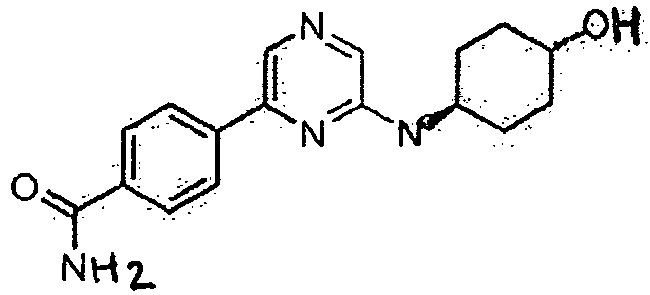
-

- A mixture of 2,6-clichloropyrazine (0.150 g, 1.006 mmol), 6-aminoindole (0.200 g, 1.51 mmol), BINAP (0.0137 g, 0.02215 mmol), sodium tertiary butoxide (0.136 g, 1.409 mmol) and palladium acetate (0.005 g, 0.02215 mmol) in toluene (8 mL) was heated at 85 °C for 16 h under nitrogen. CH2Cl2 was added, the reaction mixture was filtered through Celite, and the solvent was evaporated. The residue was purified by column chromatography (5% methanol in CH2Cl2 as eluent) to give 0.070 g (33%) of intermediate (6-chloropyrazin-2-yl)-(1H-indol-6-yl)-amine. 1H NMR (CDCl3) δ 8.36 (brs, 1H, NH), 8.08 (s, 1H), 7.92 (s, 1H), 7.64-7.59 (m, 2 H), 7.23 (s, 1H), 7.01-6.98 (d, J = 8.37 Hz, 1 H), 6.87 (s, 1H, NH), 6.56 (s, 1 H); MS (API-ES/ Positive); m/z: 245 (M+H)+.
- A mixture of (6-chloro-pyrazin-2-yl)-(1H-indol-6-yl)-amine (0.070 g, 0.2868 mmol), pyridine-4-boronic acid (0.042 g, 0.344 mmol), sodium carbonate (0.150 g, 1.43 mmol) and tetrakis(triphenylphosphine)palladium(0) (0.0165 g, 0.0143 mmol) in DME:water (3:2, 5 mL) was heated at reflux for 20 h. The reaction mixture was concentrated under reduced pressure and the residue obtained was extracted with dichloromethane. The organic layer was washed with water, brine, dried over sodium sulfate and concentrated. The crude product was purified by flash chromatography (5% methanol in CH2Cl2 as eluent) to yield N-(6-pyridin-4-ylpyrazin-2-yl)-1H-indol-6-amine (0.030 g, 36.5%) as a yellow solid. 1H NMR (CD3OD) δ 8.73- 8.72 (d, J = 5.68 Hz, 2 H), 8.51 (s, 1H), 8.23-8.20 (m, 4 H), 7.56-7.54 (d, J= 8.46 Hz, 1H), 7.22 (d, J= 2.99 Hz, 1 H), 7.14 (dd, J= 10.18, 1.74 Hz, 1H), 6.45 (d, J= 2.75 Hz,1 H); MS (API-ES/Positive); m/z: 288 (M+H)+.
- The ability of compound of the invention to inhibit FLT3 can be determined using in vitro and in vivo assays known in the art. Several in vitro kinase assays for FLT3 inhibition have been described in the literature using cloned kinase domain and measuring phosphorylation of a substrate peptide. In addition, cell-lines expressing FLT3 have been used to measure the effect on viability and proliferation in a cellular assay.
- The compounds according to the invention were evaluated for their inhibition of FLT3 by the following method:
- An enzyme inhibition assay for the tyrosine kinase domain of FLT3 was established using a fluorescence polarization technique, Immobilized Metal Ion Affinity-Based Fluorescence Polarization (IMAP) from Molecular Devices.
- Briefly: kinase activity is measured by incubating a fluorescent peptide substrate with the kinase domain. After completion of the kinase reaction a binding buffer is added. Upon phosphorylation of the substrate, the fluorescent peptide gains the ability to bind to a metal-coated nanoparticle. When the substrate is bound to the nanoparticle, the rotational speed of the peptide is reduced, and thus the fluorescence polarization (fp) becomes high. Compounds inhibiting the kinase activity of the enzyme will result in a low degree of phosphorylated substrate and a low fp-signal.
- IMAP Buffer kit with Progressive Binding System (Molecular Devices, #R8124): Reaction buffer: 10 mM Tris-HCL pH 7.2 with 10 mM MgCl2, 0.05% NaN3 and 0.01% Tween 20. Prior to use DTT was added to 1 mM DTT final concentration (complete reaction buffer).
- Binding solution was prepared from buffer kit according to the manufactures recommendations. Binding Reagent was diluted 1:1500 in 40 % Binding buffer A and 60 % Binding buffer B.
- FLT3 enzyme used was recombinant human FLT3 from Upstate (#14-500) 7.2 U/ml, N-terminal GST tagged, amino acids 564 - end.
- Substrate peptide used: FAM-CSKtide from Molecular Devices (#R7269) 20 µM, 5FAM-KKKKEEIYFFFG-NH2.
ATP stock solution 10 mM
DTT stock solution 100 mM
Compound dilutions: 0.01% Tween20 + 1% DMSO in reaction buffer. Reagents were diluted in complete reaction buffer to working solutions. - Final concentrations:
- Flt3: 0.0125 U/ml (batch dependent)
- FAM-CSKtide: 100 nM
- ATP: 100 µM
- Compound dose response: eleven step dilution 1:3, concentration range 25000 - 0.42 nM, 5000 - 0.085 nM, resp. 500 - 0.0085 nM depending of the potency of compound.
-
- I. Set up kinase reaction in 20 µl volume for 1 h:
- Pipette into 96-well black ½ area plate:
- 5 µl compound dilution or vehicle
- 5 µl substrate peptide (400 nM)
- 5 µl enzyme (0.05 U/ml) or complete reaction buffer for non specific background
- (NSB)
- 5 µl ATP (400 µM)
- Cover the plate and incubate at room temperature with gentle agitation
- Pipette into 96-well black ½ area plate:
- II. Binding incubation for 2 h (minimum time):
- Add 60 µl binding solution.
- Cover the plate and incubate at room temperature with gentle agitation
- III. Fluorescence Polarization analysis:
- Measure fluorescein using a plate reader (Analyst AD) excitation wave length 485 and emission wave length 530, reading with integration time of 0.1 sec. (Alternatively Victor2 V Wallac 485/535 nm)
- Stock concentrations of test compounds were made at 10 mM in 100 % DMSO. In the assay, compounds were tested in single point at 10 and 1 micromolar, diluted in reaction buffer as described above. Compounds with an inhibitory activity greater than 60 % inhibition at 1 micromolar were subsequently tested in dose-respons for IC50 determinations, using an eleven point dilution range with 1:3 dilution steps (typically from 25000 nM to 0.42 nM, more potent compounds were assayed from 500 nM to 0.0085 nM).
IC50 values were obtained by the equation (A+((B-A)/(1+((C/x)^D)))) where A equals min, B equals max, C equals IC50 and D equals Hill slope. - The compounds in accordance with the invention can display IC50 values between 1 nM and 2 µM (e.g. between 1 nM and 1 µM, between 1 nM and 500 nM, between 1 nM and 100 nM, between 1 nM and 25 nM, between 1 nM and 10 nM).
- AML cell-line MV4-11 carries the FLT3-internal tandem duplication. This cell-line has been widely used for evaluating the effect of FLT3-kinase inhibitors on viability and proliferation.
- Briefly, cells are seeded at a low density into 96-well plates. Serial dilution of compounds is added and the cells are incubated for 72 hours. Total number of viable cells is measured using flow cytometry at the end of treatment, and the effect of the compounds is calculated as % inhibition compared to vehicle treated cells.
- All cells were cultured under standard cell culture conditions, at 37° Celsius in an atmosphere of 5% CO2 in 90% humidity.
- AML-cell line MV4-11 was cultured in DMEM Glutamax high glucose (4500g/l glucose) supplemented with 10 % Fetal Bovine Serum (FBS) from Invitrogen. Cells were subcultured twice weakly, growing to a density of approx 2 million cells per ml prior to subcultivation.
- For viability determination, 3000-5000 cells were seeded in 50 microliter culture medium into a 96-well plate. Serial dilutions 1:3 of compounds from 10mM DMSO stock were made in serumfree culture medium supplemented with penicillin and streptomycin. 50 microliter of the serial dilutions were added to the cell-suspension. The final concentration of compounds was from 5 micromolar to 0.8 nM, or from 500 nM to 0.08 nM respectively. The DMSO concentration was kept constant at 0.05%.
- At the end of the treatment, 100 microliter viability reagent (Guava ViaCount) was added to each well and number of cells and viability was determined using flow cytometry (Guava 96-well ViaCount assay). Typically the vehicle treated (0.05 % DMSO) cell-line cells had doubled three times during the experiment.
% Survival was calculated compared to the vehicle treated cells at the end of experiment. EC50 values were determined using the equation (A+((B-A)/(1+((C/x)^D)))) where A equals min, B equals max, C equals EC50 and D equals Hill slope. -
Table 1: Typical mean IC50 values (n = 4-8) determined in the FLT3 kinase assay. Example IC50 (nM) 15 60 20 159 24 560 Table 2: EC50 values determined in AML-cell line. Example Cell data MV4-11 (nM) 15 184 20 178 24 373 - Sequence dependent synergisitic activities of compounds of formula (I) and standard chemotherapy agents used in treating AML is performed as described in Brown et al. (2006) Leukemia 20: 1368-1376, and the results analysed using Calcusyn Software according to the principles of Chou and Talalay (1981) Eur J Biochem.
Claims (14)
- A compound which is:N3-1H-indol-5-yl-5-pyridin-4-ylpyrazine-2,3-diamine,or a pharmacologically acceptable salt thereof.
- A compound according to claim 1 for use in therapy.
- A compound for use according to claim 2, in the treatment of haematological malignancies; myeloproliferative disorders; cancer; autoimmune disorders; or skin disorders.
- A compound for use according to claim 2 in the prophylaxis of haematological malignancies; myeloproliferative disorders; cancer; autoimmune disorders; or skin disorders.
- A compound for use according to claim 3, in the treatment of haematological malignancies.
- A compound for use according to claim 4, in the prophylaxis of haematological malignancies.
- A compound for use according to claim 5 or 6, wherein the haematological disorder is selected from acute myeloic leukemia (AML); mixed lineage leukemia (MLL); T-cell type acute lymphocytic leukemia (T-ALL); B-cell type acute lymphocytic leukemia (B-ALL); or chronic myelo- monocytic leukemia (CMML).
- A compound for use according to claim 7, wherein the haematological malignancy is acute myeloic leukemia (AML).
- A compound for use according to claim 3, in the treatment of a skin disorder.
- A compound for use according to claim 9, wherein the skin disorder is psoriasis or atopic dermatitis.
- A pharmaceutical composition comprising a compound according to claim 1, in conjunction with another molecularly targeted agent.
- A preparation comprising a compound according to claim 1 and another molecularly targeted agent for use in the treatment of haematological malignancies, wherein the compound as defined in claim 1 is administered simultaneously or sequentially with said molecularly targeted agent.
- A pharmaceutical composition according to claim 11 or a preparation according to claim 12, wherein the other molecularly targeted agent is a conventional cytotoxic agent, or a compound used in postchemotherapy, stem-cell directed maintenance therapy and in MLL-rearranged infant acute lymphoblastic leukemia.
- A preparation according to claim 12, wherein the haematological malignancy is acute myeloic leukemia (AML).
Priority Applications (4)
| Application Number | Priority Date | Filing Date | Title |
|---|---|---|---|
| EP13182880.8A EP2671876A3 (en) | 2008-02-01 | 2009-01-28 | Pyrazine derivatives and their use as protein kinase inhbitors |
| PL09706385T PL2252597T3 (en) | 2008-02-01 | 2009-01-28 | Pyrazine derivatives and their use as protein kinase inhibitors |
| SI200930949T SI2252597T1 (en) | 2008-02-01 | 2009-01-28 | Pyrazine derivatives and their use as protein kinase inhibitors |
| CY20141100435T CY1115400T1 (en) | 2008-02-01 | 2014-06-17 | PYRAZINE PRODUCERS AND USE AS PROTEIN CHINESE Suspensions |
Applications Claiming Priority (4)
| Application Number | Priority Date | Filing Date | Title |
|---|---|---|---|
| SE0800250 | 2008-02-01 | ||
| US12303908P | 2008-04-04 | 2008-04-04 | |
| SE0801185 | 2008-05-21 | ||
| PCT/EP2009/050931 WO2009095399A2 (en) | 2008-02-01 | 2009-01-28 | Pyrazine derivatives and their use as protein kinase inhbitors |
Related Child Applications (2)
| Application Number | Title | Priority Date | Filing Date |
|---|---|---|---|
| EP13182880.8A Division EP2671876A3 (en) | 2008-02-01 | 2009-01-28 | Pyrazine derivatives and their use as protein kinase inhbitors |
| EP13182880.8A Division-Into EP2671876A3 (en) | 2008-02-01 | 2009-01-28 | Pyrazine derivatives and their use as protein kinase inhbitors |
Publications (2)
| Publication Number | Publication Date |
|---|---|
| EP2252597A2 EP2252597A2 (en) | 2010-11-24 |
| EP2252597B1 true EP2252597B1 (en) | 2014-03-19 |
Family
ID=40527384
Family Applications (2)
| Application Number | Title | Priority Date | Filing Date |
|---|---|---|---|
| EP13182880.8A Withdrawn EP2671876A3 (en) | 2008-02-01 | 2009-01-28 | Pyrazine derivatives and their use as protein kinase inhbitors |
| EP09706385.3A Active EP2252597B1 (en) | 2008-02-01 | 2009-01-28 | Pyrazine derivatives and their use as protein kinase inhibitors |
Family Applications Before (1)
| Application Number | Title | Priority Date | Filing Date |
|---|---|---|---|
| EP13182880.8A Withdrawn EP2671876A3 (en) | 2008-02-01 | 2009-01-28 | Pyrazine derivatives and their use as protein kinase inhbitors |
Country Status (18)
| Country | Link |
|---|---|
| US (2) | US8436171B2 (en) |
| EP (2) | EP2671876A3 (en) |
| JP (2) | JP5562256B2 (en) |
| KR (1) | KR101599082B1 (en) |
| CN (1) | CN101970418B (en) |
| AU (1) | AU2009209633C1 (en) |
| BR (1) | BRPI0907453A2 (en) |
| CA (1) | CA2713553A1 (en) |
| CY (1) | CY1115400T1 (en) |
| DK (1) | DK2252597T3 (en) |
| ES (1) | ES2459297T3 (en) |
| HR (1) | HRP20140547T1 (en) |
| MX (1) | MX2010007973A (en) |
| PL (1) | PL2252597T3 (en) |
| PT (1) | PT2252597E (en) |
| RU (1) | RU2493152C2 (en) |
| SI (1) | SI2252597T1 (en) |
| WO (1) | WO2009095399A2 (en) |
Families Citing this family (25)
| Publication number | Priority date | Publication date | Assignee | Title |
|---|---|---|---|---|
| US8436171B2 (en) * | 2008-02-01 | 2013-05-07 | Akinion Pharmaceuticals Ab | Amino substituted pyrazines as inhibitors or protein kinases |
| EP2521782B1 (en) | 2010-01-05 | 2019-04-10 | INSERM - Institut National de la Santé et de la Recherche Médicale | Flt3 receptor antagonists for the treatment or the prevention of pain disorders |
| WO2013089636A1 (en) * | 2011-12-15 | 2013-06-20 | Akinion Pharmaceuticals Ab | Processes for manufacturing of a kinase inhibitor |
| CN104244934A (en) * | 2012-03-14 | 2014-12-24 | 印第安纳大学研究及科技有限公司 | Compounds and methods for treating leukemia |
| PL2840080T3 (en) * | 2012-04-17 | 2018-06-29 | Fujifilm Corporation | Nitrogen-containing heterocyclic compound or salt thereof |
| UY34807A (en) * | 2012-05-16 | 2013-12-31 | Novartis Ag | MONOCYCLIC DERIVATIVES OF HETEROARYL CYCLOALKYL-DIAMINE |
| BR112016008080B1 (en) | 2013-10-16 | 2021-02-23 | Fujifilm Corporation | carboxylic acid salt or a mineral acid salt, succinate crystal, fumarate crystal and pharmaceutical composition |
| WO2016016370A1 (en) | 2014-07-31 | 2016-02-04 | INSERM (Institut National de la Santé et de la Recherche Médicale) | Flt3 receptor antagonists |
| JP6257782B2 (en) | 2014-08-22 | 2018-01-10 | 富士フイルム株式会社 | Pharmaceutical composition for treating FLT3 mutation positive cancer, mutant FLT3 inhibitor and application thereof |
| CN105985322A (en) * | 2015-03-03 | 2016-10-05 | 苏州翔实医药发展有限公司 | Amino pyrazine compound and application thereof |
| JP6412471B2 (en) | 2015-07-15 | 2018-10-24 | 富士フイルム株式会社 | Process for producing nitrogen-containing heterocyclic compound and intermediate thereof |
| EP3254698A1 (en) | 2016-06-08 | 2017-12-13 | Universite De Montpellier | Flt3 receptor inhibitor at low dosage for the treatment of neuropathic pain |
| US20200171022A1 (en) | 2017-05-17 | 2020-06-04 | Inserm (Institut National De La Santé Et Da La Recherche Médicale) | Flt3 inhibitors for improving pain treatments by opioids |
| JP2020527588A (en) | 2017-07-18 | 2020-09-10 | ニューベイション・バイオ・インコーポレイテッドNuvation Bio Inc. | Heterocyclic compounds as adenosine antagonists |
| WO2019057649A1 (en) | 2017-09-19 | 2019-03-28 | INSERM (Institut National de la Santé et de la Recherche Médicale) | Methods and pharmaceutical compositions for the treatment of acute myeloid leukemia |
| CN110483366B (en) * | 2018-05-14 | 2022-09-16 | 中国医学科学院药物研究所 | Indole compound and preparation method, pharmaceutical composition and application thereof |
| CA3126931A1 (en) | 2019-01-18 | 2020-07-23 | Nuvation Bio Inc. | 1,8-naphthyridinone compounds and uses thereof |
| AU2020208644A1 (en) * | 2019-01-18 | 2021-08-26 | Nuvation Bio Inc. | Heterocyclic compounds as adenosine antagonists |
| CN113631167A (en) * | 2019-01-18 | 2021-11-09 | 诺维逊生物股份有限公司 | Heterocyclic compounds as adenosine antagonists |
| AU2020242287A1 (en) | 2019-03-21 | 2021-09-02 | INSERM (Institut National de la Santé et de la Recherche Médicale) | A Dbait molecule in combination with kinase inhibitor for the treatment of cancer |
| KR20220098759A (en) | 2019-11-08 | 2022-07-12 | 인쎄름 (엥스띠뛰 나씨오날 드 라 쌍떼 에 드 라 흐쉐르슈 메디깔) | A method of treating cancer that has acquired resistance to a kinase inhibitor |
| WO2021148581A1 (en) | 2020-01-22 | 2021-07-29 | Onxeo | Novel dbait molecule and its use |
| CN112574192B (en) * | 2020-12-24 | 2021-10-01 | 烟台大学 | Amino acid-derived bithiazole-tryptamine anticancer compounds and applications |
| KR20250075303A (en) * | 2023-11-21 | 2025-05-28 | (주)신테카바이오 | Pharmaceutical composition for preventing or treating psoriasis comprising crenolanib |
| KR20250075302A (en) * | 2023-11-21 | 2025-05-28 | (주)신테카바이오 | Pharmaceutical composition for preventing or treating atopic dermatitis comprising crenolanib |
Family Cites Families (16)
| Publication number | Priority date | Publication date | Assignee | Title |
|---|---|---|---|---|
| TW225528B (en) * | 1992-04-03 | 1994-06-21 | Ciba Geigy Ag | |
| RU2340611C2 (en) * | 2000-09-15 | 2008-12-10 | Вертекс Фармасьютикалз Инкорпорейтед | Pyrazole derivatives applied as protein kinase inhibitors |
| WO2002060492A1 (en) * | 2001-01-30 | 2002-08-08 | Cytopia Pty Ltd | Methods of inhibiting kinases |
| IL165264A0 (en) * | 2002-05-23 | 2005-12-18 | Cytopia Pty Ltd | Protein kinase inhibitors |
| AUPS251502A0 (en) * | 2002-05-23 | 2002-06-13 | Cytopia Pty Ltd | Protein kinase inhibitors |
| GB2400101A (en) * | 2003-03-28 | 2004-10-06 | Biofocus Discovery Ltd | Compounds capable of binding to the active site of protein kinases |
| US7563748B2 (en) | 2003-06-23 | 2009-07-21 | Cognis Ip Management Gmbh | Alcohol alkoxylate carriers for pesticide active ingredients |
| US7390907B2 (en) * | 2003-09-30 | 2008-06-24 | Amgen Inc. | Vanilloid receptor ligands and their use in treatments |
| WO2005058876A1 (en) | 2003-12-16 | 2005-06-30 | Gpc Biotech Ag | Pyrazine derivatives as effective compounds against infectious diseases |
| ATE458730T1 (en) * | 2004-04-13 | 2010-03-15 | Icagen Inc | POLYCYCLIC PYRAZINE AS POTASSIUM ION CHANNEL MODULATORS |
| EP1769092A4 (en) | 2004-06-29 | 2008-08-06 | Europ Nickel Plc | Improved leaching of base metals |
| GB0428082D0 (en) * | 2004-12-22 | 2005-01-26 | Welcome Trust The Ltd | Therapeutic compounds |
| TW200801513A (en) | 2006-06-29 | 2008-01-01 | Fermiscan Australia Pty Ltd | Improved process |
| ATE517868T1 (en) | 2006-08-16 | 2011-08-15 | Boehringer Ingelheim Int | PYRAZINE COMPOUNDS, THEIR USE AND PRODUCTION PROCESS |
| WO2008058341A1 (en) | 2006-11-15 | 2008-05-22 | Cytopia Research Pty Ltd | Inhibitors of kinase activity |
| US8436171B2 (en) * | 2008-02-01 | 2013-05-07 | Akinion Pharmaceuticals Ab | Amino substituted pyrazines as inhibitors or protein kinases |
-
2009
- 2009-01-28 US US12/865,359 patent/US8436171B2/en not_active Expired - Fee Related
- 2009-01-28 DK DK09706385.3T patent/DK2252597T3/en active
- 2009-01-28 SI SI200930949T patent/SI2252597T1/en unknown
- 2009-01-28 CN CN2009801038291A patent/CN101970418B/en not_active Expired - Fee Related
- 2009-01-28 RU RU2010136653/04A patent/RU2493152C2/en not_active IP Right Cessation
- 2009-01-28 MX MX2010007973A patent/MX2010007973A/en active IP Right Grant
- 2009-01-28 KR KR1020107017417A patent/KR101599082B1/en not_active Expired - Fee Related
- 2009-01-28 EP EP13182880.8A patent/EP2671876A3/en not_active Withdrawn
- 2009-01-28 ES ES09706385.3T patent/ES2459297T3/en active Active
- 2009-01-28 EP EP09706385.3A patent/EP2252597B1/en active Active
- 2009-01-28 HR HRP20140547AT patent/HRP20140547T1/en unknown
- 2009-01-28 AU AU2009209633A patent/AU2009209633C1/en not_active Ceased
- 2009-01-28 BR BRPI0907453-8A patent/BRPI0907453A2/en not_active Application Discontinuation
- 2009-01-28 PT PT97063853T patent/PT2252597E/en unknown
- 2009-01-28 CA CA2713553A patent/CA2713553A1/en not_active Abandoned
- 2009-01-28 JP JP2010544683A patent/JP5562256B2/en not_active Expired - Fee Related
- 2009-01-28 WO PCT/EP2009/050931 patent/WO2009095399A2/en not_active Ceased
- 2009-01-28 PL PL09706385T patent/PL2252597T3/en unknown
-
2013
- 2013-03-15 US US13/833,231 patent/US20130203774A1/en not_active Abandoned
-
2014
- 2014-04-04 JP JP2014077470A patent/JP2014148522A/en active Pending
- 2014-06-17 CY CY20141100435T patent/CY1115400T1/en unknown
Also Published As
| Publication number | Publication date |
|---|---|
| EP2671876A3 (en) | 2014-02-05 |
| WO2009095399A2 (en) | 2009-08-06 |
| JP2014148522A (en) | 2014-08-21 |
| CA2713553A1 (en) | 2009-08-06 |
| BRPI0907453A2 (en) | 2015-07-14 |
| US20130203774A1 (en) | 2013-08-08 |
| WO2009095399A3 (en) | 2009-10-01 |
| CN101970418A (en) | 2011-02-09 |
| JP5562256B2 (en) | 2014-07-30 |
| ES2459297T3 (en) | 2014-05-08 |
| JP2011510948A (en) | 2011-04-07 |
| CY1115400T1 (en) | 2017-01-04 |
| EP2671876A2 (en) | 2013-12-11 |
| DK2252597T3 (en) | 2014-04-28 |
| PT2252597E (en) | 2014-04-30 |
| RU2493152C2 (en) | 2013-09-20 |
| MX2010007973A (en) | 2010-11-09 |
| PL2252597T3 (en) | 2014-09-30 |
| EP2252597A2 (en) | 2010-11-24 |
| CN101970418B (en) | 2013-07-03 |
| AU2009209633A1 (en) | 2009-08-06 |
| US8436171B2 (en) | 2013-05-07 |
| HK1149268A1 (en) | 2011-09-30 |
| KR101599082B1 (en) | 2016-03-02 |
| AU2009209633B2 (en) | 2013-07-18 |
| HRP20140547T1 (en) | 2014-07-18 |
| SI2252597T1 (en) | 2014-07-31 |
| AU2009209633C1 (en) | 2014-01-23 |
| RU2010136653A (en) | 2012-03-10 |
| US20110098310A1 (en) | 2011-04-28 |
| KR20100116599A (en) | 2010-11-01 |
Similar Documents
| Publication | Publication Date | Title |
|---|---|---|
| EP2252597B1 (en) | Pyrazine derivatives and their use as protein kinase inhibitors | |
| EP3584239B1 (en) | O-aminoheteroaryl alkynyl-containing compound, preparation method therefor, and use thereof | |
| EP2684877B1 (en) | Pharmaceutically acceptable salt of (e)-n-[4-[[3-chloro-4-(2-pyridylmethoxy)phenyl]amino]-3-cyano-7-ethoxy-6-quinolyl]-3-[(2r)-1-methylpyrrolidin-2-yl]prop-2-enamide, preparation method therefor, and medical use thereof | |
| EP3722292B1 (en) | Novel pyrimidine derivative having effect of inhibiting cancer cell growth and pharmaceutical composition containing same | |
| EP3398950B1 (en) | Novel kinase inhibitor against wild-type egfr and mutated egfr | |
| AU2011311814B2 (en) | Substituted pyridazine carboxamide compounds | |
| JP2002535318A (en) | Kinase inhibitors | |
| EP3489223A1 (en) | Heterocyclic compound used as fgfr inhibitor | |
| JP6916562B2 (en) | Compounds, pharmaceutically acceptable salts thereof, solvates, stereoisomers and tautomers, and drug compositions, hyperproliferative disorder therapeutic agents, hyperproliferative disorder prophylaxis agents, drugs, cancer therapeutic agents, cancer Prophylactic agents and kinase signaling regulators | |
| WO2019184966A1 (en) | Substituted diamino heterocyclic carboxamide compound and a composition containing the compound and use thereof | |
| CN101687801A (en) | Ethers of naphtalene carboxylic acid amides as cancer cure | |
| HK1188448A (en) | Pyrazine derivatives and their use as protein kinase inhbitors | |
| KR20220159457A (en) | Salt Forms, Crystalline Forms and Uses of FGFR4 Inhibitors | |
| EP4053121A1 (en) | Novel heterocyclic-substituted pyrimidine derivative exhibiting cancer cell growth inhibitory effect, and pharmaceutical composition containing same | |
| EP4393908A1 (en) | Bis-pyrazolyl-methane compounds affecting kras | |
| KR20250041906A (en) | Novel compounds having HPK1 and MLK3 inhibitory activities and anti-cancer compositions containing the same | |
| HK40079392B (en) | Phenyl-2-hydroxy-acetylamino-2-methyl-phenyl compounds | |
| WO2025003429A1 (en) | Pyrazole derivatives as pd-1/pd-l1 interaction inhibitors | |
| CN117700401A (en) | Deuterated compound and application thereof in medicine | |
| HK40022857A (en) | Compounds for use in the therapeutic and/or prophylactic treatment of cancer | |
| HK1149268B (en) | Pyrazine derivatives and their use as protein kinase inhbitors | |
| HK1160859B (en) | Inhibitors of tyrosine kinases | |
| HK1160859A1 (en) | Inhibitors of tyrosine kinases |
Legal Events
| Date | Code | Title | Description |
|---|---|---|---|
| PUAI | Public reference made under article 153(3) epc to a published international application that has entered the european phase |
Free format text: ORIGINAL CODE: 0009012 |
|
| 17P | Request for examination filed |
Effective date: 20100826 |
|
| AK | Designated contracting states |
Kind code of ref document: A2 Designated state(s): AT BE BG CH CY CZ DE DK EE ES FI FR GB GR HR HU IE IS IT LI LT LU LV MC MK MT NL NO PL PT RO SE SI SK TR |
|
| AX | Request for extension of the european patent |
Extension state: AL BA RS |
|
| RIN1 | Information on inventor provided before grant (corrected) |
Inventor name: JENMALM JENSEN, ANNIKA Inventor name: LEHMANN, FREDRIK Inventor name: NILSSON, BJOERN, M. Inventor name: NORDLING, ERIK Inventor name: PARROW, VENDELA |
|
| DAX | Request for extension of the european patent (deleted) | ||
| 17Q | First examination report despatched |
Effective date: 20110906 |
|
| GRAP | Despatch of communication of intention to grant a patent |
Free format text: ORIGINAL CODE: EPIDOSNIGR1 |
|
| INTG | Intention to grant announced |
Effective date: 20131018 |
|
| GRAS | Grant fee paid |
Free format text: ORIGINAL CODE: EPIDOSNIGR3 |
|
| GRAA | (expected) grant |
Free format text: ORIGINAL CODE: 0009210 |
|
| AK | Designated contracting states |
Kind code of ref document: B1 Designated state(s): AT BE BG CH CY CZ DE DK EE ES FI FR GB GR HR HU IE IS IT LI LT LU LV MC MK MT NL NO PL PT RO SE SI SK TR |
|
| REG | Reference to a national code |
Ref country code: GB Ref legal event code: FG4D |
|
| REG | Reference to a national code |
Ref country code: CH Ref legal event code: EP |
|
| REG | Reference to a national code |
Ref country code: IE Ref legal event code: FG4D |
|
| REG | Reference to a national code |
Ref country code: AT Ref legal event code: REF Ref document number: 657589 Country of ref document: AT Kind code of ref document: T Effective date: 20140415 |
|
| REG | Reference to a national code |
Ref country code: DK Ref legal event code: T3 Effective date: 20140424 |
|
| REG | Reference to a national code |
Ref country code: PT Ref legal event code: SC4A Free format text: AVAILABILITY OF NATIONAL TRANSLATION Effective date: 20140421 Ref country code: DE Ref legal event code: R096 Ref document number: 602009022584 Country of ref document: DE Effective date: 20140430 |
|
| REG | Reference to a national code |
Ref country code: ES Ref legal event code: FG2A Ref document number: 2459297 Country of ref document: ES Kind code of ref document: T3 Effective date: 20140508 |
|
| REG | Reference to a national code |
Ref country code: CH Ref legal event code: NV Representative=s name: ISLER AND PEDRAZZINI AG, CH |
|
| REG | Reference to a national code |
Ref country code: NL Ref legal event code: T3 |
|
| REG | Reference to a national code |
Ref country code: RO Ref legal event code: EPE |
|
| REG | Reference to a national code |
Ref country code: HR Ref legal event code: TUEP Ref document number: P20140547 Country of ref document: HR |
|
| REG | Reference to a national code |
Ref country code: SE Ref legal event code: TRGR |
|
| REG | Reference to a national code |
Ref country code: NO Ref legal event code: T2 Effective date: 20140319 |
|
| REG | Reference to a national code |
Ref country code: HR Ref legal event code: T1PR Ref document number: P20140547 Country of ref document: HR |
|
| REG | Reference to a national code |
Ref country code: GR Ref legal event code: EP Ref document number: 20140400897 Country of ref document: GR Effective date: 20140625 |
|
| REG | Reference to a national code |
Ref country code: SK Ref legal event code: T3 Ref document number: E 16385 Country of ref document: SK |
|
| REG | Reference to a national code |
Ref country code: EE Ref legal event code: FG4A Ref document number: E009310 Country of ref document: EE Effective date: 20140526 |
|
| REG | Reference to a national code |
Ref country code: PL Ref legal event code: T3 |
|
| REG | Reference to a national code |
Ref country code: DE Ref legal event code: R097 Ref document number: 602009022584 Country of ref document: DE |
|
| PLBE | No opposition filed within time limit |
Free format text: ORIGINAL CODE: 0009261 |
|
| STAA | Information on the status of an ep patent application or granted ep patent |
Free format text: STATUS: NO OPPOSITION FILED WITHIN TIME LIMIT |
|
| 26N | No opposition filed |
Effective date: 20141222 |
|
| REG | Reference to a national code |
Ref country code: HU Ref legal event code: AG4A Ref document number: E022024 Country of ref document: HU |
|
| REG | Reference to a national code |
Ref country code: DE Ref legal event code: R097 Ref document number: 602009022584 Country of ref document: DE Effective date: 20141222 |
|
| REG | Reference to a national code |
Ref country code: FR Ref legal event code: PLFP Year of fee payment: 8 |
|
| REG | Reference to a national code |
Ref country code: FR Ref legal event code: PLFP Year of fee payment: 9 |
|
| REG | Reference to a national code |
Ref country code: FR Ref legal event code: PLFP Year of fee payment: 10 |
|
| PGFP | Annual fee paid to national office [announced via postgrant information from national office to epo] |
Ref country code: LU Payment date: 20180119 Year of fee payment: 10 |
|
| PGFP | Annual fee paid to national office [announced via postgrant information from national office to epo] |
Ref country code: NL Payment date: 20180116 Year of fee payment: 10 |
|
| PGFP | Annual fee paid to national office [announced via postgrant information from national office to epo] |
Ref country code: ES Payment date: 20180201 Year of fee payment: 10 Ref country code: GB Payment date: 20180116 Year of fee payment: 10 Ref country code: NO Payment date: 20180118 Year of fee payment: 10 Ref country code: FI Payment date: 20180118 Year of fee payment: 10 Ref country code: CH Payment date: 20180127 Year of fee payment: 10 Ref country code: DE Payment date: 20180116 Year of fee payment: 10 |
|
| PGFP | Annual fee paid to national office [announced via postgrant information from national office to epo] |
Ref country code: SE Payment date: 20180115 Year of fee payment: 10 Ref country code: IT Payment date: 20180122 Year of fee payment: 10 Ref country code: LV Payment date: 20180103 Year of fee payment: 10 Ref country code: FR Payment date: 20180116 Year of fee payment: 10 Ref country code: GR Payment date: 20180117 Year of fee payment: 10 Ref country code: IE Payment date: 20180115 Year of fee payment: 10 Ref country code: IS Payment date: 20180126 Year of fee payment: 10 Ref country code: MC Payment date: 20180119 Year of fee payment: 10 Ref country code: AT Payment date: 20180123 Year of fee payment: 10 |
|
| PGFP | Annual fee paid to national office [announced via postgrant information from national office to epo] |
Ref country code: MT Payment date: 20180110 Year of fee payment: 10 |
|
| REG | Reference to a national code |
Ref country code: HR Ref legal event code: ODRP Ref document number: P20140547 Country of ref document: HR Payment date: 20190107 Year of fee payment: 11 |
|
| PGFP | Annual fee paid to national office [announced via postgrant information from national office to epo] |
Ref country code: LT Payment date: 20181220 Year of fee payment: 11 |
|
| PGFP | Annual fee paid to national office [announced via postgrant information from national office to epo] |
Ref country code: RO Payment date: 20190110 Year of fee payment: 11 Ref country code: CZ Payment date: 20190118 Year of fee payment: 11 Ref country code: CY Payment date: 20190103 Year of fee payment: 11 Ref country code: PL Payment date: 20190121 Year of fee payment: 11 Ref country code: BG Payment date: 20190122 Year of fee payment: 11 |
|
| PGFP | Annual fee paid to national office [announced via postgrant information from national office to epo] |
Ref country code: HR Payment date: 20190107 Year of fee payment: 11 Ref country code: HU Payment date: 20190107 Year of fee payment: 11 Ref country code: DK Payment date: 20190116 Year of fee payment: 11 Ref country code: SI Payment date: 20190103 Year of fee payment: 11 Ref country code: EE Payment date: 20190118 Year of fee payment: 11 Ref country code: TR Payment date: 20190107 Year of fee payment: 11 Ref country code: BE Payment date: 20190117 Year of fee payment: 11 |
|
| PGFP | Annual fee paid to national office [announced via postgrant information from national office to epo] |
Ref country code: SK Payment date: 20190117 Year of fee payment: 11 Ref country code: MK Payment date: 20181228 Year of fee payment: 11 |
|
| PGFP | Annual fee paid to national office [announced via postgrant information from national office to epo] |
Ref country code: PT Payment date: 20181228 Year of fee payment: 11 |
|
| REG | Reference to a national code |
Ref country code: DE Ref legal event code: R119 Ref document number: 602009022584 Country of ref document: DE |
|
| REG | Reference to a national code |
Ref country code: NO Ref legal event code: MMEP |
|
| PG25 | Lapsed in a contracting state [announced via postgrant information from national office to epo] |
Ref country code: MC Free format text: LAPSE BECAUSE OF NON-PAYMENT OF DUE FEES Effective date: 20190131 |
|
| REG | Reference to a national code |
Ref country code: CH Ref legal event code: PL |
|
| REG | Reference to a national code |
Ref country code: NL Ref legal event code: MM Effective date: 20190201 |
|
| REG | Reference to a national code |
Ref country code: AT Ref legal event code: MM01 Ref document number: 657589 Country of ref document: AT Kind code of ref document: T Effective date: 20190128 |
|
| GBPC | Gb: european patent ceased through non-payment of renewal fee |
Effective date: 20190128 |
|
| PG25 | Lapsed in a contracting state [announced via postgrant information from national office to epo] |
Ref country code: LU Free format text: LAPSE BECAUSE OF NON-PAYMENT OF DUE FEES Effective date: 20190128 |
|
| REG | Reference to a national code |
Ref country code: IE Ref legal event code: MM4A |
|
| PG25 | Lapsed in a contracting state [announced via postgrant information from national office to epo] |
Ref country code: FR Free format text: LAPSE BECAUSE OF NON-PAYMENT OF DUE FEES Effective date: 20190131 Ref country code: NO Free format text: LAPSE BECAUSE OF NON-PAYMENT OF DUE FEES Effective date: 20190131 Ref country code: NL Free format text: LAPSE BECAUSE OF NON-PAYMENT OF DUE FEES Effective date: 20190201 Ref country code: FI Free format text: LAPSE BECAUSE OF NON-PAYMENT OF DUE FEES Effective date: 20190128 Ref country code: SE Free format text: LAPSE BECAUSE OF NON-PAYMENT OF DUE FEES Effective date: 20190129 Ref country code: DE Free format text: LAPSE BECAUSE OF NON-PAYMENT OF DUE FEES Effective date: 20190801 |
|
| PG25 | Lapsed in a contracting state [announced via postgrant information from national office to epo] |
Ref country code: GR Free format text: LAPSE BECAUSE OF NON-PAYMENT OF DUE FEES Effective date: 20190802 Ref country code: LV Free format text: LAPSE BECAUSE OF NON-PAYMENT OF DUE FEES Effective date: 20190128 |
|
| PG25 | Lapsed in a contracting state [announced via postgrant information from national office to epo] |
Ref country code: AT Free format text: LAPSE BECAUSE OF NON-PAYMENT OF DUE FEES Effective date: 20190128 Ref country code: CH Free format text: LAPSE BECAUSE OF NON-PAYMENT OF DUE FEES Effective date: 20190131 Ref country code: LI Free format text: LAPSE BECAUSE OF NON-PAYMENT OF DUE FEES Effective date: 20190131 Ref country code: GB Free format text: LAPSE BECAUSE OF NON-PAYMENT OF DUE FEES Effective date: 20190128 Ref country code: IS Free format text: LAPSE BECAUSE OF FAILURE TO SUBMIT A TRANSLATION OF THE DESCRIPTION OR TO PAY THE FEE WITHIN THE PRESCRIBED TIME-LIMIT Effective date: 20190801 |
|
| PG25 | Lapsed in a contracting state [announced via postgrant information from national office to epo] |
Ref country code: IE Free format text: LAPSE BECAUSE OF NON-PAYMENT OF DUE FEES Effective date: 20190128 |
|
| PG25 | Lapsed in a contracting state [announced via postgrant information from national office to epo] |
Ref country code: IT Free format text: LAPSE BECAUSE OF NON-PAYMENT OF DUE FEES Effective date: 20190128 |
|
| REG | Reference to a national code |
Ref country code: ES Ref legal event code: FD2A Effective date: 20200310 |
|
| PG25 | Lapsed in a contracting state [announced via postgrant information from national office to epo] |
Ref country code: ES Free format text: LAPSE BECAUSE OF NON-PAYMENT OF DUE FEES Effective date: 20190129 |
|
| REG | Reference to a national code |
Ref country code: HR Ref legal event code: PBON Ref document number: P20140547 Country of ref document: HR Effective date: 20200128 |
|
| REG | Reference to a national code |
Ref country code: DK Ref legal event code: EBP Effective date: 20200131 |
|
| REG | Reference to a national code |
Ref country code: EE Ref legal event code: MM4A Ref document number: E009310 Country of ref document: EE Effective date: 20200131 |
|
| REG | Reference to a national code |
Ref country code: SK Ref legal event code: MM4A Ref document number: E 16385 Country of ref document: SK Effective date: 20200128 |
|
| REG | Reference to a national code |
Ref country code: BE Ref legal event code: MM Effective date: 20200131 |
|
| PG25 | Lapsed in a contracting state [announced via postgrant information from national office to epo] |
Ref country code: PT Free format text: LAPSE BECAUSE OF NON-PAYMENT OF DUE FEES Effective date: 20200828 Ref country code: SK Free format text: LAPSE BECAUSE OF NON-PAYMENT OF DUE FEES Effective date: 20200128 Ref country code: RO Free format text: LAPSE BECAUSE OF NON-PAYMENT OF DUE FEES Effective date: 20200128 Ref country code: CZ Free format text: LAPSE BECAUSE OF NON-PAYMENT OF DUE FEES Effective date: 20200128 Ref country code: EE Free format text: LAPSE BECAUSE OF NON-PAYMENT OF DUE FEES Effective date: 20200131 Ref country code: CY Free format text: LAPSE BECAUSE OF NON-PAYMENT OF DUE FEES Effective date: 20200128 |
|
| REG | Reference to a national code |
Ref country code: LT Ref legal event code: MM4D Effective date: 20200128 |
|
| PG25 | Lapsed in a contracting state [announced via postgrant information from national office to epo] |
Ref country code: BG Free format text: LAPSE BECAUSE OF NON-PAYMENT OF DUE FEES Effective date: 20200731 Ref country code: SI Free format text: LAPSE BECAUSE OF NON-PAYMENT OF DUE FEES Effective date: 20200129 Ref country code: HU Free format text: LAPSE BECAUSE OF NON-PAYMENT OF DUE FEES Effective date: 20200129 Ref country code: BE Free format text: LAPSE BECAUSE OF NON-PAYMENT OF DUE FEES Effective date: 20200131 Ref country code: HR Free format text: LAPSE BECAUSE OF NON-PAYMENT OF DUE FEES Effective date: 20200128 |
|
| REG | Reference to a national code |
Ref country code: SI Ref legal event code: KO00 Effective date: 20201030 |
|
| PG25 | Lapsed in a contracting state [announced via postgrant information from national office to epo] |
Ref country code: LT Free format text: LAPSE BECAUSE OF NON-PAYMENT OF DUE FEES Effective date: 20200128 Ref country code: DK Free format text: LAPSE BECAUSE OF NON-PAYMENT OF DUE FEES Effective date: 20200131 |
|
| PG25 | Lapsed in a contracting state [announced via postgrant information from national office to epo] |
Ref country code: MT Free format text: LAPSE BECAUSE OF FAILURE TO SUBMIT A TRANSLATION OF THE DESCRIPTION OR TO PAY THE FEE WITHIN THE PRESCRIBED TIME-LIMIT Effective date: 20190128 |
|
| PG25 | Lapsed in a contracting state [announced via postgrant information from national office to epo] |
Ref country code: PL Free format text: LAPSE BECAUSE OF NON-PAYMENT OF DUE FEES Effective date: 20200128 |
|
| PG25 | Lapsed in a contracting state [announced via postgrant information from national office to epo] |
Ref country code: TR Free format text: LAPSE BECAUSE OF NON-PAYMENT OF DUE FEES Effective date: 20200128 |