EP2251742A1 - Composition for forming resist underlayer film and method for forming resist pattern using the same - Google Patents
Composition for forming resist underlayer film and method for forming resist pattern using the same Download PDFInfo
- Publication number
- EP2251742A1 EP2251742A1 EP09712004A EP09712004A EP2251742A1 EP 2251742 A1 EP2251742 A1 EP 2251742A1 EP 09712004 A EP09712004 A EP 09712004A EP 09712004 A EP09712004 A EP 09712004A EP 2251742 A1 EP2251742 A1 EP 2251742A1
- Authority
- EP
- European Patent Office
- Prior art keywords
- group
- formula
- underlayer film
- resist underlayer
- film forming
- Prior art date
- Legal status (The legal status is an assumption and is not a legal conclusion. Google has not performed a legal analysis and makes no representation as to the accuracy of the status listed.)
- Granted
Links
- 0 O=C(C(C12)C([C@@]3C(O4)=O)C=CC1[C@]3C4=O)O*2=O Chemical compound O=C(C(C12)C([C@@]3C(O4)=O)C=CC1[C@]3C4=O)O*2=O 0.000 description 1
- OLQWMCSSZKNOLQ-UHFFFAOYSA-N O=C(CC1C(CC(O2)=O)C2=O)OC1=O Chemical compound O=C(CC1C(CC(O2)=O)C2=O)OC1=O OLQWMCSSZKNOLQ-UHFFFAOYSA-N 0.000 description 1
Classifications
-
- G—PHYSICS
- G03—PHOTOGRAPHY; CINEMATOGRAPHY; ANALOGOUS TECHNIQUES USING WAVES OTHER THAN OPTICAL WAVES; ELECTROGRAPHY; HOLOGRAPHY
- G03F—PHOTOMECHANICAL PRODUCTION OF TEXTURED OR PATTERNED SURFACES, e.g. FOR PRINTING, FOR PROCESSING OF SEMICONDUCTOR DEVICES; MATERIALS THEREFOR; ORIGINALS THEREFOR; APPARATUS SPECIALLY ADAPTED THEREFOR
- G03F7/00—Photomechanical, e.g. photolithographic, production of textured or patterned surfaces, e.g. printing surfaces; Materials therefor, e.g. comprising photoresists; Apparatus specially adapted therefor
- G03F7/004—Photosensitive materials
- G03F7/09—Photosensitive materials characterised by structural details, e.g. supports, auxiliary layers
- G03F7/11—Photosensitive materials characterised by structural details, e.g. supports, auxiliary layers having cover layers or intermediate layers, e.g. subbing layers
-
- G—PHYSICS
- G03—PHOTOGRAPHY; CINEMATOGRAPHY; ANALOGOUS TECHNIQUES USING WAVES OTHER THAN OPTICAL WAVES; ELECTROGRAPHY; HOLOGRAPHY
- G03F—PHOTOMECHANICAL PRODUCTION OF TEXTURED OR PATTERNED SURFACES, e.g. FOR PRINTING, FOR PROCESSING OF SEMICONDUCTOR DEVICES; MATERIALS THEREFOR; ORIGINALS THEREFOR; APPARATUS SPECIALLY ADAPTED THEREFOR
- G03F7/00—Photomechanical, e.g. photolithographic, production of textured or patterned surfaces, e.g. printing surfaces; Materials therefor, e.g. comprising photoresists; Apparatus specially adapted therefor
- G03F7/004—Photosensitive materials
- G03F7/09—Photosensitive materials characterised by structural details, e.g. supports, auxiliary layers
- G03F7/091—Photosensitive materials characterised by structural details, e.g. supports, auxiliary layers characterised by antireflection means or light filtering or absorbing means, e.g. anti-halation, contrast enhancement
-
- C—CHEMISTRY; METALLURGY
- C08—ORGANIC MACROMOLECULAR COMPOUNDS; THEIR PREPARATION OR CHEMICAL WORKING-UP; COMPOSITIONS BASED THEREON
- C08G—MACROMOLECULAR COMPOUNDS OBTAINED OTHERWISE THAN BY REACTIONS ONLY INVOLVING UNSATURATED CARBON-TO-CARBON BONDS
- C08G59/00—Polycondensates containing more than one epoxy group per molecule; Macromolecules obtained by polymerising compounds containing more than one epoxy group per molecule using curing agents or catalysts which react with the epoxy groups
- C08G59/14—Polycondensates modified by chemical after-treatment
- C08G59/1433—Polycondensates modified by chemical after-treatment with organic low-molecular-weight compounds
- C08G59/1438—Polycondensates modified by chemical after-treatment with organic low-molecular-weight compounds containing oxygen
- C08G59/1455—Monocarboxylic acids, anhydrides, halides, or low-molecular-weight esters thereof
-
- C—CHEMISTRY; METALLURGY
- C08—ORGANIC MACROMOLECULAR COMPOUNDS; THEIR PREPARATION OR CHEMICAL WORKING-UP; COMPOSITIONS BASED THEREON
- C08G—MACROMOLECULAR COMPOUNDS OBTAINED OTHERWISE THAN BY REACTIONS ONLY INVOLVING UNSATURATED CARBON-TO-CARBON BONDS
- C08G63/00—Macromolecular compounds obtained by reactions forming a carboxylic ester link in the main chain of the macromolecule
- C08G63/02—Polyesters derived from hydroxycarboxylic acids or from polycarboxylic acids and polyhydroxy compounds
- C08G63/12—Polyesters derived from hydroxycarboxylic acids or from polycarboxylic acids and polyhydroxy compounds derived from polycarboxylic acids and polyhydroxy compounds
- C08G63/16—Dicarboxylic acids and dihydroxy compounds
- C08G63/20—Polyesters having been prepared in the presence of compounds having one reactive group or more than two reactive groups
-
- C—CHEMISTRY; METALLURGY
- C08—ORGANIC MACROMOLECULAR COMPOUNDS; THEIR PREPARATION OR CHEMICAL WORKING-UP; COMPOSITIONS BASED THEREON
- C08G—MACROMOLECULAR COMPOUNDS OBTAINED OTHERWISE THAN BY REACTIONS ONLY INVOLVING UNSATURATED CARBON-TO-CARBON BONDS
- C08G63/00—Macromolecular compounds obtained by reactions forming a carboxylic ester link in the main chain of the macromolecule
- C08G63/02—Polyesters derived from hydroxycarboxylic acids or from polycarboxylic acids and polyhydroxy compounds
- C08G63/12—Polyesters derived from hydroxycarboxylic acids or from polycarboxylic acids and polyhydroxy compounds derived from polycarboxylic acids and polyhydroxy compounds
- C08G63/40—Polyesters derived from ester-forming derivatives of polycarboxylic acids or of polyhydroxy compounds, other than from esters thereof
- C08G63/42—Cyclic ethers; Cyclic carbonates; Cyclic sulfites; Cyclic orthoesters
-
- C—CHEMISTRY; METALLURGY
- C08—ORGANIC MACROMOLECULAR COMPOUNDS; THEIR PREPARATION OR CHEMICAL WORKING-UP; COMPOSITIONS BASED THEREON
- C08G—MACROMOLECULAR COMPOUNDS OBTAINED OTHERWISE THAN BY REACTIONS ONLY INVOLVING UNSATURATED CARBON-TO-CARBON BONDS
- C08G63/00—Macromolecular compounds obtained by reactions forming a carboxylic ester link in the main chain of the macromolecule
- C08G63/66—Polyesters containing oxygen in the form of ether groups
- C08G63/668—Polyesters containing oxygen in the form of ether groups derived from polycarboxylic acids and polyhydroxy compounds
-
- C—CHEMISTRY; METALLURGY
- C08—ORGANIC MACROMOLECULAR COMPOUNDS; THEIR PREPARATION OR CHEMICAL WORKING-UP; COMPOSITIONS BASED THEREON
- C08G—MACROMOLECULAR COMPOUNDS OBTAINED OTHERWISE THAN BY REACTIONS ONLY INVOLVING UNSATURATED CARBON-TO-CARBON BONDS
- C08G63/00—Macromolecular compounds obtained by reactions forming a carboxylic ester link in the main chain of the macromolecule
- C08G63/68—Polyesters containing atoms other than carbon, hydrogen and oxygen
- C08G63/685—Polyesters containing atoms other than carbon, hydrogen and oxygen containing nitrogen
- C08G63/6854—Polyesters containing atoms other than carbon, hydrogen and oxygen containing nitrogen derived from polycarboxylic acids and polyhydroxy compounds
-
- H—ELECTRICITY
- H10—SEMICONDUCTOR DEVICES; ELECTRIC SOLID-STATE DEVICES NOT OTHERWISE PROVIDED FOR
- H10P—GENERIC PROCESSES OR APPARATUS FOR THE MANUFACTURE OR TREATMENT OF DEVICES COVERED BY CLASS H10
- H10P76/00—Manufacture or treatment of masks on semiconductor bodies, e.g. by lithography or photolithography
- H10P76/20—Manufacture or treatment of masks on semiconductor bodies, e.g. by lithography or photolithography of masks comprising organic materials
- H10P76/204—Manufacture or treatment of masks on semiconductor bodies, e.g. by lithography or photolithography of masks comprising organic materials of organic photoresist masks
-
- H—ELECTRICITY
- H10—SEMICONDUCTOR DEVICES; ELECTRIC SOLID-STATE DEVICES NOT OTHERWISE PROVIDED FOR
- H10P—GENERIC PROCESSES OR APPARATUS FOR THE MANUFACTURE OR TREATMENT OF DEVICES COVERED BY CLASS H10
- H10P76/00—Manufacture or treatment of masks on semiconductor bodies, e.g. by lithography or photolithography
- H10P76/20—Manufacture or treatment of masks on semiconductor bodies, e.g. by lithography or photolithography of masks comprising organic materials
- H10P76/204—Manufacture or treatment of masks on semiconductor bodies, e.g. by lithography or photolithography of masks comprising organic materials of organic photoresist masks
- H10P76/2041—Photolithographic processes
Definitions
- the present invention relates to a composition useful for forming a resist underlayer film between a substrate and a resist film formed on the substrate in order to obtain a resist pattern in a desired shape in a lithography process which is a process for the production of semiconductor devices.
- the present invention also relates to a resist underlayer film forming composition suitable for a lithography process using an immersion exposure apparatus.
- a resist underlayer film capable of suppressing an influence of a reflected wave on a resist film during the exposure of the resist film can also be called an anti-reflective film.
- Patent Document 1 discloses a composition containing an acrylic resin which is a copolymer having each of a benzene ring, a lactone ring, and a hydroxyalkyl group independently in its side chains.
- Patent Document 3 discloses an anti-reflective film forming composition containing a polymer obtained by reacting at least an aliphatic tetracarboxylic dianhydride with diols.
- Patent Document 1 International Publication No. WO 03/017002 pamphlet
- Patent Document 2 Japanese Translation of PCT International Application No. JP-A-2006-507521
- Patent Document 3 International Publication No. WO 2008/017954 pamphlet
- a resist underlayer film having a high attenuation coefficient also called k value or absorptivity
- k value a low k value is considered to be effective, for controlling the reflection of an incident wave.
- a copolymerization of a polymer with a monomer having high transparency is effective.
- a monomer having high transparency at 193 nm which is a wavelength for exposure there are known aliphatic hydrocarbon compounds having a large number of carbon atoms such as adamantane and norbornene.
- a film formed from the composition may cause a trouble of lowering the dry etching rate of the film.
- the resist underlayer film is required to have a dry etching rate larger (a selection ratio of dry etching rate larger) than that of a resist film.
- a conventional resist underlayer film formed from an acrylic or methacrylic resin-containing composition is not necessarily satisfactory in terms of dry etching rate.
- a cause of this disadvantage is considered to be that a carbon-carbon bond (C-C bond) constituting the backbone of an acrylic resin or methacrylic resin is not easily broken by dry etching.
- the present invention is a resist underlayer film forming composition for lithography containing a polymer obtained by reacting at least a tetracarboxylic dianhydride (alicyclic or aliphatic tetracarboxylic dianhydride) having an alicyclic structure or an aliphatic structure and a diepoxy compound having two epoxy groups with an organic solvent containing an alcohol-based compound having an OH group (excluding diols or a similar compound having two or more OH groups), and a solvent.
- the polymer in the present invention means a polymer that is not a monomer and from the polymer, a so-called oligomer is not excluded.
- the polymer contained in the composition of the present invention has a repeating structure of Formula (1): (where A 1 , A 2 , A 3 , A 4 , A 5 , and A 6 are independently a hydrogen atom, a methyl group, or an ethyl group; Q is a divalent organic group; R 1 is a C 4-20 alicyclic structure or aliphatic structure; R 2 is a C 1-13 alkyl group, a C 3-13 cycloalkyl group, or a C 1-13 alkyl group substituted with at least one group selected from a group consisting of a C 1-13 alkoxy group, a C 2-13 alkylcarbonyloxy group, a C 2-13 alkoxycarbonyl group, a C 1-13 alkylthio group, a nitro group, a C 1-13 alkylsulfonyloxy group, and a C 1-13 alkoxysulfonyl group; and m is the number of repeating units of 5 to 300).
- the polymer contained in the composition of the present invention is a polymer containing structural units of Formula (28) and Formula (29):
- R 1 is a C 4-20 alicyclic structure or aliphatic structure
- R 2 is a C 1-13 alkyl group, a C 3-13 cycloalkyl group, or a C 1-13 alkyl group substituted with at least one group selected from a group consisting of a C 1-13 alkoxy group, a C 2-13 alkylcarbonyloxy group, a C 2-13 alkoxycarbonyl group, a C 1-13 alkylthio group, a nitro group, a C 1-13 alkylsulfonyloxy group, and a C 1-13 alkoxysulfonyl group
- a 1 , A 2 , A 3 , A 4 , A 5 , and A 6 are independently a hydrogen atom, a methyl group, or an ethyl group
- Q is a di
- Q is a group of Formula (2): (where Q 1 is a C 1-10 alkylene group, a divalent organic group having a C 3-10 alicyclic hydrocarbon, a phenylene group, a naphthylene group, or an anthrylene group, where the phenylene group, the naphthylene group, and the anthrylene group each may be substituted with at least one group selected from a group consisting of a C 1-6 alkyl group, a halogen atom, a C 1-6 alkoxy group, a nitro group, a cyano group, and a C 1-6 alkylthio group; and n 1 and n 2 are independently a number of 0 or 1).
- Q is a group of Formula (3): [where X 1 is a divalent group of Formula (4) or Formula (5): (where R 3 and R 4 are independently a hydrogen atom, a C 1-6 alkyl group, a C 3-6 alkenyl group, a benzyl group, or a phenyl group, where the phenyl group may be substituted with at least one group selected from a group consisting of a C 1-6 alkyl group, a halogen atom, a C 1-6 alkoxy group, a nitro group, a cyano group, and a C 1-6 alkylthio group, or R 3 and R 4 may be bonded to each other to form a C 3-6 ring)].
- R 3 and R 4 are independently a hydrogen atom, a C 1-6 alkyl group, a C 3-6 alkenyl group, a benzyl group, or a phenyl group, where the phenyl group may be substituted with at least one group selected
- the repeating structure of Formula (1) or the structural unit of Formula (29) may further have besides a unit structure in which Q is a group of Formula (3), a unit structure in which Q is a group of Formula (2).
- Q is a group of Formula (6): (where R 5 is a C 1-6 alkyl group, a C 3-6 alkenyl group, a benzyl group, or a phenyl group, where the phenyl group may be substituted with at least one group selected from a group consisting of a C 1-6 alkyl group, a halogen atom, a C 1-6 alkoxy group, a nitro group, a cyano group, and a C 1-6 alkylthio group).
- the repeating structure of Formula (1) or the structural unit of Formula (29) may further have besides a unit structure in which Q is a group of Formula (6), a unit structure in which Q is a group of Formula (2).
- the alkyl group is not limited to a straight chain alkyl group, but may be a branched alkyl group, and examples thereof include a methyl group, an ethyl group, an isopropyl group, a tert-butyl group, and an n-hexyl group.
- the cycloalkyl group include a cyclobutyl group, a cyclopentyl group, and a cyclohexyl group.
- Examples of the alkylene group include a methylene group, an ethylene group, an n-propylene group, an n-pentylene group, an n-octylene group, a 2-methylpropylene group, and a 1,4-dimethylbutylene group.
- Examples of the alicyclic hydrocarbon include cyclobutane, cyclohexane, and adamantane.
- Examples of the alkoxy group include a methoxy group, an ethoxy group, an n-pentyloxy group, and an isopropoxy group.
- alkylthio group examples include a methylthio group, an ethylthio group, an n-pentylthio group, and an isopropylthio group.
- alkenyl group examples include a vinyl group, a 1-propenyl group, a 2-propenyl group (allyl group), a 1-methyl-2-propenyl group, a 1-butenyl group, a 2-butenyl group, and a 3-butenyl group.
- the alkylene group, alkoxy group, and alkylthio group are not limited to a straight chain group and may also have a branched structure or a cyclic structure.
- halogen atom examples include a fluorine atom, a chlorine atom, a bromine atom, and an iodine atom.
- R 1 is not particularly limited so long as R 1 has an alicyclic structure or an aliphatic structure.
- preferred examples of R 1 having an alicyclic structure include cyclobutane, cyclopentane, cyclohexane, bicycle[2,2,2]octo-7-ene, and bicyclo[3,3,0]octane.
- the polymer having a repeating structure of Formula (1) or the polymer containing structural units of Formula (28) and Formula (29) is a product of a reaction between at least one type of compound of Formula (7) below, at least one type of compound of Formula (8) below, and at least one type of compound of Formula (9) below.
- R 1 is a C 4-20 alicyclic structure or aliphatic structure
- R 2 is a C 1-13 alkyl group, a C 3-13 cycloalkyl group, or a C 1-13 alkyl group substituted with at least one group selected from a group consisting of a C 1-13 alkoxy group, a C 2-13 alkylcarbonyloxy group, a C 2-13 alkoxycarbonyl group, a C 1-13 alkylthio group, a nitro group, a C 1-13 alkylsulfonyloxy group, and a C 1-13 alkoxysulfonyl group;
- a 1 , A 2 , A 3 , A 4 , A 5 , and A 6 are independently a hydrogen atom, a methyl group, or an ethyl group; and Q is a divalent organic group).
- the polymer having a repeating structure of Formula (1) or the polymer containing structural units of Formula (28) and Formula (29) can be obtained by dissolving at least one type of compound of Formula (7) and at least one type of compound of Formula (9) in an organic solvent containing at least one type of compound of Formula (8) in a large excessive amount so as to have an appropriate molar ratio and by subjecting the resultant solution to the polymerization in a presence of a catalyst activating an epoxy group.
- the catalyst activating an epoxy group include quaternary phosphonium salts such as ethyltriphenylphosphonium bromide and quaternary ammonium salts such as benzyltriethylammonium chloride.
- the catalyst may be used in an appropriate amount selected from a range of 0.1 to 10% by mass, based on the total mass of the compound of Formula (7) used and the compound of Formula (9) used.
- the temperature and time for the polymerization reaction may be selected from ranges of 80 to 160°C and 2 to 50 hours as the optimal conditions.
- tetracarboxylic dianhydrides of Formula (7-c) and Formula (7-d) are more preferred.
- tetracarboxylic dianhydrides of Formula (7-c) and Formula (7-d) and further preferred is a tetracarboxylic dianhydride of Formula (7-d).
- GPC gel permeation chromatography
- Specific examples of the compound of Formula (8) include compounds of Formulae (8-a) to (8-o): However, the specific examples are not limited to these compounds. Among these examples, more preferred is propylene glycol monomethyl ether (PGME) of Formula (8-o). This is because PGME can be used as simultaneously both a reactant and a solvent when the polymer (reaction product) is obtained by the polymerization, and the obtained polymer is a compound in which PGME is added to side chains of the polymer, so that the solubility of the polymer in a solvent such as PGME and propylene glycol monomethyl ether acetate (PGMEA) becomes extremely excellent. PGME has a relatively high oxygen content and thus has an effect of not lowering the selection ratio of a dry etching rate described below.
- Q is a group of Formula (10): (where Q 1 is a C 1-10 alkylene group, a divalent organic group having a C 3-10 alicyclic hydrocarbon, a phenylene group, a naphthylene group, or an anthrylene group, where the phenylene group, the naphthylene group, and the anthrylene group each may be substituted with at least one group selected from a group consisting of a C 1-6 alkyl group, a halogen atom, a C 1-6 alkoxy group, a nitro group, a cyano group, and a C 1-6 alkylthio group; and n 1 and n 2 are independently a number of 0 or 1).
- Examples of the compound of Formula (9) include a compound of Formula (11): (where Y is a C 1-6 alkyl group, a halogen atom, a C 1-6 alkoxy group, a nitro group, a cyano group, or a C 1-6 alkylthio group; and m is an integer of 0 to 4, where when m is 2 to 4, each Y may be the same as or different from each other).
- Q is a group of Formula (12): (where R 5 is a C 1-6 alkyl group, a C 3-6 alkenyl group, a benzyl group, or a phenyl group, where the phenyl group may be substituted with at least one group selected from a group consisting of a C 1-6 alkyl group, a halogen atom, a C 1-6 alkoxy group, a nitro group, a cyano group, and a C 1-6 alkylthio group).
- the compound of Formula (9) preferably has a structure symmetric with respect to the structure Q, and specific examples of the compound of Formula (9) include compounds of Formulae (9-a) to (9-h):
- the polymer of the present invention may also be a reaction product obtained by adding besides the compounds of Formulae (7) to (9), other compounds having a polymerizable group to the mixture so long as the effect of the present invention is not impaired and by reacting the resultant mixture.
- the k value at a specific wavelength can be controlled, and examples of the compound having a unit contributing to the absorption at a wavelength of 193 nm include 2,4-dihydroxybenzoic acid.
- Examples of the structural unit of the linear polymer contained in the composition of the present invention include structural units of Formulae (13) to (27): However, the examples are not limited to these structural units.
- a polymer having a structural unit of Formula (13) can be obtained by polymerizing a compound of Formula (7-a) which is a specific example of the compound of Formula (7), a compound of Formula (8-o) which is a specific example of the compound of Formula (8), and a compound of Formula (9-a) which is a specific example of the compound of Formula (9), which are used as raw materials.
- a polymer having a structural unit of Formula (17) can be obtained by polymerizing a compound of Formula (7-d) which is a specific example of the compound of Formula (7), a compound of Formula (8-o) which is a specific example of the compound of Formula (8), a compound of Formula (9-a) which is a specific example of the compound of Formula (9), and 2,4-dihydroxybenzoic acid, which are used as raw materials.
- a polymer having a structural unit of Formulae (23) can be obtained by polymerizing a compound of Formula (7-d) which is a specific example of the compound of Formula (7), a compound of Formula (8-o) which is a specific example of the compound of Formula (8), and two types of compounds of Formula (9) (a compound of Formula (9-a) and a compound of Formula (9-f)), which are used as raw materials.
- a molar ratio between a structural unit of a and a structural unit of b is 1:1.
- b" is a unit contributing to the absorption at a wavelength of 193 nm. Accordingly, by varying the ratio between b' and b", the k value at a wavelength of 193 nm can be controlled to become an objective value, and the k value at a wavelength of 193 nm can be lowered by lowering the ratio of b".
- Examples of the solvent contained in the composition of the present invention include one type of solvent or a mixture of two or more types of solvents selected from a group consisting of propylene glycol monomethyl ether (PGME), propylene glycol monomethyl ether acetate (PGMEA), propylene glycol monopropyl ether, methyl ethyl ketone, ethyl lactate, cyclohexanone, y-butyrolactone, and N-methylpyrrolidone.
- the content of the solvent in the composition of the present invention is, for example, 50% by mass or more and 99.5% by mass or less.
- the content of the polymer contained in the composition of the present invention may be, for example, 0.5% by mass or more and 30% by mass or less, based on the mass of the resist underlayer film forming composition.
- the composition of the present invention may contain besides the polymer and the solvent, a crosslinkable compound (crosslinker) and further a compound for accelerating a crosslinking reaction.
- a crosslinkable compound crosslinker
- the solid content contains the polymer and additives added if necessary, such as a crosslinkable compound and a compound for accelerating a crosslinking reaction.
- the content of the polymer in the solid content is, for example, 70% by mass or more and 98% by mass or less.
- crosslinkable compound examples include nitrogen-containing compounds having two to four nitrogen atoms substituted with a methylol group or an alkoxymethyl group, and the crosslinkable compound may be blended in the composition of the present invention in an amount of, for example, 1% by mass or more and 30% by mass or less, based on the mass of the polymer contained in the composition of the present invention.
- crosslinkable compound examples include hexamethoxymethylmelamine, tetramethoxymethylbenzoguanamine, 1,3,4,6-tetrakis(methoxymethyl)glycoluril, 1,3,4,6-tetrakis(butoxymethyl)glycoluril, 1,3,4,6-tetrakis(hydroxymethyl)glycoluril, 1,3-bis(hydroxymethyl)urea, 1,1,3,3-tetrakis(butoxymethyl)urea, and 1,1,3,3-tetrakis(methoxymethyl)urea.
- the compound for accelerating a crosslinking reaction include, for example, a sulfonic acid compound and may also be a combination of an acid generator and a sulfonic acid compound.
- the compound for accelerating a crosslinking reaction may be blended in the composition of the present invention in an amount of, for example, 0.1% by mass or more and 10% by mass or less, based on the mass of the polymer contained in the composition of the present invention.
- the sulfonic acid compound examples include p-toluenesulfonic acid, trifluoromethanesulfonic acid, pyridinium-p-toluenesulfonic acid, camphorsulfonic acid, 5-sulfosalicylic acid, 4-chlorobenzenesulfonic acid, 4-hydroxybenzenesulfonic acid, benzenedisulfonic acid, 1-naphthalenesulfonic acid, and pyridinium-1-naphthalenesulfonic acid.
- the acid generator include 4-acetoxyphenyldimethylsulfonium hexafluoroarsenate, benzyl-4-hydroxyphenylmethylsulfonium hexafluoroantimonate, 4-acetoxyphenylbenzylmethylsulfonium hexafluoroantimonate, dibenzyl-4-hydroxyphenylsulfonium hexafluoroantimonate, 4-acetoxyphenylbenzylsulfonium hexafluoroantimonate, 3-benzylbenzothiazolium hexafluoroantimonate, 2,4,4,6-tetrabromocylohexadienone, benzointosylate, and 2-nitrobenzyltosylate.
- the composition of the present invention may further contain a surfactant and/or an adhesive assistant.
- the surfactant is an additive for enhancing the applicability of the composition to the substrate.
- publicly known surfactants such as nonion-based surfactants and fluorinated surfactants may be used, and the surfactant may be blended in the composition of the present invention, for example, in an amount of 0.01% by mass or more and 0.5% by mass or less, based on the mass of the composition.
- the adhesive assistant has an object of enhancing the adhesion of the resist underlayer film with the substrate or the resist film and is an additive for suppressing the peeling of the resist film during the development after the exposure.
- the adhesive assistant examples include chlorosilanes, alkoxysilanes, silazanes, silanes, and heterocyclic compounds, and the adhesive assistant may be blended in the resist underlayer film forming composition of the present invention in an amount of, for example, 0.1% by mass or more and 2% by mass or less, based on the mass of the resist underlayer film forming composition.
- the composition of the present invention can be applied to a lithography process in the production process of semiconductor devices.
- a resist pattern is formed through at least such processes as: a process for applying the composition of the present invention on a semiconductor substrate and baking the composition to form a resist underlayer film; a process for forming a resist film on the resist underlayer film; a process for exposing the semiconductor substrate coated with the resist underlayer film and the resist film to light; and a process for developing the resist film after the exposure.
- the exposure is performed using, for example, an ArF excimer laser.
- EUV wavelength: 13.5 nm
- EUV is an abbreviation of the extreme ultraviolet.
- the resist for forming the resist film may be any one of a positive resist and a negative resist.
- the resist there can be used a chemical amplification-type resist photosensitive to an ArF excimer laser, EUV, or an electron beam.
- a representative substrate of the above semiconductor substrate is a silicon wafer.
- a silicon on insulator (SOI) substrate or a wafer of a compound semiconductor such as gallium arsenide (GaAs), indium phosphide (InP), and gallium phosphide (GaP) may also be used.
- composition of the present invention contains a polymer having a repeating structure of Formula (1) or a polymer containing structural units of Formula (28) and Formula (29). Therefore, a resist underlayer film having high efficiency for lowering the k value and having a large selection ratio of a dry etching rate relative to a resist film without lowering the oxygen content can be obtained from the composition of the present invention.
- the backbone of the two-dimensional polymer (linear polymer) contained in the composition of the present invention has a C-O bond that is more easily broken by dry etching than a C-C bond, and thus, the composition of the present invention can obtain a resist underlayer film having a dry etching rate larger than that of a resist underlayer film obtained from a resist underlayer film forming composition using as the polymer, an acrylic resin or a methacrylic resin.
- An alicyclic or aliphatic tetracarboxylic dianhydride which is one of raw material compounds for the polymer contained in the composition of the present invention is a compound having high oxygen content. Then, an alicyclic or aliphatic tetracarboxylic dianhydride generates two carboxy groups through a reaction thereof with an alcoholic compound. Therefore, these tetracarboxylic dianhydrides can be readily subjected to a condensation reaction with a diepoxy compound to be polymerized. As a result, the obtained polymer has high oxygen content and has an ester bond in the backbone thereof, and thus, the resist underlayer film obtained from the composition of the present invention can have a high dry etching rate.
- An alicyclic or aliphatic tetracarboxylic dianhydride has high transparency at a wavelength of 193 nm, and thus, by combining the alicyclic or aliphatic tetracarboxylic dianhydride with a light absorbing moiety to control an introduced amount of the alicyclic or aliphatic tetracarboxylic dianhydride, there can be obtained a resist underlayer film having a desired, relatively low k value (such as a value of 0.3 or less and more than 0) and an n value of more than 1.6. Accordingly, the composition of the present invention can be applied to an immersion lithography process using an immersion exposure apparatus having a large number of aperture (NA) of a projection lens and also to a so-called dry lithography process.
- NA aperture
- the weight average molecular weight shown in the following Synthesis Examples of the present specification is the result of the measurement by gel permeation chromatography (hereinafter, abbreviated as GPC).
- GPC gel permeation chromatography
- a GPC apparatus manufactured by Tosoh Corporation was used and the conditions for the measurement were as follows.
- 1,2,3,4-Cyclobutanetetracarbaxylic dianhydride is obtained by applying a method described in, for example, Japanese Examined Patent Publication No. JP-B-2-61956 and Japanese Patent Application Publication No. JP-A-2003-192685 .
- Bicyclo[3,3,0]octane-2,4,6,8-tetracarboxylic dianhydride is obtained by applying a method described in, for example, Japanese Patent Application Publication No. JP-A-2000-159772 .
- the solution was filtered using a polyethylene microfilter having a pore diameter of 0.10 ⁇ m and further filtered using a polyethylene microfilter having a pore diameter of 0.05 ⁇ m to prepare a resist underlayer film forming composition (solution).
- the solution was filtered using a polyethylene microfilter having a pore diameter of 0.10 ⁇ m and further filtered using a polyethylene microfilter having a pore diameter of 0.05 ⁇ m to prepare a resist underlayer film forming composition (solution).
- the solution was filtered using a polyethylene microfilter having a pore diameter of 0.10 ⁇ m and further filtered using a polyethylene microfilter having a pore diameter of 0.05 ⁇ m to prepare a resist underlayer film forming composition (solution).
- the solution was filtered using a polyethylene microfilter having a pore diameter of 0.10 ⁇ m and further filtered using a polyethylene microfilter having a pore diameter of 0.05 ⁇ m to prepare a resist underlayer film forming composition (solution).
- the solution was filtered using a polyethylene microfilter having a pore diameter of 0.10 ⁇ m and further filtered using a polyethylene microfilter having a pore diameter of 0.05 ⁇ m to prepare a resist underlayer film forming composition (solution).
- the solution was filtered using a polyethylene microfilter having a pore diameter of 0.10 ⁇ m and further filtered using a polyethylene micro filter having a pore diameter of 0.05 ⁇ m to prepare a resist underlayer film forming composition (solution).
- the solution was filtered using a polyethylene microfilter having a pore diameter of 0.10 ⁇ m and further filtered using a polyethylene microfilter having a pore diameter of 0.05 ⁇ m to prepare a resist underlayer film forming composition (solution).
- the solution was filtered using a polyethylene microfilter having a pore diameter of 0.10 ⁇ m and further filtered using a polyethylene microfilter having a pore diameter of 0.05 ⁇ m to prepare a resist underlayer film forming composition (solution).
- the solution was filtered using a polyethylene microfilter having a pore diameter of 0.10 ⁇ m and further filtered using a polyethylene microfilter having a pore diameter of 0.05 ⁇ m to prepare a resist underlayer film forming composition (solution).
- a resist underlayer film forming composition (solution) containing: a copolymer that has a structural unit of Formula (30) below as the polymer; and further a crosslinker of Formula (31) below and pyridinium-p-toluenesulfonic acid as the additives.
- Each of the resist underlayer film forming compositions prepared in Examples 1 to 9 of the present invention was applied (spin-coated) on a silicon wafer using a spinner.
- the composition was baked on a hot plate at 205°C for 1 minute to form a resist underlayer film (film thickness: 0.10 ⁇ m).
- the resist underlayer film was immersed in ethyl lactate and propylene glycol monomethyl ether which were a solvent for the resist solution and it was confirmed that the resist underlayer film was insoluble in the solvent.
- Each of the resist underlayer film forming compositions prepared in Examples 1 to 9 of the present invention was applied on a silicon wafer using a spinner.
- the composition was heated on a hot plate at 205°C for 1 minute to form a resist underlayer film (film thickness: 0.10 ⁇ m).
- a commercially available resist solution (manufactured by JSR Corporation; trade name: AR2772JN) was applied on the resist underlayer film using a spinner.
- the resist solution was heated on a hot plate at 110°C for 1.5 minutes to form a resist film, and the resultant resist film was exposed to light using an exposure apparatus, followed by subjecting the resist film to the post exposure bake (PEB) at 110°C for 1.5 minutes.
- PEB post exposure bake
- the resist film was developed and thereafter, the film thickness of the resist underlayer film was measured, and thus, it was confirmed that there was caused no intermixing between each of the resist underlayer films obtained from the resist underlayer film forming compositions prepared in Examples 1 to 9 and the resist film.
- each of the resist underlayer film forming compositions prepared in Examples 1 to 9 of the present invention and the resist underlayer film forming composition shown in Comparative Example 1 was applied on a silicon wafer using a spinner.
- the composition was heated on a hot plate at 205°C for 1 minute to form a resist underlayer film (film thickness: 0.06 ⁇ m).
- the refractive index n value and the attenuation coefficient k value at the wavelength of 193 nm of each of these ten types of resist underlayer films were measured using a spectroscopic ellipsometer (manufactured by J.A.Woollam Co., Inc.; VUV-VASE VU-302). The result of the measurement is shown in Table 1.
- each of the resist underlayer film forming compositions prepared in Examples 1 to 9 of the present invention and the resist underlayer film forming composition shown in Comparative Example 1 was applied on a silicon wafer using a spinner.
- the composition was heated on a hot plate at 205°C for 1 minute to form a resist underlayer film.
- the dry etching rate (reduced amount of film thickness per unit time) of the resist underlayer film was measured using RIE system ES401 manufactured by Nippon Scientific Co., Ltd. under a condition of using CF 4 as a dry etching gas.
- a resist solution (manufactured by Sumitomo Chemical Co., Ltd.; trade name: PAR710) was applied on a silicon wafer using a spinner and in the same manner as described above, a resist film was formed. Then, the dry etching rate of the resist film was measured using RIE system ES401 manufactured by Nippon Scientific Co., Ltd. under a condition of using CF 4 as a dry etching gas.
- each of the resist underlayer films obtained from the resist underlayer film forming compositions of Examples 1 to 9 corresponding to the composition of the present invention has a sufficiently effective refractive index and attenuation coefficient relative to a light of 193 nm and exhibited a k value lower than that of the resist underlayer film of Comparative Example 1.
- the resist underlayer film has a large selection ratio of a dry etching rate relative to the resist film and has a selection ratio of a dry etching rate larger than that of the resist underlayer film of Comparative Example 1.
- the result shows that the resist underlayer film obtained from the resist underlayer film forming composition of the present invention can reduce the time required for removing the resist underlayer film by dry etching and can also suppress the decrease of the film thickness of the resist film on the resist underlayer film according to the removal of the resist underlayer film by dry etching.
- Each of the resist underlayer film forming compositions prepared in Examples 1 to 9 of the present invention was spin-coated on a silicon wafer, and the composition was heated at 205°C for 1 minute to form a resist underlayer film.
- a resist solution for an ArF excimer laser (manufactured by JSR Corporation; trade name: AR2772JN) was spin-coated on the resist underlayer film, and the solution was heated at 110°C for 90 seconds to form a resist film.
- the exposure was performed using an exposure apparatus for an ArF excimer laser (manufactured by ASML Holding N.V.; ASM 5500/1100), under a predetermined condition, and after the exposure, the resultant films were subjected to a post exposure bake (PEB) at 110°C for 90 seconds, was cooled down to room temperature on a cooling plate, and was subjected to the development and the rinse treatment to form a resist pattern.
- PEB post exposure bake
- the objective resist pattern was formed by setting the objective line width to 80 nm line and space, measuring the resist pattern size under a condition of the optimal exposure amount and the optimal focus with a length measuring SEM, and observing the cross section shape of the resist pattern in a direction perpendicular to the substrate (silicon wafer) with a cross section SEM.
Landscapes
- Chemical & Material Sciences (AREA)
- Health & Medical Sciences (AREA)
- Organic Chemistry (AREA)
- Polymers & Plastics (AREA)
- Medicinal Chemistry (AREA)
- Chemical Kinetics & Catalysis (AREA)
- General Physics & Mathematics (AREA)
- Engineering & Computer Science (AREA)
- Physics & Mathematics (AREA)
- Structural Engineering (AREA)
- Architecture (AREA)
- Emergency Medicine (AREA)
- General Chemical & Material Sciences (AREA)
- Materials For Photolithography (AREA)
- Macromolecular Compounds Obtained By Forming Nitrogen-Containing Linkages In General (AREA)
- Epoxy Resins (AREA)
Abstract
Description
- The present invention relates to a composition useful for forming a resist underlayer film between a substrate and a resist film formed on the substrate in order to obtain a resist pattern in a desired shape in a lithography process which is a process for the production of semiconductor devices. The present invention also relates to a resist underlayer film forming composition suitable for a lithography process using an immersion exposure apparatus. A resist underlayer film capable of suppressing an influence of a reflected wave on a resist film during the exposure of the resist film can also be called an anti-reflective film.
- There is known an anti-reflective film forming composition used in a lithography process using an ArF excimer laser having a wavelength of about 193 nm as a light source (see Patent Document 1). Patent Document 1 discloses a composition containing an acrylic resin which is a copolymer having each of a benzene ring, a lactone ring, and a hydroxyalkyl group independently in its side chains.
- In addition, there is known an anti-reflective film forming composition using a resin derived from tetracarboxylic dianhydride such as pyromellitic dianhydride containing in the polymer backbone of the resin, an aromatic compound having high absorptivity (low transparency) at a wavelength of 193 nm (see Patent Document 2). However, there is neither described nor indicated a polymer in which a derivative having high transparency at a wavelength of 193 nm and using an alicyclic or aliphatic tetracarboxylic dianhydride is introduced into the backbone of the polymer. Further, Patent Document 3 discloses an anti-reflective film forming composition containing a polymer obtained by reacting at least an aliphatic tetracarboxylic dianhydride with diols.
Patent Document 1: International Publication No.WO 03/017002
Patent Document 2: Japanese Translation ofPCT International Application No. JP-A-2006-507521
Patent Document 3: International Publication No.WO 2008/017954 pamphlet - In the case of adopting an immersion lithography process, when the number of apertures (NA) of a projection lens of an immersion exposure apparatus becomes larger, a resist underlayer film having a high attenuation coefficient (also called k value or absorptivity) is undesirable, rather a low k value is considered to be effective, for controlling the reflection of an incident wave. For setting the k value low, a copolymerization of a polymer with a monomer having high transparency is effective. As a monomer having high transparency at 193 nm which is a wavelength for exposure, there are known aliphatic hydrocarbon compounds having a large number of carbon atoms such as adamantane and norbornene. When such a monomer is used for a resist underlayer film forming composition, a film formed from the composition may cause a trouble of lowering the dry etching rate of the film.
- The resist underlayer film is required to have a dry etching rate larger (a selection ratio of dry etching rate larger) than that of a resist film. However, a conventional resist underlayer film formed from an acrylic or methacrylic resin-containing composition is not necessarily satisfactory in terms of dry etching rate. A cause of this disadvantage is considered to be that a carbon-carbon bond (C-C bond) constituting the backbone of an acrylic resin or methacrylic resin is not easily broken by dry etching.
- It is an object of the present invention to provide a resist underlayer film forming composition containing a polymer obtained using as a raw material, a monomer having high transparency for lowering the k value, having a large selection ratio of a dry etching rate, and having a k value and a refractive index (n value) at a short wavelength such as an ArF excimer laser, both of which exhibit desired values. It is another object of the present invention to obtain a resist underlayer film forming composition with which a resist pattern formed on a resist underlayer film can be formed in a desired shape. Needless to say, the composition of the present invention is required to be insoluble in a solvent of a resist applied on the resist underlayer film formed, and not to cause intermixing between the resist underlayer film formed and the resist film.
- The present invention is a resist underlayer film forming composition for lithography containing a polymer obtained by reacting at least a tetracarboxylic dianhydride (alicyclic or aliphatic tetracarboxylic dianhydride) having an alicyclic structure or an aliphatic structure and a diepoxy compound having two epoxy groups with an organic solvent containing an alcohol-based compound having an OH group (excluding diols or a similar compound having two or more OH groups), and a solvent. The polymer is a two-dimensional polymer or a linear polymer and the backbone thereof has an ester bond, that is, -C(=O)-O- or -O-C(=O)-. The polymer in the present invention means a polymer that is not a monomer and from the polymer, a so-called oligomer is not excluded.
- The polymer contained in the composition of the present invention has a repeating structure of Formula (1):

The number m of repeating units is, for example, 10 or more and 300 or less.
Here, the polymer may contain a structural unit other than that of Formula (1). The main repeating structure of Formula (1) and optional structural units are arranged linearly to constitute a polymer. - Furthermore, the polymer contained in the composition of the present invention is a polymer containing structural units of Formula (28) and Formula (29):

in Formula (29), A1, A2, A3, A4, A5, and A6 are independently a hydrogen atom, a methyl group, or an ethyl group; and Q is a divalent organic group).
Here, the polymer may contain a structural unit other than those of Formula (28) and Formula (29).
The main structural units of Formula (28) and Formula (29) and optional structural units are arranged linearly to constitute a polymer. - In Formula (1) or Formula (29), Q is a group of Formula (2):

- In Formula (1) or Formula (29), Q is a group of Formula (3):


- The repeating structure of Formula (1) or the structural unit of Formula (29) may further have besides a unit structure in which Q is a group of Formula (3), a unit structure in which Q is a group of Formula (2).
- Furthermore, in Formula (1) or Formula (29), Q is a group of Formula (6):

- The repeating structure of Formula (1) or the structural unit of Formula (29) may further have besides a unit structure in which Q is a group of Formula (6), a unit structure in which Q is a group of Formula (2).
- In the present invention, the alkyl group is not limited to a straight chain alkyl group, but may be a branched alkyl group, and examples thereof include a methyl group, an ethyl group, an isopropyl group, a tert-butyl group, and an n-hexyl group. Examples of the cycloalkyl group include a cyclobutyl group, a cyclopentyl group, and a cyclohexyl group. Examples of the alkylene group include a methylene group, an ethylene group, an n-propylene group, an n-pentylene group, an n-octylene group, a 2-methylpropylene group, and a 1,4-dimethylbutylene group. Examples of the alicyclic hydrocarbon include cyclobutane, cyclohexane, and adamantane. Examples of the alkoxy group include a methoxy group, an ethoxy group, an n-pentyloxy group, and an isopropoxy group. Examples of the alkylthio group include a methylthio group, an ethylthio group, an n-pentylthio group, and an isopropylthio group. Examples of the alkenyl group include a vinyl group, a 1-propenyl group, a 2-propenyl group (allyl group), a 1-methyl-2-propenyl group, a 1-butenyl group, a 2-butenyl group, and a 3-butenyl group. The alkylene group, alkoxy group, and alkylthio group are not limited to a straight chain group and may also have a branched structure or a cyclic structure. Examples of the halogen atom include a fluorine atom, a chlorine atom, a bromine atom, and an iodine atom.
R1 is not particularly limited so long as R1 has an alicyclic structure or an aliphatic structure. However, preferred examples of R1 having an alicyclic structure include cyclobutane, cyclopentane, cyclohexane, bicycle[2,2,2]octo-7-ene, and bicyclo[3,3,0]octane. - The polymer having a repeating structure of Formula (1) or the polymer containing structural units of Formula (28) and Formula (29) is a product of a reaction between at least one type of compound of Formula (7) below, at least one type of compound of Formula (8) below, and at least one type of compound of Formula (9) below.


- In other words, the polymer having a repeating structure of Formula (1) or the polymer containing structural units of Formula (28) and Formula (29) can be obtained by dissolving at least one type of compound of Formula (7) and at least one type of compound of Formula (9) in an organic solvent containing at least one type of compound of Formula (8) in a large excessive amount so as to have an appropriate molar ratio and by subjecting the resultant solution to the polymerization in a presence of a catalyst activating an epoxy group. Examples of the catalyst activating an epoxy group include quaternary phosphonium salts such as ethyltriphenylphosphonium bromide and quaternary ammonium salts such as benzyltriethylammonium chloride. The catalyst may be used in an appropriate amount selected from a range of 0.1 to 10% by mass, based on the total mass of the compound of Formula (7) used and the compound of Formula (9) used. The temperature and time for the polymerization reaction may be selected from ranges of 80 to 160°C and 2 to 50 hours as the optimal conditions.
- Specific examples of the compound of Formula (7) include compounds of Formulae (7-a) to (7-e):
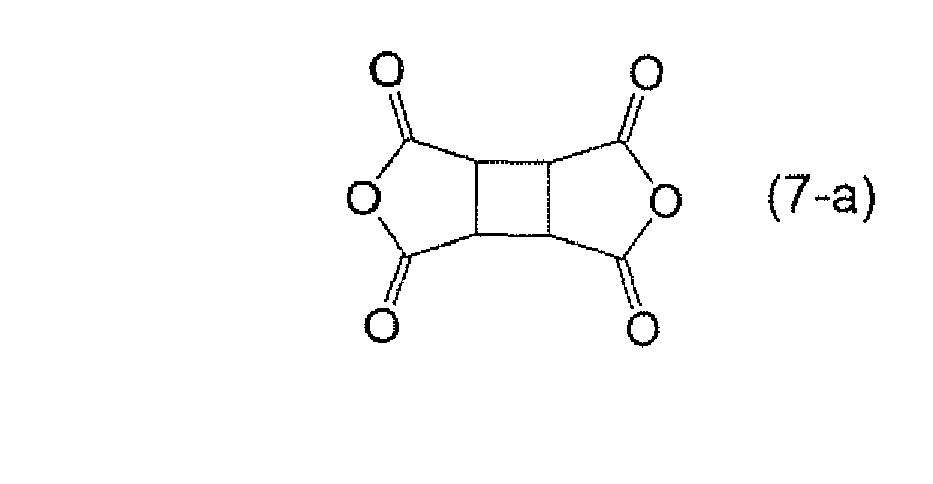


- However, the specific examples are not limited to these compounds. Among these examples, more preferred are tetracarboxylic dianhydrides of Formula (7-c) and Formula (7-d) and further preferred is a tetracarboxylic dianhydride of Formula (7-d). This is because the molecular weight distribution of the polymer as the reaction product of the polymerization becomes stable, and peaks exhibited by a measurement result of gel permeation chromatography (GPC) can be obtained substantially in a form of Gauss distribution.
- Specific examples of the compound of Formula (8) include compounds of Formulae (8-a) to (8-o):
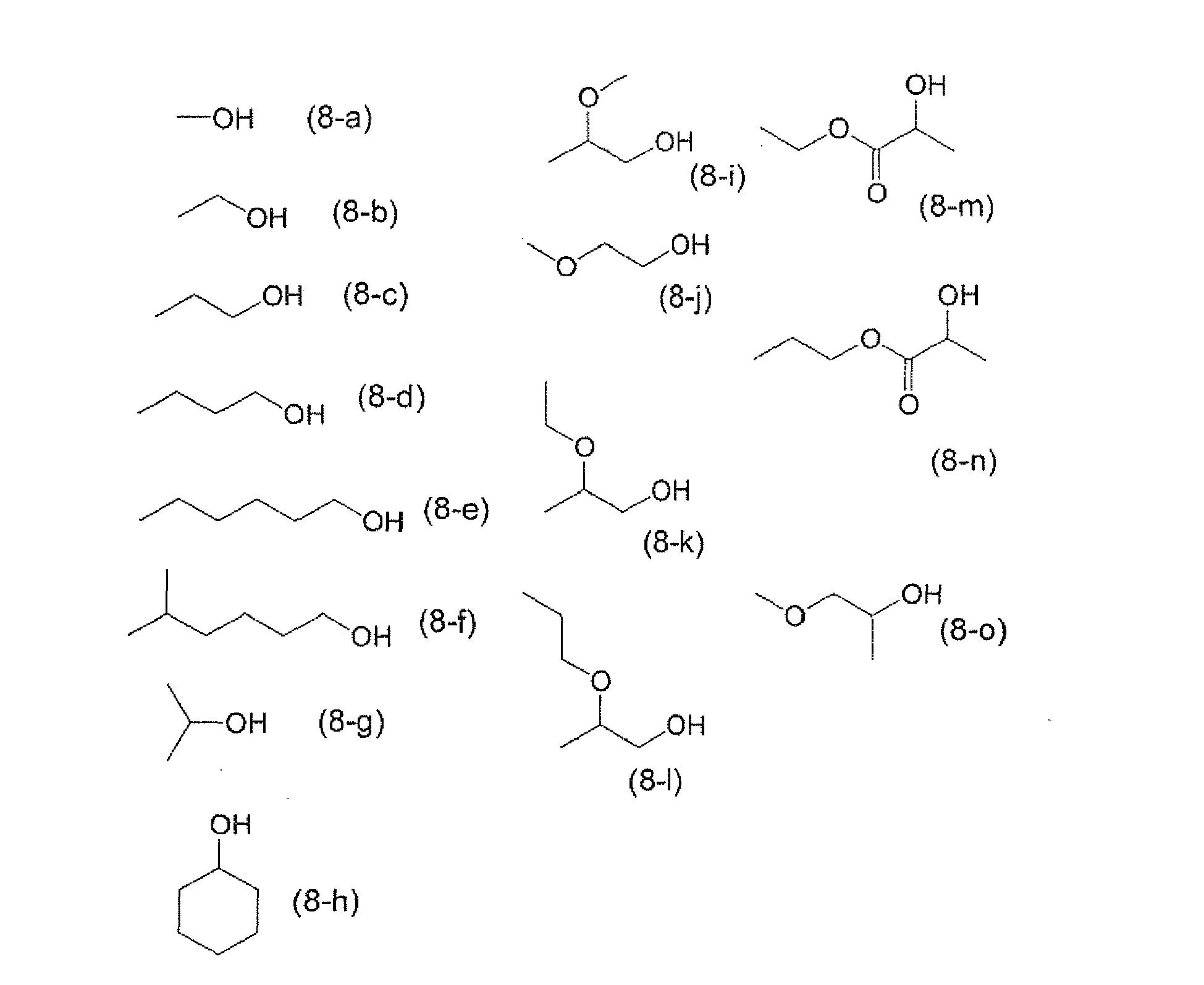
- In Formula (9), Q is a group of Formula (10):

- Examples of the compound of Formula (9) include a compound of Formula (11):

- In Formula (9), Q is a group of Formula (12):

- The compound of Formula (9) preferably has a structure symmetric with respect to the structure Q, and specific examples of the compound of Formula (9) include compounds of Formulae (9-a) to (9-h):

- However, the specific examples are not limited to these compounds.
- The polymer of the present invention may also be a reaction product obtained by adding besides the compounds of Formulae (7) to (9), other compounds having a polymerizable group to the mixture so long as the effect of the present invention is not impaired and by reacting the resultant mixture.
Particularly by adding other compounds having a functional group contributing to the absorption at a specific wavelength to the mixture, the k value at a specific wavelength can be controlled, and examples of the compound having a unit contributing to the absorption at a wavelength of 193 nm include 2,4-dihydroxybenzoic acid. - Examples of the structural unit of the linear polymer contained in the composition of the present invention include structural units of Formulae (13) to (27):


- For example, a polymer having a structural unit of Formula (13) can be obtained by polymerizing a compound of Formula (7-a) which is a specific example of the compound of Formula (7), a compound of Formula (8-o) which is a specific example of the compound of Formula (8), and a compound of Formula (9-a) which is a specific example of the compound of Formula (9), which are used as raw materials.
A polymer having a structural unit of Formula (17) can be obtained by polymerizing a compound of Formula (7-d) which is a specific example of the compound of Formula (7), a compound of Formula (8-o) which is a specific example of the compound of Formula (8), a compound of Formula (9-a) which is a specific example of the compound of Formula (9), and 2,4-dihydroxybenzoic acid, which are used as raw materials.
A polymer having a structural unit of Formulae (23) can be obtained by polymerizing a compound of Formula (7-d) which is a specific example of the compound of Formula (7), a compound of Formula (8-o) which is a specific example of the compound of Formula (8), and two types of compounds of Formula (9) (a compound of Formula (9-a) and a compound of Formula (9-f)), which are used as raw materials. - In Formula (13), Formula (15), Formula (16), Formula (18), Formula (20), and Formula (21), a molar ratio between a structural unit of a and a structural unit of b is 1:1.
In Formula (14), Formula (17), Formula (19), and Formulae (25) to (27), a molar ratio between a structural unit of a, a structural unit of b', and a structural unit of b" satisfies a relationship of a:(b'+b")=1:1.
In Formulae (22) to (24), a molar ratio between a structural unit of a', a structural unit of a", and a structural unit of b satisfies a relationship of (a'+a"):b=1:1. - In the molar ratio a:(b'+b")=1:1 with respect to Formula (14), Formula (17), Formula (19), and Formulae (25) to (27), b" may be 0 and the molar ratio between b' and b" can be expressed as b':b"=(1-x):x (with proviso that 0≤x<1).
In the molar ratio (a'+a"):b=1:1 with respect to Formulae (22) to (24), any one of a' and a" may be 0 and the molar ratio between a' and a" can be expressed as a':a"=(1-x):x (with proviso that 0≤x≤1).
Here, b" is a unit contributing to the absorption at a wavelength of 193 nm. Accordingly, by varying the ratio between b' and b", the k value at a wavelength of 193 nm can be controlled to become an objective value, and the k value at a wavelength of 193 nm can be lowered by lowering the ratio of b". - Examples of the solvent contained in the composition of the present invention include one type of solvent or a mixture of two or more types of solvents selected from a group consisting of propylene glycol monomethyl ether (PGME), propylene glycol monomethyl ether acetate (PGMEA), propylene glycol monopropyl ether, methyl ethyl ketone, ethyl lactate, cyclohexanone, y-butyrolactone, and N-methylpyrrolidone. Then, the content of the solvent in the composition of the present invention is, for example, 50% by mass or more and 99.5% by mass or less.
- The content of the polymer contained in the composition of the present invention may be, for example, 0.5% by mass or more and 30% by mass or less, based on the mass of the resist underlayer film forming composition.
- The composition of the present invention may contain besides the polymer and the solvent, a crosslinkable compound (crosslinker) and further a compound for accelerating a crosslinking reaction. When a component remaining after subtracting the solvent from the whole composition is defined as the solid content, the solid content contains the polymer and additives added if necessary, such as a crosslinkable compound and a compound for accelerating a crosslinking reaction. The content of the polymer in the solid content is, for example, 70% by mass or more and 98% by mass or less.
- Examples of the crosslinkable compound include nitrogen-containing compounds having two to four nitrogen atoms substituted with a methylol group or an alkoxymethyl group, and the crosslinkable compound may be blended in the composition of the present invention in an amount of, for example, 1% by mass or more and 30% by mass or less, based on the mass of the polymer contained in the composition of the present invention. Specific examples of the crosslinkable compound include hexamethoxymethylmelamine, tetramethoxymethylbenzoguanamine, 1,3,4,6-tetrakis(methoxymethyl)glycoluril, 1,3,4,6-tetrakis(butoxymethyl)glycoluril, 1,3,4,6-tetrakis(hydroxymethyl)glycoluril, 1,3-bis(hydroxymethyl)urea, 1,1,3,3-tetrakis(butoxymethyl)urea, and 1,1,3,3-tetrakis(methoxymethyl)urea.
- The compound for accelerating a crosslinking reaction include, for example, a sulfonic acid compound and may also be a combination of an acid generator and a sulfonic acid compound. The compound for accelerating a crosslinking reaction may be blended in the composition of the present invention in an amount of, for example, 0.1% by mass or more and 10% by mass or less, based on the mass of the polymer contained in the composition of the present invention. Specific examples of the sulfonic acid compound include p-toluenesulfonic acid, trifluoromethanesulfonic acid, pyridinium-p-toluenesulfonic acid, camphorsulfonic acid, 5-sulfosalicylic acid, 4-chlorobenzenesulfonic acid, 4-hydroxybenzenesulfonic acid, benzenedisulfonic acid, 1-naphthalenesulfonic acid, and pyridinium-1-naphthalenesulfonic acid. Specific examples of the acid generator include 4-acetoxyphenyldimethylsulfonium hexafluoroarsenate, benzyl-4-hydroxyphenylmethylsulfonium hexafluoroantimonate, 4-acetoxyphenylbenzylmethylsulfonium hexafluoroantimonate, dibenzyl-4-hydroxyphenylsulfonium hexafluoroantimonate, 4-acetoxyphenylbenzylsulfonium hexafluoroantimonate, 3-benzylbenzothiazolium hexafluoroantimonate, 2,4,4,6-tetrabromocylohexadienone, benzointosylate, and 2-nitrobenzyltosylate.
- The composition of the present invention may further contain a surfactant and/or an adhesive assistant. The surfactant is an additive for enhancing the applicability of the composition to the substrate. As the surfactant, publicly known surfactants such as nonion-based surfactants and fluorinated surfactants may be used, and the surfactant may be blended in the composition of the present invention, for example, in an amount of 0.01% by mass or more and 0.5% by mass or less, based on the mass of the composition. The adhesive assistant has an object of enhancing the adhesion of the resist underlayer film with the substrate or the resist film and is an additive for suppressing the peeling of the resist film during the development after the exposure. Examples of the adhesive assistant include chlorosilanes, alkoxysilanes, silazanes, silanes, and heterocyclic compounds, and the adhesive assistant may be blended in the resist underlayer film forming composition of the present invention in an amount of, for example, 0.1% by mass or more and 2% by mass or less, based on the mass of the resist underlayer film forming composition.
- The composition of the present invention can be applied to a lithography process in the production process of semiconductor devices. A resist pattern is formed through at least such processes as: a process for applying the composition of the present invention on a semiconductor substrate and baking the composition to form a resist underlayer film; a process for forming a resist film on the resist underlayer film; a process for exposing the semiconductor substrate coated with the resist underlayer film and the resist film to light; and a process for developing the resist film after the exposure.
- The exposure is performed using, for example, an ArF excimer laser. Instead of the ArF excimer laser, EUV (wavelength: 13.5 nm) or an electron beam may also be used. The "EUV" is an abbreviation of the extreme ultraviolet. The resist for forming the resist film may be any one of a positive resist and a negative resist. As the resist, there can be used a chemical amplification-type resist photosensitive to an ArF excimer laser, EUV, or an electron beam.
- A representative substrate of the above semiconductor substrate is a silicon wafer. However, as the semiconductor substrate, a silicon on insulator (SOI) substrate or a wafer of a compound semiconductor such as gallium arsenide (GaAs), indium phosphide (InP), and gallium phosphide (GaP) may also be used. There may also be used a semiconductor substrate on which an insulating film such as a silicon oxide film, a nitrogen-containing silicon oxide film (SiON film), and a carbon-containing silicon oxide film (SiOC film) is formed, and in this case, the composition of the present invention is applied on the insulating film.
- The composition of the present invention contains a polymer having a repeating structure of Formula (1) or a polymer containing structural units of Formula (28) and Formula (29). Therefore, a resist underlayer film having high efficiency for lowering the k value and having a large selection ratio of a dry etching rate relative to a resist film without lowering the oxygen content can be obtained from the composition of the present invention. The backbone of the two-dimensional polymer (linear polymer) contained in the composition of the present invention has a C-O bond that is more easily broken by dry etching than a C-C bond, and thus, the composition of the present invention can obtain a resist underlayer film having a dry etching rate larger than that of a resist underlayer film obtained from a resist underlayer film forming composition using as the polymer, an acrylic resin or a methacrylic resin.
- An alicyclic or aliphatic tetracarboxylic dianhydride which is one of raw material compounds for the polymer contained in the composition of the present invention is a compound having high oxygen content. Then, an alicyclic or aliphatic tetracarboxylic dianhydride generates two carboxy groups through a reaction thereof with an alcoholic compound. Therefore, these tetracarboxylic dianhydrides can be readily subjected to a condensation reaction with a diepoxy compound to be polymerized. As a result, the obtained polymer has high oxygen content and has an ester bond in the backbone thereof, and thus, the resist underlayer film obtained from the composition of the present invention can have a high dry etching rate. An alicyclic or aliphatic tetracarboxylic dianhydride has high transparency at a wavelength of 193 nm, and thus, by combining the alicyclic or aliphatic tetracarboxylic dianhydride with a light absorbing moiety to control an introduced amount of the alicyclic or aliphatic tetracarboxylic dianhydride, there can be obtained a resist underlayer film having a desired, relatively low k value (such as a value of 0.3 or less and more than 0) and an n value of more than 1.6. Accordingly, the composition of the present invention can be applied to an immersion lithography process using an immersion exposure apparatus having a large number of aperture (NA) of a projection lens and also to a so-called dry lithography process.
- Hereinafter, the present invention will be described more specifically referring to Synthesis Examples and Examples. However, the following Synthesis Examples and Examples should not be construed as limiting the scope of the present invention.
- The weight average molecular weight shown in the following Synthesis Examples of the present specification is the result of the measurement by gel permeation chromatography (hereinafter, abbreviated as GPC). For the measurement, a GPC apparatus manufactured by Tosoh Corporation was used and the conditions for the measurement were as follows.
GPC column: Shodex (registered trademark), Asahipak (registered trademark) (Showa Denko K.K.)
Column temperature: 40°C
Solvent: N,N-dimethylformamide (DMF)
Flow rate: 0.6 mL/min
Standard sample: polystyrene (Tosoh Corporation)
Detector: RI - 9.00 g of monoallyldiglycidylisocyanuric acid (manufactured by Shikoku Chemicals Corporation) of Formula (9-a), 6.46 g of 1,2,3,4-cyclabutanetetracarboxylic dianhydride of Formula (7-a), and 0.61 g of ethyltriphenylphosphonium bromide were dissolved in 64.29 g of propylene glycol monomethyl ether, and the resultant solution was subjected to the reaction at 130°C for 4 hours to produce a solution containing a polymer. The obtained polymer corresponds to a polymer containing a structural unit of Formula (13) (a:b=1:1 (molar ratio)) and was subjected to a GPC analysis. As the result of the analysis, the obtained polymer was found to have a weight average molecular weight of 7,400 in terms of standard polystyrene. 1,2,3,4-Cyclobutanetetracarbaxylic dianhydride is obtained by applying a method described in, for example, Japanese Examined Patent Publication No.
JP-B-2-61956 JP-A-2003-192685 - 20.00 g of monoallyldiglycidylisocyanuric acid (manufactured by Shikoku Chemicals Corporation), 7.06 g of 1,2,3,4-cyclobutanetetracarboxylic dianhydride, 5.55 g of 2,4-dihydroxybenzoic acid, and 1.34 g of ethyltriphenylphosphonium bromide were dissolved in 79.19 g of propylene glycol monomethyl ether, and the resultant solution was subjected to the reaction at 130°C for 4 hours to produce a solution containing a polymer. The obtained polymer corresponds to a polymer containing a structural unit of Formula (14) (a:b':b"=2:1:1 (molar ratio)) and was subjected to a GPC analysis. As the result of the analysis, the obtained polymer was found to have a weight average molecular weight of 8,200 in terms of standard polystyrene.
- 8.00 g of monoallyldiglycidylisocyanuric acid (manufactured by Shikoku Chemicals Corporation), 6.04 g of 1,2,3,4-cyclopentanetetracarboxylic dianhydride (manufactured by Tokyo Chemical Industry Co., Ltd.) of Formula (7-d), and 0.53 g of ethyltriphenylphosphonium bromide were dissolved in 34.01 g of propylene glycol monomethyl ether, and the resultant solution was subjected to the reaction at 130°C for 4 hours to produce a solution containing a polymer. The obtained polymer corresponds to a polymer containing a structural unit of Formula (15) (a:b=1:1 (molar ratio)) and was subjected to a GPC analysis. As the result of the analysis, the obtained polymer was found to have a weight average molecular weight of 10,000 in terms of standard polystyrene.
- 8.00 g of monoallyldiglycidylisocyanuric acid (manufactured by Shikoku Chemicals Corporation), 6.04 g of 1,2,3,4-cyclopentanetetracarboxylic dianhydride (manufactured by Tokyo Chemical Industry Co., Ltd.), and 0.53 g of ethyltriphenylphosphonium bromide were dissolved in 14.0 g of 1-hexanol and 20.00 g of cyclohexanone, and the resultant solution was subjected to the reaction at 130°C for 4 hours to produce a solution containing a polymer. The obtained polymer corresponds to a polymer containing a structural unit of Formula (16) (a:b=1:1 (molar ratio)) and was subjected to a GPC analysis. As the result of the analysis, the obtained polymer was found to have a weight average molecular weight of 7,200 in terms of standard polystyrene.
- 20.00 g of monoallyldiglycidylisocyanuric acid (manufactured by Shikoku Chemicals Corporation), 7.56 g of 1,2,3,4-cyclopentanetetracarboxylic dianhydride (manufactured by Tokyo Chemical Industry Co., Ltd.), 5.55 g of 2,4-dihydroxybenzoic acid, and 1.34 g of ethyltriphenylphosphonium bromide were dissolved in 80.37 g of propylene glycol monomethyl ether, and the resultant solution was subjected to the reaction at 130°C for 4 hours to produce a solution containing a polymer. The obtained polymer corresponds to a polymer containing a structural unit of Formula (17) (a:b':b"=2:1:1 (molar ratio)) and was subjected to a GPC analysis. As the result of the analysis, the obtained polymer was found to have a weight average molecular weight of 7,500 in terms of standard polystyrene.
- 8.00 g of monoallyldiglycidylisocyanuric acid (manufactured by Shikoku Chemicals Corporation), 7.26 g of bicyclo[2,2,2]octo-7-ene-2,3,5,6-tetracarboxylic dianhydride (manufactured by Tokyo Chemical Industry Co., Ltd.) of Formula (7-b), 0.54 g of ethyltriphenylphosphonium bromide, and 0.08 g of hydroquinone were dissolved in 63.24 g of propylene glycol monomethyl ether, and the resultant solution was subjected to the reaction at 130°C for 4 hours to produce a solution containing a polymer. Hydroquinone is added in order to suppress a side reaction in which a double bond (C=C bond) of a tetracarboxylic dianhydride used in the present Synthesis Example is radical-polymerized. The obtained polymer corresponds to a polymer containing a structural unit of Formula (18) (a:b=1:1 (molar ratio)) and was subjected to a GPC analysis. As the result of the analysis, the obtained polymer was found to have a weight average molecular weight of 28,000 in terms of standard polystyrene.
- 20.00 g of monoallyldiglycidylisocyanuric acid (manufactured by Shikoku Chemicals Corporation), 8.93 g of bicyclo[2,2,2]octo-7-ene-2,3,5,6-tetracarboxylic dianhydride (manufactured by Tokyo Chemical Industry Co., Ltd.), 5.55 g of 2,4-dihydroxybenzoic acid, 1.34 g of ethyltriphenylphosphonium bromide, and 0.32 g of hydroquinone were dissolved in 84.32 g of propylene glycol monomethyl ether, and the resultant solution was subjected to the reaction at 130° C for 4 hours to produce a solution containing a polymer. Hydroquinone is added in order to suppress a side reaction in which a double bond (C=C bond) of a tetracarboxylic dianhydride used in the present Synthesis Example is radical-polymerized. The obtained polymer corresponds to a polymer containing a structural unit of Formula (19) (a:b':b"=2:1:1 (molar ratio)) and was subjected to a GPC analysis (gel permeation chromatography). As the result of the analysis, the obtained polymer was found to have a weight average molecular weight of 19,000 in terms of standard polystyrene.
- 8.00 g of monoallyldiglycidylisocyanuric acid (manufactured by Shikoku Chemicals Corporation), 7.20 g of bicyclo[3,3,0]octane-2,4,6,8-tetracarboxylic dianhydride of Formula (7-e), and 0.53 g of ethyltriphenylphosphonium bromide were dissolved in 62.95 g of propylene glycol monomethyl ether, and the resultant solution was subjected to the reaction at 130°C for 4 hours to produce a solution containing a polymer. The obtained polymer corresponds to a polymer containing a structural unit of Formula (20) (a:b=1:1 (molar ratio)) and was subjected to a GPC analysis. As the result of the analysis, the obtained polymer was found to have a weight average molecular weight of 71,000 in terms of standard polystyrene. Bicyclo[3,3,0]octane-2,4,6,8-tetracarboxylic dianhydride is obtained by applying a method described in, for example, Japanese Patent Application Publication No.
JP-A-2000-159772 - 8.00 g of monoallyldiglycidylisocyanuric acid (manufactured by Shikoku Chemicals Corporation), 5.70 g of meso-butane-1,2,3,4-tetracarboxylic dianhydride (manufactured by Tokyo Chemical Industry Co., Ltd.) of Formula (7-c), and 0.53 g of ethyltriphenylphosphonium bromide were dissolved in 57.00 g of propylene glycol monomethyl ether and the resultant solution was subjected to the reaction at 130°C for 4 hours to produce a solution containing a polymer. The obtained polymer corresponds to a polymer containing a structural unit of Formula (21) (a:b=1:1 (molar ratio)) and was subjected to a GPC analysis. As the result of the analysis, the obtained polymer was found to have a weight average molecular weight of 7,500 in terms of standard polystyrene.
- With 10 g of a solution containing 2 g of the polymer obtained in Synthesis Example 1, 0.5 g of tetramethoxymethylglycoluril (manufactured by Nihon Cytec Industries Inc.; trade name: POWDERLINK (registered trademark) 1174) and 0.05 g of pyridinium-p-toluenesulfonic acid were mixed, and the resultant mixture was dissolved in 35.4 g of propylene glycol monomethyl ether and 18.6 g of propylene glycol monomethyl ether acetate to prepare a solution. Subsequently, the solution was filtered using a polyethylene microfilter having a pore diameter of 0.10 µm and further filtered using a polyethylene microfilter having a pore diameter of 0.05 µm to prepare a resist underlayer film forming composition (solution).
- With 10 g of a solution containing 2 g of the polymer obtained in Synthesis Example 2, 0.5 g of tetramethoxymethylglycoluril (manufactured by Nihon Cytec Industries Inc.; trade name: POWDERLINK (registered trademark) 1174) and 0.05 g of pyridinium-p-toluenesulfonic acid were mixed, and the resultant mixture was dissolved in 35.4 g of propylene glycol monomethyl ether and 18.6 g of propylene glycol monomethyl ether acetate to prepare a solution. Subsequently, the solution was filtered using a polyethylene microfilter having a pore diameter of 0.10 µm and further filtered using a polyethylene microfilter having a pore diameter of 0.05 µm to prepare a resist underlayer film forming composition (solution).
- With 10 g of a solution containing 2 g of the polymer obtained in Synthesis Example 3, 0.5 g of tetramethoxymethylglycoluril (manufactured by Nihon Cytec Industries Inc.; trade name: POWDERLINK (registered trademark) 1174) and 0.05 g of pyridinium-p-toluenesulfonic acid were mixed, and the resultant mixture was dissolved in 35.4 g of propylene glycol monomethyl ether and 18.6 g of propylene glycol monomethyl ether acetate to prepare a solution. Subsequently, the solution was filtered using a polyethylene microfilter having a pore diameter of 0.10 µm and further filtered using a polyethylene microfilter having a pore diameter of 0.05 µm to prepare a resist underlayer film forming composition (solution).
- With 10 g of a solution containing 2 g of the polymer obtained in Synthesis Example 4, 0.5 g of tetramethoxymethylglycoluril (manufactured by Nihon Cytec Industries Inc.; trade name: POWDERLINK (registered trademark) 1174) and 0.05 g of pyridinium-p-toluenesulfonic acid were mixed, and the resultant mixture was dissolved in 35.4 g of propylene glycol monomethyl ether and 18.6 g of propylene glycol monomethyl ether acetate to prepare a solution. Subsequently, the solution was filtered using a polyethylene microfilter having a pore diameter of 0.10 µm and further filtered using a polyethylene microfilter having a pore diameter of 0.05 µm to prepare a resist underlayer film forming composition (solution).
- With 10 g of a solution containing 2 g of the polymer obtained in Synthesis Example 5, 0.5 g of tetramethoxymethylglycoluril (manufactured by Nihon Cytec Industries Inc.; trade name: POWDERLINK (registered trademark) 1174) and 0.05 g of pyridinium-p-toluenesulfonic acid were mixed, and the resultant mixture was dissolved in 35.4 g of propylene glycol monomethyl ether and 18.6 g of propylene glycol monomethyl ether acetate to prepare a solution. Subsequently, the solution was filtered using a polyethylene microfilter having a pore diameter of 0.10 µm and further filtered using a polyethylene microfilter having a pore diameter of 0.05 µm to prepare a resist underlayer film forming composition (solution).
- With 10 g of a solution containing 2 g of the polymer obtained in Synthesis Example 6, 0.5 g of tetramethoxymethylglycoluril (manufactured by Nihon Cytec Industries Inc.; trade name: POWDERLINK (registered trademark) 1174) and 0.05 g of pyridinium-p-toluenesulfonic acid were mixed, and the resultant mixture was dissolved in 35.4 g of propylene glycol monomethyl ether and 18.6 g of propylene glycol monomethyl ether acetate to prepare a solution. Subsequently, the solution was filtered using a polyethylene microfilter having a pore diameter of 0.10 µm and further filtered using a polyethylene micro filter having a pore diameter of 0.05 µm to prepare a resist underlayer film forming composition (solution).
- With 10 g of a solution containing 2 g of the polymer obtained in Synthesis Example 7, 0.5 g of tetramethoxymethylglycoluril (manufactured by Nihon Cytec Industries Inc.; trade name: POWDERLINK (registered trademark) 1174) and 0.05 g of pyridinium-p-toluenesulfonic acid were mixed, and the resultant mixture was dissolved in 35.4 g of propylene glycol monomethyl ether and 18.6 g of propylene glycol monomethyl ether acetate to prepare a solution. Subsequently, the solution was filtered using a polyethylene microfilter having a pore diameter of 0.10 µm and further filtered using a polyethylene microfilter having a pore diameter of 0.05 µm to prepare a resist underlayer film forming composition (solution).
- With 10 g of a solution containing 2 g of the polymer obtained in Synthesis Example 8, 0.5 g of tetramethoxymethylglycoluril (manufactured by Nihon Cytec Industries Inc.; trade name: POWDERLINK (registered trademark) 1174) and 0.05 g of pyridinium-p-toluenesulfonic acid were mixed, and the resultant mixture was dissolved in 35.4 g of propylene glycol monomethyl ether and 18.6 g of propylene glycol monomethyl ether acetate to prepare a solution. Subsequently, the solution was filtered using a polyethylene microfilter having a pore diameter of 0.10 µm and further filtered using a polyethylene microfilter having a pore diameter of 0.05 µm to prepare a resist underlayer film forming composition (solution).
- With 10 g of a solution containing 2 g of the polymer obtained in Synthesis Example 9, 0.5 g of tetramethoxymethylglycoluril (manufactured by Nihon Cytec Industries Inc.; trade name: POWDERLINK (registered trademark) 1174) and 0.05 g of pyridinium-p-toluenesulfonic acid were mixed, and the resultant mixture was dissolved in 35.4 g of propylene glycol monomethyl ether and 18.6 g of propylene glycol monomethyl ether acetate to prepare a solution. Subsequently, the solution was filtered using a polyethylene microfilter having a pore diameter of 0.10 µm and further filtered using a polyethylene microfilter having a pore diameter of 0.05 µm to prepare a resist underlayer film forming composition (solution).
- There was prepared a resist underlayer film forming composition (solution) containing: a copolymer that has a structural unit of Formula (30) below as the polymer; and further a crosslinker of Formula (31) below and pyridinium-p-toluenesulfonic acid as the additives.
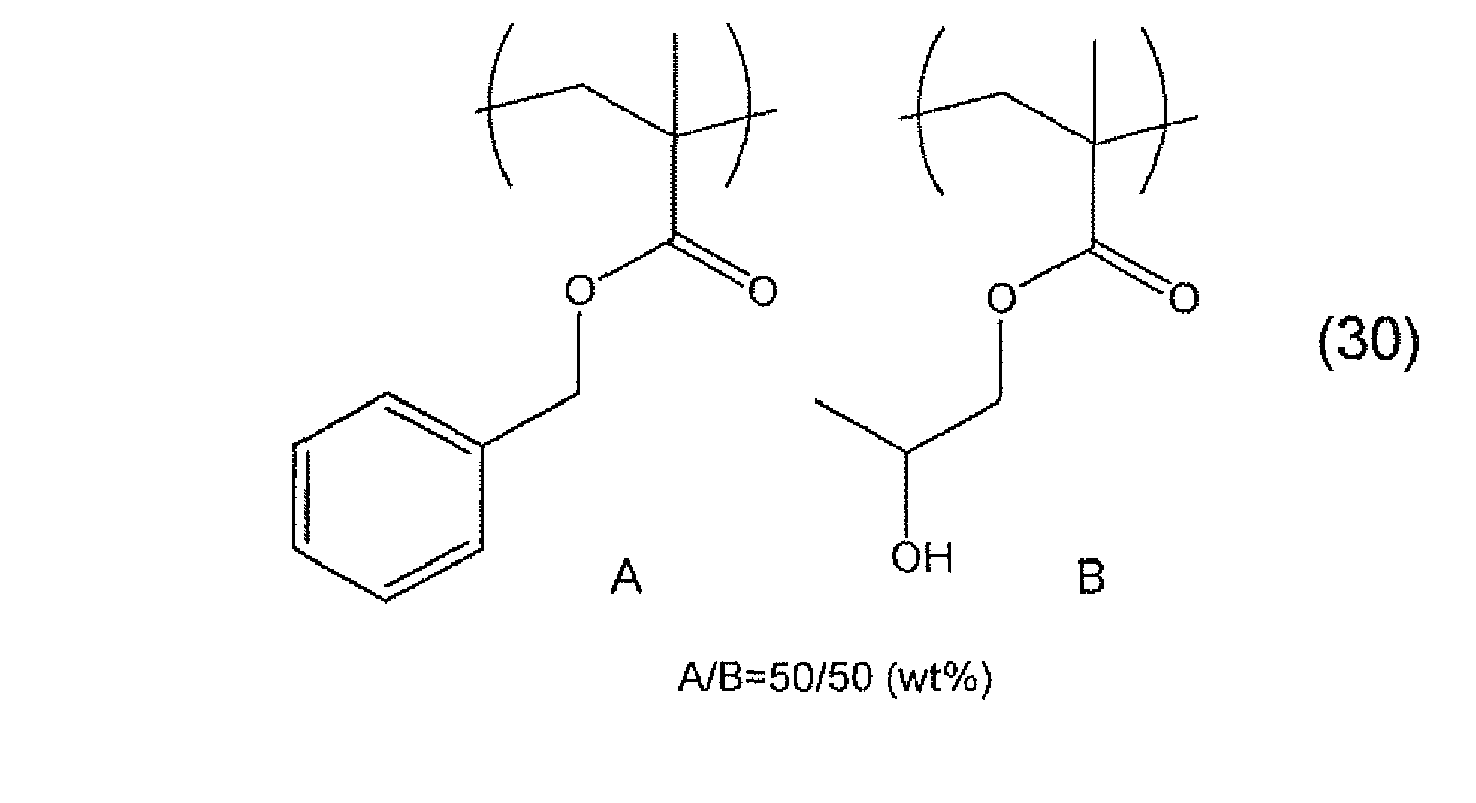
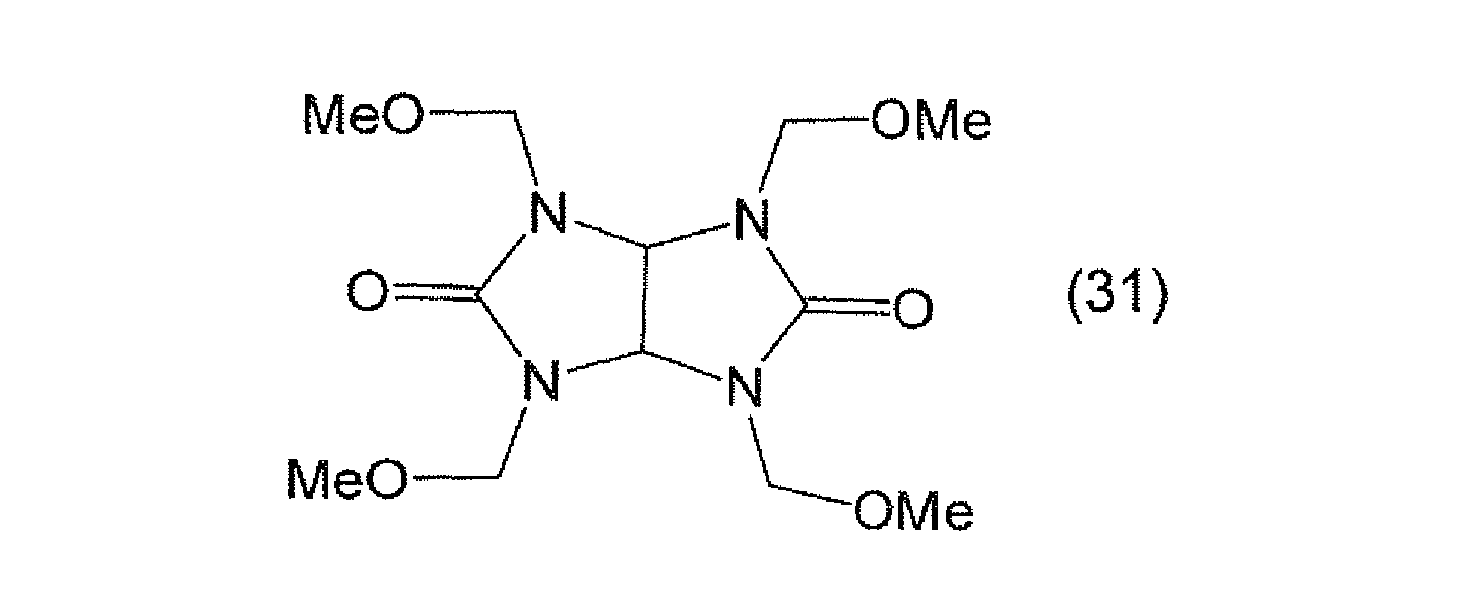
- Each of the resist underlayer film forming compositions prepared in Examples 1 to 9 of the present invention was applied (spin-coated) on a silicon wafer using a spinner. The composition was baked on a hot plate at 205°C for 1 minute to form a resist underlayer film (film thickness: 0.10 µm). The resist underlayer film was immersed in ethyl lactate and propylene glycol monomethyl ether which were a solvent for the resist solution and it was confirmed that the resist underlayer film was insoluble in the solvent.
- Each of the resist underlayer film forming compositions prepared in Examples 1 to 9 of the present invention was applied on a silicon wafer using a spinner. The composition was heated on a hot plate at 205°C for 1 minute to form a resist underlayer film (film thickness: 0.10 µm).
- As an upper layer of the resist underlayer film, a commercially available resist solution (manufactured by JSR Corporation; trade name: AR2772JN) was applied on the resist underlayer film using a spinner. The resist solution was heated on a hot plate at 110°C for 1.5 minutes to form a resist film, and the resultant resist film was exposed to light using an exposure apparatus, followed by subjecting the resist film to the post exposure bake (PEB) at 110°C for 1.5 minutes. The resist film was developed and thereafter, the film thickness of the resist underlayer film was measured, and thus, it was confirmed that there was caused no intermixing between each of the resist underlayer films obtained from the resist underlayer film forming compositions prepared in Examples 1 to 9 and the resist film.
- Each of the resist underlayer film forming compositions prepared in Examples 1 to 9 of the present invention and the resist underlayer film forming composition shown in Comparative Example 1 was applied on a silicon wafer using a spinner. The composition was heated on a hot plate at 205°C for 1 minute to form a resist underlayer film (film thickness: 0.06 µm). Then, the refractive index n value and the attenuation coefficient k value at the wavelength of 193 nm of each of these ten types of resist underlayer films were measured using a spectroscopic ellipsometer (manufactured by J.A.Woollam Co., Inc.; VUV-VASE VU-302). The result of the measurement is shown in Table 1.
- Each of the resist underlayer film forming compositions prepared in Examples 1 to 9 of the present invention and the resist underlayer film forming composition shown in Comparative Example 1 was applied on a silicon wafer using a spinner. The composition was heated on a hot plate at 205°C for 1 minute to form a resist underlayer film. Then, the dry etching rate (reduced amount of film thickness per unit time) of the resist underlayer film was measured using RIE system ES401 manufactured by Nippon Scientific Co., Ltd. under a condition of using CF4 as a dry etching gas.
- A resist solution (manufactured by Sumitomo Chemical Co., Ltd.; trade name: PAR710) was applied on a silicon wafer using a spinner and in the same manner as described above, a resist film was formed. Then, the dry etching rate of the resist film was measured using RIE system ES401 manufactured by Nippon Scientific Co., Ltd. under a condition of using CF4 as a dry etching gas.
- The dry etching rate of each of ten types of resist underlayer films obtained from the resist underlayer film forming compositions prepared in Examples 1 to 9 and Comparative Example 1 was compared with the dry etching rate of the resist film formed from the resist solution manufactured by Sumitomo Chemical Co., Ltd. The ratio of the dry etching rate of each of the resist underlayer films relative to the dry etching rate of the resist film (selection ratio of dry etching rate) is shown in Table 1.
-
[Table 1] Refractive index (n value) Attenuation coefficient (k value) Wave length (nm) Selection ratio of dry etching rate Example 1 1.81 0.17 193 1.88 Example 2 1.80 0.22 193 1.81 Example 3 1.81 0.14 193 1.73 Example 4 1.77 0.14 193 1.42 Example 5 1.79 0.21 193 1.73 Example 6 1.82 0.17 193 1.58 Example 7 1.81 0.22 193 1.63 Example 8 1.81 0.13 193 1.61 Example 9 1.80 0.13 193 1.83 Comparative Example 1 1.84 0.48 193 1.10 - Each of the resist underlayer films obtained from the resist underlayer film forming compositions of Examples 1 to 9 corresponding to the composition of the present invention has a sufficiently effective refractive index and attenuation coefficient relative to a light of 193 nm and exhibited a k value lower than that of the resist underlayer film of Comparative Example 1. There was obtained the result that the resist underlayer film has a large selection ratio of a dry etching rate relative to the resist film and has a selection ratio of a dry etching rate larger than that of the resist underlayer film of Comparative Example 1.
In other words, the result shows that the resist underlayer film obtained from the resist underlayer film forming composition of the present invention can reduce the time required for removing the resist underlayer film by dry etching and can also suppress the decrease of the film thickness of the resist film on the resist underlayer film according to the removal of the resist underlayer film by dry etching. - Each of the resist underlayer film forming compositions prepared in Examples 1 to 9 of the present invention was spin-coated on a silicon wafer, and the composition was heated at 205°C for 1 minute to form a resist underlayer film. A resist solution for an ArF excimer laser (manufactured by JSR Corporation; trade name: AR2772JN) was spin-coated on the resist underlayer film, and the solution was heated at 110°C for 90 seconds to form a resist film. Then, the exposure was performed using an exposure apparatus for an ArF excimer laser (manufactured by ASML Holding N.V.; ASM 5500/1100), under a predetermined condition, and after the exposure, the resultant films were subjected to a post exposure bake (PEB) at 110°C for 90 seconds, was cooled down to room temperature on a cooling plate, and was subjected to the development and the rinse treatment to form a resist pattern.
- It was able to be confirmed that the objective resist pattern was formed by setting the objective line width to 80 nm line and space, measuring the resist pattern size under a condition of the optimal exposure amount and the optimal focus with a length measuring SEM, and observing the cross section shape of the resist pattern in a direction perpendicular to the substrate (silicon wafer) with a cross section SEM.
Claims (19)
- A resist underlayer film forming composition for lithography comprising:a polymer having a repeating structure of Formula (1):
 a solvent.
 - A resist underlayer film forming composition for lithography comprising:a polymer containing structural units of Formula (28) and Formula (29):
 in Formula (29), A1, A2, A3, A4, A5, and A6 are independently a hydrogen atom, a methyl group, or an ethyl group; and Q is a divalent organic group); anda solvent.
 - The resist underlayer film forming composition for lithography according to claim 1, wherein in Formula (1), Q is a group of Formula (2):
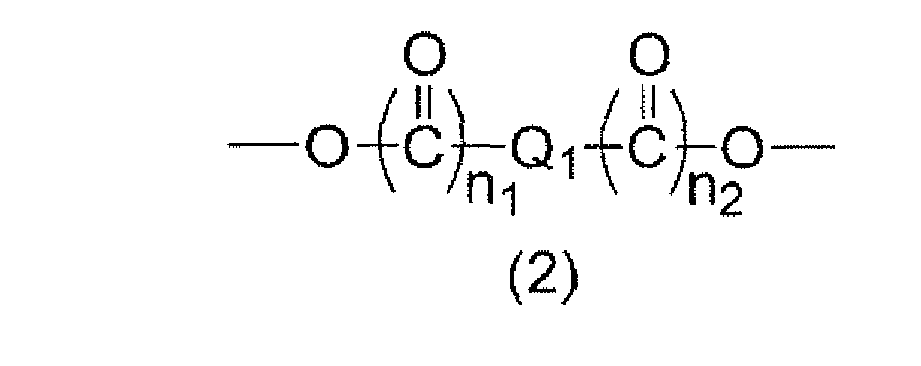
- The resist underlayer film forming composition for lithography according to claim 1, wherein in Formula (1), Q is a group of Formula (3):


- The resist underlayer film forming composition for lithography according to claim 1, wherein in Formula (1), Q is a group of Formula (6):

- The resist underlayer film forming composition for lithography according to claim 2, wherein in Formula (29), Q is a group of Formula (2):

- The resist underlayer film forming composition for lithography according to claim 2, wherein in Formula (29), Q is a group of Formula (3):


- The resist underlayer film forming composition for lithography according to claim 2, wherein in Formula (29), Q is a group of Formula (6):
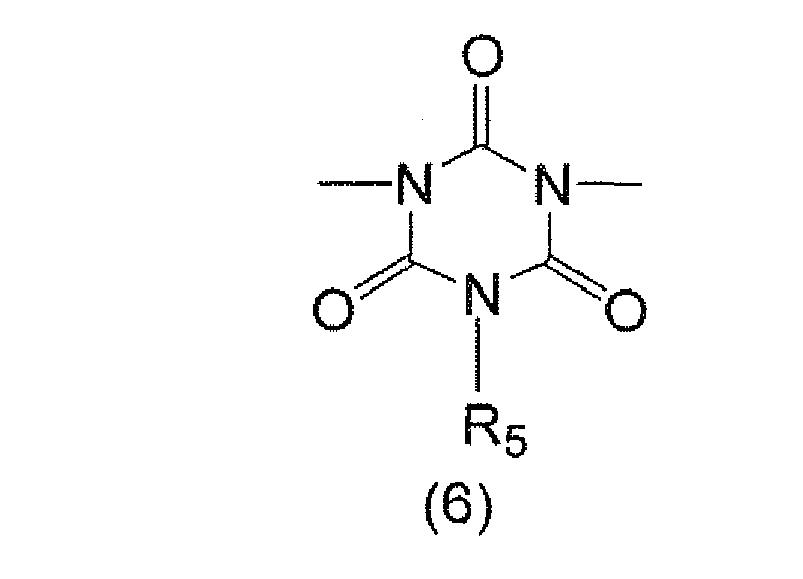
- The resist underlayer film forming composition for lithography according to claim 1 or 2, wherein the polymer is a product of a reaction between at least one type of compound of Formula (7) below, at least one type of compound of Formula (8) below, and at least one type of compound of Formula (9) below:

HO-R2 (8)

- The resist underlayer film forming composition for lithography according to claim 9, wherein in Formula (9), Q is a group of Formula (10):

- The resist underlayer film forming composition for lithography according to claim 9 or 10, wherein the compound of Formula (9) is a compound of Formula (11):

- The resist underlayer film forming composition for lithography according to claim 9, wherein in Formula (9), Q is a group of Formula (12):

- The resist underlayer film forming composition for lithography according to any one of claims 1 to 12, further comprising a crosslinkable compound.
- The resist underlayer film forming composition for lithography according to claim 13, further comprising a compound for accelerating a crosslinking reaction.
- The resist underlayer film forming composition for lithography according to claim 13, wherein the crosslinkable compound is a nitrogen-containing compound having two to four nitrogen atoms substituted with a methylol group or an alkoxymethyl group.
- The resist underlayer film forming composition for lithography according to claim 14, wherein the compound for accelerating a crosslinking reaction is a sulfonic acid compound.
- The resist underlayer film forming composition for lithography according to claim 14, wherein the compound for accelerating a crosslinking reaction is a combination of an acid generator and a sulfonic acid compound.
- A forming method of a resist pattern used for the production of a semiconductor device, comprising:applying the resist underlayer film forming composition for lithography as claimed in any one of claims 1 to 17 on a semiconductor substrate and baking the composition to form a resist underlayer film,;forming a resist film on the resist underlayer film;exposing the semiconductor substrate coated with the resist underlayer film and the resist film to light; anddeveloping the resist film after the exposure.
- The forming method of a resist pattern according to claim 18, wherein the exposure is performed using an ArF excimer laser.
Applications Claiming Priority (2)
| Application Number | Priority Date | Filing Date | Title |
|---|---|---|---|
| JP2008039900 | 2008-02-21 | ||
| PCT/JP2009/052905 WO2009104685A1 (en) | 2008-02-21 | 2009-02-19 | Composition for forming resist underlayer film and method for forming resist pattern using the same |
Publications (3)
| Publication Number | Publication Date |
|---|---|
| EP2251742A1 true EP2251742A1 (en) | 2010-11-17 |
| EP2251742A4 EP2251742A4 (en) | 2011-03-23 |
| EP2251742B1 EP2251742B1 (en) | 2012-05-16 |
Family
ID=40985563
Family Applications (1)
| Application Number | Title | Priority Date | Filing Date |
|---|---|---|---|
| EP09712004A Not-in-force EP2251742B1 (en) | 2008-02-21 | 2009-02-19 | Composition for forming resist underlayer film and method for forming resist pattern using the same |
Country Status (7)
| Country | Link |
|---|---|
| US (1) | US8435721B2 (en) |
| EP (1) | EP2251742B1 (en) |
| JP (1) | JP5267819B2 (en) |
| KR (1) | KR101423060B1 (en) |
| CN (1) | CN101946210B (en) |
| TW (1) | TWI454848B (en) |
| WO (1) | WO2009104685A1 (en) |
Cited By (1)
| Publication number | Priority date | Publication date | Assignee | Title |
|---|---|---|---|---|
| US12242194B2 (en) * | 2015-07-02 | 2025-03-04 | Nissan Chemical Industries, Ltd. | Resist underlayer film-forming composition comprising epoxy adduct having long-chain alkyl group |
Families Citing this family (22)
| Publication number | Priority date | Publication date | Assignee | Title |
|---|---|---|---|---|
| US8221965B2 (en) * | 2008-07-08 | 2012-07-17 | Az Electronic Materials Usa Corp. | Antireflective coating compositions |
| US8551686B2 (en) * | 2009-10-30 | 2013-10-08 | Az Electronic Materials Usa Corp. | Antireflective composition for photoresists |
| WO2012124597A1 (en) | 2011-03-15 | 2012-09-20 | 日産化学工業株式会社 | Resist underlayer film formation composition and method for forming resist pattern using same |
| WO2012169580A1 (en) * | 2011-06-10 | 2012-12-13 | 日産化学工業株式会社 | Block copolymer and resist underlayer film-forming composition |
| KR20140050046A (en) * | 2011-08-04 | 2014-04-28 | 닛산 가가쿠 고교 가부시키 가이샤 | Resist underlayer film-forming composition for euv lithography containing condensation polymer |
| US9212255B2 (en) * | 2012-05-07 | 2015-12-15 | Nissan Chemical Industries, Ltd. | Resist underlayer film-forming composition |
| US10113083B2 (en) | 2013-08-08 | 2018-10-30 | Nissan Chemical Industries, Ltd. | Resist underlayer film-forming composition containing polymer which contains nitrogen-containing ring compound |
| KR102008161B1 (en) | 2013-09-27 | 2019-08-07 | 닛산 가가쿠 가부시키가이샤 | Resist underlayer film-forming composition and method for forming resist pattern using same |
| CN106233207B (en) | 2014-04-25 | 2020-04-10 | 日产化学工业株式会社 | Composition for forming resist underlayer film and method for forming resist pattern using same |
| WO2016063805A1 (en) * | 2014-10-21 | 2016-04-28 | 日産化学工業株式会社 | Resist underlay film-forming composition |
| KR102328436B1 (en) * | 2016-04-28 | 2021-11-18 | 닛산 가가쿠 가부시키가이샤 | Resist underlayer film forming composition |
| JP7447892B2 (en) * | 2019-03-04 | 2024-03-12 | 日産化学株式会社 | Chemical-resistant protective film-forming composition containing a polymerization product having a terminal diol structure |
| CN113646352B (en) * | 2019-04-11 | 2025-01-17 | 日产化学株式会社 | Composition for forming drug solution resistant protective film comprising hydroxyaryl-terminated polymer |
| CN113795532B (en) * | 2019-05-08 | 2025-02-28 | 日产化学株式会社 | Resist underlayer film-forming composition containing alicyclic compound-terminated polymer |
| TWI815097B (en) * | 2020-03-30 | 2023-09-11 | 台灣積體電路製造股份有限公司 | Photoresist composition and method of manufacturing semiconductor device |
| US12566374B2 (en) * | 2020-03-30 | 2026-03-03 | Taiwan Semiconductor Manufacturing Company, Ltd. | Photoresist composition and method of manufacturing semiconductor device |
| KR102665285B1 (en) * | 2020-06-12 | 2024-05-13 | 닛산 가가쿠 가부시키가이샤 | Composition for forming a resist underlayer film containing a diol structure |
| TWI903025B (en) * | 2021-01-27 | 2025-11-01 | 日商日產化學股份有限公司 | Film-forming components with multiple bonds |
| TWI890922B (en) * | 2021-01-27 | 2025-07-21 | 日商日產化學股份有限公司 | Resist underlayer film forming composition containing reaction product of acid dianhydride |
| WO2022172917A1 (en) * | 2021-02-09 | 2022-08-18 | 日産化学株式会社 | Resist underlayer film-forming composition containing polymer that has side chain blocked with aryl group |
| CN119604819A (en) * | 2022-07-29 | 2025-03-11 | 日产化学株式会社 | Resist underlayer film forming composition |
| EP4679146A1 (en) | 2023-03-24 | 2026-01-14 | Nissan Chemical Corporation | Composition for forming resist underlayer film for manufacturing optical diffraction body |
Family Cites Families (19)
| Publication number | Priority date | Publication date | Assignee | Title |
|---|---|---|---|---|
| JPS59212495A (en) | 1983-05-19 | 1984-12-01 | Nissan Chem Ind Ltd | Preparation of 1,2,3,4-cyclobutanetetracarboxylic acid-1, 2:3,4-dianhydride |
| JP4386153B2 (en) | 1998-12-02 | 2009-12-16 | 日産化学工業株式会社 | Crystallization method of acid dianhydride |
| US6447980B1 (en) * | 2000-07-19 | 2002-09-10 | Clariant Finance (Bvi) Limited | Photoresist composition for deep UV and process thereof |
| KR100839393B1 (en) | 2001-07-26 | 2008-06-19 | 닛산 가가쿠 고교 가부시키 가이샤 | Polyamic acid resin composition |
| US7326509B2 (en) | 2001-08-20 | 2008-02-05 | Nissan Chemical Industries, Ltd. | Composition for forming anti-reflective coating for use in lithography |
| JP4852206B2 (en) | 2001-12-26 | 2012-01-11 | 日産化学工業株式会社 | Method for producing cyclobutanetetracarboxylic dianhydride compound |
| JP4243825B2 (en) * | 2002-05-24 | 2009-03-25 | 日産化学工業株式会社 | Antireflection film forming composition for lithography |
| US7264913B2 (en) * | 2002-11-21 | 2007-09-04 | Az Electronic Materials Usa Corp. | Antireflective compositions for photoresists |
| US7563748B2 (en) | 2003-06-23 | 2009-07-21 | Cognis Ip Management Gmbh | Alcohol alkoxylate carriers for pesticide active ingredients |
| TWI358612B (en) * | 2003-08-28 | 2012-02-21 | Nissan Chemical Ind Ltd | Polyamic acid-containing composition for forming a |
| JP2005321752A (en) * | 2004-04-09 | 2005-11-17 | Nissan Chem Ind Ltd | Antireflection film-forming composition comprising a reaction product of an isocyanuric acid compound and a benzoic acid compound |
| JP4702559B2 (en) * | 2004-04-09 | 2011-06-15 | 日産化学工業株式会社 | Antireflection film for semiconductor having condensed polymer |
| EP1757987A4 (en) * | 2004-05-14 | 2010-04-21 | Nissan Chemical Ind Ltd | ANTI-REFLECTIVE COMPOSITION FORMING A FILM CONTAINING A VINYL ETHER COMPOUND |
| RU2346996C2 (en) | 2004-06-29 | 2009-02-20 | ЮРОПИЭН НИКЕЛЬ ПиЭлСи | Improved leaching of base metals |
| EP1876495B1 (en) * | 2005-04-19 | 2011-07-20 | Nissan Chemical Industries, Ltd. | Composition comprising polymer having ethylene-dicarbonyl structure for use in forming anti-reflective coating for lithography |
| JP4703284B2 (en) | 2005-06-22 | 2011-06-15 | セントラル硝子株式会社 | Polyester compound and resist material using the same |
| TW200801513A (en) | 2006-06-29 | 2008-01-01 | Fermiscan Australia Pty Ltd | Improved process |
| US7638262B2 (en) * | 2006-08-10 | 2009-12-29 | Az Electronic Materials Usa Corp. | Antireflective composition for photoresists |
| US20080286689A1 (en) | 2007-05-14 | 2008-11-20 | Hong Zhuang | Antireflective Coating Compositions |
-
2009
- 2009-02-19 WO PCT/JP2009/052905 patent/WO2009104685A1/en not_active Ceased
- 2009-02-19 JP JP2009554372A patent/JP5267819B2/en active Active
- 2009-02-19 CN CN200980105915.6A patent/CN101946210B/en active Active
- 2009-02-19 EP EP09712004A patent/EP2251742B1/en not_active Not-in-force
- 2009-02-19 US US12/866,831 patent/US8435721B2/en active Active
- 2009-02-19 KR KR1020107019539A patent/KR101423060B1/en active Active
- 2009-02-20 TW TW098105475A patent/TWI454848B/en active
Cited By (1)
| Publication number | Priority date | Publication date | Assignee | Title |
|---|---|---|---|---|
| US12242194B2 (en) * | 2015-07-02 | 2025-03-04 | Nissan Chemical Industries, Ltd. | Resist underlayer film-forming composition comprising epoxy adduct having long-chain alkyl group |
Also Published As
| Publication number | Publication date |
|---|---|
| JPWO2009104685A1 (en) | 2011-06-23 |
| JP5267819B2 (en) | 2013-08-21 |
| KR20100133965A (en) | 2010-12-22 |
| CN101946210A (en) | 2011-01-12 |
| US20110059404A1 (en) | 2011-03-10 |
| EP2251742A4 (en) | 2011-03-23 |
| TWI454848B (en) | 2014-10-01 |
| US8435721B2 (en) | 2013-05-07 |
| WO2009104685A1 (en) | 2009-08-27 |
| EP2251742B1 (en) | 2012-05-16 |
| CN101946210B (en) | 2013-01-23 |
| KR101423060B1 (en) | 2014-07-25 |
| TW200951625A (en) | 2009-12-16 |
Similar Documents
| Publication | Publication Date | Title |
|---|---|---|
| EP2251742B1 (en) | Composition for forming resist underlayer film and method for forming resist pattern using the same | |
| KR101451762B1 (en) | Composition for forming resist underlayer film and method of forming resist pattern from the same | |
| EP2237110B1 (en) | Sulfur atom-containing composition for resist underlayer film formation and method for resist pattern formation | |
| JP5158381B2 (en) | Resist underlayer film forming composition and resist pattern forming method using the same | |
| KR101682919B1 (en) | Resist underlayer film forming composition, and method for forming resist pattern using same | |
| US8361695B2 (en) | Resist underlayer film forming composition and method for forming resist pattern | |
| JP5333737B2 (en) | Resist underlayer film forming composition and resist pattern forming method using the same | |
| KR102328436B1 (en) | Resist underlayer film forming composition | |
| KR20140012111A (en) | Resist underlayer film formation composition and method for forming resist pattern using same | |
| WO2013088931A1 (en) | Composition for forming resist underlayer film and method for forming resist pattern using same | |
| JP5522415B2 (en) | Resist underlayer film forming composition and resist pattern forming method using the same | |
| KR102749491B1 (en) | Composition for forming resist underlayer film and resist pattern formation method | |
| JP2010078823A (en) | Composition for forming resist underlay film and method for forming resist pattern using the same |
Legal Events
| Date | Code | Title | Description |
|---|---|---|---|
| PUAI | Public reference made under article 153(3) epc to a published international application that has entered the european phase |
Free format text: ORIGINAL CODE: 0009012 |
|
| 17P | Request for examination filed |
Effective date: 20100915 |
|
| AK | Designated contracting states |
Kind code of ref document: A1 Designated state(s): AT BE BG CH CY CZ DE DK EE ES FI FR GB GR HR HU IE IS IT LI LT LU LV MC MK MT NL NO PL PT RO SE SI SK TR |
|
| AX | Request for extension of the european patent |
Extension state: AL BA RS |
|
| A4 | Supplementary search report drawn up and despatched |
Effective date: 20110218 |
|
| RIC1 | Information provided on ipc code assigned before grant |
Ipc: G03F 7/11 20060101ALI20110214BHEP Ipc: C08G 59/42 20060101AFI20110214BHEP Ipc: G03F 7/09 20060101ALI20110214BHEP |
|
| DAX | Request for extension of the european patent (deleted) | ||
| REG | Reference to a national code |
Ref country code: DE Ref legal event code: R079 Ref document number: 602009007035 Country of ref document: DE Free format text: PREVIOUS MAIN CLASS: G03F0007110000 Ipc: C08G0059420000 |
|
| RIC1 | Information provided on ipc code assigned before grant |
Ipc: C08G 59/42 20060101AFI20111006BHEP Ipc: G03F 7/09 20060101ALI20111006BHEP Ipc: G03F 7/11 20060101ALI20111006BHEP |
|
| GRAP | Despatch of communication of intention to grant a patent |
Free format text: ORIGINAL CODE: EPIDOSNIGR1 |
|
| GRAS | Grant fee paid |
Free format text: ORIGINAL CODE: EPIDOSNIGR3 |
|
| GRAA | (expected) grant |
Free format text: ORIGINAL CODE: 0009210 |
|
| AK | Designated contracting states |
Kind code of ref document: B1 Designated state(s): AT BE BG CH CY CZ DE DK EE ES FI FR GB GR HR HU IE IS IT LI LT LU LV MC MK MT NL NO PL PT RO SE SI SK TR |
|
| REG | Reference to a national code |
Ref country code: GB Ref legal event code: FG4D |
|
| REG | Reference to a national code |
Ref country code: CH Ref legal event code: EP |
|
| REG | Reference to a national code |
Ref country code: AT Ref legal event code: REF Ref document number: 558067 Country of ref document: AT Kind code of ref document: T Effective date: 20120615 |
|
| REG | Reference to a national code |
Ref country code: IE Ref legal event code: FG4D |
|
| REG | Reference to a national code |
Ref country code: DE Ref legal event code: R096 Ref document number: 602009007035 Country of ref document: DE Effective date: 20120712 |
|
| REG | Reference to a national code |
Ref country code: NL Ref legal event code: VDEP Effective date: 20120516 |
|
| REG | Reference to a national code |
Ref country code: LT Ref legal event code: MG4D Effective date: 20120516 |
|
| PG25 | Lapsed in a contracting state [announced via postgrant information from national office to epo] |
Ref country code: NO Free format text: LAPSE BECAUSE OF FAILURE TO SUBMIT A TRANSLATION OF THE DESCRIPTION OR TO PAY THE FEE WITHIN THE PRESCRIBED TIME-LIMIT Effective date: 20120816 Ref country code: SE Free format text: LAPSE BECAUSE OF FAILURE TO SUBMIT A TRANSLATION OF THE DESCRIPTION OR TO PAY THE FEE WITHIN THE PRESCRIBED TIME-LIMIT Effective date: 20120516 Ref country code: CY Free format text: LAPSE BECAUSE OF FAILURE TO SUBMIT A TRANSLATION OF THE DESCRIPTION OR TO PAY THE FEE WITHIN THE PRESCRIBED TIME-LIMIT Effective date: 20120516 Ref country code: IS Free format text: LAPSE BECAUSE OF FAILURE TO SUBMIT A TRANSLATION OF THE DESCRIPTION OR TO PAY THE FEE WITHIN THE PRESCRIBED TIME-LIMIT Effective date: 20120916 Ref country code: FI Free format text: LAPSE BECAUSE OF FAILURE TO SUBMIT A TRANSLATION OF THE DESCRIPTION OR TO PAY THE FEE WITHIN THE PRESCRIBED TIME-LIMIT Effective date: 20120516 Ref country code: PL Free format text: LAPSE BECAUSE OF FAILURE TO SUBMIT A TRANSLATION OF THE DESCRIPTION OR TO PAY THE FEE WITHIN THE PRESCRIBED TIME-LIMIT Effective date: 20120516 Ref country code: LT Free format text: LAPSE BECAUSE OF FAILURE TO SUBMIT A TRANSLATION OF THE DESCRIPTION OR TO PAY THE FEE WITHIN THE PRESCRIBED TIME-LIMIT Effective date: 20120516 |
|
| REG | Reference to a national code |
Ref country code: AT Ref legal event code: MK05 Ref document number: 558067 Country of ref document: AT Kind code of ref document: T Effective date: 20120516 |
|
| PG25 | Lapsed in a contracting state [announced via postgrant information from national office to epo] |
Ref country code: HR Free format text: LAPSE BECAUSE OF FAILURE TO SUBMIT A TRANSLATION OF THE DESCRIPTION OR TO PAY THE FEE WITHIN THE PRESCRIBED TIME-LIMIT Effective date: 20120516 Ref country code: PT Free format text: LAPSE BECAUSE OF FAILURE TO SUBMIT A TRANSLATION OF THE DESCRIPTION OR TO PAY THE FEE WITHIN THE PRESCRIBED TIME-LIMIT Effective date: 20120917 Ref country code: GR Free format text: LAPSE BECAUSE OF FAILURE TO SUBMIT A TRANSLATION OF THE DESCRIPTION OR TO PAY THE FEE WITHIN THE PRESCRIBED TIME-LIMIT Effective date: 20120817 Ref country code: LV Free format text: LAPSE BECAUSE OF FAILURE TO SUBMIT A TRANSLATION OF THE DESCRIPTION OR TO PAY THE FEE WITHIN THE PRESCRIBED TIME-LIMIT Effective date: 20120516 Ref country code: SI Free format text: LAPSE BECAUSE OF FAILURE TO SUBMIT A TRANSLATION OF THE DESCRIPTION OR TO PAY THE FEE WITHIN THE PRESCRIBED TIME-LIMIT Effective date: 20120516 |
|
| PG25 | Lapsed in a contracting state [announced via postgrant information from national office to epo] |
Ref country code: BE Free format text: LAPSE BECAUSE OF FAILURE TO SUBMIT A TRANSLATION OF THE DESCRIPTION OR TO PAY THE FEE WITHIN THE PRESCRIBED TIME-LIMIT Effective date: 20120516 |
|
| PG25 | Lapsed in a contracting state [announced via postgrant information from national office to epo] |
Ref country code: CZ Free format text: LAPSE BECAUSE OF FAILURE TO SUBMIT A TRANSLATION OF THE DESCRIPTION OR TO PAY THE FEE WITHIN THE PRESCRIBED TIME-LIMIT Effective date: 20120516 Ref country code: RO Free format text: LAPSE BECAUSE OF FAILURE TO SUBMIT A TRANSLATION OF THE DESCRIPTION OR TO PAY THE FEE WITHIN THE PRESCRIBED TIME-LIMIT Effective date: 20120516 Ref country code: SK Free format text: LAPSE BECAUSE OF FAILURE TO SUBMIT A TRANSLATION OF THE DESCRIPTION OR TO PAY THE FEE WITHIN THE PRESCRIBED TIME-LIMIT Effective date: 20120516 Ref country code: DK Free format text: LAPSE BECAUSE OF FAILURE TO SUBMIT A TRANSLATION OF THE DESCRIPTION OR TO PAY THE FEE WITHIN THE PRESCRIBED TIME-LIMIT Effective date: 20120516 Ref country code: AT Free format text: LAPSE BECAUSE OF FAILURE TO SUBMIT A TRANSLATION OF THE DESCRIPTION OR TO PAY THE FEE WITHIN THE PRESCRIBED TIME-LIMIT Effective date: 20120516 Ref country code: EE Free format text: LAPSE BECAUSE OF FAILURE TO SUBMIT A TRANSLATION OF THE DESCRIPTION OR TO PAY THE FEE WITHIN THE PRESCRIBED TIME-LIMIT Effective date: 20120516 Ref country code: NL Free format text: LAPSE BECAUSE OF FAILURE TO SUBMIT A TRANSLATION OF THE DESCRIPTION OR TO PAY THE FEE WITHIN THE PRESCRIBED TIME-LIMIT Effective date: 20120516 |
|
| PG25 | Lapsed in a contracting state [announced via postgrant information from national office to epo] |
Ref country code: IT Free format text: LAPSE BECAUSE OF FAILURE TO SUBMIT A TRANSLATION OF THE DESCRIPTION OR TO PAY THE FEE WITHIN THE PRESCRIBED TIME-LIMIT Effective date: 20120516 |
|
| PLBE | No opposition filed within time limit |
Free format text: ORIGINAL CODE: 0009261 |
|
| STAA | Information on the status of an ep patent application or granted ep patent |
Free format text: STATUS: NO OPPOSITION FILED WITHIN TIME LIMIT |
|
| 26N | No opposition filed |
Effective date: 20130219 |
|
| PG25 | Lapsed in a contracting state [announced via postgrant information from national office to epo] |
Ref country code: ES Free format text: LAPSE BECAUSE OF FAILURE TO SUBMIT A TRANSLATION OF THE DESCRIPTION OR TO PAY THE FEE WITHIN THE PRESCRIBED TIME-LIMIT Effective date: 20120827 |
|
| REG | Reference to a national code |
Ref country code: DE Ref legal event code: R097 Ref document number: 602009007035 Country of ref document: DE Effective date: 20130219 |
|
| PG25 | Lapsed in a contracting state [announced via postgrant information from national office to epo] |
Ref country code: BG Free format text: LAPSE BECAUSE OF FAILURE TO SUBMIT A TRANSLATION OF THE DESCRIPTION OR TO PAY THE FEE WITHIN THE PRESCRIBED TIME-LIMIT Effective date: 20120816 |
|
| PG25 | Lapsed in a contracting state [announced via postgrant information from national office to epo] |
Ref country code: MC Free format text: LAPSE BECAUSE OF NON-PAYMENT OF DUE FEES Effective date: 20130228 |
|
| REG | Reference to a national code |
Ref country code: CH Ref legal event code: PL |
|
| PG25 | Lapsed in a contracting state [announced via postgrant information from national office to epo] |
Ref country code: LI Free format text: LAPSE BECAUSE OF NON-PAYMENT OF DUE FEES Effective date: 20130228 Ref country code: CH Free format text: LAPSE BECAUSE OF NON-PAYMENT OF DUE FEES Effective date: 20130228 |
|
| REG | Reference to a national code |
Ref country code: IE Ref legal event code: MM4A |
|
| PG25 | Lapsed in a contracting state [announced via postgrant information from national office to epo] |
Ref country code: IE Free format text: LAPSE BECAUSE OF NON-PAYMENT OF DUE FEES Effective date: 20130219 |
|
| PG25 | Lapsed in a contracting state [announced via postgrant information from national office to epo] |
Ref country code: MT Free format text: LAPSE BECAUSE OF FAILURE TO SUBMIT A TRANSLATION OF THE DESCRIPTION OR TO PAY THE FEE WITHIN THE PRESCRIBED TIME-LIMIT Effective date: 20120516 |
|
| PG25 | Lapsed in a contracting state [announced via postgrant information from national office to epo] |
Ref country code: TR Free format text: LAPSE BECAUSE OF FAILURE TO SUBMIT A TRANSLATION OF THE DESCRIPTION OR TO PAY THE FEE WITHIN THE PRESCRIBED TIME-LIMIT Effective date: 20120516 |
|
| PG25 | Lapsed in a contracting state [announced via postgrant information from national office to epo] |
Ref country code: LU Free format text: LAPSE BECAUSE OF NON-PAYMENT OF DUE FEES Effective date: 20130219 Ref country code: MK Free format text: LAPSE BECAUSE OF FAILURE TO SUBMIT A TRANSLATION OF THE DESCRIPTION OR TO PAY THE FEE WITHIN THE PRESCRIBED TIME-LIMIT Effective date: 20120516 Ref country code: HU Free format text: LAPSE BECAUSE OF FAILURE TO SUBMIT A TRANSLATION OF THE DESCRIPTION OR TO PAY THE FEE WITHIN THE PRESCRIBED TIME-LIMIT; INVALID AB INITIO Effective date: 20090219 |
|
| REG | Reference to a national code |
Ref country code: FR Ref legal event code: PLFP Year of fee payment: 8 |
|
| PGFP | Annual fee paid to national office [announced via postgrant information from national office to epo] |
Ref country code: DE Payment date: 20160216 Year of fee payment: 8 |
|
| PGFP | Annual fee paid to national office [announced via postgrant information from national office to epo] |
Ref country code: GB Payment date: 20160217 Year of fee payment: 8 Ref country code: FR Payment date: 20160108 Year of fee payment: 8 |
|
| REG | Reference to a national code |
Ref country code: DE Ref legal event code: R119 Ref document number: 602009007035 Country of ref document: DE |
|
| GBPC | Gb: european patent ceased through non-payment of renewal fee |
Effective date: 20170219 |
|
| REG | Reference to a national code |
Ref country code: FR Ref legal event code: ST Effective date: 20171031 |
|
| PG25 | Lapsed in a contracting state [announced via postgrant information from national office to epo] |
Ref country code: FR Free format text: LAPSE BECAUSE OF NON-PAYMENT OF DUE FEES Effective date: 20170228 Ref country code: DE Free format text: LAPSE BECAUSE OF NON-PAYMENT OF DUE FEES Effective date: 20170901 |
|
| PG25 | Lapsed in a contracting state [announced via postgrant information from national office to epo] |
Ref country code: GB Free format text: LAPSE BECAUSE OF NON-PAYMENT OF DUE FEES Effective date: 20170219 |