EP2249508B1 - Verfahren zur Dekodierung eines probabilistischen Anti-Kollusionskodes - Google Patents
Verfahren zur Dekodierung eines probabilistischen Anti-Kollusionskodes Download PDFInfo
- Publication number
- EP2249508B1 EP2249508B1 EP10162174A EP10162174A EP2249508B1 EP 2249508 B1 EP2249508 B1 EP 2249508B1 EP 10162174 A EP10162174 A EP 10162174A EP 10162174 A EP10162174 A EP 10162174A EP 2249508 B1 EP2249508 B1 EP 2249508B1
- Authority
- EP
- European Patent Office
- Prior art keywords
- collusion
- sequence
- code
- sequences
- strategy
- Prior art date
- Legal status (The legal status is an assumption and is not a legal conclusion. Google has not performed a legal analysis and makes no representation as to the accuracy of the status listed.)
- Not-in-force
Links
- 238000000034 method Methods 0.000 claims abstract description 103
- 238000001914 filtration Methods 0.000 claims abstract description 41
- 238000004364 calculation method Methods 0.000 claims description 17
- 230000008901 benefit Effects 0.000 description 5
- 238000010276 construction Methods 0.000 description 5
- 239000011159 matrix material Substances 0.000 description 4
- 238000005457 optimization Methods 0.000 description 4
- 230000000717 retained effect Effects 0.000 description 4
- 238000012795 verification Methods 0.000 description 3
- 230000008859 change Effects 0.000 description 2
- 230000002596 correlated effect Effects 0.000 description 2
- 230000000875 corresponding effect Effects 0.000 description 2
- 238000013461 design Methods 0.000 description 2
- 238000001514 detection method Methods 0.000 description 2
- 238000012986 modification Methods 0.000 description 2
- 230000004048 modification Effects 0.000 description 2
- 238000009877 rendering Methods 0.000 description 2
- 238000000926 separation method Methods 0.000 description 2
- 230000005540 biological transmission Effects 0.000 description 1
- 238000004891 communication Methods 0.000 description 1
- 230000006835 compression Effects 0.000 description 1
- 238000007906 compression Methods 0.000 description 1
- 238000011156 evaluation Methods 0.000 description 1
- 230000006870 function Effects 0.000 description 1
- 238000003780 insertion Methods 0.000 description 1
- 230000037431 insertion Effects 0.000 description 1
- 230000000873 masking effect Effects 0.000 description 1
- 230000008569 process Effects 0.000 description 1
- 230000004044 response Effects 0.000 description 1
- 230000009466 transformation Effects 0.000 description 1
Images



Classifications
-
- H—ELECTRICITY
- H04—ELECTRIC COMMUNICATION TECHNIQUE
- H04L—TRANSMISSION OF DIGITAL INFORMATION, e.g. TELEGRAPHIC COMMUNICATION
- H04L9/00—Cryptographic mechanisms or cryptographic arrangements for secret or secure communications; Network security protocols
- H04L9/32—Cryptographic mechanisms or cryptographic arrangements for secret or secure communications; Network security protocols including means for verifying the identity or authority of a user of the system or for message authentication, e.g. authorization, entity authentication, data integrity or data verification, non-repudiation, key authentication or verification of credentials
-
- H—ELECTRICITY
- H04—ELECTRIC COMMUNICATION TECHNIQUE
- H04N—PICTORIAL COMMUNICATION, e.g. TELEVISION
- H04N21/00—Selective content distribution, e.g. interactive television or video on demand [VOD]
- H04N21/80—Generation or processing of content or additional data by content creator independently of the distribution process; Content per se
- H04N21/83—Generation or processing of protective or descriptive data associated with content; Content structuring
- H04N21/835—Generation of protective data, e.g. certificates
- H04N21/8358—Generation of protective data, e.g. certificates involving watermark
-
- H—ELECTRICITY
- H04—ELECTRIC COMMUNICATION TECHNIQUE
- H04L—TRANSMISSION OF DIGITAL INFORMATION, e.g. TELEGRAPHIC COMMUNICATION
- H04L2209/00—Additional information or applications relating to cryptographic mechanisms or cryptographic arrangements for secret or secure communication H04L9/00
- H04L2209/60—Digital content management, e.g. content distribution
- H04L2209/606—Traitor tracing
-
- H—ELECTRICITY
- H04—ELECTRIC COMMUNICATION TECHNIQUE
- H04L—TRANSMISSION OF DIGITAL INFORMATION, e.g. TELEGRAPHIC COMMUNICATION
- H04L2209/00—Additional information or applications relating to cryptographic mechanisms or cryptographic arrangements for secret or secure communication H04L9/00
- H04L2209/60—Digital content management, e.g. content distribution
- H04L2209/608—Watermarking
Definitions
- the invention relates to the general domain of protection of digital content against illegal copying and of identification of sources at the origin of an illegal copy. More specifically, the invention relates to a method for rapid decoding for a probabilistic anti-collusion code aiming to identify one or more sources at the origin of an illegal copy of a digital content.
- the domain of the invention is also known as traitor tracing, active fingerprint, user forensic or again transactional watermarking.
- a video-on-demand server distributes personal copies of a same content to different clients. Some dishonest clients, called pirates, illegally redistribute a copy of this content for example on a P2P (Peer-To-Peer) network. The copyrights owner would like to identify the pirates. To do this, the video-on-demand server inserts a unique identifier in each of the copies using a video watermarking technique thus producing so many different copies although they appear to be identical. The content identifier in the illegal copy thus enables the source of this illegal copy, and therefore the pirate, to be identified.
- P2P Peer-To-Peer
- the identifier inserted into the copy by watermarking is a sequence of symbols of an anti-collusion code.
- Cryptographers such as D. Boneh and J. Shaw in “Collusion-secure fingerprinting for digital data” (in “IEEE Transactions on Information Theory” volume 44, pages 1897-1905, September 1998 ) have shown the existence of an optimal code of minimum length enabling by decoding of the mix of a finite number of code sequences, to identify the subset of original sequences used for the collusion whatever the collusion strategy used to create the copy.
- Philips has shown (in “ Tardos fingerprinting is better than we thought" by B. Skoric, T. Vladimirova, M. Celik, and J. Talstra, “IEEE Transactions on Information Theory” volume 54, pages 3663-3676, A complicat 2008 ) that if we want to maintain the probability of a false alrm below a certain threshold ⁇ , the length of code must be greater than 2 ⁇ 2 c 2 log(n ⁇ -1 ) for a binary code such as that of Tardos where c represents the number of dishonest clients and n the number of clients in total. Philips (in symmetric Tardos fingerprinting codes for arbitrary alphabet sizes" by B. Skoric, S. Katzenbeisser and M. Celik, “Designs, Codes and Cryptography", 46(2):137-166, February 2008 ) also addressed the generalisation of the Tardos code to a code designed on an alphabet of arbitrary size in keeping with the idea of minimizing the length of code.
- Some documents are directed at optimizing fingerprinting codes for a large number of users but fail to address practical implementation including optimization of the decoding model or limitation of the code length.
- the original Tardos code and decoder is further described in " On the Design and Optimization of Tardos Probalistic Fingerprinting Codes" by T. Furon et al. Some modifications to the original decoder improve its performance in two particular cases: when the maximum number of colluders is known, and when the collusion channel is known.
- Philips works is completed by the document "Combining Tardos Fingerprinting Codes and Fingercasting" from S. Katzenbeisser which proposes a practical implementation of a fingerprint embedder for broadcast scenarios incorporating a Tardos' code.
- “Improved versions of Tardos fingerprinting scheme” O. Blayer and T. Tassa further re-analyzes theoretically the original Tardos' fingerprint construction, showing that the codeword length can be reduced in a factor of at least 16.
- the structure of the original Tardos' decoder is kept unaltered.
- the patent US2009/0049558 discloses a system identifying the source of an illegal copy relaying on fingerprint where the decoding is based on score computation.
- the technical problem of these solutions is the length of the code.
- the length of the code On the one hand, the number of symbols that can be hidden in a multimedia content using watermarking techniques being limited, the length of the code must remain compatible with the size of the content to be identified.
- the complexity of the decoding being directly related to the length of the code, it must remain minimal to limit the calculating power and memory size means of the decoding device.
- the length of anti-collusion codes increases to handle the growing number of services users particularly of video-on-demand services and potentially of dishonest users.
- the purpose of the invention is to overcome at least one of the disadvantages of the prior art by improving the performances of a probabilistic anti-collusion code such as the Tardos code, not at the creation of the code but at the decoding of it while limiting the complexity of this decoding operation.
- a probabilistic anti-collusion code such as the Tardos code
- the decoding performance is ensured whatever the collusion strategy of the dishonest users.
- the idea of the invention is to make hypotheses on the possible collusion strategies then to select the most probable strategy from among these hypotheses in a manner to improve the performances of the code. This selection is in addition relatively simple to implement as the probability calculations only depend on the sequence in the illegal copy and the code symbols.
- the invention proposes a method of filtering of code sequences from among which the decoding method seeks to identify its presence in the collusion.
- this filtering method reduces the complexity of the decoding.
- the invention relates to a decoding method for a probabilistic anti-collusion code aiming to identify at least one sequence of the code present in the multimedia content having served in the creation of an illegal copy of the multimedia content, this method comprising a step of selection of the collusion strategy used to constitute the copy from among a set of collusion strategy models.
- different collusion strategies can be used by the group of pirates to create the illegal copy by mixing their copies block by block, as an example can be cited uniform pulling, majority vote, minority vote, random vote.
- the decoding method according to the invention is particularly well adapted when the strategy is random and when the strategy does not change for a given collusion of copies.
- the decoding method according to the invention determines the strategy used by the pirate group to create the illegal copy. This knowledge advantageously renders the decoding method more efficient for a given length of code. It thus enables to reduce the number of code symbols for a probability to accuse a given innocent.
- the estimation of the collusion strategy according to the invention is based only on the analysis of the sequence in the illegal copy.
- the decoding method according to the invention enables an increasing number of code sequences required for an increasing number of users of content provider services or an increasing number of pirates to be efficiently confronted.
- the collusion strategy is represented, for a number of sequences present in the collusion, by a vector of probabilities of the collusion strategy constituted for each list of symbols of the sequences present in the collusion, of the conditional probability of observing the symbol in the illegal copy knowing the list of symbols of sequences present in the collusion.
- the collusion strategy can, in the statistical domain, be modelled by a probabilities vector: the conditional probability that a pirate places a given symbol in the illegal copy knowing all the symbols of pirates implicated in the collusion.
- the collusion strategy also comprises knowledge of the number of pirates in the collusion.
- the set of models of collusion strategies comprise for each estimation of the number of sequences present in the collusion, the most probable collusion strategy.
- the creation of this set and the selection of a collusion strategy according to its probability enable an iterative method to be overcome by estimating all the possible cases of collusion only from the sequence in the illegal copy.
- All of the possible cases of collusion have parameters set by the number of sequences in the collusion and the list of symbols of sequences present in the collusion.
- an estimator of the probability of the collusion strategy is defined: It is the probability a posteriori of a collusion strategy knowing the sequence contained in the illegal copy.
- the most probable collusion strategy for a given number of pirates is the collusion is therefore the collusion strategy that maximises the probability a posteriori of a collusion strategy.
- this first criterion enables for an estimation of the number of pirates in a given collusion, the most probable strategy for this number of sequences to be selected, and thus to create the set of models of collusion strategies according to one of the embodiments.
- a second step will enable the most probable model to be selected, that is to say the number of sequences in the collusion associated with the most probable collusion strategy.
- This step uses for the calculation of the probability of the model, in addition to the probability of the collusion strategy, the accusation that is to say the identification of a user in the collusion process.
- the accusation is modelled by a probabilities vector: the probability that a user participates in the collusion.
- a probabilities vector the probability that a user participates in the collusion.
- the accusation itself is carried out using the collusion strategy selected in step b).
- the probabilities of presence in the collusion are clearly distinct between the dishonest users and the honest users.
- This separation renders the decoding method according to the invention very interesting due to its performance verses complexity ratio, particularly in comparison with the iterative method taught in another patent application.
- the invention By proposing a decoding method that is efficient with respect to the uniform accusation methods (that is to say that operate without forming an hypothesis on the collusion strategy), the invention also enables the length of code required for the identification of pirates to be reduced.
- a sequence of code is identified as being present in the multimedia content having served in the creation of the illegal copy when the value of the conditional probability of presence for this sequence in the collusion is maximal knowing the sequence contained in the illegal copy, the sequence and the model of the collusion strategy selected in step b).
- This characteristic enables accusation of the user who has the highest probability of being guilty.
- a group of code sequences is identified as being present in the multimedia content having served in the creation of the illegal copy when the value of the conditional probability is greater than a threshold S for each of the sequences of this group knowing the sequence contained in the illegal copy, the sequence of the group and the model of the collusion strategy selected in step b).
- This characteristic enables for example users that have a probability of being guilty greater than that of being innocent to be accused if the threshold is fixed at 1/2.
- This characteristic is a performance criterion of a decoding method of an anti-collusion code.
- this threshold can also be determined to reduce the probability of accusing an innocent individual or of missing a pirate.
- the copyrights owner or the content provider that seek to identify a source at the origin of an illegal copy can choose to trace a single user with a higher degree of certitude or to trace a group of user that are probably at the origin of the collusion.
- these last two characteristics enable a response to the various expectations of clients of such solutions as "traitor tracing", such as content providers or database managers.
- the decoding method comprises a step of filtering of code sequences comprising the selection of a sub-group of the smallest possible code sequences containing at least one sequence present in the multimedia content having served in the creation of the illegal copy by comparing for each code sequence and for a selected given symbol index, the symbol of the code sequence with the symbol of the sequence contained in the illegal copy.
- This filtering therefore enables at least four fifths of users to freed from the calculations in the particularly calculating power greedy steps a) and b).
- a negative aspect of this filtering is that it limits the accusation to a single pirate and that the sequence in the illegal copy must be free of errors.
- the filtering method ensures that, without an erroneous symbol in the sequence of the illegal copy, the sub-group contains at least one pirate sequence having provided the index symbol selected in the sequence of the illegal copy but nothing ensures that there is more than one.
- this embodiment of rapid decoding can be used as a first analysis, and can be verified thereafter by an optimal decoding as taught by the prior art in an additional analysis.
- the step of filtering of code sequences verifies that the sequence contained in the copy is the result without error of a collusion of code sequences.
- the filtering method based on the presence of a given symbol in the sequence of the copy does not tolerate any errors on this symbol.
- This verification thus enables the filtering method to be applied if the sequence of the copy is the result without error of a collusion of code sequences and thus enables the probability of accusing an innocent individual to be limited.
- this limitation renders the method less robust against errors due to noise and content distortion than the iterative decoding method presented in another patent application. If an error is detected in a sequence of the illegal copy, the method presented by the applicant in another application filed this day would be advantageously used.
- the method is reiterated to identify at least one new sequence in the collusion.
- the parameters of the decoding method are adapted and the same accusation method is used.
- This embodiment offers the advantage of proposing the accusation of more than one dishonest users in the case of a filtering of sequences.
- This embodiment associated with the step of filtering of sequences can also propose a solution to converge more quickly to the identification of sources at the origin of the illegal copy.
- c the number of sequences present in the collusion
- t ] the vector of probabilities of the collusion strategy constituted for each list t of symbols, of the conditional probability Prob[ y
- t ] to observe the symbol in the sequence y of the illegal copy knowing the list t of symbols of sequences present in the collusion from among the set noted as T q c of possible lists created from c symbols of an alphabet q -ary noted as ⁇ ⁇ 0,1,..., q -1 ⁇ .
- the collusion strategy can, in the statistical domain, be modelled by a probabilities vector: the conditional probability that a pirate places a given symbol in the illegal copy knowing all the symbols of pirates implicated in the collusion.
- the modelling of the collusion strategy also comprises knowledge of the number of pirates c in the collusion.
- x j , y , ⁇ c * is the conditional probability of the presence represented by s j c 1 of a given sequence x j in the collusion of c sequences among the n sequences of the code knowing the sequence contained in the illegal copy y , the sequence x j and the most probable collusion strategy ⁇ c * .
- the accusation can be modelled by a probabilities vector: the probability that a user participates in the collusion.
- the variable s j c represents this participation, it is equal to 1 if the user j participated in the collusion and to 0 if the user j is innocent.
- This probability proposes a culpability score that advantageously enables a guilty individual (maximum score) or a group of guilty individuals (score greater than a threshold) to be identified.
- the invention relates to a method for filtering sequences of a probabilistic anti-collusion code for the decoding of this code aiming to identify at least one sequence of the code present in a multimedia content having served in the creation of an illegal copy of the multimedia content comprising a step of selection of a sub-group of the smallest possible code sequences containing at least one sequence present in a multimedia content having served in the creation of the illegal copy by comparing for each sequence of the code and for a selected given symbol index, the symbol of the sequence of the code with the symbol of the sequence contained in the illegal copy.
- this filtering limits the complexity of the decoding.
- This filtering method is particularly advantageous for any code decoding method supporting a great number of users. In fact, depending on the collusion strategy used by the pirates, the filtering enables just 0.1% to 20% of the users to be retained that is to say of code sequences.
- the method for filtering code sequences verifies that the sequence contained in the copy is the result without error of a collusion of code sequences.
- the filtering method based on the presence of a given symbol in the sequence of the copy does not tolerate any errors on this symbol. This verification therefore enables the filtering method to be applied only if the sequence of the copy is the result without error of a collusion of code sequences.
- the anti-collusion code is a Tardos code.
- the protection of contents against collusion is composed of two layers: the anti-collusion code and the watermarking of the content.
- the code provides the identifier or series number of the content
- the watermarking provides a method for insertion of data in a content.
- Figure 1 diagrammatically illustrates the principle of creation and distribution of illegal copies by collusion of contents.
- a content provider proposes for example over the Internet, a multimedia content 101 that comprises notably a film or a video, music or audio, a video game, a digital book or any other digital document.
- the content provider inserts in each of the copies 102 legally distributed a unique series number 103 enabling the source of the copy and thus its user to be identified.
- This series number 103 is a sequence of an anti-collusion code such as the Tardos code.
- This series number 103 is inserted into the copy using a watermarking method rendering each copy apparently identical to the unique user.
- the content is cut into blocks and the symbols of the series number are hidden block by block in the content.
- a group of pirate users such as P and M can create a copy 104 by mixing their different personal copies block by block, thus producing the series number Y 105 that does not correspond to a code sequence:
- this series number Y 105 can also be altered by a compression with loss of the illegal copy, by a low-pass filtering, by an addition of noise that interferes with the decoding method of the watermarking layer.
- the collusion of copies can also be realised by merging of blocks. In this case, the users mix their copies pixel by pixel in the case of an image or a video, sample by sample in the case of an audio document.
- the pixels of the copy are the mean, the median (if more than two copies are mixed), the minimum or the maximum of pixels of each of the copies.
- the robustness of the method for decoding the watermarking that is challenged so as to detect the correct series number.
- the probabilistic anti-collusion codes such as the Tardos code were designed to enable different sources at the origin of a copy obtained by collusion to be identified.
- Figure 2 shows the construction principle of such a code X 201.
- Each sequence 203 x j is associated with a user j .
- the values p( x,i ) are memorized in a matrix P 200, called the auxiliary variable matrix of the code.
- the line indexes of this matrix are the n sequences of the code and the column indexes are the m symbols of sequences.
- This matrix corresponds to a database serving as a secret key to list in addition all the sequences 202 of the code X 201.
- the anti-collusion codes have the following property: from a mix of symbols of a finite number of code sequences, the decoding of the new sequence thus obtained enables the sub-set of original sequences used by the mix to be found again.
- a code is designed for a maximum number n of sequences (and hence of users) and a maximum number c of original sequences in the mix (and hence of dishonest users) that can be found again.
- the decoding performance is uniform whatever the collusion strategy.
- the decoding method according to the invention comprises the selection of hypotheses on the collusion strategy in a way to improve the decoding performances. Different collusion strategies will be more easily explained using figure 3 .
- the multimedia content that is being attempted to be protected is cut into m blocks 301.
- Each block i hides, using a watermarking technique, a symbol x i 302 of anti-collusion code, thus proposing a version of the block i specific to the hidden symbol.
- the principle of watermarking not being sufficiently secure, users are capable of finding the blocks of the watermarking layer. However they are not capable of extracting the inserted item of data, in other words the pirates are not able to create a block masking a symbol that they do not have.
- Dishonest users thus constitute a copy 306 by assembling for each of the blocks of the original content P 303 or M 304, a version from among the set of versions of the block that they know 307. The pirates for example do not know the versions of blocks of the original content J 305.
- the symbols of c sequences present in the collusion are distributed in a type t , the type t being a vector of q values for which the k th component t ( k, i ), for a symbol index i and for the c sequences j potentially present in the collusion, indicates the number of symbols in the list of symbols ⁇ x j1,i , ..., x jc,i ⁇ possible equal to the symbol k , the set of types t possible created from the c sequences of symbols of a q-ary alphabet being referred to as T q c .
- the collusion strategy is defined as the conditional probability that the pirates place a symbol y in the illegal copy knowing the type of all the symbols that they have.
- t ] with y ⁇ ⁇ is one possible representation in the probabilistic domain of different strategies notably those previously cited whether they are determinist or random. For example in the case of a majority vote (where a block is selected if it is more present among the blocks of users in the collusion), the Prob[ y
- the decoding method according to the invention is particularly well adapted when the strategy is random but it does not change for a given collusion of copies.
- the presence of a user in the collusion is also modelled in the probabilistic domain.
- a variable s j is defined that takes the value 1 if the sequence j is identified as being present in a multimedia content having served in the collusion, and the value 0 if not.
- the decoding method according to the invention is based on this double modelling of the problem of resistance against collusion.
- the decoding method according to the invention determines the strategy used by the pirate group to create the illegal copy.
- the decoding method according to the invention determines the collusion strategy used by a double selection based on the probability of the collusion model from among a set of possible models.
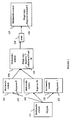
- Figure 6 shows the decoding method according to the invention. From the sequence contained in the illegal copy (601) and code sequences (602), the decoding method of an anti-collusion code determines the sources at the origin of the illegal copy (605).
- the method comprises in addition to a step of identification of sources (604) as taught by the accusation methods called uniform methods, a step of selection of the collusion strategy (603).
- This collusion strategy represents the selection carried out by the pirates to create the illegal copy for example uniform pulling, the majority vote, the minority vote or random vote.
- the set of models created depends on two parameters: the number of pirates in the collusion on one hand and the list of symbols of sequences present in the collusion on the other hand.
- the number of pirates c in the collusion varies between c min and c max .
- c min is fixed at 1 and c max must not exceed the maximum number of traitors considered during the construction of the code.
- an estimator of the probability of the collusion strategy knowing the sequence y contained in the illegal copy is calculated.
- t ] to observe the symbol in the sequence y of the illegal copy knowing the list t of symbols of sequences present in the collusion from among the set noted as T q c of possible lists created from c symbols of a q-ary alphabet noted as ⁇ ⁇ 0,1,..., q -1 ⁇ .
- the probability a posteriori of a given collusion strategy to observe the sequence y in the illegal copy is: Prob y
- ⁇ c ⁇ i ⁇ 1 m ⁇ Prob y i
- ⁇ c ⁇ i ⁇ 1 m ⁇ ti ⁇ Tcq ⁇ Prob y i
- the most probable collusion strategy is that which maximises the probability a posteriori of the collusion strategy to observe the sequence y .
- t i ] .Prob[ t i ] of the a posteriori probability of a given collusion strategy to observe the sequence y in the illegal copy are pre-calculated for each possible symbol y(i) and each list t i of c symbols in an alphabet of q symbols. These pre-calculations accelerate the calculation step of the estimator of the probability of the collusion strategy ⁇ c thus improving the performance of the decoding.
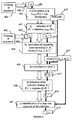
- step 403 for each estimation of the number of sequences c in the collusion, a first selection is made on the list of symbols of sequences in the collusion based on the maximum probability of the collusion strategy that is to say of this list.
- the collusion strategy that maximises the estimator of the probability for c sequences in the collusion is noted as ⁇ c *.
- the collusion strategy is ⁇ c *. 411.
- Step 404 comprises the calculation of a culpability score for each of the users while forming the hypothesis of the collusion strategy ⁇ c *.
- the probabilities vector of the presence of a sequence x j in the collusion 412 noted as Prob s j c 1
- x j , y , ⁇ c * , j ⁇ 1 n is calculated.
- This probabilities vector represents a culpability score of users given a collusion strategy ⁇ c * 411.
- step 407 the calculation of the culpability score of the users that is to say the vector of probabilities of the presence of a sequence x j in the collusion 412 is updated according to the collusion strategy ⁇ c * * obtained by selection according to the probability criteria of steps a) 401, 403 and b) 404, 405, 406. Then, this same step 407 determines at least one sequence of the code present in the multimedia content having served in the creation of the illegal copy. According to the embodiments of the invention at least two criteria can determine a sequence present in the collusion.
- this criterion enables a pirate with a relatively low false alarm probability error to be identified.
- this criterion advantageously enables users that have a probability of being guilty greater than that of being innocent to be accused if this threshold is fixed at 1 ⁇ 2.
- this threshold can also be determined to satisfy false alarm or miss conditions. It is particularly interesting to underline that the scores of innocent and guilty individuals are widely separated following a decoding according to the invention, this enables guilty individuals to be accused with more assurance (that is to say for a heightened probability of false alarm or miss) or to reduce the length of code required for the identification of sources of a collusion of copies.
- the decoding method can comprise a step of filtering of sequences 402. This step enables the number n of sequences of code and thus the number of symbols on which the collusion hypotheses are built to be limited. This filtering step intervenes on the data 409 of steps 401 and 404.
- the parameters of the decoding method with filtering are also adapted but the same accusation method is used. If i * the index of the symbol selected in the filtering method is noted, the accusation method must ignore this symbol.
- the sequences of the code are thus the length m-1 symbols and the sequence of the copy to be taken into account is noted as y ' and is equal to y from which the symbol y(i*) has been removed.
- the method associated with this filtering step is more widely illustrated in figure 5 .
- the decoding method according to the invention also presents the advantage of being able to take into account the knowledge of an a priori on the culpability of a user, resulting for example from a previous rapid decoding method.
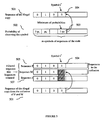
- Figure 5 shows one of the embodiments of the sequences filtering method.
- This filtering method is based on the hypothesis that the pirates can not create a symbol during the creation of the illegal copy by mixing their copies block by block.
- the symbol y(i) of the illegal copy is from one of the sequences that has this same symbol at the same index.
- the problem is to select an index i that will enable a smallest possible group of users to be constituted from among whom a pirate can be searched for and thus reduce the complexity of the decoding algorithm in line with the filtering.
- This law enables, for a given index symbol i of the sequence 501 of the illegal copy, the probability of observing this symbol 502 to be calculated.
- the sequences having participated in the collusion are the sequences P 505 and M 506 and that the sequences retained by the filtering are the sequences M 506 and J 507.
- the filtering enables a sub-group to be selected when it contains at least one sequence in the collusion, the sequence M 506, but not all the sequences in the collusion, for example, the sequence P 507.
- this filtering method thus authorizes the decoding method to identify a sequence in the collusion but not a group of sequences as there is no guarantee that there were more than one sequences having participated in the collusion in the sub-group of sequences retained 507 by the pre-selection.
- this filtering method only functions if the sequence y is the result without error of the mix of symbols of sequences in the collusion.
- the mixing of filtering comprises a step of verification of the marking hypothesis namely that the sequence y does contain errors on the symbols.
- the filtering method only retains 0.1% of the sequences of the code, in the case of the majority or minority vote, to 20% of the of the sequences of the code, in the case of the uniform pulling.
- This filtering method very simple to implement, enables the complexity verses performance ratio to be improved of an anti-collusion code decoding method, in particular of the decoding method according to the invention.
- the anti-collusion code is a binary Tardos code.
- the maximum number of sequences that the code enables by construction to recover is noted as c.
- q 2 and there are c +1 types possible.
- the types can be noted as pairs ( ⁇ , c - ⁇ ) where ⁇ is the number of symbols at '1' that the pirates possess.
- the number of symbols at '1' that the pirates possess, noted as ⁇ varies between 0 and c.
- ⁇ c'] ⁇ ⁇ [0,1] c'+1 .
- This vector is constructed from the possibility to observe a '1' in the sequence of the illegal copy knowing that respectively no symbol of sequences of the collusion is at '1', a symbol of sequences of the collusion is at '1' and up to all of the c' symbols of sequences of the collusion are at '1'.
- c' ] 1).
- the invention is not limited to the embodiments previously described.
- the invention is compatible with anti-collusion codes distinct from Tardos codes.
Landscapes
- Engineering & Computer Science (AREA)
- Computer Security & Cryptography (AREA)
- Signal Processing (AREA)
- Multimedia (AREA)
- Computer Networks & Wireless Communication (AREA)
- Two-Way Televisions, Distribution Of Moving Picture Or The Like (AREA)
- Storage Device Security (AREA)
- Editing Of Facsimile Originals (AREA)
Claims (12)
- Verfahren zum Decodieren eines probabilistischen Antikollusionscodes, der mindestens eine Sequenz (103) des Codes identifizieren soll, der in einem Multimediainhalt (102) vorhandenen ist, der bei der Erstellung einer Raubkopie (104) des Multimediainhalts gedient hat, wobei das Verfahren einen Schritt (603) der Auswahl der zum Bilden der Kopie verwendeten Kollusionsstrategie aus einer Menge von Kollusionsstrategiemodellen umfasst, dadurch gekennzeichnet, dass die Kollusionsstrategie für eine Anzahl in der Kollusion vorhandener Sequenzen einen Vektor der Wahrscheinlichkeiten der Kollusionsstrategie umfasst, der für jede Liste von Symbolen der in der Kollusion vorhandenen Sequenzen aus der bedingten Wahrscheinlichkeit der Beobachtung des Symbols in der Raubkopie unter Kenntnis der Liste von Symbolen der in der Kollusion vorhandenen Sequenzen gebildet ist.
- Verfahren nach Anspruch 1, dadurch gekennzeichnet, dass die Menge von Modellen von Kollusionsstrategien für jede Schätzung der Anzahl in der Kollusion vorhandener Sequenzen die wahrscheinlichste Kollusionsstrategie (411) umfasst.
- Verfahren nach Anspruch 2, dadurch gekennzeichnet, dass es die folgenden Schritte umfasst:a) Erstellung einer Menge von Modellen von Kollusionsstrategien, d. h.:i. für jede Schätzung der Anzahl von Sequenzen in der Kollusion und für jede Liste von Symbolen in der Kollusion vorhandener Sequenzen, Berechnung (401) einer Schätzfunktion der Wahrscheinlichkeit der Kollusionsstrategie unter Kenntnis der in der Raubkopie enthaltenen Sequenz,ii. für jede Schätzung der Anzahl von Sequenzen in der Kollusion, Auswahl (403) der Kollusionsstrategie, die die Schätzfunktion der Wahrscheinlichkeit der Kollusionsstrategie maximiert, a posteriori;b) Auswahl der Kollusionsstrategie aus der Menge von Modellen der Kollusionsstrategie, d. h.:i. für jede Schätzung der Anzahl von Sequenzen in der Kollusion, die der wahrscheinlichsten Kollusionsstrategie zugeordnet sind, Berechnung (404) des Vektors der Wahrscheinlichkeiten der Anwesenheit einer Sequenz in der gebildeten Kollusion für jede Sequenz des Codes, der bedingten Wahrscheinlichkeit der Anwesenheit einer gegebenen Sequenz in der Kollusion unter Kenntnis der in der Raubkopie enthaltenen Sequenz, der gegebenen Sequenz und der wahrscheinlichsten Kollusionsstrategie,ii. für jede Schätzung der Anzahl von Sequenzen in der Kollusion, die der wahrscheinlichsten Kollusionsstrategie zugeordnet sind, Berechnung (405) der Wahrscheinlichkeit des Modells der Kollusionsstrategie aus dem Vektor der Wahrscheinlichkeiten der Anwesenheit einer Sequenz in der Kollusion und der Wahrscheinlichkeit der Kollusionsstrategie unter Kenntnis der in der Raubkopie enthaltenen Sequenz,iii. Auswahl (406) aus der Menge von Modellen von Kollusionsstrategien, der Anzahl von Sequenzen in der Kollusion, die der wahrscheinlichsten Kollusionsstrategie zugeordnet sind, die die Wahrscheinlichkeit des Modells der Kollusionsstrategie maximiert;c) Identifizierung (407) mindestens einer Sequenz des in einem Multimediainhalt vorhandenen Codes, der bei der Erstellung der Raubkopie gedient hat, aus der bedingten Wahrscheinlichkeit der Anwesenheit der mindestens einen Sequenz unter Kenntnis des in Schritt b) geschätzten Modells der Kollusionsstrategie.
- Verfahren nach Anspruch 3, dadurch gekennzeichnet, dass in Schritt c) eine Sequenz des Codes als in einem Multimediainhalt, der bei der Erstellung der Raubkopie gedient hat, vorhanden identifiziert wird, wenn der Wert der bedingten Wahrscheinlichkeit der Anwesenheit für diese Sequenz in der Kollusion unter Kenntnis der in der Raubkopie enthaltenen Sequenz maximal ist, wobei die Sequenz und das Modell der Kollusionsstrategie in Schritt b) ausgewählt werden.
- Verfahren nach Anspruch 3, dadurch gekennzeichnet, dass in Schritt c) eine Gruppe von Sequenzen des Codes als in einem Multimediainhalt, der bei der Erstellung der Raubkopie gedient hat, vorhanden identifiziert wird, wenn der Wert der bedingten Wahrscheinlichkeit für jede der Sequenzen dieser Gruppe unter Kenntnis der in Raubkopie enthaltenen Sequenz, der Sequenz der Gruppe und des in Schritt b) ausgewählten Modells der Kollusionsstrategie größer als ein Schwellenwert S ist.
- Verfahren nach Anspruch 4, dadurch gekennzeichnet, dass es einen Schritt des Filterns von Sequenzen des Codes umfasst, der die Auswahl einer kleinstmöglichen Untergruppe von Sequenzen des Codes, die mindestens eine in dem Multimediainhalt, der bei der Erstellung der Raubkopie gedient hat, vorhandene Sequenz enthalten, umfasst, durch Vergleich für jede Sequenz des Codes und für einen ausgewählten gegebenen Symbolindex des Symbols der Sequenz des Codes mit dem Symbol der in der Raubkopie enthaltenen Sequenz.
- Verfahren nach Anspruch 6, dadurch gekennzeichnet, dass der Schritt des Filterns von Sequenzen des Codes überprüft, dass die in der Kopie enthaltene Sequenz das fehlerfreie Ergebnis einer Kollusion von Sequenzen des Codes ist.
- Verfahren zum Decodieren nach den Ansprüchen 4 bis 6, dadurch gekennzeichnet, dass nach Identifizierung mindestens einer Sequenz, die in einem Multimediainhalt, der bei der Erstellung der Raubkopie gedient hat, vorhanden ist, das Verfahren wiederholt wird, um mindestens eine neue Sequenz in der Kollusion zu identifizieren.
- Verfahren nach Anspruch 1, dadurch gekennzeichnet, dass die Kollusionsstrategie als θ c = {Prob[y|t], y ∈ χ, t ∈ Tq c} notiert wird, wobei c die Anzahl in der Kollusion vorhandener Sequenzen ist und {Prob[y|t], y ∈ χ, t ∈ Tq c} der Vektor der Wahrscheinlichkeiten der Kollusionsstrategie ist, der für jede Liste t von Symbolen aus der bedingten Wahrscheinlichkeit Prob[y|t], das Symbol in der Sequenz y der Raubkopie unter Kenntnis der Liste t von Symbolen in der Kollusion vorhandener Sequenzen aus der als Tq c bezeichneten Menge möglicher Listen, die aus c Sequenzen von Symbolen einer als χ = {0, 1, ..., q-1} bezeichneten alphabetischen q-stelligen Zahl erzeugt worden sind, zu beobachten, gebildet ist.
- Verfahren nach Anspruch 3, dadurch gekennzeichnet, dass in Schritt a) der Erstellung einer Menge von Modellen von Kollusionsstrategien, die Schätzfunktion der Wahrscheinlichkeit der Kollusionsstrategie θ c als Lbolind (θ c ) = Log(Prob[y|θ c ]) notiert wird, wobei Prob[y|θ c ] die bedingte Wahrscheinlichkeit der Beobachtung der Sequenz y in der Raubkopie unter Kenntnis der Kollusionsstrategie θ c für eine Anzahl c in der Kollusion vorhandener Sequenzen ist.
- Verfahren nach Anspruch 3, dadurch gekennzeichnet, dass in Schritt b) der Auswahl der Kollusionsstrategie, der Wahrscheinlichkeitenvektor (412) der Anwesenheit einer Sequenz xj in der Kollusion als {Prob[sj c = 1|x j , y, θ c*]}, j ∈ [1, n]} notiert wird, wobei sj eine Variable gleich 1 ist, falls die Sequenz xj in der Kollusion vorhanden ist, und wobei {Prob[s j c = 1|x j , y, θ c*]} die bedingte Wahrscheinlichkeit der durch sj c = 1 dargestellten Anwesenheit einer gegebenen Sequenz xj in der Kollusion von c Sequenzen unter den n Sequenzen des Codes unter Kenntnis der in der Raubkopie y enthaltenen Sequenz, der Sequenz xj und der wahrscheinlichsten Kollusionsstrategie θ c * (411) ist.
- Verfahren nach einem der vorhergehenden Ansprüche, dadurch gekennzeichnet, dass der Antikollusionscode ein Tardos-Code ist.
Applications Claiming Priority (1)
| Application Number | Priority Date | Filing Date | Title |
|---|---|---|---|
| FR0953073 | 2009-05-07 |
Publications (2)
| Publication Number | Publication Date |
|---|---|
| EP2249508A1 EP2249508A1 (de) | 2010-11-10 |
| EP2249508B1 true EP2249508B1 (de) | 2012-02-08 |
Family
ID=41811904
Family Applications (1)
| Application Number | Title | Priority Date | Filing Date |
|---|---|---|---|
| EP10162174A Not-in-force EP2249508B1 (de) | 2009-05-07 | 2010-05-06 | Verfahren zur Dekodierung eines probabilistischen Anti-Kollusionskodes |
Country Status (4)
| Country | Link |
|---|---|
| US (1) | US8370958B2 (de) |
| EP (1) | EP2249508B1 (de) |
| JP (1) | JP5693040B2 (de) |
| AT (1) | ATE545232T1 (de) |
Families Citing this family (4)
| Publication number | Priority date | Publication date | Assignee | Title |
|---|---|---|---|---|
| GB201110254D0 (en) * | 2011-06-17 | 2011-08-03 | Irdeto Corporate Bv | Dynamic fingerprinting |
| US11803620B2 (en) * | 2020-05-15 | 2023-10-31 | Synamedia Limited | Systems and methods for identifying a content receiving device |
| CN114244955B (zh) * | 2020-09-08 | 2022-12-30 | 华为技术有限公司 | 服务的分享方法、系统、电子设备及计算机可读存储介质 |
| US12556547B2 (en) * | 2022-05-02 | 2026-02-17 | Synamedia Limited | Anti-piracy methods, devices, and systems |
Family Cites Families (3)
| Publication number | Priority date | Publication date | Assignee | Title |
|---|---|---|---|---|
| JP3651777B2 (ja) * | 2000-11-28 | 2005-05-25 | 株式会社東芝 | 電子透かしシステム、電子透かし解析装置、電子透かし解析方法及び記録媒体 |
| US7047413B2 (en) * | 2001-04-23 | 2006-05-16 | Microsoft Corporation | Collusion-resistant watermarking and fingerprinting |
| US7975313B2 (en) * | 2007-08-14 | 2011-07-05 | International Business Machines Corporation | System and method for tracing Tardos fingerprint codes |
-
2010
- 2010-04-27 JP JP2010102150A patent/JP5693040B2/ja not_active Expired - Fee Related
- 2010-05-06 US US12/800,044 patent/US8370958B2/en not_active Expired - Fee Related
- 2010-05-06 AT AT10162174T patent/ATE545232T1/de active
- 2010-05-06 EP EP10162174A patent/EP2249508B1/de not_active Not-in-force
Also Published As
| Publication number | Publication date |
|---|---|
| US20100287614A1 (en) | 2010-11-11 |
| ATE545232T1 (de) | 2012-02-15 |
| JP5693040B2 (ja) | 2015-04-01 |
| JP2010268453A (ja) | 2010-11-25 |
| US8370958B2 (en) | 2013-02-05 |
| EP2249508A1 (de) | 2010-11-10 |
Similar Documents
| Publication | Publication Date | Title |
|---|---|---|
| KR101143233B1 (ko) | 디지탈 멀티미디아 데이타에 대한 비동기화된 핑거프린팅 방법 및 시스템 | |
| US7814564B2 (en) | Method for fingerprinting multimedia content | |
| US20150254342A1 (en) | Video dna (vdna) method and system for multi-dimensional content matching | |
| EP2249508B1 (de) | Verfahren zur Dekodierung eines probabilistischen Anti-Kollusionskodes | |
| Xie et al. | On-off keying modulation and tardos fingerprinting | |
| Oosterwijk et al. | Optimal suspicion functions for Tardos traitor tracing schemes | |
| Chaabane et al. | A survey on digital tracing traitors schemes | |
| Rose et al. | A secure verifiable scheme for secret image sharing | |
| US20150254343A1 (en) | Video dna (vdna) method and system for multi-dimensional content matching | |
| Zamani et al. | Genetic substitution-based audio steganography for high capacity applications | |
| EP2249507B1 (de) | Verfahren zur Dekodierung eines probabilistischen Anti-Kollusionskodes | |
| Schaathun | The Boneh-Shaw fingerprinting scheme is better than we thought | |
| Elbegbayan | Winnowing, a document fingerprinting algorithm | |
| CN116630124A (zh) | 一种基于ai模型的高鲁棒性水印嵌入方法 | |
| Tiwari et al. | A survey of transform domain based semifragile watermarking schemes for image authentication | |
| Stern et al. | Automatic detection of a watermarked document using a private key | |
| Gholam Pour et al. | Relating the Detection Rate, Capacity and the Cost of Steganography by Steganographer Modeling | |
| Rehman | Practical watermarking for multimedia traitor tracing | |
| Zhang et al. | Steganography based on adaptive pixel-value differencing scheme revisited | |
| Lian et al. | On the joint audio fingerprinting and decryption scheme | |
| Fridrich | Steganalysis | |
| Khlaif et al. | Digital Data Security and Copyright Protection Using Cellular Automata | |
| Hamida et al. | Hierarchical traceability of multimedia documents | |
| Furon | Binary Tardos Codes and Zero-bit Watermarking | |
| Liu et al. | Network Transmission of Images Containing Public Opinion Data: Analysis and Countermeasures Based on Digital Watermarking Technology. |
Legal Events
| Date | Code | Title | Description |
|---|---|---|---|
| PUAI | Public reference made under article 153(3) epc to a published international application that has entered the european phase |
Free format text: ORIGINAL CODE: 0009012 |
|
| AK | Designated contracting states |
Kind code of ref document: A1 Designated state(s): AL AT BE BG CH CY CZ DE DK EE ES FI FR GB GR HR HU IE IS IT LI LT LU LV MC MK MT NL NO PL PT RO SE SI SK SM TR |
|
| AX | Request for extension of the european patent |
Extension state: BA ME RS |
|
| 17P | Request for examination filed |
Effective date: 20110510 |
|
| GRAP | Despatch of communication of intention to grant a patent |
Free format text: ORIGINAL CODE: EPIDOSNIGR1 |
|
| RIC1 | Information provided on ipc code assigned before grant |
Ipc: H04L 9/00 20060101AFI20110621BHEP |
|
| GRAS | Grant fee paid |
Free format text: ORIGINAL CODE: EPIDOSNIGR3 |
|
| GRAA | (expected) grant |
Free format text: ORIGINAL CODE: 0009210 |
|
| AK | Designated contracting states |
Kind code of ref document: B1 Designated state(s): AL AT BE BG CH CY CZ DE DK EE ES FI FR GB GR HR HU IE IS IT LI LT LU LV MC MK MT NL NO PL PT RO SE SI SK SM TR |
|
| REG | Reference to a national code |
Ref country code: GB Ref legal event code: FG4D |
|
| REG | Reference to a national code |
Ref country code: AT Ref legal event code: REF Ref document number: 545232 Country of ref document: AT Kind code of ref document: T Effective date: 20120215 Ref country code: CH Ref legal event code: EP |
|
| REG | Reference to a national code |
Ref country code: DE Ref legal event code: R096 Ref document number: 602010000800 Country of ref document: DE Effective date: 20120405 |
|
| REG | Reference to a national code |
Ref country code: NL Ref legal event code: VDEP Effective date: 20120208 |
|
| LTIE | Lt: invalidation of european patent or patent extension |
Effective date: 20120208 |
|
| PG25 | Lapsed in a contracting state [announced via postgrant information from national office to epo] |
Ref country code: NL Free format text: LAPSE BECAUSE OF FAILURE TO SUBMIT A TRANSLATION OF THE DESCRIPTION OR TO PAY THE FEE WITHIN THE PRESCRIBED TIME-LIMIT Effective date: 20120208 Ref country code: IS Free format text: LAPSE BECAUSE OF FAILURE TO SUBMIT A TRANSLATION OF THE DESCRIPTION OR TO PAY THE FEE WITHIN THE PRESCRIBED TIME-LIMIT Effective date: 20120608 Ref country code: NO Free format text: LAPSE BECAUSE OF FAILURE TO SUBMIT A TRANSLATION OF THE DESCRIPTION OR TO PAY THE FEE WITHIN THE PRESCRIBED TIME-LIMIT Effective date: 20120508 Ref country code: HR Free format text: LAPSE BECAUSE OF FAILURE TO SUBMIT A TRANSLATION OF THE DESCRIPTION OR TO PAY THE FEE WITHIN THE PRESCRIBED TIME-LIMIT Effective date: 20120208 Ref country code: LT Free format text: LAPSE BECAUSE OF FAILURE TO SUBMIT A TRANSLATION OF THE DESCRIPTION OR TO PAY THE FEE WITHIN THE PRESCRIBED TIME-LIMIT Effective date: 20120208 |
|
| PG25 | Lapsed in a contracting state [announced via postgrant information from national office to epo] |
Ref country code: PL Free format text: LAPSE BECAUSE OF FAILURE TO SUBMIT A TRANSLATION OF THE DESCRIPTION OR TO PAY THE FEE WITHIN THE PRESCRIBED TIME-LIMIT Effective date: 20120208 Ref country code: PT Free format text: LAPSE BECAUSE OF FAILURE TO SUBMIT A TRANSLATION OF THE DESCRIPTION OR TO PAY THE FEE WITHIN THE PRESCRIBED TIME-LIMIT Effective date: 20120608 Ref country code: GR Free format text: LAPSE BECAUSE OF FAILURE TO SUBMIT A TRANSLATION OF THE DESCRIPTION OR TO PAY THE FEE WITHIN THE PRESCRIBED TIME-LIMIT Effective date: 20120509 Ref country code: BE Free format text: LAPSE BECAUSE OF FAILURE TO SUBMIT A TRANSLATION OF THE DESCRIPTION OR TO PAY THE FEE WITHIN THE PRESCRIBED TIME-LIMIT Effective date: 20120208 Ref country code: FI Free format text: LAPSE BECAUSE OF FAILURE TO SUBMIT A TRANSLATION OF THE DESCRIPTION OR TO PAY THE FEE WITHIN THE PRESCRIBED TIME-LIMIT Effective date: 20120208 Ref country code: LV Free format text: LAPSE BECAUSE OF FAILURE TO SUBMIT A TRANSLATION OF THE DESCRIPTION OR TO PAY THE FEE WITHIN THE PRESCRIBED TIME-LIMIT Effective date: 20120208 |
|
| REG | Reference to a national code |
Ref country code: AT Ref legal event code: MK05 Ref document number: 545232 Country of ref document: AT Kind code of ref document: T Effective date: 20120208 |
|
| PG25 | Lapsed in a contracting state [announced via postgrant information from national office to epo] |
Ref country code: CY Free format text: LAPSE BECAUSE OF FAILURE TO SUBMIT A TRANSLATION OF THE DESCRIPTION OR TO PAY THE FEE WITHIN THE PRESCRIBED TIME-LIMIT Effective date: 20120208 |
|
| PG25 | Lapsed in a contracting state [announced via postgrant information from national office to epo] |
Ref country code: SI Free format text: LAPSE BECAUSE OF FAILURE TO SUBMIT A TRANSLATION OF THE DESCRIPTION OR TO PAY THE FEE WITHIN THE PRESCRIBED TIME-LIMIT Effective date: 20120208 Ref country code: SE Free format text: LAPSE BECAUSE OF FAILURE TO SUBMIT A TRANSLATION OF THE DESCRIPTION OR TO PAY THE FEE WITHIN THE PRESCRIBED TIME-LIMIT Effective date: 20120208 Ref country code: DK Free format text: LAPSE BECAUSE OF FAILURE TO SUBMIT A TRANSLATION OF THE DESCRIPTION OR TO PAY THE FEE WITHIN THE PRESCRIBED TIME-LIMIT Effective date: 20120208 Ref country code: EE Free format text: LAPSE BECAUSE OF FAILURE TO SUBMIT A TRANSLATION OF THE DESCRIPTION OR TO PAY THE FEE WITHIN THE PRESCRIBED TIME-LIMIT Effective date: 20120208 Ref country code: CZ Free format text: LAPSE BECAUSE OF FAILURE TO SUBMIT A TRANSLATION OF THE DESCRIPTION OR TO PAY THE FEE WITHIN THE PRESCRIBED TIME-LIMIT Effective date: 20120208 Ref country code: RO Free format text: LAPSE BECAUSE OF FAILURE TO SUBMIT A TRANSLATION OF THE DESCRIPTION OR TO PAY THE FEE WITHIN THE PRESCRIBED TIME-LIMIT Effective date: 20120208 |
|
| PG25 | Lapsed in a contracting state [announced via postgrant information from national office to epo] |
Ref country code: IT Free format text: LAPSE BECAUSE OF FAILURE TO SUBMIT A TRANSLATION OF THE DESCRIPTION OR TO PAY THE FEE WITHIN THE PRESCRIBED TIME-LIMIT Effective date: 20120208 Ref country code: SK Free format text: LAPSE BECAUSE OF FAILURE TO SUBMIT A TRANSLATION OF THE DESCRIPTION OR TO PAY THE FEE WITHIN THE PRESCRIBED TIME-LIMIT Effective date: 20120208 |
|
| PLBE | No opposition filed within time limit |
Free format text: ORIGINAL CODE: 0009261 |
|
| STAA | Information on the status of an ep patent application or granted ep patent |
Free format text: STATUS: NO OPPOSITION FILED WITHIN TIME LIMIT |
|
| PG25 | Lapsed in a contracting state [announced via postgrant information from national office to epo] |
Ref country code: MC Free format text: LAPSE BECAUSE OF NON-PAYMENT OF DUE FEES Effective date: 20120531 |
|
| 26N | No opposition filed |
Effective date: 20121109 |
|
| PG25 | Lapsed in a contracting state [announced via postgrant information from national office to epo] |
Ref country code: AT Free format text: LAPSE BECAUSE OF FAILURE TO SUBMIT A TRANSLATION OF THE DESCRIPTION OR TO PAY THE FEE WITHIN THE PRESCRIBED TIME-LIMIT Effective date: 20120208 |
|
| REG | Reference to a national code |
Ref country code: IE Ref legal event code: MM4A |
|
| PG25 | Lapsed in a contracting state [announced via postgrant information from national office to epo] |
Ref country code: MK Free format text: LAPSE BECAUSE OF FAILURE TO SUBMIT A TRANSLATION OF THE DESCRIPTION OR TO PAY THE FEE WITHIN THE PRESCRIBED TIME-LIMIT Effective date: 20120208 |
|
| REG | Reference to a national code |
Ref country code: DE Ref legal event code: R097 Ref document number: 602010000800 Country of ref document: DE Effective date: 20121109 |
|
| PG25 | Lapsed in a contracting state [announced via postgrant information from national office to epo] |
Ref country code: ES Free format text: LAPSE BECAUSE OF FAILURE TO SUBMIT A TRANSLATION OF THE DESCRIPTION OR TO PAY THE FEE WITHIN THE PRESCRIBED TIME-LIMIT Effective date: 20120519 Ref country code: IE Free format text: LAPSE BECAUSE OF NON-PAYMENT OF DUE FEES Effective date: 20120506 |
|
| PG25 | Lapsed in a contracting state [announced via postgrant information from national office to epo] |
Ref country code: BG Free format text: LAPSE BECAUSE OF FAILURE TO SUBMIT A TRANSLATION OF THE DESCRIPTION OR TO PAY THE FEE WITHIN THE PRESCRIBED TIME-LIMIT Effective date: 20120508 Ref country code: MT Free format text: LAPSE BECAUSE OF FAILURE TO SUBMIT A TRANSLATION OF THE DESCRIPTION OR TO PAY THE FEE WITHIN THE PRESCRIBED TIME-LIMIT Effective date: 20120208 |
|
| PG25 | Lapsed in a contracting state [announced via postgrant information from national office to epo] |
Ref country code: AL Free format text: LAPSE BECAUSE OF FAILURE TO SUBMIT A TRANSLATION OF THE DESCRIPTION OR TO PAY THE FEE WITHIN THE PRESCRIBED TIME-LIMIT Effective date: 20120208 |
|
| PG25 | Lapsed in a contracting state [announced via postgrant information from national office to epo] |
Ref country code: TR Free format text: LAPSE BECAUSE OF FAILURE TO SUBMIT A TRANSLATION OF THE DESCRIPTION OR TO PAY THE FEE WITHIN THE PRESCRIBED TIME-LIMIT Effective date: 20120208 |
|
| PG25 | Lapsed in a contracting state [announced via postgrant information from national office to epo] |
Ref country code: SM Free format text: LAPSE BECAUSE OF FAILURE TO SUBMIT A TRANSLATION OF THE DESCRIPTION OR TO PAY THE FEE WITHIN THE PRESCRIBED TIME-LIMIT Effective date: 20120208 Ref country code: LU Free format text: LAPSE BECAUSE OF NON-PAYMENT OF DUE FEES Effective date: 20120506 |
|
| PG25 | Lapsed in a contracting state [announced via postgrant information from national office to epo] |
Ref country code: HU Free format text: LAPSE BECAUSE OF FAILURE TO SUBMIT A TRANSLATION OF THE DESCRIPTION OR TO PAY THE FEE WITHIN THE PRESCRIBED TIME-LIMIT Effective date: 20100506 |
|
| REG | Reference to a national code |
Ref country code: CH Ref legal event code: PL |
|
| PG25 | Lapsed in a contracting state [announced via postgrant information from national office to epo] |
Ref country code: LI Free format text: LAPSE BECAUSE OF NON-PAYMENT OF DUE FEES Effective date: 20140531 Ref country code: CH Free format text: LAPSE BECAUSE OF NON-PAYMENT OF DUE FEES Effective date: 20140531 |
|
| REG | Reference to a national code |
Ref country code: FR Ref legal event code: PLFP Year of fee payment: 7 |
|
| REG | Reference to a national code |
Ref country code: FR Ref legal event code: PLFP Year of fee payment: 8 |
|
| REG | Reference to a national code |
Ref country code: DE Ref legal event code: R082 Ref document number: 602010000800 Country of ref document: DE Representative=s name: HOFSTETTER, SCHURACK & PARTNER PATENT- UND REC, DE |
|
| REG | Reference to a national code |
Ref country code: FR Ref legal event code: PLFP Year of fee payment: 9 |
|
| PGFP | Annual fee paid to national office [announced via postgrant information from national office to epo] |
Ref country code: DE Payment date: 20180518 Year of fee payment: 9 |
|
| PGFP | Annual fee paid to national office [announced via postgrant information from national office to epo] |
Ref country code: FR Payment date: 20180523 Year of fee payment: 9 |
|
| PGFP | Annual fee paid to national office [announced via postgrant information from national office to epo] |
Ref country code: GB Payment date: 20180524 Year of fee payment: 9 |
|
| REG | Reference to a national code |
Ref country code: DE Ref legal event code: R119 Ref document number: 602010000800 Country of ref document: DE |
|
| GBPC | Gb: european patent ceased through non-payment of renewal fee |
Effective date: 20190506 |
|
| PG25 | Lapsed in a contracting state [announced via postgrant information from national office to epo] |
Ref country code: GB Free format text: LAPSE BECAUSE OF NON-PAYMENT OF DUE FEES Effective date: 20190506 Ref country code: DE Free format text: LAPSE BECAUSE OF NON-PAYMENT OF DUE FEES Effective date: 20191203 |
|
| PG25 | Lapsed in a contracting state [announced via postgrant information from national office to epo] |
Ref country code: FR Free format text: LAPSE BECAUSE OF NON-PAYMENT OF DUE FEES Effective date: 20190531 |