EP2248913B1 - GNLY als epigenetischer Marker zur Identifikation von CD56-exprimierenden natürlichen Killerzellen - Google Patents
GNLY als epigenetischer Marker zur Identifikation von CD56-exprimierenden natürlichen Killerzellen Download PDFInfo
- Publication number
- EP2248913B1 EP2248913B1 EP09005876.9A EP09005876A EP2248913B1 EP 2248913 B1 EP2248913 B1 EP 2248913B1 EP 09005876 A EP09005876 A EP 09005876A EP 2248913 B1 EP2248913 B1 EP 2248913B1
- Authority
- EP
- European Patent Office
- Prior art keywords
- dna
- cells
- primer
- natural killer
- unknown
- Prior art date
- Legal status (The legal status is an assumption and is not a legal conclusion. Google has not performed a legal analysis and makes no representation as to the accuracy of the status listed.)
- Active
Links
Images

Classifications
-
- C—CHEMISTRY; METALLURGY
- C12—BIOCHEMISTRY; BEER; SPIRITS; WINE; VINEGAR; MICROBIOLOGY; ENZYMOLOGY; MUTATION OR GENETIC ENGINEERING
- C12Q—MEASURING OR TESTING PROCESSES INVOLVING ENZYMES, NUCLEIC ACIDS OR MICROORGANISMS; COMPOSITIONS OR TEST PAPERS THEREFOR; PROCESSES OF PREPARING SUCH COMPOSITIONS; CONDITION-RESPONSIVE CONTROL IN MICROBIOLOGICAL OR ENZYMOLOGICAL PROCESSES
- C12Q1/00—Measuring or testing processes involving enzymes, nucleic acids or microorganisms; Compositions therefor; Processes of preparing such compositions
- C12Q1/68—Measuring or testing processes involving enzymes, nucleic acids or microorganisms; Compositions therefor; Processes of preparing such compositions involving nucleic acids
- C12Q1/6876—Nucleic acid products used in the analysis of nucleic acids, e.g. primers or probes
- C12Q1/6881—Nucleic acid products used in the analysis of nucleic acids, e.g. primers or probes for tissue or cell typing, e.g. human leukocyte antigen [HLA] probes
-
- C—CHEMISTRY; METALLURGY
- C12—BIOCHEMISTRY; BEER; SPIRITS; WINE; VINEGAR; MICROBIOLOGY; ENZYMOLOGY; MUTATION OR GENETIC ENGINEERING
- C12Q—MEASURING OR TESTING PROCESSES INVOLVING ENZYMES, NUCLEIC ACIDS OR MICROORGANISMS; COMPOSITIONS OR TEST PAPERS THEREFOR; PROCESSES OF PREPARING SUCH COMPOSITIONS; CONDITION-RESPONSIVE CONTROL IN MICROBIOLOGICAL OR ENZYMOLOGICAL PROCESSES
- C12Q2600/00—Oligonucleotides characterized by their use
- C12Q2600/154—Methylation markers
Definitions
- the present application relates to a method, in particular an in vitro method for identifying natural killer cells of a mammal, preferably CD3-, non T-lymphocyte derived NK cells, but in certain embodiments also CD3+ NKT cells, which often express the surface proteins CD 16 and/or CD56, comprising analyzing the methylation status of at least one CpG position in the CX3CR1 and/or FGR and/or NKG7 and/or GNLY genes, in particular their upstream regulatory regions, and in particular the promoter and other conserved regions of the genes CX3CR1 and/or FGR and/or NKG7 and/or GNLY, wherein a demethylation of at least one CpG in the analyzed sample to at least 70% is indicative for CD56 expressing NK cells, which might also be CD8+ or CD8-, CD56 dim or bright, CD16+ or CD16- NK cells.
- the methods of the present application are useful for the detection, the quantification and quality assurance and control of NK cells. Furthermore, the present invention relates to a kit for performing the above methods as well as respective uses of the inventive methods or kits. The present application furthermore provides an improved method for analysing the methylation status of at least one CpG position in the gene CX3CR1 and/or FGR and/or NKG7 and/or GNLY genes that allows for a precise analysis even from sub-optimal quality samples, such as non-freshly obtained blood, tissue or serum samples.
- Natural killer cells are granular cytotoxic lymphocytes, derived from CD34+ hematopoietic progenitor cells (HPCs). They represent an essential component of the innate immune system. They comprise about 5 to 20% of lymphocytes in the spleen, liver, and peripheral blood and are also present - even if at lower frequencies - in the bone marrow, the thymus, and in lymph nodes. They were originally identified by their ability to kill certain (tumor-) target cells without sensitization. This killing works in vivo and in vitro and is not restricted by the target cell's expression of major histocompatibility complex (MHC) molecules.
- MHC major histocompatibility complex
- NK cells also possess natural cytotoxic activity against conspicious, such as but not restricted to (virus-) infected and/or tumor, cells. In addition, they mediate antibody-dependent cellular cytotoxicity (ADCC) of targets through FccRIII (CD16), a receptor that binds the Fc portion of antibodies.
- ADCC antibody-dependent cellular cytotoxicity
- CD16 FccRIII
- CD56 FccRIII
- CD56 FccRIII
- NCAM neural cell adhesion molecule
- human NK cells are often further subdivided into CD56 dim or CD56 bright NK cells. In the periphery, the majority (>90%) of NK cells have been found to consist of CD56 dim along with high expression of CD16, and the remaining 10% are CD56 bright NK cells coming along with low or no expression of CD 16.
- the described CD56 dim NK cell fraction is generally considered the "classical cytotoxic NK cell subset".
- the CD56 bright fraction displays much lower cytotoxicity and, instead, produces high amounts of cytokines, including IFN ⁇ and TNF ⁇ , indicating a primary role in immunoregulatory function.
- the measurement of the cellular components in the blood is generally considered easier than that of other organs, since the cells are (at least in the periphery) not adherent or matrixed in a scaffolded organ.
- CD cluster of differentiation
- the blood/immunological methods used for blood component measurement for blood cells present in other tissues, including solid tissues at or after inflammation, and or the growth of solid tumors are limited, since they represent at most semi-quantitative methods (of particular relevance is the immunohistochemistry).
- the identification of specific epigenetic markers will greatly facilitate the clinical routine application of the measurement of blood cell types.
- the primary target of methylation is the two-nucleotide sequence Cytosine-Guanine (a 'CpG site'); within this context cytosine (C) can undergo a simple chemical modification to become 5-methyl-cytosine.
- C Cytosine-Guanine
- the CG sequence is much rarer than expected except in certain relatively dense clusters called 'CpG islands'.
- CpG islands are frequently associated with gene promoters, and it has been estimated that more than half of the human genes have CpG islands ( Antequera and Bird, Proc Natl Acad Sci USA. 90:11995-9, 1993 ).
- Methylation profiles have been recognised to be tumour specific (i.e., changes in the methylation pattern of particular genes or even individual CpGs are diagnostic of particular tumour types) and there is now an extensive collection of diagnostic markers for bladder, breast, colon, oesophagus, stomach, liver, lung, and prostate cancers (summarized by Laird, Nature Reviews/Cancer 3:253-266, 2003 ).
- EP 1213360 describes a method of identifying a cell, tissue or nucleus, comprising collecting information on the methylation pattern of DNA isolated from the cell, tissue or nucleus and analyzing the resultant information.
- WO 2004/050706 describes a sub-group of T-cells, and relates to characteristics of regulatory T-cells which define them as such.
- the application also describes the uses of such T-cells, compositions comprising them and chemokines which recruit them in the modulation of an immune response.
- Du et al. (in: Du X et al. "Genomic profiles for human peripheral blood T cells, B cells, natural killer cells, monocytes, and polymorphonuclear cells: Comparisons to ischemic stroke, migraine, and Tourette syndrome” Genomics, Acad. Press, San Diego, vol. 87, no. 6, 1 June 2006, pages 693-703 ) describes that 269 genes are differentially expressed between blood cell types, these genes were separated in nine clusters of relatively unique expression profiles. Cluster 6 encompasses differentially expressed genes found in both NK and CD8+ cells.
- EP 1826279 describes a method, in particular an in vitro method for identifying FoxP3-positive regulatory T cells, preferably CD25 + CD4 + regulatory T cells of a mammal, comprising analyzing the methylation status of at least one CpG position in the gene foxp3 or an orthologous or paralogous gene thereof, and the use of DNA-methylation analysis of the gene of the transcription factor FoxP3 for a detection and quality assurance and control of regulatory T cells.
- the invention solves the above problem by providing a method for identifying natural killer cells in a sample derived from a mammal, comprising analysing the methylation status of CpG motifs in an amplicon according to SEQ ID NOs: 29 to 34, wherein a demethylation of said CpG motifs to at least 70% in a natural killer cell in said sample, when compared to a non-natural killer cell, is indicative for a CD56-expressing natural killer cell.
- said natural killer cells of said mammal are preferably CD3-, non T-lymphocyte derived NK cells, but in certain embodiments also encompass CD3+ NKT cells.
- methods of the invention are preferred, wherein said CpG motifs motifs in a CD56-expressing natural killer cell in said sample are demethylated to more than 80% and preferably more than 90% and most preferred more than 95%.
- Yet another aspect relates to a method according to the present invention, wherein the analysis of the methylation status comprises a method selected from methylation specific enzymatic digests, bisulphite sequencing, analysis selected from promoter methylation, CpG island methylation, MSP, HeavyMethyl, MethyLight, Ms-SNuPE or other methods relying on a detection of amplified DNA. Also preferred is an additional analysis of the markers NKG7, CX3CR1, FGR, CD56, CD16 and/or CD8.
- Samples are selected from a fresh, fresh-frozen or fully prepared (such as formalin fixed paraffin embedded) sample, including mammalian body fluid, preferable human blood samples, serum samples or tumourous or non-tumourous solid tissue samples, organ or cell type blood sample, a sample of blood lymphocytes or a fraction thereof. These samples should be mammalian, preferably mouse, rat, monkey or human.
- a mammal most preferred a human, which suffers from or is likely to suffer from autoimmune diseases, viral or bacterial infections, transplant rejections, cancer, and/or allergy or any disease directly correlated to NK cells, such as - including but not limited to - diseases as phenotypically described by SCID-X1.
- Another embodiment of the invention relates to the above methods, wherein said identification comprises a distinction and, optionally, a further quantification, of said natural killer cells from all major peripheral blood cell types or non-blood cells, and then further comprises the step of concluding on the immune status of said mammal based on said natural killer cells as identified.
- said identification comprises a distinction and, optionally, a further quantification, of said natural killer cells from all major peripheral blood cell types or non-blood cells, and then further comprises the step of concluding on the immune status of said mammal based on said natural killer cells as identified.
- NK cells can be identified and quantified due to their (unique) methylation pattern in the analysed genes. Based on this they can be quantitated.
- Another aspect then relates to a method of the invention, wherein a demethylation of CpG motifs in the gene GNLY in combination with a demethylation of at least one CpG motif in at least a second gene selected from NKG7, CX3CR1, and FGR is indicative for a CD56 dim or CD56 bright natural killer cell.
- a preferred aspect then relates to a method of the invention, wherein a demethylation of at least one CpG motif of NKG7 to at least 70% in combination with a demethylation of at least one CpG motif of a gene selected from CX3CR1, FGR and GNLY to at least 70% in said sample is indicative for a CD56 dim or CD56 bright or CD8 + or CD8 - natural killer cell.
- the inventive method is useful for monitoring the level of CD56 expressing natural killer cells, in particular CD56 dim or CD56 bright , and/or CD16+ or CD16 - , and/or CD8 + or CD8 - natural killer cells in a mammal, comprising a method according to the invention, and comparing the amount of natural killer cells as identified to an earlier sample taken from the same mammal, and/or to a control sample.
- the method is also useful for measuring and/or monitoring the amount of said natural killer cells in response to chemical and/or biological substances that are provided to said mammal.
- the invention provides for the use of an amplicon according to SEQ ID NOs: 29 to 34 or an amplicon produced by a primer-pair according to SEQ ID NOs: 48, 49, and 138 to 159, and/or an oligomer hybridizing to a sequence selected from SEQ ID NO: 29 to 34, preferably an oligomer selected from SEQ ID NOs: 48, 49, and 138 to 159 for identifying and/or monitoring CD56 dim or CD56 bright natural killer cells in a mammal in methods according to the present invention.
- kits for identifying and/or monitoring natural killer cells in particular CD56 dim or CD56 bright , and/or CD16 + or CD16 - , and/or CD8 + or CD8 - natural killer cells, in a mammal based on the analysis of the methylation status of CpG positions in one or more genes selected from CX3CR1, FGR, NKG7 and GNLY, comprising materials for performing a method according to the invention.
- kit as described comprises, but is not limited to, a) a bisulfite reagent, and b) materials for the methylation analysis of CpG positions selected from the CpG positions of the gene CX3CR1 according to SEQ ID NO: 1, preferably selected from the CpG positions of the amplicon CX3CR1-1 (1452) according to SEQ ID NO: 5 or CX3CR1 amplicons ROI956 - 966, according to SEQ ID NOs: 6 - 16; FGR according to SEQ ID NO: 2, preferably of the amplicons FGR-1 (Amp.
- the present invention solves the above problem that the detection of NK cells is problematic for routine applications by providing a method for identifying CD56-expressing natural killer cells of a mammal, comprising analysing the methylation status of the CpG motifs in an amplicon according to SEQ ID NOs: 29 to 34, wherein a demethylation of said CpG motifs to at least 70% in a natural killer cell in said sample, when compared to a non-natural killer cell, is indicative for a CD56-expressing natural killer cell.
- the inventors furthermore present a novel and more specific way in order to monitor NK cells in all human body fluids, including human blood samples, or in any given (solid) tissue, organ or cell type.
- the inventive concept is generally based on a specific demethylation of the GNLY regions in NK cells.
- a simple and precise quantitative PCR method as a signal amplification method (e.g. a precise quantitative PCR method)
- the inventors show that the GNLY demethylation represents a surrogate marker for lymphocyte counts in blood or tissues.
- the present inventors have thus identified particular regions within the GNLY gene that are functionally involved in, or reliably associated with, the existence of natural killer cells.
- the preferred regions for this identification are regions as claimed containing a number of CpG motifs that exhibit a differential methylation status in cells expressing CD56 in either CD56 high or CD56 dim cells, which may or may not also express CD16 and CD8 compared with other cells not expressing CD56, using, for example, the bisulphite sequencing method or real time PCR analysis.
- One further preferred embodiment is the distinction between and among functionally different fractions of natural NK cells, such as the cytotoxic sub-fraction (often characterized by the surface markers CD56 dim , and likely CD16 high ) and the cytokine producing sub-fraction (i.e., often described as CD56 bright and CD16 low/medium ) or between CD8 positive and CD8 negative NK cell fractions or any other sub-fractions of NK cells.
- the inventors consider the fractionation of the subgroups such as CD56 dim vs. CD56 bright or CD8 positive or CD8 negative, the combination of GNLY with the respective markers of CX3CR1, FGR and/or NKG7 a preferred embodiment. In such setting and as one embodiment, using the demethylation of GNLY alone would provide for the identification of cytotoxic, cytokine producing or CD8 positive or negative cells alone NK cells only, without determining the amount of the other NK or other cell fractions.
- NK cells such as CD56 bright or CD56 dim and/or CD 16 positive or negative and CD8 positive or negative NK cells (defined by the principle ability to express CD56) the CpG motifs are almost completely demethylated (i.e. to more than 70%, preferably 80%, preferably, more than 90% and most preferred more than 95%), whereas the same motifs are completely methylated in all non-NK cells.
- Determination of the methylation status of the GNLY locus is a valuable tool to identify NK cells, such as will be required/or at least of some value for measuring NK cells in autoimmune diseases, (viral) infections, transplant rejections, cancer, allergy, or just the NK cell related immune status in any envisionable context, when desired.
- the assay allows measurement of NK cells without purification or any staining procedures.
- the measurement of NK cells by either of the markers described in here can be easily detected and quantified from within solid tissue samples of healthy or diseased nature, including tumorous or non-tumourous tissues.
- NK cells for such analysis it is possible to make the analysis either from fresh, fresh-frozen or any type of conserved (such as, for example, formalin fixed and/or paraffin-embedded) tissue.
- Another preferred embodiment is to determine the ratio between NK cells on one hand and CD3+ T lymphocytes, CD 19 positive B cells, FOXP3 CD25 CD3+ cells, monocytes and/or granulocytes.
- NK cell properties of mammalian immune cells coincide with epigenetic, i.e., DNA methylation based regulation in the gene GNLY.
- DNA methylation is a biologically and chemically stable epigenetic modification, resulting in long-term gene expression changes.
- the inventors found demethylation at the human GNLY locus to be restricted to NK cells when tested against all major peripheral blood cell types and a selection of non-blood cells.
- the present invention relies on the surprising finding that in a particular region of the gene for GNLY, the so-called "NK-SDR"s (NK cell specific demethylated regions), the CpG motifs are almost completely demethylated to more than 70%, preferably more than 80%, more preferably to more than 90%, preferably 91%, even more preferably more than 92% and most preferred more than 95%, whereas the same motifs are completely methylated in all non NK cells.
- this region provides a valuable and reliable tool for a diagnostic analysis according to the present invention.
- the gene NKG7 in humans is located on the reverse strand of chromosome 19.
- the gene region spans roughly 1.3 kb comprising 5' and 3' UTRs, 4 exons and 3 intronic regions (Ensembl release 53, March 2009).
- NK-SDR the 5' UTR of NKG7, or preferable the 3' UTR of NKG7. Furthermore, natural killer cell specific demethylated regions as described are located within the intronic sequences of this gene. Described are also NK-SDRs that are located around the exon-intron boundaries of NKG7, preferably the boundary between the first exon and first intron and/or the first intron and second exon and/or the second exon and second intron and/or the second intron and third exon and/or the third exon and third intron and/or the third intron and fourth exon, or any possible combination of the above.
- NK-SDRs are described, which are located within 10000 bases upstream of the transcriptional start site of NKG7, preferably 9000 bases, 8000 bases, 7000 bases, 6000 bases, 5000 bases, 4000 bases, 3000 bases or 2000 bases upstream of NKG7, even in a region 1000 bases upstream of the transcriptional start of NKG7 and NK-SDRs in the first 500 bases upstream of the transcriptional start site of NKG7.
- NK-SDRs are located within the gene promoter of NKG7.
- NK-SDRs downstream of the open reading frame (ORF) of NKG7 preferably within 10000 bases downstream of the ORF of NKG7, more preferable 8000 bases downstream of NKG7, even more preferred is a region 6000 bases downstream of the ORF of NKG7, preferably 4000 bases downstream of NKG7 and most preferable NK-SDRs in the first 2000 bases downstream of the ORF of NKG7.
- NK-SDRs of NKG7 which comprise any possible combination of the aforementioned preferred NK-SDRs of NKG7.
- NK-SDRs of NKG7 that are found within the regions of SEQ ID NO: 4, preferably a region selected from the group of SEQ ID NOs: 35 to 41, preferably of SEQ ID NO: 35, or any combinations thereof.
- amplicons of NKG7 which are generated using a primer pair according to SEQ ID NOs: 160 to 181, wherein primers having the same number in their name, but differ in the last position of the name, are pairs.
- the gene CX3CR1 in humans is located on the reverse strand of chromosome 3.
- the gene region spans roughly 18.5 kb genomic DNA comprising 5' and 3' UTRs, 3 exons and 2 intronic regions (Ensembl release 53, March 2009).
- NK-SDR is the 5' UTR of CX3CR1, or the 3' UTR of CX3CR1.
- natural killer cell specific demethylated regions are located within the intronic sequences of this gene.
- NK-SDRs that are located around the exon-intron boundaries of CX3CR1, preferably the boundary between the first exon and first intron and/or the first intron and second exon and/or the second exon and the second intron and/or the second intron and third exon, or any possible preferred combination of the above.
- NK-SDRs which are located within 20000 bases upstream of the transcriptional start site of CX3CR1, preferable 15000 bases upstream of CX3CR1, even more preferred is a region 10000 bases, 9000 bases, 8000 bases, 7000 bases, 6000 bases, 5000 bases, 4000 bases, 3000 bases, 2000 bases or 1000 bases upstream of the transcriptional start of CX3CR1, and most preferable NK-SDRs in the first 500 bases upstream of the transcriptional start site of CX3CR1.
- Particularly preferred NK-SDRs are described that are located within the gene promoter of CX3CR1.
- NK-SDRs downstream of the open reading frame (ORF) of CX3CR1 are described, preferably within 10000 bases downstream of the ORF of CX3CR1, more preferable 8000 bases downstream of CX3CR1, even more preferred is a region 6000 bases downstream of the ORF of CX3CR1, preferably 4000 bases downstream of CX3CR1 and most preferable NK-SDRs in the first 2000 bases downstream of the ORF of CX3CR1.
- NK-SDRs of CX3CR1 which comprise any possible combination of the aforementioned NK-SDRs of CX3CR1.
- NK-SDRs of CX3CR1 that are found within the regions of SEQ ID NO: 1, preferably a region selected from the group of SEQ ID NOs: 5 to 16, preferably of SEQ ID NO: 5, or any combinations thereof. Further described are amplicons of CX3CR1 which are generated using a primer pair according to SEQ ID NOs: 50 to 95, wherein primers having the same number in their name, but differ in the last position of the name, are pairs.
- the gene FGR in humans is located on the reverse strand of chromosome 1.
- the gene region spans about 23.12 kb genomic DNA comprising 5' and 3' UTRs, 11 exons and 10 intronic regions (Ensembl release 53, March 2009).
- NK-SDR is the 5' UTR of FGR, or preferable the 3' UTR of FGR.
- natural killer cell specific demethylated regions as described are located within the intronic sequences of this gene.
- NK-SDRs that are located around the exon-intron boundaries of FGR, preferably the boundary between the first exon and first intron and/or the first intron and second exon and/or the second exon and the second intron and/or the second intron and third exon and/or the third exon and third intron and/or the third intron and fourth exon and/or the fourth exon and fourth intron and/or the fourth intron and fifth exon and/or the fifth exon and fifth intron and/or the fifth intron and sixth exon and/or the sixth exon and sixth intron, and/or the sixth intron and seventh exon and/or the seventh exon and seventh intron and/or the seventh intron and eighth exon and/or the eighth exon and eighth exon and/or the
- NK-SDRs are described, which are located within 10000 bases upstream of the transcriptional start site of FGR, preferable 9000 bases, 8000 bases, 7000 bases, 6000 bases, 5000 bases, 4000 bases, 3000 bases or 2000 bases upstream of FGR, even more preferred is a region 1000 bases upstream of the transcriptional start of FGR, and most preferable NK-SDRs in the first 500 bases upstream of the transcriptional start site of FGR.
- Particular NK-SDRs are located within the gene promoter of FGR.
- NK-SDRs downstream of the open reading frame (ORF) of FGR preferably within 10000 bases downstream of the ORF of FGR, more preferable 8000 bases downstream of FGR, even more preferred is a region 6000 bases downstream of the ORF of FGR, preferably 4000 bases downstream of FGR and most preferable NK-SDRs in the first 2000 bases downstream of the ORF of FGR.
- ORF open reading frame
- NK-SDRs of FGR which comprise any possible combination of the aforementioned preferred NK-SDRs of FGR.
- NK-SDRs of FGR that are found within the regions of SEQ ID NO: 2, preferably a region selected from the group of SEQ ID NOs: 17 to 28, preferably of SEQ ID NO: 17, or any combinations thereof.
- amplicons of FGR which are generated using a primer pair according to SEQ ID NO: 96 to 137, wherein primers having the same number in their name, but differ in the last position of the name, are pairs.
- the gene GNLY in humans is located on the forward strand of the second chromosome.
- the gene region spans 4.7 kb of genomic DNA comprising 5' and 3' UTRs, 6 exons and 5 intronic regions (Ensembl release 53, March 2009).
- a preferred NK-SDR of the present invention is the 5' UTR of GNLY, or preferable the 3' UTR of GNLY.
- natural killer cell specific demethylated regions of the present invention are located within the intronic sequences of this gene.
- NK-SDRs that are located around the exon-intron boundaries of GNLY, preferably the boundary between the first exon and first intron and/or the first intron and second exon and/or the second exon and the second intron and/or the second intron and third exon and/or the third exon and third intron and/or the third intron and fourth exon and/or the fourth exon and fourth intron and/or the fourth intron and fifth exon and/or the fifth exon and fifth intron and/or the fifth intron and sixth exon, or any possible preferred combination of the above.
- NK-SDRs are provided, which are located within 10000 bases upstream of the transcriptional start site of GNLY, preferable 9000 bases, 8000 bases, 7000 bases, 6000 bases, 5000 bases, 4000 bases, 3000 bases or 2000 bases upstream of GNLY, even more preferred is a region 1000 bases upstream of the transcriptional start of GNLY and most preferable NK-SDRs in the first 500 bases upstream of the transcriptional start site of GNLY. It is, however, particularly preferred that NK-SDRs of the present invention are located within the gene promoter of GNLY.
- preferred embodiments of the present invention comprise NK-SDRs downstream of the open reading frame (ORF) of GNLY, preferably within 10000 bases downstream of the ORF of GNLY, more preferable 8000 bases downstream of GNLY, even more preferred is a region 6000 bases downstream of the ORF of GNLY, preferably 4000 bases downstream of GNLY and most preferable NK-SDRs in the first 2000 bases downstream of the ORF of GNLY.
- ORF open reading frame
- the present invention further preferably provides groups of NK-SDRs of GNLY, which comprise any possible combination of the aforementioned preferred NK-SDRs of GNLY.
- NK-SDRs of GLNY that are found within the regions of SEQ ID NO: 3, preferably a region selected from the group of SEQ ID NOs: 29 to 34, preferably of SEQ ID NO: 29, or any combinations thereof.
- amplicons of GLNY which are generated using a primer pair according to SEQ ID NOs: 138 to 159, wherein primers having the same number in their name, but differ in the last position of the name, are pairs.
- the next aspect of the invention relates to combined natural killer cell specific demethylation regions, wherein the combinations of the invention are composed of the single preferred NK-SDRs of the above gene GNLY, combined with NKG7, CX3CR1, and/or FGR.
- NK-SDRs preferably for the analysis of a sample of cells, multiple demethylation patterns of NK-SDRs are combined to conclude the presence of a CD56 expressing natural killer cell or a sub-fraction of natural killer cells, preferably CG56 dim or CD56 bright NK cells and/or CD16+ or CD16- NK cells and/or CD8+ or CD8- NK cells.
- the method according to the present invention is preferred, wherein said analysis of the methylation status comprises amplification with at least one primer of the primer pairs useful to amplify an amplicon selected from the group comprising SEQ ID NOs: 29 to 34.
- the amplification involves a polymerase enzyme, a PCR or chemical amplification reaction, or other amplification methods as known to the person of skill as described below, e.g. in the context of MSP, HeavyMethyl, Scorpion, MS-SNUPE, MethylLight Sequencing methyl specific restriction assays.
- the amplicon of the NK-SDR or any other region in the GNLY gene or any paralog or ortholog as described herein is produced that is a particularly preferred "tool" for performing the method(s) according to the present invention.
- an oligomer according to any of SEQ ID NOs: 48, 49, and 138 to 159 or the amplicon as amplified by the primer pair selected from SEQ ID NOs: 48, 49, and 138 to 159 constitute preferred embodiments of the present invention, or any other sequence in the GNLY locus.
- the person of skill will furthermore be able to select specific subsets of CpG positions in order to minimise the amount of sites to be analyzed, for example all sites as present on the amplicons according to SEQ ID No 29 to 34, or any other sequence in the GNLY gene.
- the analysis of the methylation status comprises a method selected from methylation specific enzymatic digests, bisulphite sequencing, analysis selected from promoter methylation, CpG island methylation, MSP, HeavyMethyl, MethyLight, Ms-SNuPE or other methods relying on a detection of amplified DNA.
- Another important aspect of the present invention relates to the use of an amplicon according to SEQ ID Nos: 29 to 34 or an amplicon produced by a primer-pair according to SEQ ID Nos: 48, 49, and 138 to 159, and/or an oligomer hybridizing to a sequence selected from SEQ ID NO: 29 to 34, preferably an oligomer selected from SEQ ID Nos: 48, 49, and 138 to 159 for identifying and/or monitoring CD56 dim or CD56 bright natural killer cells in a mammal in methods according to the present invention.
- These amplicons provide important tools for performing preferred embodiments of the methods of the present invention.
- a method according to the invention further comprising the step of analysing the cellular markers CD56, CD16 and/or CD8.
- any known method to analyse expression can be used, such as methods using antibodies, and/or methylation analysis.
- the analysis of these markers preferably further improves the accuracy of the analysis, and might allow to identify sub-sets of cells.
- the method according to the present invention comprises an identification that is a distinction of said natural killer cells from all major peripheral blood cell types or non-blood cells.
- the method according to the present invention can be performed with any mammal having the above markers or orthologs or paralogs thereof, preferred is a method according to the present invention, wherein said mammal is a mouse, rat, monkey or human, preferably a human.
- the method(s) according to the present invention can be performed in vitro .
- all biological samples can be used, as long as they contain suitable cells or suitable DNA of cells of interest.
- Preferred is a method wherein said sample is selected from a fresh, fresh-frozen or fully prepared sample including mammalian body fluid, preferable human blood samples, serum samples or a tumourous or non-tumourous solid tissue, organ or cell type blood sample, a sample of blood lymphocytes or a fraction thereof.
- Another preferred aspect of the present invention relates to the use of the method according to the present invention as above in diagnostics and the use in monitoring diseases.
- the invention is directed at a method according to the present invention which further comprises the step of concluding on the immune status of said mammal based on said natural killer cells as identified.
- a demethylation of at least one CpG position in a first gene selected from GNLY in combination with a demethylation of at least one CpG position in at least a second gene selected from NKG7, CX3CR1, and FGR is indicative for a CD56 dim or CD56 bright natural killer cell.
- Another important aspect of the present invention relates to a method according to the present invention for monitoring the level of CD56 expressing natural killer cells, in particular CD56 dim or CD56 bright , and/or CD16+ or CD16 - , and/or CD8+ or CD8- natural killer cells in a mammal, comprising a method according to the invention as above, and comparing the amount of natural killer cells as identified with an earlier sample taken from the same mammal, and/or with a control sample.
- said method is performed on a sample from a mammal suffering from or is likely to suffer from autoimmune diseases, transplant rejections, cancer, allergy and/or any disease directly correlated to NK cells, such as, but not limited to SCID-X1.
- said method according to the invention then further comprises measuring and/or monitoring the amount of the amount of natural killer cells in response to chemical and/or biological substances that are provided to said mammal. That is, changes in the amount or ratio of natural killer cells that are caused by, for example, the treatment of a disease (e.g. as described herein), and the success and/or progress of said treatment in terms of an effect on the natural killer cells can be followed using this method.
- a follow-up of the methylation pattern based on the markers herein will point to changes in the cells that are due to a response to said chemical and/or biological substances, in some cases even before a phenotypic change can be observed.
- a method for identifying chemical and/or biological substances that selectively modulate natural killer cells expressing the markers as described herein comprising contacting one or more of said chemical and/or biological substance with said natural killer cells, and detecting, whether said chemical and/or biological substance modulates the methylation of the CpG positions as analyzed, and/or whether said one or more of said chemical and/or biological substance selectively modulates the amount and/or ratio of marker-expressing natural killer cells.
- a modulation of said natural killer cells that increases the amount and/or ratio of said natural killer cells.
- the method can be performed in vitro .
- the present invention provides a method, sometimes called a "screening-method", that seeks to identify chemical and/or biological substances modulating expression of the markers as above that can be used as starting points for the development of natural killer cell-specific medication and respective pharmaceutical compositions.
- the method is based on the fact that it is well accepted that the marker genes as identified herein must play a central role for the development of natural killer cells. Therefore, factors stimulating marker expression are interesting for the treatment of patients. Such factors, which lead to a stable modification, preferably induction, of the development/ratio/amount of natural killer cells, can be detected with the method as described.
- Chemical and/or biological substances that are suitable as screening compounds are known to the person of skill and, for example, include small molecules, peptides and proteins, and antibodies or fragments thereof. Furthermore, the screening can be done using a commercially compound library, optimally together with suitable automation, such as a robot. In one embodiment of the method for identifying chemical and/or biological substances, said substance provides a demethylation of the CpG positions as analyzed to at least 80%, preferably 90%, and more preferably 95%.
- a method which further comprises the step of providing a treatment for a patient suffering from or being likely to suffer from autoimmune diseases, transplant rejections, cancer, allergy and/or any disease directly correlated to NK cells, such as, but not limited to SCID-X1, wherein said treatment modulates, and preferably increases the amount and/or proportion of NK cells in said, preferably, cancer patient.
- said treatment is selected from providing chemical and/or biological substances that selectively stimulate NK cells in said patient, or a treatment that stimulates the expression of the marker genes as above or supports the biological activity of said marker genes in said NK cells in said patient.
- Preferred examples of such treatments are demethylating agents that provide for a reduced methylation of said genes.
- treatment also includes a prevention of marker gene expression related diseases.
- kits for identifying and/or monitoring natural killer cells in particular CD56 dim or CD56 bright , and/or CD16+ or CD16 - , and/or CD8+ or CD8- natural killer cells, in a mammal based on the analysis of the methylation status of CpG positions in one or more genes selected from CX3CR1, FGR, NKG7 and GNLY, comprising materials for performing a method as described herein, in particular a kit comprising a) a bisulfite reagent, and b) materials for the methylation analysis of CpG positions selected from the CpG positions of the gene CX3CR1-1 (1452) according to SEQ ID NO: 5, or CX3CR1 amplicons ROI956 to 966, according to SEQ ID NOs: 6 to 16; FGR according to SEQ ID NO: 2, preferably of the amplicon FGR-1 (Amp.
- the person of skill will furthermore be able to select materials for specific subsets of CpG positions in order to minimize the amount of sites to be analyzed, for example all sites as present on an amplicon as above or all sites as present on another amplicon as above, or orthologous or paralogous CpG positions thereof.
- the kit can be a diagnostic kit.
- the present application relates to the use of an oligomer or amplicon according to the present invention for identifying and/or monitoring CD56 dim or CD56 bright , and/or CD16+ or CD16-, and/or CD8+ or CD8- natural killer cells in a mammal.
- FIG. 1 shows the measurement of various leukocyte cell fractions, including NK cells (second from the left).
- Each line represents an exemplary individual CpG in the selected and representative amplicon of the gene CX3CR1 (amplicon 1452: CX3CR1-1, SEQ ID NO: 5). Beginning from the left each respective row shows the methylation of the given CpGs in B cells, CD8 positive CD3+ T cells, CD4 positive CD3+ cells, monocytes, NK cells, and granulocytes.
- the color codes indicate the level of methylation in each cell type with blue representing full methylation and green indicating heavily decreased methylation.
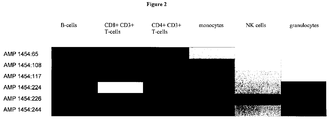
- FIG. 2 shows the measurement of various leukocyte cell fractions, including NK cells.
- Each line represents an exemplary individual CpG in the selected and representative amplicon of the gene FGR (amplicon 1454: FGR-1, SEQ ID NO: 17). Beginning from the left each respective row shows the methylation of the named CpGs in B cells, CD8 positive CD3+ T cells, CD4 positive CD3+ cells, monocytes, NK cells, and granulocytes.
- the color codes indicate the level of methylation in each cell type with blue representing full methylation and green indicating heavily decreased methylation.
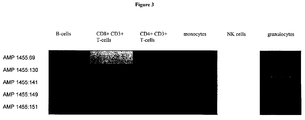
- FIG. 3 shows the measurement of various leukocyte cell fractions, including NK cells.
- Each line represents an exemplary individual CpG in the selected and representative amplicon of the gene NKG7 (amplicon 1455: NKG7-1, SEQ ID NO: 35). Beginning from the left each respective row shows the methylation of the named CpGs in B cells, CD8 positive CD3+ T cells, CD4 positive CD3+ cells, monocytes, NK cells, and granulocytes.
- the color codes indicate the level of methylation in each cell type with blue representing full methylation and green indicating heavily decreased methylation.
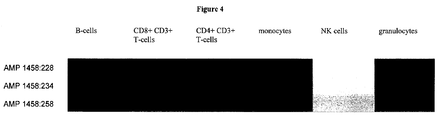
- FIG. 4 shows the measurement of various leukocyte cell fractions, including NK cells.
- Each line represents an exemplary individual CpG in the selected and representative amplicon of the gene GNLY (amplicon 1458: GLNY-1, SEQ ID NO: 29). Beginning from the left each respective row shows the methylation of the named CpGs in B cells, CD8 positive CD3+ T cells, CD4 positive CD3+ cells, monocytes, NK cells, and granulocytes.
- the color codes indicate the level of methylation in each cell type with blue representing full methylation and green indicating heavily decreased methylation.
- the inventors analyzed the methylation status of a multitude of candidate gene regions (amplicons) of NKG7, CX3CR1, FGR and GLNY within various cell types in comparison with an isolated fraction of natural killer cells. Surprisingly it was found, that specific areas in the genomic regions of the genes NKG7, CX3CR1, FGR and GLNY are significantly demethylated in natural killer cells compared to any other cell type. Table 2: Positive-Identifiers for NK-Cells.
- NK-cells Demethylated in NK-cells, methylated in all other cell types Ovar Whole PBMC Mono- Granulo- TH cells Th cells CTL CTL B cells B cells Mean NK Blood cyte cyte naive mem naive mem naive mem Value cells Methylation CpG-ID Gene CD4+C CD4+CD CD8+CD CD8+CD CD 19+ D27+CD 27+CD45 27+CD45 27+CD45 CD45R CD19+C CD5 6+ BCS (Pool) CD 14+ CD15+ 45RA+ RA- RA+ RA- A+ D45RA- other cell Difference BCST19 BCST18 BCST21 BCST22 BCST23 BCST24 BCST25 BCST26 Types T20 Other-NK cg22917 487 CX3C R1 0,88 0,83 0,89 0,92 0,92 0,94 0,90 0,92 0,59 0,57 0,79 0,83 0,13 0,69130567 cg1125
- the inventors have purified various blood subsets including CD3/CD4, CD3/CD8 na ⁇ ve and memory T lymphocytes, CD56 natural killer cells, CD 19 naive and memory B cells, CD 14 monocytes and CD 15 granulocytes.
- DNA from the purified cells was bisulfite-treated and analyzed at various CpG dinucleotide motifs. The inventors then compared the methylation status (finding C as for Cytosine that was methylated in the original (genomic) sequence versus T for cytosine that was unmethylated in the original sequence).
- the inventors have purified various blood subsets including CD3/CD4, CD3/CD8 naive and memory T lymphocytes, CD56 natural killer cells, CD19 na ⁇ ve and memory B cells, CD14 monocytes and CD 15 granulocytes.
- DNA from the purified cells was bisulfite-treated and analyzed at various CpG dinucleotide motifs.
- the inventors then compared the methylation status (finding C as for Cytosine that was methylated in the original (genomic) sequence versus T for cytosine that was unmethylated in the original sequence).
- the inventors have purified various blood subsets including CD3/CD4, CD3/CD8 na ⁇ ve and memory T lymphocytes, CD56 natural killer cells, CD19 na ⁇ ve and memory B cells, CD14 monocytes and CD 15 granulocytes.
- DNA from the purified cells was bisulfite-treated analyzed at various CpG dinucleotide motifs.
- the inventors then compared the methylation status (finding C as for Cytosine that was methylated in the original (genomic) sequence versus T for cytosine that was unmethylated in the original sequence).
- the inventors have purified various blood subsets including CD3/CD4, CD3/CD8 naive and memory T lymphocytes, CD56 natural killer cells, CD19 naive and memory B cells, CD14 monocytes and CD 15 granulocytes.
- DNA from the purified cells was bisulfite-treated analyzed at various CpG dinucleotide motifs.
- the inventors then compared the methylation status (finding C as for Cytosine that was methylated in the original (genomic) sequence versus T for cytosine that was unmethylated in the original sequence).
Landscapes
- Life Sciences & Earth Sciences (AREA)
- Chemical & Material Sciences (AREA)
- Proteomics, Peptides & Aminoacids (AREA)
- Health & Medical Sciences (AREA)
- Organic Chemistry (AREA)
- Zoology (AREA)
- Analytical Chemistry (AREA)
- Wood Science & Technology (AREA)
- Immunology (AREA)
- Engineering & Computer Science (AREA)
- Biotechnology (AREA)
- Microbiology (AREA)
- Molecular Biology (AREA)
- Biophysics (AREA)
- Physics & Mathematics (AREA)
- Cell Biology (AREA)
- Biochemistry (AREA)
- Bioinformatics & Cheminformatics (AREA)
- General Engineering & Computer Science (AREA)
- General Health & Medical Sciences (AREA)
- Genetics & Genomics (AREA)
- Measuring Or Testing Involving Enzymes Or Micro-Organisms (AREA)
Claims (11)
- Verfahren zur Identifizierung von CD56-exprimierenden natürlichen Killerzellen in a Probe abgeleitet von einem Säugetier, umfassend ein Analysieren des Methylierungsstatus der CpG Motive in einem Amplicon gemäß SEQ ID NOs: 29 bis 34, wobei eine Demethylierung der CpG Motive zu mindestens 70% in einer natürlichen Killerzelle in der Probe, wenn verglichen mit einer nicht-natürlichen Killerzelle, eine CD56-exprimierende natürliche Killerzelle anzeigt.
- Verfahren nach Anspruch 1, wobei die CpG Motive in einer CD56-exprimierenden natürlichen Killerzelle in der Probe zu mehr als 80%, bevorzugt zu mehr als 90%, und am meisten bevorzugt zu mehr als 95% demethyliert sind.
- Verfahren nach Anspruch 1 oder 2, wobei die Analyse des Methylierungsstatus ein Verfahren ausgewählt aus Methylierungs-spezifischen enzymatischen Verdaus, Bisulfit-Sequenzierung, einer Analyse ausgewählt aus Promotormethylierung, CpG Insel-Methylierung, MSP, HeavyMethyl, MethyLight, Ms-SNuPE oder anderen Verfahren, die auf dem Nachweis einer amplifizierten DNA beruhen, umfasst.
- Verfahren nach einem der Ansprüche 1 bis 3, weiter umfassend eine Analyse der Marker NKG7, CX3CR1, FGR, CD56, CD16 und/oder CD8.
- Verfahren nach einem der Ansprüche 1 bis 4, wobei die Identifizierung eine Unterscheidung der natürlichen Killerzellen von allen Haupt-peripheren Blutzelltypen oder nicht-Blutzellen umfasst.
- Verfahren nach einem der Ansprüche 1 bis 5, weiter umfassend den Schritt von Schlussfolgern auf den Immunstatus des Säugetiers, basierend auf den natürlichen Killerzellen wie identifiziert.
- Verfahren nach einem der Ansprüche 1 bis 6, wobei eine Demethylierung der CpG-Motive in dem Gen GNLY in Kombination mit einer Demethylierung von mindestens einem CpG Motiv in mindestens einem zweiten Gen ausgewählt aus NKG7, CX3CR1 und FGR eine CD56dim oder CD56bright natürliche Killerzelle anzeigt.
- Verfahren zur Überwachung des Spiegels von CD56-exprimierenden natürlichen Killerzellen, insbesondere CD56dim oder CD56bright und/oder CD16+ oder CD 16- und/oder CD8+ oder CD8- natürlichen Killerzellen in einem Säugetier, umfassend ein Verfahren nach einem der Ansprüche 1 bis 6, und ein Vergleichen der Menge an natürlichen Killerzellen wie identifiziert mit einer früheren Probe, die von demselben Säugetier genommen wurde, und/oder mit einer Kontrollprobe.
- Verfahren nach einem der Ansprüche 1 bis 7, wobei das Säugetier an Autoimmunerkrankungen, Transplantatabstossungen, Krebs, Allergie und/oder jeglicher Erkrankung leidet oder wahrscheinlich leiden wird, die direkt mit NK Zellen korreliert, wie zum Beispiel, aber nicht beschränkt auf, SCID-X1.
- Verfahren nach einem der Ansprüche 1 bis 9, weiter umfassend ein Messen und/oder Überwachen der Menge an natürlichen Killerzellen in Antwort auf chemische und/oder biologische Substanzen, die an das Säugetier verabreicht werden.
- Verwendung eines Amplicons gemäß SEQ ID NOs: 29 bis 34 oder eines Amplicons hergestellt durch ein Primerpaar gemäß SEQ ID NOs: 48, 49 und 138 bis 159, und/oder eines Oligomers, das an eine Sequenz ausgewählt aus SEQ ID NO: 29 bis 34 hybridisiert, bevorzugt eines Oligomers ausgewählt aus SEQ ID NOs: 48, 49 und 138 bis 159, zur Identifizierung und/oder Überwachung von CD56dim oder CD56bright natürlichen Killerzellen in einem Säugetier in einem Verfahren nach einem der Ansprüche 1 bis 10.
Priority Applications (6)
| Application Number | Priority Date | Filing Date | Title |
|---|---|---|---|
| ES09005876.9T ES2607185T3 (es) | 2009-04-28 | 2009-04-28 | GNLY como marcador epigenético para la identificación de linfocitos citolíticos naturales que expresan CD56 |
| PL09005876T PL2248913T3 (pl) | 2009-04-28 | 2009-04-28 | GNLY jako marker epigenetyczny do identyfikacji komórek naturalnej cytotoksyczności ekspresjonujących CD56 |
| EP09005876.9A EP2248913B1 (de) | 2009-04-28 | 2009-04-28 | GNLY als epigenetischer Marker zur Identifikation von CD56-exprimierenden natürlichen Killerzellen |
| US13/318,015 US9096900B2 (en) | 2009-04-28 | 2010-04-28 | Epigenetic marker for the identification of natural killer cells |
| PCT/EP2010/055722 WO2010125106A1 (en) | 2009-04-28 | 2010-04-28 | Epigenetic marker for the identification of natural killer cells |
| CA2760518A CA2760518C (en) | 2009-04-28 | 2010-04-28 | Epigenetic marker for the identification of natural killer cells |
Applications Claiming Priority (1)
| Application Number | Priority Date | Filing Date | Title |
|---|---|---|---|
| EP09005876.9A EP2248913B1 (de) | 2009-04-28 | 2009-04-28 | GNLY als epigenetischer Marker zur Identifikation von CD56-exprimierenden natürlichen Killerzellen |
Publications (2)
| Publication Number | Publication Date |
|---|---|
| EP2248913A1 EP2248913A1 (de) | 2010-11-10 |
| EP2248913B1 true EP2248913B1 (de) | 2016-10-05 |
Family
ID=40887777
Family Applications (1)
| Application Number | Title | Priority Date | Filing Date |
|---|---|---|---|
| EP09005876.9A Active EP2248913B1 (de) | 2009-04-28 | 2009-04-28 | GNLY als epigenetischer Marker zur Identifikation von CD56-exprimierenden natürlichen Killerzellen |
Country Status (6)
| Country | Link |
|---|---|
| US (1) | US9096900B2 (de) |
| EP (1) | EP2248913B1 (de) |
| CA (1) | CA2760518C (de) |
| ES (1) | ES2607185T3 (de) |
| PL (1) | PL2248913T3 (de) |
| WO (1) | WO2010125106A1 (de) |
Families Citing this family (7)
| Publication number | Priority date | Publication date | Assignee | Title |
|---|---|---|---|---|
| EP2354242A1 (de) | 2010-02-03 | 2011-08-10 | Epiontis GmbH | Assay zur Bestimmung des Typs und/oder des Zustands eines zellbasierten epigenetischen Musters und der chromatischen Struktur |
| GB201112586D0 (en) * | 2011-07-22 | 2011-09-07 | Epiontis Gmbh | Epigenetic marker for the identification of natural killer cells |
| GB201221133D0 (en) | 2012-11-23 | 2013-01-09 | Epiontis Gmbh | Epigenetic method for the identification of subpopulations of CD8 and T lympocytes, in particular CD8 alpha and beta T lymphocytes |
| CN105189783B (zh) * | 2013-04-19 | 2020-08-07 | 艾皮恩蒂斯有限公司 | 鉴定生物样品中定量细胞组成的方法 |
| GB201516971D0 (en) * | 2015-09-25 | 2015-11-11 | Epiontis Gmbh | MVD as epigenetic marker for the identification of immune cells, in particular CD56+ NK cells |
| GB201516975D0 (en) | 2015-09-25 | 2015-11-11 | Epiontis Gmbh | PARK2 as epigenetic marker for the identification of immune cells, in particular monocytes |
| EP3382033B1 (de) * | 2017-03-30 | 2020-08-05 | Rheinisch-Westfälische Technische Hochschule (RWTH) Aachen | Verfahren zur bestimmung von blutkörperchenzahlen auf der basis der dns methylierung |
Family Cites Families (3)
| Publication number | Priority date | Publication date | Assignee | Title |
|---|---|---|---|---|
| JP2002171973A (ja) | 2000-12-07 | 2002-06-18 | Univ Tokyo | Dnaメチル化パターンによる細胞の同定法 |
| AU2003285586A1 (en) | 2002-12-03 | 2004-06-23 | Medical Research Council | Regulatory t-cells |
| ATE508207T1 (de) | 2006-02-28 | 2011-05-15 | Charite Universitaetsmedizin | Nachweis und qualitätskontrolle von regulator-t- zellen mittels dna-methylierungsanalyse des foxp3-gens |
-
2009
- 2009-04-28 EP EP09005876.9A patent/EP2248913B1/de active Active
- 2009-04-28 ES ES09005876.9T patent/ES2607185T3/es active Active
- 2009-04-28 PL PL09005876T patent/PL2248913T3/pl unknown
-
2010
- 2010-04-28 CA CA2760518A patent/CA2760518C/en active Active
- 2010-04-28 US US13/318,015 patent/US9096900B2/en active Active
- 2010-04-28 WO PCT/EP2010/055722 patent/WO2010125106A1/en not_active Ceased
Also Published As
| Publication number | Publication date |
|---|---|
| ES2607185T3 (es) | 2017-03-29 |
| EP2248913A1 (de) | 2010-11-10 |
| PL2248913T3 (pl) | 2017-04-28 |
| US20120094290A1 (en) | 2012-04-19 |
| WO2010125106A1 (en) | 2010-11-04 |
| US9096900B2 (en) | 2015-08-04 |
| CA2760518A1 (en) | 2010-11-04 |
| CA2760518C (en) | 2018-06-26 |
Similar Documents
| Publication | Publication Date | Title |
|---|---|---|
| EP1826279B1 (de) | Nachweis und Qualitätskontrolle von Regulator-T-Zellen mittels DNA-Methylierungsanalyse des FoxP3-Gens | |
| EP2248913B1 (de) | GNLY als epigenetischer Marker zur Identifikation von CD56-exprimierenden natürlichen Killerzellen | |
| EP2376648B1 (de) | Epigenetische marker zur identifikation von cd3+ t-lymphozyten | |
| CN108026590B (zh) | Park2作为用于鉴定免疫细胞特别是单核细胞的表观遗传标志物 | |
| US10294527B2 (en) | Epigenetic marker for the identification of natural killer cells | |
| CN108026577B (zh) | Mvd作为用于鉴定免疫细胞特别是cd56+nk细胞的表观遗传标志物 | |
| ES2700790T3 (es) | Marcador epigenético para la identificación de linfocitos T il17 positivos en muestras complejas | |
| WO2024245833A1 (en) | Lag3 as epigenetic marker for the identification of immune cells | |
| Mao et al. | Cloning and functional characterization of chicken stem cell antigen 2 | |
| WO2024245656A1 (en) | Gata 3 as epigenetic marker for the identification of immune cells | |
| US20230265507A1 (en) | Myh11/nde1 region as epigenetic marker for the identification of endothelial progenitor cells (epcs) | |
| NZ618191A (en) | Molecular diagnostic test for cancer | |
| NZ618191B2 (en) | Molecular diagnostic test for cancer | |
| HK1163189B (en) | Epigenetic markers for the identification of cd3 positive t-lymphocytes |
Legal Events
| Date | Code | Title | Description |
|---|---|---|---|
| PUAI | Public reference made under article 153(3) epc to a published international application that has entered the european phase |
Free format text: ORIGINAL CODE: 0009012 |
|
| AK | Designated contracting states |
Kind code of ref document: A1 Designated state(s): AT BE BG CH CY CZ DE DK EE ES FI FR GB GR HR HU IE IS IT LI LT LU LV MC MK MT NL NO PL PT RO SE SI SK TR |
|
| AX | Request for extension of the european patent |
Extension state: AL BA RS |
|
| 17P | Request for examination filed |
Effective date: 20110509 |
|
| 17Q | First examination report despatched |
Effective date: 20110530 |
|
| GRAP | Despatch of communication of intention to grant a patent |
Free format text: ORIGINAL CODE: EPIDOSNIGR1 |
|
| INTG | Intention to grant announced |
Effective date: 20160421 |
|
| GRAS | Grant fee paid |
Free format text: ORIGINAL CODE: EPIDOSNIGR3 |
|
| GRAA | (expected) grant |
Free format text: ORIGINAL CODE: 0009210 |
|
| AK | Designated contracting states |
Kind code of ref document: B1 Designated state(s): AT BE BG CH CY CZ DE DK EE ES FI FR GB GR HR HU IE IS IT LI LT LU LV MC MK MT NL NO PL PT RO SE SI SK TR |
|
| REG | Reference to a national code |
Ref country code: GB Ref legal event code: FG4D |
|
| REG | Reference to a national code |
Ref country code: CH Ref legal event code: EP |
|
| REG | Reference to a national code |
Ref country code: AT Ref legal event code: REF Ref document number: 834719 Country of ref document: AT Kind code of ref document: T Effective date: 20161015 |
|
| REG | Reference to a national code |
Ref country code: IE Ref legal event code: FG4D |
|
| REG | Reference to a national code |
Ref country code: CH Ref legal event code: NV Representative=s name: KATZAROV S.A., CH |
|
| REG | Reference to a national code |
Ref country code: DE Ref legal event code: R096 Ref document number: 602009041494 Country of ref document: DE |
|
| REG | Reference to a national code |
Ref country code: NL Ref legal event code: FP |
|
| REG | Reference to a national code |
Ref country code: LT Ref legal event code: MG4D |
|
| PG25 | Lapsed in a contracting state [announced via postgrant information from national office to epo] |
Ref country code: LV Free format text: LAPSE BECAUSE OF FAILURE TO SUBMIT A TRANSLATION OF THE DESCRIPTION OR TO PAY THE FEE WITHIN THE PRESCRIBED TIME-LIMIT Effective date: 20161005 |
|
| REG | Reference to a national code |
Ref country code: FR Ref legal event code: PLFP Year of fee payment: 9 |
|
| PG25 | Lapsed in a contracting state [announced via postgrant information from national office to epo] |
Ref country code: SE Free format text: LAPSE BECAUSE OF FAILURE TO SUBMIT A TRANSLATION OF THE DESCRIPTION OR TO PAY THE FEE WITHIN THE PRESCRIBED TIME-LIMIT Effective date: 20161005 Ref country code: LT Free format text: LAPSE BECAUSE OF FAILURE TO SUBMIT A TRANSLATION OF THE DESCRIPTION OR TO PAY THE FEE WITHIN THE PRESCRIBED TIME-LIMIT Effective date: 20161005 Ref country code: GR Free format text: LAPSE BECAUSE OF FAILURE TO SUBMIT A TRANSLATION OF THE DESCRIPTION OR TO PAY THE FEE WITHIN THE PRESCRIBED TIME-LIMIT Effective date: 20170106 Ref country code: NO Free format text: LAPSE BECAUSE OF FAILURE TO SUBMIT A TRANSLATION OF THE DESCRIPTION OR TO PAY THE FEE WITHIN THE PRESCRIBED TIME-LIMIT Effective date: 20170105 |
|
| PG25 | Lapsed in a contracting state [announced via postgrant information from national office to epo] |
Ref country code: IS Free format text: LAPSE BECAUSE OF FAILURE TO SUBMIT A TRANSLATION OF THE DESCRIPTION OR TO PAY THE FEE WITHIN THE PRESCRIBED TIME-LIMIT Effective date: 20170205 Ref country code: PT Free format text: LAPSE BECAUSE OF FAILURE TO SUBMIT A TRANSLATION OF THE DESCRIPTION OR TO PAY THE FEE WITHIN THE PRESCRIBED TIME-LIMIT Effective date: 20170206 Ref country code: HR Free format text: LAPSE BECAUSE OF FAILURE TO SUBMIT A TRANSLATION OF THE DESCRIPTION OR TO PAY THE FEE WITHIN THE PRESCRIBED TIME-LIMIT Effective date: 20161005 Ref country code: FI Free format text: LAPSE BECAUSE OF FAILURE TO SUBMIT A TRANSLATION OF THE DESCRIPTION OR TO PAY THE FEE WITHIN THE PRESCRIBED TIME-LIMIT Effective date: 20161005 |
|
| REG | Reference to a national code |
Ref country code: DE Ref legal event code: R097 Ref document number: 602009041494 Country of ref document: DE |
|
| PG25 | Lapsed in a contracting state [announced via postgrant information from national office to epo] |
Ref country code: RO Free format text: LAPSE BECAUSE OF FAILURE TO SUBMIT A TRANSLATION OF THE DESCRIPTION OR TO PAY THE FEE WITHIN THE PRESCRIBED TIME-LIMIT Effective date: 20161005 Ref country code: SK Free format text: LAPSE BECAUSE OF FAILURE TO SUBMIT A TRANSLATION OF THE DESCRIPTION OR TO PAY THE FEE WITHIN THE PRESCRIBED TIME-LIMIT Effective date: 20161005 Ref country code: DK Free format text: LAPSE BECAUSE OF FAILURE TO SUBMIT A TRANSLATION OF THE DESCRIPTION OR TO PAY THE FEE WITHIN THE PRESCRIBED TIME-LIMIT Effective date: 20161005 Ref country code: EE Free format text: LAPSE BECAUSE OF FAILURE TO SUBMIT A TRANSLATION OF THE DESCRIPTION OR TO PAY THE FEE WITHIN THE PRESCRIBED TIME-LIMIT Effective date: 20161005 |
|
| PLBE | No opposition filed within time limit |
Free format text: ORIGINAL CODE: 0009261 |
|
| STAA | Information on the status of an ep patent application or granted ep patent |
Free format text: STATUS: NO OPPOSITION FILED WITHIN TIME LIMIT |
|
| PG25 | Lapsed in a contracting state [announced via postgrant information from national office to epo] |
Ref country code: BG Free format text: LAPSE BECAUSE OF FAILURE TO SUBMIT A TRANSLATION OF THE DESCRIPTION OR TO PAY THE FEE WITHIN THE PRESCRIBED TIME-LIMIT Effective date: 20170105 |
|
| 26N | No opposition filed |
Effective date: 20170706 |
|
| PG25 | Lapsed in a contracting state [announced via postgrant information from national office to epo] |
Ref country code: SI Free format text: LAPSE BECAUSE OF FAILURE TO SUBMIT A TRANSLATION OF THE DESCRIPTION OR TO PAY THE FEE WITHIN THE PRESCRIBED TIME-LIMIT Effective date: 20161005 |
|
| PG25 | Lapsed in a contracting state [announced via postgrant information from national office to epo] |
Ref country code: MC Free format text: LAPSE BECAUSE OF FAILURE TO SUBMIT A TRANSLATION OF THE DESCRIPTION OR TO PAY THE FEE WITHIN THE PRESCRIBED TIME-LIMIT Effective date: 20161005 |
|
| REG | Reference to a national code |
Ref country code: CH Ref legal event code: PCAR Free format text: NEW ADDRESS: AVENUE DES MORGINES 12, 1213 PETIT-LANCY (CH) |
|
| REG | Reference to a national code |
Ref country code: FR Ref legal event code: PLFP Year of fee payment: 10 |
|
| PG25 | Lapsed in a contracting state [announced via postgrant information from national office to epo] |
Ref country code: MT Free format text: LAPSE BECAUSE OF NON-PAYMENT OF DUE FEES Effective date: 20170428 |
|
| REG | Reference to a national code |
Ref country code: AT Ref legal event code: UEP Ref document number: 834719 Country of ref document: AT Kind code of ref document: T Effective date: 20161005 |
|
| PG25 | Lapsed in a contracting state [announced via postgrant information from national office to epo] |
Ref country code: HU Free format text: LAPSE BECAUSE OF FAILURE TO SUBMIT A TRANSLATION OF THE DESCRIPTION OR TO PAY THE FEE WITHIN THE PRESCRIBED TIME-LIMIT; INVALID AB INITIO Effective date: 20090428 |
|
| PG25 | Lapsed in a contracting state [announced via postgrant information from national office to epo] |
Ref country code: CY Free format text: LAPSE BECAUSE OF NON-PAYMENT OF DUE FEES Effective date: 20161005 |
|
| PG25 | Lapsed in a contracting state [announced via postgrant information from national office to epo] |
Ref country code: MK Free format text: LAPSE BECAUSE OF FAILURE TO SUBMIT A TRANSLATION OF THE DESCRIPTION OR TO PAY THE FEE WITHIN THE PRESCRIBED TIME-LIMIT Effective date: 20161005 |
|
| PG25 | Lapsed in a contracting state [announced via postgrant information from national office to epo] |
Ref country code: TR Free format text: LAPSE BECAUSE OF FAILURE TO SUBMIT A TRANSLATION OF THE DESCRIPTION OR TO PAY THE FEE WITHIN THE PRESCRIBED TIME-LIMIT Effective date: 20161005 |
|
| PGFP | Annual fee paid to national office [announced via postgrant information from national office to epo] |
Ref country code: CZ Payment date: 20200422 Year of fee payment: 12 Ref country code: IE Payment date: 20200409 Year of fee payment: 12 Ref country code: LU Payment date: 20200414 Year of fee payment: 12 Ref country code: NL Payment date: 20200417 Year of fee payment: 12 Ref country code: ES Payment date: 20200504 Year of fee payment: 12 |
|
| PGFP | Annual fee paid to national office [announced via postgrant information from national office to epo] |
Ref country code: IT Payment date: 20200414 Year of fee payment: 12 Ref country code: BE Payment date: 20200416 Year of fee payment: 12 Ref country code: PL Payment date: 20200415 Year of fee payment: 12 |
|
| PGFP | Annual fee paid to national office [announced via postgrant information from national office to epo] |
Ref country code: AT Payment date: 20200409 Year of fee payment: 12 |
|
| REG | Reference to a national code |
Ref country code: NL Ref legal event code: MM Effective date: 20210501 |
|
| REG | Reference to a national code |
Ref country code: AT Ref legal event code: MM01 Ref document number: 834719 Country of ref document: AT Kind code of ref document: T Effective date: 20210428 |
|
| PG25 | Lapsed in a contracting state [announced via postgrant information from national office to epo] |
Ref country code: LU Free format text: LAPSE BECAUSE OF NON-PAYMENT OF DUE FEES Effective date: 20210428 |
|
| REG | Reference to a national code |
Ref country code: BE Ref legal event code: MM Effective date: 20210430 |
|
| PG25 | Lapsed in a contracting state [announced via postgrant information from national office to epo] |
Ref country code: AT Free format text: LAPSE BECAUSE OF NON-PAYMENT OF DUE FEES Effective date: 20210428 Ref country code: CZ Free format text: LAPSE BECAUSE OF NON-PAYMENT OF DUE FEES Effective date: 20210428 |
|
| PG25 | Lapsed in a contracting state [announced via postgrant information from national office to epo] |
Ref country code: NL Free format text: LAPSE BECAUSE OF NON-PAYMENT OF DUE FEES Effective date: 20210501 |
|
| PG25 | Lapsed in a contracting state [announced via postgrant information from national office to epo] |
Ref country code: IE Free format text: LAPSE BECAUSE OF NON-PAYMENT OF DUE FEES Effective date: 20210428 |
|
| REG | Reference to a national code |
Ref country code: ES Ref legal event code: FD2A Effective date: 20220728 |
|
| PG25 | Lapsed in a contracting state [announced via postgrant information from national office to epo] |
Ref country code: BE Free format text: LAPSE BECAUSE OF NON-PAYMENT OF DUE FEES Effective date: 20210430 |
|
| PG25 | Lapsed in a contracting state [announced via postgrant information from national office to epo] |
Ref country code: ES Free format text: LAPSE BECAUSE OF NON-PAYMENT OF DUE FEES Effective date: 20210429 |
|
| REG | Reference to a national code |
Ref country code: DE Ref legal event code: R082 Ref document number: 602009041494 Country of ref document: DE Representative=s name: KRAUSS, JAN, DR., DE |
|
| PG25 | Lapsed in a contracting state [announced via postgrant information from national office to epo] |
Ref country code: PL Free format text: LAPSE BECAUSE OF NON-PAYMENT OF DUE FEES Effective date: 20210428 |
|
| PG25 | Lapsed in a contracting state [announced via postgrant information from national office to epo] |
Ref country code: IT Free format text: LAPSE BECAUSE OF NON-PAYMENT OF DUE FEES Effective date: 20200428 |
|
| P01 | Opt-out of the competence of the unified patent court (upc) registered |
Effective date: 20230525 |
|
| PGFP | Annual fee paid to national office [announced via postgrant information from national office to epo] |
Ref country code: DE Payment date: 20250417 Year of fee payment: 17 |
|
| PGFP | Annual fee paid to national office [announced via postgrant information from national office to epo] |
Ref country code: GB Payment date: 20250423 Year of fee payment: 17 |
|
| PGFP | Annual fee paid to national office [announced via postgrant information from national office to epo] |
Ref country code: FR Payment date: 20250422 Year of fee payment: 17 |
|
| PGFP | Annual fee paid to national office [announced via postgrant information from national office to epo] |
Ref country code: CH Payment date: 20250501 Year of fee payment: 17 |
|
| PG25 | Lapsed in a contracting state [announced via postgrant information from national office to epo] |
Ref country code: IT Free format text: LAPSE BECAUSE OF NON-PAYMENT OF DUE FEES Effective date: 20210428 |