EP2248879A1 - Lubricant composition for continuously variable transmission - Google Patents
Lubricant composition for continuously variable transmission Download PDFInfo
- Publication number
- EP2248879A1 EP2248879A1 EP09710374A EP09710374A EP2248879A1 EP 2248879 A1 EP2248879 A1 EP 2248879A1 EP 09710374 A EP09710374 A EP 09710374A EP 09710374 A EP09710374 A EP 09710374A EP 2248879 A1 EP2248879 A1 EP 2248879A1
- Authority
- EP
- European Patent Office
- Prior art keywords
- lubricating oil
- alkaline earth
- earth metal
- oil composition
- composition according
- Prior art date
- Legal status (The legal status is an assumption and is not a legal conclusion. Google has not performed a legal analysis and makes no representation as to the accuracy of the status listed.)
- Granted
Links
Classifications
-
- C—CHEMISTRY; METALLURGY
- C10—PETROLEUM, GAS OR COKE INDUSTRIES; TECHNICAL GASES CONTAINING CARBON MONOXIDE; FUELS; LUBRICANTS; PEAT
- C10M—LUBRICATING COMPOSITIONS; USE OF CHEMICAL SUBSTANCES EITHER ALONE OR AS LUBRICATING INGREDIENTS IN A LUBRICATING COMPOSITION
- C10M163/00—Lubricating compositions characterised by the additive being a mixture of a compound of unknown or incompletely defined constitution and a non-macromolecular compound, each of these compounds being essential
-
- C—CHEMISTRY; METALLURGY
- C10—PETROLEUM, GAS OR COKE INDUSTRIES; TECHNICAL GASES CONTAINING CARBON MONOXIDE; FUELS; LUBRICANTS; PEAT
- C10M—LUBRICATING COMPOSITIONS; USE OF CHEMICAL SUBSTANCES EITHER ALONE OR AS LUBRICATING INGREDIENTS IN A LUBRICATING COMPOSITION
- C10M169/00—Lubricating compositions characterised by containing as components a mixture of at least two types of ingredient selected from base-materials, thickeners or additives, covered by the preceding groups, each of these compounds being essential
-
- C—CHEMISTRY; METALLURGY
- C10—PETROLEUM, GAS OR COKE INDUSTRIES; TECHNICAL GASES CONTAINING CARBON MONOXIDE; FUELS; LUBRICANTS; PEAT
- C10M—LUBRICATING COMPOSITIONS; USE OF CHEMICAL SUBSTANCES EITHER ALONE OR AS LUBRICATING INGREDIENTS IN A LUBRICATING COMPOSITION
- C10M2203/00—Organic non-macromolecular hydrocarbon compounds and hydrocarbon fractions as ingredients in lubricant compositions
- C10M2203/10—Petroleum or coal fractions, e.g. tars, solvents, bitumen
- C10M2203/102—Aliphatic fractions
- C10M2203/1025—Aliphatic fractions used as base material
-
- C—CHEMISTRY; METALLURGY
- C10—PETROLEUM, GAS OR COKE INDUSTRIES; TECHNICAL GASES CONTAINING CARBON MONOXIDE; FUELS; LUBRICANTS; PEAT
- C10M—LUBRICATING COMPOSITIONS; USE OF CHEMICAL SUBSTANCES EITHER ALONE OR AS LUBRICATING INGREDIENTS IN A LUBRICATING COMPOSITION
- C10M2207/00—Organic non-macromolecular hydrocarbon compounds containing hydrogen, carbon and oxygen as ingredients in lubricant compositions
- C10M2207/02—Hydroxy compounds
- C10M2207/023—Hydroxy compounds having hydroxy groups bound to carbon atoms of six-membered aromatic rings
- C10M2207/028—Overbased salts thereof
-
- C—CHEMISTRY; METALLURGY
- C10—PETROLEUM, GAS OR COKE INDUSTRIES; TECHNICAL GASES CONTAINING CARBON MONOXIDE; FUELS; LUBRICANTS; PEAT
- C10M—LUBRICATING COMPOSITIONS; USE OF CHEMICAL SUBSTANCES EITHER ALONE OR AS LUBRICATING INGREDIENTS IN A LUBRICATING COMPOSITION
- C10M2207/00—Organic non-macromolecular hydrocarbon compounds containing hydrogen, carbon and oxygen as ingredients in lubricant compositions
- C10M2207/26—Overbased carboxylic acid salts
-
- C—CHEMISTRY; METALLURGY
- C10—PETROLEUM, GAS OR COKE INDUSTRIES; TECHNICAL GASES CONTAINING CARBON MONOXIDE; FUELS; LUBRICANTS; PEAT
- C10M—LUBRICATING COMPOSITIONS; USE OF CHEMICAL SUBSTANCES EITHER ALONE OR AS LUBRICATING INGREDIENTS IN A LUBRICATING COMPOSITION
- C10M2207/00—Organic non-macromolecular hydrocarbon compounds containing hydrogen, carbon and oxygen as ingredients in lubricant compositions
- C10M2207/26—Overbased carboxylic acid salts
- C10M2207/262—Overbased carboxylic acid salts derived from hydroxy substituted aromatic acids, e.g. salicylates
-
- C—CHEMISTRY; METALLURGY
- C10—PETROLEUM, GAS OR COKE INDUSTRIES; TECHNICAL GASES CONTAINING CARBON MONOXIDE; FUELS; LUBRICANTS; PEAT
- C10M—LUBRICATING COMPOSITIONS; USE OF CHEMICAL SUBSTANCES EITHER ALONE OR AS LUBRICATING INGREDIENTS IN A LUBRICATING COMPOSITION
- C10M2215/00—Organic non-macromolecular compounds containing nitrogen as ingredients in lubricant Compositions
- C10M2215/02—Amines, e.g. polyalkylene polyamines; Quaternary amines
- C10M2215/06—Amines, e.g. polyalkylene polyamines; Quaternary amines having amino groups bound to carbon atoms of six-membered aromatic rings
- C10M2215/064—Di- and triaryl amines
-
- C—CHEMISTRY; METALLURGY
- C10—PETROLEUM, GAS OR COKE INDUSTRIES; TECHNICAL GASES CONTAINING CARBON MONOXIDE; FUELS; LUBRICANTS; PEAT
- C10M—LUBRICATING COMPOSITIONS; USE OF CHEMICAL SUBSTANCES EITHER ALONE OR AS LUBRICATING INGREDIENTS IN A LUBRICATING COMPOSITION
- C10M2215/00—Organic non-macromolecular compounds containing nitrogen as ingredients in lubricant Compositions
- C10M2215/086—Imides [having hydrocarbon substituents containing less than thirty carbon atoms]
-
- C—CHEMISTRY; METALLURGY
- C10—PETROLEUM, GAS OR COKE INDUSTRIES; TECHNICAL GASES CONTAINING CARBON MONOXIDE; FUELS; LUBRICANTS; PEAT
- C10M—LUBRICATING COMPOSITIONS; USE OF CHEMICAL SUBSTANCES EITHER ALONE OR AS LUBRICATING INGREDIENTS IN A LUBRICATING COMPOSITION
- C10M2215/00—Organic non-macromolecular compounds containing nitrogen as ingredients in lubricant Compositions
- C10M2215/24—Organic non-macromolecular compounds containing nitrogen as ingredients in lubricant Compositions having hydrocarbon substituents containing thirty or more carbon atoms, e.g. nitrogen derivatives of substituted succinic acid
- C10M2215/28—Amides; Imides
-
- C—CHEMISTRY; METALLURGY
- C10—PETROLEUM, GAS OR COKE INDUSTRIES; TECHNICAL GASES CONTAINING CARBON MONOXIDE; FUELS; LUBRICANTS; PEAT
- C10M—LUBRICATING COMPOSITIONS; USE OF CHEMICAL SUBSTANCES EITHER ALONE OR AS LUBRICATING INGREDIENTS IN A LUBRICATING COMPOSITION
- C10M2219/00—Organic non-macromolecular compounds containing sulfur, selenium or tellurium as ingredients in lubricant compositions
- C10M2219/04—Organic non-macromolecular compounds containing sulfur, selenium or tellurium as ingredients in lubricant compositions containing sulfur-to-oxygen bonds, i.e. sulfones, sulfoxides
- C10M2219/046—Overbased sulfonic acid salts
-
- C—CHEMISTRY; METALLURGY
- C10—PETROLEUM, GAS OR COKE INDUSTRIES; TECHNICAL GASES CONTAINING CARBON MONOXIDE; FUELS; LUBRICANTS; PEAT
- C10M—LUBRICATING COMPOSITIONS; USE OF CHEMICAL SUBSTANCES EITHER ALONE OR AS LUBRICATING INGREDIENTS IN A LUBRICATING COMPOSITION
- C10M2219/00—Organic non-macromolecular compounds containing sulfur, selenium or tellurium as ingredients in lubricant compositions
- C10M2219/08—Thiols; Sulfides; Polysulfides; Mercaptals
- C10M2219/082—Thiols; Sulfides; Polysulfides; Mercaptals containing sulfur atoms bound to acyclic or cycloaliphatic carbon atoms
- C10M2219/087—Thiols; Sulfides; Polysulfides; Mercaptals containing sulfur atoms bound to acyclic or cycloaliphatic carbon atoms containing hydroxy groups; Derivatives thereof, e.g. sulfurised phenols
- C10M2219/089—Overbased salts
-
- C—CHEMISTRY; METALLURGY
- C10—PETROLEUM, GAS OR COKE INDUSTRIES; TECHNICAL GASES CONTAINING CARBON MONOXIDE; FUELS; LUBRICANTS; PEAT
- C10M—LUBRICATING COMPOSITIONS; USE OF CHEMICAL SUBSTANCES EITHER ALONE OR AS LUBRICATING INGREDIENTS IN A LUBRICATING COMPOSITION
- C10M2223/00—Organic non-macromolecular compounds containing phosphorus as ingredients in lubricant compositions
- C10M2223/02—Organic non-macromolecular compounds containing phosphorus as ingredients in lubricant compositions having no phosphorus-to-carbon bonds
- C10M2223/04—Phosphate esters
-
- C—CHEMISTRY; METALLURGY
- C10—PETROLEUM, GAS OR COKE INDUSTRIES; TECHNICAL GASES CONTAINING CARBON MONOXIDE; FUELS; LUBRICANTS; PEAT
- C10M—LUBRICATING COMPOSITIONS; USE OF CHEMICAL SUBSTANCES EITHER ALONE OR AS LUBRICATING INGREDIENTS IN A LUBRICATING COMPOSITION
- C10M2223/00—Organic non-macromolecular compounds containing phosphorus as ingredients in lubricant compositions
- C10M2223/02—Organic non-macromolecular compounds containing phosphorus as ingredients in lubricant compositions having no phosphorus-to-carbon bonds
- C10M2223/04—Phosphate esters
- C10M2223/041—Triaryl phosphates
-
- C—CHEMISTRY; METALLURGY
- C10—PETROLEUM, GAS OR COKE INDUSTRIES; TECHNICAL GASES CONTAINING CARBON MONOXIDE; FUELS; LUBRICANTS; PEAT
- C10M—LUBRICATING COMPOSITIONS; USE OF CHEMICAL SUBSTANCES EITHER ALONE OR AS LUBRICATING INGREDIENTS IN A LUBRICATING COMPOSITION
- C10M2223/00—Organic non-macromolecular compounds containing phosphorus as ingredients in lubricant compositions
- C10M2223/02—Organic non-macromolecular compounds containing phosphorus as ingredients in lubricant compositions having no phosphorus-to-carbon bonds
- C10M2223/04—Phosphate esters
- C10M2223/047—Thioderivatives not containing metallic elements
-
- C—CHEMISTRY; METALLURGY
- C10—PETROLEUM, GAS OR COKE INDUSTRIES; TECHNICAL GASES CONTAINING CARBON MONOXIDE; FUELS; LUBRICANTS; PEAT
- C10M—LUBRICATING COMPOSITIONS; USE OF CHEMICAL SUBSTANCES EITHER ALONE OR AS LUBRICATING INGREDIENTS IN A LUBRICATING COMPOSITION
- C10M2229/00—Organic macromolecular compounds containing atoms of elements not provided for in groups C10M2205/00, C10M2209/00, C10M2213/00, C10M2217/00, C10M2221/00 or C10M2225/00 as ingredients in lubricant compositions
- C10M2229/02—Unspecified siloxanes; Silicones
-
- C—CHEMISTRY; METALLURGY
- C10—PETROLEUM, GAS OR COKE INDUSTRIES; TECHNICAL GASES CONTAINING CARBON MONOXIDE; FUELS; LUBRICANTS; PEAT
- C10N—INDEXING SCHEME ASSOCIATED WITH SUBCLASS C10M RELATING TO LUBRICATING COMPOSITIONS
- C10N2010/00—Metal present as such or in compounds
- C10N2010/04—Groups 2 or 12
-
- C—CHEMISTRY; METALLURGY
- C10—PETROLEUM, GAS OR COKE INDUSTRIES; TECHNICAL GASES CONTAINING CARBON MONOXIDE; FUELS; LUBRICANTS; PEAT
- C10N—INDEXING SCHEME ASSOCIATED WITH SUBCLASS C10M RELATING TO LUBRICATING COMPOSITIONS
- C10N2020/00—Specified physical or chemical properties or characteristics, i.e. function, of component of lubricating compositions
- C10N2020/01—Physico-chemical properties
-
- C—CHEMISTRY; METALLURGY
- C10—PETROLEUM, GAS OR COKE INDUSTRIES; TECHNICAL GASES CONTAINING CARBON MONOXIDE; FUELS; LUBRICANTS; PEAT
- C10N—INDEXING SCHEME ASSOCIATED WITH SUBCLASS C10M RELATING TO LUBRICATING COMPOSITIONS
- C10N2020/00—Specified physical or chemical properties or characteristics, i.e. function, of component of lubricating compositions
- C10N2020/01—Physico-chemical properties
- C10N2020/077—Ionic Liquids
-
- C—CHEMISTRY; METALLURGY
- C10—PETROLEUM, GAS OR COKE INDUSTRIES; TECHNICAL GASES CONTAINING CARBON MONOXIDE; FUELS; LUBRICANTS; PEAT
- C10N—INDEXING SCHEME ASSOCIATED WITH SUBCLASS C10M RELATING TO LUBRICATING COMPOSITIONS
- C10N2030/00—Specified physical or chemical properties which is improved by the additive characterising the lubricating composition, e.g. multifunctional additives
- C10N2030/02—Pour-point; Viscosity index
-
- C—CHEMISTRY; METALLURGY
- C10—PETROLEUM, GAS OR COKE INDUSTRIES; TECHNICAL GASES CONTAINING CARBON MONOXIDE; FUELS; LUBRICANTS; PEAT
- C10N—INDEXING SCHEME ASSOCIATED WITH SUBCLASS C10M RELATING TO LUBRICATING COMPOSITIONS
- C10N2030/00—Specified physical or chemical properties which is improved by the additive characterising the lubricating composition, e.g. multifunctional additives
- C10N2030/06—Oiliness; Film-strength; Anti-wear; Resistance to extreme pressure
-
- C—CHEMISTRY; METALLURGY
- C10—PETROLEUM, GAS OR COKE INDUSTRIES; TECHNICAL GASES CONTAINING CARBON MONOXIDE; FUELS; LUBRICANTS; PEAT
- C10N—INDEXING SCHEME ASSOCIATED WITH SUBCLASS C10M RELATING TO LUBRICATING COMPOSITIONS
- C10N2040/00—Specified use or application for which the lubricating composition is intended
- C10N2040/04—Oil-bath; Gear-boxes; Automatic transmissions; Traction drives
- C10N2040/045—Oil-bath; Gear-boxes; Automatic transmissions; Traction drives for continuous variable transmission [CVT]
-
- C—CHEMISTRY; METALLURGY
- C10—PETROLEUM, GAS OR COKE INDUSTRIES; TECHNICAL GASES CONTAINING CARBON MONOXIDE; FUELS; LUBRICANTS; PEAT
- C10N—INDEXING SCHEME ASSOCIATED WITH SUBCLASS C10M RELATING TO LUBRICATING COMPOSITIONS
- C10N2040/00—Specified use or application for which the lubricating composition is intended
- C10N2040/04—Oil-bath; Gear-boxes; Automatic transmissions; Traction drives
- C10N2040/046—Oil-bath; Gear-boxes; Automatic transmissions; Traction drives for traction drives
-
- C—CHEMISTRY; METALLURGY
- C10—PETROLEUM, GAS OR COKE INDUSTRIES; TECHNICAL GASES CONTAINING CARBON MONOXIDE; FUELS; LUBRICANTS; PEAT
- C10N—INDEXING SCHEME ASSOCIATED WITH SUBCLASS C10M RELATING TO LUBRICATING COMPOSITIONS
- C10N2060/00—Chemical after-treatment of the constituents of the lubricating composition
- C10N2060/14—Chemical after-treatment of the constituents of the lubricating composition by boron or a compound containing boron
Definitions
- the present invention relates to a lubricating oil composition for a continuously variable transmission.
- a lubricating oil used for such a continuously variable transmission is required to have a high power (torque) transmission capacity. Accordingly, there have been known various kinds of lubricating oil compositions with a large power transmission capacity enough to allow a favorable power transmission (e.g., see Patent Documents 1 and 2).
- a lubricating oil composition disclosed in Patent Document 1 is excellent in abrasion resistance and extreme pressure property and is capable of maintaining a high friction coefficient for a long time.
- this lubricating oil composition is formed by adding a base oil of lubricating oil with a sulfuric extreme pressure agent, a phosphorus extreme pressure agent and an alkali earth metal detergent.
- a lubricating oil composition disclosed in Patent Document 2 is formed by adding a base oil of lubricating oil with an effective amount of succinic bisimide having a predetermined structure in order to increase the power transmission capacity of the lubricating oil composition and to improve the anti-shudder property thereof.
- a sulfonate detergent and boron-containing succinimide are mixed, thereby improving the torque transmission capacity of the lubricating oil composition and the antiwear property of a wet-type friction agent.
- Patent Document 1 JP-A-9-100487
- Patent Document 2 JP-A-9-202890
- Patent Document 3 JP-A-2007-126543
- lubricating oil compositions as follows are provided.
- the lubricating oil composition according to the aspect of the invention is preferably used for a belt-type continuously variable transmission particularly with a metal belt.
- a lubricating oil composition for a continuously variable transmission of the invention is formed by adding a base oil of lubricating oil with (A) an acidic phosphorus compound, (B) an imide compound and (C) an alkaline earth metal salt. A detailed description thereof will be made below.
- a base oil of lubricating oil at least one of mineral oil and synthetic oil may be respectively used singularly or in a combination of two or more. Alternatively, a combination of the mineral oil and the synthetic oil may be used. There is no specific limitation on the mineral oil and the synthetic oil and thus any oils generally used as a base oil for a transmission are applicable.
- a kinematic viscosity at 100 degrees C is preferably in a range from 1 mm 2 /s to 50 mm 2 /s, particularly, in a range from 2 mm 2 /s to 15 mm 2 /s. When the kinematic viscosity is extremely high, a low-temperature viscosity may be deteriorated.
- the base oil of lubricating oil having a kinematic viscosity at 100 degrees C of 1 mm 2 /s or more but 50 mm 2 /s or less, particularly, 2 mm 2 /s or more but 15 mm 2 /s or less, are preferably used as the base oil of lubricating oil.
- a pour point that represents an index of low-temperature fluidity of the base oil of lubricating oil is not particularly limited but is preferably minus 10 degrees C or less, particularly, minus 15 degrees C or less.
- the base oil of lubricating oil is not particularly limited, but it is preferable that the content of saturated hydrocarbon thereof is 90 mass% or more, the content of sulfur thereof is 0.03 mass% or less and the viscosity index thereof is 100 or more.
- the content of saturated hydrocarbon is less than 90 mass%, deterioration products may be disadvantageously increased.
- the content of sulfur is more than 0.03 mass%, deterioration products may be disadvantageously increased.
- the viscosity index is smaller than 100, abrasion at a high temperature may be disadvantageously increased.
- the mineral oil and the synthetic oil whose content of saturated hydrocarbon is 90 mass% or more, content of sulfur is 0.03 mass% or less and viscosity index is 100 or more are preferably used.
- mineral oil examples include naphthenic mineral oil, paraffinic mineral oil and GTL WAX.
- mineral oil is exemplified by light neutral oil, medium neutral oil, heavy neutral oil and bright stock that are produced by solvent purification or hydrogenation purification.
- synthetic oil examples include polybutene or a hydride thereof, polyalphaolefin (such as 1-octene oligomer and 1-decene oligomer), alphaolefin copolymer, alkylbenzene, polyol ester, diacid ester, polyoxyalkylene glycol, polyoxyalkylene glycol ester, polyoxyalkylene glycol ether, hindered ester and silicone oil.
- Component (A) Acidic Phosphorus Compound
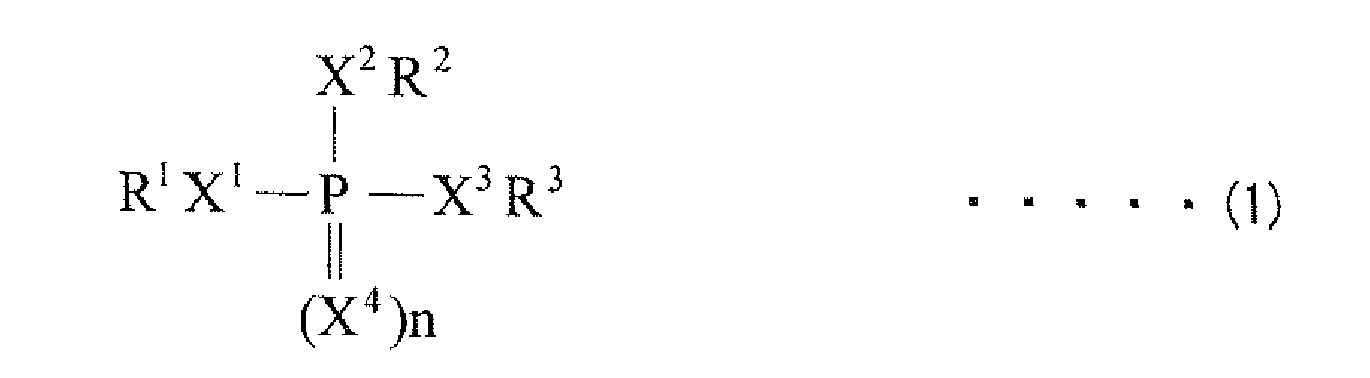
- a component (A) contained in the lubricating oil composition for a continuously variable transmission of the invention is acidic phosphorus compound expressed by a formula (1) below.
- R 1 , R 2 and R 3 respectively represent hydrogen or an alkyl group having 8 or less carbon atoms.
- R 1 , R 2 or R 3 represents the alkyl group
- the friction coefficient of the lubricating oil composition is likely to be decreased.
- all of R 1 , R 2 and R 3 are not simultaneously hydrogen or the alkyl group.
- neutral ester phosphate is formed.
- the neutral ester phosphate is not preferable in view of fiction coefficient between metals and seizure resistance.
- X 1 , X 2 , X 3 and X 4 represent oxygen or sulfur.
- n represents zero or one.
- n is zero, at least two of X 1 , X 2 and X 3 are sulfur.
- n is one, at least two of X 1 , X 2 , X 3 and X 4 are sulfur.
- n is zero or one, when there is one or zero sulfur atom to be boded to phosphorus (P) contained in the compound, the seizure resistance of the lubricating oil composition is poor.
- acidic phosphorus compound a compound known as an extreme pressure agent can be used.
- acid dithiophosphate ester or acid dithiophosphite are preferable in view of solubility to the base oil of lubricating oil and seizure resistance,
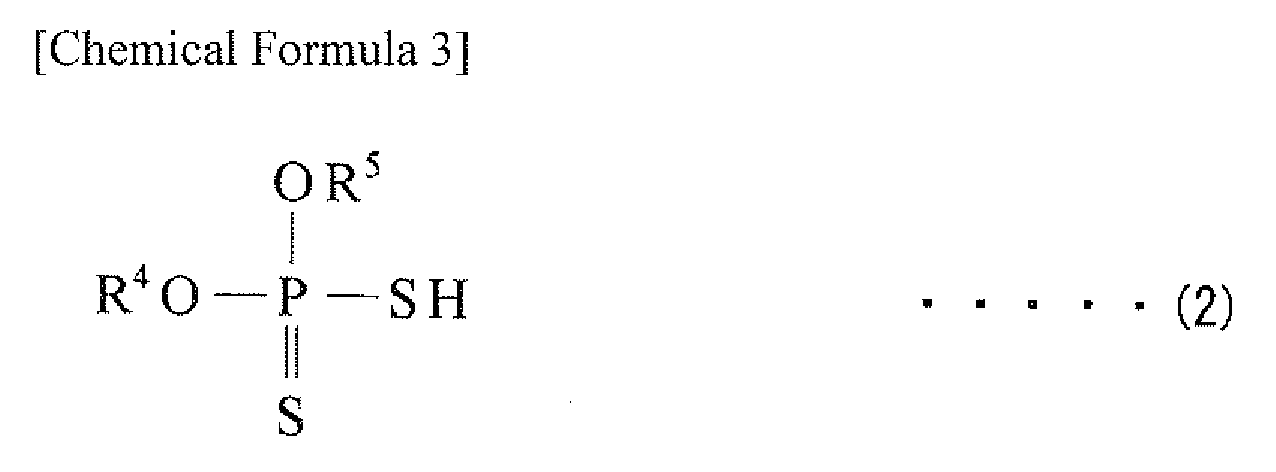
- the acid dithiophosphate is preferably a compound expressed by a formula (2) below.
- each of R 4 and R 5 is hydrogen or an alkyl group having 8 or less carbon atoms. It should be noted that both are not simultaneously hydrogen.
- the acid dithiophosphate of the above formula (2) is preferably di(2-ethylhexyl) dithiophosphate in view of seizure resistance. This compound is available as Phoslex DT-8 manufactured by Sakai Chemical Industry, Co., Ltd.
- the content of the component (A) is preferably 0.05 to 0.5 mass% relative to the total amount of the composition, more preferably 0.05 to 0.4 mass%, further preferably 0.1 to 0.3 mass%.
- the content of the component (A) is preferably 0.5 mass% or less.
- An imide compound as a component (B) contained in the lubricating oil composition of the invention is preferably succinimide, which is effective in improvement of friction coefficient between metals and thus excellent in anti-shudder property.
- the succinimide preferably has an alkyl or alkenyl group with a number average molecular weight of 600 to 3000 in a side chain.
- succinimide e.g., succinimide having a polybutenyl or polybutenyl group.
- the polybutenyl group is obtained by polymerizing 1-butene with an isobutene mixture or a high-purity isobutene or by hydro generating with a polyisobutenyl group.
- the succinimide may be so-called monotype alkenyl or alkyl succinimide, or so-called bis-type alkenyl or alkyl succinimide.
- the succinimide may be selected for use from compounds known as an ashless dispersant.
- any conventional method may be employed to produce the succinimide having a side chain.
- polybutene or chlorinated polybutene whose number average molecular weight is approximately 600 to 3000 and anhydride maleic acid are reacted with each other at approximately 100 to 200 degrees C, and then its reaction product, i.e. polybutenyl succinic acid, is reacted with polyamine to obtain polybutenyl succinimide.
- the polyamine are diethylene triamin, triethylene tetramine, tetraethylene pentamine and pentaethylene hexamine.
- alkenyl or alkyl succinimide and an aromatic compound such as alkylphenol or sulfurized alkylphenol can be subjected to Mannich condensation to obtain an alkylphenol or sulfurized alkylphenol derivative, which is also preferably used.
- alkylphenol having an alkyl group of 3 to 30 carbon atoms is typically used.
- the above-described succinimide is preferably boron-modified.
- a boron compound such as boracic acid
- an organic solvent such as alcohol, hexane or xylene
- examples of the boron compound other than boracic acid are boric anhydride, boron halogenide, borate ester, borate amide and boric oxide.
- boracic acid is particularly preferable.
- Such boron-modified succinimide which has a bulky structure, is preferable because addition thereof to the compound allows an increase in the friction coefficient between metals, which results in an increase in the torque transmission capacity.
- the content of boron relative to the total amount of the composition is preferably in a range from 0.01 to 0.03 mass%, more preferably in a range from 0.015 to 0.025 mass%.
- the content of boron is preferably 0.01 mass% or more in view of improvement in the friction coefficient between metals and the content of boron is preferably 0.03 mass% or less in view of prevention of clogging of a clutch member.
- alkaline earth metal salt as a component (C) contained in the lubricating oil composition for a continuously variable transmission of the invention, at least one compound of alkaline earth metal salicylate, alkaline earth metal sulfonate and alkaline earth metal phenate is preferably used. These compounds may also be selected for use from compounds known as a metal detergent.
- the alkaline earth metal salicylate is exemplified by an alkaline earth metal salt of alkyl salicylic acid, particularly a magnesium salt and a calcium salt, among which the calcium salt is preferably used.
- the alkaline earth metal sulfonate is exemplified by an alkaline earth metal salt of alkyl aromatic sulfonic acid, particularly a magnesium salt and a calcium salt, among which the calcium salt is preferably used.
- Such alkaline earth metal salt of alkyl aromatic sulfonic acid is obtained by sulfonating an alkyl aromatic compound whose molecular weight is 300 to 1500 (preferably 400 to 700).
- the alkaline earth metal phenate is exemplified by alkylphenol, an alkylphenol sulfide and alkaline earth metal salt as a Mannich reaction product of alkylphenol, particularly a magnesium salt and a calcium salt, among which the calcium salt is preferably used.
- An alkyl group forming the alkaline earth metal salt preferably has 4 to 30 carbon atoms.
- the alkyl group is more preferably a linear or branched alkyl group having 6 to 18 carbon atoms.
- the alkyl group may be a primary alkyl group, a secondary alkyl group or a tertiary alkyl group.
- alkaline earth metal salicylate, the alkaline earth metal sulfonate and the alkaline earth metal phenate may be neutral alkaline earth metal sulfonate, neutral alkaline earth metal phenate and neutral alkaline earth metal salicylate obtained by: directly reacting the above-described alkylphenol, alkylphenol sulfide, a Mannich reaction product of alkylphenol, alkyl salicylic acid, alkyl aromatic sulfonic acid or the like with alkaline earth metal base exemplified by an oxide or a hydroxide of alkaline earth metal such as magnesium and/or calcium; or converting the above-described substance into alkali metal salt such as sodium salt or potassium salt and subsequently substituting the alkali metal salt with alkaline earth metal salt.
- alkaline earth metal sulfonate, alkaline earth metal phenate and alkaline earth metal salicylate may be: basic alkaline earth metal sulfonate, basic alkaline earth metal phenate and basic alkaline earth metal salicylate obtained by heating neutral alkaline earth metal sulfonate, neutral alkaline earth metal phenate and neutral alkaline earth metal salicylate with excess alkaline earth metal salt or alkaline earth metal base under the presence of water; or overbased alkaline earth metal sulfonate, overbased alkaline earth metal phenate and overbased alkaline earth metal salicylate obtained by reacting neutral alkaline earth metal sulfonate, neutral alkaline earth metal phenate and neutral alkaline earth metal salicylate with carbonate or borate of alkaline earth metal under the presence of carbon dioxide gas.
- the total base number (TBN) thereof is preferably in a range from 100 to 500 mgKOH/g, more preferably in a range from 200 to 400 mgKOH/g.
- the total base number is less than 100 mgKOH/g, oxidation stability may be deteriorated.
- the total base number exceeds 500 mgKOH/g, a neutralization number thereof may be unbalanced, thereby deteriorating seizure resistance.
- the content of the above-described component (C) is preferably in a range from 0.01 to 0.05 mass% in terms of alkaline earth metal relative to the total amount of the composition, more preferably in a range from 0.015 to 0.45 mass%, further preferably in a range from 0.02 to 0.04 mass%.
- the content of the component (C) of 0.01 mass% or more is preferable in view of the friction coefficient between metals and the content of the component (C) of 0.05 mass% or less is preferable in view of prevention of clogging of the clutch member.
- the lubricating oil composition for a continuously variable transmission of the invention preferably has the following properties (D) to (F).
- the lubricating oil composition for a continuously variable transmission of the invention has the large torque transmission capacity due to the high friction coefficient between metals and is excellent in seizure resistance
- the lubricating oil composition may be applied to various types of continuously variable transmissions such as a chain-type continuously variable transmission with a chain and a belt-type continuously variable transmission with a metal belt.
- the lubricating oil composition of the invention may be added as necessary with various additives as long as the object of the invention is not hampered.
- additives for instance, an antioxidant, an antiwear agent, a metal deactivator, an antifoaming agent, a pour point depressant, a surfactant, a coloring agent and the like are used as necessary.
- the antioxidant may be exemplified by an amine-based antioxidant, a phenol-based antioxidant, a sulfur-based antioxidant and the like.
- the amine-based antioxidant are: an antioxidant based on monoalkyldiphenylamine such as monooctyldiphenylamine and monononyldiphenylamine; an antioxidant based on dialkyl diphenylamine such as 4,4'-dibutyldiphenylamine, 4,4'-dipentyldiphezzylaznine, 4,4'-dihexyldiphenylamine, 4,4'-diheptyldiphenylamine, 4,4'-dioctyldiphenylamine and 4,4'-dinonyldiphenylamine; an antioxidant based on polyalkyldiphenylamine such as tetrabutyldiphenylamine, tetrahexyldiphenylamine, tetraoctyldiphenylamine and te
- phenol-based antioxidant examples include: 2,6-di-t-butylphenol; 2,6-di-t-butyl-4-methylphenol; 4,4-methylenebis(2,6-di-t-butylphenol); 4,4'-butylidezlabis(3-methyl-6-t-butylphenol); 2,2'-methylenebis(4-ethyl-6-t-butylphenol); 2,2'-methylenebis(4-methyl-6-t-butylphenol); 4,4'-isopropylidenebisphenol; 2,4-dimethyl-6-t-butylphenol; tetorakis[methylene-3-(3,5-di-t-butyl-4-hydroxyphenyl)propionate]methane; 1,1,3-tris(2-methyl-4-hydroxy-5-t-butylphenyl) butane; 1,3,5-trimethyl-2,4,6-tris(3,5-di-t-butyl-4-hydroxybenzyl)benzene;
- sulfur-based antioxidant examples include: dialkyl thiodipropionate; a dialkyldithiocarbamate derivative (except metal salt); bis(3,5-di-t-butyl-4-hydroxybenzyl)sulfide; mercaptobenzothiazole; a reaction product of phosphorus pentasulfide and olefin; and dicetyl sulfide.
- the above-described various antioxidants are respectively used singularly or in a combination of two or more.
- the amine-based antioxidant, the phenol-based antioxidant, zinc alkyldithio phosphate and the like are preferably used. These antioxidants are preferably added at a rate of 0.05 to 3 mass% relative to the total amount of the composition.
- the antiwear agent examples include: a metal thiophosphate (Zn, Pb, Sb or the like), a metal thiocarbamate (Zn or the like), a sulfur compound, phosphate ester (tricresyl phosphate), and phosphite ester, which are generally used at a rate of 0.05 to 5 mass%.
- a metal thiophosphate Zn, Pb, Sb or the like
- Zn or the like a metal thiocarbamate
- sulfur compound phosphate ester (tricresyl phosphate), and phosphite ester
- tricresyl phosphate tricresyl phosphate
- phosphite ester which are generally used at a rate of 0.05 to 5 mass%.
- the metal deactivator one or a combination of two or more of benzotriazole, thiadiazole and the like is used.
- the metal deactivator is preferably added at a rate of 0.01 to
- pour point depressant polymethacrylate or the like is used.
- the pour point depressant is preferably added at a rate of 0.01 to 10 mass% relative to the total amount of the composition.
- surfactant polyoxyethylene alkyl phenyl ether or the like is used.
- the surfactant is preferably added at a rate of 0.01 to 10 mass% relative to the total amount of the compound.
- Lubricating oil compositions of blending ratios shown in Table 1 were prepared and friction coefficient between metals and seizure load were measured to evaluate torque transmission capacity and seizure resistance. Results thereof are also shown in Table 1.
- Seizure load was measured using an FALEX tester described in ASTM D3233 to evaluate seizure resistance.
- the seizure resistance represents extreme pressure property between steels. Specific test conditions are as follows.
- Example 1 Example 2 Comparative 1 Comparative 2 Comparative 3 Comparative 4 Comparative 5 blending ratio (mass%) base oil mineral oil (API category group III) rest rest rest rest rest rest rest rest pour point depressant PMA (Mw 100,000) 0.30 0.30 0.30 0.30 0.30 0.30 0.30 0.30 0.30 0.30 0.30 0.30 0.30 0.30 0.30 0.30 0.30 0.30 0.30 0.30 0.30 0.30 antioxidant diphenylamine 1.30 1.30 - 1.30 1.30 1.30 1.30 1.30 1.30 antiwear agent tricresyl phosphate 0.30 0.30 0.30 0.30 0.30 0.30 0.30 0.30 0.30 0.30 ashless dispersant boron-modified polybutenyl succinimde (Mn 1,000 of PB group) 1.00 1.00 - - - 1.00 1.00 polybutenyl succinimide (Mn 4,000 ofPB group) 4.00 4.00 - 4.00 - 4.00 4.00 metal detergent calcium sulfonate, (400TBN) 0.20 0.20 -
- the lubricating oil compositions according to the invention contain acid dithiophosphate as the component (A), (boron-modified) polybutenyl succinimide as the component (B), and calcium sulfonate as the component (C), it can be understood that the lubricating oil compositions have a high friction coefficient between metals and a large torque transmission capacity. Further, it can be understood from the result of the FALEX test that the lubricating oil compositions are excellent in seizure resistance. On the other hand, since the Comparatives I to 5 do not contain the above-described component (A), the friction coefficients between metals thereof are low and seizure resistances thereof are poor.
- the Comparatives 1 and 3 do not contain any one of the above-described components (A) to (C), the seizure resistances thereof are considerably poor.
- the Comparative 2 has boron-unmodified polybutenyl succinimide as the component (B) in addition to the components of the Comparative 3, and therefore the seizure resistance thereof is rather deteriorated while the friction coefficient between metals thereof is slightly increased.
- the lubricating oil composition according to the invention can be preferably used in, for instance, a metal belt type or chain type continuously variable transmission.
Landscapes
- Chemical & Material Sciences (AREA)
- Chemical Kinetics & Catalysis (AREA)
- General Chemical & Material Sciences (AREA)
- Oil, Petroleum & Natural Gas (AREA)
- Organic Chemistry (AREA)
- Lubricants (AREA)
Abstract
Description
- The present invention relates to a lubricating oil composition for a continuously variable transmission.
- In a continuously variable transmission, it has been well known to use friction between a metal belt or chain and a pulley made of metal to transmit torque. A lubricating oil used for such a continuously variable transmission is required to have a high power (torque) transmission capacity. Accordingly, there have been known various kinds of lubricating oil compositions with a large power transmission capacity enough to allow a favorable power transmission (e.g., see Patent Documents 1 and 2).
A lubricating oil composition disclosed in Patent Document 1 is excellent in abrasion resistance and extreme pressure property and is capable of maintaining a high friction coefficient for a long time. In order to transmit a large amount of torque, this lubricating oil composition is formed by adding a base oil of lubricating oil with a sulfuric extreme pressure agent, a phosphorus extreme pressure agent and an alkali earth metal detergent.
A lubricating oil composition disclosed in Patent Document 2 is formed by adding a base oil of lubricating oil with an effective amount of succinic bisimide having a predetermined structure in order to increase the power transmission capacity of the lubricating oil composition and to improve the anti-shudder property thereof.
In a lubricating oil composition disclosed in Patent Document 3, a sulfonate detergent and boron-containing succinimide are mixed, thereby improving the torque transmission capacity of the lubricating oil composition and the antiwear property of a wet-type friction agent. - [Patent Document 1]
JP-A-9-100487
[Patent Document 2]JP-A-9-202890
[Patent Document 3]JP-A-2007-126543 - What is important for a clutch for a continuously variable transmission is not only a high friction coefficient between metals that represents an index of torque transmission capacity in engagement but also seizure resistance between metals.
However, with the lubricating oil compositions of the above Patent Documents 1 to 3, a sufficient clutch property has not yet been exhibited. The lubricating oil compositions, which are blended for simply increasing friction coefficient between metals, exhibit a lowered seizure resistance.
Further, these conventional lubricating oil compositions, even though being applicable to a belt-type continuously variable transmission requiring less-restricted use conditions, are likely to cause seizure when being used for a chain-type continuously variable transmission having a larger contacting pressure.
Accordingly, it is an object of the invention to provide a lubricating oil composition for a continuously variable transmission, capable of providing a high torque transmission capacity (fiction coefficient between metals) and seizure resistance when a clutch is in engagement. - In order to solve the above problems, according to an aspect of the invention, lubricating oil compositions as follows are provided.
- [1] A lubricating oil composition for a continuously variable transmission including: a base oil of lubricating oil; components (A) to (C) below:
- (A) an acidic phosphorus compound expressed by a formula (1) below,

- (B) an imide compound; and
- (C) an alkaline earth metal salt.
- (A) an acidic phosphorus compound expressed by a formula (1) below,
- [2] The above lubricating oil composition, in which the component (A) is acid dithiophosphate and/or acid dithiophosphite.
- [3] The above lubricating oil composition, in which the component (A) is added to a base oil of lubricating oil at 0.05 to 0.5 mass% relative to a total amount of the composition.
- [4] The above lubricating oil composition, in which the component (B) is a boron-modified imide compound.
- [5] The above lubricating oil composition, in which the boron-modified imide compound is succinimide having an alkyl or alkenyl group whose number average molecular weight is in a range from 600 to 3000.
- [6] The above lubricating oil composition, in which the compound (B) is added in an amount of 0.01 to 0.03 mass% in terms of boron relative to a total amount of the composition.
- [7] The above lubricating oil composition, in which the component (C) is at least one compound of alkaline earth metal salicylate, alkaline earth metal sulfonate and alkaline earth metal phenate.
- [8] The above lubricating oil composition, in which a total base number of the component (C) is in a range from 100 to 500 mgKOH/g.
- [9] The above lubricating oil composition, in which the component (C) is added to the base oil of the lubricating oil in an amount of 0.01 to 0.05 mass% in terms of alkaline earth metal relative to a total amount of the composition.
- [10] The above lubricating oil composition, in which the composition exhibits properties (D) to (F) below:
- (D) kinematic viscosity at 40 degrees C of 20 to 40 mm2/s;
- (E) kinematic viscosity at 100 degrees C of 4 to 8 mm2/s; and
- (F) viscosity index of 100 to 250.
- Since the base oil is added with three specific components in the lubricating oil composition according to the aspect of the invention, the friction coefficient between metals is high and thus the torque transmission capacity is high. The seizure resistance between metals is also excellent. Accordingly, the lubricating oil composition according to the aspect of the invention is preferably used for a belt-type continuously variable transmission particularly with a metal belt.
- A preferred exemplary embodiment for implementing the invention will be described below.
- A lubricating oil composition for a continuously variable transmission of the invention is formed by adding a base oil of lubricating oil with (A) an acidic phosphorus compound, (B) an imide compound and (C) an alkaline earth metal salt. A detailed description thereof will be made below.
- As a base oil of lubricating oil, at least one of mineral oil and synthetic oil may be respectively used singularly or in a combination of two or more. Alternatively, a combination of the mineral oil and the synthetic oil may be used.
There is no specific limitation on the mineral oil and the synthetic oil and thus any oils generally used as a base oil for a transmission are applicable. Particularly, a kinematic viscosity at 100 degrees C is preferably in a range from 1 mm2/s to 50 mm2/s, particularly, in a range from 2 mm2/s to 15 mm2/s. When the kinematic viscosity is extremely high, a low-temperature viscosity may be deteriorated. When the kinematic viscosity is extremely low, abrasion of sliding portions such as a gear bearing and a clutch of a continuously variable transmission may be increased. Accordingly, the base oil of lubricating oil having a kinematic viscosity at 100 degrees C of 1 mm2/s or more but 50 mm2/s or less, particularly, 2 mm2/s or more but 15 mm2/s or less, are preferably used as the base oil of lubricating oil.
A pour point that represents an index of low-temperature fluidity of the base oil of lubricating oil is not particularly limited but is preferably minus 10 degrees C or less, particularly, minus 15 degrees C or less.
The base oil of lubricating oil is not particularly limited, but it is preferable that the content of saturated hydrocarbon thereof is 90 mass% or more, the content of sulfur thereof is 0.03 mass% or less and the viscosity index thereof is 100 or more. Here, when the content of saturated hydrocarbon is less than 90 mass%, deterioration products may be disadvantageously increased. When the content of sulfur is more than 0.03 mass%, deterioration products may be disadvantageously increased. When the viscosity index is smaller than 100, abrasion at a high temperature may be disadvantageously increased. Accordingly, the mineral oil and the synthetic oil whose content of saturated hydrocarbon is 90 mass% or more, content of sulfur is 0.03 mass% or less and viscosity index is 100 or more are preferably used. - Examples of such mineral oil are naphthenic mineral oil, paraffinic mineral oil and GTL WAX. Specifically, such mineral oil is exemplified by light neutral oil, medium neutral oil, heavy neutral oil and bright stock that are produced by solvent purification or hydrogenation purification.
Examples of the synthetic oil are polybutene or a hydride thereof, polyalphaolefin (such as 1-octene oligomer and 1-decene oligomer), alphaolefin copolymer, alkylbenzene, polyol ester, diacid ester, polyoxyalkylene glycol, polyoxyalkylene glycol ester, polyoxyalkylene glycol ether, hindered ester and silicone oil. - A component (A) contained in the lubricating oil composition for a continuously variable transmission of the invention is acidic phosphorus compound expressed by a formula (1) below.
-

- In the formula, R1, R2 and R3 respectively represent hydrogen or an alkyl group having 8 or less carbon atoms. Here, in the case where R1, R2 or R3 represents the alkyl group, when the alkyl group has 9 or more carbon atoms, the friction coefficient of the lubricating oil composition is likely to be decreased. It should be noted that all of R1, R2 and R3 are not simultaneously hydrogen or the alkyl group. When all of R1, R2 and R3 are the alkyl group, so-called neutral ester phosphate is formed. The neutral ester phosphate is not preferable in view of fiction coefficient between metals and seizure resistance.
X1, X2, X3 and X4 represent oxygen or sulfur. n represents zero or one. When n is zero, at least two of X1, X2 and X3 are sulfur. When n is one, at least two of X1, X2, X3 and X4 are sulfur. In either case where n is zero or one, when there is one or zero sulfur atom to be boded to phosphorus (P) contained in the compound, the seizure resistance of the lubricating oil composition is poor. - As such acidic phosphorus compound, a compound known as an extreme pressure agent can be used. Specifically, acid dithiophosphate ester or acid dithiophosphite are preferable in view of solubility to the base oil of lubricating oil and seizure resistance, For instance, the acid dithiophosphate is preferably a compound expressed by a formula (2) below.
-
- The content of the component (A) is preferably 0.05 to 0.5 mass% relative to the total amount of the composition, more preferably 0.05 to 0.4 mass%, further preferably 0.1 to 0.3 mass%. When the content of the component (A) is 0.05 mass% or more, a sufficient seizure resistance can be exhibited. In view of oxidation stability, the content of the component (A) is preferably 0.5 mass% or less.
- An imide compound as a component (B) contained in the lubricating oil composition of the invention is preferably succinimide, which is effective in improvement of friction coefficient between metals and thus excellent in anti-shudder property. Particularly, the succinimide preferably has an alkyl or alkenyl group with a number average molecular weight of 600 to 3000 in a side chain. There are various examples of such succinimide, e.g., succinimide having a polybutenyl or polybutenyl group. Here, the polybutenyl group is obtained by polymerizing 1-butene with an isobutene mixture or a high-purity isobutene or by hydro generating with a polyisobutenyl group. Incidentally, the succinimide may be so-called monotype alkenyl or alkyl succinimide, or so-called bis-type alkenyl or alkyl succinimide. The succinimide may be selected for use from compounds known as an ashless dispersant.
- Any conventional method may be employed to produce the succinimide having a side chain. For instance, polybutene or chlorinated polybutene whose number average molecular weight is approximately 600 to 3000 and anhydride maleic acid are reacted with each other at approximately 100 to 200 degrees C, and then its reaction product, i.e. polybutenyl succinic acid, is reacted with polyamine to obtain polybutenyl succinimide.
Examples of the polyamine are diethylene triamin, triethylene tetramine, tetraethylene pentamine and pentaethylene hexamine.
The alkenyl or alkyl succinimide and an aromatic compound such as alkylphenol or sulfurized alkylphenol can be subjected to Mannich condensation to obtain an alkylphenol or sulfurized alkylphenol derivative, which is also preferably used. In this case, alkylphenol having an alkyl group of 3 to 30 carbon atoms is typically used. - In such succinimide having the alkyl or alkenyl group whose number average molecular weight is 600 to 3000 in the side chain, when the number average molecular weight of the side chain is less than 600, dispersibility to the base oil is unfavorably deteriorated. On the other hand, when the number average molecular weight of the side chain exceeds 3000, handlability in preparation of the lubricating oil composition is deteriorated. Moreover, the viscosity of the composition is extremely increased, so that a friction property of a clutch (e.g., a wet-type clutch) to which the composition is applied may be deteriorated.
- The above-described succinimide is preferably boron-modified. For instance, by adding the above-described polyamine and polybutenyl succinic acid (anhydride) and a boron compound such as boracic acid to an organic solvent such as alcohol, hexane or xylene and applying heat thereto under an appropriate condition, a boronated polybutenyl succinimide is obtained. Incidentally, examples of the boron compound other than boracic acid are boric anhydride, boron halogenide, borate ester, borate amide and boric oxide. Among the above, boracic acid is particularly preferable.
- Such boron-modified succinimide, which has a bulky structure, is preferable because addition thereof to the compound allows an increase in the friction coefficient between metals, which results in an increase in the torque transmission capacity.
When the above-described boron-modified succinimide is added, the content of boron relative to the total amount of the composition is preferably in a range from 0.01 to 0.03 mass%, more preferably in a range from 0.015 to 0.025 mass%.
When the boron-modified succinimide is added, the content of boron is preferably 0.01 mass% or more in view of improvement in the friction coefficient between metals and the content of boron is preferably 0.03 mass% or less in view of prevention of clogging of a clutch member. When the content of boron is 0.01 mass% or more, heat resistance of the lubricating oil composition is improved.
When the content of boron is 0.03 mass% or less, hydrolysis of boron can be suppressed and production cost can be suppressed, which is preferable. - As alkaline earth metal salt as a component (C) contained in the lubricating oil composition for a continuously variable transmission of the invention, at least one compound of alkaline earth metal salicylate, alkaline earth metal sulfonate and alkaline earth metal phenate is preferably used. These compounds may also be selected for use from compounds known as a metal detergent.
The alkaline earth metal salicylate is exemplified by an alkaline earth metal salt of alkyl salicylic acid, particularly a magnesium salt and a calcium salt, among which the calcium salt is preferably used.
The alkaline earth metal sulfonate is exemplified by an alkaline earth metal salt of alkyl aromatic sulfonic acid, particularly a magnesium salt and a calcium salt, among which the calcium salt is preferably used. Such alkaline earth metal salt of alkyl aromatic sulfonic acid is obtained by sulfonating an alkyl aromatic compound whose molecular weight is 300 to 1500 (preferably 400 to 700).
The alkaline earth metal phenate is exemplified by alkylphenol, an alkylphenol sulfide and alkaline earth metal salt as a Mannich reaction product of alkylphenol, particularly a magnesium salt and a calcium salt, among which the calcium salt is preferably used.
An alkyl group forming the alkaline earth metal salt preferably has 4 to 30 carbon atoms. The alkyl group is more preferably a linear or branched alkyl group having 6 to 18 carbon atoms. The alkyl group may be a primary alkyl group, a secondary alkyl group or a tertiary alkyl group. - In addition, the alkaline earth metal salicylate, the alkaline earth metal sulfonate and the alkaline earth metal phenate may be neutral alkaline earth metal sulfonate, neutral alkaline earth metal phenate and neutral alkaline earth metal salicylate obtained by: directly reacting the above-described alkylphenol, alkylphenol sulfide, a Mannich reaction product of alkylphenol, alkyl salicylic acid, alkyl aromatic sulfonic acid or the like with alkaline earth metal base exemplified by an oxide or a hydroxide of alkaline earth metal such as magnesium and/or calcium; or converting the above-described substance into alkali metal salt such as sodium salt or potassium salt and subsequently substituting the alkali metal salt with alkaline earth metal salt. Alternatively, alkaline earth metal sulfonate, alkaline earth metal phenate and alkaline earth metal salicylate may be: basic alkaline earth metal sulfonate, basic alkaline earth metal phenate and basic alkaline earth metal salicylate obtained by heating neutral alkaline earth metal sulfonate, neutral alkaline earth metal phenate and neutral alkaline earth metal salicylate with excess alkaline earth metal salt or alkaline earth metal base under the presence of water; or overbased alkaline earth metal sulfonate, overbased alkaline earth metal phenate and overbased alkaline earth metal salicylate obtained by reacting neutral alkaline earth metal sulfonate, neutral alkaline earth metal phenate and neutral alkaline earth metal salicylate with carbonate or borate of alkaline earth metal under the presence of carbon dioxide gas.
In these alkaline earth metal salts, the total base number (TBN) thereof is preferably in a range from 100 to 500 mgKOH/g, more preferably in a range from 200 to 400 mgKOH/g. When the total base number is less than 100 mgKOH/g, oxidation stability may be deteriorated. On the other hand, when the total base number exceeds 500 mgKOH/g, a neutralization number thereof may be unbalanced, thereby deteriorating seizure resistance. - The content of the above-described component (C) is preferably in a range from 0.01 to 0.05 mass% in terms of alkaline earth metal relative to the total amount of the composition, more preferably in a range from 0.015 to 0.45 mass%, further preferably in a range from 0.02 to 0.04 mass%. The content of the component (C) of 0.01 mass% or more is preferable in view of the friction coefficient between metals and the content of the component (C) of 0.05 mass% or less is preferable in view of prevention of clogging of the clutch member.
- The lubricating oil composition for a continuously variable transmission of the invention preferably has the following properties (D) to (F).
- (D) kinematic viscosity at 40 degrees C: 20 to 40 mm2/s
- (E) kinematic viscosity at 100 degrees C: 4 to 8 mm2/s
- (F) viscosity index: 100 to 250
- Since the above-described lubricating oil composition for a continuously variable transmission of the invention has the large torque transmission capacity due to the high friction coefficient between metals and is excellent in seizure resistance, the lubricating oil composition may be applied to various types of continuously variable transmissions such as a chain-type continuously variable transmission with a chain and a belt-type continuously variable transmission with a metal belt.
- The lubricating oil composition of the invention may be added as necessary with various additives as long as the object of the invention is not hampered.
As the additives, for instance, an antioxidant, an antiwear agent, a metal deactivator, an antifoaming agent, a pour point depressant, a surfactant, a coloring agent and the like are used as necessary. - The antioxidant may be exemplified by an amine-based antioxidant, a phenol-based antioxidant, a sulfur-based antioxidant and the like.
Examples of the amine-based antioxidant are: an antioxidant based on monoalkyldiphenylamine such as monooctyldiphenylamine and monononyldiphenylamine; an antioxidant based on dialkyl diphenylamine such as 4,4'-dibutyldiphenylamine, 4,4'-dipentyldiphezzylaznine, 4,4'-dihexyldiphenylamine, 4,4'-diheptyldiphenylamine, 4,4'-dioctyldiphenylamine and 4,4'-dinonyldiphenylamine; an antioxidant based on polyalkyldiphenylamine such as tetrabutyldiphenylamine, tetrahexyldiphenylamine, tetraoctyldiphenylamine and tetranonyldiphenylamine; and an antioxidant based on naphthylamine such as α-naphthylamine, phenyl-α-naphthylamine, butylphenyl-α-naphthylamine, pentylphenyl-α-naphthylamine, hexylphenyl-α-naphthylamine, heptylphenyl-α-naphthylamine, octylphenyl-α-naphthylamine and nonylphenyl-α-naphthylamine. Particularly, a compound having an alkyl group of 4 to 24 carbon atoms, particularly 6 to 18 carbon atoms, is preferably used. One or a combination of two or more of the above compounds may be used. - Examples of the phenol-based antioxidant are: 2,6-di-t-butylphenol; 2,6-di-t-butyl-4-methylphenol; 4,4-methylenebis(2,6-di-t-butylphenol); 4,4'-butylidezlabis(3-methyl-6-t-butylphenol); 2,2'-methylenebis(4-ethyl-6-t-butylphenol); 2,2'-methylenebis(4-methyl-6-t-butylphenol); 4,4'-isopropylidenebisphenol; 2,4-dimethyl-6-t-butylphenol; tetorakis[methylene-3-(3,5-di-t-butyl-4-hydroxyphenyl)propionate]methane; 1,1,3-tris(2-methyl-4-hydroxy-5-t-butylphenyl) butane; 1,3,5-trimethyl-2,4,6-tris(3,5-di-t-butyl-4-hydroxybenzyl)benzene; and 2,6-di-t-butyl-4-ethylphenol.
- Examples of the sulfur-based antioxidant are: dialkyl thiodipropionate; a dialkyldithiocarbamate derivative (except metal salt); bis(3,5-di-t-butyl-4-hydroxybenzyl)sulfide; mercaptobenzothiazole; a reaction product of phosphorus pentasulfide and olefin; and dicetyl sulfide.
The above-described various antioxidants are respectively used singularly or in a combination of two or more. Particularly, the amine-based antioxidant, the phenol-based antioxidant, zinc alkyldithio phosphate and the like are preferably used. These antioxidants are preferably added at a rate of 0.05 to 3 mass% relative to the total amount of the composition. - Examples of the antiwear agent are: a metal thiophosphate (Zn, Pb, Sb or the like), a metal thiocarbamate (Zn or the like), a sulfur compound, phosphate ester (tricresyl phosphate), and phosphite ester, which are generally used at a rate of 0.05 to 5 mass%.
As the metal deactivator, one or a combination of two or more of benzotriazole, thiadiazole and the like is used. The metal deactivator is preferably added at a rate of 0.01 to 5 mass% relative to the total amount of the composition.
As the antifoaming agent, one or a combination of two or more of a silicone compound, an ester compound and the like is used. The antifoaming agent is preferably added at a rate of 0.05 to 5 mass% relative to the total amount of the composition. - As the pour point depressant, polymethacrylate or the like is used. The pour point depressant is preferably added at a rate of 0.01 to 10 mass% relative to the total amount of the composition.
As the surfactant, polyoxyethylene alkyl phenyl ether or the like is used. The surfactant is preferably added at a rate of 0.01 to 10 mass% relative to the total amount of the compound. - Next, the invention will be described in detail with reference to Examples and Comparatives. Incidentally, the invention is not limited to descriptions on the Examples and the like.
- Lubricating oil compositions of blending ratios shown in Table 1 were prepared and friction coefficient between metals and seizure load were measured to evaluate torque transmission capacity and seizure resistance. Results thereof are also shown in Table 1.
- The friction coefficient between metals was measured using a block-on-ring tester (LFW-1) described in ASTM D2174. Specific testing conditions are as follows:
- Test jig
Ring: Falex S-10 Test Ring (SAE4620 Steel)
Block: Falex H-60 Test Block(SAE01 Steel) - Conditions of break-in
Oil temperature: 90 degrees C
Load: after being kept at 490N (50kgf) for one minute, load was kept at 980N (100kgf) for one minute, at 1470N (150kgf) for one minute, and at 1830N (187kgf) for 27 minutes. - Sliding velocity: kept at 0.5m/s for 30 minutes
- Conditions of main test
Oil temperature: 90 degrees C
Load: 1830N (187kgf)
Sliding velocity: sequentially kept at 0.5, 0.4, 0.3, 0.25, 0.2, 0.15, 0.1, 0.075, 0.05, 0.04, 0.025 and 0.01 m/s each for two minutes
Friction coefficient: a measurement value obtained for 30 seconds before change in the sliding velocity - Seizure load was measured using an FALEX tester described in ASTM D3233 to evaluate seizure resistance. The seizure resistance represents extreme pressure property between steels. Specific test conditions are as follows.
- Test jig
Test pin: SUJ-2
Test block: SKH51 - Conditions of main test
Oil temperature: 110 degrees C
Sliding velocity: 0.1 m/s
Load measurement: without conducting a break-in, load was continuously increased under a condition of 42 N/min to measure the seizure load. -
[Table 1] Example 1 Example 2 Comparative 1 Comparative 2 Comparative 3 Comparative 4 Comparative 5 blending ratio (mass%) base oil mineral oil (API category group III) rest rest rest rest rest rest rest pour point depressant PMA (Mw 100,000) 0.30 0.30 0.30 0.30 0.30 0.30 0.30 viscosity index improver PMA (Mw 10,000) 4.00 2.50 8.20 8.20 8.20 4.00 4.00 antioxidant diphenylamine 1.30 1.30 - 1.30 1.30 1.30 1.30 antiwear agent tricresyl phosphate 0.30 0.30 0.30 0.30 0.30 0.30 0.30 ashless dispersant boron-modified polybutenyl succinimde (Mn 1,000 of PB group) 1.00 1.00 - - - 1.00 1.00 polybutenyl succinimide (Mn 4,000 ofPB group) 4.00 4.00 - 4.00 - 4.00 4.00 metal detergent calcium sulfonate, (400TBN) 0.20 0.20 - - - 0.20 0.20 extreme pressure agent acid dithiophosphate ester 0.10 0.10 - - - - - phosphate ester2) - - - - - - 0.20 coloring agent, azo compound (Automate Red) 0.03 0.03 0.03 0.03 0.03 0.03 0.03 antifoaming agent dimethylpolysiloxane 0.20 0.20 0.20 0.20 0.20 0.20 0.20 compound properties kinematic viscosity (mm2/s) @40°C - 37.7 29.1 28.7 35.7 28.8 37.6 35.6 @100°C - 7.3 5.9 6.2 7.2 6.2 7.3 7.0 viscosity index - 164 154 172 171 172 163 163 metal (mass%) Ca - 0.03 0.03 0.00 0.00 0.00 0.03 0.03 P - 0.04 0.04 0.00 0.03 0.03 0.03 0.04 S - 0.05 0.05 0.02 0.03 0.03 0.03 0.02 B - 0.02 0.02 0.00 0.01 0.01 0.02 0.02 N - 0.11 0.11 0.00 0.09 0.03 0.11 0.11 evaluation results LFW-1 - - 0.130 0.139 0.099 0.120 0.115 0.120 0.129 FALEX (N) - 10000 10000 3000 3000 5000 8000 8000 1) Phoslex DT-8 manufactured by Sakai Chemical Industry, Co., Ltd.
2) Phoslex A-18 manufactured by Sakai Chemical Industry, Co., Ltd. - From the Examples 1 to 2 shown in Table 1, since the lubricating oil compositions according to the invention contain acid dithiophosphate as the component (A), (boron-modified) polybutenyl succinimide as the component (B), and calcium sulfonate as the component (C), it can be understood that the lubricating oil compositions have a high friction coefficient between metals and a large torque transmission capacity. Further, it can be understood from the result of the FALEX test that the lubricating oil compositions are excellent in seizure resistance.
On the other hand, since the Comparatives I to 5 do not contain the above-described component (A), the friction coefficients between metals thereof are low and seizure resistances thereof are poor. Particularly, since the Comparatives 1 and 3 do not contain any one of the above-described components (A) to (C), the seizure resistances thereof are considerably poor. The Comparative 2 has boron-unmodified polybutenyl succinimide as the component (B) in addition to the components of the Comparative 3, and therefore the seizure resistance thereof is rather deteriorated while the friction coefficient between metals thereof is slightly increased. - The lubricating oil composition according to the invention can be preferably used in, for instance, a metal belt type or chain type continuously variable transmission.
When the kinematic viscosity at 100 degrees C is 4 mm2/s or more, the lubricating oil exhibits oil film sustainability enough to overcome evaporation loss of the base oil of lubricating oil. On the other hand, the kinematic viscosity at 100 degrees C of 8 mm2/s or less serves to favorably maintain low-temperature viscosity property. In addition such kinematic viscosity is preferable in view of maintaining the friction coefficient between metals. The kinematic viscosity at 100 degrees C is more preferably in a range from 5 to 6 mm2/s.
When the viscosity index is 100 or more, temperature-dependency of the viscosity of the composition is small, and thus lubricating oil composition for a continuously variable transmission of the invention can be stably used in a range from a low temperature to a high temperature. On the other hand, when an additive amount of a viscosity index improver is increased until the viscosity index exceeds 250, shear stability may be deteriorated.
In order to improve the viscosity index, addition of a viscosity index improver is preferable. As the viscosity index improver, for instance, polymethacrylate, an olefin-based copolymer such as an ethylene-propylene copolymer, a dispersed olefin-based copolymer, and a styrene-based copolymer such as a styrene-diene copolymer hydride are respectively used singularly or in a combination of two or more. The viscosity index improver is preferably added at a rate of 0.01 to 10 mass% relative to the total amount of the composition.
Claims (10)
- A lubricating oil composition for a continuously variable transmission comprising:a base oil of lubricating oil; components (A) to (C) below:(A) an acidic phosphorus compound expressed by a formula (1) below,
 R1, R2 and R3 each independently represent hydrogen or an alkyl group having 8 or less carbon atoms, R1, R2 and R3 being not simultaneously hydrogen nor the alkyl group,X1, X2, X3 and X4 each represent oxygen or sulfur, andn represents zero or one, wherein when n is zero, at least two of X1, X2 and X3 are sulfur and when n is one, at least two of X1, X2, X3 and X4 are sulfur;(B) an imide compound; and(C) an alkaline earth metal salt.
 - The lubricating oil composition according to claim 1, wherein the component (A) is acid dithiophosphate and/or acid dithiophosphite.
- The lubricating oil composition according to claim 1 or 2, wherein the component (A) is added to a base oil of lubricating oil at 0.05 to 0.5 mass% relative to a total amount of the composition.
- The lubricating oil composition according to any one of claims 1 to 3, wherein the component (B) is a boron-modified imide compound.
- The lubricating oil composition according to claim 4, wherein the boron-modified imide compound is succinimide having an alkyl or alkenyl group whose number average molecular weight is in a range from 600 to 3000.
- The lubricating oil composition according to claim 4 or 5, wherein the compound (B) is added in an amount of 0.01 to 0.03 mass% in terms of boron relative to a total amount of the composition.
- The lubricating oil composition according to any one of claims 1 to 6, wherein the component (C) is at least one compound of alkaline earth metal salicylate, alkaline earth metal sulfonate and alkaline earth metal phenate.
- The lubricating oil composition according to claim 7, wherein a total base number of the component (C) is in a range from 100 to 500 mgKOH/g.
- The lubricating oil composition according to any one of claims 1 to 8, wherein the component (C) is added to the base oil of the lubricating oil in an amount of 0.01 to 0.05 mass% in terms of alkaline earth metal relative to a total amount of the composition.
- The lubricating oil composition according to any one of claims 1 to 9, wherein the composition exhibits properties (D) to (F) below:(D) kinematic viscosity at 40 degrees C of 20 to 40 mm2/s;(E) kinematic viscosity at 100 degrees C of 4 to 8 mm2/s; and(F) viscosity index of 100 to 250.
Applications Claiming Priority (2)
| Application Number | Priority Date | Filing Date | Title |
|---|---|---|---|
| JP2008031527 | 2008-02-13 | ||
| PCT/JP2009/050921 WO2009101847A1 (en) | 2008-02-13 | 2009-01-22 | Lubricant composition for continuously variable transmission |
Publications (3)
| Publication Number | Publication Date |
|---|---|
| EP2248879A1 true EP2248879A1 (en) | 2010-11-10 |
| EP2248879A4 EP2248879A4 (en) | 2012-03-21 |
| EP2248879B1 EP2248879B1 (en) | 2014-12-31 |
Family
ID=40956877
Family Applications (1)
| Application Number | Title | Priority Date | Filing Date |
|---|---|---|---|
| EP09710374.1A Not-in-force EP2248879B1 (en) | 2008-02-13 | 2009-01-22 | Lubricant composition for continuously variable transmission |
Country Status (5)
| Country | Link |
|---|---|
| US (1) | US9085742B2 (en) |
| EP (1) | EP2248879B1 (en) |
| JP (1) | JP5563832B2 (en) |
| CN (2) | CN105567384A (en) |
| WO (1) | WO2009101847A1 (en) |
Cited By (3)
| Publication number | Priority date | Publication date | Assignee | Title |
|---|---|---|---|---|
| WO2014186318A1 (en) * | 2013-05-14 | 2014-11-20 | The Lubrizol Corporation | Lubricating composition and method of lubricating a transmission |
| CN104487557A (en) * | 2012-07-20 | 2015-04-01 | 吉坤日矿日石能源株式会社 | Lubricating oil composition for continuously variable transmission |
| EP2980194A4 (en) * | 2013-03-29 | 2016-10-19 | Idemitsu Kosan Co | LUBRICATING OIL COMPOSITION |
Families Citing this family (7)
| Publication number | Priority date | Publication date | Assignee | Title |
|---|---|---|---|---|
| US8410032B1 (en) * | 2012-07-09 | 2013-04-02 | Afton Chemical Corporation | Multi-vehicle automatic transmission fluid |
| JP6035175B2 (en) | 2013-03-15 | 2016-11-30 | 出光興産株式会社 | Lubricating oil composition |
| JP6016692B2 (en) * | 2013-03-29 | 2016-10-26 | Jxエネルギー株式会社 | Lubricating oil composition for automatic transmission |
| CN103571582B (en) * | 2013-11-05 | 2015-08-12 | 广州机械科学研究院有限公司 | A kind of auto continuously variable transmission gear compound and preparation method thereof |
| CN108779410B (en) * | 2016-03-15 | 2022-03-01 | 出光兴产株式会社 | Lubricating oil composition, lubricating method, and transmission |
| JP2021095457A (en) * | 2019-12-13 | 2021-06-24 | 出光興産株式会社 | Lubricant composition |
| JP7324729B2 (en) * | 2020-03-19 | 2023-08-10 | Eneos株式会社 | lubricating oil composition |
Family Cites Families (14)
| Publication number | Priority date | Publication date | Assignee | Title |
|---|---|---|---|---|
| US2004A (en) * | 1841-03-12 | Improvement in the manner of constructing and propelling steam-vessels | ||
| US2007A (en) * | 1841-03-16 | Improvement in the mode of harvesting grain | ||
| JP4354014B2 (en) * | 1995-10-05 | 2009-10-28 | 出光興産株式会社 | Lubricating oil composition for continuously variable transmission |
| JPH09202890A (en) | 1995-11-21 | 1997-08-05 | Tonen Corp | Lubricating oil composition for automatic transmission |
| JP4199945B2 (en) * | 2001-10-02 | 2008-12-24 | 新日本石油株式会社 | Lubricating oil composition |
| JP2003138285A (en) * | 2001-11-02 | 2003-05-14 | Nippon Oil Corp | Automotive transmission oil composition |
| US6660695B2 (en) * | 2002-03-15 | 2003-12-09 | Infineum International Ltd. | Power transmission fluids of improved anti-shudder properties |
| JP3921178B2 (en) * | 2003-02-21 | 2007-05-30 | 新日本石油株式会社 | Lubricating oil composition for transmission |
| EP2479249B1 (en) | 2003-02-21 | 2014-01-01 | Nippon Oil Corporation | Lubricating oil composition for transmissions |
| JP4907074B2 (en) * | 2004-10-22 | 2012-03-28 | Jx日鉱日石エネルギー株式会社 | Lubricating oil composition for transmission |
| ATE514766T1 (en) * | 2004-10-22 | 2011-07-15 | Nippon Oil Corp | LUBRICANT COMPOSITION FOR TRANSMISSIONS |
| JP5188019B2 (en) | 2005-11-02 | 2013-04-24 | Jx日鉱日石エネルギー株式会社 | Lubricating oil composition |
| JP5207599B2 (en) | 2006-06-08 | 2013-06-12 | Jx日鉱日石エネルギー株式会社 | Lubricating oil composition |
| JP5350583B2 (en) * | 2006-08-03 | 2013-11-27 | 出光興産株式会社 | Lubricating oil composition and method for improving metal fatigue of automobile transmission using the same |
-
2009
- 2009-01-22 CN CN201510988765.5A patent/CN105567384A/en active Pending
- 2009-01-22 EP EP09710374.1A patent/EP2248879B1/en not_active Not-in-force
- 2009-01-22 US US12/867,521 patent/US9085742B2/en active Active
- 2009-01-22 CN CN2009801053747A patent/CN101945983A/en active Pending
- 2009-01-22 JP JP2009553383A patent/JP5563832B2/en not_active Expired - Fee Related
- 2009-01-22 WO PCT/JP2009/050921 patent/WO2009101847A1/en not_active Ceased
Cited By (6)
| Publication number | Priority date | Publication date | Assignee | Title |
|---|---|---|---|---|
| CN104487557A (en) * | 2012-07-20 | 2015-04-01 | 吉坤日矿日石能源株式会社 | Lubricating oil composition for continuously variable transmission |
| CN104487557B (en) * | 2012-07-20 | 2016-08-17 | 吉坤日矿日石能源株式会社 | Lubricating oil composition for continuously variable transmission |
| EP2980194A4 (en) * | 2013-03-29 | 2016-10-19 | Idemitsu Kosan Co | LUBRICATING OIL COMPOSITION |
| US10563148B2 (en) | 2013-03-29 | 2020-02-18 | Idemitsu Kosan Co., Ltd. | Lubricant oil composition |
| WO2014186318A1 (en) * | 2013-05-14 | 2014-11-20 | The Lubrizol Corporation | Lubricating composition and method of lubricating a transmission |
| CN105378044A (en) * | 2013-05-14 | 2016-03-02 | 路博润公司 | Lubricating composition and method of lubricating a transmission |
Also Published As
| Publication number | Publication date |
|---|---|
| EP2248879B1 (en) | 2014-12-31 |
| WO2009101847A1 (en) | 2009-08-20 |
| EP2248879A4 (en) | 2012-03-21 |
| CN101945983A (en) | 2011-01-12 |
| US20100317551A1 (en) | 2010-12-16 |
| JP5563832B2 (en) | 2014-07-30 |
| JPWO2009101847A1 (en) | 2011-06-09 |
| US9085742B2 (en) | 2015-07-21 |
| CN105567384A (en) | 2016-05-11 |
Similar Documents
| Publication | Publication Date | Title |
|---|---|---|
| EP2248879B1 (en) | Lubricant composition for continuously variable transmission | |
| EP2546324B1 (en) | Lubricant composition | |
| JP6302458B2 (en) | Lubricating oil composition | |
| CA2711626C (en) | Friction modifier and transmission oil | |
| US10087389B2 (en) | Lubricating oil composition | |
| EP3409751B1 (en) | Lubricant composition | |
| US20170335224A1 (en) | Mixed phosphorus esters for lubricant applications | |
| US20160075964A1 (en) | Lubricating oil composition for automatic transmission | |
| US10011802B2 (en) | Lubricating oil composition | |
| US8557751B2 (en) | Lubricant composition | |
| US10407642B2 (en) | Lubricant composition | |
| WO2014136970A1 (en) | Lubricating-oil composition | |
| CN104395446A (en) | lubricating oil composition | |
| JP5184214B2 (en) | Lubricating oil composition for metal belt type continuously variable transmission | |
| JP6690108B2 (en) | Lubricating oil composition for internal combustion engine of hybrid vehicle | |
| JP5473236B2 (en) | Lubricating oil composition | |
| EP3268454B1 (en) | Lubricating compositions comprising an anti-wear/friction modifying agent | |
| EP3735455B1 (en) | Boron containing automotive gear oil | |
| EP3034585A1 (en) | Transmission fluid | |
| EP3034584A1 (en) | Transmission fluid | |
| EP3031887A1 (en) | Transmission fluid | |
| JP2007217596A (en) | Continuously variable transmission oil composition | |
| JP2017101151A (en) | Lubricant composition |
Legal Events
| Date | Code | Title | Description |
|---|---|---|---|
| PUAI | Public reference made under article 153(3) epc to a published international application that has entered the european phase |
Free format text: ORIGINAL CODE: 0009012 |
|
| 17P | Request for examination filed |
Effective date: 20100907 |
|
| AK | Designated contracting states |
Kind code of ref document: A1 Designated state(s): AT BE BG CH CY CZ DE DK EE ES FI FR GB GR HR HU IE IS IT LI LT LU LV MC MK MT NL NO PL PT RO SE SI SK TR |
|
| AX | Request for extension of the european patent |
Extension state: AL BA RS |
|
| DAX | Request for extension of the european patent (deleted) | ||
| A4 | Supplementary search report drawn up and despatched |
Effective date: 20120222 |
|
| RIC1 | Information provided on ipc code assigned before grant |
Ipc: C10M 159/20 20060101ALI20120216BHEP Ipc: C10M 163/00 20060101AFI20120216BHEP Ipc: C10M 137/02 20060101ALI20120216BHEP Ipc: C10M 159/22 20060101ALI20120216BHEP Ipc: C10M 133/16 20060101ALI20120216BHEP Ipc: C10N 20/04 20060101ALI20120216BHEP Ipc: C10N 40/04 20060101ALI20120216BHEP Ipc: C10N 30/00 20060101ALI20120216BHEP Ipc: C10N 30/06 20060101ALI20120216BHEP Ipc: C10M 133/56 20060101ALI20120216BHEP Ipc: C10M 159/24 20060101ALI20120216BHEP Ipc: C10N 10/04 20060101ALI20120216BHEP Ipc: C10N 20/02 20060101ALI20120216BHEP Ipc: C10M 139/00 20060101ALI20120216BHEP Ipc: C10M 137/10 20060101ALI20120216BHEP Ipc: C10N 20/00 20060101ALI20120216BHEP |
|
| 17Q | First examination report despatched |
Effective date: 20121203 |
|
| GRAP | Despatch of communication of intention to grant a patent |
Free format text: ORIGINAL CODE: EPIDOSNIGR1 |
|
| INTG | Intention to grant announced |
Effective date: 20140818 |
|
| GRAS | Grant fee paid |
Free format text: ORIGINAL CODE: EPIDOSNIGR3 |
|
| GRAA | (expected) grant |
Free format text: ORIGINAL CODE: 0009210 |
|
| AK | Designated contracting states |
Kind code of ref document: B1 Designated state(s): AT BE BG CH CY CZ DE DK EE ES FI FR GB GR HR HU IE IS IT LI LT LU LV MC MK MT NL NO PL PT RO SE SI SK TR |
|
| REG | Reference to a national code |
Ref country code: CH Ref legal event code: EP Ref country code: GB Ref legal event code: FG4D |
|
| REG | Reference to a national code |
Ref country code: IE Ref legal event code: FG4D |
|
| REG | Reference to a national code |
Ref country code: AT Ref legal event code: REF Ref document number: 704413 Country of ref document: AT Kind code of ref document: T Effective date: 20150215 |
|
| REG | Reference to a national code |
Ref country code: DE Ref legal event code: R096 Ref document number: 602009028671 Country of ref document: DE Effective date: 20150226 |
|
| PG25 | Lapsed in a contracting state [announced via postgrant information from national office to epo] |
Ref country code: NO Free format text: LAPSE BECAUSE OF FAILURE TO SUBMIT A TRANSLATION OF THE DESCRIPTION OR TO PAY THE FEE WITHIN THE PRESCRIBED TIME-LIMIT Effective date: 20150331 Ref country code: FI Free format text: LAPSE BECAUSE OF FAILURE TO SUBMIT A TRANSLATION OF THE DESCRIPTION OR TO PAY THE FEE WITHIN THE PRESCRIBED TIME-LIMIT Effective date: 20141231 Ref country code: LT Free format text: LAPSE BECAUSE OF FAILURE TO SUBMIT A TRANSLATION OF THE DESCRIPTION OR TO PAY THE FEE WITHIN THE PRESCRIBED TIME-LIMIT Effective date: 20141231 |
|
| REG | Reference to a national code |
Ref country code: NL Ref legal event code: VDEP Effective date: 20141231 |
|
| REG | Reference to a national code |
Ref country code: LT Ref legal event code: MG4D |
|
| PG25 | Lapsed in a contracting state [announced via postgrant information from national office to epo] |
Ref country code: HR Free format text: LAPSE BECAUSE OF FAILURE TO SUBMIT A TRANSLATION OF THE DESCRIPTION OR TO PAY THE FEE WITHIN THE PRESCRIBED TIME-LIMIT Effective date: 20141231 Ref country code: LV Free format text: LAPSE BECAUSE OF FAILURE TO SUBMIT A TRANSLATION OF THE DESCRIPTION OR TO PAY THE FEE WITHIN THE PRESCRIBED TIME-LIMIT Effective date: 20141231 Ref country code: SE Free format text: LAPSE BECAUSE OF FAILURE TO SUBMIT A TRANSLATION OF THE DESCRIPTION OR TO PAY THE FEE WITHIN THE PRESCRIBED TIME-LIMIT Effective date: 20141231 Ref country code: GR Free format text: LAPSE BECAUSE OF FAILURE TO SUBMIT A TRANSLATION OF THE DESCRIPTION OR TO PAY THE FEE WITHIN THE PRESCRIBED TIME-LIMIT Effective date: 20150401 |
|
| REG | Reference to a national code |
Ref country code: AT Ref legal event code: MK05 Ref document number: 704413 Country of ref document: AT Kind code of ref document: T Effective date: 20141231 |
|
| PG25 | Lapsed in a contracting state [announced via postgrant information from national office to epo] |
Ref country code: NL Free format text: LAPSE BECAUSE OF FAILURE TO SUBMIT A TRANSLATION OF THE DESCRIPTION OR TO PAY THE FEE WITHIN THE PRESCRIBED TIME-LIMIT Effective date: 20141231 |
|
| PG25 | Lapsed in a contracting state [announced via postgrant information from national office to epo] |
Ref country code: SK Free format text: LAPSE BECAUSE OF FAILURE TO SUBMIT A TRANSLATION OF THE DESCRIPTION OR TO PAY THE FEE WITHIN THE PRESCRIBED TIME-LIMIT Effective date: 20141231 Ref country code: ES Free format text: LAPSE BECAUSE OF FAILURE TO SUBMIT A TRANSLATION OF THE DESCRIPTION OR TO PAY THE FEE WITHIN THE PRESCRIBED TIME-LIMIT Effective date: 20141231 Ref country code: RO Free format text: LAPSE BECAUSE OF FAILURE TO SUBMIT A TRANSLATION OF THE DESCRIPTION OR TO PAY THE FEE WITHIN THE PRESCRIBED TIME-LIMIT Effective date: 20141231 Ref country code: CZ Free format text: LAPSE BECAUSE OF FAILURE TO SUBMIT A TRANSLATION OF THE DESCRIPTION OR TO PAY THE FEE WITHIN THE PRESCRIBED TIME-LIMIT Effective date: 20141231 |
|
| REG | Reference to a national code |
Ref country code: CH Ref legal event code: PL |
|
| PG25 | Lapsed in a contracting state [announced via postgrant information from national office to epo] |
Ref country code: PL Free format text: LAPSE BECAUSE OF FAILURE TO SUBMIT A TRANSLATION OF THE DESCRIPTION OR TO PAY THE FEE WITHIN THE PRESCRIBED TIME-LIMIT Effective date: 20141231 Ref country code: IS Free format text: LAPSE BECAUSE OF FAILURE TO SUBMIT A TRANSLATION OF THE DESCRIPTION OR TO PAY THE FEE WITHIN THE PRESCRIBED TIME-LIMIT Effective date: 20150430 Ref country code: LU Free format text: LAPSE BECAUSE OF FAILURE TO SUBMIT A TRANSLATION OF THE DESCRIPTION OR TO PAY THE FEE WITHIN THE PRESCRIBED TIME-LIMIT Effective date: 20150122 Ref country code: AT Free format text: LAPSE BECAUSE OF FAILURE TO SUBMIT A TRANSLATION OF THE DESCRIPTION OR TO PAY THE FEE WITHIN THE PRESCRIBED TIME-LIMIT Effective date: 20141231 |
|
| REG | Reference to a national code |
Ref country code: DE Ref legal event code: R097 Ref document number: 602009028671 Country of ref document: DE |
|
| PG25 | Lapsed in a contracting state [announced via postgrant information from national office to epo] |
Ref country code: DK Free format text: LAPSE BECAUSE OF FAILURE TO SUBMIT A TRANSLATION OF THE DESCRIPTION OR TO PAY THE FEE WITHIN THE PRESCRIBED TIME-LIMIT Effective date: 20141231 Ref country code: EE Free format text: LAPSE BECAUSE OF FAILURE TO SUBMIT A TRANSLATION OF THE DESCRIPTION OR TO PAY THE FEE WITHIN THE PRESCRIBED TIME-LIMIT Effective date: 20141231 Ref country code: CH Free format text: LAPSE BECAUSE OF NON-PAYMENT OF DUE FEES Effective date: 20150131 Ref country code: MC Free format text: LAPSE BECAUSE OF FAILURE TO SUBMIT A TRANSLATION OF THE DESCRIPTION OR TO PAY THE FEE WITHIN THE PRESCRIBED TIME-LIMIT Effective date: 20141231 Ref country code: LI Free format text: LAPSE BECAUSE OF NON-PAYMENT OF DUE FEES Effective date: 20150131 |
|
| REG | Reference to a national code |
Ref country code: IE Ref legal event code: MM4A |
|
| PLBE | No opposition filed within time limit |
Free format text: ORIGINAL CODE: 0009261 |
|
| STAA | Information on the status of an ep patent application or granted ep patent |
Free format text: STATUS: NO OPPOSITION FILED WITHIN TIME LIMIT |
|
| REG | Reference to a national code |
Ref country code: FR Ref legal event code: PLFP Year of fee payment: 8 |
|
| 26N | No opposition filed |
Effective date: 20151001 |
|
| PG25 | Lapsed in a contracting state [announced via postgrant information from national office to epo] |
Ref country code: IT Free format text: LAPSE BECAUSE OF FAILURE TO SUBMIT A TRANSLATION OF THE DESCRIPTION OR TO PAY THE FEE WITHIN THE PRESCRIBED TIME-LIMIT Effective date: 20141231 |
|
| PG25 | Lapsed in a contracting state [announced via postgrant information from national office to epo] |
Ref country code: IE Free format text: LAPSE BECAUSE OF NON-PAYMENT OF DUE FEES Effective date: 20150122 |
|
| PG25 | Lapsed in a contracting state [announced via postgrant information from national office to epo] |
Ref country code: SI Free format text: LAPSE BECAUSE OF FAILURE TO SUBMIT A TRANSLATION OF THE DESCRIPTION OR TO PAY THE FEE WITHIN THE PRESCRIBED TIME-LIMIT Effective date: 20141231 |
|
| PGFP | Annual fee paid to national office [announced via postgrant information from national office to epo] |
Ref country code: FR Payment date: 20151208 Year of fee payment: 8 |
|
| PG25 | Lapsed in a contracting state [announced via postgrant information from national office to epo] |
Ref country code: BE Free format text: LAPSE BECAUSE OF FAILURE TO SUBMIT A TRANSLATION OF THE DESCRIPTION OR TO PAY THE FEE WITHIN THE PRESCRIBED TIME-LIMIT Effective date: 20141231 |
|
| PGFP | Annual fee paid to national office [announced via postgrant information from national office to epo] |
Ref country code: GB Payment date: 20160120 Year of fee payment: 8 |
|
| PG25 | Lapsed in a contracting state [announced via postgrant information from national office to epo] |
Ref country code: MT Free format text: LAPSE BECAUSE OF FAILURE TO SUBMIT A TRANSLATION OF THE DESCRIPTION OR TO PAY THE FEE WITHIN THE PRESCRIBED TIME-LIMIT Effective date: 20141231 |
|
| PG25 | Lapsed in a contracting state [announced via postgrant information from national office to epo] |
Ref country code: BG Free format text: LAPSE BECAUSE OF FAILURE TO SUBMIT A TRANSLATION OF THE DESCRIPTION OR TO PAY THE FEE WITHIN THE PRESCRIBED TIME-LIMIT Effective date: 20141231 Ref country code: HU Free format text: LAPSE BECAUSE OF FAILURE TO SUBMIT A TRANSLATION OF THE DESCRIPTION OR TO PAY THE FEE WITHIN THE PRESCRIBED TIME-LIMIT; INVALID AB INITIO Effective date: 20090122 |
|
| PG25 | Lapsed in a contracting state [announced via postgrant information from national office to epo] |
Ref country code: CY Free format text: LAPSE BECAUSE OF FAILURE TO SUBMIT A TRANSLATION OF THE DESCRIPTION OR TO PAY THE FEE WITHIN THE PRESCRIBED TIME-LIMIT Effective date: 20141231 |
|
| PG25 | Lapsed in a contracting state [announced via postgrant information from national office to epo] |
Ref country code: PT Free format text: LAPSE BECAUSE OF FAILURE TO SUBMIT A TRANSLATION OF THE DESCRIPTION OR TO PAY THE FEE WITHIN THE PRESCRIBED TIME-LIMIT Effective date: 20150501 |
|
| PG25 | Lapsed in a contracting state [announced via postgrant information from national office to epo] |
Ref country code: TR Free format text: LAPSE BECAUSE OF FAILURE TO SUBMIT A TRANSLATION OF THE DESCRIPTION OR TO PAY THE FEE WITHIN THE PRESCRIBED TIME-LIMIT Effective date: 20141231 |
|
| GBPC | Gb: european patent ceased through non-payment of renewal fee |
Effective date: 20170122 |
|
| REG | Reference to a national code |
Ref country code: FR Ref legal event code: ST Effective date: 20170929 |
|
| PG25 | Lapsed in a contracting state [announced via postgrant information from national office to epo] |
Ref country code: FR Free format text: LAPSE BECAUSE OF NON-PAYMENT OF DUE FEES Effective date: 20170131 |
|
| PG25 | Lapsed in a contracting state [announced via postgrant information from national office to epo] |
Ref country code: GB Free format text: LAPSE BECAUSE OF NON-PAYMENT OF DUE FEES Effective date: 20170122 |
|
| PG25 | Lapsed in a contracting state [announced via postgrant information from national office to epo] |
Ref country code: MK Free format text: LAPSE BECAUSE OF FAILURE TO SUBMIT A TRANSLATION OF THE DESCRIPTION OR TO PAY THE FEE WITHIN THE PRESCRIBED TIME-LIMIT Effective date: 20141231 |
|
| PGFP | Annual fee paid to national office [announced via postgrant information from national office to epo] |
Ref country code: DE Payment date: 20221130 Year of fee payment: 15 |
|
| REG | Reference to a national code |
Ref country code: DE Ref legal event code: R119 Ref document number: 602009028671 Country of ref document: DE |
|
| PG25 | Lapsed in a contracting state [announced via postgrant information from national office to epo] |
Ref country code: DE Free format text: LAPSE BECAUSE OF NON-PAYMENT OF DUE FEES Effective date: 20240801 |
|
| PG25 | Lapsed in a contracting state [announced via postgrant information from national office to epo] |
Ref country code: DE Free format text: LAPSE BECAUSE OF NON-PAYMENT OF DUE FEES Effective date: 20240801 |