EP2248177B1 - Halbleitende metallhybridkomponente - Google Patents
Halbleitende metallhybridkomponente Download PDFInfo
- Publication number
- EP2248177B1 EP2248177B1 EP09709825A EP09709825A EP2248177B1 EP 2248177 B1 EP2248177 B1 EP 2248177B1 EP 09709825 A EP09709825 A EP 09709825A EP 09709825 A EP09709825 A EP 09709825A EP 2248177 B1 EP2248177 B1 EP 2248177B1
- Authority
- EP
- European Patent Office
- Prior art keywords
- type
- layer
- metal
- providing
- atoms
- Prior art date
- Legal status (The legal status is an assumption and is not a legal conclusion. Google has not performed a legal analysis and makes no representation as to the accuracy of the status listed.)
- Not-in-force
Links
Images




Classifications
-
- H—ELECTRICITY
- H10—SEMICONDUCTOR DEVICES; ELECTRIC SOLID-STATE DEVICES NOT OTHERWISE PROVIDED FOR
- H10D—INORGANIC ELECTRIC SEMICONDUCTOR DEVICES
- H10D62/00—Semiconductor bodies, or regions thereof, of devices having potential barriers
- H10D62/80—Semiconductor bodies, or regions thereof, of devices having potential barriers characterised by the materials
-
- H—ELECTRICITY
- H10—SEMICONDUCTOR DEVICES; ELECTRIC SOLID-STATE DEVICES NOT OTHERWISE PROVIDED FOR
- H10F—INORGANIC SEMICONDUCTOR DEVICES SENSITIVE TO INFRARED RADIATION, LIGHT, ELECTROMAGNETIC RADIATION OF SHORTER WAVELENGTH OR CORPUSCULAR RADIATION
- H10F10/00—Individual photovoltaic cells, e.g. solar cells
- H10F10/10—Individual photovoltaic cells, e.g. solar cells having potential barriers
- H10F10/16—Photovoltaic cells having only PN heterojunction potential barriers
-
- H—ELECTRICITY
- H10—SEMICONDUCTOR DEVICES; ELECTRIC SOLID-STATE DEVICES NOT OTHERWISE PROVIDED FOR
- H10F—INORGANIC SEMICONDUCTOR DEVICES SENSITIVE TO INFRARED RADIATION, LIGHT, ELECTROMAGNETIC RADIATION OF SHORTER WAVELENGTH OR CORPUSCULAR RADIATION
- H10F77/00—Constructional details of devices covered by this subclass
- H10F77/10—Semiconductor bodies
- H10F77/12—Active materials
-
- H10P14/22—
-
- H10P14/3402—
-
- Y—GENERAL TAGGING OF NEW TECHNOLOGICAL DEVELOPMENTS; GENERAL TAGGING OF CROSS-SECTIONAL TECHNOLOGIES SPANNING OVER SEVERAL SECTIONS OF THE IPC; TECHNICAL SUBJECTS COVERED BY FORMER USPC CROSS-REFERENCE ART COLLECTIONS [XRACs] AND DIGESTS
- Y02—TECHNOLOGIES OR APPLICATIONS FOR MITIGATION OR ADAPTATION AGAINST CLIMATE CHANGE
- Y02E—REDUCTION OF GREENHOUSE GAS [GHG] EMISSIONS, RELATED TO ENERGY GENERATION, TRANSMISSION OR DISTRIBUTION
- Y02E10/00—Energy generation through renewable energy sources
- Y02E10/50—Photovoltaic [PV] energy
Definitions
- This invention relates to a semiconducting component and a method for producing such a component, more specifically it relates to the use and production of metal hydrides as semiconducting devices such as diodes or transistors.
- Semiconductors have been commonly used in a wide range of applications for the last 50 years. Most of these are based on well known semiconducting materials such as Si or GaAs doped with different materials in order to adjust the band widths and thus the semiconducting properties of the materials, e.g. for providing p- or n-type conductivity and combinations of such for producing diodes, transistors etc.
- EP0233613 by C. R. Dickson 1987.08.26 discusses Si (semiconductor) based hydrides and it is related to the discovery of "Giant Micro-electronics", which is about applications of hydrogenated amorphous silicon (a-Si:H) in semiconductor electronics.
- a-Si:H hydrogenated amorphous silicon
- some other hydrogenated semiconductors such as, e.g., a-Si:H, Si2N3H, etc., are widely used in electronic devices, but they have the same disadvantages as other silicon based solutions.
- Patent application WO 9927561A by M. Todd et. Al. 1999.06.03 provides solution of the problem as to how to stabilize a hydride to make it suitable for electronic device applications.
- CN 1483724 by T. Utang et. al. 2004.03.24 discusses hydrogen containing polymer Tris(8-hydroxyquinolinato) aluminum obtained by using the hydride LiAlH 4 .
- FR 2303385 A by J. Meuleman 1976.10.01 discusses a detector consisting of a p-i-n diode from the Si/Hydride device structure where a LiAlH 4 is deposited on a Si substrate.
- Si(Li) detectors One disadvantage of Si(Li) detectors is that they have to be stored in liquid nitrogen or the lithium will diffuse out of the depletion layer.
- This object is thus to provide a cost effective solution for making semiconductive devices and is obtained by a method and component as mentioned above and characterized as specified in the accompanying claims.
- Figure 1 shows the fundamental band gap of a number of metal and complex hydrides: 1-5.
- bottom-most conduction band and top-most valence bands show that these materials are expected to show good electrical conductivity.
- Such hydrides can present interest for electronic device applications, say as p-n junction based devices (solar cells, photodetectors, buffer layers, etc.).
- Nc 1 V 0 ⁇ Ec ⁇ e Ec - E kT ⁇ N E d E
- Nv 1 V 0 ⁇ - ⁇ Ev e E - E v kT ⁇ N E d E
- intrinsic carrier concentration n i n i Nc ⁇ Nv ⁇ e - E g 2 ⁇ kT
- E the energy
- Ec and Ev are the energies corresponding to bottommost CB and topmost VB.
- k is the Boltzmann constant and T is the temperature.
- n i allows to estimate diffusion potential of the p - n junction with concentration of shallow donors N d and shallow acceptors N a
- V D kT q ⁇ ln N a ⁇ N d n i 2 , which is one of the important parameters of semiconductor p - n junction based devices. Using the values of N ( E ) and Eq.
- FIG. 4 presents PDOS for Si and Mg 2 NiH 4 - c .
- Analysis showed that not only the bottommost CB, but also the topmost VB of most of the hydrides are mainly contributed from s-electrons. This is the distinguishing feature of hydrides compared to conventional semiconductors and TCOs where the topmost VB are commonly originated from p -/d-electrons and bottommost CB - from s-electrons.
- One of the parameters characterizing transport properties of solids is carrier effective masses. Effective masses have been calculated for Si and Mg 2 NiH 4 -c , and Mg 2 NiH 4 - m as illustrated in the table in figure 8 . Analysis shows that the effective masses of hydrides are of the same order as those of the well known semiconductors such as Si and GaAs, TCOs ZnO and In 2 O 3 . The results indicate that electrical conductivity of hydrides can be the same as that of semiconductors and TCOs.
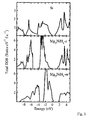
- Figure 5 presents total DOS for Mg 2 NiH 4 -c with Al Mg and Li Mg .
- Al Mg ( Figure 5 ) form states below the bottommost part of the CB of Mg 2 NiH 4 -c .
- These shallow-donor-states are not isolated from the CB and can contribute to the n -type electrical conductivity.
- the defects such as Li Mg form shallow acceptor states and can contribute to p -type electrical conductivity ( Figure 5 ).
- Doping can affect not only conductivity but also transparency.
- absorption and reflectivity spectra of Mg 2 NiH 4 - c with Al Mg and Li Mg ( Fig. 6 ). From Fig. 5 it is seen that Al Mg and Li Mg doped Mg 2 NiH 4 - c is not transparent. The reason is that not only the fundamental, but also the second band gap of the hydride, which is the energy difference between the nearest two bottommost CB, is not sufficiently large. To consider these hydrides as TC materials the second band gap should be >3.1 eV.
- hydrides possess wide band gap and therefore can be used as transparent windows for wide variety of electronic devices such as solar cells, light emitting diodes etc.
- the wide band gap hydrides can be regarded as an alternative to such conventional transparent microelectronic materials as SiO x , SiN x or SiN x :H. Distinct from these transparent windows, hydrides have the advantage to provide good passivation of interfaces in semiconductor devices similar to that by the a-Si:H due to high concentration of hydrogen in their structure. More systematic investigations are necessary to prove this statement.
- TCOs The usage of TCOs in some devices results in the formation of an intermediate oxide layer, large band-offset, and defect states, which can limit the device performance. If hydrides would be used instead of the TCOs, then no oxide layer would be formed and there is no need in using buffer layer. Large band-offset can be prevented by reducing the band gap of the hydrides, which is much easier than that in oxides. Furthermore, hydrogen diffusion from hydrides into semiconductors can be useful to passivate defect states at the interface and increase their conductivity those are important for improving the device performance. Hydrides can also be regarded as a natural alternative to SiN x and TCOs in case of any low temperature technology.
- hydrides can be regarded as novel class of solar cells.
- the crystalline nature and light weight of hydrides, as well as small concentration of defects between active solar cell and TCO present interest for third generation photovoltaics.
- World wide lot of attention is currently focused on developing environmentally friendly technologies, alternative energy sources, improving the performance of solar cells etc. and our finding is directly relevant to these activities.
- hydrides in most cases are much lighter than conventional semiconductors, and hydrogen is the most abundant element in the universe. Consequently, hydrides are of great interest for terrestrial and space applications of solar cells, and also hydrides have large potential for applications in bio-compatible semiconducting devices.
- the component according to the invention is illustrated in figure 7 and is preferable produced by positioning at least one metal layer 2,3 on a substrate 4, and a capping layer 1 on top of the metal layer 2,3.
- the metal layer is made from a metal and doped with a chosen dopant which when hydrogenated will have a chosen semiconducting characteristic as discussed in the theory above.
- the component is hydrogenated by subjecting the component to a gas flow 5 comprising hydrogen, as will be discussed more in detail below.
- a component comprising a capping layer 1, a doped metal hydride layer 2,3 and a substrate.
- a gas flow 5 comprising hydrogen
- a component comprising a capping layer 1, a doped metal hydride layer 2,3 and a substrate.
- two metal hydride layers 2,3 are shown, for example providing a p-n junction, i.e. one layer with p-type conduction and one layer with n-type conduction.
- An alternative production method may be performed by growing the layers as hydrides, which will reduce the stress in the material which occurs when it is loaded with hydrogen after the deposition.
- a more detailed description is given in the thesis of Ingrid A.M.E. Giebels "Shining light on magnesium based switchable mirrors" ISBN 90-9018547-X, section 2.2.1 where a GdMg-H 5 layer is produced by co-sputtering of the metals in a hydrogen/argon atmosphere at room temperature. In this case also the capping layer may be omitted during production.
- the abovementioned thesis in sections 2.2.2 and 2.2.3 also discloses other production methods incorporating In-Situ and Ex-Situ hydrogen loading.
- a combination of the production methods may also be contemplated, where the layers are grown as hydrate metals, and additional hydrogen are loaded afterward. This is discussed in section 5.14 in the thesis of Ruud Westerwaal, "Growth, microstructure and hydrogenation of Pd-catalyzed complex metal hydride thin films", ISBN-978 90 8659 071 1 .
- the individual n- or p-type metal hydrides layers can be utilized for instance as buffer layers for heterojunction devices, such as solar cells.
- the device structures look like follows:
- the n-type/p-type metal hydride stack can also be utilized as a diode, which is a basic structure of several microelectronic devices, including solar cells.
- the metal hydride solar cell structures look as follows: Antireflection coating 1/n-type(p-type) metal hydride (emitter) 2/p-type(n-type) metal hydride solar cell base 3/ Pd(Ni) 4/back side metallization 7;
- n- and p-type semiconductors A number of different metal hydrides may be used as n- and p-type semiconductors. Some examples are mentioned below:
- metals and dopants may be contemplated, e.g. combinations of the AlH x and NgNiH x materials mentioned above, thus providing any combinations of n-p, p-n, p-p or n-n junctions, as well as three layered components such as n-p-n and p-n-p constituting transistors.
- the materials are chosen depending on their stability, especially related to temperature and the band gap as well as the compatibility with other materials in the component and connected instruments and conductors. It is also possible to use materials having amorphous properties with the selected concentrations of hydrogen.
- Electrical couplings to conductor leads 6,7 for utilizing the component in an electronic system may also be of different types depending on the compatibility. In general there it is an advantage related to the use of metal hydrides as semiconductors that they provide good electrical contact with other materials and conductor leads.
- the electrical coupling points may be chosen e.g. to the top metal hydride surface 2 and to the substrate 4.
- the substrate 4 is made by any material being compatible with the materials of the deposited layers, such as metal, ceramic, glass, polymers, etc, the choice also depending on the need for e.g. an electrically conductive substrate or for providing electrical conductors on or through the substrate.
- the substrate 4 may also be a metal or metal to be hydrogenated through the production process, thus being part of the active component.
- the component according to the inventions involves a layered structure comprising at least one p- or n- type metal hydride.
- the component incorporates at least two layers, e.g. providing a p-n junction or three layers providing a n-p-n or p-n-p junction, but other solutions may be contemplated, depending on the use, for example an n-n' configuration.
- the component will include a protective top layer, e.g. a TCO and a lower substrate. Between the layers amorphous layers of metal hydrides or silicon may be used, so as to act as stress relieves or buffer layers, but this may not be necessary if two layers are compatible.
- a possible component according to the invention for use in solar cells could thus be comprised from the bottom and up by a conductive metal substrate 4, a p-type metal hydride layer 3, an n-type metal hydride layer 2, and a TCO 1 on top, with conductors 5,6 connected to the TCO layer 1 and metal substrate 4.
- a protective top layer e.g. a TCO and a lower substrate.
- amorphous layers of metal hydrides or silicon may be used, so as to act as stress relieves or buffer layers, but this may not be necessary if two layers are compatible.
- a possible component according to the invention for use in solar cells could thus be comprised from the bottom and up by a conductive metal substrate 4, a p-type metal
- the invention thus relates to an electronic semiconductive component comprising at least one layer of a p-type or n-type material, wherein said p- or n-type material is constituted by a metal hydride having a chosen dopant.
- the component comprises both a p-type and an n-type material constituting a p-n junction, wherein at least one of said p- and n-type materials is constituted by a metal hydride having a chosen dopant.
- a number of material may be used for making the n-type material in the component, such as having at least one following materials Mg 2 NiH 4 -c with Al atom doping in a concentration of 10 15 to 10 22 atoms/cm 3 , MgH 2 with Al atom doping in a concentration of 10 15 to 10 22 atoms/cm 3 or MgH 2 with Cs atom doping in a concentration of 10 15 to 10 22 atoms/cm 3 .
- Another possible n-type material is made from AlH 3 with atom doping from group IV/II atoms, eg. C,Si,Be,Mg etc in a concentration of 10 15 to 10 22 atoms/cm 3 .
- Similarily p-type materials may for example be provided by using a material made from Mg 2 NiH 4 - c with Li atom doping in a concentration of 10 15 to 10 22 atoms/cm 3 , MgH 2 with Li atom doping in a concentration of 10 15 to 10 22 atoms/cm 3 , or at least one following materials AlH 3 with Ca atom doping in a concentration of 10 15 to 10 22 atoms/cm 3 .
- a third layer may be added, for example making a p-n-p og n-p-n device.
- the component may be produced in different ways for example by ex-situ or in-situ deposition or sputtering techniques.
- the ex-situ deposition method comprising the steps of depositing at least one layer constituted by a chosen metal having a chosen dopant on a substrate, said dopant providing a n- or p-type conductivity after hydrogenation, providing a capping layer on said at least one layer, and exposing the layers and capping to a gas stream containing a chosen fraction of hydrogen.
- This method may also include depositing of two metal layers, one of which providing an n-type semiconductor after hydrogenation and the second providing a p-type semiconductor after hydrogenation, thus providing a p-n junction, and depositing a third metal layer providing a second p-n or n-p junction after hydrogenation.
- the in-situ production method may comprise the steps of depositing at least one first layer constituted by a chosen metal having a chosen dopant on a substrate, the deposition being performed by a sputtering process in an atmosphere constituted by hydrogen and a nobel gas, e.g. argon, thus depositing a hydrogenated doped metal layer, the dopant providing a n- or p-type conductivity.
- a nobel gas e.g. argon
- this may also include a second step of depositing a second layer with a second dopant being different from said first dopant, as well as a third step adding a third layer.
- a combination of the two methods may also be used by including a step of depositing a capping layer and exposing said component to a gas stream containing a chosen fraction of hydrogen for additional hydrogen loading of the material.
Landscapes
- Photovoltaic Devices (AREA)
- Engineering & Computer Science (AREA)
- Physics & Mathematics (AREA)
- Condensed Matter Physics & Semiconductors (AREA)
- General Physics & Mathematics (AREA)
- Manufacturing & Machinery (AREA)
- Computer Hardware Design (AREA)
- Microelectronics & Electronic Packaging (AREA)
- Power Engineering (AREA)
- Electrodes Of Semiconductors (AREA)
Claims (15)
- Elektronisches halbleitendes Bauteil, umfassend zumindest eine Schicht eines p-dotierten oder n-dotierten Materials, dadurch gekennzeichnet, dass eine der zumindest einen Schicht aus p- oder n-dotiertem Material durch ein Metallhydrid mit einem gewählten Dotierstoff gebildet ist.
- Bauteil nach Anspruch 1, umfassend ein p-dotiertes und ein n-dotiertes Material, welche einen p-n-Übergang bilden, wobei zumindest eines aus dem p- und dem n-dotierten Material durch ein Metallhydrid mit einem gewählten Dotierstoff gebildet ist.
- Bauteil nach Anspruch 1, wobei das Material ein n-dotiertes Material mit zumindest einem der folgenden Materialien ist: Mg2NiH4 -c mit einer Dotierung von Al-Atomen in einer Konzentration von 1015 bis 1022 Atome/cm3, MgH2 mit einer Dotierung von Al-Atomen in einer Konzentration von 1015 bis 1022 Atome/cm3 oder MgH2 mit einer Dotierung von Cs-Atomen in einer Konzentration von 1015 bis 1022 Atome/cm3.
- Bauteil nach Anspruch 1, wobei das Material ein p-dotiertes Material ist, welches aus Mg2NiH4 -c mit einer Dotierung von Li-Atomen in einer Konzentration von 1015 bis 1022 Atome/cm3, MgH2 mit einer Dotierung aus Li-Atomen in einer Konzentration von 1015 bis 1022 Atome/cm3 hergestellt ist.
- Bauteil nach Anspruch 1, wobei das Material ein p-dotiertes Material aus zumindest dem folgenden Material ist:AlH3 mit einer Dotierung aus Ca-Atomen in einer Konzentration von 1015 bis 1022 Atome/cm3.
- Bauteil nach Anspruch 1, wobei das Material ein n-dotiertes Material ist, welches aus Mg2NiH4 mit einer atomaren Dotierung aus Gruppe-I/III-Atomen, z. B. Li/Al, usw., in einer Konzentration von 1015 bis 1022 Atome/cm3 hergestellt ist.
- Bauteil nach Anspruch 2, weiterhin enthaltend ein drittes Material mit einer p-Dotierung, welches einen p-n-Übergang mit dem n-dotierten Material vorsieht, wobei das Bauteil dadurch eine p-n-p-Vorrichtung ist.
- Bauteil nach Anspruch 2, weiterhin enthaltend ein drittes Material mit einer n-Dotierung, welches einen p-n-Übergang mit dem n-dotierten Material vorsieht, wobei das Bauteil dadurch eine n-p-n-Vorrichtung ist.
- Verwendung eines Bauteils nach Anspruch 1 als eine Solarzelle.
- Verfahren zur Herstellung eines Bauteils nach Anspruch 1, enthaltend ein halbleitendes Metallhydrid, umfassend die Schritte des Abscheidens zumindest einer Schicht, welche durch ein gewähltes Metall mit einem gewählten Dotierstoff gebildet ist, auf einem Substrat, wobei der Dotierstoff eine n- oder p-Leitfähigkeit nach der Hydrierung vorsieht, des Vorsehens einer Deckschicht auf der zumindest einen Schicht, und des Exponierens der Schichten und der Abdeckung gegenüber einem Gasstrom, welcher einen gewählten Anteil an Wasserstoff enthält.
- Verfahren nach Anspruch 10, wobei es das Abscheiden von zwei Metallschichten enthält, von denen eine einen n-dotierten Halbleiter nach Hydrierung vorsieht und die zweite einen p-dotierten Halbleiter nach Hydrierung vorsieht, so dass sie einen p-n-Übergang vorsehen.
- Verfahren nach Anspruch 10, wobei es das Abscheiden einer dritten Metallschicht enthält, welche einen zweiten p-n- oder n-p-Übergang nach Hydrierung vorsieht.
- Verfahren zum Herstellen eines Bauteils nach Anspruch 1, enthaltend ein halbleitendes Metallhydrid, umfassend die Schritte des Abscheidens zumindest einer ersten Schicht, welche durch ein gewähltes Metall mit einem gewählten Dotierstoff gebildet ist, auf einem Substrat, wobei die Abscheidung durch ein Sputterverfahren in einer durch Wasserstoff und ein Edelgas, z. B. Argon, gebildeten Atmosphäre durchgeführt wird, so dass eine hydrierte dotierte Metallschicht abgeschieden wird, wobei der Dotierstoff eine n- oder p-Leitfähigkeit vorsieht.
- Verfahren nach Anspruch 13, enthaltend einen zweiten Schritt des Abscheidens einer zweiten Schicht mit einem vom ersten Dotierstoff verschiedenen zweiten Dotierstoff.
- Verfahren nach Anspruch 13, enthaltend einen Schritt des Abscheidens einer Deckschicht und des Exponierens des Bauteils gegenüber einem Gasstrom, welcher einen gewählten Anteil an Wasserstoff enthält, zum zusätzlichen Beladen des Materials mit Wasserstoff.
Priority Applications (1)
| Application Number | Priority Date | Filing Date | Title |
|---|---|---|---|
| EP12193329A EP2562817A1 (de) | 2008-02-11 | 2009-02-09 | Metallische Hydride-Halbleiteranordnung |
Applications Claiming Priority (3)
| Application Number | Priority Date | Filing Date | Title |
|---|---|---|---|
| US6400408P | 2008-02-11 | 2008-02-11 | |
| NO20080769A NO342873B1 (no) | 2008-02-11 | 2008-02-12 | Halvlederkomponent |
| PCT/NO2009/000045 WO2009102213A1 (en) | 2008-02-11 | 2009-02-09 | Metal hybride semiconducting component |
Related Child Applications (1)
| Application Number | Title | Priority Date | Filing Date |
|---|---|---|---|
| EP12193329.5 Division-Into | 2012-11-20 |
Publications (3)
| Publication Number | Publication Date |
|---|---|
| EP2248177A1 EP2248177A1 (de) | 2010-11-10 |
| EP2248177B1 true EP2248177B1 (de) | 2012-11-21 |
| EP2248177B8 EP2248177B8 (de) | 2013-01-02 |
Family
ID=41091754
Family Applications (2)
| Application Number | Title | Priority Date | Filing Date |
|---|---|---|---|
| EP12193329A Withdrawn EP2562817A1 (de) | 2008-02-11 | 2009-02-09 | Metallische Hydride-Halbleiteranordnung |
| EP09709825A Not-in-force EP2248177B8 (de) | 2008-02-11 | 2009-02-09 | Halbleitende metallhydridkomponente |
Family Applications Before (1)
| Application Number | Title | Priority Date | Filing Date |
|---|---|---|---|
| EP12193329A Withdrawn EP2562817A1 (de) | 2008-02-11 | 2009-02-09 | Metallische Hydride-Halbleiteranordnung |
Country Status (4)
| Country | Link |
|---|---|
| US (2) | US9461123B2 (de) |
| EP (2) | EP2562817A1 (de) |
| NO (1) | NO342873B1 (de) |
| WO (1) | WO2009102213A1 (de) |
Families Citing this family (2)
| Publication number | Priority date | Publication date | Assignee | Title |
|---|---|---|---|---|
| NO342873B1 (no) | 2008-02-11 | 2018-08-20 | Inst Energiteknik | Halvlederkomponent |
| WO2017137268A1 (en) * | 2016-02-11 | 2017-08-17 | Flisom Ag | Fabricating thin-film optoelectronic devices with added rubidium and/or cesium |
Family Cites Families (9)
| Publication number | Priority date | Publication date | Assignee | Title |
|---|---|---|---|---|
| FR2303385A1 (fr) * | 1975-03-03 | 1976-10-01 | Radiotechnique Compelec | Nouveau procede de fabrication de corps semi-conducteurs |
| US4710786A (en) * | 1978-03-16 | 1987-12-01 | Ovshinsky Stanford R | Wide band gap semiconductor alloy material |
| EG18056A (en) * | 1986-02-18 | 1991-11-30 | Solarex Corp | Dispositif feedstock materials useful in the fabrication of hydrogenated amorphous silicon alloys for photo-voltaic devices and other semiconductor devices |
| AUPM483494A0 (en) * | 1994-03-31 | 1994-04-28 | Pacific Solar Pty Limited | Multiple layer thin film solar cells |
| US5719076A (en) * | 1996-04-24 | 1998-02-17 | United Solar Systems Corporation | Method for the manufacture of semiconductor devices with optimized hydrogen content |
| US6146608A (en) * | 1997-11-24 | 2000-11-14 | Advanced Technology Materials, Inc. | Stable hydride source compositions for manufacture of semiconductor devices and structures |
| CA2301252A1 (en) * | 2000-03-17 | 2001-09-17 | Hydro-Quebec | Method for producing gaseous hydrogen by chemical reaction of metals or metal hydrides subjected to intense mechanical deformations |
| CN1199949C (zh) * | 2003-06-25 | 2005-05-04 | 山东大学 | 高纯8-羟基喹啉铝类化合物及其制备方法与应用 |
| NO342873B1 (no) | 2008-02-11 | 2018-08-20 | Inst Energiteknik | Halvlederkomponent |
-
2008
- 2008-02-12 NO NO20080769A patent/NO342873B1/no unknown
-
2009
- 2009-02-09 EP EP12193329A patent/EP2562817A1/de not_active Withdrawn
- 2009-02-09 EP EP09709825A patent/EP2248177B8/de not_active Not-in-force
- 2009-02-09 WO PCT/NO2009/000045 patent/WO2009102213A1/en not_active Ceased
- 2009-02-09 US US12/867,070 patent/US9461123B2/en active Active
-
2016
- 2016-03-28 US US15/082,160 patent/US10461160B2/en active Active
Also Published As
| Publication number | Publication date |
|---|---|
| EP2248177B8 (de) | 2013-01-02 |
| NO20080769L (no) | 2009-08-12 |
| WO2009102213A1 (en) | 2009-08-20 |
| US20160211391A1 (en) | 2016-07-21 |
| EP2248177A1 (de) | 2010-11-10 |
| US20100319760A1 (en) | 2010-12-23 |
| US10461160B2 (en) | 2019-10-29 |
| NO342873B1 (no) | 2018-08-20 |
| EP2562817A1 (de) | 2013-02-27 |
| US9461123B2 (en) | 2016-10-04 |
Similar Documents
| Publication | Publication Date | Title |
|---|---|---|
| Gupta et al. | Recent advances in materials design using atomic layer deposition for energy applications | |
| Mailoa et al. | A 2-terminal perovskite/silicon multijunction solar cell enabled by a silicon tunnel junction | |
| CN101960618B (zh) | 低成本的太阳能电池及其生产方法 | |
| AU2015304774B2 (en) | System and method based on low-pressure chemical vapor deposition for fabricating perovskite film | |
| Ye et al. | Tailoring low‐dimensional perovskites passivation for efficient two‐step‐processed FAPbI3 solar cells and modules | |
| Masudy-Panah et al. | Reduction of Cu-rich interfacial layer and improvement of bulk CuO property through two-step sputtering for p-CuO/n-Si heterojunction solar cell | |
| Wan et al. | A magnesium/amorphous silicon passivating contact for n-type crystalline silicon solar cells | |
| Chua et al. | Enhancement of the open circuit voltage of Cu2O/Ga2O3 heterojunction solar cells through the mitigation of interfacial recombination | |
| Dutta et al. | Low-temperature UV ozone-treated high efficiency radial pn junction solar cells: N-Si NW arrays embedded in a p-Si matrix | |
| Xu et al. | Mitigating voltage loss in efficient CsPbI2Br all-inorganic perovskite solar cells via metal ion-doped ZnO electron transport layer | |
| Park et al. | Amorphous TiO2 Passivating Contacts for Cu (In, Ga)(S, Se) 2 Ultrathin Solar Cells: Defect‐State‐Mediated Hole Conduction | |
| Ahmed et al. | Development of silicon nanowires with optimized characteristics and fabrication of radial junction solar cells with< 100 nm amorphous silicon absorber layer | |
| Kang et al. | Carbon-doped GaAs single junction solar microcells grown in multilayer epitaxial assemblies | |
| Yu et al. | Enhancing poly-Si contact through a highly conductive and ultra-thin TiN layer for high-efficiency passivating contact silicon solar cells | |
| Bharwal et al. | Influence of sodium concentration on the optoelectronic properties of silicon clathrate films | |
| US20110146784A1 (en) | Photovoltaic device back contact | |
| CN103210499B (zh) | 电接触 | |
| US10461160B2 (en) | Semiconducting component | |
| Rahman | Cadmium telluride (CdTe) thin film solar cells | |
| Jang et al. | Achieving over 10% device efficiency in Cu2ZnSn (S, Se) 4 thin-film solar cells with modifications of window layer properties | |
| Manjunatha et al. | Carrier selective metal-oxides for self-doped silicon nanowire solar cells | |
| Ravi et al. | Fabrication of InGaN/Si (111) nanowire heterostructure photoanode for hydrogen generation under visible light | |
| Liu et al. | Improved device performance of Si-based heterojunction solar cells by using phosphorus doped Si nanocrystals embedded in SiC host matrix | |
| Camacho-Espinosa et al. | CHClF2 gas mixtures to activate all-sputtered CdS/CdTe solar cells | |
| US7368658B1 (en) | High efficiency diamond solar cells |
Legal Events
| Date | Code | Title | Description |
|---|---|---|---|
| PUAI | Public reference made under article 153(3) epc to a published international application that has entered the european phase |
Free format text: ORIGINAL CODE: 0009012 |
|
| 17P | Request for examination filed |
Effective date: 20100910 |
|
| AK | Designated contracting states |
Kind code of ref document: A1 Designated state(s): AT BE BG CH CY CZ DE DK EE ES FI FR GB GR HR HU IE IS IT LI LT LU LV MC MK MT NL NO PL PT RO SE SI SK TR |
|
| AX | Request for extension of the european patent |
Extension state: AL BA RS |
|
| DAX | Request for extension of the european patent (deleted) | ||
| GRAP | Despatch of communication of intention to grant a patent |
Free format text: ORIGINAL CODE: EPIDOSNIGR1 |
|
| GRAS | Grant fee paid |
Free format text: ORIGINAL CODE: EPIDOSNIGR3 |
|
| GRAA | (expected) grant |
Free format text: ORIGINAL CODE: 0009210 |
|
| AK | Designated contracting states |
Kind code of ref document: B1 Designated state(s): AT BE BG CH CY CZ DE DK EE ES FI FR GB GR HR HU IE IS IT LI LT LU LV MC MK MT NL NO PL PT RO SE SI SK TR |
|
| REG | Reference to a national code |
Ref country code: GB Ref legal event code: FG4D |
|
| REG | Reference to a national code |
Ref country code: CH Ref legal event code: EP |
|
| REG | Reference to a national code |
Ref country code: AT Ref legal event code: REF Ref document number: 585465 Country of ref document: AT Kind code of ref document: T Effective date: 20121215 |
|
| REG | Reference to a national code |
Ref country code: IE Ref legal event code: FG4D |
|
| REG | Reference to a national code |
Ref country code: DE Ref legal event code: R096 Ref document number: 602009011352 Country of ref document: DE Effective date: 20130117 |
|
| REG | Reference to a national code |
Ref country code: NL Ref legal event code: VDEP Effective date: 20121121 |
|
| REG | Reference to a national code |
Ref country code: AT Ref legal event code: MK05 Ref document number: 585465 Country of ref document: AT Kind code of ref document: T Effective date: 20121121 |
|
| REG | Reference to a national code |
Ref country code: LT Ref legal event code: MG4D |
|
| PG25 | Lapsed in a contracting state [announced via postgrant information from national office to epo] |
Ref country code: LT Free format text: LAPSE BECAUSE OF FAILURE TO SUBMIT A TRANSLATION OF THE DESCRIPTION OR TO PAY THE FEE WITHIN THE PRESCRIBED TIME-LIMIT Effective date: 20121121 Ref country code: ES Free format text: LAPSE BECAUSE OF FAILURE TO SUBMIT A TRANSLATION OF THE DESCRIPTION OR TO PAY THE FEE WITHIN THE PRESCRIBED TIME-LIMIT Effective date: 20130304 Ref country code: NO Free format text: LAPSE BECAUSE OF FAILURE TO SUBMIT A TRANSLATION OF THE DESCRIPTION OR TO PAY THE FEE WITHIN THE PRESCRIBED TIME-LIMIT Effective date: 20130221 Ref country code: HR Free format text: LAPSE BECAUSE OF FAILURE TO SUBMIT A TRANSLATION OF THE DESCRIPTION OR TO PAY THE FEE WITHIN THE PRESCRIBED TIME-LIMIT Effective date: 20121121 Ref country code: SE Free format text: LAPSE BECAUSE OF FAILURE TO SUBMIT A TRANSLATION OF THE DESCRIPTION OR TO PAY THE FEE WITHIN THE PRESCRIBED TIME-LIMIT Effective date: 20121121 Ref country code: FI Free format text: LAPSE BECAUSE OF FAILURE TO SUBMIT A TRANSLATION OF THE DESCRIPTION OR TO PAY THE FEE WITHIN THE PRESCRIBED TIME-LIMIT Effective date: 20121121 |
|
| PG25 | Lapsed in a contracting state [announced via postgrant information from national office to epo] |
Ref country code: LV Free format text: LAPSE BECAUSE OF FAILURE TO SUBMIT A TRANSLATION OF THE DESCRIPTION OR TO PAY THE FEE WITHIN THE PRESCRIBED TIME-LIMIT Effective date: 20121121 Ref country code: SI Free format text: LAPSE BECAUSE OF FAILURE TO SUBMIT A TRANSLATION OF THE DESCRIPTION OR TO PAY THE FEE WITHIN THE PRESCRIBED TIME-LIMIT Effective date: 20121121 Ref country code: GR Free format text: LAPSE BECAUSE OF FAILURE TO SUBMIT A TRANSLATION OF THE DESCRIPTION OR TO PAY THE FEE WITHIN THE PRESCRIBED TIME-LIMIT Effective date: 20130222 Ref country code: BE Free format text: LAPSE BECAUSE OF FAILURE TO SUBMIT A TRANSLATION OF THE DESCRIPTION OR TO PAY THE FEE WITHIN THE PRESCRIBED TIME-LIMIT Effective date: 20121121 Ref country code: PT Free format text: LAPSE BECAUSE OF FAILURE TO SUBMIT A TRANSLATION OF THE DESCRIPTION OR TO PAY THE FEE WITHIN THE PRESCRIBED TIME-LIMIT Effective date: 20130321 Ref country code: PL Free format text: LAPSE BECAUSE OF FAILURE TO SUBMIT A TRANSLATION OF THE DESCRIPTION OR TO PAY THE FEE WITHIN THE PRESCRIBED TIME-LIMIT Effective date: 20121121 |
|
| PG25 | Lapsed in a contracting state [announced via postgrant information from national office to epo] |
Ref country code: AT Free format text: LAPSE BECAUSE OF FAILURE TO SUBMIT A TRANSLATION OF THE DESCRIPTION OR TO PAY THE FEE WITHIN THE PRESCRIBED TIME-LIMIT Effective date: 20121121 |
|
| PG25 | Lapsed in a contracting state [announced via postgrant information from national office to epo] |
Ref country code: BG Free format text: LAPSE BECAUSE OF FAILURE TO SUBMIT A TRANSLATION OF THE DESCRIPTION OR TO PAY THE FEE WITHIN THE PRESCRIBED TIME-LIMIT Effective date: 20130221 Ref country code: SK Free format text: LAPSE BECAUSE OF FAILURE TO SUBMIT A TRANSLATION OF THE DESCRIPTION OR TO PAY THE FEE WITHIN THE PRESCRIBED TIME-LIMIT Effective date: 20121121 Ref country code: EE Free format text: LAPSE BECAUSE OF FAILURE TO SUBMIT A TRANSLATION OF THE DESCRIPTION OR TO PAY THE FEE WITHIN THE PRESCRIBED TIME-LIMIT Effective date: 20121121 Ref country code: CZ Free format text: LAPSE BECAUSE OF FAILURE TO SUBMIT A TRANSLATION OF THE DESCRIPTION OR TO PAY THE FEE WITHIN THE PRESCRIBED TIME-LIMIT Effective date: 20121121 Ref country code: DK Free format text: LAPSE BECAUSE OF FAILURE TO SUBMIT A TRANSLATION OF THE DESCRIPTION OR TO PAY THE FEE WITHIN THE PRESCRIBED TIME-LIMIT Effective date: 20121121 |
|
| PG25 | Lapsed in a contracting state [announced via postgrant information from national office to epo] |
Ref country code: RO Free format text: LAPSE BECAUSE OF FAILURE TO SUBMIT A TRANSLATION OF THE DESCRIPTION OR TO PAY THE FEE WITHIN THE PRESCRIBED TIME-LIMIT Effective date: 20121121 Ref country code: NL Free format text: LAPSE BECAUSE OF FAILURE TO SUBMIT A TRANSLATION OF THE DESCRIPTION OR TO PAY THE FEE WITHIN THE PRESCRIBED TIME-LIMIT Effective date: 20121121 Ref country code: IT Free format text: LAPSE BECAUSE OF FAILURE TO SUBMIT A TRANSLATION OF THE DESCRIPTION OR TO PAY THE FEE WITHIN THE PRESCRIBED TIME-LIMIT Effective date: 20121121 |
|
| PLBE | No opposition filed within time limit |
Free format text: ORIGINAL CODE: 0009261 |
|
| STAA | Information on the status of an ep patent application or granted ep patent |
Free format text: STATUS: NO OPPOSITION FILED WITHIN TIME LIMIT |
|
| PG25 | Lapsed in a contracting state [announced via postgrant information from national office to epo] |
Ref country code: MC Free format text: LAPSE BECAUSE OF NON-PAYMENT OF DUE FEES Effective date: 20130228 |
|
| REG | Reference to a national code |
Ref country code: CH Ref legal event code: PL |
|
| 26N | No opposition filed |
Effective date: 20130822 |
|
| PG25 | Lapsed in a contracting state [announced via postgrant information from national office to epo] |
Ref country code: CH Free format text: LAPSE BECAUSE OF NON-PAYMENT OF DUE FEES Effective date: 20130228 Ref country code: LI Free format text: LAPSE BECAUSE OF NON-PAYMENT OF DUE FEES Effective date: 20130228 |
|
| REG | Reference to a national code |
Ref country code: IE Ref legal event code: MM4A |
|
| REG | Reference to a national code |
Ref country code: DE Ref legal event code: R097 Ref document number: 602009011352 Country of ref document: DE Effective date: 20130822 |
|
| PG25 | Lapsed in a contracting state [announced via postgrant information from national office to epo] |
Ref country code: IE Free format text: LAPSE BECAUSE OF NON-PAYMENT OF DUE FEES Effective date: 20130209 |
|
| PG25 | Lapsed in a contracting state [announced via postgrant information from national office to epo] |
Ref country code: MT Free format text: LAPSE BECAUSE OF FAILURE TO SUBMIT A TRANSLATION OF THE DESCRIPTION OR TO PAY THE FEE WITHIN THE PRESCRIBED TIME-LIMIT Effective date: 20121121 |
|
| PG25 | Lapsed in a contracting state [announced via postgrant information from national office to epo] |
Ref country code: TR Free format text: LAPSE BECAUSE OF FAILURE TO SUBMIT A TRANSLATION OF THE DESCRIPTION OR TO PAY THE FEE WITHIN THE PRESCRIBED TIME-LIMIT Effective date: 20121121 Ref country code: CY Free format text: LAPSE BECAUSE OF FAILURE TO SUBMIT A TRANSLATION OF THE DESCRIPTION OR TO PAY THE FEE WITHIN THE PRESCRIBED TIME-LIMIT Effective date: 20121121 |
|
| PG25 | Lapsed in a contracting state [announced via postgrant information from national office to epo] |
Ref country code: HU Free format text: LAPSE BECAUSE OF FAILURE TO SUBMIT A TRANSLATION OF THE DESCRIPTION OR TO PAY THE FEE WITHIN THE PRESCRIBED TIME-LIMIT; INVALID AB INITIO Effective date: 20090209 Ref country code: MK Free format text: LAPSE BECAUSE OF FAILURE TO SUBMIT A TRANSLATION OF THE DESCRIPTION OR TO PAY THE FEE WITHIN THE PRESCRIBED TIME-LIMIT Effective date: 20121121 Ref country code: LU Free format text: LAPSE BECAUSE OF NON-PAYMENT OF DUE FEES Effective date: 20130209 |
|
| REG | Reference to a national code |
Ref country code: FR Ref legal event code: PLFP Year of fee payment: 8 |
|
| PG25 | Lapsed in a contracting state [announced via postgrant information from national office to epo] |
Ref country code: IS Free format text: LAPSE BECAUSE OF FAILURE TO SUBMIT A TRANSLATION OF THE DESCRIPTION OR TO PAY THE FEE WITHIN THE PRESCRIBED TIME-LIMIT Effective date: 20121121 |
|
| REG | Reference to a national code |
Ref country code: FR Ref legal event code: PLFP Year of fee payment: 9 |
|
| REG | Reference to a national code |
Ref country code: FR Ref legal event code: PLFP Year of fee payment: 10 |
|
| PGFP | Annual fee paid to national office [announced via postgrant information from national office to epo] |
Ref country code: DE Payment date: 20240212 Year of fee payment: 16 Ref country code: GB Payment date: 20240214 Year of fee payment: 16 |
|
| PGFP | Annual fee paid to national office [announced via postgrant information from national office to epo] |
Ref country code: FR Payment date: 20240221 Year of fee payment: 16 |
|
| REG | Reference to a national code |
Ref country code: DE Ref legal event code: R079 Ref document number: 602009011352 Country of ref document: DE Free format text: PREVIOUS MAIN CLASS: H01L0029240000 Ipc: H10D0062800000 |
|
| REG | Reference to a national code |
Ref country code: DE Ref legal event code: R119 Ref document number: 602009011352 Country of ref document: DE |
|
| GBPC | Gb: european patent ceased through non-payment of renewal fee |
Effective date: 20250209 |
|
| PG25 | Lapsed in a contracting state [announced via postgrant information from national office to epo] |
Ref country code: DE Free format text: LAPSE BECAUSE OF NON-PAYMENT OF DUE FEES Effective date: 20250902 |
|
| PG25 | Lapsed in a contracting state [announced via postgrant information from national office to epo] |
Ref country code: GB Free format text: LAPSE BECAUSE OF NON-PAYMENT OF DUE FEES Effective date: 20250209 |
|
| PG25 | Lapsed in a contracting state [announced via postgrant information from national office to epo] |
Ref country code: FR Free format text: LAPSE BECAUSE OF NON-PAYMENT OF DUE FEES Effective date: 20250228 |