EP2244499B1 - Relais zur Handhabung von Datenweiterleitung in einem drahtlosen Kommunikationssystem und zugehöriges Verfahren zu dessen Steuerung - Google Patents
Relais zur Handhabung von Datenweiterleitung in einem drahtlosen Kommunikationssystem und zugehöriges Verfahren zu dessen Steuerung Download PDFInfo
- Publication number
- EP2244499B1 EP2244499B1 EP10004223.3A EP10004223A EP2244499B1 EP 2244499 B1 EP2244499 B1 EP 2244499B1 EP 10004223 A EP10004223 A EP 10004223A EP 2244499 B1 EP2244499 B1 EP 2244499B1
- Authority
- EP
- European Patent Office
- Prior art keywords
- relay
- base station
- unit
- data
- rrc
- Prior art date
- Legal status (The legal status is an assumption and is not a legal conclusion. Google has not performed a legal analysis and makes no representation as to the accuracy of the status listed.)
- Active
Links
Images




Classifications
-
- H—ELECTRICITY
- H04—ELECTRIC COMMUNICATION TECHNIQUE
- H04W—WIRELESS COMMUNICATION NETWORKS
- H04W16/00—Network planning, e.g. coverage or traffic planning tools; Network deployment, e.g. resource partitioning or cells structures
- H04W16/24—Cell structures
- H04W16/26—Cell enhancers or enhancement, e.g. for tunnels, building shadow
-
- H—ELECTRICITY
- H04—ELECTRIC COMMUNICATION TECHNIQUE
- H04B—TRANSMISSION
- H04B7/00—Radio transmission systems, i.e. using radiation field
- H04B7/14—Relay systems
- H04B7/15—Active relay systems
- H04B7/155—Ground-based stations
- H04B7/15557—Selecting relay station operation mode, e.g. between amplify and forward mode, decode and forward mode or FDD - and TDD mode
-
- H—ELECTRICITY
- H04—ELECTRIC COMMUNICATION TECHNIQUE
- H04W—WIRELESS COMMUNICATION NETWORKS
- H04W84/00—Network topologies
- H04W84/02—Hierarchically pre-organised networks, e.g. paging networks, cellular networks, WLAN [Wireless Local Area Network] or WLL [Wireless Local Loop]
- H04W84/04—Large scale networks; Deep hierarchical networks
- H04W84/042—Public Land Mobile systems, e.g. cellular systems
- H04W84/047—Public Land Mobile systems, e.g. cellular systems using dedicated repeater stations
Definitions
- the present invention relates to a relay of a wireless communication system for handling data forwarding and related method for controlling the same.
- LTE long-term evolution
- 3GPP third generation partnership project
- a radio access network known as an evolved universal terrestrial radio access network (E-UTRAN) includes a plurality of evolved Node-Bs (eNBs) for communicating with a plurality of user equipments (UEs) and communicates with a core network including a mobility management entity (MME), serving gateway, etc for NAS (Non Access Stratum) control.
- eNBs evolved Node-Bs
- MME mobility management entity
- NAS Non Access Stratum
- LTE-A long term evolution-advanced
- a relay can be deployed at the cell edge where the eNB is unable to provide required radio quality/throughput for the UEs or at certain location where radio signals of the eNB cannot cover.
- ERICSSON "Relay” 3GPP DRAFT; R3-090835, 3RD GENERATION PARTNERSHIP PROJECT (3GPP), MOBILE COMPETENCE CENTRE, 650, ROUTE DES LUCIOLES, F-06921 SOPHIA-ANTIPOLIS CEDEX, FRANCE, Seoul, Korea; 18 March 2009 XP050341212 was used as a basis for the preamble of claims 1 and 10.
- EP 1 798 998 A1 discloses a method and apparatus for improved battery performance of user equipment in a wireless network having multiple radio resource control (RRC) states, the method comprising the steps of: monitoring, at the user equipment, application data exchange; determining when no application on the user equipment is expected to exchange data; and initiating, from the user equipment, a transition to a less battery demanding radio resource control state or mode.
- RRC radio resource control
- the present invention aims at providing a relay of a wireless communication system for handling data forwarding and related method for controlling the same is provided so that the relay can efficiently, effectively communicates with the network and the mobile devices.
- Fig. 1 illustrates a schematic diagram of a wireless communication system 10 according to an example.
- the wireless communication system 10 includes a core network 12, a base station (BS) 14 of a radio access network 16, a relay 18 and a plurality of user equipments (UEs) wirelessly coupled to the relay 18.
- the radio access network 16 performs AS (Access Stratum) control for the UEs, whereas the core network 12 performs NAS (Non Access Stratum) control for the UEs through the radio access network 16.
- the wireless communication system 10 may be a UMTS (Universal Mobile Telecommunications System), an LTE (long-term evolution) system, an LTE-A (LTE-Advance) or any other similar network system.
- UMTS Universal Mobile Telecommunications System
- LTE long-term evolution
- LTE-A LTE-Advance
- the radio access network 16 and the base station 14 are referred as a EUTRAN (evolved-UMTS Terrestrial Radio Access Network) and eNB (evolved Node-B) respectively.
- EUTRAN evolved-UMTS Terrestrial Radio Access Network
- eNB evolved Node-B
- the UEs can be devices such as mobile phones, computer systems, etc.
- the core network 12 may include a mobility management entity (MME) and a serving gateway.
- MME mobility management entity
- the radio access network 16 and the UEs can be seen as a transmitter or receiver according to transmission direction, e.g., for uplink (UL), the UEs are the transmitter and the radio access network 16 is the receiver, and for downlink (DL), the radio access network 16 is the transmitter and the UEs are the receiver.
- the relay 18 is wirelessly connected to the radio access network 16 and responsible for handling and conveying data from the base station 14 assigned as a donor base station to the UEs or data from the UEs to the base station 14, thereby maintaining a throughput between the UE and the base station 14 above a certain required level.
- the relay 18 may establish data radio bearers to forward data between the UEs and base station 14.
- the BS-to-relay and BS-to-UE connections can be an inband or outband connection.
- the inband connection means that the BS-to-relay connection shares the same band with direct BS-to-UE connections.
- the outband connection means that the BS-to-relay connection does not operate in the same band as the direct BS-to-UE connections.
- the relay 18 may be a transparent relay with which the UE is not aware of whether or not it communicates with the radio access network 16 via the relay 18.
- the relay 18 may be a non-transparent relay with which the UE is aware of whether or not it is communicating with the radio access network 16 via the relay 18.
- the wireless communication system 10 is a simplified example to explain the concept of the disclosure, and the relay 18 may simultaneously communicate with multiple base stations via multiple connections.
- the relay 18 may be part of the donor cell controlled by the base station 14 assigned as the donor base station or control cells of its own.
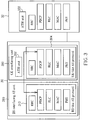
- Fig. 2 illustrates a schematic diagram of an exemplary relay 20.
- the relay 20 may be the relay 18 and includes a UE interfacing unit 200 for communicating with a base station (e.g. the base station 14) and a BS interfacing (base station-like) AS unit 210.
- the UE interfacing unit 200 includes an access stratum (AS) unit 202 and a non access stratum (NAS) unit 206.
- the AS unit 202 performs AS functionalities with the base station based on a UE-like AS protocol 204.
- the NAS unit 206 exchanges NAS data to perform NAS functionalities with a core network (e.g. the core network 12) based on a NAS protocol 208.
- a core network e.g. the core network 12
- the BS interfacing AS unit 210 wirelessly performs BS AS functionalities with the UEs based on a BS-like AS protocol 212 and exchanges data with the UE interfacing unit 200.
- the UE-like AS protocol 204 and the BS interfacing AS unit 210 each may include a radio resource control (RRC) layer, a packet data convergence protocol (PDCP) layer, a radio link control (RLC) layer, a medium access control (MAC) layer and a a physical (PHY) layer.
- RRC radio resource control
- PDCP packet data convergence protocol
- RLC radio link control
- MAC medium access control
- PHY physical
- the AS, BS AS, and NAS functionalities may include authentication, control plane signaling, transfer of user plane data, security of the control plane signaling and the user plane data, and connection control functionalities inherited from AS functionalities of the UEs and the base station and NAS functionalities of the UEs and the core network.
- the procedure and parameters of the inherited functionalities may refer to LTE/LTE-A specifiaction of 3GPP (Third Generation Partnership Project), and detailed operation thereof is omitted herein.
- the relay 18 performs a RRC connection establishment procedure to establish a RRC connection and performs a NAS Attach procedure to register to the MME.
- the NAS and AS functions of the relay 18 may be a simplified version of the NAS and AS functions of the UEs.
- the relay 18 may not inherit a RRC measurement functionality of the UEs.
- the base station also performs the BS AS functionalities with the AS unit 202 based on the BS-like AS protocol 212.
- the relay 18 is recognized as a UE by the base station via the UE-like AS protocol 204, and the relay 18 may appear as a base station or a relay itself to the UEs via the BS-like AS protocol 212.
- the relays 20 may further include a Universal Subscriber Identity Module (USIM), not shown in Fig. 2 , coupled to the UE interfacing unit.
- USIM Universal Subscriber Identity Module
- the USIM include a secret key for the relay to perform ciphering, integrity protection, authentication key agreement (AKA), etc.
- the base station communicating with the relay 20 may be a donor base station of the UEs.
- the relay 20 may select an appropriate base station or may be configured to connect to a base station for registration.
- the core network may be informed about the registration of the relay 20.
- Fig. 3 illustrates a schematic diagram of an exemplary relay 30.
- the relay 30 may be the relay 18 of Fig. 1 and includes a UE interfacing AS unit 300 including an authentication (ATH) unit 302 and a BS interfacing AS unit 310.
- the UE interfacing AS unit 300 performs AS functionalities with a base station 32 (e.g. the base station 14) based on a UE-like AS protocol 304.
- the base station 32 may be a donor base station of the relay 30 and includes an ATH unit 322 and the same AS protocol structure as the BS-like AS unit 312.
- the ATH unit 302 performs authentication functionality with the ATH unit 322 of the base station 32.
- the relay 30 can be authenticated by the base station 32 without need of non access stratum communication.
- the base station may configure data radio bearers for the relay 18 to forward data from the UEs to the base station or data from the base station to the UEs.
- the BS interfacing AS unit 310 for wirelessly performing BS AS functionalities with the UEs based on a BS-like AS protocol 312 and exchanges data with the UE interfacing AS unit 300.
- the UE-like AS protocol 304, the BS interfacing AS unit 310, and the BS interfacing AS protocol 312 works similarly to the UE-like AS protocol 204, the BS interfacing AS unit 210, and the BS-like AS protocol 212 respectively and related detailed operation are omitted herein.
- the ATH unit 302 With the ATH unit 302, the NAS configuration associated with the relay 30 itself can be eliminated. Thus, the core network does not need to perform any NAS control for the relay 30 itself but may be still involved with the NAS control of the UEs.
- Fig. 4 illustrates a schematic diagram of an exemplary process 40.
- the process 40 is used in a relay for handling data forwarding with a base station in a wireless communication system and includes the following steps:
- the relay may automatically enter a connected mode based on the configuration that has been stored before establishment of a RRC connection is initiated and may have been known by both the relay and the base station before the relay enters the connected mode.
- the relay in the connected mode represents that the relay has a RRC connection with the base station and the RRC connection is established based on the configuration. Since the configuration has been known by the based station, the based station is able to know exactly how to deal with the connection the relay would like to establish and thereby do corresponding connection configuration at itself.
- the relay is pre-configured to establish the connection without any signaling exchange between the base station and the relay, and the base station is capable of recognizing the pre-configured relay.
- the connection and connection mode thereof may be the RRC connection and the RRC_CONNECTED mode.
- the relay may perform Step 402 when powering on.
- the configuration includes at least one of a radio network temporary identifier, an integrity key, a ciphering key, a base-station-level key, and dedicated preamble configuration related to random access.
- a preconfigured dedicated preamble and a preconfigured C-RNTI are set for performing a random access procedure for obtaining the first time access to the base station and uplink synchronization.
- the base station can recognize the relay based on the preconfigured C-RNTI that may allow the relay and the UEs to be distinguishable from each other.
- Preconfigured security configuration is set for activating security function during the connection establishment and may include integrity and ciphering keys or a pre-configured base-station-level key (e.g. a K eNB ).
- a pre-configured base-station-level key e.g. a K eNB
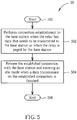
- Fig. 5 illustrates a schematic diagram of an exemplary process 50.
- the process 50 is used in a relay for handling data forwarding with a base station in a wireless communication system and includes the following steps:
- the relay performs the connection establishment, e.g. RRC connection establishment, to the base station when the relay has the data that needs to be transmitted to the base station or is paged by the base station. Furthermore, the relay releases the established connection and enters an idle mode when a data transmission of the connection establishment is finished.
- the idle mode e.g. a RRC_IDLE mode, herein means that the relay does not have any RRC connection for unicast data transfer with the base station.
- the situation that the relay has the data that needs to be transmitted to the base station may represent that the relay has received data from the UE, whereas the situation that the relay is paged by the base station may represent that the base station has data for the relay to forward to the UEs. Therefore, through the process 50, the relay stays in the idle mode until a data transmission attempt triggered is made, in order to save power.
- the RRC connection establishment may be performed via a random access procedure for obtaining uplink synchronization and a RRC connection establishment procedure, inherited from the procedure between the UEs and the base station/core network.
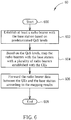
- Fig. 6 illustrates a schematic diagram of an exemplary process 60.
- the process 60 is used in a relay for handling data forwarding between at least a UE and a base station in a wireless communication system and includes the following steps:
- the relay maps the radio bearers established with the UEs and the base station and forwards the radio bearer data between the UEs and the base station according to the mapping results.
- the relay can classify data from the UEs based on the QoS levels that may have been set when the relay powers on.
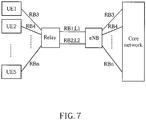
- Figs. 7-8 illustrate schematic diagrams of exemplary radio bearer mapping according to the concept of the process 60.
- a relay establishes a radio bearer RB1 with a QoS level L1 and a radio bearer RB2 with a QoS level L2 with an eNB.
- the relay performs data communication with UE1-UE5 by establishing radio bearers RB3-RBn.
- the relay receives data from one of UE1-UE5
- the relay forwards the data via RB1 or RB2 based on the QoS levels L1 and L2.
- the data conforming to the QoS level L1 is transmitted to the eNB via the radio bearer RB1.
- the data conforming to the QoS level L2 is transmitted to the eNB via the radio bearer RB2.
- the relay can determine whether the data of the UE1-UE5 conform to the QoS level L1 or L2, based on RB3-RBn configurations.
- the eNB restores the radio bearers RB3-RBn established between the UE and the relay so that core network is allowed to perform NAS control for the UEs as if direct connections are used between the UEs and eNB.
- Fig. 8 depicts that the eNB and the relay sets up radio bearers totally according to the QoS levels of the radio bearers established between the UEs and the eNB. In other words, the relay does not re-arrange radio bearer data of the UEs into new radio bearers for forwarding data to the eNB.
- the concepts of the processes 40-60 are applicable for the relays 18, 20 and 30, and other relays that can perform AS/RRC control for forwarding data between the UEs and the base station.
- the UE interfacing unit 200 of the relay 20 may be use for performing Step 602.
- the UE interfacing unit 200 itself, the BS interfacing AS unit 210 itself, or both the UE interfacing unit 200 and the BS interfacing AS unit 210 may be used as a mapping unit for performing Step 604 and also may be used as a forwarding unit for performing Step 606.
- the same usage can be applied for the relay 30.
- the steps of the abovementioned processes, including suggested steps, can be realized by means that could be hardware, firmware known as a combination of a hardware device and computer instructions and data that reside as read-only software on the hardware device, or an electronic system.
- hardware can include analog, digital and mixed circuits known as microcircuit, microchip, or silicon chip.
- the electronic system can include system on chip (SOC), system in package (Sip), computer on module (COM), and a communication device that includes a memory unit for storing program code corresponding to any of the abovementioned processes and a processor means for accessing the program code.
- SOC system on chip
- Sip system in package
- COM computer on module
- a communication device that includes a memory unit for storing program code corresponding to any of the abovementioned processes and a processor means for accessing the program code.
- the examples as mentioned above provide means and methods of efficiently, effectively communicating with UEs and the eNB in the aspects of AS, NAS, authentication, and security.
Landscapes
- Engineering & Computer Science (AREA)
- Computer Networks & Wireless Communication (AREA)
- Signal Processing (AREA)
- Mobile Radio Communication Systems (AREA)
Claims (13)
- Ein Relais- oder Weiterleitungselement (18; 20; 30) eines Drahtloskommunikationssystems (10) zum Handhaben einer Datenweiterleitung zwischen wenigstens einer Nutzereinrichtung bzw. UE (UE = user equipment) und einer Basisstation (14; 32), wobei das Relaiselement (18; 20; 30) Folgendes aufweist:
eine UE-Schnittstelleneinheit (200; 300) zum Kommunizieren mit der Basisstation (14; 32), wobei die UE-Schnittstelleneinheit (200; 300) Folgendes aufweist:eine Zugriffsschicht bzw. AS-Einheit (AS = access stratum) (202; 300) zum Durchführen von AS-Funktionalitäten mit der Basisstation (14; 32) basierend auf einem ersten AS-Protokoll (204; 304), wobei das Relaiselement (18; 20; 30) als eine UE durch die Basisstation (14; 32) über das erste AS-Protokoll (204; 304) erkannt werden kann; undeine Basisstations- bzw. BS-Schnittstellen-AS-Einheit (BS = base Station) (210; 310) zum drahtlosen Durchführen von BS-AS-Funktionalitäten mit den UEs basierend auf einem zweiten AS-Protokoll (212; 312) und Austauschen von Daten mit der UE-Schnittstelleneinheit (200; 300);wobei die UE-Schnittstelleneinheit (200; 300) wenigstens einen Funkträger bzw. RB (RB = radio bearer) (RB1, RB2) mit der Basisstation (14; 32) einrichtet basierend auf Dienstqualitäts- bzw. QoS-Niveaus (L1; L2),dadurch gekennzeichnet, dass das Relaiselement (18; 20; 30) weiter Folgendes aufweist:eine Abbildungs- bzw. Zuordnungseinheit zum Abbilden bzw. Zuordnen der eingerichteten Funkträger (RB1, RB2) zu einer Vielzahl von Funkträgern (RB3-RBn), die zwischen dem Relaiselement (18; 20; 30) und den UEs eingerichtet sind, und zwar basierend auf den QoS-Niveaus (L1, L2); undeine Weiterleitungseinheit zum Weiterleiten der Funkträgerdaten zwischen den UEs und der Basisstation (14; 32) gemäß den Abbildungsergebnissen. - Relaiselement nach Anspruch 1, dadurch gekennzeichnet, dass die UE-Schnittstelleneinheit weiter eine Nichtzugriffsschicht- bzw. NAS-Einheit (NAS = non access stratum) (206) zum Austauschen von NAS-Daten, die mit NAS-Funktionalitäten assoziiert sind, mit einem Kernnetzwerk über die Basisstation aufweist, wobei die NAS-Daten wenigstens eines von Daten, die mit einer Mobilität der UE assoziiert sind, und Daten, die mit Nutzerebenenträgern bzw. User-Plane-Trägern der UE assoziiert sind, beinhalten; und die AS-, NAS-, und BS-AS-Funktionalitäten wenigstens eines von Folgendem aufweisen: Authentifizierung, Steuerebenensignalisierung, Transfer von Nutzerebenendaten, Sicherheit der Steuerebenensignalisierung und der Nutzerebenendaten und Verbindungssteuerungsfunktionalitäten.
- Relaiselement nach Anspruch 2, das weiter ein Universal Subscriber Identity Module bzw. eine USIM aufweist, die an die UE-Schnittstelleneinheit gekoppelt ist.
- Relaiselement nach Anspruch 1, dadurch gekennzeichnet, dass die AS-Einheit der UE-Schnittstelleneinheit eine Authentifizierungs- bzw. ATH-Einheit (ATH = authentication) (302) zum Durchführen einer Authentifizierungsfunktionalität aufweist, wobei das Relaiselement durch die Basisstation über die Authentifizierungsfunktionalität ohne Nichtzugriffsschicht- bzw. NAS-Kommunikation authentifiziert wird.
- Relaiselement nach Anspruch 4, dadurch gekennzeichnet, dass das Relaiselement eine Relaiselementidentität hat, die durch die Basisstation unterschieden werden kann, und die AS-Einheit der UE-Schnittstelleneinheit die Relaiselementidentität in einer Funkressourcensteuerungsprozedur oder bei der Authentifizierungsfunktionalität verwendet.
- Relaiselement nach Anspruch 5, dadurch gekennzeichnet, dass das Relaiselement weiter einen Satz geheimer Schlüssel hat und die AS-Einheit der UE-Schnittstelleneinheit einen Authentifizierungsschlüssel aus dem Satz geheimer Schlüssel herleitet und den Authentifizierungsschlüssel bei der Authentifizierungsfunktionalität verwendet.
- Relaiselement nach Anspruch 6, dadurch gekennzeichnet, dass die AS-Einheit der UE-Schnittstelleneinheit RRC-Integritätsschlüssel und RRC-Verschlüsselungsschlüssel aus dem Authentifizierungsschlüssel herleitet und die RRC-Integritätsschlüssel und die RRC-Verschlüsselungsschlüssel zum Integritätsschutz und zum Verschlüsseln von Funkträgern verwendet.
- Relaiselement nach Anspruch 1, dadurch gekennzeichnet, dass die AS-Einheit der UE-Schnittstelleneinheit in einen verbundenen Funkressourcensteuerungs- bzw. RRC-Modus (RRC = radio resource control) eintritt basierend auf einer Konfiguration, die gespeichert worden ist, bevor eine Einrichtung einer RRC-Verbindung initiiert wird, wobei die Konfiguration wenigstens eines von einem temporären Funknetzwerkidentifikator, einem Integritätsschlüssel, einem Verschlüsselungsschlüssel, einem Basisstationsebenenschlüssel und einer speziell vorgesehenen bzw. dedizierten Präambelkonfiguration, die mit Random-Access bzw. Direktzugriff in Beziehung steht, beinhaltet.
- Relaiselement nach Anspruch 1, dadurch gekennzeichnet, dass die AS-Einheit der UE-Schnittstelleneinheit die RRC-Verbindungseinrichtung zu der Basisstation durchführt, wenn das Relaiselement Daten hat, die an die Basisstation gesendet werden müssen oder wenn die Relaisstation einen Funkruf von der Basisstation erhält bzw. von dieser gepaged wird, und in einen RRC-Ruhemodus eintritt, wenn eine Datensendung auf der eingerichteten RRC-Verbindung beendet ist.
- Relaiselement (18; 20; 30) eines Drahtloskommunikationssystems zum Handhaben einer Datenweiterleitung zwischen wenigstens einer Nutzereinrichtung bzw. UE (UE = user equipment) und einer Basisstation, wobei das Relaiselement weiter Folgendes aufweist:Mittel zum Durchführen einer Funkressourcensteuerungs- bzw. RRC-Funktionalität (RRC = radio resource control) mit der Basisstation, wobei das Relaiselement durch die Basisstation als eine UE erkannt werden kann; undMittel zum drahtlosen Kommunizieren mit den UEs gemäß der durchgeführten RRC-Funktionalität;Mittel zum Einrichten wenigstens eines Funkträgers mit der Basisstation basierend auf Dienstqualitäts- bzw. QoS-Niveaus;gekennzeichnet durch:Mittel zum, basierend auf den QoS-Niveaus, Abbilden bzw. Zuordnen der eingerichteten Funkträger zu einer Vielzahl von Funkträgern, die mit den UEs eingerichtet sind; undMittel zum Weiterleiten der Funkträgerdaten zwischen den UEs und der Basisstation gemäß den Abbildungs- bzw. Zuordnungsergebnissen.
- Relaiselement nach Anspruch 10, dadurch gekennzeichnet, dass die Mittel zum Durchführen der RRC-Funktionalität mit der Basisstation Folgendes aufweisen:Mittel zum Speichern einer Konfiguration bevor eine Einrichtung einer RRC-Verbindung initiiert wird; undMittel zum Eintreten in einen verbundenen Modus basierend auf der Konfiguration, wobei das Relaiselement in dem verbundenen Modus eine Verbindung mit der Basisstation hat und die RRC-Verbindung eingerichtet wird basierend auf der Konfiguration, wobei die Konfiguration wenigstens eines von einem temporären Funknetzwerkidentifikator, einem Integritätsschlüssel, einem Verschlüsselungsschlüssel, einem Basisstationsebenenenschlüssel und einer dedizierten bzw. speziell vorgesehenen Präambelkonfiguration, die mit Random-Access bzw. Direktzugriff in Beziehung steht, beinhaltet.
- Relaiselement nach Anspruch 10, dadurch gekennzeichnet, dass die Mittel zum Durchführen der RRC-Funktionalität mit der Basisstation Folgendes aufweisen:Mittel zum Durchführen einer Verbindungseinrichtung mit der Basisstation, wenn das Relaiselement Daten hat, die an die Basisstation gesendet werden müssen oder wenn das Relaiselement einen Funkruf durch die Basisstation erhält bzw. durch diese gepaged wird; undMittel zum Freigeben der eingerichteten Verbindung mit der Basisstation und zum Eintreten in einen Ruhemodus, wenn eine Datensendung auf der eingerichteten Verbindung beendet worden ist.
- Ein Verfahren, das Verfahrensschritte aufweist, die Funktionalitäten entsprechen, die durch die Mittel ausgeführt werden, die in einem Relaiselement enthalten sind, das in einem der vorhergehenden Ansprüche beansprucht wird.
Applications Claiming Priority (1)
| Application Number | Priority Date | Filing Date | Title |
|---|---|---|---|
| US17109609P | 2009-04-21 | 2009-04-21 |
Publications (3)
| Publication Number | Publication Date |
|---|---|
| EP2244499A2 EP2244499A2 (de) | 2010-10-27 |
| EP2244499A3 EP2244499A3 (de) | 2010-12-08 |
| EP2244499B1 true EP2244499B1 (de) | 2018-09-12 |
Family
ID=42314240
Family Applications (1)
| Application Number | Title | Priority Date | Filing Date |
|---|---|---|---|
| EP10004223.3A Active EP2244499B1 (de) | 2009-04-21 | 2010-04-21 | Relais zur Handhabung von Datenweiterleitung in einem drahtlosen Kommunikationssystem und zugehöriges Verfahren zu dessen Steuerung |
Country Status (4)
| Country | Link |
|---|---|
| US (1) | US8902827B2 (de) |
| EP (1) | EP2244499B1 (de) |
| CN (1) | CN101873164B (de) |
| TW (1) | TWI422242B (de) |
Families Citing this family (26)
| Publication number | Priority date | Publication date | Assignee | Title |
|---|---|---|---|---|
| EP1798998B1 (de) | 2005-12-14 | 2011-06-15 | Research In Motion Limited | Verfahren und Gerät für Endgerätebasierte Funkmittelsteuerung in einem UMTS Netz |
| DE602006017517D1 (de) | 2006-05-17 | 2010-11-25 | Research In Motion Ltd | Verfahren und System zur Anzeige einer Ursache für einen Abbau einer Signalisierungsverbindung in einem UMTS Netz |
| US8265034B2 (en) | 2006-05-17 | 2012-09-11 | Research In Motion Limited | Method and system for a signaling connection release indication |
| EP2061192B1 (de) | 2007-11-13 | 2012-04-11 | Research In Motion Limited | Verfahren und Vorrichtung für Status-/Modusübergänge |
| EP3934336B1 (de) | 2008-11-10 | 2024-01-03 | Malikie Innovations Limited | Verfahren, vorrichtung und computerlesbares speichermedium zum übergang zu einem batterieeffizienten zustand |
| EP2405703A4 (de) * | 2009-03-06 | 2016-08-03 | China Mobile Comm Corp | Verfahren, system und netzwerkgerät für den netzwerkzugang eines relaisknoten |
| EP2259651A1 (de) * | 2009-06-05 | 2010-12-08 | Panasonic Corporation | Qos-Multiplexen mittels Basisstation/Relaisknoten-Schnittstelle |
| CN101932103B (zh) * | 2009-06-19 | 2015-08-12 | 中兴通讯股份有限公司 | 一种中继节点接入的方法 |
| ES2494193T3 (es) | 2009-11-23 | 2014-09-15 | Blackberry Limited | Método y aparato para realizar una transición de estado/modo a una inactividad rápida |
| WO2011061352A1 (en) | 2009-11-23 | 2011-05-26 | Research In Motion Limited | Method and apparatus for state/mode transitioning |
| BR112012012351B1 (pt) | 2009-11-23 | 2021-05-04 | Blackberry Limited | método para o processamento de uma mensagem de indicação e equipamento de usuário configurado para processar as mensagens de indicação |
| US8983532B2 (en) | 2009-12-30 | 2015-03-17 | Blackberry Limited | Method and system for a wireless communication device to adopt varied functionalities based on different communication systems by specific protocol messages |
| EP2572552B1 (de) * | 2010-05-17 | 2017-11-08 | Telefonaktiebolaget LM Ericsson (publ) | Verfahren und anordnungen zur einstellung der eigenschaften eines relais-/repeaterknotens in einem funkkommunikationsnetz |
| US9215220B2 (en) * | 2010-06-21 | 2015-12-15 | Nokia Solutions And Networks Oy | Remote verification of attributes in a communication network |
| WO2012080373A1 (en) * | 2010-12-14 | 2012-06-21 | Nec Europe Ltd. | Method and system for connecting a user equipment to a core network entity of a mobile communication network via a relay node |
| US20120250601A1 (en) * | 2011-03-28 | 2012-10-04 | Hyung-Nam Choi | Communication terminal, method for exchanging data, communication device and method for establishing a communication connection |
| WO2013027015A1 (en) | 2011-08-19 | 2013-02-28 | Sca Ipla Holdings Inc. | Wireless communications system and method |
| CA2823789C (en) | 2011-11-11 | 2016-08-16 | Research In Motion Limited | Method and apparatus for user equipment state transition |
| GB201201915D0 (en) * | 2012-02-03 | 2012-03-21 | Nec Corp | Mobile communications device and system |
| CN103297172B (zh) | 2012-02-24 | 2016-12-21 | 华为技术有限公司 | 分组聚合的数据传输方法、接入点、中继节点和数据节点 |
| WO2013174007A1 (zh) * | 2012-05-25 | 2013-11-28 | 海能达通信股份有限公司 | 站点间无线互联系统、方法及站点 |
| WO2017075489A1 (en) * | 2015-10-30 | 2017-05-04 | Kyocera Corporation | Selection of decoding level at signal forwarding devices |
| EP3209048B1 (de) | 2016-02-18 | 2019-08-28 | Deutsche Telekom AG | Verfahren für eine verbesserte und/oder adaptive kommunikation zwischen einem telekommunikationsnetz und mindestens einer sekundären kommunikationsvorrichtung über oder mit einer primärem kommunikationsvorrichtung, system, programm und speichermedium |
| US10148340B1 (en) * | 2016-03-30 | 2018-12-04 | Sprint Communications Company L.P. | Multi-core communication system to serve wireless relays and user equipment |
| CN110463339B (zh) * | 2017-03-23 | 2022-10-11 | 苹果公司 | 下一代多跳中继蜂窝网络中的高级无线电资源管理 |
| MX2019012914A (es) * | 2017-05-05 | 2020-01-14 | Ericsson Telefon Ab L M | Diferenciacion de politicas de paginacion en sistema 5g. |
Family Cites Families (7)
| Publication number | Priority date | Publication date | Assignee | Title |
|---|---|---|---|---|
| EP1798998B1 (de) | 2005-12-14 | 2011-06-15 | Research In Motion Limited | Verfahren und Gerät für Endgerätebasierte Funkmittelsteuerung in einem UMTS Netz |
| CN101384020B (zh) * | 2007-09-05 | 2012-07-04 | 中兴通讯股份有限公司 | 一种无线中继系统及其数据传输方法 |
| KR101421294B1 (ko) * | 2007-11-06 | 2014-07-18 | 삼성전자주식회사 | 유선 중계국을 활용한 셀룰러 시스템에서 스케줄링 방법 및장치 |
| US8902805B2 (en) * | 2008-10-24 | 2014-12-02 | Qualcomm Incorporated | Cell relay packet routing |
| US8964781B2 (en) * | 2008-11-05 | 2015-02-24 | Qualcomm Incorporated | Relays in a multihop heterogeneous UMTS wireless communication system |
| US20100260109A1 (en) * | 2009-04-10 | 2010-10-14 | Qualcomm Incorporated | Optimized inter-access point packet routing for ip relay nodes |
| KR100968037B1 (ko) * | 2009-04-21 | 2010-07-07 | 엘지전자 주식회사 | 무선 통신 시스템에서 무선 베어러를 관리하는 방법 및 장치 |
-
2010
- 2010-04-16 US US12/761,412 patent/US8902827B2/en active Active
- 2010-04-21 CN CN201010167411.1A patent/CN101873164B/zh active Active
- 2010-04-21 EP EP10004223.3A patent/EP2244499B1/de active Active
- 2010-04-21 TW TW099112490A patent/TWI422242B/zh active
Non-Patent Citations (1)
| Title |
|---|
| None * |
Also Published As
| Publication number | Publication date |
|---|---|
| EP2244499A2 (de) | 2010-10-27 |
| US8902827B2 (en) | 2014-12-02 |
| CN101873164B (zh) | 2014-03-26 |
| TWI422242B (zh) | 2014-01-01 |
| CN101873164A (zh) | 2010-10-27 |
| US20100265872A1 (en) | 2010-10-21 |
| EP2244499A3 (de) | 2010-12-08 |
| TW201129133A (en) | 2011-08-16 |
Similar Documents
| Publication | Publication Date | Title |
|---|---|---|
| EP2244499B1 (de) | Relais zur Handhabung von Datenweiterleitung in einem drahtlosen Kommunikationssystem und zugehöriges Verfahren zu dessen Steuerung | |
| US11224032B2 (en) | Layer 2 relay to support coverage and resource-constrained devices in wireless networks | |
| US10433164B2 (en) | Method and apparatus for applying security information in wireless communication system | |
| US10271199B2 (en) | Method and apparatus for performing membership verification or access control in wireless communication system | |
| US9055442B2 (en) | Method and system for realizing integrity protection | |
| WO2017190590A1 (en) | System and method for device identification and authentication | |
| WO2011113324A1 (zh) | 一种处理回程链路错误的方法和中继节点 | |
| US9338655B2 (en) | Access control of relay node with closed subscriber group | |
| US12506579B2 (en) | Data transfer during mobility in layer 2 relay | |
| US9479921B2 (en) | Method and apparatus for performing closed subscriber group grouping in wireless communication system | |
| EP3285428B1 (de) | Vorrichtung zur handhabung von zellularer wlan-aggregation |
Legal Events
| Date | Code | Title | Description |
|---|---|---|---|
| PUAI | Public reference made under article 153(3) epc to a published international application that has entered the european phase |
Free format text: ORIGINAL CODE: 0009012 |
|
| 17P | Request for examination filed |
Effective date: 20100421 |
|
| AK | Designated contracting states |
Kind code of ref document: A2 Designated state(s): AT BE BG CH CY CZ DE DK EE ES FI FR GB GR HR HU IE IS IT LI LT LU LV MC MK MT NL NO PL PT RO SE SI SK SM TR |
|
| AX | Request for extension of the european patent |
Extension state: AL BA ME RS |
|
| PUAL | Search report despatched |
Free format text: ORIGINAL CODE: 0009013 |
|
| AK | Designated contracting states |
Kind code of ref document: A3 Designated state(s): AT BE BG CH CY CZ DE DK EE ES FI FR GB GR HR HU IE IS IT LI LT LU LV MC MK MT NL NO PL PT RO SE SI SK SM TR |
|
| AX | Request for extension of the european patent |
Extension state: AL BA ME RS |
|
| 17Q | First examination report despatched |
Effective date: 20101208 |
|
| RAP1 | Party data changed (applicant data changed or rights of an application transferred) |
Owner name: HTC CORPORATION |
|
| GRAP | Despatch of communication of intention to grant a patent |
Free format text: ORIGINAL CODE: EPIDOSNIGR1 |
|
| STAA | Information on the status of an ep patent application or granted ep patent |
Free format text: STATUS: GRANT OF PATENT IS INTENDED |
|
| RIC1 | Information provided on ipc code assigned before grant |
Ipc: H04B 7/155 20060101ALI20180223BHEP Ipc: H04W 16/26 20090101AFI20180223BHEP Ipc: H04W 84/04 20090101ALN20180223BHEP |
|
| RIC1 | Information provided on ipc code assigned before grant |
Ipc: H04W 84/04 20090101ALN20180320BHEP Ipc: H04B 7/155 20060101ALI20180320BHEP Ipc: H04W 16/26 20090101AFI20180320BHEP |
|
| INTG | Intention to grant announced |
Effective date: 20180404 |
|
| GRAS | Grant fee paid |
Free format text: ORIGINAL CODE: EPIDOSNIGR3 |
|
| GRAA | (expected) grant |
Free format text: ORIGINAL CODE: 0009210 |
|
| STAA | Information on the status of an ep patent application or granted ep patent |
Free format text: STATUS: THE PATENT HAS BEEN GRANTED |
|
| AK | Designated contracting states |
Kind code of ref document: B1 Designated state(s): AT BE BG CH CY CZ DE DK EE ES FI FR GB GR HR HU IE IS IT LI LT LU LV MC MK MT NL NO PL PT RO SE SI SK SM TR |
|
| REG | Reference to a national code |
Ref country code: GB Ref legal event code: FG4D |
|
| REG | Reference to a national code |
Ref country code: CH Ref legal event code: EP |
|
| REG | Reference to a national code |
Ref country code: IE Ref legal event code: FG4D |
|
| REG | Reference to a national code |
Ref country code: DE Ref legal event code: R096 Ref document number: 602010053468 Country of ref document: DE |
|
| REG | Reference to a national code |
Ref country code: AT Ref legal event code: REF Ref document number: 1042073 Country of ref document: AT Kind code of ref document: T Effective date: 20181015 |
|
| REG | Reference to a national code |
Ref country code: NL Ref legal event code: FP |
|
| REG | Reference to a national code |
Ref country code: LT Ref legal event code: MG4D |
|
| PG25 | Lapsed in a contracting state [announced via postgrant information from national office to epo] |
Ref country code: LT Free format text: LAPSE BECAUSE OF FAILURE TO SUBMIT A TRANSLATION OF THE DESCRIPTION OR TO PAY THE FEE WITHIN THE PRESCRIBED TIME-LIMIT Effective date: 20180912 Ref country code: NO Free format text: LAPSE BECAUSE OF FAILURE TO SUBMIT A TRANSLATION OF THE DESCRIPTION OR TO PAY THE FEE WITHIN THE PRESCRIBED TIME-LIMIT Effective date: 20181212 Ref country code: BG Free format text: LAPSE BECAUSE OF FAILURE TO SUBMIT A TRANSLATION OF THE DESCRIPTION OR TO PAY THE FEE WITHIN THE PRESCRIBED TIME-LIMIT Effective date: 20181212 Ref country code: GR Free format text: LAPSE BECAUSE OF FAILURE TO SUBMIT A TRANSLATION OF THE DESCRIPTION OR TO PAY THE FEE WITHIN THE PRESCRIBED TIME-LIMIT Effective date: 20181213 Ref country code: FI Free format text: LAPSE BECAUSE OF FAILURE TO SUBMIT A TRANSLATION OF THE DESCRIPTION OR TO PAY THE FEE WITHIN THE PRESCRIBED TIME-LIMIT Effective date: 20180912 Ref country code: SE Free format text: LAPSE BECAUSE OF FAILURE TO SUBMIT A TRANSLATION OF THE DESCRIPTION OR TO PAY THE FEE WITHIN THE PRESCRIBED TIME-LIMIT Effective date: 20180912 |
|
| PG25 | Lapsed in a contracting state [announced via postgrant information from national office to epo] |
Ref country code: LV Free format text: LAPSE BECAUSE OF FAILURE TO SUBMIT A TRANSLATION OF THE DESCRIPTION OR TO PAY THE FEE WITHIN THE PRESCRIBED TIME-LIMIT Effective date: 20180912 Ref country code: ES Free format text: LAPSE BECAUSE OF FAILURE TO SUBMIT A TRANSLATION OF THE DESCRIPTION OR TO PAY THE FEE WITHIN THE PRESCRIBED TIME-LIMIT Effective date: 20180912 Ref country code: HR Free format text: LAPSE BECAUSE OF FAILURE TO SUBMIT A TRANSLATION OF THE DESCRIPTION OR TO PAY THE FEE WITHIN THE PRESCRIBED TIME-LIMIT Effective date: 20180912 |
|
| REG | Reference to a national code |
Ref country code: AT Ref legal event code: MK05 Ref document number: 1042073 Country of ref document: AT Kind code of ref document: T Effective date: 20180912 |
|
| PG25 | Lapsed in a contracting state [announced via postgrant information from national office to epo] |
Ref country code: RO Free format text: LAPSE BECAUSE OF FAILURE TO SUBMIT A TRANSLATION OF THE DESCRIPTION OR TO PAY THE FEE WITHIN THE PRESCRIBED TIME-LIMIT Effective date: 20180912 Ref country code: IT Free format text: LAPSE BECAUSE OF FAILURE TO SUBMIT A TRANSLATION OF THE DESCRIPTION OR TO PAY THE FEE WITHIN THE PRESCRIBED TIME-LIMIT Effective date: 20180912 Ref country code: EE Free format text: LAPSE BECAUSE OF FAILURE TO SUBMIT A TRANSLATION OF THE DESCRIPTION OR TO PAY THE FEE WITHIN THE PRESCRIBED TIME-LIMIT Effective date: 20180912 Ref country code: PL Free format text: LAPSE BECAUSE OF FAILURE TO SUBMIT A TRANSLATION OF THE DESCRIPTION OR TO PAY THE FEE WITHIN THE PRESCRIBED TIME-LIMIT Effective date: 20180912 Ref country code: AT Free format text: LAPSE BECAUSE OF FAILURE TO SUBMIT A TRANSLATION OF THE DESCRIPTION OR TO PAY THE FEE WITHIN THE PRESCRIBED TIME-LIMIT Effective date: 20180912 Ref country code: IS Free format text: LAPSE BECAUSE OF FAILURE TO SUBMIT A TRANSLATION OF THE DESCRIPTION OR TO PAY THE FEE WITHIN THE PRESCRIBED TIME-LIMIT Effective date: 20190112 Ref country code: CZ Free format text: LAPSE BECAUSE OF FAILURE TO SUBMIT A TRANSLATION OF THE DESCRIPTION OR TO PAY THE FEE WITHIN THE PRESCRIBED TIME-LIMIT Effective date: 20180912 |
|
| PG25 | Lapsed in a contracting state [announced via postgrant information from national office to epo] |
Ref country code: SM Free format text: LAPSE BECAUSE OF FAILURE TO SUBMIT A TRANSLATION OF THE DESCRIPTION OR TO PAY THE FEE WITHIN THE PRESCRIBED TIME-LIMIT Effective date: 20180912 Ref country code: PT Free format text: LAPSE BECAUSE OF FAILURE TO SUBMIT A TRANSLATION OF THE DESCRIPTION OR TO PAY THE FEE WITHIN THE PRESCRIBED TIME-LIMIT Effective date: 20190112 Ref country code: SK Free format text: LAPSE BECAUSE OF FAILURE TO SUBMIT A TRANSLATION OF THE DESCRIPTION OR TO PAY THE FEE WITHIN THE PRESCRIBED TIME-LIMIT Effective date: 20180912 |
|
| REG | Reference to a national code |
Ref country code: DE Ref legal event code: R097 Ref document number: 602010053468 Country of ref document: DE |
|
| PLBE | No opposition filed within time limit |
Free format text: ORIGINAL CODE: 0009261 |
|
| STAA | Information on the status of an ep patent application or granted ep patent |
Free format text: STATUS: NO OPPOSITION FILED WITHIN TIME LIMIT |
|
| PG25 | Lapsed in a contracting state [announced via postgrant information from national office to epo] |
Ref country code: DK Free format text: LAPSE BECAUSE OF FAILURE TO SUBMIT A TRANSLATION OF THE DESCRIPTION OR TO PAY THE FEE WITHIN THE PRESCRIBED TIME-LIMIT Effective date: 20180912 |
|
| 26N | No opposition filed |
Effective date: 20190613 |
|
| PG25 | Lapsed in a contracting state [announced via postgrant information from national office to epo] |
Ref country code: SI Free format text: LAPSE BECAUSE OF FAILURE TO SUBMIT A TRANSLATION OF THE DESCRIPTION OR TO PAY THE FEE WITHIN THE PRESCRIBED TIME-LIMIT Effective date: 20180912 |
|
| REG | Reference to a national code |
Ref country code: CH Ref legal event code: PL |
|
| REG | Reference to a national code |
Ref country code: BE Ref legal event code: MM Effective date: 20190430 |
|
| PG25 | Lapsed in a contracting state [announced via postgrant information from national office to epo] |
Ref country code: LU Free format text: LAPSE BECAUSE OF NON-PAYMENT OF DUE FEES Effective date: 20190421 Ref country code: MC Free format text: LAPSE BECAUSE OF FAILURE TO SUBMIT A TRANSLATION OF THE DESCRIPTION OR TO PAY THE FEE WITHIN THE PRESCRIBED TIME-LIMIT Effective date: 20180912 |
|
| PG25 | Lapsed in a contracting state [announced via postgrant information from national office to epo] |
Ref country code: CH Free format text: LAPSE BECAUSE OF NON-PAYMENT OF DUE FEES Effective date: 20190430 Ref country code: LI Free format text: LAPSE BECAUSE OF NON-PAYMENT OF DUE FEES Effective date: 20190430 |
|
| PG25 | Lapsed in a contracting state [announced via postgrant information from national office to epo] |
Ref country code: BE Free format text: LAPSE BECAUSE OF NON-PAYMENT OF DUE FEES Effective date: 20190430 |
|
| PG25 | Lapsed in a contracting state [announced via postgrant information from national office to epo] |
Ref country code: TR Free format text: LAPSE BECAUSE OF FAILURE TO SUBMIT A TRANSLATION OF THE DESCRIPTION OR TO PAY THE FEE WITHIN THE PRESCRIBED TIME-LIMIT Effective date: 20180912 |
|
| PG25 | Lapsed in a contracting state [announced via postgrant information from national office to epo] |
Ref country code: IE Free format text: LAPSE BECAUSE OF NON-PAYMENT OF DUE FEES Effective date: 20190421 |
|
| PG25 | Lapsed in a contracting state [announced via postgrant information from national office to epo] |
Ref country code: CY Free format text: LAPSE BECAUSE OF FAILURE TO SUBMIT A TRANSLATION OF THE DESCRIPTION OR TO PAY THE FEE WITHIN THE PRESCRIBED TIME-LIMIT Effective date: 20180912 |
|
| PG25 | Lapsed in a contracting state [announced via postgrant information from national office to epo] |
Ref country code: HU Free format text: LAPSE BECAUSE OF FAILURE TO SUBMIT A TRANSLATION OF THE DESCRIPTION OR TO PAY THE FEE WITHIN THE PRESCRIBED TIME-LIMIT; INVALID AB INITIO Effective date: 20100421 Ref country code: MT Free format text: LAPSE BECAUSE OF FAILURE TO SUBMIT A TRANSLATION OF THE DESCRIPTION OR TO PAY THE FEE WITHIN THE PRESCRIBED TIME-LIMIT Effective date: 20180912 |
|
| PG25 | Lapsed in a contracting state [announced via postgrant information from national office to epo] |
Ref country code: MK Free format text: LAPSE BECAUSE OF FAILURE TO SUBMIT A TRANSLATION OF THE DESCRIPTION OR TO PAY THE FEE WITHIN THE PRESCRIBED TIME-LIMIT Effective date: 20180912 |
|
| P01 | Opt-out of the competence of the unified patent court (upc) registered |
Effective date: 20230602 |
|
| PGFP | Annual fee paid to national office [announced via postgrant information from national office to epo] |
Ref country code: DE Payment date: 20250305 Year of fee payment: 16 |
|
| PGFP | Annual fee paid to national office [announced via postgrant information from national office to epo] |
Ref country code: GB Payment date: 20260312 Year of fee payment: 17 |
|
| PGFP | Annual fee paid to national office [announced via postgrant information from national office to epo] |
Ref country code: NL Payment date: 20260317 Year of fee payment: 17 |
|
| PGFP | Annual fee paid to national office [announced via postgrant information from national office to epo] |
Ref country code: FR Payment date: 20260309 Year of fee payment: 17 |