EP2243942A1 - Balancing method for the cylinders of an internal combustion engine - Google Patents
Balancing method for the cylinders of an internal combustion engine Download PDFInfo
- Publication number
- EP2243942A1 EP2243942A1 EP20100160638 EP10160638A EP2243942A1 EP 2243942 A1 EP2243942 A1 EP 2243942A1 EP 20100160638 EP20100160638 EP 20100160638 EP 10160638 A EP10160638 A EP 10160638A EP 2243942 A1 EP2243942 A1 EP 2243942A1
- Authority
- EP
- European Patent Office
- Prior art keywords
- balancing method
- engine
- determining
- cylinders
- intake
- Prior art date
- Legal status (The legal status is an assumption and is not a legal conclusion. Google has not performed a legal analysis and makes no representation as to the accuracy of the status listed.)
- Granted
Links
- 238000002485 combustion reaction Methods 0.000 title claims abstract description 35
- 238000000034 method Methods 0.000 title claims abstract description 33
- 238000011835 investigation Methods 0.000 claims abstract description 26
- 238000013461 design Methods 0.000 claims abstract description 7
- 238000005070 sampling Methods 0.000 claims abstract description 4
- 238000005259 measurement Methods 0.000 description 4
- 239000000446 fuel Substances 0.000 description 2
- 238000011144 upstream manufacturing Methods 0.000 description 2
- 238000004364 calculation method Methods 0.000 description 1
- 239000006185 dispersion Substances 0.000 description 1
- 230000000694 effects Effects 0.000 description 1
- 238000012423 maintenance Methods 0.000 description 1
- 238000004088 simulation Methods 0.000 description 1
- 238000012360 testing method Methods 0.000 description 1
Images


Classifications
-
- F—MECHANICAL ENGINEERING; LIGHTING; HEATING; WEAPONS; BLASTING
- F02—COMBUSTION ENGINES; HOT-GAS OR COMBUSTION-PRODUCT ENGINE PLANTS
- F02D—CONTROLLING COMBUSTION ENGINES
- F02D41/00—Electrical control of supply of combustible mixture or its constituents
- F02D41/008—Controlling each cylinder individually
- F02D41/0085—Balancing of cylinder outputs, e.g. speed, torque or air-fuel ratio
-
- F—MECHANICAL ENGINEERING; LIGHTING; HEATING; WEAPONS; BLASTING
- F02—COMBUSTION ENGINES; HOT-GAS OR COMBUSTION-PRODUCT ENGINE PLANTS
- F02D—CONTROLLING COMBUSTION ENGINES
- F02D41/00—Electrical control of supply of combustible mixture or its constituents
- F02D41/0002—Controlling intake air
-
- F—MECHANICAL ENGINEERING; LIGHTING; HEATING; WEAPONS; BLASTING
- F02—COMBUSTION ENGINES; HOT-GAS OR COMBUSTION-PRODUCT ENGINE PLANTS
- F02D—CONTROLLING COMBUSTION ENGINES
- F02D2200/00—Input parameters for engine control
- F02D2200/02—Input parameters for engine control the parameters being related to the engine
- F02D2200/04—Engine intake system parameters
- F02D2200/0402—Engine intake system parameters the parameter being determined by using a model of the engine intake or its components
-
- F—MECHANICAL ENGINEERING; LIGHTING; HEATING; WEAPONS; BLASTING
- F02—COMBUSTION ENGINES; HOT-GAS OR COMBUSTION-PRODUCT ENGINE PLANTS
- F02D—CONTROLLING COMBUSTION ENGINES
- F02D2200/00—Input parameters for engine control
- F02D2200/02—Input parameters for engine control the parameters being related to the engine
- F02D2200/04—Engine intake system parameters
- F02D2200/0406—Intake manifold pressure
-
- F—MECHANICAL ENGINEERING; LIGHTING; HEATING; WEAPONS; BLASTING
- F02—COMBUSTION ENGINES; HOT-GAS OR COMBUSTION-PRODUCT ENGINE PLANTS
- F02D—CONTROLLING COMBUSTION ENGINES
- F02D31/00—Use of speed-sensing governors to control combustion engines, not otherwise provided for
- F02D31/001—Electric control of rotation speed
- F02D31/002—Electric control of rotation speed controlling air supply
- F02D31/003—Electric control of rotation speed controlling air supply for idle speed control
- F02D31/005—Electric control of rotation speed controlling air supply for idle speed control by controlling a throttle by-pass
-
- F—MECHANICAL ENGINEERING; LIGHTING; HEATING; WEAPONS; BLASTING
- F02—COMBUSTION ENGINES; HOT-GAS OR COMBUSTION-PRODUCT ENGINE PLANTS
- F02D—CONTROLLING COMBUSTION ENGINES
- F02D41/00—Electrical control of supply of combustible mixture or its constituents
- F02D41/30—Controlling fuel injection
- F02D41/32—Controlling fuel injection of the low pressure type
-
- Y—GENERAL TAGGING OF NEW TECHNOLOGICAL DEVELOPMENTS; GENERAL TAGGING OF CROSS-SECTIONAL TECHNOLOGIES SPANNING OVER SEVERAL SECTIONS OF THE IPC; TECHNICAL SUBJECTS COVERED BY FORMER USPC CROSS-REFERENCE ART COLLECTIONS [XRACs] AND DIGESTS
- Y02—TECHNOLOGIES OR APPLICATIONS FOR MITIGATION OR ADAPTATION AGAINST CLIMATE CHANGE
- Y02T—CLIMATE CHANGE MITIGATION TECHNOLOGIES RELATED TO TRANSPORTATION
- Y02T10/00—Road transport of goods or passengers
- Y02T10/10—Internal combustion engine [ICE] based vehicles
- Y02T10/40—Engine management systems
Definitions
- the present invention relates to a balancing method for the cylinders of an internal combustion engine.
- the present invention is advantageously applied to the balancing of the cylinders of an internal combustion engine of a motor vehicle, to which explicit reference will be made in the following description without therefore loosing in generality.
- each intake duct comprises a bypass duct which is arranged astride of the butterfly valve, i.e. it connects an area of the intake duct upstream of the butterfly valve to an area of the intake duct downstream of the butterfly valve.
- Each bypass duct is provided with a bypass valve, which is either opened or closed by operating on an adjustment screw.
- the cylinders of the internal combustion engine for motorcycles are balanced in an entirely manual manner by an experienced operator who evaluates the unbalances between the cylinders "by ear" (i.e. by evaluating the noise of the engines at different engine speeds according to his/her experience) and using both vacuometers, which are connected to the intake ducts, and the signals provided by lambda sensors of the exhaust system.
- the entirely manual balancing of the cylinders is long and difficult, and especially requires the intervention of an experienced operator, who can correctly evaluate the unbalance signals supplied by vacuometers, lambda sensors and engine noise.
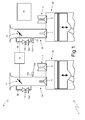
- numeral 1 indicates as a whole an internal combustion engine for motor vehicles.
- the internal combustion engine 1 is provided with two cylinders 2, each of which is connected to a respective intake duct 3 (or intake horn) by means of two intake valves 4 (only one of which is shown in figure 1 ) and to an exhaust duct 5 by means of two exhaust valves 6 (only one of which is shown in figure 1 ).
- Each intake duct 3 originates from an air box (containing an air cleaner) for receiving fresh air (i.e. air from the external environment) and is adjusted by a butterfly valve 7.
- the two butterfly valves 7 are actuated by the same electric actuator 8, which is common to both butterfly valves 7.
- Each intake duct 3 comprises a bypass duct 9, which is arranged astride of the butterfly valve 7, i.e. it connects an area of the intake duct upstream of the butterfly valve 7 to an area of the intake duct 3 downstream of the butterfly valve 7.
- Each bypass duct 9 is provided with a bypass valve 10, which is either opened or closed by operating on an adjustment screw 11.
- a measuring duct 12 originates in each intake duct 3 downstream of the butterfly valve 7, which measuring duct 12 has a pressure port with a calibrated hole and is provided with a pressure sensor 13 adapted to measure the value of the intake pressure within the intake duct 3. Therefore, each pressure sensor 13 is associated to a corresponding intake duct 3 and detects an intake pressure value substantially equal to the pressure inside the intake duct downstream of the butterfly valve 7.
- the pressure port of each measuring duct 12 preferably originates as far as possible from the butterfly valve 7, thus as close as possible to the intake valves 4, where the shape and level of the pressure are more significant.
- one common Y-shaped measuring duct 12 is included, which connects the two intake ducts 3 together and is provided with a pressure sensor 13 adapted to measure the pressure value inside the measuring duct 12. Therefore, the pressure sensor 13 is in common to both intake ducts 3 and detects an intake pressure value which is a combination of the pressures inside the intake ducts 3 downstream of the butterfly valves 7.
- An electronic control unit 14 governs the operation of the internal combustion engine 1 and, inter alia, receives the measuring signal provided by the pressure sensors 13 (in the embodiment in figure 1 ) or by the pressure sensor 13 (in the embodiment shown in figure 2 ), and drives the electric actuator 8.
- the electronic control unit 14 preferably comprises a fast acquisition buffer, which receives the measurements provided either by the pressure sensors 13 (in the embodiment shown in figure 1 ) or by the pressure sensor 13 (in the embodiment shown in figure 2 ).
- saving the instantaneous intake pressures in the fast acquisition buffer of the electronic control unit 14 is directly controlled by the BIOS of the electronic control unit 14 without requiring specific software; in other words, the acquisition of the measurements in the fast acquisition buffer is directly managed by the low level software present in the BIOS without requiring a specific intervention by the CPU, managed by the high level software.
- the mode used by the electronic control unit 14 to balance the two cylinders 2 is described below.
- an investigation window Wa expressed in engine degrees and associated to the cylinder 2a and an investigation window Wb expressed in engine degrees and associated to the cylinder 2b are determined.
- each investigation window Wa and Wb coincides with the engine cycle, i.e. it has a width of 720°; in this case, the two investigation windows Wa and Wb perfectly overlap.
- each investigation window Wa and Wb covers a fraction of the engine cycle; preferably, in this case, the two investigation windows Wa and Wb do not overlap at all.
- the internal combustion engine 1 comprises a single pressure sensor 13 pneumatically connected to both intake ducts 3 (embodiment shown in figure 2 )
- the exact positioning and size of the investigation windows Wa e Wb are determined in an essentially experimental manner from the starting data, gradually improving them by means of targeted experimental tests (which may possibly be replaced by software model simulations).
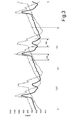
- figures 3 and 4 show two examples of acquisitions carried out on a real internal combustion engine 1 provided with a single pressure sensor pneumatically connected to two intake ducts 3.
- Figures 3 and 4 show investigation windows Wa and Wb; furthermore, in figures 3 and 4 the continuous line shows the pattern of the intake pressure measured by the common pressure sensor 13, while the dashed-and-dotted line shows the patterns of the intake pressure in the intake ducts 3 measured by further laboratory pressure sensors temporarily mounted for study purposes.
- the internal combustion engine 1 is run at a desired and stabilized engine point which preferably includes rotation rpm close to idling rpm (indicatively about 2000 rpm) and a low opening degree of the butterfly values 7 (indicatively a few degrees of opening).
- a desired and stabilized engine point which preferably includes rotation rpm close to idling rpm (indicatively about 2000 rpm) and a low opening degree of the butterfly values 7 (indicatively a few degrees of opening).
- the electronic control unit 14 samples the measurement of the instantaneous intake pressure provided by the pressure sensors 13 (in the embodiment in figure 1 ) or by the pressure sensor 13 (in the embodiment shown in figure 2 ).
- the electronic control unit 14 determines a balance index Ia associated to the cylinder 2a by calculating an average of the instantaneous intake pressures within the investigation window Wa and determines a balance index Ib associated to the cylinder 2b by calculating an average of the instantaneous intake pressures within the investigation window Wb.
- each balance index Ia and Ib is determined by calculating the average of the instantaneous intake pressures measured by the pressure sensor 13a or 13b coupled to the corresponding cylinder 2a or 2b; thus, each balance index Ia and Ib is equal to the average value of the intake pressure in the corresponding intake duct 3a and 3b during the corresponding investigation window Wa and Wb (i.e. during an entire engine cycle, because each investigation window Wa and Wb coincides with the engine cycle).
- each balance index Ia and Ib is equal to the average value of the intake pressure during the corresponding investigation window Wa and Wb, which is a fraction of the entire engine cycle.
- each balance index Ia and Ib is calculated by means of a weighed average according to the engine angle of the instantaneous intake pressures inside the corresponding investigation window Wa and Wb; in other words, the instantaneous intake pressures measured in some given engine degrees may be considered more significant (i.e. with a higher weight) than other instantaneous intake pressures.
- the electronic control unit 14 preferably determines a plurality of balance indexes Ia and Ib in sequence during the subsequent engine cycles and therefore calculates an average (preferably mobile) between the balance indexes Ia and the balance indexes Ib; thereby, the effect of the accidental errors may be reduced by increasing the confidence degree of the balance indexes Ia and Ib.
- the electronic control unit 14 determines the degree of unbalance of the two cylinders 2.
- a differential reference value ⁇ REF is determined.
- the electronic control unit 14 calculates a comparison value ⁇ equal to the difference between the two balance indexes Ia and Ib, and determines the unbalancing degree of the two cylinders 2 according to the difference between the comparison value ⁇ and the differential reference value ⁇ REF .
- the differential reference value ⁇ REF is experimentally determined by determining the balance indexes Ia and Ib in a perfectly balanced sample engine; in other words, the reference balance indexes Ia REF and Ib REF are determined by carrying out calibration measurements in a perfectly balanced sample engine, and thus the differential reference value ⁇ REF is calculated as the difference between the reference balancing values Ia REF and Ib REF.
- the electronic control unit 14 establishes the two cylinders 2 being unbalanced when the difference between the comparison value ⁇ and the differential reference value ⁇ REF is (substantially) not zero (i.e. as absolute value, it is higher than a first threshold value) and establishes that the two cylinders 2 are balanced when the difference between the comparison value ⁇ and the differential reference value ⁇ REF is (substantially) zero (i.e. the absolute value is lower than the first threshold value).
- the electronic control unit 14 In order to balance the internal combustion engine 1, i.e. to compensate for the unbalance between the two cylinders 2, the electronic control unit 14 requires the bypass valve 10a of the cylinder 2a to be opended when the difference between the comparison value ⁇ and the differential reference value ⁇ REF is negative, and requires the bypass valve 10b of the cylinder 2b to be opened when the difference between the comparison value ⁇ and the differential reference value ⁇ REF is positive (or also vice versa according to the conventions used).
- the electronic control unit 14 preferably establishes the opening degree of the bypass valve 10a and 10b according to the extent of the absolute value of the difference between the comparison value ⁇ and the differential reference value ⁇ REF ; for example, if the absolute value of the difference between the comparison value ⁇ and the differential reference value ⁇ REF is small (i.e. is lower than a second threshold value), then the electronic control unit 14 requires the bypass valve 10a or 10b to be opened by rotating the corresponding adjustment screw 11a or 11b by one fourth of a turn, while if the absolute value of the difference between the comparison value ⁇ and the differential reference value ⁇ REF is high (i.e. higher than the second threshold value), then the electronic control unit 14 requires the bypass valve 10a or 10b to be opened by rotating the corresponding adjustment screw 11a or 11b by half a turn.
- the electronic control unit 14 saves the instantaneous intake pressures provided by the pressure sensors 13 (in the embodiment shown in figure 1 ) or by the pressure sensor 13 (in the embodiment in figure 2 ) in the fast acquisition buffer; moreover, at the end of each engine cycle occurring in the desired, stabilized engine point, the electronic control unit 14 determines the balance indexes Ia and Ib by calculating an average of the instantaneous intake pressures previously saved in the buffer.
- the sampling frequency of the instantaneous intake pressure is directly proportional to the engine rpm so that a constant number (e.g. 120) of instantaneous intake pressure samples is acquired at each engine cycle.
- the above-described mode for balancing the two cylinders 2 is typically performed by the electronic control unit 14 once the internal combustion engine 1 has been constructed, starting from the bypass valves 10 entirely closed. Furthermore, the above-described mode for balancing the two cylinders 2 may be performed by the electronic control unit 14 also during the normal operation of the internal combustion engine 1 (obviously, when possible, i.e. when the current engine point is stabilized and is about the desired engine point), to check whether the two cylinders 2 are actually unbalanced; if the electronic control unit 14 detects an unbalance (e.g. caused by a time drift of the components, by a fault, or by an incorrect maintenance intervention), the electronic control unit 14 indicates the need for servicing to the driver.
- an unbalance e.g. caused by a time drift of the components, by a fault, or by an incorrect maintenance intervention
- the above-described mode for balancing the two cylinders 2 may be performed in any engine having two or more cylinders, in which the butterfly valves of several intake ducts are controlled by a single common actuator.
- the above-described balancing operation is performed for each pair of cylinders, formed by two cylinders which share the same common electric actuator for the butterfly valve of the intake ducts.
- the above-described balancing method has several advantages.
- the above-described balancing method is simple and cost-effective to be implemented, not requiring the addition of new hardware components as compared to those normally present in a modern internal combustion engine of a motorcycle, and not requiring a calculation power higher than the possibility of the electronic control units currently in use.
- the above-described balancing method does not require the intervention by a highly specialized operator, because the operator only needs to act on the screws 11 according to the indications received from the electronic control unit 14, and thus has no function to decide but only function to execute.
- the above-described balancing method is particularly fast as compared to the traditional completely manual balancing and allows to obtain a high uniformity of results (on the contrary, an even highly specialized operator may produce either a very good or poor balancing according to his/her degree of fatigue/attention, and thus with a high unpredictability and dispersion of results).
- the above-described balancing method does not require vacuometers to be used, therefore the balancing procedure is thus simplified and the ports in the intake ducts 3 are no longer needed to be connected to the vacuometers.
- the above-described balancing method may be performed during the normal operation of the internal combustion engine 1, thus allowing a continuous control of the balancing state of the cylinders 2.
Landscapes
- Engineering & Computer Science (AREA)
- Chemical & Material Sciences (AREA)
- Combustion & Propulsion (AREA)
- Mechanical Engineering (AREA)
- General Engineering & Computer Science (AREA)
- Combined Controls Of Internal Combustion Engines (AREA)
- Output Control And Ontrol Of Special Type Engine (AREA)
Abstract
Description
- The present invention relates to a balancing method for the cylinders of an internal combustion engine.
- The present invention is advantageously applied to the balancing of the cylinders of an internal combustion engine of a motor vehicle, to which explicit reference will be made in the following description without therefore loosing in generality.
- In an internal combustion engine for a motor vehicle, there may be minor differences between cylinders due to inevitable constructional tolerances and due to different time drifts. Such differences between cylinders determine differences in the aspirated air amount in case of the opening of the butterfly valves being equal; and therefore, since the amount of injected petrol being the same for all cylinders, the combustion in at least one cylinder will always be either too lean (i.e. with an air-to-fuel ratio unbalanced in favor of air) or too rich (i.e. an air-to-fuel ratio unbalanced in favor of petrol). The problem of differences between cylinders is particularly felt in internal combustion engines for motorcycles, because in general these internal combustion engines have no intake manifold and each cylinder is directly connected to the air box (containing the air cleaner) by means of a short intake duct (or intake horn) adjusted by a respective butterfly valve.
- For balancing the cylinders of an internal combustion engine for motorcycles, i.e. for compensating the minor differences between cylinders, each intake duct comprises a bypass duct which is arranged astride of the butterfly valve, i.e. it connects an area of the intake duct upstream of the butterfly valve to an area of the intake duct downstream of the butterfly valve. Each bypass duct is provided with a bypass valve, which is either opened or closed by operating on an adjustment screw. When an internal combustion engine for motorcycles is produced, the bypass valves are all closed and are then opened during a balancing procedure to compensate for the minor differences between cylinders.
- Currently, the cylinders of the internal combustion engine for motorcycles are balanced in an entirely manual manner by an experienced operator who evaluates the unbalances between the cylinders "by ear" (i.e. by evaluating the noise of the engines at different engine speeds according to his/her experience) and using both vacuometers, which are connected to the intake ducts, and the signals provided by lambda sensors of the exhaust system. However, the entirely manual balancing of the cylinders is long and difficult, and especially requires the intervention of an experienced operator, who can correctly evaluate the unbalance signals supplied by vacuometers, lambda sensors and engine noise.
- It is the object of the present invention to provide a balancing method of the cylinders of an internal combustion engine, which balancing method is free from the above-described drawbacks, while being easy and cost-effective to be implemented.
- According to the present invention, a balancing method of the cylinders of an internal combustion engine is provided as claimed in the appended claims.
- The present invention will now be described with reference to the accompanying drawings, which illustrate a non-limitative embodiment thereof, in which:
-
figure 1 is a diagrammatic view of an internal combustion engine which implements the balancing method object of the present invention; -
figure 2 is a diagrammatic view of a variant of the engine infigure 1 ; and -
figures 3 and4 are two charts showing the variation of intake pressure in the engine infigure 2 as the engine angle (i.e. the angular position of the drive shaft) varies. - In
figure 1 ,numeral 1 indicates as a whole an internal combustion engine for motor vehicles. Theinternal combustion engine 1 is provided with two cylinders 2, each of which is connected to a respective intake duct 3 (or intake horn) by means of two intake valves 4 (only one of which is shown infigure 1 ) and to anexhaust duct 5 by means of two exhaust valves 6 (only one of which is shown infigure 1 ). Each intake duct 3 originates from an air box (containing an air cleaner) for receiving fresh air (i.e. air from the external environment) and is adjusted by a butterfly valve 7. The two butterfly valves 7 are actuated by the sameelectric actuator 8, which is common to both butterfly valves 7. - Each intake duct 3 comprises a bypass duct 9, which is arranged astride of the butterfly valve 7, i.e. it connects an area of the intake duct upstream of the butterfly valve 7 to an area of the intake duct 3 downstream of the butterfly valve 7. Each bypass duct 9 is provided with a bypass valve 10, which is either opened or closed by operating on an adjustment screw 11.
- A
measuring duct 12 originates in each intake duct 3 downstream of the butterfly valve 7, which measuringduct 12 has a pressure port with a calibrated hole and is provided with apressure sensor 13 adapted to measure the value of the intake pressure within the intake duct 3. Therefore, eachpressure sensor 13 is associated to a corresponding intake duct 3 and detects an intake pressure value substantially equal to the pressure inside the intake duct downstream of the butterfly valve 7. The pressure port of eachmeasuring duct 12 preferably originates as far as possible from the butterfly valve 7, thus as close as possible to theintake valves 4, where the shape and level of the pressure are more significant. - According to the alternative embodiment shown in
figure 2 , one common Y-shaped measuring duct 12 is included, which connects the two intake ducts 3 together and is provided with apressure sensor 13 adapted to measure the pressure value inside themeasuring duct 12. Therefore, thepressure sensor 13 is in common to both intake ducts 3 and detects an intake pressure value which is a combination of the pressures inside the intake ducts 3 downstream of the butterfly valves 7. - An
electronic control unit 14 governs the operation of theinternal combustion engine 1 and, inter alia, receives the measuring signal provided by the pressure sensors 13 (in the embodiment infigure 1 ) or by the pressure sensor 13 (in the embodiment shown infigure 2 ), and drives theelectric actuator 8. Theelectronic control unit 14 preferably comprises a fast acquisition buffer, which receives the measurements provided either by the pressure sensors 13 (in the embodiment shown infigure 1 ) or by the pressure sensor 13 (in the embodiment shown infigure 2 ). In particular, saving the instantaneous intake pressures in the fast acquisition buffer of theelectronic control unit 14 is directly controlled by the BIOS of theelectronic control unit 14 without requiring specific software; in other words, the acquisition of the measurements in the fast acquisition buffer is directly managed by the low level software present in the BIOS without requiring a specific intervention by the CPU, managed by the high level software. - The mode used by the
electronic control unit 14 to balance the two cylinders 2 is described below. - During a design phase, an investigation window Wa expressed in engine degrees and associated to the
cylinder 2a and an investigation window Wb expressed in engine degrees and associated to thecylinder 2b are determined. Preferably, when theinternal combustion engine 1 comprises acorresponding pressure sensor 13 for each intake duct 3 (embodiment shown infigure 1 ), each investigation window Wa and Wb coincides with the engine cycle, i.e. it has a width of 720°; in this case, the two investigation windows Wa and Wb perfectly overlap. When theinternal combustion engine 1 comprises asingle pressure sensor 13 pneumatically connected to both intake ducts 3 (embodiment shown infigure 2 ), each investigation window Wa and Wb covers a fraction of the engine cycle; preferably, in this case, the two investigation windows Wa and Wb do not overlap at all. When theinternal combustion engine 1 comprises asingle pressure sensor 13 pneumatically connected to both intake ducts 3 (embodiment shown infigure 2 ), the exact positioning and size of the investigation windows Wa e Wb are determined in an essentially experimental manner from the starting data, gradually improving them by means of targeted experimental tests (which may possibly be replaced by software model simulations). - By way of example,
figures 3 and4 show two examples of acquisitions carried out on a realinternal combustion engine 1 provided with a single pressure sensor pneumatically connected to two intake ducts 3.Figures 3 and4 show investigation windows Wa and Wb; furthermore, infigures 3 and4 the continuous line shows the pattern of the intake pressure measured by thecommon pressure sensor 13, while the dashed-and-dotted line shows the patterns of the intake pressure in the intake ducts 3 measured by further laboratory pressure sensors temporarily mounted for study purposes. - The
internal combustion engine 1 is run at a desired and stabilized engine point which preferably includes rotation rpm close to idling rpm (indicatively about 2000 rpm) and a low opening degree of the butterfly values 7 (indicatively a few degrees of opening). When the engine point has stabilized, during an engine cycle theelectronic control unit 14 samples the measurement of the instantaneous intake pressure provided by the pressure sensors 13 (in the embodiment infigure 1 ) or by the pressure sensor 13 (in the embodiment shown infigure 2 ). - At the end of each engine cycle occurring in the desired, stabilized engine point, the
electronic control unit 14 determines a balance index Ia associated to thecylinder 2a by calculating an average of the instantaneous intake pressures within the investigation window Wa and determines a balance index Ib associated to thecylinder 2b by calculating an average of the instantaneous intake pressures within the investigation window Wb. When theinternal combustion engine 1 comprises acorresponding pressure sensor 13 for each intake duct 3 (embodiment shown infigure 1 ), each balance index Ia and Ib is determined by calculating the average of the instantaneous intake pressures measured by thepressure sensor corresponding cylinder corresponding intake duct internal combustion engine 1 comprises asingle pressure sensor 13 pneumatically connected to both intake ducts 3 (embodiment shown infigure 2 ), each balance index Ia and Ib is equal to the average value of the intake pressure during the corresponding investigation window Wa and Wb, which is a fraction of the entire engine cycle. - According to a possible embodiment, each balance index Ia and Ib is calculated by means of a weighed average according to the engine angle of the instantaneous intake pressures inside the corresponding investigation window Wa and Wb; in other words, the instantaneous intake pressures measured in some given engine degrees may be considered more significant (i.e. with a higher weight) than other instantaneous intake pressures.
- The
electronic control unit 14 preferably determines a plurality of balance indexes Ia and Ib in sequence during the subsequent engine cycles and therefore calculates an average (preferably mobile) between the balance indexes Ia and the balance indexes Ib; thereby, the effect of the accidental errors may be reduced by increasing the confidence degree of the balance indexes Ia and Ib. - According to the balance indexes Ia and Ib, the
electronic control unit 14 determines the degree of unbalance of the two cylinders 2. - In order to analyze the balance indexes Ia and Ib, during the designing phase a differential reference value ΔREF is determined. In use, the
electronic control unit 14 calculates a comparison value Δ equal to the difference between the two balance indexes Ia and Ib, and determines the unbalancing degree of the two cylinders 2 according to the difference between the comparison value Δ and the differential reference value ΔREF. - Preferably, the differential reference value ΔREF is experimentally determined by determining the balance indexes Ia and Ib in a perfectly balanced sample engine; in other words, the reference balance indexes IaREF and IbREF are determined by carrying out calibration measurements in a perfectly balanced sample engine, and thus the differential reference value ΔREF is calculated as the difference between the reference balancing values IaREF and IbREF.
- In essence, the following equations are used:


- The
electronic control unit 14 establishes the two cylinders 2 being unbalanced when the difference between the comparison value Δ and the differential reference value ΔREF is (substantially) not zero (i.e. as absolute value, it is higher than a first threshold value) and establishes that the two cylinders 2 are balanced when the difference between the comparison value Δ and the differential reference value ΔREF is (substantially) zero (i.e. the absolute value is lower than the first threshold value). - Once the
electronic control unit 14 has established that there is an unbalance between the two cylinders 2, in order to balance theinternal combustion engine 1, i.e. to compensate for the unbalance between the two cylinders 2, theelectronic control unit 14 requires thebypass valve 10a of thecylinder 2a to be opended when the difference between the comparison value Δ and the differential reference value ΔREF is negative, and requires thebypass valve 10b of thecylinder 2b to be opened when the difference between the comparison value Δ and the differential reference value ΔREF is positive (or also vice versa according to the conventions used). Theelectronic control unit 14 preferably establishes the opening degree of thebypass valve electronic control unit 14 requires thebypass valve corresponding adjustment screw electronic control unit 14 requires thebypass valve corresponding adjustment screw - As previously mentioned, during each engine cycle, the
electronic control unit 14 saves the instantaneous intake pressures provided by the pressure sensors 13 (in the embodiment shown infigure 1 ) or by the pressure sensor 13 (in the embodiment infigure 2 ) in the fast acquisition buffer; moreover, at the end of each engine cycle occurring in the desired, stabilized engine point, theelectronic control unit 14 determines the balance indexes Ia and Ib by calculating an average of the instantaneous intake pressures previously saved in the buffer. Preferably, the sampling frequency of the instantaneous intake pressure is directly proportional to the engine rpm so that a constant number (e.g. 120) of instantaneous intake pressure samples is acquired at each engine cycle. - The above-described mode for balancing the two cylinders 2 is typically performed by the
electronic control unit 14 once theinternal combustion engine 1 has been constructed, starting from the bypass valves 10 entirely closed. Furthermore, the above-described mode for balancing the two cylinders 2 may be performed by theelectronic control unit 14 also during the normal operation of the internal combustion engine 1 (obviously, when possible, i.e. when the current engine point is stabilized and is about the desired engine point), to check whether the two cylinders 2 are actually unbalanced; if theelectronic control unit 14 detects an unbalance (e.g. caused by a time drift of the components, by a fault, or by an incorrect maintenance intervention), theelectronic control unit 14 indicates the need for servicing to the driver. - The above-described mode for balancing the two cylinders 2 may be performed in any engine having two or more cylinders, in which the butterfly valves of several intake ducts are controlled by a single common actuator. For example, in the case of an engine having four V-arranged cylinders, in which four butterfly valves controlled in pairs by two different electric actuators are provided, the above-described balancing operation is performed for each pair of cylinders, formed by two cylinders which share the same common electric actuator for the butterfly valve of the intake ducts.
- The above-described balancing method has several advantages.
- Firstly, the above-described balancing method is simple and cost-effective to be implemented, not requiring the addition of new hardware components as compared to those normally present in a modern internal combustion engine of a motorcycle, and not requiring a calculation power higher than the possibility of the electronic control units currently in use.
- Furthermore, the above-described balancing method does not require the intervention by a highly specialized operator, because the operator only needs to act on the screws 11 according to the indications received from the
electronic control unit 14, and thus has no function to decide but only function to execute. - The above-described balancing method is particularly fast as compared to the traditional completely manual balancing and allows to obtain a high uniformity of results (on the contrary, an even highly specialized operator may produce either a very good or poor balancing according to his/her degree of fatigue/attention, and thus with a high unpredictability and dispersion of results).
- The above-described balancing method does not require vacuometers to be used, therefore the balancing procedure is thus simplified and the ports in the intake ducts 3 are no longer needed to be connected to the vacuometers.
- Finally, the above-described balancing method may be performed during the normal operation of the
internal combustion engine 1, thus allowing a continuous control of the balancing state of the cylinders 2.
Claims (15)
- Balancing method for the cylinders (2) of an internal combustion engine (1); the internal combustion engine (1) comprises at least two cylinders (2), each of which receives fresh air by means of an intake duct (3); the balancing method comprises the steps of:determining, during a design phase, a first investigation window (Wa) expressed in engine degrees and associated to a first cylinder (2a);determining, during the design phase, a second investigation window (Wb) expressed in engine degrees and associated to a second cylinder (2b);sampling, during an engine cycle, the measure of the instantaneous intake pressure provided by at least one pressure sensor (13) coupled to at least one intake duct (3);determining a first balance index (Ia) associated to the first cylinder (2a) by calculating an average of the instantaneous intake pressures within the first investigation window (Wa);determining a second balance index (Ib) associated to the second cylinder (2b) by calculating an average of the instantaneous intake pressures within the second investigation window (Wb); anddetermining the degree of unbalance of the two cylinders (2) according to the balance indexes (Ia, Ib).
- Balancing method according to claim 1, wherein:the internal combustion engine (1) comprises, for each intake duct (3), a corresponding pressure sensor (13) ;each investigation window (Wa; Wb) coincides with the engine cycle; andeach balance index (Ia; Ib) is determined by calculating the average of the instantaneous intake pressures measured by the pressure sensor (13) coupled to the corresponding cylinder (2a; 2b).
- Balancing method according to claim 1, wherein:the internal combustion engine (1) comprises a single pressure sensor (13), which is pneumatically connected to both intake ducts (3) in order to measure a intake pressure value which is a combination of the pressures present inside the intake ducts (3); andeach investigation window (Wa; Wb) covers a fraction of the engine cycle.
- Balancing method according to claim 3, wherein the two investigation windows (Wa; Wb) do not present any overlap.
- Balancing method according to one of the claims from 1 to 4 and comprising the further steps of:determining, during the design phase, a differential reference value (ΔREF);calculating a comparison value (Δ) equal to the difference between the two balance indexes (Ia, Ib); anddetermining the unbalance degree of the two cylinders (2) according to the difference between the comparison value (Δ) and the differential reference value (ΔREF).
- Balancing method according to claim 5 and comprising the further step of determining, during the design phase, the differential reference value (ΔREF) by determining the balance indexes (Ia, Ib) in a sample engine which is perfectly balanced.
- Balancing method according to claim 5 or 6 and comprising the further steps of:establishing that the two cylinders (2) are unbalanced when the difference between the comparison value (Δ) and the differential reference value (ΔREF) is not null; andestablishing that the two cylinders (2) are balanced when the difference between the comparison value (Δ) and the differential reference value (ΔREF) is null.
- Balancing method according to claim 7, wherein the internal combustion engine (1) comprises at least two bypass ducts (9), each of which is arranged astride of a butterfly valve (7) and is provided with an adjustable bypass valve (10); the balancing method comprises the further steps of:requiring an opening of a first bypass valve (10a) of the first cylinder (2a) when the difference between the comparison value (Δ) and the differential reference value (ΔREF) is negative; andrequiring an opening of a second bypass valve (10b) of the second cylinder (2b) when the difference between the comparison value (Δ) and the differential reference value (ΔREF) is positive.
- Balancing method according to claim 8 and comprising the further step of establishing the degree of opening of the bypass valve (10a, 10b) according to the extent of the absolute value of the difference between the comparison value (Δ) and the differential reference value (ΔREF).
- Balancing method according to one of the claims from 1 to 9 and comprising the further step of making the internal combustion engine (1) run at a desired and stabilized engine point.
- Balancing method according to claim 10, wherein the desired engine point envisages a rpm range close to the minimum rpm and a reduced degree of opening of the butterfly valves (7).
- Balancing method according to one of the claims from 1 to 11 and comprising the further steps of:determining in sequence a plurality of balance indexes (Ia, Ib); andcalculating the average between the first balance indexes (Ia) and the second balance indexes (Ib).
- Balancing method according to one of the claims from 1 to 12, wherein each balance index (Ia; Ib) is obtained by calculating a weighted average according to the engine angle of the instantaneous intake pressures within the corresponding investigation window (Wa; Wb).
- Balancing method according to one of the claims from 1 to 13 and comprising the further steps of:saving, during each engine cycle, the instantaneous intake pressures in a fast acquisition buffer of an electronic control unit (14); anddetermining, at the end of each engine cycle, the balance indexes (Ia, Ib) by calculating an average of the instantaneous intake pressures previously saved in the buffer.
- Balancing method according to one of the claims from 1 to 14, wherein the sampling frequency of the instantaneous intake pressures is directly proportional to the engine rpm, so that a constant number of instantaneous intake pressures is acquired in each engine cycle.
Applications Claiming Priority (1)
| Application Number | Priority Date | Filing Date | Title |
|---|---|---|---|
| IT000256A ITBO20090256A1 (en) | 2009-04-24 | 2009-04-24 | METHOD OF BALANCING THE CYLINDERS OF AN INTERNAL COMBUSTION ENGINE |
Publications (2)
| Publication Number | Publication Date |
|---|---|
| EP2243942A1 true EP2243942A1 (en) | 2010-10-27 |
| EP2243942B1 EP2243942B1 (en) | 2016-07-27 |
Family
ID=41396406
Family Applications (1)
| Application Number | Title | Priority Date | Filing Date |
|---|---|---|---|
| EP10160638.2A Not-in-force EP2243942B1 (en) | 2009-04-24 | 2010-04-21 | Balancing method for the cylinders of an internal combustion engine |
Country Status (2)
| Country | Link |
|---|---|
| EP (1) | EP2243942B1 (en) |
| IT (1) | ITBO20090256A1 (en) |
Citations (6)
| Publication number | Priority date | Publication date | Assignee | Title |
|---|---|---|---|---|
| US5113826A (en) * | 1990-05-30 | 1992-05-19 | Nissan Motor Co., Ltd. | Intake air control system for internal combustion engine |
| US5146888A (en) * | 1990-06-29 | 1992-09-15 | Nissan Motor Co., Ltd. | Idle engine speed control apparatus |
| US20020166539A1 (en) * | 2000-12-22 | 2002-11-14 | Hermann Gaessler | Method and device for controlling a gas fill of cylinders of an internal combustion engine |
| EP1342903A1 (en) * | 2000-11-22 | 2003-09-10 | Mikuni Corporation | Method for measuring intake air volume in internal combustion engine |
| DE10332350A1 (en) * | 2002-07-18 | 2004-02-26 | Denso Corp., Kariya | Electronic engine control unit, adjusts individual inter-cylinder variations by inter-relation of instantaneous breathing, speed, stoichiometry, timing and injection |
| EP2011983A1 (en) * | 2007-07-05 | 2009-01-07 | MAGNETI MARELLI POWERTRAIN S.p.A. | Method for the acquisition and processing of an intake pressure signal in an internal combustion engine without an intake manifold |
-
2009
- 2009-04-24 IT IT000256A patent/ITBO20090256A1/en unknown
-
2010
- 2010-04-21 EP EP10160638.2A patent/EP2243942B1/en not_active Not-in-force
Patent Citations (6)
| Publication number | Priority date | Publication date | Assignee | Title |
|---|---|---|---|---|
| US5113826A (en) * | 1990-05-30 | 1992-05-19 | Nissan Motor Co., Ltd. | Intake air control system for internal combustion engine |
| US5146888A (en) * | 1990-06-29 | 1992-09-15 | Nissan Motor Co., Ltd. | Idle engine speed control apparatus |
| EP1342903A1 (en) * | 2000-11-22 | 2003-09-10 | Mikuni Corporation | Method for measuring intake air volume in internal combustion engine |
| US20020166539A1 (en) * | 2000-12-22 | 2002-11-14 | Hermann Gaessler | Method and device for controlling a gas fill of cylinders of an internal combustion engine |
| DE10332350A1 (en) * | 2002-07-18 | 2004-02-26 | Denso Corp., Kariya | Electronic engine control unit, adjusts individual inter-cylinder variations by inter-relation of instantaneous breathing, speed, stoichiometry, timing and injection |
| EP2011983A1 (en) * | 2007-07-05 | 2009-01-07 | MAGNETI MARELLI POWERTRAIN S.p.A. | Method for the acquisition and processing of an intake pressure signal in an internal combustion engine without an intake manifold |
Also Published As
| Publication number | Publication date |
|---|---|
| ITBO20090256A1 (en) | 2010-10-25 |
| EP2243942B1 (en) | 2016-07-27 |
Similar Documents
| Publication | Publication Date | Title |
|---|---|---|
| AU750684B2 (en) | Process for detecting a misfire in an internal combustion engine and system for carrying out said process | |
| US7441544B2 (en) | Control device for internal combustion engine | |
| JP5264429B2 (en) | How to determine the correct flow rate of fuel to a vehicle engine for diagnostic testing | |
| US7469577B2 (en) | Method of diagnosing turbochargers for internal combustion engines | |
| CN101358561A (en) | Method for detecting and processing intake pressure signals in internal combustion engines without intake manifold | |
| US8170777B2 (en) | Indicating system and method for determining an engine parameter | |
| WO2011132464A1 (en) | System and method for calculating intake air parameter for internal combustion engine | |
| CN107002578A (en) | Method and device for determining propulsion torque | |
| US5582152A (en) | Process and device for determining the parameters of the fuel injectors of an internal combustion engine | |
| JP3960339B2 (en) | Intake air quantity variation detector | |
| EP2243942B1 (en) | Balancing method for the cylinders of an internal combustion engine | |
| US7966815B2 (en) | Engine load estimation | |
| KR20080106972A (en) | Method and apparatus for controlling compressor of exhaust gas turbocharger | |
| JP6810175B2 (en) | Internal combustion engine abnormality judgment device | |
| CZ293641B6 (en) | Method for detecting cyclic fluctuations in combustion in multicylinder internal combustion engines | |
| CN119373588B (en) | A hydrogen engine exhaust measurement device, performance diagnosis method and system | |
| RU2724072C1 (en) | Imitation quality control system of vehicles engine oil | |
| CN106795824B (en) | Combustion engine for a motor vehicle with improved abundance control | |
| KR100892513B1 (en) | How to measure air pulsation noise of turbocharger | |
| KR20100042501A (en) | Measuring system of turbo charger | |
| CN111089681B (en) | A method and apparatus for estimating in-cylinder pressure in a Miller engine | |
| Tailony et al. | Detection of the engine valves chocking using the pressure curves analysis of the cold test stands | |
| JP2006347340A (en) | Control device for internal combustion engine for vehicle and method for determining bad road on vehicle road surface | |
| JPS63206628A (en) | Measurement of atmospheric pressure utilizing measurement of intake pipe negative pressure | |
| JP2025123700A (en) | Method for diagnosing the response of intake manifold pressure sensors |
Legal Events
| Date | Code | Title | Description |
|---|---|---|---|
| PUAI | Public reference made under article 153(3) epc to a published international application that has entered the european phase |
Free format text: ORIGINAL CODE: 0009012 |
|
| AK | Designated contracting states |
Kind code of ref document: A1 Designated state(s): AT BE BG CH CY CZ DE DK EE ES FI FR GB GR HR HU IE IS IT LI LT LU LV MC MK MT NL NO PL PT RO SE SI SK SM TR |
|
| AX | Request for extension of the european patent |
Extension state: AL BA ME RS |
|
| 17P | Request for examination filed |
Effective date: 20110427 |
|
| 17Q | First examination report despatched |
Effective date: 20150417 |
|
| GRAP | Despatch of communication of intention to grant a patent |
Free format text: ORIGINAL CODE: EPIDOSNIGR1 |
|
| INTG | Intention to grant announced |
Effective date: 20160212 |
|
| GRAS | Grant fee paid |
Free format text: ORIGINAL CODE: EPIDOSNIGR3 |
|
| GRAA | (expected) grant |
Free format text: ORIGINAL CODE: 0009210 |
|
| AK | Designated contracting states |
Kind code of ref document: B1 Designated state(s): AT BE BG CH CY CZ DE DK EE ES FI FR GB GR HR HU IE IS IT LI LT LU LV MC MK MT NL NO PL PT RO SE SI SK SM TR |
|
| REG | Reference to a national code |
Ref country code: GB Ref legal event code: FG4D |
|
| REG | Reference to a national code |
Ref country code: CH Ref legal event code: EP |
|
| REG | Reference to a national code |
Ref country code: AT Ref legal event code: REF Ref document number: 816019 Country of ref document: AT Kind code of ref document: T Effective date: 20160815 |
|
| REG | Reference to a national code |
Ref country code: IE Ref legal event code: FG4D |
|
| REG | Reference to a national code |
Ref country code: DE Ref legal event code: R096 Ref document number: 602010034984 Country of ref document: DE |
|
| REG | Reference to a national code |
Ref country code: LT Ref legal event code: MG4D |
|
| REG | Reference to a national code |
Ref country code: NL Ref legal event code: MP Effective date: 20160727 |
|
| REG | Reference to a national code |
Ref country code: AT Ref legal event code: MK05 Ref document number: 816019 Country of ref document: AT Kind code of ref document: T Effective date: 20160727 |
|
| PG25 | Lapsed in a contracting state [announced via postgrant information from national office to epo] |
Ref country code: LT Free format text: LAPSE BECAUSE OF FAILURE TO SUBMIT A TRANSLATION OF THE DESCRIPTION OR TO PAY THE FEE WITHIN THE PRESCRIBED TIME-LIMIT Effective date: 20160727 Ref country code: NL Free format text: LAPSE BECAUSE OF FAILURE TO SUBMIT A TRANSLATION OF THE DESCRIPTION OR TO PAY THE FEE WITHIN THE PRESCRIBED TIME-LIMIT Effective date: 20160727 Ref country code: NO Free format text: LAPSE BECAUSE OF FAILURE TO SUBMIT A TRANSLATION OF THE DESCRIPTION OR TO PAY THE FEE WITHIN THE PRESCRIBED TIME-LIMIT Effective date: 20161027 Ref country code: HR Free format text: LAPSE BECAUSE OF FAILURE TO SUBMIT A TRANSLATION OF THE DESCRIPTION OR TO PAY THE FEE WITHIN THE PRESCRIBED TIME-LIMIT Effective date: 20160727 Ref country code: FI Free format text: LAPSE BECAUSE OF FAILURE TO SUBMIT A TRANSLATION OF THE DESCRIPTION OR TO PAY THE FEE WITHIN THE PRESCRIBED TIME-LIMIT Effective date: 20160727 Ref country code: IS Free format text: LAPSE BECAUSE OF FAILURE TO SUBMIT A TRANSLATION OF THE DESCRIPTION OR TO PAY THE FEE WITHIN THE PRESCRIBED TIME-LIMIT Effective date: 20161127 |
|
| PG25 | Lapsed in a contracting state [announced via postgrant information from national office to epo] |
Ref country code: SE Free format text: LAPSE BECAUSE OF FAILURE TO SUBMIT A TRANSLATION OF THE DESCRIPTION OR TO PAY THE FEE WITHIN THE PRESCRIBED TIME-LIMIT Effective date: 20160727 Ref country code: BE Free format text: LAPSE BECAUSE OF FAILURE TO SUBMIT A TRANSLATION OF THE DESCRIPTION OR TO PAY THE FEE WITHIN THE PRESCRIBED TIME-LIMIT Effective date: 20160727 Ref country code: PT Free format text: LAPSE BECAUSE OF FAILURE TO SUBMIT A TRANSLATION OF THE DESCRIPTION OR TO PAY THE FEE WITHIN THE PRESCRIBED TIME-LIMIT Effective date: 20161128 Ref country code: GR Free format text: LAPSE BECAUSE OF FAILURE TO SUBMIT A TRANSLATION OF THE DESCRIPTION OR TO PAY THE FEE WITHIN THE PRESCRIBED TIME-LIMIT Effective date: 20161028 Ref country code: PL Free format text: LAPSE BECAUSE OF FAILURE TO SUBMIT A TRANSLATION OF THE DESCRIPTION OR TO PAY THE FEE WITHIN THE PRESCRIBED TIME-LIMIT Effective date: 20160727 Ref country code: AT Free format text: LAPSE BECAUSE OF FAILURE TO SUBMIT A TRANSLATION OF THE DESCRIPTION OR TO PAY THE FEE WITHIN THE PRESCRIBED TIME-LIMIT Effective date: 20160727 Ref country code: LV Free format text: LAPSE BECAUSE OF FAILURE TO SUBMIT A TRANSLATION OF THE DESCRIPTION OR TO PAY THE FEE WITHIN THE PRESCRIBED TIME-LIMIT Effective date: 20160727 Ref country code: ES Free format text: LAPSE BECAUSE OF FAILURE TO SUBMIT A TRANSLATION OF THE DESCRIPTION OR TO PAY THE FEE WITHIN THE PRESCRIBED TIME-LIMIT Effective date: 20160727 |
|
| REG | Reference to a national code |
Ref country code: FR Ref legal event code: PLFP Year of fee payment: 8 |
|
| PG25 | Lapsed in a contracting state [announced via postgrant information from national office to epo] |
Ref country code: EE Free format text: LAPSE BECAUSE OF FAILURE TO SUBMIT A TRANSLATION OF THE DESCRIPTION OR TO PAY THE FEE WITHIN THE PRESCRIBED TIME-LIMIT Effective date: 20160727 Ref country code: RO Free format text: LAPSE BECAUSE OF FAILURE TO SUBMIT A TRANSLATION OF THE DESCRIPTION OR TO PAY THE FEE WITHIN THE PRESCRIBED TIME-LIMIT Effective date: 20160727 |
|
| REG | Reference to a national code |
Ref country code: DE Ref legal event code: R097 Ref document number: 602010034984 Country of ref document: DE |
|
| PG25 | Lapsed in a contracting state [announced via postgrant information from national office to epo] |
Ref country code: SK Free format text: LAPSE BECAUSE OF FAILURE TO SUBMIT A TRANSLATION OF THE DESCRIPTION OR TO PAY THE FEE WITHIN THE PRESCRIBED TIME-LIMIT Effective date: 20160727 Ref country code: CZ Free format text: LAPSE BECAUSE OF FAILURE TO SUBMIT A TRANSLATION OF THE DESCRIPTION OR TO PAY THE FEE WITHIN THE PRESCRIBED TIME-LIMIT Effective date: 20160727 Ref country code: BG Free format text: LAPSE BECAUSE OF FAILURE TO SUBMIT A TRANSLATION OF THE DESCRIPTION OR TO PAY THE FEE WITHIN THE PRESCRIBED TIME-LIMIT Effective date: 20161027 Ref country code: DK Free format text: LAPSE BECAUSE OF FAILURE TO SUBMIT A TRANSLATION OF THE DESCRIPTION OR TO PAY THE FEE WITHIN THE PRESCRIBED TIME-LIMIT Effective date: 20160727 Ref country code: SM Free format text: LAPSE BECAUSE OF FAILURE TO SUBMIT A TRANSLATION OF THE DESCRIPTION OR TO PAY THE FEE WITHIN THE PRESCRIBED TIME-LIMIT Effective date: 20160727 |
|
| PLBE | No opposition filed within time limit |
Free format text: ORIGINAL CODE: 0009261 |
|
| STAA | Information on the status of an ep patent application or granted ep patent |
Free format text: STATUS: NO OPPOSITION FILED WITHIN TIME LIMIT |
|
| 26N | No opposition filed |
Effective date: 20170502 |
|
| PG25 | Lapsed in a contracting state [announced via postgrant information from national office to epo] |
Ref country code: SI Free format text: LAPSE BECAUSE OF FAILURE TO SUBMIT A TRANSLATION OF THE DESCRIPTION OR TO PAY THE FEE WITHIN THE PRESCRIBED TIME-LIMIT Effective date: 20160727 |
|
| PGFP | Annual fee paid to national office [announced via postgrant information from national office to epo] |
Ref country code: TR Payment date: 20170403 Year of fee payment: 8 |
|
| REG | Reference to a national code |
Ref country code: CH Ref legal event code: PL |
|
| GBPC | Gb: european patent ceased through non-payment of renewal fee |
Effective date: 20170421 |
|
| REG | Reference to a national code |
Ref country code: IE Ref legal event code: MM4A |
|
| PG25 | Lapsed in a contracting state [announced via postgrant information from national office to epo] |
Ref country code: MC Free format text: LAPSE BECAUSE OF FAILURE TO SUBMIT A TRANSLATION OF THE DESCRIPTION OR TO PAY THE FEE WITHIN THE PRESCRIBED TIME-LIMIT Effective date: 20160727 |
|
| PG25 | Lapsed in a contracting state [announced via postgrant information from national office to epo] |
Ref country code: CH Free format text: LAPSE BECAUSE OF NON-PAYMENT OF DUE FEES Effective date: 20170430 Ref country code: LI Free format text: LAPSE BECAUSE OF NON-PAYMENT OF DUE FEES Effective date: 20170430 Ref country code: GB Free format text: LAPSE BECAUSE OF NON-PAYMENT OF DUE FEES Effective date: 20170421 Ref country code: LU Free format text: LAPSE BECAUSE OF NON-PAYMENT OF DUE FEES Effective date: 20170421 |
|
| REG | Reference to a national code |
Ref country code: FR Ref legal event code: PLFP Year of fee payment: 9 |
|
| PG25 | Lapsed in a contracting state [announced via postgrant information from national office to epo] |
Ref country code: IE Free format text: LAPSE BECAUSE OF NON-PAYMENT OF DUE FEES Effective date: 20170421 |
|
| PG25 | Lapsed in a contracting state [announced via postgrant information from national office to epo] |
Ref country code: MT Free format text: LAPSE BECAUSE OF NON-PAYMENT OF DUE FEES Effective date: 20170421 |
|
| PG25 | Lapsed in a contracting state [announced via postgrant information from national office to epo] |
Ref country code: HU Free format text: LAPSE BECAUSE OF FAILURE TO SUBMIT A TRANSLATION OF THE DESCRIPTION OR TO PAY THE FEE WITHIN THE PRESCRIBED TIME-LIMIT; INVALID AB INITIO Effective date: 20100421 |
|
| PG25 | Lapsed in a contracting state [announced via postgrant information from national office to epo] |
Ref country code: CY Free format text: LAPSE BECAUSE OF NON-PAYMENT OF DUE FEES Effective date: 20160727 |
|
| PG25 | Lapsed in a contracting state [announced via postgrant information from national office to epo] |
Ref country code: MK Free format text: LAPSE BECAUSE OF FAILURE TO SUBMIT A TRANSLATION OF THE DESCRIPTION OR TO PAY THE FEE WITHIN THE PRESCRIBED TIME-LIMIT Effective date: 20160727 |
|
| PGFP | Annual fee paid to national office [announced via postgrant information from national office to epo] |
Ref country code: IT Payment date: 20210323 Year of fee payment: 12 Ref country code: FR Payment date: 20210323 Year of fee payment: 12 |
|
| PGFP | Annual fee paid to national office [announced via postgrant information from national office to epo] |
Ref country code: DE Payment date: 20210323 Year of fee payment: 12 |
|
| PG25 | Lapsed in a contracting state [announced via postgrant information from national office to epo] |
Ref country code: TR Free format text: LAPSE BECAUSE OF NON-PAYMENT OF DUE FEES Effective date: 20180421 |
|
| REG | Reference to a national code |
Ref country code: DE Ref legal event code: R119 Ref document number: 602010034984 Country of ref document: DE |
|
| PG25 | Lapsed in a contracting state [announced via postgrant information from national office to epo] |
Ref country code: FR Free format text: LAPSE BECAUSE OF NON-PAYMENT OF DUE FEES Effective date: 20220430 Ref country code: DE Free format text: LAPSE BECAUSE OF NON-PAYMENT OF DUE FEES Effective date: 20221103 |
|
| PG25 | Lapsed in a contracting state [announced via postgrant information from national office to epo] |
Ref country code: IT Free format text: LAPSE BECAUSE OF NON-PAYMENT OF DUE FEES Effective date: 20220421 |