EP2242357B1 - Neuartiges material mit bakteriostatischen eigenschaften - Google Patents
Neuartiges material mit bakteriostatischen eigenschaften Download PDFInfo
- Publication number
- EP2242357B1 EP2242357B1 EP09718389.1A EP09718389A EP2242357B1 EP 2242357 B1 EP2242357 B1 EP 2242357B1 EP 09718389 A EP09718389 A EP 09718389A EP 2242357 B1 EP2242357 B1 EP 2242357B1
- Authority
- EP
- European Patent Office
- Prior art keywords
- silver
- mixture
- nanoparticles
- composition
- hema
- Prior art date
- Legal status (The legal status is an assumption and is not a legal conclusion. Google has not performed a legal analysis and makes no representation as to the accuracy of the status listed.)
- Not-in-force
Links
Images

Classifications
-
- C—CHEMISTRY; METALLURGY
- C08—ORGANIC MACROMOLECULAR COMPOUNDS; THEIR PREPARATION OR CHEMICAL WORKING-UP; COMPOSITIONS BASED THEREON
- C08F—MACROMOLECULAR COMPOUNDS OBTAINED BY REACTIONS ONLY INVOLVING CARBON-TO-CARBON UNSATURATED BONDS
- C08F2/00—Processes of polymerisation
- C08F2/46—Polymerisation initiated by wave energy or particle radiation
-
- A—HUMAN NECESSITIES
- A01—AGRICULTURE; FORESTRY; ANIMAL HUSBANDRY; HUNTING; TRAPPING; FISHING
- A01N—PRESERVATION OF BODIES OF HUMANS OR ANIMALS OR PLANTS OR PARTS THEREOF; BIOCIDES, e.g. AS DISINFECTANTS, AS PESTICIDES OR AS HERBICIDES; PEST REPELLANTS OR ATTRACTANTS; PLANT GROWTH REGULATORS
- A01N59/00—Biocides, pest repellants or attractants, or plant growth regulators containing elements or inorganic compounds
- A01N59/16—Heavy metals; Compounds thereof
-
- C—CHEMISTRY; METALLURGY
- C08—ORGANIC MACROMOLECULAR COMPOUNDS; THEIR PREPARATION OR CHEMICAL WORKING-UP; COMPOSITIONS BASED THEREON
- C08F—MACROMOLECULAR COMPOUNDS OBTAINED BY REACTIONS ONLY INVOLVING CARBON-TO-CARBON UNSATURATED BONDS
- C08F20/00—Homopolymers and copolymers of compounds having one or more unsaturated aliphatic radicals, each having only one carbon-to-carbon double bond, and only one being terminated by only one carboxyl radical or a salt, anhydride, ester, amide, imide or nitrile thereof
- C08F20/02—Monocarboxylic acids having less than ten carbon atoms, Derivatives thereof
- C08F20/10—Esters
- C08F20/26—Esters containing oxygen in addition to the carboxy oxygen
- C08F20/28—Esters containing oxygen in addition to the carboxy oxygen containing no aromatic rings in the alcohol moiety
-
- C—CHEMISTRY; METALLURGY
- C08—ORGANIC MACROMOLECULAR COMPOUNDS; THEIR PREPARATION OR CHEMICAL WORKING-UP; COMPOSITIONS BASED THEREON
- C08J—WORKING-UP; GENERAL PROCESSES OF COMPOUNDING; AFTER-TREATMENT NOT COVERED BY SUBCLASSES C08B, C08C, C08F, C08G or C08H
- C08J9/00—Working-up of macromolecular substances to porous or cellular articles or materials; After-treatment thereof
- C08J9/0066—Use of inorganic compounding ingredients
-
- C—CHEMISTRY; METALLURGY
- C08—ORGANIC MACROMOLECULAR COMPOUNDS; THEIR PREPARATION OR CHEMICAL WORKING-UP; COMPOSITIONS BASED THEREON
- C08J—WORKING-UP; GENERAL PROCESSES OF COMPOUNDING; AFTER-TREATMENT NOT COVERED BY SUBCLASSES C08B, C08C, C08F, C08G or C08H
- C08J9/00—Working-up of macromolecular substances to porous or cellular articles or materials; After-treatment thereof
- C08J9/0066—Use of inorganic compounding ingredients
- C08J9/0071—Nanosized fillers, i.e. having at least one dimension below 100 nanometers
-
- C—CHEMISTRY; METALLURGY
- C08—ORGANIC MACROMOLECULAR COMPOUNDS; THEIR PREPARATION OR CHEMICAL WORKING-UP; COMPOSITIONS BASED THEREON
- C08J—WORKING-UP; GENERAL PROCESSES OF COMPOUNDING; AFTER-TREATMENT NOT COVERED BY SUBCLASSES C08B, C08C, C08F, C08G or C08H
- C08J2207/00—Foams characterised by their intended use
- C08J2207/10—Medical applications, e.g. biocompatible scaffolds
-
- C—CHEMISTRY; METALLURGY
- C08—ORGANIC MACROMOLECULAR COMPOUNDS; THEIR PREPARATION OR CHEMICAL WORKING-UP; COMPOSITIONS BASED THEREON
- C08J—WORKING-UP; GENERAL PROCESSES OF COMPOUNDING; AFTER-TREATMENT NOT COVERED BY SUBCLASSES C08B, C08C, C08F, C08G or C08H
- C08J2333/00—Characterised by the use of homopolymers or copolymers of compounds having one or more unsaturated aliphatic radicals, each having only one carbon-to-carbon double bond, and only one being terminated by only one carboxyl radical, or of salts, anhydrides, esters, amides, imides, or nitriles thereof; Derivatives of such polymers
- C08J2333/04—Characterised by the use of homopolymers or copolymers of compounds having one or more unsaturated aliphatic radicals, each having only one carbon-to-carbon double bond, and only one being terminated by only one carboxyl radical, or of salts, anhydrides, esters, amides, imides, or nitriles thereof; Derivatives of such polymers esters
- C08J2333/06—Characterised by the use of homopolymers or copolymers of compounds having one or more unsaturated aliphatic radicals, each having only one carbon-to-carbon double bond, and only one being terminated by only one carboxyl radical, or of salts, anhydrides, esters, amides, imides, or nitriles thereof; Derivatives of such polymers esters of esters containing only carbon, hydrogen, and oxygen, the oxygen atom being present only as part of the carboxyl radical
Definitions
- the invention relates to novel antimicrobial materials and a process for their manufacture.
- the invention relates to an antibacterial material comprising a porous polymeric matrix in which nanoparticles of an antibacterial metal are substantially homogeneously distributed.
- This material is biocompatible and allows a regular and prolonged release of nanoparticles of metal and elements in ionic form, more particularly silver, with antibacterial properties.
- Such a material has many applications in the medical and paramedical field, industrial and domestic. In addition it can be produced easily and reproducibly by a simple process in its implementation, easily industrializable and economical.
- Nosocomial infections are recognized as a major public health problem by their frequency, cost and severity. In France, between 500,000 and 800,000 patients are estimated to have nosocomial infections each year. This risk of infection is on average 8% but can reach 30% in a service such as resuscitation. Antibiotics today show their limitations in the treatment of these infections ( SV Kyriacou, et al., Biochemistry, 43, (2004), 140 ), So it is necessary to limit the contamination of patients by reducing the proliferation of bacteria.
- Silver is a naturally bacteriostatic and fungicidal element that does not develop a phenomenon (s) of habituation.
- contact lenses F. Christopher, et al. , Contact Lens & Anterior Eye 29 (2006) 247
- the biological medium complexes some of the silver ions and thereby decreases their effectiveness.
- the use of more concentrated silver salts increases the risks of toxicity ( Douglas Brandt BS et al., Journal of the American Academy of Dermatology, 53, Issue 2,, (2005) S105 ).
- the silver can be prepared in the form of thin layers.
- the silver in ionic form is released by the oxidation of the surface of the deposit.
- the manufacturing process consists of covering or implanting a material with silver ( G. Goshegera et al., Biomaterials 25 (2004) 5547 ) by vacuum deposits. These processes are complex, energy consuming and therefore expensive. In addition, these materials are subject to recurrent problems of adhesion or release at the interfaces. Finally, they have the disadvantage of offering a small developed area compared to the amount of money used ( Jin Wang et al., Surface & Coatings Technology 201 (2007) 6893 ). The effectiveness of these materials therefore remains reduced ( EPJ M Everaert ,. et al., Journal of Materials Science - Materials in Medicine 9 (1998). 147 )
- the silver In the form of nanoparticles ( R. Strohala et al., Journal of Hospital Infection (2005) 60, 226 ), the silver has a large reactive surface that optimizes the release of Ag + ions for a very small amount of material.
- nanoparticles under certain conditions, had modes of action complementary to those of the Ag + ions. When their size is between 1 and 10 nm, the nanoparticles attach to the surface of the cells or penetrate them by destroying their reproductive capacity.
- Nanoparticles are therefore the most effective form of silver as a bacteriostatic and fungicidal element. This form is also used in many applications ( WO 2006/026026 ; US-2006182813 ; US-2007218555 ).
- Yun-Ok Kang et al. (Journal of Non-Crystal Solids, 352, Issue 5, (2006) 463 ) describe a material prepared in two steps: nanoparticles are coated with a polymer and then the mixture is incorporated into a second polymer obtained from aniline, a carcinogenic substance. Nanoparticles coated with a polymer shell are difficult to prepare, the material is toxic, fragile and difficult to maintain. The process is complex and the product obtained comprises agglomerates of nanoparticles unequally distributed in the solid matrix.
- Hyeon Suk Shin et al. (Journal of Colloid and Interface Science, 274 (2004) 89 ) describe silver nanoparticles stabilized by a polyvinyl pyrrolidone coating.
- V. Alt et al. (Biomaterials, 25 (2004) 4383 ) describe a bone cement based on polymethyl methacrylate in which silver nanoparticles are dispersed. The cement is mixed with the nanoparticles before the setting step and is then molded and solidified.
- AMB Silva et al. discloses a process in which silver salts are introduced into a resin, the resin is then crosslinked, cut and the silver nanoparticles are formed in situ by UV irradiation. In addition to the complexity of the process, it only gives access to thin objects.
- the document WO 2005/014074 discloses lenses having antimicrobial properties of a polymeric material in which evenly distributed silver nanoparticles are distributed.
- the polymers are based on monomers bearing siloxane functions. Although they are appreciated in the field of ophthalmology, these monomers are not without their drawbacks: the Council of Europe, through its Resolution ResAP (2004) 5, expresses reservations about contacts between siloxanes and Canada has reservations about the use of certain siloxanes and the risks they pose to human health.
- the polysiloxane has an oxygen permeability 12 times greater than that of pHEMA (poly hydroxyethyl methacrylate).
- a bacteriostatic material containing silver nanoparticles must have a controlled size, preferably less than 10 nm. At this scale, nanoparticles oxidize rapidly. PHEMA allows, with respect to siloxane and polysiloxane, a better control of this oxidation. Finally, the authors of WO 2005/014074 found that, under the same conditions as those used for the production of silver nanoparticles in polysiloxane, in hydroxyethyl methacrylate, no silver nanoparticles were formed. The synthesis of these nanoparticles at the same time as that of a polymer is delicate and requires controlled conditions, particularly in terms of reaction medium and irradiation.
- Polyhydroxyethyl methacrylate is particularly interesting for all medical and paramedical applications because of its excellent biocompatibility ( MH Casimiro et al., Nuclear Instruments and Methods in Physics Research B 236 (2005) 482 ).
- the size of the nanoparticles is not controlled and a polydisperse particle composition is obtained, which results in a low product efficiency.
- the product obtained by the process of the prior art is very heterogeneous.
- a first object of the invention is a method of manufacturing a composite material comprising a porous polymeric matrix in which are dispersed nanoparticles of an antibacterial metal such as silver.
- the polymerizable fluid comprising HEMA comprises a mixture of monomers and / or pre-polymers capable of copolymerizing by the action of radiation of appropriate wavelength.
- HEMA is present in the polymerizable fluid as a monomer.
- the comonomer or comonomers present in the polymerizable fluid are chosen from: acrylamide, methacrylamide, dialkyl acrylamides C 1 C 8 , dialkyl methacrylamides C 1 C 8 , allylacrylamides C 1 - 8 C, the allyméthacrylamides C 1 -C 8 hydroxyalkylacrylamides the C 1 -C 8 hydroxyalkylméthacrylamides the C 1 -C 8, N-vinyl lactams, biopolymers such as chitosan, for example.
- hydrophilic monomers and more particularly N, N-dimethylacrylamide (DMA), hydroxy ethyl acrylate, hydroxypropylacrylate, hydroxy propyl methacrylate, dimethylaminoethyl methacrylate (DMAEMA), dimethylaminoethylmethacrylamide, acrylamide, methacrylamide, acrylic acid, methacrylic acid and N, N-dimethylacrylamide
- DMA N-dimethylacrylamide
- DMAEMA dimethylaminoethyl methacrylate
- acrylamide methacrylamide
- acrylic acid methacrylic acid
- methacrylic acid and N, N-dimethylacrylamide
- the HEMA monomer or the HEMA copolymer represents more than 50% by weight of the total mass of the monomers and prepolymers of the polymerizable fluid composition, preferably more than 80%, even more preferably more than 90% and more more preferably more than 99%.
- HEMA is present in the polymerizable fluid composition in the form of a monomer.
- the polymerizable fluid composition may comprise other constituents such as fillers (inorganic or polymeric) and solvents.
- the addition of the following substances makes it possible, when desired, to obtain a monodisperse distribution of the size of the silver nanoparticles: polymethyl methacrylate (pMMA), polyvinylpyrrolidone, polyacrylic acid and polyacrylamide .
- pMMA polymethyl methacrylate
- polyvinylpyrrolidone polyvinylpyrrolidone
- polyacrylic acid polyacrylamide .
- pMMA polymethyl methacrylate
- These substances are advantageously added at a molar concentration of between 10 -6 and 10 -3 M in the mixture of monomers and silver salts before irradiation (the mixture of step (a)).
- a polymer is a material formed by the polymerization and / or crosslinking of several monomers or prepolymers.
- a prepolymer is a polymer that can be further polymerized or crosslinked to form a higher molecular weight polymer than the starting polymer.
- composition comprising silver salts which is used in the process of the invention is preferably an aqueous solution of silver salts.
- the silver salts can be for example Ag 2 SO 4 or AgNO 3 .
- Ag 2 O 4 is selected.
- one or more solvents are added: advantageously deionized water (preferably of conductivity less than 18 megohms) and at least one alcohol.
- a mixture of a primary alcohol, such as ethanol and methanol, and a secondary alcohol such as isopropanol are used.
- a mixture of methanol and isopropanol is used.
- the solvent comprises from 5 to 50% of one or more alcohols (methanol, ethanol, isopropanol) and from 95 to 50% of water.
- alcohols methanol, ethanol, isopropanol
- the components of the mixture are mixed and placed under vacuum of oxygen before treatment by irradiation.
- This step may consist of a sweep of the solution by an argon flow, or a vacuum of the mixture (at a pressure of the order of mbar).
- the mixture of step (a) is then treated with radiation of appropriate wavelength to cause both the polymerization of the polymerizable fluid and the formation of silver nanoparticles.
- radiation Preferably, it is a radiation treatment with a wavelength of between 4.10 -7 and 10 -12 meters.
- the radiation is gamma radiation of a few picometers, from 0.5 to 2.10 -12 meters, more preferably from 0.8 to 1.2 ⁇ 10 -12 meters and still more preferably from 0.9 to 1.1 ⁇ 10 -12 meters.
- step (a) causes the polymerization of the polymerizable mixture and the formation of silver nanoparticles simultaneously, so that a polymer matrix is formed, in which is present a substantially uniform distribution of silver nanoparticles.
- the formation of the polymer and the silver nanoparticles is simultaneous, which represents a substantial gain in terms of process economy.
- This process promotes the homogeneity of the material obtained, the stabilization of the nanoparticles without the need to resort to stabilization methods such as those described in the prior art.
- the control of the irradiation makes it possible to control the size of the nanoparticles and the kinetics of polymerization.
- the dose is between 1 and 30 kGray and the dose rate is greater than or equal to 2 kGray / hour. Increasing the dose helps to strengthen the hardness of the material. Increasing the dose rate multiplies the number of nanoparticles, reduces their size, decreases the exposure time, and increases the bacteriostatic efficacy of the material.
- the bacteriostatic effectiveness of the composite material is reduced and relies mainly on the release of silver ions, since the size of the nanoparticles is predominantly greater than 10 nanometers.
- the resulting composite is a solid material whose yellow tint varies depending on the initial concentration of silver salts.
- the mixture of step (a) is introduced before irradiation in a mold of the form adapted to the subsequent use of the material. Irradiation leads to a material of the chosen shape and hardness, in which silver nanoparticles are distributed. This material is bacteriostatic and fungicidal and these properties can be seen over long periods of time.
- the silver nanoparticles have a size of between 1 and 10 nm, advantageously between 3 and 7 nm.
- the silver nanoparticles in the material of the invention have a monodisperse size distribution.
- Monodisperse size distribution is understood to mean a ratio d / d max of less than 10%, d being the diameter of any of the nanoparticles and d max the diameter of the largest nanoparticle.
- Silver nanoparticles are particles composed mainly of silver (Ag) having a size smaller than one micron.
- the silver nanoparticles contain silver of degree of oxidation Ag ° and, optionally, Ag 1+ and / or Ag 2+ .
- the formation of silver nanoparticles can be observed by UV spectrometry using a characteristic peak located in the wavelength range between 340 and 460 nm. For clusters of a few atoms, we can also observe an absorption peak of between 630 and 690 nm
- the polymeric matrix comprises pores with a size of between 1 nanometer and 5 microns, preferably between 20 nm and 1 ⁇ m, advantageously between 25 nm and 0.1 ⁇ m.
- the nature of the monomer mixture as well as the rate of irradiation (dose and dose rate) make it possible to control the porosity of the matrix.
- the properties of the polymeric matrix are controlled by the intensity and duration of the irradiation.
- the yellow coloration of the bacteriostatic composite material comes from the plasmon absorption of the silver nanoparticles. This absorption has been demonstrated by UV-Visible spectroscopy.
- the size of the nanoparticles is less than 1 nm, for example because of a dose rate greater than 2 kGray / hour, the coloration of the bacteriostatic composite material is predominantly pink. This coloration also comes from an absorption phenomenon due to surface plasmons.
- the duration of the irradiation increases the rate of polymerization and / or crosslinking of the polymer and therefore the hardness of the material.
- the quantity of silver in the final material is preferably between 10 -2 and 10 -5 % by weight relative to the total mass of the material.
- the material After irradiation, the material remains stable in the air for several months. For prolonged storage, it is best to store it away from moisture and light.
- the material of the invention can be used directly out of the mold, or it can be ground to form a powder.
- the particle size of the powder is controlled by the hardness of the material of the invention and the grinding conditions.
- the material is subjected to an irradiation which gives it a high hardness (prosthesis, surgical instrument) or contrary it is subjected to a less important irradiation so as to have some flexibility (surgical cement, dressing, lens).
- the material of the invention can be used in many applications in the medical, cosmetic, domestic and industrial fields.
- the medical field it can be used for the manufacture of prostheses or as cement for the placement of prostheses, it can be used to manufacture surgical instruments. It can be used to produce lenses, including post-surgical dressing lenses, it can also be used in the manufacture of dressings to be applied to the skin and also to make implants for the diffusion of ionic silver.
- the material of the invention can be used to manufacture equipment intended for the building, for the use of individuals or communities:
- Antibacterial surfaces can be obtained by the application of a surface coating (paint) comprising a powder of a material of the invention.
- Electrical switches may be molded of a material of the invention.
- the internal walls of refrigerators can be molded into a material of the invention. It can also be used to produce drinking water tanks.
- the material of the invention in powder form can be used as a preservative in cosmetic compositions or paint compositions. It can also enter into the constitution of vials in which such compositions can be stored.
- the bacteriostatic and prolonged fungicidal properties of the material of the invention associated with its good biocompatibility allow in all these applications a reduction of microbial proliferation and better safety.
- the materials of the invention can not only be used to eliminate or reduce microorganisms that may create sanitary problems, but also for their bacteriostatic properties vis-à-vis bacteria that cause nauseating odors.
- the materials of the invention have utility in the manufacture of clothing, sports equipment, shoe soles, sanitary and kitchen equipment.
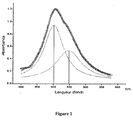
- the figure 1 shows an absorption spectrum obtained by difference between a bacteriostatic composite material containing a mass percentage of 3.1 ⁇ 10 -3 % of silver, in the form of nanoparticles, and an identical reference without silver nanoparticles.
- the two absorption bands at 400 and 450 nm are characteristic of the silver nanoparticles.
- the effectiveness of the bacteriostatic composite material based on Ag 2 SO 4 was tested on four bacteria: Escherichia coli, Pseudomonas aeruginosa, Staphylococcus aureus, Streptococcus faecalis.
- the figure 3 presents the comparative evolution of the four bacteria after 24 hours of exposure to the material.
- preculture is performed under sterile conditions in a 15 mL tube with 2 mL of appropriate culture medium (see table), inoculated with 50 ⁇ L of a saturated bacterial culture, and incubated for 12 hours at 37 ° C. ° C with stirring.
- s microliter
- preculture is performed under sterile conditions in a 15 mL tube with 2 mL of appropriate culture medium (see table), inoculated with 50 ⁇ L of a saturated bacterial culture, and incubated for 12 hours at 37 ° C. ° C with stirring.
- One hundred microliter (s) of this preculture are used to inoculate 20 ml of medium (identical to that used for preculture) (1/200 ° solution).
- test tubes Two milliliters of this culture are distributed in each test tube or control, the test tubes contain 2 ml of gel + the material prepared above with a final silver concentration of 2.10 -4 M (NanoAg on the figure 3 ), and the control tubes contain 2 mL of gel, the tubes are placed for 12 hours at 37 ° C with stirring. After incubation, a turbidimetric measurement is carried out for each culture using a spectrophotometer at a wavelength of 600 nm.
- Bacterium Culture centre Escherichia coli LB Staphylococcus aureus LB Pseudomonas aeruginosa LB Streptococcus faecalis Brain Heart Infusion
- LB for 1L 10 g of tryptone, 10 g of yeast extract, 5 g of sodium chloride, adjusted to pH 7.4, autoclaved for 15 min at 121 ° C.
- Brain Heart for 1L, 10 g of protease-peptone, 12.5 g of infusion of calf brains, 5 g of beef brains infusion, 2 g of glucose, 5 g of sodium chloride, 2, 5 g of sodium hydrogenphosphate, adjusted to pH 7.4, autoclaved for 15 min at 121 ° C.
Landscapes
- Chemical & Material Sciences (AREA)
- Engineering & Computer Science (AREA)
- Health & Medical Sciences (AREA)
- Materials Engineering (AREA)
- Chemical Kinetics & Catalysis (AREA)
- Medicinal Chemistry (AREA)
- Polymers & Plastics (AREA)
- Organic Chemistry (AREA)
- Life Sciences & Earth Sciences (AREA)
- Inorganic Chemistry (AREA)
- General Health & Medical Sciences (AREA)
- Pest Control & Pesticides (AREA)
- Agronomy & Crop Science (AREA)
- Plant Pathology (AREA)
- Dentistry (AREA)
- Wood Science & Technology (AREA)
- Zoology (AREA)
- Environmental Sciences (AREA)
- Nanotechnology (AREA)
- Agricultural Chemicals And Associated Chemicals (AREA)
- Materials For Medical Uses (AREA)
- Compositions Of Macromolecular Compounds (AREA)
- Toxicology (AREA)
- Manufacture Of Porous Articles, And Recovery And Treatment Of Waste Products (AREA)
Claims (16)
- Verfahren zur Herstellung eines Verbundmaterials, das eine poröse Polymermatrix umfasst, in der Silber-Nanopartikel dispergiert sind, wobei dieses Verfahren die folgenden Schritte umfasst:(a) das Mischen von zwei Verbindungen:(i) einer ersten Verbindung, die ein polymerisierbares Fluid umfasst, das HEMA oder 2-Hydroxyethylmethacrylat umfasst, das in dem Fluid in Monomerform vorhanden ist, und(ii) einer zweiten Verbindung, die Silbersalze umfasst;wobei die Mischung ferner Lösungsmittel umfasst, die unter Wasser und mindestens einem Alkohol ausgewählt sind;(b) die Bestrahlung der Mischung aus Schritt (a) durch eine Strahlung mit einer Wellenlänge, die in der Lage ist, die Polymerisation des polymerisierbaren Fluides und die Bildung von Silbernanopartikeln auf simultane Art und Weise zu bewirken.
- Verfahren nach Anspruch 1, wobei das HEMA über 50 Ma% der Gesamtmasse der Monomere und Vorpolymere der polymerisierbaren Fluidverbindung darstellt.
- Verfahren nach einem der vorhergehenden Ansprüche, wobei die Verbindung, die Silbersalze umfasst, eine wässrige Lösung von Silbersalzen ist.
- Verfahren nach einem der vorhergehenden Ansprüche, wobei die Mischung aus Schritt (a) Folgendes umfasst:- 55 bis 70 Vol.-% Monomer oder Vorpolymer,- 30 bis 45 Vol.-% Lösungsmittel,- 10-1 bis 10-5 Ma% Silbersalze.
- Verfahren nach Anspruch 3 oder Anspruch 4, wobei das Lösungsmittel zwischen 5 und 50 % von einem oder mehreren Alkoholen und zwischen 95 und 50 % Wasser umfasst.
- Verfahren nach einem der vorhergehenden Ansprüche, wobei die Mischung aus Schritt (a) ferner zwischen 10-6 und 10-3 M von mindestens einem Stoff umfasst, der unter Folgendem ausgewählt wird: Polymethylmethacrylat (pMMA), Polyvinylpyrrolidon, Polyacrylsäure und Polyacrylamid.
- Verfahren nach einem der vorhergehenden Ansprüche, wobei die Verbindungen der Mischung vor der Bestrahlung unter einem Sauerstoffvakuum untergebracht werden.
- Verfahren nach einem der vorhergehenden Ansprüche, wobei die Mischung aus Schritt (a) durch eine Strahlung mit einer Wellenlänge behandelt wird, die zwischen 4.10-7 und 10-12 Meter enthalten ist.
- Verfahren nach einem der vorhergehenden Ansprüche, wobei die Dosisleistung der Behandlung durch Strahlung größer oder gleich 2 kGray/Stunde ist.
- Verfahren nach einem der vorhergehenden Ansprüche, wobei die Bestrahlungsdosis zwischen 1 und 30 kGray enthalten ist.
- Verfahren nach einem der vorhergehenden Ansprüche, wobei die Mischung von Schritt (a) vor der Bestrahlung in eine Gussform eingeführt wird.
- Verbundwerkstoff, der durch das Verfahren nach einem der Ansprüche 1 bis 11 erhalten werden kann, der Folgendes umfasst:(i) eine poröse Polymermatrix auf Basis von Monomeren, von der mindestens 50 Gew.-% HEMA sind,(ii) Silbernanopartikel, die eine monodisperse Größenverteilung aufweisen, die in der Polymermatrix verteilt sind.
- Werkstoff nach Anspruch 12, wobei die Silbermenge zwischen 10-2 und 10-5 Ma% im Verhältnis zur Gesamtmasse des Werkstoffs ist.
- Verwendung eines Werkstoffs nach einem der Ansprüche 12 oder 13 als antimikrobieller Werkstoff.
- Verwendung eines Werkstoffs nach einem der Ansprüche 12 oder 13 zur Herstellung von Prothesen oder als Zement für die Einrichtung von Prothesen, zur Herstellung chirurgischer Instrumente, zur Herstellung von Linsen, zur Herstellung von Verbänden, zur Herstellung von Folgendem: für die Bauwirtschaft bestimmte Ausrüstungen, antibakterielle Flächen, elektrische Schalter, Innenwände von Kühlschränken, Trinkwasserspeicher, Flaschen, Platten, die zur Aufnahme chirurgischer Instrumente bestimmt sind, Wickeltische, Badezimmer- oder Küchenmöbel, Möbel, die für die Ausrüstung von Körperschaften bestimmt sind, Kleidung, Sporteinrichtungen, Schuhsohlen, sanitäre Einrichtungen.
- Verwendung eines Werkstoffs nach einem der Ansprüche 12 oder 13 als Konservierungsstoff in kosmetischen Verbindungen oder Anstrichmittelverbindungen.
Applications Claiming Priority (2)
| Application Number | Priority Date | Filing Date | Title |
|---|---|---|---|
| FR0800570A FR2927085B1 (fr) | 2008-02-04 | 2008-02-04 | Nouveau materiau a proprietes bacteriostatiques |
| PCT/FR2009/000120 WO2009109724A2 (fr) | 2008-02-04 | 2009-02-03 | Nouveau materiau a proprietes bacteriostatiques |
Publications (2)
| Publication Number | Publication Date |
|---|---|
| EP2242357A2 EP2242357A2 (de) | 2010-10-27 |
| EP2242357B1 true EP2242357B1 (de) | 2016-04-13 |
Family
ID=39739793
Family Applications (1)
| Application Number | Title | Priority Date | Filing Date |
|---|---|---|---|
| EP09718389.1A Not-in-force EP2242357B1 (de) | 2008-02-04 | 2009-02-03 | Neuartiges material mit bakteriostatischen eigenschaften |
Country Status (4)
| Country | Link |
|---|---|
| US (1) | US8986734B2 (de) |
| EP (1) | EP2242357B1 (de) |
| FR (1) | FR2927085B1 (de) |
| WO (1) | WO2009109724A2 (de) |
Families Citing this family (15)
| Publication number | Priority date | Publication date | Assignee | Title |
|---|---|---|---|---|
| US9173967B1 (en) | 2007-05-11 | 2015-11-03 | SDCmaterials, Inc. | System for and method of processing soft tissue and skin with fluids using temperature and pressure changes |
| US8507401B1 (en) | 2007-10-15 | 2013-08-13 | SDCmaterials, Inc. | Method and system for forming plug and play metal catalysts |
| US9126191B2 (en) | 2009-12-15 | 2015-09-08 | SDCmaterials, Inc. | Advanced catalysts for automotive applications |
| US8652992B2 (en) | 2009-12-15 | 2014-02-18 | SDCmaterials, Inc. | Pinning and affixing nano-active material |
| US8669202B2 (en) | 2011-02-23 | 2014-03-11 | SDCmaterials, Inc. | Wet chemical and plasma methods of forming stable PtPd catalysts |
| CN102226029B (zh) * | 2011-04-28 | 2013-04-17 | 东华大学 | 一种载银纳米粒子温度刺激响应性纳米水凝胶的制备方法 |
| US9511352B2 (en) | 2012-11-21 | 2016-12-06 | SDCmaterials, Inc. | Three-way catalytic converter using nanoparticles |
| US9156025B2 (en) | 2012-11-21 | 2015-10-13 | SDCmaterials, Inc. | Three-way catalytic converter using nanoparticles |
| GB2511528A (en) | 2013-03-06 | 2014-09-10 | Speciality Fibres And Materials Ltd | Absorbent materials |
| US9586179B2 (en) | 2013-07-25 | 2017-03-07 | SDCmaterials, Inc. | Washcoats and coated substrates for catalytic converters and methods of making and using same |
| MX2016004759A (es) | 2013-10-22 | 2016-07-26 | Sdcmaterials Inc | Composiciones para trampas de oxidos de nitrogeno (nox) pobres. |
| CN106061600A (zh) | 2013-10-22 | 2016-10-26 | Sdc材料公司 | 用于重型柴油机的催化剂设计 |
| US9687811B2 (en) | 2014-03-21 | 2017-06-27 | SDCmaterials, Inc. | Compositions for passive NOx adsorption (PNA) systems and methods of making and using same |
| WO2016033526A1 (en) * | 2014-08-29 | 2016-03-03 | SDCmaterials, Inc. | Composition comprising nanoparticles with desired sintering and melting point temperatures and methods of making thereof |
| CN115141447B (zh) * | 2021-03-30 | 2023-09-15 | 合肥杰事杰新材料股份有限公司 | 一种抗菌聚甲基丙烯酸羟乙酯材料及其制备方法和应用 |
Family Cites Families (3)
| Publication number | Priority date | Publication date | Assignee | Title |
|---|---|---|---|---|
| EP1769809A3 (de) * | 2002-11-22 | 2007-11-07 | Johnson & Johnson Vision Care, Inc. | Antimikrobielle Linsen mit verlängerter Wirksamkeit, Verfahren zu deren Herstellung und Anwendung |
| US8425926B2 (en) * | 2003-07-16 | 2013-04-23 | Yongxing Qiu | Antimicrobial medical devices |
| CN101010003B (zh) * | 2004-07-30 | 2012-07-04 | 金佰利-克拉克国际公司 | 抗微生物的银组合物 |
-
2008
- 2008-02-04 FR FR0800570A patent/FR2927085B1/fr not_active Expired - Fee Related
-
2009
- 2009-02-03 US US12/865,852 patent/US8986734B2/en not_active Expired - Fee Related
- 2009-02-03 WO PCT/FR2009/000120 patent/WO2009109724A2/fr not_active Ceased
- 2009-02-03 EP EP09718389.1A patent/EP2242357B1/de not_active Not-in-force
Also Published As
| Publication number | Publication date |
|---|---|
| FR2927085B1 (fr) | 2012-10-26 |
| EP2242357A2 (de) | 2010-10-27 |
| US8986734B2 (en) | 2015-03-24 |
| US20110052698A1 (en) | 2011-03-03 |
| WO2009109724A3 (fr) | 2009-11-12 |
| FR2927085A1 (fr) | 2009-08-07 |
| WO2009109724A2 (fr) | 2009-09-11 |
Similar Documents
| Publication | Publication Date | Title |
|---|---|---|
| EP2242357B1 (de) | Neuartiges material mit bakteriostatischen eigenschaften | |
| He et al. | UV-assisted deposition of antibacterial Ag–tannic acid nanocomposite coating | |
| Zhang et al. | Integration of antifouling and antibacterial properties in salt-responsive hydrogels with surface regeneration capacity | |
| Thomas et al. | A versatile strategy to fabricate hydrogel–silver nanocomposites and investigation of their antimicrobial activity | |
| Gutiérrez et al. | Mechanical and microbiological properties and drug release modeling of an etch-and-rinse adhesive containing copper nanoparticles | |
| Baek et al. | In situ assembly of antifouling/bacterial silver nanoparticle-hydrogel composites with controlled particle release and matrix softening | |
| Swaroop et al. | Gamma irradiation synthesis of Ag/PVA hydrogels and its antibacterial activity | |
| Liao et al. | Aminomalononitrile-assisted multifunctional antibacterial coatings | |
| Rojo et al. | Intrinsically antibacterial materials based on polymeric derivatives of eugenol for biomedical applications | |
| EP1355681B1 (de) | Aktiviertes silber enthaltende antimikrobielle kontaktlinse sowie verfahren zu deren herstellung | |
| Taheri et al. | Antibacterial plasma polymer films conjugated with phospholipid encapsulated silver nanoparticles | |
| CN102317537A (zh) | 活性聚合物膜 | |
| Stepulane et al. | Multifunctional surface modification of PDMS for antibacterial contact killing and drug-delivery of polar, nonpolar, and amphiphilic drugs | |
| EP2793959A1 (de) | Dekontaminationsgel und verfahren zur dekontamination von oberflächen durch benetzung mit diesem gel | |
| MX2007004169A (es) | Metodo de formacion de agregados retentivos de forma de particulas de gel y sus usos. | |
| Praveen et al. | Poly (2-hydroxyethyl methacrylate) sponges doped with Ag nanoparticles as antibacterial agents | |
| Guo et al. | Acidity-activated charge-convertible silver nanocomposites for enhanced bacteria-specific aggregation and antibacterial activity | |
| Roy et al. | Hierarchical assembly of nanodimensional silver–silver oxide physical gels controlling nosocomial infections | |
| Elashnikov et al. | Tunable release of silver nanoparticles from temperature-responsive polymer blends | |
| Wang et al. | The innovative fabrication of nano-natural antimicrobial agent@ polymeric microgels-TiO2 hybrid films capable of absorbing UV and antibacterial on touch screen panel | |
| Lou et al. | Self-disinfecting PDMS surfaces with high quaternary ammonium functionality by direct surface photoinitiated polymerization of vinylbenzyl dimethylbutylammonium chloride | |
| Zhang et al. | Multifunctional polydopamine/hemin-cyclodextrin reinforced chitosan nanocomposite hydrogel: a synergistic platform for wound healing | |
| Chen et al. | Cooperative enhancement of fungal repelling performance by surface photografting of stereochemical bi-molecules | |
| Ishak et al. | Ecofriendly zinc oxide-decorated poly-3-hydroxyalkanoate—graft—poly-methyl acrylate copolymer film for photocatalysis-mediated water treatment | |
| Pietrella et al. | Resin-based materials with chlorhexidine-loaded MCM-41: Surface characteristics, drug release, and antibiofilm activity |
Legal Events
| Date | Code | Title | Description |
|---|---|---|---|
| PUAI | Public reference made under article 153(3) epc to a published international application that has entered the european phase |
Free format text: ORIGINAL CODE: 0009012 |
|
| 17P | Request for examination filed |
Effective date: 20100901 |
|
| AK | Designated contracting states |
Kind code of ref document: A2 Designated state(s): AT BE BG CH CY CZ DE DK EE ES FI FR GB GR HR HU IE IS IT LI LT LU LV MC MK MT NL NO PL PT RO SE SI SK TR |
|
| AX | Request for extension of the european patent |
Extension state: AL BA RS |
|
| RIN1 | Information on inventor provided before grant (corrected) |
Inventor name: BRULE, FABIENNE Inventor name: SABOUNGI, MARIE-LOUISE Inventor name: LES AUTERS INVENTEURS ONT RENONCE A LEUR DESIGNATI |
|
| 17Q | First examination report despatched |
Effective date: 20110204 |
|
| DAX | Request for extension of the european patent (deleted) | ||
| REG | Reference to a national code |
Ref country code: DE Ref legal event code: R079 Ref document number: 602009037750 Country of ref document: DE Free format text: PREVIOUS MAIN CLASS: A01N0025100000 Ipc: C08J0009000000 |
|
| GRAP | Despatch of communication of intention to grant a patent |
Free format text: ORIGINAL CODE: EPIDOSNIGR1 |
|
| RIC1 | Information provided on ipc code assigned before grant |
Ipc: C08F 20/28 20060101ALI20150929BHEP Ipc: C08J 9/00 20060101AFI20150929BHEP Ipc: A01N 59/16 20060101ALI20150929BHEP Ipc: C08F 2/46 20060101ALI20150929BHEP |
|
| INTG | Intention to grant announced |
Effective date: 20151028 |
|
| RIN1 | Information on inventor provided before grant (corrected) |
Inventor name: SABOUNGI, MARIE-LOUISE Inventor name: BENOIT, ROLAND Inventor name: BRULE, FABIENNE |
|
| GRAS | Grant fee paid |
Free format text: ORIGINAL CODE: EPIDOSNIGR3 |
|
| GRAA | (expected) grant |
Free format text: ORIGINAL CODE: 0009210 |
|
| AK | Designated contracting states |
Kind code of ref document: B1 Designated state(s): AT BE BG CH CY CZ DE DK EE ES FI FR GB GR HR HU IE IS IT LI LT LU LV MC MK MT NL NO PL PT RO SE SI SK TR |
|
| REG | Reference to a national code |
Ref country code: GB Ref legal event code: FG4D Free format text: NOT ENGLISH |
|
| REG | Reference to a national code |
Ref country code: AT Ref legal event code: REF Ref document number: 790094 Country of ref document: AT Kind code of ref document: T Effective date: 20160415 Ref country code: CH Ref legal event code: EP |
|
| REG | Reference to a national code |
Ref country code: IE Ref legal event code: FG4D Free format text: LANGUAGE OF EP DOCUMENT: FRENCH |
|
| REG | Reference to a national code |
Ref country code: DE Ref legal event code: R096 Ref document number: 602009037750 Country of ref document: DE |
|
| REG | Reference to a national code |
Ref country code: LT Ref legal event code: MG4D |
|
| REG | Reference to a national code |
Ref country code: AT Ref legal event code: MK05 Ref document number: 790094 Country of ref document: AT Kind code of ref document: T Effective date: 20160413 |
|
| REG | Reference to a national code |
Ref country code: NL Ref legal event code: MP Effective date: 20160413 |
|
| PG25 | Lapsed in a contracting state [announced via postgrant information from national office to epo] |
Ref country code: NL Free format text: LAPSE BECAUSE OF FAILURE TO SUBMIT A TRANSLATION OF THE DESCRIPTION OR TO PAY THE FEE WITHIN THE PRESCRIBED TIME-LIMIT Effective date: 20160413 Ref country code: NO Free format text: LAPSE BECAUSE OF FAILURE TO SUBMIT A TRANSLATION OF THE DESCRIPTION OR TO PAY THE FEE WITHIN THE PRESCRIBED TIME-LIMIT Effective date: 20160713 Ref country code: PL Free format text: LAPSE BECAUSE OF FAILURE TO SUBMIT A TRANSLATION OF THE DESCRIPTION OR TO PAY THE FEE WITHIN THE PRESCRIBED TIME-LIMIT Effective date: 20160413 Ref country code: LT Free format text: LAPSE BECAUSE OF FAILURE TO SUBMIT A TRANSLATION OF THE DESCRIPTION OR TO PAY THE FEE WITHIN THE PRESCRIBED TIME-LIMIT Effective date: 20160413 Ref country code: FI Free format text: LAPSE BECAUSE OF FAILURE TO SUBMIT A TRANSLATION OF THE DESCRIPTION OR TO PAY THE FEE WITHIN THE PRESCRIBED TIME-LIMIT Effective date: 20160413 |
|
| PG25 | Lapsed in a contracting state [announced via postgrant information from national office to epo] |
Ref country code: HR Free format text: LAPSE BECAUSE OF FAILURE TO SUBMIT A TRANSLATION OF THE DESCRIPTION OR TO PAY THE FEE WITHIN THE PRESCRIBED TIME-LIMIT Effective date: 20160413 Ref country code: SE Free format text: LAPSE BECAUSE OF FAILURE TO SUBMIT A TRANSLATION OF THE DESCRIPTION OR TO PAY THE FEE WITHIN THE PRESCRIBED TIME-LIMIT Effective date: 20160413 Ref country code: LV Free format text: LAPSE BECAUSE OF FAILURE TO SUBMIT A TRANSLATION OF THE DESCRIPTION OR TO PAY THE FEE WITHIN THE PRESCRIBED TIME-LIMIT Effective date: 20160413 Ref country code: PT Free format text: LAPSE BECAUSE OF FAILURE TO SUBMIT A TRANSLATION OF THE DESCRIPTION OR TO PAY THE FEE WITHIN THE PRESCRIBED TIME-LIMIT Effective date: 20160816 Ref country code: GR Free format text: LAPSE BECAUSE OF FAILURE TO SUBMIT A TRANSLATION OF THE DESCRIPTION OR TO PAY THE FEE WITHIN THE PRESCRIBED TIME-LIMIT Effective date: 20160714 Ref country code: ES Free format text: LAPSE BECAUSE OF FAILURE TO SUBMIT A TRANSLATION OF THE DESCRIPTION OR TO PAY THE FEE WITHIN THE PRESCRIBED TIME-LIMIT Effective date: 20160413 Ref country code: AT Free format text: LAPSE BECAUSE OF FAILURE TO SUBMIT A TRANSLATION OF THE DESCRIPTION OR TO PAY THE FEE WITHIN THE PRESCRIBED TIME-LIMIT Effective date: 20160413 |
|
| PG25 | Lapsed in a contracting state [announced via postgrant information from national office to epo] |
Ref country code: IT Free format text: LAPSE BECAUSE OF FAILURE TO SUBMIT A TRANSLATION OF THE DESCRIPTION OR TO PAY THE FEE WITHIN THE PRESCRIBED TIME-LIMIT Effective date: 20160413 |
|
| REG | Reference to a national code |
Ref country code: DE Ref legal event code: R097 Ref document number: 602009037750 Country of ref document: DE |
|
| PG25 | Lapsed in a contracting state [announced via postgrant information from national office to epo] |
Ref country code: DK Free format text: LAPSE BECAUSE OF FAILURE TO SUBMIT A TRANSLATION OF THE DESCRIPTION OR TO PAY THE FEE WITHIN THE PRESCRIBED TIME-LIMIT Effective date: 20160413 Ref country code: EE Free format text: LAPSE BECAUSE OF FAILURE TO SUBMIT A TRANSLATION OF THE DESCRIPTION OR TO PAY THE FEE WITHIN THE PRESCRIBED TIME-LIMIT Effective date: 20160413 Ref country code: CZ Free format text: LAPSE BECAUSE OF FAILURE TO SUBMIT A TRANSLATION OF THE DESCRIPTION OR TO PAY THE FEE WITHIN THE PRESCRIBED TIME-LIMIT Effective date: 20160413 Ref country code: RO Free format text: LAPSE BECAUSE OF FAILURE TO SUBMIT A TRANSLATION OF THE DESCRIPTION OR TO PAY THE FEE WITHIN THE PRESCRIBED TIME-LIMIT Effective date: 20160413 Ref country code: SK Free format text: LAPSE BECAUSE OF FAILURE TO SUBMIT A TRANSLATION OF THE DESCRIPTION OR TO PAY THE FEE WITHIN THE PRESCRIBED TIME-LIMIT Effective date: 20160413 |
|
| PLBE | No opposition filed within time limit |
Free format text: ORIGINAL CODE: 0009261 |
|
| STAA | Information on the status of an ep patent application or granted ep patent |
Free format text: STATUS: NO OPPOSITION FILED WITHIN TIME LIMIT |
|
| 26N | No opposition filed |
Effective date: 20170116 |
|
| PG25 | Lapsed in a contracting state [announced via postgrant information from national office to epo] |
Ref country code: BE Free format text: LAPSE BECAUSE OF NON-PAYMENT OF DUE FEES Effective date: 20170228 Ref country code: SI Free format text: LAPSE BECAUSE OF FAILURE TO SUBMIT A TRANSLATION OF THE DESCRIPTION OR TO PAY THE FEE WITHIN THE PRESCRIBED TIME-LIMIT Effective date: 20160413 |
|
| REG | Reference to a national code |
Ref country code: DE Ref legal event code: R119 Ref document number: 602009037750 Country of ref document: DE |
|
| PG25 | Lapsed in a contracting state [announced via postgrant information from national office to epo] |
Ref country code: MC Free format text: LAPSE BECAUSE OF FAILURE TO SUBMIT A TRANSLATION OF THE DESCRIPTION OR TO PAY THE FEE WITHIN THE PRESCRIBED TIME-LIMIT Effective date: 20160413 |
|
| REG | Reference to a national code |
Ref country code: CH Ref legal event code: PL |
|
| GBPC | Gb: european patent ceased through non-payment of renewal fee |
Effective date: 20170203 |
|
| PG25 | Lapsed in a contracting state [announced via postgrant information from national office to epo] |
Ref country code: CH Free format text: LAPSE BECAUSE OF NON-PAYMENT OF DUE FEES Effective date: 20170228 Ref country code: LI Free format text: LAPSE BECAUSE OF NON-PAYMENT OF DUE FEES Effective date: 20170228 |
|
| REG | Reference to a national code |
Ref country code: IE Ref legal event code: MM4A |
|
| REG | Reference to a national code |
Ref country code: FR Ref legal event code: ST Effective date: 20171031 |
|
| PG25 | Lapsed in a contracting state [announced via postgrant information from national office to epo] |
Ref country code: LU Free format text: LAPSE BECAUSE OF NON-PAYMENT OF DUE FEES Effective date: 20170203 |
|
| PG25 | Lapsed in a contracting state [announced via postgrant information from national office to epo] |
Ref country code: DE Free format text: LAPSE BECAUSE OF NON-PAYMENT OF DUE FEES Effective date: 20170901 Ref country code: FR Free format text: LAPSE BECAUSE OF NON-PAYMENT OF DUE FEES Effective date: 20170228 |
|
| REG | Reference to a national code |
Ref country code: BE Ref legal event code: MM Effective date: 20170228 |
|
| PG25 | Lapsed in a contracting state [announced via postgrant information from national office to epo] |
Ref country code: IE Free format text: LAPSE BECAUSE OF NON-PAYMENT OF DUE FEES Effective date: 20170203 Ref country code: GB Free format text: LAPSE BECAUSE OF NON-PAYMENT OF DUE FEES Effective date: 20170203 |
|
| PG25 | Lapsed in a contracting state [announced via postgrant information from national office to epo] |
Ref country code: MT Free format text: LAPSE BECAUSE OF FAILURE TO SUBMIT A TRANSLATION OF THE DESCRIPTION OR TO PAY THE FEE WITHIN THE PRESCRIBED TIME-LIMIT Effective date: 20160413 |
|
| PG25 | Lapsed in a contracting state [announced via postgrant information from national office to epo] |
Ref country code: HU Free format text: LAPSE BECAUSE OF FAILURE TO SUBMIT A TRANSLATION OF THE DESCRIPTION OR TO PAY THE FEE WITHIN THE PRESCRIBED TIME-LIMIT; INVALID AB INITIO Effective date: 20090203 |
|
| PG25 | Lapsed in a contracting state [announced via postgrant information from national office to epo] |
Ref country code: BG Free format text: LAPSE BECAUSE OF FAILURE TO SUBMIT A TRANSLATION OF THE DESCRIPTION OR TO PAY THE FEE WITHIN THE PRESCRIBED TIME-LIMIT Effective date: 20160413 |
|
| PG25 | Lapsed in a contracting state [announced via postgrant information from national office to epo] |
Ref country code: CY Free format text: LAPSE BECAUSE OF NON-PAYMENT OF DUE FEES Effective date: 20160413 |
|
| PG25 | Lapsed in a contracting state [announced via postgrant information from national office to epo] |
Ref country code: MK Free format text: LAPSE BECAUSE OF FAILURE TO SUBMIT A TRANSLATION OF THE DESCRIPTION OR TO PAY THE FEE WITHIN THE PRESCRIBED TIME-LIMIT Effective date: 20160413 |
|
| PG25 | Lapsed in a contracting state [announced via postgrant information from national office to epo] |
Ref country code: TR Free format text: LAPSE BECAUSE OF FAILURE TO SUBMIT A TRANSLATION OF THE DESCRIPTION OR TO PAY THE FEE WITHIN THE PRESCRIBED TIME-LIMIT Effective date: 20160413 |
|
| PG25 | Lapsed in a contracting state [announced via postgrant information from national office to epo] |
Ref country code: IS Free format text: LAPSE BECAUSE OF FAILURE TO SUBMIT A TRANSLATION OF THE DESCRIPTION OR TO PAY THE FEE WITHIN THE PRESCRIBED TIME-LIMIT Effective date: 20160813 |