EP2242002A2 - Securing a data signal transmitted by a portable data carrier - Google Patents
Securing a data signal transmitted by a portable data carrier Download PDFInfo
- Publication number
- EP2242002A2 EP2242002A2 EP10002691A EP10002691A EP2242002A2 EP 2242002 A2 EP2242002 A2 EP 2242002A2 EP 10002691 A EP10002691 A EP 10002691A EP 10002691 A EP10002691 A EP 10002691A EP 2242002 A2 EP2242002 A2 EP 2242002A2
- Authority
- EP
- European Patent Office
- Prior art keywords
- data
- diode
- data signal
- transmitting
- energy
- Prior art date
- Legal status (The legal status is an assumption and is not a legal conclusion. Google has not performed a legal analysis and makes no representation as to the accuracy of the status listed.)
- Withdrawn
Links
Images


Classifications
-
- G—PHYSICS
- G06—COMPUTING OR CALCULATING; COUNTING
- G06K—GRAPHICAL DATA READING; PRESENTATION OF DATA; RECORD CARRIERS; HANDLING RECORD CARRIERS
- G06K19/00—Record carriers for use with machines and with at least a part designed to carry digital markings
- G06K19/06—Record carriers for use with machines and with at least a part designed to carry digital markings characterised by the kind of the digital marking, e.g. shape, nature, code
- G06K19/067—Record carriers with conductive marks, printed circuits or semiconductor circuit elements, e.g. credit or identity cards also with resonating or responding marks without active components
- G06K19/07—Record carriers with conductive marks, printed circuits or semiconductor circuit elements, e.g. credit or identity cards also with resonating or responding marks without active components with integrated circuit chips
- G06K19/073—Special arrangements for circuits, e.g. for protecting identification code in memory
-
- G—PHYSICS
- G06—COMPUTING OR CALCULATING; COUNTING
- G06K—GRAPHICAL DATA READING; PRESENTATION OF DATA; RECORD CARRIERS; HANDLING RECORD CARRIERS
- G06K19/00—Record carriers for use with machines and with at least a part designed to carry digital markings
- G06K19/06—Record carriers for use with machines and with at least a part designed to carry digital markings characterised by the kind of the digital marking, e.g. shape, nature, code
- G06K19/067—Record carriers with conductive marks, printed circuits or semiconductor circuit elements, e.g. credit or identity cards also with resonating or responding marks without active components
- G06K19/07—Record carriers with conductive marks, printed circuits or semiconductor circuit elements, e.g. credit or identity cards also with resonating or responding marks without active components with integrated circuit chips
- G06K19/0723—Record carriers with conductive marks, printed circuits or semiconductor circuit elements, e.g. credit or identity cards also with resonating or responding marks without active components with integrated circuit chips the record carrier comprising an arrangement for non-contact communication, e.g. wireless communication circuits on transponder cards, non-contact smart cards or RFIDs
- G06K19/0728—Record carriers with conductive marks, printed circuits or semiconductor circuit elements, e.g. credit or identity cards also with resonating or responding marks without active components with integrated circuit chips the record carrier comprising an arrangement for non-contact communication, e.g. wireless communication circuits on transponder cards, non-contact smart cards or RFIDs the arrangement being an optical or sound-based communication interface
-
- G—PHYSICS
- G06—COMPUTING OR CALCULATING; COUNTING
- G06K—GRAPHICAL DATA READING; PRESENTATION OF DATA; RECORD CARRIERS; HANDLING RECORD CARRIERS
- G06K19/00—Record carriers for use with machines and with at least a part designed to carry digital markings
- G06K19/06—Record carriers for use with machines and with at least a part designed to carry digital markings characterised by the kind of the digital marking, e.g. shape, nature, code
- G06K19/067—Record carriers with conductive marks, printed circuits or semiconductor circuit elements, e.g. credit or identity cards also with resonating or responding marks without active components
- G06K19/07—Record carriers with conductive marks, printed circuits or semiconductor circuit elements, e.g. credit or identity cards also with resonating or responding marks without active components with integrated circuit chips
- G06K19/073—Special arrangements for circuits, e.g. for protecting identification code in memory
- G06K19/07309—Means for preventing undesired reading or writing from or onto record carriers
- G06K19/07363—Means for preventing undesired reading or writing from or onto record carriers by preventing analysis of the circuit, e.g. dynamic or static power analysis or current analysis
Definitions
- An inventive method on a portable data carrier comprises receiving energy by means of an energy receiving device, transmitting a data signal by means of an optical data transmission device using the received energy, wherein a current consumer of the data carrier is controlled by a control device such that from a common power consumption of the optical data transmission device when transmitting a data signal and the power consumer, the data signal sent with the optical data transmitter is not derivable.
- the energy receiving device withdraws energy from an electromagnetic alternating field for the supply of the data carrier and thus causes a load modulation.
- this is so disguised by the inventive targeted control of the power consumer or supplemented to a total load modulation that there is no reproducible correlation between the transmitted data signal and the total power consumption or the total load modulation.
- the data signal sent to the data transmission device is thus no longer derivable, since the total load modulation of the alternating electromagnetic field is not derivable, e.g. as part of a DPA attack on which the transmitted data signal can be closed.
- Such a common power consumption of the optical data transmission device and of the power consumer, from which the data signal sent with the data transmission device can not be derived can be achieved, for example, by the control device actuating the power consumer with a control signal which corresponds to the bitwise inverted data signal.
- the control device actuating the power consumer with a control signal which corresponds to the bitwise inverted data signal.
- the optical data transmitting device ie, for example, an IR transmitting diode
- the optical data transmitting device ie, for example, an IR transmitting diode
- the power consumer is set up in such a way that it has an approximately identical power consumption as the data transmitting device, so that the transmitted data signal or its Bit values can not be derived from the common power consumption of the optical data transmission device and the power consumer.
- the optical data transmission device preferably transmits a unipolar RZ-coded ("return to zero”) data signal or a unipolar NRZ-coded ("non-return to zero") data signal
- a unipolar RZ coding the data signal falls after each transmission by a noticeably increased potential 1 again to a zero potential, so that the data signal falls back briefly to the zero potential even with two consecutive bit values of 1.
- this is not the case with a unipolar NRZ-coded data signal, so that with a unipolar NRZ coding the data signal between two bit values of 1 does not drop to zero potential, but remains at the detectably increased potential until a bit value of 0 is sent.
- a unipolar NRZ-coded data signal in connection with a relation to the data signal bitwise inverted control signal occur such on and off operations of the data transmitter or the power consumer only with an actual change of the bit value of 1 to 0 or from 0 to 1.
- the control of the power consumer by the control device by means of the control signal is so precise that the turn-on and turn off the data transmitting device and the power consumer not in a short-term combined power consumption of the data transmitting device and the power consumer noticeable, thus conclusions the transmitted data signal can be avoided due to the only occurring on a change of the bit value on and off operations.
- the activation of the current consumer is so precisely matched to the activity of the data transmission device that the switching on and off of the optical data transmission device and switching off or on of the current consumer takes place as simultaneously as possible.
- the energy receiving device of the data carrier preferably receives the energy required for the transmission of the data signal from a transmission field of an RFID reader ("Radio Frequency Identification").
- the portable data carrier can be equipped with an RFID communication interface functioning as an energy receiving device, which enables contactless data transmission with an RFID reader in parallel with the optical transmission of data signals by the data transmitting device.
- the optical data transmission device preferably transmits the data in the infrared spectral range.
- devices according to the IRDA standard are used for this purpose ("Infrared Data Association") and / or devices according to the IRFM standard ("Infrared Financial Messaging").
- an infrared transmitting diode IR transmitting diode
- the IR transmitter diode and the optically shielded IR diode are preferably connected in anti-parallel.
- these two diodes can be individually controlled by the control device in a particularly simple manner and via a common two-wire connection by inverting the polarity of the supply voltage of the antiparallel-connected diodes.
- the same series resistor is used for the two diodes in order to save a component and to achieve the most identical possible power consumption of the two diodes.
- the two diodes to control separately, for example, to be able to switch between them very fast.
- the data carrier preferably also has an optical data receiving device for receiving an optical data signal in order to enable bidirectional optical data communication.
- the optical data receiving device is preferably designed such that it receives data signals in the infrared spectral range.
- the energy received by means of the energy receiving device is preferably also used to operate the data receiving device.
- a photo semiconductor in particular an IR receiving diode or an IR photodiode can be used.
- the data carrier according to the invention can in particular be a smart card, a chip card with payment function or another such portable data carrier with computing capacity.
- Fig.1 schematically shows a portable data carrier 1 according to the invention, for example a smart card or a smart card with payment function or another such portable data carrier.
- the data carrier 1 comprises a central unit 2, which is connected via data and power supply buses 3 to a control device 10 for driving an optical data transmission device 11, a data reception control device 20 for driving an optical data reception device 21 and a contactless interface 30 with transponder coil 31.
- the central unit 2 can in particular comprise a memory (not shown) and a CPU (not shown), by means of which applications stored in the memory are executed, and / or a security chip (not shown).
- the contactless interface 30 with transponder coil 31 receives energy from the transmission field of an RFID reader (not shown) with the next to the contactless interface 30 via the data and power buses 3, the central unit 2, the controller 10 and the data reception controller 20 are supplied.
- the central unit 2 can send data to an RFID reader (not shown) and receive data from it.
- the optical data transmission device 11 is configured in the present embodiment as an IR transmitting diode (infrared diode) 11 which is mounted in a portion 12 of the data carrier 1, from which the infrared radiation generated by the IR emitting diode 11 exits from the data carrier 1 and from a suitable reader (For example, an IRDA or an IRFM device, not shown) can be received as a data signal.
- a suitable reader for example, an IRDA or an IRFM device, not shown
- an IR diode 13 is connected, which is identical to the IR transmitter diode 11 and serves as a current consumer 13.
- the IR diode 13 is mounted in an optically shielded portion 14 of the housing from which no infrared radiation emerges, so that the infrared radiation generated by the shielded IR diode 13 is not received by a reading device as a data signal can be.
- the IR transmitter diode 11 and the IR diode 13 are connected via a common series resistor 15 to the outputs L1 and L2 of the control device 10, which controls the IR transmitter diode 11 and the IR diode 13.
- the central unit 2 can send data to a suitable reader by means of the IR transmitter diode 11.
- the control device 10 controls when sending a data signal generated by the central unit 2 in addition to the IR transmitter diode 11 and the power consumers 13 via a suitable control signal. This is done in such a way that from a common power consumption of the IR transmitter diode 11 and the IR diode 13, the data signal sent with the IR transmitter diode 11 is not derivable.
- the control device 10 controls the serving as a current consumer 13 IR diode 13 with a control signal corresponding to the bitwise inverted data signal.
- the two outputs L1 and L2 of the control device 10 are of the same type and on the same control chip (not shown) of the controller 10 integrated and thus have only a small tolerance deviation from each other. Thus, a nearly identical current flow can be effected either by the IR emitting diode 11 or by the same to the IR emitting diode 11 identical IR diode 13.
- the outputs L1 and L2 are preferably push-pull outputs.
- the central processing unit 2 may also be operated by means of the optical data receiving device 21 shown in FIG Fig. 1 is designed as an IR receiving diode (IR photodiode) 21, receive data.
- the IR receiving diode 21 is connected to and controlled by the data receiving controller 20.
- the data reception control device 20 is in turn driven by the central unit 2 via the data and power supply buses 3.
- the IR receiving diode 21 is mounted in a portion 22 of the data carrier in which infrared radiation generated by a suitable transmitting device can be received by the IR receiving diode 21.
- the data carrier 1 can also be provided with an optical transmission and reception device which can be switched between transmission and reception mode.
- the data carrier 1 may additionally have additional interfaces, for example a contact-type interface (if applicable according to the ISO 7816 standard) and / or a contactless (radio) interface.
- an output L1, L2 of the control device 10 can be used to control such a further interface.
- the output L1, L2 of the control device 10 which is not used for controlling the further interface is preferably switched to a high-resistance state during the data communication via the further interface.
- any current flow through the IR transmitter diode 11 and the IR diode 13 is suppressed and communication via the further interface without activation of the IR transmitter diode 11 or the IR diode 13 allows. It is also possible to supply the data carrier 1 with energy via a contact-type interface as soon as a suitable reading device is connected to the contact-type interface.
- one of the outputs L1, L2 of the control device is connected to one terminal of the data transmitting device 11 and the other of the outputs L1, L2 to one terminal of the current consumer 13 and the other terminal of the data transmitting device 11 and the current consumer 13, possibly via one or the same series resistor, connected to ground (or to a constant potential).
- this allows a particularly fast switching between the data transmission device 11 and the power consumer 13.
- one of the outputs L1 or L2 can not readily be used for communication via a further interface as described above, without the current consumer 13 or the Data transmission device 11 is activated.
- a resistor or other power consumers can be used as a power consumer 13.
- control device 10 not only to switch the current consumer 13 on and off, but also to regulate the flow of current through the current consumer 13 in such a way that the data signal sent to the data transmission device 11 does not come from a common power consumption of the data transmission device 11 and the power consumer 13 is derivable.
- a unipolar RZ-coded signal is used according to a first embodiment variant.
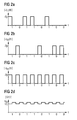
- Fig. 2 shows by way of example (a) the absolute value of the current flow
- the serving as a current consumer 13 IR diode 13 is driven by a control signal corresponding to the bitwise inverted data signal.
- the IR transmitting diode 11 is activated (
- J D ;
- 0) and at a bit value of 0, the IR diode 13 (
- 0;
- J D ).
- Fig. 2 (d) is the absolute value of a voltage received from the transmission field of an RFID reader
- between the values Uo and U 1 the data signal can not be derived from this purely periodic modulation.
- the activation duration of the IR transmitter diode 11 and the IR diode 13 need not necessarily be in an RZ signal as in Fig. 2 may be half the transmission time of one bit, but may take any value less than the transmission time of one bit.
- a unipolar NRZ-coded signal is used according to a further embodiment variant.
- Fig. 3 shows by way of example (a) the absolute value of the current flow
- Fig. 3 shows by way of example (a) the absolute value of the current flow
- the IR transmitting diode 11 is activated at a bit value of 1 (
- J D ;
- 0) and, for a bit value of 0, the IR diode 13 (
- 0;
- J D ) driven by the bitwise inverted data signal, the current flowing through the activated one IR diode 13 the same value J D as the current flow through the IR transmitter diode 11, when it is activated.
- the IR emitting diode 11 and the IR diode 13 can be seen, may be in particular because when changing the bit value is not switched simultaneously or fast enough between the operation of the IR transmitter diode 11 and the IR diode 13. This may be the case in particular when the control device 10 requires a plurality of instruction cycles for the switching operation.
- Fig. 3 (e) shows in analogy to Fig. 3 (c) the absolute value of the total current flow
- Fig. 3 (f) is the absolute value of a voltage
Landscapes
- Engineering & Computer Science (AREA)
- Computer Hardware Design (AREA)
- Microelectronics & Electronic Packaging (AREA)
- Physics & Mathematics (AREA)
- General Physics & Mathematics (AREA)
- Theoretical Computer Science (AREA)
- Computer Security & Cryptography (AREA)
- General Engineering & Computer Science (AREA)
- Computer Networks & Wireless Communication (AREA)
- Optical Communication System (AREA)
Abstract
Description
Die vorliegende Erfindung betrifft ein Verfahren auf einem portablen Datenträger zum Senden eines Datensignals mittels einer optischen Datensendeeinrichtung sowie einen derartigen portablen Datenträger.The present invention relates to a method on a portable data carrier for transmitting a data signal by means of an optical data transmission device and such a portable data carrier.
Gemäß der
Durch das Ein- und Ausschalten einer IR-Sendediode ändert sich jedoch der Verbrauch der über die Kontaktlosschnittstelle bereitgestellten Energie, was eine Lastmodulation des Funkfeldes bewirkt, aus dem die Energie empfangen wird. Diese ungewollte Lastmodulation könnte demzufolge im Rahmen eines Angriffs auf den Datenträger detektiert werden, um dadurch die über die Infrarotschnittstelle gesendeten Datensignale mittelbar mitzulesen. Ein solcher DPA-Angriff ("Differential Power Analysis") wäre mit verhältnismäßig geringem Aufwand durchführbar und würde die in der
Aufgabe der vorliegenden Erfindung ist es daher, eine optische Übertragung von Datensignalen unter Nutzung von über eine Kontaktlosschnittstelle empfangener Energie hinreichend abzusichern.It is therefore an object of the present invention to sufficiently secure an optical transmission of data signals using energy received via a contactless interface.
Diese Aufgabe wird durch ein Verfahren sowie einen Datenträger mit den Merkmalen der unabhängigen Patentansprüche gelöst. In den davon abhängigen Ansprüchen sind vorteilhafte Ausgestaltungen und Weiterbildungen der Erfindung angegeben.This object is achieved by a method and a data carrier with the features of the independent claims. In the dependent claims advantageous refinements and developments of the invention are given.
Ein erfindungsgemäßes Verfahren auf einem portablen Datenträger umfasst ein Empfangen von Energie mittels einer Energieempfangseinrichtung, ein Senden eines Datensignals mittels einer optischen Datensendeeinrichtung unter Verwendung der empfangenen Energie, wobei ein Stromverbraucher des Datenträgers mittels einer Steuereinrichtung derart angesteuert wird, dass aus einem gemeinsamen Stromverbrauch der optischen Datensendeeinrichtung beim Senden eines Datensignals und des Stromverbrauchers das mit der optischen Datensendeeinrichtung gesendete Datensignal nicht ableitbar ist.An inventive method on a portable data carrier comprises receiving energy by means of an energy receiving device, transmitting a data signal by means of an optical data transmission device using the received energy, wherein a current consumer of the data carrier is controlled by a control device such that from a common power consumption of the optical data transmission device when transmitting a data signal and the power consumer, the data signal sent with the optical data transmitter is not derivable.
Dementsprechend umfasst ein erfindungsgemäßer portabler Datenträger eine Energieempfangseinrichtung zum Empfangen von Energie, eine optische Datensendeeinrichtung zum Senden eines Datensignals unter Verwendung der empfangenen Energie, einen Stromverbraucher, sowie eine Steuereinrichtung, die eingerichtet ist, den Stromverbraucher während eines Sendens eines Datensignals durch die Datensendeeinrichtung derart anzusteuern, dass aus einem gemeinsamen Stromverbrauch der optischen Datensendeeinrichtung und des Stromverbrauchers das mit der Datensendeeinrichtung gesendete Datensignal nicht ableitbar ist.Accordingly, a portable data carrier according to the invention comprises a power receiving device for receiving power, an optical data transmitting device for transmitting a data signal using the received energy, a power consumer, and a control device configured to control the power consumer during transmission of a data signal by the data transmitting device, that from a common power consumption of the optical data transmission device and the power consumer, the data signal sent with the data transmission device is not derivable.
Hierbei entzieht zwar die Energieempfangseinrichtung einem elektromagnetischen Wechselfeld Energie zur Versorgung des Datenträgers und verursacht somit eine Lastmodulation. Diese wird jedoch durch die erfindungsgemäße gezielte Ansteuerung des Stromverbrauchers derart verschleiert bzw. zu einer Gesamtlastmodulation ergänzt, dass keine reproduzierbare Korrelation zwischen dem gesendeten Datensignal und dem Gesamtstromverbrauch bzw. der Gesamtlastmodulation besteht. Aus dem gemeinsamen Stromverbrauch der optischen Datensendeeinrichtung und des Stromverbrauchers ist das mit der Datensendeeinrichtung gesendete Datensignal also nicht mehr ableitbar, da aus der Gesamtlastmodulation des elektromagnetischen Wechselfelds nicht, z.B. im Rahmen eines DPA-Angriffs, auf das gesendete Datensignal geschlossen werden kann.Although the energy receiving device withdraws energy from an electromagnetic alternating field for the supply of the data carrier and thus causes a load modulation. However, this is so disguised by the inventive targeted control of the power consumer or supplemented to a total load modulation that there is no reproducible correlation between the transmitted data signal and the total power consumption or the total load modulation. From the common power consumption of the optical data transmission device and the power consumer, the data signal sent to the data transmission device is thus no longer derivable, since the total load modulation of the alternating electromagnetic field is not derivable, e.g. as part of a DPA attack on which the transmitted data signal can be closed.
Ein derartiger gemeinsamer Stromverbrauch der optischen Datensendeeinrichtung und des Stromverbrauchers, aus dem das mit der Datensendeeinrichtung gesendete Datensignal nicht ableitbar ist, kann beispielsweise dadurch erreicht werden, dass die Steuereinrichtung den Stromverbraucher mit einem Steuersignal ansteuert, das dem bitweise invertierten Datensignal entspricht. Hierbei wird bei einem Bitwert des Datensignals von 1 (d.h. bei einem Bitwert des Steuersignals von 0) die optische Datensendeeinrichtung, d.h. beispielsweise eine IR-Sendediode, aktiviert und bei einem Bitwert des Datensignals von 0 (bei einem Bitwert des Steuersignals von 1) der Stromverbraucher aktiviert. Somit wird sowohl bei einem Bitwert des Datensignals von 0 als auch von 1 Strom verbraucht, nämlich entweder durch die Datensendeeinrichtung oder den Stromverbraucher. Um die erfindungsgemäße Verschleierung des Datensignals zu erreichen, ist der Stromverbraucher derart eingerichtet, dass er einen annähernd identischen Stromverbrauch hat wie die Datensendeeinrichtung, so dass das gesendete Datensignal bzw. dessen Bitwerte nicht aus dem gemeinsamen Stromverbrauch der optischen Datensendeeinrichtung und des Stromverbrauchers ableitbar ist.Such a common power consumption of the optical data transmission device and of the power consumer, from which the data signal sent with the data transmission device can not be derived, can be achieved, for example, by the control device actuating the power consumer with a control signal which corresponds to the bitwise inverted data signal. Here, at a bit value of the data signal of 1 (ie, at a bit value of the control signal of 0), the optical data transmitting device, ie, for example, an IR transmitting diode, is activated and at a bit value of the data signal of 0 (at a bit value of the control signal of FIG activated. Thus, both at a bit value of the data signal of 0 and 1 power is consumed, either by the data transmitting device or the power consumer. In order to achieve the obfuscation of the data signal according to the invention, the power consumer is set up in such a way that it has an approximately identical power consumption as the data transmitting device, so that the transmitted data signal or its Bit values can not be derived from the common power consumption of the optical data transmission device and the power consumer.
Die optische Datensendeeinrichtung sendet vorzugsweise ein unipolar RZ-kodiertes ("Return to Zero") Datensignal oder ein unipolar NRZ-kodiertes ("Non Return to Zero) Datensignal. Bei einer unipolaren RZ-Kodierung fällt das Datentsignal nach Senden jedes durch ein erkennbar erhöhtes Potential gekennzeichneten Bitwerts von 1 wieder auf ein Nullpotential ab, so dass das Datensignal auch bei zwei aufeinander folgenden Bitwerten von 1 kurz auf das Nullpotential zurückfällt. Bei einem unipolar NRZ-kodierten Datensignal ist dies hingegen nicht der Fall, so dass bei einer unipolaren NRZ-Kodierung das Datensignal zwischen zwei Bitwerten von 1 nicht auf Nullpotential abfällt, sondern solange auf dem erkennbar erhöhten Potential verbleibt, bis ein Bitwert von 0 gesendet wird.The optical data transmission device preferably transmits a unipolar RZ-coded ("return to zero") data signal or a unipolar NRZ-coded ("non-return to zero") data signal In a unipolar RZ coding, the data signal falls after each transmission by a noticeably increased
Der Vorteil eines unipolar RZ-kodierten Datensignals im Zusammenhang mit einem gegenüber den Datensignal bitweise invertierten Steuersignal besteht darin, dass bei jedem gesendeten Bit, unabhängig von dessen Bitwert, entweder die optische Datensendeeinrichtung (z.B. eine IR-Sendediode) oder der Stromverbraucher ein- und ausgeschaltet wird. Durch diese notwendigen, regelmäßigen Ein-/ Ausschaltvorgänge bei jedem gesendeten Bitwert ist eine einfache Koordinierung der komplementären Aktivierung der Datensendeeinrichtung und des Stromverbrauchers bzw. deren Synchronisation möglich, da durch das immer wieder auf 0 zurückfallende Potential des Gesamtstromverbrauchs eine unerwünschte kombinierte Aktivierung der Datensendeeinrichtung und des Stromverbrauchers leicht vermieden werden kann.The advantage of a unipolar RZ-coded data signal in connection with a bitwise inverted control signal relative to the data signal is that with each transmitted bit, regardless of its bit value, either the optical data transmitting device (eg an IR transmitter diode) or the power consumer switched on and off becomes. Through these necessary, regular on / off operations at each bit value sent a simple coordination of the complementary activation of the data transmission device and the power consumer or their synchronization is possible, as due to the always falling back to 0 potential of the total power consumption unwanted combined activation of the data transmission device and the Power consumer can be easily avoided.
Bei Verwendung eines unipolar NRZ-kodierten Datensignals im Zusammenhang mit einem gegenüber dem Datensignal bitweise invertierten Steuersignal treten derartige Ein- und Ausschaltvorgänge der Datensendeeinrichtung oder des Stromverbrauchers nur bei einem tatsächlichen Wechsel des Bitwerts von 1 auf 0 oder von 0 auf 1 auf. Bei einem unipolar NRZ-kodierten Datensignal erfolgt die Ansteuerung des Stromverbrauchers durch die Steuereinrichtung mittels des Steuersignals derart präzise, dass sich die Ein- und Ausschaltvorgänge der Datensendeeinrichtung und des Stromverbrauchers nicht in einem kurzzeitigen kombinierten Stromverbrauch der Datensendeeinrichtung und des Stromverbrauchers bemerkbar machen, damit Rückschlüsse auf das gesendete Datensignal aufgrund der lediglich bei einem Wechsel des Bitwerts auftretenden Ein- und Ausschaltvorgänge vermieden werden können. Deshalb erfolgt die Ansteuerung des Stromverbrauchers bei einem unipolar NRZ-kodierten Datensignal derart präzise auf die Aktivität der Datensendeeinrichtung abgestimmt, dass das Ein- bzw. Ausschalten der optischen Datensendeeinrichtung und das Aus- bzw. Einschalten des Stromverbrauchers möglichst zeitgleich erfolgt.When using a unipolar NRZ-coded data signal in connection with a relation to the data signal bitwise inverted control signal occur such on and off operations of the data transmitter or the power consumer only with an actual change of the bit value of 1 to 0 or from 0 to 1. In a unipolar NRZ-coded data signal, the control of the power consumer by the control device by means of the control signal is so precise that the turn-on and turn off the data transmitting device and the power consumer not in a short-term combined power consumption of the data transmitting device and the power consumer noticeable, thus conclusions the transmitted data signal can be avoided due to the only occurring on a change of the bit value on and off operations. Therefore, in the case of a unipolar NRZ-coded data signal, the activation of the current consumer is so precisely matched to the activity of the data transmission device that the switching on and off of the optical data transmission device and switching off or on of the current consumer takes place as simultaneously as possible.
Die Energieempfangseinrichtung des Datenträgers empfängt die für das Senden des Datensignals benötigte Energie vorzugsweise aus einem Sendefeld eines RFID-Lesegeräts ("Radio Frequency Identification"). Insbesondere kann der portable Datenträger mit einer als Energieempfangseinrichtung fungierenden RFID-Kommunikationsschnittstelle ausgestattet sein, die parallel zum optischen Senden von Datensignalen durch die Datensendeeinrichtung eine kontaktlose Datenübertragung mit einem RFID-Lesegerät ermöglicht.The energy receiving device of the data carrier preferably receives the energy required for the transmission of the data signal from a transmission field of an RFID reader ("Radio Frequency Identification"). In particular, the portable data carrier can be equipped with an RFID communication interface functioning as an energy receiving device, which enables contactless data transmission with an RFID reader in parallel with the optical transmission of data signals by the data transmitting device.
Die optische Datensendeeinrichtung sendet die Daten vorzugsweise im infraroten Spektralbereich. Hierzu sind insbesondere Geräte nach dem IRDA-Standard ("Infrared Data Association") und/oder Geräte nach dem IRFM-Standard ("Infrared Financial Messaging") geeignet. Insbesondere kann eine Infrarot-Sendediode (IR-Sendediode) als optische Datensendeeinrichtung zum Senden von Datensignalen verwendet werden.The optical data transmission device preferably transmits the data in the infrared spectral range. In particular, devices according to the IRDA standard are used for this purpose ("Infrared Data Association") and / or devices according to the IRFM standard ("Infrared Financial Messaging"). In particular, an infrared transmitting diode (IR transmitting diode) can be used as an optical data transmitting device for transmitting data signals.
Bei Verwendung einer IR-Sendediode als Datensendeeinrichtung wird als Stromverbraucher bevorzugt eine optisch abgeschirmte IR-Diode eingesetzt, die vorzugsweise von einer mit der IR-Sendediode vergleichbaren Bauart ist. Unter einer optisch abgeschirmten IR-Diode ist im Zusammenhang mit der vorliegenden Erfindung eine IR-Diode zu verstehen, von der nahezu keine Infrarotstrahlung nach außen treten kann, so dass die von einer derart abgeschirmten IR-Diode erzeugte Infrarotstrahlung insbesondere nicht von einem Lesegerät als Datensignal empfangen werden kann. Dies hat den Vorteil, dass der Stromverbraucher und die Datensendeeinrichtung sowohl während des Ein- oder Ausschaltens als auch während der dazwischen liegenden Aktivitätsphasen einen nahezu identischen Stromverbrauch bewirken.When using an IR transmitter diode as a data transmitting device is preferably used as a current consumer an optically shielded IR diode, which is preferably of a comparable with the IR transmitter diode type. In the context of the present invention, an optically shielded IR diode is an IR diode from which virtually no infrared radiation can escape to the outside, so that the infrared radiation generated by such a shielded IR diode is not detected by a reading device as a data signal can be received. This has the advantage that the current consumer and the data transmitting device cause a nearly identical power consumption both during switching on and off as well as during the intermediate activity phases.
Bei Verwendung einer IR-Sendediode als Datensendeeinrichtung und einer optisch abgeschirmten IR-Diode von einer mit der IR-Sendediode vergleichbaren Bauart als Stromverbraucher werden die IR-Sendediode und die optisch abgeschirmte IR-Diode vorzugsweise antiparallel geschaltet. Hierdurch können diese beiden Dioden besonders einfach und über einen gemeinsamen zweiadrigen Anschluss durch Invertieren der Polarität der Versorgungsspannung der antiparallel geschalteten Dioden durch die Steuereinrichtung einzeln angesteuert werden. Bei dieser Verschaltung wird vorzugsweise derselbe Vorwiderstand für die beiden Dioden verwendet, um ein Bauteil einzusparen und um einen möglichst identischen Stromverbrauch der beiden Dioden zu erreichen. Alternativ ist es jedoch auch möglich, die beiden Dioden separat anzusteuern, beispielsweise um besonders schnell zwischen diesen umschalten zu können.When using an IR transmitter diode as a data transmitting device and an optically shielded IR diode of a comparable with the IR emitting diode design as a power consumer, the IR transmitter diode and the optically shielded IR diode are preferably connected in anti-parallel. As a result, these two diodes can be individually controlled by the control device in a particularly simple manner and via a common two-wire connection by inverting the polarity of the supply voltage of the antiparallel-connected diodes. In this interconnection preferably the same series resistor is used for the two diodes in order to save a component and to achieve the most identical possible power consumption of the two diodes. Alternatively, it is also possible, the two diodes to control separately, for example, to be able to switch between them very fast.
Der Datenträger verfügt vorzugsweise außerdem über eine optische Datenempfangseinrichtung zum Empfang eines optischen Datensignals, um eine bidirektionale optische Datenkommunikation zu ermöglichen. Die optische Datenempfangseinrichtung ist vorzugsweise derart ausgestaltet, dass sie Datensignale im infraroten Spektralbereich empfängt. Hierbei wird vorzugsweise die mittels der Energieempfangseinrichtung empfangene Energie auch zum Betreiben der Datenempfangseinrichtung genutzt. Als optische Datenempfangseinrichtung kann ein Photohalbleiter, insbesondere eine IR-Empfangsdiode bzw. eine IR-Photodiode verwendet werden.The data carrier preferably also has an optical data receiving device for receiving an optical data signal in order to enable bidirectional optical data communication. The optical data receiving device is preferably designed such that it receives data signals in the infrared spectral range. In this case, the energy received by means of the energy receiving device is preferably also used to operate the data receiving device. As an optical data receiving device, a photo semiconductor, in particular an IR receiving diode or an IR photodiode can be used.
Der erfindungsgemäße Datenträger kann insbesondere eine Smart-Card, eine Chipkarte mit Bezahlfunktion oder ein sonstiger derartiger portabler Datenträger mit Rechenkapazität sein.The data carrier according to the invention can in particular be a smart card, a chip card with payment function or another such portable data carrier with computing capacity.
Weitere Merkmale und Vorteile der Erfindung ergeben sich aus der folgenden Beschreibung von erfindungsgemäßen Ausführungsbeispielen sowie weiteren Ausführungsalternativen im Zusammenhang mit den Zeichnungen, die schematisch zeigen:
- Fig.1
- einen erfindungsgemäßen portablen Datenträger;
- Fig. 2 (a, b)
- den Absolutbetrag des Stromflusses durch (a) die IR-Sende- diode und (b) die optisch abgeschirmte IR-Diode des Datenträ- gers gemäß
Fig.1 als Funktion der Zeit bei Verwendung eines unipolar RZ-kodierten Datensignals; - Fig. 2 (c, d)
- den Absolutbetrag des resultierenden Gesamtstromflusses (c) durch die IR-Sendediode und die IR-Diode und den Absolutbe- trag (d) der aus einem durch den Stromverbrauch der IR- Sendediode und die IR-Diode modulierten Sendefeld eines RFID-Lesegeräts empfangenen Versorgungsspannung;
- Fig. 3 (a, b)
- den Absolutbetrag des Stromflusses durch (a) die IR-Sende- diode und (b) die optisch abgeschirmte IR-Diode des Datenträ- gers gemäß
Fig. 1 als Funktion der Zeit bei Verwendung eines unipolar NRZ-kodierten Datensignals; - Fig. 3 (c, d)
- den Absolutbetrag des resultierenden Gesamtstromflusses (c) durch die IR-Sendediode und die IR-Diode und den Absolutbe- trag (d) der aus einem durch den Stromverbrauch der IR- Sendediode und die IR-Diode modulierten Sendefeld eines RFID-Lesegeräts empfangenen Versorgungsspannung für den Fall, dass die Ein- und Ausschaltvorgänge der IR-Sendediode und der IR-Diode in (c) und (d) erkennbar sind; und
- Fig. 3 (e, f)
- analog zu (c) den Absolutbetrag des resultierenden Gesamt- stromflusses (e) und analog zu (d) den Absolutbetrag (f) der aus dem modulierten Sendefeld eines RFID-Lesegeräts emp- fangenen Versorgungsspannung für den Fall, dass die IR- Sendediode und die IR-Diode so angesteuert werden, dass die Ein- und Ausschaltvorgänge der IR-Sendediode und der IR- Diode in (e) und (f) nicht erkennbar sind;
- Fig.1
- a portable data carrier according to the invention;
- Fig. 2 (a, b)
- the absolute value of the current flow through (a) the IR transmitting diode and (b) the optically shielded IR diode of the data carrier according to
Fig.1 as a function of time using a unipolar RZ encoded data signal; - Fig. 2 (c, d)
- the absolute value of the resulting total current flow (c) through the IR transmitting diode and the IR diode and the absolute value (d) of the supply voltage received from a transmitting field of an RFID reader modulated by the current consumption of the IR transmitting diode and the IR diode;
- Fig. 3 (a, b)
- the absolute value of the current flow through (a) the IR transmitting diode and (b) the optically shielded IR diode of the data carrier according to
Fig. 1 as a function of time using a unipolar NRZ encoded data signal; - Fig. 3 (c, d)
- the absolute value of the resulting total current flow (c) through the IR transmitting diode and the IR diode and the absolute value (d) of the supply voltage received from a transmitting field of an RFID reader modulated by the current consumption of the IR transmitting diode and the IR diode the case that the turn-on and turn-off operations of the IR transmitting diode and the IR diode in (c) and (d) are recognizable; and
- Fig. 3 (e, f)
- analogous to (c) the absolute value of the resulting total current flow (e) and, analogously to (d), the absolute value (f) of the supply voltage received from the modulated transmission field of an RFID reader in the event that the IR transmitting diode and the IR diode are controlled so that the on and off operations of the IR transmitter diode and the IR diode in (e) and (f) are not visible;
Die Zentraleinheit 2 kann insbesondere einen Speicher (nicht dargestellt) und eine CPU (nicht dargestellt), mittels der in dem Speicher gespeicherte Applikationen ausgeführt werden, und/oder einen Sicherheitschip (nicht dargestellt) umfassen.The central unit 2 can in particular comprise a memory (not shown) and a CPU (not shown), by means of which applications stored in the memory are executed, and / or a security chip (not shown).
Die Kontaktlosschnittstelle 30 mit Transponderspule 31 empfängt Energie aus dem Sendefeld eines RFID-Lesegeräts (nicht dargestellt) mit der neben der Kontaktlosschnittstelle 30 über die Daten- und Energieversorgungsbusse 3 auch die Zentraleinheit 2, die Steuereinrichtung 10 und die Datenempfangssteuereinrichtung 20 versorgt werden. Zudem kann die Zentraleinheit 2 durch Ansteuern der Kontaktlosschnittstelle 30 über die Daten- und Energieversorgungsbusse 3 mittels der Transponderspule 31 Daten an ein RFID-Lesegerät (nicht dargestellt) senden und von diesem empfangen.The
Die optische Datensendeeinrichtung 11 ist im vorliegenden Ausführungsbeispiel als IR-Sendediode (Infrarotdiode) 11 ausgestaltet, die in einem Abschnitt 12 des Datenträgers 1 angebracht ist, aus dem die von der IR-Sendediode 11 erzeugte Infrarotstrahlung aus dem Datenträger 1 austritt und von einem geeigneten Lesegerät (z.B. einem IRDA- oder einem IRFM-Gerät, nicht dargestellt) als Datensignal empfangen werden kann. Antiparallel zu der als Datensendeeinrichtung 11 dienenden IR-Sendediode 11 ist eine IR-Diode 13 geschaltet, die zu der IR-Sendediode 11 baugleich ist und als Stromverbraucher 13 dient. Im Unterschied zu der IR-Sendediode 11 ist die IR-Diode 13 jedoch in einem optisch abgeschirmten Abschnitt 14 des Gehäuses angebracht, aus dem keine Infrarotstrahlung austritt, so dass die von der abgeschirmten IR-Diode 13 erzeugte Infrarotstrahlung von einem Lesegerät nicht als Datensignal empfangen werden kann.The optical
Die IR-Sendediode 11 und die IR-Diode 13 sind über einen gemeinsamen Vorwiderstand 15 an die Ausgänge L1 und L2 der Steuereinrichtung 10 angeschlossen, die die IR-Sendediode 11 und die IR-Diode 13 ansteuert. Durch Ansteuern der Steuereinrichtung 10 über die Daten- und Energieversorgungsbusse 3 kann die Zentraleinheit 2 mittels der IR-Sendediode 11 Daten an ein geeignetes Lesegerät senden.The
Die Steuereinrichtung 10 steuert beim Senden eines von der Zentraleinheit 2 generierten Datensignals neben der IR-Sendediode 11 auch den Stromverbraucher 13 über ein geeignetes Steuersignal an. Dies erfolgt derart, dass aus einem gemeinsamen Stromverbrauch der IR-Sendediode 11 und der IR-Diode 13 das mit der IR-Sendediode 11 gesendete Datensignal nicht ableitbar ist. Hierzu steuert die Steuereinrichtung 10 die als Stromverbraucher 13 dienende IR-Diode 13 mit einem Steuersignal an, das dem bitweise invertierten Datensignal entspricht.The
Um bei der Ansteuerung einen Stromfluss durch die IR-Sendediode 11 zu bewirken, wird der Ausgang L1 der Steuereinrichtung 10 auf Nullpotential (Erde) gelegt und der Ausgang L2 der Steuereinrichtung 10 auf ein festgelegtes erkennbar erhöhtes, positives Potential. Um hingegen einen komplementären Stromfluss durch die IR-Diode 13 zu bewirken, wird der Ausgang L2 der Steuereinrichtung 10 auf Nullpotential (Erde) gelegt und der Ausgang L1 der Steuereinrichtung 10 auf das zuvor genannte festgelegte positive Potential.In order to cause a current flow through the
Die beiden Ausgänge L1 und L2 der Steuereinrichtung 10 sind vom gleichen Typ und auf demselben Steuerchip (nicht dargestellt) der Steuereinrichtung 10 integriert und weisen somit nur eine geringe Toleranzabweichung voneinander auf. Somit kann ein nahezu identischer Stromfluss entweder durch die IR-Sendediode 11 oder durch die zu der IR-Sendediode 11 baugleichen IR-Diode 13 bewirkt werden. Bei den Ausgängen L1 und L2 handelt es sich bevorzugt um Push-Pull-Ausgänge.The two outputs L1 and L2 of the
Die Zentraleinheit 2 kann außerdem mittels der optischen Datenempfangseinrichtung 21, die in
Alternativ zu einer optischen Datensendeeinrichtung 11 und einer separaten optischen Datenempfangseinrichtung 21 kann der Datenträger 1 auch mit einer zwischen Sende- und Empfangsbetrieb umschaltbaren optischen Sende- und Empfangsvorrichtung versehen sein.As an alternative to an optical
Gemäß weiterer Ausführungsvarianten kann der Datenträger 1 zusätzlich noch weitere Schnittstellen besitzen, z.B. eine kontaktbehaftete Schnittstelle (ggf. nach dem ISO 7816 Standard) und/ oder eine kontaktlose (Funk-) Schnittstelle. Gemäß einer besonderen Ausführungsvariante kann ein Ausgang L1, L2 der Steuereinrichtung 10 zur Ansteuerung einer solchen weiteren Schnittstelle verwendet werden. Hierbei wird vorzugsweise der nicht zur Ansteuerung der weiteren Schnittstelle verwendete Ausgang L1, L2 der Steuereinrichtung 10 während der Datenkommunikation über die weitere Schnittstelle in einen hochohmigen Zustand geschaltet. Dadurch wird jeglicher Stromfluss durch die IR-Sendediode 11 und die IR-Diode 13 unterbunden und eine Kommunikation über die weitere Schnittstelle ohne Aktivierung der IR-Sendediode 11 oder der IR-Diode 13 ermöglicht. Auch ist es möglich, den Datenträger 1 über eine kontaktbehaftete Schnittstelle mit Energie zu versorgen, sobald ein hierfür geeignetes Lesegerät an die kontaktbehaftete Schnittstelle angeschlossen wird.According to further embodiments, the
Gemäß einer alternativen Ausführungsvariante wird einer der Ausgänge L1, L2 der Steuereinrichtung mit einem Anschluss der Datensendeeinrichtung 11 und der andere der Ausgänge L1, L2 mit einem Anschluss des Stromverbrauchers 13 beschaltet und der jeweils andere Anschluss der Datensendeeinrichtung 11 und des Stromverbrauchers 13, ggf. über jeweils einen oder denselben Vorwiderstand, auf Masse (oder auch auf ein konstantes Potential) gelegt. Dies ermöglicht insbesondere ein besonders schnelles Umschalten zwischen der Datensendeeinrichtung 11 und dem Stromverbraucher 13. Bei dieser Ausführungsvariante kann jedoch nicht ohne weiteres wie zuvor dargestellt einer der Ausgänge L1 oder L2 zur Kommunikation über eine weitere Schnittstelle verwendet werden, ohne dass dabei der Stromverbraucher 13 oder die Datensendeeinrichtung 11 aktiviert wird.According to an alternative embodiment variant, one of the outputs L1, L2 of the control device is connected to one terminal of the
Als Stromverbraucher 13 kann auch ein Widerstand oder ein anderer Stromverbraucher verwendet werden.As a
Auch besteht die Möglichkeit, dass die Steuereinrichtung 10 den Stromverbraucher 13 nicht nur ein- und ausschaltet, sondern den Stromfluss durch den Stromverbraucher 13 gezielt regelt, so dass aus einem gemeinsamen Stromverbrauch der Datensendeeinrichtung 11 und des Stromverbrauchers 13 das mit der Datensendeeinrichtung 11 gesendete Datensignal nicht ableitbar ist.It is also possible for the
Zum Senden der Daten wird gemäß einer ersten Ausführungsvariante ein unipolar RZ-kodiertes Signal verwendet.
Aus dem in
In
Die Aktivierungsdauer der IR-Sendediode 11 und der IR-Diode 13 muss bei einem RZ-Signal nicht zwangsweise wie in
Zum Senden des Datensignals wird gemäß einer weiteren Ausführungsvariante ein unipolar NRZ-kodiertes Signal verwendet.
Anhand des in
Dies gilt in der Folge auch für den in
Dass die Ein- und Ausschaltvorgänge der IR-Sendediode 11 und der IR-Diode 13 am kombinierten Stromverbrauch |Jtot(t)| der IR-Sendediode 11 und der IR-Diode 13 erkennbar sind, kann insbesondere daran liegen, dass bei einem Wechsel des Bitwerts nicht zeitgleich bzw. schnell genug zwischen dem Betrieb der IR-Sendediode 11 und der IR-Diode 13 umgeschaltet wird. Dies kann insbesondere dann der Fall sein, wenn die Steuereinrichtung 10 mehrere Befehlszyklen für den Umschaltvorgang benötigt.That the ON and OFF operations of the
Daher erfolgt bei Verwendung eines unipolar NRZ-kodierten Datensignals das Ausschalten der optischen Datensendeeinrichtung 11 und das Einschalten des Stromverbrauchers 13, bzw. das Ausschalten des Stromverbrauchers 13 und das Einschalten der Datensendeeinrichtung 11 durch die Steuereinrichtung 10 möglichst zeitgleich. Dies kann beispielsweise durch Verwendung einer ausreichend schnellen Steuereinrichtung 10 erreicht werden. Hierzu kann es auch erforderlich sein, wie zuvor erläutert, einen der Ausgänge L1, L2 der Steuereinrichtung 10 mit einem Anschluss der Datensendeeinrichtung 11 und den anderen Ausgang L2, L1 mit einem Anschluss des Stromverbrauchers 13 zu beschalten und den jeweils anderen Anschluss der Datensendeeinrichtung 11 und des Stromverbrauchers 13 auf Masse (oder auch auf ein konstantes Potential) zu legen, um ein besonders schnelles Umschalten zwischen Datensendeeinrichtung 11 und Stromverbraucher 13 zu ermöglichen. Auch können kurzzeitige Schwankungen des Stromverbrauchs des Datenträgers 1 durch einen Kondensator kompensiert werden.Therefore, when using a unipolar NRZ-coded data signal, turning off the optical
In
Zur Kodierung des Datensignals ist auch die Verwendung eines Miller-Codes oder die Verwendung einer Bi-phase-Kodierung denkbar.To encode the data signal, the use of a Miller code or the use of a bi-phase encoding is conceivable.
Claims (15)
Applications Claiming Priority (1)
| Application Number | Priority Date | Filing Date | Title |
|---|---|---|---|
| DE200910013158 DE102009013158A1 (en) | 2009-03-16 | 2009-03-16 | Securing a data signal sent from a portable data carrier |
Publications (2)
| Publication Number | Publication Date |
|---|---|
| EP2242002A2 true EP2242002A2 (en) | 2010-10-20 |
| EP2242002A3 EP2242002A3 (en) | 2011-12-21 |
Family
ID=42225046
Family Applications (1)
| Application Number | Title | Priority Date | Filing Date |
|---|---|---|---|
| EP10002691A Withdrawn EP2242002A3 (en) | 2009-03-16 | 2010-03-15 | Securing a data signal transmitted by a portable data carrier |
Country Status (2)
| Country | Link |
|---|---|
| EP (1) | EP2242002A3 (en) |
| DE (1) | DE102009013158A1 (en) |
Citations (2)
| Publication number | Priority date | Publication date | Assignee | Title |
|---|---|---|---|---|
| DE10317257A1 (en) | 2003-04-14 | 2004-11-04 | Giesecke & Devrient Gmbh | Contactless data carrier |
| DE102004058165A1 (en) | 2004-12-02 | 2006-06-08 | Giesecke & Devrient Gmbh | Portable data carrier such as a chip card with separate contact free data and power receiving circuits |
Family Cites Families (5)
| Publication number | Priority date | Publication date | Assignee | Title |
|---|---|---|---|---|
| DE19850721A1 (en) * | 1998-11-03 | 2000-05-18 | Koninkl Philips Electronics Nv | Disk with concealment of power consumption |
| FR2813972B1 (en) * | 2000-09-14 | 2003-12-12 | St Microelectronics Sa | METHOD OF INTERFERING THE ELECTRICAL CONSUMPTION OF AN INTEGRATED CIRCUIT |
| DE102004006504A1 (en) * | 2004-02-10 | 2005-09-08 | Infineon Technologies Ag | Contactless data carrier with signal generator |
| DE102006010514B4 (en) * | 2006-03-07 | 2008-09-18 | Infineon Technologies Ag | Electrical circuit and terminal |
| DE102007002385A1 (en) * | 2007-01-10 | 2008-07-24 | Bundesdruckerei Gmbh | Document with an optical transmitter |
-
2009
- 2009-03-16 DE DE200910013158 patent/DE102009013158A1/en not_active Withdrawn
-
2010
- 2010-03-15 EP EP10002691A patent/EP2242002A3/en not_active Withdrawn
Patent Citations (2)
| Publication number | Priority date | Publication date | Assignee | Title |
|---|---|---|---|---|
| DE10317257A1 (en) | 2003-04-14 | 2004-11-04 | Giesecke & Devrient Gmbh | Contactless data carrier |
| DE102004058165A1 (en) | 2004-12-02 | 2006-06-08 | Giesecke & Devrient Gmbh | Portable data carrier such as a chip card with separate contact free data and power receiving circuits |
Also Published As
| Publication number | Publication date |
|---|---|
| EP2242002A3 (en) | 2011-12-21 |
| DE102009013158A1 (en) | 2010-09-23 |
Similar Documents
| Publication | Publication Date | Title |
|---|---|---|
| EP2132721B1 (en) | Device for controlling an actuator | |
| DE3935364C1 (en) | ||
| DE69836410T2 (en) | HYBRID DATA CARRIER AND SWITCHING WITH IMPROVED SWITCHING MODE | |
| WO2009030533A1 (en) | Method for identification of components in an electrical low-voltage switchgear assembly | |
| EP2053254A1 (en) | Fluid valve assembly with at least one electromagnetic valve and an identification data containing device | |
| EP0949576B1 (en) | Data carrier and method for wireless reception of data and energy | |
| EP0539696B2 (en) | Method for contactless energy and data transmission | |
| EP3599573B1 (en) | Method for data transmission between a radio transponder reader and a radio transponder and radio transponder | |
| EP0662221B1 (en) | Process for testing an electronic electricity meter | |
| DE212016000212U1 (en) | System for power transmission and duplex communication via a single isolation device | |
| DE102010029799B4 (en) | Adaptive demodulator | |
| DE102014216519A1 (en) | communication system | |
| DE102006035582B4 (en) | Vibration maintenance circuit for half-duplex transponder | |
| EP0532989B1 (en) | Wireless transmission equipment for power and data transmission | |
| EP1450181B1 (en) | Circuit arrangement for signal detection | |
| DE4242112A1 (en) | Control for a switched load of an IC card | |
| DE102009013158A1 (en) | Securing a data signal sent from a portable data carrier | |
| WO2013083835A1 (en) | Method for controlling a multi-color signal assembly, and multi-color signal assembly | |
| DE102010053500A1 (en) | Photovoltaic generator with protective circuit for photovoltaic modules | |
| WO2001024441A2 (en) | Method and device for bi-directional communication between at least two communication participants | |
| DE19916119A1 (en) | Computer mouse with interface converter to enable mouse to be connected RS-232 or PS/2 connector | |
| DE3613150C2 (en) | ||
| EP2302559B1 (en) | Emitting device with low noise, high efficiency and variable power for RFID reader/writer | |
| EP2106034A2 (en) | Galvanically isolated energy and data transfer module | |
| EP1639526B1 (en) | Electronic component used for id tags |
Legal Events
| Date | Code | Title | Description |
|---|---|---|---|
| PUAI | Public reference made under article 153(3) epc to a published international application that has entered the european phase |
Free format text: ORIGINAL CODE: 0009012 |
|
| AK | Designated contracting states |
Kind code of ref document: A2 Designated state(s): AT BE BG CH CY CZ DE DK EE ES FI FR GB GR HR HU IE IS IT LI LT LU LV MC MK MT NL NO PL PT RO SE SI SK SM TR |
|
| AX | Request for extension of the european patent |
Extension state: AL BA ME RS |
|
| PUAL | Search report despatched |
Free format text: ORIGINAL CODE: 0009013 |
|
| AK | Designated contracting states |
Kind code of ref document: A3 Designated state(s): AT BE BG CH CY CZ DE DK EE ES FI FR GB GR HR HU IE IS IT LI LT LU LV MC MK MT NL NO PL PT RO SE SI SK SM TR |
|
| AX | Request for extension of the european patent |
Extension state: AL BA ME RS |
|
| RIC1 | Information provided on ipc code assigned before grant |
Ipc: G06K 19/073 20060101AFI20111114BHEP |
|
| STAA | Information on the status of an ep patent application or granted ep patent |
Free format text: STATUS: THE APPLICATION HAS BEEN WITHDRAWN |
|
| 18W | Application withdrawn |
Effective date: 20120621 |