EP2241975A2 - Planung und/oder Organisation einer Aufgabenausführung für eine Zielrechnerplattform - Google Patents
Planung und/oder Organisation einer Aufgabenausführung für eine Zielrechnerplattform Download PDFInfo
- Publication number
- EP2241975A2 EP2241975A2 EP10155668A EP10155668A EP2241975A2 EP 2241975 A2 EP2241975 A2 EP 2241975A2 EP 10155668 A EP10155668 A EP 10155668A EP 10155668 A EP10155668 A EP 10155668A EP 2241975 A2 EP2241975 A2 EP 2241975A2
- Authority
- EP
- European Patent Office
- Prior art keywords
- computing platform
- target computing
- time interval
- tasks
- critical time
- Prior art date
- Legal status (The legal status is an assumption and is not a legal conclusion. Google has not performed a legal analysis and makes no representation as to the accuracy of the status listed.)
- Withdrawn
Links
Images


Classifications
-
- G—PHYSICS
- G06—COMPUTING OR CALCULATING; COUNTING
- G06F—ELECTRIC DIGITAL DATA PROCESSING
- G06F9/00—Arrangements for program control, e.g. control units
- G06F9/06—Arrangements for program control, e.g. control units using stored programs, i.e. using an internal store of processing equipment to receive or retain programs
- G06F9/46—Multiprogramming arrangements
- G06F9/48—Program initiating; Program switching, e.g. by interrupt
- G06F9/4806—Task transfer initiation or dispatching
- G06F9/4843—Task transfer initiation or dispatching by program, e.g. task dispatcher, supervisor, operating system
- G06F9/4881—Scheduling strategies for dispatcher, e.g. round robin, multi-level priority queues
-
- G—PHYSICS
- G06—COMPUTING OR CALCULATING; COUNTING
- G06F—ELECTRIC DIGITAL DATA PROCESSING
- G06F9/00—Arrangements for program control, e.g. control units
- G06F9/06—Arrangements for program control, e.g. control units using stored programs, i.e. using an internal store of processing equipment to receive or retain programs
- G06F9/46—Multiprogramming arrangements
- G06F9/48—Program initiating; Program switching, e.g. by interrupt
- G06F9/4806—Task transfer initiation or dispatching
- G06F9/4843—Task transfer initiation or dispatching by program, e.g. task dispatcher, supervisor, operating system
- G06F9/4881—Scheduling strategies for dispatcher, e.g. round robin, multi-level priority queues
- G06F9/4887—Scheduling strategies for dispatcher, e.g. round robin, multi-level priority queues involving deadlines, e.g. rate based, periodic
-
- G—PHYSICS
- G06—COMPUTING OR CALCULATING; COUNTING
- G06F—ELECTRIC DIGITAL DATA PROCESSING
- G06F9/00—Arrangements for program control, e.g. control units
- G06F9/06—Arrangements for program control, e.g. control units using stored programs, i.e. using an internal store of processing equipment to receive or retain programs
- G06F9/46—Multiprogramming arrangements
- G06F9/48—Program initiating; Program switching, e.g. by interrupt
- G06F9/4806—Task transfer initiation or dispatching
- G06F9/4843—Task transfer initiation or dispatching by program, e.g. task dispatcher, supervisor, operating system
- G06F9/4881—Scheduling strategies for dispatcher, e.g. round robin, multi-level priority queues
- G06F9/4893—Scheduling strategies for dispatcher, e.g. round robin, multi-level priority queues taking into account power or heat criteria
-
- Y—GENERAL TAGGING OF NEW TECHNOLOGICAL DEVELOPMENTS; GENERAL TAGGING OF CROSS-SECTIONAL TECHNOLOGIES SPANNING OVER SEVERAL SECTIONS OF THE IPC; TECHNICAL SUBJECTS COVERED BY FORMER USPC CROSS-REFERENCE ART COLLECTIONS [XRACs] AND DIGESTS
- Y02—TECHNOLOGIES OR APPLICATIONS FOR MITIGATION OR ADAPTATION AGAINST CLIMATE CHANGE
- Y02D—CLIMATE CHANGE MITIGATION TECHNOLOGIES IN INFORMATION AND COMMUNICATION TECHNOLOGIES [ICT], I.E. INFORMATION AND COMMUNICATION TECHNOLOGIES AIMING AT THE REDUCTION OF THEIR OWN ENERGY USE
- Y02D10/00—Energy efficient computing, e.g. low power processors, power management or thermal management
Definitions
- DVS dynamic voltage scheduling
- An algorithm is generally considered to be a self-consistent sequence of operations and/or similar processing leading to a desired result where the operations may involve physical manipulations of physical quantities that may take the form of electrical, magnetic and/or electromagnetic signals capable of being stored, transferred, combined, compared and/or otherwise manipulated.
- signals may be referred to as bits, data, values, elements, symbols, characters, terms, numbers, numerals, etc. Those skilled in the art will recognize, however, that such terms may be used to connote physical quantities.
- the problem of optimally scheduling the set of tasks for execution on the target computing platform, reducing or minimizing the amount of energy consumed in executing the set of tasks may be considered as the problem of minimize ⁇ O T ⁇ P ⁇ t d t
- P( ) is a power consumption function
- ⁇ ( t ) is a mapping function defining the processor mode and the scheduled task at time t .
- mapping function ⁇ ( t ) that defines the scheduled task at time t , such that the total energy consumption during the [0, T ] period is minimized or reduced to a desired level.
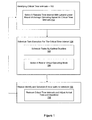
- method 100 may include one or more functions or processing operations illustrated by blocks 102, 104 and/or 106. As illustrated, processing may start at block 102, identifying critical time interval, where a first critical time interval [a, b] of the [0, T ] period is identified. From block 102, method 100 may proceed to block 104, schedule task execution for the critical time interval, where the tasks to be executed during the critical time interval are scheduled and/or organized (hereinafter, simply "schedule"). From block 104, method 100 may proceed to block 106, repeat identify and schedule if more tasks to schedule.
- identifying critical time intervals at block 102 may include selecting a feasible time interval with the largest lower bound average operating speed as the critical time interval, block 112.
- the [0, T ] period may be considered as having a number of feasible time intervals, and identifying critical time interval 102 comprises selecting one of these feasible time intervals.
- each of the feasible time intervals has an average operating speed, which is the average operating speed needed to execute the tasks to be executed during the feasible time interval.
- each of the feasible time intervals has a lower bound average operating speed, to be described in more detail below.
- the selecting may be based at least in part on these lower bounds, more specifically, the feasible time interval with the largest lower bound average operating speed may be selected as the critical time interval.
- s 1 and s 2 are two respective operating speeds of two operating modes;
- s * is the virtual operating speed achieved by operating at s 1 and s 2 for time t 1 and t 2 respectively
- ⁇ ij is a delay incurred by the scheduled task as it becomes idle, when the computing platform switches from operating mode i to operating mode j , and s *
- g ( I ) is the lower bound on the average speed in the interval I .
- g ( I ) may be modified accordingly to reflect the non-uniformity. For ease of understanding, the description will assume uniform switching capacity.
- a processor may operate in any virtual operating speed as illustrated by graph 202 in Figure 2a , and t 1 and t 2 may be determined using the above formulas and as illustrated by graph 204 in Figure 2b .
- Equation 4 shows the case where due to switching delay overhead, the virtual speed is larger than s 2 and therefore the processor only runs at s 2 for the portion of time.
- FIG. 3 illustrates a lower convex curve for an energy-speed domain, in accordance with various embodiments of the present disclosure.
- a lower convex curve (also may be referred to as convexity energy-speed envelope) can be created, by assuming the energy consumption for the lowest operating speeds to be the same as the known energy consumption for the lowest known operating speed, that is, by extending the curve on the lower-left side to cover the entire speed axis, as illustrated by curve 302.
- Interval I * is said to be critical if g ( I* ) is maximum for all feasible intervals in [0, T ].
- Equation 14 The interpretation of Equation 14 may be that energy consumption at speed ⁇ s 1 + (1 - ⁇ ) s 2 may be less the weighted energy consumption when the processor is running at ⁇ s 1 and (1 - ⁇ ) s 2 . Therefore the overhead energy ⁇ 12 must be taken into account.
- a computing platform may include one or more processing units or processors, one or more input/output devices, such as a display, a keyboard and/or a mouse, and one or more memories, such as static random access memory, dynamic random access memory, flash memory, and/or a hard drive.
Landscapes
- Engineering & Computer Science (AREA)
- Software Systems (AREA)
- Theoretical Computer Science (AREA)
- Physics & Mathematics (AREA)
- General Engineering & Computer Science (AREA)
- General Physics & Mathematics (AREA)
- Power Sources (AREA)
- General Factory Administration (AREA)
Applications Claiming Priority (1)
| Application Number | Priority Date | Filing Date | Title |
|---|---|---|---|
| US12/426,139 US8661443B2 (en) | 2009-04-17 | 2009-04-17 | Scheduling and/or organizing task execution for a target computing platform |
Publications (2)
| Publication Number | Publication Date |
|---|---|
| EP2241975A2 true EP2241975A2 (de) | 2010-10-20 |
| EP2241975A3 EP2241975A3 (de) | 2017-05-17 |
Family
ID=42668325
Family Applications (1)
| Application Number | Title | Priority Date | Filing Date |
|---|---|---|---|
| EP10155668.6A Withdrawn EP2241975A3 (de) | 2009-04-17 | 2010-03-05 | Planung und/oder Organisation einer Aufgabenausführung für eine Zielrechnerplattform |
Country Status (3)
| Country | Link |
|---|---|
| US (2) | US8661443B2 (de) |
| EP (1) | EP2241975A3 (de) |
| JP (1) | JP2010250802A (de) |
Cited By (2)
| Publication number | Priority date | Publication date | Assignee | Title |
|---|---|---|---|---|
| FR3010545A1 (fr) * | 2013-09-06 | 2015-03-13 | Commissariat Energie Atomique | Procede de commande d'un circuit electronique |
| CN117421107A (zh) * | 2023-12-14 | 2024-01-19 | 江西飞尚科技有限公司 | 监测平台调度方法、系统、可读存储介质及计算机 |
Families Citing this family (9)
| Publication number | Priority date | Publication date | Assignee | Title |
|---|---|---|---|---|
| US8397088B1 (en) | 2009-07-21 | 2013-03-12 | The Research Foundation Of State University Of New York | Apparatus and method for efficient estimation of the energy dissipation of processor based systems |
| US8776066B2 (en) * | 2009-11-30 | 2014-07-08 | International Business Machines Corporation | Managing task execution on accelerators |
| US20120245754A1 (en) * | 2009-12-05 | 2012-09-27 | Jens Mehnert | Method and apparatus for analysis of energy input during operation of a production system |
| US20120005682A1 (en) * | 2010-06-30 | 2012-01-05 | International Business Machines Corporation | Holistic task scheduling for distributed computing |
| US20150169373A1 (en) * | 2012-12-17 | 2015-06-18 | Unisys Corporation | System and method for managing computing resources |
| US9323574B2 (en) * | 2014-02-21 | 2016-04-26 | Lenovo Enterprise Solutions (Singapore) Pte. Ltd. | Processor power optimization with response time assurance |
| US9552228B2 (en) * | 2014-09-08 | 2017-01-24 | Empire Technology Development Llc | Instruction set extension concealment in data centers |
| US10007440B2 (en) * | 2015-11-22 | 2018-06-26 | Cisco Technology, Inc. | Method of reordering a queue of write requests |
| GB2545435B (en) * | 2015-12-15 | 2019-10-30 | Advanced Risc Mach Ltd | Data processing systems |
Family Cites Families (8)
| Publication number | Priority date | Publication date | Assignee | Title |
|---|---|---|---|---|
| US5814845A (en) * | 1995-01-10 | 1998-09-29 | Carnegie Mellon University | Four rail circuit architecture for ultra-low power and voltage CMOS circuit design |
| JP3830133B2 (ja) | 2001-11-06 | 2006-10-04 | 株式会社日立製作所 | 電力制御装置及び方法並びに電力制御プログラム |
| JP4433782B2 (ja) | 2003-12-17 | 2010-03-17 | 株式会社日立製作所 | 情報処理装置及びオペレーティングシステム |
| GB2410344B (en) | 2004-01-26 | 2006-03-15 | Toshiba Res Europ Ltd | Dynamic voltage controller |
| US7971073B2 (en) * | 2005-11-03 | 2011-06-28 | Los Alamos National Security, Llc | Adaptive real-time methodology for optimizing energy-efficient computing |
| US8112649B2 (en) | 2009-03-17 | 2012-02-07 | Empire Technology Development Llc | Energy optimization through intentional errors |
| US8041992B2 (en) | 2009-05-11 | 2011-10-18 | Technology Currents Llc | Input compensated and/or overcompensated computing |
| US8145943B2 (en) | 2009-05-11 | 2012-03-27 | Empire Technology Development Llc | State variable-based detection and correction of errors |
-
2009
- 2009-04-17 US US12/426,139 patent/US8661443B2/en not_active Expired - Fee Related
- 2009-12-18 JP JP2009287077A patent/JP2010250802A/ja active Pending
-
2010
- 2010-03-05 EP EP10155668.6A patent/EP2241975A3/de not_active Withdrawn
-
2014
- 2014-02-03 US US14/171,323 patent/US9471376B2/en not_active Expired - Fee Related
Non-Patent Citations (1)
| Title |
|---|
| None |
Cited By (5)
| Publication number | Priority date | Publication date | Assignee | Title |
|---|---|---|---|---|
| FR3010545A1 (fr) * | 2013-09-06 | 2015-03-13 | Commissariat Energie Atomique | Procede de commande d'un circuit electronique |
| WO2015033078A3 (fr) * | 2013-09-06 | 2015-06-25 | Commissariat A L'energie Atomique Et Aux Energies Alternatives | Procédé de commande d'un circuit électronique |
| US9698673B2 (en) | 2013-09-06 | 2017-07-04 | Commissariat à l'Energie Atomique et aux Energies Alternatives | Method for controlling an electronic circuit |
| CN117421107A (zh) * | 2023-12-14 | 2024-01-19 | 江西飞尚科技有限公司 | 监测平台调度方法、系统、可读存储介质及计算机 |
| CN117421107B (zh) * | 2023-12-14 | 2024-03-08 | 江西飞尚科技有限公司 | 监测平台调度方法、系统、可读存储介质及计算机 |
Also Published As
| Publication number | Publication date |
|---|---|
| US8661443B2 (en) | 2014-02-25 |
| US9471376B2 (en) | 2016-10-18 |
| JP2010250802A (ja) | 2010-11-04 |
| EP2241975A3 (de) | 2017-05-17 |
| US20100269116A1 (en) | 2010-10-21 |
| US20140196046A1 (en) | 2014-07-10 |
Similar Documents
| Publication | Publication Date | Title |
|---|---|---|
| EP2241975A2 (de) | Planung und/oder Organisation einer Aufgabenausführung für eine Zielrechnerplattform | |
| US10775873B2 (en) | Performing power management in a multicore processor | |
| Schmitz et al. | Considering power variations of DVS processing elements for energy minimisation in distributed systems | |
| US8751854B2 (en) | Processor core clock rate selection | |
| CN104081315B (zh) | 包括线程合并的用于能效和节能的方法、装置和系统 | |
| US9323306B2 (en) | Energy based time scheduler for parallel computing system | |
| US20120166731A1 (en) | Computing platform power management with adaptive cache flush | |
| US20130332753A1 (en) | Dynamic power limit sharing in a platform | |
| CN105677000B (zh) | 动态电压频率调整的系统及方法 | |
| Tosun | Energy-and reliability-aware task scheduling onto heterogeneous MPSoC architectures | |
| KR20100026989A (ko) | 에너지 절약형 멀티 코어 프로세서 | |
| ul Islam et al. | Task aware hybrid DVFS for multi-core real-time systems using machine learning | |
| CN103329100A (zh) | 异质的计算环境中的负载平衡 | |
| CN102171627A (zh) | 对在异构计算系统中执行的应用的调度 | |
| Huang et al. | Energy-efficient task allocation and scheduling for multi-mode MPSoCs under lifetime reliability constraint | |
| US9146602B2 (en) | Method for managing energy consumption for multiprocessor systems using an offline phase for characterization of a variation of a potential rate of parallelism for task scheduling and an online phase for detection and exploitation of potential inactivity intervals | |
| Chen et al. | GAS-MARL: Green-aware job scheduling algorithm for HPC clusters based on multi-action deep reinforcement learning | |
| Chrobak et al. | Algorithms for temperature-aware task scheduling in microprocessor systems | |
| Niu | Energy efficient scheduling for real-time embedded systems with QoS guarantee | |
| He et al. | A heuristic energy-aware approach for hard real-time systems on multi-core platforms | |
| Carvalho et al. | Evaluation of static and dynamic task mapping algorithms in NoC-based MPSoCs | |
| US20140007135A1 (en) | Multi-core system, scheduling method, and computer product | |
| US10108454B2 (en) | Managing dynamic capacitance using code scheduling | |
| Niu et al. | Improving schedulability and energy performance for weakly hard real-time systems | |
| Wang et al. | Min-cut based leakage power aware scheduling in high-level synthesis |
Legal Events
| Date | Code | Title | Description |
|---|---|---|---|
| PUAI | Public reference made under article 153(3) epc to a published international application that has entered the european phase |
Free format text: ORIGINAL CODE: 0009012 |
|
| AK | Designated contracting states |
Kind code of ref document: A2 Designated state(s): AT BE BG CH CY CZ DE DK EE ES FI FR GB GR HR HU IE IS IT LI LT LU LV MC MK MT NL NO PL PT RO SE SI SK SM TR |
|
| AX | Request for extension of the european patent |
Extension state: AL BA ME RS |
|
| RAP1 | Party data changed (applicant data changed or rights of an application transferred) |
Owner name: EMPIRE TECHNOLOGY DEVELOPMENT LLC |
|
| PUAL | Search report despatched |
Free format text: ORIGINAL CODE: 0009013 |
|
| AK | Designated contracting states |
Kind code of ref document: A3 Designated state(s): AT BE BG CH CY CZ DE DK EE ES FI FR GB GR HR HU IE IS IT LI LT LU LV MC MK MT NL NO PL PT RO SE SI SK SM TR |
|
| AX | Request for extension of the european patent |
Extension state: AL BA ME RS |
|
| RIC1 | Information provided on ipc code assigned before grant |
Ipc: G06F 9/48 20060101AFI20170413BHEP |
|
| 17P | Request for examination filed |
Effective date: 20171027 |
|
| RBV | Designated contracting states (corrected) |
Designated state(s): AT BE BG CH CY CZ DE DK EE ES FI FR GB GR HR HU IE IS IT LI LT LU LV MC MK MT NL NO PL PT RO SE SI SK SM TR |
|
| 17Q | First examination report despatched |
Effective date: 20180629 |
|
| STAA | Information on the status of an ep patent application or granted ep patent |
Free format text: STATUS: THE APPLICATION IS DEEMED TO BE WITHDRAWN |
|
| 18D | Application deemed to be withdrawn |
Effective date: 20190110 |