EP2241052B1 - Verfahren zur rückverfolgung rückverfolgbarer teile privater originalschlüssel in einem verschlüsselungssystem mit öffentlichen schlüsseln - Google Patents
Verfahren zur rückverfolgung rückverfolgbarer teile privater originalschlüssel in einem verschlüsselungssystem mit öffentlichen schlüsseln Download PDFInfo
- Publication number
- EP2241052B1 EP2241052B1 EP08863527.1A EP08863527A EP2241052B1 EP 2241052 B1 EP2241052 B1 EP 2241052B1 EP 08863527 A EP08863527 A EP 08863527A EP 2241052 B1 EP2241052 B1 EP 2241052B1
- Authority
- EP
- European Patent Office
- Prior art keywords
- key
- traceable
- keys
- private key
- private keys
- Prior art date
- Legal status (The legal status is an assumption and is not a legal conclusion. Google has not performed a legal analysis and makes no representation as to the accuracy of the status listed.)
- Active
Links
Images
Classifications
-
- H—ELECTRICITY
- H04—ELECTRIC COMMUNICATION TECHNIQUE
- H04L—TRANSMISSION OF DIGITAL INFORMATION, e.g. TELEGRAPHIC COMMUNICATION
- H04L9/00—Cryptographic mechanisms or cryptographic arrangements for secret or secure communications; Network security protocols
- H04L9/30—Public key, i.e. encryption algorithm being computationally infeasible to invert or user's encryption keys not requiring secrecy
- H04L9/304—Public key, i.e. encryption algorithm being computationally infeasible to invert or user's encryption keys not requiring secrecy based on error correction codes, e.g. McEliece
-
- H—ELECTRICITY
- H04—ELECTRIC COMMUNICATION TECHNIQUE
- H04L—TRANSMISSION OF DIGITAL INFORMATION, e.g. TELEGRAPHIC COMMUNICATION
- H04L9/00—Cryptographic mechanisms or cryptographic arrangements for secret or secure communications; Network security protocols
- H04L9/30—Public key, i.e. encryption algorithm being computationally infeasible to invert or user's encryption keys not requiring secrecy
- H04L9/3066—Public key, i.e. encryption algorithm being computationally infeasible to invert or user's encryption keys not requiring secrecy involving algebraic varieties, e.g. elliptic or hyper-elliptic curves
- H04L9/3073—Public key, i.e. encryption algorithm being computationally infeasible to invert or user's encryption keys not requiring secrecy involving algebraic varieties, e.g. elliptic or hyper-elliptic curves involving pairings, e.g. identity based encryption [IBE], bilinear mappings or bilinear pairings, e.g. Weil or Tate pairing
-
- H—ELECTRICITY
- H04—ELECTRIC COMMUNICATION TECHNIQUE
- H04L—TRANSMISSION OF DIGITAL INFORMATION, e.g. TELEGRAPHIC COMMUNICATION
- H04L9/00—Cryptographic mechanisms or cryptographic arrangements for secret or secure communications; Network security protocols
- H04L9/30—Public key, i.e. encryption algorithm being computationally infeasible to invert or user's encryption keys not requiring secrecy
- H04L9/3093—Public key, i.e. encryption algorithm being computationally infeasible to invert or user's encryption keys not requiring secrecy involving Lattices or polynomial equations, e.g. NTRU scheme
-
- H—ELECTRICITY
- H04—ELECTRIC COMMUNICATION TECHNIQUE
- H04L—TRANSMISSION OF DIGITAL INFORMATION, e.g. TELEGRAPHIC COMMUNICATION
- H04L2209/00—Additional information or applications relating to cryptographic mechanisms or cryptographic arrangements for secret or secure communication H04L9/00
- H04L2209/34—Encoding or coding, e.g. Huffman coding or error correction
-
- H—ELECTRICITY
- H04—ELECTRIC COMMUNICATION TECHNIQUE
- H04L—TRANSMISSION OF DIGITAL INFORMATION, e.g. TELEGRAPHIC COMMUNICATION
- H04L2209/00—Additional information or applications relating to cryptographic mechanisms or cryptographic arrangements for secret or secure communication H04L9/00
- H04L2209/60—Digital content management, e.g. content distribution
- H04L2209/601—Broadcast encryption
-
- H—ELECTRICITY
- H04—ELECTRIC COMMUNICATION TECHNIQUE
- H04L—TRANSMISSION OF DIGITAL INFORMATION, e.g. TELEGRAPHIC COMMUNICATION
- H04L2209/00—Additional information or applications relating to cryptographic mechanisms or cryptographic arrangements for secret or secure communication H04L9/00
- H04L2209/60—Digital content management, e.g. content distribution
- H04L2209/606—Traitor tracing
Definitions
- the aim of the present invention is to propose a very fast alternative mechanism to the traitor tracing algorithm introduced by Boneh and Franklin to trace private keys in a public-key cryptosystem.
- a management center would like to broadcast some data to l receivers, where only authorized users (typically, those who have paid a fee) can have access to the data.
- a possible solution widely deployed in commercial Pay-TV systems or in secured media distribution systems, for instance, consists in encrypting the data using a symmetric key and to securely transmit to each authorized receiver this key which will be stored in a tamper-proof piece of hardware, like a smartcard.
- tamper-resistant hardware is very difficult and/or costly to design, since it is vulnerable to a wide variety of attacks. Therefore, a malicious user (hereafter called a traitor ) can try to retrieve the decryption key from his receiver and distribute it (sell or give away) to unauthorized users ( the pirates ) .
- a malicious user hereafter called a traitor
- a traitor can try to retrieve the decryption key from his receiver and distribute it (sell or give away) to unauthorized users (the pirates ) .
- a dishonest user will try to mix several legitimate keys in order to build a new one and embed it in a pirate receiver device.
- traitor tracing The problem of identifying which receivers were compromised and/or which secret keys were leaked is called traitor tracing.
- traitor tracing Two modes of traitor tracing are considered: in the black-box mode, the tracing algorithm sends crafty ciphertexts to the rogue receiver and aims at determining which keys it uses while observing its behavior; in the non-black-box model, we assume that the keys (or their combination) can be extracted from the pirate receiver and are known to the tracing algorithm.
- Fiat and Naor [1] introduced the concept of broadcast encryption.
- the broadcasting center can dynamically specify a privileged subset of authorized users that can decrypt selected ciphertexts (like high-value content, for instance).
- Chor, Fiat, and Naor [2] introduced the concept of traitor-tracing to thwart the problem of decryption keys piracy in broadcast encryption schemes; their scheme is k-collusion resistant (or k-resilient) in the sense that at least one traitor is identified with very high probability if there are at most k of them.
- Boneh and Franklin [6] proposed a new public-key traitor-tracing scheme based on error-correcting codes, more precisely on Reed-Solomon codes.
- the Boneh-Franklin non-black-box traitor tracing scheme is k-collusion resistant and deterministic in the sense that all of the traitors are identified with probability 1 as long as at most k of them collude to derive new pirate keys.
- a linear code C over GF ( q ) l vector space is a subspace of GF ( q ) l .
- C has a dimension 0 ⁇ 2 k ⁇ l and contains q 2 k codewords.
- the minimal distance d of C is equal to the minimum Hamming weight of all non-zero codewords.
- An l ⁇ 2 k matrix G over GF ( q ) is called a generator matrix if its columns form a linearly independent basis for C.
- c (1,1,...,1), one simply speaks of Reed-Solomon codes.
- the aim of the present application is a new non-black-box traitor tracing mechanism for Boneh-Franklin and related schemes. Due to its algorithmic complexity, the original traitor tracing procedure, as it was described by Boneh and Franklin, is limited to the systems of about 10'000 users in a practical scenario on a common desktop computer available in 2007.
- the benefit of the present application is the possibility to perform key tracing in systems up to several billions of users in a fraction of time of the original tracing mechanism on the same computer configuration.
- the identities of the traitors are revealed by subtracting ⁇ - ⁇ c ; the base point ⁇ ⁇ then reveals the index i of the key used in the coalition. In other words, it is the i -th non-zero element of the resulting vector.
- the running time of the above algorithm is in O (l 3 ), i.e. it depends on the cube of the number l of users in the system. Such running time is prohibitive in practice as soon as l becomes larger than 10'000. Even though the complexity of the optimized version of the tracing procedure using the so-called Berlekamp-Welch described in [9] is in O (l 2 ) , the tracing capacity in terms of number of users in the system still remains heavily limited.
- the goal of the algorithm is to find the subset T .
- the new fast traitor tracing mechanism that is the subject of the present invention will take 2k elements as input and will output the identities of the traitors as long as there are at most k traitor keys in the representation d .
- the new proposed algorithm consists of 2 steps:
- the actual identity of the traitors is given through a identity-base-point relations table which explicitly maps the identity of a user to the corresponding base point of a given private key and vice-versa.
- the first advantage of the proposed method is that the first step of the algorithm is independent of the number of users l in the system and only depends on the coalition size k which is negligible compared to the number of users in the system l in terms of complexity.
- the second step is linear in l , but involves only light computations.
- the tracing procedure can be performed considerably faster than in the original Boneh-Franklin proposal.
- the overall complexity of the new algorithm is in O (l), i.e. it is linear in l .
- the present invention can be applied, but is not limited, to the Pay-TV and other digital media distribution systems, such as CDs and DVDs.
- the data is to be encrypted using the system's public key and each user is given a distinct private traceable key by means of incorporation of the abovementioned private key parts in tamper-proof memory of an electronic device, also referred as "receiver" (Set-Top Box, mobile terminal or an optical disc player).
- an unlawful user also referred as "traitor”
- an unlawful user would try to extract the private key information by means of reverse engineering, that is taking the receiver apart and discovering the key material through analysis of receiver's function and operations.
- the traitor might then build his own receiver or player which utilizes a combination of the retrieved private keys in order to decrypt the protected media. He may sell it or he may put it on the Internet if the receiver can be simulated by a software program executing on a personal computer which will then result in the propagation of piracy.
- the media distribution authority after locating and recovering the abovementioned pirate device and extracting the pirate key, will run the fast traitor tracing mechanism which is subject to the current disclosure.
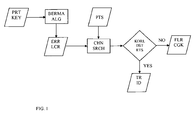
- the Berlekamp-Massey algorithm represented by the block BERMA-ALG will be executed on the traceable part of the pirate key PRT-KEY which consists of 2k elements and it will output the error locator polynomial ERR-LCR consisting of k coefficients.
- the decision diamond KORL-DST-RTS it is determined whether the error locator polynomial has k or fewer roots, which corresponds to the pirate private key being formed by k or less original private keys according to (1).
- the logic flows from decision diamond KORL-DST-RTS to output the identities of the traitors TR-ID by searching the modular inverse of the roots of the error locator polynomial against the identity-base-points relations table.
- the main advantage of the current invention is its speed, comparing to the previously proposed art, meaning that a system implementing the fast traitor tracing can be deployed in a scenario with several hundreds of millions of receivers, which seems deeply appropriate to the digital media distribution systems such as those using optical discs (DVDs and CDs) and Pay-TV systems, whereas previously known art [6] could only be used in a scenario with 10'000 of users which may be seen as a severe limiting factor.
- the fast traitor tracing uses the non-black-box deterministic tracing approach. It means that first of all, the key material is to be extracted from the receiver by media distribution authority by means of reverse engineering. The advantage of this approach is the deterministic nature of the fast traitor tracing mechanism, specifically until there is a combination of k or less rogue keys in the pirate receiver, the identities of the traitors will be discovered with probability 1. On the contrary, the method proposed in [4], under some circumstances, will not be able to output the exact identities of the traitors.
Landscapes
- Engineering & Computer Science (AREA)
- Theoretical Computer Science (AREA)
- Signal Processing (AREA)
- Computing Systems (AREA)
- Computer Networks & Wireless Communication (AREA)
- Computer Security & Cryptography (AREA)
- Algebra (AREA)
- General Physics & Mathematics (AREA)
- Pure & Applied Mathematics (AREA)
- Mathematical Analysis (AREA)
- Mathematical Physics (AREA)
- Mathematical Optimization (AREA)
- Physics & Mathematics (AREA)
- Error Detection And Correction (AREA)
- Storage Device Security (AREA)
- Detection And Correction Of Errors (AREA)
Claims (3)
- Verfahren zur Rückverfolgung rückverfolgbarer Teile
d = (d1,...,d2k)T von privaten Originalschlüsseln in einem Kryptosystem mit öffentlichem Schlüssel, bestehend aus einem öffentlichen Schlüssel und ℓ entsprechenden privaten Schlüsseln, wobei ein privater Schlüssel aus mindestens einer rückverfolgbaren Anordnung von 2k Elementen besteht, die ein Syndrom eines verallgemeinerten Reed-Solomon-Codes bilden, mit Parametern (ℓ,ℓ-2k) definiert durch die Basispunkteπ = (π1,...,πl)T und einen Skalierungsvektorc = (c1,...,cl)T, in dem k eine maximale Koalitionsgröße ist, T eine Teilmenge von kompromittierten Schlüsseln, ℓ die Zahl der Benutzer und q eine große Primzahl, mit folgenden Phasen:- Erhalt des rückverfolgbaren Teilsgekennzeichnet dadurch, dass es des weiteren folgende Phasen umfasst:d = (d1,...,d2k)T eines privaten Rogue-Schlüssels, wobei die Anordnung von 2k Elementen eine lineare Kombination von Anordnungen von 2k Elementen ist, die mindestens zwei privaten Originalschlüsseln angehören, so dass die Summe der Koeffizienten der linearen Kombination gleich 1 mod q ist,- Anwendung eines Berlekamp-Massey-Algorithmus auf den rückverfolgbaren Teild = (d1,...,d2k)T des privaten Rogue-Schlüssels, um die k Koeffizienten eines Fehlerstellenpolynoms zu erhalten,- Anwendung von Chiens Suchalgorithmus auf das Fehlerstellenpolynom, um Wurzeln des Fehlerstellenpolynoms zu erhalten,- Bestimmung der Basispunkte des rückverfolgbaren Teils der originalen privaten Schlüssel durch Berechnung der arithmetischen Umkehrfunktion jeder Wurzel, wobei es diese Basispunkte gestatten, die Identität des privaten Schlüssels eindeutig zu bestimmen. - Verfahren nach Anspruch 1, wobei das verallgemeinerte Reed-Solomon-Codewort über ein endliches Feld von mindesten 2127 Elementen definiert ist.
- Verfahren nach Anspruch 1 und 2, wobei jeder private Originalschlüssel einer gegebenen Identität zugeteilt wird, wobei das Verfahren des weiteren folgende Phasen umfasst:- Speicherung, für jeden privaten Schlüssel, des Basispunkts πi und der entsprechenden Identität i,- Wiederauffinden der Identitäten der privaten Schlüssel auf der Grundlage des wiedergewonnenen Basispunkts und der entsprechenden gespeicherten Identitäten.
Priority Applications (1)
| Application Number | Priority Date | Filing Date | Title |
|---|---|---|---|
| EP08863527.1A EP2241052B1 (de) | 2007-12-21 | 2008-12-18 | Verfahren zur rückverfolgung rückverfolgbarer teile privater originalschlüssel in einem verschlüsselungssystem mit öffentlichen schlüsseln |
Applications Claiming Priority (3)
| Application Number | Priority Date | Filing Date | Title |
|---|---|---|---|
| EP07150363A EP2073431A1 (de) | 2007-12-21 | 2007-12-21 | Verfahren zur Rückverfolgung rückverfolgbarer Teile privater Originalschlüssel in einem Verschlüsselungssystem mit öffentlichen Schlüsseln |
| PCT/EP2008/067827 WO2009080683A1 (en) | 2007-12-21 | 2008-12-18 | Method to trace traceable parts of original private keys in a public-key cryptosystem |
| EP08863527.1A EP2241052B1 (de) | 2007-12-21 | 2008-12-18 | Verfahren zur rückverfolgung rückverfolgbarer teile privater originalschlüssel in einem verschlüsselungssystem mit öffentlichen schlüsseln |
Publications (2)
| Publication Number | Publication Date |
|---|---|
| EP2241052A1 EP2241052A1 (de) | 2010-10-20 |
| EP2241052B1 true EP2241052B1 (de) | 2013-05-15 |
Family
ID=39524303
Family Applications (2)
| Application Number | Title | Priority Date | Filing Date |
|---|---|---|---|
| EP07150363A Withdrawn EP2073431A1 (de) | 2007-12-21 | 2007-12-21 | Verfahren zur Rückverfolgung rückverfolgbarer Teile privater Originalschlüssel in einem Verschlüsselungssystem mit öffentlichen Schlüsseln |
| EP08863527.1A Active EP2241052B1 (de) | 2007-12-21 | 2008-12-18 | Verfahren zur rückverfolgung rückverfolgbarer teile privater originalschlüssel in einem verschlüsselungssystem mit öffentlichen schlüsseln |
Family Applications Before (1)
| Application Number | Title | Priority Date | Filing Date |
|---|---|---|---|
| EP07150363A Withdrawn EP2073431A1 (de) | 2007-12-21 | 2007-12-21 | Verfahren zur Rückverfolgung rückverfolgbarer Teile privater Originalschlüssel in einem Verschlüsselungssystem mit öffentlichen Schlüsseln |
Country Status (4)
| Country | Link |
|---|---|
| EP (2) | EP2073431A1 (de) |
| KR (1) | KR101439587B1 (de) |
| CN (1) | CN101897149B (de) |
| WO (1) | WO2009080683A1 (de) |
Families Citing this family (1)
| Publication number | Priority date | Publication date | Assignee | Title |
|---|---|---|---|---|
| CN112769573B (zh) * | 2020-12-26 | 2022-08-05 | 西安电子科技大学 | 一种基于grs码的数字签名方法、验签方法及其装置 |
Family Cites Families (4)
| Publication number | Priority date | Publication date | Assignee | Title |
|---|---|---|---|---|
| US4633470A (en) | 1983-09-27 | 1986-12-30 | Cyclotomics, Inc. | Error correction for algebraic block codes |
| US7039803B2 (en) | 2001-01-26 | 2006-05-02 | International Business Machines Corporation | Method for broadcast encryption and key revocation of stateless receivers |
| US7010125B2 (en) | 2001-01-26 | 2006-03-07 | Interntional Business Machines Corporation | Method for tracing traitor receivers in a broadcast encryption system |
| FR2856539A1 (fr) * | 2003-06-17 | 2004-12-24 | France Telecom | Procede et systeme tracables de chiffrement et/ou de dechiffrement d'informations, et supports d'enregistrement pour la mise en oeuvre du procede |
-
2007
- 2007-12-21 EP EP07150363A patent/EP2073431A1/de not_active Withdrawn
-
2008
- 2008-12-18 WO PCT/EP2008/067827 patent/WO2009080683A1/en not_active Ceased
- 2008-12-18 KR KR1020107013688A patent/KR101439587B1/ko active Active
- 2008-12-18 CN CN200880119977.8A patent/CN101897149B/zh active Active
- 2008-12-18 EP EP08863527.1A patent/EP2241052B1/de active Active
Also Published As
| Publication number | Publication date |
|---|---|
| KR20100093091A (ko) | 2010-08-24 |
| KR101439587B1 (ko) | 2014-10-30 |
| CN101897149A (zh) | 2010-11-24 |
| EP2073431A1 (de) | 2009-06-24 |
| WO2009080683A1 (en) | 2009-07-02 |
| EP2241052A1 (de) | 2010-10-20 |
| CN101897149B (zh) | 2013-01-02 |
Similar Documents
| Publication | Publication Date | Title |
|---|---|---|
| US12101415B2 (en) | Method of RSA signature or decryption protected using a homomorphic encryption | |
| Gaborit et al. | Identity-based encryption from codes with rank metric | |
| Canteaut et al. | Cryptanalysis of the original McEliece cryptosystem | |
| US9191199B2 (en) | Method and apparatus for public-key cryptography based on error correcting codes | |
| CN100583755C (zh) | 使用同源来设计密码系统 | |
| Kiayias et al. | Breaking and repairing asymmetric public-key traitor tracing | |
| CN102067080B (zh) | 白盒实现 | |
| Nosouhi et al. | Weak-key analysis for BIKE post-quantum key encapsulation mechanism | |
| US10484182B2 (en) | Encrypted text verification system, method, and recording medium | |
| KR101942030B1 (ko) | 메시지에 대한 무결성 검증이 지원되는 부호 기반의 암호화가 가능한 전자 장치 및 그 동작 방법 | |
| CN1836396B (zh) | 用于加密和/或解密数据的可追踪方法和系统 | |
| Cayrel et al. | On kabatianskii-krouk-smeets signatures | |
| US8913741B2 (en) | Method for performing a cryptographic task in an electronic hardware component | |
| US10503915B2 (en) | Encrypted text verification system, method and recording medium | |
| Rashwan et al. | Security of the GPT cryptosystem and its applications to cryptography | |
| Loureiro | Function hiding based on error correcting codes | |
| US20020001383A1 (en) | Cryptosystem using multivariable polynomials | |
| WO2007142170A1 (ja) | 不正者失効システム、暗号化装置、暗号化方法およびプログラム | |
| EP2241052B1 (de) | Verfahren zur rückverfolgung rückverfolgbarer teile privater originalschlüssel in einem verschlüsselungssystem mit öffentlichen schlüsseln | |
| US7936882B2 (en) | Method to trace traceable parts of original private keys in a public-key cryptosystem | |
| Boneh et al. | Robust fingerprinting codes: a near optimal construction | |
| CN107947915A (zh) | 基于压缩感知的匿名叛逆者追踪方法 | |
| CN101889412B (zh) | 在Boneh-Franklin方案中生成私钥的方法 | |
| US8306220B2 (en) | Method to generate a private key in a boneh-franklin scheme | |
| Assael | Hardware acceleration of post-quantum cryptography for embedded systems |
Legal Events
| Date | Code | Title | Description |
|---|---|---|---|
| PUAI | Public reference made under article 153(3) epc to a published international application that has entered the european phase |
Free format text: ORIGINAL CODE: 0009012 |
|
| 17P | Request for examination filed |
Effective date: 20100712 |
|
| AK | Designated contracting states |
Kind code of ref document: A1 Designated state(s): AT BE BG CH CY CZ DE DK EE ES FI FR GB GR HR HU IE IS IT LI LT LU LV MC MT NL NO PL PT RO SE SI SK TR |
|
| AX | Request for extension of the european patent |
Extension state: AL BA MK RS |
|
| DAX | Request for extension of the european patent (deleted) | ||
| GRAP | Despatch of communication of intention to grant a patent |
Free format text: ORIGINAL CODE: EPIDOSNIGR1 |
|
| GRAS | Grant fee paid |
Free format text: ORIGINAL CODE: EPIDOSNIGR3 |
|
| GRAA | (expected) grant |
Free format text: ORIGINAL CODE: 0009210 |
|
| AK | Designated contracting states |
Kind code of ref document: B1 Designated state(s): AT BE BG CH CY CZ DE DK EE ES FI FR GB GR HR HU IE IS IT LI LT LU LV MC MT NL NO PL PT RO SE SI SK TR |
|
| REG | Reference to a national code |
Ref country code: CH Ref legal event code: EP Ref country code: GB Ref legal event code: FG4D |
|
| REG | Reference to a national code |
Ref country code: AT Ref legal event code: REF Ref document number: 612580 Country of ref document: AT Kind code of ref document: T Effective date: 20130615 |
|
| REG | Reference to a national code |
Ref country code: IE Ref legal event code: FG4D |
|
| REG | Reference to a national code |
Ref country code: DE Ref legal event code: R096 Ref document number: 602008024655 Country of ref document: DE Effective date: 20130711 |
|
| REG | Reference to a national code |
Ref country code: AT Ref legal event code: MK05 Ref document number: 612580 Country of ref document: AT Kind code of ref document: T Effective date: 20130515 |
|
| REG | Reference to a national code |
Ref country code: LT Ref legal event code: MG4D |
|
| REG | Reference to a national code |
Ref country code: NL Ref legal event code: VDEP Effective date: 20130515 |
|
| PG25 | Lapsed in a contracting state [announced via postgrant information from national office to epo] |
Ref country code: FI Free format text: LAPSE BECAUSE OF FAILURE TO SUBMIT A TRANSLATION OF THE DESCRIPTION OR TO PAY THE FEE WITHIN THE PRESCRIBED TIME-LIMIT Effective date: 20130515 Ref country code: ES Free format text: LAPSE BECAUSE OF FAILURE TO SUBMIT A TRANSLATION OF THE DESCRIPTION OR TO PAY THE FEE WITHIN THE PRESCRIBED TIME-LIMIT Effective date: 20130826 Ref country code: LT Free format text: LAPSE BECAUSE OF FAILURE TO SUBMIT A TRANSLATION OF THE DESCRIPTION OR TO PAY THE FEE WITHIN THE PRESCRIBED TIME-LIMIT Effective date: 20130515 Ref country code: NO Free format text: LAPSE BECAUSE OF FAILURE TO SUBMIT A TRANSLATION OF THE DESCRIPTION OR TO PAY THE FEE WITHIN THE PRESCRIBED TIME-LIMIT Effective date: 20130815 Ref country code: SI Free format text: LAPSE BECAUSE OF FAILURE TO SUBMIT A TRANSLATION OF THE DESCRIPTION OR TO PAY THE FEE WITHIN THE PRESCRIBED TIME-LIMIT Effective date: 20130515 Ref country code: PT Free format text: LAPSE BECAUSE OF FAILURE TO SUBMIT A TRANSLATION OF THE DESCRIPTION OR TO PAY THE FEE WITHIN THE PRESCRIBED TIME-LIMIT Effective date: 20130916 Ref country code: GR Free format text: LAPSE BECAUSE OF FAILURE TO SUBMIT A TRANSLATION OF THE DESCRIPTION OR TO PAY THE FEE WITHIN THE PRESCRIBED TIME-LIMIT Effective date: 20130816 Ref country code: AT Free format text: LAPSE BECAUSE OF FAILURE TO SUBMIT A TRANSLATION OF THE DESCRIPTION OR TO PAY THE FEE WITHIN THE PRESCRIBED TIME-LIMIT Effective date: 20130515 Ref country code: SE Free format text: LAPSE BECAUSE OF FAILURE TO SUBMIT A TRANSLATION OF THE DESCRIPTION OR TO PAY THE FEE WITHIN THE PRESCRIBED TIME-LIMIT Effective date: 20130515 Ref country code: IS Free format text: LAPSE BECAUSE OF FAILURE TO SUBMIT A TRANSLATION OF THE DESCRIPTION OR TO PAY THE FEE WITHIN THE PRESCRIBED TIME-LIMIT Effective date: 20130915 |
|
| PG25 | Lapsed in a contracting state [announced via postgrant information from national office to epo] |
Ref country code: BG Free format text: LAPSE BECAUSE OF FAILURE TO SUBMIT A TRANSLATION OF THE DESCRIPTION OR TO PAY THE FEE WITHIN THE PRESCRIBED TIME-LIMIT Effective date: 20130815 Ref country code: PL Free format text: LAPSE BECAUSE OF FAILURE TO SUBMIT A TRANSLATION OF THE DESCRIPTION OR TO PAY THE FEE WITHIN THE PRESCRIBED TIME-LIMIT Effective date: 20130515 Ref country code: HR Free format text: LAPSE BECAUSE OF FAILURE TO SUBMIT A TRANSLATION OF THE DESCRIPTION OR TO PAY THE FEE WITHIN THE PRESCRIBED TIME-LIMIT Effective date: 20130515 |
|
| PG25 | Lapsed in a contracting state [announced via postgrant information from national office to epo] |
Ref country code: LV Free format text: LAPSE BECAUSE OF FAILURE TO SUBMIT A TRANSLATION OF THE DESCRIPTION OR TO PAY THE FEE WITHIN THE PRESCRIBED TIME-LIMIT Effective date: 20130515 |
|
| PG25 | Lapsed in a contracting state [announced via postgrant information from national office to epo] |
Ref country code: CZ Free format text: LAPSE BECAUSE OF FAILURE TO SUBMIT A TRANSLATION OF THE DESCRIPTION OR TO PAY THE FEE WITHIN THE PRESCRIBED TIME-LIMIT Effective date: 20130515 Ref country code: DK Free format text: LAPSE BECAUSE OF FAILURE TO SUBMIT A TRANSLATION OF THE DESCRIPTION OR TO PAY THE FEE WITHIN THE PRESCRIBED TIME-LIMIT Effective date: 20130515 Ref country code: BE Free format text: LAPSE BECAUSE OF FAILURE TO SUBMIT A TRANSLATION OF THE DESCRIPTION OR TO PAY THE FEE WITHIN THE PRESCRIBED TIME-LIMIT Effective date: 20130515 Ref country code: SK Free format text: LAPSE BECAUSE OF FAILURE TO SUBMIT A TRANSLATION OF THE DESCRIPTION OR TO PAY THE FEE WITHIN THE PRESCRIBED TIME-LIMIT Effective date: 20130515 Ref country code: EE Free format text: LAPSE BECAUSE OF FAILURE TO SUBMIT A TRANSLATION OF THE DESCRIPTION OR TO PAY THE FEE WITHIN THE PRESCRIBED TIME-LIMIT Effective date: 20130515 |
|
| PG25 | Lapsed in a contracting state [announced via postgrant information from national office to epo] |
Ref country code: RO Free format text: LAPSE BECAUSE OF FAILURE TO SUBMIT A TRANSLATION OF THE DESCRIPTION OR TO PAY THE FEE WITHIN THE PRESCRIBED TIME-LIMIT Effective date: 20130515 Ref country code: IT Free format text: LAPSE BECAUSE OF FAILURE TO SUBMIT A TRANSLATION OF THE DESCRIPTION OR TO PAY THE FEE WITHIN THE PRESCRIBED TIME-LIMIT Effective date: 20130515 Ref country code: NL Free format text: LAPSE BECAUSE OF FAILURE TO SUBMIT A TRANSLATION OF THE DESCRIPTION OR TO PAY THE FEE WITHIN THE PRESCRIBED TIME-LIMIT Effective date: 20130515 |
|
| PLBE | No opposition filed within time limit |
Free format text: ORIGINAL CODE: 0009261 |
|
| STAA | Information on the status of an ep patent application or granted ep patent |
Free format text: STATUS: NO OPPOSITION FILED WITHIN TIME LIMIT |
|
| 26N | No opposition filed |
Effective date: 20140218 |
|
| REG | Reference to a national code |
Ref country code: DE Ref legal event code: R097 Ref document number: 602008024655 Country of ref document: DE Effective date: 20140218 |
|
| REG | Reference to a national code |
Ref country code: CH Ref legal event code: PL |
|
| PG25 | Lapsed in a contracting state [announced via postgrant information from national office to epo] |
Ref country code: LU Free format text: LAPSE BECAUSE OF FAILURE TO SUBMIT A TRANSLATION OF THE DESCRIPTION OR TO PAY THE FEE WITHIN THE PRESCRIBED TIME-LIMIT Effective date: 20131218 Ref country code: MC Free format text: LAPSE BECAUSE OF FAILURE TO SUBMIT A TRANSLATION OF THE DESCRIPTION OR TO PAY THE FEE WITHIN THE PRESCRIBED TIME-LIMIT Effective date: 20130515 |
|
| REG | Reference to a national code |
Ref country code: IE Ref legal event code: MM4A |
|
| PG25 | Lapsed in a contracting state [announced via postgrant information from national office to epo] |
Ref country code: CH Free format text: LAPSE BECAUSE OF NON-PAYMENT OF DUE FEES Effective date: 20131231 Ref country code: LI Free format text: LAPSE BECAUSE OF NON-PAYMENT OF DUE FEES Effective date: 20131231 Ref country code: IE Free format text: LAPSE BECAUSE OF NON-PAYMENT OF DUE FEES Effective date: 20131218 |
|
| PG25 | Lapsed in a contracting state [announced via postgrant information from national office to epo] |
Ref country code: CY Free format text: LAPSE BECAUSE OF FAILURE TO SUBMIT A TRANSLATION OF THE DESCRIPTION OR TO PAY THE FEE WITHIN THE PRESCRIBED TIME-LIMIT Effective date: 20130515 Ref country code: TR Free format text: LAPSE BECAUSE OF FAILURE TO SUBMIT A TRANSLATION OF THE DESCRIPTION OR TO PAY THE FEE WITHIN THE PRESCRIBED TIME-LIMIT Effective date: 20130515 |
|
| PG25 | Lapsed in a contracting state [announced via postgrant information from national office to epo] |
Ref country code: HU Free format text: LAPSE BECAUSE OF FAILURE TO SUBMIT A TRANSLATION OF THE DESCRIPTION OR TO PAY THE FEE WITHIN THE PRESCRIBED TIME-LIMIT; INVALID AB INITIO Effective date: 20081218 |
|
| PG25 | Lapsed in a contracting state [announced via postgrant information from national office to epo] |
Ref country code: MT Free format text: LAPSE BECAUSE OF FAILURE TO SUBMIT A TRANSLATION OF THE DESCRIPTION OR TO PAY THE FEE WITHIN THE PRESCRIBED TIME-LIMIT Effective date: 20130515 |
|
| REG | Reference to a national code |
Ref country code: FR Ref legal event code: PLFP Year of fee payment: 8 |
|
| REG | Reference to a national code |
Ref country code: FR Ref legal event code: PLFP Year of fee payment: 9 |
|
| REG | Reference to a national code |
Ref country code: FR Ref legal event code: PLFP Year of fee payment: 10 |
|
| PGFP | Annual fee paid to national office [announced via postgrant information from national office to epo] |
Ref country code: DE Payment date: 20251126 Year of fee payment: 18 |
|
| PGFP | Annual fee paid to national office [announced via postgrant information from national office to epo] |
Ref country code: GB Payment date: 20251120 Year of fee payment: 18 |
|
| PGFP | Annual fee paid to national office [announced via postgrant information from national office to epo] |
Ref country code: FR Payment date: 20251120 Year of fee payment: 18 |