EP2240477B1 - Novel process for the preparation of scopine esters - Google Patents
Novel process for the preparation of scopine esters Download PDFInfo
- Publication number
- EP2240477B1 EP2240477B1 EP09701042.5A EP09701042A EP2240477B1 EP 2240477 B1 EP2240477 B1 EP 2240477B1 EP 09701042 A EP09701042 A EP 09701042A EP 2240477 B1 EP2240477 B1 EP 2240477B1
- Authority
- EP
- European Patent Office
- Prior art keywords
- group
- optionally
- alkyl
- scopine
- aryl
- Prior art date
- Legal status (The legal status is an assumption and is not a legal conclusion. Google has not performed a legal analysis and makes no representation as to the accuracy of the status listed.)
- Active
Links
Classifications
-
- C—CHEMISTRY; METALLURGY
- C07—ORGANIC CHEMISTRY
- C07D—HETEROCYCLIC COMPOUNDS
- C07D451/00—Heterocyclic compounds containing 8-azabicyclo [3.2.1] octane, 9-azabicyclo [3.3.1] nonane, or 3-oxa-9-azatricyclo [3.3.1.0<2,4>] nonane ring systems, e.g. tropane or granatane alkaloids, scopolamine; Cyclic acetals thereof
- C07D451/02—Heterocyclic compounds containing 8-azabicyclo [3.2.1] octane, 9-azabicyclo [3.3.1] nonane, or 3-oxa-9-azatricyclo [3.3.1.0<2,4>] nonane ring systems, e.g. tropane or granatane alkaloids, scopolamine; Cyclic acetals thereof containing not further condensed 8-azabicyclo [3.2.1] octane or 3-oxa-9-azatricyclo [3.3.1.0<2,4>] nonane ring systems, e.g. tropane; Cyclic acetals thereof
- C07D451/04—Heterocyclic compounds containing 8-azabicyclo [3.2.1] octane, 9-azabicyclo [3.3.1] nonane, or 3-oxa-9-azatricyclo [3.3.1.0<2,4>] nonane ring systems, e.g. tropane or granatane alkaloids, scopolamine; Cyclic acetals thereof containing not further condensed 8-azabicyclo [3.2.1] octane or 3-oxa-9-azatricyclo [3.3.1.0<2,4>] nonane ring systems, e.g. tropane; Cyclic acetals thereof with hetero atoms directly attached in position 3 of the 8-azabicyclo [3.2.1] octane or in position 7 of the 3-oxa-9-azatricyclo [3.3.1.0<2,4>] nonane ring system
- C07D451/06—Oxygen atoms
- C07D451/10—Oxygen atoms acylated by aliphatic or araliphatic carboxylic acids, e.g. atropine, scopolamine
-
- A—HUMAN NECESSITIES
- A61—MEDICAL OR VETERINARY SCIENCE; HYGIENE
- A61K—PREPARATIONS FOR MEDICAL, DENTAL OR TOILETRY PURPOSES
- A61K31/00—Medicinal preparations containing organic active ingredients
- A61K31/33—Heterocyclic compounds
- A61K31/395—Heterocyclic compounds having nitrogen as a ring hetero atom, e.g. guanethidine or rifamycins
- A61K31/435—Heterocyclic compounds having nitrogen as a ring hetero atom, e.g. guanethidine or rifamycins having six-membered rings with one nitrogen as the only ring hetero atom
- A61K31/46—8-Azabicyclo [3.2.1] octane; Derivatives thereof, e.g. atropine, cocaine
-
- A—HUMAN NECESSITIES
- A61—MEDICAL OR VETERINARY SCIENCE; HYGIENE
- A61P—SPECIFIC THERAPEUTIC ACTIVITY OF CHEMICAL COMPOUNDS OR MEDICINAL PREPARATIONS
- A61P11/00—Drugs for disorders of the respiratory system
-
- A—HUMAN NECESSITIES
- A61—MEDICAL OR VETERINARY SCIENCE; HYGIENE
- A61P—SPECIFIC THERAPEUTIC ACTIVITY OF CHEMICAL COMPOUNDS OR MEDICINAL PREPARATIONS
- A61P11/00—Drugs for disorders of the respiratory system
- A61P11/06—Antiasthmatics
-
- A—HUMAN NECESSITIES
- A61—MEDICAL OR VETERINARY SCIENCE; HYGIENE
- A61P—SPECIFIC THERAPEUTIC ACTIVITY OF CHEMICAL COMPOUNDS OR MEDICINAL PREPARATIONS
- A61P11/00—Drugs for disorders of the respiratory system
- A61P11/08—Bronchodilators
-
- A—HUMAN NECESSITIES
- A61—MEDICAL OR VETERINARY SCIENCE; HYGIENE
- A61P—SPECIFIC THERAPEUTIC ACTIVITY OF CHEMICAL COMPOUNDS OR MEDICINAL PREPARATIONS
- A61P35/00—Antineoplastic agents
-
- A—HUMAN NECESSITIES
- A61—MEDICAL OR VETERINARY SCIENCE; HYGIENE
- A61P—SPECIFIC THERAPEUTIC ACTIVITY OF CHEMICAL COMPOUNDS OR MEDICINAL PREPARATIONS
- A61P37/00—Drugs for immunological or allergic disorders
- A61P37/08—Antiallergic agents
-
- A—HUMAN NECESSITIES
- A61—MEDICAL OR VETERINARY SCIENCE; HYGIENE
- A61P—SPECIFIC THERAPEUTIC ACTIVITY OF CHEMICAL COMPOUNDS OR MEDICINAL PREPARATIONS
- A61P43/00—Drugs for specific purposes, not provided for in groups A61P1/00-A61P41/00
-
- C—CHEMISTRY; METALLURGY
- C07—ORGANIC CHEMISTRY
- C07B—GENERAL METHODS OF ORGANIC CHEMISTRY; APPARATUS THEREFOR
- C07B2200/00—Indexing scheme relating to specific properties of organic compounds
- C07B2200/07—Optical isomers
Definitions
- the present invention relates to novel processes for the preparation of scopine esters and their quaternary salts.
- the present invention relates to a process for the preparation of tiotropium bromide.
- Tiotropium bromide (1) is a highly effective anticholinergic agent with a specificity for muscarinic receptors and it is presently approved for the treatment of respiratory disorders, such as asthma or chronic obstructive pulmonary disease (COPD), including chronic bronchitis and emphysema.
- COPD chronic obstructive pulmonary disease
- Tiotropium bromide is used in low (microgram) therapeutic doses and it is therefore particularly necessary to develop an industrial process for the commercial preparation of tiotropium bromide which ensures that the product is prepared not only in a good, economical yield but also with exceptional purity.
- the yields for the preparation of the tiotropium base (3) are low with an HPLC purity around 45-50% - the remaining impurity being di(2-thienyl)glycolic acid (5).
- the reported process is also inconvenient as the tiotropium base (3) needs to be isolated and purified before quaternisation to afford tiotropium bromide (1).
- the present inventors were interested in preparing highly pure tiotropium and related compounds by the most convenient and shortest route, which avoids the use of hazardous and/or environmentally unsuitable reagents.
- an "alkyl” group is defined as a monovalent saturated hydrocarbon, which may be straight-chained or branched, or be or include cyclic groups.
- An alkyl group may optionally be substituted, and may optionally include one or more heteroatoms N, O or S in its carbon skeleton.
- Preferably an alkyl group is straight-chained or branched.
- Preferably an alkyl group is not substituted.
- an alkyl group does not include any heteroatoms in its carbon skeleton.
- alkyl groups are methyl, ethyl, n-propyl, i-propyl, n-butyl, i-butyl, t-butyl, n-pentyl, cyclopentyl, cyclohexyl and cycloheptyl groups.
- an alkyl group is a C 1-12 alkyle group, preferably a C 1-6 alkyl group.
- a cyclic alkyle group is a C 3-12 cyclic alkyl group, preferably a C 5-7 cyclic alkyl group.
- alkenyl is defined as a monovalent hydrocarbon, which comprises at least one carbon-carbon double bond, which may be straight-chained or branched, or be or include cyclic groups.
- An alkenyl group may optionally be substituted, and may optionally include one or more heteroatoms N, O or S in its carbon skeleton.
- Preferably an alkynyl group is straight-chained or branched.
- Preferably an alkenyl group is not substituted.
- an alkenyl group does not include any heteroatoms in its carbon skeleton. Examples of alkenyl groups are vinyl, allyl, but-1-enyl, but-2-enyl, cyclohexenyl and cycloheptenyl groups.
- an alkynyl group is a C 2-12 alkenyl group, preferably a C 1-6 alkenyl group.
- a cyclic alkenyl group is a C 3-12 cyclic alkenyl group, preferably a C 5-7 cyclic alkenyl group.
- alkynyl is defined as a monovalent hydrocarbon, which comprises at least one carbon-carbon triple bond, which may be straight-chained or branched, or be or include cyclic groups.
- An alkynyl group may optionally be substituted, and may optionally include one or more heteroatoms N, O or S in its carbon skeleton.
- Preferably an alkynyl group is straight-chained or branched.
- Preferably an alkynyl group is not substituted.
- an alkynyl group does not include any heteroatoms in its carbon skeleton. Examples of alkynyl groups are ethynyl, propargyl, but-1-ynyl and but-2-ynyl groups.
- an alkynyl group is a C 2-12 alkynyl group, preferably a C 2-6 alkynyl group.
- a cyclic alkynyl group is a C 3-12 cyclic alkynyl group, preferably a C 5-7 cyclic alkynyl group.
- aryl is defined as a monovalent aromatic hydrocarbon.
- An aryl group may optionally be substituted, and may optionally include one or more heteroatoms N, O or S in its carbon skeleton.
- Preferably an aryl group is not substituted.
- Preferably an aryl group does not include any heteroatoms in its carbon skeleton. Examples of aryl groups are phenyl, naphthyl, anthracenyl, phenanthrenyl, thienyl and furyl groups.
- an aryl group is a C 4-14 aryl group, preferably a C 6-10 aryl group.
- arylalkyl arylalkenyl, arylalkynyl, alkylaryl, alkenylaryl or alkynylaryl
- the last mentioned group contains the atom by which the moiety is attached to the rest of the molecule.
- a typical example of an arylalkyl group is benzyl
- an "alkoxy” group is defined as a -O-alkyl, -O-alkenyl, -O-alkynyl, -O-aryl, -O-arylalkyl, -O-arylalkenyl, -O-arylalkynyl, -O-alkylaryl, -O-alkenylaryl or -O-alkynylaryl group.
- an "alkoxy” group is a -O-alkyl or -O-aryl group. More preferably an "alkoxy" group is a -O-alkyl group.
- a "halo" group is a tluoro, chloro, bromo or iodo group.
- an optionally substituted group may be substituted with one or more of -F, -Cl, -Br, -I, -CF 3 , -CCl 3 , -CBr 3 , -CI 3 , -OH, -SH, -NH 2 , -CN, -NO 2 , -COOH, -R a -O-R b , -R a -S-R b , -R a -N(R b ) 2 , -R a -N(R b ) 3 + , -R a -P(R b ) 2 , -R a -Si(R b ) 3 , -R a -CO-R b , -R a -CO-OR b , -R a O-CO-R b , -R a -CO-N(R b ) 2 ,
- -R a - is independently a chemical bond, a C 1 -C 10 alkylene, C 2 -C 10 alkenylene or C 2 -C 10 alkynylene group.
- -R b is independently hydrogen, unsubstituted C 1 -C 6 alkyl or unsubstituted C 6 -C 10 aryl.
- an optionally substituted group may be substituted with one or more of C 1 -C 4 alkyl, C 1 -C 4 alkoxy, hydroxy, halo or haloalkyl, all unsubstituted.
- Optional substituent(s) are not taken into account when calculating the total number of carbon atoms in the parent group substituted with the optional substituent(s).
- a substituted group comprises 1, 2 or 3 substituents, more preferably 1 or 2 substituents, and even more preferably 1 substituent.
- a compound is "substantially pure", if it comprises less than 1% impurity by HPLC, preferably less than 0.5%, preferably less than 0.3%, preferably less than 0.2%, preferably less than 0.1%.
- a first aspect of the present invention provides a process for the preparation of the scopine ester I or its quaternary salt II: comprising transesterification of scopine, or a mineral acid or organic acid addition salt thereof, with a suitable carboxylic ester R 1 CO 2 R 3 ; wherein R 1 and R 2 independently represent hydrogen, alkyl, alkenyl, alkynyl, optionally substituted aryl, or optionally substituted arylalkyl, arylalkenyl, arylalkynyl, alkylaryl, alkenylaryl or alkynylaryl; R 3 represents alkyl, alkenyl, alkenyl, optionally substituted aryl, or optionally substituted arylalkyl, arylalkenyl, arylalhynyl, alkylaryl, alkenylaryl or alkynylaryl; and X represents a pharmaceutically acceptable anion; wherein the transesterification reaction is performed in the presence of an organic amine base
- R 1 is represented by formula III, wherein R 4 , R 5 and R 6 independently represent hydrogen, hydroxy, halo, alkoxy, alkyl, hydroxyalkyl, alkenyl, alkynyl, optionally substituted aryl, or optionally substituted arylalkyl, arylalkenyl, arylalkynyl, alkylaryl, alkenylaryl or alkynylaryl.
- R 4 and/or R 5 represent aryl, wherein the aryl group can be selected from phenyl, naphthyl, thienyl and furyl, which may optionally be mono- or disubstituted by one or two groups selected from C 1 -C 4 alkyl, C 1 -C 4 alkoxy, hydroxy, halo or haloalkyl. Most preferably the aryl group is 2-thienyl.
- R 6 represents hydroxy, C 1 -C 4 alkyl, C 1 -C 4 alkoxy, hydroxyalkyl, halo or haloalkyl.
- R 4 is 2-thienyl
- R 5 is 2-thienyl
- R 6 is hydroxy
- R 2 represents hydrogen or C 1 -C 4 alkyl, more preferably methyl.
- R 3 represents C 1 -C 4 alkyl, and most preferably R 3 represents methyl.
- X represents halo, methanesulfonate, toluenesulfonate or trifluoromethanesulfonate. Most preferably X represents a bromo.
- R 2 is methyl and X is bromo.
- the scopine is used in the form of a salt, preferably an acid addition salt, and most preferably in the form of its hydrochloride salt
- the transesterification reaction is performed in the presence of an organic amine base.
- the organic amine base is preferably a trialkylamine such as triethylamine or diisopropylethylamine, or a heterocyclic amine such as 1,8-diazabicyclo[5.4.0]undec-7-ene (DBU), 1,5-diazabicyclo[4.3.0]non-5-ene (DBN), 1,4-dia;sabicyclo[2.2.2]octane (Dabco), pyridine or 4-(dimethylamino)pyridine (DMAP).
- DBU 1,8-diazabicyclo[5.4.0]undec-7-ene
- DBN 1,5-diazabicyclo[4.3.0]non-5-ene
- Dabco 1,4-dia;sabicyclo[2.2.2]octane
- pyridine 1,4-dia;sabicyclo[2.2.2]octane
- a further base may be used for the transesterification reaction.
- the further base is an inorganic base, preferably a hydride such as NaH, KH or CaH 2 .
- the further base is NaH.
- 1-2 equivalents of the further base are used relative to the scopine or the salt thereof.
- two bases may be used in any order, i.e. the further base may be added to the reaction mixture before, after and/or simultaneous with the first base.
- the base(s) are believed to deprotonate the scopine hydroxyl group or a protonated reaction intermediate.
- the base(s) in particular the inorganic base, are believed to liberate scopine free base in situ.
- the reaction temperature used in the transesterification step is preferably in the range of 30 to 90°C, more preferably in the range of 40 to 70°C, and more preferably in the range of 50 to 70°C. Most preferably the reaction is carried out at about 60°C.
- the process according to the first aspect of the invention is carried out such that formation of the quaternary salt II is obtained without purification and/or isolation of ester I.
- the transesterification reaction is carried out in polar aprotic solvent, such as a solvent selected from dimethylformamide, dimethylsulfoxide, acetonitrile or N-methylpyrrolidine.
- polar aprotic solvent such as a solvent selected from dimethylformamide, dimethylsulfoxide, acetonitrile or N-methylpyrrolidine.
- the solvent is dimethylformamide.
- the scopine ester I or its quaternary salt II are obtained in an HPLC purity of greater than 95%, preferably greater than 98%, preferably greater than 99%, preferably greater than 99.5%, preferably greater than 99.7%, preferably greater than 99.8%, more preferably greater than 99.9%.
- the scopine ester I or its quaternary salt II are obtained in a yield of greater than 50%, preferably greater than 55%, more preferably greater than 60%.
- tiotropium base (3) and tiotropium bromide (1) can be obtained in substantially pure form when synthesised by the efficient and more advantageous process of the present invention.
- a preferred embodiment of the present invention is outlined in Scheme 1.
- the process outlined in Scheme 1 is a novel process for the preparation of tiotropium base (3) and is very advantageous as the use of DBU (1,8-diazabicyclo[5.4.0]undec-7-ene) as base gives a dramatic improvement in the purity from 45-50% (obtained when using prior art processes) to >99.6% by HPLC. The overall yield is also improved over the prior art.
- the solvent used is preferably DMF and the reaction is preferably carried out at about 60°C.
- the solvent used in the transesterification step is DMF, but alternatively the solvent used can be dimethylsulfoxide, acetonitrile or N-methylpyrrolidine.
- the reaction temperature used in the transesterification step is preferably in the range of 30 to 90°C, more preferably in the range of 40 to 70°C, and more preferably in the range of 50 to 70°C. Most preferably the reaction is carried out at about 60°C.
- the tiotropium base (3) formed by the present invention is so pure that it can surprisingly be quaternised, for example with methyl bromide, without isolation and purification to afford a highly pure quaternary salt product. This is a huge benefit in a commercial operation as it saves very significantly on time and cost if a purification and/or isolation step can be avoided.
- the organic amine bases used in the present invention are preferably trialkylamines such as diisopropylethylamine or triethylamine, or a heterocyclic amine such as 1,8-diazabicyclo[5.4.0]undec-7-ene (DBU), 1,5-dimibicyclo[4.3.0]non-5-ene (DBN), 1,4-diazabicyclo[2.2.2]octane (Dabco), pyridine or 4-(dimethylamino)pyridine (DMAP).
- DBU 1,8-diazabicyclo[5.4.0]undec-7-ene
- DBN 1,5-dimibicyclo[4.3.0]non-5-ene
- Dabco 1,4-diazabicyclo[2.2.2]octane
- pyridine or 4-(dimethylamino)pyridine (DMAP).
- DBU 1,8-diazabicyclo[5.4.0]undec-7-ene
- the scopine is used in the form of its hydrochloride salt, but alternatively it can be used in the form of the free base or another mineral acid addition salt (e.g. HBr or HI) or an organic acid addition salt (e.g. acetate, benzoate, propionate, maleate, fumarate, oxalate, besylate, mesylate, tosylate, citrate of salicylate).
- another mineral acid addition salt e.g. HBr or HI
- an organic acid addition salt e.g. acetate, benzoate, propionate, maleate, fumarate, oxalate, besylate, mesylate, tosylate, citrate of salicylate.
- scopolamine represented by ester I, wherein R 1 is represented by formula III and R 4 is hydrogen, R 5 is phenyl and R 6 is hydroxymethyl (CH 2 OH)]; scopolamine hydrogen bromide [represented by salt II, wherein R 1 is represented by formula III and R 4 is hydrogen, R 5 is phenyl, R 6 is hydroxyethyl R 2 is hydrogen and X is bromo]; oxitropium bromide [represented by salt II, wherein R 1 is represented by formula III and R 4 is hydrogen, R 5 is phenyl, R 6 is hydroxymethyl, R 2 is ethyl and X is bromo]; and cimetropium bromide [represented by salt II, wherein R 1 is represented by formula III and R 4 is hydrogen, R 5 is phenyl, R 6 is hydroxyethyl, R 2 is -CH 2 -cyclopropyl and X is bromo].
- a pharmaceutical composition may comprise tiotropium bromide prepared according to the first aspect of the invention.
- the pharmaceutical composition is suitable for use in a dry powder inhaler (DPI), an aqueous nebulizer, or a pressurized metered dosage inhaler (pMDI).
- DPI dry powder inhaler
- pMDI pressurized metered dosage inhaler
- the DPI compositions preferably contain, in addition to the active substance, one or more of the following physiologically acceptable excipients: monosaccharides (e.g. glucose or arabinose), disaccharides (e.g. lactose, sucrose, maltose), oligo- and polysaccharides (e.g. dextrane), polyalcohols (e.g. sorbitol, mannitol, xylitol), salts (e.g. sodium chloride, calcium carbonate) or mixtures of these excipients with one another.
- mono- or disaccharides are used, while the use of lactose or glucose is preferred, particularly in the form of their hydrates. Lactose is a particularly preferred excipient, while lactose monohydrate is most particularly preferred.
- the pMDI uses HFA 134a, HFA 227 or mixtures thereof as propellant gas.
- the pharmaceutical composition can also be a solution, suspension or a solid oral dosage form if so desired.
- Preferred oral dosage forms include tablets, capsules and the like which, optionally, may be coated if desired. Tablets can be prepared by conventional techniques, including direct compression, wet granulation and dry granulation. Capsules are generally formed from a gelatine material and can include a conventionally prepared granulate of excipients.
- the pharmaceutical composition typically comprises one or more conventional pharmaceutically acceptable excipient(s) selected from the group comprising a filler, a binder, a disintegrant, a lubricant and optionally further comprises at least one excipient selected from colouring agents, adsorbents, surfactants, film formers and plasticizers.
- the coating may be prepared from at least one film-former such as hydroxypropyl methyl cellulose, hydroxypropyl cellulose or methacrylate polymers which optionally may contain at least one plasticizer such as polyethylene glycols, dibutyl sebacate, triethyl citrate, and other pharmaceutical auxiliary substances conventional for film coatings, such as pigments, fillers and others.
- film-former such as hydroxypropyl methyl cellulose, hydroxypropyl cellulose or methacrylate polymers
- plasticizer such as polyethylene glycols, dibutyl sebacate, triethyl citrate, and other pharmaceutical auxiliary substances conventional for film coatings, such as pigments, fillers and others.
- compositions preferably contain about 0.001 to 20% tiotropium bromide in admixture with a physiologically acceptable excipient.
- Preferred compositions contain 0.01 to 10% of tiotropium bromide, more preferred are compositions which contain 0.01 to 2% of tiotropium bromide, and most preferred are compositions which contain 0.04 to 0.8% of tiotropium bromide.
- Scopine HCl was taken in DMF (5vol), cooled to 5°C, and NaH (1.7eq) was added slowly maintaining the temperature at 5°C. The reaction was stirred for 1 hour at 10°C and DBU (1eq) and methyl di(2-thienyl)glycolate (1eq) were added. The reaction was heated to 60°C for 1 hour and a second portion of DBU (2eq) was added. The reaction was heated for a further 4 hours at 60°C and monitored by TLC. After completion of the reaction, the mixture was cooled to 5°C and a solution of conc. HCl (2.5vol) in cold water (10vol) at 10°C (pH 2) was added.
- Scopine HCl was taken in DMF (5vol), cooled to 5°C, and NaH (1.7eq) was added slowly maintaining the temperature at 5°C. The reaction mixture was stirred for 1 hour at 10°C and DBU (1eq) and methyl di(2-thienyl)glycolate (1eq) were added. The reaction was heated to 60°C for 1 hour and a second lot of DBU (2eq) was added. The reaction mixture was heated for a further 4 hours at 60°C and monitored by TLC. After completion of the reaction, the mixture was cooled to 5°C and a solution of conc. HCl (2.5vol) in cold water (10vol) at 10°C (pH 2) was added.
Landscapes
- Health & Medical Sciences (AREA)
- Chemical & Material Sciences (AREA)
- Organic Chemistry (AREA)
- Veterinary Medicine (AREA)
- Medicinal Chemistry (AREA)
- Pharmacology & Pharmacy (AREA)
- Life Sciences & Earth Sciences (AREA)
- Animal Behavior & Ethology (AREA)
- General Health & Medical Sciences (AREA)
- Public Health (AREA)
- Nuclear Medicine, Radiotherapy & Molecular Imaging (AREA)
- General Chemical & Material Sciences (AREA)
- Chemical Kinetics & Catalysis (AREA)
- Bioinformatics & Cheminformatics (AREA)
- Engineering & Computer Science (AREA)
- Pulmonology (AREA)
- Immunology (AREA)
- Emergency Medicine (AREA)
- Epidemiology (AREA)
- Nitrogen Condensed Heterocyclic Rings (AREA)
- Pharmaceuticals Containing Other Organic And Inorganic Compounds (AREA)
- Medicinal Preparation (AREA)
- Organic Low-Molecular-Weight Compounds And Preparation Thereof (AREA)
- Acyclic And Carbocyclic Compounds In Medicinal Compositions (AREA)
Description
- The present invention relates to novel processes for the preparation of scopine esters and their quaternary salts. In particular, the present invention relates to a process for the preparation of tiotropium bromide.
- Tiotropium bromide (1), first disclosed in European Patent Application
EP418716 
- Tiotropium bromide is used in low (microgram) therapeutic doses and it is therefore particularly necessary to develop an industrial process for the commercial preparation of tiotropium bromide which ensures that the product is prepared not only in a good, economical yield but also with exceptional purity.
- A process for the preparation of tiotropium bromide was first reported in
EP418716 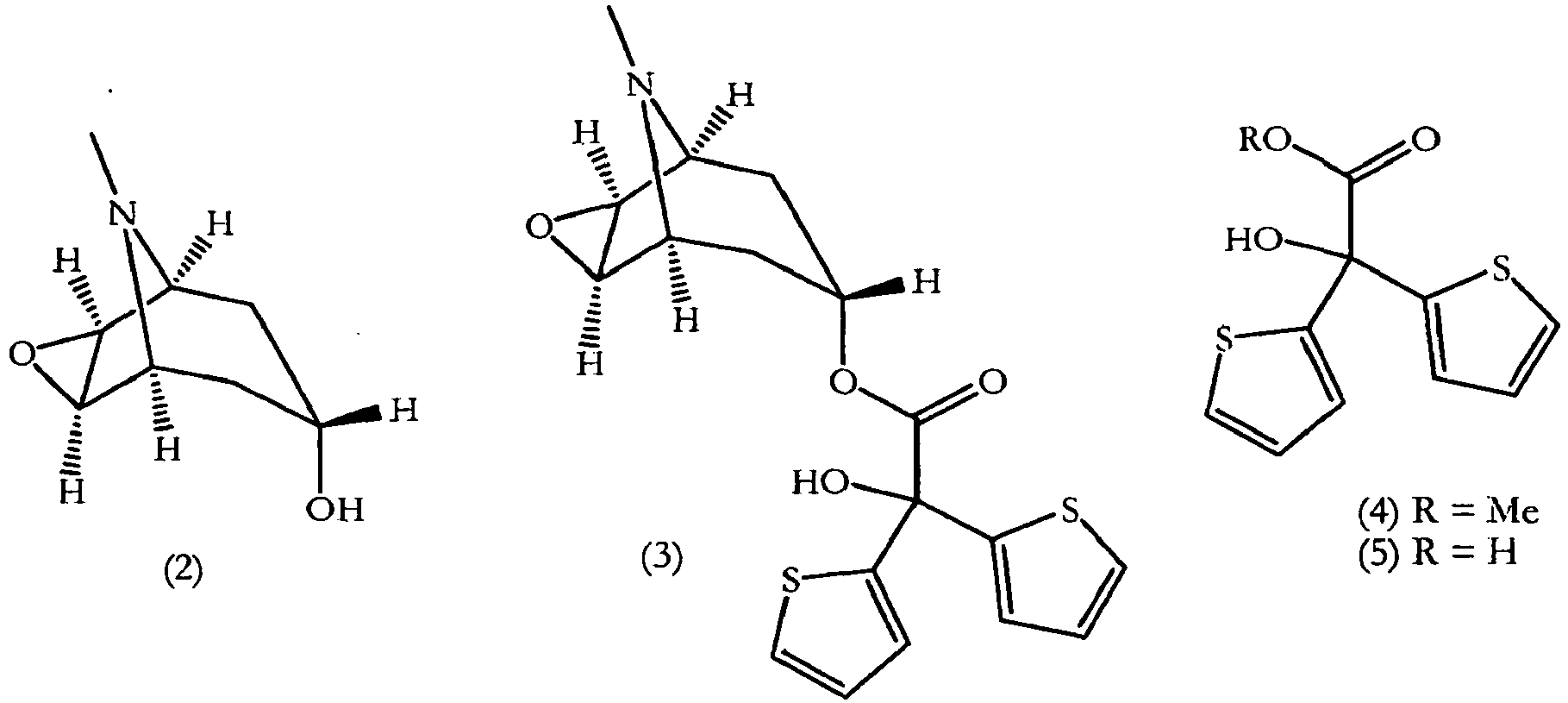
- Alternative processes, reported in US patents
US6486321 ,US6506900 ,US6610849 andUS6747153 , describe the preparation of tiotropium bromide starting from tropenol hydrochloride. However, these processes are not convenient as they are complex procedures involving a number of synthetic steps and require an epoxidation reaction later in the synthetic route to form the scopine ester moiety. - An alternative process, reported in US patent
US6747154 , describes the preparation of tiotropium bromide via a direct coupling reaction between di(2-thienyl)glycolic acid and the quaternised derivative scopine methyl bromide. Although this is a short, direct synthesis, the method requires the use of expensive coupling agents such as carbonyldiimidazole, carbonyldi-1,2,4-triazole, ethyldimethylaminopropylcarbodiimide or dicyclohexyl-carbodiimide. In addition, there are other disadvantages to this method as the reaction proceeds at low (sub-zero) temperature, hazardous reagents such as lithium hydride have to be employed, and yields of the purified product are modest. - The present inventors were interested in preparing highly pure tiotropium and related compounds by the most convenient and shortest route, which avoids the use of hazardous and/or environmentally unsuitable reagents.
- The processes reported in the prior art, as described above, are not very efficient or convenient for commercial manufacture of pure product and an alternative method is required.
- It is therefore an object of the present invention to provide an efficient, simple and non-hazardous process for the preparation of tiotropium bromide (1), tiotropium base (3) and related compounds.
- For the purposes of the present invention, an "alkyl" group is defined as a monovalent saturated hydrocarbon, which may be straight-chained or branched, or be or include cyclic groups. An alkyl group may optionally be substituted, and may optionally include one or more heteroatoms N, O or S in its carbon skeleton. Preferably an alkyl group is straight-chained or branched. Preferably an alkyl group is not substituted. Preferably an alkyl group does not include any heteroatoms in its carbon skeleton. Examples of alkyl groups are methyl, ethyl, n-propyl, i-propyl, n-butyl, i-butyl, t-butyl, n-pentyl, cyclopentyl, cyclohexyl and cycloheptyl groups. Preferably an alkyl group is a C1-12 alkyle group, preferably a C1-6 alkyl group. Preferably a cyclic alkyle group is a C3-12 cyclic alkyl group, preferably a C5-7 cyclic alkyl group.
- An "alkenyl" group is defined as a monovalent hydrocarbon, which comprises at least one carbon-carbon double bond, which may be straight-chained or branched, or be or include cyclic groups. An alkenyl group may optionally be substituted, and may optionally include one or more heteroatoms N, O or S in its carbon skeleton. Preferably an alkynyl group is straight-chained or branched. Preferably an alkenyl group is not substituted. Preferably an alkenyl group does not include any heteroatoms in its carbon skeleton. Examples of alkenyl groups are vinyl, allyl, but-1-enyl, but-2-enyl, cyclohexenyl and cycloheptenyl groups. Preferably an alkynyl group is a C2-12 alkenyl group, preferably a C1-6 alkenyl group. Preferably a cyclic alkenyl group is a C3-12 cyclic alkenyl group, preferably a C5-7 cyclic alkenyl group.
- An "alkynyl" group is defined as a monovalent hydrocarbon, which comprises at least one carbon-carbon triple bond, which may be straight-chained or branched, or be or include cyclic groups. An alkynyl group may optionally be substituted, and may optionally include one or more heteroatoms N, O or S in its carbon skeleton. Preferably an alkynyl group is straight-chained or branched. Preferably an alkynyl group is not substituted. Preferably an alkynyl group does not include any heteroatoms in its carbon skeleton. Examples of alkynyl groups are ethynyl, propargyl, but-1-ynyl and but-2-ynyl groups. Preferably an alkynyl group is a C2-12 alkynyl group, preferably a C2-6 alkynyl group. Preferably a cyclic alkynyl group is a C3-12 cyclic alkynyl group, preferably a C5-7 cyclic alkynyl group.
- An "aryl" group is defined as a monovalent aromatic hydrocarbon. An aryl group may optionally be substituted, and may optionally include one or more heteroatoms N, O or S in its carbon skeleton. Preferably an aryl group is not substituted. Preferably an aryl group does not include any heteroatoms in its carbon skeleton. Examples of aryl groups are phenyl, naphthyl, anthracenyl, phenanthrenyl, thienyl and furyl groups. Preferably an aryl group is a C4-14 aryl group, preferably a C6-10 aryl group.
- For the purposes of the present invention, where a combination of groups is referred to as one moiety, for example, arylalkyl, arylalkenyl, arylalkynyl, alkylaryl, alkenylaryl or alkynylaryl, the last mentioned group contains the atom by which the moiety is attached to the rest of the molecule. A typical example of an arylalkyl group is benzyl
- An "alkoxy" group is defined as a -O-alkyl, -O-alkenyl, -O-alkynyl, -O-aryl, -O-arylalkyl, -O-arylalkenyl, -O-arylalkynyl, -O-alkylaryl, -O-alkenylaryl or -O-alkynylaryl group. Preferably an "alkoxy" group is a -O-alkyl or -O-aryl group. More preferably an "alkoxy" group is a -O-alkyl group.
- A "halo" group is a tluoro, chloro, bromo or iodo group.
- For the purposes of this invention, an optionally substituted group may be substituted with one or more of -F, -Cl, -Br, -I, -CF3, -CCl3, -CBr3, -CI3, -OH, -SH, -NH2, -CN, -NO2, -COOH, -Ra-O-Rb, -Ra-S-Rb, -Ra-N(Rb)2, -Ra-N(Rb)3 +, -Ra-P(Rb)2, -Ra-Si(Rb)3, -Ra-CO-Rb, -Ra-CO-ORb, -RaO-CO-Rb, -Ra-CO-N(Rb)2, -Ra-NRb-CO-Rb, -RO-CO-ORb, -RaO-CO-N(Rb)2, -Ra-NRb-CO-ORb, -Ra-NRb-CO-N(Rb)2, -Ra-CS-Rb or -Rb. In this context, -Ra- is independently a chemical bond, a C1-C10 alkylene, C2-C10 alkenylene or C2-C10 alkynylene group. -Rb is independently hydrogen, unsubstituted C1-C6 alkyl or unsubstituted C6-C10 aryl. Preferably an optionally substituted group may be substituted with one or more of C1-C4 alkyl, C1-C4 alkoxy, hydroxy, halo or haloalkyl, all unsubstituted. Optional substituent(s) are not taken into account when calculating the total number of carbon atoms in the parent group substituted with the optional substituent(s). Preferably a substituted group comprises 1, 2 or 3 substituents, more preferably 1 or 2 substituents, and even more preferably 1 substituent.
- For the purposes of the present invention, a compound is "substantially pure", if it comprises less than 1% impurity by HPLC, preferably less than 0.5%, preferably less than 0.3%, preferably less than 0.2%, preferably less than 0.1%.
- A first aspect of the present invention provides a process for the preparation of the scopine ester I or its quaternary salt II:

wherein the transesterification reaction is performed in the presence of an organic amine base;
wherein an "alkyl" group is a monovalent saturated hydrocarbon, which may be straight-chained or branched, or be or include cyclic groups, and which may optionally be substituted, and which may optionally include one or more heteroatoms N, O or S in its carbon skeleton;
wherein an "alkenyl" group is a monovalent hydrocarbon, which comprises at least one carbon-carbon double bond, and which may be straight-chained or branched, or be or include cyclic groups, and which may optionally be substituted, and which may optionally include one or more heteroatoms N, O or S in its carbon skeleton;
wherein an "alkynyl" group is a monovalent hydrocarbon, which comprises at least one carbon-carbon triple bond, and which may be straight-chained or branched, or be or include cyclic groups, and which may optionally be substituted, and which may optionally include one or more heteroatoms N, O or S in its carbon skeleton; and
wherein an "aryl" group is a monovalent aromatic hydrocarbon, which may optionally be substituted, and which may optionally include one or more heteroatoms N, O or S. in its carbon skeleton. - In a preferred process R1 is represented by formula III, wherein R4, R5 and R6 independently represent hydrogen, hydroxy, halo, alkoxy, alkyl, hydroxyalkyl, alkenyl, alkynyl, optionally substituted aryl, or optionally substituted arylalkyl, arylalkenyl, arylalkynyl, alkylaryl, alkenylaryl or alkynylaryl.

- Preferably R4 and/or R5 represent aryl, wherein the aryl group can be selected from phenyl, naphthyl, thienyl and furyl, which may optionally be mono- or disubstituted by one or two groups selected from C1-C4 alkyl, C1-C4 alkoxy, hydroxy, halo or haloalkyl. Most preferably the aryl group is 2-thienyl.
- Preferably R6 represents hydroxy, C1-C4 alkyl, C1-C4 alkoxy, hydroxyalkyl, halo or haloalkyl.
- Most preferably, R4 is 2-thienyl, R5 is 2-thienyl and R6 is hydroxy.
- Preferably R2 represents hydrogen or C1-C4 alkyl, more preferably methyl.
- Preferably R3 represents C1-C4 alkyl, and most preferably R3 represents methyl.
- Preferably, X represents halo, methanesulfonate, toluenesulfonate or trifluoromethanesulfonate. Most preferably X represents a bromo.
- Most preferably when forming the quaternary salt II, R2 is methyl and X is bromo.
- Preferably the scopine is used in the form of a salt, preferably an acid addition salt, and most preferably in the form of its hydrochloride salt
- The transesterification reaction is performed in the presence of an organic amine base. The organic amine base is preferably a trialkylamine such as triethylamine or diisopropylethylamine, or a heterocyclic amine such as 1,8-diazabicyclo[5.4.0]undec-7-ene (DBU), 1,5-diazabicyclo[4.3.0]non-5-ene (DBN), 1,4-dia;sabicyclo[2.2.2]octane (Dabco), pyridine or 4-(dimethylamino)pyridine (DMAP). Most preferably, the organic amine base is DBU. Preferably 1-5 equivalents of the organic amine base are used relative to the scopine or the salt thereof, preferably 1-3 equivalents of the organic amine base are used.
- Additionally a further base may be used for the transesterification reaction. Preferably the further base is an inorganic base, preferably a hydride such as NaH, KH or CaH2. Preferably the further base is NaH. Preferably 1-2 equivalents of the further base are used relative to the scopine or the salt thereof.
- If two bases are used, they may be used in any order, i.e. the further base may be added to the reaction mixture before, after and/or simultaneous with the first base. Without wishing to be bound by theory, the base(s) are believed to deprotonate the scopine hydroxyl group or a protonated reaction intermediate. Moreover, if the scopine is used in the form of a salt, the base(s), in particular the inorganic base, are believed to liberate scopine free base in situ.
- The reaction temperature used in the transesterification step is preferably in the range of 30 to 90°C, more preferably in the range of 40 to 70°C, and more preferably in the range of 50 to 70°C. Most preferably the reaction is carried out at about 60°C.
- Preferably, the process according to the first aspect of the invention is carried out such that formation of the quaternary salt II is obtained without purification and/or isolation of ester I.
- Preferably, the transesterification reaction is carried out in polar aprotic solvent, such as a solvent selected from dimethylformamide, dimethylsulfoxide, acetonitrile or N-methylpyrrolidine. Preferably, the solvent is dimethylformamide.
- Preferably, the scopine ester I or its quaternary salt II are obtained in an HPLC purity of greater than 95%, preferably greater than 98%, preferably greater than 99%, preferably greater than 99.5%, preferably greater than 99.7%, preferably greater than 99.8%, more preferably greater than 99.9%.
- Preferably, the scopine ester I or its quaternary salt II are obtained in a yield of greater than 50%, preferably greater than 55%, more preferably greater than 60%.
- Surprisingly, it has been found that tiotropium base (3) and tiotropium bromide (1) can be obtained in substantially pure form when synthesised by the efficient and more advantageous process of the present invention. A preferred embodiment of the present invention is outlined in Scheme 1.

- The process outlined in Scheme 1 is a novel process for the preparation of tiotropium base (3) and is very advantageous as the use of DBU (1,8-diazabicyclo[5.4.0]undec-7-ene) as base gives a dramatic improvement in the purity from 45-50% (obtained when using prior art processes) to >99.6% by HPLC. The overall yield is also improved over the prior art. The solvent used is preferably DMF and the reaction is preferably carried out at about 60°C.
- Preferably, the solvent used in the transesterification step is DMF, but alternatively the solvent used can be dimethylsulfoxide, acetonitrile or N-methylpyrrolidine.
- The reaction temperature used in the transesterification step is preferably in the range of 30 to 90°C, more preferably in the range of 40 to 70°C, and more preferably in the range of 50 to 70°C. Most preferably the reaction is carried out at about 60°C.
- The tiotropium base (3) formed by the present invention is so pure that it can surprisingly be quaternised, for example with methyl bromide, without isolation and purification to afford a highly pure quaternary salt product. This is a huge benefit in a commercial operation as it saves very significantly on time and cost if a purification and/or isolation step can be avoided.
- The organic amine bases used in the present invention are preferably trialkylamines such as diisopropylethylamine or triethylamine, or a heterocyclic amine such as 1,8-diazabicyclo[5.4.0]undec-7-ene (DBU), 1,5-dimibicyclo[4.3.0]non-5-ene (DBN), 1,4-diazabicyclo[2.2.2]octane (Dabco), pyridine or 4-(dimethylamino)pyridine (DMAP). The organic base used is most preferably DBU.
- Preferably the scopine is used in the form of its hydrochloride salt, but alternatively it can be used in the form of the free base or another mineral acid addition salt (e.g. HBr or HI) or an organic acid addition salt (e.g. acetate, benzoate, propionate, maleate, fumarate, oxalate, besylate, mesylate, tosylate, citrate of salicylate).
- Other preferred embodiments of the first aspect of the invention are the preparation of scopolamine [represented by ester I, wherein R1 is represented by formula III and R4 is hydrogen, R5 is phenyl and R6 is hydroxymethyl (CH2OH)]; scopolamine hydrogen bromide [represented by salt II, wherein R1 is represented by formula III and R4 is hydrogen, R5 is phenyl, R6 is hydroxyethyl R2 is hydrogen and X is bromo]; oxitropium bromide [represented by salt II, wherein R1 is represented by formula III and R4 is hydrogen, R5 is phenyl, R6 is hydroxymethyl, R2 is ethyl and X is bromo]; and cimetropium bromide [represented by salt II, wherein R1 is represented by formula III and R4 is hydrogen, R5 is phenyl, R6 is hydroxyethyl, R2 is -CH2-cyclopropyl and X is bromo].
- A pharmaceutical composition may comprise tiotropium bromide prepared according to the first aspect of the invention. Preferably, the pharmaceutical composition is suitable for use in a dry powder inhaler (DPI), an aqueous nebulizer, or a pressurized metered dosage inhaler (pMDI).
- The DPI compositions preferably contain, in addition to the active substance, one or more of the following physiologically acceptable excipients: monosaccharides (e.g. glucose or arabinose), disaccharides (e.g. lactose, sucrose, maltose), oligo- and polysaccharides (e.g. dextrane), polyalcohols (e.g. sorbitol, mannitol, xylitol), salts (e.g. sodium chloride, calcium carbonate) or mixtures of these excipients with one another. Preferably, mono- or disaccharides are used, while the use of lactose or glucose is preferred, particularly in the form of their hydrates. Lactose is a particularly preferred excipient, while lactose monohydrate is most particularly preferred.
- Preferably the pMDI uses HFA 134a, HFA 227 or mixtures thereof as propellant gas.
- The pharmaceutical composition can also be a solution, suspension or a solid oral dosage form if so desired. Preferred oral dosage forms include tablets, capsules and the like which, optionally, may be coated if desired. Tablets can be prepared by conventional techniques, including direct compression, wet granulation and dry granulation. Capsules are generally formed from a gelatine material and can include a conventionally prepared granulate of excipients.
- The pharmaceutical composition typically comprises one or more conventional pharmaceutically acceptable excipient(s) selected from the group comprising a filler, a binder, a disintegrant, a lubricant and optionally further comprises at least one excipient selected from colouring agents, adsorbents, surfactants, film formers and plasticizers.
- If the solid pharmaceutical formulation is in the form of coated tablets, the coating may be prepared from at least one film-former such as hydroxypropyl methyl cellulose, hydroxypropyl cellulose or methacrylate polymers which optionally may contain at least one plasticizer such as polyethylene glycols, dibutyl sebacate, triethyl citrate, and other pharmaceutical auxiliary substances conventional for film coatings, such as pigments, fillers and others.
- The pharmaceutical compositions preferably contain about 0.001 to 20% tiotropium bromide in admixture with a physiologically acceptable excipient. Preferred compositions contain 0.01 to 10% of tiotropium bromide, more preferred are compositions which contain 0.01 to 2% of tiotropium bromide, and most preferred are compositions which contain 0.04 to 0.8% of tiotropium bromide.
- The following examples are provided to illustrate the present invention and should not be construed as limiting thereof.
- Scopine HCl was taken in DMF (5vol), cooled to 5°C, and NaH (1.7eq) was added slowly maintaining the temperature at 5°C. The reaction was stirred for 1 hour at 10°C and DBU (1eq) and methyl di(2-thienyl)glycolate (1eq) were added. The reaction was heated to 60°C for 1 hour and a second portion of DBU (2eq) was added. The reaction was heated for a further 4 hours at 60°C and monitored by TLC. After completion of the reaction, the mixture was cooled to 5°C and a solution of conc. HCl (2.5vol) in cold water (10vol) at 10°C (pH 2) was added. The mixture was washed with toluene and basified with aqueous sodium carbonate (7.5eq) to pH 10 and extracted with DCM (3 x 10vol). The combined DCM layer was washed with water (3 x 10vol) and DCM was distilled under vacuum (150 mbar) at 30°C. The product was obtained as light brown solid. Molar Yield = 60%; HPLC purity = 98%.
- The crude base (3) was recrystallized from acetonitrile (5vol). Yield of crystallization = 86%; HPLC purity > 99.8%.
- The purified tiotropium base (3) was dissolved in DCM (10vol) and acetonitrile (3vol) and purged with methyl bromide gas at a pressure of 10 kg/cm2 for 20 minutes. The solution was kept at 25-30°C for 30 hours. The precipitated solid was filtered and washed with DCM (20vol). Drying of the solid at 25-30°C under vacuum gave the product as a white solid. Molar Yield = 97.76%; HPLC purity = 99.83%.
- 1H-NMR (300 MHz, CD3OD): 7.45 (2H dd), 7.23 (2H dd), 7.00 (2H dd), 5.27 (1H t), 4.60 (1H br s OH), 3.35 (8H m), 3.10 (2H s), 2.85 (2H dt), 2.10 (2H d). MS: 392.3 (M+1)
- Scopine HCl was taken in DMF (5vol), cooled to 5°C, and NaH (1.7eq) was added slowly maintaining the temperature at 5°C. The reaction mixture was stirred for 1 hour at 10°C and DBU (1eq) and methyl di(2-thienyl)glycolate (1eq) were added. The reaction was heated to 60°C for 1 hour and a second lot of DBU (2eq) was added. The reaction mixture was heated for a further 4 hours at 60°C and monitored by TLC. After completion of the reaction, the mixture was cooled to 5°C and a solution of conc. HCl (2.5vol) in cold water (10vol) at 10°C (pH 2) was added. The mixture was washed with toluene (1vol) and the aqueous layer was basified with saturated sodium carbonate (7.5eq) solution to pH 10 and extracted with DCM (3 x 10vol). The combined DCM layer was washed with water (3 x 10vol) and dried over anhydrous sodium sulfate.
- To the DCM solution, acetonitrile was added and the mixture was purged with methyl bromide gas at a pressure of 3 kg/cm2 for 30 minutes. The solution was kept at 25-30°C for 30 hours. The precipitated solid was filtered and washed with DCM (20vol). Drying of the solid at 25-30°C under vacuum gave the product as a white solid. Molar yield = 41%; HPLC purity = 98.66%.
Claims (8)
- A process for the preparation of scopine ester I or its quaternary salt II:

wherein an "alkyl" group is a monovalent saturated hydrocarbon, which may be straight-chained or branched, or be or include cyclic groups, and which may optionally be substituted, and which may optionally include one or more heteroatoms N, O or S in its carbon skeleton;
wherein an "alkenyl" group is a monovalent hydrocarbon, which comprises at least one carbon-carbon double bond, and which may be straight-chained or branched, or be or include cyclic groups, and which may optionally be substituted, and which may optionally include one or more heteroatoms N, O or S in its carbon skeleton;
wherein an "alkynyl" group is a monovalent hydrocarbon, which comprises at least one carbon-carbon triple bond, and which may be straight-chained or branched, or be or include cyclic groups, and which may optionally be substituted, and which may optionally include one or more heteroatoms N, O or S in its carbon skeleton; and
wherein an "aryl" group is a monovalent aromatic hydrocarbon, which may optionally be substituted, and which may optionally include one or more heteroatoms N, O or S in its carbon skeleton. - A process according to claim 1, wherein:(i) R1 is represented by formula III:
 (ii) R7 represents hydrogen or C1-C4 alkyl; and/or(iii) R3 represents C1-C4 alkyl; and/or(iv) R3 represents methyl; and/or(v) X represents a halo, a methanesulfonate, a toluenesulfonate or a trifluoromethanesulfonate group; and/or(vi) X represents a bromo group; and/or(vii) R2 is methyl and X is bromo.
 - A process according to claim 2, wherein:(i) R4 and/or R5 represent aryl; and/or(ii) R4 and/or R5 represent aryl, and wherein the aryl group is selected from phenyl, naphthyl, thienyl and furyl, which may optionally be mono- or disubstituted by one or two groups selected from C1-C4 alkyl, C1-C4 alkoxy, hydroxy, halo or haloalkyl; and/or(iii) R4 and/or R5 represent aryl, and wherein the aryl group is 2-thienyl; and/or(iv) R6 represents hydroxy, C1-C4 alkyl, C1-C4 alkoxy, hydroxyalkyl, halo or haloalkyl; and/or(v) R4 is 2-thienyl, R5 is 2-thienyl and R6 is hydroxyl.
- A process according to any one of the preceding claims, wherein the organic amine base is:(i) a trialkylamine or a heterocyclic amine; and/or(ii) selected from triethylamine, diisopropylethylamine, 1,8-diazabicyclo[5.4.0]undec-7-ene (DBU), 1,5-diazabicyclo[4.3.0]non-5-ene (DBN), 1,4-diazabicyclo[2.2.2]octane (Dabco), pyridine or 4-(dimethylamino)pyridine (DMAP); and/or(iii) DBU.
- A process according to any one of the preceding claims, wherein a further base is used.
- A process according to claim 5, wherein the further base is:(i) an inorganic base; and/or(ii) a hydride; and/or(iii) NaH, KH or CaH2; and/or(iv) NaH.
- A process according to claim 5 or 6, wherein the scopine is:(i) used in the form of a salt; and/or(ii) used in the form of a salt, and wherein the further base is used to liberate scopine free base in situ.
- A process according to any one of the preceding claims, wherein:(i) the scopine is used in the form of its hydrochloride salt; and/or(ii) formation of the quaternary salt II is carried out without purification and/or isolation of ester I; and/or(iii) the transesterification reaction is carried out in dimethylformamide; and/or(iv) the scopine ester I or its quaternary salt II are obtained in an HPLC purity of greater than 95%; and/or(v) the scopine ester I or its quaternary salt II are obtained in a yield of greater than 50%.
Priority Applications (4)
| Application Number | Priority Date | Filing Date | Title |
|---|---|---|---|
| SI200931062T SI2240477T1 (en) | 2008-01-10 | 2009-01-09 | Novel process for the preparation of scopine esters |
| HRP20141004AT HRP20141004T1 (en) | 2008-01-10 | 2009-01-09 | NEW PROCEDURE FOR PREPARATION OF ESTER SKUPIN |
| PL09701042T PL2240477T3 (en) | 2008-01-10 | 2009-01-09 | Novel process for the preparation of scopine esters |
| CY20141100937T CY1116076T1 (en) | 2008-01-10 | 2014-11-11 | NEW METHOD FOR PREPARING STEEL |
Applications Claiming Priority (2)
| Application Number | Priority Date | Filing Date | Title |
|---|---|---|---|
| IN77KO2008 | 2008-01-10 | ||
| PCT/GB2009/050014 WO2009087419A1 (en) | 2008-01-10 | 2009-01-09 | Novel process for the preparation of scopine esters |
Publications (3)
| Publication Number | Publication Date |
|---|---|
| EP2240477A1 EP2240477A1 (en) | 2010-10-20 |
| EP2240477B1 true EP2240477B1 (en) | 2014-09-10 |
| EP2240477B8 EP2240477B8 (en) | 2014-12-10 |
Family
ID=40451439
Family Applications (1)
| Application Number | Title | Priority Date | Filing Date |
|---|---|---|---|
| EP09701042.5A Active EP2240477B8 (en) | 2008-01-10 | 2009-01-09 | Novel process for the preparation of scopine esters |
Country Status (14)
| Country | Link |
|---|---|
| US (1) | US20110028508A1 (en) |
| EP (1) | EP2240477B8 (en) |
| JP (2) | JP6087492B2 (en) |
| CN (2) | CN105601628A (en) |
| AU (1) | AU2009203579B2 (en) |
| CA (1) | CA2710523C (en) |
| CY (1) | CY1116076T1 (en) |
| DK (1) | DK2240477T3 (en) |
| ES (1) | ES2523695T3 (en) |
| HR (1) | HRP20141004T1 (en) |
| PL (1) | PL2240477T3 (en) |
| PT (1) | PT2240477E (en) |
| SI (1) | SI2240477T1 (en) |
| WO (1) | WO2009087419A1 (en) |
Families Citing this family (15)
| Publication number | Priority date | Publication date | Assignee | Title |
|---|---|---|---|---|
| US20080051582A1 (en) | 2006-07-10 | 2008-02-28 | Sicor Inc. | Process for the preparation of tiotropium bromide |
| WO2011015884A1 (en) | 2009-08-07 | 2011-02-10 | Generics [Uk] Limited | Process to prepare scopine esters |
| CA2931876A1 (en) | 2009-08-07 | 2011-02-10 | Generics [Uk] Limited | Anhydrate of tiotropium bromide |
| WO2011095800A2 (en) | 2010-02-02 | 2011-08-11 | Generics [Uk] Limited | Analytical methods |
| TR201005221A2 (en) * | 2010-04-01 | 2012-01-23 | Bi̇lgi̇ç Mahmut | Improved synthesis method. |
| US8957209B2 (en) | 2010-04-01 | 2015-02-17 | Mahmut Bilgic | Methods for the synthesis of tiotropium bromide |
| TR201002520A2 (en) * | 2010-04-01 | 2010-05-21 | Bi̇lgi̇ç Mahmut | Tiotropium bromide manufacturing method. |
| TR201005222A2 (en) * | 2010-04-01 | 2011-10-21 | Bi̇lgi̇ç Mahmut | Tiotropium bromide synthesis method |
| CN101979391B (en) * | 2010-11-16 | 2013-06-05 | 济南德信佳生物科技有限公司 | Method for preparing tiotropium bromide |
| US8680297B2 (en) * | 2011-10-06 | 2014-03-25 | Drug Process Licensing Assoc., LLC | Manufacturing process for tiotropium bromide |
| PT106142B (en) | 2012-02-10 | 2014-07-18 | Hovione Farmaci Ncia S A | PROCESS FOR THE PREPARATION OF TIOTROPE BROMIDE |
| CZ304808B6 (en) | 2012-03-16 | 2014-11-05 | Zentiva, K.S. | Process for preparing scopine ester of di-(2- thienyl)glycolic acid, an intermediate in the synthesis of tiotropium bromide and a new form thereof |
| CZ305012B6 (en) | 2012-03-30 | 2015-03-25 | Zentiva, K.S. | Process for preparing scopine ester of di-(2-thienyl)glycolic acid, an intermediate in the synthesis of tiotropium bromide |
| WO2014140318A1 (en) * | 2013-03-14 | 2014-09-18 | K.H.S. Pharma Holding Gmbh | Improved process for acyl transfer reactions |
| CN117486893B (en) * | 2023-12-29 | 2024-03-12 | 北京中医药大学深圳医院(龙岗) | anti-pso B and application thereof in preparation of medicines for preventing and/or treating psoriasis |
Family Cites Families (19)
| Publication number | Priority date | Publication date | Assignee | Title |
|---|---|---|---|---|
| DE3931041C2 (en) * | 1989-09-16 | 2000-04-06 | Boehringer Ingelheim Kg | Esters of thienyl carboxylic acids with amino alcohols, their quaternization products, processes for their preparation and medicaments containing them |
| US5610163A (en) * | 1989-09-16 | 1997-03-11 | Boehringer Ingelheim Gmbh | Esters of thienyl carboxylic acids and amino alcohols and their quaternization products |
| US6908928B2 (en) * | 2000-10-12 | 2005-06-21 | Bi Pharma Kg. | Crystalline tiotropium bromide monohydrate, processes for the preparation thereof, and pharmaceutical compositions |
| DE10064816A1 (en) * | 2000-12-22 | 2002-06-27 | Boehringer Ingelheim Pharma | Production of tiotropium bromide useful as an anticholinergic comprises oxidation of di-(2-thienyl)-glycolic acid tropenol ester and subsequent quaternisation |
| US6506900B1 (en) * | 2001-01-31 | 2003-01-14 | Boehringer Ingelheim Pharma Ag | Process for preparing a scopine ester intermediate |
| AUPR315301A0 (en) * | 2001-02-19 | 2001-03-15 | Silverbrook Research Pty. Ltd. | An Apparatus (ART102) |
| US6608055B2 (en) * | 2001-06-22 | 2003-08-19 | Boehringer Ingelheim Pharma Kg | Crystalline anticholinergic, processes for preparing it and its use for preparing a pharmaceutical composition |
| US6610849B2 (en) * | 2001-06-28 | 2003-08-26 | Boehringer Ingelheim Pharma Kg | Process for the manufacture of tropenol |
| DE10200943A1 (en) * | 2002-01-12 | 2003-07-24 | Boehringer Ingelheim Pharma | Process for the preparation of scopine esters |
| US6747153B2 (en) * | 2002-05-31 | 2004-06-08 | Boehringer Ingelheim Pharma Gmbh & Co. Kg | Industrial process for preparing tropenol |
| ATE435862T1 (en) * | 2003-05-28 | 2009-07-15 | Theravance Inc | AZABICYCLOALKAN COMPOUNDS AS MUSCARINE RECEPTOR ANTAGONISTS |
| US7968717B2 (en) * | 2003-11-03 | 2011-06-28 | Boehringer Ingelhein International Gmbh | Crystalline anhydrate with anticholinergic efficacy |
| JP5227790B2 (en) * | 2005-05-02 | 2013-07-03 | ベーリンガー インゲルハイム インターナショナル ゲゼルシャフト ミット ベシュレンクテル ハフツング | New crystalline tiotropium bromide |
| DE102005035112A1 (en) * | 2005-07-27 | 2007-02-15 | Boehringer Ingelheim Pharma Gmbh & Co. Kg | A new process for the preparation of tiotropium salts using N-methylscopinium salts soluble in organic solvents |
| US20070167480A1 (en) * | 2005-12-19 | 2007-07-19 | Sicor Inc. | Pure and stable tiotropium bromide |
| KR101395881B1 (en) * | 2005-12-19 | 2014-05-21 | 시코르, 인크. | Novel forms of tiotropium bromide and processes for preparation thereof |
| US20080051582A1 (en) * | 2006-07-10 | 2008-02-28 | Sicor Inc. | Process for the preparation of tiotropium bromide |
| WO2008089852A1 (en) * | 2007-01-26 | 2008-07-31 | Boehringer Ingelheim Pharma Gmbh & Co.Kg | Novel process for preparing tiotropium salts |
| WO2008104955A1 (en) * | 2007-02-28 | 2008-09-04 | Ranbaxy Laboratories Limited | Azoniatricyclo [3.3.1.0] nonane derivatives as muscarinic receptor antagonists |
-
2009
- 2009-01-09 HR HRP20141004AT patent/HRP20141004T1/en unknown
- 2009-01-09 US US12/810,231 patent/US20110028508A1/en not_active Abandoned
- 2009-01-09 ES ES09701042.5T patent/ES2523695T3/en active Active
- 2009-01-09 PL PL09701042T patent/PL2240477T3/en unknown
- 2009-01-09 JP JP2010541849A patent/JP6087492B2/en not_active Expired - Fee Related
- 2009-01-09 WO PCT/GB2009/050014 patent/WO2009087419A1/en not_active Ceased
- 2009-01-09 CN CN201610056741.0A patent/CN105601628A/en active Pending
- 2009-01-09 SI SI200931062T patent/SI2240477T1/en unknown
- 2009-01-09 CA CA2710523A patent/CA2710523C/en not_active Expired - Fee Related
- 2009-01-09 DK DK09701042.5T patent/DK2240477T3/en active
- 2009-01-09 CN CN2009801017774A patent/CN101918401A/en active Pending
- 2009-01-09 PT PT97010425T patent/PT2240477E/en unknown
- 2009-01-09 EP EP09701042.5A patent/EP2240477B8/en active Active
- 2009-01-09 AU AU2009203579A patent/AU2009203579B2/en not_active Ceased
-
2014
- 2014-08-15 JP JP2014165472A patent/JP5902774B2/en not_active Expired - Fee Related
- 2014-11-11 CY CY20141100937T patent/CY1116076T1/en unknown
Also Published As
| Publication number | Publication date |
|---|---|
| WO2009087419A1 (en) | 2009-07-16 |
| CY1116076T1 (en) | 2017-02-08 |
| CA2710523C (en) | 2014-11-18 |
| JP5902774B2 (en) | 2016-04-13 |
| US20110028508A1 (en) | 2011-02-03 |
| AU2009203579B2 (en) | 2013-07-25 |
| JP2011509284A (en) | 2011-03-24 |
| PL2240477T3 (en) | 2015-03-31 |
| ES2523695T3 (en) | 2014-11-28 |
| CN101918401A (en) | 2010-12-15 |
| PT2240477E (en) | 2014-11-19 |
| AU2009203579A1 (en) | 2009-07-16 |
| HRP20141004T1 (en) | 2015-02-13 |
| JP6087492B2 (en) | 2017-03-01 |
| EP2240477B8 (en) | 2014-12-10 |
| CA2710523A1 (en) | 2009-07-16 |
| CN105601628A (en) | 2016-05-25 |
| EP2240477A1 (en) | 2010-10-20 |
| JP2014208718A (en) | 2014-11-06 |
| SI2240477T1 (en) | 2015-02-27 |
| DK2240477T3 (en) | 2014-12-08 |
Similar Documents
| Publication | Publication Date | Title |
|---|---|---|
| DK2240477T3 (en) | New process for the preparation of skopinestre | |
| CN100393719C (en) | A kind of method for preparing scopolamine ester | |
| JP5959117B2 (en) | Process for preparing biphenyl-2-ylcarbamic acid | |
| US20140249175A1 (en) | Anhydrate of tiotropium bromide | |
| WO2011015884A1 (en) | Process to prepare scopine esters | |
| KR20100103646A (en) | Process for the preparation of 6-substituted-1-(2h)-isoquinolinones | |
| JP2005530809A (en) | Phenylcyclohexylpropanolamine derivative, process for its preparation and therapeutic application thereof | |
| WO2011015883A1 (en) | Dichloromethane solvate of tiotropium bromide and its use | |
| EP2552911B1 (en) | Tiotropium bromide preparation process | |
| US9440945B2 (en) | Methods for the synthesis of tiotropium bromide | |
| CN104098560A (en) | Crystalline form of tiotropium bromide | |
| CN103787969B (en) | A kind of (1S)-1-phenyl-3,4-dihydro-2(1H) preparation method of-isoquinolinecarboxylic acid ester | |
| JP4610333B2 (en) | Industrial production of tropenol | |
| EP2552913B1 (en) | Method for synthesis of tiotropium bromide | |
| EP2552912B1 (en) | Synthesis method for producing tiotropium bromide | |
| TR2022009462T2 (en) | AN IMPROVED PROCESS FOR THE PREPARATION OF SCOPINE HYDROBROMIDE | |
| HK1060570B (en) | Method for producing the anticholinergic agent tiotropium bromide | |
| HK1096683B (en) | A method for preparing a scopine ester | |
| HK1184145B (en) | Process for preparing a biphenyl-2-ylcarbamic acid | |
| KR20040042637A (en) | Method for preparing arginine derivatives |
Legal Events
| Date | Code | Title | Description |
|---|---|---|---|
| PUAI | Public reference made under article 153(3) epc to a published international application that has entered the european phase |
Free format text: ORIGINAL CODE: 0009012 |
|
| 17P | Request for examination filed |
Effective date: 20100713 |
|
| AK | Designated contracting states |
Kind code of ref document: A1 Designated state(s): AT BE BG CH CY CZ DE DK EE ES FI FR GB GR HR HU IE IS IT LI LT LU LV MC MK MT NL NO PL PT RO SE SI SK TR |
|
| AX | Request for extension of the european patent |
Extension state: AL BA RS |
|
| DAX | Request for extension of the european patent (deleted) | ||
| 17Q | First examination report despatched |
Effective date: 20130301 |
|
| GRAP | Despatch of communication of intention to grant a patent |
Free format text: ORIGINAL CODE: EPIDOSNIGR1 |
|
| INTG | Intention to grant announced |
Effective date: 20131206 |
|
| GRAP | Despatch of communication of intention to grant a patent |
Free format text: ORIGINAL CODE: EPIDOSNIGR1 |
|
| INTG | Intention to grant announced |
Effective date: 20140522 |
|
| GRAS | Grant fee paid |
Free format text: ORIGINAL CODE: EPIDOSNIGR3 |
|
| GRAA | (expected) grant |
Free format text: ORIGINAL CODE: 0009210 |
|
| AK | Designated contracting states |
Kind code of ref document: B1 Designated state(s): AT BE BG CH CY CZ DE DK EE ES FI FR GB GR HR HU IE IS IT LI LT LU LV MC MK MT NL NO PL PT RO SE SI SK TR |
|
| REG | Reference to a national code |
Ref country code: GB Ref legal event code: FG4D |
|
| REG | Reference to a national code |
Ref country code: CH Ref legal event code: EP |
|
| RAP2 | Party data changed (patent owner data changed or rights of a patent transferred) |
Owner name: GENERICS (UK) LIMITED |
|
| REG | Reference to a national code |
Ref country code: IE Ref legal event code: FG4D |
|
| REG | Reference to a national code |
Ref country code: AT Ref legal event code: REF Ref document number: 686624 Country of ref document: AT Kind code of ref document: T Effective date: 20141015 |
|
| REG | Reference to a national code |
Ref country code: DE Ref legal event code: R096 Ref document number: 602009026565 Country of ref document: DE Effective date: 20141016 |
|
| REG | Reference to a national code |
Ref country code: HR Ref legal event code: TUEP Ref document number: P20141004 Country of ref document: HR |
|
| REG | Reference to a national code |
Ref country code: PT Ref legal event code: SC4A Free format text: AVAILABILITY OF NATIONAL TRANSLATION Effective date: 20141112 |
|
| REG | Reference to a national code |
Ref country code: PT Ref legal event code: PC4A Owner name: GENERICS (UK) LIMITED, GB Effective date: 20141114 |
|
| REG | Reference to a national code |
Ref country code: CH Ref legal event code: NV Representative=s name: FIAMMENGHI-FIAMMENGHI, CH Ref country code: ES Ref legal event code: FG2A Ref document number: 2523695 Country of ref document: ES Kind code of ref document: T3 Effective date: 20141128 |
|
| REG | Reference to a national code |
Ref country code: DK Ref legal event code: T3 Effective date: 20141202 |
|
| REG | Reference to a national code |
Ref country code: RO Ref legal event code: EPE |
|
| REG | Reference to a national code |
Ref country code: SE Ref legal event code: TRGR |
|
| REG | Reference to a national code |
Ref country code: NL Ref legal event code: T3 |
|
| REG | Reference to a national code |
Ref country code: NO Ref legal event code: T2 Effective date: 20140910 |
|
| REG | Reference to a national code |
Ref country code: HR Ref legal event code: T1PR Ref document number: P20141004 Country of ref document: HR |
|
| REG | Reference to a national code |
Ref country code: EE Ref legal event code: FG4A Ref document number: E010030 Country of ref document: EE Effective date: 20141201 |
|
| REG | Reference to a national code |
Ref country code: GR Ref legal event code: EP Ref document number: 20140402515 Country of ref document: GR Effective date: 20150128 |
|
| REG | Reference to a national code |
Ref country code: NL Ref legal event code: SD Effective date: 20150319 |
|
| REG | Reference to a national code |
Ref country code: PL Ref legal event code: T3 |
|
| REG | Reference to a national code |
Ref country code: SK Ref legal event code: T3 Ref document number: E 18041 Country of ref document: SK |
|
| REG | Reference to a national code |
Ref country code: DE Ref legal event code: R097 Ref document number: 602009026565 Country of ref document: DE |
|
| PLBE | No opposition filed within time limit |
Free format text: ORIGINAL CODE: 0009261 |
|
| STAA | Information on the status of an ep patent application or granted ep patent |
Free format text: STATUS: NO OPPOSITION FILED WITHIN TIME LIMIT |
|
| REG | Reference to a national code |
Ref country code: HU Ref legal event code: AG4A Ref document number: E023728 Country of ref document: HU |
|
| 26N | No opposition filed |
Effective date: 20150611 |
|
| REG | Reference to a national code |
Ref country code: FR Ref legal event code: PLFP Year of fee payment: 8 |
|
| REG | Reference to a national code |
Ref country code: FR Ref legal event code: PLFP Year of fee payment: 9 |
|
| REG | Reference to a national code |
Ref country code: FR Ref legal event code: PLFP Year of fee payment: 10 |
|
| REG | Reference to a national code |
Ref country code: HR Ref legal event code: ODRP Ref document number: P20141004 Country of ref document: HR Payment date: 20181218 Year of fee payment: 11 |
|
| REG | Reference to a national code |
Ref country code: HR Ref legal event code: ODRP Ref document number: P20141004 Country of ref document: HR Payment date: 20191224 Year of fee payment: 12 |
|
| REG | Reference to a national code |
Ref country code: DE Ref legal event code: R082 Ref document number: 602009026565 Country of ref document: DE Representative=s name: VENNER SHIPLEY LLP, DE |
|
| REG | Reference to a national code |
Ref country code: HR Ref legal event code: ODRP Ref document number: P20141004 Country of ref document: HR Payment date: 20210105 Year of fee payment: 13 |
|
| PGFP | Annual fee paid to national office [announced via postgrant information from national office to epo] |
Ref country code: PT Payment date: 20201228 Year of fee payment: 13 |
|
| PGFP | Annual fee paid to national office [announced via postgrant information from national office to epo] |
Ref country code: SK Payment date: 20201229 Year of fee payment: 13 Ref country code: PL Payment date: 20201230 Year of fee payment: 13 |
|
| PGFP | Annual fee paid to national office [announced via postgrant information from national office to epo] |
Ref country code: LU Payment date: 20210127 Year of fee payment: 13 |
|
| PGFP | Annual fee paid to national office [announced via postgrant information from national office to epo] |
Ref country code: FR Payment date: 20210127 Year of fee payment: 13 Ref country code: NL Payment date: 20210126 Year of fee payment: 13 Ref country code: RO Payment date: 20210106 Year of fee payment: 13 Ref country code: MC Payment date: 20210121 Year of fee payment: 13 Ref country code: LT Payment date: 20210105 Year of fee payment: 13 Ref country code: NO Payment date: 20210119 Year of fee payment: 13 Ref country code: CH Payment date: 20210122 Year of fee payment: 13 Ref country code: FI Payment date: 20210120 Year of fee payment: 13 Ref country code: EE Payment date: 20210125 Year of fee payment: 13 Ref country code: CZ Payment date: 20210111 Year of fee payment: 13 Ref country code: GR Payment date: 20210120 Year of fee payment: 13 Ref country code: IT Payment date: 20210121 Year of fee payment: 13 Ref country code: IE Payment date: 20210120 Year of fee payment: 13 |
|
| PGFP | Annual fee paid to national office [announced via postgrant information from national office to epo] |
Ref country code: AT Payment date: 20210120 Year of fee payment: 13 Ref country code: BE Payment date: 20210127 Year of fee payment: 13 Ref country code: BG Payment date: 20210120 Year of fee payment: 13 Ref country code: DK Payment date: 20210119 Year of fee payment: 13 Ref country code: LV Payment date: 20210126 Year of fee payment: 13 Ref country code: HU Payment date: 20210102 Year of fee payment: 13 Ref country code: IS Payment date: 20210128 Year of fee payment: 13 Ref country code: SE Payment date: 20210122 Year of fee payment: 13 Ref country code: TR Payment date: 20210105 Year of fee payment: 13 Ref country code: SI Payment date: 20210104 Year of fee payment: 13 Ref country code: GB Payment date: 20210128 Year of fee payment: 13 Ref country code: ES Payment date: 20210217 Year of fee payment: 13 Ref country code: DE Payment date: 20210129 Year of fee payment: 13 |
|
| PGFP | Annual fee paid to national office [announced via postgrant information from national office to epo] |
Ref country code: HR Payment date: 20210105 Year of fee payment: 13 Ref country code: MT Payment date: 20210125 Year of fee payment: 13 |
|
| PGFP | Annual fee paid to national office [announced via postgrant information from national office to epo] |
Ref country code: CY Payment date: 20210105 Year of fee payment: 13 |
|
| PGFP | Annual fee paid to national office [announced via postgrant information from national office to epo] |
Ref country code: MK Payment date: 20201229 Year of fee payment: 13 |
|
| REG | Reference to a national code |
Ref country code: HR Ref legal event code: PBON Ref document number: P20141004 Country of ref document: HR Effective date: 20220109 |
|
| REG | Reference to a national code |
Ref country code: DE Ref legal event code: R119 Ref document number: 602009026565 Country of ref document: DE |
|
| REG | Reference to a national code |
Ref country code: FI Ref legal event code: MAE |
|
| REG | Reference to a national code |
Ref country code: LT Ref legal event code: MM4D Effective date: 20220109 |
|
| REG | Reference to a national code |
Ref country code: NO Ref legal event code: MMEP Ref country code: DK Ref legal event code: EBP Effective date: 20220131 |
|
| REG | Reference to a national code |
Ref country code: SK Ref legal event code: MM4A Ref document number: E 18041 Country of ref document: SK Effective date: 20220109 |
|
| REG | Reference to a national code |
Ref country code: SE Ref legal event code: EUG |
|
| PG25 | Lapsed in a contracting state [announced via postgrant information from national office to epo] |
Ref country code: MC Free format text: LAPSE BECAUSE OF NON-PAYMENT OF DUE FEES Effective date: 20220131 |
|
| REG | Reference to a national code |
Ref country code: CH Ref legal event code: PL |
|
| REG | Reference to a national code |
Ref country code: NL Ref legal event code: MM Effective date: 20220201 |
|
| REG | Reference to a national code |
Ref country code: EE Ref legal event code: MM4A Ref document number: E010030 Country of ref document: EE Effective date: 20220131 Ref country code: AT Ref legal event code: MM01 Ref document number: 686624 Country of ref document: AT Kind code of ref document: T Effective date: 20220109 |
|
| GBPC | Gb: european patent ceased through non-payment of renewal fee |
Effective date: 20220109 |
|
| REG | Reference to a national code |
Ref country code: BE Ref legal event code: MM Effective date: 20220131 |
|
| PG25 | Lapsed in a contracting state [announced via postgrant information from national office to epo] |
Ref country code: SK Free format text: LAPSE BECAUSE OF NON-PAYMENT OF DUE FEES Effective date: 20220109 Ref country code: SE Free format text: LAPSE BECAUSE OF NON-PAYMENT OF DUE FEES Effective date: 20220110 Ref country code: RO Free format text: LAPSE BECAUSE OF NON-PAYMENT OF DUE FEES Effective date: 20220109 Ref country code: PT Free format text: LAPSE BECAUSE OF NON-PAYMENT OF DUE FEES Effective date: 20220711 Ref country code: NO Free format text: LAPSE BECAUSE OF NON-PAYMENT OF DUE FEES Effective date: 20220131 Ref country code: NL Free format text: LAPSE BECAUSE OF NON-PAYMENT OF DUE FEES Effective date: 20220201 Ref country code: LU Free format text: LAPSE BECAUSE OF NON-PAYMENT OF DUE FEES Effective date: 20220109 Ref country code: LT Free format text: LAPSE BECAUSE OF NON-PAYMENT OF DUE FEES Effective date: 20220109 Ref country code: HR Free format text: LAPSE BECAUSE OF NON-PAYMENT OF DUE FEES Effective date: 20220109 Ref country code: GR Free format text: LAPSE BECAUSE OF NON-PAYMENT OF DUE FEES Effective date: 20220805 Ref country code: GB Free format text: LAPSE BECAUSE OF NON-PAYMENT OF DUE FEES Effective date: 20220109 Ref country code: FI Free format text: LAPSE BECAUSE OF NON-PAYMENT OF DUE FEES Effective date: 20220109 Ref country code: EE Free format text: LAPSE BECAUSE OF NON-PAYMENT OF DUE FEES Effective date: 20220131 Ref country code: DE Free format text: LAPSE BECAUSE OF NON-PAYMENT OF DUE FEES Effective date: 20220802 Ref country code: CZ Free format text: LAPSE BECAUSE OF NON-PAYMENT OF DUE FEES Effective date: 20220109 Ref country code: CY Free format text: LAPSE BECAUSE OF NON-PAYMENT OF DUE FEES Effective date: 20220109 Ref country code: BG Free format text: LAPSE BECAUSE OF NON-PAYMENT OF DUE FEES Effective date: 20220731 Ref country code: AT Free format text: LAPSE BECAUSE OF NON-PAYMENT OF DUE FEES Effective date: 20220109 |
|
| PG25 | Lapsed in a contracting state [announced via postgrant information from national office to epo] |
Ref country code: SI Free format text: LAPSE BECAUSE OF NON-PAYMENT OF DUE FEES Effective date: 20220110 Ref country code: LV Free format text: LAPSE BECAUSE OF NON-PAYMENT OF DUE FEES Effective date: 20220109 Ref country code: HU Free format text: LAPSE BECAUSE OF NON-PAYMENT OF DUE FEES Effective date: 20220110 Ref country code: FR Free format text: LAPSE BECAUSE OF NON-PAYMENT OF DUE FEES Effective date: 20220131 Ref country code: BE Free format text: LAPSE BECAUSE OF NON-PAYMENT OF DUE FEES Effective date: 20220131 |
|
| REG | Reference to a national code |
Ref country code: SI Ref legal event code: KO00 Effective date: 20221003 |
|
| PG25 | Lapsed in a contracting state [announced via postgrant information from national office to epo] |
Ref country code: LI Free format text: LAPSE BECAUSE OF NON-PAYMENT OF DUE FEES Effective date: 20220131 Ref country code: CH Free format text: LAPSE BECAUSE OF NON-PAYMENT OF DUE FEES Effective date: 20220131 |
|
| PG25 | Lapsed in a contracting state [announced via postgrant information from national office to epo] |
Ref country code: IT Free format text: LAPSE BECAUSE OF NON-PAYMENT OF DUE FEES Effective date: 20220109 Ref country code: IE Free format text: LAPSE BECAUSE OF NON-PAYMENT OF DUE FEES Effective date: 20220109 Ref country code: DK Free format text: LAPSE BECAUSE OF NON-PAYMENT OF DUE FEES Effective date: 20220131 |
|
| REG | Reference to a national code |
Ref country code: ES Ref legal event code: FD2A Effective date: 20230303 |
|
| PG25 | Lapsed in a contracting state [announced via postgrant information from national office to epo] |
Ref country code: ES Free format text: LAPSE BECAUSE OF NON-PAYMENT OF DUE FEES Effective date: 20220110 |
|
| PG25 | Lapsed in a contracting state [announced via postgrant information from national office to epo] |
Ref country code: PL Free format text: LAPSE BECAUSE OF NON-PAYMENT OF DUE FEES Effective date: 20220109 |
|
| PG25 | Lapsed in a contracting state [announced via postgrant information from national office to epo] |
Ref country code: MT Free format text: LAPSE BECAUSE OF NON-PAYMENT OF DUE FEES Effective date: 20220901 |
|
| PG25 | Lapsed in a contracting state [announced via postgrant information from national office to epo] |
Ref country code: TR Free format text: LAPSE BECAUSE OF NON-PAYMENT OF DUE FEES Effective date: 20220109 |
|
| PG25 | Lapsed in a contracting state [announced via postgrant information from national office to epo] |
Ref country code: BG Free format text: LAPSE BECAUSE OF NON-PAYMENT OF DUE FEES Effective date: 20220109 |
|
| PG25 | Lapsed in a contracting state [announced via postgrant information from national office to epo] |
Ref country code: BG Free format text: LAPSE BECAUSE OF NON-PAYMENT OF DUE FEES Effective date: 20220109 |
|
| PG25 | Lapsed in a contracting state [announced via postgrant information from national office to epo] |
Ref country code: IS Free format text: LAPSE BECAUSE OF NON-PAYMENT OF DUE FEES Effective date: 20220805 |