EP2239673A1 - Verfahren und System zur Datenspeicherung in einem öffentlichen Netz - Google Patents
Verfahren und System zur Datenspeicherung in einem öffentlichen Netz Download PDFInfo
- Publication number
- EP2239673A1 EP2239673A1 EP09157735A EP09157735A EP2239673A1 EP 2239673 A1 EP2239673 A1 EP 2239673A1 EP 09157735 A EP09157735 A EP 09157735A EP 09157735 A EP09157735 A EP 09157735A EP 2239673 A1 EP2239673 A1 EP 2239673A1
- Authority
- EP
- European Patent Office
- Prior art keywords
- data
- server
- module
- client
- server side
- Prior art date
- Legal status (The legal status is an assumption and is not a legal conclusion. Google has not performed a legal analysis and makes no representation as to the accuracy of the status listed.)
- Withdrawn
Links
Images

Classifications
-
- G—PHYSICS
- G06—COMPUTING OR CALCULATING; COUNTING
- G06F—ELECTRIC DIGITAL DATA PROCESSING
- G06F16/00—Information retrieval; Database structures therefor; File system structures therefor
- G06F16/90—Details of database functions independent of the retrieved data types
- G06F16/95—Retrieval from the web
- G06F16/958—Organisation or management of web site content, e.g. publishing, maintaining pages or automatic linking
- G06F16/972—Access to data in other repository systems, e.g. legacy data or dynamic Web page generation
Definitions
- the present invention relates to a method for storing or publishing data. It also relates to a system for storing data upon a public network.
- requested data are text information, but can also be images, video or graphic files.
- Style sheets, players and other utilities are well known in the art of communicating data to the public.
- some extended standards, like XML, are made available and useful for many browsers.
- Personal data is a piece of information containing two parts, namely, a first part related to identity related data, and second part related to informative data which are related to the person identified by the identity related data.
- networks are a key matter. For example, some diseases of a given person are treated over a long time by several practitioners. Key data from a given pathology are very important to be available over a long period of time.
- Practitioner or physician is equipped with a client terminal connected to the Internet Network. Means for connecting to a server are provided at the browser to consult, edit and/or modify medical data related to the examined patient.
- Medical data are very sensitive and the privacy of to whom it belongs must be protected at the highest level. At the same time some informative data are very useful in the view of data processing including statistics and compilation.
- the invention is not exclusive of other methods to protect data and/or to authenticate the members of a session during a communication.
- the present invention relates to a system for storing data on a public network which comprises:
- the present invention relates also to a method for storing data on a public network. It comprises the steps of:
- FIG. 1 is a schematic diagram of a system for storing personal data on a public network according to the present invention
- FIG. 2 is a schematic diagram of a system for adding data of two kinds under control of a client
- FIG.3 is a drawing of the streams of data for a login step of an embodiment of the present invention.
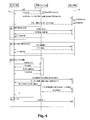
- FIG. 4 is a drawing of actions executed in a specific step of the method of the present invention.
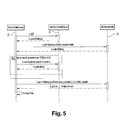
- FIG. 5 is a drawing of actions executed in another specific step of the method of the present invention.
- FIG. 1 it is schematically represented an example of a system for storing and/or editing personal data on a public network which comprises:
- the browser running at the client terminal 2 comprises also a means for receiving in response to the first opening request at least a first file from a module of said first server and a second file from the said second server.
- a means for combining both said first and second received files is provided for compiling said requested personal data.
- data Prior to the normal use of the two servers 3 and 4 with the terminal 2, data are divided from a source data into two sets of data.
- Original data are an input data unit which is divided into a set of data of a predetermined first kind and a set of data of a predetermined second kind.
- the two kinds of data are considered under technical considerations so that administrators of the two server sides are never aware of their content.
- first kind of data is determined by privacy of a person, identity related data known only at a determined client terminal with a determined user.
- second kind of data comprises medical data which are collected for any medical treatment or the like, ordered by or with the user at the terminal 2.
- the invented method comprises also a step for uploading said set of data of a first kind to a module of a first server side and said set of data of a second kind to a centralized database at a second server side.
- Such a step is executed when the physician at the client terminal 2 edits and/or updates identity and/or medical data of the first and second kind only at the terminal 2.
- the invented method comprises then an opening session step at a client side by requesting at least a first set of data of the said first kind to a module of a first server side and at least a second set of data of the said second kind to a centralized database at a second server side, and then merging both first and second sets of data to compile at least one output data unit at the client side.
- Data units are data files which are sent and received on the Internet Network. They are also stored at databases served at the two server sides 3 and 9.
- Terminal 2 at the client side runs a standard browser 10 in which a simple HTML page is previously opened when user has edited a predetermined address URL in the address bar of the browser.
- the predetermined address URL is the location of the HTML page stored at the second server side.
- the HTML page comprises both data and code.
- Browser 10 runs code embedded in the source code of the HTML page.
- client 2 connects to the second server side 13 when the user has selected an identifier of the address of the required HTML page which is located at the server side 13, 3.
- Browser 10 compiles or otherwise processes said code and, mainly, code referred as 12 at the drawing.
- the server at the second server side comprises a web server onto which run an application server 13 and a database server 3 which stores data of the second kind.
- Such a set 12 of codes has many possible implementations.
- an icon as an image is drawn at a chosen location at the display of the HTML page at the browser 10.
- the detected event activates a http request as a POST method to connect the client side browser at the said first server side, more peculiarly to a module 4 in which a first kind of data are stored.
- module 4 sends to the client terminal 2 data of the said first type which are displayed or otherwise processed at the client terminal with the standard browser 10.
- data coming from the module 4 of the first server side are loaded in the Document Object Model DOM of the HTML page 10 displayed at the browser of the client terminal 2.
- the standard browser 10 contains a software module to execute software scripts as JavaScripts.
- the set 12 of code is written as a script in the JavaScript language. It is written in the source code of the HTML page 10, loaded from the server of the second server side 3. As it has been described above, an icon is drawn at a given location of the displayed page 10.
- an http request is sent to the module 4 and data of the first kind which respond to the request are loaded at a programmed location.
- the present invention provides a means for adding or merging data 4 of a first kind to data 3 of a second kind in a single unit of data 10 under control only of the client terminal 2, the two entities controlling their own data of the first and second kinds being not aware of the content of the data of the other entity.
- the client terminal 2 is operated by a physician receiving a patient, personal data of whom are recorded as data of the said first kind at a module 4.
- Medical data of the patient comprising diagnostic data, radiographies, executed protocols or the like are recorded at the centralized server 3 of the data of the second kind.
- the merits of the present invention include the following. Physician is not aware of the private data of the second type related to the personal data of his patient. Further, the administrator of the centralized database 3 for the data of the second kind, which are medical data, is unaware of the private data of the first kind because the medical data of the first kind are only related to the corresponding patient with an anonymous identifier. Further, the administrator of the centralized database 3 has access rights to the only data of the second kind, i.e. medical data. Therefore, statistics with the medical data recorded are restricted to analysis of the aggregate anonymous data by means of a statistical tool.
- Medical data as previously described are personal data of a patient the disease of who is diagnosed and cured with at least a physician or any other member of a medical team. These personal data are strongly coupled with identity of the patient. Confidentiality of identity of a patient is determined by a specific regulation, the definition of which has determined both the access restrictions imposed upon the database recorded at a given module 4 at the first kind server side, and also the construction of the various modules for each country zone.
- system of the invention comprises:
- the central server contains the main application. It generates the pages comprising HTML and JavaScript and executing the application. It deals also with anonymous data about persons. Such data are interesting for statistical purpose or for administration. All the web pages are generated by this central server.
- the module 4 contains only a minimal server. It is only used to serve and store personal data about users and persons.
- the access restrictions imposed upon the records of the database stored in module 4 are determined on the basis of a national regulation standard which is related to the users and persons which are recorded in it, as it has been described above.
- the client-hub or terminal 2 runs a normal browser interpreting pages generated by the central server and containing JavaScript programs.
- the client-hub is the interface between the user and the two servers. The interface works in the background. The user doesn't see which server is contacted for which purpose.
- the central server provides a JavaScript library for the client-hub. This library contains all the connection information.
- the central server provides pages containing the different menus and forms. The data typed are not all sent to the server, some of them are sent to the module. It evaluates the data and stores some of them before answering to the client. The client makes the connection to the central server.
- the first kind of data are identities of documented persons.
- Documented persons are patients and/or users of the client terminals, each documented person having identity related data and medical data to be edited.
- a module at the said first server side is designed for a specific confidentiality policy.
- the first kind of data relates to information like the identity data of said documented persons, patients and/or users.
- a documented person has also medical information which is stored at the central database server at the second server side. Therefore, medical data are information of the second kind of data. They are stored at the central database server along with HTML pages and/or applications related to said documented persons to be requested by the client terminals.
- FIG. 3 it has been described the stream of the Internet requests and answers from the terminal 2 (see FIG.1 ) and the two servers, namely 4 ( FIG. 1 ) of the personal data or data of the said first kind, and 3 ( FIG. 1 ) of the medical data or data of the said second kind.
- the goal of the login step is to grant a user access to the data of some persons which are related with the use. It will be the case of a patient of a physician.
- the logged-in user has to have access to the data on the central server 3, as well as the one on the module server 4.
- the login operation uses the three parts of the system.
- the client 2 ( FIG. 3 ) sends a request R0 for a page to the central server 3 ( FIG. 3 ) of the data of the second kind, namely medical data.
- the central server sends as an answer to R0 the requested HTML page R1.
- This page contains a login form with two fields which are created for the record in the centralized database at server 3: username UN and password UP.
- the user at terminal 2 fills the two fields in the form of the login HTML page displayed at the browser and their content is read by a JavaScript program which was embedded in the source code of the login HTML page received from centralized server 3 by the terminal 2 of the connected user.
- the content of the field is not sent to the central server 3, but to the module 4 of the first server side server 4 together with a central server's sessionID. This is done by accessing a Document Object Model (DOM) of the original HTML page generated and sent by the centralized server 3 at request R1.
- the JavaScript program creates a new HTML ' ⁇ script>' tag in the HTML page, which requires the browser of the user terminal 2 to send a new request R2 to the module 4.
- the module 4 which runs a reduced server, analyses the transferred information.
- the module 3 If the user information matches the one stored in the database of the data of the first type, namely personal data, the module 3 creates an anonymous credential CR.
- This credential CR contains the user identification 'userID' of the user on the module 4 and the current session identification, 'sessionID', on the central server 3. This is signed with the private key PKM of the module 4.
- the credential CR is the concatenation of the identifications 'userID' and 'sessionID' of the central server and signature SIG.
- the client-hub or terminal 2 receives R3 this information as a response to its request R2.
- the response R3 contains the credential or a negative answer. If the client 2 received a credential, it is transferred R4 to the central server.
- the central server receives the credential, it verifies the validity of the signature using the public key of the module, and then the user receives the rights defined in the database.
- All the users are referred to by their userID and module ID. This means that a module can only grant its own users access to the central server.
- the client 2 first requests to the central server 3 a page for registering a new user.
- the central server 3 sends an HTML page in which an HTML form containing all the default fields to be filled. Together with this form, the client receives an identifier 'sessionID' for the central server 3, which is also signed. Then a JavaScript program requests some custom fields from the module 4.
- the content of all the fields is sent to the module 3 together with the signed identifier 'sessionID', using an object JSON which is generated at the terminal side 2.
- the module 3 creates a new record in its database and creates a new identifier 'userID'.
- the new identifier 'userID' on the module 3 is then sent back to the client 2. This information is signed using the private key PKM of the module 3.
- the central server 4 receives the new identifier 'userID', creates a new user record UR in its database and sends back an acknowledgment ACK or an error ERR to the client 2. If the client 2 receives an error ERR, it sends a rollback command to the module 4, in order to remove the inserted user.
- FIG. 4 More precisely, by reading FIG. 4 from the top to the bottom, it is seen exchanges between the terminal 2 at the left side, and the central server 3 or the module 4. Each rectangle drawned onto the hashed line relates to an application which is run on the part of the system which corresponds.
- a GET method has sent data from the HTML form in the New User HTML page to the central server 3.
- the server 3 runs a signature application to produce both the identifier 'ServerSessionId', a signature sign (ServerSessionId) and a JavaScript'newUser.jsf.
- client 2 sends a request getClinicNames() to the module 4 with some parameters comprising:
- module 3 runs at '5' a function verify() which is applied to the signature and at '6' a function to start the session at module 4, startSession. Which returns to client 2 at '7' a list of parameters comprising in the example:
- This step is the same that the registration step of a new user except that there are only default fields.
- the client 2 makes a request by a GET method ( FIG. 5 : at '1') on a submit action in an HTML form at the original HTML page loaded from the central server 3.
- a search patient page searchPatient.jsf is loaded from the central server 3.
- the requested page is returned containing fields for the search.
- Some additional fields are then requested at '3' by JavaScript getPatientSearchField() on the module 4 and received at '4' onto the terminal 2.
- the user fills up the fields.
- Some fields contain information about the identity of the person stored on the module 3, some about the anonymous stored on the central server 4.
- the first step is to send at '5' the anonymous information to the central server, which returns via an AJAX application a list of persons IDs at '6': patientIds[]. These are the Ids of the persons satisfying the previously sent criteria.
- the client 2 sends the rest of the search parameter (identity related information) at '7', and the list of possible persons to the module.
- the Module 4 sends back at '8' a list of persons and the number of persons found.
- the data is then merged at '9' on the client 2 with the data that was received from the central server 3.
- the logout procedure starts with the request for the logout page. Then the client 2 receives a logout HTML page from the central server 3. This page when loaded at the browser of terminal 2 calls the JSON function logout() on the module 4 which destroys the session on the module 4.
- the central server 3 destroys the session on its side.
- the data are encrypted to ensure a high level of security.
- a specific method has been developed which is disclosed hereinafter.
- the system of the invention comprises an encryption/decryption module at each end of the communicating parties, namely at the light server at the first server side, onto each module 4, 8, at the central server at the second server side 4 and also at each client terminal 2.
- an identifier of a given user is created and exchanged between the client terminal 2 and any of the two first and second kind data servers.
- Such an identifier is built on personal data such as a social security number. It should be treated as a private data set and should in no case be stored on the central server 3. Any person directly accessing this identifier has direct access to that person.
Landscapes
- Engineering & Computer Science (AREA)
- Databases & Information Systems (AREA)
- Theoretical Computer Science (AREA)
- Data Mining & Analysis (AREA)
- Physics & Mathematics (AREA)
- General Engineering & Computer Science (AREA)
- General Physics & Mathematics (AREA)
- Computer And Data Communications (AREA)
Priority Applications (1)
| Application Number | Priority Date | Filing Date | Title |
|---|---|---|---|
| EP09157735A EP2239673A1 (de) | 2009-04-09 | 2009-04-09 | Verfahren und System zur Datenspeicherung in einem öffentlichen Netz |
Applications Claiming Priority (1)
| Application Number | Priority Date | Filing Date | Title |
|---|---|---|---|
| EP09157735A EP2239673A1 (de) | 2009-04-09 | 2009-04-09 | Verfahren und System zur Datenspeicherung in einem öffentlichen Netz |
Publications (1)
| Publication Number | Publication Date |
|---|---|
| EP2239673A1 true EP2239673A1 (de) | 2010-10-13 |
Family
ID=40934904
Family Applications (1)
| Application Number | Title | Priority Date | Filing Date |
|---|---|---|---|
| EP09157735A Withdrawn EP2239673A1 (de) | 2009-04-09 | 2009-04-09 | Verfahren und System zur Datenspeicherung in einem öffentlichen Netz |
Country Status (1)
| Country | Link |
|---|---|
| EP (1) | EP2239673A1 (de) |
Cited By (1)
| Publication number | Priority date | Publication date | Assignee | Title |
|---|---|---|---|---|
| CN104243532A (zh) * | 2013-06-21 | 2014-12-24 | 鸿富锦精密工业(深圳)有限公司 | 数据访问方法及系统 |
Citations (3)
| Publication number | Priority date | Publication date | Assignee | Title |
|---|---|---|---|---|
| WO2002048831A2 (en) * | 2000-12-07 | 2002-06-20 | Medstory. Com | Method, apparatus, and system for aggregating, targeting, and synchronizing health information delivery |
| US20060235852A1 (en) * | 2005-04-14 | 2006-10-19 | Lockheed Martin Corporation | System for inter-database communication |
| WO2008147566A1 (en) * | 2007-05-25 | 2008-12-04 | Nextgen Healthcare Information Systems, Inc. | Use of restricted links to send medical records data to recipients |
-
2009
- 2009-04-09 EP EP09157735A patent/EP2239673A1/de not_active Withdrawn
Patent Citations (3)
| Publication number | Priority date | Publication date | Assignee | Title |
|---|---|---|---|---|
| WO2002048831A2 (en) * | 2000-12-07 | 2002-06-20 | Medstory. Com | Method, apparatus, and system for aggregating, targeting, and synchronizing health information delivery |
| US20060235852A1 (en) * | 2005-04-14 | 2006-10-19 | Lockheed Martin Corporation | System for inter-database communication |
| WO2008147566A1 (en) * | 2007-05-25 | 2008-12-04 | Nextgen Healthcare Information Systems, Inc. | Use of restricted links to send medical records data to recipients |
Cited By (1)
| Publication number | Priority date | Publication date | Assignee | Title |
|---|---|---|---|---|
| CN104243532A (zh) * | 2013-06-21 | 2014-12-24 | 鸿富锦精密工业(深圳)有限公司 | 数据访问方法及系统 |
Similar Documents
| Publication | Publication Date | Title |
|---|---|---|
| US7590705B2 (en) | Profile and consent accrual | |
| CN101785243B (zh) | 可传递受限安全令牌 | |
| US7660880B2 (en) | System and method for automated login | |
| US7941849B2 (en) | System and method for audit tracking | |
| US20050144482A1 (en) | Internet protocol compatible access authentication system | |
| US11868462B1 (en) | Securely manipulating and utilizing user credentials | |
| KR101925322B1 (ko) | 전자인증, 전자서명 및 위변조방지를 포함하는 암호화 기반 의료자문 서비스 제공 방법 | |
| US10902382B2 (en) | Methods for remotely accessing electronic medical records without having prior authorization | |
| JP4520736B2 (ja) | リソースの使用を管理するシステムでリソースのステータスを追跡する方法および装置 | |
| Ramtohul et al. | Information security governance for e-services in southern African developing countries e-Government projects | |
| Chadwick et al. | Using the Internet to access confidential patient records: a case study | |
| CN117097540A (zh) | 一种基于智能网联的校园身份验证安全管理方法 | |
| RU2415466C1 (ru) | Способ управления идентификацией пользователей информационных ресурсов неоднородной вычислительной сети | |
| CN111163045B (zh) | 与个人有关的分布存储的用户数据的本地组合的透明机制 | |
| CN118296578A (zh) | 一种用于访问多个平台的方法、系统、介质及设备 | |
| JP2004110335A (ja) | アクセス制御システム | |
| EP1293857A1 (de) | Serverzugriffsteuerung | |
| EP1901196A2 (de) | Verfahren und System für Sicherheit und Datenschutz bei medizinischen Formularen | |
| Meinecke et al. | Modeling Federations of Web Applications with WAM | |
| Nargis et al. | Decentralized Record Encryption Authentication and Management System (DREAMS) for Healthcare | |
| JP2004355471A (ja) | 不正アクセス防止方法 | |
| Burrai | Digital Identity Systems for Healthcare Applications | |
| Al-Sinani et al. | Client-based cardspace-openid interoperation | |
| CN120034367A (zh) | 基于Oauth授权框架的统一认证方法及计算机设备 | |
| CN122067723A (en) | Psychological assessment data synchronization method and device based on medical scene |
Legal Events
| Date | Code | Title | Description |
|---|---|---|---|
| PUAI | Public reference made under article 153(3) epc to a published international application that has entered the european phase |
Free format text: ORIGINAL CODE: 0009012 |
|
| AK | Designated contracting states |
Kind code of ref document: A1 Designated state(s): AT BE BG CH CY CZ DE DK EE ES FI FR GB GR HR HU IE IS IT LI LT LU LV MC MK MT NL NO PL PT RO SE SI SK TR |
|
| AX | Request for extension of the european patent |
Extension state: AL BA RS |
|
| STAA | Information on the status of an ep patent application or granted ep patent |
Free format text: STATUS: THE APPLICATION IS DEEMED TO BE WITHDRAWN |
|
| 18D | Application deemed to be withdrawn |
Effective date: 20110414 |