EP2233879A2 - Munition insensible - Google Patents
Munition insensible Download PDFInfo
- Publication number
- EP2233879A2 EP2233879A2 EP10250511A EP10250511A EP2233879A2 EP 2233879 A2 EP2233879 A2 EP 2233879A2 EP 10250511 A EP10250511 A EP 10250511A EP 10250511 A EP10250511 A EP 10250511A EP 2233879 A2 EP2233879 A2 EP 2233879A2
- Authority
- EP
- European Patent Office
- Prior art keywords
- high explosive
- section
- detonation
- cross
- portions
- Prior art date
- Legal status (The legal status is an assumption and is not a legal conclusion. Google has not performed a legal analysis and makes no representation as to the accuracy of the status listed.)
- Granted
Links
- 239000002360 explosive Substances 0.000 claims abstract description 161
- 238000005474 detonation Methods 0.000 claims abstract description 102
- 239000000463 material Substances 0.000 claims abstract description 66
- 238000000034 method Methods 0.000 claims abstract description 11
- 239000011800 void material Substances 0.000 claims description 6
- 239000011230 binding agent Substances 0.000 claims description 5
- 230000004888 barrier function Effects 0.000 claims description 2
- 238000012360 testing method Methods 0.000 description 22
- 230000000977 initiatory effect Effects 0.000 description 11
- 239000000203 mixture Substances 0.000 description 11
- 238000002474 experimental method Methods 0.000 description 9
- 239000008188 pellet Substances 0.000 description 8
- 238000013461 design Methods 0.000 description 7
- 239000011159 matrix material Substances 0.000 description 6
- 239000004411 aluminium Substances 0.000 description 5
- 229910052782 aluminium Inorganic materials 0.000 description 5
- XAGFODPZIPBFFR-UHFFFAOYSA-N aluminium Chemical compound [Al] XAGFODPZIPBFFR-UHFFFAOYSA-N 0.000 description 5
- 238000006243 chemical reaction Methods 0.000 description 5
- 239000012634 fragment Substances 0.000 description 5
- 238000009472 formulation Methods 0.000 description 4
- 229920000642 polymer Polymers 0.000 description 4
- 239000000523 sample Substances 0.000 description 4
- 238000000926 separation method Methods 0.000 description 4
- 230000002459 sustained effect Effects 0.000 description 4
- 229920002121 Hydroxyl-terminated polybutadiene Polymers 0.000 description 3
- 150000001875 compounds Chemical class 0.000 description 3
- -1 for example azides) Chemical class 0.000 description 3
- 239000003999 initiator Substances 0.000 description 3
- 238000004519 manufacturing process Methods 0.000 description 3
- 239000000155 melt Substances 0.000 description 3
- 229920005596 polymer binder Polymers 0.000 description 3
- 239000002491 polymer binding agent Substances 0.000 description 3
- 230000004044 response Effects 0.000 description 3
- 230000035939 shock Effects 0.000 description 3
- 239000000654 additive Substances 0.000 description 2
- 239000003570 air Substances 0.000 description 2
- 238000004200 deflagration Methods 0.000 description 2
- 230000000694 effects Effects 0.000 description 2
- 230000002708 enhancing effect Effects 0.000 description 2
- 238000012856 packing Methods 0.000 description 2
- 229920003229 poly(methyl methacrylate) Polymers 0.000 description 2
- 239000004926 polymethyl methacrylate Substances 0.000 description 2
- 239000000843 powder Substances 0.000 description 2
- 239000003380 propellant Substances 0.000 description 2
- 230000009467 reduction Effects 0.000 description 2
- IXYHLWZRPFVFON-UHFFFAOYSA-N (3-methyloxetan-3-yl)methyl nitrate Chemical compound [O-][N+](=O)OCC1(C)COC1 IXYHLWZRPFVFON-UHFFFAOYSA-N 0.000 description 1
- JIABEENURMZTTI-UHFFFAOYSA-N 1-isocyanato-2-[(2-isocyanatophenyl)methyl]benzene Chemical compound O=C=NC1=CC=CC=C1CC1=CC=CC=C1N=C=O JIABEENURMZTTI-UHFFFAOYSA-N 0.000 description 1
- JSOGDEOQBIUNTR-UHFFFAOYSA-N 2-(azidomethyl)oxirane Chemical compound [N-]=[N+]=NCC1CO1 JSOGDEOQBIUNTR-UHFFFAOYSA-N 0.000 description 1
- 235000015842 Hesperis Nutrition 0.000 description 1
- 235000012633 Iberis amara Nutrition 0.000 description 1
- 239000005058 Isophorone diisocyanate Substances 0.000 description 1
- 229910000831 Steel Inorganic materials 0.000 description 1
- 230000000996 additive effect Effects 0.000 description 1
- 230000002411 adverse Effects 0.000 description 1
- 239000012080 ambient air Substances 0.000 description 1
- 238000013459 approach Methods 0.000 description 1
- 150000001540 azides Chemical class 0.000 description 1
- 230000008901 benefit Effects 0.000 description 1
- 238000005336 cracking Methods 0.000 description 1
- 239000003975 dentin desensitizing agent Substances 0.000 description 1
- MIMDHDXOBDPUQW-UHFFFAOYSA-N dioctyl decanedioate Chemical compound CCCCCCCCOC(=O)CCCCCCCCC(=O)OCCCCCCCC MIMDHDXOBDPUQW-UHFFFAOYSA-N 0.000 description 1
- 229920001971 elastomer Polymers 0.000 description 1
- 239000011888 foil Substances 0.000 description 1
- 238000013467 fragmentation Methods 0.000 description 1
- 238000006062 fragmentation reaction Methods 0.000 description 1
- 231100001261 hazardous Toxicity 0.000 description 1
- 238000005259 measurement Methods 0.000 description 1
- 239000002184 metal Substances 0.000 description 1
- 229910052751 metal Inorganic materials 0.000 description 1
- ADZAAKGRMMGJKM-UHFFFAOYSA-N oxiran-2-ylmethyl nitrate Chemical compound [O-][N+](=O)OCC1CO1 ADZAAKGRMMGJKM-UHFFFAOYSA-N 0.000 description 1
- 230000003071 parasitic effect Effects 0.000 description 1
- 239000002245 particle Substances 0.000 description 1
- 239000012255 powdered metal Substances 0.000 description 1
- 230000000644 propagated effect Effects 0.000 description 1
- 230000001902 propagating effect Effects 0.000 description 1
- 239000005060 rubber Substances 0.000 description 1
- 239000010959 steel Substances 0.000 description 1
- 238000003860 storage Methods 0.000 description 1
- JDFUJAMTCCQARF-UHFFFAOYSA-N tatb Chemical compound NC1=C([N+]([O-])=O)C(N)=C([N+]([O-])=O)C(N)=C1[N+]([O-])=O JDFUJAMTCCQARF-UHFFFAOYSA-N 0.000 description 1
- 230000001960 triggered effect Effects 0.000 description 1
- 230000035899 viability Effects 0.000 description 1
Images



Classifications
-
- F—MECHANICAL ENGINEERING; LIGHTING; HEATING; WEAPONS; BLASTING
- F42—AMMUNITION; BLASTING
- F42B—EXPLOSIVE CHARGES, e.g. FOR BLASTING, FIREWORKS, AMMUNITION
- F42B12/00—Projectiles, missiles or mines characterised by the warhead, the intended effect, or the material
- F42B12/02—Projectiles, missiles or mines characterised by the warhead, the intended effect, or the material characterised by the warhead or the intended effect
- F42B12/20—Projectiles, missiles or mines characterised by the warhead, the intended effect, or the material characterised by the warhead or the intended effect of high-explosive type
- F42B12/207—Projectiles, missiles or mines characterised by the warhead, the intended effect, or the material characterised by the warhead or the intended effect of high-explosive type characterised by the explosive material or the construction of the high explosive warhead, e.g. insensitive ammunition
-
- F—MECHANICAL ENGINEERING; LIGHTING; HEATING; WEAPONS; BLASTING
- F42—AMMUNITION; BLASTING
- F42B—EXPLOSIVE CHARGES, e.g. FOR BLASTING, FIREWORKS, AMMUNITION
- F42B12/00—Projectiles, missiles or mines characterised by the warhead, the intended effect, or the material
- F42B12/02—Projectiles, missiles or mines characterised by the warhead, the intended effect, or the material characterised by the warhead or the intended effect
- F42B12/20—Projectiles, missiles or mines characterised by the warhead, the intended effect, or the material characterised by the warhead or the intended effect of high-explosive type
- F42B12/208—Projectiles, missiles or mines characterised by the warhead, the intended effect, or the material characterised by the warhead or the intended effect of high-explosive type characterised by a plurality of charges within a single high explosive warhead
-
- F—MECHANICAL ENGINEERING; LIGHTING; HEATING; WEAPONS; BLASTING
- F42—AMMUNITION; BLASTING
- F42C—AMMUNITION FUZES; ARMING OR SAFETY MEANS THEREFOR
- F42C19/00—Details of fuzes
- F42C19/08—Primers; Detonators
- F42C19/0838—Primers or igniters for the initiation or the explosive charge in a warhead
- F42C19/0846—Arrangements of a multiplicity of primers or detonators, dispersed within a warhead, for increased efficiency
Definitions
- This invention relates to warheads, and munitions comprising one or more warheads.
- the invention lies in the field of insensitive munition warheads, especially those capable of providing a reduced response to hazard stimuli such as fragment or bullet attack.
- the warhead will find particular use in increasing the IM compliance of munitions.
- methods of preparing the warheads of the invention methods of controllably detonating the warheads and a kit suitable for preparing such a warhead.
- munition any casing that carries a high explosive material in the form of a warhead.
- the munition may also comprise other energetic materials that are used to deliver said warhead, such as bombs, rockets, or any similar device.
- a warhead comprising at least two portions of high explosive separated by a non-detonative material, wherein each portion of high explosive has a cross section below its critical detonation cross section, and wherein the at least two portions of high explosive are arranged such that the total cross section of the at least two portions of high explosive exceeds the critical detonation cross section of said high explosive, such that in use only simultaneous detonation of the at least two portions of high explosive causes detonation to occur.
- the critical detonation cross section for a high explosive is the minimum cross section of that explosive that can be detonated in a direction normal to the cross section in the absence of any confinement. In other words, it is the minimum physical cross section of a specific explosive that must be present in order to sustain its own detonation wave.
- munitions are built with cylindrical charges and so the term critical diameter is routinely used.
- any cross section shape of high explosive may be used, and so there will be a minimum i.e. critical detonation cross section that is required in order for a particular explosive to sustain its own detonation wave.
- the effective critical detonation cross section is reduced if the explosive is heavily confined, so this will need to be taken into account when the charge is located inside a munition.
- the reduction in effective critical detonation cross section would be readily calculated by those skilled in the art.
- the measurement of the critical detonation cross section of any given high explosive may be determined by routine experimentation, to provide a precise and reproducible value, in a given batch of explosive.
- the warhead of the current invention has the advantage that it may only sustain detonation when substantially all or more preferably all, of the separate portions of high explosive are initiated simultaneously.
- detonation of the warhead should not occur, because each portion on its own is not capable of sustaining detonation. Consequently, the worst hazard response possible is likely to be merely some form of burning or deflagration reaction, i.e. a lower order reaction.
- high explosives there are at least 3 portions of high explosive, more preferably at least 4, yet more preferably at least 5 portions of high explosive.
- High explosives which possess a critical detonation cross section that is only marginally below said critical dimension may start to detonate, but will fail to sustain detonation along the entire length of the charge.
- the respective critical detonation cross sections of (n) number of portions of high explosive are selected so as to ensure that there is substantially no detonation along the length of the portion of high explosive when (n-1), (n-2), or fewer, number of portions of high explosive are subjected to a detonative impulse. It is desirable that any detonation that does start to occur in (n-1), (n-2), or fewer number of charges, decays or fails in a short length of the portion of high explosive.
- n increases it becomes likely that detonation will result if simultaneous initiation of a high percentage of the (n) charges were to occur. This follows since for a given percentage of the number of charges (n) the total surface area initiated will increase with increase in n. However, this remains acceptable behaviour because as the value of n increases, the probability that a particular hazardous event will be capable of simultaneously detonating the required number of portions of explosive material, so as to lead to sustained detonation, will also be reduced.
- the portions of high explosive are elongate, so as to increase the total explosive mass available in the warhead.
- the portions of high explosive may possess any suitable cross sectioned shape.
- the shape may be selected to increase the packing density of the separate portions of high explosive, such as, for example, a polygon shaped cross section. Seven hexagonal cross section shaped portions of high explosive, arranged in a close packed arrangement, will form a closer packed arrangement than the corresponding circular cross sectioned portions.
- Other cross sectioned shapes, with curved or flat edges, may be used to provide alternative close packing arrangements.
- Prior art warheads are generally built in a circular fashion to give a generally cylindrical explosive filling. Explosive fillings such as, for example, melt cast or consolidated powders may be prone to cracking at the edges of the filling. Therefore a generally circular shape of explosive filling is preferred as it reduces the number of edges present.
- each portion of high explosive used in the invention may conveniently be substantially cylindrical, and each cylinder is of a diameter which is below its critical detonation diameter. The spaces that are created between the portions of high explosives, especially when cylindrical portions of high explosives are used, these spaces may be filled with the non-detonative material.
- the at least two portions of high explosive must be arranged such that the total cross section of the at least two portions of high explosive exceeds the critical detonation cross section of said high explosive.
- the arrangement may be provided such for example by co-locating separate elongate element along their longest axis or providing a co-axial arrangement.
- the separation is such that portions of high explosive are not in intimate contact, i.e. are not abutting, with neighbouring portions of high explosive.
- the separation is provided by the non-detonative material as defined herein.
- the separation may be provided by one or more layers of the non-detonative material, which may cover part, substantially all or the entire surface of the individual portions of high explosives.
- high explosive may be made from any high explosive material.
- high explosive is meant a material which is capable of sustaining detonation when it is impacted upon by a detonative impulse. It is not desirable to choose initiatory compounds (such as, for example azides), or compounds that are capable of building up to detonation from a deflagration or burning event.
- the high explosive material in the portion of high explosive material may be selected from the same or different high explosive material, provided that the cross sections of different portions of high explosive material do not exceed the critical detonation cross section.
- the non-detonative material may be any material that is itself not capable of sustaining detonation; otherwise the portions of high explosive and the non-detonative material would exceed the critical detonation cross section.
- the non-detonative material may comprise inert materials such as polymers and rubbers, or it may possess high energy materials that enhance the blast, provided such high energy materials are not themselves capable of sustaining detonation.
- the non-detonative material may be an air gap, but in practise this would give rise to movement of the individual portions of high explosive which may cause breakage. Therefore any air gap must be supported, to prevent movement of the portions of high explosive, as the high explosive material needs to survive transport and handling regimes during its lifetime.
- the non-detonative material comprises a high energy material such as an energetic material (i.e. combustible material), or powdered metal, particularly aluminium in an inert binder, or an energetic polymer binder material.
- the energetic polymer binder may, for example, be selected from Polyglyn (Glycidyl nitrate polymer), GAP (Glycidyl azide polymer) or Polynimmo (3-nitratomethyl-3-methyloxetane polymer).
- the non-detonative material may comprise a high energy material so as to compensate for the reduction in the total volume/mass of high explosive missing i.e. the material that would have occupied the separation between abutting portions of high explosive in the warhead of the munition.
- aluminium particles to enhance blast is well known and is a highly preferred additive.
- a further portion of the non-detonative material may be enveloped around the outer perimeter of the total cross section of the at least two portions.
- the entire outer surface of the at least two portions of high explosive may be covered with the non-detonative material. It may not be desirable to cover the small area on the end surface of the portions of high explosive which has the initiator located thereon, as this may reduce the effectiveness of the detonation of the munition.
- simultaneous is meant substantially simultaneously, such that the detonative shockwave is applied to all of the portions of high explosive within less than 20 microsecond timescale more preferably within a less than 10 microsecond timescale, yet more preferably less than 5 microseconds so as to ensure that the detonation waves from adjacent portions of high explosive are able to combine and sustain detonation in the total cross sectional area of said portions of high explosive.
- a high voltage system such as, for example, a plurality of individual exploding foil initiators (EFI) or exploding bridgewires (EBW) may be used.
- EFI individual exploding foil initiators
- EBW exploding bridgewires
- Other forms of driven flyer plate may also be used, or laser initiation.
- a single detonative pulse may be promulgated via a plurality of explosive track plates, detonation cords, or a detonation wave guide, so as to ensure that the single detonative pulse reaches all of the portions of high explosive substantially simultaneously.
- This degree of accuracy is vital so as to ensure that all of the portions of high explosive are detonated at substantially the same time, and hence sustained detonation is achieved in the total cross section of the portions of high explosive.
- the warhead may be made up of a plurality of discrete portions of high explosive, which are enveloped by the non-detonative material. These enveloped portions of high explosives may be loaded into the munition individually or preassembled as a complete unit to provide the final warhead.
- a method of preparing a warhead according to the invention comprising the step of providing a plurality of portions of high explosive, each of which is below its critical detonation cross section, enveloping each portion in a non-detonative material, and arranging the portions to provide a total cross section of said portions which exceeds the critical detonation cross section of said high explosive.
- a matrix or lattice of non-detonative material which can be filled with the melt or cure cast explosive to form a ready contained portion of high explosive, such as to provide a warhead that comprises a plurality of voids formed by a lattice of intersecting walls of a non-detonative material, wherein each void has a cross section which is below the critical detonation cross section of a selected high explosive filling, such that upon filling said voids with said high explosive, provides a total cross section of said high explosive fillings which exceeds the critical detonation cross section of said high explosive.
- a method of preparing a warhead comprising the step of providing a plurality of voids formed by a lattice of intersecting walls of a non-detonative material, wherein each void has a cross section which is below the critical detonation cross section of a selected high explosive filling, filling said voids with said high explosive, so as to provide a total cross section of said high explosive fillings that exceeds the critical detonation cross section of said high explosive.
- the shape of the voids may be selected from any convenient shape, such as a described earlier for the at least two portions of high explosive. In addition more complex shapes may be prepared, as there is no requirement for arranging individual portions of high explosive.
- the shape of the void must permit the cross section of each void that contains a portion of high explosive to be less than the critical detonation cross section of said high explosive.
- the matrix or lattice of non-detonative material may be located in the munition prior to filling with the castable explosive formulation, or it may be gently lowered into a munition that has just been filled with said castable formulation.
- the matrix of non-detonative material may be filled with said explosive and then inserted into a munition.
- the warhead is designed such that simultaneous multi-point initiation of all the explosive elements at one end of the warhead leads to a propagating stable detonation.
- each portion of high explosive is below the critical detonation cross section, the interacting shock waves and dynamic confinement offered by the detonation of all the portions can be engineered to produce a stable detonation.
- Such engineering requires the layer of non-detonative material between the explosive charges to be selected so as to prevent the charges acting as one large charge and enable the interacting shock waves and dynamic confinement to support a stable detonation when all charges are initiated simultaneously.
- this non-detonative layer will be of a blast enhancing material which will react with the detonation products and ambient air to support and enhance the blast effects.
- a munition comprising at least one warhead according to the invention.
- Certain munitions have multiple warheads and it may be desirable that all warheads that are present are those according to the invention.
- kit of parts comprising a plurality of portions of high explosive, each of which is below its critical detonation cross section and separated by a non-detonative material, and a means of simultaneous detonation of the plurality of said portions of high explosive.
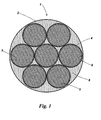
- Figure 1 shows a top-down, cross sectioned view of munition 1 which possesses a case 2.
- Seven high explosive cylindrical charges 3 are arranged in a close packed arrangement, wherein respective outer edges 4 are separated by a non-detonative material 8, so that the charges 3 are not in intimate contact.
- the melt cast explosive 3 may be poured into cardboard tubes 6 to create a cylindrical charge.
- the seven charges 3 may be held in place and the gaps between the charges are filled with non-detonative material 8.
- FIG 2 shows a warhead charge 11 containing seven cylindrical charges 13 that are arranged in a closed packed arrangement. Between the abutting cylinders are a number of gaps 18 which may be filled with non-detonative material (not shown). On top of each charge 13, is located an initiator 19 configured to ensure substantially simultaneous detonation of each charge 13. The warhead charge 11 may then be inserted into a munition casing as shown in Figure 1 .
- Figure 3 shows a top view of a munition 21 which possess a case 22, having a lattice or matrix of non-detonative material walls 24 that define a plurality of voids 28.
- the voids 28 may then be filled with melt cast explosive 23.
- Figure 4 shows a side view of the sequence of the arrangement of a test warhead charge 31.
- Seven cardboard tubes 36 filled with high explosive composition 33 are arranged in a close packed configuration.
- the tubes 36 are held in place by a retaining band 35 (as an alternative to a munitions case).
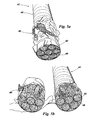
- Figure 5a and 5b show end views of the test charge 41 after the single point detonation in experiment 3, described below.
- a pellet of high explosive (not shown) was located and detonated on the side of the charge 45, leading to damage 40 of the tube and the high explosive 43.
- the test charge 41 is still largely intact, and did not result in an undesired detonation event.
- Figure 6 shows a side elevation of a test charge 51 after the single point detonation in experiment 4, described below.
- a pellet of high explosive (not shown) was located and detonated on the top face of the charge 55, leading to damage 50 of the tube and the high explosive 53.
- the test charge 51 is still largely intact, and did not result in an undesired detonation event.
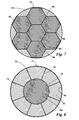
- Figure 7 shows a munition 61 which possesses a case 62.
- Seven high explosive hexagonal charges 63 are arranged in a close packed arrangement, their outer edges are separated by a non-detonative material 64.
- the melt cast explosive 63 may be poured into cardboard tubes 66 to create a hexagonal charge, in a similar fashion as described in Figure 1 .
- Figure 8 shows a munition 71 which possesses a case 72.
- Eight high explosive trapezoidal shaped charges 73 are arranged around a central core of high explosive 73a (which may be octagonal or circular).
- the edges 74, 76 and 78 are walls of non-detonative material.
- the edges 74, 76 and 78 are in the form of a lattice that creates the respective shaped voids which form portions of high explosive 73 and 73a.
- the charges may be held in place by filling any remaining voids with non-detonative material.
- the outer surface of 76 may be further coated in a non-detonative material (not shown) to provide additional protection from external hazards such as fragment or blast attacks.
- Composition QRX 104 (RDX 53%/Al 35%/HTPB-DOS-IPDI 12%) was selected. Thirteen 300mm long test cylinders of this composition were manufactured with varying diameters to enable the critical diameter to be determined.
- the charges were initiated at one end using a Debrix pellet (10mm x 10mm) and EBW detonator. In all the tests, a steel witness plate was used to determine whether detonation propagated to the end of the charge. In addition 12 ionisation pins were used on 6 of the tests to provide detonation velocity information over the last 120 mm of the charge.
- blast warheads which can be detonated in design mode by the use of multiple point initiation, but which are immune from detonation by single stimuli representative of hazards.
- This concept has the potential to provide a general IM solution for all medium to large blast or blast-fragmentation warheads, and as such should find wide application in the design of new warheads.
Landscapes
- Engineering & Computer Science (AREA)
- General Engineering & Computer Science (AREA)
- Chemical & Material Sciences (AREA)
- Combustion & Propulsion (AREA)
- Aiming, Guidance, Guns With A Light Source, Armor, Camouflage, And Targets (AREA)
- Perforating, Stamping-Out Or Severing By Means Other Than Cutting (AREA)
Applications Claiming Priority (1)
| Application Number | Priority Date | Filing Date | Title |
|---|---|---|---|
| GBGB0904929.7A GB0904929D0 (en) | 2009-03-23 | 2009-03-23 | Novel munition |
Publications (3)
| Publication Number | Publication Date |
|---|---|
| EP2233879A2 true EP2233879A2 (fr) | 2010-09-29 |
| EP2233879A3 EP2233879A3 (fr) | 2011-08-24 |
| EP2233879B1 EP2233879B1 (fr) | 2016-03-16 |
Family
ID=40639973
Family Applications (1)
| Application Number | Title | Priority Date | Filing Date |
|---|---|---|---|
| EP10250511.2A Active EP2233879B1 (fr) | 2009-03-23 | 2010-03-18 | Munition insensible |
Country Status (3)
| Country | Link |
|---|---|
| US (1) | US8256350B2 (fr) |
| EP (1) | EP2233879B1 (fr) |
| GB (1) | GB0904929D0 (fr) |
Cited By (2)
| Publication number | Priority date | Publication date | Assignee | Title |
|---|---|---|---|---|
| GB2479966A (en) * | 2010-04-27 | 2011-11-02 | Qinetiq Ltd | Warhead |
| WO2014195650A1 (fr) * | 2013-06-06 | 2014-12-11 | Herakles | Chargement pyrotechnique et generateur de gaz comprenant un tel chargement |
Families Citing this family (4)
| Publication number | Priority date | Publication date | Assignee | Title |
|---|---|---|---|---|
| US8943971B1 (en) * | 2012-08-03 | 2015-02-03 | The United States Of America As Represented By The Secretary Of The Navy | Compounded high explosive composites for impact mitigation |
| RU2556733C1 (ru) * | 2014-02-27 | 2015-07-20 | Российская Федерация, от имени которой выступает Государственная корпорация по атомной энергии "Росатом" - Госкорпорация "Росатом" | Устройство для формирования детонационной волны |
| DE102014018218B4 (de) * | 2014-12-06 | 2023-05-17 | TDW Gesellschaft für verteidigungstechnische Wirksysteme mbH | Vorrichtung zur gesteuerten Initiierung der Deflagration einer Sprengladung |
| IL247736B (en) * | 2016-09-08 | 2020-11-30 | Rafael Advanced Defense Systems Ltd | Explosive system |
Family Cites Families (9)
| Publication number | Priority date | Publication date | Assignee | Title |
|---|---|---|---|---|
| US3757694A (en) * | 1965-10-22 | 1973-09-11 | Us Navy | Fragment core warhead |
| US3960085A (en) | 1967-05-25 | 1976-06-01 | The United States Of America As Represented By The Secretary Of The Navy | Variable geometry warhead |
| FR2629582B1 (fr) | 1988-03-31 | 1993-06-04 | France Etat Armement | Projectile explosif engendrant une gerbe d'eclats |
| US5267513A (en) | 1992-10-02 | 1993-12-07 | The United States Of America As Represented By The Secretary Of The Navy | Detonation through solid-state explosion fiber bundle |
| US20060037509A1 (en) * | 2004-08-19 | 2006-02-23 | Phillip Kneisl | Non-detonable explosive scent training tool |
| GB2442382B (en) | 2005-07-06 | 2008-05-21 | Tdw Verteidigungstech Wirksys | Adjustable charge for a warhead |
| US7895947B1 (en) * | 2007-07-03 | 2011-03-01 | The United States Of America As Represented By The Secretary Of The Navy | Weapon fuse method |
| DE102008027900B4 (de) | 2008-06-11 | 2013-07-04 | TDW Gesellschaft für verteidigungstechnische Wirksysteme mbH | Verfahren und Vorrichtung zur Leistungssteuerung eines Gefechtskopfes |
| SE533045C2 (sv) * | 2008-09-09 | 2010-06-15 | Bae Systems Bofors Ab | Verkansdel med valbar initiering |
-
2009
- 2009-03-23 GB GBGB0904929.7A patent/GB0904929D0/en not_active Ceased
-
2010
- 2010-03-18 EP EP10250511.2A patent/EP2233879B1/fr active Active
- 2010-03-18 US US12/726,575 patent/US8256350B2/en active Active
Non-Patent Citations (1)
| Title |
|---|
| None |
Cited By (5)
| Publication number | Priority date | Publication date | Assignee | Title |
|---|---|---|---|---|
| GB2479966A (en) * | 2010-04-27 | 2011-11-02 | Qinetiq Ltd | Warhead |
| GB2479966B (en) * | 2010-04-27 | 2013-05-08 | Qinetiq Ltd | Controllable output warhead |
| US9109865B2 (en) | 2010-04-27 | 2015-08-18 | Qinetiq Limited | Controllable output warhead |
| WO2014195650A1 (fr) * | 2013-06-06 | 2014-12-11 | Herakles | Chargement pyrotechnique et generateur de gaz comprenant un tel chargement |
| US10035489B2 (en) | 2013-06-06 | 2018-07-31 | Arianegroup Sas | Pyrotechnic charge and gas generator comprising such a charge |
Also Published As
| Publication number | Publication date |
|---|---|
| US20100236443A1 (en) | 2010-09-23 |
| EP2233879B1 (fr) | 2016-03-16 |
| GB0904929D0 (en) | 2009-05-06 |
| US8256350B2 (en) | 2012-09-04 |
| EP2233879A3 (fr) | 2011-08-24 |
Similar Documents
| Publication | Publication Date | Title |
|---|---|---|
| EP2564150B1 (fr) | Tête militaire à effet contrôlable | |
| US8256350B2 (en) | Insensitive munition | |
| US4106410A (en) | Layered fragmentation device | |
| US8661982B2 (en) | Adaptable smart warhead and method for use | |
| EP3105534B1 (fr) | Munition avec fuselage | |
| US8443731B1 (en) | Reactive material enhanced projectiles, devices for generating reactive material enhanced projectiles and related methods | |
| JP4588769B2 (ja) | 小さい散開角度を有する運動エネルギーロッド弾頭 | |
| US11614311B1 (en) | Prefragmented warheads with enhanced performance | |
| JP4430070B2 (ja) | 放出角度が低減された運動エネルギー式ロッド型弾頭 | |
| US10634472B1 (en) | Prefragmented warheads with enhanced performance | |
| JP2008512642A (ja) | 狭い散開角を持つ運動エネルギーロッド弾頭 | |
| US7040235B1 (en) | Kinetic energy rod warhead with isotropic firing of the projectiles | |
| US12072171B1 (en) | Prefragmented warheads with enhanced performance | |
| US5187319A (en) | Low vulnerability component of explosive ammunition and process for initiating a charge of low-sensitivity composite explosive | |
| US8418622B1 (en) | Shaped charge jet disruptor | |
| GB2593973A (en) | Casing for a fragmentation weapon, fragmentation weapon, and method of manufacture | |
| US11293730B1 (en) | Bullet projectile with enhanced mechanical shock wave delivery for warfare | |
| US10823538B2 (en) | Explosive system | |
| RU2789247C1 (ru) | Взрывная камера ударной трубы взрывного действия | |
| JP2000337800A (ja) | 弾子および弾頭 |
Legal Events
| Date | Code | Title | Description |
|---|---|---|---|
| PUAI | Public reference made under article 153(3) epc to a published international application that has entered the european phase |
Free format text: ORIGINAL CODE: 0009012 |
|
| 17P | Request for examination filed |
Effective date: 20100318 |
|
| AK | Designated contracting states |
Kind code of ref document: A2 Designated state(s): AT BE BG CH CY CZ DE DK EE ES FI FR GB GR HR HU IE IS IT LI LT LU LV MC MK MT NL NO PL PT RO SE SI SK SM TR |
|
| AX | Request for extension of the european patent |
Extension state: AL BA ME RS |
|
| RAP1 | Party data changed (applicant data changed or rights of an application transferred) |
Owner name: QINETIQ LIMITED |
|
| PUAL | Search report despatched |
Free format text: ORIGINAL CODE: 0009013 |
|
| AK | Designated contracting states |
Kind code of ref document: A3 Designated state(s): AT BE BG CH CY CZ DE DK EE ES FI FR GB GR HR HU IE IS IT LI LT LU LV MC MK MT NL NO PL PT RO SE SI SK SM TR |
|
| AX | Request for extension of the european patent |
Extension state: AL BA ME RS |
|
| RIC1 | Information provided on ipc code assigned before grant |
Ipc: F42B 12/20 20060101AFI20110721BHEP Ipc: F42C 19/08 20060101ALI20110721BHEP |
|
| GRAP | Despatch of communication of intention to grant a patent |
Free format text: ORIGINAL CODE: EPIDOSNIGR1 |
|
| INTG | Intention to grant announced |
Effective date: 20150930 |
|
| GRAS | Grant fee paid |
Free format text: ORIGINAL CODE: EPIDOSNIGR3 |
|
| GRAA | (expected) grant |
Free format text: ORIGINAL CODE: 0009210 |
|
| AK | Designated contracting states |
Kind code of ref document: B1 Designated state(s): AT BE BG CH CY CZ DE DK EE ES FI FR GB GR HR HU IE IS IT LI LT LU LV MC MK MT NL NO PL PT RO SE SI SK SM TR |
|
| REG | Reference to a national code |
Ref country code: GB Ref legal event code: FG4D |
|
| REG | Reference to a national code |
Ref country code: CH Ref legal event code: EP |
|
| REG | Reference to a national code |
Ref country code: IE Ref legal event code: FG4D |
|
| REG | Reference to a national code |
Ref country code: AT Ref legal event code: REF Ref document number: 781609 Country of ref document: AT Kind code of ref document: T Effective date: 20160415 |
|
| REG | Reference to a national code |
Ref country code: DE Ref legal event code: R096 Ref document number: 602010031176 Country of ref document: DE |
|
| REG | Reference to a national code |
Ref country code: NL Ref legal event code: MP Effective date: 20160316 |
|
| REG | Reference to a national code |
Ref country code: LT Ref legal event code: MG4D |
|
| PG25 | Lapsed in a contracting state [announced via postgrant information from national office to epo] |
Ref country code: HR Free format text: LAPSE BECAUSE OF FAILURE TO SUBMIT A TRANSLATION OF THE DESCRIPTION OR TO PAY THE FEE WITHIN THE PRESCRIBED TIME-LIMIT Effective date: 20160316 Ref country code: GR Free format text: LAPSE BECAUSE OF FAILURE TO SUBMIT A TRANSLATION OF THE DESCRIPTION OR TO PAY THE FEE WITHIN THE PRESCRIBED TIME-LIMIT Effective date: 20160617 Ref country code: FI Free format text: LAPSE BECAUSE OF FAILURE TO SUBMIT A TRANSLATION OF THE DESCRIPTION OR TO PAY THE FEE WITHIN THE PRESCRIBED TIME-LIMIT Effective date: 20160316 Ref country code: NO Free format text: LAPSE BECAUSE OF FAILURE TO SUBMIT A TRANSLATION OF THE DESCRIPTION OR TO PAY THE FEE WITHIN THE PRESCRIBED TIME-LIMIT Effective date: 20160616 |
|
| REG | Reference to a national code |
Ref country code: AT Ref legal event code: MK05 Ref document number: 781609 Country of ref document: AT Kind code of ref document: T Effective date: 20160316 |
|
| PG25 | Lapsed in a contracting state [announced via postgrant information from national office to epo] |
Ref country code: BE Free format text: LAPSE BECAUSE OF NON-PAYMENT OF DUE FEES Effective date: 20160331 Ref country code: LV Free format text: LAPSE BECAUSE OF FAILURE TO SUBMIT A TRANSLATION OF THE DESCRIPTION OR TO PAY THE FEE WITHIN THE PRESCRIBED TIME-LIMIT Effective date: 20160316 Ref country code: LT Free format text: LAPSE BECAUSE OF FAILURE TO SUBMIT A TRANSLATION OF THE DESCRIPTION OR TO PAY THE FEE WITHIN THE PRESCRIBED TIME-LIMIT Effective date: 20160316 Ref country code: SE Free format text: LAPSE BECAUSE OF FAILURE TO SUBMIT A TRANSLATION OF THE DESCRIPTION OR TO PAY THE FEE WITHIN THE PRESCRIBED TIME-LIMIT Effective date: 20160316 Ref country code: NL Free format text: LAPSE BECAUSE OF FAILURE TO SUBMIT A TRANSLATION OF THE DESCRIPTION OR TO PAY THE FEE WITHIN THE PRESCRIBED TIME-LIMIT Effective date: 20160316 |
|
| REG | Reference to a national code |
Ref country code: DE Ref legal event code: R119 Ref document number: 602010031176 Country of ref document: DE |
|
| PG25 | Lapsed in a contracting state [announced via postgrant information from national office to epo] |
Ref country code: EE Free format text: LAPSE BECAUSE OF FAILURE TO SUBMIT A TRANSLATION OF THE DESCRIPTION OR TO PAY THE FEE WITHIN THE PRESCRIBED TIME-LIMIT Effective date: 20160316 Ref country code: PL Free format text: LAPSE BECAUSE OF FAILURE TO SUBMIT A TRANSLATION OF THE DESCRIPTION OR TO PAY THE FEE WITHIN THE PRESCRIBED TIME-LIMIT Effective date: 20160316 Ref country code: IS Free format text: LAPSE BECAUSE OF FAILURE TO SUBMIT A TRANSLATION OF THE DESCRIPTION OR TO PAY THE FEE WITHIN THE PRESCRIBED TIME-LIMIT Effective date: 20160716 |
|
| REG | Reference to a national code |
Ref country code: CH Ref legal event code: PL |
|
| PG25 | Lapsed in a contracting state [announced via postgrant information from national office to epo] |
Ref country code: RO Free format text: LAPSE BECAUSE OF FAILURE TO SUBMIT A TRANSLATION OF THE DESCRIPTION OR TO PAY THE FEE WITHIN THE PRESCRIBED TIME-LIMIT Effective date: 20160316 Ref country code: SK Free format text: LAPSE BECAUSE OF FAILURE TO SUBMIT A TRANSLATION OF THE DESCRIPTION OR TO PAY THE FEE WITHIN THE PRESCRIBED TIME-LIMIT Effective date: 20160316 Ref country code: ES Free format text: LAPSE BECAUSE OF FAILURE TO SUBMIT A TRANSLATION OF THE DESCRIPTION OR TO PAY THE FEE WITHIN THE PRESCRIBED TIME-LIMIT Effective date: 20160316 Ref country code: CZ Free format text: LAPSE BECAUSE OF FAILURE TO SUBMIT A TRANSLATION OF THE DESCRIPTION OR TO PAY THE FEE WITHIN THE PRESCRIBED TIME-LIMIT Effective date: 20160316 Ref country code: PT Free format text: LAPSE BECAUSE OF FAILURE TO SUBMIT A TRANSLATION OF THE DESCRIPTION OR TO PAY THE FEE WITHIN THE PRESCRIBED TIME-LIMIT Effective date: 20160718 Ref country code: SM Free format text: LAPSE BECAUSE OF FAILURE TO SUBMIT A TRANSLATION OF THE DESCRIPTION OR TO PAY THE FEE WITHIN THE PRESCRIBED TIME-LIMIT Effective date: 20160316 Ref country code: AT Free format text: LAPSE BECAUSE OF FAILURE TO SUBMIT A TRANSLATION OF THE DESCRIPTION OR TO PAY THE FEE WITHIN THE PRESCRIBED TIME-LIMIT Effective date: 20160316 |
|
| REG | Reference to a national code |
Ref country code: IE Ref legal event code: MM4A |
|
| PG25 | Lapsed in a contracting state [announced via postgrant information from national office to epo] |
Ref country code: BE Free format text: LAPSE BECAUSE OF FAILURE TO SUBMIT A TRANSLATION OF THE DESCRIPTION OR TO PAY THE FEE WITHIN THE PRESCRIBED TIME-LIMIT Effective date: 20160316 Ref country code: IT Free format text: LAPSE BECAUSE OF FAILURE TO SUBMIT A TRANSLATION OF THE DESCRIPTION OR TO PAY THE FEE WITHIN THE PRESCRIBED TIME-LIMIT Effective date: 20160316 |
|
| PLBE | No opposition filed within time limit |
Free format text: ORIGINAL CODE: 0009261 |
|
| STAA | Information on the status of an ep patent application or granted ep patent |
Free format text: STATUS: NO OPPOSITION FILED WITHIN TIME LIMIT |
|
| PG25 | Lapsed in a contracting state [announced via postgrant information from national office to epo] |
Ref country code: DK Free format text: LAPSE BECAUSE OF FAILURE TO SUBMIT A TRANSLATION OF THE DESCRIPTION OR TO PAY THE FEE WITHIN THE PRESCRIBED TIME-LIMIT Effective date: 20160316 Ref country code: CH Free format text: LAPSE BECAUSE OF NON-PAYMENT OF DUE FEES Effective date: 20160331 Ref country code: DE Free format text: LAPSE BECAUSE OF NON-PAYMENT OF DUE FEES Effective date: 20161001 Ref country code: LI Free format text: LAPSE BECAUSE OF NON-PAYMENT OF DUE FEES Effective date: 20160331 Ref country code: IE Free format text: LAPSE BECAUSE OF NON-PAYMENT OF DUE FEES Effective date: 20160318 |
|
| REG | Reference to a national code |
Ref country code: FR Ref legal event code: ST Effective date: 20170116 |
|
| 26N | No opposition filed |
Effective date: 20161219 |
|
| PG25 | Lapsed in a contracting state [announced via postgrant information from national office to epo] |
Ref country code: BG Free format text: LAPSE BECAUSE OF FAILURE TO SUBMIT A TRANSLATION OF THE DESCRIPTION OR TO PAY THE FEE WITHIN THE PRESCRIBED TIME-LIMIT Effective date: 20160616 |
|
| PG25 | Lapsed in a contracting state [announced via postgrant information from national office to epo] |
Ref country code: FR Free format text: LAPSE BECAUSE OF NON-PAYMENT OF DUE FEES Effective date: 20160517 |
|
| PG25 | Lapsed in a contracting state [announced via postgrant information from national office to epo] |
Ref country code: SI Free format text: LAPSE BECAUSE OF FAILURE TO SUBMIT A TRANSLATION OF THE DESCRIPTION OR TO PAY THE FEE WITHIN THE PRESCRIBED TIME-LIMIT Effective date: 20160316 |
|
| PG25 | Lapsed in a contracting state [announced via postgrant information from national office to epo] |
Ref country code: MT Free format text: LAPSE BECAUSE OF FAILURE TO SUBMIT A TRANSLATION OF THE DESCRIPTION OR TO PAY THE FEE WITHIN THE PRESCRIBED TIME-LIMIT Effective date: 20160316 |
|
| PG25 | Lapsed in a contracting state [announced via postgrant information from national office to epo] |
Ref country code: HU Free format text: LAPSE BECAUSE OF FAILURE TO SUBMIT A TRANSLATION OF THE DESCRIPTION OR TO PAY THE FEE WITHIN THE PRESCRIBED TIME-LIMIT; INVALID AB INITIO Effective date: 20100318 Ref country code: CY Free format text: LAPSE BECAUSE OF FAILURE TO SUBMIT A TRANSLATION OF THE DESCRIPTION OR TO PAY THE FEE WITHIN THE PRESCRIBED TIME-LIMIT Effective date: 20160316 |
|
| PG25 | Lapsed in a contracting state [announced via postgrant information from national office to epo] |
Ref country code: LU Free format text: LAPSE BECAUSE OF NON-PAYMENT OF DUE FEES Effective date: 20160318 Ref country code: MT Free format text: LAPSE BECAUSE OF FAILURE TO SUBMIT A TRANSLATION OF THE DESCRIPTION OR TO PAY THE FEE WITHIN THE PRESCRIBED TIME-LIMIT Effective date: 20160331 Ref country code: MC Free format text: LAPSE BECAUSE OF FAILURE TO SUBMIT A TRANSLATION OF THE DESCRIPTION OR TO PAY THE FEE WITHIN THE PRESCRIBED TIME-LIMIT Effective date: 20160316 Ref country code: TR Free format text: LAPSE BECAUSE OF FAILURE TO SUBMIT A TRANSLATION OF THE DESCRIPTION OR TO PAY THE FEE WITHIN THE PRESCRIBED TIME-LIMIT Effective date: 20160316 Ref country code: MK Free format text: LAPSE BECAUSE OF FAILURE TO SUBMIT A TRANSLATION OF THE DESCRIPTION OR TO PAY THE FEE WITHIN THE PRESCRIBED TIME-LIMIT Effective date: 20160316 |
|
| P01 | Opt-out of the competence of the unified patent court (upc) registered |
Effective date: 20230401 |
|
| PGFP | Annual fee paid to national office [announced via postgrant information from national office to epo] |
Ref country code: GB Payment date: 20250327 Year of fee payment: 16 |