EP2231653B1 - Antibacterial condensed thiazoles - Google Patents
Antibacterial condensed thiazoles Download PDFInfo
- Publication number
- EP2231653B1 EP2231653B1 EP20080859786 EP08859786A EP2231653B1 EP 2231653 B1 EP2231653 B1 EP 2231653B1 EP 20080859786 EP20080859786 EP 20080859786 EP 08859786 A EP08859786 A EP 08859786A EP 2231653 B1 EP2231653 B1 EP 2231653B1
- Authority
- EP
- European Patent Office
- Prior art keywords
- thiazol
- ethyl
- mmol
- urea
- benzo
- Prior art date
- Legal status (The legal status is an assumption and is not a legal conclusion. Google has not performed a legal analysis and makes no representation as to the accuracy of the status listed.)
- Not-in-force
Links
- 230000000844 anti-bacterial effect Effects 0.000 title claims description 11
- 150000003557 thiazoles Chemical class 0.000 title 1
- IJGRMHOSHXDMSA-UHFFFAOYSA-N Atomic nitrogen Chemical compound N#N IJGRMHOSHXDMSA-UHFFFAOYSA-N 0.000 claims description 390
- 229910052757 nitrogen Inorganic materials 0.000 claims description 197
- 150000001875 compounds Chemical class 0.000 claims description 85
- -1 alkynylene radical Chemical class 0.000 claims description 76
- RTZKZFJDLAIYFH-UHFFFAOYSA-N Diethyl ether Chemical compound CCOCC RTZKZFJDLAIYFH-UHFFFAOYSA-N 0.000 claims description 35
- 239000000203 mixture Substances 0.000 claims description 26
- 125000001424 substituent group Chemical group 0.000 claims description 23
- 125000006273 (C1-C3) alkyl group Chemical group 0.000 claims description 20
- 230000001580 bacterial effect Effects 0.000 claims description 18
- 125000006413 ring segment Chemical group 0.000 claims description 17
- 125000001997 phenyl group Chemical group [H]C1=C([H])C([H])=C(*)C([H])=C1[H] 0.000 claims description 16
- 125000004169 (C1-C6) alkyl group Chemical group 0.000 claims description 15
- 239000001257 hydrogen Substances 0.000 claims description 15
- 229910052739 hydrogen Inorganic materials 0.000 claims description 15
- 125000001072 heteroaryl group Chemical group 0.000 claims description 12
- 238000000034 method Methods 0.000 claims description 12
- CJEOICZZUAJJTM-UHFFFAOYSA-N 1-ethyl-3-[6-fluoro-5-[2-(4-methylpiperazin-1-yl)pyrimidin-5-yl]-1,3-benzothiazol-2-yl]urea Chemical compound FC=1C=C2SC(NC(=O)NCC)=NC2=CC=1C(C=N1)=CN=C1N1CCN(C)CC1 CJEOICZZUAJJTM-UHFFFAOYSA-N 0.000 claims description 11
- 150000003839 salts Chemical class 0.000 claims description 11
- 125000004432 carbon atom Chemical group C* 0.000 claims description 10
- 125000002887 hydroxy group Chemical group [H]O* 0.000 claims description 9
- 125000006274 (C1-C3)alkoxy group Chemical group 0.000 claims description 8
- 238000011109 contamination Methods 0.000 claims description 8
- 150000002431 hydrogen Chemical class 0.000 claims description 8
- 125000003386 piperidinyl group Chemical group 0.000 claims description 8
- 125000004076 pyridyl group Chemical group 0.000 claims description 8
- 239000004202 carbamide Substances 0.000 claims description 7
- 125000002496 methyl group Chemical group [H]C([H])([H])* 0.000 claims description 7
- 125000000714 pyrimidinyl group Chemical group 0.000 claims description 7
- KYQCOXFCLRTKLS-UHFFFAOYSA-N Pyrazine Chemical class C1=CN=CC=N1 KYQCOXFCLRTKLS-UHFFFAOYSA-N 0.000 claims description 6
- XSQUKJJJFZCRTK-UHFFFAOYSA-N Urea Chemical compound NC(N)=O XSQUKJJJFZCRTK-UHFFFAOYSA-N 0.000 claims description 6
- 125000005605 benzo group Chemical group 0.000 claims description 6
- 125000005553 heteroaryloxy group Chemical group 0.000 claims description 6
- 125000002757 morpholinyl group Chemical group 0.000 claims description 6
- 125000000951 phenoxy group Chemical group [H]C1=C([H])C([H])=C(O*)C([H])=C1[H] 0.000 claims description 6
- 125000004193 piperazinyl group Chemical group 0.000 claims description 6
- FFWBJWHKDIILSO-UHFFFAOYSA-N tert-butyl 3-[[4-[4-[2-(ethylcarbamoylamino)-6-fluoro-1,3-benzothiazol-5-yl]-2-oxopyridin-1-yl]-2-oxopyridin-1-yl]methyl]piperidine-1-carboxylate Chemical compound FC=1C=C2SC(NC(=O)NCC)=NC2=CC=1C(=CC1=O)C=CN1C(=CC1=O)C=CN1CC1CCCN(C(=O)OC(C)(C)C)C1 FFWBJWHKDIILSO-UHFFFAOYSA-N 0.000 claims description 6
- UFHFLCQGNIYNRP-UHFFFAOYSA-N Hydrogen Chemical compound [H][H] UFHFLCQGNIYNRP-UHFFFAOYSA-N 0.000 claims description 5
- DNCYBUMDUBHIJZ-UHFFFAOYSA-N 1h-pyrimidin-6-one Chemical class O=C1C=CN=CN1 DNCYBUMDUBHIJZ-UHFFFAOYSA-N 0.000 claims description 4
- 208000035143 Bacterial infection Diseases 0.000 claims description 4
- 208000022362 bacterial infectious disease Diseases 0.000 claims description 4
- 125000002837 carbocyclic group Chemical group 0.000 claims description 4
- 125000000753 cycloalkyl group Chemical group 0.000 claims description 4
- 125000001495 ethyl group Chemical group [H]C([H])([H])C([H])([H])* 0.000 claims description 4
- 125000005843 halogen group Chemical group 0.000 claims description 4
- 150000002825 nitriles Chemical class 0.000 claims description 4
- 125000001715 oxadiazolyl group Chemical group 0.000 claims description 4
- UBQKCCHYAOITMY-UHFFFAOYSA-N pyridin-2-ol Chemical class OC1=CC=CC=N1 UBQKCCHYAOITMY-UHFFFAOYSA-N 0.000 claims description 4
- PXQLVRUNWNTZOS-UHFFFAOYSA-N sulfanyl Chemical class [SH] PXQLVRUNWNTZOS-UHFFFAOYSA-N 0.000 claims description 4
- 125000003161 (C1-C6) alkylene group Chemical group 0.000 claims description 3
- FEZCMLSGFJEISW-UHFFFAOYSA-N 1-[5-[1-[3-(dimethylamino)propyl]-2-methyl-6-oxopyridin-4-yl]-6-fluoro-1,3-benzothiazol-2-yl]-3-ethylurea Chemical compound FC=1C=C2SC(NC(=O)NCC)=NC2=CC=1C=1C=C(C)N(CCCN(C)C)C(=O)C=1 FEZCMLSGFJEISW-UHFFFAOYSA-N 0.000 claims description 3
- XOCHVIVRFUZYLK-UHFFFAOYSA-N 1-ethyl-3-[5-[2-(hydroxymethyl)-3-methylimidazol-4-yl]-1,3-benzothiazol-2-yl]urea Chemical compound C=1C=C2SC(NC(=O)NCC)=NC2=CC=1C1=CN=C(CO)N1C XOCHVIVRFUZYLK-UHFFFAOYSA-N 0.000 claims description 3
- IGPLFESYPJKUIT-UHFFFAOYSA-N 1-ethyl-3-[6-fluoro-5-[2-methyl-1-[(1-methylimidazol-4-yl)methyl]-6-oxopyridin-4-yl]-1,3-benzothiazol-2-yl]urea Chemical compound FC=1C=C2SC(NC(=O)NCC)=NC2=CC=1C(=CC1=O)C=C(C)N1CC1=CN(C)C=N1 IGPLFESYPJKUIT-UHFFFAOYSA-N 0.000 claims description 3
- TWXZFBTXRMNCGO-UHFFFAOYSA-N 1-ethyl-3-[6-fluoro-5-[2-methyl-1-[(1-methylpiperidin-2-yl)methyl]-6-oxopyridin-4-yl]-1,3-benzothiazol-2-yl]urea Chemical compound FC=1C=C2SC(NC(=O)NCC)=NC2=CC=1C(=CC1=O)C=C(C)N1CC1CCCCN1C TWXZFBTXRMNCGO-UHFFFAOYSA-N 0.000 claims description 3
- UYOBBWGXWSFJIQ-UHFFFAOYSA-N 1-ethyl-3-[6-fluoro-5-[2-methyl-1-[(1-methylpyrrolidin-3-yl)methyl]-6-oxopyridin-4-yl]-1,3-benzothiazol-2-yl]urea Chemical compound FC=1C=C2SC(NC(=O)NCC)=NC2=CC=1C(=CC1=O)C=C(C)N1CC1CCN(C)C1 UYOBBWGXWSFJIQ-UHFFFAOYSA-N 0.000 claims description 3
- 125000000882 C2-C6 alkenyl group Chemical group 0.000 claims description 3
- 125000003601 C2-C6 alkynyl group Chemical group 0.000 claims description 3
- 150000001204 N-oxides Chemical class 0.000 claims description 3
- PCNDJXKNXGMECE-UHFFFAOYSA-N Phenazine Chemical class C1=CC=CC2=NC3=CC=CC=C3N=C21 PCNDJXKNXGMECE-UHFFFAOYSA-N 0.000 claims description 3
- 125000004450 alkenylene group Chemical group 0.000 claims description 3
- HSFWRNGVRCDJHI-UHFFFAOYSA-N alpha-acetylene Natural products C#C HSFWRNGVRCDJHI-UHFFFAOYSA-N 0.000 claims description 3
- 125000001246 bromo group Chemical group Br* 0.000 claims description 3
- 125000001309 chloro group Chemical group Cl* 0.000 claims description 3
- 125000002534 ethynyl group Chemical group [H]C#C* 0.000 claims description 3
- 125000001153 fluoro group Chemical group F* 0.000 claims description 3
- 125000002924 primary amino group Chemical group [H]N([H])* 0.000 claims description 3
- CHGDMCHOUYMMLO-UHFFFAOYSA-N tert-butyl 2-[[4-[2-(ethylcarbamoylamino)-6-fluoro-1,3-benzothiazol-5-yl]-2-methyl-6-oxopyridin-1-yl]methyl]pyrrolidine-1-carboxylate Chemical compound FC=1C=C2SC(NC(=O)NCC)=NC2=CC=1C(=CC1=O)C=C(C)N1CC1CCCN1C(=O)OC(C)(C)C CHGDMCHOUYMMLO-UHFFFAOYSA-N 0.000 claims description 3
- 150000003568 thioethers Chemical class 0.000 claims description 3
- 125000000876 trifluoromethoxy group Chemical group FC(F)(F)O* 0.000 claims description 3
- 125000002023 trifluoromethyl group Chemical group FC(F)(F)* 0.000 claims description 3
- 125000000391 vinyl group Chemical group [H]C([*])=C([H])[H] 0.000 claims description 3
- 125000006526 (C1-C2) alkyl group Chemical group 0.000 claims description 2
- 125000006536 (C1-C2)alkoxy group Chemical group 0.000 claims description 2
- 125000004455 (C1-C3) alkylthio group Chemical group 0.000 claims description 2
- 125000004191 (C1-C6) alkoxy group Chemical group 0.000 claims description 2
- 125000006700 (C1-C6) alkylthio group Chemical group 0.000 claims description 2
- FQDMAJAJQGUZKU-UHFFFAOYSA-N 1-[5-[1-(2-ethoxyethyl)-6-oxopyridin-3-yl]-1,3-benzothiazol-2-yl]-3-ethylurea Chemical compound C=1C=C2SC(NC(=O)NCC)=NC2=CC=1C=1C=CC(=O)N(CCOCC)C=1 FQDMAJAJQGUZKU-UHFFFAOYSA-N 0.000 claims description 2
- DVLHFOLCJLLICM-UHFFFAOYSA-N 1-ethyl-3-[5-(6-morpholin-4-ylpyridin-3-yl)-1,3-benzothiazol-2-yl]urea Chemical compound C=1C=C2SC(NC(=O)NCC)=NC2=CC=1C(C=N1)=CC=C1N1CCOCC1 DVLHFOLCJLLICM-UHFFFAOYSA-N 0.000 claims description 2
- LSZDLXKNEREMBW-UHFFFAOYSA-N 1-ethyl-3-[6-fluoro-5-(1h-pyrrolo[2,3-b]pyridin-3-yl)-1,3-benzothiazol-2-yl]urea Chemical compound C1=CC=C2C(C=3C=C4N=C(SC4=CC=3F)NC(=O)NCC)=CNC2=N1 LSZDLXKNEREMBW-UHFFFAOYSA-N 0.000 claims description 2
- ZPSMOJSIGHAIGD-UHFFFAOYSA-N 1-ethyl-3-[6-fluoro-5-[1-[(3-methoxypyridin-2-yl)methyl]-2-oxopyridin-4-yl]-1,3-benzothiazol-2-yl]urea Chemical compound FC=1C=C2SC(NC(=O)NCC)=NC2=CC=1C(=CC1=O)C=CN1CC1=NC=CC=C1OC ZPSMOJSIGHAIGD-UHFFFAOYSA-N 0.000 claims description 2
- ZPSJGADGUYYRKE-UHFFFAOYSA-N 2H-pyran-2-one Chemical class O=C1C=CC=CO1 ZPSJGADGUYYRKE-UHFFFAOYSA-N 0.000 claims description 2
- CZPWVGJYEJSRLH-UHFFFAOYSA-N Pyrimidine Chemical class C1=CN=CN=C1 CZPWVGJYEJSRLH-UHFFFAOYSA-N 0.000 claims description 2
- 125000000217 alkyl group Chemical group 0.000 claims description 2
- 125000004414 alkyl thio group Chemical group 0.000 claims description 2
- 125000002527 bicyclic carbocyclic group Chemical group 0.000 claims description 2
- 125000003178 carboxy group Chemical group [H]OC(*)=O 0.000 claims description 2
- 125000004433 nitrogen atom Chemical group N* 0.000 claims description 2
- QJGQUHMNIGDVPM-UHFFFAOYSA-N nitrogen group Chemical group [N] QJGQUHMNIGDVPM-UHFFFAOYSA-N 0.000 claims description 2
- 239000000546 pharmaceutical excipient Substances 0.000 claims description 2
- JUJWROOIHBZHMG-UHFFFAOYSA-N pyridine Substances C1=CC=NC=C1 JUJWROOIHBZHMG-UHFFFAOYSA-N 0.000 claims description 2
- UMJSCPRVCHMLSP-UHFFFAOYSA-N pyridine Natural products COC1=CC=CN=C1 UMJSCPRVCHMLSP-UHFFFAOYSA-N 0.000 claims description 2
- 150000003222 pyridines Chemical class 0.000 claims description 2
- 239000000758 substrate Substances 0.000 claims description 2
- 125000000437 thiazol-2-yl group Chemical group [H]C1=C([H])N=C(*)S1 0.000 claims description 2
- 125000004435 hydrogen atom Chemical group [H]* 0.000 claims 2
- AJEYDFVTRGYAPW-UHFFFAOYSA-N 1-[5-[1-[2-(dimethylamino)ethyl]-2-oxopyridin-4-yl]-6-fluoro-1,3-benzothiazol-2-yl]-3-ethylurea Chemical compound FC=1C=C2SC(NC(=O)NCC)=NC2=CC=1C=1C=CN(CCN(C)C)C(=O)C=1 AJEYDFVTRGYAPW-UHFFFAOYSA-N 0.000 claims 1
- FRGKXDCJWZZQTH-UHFFFAOYSA-N C(C)NC(=O)NC=1SC2=C(N1)C=C(C(=C2)C)C2=CC(N(C=C2)C)=O.C(C)NC(=O)NC=2SC1=C(N2)C=C(C(=C1)C)C=1C=NC=CC1 Chemical compound C(C)NC(=O)NC=1SC2=C(N1)C=C(C(=C2)C)C2=CC(N(C=C2)C)=O.C(C)NC(=O)NC=2SC1=C(N2)C=C(C(=C1)C)C=1C=NC=CC1 FRGKXDCJWZZQTH-UHFFFAOYSA-N 0.000 claims 1
- DALOFQJBVZBCNR-UHFFFAOYSA-N C(C)NC(=O)NC=1SC2=C(N1)C=C(C(=C2)F)C2=CC(N(C(=C2)C)C(C)C=2C=NC(=CC2)C)=O.C(C)NC(=O)NC=2SC1=NC=C(C=C1N2)C2=CC(OC(=C2)C)=O Chemical compound C(C)NC(=O)NC=1SC2=C(N1)C=C(C(=C2)F)C2=CC(N(C(=C2)C)C(C)C=2C=NC(=CC2)C)=O.C(C)NC(=O)NC=2SC1=NC=C(C=C1N2)C2=CC(OC(=C2)C)=O DALOFQJBVZBCNR-UHFFFAOYSA-N 0.000 claims 1
- FEQCAFWHKNGPCP-UHFFFAOYSA-N C(C)NC(=O)NC=1SC2=C(N1)C=C(C(=C2)F)C2=CC(N(C=C2)CCN2CCOCC2)=O.C(C)NC(=O)NC=2SC1=C(N2)C=C(C(=C1)F)C1=CC(N(C=C1)C)=O Chemical compound C(C)NC(=O)NC=1SC2=C(N1)C=C(C(=C2)F)C2=CC(N(C=C2)CCN2CCOCC2)=O.C(C)NC(=O)NC=2SC1=C(N2)C=C(C(=C1)F)C1=CC(N(C=C1)C)=O FEQCAFWHKNGPCP-UHFFFAOYSA-N 0.000 claims 1
- MYWWEZDAPIRFGF-UHFFFAOYSA-N C(C)NC(=O)NC=1SC2=C(N1)C=C(C(=C2)F)C2=NC=CC(=C2)OC.C(C)NC(=O)NC=2SC1=C(N2)C=C(C(=C1)F)C=1C=NC(=CC1)C1=NOC(=N1)C Chemical compound C(C)NC(=O)NC=1SC2=C(N1)C=C(C(=C2)F)C2=NC=CC(=C2)OC.C(C)NC(=O)NC=2SC1=C(N2)C=C(C(=C1)F)C=1C=NC(=CC1)C1=NOC(=N1)C MYWWEZDAPIRFGF-UHFFFAOYSA-N 0.000 claims 1
- DZGTWVQODMVIQC-UHFFFAOYSA-N C(C)NC(=O)NC=1SC2=C(N1)C=C(C(=C2)F)C=2C=NC(=CC2)CN2CCOCC2.C(C)NC(=O)NC=2SC1=C(N2)C=C(C(=C1)F)C=1C=NC(=CC1)CO Chemical compound C(C)NC(=O)NC=1SC2=C(N1)C=C(C(=C2)F)C=2C=NC(=CC2)CN2CCOCC2.C(C)NC(=O)NC=2SC1=C(N2)C=C(C(=C1)F)C=1C=NC(=CC1)CO DZGTWVQODMVIQC-UHFFFAOYSA-N 0.000 claims 1
- WKCFOWVZICUKTO-UHFFFAOYSA-N C(C)NC(=O)NC=1SC2=C(N1)C=C(C(=C2)F)C=2C=NC(=NC2)S(=O)(=O)C.C(C)NC(=O)NC=2SC1=C(N2)C=C(C(=C1)F)C1=CN=CS1 Chemical compound C(C)NC(=O)NC=1SC2=C(N1)C=C(C(=C2)F)C=2C=NC(=NC2)S(=O)(=O)C.C(C)NC(=O)NC=2SC1=C(N2)C=C(C(=C1)F)C1=CN=CS1 WKCFOWVZICUKTO-UHFFFAOYSA-N 0.000 claims 1
- SYOYGFDWFBLRTC-UHFFFAOYSA-N C(C)NC(=O)NC=1SC2=C(N1)C=C(C(=C2)F)C=2C=NC=CC2.C(C)NC(=O)NC=2SC1=C(N2)C=C(C=C1)C1=CC(N(C=C1)C)=O Chemical compound C(C)NC(=O)NC=1SC2=C(N1)C=C(C(=C2)F)C=2C=NC=CC2.C(C)NC(=O)NC=2SC1=C(N2)C=C(C=C1)C1=CC(N(C=C1)C)=O SYOYGFDWFBLRTC-UHFFFAOYSA-N 0.000 claims 1
- VXRIDLAXYLKGPT-UHFFFAOYSA-N C(C)NC(=O)NC=1SC2=C(N1)C=C(C(=C2)OC)C2=CC(N(C=C2)C)=O.C(C)NC(=O)NC=2SC1=C(N2)C=C(C(=C1)OC)C=1C=NC=CC1 Chemical compound C(C)NC(=O)NC=1SC2=C(N1)C=C(C(=C2)OC)C2=CC(N(C=C2)C)=O.C(C)NC(=O)NC=2SC1=C(N2)C=C(C(=C1)OC)C=1C=NC=CC1 VXRIDLAXYLKGPT-UHFFFAOYSA-N 0.000 claims 1
- ARIPTSRREBIYJS-UHFFFAOYSA-N C(C)NC(=O)NC=1SC2=C(N1)C=C(C=C2)C2=CC=1OCCN(C1N=C2)C.C(C)NC(=O)NC=2SC1=C(N2)C=C(C=C1)C=1C=NN(C1)C Chemical compound C(C)NC(=O)NC=1SC2=C(N1)C=C(C=C2)C2=CC=1OCCN(C1N=C2)C.C(C)NC(=O)NC=2SC1=C(N2)C=C(C=C1)C=1C=NN(C1)C ARIPTSRREBIYJS-UHFFFAOYSA-N 0.000 claims 1
- VWEDNHBAWHMZLY-UHFFFAOYSA-N C(C)NC(=O)NC=1SC2=C(N1)C=C(C=C2)C2=CN=C(S2)OC.N2N=CC(=C2)C=2C=CC1=C(N=C(S1)NC(=O)NCC)C2.C(C)NC(=O)NC=2SC1=C(N2)C=C(C=C1)C1=CN=CC2=CC=CC=C12 Chemical compound C(C)NC(=O)NC=1SC2=C(N1)C=C(C=C2)C2=CN=C(S2)OC.N2N=CC(=C2)C=2C=CC1=C(N=C(S1)NC(=O)NCC)C2.C(C)NC(=O)NC=2SC1=C(N2)C=C(C=C1)C1=CN=CC2=CC=CC=C12 VWEDNHBAWHMZLY-UHFFFAOYSA-N 0.000 claims 1
- AWAPBMOXFTYRQB-UHFFFAOYSA-N C(C)NC(=O)NC=1SC2=C(N1)C=C(C=C2)C2=CN=C1N2C=CC=C1.C(C)NC(=O)NC=1SC2=C(N1)C=C(C=C2)C2=CN=C(S2)O Chemical compound C(C)NC(=O)NC=1SC2=C(N1)C=C(C=C2)C2=CN=C1N2C=CC=C1.C(C)NC(=O)NC=1SC2=C(N1)C=C(C=C2)C2=CN=C(S2)O AWAPBMOXFTYRQB-UHFFFAOYSA-N 0.000 claims 1
- BMXXKSDONGUVQM-UHFFFAOYSA-N C(C)NC(=O)NC=1SC2=C(N1)C=C(C=C2)C2=NC=C(N=C2)N2C(C=CC=C2)=O.C(C)NC(=O)NC=2SC1=C(N2)C=C(C=C1)C=1C=NC(=CC1)CO Chemical compound C(C)NC(=O)NC=1SC2=C(N1)C=C(C=C2)C2=NC=C(N=C2)N2C(C=CC=C2)=O.C(C)NC(=O)NC=2SC1=C(N2)C=C(C=C1)C=1C=NC(=CC1)CO BMXXKSDONGUVQM-UHFFFAOYSA-N 0.000 claims 1
- DCFRXPZOKZTFMJ-UHFFFAOYSA-N C(C)NC(=O)NC=1SC2=C(N1)C=C(C=C2)C=2C=CC=1N(C2)C=CN1.N=1N=CN2C1C=CC(=C2)C=2C=CC1=C(N=C(S1)NC(=O)NCC)C2 Chemical compound C(C)NC(=O)NC=1SC2=C(N1)C=C(C=C2)C=2C=CC=1N(C2)C=CN1.N=1N=CN2C1C=CC(=C2)C=2C=CC1=C(N=C(S1)NC(=O)NCC)C2 DCFRXPZOKZTFMJ-UHFFFAOYSA-N 0.000 claims 1
- JNZCMAPGOOGBPW-UHFFFAOYSA-N C(C)NC(NC=1SC2=C(N1)C=C(C(=C2)F)C=2C=CC(=NC2)CC(=O)NC)=O.C(C)NC(=O)NC=2SC1=C(N2)C=C(C(=C1)F)C1=CC(N(C=C1)C1CNCC1)=O Chemical compound C(C)NC(NC=1SC2=C(N1)C=C(C(=C2)F)C=2C=CC(=NC2)CC(=O)NC)=O.C(C)NC(=O)NC=2SC1=C(N2)C=C(C(=C1)F)C1=CC(N(C=C1)C1CNCC1)=O JNZCMAPGOOGBPW-UHFFFAOYSA-N 0.000 claims 1
- ISMFJJVZYOYIAE-UHFFFAOYSA-N C(C)NC(NC=1SC2=C(N1)C=C(C=C2)C=2C=CC(=NC2)NC(C)=O)=O.N=2C=NN1C2C=CC(=C1)C=1C=CC2=C(N=C(S2)NC(=O)NCC)C1 Chemical compound C(C)NC(NC=1SC2=C(N1)C=C(C=C2)C=2C=CC(=NC2)NC(C)=O)=O.N=2C=NN1C2C=CC(=C1)C=1C=CC2=C(N=C(S2)NC(=O)NCC)C1 ISMFJJVZYOYIAE-UHFFFAOYSA-N 0.000 claims 1
- ZXPZRGGQVWEEFH-UHFFFAOYSA-N C(C)NC(NC=1SC2=NC=C(C=C2N1)C=1C=CC(=NC1)NC(C)=O)=O.C(C)NC(=O)NC=1SC2=NC=C(C=C2N1)C=1C=NC=CC1 Chemical compound C(C)NC(NC=1SC2=NC=C(C=C2N1)C=1C=CC(=NC1)NC(C)=O)=O.C(C)NC(=O)NC=1SC2=NC=C(C=C2N1)C=1C=NC=CC1 ZXPZRGGQVWEEFH-UHFFFAOYSA-N 0.000 claims 1
- VVWKWXMBOVKCIY-UHFFFAOYSA-N N1N=C(C=C1)C=1C=CC2=C(N=C(S2)NC(=O)NCC)C1.C(C)NC(=O)NC=1SC2=C(N1)C=C(C=C2)C=2C=NN(C2)CCN2CCOCC2.C(C)NC(NC=2SC1=C(N2)C=C(C=C1)C=1C=CC(=NC1)C(=O)OC)=O Chemical compound N1N=C(C=C1)C=1C=CC2=C(N=C(S2)NC(=O)NCC)C1.C(C)NC(=O)NC=1SC2=C(N1)C=C(C=C2)C=2C=NN(C2)CCN2CCOCC2.C(C)NC(NC=2SC1=C(N2)C=C(C=C1)C=1C=CC(=NC1)C(=O)OC)=O VVWKWXMBOVKCIY-UHFFFAOYSA-N 0.000 claims 1
- AEBOUBWPAQMUJD-UHFFFAOYSA-N O1C2=C(NCC1)N=CC(=C2)C=2C=CC1=C(N=C(S1)NC(=O)NCC)C2.C(C)NC(=O)NC=2SC1=C(N2)C=C(C=C1)C=1C=CC=2N(C1)N=NN2 Chemical compound O1C2=C(NCC1)N=CC(=C2)C=2C=CC1=C(N=C(S1)NC(=O)NCC)C2.C(C)NC(=O)NC=2SC1=C(N2)C=C(C=C1)C=1C=CC=2N(C1)N=NN2 AEBOUBWPAQMUJD-UHFFFAOYSA-N 0.000 claims 1
- XBDQKXXYIPTUBI-UHFFFAOYSA-N Propionic acid Chemical compound CCC(O)=O XBDQKXXYIPTUBI-UHFFFAOYSA-N 0.000 claims 1
- 239000003937 drug carrier Substances 0.000 claims 1
- 125000000449 nitro group Chemical group [O-][N+](*)=O 0.000 claims 1
- 230000002265 prevention Effects 0.000 claims 1
- 239000011541 reaction mixture Substances 0.000 description 394
- XEKOWRVHYACXOJ-UHFFFAOYSA-N Ethyl acetate Chemical compound CCOC(C)=O XEKOWRVHYACXOJ-UHFFFAOYSA-N 0.000 description 257
- IAZDPXIOMUYVGZ-WFGJKAKNSA-N Dimethyl sulfoxide Chemical compound [2H]C([2H])([2H])S(=O)C([2H])([2H])[2H] IAZDPXIOMUYVGZ-WFGJKAKNSA-N 0.000 description 208
- 239000000243 solution Substances 0.000 description 205
- 238000006243 chemical reaction Methods 0.000 description 172
- 238000002360 preparation method Methods 0.000 description 167
- 238000004809 thin layer chromatography Methods 0.000 description 164
- 238000012544 monitoring process Methods 0.000 description 162
- XLYOFNOQVPJJNP-UHFFFAOYSA-N water Substances O XLYOFNOQVPJJNP-UHFFFAOYSA-N 0.000 description 146
- VYPSYNLAJGMNEJ-UHFFFAOYSA-N Silicium dioxide Chemical compound O=[Si]=O VYPSYNLAJGMNEJ-UHFFFAOYSA-N 0.000 description 130
- 239000000047 product Substances 0.000 description 128
- 235000019439 ethyl acetate Nutrition 0.000 description 120
- YNHIGQDRGKUECZ-UHFFFAOYSA-L PdCl2(PPh3)2 Substances [Cl-].[Cl-].[Pd+2].C1=CC=CC=C1P(C=1C=CC=CC=1)C1=CC=CC=C1.C1=CC=CC=C1P(C=1C=CC=CC=1)C1=CC=CC=C1 YNHIGQDRGKUECZ-UHFFFAOYSA-L 0.000 description 108
- 238000005160 1H NMR spectroscopy Methods 0.000 description 106
- 239000012267 brine Substances 0.000 description 97
- HPALAKNZSZLMCH-UHFFFAOYSA-M sodium;chloride;hydrate Chemical compound O.[Na+].[Cl-] HPALAKNZSZLMCH-UHFFFAOYSA-M 0.000 description 97
- 238000011010 flushing procedure Methods 0.000 description 87
- 239000000741 silica gel Substances 0.000 description 86
- 229910002027 silica gel Inorganic materials 0.000 description 86
- 229960001866 silicon dioxide Drugs 0.000 description 86
- WGLUMOCWFMKWIL-UHFFFAOYSA-N dichloromethane;methanol Chemical compound OC.ClCCl WGLUMOCWFMKWIL-UHFFFAOYSA-N 0.000 description 76
- 238000004128 high performance liquid chromatography Methods 0.000 description 76
- 238000000605 extraction Methods 0.000 description 72
- YMWUJEATGCHHMB-UHFFFAOYSA-N Dichloromethane Chemical compound ClCCl YMWUJEATGCHHMB-UHFFFAOYSA-N 0.000 description 69
- LWIHDJKSTIGBAC-UHFFFAOYSA-K tripotassium phosphate Chemical compound [K+].[K+].[K+].[O-]P([O-])([O-])=O LWIHDJKSTIGBAC-UHFFFAOYSA-K 0.000 description 63
- 238000007872 degassing Methods 0.000 description 60
- 229910000404 tripotassium phosphate Inorganic materials 0.000 description 59
- WHQSYGRFZMUQGQ-UHFFFAOYSA-N n,n-dimethylformamide;hydrate Chemical compound O.CN(C)C=O WHQSYGRFZMUQGQ-UHFFFAOYSA-N 0.000 description 55
- UTCSSFWDNNEEBH-UHFFFAOYSA-N imidazo[1,2-a]pyridine Chemical compound C1=CC=CC2=NC=CN21 UTCSSFWDNNEEBH-UHFFFAOYSA-N 0.000 description 53
- VLKZOEOYAKHREP-UHFFFAOYSA-N n-Hexane Chemical compound CCCCCC VLKZOEOYAKHREP-UHFFFAOYSA-N 0.000 description 45
- IBCVARZOMTXMPC-UHFFFAOYSA-N tert-butyl 3-[2-oxo-4-(4,4,5,5-tetramethyl-1,3,2-dioxaborolan-2-yl)pyridin-1-yl]pyrrolidine-1-carboxylate Chemical compound C1N(C(=O)OC(C)(C)C)CCC1N1C(=O)C=C(B2OC(C)(C)C(C)(C)O2)C=C1 IBCVARZOMTXMPC-UHFFFAOYSA-N 0.000 description 45
- RYHBNJHYFVUHQT-UHFFFAOYSA-N 1,4-Dioxane Chemical compound C1COCCO1 RYHBNJHYFVUHQT-UHFFFAOYSA-N 0.000 description 41
- SCVFZCLFOSHCOH-UHFFFAOYSA-M potassium acetate Chemical compound [K+].CC([O-])=O SCVFZCLFOSHCOH-UHFFFAOYSA-M 0.000 description 39
- IBDINBYDLQQKTJ-UHFFFAOYSA-N 1-(5-bromo-6-fluoro-1,3-benzothiazol-2-yl)-3-ethylurea Chemical compound BrC1=C(F)C=C2SC(NC(=O)NCC)=NC2=C1 IBDINBYDLQQKTJ-UHFFFAOYSA-N 0.000 description 36
- ZMXDDKWLCZADIW-UHFFFAOYSA-N N,N-Dimethylformamide Chemical compound CN(C)C=O ZMXDDKWLCZADIW-UHFFFAOYSA-N 0.000 description 36
- 238000000746 purification Methods 0.000 description 34
- 239000007787 solid Substances 0.000 description 34
- CSCPPACGZOOCGX-UHFFFAOYSA-N Acetone Chemical compound CC(C)=O CSCPPACGZOOCGX-UHFFFAOYSA-N 0.000 description 33
- 239000000706 filtrate Substances 0.000 description 32
- WLPUWLXVBWGYMZ-UHFFFAOYSA-N tricyclohexylphosphine Chemical compound C1CCCCC1P(C1CCCCC1)C1CCCCC1 WLPUWLXVBWGYMZ-UHFFFAOYSA-N 0.000 description 28
- 239000007983 Tris buffer Substances 0.000 description 27
- IAZDPXIOMUYVGZ-UHFFFAOYSA-N Dimethylsulphoxide Chemical compound CS(C)=O IAZDPXIOMUYVGZ-UHFFFAOYSA-N 0.000 description 24
- UQAUJONYOJOBBS-UHFFFAOYSA-N tert-butyl 3-[4-[2-(ethylcarbamoylamino)-6-fluoro-1,3-benzothiazol-5-yl]-2-oxopyridin-1-yl]pyrrolidine-1-carboxylate Chemical compound FC=1C=C2SC(NC(=O)NCC)=NC2=CC=1C(=CC1=O)C=CN1C1CCN(C(=O)OC(C)(C)C)C1 UQAUJONYOJOBBS-UHFFFAOYSA-N 0.000 description 24
- QTBSBXVTEAMEQO-UHFFFAOYSA-N Acetic acid Chemical compound CC(O)=O QTBSBXVTEAMEQO-UHFFFAOYSA-N 0.000 description 23
- WYURNTSHIVDZCO-UHFFFAOYSA-N tetrahydrofuran Substances C1CCOC1 WYURNTSHIVDZCO-UHFFFAOYSA-N 0.000 description 23
- LFQSCWFLJHTTHZ-UHFFFAOYSA-N Ethanol Chemical compound CCO LFQSCWFLJHTTHZ-UHFFFAOYSA-N 0.000 description 22
- NCCRJWXFDGJZLM-UHFFFAOYSA-N 1-(5-bromo-1,3-benzothiazol-2-yl)-3-ethylurea Chemical compound BrC1=CC=C2SC(NC(=O)NCC)=NC2=C1 NCCRJWXFDGJZLM-UHFFFAOYSA-N 0.000 description 19
- HEMHJVSKTPXQMS-UHFFFAOYSA-M Sodium hydroxide Chemical compound [OH-].[Na+] HEMHJVSKTPXQMS-UHFFFAOYSA-M 0.000 description 18
- 230000000694 effects Effects 0.000 description 18
- QOJWFINFNCLGHK-UHFFFAOYSA-N methyl 1-[5-(4,4,5,5-tetramethyl-1,3,2-dioxaborolan-2-yl)pyrimidin-2-yl]piperidine-3-carboxylate Chemical compound C1C(C(=O)OC)CCCN1C1=NC=C(B2OC(C)(C)C(C)(C)O2)C=N1 QOJWFINFNCLGHK-UHFFFAOYSA-N 0.000 description 17
- UEKXCFIPAGCLQJ-UHFFFAOYSA-N methyl 1-[5-(4,4,5,5-tetramethyl-1,3,2-dioxaborolan-2-yl)pyrimidin-2-yl]piperidine-4-carboxylate Chemical compound C1CC(C(=O)OC)CCN1C1=NC=C(B2OC(C)(C)C(C)(C)O2)C=N1 UEKXCFIPAGCLQJ-UHFFFAOYSA-N 0.000 description 17
- FJDQFPXHSGXQBY-UHFFFAOYSA-L caesium carbonate Chemical compound [Cs+].[Cs+].[O-]C([O-])=O FJDQFPXHSGXQBY-UHFFFAOYSA-L 0.000 description 16
- PBHAKKGKJYGQLT-UHFFFAOYSA-N 1-ethyl-3-[5-(4,4,5,5-tetramethyl-1,3,2-dioxaborolan-2-yl)-1,3-benzothiazol-2-yl]urea Chemical compound C=1C=C2SC(NC(=O)NCC)=NC2=CC=1B1OC(C)(C)C(C)(C)O1 PBHAKKGKJYGQLT-UHFFFAOYSA-N 0.000 description 15
- OKKJLVBELUTLKV-UHFFFAOYSA-N Methanol Chemical compound OC OKKJLVBELUTLKV-UHFFFAOYSA-N 0.000 description 15
- 239000002904 solvent Substances 0.000 description 14
- UIIMBOGNXHQVGW-UHFFFAOYSA-M Sodium bicarbonate Chemical compound [Na+].OC([O-])=O UIIMBOGNXHQVGW-UHFFFAOYSA-M 0.000 description 13
- 101710183280 Topoisomerase Proteins 0.000 description 13
- 238000003756 stirring Methods 0.000 description 13
- NXQGGXCHGDYOHB-UHFFFAOYSA-L cyclopenta-1,4-dien-1-yl(diphenyl)phosphane;dichloropalladium;iron(2+) Chemical compound [Fe+2].Cl[Pd]Cl.[CH-]1C=CC(P(C=2C=CC=CC=2)C=2C=CC=CC=2)=C1.[CH-]1C=CC(P(C=2C=CC=CC=2)C=2C=CC=CC=2)=C1 NXQGGXCHGDYOHB-UHFFFAOYSA-L 0.000 description 12
- IOJUPLGTWVMSFF-UHFFFAOYSA-N benzothiazole Chemical class C1=CC=C2SC=NC2=C1 IOJUPLGTWVMSFF-UHFFFAOYSA-N 0.000 description 11
- GTWCSQSSJHDDRA-UHFFFAOYSA-N 1-ethyl-3-[5-[1-(2-methoxyethyl)-2-methyl-6-oxopyridin-4-yl]-1,3-benzothiazol-2-yl]urea Chemical compound C=1C=C2SC(NC(=O)NCC)=NC2=CC=1C=1C=C(C)N(CCOC)C(=O)C=1 GTWCSQSSJHDDRA-UHFFFAOYSA-N 0.000 description 10
- SCVPLDUBVWZRNP-UHFFFAOYSA-N 1-ethyl-3-[6-fluoro-5-[6-(5-methyl-1,2,4-oxadiazol-3-yl)pyridin-3-yl]-1,3-benzothiazol-2-yl]urea Chemical compound FC=1C=C2SC(NC(=O)NCC)=NC2=CC=1C(C=N1)=CC=C1C1=NOC(C)=N1 SCVPLDUBVWZRNP-UHFFFAOYSA-N 0.000 description 10
- OAYLNYINCPYISS-UHFFFAOYSA-N ethyl acetate;hexane Chemical compound CCCCCC.CCOC(C)=O OAYLNYINCPYISS-UHFFFAOYSA-N 0.000 description 10
- 238000004895 liquid chromatography mass spectrometry Methods 0.000 description 10
- XHMSHQJASDNBFB-UHFFFAOYSA-N methyl 1-[5-[2-(ethylcarbamoylamino)-6-fluoro-1,3-benzothiazol-5-yl]pyrimidin-2-yl]piperidine-3-carboxylate Chemical compound FC=1C=C2SC(NC(=O)NCC)=NC2=CC=1C(C=N1)=CN=C1N1CCCC(C(=O)OC)C1 XHMSHQJASDNBFB-UHFFFAOYSA-N 0.000 description 10
- 239000012299 nitrogen atmosphere Substances 0.000 description 10
- 150000003254 radicals Chemical class 0.000 description 10
- SSLMGOKTIUIZLY-UHFFFAOYSA-N 4-bromo-1h-pyridin-2-one Chemical compound OC1=CC(Br)=CC=N1 SSLMGOKTIUIZLY-UHFFFAOYSA-N 0.000 description 9
- YXFVVABEGXRONW-UHFFFAOYSA-N Toluene Chemical compound CC1=CC=CC=C1 YXFVVABEGXRONW-UHFFFAOYSA-N 0.000 description 9
- 229910000024 caesium carbonate Inorganic materials 0.000 description 9
- 239000000725 suspension Substances 0.000 description 9
- YQEOHQLMFVMQRC-UHFFFAOYSA-N 1-ethyl-3-[5-[2-methyl-1-[(6-methylpyridin-2-yl)methyl]-6-oxopyridin-4-yl]-1,3-benzothiazol-2-yl]urea Chemical compound C=1C=C2SC(NC(=O)NCC)=NC2=CC=1C(=CC1=O)C=C(C)N1CC1=CC=CC(C)=N1 YQEOHQLMFVMQRC-UHFFFAOYSA-N 0.000 description 8
- JGFZNNIVVJXRND-UHFFFAOYSA-N N,N-Diisopropylethylamine (DIPEA) Chemical compound CCN(C(C)C)C(C)C JGFZNNIVVJXRND-UHFFFAOYSA-N 0.000 description 8
- SECXISVLQFMRJM-UHFFFAOYSA-N N-Methylpyrrolidone Chemical compound CN1CCCC1=O SECXISVLQFMRJM-UHFFFAOYSA-N 0.000 description 8
- 239000012044 organic layer Substances 0.000 description 8
- NSYSSMYQPLSPOD-UHFFFAOYSA-N triacetate lactone Chemical compound CC1=CC(O)=CC(=O)O1 NSYSSMYQPLSPOD-UHFFFAOYSA-N 0.000 description 8
- KZPYGQFFRCFCPP-UHFFFAOYSA-N 1,1'-bis(diphenylphosphino)ferrocene Chemical compound [Fe+2].C1=CC=C[C-]1P(C=1C=CC=CC=1)C1=CC=CC=C1.C1=CC=C[C-]1P(C=1C=CC=CC=1)C1=CC=CC=C1 KZPYGQFFRCFCPP-UHFFFAOYSA-N 0.000 description 7
- YFOQSLIPUHGGQE-UHFFFAOYSA-N 4-bromo-1-methylpyridin-2-one Chemical compound CN1C=CC(Br)=CC1=O YFOQSLIPUHGGQE-UHFFFAOYSA-N 0.000 description 7
- KWYUFKZDYYNOTN-UHFFFAOYSA-M Potassium hydroxide Chemical class [OH-].[K+] KWYUFKZDYYNOTN-UHFFFAOYSA-M 0.000 description 7
- 239000003242 anti bacterial agent Substances 0.000 description 7
- 230000015572 biosynthetic process Effects 0.000 description 7
- WUDNUHPRLBTKOJ-UHFFFAOYSA-N ethyl isocyanate Chemical compound CCN=C=O WUDNUHPRLBTKOJ-UHFFFAOYSA-N 0.000 description 7
- 239000000377 silicon dioxide Substances 0.000 description 7
- 235000011121 sodium hydroxide Nutrition 0.000 description 7
- 238000003786 synthesis reaction Methods 0.000 description 7
- NZZLECBWDDORQM-UHFFFAOYSA-N 1-ethyl-3-[6-(4,4,5,5-tetramethyl-1,3,2-dioxaborolan-2-yl)-[1,3]thiazolo[5,4-b]pyridin-2-yl]urea Chemical compound C=1N=C2SC(NC(=O)NCC)=NC2=CC=1B1OC(C)(C)C(C)(C)O1 NZZLECBWDDORQM-UHFFFAOYSA-N 0.000 description 6
- VHYFNPMBLIVWCW-UHFFFAOYSA-N 4-Dimethylaminopyridine Chemical compound CN(C)C1=CC=NC=C1 VHYFNPMBLIVWCW-UHFFFAOYSA-N 0.000 description 6
- 229910014455 Ca-Cb Inorganic materials 0.000 description 6
- 108020004414 DNA Proteins 0.000 description 6
- 108090000790 Enzymes Proteins 0.000 description 6
- 102000004190 Enzymes Human genes 0.000 description 6
- NFHFRUOZVGFOOS-UHFFFAOYSA-N Pd(PPh3)4 Substances [Pd].C1=CC=CC=C1P(C=1C=CC=CC=1)C1=CC=CC=C1.C1=CC=CC=C1P(C=1C=CC=CC=1)C1=CC=CC=C1.C1=CC=CC=C1P(C=1C=CC=CC=1)C1=CC=CC=C1.C1=CC=CC=C1P(C=1C=CC=CC=1)C1=CC=CC=C1 NFHFRUOZVGFOOS-UHFFFAOYSA-N 0.000 description 6
- 229910002666 PdCl2 Inorganic materials 0.000 description 6
- ZMANZCXQSJIPKH-UHFFFAOYSA-N Triethylamine Chemical compound CCN(CC)CC ZMANZCXQSJIPKH-UHFFFAOYSA-N 0.000 description 6
- 229960000583 acetic acid Drugs 0.000 description 6
- ILAHWRKJUDSMFH-UHFFFAOYSA-N boron tribromide Chemical compound BrB(Br)Br ILAHWRKJUDSMFH-UHFFFAOYSA-N 0.000 description 6
- 125000000842 isoxazolyl group Chemical group 0.000 description 6
- 239000007788 liquid Substances 0.000 description 6
- 239000002480 mineral oil Substances 0.000 description 6
- 235000010446 mineral oil Nutrition 0.000 description 6
- PIBWKRNGBLPSSY-UHFFFAOYSA-L palladium(II) chloride Chemical compound Cl[Pd]Cl PIBWKRNGBLPSSY-UHFFFAOYSA-L 0.000 description 6
- UQPUONNXJVWHRM-UHFFFAOYSA-N palladium;triphenylphosphane Chemical compound [Pd].C1=CC=CC=C1P(C=1C=CC=CC=1)C1=CC=CC=C1 UQPUONNXJVWHRM-UHFFFAOYSA-N 0.000 description 6
- KXXPHJGUWNWYJW-UHFFFAOYSA-N 1-[6-[1-[2-(dimethylamino)ethyl]-2-oxopyridin-4-yl]-6-fluoro-2h-1,3-benzothiazol-2-yl]-3-ethylurea Chemical compound C1=CC2=NC(NC(=O)NCC)SC2=CC1(F)C=1C=CN(CCN(C)C)C(=O)C=1 KXXPHJGUWNWYJW-UHFFFAOYSA-N 0.000 description 5
- LLFSFJYWGVKYRP-UHFFFAOYSA-N 4-bromo-6-methylpyran-2-one Chemical compound CC1=CC(Br)=CC(=O)O1 LLFSFJYWGVKYRP-UHFFFAOYSA-N 0.000 description 5
- 241000894006 Bacteria Species 0.000 description 5
- 241000194032 Enterococcus faecalis Species 0.000 description 5
- PEDCQBHIVMGVHV-UHFFFAOYSA-N Glycerine Chemical compound OCC(O)CO PEDCQBHIVMGVHV-UHFFFAOYSA-N 0.000 description 5
- 238000003556 assay Methods 0.000 description 5
- 125000003785 benzimidazolyl group Chemical group N1=C(NC2=C1C=CC=C2)* 0.000 description 5
- CPEKAXYCDKETEN-UHFFFAOYSA-N benzoyl isothiocyanate Chemical compound S=C=NC(=O)C1=CC=CC=C1 CPEKAXYCDKETEN-UHFFFAOYSA-N 0.000 description 5
- 230000005587 bubbling Effects 0.000 description 5
- 239000003814 drug Substances 0.000 description 5
- 229940079593 drug Drugs 0.000 description 5
- 229940032049 enterococcus faecalis Drugs 0.000 description 5
- 239000010410 layer Substances 0.000 description 5
- 125000002950 monocyclic group Chemical group 0.000 description 5
- 229910000069 nitrogen hydride Inorganic materials 0.000 description 5
- 235000011056 potassium acetate Nutrition 0.000 description 5
- 125000003226 pyrazolyl group Chemical group 0.000 description 5
- ABMYEXAYWZJVOV-UHFFFAOYSA-N pyridin-3-ylboronic acid Chemical compound OB(O)C1=CC=CN=C1 ABMYEXAYWZJVOV-UHFFFAOYSA-N 0.000 description 5
- 241000894007 species Species 0.000 description 5
- ZAPXSOUWJSMIQD-UHFFFAOYSA-N tert-butyl 3-[(4-bromo-2-oxopyridin-1-yl)methyl]piperidine-1-carboxylate Chemical compound C1N(C(=O)OC(C)(C)C)CCCC1CN1C(=O)C=C(Br)C=C1 ZAPXSOUWJSMIQD-UHFFFAOYSA-N 0.000 description 5
- 125000000335 thiazolyl group Chemical group 0.000 description 5
- LMFDEUSLYJMRRF-UHFFFAOYSA-N (5-bromo-2,4-difluorophenyl)thiourea Chemical compound NC(=S)NC1=CC(Br)=C(F)C=C1F LMFDEUSLYJMRRF-UHFFFAOYSA-N 0.000 description 4
- DIOHEXPTUTVCNX-UHFFFAOYSA-N 1,1,1-trifluoro-n-phenyl-n-(trifluoromethylsulfonyl)methanesulfonamide Chemical compound FC(F)(F)S(=O)(=O)N(S(=O)(=O)C(F)(F)F)C1=CC=CC=C1 DIOHEXPTUTVCNX-UHFFFAOYSA-N 0.000 description 4
- HDIICZIZHVSRHE-UHFFFAOYSA-N 1-[2-(dimethylamino)ethyl]-4-(4,4,5,5-tetramethyl-1,3,2-dioxaborolan-2-yl)pyridin-2-one Chemical compound O=C1N(CCN(C)C)C=CC(B2OC(C)(C)C(C)(C)O2)=C1 HDIICZIZHVSRHE-UHFFFAOYSA-N 0.000 description 4
- LTFRJBFHTJPLCK-UHFFFAOYSA-N 1-ethyl-3-[5-(1h-pyrazol-5-yl)-1,3-benzothiazol-2-yl]urea Chemical compound C=1C=C2SC(NC(=O)NCC)=NC2=CC=1C=1C=CNN=1 LTFRJBFHTJPLCK-UHFFFAOYSA-N 0.000 description 4
- HDIHJDRBCDWCQH-UHFFFAOYSA-N 1-ethyl-3-[5-[2-methyl-6-oxo-1-(1-pyridin-2-ylethyl)pyridin-4-yl]-1,3-benzothiazol-2-yl]urea Chemical compound C=1C=C2SC(NC(=O)NCC)=NC2=CC=1C(=CC1=O)C=C(C)N1C(C)C1=CC=CC=N1 HDIHJDRBCDWCQH-UHFFFAOYSA-N 0.000 description 4
- ZWMXKXNCZAXWND-UHFFFAOYSA-N 1-ethyl-3-[6-fluoro-5-[2-methyl-1-[1-(6-methylpyridin-3-yl)ethyl]-6-oxopyridin-4-yl]-1,3-benzothiazol-2-yl]urea Chemical compound FC=1C=C2SC(NC(=O)NCC)=NC2=CC=1C(=CC1=O)C=C(C)N1C(C)C1=CC=C(C)N=C1 ZWMXKXNCZAXWND-UHFFFAOYSA-N 0.000 description 4
- AVJRGCKNVZTWQH-UHFFFAOYSA-N 1-methyl-4-(4,4,5,5-tetramethyl-1,3,2-dioxaborolan-2-yl)pyridin-2-one Chemical compound O=C1N(C)C=CC(B2OC(C)(C)C(C)(C)O2)=C1 AVJRGCKNVZTWQH-UHFFFAOYSA-N 0.000 description 4
- ATKULCGQSLCGEK-UHFFFAOYSA-N 2-(5-bromopyridin-2-yl)acetic acid Chemical compound OC(=O)CC1=CC=C(Br)C=N1 ATKULCGQSLCGEK-UHFFFAOYSA-N 0.000 description 4
- RPCKLZZTGOIHCJ-UHFFFAOYSA-N 5-bromo-6-fluoro-1,3-benzothiazol-2-amine Chemical compound BrC1=C(F)C=C2SC(N)=NC2=C1 RPCKLZZTGOIHCJ-UHFFFAOYSA-N 0.000 description 4
- 108091006112 ATPases Proteins 0.000 description 4
- 102000057290 Adenosine Triphosphatases Human genes 0.000 description 4
- 108010054814 DNA Gyrase Proteins 0.000 description 4
- 241000194031 Enterococcus faecium Species 0.000 description 4
- BAVYZALUXZFZLV-UHFFFAOYSA-N Methylamine Chemical compound NC BAVYZALUXZFZLV-UHFFFAOYSA-N 0.000 description 4
- YNAVUWVOSKDBBP-UHFFFAOYSA-N Morpholine Chemical compound C1COCCN1 YNAVUWVOSKDBBP-UHFFFAOYSA-N 0.000 description 4
- 241000191967 Staphylococcus aureus Species 0.000 description 4
- 241000193998 Streptococcus pneumoniae Species 0.000 description 4
- 241000193996 Streptococcus pyogenes Species 0.000 description 4
- QAOWNCQODCNURD-UHFFFAOYSA-N Sulfuric acid Chemical compound OS(O)(=O)=O QAOWNCQODCNURD-UHFFFAOYSA-N 0.000 description 4
- HEDRZPFGACZZDS-MICDWDOJSA-N Trichloro(2H)methane Chemical compound [2H]C(Cl)(Cl)Cl HEDRZPFGACZZDS-MICDWDOJSA-N 0.000 description 4
- XDXSCGZEHJYDGD-UHFFFAOYSA-N [2-(ethylcarbamoylamino)-1,3-benzothiazol-5-yl] trifluoromethanesulfonate Chemical compound FC(F)(F)S(=O)(=O)OC1=CC=C2SC(NC(=O)NCC)=NC2=C1 XDXSCGZEHJYDGD-UHFFFAOYSA-N 0.000 description 4
- 229940088710 antibiotic agent Drugs 0.000 description 4
- 125000003118 aryl group Chemical group 0.000 description 4
- 238000004587 chromatography analysis Methods 0.000 description 4
- 150000003950 cyclic amides Chemical class 0.000 description 4
- 238000010790 dilution Methods 0.000 description 4
- 239000012895 dilution Substances 0.000 description 4
- 238000001914 filtration Methods 0.000 description 4
- 125000002541 furyl group Chemical group 0.000 description 4
- 125000000623 heterocyclic group Chemical group 0.000 description 4
- 150000002430 hydrocarbons Chemical group 0.000 description 4
- NPZTUJOABDZTLV-UHFFFAOYSA-N hydroxybenzotriazole Substances O=C1C=CC=C2NNN=C12 NPZTUJOABDZTLV-UHFFFAOYSA-N 0.000 description 4
- 125000002883 imidazolyl group Chemical group 0.000 description 4
- 125000001041 indolyl group Chemical group 0.000 description 4
- 239000003112 inhibitor Substances 0.000 description 4
- 230000002401 inhibitory effect Effects 0.000 description 4
- 125000001786 isothiazolyl group Chemical group 0.000 description 4
- XVAIDCNLVLTVFM-UHFFFAOYSA-N methacetin Chemical compound COC1=CC=C(NC(C)=O)C=C1 XVAIDCNLVLTVFM-UHFFFAOYSA-N 0.000 description 4
- PGXWDLGWMQIXDT-UHFFFAOYSA-N methylsulfinylmethane;hydrate Chemical compound O.CS(C)=O PGXWDLGWMQIXDT-UHFFFAOYSA-N 0.000 description 4
- JJXLVTVWRZCLGJ-UHFFFAOYSA-N n-[(5-bromo-2,4-difluorophenyl)carbamothioyl]benzamide Chemical compound C1=C(Br)C(F)=CC(F)=C1NC(=S)NC(=O)C1=CC=CC=C1 JJXLVTVWRZCLGJ-UHFFFAOYSA-N 0.000 description 4
- 125000002971 oxazolyl group Chemical group 0.000 description 4
- BWHMMNNQKKPAPP-UHFFFAOYSA-L potassium carbonate Chemical compound [K+].[K+].[O-]C([O-])=O BWHMMNNQKKPAPP-UHFFFAOYSA-L 0.000 description 4
- 235000011118 potassium hydroxide Nutrition 0.000 description 4
- 125000000168 pyrrolyl group Chemical group 0.000 description 4
- 229910000030 sodium bicarbonate Inorganic materials 0.000 description 4
- 239000012258 stirred mixture Substances 0.000 description 4
- 229940031000 streptococcus pneumoniae Drugs 0.000 description 4
- 239000006188 syrup Substances 0.000 description 4
- 235000020357 syrup Nutrition 0.000 description 4
- DYHSDKLCOJIUFX-UHFFFAOYSA-N tert-butoxycarbonyl anhydride Chemical compound CC(C)(C)OC(=O)OC(=O)OC(C)(C)C DYHSDKLCOJIUFX-UHFFFAOYSA-N 0.000 description 4
- KWDBPLOFEKHTLA-UHFFFAOYSA-N tert-butyl 3-[[2-oxo-4-(4,4,5,5-tetramethyl-1,3,2-dioxaborolan-2-yl)pyridin-1-yl]methyl]piperidine-1-carboxylate Chemical compound C1N(C(=O)OC(C)(C)C)CCCC1CN1C(=O)C=C(B2OC(C)(C)C(C)(C)O2)C=C1 KWDBPLOFEKHTLA-UHFFFAOYSA-N 0.000 description 4
- 125000001113 thiadiazolyl group Chemical group 0.000 description 4
- 125000001544 thienyl group Chemical group 0.000 description 4
- 230000000699 topical effect Effects 0.000 description 4
- RIOQSEWOXXDEQQ-UHFFFAOYSA-N triphenylphosphine Chemical compound C1=CC=CC=C1P(C=1C=CC=CC=1)C1=CC=CC=C1 RIOQSEWOXXDEQQ-UHFFFAOYSA-N 0.000 description 4
- 239000003981 vehicle Substances 0.000 description 4
- RUCZFWMEACWFER-UHFFFAOYSA-N (5-bromopyridin-2-yl)methanol Chemical compound OCC1=CC=C(Br)C=N1 RUCZFWMEACWFER-UHFFFAOYSA-N 0.000 description 3
- IAVLPJBSBVKQNE-UHFFFAOYSA-N 1-(5-bromo-6-methoxy-1,3-benzothiazol-2-yl)-3-ethylurea Chemical compound BrC1=C(OC)C=C2SC(NC(=O)NCC)=NC2=C1 IAVLPJBSBVKQNE-UHFFFAOYSA-N 0.000 description 3
- KBJMQQSEWSWHDL-UHFFFAOYSA-N 1-(6-bromo-[1,3]thiazolo[5,4-b]pyridin-2-yl)-3-ethylurea Chemical compound BrC1=CN=C2SC(NC(=O)NCC)=NC2=C1 KBJMQQSEWSWHDL-UHFFFAOYSA-N 0.000 description 3
- AUMSVPWMSORTBR-UHFFFAOYSA-N 1-ethyl-3-[5-[5-(2-oxopyridin-1-yl)pyrazin-2-yl]-1,3-benzothiazol-2-yl]urea Chemical compound C=1C=C2SC(NC(=O)NCC)=NC2=CC=1C(N=C1)=CN=C1N1C=CC=CC1=O AUMSVPWMSORTBR-UHFFFAOYSA-N 0.000 description 3
- MDNDJMCSXOXBFZ-UHFFFAOYSA-N 2-(5,5-dimethyl-1,3,2-dioxaborinan-2-yl)-5,5-dimethyl-1,3,2-dioxaborinane Chemical compound O1CC(C)(C)COB1B1OCC(C)(C)CO1 MDNDJMCSXOXBFZ-UHFFFAOYSA-N 0.000 description 3
- DJLHXMHAMCKKFT-UHFFFAOYSA-N 2-(5-bromopyridin-2-yl)-n-methylacetamide Chemical compound CNC(=O)CC1=CC=C(Br)C=N1 DJLHXMHAMCKKFT-UHFFFAOYSA-N 0.000 description 3
- ZHILQWYDUADXTR-UHFFFAOYSA-N 4-bromo-1-[(3-methoxypyridin-2-yl)methyl]pyridin-2-one Chemical compound COC1=CC=CN=C1CN1C(=O)C=C(Br)C=C1 ZHILQWYDUADXTR-UHFFFAOYSA-N 0.000 description 3
- NDMZZQRNZFWMEZ-UHFFFAOYSA-N 5-bromo-1h-pyridin-2-one Chemical compound OC1=CC=C(Br)C=N1 NDMZZQRNZFWMEZ-UHFFFAOYSA-N 0.000 description 3
- DLFVBJFMPXGRIB-UHFFFAOYSA-N Acetamide Chemical compound CC(N)=O DLFVBJFMPXGRIB-UHFFFAOYSA-N 0.000 description 3
- WFDIJRYMOXRFFG-UHFFFAOYSA-N Acetic anhydride Chemical compound CC(=O)OC(C)=O WFDIJRYMOXRFFG-UHFFFAOYSA-N 0.000 description 3
- 241000186427 Cutibacterium acnes Species 0.000 description 3
- FBPFZTCFMRRESA-FSIIMWSLSA-N D-Glucitol Natural products OC[C@H](O)[C@H](O)[C@@H](O)[C@H](O)CO FBPFZTCFMRRESA-FSIIMWSLSA-N 0.000 description 3
- 108010041052 DNA Topoisomerase IV Proteins 0.000 description 3
- 241000606768 Haemophilus influenzae Species 0.000 description 3
- 241000588655 Moraxella catarrhalis Species 0.000 description 3
- DNIAPMSPPWPWGF-UHFFFAOYSA-N Propylene glycol Chemical compound CC(O)CO DNIAPMSPPWPWGF-UHFFFAOYSA-N 0.000 description 3
- RWRDLPDLKQPQOW-UHFFFAOYSA-N Pyrrolidine Chemical compound C1CCNC1 RWRDLPDLKQPQOW-UHFFFAOYSA-N 0.000 description 3
- 241000191963 Staphylococcus epidermidis Species 0.000 description 3
- WFIHKLWVLPBMIQ-UHFFFAOYSA-N [1,3]thiazolo[5,4-b]pyridine Chemical class C1=CN=C2SC=NC2=C1 WFIHKLWVLPBMIQ-UHFFFAOYSA-N 0.000 description 3
- JGBKZSBTACRTOO-UHFFFAOYSA-N [2-(ethylcarbamoylamino)-6-methyl-1,3-benzothiazol-5-yl] trifluoromethanesulfonate Chemical compound FC(F)(F)S(=O)(=O)OC1=C(C)C=C2SC(NC(=O)NCC)=NC2=C1 JGBKZSBTACRTOO-UHFFFAOYSA-N 0.000 description 3
- WKEYYCHFLYUPDY-UHFFFAOYSA-N [2-methyl-1-[1-(6-methylpyridin-3-yl)ethyl]-6-oxopyridin-4-yl] 4-methylbenzenesulfonate Chemical compound CC1=CC(OS(=O)(=O)C=2C=CC(C)=CC=2)=CC(=O)N1C(C)C1=CC=C(C)N=C1 WKEYYCHFLYUPDY-UHFFFAOYSA-N 0.000 description 3
- 238000002835 absorbance Methods 0.000 description 3
- 230000000845 anti-microbial effect Effects 0.000 description 3
- CBHOOMGKXCMKIR-UHFFFAOYSA-N azane;methanol Chemical compound N.OC CBHOOMGKXCMKIR-UHFFFAOYSA-N 0.000 description 3
- 125000001511 cyclopentyl group Chemical group [H]C1([H])C([H])([H])C([H])([H])C([H])(*)C1([H])[H] 0.000 description 3
- ZOCHARZZJNPSEU-UHFFFAOYSA-N diboron Chemical compound B#B ZOCHARZZJNPSEU-UHFFFAOYSA-N 0.000 description 3
- 239000006185 dispersion Substances 0.000 description 3
- 238000004821 distillation Methods 0.000 description 3
- 235000019441 ethanol Nutrition 0.000 description 3
- 229940047650 haemophilus influenzae Drugs 0.000 description 3
- 125000005842 heteroatom Chemical group 0.000 description 3
- 208000015181 infectious disease Diseases 0.000 description 3
- INQOMBQAUSQDDS-UHFFFAOYSA-N iodomethane Chemical compound IC INQOMBQAUSQDDS-UHFFFAOYSA-N 0.000 description 3
- 229940107698 malachite green Drugs 0.000 description 3
- FDZZZRQASAIRJF-UHFFFAOYSA-M malachite green Chemical compound [Cl-].C1=CC(N(C)C)=CC=C1C(C=1C=CC=CC=1)=C1C=CC(=[N+](C)C)C=C1 FDZZZRQASAIRJF-UHFFFAOYSA-M 0.000 description 3
- YCWPTBAHVWJMEY-UHFFFAOYSA-N n-[5-(4,4,5,5-tetramethyl-1,3,2-dioxaborolan-2-yl)pyridin-2-yl]acetamide Chemical compound C1=NC(NC(=O)C)=CC=C1B1OC(C)(C)C(C)(C)O1 YCWPTBAHVWJMEY-UHFFFAOYSA-N 0.000 description 3
- OUGDMTDLPBUYFK-UHFFFAOYSA-N n-methyl-2-[5-(4,4,5,5-tetramethyl-1,3,2-dioxaborolan-2-yl)pyridin-2-yl]acetamide Chemical compound C1=NC(CC(=O)NC)=CC=C1B1OC(C)(C)C(C)(C)O1 OUGDMTDLPBUYFK-UHFFFAOYSA-N 0.000 description 3
- KDLHZDBZIXYQEI-UHFFFAOYSA-N palladium Substances [Pd] KDLHZDBZIXYQEI-UHFFFAOYSA-N 0.000 description 3
- 238000002953 preparative HPLC Methods 0.000 description 3
- 239000003755 preservative agent Substances 0.000 description 3
- 229940055019 propionibacterium acne Drugs 0.000 description 3
- 125000000719 pyrrolidinyl group Chemical group 0.000 description 3
- 239000012453 solvate Substances 0.000 description 3
- 239000000600 sorbitol Substances 0.000 description 3
- 235000010356 sorbitol Nutrition 0.000 description 3
- 239000003826 tablet Substances 0.000 description 3
- JRMUNVKIHCOMHV-UHFFFAOYSA-M tetrabutylammonium bromide Chemical compound [Br-].CCCC[N+](CCCC)(CCCC)CCCC JRMUNVKIHCOMHV-UHFFFAOYSA-M 0.000 description 3
- CYPYTURSJDMMMP-WVCUSYJESA-N (1e,4e)-1,5-diphenylpenta-1,4-dien-3-one;palladium Chemical compound [Pd].[Pd].C=1C=CC=CC=1\C=C\C(=O)\C=C\C1=CC=CC=C1.C=1C=CC=CC=1\C=C\C(=O)\C=C\C1=CC=CC=C1.C=1C=CC=CC=1\C=C\C(=O)\C=C\C1=CC=CC=C1 CYPYTURSJDMMMP-WVCUSYJESA-N 0.000 description 2
- RDXXAIGOEPIQPK-UHFFFAOYSA-N (3-methoxypyridin-2-yl)methanol Chemical compound COC1=CC=CN=C1CO RDXXAIGOEPIQPK-UHFFFAOYSA-N 0.000 description 2
- WORJRXHJTUTINR-UHFFFAOYSA-N 1,4-dioxane;hydron;chloride Chemical compound Cl.C1COCCO1 WORJRXHJTUTINR-UHFFFAOYSA-N 0.000 description 2
- FBUMATHXIBWTAP-UHFFFAOYSA-N 1-(2-morpholin-4-ylethyl)-4-(4,4,5,5-tetramethyl-1,3,2-dioxaborolan-2-yl)pyridin-2-one Chemical compound O1C(C)(C)C(C)(C)OB1C1=CC(=O)N(CCN2CCOCC2)C=C1 FBUMATHXIBWTAP-UHFFFAOYSA-N 0.000 description 2
- LMDZBCPBFSXMTL-UHFFFAOYSA-N 1-Ethyl-3-(3-dimethylaminopropyl)carbodiimide Substances CCN=C=NCCCN(C)C LMDZBCPBFSXMTL-UHFFFAOYSA-N 0.000 description 2
- UIHXONVDYVBELZ-UHFFFAOYSA-N 1-[5-(5,5-dimethyl-1,3,2-dioxaborinan-2-yl)-6-fluoro-1,3-benzothiazol-2-yl]-3-ethylurea Chemical compound FC=1C=C2SC(NC(=O)NCC)=NC2=CC=1B1OCC(C)(C)CO1 UIHXONVDYVBELZ-UHFFFAOYSA-N 0.000 description 2
- JVHQMVBURIAJPR-UHFFFAOYSA-N 1-[5-(6-cyanopyridin-3-yl)-6-fluoro-1,3-benzothiazol-2-yl]-3-ethylurea Chemical compound FC=1C=C2SC(NC(=O)NCC)=NC2=CC=1C1=CC=C(C#N)N=C1 JVHQMVBURIAJPR-UHFFFAOYSA-N 0.000 description 2
- ZVLJIAFDJQMKEQ-UHFFFAOYSA-N 1-ethyl-3-(5-hydroxy-1,3-benzothiazol-2-yl)urea Chemical compound OC1=CC=C2SC(NC(=O)NCC)=NC2=C1 ZVLJIAFDJQMKEQ-UHFFFAOYSA-N 0.000 description 2
- BFTGFSXOLBQJNU-UHFFFAOYSA-N 1-ethyl-3-(5-hydroxy-6-methyl-1,3-benzothiazol-2-yl)urea Chemical compound OC1=C(C)C=C2SC(NC(=O)NCC)=NC2=C1 BFTGFSXOLBQJNU-UHFFFAOYSA-N 0.000 description 2
- LCRAXLYNKHWKRF-UHFFFAOYSA-N 1-ethyl-3-(6-methyl-5-pyridin-3-yl-1,3-benzothiazol-2-yl)urea Chemical compound CC=1C=C2SC(NC(=O)NCC)=NC2=CC=1C1=CC=CN=C1 LCRAXLYNKHWKRF-UHFFFAOYSA-N 0.000 description 2
- WDNOXIWYTZTYIJ-UHFFFAOYSA-N 1-ethyl-3-[5-(2-methoxy-1,3-thiazol-5-yl)-1,3-benzothiazol-2-yl]urea Chemical compound C=1C=C2SC(NC(=O)NCC)=NC2=CC=1C1=CN=C(OC)S1 WDNOXIWYTZTYIJ-UHFFFAOYSA-N 0.000 description 2
- WEGXUOREFKMSHG-UHFFFAOYSA-N 1-ethyl-3-[5-(4-methyl-2,3-dihydropyrido[3,2-b][1,4]oxazin-7-yl)-1,3-benzothiazol-2-yl]urea Chemical compound CN1CCOC2=CC(C=3C=C4N=C(SC4=CC=3)NC(=O)NCC)=CN=C21 WEGXUOREFKMSHG-UHFFFAOYSA-N 0.000 description 2
- XRRFWZVFIZUJQM-UHFFFAOYSA-N 1-ethyl-3-[6-(2-methyl-6-oxopyran-4-yl)-[1,3]thiazolo[5,4-b]pyridin-2-yl]urea Chemical compound C=1N=C2SC(NC(=O)NCC)=NC2=CC=1C=1C=C(C)OC(=O)C=1 XRRFWZVFIZUJQM-UHFFFAOYSA-N 0.000 description 2
- GCNKJSLIXASEQW-UHFFFAOYSA-N 1-ethyl-3-[6-fluoro-5-(4,4,5,5-tetramethyl-1,3,2-dioxaborolan-2-yl)-1,3-benzothiazol-2-yl]urea Chemical compound FC=1C=C2SC(NC(=O)NCC)=NC2=CC=1B1OC(C)(C)C(C)(C)O1 GCNKJSLIXASEQW-UHFFFAOYSA-N 0.000 description 2
- YXDKIVLKMWAVNA-UHFFFAOYSA-N 1-ethyl-3-[6-fluoro-5-(5-methoxypyridin-3-yl)-1,3-benzothiazol-2-yl]urea Chemical compound FC=1C=C2SC(NC(=O)NCC)=NC2=CC=1C1=CN=CC(OC)=C1 YXDKIVLKMWAVNA-UHFFFAOYSA-N 0.000 description 2
- WBDCIYYJVZQZEB-UHFFFAOYSA-N 1-ethyl-3-[6-fluoro-5-[2-methyl-6-oxo-1-(pyridin-3-ylmethyl)pyridin-4-yl]-1,3-benzothiazol-2-yl]urea Chemical compound FC=1C=C2SC(NC(=O)NCC)=NC2=CC=1C(=CC1=O)C=C(C)N1CC1=CC=CN=C1 WBDCIYYJVZQZEB-UHFFFAOYSA-N 0.000 description 2
- VOEFRGFXMMXFGK-UHFFFAOYSA-N 2-(2-methyltetrazol-5-yl)-5-(4,4,5,5-tetramethyl-1,3,2-dioxaborolan-2-yl)pyridine Chemical compound CN1N=NC(C=2N=CC(=CC=2)B2OC(C)(C)C(C)(C)O2)=N1 VOEFRGFXMMXFGK-UHFFFAOYSA-N 0.000 description 2
- LGIDGOSYDQTQDO-UHFFFAOYSA-N 2-(4-methylpiperazin-1-yl)-5-(4,4,5,5-tetramethyl-1,3,2-dioxaborolan-2-yl)pyrimidine Chemical compound C1CN(C)CCN1C1=NC=C(B2OC(C)(C)C(C)(C)O2)C=N1 LGIDGOSYDQTQDO-UHFFFAOYSA-N 0.000 description 2
- ZZAGRUBMUDIADL-UHFFFAOYSA-N 2-[4-(5-bromopyrimidin-2-yl)piperazin-1-yl]ethanol Chemical compound C1CN(CCO)CCN1C1=NC=C(Br)C=N1 ZZAGRUBMUDIADL-UHFFFAOYSA-N 0.000 description 2
- RDRHEYJFNAAXET-UHFFFAOYSA-N 2-[4-[5-(4,4,5,5-tetramethyl-1,3,2-dioxaborolan-2-yl)pyrimidin-2-yl]piperazin-1-yl]ethanol Chemical compound O1C(C)(C)C(C)(C)OB1C1=CN=C(N2CCN(CCO)CC2)N=C1 RDRHEYJFNAAXET-UHFFFAOYSA-N 0.000 description 2
- RQEAFKUOEFVYON-UHFFFAOYSA-N 2-amino-6-methyl-1,3-benzothiazol-5-ol Chemical compound C1=C(O)C(C)=CC2=C1N=C(N)S2 RQEAFKUOEFVYON-UHFFFAOYSA-N 0.000 description 2
- FJWXIWBINYNRCO-UHFFFAOYSA-N 3-(5-bromopyridin-2-yl)-5-methyl-1,2,4-oxadiazole Chemical compound O1C(C)=NC(C=2N=CC(Br)=CC=2)=N1 FJWXIWBINYNRCO-UHFFFAOYSA-N 0.000 description 2
- FPQQSJJWHUJYPU-UHFFFAOYSA-N 3-(dimethylamino)propyliminomethylidene-ethylazanium;chloride Chemical compound Cl.CCN=C=NCCCN(C)C FPQQSJJWHUJYPU-UHFFFAOYSA-N 0.000 description 2
- NMUFTXMBONJQTC-UHFFFAOYSA-N 3-bromo-4-methoxyaniline Chemical compound COC1=CC=C(N)C=C1Br NMUFTXMBONJQTC-UHFFFAOYSA-N 0.000 description 2
- HENXUFOAGXNWKH-UHFFFAOYSA-N 3-methoxy-5-(4,4,5,5-tetramethyl-1,3,2-dioxaborolan-2-yl)pyridine Chemical compound COC1=CN=CC(B2OC(C)(C)C(C)(C)O2)=C1 HENXUFOAGXNWKH-UHFFFAOYSA-N 0.000 description 2
- UBOOKRVGOBKDMM-UHFFFAOYSA-N 3h-imidazo[4,5-c]pyridine Chemical compound C1=NC=C2NC=NC2=C1 UBOOKRVGOBKDMM-UHFFFAOYSA-N 0.000 description 2
- NWPUIXHXLHVEEN-UHFFFAOYSA-N 4-[(5-bromopyridin-2-yl)methyl]morpholine Chemical compound N1=CC(Br)=CC=C1CN1CCOCC1 NWPUIXHXLHVEEN-UHFFFAOYSA-N 0.000 description 2
- DDIPWDTXYFXZET-UHFFFAOYSA-N 4-[[5-(4,4,5,5-tetramethyl-1,3,2-dioxaborolan-2-yl)pyridin-2-yl]methyl]morpholine Chemical compound O1C(C)(C)C(C)(C)OB1C(C=N1)=CC=C1CN1CCOCC1 DDIPWDTXYFXZET-UHFFFAOYSA-N 0.000 description 2
- GAMYYCRTACQSBR-UHFFFAOYSA-N 4-azabenzimidazole Chemical class C1=CC=C2NC=NC2=N1 GAMYYCRTACQSBR-UHFFFAOYSA-N 0.000 description 2
- VSVYJWXIJCRJGV-UHFFFAOYSA-N 4-bromo-1-(2-morpholin-4-ylethyl)pyridin-2-one Chemical compound O=C1C=C(Br)C=CN1CCN1CCOCC1 VSVYJWXIJCRJGV-UHFFFAOYSA-N 0.000 description 2
- AYNUDBSQRXLTKU-UHFFFAOYSA-N 4-bromo-1-[2-(dimethylamino)ethyl]pyridin-2-one Chemical compound CN(C)CCN1C=CC(Br)=CC1=O AYNUDBSQRXLTKU-UHFFFAOYSA-N 0.000 description 2
- WGDMZZSRDPMNMO-UHFFFAOYSA-N 4-hydroxy-6-methyl-1-[1-(6-methylpyridin-3-yl)ethyl]pyridin-2-one Chemical compound CC1=CC(O)=CC(=O)N1C(C)C1=CC=C(C)N=C1 WGDMZZSRDPMNMO-UHFFFAOYSA-N 0.000 description 2
- IXTBQKLZPOYJFJ-UHFFFAOYSA-N 5-(4,4,5,5-tetramethyl-1,3,2-dioxaborolan-2-yl)pyridine-2-carbonitrile Chemical compound O1C(C)(C)C(C)(C)OB1C1=CC=C(C#N)N=C1 IXTBQKLZPOYJFJ-UHFFFAOYSA-N 0.000 description 2
- ZPUJTWBWSOOMRP-UHFFFAOYSA-N 5-bromo-1,3-benzothiazol-2-amine Chemical compound BrC1=CC=C2SC(N)=NC2=C1 ZPUJTWBWSOOMRP-UHFFFAOYSA-N 0.000 description 2
- DPSHRAAMBQYAAQ-UHFFFAOYSA-N 5-bromo-1-(2-methoxyethyl)pyridin-2-one Chemical compound COCCN1C=C(Br)C=CC1=O DPSHRAAMBQYAAQ-UHFFFAOYSA-N 0.000 description 2
- FQZCUAASVCIWSL-UHFFFAOYSA-N 5-bromo-2,4-difluoroaniline Chemical compound NC1=CC(Br)=C(F)C=C1F FQZCUAASVCIWSL-UHFFFAOYSA-N 0.000 description 2
- HKUIAGDFAVEANL-UHFFFAOYSA-N 5-bromo-6-methoxy-1,3-benzothiazol-2-amine Chemical compound C1=C(Br)C(OC)=CC2=C1N=C(N)S2 HKUIAGDFAVEANL-UHFFFAOYSA-N 0.000 description 2
- DNYNBLKRHFZGQG-UHFFFAOYSA-N 5-bromo-N'-hydroxypyridine-2-carboximidamide Chemical compound ONC(=N)C1=CC=C(Br)C=N1 DNYNBLKRHFZGQG-UHFFFAOYSA-N 0.000 description 2
- DMSHUVBQFSNBBL-UHFFFAOYSA-N 5-bromopyridine-2-carbonitrile Chemical compound BrC1=CC=C(C#N)N=C1 DMSHUVBQFSNBBL-UHFFFAOYSA-N 0.000 description 2
- QXPSJGKDBGYOEX-UHFFFAOYSA-N 6-(4,4,5,5-tetramethyl-1,3,2-dioxaborolan-2-yl)-[1,2,4]triazolo[1,5-a]pyridine Chemical compound O1C(C)(C)C(C)(C)OB1C1=CN2N=CN=C2C=C1 QXPSJGKDBGYOEX-UHFFFAOYSA-N 0.000 description 2
- WZQLBSAXHYDIEQ-UHFFFAOYSA-N 6-bromo-[1,3]thiazolo[5,4-b]pyridin-2-amine Chemical compound BrC1=CN=C2SC(N)=NC2=C1 WZQLBSAXHYDIEQ-UHFFFAOYSA-N 0.000 description 2
- RVDLUGWVDNIEOY-UHFFFAOYSA-N 6-methyl-4-(4,4,5,5-tetramethyl-1,3,2-dioxaborolan-2-yl)pyran-2-one Chemical compound O=C1OC(C)=CC(B2OC(C)(C)C(C)(C)O2)=C1 RVDLUGWVDNIEOY-UHFFFAOYSA-N 0.000 description 2
- UEZCMDFHCHWUFM-UHFFFAOYSA-N 7-chloro-1-methyl-4-oxoquinoline-3-carboxylic acid Chemical compound C1=C(Cl)C=C2N(C)C=C(C(O)=O)C(=O)C2=C1 UEZCMDFHCHWUFM-UHFFFAOYSA-N 0.000 description 2
- 208000002874 Acne Vulgaris Diseases 0.000 description 2
- 229910015845 BBr3 Inorganic materials 0.000 description 2
- 206010012438 Dermatitis atopic Diseases 0.000 description 2
- 108010010803 Gelatin Proteins 0.000 description 2
- WTDHULULXKLSOZ-UHFFFAOYSA-N Hydroxylamine hydrochloride Chemical compound Cl.ON WTDHULULXKLSOZ-UHFFFAOYSA-N 0.000 description 2
- 206010021531 Impetigo Diseases 0.000 description 2
- 235000010643 Leucaena leucocephala Nutrition 0.000 description 2
- 240000007472 Leucaena leucocephala Species 0.000 description 2
- TWRXJAOTZQYOKJ-UHFFFAOYSA-L Magnesium chloride Chemical compound [Mg+2].[Cl-].[Cl-] TWRXJAOTZQYOKJ-UHFFFAOYSA-L 0.000 description 2
- AFVFQIVMOAPDHO-UHFFFAOYSA-N Methanesulfonic acid Chemical compound CS(O)(=O)=O AFVFQIVMOAPDHO-UHFFFAOYSA-N 0.000 description 2
- 241000588621 Moraxella Species 0.000 description 2
- 238000005481 NMR spectroscopy Methods 0.000 description 2
- NBIIXXVUZAFLBC-UHFFFAOYSA-N Phosphoric acid Chemical compound OP(O)(O)=O NBIIXXVUZAFLBC-UHFFFAOYSA-N 0.000 description 2
- NQRYJNQNLNOLGT-UHFFFAOYSA-N Piperidine Chemical compound C1CCNCC1 NQRYJNQNLNOLGT-UHFFFAOYSA-N 0.000 description 2
- 206010035664 Pneumonia Diseases 0.000 description 2
- CDBYLPFSWZWCQE-UHFFFAOYSA-L Sodium Carbonate Chemical compound [Na+].[Na+].[O-]C([O-])=O CDBYLPFSWZWCQE-UHFFFAOYSA-L 0.000 description 2
- 241000295644 Staphylococcaceae Species 0.000 description 2
- XFCRCZYNRQHVDP-UHFFFAOYSA-N [5-(4,4,5,5-tetramethyl-1,3,2-dioxaborolan-2-yl)pyridin-2-yl]methanol Chemical compound O1C(C)(C)C(C)(C)OB1C1=CC=C(CO)N=C1 XFCRCZYNRQHVDP-UHFFFAOYSA-N 0.000 description 2
- 239000002253 acid Substances 0.000 description 2
- 206010000496 acne Diseases 0.000 description 2
- 239000004480 active ingredient Substances 0.000 description 2
- 239000000654 additive Substances 0.000 description 2
- 125000003342 alkenyl group Chemical group 0.000 description 2
- 238000009635 antibiotic susceptibility testing Methods 0.000 description 2
- 201000008937 atopic dermatitis Diseases 0.000 description 2
- 125000002393 azetidinyl group Chemical group 0.000 description 2
- 239000002585 base Substances 0.000 description 2
- 125000004604 benzisothiazolyl group Chemical group S1N=C(C2=C1C=CC=C2)* 0.000 description 2
- 125000004603 benzisoxazolyl group Chemical group O1N=C(C2=C1C=CC=C2)* 0.000 description 2
- 125000001164 benzothiazolyl group Chemical group S1C(=NC2=C1C=CC=C2)* 0.000 description 2
- 125000004196 benzothienyl group Chemical group S1C(=CC2=C1C=CC=C2)* 0.000 description 2
- 125000004541 benzoxazolyl group Chemical group O1C(=NC2=C1C=CC=C2)* 0.000 description 2
- 230000003115 biocidal effect Effects 0.000 description 2
- 239000000872 buffer Substances 0.000 description 2
- 239000002775 capsule Substances 0.000 description 2
- MYSWGUAQZAJSOK-UHFFFAOYSA-N ciprofloxacin Chemical compound C12=CC(N3CCNCC3)=C(F)C=C2C(=O)C(C(=O)O)=CN1C1CC1 MYSWGUAQZAJSOK-UHFFFAOYSA-N 0.000 description 2
- LKJYEAJRWPUOGW-UHFFFAOYSA-N clerocidin Chemical compound CC1CCC(C(=CCC2)C=O)(C)C2C1(C)CC(C1(OC1)C1(O)O2)OC1OC1(O)C2OC(CC2(C)C3C(C(=CCC3)C=O)(C)CCC2C)C11CO1 LKJYEAJRWPUOGW-UHFFFAOYSA-N 0.000 description 2
- 239000006071 cream Substances 0.000 description 2
- 239000012043 crude product Substances 0.000 description 2
- 125000001995 cyclobutyl group Chemical group [H]C1([H])C([H])([H])C([H])(*)C1([H])[H] 0.000 description 2
- 125000000113 cyclohexyl group Chemical group [H]C1([H])C([H])([H])C([H])([H])C([H])(*)C([H])([H])C1([H])[H] 0.000 description 2
- 125000001559 cyclopropyl group Chemical group [H]C1([H])C([H])([H])C1([H])* 0.000 description 2
- NPOMSUOUAZCMBL-UHFFFAOYSA-N dichloromethane;ethoxyethane Chemical compound ClCCl.CCOCC NPOMSUOUAZCMBL-UHFFFAOYSA-N 0.000 description 2
- ZUOUZKKEUPVFJK-UHFFFAOYSA-N diphenyl Chemical compound C1=CC=CC=C1C1=CC=CC=C1 ZUOUZKKEUPVFJK-UHFFFAOYSA-N 0.000 description 2
- PRUOYBJSVQRNCS-UHFFFAOYSA-N ethyl 2-(5-bromo-2-oxopyridin-1-yl)acetate Chemical compound CCOC(=O)CN1C=C(Br)C=CC1=O PRUOYBJSVQRNCS-UHFFFAOYSA-N 0.000 description 2
- JZRXBECGGDEKGE-UHFFFAOYSA-N ethyl 2-[4-[2-(ethylcarbamoylamino)-6-fluoro-1,3-benzothiazol-5-yl]pyrazol-1-yl]acetate Chemical compound FC=1C=C2SC(NC(=O)NCC)=NC2=CC=1C=1C=NN(CC(=O)OCC)C=1 JZRXBECGGDEKGE-UHFFFAOYSA-N 0.000 description 2
- 239000000284 extract Substances 0.000 description 2
- 229940124307 fluoroquinolone Drugs 0.000 description 2
- 238000009472 formulation Methods 0.000 description 2
- 239000008273 gelatin Substances 0.000 description 2
- 229920000159 gelatin Polymers 0.000 description 2
- 235000019322 gelatine Nutrition 0.000 description 2
- 235000011852 gelatine desserts Nutrition 0.000 description 2
- 235000011187 glycerol Nutrition 0.000 description 2
- 150000004677 hydrates Chemical class 0.000 description 2
- 238000011065 in-situ storage Methods 0.000 description 2
- 125000003453 indazolyl group Chemical group N1N=C(C2=C1C=CC=C2)* 0.000 description 2
- 230000005764 inhibitory process Effects 0.000 description 2
- GLXDVVHUTZTUQK-UHFFFAOYSA-M lithium;hydroxide;hydrate Chemical compound [Li+].O.[OH-] GLXDVVHUTZTUQK-UHFFFAOYSA-M 0.000 description 2
- HQKMJHAJHXVSDF-UHFFFAOYSA-L magnesium stearate Chemical compound [Mg+2].CCCCCCCCCCCCCCCCCC([O-])=O.CCCCCCCCCCCCCCCCCC([O-])=O HQKMJHAJHXVSDF-UHFFFAOYSA-L 0.000 description 2
- OQTCOFRTCLKRKC-UHFFFAOYSA-N methyl 2-(4-bromopyrazol-1-yl)propanoate Chemical compound COC(=O)C(C)N1C=C(Br)C=N1 OQTCOFRTCLKRKC-UHFFFAOYSA-N 0.000 description 2
- NNCABFJNANIIGJ-UHFFFAOYSA-N methyl 2-[4-(4,4,5,5-tetramethyl-1,3,2-dioxaborolan-2-yl)pyrazol-1-yl]propanoate Chemical compound C1=NN(C(C)C(=O)OC)C=C1B1OC(C)(C)C(C)(C)O1 NNCABFJNANIIGJ-UHFFFAOYSA-N 0.000 description 2
- FOMGGBXHSUSZFZ-UHFFFAOYSA-N n-(3-bromo-4-methoxyphenyl)acetamide Chemical compound COC1=CC=C(NC(C)=O)C=C1Br FOMGGBXHSUSZFZ-UHFFFAOYSA-N 0.000 description 2
- MJFCOXATGBYERZ-UHFFFAOYSA-N n-(5-bromopyridin-2-yl)acetamide Chemical compound CC(=O)NC1=CC=C(Br)C=N1 MJFCOXATGBYERZ-UHFFFAOYSA-N 0.000 description 2
- POTYDBWSMIMCHL-UHFFFAOYSA-N n-(6-bromo-[1,3]thiazolo[5,4-b]pyridin-2-yl)benzamide Chemical compound N=1C2=CC(Br)=CN=C2SC=1NC(=O)C1=CC=CC=C1 POTYDBWSMIMCHL-UHFFFAOYSA-N 0.000 description 2
- XWAVKOFNOPXRFR-UHFFFAOYSA-N n-(6-methyl-5-phenylmethoxy-1,3-benzothiazol-2-yl)benzamide Chemical compound N=1C=2C=C(OCC=3C=CC=CC=3)C(C)=CC=2SC=1NC(=O)C1=CC=CC=C1 XWAVKOFNOPXRFR-UHFFFAOYSA-N 0.000 description 2
- PPLYDZYBYXUCAC-UHFFFAOYSA-N n-[(2,5-dibromophenyl)carbamothioyl]benzamide Chemical compound BrC1=CC=C(Br)C(NC(=S)NC(=O)C=2C=CC=CC=2)=C1 PPLYDZYBYXUCAC-UHFFFAOYSA-N 0.000 description 2
- DEDVANSVZSKPQO-UHFFFAOYSA-N n-[(5-bromo-2-fluoropyridin-3-yl)carbamothioyl]benzamide Chemical compound FC1=NC=C(Br)C=C1NC(=S)NC(=O)C1=CC=CC=C1 DEDVANSVZSKPQO-UHFFFAOYSA-N 0.000 description 2
- NEDNPDQFFWXYMP-UHFFFAOYSA-N n-[5-[2-(ethylcarbamoylamino)-6-fluoro-1,3-benzothiazol-5-yl]pyridin-2-yl]acetamide Chemical compound FC=1C=C2SC(NC(=O)NCC)=NC2=CC=1C1=CC=C(NC(C)=O)N=C1 NEDNPDQFFWXYMP-UHFFFAOYSA-N 0.000 description 2
- 125000001624 naphthyl group Chemical group 0.000 description 2
- 239000002687 nonaqueous vehicle Substances 0.000 description 2
- 239000002674 ointment Substances 0.000 description 2
- 229910000027 potassium carbonate Inorganic materials 0.000 description 2
- 150000003141 primary amines Chemical class 0.000 description 2
- 238000010926 purge Methods 0.000 description 2
- 125000004309 pyranyl group Chemical group O1C(C=CC=C1)* 0.000 description 2
- 125000003373 pyrazinyl group Chemical group 0.000 description 2
- 125000002098 pyridazinyl group Chemical group 0.000 description 2
- 150000007660 quinolones Chemical class 0.000 description 2
- 238000010992 reflux Methods 0.000 description 2
- 238000012552 review Methods 0.000 description 2
- 229920006395 saturated elastomer Polymers 0.000 description 2
- 239000011734 sodium Substances 0.000 description 2
- ATHGHQPFGPMSJY-UHFFFAOYSA-N spermidine Chemical compound NCCCCNCCCN ATHGHQPFGPMSJY-UHFFFAOYSA-N 0.000 description 2
- FWSVXYOMGFESAP-UHFFFAOYSA-N tert-butyl 3-(4,4,5,5-tetramethyl-1,3,2-dioxaborolan-2-yl)pyrrolo[2,3-b]pyridine-1-carboxylate Chemical compound C12=CC=CN=C2N(C(=O)OC(C)(C)C)C=C1B1OC(C)(C)C(C)(C)O1 FWSVXYOMGFESAP-UHFFFAOYSA-N 0.000 description 2
- FVLLXBVYFZDUGB-UHFFFAOYSA-N tert-butyl 3-(4-bromo-2-oxopyridin-1-yl)pyrrolidine-1-carboxylate Chemical compound C1N(C(=O)OC(C)(C)C)CCC1N1C(=O)C=C(Br)C=C1 FVLLXBVYFZDUGB-UHFFFAOYSA-N 0.000 description 2
- LRMPSYYFDWATPN-UHFFFAOYSA-N tert-butyl 3-bromopyrrolo[2,3-b]pyridine-1-carboxylate Chemical compound C1=CN=C2N(C(=O)OC(C)(C)C)C=C(Br)C2=C1 LRMPSYYFDWATPN-UHFFFAOYSA-N 0.000 description 2
- YODSUBUWTUTLAZ-UHFFFAOYSA-N tert-butyl 4-[5-(4,4,5,5-tetramethyl-1,3,2-dioxaborolan-2-yl)pyrimidin-2-yl]piperazine-1-carboxylate Chemical compound C1CN(C(=O)OC(C)(C)C)CCN1C1=NC=C(B2OC(C)(C)C(C)(C)O2)C=N1 YODSUBUWTUTLAZ-UHFFFAOYSA-N 0.000 description 2
- VNWFDWFKPOJTRK-UHFFFAOYSA-N tert-butyl 4-[5-[2-(ethylcarbamoylamino)-6-fluoro-1,3-benzothiazol-5-yl]pyrimidin-2-yl]piperazine-1-carboxylate Chemical compound FC=1C=C2SC(NC(=O)NCC)=NC2=CC=1C(C=N1)=CN=C1N1CCN(C(=O)OC(C)(C)C)CC1 VNWFDWFKPOJTRK-UHFFFAOYSA-N 0.000 description 2
- VPJUDECFCLDRIG-UHFFFAOYSA-N tert-butyl 4-bromo-2-oxopyridine-1-carboxylate Chemical compound CC(C)(C)OC(=O)N1C=CC(Br)=CC1=O VPJUDECFCLDRIG-UHFFFAOYSA-N 0.000 description 2
- 238000012360 testing method Methods 0.000 description 2
- FYSNRJHAOHDILO-UHFFFAOYSA-N thionyl chloride Chemical compound ClS(Cl)=O FYSNRJHAOHDILO-UHFFFAOYSA-N 0.000 description 2
- 125000004306 triazinyl group Chemical group 0.000 description 2
- 125000001425 triazolyl group Chemical group 0.000 description 2
- UEICGUUUWGMARF-UHFFFAOYSA-N tributyl(imidazo[1,2-a]pyridin-3-yl)stannane Chemical compound C1=CC=CN2C([Sn](CCCC)(CCCC)CCCC)=CN=C21 UEICGUUUWGMARF-UHFFFAOYSA-N 0.000 description 2
- 229940086542 triethylamine Drugs 0.000 description 2
- 150000008648 triflates Chemical class 0.000 description 2
- 235000019798 tripotassium phosphate Nutrition 0.000 description 2
- LENZDBCJOHFCAS-UHFFFAOYSA-N tris Chemical compound OCC(N)(CO)CO LENZDBCJOHFCAS-UHFFFAOYSA-N 0.000 description 2
- GDVJWWGNIMWFRJ-UHFFFAOYSA-N (2,5-dibromophenyl)thiourea Chemical compound NC(=S)NC1=CC(Br)=CC=C1Br GDVJWWGNIMWFRJ-UHFFFAOYSA-N 0.000 description 1
- HMHQWJDFNVJCHA-BTZKOOKSSA-N (2s)-2-[[(5r,8s)-8-[[(2s,3r)-1-[(2s)-2-amino-3-hydroxypropanoyl]-3-hydroxypyrrolidine-2-carbonyl]amino]-14,16-dihydroxy-13-methyl-7,11-dioxo-10-oxa-3-thia-6-azabicyclo[10.4.0]hexadeca-1(16),12,14-triene-5-carbonyl]amino]propanoic acid Chemical compound N([C@H]1COC(=O)C2=C(C)C(O)=CC(O)=C2CSC[C@H](NC1=O)C(=O)N[C@@H](C)C(O)=O)C(=O)[C@@H]1[C@H](O)CCN1C(=O)[C@@H](N)CO HMHQWJDFNVJCHA-BTZKOOKSSA-N 0.000 description 1
- KXNDYMLJDLCBMV-UHFFFAOYSA-N (5-bromo-1-methylimidazol-2-yl)methanol Chemical compound CN1C(Br)=CN=C1CO KXNDYMLJDLCBMV-UHFFFAOYSA-N 0.000 description 1
- XUBOMFCQGDBHNK-JTQLQIEISA-N (S)-gatifloxacin Chemical compound FC1=CC(C(C(C(O)=O)=CN2C3CC3)=O)=C2C(OC)=C1N1CCN[C@@H](C)C1 XUBOMFCQGDBHNK-JTQLQIEISA-N 0.000 description 1
- ZORQXIQZAOLNGE-UHFFFAOYSA-N 1,1-difluorocyclohexane Chemical compound FC1(F)CCCCC1 ZORQXIQZAOLNGE-UHFFFAOYSA-N 0.000 description 1
- JCIIKRHCWVHVFF-UHFFFAOYSA-N 1,2,4-thiadiazol-5-amine;hydrochloride Chemical compound Cl.NC1=NC=NS1 JCIIKRHCWVHVFF-UHFFFAOYSA-N 0.000 description 1
- VLXSIHLNPYRFFN-UHFFFAOYSA-N 1,4-dioxane;methanol Chemical compound OC.C1COCCO1 VLXSIHLNPYRFFN-UHFFFAOYSA-N 0.000 description 1
- GLTIIUKSLNSXKM-UHFFFAOYSA-N 1-(6-methylpyridin-3-yl)ethanamine Chemical compound CC(N)C1=CC=C(C)N=C1 GLTIIUKSLNSXKM-UHFFFAOYSA-N 0.000 description 1
- VXNZUUAINFGPBY-UHFFFAOYSA-N 1-Butene Chemical group CCC=C VXNZUUAINFGPBY-UHFFFAOYSA-N 0.000 description 1
- PXESIUKMLCTPIN-UHFFFAOYSA-N 1-[3-(dimethylamino)propyl]-6-methyl-4-(4,4,5,5-tetramethyl-1,3,2-dioxaborolan-2-yl)pyridin-2-one Chemical compound O=C1N(CCCN(C)C)C(C)=CC(B2OC(C)(C)C(C)(C)O2)=C1 PXESIUKMLCTPIN-UHFFFAOYSA-N 0.000 description 1
- OJEJUFGAKHQYSC-UHFFFAOYSA-N 1-[5-(3,4-dihydro-2h-pyrido[3,2-b][1,4]oxazin-7-yl)-1,3-benzothiazol-2-yl]-3-ethylurea Chemical compound N1CCOC2=CC(C=3C=C4N=C(SC4=CC=3)NC(=O)NCC)=CN=C21 OJEJUFGAKHQYSC-UHFFFAOYSA-N 0.000 description 1
- KDXZKBAHQKXWHE-UHFFFAOYSA-N 1-[5-[2-(ethylcarbamoylamino)-6-fluoro-1,3-benzothiazol-5-yl]pyrimidin-2-yl]piperidine-3-carboxylic acid Chemical compound FC=1C=C2SC(NC(=O)NCC)=NC2=CC=1C(C=N1)=CN=C1N1CCCC(C(O)=O)C1 KDXZKBAHQKXWHE-UHFFFAOYSA-N 0.000 description 1
- LCOMOVQMUQSDLR-UHFFFAOYSA-N 1-[5-[2-(ethylcarbamoylamino)-6-fluoro-1,3-benzothiazol-5-yl]pyrimidin-2-yl]piperidine-4-carboxylic acid Chemical compound FC=1C=C2SC(NC(=O)NCC)=NC2=CC=1C(C=N1)=CN=C1N1CCC(C(O)=O)CC1 LCOMOVQMUQSDLR-UHFFFAOYSA-N 0.000 description 1
- YZUPZGFPHUVJKC-UHFFFAOYSA-N 1-bromo-2-methoxyethane Chemical compound COCCBr YZUPZGFPHUVJKC-UHFFFAOYSA-N 0.000 description 1
- 125000004973 1-butenyl group Chemical group C(=CCC)* 0.000 description 1
- 125000004972 1-butynyl group Chemical group [H]C([H])([H])C([H])([H])C#C* 0.000 description 1
- SFMXVVTWITVKDF-UHFFFAOYSA-N 1-ethyl-3-(5-imidazo[1,2-a]pyridin-3-yl-1,3-benzothiazol-2-yl)urea Chemical compound C1=CC=CN2C(C=3C=C4N=C(SC4=CC=3)NC(=O)NCC)=CN=C21 SFMXVVTWITVKDF-UHFFFAOYSA-N 0.000 description 1
- UVJOZSJQTBNSBC-UHFFFAOYSA-N 1-ethyl-3-(5-imidazo[1,2-a]pyridin-6-yl-1,3-benzothiazol-2-yl)urea Chemical compound C1=CC2=NC=CN2C=C1C1=CC=C(SC(NC(=O)NCC)=N2)C2=C1 UVJOZSJQTBNSBC-UHFFFAOYSA-N 0.000 description 1
- BMIPFLDVVQUCKM-UHFFFAOYSA-N 1-ethyl-3-(5-isoquinolin-4-yl-1,3-benzothiazol-2-yl)urea Chemical compound C1=CC=C2C(C=3C=C4N=C(SC4=CC=3)NC(=O)NCC)=CN=CC2=C1 BMIPFLDVVQUCKM-UHFFFAOYSA-N 0.000 description 1
- MADTWKZTOPMBKK-UHFFFAOYSA-N 1-ethyl-3-(5-phenylmethoxy-1,3-benzothiazol-2-yl)urea Chemical compound C=1C=C2SC(NC(=O)NCC)=NC2=CC=1OCC1=CC=CC=C1 MADTWKZTOPMBKK-UHFFFAOYSA-N 0.000 description 1
- JUZOPGNAEFIKMI-UHFFFAOYSA-N 1-ethyl-3-(5-pyridin-3-yl-1,3-benzothiazol-2-yl)urea Chemical compound C=1C=C2SC(NC(=O)NCC)=NC2=CC=1C1=CC=CN=C1 JUZOPGNAEFIKMI-UHFFFAOYSA-N 0.000 description 1
- PDKCJJJNEIYSTR-UHFFFAOYSA-N 1-ethyl-3-(6-methoxy-5-pyridin-3-yl-1,3-benzothiazol-2-yl)urea Chemical compound COC=1C=C2SC(NC(=O)NCC)=NC2=CC=1C1=CC=CN=C1 PDKCJJJNEIYSTR-UHFFFAOYSA-N 0.000 description 1
- OJIRJPXQGLKPLX-UHFFFAOYSA-N 1-ethyl-3-(6-pyridin-3-yl-[1,3]thiazolo[5,4-b]pyridin-2-yl)urea Chemical compound C=1N=C2SC(NC(=O)NCC)=NC2=CC=1C1=CC=CN=C1 OJIRJPXQGLKPLX-UHFFFAOYSA-N 0.000 description 1
- ICIZQHAUBHCDNR-UHFFFAOYSA-N 1-ethyl-3-[5-(1-methyl-2-oxopyridin-4-yl)-1,3-benzothiazol-2-yl]urea Chemical compound C=1C=C2SC(NC(=O)NCC)=NC2=CC=1C=1C=CN(C)C(=O)C=1 ICIZQHAUBHCDNR-UHFFFAOYSA-N 0.000 description 1
- KBYWLNLMISYCJJ-UHFFFAOYSA-N 1-ethyl-3-[5-(1-methylpyrazol-4-yl)-1,3-benzothiazol-2-yl]urea Chemical compound C=1C=C2SC(NC(=O)NCC)=NC2=CC=1C=1C=NN(C)C=1 KBYWLNLMISYCJJ-UHFFFAOYSA-N 0.000 description 1
- DOZXCIUTWZEEFA-UHFFFAOYSA-N 1-ethyl-3-[5-(1h-pyrazol-4-yl)-1,3-benzothiazol-2-yl]urea Chemical compound C=1C=C2SC(NC(=O)NCC)=NC2=CC=1C=1C=NNC=1 DOZXCIUTWZEEFA-UHFFFAOYSA-N 0.000 description 1
- IERZWUZDMPGDGZ-UHFFFAOYSA-N 1-ethyl-3-[5-(2-imidazol-1-ylpyrimidin-5-yl)-1,3-benzothiazol-2-yl]urea Chemical compound C=1C=C2SC(NC(=O)NCC)=NC2=CC=1C(C=N1)=CN=C1N1C=CN=C1 IERZWUZDMPGDGZ-UHFFFAOYSA-N 0.000 description 1
- PJIDOBXNQXKBPI-UHFFFAOYSA-N 1-ethyl-3-[5-(2-methyl-6-oxopyran-4-yl)-1,3-benzothiazol-2-yl]urea Chemical compound C=1C=C2SC(NC(=O)NCC)=NC2=CC=1C=1C=C(C)OC(=O)C=1 PJIDOBXNQXKBPI-UHFFFAOYSA-N 0.000 description 1
- KUAXFNLPHDBQLR-UHFFFAOYSA-N 1-ethyl-3-[5-(2-oxo-1h-pyridin-4-yl)-1,3-benzothiazol-2-yl]urea Chemical compound C=1C=C2SC(NC(=O)NCC)=NC2=CC=1C=1C=CNC(=O)C=1 KUAXFNLPHDBQLR-UHFFFAOYSA-N 0.000 description 1
- DXWPTVSFXJWYGK-UHFFFAOYSA-N 1-ethyl-3-[5-(2-oxo-3h-1,3-thiazol-5-yl)-1,3-benzothiazol-2-yl]urea Chemical compound C=1C=C2SC(NC(=O)NCC)=NC2=CC=1C1=CN=C(O)S1 DXWPTVSFXJWYGK-UHFFFAOYSA-N 0.000 description 1
- NPGBSWIIMNZWLH-UHFFFAOYSA-N 1-ethyl-3-[5-([1,2,4]triazolo[1,5-a]pyridin-6-yl)-1,3-benzothiazol-2-yl]urea Chemical compound C1=CC2=NC=NN2C=C1C1=CC=C(SC(NC(=O)NCC)=N2)C2=C1 NPGBSWIIMNZWLH-UHFFFAOYSA-N 0.000 description 1
- PJYWQWOTVHBJOX-UHFFFAOYSA-N 1-ethyl-3-[5-([1,2,4]triazolo[4,3-a]pyridin-6-yl)-1,3-benzothiazol-2-yl]urea Chemical compound C1=CC2=NN=CN2C=C1C1=CC=C(SC(NC(=O)NCC)=N2)C2=C1 PJYWQWOTVHBJOX-UHFFFAOYSA-N 0.000 description 1
- ZCVPLGHYRBGXJA-UHFFFAOYSA-N 1-ethyl-3-[5-(tetrazolo[1,5-a]pyridin-6-yl)-1,3-benzothiazol-2-yl]urea Chemical compound C1=CC2=NN=NN2C=C1C1=CC=C(SC(NC(=O)NCC)=N2)C2=C1 ZCVPLGHYRBGXJA-UHFFFAOYSA-N 0.000 description 1
- RTGPBFZARVRBQG-UHFFFAOYSA-N 1-ethyl-3-[5-[1-(2-hydroxyethyl)-2-methyl-6-oxopyridin-4-yl]-1,3-benzothiazol-2-yl]urea Chemical compound C=1C=C2SC(NC(=O)NCC)=NC2=CC=1C=1C=C(C)N(CCO)C(=O)C=1 RTGPBFZARVRBQG-UHFFFAOYSA-N 0.000 description 1
- NAJHLGXIQNEGJT-UHFFFAOYSA-N 1-ethyl-3-[5-[1-(2-morpholin-4-ylethyl)pyrazol-4-yl]-1,3-benzothiazol-2-yl]urea Chemical compound C=1C=C2SC(NC(=O)NCC)=NC2=CC=1C(=C1)C=NN1CCN1CCOCC1 NAJHLGXIQNEGJT-UHFFFAOYSA-N 0.000 description 1
- VRJPCTKUYUJVMD-UHFFFAOYSA-N 1-ethyl-3-[5-[2-methyl-6-oxo-1-(pyridin-2-ylmethyl)pyridin-4-yl]-1,3-benzothiazol-2-yl]urea Chemical compound C=1C=C2SC(NC(=O)NCC)=NC2=CC=1C(=CC1=O)C=C(C)N1CC1=CC=CC=N1 VRJPCTKUYUJVMD-UHFFFAOYSA-N 0.000 description 1
- YTOMRFZBGJFQDF-UHFFFAOYSA-N 1-ethyl-3-[5-[2-methyl-6-oxo-1-(pyridin-3-ylmethyl)pyridin-4-yl]-1,3-benzothiazol-2-yl]urea Chemical compound C=1C=C2SC(NC(=O)NCC)=NC2=CC=1C(=CC1=O)C=C(C)N1CC1=CC=CN=C1 YTOMRFZBGJFQDF-UHFFFAOYSA-N 0.000 description 1
- ICTNNBOJDBSQTE-UHFFFAOYSA-N 1-ethyl-3-[5-[6-(2-methyltetrazol-5-yl)pyridin-3-yl]-1,3-benzothiazol-2-yl]urea Chemical compound C=1C=C2SC(NC(=O)NCC)=NC2=CC=1C(C=N1)=CC=C1C=1N=NN(C)N=1 ICTNNBOJDBSQTE-UHFFFAOYSA-N 0.000 description 1
- CPPMKAZKQCKFRT-UHFFFAOYSA-N 1-ethyl-3-[5-[6-(hydroxymethyl)pyridin-3-yl]-1,3-benzothiazol-2-yl]urea Chemical compound C=1C=C2SC(NC(=O)NCC)=NC2=CC=1C1=CC=C(CO)N=C1 CPPMKAZKQCKFRT-UHFFFAOYSA-N 0.000 description 1
- VIIUMBFCEKKFAH-UHFFFAOYSA-N 1-ethyl-3-[6-fluoro-5-(1,3-thiazol-5-yl)-1,3-benzothiazol-2-yl]urea Chemical compound FC=1C=C2SC(NC(=O)NCC)=NC2=CC=1C1=CN=CS1 VIIUMBFCEKKFAH-UHFFFAOYSA-N 0.000 description 1
- SFAIZLCVDNVGGJ-UHFFFAOYSA-N 1-ethyl-3-[6-fluoro-5-(1-methyl-2-oxopyridin-4-yl)-1,3-benzothiazol-2-yl]urea Chemical compound FC=1C=C2SC(NC(=O)NCC)=NC2=CC=1C=1C=CN(C)C(=O)C=1 SFAIZLCVDNVGGJ-UHFFFAOYSA-N 0.000 description 1
- DJWINAZKWBSONA-UHFFFAOYSA-N 1-ethyl-3-[6-fluoro-5-(2-methyl-6-oxopyran-4-yl)-1,3-benzothiazol-2-yl]urea Chemical compound FC=1C=C2SC(NC(=O)NCC)=NC2=CC=1C=1C=C(C)OC(=O)C=1 DJWINAZKWBSONA-UHFFFAOYSA-N 0.000 description 1
- WQCUFLPVZRAJKU-UHFFFAOYSA-N 1-ethyl-3-[6-fluoro-5-(2-methylsulfonylpyrimidin-5-yl)-1,3-benzothiazol-2-yl]urea Chemical compound FC=1C=C2SC(NC(=O)NCC)=NC2=CC=1C1=CN=C(S(C)(=O)=O)N=C1 WQCUFLPVZRAJKU-UHFFFAOYSA-N 0.000 description 1
- SZTVSKREVPNNNI-UHFFFAOYSA-N 1-ethyl-3-[6-fluoro-5-(2-oxo-1-pyrrolidin-3-ylpyridin-4-yl)-1,3-benzothiazol-2-yl]urea Chemical compound FC=1C=C2SC(NC(=O)NCC)=NC2=CC=1C(=CC1=O)C=CN1C1CCNC1 SZTVSKREVPNNNI-UHFFFAOYSA-N 0.000 description 1
- HYXWDZXHFJPHJW-UHFFFAOYSA-N 1-ethyl-3-[6-fluoro-5-(2-piperazin-1-ylpyrimidin-5-yl)-1,3-benzothiazol-2-yl]urea;hydrochloride Chemical compound Cl.FC=1C=C2SC(NC(=O)NCC)=NC2=CC=1C(C=N1)=CN=C1N1CCNCC1 HYXWDZXHFJPHJW-UHFFFAOYSA-N 0.000 description 1
- CDRBZIWHZFQOGA-UHFFFAOYSA-N 1-ethyl-3-[6-fluoro-5-(4-methoxypyridin-2-yl)-1,3-benzothiazol-2-yl]urea Chemical compound FC=1C=C2SC(NC(=O)NCC)=NC2=CC=1C1=CC(OC)=CC=N1 CDRBZIWHZFQOGA-UHFFFAOYSA-N 0.000 description 1
- RWBYPNPZWLOZBK-UHFFFAOYSA-N 1-ethyl-3-[6-fluoro-5-(5-hydroxypyridin-3-yl)-1,3-benzothiazol-2-yl]urea Chemical compound FC=1C=C2SC(NC(=O)NCC)=NC2=CC=1C1=CN=CC(O)=C1 RWBYPNPZWLOZBK-UHFFFAOYSA-N 0.000 description 1
- WBXQNQAKOAPQIS-UHFFFAOYSA-N 1-ethyl-3-[6-fluoro-5-[1-(2-morpholin-4-ylethyl)-2-oxopyridin-4-yl]-1,3-benzothiazol-2-yl]urea Chemical compound FC=1C=C2SC(NC(=O)NCC)=NC2=CC=1C(=CC1=O)C=CN1CCN1CCOCC1 WBXQNQAKOAPQIS-UHFFFAOYSA-N 0.000 description 1
- GKZOCNOYDIKRMN-UHFFFAOYSA-N 1-ethyl-3-[6-fluoro-5-[2-[4-(2-hydroxyethyl)piperazin-1-yl]pyrimidin-5-yl]-1,3-benzothiazol-2-yl]urea Chemical compound FC=1C=C2SC(NC(=O)NCC)=NC2=CC=1C(C=N1)=CN=C1N1CCN(CCO)CC1 GKZOCNOYDIKRMN-UHFFFAOYSA-N 0.000 description 1
- COWUIVSDMZNIOO-UHFFFAOYSA-N 1-ethyl-3-[6-fluoro-5-[6-(hydroxymethyl)pyridin-3-yl]-1,3-benzothiazol-2-yl]urea Chemical compound FC=1C=C2SC(NC(=O)NCC)=NC2=CC=1C1=CC=C(CO)N=C1 COWUIVSDMZNIOO-UHFFFAOYSA-N 0.000 description 1
- RMMFLZYVRZYEJH-UHFFFAOYSA-N 1-ethyl-3-[6-fluoro-5-[6-(morpholin-4-ylmethyl)pyridin-3-yl]-1,3-benzothiazol-2-yl]urea Chemical compound FC=1C=C2SC(NC(=O)NCC)=NC2=CC=1C(C=N1)=CC=C1CN1CCOCC1 RMMFLZYVRZYEJH-UHFFFAOYSA-N 0.000 description 1
- CCKSWMJYOYEDBJ-UHFFFAOYSA-N 1-ethyl-3-[6-fluoro-5-[6-[(Z)-N'-hydroxycarbamimidoyl]pyridin-3-yl]-1,3-benzothiazol-2-yl]urea Chemical compound FC=1C=C2SC(NC(=O)NCC)=NC2=CC=1C1=CC=C(C(N)=NO)N=C1 CCKSWMJYOYEDBJ-UHFFFAOYSA-N 0.000 description 1
- CBQNUCICVBMAEN-UHFFFAOYSA-N 1-ethyl-3-[6-methoxy-5-(1-methyl-2-oxopyridin-4-yl)-1,3-benzothiazol-2-yl]urea Chemical compound COC=1C=C2SC(NC(=O)NCC)=NC2=CC=1C=1C=CN(C)C(=O)C=1 CBQNUCICVBMAEN-UHFFFAOYSA-N 0.000 description 1
- UCNGGGYMLHAMJG-UHFFFAOYSA-N 1-methyl-4-(4,4,5,5-tetramethyl-1,3,2-dioxaborolan-2-yl)pyrazole Chemical compound C1=NN(C)C=C1B1OC(C)(C)C(C)(C)O1 UCNGGGYMLHAMJG-UHFFFAOYSA-N 0.000 description 1
- IIZPXYDJLKNOIY-JXPKJXOSSA-N 1-palmitoyl-2-arachidonoyl-sn-glycero-3-phosphocholine Chemical compound CCCCCCCCCCCCCCCC(=O)OC[C@H](COP([O-])(=O)OCC[N+](C)(C)C)OC(=O)CCC\C=C/C\C=C/C\C=C/C\C=C/CCCCC IIZPXYDJLKNOIY-JXPKJXOSSA-N 0.000 description 1
- 125000000530 1-propynyl group Chemical group [H]C([H])([H])C#C* 0.000 description 1
- HYZJCKYKOHLVJF-UHFFFAOYSA-N 1H-benzimidazole Chemical compound C1=CC=C2NC=NC2=C1 HYZJCKYKOHLVJF-UHFFFAOYSA-N 0.000 description 1
- KEZNMOUMHOZFRA-UHFFFAOYSA-N 1h-pyrazol-4-ylboronic acid Chemical compound OB(O)C=1C=NNC=1 KEZNMOUMHOZFRA-UHFFFAOYSA-N 0.000 description 1
- NEUWPDLMDVINSN-UHFFFAOYSA-N 1h-pyrazol-5-ylboronic acid Chemical compound OB(O)C=1C=CNN=1 NEUWPDLMDVINSN-UHFFFAOYSA-N 0.000 description 1
- WRTAZRGRFBCKBU-UHFFFAOYSA-N 2,5-dibromoaniline Chemical compound NC1=CC(Br)=CC=C1Br WRTAZRGRFBCKBU-UHFFFAOYSA-N 0.000 description 1
- QJDBHMKKZWMMJU-UHFFFAOYSA-N 2-(4-bromopyrazol-1-yl)propanoic acid Chemical compound OC(=O)C(C)N1C=C(Br)C=N1 QJDBHMKKZWMMJU-UHFFFAOYSA-N 0.000 description 1
- JWQRMITVLGIGCV-UHFFFAOYSA-N 2-[5-[2-(ethylcarbamoylamino)-1,3-benzothiazol-5-yl]pyridin-2-yl]-n-methylacetamide Chemical compound C=1C=C2SC(NC(=O)NCC)=NC2=CC=1C1=CC=C(CC(=O)NC)N=C1 JWQRMITVLGIGCV-UHFFFAOYSA-N 0.000 description 1
- JFYRHAFXWNLJHD-UHFFFAOYSA-N 2-[5-[2-(ethylcarbamoylamino)-6-fluoro-1,3-benzothiazol-5-yl]pyridin-2-yl]-n-methylacetamide Chemical compound FC=1C=C2SC(NC(=O)NCC)=NC2=CC=1C1=CC=C(CC(=O)NC)N=C1 JFYRHAFXWNLJHD-UHFFFAOYSA-N 0.000 description 1
- FEMSDHJSFUHYSH-UHFFFAOYSA-N 2-bromo-4-methyl-5-phenylmethoxyaniline Chemical compound CC1=CC(Br)=C(N)C=C1OCC1=CC=CC=C1 FEMSDHJSFUHYSH-UHFFFAOYSA-N 0.000 description 1
- LDLCZOVUSADOIV-UHFFFAOYSA-N 2-bromoethanol Chemical compound OCCBr LDLCZOVUSADOIV-UHFFFAOYSA-N 0.000 description 1
- 125000004974 2-butenyl group Chemical group C(C=CC)* 0.000 description 1
- 125000000069 2-butynyl group Chemical group [H]C([H])([H])C#CC([H])([H])* 0.000 description 1
- PMTPFBWHUOWTNN-UHFFFAOYSA-N 2-chloro-4-methoxypyridine Chemical compound COC1=CC=NC(Cl)=C1 PMTPFBWHUOWTNN-UHFFFAOYSA-N 0.000 description 1
- WQMAANNAZKNUDL-UHFFFAOYSA-N 2-dimethylaminoethyl chloride Chemical compound CN(C)CCCl WQMAANNAZKNUDL-UHFFFAOYSA-N 0.000 description 1
- YEDUAINPPJYDJZ-UHFFFAOYSA-N 2-hydroxybenzothiazole Chemical compound C1=CC=C2SC(O)=NC2=C1 YEDUAINPPJYDJZ-UHFFFAOYSA-N 0.000 description 1
- BCWMEGZPVCVYPQ-UHFFFAOYSA-N 2-imidazol-1-yl-5-(4,4,5,5-tetramethyl-1,3,2-dioxaborolan-2-yl)pyrimidine Chemical compound O1C(C)(C)C(C)(C)OB1C1=CN=C(N2C=NC=C2)N=C1 BCWMEGZPVCVYPQ-UHFFFAOYSA-N 0.000 description 1
- 125000006022 2-methyl-2-propenyl group Chemical group 0.000 description 1
- 125000003903 2-propenyl group Chemical group [H]C([*])([H])C([H])=C([H])[H] 0.000 description 1
- 125000004105 2-pyridyl group Chemical group N1=C([*])C([H])=C([H])C([H])=C1[H] 0.000 description 1
- VJDGIJDCXIEXPF-UHFFFAOYSA-N 3-bromo-1h-pyrrolo[2,3-b]pyridine Chemical compound C1=CC=C2C(Br)=CNC2=N1 VJDGIJDCXIEXPF-UHFFFAOYSA-N 0.000 description 1
- FZWUIWQMJFAWJW-UHFFFAOYSA-N 3-bromo-5-methoxypyridine Chemical compound COC1=CN=CC(Br)=C1 FZWUIWQMJFAWJW-UHFFFAOYSA-N 0.000 description 1
- APYSHMNJHJRIDR-UHFFFAOYSA-N 3-bromoimidazo[1,2-a]pyridine Chemical compound C1=CC=CN2C(Br)=CN=C21 APYSHMNJHJRIDR-UHFFFAOYSA-N 0.000 description 1
- ZAPMTSHEXFEPSD-UHFFFAOYSA-N 4-(2-chloroethyl)morpholine Chemical compound ClCCN1CCOCC1 ZAPMTSHEXFEPSD-UHFFFAOYSA-N 0.000 description 1
- ZGDLVKWIZHHWIR-UHFFFAOYSA-N 4-[5-(4,4,5,5-tetramethyl-1,3,2-dioxaborolan-2-yl)pyridin-2-yl]morpholine Chemical compound O1C(C)(C)C(C)(C)OB1C1=CC=C(N2CCOCC2)N=C1 ZGDLVKWIZHHWIR-UHFFFAOYSA-N 0.000 description 1
- PDTRXHRSCGNYFD-UHFFFAOYSA-N 4-methyl-7-(4,4,5,5-tetramethyl-1,3,2-dioxaborolan-2-yl)-2,3-dihydropyrido[3,2-b][1,4]oxazine Chemical compound C=1N=C2N(C)CCOC2=CC=1B1OC(C)(C)C(C)(C)O1 PDTRXHRSCGNYFD-UHFFFAOYSA-N 0.000 description 1
- YYROPELSRYBVMQ-UHFFFAOYSA-N 4-toluenesulfonyl chloride Chemical compound CC1=CC=C(S(Cl)(=O)=O)C=C1 YYROPELSRYBVMQ-UHFFFAOYSA-N 0.000 description 1
- JANKGNBDRWYWSN-UHFFFAOYSA-N 5-bromo-2-(2-methyltetrazol-5-yl)pyridine Chemical compound CN1N=NC(C=2N=CC(Br)=CC=2)=N1 JANKGNBDRWYWSN-UHFFFAOYSA-N 0.000 description 1
- PRYPBGVWKANVLV-UHFFFAOYSA-N 5-bromo-2-(4-methylpiperazin-1-yl)pyrimidine Chemical compound C1CN(C)CCN1C1=NC=C(Br)C=N1 PRYPBGVWKANVLV-UHFFFAOYSA-N 0.000 description 1
- CLYOMCMDBNNGSM-UHFFFAOYSA-N 5-bromo-2-fluoropyridin-3-amine Chemical compound NC1=CC(Br)=CN=C1F CLYOMCMDBNNGSM-UHFFFAOYSA-N 0.000 description 1
- YHWLBBPOKRHVAR-UHFFFAOYSA-N 5-bromo-2-piperazin-1-ylpyrimidine Chemical compound N1=CC(Br)=CN=C1N1CCNCC1 YHWLBBPOKRHVAR-UHFFFAOYSA-N 0.000 description 1
- ZQVLPMNLLKGGIU-UHFFFAOYSA-N 5-bromopyridine-2-carbaldehyde Chemical compound BrC1=CC=C(C=O)N=C1 ZQVLPMNLLKGGIU-UHFFFAOYSA-N 0.000 description 1
- CXRXKDSDRWLKTK-UHFFFAOYSA-N 6-bromo-[1,2,4]triazolo[1,5-a]pyridine Chemical compound C1=C(Br)C=CC2=NC=NN21 CXRXKDSDRWLKTK-UHFFFAOYSA-N 0.000 description 1
- PFKZKSHKBBUZKU-UHFFFAOYSA-N 6-bromo-[1,2,4]triazolo[4,3-a]pyridine Chemical compound C1=C(Br)C=CC2=NN=CN21 PFKZKSHKBBUZKU-UHFFFAOYSA-N 0.000 description 1
- FXPMFQUOGYGTAM-UHFFFAOYSA-N 6-bromoimidazo[1,2-a]pyridine Chemical compound C1=C(Br)C=CC2=NC=CN21 FXPMFQUOGYGTAM-UHFFFAOYSA-N 0.000 description 1
- BZQNWLUCQRIYFF-UHFFFAOYSA-N 6-bromotetrazolo[1,5-a]pyridine Chemical compound C1=C(Br)C=CC2=NN=NN21 BZQNWLUCQRIYFF-UHFFFAOYSA-N 0.000 description 1
- RHTKAWJRBBOPBR-UHFFFAOYSA-N 6-methyl-1-[(1-methylimidazol-4-yl)methyl]-4-(4,4,5,5-tetramethyl-1,3,2-dioxaborolan-2-yl)pyridin-2-one Chemical compound CC1=CC(B2OC(C)(C)C(C)(C)O2)=CC(=O)N1CC1=CN(C)C=N1 RHTKAWJRBBOPBR-UHFFFAOYSA-N 0.000 description 1
- WUFCDFDTHZCISK-UHFFFAOYSA-N 6-methyl-1-[(1-methylpiperidin-2-yl)methyl]-4-(4,4,5,5-tetramethyl-1,3,2-dioxaborolan-2-yl)pyridin-2-one Chemical compound CN1CCCCC1CN1C(=O)C=C(B2OC(C)(C)C(C)(C)O2)C=C1C WUFCDFDTHZCISK-UHFFFAOYSA-N 0.000 description 1
- PLURNWKIBYPKLG-UHFFFAOYSA-N 6-methyl-1-[(1-methylpyrrolidin-3-yl)methyl]-4-(4,4,5,5-tetramethyl-1,3,2-dioxaborolan-2-yl)pyridin-2-one Chemical compound C1N(C)CCC1CN1C(=O)C=C(B2OC(C)(C)C(C)(C)O2)C=C1C PLURNWKIBYPKLG-UHFFFAOYSA-N 0.000 description 1
- 125000004939 6-pyridyl group Chemical group N1=CC=CC=C1* 0.000 description 1
- HBAQYPYDRFILMT-UHFFFAOYSA-N 8-[3-(1-cyclopropylpyrazol-4-yl)-1H-pyrazolo[4,3-d]pyrimidin-5-yl]-3-methyl-3,8-diazabicyclo[3.2.1]octan-2-one Chemical class C1(CC1)N1N=CC(=C1)C1=NNC2=C1N=C(N=C2)N1C2C(N(CC1CC2)C)=O HBAQYPYDRFILMT-UHFFFAOYSA-N 0.000 description 1
- 241000251468 Actinopterygii Species 0.000 description 1
- 235000019489 Almond oil Nutrition 0.000 description 1
- NLXLAEXVIDQMFP-UHFFFAOYSA-N Ammonia chloride Chemical class [NH4+].[Cl-] NLXLAEXVIDQMFP-UHFFFAOYSA-N 0.000 description 1
- 241000416162 Astragalus gummifer Species 0.000 description 1
- 241000271566 Aves Species 0.000 description 1
- POGRAWTWLQUCTH-UHFFFAOYSA-N CC1(C)COB(c(cc2nc(NC(NC)=O)[s]c2c2)c2F)OC1 Chemical compound CC1(C)COB(c(cc2nc(NC(NC)=O)[s]c2c2)c2F)OC1 POGRAWTWLQUCTH-UHFFFAOYSA-N 0.000 description 1
- MHYHYQCYZMVQHI-UHFFFAOYSA-N CCNC(Nc([s]c1c2)nc1cc(-c1cc(OC)ccn1)c2F)O Chemical compound CCNC(Nc([s]c1c2)nc1cc(-c1cc(OC)ccn1)c2F)O MHYHYQCYZMVQHI-UHFFFAOYSA-N 0.000 description 1
- OYPRJOBELJOOCE-UHFFFAOYSA-N Calcium Chemical compound [Ca] OYPRJOBELJOOCE-UHFFFAOYSA-N 0.000 description 1
- OKTJSMMVPCPJKN-UHFFFAOYSA-N Carbon Chemical compound [C] OKTJSMMVPCPJKN-UHFFFAOYSA-N 0.000 description 1
- GHXZTYHSJHQHIJ-UHFFFAOYSA-N Chlorhexidine Chemical compound C=1C=C(Cl)C=CC=1NC(N)=NC(N)=NCCCCCCN=C(N)N=C(N)NC1=CC=C(Cl)C=C1 GHXZTYHSJHQHIJ-UHFFFAOYSA-N 0.000 description 1
- 229920002261 Corn starch Polymers 0.000 description 1
- FBPFZTCFMRRESA-JGWLITMVSA-N D-glucitol Chemical compound OC[C@H](O)[C@@H](O)[C@H](O)[C@H](O)CO FBPFZTCFMRRESA-JGWLITMVSA-N 0.000 description 1
- 102000053602 DNA Human genes 0.000 description 1
- BWLUMTFWVZZZND-UHFFFAOYSA-N Dibenzylamine Chemical compound C=1C=CC=CC=1CNCC1=CC=CC=C1 BWLUMTFWVZZZND-UHFFFAOYSA-N 0.000 description 1
- QXNVGIXVLWOKEQ-UHFFFAOYSA-N Disodium Chemical compound [Na][Na] QXNVGIXVLWOKEQ-UHFFFAOYSA-N 0.000 description 1
- 239000004150 EU approved colour Substances 0.000 description 1
- 241000943303 Enterococcus faecalis ATCC 29212 Species 0.000 description 1
- 241000588724 Escherichia coli Species 0.000 description 1
- YCKRFDGAMUMZLT-UHFFFAOYSA-N Fluorine atom Chemical compound [F] YCKRFDGAMUMZLT-UHFFFAOYSA-N 0.000 description 1
- WQZGKKKJIJFFOK-GASJEMHNSA-N Glucose Natural products OC[C@H]1OC(O)[C@H](O)[C@@H](O)[C@@H]1O WQZGKKKJIJFFOK-GASJEMHNSA-N 0.000 description 1
- DHMQDGOQFOQNFH-UHFFFAOYSA-N Glycine Chemical compound NCC(O)=O DHMQDGOQFOQNFH-UHFFFAOYSA-N 0.000 description 1
- 229940127266 GyrB and ParE Drugs 0.000 description 1
- IVDFJHOHABJVEH-UHFFFAOYSA-N HOCMe2CMe2OH Natural products CC(C)(O)C(C)(C)O IVDFJHOHABJVEH-UHFFFAOYSA-N 0.000 description 1
- CPELXLSAUQHCOX-UHFFFAOYSA-N Hydrogen bromide Chemical class Br CPELXLSAUQHCOX-UHFFFAOYSA-N 0.000 description 1
- DGAQECJNVWCQMB-PUAWFVPOSA-M Ilexoside XXIX Chemical compound C[C@@H]1CC[C@@]2(CC[C@@]3(C(=CC[C@H]4[C@]3(CC[C@@H]5[C@@]4(CC[C@@H](C5(C)C)OS(=O)(=O)[O-])C)C)[C@@H]2[C@]1(C)O)C)C(=O)O[C@H]6[C@@H]([C@H]([C@@H]([C@H](O6)CO)O)O)O.[Na+] DGAQECJNVWCQMB-PUAWFVPOSA-M 0.000 description 1
- 108090000769 Isomerases Proteins 0.000 description 1
- 102000004195 Isomerases Human genes 0.000 description 1
- ODKSFYDXXFIFQN-BYPYZUCNSA-N L-arginine Chemical compound OC(=O)[C@@H](N)CCCN=C(N)N ODKSFYDXXFIFQN-BYPYZUCNSA-N 0.000 description 1
- 229930064664 L-arginine Natural products 0.000 description 1
- 235000014852 L-arginine Nutrition 0.000 description 1
- GUBGYTABKSRVRQ-QKKXKWKRSA-N Lactose Natural products OC[C@H]1O[C@@H](O[C@H]2[C@H](O)[C@@H](O)C(O)O[C@@H]2CO)[C@H](O)[C@@H](O)[C@H]1O GUBGYTABKSRVRQ-QKKXKWKRSA-N 0.000 description 1
- 235000019759 Maize starch Nutrition 0.000 description 1
- 241000124008 Mammalia Species 0.000 description 1
- HTLZVHNRZJPSMI-UHFFFAOYSA-N N-ethylpiperidine Chemical compound CCN1CCCCC1 HTLZVHNRZJPSMI-UHFFFAOYSA-N 0.000 description 1
- MBBZMMPHUWSWHV-BDVNFPICSA-N N-methylglucamine Chemical compound CNC[C@H](O)[C@@H](O)[C@H](O)[C@H](O)CO MBBZMMPHUWSWHV-BDVNFPICSA-N 0.000 description 1
- 229910002651 NO3 Inorganic materials 0.000 description 1
- 206010028980 Neoplasm Diseases 0.000 description 1
- NHNBFGGVMKEFGY-UHFFFAOYSA-N Nitrate Chemical compound [O-][N+]([O-])=O NHNBFGGVMKEFGY-UHFFFAOYSA-N 0.000 description 1
- GRYLNZFGIOXLOG-UHFFFAOYSA-N Nitric acid Chemical compound O[N+]([O-])=O GRYLNZFGIOXLOG-UHFFFAOYSA-N 0.000 description 1
- YJQPYGGHQPGBLI-UHFFFAOYSA-N Novobiocin Natural products O1C(C)(C)C(OC)C(OC(N)=O)C(O)C1OC1=CC=C(C(O)=C(NC(=O)C=2C=C(CC=C(C)C)C(O)=CC=2)C(=O)O2)C2=C1C YJQPYGGHQPGBLI-UHFFFAOYSA-N 0.000 description 1
- KYGZCKSPAKDVKC-UHFFFAOYSA-N Oxolinic acid Chemical compound C1=C2N(CC)C=C(C(O)=O)C(=O)C2=CC2=C1OCO2 KYGZCKSPAKDVKC-UHFFFAOYSA-N 0.000 description 1
- 229910019142 PO4 Inorganic materials 0.000 description 1
- 239000002202 Polyethylene glycol Substances 0.000 description 1
- 229920001213 Polysorbate 20 Polymers 0.000 description 1
- 229910006124 SOCl2 Inorganic materials 0.000 description 1
- DBMJMQXJHONAFJ-UHFFFAOYSA-M Sodium laurylsulphate Chemical compound [Na+].CCCCCCCCCCCCOS([O-])(=O)=O DBMJMQXJHONAFJ-UHFFFAOYSA-M 0.000 description 1
- 239000004141 Sodium laurylsulphate Substances 0.000 description 1
- 241000751182 Staphylococcus epidermidis ATCC 12228 Species 0.000 description 1
- 241000191984 Staphylococcus haemolyticus Species 0.000 description 1
- 241000775777 Streptococcus agalactiae ATCC 13813 Species 0.000 description 1
- 241000194019 Streptococcus mutans Species 0.000 description 1
- 229920001615 Tragacanth Polymers 0.000 description 1
- GCTFWCDSFPMHHS-UHFFFAOYSA-M Tributyltin chloride Chemical compound CCCC[Sn](Cl)(CCCC)CCCC GCTFWCDSFPMHHS-UHFFFAOYSA-M 0.000 description 1
- WJRZTBNFQGTLRC-UHFFFAOYSA-N [1,3]thiazolo[5,4-c]pyridazine Chemical class C1=NN=C2SC=NC2=C1 WJRZTBNFQGTLRC-UHFFFAOYSA-N 0.000 description 1
- WEFGEZLNCVGCSW-UHFFFAOYSA-N [1-(2-methoxyethyl)-2-methyl-6-oxopyridin-4-yl] trifluoromethanesulfonate Chemical compound COCCN1C(C)=CC(OS(=O)(=O)C(F)(F)F)=CC1=O WEFGEZLNCVGCSW-UHFFFAOYSA-N 0.000 description 1
- GUSWDABWOGUSCQ-UHFFFAOYSA-N [2-methyl-1-[(6-methylpyridin-2-yl)methyl]-6-oxopyridin-4-yl] trifluoromethanesulfonate Chemical compound CC1=CC=CC(CN2C(C=C(OS(=O)(=O)C(F)(F)F)C=C2C)=O)=N1 GUSWDABWOGUSCQ-UHFFFAOYSA-N 0.000 description 1
- XTILNNHHIZOUNF-UHFFFAOYSA-N [2-methyl-6-oxo-1-(1-pyridin-2-ylethyl)pyridin-4-yl] trifluoromethanesulfonate Chemical compound CC1=CC(OS(=O)(=O)C(F)(F)F)=CC(=O)N1C(C)C1=CC=CC=N1 XTILNNHHIZOUNF-UHFFFAOYSA-N 0.000 description 1
- SDHMCFCMXQARPR-UHFFFAOYSA-N [2-methyl-6-oxo-1-(pyridin-2-ylmethyl)pyridin-4-yl] trifluoromethanesulfonate Chemical compound CC1=CC(OS(=O)(=O)C(F)(F)F)=CC(=O)N1CC1=CC=CC=N1 SDHMCFCMXQARPR-UHFFFAOYSA-N 0.000 description 1
- BEFIPGDUDZAVKN-UHFFFAOYSA-N [2-methyl-6-oxo-1-(pyridin-3-ylmethyl)pyridin-4-yl] trifluoromethanesulfonate Chemical compound CC1=CC(OS(=O)(=O)C(F)(F)F)=CC(=O)N1CC1=CC=CN=C1 BEFIPGDUDZAVKN-UHFFFAOYSA-N 0.000 description 1
- WETWJCDKMRHUPV-UHFFFAOYSA-N acetyl chloride Chemical compound CC(Cl)=O WETWJCDKMRHUPV-UHFFFAOYSA-N 0.000 description 1
- 239000012346 acetyl chloride Substances 0.000 description 1
- 230000002378 acidificating effect Effects 0.000 description 1
- 150000007513 acids Chemical class 0.000 description 1
- 239000002671 adjuvant Substances 0.000 description 1
- 238000002814 agar dilution Methods 0.000 description 1
- 150000008044 alkali metal hydroxides Chemical class 0.000 description 1
- 229910001860 alkaline earth metal hydroxide Inorganic materials 0.000 description 1
- 125000000304 alkynyl group Chemical group 0.000 description 1
- IYABWNGZIDDRAK-UHFFFAOYSA-N allene Chemical group C=C=C IYABWNGZIDDRAK-UHFFFAOYSA-N 0.000 description 1
- 239000008168 almond oil Substances 0.000 description 1
- PNEYBMLMFCGWSK-UHFFFAOYSA-N aluminium oxide Inorganic materials [O-2].[O-2].[O-2].[Al+3].[Al+3] PNEYBMLMFCGWSK-UHFFFAOYSA-N 0.000 description 1
- 229910000147 aluminium phosphate Inorganic materials 0.000 description 1
- 239000011609 ammonium molybdate Substances 0.000 description 1
- 235000018660 ammonium molybdate Nutrition 0.000 description 1
- APUPEJJSWDHEBO-UHFFFAOYSA-P ammonium molybdate Chemical compound [NH4+].[NH4+].[O-][Mo]([O-])(=O)=O APUPEJJSWDHEBO-UHFFFAOYSA-P 0.000 description 1
- 229940010552 ammonium molybdate Drugs 0.000 description 1
- SOIFLUNRINLCBN-UHFFFAOYSA-N ammonium thiocyanate Chemical compound [NH4+].[S-]C#N SOIFLUNRINLCBN-UHFFFAOYSA-N 0.000 description 1
- 230000003444 anaesthetic effect Effects 0.000 description 1
- 230000033115 angiogenesis Effects 0.000 description 1
- 238000013459 approach Methods 0.000 description 1
- 239000007864 aqueous solution Substances 0.000 description 1
- 239000008135 aqueous vehicle Substances 0.000 description 1
- 239000012298 atmosphere Substances 0.000 description 1
- 125000004429 atom Chemical group 0.000 description 1
- HONIICLYMWZJFZ-UHFFFAOYSA-N azetidine Chemical compound C1CNC1 HONIICLYMWZJFZ-UHFFFAOYSA-N 0.000 description 1
- 239000003899 bactericide agent Substances 0.000 description 1
- 229910052788 barium Inorganic materials 0.000 description 1
- DSAJWYNOEDNPEQ-UHFFFAOYSA-N barium atom Chemical compound [Ba] DSAJWYNOEDNPEQ-UHFFFAOYSA-N 0.000 description 1
- 229960000686 benzalkonium chloride Drugs 0.000 description 1
- 150000001556 benzimidazoles Chemical class 0.000 description 1
- ZYGHJZDHTFUPRJ-UHFFFAOYSA-N benzo-alpha-pyrone Natural products C1=CC=C2OC(=O)C=CC2=C1 ZYGHJZDHTFUPRJ-UHFFFAOYSA-N 0.000 description 1
- WPYMKLBDIGXBTP-UHFFFAOYSA-N benzoic acid group Chemical group C(C1=CC=CC=C1)(=O)O WPYMKLBDIGXBTP-UHFFFAOYSA-N 0.000 description 1
- CADWTSSKOVRVJC-UHFFFAOYSA-N benzyl(dimethyl)azanium;chloride Chemical compound [Cl-].C[NH+](C)CC1=CC=CC=C1 CADWTSSKOVRVJC-UHFFFAOYSA-N 0.000 description 1
- 239000011230 binding agent Substances 0.000 description 1
- 235000010290 biphenyl Nutrition 0.000 description 1
- 239000004305 biphenyl Substances 0.000 description 1
- IPWKHHSGDUIRAH-UHFFFAOYSA-N bis(pinacolato)diboron Chemical compound O1C(C)(C)C(C)(C)OB1B1OC(C)(C)C(C)(C)O1 IPWKHHSGDUIRAH-UHFFFAOYSA-N 0.000 description 1
- 230000037396 body weight Effects 0.000 description 1
- 125000005621 boronate group Chemical class 0.000 description 1
- 238000002815 broth microdilution Methods 0.000 description 1
- 239000006172 buffering agent Substances 0.000 description 1
- 210000004899 c-terminal region Anatomy 0.000 description 1
- 229910052791 calcium Inorganic materials 0.000 description 1
- 239000011575 calcium Substances 0.000 description 1
- 239000001506 calcium phosphate Substances 0.000 description 1
- 229910000389 calcium phosphate Inorganic materials 0.000 description 1
- 235000011010 calcium phosphates Nutrition 0.000 description 1
- 201000011510 cancer Diseases 0.000 description 1
- 125000001951 carbamoylamino group Chemical group C(N)(=O)N* 0.000 description 1
- 229910052799 carbon Inorganic materials 0.000 description 1
- 239000003795 chemical substances by application Substances 0.000 description 1
- 229960003260 chlorhexidine Drugs 0.000 description 1
- OEYIOHPDSNJKLS-UHFFFAOYSA-N choline Chemical compound C[N+](C)(C)CCO OEYIOHPDSNJKLS-UHFFFAOYSA-N 0.000 description 1
- 229960001231 choline Drugs 0.000 description 1
- 210000000349 chromosome Anatomy 0.000 description 1
- CWFRPHYKKQVWNI-HADAFWAXSA-N cinodine Chemical compound O([C@H]1O[C@@H]([C@H]([C@H](O)[C@H]1NC(N)=N)NC(=O)N[C@@H]1[C@@H]([C@@H](O)[C@H](O[C@H]2[C@@H]3N(C(=O)N[C@H]3[C@H](O)CO2)C(N)=O)CO1)NC(N)=O)C)C1=CC=C(\C=C\C(=O)NCCCNCCCCN)C=C1.O([C@H]1O[C@@H]([C@H]([C@H](O)[C@H]1NC(N)=N)NC(=O)N[C@@H]1[C@@H]([C@@H](O)[C@H](O[C@H]2[C@@H]([C@H]3NC(=O)O[C@@H]3CO2)NC(N)=O)CO1)NC(N)=O)C)C1=CC=C(\C=C\C(=O)NCCCNCCCCN)C=C1 CWFRPHYKKQVWNI-HADAFWAXSA-N 0.000 description 1
- 229960004621 cinoxacin Drugs 0.000 description 1
- VDUWPHTZYNWKRN-UHFFFAOYSA-N cinoxacin Chemical compound C1=C2N(CC)N=C(C(O)=O)C(=O)C2=CC2=C1OCO2 VDUWPHTZYNWKRN-UHFFFAOYSA-N 0.000 description 1
- 229960003405 ciprofloxacin Drugs 0.000 description 1
- 239000003240 coconut oil Substances 0.000 description 1
- 235000019864 coconut oil Nutrition 0.000 description 1
- 235000001671 coumarin Nutrition 0.000 description 1
- 150000004775 coumarins Chemical class 0.000 description 1
- WTIJXIZOODAMJT-DHFGXMAYSA-N coumermycin A1 Chemical compound O([C@@H]1[C@H](C(O[C@@H](OC=2C(=C3OC(=O)C(NC(=O)C=4C(=C(C(=O)NC=5C(OC6=C(C)C(O[C@H]7[C@@H]([C@H](OC(=O)C=8NC(C)=CC=8)[C@@H](OC)C(C)(C)O7)O)=CC=C6C=5O)=O)NC=4)C)=C(O)C3=CC=2)C)[C@@H]1O)(C)C)OC)C(=O)C1=CC=C(C)N1 WTIJXIZOODAMJT-DHFGXMAYSA-N 0.000 description 1
- WZHCOOQXZCIUNC-UHFFFAOYSA-N cyclandelate Chemical class C1C(C)(C)CC(C)CC1OC(=O)C(O)C1=CC=CC=C1 WZHCOOQXZCIUNC-UHFFFAOYSA-N 0.000 description 1
- 125000000582 cycloheptyl group Chemical group [H]C1([H])C([H])([H])C([H])([H])C([H])([H])C([H])(*)C([H])([H])C1([H])[H] 0.000 description 1
- 125000000640 cyclooctyl group Chemical group [H]C1([H])C([H])([H])C([H])([H])C([H])([H])C([H])(*)C([H])([H])C([H])([H])C1([H])[H] 0.000 description 1
- HMHQWJDFNVJCHA-UHFFFAOYSA-N cyclothialidine Natural products O=C1NC(C(=O)NC(C)C(O)=O)CSCC2=C(O)C=C(O)C(C)=C2C(=O)OCC1NC(=O)C1C(O)CCN1C(=O)C(N)CO HMHQWJDFNVJCHA-UHFFFAOYSA-N 0.000 description 1
- 108010083968 cyclothialidine Proteins 0.000 description 1
- DEZRYPDIMOWBDS-UHFFFAOYSA-N dcm dichloromethane Chemical compound ClCCl.ClCCl DEZRYPDIMOWBDS-UHFFFAOYSA-N 0.000 description 1
- 238000013461 design Methods 0.000 description 1
- 239000000645 desinfectant Substances 0.000 description 1
- 238000011161 development Methods 0.000 description 1
- 235000005911 diet Nutrition 0.000 description 1
- 230000037213 diet Effects 0.000 description 1
- FAMRKDQNMBBFBR-BQYQJAHWSA-N diethyl azodicarboxylate Substances CCOC(=O)\N=N\C(=O)OCC FAMRKDQNMBBFBR-BQYQJAHWSA-N 0.000 description 1
- UXGNZZKBCMGWAZ-UHFFFAOYSA-N dimethylformamide dmf Chemical compound CN(C)C=O.CN(C)C=O UXGNZZKBCMGWAZ-UHFFFAOYSA-N 0.000 description 1
- 201000010099 disease Diseases 0.000 description 1
- 208000037265 diseases, disorders, signs and symptoms Diseases 0.000 description 1
- 239000007884 disintegrant Substances 0.000 description 1
- CETRZFQIITUQQL-UHFFFAOYSA-N dmso dimethylsulfoxide Chemical compound CS(C)=O.CS(C)=O CETRZFQIITUQQL-UHFFFAOYSA-N 0.000 description 1
- 239000000890 drug combination Substances 0.000 description 1
- 229940112141 dry powder inhaler Drugs 0.000 description 1
- 239000008157 edible vegetable oil Substances 0.000 description 1
- 239000003995 emulsifying agent Substances 0.000 description 1
- 239000000839 emulsion Substances 0.000 description 1
- 150000002148 esters Chemical class 0.000 description 1
- BEFDCLMNVWHSGT-UHFFFAOYSA-N ethenylcyclopentane Chemical compound C=CC1CCCC1 BEFDCLMNVWHSGT-UHFFFAOYSA-N 0.000 description 1
- 125000005678 ethenylene group Chemical group [H]C([*:1])=C([H])[*:2] 0.000 description 1
- SGPBDQOKYOKYHV-UHFFFAOYSA-N ethyl 1-methyl-4-oxo-7-(4,4,5,5-tetramethyl-1,3,2-dioxaborolan-2-yl)quinoline-3-carboxylate Chemical compound C=1C=C2C(=O)C(C(=O)OCC)=CN(C)C2=CC=1B1OC(C)(C)C(C)(C)O1 SGPBDQOKYOKYHV-UHFFFAOYSA-N 0.000 description 1
- YUEZJHOSHBTWPV-UHFFFAOYSA-N ethyl 2-[4-(4,4,5,5-tetramethyl-1,3,2-dioxaborolan-2-yl)pyrazol-1-yl]acetate Chemical compound C1=NN(CC(=O)OCC)C=C1B1OC(C)(C)C(C)(C)O1 YUEZJHOSHBTWPV-UHFFFAOYSA-N 0.000 description 1
- SRQXDUJCDAPOLK-UHFFFAOYSA-N ethyl 2-[5-[2-(ethylcarbamoylamino)-1,3-benzothiazol-5-yl]-2-oxopyridin-1-yl]acetate Chemical compound C=1C=C2SC(NC(=O)NCC)=NC2=CC=1C=1C=CC(=O)N(CC(=O)OCC)C=1 SRQXDUJCDAPOLK-UHFFFAOYSA-N 0.000 description 1
- LEMCBKVVDHBCFN-UHFFFAOYSA-N ethyl 7-[2-(ethylcarbamoylamino)-1,3-benzothiazol-5-yl]-1-methyl-4-oxoquinoline-3-carboxylate Chemical compound CN1C=C(C(=O)OCC)C(=O)C=2C1=CC(C=1C=C3N=C(SC3=CC=1)NC(=O)NCC)=CC=2 LEMCBKVVDHBCFN-UHFFFAOYSA-N 0.000 description 1
- DLOYRBXIOLLBPS-UHFFFAOYSA-N ethyl 7-chloro-1-methyl-4-oxoquinoline-3-carboxylate Chemical compound ClC1=CC=C2C(=O)C(C(=O)OCC)=CN(C)C2=C1 DLOYRBXIOLLBPS-UHFFFAOYSA-N 0.000 description 1
- PQJJJMRNHATNKG-UHFFFAOYSA-N ethyl bromoacetate Chemical compound CCOC(=O)CBr PQJJJMRNHATNKG-UHFFFAOYSA-N 0.000 description 1
- FAMRKDQNMBBFBR-UHFFFAOYSA-N ethyl n-ethoxycarbonyliminocarbamate Chemical compound CCOC(=O)N=NC(=O)OCC FAMRKDQNMBBFBR-UHFFFAOYSA-N 0.000 description 1
- OJCSPXHYDFONPU-UHFFFAOYSA-N etoac etoac Chemical compound CCOC(C)=O.CCOC(C)=O OJCSPXHYDFONPU-UHFFFAOYSA-N 0.000 description 1
- 230000029142 excretion Effects 0.000 description 1
- 239000003925 fat Substances 0.000 description 1
- 235000019197 fats Nutrition 0.000 description 1
- 239000000945 filler Substances 0.000 description 1
- 239000000796 flavoring agent Substances 0.000 description 1
- 239000011737 fluorine Substances 0.000 description 1
- 229910052731 fluorine Inorganic materials 0.000 description 1
- 239000000417 fungicide Substances 0.000 description 1
- 229960003923 gatifloxacin Drugs 0.000 description 1
- 239000000499 gel Substances 0.000 description 1
- 239000003193 general anesthetic agent Substances 0.000 description 1
- 239000012362 glacial acetic acid Substances 0.000 description 1
- 239000008103 glucose Substances 0.000 description 1
- 235000001727 glucose Nutrition 0.000 description 1
- 239000008187 granular material Substances 0.000 description 1
- 229940093915 gynecological organic acid Drugs 0.000 description 1
- 230000036541 health Effects 0.000 description 1
- 239000001866 hydroxypropyl methyl cellulose Substances 0.000 description 1
- 235000010979 hydroxypropyl methyl cellulose Nutrition 0.000 description 1
- 229920003088 hydroxypropyl methyl cellulose Polymers 0.000 description 1
- 229960003943 hypromellose Drugs 0.000 description 1
- 229910052816 inorganic phosphate Inorganic materials 0.000 description 1
- 125000000959 isobutyl group Chemical group [H]C([H])([H])C([H])(C([H])([H])[H])C([H])([H])* 0.000 description 1
- 125000001449 isopropyl group Chemical group [H]C([H])([H])C([H])(*)C([H])([H])[H] 0.000 description 1
- GDTOUTKTCGPAGY-UHFFFAOYSA-N isoquinolin-4-ylboronic acid Chemical compound C1=CC=C2C(B(O)O)=CN=CC2=C1 GDTOUTKTCGPAGY-UHFFFAOYSA-N 0.000 description 1
- 125000002183 isoquinolinyl group Chemical group C1(=NC=CC2=CC=CC=C12)* 0.000 description 1
- 239000008101 lactose Substances 0.000 description 1
- 239000000787 lecithin Substances 0.000 description 1
- 235000010445 lecithin Nutrition 0.000 description 1
- 229940067606 lecithin Drugs 0.000 description 1
- 238000013332 literature search Methods 0.000 description 1
- DLEDOFVPSDKWEF-UHFFFAOYSA-N lithium butane Chemical compound [Li+].CCC[CH2-] DLEDOFVPSDKWEF-UHFFFAOYSA-N 0.000 description 1
- 239000006210 lotion Substances 0.000 description 1
- 239000007937 lozenge Substances 0.000 description 1
- 229910001629 magnesium chloride Inorganic materials 0.000 description 1
- VTHJTEIRLNZDEV-UHFFFAOYSA-L magnesium dihydroxide Chemical class [OH-].[OH-].[Mg+2] VTHJTEIRLNZDEV-UHFFFAOYSA-L 0.000 description 1
- 235000012254 magnesium hydroxide Nutrition 0.000 description 1
- 235000019359 magnesium stearate Nutrition 0.000 description 1
- 230000014759 maintenance of location Effects 0.000 description 1
- 238000004949 mass spectrometry Methods 0.000 description 1
- 230000007246 mechanism Effects 0.000 description 1
- 230000010534 mechanism of action Effects 0.000 description 1
- 229940071648 metered dose inhaler Drugs 0.000 description 1
- 229940098779 methanesulfonic acid Drugs 0.000 description 1
- 125000000956 methoxy group Chemical group [H]C([H])([H])O* 0.000 description 1
- JCMHISYFYGLZEA-UHFFFAOYSA-N methyl 1-(5-bromopyrimidin-2-yl)piperidine-3-carboxylate Chemical compound C1C(C(=O)OC)CCCN1C1=NC=C(Br)C=N1 JCMHISYFYGLZEA-UHFFFAOYSA-N 0.000 description 1
- CCUNQFMNCAFIEV-UHFFFAOYSA-N methyl 1-(5-bromopyrimidin-2-yl)piperidine-4-carboxylate Chemical compound C1CC(C(=O)OC)CCN1C1=NC=C(Br)C=N1 CCUNQFMNCAFIEV-UHFFFAOYSA-N 0.000 description 1
- UDENJDSANWBPKI-UHFFFAOYSA-N methyl 1-[5-[2-(ethylcarbamoylamino)-6-fluoro-1,3-benzothiazol-5-yl]pyrimidin-2-yl]piperidine-4-carboxylate Chemical compound FC=1C=C2SC(NC(=O)NCC)=NC2=CC=1C(C=N1)=CN=C1N1CCC(C(=O)OC)CC1 UDENJDSANWBPKI-UHFFFAOYSA-N 0.000 description 1
- HHHNOETWBQNCSX-UHFFFAOYSA-N methyl 2-[4-[2-(ethylcarbamoylamino)-6-fluoro-1,3-benzothiazol-5-yl]pyrazol-1-yl]propanoate Chemical compound FC=1C=C2SC(NC(=O)NCC)=NC2=CC=1C=1C=NN(C(C)C(=O)OC)C=1 HHHNOETWBQNCSX-UHFFFAOYSA-N 0.000 description 1
- IXKFGVRURWXXKX-UHFFFAOYSA-N methyl 5-(4,4,5,5-tetramethyl-1,3,2-dioxaborolan-2-yl)pyridine-2-carboxylate Chemical compound C1=NC(C(=O)OC)=CC=C1B1OC(C)(C)C(C)(C)O1 IXKFGVRURWXXKX-UHFFFAOYSA-N 0.000 description 1
- 229920000609 methyl cellulose Polymers 0.000 description 1
- 235000010270 methyl p-hydroxybenzoate Nutrition 0.000 description 1
- 239000004292 methyl p-hydroxybenzoate Substances 0.000 description 1
- 239000001923 methylcellulose Substances 0.000 description 1
- 235000010981 methylcellulose Nutrition 0.000 description 1
- 230000000813 microbial effect Effects 0.000 description 1
- 150000007522 mineralic acids Chemical class 0.000 description 1
- 229960003702 moxifloxacin Drugs 0.000 description 1
- FABPRXSRWADJSP-MEDUHNTESA-N moxifloxacin Chemical compound COC1=C(N2C[C@H]3NCCC[C@H]3C2)C(F)=CC(C(C(C(O)=O)=C2)=O)=C1N2C1CC1 FABPRXSRWADJSP-MEDUHNTESA-N 0.000 description 1
- MZRVEZGGRBJDDB-UHFFFAOYSA-N n-Butyllithium Substances [Li]CCCC MZRVEZGGRBJDDB-UHFFFAOYSA-N 0.000 description 1
- JTLDXJTZHRIOOY-UHFFFAOYSA-N n-[(2-bromo-4-methyl-5-phenylmethoxyphenyl)carbamothioyl]benzamide Chemical compound C1=C(OCC=2C=CC=CC=2)C(C)=CC(Br)=C1NC(=S)NC(=O)C1=CC=CC=C1 JTLDXJTZHRIOOY-UHFFFAOYSA-N 0.000 description 1
- RCWOKJMBZJIAFP-UHFFFAOYSA-N n-[5-[2-(ethylcarbamoylamino)-1,3-benzothiazol-5-yl]pyridin-2-yl]acetamide Chemical compound C=1C=C2SC(NC(=O)NCC)=NC2=CC=1C1=CC=C(NC(C)=O)N=C1 RCWOKJMBZJIAFP-UHFFFAOYSA-N 0.000 description 1
- 125000004108 n-butyl group Chemical group [H]C([H])([H])C([H])([H])C([H])([H])C([H])([H])* 0.000 description 1
- WOOWBQQQJXZGIE-UHFFFAOYSA-N n-ethyl-n-propan-2-ylpropan-2-amine Chemical compound CCN(C(C)C)C(C)C.CCN(C(C)C)C(C)C WOOWBQQQJXZGIE-UHFFFAOYSA-N 0.000 description 1
- 125000001280 n-hexyl group Chemical group C(CCCCC)* 0.000 description 1
- 125000000740 n-pentyl group Chemical group [H]C([H])([H])C([H])([H])C([H])([H])C([H])([H])C([H])([H])* 0.000 description 1
- 125000004123 n-propyl group Chemical group [H]C([H])([H])C([H])([H])C([H])([H])* 0.000 description 1
- 229960000210 nalidixic acid Drugs 0.000 description 1
- MHWLWQUZZRMNGJ-UHFFFAOYSA-N nalidixic acid Chemical compound C1=C(C)N=C2N(CC)C=C(C(O)=O)C(=O)C2=C1 MHWLWQUZZRMNGJ-UHFFFAOYSA-N 0.000 description 1
- 125000001971 neopentyl group Chemical group [H]C([*])([H])C(C([H])([H])[H])(C([H])([H])[H])C([H])([H])[H] 0.000 description 1
- 230000007935 neutral effect Effects 0.000 description 1
- 229910017604 nitric acid Inorganic materials 0.000 description 1
- 229960001180 norfloxacin Drugs 0.000 description 1
- OGJPXUAPXNRGGI-UHFFFAOYSA-N norfloxacin Chemical compound C1=C2N(CC)C=C(C(O)=O)C(=O)C2=CC(F)=C1N1CCNCC1 OGJPXUAPXNRGGI-UHFFFAOYSA-N 0.000 description 1
- YJQPYGGHQPGBLI-KGSXXDOSSA-N novobiocin Chemical compound O1C(C)(C)[C@H](OC)[C@@H](OC(N)=O)[C@@H](O)[C@@H]1OC1=CC=C(C(O)=C(NC(=O)C=2C=C(CC=C(C)C)C(O)=CC=2)C(=O)O2)C2=C1C YJQPYGGHQPGBLI-KGSXXDOSSA-N 0.000 description 1
- 229960002950 novobiocin Drugs 0.000 description 1
- 239000003921 oil Substances 0.000 description 1
- 235000019198 oils Nutrition 0.000 description 1
- 229940006093 opthalmologic coloring agent diagnostic Drugs 0.000 description 1
- 150000007524 organic acids Chemical class 0.000 description 1
- 235000005985 organic acids Nutrition 0.000 description 1
- 150000007530 organic bases Chemical class 0.000 description 1
- 229960000321 oxolinic acid Drugs 0.000 description 1
- BHAAPTBBJKJZER-UHFFFAOYSA-N p-anisidine Chemical compound COC1=CC=C(N)C=C1 BHAAPTBBJKJZER-UHFFFAOYSA-N 0.000 description 1
- 239000003182 parenteral nutrition solution Substances 0.000 description 1
- 230000035699 permeability Effects 0.000 description 1
- 229940096826 phenylmercuric acetate Drugs 0.000 description 1
- NBIIXXVUZAFLBC-UHFFFAOYSA-K phosphate Chemical compound [O-]P([O-])([O-])=O NBIIXXVUZAFLBC-UHFFFAOYSA-K 0.000 description 1
- 239000010452 phosphate Substances 0.000 description 1
- SIOXPEMLGUPBBT-UHFFFAOYSA-M picolinate Chemical compound [O-]C(=O)C1=CC=CC=N1 SIOXPEMLGUPBBT-UHFFFAOYSA-M 0.000 description 1
- SRJOCJYGOFTFLH-UHFFFAOYSA-M piperidine-4-carboxylate Chemical compound [O-]C(=O)C1CCNCC1 SRJOCJYGOFTFLH-UHFFFAOYSA-M 0.000 description 1
- 229920001223 polyethylene glycol Polymers 0.000 description 1
- 239000000256 polyoxyethylene sorbitan monolaurate Substances 0.000 description 1
- 235000010486 polyoxyethylene sorbitan monolaurate Nutrition 0.000 description 1
- 235000013855 polyvinylpyrrolidone Nutrition 0.000 description 1
- 239000001267 polyvinylpyrrolidone Substances 0.000 description 1
- 229910000160 potassium phosphate Inorganic materials 0.000 description 1
- 235000011009 potassium phosphates Nutrition 0.000 description 1
- LPNYRYFBWFDTMA-UHFFFAOYSA-N potassium tert-butoxide Chemical compound [K+].CC(C)(C)[O-] LPNYRYFBWFDTMA-UHFFFAOYSA-N 0.000 description 1
- 229920001592 potato starch Polymers 0.000 description 1
- 239000000843 powder Substances 0.000 description 1
- 239000002244 precipitate Substances 0.000 description 1
- 230000002335 preservative effect Effects 0.000 description 1
- VVWRJUBEIPHGQF-MDZDMXLPSA-N propan-2-yl (ne)-n-propan-2-yloxycarbonyliminocarbamate Chemical compound CC(C)OC(=O)\N=N\C(=O)OC(C)C VVWRJUBEIPHGQF-MDZDMXLPSA-N 0.000 description 1
- 235000010232 propyl p-hydroxybenzoate Nutrition 0.000 description 1
- 239000004405 propyl p-hydroxybenzoate Substances 0.000 description 1
- 235000013772 propylene glycol Nutrition 0.000 description 1
- QELSKZZBTMNZEB-UHFFFAOYSA-N propylparaben Chemical compound CCCOC(=O)C1=CC=C(O)C=C1 QELSKZZBTMNZEB-UHFFFAOYSA-N 0.000 description 1
- 125000005494 pyridonyl group Chemical group 0.000 description 1
- 125000000246 pyrimidin-2-yl group Chemical group [H]C1=NC(*)=NC([H])=C1[H] 0.000 description 1
- 238000010791 quenching Methods 0.000 description 1
- 230000000171 quenching effect Effects 0.000 description 1
- LISFMEBWQUVKPJ-UHFFFAOYSA-N quinolin-2-ol Chemical compound C1=CC=C2NC(=O)C=CC2=C1 LISFMEBWQUVKPJ-UHFFFAOYSA-N 0.000 description 1
- 125000002943 quinolinyl group Chemical group N1=C(C=CC2=CC=CC=C12)* 0.000 description 1
- 230000010076 replication Effects 0.000 description 1
- 229930195734 saturated hydrocarbon Natural products 0.000 description 1
- 239000012047 saturated solution Substances 0.000 description 1
- 125000002914 sec-butyl group Chemical group [H]C([H])([H])C([H])([H])C([H])(*)C([H])([H])[H] 0.000 description 1
- 229910052708 sodium Inorganic materials 0.000 description 1
- 235000017557 sodium bicarbonate Nutrition 0.000 description 1
- 229910000029 sodium carbonate Inorganic materials 0.000 description 1
- HRZFUMHJMZEROT-UHFFFAOYSA-L sodium disulfite Chemical compound [Na+].[Na+].[O-]S(=O)S([O-])(=O)=O HRZFUMHJMZEROT-UHFFFAOYSA-L 0.000 description 1
- 235000019333 sodium laurylsulphate Nutrition 0.000 description 1
- 239000004296 sodium metabisulphite Substances 0.000 description 1
- 235000010262 sodium metabisulphite Nutrition 0.000 description 1
- 239000012321 sodium triacetoxyborohydride Substances 0.000 description 1
- 235000010199 sorbic acid Nutrition 0.000 description 1
- 239000004334 sorbic acid Substances 0.000 description 1
- 229940075582 sorbic acid Drugs 0.000 description 1
- 239000001593 sorbitan monooleate Substances 0.000 description 1
- 235000011069 sorbitan monooleate Nutrition 0.000 description 1
- 229940035049 sorbitan monooleate Drugs 0.000 description 1
- 238000001228 spectrum Methods 0.000 description 1
- 229940063673 spermidine Drugs 0.000 description 1
- 239000007921 spray Substances 0.000 description 1
- 229940037649 staphylococcus haemolyticus Drugs 0.000 description 1
- 239000000126 substance Substances 0.000 description 1
- WPLOVIFNBMNBPD-ATHMIXSHSA-N subtilin Chemical compound CC1SCC(NC2=O)C(=O)NC(CC(N)=O)C(=O)NC(C(=O)NC(CCCCN)C(=O)NC(C(C)CC)C(=O)NC(=C)C(=O)NC(CCCCN)C(O)=O)CSC(C)C2NC(=O)C(CC(C)C)NC(=O)C1NC(=O)C(CCC(N)=O)NC(=O)C(CC(C)C)NC(=O)C(NC(=O)C1NC(=O)C(=C/C)/NC(=O)C(CCC(N)=O)NC(=O)C(CC(C)C)NC(=O)C(C)NC(=O)CNC(=O)C(NC(=O)C(NC(=O)C2NC(=O)CNC(=O)C3CCCN3C(=O)C(NC(=O)C3NC(=O)C(CC(C)C)NC(=O)C(=C)NC(=O)C(CCC(O)=O)NC(=O)C(NC(=O)C(CCCCN)NC(=O)C(N)CC=4C5=CC=CC=C5NC=4)CSC3)C(C)SC2)C(C)C)C(C)SC1)CC1=CC=CC=C1 WPLOVIFNBMNBPD-ATHMIXSHSA-N 0.000 description 1
- 235000000346 sugar Nutrition 0.000 description 1
- 239000001117 sulphuric acid Substances 0.000 description 1
- 235000011149 sulphuric acid Nutrition 0.000 description 1
- 239000006228 supernatant Substances 0.000 description 1
- 239000000375 suspending agent Substances 0.000 description 1
- 239000002278 tabletting lubricant Substances 0.000 description 1
- 239000000454 talc Substances 0.000 description 1
- 229910052623 talc Inorganic materials 0.000 description 1
- LSGASUOHVATADX-UHFFFAOYSA-N tert-butyl 2-[[2-methyl-6-oxo-4-(4,4,5,5-tetramethyl-1,3,2-dioxaborolan-2-yl)pyridin-1-yl]methyl]pyrrolidine-1-carboxylate Chemical compound CC1=CC(B2OC(C)(C)C(C)(C)O2)=CC(=O)N1CC1CCCN1C(=O)OC(C)(C)C LSGASUOHVATADX-UHFFFAOYSA-N 0.000 description 1
- MGGZYACWICDRRD-UHFFFAOYSA-N tert-butyl 3-(bromomethyl)piperidine-1-carboxylate Chemical compound CC(C)(C)OC(=O)N1CCCC(CBr)C1 MGGZYACWICDRRD-UHFFFAOYSA-N 0.000 description 1
- YFIAVMMGSRDLLG-UHFFFAOYSA-N tert-butyl 3-benzylpiperazine-1-carboxylate Chemical compound C1N(C(=O)OC(C)(C)C)CCNC1CC1=CC=CC=C1 YFIAVMMGSRDLLG-UHFFFAOYSA-N 0.000 description 1
- APCBTRDHCDOPNY-UHFFFAOYSA-N tert-butyl 3-hydroxypyrrolidine-1-carboxylate Chemical compound CC(C)(C)OC(=O)N1CCC(O)C1 APCBTRDHCDOPNY-UHFFFAOYSA-N 0.000 description 1
- UKCBGXCNXOKVTF-UHFFFAOYSA-N tert-butyl 4-(5-bromopyrimidin-2-yl)piperazine-1-carboxylate Chemical compound C1CN(C(=O)OC(C)(C)C)CCN1C1=NC=C(Br)C=N1 UKCBGXCNXOKVTF-UHFFFAOYSA-N 0.000 description 1
- 125000000999 tert-butyl group Chemical group [H]C([H])([H])C(*)(C([H])([H])[H])C([H])([H])[H] 0.000 description 1
- WHRNULOCNSKMGB-UHFFFAOYSA-N tetrahydrofuran thf Chemical compound C1CCOC1.C1CCOC1 WHRNULOCNSKMGB-UHFFFAOYSA-N 0.000 description 1
- 125000003831 tetrazolyl group Chemical group 0.000 description 1
- 238000002560 therapeutic procedure Methods 0.000 description 1
- 125000004496 thiazol-5-yl group Chemical group S1C=NC=C1* 0.000 description 1
- 239000002562 thickening agent Substances 0.000 description 1
- BRNULMACUQOKMR-UHFFFAOYSA-N thiomorpholine Chemical compound C1CSCCN1 BRNULMACUQOKMR-UHFFFAOYSA-N 0.000 description 1
- 230000001988 toxicity Effects 0.000 description 1
- 231100000419 toxicity Toxicity 0.000 description 1
- 239000000196 tragacanth Substances 0.000 description 1
- 235000010487 tragacanth Nutrition 0.000 description 1
- 229940116362 tragacanth Drugs 0.000 description 1
- 230000009466 transformation Effects 0.000 description 1
- GOWNSHUNTJWVOM-UHFFFAOYSA-N tributyl(1,3-thiazol-5-yl)stannane Chemical compound CCCC[Sn](CCCC)(CCCC)C1=CN=CS1 GOWNSHUNTJWVOM-UHFFFAOYSA-N 0.000 description 1
- IRDMSBWEFWGVLF-UHFFFAOYSA-N tributyl-(2-methoxy-1,3-thiazol-5-yl)stannane Chemical compound CCCC[Sn](CCCC)(CCCC)C1=CN=C(OC)S1 IRDMSBWEFWGVLF-UHFFFAOYSA-N 0.000 description 1
- RRHTVQOGUAOHDR-UHFFFAOYSA-N tributyl-(2-methylsulfonylpyrimidin-5-yl)stannane Chemical compound CCCC[Sn](CCCC)(CCCC)C1=CN=C(S(C)(=O)=O)N=C1 RRHTVQOGUAOHDR-UHFFFAOYSA-N 0.000 description 1
- QORWJWZARLRLPR-UHFFFAOYSA-H tricalcium bis(phosphate) Chemical compound [Ca+2].[Ca+2].[Ca+2].[O-]P([O-])([O-])=O.[O-]P([O-])([O-])=O QORWJWZARLRLPR-UHFFFAOYSA-H 0.000 description 1
- ITMCEJHCFYSIIV-UHFFFAOYSA-M triflate Chemical compound [O-]S(=O)(=O)C(F)(F)F ITMCEJHCFYSIIV-UHFFFAOYSA-M 0.000 description 1
- FIQMHBFVRAXMOP-UHFFFAOYSA-N triphenylphosphane oxide Chemical compound C=1C=CC=CC=1P(C=1C=CC=CC=1)(=O)C1=CC=CC=C1 FIQMHBFVRAXMOP-UHFFFAOYSA-N 0.000 description 1
- 241001148471 unidentified anaerobic bacterium Species 0.000 description 1
- 229920002554 vinyl polymer Polymers 0.000 description 1
- 239000000080 wetting agent Substances 0.000 description 1
Classifications
-
- C—CHEMISTRY; METALLURGY
- C07—ORGANIC CHEMISTRY
- C07D—HETEROCYCLIC COMPOUNDS
- C07D417/00—Heterocyclic compounds containing two or more hetero rings, at least one ring having nitrogen and sulfur atoms as the only ring hetero atoms, not provided for by group C07D415/00
- C07D417/02—Heterocyclic compounds containing two or more hetero rings, at least one ring having nitrogen and sulfur atoms as the only ring hetero atoms, not provided for by group C07D415/00 containing two hetero rings
- C07D417/04—Heterocyclic compounds containing two or more hetero rings, at least one ring having nitrogen and sulfur atoms as the only ring hetero atoms, not provided for by group C07D415/00 containing two hetero rings directly linked by a ring-member-to-ring-member bond
-
- A—HUMAN NECESSITIES
- A61—MEDICAL OR VETERINARY SCIENCE; HYGIENE
- A61K—PREPARATIONS FOR MEDICAL, DENTAL OR TOILETRY PURPOSES
- A61K31/00—Medicinal preparations containing organic active ingredients
- A61K31/33—Heterocyclic compounds
- A61K31/395—Heterocyclic compounds having nitrogen as a ring hetero atom, e.g. guanethidine or rifamycins
- A61K31/41—Heterocyclic compounds having nitrogen as a ring hetero atom, e.g. guanethidine or rifamycins having five-membered rings with two or more ring hetero atoms, at least one of which being nitrogen, e.g. tetrazole
- A61K31/425—Thiazoles
- A61K31/428—Thiazoles condensed with carbocyclic rings
-
- A—HUMAN NECESSITIES
- A61—MEDICAL OR VETERINARY SCIENCE; HYGIENE
- A61P—SPECIFIC THERAPEUTIC ACTIVITY OF CHEMICAL COMPOUNDS OR MEDICINAL PREPARATIONS
- A61P31/00—Antiinfectives, i.e. antibiotics, antiseptics, chemotherapeutics
- A61P31/04—Antibacterial agents
-
- C—CHEMISTRY; METALLURGY
- C07—ORGANIC CHEMISTRY
- C07D—HETEROCYCLIC COMPOUNDS
- C07D277/00—Heterocyclic compounds containing 1,3-thiazole or hydrogenated 1,3-thiazole rings
- C07D277/60—Heterocyclic compounds containing 1,3-thiazole or hydrogenated 1,3-thiazole rings condensed with carbocyclic rings or ring systems
- C07D277/62—Benzothiazoles
- C07D277/68—Benzothiazoles with hetero atoms or with carbon atoms having three bonds to hetero atoms with at the most one bond to halogen, e.g. ester or nitrile radicals, directly attached in position 2
- C07D277/82—Nitrogen atoms
-
- C—CHEMISTRY; METALLURGY
- C07—ORGANIC CHEMISTRY
- C07D—HETEROCYCLIC COMPOUNDS
- C07D417/00—Heterocyclic compounds containing two or more hetero rings, at least one ring having nitrogen and sulfur atoms as the only ring hetero atoms, not provided for by group C07D415/00
- C07D417/14—Heterocyclic compounds containing two or more hetero rings, at least one ring having nitrogen and sulfur atoms as the only ring hetero atoms, not provided for by group C07D415/00 containing three or more hetero rings
-
- C—CHEMISTRY; METALLURGY
- C07—ORGANIC CHEMISTRY
- C07D—HETEROCYCLIC COMPOUNDS
- C07D471/00—Heterocyclic compounds containing nitrogen atoms as the only ring hetero atoms in the condensed system, at least one ring being a six-membered ring with one nitrogen atom, not provided for by groups C07D451/00 - C07D463/00
- C07D471/02—Heterocyclic compounds containing nitrogen atoms as the only ring hetero atoms in the condensed system, at least one ring being a six-membered ring with one nitrogen atom, not provided for by groups C07D451/00 - C07D463/00 in which the condensed system contains two hetero rings
- C07D471/04—Ortho-condensed systems
-
- C—CHEMISTRY; METALLURGY
- C07—ORGANIC CHEMISTRY
- C07D—HETEROCYCLIC COMPOUNDS
- C07D498/00—Heterocyclic compounds containing in the condensed system at least one hetero ring having nitrogen and oxygen atoms as the only ring hetero atoms
- C07D498/02—Heterocyclic compounds containing in the condensed system at least one hetero ring having nitrogen and oxygen atoms as the only ring hetero atoms in which the condensed system contains two hetero rings
- C07D498/04—Ortho-condensed systems
-
- C—CHEMISTRY; METALLURGY
- C07—ORGANIC CHEMISTRY
- C07D—HETEROCYCLIC COMPOUNDS
- C07D513/00—Heterocyclic compounds containing in the condensed system at least one hetero ring having nitrogen and sulfur atoms as the only ring hetero atoms, not provided for in groups C07D463/00, C07D477/00 or C07D499/00 - C07D507/00
- C07D513/02—Heterocyclic compounds containing in the condensed system at least one hetero ring having nitrogen and sulfur atoms as the only ring hetero atoms, not provided for in groups C07D463/00, C07D477/00 or C07D499/00 - C07D507/00 in which the condensed system contains two hetero rings
- C07D513/04—Ortho-condensed systems
Definitions
- This invention relates to substituted benzothiazoles, thiazolopyridines and thiazolopyridazines that are useful as antibacterial agents.
- Type II topoisomerases catalyse the interconversion of DNA topoisomers by transporting one DNA segment through another.
- Bacteria encode two type II topoisomerase enzymes, DNA gyrase and DNA topoisomerase IV.
- Gyrase controls DNA supercoiling and relieves topological stress.
- Topoisomerase IV decatenates daughter chromosomes following replication and can also relax supercoiled DNA.
- Bacterial type II topoisomerases form a heterotetrameric complex composed of two subunits. Gyrase forms an A 2 B 2 complex comprised of GyrA and GyrB whereas topoisomerase forms a C 2 E 2 complex comprised of ParC and ParE.
- eukaryotic type II topoisomerases are homodimers.
- an antibiotic based on the inhibition of bacterial type II topoisomerases would be selective for the bacterial enzymes and be relatively inactive against the eukaryotic type II isomerases.
- the type II topoisomerases are highly conserved enzymes allowing the design of broad-spectrum inhibitors. Furthermore, the GyrB and ParE subunits are functionally similar, having an ATPase domain in the N-terminal domain and a C-terminal domain that interacts with the other subunit (GyrA and ParC respectively) and the DNA.
- the conservation between the gyrase and topoisomerase IV active sites suggests that inhibitors of the sites might simultaneously target both type II topoisomerases. Such dual-targeting inhibitors are attractive because they have the potential to reduce the development of target-based resistance.
- Type II topoisomerases are the target of a number of antibacterial agents. The most prominent of these agents are the quinolones.
- the original quinolone antibiotics included nalidixic acid, cinoxacin and oxolinic acid.
- the addition of fluorine yielded a new class of drugs, the fluoroquinolones, which have a broader antimicrobial spectrum and improved pharmacokinetic properties.
- the fluoroquinolones include norfloxacin, ciprofloxacin, and fourth generation quinolones gatifloxacin and moxifloxacin.
- the coumarins and the cyclothialidines are further classes of antibiotics that inhibit type II topoisomerases, however they are not widely used because of poor permeability in bacteria, eukaryotic toxicity, and low water solubility.
- antibiotics include novobiocin and coumermycin A1, cyclothialidine, cinodine, and clerocidin.
- novobiocin and coumermycin A1 include novobiocin and coumermycin A1
- cyclothialidine cyclothialidine
- cinodine cinodine
- clerocidin clerocidin
- This invention is based on the finding that a class of substituted benzothiazoles, thiazolopyridines and thiazolopyridazines has antibacterial activity, as evidenced by inhibition of bacterial growth by members of that class.
- the compounds exhibit activity against strains of Gram-positive and/or Gram-negative classes, such as staphylococci, enterococci, streptococci, propionibacteria and moraxellas for example Staphylococcus aureus, Staphylococcus epidermidis, Enterococcus faecalis, Enterococcus faecium, Streptococcus pneumoniae, Streptococcus pyogenes, Propionibacterium acnes, Haemophilus influenzae and Moraxella catarrhalis.
- the compounds with which the invention is concerned are therefore useful for the treatment of bacterial infection or contamination, for example in the treatment of, inter alia, Gram-positive infections, community acquired pneumonias, acne vulgaris, impe
- the invention therefore encompasses the antibacterial use of the class of substituted benzothiazole, thiazolopyridine and thiazolopyridazines compounds defined herein, and to novel members of that class of compounds.
- Co-pending patent application WO 2007/148093 describes substituted benzothiazole and thiazolopyridine compounds that inhibit bacterial gyrase activity.
- the benzothiazoles and thiazolopyridines of that application have a substituent in the 7-position, and antibacterial activity is demonstrated for those 7-substituted compounds.
- the invention includes:
- (C a -C b )alkyl wherein a and b are integers refers to a straight or branched chain alkyl radical having from a to b carbon atoms.
- a 1 and b is 6, for example, the term includes methyl, ethyl, n-propyl, isopropyl, n-butyl, isobutyl, sec-butyl, t-butyl, n-pentyl and n-hexyl.
- divalent (C a -C b )alkylene radical wherein a and b are integers refers to a saturated hydrocarbon chain having from a to b carbon atoms and two unsatisfied valences.
- the term includes, for example, methylene, ethylene, n-propylene and n-butylene.
- (C a -C b )alkenyl wherein a and b are integers refers to a straight or branched chain alkenyl moiety having from a to b carbon atoms having at least one double bond of either E or Z stereochemistry where applicable.
- the term includes, for example, vinyl, allyl, 1- and 2-butenyl and 2-methyl-2-propenyl.
- divalent (C a -C b )alkenylene radical means a hydrocarbon chain having from a to b carbon atoms, at least one double bond, and two unsatisfied valences.
- C a -C b alkynyl wherein a and b are integers refers to straight chain or branched chain hydrocarbon groups having from a to b carbon atoms and having in addition at least one triple bond. This term would include for example, ethynyl, 1-propynyl, 1- and 2-butynyl, 2-methyl-2-propynyl, 2-pentynyl, 3-pentynyl, 4-pentynyl, 2-hexynyl, 3-hexynyl, 4-hexynyl and 5-hexynyl.
- divalent (C a -C b )alkynylene radical wherein a and b are integers refers to a divalent hydrocarbon chain having from a to b carbon atoms, and at least one triple bond.
- the term includes, for example, -C ⁇ C-, -C ⁇ C-CH 2 -, and -CH 2 -C ⁇ CH-.
- Carbocyclic refers to a mono-, bi- or tricyclic radical having up to 16 ring atoms, all of which are carbon, and includes aryl and cycloalkyl.
- cycloalkyl refers to a monocyclic saturated carbocyclic radical having from 3-8 carbon atoms and includes, for example, cyclopropyl, cyclobutyl, cyclopentyl, cyclohexyl, cycloheptyl, cyclooctyl and bicyclo[2.2.1]hept-1-yl.
- aryl refers to a mono-, bi- or tri-cyclic carbocyclic aromatic radical, and includes radicals having two monocyclic carbocyclic aromatic rings which are directly linked by a covalent bond.
- Illustrative of such radicals are phenyl, biphenyl and naphthyl.
- heteroaryl refers to a mono-, bi- or tri-cyclic aromatic radical containing one or more heteroatoms selected from S, N and O, and includes radicals having two such monocyclic rings, or one such monocyclic ring and one monocyclic aryl ring, which are directly linked by a covalent bond.
- Illustrative of such radicals are thienyl, benzothienyl, furyl, benzfuryl, pyrrolyl, imidazolyl, benzimidazolyl, thiazolyl, benzothiazolyl, isothiazolyl, benzisothiazolyl, pyrazolyl, oxazolyl, benzoxazolyl, isoxazolyl, benzisoxazolyl, isothiazolyl, triazolyl, benztriazolyl, thiadiazolyl, oxadiazolyl, pyridinyl, pyridazinyl, pyrimidinyl, pyrazinyl, triazinyl, indolyl and indazolyl.
- heterocyclyl or “heterocyclic” includes “heteroaryl” as defined above, and in its non-aromatic meaning relates to a mono-, bi- or tri-cyclic non-aromatic radical containing one or more heteroatoms selected from S, N and O, and to groups consisting of a monocyclic non-aromatic radical containing one or more such heteroatoms which is covalently linked to another such radical or to a monocyclic carbocyclic radical.
- radicals are azetidinyl, pyrrolyl, furanyl, thienyl, piperidinyl, imidazolyl, oxazolyl, isoxazolyl, thiazolyl, thiadiazolyl, pyrazolyl, pyridinyl, pyrrolidinyl, pyrimidinyl, morpholinyl, piperazinyl, indolyl, morpholinyl, benzfuranyl, pyranyl, isoxazolyl, benzimidazolyl, methylenedioxyphenyl, ethylenedioxyphenyl, maleimido and succinimido groups.
- substituted as applied to any moiety herein means substituted with up to four compatible substituents, each of which independently may be, for example, (C 1 -C 6 )alkyl, (C 2 -C 6 )alkenyl, (C 2 -C 6 )alkynyl, (C 1 -C 6 )alkoxy, hydroxy, hydroxy(C 1 -C 6 )alkyl, (C 1 -C 3 )alkoxy(C 1 -C 3 )alkyl, mercapto, mercapto(C 1 -C 6 )alkyl, (C 1 -C 6 )alkylthio, halo (including fluoro, bromo and chloro), fully or partially fluorinated (C 1 -C 3 )alkyl, (C 1 -C 3 )alkoxy or (C 1 -C 3 )alkylthio such as trifluoro
- substituent is phenyl, phenyl(C 1 -C 3 )alkyl-, phenoxy or monocyclic heteroaryl, heteroaryl(C 1 -C 3 )alkyl-, or heteroaryloxy with 5 or 6 ring atoms
- the phenyl or heteroaryl ring thereof may itself be substituted by any of the above substituents except phenyl, phenyl(C 1 -C 3 )alkyl-, phenoxy, heteroaryl, heteroaryl(C 1 -C 3 )alkyl-, or heteroaryloxy.
- An "optional substituent" or “substituent” may be one of the foregoing specified groups.
- salt includes base addition, acid addition and quaternary salts.
- Compounds of the invention which are acidic can form salts, including pharmaceutically acceptable salts, with bases such as alkali metal hydroxides, e.g. sodium and potassium hydroxides; alkaline earth metal hydroxides e.g. calcium, barium and magnesium hydroxides; with organic bases e.g. N-methyl-D-glucamine, choline tris(hydroxymethyl)amino-methane, L-arginine, L-lysine, N-ethyl piperidine, dibenzylamine and the like.
- bases such as alkali metal hydroxides, e.g. sodium and potassium hydroxides; alkaline earth metal hydroxides e.g. calcium, barium and magnesium hydroxides; with organic bases e.g. N-methyl-D-glucamine, choline tris(hydroxymethyl)amino-methane, L-arginine, L-lysine, N-ethyl pipe
- hydrohalic acids such as hydrochloric or hydrobromic acids, sulphuric acid, nitric acid or phosphoric acid and the like
- organic acids e.g. with acetic, tartaric, succinic, fumaric, maleic, malic, salicylic, citric, methanesulphonic, p-toluenesulphonic, benzoic, benzenesunfonic, glutamic, lactic, and mandelic acids and the like.
- suitable salts see Handbook of Pharmaceutical Salts: Properties, Selection, and Use by Stahl and Wermuth (Wiley-VCH, Weinheim, Germany, 2002 ).
- Compounds of the invention may be prepared in crystalline form, and may be in the form of hydrates and solvates.
- the term 'solvate' is used herein to describe a molecular complex comprising the compound of the invention and a stoichiometric amount of one or more pharmaceutically acceptable solvent molecules, for example, ethanol.
- the term 'hydrate' is employed when said solvent is water.
- Reference herein to a compound of the invention is to be understood as including hydrates and solvates thereof.
- Compounds with which the invention is concerned which may exist in one or more stereoisomeric form, because of the presence of asymmetric atoms or rotational restrictions, can exist as a number of stereoisomers with R or S stereochemistry at each chiral centre or as atropisomeres with R or S stereochemistry at each chiral axis.
- the invention includes all such enantiomers and diastereoisomers and mixtures thereof.
- Q 2 may be an optionally substituted divalent nitrogen-containing heterocyclic radical having 5 or 6 ring atoms, such as an optionally substituted divalent pyridonyl, pyridyl, pyrazolyl, pyrimidinyl, thiazolyl, or pyrrolyl radical, or Q 2 when present may be a divalent nitrogen-containing bicyclic carbocyclic or heterocyclic radical having 9 or 10 ring atoms, such as quinolinyl, isoquinolinyl, benzimidazolyl or 5-azaindolyl.
- Q 2 rings include optionally substituted pyridine, pyrimidine, pyrazine, pyran-2-one, pyrimidine-4-one or pyridine-2-one rings, such as an optionally substituted pyridine-3-yl ring, an optionally substituted pyrimidine-5-yl ring, an optionally substituted pyrazine-2-yl ring, an optionally substituted pyran-2-one-4-yl ring or an optionally substituted pyridine-2-one-4-yl ring.
- Presently preferred optional substituents in Q 2 include CH 3 -, CH 3 O-, - CN, and -NH 2 .
- Alk 1 is present and may be, for example, an optionally substituted divalent C 1 -C 3 alkylene radical which may optionally include an -NH- link, or optionally terminate in an -NH- link to Q 2 .
- Q 1 may be, for example, hydrogen, or an optional substituent as particularised above.
- Q 1 is a group of formula -NR A R B , wherein R A and R B are independently hydrogen or a (C 1 -C 6 )alkyl, hydroxy(C 1 -C 6 )alkyl, or (C 1 -C 3 )alkoxy(C 1 -C 3 )alkyl group, or R A and R B taken together with that nitrogen form a cyclic amino ring, for example, a piperidine, morpholine, thiomorpholine, azetidine, pyrrolidine or piperazine ring, the latter being optionally N-substituted, for example by C 1 -C 3 alkyl, or hydroxy - C 1 -C 3 alkyl or C 1 -C 3 alkoxy-C 1 -C 3 alkyl.
- Q 2 may be, for example, an optionally substited heterocyle such as pyridinyl, pyrimidinyl or pyrazinyl radical.
- q may be 0 and Q 1 may be, for example, an optionally substited heterocyle such as oxadiazolyl, tetrazolyl, piperidinyl or pyrrolidinyl. In the latter two cases, a currently preferred optional substituent in Q 1 is -COOH.
- Q 2 may be an optionally substituted heterocyle such as pyrimidine-4-one or pyridine-2-one, q may be 1 and Q 1 may be an optionally substituted heterocyclic radical having 3-7 ring atoms, such as an optionally substituted pyridinyl group.
- Alk 1 may be, for example -CH 2 -.
- R 2 groups include the following:
- the compounds with which the invention are concerned are antimicrobially active, and may therefore be of use as topical antibacterial disinfectants, or in the treatment of microbial infection in humans and non-human animals e.g. other mammals, birds and fish.
- the type II topoisomerase target of the compounds of the invention is a universal bacterial enzyme
- the compounds of the invention inhibit growth of a variety of bacterial species, of the Gram-positive and/or Gram negative classes, such as staphylococci, enterococci, streptococci, propionibacteria, haemophili and moraxellas for example Staphylococcus aureus, Staphylococcus epidermidis, Enterococcus faecalis, Enterococcus faecium, Streptococcus pneumoniae, Streptococcus pyogenes, Propionibacterium acnes, Haemophilus influenzae and Moraxella catarrhalis.
- the compounds with which the invention is concerned are therefore useful
- the specific dose level for any particular patient will depend upon a variety of factors including the activity of the specific compound employed, the age, body weight, general health, sex, diet, time of administration, route of administration, rate of excretion, drug combination and the severity of the particular disease undergoing therapy. Optimum dose levels and frequency of dosing will be determined by clinical trial as is required in the art.
- the compounds with which the invention is concerned may be prepared for administration by any route consistent with their pharmacokinetic properties.
- the orally administrable compositions may be in the form of tablets, capsules, powders, granules, lozenges, liquid or gel preparations, such as oral, topical, or sterile parenteral solutions or suspensions.
- Tablets and capsules for oral administration may be in unit dose presentation form, and may contain conventional excipients such as binding agents, for example syrup, acacia, gelatin, sorbitol, tragacanth, or polyvinyl-pyrrolidone; fillers for example lactose, sugar, maize-starch, calcium phosphate, sorbitol or glycine; tabletting lubricant, for example magnesium stearate, talc, polyethylene glycol or silica; disintegrants for example potato starch, or acceptable wetting agents such as sodium lauryl sulphate.
- the tablets may be coated according to methods well known in normal pharmaceutical practice.
- Oral liquid preparations may be in the form of, for example, aqueous or oily suspensions, solutions, emulsions, syrups or elixirs, or may be presented as a dry product for reconstitution with water or other suitable vehicle before use.
- Such liquid preparations may contain conventional additives such as suspending agents, for example sorbitol, syrup, methyl cellulose, glucose syrup, gelatin hydrogenated edible fats; emulsifying agents, for example lecithin, sorbitan monooleate, or acacia; nonaqueous vehicles (which may include edible oils), for example almond oil, fractionated coconut oil, oily esters such as glycerine, propylene glycol, or ethyl alcohol; preservatives, for example methyl or propyl p-hydroxybenzoate or sorbic acid, and if desired conventional flavouring or colouring agents.
- suspending agents for example sorbitol, syrup, methyl cellulose, glucose syrup, gelatin hydrogenated edible fats
- emulsifying agents for example lecithin, sorbitan monooleate, or acacia
- nonaqueous vehicles which may include edible oils
- almond oil fractionated coconut oil
- oily esters such as glycerine, propylene glycol
- the drug may be made up into a cream, lotion or ointment.
- Cream or ointment formulations which may be used for the drug are conventional formulations well known in the art, for example as described in standard textbooks of pharmaceutics such as the British Pharmacopoeia.
- the drug may be made up into a solution or suspension in a suitable sterile aqueous or non aqueous vehicle.
- Additives for instance buffers such as sodium metabisulphite or disodium edeate; preservatives including bactericidal and fungicidal agents such as phenyl mercuric acetate or nitrate, benzalkonium chloride or chlorhexidine, and thickening agents such as hypromellose may also be included.
- the active ingredient may be inhaled using a suitable device such as a dry powder inhaler, a nebuliser, a metered dose inhaler or a liquid spray system.
- a suitable device such as a dry powder inhaler, a nebuliser, a metered dose inhaler or a liquid spray system.
- the active ingredient may also be administered parenterally in a sterile medium.
- the drug can either be suspended or dissolved in the vehicle.
- adjuvants such as a local anaesthetic, preservative and buffering agents can be dissolved in the vehicle.
- reaction mixture was degassed by bubbling nitrogen for 15-20 min followed by addition of PdCl 2 (PPh 3 ) 2 (0.007 g, 0.01 mmol).
- PdCl 2 (PPh 3 ) 2 0.007 g, 0.01 mmol.
- the reaction mixture was the again degassed for another 15-20 min and then heated up to 110°C for 6h.
- TLC monitoring After completion of reaction (TLC monitoring) the reaction mixture was cooled, water was added and extracted with ethyl acetate, dried over Na 2 SO 4 , filtered and evaporated to dryness under high vacuum.
- the crude residue was purified over silica gel (230-400 M) using dichloromethane:methanol [88:12] to obtain the desired compound (0.007 g, 20%).
- reaction mixture was cooled followed by sequential addition of 4-bromo-1-methyl-1H-pyridin-2-one H (0.13 g, 0.65 mmol), Cs 2 CO 3 solution in water (0.22 g in 0.2 mL H 2 O, 0.65 mmol) and Pd(PPh 3 ) 4 (0.05 g, 0.043 mmol).
- the resulting mixture was degassed for 15 min and heated to 100°C for further 18 h.
- TLC monitoring the reaction mixture was cooled, diluted with ethyl acetate and washed with water (2 x 20 mL), brine, dried over Na 2 SO 4 filtered and evaporated to dryness under high vacuum.
- reaction mixture was then again degassed for half an hour and heated at 120°C for 1 h under nitrogen atmosphere.
- DMF was distilled off; water was added to the reaction mixture and extracted with ethyl acetate. The combined organic layers were dried over anhydrous Na 2 SO 4 , and evaporated to dryness under reduced pressure.
- the crude residue was purified over silica gel (100-200 M) using EtOAc-Hexane (55:45) to provide the title compound as beige solid (0.21 g, 70%). M.P. 199.10°C.
- reaction mixture was then heated to 100°C for 4 h. After the completion of the reaction (TLC monitoring), the reaction mixture was cooled to room temperature and poured onto ice-cold water followed by extraction with EtOAc (2 x 50 mL). The combined organics was washed with brine, dried (Na 2 SO 4 ), filtered and concentrated under reduced pressure. The crude was then purified over silica gel (100-200 M, 2.0% MeOH-DCM) to obtain the desired product (0.014 g, 14%).
- reaction mixture was then heated to 85°C for 4 h. After the completion of the reaction (TLC monitoring), the reaction mixture was cooled to room temperature and poured onto ice-cold water followed by extraction with EtOAc (2 x 50 mL). The combined organics was washed with brine, dried (Na 2 SO 4 ), filtered and concentrated under reduced pressure. The crude was then purified over silica gel (100-200 M, 2.50% MeOH-DCM) to obtain the desired product (0.007 g, 5%).
- reaction mixture was cooled to room temperature and poured onto ice-cold water followed by extraction with EtOAc (2 x 50 mL). The combined organics was washed with brine, dried (Na 2 SO 4 ), filtered and concentrated under reduced pressure. The crude was then purified over silica gel (100-200 M, 100% EtOAc) to obtain the desired product (0.01 g, 6%).
- reaction mixture was then heated to 80°C for 2 h. After the completion of the reaction (TLC monitoring), the reaction mixture was cooled to room temperature and poured onto ice-cold water followed by extraction with EtOAc (2 x 25 mL). The combined organics was washed with brine, dried (Na 2 SO 4 ), filtered and concentrated under reduced pressure. The crude was then purified over silica gel (100-200 M, 2% MeOH-DCM) to obtain the desired product (0.015 g, 23%).
- reaction mixture was cooled to room temperature and poured onto ice-cold water followed by extraction with EtOAc (2 x 25 mL). The combined organics was washed with brine, dried (Na 2 SO 4 ), filtered and concentrated under reduced pressure. The crude was then purified over silica gel (100-200 M, 80% EtOAc-Hexane) to obtain the desired product (0.001 g, 14%).
- reaction mixture was cooled to room temperature and poured onto ice-cold water followed by extraction with EtOAc (2 x 25 mL). The combined organics was washed with brine, dried (Na 2 SO 4 ), filtered and concentrated under reduced pressure. The crude was then purified over silica gel (100-200 M, 2.50% MeOH-DCM) to obtain the desired product (0.015 g, 20%).
- reaction mixture was cooled to room temperature and poured onto ice-cold water followed by extraction with DCM (2 x 50 mL). The combined organics was washed with brine, dried (Na 2 SO 4 filtered and concentrated under reduced pressure. The crude was then purified over silica gel (100-200 M, 3% MeOH-DCM) to obtain the desired product (0.04 g, 46%).
- reaction mixture was cooled to room temperature and poured onto ice-cold water followed by extraction with DCM (2 x 25 mL). The combined organics was washed with brine, dried (Na 2 SO 4 ), filtered and concentrated under reduced pressure. The crude was then purified over silica gel (100-200 M, 3% MeOH-DCM) to obtain the desired product (0.01 g, 21%).
- reaction mixture was cooled to room temperature and poured onto ice-cold water followed by extraction with EtOAc (3 x 50 mL). The combined organics was washed with brine, dried (Na 2 SO 4 filtered and concentrated. The crude residue was purified over silica gel (230-400 M, 1.50% MeOH-DCM) to obtain the desired product (0.035 g, 63%).
- reaction mixture After completion of reaction (TLC monitoring), the reaction mixture was cooled to room temperature followed by in situ addition of tert-butyl 4-bromo-2-oxopyridine-1(2H)-carboxylate (0.27 g, 1.0 mmol) and Cs 2 CO 3 (0.20 g in 0.2 mL H 2 O). The resulting reaction mixture was degassed for 10-15 min followed by the addition of Pd(PPh 3 ) 4 (0.05 g, 0.07 mmol). The reaction mixture was finally degassed for 15-20 min and then heated to 80°C for 16 h. After completion of reaction (TLC monitoring), water (50 mL) was added to the reaction mixture followed by extraction with EtOAc (2 x 50 mL).
- Tetarkis(triphenylphosphine)palladium (0) (0.05 g, 0.04 mmol) was then added to the reaction mixture followed by degassing with nitrogen for another 15 min. The resulting reaction mixture was then heated to 85°C for 4 h. After the completion of the reaction (TLC monitoring), the reaction mixture was cooled to room temperature and poured onto ice-cold water followed by extraction with EtOAc (2 x 50 mL). The combined organics was washed with brine, dried (Na 2 SO 4 ), filtered and concentrated under reduced pressure. The crude was then purified over silica gel (100-200 M, 4.2% MeOH-DCM) to obtain the desired product (0.004 g, 1.0%).
- Tetarkis(triphenylphosphine)palladium (0) (0.06 g, 0.05 mmol) was then added to the reaction mixture followed by degassing with nitrogen for another 15 min. The resulting reaction mixture was then heated to 85°C for 4 h. After the completion of the reaction (TLC monitoring), the reaction mixture was cooled to room temperature and poured onto ice-cold water followed by extraction with EtOAc (2 x 50 mL). The combined organics was washed with brine, dried (Na 2 SO 4 ), filtered and concentrated under reduced pressure. The crude was then purified over silica gel (100-200 M, 3.0% MeOH-DCM) to obtain the desired product (0.016 g, 4.0%).
- Tetarkis(triphenylphosphine)palladium (0) (0.05 g, 0.04 mmol) was then added to the reaction mixture followed by degassing with nitrogen for another 15 min. The resulting reaction mixture was then heated to 85°C for 4 h. After the completion of the reaction (TLC monitoring), the reaction mixture was cooled to room temperature and poured onto ice-cold water followed by extraction with EtOAc (2 x 50 mL). The combined organics was washed with brine, dried (Na 2 SO 4 ), filtered and concentrated under reduced pressure. The crude was then purified over silica gel (100-200 M, 1.9% MeOH-DCM) to obtain the desired product (0.011 g, 3.0%).
- Tetarkis(triphenylphosphine)palladium (0) (0.04 g, 0.03 mmol) was then added to the reaction mixture followed by degassing with nitrogen for another 15 min. The resulting reaction mixture was then heated to 85°C for 4 h. After the completion of the reaction (TLC monitoring), the reaction mixture was cooled to room temperature and poured onto ice-cold water followed by extraction with EtOAc (2 x 50 mL). The combined organics was washed with brine, dried (Na 2 SO 4 ), filtered and concentrated under reduced pressure. The crude was then purified over silica gel (100-200 M, 2.0% MeOH-DCM) to obtain the desired product (0.004 g, 2.0%).
- reaction mixture was then heated to 110°C for 2 h. After the completion of the reaction (TLC monitoring), the reaction mixture was cooled to room temperature and poured onto ice-cold water followed by extraction with EtOAc (2 x 50 mL). The combined organics was washed with brine, dried (Na 2 SO 4 ), filtered and concentrated under reduced pressure. The crude was then purified over silica gel (100-200 M, 1.0% MeOH-DCM) to obtain the desired product (0.024 g, 20%).
- the aqueous layer was acidified with 1 N HCl till pH 5-6 and then extracted with EtOAc (2 x 25 mL). The combined organics was washed with brine, dried (Na 2 SO 4 ), filtered and concentrated to obtain the desired product (0.03 g, 62%).
- the aqueous layer was acidified with 1N HCl till pH 5-6 and then extracted with EtOAc (2 x 25 mL). The combined organics was washed with brine, dried (Na 2 SO 4 ), filtered and concentrated to obtain the desired product (0.03 g, 62%).
- reaction mixture After completion of reaction (TLC monitoring), the reaction mixture was cooled to room temperature followed by in-situ addition of 2-chloro-4-methoxy-pyridine (0.035 g, 0.24 mmol) and Cs 2 CO 3 (0.08 g, 3.70 M in H 2 O). The resulting reaction mixture was degassed for 10-15 min. followed by the addition of Pd(PPh 3 ) 4 (0.20 g, 0.02 mmol). The resulting reaction mixture was finally degassed for 15-20 min and heated to 80°C for 16 h. After completion of reaction (TLC monitoring), water was added to the reaction mixture and extracted with ethyl acetate (3 x 50 mL). The combined organics was dried over Na 2 SO 4 and evaporated.
- reaction mixture was then heated to 100°C for 2 h. After the completion of the reaction (TLC monitoring), the reaction mixture was cooled to room temperature and poured onto ice-cold water followed by extraction with EtOAc (2 x 50 mL). The combined organics was washed with brine, dried (Na 2 SO 4 ), filtered and concentrated under reduced pressure. The crude was then purified over silica gel (100-200 M, 2.50% MeOH-DCM) to obtain the desired product (0.075 g, 71%).
- Tricyclohexylphosphine (0.017 g, 0.06 mmol) and tris(dibenzyledineacetone) dipalladium (0) (0.021 g, 0.020 mmol) was then added to the reaction mixture, which was again degassed by nitrogen for 15 min. The resulting reaction mixture was heated to 100°C for 1 h. After the completion of the reaction (TLC monitoring), the reaction mixture was filtered through celite bed and the filtrate was concentrated to get the crude residue that was carried forward to the next step without further purification. MS: 419.20 (M+H) + .
- Tricyclohexylphosphine (0.025 g, 0.87 mmol) and tris(dibenzyledineacetone) dipalladium (0) (0.053 g, 0.058 mmol) was then added to the reaction mixture, which was again degassed by nitrogen for 15 min. The resulting reaction mixture was heated to 80°C for 2 h. After the completion of the reaction (TLC monitoring), the reaction mixture was filtered through celite bed and the filtrate was concentrated to get the crude residue that was carried forward to the next step without further purification. MS: 391.20 (M+H) + .
- reaction mixture was cooled to room temperature and poured onto ice-cold water followed by extraction with EtOAc (3 x 50 mL). The combined organics was washed with brine, dried (Na 2 SO 4 ), filtered and concentrated under reduced pressure. The crude was then purified over silica gel (100-200 M, 2.0% MeOH-DCM) to obtain the desired product (0.033 g, 33%).
- reaction mixture was cooled to room temperature and poured onto ice-cold water followed by extraction with EtOAc (3 x 50 mL). The combined organics was washed with brine, dried (Na 2 SO 4 ), filtered and concentrated under reduced pressure. The crude was then purified over silica gel (230-400 M, 1.60% MeOH-DCM) to obtain the desired product (0.007 g, 10%).
- reaction mixture was cooled to room temperature followed by addition of 4-bromo-1-methylpyridin-2(1H)-one (0.12 g, 0.64 mmol) and Cs 2 CO 3 (0.16 g, 3.7 M in H 2 O). The resulting mixture was degassed for 10-15 min. followed by the addition of Pd(PPh 3 ) 4 (0.04 g, 0.03 mmol) and again degassed for 15-20 min and finally heated to 80°C for 16 h. After completion of reaction (TLC monitoring), water was added to the reaction mixture and extracted with EtOAc (3 x 50 mL). The combined organics was dried over Na 2 SO 4 and concentrated.
- reaction mixture was cooled to room temperature and poured onto ice-cold water followed by extraction with EtOAc (2 x 100 mL). The combined organics was washed with brine, dried (Na 2 SO 4 ), filtered and concentrated under reduced pressure. The crude was then purified over silica gel (100-200 M, 2.40% MeOH-DCM) to obtain the desired product (0.003 g (7%).
- the reaction mixture from Step 1 was cooled to ambient temperature.
- the mixture containing 4-Bromo-1-(3-methoxy-pyridin-2-ylmethyl)-1 H -pyridin-2-one (114 mg) was added followed by aqueous cesium carbonate solution (3.7 M, 0.25 ml, 0.930 mmol) and 1,1'-bis(diphenylphosphino)ferrocene palladium(II)chloride complex (26 mg, 0.0314 mmol).
- the reaction mixture was purged with nitrogen for 5 minutes, sealed and heated at 80°C for 5 h.
- the reaction mixture was cooled to ambient temperature, diluted with water (12 ml) and extracted with dichloromethane (3x12 ml).
- Gyrase converts ATP into ADP and inorganic phosphate.
- the released phosphate can be detected by the addition of malachite green solution and measured by monitoring the increase in absorbance at 600nm.
- the ATPase assay is carried out in a buffer containing 4.8 pg/ml Gyrase enzyme (A 2 B 2 complex from Escherichia coli ), 0.08 ⁇ g/ml ssDNA, 35 mM Tris pH 7.5, 24 mM KCI, 2 mM MgCl 2 , 6.5% Glycerol, 2 mM DTT, 1.8 mM Spermidine, 0.5 mg/ml BSA, and 5% DMSO solution containing the inhibitor.
- the reaction is started by adding ATP to a final concentration of 1 mM and allowed to incubate at 30°C for 60 minutes.
- the reaction is stopped by adding 200 ⁇ l of malachite green solution (0.034% malachite green, 10 mM ammonium molybdate, 1 M HCl, 3.4% ethanol, 0.01% tween 20). Colour is allowed to develop for 5 minutes and the absorbance at 600 nm is measured spectrophotometrically. The IC 50 values are determined from the absorbance readings using no compound and no enzyme controls.
- Example compounds above of the current invention were found to inhibit the gyrase ATPase assay described above, with 50% inhibitory concentrations (IC 50 ) of less than 0.75 micro molar.
- Table 1 shows the MIC value for each Example against Enterococcus faecalis ATCC 29212 in the MIC Assay described above.
- Examples with activity “C” demonstrate MICs of 2-16 ⁇ g/ml.
- Examples with activity “B” demonstrate MICs of 0.25-1 ⁇ g/ml.
- Examples with activity “A” demonstrate MICs of ⁇ 0.25 ⁇ g/ml.
- Example compounds were also tested for activity against other bacterial species.
- Table 2 shows the MICs of Example 3 against various bacterial species.
- Activity "C” demonstrates an MIC of 2-16 ⁇ g/ml.
- Activity "B” demonstrates an MIC of 0.25-1 ⁇ g/ml.
- Activity "A” demonstrates an MIC of ⁇ 0.25 ⁇ g/ml. Table 2.
- VRE Isolate ID Activity Enterococcus faecalis
- VRE Enterococcus faecium
- ATCC 700221 Haemophilus influenzae ATCC 49247 C Moraxella catarrhalis ATCC 25240 B
- Staphylococcus aureus ATCC 29213
- Staphylococcus epidermidis ATCC 12228
- Streptococcus mutans ATCC 35668
- Streptococcus pneumoniae ATCC 49619 A Streptococcus pyogenes ATCC 51339 B
- Example compounds were also tested for activity against clinical isolates of various bacterial species.
- Table 3 shows the MIC 90 s of Example 49 against various bacterial species.
- Table 3. MICs against various clinical isolatesSpecies Number of isolates MIC range ( ⁇ g/ml) MIC 90 ( ⁇ g/ml) Staphylococus aureus 10 0.03-0.12 0.06 Staphylococcus epidermidis 10 0.008-0.06 0.03 Streptococcus pyogenes 10 0.12-0.5 0.25 Streptococcus pneumoniae 10 0.008-0.03 0.015 Propionibacterium acnes 5 1 1 Enterococcus faecium 10 0.25-0.5 0.5 Enterococcus faecalis 10 0.06-0.5 0.25
Landscapes
- Chemical & Material Sciences (AREA)
- Organic Chemistry (AREA)
- Health & Medical Sciences (AREA)
- Veterinary Medicine (AREA)
- Medicinal Chemistry (AREA)
- Pharmacology & Pharmacy (AREA)
- Life Sciences & Earth Sciences (AREA)
- Animal Behavior & Ethology (AREA)
- General Health & Medical Sciences (AREA)
- Public Health (AREA)
- Epidemiology (AREA)
- Communicable Diseases (AREA)
- Oncology (AREA)
- Chemical Kinetics & Catalysis (AREA)
- General Chemical & Material Sciences (AREA)
- Nuclear Medicine, Radiotherapy & Molecular Imaging (AREA)
- Pharmaceuticals Containing Other Organic And Inorganic Compounds (AREA)
- Nitrogen And Oxygen Or Sulfur-Condensed Heterocyclic Ring Systems (AREA)
- Plural Heterocyclic Compounds (AREA)
- Thiazole And Isothizaole Compounds (AREA)
- Nitrogen Condensed Heterocyclic Rings (AREA)
Description
- This invention relates to substituted benzothiazoles, thiazolopyridines and thiazolopyridazines that are useful as antibacterial agents.
- Type II topoisomerases catalyse the interconversion of DNA topoisomers by transporting one DNA segment through another. Bacteria encode two type II topoisomerase enzymes, DNA gyrase and DNA topoisomerase IV. Gyrase controls DNA supercoiling and relieves topological stress. Topoisomerase IV decatenates daughter chromosomes following replication and can also relax supercoiled DNA. Bacterial type II topoisomerases form a heterotetrameric complex composed of two subunits. Gyrase forms an A2B2 complex comprised of GyrA and GyrB whereas topoisomerase forms a C2E2 complex comprised of ParC and ParE. In contrast eukaryotic type II topoisomerases are homodimers. Ideally, an antibiotic based on the inhibition of bacterial type II topoisomerases would be selective for the bacterial enzymes and be relatively inactive against the eukaryotic type II isomerases.
- The type II topoisomerases are highly conserved enzymes allowing the design of broad-spectrum inhibitors. Furthermore, the GyrB and ParE subunits are functionally similar, having an ATPase domain in the N-terminal domain and a C-terminal domain that interacts with the other subunit (GyrA and ParC respectively) and the DNA. The conservation between the gyrase and topoisomerase IV active sites suggests that inhibitors of the sites might simultaneously target both type II topoisomerases. Such dual-targeting inhibitors are attractive because they have the potential to reduce the development of target-based resistance.
- Type II topoisomerases are the target of a number of antibacterial agents. The most prominent of these agents are the quinolones. The original quinolone antibiotics included nalidixic acid, cinoxacin and oxolinic acid. The addition of fluorine yielded a new class of drugs, the fluoroquinolones, which have a broader antimicrobial spectrum and improved pharmacokinetic properties. The fluoroquinolones include norfloxacin, ciprofloxacin, and fourth generation quinolones gatifloxacin and moxifloxacin. The coumarins and the cyclothialidines are further classes of antibiotics that inhibit type II topoisomerases, however they are not widely used because of poor permeability in bacteria, eukaryotic toxicity, and low water solubility. Examples of such antibiotics include novobiocin and coumermycin A1, cyclothialidine, cinodine, and clerocidin. However, the continuous emergence of antibiotic resistance demands that novel classes of antibiotics continue to be developed and alternative compounds that inhibit bacterial topoisomerases are required.
- This invention is based on the finding that a class of substituted benzothiazoles, thiazolopyridines and thiazolopyridazines has antibacterial activity, as evidenced by inhibition of bacterial growth by members of that class. The compounds exhibit activity against strains of Gram-positive and/or Gram-negative classes, such as staphylococci, enterococci, streptococci, propionibacteria and moraxellas for example Staphylococcus aureus, Staphylococcus epidermidis, Enterococcus faecalis, Enterococcus faecium, Streptococcus pneumoniae, Streptococcus pyogenes, Propionibacterium acnes, Haemophilus influenzae and Moraxella catarrhalis. The compounds with which the invention is concerned are therefore useful for the treatment of bacterial infection or contamination, for example in the treatment of, inter alia, Gram-positive infections, community acquired pneumonias, acne vulgaris, impetigo and infected atopic dermatitis.
- Whilst the invention is not limited by any particular hypothesis as to the mechanism of action of the compounds, it is presently believed that such activity is due, at least in part, to the compounds inhibiting the type II bacterial topoisomerases.
- The invention therefore encompasses the antibacterial use of the class of substituted benzothiazole, thiazolopyridine and thiazolopyridazines compounds defined herein, and to novel members of that class of compounds.
- International Patent Applications
WO 03/105846 WO 2005/012292 relate to benzimidazole, and pyridoimidazole compounds which inhibit bacterial gyrase activity. Many benzimidazoles and a single 1H-imidazo[4,5-b]pyridine were synthesized, characterized and tested for gyrase and antibacterial activity. Although they were claimed, no 3H-imidazo[4,5-c]pyridine was synthesized. Therefore, no "proof of principle" that 3H-imidazo[4,5-c]pyridines have the asserted gyrase inhibitory and antibacterial activities was provided. - Co-pending patent application
WO 2007/148093 describes substituted benzothiazole and thiazolopyridine compounds that inhibit bacterial gyrase activity. The benzothiazoles and thiazolopyridines of that application have a substituent in the 7-position, and antibacterial activity is demonstrated for those 7-substituted compounds. - International Patent Application No.
WO 2001057008 relates to benzothiazoles said to be useful for treatment of cancer and conditions in which angiogenesis is a contributory mechanism. That document does not state or imply that the compounds with which it is concerned have antibacterial activity, nor does it disclose the substituted benzothiazole, thiazolopyridine and thiazolopyridazine compounds claimed herein. - According to the invention, there is provided a compound of formula (I) or a salt or N-oxide thereof as set out in claim 1.
- In other broad aspects, the invention includes:
- (i) the use of a compound (I) as defined above in the preparation of an antibacterial composition;
- (ii) a method treating or preventing bacterial contamination of a non-living substrate comprising applying to the site of such contamination or potential contamination an amount of a compound (I) as defined above, sufficient to inhibit bacterial growth;
- (iii) a compound (I) as defined above for use in treating or preventing bacterial infection.
- As used herein, the term "(Ca-Cb)alkyl" wherein a and b are integers refers to a straight or branched chain alkyl radical having from a to b carbon atoms. Thus when a is 1 and b is 6, for example, the term includes methyl, ethyl, n-propyl, isopropyl, n-butyl, isobutyl, sec-butyl, t-butyl, n-pentyl and n-hexyl.
- As used herein the term "divalent (Ca-Cb)alkylene radical" wherein a and b are integers refers to a saturated hydrocarbon chain having from a to b carbon atoms and two unsatisfied valences. The term includes, for example, methylene, ethylene, n-propylene and n-butylene.
- As used herein the term "(Ca-Cb)alkenyl" wherein a and b are integers refers to a straight or branched chain alkenyl moiety having from a to b carbon atoms having at least one double bond of either E or Z stereochemistry where applicable. The term includes, for example, vinyl, allyl, 1- and 2-butenyl and 2-methyl-2-propenyl.
- As used herein the term "divalent (Ca-Cb)alkenylene radical" means a hydrocarbon chain having from a to b carbon atoms, at least one double bond, and two unsatisfied valences. The term includes, for example, -CH=CH- (vinylene), -CH=CH-CH2-, -CH2-CH=CH-, -CH=CH-CH2-CH2-, -CH=CH-CH2-CH2-CH2-, -CH=CH-CH=CH-, -CH=CH-CH=CH-CH2-, -CH=CH-CH=CH-CH2-CH2-, -CH=CH-CH2-CH=CH-, and -CH=CH-CH2-CH2-CH=CH-.
- As used herein the term "Ca-Cb alkynyl" wherein a and b are integers refers to straight chain or branched chain hydrocarbon groups having from a to b carbon atoms and having in addition at least one triple bond. This term would include for example, ethynyl, 1-propynyl, 1- and 2-butynyl, 2-methyl-2-propynyl, 2-pentynyl, 3-pentynyl, 4-pentynyl, 2-hexynyl, 3-hexynyl, 4-hexynyl and 5-hexynyl.
- As used herein the term "divalent (Ca-Cb)alkynylene radical" wherein a and b are integers refers to a divalent hydrocarbon chain having from a to b carbon atoms, and at least one triple bond. The term includes, for example, -C≡C-, -C≡C-CH2-, and -CH2-C≡CH-.
- As used herein the term "carbocyclic" refers to a mono-, bi- or tricyclic radical having up to 16 ring atoms, all of which are carbon, and includes aryl and cycloalkyl.
- As used herein the term "cycloalkyl" refers to a monocyclic saturated carbocyclic radical having from 3-8 carbon atoms and includes, for example, cyclopropyl, cyclobutyl, cyclopentyl, cyclohexyl, cycloheptyl, cyclooctyl and bicyclo[2.2.1]hept-1-yl.
- As used herein the unqualified term "aryl" refers to a mono-, bi- or tri-cyclic carbocyclic aromatic radical, and includes radicals having two monocyclic carbocyclic aromatic rings which are directly linked by a covalent bond. Illustrative of such radicals are phenyl, biphenyl and naphthyl.
- As used herein the unqualified term "heteroaryl" refers to a mono-, bi- or tri-cyclic aromatic radical containing one or more heteroatoms selected from S, N and O, and includes radicals having two such monocyclic rings, or one such monocyclic ring and one monocyclic aryl ring, which are directly linked by a covalent bond. Illustrative of such radicals are thienyl, benzothienyl, furyl, benzfuryl, pyrrolyl, imidazolyl, benzimidazolyl, thiazolyl, benzothiazolyl, isothiazolyl, benzisothiazolyl, pyrazolyl, oxazolyl, benzoxazolyl, isoxazolyl, benzisoxazolyl, isothiazolyl, triazolyl, benztriazolyl, thiadiazolyl, oxadiazolyl, pyridinyl, pyridazinyl, pyrimidinyl, pyrazinyl, triazinyl, indolyl and indazolyl.
- As used herein the unqualified term "heterocyclyl" or "heterocyclic" includes "heteroaryl" as defined above, and in its non-aromatic meaning relates to a mono-, bi- or tri-cyclic non-aromatic radical containing one or more heteroatoms selected from S, N and O, and to groups consisting of a monocyclic non-aromatic radical containing one or more such heteroatoms which is covalently linked to another such radical or to a monocyclic carbocyclic radical. Illustrative of such radicals are azetidinyl, pyrrolyl, furanyl, thienyl, piperidinyl, imidazolyl, oxazolyl, isoxazolyl, thiazolyl, thiadiazolyl, pyrazolyl, pyridinyl, pyrrolidinyl, pyrimidinyl, morpholinyl, piperazinyl, indolyl, morpholinyl, benzfuranyl, pyranyl, isoxazolyl, benzimidazolyl, methylenedioxyphenyl, ethylenedioxyphenyl, maleimido and succinimido groups.
- Unless otherwise specified in the context in which it occurs, the term "substituted" as applied to any moiety herein means substituted with up to four compatible substituents, each of which independently may be, for example, (C1-C6)alkyl, (C2-C6)alkenyl, (C2-C6)alkynyl, (C1-C6)alkoxy, hydroxy, hydroxy(C1-C6)alkyl, (C1-C3)alkoxy(C1-C3)alkyl, mercapto, mercapto(C1-C6)alkyl, (C1-C6)alkylthio, halo (including fluoro, bromo and chloro), fully or partially fluorinated (C1-C3)alkyl, (C1-C3)alkoxy or (C1-C3)alkylthio such as trifluoromethyl, trifluoromethoxy, and trifluoromethylthio, nitro, nitrile (-CN), oxo (=O), phenyl, phenyl(C1-C3)alkyl-, phenoxy, monocyclic heteroaryl, heteroaryl(C1-C3)alkyl-, or heteroaryloxy with 5 or 6 ring atoms, cycloalkyl having 3 to 6 ring carbon atoms, -COORA, -CORA, -OCORA, -S02RA, -CONRARB, -CONHNH2, -SO2NRARB, -NRARB, - NHNH2, -OCONRARB, -NRBCORA, -NRBCOORA, -NR8SO2ORA or -NRACONRARB wherein RA and RB are independently hydrogen or a (C1-C6)alkyl, hydroxy(C1-C6)alkyl, or (C1-C3)alkoxy(C1-C3)alkyl group or, in the case where RA and RB are linked to the same N atom, RA and RB taken together with that nitrogen may form a cyclic amino ring such as morpholinyl, piperidinyl, piperazinyl, or 4-(C1-C6)alkyl-piperizinyl such as 4-methyl-piperazinyl. Where the substituent is phenyl, phenyl(C1-C3)alkyl-, phenoxy or monocyclic heteroaryl, heteroaryl(C1-C3)alkyl-, or heteroaryloxy with 5 or 6 ring atoms, the phenyl or heteroaryl ring thereof may itself be substituted by any of the above substituents except phenyl, phenyl(C1-C3)alkyl-, phenoxy, heteroaryl, heteroaryl(C1-C3)alkyl-, or heteroaryloxy. An "optional substituent" or "substituent" may be one of the foregoing specified groups.
- As used herein the term "salt" includes base addition, acid addition and quaternary salts. Compounds of the invention which are acidic can form salts, including pharmaceutically acceptable salts, with bases such as alkali metal hydroxides, e.g. sodium and potassium hydroxides; alkaline earth metal hydroxides e.g. calcium, barium and magnesium hydroxides; with organic bases e.g. N-methyl-D-glucamine, choline tris(hydroxymethyl)amino-methane, L-arginine, L-lysine, N-ethyl piperidine, dibenzylamine and the like. Those compounds (I) which are basic can form salts, including pharmaceutically acceptable salts with inorganic acids, e.g. with hydrohalic acids such as hydrochloric or hydrobromic acids, sulphuric acid, nitric acid or phosphoric acid and the like, and with organic acids e.g. with acetic, tartaric, succinic, fumaric, maleic, malic, salicylic, citric, methanesulphonic, p-toluenesulphonic, benzoic, benzenesunfonic, glutamic, lactic, and mandelic acids and the like. For a review on suitable salts, see Handbook of Pharmaceutical Salts: Properties, Selection, and Use by Stahl and Wermuth (Wiley-VCH, Weinheim, Germany, 2002).
- Compounds of the invention may be prepared in crystalline form, and may be in the form of hydrates and solvates. The term 'solvate' is used herein to describe a molecular complex comprising the compound of the invention and a stoichiometric amount of one or more pharmaceutically acceptable solvent molecules, for example, ethanol. The term 'hydrate' is employed when said solvent is water. Reference herein to a compound of the invention is to be understood as including hydrates and solvates thereof.
- Compounds with which the invention is concerned which may exist in one or more stereoisomeric form, because of the presence of asymmetric atoms or rotational restrictions, can exist as a number of stereoisomers with R or S stereochemistry at each chiral centre or as atropisomeres with R or S stereochemistry at each chiral axis. The invention includes all such enantiomers and diastereoisomers and mixtures thereof.
- The compounds with which the invention is concerned may have, for example, the following features, in any compatible combination:
- Z1 is -N= or -CH=, and Z2 is -N= or -C(R1)=, wherein R1 is hydrogen, methyl, ethyl, ethenyl, ethynyl, methoxy, mercapto, mercaptomethyl, halo (including fluoro, bromo and chloro), fully or partially fluorinated (C1-C2)alkyl, (C1-C2)alkoxy or (C1-C2)alkylthio such as trifluoromethyl, trifluoromethoxy, and trifluoromethylthio, nitro, or nitrile (-CN)). Thus, one example of Z2 is -CF=. In one class of compounds Z1 and Z2 are both -CH=. However, presently it is preferred that Z1 be -CH= and Z2 be -CF=, so that the compounds (I) are substituted benzothiazoles.
- X may be, for example, -C(O)O- or -C(O)NH-. Within this subclass, m is 1 and Q hydrogen, with Alk being, for example -CH2-, -(CH2)2- or -(CH2)3-. Presently, when m is 1 it is preferred that X be -C(O)NH-, Alk be -(-CH2)2- and Q be hydrogen.
- R2 is a group Q1-[Alk1]q-Q2 -.
- Alk1 when present is an optionally substituted, divalent, straight chain or branched C1-C6 alkylene, or C2-C6 alkenylene or C2-C6 alkynylene radical which may contain or terminate in an ether (-O-), thioether (-S-) or amino (-NR)- link. Examples of such radicals include -CH2-, -CH(OH)-, -CH2CH2-, -CH2CH2CH2-, -CH=CH-, -C≡C-. -CH2CH=CH-, -CH2C≡C-, -CH2NH-, -C(=O)NH-, -CH2OCH2-, -CH2CH2C(=O)NH-.
- Q2 is an optionally substituted divalent monocyclic carbocyclic or heterocyclic radical having 5 or 6 ring atoms or an optionally substituted divalent bicyclic carbocyclic or heterocyclic radical having 9 or 10 ring atoms. Examples of such radicals include those having optionally substituted thienyl, benzothienyl, furyl, benzfuryl, pyrrolyl, imidazolyl, benzimidazolyl, thiazolyl, benzothiazolyl, isothiazolyl, benzisothiazolyl, pyrazolyl, oxazolyl, benzoxazolyl, isoxazolyl, benzisoxazolyl, isothiazolyl, triazolyl, benztriazolyl, thiadiazolyl, oxadiazolyl, pyridinyl, pyridazinyl, pyrimidinyl, pyrazinyl, triazinyl, indolyl, indazolyl, azetidinyl, pyrrolyl, furanyl, thienyl, piperidinyl, imidazolyl, oxazolyl, isoxazolyl, thiazolyl, thiadiazolyl, pyrazolyl, pyridinyl, pyrrolidinyl, pyrimidinyl, piperidinyl, piperazinyl, indolyl, morpholinyl, benzfuranyl, pyranyl, isoxazolyl, benzimidazolyl, cyclopropyl, cyclobutyl, cyclopentyl, cyclohexyl, phenyl, and naphthyl rings.
- Q1 is hydrogen, an optional substituent, or an optionally substituted carbocyclic or heterocyclic radical having 3-7 ring atoms. Optional substituents include those particularised above in the discussion of the term "optional substituent". Carbocyclic or heterocyclic rings having 3-7 ring atoms include those monocyclic rings listed in the preceding paragraph, as well as cyclopentyl and homopiperazinyl rings.
- In the group R2, Q2 may be an optionally substituted divalent nitrogen-containing heterocyclic radical having 5 or 6 ring atoms, such as an optionally substituted divalent pyridonyl, pyridyl, pyrazolyl, pyrimidinyl, thiazolyl, or pyrrolyl radical, or Q2 when present may be a divalent nitrogen-containing bicyclic carbocyclic or heterocyclic radical having 9 or 10 ring atoms, such as quinolinyl, isoquinolinyl, benzimidazolyl or 5-azaindolyl. Presently preferred Q2 rings include optionally substituted pyridine, pyrimidine, pyrazine, pyran-2-one, pyrimidine-4-one or pyridine-2-one rings, such as an optionally substituted pyridine-3-yl ring, an optionally substituted pyrimidine-5-yl ring, an optionally substituted pyrazine-2-yl ring, an optionally substituted pyran-2-one-4-yl ring or an optionally substituted pyridine-2-one-4-yl ring. Presently preferred optional substituents in Q2 include CH3-, CH3O-, - CN, and -NH2.
- In the group R2, q is 0 or 1. When q is 1, Alk1 is present and may be, for example, an optionally substituted divalent C1-C3 alkylene radical which may optionally include an -NH- link, or optionally terminate in an -NH- link to Q2. In a particular case, Alk1 is a divalent C2-C3 alkylene radical which terminates in an -NH- link to Q2, and which is oxo-substituted on the C atom adjacent that -NH- link, whereby Alk1 has the formula -(CH2)0-2C(=O)NH-. In other cases Alk1 has the formula -(CH2)1-2NHC(=O)-, with the (C=O) being linked to Q2.
- In the group R2, Q1 may be, for example, hydrogen, or an optional substituent as particularised above. In some embodiments Q1 is a group of formula -NRARB, wherein RA and RB are independently hydrogen or a (C1-C6)alkyl, hydroxy(C1-C6)alkyl, or (C1-C3)alkoxy(C1-C3)alkyl group, or RA and RB taken together with that nitrogen form a cyclic amino ring, for example, a piperidine, morpholine, thiomorpholine, azetidine, pyrrolidine or piperazine ring, the latter being optionally N-substituted, for example by C1-C3 alkyl, or hydroxy - C1-C3 alkyl or C1-C3 alkoxy-C1-C3 alkyl.
- In the group R2, Q2 may be, for example, an optionally substited heterocyle such as pyridinyl, pyrimidinyl or pyrazinyl radical. In some embodiments q may be 0 and Q1 may be, for example, an optionally substited heterocyle such as oxadiazolyl, tetrazolyl, piperidinyl or pyrrolidinyl. In the latter two cases, a currently preferred optional substituent in Q1 is -COOH.
- In the group R2, Q2 may be an optionally substituted heterocyle such as pyrimidine-4-one or pyridine-2-one, q may be 1 and Q1 may be an optionally substituted heterocyclic radical having 3-7 ring atoms, such as an optionally substituted pyridinyl group. In this substet of compounds of the invention Alk1 may be, for example -CH2-.
- The examples herein provide specific examples of Q1, and Q2 radicals which may be presetn in R2.
- Examples of R2 groups include the following:


- Specific compounds of the invention include those of the Examples herein, and their salts and N-oxides.
- As mentioned above, the compounds with which the invention are concerned are antimicrobially active, and may therefore be of use as topical antibacterial disinfectants, or in the treatment of microbial infection in humans and non-human animals e.g. other mammals, birds and fish. Since the type II topoisomerase target of the compounds of the invention is a universal bacterial enzyme, the compounds of the invention inhibit growth of a variety of bacterial species, of the Gram-positive and/or Gram negative classes, such as staphylococci, enterococci, streptococci, propionibacteria, haemophili and moraxellas for example Staphylococcus aureus, Staphylococcus epidermidis, Enterococcus faecalis, Enterococcus faecium, Streptococcus pneumoniae, Streptococcus pyogenes, Propionibacterium acnes, Haemophilus influenzae and Moraxella catarrhalis. The compounds with which the invention is concerned are therefore useful for the treatment of bacterial infection or contamination, for example in the treatment of, inter alia, Gram-positive infections community acquired pneumonias, acne vulgaris, impetigo and infected atopic dermatitis.
- It will be understood that the specific dose level for any particular patient will depend upon a variety of factors including the activity of the specific compound employed, the age, body weight, general health, sex, diet, time of administration, route of administration, rate of excretion, drug combination and the severity of the particular disease undergoing therapy. Optimum dose levels and frequency of dosing will be determined by clinical trial as is required in the art.
- The compounds with which the invention is concerned may be prepared for administration by any route consistent with their pharmacokinetic properties. The orally administrable compositions may be in the form of tablets, capsules, powders, granules, lozenges, liquid or gel preparations, such as oral, topical, or sterile parenteral solutions or suspensions. Tablets and capsules for oral administration may be in unit dose presentation form, and may contain conventional excipients such as binding agents, for example syrup, acacia, gelatin, sorbitol, tragacanth, or polyvinyl-pyrrolidone; fillers for example lactose, sugar, maize-starch, calcium phosphate, sorbitol or glycine; tabletting lubricant, for example magnesium stearate, talc, polyethylene glycol or silica; disintegrants for example potato starch, or acceptable wetting agents such as sodium lauryl sulphate. The tablets may be coated according to methods well known in normal pharmaceutical practice. Oral liquid preparations may be in the form of, for example, aqueous or oily suspensions, solutions, emulsions, syrups or elixirs, or may be presented as a dry product for reconstitution with water or other suitable vehicle before use. Such liquid preparations may contain conventional additives such as suspending agents, for example sorbitol, syrup, methyl cellulose, glucose syrup, gelatin hydrogenated edible fats; emulsifying agents, for example lecithin, sorbitan monooleate, or acacia; nonaqueous vehicles (which may include edible oils), for example almond oil, fractionated coconut oil, oily esters such as glycerine, propylene glycol, or ethyl alcohol; preservatives, for example methyl or propyl p-hydroxybenzoate or sorbic acid, and if desired conventional flavouring or colouring agents.
- For topical application to the skin, the drug may be made up into a cream, lotion or ointment. Cream or ointment formulations which may be used for the drug are conventional formulations well known in the art, for example as described in standard textbooks of pharmaceutics such as the British Pharmacopoeia.
- For topical application to the eye, the drug may be made up into a solution or suspension in a suitable sterile aqueous or non aqueous vehicle. Additives, for instance buffers such as sodium metabisulphite or disodium edeate; preservatives including bactericidal and fungicidal agents such as phenyl mercuric acetate or nitrate, benzalkonium chloride or chlorhexidine, and thickening agents such as hypromellose may also be included.
- The active ingredient may be inhaled using a suitable device such as a dry powder inhaler, a nebuliser, a metered dose inhaler or a liquid spray system.
- The active ingredient may also be administered parenterally in a sterile medium. Depending on the vehicle and concentration used, the drug can either be suspended or dissolved in the vehicle. Advantageously, adjuvants such as a local anaesthetic, preservative and buffering agents can be dissolved in the vehicle.
- There are multiple synthetic strategies for the synthesis of the compounds (I) with which the present invention is concerned, but all rely on known chemistry, known to the synthetic organic chemist. Thus, compounds according to formula (I) can be synthesised according to procedures described in the standard literature and are well-known to the one skilled in the art. Typical literature sources are " Advanced organic chemistry", 4th Edition (Wiley), J March, "Comprehensive Organic Transformation", 2nd Edition (Wiley), R.C. Larock , "Handbook of Heterocyclic Chemistry", 2nd Edition (Pergamon), A.R. Katritzky), review articles such as found in "Synthesis", "Acc. Chem. Res." , "Chem. Rev", or primary literature sources identified by standard literature searches online or from secondary sources such as "Chemical Abstracts" or "Beilstein".
- Examples of synthetic approaches and schemes for the preparation of compounds (I) are given in the Examples herein.
- The invention will now be illustrated by reference to the following Examples:
-
- DMSO
- - dimethylsulfoxide
- HPLC
- - high performance liquid chromatography
- MS
- - mass spectrometry
- NMR
- - nuclear magnetic resonance
- Rt
- - retention time
- THF
- - tetrahydrofuran
- TLC
- - thin layer chromatography
- HOBT
- - N-hydroxybenzotriazole
- Boc
- - t-butoxycarbonyl
- EDC.HCl
- - 1-ethyl-3-(3-dimethylaminopropyl) carbodiimide hydrochloride
- Pd2(dba)3
- - tris(dibenzyledineacetone) dipalladium(0)
- DIPEA
- - N,N-Diisopropylethylamine
- PdCl2(dppf)
- - Dichlorobis(triphenylphosphine)-palladium(II)
- NMP
- - N-methylpyrrolidinone
- DMF
- - N,N-dimethylformamide
- TBAB
- - Tetra-n-butylammonium bromide
- EtOAc
- - Ethyl acetate
- DCM
- - dichloromethane
- To a suspension of 5-bromo-pyridin-2-yl-acetic acid (0.87 g, 4.0 mmol) in THF (12 mL) was added HOBt (0.74 g, 4.8 mmol) and EDCl.HCl (0.85 g, 4.4 mmol) and stirred the resulting reaction mixture for 15-20min at room temperature followed by drop-wise addition of methyl amine (2.0 M in THF, 4.05 mL, 8.0 mmol). The resulting mixture was then continued to stir for 6-7 h at room temperature. After completion of reaction, water was added and extracted with ethyl acetate. The crude residue was purified over silica (60-120 M) using dichloromethane:methanol (97.5:2.5) to obtain the pale-yellow solid compound (0.25 g, 27%). 1H NMR (DMSO-d6, 400 MHz): δ 2.58 (d, J= 4.8 Hz, 3H), 3.57 (s, 2H), 7.33 (d, J= 1H), 7.96 (d, J= 2.4 Hz & 8.4 Hz, 1H), 8.00 (br s, 1H) and 8.58 (d, J= 2.4 Hz, 1H). MS: 229.11 (M+H+).
- A solution of 2-(5-bromo-pyridin-2-yl)-N-methyl-acetamide] (0.5 g, 0.22 mmol) in 1, 4-dioxane was degassed by bubbling nitrogen for 15-20 min followed by sequential addition of Pd2(dba)3 (0.01 g, 0.01 mmol), bis pinacolato diboron (0.06 g, 0.24 mmol), tricyclohexyl phosphine (0.007 g 0.03 mmol) and potassium acetate (0.03 g, 0.033 mmol). The reaction mixture was then again degassed for another 15-20 min and then heated up to 80°C for overnight. After completion of reaction (TLC monitoring) the reaction mixture was cooled, diluted with ethyl acetate and filtered through celite bed. The filtrate was dried over Na2SO4, filtered, concentrated and washed with hexane. The crude oily compound (60 mg) was used further without purification. MS: 277.26 (M+H+).

- To a solution of 4-bromo-2-hydroxypyridine (0.10 g, 0.57 mmol) in THF (5.0 mL) was added, portion wise, NaH (60% dispersion in mineral oil, 0.02 g, 0.86 mmol). The resulting solution was stirred at room temperature for 5 min followed by addition of methyl iodide (0.11 mL, 1.72 mmol). The reaction mixture was then allowed to stir overnight at room temperature. After the completion of reaction, THF was distilled off, added water and extracted with ethyl acetate (3 x 25 mL). The combined organics was washed with water, brine, dried (Na2SO4), filtered and concentrated to obtain the desired product (0.10 g, 92%). 1H NMR (DMSO-d6, 400 MHz): δ 3.43 (s, 3H), 6.45 (dd, J= 2.40 and 7.20 Hz, 1H), 6.69 (d, J= 2.40 Hz, 1H) and 7.68 (d, J= 7.20 Hz, 1H). MS: 188.05 (M+H+).

- To a solution of 2,5-dibromo-phenylamine I (2.44 g, 9.72 mmol) in acetone (60 mL) was added benzoylisothiocyanate (1.74 g, 26.0 mL, 10.6 mmol) at room temperature. After 15 min, solid precipitated out. The reaction mixture was continued to stir for 30 min at room temperature. After completion of reaction (TLC monitoring) acetone was distilled off and crude solid filtered with hexane (100 mL) and again washed with hexane (100 mL) to obtain the desired compound as pale-yellow solid (3.9 g, 97%).
1H NMR (DMSO-d6, 400 MHz): δ 7.47 (dd, J= 6.4, 6.0 Hz, 1H), 7.53 (m, 2H), 7.66 (s, 1H), 7.70 (m, 1H), 7.99 (m, 1H), 8.01 (s, 1H), 8.17 (d, J= 2.4 Hz, 1H), 11.91 (br s, 1H) and 12.63 (br s, 1H). - To a solution of 1-benzoyl-3-(2,5-dibromo-phenyl)-thiourea II (3.90 g, 11.8 mmol) in THF (80 mL) was added NaOH solution (1.13 g in 20 mL H2O) at room temperature. The reaction mixture was then heated up to 60-65°C overnight. After completion of the reaction (TLC monitoring) THF was distilled off followed by addition of water, and extracted with ethyl acetate (2x 50 mL). The combined organic layers were combined and dried over anhydrous Na2SO4, filtered and evaporated to dryness under reduced pressure. The crude residue was washed with mixture of hexane and diethyl ether (95:5) and dried under high vacuum to obtain the desired product as pale-yellow solid (2.5 g, 86%). 1H NMR (DMSO-d6, 400 MHz): δ 7.35 (dd, J= 8.80 and 2.80 Hz, 1H), 7.48 (br s, 1H), 7.60 (d, J= 8.40 Hz, 1H), 7.87 (d, J= 2.40 Hz, 1H), 8.0 (br s, 1H) and 9.33 (br s, 1H). MS: 308.98 (M+H+).
- To a solution of 2,5-dibromo-phenyl)-thiourea III (2.0 g, 6.5 mmol) in N-methylpyrrolidone (10 mL) was added NaH (60% dispersion in mineral oil, 0.24 g, 9.70 mmol) at room temperature. The reaction mixture was heated up to 160°C for 1 h. After completion of reaction (TLC monitoring), the reaction mixture was allowed to come to room temperature. Water (100 mL) was added to the reaction mixture and extracted with ethyl acetate (3x 50 mL). The combined organic layers were dried over anhydrous Na2SO4, filtered and evaporated to dryness under reduced pressure. The crude residue was purified over silica gel (100 -200M) using hexane and ethyl acetate (80:20) to obtain the desired product as white solid (0.23 g, 16%). 1H NMR (DMSO-d6, 400 MHz): δ 7.15 (dd, J= 2.0 and 8.40 Hz, 1H), 7.47 (d, J= 2.0 Hz, 1H), 7.62 (d, J= 8.40 Hz, 1H) and 7.68 (br s, 2H). MS: 229.01 (M+H+).
- To a suspension of 5-bromo-benzothiazol-2-ylamine IV (0.23 g, 1.0 mmol) in 1, 4-dioxane (10 mL) was added ethylisocyanate (0.36 g, 0.38 mL, 5.02 mmol). The reaction mixture was heated up to 78-80°C overnight. After completion of reaction (TLC monitoring), 1, 4-dioxane was distilled off and co evaporated with hexane. The resulting solid was treated with water to 60-70°C for 3-5 h. The resulting solid was filtered off and again washed with hot water, dried under high vacuum to obtain the desired product as off-white solid (0.15 g, 50%). 1H NMR (DMSO-d6, 400 MHz): δ 1.08 (t, J= 7.20 Hz, 3H), 3.18 (m, 2H), 6.70 (br s, 1H), 7.36 (dd, J= 1.60 and 8.0 Hz, 1H), 7.79 (d, J = 1.60 Hz, 1H), 7.84 (d, J= 8.40 Hz, 1H) and 10.85 (br s, 1H). MS: 300.07 (M+H+).
- To a solution of 1-(5-bromo-benzothiazol-2-yl)-3-ethyl-urea (0.20 g, 0.67 mmol) in N,N-dimethylformamide:H2O (4:1, 5.0 mL) was added pyridine-3-boronic acid (0.16 g, 1.30 mmol) and potassium phosphate tribasic (0.28 g, 1.30 mmol) at room temperature under nitrogen atmosphere. The reaction mixture was degassed by bubbling nitrogen for 15-20 min followed by addition of PdCl2(PPh3)2 (0.05 g, 0.07 mmol). The reaction mixture was then again degassed for another 15-20 min and then heated up to 90°C for 30 min. After completion of reaction (TLC monitoring) the reaction mixture was cooled, water was added and extracted with ethyl acetate, dried over Na2SO4, filtered and evaporated to dryness. The crude residue was washed with ether to obtain the desired product as a pale yellow solid (0.13 g, 65%). 1H NMR (DMSO-d6, 400 MHz): δ 1.09 (t, J= 7.2 Hz, 3H), 3.20 (m, 2H), 6.74 (br s, 1H), 7.48-7.51 (m, 1H), 7.56 (dd, J= 2.0 and 8.40 Hz, 1H), 7.94 (s, 1H), 7.99 (d, J= 8.0 Hz, 1H), 8.13 (dd, J= 2.0 and 8.0 Hz, 1H), 8.56 (m, 1H), 8.94 (d, J= 2.0 Hz, 1H) and 10.78 (br s, 1H). MS: 299.23 (M+H). HPLC Purity (Acquity BEH C-18, 2.1 x 100mm, 1.7 µm, 253.0 nm): 98.15% (Rt= 4.93 min).
- To a solution of 1-(5-bromo-benzothiazol-2-yl)-3-ethyl-urea (0.03 g, 0.10 mmol) in N,N-dimethylformamide:H2O (3:0.5, 3.5 mL) was added N-methyl-2-[5-(4,4,5,5-tetramethyl-[1,3,2]dioxaborolan-2-yl)-pyridin-2-yl]-acetamide F (0.09 g, 0.30 mmol) and potassium phosphate tribasic (0.03 g, 0.12 mmol) at room temperature under nitrogen atmosphere. The reaction mixture was degassed by bubbling nitrogen for 15-20 min followed by addition of PdCl2(PPh3)2 (0.007 g, 0.01 mmol). The reaction mixture was the again degassed for another 15-20 min and then heated up to 110°C for 6h. After completion of reaction (TLC monitoring) the reaction mixture was cooled, water was added and extracted with ethyl acetate, dried over Na2SO4, filtered and evaporated to dryness under high vacuum. The crude residue was purified over silica gel (230-400 M) using dichloromethane:methanol [88:12] to obtain the desired compound (0.007 g, 20%). 1H NMR (DMSO-d6, 400 MHz): δ 1.08 (t, J= 7.20 Hz, 3H), 2.60 (d, J=4.8 Hz, 3H), 3.18 (m, 2H), 3.63 (s, 2H), 7.09 (br s, 1H), 7.23 (s, 1H), 7.42 (d, J= 8.0 Hz, 1H), 7.52 (dd, J= 1.6 &, 8.0 Hz, 1H), 7.86 (s, 1H), 7.92 (s, 1H), 8.05 (s, 1H), 8.82 (d, J= 2.4 Hz, 1H) and 10.75 (br s, 1H). MS: 370.25 (M+H+). Qualitative HPLC Purity (Acquity BEH C-18, 2.1 x 100mm, 1.7 µm, 254.0 nm): 85.81 % (Rt = 4.47 min).
- To a solution of 1-(5-bromo-benzothiazol-2-yl)-3-ethyl-urea (0.13 g, 0.43 mmol) in DMSO (4 mL) was added bis neopentyl glycolatodiboron (0.20 g, 0.86 mmol) and potassium acetate (0.13 g, 1.30 mmol) at room temperature under nitrogen atmosphere. The reaction mixture was degassed by bubbling nitrogen for 15-20 min followed by addition of PdCl2(dppf) (0.035 g, 0.043 mmol). The reaction mixture was again degassed for 15-20 min. The resulting solution was the heated up to 80°C for 3h. The reaction mixture was cooled followed by sequential addition of 4-bromo-1-methyl-1H-pyridin-2-one H (0.13 g, 0.65 mmol), Cs2CO3 solution in water (0.22 g in 0.2 mL H2O, 0.65 mmol) and Pd(PPh3)4 (0.05 g, 0.043 mmol). The resulting mixture was degassed for 15 min and heated to 100°C for further 18 h. After completion of reaction (TLC monitoring), the reaction mixture was cooled, diluted with ethyl acetate and washed with water (2 x 20 mL), brine, dried over Na2SO4 filtered and evaporated to dryness under high vacuum. The crude residue (0.10 g) was purified by Prep HPLC to obtain the desired product (0.01 g, 7%). 1H NMR (DMSO-d6, 400 MHz): δ 1.09 (t, J= 7.20 Hz, 3H), 3.18 (q, J= 6.8 Hz, 2H), 3.45 (s, 3H), 6.65 (dd, J= 7.20 Hz & 2.0 Hz, 1H), 6.72 (s, 1H), 6.79 (br s, 1H), 7.54 (dd, J= 8.0 Hz & 2.0 Hz, 1H), 7.77 (d, J= 7.2 Hz, 1H), 7.91 (s, 1H), 7.96 (m, 1H), 10.37 (br s, 1H). MS: 329.29 (M+H+). Qualitative HPLC Purity (Acquity BEH C-18, 2.1 x 100mm, 1.7 µm, 264.0 nm): 91.08% (Rt = 4.45 min).


- To a solution of 5-bromo-2,4-difluoro aniline (1.0 g, 4.81 mmol) in acetone (25.0 mL) was added drop wise benzoyl isothiocyanate (0.71 mL, 5.29 mmol). The resulting reaction mixture was allowed to stir at room temperature for 30 min. After the completion of the reaction (TLC monitoring), the solvent was evaporated and the residue was washed with hexane and ether to get the title compound (1.70 g, quantitative yield) as a white solid. 1H-NMR (400 MHz, CDCl3): δ 7.02-7.06 (m, 1H), 7.56 (t, J= 8.0 Hz, 2H), 7.68 (t, J= 7.60 Hz, 1H), 7.91 (d, J= 7.60 Hz, 2H), 8.67 (t, J= 7.60 Hz, 1H), 9.15 (br s, 1H) and 12.65 (br s, 1H).
- To a solution of 1-benzoyl-3-(5-bromo-2,4-difluoro-phenyl)-thiourea (1.70 g, 4.60 mmol) in THF (35.0 mL) was added a solution of NaOH (0.97 g, 24.25 mmol) in water (13.0 mL). The resulting reaction mixture was stirred at 70°C for 15 h. After the completion of the reaction (TLC monitoring), THF was evaporated, added water and extracted with EtOAc (3 x 50 mL). The combined organics was washed with brine and concentrated to obtain the desired compound (1.0 g, 83%). MS: 267.03 (M+H)+.
- To a solution of (5-Bromo-2,4-difluoro-phenyl)-thiourea (0.75 g, 2.80 mmol) in NMP (5.0 mL) was added NaH (0.17 g, 4.21 mmol, 60% dispersion in oil) portion wise. The reaction mixture was then heated at 130°C for 2 h. The reaction mixture was then poured onto crushed ice and extracted with EtOAc (3 x 50 mL). The combined organics was evaporated to get the crude residue that was purified over silica gel (100-200 M, 12% EtOAc-Hexane) to obtain the desired compound (0.36 g, 52%). 1H-NMR (400 MHz, DMSO-d6): δ 7.57 (d, J= 6.40 Hz, 1H), 7.66 (br s, 2H) and 7.79 (d, 8.80 Hz, 1H).
- To a solution of 5-bromo-6-fluoro-benzothiazol-2-ylamine (0.36 g, 1.45 mmol) in 1,4-dioxane (25.0 mL) was added ethyl isocyanate (0.69 mL, 8.74 mmol) and the resulting reaction mixture was heated at 80°C for 15 h. After the completion of the reaction (TLC monitoring) the solvent was evaporated. The residue thus obtained was stirred with water at 60°C for 5 h. The solution was then filtered and washed with ether to get the title compound (0.30 g, 69%). 1H-NMR (400 MHz, DMSO-d6): δ 1.08 (t, J= 6.80 Hz, 3H), 3.17 (m, 2H), 6.69 (br s, 1H), 7.92 (d, J= 6.40 Hz, 1H), 8.0 (d, J= 8.40 Hz, 1H) and 10.86 (br s, 1H).
- To a solution of 1-(5-Bromo-6-fluoro-benzothiazol-2-yl)-3-ethyl-urea (0.30 g, 0.94 mmol) in DMF: H2O (10:1, 11 mL) was added pyridine-3-boronic acid (0.23 g, 1.88 mmol) and K3PO4 (0.24 g, 1.13 mmol) under nitrogen atmosphere at room temperature. The reaction mixture was then degassed for half an hour followed by the addition of [1,1'-bis(diphenylphosphino)ferrocene] dichloropalladium(II) complex with CH2Cl2 (0.13 g, 0.16 mmol). The reaction mixture was then again degassed for half an hour and heated at 120°C for 1 h under nitrogen atmosphere. After the completion of the reaction (TLC monitoring), DMF was distilled off; water was added to the reaction mixture and extracted with ethyl acetate. The combined organic layers were dried over anhydrous Na2SO4, and evaporated to dryness under reduced pressure. The crude residue was purified over silica gel (100-200 M) using EtOAc-Hexane (55:45) to provide the title compound as beige solid (0.21 g, 70%). M.P. 199.10°C. 1H-NMR (400 MHz, DMSO-d6): δ 1.10 (t, J= 6.80 Hz, 3H), 3.20 (m, 2H), 6.71 (br s, 1H), 7.50-7.53 (m, 1H), 7.78 (d, J= 6.80 Hz, 1H), 7.97 (d, J= 10.40 Hz, 1H), 8.01 (dd, J= 1.60 & 8.0 Hz, respectively, 1H), 8.61 (dd, J= 1.20 & 4.80 Hz, respectively, 1H), 8.79 (s, 1H) and 10.81 (br s, 1H). MS: 317.21 (M+H)+ Qualitative HPLC Purity_(Xbridge C18, 250 x 4.6 mm, 255nm): 98.15 (Rt = 13.49 min).


- To a solution of 2-amino-5-bromo benzothiazole (0.23 g, 1.0 mmol) in 1,4-dioxane (8.0 mL) was added ethylisocyanate (3.96 mL, 5.0 mmol) and the resulting solution was heated to 80°C for 16 h. After the completion of the reaction (TLC monitoring), 1,4-dioxane was distilled off followed by co-distillation with n-hexane (2 times). The residue was then stirred with water at 90°C for 2 h followed by filtration to obtain the desired product that was further washed with hot water and then dried. The residue was finally washed with ether to obtain the desired product (0.18 g, 60%).
- A solution of 1-(5-bromobenzo[d]thiazol-2-yl)-3-ethylurea II (0.20 g, 0.69 mmol), bispinacolatodiboron (0.19 g, 0.80 mmol) and KOAc (0.082 g, 1.03 mmol) in 1,4-dioxane (5.0 mL) was degassed by flushing with nitrogen for 15 min. Tricyclohexylphosphine (0.023 g, 0.08 mmol) and tris(dibenzyledineacetone) dipalladium (0) (0.03 g, 0.03 mmol) was then added to the reaction mixture, which was again degassed by nitrogen for 15 min. The resulting reaction mixture was heated to 80-85°C for 2 h. After the completion of the reaction (TLC monitoring), the reaction mixture was filtered through celite bed and the filtrate was concentrated to get the crude residue that was carried forward to the next step without further purification. MS: 348.10 (M+H)+.
- A solution of 6-bromo-[1,2,4]triazolo[4,3-a]pyridine (0.080 g, 0.40 mmol), 1-ethyl-3-(5-(4,4,5,5-tetramethyl-1,3,2-dioxaborolan-2-yl)benzo [d]thiazol-2-yl)urea III (0.21 g, 0.60 mmol) and K3PO4 (0.13 g, 0.60 mmol) in DMF-H2O (7.0 mL, 2:1) was degassed by flushing with nitrogen for 15 min. Dichlorobis(triphenylphosphine)-palladium(II) (0.04 g, 0.05 mmol) was then added to the reaction mixture followed by degassing with nitrogen for another 15 min. The resulting reaction mixture was then heated to 80°C for 16 h. After the completion of the reaction (TLC monitoring), the reaction mixture was cooled to room temperature and poured onto ice-cold water followed by extraction with EtOAc (2 x 50 mL). The combined organics was washed with brine, dried (Na2SO4), filtered and concentrated under reduced pressure. The crude was then purified over silica gel (230-400 M, 3.50% MeOH-DCM) to obtain the desired product (0.003 g, 2%). 1H-NMR (400 MHz, DMSO-d6): δ 1.11 (t, J= 7.20 Hz, 3H), 3.19 (m, 2H), 6.72 (br s, 1H), 7.55 (dd, J= 1.60 and 8.40 Hz, 1H), 7.80-7.96 (m, 3H), 8.02 (d, J= 8.0 Hz, 1H), 8.97 (s, 1H), 9.25 (s, 1H) and 10.82 (br s, 1H). MS: 339.24 (M+H)+. Qualitative HPLC Purity (Acquity BEH C-18, 100 x 2.1 mm, 255 nm): 99.03% (Rt = 4.63 min).
- A solution of 6-bromoimidazo[1,2-A]pyridine (0.062 g, 0.32 mmol), 1-ethyl-3-(5-(4,4,5,5-tetramethyl-1,3,2-dioxaborolan-2-yl)benzo [d]thiazol-2-yl)urea III (0.10 g, 0.29 mmol) and K3PO4 (0.07 g, 0.34 mmol) in DMF-H2O (6.0 mL, 2:1) was degassed by flushing with nitrogen for 15 min. Dichlorobis(triphenylphosphine)-palladium(II) (0.01 g, 0.014 mmol) was then added to the reaction mixture followed by degassing with nitrogen for another 15 min. The resulting reaction mixture was then heated to 100°C for 4 h. After the completion of the reaction (TLC monitoring), the reaction mixture was cooled to room temperature and poured onto ice-cold water followed by extraction with EtOAc (2 x 50 mL). The combined organics was washed with brine, dried (Na2SO4), filtered and concentrated under reduced pressure. The crude was then purified over silica gel (100-200 M, 2.0% MeOH-DCM) to obtain the desired product (0.014 g, 14%). 1H-NMR (400 MHz, DMSO-d6): δ 1.11 (t, J= 7.20 Hz, 3H), 3.19 (m, 2H), 6.78 (br s, 1H), 7.54-7.65 (m, 4H), 7.93-7.99 (m, 3H), 8.99 (s, 1H) and 10.82 (br s, 1H). MS: 338.24 (M+H)+. Qualitative HPLC Purity (Acquity BEH C-18, 100 x 2.1 mm, 257 nm): 94.35% (Rt = 4.78 min).
- A solution of 6-bromotetrazolo[1,5-A]pyridine (0.05 g, 0.24 mmol), 1-ethyl-3-(5-(4,4,5,5-tetramethyl-1,3,2-dioxaborolan-2-yl)benzo [d]thiazol-2-yl)urea III (0.08 g, 0.22 mmol) and K3PO4 (0.054 g, 0.25 mmol) in DMF-H2O (6.0 mL, 2:1) was degassed by flushing with nitrogen for 15 min. Dichlorobis(triphenylphosphine)-palladium(II) (0.007 g, 0.009 mmol) was then added to the reaction mixture followed by degassing with nitrogen for another 15 min. The resulting reaction mixture was then heated to 80°C for 3 h. After the completion of the reaction (TLC monitoring), the reaction mixture was cooled to room temperature and poured onto ice-cold water followed by extraction with EtOAc (2 x 50 mL). The combined organics was washed with brine, dried (Na2SO4), filtered and concentrated under reduced pressure. The crude was then purified over silica gel (100-200 M, 2.0% MeOH-DCM) to obtain the desired product (0.003 g, 4%). 1H-NMR (400 MHz, DMSO-d6): δ1.10 (t, J= 7.20 Hz, 3H), 3.20 (m, 2H), 6.75 (br s, 1H), 7.72 (d, J= 8.0 Hz, 1H), 8.06 (d, J= 8.40 Hz, 1H), 8.12 (s, 1H), 8.29 (m, 2H), 9.75 (s, 1H) and 10.82 (br s, 1H). MS: 338.03 (M+H)+. Qualitative HPLC Purity (Acquity BEH C-18, 100 x 2.1 mm, 254 nm): 98.57% (Rt = 4.95 min).
- A solution of 6-bromotetrazolo[1,5-A]pyridin7-bromo-3,4-dihydro-2H-pyrido[3,2-B][1,4]oxazine (0.10 g, 0.46 mmol), 1-ethyl-3-(5-(4,4,5,5-tetramethyl-1,3,2-dioxaborolan-2-yl)benzo [d]thiazol-2-yl)urea III (0.16 g, 0.46 mmol) and K3PO4 (0.20 g, 0.93 mmol) in DMF-H2O (6.0 mL, 2:1) was degassed by flushing with nitrogen for 15 min. Dichlorobis(triphenylphosphine)-palladium(II) (0.033 g, 0.04 mmol) was then added to the reaction mixture followed by degassing with nitrogen for another 15 min. The resulting reaction mixture was then heated to 80°C for 2 h. After the completion of the reaction (TLC monitoring), the reaction mixture was cooled to room temperature and poured onto ice-cold water followed by extraction with EtOAc (2 x 50 mL). The combined organics was washed with brine, dried (Na2SO4), filtered and concentrated under reduced pressure. The crude was then purified over silica gel (100-200 M, 3.0% MeOH-DCM) to obtain the desired product (0.012 g, 7%). 1H-NMR (400 MHz, DMSO-d6): δ 1.11 (t, J= 7.20 Hz, 3H), 3.20 (m, 2H), 3.43 (br s, 2H), 4.03 (m, 2H), 6.78 (br s, 1H), 6.85 (br s, 1H), 7.29 (s, 1H), 7.42 (d, J= 8.40 Hz, 1H), 7.75 (s, 1H), 7.87 (d, J= 8.40 Hz, 1H), 7.95 (d, J= 1.20 Hz, 1H) and 10.71 (br s, 1H). MS: 356.19 (M+H)+. Qualitative HPLC Purity (Acquity BEH C-18, 100 x 2.1 mm, 235 nm): 87.51% (Rt = 4.99 min).
- A solution of 5-bromo-2-hydroxymethyl pyridine (0.054 g, 0.29 mmol), 1-ethyl-3-(5-(4,4,5,5-tetramethyl-1,3,2-dioxaborolan-2-yl)benzo [d]thiazol-2-yl)urea III (0.10 g, 0.29 mmol) and K3PO4 (0.09 g, 0.43 mmol) in DMF-H2O (5.0 mL, 3:2) was degassed by flushing with nitrogen for 15 min. Dichlorobis(triphenylphosphine)-palladium(II) (0.02 g, 0.03 mmol) was then added to the reaction mixture followed by degassing with nitrogen for another 15 min. The resulting reaction mixture was then heated to 85°C for 4 h. After the completion of the reaction (TLC monitoring), the reaction mixture was cooled to room temperature and poured onto ice-cold water followed by extraction with EtOAc (2 x 50 mL). The combined organics was washed with brine, dried (Na2SO4), filtered and concentrated under reduced pressure. The crude was then purified over silica gel (100-200 M, 2.50% MeOH-DCM) to obtain the desired product (0.007 g, 5%). 1H-NMR (400 MHz, DMSO-d6): δ 1.11 (t, J= 7.20 Hz, 3H), 3.19 (m, 2H), 4.62 (d, J= 6.0 Hz, 2H), 5.46 (t, J= 5.60 Hz, 1H), 6.75 (br s, 1H), 7.56 (d, J= 8.40 Hz, 2H), 7.93 (s, 1H), 7.99 (d, J= 8.0 Hz, 1H), 8.15 (dd, J= 2.0 and 8.0 Hz, 1H), 8.84 (s, 1H) and 10.76 (br s, 1H). MS: 329.25 (M+H)+. Qualitative HPLC Purity (Acquity BEH C-18, 100 x 2.1 mm, 254 nm): 97.81% (Rt = 4.52 min).
- A solution of 2-bromo-5-(1H-pyridin-2-one)pyrazine (0.03 g, 0.12 mmol), 1-ethyl-3-(5-(4,4,5,5-tetramethyl-1,3,2-dioxaborolan-2-yl)benzo [d]thiazol-2-yl)urea III (0.082 g, 0.24 mmol) and K3PO4 (0.04 g, 0.18 mmol) in DMF-H2O (9.0 mL, 2:1) was degassed by flushing with nitrogen for 15 min. Dichlorobis(triphenylphosphine)-palladium(II) (0.009 g, 0.012 mmol) was then added to the reaction mixture followed by degassing with nitrogen for another 15 min. The resulting reaction mixture was then heated to 80°C for 4 h. After the completion of the reaction (TLC monitoring), the reaction mixture was cooled to room temperature and poured onto ice-cold water followed by extraction with EtOAc (2 x 50 mL). The combined organics was washed with brine, dried (Na2SO4), filtered and concentrated under reduced pressure. The crude was then purified over silica gel (100-200 M, 2.50% MeOH-DCM) to obtain the desired product (0.012 g, 26%). 1H-NMR (400 MHz, DMSO-d6): δ 1.10 (t, J= 7.20 Hz, 3H), 3.20 (m, 2H), 6.46 (t, J= 7.20 Hz, 1H), 6.59 (d, J=9.20 Hz, 1H), 6.72 (br s, 1H), 7.60 (m, 1H), 7.95 (m, 1H), 8.06 (s, 2H), 8.43 (s, 1H), 9.15 (s, 1H), 9.38 (s, 1H) and 10.87 (br s, 1H). MS: 393.20 (M+H)+. Qualitative HPLC Purity (Acquity BEH C-18, 100 x 2.1 mm, 261 nm): 95.76% (Rt = 4.94 min).
- A solution of 5-bromo-2-(hydroxymethyl)-1-methyl-1H-imidazole (0.06 g, 0.32 mmol), 1-ethyl-3-(5-(4,4,5,5-tetramethyl-1,3,2-dioxaborolan-2-yl)benzo [d]thiazol-2-yl)urea III (0.21 g, 0.64 mmol) and K3PO4 (0.10 g, 0.48 mmol) in DMF-H2O (6.0 mL, 2:1) was degassed by flushing with nitrogen for 15 min. Dichlorobis(triphenylphosphine)-palladium(II) (0.023 g, 0.032 mmol) was then added to the reaction mixture followed by degassing with nitrogen for another 15 min. The resulting reaction mixture was then heated to 80°C for 4 h. After the completion of the reaction (TLC monitoring), the reaction mixture was cooled to room temperature and poured onto ice-cold water followed by extraction with EtOAc (2 x 50 mL). The combined organics was washed with brine, dried (Na2SO4) filtered and concentrated under reduced pressure. The crude was then purified over silica gel (100-200 M, 3.0% MeOH-DCM) to obtain the desired product (0.007 g, 7%). 1H-NMR (400 MHz, DMSO-d6):δ 1.11 (t, J= 7.20 Hz, 3H), 3.19 (m, 2H), 3.66 (s, 3H), 4.56 (d, J= 4.40 Hz, 2H), 5.36 (m, 1H), 6.77 (br s, 1H), 6.98 (s, 1H), 7.28 (d, J= 8.40 Hz, 1H), 7.64 (s, 1H), 7.96 (d, J= 8.0 Hz, 1H) and 10.74 (br s, 1H). MS: 332.11 (M+H)+. Qualitative HPLC Purity (Acquity BEH C-18, 100 x 2.1 mm, 256 nm): 94.64% (Rt = 4.25 min).

- To an ice-cold solution of 5-bromo-2(1H)-pyridone (1.0 g, 5.75 mmol) in DMF (5.0 mL) was added NaH (60% suspension in mineral oil, 0.25 g, 10.30 mmol) portion wise and the resulting solution was heated to 80°C for 90 min. The reaction mixture was then again cooled to 0°C followed by addition ethyl bromoacetate (1.92 g, 11.50 mmol). The reaction mixture was then heated to 80°C for 16 h. After the completion of reaction (TLC monitoring), DMF was distilled off, added water and extracted with EtOAc (3 x 100 mL). The combined organics was dried over anhydrous Na2SO4 filtered and concentrated. The crude residue was purified over silica gel (100-200 M, 20% EtOAc-hexane) to obtain the desired product (0.90 g, 60%). MS: 260.10 (M+H)+
- To a solution of 5-bromo-2(1H)-pyridone (0.10 g, 0.57 mmol) in acetone (5.0 ml) was added K2CO3 (0.18 g, 2.60 mmol followed by addition of 2-bromo-ethyl-methylether (0.24 g, 1.70 mmol). The resulting reaction mixture was heated to 60°C for 16 h. After the completion of reaction (TLC monitoring), acetone was distilled off, added water and extracted with DCM (3 x 10 mL). The combined organics was washed with brine, dried (Na2SO4), filtered and concentrated. The crude residue was purified over silica gel (60-120 M, 1% MeOH-DCM) to obtain the desired product (0.10 g, 75%). MS: 232.01 (M+H)+.
- A solution of 1-ethyl-3-(5-(4,4,5,5-tetramethyl-1,3,2-dioxaborolan-2-yl)benzo [d]thiazol-2-yl)urea (0.20 g, 0.58 mmol), ethyl 2-(5-bromo-2-oxopyridin-1(2H)-yl)acetate II-A (0.30 g, 1.16 mmol) and K3PO4 (0.23 g, 1.08 mmol) in DMF-H2O (7.0 mL, 5:2) was degassed by flushing with nitrogen for 15 min. Dichlorobis(triphenylphosphine)-palladium(II) (0.02 g, 0.03 mmol) was then added to the reaction mixture followed by degassing with nitrogen for another 15 min. The resulting reaction mixture was then heated to 80°C for 45 min. After the completion of the reaction (TLC monitoring), the reaction mixture was cooled to room temperature and poured onto ice-cold water followed by extraction with EtOAc (2 x 50 mL). The combined organics was washed with brine, dried (Na2SO4) filtered and concentrated under reduced pressure. The crude was then purified over silica gel (100-200 M, 4% MeOH-DCM) to obtain the desired product (0.02 g, 9%). 1H-NMR (400 MHz, DMSO-d6): δ 1.10 (t, J= 7.20 Hz, 3H), 1.22 (t, J= 7.20 Hz, 3H), 3.20 (m, 2H), 4.17 (q, J= 7.20 Hz, 2H), 4.77 (s, 2H), 6.54 (d, J= 9.20 Hz, 1H), 6.73 (br s, 1H), 7.41 (m, 1H), 7.79 (s, 1H), 7.93 (d, J= 8.0 Hz, 1H), 7.98 (dd, J= 2.80 and 9.60 Hz, 1H), 8.21 (s, 1H) and 10.77 (br s, 1H). MS: 401.23. Qualitative HPLC Purity (Acquity BEH C-18, 100 x 2.1 mm, 261 nm): 89.81 % (Rt = 4.89 min).
- A solution of 1-ethyl-3-(5-(4,4,5,5-tetramethyl-1,3,2-dioxaborolan-2-yl)benzo [d]thiazol-2-yl)urea (0.30 g, 0.86 mmol), 5-bromo-1-(2-methoxyethyl)pyridin-2(1H)-one II-B (0.16 g, 0.65 mmol) and K3PO4 (0.21 g, 0.97 mmol) in DMF-H2O (7.0 mL, 5:2) was degassed by flushing with nitrogen for 15 min. Dichlorobis(triphenylphosphine)-palladium(II) (0.04 g, 0.065 mmol) was then added to the reaction mixture followed by degassing with nitrogen for another 15 min. The resulting reaction mixture was then heated to 85°C for 15 h. After the completion of the reaction (TLC monitoring), the reaction mixture was cooled to room temperature and poured onto ice-cold water followed by extraction with DCM (2 x 50 mL). The combined organics was washed with brine, dried (Na2SO4 filtered and concentrated under reduced pressure. The crude was then purified over silica gel (100-200 M, 2% MeOH-DCM) to obtain the desired product (0.064 g, 19%). 1H-NMR (400 MHz, DMSO-d6): δ 1.09 (t, J= 7.20 Hz, 3H), 3.20 (m, 2H), 3.25 (s, 3H), 3.62 (t, J= 5.20 Hz, 2H), 4.15 (t, J= 5.60 Hz, 2H), 6.50 (d, J= 9.60 Hz, 1H), 6.72 (br s, 1H), 7.41 (m, 1H), 7.79 (s, 1H), 7.87-7.92 (m, 2H), 8.07 (d, J= 2.40 Hz, 1H) and 10.72 (br s, 1H). MS: 371.10 (M+H)+. Qualitative HPLC Purity (Acquity BEH C-18, 100 x 2.1 mm, 262 nm): 81.75% (Rt = 4.61 min).

- To a solution of 4-hydroxy-6-methyl-2-pyrone (0.20 g, 1.60 mmol) in toluene (5.0 ml) was added P2O5 (0.56 g, 4.0 mmo) and TBAB (0.62 g, 1.90 mmol) under nitrogen atmosphere. The resultant reaction mixture was heated to 100°C for 2 h. After the completion of reaction (TLC monitoring), the reaction mixture was cooled to room temperature and filtered. The filtrate was washed with 5% NaHCO3 solution and dried over anhydrous Na2SO4, filtered and concentrated to obtain the desired product (0.18 g, 60%). MS: 189.10 (M+H)+.
- A solution of 4-bromo-6-methyl-2H-pyran-2-one II (0.18 g, 0.95 mmol), 1-ethyl-3-(5-(4,4,5,5-tetramethyl-1,3,2-dioxaborolan-2-yl)benzo [d]thiazol-2-yl)urea (0.50 g, 1.43 mmol) and K3PO4 (0.30 g, 1.43 mmol) in DMF-H2O (6.0 mL, 2:1) was degassed by flushing with nitrogen for 15 min. Dichlorobis(triphenylphosphine)-palladium(II) (0.07 g, 0.095 mmol) was then added to the reaction mixture followed by degassing with nitrogen for another 15 min. The resulting reaction mixture was then heated to 80°C for 4 h. After the completion of the reaction (TLC monitoring), the reaction mixture was cooled to room temperature and poured onto ice-cold water followed by extraction with EtOAc (2 x 50 mL). The combined organics was washed with brine, dried (Na2SO4) filtered and concentrated under reduced pressure. The crude was then purified over silica gel (230-400 M, 1.20% MeOH-DCM) to obtain the desired product (0.15 g, 50%). 1H-NMR (400 MHz, DMSO-d6): δ 1.09 (t, J= 7.20 Hz, 3H), 2.30 (s, 3H), 3.19 (m, 2H), 6.56 (s, 1H), 6.72 (br s, 1H), 6.84 (s, 1H), 7.64 (d, J= 8.40 Hz, 1H), 8.0-8.03 (m, 2H) and 10.81 (br s, 1H). MS: 330.18 (M+H)+. Qualitative HPLC Purity (Acquity BEH C-18, 100 x 2.1 mm, 238 nm): 97.55% (Rt = 5.13 min).

- A solution of 2-methoxycarbonyl-5-pyridineboronic acid, pinacol ester (0.20 g, 0.75 mmol), 1-(5-bromobenzo[d]thiazol-2-yl)-3-ethylurea (0.15 g, 0.50 mmol) and K3PO4 (0.21 g, 1.0 mmol) in DMF-H2O (7.0 mL, 5:2) was degassed by flushing with nitrogen for 15 min. Dichlorobis(triphenylphosphine)-palladium(II) (0.03 g, 0.05 mmol) was then added to the reaction mixture followed by degassing with nitrogen for another 15 min. The resulting reaction mixture was then heated to 80°C for 16 h. After the completion of the reaction (TLC monitoring), the reaction mixture was cooled to room temperature and poured onto ice-cold water followed by extraction with EtOAc (2 x 50 mL). The combined organics was washed with brine, dried (Na2SO4), filtered and concentrated under reduced pressure. The crude was then purified over silica gel (100-200 M, 100% EtOAc) to obtain the desired product (0.01 g, 6%).1 H-NMR (400 MHz, DMSO-d6): δ 1.09 (t, J= 7.20 Hz, 3H), 3.19 (m, 2H), 3.91 (s, 3H), 6.75 (br s, 1H), 7.66 (d, J= 9.60 Hz, 1H), 8.05 (m, 2H), 8.14 (d, J= 8.40 Hz, 1H), 8.36 (m, 1H), 9.11 (s, 1H) and 10.78 (br s, 1H). MS: 357.15 (M+H)+. Qualitative HPLC Purity (Acquity BEH C-18, 100 x 2.1 mm, 266 nm): 92.29% (Rt = 4.99 min).
- A solution of 1-(2-morpholinoethyl)-1H-pyrazole-4-boronicacid, pinacol ester (0.08 g, 0.25 mmol), 1-(5-bromobenzo[d]thiazol-2-yl)-3-ethylurea (0.05 g, 0.16 mmol) and K3PO4 (0.053 g, 0.25 mmol) in DMF-H2O (3.0 mL, 2:1) was degassed by flushing with nitrogen for 15 min. Dichlorobis(triphenylphosphine)-palladium(II) (0.012 g, 0.016 mmol) was then added to the reaction mixture followed by degassing with nitrogen for another 15 min. The resulting reaction mixture was then heated to 80°C for 2 h. After the completion of the reaction (TLC monitoring), the reaction mixture was cooled to room temperature and poured onto ice-cold water followed by extraction with EtOAc (2 x 25 mL). The combined organics was washed with brine, dried (Na2SO4), filtered and concentrated under reduced pressure. The crude was then purified over silica gel (100-200 M, 2% MeOH-DCM) to obtain the desired product (0.015 g, 23%). 1H-NMR (400 MHz, DMSO-d6): δ 1 - 10 (t, J= 7.20 Hz, 3H), 2.42 (br s, 4H), 2.74 (t, J= 6.80 Hz, 2H), 3.20 (quintet, J= 6.80 Hz, 2H), 3.55 (m, 4H), 4.23 (t, J= 6.40 Hz, 2H), 6.72 (br s, 1H), 7.43 (d, J= 8.0 Hz, 1H), 7.79-7.83 (m, 2H), 7.92 (s, 1H), 8.23 (s, 1H) and 10.66 (br s, 1H). MS: 401.22 (M+H)+. Qualitative HPLC Purity (Acquity BEH C-18, 100 x 2.1 mm, 254 nm): 98.63% (Rt = 4.68 min).
- A solution of 1H-pyrazole-3-boronic acid, pinacol ester (0.072 g, 0.37 mmol), 1-(5-bromobenzo[d]thiazol-2-yl)-3-ethylurea (0.075 g, 0.25 mmol) and K3PO4 (0.11 g, 0.50 mmol) in DMF-H2O (6.0 mL, 2:1) was degassed by flushing with nitrogen for 15 min. Dichlorobis(triphenylphosphine)-palladium(II) (0.017 g, 0.025 mmol) was then added to the reaction mixture followed by degassing with nitrogen for another 15 min. The resulting reaction mixture was then heated to 80°C for 16 h. After the completion of the reaction (TLC monitoring), the reaction mixture was cooled to room temperature and poured onto ice-cold water followed by extraction with EtOAc (2 x 25 mL). The combined organics was washed with brine, dried (Na2SO4), filtered and concentrated under reduced pressure. The crude was then purified over silica gel (100-200 M, 80% EtOAc-Hexane) to obtain the desired product (0.001 g, 14%). 1H-NMR (400 MHz, DMSO-d6): δ 1.09 (t, J= 7.20 Hz, 3H), 3.19 (m, 2H), 6.77 (m, 2H), 7.48 (m; 1H), 7.59 (d, J= 8.0 Hz, 1H), 7.78 (s, 1H), 7.87 (d, J= 7.20 Hz, 1H), 8.02 (s, 1H) and 10.82 (br s, 1H). MS: 288.10 (M+H)+. Qualitative HPLC Purity (Acquity BEH C-18, 100 x 2.1 mm, 252 nm): 93.64% (Rt = 4.66 min).
- A solution of 1-methylpyrazole-4-boronic acid, pinacol ester (0.10 g, 0.38 mmol), 1-(5-bromobenzo[d]thiazol-2-yl)-3-ethylurea (0.075 g, 0.25 mmol) and K3PO4 (0.16 g, 0.75 mmol) in DMF-H2O (6.0 mL, 2:1) was degassed by flushing with nitrogen for 15 min. Dichlorobis(triphenylphosphine)-palladium(II) (0.018 g, 0.03 mmol) was then added to the reaction mixture followed by degassing with nitrogen for another 15 min. The resulting reaction mixture was then heated to 80°C for 2 h. After the completion of the reaction (TLC monitoring), the reaction mixture was cooled to room temperature and poured onto ice-cold water followed by extraction with EtOAc (2 x 25 mL). The combined organics was washed with brine, dried (Na2SO4), filtered and concentrated under reduced pressure. The crude was then purified over silica gel (100-200 M, 2.50% MeOH-DCM) to obtain the desired product (0.015 g, 20%). 1H-NMR (400 MHz, DMSO-d6): δ 1.09 (t, J= 7.20 Hz, 3H), 3.20 (m, 2H), 3.86 (s, 3H), 6.71 (br s, 1H), 7.42 (d, J= 8.40 Hz, 1H), 7.80 (m, 2H), 7.91 (s, 1H), 8.18 (s, 1H) and 10.66 (br s, 1H). MS: 302.17. Qualitative HPLC Purity (Acquity BEH C-18, 100 x 2.1 mm, 253 nm): 96.66% (Rt = 4.76 min).
- A solution of 4-methyl-3,4-dihydro-2H-pyrido[3,2-B][1,4]oxazine-7-boronic acid, pinacol ester (0.096 g, 0.34 mmol), 1-(5-bromobenzo[d]thiazol-2-yl)-3-ethylurea (0.07 g, 0.23 mmol) and K3PO4 (0.097 g, 0.46 mmol) in DMF-H2O (7.0 mL, 5:2) was degassed by flushing with nitrogen for 15 min. Dichlorobis(triphenylphosphine)-palladium(II) (0.016 g, 0.023 mmol) was then added to the reaction mixture followed by degassing with nitrogen for another 15 min. The resulting reaction mixture was then heated to 85°C for 2 h. After the completion of the reaction (TLC monitoring), the reaction mixture was cooled to room temperature and poured onto ice-cold water followed by extraction with EtOAc (2 x 25 mL). The combined organics was washed with brine, dried (Na2SO4), filtered and concentrated under reduced pressure. The crude was then purified over silica gel (100-200 M, 2.50% MeOH-DCM) to obtain the desired product (0.05 g, 59%). 1H-NMR (400 MHz, DMSO-d6): δ 1.09 (t, J= 7.20 Hz, 3H), 3.06 (s, 3H), 3.20 (m, 2H), 3.46 (t, J= 4.40 Hz, 2H), 4.25 (t, J= 4.0 Hz, 2H), 6.74 (br s, 1H), 7.29 (d, J=1.60 Hz, 1H), 7.43 (d, J= 8.40 Hz, 1H), 7.77 (br s, 1H), 7.88 (d, J= 8.0 Hz, 1H), 8.06 (d. J= 1.60 Hz, 1H), and 10.68 (br s, 1H). MS: 370.21. Qualitative HPLC Purity (Acquity BEH C-18, 100 x 2.1 mm, 236 nm): 95.95% (Rt = 5.22 min).

- A solution of 4-isoquinolineboronic acid (0.052 g, 0.30 mmol), 1-(5-bromobenzo[d]thiazol-2-yl)-3-ethylurea (0.075 g, 0.25 mmol) and K3PO4 (0.08 g, 0.37 mmol) in DMF-H2O (3.0 mL, 2:1) was degassed by flushing with nitrogen for 15 min. Dichlorobis(triphenylphosphine)-palladium(II) (0.01 g, 0.015 mmol) was then added to the reaction mixture followed by degassing with nitrogen for another 15 min. The resulting reaction mixture was then heated to 95°C for 2 h. After the completion of the reaction (TLC monitoring), the reaction mixture was cooled to room temperature and poured onto ice-cold water followed by extraction with DCM (2 x 50 mL). The combined organics was washed with brine, dried (Na2SO4 filtered and concentrated under reduced pressure. The crude was then purified over silica gel (100-200 M, 3% MeOH-DCM) to obtain the desired product (0.04 g, 46%). 1H-NMR (400 MHz, DMSO-d6): δ 1.10 (t, J= 7.20 Hz, 3H), 3.20 (quintet, J= 6.80 Hz, 2H), 6.75 (br s, 1H), 7.37 (d, J= 9.20 Hz, 1H), 7.72-7.81 (m, 3H), 7.89 (d, J= 8.0 Hz, 1H), 8.07 (d, J= 8.0 Hz, 1H), 8.24 (d, J= 8.0 Hz, 1H), 8.49 (s, 1H), 9.36 (s, 1H) and 10.80 (br s, 1H). MS: 349.14. Qualitative HPLC Purity (Acquity BEH C-18, 100 x 2.1 mm, 218 nm): 98.45% (Rt = 5.50 min).
- A solution of 1H-pyrazole-4-boronic acid (0.037 g, 0.33 mmol), 1-(5-bromobenzo[d]thiazol-2-yl)-3-ethylurea (0.05 g, 0.17 mmol) and K3PO4 (0.11 g, 0.49 mmol) in DMF-H2O (6.0 mL, 2:1) was degassed by flushing with nitrogen for 15 min. Dichlorobis(triphenylphosphine)-palladium(II) (0.011 g, 0.016 mmol) was then added to the reaction mixture followed by degassing with nitrogen for another 15 min. The resulting reaction mixture was then heated to 80°C for 16 h. After the completion of the reaction (TLC monitoring), the reaction mixture was cooled to room temperature and poured onto ice-cold water followed by extraction with DCM (2 x 25 mL). The combined organics was washed with brine, dried (Na2SO4), filtered and concentrated under reduced pressure. The crude was then purified over silica gel (100-200 M, 3% MeOH-DCM) to obtain the desired product (0.01 g, 21%). 1H-NMR (400 MHz, DMSO-d6): δ 1.09 (t, J= 7.20 Hz, 3H), 3.18 (quintet, J= 6.80 Hz, 2H), 6.76 (br s, 1H), 7.48 (dd, J= 1.60 and 8.40 Hz, 1H), 7.66 (br s, 1H), 7.82 (m, 2H), 8.11 (br s, 1H), 8.24 (br s, 1H) and 10.67 (br s, 1H). MS: 288.20. Qualitative HPLC Purity (Acquity BEH C-18, 100 x 2.1 mm, 251 nm): 96.91% (Rt = 4.52 min).

- To a solution of 1-(5-bromobenzo[d]thiazol-2-yl)-3-ethylurea (0.05 g, 0.17 mmol) in DMF (5.0 mL) was added 2-methoxy-5-(tributylstannyl)thiazole (0.14 g, 0.33 mmol) and the resulting solution was degassed by nitrogen for 15 min. Tetarkis(triphenylphosphine)palladium (0) (0.02 g, 0.017 mmol) was then added to the solution that was again degassed by nitrogen for 15 min. The reaction mixture was then heated to 90°C for 5 h. After the completion of reaction (TLC monitoring), the reaction mixture was cooled to room temperature and poured onto ice-cold water followed by extraction with EtOAc (3 x 50 mL). The combined organics was washed with brine, dried (Na2SO4 filtered and concentrated. The crude residue was purified over silica gel (230-400 M, 1.50% MeOH-DCM) to obtain the desired product (0.035 g, 63%). 1H-NMR (400 MHz, DMSO-d6): δ 1.08 (t, J= 6.80 Hz, 3H), 3.20 (m, 2H), 4.05 (s, 3H), 6.72 (br s, 1H), 7.39 (d, J= 8.0 Hz, 1H), 7.68 (s, 1H), 7.74 (s, 1H), 7.90 (d, J= 8.0 Hz, 1H) and 10.76 (br s, 1H). MS: 335.09 (M+H)+. Qualitative HPLC Purity (Acquity BEH C-18, 100 x 2.1 mm, 268 nm): 97.44% (Rt = 5.81 min).
- To a solution of 1-ethyl-3-(5-(2-methoxythiazol-5-yl)benzo[d]thiazol-2-yl)urea II (0.025 g, 0.075 mmol) in DCM at -78°C was added boron tribromide (71.0 µL, 0.75 mmol) and the resulting reaction mixture was allowed to come to room temperature over the period of 1-2 h. After the completion of reaction (TLC monitoring), the reaction mixture was cooled to -30°C followed by quenching with ice-cold water and extraction with EtOAc (3 x 50 mL). The combined organics was washed with brine, dried (Na2SO4), filtered and concentrated. The crude residue was purified over silica gel (230-400 M, 2.10% MeOH-DCM) to obtain the desired product (0.07 g, 29%). 1H-NMR (400 MHz, DMSO-d6): δ 1.08 (t, J= 7.20 Hz, 3H), 3.20 (m, 2H), 6.72 (br s, 1H), 7.30 (dd, J= 1.60 and 8.0 Hz, 1H), 7.48 (s, 1H), 7.61 (s, 1H), 7.86 (d, J= 8.40 Hz, 1H), 10.74 (br s, 1H) and 11.44 (br s, 1H). MS: 321.12 (M+H)+. Qualitative HPLC Purity (Acquity BEH C-18, 100 x 2.1 mm, 237 nm): 97.26% (Rt = 4.68 min).


- A solution of 3-bromoimidazo[1,2-A]pyridine (0.10 g, 0.51 mmol) in THF, (7.0 mL) under nitrogen atmosphere was cooled to -78°C followed by dropwise addition of n-BuLi (1.30 M in hexane, 0.46 mL, 0.66 mmol). The resulting solution was stirred at same temperature for 45 min followed by addition of tributyltin chloride (0.14 mL, 0.53 mmol). The reaction mixture was then allowed to come to room temperature (45 min). After the completion of reaction (TLC monitoring), the reaction mixture was again cooled to -78°C and quenched with dropwise addition of saturated NH4Cl solution. The reaction mixture was then extracted with EtOAc (2 x 25 ml). The combined organics was dried (Na2SO4), filtered and concentrated. The residue was used as such without further purification. MS: 409.10 (M+H)+.
- To a solution of 1-(5-bromobenzo[d]thiazol-2-yl)-3-ethylurea (0.075 g, 0.25 mmol) in DMF (5.0 mL) was added 3-(tributylstannyl)imidazo[1,2-a]pyridine II (0.204 g, 0.50 mmol) and the resulting solution was degassed by nitrogen for 15 min. Tetarkis(triphenylphosphine)palladium (0) (0.03 g, 0.025 mmol) was then added to the solution that was again degassed by nitrogen for 15 min. The reaction mixture was then heated to 80°C for 3h. After the completion of reaction (TLC monitoring), the reaction mixture was cooled to room temperature and poured onto ice-cold water followed by extraction with EtOAc (2 x 50 mL). The combined organics was washed with brine, dried (Na2SO4), filtered and concentrated. The crude residue was purified over silica gel (100-200 M, 3% MeOH-DCM) to get the product that was repurified over prep-TLC to obtain the desired product (0.007 g, 8%). 1H-NMR (400 MHz, DMSO-d6 ): δ 1.10 (t, J= 7.20 Hz, 3H), 3.20 (m, 2H), 6.76 (br s, 1H), 6.96 (t, J=. 6.80 Hz, 1H), 7.30 (m, 1H), 7.49 (dd, J= 1.60 and 8.0 Hz, 1H), 7.65 (m, 1H), 7.79 (s, 1H), 7.89 (br s, 1H), 8.05 (d, J= 8.0 Hz, 1H), 8.60 (d, J= 6.80 Hz, 1H) and 10.77 (br s, 1H). MS: 338.18. Qualitative HPLC Purity (Acquity BEH C-18, 100 x 2.1 mm. 254 nm): 99.01 % (Rt = 5.0 min).

- A solution of 6-bromo-[1,2,4]triazolo[1,5-a]pyridine (0.15 g, 0.75 mmol), bispinacolatodiboron (0.29 g, 1.14 mmol) and KOAc (0.11 g, 1.13 mmol) in 1,4-dioxane (5.0 mL) was degassed by flushing with nitrogen for 15 min. Tricyclohexylphosphine (0.025 g, 0.09 mmol) and tris(dibenzyledineacetone) dipalladium (0) (0.038 g, 0.037 mmol) was then added to the reaction mixture, which was again degassed by nitrogen for 15 min. The resulting reaction mixture was heated to 100°C for 2 h. After the completion of the reaction (TLC monitoring), the reaction mixture was filtered through celite bed and the filtrate was concentrated to get the crude residue that was carried forward to the next step without further purification. MS: 246.10 (M+H)+.
- A solution of 2-acetylamino-5-bromopyridine (0.25 g, 0.95 mmol), bispinacolatodiboron (0.27 g, 1.04 mmol) and KOAc (0.14 g, 1.42 mmol) in 1,4-dioxane (8.0 mL) was degassed by flushing with nitrogen for 15 min. Tricyclohexylphosphine (0.032 g, 0.11 mmol) and tris(dibenzyledineacetone) dipalladium (0) (0.05 g, 0.047 mmol) was then added to the reaction mixture, which was again degassed by nitrogen for 15 min. The resulting reaction mixture was heated to 80°C for 3 h. After the completion of the reaction (TLC monitoring), the reaction mixture was filtered through celite bed and the filtrate was concentrated to get the crude residue that was carried forward to the next step without further purification. MS: 263.15 (M+H)+.
- A solution of 6-(4,4,5,5-tetramethyl-1,3,2-dioxaborolan-2-yl)-[1,2,4]triazolo[1,5-a]pyridine II-A (0.12 g, 0.49 mmol), 1-(5-bromobenzo[d]thiazol-2-yl)-3-ethylurea (0.10 g, 0.33 mmol) and K3PO4 (0.084 g, 0.39 mmol) in DMF-H2O (7.0 mL, 5:2) was degassed by flushing with nitrogen for 15 min. Dichlorobis(triphenylphosphine)-palladium(II) (0.012 g, 0.016 mmol) was then added to the reaction mixture followed by degassing with nitrogen for another 15 min. The resulting reaction mixture was then heated to 85°C for 2 h. After the completion of the reaction (TLC monitoring), the reaction mixture was cooled to room temperature and poured onto ice-cold water followed by extraction with DCM (2 x 50 mL). The combined organics was washed with brine, dried (Na2SO4), filtered and concentrated under reduced pressure. The crude was then purified over silica gel (60-120 M, 3% MeOH-DCM) to obtain the desired product (0.05 g, 45%). 1H-NMR (400 MHz, DMSO-d6 ): δ 1.10 (t, J= 7.20 Hz, 3H), 3.20 (m, 2H), 6.73 (br s, 1H), 7.66 (d, J= 8.0 Hz, 1H), 7.95 (d, J= 9.20 Hz, 1H), 8.0-8.05 (m, 2H), 8.11 (d, J= 9.60 Hz, 1H), 8.54 (s, 1H), 9.37 (s, 1H), 10.78 (br s, 1H). MS: 337.06 (M+H)+. Qualitative HPLC Purity (Acquity BEH C-18, 100 x 2.1 mm, 252 nm): 95.40% (Rt = 4.78 min).
- A solution of N-(5-(4,4,5,5-tetramethyl-1,3,2-dioxaborolan-2-yl)pyridin-2-yl)acetamide II-B (0.13 g, 0.49 mmol), 1-(5-bromobenzo[d]thiazol-2-yl)-3-ethylurea (0.10 g, 0.33 mmol) and K3PO4 (0.084 g, 0.39 mmol) in DMF-H2O (7.0 mL, 5:2) was degassed by flushing with nitrogen for 15 min. Dichlorobis(triphenylphosphine)-palladium(II) (0.023 g, 0.033 mmol) was then added to the reaction mixture followed by degassing with nitrogen for another 15 min. The resulting reaction mixture was then heated to 85°C for 2 h. After the completion of the reaction (TLC monitoring), the reaction mixture was cooled to room temperature and poured onto ice-cold water followed by extraction with EtOAc (2 x 50 mL). The combined organics was washed with brine, dried (Na2SO4), filtered and concentrated under reduced pressure. The crude was then purified over silica gel (60-120 M, 2.50% MeOH-DCM) to obtain the desired product (0.057 g, 48%). 1H-NMR (400 MHz, DMSO-d6 ): δ 1.09 (t, J= 7.20 Hz, 3H), 2.11 (s, 3H), 3.21 (m, 2H), 6.73 (br s, 1H), 7.55 (d, J= 9.20 Hz, 1H), 7.92-7.97 (m, 2H), 8.15 (m, 2H), 8.68 (s, 1H), 10.58 (br s, 1H) and 10.74 (br s, 1H). MS: 354.09 (M+H)+ Qualitative HPLC Purity (Acquity BEH C-18, 100 x 2.1 mm, 264 nm): 93.67% (Rt = 4.83 min).

- To a solution of 1-(5-(benzyloxy)benzo[d]thiazol-2-yl)-3-ethylurea I (1.20 g, 3.66 mmol) in DCM (100.0 mL) was added methanesulfonic acid (4.32 mL, 66.22 mmol) and the resulting reaction mixture was stirred at room temperature for 2 h. After the completion of reaction (TLC monitoring), the solvent was evaporated. The residue was cooled and then basified with saturated NaHCO3 solution followed by extraction with EtOAc (3 x 100 mL). The combined organics was washed with brine, dried (Na2SO4), filtered and concentrated to obtain the desired product (0.90 g) that was carried forward to the next step without further purification. MS: 238.10 (M+H)+.
- To a solution of 1-ethyl-3-(5-hydroxybenzo[d]thiazol-2-yl)urea II (2.30 g, 9.70 mmol) in DMF (100.0 mL) was added DIPEA (1.62 mL, 12.50 mmol) followed by addition of N-phenylbis(trifluoromethanesulfonimide) (3.81 g, 10.60 mmol). The resulting reaction mixture was stirred at room temperature for 2 h. After the completion of reaction (TLC monitoring), the solvent was evaporated; added water and extracted with hot EtOAc (2 x 100 mL). The combined organics was washed with brine, dried (Na2SO4), filtered and concentrated to obtain the desired product (1.30 g, 36%). MS: 370.10 (M+H)+.
- A solution of 2-(3-ethylureido)benzo[d]thiazol-5-yl trifluoromethanesulfonate III (0.075 g, 0.20 mmol), 4-(5-(4,4,5,5-tetramethyl-1,3,2-dioxaborolan-2-yl)pyridin-2-yl)morpholine (0.12 g, 0.40 mmol) and K3PO4 (0.13 g, 0.60 mmol) in DMF-H2O (7.0 mL, 5:2) was degassed by flushing with nitrogen for 15 min. Dichlorobis(triphenylphosphine)-palladium(II) (0.014 g, 0.020 mmol) was then added to the reaction mixture followed by degassing with nitrogen for another 15 min. The resulting reaction mixture was then heated to 85°C for 4 h. After the completion of the reaction (TLC monitoring), the reaction mixture was cooled to room temperature and poured onto ice-cold water followed by extraction with EtOAc (2 x 100 mL). The combined organics was washed with brine, dried (Na2SO4), filtered and concentrated under reduced pressure. The crude was then purified over silica gel (100-200 M, 3.5% MeOH-DCM) to obtain the desired product (0.040 g, 52%). 1H-NMR (400 MHz, DMSO-d6): δ 1.09 (t, J= 7.20 Hz, 3H), 3.19 (m, 2H), 3.49 (t, J= 5.20 Hz, 4H), 3.71 (t, J= 4.80 Hz, 4H), 6.74 (br s, 1H), 6.94 (d, J= 8.80 Hz, 1H), 7.47 (m, 1H), 7.83 (s, 1H), 7.89-7.95 (m, 2H), 8.52 (s, 1H) and 10.69 (br s, 1H). MS: 384.22 (M+H)+. Qualitative HPLC Purity (Acquity BEH C-18, 100 x 2.1 mm, 233 nm): 96.36% (Rt = 5.43 min).
- A solution of 2-(3-ethylureido)benzo[d]thiazol-5-yl trifluoromethanesulfonate III (0.075 g, 0.20 mmol), 2-(1H-imidazol-1-yl)-5-(4,4,5,5-tetramethyl-1,3,2-dioxaborolan-2-yl)pyrimidine (0.11 g, 0.40 mmol) and K3PO4 (0.13 g, 0.60 mmol) in DMF-H2O (7.0 mL, 5:2) was degassed by flushing with nitrogen for 15 min. Dichlorobis(triphenylphosphine)-palladium(II) (0.014 g, 0.020 mmol) was then added to the reaction mixture followed by degassing with nitrogen for another 15 min. The resulting reaction mixture was then heated to 85°C for 4 h. After the completion of the reaction (TLC monitoring), the reaction mixture was cooled to room temperature and poured onto ice-cold water followed by extraction with EtOAc (2 x 100 mL). The combined organics was washed with brine, dried (Na2SO4) filtered and concentrated under reduced pressure. The crude was then purified over silica gel (100-200 M, 3.0% MeOH-DCM) to obtain the desired product (0.025 g, 33%). 1H-NMR (400 MHz, DMSO-d6): δ 1.10 (t, J= 7.20 Hz, 3H), 3.19 (m, 2H), 6.74 (br s, 1H), 7.18 (s, 1H), 7.68 (dd, J= 1.60 and 8.40 Hz, 1H), 8.0 (s, 1H), 8.06 (d, J= 8.40 Hz, 1H), 8.10 (s, 1H), 8.64 (s, 1H), 9.27 (s, 2H) and 10.78 (br s, 1H). MS: 366.12 (M+H)+. Qualitative HPLC Purity (Acquity BEH C-18, 100 x 2.1 mm, 268 nm): 96.87% (Rt = 3.89 min).

- To an ice cold solution of 5-bromopyridin-2(1H)-one (0.20 g, 1.15 mmol) in THF (5 mL) was added 4-dimethylaminopyridine (DMAP) (0.014 g, 0.12 mmol) followed by drop wise addition of Boc anhydride (0.27 g, 0.12 mmol). The reaction mixture was allowed to come at room temperature and srtirred for 1 h. After completion of reaction (TLC monitoring), water was added to the reaction mixture followed by extraction with EtOAc (2 x 25 mL). The combined organics was dried over Na2SO4 and evaporated upto dryness. The crude white solid was used for next step without further purification (0.27 g, 86%). MS: 274.0 (M+H+).
- To a solution of 1-(5-bromobenzo[d]thiazol-2-yl)-3-ethylurea (0.20 g, 0.67 mmol) in DMSO (5 mL) was added KOAc (0.20g, 0.2.01 mmol) and bis (neopentyl glycolato) diboron (0.30 g, 1.34 mmol) at room temperature. The resulting mixture was degassed for 15-20 min by purging nitrogen followed by the addition of PdCl2.dppf (0.06 g, 0.07 mmol). The reaction mixture was again degassed for 15-20 min and then heated to 80°C for 3 h. After completion of reaction (TLC monitoring), the reaction mixture was cooled to room temperature followed by in situ addition of tert-butyl 4-bromo-2-oxopyridine-1(2H)-carboxylate (0.27 g, 1.0 mmol) and Cs2CO3 (0.20 g in 0.2 mL H2O). The resulting reaction mixture was degassed for 10-15 min followed by the addition of Pd(PPh3)4 (0.05 g, 0.07 mmol). The reaction mixture was finally degassed for 15-20 min and then heated to 80°C for 16 h. After completion of reaction (TLC monitoring), water (50 mL) was added to the reaction mixture followed by extraction with EtOAc (2 x 50 mL). The combined organics was dried over Na2SO4 and concentrated. The crude residue was purified over silica-gel (100-200 M, 4% MeOH-DCM) to obtain the desired de-Boc product (0.017 g, 8%). 1H-NMR (400 MHz, DMSO-d6, D2O Exchange): δ 1.06 (t, J= 7.20 Hz, 3H), 3.15 (m, 2H), 6.56 (d, J= 9.20 Hz, 1H), 7.39 (d, J= 7.60 Hz, 1H), 7.75 (m, 2H), 7.87 (d, J= 8.40 Hz, 1H) and 7.96 (d, J= 10.80 Hz, 1H). MS: 313.08 (M-H)+ Qualitative HPLC Purity (Acquity BEH C-18, 2.1 x 100 mm, 261 nm): 94.42% (Rt = 4.24 min).

- A solution of 5-bromo-2-(2-methyl-2H-tetrazol-5-yl)pyridine (0.15 g, 0.63 mmol), bispinacolatodiboron (0.176 g, 0.69 mmol) and KOAc (0.076 g. 0.93 mmol) in 1,4-dioxane (5.0 mL) was degassed by flushing with nitrogen for 15 min. Tricyclohexylphosphine (0.02 g, 0.07 mmol) and tris(dibenzyledineacetone) dipalladium (0) (0.03 g, 0.03 mmol) was then added to the reaction mixture that was again degassed by nitrogen for 15 min. The resulting reaction mixture was heated to 100°C for 3 h. After the completion of the reaction (TLC monitoring), the reaction mixture was filtered through celite bed and the filtrate was concentrated to get the crude residue that was carried forward to the next step without further purification. MS: 288.10 (M+H)+.
- A solution of 2-(3-ethylureido)benzo[d]thiazol-5-yl trifluoromethanesulfonate (0.10 g, 0.27 mmol), 2-(2-methyl-2H-tetrazol-5-yl)-5-(4,4,5,5-tetramethyl-1,3,2-dioxaborolan-2-yl)pyridine (0.093 g, 0.32 mmol) and K3PO4 (0.085 g, 0.40 mmol) in DMF-H2O (5.0 mL, 4:1) was degassed by flushing with nitrogen for 15 min. Dichlorobis(triphenylphosphine)-palladium(II) (0.018 g, 0.020 mmol) was then added to the reaction mixture followed by degassing with nitrogen for another 15 min. The resulting reaction mixture was then heated to 80°C for 16 h. After the completion of the reaction (TLC monitoring), the reaction mixture was cooled to room temperature and poured onto ice-cold water followed by extraction with EtOAc (2 x 50 mL). The combined organics was washed with brine, dried (Na2SO4), filtered and concentrated under reduced pressure. The crude was then purified over silica gel (100-200 M, 2.8% MeOH-DCM) to obtain the desired product (0.005 g, 4%). 1H-NMR (400 MHz, DMSO-d6): δ 1.10 (t, J= 7.20 Hz, 3H), 3.20 (m, 2H), 4.48 (s, 3H), 6.75 (br s, 1H), 7.68 (d, J= 9.20 Hz, 1H), 8.06 (m, 2H), 8.20 (m, 1H), 8.36 (m, 1H), 9.14 (s, 1H) and 10.80 (br s, 1H). MS: 381.11 (M+H)+. Qualitative HPLC Purity (Acquity BEH C-18, 100 x 2.1 mm, 266 nm): 95.53% (Rt = 5.04 min).

- A mixture of 6-methyl-4-hydroxy pyranone (1.0 eq) and primary amine (1.20 eq) in water (5 times dilution by weight) was heated to 80°C for 16 h. After the completion of reaction (TLC monitoring), the precipitated solid was filtered, washed with ether and dried under vacuum to obtain the desired product (around 75% yield).
- To a solution of cyclic amide II (1.0 eq) in DMF was added DIPEA (1.15 eq) and the resulting mixture was stirred at room temperature for 15 min followed by addition of N-phenylbis(trifluoromethanesulfonimide) (1.20 eq). The resulting reaction mixture was continued to stir at room temperature for 2 h. After the completion of reaction (TLC monitoring), the reaction mixture was poured onto the ice-cold water and extracted with EtOAc (3 x 100 mL). The combined organics was washed with brine dried over Na2SO4, filtered and concentrated under reduced pressure to obtain the desired product that was carried forward to the next step without further purification.
- A solution of 1-(2-methoxyethyl)-6-methyl-2-oxo-1,2-dihydropyridin-4-yl trifluoromethanesulfonate (0.20 g, 0.65 mmol), 1-ethyl-3-(5-(4,4,5,5-tetramethyl-1,3,2-dioxaborolan-2-yl)benzo[d]thiazol-2-yl)urea (0.15 g, 0.43) and K3PO4 (0.14 g, 0.65 mmol) in DMF-H2O (5.0 mL, 3:2) was degassed by flushing with nitrogen for 15 min. Dichlorobis(triphenylphosphine)-palladium(li) (0.03 g, 0.04 mmol) was then added to the reaction mixture followed by degassing with nitrogen for another 15 min. The resulting reaction mixture was then heated to 85°C for 4 h. After the completion of the reaction (TLC monitoring), the reaction mixture was cooled to room temperature and poured onto ice-cold water followed by extraction with EtOAc (2 x 50 mL). The combined organics was washed with brine, dried (Na2SO4), filtered and concentrated under reduced pressure. The crude was then purified over silica gel (100-200 M, 2.50% MeOH-DCM) to obtain the desired product (0.05 g, 32.0%). 1H-NMR (400 MHz, DMSO-d6): δ 1.11 (t, J= 7.20 Hz, 3H), 2.50 (s, 3H), 3.19 (m, 2H), 3.24 (s, 3H), 3.58 (t, J= 5.60 Hz, 2H), 4.14 (t, J= 5.20 Hz, 2H), 6.59 (s, 2H), 6.73 (br s, 1H), 7.54 (m, 1H), 7.91 (s, 1H), 7.97 (d, J= 8.0 Hz, 1H) and 10.80 (br s, 1H). MS: 387.15 (M+H)+. Qualitative HPLC Purity (Acquity BEH C-18, 100 x 2.1 mm, 263 nm): 98.18% (Rt = 4.93 min).
- To a solution of 1-ethyl-3-(5-(1-(2-methoxyethyl)-6-methyl-2-oxo-1,2-dihydropyridin-4-yl)benzo[d]thiazol-2-yl)urea IV-A (0.035 g, 0.09 mmol) in DCM (3.50 mL) at -78°C was added BBr3 (0.034 g, 0.14 mmol) and the resulting reaction mixture was then stirred at 0°C for 1 h. After the completion of reaction (TLC monitoring), the reaction mixture again cooled to -78°C and quenched with saturated solution of NaHCO3 (1.0 mL). The reaction mixture was then diluted with water and the extracted with EtOAc (3 x 20 mL). The combined organics was washed with brine, dried (Na2SO4), filtered and concentrated to obtain the desired product (0.015 g, 43%). 1H-NMR (400 MHz, DMSO-d6): δ 0.59 (t, J= 6.80 Hz, 3H), 2.70 (m, 2H), 2.80 (s, 3H), 3.14 (m, 2H), 3.52 (t, J= 5.60 Hz, 2H), 4.47 (t, J= 5.20 Hz, 1H), 6.08 (s, 2H), 6.26 (m, 1H), 7.04 (d, J= 8.40 Hz, 1H), 7.40 (s, 1H), 7.47 (d, J= 7.60 Hz, 1H), and 10.29 (br s, 1H). MS: 371.10 (M+H)+. Qualitative HPLC Purity (Acquity BEH C-18, 100 x 2.1 mm, 263 nm): 87.90% (Rt = 4.60 min).
- A solution of 6-methyl-1-((6-methylpyridin-2-yl)methyl)-2-oxo-1,2-dihydropyridin-4-yl trifluoromethanesulfonate (0.10 g, 0.86 mmol), 1-ethyl-3-(5-(4,4,5,5-tetramethyl-1,3,2-dioxaborolan-2-yl)benzo[d]thiazol-2-yl)urea (0.30 g, 0.86 mmol) and Cs2CO*3 (0.21 g, 0.64 mmol) in DMSO-H2O (5.0 mL, 4:1) was degassed by flushing with nitrogen for 15 min. Tetarkis(triphenylphosphine)palladium (0) (0.05 g, 0.04 mmol) was then added to the reaction mixture followed by degassing with nitrogen for another 15 min. The resulting reaction mixture was then heated to 85°C for 4 h. After the completion of the reaction (TLC monitoring), the reaction mixture was cooled to room temperature and poured onto ice-cold water followed by extraction with EtOAc (2 x 50 mL). The combined organics was washed with brine, dried (Na2SO4), filtered and concentrated under reduced pressure. The crude was then purified over silica gel (100-200 M, 4.2% MeOH-DCM) to obtain the desired product (0.004 g, 1.0%). 1H-NMR (400 MHz, DMSO-d6): δ 1.11 (t, J= 7.20 Hz, 3H), 2.43 (s, 3H), 2.44 (s, 3H), 3.19 (m, 2H), 5.29 (s, 2H), 6.68 (d, J= 5.60 Hz, 2H), 6.74 (br s, 1H), 6.91 (d, J= 7.60 Hz, 1H), 7.16 (d, J= 7.60 Hz, 1H), 7.59 (d, J= 8.0 Hz, 1H), 7.64 (t, J= 7.60 Hz, 1H), 7.96 (m, 2H) and 10.82 (br s, 1H). MS: 434.25 (M+H)+. Qualitative HPLC Purity (Acquity BEH C-18, 100 x 2.1 mm, 265 nm): 94.22% (Rt = 5.20 min).
- A solution of 6-methyl-2-oxo-1-(pyridin-3-ylmethyl)-1,2-dihydropyridin-4-yl trifluoromethanesulfonate (0.36 g, 1.00 mmol), 1-ethyl-3-(5-(4,4,5,5-tetramethyl-1,3,2-dioxaborolan-2-yl)benzo[d]thiazol-2-yl)urea (0.35 g, 1.0 mmol) and Cs2CO3 (0.25 g, 0.75 mmol) in DMSO-H2O (5.0 mL, 4:1) was degassed by flushing with nitrogen for 15 min. Tetarkis(triphenylphosphine)palladium (0) (0.06 g, 0.05 mmol) was then added to the reaction mixture followed by degassing with nitrogen for another 15 min. The resulting reaction mixture was then heated to 85°C for 4 h. After the completion of the reaction (TLC monitoring), the reaction mixture was cooled to room temperature and poured onto ice-cold water followed by extraction with EtOAc (2 x 50 mL). The combined organics was washed with brine, dried (Na2SO4), filtered and concentrated under reduced pressure. The crude was then purified over silica gel (100-200 M, 3.0% MeOH-DCM) to obtain the desired product (0.016 g, 4.0%). 1H-NMR (400 MHz, DMSO-d6): δ 1.09 (t, J= 7.20 Hz, 3H), 2.38 (s, 3H), 3.19 (m, 2H), 5.34 (s, 2H), 6.72 (m, 3H), 7.38 (m, 1H), 7.58 (m, 2H), 7.96 (m, 2H), 8.49 (m, 2H) and 10.81 (br s, 1H). MS: 420.25. Qualitative HPLC Purity (Acquity BEH C-18, 100 x 2.1 mm, 264 nm): 99.49% (Rt = 4.78 min).
- A solution of 6-methyl-2-oxo-1-(pyridin-2-ylmethyl)-1,2-dihydropyridin-4-yl trifluoromethanesulfonate (0.30 g, 0.86 mmol), 1-ethyl-3-(5-(4,4,5,5-tetramethyl-1,3,2-dioxaborolan-2-yl)benzo[d]thiazol-2-yl)urea (0.30 g, 0.86 mmol) and Cs2CO3 (0.21 g, 0.64 mmol) in DMSO-H2O (5.0 mL, 4:1) was degassed by flushing with nitrogen for 15 min. Tetarkis(triphenylphosphine)palladium (0) (0.05 g, 0.04 mmol) was then added to the reaction mixture followed by degassing with nitrogen for another 15 min. The resulting reaction mixture was then heated to 85°C for 4 h. After the completion of the reaction (TLC monitoring), the reaction mixture was cooled to room temperature and poured onto ice-cold water followed by extraction with EtOAc (2 x 50 mL). The combined organics was washed with brine, dried (Na2SO4), filtered and concentrated under reduced pressure. The crude was then purified over silica gel (100-200 M, 1.9% MeOH-DCM) to obtain the desired product (0.011 g, 3.0%). 1H-NMR (400 MHz, DMSO-d6): δ 1.09 (t, J= 7.20 Hz, 3H), 2.40 (s, 3H), 3.19 (m, 2H), 5.35 (s, 2H), 6.67 (d, J= 8.80 Hz, 2H), 6.73 (br s, 1H), 7.29 (m, 2H), 7.58 (d, J= 8.0 Hz, 1H), 7.78 (t, J= 7.60 Hz, 1H), 7.96 (m, 2H), 8.50 (d, J= 4.80 Hz, 1H) and 10.80 (br s, 1H). MS: 420.22. Qualitative HPLC Purity (Acquity BEH C-18, 100 x 2.1 mm, 264 nm): 91.62% (Rt = 4.97 min).
- A solution of 6-methyl-2-oxo-1-(1-(pyridin-2-yl)ethyl)-1,2-dihydropyridin-4-yl trifluoromethanesulfonate (0.25 g, 0.66 mmol), 1-ethyl-3-(5-(4,4,5,5-tetramethyl-1,3,2-dioxaborolan-2-yl)benzo(d]thiazol-2-yl)urea (0.30 g, 0.86 mmol) and Cs2CO3 (0.16 g, 0.50 mmol) in DMSO-H2O (5.0 mL, 4:1) was degassed by flushing with nitrogen for 15 min. Tetarkis(triphenylphosphine)palladium (0) (0.04 g, 0.03 mmol) was then added to the reaction mixture followed by degassing with nitrogen for another 15 min. The resulting reaction mixture was then heated to 85°C for 4 h. After the completion of the reaction (TLC monitoring), the reaction mixture was cooled to room temperature and poured onto ice-cold water followed by extraction with EtOAc (2 x 50 mL). The combined organics was washed with brine, dried (Na2SO4), filtered and concentrated under reduced pressure. The crude was then purified over silica gel (100-200 M, 2.0% MeOH-DCM) to obtain the desired product (0.004 g, 2.0%). 1H-NMR (400 MHz, DMSO-d6): δ 1.09 (t, J= 7.20 Hz, 3H), 1.88 (d, J= 6.80 Hz, 3H), 3.20 (m, 2H), 3.22 (s, 3H), 6.49 (m, 2H), 6.62 (s, 1H), 6.73 (br s, 1H), 7.24 (m, 1H), 7.34 (d, J= 7.60 Hz, 1H), 7.55 (d, J= 8.40 Hz, 1H), 7.76 (t, J= 7.60 Hz, 1H), 7.91 (s, 1H), 7.97 (d, J= 8.40 Hz, 1H), 8.46 (br s, 1H) and 10.81 (br s, 1H). MS: 432.15. Qualitative HPLC Purity (Acquity BEH C-18, 100 x 2.1 mm, 263 nm): 89.28% (Rt = 5.15 min).
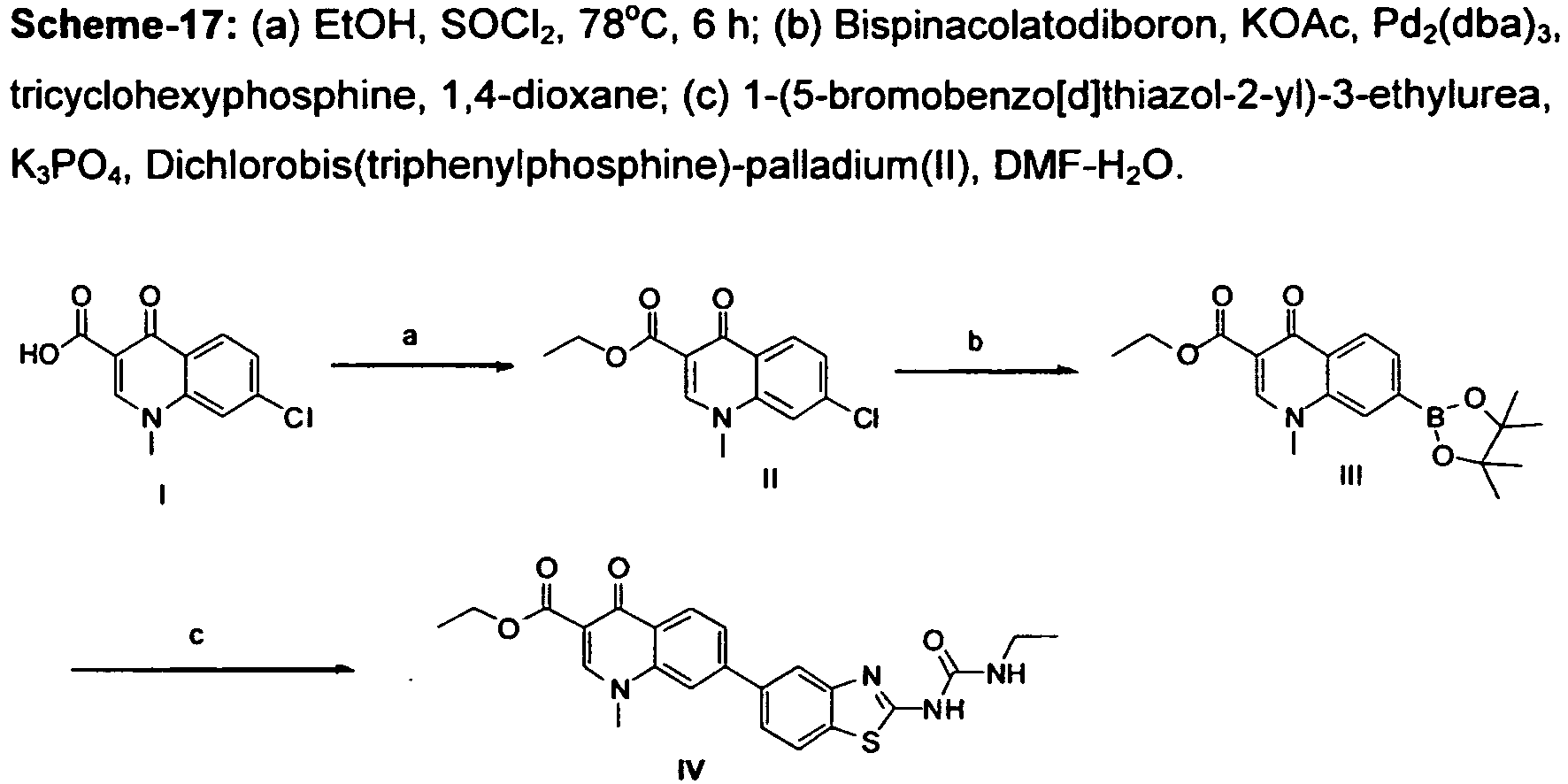
- A solution of 7-chloro-1-methyl-4-oxo-1,4-dihydro-quinoline-3-carboxylic acid (0.50 g, 2.10 mmol) and SOCl2 (2.0 mL) in EtOH (15.0 mL) was heated to 78°C for 6 h. After the completion of reaction (TLC monitoring), EtOH was distilled off, added water and extracted with EtOAc (3 x 70 mL). The combined organics was washed with saturated NaHCO3 solution, dried (Na2SO4), filtered and concentrated to obtain the desired product in quantitative yields.
- A solution of 7-chloro-1-methyl-4-oxo-1,4-dihydroquinoline-3-carboxylate II (0.70 g crude, 2.63 mmol), bispinacolatodiboron (0.74 g, 2.89 mmol) and KOAc (0.39 g, 3.95 mmol) in 1,4-dioxane (12.0 mL) was degassed by flushing with nitrogen for 15 min. Tricyclohexylphosphine (0.089 g, 0.32 mmol) and tris(dibenzyledineacetone) dipalladium (0) (0.12 g, 0.13 mmol) was then added to the reaction mixture, which was again degassed by nitrogen for 15 min. The resulting reaction mixture was heated to 90°C for 16 h. After the completion of the reaction (TLC monitoring), the reaction mixture was filtered through celite bed and the filtrate was concentrated to get the crude residue that was carried forward to the next step without further purification. MS: 358.10 (M+H)+.
- A solution of ethyl 1-methyl-4-oxo-7-(4,4,5,5-tetramethyl-1,3,2-dioxaborolan-2-yl)-1,4-dihydroquinoline-3-carboxylate III (0.60 g, 1.67 mmol), 1-(5-bromobenzo[d]thiazol-2-yl)-3-ethylurea (0.25 g, 0.84 mmol) and K3PO4 (0.36 g, 1.67 mmol) in DMF-H2O (7.5 mL, 2:1) was degassed by flushing with nitrogen for 15 min. [1,1'-Bis(diphenylphosphino)-ferrocene]dichloropalladium(II) (0.07 g, 0.084 mmol) was then added to the reaction mixture followed by degassing with nitrogen for another 15 min. The resulting reaction mixture was then heated to 80°C for 5 h. After the completion of the reaction (TLC monitoring), the reaction mixture was cooled to room temperature and poured onto ice-cold water followed by extraction with EtOAc (4 x 50 mL). The combined organics was washed with brine, dried (Na2SO4) filtered and concentrated under reduced pressure. The crude was then purified over silica gel (230-400 M, 7% MeOH-DCM) to obtain the desired product (0.002 g, negligible yield). 1H-NMR (400 MHz, DMSO-d6): δ 1.11 (t, J= 7.20 Hz, 3H), 1.21 (t, J= 7.20 Hz, 3H), 3.19 (m, 2H), 3.94 (s, 3H), 4.14 (m, 2H), 6.85 (br s, 1H), 6.99 (d, J= 8.0 Hz, 1H), 7.22 (d, J= 5.60 Hz, 1H), 7.36 (s, 1H), 7.77 (m, 3H), 8.65 (s, 1H) and 10.01 (br s, 1H). LCMS: 451.21 (M+H)+, 96.95%.


- To a solution of 5-bromo-2,4-difluoro aniline (1.0 g, 4.81 mmol) in acetone (25.0 mL) was added drop wise benzoyl isothiocyanate (0.71 mL, 5.29 mmol). The resulting reaction mixture was allowed to stir at room temperature for 30 min. After the completion of the reaction (TLC monitoring), the solvent was evaporated and the residue was washed with hexane and ether to get the title compound (1.70 g, quantitative yield) as a white solid. 1H-NMR (400 MHz, CDCl3): δ 7.02-7.06 (m, 1H), 7.56 (t, J= 8.0 Hz, 2H), 7.68 (t, J= 7.60 Hz, 1H), 7.91 (d, J= 7.60 Hz, 2H), 8.67 (t, J= 7.60 Hz, 1H). 9.15 (br s, 1H) and 12.65 (br s, 1H).
- To a solution of 1-benzoyl-3-(5-bromo-2,4-difluoro-phenyl)-thiourea II (1.70 g, 4.60 mmol) in THF (35.0 mL) was added a solution of NaOH (0.97 g, 24.25 mmol) in water (13.0 mL). The resulting reaction mixture was stirred at 70°C for 15 h. After the completion of the reaction (TLC monitoring), THF was evaporated, added water and extracted with EtOAc (3 x 50 mL). The combined organics was washed with brine and concentrated to obtain the desired compound (1.0 g, 83%). MS: 267.03 (M+H)+.
- To a solution of (5-bromo-2,4-difluoro-phenyl)-thiourea III (0.75 g, 2.80 mmol) in NMP (5.0 mL) was added NaH (0.17 g, 4.21 mmol, 60% suspension in mineral oil) portion wise. The reaction mixture was then heated at 130°C for 2 h. The reaction mixture was then poured onto crushed ice and extracted with EtOAc (3 x 50 mL). The combined organics was evaporated to get the crude residue that was purified over silica gel (100-200 M, 12% EtOAc-Hexane) to obtain the desired compound (0.36 g, 52%). 1H-NMR (400 MHz, DMSO-d6): δ 7.57 (d, J= 6.40 Hz, 1H), 7.66 (br s, 2H) and 7.79 (d, 8.80 Hz, 1H).
- To a solution of 5-bromo-6-fluoro-benzothiazol-2-ylamine IV (0.36 g, 1.45 mmol) in 1,4-dioxane (25.0 mL) was added ethyl isocyanate (0.69 mL, 8.74 mmol) and the resulting reaction mixture was heated at 80°C for 15 h. After the completion of the reaction (TLC monitoring) the solvent was evaporated. The residue thus obtained was stirred with water at 60°C for 5 h. The solution was then filtered and washed with ether to get the title compound (0.30 g, 69%). 1H-NMR (400 MHz, DMSO-d6): δ 1.08 (t, J= 6.80 Hz, 3H), 3.17 (m, 2H), 6.69 (br s, 1H), 7.92 (d, J= 6.40 Hz, 1H), 8.0 (d, J= 8.40 Hz, 1H) and 10.86 (br s, 1H).
- A solution of 1-(5-bromo-6-fluoro-benzothiazol-2-yl)-3-ethyl-urea V (0.10 g, 0.31 mmol), N-(5-(4,4,5,5-tetramethyl-1,3,2-dioxaborolan-2-yl)pyridin-2-yl)acetamide (0.17 g, 0.62 mmol) and K3PO4 (0.067 g, 0.31 mmol) in DMF-H2O (2.5 mL, 2:0.5) was degassed by flushing with nitrogen for 15 min. Dichlorobis(triphenylphosphine)-palladium(II) (0.022 g, 0.031 mmol) was then added to the reaction mixture followed by degassing with nitrogen for another 15 min. The resulting reaction mixture was then heated to 110°C for 2 h. After the completion of the reaction (TLC monitoring), the reaction mixture was cooled to room temperature and poured onto ice-cold water followed by extraction with EtOAc (3 x 25 mL). The combined organics was washed with brine, dried (Na2SO4), filtered and concentrated under reduced pressure. The crude was then purified over silica gel (100-200 M, 1.5% MeOH-DCM) and then through prep-HPLC to obtain the desired product (0.046 g, 39%). 1H-NMR (400 MHz, DMSO-d6): δ 1.08 (t, J= 7.20 Hz, 3H), 2.12 (s, 3H), 3.20 (quintet, J= 6.40 Hz, 2H), 6.77 (br s, 1H). 7.75 (d, J= 6.80 Hz, 1H). 7.93 (d, J= 10.40 Hz, 1H), 8.01 (d, J= 8.40 Hz, 1H), 8.18 (d, J= 8.80 Hz, 1H), 8.52 (s, 1H). 10.63 (br s, 1H) and 10.85 (brs. 1H). MS: 374.20 (M+H)+. Qualitative HPLC Purity (Acquity BEH C-18, 100 x 2.1 mm, 261 nm): 98.72% (Rt = 5.03 min).
- A solution of 1-(5-bromo-6-fluoro-benzothiazol-2-yl)-3-ethyl-urea V (0.10 g, 0.31 mmol), 1-(ethoxycarbonylmethyl)-1H-pyrazole-4-boronic acid, pinacol ester (0.18 g, 0.63 mmol) and K3PO4 (0.067 g, 0.31 mmol) in DMF-H2O (2.5 mL, 2:0.5) was degassed by flushing with nitrogen for 15 min. Dichlorobis(triphenylphosphine)-palladium(II) (0.022 g, 0.031 mmol) was then added to the reaction mixture followed by degassing with nitrogen for another 15 min. The resulting reaction mixture was then heated to 110°C for 2 h. After the completion of the reaction (TLC monitoring), the reaction mixture was cooled to room temperature and poured onto ice-cold water followed by extraction with EtOAc (2 x 50 mL). The combined organics was washed with brine, dried (Na2SO4), filtered and concentrated under reduced pressure. The crude was then purified over silica gel (100-200 M, 1.0% MeOH-DCM) to obtain the desired product (0.024 g, 20%). 1H-NMR (400 MHz, DMSO-d6): δ 1.08 (t, J= 7.20 Hz, 3H), 1.22 (t, J= 7.20 Hz, 3H), 3.20 (m, 2H), 4.18 (q, J= 7.20 Hz, 2H), 5.12 (s, 2H), 6.69 (br s, 1H), 7.86 (d, J= 10.80 Hz, 1H), 7.94 (d, J= 6.40 Hz, 1H). 8.04 (s, 1H), 8.21 (d, J= 2.40 Hz, 1H) and 10.71 (br s, 1H). MS: 392.21 (M+H)+ Qualitative HPLC Purity (Acquity BEH C-18, 100 x 2.1 mm, 249 nm): 89.68% (Rt = 5.33 min).

- A solution of 4-hydroxy-6-methyl-2-pyrone (0.50 g, 3.96 mmol), P2O5 (1.41 g, 9.91 mmol) and TBAB (1.53 g, 4.76 mmol) in toluene (25 mL) was heated to 100°C for 1.50 h. After the completion of reaction (TLC monitoring), the reaction mixture was cooled to room temperature, added water and extracted the organic layer. The aqueous layer was re-extracted with toluene (2 x 20 mL). The combined organics was washed saturated NaHCO3 solution followed by brine wash, dried (Na2SO4), filtered and concentrated to obtain the desired product (0.57 g, 76%). MS: 189.10 (M+H)+.
- A solution of 4-bromo-6-methyl-2H-pyran-2-one II (0.15 g, 0.79 mmol), bispinacolatodiboron (0.22 g, 0.87 mmol) and KOAc (0.12 g, 1.19 mmol) in 1,4-dioxane (10.0 mL) was degassed by flushing with nitrogen for 15 min. Tricyclohexylphosphine (0.027 g, 0.10 mmol) and tris(dibenzyledineacetone) dipalladium (0) (0.036 g, 0.04 mmol) was then added to the reaction mixture, which was again degassed by nitrogen for 15 min. The resulting reaction mixture was heated to 80°C for 2 h. After the completion of the reaction (TLC monitoring), the - reaction mixture was filtered through celite bed and the filtrate was concentrated to get the crude residue that was carried forward to the next step without further purification. MS: 237.10 (M+H)+.
- A solution of 1-(5-bromo-6-fluoro-benzothiazol-2-yl)-3-ethyl-urea (0.08 g, 0.25 mmol), 6-methyl-4-(4,4,5,5-tetramethyl-1,3,2-dioxaborolan-2-yl)-2H-pyran-2-one (0.118 g, 0.50 mmol) and K3PO4 (0.064 g, 0.30 mmol) in DMF-H2O (2.5 mL, 2:0.5) was degassed by flushing with nitrogen for 15 min. Dichlorobis(triphenylphosphine)-palladium(II) (0.018 g, 0.03 mmol) was then added to the reaction mixture followed by degassing with nitrogen for another 15 min. The resulting reaction mixture was then heated to 110°C for 2 h. After the completion of the reaction (TLC monitoring), the reaction mixture was cooled to room temperature and poured onto ice-cold water followed by extraction with EtOAc (3 x 20 mL). The combined organics was washed with brine, dried (Na2SO4) filtered and concentrated under reduced pressure. The crude was then purified over silica gel (100-200 M, 1.0% MeOH-DCM) and then through prep-HPLC to obtain the desired product (0.026 g, 30%). 1H-NMR (400 MHz, DMSO-d6): δ 1.08 (t, J= 7.20 Hz, 3H), 2.29 (s, 3H), 3.19 (m, 2H), 6.40 (s, 1H), 6.59 (s, 1H), 6.91 (br s, 1H), 7.80 (d, J= 6.40 Hz, 1H), 7.97 (d, J= 10.80 Hz, 1H) and 10.33 (br s, 1H). MS: 348.07 (M+H)+. Qualitative HPLC Purity (Acquity BEH C-18, 100 x 2.1 mm, 237 nm): 98.50% (Rt = 5.43 min).


- To a solution of 5-bromo-2-(piperazin-1-yl)pyrimidine (0.20 g, 0.83 mmol) in acetone (10.0 mL) was added K2CO3 (0.58 g, 4.17 mmol) followed by the addition of 2-bromoethanol (0.01 g, 1.66 mmol). The resulting reaction mixture was heated to reflux for 3 h. After the completion of reaction (TLC monitoring), the reaction mixture was cooled, added water and extracted with EtOAc (2 x 100 mL). The combined organics was washed with brine, dried (Na2SO4), filtered and concentrated. The crude residue was purified over silica gel (100-200 M, 2%MeOH-DCM) to obtain the desired product (0.11 g, 47%). MS: 287.10 (M+H)+.
- A solution of 2-(4-(5-bromopyrimidin-2-yl)piperazin-1-yl)ethanol II (0.10 g, 0.35 mmol), bispinacolatodiboron (0.098 g, 0.39 mmol) and KOAc (0.052 g, 0.53 mmol) in 1,4-dioxane (10.0 mL) was degassed by flushing with nitrogen for 15 min. Tricyclohexylphosphine (0.012 g, 0.043 mmol) and tris(dibenzyledineacetone) dipalladium (0) (0.016 g, 0.017 mmol) was then added to the reaction mixture, which was again degassed by nitrogen for 15 min. The resulting reaction mixture was heated to 95-100°C for 3 h. After the completion of the reaction (TLC monitoring), the reaction mixture was filtered through celite bed and the filtrate was concentrated to get the crude residue that was carried forward to the next step without further purification. MS: 335.21 (M+H)+.
- A solution of 1-(5-bromo-6-fluoro-benzothiazol-2-yl)-3-ethyl-urea (0.08 g, 0.25 mmol), 2-(4-(5-(4,4,5,5-tetramethyl-1,3,2-dioxaborolan-2-yl)pyrimidin-2-yl)piperazin-1-yl)ethanol (0.10 g, 0.30 mmol) and K3PO4 (0.08 g, 0.38 mmol) in DMF-H2O (3.0 mL, 2:1) was degassed by flushing with nitrogen for 15 min. Dichlorobis(triphenylphosphine)-palladium(II) (0.009 g, 0.013 mmol) was then added to the reaction mixture followed by degassing with nitrogen for another 15 min. The resulting reaction mixture was then heated to 95-100°C for 16 h. After the completion of the reaction (TLC monitoring), the reaction mixture was cooled to room temperature and poured onto ice-cold water followed by extraction with DCM (2 x 100 mL). The combined organics was washed with brine, dried (Na2SO4), filtered and concentrated under reduced pressure. The crude was then purified over neutral alumina (4.0% MeOH-DCM) to obtain the desired product (0.070 g, 63%). 1H-NMR (400 MHz, DMSO-d6): δ 1.08 (t, J= 7.20 Hz, 3H), 2.45 (m, 2H), 3.20 (m, 2H), 3.34 (m, 4H), 3.55 (q, J= 5.60 Hz, 2H), 3.78 (br s, 4H), 4.45 (t, J= 5.60 Hz, 1H), 6.71 (br s, 1H), 7.75 (d, J= 6.80 Hz, 1H), 7.92 (d, J= 10.40 Hz, 1H), 8.64 (s, 2H) and 10.75 (br s, 1H). MS: 446.14 (M+H)+. Qualitative HPLC Purity (Acquity BEH C-18, 100 x 2.1 mm, 228 nm): 95.88% (Rt = 4.82 min).

- A solution of 5-bromo-2-(4-Boc-piperazin-1-yl)pyrimidine (0.10 g, 0.29 mmol), bispinacolatodiboron (0.081 g, 0.32 mmol) and KOAc (0.035 g, 0.43 mmol) in 1,4-dioxane (5.0 mL) was degassed by flushing with nitrogen for 15 min. Tricyclohexylphosphine (0.010 g, 0.035 mmol) and tris(dibenzyledineacetone) dipalladium (0) (0.013 g, 0.014 mmol) was then added to the reaction mixture, which was again degassed by nitrogen for 15 min. The resulting reaction mixture was heated to 100°C for 5 h. After the completion of the reaction (TLC monitoring), the reaction mixture was filtered through celite bed and the filtrate was concentrated to get the crude residue that was carried forward to the next step without further purification. MS: 391.21 (M+H)+.
- A solution of 1-(5-bromo-6-fluoro-benzothiazol-2-yl)-3-ethyl-urea (0.05 g, 0.15 mmol), tert-butyl 4-(5-(4,4,5,5-tetramethyl-1,3,2-dioxaborolan-2-yl)pyrimidin-2-yl)piperazine-1-carboxylate (0.12 g, 0.31 mmol) and K3PO4 (0.13 g, 0.61 mmol) in DMF-H2O (5.0 mL, 3:2) was degassed by flushing with nitrogen for 15 min. Dichlorobis(triphenylphosphine)-palladium(II) (0.021 g, 0.03 mmol) was then added to the reaction mixture followed by degassing with nitrogen for another 15 min. The resulting reaction mixture was then heated to 95-100°C for 2 h. After the completion of the reaction (TLC monitoring), the reaction mixture was cooled to room temperature and poured onto ice-cold water followed by extraction with EtOAc (2 x 50 mL). The combined organics was washed with brine, dried (Na2SO4), filtered and concentrated under reduced pressure. The crude was then purified over silica gel (100-200 M, 1.60% MeOH-DCM) to obtain the desired product (0.015 g, 20%). 1H-NMR (400 MHz, DMSO-d6): δ 1.08 (t, J= 7.20 Hz, 3H), 1.43 (s, 9H), 3.20 (m, 2H), 3.42 (br s, 4H), 3.79 (br s, 4H), 6.71 (br s, 1H), 7.76 (d, J= 6.80 Hz, 1H), 7.92 (d, J= 10.40 Hz, 1H), 8.62 (s, 2H) and 10.74 (br s, 1H). MS: 502.27 (M+H)+. Qualitative HPLC Purity (Acquity BEH C-18, 100 x 2.1 mm, 272 nm): 99.21% (Rt = 6.51 min).
- A solution of tert-butyl 4-(5-(2-(3-ethylureido)-6-fluorobenzo[d]thiazol-5-yl)pyrimidin-2-yl)piperazine-1-carboxylate (0.010 g, 0.02 mmol) in 4.0 M HCl-1,4-dioxane (5.0 mL) was stirred for 30 min. After the completion of reaction (TLC monitoring), the solvent was evaporated and the residue was triturated with ether to obtain the desired product (0.005 g, 62%). 1H-NMR (400 MHz, DMSO-d6): δ 1.08 (t, J= 7.20 Hz, 3H), 3.18 (m, 2H), 3.20 (br s, 4H), 4.0 (br s, 4H), 6.89 (br s, 1H), 7.77 (d, J= 6.80 Hz, 1H), 7.93 (d, J= 10.40 Hz, 1H), 8.68 (s, 2H), 9.05 (br s, 1H) and 10.83 (br s, 1H). MS: 402.22 (M+H)+. Qualitative HPLC Purity (Acquity BEH C-18, 100 x 2.1 mm, 267 nm): 98.22% (Rt = 4.47 min).

- A solution of methyl-1-(5-bromopyrimidin-2-yl)piperidine-4-carboxylate (0.32 g, 1.05 mmol), bispinacolatodiboron (0.32 g, 1.25 mmol) and KOAc (0.16 g, 1.60 mmol) in 1,4-dioxane (5.0 mL) was degassed by flushing with nitrogen for 15 min. Tricyclohexylphosphine (0.036 g, 0.13 mmol) and tris(dibenzyledineacetone) dipalladium (0) (0.05 g, 0.053 mmol) was then added to the reaction mixture, which was again degassed by nitrogen for 15 min. The resulting reaction mixture was heated to 100°C for 4 h. After the completion of the reaction (TLC monitoring), the reaction mixture was filtered through celite bed and the filtrate was concentrated to get the crude residue that was carried forward to the next step without further purification. MS: 348.21 (M+H)+.
- A solution of methyl-1-(5-bromopyrimidin-2-yl)piperidine-3-carboxylate (0.10 g, 0.33 mmol), bispinacolatodiboron (0.102 g, 0.39 mmol) and KOAc (0.05 g, 0.49 mmol) in 1,4-dioxane (5.0 mL) was degassed by flushing with nitrogen for 15 min. Tricyclohexylphosphine (0.012 g, 0.04 mmol) and tris(dibenzyledineacetone) dipalladium (0) (0.016 g, 0.020 mmol) was then added to the reaction mixture, which was again degassed by nitrogen for 15 min. The resulting reaction mixture was heated to 100°C for 5 h. After the completion of the reaction (TLC monitoring), the reaction mixture was filtered through celite bed and the filtrate was concentrated to get the crude residue that was carried forward to the next step without further purification. MS: 348.21 (M+H)+.
- A solution of 1-(5-bromo-6-fluoro-benzothiazol-2-yl)-3-ethyl-urea (0.20 g, 0.63 mmol), methyl 1-(5-(4,4,5,5-tetramethyl-1,3,2-dioxaborolan-2-yl)pyrimidin-2-yl)piperidine-4-carboxylate (0.33 g, 0.94 mmol) and K3PO4 (0.27 g, 1.26 mmol) in DMF-H2O (7.0 mL, 5:2) was degassed by flushing with nitrogen for 15 min. Dichlorobis(triphenylphosphine)-palladium(II) (0.044 g, 0.06 mmol) was then added to the reaction mixture followed by degassing with nitrogen for another 15 min. The resulting reaction mixture was then heated to 100°C for 2 h. After the completion of the reaction (TLC monitoring), the reaction mixture was cooled to room temperature and poured onto ice-cold water followed by extraction with EtOAc (2 x 50 mL). The combined organics was washed with brine, dried (Na2SO4), filtered and concentrated under reduced pressure. The crude was then purified over silica gel (100-200 M, 5% MeOH-DCM) to obtain the desired product (0.12 g, 42%). 1H-NMR (400 MHz, DMSO-d6): δ 1.19 (t, J= 7.20 Hz, 3H), 1.56 (m, 2H), 1.94 (m, 2H), 2.73 (s, 1H), 3.33 (m, 4H), 3.62 (s, 3H), 4.59 (s, 2H), 6.70 (br s, 1H), 7.75 (d, J= 6.80 Hz, 1H), 7.91 (d, J=10.40 Hz, 1H), 8.59 (s, 2H) and 10.74 (br s, 1H). MS: 459.14 (M+H+). Qualitative HPLC Purity (Acquity BEH C-18, 2.1 x 100 mm, 229 nm): 97.90% (Rt = 6.14 min).
- To a solution of methyl 1-(5-(2-(3-ethylureido)-6-fluorobenzo[d]thiazol-5-yl)pyrimidin-2-yl)piperidine-4-carboxylate (0.05 g, 0.11 mmol) in THF (3.0 mL) was added a solution of LiOH.H2O (0.014 g, 0.33 mmol) in H2O (1.0 mL). The resulting reaction mixture was heated to 60°C for 16 h. After the completion of reaction (TLC monitoring), THF was distilled off, added water and extracted with EtOAc (2 x 25 mL) that was later on discarded. The aqueous layer was acidified with 1 N HCl till pH 5-6 and then extracted with EtOAc (2 x 25 mL). The combined organics was washed with brine, dried (Na2SO4), filtered and concentrated to obtain the desired product (0.03 g, 62%). 1H-NMR (400 MHz, DMSO-d6): δ 1.10 (t, J= 7.20 Hz, 3H), 1.55 (m, 2H), 1.92 (m, 2H), 2.57 (m, 1H), 3.20 (m, 4H), 4.58 (m, 2H), 6.84 (br s, 1H), 7.75 (d, J= 7.20 Hz, 1H), 7.91 (d, J=10.40 Hz, 1H), 8.59 (s, 2H), 10.84 (br s, 1H) and 12.30 (br s, 1H). MS: 443.07 (M-H)+. Qualitative HPLC Purity (Acquity BEH C-18, 2.1 x 100 mm, 229 nm): 96.24% (Rt = 4.34 min).
- A solution of 1-(5-bromo-6-fluoro-benzothiazol-2-yl)-3-ethyl-urea (0.08 g, 0.25 mmol), methyl 1-(5-(4,4,5,5-tetramethyl-1,3,2-dioxaborolan-2-yl)pyrimidin-2-yl)piperidine-3-carboxylate (0.13 g, 0.37 mmol) and K3PO4 (0.106 g, 0.50 mmol) in DMF-H2O (7.0 mL, 5:2) was degassed by flushing with nitrogen for 15 min. Dichlorobis(triphenylphosphine)-palladium(II) (0.018 g, 0.025 mmol) was then added to the reaction mixture followed by degassing with nitrogen for another 15 min. The resulting reaction mixture was then heated to 85°C for 7 h. After the completion of the reaction (TLC monitoring), the reaction mixture was cooled to room temperature and poured onto ice-cold water followed by extraction with EtOAc (2 x 50 mL). The combined organics was washed with brine, dried (Na2SO4), filtered and concentrated under reduced pressure. The crude was then purified over silica gel (100-200 M, 3% MeOH-DCM) to obtain the desired product (0.041 g, 36%). 1H-NMR (400 MHz, DMSO-d6): δ 1.11 (t, J= 7.20 Hz, 3H), 1.50 (m, 1H), 1.74 (m, 2H), 2.03 (m, 1H), 2.57 (m, 1H), 3.08-3.32 (m, 4H), 3.63 (s, 3H), 4.48 (d, J= 12.40 Hz, 1H), 4.74 (dd, J= 3.60 and 13.20 Hz, 1H), 6.70 (br s, 1H), 7.75 (d, J= 6.80 Hz, 1H), 7.92 (d, J=10.40 Hz, 1H), 8.59 (s, 2H) and 10.74 (br s, 1H). MS: 459.14 (M+H+). Qualitative HPLC Purity (Acquity BEH C-18, 2.1 x 100 mm, 229 nm): 98.31% (Rt = 6.26 min).
- To a solution of methyl 1-(5-(2-(3-ethylureido)-6-fluorobenzo[d]thiazol-5-yl)pyrimidin-2-yl)piperidine-3-carboxylate (0.05 g, 0.11 mmol) in THF (3.0 mL) was added a solution of LiOH.H2O (0.014 g, 0.33 mmol) in H2O (1.0 mL). The resulting reaction mixture was heated to 60°C for 16 h. After the completion of reaction (TLC monitoring), THF was distilled off, added water and extracted with EtOAc (2 x 25 mL) that was later on discarded. The aqueous layer was acidified with 1N HCl till pH 5-6 and then extracted with EtOAc (2 x 25 mL). The combined organics was washed with brine, dried (Na2SO4), filtered and concentrated to obtain the desired product (0.03 g, 62%). 1H-NMR (400 MHz, DMSO-d6): δ 1.11 (t, J= 7.20 Hz, 3H), 1.49 (m, 1H), 1.74 (m, 2H), 2.02 (m, 1H), 2.41 (m, 1H), 3.04-3.21 (m, 4H), 4.51 (d, J= 13.60 Hz, 1H), 4.71 (dd, J= 3.20 and 12.80 Hz, 1H), 6.77 (br s, 1H), 7.75 (d, J= 6.80 Hz, 1H), 7.91 (d, J=10.40 Hz, 1H), 8.60 (s, 2H), 10.74 (br s, 1H) and 12.50 (br s, 1H). MS: 445.12 (M+H+). Qualitative HPLC Purity (Acquity BEH C-18, 2.1 x 100 mm, 229 nm): 98.50% (Rt = 4.42 min).

- To a solution of 2-(4-bromo-1H-pyrazol-1-yl)propanoic acid (0.20 g, 0.91 mmol) in MeOH (4.0 mL) was added conc H2SO4 (0.20 mL) and the resulting reaction mixture was heated to 68°C for 2 h. After the completion of reaction (TLC monitoring), the solvent was evaporated and the residue was basified with saturated NaHCO3 solution followed by extraction with EtOAc (3 x 25.0 mL). The combined organics was dried (Na2So4), filtered and concentrated to obtain the desired product (0.175 g, 82%).
- A solution of methyl 2-(4-bromo-1H-pyrazol-1-yl)propanoate (0.17 g, 0.73 mmol), bispinacolatodiboron (0.203 g, 0.80 mmol) and KOAc (0.107 g, 1.09 mmol) in 1,4-dioxane (7.0 mL) was degassed by flushing with nitrogen for 15 min. Tricyclohexylphosphine (0.024 g, 0.087 mmol) and tris(dibenzyledineacetone) dipalladium (0) (0.038 g, 0.036 mmol) was then added to the reaction mixture, which was again degassed by nitrogen for 15 min. The resulting reaction mixture was heated to 100°C for 2 h. After the completion of the reaction (TLC monitoring), the reaction mixture was filtered through celite bed and the filtrate was concentrated to get the crude residue that was carried forward to the next step without further purification. MS: 281.10 (M+H)+.
- A solution of 1-(5-bromo-6-fluoro-benzothiazol-2-yl)-3-ethyl-urea (0.094 g, 0.29 mmol), methyl 2-(4-(4,4,5,5-tetramethyl-1,3,2-dioxaborolan-2-yl)-1H-pyrazol-1-yl)propanoate (0.164 g, 0.58 mmol) and K3PO4 (0.125 g, 0.59 mmol) in DMF-H2O (7.0 mL, 5:2) was degassed by flushing with nitrogen for 15 min. Dichlorobis(triphenylphosphine)-palladium(II) (0.020 g, 0.03 mmol) was then added to the reaction mixture followed by degassing with nitrogen for another 15 min. The resulting reaction mixture was then heated to 90°C for 4 h. After the completion of the reaction (TLC monitoring), the reaction mixture was cooled to room temperature and poured onto ice-cold water followed by extraction with EtOAc (2 x 50 mL). The combined organics was washed with brine, dried (Na2SO4), filtered and concentrated under reduced pressure. The crude was then purified over silica gel (100-200 M, 1.50% MeOH-DCM) to obtain the desired product (0.025 g, 22%). 1H-NMR (400 MHz, DMSO-d6): δ 1.10 (t, J= 7.20 Hz, 3H), 1.71 (d, J=7.20 Hz, 3H), 3.20 (m, 2H), 3.66 (s, 3H), 5.38 (q, J=7.20 Hz, 1H), 6.71 (br s, 1H), 7.85 (d, J= 10.80 Hz, 1H), 7.95 (d, J=6.40 Hz, 1H), 8.02 (s, 1H), 8.30 (s, 1H) and 10.73 (br s, 1H). MS: 390.11 (M-H)+. Qualitative HPLC Purity (Acquity BEH C-18, 2.1 x 100 mm, 249 nm): 98.36% (Rt = 5.32 min).

- To a solution of 3-bromo-1-H-pyrrolo[2,3-b]pyridine (0.10 g, 0.50 mmol) in THF (4.0 mL) under nitrogen atmosphere was added DMAP (0.006 g, 0.06 mmol). The resulting reaction mixture was cooled to -20°C followed by addition of Boc anhydride (122 µL, 0.56 mmol). The reaction mixture ws then allowed to warm upto room temperature and stirred for 2 h. After the completion of reaction (TLC monitoring), water (20 mL) was added to the reaction mixture and then extracted with EtOAc (3 x 50 mL). The combined organics was dried (Na2SO4), filtered and concentrated. The residue was purified over silica gel (60-120 M, 5% EtOAc-Hexane) to obtain the desired product as oily mass (0.12 g, 79%).
- A solution of tert-butyl 3-bromo-1H-pyrrolo[2,3-b]pyridine-1-carboxylate (0.115 g, 0.38 mmol), bispinacolatodiboron (0.108 g, 0.42 mmol) and KOAc (0.056 g, 0.58 mmol) in 1,4-dioxane (4.0 mL) was degassed by flushing with nitrogen for 15 min. Tricyclohexylphosphine (0.013 g, 0.046 mmol) and tris(dibenzyledineacetone) dipalladium (0) (0.021 g, 0.019 mmol) was then added to the reaction mixture, which was again degassed by nitrogen for 15 min. The resulting reaction mixture was heated to 100°C for 6 h. After the completion of the reaction (TLC monitoring), the reaction mixture was filtered through celite bed and the filtrate was concentrated to get the crude residue that was carried forward to the next step without further purification. MS: 345.10 (M+H)+.
- A solution of 1-(5-bromo-6-fluoro-benzothiazol-2-yl)-3-ethyl-urea (0.049 g, 0.15 mmol), tert-butyl 3-(4,4,5,5-tetramethyl-1,3,2-dioxaborolan-2-yl)-1H-pyrrolo[2,3-b]pyridine-1-carboxylate (0.106 g, 0.31 mmol) and K3PO4 (0.065 g, 0.31 mmol) in DMF-H2O (7.0 mL, 5:2) was degassed by flushing with nitrogen for 15 min. Dichlorobis(triphenylphosphine)-palladium(II) (0.011 g, 0.015 mmol) was then added to the reaction mixture followed by degassing with nitrogen for another 15 min. The resulting reaction mixture was then heated to 95°C for 4 h. After the completion of the reaction (TLC monitoring), the reaction mixture was cooled to room temperature and poured onto ice-cold water followed by extraction with EtOAc (2 x 50 mL). The combined organics was washed with brine, dried (Na2SO4), filtered and concentrated under reduced pressure. The crude was then purified over silica gel (100-200 M, 2.50% MeOH-DCM) to obtain the desired de-Boc product (0.016 g, 29%). 1H NMR (DMSO-d6, 400 MHz): δ 1.11 (t, J= 7.20 Hz, 3H), 3.20 (m, 2H), 6.79 (br s, 1H), 7.17 (m, 1H), 7.83 (m, 2H), 7.93 (m, 1H), 8.08 (d, J=8.00 Hz, 1H), 8.29 (d, J=1.20 Hz, 1H), 10.80 (br s, 1H) and 12.03 (br s, 1H). MS: 356.13 (M+H+). Qualitative HPLC Purity (Acquity BEH C-18, 2.1 x 100 mm, 223 nm): 90.90% (Rt = 5.17 min).

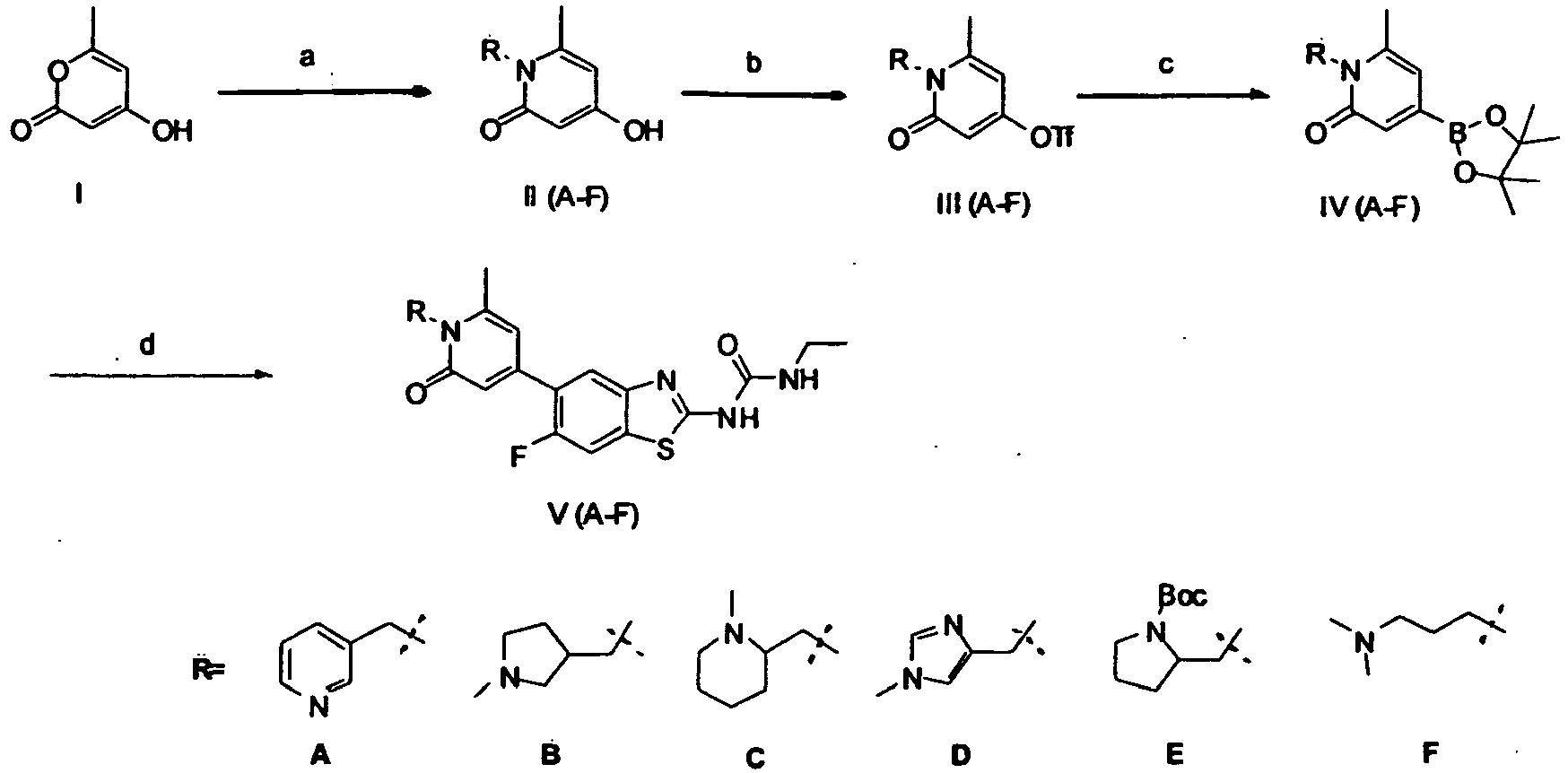
- A mixture of 6-methyl-4-hydroxy pyranone (1.0 eq) and primary amine (1.20 eq) in water (5 times dilution by weight) was heated to 80°C for 16 h. After the completion of reaction (TLC monitoring) the precipitated solid was filtered, washed with ether and dried under vacuum to obtain the desired product (around 75% yield).
- To a solution of cyclic amide II (1.0 eq) in DMF was added DIPEA (1.15 eq) and the resulting mixture was stirred at room temperature for 15 min followed by addition of N-phenylbis(trifluoromethanesulfonimide) (1.20 eq). The resulting reaction mixture was continued to stir at room temperature for 2 h. After the completion of reaction (TLC monitoring), the reaction mixture was poured onto the ice-cold water and extracted with EtOAc (3 x 100 mL). The combined organics was washed with brine, dried over Na2SO4, filtered and concentrated under reduced pressure to obtain the desired product that was carried forward to the next step without further purification.
- To a solution of triflate III (1.0 eq) in 1,4-dioxane (10 times dilution by weight) was added bis(pinacolato)diboron (2.0 eq) followed by KOAc (3.0 eq). The resulting solution was degassed by nitrogen for 15 min followed by addition of tricyclohexylphosphine (0.15 eq) and tris(dibenzylideneacetone)dipalladium (0) (0.10 eq). The resulting reaction mixture was again degassed by nitrogen for 15 min and then heated to 80°C for 2 h. After the completion of reaction (TLC monitoring), the reaction mixture was diluted by EtOAc and filtered through celite bed bed. The filtrate was concentrated and used as such for the next step without further purification.
- A solution of 1-(5-bromo-6-fluoro-benzothiazol-2-yl)-3-ethyl-urea (0.30 g, 0.94 mmol), 6-methyl-1-(pyridin-3-ylmethyl)-4-(4,4, 5,5-tetramethyl-1, 3,2-dioxaborolan-2-yl)pyrid in-2(1H)-one IV-A (0.47 g, 1.43 mmol) and K3PO4 (0.40 g, 1.88 mmol) in DMF-H2O (14.0 mL, 5:2) was degassed by flushing with nitrogen for 15 min. Dichlorobis(triphenylphosphine)-palladium(II) (0.065 g, 0.090 mmol) was then added to the reaction mixture followed by degassing with nitrogen for another 15 min. The resulting reaction mixture was then heated to 80°C for 3 h. After the completion of the reaction (TLC monitoring), the reaction mixture was cooled to room temperature and poured onto ice-cold water followed by extraction with EtOAc (2 x 100 mL). The combined organics was washed with brine, dried (Na2SO4), filtered and concentrated under reduced pressure. The crude was then purified over silica gel (100-200 M, 7.0% MeOH-DCM) to obtain the desired product (0.25 g, 61%). 1H-NMR (400 MHz, DMSO-d6): δ 1.08 (t, J= 7.20 Hz, 3H), 2.37 (s, 3H), 3.20 (m, 2H), 5.34 (s, 2H), 6.48 (s, 1H), 6.58 (s, 1H), 6.70 (br s, 1H), 7.38 (m, 1H), 7.59 (d, J= 8.0 Hz, 1H), 7.77 (d, J= 6.40 Hz, 1H), 7.95 (d, J= 10.80 Hz, 1H), 8.50 (s, 2H) and 10.87 (br s, 1H). MS: 438.07 (M+H)+. Qualitative HPLC Purity (Acquity BEH C-18, 100 x 2.1 mm, 240 nm): 99.13% (Rt = 4.94 min).
- A solution of 1-(5-bromo-6-fluoro-benzothiazol-2-yl)-3-ethyl-urea (0.066 g, 0.20 mmol), 6-methyl-1-((1-methylpyrrolidin-3-yl)methyl)-4-(4,4,5,5-tetramethyl-1,3,2-dioxaborolan-2-yl)pyridin-2(1H)-one IV-B (0.14 g, 0.41 mmol) and K3PO4 (0.088 g, 0.41 mmol) in DMF-H2O (8.0 mL, 5:3) was degassed by flushing with nitrogen for 15 min. Dichlorobis(triphenylphosphine)-palladium(II) (0.015 g, 0.02 mmol) was then added to the reaction mixture followed by degassing with nitrogen for another 15 min. The resulting reaction mixture was then heated to 80-90°C for 4-5 h. After the completion of the reaction (TLC monitoring), the reaction mixture was cooled to room temperature and poured onto ice-cold water followed by extraction with EtOAc (4 x 50 mL). The combined organics was washed with brine, dried (Na2SO4), filtered and concentrated under reduced pressure. The crude was then purified over silica gel (230-400 M, 8.0-10.0% MeOH-DCM) to obtain the desired product (0.005 g, 5%). 1H-NMR (400 MHz, DMSO-d6): δ 1.08 (t, J= 7.20 Hz, 3H), 1.50 (m, 2H), 1.87 (m, 1H), 2.23 (s, 3H), 2.31 (m, 2H), 2.49 (s, 3H), 2.62 (m, 1H), 3.19 (m, 4H), 3.97 (m, 1H), 6.40 (s, 1H), 6.45 (s, 1H), 6.91 (br s, 1H), 7.72 (d, J= 6.80 Hz, 1H), 7.93 (d, J= 10.80 Hz, 1H), and 11.0 (br s, 1H). MS: 441.15 (M+H)+. Qualitative HPLC Purity (Acquity BEH C-18, 100 x 2.1 mm, 240 nm): 85.59% (Rt = 4.45 min).
- A solution of 1-(5-bromo-6-fluoro-benzothiazol-2-yl)-3-ethyl-urea (0.075 g, 0.24 mmol), 6-methyl-1-((1-methylpiperidin-2-yl)methyl)-4-(4,4,5,5-tetramethyl-1,3,2-dioxaborolan-2-yl)pyridin-2(1H)-one IV-C (0.164 g, 0.47 mmol) and K3PO4 (0.10 g, 0.47 mmol) in DMF-H2O (8.0 mL, 5:1) was degassed by flushing with nitrogen for 15 min. Dichlorobis(triphenylphosphine)-palladium(II) (0.016 g, 0.023 mmol) was then added to the reaction mixture followed by degassing with nitrogen for another 15 min. The resulting reaction mixture was then heated to 90°C for 2 h. After the completion of the reaction (TLC monitoring), the reaction mixture was cooled to room temperature and poured onto ice-cold water followed by extraction with EtOAc (4 x 50 mL). The combined organics was washed with brine, dried (Na2SO4), filtered and concentrated under reduced pressure. The crude was then purified over silica gel (230-400 M, 7.0-8.0% MeOH-DCM) to obtain the desired product (0.044 g, 41%). 1H-NMR (400 MHz, DMSO-d6): δ 1.08 (t, J= 7.20 Hz, 3H), 1.21 (m, 2H), 1.33 (m, 2H), 1.52 (m, 2H), 1.64 (m, 1H), 2.47 (s, 3H), 2.94 (m, 1H), 3.20 (m, 3H), 3.30 (s, 3H), 4.24 (m, 2H), 6.44 (s, 1H), 6.47 (s, 1H), 6.76 (br s, 1H), 7.73 (d, J= 6.40 Hz, 1H), 7.94 (d, J= 10.80 Hz, 1H) and 10.89 (br s, 1H). MS: 458.13 (M+H)+. Qualitative HPLC Purity (Acquity BEH C-18, 100 x 2.1 mm, 240 nm): 97.87% (Rt = 4.77 min).
- A solution of 1-(5-bromo-6-fluoro-benzothiazol-2-yl)-3-ethyl-urea (0.077 g, 0.24 mmol), 6-methyl-1-((1-methyl-1H-imidazol-4-yl)methyl)-4-(4,4,5,5-tetramethyl-1,3,2-dioxaborolan-2-yl)pyridin-2(1H)-one IV-D (0.16 g, 0.48 mmol) and K3PO4 (0.103 g, 0.48 mmol) in DMF-H2O (4.0 mL, 3:1) was degassed by flushing with nitrogen for 15 min. Dichlorobis(triphenylphosphine)-palladium(II) (0.017 g, 0.024 mmol) was then added to the reaction mixture followed by degassing with nitrogen for another 15 min. The resulting reaction mixture was then heated to 90°C for 2 h. After the completion of the reaction (TLC monitoring), the reaction mixture was cooled to room temperature and poured onto ice-cold water followed by extraction with EtOAc (2 x 20 mL). The combined organics was washed with brine, dried (Na2SO4), filtered and concentrated under reduced pressure. The crude was then purified over silica gel (230-400 M, 4.0% MeOH-DCM) to obtain the desired product (0.019 g, 56%). 1H-NMR (400 MHz, DMSO-d6): δ 1.08 (t, J= 7.20 Hz, 3H), 2.63 (s, 3H), 3.18 (m, 2H), 3.59 (s, 3H), 5.06 (s, 2H), 6.36 (s, 1H), 6.43 (s, 1H), 6.69 (br s, 1H), 7.01 (br s, 1H), 7.48 (br s, 1H), 7.70 (d, J= 6.80 Hz, 1H), 7.92 (d, J= 10.40 Hz, 1H) and 10.80 (br s, 1H). MS: 441.26 (M+H)+. Qualitative HPLC Purity (Acquity BEH C-18, 100 x 2.1 mm, 240 nm): 98.35% (Rt = 4.76 min).
- A solution of 1-(5-bromo-6-fluoro-benzothiazol-2-yl)-3-ethyl-urea (0.07 g, 0.22 mmol), tert-butyl 2-((6-methyl-2-oxo-4-(4,4,5,5-tetramethyl-1,3,2-dioxaborolan-2-yl)pyridin-1(2H)-yl)methyl)pyrrolidine-1-carboxylate IV-E (0.184 g, 0.44 mmol) and K3PO4 (0.094 g, 0.44 mmol) in DMF-H2O (5.0 mL, 3:2) was degassed by flushing with nitrogen for 15 min. Dichlorobis(triphenylphosphine)-palladium(II) (0.014 g, 0.02 mmol) was then added to the reaction mixture followed by degassing with nitrogen for another 15 min. The resulting reaction mixture was then heated to 80°C for 2 h. After the completion of the reaction (TLC monitoring), the reaction mixture was cooled to room temperature and poured onto ice-cold water followed by extraction with EtOAc (2 x 25 mL). The combined organics was washed with brine, dried (Na2SO4), filtered and concentrated under reduced pressure. The crude was then purified over silica gel (100-200 M, 5.0% MeOH-DCM) to obtain the desired product (0.02 g, 17%). 1H-NMR (400 MHz, DMSO-d6): δ 1.08 (t, J= 7.20 Hz, 3H), 1.23 (s, 9H), 1.74-1.85 (m, 4H), 2.02 (m, 1H), 2.41 (s, 3H), 3.20 (m, 2H), 3.89 (m, 1H), 4.03 (m, 1H), 4.21 (br s, 1H), 4.33 (br s, 1H), 6.39-6.45 (m, 2H), 6.70 (br s, 1H), 7.67 (d, J= 6.80 Hz, 1H), 7.93 (d, J= 10.40 Hz, 1H) and 10.82 (br s, 1H). MS: 530.21 (M+H)+. Qualitative HPLC Purity (Acquity BEH C-18, 100 x 2.1 mm, 259 nm): 97.62% (Rt = 5.73 min).
- A solution of 1-(5-bromo-6-fluoro-benzothiazol-2-yl)-3-ethyl-urea (0.08 g, 0.25 mmol), 1-(3-(dimethylamino)propyl)-6-methyl-4-(4,4,5,5-tetramethyl-1,3,2-dioxaborolan-2-yl)pyridin-2(1H)-one IV-F (0.16 g, 0.50 mmol) and K3PO4 (0.106 g, 0.50 mmol) in DMF-H2O (7.0 mL, 4:3) was degassed by flushing with nitrogen for 15 min. Dichlorobis(triphenylphosphine)-palladium(II) (0.018 g, 0.02 mmol) was then added to the reaction mixture followed by degassing with nitrogen for another 15 min. The resulting reaction mixture was then heated to 90°C for 1 h. After the completion of the reaction (TLC monitoring), the reaction mixture was cooled to room temperature and poured onto ice-cold water followed by extraction with EtOAc (2 x 25 mL). The combined organics was washed with brine, dried (Na2SO4), filtered and concentrated under reduced pressure. The crude was then purified over silica gel (100-200 M, 9.0% MeOH-DCM saturated with 1% aq NH3) to obtain the desired product (0.02 g, 19%). 1H-NMR (400 MHz, DMSO-d6): δ 1.08 (t, J= 7.20 Hz, 3H), 1.81 (m, 2H), 2.29 (s, 6H), 2.46 (m, 5H), 3.20 (m, 2H), 3.99 (m, 2H), 6.41 (s, 1H), 6.45 (s, 1H), 6.78 (br s, 1H), 7.71 (d, J= 6.80 Hz, 1H), 7.93 (d, J= 10.40 Hz, 1H) and 10.85 (br s, 1H). MS: 432.16 (M+H)+. Qualitative HPLC Purity (Acquity BEH C-18, 100 x 2.1 mm, 238 nm): 96.96% (Rt = 4.37 min).

- To a solution of 5-bromo-2-cyanopyridine (1.0 g, 5.50 mmol) in EtOH (100.0 mL) was added a solution of NaOH (0.22 g, 5.50 mmol dissolved in 2.0 ml H2O) followed by addition of NH2OH.HCl (0.38 g, 5.50 mmol). The resulting solution was heated to 60-65°C for 16 h. After the completion of reaction (TLC monitoring), the solvent was evaporated and the residue was acidified with 3% HCl solution (20.0 mL) and heated to 100°C till a clear solution was obtained. The reaction mixture was then cooled to room temperature and extracted with DCM (2 x 50 mL) that was later on discarded. The aqueous layer was basified with aqueous NH3 till pH 8 and extracted with EtOAc (3 x 50 mL). The combined organics was dried (Na2SO4), filtered and concentrated to obtain the desired product (0.75 g, 64%). MS: 216.01 (M+H)+.
- To a solution of 5-bromo-N'-hydroxypicolinimidamide II (0.75 g, 3.50 mmol) in acetic acid (50.0 mL) was added acetic anhydride (0.75 mL, 7.0 mmol) and the resulting reaction mixture was heated to 100°C for 2 h. After the completion of reaction (TLC monitoring), acetic acid was distilled off, added water (25.0 mL) and extracted with EtOAc (2 x 50 mL). The combined organics was washed with brine, dried (Na2SO4), filtered and concentrated to obtain the desired product (0.27 g, 45%). MS: 240.01 (M+H)+.
- A solution of 1-(5-bromo-6-fluoro-benzothiazol-2-yl)-3-ethyl-urea (0.135 g, 0.42 mmol), bispinacolatodiboron (0.19 g, 0.47 mmol) and KOAc (0.065 g, 0.64 mmol) in 1,4-dioxane (10.0 mL) was degassed by flushing with nitrogen for 15 min. Tricyclohexylphosphine (0.015 g, 0.05 mmol) and tris(dibenzyledineacetone) dipalladium (0) (0.02 g, 0.02 mmol) was then added to the reaction mixture, which was again degassed by nitrogen for 15 min. The resulting reaction mixture was heated to 100°C for 3 h. After the completion of the reaction (TLC monitoring), the reaction mixture was filtered through celite bed and the filtrate was concentrated to get the crude residue that was carried forward to the next step without further purification. MS: 365.10 (M+H)+.
- A solution of 3-(5-bromopyridin-2-yl)-5-methyl-1,2,4-oxadiazole III (0.070 g, 0.30 mmol), 1-ethyl-3-(6-fluoro-5-(4,4,5,5-tetramethyl-1,3,2-dioxaborolan-2-yl)benzo[d]thiazol-2-yl)urea V (0.11 g, 0.30 mmol) and K3PO4 (0.077 g, 0.36 mmol) in DMF-H2O (7.0 mL, 5:2) was degassed by flushing with nitrogen for 15 min. Dichlorobis(triphenylphosphine)-palladium(II) (0.04 g, 0.05 mmol) was then added to the reaction mixture followed by degassing with nitrogen for another 15 min. The resulting reaction mixture was then heated to 95-100°C for 16 h. After the completion of the reaction (TLC monitoring), the reaction mixture was cooled to room temperature and poured onto ice-cold water followed by extraction with EtOAc (2 x 100 mL). The combined organics was washed with brine, dried (Na2SO4), filtered and concentrated under reduced pressure. The crude was then purified over silica gel (100-200 M, 2.50-3.0% MeOH-DCM) to obtain the desired product (0.011 g, 9%). 1H-NMR (400 MHz, DMSO-d6): δ 1.09 (t, J= 7.20 Hz, 3H), 2.71 (s, 3H), 3.19 (quintet, J= 7.20 Hz, 2H), 6.72 (br s, 1H), 7.90 (d, J= 6.80 Hz, 1H), 8.02 (d, J= 10.40 Hz, 1H), 8.16 (m, 1H), 8.24 (m, 1H), 8.98 (s, 1H) and 10.84 (br s, 1H). MS: 399.09 (M+H)+. Qualitative HPLC Purity (Acquity BEH C-18, 100 x 2.1 mm, 262 nm): 85.87% (Rt = 5.44 min).

- To a solution of 1-(5-bromo-6-fluoro-benzothiazol-2-yl)-3-ethyl-urea (I) (0.15 g, 0.47 mmol) in DMSO (5 mL) was added KOAc (0.14 g, 1.41 mmol) and bis (neopentyl glycolato) diboron (0.21 g, 0.94 mmol) at room temperature. The resulting mixture was degassed for 15-20 min. by purging nitrogen followed by the addition of PdCl2.dppf (0.013 g, 0.02 mmol). The reaction mixture was again degassed for 15-20 min and then heated up to 80°C for 3 h. After completion of reaction (TLC monitoring), the reaction mixture was cooled to room temperature followed by in-situ addition of 2-chloro-4-methoxy-pyridine (0.035 g, 0.24 mmol) and Cs2CO3 (0.08 g, 3.70 M in H2O). The resulting reaction mixture was degassed for 10-15 min. followed by the addition of Pd(PPh3)4 (0.20 g, 0.02 mmol). The resulting reaction mixture was finally degassed for 15-20 min and heated to 80°C for 16 h. After completion of reaction (TLC monitoring), water was added to the reaction mixture and extracted with ethyl acetate (3 x 50 mL). The combined organics was dried over Na2SO4 and evaporated. The crude residue was purified over silica-gel (230-400 M, 2-3% MeOH-DCM to obtain the desired product as beige-solid (0.07 g, 4.3%). 1H-NMR (400 MHz, DMSO-d6): δ 1.08 (t, J= 7.20 Hz, 3H), 3.19 (m, 2H), 3.89 (s, 3H), 6.69 (br s, 1H), 7.02 (d, J= 3.60 Hz, 1H), 7.33 (s, 1H), 7.93 (d, J=10.80 Hz, 1H), 8.06 (d, J= 6.00 Hz, 1H), 8.54 (d, J=5.60 Hz, 1H) and 10.86 (br s, 1H). MS: 347.12 (M+H+). Qualitative HPLC Purity (Acquity BEH C-18, 2.1 x 100 mm, 247 nm): 98.52% (Rt = 5.07 min).

- A solution of 5-bromo-2-(4-methylpiperazin-1-yl)pyrimidine (0.25 g, 0.98 mmol), bispinacolatodiboron (0.27 g, 1.07 mmol) and KOAc (0.12 g, 1.46 mmol) in 1,4-dioxane (5.0 mL) was degassed by flushing with nitrogen for 15 min. Tricyclohexylphosphine (0.027 g, 0.096 mmol) and tris(dibenzyledineacetone) dipalladium (0) (0.044 g, 0.048 mmol) was then added to the reaction mixture, which was again degassed by nitrogen for 15 min. The resulting reaction mixture was heated to 80°C for 2 h. After the completion of the reaction (TLC monitoring), the reaction mixture was filtered through celite bed and the filtrate was concentrated to get the crude residue that was carried forward to the next step without further purification. MS: 305.20 (M+H)+.
- A solution, of 3-bromo-5-methoxypyridine (0.10 g, 0.53 mmol), bispinacolatodiboron (0.15 g, 0.59 mmol) and KOAc (0.078 g, 0.80 mmol) in 1,4-dioxane (8.0 mL) was degassed by flushing with nitrogen for 15 min. Tricyclohexylphosphine (0.018 g, 0.06 mmol) and tris(dibenzyledineacetone) dipalladium (0) (0.024 g, 0.03 mmol) was then added to the reaction mixture, which was again degassed by nitrogen for 15 min. The resulting reaction mixture was heated to 80°C for 16 h. After the completion of the reaction (TLC monitoring), the reaction mixture was filtered through celite bed and the filtrate was concentrated to get the crude residue that was carried forward to the next step without further purification. MS: 236.10 (M+H)+.
- A solution of 1-(5-bromo-6-fluoro-benzothiazol-2-yl)-3-ethyl-urea (0.13 g, 0.41 mmol), 2-(4-methylpiperazin-1-yl)-5-(4,4,5,5-tetramethyl-1,3,2-dioxaborolan-2-yl)pyrimidine II-A (0.25 g, 0.82 mmol) and K3PO4 (0.173 g, 0.82 mmol) in DMF-H2O (5.0 mL, 4:1) was degassed by flushing with nitrogen for 15 min. Dichlorobis(triphenylphosphine)-palladium(II) (0.057 g, 0.05 mmol) was then added to the reaction mixture followed by degassing with nitrogen for another 15 min. The resulting reaction mixture was then heated to 100°C for 2 h. After the completion of the reaction (TLC monitoring), the reaction mixture was cooled to room temperature and poured onto ice-cold water followed by extraction with EtOAc (2 x 50 mL). The combined organics was washed with brine, dried (Na2SO4), filtered and concentrated under reduced pressure. The crude was then purified over silica gel (100-200 M, 4.20% MeOH-DCM) to obtain the desired product (0.03 g, 18%), 1H-NMR (400 MHz, DMSO-d6): δ 1.08 (t, J= 7.20 Hz, 3H), 2.26 (s, 3H), 2.43 (br s, 4H), 3.20 (quintet, J= 7.20 Hz, 2H), 3.80 (br s, 4H), 6.72 (br s, 1H), 7.75 (d, J= 6.80 Hz, 1H), 7.91 (d, J= 10.40 Hz, 1H), 8.60 (s, 2H) and 10.75 (br s, 1H). MS: 416.28 (M+H)+. Qualitative HPLC Purity (Acquity BEH C-18, 100 x 2.1 mm, 229 nm): 96.97% (Rt = 5.04 min).
- A solution of 1-(5-bromo-6-fluoro-benzothiazol-2-yl)-3-ethyl-urea (0.10 g, 0.31 mmol), 3-methoxy-5-(4,4,5,5-tetramethyl-1,3,2-dioxaborolan-2-yl)pyridine II-B (0.148 g, 0.62 mmol) and K3PO4 (0.067 g, 0.31 mmol) in DMF-H2O (2.50 mL, 2:0.5) was degassed by flushing with nitrogen for 15 min. Dichlorobis(triphenylphosphine)-palladium(II) (0.022 g, 0.03 mmol) was then added to the reaction mixture followed by degassing with nitrogen for another 15 min. The resulting reaction mixture was then heated to 100°C for 2 h. After the completion of the reaction (TLC monitoring), the reaction mixture was cooled to room temperature and poured onto ice-cold water followed by extraction with EtOAc (2 x 50 mL). The combined organics was washed with brine, dried (Na2SO4), filtered and concentrated under reduced pressure. The crude was then purified over silica gel (60-120 M, 2.0% MeOH-DCM) to obtain the desired product (0.091 g, 84%). 1H-NMR (400 MHz, DMSO-d6): δ 1.09 (t, J= 7.20 Hz, 3H), 3.20 (quintet, J= 7.20 Hz, 2H), 3.89 (s, 3H), 6.70 (br s, 1H), 7.58 (br s, 1H), 7.81 (d, J= 7.20 Hz, 1H), 7.97 (d, J= 10.0 Hz, 1H), 8.33 (m, 1H), 8.38 (br s, 1H) and 10.79 (br s, 1H). MS: 347.13 (M+H)+. Qualitative HPLC Purity (Acquity BEH C-18, 100 x 2.1 mm, 244 nm): 95.04% (Rt = 5.29 min).
- A solution of 1-ethyl-3-(6-fluoro-5-(5-methoxypyridin-3-yl)benzo[d]thiazol-2-yl)urea III-B (0.025 g, 0.07 mmol) in DCM (5.0 mL) was cooled to -78°C followed by addition of BBr3 (0.036 g, 0.14 mmol). The resulting reaction mixture was stirred at room temperature for 1 h. After the completion of reaction (TLC monitoring), the solution was again cooled to -78°C, quenched with drop wise addition of water (5.0 mL), basified with saturated NaHCO3 solution and extracted with EtOAc (3 x 25 mL). The combined organics was washed with brine, dried (Na2SO4), filtered and concentrated. The residue was purified over silica gel (100-200 M, 2% MeOH-DCM) to obtain the desired product (0.018 g, 75%). 1H-NMR (400 MHz, DMSO-d6): δ 1.09 (t, J= 7.20 Hz, 3H), 3.20 (m, 2H), 6.71 (br s, 1H), 7.34 (br s, 1H), 7.73 (d, J= 7.20 Hz, 1H), 7.95 (d, J= 10.40 Hz, 1H), 8.16 (d, = 2.40 Hz, 1H), 8.24 (s, 1H), 10.10 (br s, 1H) and 10.80 (br s, 1H). MS: 333.16 (M+H)+. Qualitative HPLC Purity (Acquity BEH C-18, 100 x 2.1 mm, 244 nm): 96.71% (Rt = 4.83 min).
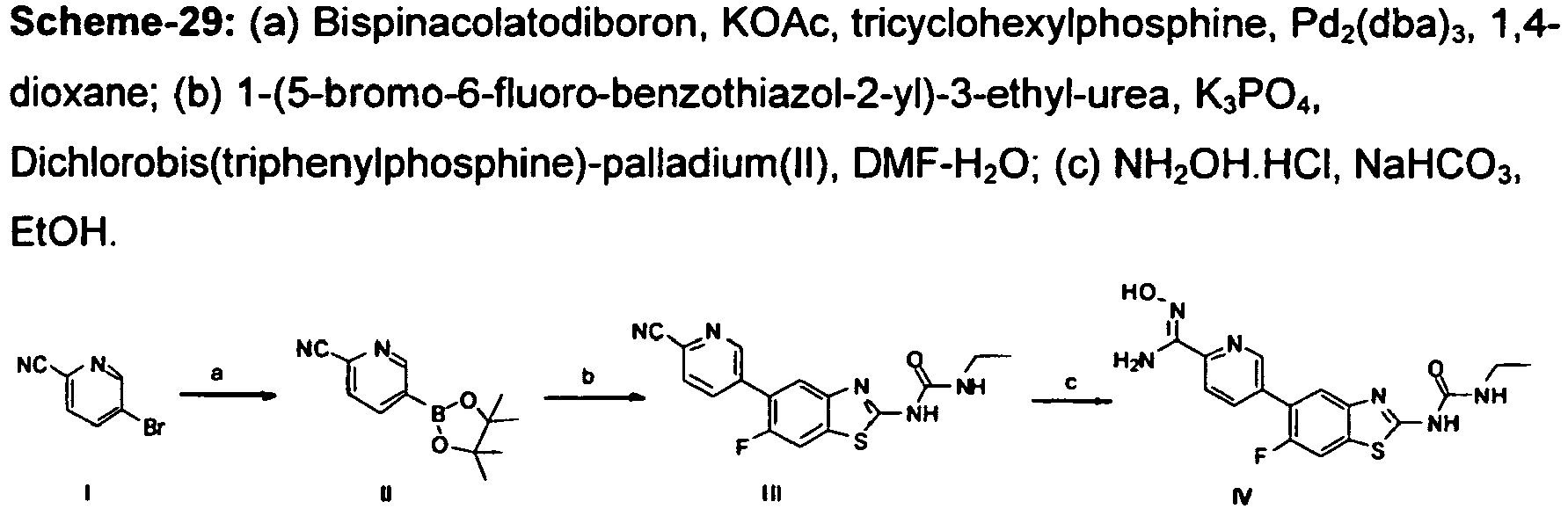
- A solution of 5-bromo-2-cyanopyridine (0.50 g, 2.73 mmol), bispinacolatodiboron (0.76 g, 3.0 mmol) and KOAc (0.34 g, 4.10 mmol) in 1,4-dioxane (10.0 mL) was degassed by flushing with nitrogen for 15 min. Tricyclohexylphosphine (0.091 g, 0.33 mmol) and tris(dibenzyledineacetone) dipalladium (0) (0.14 g, 0.14 mmol) was then added to the reaction mixture, which was again degassed by nitrogen for 15 min. The resulting reaction mixture was heated to 100°C for 2 h. After the completion of the reaction (TLC monitoring), the reaction mixture was filtered through celite bed and the filtrate was concentrated to get the crude residue that was carried forward to the next step without further purification. MS: 231.10 (M+H)+.
- A solution of 1-(5-bromo-6-fluoro-benzothiazol-2-yl)-3-ethyl-urea (0.10 g, 0.31 mmol), 5-(4,4,5,5-tetramethyl-1,3,2-dioxaborolan-2-yl)picolinonitrile (0.144 g, 0.63 mmol) and K3PO4 (0.133 g, 0.63 mmol) in DMF-H2O (5.0 mL, 4:1) was degassed by flushing with nitrogen for 15 min. Dichlorobis(triphenylphosphine)-palladium(II) (0.022 g, 0.03 mmol) was then added to the reaction mixture followed by degassing with nitrogen for another 15 min. The resulting reaction mixture was then heated to 100°C for 2 h. After the completion of the reaction (TLC monitoring), the reaction mixture was cooled to room temperature and poured onto ice-cold water followed by extraction with EtOAc (2 x 50 mL). The combined organics was washed with brine, dried (Na2SO4), filtered and concentrated under reduced pressure. The crude was then purified over silica gel (100-200 M, 2.50% MeOH-DCM) to obtain the desired product (0.075 g, 71%). 1H-NMR (400 MHz, DMSO-d6): δ 1.09 (t, J= 7.20 Hz, 3H), 3.20 (m, 2H), 6.71 (br s, 1H), 7.90 (d, J= 6.80 Hz, 1H), 8.03 (d, J= 10.80 Hz, 1H), 8.15 (m, 1H), 8.31 (m, 1H), 9.0 (s, 1H) and 10.90 (br s, 1H). MS: 340.06 (M-H)+.
- To a solution of 1-(5-(6-cyanopyridin-3-yl)-6-fluorobenzo[d]thiazol-2-yl)-3-ethylurea (0.075 g, 0.22 mmol) in EtOH (5.0 mL) was added NaHCO3 (0.055, 0.66 mmol) followed by NH2OH.HCl (0.045 g, 0.66 mmol). The resulting reaction mixture was heated to 78°C for 2 h. After the completion of reaction (TLC monitoring), EtOH was evaporated, added water and extracted with EtOAc (2 x 25 mL), the combined organics was washed with brine, dried (Na2SO4), filtered and concentrated. The residue was purified over silica gel (100-200 M, 2.50% MeOH-DCM) to obtain the desired product (0.038 g, 46%). 1H-NMR (400 MHz, DMSO-d6): δ 1.09 (t, J= 7.20 Hz, 3H), 3.20 (m, 2H), 5.89 (br s, 2H), 6.76 (br s, 1H), 7.82 (d, J= 6.80 Hz, 1H), 7.96 (m, 2H), 8.05 (m, 1H), 8.78 (s, 1H), 10.0 (s, 1H) and 10.82 (br s, 1H). MS: 375.15 (M+H)+. Qualitative HPLC Purity (Acquity BEH C-18, 100 x 2.1 mm, 258 nm): 90.12% (Rt = 4.97 min).


- To an ice-cold solution of 2-hydroxy-4-bromopyridine (1.0 g, 5.75 mmol) in THF (20.0 mL) was added NaH (60% in mineral oil, 0.23 g, 5.75 mmol) portionwise. The reaction mixture was stirred at room temperature for 15 min followed by addition of methyl iodide (1.10 mL, 17.24 mmol). The resulting reaction mixture was stirred at room temperature for 16 h. After the completion of the reaction (TLC monitoring), the reaction mixture was cooled to 0°C, added water and extracted with EtOAc (3 x 50 mL). The combined organics was washed with brine, dried (Na2SO4), filtered and concentrated under reduced pressure to obtain the desired product (0.99 g, 92%). 1H NMR (400MHz, DMSO-d6): δ 3.38 (s, 3H), 6.44 (dd, J= 2.0 and 7.20 Hz, 1H), 6.69 (d, J= 2.0 Hz, 1H) and 7.69 (d, J= 7.20 Hz, 1H).
- To a solution of 2-hydroxy-4-bromopyridine (0.10 g, 0.57 mmol) in DMSO (1.0 mL) was added KOH (0.13 g, 2.29 mmol) and the resulting reaction mixture was stirred for 10 min at room temperature followed by addition of 4-(2-chloroethyl)morpholine (0.13 g, 0.69 mmol). The reaction mixture was then stirred at 45°C for 30 min. After the completion of reaction (TLC monitoring), water was added to the reaction and extracted with EtOAc (3 x 25 mL). The combined organics was washed with brine, dried (Na2SO4), filtered and concentrated. The residue was purified over silica gel (100-200 M, 5% MeOH-DCM) to obtain the desired product (0.085 g, 52%). MS: 287.10 (M+H)+.
- To a solution of 2-hydroxy-4-bromopyridine (0.10 g, 0.57 mmol) in DMSO (1.0 mL) was added KOH (0.13 g, 2.29 mmol) and the resulting reaction mixture was stirred for 10 min at room temperature followed by addition of N,N-dimethylaminoethylchloride.HCl (0.098 g, 0.68 mmol). The reaction mixture was then stirred at 40°C for 1 h. After the completion of reaction (TLC monitoring), water was added to the reaction and extracted with EtOAc (3 x 25 mL). The combined organics was washed with brine, dried (Na2SO4), filtered and concentrated. The residue was triturated with ether to obtain the desired product (0.10 g, 72%). MS: 245.10 (M+H)+.
- To a solution of 2-hydroxy-4-bromopyridine (0.10 g, 0.57 mmol) in DMSO (1.50 mL) was added KOH (0.095 g, 1.70 mmol) and the resulting reaction mixture was stirred for 10 min at room temperature followed by addition of 1-Boc-3-bromomethylpiperidine (0.16 g, 0.57 mmol). The reaction mixture was then stirred at 45°C for 16 h. After the completion of reaction (TLC monitoring), water was added to the reaction and extracted with EtOAc (3 x 25 mL). The combined organics was washed with brine, dried (Na2SO4), filtered and concentrated. The residue was purified over silica gel (100-200 M, 1% MeOH-DCM) to obtain the desired product (0.15 g, 95%). MS: 371.10 (M+H)+.
- A solution of 4-bromo-1-methylpyridin-2(1H)-one II-A (0.50 g, 2.66 mmol), bispinacolatodiboron (0.74 g, 2.93 mmol) and KOAc (0.39 g, 3.99 mmol) in 1,4-dioxane (10.0 mL) was degassed by flushing with nitrogen for 15 min. Tricyclohexylphosphine (0.090 g, 0.32 mmol) and tris(dibenzyledineacetone) dipalladium (0) (0.14 g, 0.13 mmol) was then added to the reaction mixture, which was again degassed by nitrogen for 15 min. The resulting reaction mixture was heated to 80-85°C for 3 h. After the completion of the reaction (TLC monitoring), the reaction mixture was filtered through celite bed and the filtrate was concentrated to get the crude residue that was carried forward to the next step without further purification. MS: 236.23 (M+H)+.
- A solution of 4-bromo-1-(2-morpholinoethyl)pyridin-2(1H)-one II-B (0.085 g, 0.30 mmol), bispinacolatodiboron (0.089 g, 0.35 mmol) and KOAc (0.036 g, 0.44 mmol) in 1,4-dioxane (5.0 mL) was degassed by flushing with nitrogen for 15 min. Tricyclohexylphosphine (0.012 g, 0.04 mmol) and tris(dibenzyledineacetone) dipalladium (0) (0.015 g, 0.014 mmol) was then added to the reaction mixture, which was again degassed by nitrogen for 15 min. The resulting reaction mixture was heated to 80°C for 1 h. After the completion of the reaction (TLC monitoring), the reaction mixture was filtered through celite bed and the filtrate was concentrated to get the crude residue that was carried forward to the next step without further purification. MS: 335.23 (M+H)+.
- A solution of 4-bromo-1-(2-(dimethylamino)ethyl)pyridin-2(1H)-one II-C (0.10 g, 0.41 mmol), bispinacolatodiboron (0.12 g, 0.49 mmol) and KOAc (0.05 g, 0.61 mmol) in 1,4-dioxane (5.0 mL) was degassed by flushing with nitrogen for 15 min. Tricyclohexylphosphine (0.017 g, 0.06 mmol) and tris(dibenzyledineacetone) dipalladium (0) (0.021 g, 0.020 mmol) was then added to the reaction mixture, which was again degassed by nitrogen for 15 min. The resulting reaction mixture was heated to 80°C for 1 h. After the completion of the reaction (TLC monitoring), the reaction mixture was filtered through celite bed and the filtrate was concentrated to get the crude residue that was carried forward to the next step without further purification. MS: 293.20 (M+H)+.
- A solution of tert-butyl 3-((4-bromo-2-oxopyridin-1(2H)-yl)methyl)piperidine-1-carboxylate II-D (0.15 g, 0.40 mmol), bispinacolatodiboron (0.122 g, 0.48 mmol) and KOAc (0.049 g, 0.61 mmol) in 1,4-dioxane (5.0 mL) was degassed by flushing with nitrogen for 15 min. Tricyclohexylphosphine (0.017 g, 0.06 mmol) and tris(dibenzyledineacetone) dipalladium (0) (0.021 g, 0.020 mmol) was then added to the reaction mixture, which was again degassed by nitrogen for 15 min. The resulting reaction mixture was heated to 100°C for 1 h. After the completion of the reaction (TLC monitoring), the reaction mixture was filtered through celite bed and the filtrate was concentrated to get the crude residue that was carried forward to the next step without further purification. MS: 419.20 (M+H)+.
- A solution of 1-(5-bromo-6-fluoro-benzothiazol-2-yl)-3-ethyl-urea (0.20 g, 0.63 mmol), 1-methyl-4-(4,4,5,5-tetramethyl-1,3,2-dioxaborolan-2-yl) pyridin-2(1H)-one III-A (0.18 g, 0.75 mmol) and K3PO4 (0.20 g, 0.96 mmol) in DMF-H2O (11.0 mL, 7:4) was degassed by flushing with nitrogen for 15 min. Dichlorobis(triphenylphosphine)-palladium(II) (0.044 g, 0.06 mmol) was then added to the reaction mixture followed by degassing with nitrogen for another 15 min. The resulting reaction mixture was then heated to 80°C for 1 h. After the completion of the reaction (TLC monitoring), the reaction mixture was cooled to room temperature and poured onto ice-cold water followed by extraction with EtOAc (3 x 100 mL). The combined organics was washed with brine, dried (Na2SO4), filtered and concentrated under reduced pressure. The crude was then purified over silica gel (100-200 M, 2.50% MeOH-DCM) to obtain the desired product (0.065 g, 30%). 1H NMR (400MHz, DMSO-d6): δ 1.08 (t, J= 7.20 Hz, 3H), 3.20 (quintet, J= 7.20 Hz, 2H), 3.44 (s, 3H), 6.44 (d, J= 7.20 Hz, 1H), 6.57 (s, 1H), 6.70 (br s, 1H), 7.73 (d, J= 6.40 Hz, 1H), 7.77 (d, J= 6.80 Hz, 1H), 7.94 (d, J= 10.40 Hz, 1H) and 10.82 (br s, 1H). MS: 345.09 (M-H)+. Qualitative HPLC Purity (Acquity BEH C-18, 100 x 2.1 mm, 238 nm): 92.19% (Rt = 4.64 min).
- A solution of 1-(5-bromo-6-fluoro-benzothiazol-2-yl)-3-ethyl-urea (0.05 g, 0.16 mmol), 1-(2-morpholinoethyl)-4-(4,4,5,5-tetramethyl-1,3,2-dioxaborolan-2-yl)pyridin-2(1H)-one III-B (0.08 g, 0.22 mmol) and K3PO4 (0.05 g, 0.24 mmol) in DMF-H2O (7.0 mL, 5:2) was degassed by flushing with nitrogen for 15 min. Dichlorobis(triphenylphosphine)-palladium(II) (0.012 g, 0.017 mmol) was then added to the reaction mixture followed by degassing with nitrogen for another 15 min. The resulting reaction mixture was then heated to 95°C for 3 h. After the completion of the reaction (TLC monitoring), the reaction mixture was cooled to room temperature and poured onto ice-cold water followed by extraction with EtOAc (3 x 50 mL). The combined organics was washed with brine, dried (Na2SO4), filtered and concentrated under reduced pressure. The crude was then purified over silica gel (100-200 M, 5.0% MeOH-DCM) to obtain the desired product (0.020 g, 28%). 1H NMR (400MHz, DMSO-d6): δ 1.09 (t, J= 7.20 Hz, 3H), 2.50 (m, 4H), 2.58 (t, J= 6.0 Hz, 2H), 3.20 (m, 2H), 3.55 (t, J= 4.40 Hz, 4H), 4.03 (t, J= 6.40 Hz, 2H), 6.47 (d, J= 6.80 Hz, 1H), 6.59 (s, 1H), 6.70 (br s, 1H), 7.73 (m, 2H), 7.94 (d, J= 10.40 Hz, 1H) and 10.83 (br s, 1H). MS: 446.15 (M+H)+. Qualitative HPLC Purity (Acquity BEH C-18, 2.1 x 100 mm, 238nm): 95.30% (Rt = 4.81 min).
- A solution of 1-(5-bromo-6-fluoro-benzothiazol-2-yl)-3-ethyl-urea (0.12 g, 0.41 mmol), 1-(2-(dimethylamino)ethyl)-4-(4,4,5,5-tetramethyl-1,3,2-dioxaborolan-2-yl)pyridin-2(1H)-one III-C (0.065 g, 0.21 mmol) and K3PO4 (0.13 g, 0.62 mmol) in DMF-H2O (5.0 mL, 3:2) was degassed by flushing with nitrogen for 15 min. Dichlorobis(triphenylphosphine)-palladium(II) (0.028 g, 0.041 mmol) was then added to the reaction mixture followed by degassing with nitrogen for another 15 min. The resulting reaction mixture was then heated to 100°C for 2 h. After the completion of the reaction (TLC monitoring), the reaction mixture was cooled to room temperature and poured onto ice-cold water followed by extraction with EtOAc (3 x 50 mL). The combined organics was washed with brine, dried (Na2SO4), filtered and concentrated under reduced pressure. The crude was then purified over silica gel (100-200 M, 9.0% MeOH-DCM) to obtain the desired product (0.037 g, 41%). 1H NMR (400MHz, DMSO-d6): δ 1.08 (t, J= 7.20 Hz, 3H), 2.21 (s, 6H), 2.55 (m, 2H), 3.20 (m, 2H), 4.01 (t, J= 6.0 Hz, 2H), 6.46 (d, J= 6.80 Hz, 1H), 6.56 (s, 1H), 6.73 (br s, 1H), 7.72 (m, 2H), 7.95 (d, J= 10.40 Hz, 1H) and 10.86 (br s, 1H). MS: 404.23 (M+H)+. Qualitative HPLC Purity (Acquity BEH C-18, 2.1 x 100 mm, 238nm): 96.07% (Rt = 4.42 min).
- A solution of 1-(5-bromo-6-fluoro-benzothiazol-2-yl)-3-ethyl-urea (0.15 g, 0.47 mmol), tert-butyl 3-((2-oxo-4-(4,4,5,5-tetramethyl-1,3,2-dioxaborolan-2-yl)pyridin-1(2H)-yl)methyl)piperidine-1-carboxylate III-D (0.39 g, 0.94 mmol) and K3PO4 (0.15 g, 0.26 mmol) in DMF-H2O (5.0 mL, 3:2) was degassed by flushing with nitrogen for 15 min. Dichlorobis(triphenylphosphine)-palladium(II) (0.033 g, 0.047 mmol) was then added to the reaction mixture followed by degassing with nitrogen for another 15 min. The resulting reaction mixture was then heated to 100°C for 2 h. After the completion of the reaction (TLC monitoring), the reaction mixture was cooled to room temperature and poured onto ice-cold water followed by extraction with EtOAc (3 x 50 mL). The combined organics was washed with brine, dried (Na2SO4), filtered and concentrated under reduced pressure. The crude was then purified over silica gel (100-200 M, 2.50% MeOH-DCM) to obtain the desired product (0.032 g, 11%). 1H NMR (400MHz, DMSO-d6): δ 1.08 (t, J= 7.20 Hz, 3H), 1.19 (m, 1H), 1.33 (s, 9H), 1.67 (m, 2H), 1.88 (m, 2H), 2.30 (m, 1H), 2.79 (m, 1H), 3.20 (m, 2H), 3.73-3.82 (m, 4H), 6.49 (d, J= 6.80 Hz, 1H), 6.60 (s, 1H), 6.70 (br s, 1H), 7.74 (m, 2H), 7.95 (d, J= 10.80 Hz, 1H) and 10.85 (br s, 1H). LCMS: 84.22% (Rt = 3.34 min).

- To a solution of 5-bromo-pyridine-2-carbaldehyde (0.30 g, 1.62 mmol) in DCM (15 mL) was added morpholine (0.10 g, 1.13 mmol) and glacial acetic acid (2 mL) and stirred the resulting reaction mixture for 30 min. followed by addition of sodium triacetoxyborohydride (0.86 g, 4.05 mmol). The resulting reaction mixture was stirred for 4 h at room temperature. After completion of reaction (TLC monitoring), the reaction mixture was diluted with DCM, added water and extracted the organic layer. The organic layer was dried over Na2SO4 and concentrated. The crude residue was purified over silica- gel [100-200 M, compound II-A (0.21 g, 69%) eluted in 1.50% EtOAc-hexane and compound II-B (0.12 g, 28%) eluted in 5 % EtOAc-hexane.
- A solution of (5-bromopyridin-2-yl)methanol II-A (0.20 g, 1.06 mmol), bispinacolatodiboron (0.32 g, 1.27 mmol) and KOAc (0.13 g, 1.59 mmol) in 1,4-dioxane (5.0 mL) was degassed by flushing with nitrogen for 15 min. Tricyclohexylphosphine (0.045 g, 0.16 mmol) and tris(dibenzyledineacetone) dipalladium (0) (0.055 g, 0.053 mmol) was then added to the reaction mixture, which was again degassed by nitrogen for 15 min. The resulting reaction mixture was heated to 80°C for 16 h. After the completion of the reaction (TLC monitoring), the reaction mixture was filtered through celite bed and the filtrate was concentrated to get the crude residue that was carried forward to the next step without further purification. MS: 236.20 (M+H)+.
- A solution of 4-((5-bromopyridin-2-yl)methyl)morpholine II-B (0.10 g, 0.39 mmol), bispinacolatodiboron (0.12 g, 0.47 mmol) and KOAc (0.048 g, 0.59 mmol) in 1,4-dioxane (5.0 mL) was degassed by flushing with nitrogen for 15 min. Tricyclohexylphosphine (0.017 g, 0.05 mmol) and tris(dibenzyledineacetone) dipalladium (0) (0.02 g, 0.02 mmol) was then added to the reaction mixture, which was again degassed by nitrogen for 15 min. The resulting reaction mixture was heated to 80°C for 8 h. After the completion of the reaction (TLC monitoring), the reaction mixture was filtered through celite bed and the filtrate was concentrated to get the crude residue that was carried forward to the next step without further purification. MS: 305.20 (M+H)+.
- A solution of 1-(5-bromo-6-fluoro-benzothiazol-2-yl)-3-ethyl-urea (0.10 g, 0.31 mmol), (5-(4,4,5,5-tetramethyl-1,3,2-dioxaborolan-2-yl)pyridin-2-yl)methanol III-A (0.15 g, 0.63 mmol) and K3PO4 (0.13 g, 0.62 mmol) in DMF-H2O (6.0 mL, 4:2) was degassed by flushing with nitrogen for 15 min. Dichlorobis(triphenylphosphine)-palladium(II) (0.022 g, 0.03 mmol) was then added to the reaction mixture followed by degassing with nitrogen for another 15 min. The resulting reaction mixture was then heated to 80°C for 2 h. After the completion of the reaction (TLC monitoring), the reaction mixture was cooled to room temperature and poured onto ice-cold water followed by extraction with EtOAc (3 x 50 mL). The combined organics was washed with brine, dried (Na2SO4), filtered and concentrated under reduced pressure. The crude was then purified over silica gel (100-200 M, 2.80% MeOH-DCM) to obtain the desired product (0.050 g, 46%). 1H NMR (400MHz, DMSO-d6): δ 1.09 (t, J= 7.20 Hz, 3H), 3.20 (m, 2H), 4.63 (d, J= 6.0 Hz, 2H), 5.49 (t, J= 5.60 Hz, 1H), 6.71 (br s, 1H), 7.56 (d, J= 8.0 Hz, 1H), 7.77 (d, J= 6.80 Hz, 1H), 7.96 (d, J= 10.40 Hz, 1H), 8.0 (m, 1H), 8.68 (s, 1H) and 10.79 (br s, 1H). MS: 347.17 (M+H)+. Qualitative HPLC Purity (Acquity BEH C-18, 2.1 x 100 mm, 248nm): 96.75% (Rt = 4.75 min).
- A solution of 1-(5-bromo-6-fluoro-benzothiazol-2-yl)-3-ethyl-urea (0.07 g, 0.22 mmol), 4-((5-(4,4,5,5-tetramethyl-1,3,2-dioxaborolan-2-yl)pyridin-2-yl)methyl)morpholine III-A (0.134 g, 0.44 mmol) and K3PO4 (0.094 g, 0.44 mmol) in DMF-H2O (5.0 mL, 3:2) was degassed by flushing with nitrogen for 15 min. Dichlorobis(triphenylphosphine)-palladium(II) (0.014 g, 0.02 mmol) was then added to the reaction mixture followed by degassing with nitrogen for another 15 min. The resulting reaction mixture was then heated to 80°C for 2 h. After the completion of the reaction (TLC monitoring), the reaction mixture was cooled to room temperature and poured onto ice-cold water followed by extraction with EtOAc (3 x 50 mL). The combined organics was washed with brine, dried (Na2SO4), filtered and concentrated under reduced pressure. The crude was then purified over silica gel (100-200 M, 5.0% MeOH-DCM) to obtain the desired product (0.007 g, 8%). 1H NMR (400MHz, DMSO-d6): δ 1.09 (t, J= 7.20 Hz, 3H), 2.45 (m, 4H), 3.20 (m, 2H), 3.61 (m, 4H), 3.64 (s, 2H), 6.71 (br s, 1H), 7.57 (d, J= 8.0 Hz, 1H), 7.77 (d, J= 6.80 Hz, 1H), 7.93-8.0 (m, 2H), 8.70 (s, 1H) and 10.80 (br s, 1H). MS: 416.24 (M+H)+. Qualitative HPLC Purity (Acquity BEH C-18, 2.1 x 100 mm, 249nm): 92.05% (Rt = 5.35 min).

- To an ice cold solution of triphenylphosphine (0.17 g, 0.63 mmol) in THF (10.0 mL) was added DIAD (0.12 mL, 0.63 mmol) and the resulting solution was stirred at the same temperature for 15 min. after which a yellow precipitate was formed. 1-Boc-3-hydroxypyrrolidine (0.10 g, 0.53 mmol) was then added to the reaction mixture and allowed to stir for 20 min followed by addition of 4-bromo-2-hydroxypyridine (0.093 g, 0.53 mmol). The resulting reaction mixture was stirred for 16 h at room temperature. After completion of reaction (TLC monitoring), the reaction mixture was diluted with water and extracted with EtOAc (3 x 50 ml). The combined organics was dried (Na2SO4), filtered and concentrated. The residue was purified over silica gel (100-200 M, 0.5% MeOH-DCM) to obtain the desired product (0.20 g, quantitative yield). MS: 343.10 (M+H)+.
- A solution of tert-butyl 3-(4-bromo-2-oxopyridin-1 (2H)-yl)pyrrolidine-1-carboxylate (0.20 g, 0.58 mmol), bispinacolatodiboron (0.29 g, 1.16 mmol) and KOAc (0.17 g, 1.74 mmol) in 1,4-dioxane (7.0 mL) was degassed by flushing with nitrogen for 15 min. Tricyclohexylphosphine (0.025 g, 0.87 mmol) and tris(dibenzyledineacetone) dipalladium (0) (0.053 g, 0.058 mmol) was then added to the reaction mixture, which was again degassed by nitrogen for 15 min. The resulting reaction mixture was heated to 80°C for 2 h. After the completion of the reaction (TLC monitoring), the reaction mixture was filtered through celite bed and the filtrate was concentrated to get the crude residue that was carried forward to the next step without further purification. MS: 391.20 (M+H)+.
- A solution of 1-(5-bromo-6-fluoro-benzothiazol-2-yl)-3-ethyl-urea (0.07 g, 0.31 mmol), tert-butyl 3-(2-oxo-4-(4,4,5,5-tetramethyl-1,3,2-dioxaborolan-2-yl)pyridin-1 (2H)-yl)pyrrolidine-1-carboxylate (0.24 g, 0.62 mmol) and K3PO4 (0.13 g, 0.62 mmol) in DMF-H2O (5.0 mL, 3:2) was degassed by flushing with nitrogen for 15 min. Dichlorobis(triphenylphosphine)-palladium(II) (0.022 g, 0.03 mmol) was then added to the reaction mixture followed by degassing with nitrogen for another 15 min. The resulting reaction mixture was then heated to 80°C for 2 h. After the completion of the reaction (TLC monitoring), the reaction mixture was cooled to room temperature and poured onto ice-cold water followed by extraction with EtOAc (3 x 50 mL). The combined organics was washed with brine, dried (Na2SO4), filtered and concentrated under reduced pressure. The crude was then purified over silica gel (100-200 M, 1.50% MeOH-DCM) to obtain the desired product (0.056 g, 36%). MS: 502.20 (M+H)+.
- A solution of tert-butyl 3-(4-(2-(3-ethylureido)-6-fluorobenzo[d]thiazol-5-yl)-2-oxopyridin-1 (2H)-yl)pyrrolidine-1-carboxylate (0.055 g, 0.11 mmol) in HCl-1,4-dioxane (3.0 mL) was stirred for 30 min at room temperature. After the completion of reaction (TLC monitoring), the solvent was evaporated and the residue was triturated with ether to obtain the desired product (0.01 g, 45%). 1H NMR (400MHz, DMSO-d6): δ 1.10 (t, J= 7.20 Hz, 3H), 1.30 (m, 1H), 1.81 (m, 1H), 2.27 (m, 1H), 3.15 (m, 2H), 3.20 (m, 2H), 3.40 (m, 1H), 5.63 (m, 1H), 6.85 (br s, 1H), 7.01 (s, 1H), 7.29 (m, 1H), 7.79 (d, J= 6.80 Hz, 1H), 7.98 (d, J= 10.80 Hz, 1H), 8.28 (d, J= 5.20 Hz, 1H), 9.13 (br s, 1H) and 10.90 (br s, 1H). LCMS: 402.09 (86.80%).

- To a suspension of 5-bromo-pyridin-2-yl-acetic acid (0.87 g, 4.0 mmol) in THF (12 mL) was added HOBt (0.74 g, 4.8 mmol) and EDCl.HCl (0.85 g, 4.4 mmol). The resulting reaction mixture was stirred for 15-20 min at room temperature followed by drop-wise addition of methylamine (2.0 M in THF, 4.05 mL, 8.0 mmol). The resulting mixture was then continued to stir for 6-7 h at room temperature. After completion of reaction, water was added and extracted with EtOAc. The crude residue was purified over silica (60-120 M, 2.50% MeOH-DCM) to obtain the pale-yellow solid compound (0.25 g, 27%). 1H NMR (400MHz, DMSO-d6): δ 2.58 (d, J= 4.80 Hz, 3H), 3.57 (s, 2H), 7.33 (m, 1H), 7.96 (d, J= 2.40 Hz and 8.40 Hz, 1H), 8.00 (br s, 1H) and 8.58 (d, J= 2.40 Hz, 1H). MS: 229.11 (M+H+).
- A solution of 2-(5-bromo-pyridin-2-yl)-N-methyl-acetamide] (0.5 g, 0.22 mmol) in 1, 4-1,4-dioxane was degassed by bubbling nitrogen for 15-20 min followed by sequential addition of Pd2(dba)3 (0.01 g, 0.01 mmol), bispinacolatodiboron (0.06 g, 0.24 mmol), tricyclohexyl phosphine (0.007 g 0.03 mmol) and potassium acetate (0.03 g, 0.033 mmol). The reaction mixture was again degassed for 15-20 min and then heated up to 80°C for 16 h. After completion of reaction (TLC monitoring), the reaction mixture was cooled, diluted with ethyl acetate and filtered through celite bed bed. The filtrate was dried over Na2SO4, filtered, concentrated and washed with hexane. The crude oily compound (60 mg) was used further without purification. MS: 277.26 (M+H+).
- A solution of 1-(5-bromo-6-fluoro-benzothiazol-2-yl)-3-ethyl-urea (0.07 g, 0.22 mmol), N-methyl-2-[5-(4,4,5,5-tetramethyl-[1,3,2] dioxaborolan-2-yl)- pyridin-2-yl]-acetamide VI (0.122 g, 0.44 mmol) and K3PO4 (0.094 g, 0.44 mmol) in DMF-H2O (8.0 mL, 5:3) was degassed by flushing with nitrogen for 15 min. Dichlorobis(triphenylphosphine)-palladium(II) (0.016 g, 0.022 mmol) was then added to the reaction mixture followed by degassing with nitrogen for another 15 min. The resulting reaction mixture was then heated to 100°C for 6 h. After the completion of the reaction (TLC monitoring), the reaction mixture was cooled to room temperature and poured onto ice-cold water followed by extraction with EtOAc (3 x 50 mL). The combined organics was washed with brine, dried (Na2SO4), filtered and concentrated under reduced pressure. The crude was then purified over silica gel (230-400 M, 4% MeOH-DCM) to obtain the desired product (0.006 g, 7%). 1H NMR (DMSO-d6, 400 MHz): δ 1.09 (t, J= 6.80 Hz, 3H), 2.60 (d, J= 3.60 Hz, 3H), 3.18 (m, 2H), 3.65 (s, 2H), 6.73 (br s, 1H), 7.45 (d, J= 8.00 Hz, 1H), 7.77 (d, J=6.40 Hz, 1H), 7.96 (d, J=9.20 Hz, 2H), 8.08 (br s, 1H), 8.68 (s, 1H) and 10.81 (br s, 1H). MS: 388.21 (M+H+). Qualitative HPLC Purity (Acquity BEH C-18, 2.1 x 100 mm, 249 nm): 97.02% (Rt = 4.69 min).


- To a solution of 1-(5-bromo-6-fluoro-benzothiazol-2-yl)-3-ethyl-urea (0.10 g, 0.31 mmol) in DMF (4.0 mL) was added 5-(tributylstannyl)thiazole (0.18 g, 0.47 mmol) and the resulting solution was degassed by flushing with nitrogen for 15 min. followed by addition of Pd(PPh3)4 (0.036 g, 0.03 mmol). The resulting reaction mixture was again degassed with nitrogen for 15 min. and then heated to 100°C for 1 h. After the completion of the reaction (TLC monitoring), the reaction mixture was cooled to room temperature and poured onto ice-cold water followed by extraction with EtOAc (3 x 50 mL). The combined organics was washed with brine, dried (Na2SO4), filtered and concentrated under reduced pressure. The crude was then purified over silica gel (100-200 M, 2.0% MeOH-DCM) to obtain the desired product (0.033 g, 33%). 1H NMR (DMSO-d6, 400 MHz): δ 1.09 (t, J= 7.20 Hz, 3H), 3.20 (m, 2H), 6.72 (br s, 1H), 7.97-8.04 (m, 2H), 8.43 (s, 1H), 9.19 (s, 1H) and 10.82 (br s, 1H). MS: 323.13 (M+H)+. Qualitative HPLC Purity (Acquity BEH C-18, 2.1 x 100 mm, 262 nm): 88.55% (Rt = 5.18 min).
- To a solution of 1-(5-bromo-6-fluoro-benzothiazol-2-yl)-3-ethyl-urea (0.06 g, 0.19 mmol) in DMF (4.0 mL) was added 2-(methylsulfonyl)-5-(tributylstannyl)pyrimidine (0.13 g, 0.28 mmol) and the resulting solution was degassed by flushing with nitrogen for 15 min. followed by addition of Pd(PPh3)4 (0.022 g, 0.019 mmol). The resulting reaction mixture was again degassed with nitrogen for 15 min. and then heated to 100°C for 3 h. After the completion of the reaction (TLC monitoring), the reaction mixture was cooled to room temperature and poured onto ice-cold water followed by extraction with EtOAc (3 x 50 mL). The combined organics was washed with brine, dried (Na2SO4), filtered and concentrated under reduced pressure. The crude was then purified over silica gel (230-400 M, 1.60% MeOH-DCM) to obtain the desired product (0.007 g, 10%). 1H NMR (DMSO-d6, 400 MHz): δ 1.09 (t, J= 7.20 Hz, 3H), 3.19 (m, 2H), 3.47 (s, 3H), 6.72 (br s, 1H), 8.03 (d, J= 6.80 Hz, 1H), 8.08 (d, J= 10.40 Hz, 1H), 9.34 (s, 2H) and 10.86 (br s, 1H). MS: 393.95 (M-H)+. LCMS: 395.99 (M+H)+, 90.39%.

- To an ice-cold solution of p-anisidine (25 g, 203.0 mmol) in DCM (300.0 mL) was added triethyl amine (90.0 mL, 609.0 mmol) dropwise and the reaction mixture was stirred at the same temperature for 15 min. Acetyl chloride (23.0 mL, 304.50 mmol) was then added and the reaction mixture was continued to stir at room temperature for 1 h. After the completion of the reaction (TLC monitoring), water (500 mL) was added and extracted with DCM (2 x 300 mL). The combined organics was washed with brine, dried (Na2SO4), filtered and concentrated under reduced pressure to obtain the desired product (30.0 g, 90%). 1H NMR (400MHz, DMSO-d6): δ 1.99 (s, 3H), 3.70 (s, 3H), 6.86 (d, J= 8.80 Hz, 2H), 7.48 (d, J= 8.80 Hz, 2 H) and 9.77 (br s, 1H).
- To a solution of N-(4-methoxyphenyl)acetamide II (7.50 g, 45.40 mmol) in acetic acid (50 mL) was added a solution of Br2 (4.70 mL, 90.80 mmol) in acetic acid (10.0 mL). The resulting reaction mixture was then heated to 65°C for 4 h. After the completion of the reaction (TLC monitoring), acetic acid was distilled off, cooled the residue to 0°C and then basified with aqueous NH3 till pH 12 followed by extraction with EtOAc (2 x 500.0 mL). The combined organics was washed with brine, dried (Na2SO4), filtered and concentrated under reduced pressure. The crude residue was purified over silica gel (60-120 M, 25-30% EtOAc-Hexane) to obtain the desired product (5.0 g, 45%). 1H NMR (400MHz, DMSO-d6): δ 2.0 (s, 3H), 3.79 (s, 3H), 7.06 (d, J= 8.80 Hz, 1H), 7.44 (dd, J= 2.40 and 8.80 Hz, 1H), 7.91 (d, J= 2.40 Hz, 1H) and 9.92 (br s, 1H). MS: 244.15 (M+H)+.
- To a solution of N-(3-bromo-4-methoxyphenyl)acetamide III (5.0 g, 20.50 mmol) in EtOH (40.0 mL) was added concentrated HCl (20.0 mL) and heated the reaction mixture to 80°C for 4-5 h. After the completion of the reaction (TLC monitoring), EtOH was distilled off and the residue was cooled to 0°C followed by basification with aqueous NH3 till pH 12 and extraction with EtOAc (2 x 250 mL). The combined organics was washed with brine, dried (Na2SO4), filtered and concentrated under reduced pressure to obtain the desired product (3.56 g, 87%). 1H NMR (400MHz, DMSO-d6): δ 3.67 (s, 3H), 4.88 (br s, 2H), 6.54 (dd, J= 2.40 and 8.40 Hz, 1H) and 6.80 (m, 2H). MS: 202.17 (M+H)+.
- To a solution of 3-bromo-4-methoxyaniline IV (2.0 g, 9.90 mmol) in AcOH (25.0 mL) was added ammonium thiocyanate (3.80 g, 49.50 mmol) and the reaction mixture was stirred at room temperature for 1 h. The reaction mixture was then cooled to 0°C followed by addition of a solution of Br2 (0.60 mL, 11.0 mmol) in AcOH (10.0 mL). The reaction mixture was then allowed to stir at room temperature for 2 h. After the completion of the reaction (TLC monitoring), AcOH was distilled off, and the residue was cooled to 0°C followed by basification with aqueous NH3 till pH 12 and extraction with EtOAc (2 x 250 mL). The combined organics was washed with brine, dried (Na2SO4), filtered and concentrated under reduced pressure to obtain the desired product (2.0 g, 78%). 1H NMR (400MHz, DMSO-d6): δ 3.80 (s, 3H), 7.41 (br s, 2H), 7.49 (s, 1H) and 7.50 (s, 1H).
- To a solution of 5-bromo-6-methoxybenzo[d]thiazol-2-amine V (2.0 g, 7.72 mmol) in 1,4-dioxane (20.0 mL) was added ethylisocyanate (3.0 mL, 38.60 mmol) and heated the resulting reaction mixture to 80°C for 16 h. After the completion of the reaction (TLC monitoring), 1,4-dioxane was distilled off followed by co-distillation with n-hexane (2 times). The residue was then stirred with water at 90°C for 2h followed by filtration to obtain the desired product that was further washed with hot water and then dried. The residue was finally washed with ether to obtain the desired product (2.10 g, 83%). 1H NMR (400MHz, DMSO-d6): δ 1.07 (t, J= 7.20 Hz, 3H), 3.17 (quintet, J= 6.80 Hz, 2H), 3.86 (s, 3H), 6.65 (br s, 1H), 7.68 (s, 1H), 7.80 (s, 1H) and 10.67 (br s, 1H). MS: 330.08 (M+H)+.
- A solution of 1-(5-bromo-6-methoxybenzo[d)thiazol-2-yl)-3-ethylurea VI (0.20 g, 0.60 mmol), pyridine-3-boronic acid (0.11 g, 0.90 mmol) and K3PO4 (0.20 g, 0.90 mmol) in 1,4-dioxane-MeOH (8.0 mL, 5:3) was degassed by flushing with nitrogen for 15 min. [1,1'-Bis(diphenylphosphino)-ferrocene]dichloropalladium(II) complex with dichloromethane (0.05 g, 0.06 mmol) was then added to the reaction mixture followed by degassing with nitrogen for another 15 min. The resulting reaction mixture was then heated to 80°C for 2-3 h. After the completion of the reaction (TLC monitoring), the reaction mixture was cooled to room temperature and poured onto ice-cold water followed by extraction with EtOAc (2 x 100 mL). The combined organics was washed with brine, dried (Na2SO4), filtered and concentrated under reduced pressure. The crude was then purified over silica gel (100-200 M, 3-4% MeOH-DCM) to obtain the desired product that was finally washed with a mixture of 50% DCM-Ether yielding 0.09 g (45%) of the product. 1H NMR (400MHz, DMSO-d6): δ 1.09 (t, J= 7.20 Hz, 3H), 3.18 (quintet, J= 6.80 Hz, 2H), 3.81 (s, 3H), 6.67 (br s, 1H), 7.44 (m, 1H), 7.56 (s, 1H), 7.69 (s, 1H), 7.93 (m, 1H), 8.53 (d, J= 3.60 z, 1H), 8.70 (s, 1H) and 10.62 (br s, 1H). MS: 329.23 (M+H)+. Qualitative HPLC Purity (Acquity BEH C-18, 100 x 2.1 mm, 246 nm): 99.29% (Rt = 4.95 min).

- To an ice-cold solution of 2-hydroxy-4-bromopyridine (1.0 g, 5.75 mmol) in THF (20.0 mL) was added NaH (60% suspension in mineral oil, 0.23 g, 5.75 mmol) portionwise. The reaction mixture was stirred at room temperature for 15 min followed by addition of methyl iodide (1.10 mL, 17.24 mmol). The resulting reaction mixture was stirred at room temperature for 16 h. After the completion of the reaction (TLC monitoring), the reaction mixture was cooled to 0°C, added water and extracted with EtOAc (3 x 50 mL). The combined organics was washed with brine, dried (Na2SO4), filtered and concentrated under reduced pressure to obtain the desired product (0.99 g, 92%). 1H NMR (400MHz, DMSO-d6): δ 3.38 (s, 3H), 6.44 (dd, J= 2.0 and 7.20 Hz, 1H), 6.69 (d, J= 2.0 Hz, 1H) and 7.69 (d, J= 7.20 Hz, 1H).
- A solution of 4-bromo-1-methylpyridin-2(1H)-one II (0.50 g, 2.66 mmol), bispinacolatodiboron (0.74 g, 2.93 mmol) and KOAc (0.39 g, 3.99 mmol) in 1,4-dioxane (10.0 mL) was degassed by flushing with nitrogen for 15 min. Tricyclohexylphosphine (0.090 g, 0.32 mmol) and tris(dibenzyledineacetone) dipalladium (0) (0.14 g, 0.13 mmol) was then added to the reaction mixture, which was again degassed by nitrogen for 15 min. The resulting reaction mixture was heated to 80-85°C for 3 h. After the completion of the reaction (TLC monitoring), the reaction mixture was filtered through celite bed and the filtrate was concentrated to get the crude residue that was carried forward to the next step without further purification. MS: 236.23 (M+H)+.
- A solution of 1-(5-bromo-6-methoxybenzo[d]thiazol-2-yl)-3-ethylurea (0.10 g, 0.30 mmol), 1-methyl-4-(4,4,5,5-tetramethyl-1,3,2-dioxaborolan-2-yl) pyridin-2(1H)-one III (0.08 g, 0.33 mmol) and K3PO4 (0.10 g, 0.45 mmol) in DMF-H2O (5.0 mL, 3:2) was degassed by flushing with nitrogen for 15 min. Dichlorobis(triphenylphosphine)-palladium(II) (0.02 g, 0.03 mmol) was then added to the reaction mixture followed by degassing with nitrogen for another 15 min. The resulting reaction mixture was then heated to 80°C for 2 h. After the completion of the reaction (TLC monitoring), the reaction mixture was cooled to room temperature and poured onto ice-cold water followed by extraction with EtOAc (2 x 100 mL). The combined organics was washed with brine, dried (Na2SO4), filtered and concentrated under reduced pressure. The crude was then purified over silica gel (100-200 M, 3-4% MeOH-DCM) to obtain the desired product that was finally washed with a mixture of 50% DCM-Ether yielding 0.018 g (16%) of the product. 1H NMR (400MHz, DMSO-d6): δ 1.08 (t, J= 7.20 Hz, 3H), 3.21 (quintet, J= 6.80 Hz, 2H), 3.44 (s, 3H), 3.81 (s, 3H), 6.39 (dd, J= 1.60 and 6.80 Hz, 1H), 6.48 (d, J= 1.20 Hz, 1H), 6.67 (br s, 1H), 7.51 (s, 1H), 7.67 (m, 2H) and 10.64 (br s, 1H). MS: 359.20 (M+H)+. Qualitative HPLC Purity (Acquity BEH C-18, 100 x 2.1 mm, 237 nm): 94.71% (Rt = 4.52 min).
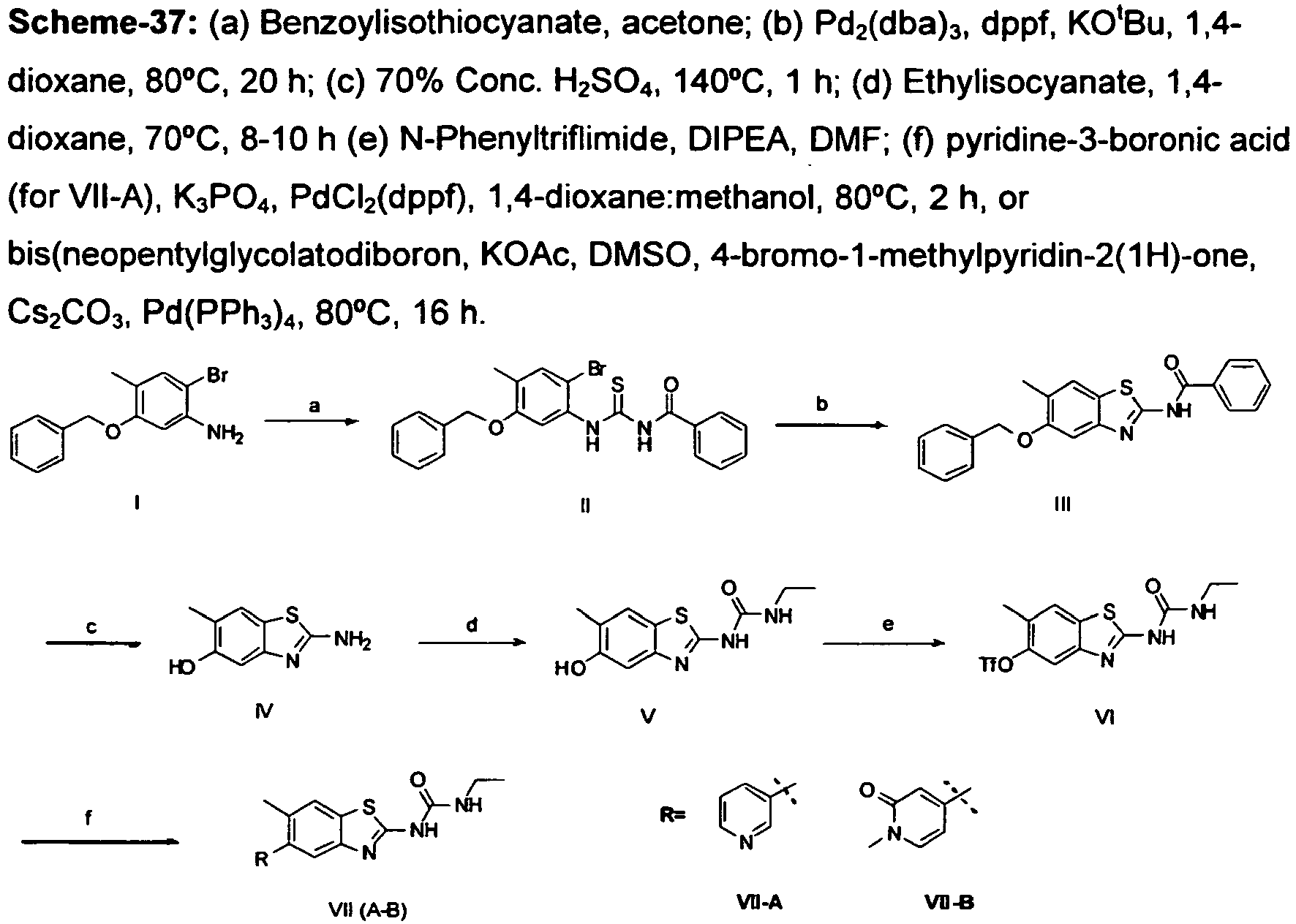
- To a solution of 5-benzyloxy-2-bromo-4-methyl-phenylamine (0.50 g, 1.71 mmol) in acetone (20 mL) was added benzoylisothiocyanate (0.28 mL, 2.08 mmol) dropwise at room temperature. The resulting reaction mixture was stirred for 30 min. at the same temperature. After completion of reaction (TLC monitoring), acetone was distilled off, the solid residue was stirred in hexane for 5-10 min and then filtered to obtain the desired product as white solid (0.70 g, 88%). 1H NMR (400MHz, DMSO-d6): δ 2.20 (s, 3H), 5.10 (s, 2H), 7.33 (m, 1H), 7.40 (t, J= 7.20 Hz, 2H), 7.48 (d, J= 7.60 Hz, 2H), 7.55 (m, 3H), 7.67 (m, 1H), 7.73 (s, 1H), 8.0 (d, J= 7.20 Hz, 2H), 11.81 (br s, 1H) and 12.59 (br s, 1H).
- To a solution of 1-benzoy!-3-(5-benzyloxy-2-bromo-4-methyl-phenyl)-thiourea II (1.0 g, 2.20 mmol) in 1,4-dioxane (30 mL) was added sequentially Pd2(dba)3 (0.12 g, 0.12 mmol), dppf (0.07 g, 0.12 mmol) and KOtBu (0.75 g, 3.30 mmol) at room temperature under N2 atmosphere. The resulting reaction mixture was heated at 80°C for 6h. After completion of reaction (TLC monitoring), the reaction mixture was diluted with EtOAc and filtered through celite bed-bed. The filtrate was concentrated and purified over silica gel (100-200 M, 20% EtOAc-Hexane) to obtain the desired product (0.50 g, 61%). 1H NMR (400MHz, DMSO-d6): δ 2.31 (s, 3H), 5.23 (s, 2H), 7.33 (m, 1H), 7.39 (m, 3H), 7.52 (m, 2H), 7.54 (m, 2H), 7.64 (m, 1H), 7.76 (s, 1H), 8.13 (d, J=7.60 Hz, 2H) and 12.77 (br s, 1H). MS: 375.19 (M+H)+.
- To an ice-cooled solution of N-(5-benzyloxy-6-methyl-benzothiazol-2-yl)-benzamide (0.60 g, 1.60 mmol) was added 70% aq. H2SO4 (5-6 mL). The resulting mixture was heated to 140°C for 1 h. After completion of reaction (TLC monitoring), the reaction mixture was basified with aq. Na2CO3 solution (pH 10) and extracted with EtOAc (2 x 300mL). The organic layers were combined and washed with brine solution, dried over Na2SO4, filtered and concentrated to obtain the desired product as a white solid (0.20 g, 70%). MS: 181.16 (M+H)+.
- To the solution of 2-amino-6-methyl-benzothiazol-5-ol (0.20 g, 1.11 mmol) in 1,4-dioxane (5 mL) was added ethylisocyanate (0.13 mL, 1.68 mmol) at room temperature. The resulting mixture was heated to 60-65°C for 16 h. After completion of reaction (TLC monitoring), 1,4-dioxane was distilled off and co-evaporated with hexane (twice). The solid residue was treated with water to 60-70°C for 2-4 h. The resulting solid was filtered off and dried under vacuum to obtain the white solid compound (0.17 g, 61%). 1H NMR (DMSO-d6, 400 MHz): δ 1.07 (t, J= 7.20 Hz, 3H), 2.17 (s, 3H), 3.16 (m, 2H), 6.68 (br s, 1H), 7.00 (s, 1H), 7.47 (s, 1H), 9.33 (s, 1H), and 10.43 (br s, 1H), MS: 252.18 (M+H+).
- To a solution of 1-ethyl-3-(5-hydroxy-6-methyl-benzothiazol-2-yl)-urea (0.185 g, 0.74 mmol) in DMF (3 ml) was added DIPEA (0.22 mL, 1.21 mmol) and the resulting solution was stirred at room temperature for 5 min. followed by portion-wise addition of N-phenyltriflimide (0.36 g, 0.99 mmol). The reaction mixture was stirred for 2 h at room temperature. After completion of reaction (TLC monitoring), the reaction mixture was quenched with cold water and extracted with EtOAc. The organic layers were combined, dried over Na2SO4 and evaporated upto dryness. The crude residue was purified over silica gel (100-200 M, 1.5% MeOH- DCM) to obtain the desired product as white solid compound (0.10 g, 38%). MS: 384.1 (M+H+).
- To a solution of 2-(3-ethylureido)-6-methylbenzo[d]thiazol-5-yl trifluoromethanesulfonate VI (0.08 g, 0.21 mmol) in 1,4-dioxane:MeOH (8.0 mL, 5:3) was added pyridine-3-boronic acid (0.03 g, 0.25 mmol) and potassium phosphate (0.05 g, 0.25 mmol) at room temperature under N2 atmosphere. The resulting mixture was degassed for 15 min. followed by addition of PdCl2(dppf) (0.025 g, 0.03 mmol) and again degassed for 15 min. The reaction mixture was then heated to 80°C for 2 h. After completion of reaction (TLC monitoring), the reaction mixture was diluted with methanol and filtered through celite bed-bed. The filtrate was distilled off, the crude residue was purified over silica gel (100-200 M, 2.5 % MeOH-DCM) to obtain the desired product as off-white solid (0.015 g, 23%). 1H NMR (DMSO-d6, 400 MHz): δ 1.08 (t, J= 7.20 Hz, 3H), 2.32 (s, 3H), 3.20 (m, 2H), 6.70 (br s, 1H), 7.46 (s, 2H), 7.55 (m, 1H), 7.84 (m, 2H), 8.59 (s, 1H), and 10.70 (br s, 1H). MS: 313.15 (M+H+). Qualitative HPLC Purity (Acquity BEH C-18, 2.1 x 100 mm, 220 nm): 90.14% (Rt = 5.22 min).
- To a solution of 2-(3-ethylureido)-6-methylbenzo[d]thiazol-5-yl trifluoromethanesulfonate VI (0.122 g, 0.32 mmol) in DMSO (8 mL) was added KOAc (0.09 g, 0.95 mmol) and bis (neopentyl glycolato) diboron (0.15 g, 0.64 mmol) at room temperature. The resulting mixture was degassed by nitrogen for 15-20 min. followed by the addition of PdCl2.dppf (0.03 g, 0.03 mmol). The reaction mixture was again degassed for 15- 20 min and then heated up to 80°C for 3 h. After completion of reaction (TLC monitoring), the reaction mixture was cooled to room temperature followed by addition of 4-bromo-1-methylpyridin-2(1H)-one (0.12 g, 0.64 mmol) and Cs2CO3 (0.16 g, 3.7 M in H2O). The resulting mixture was degassed for 10-15 min. followed by the addition of Pd(PPh3)4 (0.04 g, 0.03 mmol) and again degassed for 15-20 min and finally heated to 80°C for 16 h. After completion of reaction (TLC monitoring), water was added to the reaction mixture and extracted with EtOAc (3 x 50 mL). The combined organics was dried over Na2SO4 and concentrated. The crude residue was purified over silica gel (100-200 M, 2-2.5% MeOH-DCM) to obtain the desired product as white solid (0.025 g, 24%). 1H NMR (DMSO-d6, 400 MHz): δ 1.08 (t, J= 7.20 Hz, 3H), 2.31 (s, 3H), 3.19 (m, 2H), 3.46 (s, 3H), 6.27 (dd, J=1.60 and 6.80 Hz, 1H), 6.32 (s, 1H), 6.70 (br s, 1H), 7.41 (s, 1H), 7.74 (d, J= 6.80 Hz, 1H), 7.78 (s, 1H) and 10.71 (br s, 1H). MS: 343.18 (M+H+). Qualitative HPLC Purity (Acquity BEH C-18, 2.1 x 100 mm, 237 nm): 98.53% (Rt = 4.65 min).
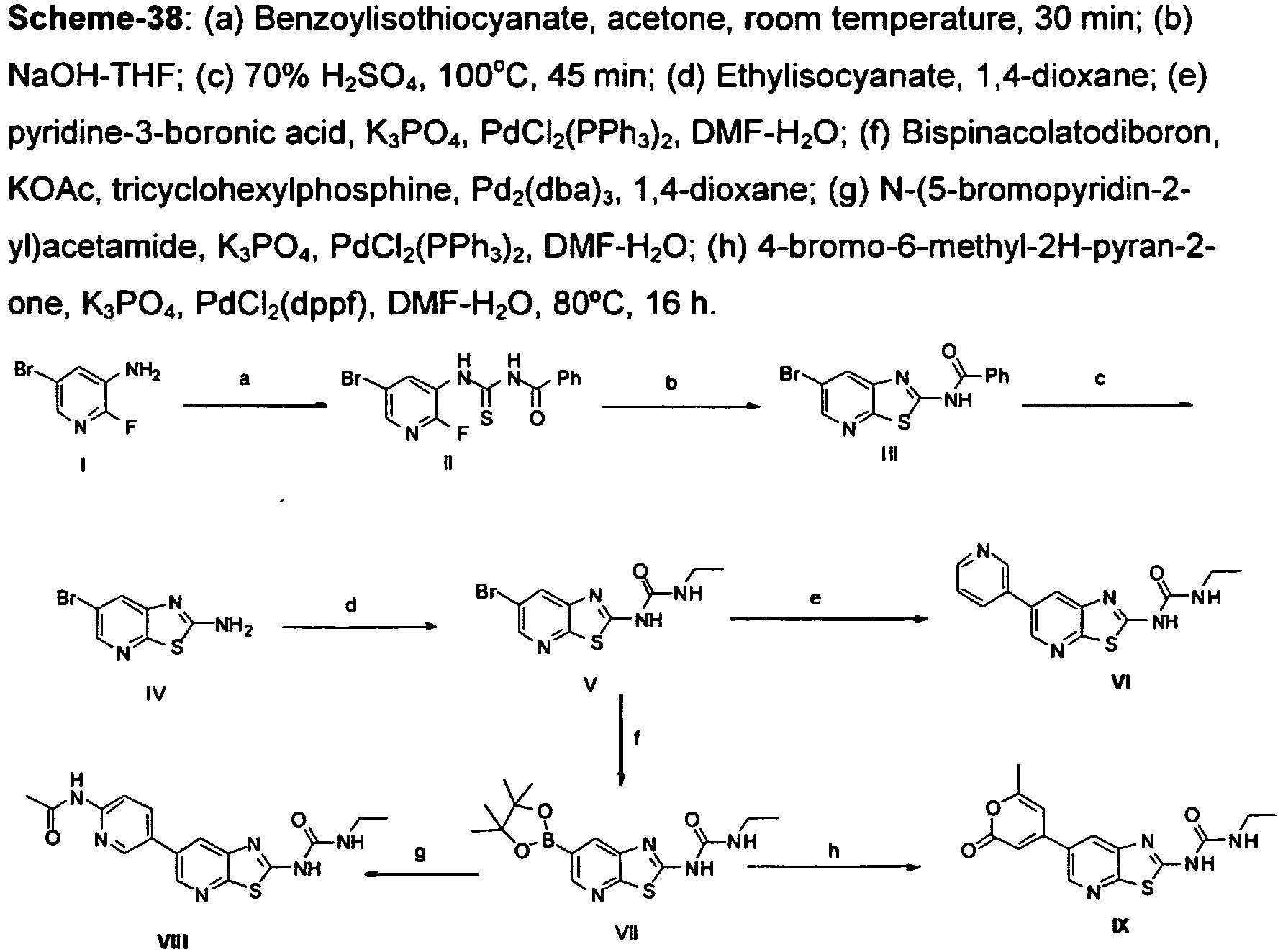
- To a solution of 3-amino-5-bromo-2-fluoropyridine (1.0 g, 5.23 mmol) in acetone (15.0 mL) was added benzoylisothiocyanate (0.85 mL, 6.25 mmol) and the resulting reaction mixture was stirred at room temperature for 30 min. After the completion of the reaction (TLC monitoring), acetone was removed under reduced pressure and the residue was washed with hexane and filtered to obtain the desired product (1.68 g, 91%). 1H NMR (400MHz, DMSO-d6): δ 7.55 (t, J= 7.60 Hz, 2H), 7.68 (t, J= 7.60 Hz, 1H), 8.0 (d, J= 7.60 Hz, 2H), 8.31 (s, 1H), 8.84 (dd, J= 2.0 and 8.40 Hz, 1H), 12.03 (br s, 1H) and 12.60 (br s, 1H).
- To an ice-cold solution of N-(5-bromo-2-fluoropyridin-3-ylcarbamothioyl) benzamide II (1.80 g, 5.08 mmol) in THF (20.0 mL) was added a solution of NaOH (1.0 g, 22.0 mmol, dissolved in 10.0 mL H2O). The reaction mixture was then heated to 60°C for 16 h. After the completion of the reaction (TLC monitoring), the reaction mixture was concentrated, added water and extracted with EtOAc (3 x 150 mL). The combined organics was washed with brine, dried (Na2SO4), filtered and concentrated under reduced pressure to obtain the desired product (1.60 g, 95%). 1H NMR (400MHz, DMSO-d6): δ 7.42 (m, 3H), 7.82 (d, J= 2.0 Hz, 1H), 8.14 (m, 2H) and 8.18 (d, J= 2.0 Hz, 1H).
- A solution of N-(6-bromothiazolo[5,4-b]pyridin-2-yl)benzamide III (2.0 g, 5.98 mmol) in 70% H2SO4 (10.0 mL) was heated to 140°C for 1 h. After the completion of the reaction (TLC monitoring), the reaction mixture was poured onto crushed ice, basified with 30% aqueous NaOH solution till pH 8.0 and extracted with EtOAc (3 x 150 mL). The combined organics was washed with brine, dried (Na2SO4), filtered and concentrated under reduced pressure to obtain the desired product (1.34 g, 98%). 1H NMR (400MHz, DMSO-d6): δ 7.85 (d, J= 2.0 Hz, 1H), 8.05 (br s, 2H) and 8.18 (d, J= 2.0 Hz, 1H).
- To a solution of 6-bromothiazolo[5,4-b]pyridin-2-amine IV (1.30 g, 5.55 mmol) in 1,4-dioxane (20.0 mL) was added ethylisocyanate (2.19 mL, 27.07 mmol) and the resulting reaction mixture was heated to 80°C for 8 h. After the completion of the reaction (TLC monitoring), 1,4-dioxane was distilled off followed by co-distillation with n-hexane (2 times). The residue was then stirred with water at 90°C for 2h followed by filtration to obtain the desired product that was further washed with hot water and then dried. The residue was finally washed with ether to obtain the desired product (1.40 g, 83%). 1H NMR (400MHz, DMSO-d6): δ 1.10 (t, J= 7.20 Hz, 3H), 3.20 (quintet, J= 7.20 Hz, 2H), 6.76 (br s, 1H), 8.24 (d, J= 2.0 Hz, 1H), 8.45 (d, J= 2.0 Hz, 1H) and 11.05 (br s, 1H).
- A solution of 1-(6-bromothiazolo[5,4-b]pyridin-2-yl)-3-ethylurea (0.05 g, 0.17 mmol), pyridine-3-boronic acid (0.025 g, 0.20 mmol) and K3PO4 (0.053 g, 0.25 mmol) in DMF-H2O (5.0 mL, 3:2) was degassed by flushing with nitrogen for 15 min. Dichlorobis(triphenylphosphine)-palladium(II) (0.012 g, 0.016 mmol) was then added to the reaction mixture followed by degassing with nitrogen for another 15 min. The resulting reaction mixture was then heated to 80°C for 4 h. After the completion of the reaction (TLC monitoring), the reaction mixture was cooled to room temperature and poured onto ice-cold water followed by extraction with EtOAc (2 x 100 mL). The combined organics was washed with brine, dried (Na2SO4), filtered and concentrated under reduced pressure. The crude was then purified over silica gel (100-200 M, 2.40% MeOH-DCM) to obtain the desired product (0.003 g (7%). 1H NMR (400MHz, DMSO-d6): δ 1.10 (t, J= 7.20 Hz, 3H), 3.18 (m, 2H), 6.77 (m, 1H), 7.55 (m, 1H), 8.22 (d, J= 8.40 Hz, 1H), 8.31 (d, J= 1.60 Hz, 1H), 8.63 (d, J= 5.20 Hz, 1H), 8.72 (d, J= 2.0 Hz, 1H), 9.01 (d, J= 1.60 Hz, 1H), and 10.97 (br s, 1H). MS: 300.11 (M+H)+. Qualitative HPLC Purity (Acquity BEH C-18, 100 x 2.1 mm, 245 nm): 97.04% (Rt = 4.40 min).
- A solution of 1-(6-bromothiazolo[5,4-b]pyridin-2-yl)-3-ethylurea V (0.20 g, 0.66 mmol), bispinacolatodiboron (0.38 g, 1.32 mmol) and KOAc (0.164 g, 2.0 mmol) in 1,4-dioxane (10.0 mL) was degassed by flushing with nitrogen for 15 min. Tricyclohexylphosphine (0.03 g, 0.10 mmol) and tris(dibenzyledineacetone) dipalladium (0) (0.06 g, 0.066 mmol) was then added to the reaction mixture, which was again degassed by nitrogen for 15 min. The resulting reaction mixture was heated to 80-85°C for 2 h. After the completion of the reaction (TLC monitoring), the reaction mixture was filtered through celite bed and the filtrate was concentrated to get the crude residue that was carried forward to the next step without further purification. MS: 349.23 (M+H)+.
- A solution of N-(5-bromopyridin-2-yl)acetamide (0.06 g, 0.28 mmol), 1-ethyl-3-(6-(4,4,5,5-tetramethyl-1,3,2-dioxaborolan-2-yl) thiazolo [5,4-b]pyridin-2-yl)urea (0.15 g, 0.42 mmol) and K3PO4 (0.18 g, 0.84 mmol) in DMF-H2O (5.0 mL, 3:2) was degassed by flushing with nitrogen for 15 min. Dichlorobis(triphenylphosphine)-palladium(II) (0.03 g, 0.04 mmol) was then added to the reaction mixture followed by degassing with nitrogen for another 15 min. The resulting reaction mixture was then heated to 80°C for 16 h. After the completion of the reaction (TLC monitoring), the reaction mixture was cooled to room temperature and poured onto ice-cold water followed by extraction with EtOAc (2 x 100 mL). The combined organics was washed with brine, dried (Na2SO4), filtered and concentrated under reduced pressure. The crude was then purified over silica gel (100-200 M, 2.80% MeOH-DCM) to obtain the desired product (0.007 g (5%). 1H NMR (400MHz, DMSO-d6): δ 1.11 (t, J= 7.20 Hz, 3H), 2.12 (s, 3H), 3.18 (m, 2H), 6.76 (m, 1H), 8.17-8.28 (m, 3H), 8.71 (d, J= 1.60 Hz, 1H), 8.75 (s, 1H), 10.72 (s, 1H) and 10.96 (br s, 1H). MS: 357.15 (M+H)+. Qualitative HPLC Purity (Acquity BEH C-18, 100 x 2.1 mm, 238 nm): 89.81% (Rt = 4.37 min).
- A solution of 4-bromo-6-methyl-2H-pyran-2-one (0.055 g, 0.30 mmol), 1-ethyl-3-(6-(4,4,5,5-tetramethyl-1,3,2-dioxaborolan-2-yl) thiazolo [5,4-b]pyridin-2-yl)urea (0.15 g, 0.42 mmol) and K3PO4 (0.185 g, 0.87 mmol) in DMF-H2O (5.0 mL, 3:2) was degassed by flushing with nitrogen for 15 min. [1,1'-Bis(diphenylphosphino)-ferrocene]dichloropalladium(II), complex with dichloromethane (0.021 g, 0.028 mmol) was then added to the reaction mixture followed by degassing with nitrogen for another 15 min. The resulting reaction mixture was then heated to 80°C for 16 h. After the completion of the reaction (TLC monitoring), the reaction mixture was cooled to room temperature and poured onto ice-cold water followed by extraction with EtOAc (2 x 100 mL). The combined organics was washed with brine, dried (Na2SO4), filtered and concentrated under reduced pressure. The crude was then purified over silica gel (100-200 M, 4.20% MeOH-DCM) to obtain the desired product (0.032 g (33%). 1H NMR (400MHz, DMSO-d6): δ 1.11 (t, J= 6.80 Hz, 3H), 2.31 (s, 3H), 3.21 (quintet, J= 7.20 Hz, 2H), 6.71 (s, 1H), 6.75 (m, 1H), 6.90 (s, 1H), 8.40 (s, 1H), 8.79 (s, 1H) and 11.07 (br s, 1H). MS: 331.10 (M+H)+. Qualitative HPLC Purity (Acquity BEH C-18, 100 x 2.1 mm, 261 nm): 96.37% (Rt = 4.72 min).

- A stirred mixture of 4-Hydroxy-6-methyl-2-pyrone (1.394 g, 11.1 mmol) and 1-(6-Methyl-pyridin-3-yl)-ethylamine (1.806 g, 13.3 mmol) in water (18 ml) was boiled under reflux for 65 h. The mixture was cooled to ambient temperature and the supernatant liquid was decanted off to leave a dark semi-solid residue. This was triturated with ethyl acetate to give 4-Hydroxy-6-methyl-1-[1-(6-methyl-pyridin-3-yl)-ethyl]-1H-pyridin-2-one as a grey solid (475 mg) which was used in the next step without further purification. LC-MS m/z 245[M+H]+ Rt=1.21 min.
- A stirred mixture of the product from Step 1 (475 mg, 1.947 mmol) and 4-methylbenzenesulfonyl chloride (371 mg, 1.947 mmol) in anhydrous dichloromethane (16 ml) was treated with anhydrous triethylamine (0.81 ml, 5.839 ml) and stirring was continued at ambient temperature for 18 h. The reaction mixture was diluted with dichloromethane (150 ml), washed with water (100 ml) followed by brine (100 ml) and dried (MgSO4). The solvent was removed in vacuo and the residue purified by flash silica chromatography eluting with ethyl acetate to give toluene-4-sulfonic acid 6-methyl-1-[1-(6-methyl-pyridin-3-yl)-ethyl]-2-oxo-1,2-dihydro-pyridin-4-yl ester (609 mg) as a colourless gum which solidified on standing. LC-MS m/z 399[M+H]+ Rt=2.10 min.

- A stirred mixture of 1-(5-Bromo-6-fluoro-benzothiazol-2-yl)-3-ethyl-urea (100 mg, 0.314 mmol), bis(neopentyl)glycolato diboron (70mg, 0.314 mmol), potassium acetate (91 mg, 0.952 mmol) and 1,1'-bis(diphenylphosphino)ferrocene palladium(II)chloride, complex (26 mg, 0.0314 mmol) in anhydrous N,N-dimethylformamide (4.1 ml) was purged with nitrogen for 15 minutes. The reaction vessel was sealed and heated at 80°C for 3h.
- The reaction mixture from Step 1 was cooled to ambient temperature. Toluene-4-sulfonic acid 6-methyl-1-[1-(6-methyl-pyridin-3-yl)-ethyl]-2-oxo-1,2-dihydro-pyridin-4-yl ester (125 mg, 0.314 mmol) was added followed by aqueous cesium carbonate solution (3.7 M, 0.12 ml, 0.470 mmol) and 1,1'-bis(diphenylphosphino)ferrocene palladium(II)chloride, complex (26 mg, 0.0314 mmol). The reaction mixture was purged with nitrogen for 5 minutes, sealed and heated at 80 °C for 5 h. The reaction mixture was cooled to ambient temperature, diluted with water (100 ml) and extracted with ethyl acetate (3x50 ml). The combined extracts were washed with brine and dried (MgSO4). The solvent was removed in vacuo and the residue purified by flash silica chromatography eluting first with ethyl acetate and then with 0 to 5% (7 N methanolic ammonia in dichloromethane to give 1-ethyl-3-(6-fluoro-5-{6-methyl-1-[1-(6-methyl-pyridin-3-yl)-ethyl]-2-oxo-1,2-dihydro-pyridin-4-yl}-benzothiazol-2-yl)-urea (Example 78) as a pale brown solid (30 mg). LC-MS m/z 466[M+H]+ Rt=2.65 min.

- (3-Methoxy-pyridin-2-yl)-methanol (227 mg, 1.63 mmol), 2-hydroxy-4-bromopyridine (282 mg, 1.63 mmol) and triphenyl phosphine (416 mg, 1.63 mmol) were stirred in dry dichloromethane (10 ml) at 0 °C under an atmosphere of nitrogen. Diethyl azodicarboxylate (242 mg, 1.63 mmol) was added at 0°C then the reaction was allowed to attain room with stirring overnight. A saturated aqueous solution of sodium hydrogen carbonate was added (10 ml) and the layers were separated. The aqueous portion was extracted with dichloromethane (2x10 ml) and the organic portions were combined, dried (MgSO4) and concentrated under reduced pressure. The crude product was purified by flash silica chromatography eluting first with 0-100% ethyl acetate in petrol and then 10% 7 N methanolic ammonia in dichloromethane to give the 4-bromo-1-(3-methoxy-pyridin-2-ylmethyl)-1H-pyridin-2-one in 57% purity contaminated with 23% 2-hydroxy-4-bromopyridine and 20% triphenyl phosphine oxide by LC-MS (340 mg). The product was used directly in the next step. LC-MS m/z 297[M+H]+ Rt=2.05 min

- A stirred mixture of 1-(5-Bromo-6-fluoro-benzothiazol-2-yl)-3-ethyl-urea (100 mg, 0.314 mmol), bis(neopentyl)glycolato diboron (70 mg, 0.314 mmol), potassium acetate (91 mg, 0.952 mmol) and 1,1'-bis(diphenylphosphino)ferrocene palladium(II)chloride, complex (26 mg, 0.0314 mmol) in anhydrous N,N-dimethylformamide (4.1 ml) was purged with nitrogen for 15 minutes. The reaction vessel was sealed and heated at 80°C for 3 h.
- The reaction mixture from Step 1 was cooled to ambient temperature. The mixture containing 4-Bromo-1-(3-methoxy-pyridin-2-ylmethyl)-1H-pyridin-2-one (114 mg) was added followed by aqueous cesium carbonate solution (3.7 M, 0.25 ml, 0.930 mmol) and 1,1'-bis(diphenylphosphino)ferrocene palladium(II)chloride complex (26 mg, 0.0314 mmol). The reaction mixture was purged with nitrogen for 5 minutes, sealed and heated at 80°C for 5 h. The reaction mixture was cooled to ambient temperature, diluted with water (12 ml) and extracted with dichloromethane (3x12 ml). The combined extracts were washed with brine, dried (MgSO4) and concentrated under reduced pressure. The crude product was triturated in dichloromethane-methanol (9:1) and the resulting solid was collected by filtration to afford 1-Ethyl-3-{6-fluoro-5-(1-(3-methoxy-pyridin-2-ylmethyl)-2-oxo-1,2-dihydropyridin-4-yl]-benzothiazol-2-yl}-urea (Example 79) (10 mg) as a white solid. The filtrate was concentrated under reduced pressure and purified by flash silica chromatography eluting with 0 to 5% 7 N methanolic ammonia in dichloromethane to give a further 8 mg of product as a white solid. LC-MS m/z 454[M+H]+ Rt=2.64 min.
- Compounds of this invention were tested for antimicrobial activity by susceptibility testing in liquid or on solid media. MICs for compounds against each strain were determined by the broth microdilution or agar dilution method according to the guidelines of the Clinical Laboratories and Standards Institute, formerly the National Committee for Clinical Laboratory Standards (Clinical Laboratories and Standards Institute. Methods for Dilution Antimicrobial Susceptibility Tests for Bacteria That Grow Aerobically, Approved Standard-Seventh Edition. Document M7-A7. CLSI, Wayne, Pa, 2006; Clinical Laboratories and Standards Institute. Methods for Antimicrobial Susceptibility Testing of Anaerobic Bacteria; Approved Standard-Sixth Edition. Document M11-A6. CLSI, Wayne, Pa, 2004).
- Compounds of the current invention were found to have antimicrobial activity in the MIC assays described above.
- Gyrase converts ATP into ADP and inorganic phosphate. The released phosphate can be detected by the addition of malachite green solution and measured by monitoring the increase in absorbance at 600nm.
- The ATPase assay is carried out in a buffer containing 4.8 pg/ml Gyrase enzyme (A2B2 complex from Escherichia coli), 0.08 µg/ml ssDNA, 35 mM Tris pH 7.5, 24 mM KCI, 2 mM MgCl2, 6.5% Glycerol, 2 mM DTT, 1.8 mM Spermidine, 0.5 mg/ml BSA, and 5% DMSO solution containing the inhibitor. The reaction is started by adding ATP to a final concentration of 1 mM and allowed to incubate at 30°C for 60 minutes. The reaction is stopped by adding 200 µl of malachite green solution (0.034% malachite green, 10 mM ammonium molybdate, 1 M HCl, 3.4% ethanol, 0.01% tween 20). Colour is allowed to develop for 5 minutes and the absorbance at 600 nm is measured spectrophotometrically. The IC50 values are determined from the absorbance readings using no compound and no enzyme controls.
- All Example compounds above of the current invention were found to inhibit the gyrase ATPase assay described above, with 50% inhibitory concentrations (IC50) of less than 0.75 micro molar.
- All of the Examples inhibited the growth of bacteria. Table 1 shows the MIC value for each Example against Enterococcus faecalis ATCC 29212 in the MIC Assay described above. Examples with activity "C" demonstrate MICs of 2-16 µg/ml. Examples with activity "B" demonstrate MICs of 0.25-1 µg/ml. Examples with activity "A" demonstrate MICs of <0.25 µg/ml.
Table 1. MICs against Enterococcus faecalis Example number Activity Example number Activity Example number Activity Example number Activity 1 B 21 C 41 C 61 B 2 C 22 C 42 C 62 B 3 B 23 C 43 B 63 C 4 B 24 C 44 A 64 B 5 C 25 B 45 B 65 B 6 C 26 C 46 B 66 C 7 c 27 C 47 C 67 C 8 C 28 C 48 B 68 C 9 c 29 C 49 B 69 C 10 C 30 B 50 C 70 C 11 C 31 B 51 C 71 B 12 C 32 C 52 B 72 B 13 C 33 B 53 C 73 C 14 C 34 B 54 C 74 B 15 C 35 B 55 B 75 C 16 C 36 C 56 C 76 C 17 C 37 C 57 C 77 C 18 C 38 B 58 B 78 B 19 B 39 C 59 B 79 A 20 B 40 B 60 B - Some of the Example compounds were also tested for activity against other bacterial species. For example, Table 2 shows the MICs of Example 3 against various bacterial species. Activity "C" demonstrates an MIC of 2-16 µg/ml. Activity "B" demonstrates an MIC of 0.25-1 µg/ml. Activity "A" demonstrates an MIC of <0.25 µg/ml.
Table 2. MICs against various bacteria Species Isolate ID Activity Enterococcus faecalis (VRE) ATCC 51299 C Enterococcus faecium (VRE) ATCC 700221 C Haemophilus influenzae ATCC 49247 C Moraxella catarrhalis ATCC 25240 B Staphylococcus aureus ATCC 29213 B Staphylococcus epidermidis ATCC 12228 B Staphylococcus haemolyticus ATCC 29970 B Streptococcus agalactiae ATCC 13813 B Streptococcus mutans ATCC 35668 B Streptococcus pneumoniae ATCC 49619 A Streptococcus pyogenes ATCC 51339 B - Some of the Example compounds were also tested for activity against clinical isolates of various bacterial species. For example, Table 3 shows the MIC90s of Example 49 against various bacterial species.
Table 3. MICs against various clinical isolatesSpecies Number of isolates MIC range (µg/ml) MIC90 (µg/ml) Staphylococus aureus 10 0.03-0.12 0.06 Staphylococcus epidermidis 10 0.008-0.06 0.03 Streptococcus pyogenes 10 0.12-0.5 0.25 Streptococcus pneumoniae 10 0.008-0.03 0.015 Propionibacterium acnes 5 1 1 Enterococcus faecium 10 0.25-0.5 0.5 Enterococcus faecalis 10 0.06-0.5 0.25


Claims (18)
- A compound of formula (I) or a salt or N-oxide thereof:

m is 1;
Q is hydrogen;
Alk is a divalent C1-C6 alkylene, alkenylene or alkynylene radical which may contain an ether (-O-), thioether (-S-) or amino (-NR)- link, wherein R is hydrogen;
X is -C(=O)NR6-, or -C(=O)O- wherein R6 is hydrogen, optionally substituted C1-C6 alkyl, C2-C6 alkenyl or C2-C6 alkynyl;
Z1 is -N= or -CH=
Z2 is -N= or -C(R1)=;
R1 is hydrogen, methyl, ethyl, ethenyl, ethynyl, methoxy, mercapto, mercaptomethyl, halo, fully or partially fluorinated (C1-C2)alkyl, (C1-C2)alkoxy or (C1-C2)alkylthio, nitro,
or nitrile (-CN);
R2 is a group Q1-[Alk1]q-Q2 -, wherein
q is 0 or 1;
Alk1 is an optionally substituted, divalent, straight chain or branched C1-C6 alkylene, or C2-C6 alkenylene or C2-C6 alkynylene radical which may contain or terminate in an ether (-O-), thioether (-S-) or amino (-NR)- link;
Q2 is an optionally substituted divalent monocyclic carbocyclic or heterocyclic radical having 5 or 6 ring atoms or an optionally substituted divalent bicyclic carbocyclic or heterocyclic radical having 9 or 10 ring atoms;
Q1 is hydrogen, an optional substituent, or an optionally substituted carbocyclic or heterocyclic radical having 3-7 ring atoms; and wherein "optionally substituted" means substituted with up to four compatible substituents, independently selected from (C1-C6)alkyl, (C2-C6)alkenyl, (C2-C6)alkynyl, (C1-C6)alkoxy, hydroxy, hydroxy(C1-C6)alkyl, (C1-C3)alkoxy(C,-C3)alkyl, mercapto, mercapto(C1-C6)alkyl, (C1-C6)alkylthio, halo such as fluoro, bromo and chloro, fully or partially fluorinated (C1-C3)alkyl, (C1-C3)alkoxy or (C1-C3)alkylthio such as trifluoromethyl, trifluoromethoxy, and trifluoromethylthio, nitro, nitrile (-CN), oxo (=O), phenyl, phenyl(C1-C3)alkyl-, phenoxy, monocyclic heteroaryl, heteroaryl(C1-C3)alkyl-, or heteroaryloxy with 5 or 6 ring atoms, cycloalkyl having 3 to 6 ring carbon atoms, - COORA, -CORA, -OCORA, -SO2RA, -CONRARB, -CONHNH2,-SO2NRARB, -NRARB, - NHNH2, -OCONRARB, -NRBCORA, -NRBCOORA, -NRBSO2ORA or -NRACONRARB wherein RA and RB are independently hydrogen or a (C1-C6)alkyl, hydroxy(C1-C6)alkyl, or (C1-C3)alkoxy(C1-C3)alkyl group or, in the case where RA and RB are linked to the same N atom, RA and RB taken together with that nitrogen may form a cyclic amino ring such as morpholinyl, piperidinyl, piperazinyl, or 4-(C1-C6)alkyl-piperizinyl such as 4-methyl-piperazinyl; and in the case where the substituent is phenyl, phenyl(C1-C3)alkyl-, phenoxy or monocyclic heteroaryl, heteroaryl(C1-C3)alkyl-, or heteroaryloxy with 5 or 6 ring atoms, the phenyl or heteroaryl ring thereof may itself be substituted by any of the above substituents except phenyl, phenyl(C1-C3)alkyl-, phenoxy, heteroaryl, heteroaryl(C1-C3)alkyl-, or heteroaryloxy. - A compound as claimed in claim 1 wherein m is 1, Q is hydrogen, Alk is - CH2CH2-, and X is -C(O)NH-.
- A compound as claimed in claim 1 or claim 2 wherein, in the substituent R2 of the said compound, Q2 is an optionally substituted pyridine, pyrimidine, pyrazine, pyran-2-one, pyrimidine-4-one or pyridine-2-one ring.
- A compound as claimed in any of claims 1 to 2 wherein, in the substituent R2 of the said compound, Q2 is an optionally substituted pyridine-3-yl ring, an optionally substituted pyrimidine-5-yl ring, an optionally substituted pyrazine-2-yl ring, an optionally substituted pyran-2-one-4-yl ring or an optionally substituted pyridine-2-one-4-yl ring.
- A compound as claimed in any of the preceding claims wherein, in the substituent R2 of the said compound, Alk1 is present and is an optionally substituted divalent C1-C3 alkylene radical.
- A compound as claimed in any of the preceding claims wherein, in the substituent R2 of the said compound, Q1 is a group of formula -NRARB, wherein RA and RB are independently hydrogen or a (C1-C6)alkyl, hydroxy(C1-C6)alkyl, or (C1-C3)alkoxy(C1-C3)alkyl group.
- A compound as claimed in any of claims 1 to 5 wherein, in the substituent R2 of the said compound, Q1 is a group of formula -NRARB, wherein RA and RB taken together with that nitrogen form a cyclic amino ring.
- A compound as claimed in claim 7 wherein the cyclic amino ring is a morpholinyl, piperidinyl, or piperazinyl ring.
- A compound as claimed in any of claims 1 to2 wherein, in the substituent R2 of the said compound, Q2 is an optionally substituted pyridinyl, pyrimidinyl or pyrazinyl radical, q is 0 and Q1 is an optionally substituted heterocyclic radical having 3-7 ring atoms.
- A compound as claimed in claim 9 wherein Q1 is an optionally substituted oxadiazolyl or tetrazolyl radical.
- A compound as claimed in claim 9 wherein Q1 is an optionally substituted piperidinyl or pyrrolidinyl radical.
- A compound as claimed in claim 11 wherein Q1 is substituted by -COOH.
- A compound as claimed in any of claims 1 to 2 wherein, in the substituent R2 of the said compound, Q2 is an optionally substituted pyrimidine-4-one or pyridine-2-one, q is 1 and Q1 is an optionally substituted heterocyclic radical having 3-7 ring atoms.
- A compound as claimed in claim 13 wherein, Alk1 is -CH2- and Q1 is an optionally substituted pyridinyl radical.
- A compound as claimed in claim 1 selected from the group consisting of:1-ethyl-3-(5-pyridin-3-yl-benzothiazol-2-yl)-urea2-{5-[2-(3-ethyl-ureido)-benzothiazol-5-yl]-pyridin-2-yl]-N-methyl-acetamide1-ethyl-3-[5- (1-methyl-2-oxo-1,2-dihydro-pyridin-4-yl)-benzothiazol-2-yl]-urea1-ethyl-3-(6-fluoro-5-pyridin-3-yl-benzothiazol-2-yl)-urea1-(5-([1,2,4]triazolo[4,3-a]pyridin-6-yl)benzo[d]thiazol-2-yl)-3-ethylurea1-ethyl-3-(5-(imidazo[1,2-a]pyridin-6-yl)benzo[d]thiazol-2-yl)urea1-ethyl-3-(5-(tetrazolo[1,5-a]pyridin-6-yl)benzo[d]thiazol-2-yl)urea1-(5-(3,4-dihydro-2H-pyrido[3,2-b][1,4]oxazin-7-yl)benzo[d]thiazol-2-yl)-3-ethylurea1-ethyl-3-(5-(6-(hydroxymethyl)pyridin-3-yl)benzo[d]thiazol-2-yl)urea1-ethyl-3-(5-(5-(2-oxopyridin-1 (2H)-yl)pyrazin-2-yl)benzo[d]thiazol-2-yl)urea1-ethyl-3-(5-(2-(hydroxymethyl)-1-methyl-1H-imidazol-5-yl)benzo[d]thiazol-2-yl)urea1-ethyl-2-(5-(2-(3-ethylureido)benzo[d]thiazol-5-yl)-2-oxopyridin-1 (2H)-yl)acetate1-(5-(1-(2-ethoxyethyl)-6-oxo-1,6-dihydropyridin-3-yl)benzo[d]thiazol-2-yl)-3-ethylurea1-ethyl-3-(5-(6-methyl-2-oxo-2H-pyran-4-yl)benzo[d]th iazol-2-yl)ureamethyl 5-(2-(3-ethylureido)benzo[d]thiazol-5-yl)picolinate1-ethyl-3-(5-(1-(2-morpholinoethyl)-1H-pyrazol-4-yl)benzo[d]thiazol-2-yl)urea1-(5-(1H-pyrazol-3-yl)benzo[d]thiazol-2-yl)-3-ethylurea1-ethyl-3-(5-(1-methyl-1H-pyrazol-4-yl)benzo[d]thiazol-2-yl)urea1-ethyl-3-(5-(4-methyl-3,4-dihydro-2H-pyrido[3,2-b][1,4]oxazin-7-yl)benzo[d]thiazol-2-yl)urea1-ethyl-3-(5-(isoquinolin-4-yl)benzo[d]thiazol-2-yl)urea1-(5-(1H-pyrazol-4-yl)benzo[d]thiazol-2-yl)-3-ethylurea1-ethyl-3-(5-(2-methoxythiazol-5-yl)benzo[d]thiazol-2-yl)urea1-ethyl-3-(5-(2-hydroxythiazol-5-yl)benzo[d]thiazol-2-yl)urea1-ethyl-3-(5-(imidazo[1,2-a]pyridin-3-yl)benzo[d]thiazol-2-yl)urea1-(5-([1,2,4]triazolo[1,5-a]pyridin-6-yl)benzo[d]thiazol-2-yl)-3-ethylureaN-(5-(2-(3-ethylureido)benzo[d]thiazol-5-yl)pyridin-2-yl)acetamide1-ethyl-3-(5-(6-morpholinopyridin-3-yl)benzo[d]thiazol-2-yl)urea1-(5-(2-(1H-imidazol-1-yl)pyrimidin-5-yl)benzo[d]th iazol-2-yl)-3-ethylurea1-ethyl-3-(5-(2-oxo-1,2-dihydropyridin-4-yl)benzo[d]thiazol-2-yl)urea1-ethyl-3-(5-(6-(2-methyl-2H-tetrazol-5-yl)pyridin-3-yl)benzo[d]thiazol-2-yl)urea1-ethyl-3-(5-(1-(2-methoxyethyl)-6-methyl-2-oxo-1 ,2-dihydropyridin-4-yl)benzo[d]thiazol-2-yl)urea1-ethyl-3-(5-(1-(2-hydroxyethyl)-6-methyl-2-oxo-1,2-dihydropyridin-4-yl)benzo[d]thiazol-2-yl)urea1-ethyl-3-(5-(6-methyl-1-((6-methylpyridin-2-yl)methyl)-2-oxo-1,2-dihydropyridin-4-yl)benzo[d]thiazol-2-yl)urea1-ethyl-3-(5-(6-methyl-2-oxo-1-(pyridin-3-ylmethyl)-1,2-dihydropyridin-4-yl)benzo[d]thiazol-2-yl)urea1-ethyl-3-(5-(6-methyl-2-oxo-1-(pyridin-2-ylmethyl)-1,2-dihydropyridin-4-yl)benzo [d]thiazol-2-yl)urea1-ethyl-3-(5-(6-methyl-2-oxo-1-(1-(pyridin-2-yl)ethyl)-1,2-dihydropyridin-4-yl)benzo[d]thiazol-2-yl)ureaethyl 7-(2-(3-ethylureido)benzo[d]thiazol-5-yl)-1-methyl-4-oxo-1,4-dihydroquinoline-3-carboxylateN-(5-(2-(3-ethylureido)-6-fluorobenzo[d]thiazol-5-yl)pyridin-2-yl)acetamideethyl 2-(4-(2-(3-ethylureido)-6-fluorobenzo[d]thiazol-5-yl)-l H-pyrazol-1-yl)acetate1-ethyl-3-(6-fluoro-5-(6-methyl-2-oxo-2H-pyran-4-yl)benzo[d]thiazol-2-yl)urea1-ethyl-3-(6-fluoro-5-(2-(4-(2-hydroxyethyl)piperazin-1-yl)pyrimidin-5-yl)benzo[d]thiazol-2-yl)urea1-ethyl-3-(6-fluoro-5-(2-(piperazin-1-yl)pyrimidin-5-yl)benzo[d]thiazol-2-yl)urea hydrochloride saltmethyl 1-(5-(2-(3-ethylureido)-6-fluorobenzo[d]thiazol-5-yl)pyrimidin-2-yl)piperidine-4-carboxylate1-(5-(2-(3-ethylureido)-6-fluorobenzo[d]thiazol-5-yl)pyrimidin-2-yl)piperidine-4-carboxylic acidmethyl 1-(5-(2-(3-ethylureido)-6-fluorobenzo[d]thiazol-5-yl)pyrimidin-2-yl)piperidine-3-carboxylate1-(5-(2-(3-ethylureido)-6-fluorobenzo[d]thiazol-5-yl)pyrimidin-2-yl)piperidine-3-carboxylic acidmethyl 2-(4-(2-(3-ethylureido)-6-fluorobenzo[d]thiazol-5-yi)-l H-pyrazol-1-yl)propanoate1-ethyl-3-(6-fluoro-5-(1H-pyrrolo[2,3-b]pyridin-3-yl)benzo[d]thiazol-2-yl)urea1-ethyl-3-(6-fluoro-5-(6-methyl-2-oxo-1-(pyridin-3-y)methyl)-1,2-dihydropyridin-4-yl)benzo[d]thiazol-2-yl)urea1-ethyl-3-(6-fluoro-5-(6-methyl-1-((1-methylpyrrolidin-3-yl)methyl)-2-oxo-1,2-dihydropyridin-4-yl)benzo[d]thiazol-2-yl)urea1-ethyl-3-(6-fluoro-5-(6-methyl-1-((1-methylpiperidin-2-yl)methyl)-2-oxo-1 ,2-dihydropyridin-4-yl)benzo[d]thiazol-2-yl)urea1-ethyl-3-(6-fluoro-5-(6-methyl-1-((1-methyl-1H-imidazol-4-yl)methyl)-2-oxo-1,2-dihydropyridin-4-yl)benzo[d]thiazol-2-yl)ureatert-butyl 2-((4-(2-(3-ethylureido)-6-fluorobenzo[d]thiazol-5-yl)-6-methyl-2-oxopyridin-1 (2H)-yl)methyl)pyrrolidine-1-carboxylate1-(5-(1-(3-(dimethylamino)propyl)-6-methyl-2-oxo-1,2-dihydropyridin-4-yl)-6-fluorobenzo[d]thiazol-2-yl)-3-ethylurea1-ethyl-3-(6-fluoro-5-(6-(5-methyl-1,2,4-oxadiazol-3-yl)pyridin-3-yl)benzo[d]thiazol-2-yl)urea1-ethyl-3-[6-fluoro-5-(4-methoxy-pyridin-2-yl)-benzothiazol-2-yl]-urea1-ethyl-3-(6-fluoro-5-(2-(4-methylpiperazin-1-yl)pyrimidin-5-yl)benzo[d]thiazol-2-yl)urea1-ethyl-3-(6-fluoro-5-(5-methoxypyridin-3-yl)benzo[d]thiazol-2-yl)u rea1-ethyl-3-(6-fluoro-5-(5-hydroxypyridin-3-yl)benzo[d]thiazol-2-yl) urea5-(2-(3-ethylureido)-6-fluorobenzo[d]thiazol-5-yl)-N'-hydroxypicolinimidamide1-ethyl-3-(6-fluoro-5-(1-methyl-2-oxo-1,2-dihydropyridin-4-yl)benzo[d]thiazol-2-yl)urea1 -ethyl-3-(6-fluoro-5-(l-(2-morpholinoethyl)-2-oxo-1,2-dihydropyridin-4-yl)benzo[d]thiazol-2-yl)urea1-(5-(1-(2-(dimethylamino)ethyl)-2-oxo-1,2-dihydropyridin-4-yl)-6-fluorobenzo[d]thiazol-2-yl)-3-ethylureatert-butyl 3-((4-(2-(3-ethylureido)-6-fluorobenzo[d]thiazol-5-yl)-2,2'-dioxo-2H-1 ,4'-bipyridin-1'(2'H)-yl)methyl)piperidine-1-carboxylate1-ethyl-3-(6-fluoro-5-(6-(hydroxymethyl)pyridin-3-yl)benzo[d]thiazol-2-yl)urea1-ethyl-3-(6-fluoro-5-(6-(morpholinomethyl)pyridin-3-yl)benzo[d]thiazol-2-yl)urea1-ethyl-3-(6-fluoro-5-(2-oxo-1-(pyrrolidin-3-yl)-1,2-dihydropyridin-4-yl)benzo[d]thiazol-2-yl)urea2-{5-[2-(3-ethyl-ureido)-6-fluoro-benzothiazol-5-yl]-pyridin-2-yl}-N-methylacetamide1-ethyl-3-(6-fluoro-5-(thiazol-5-yl)benzo[d]thiazol-2-yl)urea1-ethyl-3-(6-fluoro-5-(2-(methylsulfonyl)pyrimidin-5-yl)benzo[d]thiazol-2-yl)urea1-ethyl-3-(6-methoxy-5-(pyridin-3-yl)benzo[d]thiazol-2-yl)urea1-ethyl-3-(6-methoxy-5-(1-methyl-2-oxo-1,2-dihydropyridin-4-yl)benzo [d] thiazol-2-yl)urea1-ethyl-3-(6-methyl-5-(pyridin-3-yl)benzo[d]thiazol-2-yl)urea1-ethyl-3-(6-methyl-5-(1-methyl-2-oxo-1,2-dihydropyridin-4-yl)benzo[d]thiazol-2-yl)urea1-ethyl-3-(6-(pyridin-3-yl)thiazolo[5,4-b]pyridin-2-yl)ureaN-(5-(2-(3-ethylureido)thiazolo[5,4-b]pyridin-6-yl)pyridin-2-yl) acetamide1-ethyl-3-(6-(6-methyl-2-oxo-2H-pyran-4-yl) thiazolo[5,4-b]pyridin-2-yl)urea1-Ethyl-3-(6-fluoro-5-{6-methyl-1-[1-(6-methyl-pyridin-3-yl)-ethyl]-2-oxo-1,2-dihydro-pyridin-4-yl}-benzothiazol-2-yl)-urea1-Ethyl-3-{6-fluoro-5-[1-(3-methoxy-pyridin-2-ylmethyl)-2-oxo-1,2-dihydropyridin-4-yl]-benzothiazol-2-yl}-urea.
- An antibacterial composition comprising a compound as claimed in any of claims 1 to 15, together with one or more pharmaceutically acceptable carriers and/or excipients.
- A compound as claimed in any of claims 1 to 15 for use in the treatment or prevention of a bacterial infection.
- A method of treating or preventing bacterial contamination of a non-living substrate comprising applying to the site of such contamination or potential contamination an amount of a compound (I) as defined in any of claims 1 to 15, sufficient to inhibit bacterial growth.
Applications Claiming Priority (2)
| Application Number | Priority Date | Filing Date | Title |
|---|---|---|---|
| GBGB0724342.1A GB0724342D0 (en) | 2007-12-13 | 2007-12-13 | Anitbacterial compositions |
| PCT/GB2008/004114 WO2009074812A1 (en) | 2007-12-13 | 2008-12-12 | Antibacterial condensed thiazoles |
Publications (2)
| Publication Number | Publication Date |
|---|---|
| EP2231653A1 EP2231653A1 (en) | 2010-09-29 |
| EP2231653B1 true EP2231653B1 (en) | 2013-04-03 |
Family
ID=39048076
Family Applications (1)
| Application Number | Title | Priority Date | Filing Date |
|---|---|---|---|
| EP20080859786 Not-in-force EP2231653B1 (en) | 2007-12-13 | 2008-12-12 | Antibacterial condensed thiazoles |
Country Status (14)
| Country | Link |
|---|---|
| US (1) | US8299065B2 (en) |
| EP (1) | EP2231653B1 (en) |
| JP (1) | JP5539898B2 (en) |
| KR (1) | KR20100105847A (en) |
| CN (1) | CN102015700B (en) |
| AU (1) | AU2008334427B2 (en) |
| BR (1) | BRPI0820656A2 (en) |
| CA (1) | CA2709021A1 (en) |
| EA (1) | EA018104B1 (en) |
| ES (1) | ES2416059T3 (en) |
| GB (1) | GB0724342D0 (en) |
| MX (1) | MX2010006428A (en) |
| NZ (1) | NZ586508A (en) |
| WO (1) | WO2009074812A1 (en) |
Families Citing this family (43)
| Publication number | Priority date | Publication date | Assignee | Title |
|---|---|---|---|---|
| BRPI0913300A2 (en) * | 2008-06-04 | 2018-05-22 | Astrazeneca Ab | compound, process for preparation and use thereof, method of treating bacterial infection in an animal, and pharmaceutical composition. |
| US20110166088A1 (en) * | 2008-06-25 | 2011-07-07 | Ranbaxy Laboratories Limited | Benzothiazoles and aza-analogues thereof use as antibacterial agents |
| WO2011047323A2 (en) | 2009-10-16 | 2011-04-21 | Rib-X Pharmaceuticals, Inc. | Antimicrobial compounds and methods of making and using the same |
| JP6267863B2 (en) * | 2009-10-16 | 2018-01-24 | メリンタ セラピューティクス,インコーポレイテッド | Antimicrobial compounds and methods of making and using antimicrobial compounds |
| BR112012008759A2 (en) | 2009-10-16 | 2020-08-25 | Rib-X Pharmaceuticals, Inc. | antimicrobial compounds and methods of making and using them |
| EP2552893B1 (en) * | 2010-03-31 | 2014-10-29 | Actelion Pharmaceuticals Ltd. | Antibacterial isoquinolin-3-ylurea derivatives |
| EP2576570A1 (en) | 2010-05-26 | 2013-04-10 | Boehringer Ingelheim International GmbH | 2-oxo-1,2-dihydropyridin-4-ylboronic acid derivatives |
| US9181234B2 (en) | 2010-10-08 | 2015-11-10 | Biota Europe Ltd. | Antibacterial compounds |
| EP2663558A1 (en) | 2011-01-14 | 2013-11-20 | Vertex Pharmaceuticals Incorporated | Solid forms of gyrase inhibitor (r)-1-ethyl-3-[5-[2-{1-hydroxy-1-methyl-ethyl}pyrimidin-5-yl]-7-(tetrahydrofuran-2-yl}-1h-benzimidazol-2-yl]urea |
| PT2663556E (en) | 2011-01-14 | 2014-11-27 | Vertex Pharma | Process of making gyrase and topoisomerase iv inhibitors |
| RU2625305C2 (en) | 2011-01-14 | 2017-07-13 | Сперо Тринем, Инк. | Solid forms of gyrase inhibitor (r)-1-ethyl-3-[6-fluoro-5-[2-(1-hydroxy-1-methyl-ethyl) pyrimidin-5-yl]-7-(tetrahydrofuran-2-yl)-1h-benzimidazol-2-yl] urea |
| JP6085829B2 (en) | 2011-01-14 | 2017-03-01 | スペロ トリネム, インコーポレイテッド | Pyrimidine gyrase and topoisomerase IV inhibitors |
| MX342310B (en) * | 2011-03-28 | 2016-09-26 | Hoffmann La Roche | Thiazolopyrimidine compounds. |
| AR088729A1 (en) | 2011-03-29 | 2014-07-02 | Actelion Pharmaceuticals Ltd | DERIVATIVES OF 3-UREIDOISOQUINOLIN-8-ILO AND A PHARMACEUTICAL COMPOSITION |
| PT2697229T (en) | 2011-04-15 | 2018-04-13 | Melinta Therapeutics Inc | Antimicrobial compounds and methods of making and using the same |
| WO2012177707A1 (en) | 2011-06-20 | 2012-12-27 | Vertex Pharmaceuticals Incorporated | Phosphate esters of gyrase and topoisomerase inhibitors |
| WO2013106756A2 (en) | 2012-01-13 | 2013-07-18 | Rutgers, The State University Of New Jersey | Antimicrobial agents |
| AU2013235038A1 (en) | 2012-03-21 | 2014-10-09 | Malvika Kaul | Antimicrobial agents |
| WO2013138860A1 (en) | 2012-03-22 | 2013-09-26 | Biota Europe Limited | Antibacterial compounds |
| BR112015000308A2 (en) * | 2012-07-10 | 2017-06-27 | Bayer Pharma AG | method for preparing substituted triazolopyridines |
| WO2014014845A1 (en) | 2012-07-18 | 2014-01-23 | Vertex Pharmaceuticals Incorporated | Combination therapy comprising|1 -ethyl-3-[5-[2-{1 -hydroxy-1 -methyl-ethyl}pyrimidin-5-yl]-7-(tetra hydrofuran-2-|yl}-1 h-benzimidazol-2-yl]urea and derivatives thereof to treat mycobacterium|diseases |
| ES2716008T3 (en) | 2012-07-18 | 2019-06-07 | Sunshine Lake Pharma Co Ltd | Heterocyclic nitrogen derivatives and their application in drugs |
| US9018216B2 (en) | 2012-07-18 | 2015-04-28 | Vertex Pharmaceuticals Incorporated | Solid forms of (R)-2-(5-(2-(3-ethylureido)-6-fluoro-7-(tetrahydrofuran-2-yl)-1H-benzo[d]imidazol-5-yl)pyrimidin-2-yl)propan-2-yl dihydrogen phosphate and salts thereof |
| UA117672C2 (en) | 2012-12-21 | 2018-09-10 | ЯНССЕН САЙЄНСІЗ АЙРЛЕНД ЮСі | ANTIBACTERIAL COMPOUNDS |
| MX2016003046A (en) | 2013-09-09 | 2016-09-08 | Melinta Therapeutics Inc | Antimicrobial compounds and methods of making and using the same. |
| EP3039025A4 (en) | 2013-09-09 | 2017-05-31 | Melinta Therapeutics, Inc. | Antimicrobial compounds and methods of making and using the same |
| US9458150B2 (en) | 2013-11-08 | 2016-10-04 | Rutgers, The State University Of New Jersey | Antimicrobial agents |
| EP3102203A2 (en) | 2014-02-03 | 2016-12-14 | Spero Gyrase, Inc. | Antibacterial combinations comprising polymyxin |
| CN105367547B (en) * | 2014-08-19 | 2019-04-23 | 北京桦冠生物技术有限公司 | A kind of new synthesis process of oxazoline ketone antibiotic |
| AR102215A1 (en) * | 2014-10-10 | 2017-02-15 | Glaxosmithkline Ip Dev Ltd | COMPOSITE OF PIRAZOL-4-CARBOXAMIDE, PHARMACEUTICAL COMPOSITION THAT INCLUDES IT AND ITS USE FOR THE MANUFACTURE OF A MEDICINAL PRODUCT |
| CN107922418A (en) | 2015-03-11 | 2018-04-17 | 梅琳塔治疗公司 | Antimicrobial compounds and methods of making and using same |
| CN109195957A (en) | 2016-02-25 | 2019-01-11 | 塔克西斯医药股份有限公司 | Synthetic method and intermediate |
| JP6979968B2 (en) | 2016-04-08 | 2021-12-15 | キュアテック バイオ アーベーQuretech Bio Ab | Ring-condensed thiazolino 2-pyridones, their production methods and their use in the treatment and / or prevention of tuberculosis |
| JP2019515041A (en) | 2016-05-06 | 2019-06-06 | メリンタ セラピューティクス、 インコーポレイテッドMelinta Therapeutics, Inc. | Antimicrobial agents and methods of making and using the same |
| US20210070747A1 (en) | 2017-03-24 | 2021-03-11 | Taisho Pharmaceutical Co., Ltd. | 2(1h)-quinolinone derivative |
| CA3058183A1 (en) | 2017-03-30 | 2018-10-04 | Taxis Pharmaceuticals, Inc. | Synthetic processes and synthetic intermediates towardthe production of txa709 |
| CN107325093B (en) * | 2017-07-09 | 2020-06-05 | 西南科技大学 | Synthesis and Application of Thiourea Compounds with Antibacterial Activity |
| JP7301862B2 (en) | 2018-02-23 | 2023-07-03 | フラウンホーファー-ゲゼルシャフト ツル フェルデルング デル アンゲヴァンテン フォルシュング エー ファウ | Novel inhibitors of bacterial glutaminyl cyclase for the treatment of periodontal disease and related diseases |
| PH12022550605A1 (en) | 2019-09-13 | 2023-09-25 | Nimbus Saturn Inc | Hpk1 antagonists and uses thereof |
| WO2022174253A1 (en) | 2021-02-12 | 2022-08-18 | Nimbus Saturn, Inc. | Hpk1 antagonists and uses thereof |
| CN117295737A (en) | 2021-03-05 | 2023-12-26 | 林伯士萨顿公司 | HPK1 antagonists and their uses |
| WO2022213062A1 (en) | 2021-03-29 | 2022-10-06 | Nimbus Saturn, Inc. | Hpk1 antagonists and uses thereof |
| WO2025202955A1 (en) | 2024-03-28 | 2025-10-02 | Pi Industries Ltd. | Fused bicyclic compounds and their use as pest control agents |
Family Cites Families (11)
| Publication number | Priority date | Publication date | Assignee | Title |
|---|---|---|---|---|
| CH505543A (en) | 1968-11-01 | 1971-04-15 | Ciba Geigy Ag | Pesticides |
| US4028374A (en) * | 1975-11-03 | 1977-06-07 | Morton-Norwich Products, Inc. | Antibacterial thiocyanatobenzothiazoles |
| JPS57149280A (en) * | 1981-03-10 | 1982-09-14 | Kyowa Hakko Kogyo Co Ltd | Amino acid derivative and its preparation |
| WO2001057008A1 (en) * | 2000-02-07 | 2001-08-09 | Abbott Gesellschaft Mit Beschrankter Haftung & Company Kommanditgesellschaft | 2-benzothiazolyl urea derivatives and their use as protein kinase inhibitors |
| NZ522928A (en) | 2000-06-21 | 2005-05-27 | F | Benzothiazole derivatives |
| MY138797A (en) * | 2000-12-15 | 2009-07-31 | Vertex Pharma | Bacterial gyrase inhibitors and uses thereof |
| MXPA04012628A (en) | 2002-06-13 | 2005-03-23 | Patricia Olivershaffer | 2-ureido-6-heteroaryl-3h-benzoimidazole-4-carboxylic acid derivatives and related compounds as gyrase and/or topoisomerase iv inhibitors for the treatment of bacterial infections. |
| AR042956A1 (en) | 2003-01-31 | 2005-07-13 | Vertex Pharma | GIRASA INHIBITORS AND USES OF THE SAME |
| WO2005037845A1 (en) | 2003-10-17 | 2005-04-28 | Rigel Pharmaceuticals, Inc. | Benzothiazole and thiazole[5,5-b] pyridine compositions and their use as ubiquitin ligase inhibitors |
| KR20070106969A (en) * | 2004-09-09 | 2007-11-06 | 추가이 세이야쿠 가부시키가이샤 | New imidazolidine derivatives and uses thereof |
| GB0612428D0 (en) * | 2006-06-22 | 2006-08-02 | Prolysis Ltd | Antibacterial agents |
-
2007
- 2007-12-13 GB GBGB0724342.1A patent/GB0724342D0/en not_active Ceased
-
2008
- 2008-12-12 CN CN200880126437.2A patent/CN102015700B/en not_active Expired - Fee Related
- 2008-12-12 US US12/747,811 patent/US8299065B2/en not_active Expired - Fee Related
- 2008-12-12 EA EA201000993A patent/EA018104B1/en not_active IP Right Cessation
- 2008-12-12 AU AU2008334427A patent/AU2008334427B2/en not_active Ceased
- 2008-12-12 KR KR20107015443A patent/KR20100105847A/en not_active Ceased
- 2008-12-12 CA CA 2709021 patent/CA2709021A1/en not_active Abandoned
- 2008-12-12 BR BRPI0820656-2A patent/BRPI0820656A2/en not_active IP Right Cessation
- 2008-12-12 MX MX2010006428A patent/MX2010006428A/en active IP Right Grant
- 2008-12-12 NZ NZ586508A patent/NZ586508A/en not_active IP Right Cessation
- 2008-12-12 EP EP20080859786 patent/EP2231653B1/en not_active Not-in-force
- 2008-12-12 ES ES08859786T patent/ES2416059T3/en active Active
- 2008-12-12 WO PCT/GB2008/004114 patent/WO2009074812A1/en not_active Ceased
- 2008-12-12 JP JP2010537517A patent/JP5539898B2/en not_active Expired - Fee Related
Also Published As
| Publication number | Publication date |
|---|---|
| AU2008334427A1 (en) | 2009-06-18 |
| BRPI0820656A2 (en) | 2015-06-16 |
| CN102015700A (en) | 2011-04-13 |
| CA2709021A1 (en) | 2009-06-18 |
| US8299065B2 (en) | 2012-10-30 |
| EP2231653A1 (en) | 2010-09-29 |
| JP2011506417A (en) | 2011-03-03 |
| EA201000993A1 (en) | 2011-02-28 |
| US20100305067A1 (en) | 2010-12-02 |
| CN102015700B (en) | 2014-12-03 |
| ES2416059T3 (en) | 2013-07-30 |
| WO2009074812A1 (en) | 2009-06-18 |
| KR20100105847A (en) | 2010-09-30 |
| EA018104B1 (en) | 2013-05-30 |
| GB0724342D0 (en) | 2008-01-30 |
| MX2010006428A (en) | 2010-09-30 |
| NZ586508A (en) | 2012-05-25 |
| JP5539898B2 (en) | 2014-07-02 |
| AU2008334427B2 (en) | 2014-06-19 |
Similar Documents
| Publication | Publication Date | Title |
|---|---|---|
| US8299065B2 (en) | Antibacterial condensed thiazoles | |
| EP2034997B1 (en) | Antibacterial compositions | |
| AU2007330600B2 (en) | Antibacterial polycyclic urea compounds | |
| US20100311766A1 (en) | Antibacterial compositions | |
| US8431713B2 (en) | 2-aminopyridine derivatives as glucokinase activators | |
| US20120088750A1 (en) | Antibacterial compounds | |
| US8481544B2 (en) | Antibacterial compositions | |
| AU2012200669B2 (en) | Antibacterial compositions |
Legal Events
| Date | Code | Title | Description |
|---|---|---|---|
| PUAI | Public reference made under article 153(3) epc to a published international application that has entered the european phase |
Free format text: ORIGINAL CODE: 0009012 |
|
| 17P | Request for examination filed |
Effective date: 20100702 |
|
| AK | Designated contracting states |
Kind code of ref document: A1 Designated state(s): AT BE BG CH CY CZ DE DK EE ES FI FR GB GR HR HU IE IS IT LI LT LU LV MC MT NL NO PL PT RO SE SI SK TR |
|
| AX | Request for extension of the european patent |
Extension state: AL BA MK RS |
|
| 17Q | First examination report despatched |
Effective date: 20101208 |
|
| DAX | Request for extension of the european patent (deleted) | ||
| REG | Reference to a national code |
Ref country code: HK Ref legal event code: DE Ref document number: 1148281 Country of ref document: HK |
|
| GRAP | Despatch of communication of intention to grant a patent |
Free format text: ORIGINAL CODE: EPIDOSNIGR1 |
|
| GRAS | Grant fee paid |
Free format text: ORIGINAL CODE: EPIDOSNIGR3 |
|
| GRAA | (expected) grant |
Free format text: ORIGINAL CODE: 0009210 |
|
| AK | Designated contracting states |
Kind code of ref document: B1 Designated state(s): AT BE BG CH CY CZ DE DK EE ES FI FR GB GR HR HU IE IS IT LI LT LU LV MC MT NL NO PL PT RO SE SI SK TR |
|
| REG | Reference to a national code |
Ref country code: GB Ref legal event code: FG4D |
|
| REG | Reference to a national code |
Ref country code: AT Ref legal event code: REF Ref document number: 604683 Country of ref document: AT Kind code of ref document: T Effective date: 20130415 Ref country code: CH Ref legal event code: EP |
|
| REG | Reference to a national code |
Ref country code: IE Ref legal event code: FG4D |
|
| REG | Reference to a national code |
Ref country code: DE Ref legal event code: R096 Ref document number: 602008023557 Country of ref document: DE Effective date: 20130529 |
|
| REG | Reference to a national code |
Ref country code: ES Ref legal event code: FG2A Ref document number: 2416059 Country of ref document: ES Kind code of ref document: T3 Effective date: 20130730 |
|
| REG | Reference to a national code |
Ref country code: AT Ref legal event code: MK05 Ref document number: 604683 Country of ref document: AT Kind code of ref document: T Effective date: 20130403 |
|
| PG25 | Lapsed in a contracting state [announced via postgrant information from national office to epo] |
Ref country code: SI Free format text: LAPSE BECAUSE OF FAILURE TO SUBMIT A TRANSLATION OF THE DESCRIPTION OR TO PAY THE FEE WITHIN THE PRESCRIBED TIME-LIMIT Effective date: 20130403 |
|
| REG | Reference to a national code |
Ref country code: NL Ref legal event code: VDEP Effective date: 20130403 |
|
| REG | Reference to a national code |
Ref country code: LT Ref legal event code: MG4D |
|
| PG25 | Lapsed in a contracting state [announced via postgrant information from national office to epo] |
Ref country code: NL Free format text: LAPSE BECAUSE OF FAILURE TO SUBMIT A TRANSLATION OF THE DESCRIPTION OR TO PAY THE FEE WITHIN THE PRESCRIBED TIME-LIMIT Effective date: 20130403 Ref country code: AT Free format text: LAPSE BECAUSE OF FAILURE TO SUBMIT A TRANSLATION OF THE DESCRIPTION OR TO PAY THE FEE WITHIN THE PRESCRIBED TIME-LIMIT Effective date: 20130403 Ref country code: BE Free format text: LAPSE BECAUSE OF FAILURE TO SUBMIT A TRANSLATION OF THE DESCRIPTION OR TO PAY THE FEE WITHIN THE PRESCRIBED TIME-LIMIT Effective date: 20130403 Ref country code: IS Free format text: LAPSE BECAUSE OF FAILURE TO SUBMIT A TRANSLATION OF THE DESCRIPTION OR TO PAY THE FEE WITHIN THE PRESCRIBED TIME-LIMIT Effective date: 20130803 Ref country code: PT Free format text: LAPSE BECAUSE OF FAILURE TO SUBMIT A TRANSLATION OF THE DESCRIPTION OR TO PAY THE FEE WITHIN THE PRESCRIBED TIME-LIMIT Effective date: 20130805 Ref country code: SE Free format text: LAPSE BECAUSE OF FAILURE TO SUBMIT A TRANSLATION OF THE DESCRIPTION OR TO PAY THE FEE WITHIN THE PRESCRIBED TIME-LIMIT Effective date: 20130403 Ref country code: LT Free format text: LAPSE BECAUSE OF FAILURE TO SUBMIT A TRANSLATION OF THE DESCRIPTION OR TO PAY THE FEE WITHIN THE PRESCRIBED TIME-LIMIT Effective date: 20130403 Ref country code: GR Free format text: LAPSE BECAUSE OF FAILURE TO SUBMIT A TRANSLATION OF THE DESCRIPTION OR TO PAY THE FEE WITHIN THE PRESCRIBED TIME-LIMIT Effective date: 20130704 Ref country code: NO Free format text: LAPSE BECAUSE OF FAILURE TO SUBMIT A TRANSLATION OF THE DESCRIPTION OR TO PAY THE FEE WITHIN THE PRESCRIBED TIME-LIMIT Effective date: 20130703 Ref country code: FI Free format text: LAPSE BECAUSE OF FAILURE TO SUBMIT A TRANSLATION OF THE DESCRIPTION OR TO PAY THE FEE WITHIN THE PRESCRIBED TIME-LIMIT Effective date: 20130403 |
|
| PG25 | Lapsed in a contracting state [announced via postgrant information from national office to epo] |
Ref country code: CY Free format text: LAPSE BECAUSE OF FAILURE TO SUBMIT A TRANSLATION OF THE DESCRIPTION OR TO PAY THE FEE WITHIN THE PRESCRIBED TIME-LIMIT Effective date: 20130403 Ref country code: LV Free format text: LAPSE BECAUSE OF FAILURE TO SUBMIT A TRANSLATION OF THE DESCRIPTION OR TO PAY THE FEE WITHIN THE PRESCRIBED TIME-LIMIT Effective date: 20130403 Ref country code: PL Free format text: LAPSE BECAUSE OF FAILURE TO SUBMIT A TRANSLATION OF THE DESCRIPTION OR TO PAY THE FEE WITHIN THE PRESCRIBED TIME-LIMIT Effective date: 20130403 Ref country code: HR Free format text: LAPSE BECAUSE OF FAILURE TO SUBMIT A TRANSLATION OF THE DESCRIPTION OR TO PAY THE FEE WITHIN THE PRESCRIBED TIME-LIMIT Effective date: 20130403 Ref country code: BG Free format text: LAPSE BECAUSE OF FAILURE TO SUBMIT A TRANSLATION OF THE DESCRIPTION OR TO PAY THE FEE WITHIN THE PRESCRIBED TIME-LIMIT Effective date: 20130703 |
|
| PG25 | Lapsed in a contracting state [announced via postgrant information from national office to epo] |
Ref country code: SK Free format text: LAPSE BECAUSE OF FAILURE TO SUBMIT A TRANSLATION OF THE DESCRIPTION OR TO PAY THE FEE WITHIN THE PRESCRIBED TIME-LIMIT Effective date: 20130403 Ref country code: DK Free format text: LAPSE BECAUSE OF FAILURE TO SUBMIT A TRANSLATION OF THE DESCRIPTION OR TO PAY THE FEE WITHIN THE PRESCRIBED TIME-LIMIT Effective date: 20130403 Ref country code: CZ Free format text: LAPSE BECAUSE OF FAILURE TO SUBMIT A TRANSLATION OF THE DESCRIPTION OR TO PAY THE FEE WITHIN THE PRESCRIBED TIME-LIMIT Effective date: 20130403 Ref country code: EE Free format text: LAPSE BECAUSE OF FAILURE TO SUBMIT A TRANSLATION OF THE DESCRIPTION OR TO PAY THE FEE WITHIN THE PRESCRIBED TIME-LIMIT Effective date: 20130403 |
|
| PLBE | No opposition filed within time limit |
Free format text: ORIGINAL CODE: 0009261 |
|
| STAA | Information on the status of an ep patent application or granted ep patent |
Free format text: STATUS: NO OPPOSITION FILED WITHIN TIME LIMIT |
|
| PG25 | Lapsed in a contracting state [announced via postgrant information from national office to epo] |
Ref country code: RO Free format text: LAPSE BECAUSE OF FAILURE TO SUBMIT A TRANSLATION OF THE DESCRIPTION OR TO PAY THE FEE WITHIN THE PRESCRIBED TIME-LIMIT Effective date: 20130403 |
|
| 26N | No opposition filed |
Effective date: 20140106 |
|
| REG | Reference to a national code |
Ref country code: DE Ref legal event code: R097 Ref document number: 602008023557 Country of ref document: DE Effective date: 20140106 |
|
| REG | Reference to a national code |
Ref country code: CH Ref legal event code: PL |
|
| PG25 | Lapsed in a contracting state [announced via postgrant information from national office to epo] |
Ref country code: LU Free format text: LAPSE BECAUSE OF FAILURE TO SUBMIT A TRANSLATION OF THE DESCRIPTION OR TO PAY THE FEE WITHIN THE PRESCRIBED TIME-LIMIT Effective date: 20131212 Ref country code: MC Free format text: LAPSE BECAUSE OF FAILURE TO SUBMIT A TRANSLATION OF THE DESCRIPTION OR TO PAY THE FEE WITHIN THE PRESCRIBED TIME-LIMIT Effective date: 20130403 |
|
| REG | Reference to a national code |
Ref country code: IE Ref legal event code: MM4A |
|
| PG25 | Lapsed in a contracting state [announced via postgrant information from national office to epo] |
Ref country code: LI Free format text: LAPSE BECAUSE OF NON-PAYMENT OF DUE FEES Effective date: 20131231 Ref country code: CH Free format text: LAPSE BECAUSE OF NON-PAYMENT OF DUE FEES Effective date: 20131231 Ref country code: IE Free format text: LAPSE BECAUSE OF NON-PAYMENT OF DUE FEES Effective date: 20131212 |
|
| PG25 | Lapsed in a contracting state [announced via postgrant information from national office to epo] |
Ref country code: TR Free format text: LAPSE BECAUSE OF FAILURE TO SUBMIT A TRANSLATION OF THE DESCRIPTION OR TO PAY THE FEE WITHIN THE PRESCRIBED TIME-LIMIT Effective date: 20130403 |
|
| PG25 | Lapsed in a contracting state [announced via postgrant information from national office to epo] |
Ref country code: HU Free format text: LAPSE BECAUSE OF FAILURE TO SUBMIT A TRANSLATION OF THE DESCRIPTION OR TO PAY THE FEE WITHIN THE PRESCRIBED TIME-LIMIT; INVALID AB INITIO Effective date: 20081212 |
|
| PG25 | Lapsed in a contracting state [announced via postgrant information from national office to epo] |
Ref country code: MT Free format text: LAPSE BECAUSE OF FAILURE TO SUBMIT A TRANSLATION OF THE DESCRIPTION OR TO PAY THE FEE WITHIN THE PRESCRIBED TIME-LIMIT Effective date: 20130403 |
|
| REG | Reference to a national code |
Ref country code: FR Ref legal event code: PLFP Year of fee payment: 8 |
|
| REG | Reference to a national code |
Ref country code: FR Ref legal event code: PLFP Year of fee payment: 9 |
|
| PGFP | Annual fee paid to national office [announced via postgrant information from national office to epo] |
Ref country code: FR Payment date: 20161111 Year of fee payment: 9 Ref country code: DE Payment date: 20161206 Year of fee payment: 9 Ref country code: GB Payment date: 20161207 Year of fee payment: 9 |
|
| PGFP | Annual fee paid to national office [announced via postgrant information from national office to epo] |
Ref country code: IT Payment date: 20161221 Year of fee payment: 9 Ref country code: ES Payment date: 20161111 Year of fee payment: 9 |
|
| REG | Reference to a national code |
Ref country code: HK Ref legal event code: WD Ref document number: 1148281 Country of ref document: HK |
|
| REG | Reference to a national code |
Ref country code: DE Ref legal event code: R119 Ref document number: 602008023557 Country of ref document: DE |
|
| GBPC | Gb: european patent ceased through non-payment of renewal fee |
Effective date: 20171212 |
|
| REG | Reference to a national code |
Ref country code: FR Ref legal event code: ST Effective date: 20180831 |
|
| PG25 | Lapsed in a contracting state [announced via postgrant information from national office to epo] |
Ref country code: IT Free format text: LAPSE BECAUSE OF NON-PAYMENT OF DUE FEES Effective date: 20171212 Ref country code: FR Free format text: LAPSE BECAUSE OF NON-PAYMENT OF DUE FEES Effective date: 20180102 Ref country code: DE Free format text: LAPSE BECAUSE OF NON-PAYMENT OF DUE FEES Effective date: 20180703 |
|
| PG25 | Lapsed in a contracting state [announced via postgrant information from national office to epo] |
Ref country code: GB Free format text: LAPSE BECAUSE OF NON-PAYMENT OF DUE FEES Effective date: 20171212 |
|
| REG | Reference to a national code |
Ref country code: ES Ref legal event code: FD2A Effective date: 20190703 |
|
| PG25 | Lapsed in a contracting state [announced via postgrant information from national office to epo] |
Ref country code: ES Free format text: LAPSE BECAUSE OF NON-PAYMENT OF DUE FEES Effective date: 20171213 |