EP2230553A1 - Containers for the storage of toner, containers for the storage of developer and image-forming apparatuses using these containers - Google Patents
Containers for the storage of toner, containers for the storage of developer and image-forming apparatuses using these containers Download PDFInfo
- Publication number
- EP2230553A1 EP2230553A1 EP09169479A EP09169479A EP2230553A1 EP 2230553 A1 EP2230553 A1 EP 2230553A1 EP 09169479 A EP09169479 A EP 09169479A EP 09169479 A EP09169479 A EP 09169479A EP 2230553 A1 EP2230553 A1 EP 2230553A1
- Authority
- EP
- European Patent Office
- Prior art keywords
- toner
- electrostatic latent
- latent image
- main body
- developer
- Prior art date
- Legal status (The legal status is an assumption and is not a legal conclusion. Google has not performed a legal analysis and makes no representation as to the accuracy of the status listed.)
- Withdrawn
Links
- 238000003860 storage Methods 0.000 title description 5
- 239000002245 particle Substances 0.000 claims abstract description 255
- -1 polyethylene terephthalate Polymers 0.000 claims abstract description 103
- 229920005989 resin Polymers 0.000 claims abstract description 96
- 239000011347 resin Substances 0.000 claims abstract description 96
- 239000003795 chemical substances by application Substances 0.000 claims abstract description 86
- 229920001225 polyester resin Polymers 0.000 claims abstract description 59
- 239000004645 polyester resin Substances 0.000 claims abstract description 59
- 239000003086 colorant Substances 0.000 claims abstract description 42
- 239000000463 material Substances 0.000 claims abstract description 30
- 229920000139 polyethylene terephthalate Polymers 0.000 claims abstract description 26
- 239000005020 polyethylene terephthalate Substances 0.000 claims abstract description 26
- 239000011230 binding agent Substances 0.000 claims abstract description 24
- 229920001707 polybutylene terephthalate Polymers 0.000 claims abstract description 20
- 239000000654 additive Substances 0.000 claims description 26
- 229910052751 metal Inorganic materials 0.000 claims description 20
- 239000002184 metal Substances 0.000 claims description 20
- 238000012546 transfer Methods 0.000 claims description 20
- 239000000314 lubricant Substances 0.000 claims description 18
- 230000009477 glass transition Effects 0.000 claims description 14
- 150000003839 salts Chemical class 0.000 claims description 14
- 230000000996 additive effect Effects 0.000 claims description 12
- 235000014113 dietary fatty acids Nutrition 0.000 claims description 12
- 239000000194 fatty acid Substances 0.000 claims description 12
- 229930195729 fatty acid Natural products 0.000 claims description 12
- 150000004665 fatty acids Chemical class 0.000 claims description 7
- 229930195733 hydrocarbon Natural products 0.000 claims description 4
- 150000002430 hydrocarbons Chemical class 0.000 claims description 4
- 239000004215 Carbon black (E152) Substances 0.000 claims description 3
- 238000000034 method Methods 0.000 description 99
- 239000006185 dispersion Substances 0.000 description 76
- 238000004519 manufacturing process Methods 0.000 description 57
- 230000008569 process Effects 0.000 description 52
- 238000011161 development Methods 0.000 description 33
- 238000010438 heat treatment Methods 0.000 description 29
- 238000003756 stirring Methods 0.000 description 27
- VYPSYNLAJGMNEJ-UHFFFAOYSA-N Silicium dioxide Chemical compound O=[Si]=O VYPSYNLAJGMNEJ-UHFFFAOYSA-N 0.000 description 24
- XLYOFNOQVPJJNP-UHFFFAOYSA-N water Substances O XLYOFNOQVPJJNP-UHFFFAOYSA-N 0.000 description 23
- 239000011162 core material Substances 0.000 description 22
- 239000010410 layer Substances 0.000 description 22
- 238000004220 aggregation Methods 0.000 description 20
- 230000002776 aggregation Effects 0.000 description 20
- 238000002360 preparation method Methods 0.000 description 17
- 108091008695 photoreceptors Proteins 0.000 description 16
- 238000001816 cooling Methods 0.000 description 13
- 229910002012 Aerosil® Inorganic materials 0.000 description 12
- 230000006866 deterioration Effects 0.000 description 12
- 238000009826 distribution Methods 0.000 description 12
- 230000000052 comparative effect Effects 0.000 description 11
- 238000001035 drying Methods 0.000 description 11
- 239000007795 chemical reaction product Substances 0.000 description 10
- 238000007499 fusion processing Methods 0.000 description 10
- 238000005342 ion exchange Methods 0.000 description 10
- 239000004094 surface-active agent Substances 0.000 description 10
- YXFVVABEGXRONW-UHFFFAOYSA-N Toluene Chemical compound CC1=CC=CC=C1 YXFVVABEGXRONW-UHFFFAOYSA-N 0.000 description 9
- 239000002253 acid Substances 0.000 description 9
- 230000004931 aggregating effect Effects 0.000 description 9
- 239000003945 anionic surfactant Substances 0.000 description 9
- 238000006243 chemical reaction Methods 0.000 description 9
- 238000004140 cleaning Methods 0.000 description 9
- 239000000843 powder Substances 0.000 description 9
- LYCAIKOWRPUZTN-UHFFFAOYSA-N Ethylene glycol Chemical compound OCCO LYCAIKOWRPUZTN-UHFFFAOYSA-N 0.000 description 8
- KKEYFWRCBNTPAC-UHFFFAOYSA-N Terephthalic acid Chemical compound OC(=O)C1=CC=C(C(O)=O)C=C1 KKEYFWRCBNTPAC-UHFFFAOYSA-N 0.000 description 8
- 230000000694 effects Effects 0.000 description 8
- 238000004945 emulsification Methods 0.000 description 8
- 239000010419 fine particle Substances 0.000 description 8
- 239000000049 pigment Substances 0.000 description 8
- 239000000047 product Substances 0.000 description 8
- 239000000243 solution Substances 0.000 description 8
- 239000000126 substance Substances 0.000 description 8
- 229920003171 Poly (ethylene oxide) Polymers 0.000 description 7
- 239000012153 distilled water Substances 0.000 description 7
- 239000000203 mixture Substances 0.000 description 7
- 239000001993 wax Substances 0.000 description 7
- XEKOWRVHYACXOJ-UHFFFAOYSA-N Ethyl acetate Chemical compound CCOC(C)=O XEKOWRVHYACXOJ-UHFFFAOYSA-N 0.000 description 6
- VEXZGXHMUGYJMC-UHFFFAOYSA-N Hydrochloric acid Chemical compound Cl VEXZGXHMUGYJMC-UHFFFAOYSA-N 0.000 description 6
- XEEYBQQBJWHFJM-UHFFFAOYSA-N Iron Chemical compound [Fe] XEEYBQQBJWHFJM-UHFFFAOYSA-N 0.000 description 6
- KFZMGEQAYNKOFK-UHFFFAOYSA-N Isopropanol Chemical compound CC(C)O KFZMGEQAYNKOFK-UHFFFAOYSA-N 0.000 description 6
- GWFGDXZQZYMSMJ-UHFFFAOYSA-N Octadecansaeure-heptadecylester Natural products CCCCCCCCCCCCCCCCCOC(=O)CCCCCCCCCCCCCCCCC GWFGDXZQZYMSMJ-UHFFFAOYSA-N 0.000 description 6
- HEMHJVSKTPXQMS-UHFFFAOYSA-M Sodium hydroxide Chemical compound [OH-].[Na+] HEMHJVSKTPXQMS-UHFFFAOYSA-M 0.000 description 6
- 150000007513 acids Chemical class 0.000 description 6
- 230000015572 biosynthetic process Effects 0.000 description 6
- IISBACLAFKSPIT-UHFFFAOYSA-N bisphenol A Chemical compound C=1C=C(O)C=CC=1C(C)(C)C1=CC=C(O)C=C1 IISBACLAFKSPIT-UHFFFAOYSA-N 0.000 description 6
- LIKFHECYJZWXFJ-UHFFFAOYSA-N dimethyldichlorosilane Chemical compound C[Si](C)(Cl)Cl LIKFHECYJZWXFJ-UHFFFAOYSA-N 0.000 description 6
- 229910021485 fumed silica Inorganic materials 0.000 description 6
- 230000002209 hydrophobic effect Effects 0.000 description 6
- 238000000465 moulding Methods 0.000 description 6
- NKBWPOSQERPBFI-UHFFFAOYSA-N octadecyl octadecanoate Chemical compound CCCCCCCCCCCCCCCCCCOC(=O)CCCCCCCCCCCCCCCCC NKBWPOSQERPBFI-UHFFFAOYSA-N 0.000 description 6
- OFOBLEOULBTSOW-UHFFFAOYSA-N Propanedioic acid Natural products OC(=O)CC(O)=O OFOBLEOULBTSOW-UHFFFAOYSA-N 0.000 description 5
- 239000007864 aqueous solution Substances 0.000 description 5
- 150000002148 esters Chemical class 0.000 description 5
- 230000006870 function Effects 0.000 description 5
- 239000002609 medium Substances 0.000 description 5
- 238000002156 mixing Methods 0.000 description 5
- 229920000642 polymer Polymers 0.000 description 5
- 238000005406 washing Methods 0.000 description 5
- RTZKZFJDLAIYFH-UHFFFAOYSA-N Diethyl ether Chemical compound CCOCC RTZKZFJDLAIYFH-UHFFFAOYSA-N 0.000 description 4
- LFQSCWFLJHTTHZ-UHFFFAOYSA-N Ethanol Chemical compound CCO LFQSCWFLJHTTHZ-UHFFFAOYSA-N 0.000 description 4
- 229920000122 acrylonitrile butadiene styrene Polymers 0.000 description 4
- 125000005907 alkyl ester group Chemical group 0.000 description 4
- 239000006229 carbon black Substances 0.000 description 4
- 239000003093 cationic surfactant Substances 0.000 description 4
- 238000007334 copolymerization reaction Methods 0.000 description 4
- 230000001186 cumulative effect Effects 0.000 description 4
- 238000007599 discharging Methods 0.000 description 4
- 230000004927 fusion Effects 0.000 description 4
- YBMRDBCBODYGJE-UHFFFAOYSA-N germanium dioxide Chemical compound O=[Ge]=O YBMRDBCBODYGJE-UHFFFAOYSA-N 0.000 description 4
- QQVIHTHCMHWDBS-UHFFFAOYSA-N isophthalic acid Chemical compound OC(=O)C1=CC=CC(C(O)=O)=C1 QQVIHTHCMHWDBS-UHFFFAOYSA-N 0.000 description 4
- 239000011259 mixed solution Substances 0.000 description 4
- 239000012299 nitrogen atmosphere Substances 0.000 description 4
- 239000012188 paraffin wax Substances 0.000 description 4
- 230000002093 peripheral effect Effects 0.000 description 4
- XNGIFLGASWRNHJ-UHFFFAOYSA-N phthalic acid Chemical compound OC(=O)C1=CC=CC=C1C(O)=O XNGIFLGASWRNHJ-UHFFFAOYSA-N 0.000 description 4
- 229920003229 poly(methyl methacrylate) Polymers 0.000 description 4
- 239000004926 polymethyl methacrylate Substances 0.000 description 4
- 239000012716 precipitator Substances 0.000 description 4
- 230000009467 reduction Effects 0.000 description 4
- 230000000452 restraining effect Effects 0.000 description 4
- 239000002904 solvent Substances 0.000 description 4
- 150000005846 sugar alcohols Polymers 0.000 description 4
- BDHFUVZGWQCTTF-UHFFFAOYSA-M sulfonate Chemical compound [O-]S(=O)=O BDHFUVZGWQCTTF-UHFFFAOYSA-M 0.000 description 4
- 238000003786 synthesis reaction Methods 0.000 description 4
- 229910000859 α-Fe Inorganic materials 0.000 description 4
- OKKJLVBELUTLKV-UHFFFAOYSA-N Methanol Chemical compound OC OKKJLVBELUTLKV-UHFFFAOYSA-N 0.000 description 3
- MUBZPKHOEPUJKR-UHFFFAOYSA-N Oxalic acid Chemical compound OC(=O)C(O)=O MUBZPKHOEPUJKR-UHFFFAOYSA-N 0.000 description 3
- DNIAPMSPPWPWGF-UHFFFAOYSA-N Propylene glycol Chemical compound CC(O)CO DNIAPMSPPWPWGF-UHFFFAOYSA-N 0.000 description 3
- BCKXLBQYZLBQEK-KVVVOXFISA-M Sodium oleate Chemical compound [Na+].CCCCCCCC\C=C/CCCCCCCC([O-])=O BCKXLBQYZLBQEK-KVVVOXFISA-M 0.000 description 3
- GWEVSGVZZGPLCZ-UHFFFAOYSA-N Titan oxide Chemical compound O=[Ti]=O GWEVSGVZZGPLCZ-UHFFFAOYSA-N 0.000 description 3
- 235000010724 Wisteria floribunda Nutrition 0.000 description 3
- 229910052782 aluminium Inorganic materials 0.000 description 3
- XAGFODPZIPBFFR-UHFFFAOYSA-N aluminium Chemical compound [Al] XAGFODPZIPBFFR-UHFFFAOYSA-N 0.000 description 3
- 239000012736 aqueous medium Substances 0.000 description 3
- 150000001732 carboxylic acid derivatives Chemical class 0.000 description 3
- 229920001577 copolymer Polymers 0.000 description 3
- 239000012792 core layer Substances 0.000 description 3
- MTHSVFCYNBDYFN-UHFFFAOYSA-N diethylene glycol Chemical compound OCCOCCO MTHSVFCYNBDYFN-UHFFFAOYSA-N 0.000 description 3
- 239000002270 dispersing agent Substances 0.000 description 3
- 239000002612 dispersion medium Substances 0.000 description 3
- 238000010556 emulsion polymerization method Methods 0.000 description 3
- 238000001914 filtration Methods 0.000 description 3
- 229910052809 inorganic oxide Inorganic materials 0.000 description 3
- 238000004898 kneading Methods 0.000 description 3
- 239000007788 liquid Substances 0.000 description 3
- 238000005259 measurement Methods 0.000 description 3
- 150000002739 metals Chemical class 0.000 description 3
- 239000002736 nonionic surfactant Substances 0.000 description 3
- FATBGEAMYMYZAF-KTKRTIGZSA-N oleamide Chemical compound CCCCCCCC\C=C/CCCCCCCC(N)=O FATBGEAMYMYZAF-KTKRTIGZSA-N 0.000 description 3
- IEQIEDJGQAUEQZ-UHFFFAOYSA-N phthalocyanine Chemical compound N1C(N=C2C3=CC=CC=C3C(N=C3C4=CC=CC=C4C(=N4)N3)=N2)=C(C=CC=C2)C2=C1N=C1C2=CC=CC=C2C4=N1 IEQIEDJGQAUEQZ-UHFFFAOYSA-N 0.000 description 3
- 238000006116 polymerization reaction Methods 0.000 description 3
- 238000001953 recrystallisation Methods 0.000 description 3
- 238000000926 separation method Methods 0.000 description 3
- 239000000377 silicon dioxide Substances 0.000 description 3
- 239000011734 sodium Substances 0.000 description 3
- 229910052708 sodium Inorganic materials 0.000 description 3
- 238000005507 spraying Methods 0.000 description 3
- 230000006641 stabilisation Effects 0.000 description 3
- 238000011105 stabilization Methods 0.000 description 3
- 239000010935 stainless steel Substances 0.000 description 3
- 229910001220 stainless steel Inorganic materials 0.000 description 3
- 238000012360 testing method Methods 0.000 description 3
- ARCGXLSVLAOJQL-UHFFFAOYSA-N trimellitic acid Chemical compound OC(=O)C1=CC=C(C(O)=O)C(C(O)=O)=C1 ARCGXLSVLAOJQL-UHFFFAOYSA-N 0.000 description 3
- DSEKYWAQQVUQTP-XEWMWGOFSA-N (2r,4r,4as,6as,6as,6br,8ar,12ar,14as,14bs)-2-hydroxy-4,4a,6a,6b,8a,11,11,14a-octamethyl-2,4,5,6,6a,7,8,9,10,12,12a,13,14,14b-tetradecahydro-1h-picen-3-one Chemical compound C([C@H]1[C@]2(C)CC[C@@]34C)C(C)(C)CC[C@]1(C)CC[C@]2(C)[C@H]4CC[C@@]1(C)[C@H]3C[C@@H](O)C(=O)[C@@H]1C DSEKYWAQQVUQTP-XEWMWGOFSA-N 0.000 description 2
- LDMOEFOXLIZJOW-UHFFFAOYSA-N 1-dodecanesulfonic acid Chemical compound CCCCCCCCCCCCS(O)(=O)=O LDMOEFOXLIZJOW-UHFFFAOYSA-N 0.000 description 2
- RTBFRGCFXZNCOE-UHFFFAOYSA-N 1-methylsulfonylpiperidin-4-one Chemical compound CS(=O)(=O)N1CCC(=O)CC1 RTBFRGCFXZNCOE-UHFFFAOYSA-N 0.000 description 2
- PAYRUJLWNCNPSJ-UHFFFAOYSA-N Aniline Chemical compound NC1=CC=CC=C1 PAYRUJLWNCNPSJ-UHFFFAOYSA-N 0.000 description 2
- VZCYOOQTPOCHFL-OWOJBTEDSA-N Fumaric acid Chemical compound OC(=O)\C=C\C(O)=O VZCYOOQTPOCHFL-OWOJBTEDSA-N 0.000 description 2
- PEDCQBHIVMGVHV-UHFFFAOYSA-N Glycerine Chemical compound OCC(O)CO PEDCQBHIVMGVHV-UHFFFAOYSA-N 0.000 description 2
- DGAQECJNVWCQMB-PUAWFVPOSA-M Ilexoside XXIX Chemical compound C[C@@H]1CC[C@@]2(CC[C@@]3(C(=CC[C@H]4[C@]3(CC[C@@H]5[C@@]4(CC[C@@H](C5(C)C)OS(=O)(=O)[O-])C)C)[C@@H]2[C@]1(C)O)C)C(=O)O[C@H]6[C@@H]([C@H]([C@@H]([C@H](O6)CO)O)O)O.[Na+] DGAQECJNVWCQMB-PUAWFVPOSA-M 0.000 description 2
- TWRXJAOTZQYOKJ-UHFFFAOYSA-L Magnesium chloride Chemical compound [Mg+2].[Cl-].[Cl-] TWRXJAOTZQYOKJ-UHFFFAOYSA-L 0.000 description 2
- 229920000877 Melamine resin Polymers 0.000 description 2
- UFWIBTONFRDIAS-UHFFFAOYSA-N Naphthalene Chemical compound C1=CC=CC2=CC=CC=C21 UFWIBTONFRDIAS-UHFFFAOYSA-N 0.000 description 2
- PXHVJJICTQNCMI-UHFFFAOYSA-N Nickel Chemical compound [Ni] PXHVJJICTQNCMI-UHFFFAOYSA-N 0.000 description 2
- 240000007594 Oryza sativa Species 0.000 description 2
- 235000007164 Oryza sativa Nutrition 0.000 description 2
- 239000004698 Polyethylene Substances 0.000 description 2
- 239000002202 Polyethylene glycol Substances 0.000 description 2
- 229920000297 Rayon Polymers 0.000 description 2
- PPBRXRYQALVLMV-UHFFFAOYSA-N Styrene Chemical compound C=CC1=CC=CC=C1 PPBRXRYQALVLMV-UHFFFAOYSA-N 0.000 description 2
- KDYFGRWQOYBRFD-UHFFFAOYSA-N Succinic acid Natural products OC(=O)CCC(O)=O KDYFGRWQOYBRFD-UHFFFAOYSA-N 0.000 description 2
- QAOWNCQODCNURD-UHFFFAOYSA-N Sulfuric acid Chemical compound OS(O)(=O)=O QAOWNCQODCNURD-UHFFFAOYSA-N 0.000 description 2
- WNLRTRBMVRJNCN-UHFFFAOYSA-N adipic acid Chemical compound OC(=O)CCCCC(O)=O WNLRTRBMVRJNCN-UHFFFAOYSA-N 0.000 description 2
- 125000002947 alkylene group Chemical group 0.000 description 2
- DIZPMCHEQGEION-UHFFFAOYSA-H aluminium sulfate (anhydrous) Chemical compound [Al+3].[Al+3].[O-]S([O-])(=O)=O.[O-]S([O-])(=O)=O.[O-]S([O-])(=O)=O DIZPMCHEQGEION-UHFFFAOYSA-H 0.000 description 2
- VSCWAEJMTAWNJL-UHFFFAOYSA-K aluminium trichloride Chemical compound Cl[Al](Cl)Cl VSCWAEJMTAWNJL-UHFFFAOYSA-K 0.000 description 2
- 150000008064 anhydrides Chemical class 0.000 description 2
- JFCQEDHGNNZCLN-UHFFFAOYSA-N anhydrous glutaric acid Natural products OC(=O)CCCC(O)=O JFCQEDHGNNZCLN-UHFFFAOYSA-N 0.000 description 2
- 239000012164 animal wax Substances 0.000 description 2
- 125000003118 aryl group Chemical group 0.000 description 2
- 239000002585 base Substances 0.000 description 2
- 235000013871 bee wax Nutrition 0.000 description 2
- 239000012166 beeswax Substances 0.000 description 2
- 229940092738 beeswax Drugs 0.000 description 2
- 238000007664 blowing Methods 0.000 description 2
- WERYXYBDKMZEQL-UHFFFAOYSA-N butane-1,4-diol Chemical compound OCCCCO WERYXYBDKMZEQL-UHFFFAOYSA-N 0.000 description 2
- KDYFGRWQOYBRFD-NUQCWPJISA-N butanedioic acid Chemical compound O[14C](=O)CC[14C](O)=O KDYFGRWQOYBRFD-NUQCWPJISA-N 0.000 description 2
- 239000004204 candelilla wax Substances 0.000 description 2
- 235000013868 candelilla wax Nutrition 0.000 description 2
- 229940073532 candelilla wax Drugs 0.000 description 2
- 239000004203 carnauba wax Substances 0.000 description 2
- 235000013869 carnauba wax Nutrition 0.000 description 2
- 239000004359 castor oil Substances 0.000 description 2
- 235000019438 castor oil Nutrition 0.000 description 2
- 238000000576 coating method Methods 0.000 description 2
- 150000001875 compounds Chemical class 0.000 description 2
- 239000007859 condensation product Substances 0.000 description 2
- 239000000498 cooling water Substances 0.000 description 2
- XCJYREBRNVKWGJ-UHFFFAOYSA-N copper(II) phthalocyanine Chemical compound [Cu+2].C12=CC=CC=C2C(N=C2[N-]C(C3=CC=CC=C32)=N2)=NC1=NC([C]1C=CC=CC1=1)=NC=1N=C1[C]3C=CC=CC3=C2[N-]1 XCJYREBRNVKWGJ-UHFFFAOYSA-N 0.000 description 2
- 238000004132 cross linking Methods 0.000 description 2
- 238000010908 decantation Methods 0.000 description 2
- 230000007547 defect Effects 0.000 description 2
- JXTHNDFMNIQAHM-UHFFFAOYSA-N dichloroacetic acid Chemical compound OC(=O)C(Cl)Cl JXTHNDFMNIQAHM-UHFFFAOYSA-N 0.000 description 2
- 229960005215 dichloroacetic acid Drugs 0.000 description 2
- WOZVHXUHUFLZGK-UHFFFAOYSA-N dimethyl terephthalate Chemical compound COC(=O)C1=CC=C(C(=O)OC)C=C1 WOZVHXUHUFLZGK-UHFFFAOYSA-N 0.000 description 2
- 238000007598 dipping method Methods 0.000 description 2
- TVIDDXQYHWJXFK-UHFFFAOYSA-N dodecanedioic acid Chemical compound OC(=O)CCCCCCCCCCC(O)=O TVIDDXQYHWJXFK-UHFFFAOYSA-N 0.000 description 2
- 239000000428 dust Substances 0.000 description 2
- 239000000975 dye Substances 0.000 description 2
- 238000004043 dyeing Methods 0.000 description 2
- 229920001971 elastomer Polymers 0.000 description 2
- 239000003792 electrolyte Substances 0.000 description 2
- 239000000839 emulsion Substances 0.000 description 2
- UAUDZVJPLUQNMU-KTKRTIGZSA-N erucamide Chemical compound CCCCCCCC\C=C/CCCCCCCCCCCC(N)=O UAUDZVJPLUQNMU-KTKRTIGZSA-N 0.000 description 2
- 238000011156 evaluation Methods 0.000 description 2
- 230000001747 exhibiting effect Effects 0.000 description 2
- 229940119177 germanium dioxide Drugs 0.000 description 2
- ZEMPKEQAKRGZGQ-XOQCFJPHSA-N glycerol triricinoleate Natural products CCCCCC[C@@H](O)CC=CCCCCCCCC(=O)OC[C@@H](COC(=O)CCCCCCCC=CC[C@@H](O)CCCCCC)OC(=O)CCCCCCCC=CC[C@H](O)CCCCCC ZEMPKEQAKRGZGQ-XOQCFJPHSA-N 0.000 description 2
- IUJAMGNYPWYUPM-UHFFFAOYSA-N hentriacontane Chemical compound CCCCCCCCCCCCCCCCCCCCCCCCCCCCCCC IUJAMGNYPWYUPM-UHFFFAOYSA-N 0.000 description 2
- QQHJDPROMQRDLA-UHFFFAOYSA-N hexadecanedioic acid Chemical compound OC(=O)CCCCCCCCCCCCCCC(O)=O QQHJDPROMQRDLA-UHFFFAOYSA-N 0.000 description 2
- FFUAGWLWBBFQJT-UHFFFAOYSA-N hexamethyldisilazane Chemical compound C[Si](C)(C)N[Si](C)(C)C FFUAGWLWBBFQJT-UHFFFAOYSA-N 0.000 description 2
- JJOJFIHJIRWASH-UHFFFAOYSA-N icosanedioic acid Chemical compound OC(=O)CCCCCCCCCCCCCCCCCCC(O)=O JJOJFIHJIRWASH-UHFFFAOYSA-N 0.000 description 2
- 229910052500 inorganic mineral Inorganic materials 0.000 description 2
- 239000010954 inorganic particle Substances 0.000 description 2
- 239000002563 ionic surfactant Substances 0.000 description 2
- 229910052742 iron Inorganic materials 0.000 description 2
- SZVJSHCCFOBDDC-UHFFFAOYSA-N iron(II,III) oxide Inorganic materials O=[Fe]O[Fe]O[Fe]=O SZVJSHCCFOBDDC-UHFFFAOYSA-N 0.000 description 2
- 239000012182 japan wax Substances 0.000 description 2
- 229940119170 jojoba wax Drugs 0.000 description 2
- 239000006247 magnetic powder Substances 0.000 description 2
- 230000007246 mechanism Effects 0.000 description 2
- 238000002844 melting Methods 0.000 description 2
- 230000008018 melting Effects 0.000 description 2
- 239000004200 microcrystalline wax Substances 0.000 description 2
- 235000019808 microcrystalline wax Nutrition 0.000 description 2
- 235000010755 mineral Nutrition 0.000 description 2
- 239000012184 mineral wax Substances 0.000 description 2
- 238000012986 modification Methods 0.000 description 2
- 230000004048 modification Effects 0.000 description 2
- 239000012170 montan wax Substances 0.000 description 2
- BDJRBEYXGGNYIS-UHFFFAOYSA-N nonanedioic acid Chemical compound OC(=O)CCCCCCCC(O)=O BDJRBEYXGGNYIS-UHFFFAOYSA-N 0.000 description 2
- SBOJXQVPLKSXOG-UHFFFAOYSA-N o-amino-hydroxylamine Chemical compound NON SBOJXQVPLKSXOG-UHFFFAOYSA-N 0.000 description 2
- LYRFLYHAGKPMFH-UHFFFAOYSA-N octadecanamide Chemical compound CCCCCCCCCCCCCCCCCC(N)=O LYRFLYHAGKPMFH-UHFFFAOYSA-N 0.000 description 2
- 230000003287 optical effect Effects 0.000 description 2
- 239000011146 organic particle Substances 0.000 description 2
- 239000008188 pellet Substances 0.000 description 2
- 239000012169 petroleum derived wax Substances 0.000 description 2
- 235000019381 petroleum wax Nutrition 0.000 description 2
- 229920000867 polyelectrolyte Polymers 0.000 description 2
- 229920000728 polyester Polymers 0.000 description 2
- 229920000573 polyethylene Polymers 0.000 description 2
- 229920001223 polyethylene glycol Polymers 0.000 description 2
- 229920001296 polysiloxane Polymers 0.000 description 2
- 239000002244 precipitate Substances 0.000 description 2
- 230000003405 preventing effect Effects 0.000 description 2
- 150000003242 quaternary ammonium salts Chemical class 0.000 description 2
- 238000010791 quenching Methods 0.000 description 2
- 230000000171 quenching effect Effects 0.000 description 2
- 235000009566 rice Nutrition 0.000 description 2
- WBHHMMIMDMUBKC-XLNAKTSKSA-N ricinelaidic acid Chemical compound CCCCCC[C@@H](O)C\C=C\CCCCCCCC(O)=O WBHHMMIMDMUBKC-XLNAKTSKSA-N 0.000 description 2
- 229960003656 ricinoleic acid Drugs 0.000 description 2
- FEUQNCSVHBHROZ-UHFFFAOYSA-N ricinoleic acid Natural products CCCCCCC(O[Si](C)(C)C)CC=CCCCCCCCC(=O)OC FEUQNCSVHBHROZ-UHFFFAOYSA-N 0.000 description 2
- YGSDEFSMJLZEOE-UHFFFAOYSA-N salicylic acid Chemical compound OC(=O)C1=CC=CC=C1O YGSDEFSMJLZEOE-UHFFFAOYSA-N 0.000 description 2
- CXMXRPHRNRROMY-UHFFFAOYSA-N sebacic acid Chemical compound OC(=O)CCCCCCCCC(O)=O CXMXRPHRNRROMY-UHFFFAOYSA-N 0.000 description 2
- 238000010008 shearing Methods 0.000 description 2
- 239000000344 soap Substances 0.000 description 2
- 239000007787 solid Substances 0.000 description 2
- TYFQFVWCELRYAO-UHFFFAOYSA-N suberic acid Chemical compound OC(=O)CCCCCCC(O)=O TYFQFVWCELRYAO-UHFFFAOYSA-N 0.000 description 2
- 150000003871 sulfonates Chemical class 0.000 description 2
- 239000006228 supernatant Substances 0.000 description 2
- ISIJQEHRDSCQIU-UHFFFAOYSA-N tert-butyl 2,7-diazaspiro[4.5]decane-7-carboxylate Chemical compound C1N(C(=O)OC(C)(C)C)CCCC11CNCC1 ISIJQEHRDSCQIU-UHFFFAOYSA-N 0.000 description 2
- HQHCYKULIHKCEB-UHFFFAOYSA-N tetradecanedioic acid Chemical compound OC(=O)CCCCCCCCCCCCC(O)=O HQHCYKULIHKCEB-UHFFFAOYSA-N 0.000 description 2
- GUVMBOMMUZKFKL-UHFFFAOYSA-N tetratert-butylsilane Chemical compound CC(C)(C)[Si](C(C)(C)C)(C(C)(C)C)C(C)(C)C GUVMBOMMUZKFKL-UHFFFAOYSA-N 0.000 description 2
- 150000004897 thiazines Chemical class 0.000 description 2
- VZCYOOQTPOCHFL-UHFFFAOYSA-N trans-butenedioic acid Natural products OC(=O)C=CC(O)=O VZCYOOQTPOCHFL-UHFFFAOYSA-N 0.000 description 2
- 150000004961 triphenylmethanes Chemical class 0.000 description 2
- LWBHHRRTOZQPDM-UHFFFAOYSA-N undecanedioic acid Chemical compound OC(=O)CCCCCCCCCC(O)=O LWBHHRRTOZQPDM-UHFFFAOYSA-N 0.000 description 2
- 239000012178 vegetable wax Substances 0.000 description 2
- 125000001834 xanthenyl group Chemical class C1=CC=CC=2OC3=CC=CC=C3C(C12)* 0.000 description 2
- JIAARYAFYJHUJI-UHFFFAOYSA-L zinc dichloride Chemical compound [Cl-].[Cl-].[Zn+2] JIAARYAFYJHUJI-UHFFFAOYSA-L 0.000 description 2
- JNYAEWCLZODPBN-JGWLITMVSA-N (2r,3r,4s)-2-[(1r)-1,2-dihydroxyethyl]oxolane-3,4-diol Chemical compound OC[C@@H](O)[C@H]1OC[C@H](O)[C@H]1O JNYAEWCLZODPBN-JGWLITMVSA-N 0.000 description 1
- QGKMIGUHVLGJBR-UHFFFAOYSA-M (4z)-1-(3-methylbutyl)-4-[[1-(3-methylbutyl)quinolin-1-ium-4-yl]methylidene]quinoline;iodide Chemical compound [I-].C12=CC=CC=C2N(CCC(C)C)C=CC1=CC1=CC=[N+](CCC(C)C)C2=CC=CC=C12 QGKMIGUHVLGJBR-UHFFFAOYSA-M 0.000 description 1
- KAKVFSYQVNHFBS-UHFFFAOYSA-N (5-hydroxycyclopenten-1-yl)-phenylmethanone Chemical compound OC1CCC=C1C(=O)C1=CC=CC=C1 KAKVFSYQVNHFBS-UHFFFAOYSA-N 0.000 description 1
- FFJCNSLCJOQHKM-CLFAGFIQSA-N (z)-1-[(z)-octadec-9-enoxy]octadec-9-ene Chemical compound CCCCCCCC\C=C/CCCCCCCCOCCCCCCCC\C=C/CCCCCCCC FFJCNSLCJOQHKM-CLFAGFIQSA-N 0.000 description 1
- LPMBTLLQQJBUOO-KTKRTIGZSA-N (z)-n,n-bis(2-hydroxyethyl)octadec-9-enamide Chemical compound CCCCCCCC\C=C/CCCCCCCC(=O)N(CCO)CCO LPMBTLLQQJBUOO-KTKRTIGZSA-N 0.000 description 1
- QMMJWQMCMRUYTG-UHFFFAOYSA-N 1,2,4,5-tetrachloro-3-(trifluoromethyl)benzene Chemical compound FC(F)(F)C1=C(Cl)C(Cl)=CC(Cl)=C1Cl QMMJWQMCMRUYTG-UHFFFAOYSA-N 0.000 description 1
- VPGSXIKVUASQIY-UHFFFAOYSA-N 1,2-dibutylnaphthalene Chemical compound C1=CC=CC2=C(CCCC)C(CCCC)=CC=C21 VPGSXIKVUASQIY-UHFFFAOYSA-N 0.000 description 1
- ZPFAVCIQZKRBGF-UHFFFAOYSA-N 1,3,2-dioxathiolane 2,2-dioxide Chemical compound O=S1(=O)OCCO1 ZPFAVCIQZKRBGF-UHFFFAOYSA-N 0.000 description 1
- VZXTWGWHSMCWGA-UHFFFAOYSA-N 1,3,5-triazine-2,4-diamine Chemical compound NC1=NC=NC(N)=N1 VZXTWGWHSMCWGA-UHFFFAOYSA-N 0.000 description 1
- 150000004057 1,4-benzoquinones Chemical class 0.000 description 1
- 229940084778 1,4-sorbitan Drugs 0.000 description 1
- OSNILPMOSNGHLC-UHFFFAOYSA-N 1-[4-methoxy-3-(piperidin-1-ylmethyl)phenyl]ethanone Chemical compound COC1=CC=C(C(C)=O)C=C1CN1CCCCC1 OSNILPMOSNGHLC-UHFFFAOYSA-N 0.000 description 1
- FKKAGFLIPSSCHT-UHFFFAOYSA-N 1-dodecoxydodecane;sulfuric acid Chemical compound OS(O)(=O)=O.CCCCCCCCCCCCOCCCCCCCCCCCC FKKAGFLIPSSCHT-UHFFFAOYSA-N 0.000 description 1
- HBXWUCXDUUJDRB-UHFFFAOYSA-N 1-octadecoxyoctadecane Chemical compound CCCCCCCCCCCCCCCCCCOCCCCCCCCCCCCCCCCCC HBXWUCXDUUJDRB-UHFFFAOYSA-N 0.000 description 1
- GAEXIJRVTSSOBA-UHFFFAOYSA-N 2,2-dihydroxyethyl-dodecyl-methylazanium;chloride Chemical compound [Cl-].CCCCCCCCCCCC[NH+](C)CC(O)O GAEXIJRVTSSOBA-UHFFFAOYSA-N 0.000 description 1
- ARZSUQOKOIHYPK-UHFFFAOYSA-N 3-(dodecanoylamino)propyl-(2-hydroxyethyl)-dimethylazanium;perchlorate Chemical compound [O-]Cl(=O)(=O)=O.CCCCCCCCCCCC(=O)NCCC[N+](C)(C)CCO ARZSUQOKOIHYPK-UHFFFAOYSA-N 0.000 description 1
- NVRDLAQQDHKTTJ-UHFFFAOYSA-O 3-(dodecanoylamino)propyl-ethyl-dimethylazanium Chemical compound CCCCCCCCCCCC(=O)NCCC[N+](C)(C)CC NVRDLAQQDHKTTJ-UHFFFAOYSA-O 0.000 description 1
- CDOUZKKFHVEKRI-UHFFFAOYSA-N 3-bromo-n-[(prop-2-enoylamino)methyl]propanamide Chemical compound BrCCC(=O)NCNC(=O)C=C CDOUZKKFHVEKRI-UHFFFAOYSA-N 0.000 description 1
- VNGLVZLEUDIDQH-UHFFFAOYSA-N 4-[2-(4-hydroxyphenyl)propan-2-yl]phenol;2-methyloxirane Chemical compound CC1CO1.C=1C=C(O)C=CC=1C(C)(C)C1=CC=C(O)C=C1 VNGLVZLEUDIDQH-UHFFFAOYSA-N 0.000 description 1
- WPSWDCBWMRJJED-UHFFFAOYSA-N 4-[2-(4-hydroxyphenyl)propan-2-yl]phenol;oxirane Chemical compound C1CO1.C=1C=C(O)C=CC=1C(C)(C)C1=CC=C(O)C=C1 WPSWDCBWMRJJED-UHFFFAOYSA-N 0.000 description 1
- JBDFNORUNVZONM-UHFFFAOYSA-N 4-octoxy-4-oxo-3-sulfobutanoic acid Chemical compound CCCCCCCCOC(=O)C(S(O)(=O)=O)CC(O)=O JBDFNORUNVZONM-UHFFFAOYSA-N 0.000 description 1
- PBWGCNFJKNQDGV-UHFFFAOYSA-N 6-phenylimidazo[2,1-b][1,3]thiazol-5-amine Chemical compound N1=C2SC=CN2C(N)=C1C1=CC=CC=C1 PBWGCNFJKNQDGV-UHFFFAOYSA-N 0.000 description 1
- VHUUQVKOLVNVRT-UHFFFAOYSA-N Ammonium hydroxide Chemical compound [NH4+].[OH-] VHUUQVKOLVNVRT-UHFFFAOYSA-N 0.000 description 1
- OYPRJOBELJOOCE-UHFFFAOYSA-N Calcium Chemical compound [Ca] OYPRJOBELJOOCE-UHFFFAOYSA-N 0.000 description 1
- UXVMQQNJUSDDNG-UHFFFAOYSA-L Calcium chloride Chemical compound [Cl-].[Cl-].[Ca+2] UXVMQQNJUSDDNG-UHFFFAOYSA-L 0.000 description 1
- OKTJSMMVPCPJKN-UHFFFAOYSA-N Carbon Chemical compound [C] OKTJSMMVPCPJKN-UHFFFAOYSA-N 0.000 description 1
- REEFSLKDEDEWAO-UHFFFAOYSA-N Chloraniformethan Chemical compound ClC1=CC=C(NC(NC=O)C(Cl)(Cl)Cl)C=C1Cl REEFSLKDEDEWAO-UHFFFAOYSA-N 0.000 description 1
- VYZAMTAEIAYCRO-UHFFFAOYSA-N Chromium Chemical compound [Cr] VYZAMTAEIAYCRO-UHFFFAOYSA-N 0.000 description 1
- FBPFZTCFMRRESA-FSIIMWSLSA-N D-Glucitol Natural products OC[C@H](O)[C@H](O)[C@@H](O)[C@H](O)CO FBPFZTCFMRRESA-FSIIMWSLSA-N 0.000 description 1
- FBPFZTCFMRRESA-JGWLITMVSA-N D-glucitol Chemical compound OC[C@H](O)[C@@H](O)[C@H](O)[C@H](O)CO FBPFZTCFMRRESA-JGWLITMVSA-N 0.000 description 1
- JOYRKODLDBILNP-UHFFFAOYSA-N Ethyl urethane Chemical compound CCOC(N)=O JOYRKODLDBILNP-UHFFFAOYSA-N 0.000 description 1
- 235000010469 Glycine max Nutrition 0.000 description 1
- 244000068988 Glycine max Species 0.000 description 1
- 235000000177 Indigofera tinctoria Nutrition 0.000 description 1
- AOMUHOFOVNGZAN-UHFFFAOYSA-N N,N-bis(2-hydroxyethyl)dodecanamide Chemical compound CCCCCCCCCCCC(=O)N(CCO)CCO AOMUHOFOVNGZAN-UHFFFAOYSA-N 0.000 description 1
- GRYLNZFGIOXLOG-UHFFFAOYSA-N Nitric acid Chemical compound O[N+]([O-])=O GRYLNZFGIOXLOG-UHFFFAOYSA-N 0.000 description 1
- 229910019142 PO4 Inorganic materials 0.000 description 1
- 229920006197 POE laurate Polymers 0.000 description 1
- 241000282320 Panthera leo Species 0.000 description 1
- ALQSHHUCVQOPAS-UHFFFAOYSA-N Pentane-1,5-diol Chemical compound OCCCCCO ALQSHHUCVQOPAS-UHFFFAOYSA-N 0.000 description 1
- 239000004743 Polypropylene Substances 0.000 description 1
- 229920001213 Polysorbate 20 Polymers 0.000 description 1
- JUJWROOIHBZHMG-UHFFFAOYSA-N Pyridine Chemical class C1=CC=NC=C1 JUJWROOIHBZHMG-UHFFFAOYSA-N 0.000 description 1
- 239000006087 Silane Coupling Agent Substances 0.000 description 1
- 229910000831 Steel Inorganic materials 0.000 description 1
- 229920007962 Styrene Methyl Methacrylate Polymers 0.000 description 1
- ULUAUXLGCMPNKK-UHFFFAOYSA-N Sulfobutanedioic acid Chemical compound OC(=O)CC(C(O)=O)S(O)(=O)=O ULUAUXLGCMPNKK-UHFFFAOYSA-N 0.000 description 1
- ZJCCRDAZUWHFQH-UHFFFAOYSA-N Trimethylolpropane Chemical compound CCC(CO)(CO)CO ZJCCRDAZUWHFQH-UHFFFAOYSA-N 0.000 description 1
- XSQUKJJJFZCRTK-UHFFFAOYSA-N Urea Chemical compound NC(N)=O XSQUKJJJFZCRTK-UHFFFAOYSA-N 0.000 description 1
- YIMQCDZDWXUDCA-UHFFFAOYSA-N [4-(hydroxymethyl)cyclohexyl]methanol Chemical compound OCC1CCC(CO)CC1 YIMQCDZDWXUDCA-UHFFFAOYSA-N 0.000 description 1
- NLGOTHQMVKZTBP-KVVVOXFISA-N acetic acid;(z)-octadec-9-en-1-amine Chemical compound CC(O)=O.CCCCCCCC\C=C/CCCCCCCCN NLGOTHQMVKZTBP-KVVVOXFISA-N 0.000 description 1
- RTLOXMZIXBFVEA-UHFFFAOYSA-N acetic acid;n'-octadecylpropane-1,3-diamine Chemical compound CC(O)=O.CCCCCCCCCCCCCCCCCCNCCCN RTLOXMZIXBFVEA-UHFFFAOYSA-N 0.000 description 1
- 125000000641 acridinyl group Chemical class C1(=CC=CC2=NC3=CC=CC=C3C=C12)* 0.000 description 1
- 239000001361 adipic acid Substances 0.000 description 1
- 235000011037 adipic acid Nutrition 0.000 description 1
- 150000001298 alcohols Chemical class 0.000 description 1
- 125000001931 aliphatic group Chemical group 0.000 description 1
- 239000003513 alkali Substances 0.000 description 1
- 150000003973 alkyl amines Chemical class 0.000 description 1
- 150000005215 alkyl ethers Chemical class 0.000 description 1
- 125000005037 alkyl phenyl group Chemical group 0.000 description 1
- 125000005211 alkyl trimethyl ammonium group Chemical group 0.000 description 1
- 229910045601 alloy Inorganic materials 0.000 description 1
- 239000000956 alloy Substances 0.000 description 1
- AZDRQVAHHNSJOQ-UHFFFAOYSA-N alumane Chemical class [AlH3] AZDRQVAHHNSJOQ-UHFFFAOYSA-N 0.000 description 1
- PNEYBMLMFCGWSK-UHFFFAOYSA-N aluminium oxide Inorganic materials [O-2].[O-2].[O-2].[Al+3].[Al+3] PNEYBMLMFCGWSK-UHFFFAOYSA-N 0.000 description 1
- 150000001408 amides Chemical class 0.000 description 1
- 150000001412 amines Chemical class 0.000 description 1
- 229920003180 amino resin Polymers 0.000 description 1
- QGZKDVFQNNGYKY-UHFFFAOYSA-N ammonia Natural products N QGZKDVFQNNGYKY-UHFFFAOYSA-N 0.000 description 1
- PYKYMHQGRFAEBM-UHFFFAOYSA-N anthraquinone Natural products CCC(=O)c1c(O)c2C(=O)C3C(C=CC=C3O)C(=O)c2cc1CC(=O)OC PYKYMHQGRFAEBM-UHFFFAOYSA-N 0.000 description 1
- 150000004056 anthraquinones Chemical class 0.000 description 1
- 125000000751 azo group Chemical group [*]N=N[*] 0.000 description 1
- IRERQBUNZFJFGC-UHFFFAOYSA-L azure blue Chemical compound [Na+].[Na+].[Na+].[Na+].[Na+].[Na+].[Na+].[Na+].[Al+3].[Al+3].[Al+3].[Al+3].[Al+3].[Al+3].[S-]S[S-].[O-][Si]([O-])([O-])[O-].[O-][Si]([O-])([O-])[O-].[O-][Si]([O-])([O-])[O-].[O-][Si]([O-])([O-])[O-].[O-][Si]([O-])([O-])[O-].[O-][Si]([O-])([O-])[O-] IRERQBUNZFJFGC-UHFFFAOYSA-L 0.000 description 1
- WDIHJSXYQDMJHN-UHFFFAOYSA-L barium chloride Chemical compound [Cl-].[Cl-].[Ba+2] WDIHJSXYQDMJHN-UHFFFAOYSA-L 0.000 description 1
- 229910001626 barium chloride Inorganic materials 0.000 description 1
- QFFVPLLCYGOFPU-UHFFFAOYSA-N barium chromate Chemical compound [Ba+2].[O-][Cr]([O-])(=O)=O QFFVPLLCYGOFPU-UHFFFAOYSA-N 0.000 description 1
- POJOORKDYOPQLS-UHFFFAOYSA-L barium(2+) 5-chloro-2-[(2-hydroxynaphthalen-1-yl)diazenyl]-4-methylbenzenesulfonate Chemical compound [Ba+2].C1=C(Cl)C(C)=CC(N=NC=2C3=CC=CC=C3C=CC=2O)=C1S([O-])(=O)=O.C1=C(Cl)C(C)=CC(N=NC=2C3=CC=CC=C3C=CC=2O)=C1S([O-])(=O)=O POJOORKDYOPQLS-UHFFFAOYSA-L 0.000 description 1
- AGXUVMPSUKZYDT-UHFFFAOYSA-L barium(2+);octadecanoate Chemical compound [Ba+2].CCCCCCCCCCCCCCCCCC([O-])=O.CCCCCCCCCCCCCCCCCC([O-])=O AGXUVMPSUKZYDT-UHFFFAOYSA-L 0.000 description 1
- 239000011324 bead Substances 0.000 description 1
- 235000015278 beef Nutrition 0.000 description 1
- 229940090958 behenyl behenate Drugs 0.000 description 1
- 230000008901 benefit Effects 0.000 description 1
- 230000033228 biological regulation Effects 0.000 description 1
- 238000000071 blow moulding Methods 0.000 description 1
- 239000012267 brine Substances 0.000 description 1
- OWBTYPJTUOEWEK-UHFFFAOYSA-N butane-2,3-diol Chemical compound CC(O)C(C)O OWBTYPJTUOEWEK-UHFFFAOYSA-N 0.000 description 1
- 239000011575 calcium Substances 0.000 description 1
- 229910052791 calcium Inorganic materials 0.000 description 1
- 229940061587 calcium behenate Drugs 0.000 description 1
- 239000001110 calcium chloride Substances 0.000 description 1
- 229910001628 calcium chloride Inorganic materials 0.000 description 1
- CJZGTCYPCWQAJB-UHFFFAOYSA-L calcium stearate Chemical compound [Ca+2].CCCCCCCCCCCCCCCCCC([O-])=O.CCCCCCCCCCCCCCCCCC([O-])=O CJZGTCYPCWQAJB-UHFFFAOYSA-L 0.000 description 1
- 239000008116 calcium stearate Substances 0.000 description 1
- 235000013539 calcium stearate Nutrition 0.000 description 1
- SMBKCSPGKDEPFO-UHFFFAOYSA-L calcium;docosanoate Chemical compound [Ca+2].CCCCCCCCCCCCCCCCCCCCCC([O-])=O.CCCCCCCCCCCCCCCCCCCCCC([O-])=O SMBKCSPGKDEPFO-UHFFFAOYSA-L 0.000 description 1
- 239000004202 carbamide Substances 0.000 description 1
- 150000001733 carboxylic acid esters Chemical class 0.000 description 1
- 150000001735 carboxylic acids Chemical class 0.000 description 1
- 239000000969 carrier Substances 0.000 description 1
- 229910000420 cerium oxide Inorganic materials 0.000 description 1
- HBHZKFOUIUMKHV-UHFFFAOYSA-N chembl1982121 Chemical compound OC1=CC=C2C=CC=CC2=C1N=NC1=CC=C([N+]([O-])=O)C=C1[N+]([O-])=O HBHZKFOUIUMKHV-UHFFFAOYSA-N 0.000 description 1
- PZTQVMXMKVTIRC-UHFFFAOYSA-L chembl2028348 Chemical compound [Ca+2].[O-]S(=O)(=O)C1=CC(C)=CC=C1N=NC1=C(O)C(C([O-])=O)=CC2=CC=CC=C12 PZTQVMXMKVTIRC-UHFFFAOYSA-L 0.000 description 1
- 229910052804 chromium Inorganic materials 0.000 description 1
- 239000011651 chromium Substances 0.000 description 1
- 229920006026 co-polymeric resin Polymers 0.000 description 1
- 239000010941 cobalt Substances 0.000 description 1
- 229910017052 cobalt Inorganic materials 0.000 description 1
- GUTLYIVDDKVIGB-UHFFFAOYSA-N cobalt atom Chemical compound [Co] GUTLYIVDDKVIGB-UHFFFAOYSA-N 0.000 description 1
- NVIVJPRCKQTWLY-UHFFFAOYSA-N cobalt nickel Chemical compound [Co][Ni][Co] NVIVJPRCKQTWLY-UHFFFAOYSA-N 0.000 description 1
- 238000000748 compression moulding Methods 0.000 description 1
- 238000010586 diagram Methods 0.000 description 1
- JGFBRKRYDCGYKD-UHFFFAOYSA-N dibutyl(oxo)tin Chemical compound CCCC[Sn](=O)CCCC JGFBRKRYDCGYKD-UHFFFAOYSA-N 0.000 description 1
- WLCFKPHMRNPAFZ-UHFFFAOYSA-M didodecyl(dimethyl)azanium;chloride Chemical compound [Cl-].CCCCCCCCCCCC[N+](C)(C)CCCCCCCCCCCC WLCFKPHMRNPAFZ-UHFFFAOYSA-M 0.000 description 1
- 238000007865 diluting Methods 0.000 description 1
- VNGOYPQMJFJDLV-UHFFFAOYSA-N dimethyl benzene-1,3-dicarboxylate Chemical compound COC(=O)C1=CC=CC(C(=O)OC)=C1 VNGOYPQMJFJDLV-UHFFFAOYSA-N 0.000 description 1
- REZZEXDLIUJMMS-UHFFFAOYSA-M dimethyldioctadecylammonium chloride Chemical compound [Cl-].CCCCCCCCCCCCCCCCCC[N+](C)(C)CCCCCCCCCCCCCCCCCC REZZEXDLIUJMMS-UHFFFAOYSA-M 0.000 description 1
- KGOGNDXXUVELIQ-UHFFFAOYSA-N dioctadecylazanium;chloride Chemical compound Cl.CCCCCCCCCCCCCCCCCCNCCCCCCCCCCCCCCCCCC KGOGNDXXUVELIQ-UHFFFAOYSA-N 0.000 description 1
- 235000019329 dioctyl sodium sulphosuccinate Nutrition 0.000 description 1
- 150000005125 dioxazines Chemical class 0.000 description 1
- CZZYITDELCSZES-UHFFFAOYSA-N diphenylmethane Chemical class C=1C=CC=CC=1CC1=CC=CC=C1 CZZYITDELCSZES-UHFFFAOYSA-N 0.000 description 1
- SZXQTJUDPRGNJN-UHFFFAOYSA-N dipropylene glycol Chemical compound OCCCOCCCO SZXQTJUDPRGNJN-UHFFFAOYSA-N 0.000 description 1
- JMGZBMRVDHKMKB-UHFFFAOYSA-L disodium;2-sulfobutanedioate Chemical compound [Na+].[Na+].OS(=O)(=O)C(C([O-])=O)CC([O-])=O JMGZBMRVDHKMKB-UHFFFAOYSA-L 0.000 description 1
- 239000004664 distearyldimethylammonium chloride (DHTDMAC) Substances 0.000 description 1
- 229960000878 docusate sodium Drugs 0.000 description 1
- TWFQJFPTTMIETC-UHFFFAOYSA-N dodecan-1-amine;hydron;chloride Chemical compound [Cl-].CCCCCCCCCCCC[NH3+] TWFQJFPTTMIETC-UHFFFAOYSA-N 0.000 description 1
- ILRSCQWREDREME-UHFFFAOYSA-N dodecanamide Chemical compound CCCCCCCCCCCC(N)=O ILRSCQWREDREME-UHFFFAOYSA-N 0.000 description 1
- YRIUSKIDOIARQF-UHFFFAOYSA-N dodecyl benzenesulfonate Chemical compound CCCCCCCCCCCCOS(=O)(=O)C1=CC=CC=C1 YRIUSKIDOIARQF-UHFFFAOYSA-N 0.000 description 1
- GVGUFUZHNYFZLC-UHFFFAOYSA-N dodecyl benzenesulfonate;sodium Chemical compound [Na].CCCCCCCCCCCCOS(=O)(=O)C1=CC=CC=C1 GVGUFUZHNYFZLC-UHFFFAOYSA-N 0.000 description 1
- TVACALAUIQMRDF-UHFFFAOYSA-N dodecyl dihydrogen phosphate Chemical compound CCCCCCCCCCCCOP(O)(O)=O TVACALAUIQMRDF-UHFFFAOYSA-N 0.000 description 1
- MOTZDAYCYVMXPC-UHFFFAOYSA-N dodecyl hydrogen sulfate Chemical compound CCCCCCCCCCCCOS(O)(=O)=O MOTZDAYCYVMXPC-UHFFFAOYSA-N 0.000 description 1
- 229940043264 dodecyl sulfate Drugs 0.000 description 1
- DDXLVDQZPFLQMZ-UHFFFAOYSA-M dodecyl(trimethyl)azanium;chloride Chemical compound [Cl-].CCCCCCCCCCCC[N+](C)(C)C DDXLVDQZPFLQMZ-UHFFFAOYSA-M 0.000 description 1
- 229940071161 dodecylbenzenesulfonate Drugs 0.000 description 1
- 239000013013 elastic material Substances 0.000 description 1
- 230000001804 emulsifying effect Effects 0.000 description 1
- 230000007613 environmental effect Effects 0.000 description 1
- 239000003822 epoxy resin Substances 0.000 description 1
- 150000002170 ethers Chemical class 0.000 description 1
- PLYDMIIYRWUYBP-UHFFFAOYSA-N ethyl 4-[[2-chloro-4-[3-chloro-4-[(3-ethoxycarbonyl-5-oxo-1-phenyl-4h-pyrazol-4-yl)diazenyl]phenyl]phenyl]diazenyl]-5-oxo-1-phenyl-4h-pyrazole-3-carboxylate Chemical compound CCOC(=O)C1=NN(C=2C=CC=CC=2)C(=O)C1N=NC(C(=C1)Cl)=CC=C1C(C=C1Cl)=CC=C1N=NC(C(=N1)C(=O)OCC)C(=O)N1C1=CC=CC=C1 PLYDMIIYRWUYBP-UHFFFAOYSA-N 0.000 description 1
- 238000001125 extrusion Methods 0.000 description 1
- FPVGTPBMTFTMRT-NSKUCRDLSA-L fast yellow Chemical compound [Na+].[Na+].C1=C(S([O-])(=O)=O)C(N)=CC=C1\N=N\C1=CC=C(S([O-])(=O)=O)C=C1 FPVGTPBMTFTMRT-NSKUCRDLSA-L 0.000 description 1
- 235000019233 fast yellow AB Nutrition 0.000 description 1
- IVJISJACKSSFGE-UHFFFAOYSA-N formaldehyde;1,3,5-triazine-2,4,6-triamine Chemical compound O=C.NC1=NC(N)=NC(N)=N1 IVJISJACKSSFGE-UHFFFAOYSA-N 0.000 description 1
- 238000004108 freeze drying Methods 0.000 description 1
- 239000001530 fumaric acid Substances 0.000 description 1
- 239000011521 glass Substances 0.000 description 1
- 235000011187 glycerol Nutrition 0.000 description 1
- 238000000227 grinding Methods 0.000 description 1
- XXMIOPMDWAUFGU-UHFFFAOYSA-N hexane-1,6-diol Chemical compound OCCCCCCO XXMIOPMDWAUFGU-UHFFFAOYSA-N 0.000 description 1
- RNYJXPUAFDFIQJ-UHFFFAOYSA-N hydron;octadecan-1-amine;chloride Chemical compound [Cl-].CCCCCCCCCCCCCCCCCC[NH3+] RNYJXPUAFDFIQJ-UHFFFAOYSA-N 0.000 description 1
- WGCNASOHLSPBMP-UHFFFAOYSA-N hydroxyacetaldehyde Natural products OCC=O WGCNASOHLSPBMP-UHFFFAOYSA-N 0.000 description 1
- 238000010191 image analysis Methods 0.000 description 1
- 238000003384 imaging method Methods 0.000 description 1
- 230000001771 impaired effect Effects 0.000 description 1
- 230000006872 improvement Effects 0.000 description 1
- 235000019239 indanthrene blue RS Nutrition 0.000 description 1
- UHOKSCJSTAHBSO-UHFFFAOYSA-N indanthrone blue Chemical compound C1=CC=C2C(=O)C3=CC=C4NC5=C6C(=O)C7=CC=CC=C7C(=O)C6=CC=C5NC4=C3C(=O)C2=C1 UHOKSCJSTAHBSO-UHFFFAOYSA-N 0.000 description 1
- 229940097275 indigo Drugs 0.000 description 1
- COHYTHOBJLSHDF-UHFFFAOYSA-N indigo powder Natural products N1C2=CC=CC=C2C(=O)C1=C1C(=O)C2=CC=CC=C2N1 COHYTHOBJLSHDF-UHFFFAOYSA-N 0.000 description 1
- 238000001746 injection moulding Methods 0.000 description 1
- 150000002500 ions Chemical class 0.000 description 1
- 230000001678 irradiating effect Effects 0.000 description 1
- QPPQHRDVPBTVEV-UHFFFAOYSA-N isopropyl dihydrogen phosphate Chemical compound CC(C)OP(O)(O)=O QPPQHRDVPBTVEV-UHFFFAOYSA-N 0.000 description 1
- 229940031957 lauric acid diethanolamide Drugs 0.000 description 1
- 239000004973 liquid crystal related substance Substances 0.000 description 1
- 235000010187 litholrubine BK Nutrition 0.000 description 1
- 239000011777 magnesium Substances 0.000 description 1
- 229910001629 magnesium chloride Inorganic materials 0.000 description 1
- 230000014759 maintenance of location Effects 0.000 description 1
- 229940002712 malachite green oxalate Drugs 0.000 description 1
- VZCYOOQTPOCHFL-UPHRSURJSA-N maleic acid Chemical compound OC(=O)\C=C/C(O)=O VZCYOOQTPOCHFL-UPHRSURJSA-N 0.000 description 1
- 239000011976 maleic acid Substances 0.000 description 1
- FPYJFEHAWHCUMM-UHFFFAOYSA-N maleic anhydride Chemical compound O=C1OC(=O)C=C1 FPYJFEHAWHCUMM-UHFFFAOYSA-N 0.000 description 1
- 239000011572 manganese Substances 0.000 description 1
- WPBNNNQJVZRUHP-UHFFFAOYSA-L manganese(2+);methyl n-[[2-(methoxycarbonylcarbamothioylamino)phenyl]carbamothioyl]carbamate;n-[2-(sulfidocarbothioylamino)ethyl]carbamodithioate Chemical compound [Mn+2].[S-]C(=S)NCCNC([S-])=S.COC(=O)NC(=S)NC1=CC=CC=C1NC(=S)NC(=O)OC WPBNNNQJVZRUHP-UHFFFAOYSA-L 0.000 description 1
- JDSHMPZPIAZGSV-UHFFFAOYSA-N melamine Chemical compound NC1=NC(N)=NC(N)=N1 JDSHMPZPIAZGSV-UHFFFAOYSA-N 0.000 description 1
- HNEGQIOMVPPMNR-NSCUHMNNSA-N mesaconic acid Chemical compound OC(=O)C(/C)=C/C(O)=O HNEGQIOMVPPMNR-NSCUHMNNSA-N 0.000 description 1
- ADFPJHOAARPYLP-UHFFFAOYSA-N methyl 2-methylprop-2-enoate;styrene Chemical compound COC(=O)C(C)=C.C=CC1=CC=CC=C1 ADFPJHOAARPYLP-UHFFFAOYSA-N 0.000 description 1
- CXKWCBBOMKCUKX-UHFFFAOYSA-M methylene blue Chemical compound [Cl-].C1=CC(N(C)C)=CC2=[S+]C3=CC(N(C)C)=CC=C3N=C21 CXKWCBBOMKCUKX-UHFFFAOYSA-M 0.000 description 1
- HNEGQIOMVPPMNR-UHFFFAOYSA-N methylfumaric acid Natural products OC(=O)C(C)=CC(O)=O HNEGQIOMVPPMNR-UHFFFAOYSA-N 0.000 description 1
- XGZOMURMPLSSKQ-UHFFFAOYSA-N n,n-bis(2-hydroxyethyl)octadecanamide Chemical compound CCCCCCCCCCCCCCCCCC(=O)N(CCO)CCO XGZOMURMPLSSKQ-UHFFFAOYSA-N 0.000 description 1
- UZZYXUGECOQHPU-UHFFFAOYSA-M n-octyl sulfate Chemical compound CCCCCCCCOS([O-])(=O)=O UZZYXUGECOQHPU-UHFFFAOYSA-M 0.000 description 1
- WRYWBRATLBWSSG-UHFFFAOYSA-N naphthalene-1,2,4-tricarboxylic acid Chemical compound C1=CC=CC2=C(C(O)=O)C(C(=O)O)=CC(C(O)=O)=C21 WRYWBRATLBWSSG-UHFFFAOYSA-N 0.000 description 1
- RXOHFPCZGPKIRD-UHFFFAOYSA-N naphthalene-2,6-dicarboxylic acid Chemical compound C1=C(C(O)=O)C=CC2=CC(C(=O)O)=CC=C21 RXOHFPCZGPKIRD-UHFFFAOYSA-N 0.000 description 1
- SLCVBVWXLSEKPL-UHFFFAOYSA-N neopentyl glycol Chemical compound OCC(C)(C)CO SLCVBVWXLSEKPL-UHFFFAOYSA-N 0.000 description 1
- 238000006386 neutralization reaction Methods 0.000 description 1
- 229910052759 nickel Inorganic materials 0.000 description 1
- 229910017604 nitric acid Inorganic materials 0.000 description 1
- BPTZEQZDELJZTL-UHFFFAOYSA-N nonoxybenzene;phosphoric acid Chemical compound OP(O)(O)=O.CCCCCCCCCOC1=CC=CC=C1 BPTZEQZDELJZTL-UHFFFAOYSA-N 0.000 description 1
- OVLGNUHSJCCFPG-UHFFFAOYSA-N nonoxybenzene;sulfuric acid Chemical compound OS(O)(=O)=O.CCCCCCCCCOC1=CC=CC=C1 OVLGNUHSJCCFPG-UHFFFAOYSA-N 0.000 description 1
- UPHWVVKYDQHTCF-UHFFFAOYSA-N octadecylazanium;acetate Chemical compound CC(O)=O.CCCCCCCCCCCCCCCCCCN UPHWVVKYDQHTCF-UHFFFAOYSA-N 0.000 description 1
- 229920002114 octoxynol-9 Polymers 0.000 description 1
- 229940067739 octyl sulfate Drugs 0.000 description 1
- 239000003921 oil Substances 0.000 description 1
- 235000019198 oils Nutrition 0.000 description 1
- 229940049964 oleate Drugs 0.000 description 1
- ZQPPMHVWECSIRJ-KTKRTIGZSA-N oleic acid Chemical compound CCCCCCCC\C=C/CCCCCCCC(O)=O ZQPPMHVWECSIRJ-KTKRTIGZSA-N 0.000 description 1
- 235000006408 oxalic acid Nutrition 0.000 description 1
- BMMGVYCKOGBVEV-UHFFFAOYSA-N oxo(oxoceriooxy)cerium Chemical compound [Ce]=O.O=[Ce]=O BMMGVYCKOGBVEV-UHFFFAOYSA-N 0.000 description 1
- FJKROLUGYXJWQN-UHFFFAOYSA-N papa-hydroxy-benzoic acid Natural products OC(=O)C1=CC=C(O)C=C1 FJKROLUGYXJWQN-UHFFFAOYSA-N 0.000 description 1
- 235000021317 phosphate Nutrition 0.000 description 1
- 150000003013 phosphoric acid derivatives Chemical class 0.000 description 1
- 229920003023 plastic Polymers 0.000 description 1
- 239000004033 plastic Substances 0.000 description 1
- 229920001083 polybutene Polymers 0.000 description 1
- 229920000515 polycarbonate Polymers 0.000 description 1
- 239000004417 polycarbonate Substances 0.000 description 1
- 229920000647 polyepoxide Polymers 0.000 description 1
- 229920000098 polyolefin Polymers 0.000 description 1
- 229920000259 polyoxyethylene lauryl ether Polymers 0.000 description 1
- 239000000256 polyoxyethylene sorbitan monolaurate Substances 0.000 description 1
- 235000010486 polyoxyethylene sorbitan monolaurate Nutrition 0.000 description 1
- 239000000244 polyoxyethylene sorbitan monooleate Substances 0.000 description 1
- 235000010482 polyoxyethylene sorbitan monooleate Nutrition 0.000 description 1
- 239000000249 polyoxyethylene sorbitan monopalmitate Substances 0.000 description 1
- 235000010483 polyoxyethylene sorbitan monopalmitate Nutrition 0.000 description 1
- 239000001818 polyoxyethylene sorbitan monostearate Substances 0.000 description 1
- 235000010989 polyoxyethylene sorbitan monostearate Nutrition 0.000 description 1
- 229920001155 polypropylene Polymers 0.000 description 1
- 229920001451 polypropylene glycol Polymers 0.000 description 1
- 229920000053 polysorbate 80 Polymers 0.000 description 1
- 239000005077 polysulfide Substances 0.000 description 1
- 229920001021 polysulfide Polymers 0.000 description 1
- 150000008117 polysulfides Polymers 0.000 description 1
- 238000003825 pressing Methods 0.000 description 1
- 230000002265 prevention Effects 0.000 description 1
- 235000012752 quinoline yellow Nutrition 0.000 description 1
- 229940051201 quinoline yellow Drugs 0.000 description 1
- 239000004172 quinoline yellow Substances 0.000 description 1
- IZMJMCDDWKSTTK-UHFFFAOYSA-N quinoline yellow Chemical compound C1=CC=CC2=NC(C3C(C4=CC=CC=C4C3=O)=O)=CC=C21 IZMJMCDDWKSTTK-UHFFFAOYSA-N 0.000 description 1
- 239000010499 rapseed oil Substances 0.000 description 1
- 230000003578 releasing effect Effects 0.000 description 1
- PYWVYCXTNDRMGF-UHFFFAOYSA-N rhodamine B Chemical compound [Cl-].C=12C=CC(=[N+](CC)CC)C=C2OC2=CC(N(CC)CC)=CC=C2C=1C1=CC=CC=C1C(O)=O PYWVYCXTNDRMGF-UHFFFAOYSA-N 0.000 description 1
- 229940043267 rhodamine b Drugs 0.000 description 1
- 229910001927 ruthenium tetroxide Inorganic materials 0.000 description 1
- 229960004889 salicylic acid Drugs 0.000 description 1
- 239000004576 sand Substances 0.000 description 1
- 239000004065 semiconductor Substances 0.000 description 1
- 229920002050 silicone resin Polymers 0.000 description 1
- 239000002002 slurry Substances 0.000 description 1
- VVNRQZDDMYBBJY-UHFFFAOYSA-M sodium 1-[(1-sulfonaphthalen-2-yl)diazenyl]naphthalen-2-olate Chemical compound [Na+].C1=CC=CC2=C(S([O-])(=O)=O)C(N=NC3=C4C=CC=CC4=CC=C3O)=CC=C21 VVNRQZDDMYBBJY-UHFFFAOYSA-M 0.000 description 1
- APSBXTVYXVQYAB-UHFFFAOYSA-M sodium docusate Chemical compound [Na+].CCCCC(CC)COC(=O)CC(S([O-])(=O)=O)C(=O)OCC(CC)CCCC APSBXTVYXVQYAB-UHFFFAOYSA-M 0.000 description 1
- 229940080264 sodium dodecylbenzenesulfonate Drugs 0.000 description 1
- HPALAKNZSZLMCH-UHFFFAOYSA-M sodium;chloride;hydrate Chemical compound O.[Na+].[Cl-] HPALAKNZSZLMCH-UHFFFAOYSA-M 0.000 description 1
- 239000000600 sorbitol Substances 0.000 description 1
- 238000001694 spray drying Methods 0.000 description 1
- 230000003068 static effect Effects 0.000 description 1
- 239000010959 steel Substances 0.000 description 1
- 150000003467 sulfuric acid derivatives Chemical class 0.000 description 1
- UZZYXUGECOQHPU-UHFFFAOYSA-N sulfuric acid monooctyl ester Natural products CCCCCCCCOS(O)(=O)=O UZZYXUGECOQHPU-UHFFFAOYSA-N 0.000 description 1
- 238000010558 suspension polymerization method Methods 0.000 description 1
- 239000003760 tallow Substances 0.000 description 1
- 229920002803 thermoplastic polyurethane Polymers 0.000 description 1
- 150000003557 thiazoles Chemical class 0.000 description 1
- JOUDBUYBGJYFFP-FOCLMDBBSA-N thioindigo Chemical class S\1C2=CC=CC=C2C(=O)C/1=C1/C(=O)C2=CC=CC=C2S1 JOUDBUYBGJYFFP-FOCLMDBBSA-N 0.000 description 1
- OGIDPMRJRNCKJF-UHFFFAOYSA-N titanium oxide Inorganic materials [Ti]=O OGIDPMRJRNCKJF-UHFFFAOYSA-N 0.000 description 1
- ZIBGPFATKBEMQZ-UHFFFAOYSA-N triethylene glycol Chemical compound OCCOCCOCCO ZIBGPFATKBEMQZ-UHFFFAOYSA-N 0.000 description 1
- SRPWOOOHEPICQU-UHFFFAOYSA-N trimellitic anhydride Chemical compound OC(=O)C1=CC=C2C(=O)OC(=O)C2=C1 SRPWOOOHEPICQU-UHFFFAOYSA-N 0.000 description 1
- RBKBGHZMNFTKRE-UHFFFAOYSA-K trisodium 2-[(2-oxido-3-sulfo-6-sulfonatonaphthalen-1-yl)diazenyl]benzoate Chemical compound C1=CC=C(C(=C1)C(=O)[O-])N=NC2=C3C=CC(=CC3=CC(=C2[O-])S(=O)(=O)O)S(=O)(=O)[O-].[Na+].[Na+].[Na+] RBKBGHZMNFTKRE-UHFFFAOYSA-K 0.000 description 1
- 235000013799 ultramarine blue Nutrition 0.000 description 1
- 235000015112 vegetable and seed oil Nutrition 0.000 description 1
- 239000008158 vegetable oil Substances 0.000 description 1
- 238000005303 weighing Methods 0.000 description 1
- 239000001052 yellow pigment Substances 0.000 description 1
- 239000011592 zinc chloride Substances 0.000 description 1
- 235000005074 zinc chloride Nutrition 0.000 description 1
Images
Classifications
-
- G—PHYSICS
- G03—PHOTOGRAPHY; CINEMATOGRAPHY; ANALOGOUS TECHNIQUES USING WAVES OTHER THAN OPTICAL WAVES; ELECTROGRAPHY; HOLOGRAPHY
- G03G—ELECTROGRAPHY; ELECTROPHOTOGRAPHY; MAGNETOGRAPHY
- G03G15/00—Apparatus for electrographic processes using a charge pattern
- G03G15/06—Apparatus for electrographic processes using a charge pattern for developing
- G03G15/08—Apparatus for electrographic processes using a charge pattern for developing using a solid developer, e.g. powder developer
-
- G—PHYSICS
- G03—PHOTOGRAPHY; CINEMATOGRAPHY; ANALOGOUS TECHNIQUES USING WAVES OTHER THAN OPTICAL WAVES; ELECTROGRAPHY; HOLOGRAPHY
- G03G—ELECTROGRAPHY; ELECTROPHOTOGRAPHY; MAGNETOGRAPHY
- G03G9/00—Developers
- G03G9/08—Developers with toner particles
- G03G9/0819—Developers with toner particles characterised by the dimensions of the particles
-
- G—PHYSICS
- G03—PHOTOGRAPHY; CINEMATOGRAPHY; ANALOGOUS TECHNIQUES USING WAVES OTHER THAN OPTICAL WAVES; ELECTROGRAPHY; HOLOGRAPHY
- G03G—ELECTROGRAPHY; ELECTROPHOTOGRAPHY; MAGNETOGRAPHY
- G03G15/00—Apparatus for electrographic processes using a charge pattern
-
- G—PHYSICS
- G03—PHOTOGRAPHY; CINEMATOGRAPHY; ANALOGOUS TECHNIQUES USING WAVES OTHER THAN OPTICAL WAVES; ELECTROGRAPHY; HOLOGRAPHY
- G03G—ELECTROGRAPHY; ELECTROPHOTOGRAPHY; MAGNETOGRAPHY
- G03G9/00—Developers
- G03G9/08—Developers with toner particles
- G03G9/0802—Preparation methods
- G03G9/081—Preparation methods by mixing the toner components in a liquefied state; melt kneading; reactive mixing
-
- G—PHYSICS
- G03—PHOTOGRAPHY; CINEMATOGRAPHY; ANALOGOUS TECHNIQUES USING WAVES OTHER THAN OPTICAL WAVES; ELECTROGRAPHY; HOLOGRAPHY
- G03G—ELECTROGRAPHY; ELECTROPHOTOGRAPHY; MAGNETOGRAPHY
- G03G9/00—Developers
- G03G9/08—Developers with toner particles
- G03G9/0827—Developers with toner particles characterised by their shape, e.g. degree of sphericity
-
- G—PHYSICS
- G03—PHOTOGRAPHY; CINEMATOGRAPHY; ANALOGOUS TECHNIQUES USING WAVES OTHER THAN OPTICAL WAVES; ELECTROGRAPHY; HOLOGRAPHY
- G03G—ELECTROGRAPHY; ELECTROPHOTOGRAPHY; MAGNETOGRAPHY
- G03G9/00—Developers
- G03G9/08—Developers with toner particles
- G03G9/087—Binders for toner particles
-
- G—PHYSICS
- G03—PHOTOGRAPHY; CINEMATOGRAPHY; ANALOGOUS TECHNIQUES USING WAVES OTHER THAN OPTICAL WAVES; ELECTROGRAPHY; HOLOGRAPHY
- G03G—ELECTROGRAPHY; ELECTROPHOTOGRAPHY; MAGNETOGRAPHY
- G03G9/00—Developers
- G03G9/08—Developers with toner particles
- G03G9/087—Binders for toner particles
- G03G9/08742—Binders for toner particles comprising macromolecular compounds obtained otherwise than by reactions only involving carbon-to-carbon unsaturated bonds
- G03G9/08755—Polyesters
-
- G—PHYSICS
- G03—PHOTOGRAPHY; CINEMATOGRAPHY; ANALOGOUS TECHNIQUES USING WAVES OTHER THAN OPTICAL WAVES; ELECTROGRAPHY; HOLOGRAPHY
- G03G—ELECTROGRAPHY; ELECTROPHOTOGRAPHY; MAGNETOGRAPHY
- G03G9/00—Developers
- G03G9/08—Developers with toner particles
- G03G9/087—Binders for toner particles
- G03G9/08784—Macromolecular material not specially provided for in a single one of groups G03G9/08702 - G03G9/08775
- G03G9/08797—Macromolecular material not specially provided for in a single one of groups G03G9/08702 - G03G9/08775 characterised by their physical properties, e.g. viscosity, solubility, melting temperature, softening temperature, glass transition temperature
Definitions
- the present invention relates to a container for a toner, a container for a developer, and an image-forming apparatus using these containers.
- an image is generally visualized through processes of forming an electrostatic latent image on the surface of a photoreceptor (an electrostatic latent image holder) by charging and exposure, developing the electrostatic latent image as a toner image with a developer for electrostatic latent image development (hereinafter sometimes referred to as merely "a developer”) containing an electrostatic latent image developing toner (hereinafter sometimes referred to as merely “a toner”), transfer and fixation.
- a developer for electrostatic latent image development
- a toner an electrostatic latent image developing toner
- developers used here there are a two-component developer comprising a toner and a carrier for electrostatic latent image development (hereinafter sometimes referred to as merely “a carrier"), and a one-component developer to be used as a toner alone such as a magnetic toner.
- a carrier for electrostatic latent image development
- a toner is contained in a container for storing a toner, and arbitrarily supplied to a container for storing a developer in a developing unit.
- the toner charged by stirring in the container for storing the developer is fed to the surface of a photoreceptor (an electrostatic latent image holder), and the electrostatic latent image formed on the surface thereof is developed to form a toner image (a developed image).
- JP-A-2002-214894 A method of loosening a toner densely packed by air-conveying in a developing unit is disclosed in JP-A-2002-214894 (The term "JP-A” as used herein refers to an "unexamined published Japanese patent application”.).
- a method of lowering a charge retention property by adding carbon black to the resin constituting the cartridge corresponding to a container for storing a toner is disclosed in JP-A-2007-206481 .
- Embodiments of the invention may be defined as in the following (1) to (22).
- the embodiment described in the item (1) may provide a container for storing a toner capable of restraining deterioration of flowability of the stored toner for electrostatic latent image development having a small particle size and approaching spherical as compared with the case of not having the constitution of the embodiment.
- the embodiment described in the item (2) may restrain deterioration of flowability of a toner for electrostatic latent image development as compared with the case where the stored toner for electrostatic latent image development does not have an external additive that is characteristic to the embodiment.
- the embodiment described in the item (3) may easily control the average degree of circularity.
- the embodiment described in the item (4) may obtain a toner having a preferred average degree of circularity.
- the embodiment described in the item (5) may achieve sufficient effect of the release agent, and control reduction of the average degree of circularity of the toner by the volume fluctuation of the release agent due to cooling at the time of manufacture of the toner.
- the embodiment described in the item (6) may restrain deterioration of flowability of a toner for electrostatic latent image development as compared with the case where the exposure ratio of the release agent on the surface of the stored toner for electrostatic latent image development exceeds 10% of the entire surface of the toner.
- the embodiment described in the item (7) may restrain deterioration of flowability of the stored toner for electrostatic latent image development as compared with the case where the material constituting the toner container main body does not contain a lubricant.
- the embodiment described in the item (8) may restrain deterioration of flowability of the stored toner for electrostatic latent image development as compared with the case where the material constituting the toner container main body contains a lubricant other than those selectable from the materials described in the item (8).
- the embodiment described in the item (9) may restrain the adhesion of the components of the toner other than the binder resin to the inner walls of the containers.
- the embodiment described in the item (10) may secure the sufficient flowability with a toner.
- the embodiment described in the item (11) may provide a container for storing a developer capable of restraining deterioration of flowability of the stored toner for electrostatic latent image development having a small particle size and approaching spherical as compared with the case of not having the constitution of the embodiment.
- the embodiment described in the item (12) may restrain deterioration of flowability of a toner for electrostatic latent image development as compared with the case where the stored toner for electrostatic latent image development does not have an external additive that is characteristic to the embodiment.
- the embodiment described in the item (13) may easily control the average degree of circularity.
- the embodiment described in the item (14) may obtain a toner having a preferred average degree of circularity.
- the embodiment described in the item (15) may achieve sufficient effect of the release agent, and control reduction of the average degree of circularity of the toner by the volume fluctuation of the release agent due to cooling at the time of manufacture of the toner.
- the embodiment described in the item (16) may restrain deterioration of flowability of a toner for electrostatic latent image development as compared with the case where the exposure ratio of the release agent on the surface of the stored toner for electrostatic latent image development exceeds 10% of the entire surface of the toner.
- the embodiment described in the item (17) may restrain deterioration of flowability of the stored toner for electrostatic latent image development as compared with the case where the material constituting the developer container main body does not contain a lubricant.
- the embodiment described in the item (18) may restrain deterioration of flowability of the stored toner for electrostatic latent image development as compared with the case where the material constituting the developer container main body contains a lubricant other than those selectable from the materials described in the item (18).
- the embodiment described in the item (19) may restrain the adhesion of the components of the toner other than the binder resin to the inner walls of the containers.
- the embodiment described in the item (20) may secure the sufficient flowability with a toner.
- the embodiment described in the item (21) may provide an image-forming apparatus excellent in image quality stability of an image to be obtained as compared with the case of not having the constitution of the embodiment.
- the embodiment described in the item (22) may provide an image-forming apparatus excellent in image quality stability of an image to be obtained as compared with the case of not having the constitution of the embodiment.
- a container for storing a toner, a container for storing a developer, and an image-forming apparatus using these containers according to an embodiment of the invention will be described in detail below.
- References herein to the invention are to be understood as being references to one or more embodiments of the invention.
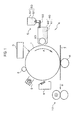
- Fig. 1 is a schematic block diagram showing an exemplary embodiment of an image-forming apparatus according to the invention equipped with a container for storing a toner and a container for storing a developer.
- An embodiment of the invention will be explained with reference to an example applying a two-component system developing unit using a two-component developer comprising a toner and a carrier.
- the invention may be applied in another embodiment to a one-component system developing unit comprising a developer of a toner alone.
- reference numeral 1 is a photoreceptor (an electrostatic latent image holder) rotation driving in the direction of arrow A, and around 1 are arranged in order of charging unit (a charging unit) 2 of a contact charging system capable of uniformly charging the surface of photoreceptor 1, exposing unit (an electrostatic latent image-forming unit) 3 for forming an electrostatic latent image on the surface of photoreceptor 1 by imagewise irradiating light, developing unit (a developed image-forming unit) 4 to obtain a toner image (a developed image) by developing the electrostatic latent image by supplying two-component developer 41 comprising a toner and a carrier to the surface of photoreceptor 1, transfer unit (a transfer unit) 6 for transferring the toner image (the developed image) formed on the surface of photoreceptor 1 to paper (a recording medium) 7, cleaning unit 8 of a blade system to remove the toner and dust remaining on the surface of photoreceptor 1, and destaticizer 9 to remove the electrostatic latent image on the surface
- Charging unit 2 is a charging unit of a contact charging system equipped with a charging roll.
- a charging unit of a non-contact system by conventionally known Corotron and Scorotron may also be used in place of a charging unit of a contact charging system.
- optical system units may be used that are capable of imagewise exposing desired light sources, such as a semiconductor laser, LED (light emitting diode), and liquid crystal shutter on the surface of photoreceptor 1.
- desired light sources such as a semiconductor laser, LED (light emitting diode), and liquid crystal shutter on the surface of photoreceptor 1.
- LED light emitting diode
- liquid crystal shutter on the surface of photoreceptor 1.
- Developing unit 4 which will be described in detail later, since it has a structure characteristic of the invention.
- Two-component developer 41 comprising a toner and a carrier is stored in developer container main body 42 to constitute container 40 for storing a developer as a whole, and the toner is charged by friction of the carrier and toner due to stirring by the stirring unit in the inside of the container not shown in the figure.
- two-component developer 41 is supplied to the surface of photoreceptor 1 by developing sleeve (a developer holder) 43 and an electrostatic latent image is developed.
- developing unit 4 is equipped with toner replenishing unit 5 to replenish the toner in two-component developer 41 in container 40 for storing developer that is consumed by development.
- Toner replenishing unit 5 consists of container 50 for storing a toner comprising toner container main body 52 for storing toner 51, and supplying unit 53 for conveying toner 51 from container 50 for storing the toner to developing unit 4.
- a roller type contact transfer charging unit (transfer unit 6) is used in the invention, but a contact transfer type charging unit using a belt, film or rubber blade may also be used, or a Scorotron transfer charging unit and a Corotron transfer charging unit using corona discharge may be used.
- cleaning blades consisting of an elastic material like rubber such as cleaning unit 8 are used in the invention, and the method adopted in the invention is a system of removing the toner and the like adhered to the surface of photoreceptor 1 by pressing one edge of the blades against the surface.
- brushes using conductive plastics and cleaning unit of other known cleaning systems may be used.
- fixing unit 10 a fixing unit of a two-roll system having an image-fixing member of a pair of roll type is exemplified, but other fixing methods may be adopted in the invention.
- the surface In photoreceptor 1 rotation driving in the direction of arrow A, the surface is in the first place uniformly charged by charging unit 2, and then is exposed according to image information by exposing unit 3 to form an electrostatic latent image on the surface of photoreceptor 1 different in potential based on the exposed area/unexposed area.
- the toner charged by one potential is supplied to the surface of photoreceptor 1 by developing unit 4 and the electrostatic latent image is developed to form a toner image, and the toner image is transferred to the surface of paper 7 by means of transfer unit 6.
- Paper 7 having the unfixed toner image on the surface thereof is conveyed in the direction of arrow B, inserted between the nip of fixing unit 10, and heat and pressure are applied thereto to melt the toner to be fastened to paper 7 to form a permanent image.
- the residual toner remained without being transferred and refuse such as paper dust are removed from the surface of photoreceptor 1 by cleaning unit 8 after the toner image has been transferred. Subsequently, the residual electrostatic latent image is removed by destaticizer 9 and a series of image formation cycle is finished to prepare for the next image formation.
- container 50 for storing a toner and container 40 for storing a developer have the constitution of the invention. That is, toner 51 stored in toner container main body 52 and the toner in two-component developer 41 stored in developer container main body 42 are toners for electrostatic latent image development comprising a binder resin containing a polyester resin, a coloring agent and a release agent, and having a volume average particle size of 4 to 8 ⁇ m or about 4 to about 8 ⁇ m and an average degree of circularity of 0.94 to 0.99 or about 0.94 to about 0.99, and toner container main body 52 and developer container main body 42 consist of a material containing at least one of polyethylene terephthalate and polybutylene terephthalate.
- Frictional charging is generally caused by difference in charging rows of the members being in contact to each other.
- the toner container main body and the like by using the same kind or the same series of polyester materials in the toner container main body, developer container main body (hereinafter referred to as “the toner container main body and the like"), and the binder resin of the toner, charging rows of both are approaching and frictional charging between both is liable to difficultly occur, so that even with the toners of small particle sizes and a spherical shape whose flowability is liable to lower in the toner container main body and the like, the lowering of flowability in the toner container main body and the like is difficult to occur. Further, since the frictional charging between the inner wall surface of the toner container main body and the like and the toner is restrained, adhesion of toner to the wall of the toner container main body and the like can be prevented.
- Stabilization of flowability of the toner in the toner container main body and the like and restraint of adhesion of toner to a wall are related to the stability of supply to the container for storing a developer, which contribute to stabilization of the quality of an image to be formed.
- the invention is especially effective in the case of being applied to a toner container.
- a toner container main body indicates a container itself to store a toner and directly in contact with a toner in a toner replenishing unit to replenish a toner to a developing unit, and does not include mechanisms for replenishment and conveying of the toner and other members.
- a container for storing a toner Such a state that the toner is stored in a toner container main body is referred to as "a container for storing a toner" in the invention.
- a developer container main body indicates the part such as a container directly being in contact with a developer stored in a developing unit, that is, a developed image-forming unit, and does not include a developer holder, mechanisms for stirring and conveying of the developer and other members.
- a container for storing a developer Such a state that the developer is stored in a developer container main body is referred to as "a container for storing a developer” in the invention.
- the image-forming apparatus of the exemplary embodiment shown in Fig. 1 has been explained as an example.
- the container for storing a toner and the container for storing a developer of the invention can be applied to conventionally known image-forming apparatus of electrostatic latent image development systems, and of course they take the constitution of the image-forming apparatus of the invention in any case.
- the container for storing a toner and the container for storing a developer of the invention is applicable to an image-forming apparatus of a system and a form in which each constitutional member of the image-forming apparatus of the exemplary embodiment is different, an image-forming apparatus of what is called a tandem system having a plurality of image-forming units within with the image-forming unit exemplified in Fig.
- image-forming apparatus in the exemplary embodiment shown in Fig. 1 , explanations have been done as to image-forming apparatus provided with the constitutions of the invention of both container for storing a toner and container for storing a developer as examples, but image-forming apparatus having either one alone of the constitutions may be corresponded to the image-forming apparatus of the invention, and such an image-forming apparatus exhibits function and effect as the image-forming apparatus of the invention so far as it goes.
- a toner for electrostatic latent image development in the invention is stored in a toner container main body as it is, or with a carrier as a two-component developer, or a toner for electrostatic latent image development alone is contained as a one-component developer.
- a toner for electrostatic latent image development for use in the invention comprises a binder resin containing a polyester resin, a coloring agent and a release agent, and has a volume average particle size of 4 to 8 ⁇ m or about 4 to about 8 ⁇ m and an average degree of circularity of 0.94 to 0.99 or about 0.94 to about 0.99.
- the toner for use in the invention may further contain an external additive and may contain other components for the improvement of flowability and stabilization of a charging property.
- Particles comprising the binder resin, coloring agent and release agent other than the external additive are sometimes considered hereinafter by referring to as "toner mother particles" to be distinguished from the toner as a whole including the external additive.
- toner mother particles the volume average particle size and average degree of circularity that are required of the toner used in the invention are defined as to toner mother particles, but the average degree of circularity of the toner after external additive is added is almost the same as that of the toner mother particles.
- polyester resin As the binder resin of the toner for use in the invention, a polyester resin is contained.
- the polyester resins to be used may be crystalline or amorphous, but it is preferred to use amorphous polyester resins, more specifically polyester resins having an aromatic ring in the constitutional component. Since polyethylene terephthalate and/or polybutylene terephthalate contain(s) an aromatic ring, it is thought that the difference in charging row can be lessened.
- polyester resin predominates in the binder resin.
- the terminology "predominate” used here means to account for proportion of half or more of all the binder resin components on the basis of mass.
- the proportion of the polyester resin to all the binder resin components is more preferably 70 mass% or more, still more preferably 80 mass% or more, still yet more preferably 90 mass% or more, and especially preferably all is polyester resin.
- resins other than the polyester resins for use as the binder resin they are not especially restricted so long as the function as toner is not impaired.
- the proportion is discussed by the proportion of the amount of all the polyester resins to all the binder resins of the core part and the shell layer part.
- this copolymer may be taken as polyester resin in the invention, and proper third component may be copolymerized, if necessary, for the regulation of melting temperature and the like.
- the copolymerization ratio of the third component is preferably 12.5 mol% or less, and more preferably 2 mol% or less.
- Other components are not especially restricted so long as they do not conspicuously damage the functions as the toner.
- polyester resins for use in the invention conventionally known polyester resins may be used.
- Commercially available polyester resins may be used in the invention, or polyester resins arbitrarily synthesized may be used.
- the polyester resin is synthesized from a polyvalent carboxylic acid component and polyhydric alcohol component.
- polyhydric alcohol components for example, as divalent alcohol components, e.g., ethylene glycol, propylene glycol, 1,4-butanediol, 2,3-butanediol, diethylene glycol, triethylene glycol, 1,5-pentanediol, 1,6-hexanediol, neopentyl glycol, 1,4-cyclohexanedimethanol, dipropylene glycol, polyethylene glycol, polypropylene glycol, bisphenol A, hydrogenated bisphenol A, alkylene oxide adduct of bisphenol A, and alkylene oxide adduct of hydrogenated bisphenol A can be used.
- divalent alcohol components e.g., ethylene glycol, propylene glycol, 1,4-butanediol, 2,3-butanediol, diethylene glycol, triethylene glycol, 1,5-pentanediol, 1,6-hexanediol, neopenty
- glycerin As trivalent or higher alcohol components, glycerin, sorbitol, 1,4-sorbitan, trimethylolpropane, etc., can be used.
- divalent carboxylic acid components to be condensed with the polyhydric alcohol component for example, maleic acid, maleic acid anhydride, fumaric acid, phthalic acid, terephthalic acid, isophthalic acid, malonic acid, succinic acid, glutaric acid, and lower alkyl esters of these acids can be used.
- aliphatic dicarboxylic acids e.g., oxalic acid, succinic acid, glutaric acid, adipic acid, suberic acid, azelaic acid, sebacic acid, 1,9-nonanedicarboxylic acid, 1,10-decanedicarboxylic acid, 1,12-dodecanedicarboxylic acid, 1,14-tetradecane- dicarboxylic acid, and 1,18-octadecanedicarboxylic acid, and aromatic dicarboxylic acids, such as dibasic acids, e.g., phthalic acid, isophthalic acid, terephthalic acid, naphthalene-2,6-dicarboxylic acid, malonic acid, and mesaconic acid are exemplified. Further, anhydrides and lower alkyl esters of these acids are also exemplified.
- 1,2,4-benzene- tricarboxylic acid 1,2,5-benzenetricarboxylic acid, 1,2,4- naphthalenetricarboxylic acid, and anhydrides and lower alkyl esters of these acids are exemplified.
- polyester resins it is preferred to contain a resin having a mass average molecular weight of 30,000 to 80,000 or about 30,000 to about 80,000 as one of the constitutional components.
- a resin having a mass average molecular weight of 30,000 to 80,000 as one of the constitutional components, it becomes easy to control the average degree of circularity described in detail later.
- the preferred range of the mass average molecular weight is from 30,000 to 70,000 or about 30,000 to about 70,000, and more preferably from 30,000 to 60,000 or about 30,000 to about 60,000.
- the toner When the mass average molecular weight is less than 30,000, the toner is liable to be influenced by a release agent, while when it exceeds 80,000 the viscosity of the resin itself becomes high, so that a preferred average degree of circularity is sometimes difficult to obtain.
- Polyester resin particle dispersion for use in the manufacture of toner mother particles by an emulsification aggregation method can be prepared by dispersing a polyester resin in an aqueous medium, e.g., water, with a surfactant, and polyelectrolyte, e.g., a polymeric acid, a polymeric base, etc., heating the system at a temperature higher than the glass transition temperature of the resin, and treating the system with a homogenizer capable of applying strong shear force, or a pressure-ejecting type disperser.
- an aqueous medium e.g., water
- a surfactant e.g., a surfactant
- polyelectrolyte e.g., a polymeric acid, a polymeric base, etc.
- the polyester resin particle dispersion can also be prepared by dissolving a polyester resin in a solvent, dispersion emulsifying the solution in water with an ionic surfactant, and desolvating.
- the polyester resin particle dispersion can further be prepared according to phase inversion emulsification by dissolving a polyester resin in a solvent, neutralization treatment, adding water to effect phase inversion while stirring, and then desolvating.
- As the polyester resin a plurality of kinds of resins may be used as mixture.
- the volume average particle size of the polyester resin particles is preferably 1 ⁇ m or less, and more preferably the range of 0.02 to 0.5 ⁇ m.
- the volume average particle size of the polyester resin particles can be measured, for example, with a micro-track (trade name: LS 13320, manufactured by Beckmann-Coulter) and the like.
- Tg (glass transition temperature) of the toner mother particles for use in the invention is preferably in the range of 50 to 70°C or about 50 to about 70°C, more preferably in the range of 53 to 65°C or about 53 to about 65°C, and still more preferably in the range of 55 to 65°C or about 55 to about 65°C.
- Tg of the toner is lower than 50°C, the toner is liable to be deformed and sometimes it is difficult to obtain a toner having a preferred average degree of circularity, and it is also sometimes difficult to obtain a toner having a preferred average degree of circularity when Tg is higher than 70°C.
- coloring agents of the toners for use in the invention conventionally known coloring agents may be used.
- various kinds of pigments e.g., carbon black, Chrome Yellow, Hansa Yellow, Benzidine Yellow, Indanthrene Yellow, Quinoline Yellow, Permanent Yellow, Permanent Orange GTR, Pyrazolone Orange, Vulcan Orange, Watchung Red, Permanent Red, Brilliant Carmine 3B, Brilliant Carmine 6B, Du Pont Oil Red, Pyrazolone Red, Lithol Red, Rhodamine B Lake, Lake Red C, Rose Bengal, Aniline Blue, Ultramarine Blue, Chalcooil Blue, Methylene Blue Chloride, Phthalocyanine Blue, Phthalocyanine Green, Malachite Green Oxalate, etc., and various kinds of dyes, e.g., acridine series, xanthene series, azo series, benzoquinone series, azine series, anthraquinone series, dioxazine series, thiazine series, azomethin
- Coloring agent particle dispersion for use in the manufacture of toner mother particles by an emulsification aggregation method is preferably prepared by dispersing a coloring agent in water with an ionic surfactant and polyelectrolyte, e.g., a polymeric acid, a polymeric base.
- an ionic surfactant and polyelectrolyte e.g., a polymeric acid, a polymeric base.
- known dispersing methods can be used, for example, a rotating shearing type homogenizer, and ordinarily used dispersing unit, such as a ball mill, a sand mill, a Dyno-mill, an altimizer, each of which has media, and the like, can be adopted with no restriction.
- the volume average particle size of the coloring agent particles dispersed in the coloring agent particle dispersion is preferably 1 ⁇ m or less, and when it is in the range of 80 to 500 nm, a good aggregating property can be obtained and good dispersion of the coloring agent in the toner mother particles can be achieved, and so further preferred.
- the content of the coloring agent in the toner mother particles is preferably in the range of 1 to 30 mass parts to 100 mass parts of the binder resin. It is also effective to use, if necessary, surface-treated coloring agents and pigment dispersions. By appropriate selection of the kinds of the coloring agents, a yellow toner, a magenta toner, a cyan toner, a black toner, and the like can be obtained.
- a release agent is generally used in the invention for the purpose of improving the releasing property of the image from the fixing member at fixing time.
- the specific examples of release agents include low molecular weight polyolefins, e.g., polyethylene, polypropylene, polybutene, etc.; silicones having a softening temperature softened by heating; fatty acid amides, e.g., oleic acid amide, erucic acid amide, ricinoleic acid amide, stearic acid amide, etc.; vegetable waxes, e.g., carnauba wax, rice wax, candelilla wax, Japan wax, jojoba oil, etc.; animal waxes, e.g., bees wax, etc.; mineral and petroleum waxes, e.g., montan wax, ozokerite, ceresine, paraffin wax, microcrystalline wax, Fischer-Tropsch wax, etc.; and ester waxes, e.g., montanic este
- the addition amount of the release agents is preferably 1 to 20 mass% or about 1 to about 20 mass% on the basis of all the amount of the toner mother particles, and more preferably 5 to 15 mass% or about 5 to about 15 mass%.
- the addition amount of the release agent is in the above range, sufficient effect of the release agent can be achieved, and reduction of the average degree of circularity of the toner by the volume fluctuation of the release agent due to cooling at the time of manufacture of the toner can be controlled.
- the toner for use in the invention may be treated by the addition of external additives such as a fluidizing agent and a charging controlling agent.
- external additives such as a fluidizing agent and a charging controlling agent.
- known materials can be used, such as inorganic particles, e.g., silica fine particles surface-treated with a silane coupling agent, etc., titanium oxide fine particles, alumina fine particles, cerium oxide fine particles, carbon black, etc.; organic particles, e.g., polycarbonate, polymethyl methacrylate, silicone resins, etc.; amine metal salts, salicylic acid metal complexes, etc.
- These external additives may be used alone, or two or more kinds may be used in combination.
- particles having a number average particle size of 70 to 300 nm or about 70 to about 300 nm as external additives from the viewpoint of avoiding direct contact of the binder resin of toner and the toner container main body or the developer container main body.
- the number average particle size is more preferably in the range of 80 to 200 nm or about 80 to about 200 nm.
- the materials of the particles of the external additives are not especially limited, and particles may be either inorganic or organic, but in view of prevention of deformation of the external additives, inorganic particles are preferred.
- Specifically usable materials are the same as those described in the external additives such as fluidizing agents and charging controlling agents.
- An internal additive may be added to the toner for use in the invention in the toner mother particles.
- the internal additive is generally used for the purpose of controlling the viscoelasticity of a fixed image.
- inorganic fine particles such as silica, titania, etc.
- organic fine particles such as polymethyl methacrylate are exemplified, and these particles may be surface-treated for the purpose of heightening the dispersability. They may be used alone, or two or more kinds of internal additives may be used in combination.
- the toners for use in the invention may further contain, if necessary, internal additives to be added for the purposes besides the above, and various components such as a charging controlling agent.
- magnetic powders such as metals, e.g., ferrite, magnetite, reduced iron, cobalt nickel, manganese, etc., alloys thereof, and compounds containing these metals are exemplified.
- the toners of the invention can be used as magnetic toners.
- the charging controlling agents that can be added to the toners, e.g., quaternary ammonium salt compounds, nigrosine series compounds, dyes comprising complexes such as aluminum, iron, chromium, etc., triphenylmethane series pigments, etc., are exemplified.
- the toners for use in the invention have a volume average particle size of 4 to 8 ⁇ m.
- the volume average particle size is in this range, adhesion preventing effect of the toner to the wall surface of the toner container main body and the like due to charging by the friction between the toner and the wall surface is great.
- the adhering force of the toner and the wall surface increases by the factors other than electrical factors, in addition to the adhering force of the toner and the wall surface by charging between both, further, the adhering force of the toners to each other increases, which cause reductions of flowability and stability and controlling of the adhesion of the toner to the wall surface is liable to be difficult.
- the volume average particle size is greater than 8 ⁇ m, although the influence of charging between the toner and the wall surface on the adhesion of the toner to the wall surface is small, the toner that cannot be controlled and charged is liable to aggregate and grow.
- Such a toner or an aggregated product thereof is easily developed or transferred and, further, if the toner is transferred to a recording medium, it is large and conspicuous, so that there is a case where influence on fogging is caused.
- the volume average particle size prescribed in the invention can be measured, for example, as follows. A measuring sample of 0.5 to 50 mg is added to a surfactant as a dispersant, preferably to 2 ml of a 5 mass% aqueous solution of sodium alkylbenzenesulfonate, which is then added to 100 to 150 ml of ISOTON-II (an electrolyte manufactured by Beckmann-Coulter).
- a surfactant as a dispersant, preferably to 2 ml of a 5 mass% aqueous solution of sodium alkylbenzenesulfonate, which is then added to 100 to 150 ml of ISOTON-II (an electrolyte manufactured by Beckmann-Coulter).
- the electrolyte in which the measuring sample is suspended is subjected to dispersion treatment with an ultrasonic disperser for about 1 minute, and then particle size distribution of the particles in the range of a particle size of 1.0 to 30 ⁇ m is measured with COULTER MULTISIZER-II (manufactured by Beckmann-Coulter) having an aperture of an aperture diameter of 50 ⁇ m.
- the number of particles to be measured is 50,000.
- the obtained particle size distribution data are plotted relative to the divided particle size ranges (channels) to draw the volume cumulative distribution from the particles having a smaller particle size, and the particle size of cumulative 50% is defined as volume average particle size. Further, the number cumulative distribution is drawn from the particles having a smaller particle size, and the particle size of cumulative 50% is defined as a number average particle size.
- the volume average particle size of the toner for use in the invention is preferably 4.5 to 7 ⁇ m, and more preferably 5 to 7 ⁇ m.
- the average degree of circularity of the toner for use in the invention is 0.94 to 0.99.
- contact points of the toner and the wall surface of the container for storing the toner are few, so that it becomes possible to prevent excessive charging.
- the average degree of circularity in the invention is defined according to expression of (equivalent-circle peripheral length)/(peripheral length). Specifically, the average degree of circularity can be obtained by the expression of (peripheral length of a circle having the same projected area as the particle image)/(peripheral length of the projected image of the particle).
- the average degree of circularity defined in the invention can be measured, for example, as follows.
- the toner of the object of measurement is collected by suction.
- a very flat flow is formed, a particle image is taken as a still image by instantaneous stroboscopic light emission, and the particle image is measured by means of a flow particle image analyzer (for example, FPIA-2100, manufactured by Sysmex Co.)
- the average degree of circularity of the toner for use in the invention is preferably 0.95 to 0.98, and more preferably 0.96 to 0.98.
- the manufacturing method of the toner (toner mother particles) will be described below.
- the toner for use in the invention can be manufactured by chemical manufacturing methods such as conventionally known kneading•grinding method, emulsion polymerization method, emulsion aggregation method, suspension polymerization method, etc. From the viewpoints that a toner excellent in storage characteristic/charging property due to surface property and core/shell structure can be manufactured while satisfying the volume average particle size and average degree of circularity required as the toner for use in the invention, and from the aspects of high yield and low environmental load, it is preferred to manufacture the toner by the emulsion polymerization method.
- toner mother particles are manufactured through at least two processes.
- One process is an aggregation process of forming aggregated particles by adding an aggregating agent to a mixed dispersion obtained by mixing a polyester resin particle dispersion having dispersed a polyester resin, a coloring agent dispersion having dispersed a coloring agent, and a release agent dispersion having dispersed a release agent, and heating.
- Another process is a fusion process of fusing the aggregated particles by heating at a glass transition temperature of the polyester resin or higher.
- various dispersions used in the aggregation process are prepared.
- a polyester resin particle dispersion, a coloring agent dispersion and a release agent dispersion are at least used, but, if necessary, other dispersions, e.g., a charging controlling agent may be mixed.
- all the solids content contained in the obtained mixed dispersion is preferably 40 mass% or less, and more preferably 2 to 20 mass%.
- the content of the coloring agent particles contained in the mixed dispersion is preferably 20 mass% or less, and more preferably 2 to 15 mass%.
- the content of the release agent particles contained in the mixed dispersion is preferably 20 mass% or less, and more preferably 5 to 15 mass%.
- Each of these dispersions is not especially restricted and an arbitrary method may be used according to the purpose.
- Dispersing units are not especially restricted.
- conventionally known apparatus for example, a HOMOMIXER (manufactured by Tokushu Kika Kogyo Co., Ltd.), a SLASHER (manufactured by Mitsui Mining Co., Ltd.), a CAVITRON (manufactured by Eurotec, Ltc.), a MICROFLUIDIZER (manufactured by Mizuho Kogyo Co., Ltd.), a MANTON GAULIN HOMOGENIZER (manufactured by Manton Gaulin), a NANOMIZER (manufactured by Nanomizer), and a STATIC MIXER (manufactured by Noritake Company, Limited) are exemplified.
- solvent emulsification and phase inversion emulsification are also exemplified.
- aqueous media As dispersion media for use in the preparation of various dispersions, aqueous media are exemplified, for example.
- aqueous media As preferred aqueous media as dispersion media, water, e.g., distilled water, ion exchange water, etc., and alcohols are exemplified. These media may be used by one kind alone, or two or more kinds may be used in combination.
- anionic surfactants such as sulfuric ester, sulfonic ester, phosphoric ester, soaps, etc.
- cationic surfactants such as an amine salt type, a quaternary ammonium salt type, etc.
- nonionic surfactants such as polyethylene glycol, alkylphenyl ethylene oxide adducts, polyhydric alcohols, etc.
- anionic surfactants and cationic surfactants are preferred.
- the nonionic surfactants are used in combination with the anionic surfactant or cationic surfactant. These surfactants may be used by one kind alone, or two or more kinds may be used in combination.
- anionic surfactants aliphatic acid soaps, e.g., potassium laurate, sodium oleate, sodium castor oil, etc.; sulfates, e.g., octyl sulfate, lauryl sulfate, lauryl ether sulfate, nonyl phenyl ether sulfate, etc.; sodium alkylnaphthalene sulfonates, e.g., lauryl sulfonate, dodecyl sulfonate, dodecylbenzene sulfonate, triisopropylnaphthalene sulfonate, dibutylnaphthalene sulfonate, etc.; sulfonates, e.g., naphthalene sulfonate-formalin condensation product, monooctyl sulfosuccinate, diocty
- amine salts e.g., laurylamine hydrochloride, stearylamine hydrochloride, oleylamine acetate, stearylamine acetate, stearylaminopropylamine acetate, etc.
- quaternary ammonium salts e.g., lauryl trimethylammonium chloride, dilauryl dimethylammonium chloride, distearylammonium chloride, distearyl dimethylammonium chloride, lauryl dihydroxyethylmethylammonium chloride, oleyl-bispolyoxy- ethylene methylammonium chloride, lauroylaminopropyl dimethylethylammonium ethosulfate, lauroylaminopropyl dimethylhydroxyethylammonium perchlorate, alkylbenzene dimethylammonium chloride, alkyl trimethylammonium chloride, etc., are examples of the quaternary ammonium salts, e
- alkyl ethers e.g., polyoxyethylene octyl ether, polyoxyethylene lauryl ether, polyoxyethylene stearyl ether, polyoxyethylene oleyl ether, etc.
- alkyl phenyl ethers e.g., polyoxyethylene octyl phenyl ether, polyoxyethylene nonyl phenyl ether, etc.
- alkyl esters e.g., polyoxyethylene laurate, polyoxyethylene stearate, oleate, etc.
- alkylamines e.g., polyoxyethylene lauryl amino ether, polyoxyethylene stearyl amino ether, polyoxyethylene oleyl amino ether, polyoxyethylene soybean amino ether, polyoxyethylene beef tallow amino ether, etc.
- alkylamides e.g., polyoxyethylene lauric acid amide, polyoxyethylene stearic acid amide, polyoxy
- polyester resin particle dispersion and coloring agent dispersion preparation methods of the polyester resin particle dispersion and coloring agent dispersion are as described above in respective items.
- an aggregating agent is added to a mixed dispersion obtained by mixing a polyester resin particle dispersion, a coloring agent dispersion, a release agent dispersion, and other components and the mixed dispersion is heated at around a glass transition temperature of the polyester resin to form aggregated particles comprising various components having aggregated therein.
- the aggregated particles are formed by the addition of an aggregating agent at room temperature while stirring the mixed dispersion with a rotating shearing type homogenizer.
- divalent or higher inorganic metal salts and divalent or higher inorganic metal complexes can be preferably used, in addition to surfactants and reverse polar surfactants used as dispersants in various dispersions.
- the use amount of surfactants can be reduced and charging characteristics of the toner can be bettered, and so preferred.
- inorganic metal salts metal salts, e.g., calcium chloride, barium chloride, magnesium chloride, zinc chloride, aluminum chloride, aluminum sulfate, etc.
- inorganic metal salt polymers e.g., aluminum polychloride, aluminum polyhydroxide, calcium polysulfide are exemplified.
- aluminum salts and polymers thereof are preferred. For obtaining sharper particle size distribution, aggregated particles having narrow particle size distribution are obtained rather by using inorganic metal salts greater in valence, or polymerization type inorganic metal salt polymers are more suitable even if the valence is the same.
- the addition amount of these aggregating agents varies depending upon the ion concentration at the time of aggregation, but is generally preferably 0.05 to 1.00 mass% on the basis of the solids content of the mixed dispersion (each material component to become a toner component), and more preferably 0.10 to 0.70 mass%.
- the amount is less than 0.05 mass%, the effect of the aggregating agent is difficult to be exhibited, while when it exceeds 1.00 mass%, there is a possibility that excessive aggregation is caused and a toner having a greater particle size easily occurs, and there is a case where an image defect attributable to transfer failure is generated. Further, strong aggregation occurs in the apparatus of toner preparation, so that not preferred on productivity.
- covering layers are formed, as an adhesion process, by adhering resin particles including the polyester resin onto the surfaces of aggregated particles formed through the above-described aggregation process (hereinafter, aggregated particles having covering layers on the surfaces of aggregated particles are referred to as "adhesion resin-aggregated particles").
- the covering layer corresponds to a shell layer of the toner mother particles formed through a fusion process described later.
- the covering layers may be formed by additionally adding an adhesion resin particle dispersion comprising a polyester resin and other resins, if necessary, to the dispersion having formed therein aggregated particles in the aggregation process, and other components such as an aggregating agent (e.g., a pH adjustor, a dispersant, etc.) may also be additionally added simultaneously.
- an adhesion resin particle dispersion comprising a polyester resin and other resins, if necessary, to the dispersion having formed therein aggregated particles in the aggregation process, and other components such as an aggregating agent (e.g., a pH adjustor, a dispersant, etc.) may also be additionally added simultaneously.
- an aggregating agent e.g., a pH adjustor, a dispersant, etc.
- the polyester resins for use in the adhesion resin particle dispersion may be the same with or different from the polyester resins to be used in the core.
- those having a glass transition temperature higher(+0 to 20°C) than that of the polyester resins used in the core are preferred in the light of thermal storage property.
- an adhesion resin particle dispersion comprising a constitutional resin other than a polyester resin is prepared and used for the operation in the adhesion process.
- the adhesion resin-aggregated particles After obtaining adhesion resin-aggregated particles by uniformly adhering the adhesion resin particles onto the surfaces of the aggregated particles to form covering layers, when the adhesion resin-aggregated particles are heated and fused in the later-described fusion process, the resin particles comprising binder resin contained in the covering layers on the surfaces of the adhesion resin-aggregated particles are melted to form shell layers. Accordingly, the release agent and coloring agent contained in the core layers positioned inside the shell layers can be effectively prevented from being exposed to the surfaces of the toner mother particles.
- the exposure ratio of the release agent on the surfaces of the toner mother particles is more preferably 5% or less or about 5% or less, and still more preferably 2.5% or less or about 2.5% or less. It is a matter of course that the greatest lower bound is preferably 0% or about 0%, but the control is difficult and not practicable.
- the exposure ratio of the release agent on the surfaces of toner mother particles is specifically measured according to the following method.
- a toner mother particle is embedded in an epoxy resin, and cut to a slice of 100 nm in thickness with a microtome.
- the surface of the toner is observed with a scanning electron microscope (SEM) to confirm the release agent from the contrast and shape. That is, there occurs difference between the resin and release agent by dyeing.
- SEM scanning electron microscope
- the release agent takes the form of being dispersed in the resin, the area ratio is found by image analysis, and the area of the release agent is computed from the entire area.
- a 0.5% aqueous solution of ruthenium tetroxide is used in dyeing.
- the exposure ratio of the release agent is measured in a state that external additives are not added to toner mother particles.
- a measuring sample is prepared by dispersing 1 g of externally added toner in 100 g of a 0.5% aqueous solution of sodium dodecylbenzene sulfonate, applying ultrasonic wave vibration (output: 60 W, frequency: 20 kHz) to the dispersion for 15 minutes, and then the dispersion is subjected to filtration and drying.
- the result of measurement in such a manner is fundamentally equivalent to the result of toner mother particles not being externally added. Therefore, in the invention, the exposure ratio of a release agent measured in the above method with an externally added toner is regarded and dealt with as equivalent to a measurement result of toner mother particles not externally added.
- the addition mixing method of the adhesion resin particle dispersion in the adhesion process is not especially restricted, and, for example, the dispersion may be added gradually and continuously, or the adhesion process may be divided and performed stepwise in a plurality of times.
- the addition and mixture of the adhesion resin particle dispersion like this generation of minute particles can be restrained and the amount of the release agent on the surface of the toner can be controlled, and the particle size distribution of the obtained toner mother particles can be narrowed as well.
- the number of times of the adhesion process in the invention may be one time or may be a plurality of times.
- a plurality of shell layers can also be formed.
- the conditions to adhere the adhesion resin particles comprising the binder resin for shell layer to the aggregated particles are as follows.
- the heating temperature in the adhesion process is preferably from the temperature near the glass transition temperature of the polyester resin for the core contained in the aggregated particles to the temperature near the glass transition temperature of the binder resin for the shell layer.
- the aggregation temperature cannot be determined unconditionally, since the temperature moves up and down with the amounts of aggregating agent and the like.
- the range of -25°C to +10°C is preferred with the glass transition temperature of the polyester resin for the core as a criterion.
- the heating time in the adhesion process cannot be prescribed unconditionally, since it depends upon the heating temperature, but it is generally from 5 minutes to 2 hours or so.
- the dispersion obtained by supplementary addition of the adhesion resin particle dispersion to the mixed dispersion wherein aggregated particles are formed may be allowed to stand, or may be gently stirred by means of a mixer and the like. The latter case is advantageous in the point that homogeneous adhesion resin-aggregated particles are easily formed.
- the use amount of the adhesion resin particle dispersion depends upon the particle size of the resin particles contained therein, but it is preferred that the amount is selected so that the thickness of the finally formed shell layers is 20 to 500 nm or so.
- the thickness of the shell layers is thinner than 20 nm, there are cases where the release agent is predominantly present on the surface of the toner, while when the shell layer thickness is thicker than 500 nm, there are cases where the average degree of circularity of the toner mother particles greatens, which are not preferred, respectively.
- the aggregated particles obtained in the aggregation process or adhesion resin-aggregated particles obtained in the adhesion process are fused by heating.
- the fusion process may be performed at a temperature higher than the glass transition temperature of the polyester resin and the like contained.
- the time required for fusion short time is sufficient when the heating temperature is high, and long time is required when the heating temperature is low. That is, the time of fusion cannot be unconditionally prescribed, since the time depends upon the heating temperature, but is generally from 10 minutes to 20 hours.
- crosslinking reaction may be carried out at the same time with heating or, alternatively, crosslinking reaction may be performed separately after termination of fusion.
- the particles obtained after termination of fusion are cooled in the cooling process.
- rapid quenching to a temperature lower than the recrystallization temperature of the release agent and lower than the glass transition temperature of the polyester resin is desired in an emulsification aggregation method for maintaining a smooth surface state.
- the cooling rate in the cooling process differs with the kind and amount of the crystalline polyester resin of the core layers, but is generally -20°C/min or faster. When the cooling is performed at a rate of faster than -20°C/min, recrystallization of the release agent in the core layers and the growth of domain can be restrained and the exposing amount of the release agent to the surfaces of the toner mother particle can be controlled.
- Rapid quenching may be carried out, for example, by a method of passing through a heat exchanger utilizing cooling water or brine, and a method of pouring and diluting the toner slurry obtained by operations up to the fusion process into cooling water of two or three times, but the invention is not restricted to these methods.
- the fused particles obtained via the fusion process and cooling process are subjected to solid-liquid separation such as filtration, washing, and drying. By virtue of these operations, toner mother particles of a state that external additives are not added are obtained.
- the fused particles it is preferred for the fused particles to be thoroughly washed to secure sufficient charging characteristics and reliability as toner.
- conspicuous washing effect can be obtained by treatment with acids such as nitric acid, sulfuric acid and hydrochloric acid, and an alkali solution represented by sodium hydroxide, and washing with ion exchange water and the like.
- the drying process an arbitrary method can be adopted such as an ordinary vibrating type fluidized drying method, a spray drying method, a freeze drying method, and a flush jet method.
- the moisture content after drying of the toner mother particles it is preferred for the moisture content after drying of the toner mother particles to be adjusted to be 2 mass% or lower, and more preferably 1 mass% or lower.
- Electrostatic latent image developer
- the electrostatic latent image developer to be stored in the container contains the toner.
- the toner is stored as a one-component developer independently as it is, or as a two-component developer with a carrier.
- any charging unit is arranged in the developing unit. While when the toner is used as a two-component developer, the toner is charged by means of the carrier and conveyed.
- the carrier is preferably a carrier covered with a resin (a resin-covered carrier, a coated carrier) with ferrite or iron powder as the core material.
- the core materials (carrier core materials) to be used are not especially restricted, and magnetic metals, e.g., iron, steel, nickel, cobalt, etc., magnetic oxides, e.g., ferrite, magnetite, etc., and glass beads, and the like are exemplified. From the viewpoint of using a magnetic brush method, magnetic carriers are preferred.
- the average particle size of the carrier core material is preferably about 3 to 10 times the average particle size of the toner.
- covering resins acryl resins, styrene resins, amino resins containing urea, urethane, melamine, guanamine, aniline, or the like, amide resins, and urethane resins are exemplified. Copolymer resins of these resins may also be used.
- the covering resins of the carrier two or more resins selected from the above resins may be used in combination.
- resin fine particles and inorganic fine particles may be used in the covering resins as dispersion.
- a resin covering layer on the surface of a carrier core material for example, a dipping method of dipping the powder of a carrier core material in a solution for forming a covering layer, a spraying method of spraying a solution for forming a covering layer on the surface of a carrier core material, a fluidized bed method of spraying a solution for forming a covering layer on a carrier core material with the carrier core material floated by fluidized air, a kneader coater method of kneading a carrier core material and a covering layer-forming solution in a kneader coater to remove a solvent, and a powder coating method of atomizing a covering resin, kneading the atomized covering resin and a carrier core material in a kneader coater at a temperature higher than the melting temperature of the covering resin, cooling and covering the covering resin are exemplified, and the kneader coater method and powder coating method are especially
- the covering amount of the resin formed in the above methods is preferably in the range of 0.5 to 10 mass% to the amount of the carrier core material.
- the mixing ratio (by mass) of the toner and carrier is in the range of toner/carrier of 1/100 to 30/100, and more preferably 3/100 to 20/100.
- Container for storage
- At least one of the toner container main body and the developer container main body consists of a material containing at least one of polyethylene terephthalate and polybutylene terephthalate for securing the flowability with a toner.
- At least one of polyethylene terephthalate and polybutylene terephthalate is predominantly contained in a material constituting at least one of the toner container main body and the developer container main body.
- Predominantly used here means to account for the proportion of half or more of the entire constituting materials in terms of mass.
- the proportion of at least one of the polyethylene terephthalate and polybutylene terephthalate accounting for in the entire constituting materials is more preferably 70 mass% or more or about 70 mass% or more, still more preferably 80 mass% or more or about 80 mass% or more, still yet preferably 90 mass% or more or about 90 mass% or more, and especially preferably all the materials are accounted for by at least one of the polyethylene terephthalate and polybutylene terephthalate.
- Resins other than polyethylene terephthalate and polybutylene terephthalate for use as the materials constituting at least one of the toner container main body and the developer container main body are not especially restricted so long as they do not conspicuously damage the functions as these containers.
- the copolymer In a case of a polymer obtained by copolymerization of other component to the main chain of polyethylene terephthalate or the main chain of polybutylene terephthalate, if the proportion of other component (the third component) is 50 mol% or less, the copolymer is also regarded as polyethylene terephthalate or polybutylene terephthalate, and a proper third component may be copolymerized for various purposes.
- the copolymerization ratio of other component is preferably 12.5 mol% or less, and more preferably 2 mol% or less.
- Other components are not especially restricted so long as they do not conspicuously damage the functions of the toner container main body and the developer container main body.
- the materials for constituting the toner container main body and/or the developer container main body besides the above materials, mixtures of polyethylene terephthalate and polybutylene terephthalate, and copolymers containing the structural units of these resins are also preferably exemplified.
- toner container main body and the developer container main body moldings from these resins, optional molding methods generally used in molding of resins, such as injection molding, extrusion molding, compression molding, blow molding, calender molding, cast molding, etc., can be used.
- toner container main bodies and developer container main bodies having desired shapes and dimensions can be obtained at temperatures of 240 to 300°C.
- the adhesion of the components of the toner other than the binder resin to the inner walls of these containers can be restrained.
- fatty acid metal salts e.g., calcium stearate, barium stearate, sodium oleate, calcium behenate, etc.
- fatty acid alkyl esters e.g., butyl stearate, stearyl stearate, behenyl behenate, behenic acid glycerol ester, etc.
- silicones having a softening temperature by heating fatty acid amides, e.g., oleic acid amide, erucic acid amide, ricinoleic acid amide, stearic acid amide, etc.
- vegetable waxes e.g., carnauba wax, rice wax, candelilla wax, Japan wax, jojoba oil, etc.
- animal waxes e.g., bees wax, etc.
- mineral and petroleum waxes e.g., montan wax, ozokerite, ceresine, paraffin wax, microcrystalline wax
- lubricants fatty acid metal salts, fatty acid alkyl esters, and hydrocarbons are preferred from the viewpoint of capable of restraining the release agent in the toner from adhering to the inner wall surface.
- the addition amount of the lubricants is preferably 0.05 to 10 mass parts or about 0.05 to about 10 mass parts per 100 mass parts of the resin for use in the toner container main body and the like, and more preferably 0.1 to 5 mass parts or about 0.1 to about 5 mass parts.
- the container for storing the toner, the container for storing the developer, and the image-forming apparatus using the same have been described, but the invention is by no means restricted thereto.
- the constitutions other than the container for storing the toner and the container for storing the developer are not especially restricted and conventionally known units can be adopted with no problems.
- Cyan pigment (C.I. Pigment Blue 15:3 (phthalocyanine pigment, Cyanine Blue 4937, manufactured by Dainichiseika 45 mass parts Color & Chemicals Mfg. Co., Ltd.))
- Anionic surfactant Neogen SC (manufactured by DAI-ICHI KOGYO SEIYAKU CO., LTD.) 5 mass parts Ion exchange water 200 mass parts
- the above components are mixed and dissolved, dispersed with a homogenizer (ULTRA-TURRAX T50, manufactured by IKA) for 10 minutes to obtain coloring agent dispersion 1 having dispersed therein a coloring agent having a number average particle size of 160 nm.
- a homogenizer ULTRA-TURRAX T50, manufactured by IKA
- Magenta pigment (C.I. Pigment Red 122 (Chromofine Magenta 6887, manufactured by Dainichiseika Color & Chemicals Mfg. Co., Ltd.)) 45 mass parts Anionic surfactant Neogen SC (manufactured by DAI-ICHI KOGYO SEIYAKU CO., LTD.) 5 mass parts Ion exchange water 200 mass parts
- the above components are mixed and dissolved, dispersed with a homogenizer (ULTRA-TURRAX T50, manufactured by IKA) for 10 minutes to obtain coloring agent dispersion 2 having dispersed therein a coloring agent having a number average particle size of 150 nm.
- a homogenizer ULTRA-TURRAX T50, manufactured by IKA
- the above components are mixed and dissolved, dispersed with a homogenizer (ULTRA-TURRAX T50, manufactured by IKA) for 10 minutes to obtain coloring agent dispersion 3 having dispersed therein a coloring agent having a number average particle size of 180 nm.
- a homogenizer ULTRA-TURRAX T50, manufactured by IKA
- Carbon black (Regal 330, manufactured by Cabot Corporation) 45 parts Anionic surfactant Neogen SC (manufactured by DAI-ICHI KOGYO SEIYAKU CO., LTD.) 5 mass parts Ion exchange water 200 mass parts
- the above components are mixed and dissolved, dispersed with a homogenizer (ULTRA-TURRAX T50, manufactured by IKA) for 10 minutes to obtain coloring agent dispersion 4 having dispersed therein a coloring agent having a number average particle size of 170 nm.
- a homogenizer ULTRA-TURRAX T50, manufactured by IKA
- Paraffin wax HNP-9, manufactured by NIPPON SEIRO CO., LTD.
- Anionic surfactant LIPAL 860K, 10 parts manufactured by Lion Corporation
- Ion exchange water 290 parts
- the above components are mixed and dissolved, dispersed with a homogenizer (ULTRA-TURRAX T50, manufactured by IKA) for 10 minutes, and then subjected to dispersion treatment with a pressure ejection type homogenizer for 30 minutes to obtain release agent dispersion having dispersed therein release agent particles (paraffin wax) having a number average particle size of 200 nm.
- a homogenizer ULTRA-TURRAX T50, manufactured by IKA
- the volume average particle size of toner mother particles 1 measured by the above method is 6.5 ⁇ m.
- the average degree of circularity measured similarly is 0.98, and the exposure ratio (area basis) of the release agent is 2.2%.
- the precipitate is freeze dried with a freeze drier for two days to obtain white powder.
- Ten (10) parts of the white powder is added to a mixed solution comprising 300 parts of toluene and 1 part of hexamethyldisilazane (HMDS), and the mixture is stirred by ultrasonic wave vibration for 30 minutes at room temperature, concentrated, and solidified by drying, followed by drying at 200°C for 3 hours to obtain silica particles (inorganic oxide particles) A having a number average particle size of 120 nm.
- HMDS hexamethyldisilazane
- toner mother particles 1 part of AEROSIL (registered trademark) R972 (hydrophobic fumed silica, surface treated with dimethyldichlorosilane, having a number average particle size of 16 nm, manufactured by Nippon Aerosil Co., Ltd.), and 2 parts of silica particles A are added, and mixed with a Henschel mixer at 25 m/s for 5 minutes to obtain toner 1.
- AEROSIL registered trademark
- R972 hydrophobic fumed silica, surface treated with dimethyldichlorosilane, having a number average particle size of 16 nm, manufactured by Nippon Aerosil Co., Ltd.
- Toner 2 is manufactured in the same manner as in the manufacture of toner 1, except that the process of heating and stirring the content of the flask up to 45°C and maintaining at 45°C for 30 minutes is changed to a process of heating and stirring up to 47°C and maintaining at 47°C for 30 minutes to obtain toner mother particles 2.
- the volume average particle size of toner mother particles 2 measured by the above method is 6.8 ⁇ m, the average degree of circularity measured similarly is 0.98, and the exposure ratio (area basis) of the release agent is 2.2%.
- Toner 3 is manufactured in the same manner as in the manufacture of toner 1, except that the process of heating and stirring the content of the flask up to 45°C and maintaining at 45°C for 30 minutes is changed to a process of heating and stirring up to 44°C and maintaining at 44°C for 20 minutes to obtain toner mother particles 3.
- the volume average particle size of toner mother particles 3 measured by the above method is 5.2 ⁇ m, the average degree of circularity measured similarly is 0.98, and the exposure ratio (area basis) of the release agent is 2.3%.
- Toner 4 is manufactured in the same manner as in the manufacture of toner 1, except that the process of heating and stirring the content of the flask up to 45°C and maintaining at 45°C for 30 minutes is changed to a process of heating and stirring up to 40°C and maintaining at 40°C for 30 minutes to obtain toner mother particles 4.
- the volume average particle size of toner mother particles 4 measured by the above method is 4.6 ⁇ m, the average degree of circularity measured similarly is 0.98, and the exposure ratio (area basis) of the release agent is 2.3%.
- Toner 5 is manufactured in the same manner as in the manufacture of toner 1, except that the process of heating and stirring the content of the flask up to 45°C and maintaining at 45°C for 30 minutes is changed to a process of heating and stirring up to 50°C and maintaining at 50°C for 30 minutes to obtain toner mother particles 5.
- the volume average particle size of toner mother particles 5 measured by the above method is 7.3 ⁇ m, the average degree of circularity measured similarly is 0.97, and the exposure ratio (area basis) of the release agent is 2.1%.
- Toner 6 is manufactured in the same manner as in the manufacture of toner 1, except that the process of heating and stirring the content of the flask up to 45°C and maintaining at 45°C for 30 minutes is changed to a process of heating and stirring up to 38°C and maintaining at 38°C for 30 minutes to obtain toner mother particles 6.
- the volume average particle size of toner mother particles 6 measured by the above method is 4.2 ⁇ m, the average degree of circularity measured similarly is 0.98, and the exposure ratio (area basis) of the release agent is 2.3%.
- Toner 7 is manufactured in the same manner as in the manufacture of toner 1, except that the process of heating and stirring the content of the flask up to 45°C and maintaining at 45°C for 30 minutes is changed to a process of heating and stirring up to 52°C and maintaining at 52°C for 40 minutes to obtain toner mother particles 7.
- the volume average particle size of toner mother particles 7 measured by the above method is 7.9 ⁇ m, the average degree of circularity measured similarly is 0.98, and the exposure ratio (area basis) of the release agent is 2.0%.
- Toner 8 is manufactured in the same manner as in the manufacture of toner 1, except that the process of raising the temperature to 96°C and allowing the reaction product to stand for 5 hours is changed to a process of raising the temperature to 90°C and allowing the reaction product to stand for 4 hours to obtain toner mother particles 8.
- the volume average particle size of toner mother particles 8 measured by the above method is 6.6 ⁇ m, the average degree of circularity measured similarly is 0.95, and the exposure ratio (area basis) of the release agent is 2.2%.
- Toner 9 is manufactured in the same manner as in the manufacture of toner 1, except that the process of raising the temperature to 96°C and allowing the reaction product to stand for 5 hours is changed to a process of raising the temperature to 86°C and allowing the reaction product to stand for 4 hours to obtain toner mother particles 9.
- the volume average particle size of toner mother particles 9 measured by the above method is 6.6 ⁇ m, the average degree of circularity measured similarly is 0.94, and the exposure ratio (area basis) of the release agent is 2.2%.
- Toner 10 is manufactured in the same manner as in the manufacture of toner 1, except that 455 parts of the first resin particle dispersion A is changed to 500 parts and 210 parts of the additional resin particle dispersion A is changed to 165 parts respectively to obtain toner mother particles 10.
- the volume average particle size of toner mother particles 10 measured by the above method is 6.4 ⁇ m, the average degree of circularity measured similarly is 0.98, and the exposure ratio (area basis) of the release agent is 4.7%.
- Toner 11 is manufactured in the same manner as in the manufacture of toner 1, except that 455 parts of the first resin particle dispersion A is changed to 550 parts and 210 parts of the additional resin particle dispersion A is changed to 115 parts respectively to obtain toner mother particles 11.
- the volume average particle size of toner mother particles 11 measured by the above method is 6.3 ⁇ m, the average degree of circularity measured similarly is 0.98, and the exposure ratio (area basis) of the release agent is 9.8%.
- Toner 12 is manufactured in the same manner as in the manufacture of toner 1, except that 455 parts of the first resin particle dispersion A is changed to 600 parts and 210 parts of the additional resin particle dispersion A is changed to 65 parts respectively to obtain toner mother particles 12.
- the volume average particle size of toner mother particles 12 measured by the above method is 6.5 ⁇ m, the average degree of circularity measured similarly is 0.98, and the exposure ratio (area basis) of the release agent is 11.1%.
- Toner 13 is manufactured in the same manner as in the manufacture of toner 1, except that the process of heating and stirring the content of the flask up to 45°C and maintaining at 45°C for 30 minutes is changed to a process of heating and stirring up to 33°C and maintaining at 33°C for 50 minutes to obtain toner mother particles 13.
- the volume average particle size of toner mother particles 13 measured by the above method is 3.8 ⁇ m, the average degree of circularity measured similarly is 0.98, and the exposure ratio (area basis) of the release agent is 2.6%.
- Toner 14 is manufactured in the same manner as in the manufacture of toner 1, except that the process of heating and stirring the content of the flask up to 45°C and maintaining at 45°C for 30 minutes is changed to a process of heating and stirring up to 55°C and maintaining at 55°C for 50 minutes to obtain toner mother particles 14.
- the volume average particle size of toner mother particles 14 measured by the above method is 8.3 ⁇ m
- the average degree of circularity measured similarly is 0.93
- the exposure ratio (area basis) of the release agent is 2.2%.
- the precipitate is freeze dried with a freeze drier for two days to obtain white powder.
- Ten (10) parts of the white powder is added to a mixed solution comprising 300 parts of toluene and I part of hexamethyldisilazane (HMDS), and the mixture is stirred by ultrasonic wave vibration for 30 minutes at room temperature, concentrated, and solidified by drying, followed by drying at 200°C for 3 hours to obtain silica particles (inorganic oxide particles) B having a number average particle size of 80 nm.
- HMDS hexamethyldisilazane
- toner mother particles 1 is obtained in the same manner as in the manufacture of toner 1 up to the preparation of the toner mother particles.
- AEROSIL registered trademark
- R972 hydrophobic fumed silica, surface treated with dimethyldichlorosilane, having a number average particle size of 16 nm, manufactured by Nippon Aerosil Co., Ltd.
- silica particles B are added, and mixed with a Henschel mixer at 25 m/s for 5 minutes to obtain toner 15.
- Toner mother particles 1 is obtained in the same manner as in the manufacture of toner 1 up to the preparation of the toner mother particles.
- AEROSIL registered trademark
- R972 hydrophobic fumed silica, surface treated with dimethyldichlorosilane, having a number average particle size of 16 nm, manufactured by Nippon Aerosil Co., Ltd.
- Toner mother particles 1 is obtained in the same manner as in the manufacture of toner 1 up to the preparation of the toner mother particles.
- To 100 parts of toner mother particles 1 1 part of AEROSIL (registered trademark) R972 (hydrophobic fumed silica, surface treated with dimethyldichlorosilane, having a number average particle size of 16 nm, manufactured by Nippon Aerosil Co., Ltd.) is added, and mixed with a Henschel mixer at 25 m/s for 5 minutes to obtain toner 17.
- AEROSIL registered trademark
- R972 hydrophobic fumed silica, surface treated with dimethyldichlorosilane, having a number average particle size of 16 nm, manufactured by Nippon Aerosil Co., Ltd.
- Toner mother particles 1 is obtained in the same manner as in the manufacture of toner 1 up to the preparation of the toner mother particles.
- AEROSIL registered trademark
- R972 hydrophobic fumed silica, surface treated with dimethyldichlorosilane, having a number average particle size of 16 nm, manufactured by Nippon Aerosil Co., Ltd.
- Toner mother particles 1 is obtained in the same manner as in the manufacture of toner 1 up to the preparation of the toner mother particles.
- AEROSIL registered trademark
- R972 hydrophobic fumed silica, surface treated with dimethyldichlorosilane, having a number average particle size of 16 nm, manufactured by Nippon Aerosil Co., Ltd.
- organic particles MP300 having a
- a kneader To a kneader is put 1,000 parts of Mn-Mg ferrite (a volume average particle size: 35 ⁇ m, manufactured by Powder Tech Co., Ltd.), and a solution obtained by dissolving 150 parts of styrene-methyl methacrylate copolymer (polymerization ratio: 30/70, Tg: 110°C, mass average molecular weight: 81,000, manufactured by The Soken Chemical & Engineering Co., Ltd.) in 700 parts of toluene is added thereto.
- the content in the kneader is mixed at room temperature for 20 minutes, heated at 70°C, dried under reduced pressure, and then taken out to obtain a coated carrier.
- the obtained coated carrier is filtered with a mesh having an aperture diameter of 75 ⁇ m to remove coarse powder to obtain a carrier.
- the above carrier and toner 1 are put in a V blender in mass ratio of 95/5, and stirred for 20 minutes to obtain one kind of electrophotographic developer 1.
- a mixed solution is prepared by putting 210 parts of terephthalic acid, 80.8 parts of ethylene glycol, 0.028 parts of germanium dioxide, and 0.024 parts of phosphorous acid to a stainless steel reaction vessel. On the condition of nitrogen atmosphere of 0.20 MPa, the mixed solution is fed over 3 hours so that the temperature in the reaction vessel becomes 240 to 250°C. After feeding, the temperature in the reaction vessel is maintained at 240 to 250°C for further 4 hours. After that, polymerization reaction is advanced for further 3 hours on the condition of 1.2 KPa and 275 to 280°C to obtain a reaction product of polyethylene terephthalate. The obtained reaction product is cooled with water and cut with a cutter to obtain pellets. The pellets are dried at 200°C for 24 hours to obtain polyethylene terephthalate.
- Polybutylene terephthalate is obtained on the same condition and same operation as in the manufacture of polyethylene terephthalate, except for using 210 parts of terephthalic acid, 117.3 parts ofbutylene glycol, 0.030 parts of germanium dioxide, and 0.025 parts of phosphorous acid in a stainless steel reaction vessel.
- the above components are mixed, melt kneaded with a biaxial extruder (a product manufactured by Toyo Seiki Seisaku-Sho, Ltd.), and molded by putting in a mold for the manufacture of the toner container main body for Apeos Port II C4300 (a product of Fuji Xerox Co., Ltd.) to obtain toner container main body A.
- a biaxial extruder a product manufactured by Toyo Seiki Seisaku-Sho, Ltd.
- Apeos Port II C4300 a product of Fuji Xerox Co., Ltd.
- Toner container main body B is manufactured in the same manner as in the manufacture of toner container main body A, except for using 100 parts of polybutylene terephthalate in place of 100 parts of polyethylene terephthalate.
- Toner container main body C is manufactured in the same manner as in the manufacture of toner container main body A, except for using 2 parts of sodium oleate (manufactured by Wako Pure Chemical Industries) in place of 2 parts of stearyl stearate.
- Toner container main body D is manufactured in the same manner as in the manufacture of toner container main body A, except for using 2 parts of polyethylene wax (Mitsui High Wax 200P, manufactured by Mitsui Chemicals, Inc.) in place of 2 parts of stearyl stearate.
- polyethylene wax Mitsubishi Wax 200P, manufactured by Mitsui Chemicals, Inc.
- Toner container main body E is manufactured in the same manner as in the manufacture of toner container main body A, except for using 3 parts of polyoxyethylene(4)stearyl ether (BS-4, manufactured by Nikko Chemicals Co., Ltd.) in place of 2 parts of stearyl stearate.
- BS-4 polyoxyethylene(4)stearyl ether
- Toner container main body F is manufactured in the same manner as in the manufacture of toner container main body A, except for not adding stearyl stearate.
- Toner container main body G is manufactured in the same manner as in the manufacture of toner container main body A, except for using ABS resin (Diapet ABS HF-3, manufactured by Mitsubishi Rayon Co., Ltd.) in place of polyethylene terephthalate.
- ABS resin Diapet ABS HF-3, manufactured by Mitsubishi Rayon Co., Ltd.
- Developer container main body X is manufactured according to the manufacture of toner container main body A by using polyethylene terephthalate used in toner container main body A, except for changing the mold for use in molding to a mold for the manufacture of the developer container main body for Apeos Port II C4300 (a product of Fuji Xerox Co., Ltd.).
- Developer container main body X is manufactured in the same manner as in the manufacture of developer container main body X, except for using ABS resin (Diapet ABS HF-3, manufactured by Mitsubishi Rayon Co., Ltd.) in place of polyethylene terephthalate used in developer container main body X.
- ABS resin Diapet ABS HF-3, manufactured by Mitsubishi Rayon Co., Ltd.
- Container A for storing a toner is obtained by storing 100 g of toner 1 in toner container main body A.
- Container X for storing a developer is obtained by storing 450 g of electrophotographic developer 1 in developer container main body X.
- Apeos Port II C4300 a product of Fuji Xerox Co., Ltd.
- the toner container and developer container in one of four developing units equipped are replaced with toner container A and developer container X, the fixing unit is removed, and the apparatus is modified to be capable of image forming even when operating developing unit is only one.
- An image of 10 cm ⁇ 10 cm square which is adjusted so that the initial development amount of the toner is 0.4 mg/cm 2 when development is performed with modified Apeos Port II C4300, is prepared (40 mg of the toner is to be consumed per one sheet in forming a toner image), and continuous outputting is performed with the modified apparatus.
- Tm mg / cm 2 Ta mg ⁇ Tb mg / 10 ⁇ cm ⁇ 10 ⁇ cm
- Tm represents a development amount of the toner
- Ta represents the mass of the paper just after being outputted from the modified apparatus and before removing the toner
- Tb represents the mass of the paper after removing the toner by flowing off with air, respectively.
- the development amount of the toner is confirmed every 100 sheets of imaging, and test is finished when the development amount reaches 0.35 mg/cm 2 . It is confirmed that the outputted number is 2,600 sheets.
- developer container X used in Example 23 It is presumed as follows. That is, both examples are common in the point that the toner containers of the invention are used in both examples, the flowabilities of the toners are stable up to the developer containers and the toners are stably fed, accordingly certain developing abilities are maintained. However, the toner is liable to be adhered to the inner wall surface of the developer container main body in Example 24, and the adhered toner is substantially not used for development, therefore, presumably development amount cannot be maintained.
Landscapes
- Physics & Mathematics (AREA)
- General Physics & Mathematics (AREA)
- Spectroscopy & Molecular Physics (AREA)
- Chemical & Material Sciences (AREA)
- Chemical Kinetics & Catalysis (AREA)
- Developing Agents For Electrophotography (AREA)
- Dry Development In Electrophotography (AREA)
Abstract
A container for storing a toner includes: an electrostatic latent image developing toner that contains: a binder resin containing a polyester resin; a coloring agent; and a release agent, and that has a volume average particle size of 4 to 8 µm and an average degree of circularity of 0.94 to 0.99; and a toner container main body that stores the electrostatic latent image developing toner, the toner container main body including a material containing at least one of polyethylene terephthalate and polybutylene terephthalate.
Description
- The present invention relates to a container for a toner, a container for a developer, and an image-forming apparatus using these containers.
- A method of visualizing image information with a toner via electrostatic latent image formation is now utilized in various fields. In an electrostatic latent image developing method, an image is generally visualized through processes of forming an electrostatic latent image on the surface of a photoreceptor (an electrostatic latent image holder) by charging and exposure, developing the electrostatic latent image as a toner image with a developer for electrostatic latent image development (hereinafter sometimes referred to as merely "a developer") containing an electrostatic latent image developing toner (hereinafter sometimes referred to as merely "a toner"), transfer and fixation.
- As developers used here, there are a two-component developer comprising a toner and a carrier for electrostatic latent image development (hereinafter sometimes referred to as merely "a carrier"), and a one-component developer to be used as a toner alone such as a magnetic toner.
- In recent years, particle sizes of toners are small sized, particle size distribution is fined, and spheroidization is advanced to respond to the requirement of high image quality. On the other hand, the charging amount of a toner is designed to be heightened in many cases to acquire sufficient gradation reproducibility.
- In general, in an image-forming apparatus, a toner is contained in a container for storing a toner, and arbitrarily supplied to a container for storing a developer in a developing unit. The toner charged by stirring in the container for storing the developer is fed to the surface of a photoreceptor (an electrostatic latent image holder), and the electrostatic latent image formed on the surface thereof is developed to form a toner image (a developed image).
- A method of loosening a toner densely packed by air-conveying in a developing unit is disclosed in
JP-A-2002-214894 - A method of lowering a charge retention property by adding carbon black to the resin constituting the cartridge corresponding to a container for storing a toner is disclosed in
JP-A-2007-206481 - It is desirable to provide a container for storing a toner capable of restraining the deterioration of flowability of a toner for electrostatic latent image development having a small particle size and approaching spherical, a container for storing a developer, and an image-forming apparatus using these containers.
- Embodiments of the invention may be defined as in the following (1) to (22).
- (1) A container for storing a toner, comprising:
- an electrostatic latent image developing toner that contains:
- a binder resin containing a polyester resin;
- a coloring agent; and a release agent, and that has a volume average particle size of 4 to 8 µm and an average degree of circularity of 0.94 to 0.99; and
- a toner container main body that stores the electrostatic latent image developing toner, the toner container main body including a material containing at least one of polyethylene terephthalate and polybutylene terephthalate.
- an electrostatic latent image developing toner that contains:
- (2) The container as described in (1) above,
wherein the electrostatic latent image developing toner further contains an external additive including particles having a number average particle size of 70 to 300 nm. - (3) The container as described in (1) above,
wherein the polyester resin contains a resin having a mass average molecular weight of 30,000 to 80,000 as one of constitutional components. - (4) The container as described in (1) above,
wherein toner mother particles for the electrostatic latent image developing toner have a Tg (glass transition temperature) of 50 to 70°C. - (5) The container as described in (1) above,
wherein an addition amount of the release agent is 1 to 20 mass% on the basis of all the amount of toner mother particles for the electrostatic latent image developing toner. - (6) The container as described in (1) above,
wherein an exposure ratio of the release agent on a surface of the electrostatic latent image developing toner is 10% or less of the entire surface of the toner. - (7) The container as described in (1) above,
wherein the material constituting the toner container main body further contains a lubricant. - (8) The container as described in (7) above,
wherein the lubricant contains at least one component selected from the group consisting of fatty acid metal salt, fatty acid alkyl ester and hydrocarbon. - (9) The container as described in (7) above,
wherein an addition amount of the lubricant is 0.05 to 10 mass parts per 100 mass parts of the resin used in the toner container main body. - (10) The container as described in (1) above,
wherein a proportion of the at least one of polyethylene terephthalate and polybutylene terephthalate accounting for the toner container main body is 70 mass% or more. - (11) A container for storing a developer, comprising:
- an electrostatic latent image developing developer containing an electrostatic latent image developing toner that contains:
- a binder resin containing a polyester resin;
- a coloring agent; and
- a release agent, and that has a volume average particle size of 4 to 8 µm and an average degree of circularity of 0.94 to 0.99; and
- a developer container main body that stores the electrostatic latent image developing developer, the developer container main body including a material containing at least one of polyethylene terephthalate and polybutylene terephthalate.
- an electrostatic latent image developing developer containing an electrostatic latent image developing toner that contains:
- (12) The container as described in (11) above,
wherein the electrostatic latent image developing toner further contains an external additive including particles having a number average particle size of 70 to 300 nm. - (13) The container as described in (11) above,
wherein the polyester resin contains a resin having a mass average molecular weight of 30,000 to 80,000 as one of constitutional components. - (14) The container as described in (11) above,
wherein toner mother particles for the electrostatic latent image developing toner have a Tg (glass transition temperature) of 50 to 70°C. - (15) The container as described in (11) above,
wherein an addition amount of the release agent is 1 to 20 mass% on the basis of all the amount of toner mother particles for the electrostatic latent image developing toner. - (16) The container as described in (11) above,
wherein an exposure ratio of the release agent on a surface of the electrostatic latent image developing toner is 10% or less of the entire surface of the toner. - (17) The container as described in (11) above,
wherein the material constituting the developer container main body further contains a lubricant. - (18) The container as described in (17) above,
wherein the lubricant contains at least one component selected from the group consisting of fatty acid metal salt, fatty acid alkyl ester and hydrocarbon. - (19) The container as described in (17) above,
wherein an addition amount of the lubricant is 0.05 to 10 mass parts per 100 mass parts of the resin used in the developer container main body. - (20) The container as described in (11) above,
wherein a proportion of the at least one of polyethylene terephthalate and polybutylene terephthalate accounting for the developer container main body is 70 mass% or more. - (21) An image-forming apparatus, comprising:
- an electrostatic latent image holder capable of forming an electrostatic latent image on a surface thereof;
- a charging unit that charges the surface of the electrostatic latent image holder;
- an electrostatic latent image-forming unit that forms an electrostatic latent image on the surface of the charged electrostatic latent image holder;
- a developed image-forming unit that forms a developed image by supplying an electrostatic latent image developing toner to the electrostatic latent image formed on the surface of the electrostatic latent image holder; and
- a transfer unit that transfers the developed image to a recording medium,
wherein the developed image-forming unit contains the container for storing a toner as described in (1) above.
- (22) An image-forming apparatus, comprising:
- an electrostatic latent image holder capable of forming an electrostatic latent image on a surface thereof;
- a charging unit that charges the surface of the electrostatic latent image holder;
- an electrostatic latent image-forming unit that forms an electrostatic latent image on the surface of the charged electrostatic latent image holder;
- a developed image-forming unit that forms a developed image by supplying an electrostatic latent image developing toner to the electrostatic latent image formed on the surface of the electrostatic latent image holder; and
- a transfer unit that transfers the developed image to a recording medium,
wherein the developed image-forming unit contains the container for storing a developer as described in (11) above.
- The embodiment described in the item (1) may provide a container for storing a toner capable of restraining deterioration of flowability of the stored toner for electrostatic latent image development having a small particle size and approaching spherical as compared with the case of not having the constitution of the embodiment.
- The embodiment described in the item (2) may restrain deterioration of flowability of a toner for electrostatic latent image development as compared with the case where the stored toner for electrostatic latent image development does not have an external additive that is characteristic to the embodiment.
- The embodiment described in the item (3) may easily control the average degree of circularity.
- The embodiment described in the item (4) may obtain a toner having a preferred average degree of circularity.
- The embodiment described in the item (5) may achieve sufficient effect of the release agent, and control reduction of the average degree of circularity of the toner by the volume fluctuation of the release agent due to cooling at the time of manufacture of the toner.
- The embodiment described in the item (6) may restrain deterioration of flowability of a toner for electrostatic latent image development as compared with the case where the exposure ratio of the release agent on the surface of the stored toner for electrostatic latent image development exceeds 10% of the entire surface of the toner.
- The embodiment described in the item (7) may restrain deterioration of flowability of the stored toner for electrostatic latent image development as compared with the case where the material constituting the toner container main body does not contain a lubricant.
- The embodiment described in the item (8) may restrain deterioration of flowability of the stored toner for electrostatic latent image development as compared with the case where the material constituting the toner container main body contains a lubricant other than those selectable from the materials described in the item (8).
- The embodiment described in the item (9) may restrain the adhesion of the components of the toner other than the binder resin to the inner walls of the containers.
- The embodiment described in the item (10) may secure the sufficient flowability with a toner.
- The embodiment described in the item (11) may provide a container for storing a developer capable of restraining deterioration of flowability of the stored toner for electrostatic latent image development having a small particle size and approaching spherical as compared with the case of not having the constitution of the embodiment.
- The embodiment described in the item (12) may restrain deterioration of flowability of a toner for electrostatic latent image development as compared with the case where the stored toner for electrostatic latent image development does not have an external additive that is characteristic to the embodiment.
- The embodiment described in the item (13) may easily control the average degree of circularity.
- The embodiment described in the item (14) may obtain a toner having a preferred average degree of circularity.
- The embodiment described in the item (15) may achieve sufficient effect of the release agent, and control reduction of the average degree of circularity of the toner by the volume fluctuation of the release agent due to cooling at the time of manufacture of the toner.
- The embodiment described in the item (16) may restrain deterioration of flowability of a toner for electrostatic latent image development as compared with the case where the exposure ratio of the release agent on the surface of the stored toner for electrostatic latent image development exceeds 10% of the entire surface of the toner.
- The embodiment described in the item (17) may restrain deterioration of flowability of the stored toner for electrostatic latent image development as compared with the case where the material constituting the developer container main body does not contain a lubricant.
- The embodiment described in the item (18) may restrain deterioration of flowability of the stored toner for electrostatic latent image development as compared with the case where the material constituting the developer container main body contains a lubricant other than those selectable from the materials described in the item (18).
- The embodiment described in the item (19) may restrain the adhesion of the components of the toner other than the binder resin to the inner walls of the containers.
- The embodiment described in the item (20) may secure the sufficient flowability with a toner.
- The embodiment described in the item (21) may provide an image-forming apparatus excellent in image quality stability of an image to be obtained as compared with the case of not having the constitution of the embodiment.
- The embodiment described in the item (22) may provide an image-forming apparatus excellent in image quality stability of an image to be obtained as compared with the case of not having the constitution of the embodiment.
- Exemplary embodiments of the present invention will be described in detail based on the following figures, wherein:
-
Fig. 1 is a typical cross-sectional view roughly showing a fundamental structure of a preferred exemplary example of an image-forming apparatus according to an embodiment of an aspect of the invention. - A container for storing a toner, a container for storing a developer, and an image-forming apparatus using these containers according to an embodiment of the invention will be described in detail below. References herein to the invention are to be understood as being references to one or more embodiments of the invention.
-
Fig. 1 is a schematic block diagram showing an exemplary embodiment of an image-forming apparatus according to the invention equipped with a container for storing a toner and a container for storing a developer. An embodiment of the invention will be explained with reference to an example applying a two-component system developing unit using a two-component developer comprising a toner and a carrier. Incidentally, as described later, the invention may be applied in another embodiment to a one-component system developing unit comprising a developer of a toner alone. - In
Fig. 1 ,reference numeral 1 is a photoreceptor (an electrostatic latent image holder) rotation driving in the direction of arrow A, and around 1 are arranged in order of charging unit (a charging unit) 2 of a contact charging system capable of uniformly charging the surface ofphotoreceptor 1, exposing unit (an electrostatic latent image-forming unit) 3 for forming an electrostatic latent image on the surface ofphotoreceptor 1 by imagewise irradiating light, developing unit (a developed image-forming unit) 4 to obtain a toner image (a developed image) by developing the electrostatic latent image by supplying two-component developer 41 comprising a toner and a carrier to the surface ofphotoreceptor 1, transfer unit (a transfer unit) 6 for transferring the toner image (the developed image) formed on the surface ofphotoreceptor 1 to paper (a recording medium) 7, cleaning unit 8 of a blade system to remove the toner and dust remaining on the surface ofphotoreceptor 1, and destaticizer 9 to remove the electrostatic latent image on the surface ofphotoreceptor 1, and further, fixing unit (a fixing unit) 10 is arranged on the downstream in the transfer direction of paper 7 (in the direction of arrow B) to transfer unit 6 to fix the toner image transferred topaper 7. - Charging unit 2 is a charging unit of a contact charging system equipped with a charging roll. Of course in the invention, a charging unit of a non-contact system by conventionally known Corotron and Scorotron may also be used in place of a charging unit of a contact charging system.
- As exposing unit 3, optical system units may be used that are capable of imagewise exposing desired light sources, such as a semiconductor laser, LED (light emitting diode), and liquid crystal shutter on the surface of
photoreceptor 1. Of these exposing units, it is preferred to use exposing units capable of exposure of incoherent lights. - Developing unit 4, which will be described in detail later, since it has a structure characteristic of the invention. Two-
component developer 41 comprising a toner and a carrier is stored in developer container main body 42 to constitute container 40 for storing a developer as a whole, and the toner is charged by friction of the carrier and toner due to stirring by the stirring unit in the inside of the container not shown in the figure. And two-component developer 41 is supplied to the surface ofphotoreceptor 1 by developing sleeve (a developer holder) 43 and an electrostatic latent image is developed. - Further, developing unit 4 is equipped with
toner replenishing unit 5 to replenish the toner in two-component developer 41 in container 40 for storing developer that is consumed by development.Toner replenishing unit 5 consists ofcontainer 50 for storing a toner comprising toner containermain body 52 for storing toner 51, and supplyingunit 53 for conveying toner 51 fromcontainer 50 for storing the toner to developing unit 4. - As a transfer unit, a roller type contact transfer charging unit (transfer unit 6) is used in the invention, but a contact transfer type charging unit using a belt, film or rubber blade may also be used, or a Scorotron transfer charging unit and a Corotron transfer charging unit using corona discharge may be used.
- As a cleaning unit, cleaning blades consisting of an elastic material like rubber such as cleaning unit 8 are used in the invention, and the method adopted in the invention is a system of removing the toner and the like adhered to the surface of
photoreceptor 1 by pressing one edge of the blades against the surface. However, in the invention, brushes using conductive plastics and cleaning unit of other known cleaning systems may be used. - As fixing
unit 10, a fixing unit of a two-roll system having an image-fixing member of a pair of roll type is exemplified, but other fixing methods may be adopted in the invention. - In
photoreceptor 1 rotation driving in the direction of arrow A, the surface is in the first place uniformly charged by charging unit 2, and then is exposed according to image information by exposing unit 3 to form an electrostatic latent image on the surface ofphotoreceptor 1 different in potential based on the exposed area/unexposed area. In the next place, the toner charged by one potential is supplied to the surface ofphotoreceptor 1 by developing unit 4 and the electrostatic latent image is developed to form a toner image, and the toner image is transferred to the surface ofpaper 7 by means of transfer unit 6.Paper 7 having the unfixed toner image on the surface thereof is conveyed in the direction of arrow B, inserted between the nip of fixingunit 10, and heat and pressure are applied thereto to melt the toner to be fastened topaper 7 to form a permanent image. - On the other hand, the residual toner remained without being transferred and refuse such as paper dust are removed from the surface of
photoreceptor 1 by cleaning unit 8 after the toner image has been transferred. Subsequently, the residual electrostatic latent image is removed by destaticizer 9 and a series of image formation cycle is finished to prepare for the next image formation. - In the exemplary embodiment of the invention,
container 50 for storing a toner and container 40 for storing a developer have the constitution of the invention. That is, toner 51 stored in toner containermain body 52 and the toner in two-component developer 41 stored in developer container main body 42 are toners for electrostatic latent image development comprising a binder resin containing a polyester resin, a coloring agent and a release agent, and having a volume average particle size of 4 to 8 µm or about 4 to about 8 µm and an average degree of circularity of 0.94 to 0.99 or about 0.94 to about 0.99, and toner containermain body 52 and developer container main body 42 consist of a material containing at least one of polyethylene terephthalate and polybutylene terephthalate. - Frictional charging is generally caused by difference in charging rows of the members being in contact to each other. In the invention, by using the same kind or the same series of polyester materials in the toner container main body, developer container main body (hereinafter referred to as "the toner container main body and the like"), and the binder resin of the toner, charging rows of both are approaching and frictional charging between both is liable to difficultly occur, so that even with the toners of small particle sizes and a spherical shape whose flowability is liable to lower in the toner container main body and the like, the lowering of flowability in the toner container main body and the like is difficult to occur. Further, since the frictional charging between the inner wall surface of the toner container main body and the like and the toner is restrained, adhesion of toner to the wall of the toner container main body and the like can be prevented.
- Stabilization of flowability of the toner in the toner container main body and the like and restraint of adhesion of toner to a wall are related to the stability of supply to the container for storing a developer, which contribute to stabilization of the quality of an image to be formed.
- In a toner container not having a stirrer inside, frictional charging between the inner wall surface of the toner container main body and the toner is especially liable to influence the flowability fluctuation. Accordingly, the invention is especially effective in the case of being applied to a toner container.
- On the other hand, in the case of a developer container having a stirrer inside and storing two-component developer, although charging by the friction between the toner and the carrier is dominant, charging by the friction between the toner and the inner wall surface of the developer container also has no small influence, and there is a possibility that a part of the developer is adhered to the inner wall surface of the container for storing the developer. Accordingly, the invention is also effectual in the case of being applied to a developer container.
- Incidentally, "a toner container main body" in the invention indicates a container itself to store a toner and directly in contact with a toner in a toner replenishing unit to replenish a toner to a developing unit, and does not include mechanisms for replenishment and conveying of the toner and other members. Such a state that the toner is stored in a toner container main body is referred to as "a container for storing a toner" in the invention.
- On the other hand, "a developer container main body" in the invention indicates the part such as a container directly being in contact with a developer stored in a developing unit, that is, a developed image-forming unit, and does not include a developer holder, mechanisms for stirring and conveying of the developer and other members. Such a state that the developer is stored in a developer container main body is referred to as "a container for storing a developer" in the invention.
- The image-forming apparatus of the exemplary embodiment shown in
Fig. 1 has been explained as an example. The container for storing a toner and the container for storing a developer of the invention can be applied to conventionally known image-forming apparatus of electrostatic latent image development systems, and of course they take the constitution of the image-forming apparatus of the invention in any case. For example, the container for storing a toner and the container for storing a developer of the invention is applicable to an image-forming apparatus of a system and a form in which each constitutional member of the image-forming apparatus of the exemplary embodiment is different, an image-forming apparatus of what is called a tandem system having a plurality of image-forming units within with the image-forming unit exemplified inFig. 1 as one image-forming unit, forming a laminated image by transferring in order an image to an intermediate transfer body, and then transferring the laminated image en bloc to a recording medium, and an image-forming apparatus using what is called a belt nip system fixing unit wherein one or both of two rolls of fixingunit 10 shown inFig. 1 is (are) made a belt-like member. - Further, in the image-forming apparatus of the exemplary embodiment shown in
Fig. 1 , explanations have been done as to image-forming apparatus provided with the constitutions of the invention of both container for storing a toner and container for storing a developer as examples, but image-forming apparatus having either one alone of the constitutions may be corresponded to the image-forming apparatus of the invention, and such an image-forming apparatus exhibits function and effect as the image-forming apparatus of the invention so far as it goes. - Each constitutional element in the invention will be described in detail below item by item.
- A toner for electrostatic latent image development in the invention is stored in a toner container main body as it is, or with a carrier as a two-component developer, or a toner for electrostatic latent image development alone is contained as a one-component developer.
- A toner for electrostatic latent image development for use in the invention comprises a binder resin containing a polyester resin, a coloring agent and a release agent, and has a volume average particle size of 4 to 8 µm or about 4 to about 8 µm and an average degree of circularity of 0.94 to 0.99 or about 0.94 to about 0.99. The toner for use in the invention may further contain an external additive and may contain other components for the improvement of flowability and stabilization of a charging property.
- Particles comprising the binder resin, coloring agent and release agent other than the external additive are sometimes considered hereinafter by referring to as "toner mother particles" to be distinguished from the toner as a whole including the external additive. Incidentally, the volume average particle size and average degree of circularity that are required of the toner used in the invention are defined as to toner mother particles, but the average degree of circularity of the toner after external additive is added is almost the same as that of the toner mother particles.
- As the binder resin of the toner for use in the invention, a polyester resin is contained. The polyester resins to be used may be crystalline or amorphous, but it is preferred to use amorphous polyester resins, more specifically polyester resins having an aromatic ring in the constitutional component. Since polyethylene terephthalate and/or polybutylene terephthalate contain(s) an aromatic ring, it is thought that the difference in charging row can be lessened.
- For the purpose of exhibiting the effect of the invention, it is preferred that polyester resin predominates in the binder resin. The terminology "predominate" used here means to account for proportion of half or more of all the binder resin components on the basis of mass. As the proportion of the polyester resin to all the binder resin components is more preferably 70 mass% or more, still more preferably 80 mass% or more, still yet more preferably 90 mass% or more, and especially preferably all is polyester resin. As resins other than the polyester resins for use as the binder resin, they are not especially restricted so long as the function as toner is not impaired.
- In a case of the later-described core/shell structure toner mother particles, the proportion is discussed by the proportion of the amount of all the polyester resins to all the binder resins of the core part and the shell layer part.
- In a case of a polymer obtained by copolymerization of other component to polyester resin main chain, if other component (third component) accounts for 50 mol% or less, this copolymer may be taken as polyester resin in the invention, and proper third component may be copolymerized, if necessary, for the regulation of melting temperature and the like. The copolymerization ratio of the third component is preferably 12.5 mol% or less, and more preferably 2 mol% or less. Other components are not especially restricted so long as they do not conspicuously damage the functions as the toner.
- As the polyester resins for use in the invention, conventionally known polyester resins may be used. Commercially available polyester resins may be used in the invention, or polyester resins arbitrarily synthesized may be used.
- The polyester resin is synthesized from a polyvalent carboxylic acid component and polyhydric alcohol component.
- As the polyhydric alcohol components, for example, as divalent alcohol components, e.g., ethylene glycol, propylene glycol, 1,4-butanediol, 2,3-butanediol, diethylene glycol, triethylene glycol, 1,5-pentanediol, 1,6-hexanediol, neopentyl glycol, 1,4-cyclohexanedimethanol, dipropylene glycol, polyethylene glycol, polypropylene glycol, bisphenol A, hydrogenated bisphenol A, alkylene oxide adduct of bisphenol A, and alkylene oxide adduct of hydrogenated bisphenol A can be used.
- As trivalent or higher alcohol components, glycerin, sorbitol, 1,4-sorbitan, trimethylolpropane, etc., can be used.
- As the divalent carboxylic acid components to be condensed with the polyhydric alcohol component, for example, maleic acid, maleic acid anhydride, fumaric acid, phthalic acid, terephthalic acid, isophthalic acid, malonic acid, succinic acid, glutaric acid, and lower alkyl esters of these acids can be used.
- As the polyvalent carboxylic acid components, aliphatic dicarboxylic acids, e.g., oxalic acid, succinic acid, glutaric acid, adipic acid, suberic acid, azelaic acid, sebacic acid, 1,9-nonanedicarboxylic acid, 1,10-decanedicarboxylic acid, 1,12-dodecanedicarboxylic acid, 1,14-tetradecane- dicarboxylic acid, and 1,18-octadecanedicarboxylic acid, and aromatic dicarboxylic acids, such as dibasic acids, e.g., phthalic acid, isophthalic acid, terephthalic acid, naphthalene-2,6-dicarboxylic acid, malonic acid, and mesaconic acid are exemplified. Further, anhydrides and lower alkyl esters of these acids are also exemplified.
- As trivalent or higher carboxylic acids, 1,2,4-benzene- tricarboxylic acid, 1,2,5-benzenetricarboxylic acid, 1,2,4- naphthalenetricarboxylic acid, and anhydrides and lower alkyl esters of these acids are exemplified.
- These acids may be used by one kind alone, or two or more kinds may be used in combination. These are of course exemplifications and the invention is by no means restricted thereto.
- As the polyester resins, it is preferred to contain a resin having a mass average molecular weight of 30,000 to 80,000 or about 30,000 to about 80,000 as one of the constitutional components. By containing a resin having a mass average molecular weight of 30,000 to 80,000 as one of the constitutional components, it becomes easy to control the average degree of circularity described in detail later. The preferred range of the mass average molecular weight is from 30,000 to 70,000 or about 30,000 to about 70,000, and more preferably from 30,000 to 60,000 or about 30,000 to about 60,000. When the mass average molecular weight is less than 30,000, the toner is liable to be influenced by a release agent, while when it exceeds 80,000 the viscosity of the resin itself becomes high, so that a preferred average degree of circularity is sometimes difficult to obtain.
- Polyester resin particle dispersion for use in the manufacture of toner mother particles by an emulsification aggregation method, which will be described later, can be prepared by dispersing a polyester resin in an aqueous medium, e.g., water, with a surfactant, and polyelectrolyte, e.g., a polymeric acid, a polymeric base, etc., heating the system at a temperature higher than the glass transition temperature of the resin, and treating the system with a homogenizer capable of applying strong shear force, or a pressure-ejecting type disperser. The polyester resin particle dispersion can also be prepared by dissolving a polyester resin in a solvent, dispersion emulsifying the solution in water with an ionic surfactant, and desolvating. The polyester resin particle dispersion can further be prepared according to phase inversion emulsification by dissolving a polyester resin in a solvent, neutralization treatment, adding water to effect phase inversion while stirring, and then desolvating. As the polyester resin, a plurality of kinds of resins may be used as mixture.
- The volume average particle size of the polyester resin particles is preferably 1 µm or less, and more preferably the range of 0.02 to 0.5 µm. When the volume average particle size of the polyester resin particles is higher than 1 µm, the particle size distribution and shape distribution of the finally obtained toner broaden, free particles occur and uneven distribution of the composition is caused, which sometimes influence the performances and reliability. While when the volume average particle size of the polyester resin particles is 1 µm or less, the toner is free from these defects, uneven distribution in the toner lessens, good dispersion in the toner can be achieved, scatterings of performances and reliability lower, and so advantageous. The volume average particle size of the polyester resin particles can be measured, for example, with a micro-track (trade name: LS 13320, manufactured by Beckmann-Coulter) and the like.
- Tg (glass transition temperature) of the toner mother particles for use in the invention is preferably in the range of 50 to 70°C or about 50 to about 70°C, more preferably in the range of 53 to 65°C or about 53 to about 65°C, and still more preferably in the range of 55 to 65°C or about 55 to about 65°C. When Tg of the toner is lower than 50°C, the toner is liable to be deformed and sometimes it is difficult to obtain a toner having a preferred average degree of circularity, and it is also sometimes difficult to obtain a toner having a preferred average degree of circularity when Tg is higher than 70°C.
- As coloring agents of the toners for use in the invention, conventionally known coloring agents may be used. For example, various kinds of pigments, e.g., carbon black, Chrome Yellow, Hansa Yellow, Benzidine Yellow, Indanthrene Yellow, Quinoline Yellow, Permanent Yellow, Permanent Orange GTR, Pyrazolone Orange, Vulcan Orange, Watchung Red, Permanent Red, Brilliant Carmine 3B, Brilliant Carmine 6B, Du Pont Oil Red, Pyrazolone Red, Lithol Red, Rhodamine B Lake, Lake Red C, Rose Bengal, Aniline Blue, Ultramarine Blue, Chalcooil Blue, Methylene Blue Chloride, Phthalocyanine Blue, Phthalocyanine Green, Malachite Green Oxalate, etc., and various kinds of dyes, e.g., acridine series, xanthene series, azo series, benzoquinone series, azine series, anthraquinone series, dioxazine series, thiazine series, azomethine series, indigo series, thioindigo series, phthalocyanine series, triphenylmethane series, diphenylmethane series, thiazine series, thiazole series, xanthenes series, etc., are exemplified, and these coloring agents may be used by one kind alone or two or more in combination.
- Coloring agent particle dispersion for use in the manufacture of toner mother particles by an emulsification aggregation method, which will be described later, is preferably prepared by dispersing a coloring agent in water with an ionic surfactant and polyelectrolyte, e.g., a polymeric acid, a polymeric base. For dispersing the coloring agent, known dispersing methods can be used, for example, a rotating shearing type homogenizer, and ordinarily used dispersing unit, such as a ball mill, a sand mill, a Dyno-mill, an altimizer, each of which has media, and the like, can be adopted with no restriction.
- The volume average particle size of the coloring agent particles dispersed in the coloring agent particle dispersion is preferably 1 µm or less, and when it is in the range of 80 to 500 nm, a good aggregating property can be obtained and good dispersion of the coloring agent in the toner mother particles can be achieved, and so further preferred.
- The content of the coloring agent in the toner mother particles is preferably in the range of 1 to 30 mass parts to 100 mass parts of the binder resin. It is also effective to use, if necessary, surface-treated coloring agents and pigment dispersions. By appropriate selection of the kinds of the coloring agents, a yellow toner, a magenta toner, a cyan toner, a black toner, and the like can be obtained.
- A release agent is generally used in the invention for the purpose of improving the releasing property of the image from the fixing member at fixing time. The specific examples of release agents include low molecular weight polyolefins, e.g., polyethylene, polypropylene, polybutene, etc.; silicones having a softening temperature softened by heating; fatty acid amides, e.g., oleic acid amide, erucic acid amide, ricinoleic acid amide, stearic acid amide, etc.; vegetable waxes, e.g., carnauba wax, rice wax, candelilla wax, Japan wax, jojoba oil, etc.; animal waxes, e.g., bees wax, etc.; mineral and petroleum waxes, e.g., montan wax, ozokerite, ceresine, paraffin wax, microcrystalline wax, Fischer-Tropsch wax, etc.; and ester waxes, e.g., montanic ester, carboxylic ester, etc. These release agents may be used by one kind alone, or two or more kinds may be used in combination in the invention.
- The addition amount of the release agents is preferably 1 to 20 mass% or about 1 to about 20 mass% on the basis of all the amount of the toner mother particles, and more preferably 5 to 15 mass% or about 5 to about 15 mass%. When the addition amount of the release agent is in the above range, sufficient effect of the release agent can be achieved, and reduction of the average degree of circularity of the toner by the volume fluctuation of the release agent due to cooling at the time of manufacture of the toner can be controlled.
- The toner for use in the invention may be treated by the addition of external additives such as a fluidizing agent and a charging controlling agent. As the external additives, known materials can be used, such as inorganic particles, e.g., silica fine particles surface-treated with a silane coupling agent, etc., titanium oxide fine particles, alumina fine particles, cerium oxide fine particles, carbon black, etc.; organic particles, e.g., polycarbonate, polymethyl methacrylate, silicone resins, etc.; amine metal salts, salicylic acid metal complexes, etc. These external additives may be used alone, or two or more kinds may be used in combination.
- In particular, it is preferred to contain particles having a number average particle size of 70 to 300 nm or about 70 to about 300 nm as external additives from the viewpoint of avoiding direct contact of the binder resin of toner and the toner container main body or the developer container main body. The number average particle size is more preferably in the range of 80 to 200 nm or about 80 to about 200 nm.
- The materials of the particles of the external additives are not especially limited, and particles may be either inorganic or organic, but in view of prevention of deformation of the external additives, inorganic particles are preferred. Specifically usable materials are the same as those described in the external additives such as fluidizing agents and charging controlling agents.
- An internal additive may be added to the toner for use in the invention in the toner mother particles. The internal additive is generally used for the purpose of controlling the viscoelasticity of a fixed image. As the specific examples of internal additives, inorganic fine particles such as silica, titania, etc., and organic fine particles such as polymethyl methacrylate are exemplified, and these particles may be surface-treated for the purpose of heightening the dispersability. They may be used alone, or two or more kinds of internal additives may be used in combination.
- Other than the above-described components, the toners for use in the invention may further contain, if necessary, internal additives to be added for the purposes besides the above, and various components such as a charging controlling agent.
- As the internal additives added for the purposes besides the above, for example, magnetic powders such as metals, e.g., ferrite, magnetite, reduced iron, cobalt nickel, manganese, etc., alloys thereof, and compounds containing these metals are exemplified. By the addition of these magnetic powders, the toners of the invention can be used as magnetic toners.
- As the charging controlling agents that can be added to the toners, e.g., quaternary ammonium salt compounds, nigrosine series compounds, dyes comprising complexes such as aluminum, iron, chromium, etc., triphenylmethane series pigments, etc., are exemplified.
- The toners for use in the invention have a volume average particle size of 4 to 8 µm. When the volume average particle size is in this range, adhesion preventing effect of the toner to the wall surface of the toner container main body and the like due to charging by the friction between the toner and the wall surface is great.
- When the volume average particle size is less than 4 µm, the adhering force of the toner and the wall surface increases by the factors other than electrical factors, in addition to the adhering force of the toner and the wall surface by charging between both, further, the adhering force of the toners to each other increases, which cause reductions of flowability and stability and controlling of the adhesion of the toner to the wall surface is liable to be difficult.
- On the other hand, when the volume average particle size is greater than 8 µm, although the influence of charging between the toner and the wall surface on the adhesion of the toner to the wall surface is small, the toner that cannot be controlled and charged is liable to aggregate and grow. Such a toner or an aggregated product thereof is easily developed or transferred and, further, if the toner is transferred to a recording medium, it is large and conspicuous, so that there is a case where influence on fogging is caused.
- The volume average particle size prescribed in the invention can be measured, for example, as follows. A measuring sample of 0.5 to 50 mg is added to a surfactant as a dispersant, preferably to 2 ml of a 5 mass% aqueous solution of sodium alkylbenzenesulfonate, which is then added to 100 to 150 ml of ISOTON-II (an electrolyte manufactured by Beckmann-Coulter). The electrolyte in which the measuring sample is suspended is subjected to dispersion treatment with an ultrasonic disperser for about 1 minute, and then particle size distribution of the particles in the range of a particle size of 1.0 to 30 µm is measured with COULTER MULTISIZER-II (manufactured by Beckmann-Coulter) having an aperture of an aperture diameter of 50 µm. The number of particles to be measured is 50,000. The obtained particle size distribution data are plotted relative to the divided particle size ranges (channels) to draw the volume cumulative distribution from the particles having a smaller particle size, and the particle size of cumulative 50% is defined as volume average particle size. Further, the number cumulative distribution is drawn from the particles having a smaller particle size, and the particle size of cumulative 50% is defined as a number average particle size.
- The volume average particle size of the toner for use in the invention is preferably 4.5 to 7 µm, and more preferably 5 to 7 µm.
- The average degree of circularity of the toner for use in the invention is 0.94 to 0.99. When the average degree of circularity is in this range, contact points of the toner and the wall surface of the container for storing the toner are few, so that it becomes possible to prevent excessive charging.
- When the average degree of circularity is less than 0.94, the contact points abound, so that the control of charging is difficult and aggregation of toner to each other is liable to occur.
- On the other hand, even when the average degree of circularity exceeds 0.99, there is no large influence on the charging property of the toner but the toner particles turn too spherical, and as to cleaning there is a case where the toner is difficultly cleaned by the operation in an ordinary cleaning process. Further, such an almost spherical toner is extremely difficult to manufacture and not practicable.
- The average degree of circularity in the invention is defined according to expression of (equivalent-circle peripheral length)/(peripheral length). Specifically, the average degree of circularity can be obtained by the expression of (peripheral length of a circle having the same projected area as the particle image)/(peripheral length of the projected image of the particle).
- The average degree of circularity defined in the invention can be measured, for example, as follows.
- The toner of the object of measurement is collected by suction. A very flat flow is formed, a particle image is taken as a still image by instantaneous stroboscopic light emission, and the particle image is measured by means of a flow particle image analyzer (for example, FPIA-2100, manufactured by Sysmex Co.)
- The average degree of circularity of the toner for use in the invention is preferably 0.95 to 0.98, and more preferably 0.96 to 0.98.
- The manufacturing method of the toner (toner mother particles) will be described below.
- The toner for use in the invention can be manufactured by chemical manufacturing methods such as conventionally known kneading•grinding method, emulsion polymerization method, emulsion aggregation method, suspension polymerization method, etc. From the viewpoints that a toner excellent in storage characteristic/charging property due to surface property and core/shell structure can be manufactured while satisfying the volume average particle size and average degree of circularity required as the toner for use in the invention, and from the aspects of high yield and low environmental load, it is preferred to manufacture the toner by the emulsion polymerization method.
- In the emulsion polymerization method, toner mother particles are manufactured through at least two processes. One process is an aggregation process of forming aggregated particles by adding an aggregating agent to a mixed dispersion obtained by mixing a polyester resin particle dispersion having dispersed a polyester resin, a coloring agent dispersion having dispersed a coloring agent, and a release agent dispersion having dispersed a release agent, and heating. Another process is a fusion process of fusing the aggregated particles by heating at a glass transition temperature of the polyester resin or higher. When toner mother particles having a core/shell structure are manufactured, the operation of an adhesion process is carried out between the aggregation process and fusion process.
- A method for manufacturing toner mother particles having a preferred core/shell structure according to an emulsification aggregation method will be described in detail below.
- In the first place, various dispersions used in the aggregation process are prepared. As the dispersions to be prepared, a polyester resin particle dispersion, a coloring agent dispersion and a release agent dispersion are at least used, but, if necessary, other dispersions, e.g., a charging controlling agent may be mixed.
- These various dispersions are mixed in a prescribed ratio to prepare a mixed dispersion.
- When four or five kinds of these dispersions are mixed, all the solids content contained in the obtained mixed dispersion is preferably 40 mass% or less, and more preferably 2 to 20 mass%. The content of the coloring agent particles contained in the mixed dispersion is preferably 20 mass% or less, and more preferably 2 to 15 mass%. The content of the release agent particles contained in the mixed dispersion is preferably 20 mass% or less, and more preferably 5 to 15 mass%.
- Each of these dispersions is not especially restricted and an arbitrary method may be used according to the purpose.
- Dispersing units are not especially restricted. As usable apparatus, conventionally known apparatus, for example, a HOMOMIXER (manufactured by Tokushu Kika Kogyo Co., Ltd.), a SLASHER (manufactured by Mitsui Mining Co., Ltd.), a CAVITRON (manufactured by Eurotec, Ltc.), a MICROFLUIDIZER (manufactured by Mizuho Kogyo Co., Ltd.), a MANTON GAULIN HOMOGENIZER (manufactured by Manton Gaulin), a NANOMIZER (manufactured by Nanomizer), and a STATIC MIXER (manufactured by Noritake Company, Limited) are exemplified. For the above resins, solvent emulsification and phase inversion emulsification are also exemplified.
- As dispersion media for use in the preparation of various dispersions, aqueous media are exemplified, for example. As preferred aqueous media as dispersion media, water, e.g., distilled water, ion exchange water, etc., and alcohols are exemplified. These media may be used by one kind alone, or two or more kinds may be used in combination.
- In the emulsification aggregation method, it is preferred to previously add a surfactant to various dispersions. As preferred surfactants, anionic surfactants, such as sulfuric ester, sulfonic ester, phosphoric ester, soaps, etc.; cationic surfactants, such as an amine salt type, a quaternary ammonium salt type, etc.; and nonionic surfactants, such as polyethylene glycol, alkylphenyl ethylene oxide adducts, polyhydric alcohols, etc., are exemplified. Of these surfactants, anionic surfactants and cationic surfactants are preferred. It is preferred that the nonionic surfactants are used in combination with the anionic surfactant or cationic surfactant. These surfactants may be used by one kind alone, or two or more kinds may be used in combination.
- As the specific examples of the anionic surfactants, aliphatic acid soaps, e.g., potassium laurate, sodium oleate, sodium castor oil, etc.; sulfates, e.g., octyl sulfate, lauryl sulfate, lauryl ether sulfate, nonyl phenyl ether sulfate, etc.; sodium alkylnaphthalene sulfonates, e.g., lauryl sulfonate, dodecyl sulfonate, dodecylbenzene sulfonate, triisopropylnaphthalene sulfonate, dibutylnaphthalene sulfonate, etc.; sulfonates, e.g., naphthalene sulfonate-formalin condensation product, monooctyl sulfosuccinate, dioctyl sulfosuccinate, lauric acid amide sulfonate, oleic acid amide sulfonate, etc.; phosphates, e.g., lauryl phosphate, isopropyl phosphate, nonyl phenyl ether phosphate, etc.; dialkyl sodium sulfosuccinate, e.g., dioctyl sodium sulfosuccinate, etc.; and sulfosuccinate, e.g., lauryl disodium sulfosuccinate, lauryl disodium polyoxyethylene sulfosuccinate, etc., are exemplified.
- As the specific examples of the cationic surfactants, amine salts, e.g., laurylamine hydrochloride, stearylamine hydrochloride, oleylamine acetate, stearylamine acetate, stearylaminopropylamine acetate, etc.; and quaternary ammonium salts, e.g., lauryl trimethylammonium chloride, dilauryl dimethylammonium chloride, distearylammonium chloride, distearyl dimethylammonium chloride, lauryl dihydroxyethylmethylammonium chloride, oleyl-bispolyoxy- ethylene methylammonium chloride, lauroylaminopropyl dimethylethylammonium ethosulfate, lauroylaminopropyl dimethylhydroxyethylammonium perchlorate, alkylbenzene dimethylammonium chloride, alkyl trimethylammonium chloride, etc., are exemplified.
- As the specific examples of the nonionic surfactants, alkyl ethers, e.g., polyoxyethylene octyl ether, polyoxyethylene lauryl ether, polyoxyethylene stearyl ether, polyoxyethylene oleyl ether, etc.; alkyl phenyl ethers, e.g., polyoxyethylene octyl phenyl ether, polyoxyethylene nonyl phenyl ether, etc.; alkyl esters, e.g., polyoxyethylene laurate, polyoxyethylene stearate, oleate, etc.; alkylamines, e.g., polyoxyethylene lauryl amino ether, polyoxyethylene stearyl amino ether, polyoxyethylene oleyl amino ether, polyoxyethylene soybean amino ether, polyoxyethylene beef tallow amino ether, etc.; alkylamides, e.g., polyoxyethylene lauric acid amide, polyoxyethylene stearic acid amide, polyoxyethylene oleic acid amide, etc.; vegetable oil ethers, e.g., polyoxyethylene castor oil ether, polyoxyethylene rape oil ether, etc.; alkanolamides, e.g., lauric acid diethanol- amide, stearic acid diethanolamide, oleic acid diethanolamide, etc.; and sorbitan ester ethers, e.g., polyoxyethylene sorbitan monolaurate, polyoxyethylene sorbitan monopalmitate, polyoxyethylene sorbitan monostearate, polyoxyethylene sorbitan monooleate, etc., are exemplified.
- Other than these, preparation methods of the polyester resin particle dispersion and coloring agent dispersion are as described above in respective items.
- In the aggregation process, in the first place, an aggregating agent is added to a mixed dispersion obtained by mixing a polyester resin particle dispersion, a coloring agent dispersion, a release agent dispersion, and other components and the mixed dispersion is heated at around a glass transition temperature of the polyester resin to form aggregated particles comprising various components having aggregated therein.
- The aggregated particles are formed by the addition of an aggregating agent at room temperature while stirring the mixed dispersion with a rotating shearing type homogenizer.
- As the aggregating agents for use in the aggregation process, divalent or higher inorganic metal salts and divalent or higher inorganic metal complexes can be preferably used, in addition to surfactants and reverse polar surfactants used as dispersants in various dispersions. In particular, when inorganic metal salts and inorganic metal complexes are used, the use amount of surfactants can be reduced and charging characteristics of the toner can be bettered, and so preferred.
- As the inorganic metal salts, metal salts, e.g., calcium chloride, barium chloride, magnesium chloride, zinc chloride, aluminum chloride, aluminum sulfate, etc., and inorganic metal salt polymers, e.g., aluminum polychloride, aluminum polyhydroxide, calcium polysulfide are exemplified. Of these inorganic metal salts, aluminum salts and polymers thereof are preferred. For obtaining sharper particle size distribution, aggregated particles having narrow particle size distribution are obtained rather by using inorganic metal salts greater in valence, or polymerization type inorganic metal salt polymers are more suitable even if the valence is the same.
- The addition amount of these aggregating agents varies depending upon the ion concentration at the time of aggregation, but is generally preferably 0.05 to 1.00 mass% on the basis of the solids content of the mixed dispersion (each material component to become a toner component), and more preferably 0.10 to 0.70 mass%. When the amount is less than 0.05 mass%, the effect of the aggregating agent is difficult to be exhibited, while when it exceeds 1.00 mass%, there is a possibility that excessive aggregation is caused and a toner having a greater particle size easily occurs, and there is a case where an image defect attributable to transfer failure is generated. Further, strong aggregation occurs in the apparatus of toner preparation, so that not preferred on productivity.
- In manufacturing toner mother particles of a core/shell structure, covering layers are formed, as an adhesion process, by adhering resin particles including the polyester resin onto the surfaces of aggregated particles formed through the above-described aggregation process (hereinafter, aggregated particles having covering layers on the surfaces of aggregated particles are referred to as "adhesion resin-aggregated particles"). Here, the covering layer corresponds to a shell layer of the toner mother particles formed through a fusion process described later.
- The covering layers may be formed by additionally adding an adhesion resin particle dispersion comprising a polyester resin and other resins, if necessary, to the dispersion having formed therein aggregated particles in the aggregation process, and other components such as an aggregating agent (e.g., a pH adjustor, a dispersant, etc.) may also be additionally added simultaneously.
- The polyester resins for use in the adhesion resin particle dispersion may be the same with or different from the polyester resins to be used in the core. When different polyester resins are used, those having a glass transition temperature higher(+0 to 20°C) than that of the polyester resins used in the core are preferred in the light of thermal storage property.
- Incidentally, as described above, when the shell layers do not contain a polyester resin, of course, an adhesion resin particle dispersion comprising a constitutional resin other than a polyester resin is prepared and used for the operation in the adhesion process.
- After obtaining adhesion resin-aggregated particles by uniformly adhering the adhesion resin particles onto the surfaces of the aggregated particles to form covering layers, when the adhesion resin-aggregated particles are heated and fused in the later-described fusion process, the resin particles comprising binder resin contained in the covering layers on the surfaces of the adhesion resin-aggregated particles are melted to form shell layers. Accordingly, the release agent and coloring agent contained in the core layers positioned inside the shell layers can be effectively prevented from being exposed to the surfaces of the toner mother particles.
- By the above constitution, it is possible to make the exposure ratio of the release agent on the surfaces of the toner mother particles to 10% or less or about 10% or less (area ratio) to the entire surfaces of the toner mother particles. The exposure ratio is more preferably 5% or less or about 5% or less, and still more preferably 2.5% or less or about 2.5% or less. It is a matter of course that the greatest lower bound is preferably 0% or about 0%, but the control is difficult and not practicable.
- The exposure ratio of the release agent on the surfaces of toner mother particles is specifically measured according to the following method. A toner mother particle is embedded in an epoxy resin, and cut to a slice of 100 nm in thickness with a microtome. The surface of the toner is observed with a scanning electron microscope (SEM) to confirm the release agent from the contrast and shape. That is, there occurs difference between the resin and release agent by dyeing. Further, since the release agent takes the form of being dispersed in the resin, the area ratio is found by image analysis, and the area of the release agent is computed from the entire area. Incidentally, a 0.5% aqueous solution of ruthenium tetroxide is used in dyeing.
- The exposure ratio of the release agent is measured in a state that external additives are not added to toner mother particles. In a case of the toner having been added with external additives (hereinafter sometimes referred to as merely "externally added toner"), a measuring sample is prepared by dispersing 1 g of externally added toner in 100 g of a 0.5% aqueous solution of sodium dodecylbenzene sulfonate, applying ultrasonic wave vibration (output: 60 W, frequency: 20 kHz) to the dispersion for 15 minutes, and then the dispersion is subjected to filtration and drying. The result of measurement in such a manner is fundamentally equivalent to the result of toner mother particles not being externally added. Therefore, in the invention, the exposure ratio of a release agent measured in the above method with an externally added toner is regarded and dealt with as equivalent to a measurement result of toner mother particles not externally added.
- The addition mixing method of the adhesion resin particle dispersion in the adhesion process is not especially restricted, and, for example, the dispersion may be added gradually and continuously, or the adhesion process may be divided and performed stepwise in a plurality of times. By the addition and mixture of the adhesion resin particle dispersion like this, generation of minute particles can be restrained and the amount of the release agent on the surface of the toner can be controlled, and the particle size distribution of the obtained toner mother particles can be narrowed as well.
- The number of times of the adhesion process in the invention may be one time or may be a plurality of times. By changing the kinds of resins, a plurality of shell layers can also be formed.
- The conditions to adhere the adhesion resin particles comprising the binder resin for shell layer to the aggregated particles are as follows.
- First, the heating temperature in the adhesion process is preferably from the temperature near the glass transition temperature of the polyester resin for the core contained in the aggregated particles to the temperature near the glass transition temperature of the binder resin for the shell layer. However, the aggregation temperature cannot be determined unconditionally, since the temperature moves up and down with the amounts of aggregating agent and the like. As a rough standard, the range of -25°C to +10°C is preferred with the glass transition temperature of the polyester resin for the core as a criterion.
- The heating time in the adhesion process cannot be prescribed unconditionally, since it depends upon the heating temperature, but it is generally from 5 minutes to 2 hours or so.
- In the adhesion process, the dispersion obtained by supplementary addition of the adhesion resin particle dispersion to the mixed dispersion wherein aggregated particles are formed may be allowed to stand, or may be gently stirred by means of a mixer and the like. The latter case is advantageous in the point that homogeneous adhesion resin-aggregated particles are easily formed.
- In the adhesion process, the use amount of the adhesion resin particle dispersion depends upon the particle size of the resin particles contained therein, but it is preferred that the amount is selected so that the thickness of the finally formed shell layers is 20 to 500 nm or so. When the thickness of the shell layers is thinner than 20 nm, there are cases where the release agent is predominantly present on the surface of the toner, while when the shell layer thickness is thicker than 500 nm, there are cases where the average degree of circularity of the toner mother particles greatens, which are not preferred, respectively.
- In the fusion process, the aggregated particles obtained in the aggregation process or adhesion resin-aggregated particles obtained in the adhesion process are fused by heating. The fusion process may be performed at a temperature higher than the glass transition temperature of the polyester resin and the like contained. As the time required for fusion, short time is sufficient when the heating temperature is high, and long time is required when the heating temperature is low. That is, the time of fusion cannot be unconditionally prescribed, since the time depends upon the heating temperature, but is generally from 10 minutes to 20 hours.
- Incidentally, in the fusion process, crosslinking reaction may be carried out at the same time with heating or, alternatively, crosslinking reaction may be performed separately after termination of fusion.
- The particles obtained after termination of fusion are cooled in the cooling process. There is a case where rapid quenching to a temperature lower than the recrystallization temperature of the release agent and lower than the glass transition temperature of the polyester resin is desired in an emulsification aggregation method for maintaining a smooth surface state. The cooling rate in the cooling process differs with the kind and amount of the crystalline polyester resin of the core layers, but is generally -20°C/min or faster. When the cooling is performed at a rate of faster than -20°C/min, recrystallization of the release agent in the core layers and the growth of domain can be restrained and the exposing amount of the release agent to the surfaces of the toner mother particle can be controlled. Further, getting worse of the average degree of circularity of the toner by the influence of the release agent lowering in volume by cooling can be repressed. When the cooling rate is slower than -20°C/min, recrystallization of the release agent advances, which causes deterioration of the toner shape due to protrusion of the release agent to the surfaces of the toner mother particles. Further, there is a case where such release agent bursts the shell layers to be exposed to the surface and liable to cause unfavorable matters such as adhesion to the inner wall surface of the toner container main body and the like.
- Rapid quenching may be carried out, for example, by a method of passing through a heat exchanger utilizing cooling water or brine, and a method of pouring and diluting the toner slurry obtained by operations up to the fusion process into cooling water of two or three times, but the invention is not restricted to these methods.
- The fused particles obtained via the fusion process and cooling process are subjected to solid-liquid separation such as filtration, washing, and drying. By virtue of these operations, toner mother particles of a state that external additives are not added are obtained.
- In this case, it is preferred for the fused particles to be thoroughly washed to secure sufficient charging characteristics and reliability as toner. In the washing process, conspicuous washing effect can be obtained by treatment with acids such as nitric acid, sulfuric acid and hydrochloric acid, and an alkali solution represented by sodium hydroxide, and washing with ion exchange water and the like.
- In the drying process, an arbitrary method can be adopted such as an ordinary vibrating type fluidized drying method, a spray drying method, a freeze drying method, and a flush jet method. In the drying process, it is preferred for the moisture content after drying of the toner mother particles to be adjusted to be 2 mass% or lower, and more preferably 1 mass% or lower.
- In the container for storing a developer of the invention, the electrostatic latent image developer to be stored in the container contains the toner. As described above, the toner is stored as a one-component developer independently as it is, or as a two-component developer with a carrier. When the toner is used as a one-component developer, any charging unit is arranged in the developing unit. While when the toner is used as a two-component developer, the toner is charged by means of the carrier and conveyed.
- The carrier is preferably a carrier covered with a resin (a resin-covered carrier, a coated carrier) with ferrite or iron powder as the core material. The core materials (carrier core materials) to be used are not especially restricted, and magnetic metals, e.g., iron, steel, nickel, cobalt, etc., magnetic oxides, e.g., ferrite, magnetite, etc., and glass beads, and the like are exemplified. From the viewpoint of using a magnetic brush method, magnetic carriers are preferred. The average particle size of the carrier core material is preferably about 3 to 10 times the average particle size of the toner.
- As the covering resins, acryl resins, styrene resins, amino resins containing urea, urethane, melamine, guanamine, aniline, or the like, amide resins, and urethane resins are exemplified. Copolymer resins of these resins may also be used. As the covering resins of the carrier, two or more resins selected from the above resins may be used in combination. For the purpose of preventing charging, resin fine particles and inorganic fine particles may be used in the covering resins as dispersion.
- As methods of forming a resin covering layer on the surface of a carrier core material, for example, a dipping method of dipping the powder of a carrier core material in a solution for forming a covering layer, a spraying method of spraying a solution for forming a covering layer on the surface of a carrier core material, a fluidized bed method of spraying a solution for forming a covering layer on a carrier core material with the carrier core material floated by fluidized air, a kneader coater method of kneading a carrier core material and a covering layer-forming solution in a kneader coater to remove a solvent, and a powder coating method of atomizing a covering resin, kneading the atomized covering resin and a carrier core material in a kneader coater at a temperature higher than the melting temperature of the covering resin, cooling and covering the covering resin are exemplified, and the kneader coater method and powder coating method are especially preferably used.
- The covering amount of the resin formed in the above methods is preferably in the range of 0.5 to 10 mass% to the amount of the carrier core material.
- In the two-component developer for use in the invention, the mixing ratio (by mass) of the toner and carrier is in the range of toner/carrier of 1/100 to 30/100, and more preferably 3/100 to 20/100.
- In the invention, at least one of the toner container main body and the developer container main body consists of a material containing at least one of polyethylene terephthalate and polybutylene terephthalate for securing the flowability with a toner.
- For exhibiting the advantage of the invention, it is preferred that at least one of polyethylene terephthalate and polybutylene terephthalate is predominantly contained in a material constituting at least one of the toner container main body and the developer container main body. "Predominantly" used here means to account for the proportion of half or more of the entire constituting materials in terms of mass. The proportion of at least one of the polyethylene terephthalate and polybutylene terephthalate accounting for in the entire constituting materials is more preferably 70 mass% or more or about 70 mass% or more, still more preferably 80 mass% or more or about 80 mass% or more, still yet preferably 90 mass% or more or about 90 mass% or more, and especially preferably all the materials are accounted for by at least one of the polyethylene terephthalate and polybutylene terephthalate. Resins other than polyethylene terephthalate and polybutylene terephthalate for use as the materials constituting at least one of the toner container main body and the developer container main body are not especially restricted so long as they do not conspicuously damage the functions as these containers.
- In a case of a polymer obtained by copolymerization of other component to the main chain of polyethylene terephthalate or the main chain of polybutylene terephthalate, if the proportion of other component (the third component) is 50 mol% or less, the copolymer is also regarded as polyethylene terephthalate or polybutylene terephthalate, and a proper third component may be copolymerized for various purposes. The copolymerization ratio of other component is preferably 12.5 mol% or less, and more preferably 2 mol% or less. Other components are not especially restricted so long as they do not conspicuously damage the functions of the toner container main body and the developer container main body.
- As the materials for constituting the toner container main body and/or the developer container main body, besides the above materials, mixtures of polyethylene terephthalate and polybutylene terephthalate, and copolymers containing the structural units of these resins are also preferably exemplified.
- For manufacturing the toner container main body and the developer container main body moldings from these resins, optional molding methods generally used in molding of resins, such as injection molding, extrusion molding, compression molding, blow molding, calender molding, cast molding, etc., can be used. For example, toner container main bodies and developer container main bodies having desired shapes and dimensions can be obtained at temperatures of 240 to 300°C.
- In the invention, by further addition of a lubricant to the materials constituting the toner container main body and/or the developer container main body, the adhesion of the components of the toner other than the binder resin to the inner walls of these containers can be restrained.
- As usable lubricants, fatty acid metal salts, e.g., calcium stearate, barium stearate, sodium oleate, calcium behenate, etc.; fatty acid alkyl esters, e.g., butyl stearate, stearyl stearate, behenyl behenate, behenic acid glycerol ester, etc.; silicones having a softening temperature by heating; fatty acid amides, e.g., oleic acid amide, erucic acid amide, ricinoleic acid amide, stearic acid amide, etc.; vegetable waxes, e.g., carnauba wax, rice wax, candelilla wax, Japan wax, jojoba oil, etc.; animal waxes, e.g., bees wax, etc.; mineral and petroleum waxes, e.g., montan wax, ozokerite, ceresine, paraffin wax, microcrystalline wax, Fischer-Tropsch wax, etc., may be used. Of these lubricants, fatty acid metal salts, fatty acid alkyl esters, and hydrocarbons are preferred from the viewpoint of capable of restraining the release agent in the toner from adhering to the inner wall surface. The addition amount of the lubricants is preferably 0.05 to 10 mass parts or about 0.05 to about 10 mass parts per 100 mass parts of the resin for use in the toner container main body and the like, and more preferably 0.1 to 5 mass parts or about 0.1 to about 5 mass parts.
- The container for storing the toner, the container for storing the developer, and the image-forming apparatus using the same have been described, but the invention is by no means restricted thereto. In the image-forming apparatus in the invention, the constitutions other than the container for storing the toner and the container for storing the developer are not especially restricted and conventionally known units can be adopted with no problems.
- The invention will be specifically described with reference to examples. In the examples "parts" and "%" mean "mass parts" and "mass %" unless otherwise indicated.
- Ninety-seven point 1 (97.1) parts of dimethyl terephthalate, 58.3 parts of dimethyl isophthalate, 53.3 parts of dodecenyl succinate anhydride, 94.9 parts of bisphenol A-ethylene oxide adduct, 241 parts of bisphenol A-propylene oxide adduct, and 0.12 parts of dibutyl-tin oxide are stirred under nitrogen atmosphere at 180°C for 6 hours. After that, the reaction solution is stirred at 220°C for 5 hours while reducing pressure, 8 parts of trimellitic acid anhydride is added, and stirring is performed for further 2 hours to obtain polyester resin (resin A) having a mass average molecular weight Mw of 45,900, a number average molecular weight Mn of 7,900. The glass transition temperature of resin A is 63°C.
- Three hundred (300) parts of resin A obtained in Synthesis Example 1, 120 parts of ethyl acetate, and 75 parts of isopropyl alcohol are mixed, the resin is dissolved at room temperature (25°C), 10.4 parts of 10% aqueous ammonia is added thereto, and then 1,200 parts of ion exchange water is gradually dripped to the mixture for phase inversion to obtain an emulsion. In the next place, ethyl acetate and isopropyl alcohol are distilled off under reduced pressure to obtain resin particle dispersion A having dispersed therein resin particles having a number average particle size of 150 nm.
-
Cyan pigment (C.I. Pigment Blue 15:3 (phthalocyanine pigment, Cyanine Blue 4937, manufactured by Dainichiseika 45 mass parts Color & Chemicals Mfg. Co., Ltd.)) Anionic surfactant, Neogen SC (manufactured by DAI-ICHI KOGYO SEIYAKU CO., LTD.) 5 mass parts Ion exchange water 200 mass parts - The above components are mixed and dissolved, dispersed with a homogenizer (ULTRA-TURRAX T50, manufactured by IKA) for 10 minutes to obtain
coloring agent dispersion 1 having dispersed therein a coloring agent having a number average particle size of 160 nm. -
Magenta pigment (C.I. Pigment Red 122 (Chromofine Magenta 6887, manufactured by Dainichiseika Color & Chemicals Mfg. Co., Ltd.)) 45 mass parts Anionic surfactant Neogen SC (manufactured by DAI-ICHI KOGYO SEIYAKU CO., LTD.) 5 mass parts Ion exchange water 200 mass parts - The above components are mixed and dissolved, dispersed with a homogenizer (ULTRA-TURRAX T50, manufactured by IKA) for 10 minutes to obtain coloring agent dispersion 2 having dispersed therein a coloring agent having a number average particle size of 150 nm.
-
Yellow pigment (C.I. Pigment Yellow 74 (Seika fast yellow 2054, manufactured 45 mass parts by Dainichiseika Color & Chemicals Mfg. Co., Ltd.)) Anionic surfactant Neogen SC (manufactured by DAI-ICHI KOGYO SEIYAKU CO., LTD.) 5 mass parts Ion exchange water 200 mass parts - The above components are mixed and dissolved, dispersed with a homogenizer (ULTRA-TURRAX T50, manufactured by IKA) for 10 minutes to obtain coloring agent dispersion 3 having dispersed therein a coloring agent having a number average particle size of 180 nm.
-
Carbon black (Regal 330, manufactured by Cabot Corporation) 45 parts Anionic surfactant Neogen SC (manufactured by DAI-ICHI KOGYO SEIYAKU CO., LTD.) 5 mass parts Ion exchange water 200 mass parts - The above components are mixed and dissolved, dispersed with a homogenizer (ULTRA-TURRAX T50, manufactured by IKA) for 10 minutes to obtain coloring agent dispersion 4 having dispersed therein a coloring agent having a number average particle size of 170 nm.
-
Paraffin wax (HNP-9, manufactured by NIPPON SEIRO CO., LTD.) 100 parts Anionic surfactant ( LIPAL 860K,10 parts manufactured by Lion Corporation) Ion exchange water 290 parts - The above components are mixed and dissolved, dispersed with a homogenizer (ULTRA-TURRAX T50, manufactured by IKA) for 10 minutes, and then subjected to dispersion treatment with a pressure ejection type homogenizer for 30 minutes to obtain release agent dispersion having dispersed therein release agent particles (paraffin wax) having a number average particle size of 200 nm.
- After mixing and dispersing the following components with a homogenizer (ULTRA-TURRAX T50, manufactured by IKA) in a round stainless steel flask for 10 minutes, the content of the flask is heated up to 45°C with stirring and maintained at 45°C for 30 minutes.
Resin particle dispersion A 455 parts Ion exchange water 250 parts Coloring agent dispersion 133.5 parts Release agent dispersion 67.5 parts A 10% aluminum sulfate aqueous solution 75 parts - After that, 210 parts of resin particle dispersion A is additionally added and stirring is continued for further 30 minutes. Growth of aggregated particles having a particle size of 6.3 µm is confirmed in the obtained product by observation with an optical microscope. pH is adjusted with a sodium hydroxide aqueous solution to 7.5, the temperature is raised to 96°C and the reaction product is allowed to stand for 5 hours, and then cooled. After cooling to 30°C, the reaction product is subjected to filtration, thoroughly washed with ion exchange water, and dried to obtain
toner mother particles 1. - The volume average particle size of
toner mother particles 1 measured by the above method is 6.5 µm. The average degree of circularity measured similarly is 0.98, and the exposure ratio (area basis) of the release agent is 2.2%. - On the other hand, under nitrogen atmosphere, 160 parts of ethanol, 12 parts of tetra-tert-butylsilane, and 6 parts of distilled water are put in a reaction vessel, stirred at 100 rpm, and 20 parts of 20% hydrochloric acid is dripped over 20 minutes with maintaining that state. After stirring at 23°C for 5 hours, the reaction product is concentrated with an evaporator until the liquid amount becomes half. Ten (10) parts of tert-alcohol and 300 parts of distilled water are added thereto, and a produced product is precipitated with a centrifugal precipitator. After removing the supernatant by decantation, 300 parts of distilled water is added and separation is carried out with a centrifugal precipitator similarly to the above. After repeating this process three times, the precipitate is freeze dried with a freeze drier for two days to obtain white powder. Ten (10) parts of the white powder is added to a mixed solution comprising 300 parts of toluene and 1 part of hexamethyldisilazane (HMDS), and the mixture is stirred by ultrasonic wave vibration for 30 minutes at room temperature, concentrated, and solidified by drying, followed by drying at 200°C for 3 hours to obtain silica particles (inorganic oxide particles) A having a number average particle size of 120 nm.
- To 100 parts of
toner mother particles toner 1. - Toner 2 is manufactured in the same manner as in the manufacture of
toner 1, except that the process of heating and stirring the content of the flask up to 45°C and maintaining at 45°C for 30 minutes is changed to a process of heating and stirring up to 47°C and maintaining at 47°C for 30 minutes to obtain toner mother particles 2. The volume average particle size of toner mother particles 2 measured by the above method is 6.8 µm, the average degree of circularity measured similarly is 0.98, and the exposure ratio (area basis) of the release agent is 2.2%. - Toner 3 is manufactured in the same manner as in the manufacture of
toner 1, except that the process of heating and stirring the content of the flask up to 45°C and maintaining at 45°C for 30 minutes is changed to a process of heating and stirring up to 44°C and maintaining at 44°C for 20 minutes to obtain toner mother particles 3. The volume average particle size of toner mother particles 3 measured by the above method is 5.2 µm, the average degree of circularity measured similarly is 0.98, and the exposure ratio (area basis) of the release agent is 2.3%. - Toner 4 is manufactured in the same manner as in the manufacture of
toner 1, except that the process of heating and stirring the content of the flask up to 45°C and maintaining at 45°C for 30 minutes is changed to a process of heating and stirring up to 40°C and maintaining at 40°C for 30 minutes to obtain toner mother particles 4. The volume average particle size of toner mother particles 4 measured by the above method is 4.6 µm, the average degree of circularity measured similarly is 0.98, and the exposure ratio (area basis) of the release agent is 2.3%. -
Toner 5 is manufactured in the same manner as in the manufacture oftoner 1, except that the process of heating and stirring the content of the flask up to 45°C and maintaining at 45°C for 30 minutes is changed to a process of heating and stirring up to 50°C and maintaining at 50°C for 30 minutes to obtaintoner mother particles 5. The volume average particle size oftoner mother particles 5 measured by the above method is 7.3 µm, the average degree of circularity measured similarly is 0.97, and the exposure ratio (area basis) of the release agent is 2.1%. - Toner 6 is manufactured in the same manner as in the manufacture of
toner 1, except that the process of heating and stirring the content of the flask up to 45°C and maintaining at 45°C for 30 minutes is changed to a process of heating and stirring up to 38°C and maintaining at 38°C for 30 minutes to obtain toner mother particles 6. The volume average particle size of toner mother particles 6 measured by the above method is 4.2 µm, the average degree of circularity measured similarly is 0.98, and the exposure ratio (area basis) of the release agent is 2.3%. -
Toner 7 is manufactured in the same manner as in the manufacture oftoner 1, except that the process of heating and stirring the content of the flask up to 45°C and maintaining at 45°C for 30 minutes is changed to a process of heating and stirring up to 52°C and maintaining at 52°C for 40 minutes to obtaintoner mother particles 7. The volume average particle size oftoner mother particles 7 measured by the above method is 7.9 µm, the average degree of circularity measured similarly is 0.98, and the exposure ratio (area basis) of the release agent is 2.0%. - Toner 8 is manufactured in the same manner as in the manufacture of
toner 1, except that the process of raising the temperature to 96°C and allowing the reaction product to stand for 5 hours is changed to a process of raising the temperature to 90°C and allowing the reaction product to stand for 4 hours to obtain toner mother particles 8. The volume average particle size of toner mother particles 8 measured by the above method is 6.6 µm, the average degree of circularity measured similarly is 0.95, and the exposure ratio (area basis) of the release agent is 2.2%. - Toner 9 is manufactured in the same manner as in the manufacture of
toner 1, except that the process of raising the temperature to 96°C and allowing the reaction product to stand for 5 hours is changed to a process of raising the temperature to 86°C and allowing the reaction product to stand for 4 hours to obtain toner mother particles 9. The volume average particle size of toner mother particles 9 measured by the above method is 6.6 µm, the average degree of circularity measured similarly is 0.94, and the exposure ratio (area basis) of the release agent is 2.2%. -
Toner 10 is manufactured in the same manner as in the manufacture oftoner 1, except that 455 parts of the first resin particle dispersion A is changed to 500 parts and 210 parts of the additional resin particle dispersion A is changed to 165 parts respectively to obtaintoner mother particles 10. The volume average particle size oftoner mother particles 10 measured by the above method is 6.4 µm, the average degree of circularity measured similarly is 0.98, and the exposure ratio (area basis) of the release agent is 4.7%. - Toner 11 is manufactured in the same manner as in the manufacture of
toner 1, except that 455 parts of the first resin particle dispersion A is changed to 550 parts and 210 parts of the additional resin particle dispersion A is changed to 115 parts respectively to obtain toner mother particles 11. The volume average particle size of toner mother particles 11 measured by the above method is 6.3 µm, the average degree of circularity measured similarly is 0.98, and the exposure ratio (area basis) of the release agent is 9.8%. - Toner 12 is manufactured in the same manner as in the manufacture of
toner 1, except that 455 parts of the first resin particle dispersion A is changed to 600 parts and 210 parts of the additional resin particle dispersion A is changed to 65 parts respectively to obtain toner mother particles 12. The volume average particle size of toner mother particles 12 measured by the above method is 6.5 µm, the average degree of circularity measured similarly is 0.98, and the exposure ratio (area basis) of the release agent is 11.1%. - Toner 13 is manufactured in the same manner as in the manufacture of
toner 1, except that the process of heating and stirring the content of the flask up to 45°C and maintaining at 45°C for 30 minutes is changed to a process of heating and stirring up to 33°C and maintaining at 33°C for 50 minutes to obtain toner mother particles 13. The volume average particle size of toner mother particles 13 measured by the above method is 3.8 µm, the average degree of circularity measured similarly is 0.98, and the exposure ratio (area basis) of the release agent is 2.6%. - Toner 14 is manufactured in the same manner as in the manufacture of
toner 1, except that the process of heating and stirring the content of the flask up to 45°C and maintaining at 45°C for 30 minutes is changed to a process of heating and stirring up to 55°C and maintaining at 55°C for 50 minutes to obtain toner mother particles 14. The volume average particle size of toner mother particles 14 measured by the above method is 8.3 µm, the average degree of circularity measured similarly is 0.93, and the exposure ratio (area basis) of the release agent is 2.2%. - Under nitrogen atmosphere, 160 parts of methanol, 12 parts of tetra-tert-butylsilane, and 6 parts of distilled water are put in a reaction vessel, stirred at 250 rpm, and 20 parts of 20% hydrochloric acid is dripped over 20 minutes with maintaining that state. After stirring at 23°C for 8 hours, the reaction product is concentrated with an evaporator until the liquid amount becomes half. Ten (10) parts of tert-alcohol and 300 parts of distilled water are added thereto, and a produced product is precipitated with a centrifugal precipitator. After removing the supernatant by decantation, 300 parts of distilled water is added and separation is carried out with a centrifugal precipitator similarly to the above. After repeating this process three times, the precipitate is freeze dried with a freeze drier for two days to obtain white powder. Ten (10) parts of the white powder is added to a mixed solution comprising 300 parts of toluene and I part of hexamethyldisilazane (HMDS), and the mixture is stirred by ultrasonic wave vibration for 30 minutes at room temperature, concentrated, and solidified by drying, followed by drying at 200°C for 3 hours to obtain silica particles (inorganic oxide particles) B having a number average particle size of 80 nm.
- On the other hand,
toner mother particles 1 is obtained in the same manner as in the manufacture oftoner 1 up to the preparation of the toner mother particles. To 100 parts oftoner mother particles -
Toner mother particles 1 is obtained in the same manner as in the manufacture oftoner 1 up to the preparation of the toner mother particles. To 100 parts oftoner mother particles -
Toner mother particles 1 is obtained in the same manner as in the manufacture oftoner 1 up to the preparation of the toner mother particles. To 100 parts oftoner mother particles -
Toner mother particles 1 is obtained in the same manner as in the manufacture oftoner 1 up to the preparation of the toner mother particles. To 100 parts oftoner mother particles -
Toner mother particles 1 is obtained in the same manner as in the manufacture oftoner 1 up to the preparation of the toner mother particles. To 100 parts oftoner mother particles - To a kneader is put 1,000 parts of Mn-Mg ferrite (a volume average particle size: 35 µm, manufactured by Powder Tech Co., Ltd.), and a solution obtained by dissolving 150 parts of styrene-methyl methacrylate copolymer (polymerization ratio: 30/70, Tg: 110°C, mass average molecular weight: 81,000, manufactured by The Soken Chemical & Engineering Co., Ltd.) in 700 parts of toluene is added thereto. The content in the kneader is mixed at room temperature for 20 minutes, heated at 70°C, dried under reduced pressure, and then taken out to obtain a coated carrier. The obtained coated carrier is filtered with a mesh having an aperture diameter of 75 µm to remove coarse powder to obtain a carrier.
- The above carrier and
toner 1 are put in a V blender in mass ratio of 95/5, and stirred for 20 minutes to obtain one kind ofelectrophotographic developer 1. - A mixed solution is prepared by putting 210 parts of terephthalic acid, 80.8 parts of ethylene glycol, 0.028 parts of germanium dioxide, and 0.024 parts of phosphorous acid to a stainless steel reaction vessel. On the condition of nitrogen atmosphere of 0.20 MPa, the mixed solution is fed over 3 hours so that the temperature in the reaction vessel becomes 240 to 250°C. After feeding, the temperature in the reaction vessel is maintained at 240 to 250°C for further 4 hours. After that, polymerization reaction is advanced for further 3 hours on the condition of 1.2 KPa and 275 to 280°C to obtain a reaction product of polyethylene terephthalate. The obtained reaction product is cooled with water and cut with a cutter to obtain pellets. The pellets are dried at 200°C for 24 hours to obtain polyethylene terephthalate.
- Polybutylene terephthalate is obtained on the same condition and same operation as in the manufacture of polyethylene terephthalate, except for using 210 parts of terephthalic acid, 117.3 parts ofbutylene glycol, 0.030 parts of germanium dioxide, and 0.025 parts of phosphorous acid in a stainless steel reaction vessel.
-
Polyethylene terephthalate 100 parts Stearyl stearate (CC-18, manufactured by Nihon Emulsion Co., Ltd.) 2 parts - The above components are mixed, melt kneaded with a biaxial extruder (a product manufactured by Toyo Seiki Seisaku-Sho, Ltd.), and molded by putting in a mold for the manufacture of the toner container main body for Apeos Port II C4300 (a product of Fuji Xerox Co., Ltd.) to obtain toner container main body A. Incidentally, parts of the apparatus, such as the lid, are used as they are, and volume variation of the container caused by the difference in the kinds of resins is left as it is unless any matter arises.
- Toner container main body B is manufactured in the same manner as in the manufacture of toner container main body A, except for using 100 parts of polybutylene terephthalate in place of 100 parts of polyethylene terephthalate.
- Toner container main body C is manufactured in the same manner as in the manufacture of toner container main body A, except for using 2 parts of sodium oleate (manufactured by Wako Pure Chemical Industries) in place of 2 parts of stearyl stearate.
- Toner container main body D is manufactured in the same manner as in the manufacture of toner container main body A, except for using 2 parts of polyethylene wax (Mitsui High Wax 200P, manufactured by Mitsui Chemicals, Inc.) in place of 2 parts of stearyl stearate.
- Toner container main body E is manufactured in the same manner as in the manufacture of toner container main body A, except for using 3 parts of polyoxyethylene(4)stearyl ether (BS-4, manufactured by Nikko Chemicals Co., Ltd.) in place of 2 parts of stearyl stearate.
- Toner container main body F is manufactured in the same manner as in the manufacture of toner container main body A, except for not adding stearyl stearate.
- Toner container main body G is manufactured in the same manner as in the manufacture of toner container main body A, except for using ABS resin (Diapet ABS HF-3, manufactured by Mitsubishi Rayon Co., Ltd.) in place of polyethylene terephthalate.
- Developer container main body X is manufactured according to the manufacture of toner container main body A by using polyethylene terephthalate used in toner container main body A, except for changing the mold for use in molding to a mold for the manufacture of the developer container main body for Apeos Port II C4300 (a product of Fuji Xerox Co., Ltd.).
- Developer container main body X is manufactured in the same manner as in the manufacture of developer container main body X, except for using ABS resin (Diapet ABS HF-3, manufactured by Mitsubishi Rayon Co., Ltd.) in place of polyethylene terephthalate used in developer container main body X.
- The combinations of the toners and toner container main bodies as shown in Table 1 below of Examples 1 to 22 and Comparative Examples 1 to 3 are subjected to the evaluation tests described below.
TABLE 1 Example No. and Comparative Example No. Toner Material of the Main Body of Toner Container Kind of toner Volume average Particle size (µm) Average Degree of Circularity Example 1 Toner 16.5 0.98 A Example 2 Toner 2 6.8 0.98 A Example 3 Toner 3 5.2 0.98 A Example 4 Toner 4 4.6 0.98 A Example 5 Toner 57.3 0.97 A Example 6 Toner 6 4.2 0.98 A Example 7 Toner 77.9 0.98 A Example 8 Toner 8 6.6 0.95 A Example 9 Toner 9 6.6 0.94 A Example 10 Toner 106.4 0.98 A Example 11 Toner 11 6.3 0.98 A Example 12 Toner 12 6.5 0.98 A Example 13 Toner 15 6.5 0.98 A Example 14 Toner 16 6.5 0.98 A Example 15 Toner 17 6.5 0.98 A Example 16 Toner 18 6.5 0.98 A Example 17 Toner 19 6.5 0.98 A Example 18 Toner 16.5 0.98 B Example 19 Toner 16.5 0.98 C Example 20 Toner 16.5 0.98 D Example 21 Toner 16.5 0.98 E Example 22 Toner 16.5 0.98 F Comparative Example 1 Toner 13 3.8 0.98 A Comparative Example 2 Toner 14 8.3 0.93 A Comparative Example 3 Toner 16.5 0.98 G - In each toner container main body of Examples and Comparative Examples, 100 g of the toner of each combination is added and allowed to stand for 12 hours on the condition of temperature of 15°C and humidity of 30%. After that, the feeding and supplying part of toner connecting the container for storing toner and the container for storing developer of the image-forming unit is taken out, and the discharging rate of the toner is adjusted to 0.5 mg/min of the initial discharging rate. The toner is discharged from the container for storing toner and discharging is continued until the toner container is exhausted. After that, the flowability of each toner is evaluated according to the following expression (A).

- a: The mass of the vacant toner container (toner container main body)
- b: The mass of the toner container containing the toner
- c: The mass of the toner container after discharging the toner
- The results obtained are shown in Table 2 below. Those showing the flowability of the toner of 95% or more are taken to be no problem (graded A). The nearer to 100%, the better is the result.
TABLE 2 Example No. and Comparative Example No. Flowability of Toner (%) Example 1 99 Example 2 99 Example 3 99 Example 4 96 Example 5 96 Example 6 95 Example 7 95 Example 8 97 Example 9 95 Example 10 98 Example 11 96 Example 12 95 Example 13 98 Example 14 97 Example 15 96 Example 16 96 Example 17 97 Example 18 99 Example 19 98 Example 20 98 Example 21 96 Example 22 97 Comparative Example 1 89 Comparative Example 2 93 Comparative Example 3 91 - Container A for storing a toner is obtained by storing 100 g of
toner 1 in toner container main body A. Container X for storing a developer is obtained by storing 450 g ofelectrophotographic developer 1 in developer container main body X. With respect to Apeos Port II C4300 (a product of Fuji Xerox Co., Ltd.), the toner container and developer container in one of four developing units equipped are replaced with toner container A and developer container X, the fixing unit is removed, and the apparatus is modified to be capable of image forming even when operating developing unit is only one. - An image of 10 cm × 10 cm square, which is adjusted so that the initial development amount of the toner is 0.4 mg/cm2 when development is performed with modified Apeos Port II C4300, is prepared (40 mg of the toner is to be consumed per one sheet in forming a toner image), and continuous outputting is performed with the modified apparatus.
- The development amount is found according to the following expression by removing the toner of the image not fixed that is outputted from the modified apparatus from the paper by blowing off with air, and weighing the masses before and after blowing.

- In the above expression, Tm represents a development amount of the toner, Ta represents the mass of the paper just after being outputted from the modified apparatus and before removing the toner, and Tb represents the mass of the paper after removing the toner by flowing off with air, respectively.
- The development amount of the toner is confirmed every 100 sheets of imaging, and test is finished when the development amount reaches 0.35 mg/cm2. It is confirmed that the outputted number is 2,600 sheets.
- Continuous outputting test is performed in the same manner as in Example 23, except that developer container Y obtained by replacing developer container main body X with developer container main body Y is used. The outputted number similarly confirmed is 2,300 sheets.
- From the above results, it is seen that in developer container Y used in Example 24, lowering of development amount is liable to occur as compared with
- developer container X used in Example 23. It is presumed as follows. That is, both examples are common in the point that the toner containers of the invention are used in both examples, the flowabilities of the toners are stable up to the developer containers and the toners are stably fed, accordingly certain developing abilities are maintained. However, the toner is liable to be adhered to the inner wall surface of the developer container main body in Example 24, and the adhered toner is substantially not used for development, therefore, presumably development amount cannot be maintained.
- The foregoing description of the exemplary embodiments of the present invention has been provided for the purpose of illustration and description. It is not intended to be exhaustive or to limit the invention to the precise forms disclosed. Obviously, many modifications and variations will be apparent to practitioners skilled in the art. The exemplary embodiments are chosen and described in order to best explain the principles of the invention and its practical applications, thereby enabling others skilled in the art to understand the invention for various exemplary embodiments and with the various modifications as are suited to the particular use contemplated. It is intended that the scope of the invention be defined by the following claims and their equivalents.
Claims (12)
- A container for storing a toner, comprising:an electrostatic latent image developing toner that contains:a binder resin containing a polyester resin;a coloring agent; anda release agent, and that has a volume average particle size of 4 to 8 µm and an average degree of circularity of 0.94 to 0.99; anda toner container main body that stores the electrostatic latent image developing toner, the toner container main body including a material containing at least one of polyethylene terephthalate and polybutylene terephthalate.
- A container for storing a developer, comprising:an electrostatic latent image developing developer containing an electrostatic latent image developing toner that contains:a binder resin containing a polyester resin;a coloring agent; anda release agent, and that has a volume average particle size of 4 to 8 µm and an average degree of circularity of 0.94 to 0.99; anda developer container main body that stores the electrostatic latent image developing developer, the developer container main body including a material containing at least one of polyethylene terephthalate and polybutylene terephthalate.
- The container according to claim 1 or 2,
wherein the electrostatic latent image developing toner further contains an external additive including particles having a number average particle size of 70 to 300 nm. - The container according to any of the preceding claims,
wherein the polyester resin contains a resin having a mass average molecular weight of 30,000 to 80,000 as one of constitutional components. - The container according to any of the preceding claims,
wherein toner mother particles for the electrostatic latent image developing toner have a Tg (glass transition temperature) of 50 to 70°C. - The container according to any of the preceding claims,
wherein an addition amount of the release agent is 1 to 20 mass% on the basis of all the amount of toner mother particles for the electrostatic latent image developing toner. - The container according to any of the preceding claims,
wherein an exposure ratio of the release agent on a surface of the electrostatic latent image developing toner is 10% or less of the entire surface of the toner. - The container according to any of the preceding claims,
wherein the material constituting the toner container main body or the developer container main body, as the case may be, further contains a lubricant. - The container according to claim 8,
wherein the lubricant contains at least one component selected from the group consisting of fatty acid metal salt, fatty acid alkyl ester and hydrocarbon. - The container according to claim 8 or 9,
wherein an addition amount of the lubricant is 0.05 to 10 mass parts per 100 mass parts of the resin used in the toner container main body or the developer container main body, as the case may be. - The container according to any of the preceding claims,
wherein a proportion of the at least one of polyethylene terephthalate and polybutylene terephthalate accounting for the toner container main body or the developer container main body, as the case may be, is 70 mass% or more. - An image-forming apparatus, comprising:an electrostatic latent image holder capable of forming an electrostatic latent image on a surface thereof;a charging unit that charges the surface of the electrostatic latent image holder;an electrostatic latent image-forming unit that forms an electrostatic latent image on the surface of the charged electrostatic latent image holder;a developed image-forming unit that forms a developed image by supplying an electrostatic latent image developing toner to the electrostatic latent image formed on the surface of the electrostatic latent image holder; anda transfer unit that transfers the developed image to a recording medium,
wherein the developed image-forming unit contains the container for storing a toner or the container for storing a developer, as the case may be, according to any of the preceding claims.
Applications Claiming Priority (1)
| Application Number | Priority Date | Filing Date | Title |
|---|---|---|---|
| JP2009067605A JP2010217835A (en) | 2009-03-19 | 2009-03-19 | Container for storage of toner, container for storage of developer and image-forming apparatus using the container |
Publications (1)
| Publication Number | Publication Date |
|---|---|
| EP2230553A1 true EP2230553A1 (en) | 2010-09-22 |
Family
ID=42288863
Family Applications (1)
| Application Number | Title | Priority Date | Filing Date |
|---|---|---|---|
| EP09169479A Withdrawn EP2230553A1 (en) | 2009-03-19 | 2009-09-04 | Containers for the storage of toner, containers for the storage of developer and image-forming apparatuses using these containers |
Country Status (6)
| Country | Link |
|---|---|
| US (1) | US7894751B2 (en) |
| EP (1) | EP2230553A1 (en) |
| JP (1) | JP2010217835A (en) |
| KR (1) | KR101297765B1 (en) |
| CN (1) | CN101840181B (en) |
| AU (1) | AU2009212821B2 (en) |
Families Citing this family (5)
| Publication number | Priority date | Publication date | Assignee | Title |
|---|---|---|---|---|
| JP5915048B2 (en) * | 2011-09-16 | 2016-05-11 | 富士ゼロックス株式会社 | Toner for developing electrostatic image, developer for developing electrostatic image, toner cartridge, process cartridge, image forming apparatus, and image forming method |
| CN103513527B (en) * | 2012-06-26 | 2016-03-02 | 珠海纳思达企业管理有限公司 | A kind of colored carbon powder and preparation method thereof |
| JP5903416B2 (en) * | 2013-09-11 | 2016-04-13 | 株式会社沖データ | Developer, developer container, developing device, and image forming apparatus |
| JP2015141400A (en) * | 2014-01-30 | 2015-08-03 | 株式会社リコー | Toner, developer, developer storage container, and image forming apparatus |
| JP6597577B2 (en) * | 2016-12-09 | 2019-10-30 | 京セラドキュメントソリューションズ株式会社 | Toner for electrostatic latent image development |
Citations (4)
| Publication number | Priority date | Publication date | Assignee | Title |
|---|---|---|---|---|
| JP2002214894A (en) | 2001-01-15 | 2002-07-31 | Ricoh Co Ltd | Toner supply device and image forming device |
| EP1361481A1 (en) * | 2002-04-24 | 2003-11-12 | Canon Kabushiki Kaisha | Toner powder supply without agglomeration |
| US20060166123A1 (en) * | 2005-01-25 | 2006-07-27 | Minoru Masuda | Toner, toner container, and toner feeding device and image forming apparatus using the toner container |
| JP2007206481A (en) | 2006-02-03 | 2007-08-16 | Canon Inc | Electrophotographic carrier, two-component developer and image forming method |
Family Cites Families (15)
| Publication number | Priority date | Publication date | Assignee | Title |
|---|---|---|---|---|
| JP2000062007A (en) * | 1998-08-20 | 2000-02-29 | Toppan Printing Co Ltd | Polyester resin container |
| JP3613990B2 (en) * | 1998-08-20 | 2005-01-26 | 凸版印刷株式会社 | Thermoplastic resin composition and molded body |
| JP2001117273A (en) * | 1999-10-21 | 2001-04-27 | Fuji Xerox Co Ltd | Toner, method of producing the same, developer and method of forming image |
| US6656654B2 (en) * | 2000-03-31 | 2003-12-02 | Ricoh Company, Ltd. | Toner and two-component developer, container therefor, and image forming apparatus |
| JP2002221858A (en) * | 2000-11-24 | 2002-08-09 | Ricoh Co Ltd | Toner bottle, electrophotographic image forming apparatus equipped with the same, and method of forming toner bottle |
| US6849369B2 (en) * | 2001-11-02 | 2005-02-01 | Ricoh Company, Limited | Toner for developing electrostatic image, method for manufacturing the toner, developer including the toner, container containing the toner, and developing method using the toner |
| JP3946518B2 (en) * | 2001-12-28 | 2007-07-18 | 株式会社リコー | Color toner for image formation, image forming apparatus and toner container |
| JP4027259B2 (en) * | 2002-04-24 | 2007-12-26 | キヤノン株式会社 | Developer supply kit |
| US7157201B2 (en) * | 2002-06-28 | 2007-01-02 | Ricoh Company, Ltd. | Toner for developing latent electrostatic image, container having the same, developer using the same, process for developing using the same, image-forming process using the same, image-forming apparatus using the same, and image-forming process cartridge using the same |
| JP3831395B2 (en) | 2004-12-09 | 2006-10-11 | 株式会社リコー | Toner container |
| JP2007079144A (en) * | 2005-09-14 | 2007-03-29 | Ricoh Co Ltd | Toner, and developer, toner-filled container, process cartridge, image forming apparatus, and image forming method |
| JP4660402B2 (en) * | 2006-03-16 | 2011-03-30 | 株式会社リコー | Non-magnetic toner for electrostatic image development |
| JP4331196B2 (en) * | 2006-10-27 | 2009-09-16 | シャープ株式会社 | Toner container and image forming apparatus having the same |
| JP5087902B2 (en) * | 2006-11-01 | 2012-12-05 | 富士ゼロックス株式会社 | Method for producing toner for electrostatic charge development |
| JP2008268644A (en) * | 2007-04-23 | 2008-11-06 | Canon Inc | Electrophotographic apparatus and process cartridge |
-
2009
- 2009-03-19 JP JP2009067605A patent/JP2010217835A/en active Pending
- 2009-08-24 US US12/546,356 patent/US7894751B2/en active Active
- 2009-08-27 AU AU2009212821A patent/AU2009212821B2/en active Active
- 2009-09-04 EP EP09169479A patent/EP2230553A1/en not_active Withdrawn
- 2009-09-14 KR KR1020090086323A patent/KR101297765B1/en active Active
- 2009-09-18 CN CN2009101760059A patent/CN101840181B/en active Active
Patent Citations (4)
| Publication number | Priority date | Publication date | Assignee | Title |
|---|---|---|---|---|
| JP2002214894A (en) | 2001-01-15 | 2002-07-31 | Ricoh Co Ltd | Toner supply device and image forming device |
| EP1361481A1 (en) * | 2002-04-24 | 2003-11-12 | Canon Kabushiki Kaisha | Toner powder supply without agglomeration |
| US20060166123A1 (en) * | 2005-01-25 | 2006-07-27 | Minoru Masuda | Toner, toner container, and toner feeding device and image forming apparatus using the toner container |
| JP2007206481A (en) | 2006-02-03 | 2007-08-16 | Canon Inc | Electrophotographic carrier, two-component developer and image forming method |
Also Published As
| Publication number | Publication date |
|---|---|
| JP2010217835A (en) | 2010-09-30 |
| AU2009212821B2 (en) | 2011-12-08 |
| CN101840181B (en) | 2013-07-10 |
| AU2009212821A1 (en) | 2010-10-07 |
| KR101297765B1 (en) | 2013-08-20 |
| US7894751B2 (en) | 2011-02-22 |
| CN101840181A (en) | 2010-09-22 |
| KR20100105320A (en) | 2010-09-29 |
| US20100239323A1 (en) | 2010-09-23 |
Similar Documents
| Publication | Publication Date | Title |
|---|---|---|
| US7951519B2 (en) | Toner for development of electrostatic image, method for manufacturing the same, developer for development of electrostatic image, toner cartridge, process cartridge, and image forming apparatus | |
| JP5303841B2 (en) | Electrostatic image developing toner, electrostatic image developer, toner cartridge, process cartridge, image forming apparatus, and image forming method | |
| KR101245657B1 (en) | Electrostatic image developing green toner, electrostatic image developer, electrostatic image developing toner set, electrostatic image developer set and image forming apparatus | |
| US20110081608A1 (en) | Electrophotographic toner and image forming apparatus | |
| JP6648547B2 (en) | Electrostatic image developer, developer cartridge, process cartridge, image forming apparatus, and image forming method | |
| US8592124B2 (en) | Toner for development of electrostatic image, electrostatic image developer, toner cartridge, process cartridge, and image forming apparatus | |
| US20100124715A1 (en) | Electrostatic charge image developing toner and method of producing the same, electrostatic charge image developer, toner cartridge, process cartridge, and image forming device | |
| US9377709B2 (en) | Toner and method of manufacturing the same | |
| US7894751B2 (en) | Container for the storage of toner, container for the storage of developer and image-forming apparatus using these containers | |
| JP2018045091A (en) | Toner set, electrostatic charge image developer set, toner cartridge set, process cartridge, image forming apparatus, and image forming method | |
| US20150072281A1 (en) | Electrostatic latent image developing toner, method for manufacturing electrostatic latent image developing toner, and method for fixing electrostatic latent image developing toner | |
| KR20120051582A (en) | Developer for electrostatic photography, process cartridge for image forming apparatus, image forming apparatus, and image forming method | |
| JP2010139643A (en) | Developing agent for nonmagnetic monocomponent development, method for producing the same, toner cartridge, process cartridge and image forming apparatus | |
| CN103105747B (en) | Developing toner for electrostatic latent images and developing toner for electrostatic latent images preparation method | |
| JP2010231068A (en) | Electrostatic charge image developing toner, electrostatic charge image developer, toner cartridge, process cartridge and image forming apparatus | |
| JP2010091875A (en) | Electrostatic latent image developing toner and method of manufacturing the same, electrostatic latent image developer, toner cartridge, process cartridge, and image forming apparatus | |
| US9772574B2 (en) | Toner | |
| US9201330B2 (en) | Developer, method for forming image, and method for producing developer | |
| JP2001117273A (en) | Toner, method of producing the same, developer and method of forming image | |
| JP2009169150A (en) | Electrostatic charge image developing toner, electrostatic charge image developer, toner cartridge, process cartridge, and image forming apparatus | |
| US9857712B2 (en) | Electrostatic latent image developing toner | |
| US12607948B2 (en) | Toner, toner production method, toner storage unit, image forming apparatus, and image forming method | |
| JP2015001720A (en) | Toner for electrostatic charge image development, electrostatic charge image developer, toner cartridge, developer cartridge, process cartridge, image forming apparatus, and image forming method | |
| JP2004264602A (en) | Externally added toner for developing electrostatic charge image | |
| JP7435279B2 (en) | Toner, developer, toner storage unit, and image forming device |
Legal Events
| Date | Code | Title | Description |
|---|---|---|---|
| PUAI | Public reference made under article 153(3) epc to a published international application that has entered the european phase |
Free format text: ORIGINAL CODE: 0009012 |
|
| AK | Designated contracting states |
Kind code of ref document: A1 Designated state(s): AT BE BG CH CY CZ DE DK EE ES FI FR GB GR HR HU IE IS IT LI LT LU LV MC MK MT NL NO PL PT RO SE SI SK SM TR |
|
| AX | Request for extension of the european patent |
Extension state: AL BA RS |
|
| 17P | Request for examination filed |
Effective date: 20110316 |
|
| STAA | Information on the status of an ep patent application or granted ep patent |
Free format text: STATUS: THE APPLICATION HAS BEEN WITHDRAWN |
|
| 18W | Application withdrawn |
Effective date: 20140117 |