EP2228639A1 - Method for evaluating kneaded clay, and method for manufacturing kneaded clay - Google Patents
Method for evaluating kneaded clay, and method for manufacturing kneaded clay Download PDFInfo
- Publication number
- EP2228639A1 EP2228639A1 EP10250358A EP10250358A EP2228639A1 EP 2228639 A1 EP2228639 A1 EP 2228639A1 EP 10250358 A EP10250358 A EP 10250358A EP 10250358 A EP10250358 A EP 10250358A EP 2228639 A1 EP2228639 A1 EP 2228639A1
- Authority
- EP
- European Patent Office
- Prior art keywords
- kneaded clay
- relaxation time
- kneaded
- contained
- clay
- Prior art date
- Legal status (The legal status is an assumption and is not a legal conclusion. Google has not performed a legal analysis and makes no representation as to the accuracy of the status listed.)
- Granted
Links
- 239000004927 clay Substances 0.000 title claims abstract description 214
- 238000000034 method Methods 0.000 title claims abstract description 63
- 238000004519 manufacturing process Methods 0.000 title claims abstract description 27
- XLYOFNOQVPJJNP-UHFFFAOYSA-N water Substances O XLYOFNOQVPJJNP-UHFFFAOYSA-N 0.000 claims abstract description 79
- 239000000463 material Substances 0.000 claims abstract description 76
- 238000004898 kneading Methods 0.000 claims abstract description 73
- 239000000919 ceramic Substances 0.000 claims abstract description 41
- 239000002994 raw material Substances 0.000 claims abstract description 39
- 238000002156 mixing Methods 0.000 claims abstract description 7
- 239000000203 mixture Substances 0.000 claims description 16
- PNEYBMLMFCGWSK-UHFFFAOYSA-N aluminium oxide Inorganic materials [O-2].[O-2].[O-2].[Al+3].[Al+3] PNEYBMLMFCGWSK-UHFFFAOYSA-N 0.000 claims description 8
- 229910052878 cordierite Inorganic materials 0.000 claims description 8
- JSKIRARMQDRGJZ-UHFFFAOYSA-N dimagnesium dioxido-bis[(1-oxido-3-oxo-2,4,6,8,9-pentaoxa-1,3-disila-5,7-dialuminabicyclo[3.3.1]nonan-7-yl)oxy]silane Chemical compound [Mg++].[Mg++].[O-][Si]([O-])(O[Al]1O[Al]2O[Si](=O)O[Si]([O-])(O1)O2)O[Al]1O[Al]2O[Si](=O)O[Si]([O-])(O1)O2 JSKIRARMQDRGJZ-UHFFFAOYSA-N 0.000 claims description 8
- 238000010304 firing Methods 0.000 claims description 8
- 238000001035 drying Methods 0.000 claims description 5
- 239000011230 binding agent Substances 0.000 description 36
- 238000005481 NMR spectroscopy Methods 0.000 description 21
- 238000012360 testing method Methods 0.000 description 19
- 238000001125 extrusion Methods 0.000 description 17
- 239000002245 particle Substances 0.000 description 17
- 238000005259 measurement Methods 0.000 description 15
- 239000004094 surface-active agent Substances 0.000 description 13
- 230000007704 transition Effects 0.000 description 13
- 238000011156 evaluation Methods 0.000 description 10
- 230000008859 change Effects 0.000 description 7
- 239000011347 resin Substances 0.000 description 6
- 229920005989 resin Polymers 0.000 description 6
- 230000007423 decrease Effects 0.000 description 5
- 239000006185 dispersion Substances 0.000 description 4
- 239000012528 membrane Substances 0.000 description 4
- 150000002894 organic compounds Chemical class 0.000 description 4
- 239000000843 powder Substances 0.000 description 4
- 238000002360 preparation method Methods 0.000 description 4
- 239000002904 solvent Substances 0.000 description 4
- KAKVFSYQVNHFBS-UHFFFAOYSA-N (5-hydroxycyclopenten-1-yl)-phenylmethanone Chemical compound OC1CCC=C1C(=O)C1=CC=CC=C1 KAKVFSYQVNHFBS-UHFFFAOYSA-N 0.000 description 3
- 230000005540 biological transmission Effects 0.000 description 3
- 238000010438 heat treatment Methods 0.000 description 3
- 238000002595 magnetic resonance imaging Methods 0.000 description 3
- 238000000691 measurement method Methods 0.000 description 3
- VNWKTOKETHGBQD-UHFFFAOYSA-N methane Chemical compound C VNWKTOKETHGBQD-UHFFFAOYSA-N 0.000 description 3
- 229920000609 methyl cellulose Polymers 0.000 description 3
- 239000001923 methylcellulose Substances 0.000 description 3
- 235000010981 methylcellulose Nutrition 0.000 description 3
- 239000000126 substance Substances 0.000 description 3
- 238000005160 1H NMR spectroscopy Methods 0.000 description 2
- 229920000049 Carbon (fiber) Polymers 0.000 description 2
- VYPSYNLAJGMNEJ-UHFFFAOYSA-N Silicium dioxide Chemical compound O=[Si]=O VYPSYNLAJGMNEJ-UHFFFAOYSA-N 0.000 description 2
- 239000004917 carbon fiber Substances 0.000 description 2
- 239000003054 catalyst Substances 0.000 description 2
- 239000002131 composite material Substances 0.000 description 2
- 238000003745 diagnosis Methods 0.000 description 2
- 238000005516 engineering process Methods 0.000 description 2
- 239000012212 insulator Substances 0.000 description 2
- 239000007788 liquid Substances 0.000 description 2
- 239000005995 Aluminium silicate Substances 0.000 description 1
- 238000010521 absorption reaction Methods 0.000 description 1
- WNROFYMDJYEPJX-UHFFFAOYSA-K aluminium hydroxide Chemical compound [OH-].[OH-].[OH-].[Al+3] WNROFYMDJYEPJX-UHFFFAOYSA-K 0.000 description 1
- 235000012211 aluminium silicate Nutrition 0.000 description 1
- 238000004458 analytical method Methods 0.000 description 1
- 230000004888 barrier function Effects 0.000 description 1
- 230000008901 benefit Effects 0.000 description 1
- 239000002134 carbon nanofiber Substances 0.000 description 1
- 230000003247 decreasing effect Effects 0.000 description 1
- 230000007850 degeneration Effects 0.000 description 1
- 238000009826 distribution Methods 0.000 description 1
- 238000003384 imaging method Methods 0.000 description 1
- 229910010272 inorganic material Inorganic materials 0.000 description 1
- 239000011147 inorganic material Substances 0.000 description 1
- 230000010354 integration Effects 0.000 description 1
- NLYAJNPCOHFWQQ-UHFFFAOYSA-N kaolin Chemical compound O.O.O=[Al]O[Si](=O)O[Si](=O)O[Al]=O NLYAJNPCOHFWQQ-UHFFFAOYSA-N 0.000 description 1
- 229910052751 metal Inorganic materials 0.000 description 1
- 239000002184 metal Substances 0.000 description 1
- 150000002739 metals Chemical class 0.000 description 1
- 238000012986 modification Methods 0.000 description 1
- 230000004048 modification Effects 0.000 description 1
- 238000001225 nuclear magnetic resonance method Methods 0.000 description 1
- 239000011368 organic material Substances 0.000 description 1
- 230000002085 persistent effect Effects 0.000 description 1
- 238000003908 quality control method Methods 0.000 description 1
- 239000000377 silicon dioxide Substances 0.000 description 1
- 239000000454 talc Substances 0.000 description 1
- 229910052623 talc Inorganic materials 0.000 description 1
- 229920001187 thermosetting polymer Polymers 0.000 description 1
- 238000012549 training Methods 0.000 description 1
Images



Classifications
-
- G—PHYSICS
- G01—MEASURING; TESTING
- G01N—INVESTIGATING OR ANALYSING MATERIALS BY DETERMINING THEIR CHEMICAL OR PHYSICAL PROPERTIES
- G01N24/00—Investigating or analyzing materials by the use of nuclear magnetic resonance, electron paramagnetic resonance or other spin effects
- G01N24/08—Investigating or analyzing materials by the use of nuclear magnetic resonance, electron paramagnetic resonance or other spin effects by using nuclear magnetic resonance
-
- C—CHEMISTRY; METALLURGY
- C04—CEMENTS; CONCRETE; ARTIFICIAL STONE; CERAMICS; REFRACTORIES
- C04B—LIME, MAGNESIA; SLAG; CEMENTS; COMPOSITIONS THEREOF, e.g. MORTARS, CONCRETE OR LIKE BUILDING MATERIALS; ARTIFICIAL STONE; CERAMICS; REFRACTORIES; TREATMENT OF NATURAL STONE
- C04B35/00—Shaped ceramic products characterised by their composition; Ceramics compositions; Processing powders of inorganic compounds preparatory to the manufacturing of ceramic products
- C04B35/01—Shaped ceramic products characterised by their composition; Ceramics compositions; Processing powders of inorganic compounds preparatory to the manufacturing of ceramic products based on oxide ceramics
- C04B35/10—Shaped ceramic products characterised by their composition; Ceramics compositions; Processing powders of inorganic compounds preparatory to the manufacturing of ceramic products based on oxide ceramics based on aluminium oxide
- C04B35/111—Fine ceramics
-
- C—CHEMISTRY; METALLURGY
- C04—CEMENTS; CONCRETE; ARTIFICIAL STONE; CERAMICS; REFRACTORIES
- C04B—LIME, MAGNESIA; SLAG; CEMENTS; COMPOSITIONS THEREOF, e.g. MORTARS, CONCRETE OR LIKE BUILDING MATERIALS; ARTIFICIAL STONE; CERAMICS; REFRACTORIES; TREATMENT OF NATURAL STONE
- C04B35/00—Shaped ceramic products characterised by their composition; Ceramics compositions; Processing powders of inorganic compounds preparatory to the manufacturing of ceramic products
- C04B35/01—Shaped ceramic products characterised by their composition; Ceramics compositions; Processing powders of inorganic compounds preparatory to the manufacturing of ceramic products based on oxide ceramics
- C04B35/16—Shaped ceramic products characterised by their composition; Ceramics compositions; Processing powders of inorganic compounds preparatory to the manufacturing of ceramic products based on oxide ceramics based on silicates other than clay
- C04B35/18—Shaped ceramic products characterised by their composition; Ceramics compositions; Processing powders of inorganic compounds preparatory to the manufacturing of ceramic products based on oxide ceramics based on silicates other than clay rich in aluminium oxide
- C04B35/195—Alkaline earth aluminosilicates, e.g. cordierite or anorthite
-
- C—CHEMISTRY; METALLURGY
- C04—CEMENTS; CONCRETE; ARTIFICIAL STONE; CERAMICS; REFRACTORIES
- C04B—LIME, MAGNESIA; SLAG; CEMENTS; COMPOSITIONS THEREOF, e.g. MORTARS, CONCRETE OR LIKE BUILDING MATERIALS; ARTIFICIAL STONE; CERAMICS; REFRACTORIES; TREATMENT OF NATURAL STONE
- C04B35/00—Shaped ceramic products characterised by their composition; Ceramics compositions; Processing powders of inorganic compounds preparatory to the manufacturing of ceramic products
- C04B35/622—Forming processes; Processing powders of inorganic compounds preparatory to the manufacturing of ceramic products
- C04B35/626—Preparing or treating the powders individually or as batches ; preparing or treating macroscopic reinforcing agents for ceramic products, e.g. fibres; mechanical aspects section B
- C04B35/62605—Treating the starting powders individually or as mixtures
- C04B35/62625—Wet mixtures
- C04B35/6263—Wet mixtures characterised by their solids loadings, i.e. the percentage of solids
-
- C—CHEMISTRY; METALLURGY
- C04—CEMENTS; CONCRETE; ARTIFICIAL STONE; CERAMICS; REFRACTORIES
- C04B—LIME, MAGNESIA; SLAG; CEMENTS; COMPOSITIONS THEREOF, e.g. MORTARS, CONCRETE OR LIKE BUILDING MATERIALS; ARTIFICIAL STONE; CERAMICS; REFRACTORIES; TREATMENT OF NATURAL STONE
- C04B35/00—Shaped ceramic products characterised by their composition; Ceramics compositions; Processing powders of inorganic compounds preparatory to the manufacturing of ceramic products
- C04B35/622—Forming processes; Processing powders of inorganic compounds preparatory to the manufacturing of ceramic products
- C04B35/626—Preparing or treating the powders individually or as batches ; preparing or treating macroscopic reinforcing agents for ceramic products, e.g. fibres; mechanical aspects section B
- C04B35/62605—Treating the starting powders individually or as mixtures
- C04B35/62625—Wet mixtures
- C04B35/62635—Mixing details
-
- C—CHEMISTRY; METALLURGY
- C04—CEMENTS; CONCRETE; ARTIFICIAL STONE; CERAMICS; REFRACTORIES
- C04B—LIME, MAGNESIA; SLAG; CEMENTS; COMPOSITIONS THEREOF, e.g. MORTARS, CONCRETE OR LIKE BUILDING MATERIALS; ARTIFICIAL STONE; CERAMICS; REFRACTORIES; TREATMENT OF NATURAL STONE
- C04B35/00—Shaped ceramic products characterised by their composition; Ceramics compositions; Processing powders of inorganic compounds preparatory to the manufacturing of ceramic products
- C04B35/622—Forming processes; Processing powders of inorganic compounds preparatory to the manufacturing of ceramic products
- C04B35/626—Preparing or treating the powders individually or as batches ; preparing or treating macroscopic reinforcing agents for ceramic products, e.g. fibres; mechanical aspects section B
- C04B35/63—Preparing or treating the powders individually or as batches ; preparing or treating macroscopic reinforcing agents for ceramic products, e.g. fibres; mechanical aspects section B using additives specially adapted for forming the products, e.g.. binder binders
- C04B35/632—Organic additives
- C04B35/636—Polysaccharides or derivatives thereof
- C04B35/6365—Cellulose or derivatives thereof
-
- G—PHYSICS
- G01—MEASURING; TESTING
- G01R—MEASURING ELECTRIC VARIABLES; MEASURING MAGNETIC VARIABLES
- G01R33/00—Arrangements or instruments for measuring magnetic variables
- G01R33/20—Arrangements or instruments for measuring magnetic variables involving magnetic resonance
- G01R33/44—Arrangements or instruments for measuring magnetic variables involving magnetic resonance using nuclear magnetic resonance [NMR]
- G01R33/48—NMR imaging systems
- G01R33/50—NMR imaging systems based on the determination of relaxation times, e.g. T1 measurement by IR sequences; T2 measurement by multiple-echo sequences
-
- C—CHEMISTRY; METALLURGY
- C04—CEMENTS; CONCRETE; ARTIFICIAL STONE; CERAMICS; REFRACTORIES
- C04B—LIME, MAGNESIA; SLAG; CEMENTS; COMPOSITIONS THEREOF, e.g. MORTARS, CONCRETE OR LIKE BUILDING MATERIALS; ARTIFICIAL STONE; CERAMICS; REFRACTORIES; TREATMENT OF NATURAL STONE
- C04B2235/00—Aspects relating to ceramic starting mixtures or sintered ceramic products
- C04B2235/02—Composition of constituents of the starting material or of secondary phases of the final product
- C04B2235/30—Constituents and secondary phases not being of a fibrous nature
- C04B2235/44—Metal salt constituents or additives chosen for the nature of the anions, e.g. hydrides or acetylacetonate
- C04B2235/449—Organic acids, e.g. EDTA, citrate, acetate, oxalate
-
- C—CHEMISTRY; METALLURGY
- C04—CEMENTS; CONCRETE; ARTIFICIAL STONE; CERAMICS; REFRACTORIES
- C04B—LIME, MAGNESIA; SLAG; CEMENTS; COMPOSITIONS THEREOF, e.g. MORTARS, CONCRETE OR LIKE BUILDING MATERIALS; ARTIFICIAL STONE; CERAMICS; REFRACTORIES; TREATMENT OF NATURAL STONE
- C04B2235/00—Aspects relating to ceramic starting mixtures or sintered ceramic products
- C04B2235/60—Aspects relating to the preparation, properties or mechanical treatment of green bodies or pre-forms
- C04B2235/602—Making the green bodies or pre-forms by moulding
- C04B2235/6021—Extrusion moulding
-
- G—PHYSICS
- G01—MEASURING; TESTING
- G01N—INVESTIGATING OR ANALYSING MATERIALS BY DETERMINING THEIR CHEMICAL OR PHYSICAL PROPERTIES
- G01N24/00—Investigating or analyzing materials by the use of nuclear magnetic resonance, electron paramagnetic resonance or other spin effects
- G01N24/08—Investigating or analyzing materials by the use of nuclear magnetic resonance, electron paramagnetic resonance or other spin effects by using nuclear magnetic resonance
- G01N24/085—Analysis of materials for the purpose of controlling industrial production systems
Definitions
- the present invention relates to a method for evaluating kneaded clay used for manufacturing a ceramic structure used for a filter, a catalyst carrier, an electric transmission insulator, a refractory, or the like and to a method for manufacturing kneaded clay.
- Ceramics which are inorganic materials, have excellent physical, chemical, and electrical characteristics which metals and organic materials do not have. Further, ceramics have an advantage that any shape can be obtained from the raw material, and an example representing this is a honeycomb structure constituted of thin walls of some microns.
- a ceramic structure is manufactured through a step of preparing kneaded clay from a mixed raw material containing a ceramic raw material, an organic binder, and/or an inorganic binder, a step of manufacturing a formed body by forming the kneaded clay into a desired shape, a step of drying the formed body, and the step of firing a formed article to obtain a fired article in this order.
- the kneaded clay is prepared by mixing and kneading contained materials such as a ceramic raw material, a binder, and a solvent.
- contained materials such as a ceramic raw material, a binder, and a solvent being insufficiently kneaded
- the characteristics regarding the transformability, shape-retentivity, and flowability of kneaded clay that is, so-called rheological properties of kneaded clay significantly influence on the shape-retentivity of the formed article manufactured with the kneaded clay.
- rheological properties of kneaded clay significantly influence on the shape-retentivity of the formed article manufactured with the kneaded clay.
- a ceramic formed article is manufactured by subjecting kneaded clay to extrusion forming
- the kneaded clay is pressure-bonded to the die for extrusion to generate a cut or a fine on a surface of the resultant formedarticle.
- the flowability of the kneaded clay is good, the formed article manufactured by extrusion forming may easily be deformed.
- kneaded clay is important, in an actual production site, the evaluation on the nature of kneaded clay depends on operator's proficient senses of vision, touch, and the like. However, by the evaluation of the nature of kneaded clay due to operator's senses, it is difficult to stably manufacture kneaded clay having high quality. In addition, the acquisition of the skill to recognize good nature of kneaded clay by senses of vision, touch, and the like needs persistent trial and error and training. Even if the skill is acquired through a great deal of effort, it is difficult to hand the skill on to another operator. Therefore, the nature of kneaded clay, which has been recognized as good by an operator's senses, has been tried to grasp by an objective index by a scientific measurement means.
- JP-A-9-33420 discloses a method for evaluating a kneaded state of an inorganic powder represented by a ceramic powder and an organic binder by observation with a transmission electron microscope. In this method, by observing the thickness of an organic binder membrane on the surface of the inorganic powder formed by kneading, the degree of kneading of the inorganic powder and an organic binder is evaluated.
- JP-A-2000-302525 discloses a method for manufacturing kneaded clay, showing a method for evaluating rheological properties of kneaded clay by an elasticity test and a capillary rheometer test. From the evaluation, it has been found that rheological properties of kneaded clay is significantly influenced by the addition proportion of a binder, a surfactant, and water added to a ceramic raw material.
- Nuclear magnetic resonance is an indispensable tool for determining a structure of an organic compound as introduced in the " Organic Chemistry” (Volume One), Fourth edition, by K.Peter C. Vollhardt, Neil E. Schore, Chemical Coterie, Chapter 10: Structure Determination by NMR Spectroscopy, Pages 419 to 478 , since the state of molecules can be observed based on the energy absorption/ejection phenomenon of nuclear spin.
- NMR is used as a tool for grasping the nature of a material containing an organic compound as the main component.
- JP-A-2001-106728 discloses that a water-absorbing resin excellent in water absorbability can be obtained by specifying the degree of cross-linkage of a resin by the T2 relaxation time of 1 H-NMR.
- Japanese Patent No. 4108648 discloses a method for manufacturing a carbon fiber composite material by the use of the T2 relaxation time of 1 H-NMR in order to grasp the state of dispersion of resin in a mixed material. In this method, there is specified a uniform dispersion state of a carbon fiber composite material containing a thermosetting resin, carbon nanofibers, and particles for dispersion.
- MRI magnetic resonance imaging method
- the MRI uses that the state of water molecules occupying most of a human body is reflected on the proton relaxation time. It is expected that NMR will take one step further from the medical diagnosis field to the production field, in particular, to quality control in a factory or the like.
- the state of clay cannot be grasped accurately even by a method disclosed in JP-A-9-33420 or a method disclosed in JP-A-2000-302525 . This is because the senses such as vision and touch of a proficient operator comprehensively catch very complex and miscellaneous factors.
- it is necessary to decompose the complex and miscellaneous factors investigate decomposed individual factors based on multilateral indexes, and further investigate the integration of the evaluation data regarding the individual factors. Therefore, still desired are search of unknown factors required for grasping the state of kneaded clay and an evaluation method therefor.
- NMR is a powerful tool in analysis of an organic compound and is widely applied to production of a chemical product containing an organic compound such as resins as the main component.
- an organic compound such as resins as the main component.
- the binder is sheared to lower the molecular amount and to cause a change in a degree of adhesion of water to the ceramic raw material. Therefore, even if NMR is applied to evaluation of a degree of kneading, enormous knowledge and an operator's proficient skills described above are necessary for selection of a phenomenon measured by NMR and construal of the measurement results.
- the present invention aims to provide a method for evaluating kneaded clay to evaluate the nature of the kneaded clay by an objective index, and the method for manufacturing kneaded clay enables to manufacture kneaded clay while checking the kneaded state of the kneaded clay by an objective index.
- the present inventors keenly investigated knowledge regarding ceramic technology, which took a long while to cultivate, again from the scientific viewpoint and found out that kneaded state of the kneaded clay can be evaluated by NMR, which led to the completion of the present invention. That is, according to the present invention, there is provided the following method for evaluating kneaded clay and method for manufacturing kneaded clay.
- a method of evaluating kneaded clay which comprises: preparing kneaded clay by mixing and kneading at least ceramic raw material and water as contained materials, measuring T1 relaxation time and/or T2 relaxation time of proton contained in the contained materials by NMR method, and evaluating a kneaded state of the kneaded clay.
- [2] A method for evaluating kneaded clay according to [1], wherein a signal for measuring the T1 relaxation time and/or the T2 relaxation time of the proton contained in the contained materials has the signal sent from the proton of the water as the main component.
- [3] A method for evaluating kneaded clay according to [1] or [2], wherein the kneaded clay is for subjecting, after the kneading, to a forming step, a drying step, and a firing step.
- [4] A method for evaluating kneaded clay according to [3], wherein the kneaded clay has a cordierite composition or an alumina composition after the firing step.
- a method for manufacturing kneaded clay which comprises: using a method for evaluating kneaded clay according to any one of [1] to [4], and kneading the kneaded clay while checking the kneaded state of the kneaded clay by the T1 relaxation time and/or the T2 relaxation time of the proton contained in the contained materials.
- [6] A method for manufacturing kneaded clay according to [5], wherein the kneaded clay is kneaded until the T1 relaxation time, measured at magnetostatic field strength of 0.3 to 9.4T, of the proton contained in the contained materials becomes 80% or less of the initial value before kneading.
- the state of contained materials for example, the state of water molecules in the kneaded clay is scientifically observed to evaluate the nature of the kneaded clay by an objective index.
- kneaded clay can be manufactured while checking the kneaded state of the kneaded clay by an objective index.
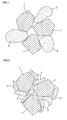
- Fig. 1 is a view schematically showing a kneaded state of ceramic raw material particles and water right after the kneading is started.
- Fig. 2 is a view schematically showing a kneaded state of ceramic raw material particles and water during kneading, which follows Fig. 1 .
- Fig. 3 is a view schematically showing a kneaded state of ceramic raw material particles and water after kneading, which follows Fig. 2 .
- Fig. 4 is a line plot showing the transition of the T1 relaxation time of the proton contained in the contained materials in the kneaded clay of Example 1.
- Fig. 5 is a line plot showing the transition of the T2 relaxation time of the proton contained in the contained materials in the kneaded clay of Example 1.
- Fig. 6 is a line plot showing the transition of the molecular weight of the organic binder contained in the kneaded clay of Example 1.
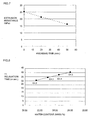
- Fig. 7 is a line plot showing the relation between the kneading time and the extrusion resistance upon extrusion of the kneaded clay of Example 1.
- Fig. 8 is a line plot showing the relation between water content and the T1 relaxation time of the proton in the kneaded clay prepared in Examples 2 to 5.
- Fig. 9 is a line plot showing the relation between water content and the T2 relaxation time of the proton in the kneaded clay prepared in Examples 2 to 5.
- Fig. 10 is a line plot showing the transition of the T1 relaxation time of the proton contained in the contained materials in the kneaded clay of Examples 6 to 8.
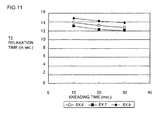
- Fig. 11 is a line plot showing the transition of the T2 relaxation time of the proton contained in the contained materials in the kneaded clay of Examples 6 to 8.
- the nature of kneaded clay is evaluated on the basis of the proton relaxation time measured by the NMR method, for example, an objective index obtained from a proton relaxation time measurement method using a NMR device.
- the method is called NMR method in the present specification, it may be called a nuclear magnetic resonance method, MR method, or MR (I) method.
- the T1 relaxation time may be indicated as a longitudinal relaxation time
- the T2 relaxation time may be indicated as a transverse relaxation time.
- distribution in the plane (imaging) can be obtained.
- kneaded clay here is prepared by mixing contained materials such as a ceramic raw material, a binder, and solvent and kneading them.
- the kneaded clay may be expressed as clay.
- the kneaded clay is preferably kneaded clay with which a ceramic structure can be manufactured by forming the clay into a predetermined shape, followed by drying and firing. Examples of such kneaded clay include kneaded clay whose material composition after firing becomes a cordierite composition or an alumina composition.
- kneaded clay even in the case that the appearance of kneaded clay is not in a clay-like state, the mixture of contained materials such as a ceramic rawmaterial, a binder, and a solvent is called as kneaded clay.
- a relaxation time measurement method using a NMR device is used to measure the T1 relaxation time and/or the T2 relaxation time of the proton contained in the contained materials in the kneaded clay.
- the T1 relaxation time and the T2 relaxation time of the proton contained in the contained materials in kneaded clay reflect the state of the contained materials in the kneaded clay at a micro level or molecular level.
- the state at a molecule level of the contained materials where kneading of the kneaded clay changes in accordance with the progress of kneading is distinguished by means of change in the T1 relaxation time and the T2 relaxation time of the proton contained in the contained materials in the kneaded clay.
- a signal for measuring the relaxation time has the signal sent from the proton contained in water as the main component:
- the kneaded clay to be evaluated is suitably kneaded clay where a signal for measuring the T1 relaxation time and/or the T2 relaxation time of the proton contained in the contained materials in the kneaded clay has the signal sent from the proton of the water as the main component.
- a signal for measuring the T1 relaxation time and/or the T2 relaxation time of the proton contained in the contained materials in the kneaded clay has the signal sent from the proton of the water as the main component.
- the T1 relaxation time and the T2 relaxation time of the proton contained in the water become short.
- the T1 relaxation time and the T2 relaxation time of the proton contained in the water become long.
- the phrase "a signal for measuring the T1 relaxation time and/or the T2 relaxation time of the proton has the signal sent from the water as the main component" means that the material having the highest inner addition rate (mass%) among the materials having a proton in the contained materials in kneaded clay is water.
- Fig. 1 shows a state of kneaded clay right after the kneading is started, in particular, a state where ceramic raw material particles 1 and water 2 are mixed together.
- water is present in a state of a liquid mass at a high proportion. At this time, most of the water molecules can move freely, and the T1 relaxation time and the T2 relaxation time of the proton contained in water in the kneaded clay are long.
- Fig. 2 is a view schematically showing a kneaded state of ceramic raw material particles and water during kneading.
- the water 2 starts covering the surface of the ceramic raw material particles 1. Therefore, the amount of the water 2 adhering to the surface of the ceramic raw material particles 1 increases relatively, and the mass of water capable of moving freely decreases relatively.
- the T1 relaxation time and the T2 relaxation time of the proton contained in the water in the kneaded clay are shortened in comparison with the time right after the start of kneading.
- Fig. 3 schematically shows a state of kneaded clay which was sufficiently kneaded.
- the water 2 covers the surfaces of the ceramic raw material particles 1 in a membrane state. At this time, since most of the water molecules adheres to the surfaces of the ceramic raw material particles 1, the T1 relaxation time and the T2 relaxation time of the proton contained in the water in the kneaded clay become shorter.
- a method for evaluating kneaded clay of the present invention utilizes the phenomenon that the T1 relaxation time and/or the T2 relaxation time of the proton contained in water in the kneaded clay becomes short in accordance with the dispersion of water in kneaded clay with the kneaded clay being sufficiently kneaded in the case that a signal for measuring the T1 relaxation time and/or the T2 relaxation time of the proton contained in the contained materials in the kneaded clay has the signal sent from the proton of the water as the main component.
- a signal for measuring the T1 relaxation time and/or the T2 relaxation time of the proton contained in the contained materials in the kneaded clay is more likely to have the signal sent from the proton of the water as the main component, and the transition of the T1 relaxation time and the T2 relaxation time of the proton contained in the contained materials in the kneaded clay furthermore reflects the transition of the T1 relaxation time and the T2 relaxation time of the proton contained in the water in the kneaded clay.
- the membrane of the water 2 on the surfaces of the ceramic raw material particles 1 becomes thick to increase the proportion of the water molecules capable of moving freely, the T1 relaxation time and the T2 relaxation time of the proton contained in the contained materials in the kneaded clay after kneading become longer than in the case that the water content in the kneaded clay is low.
- the T1 relaxation time and the T2 relaxation time of the proton contained in the contained materials in the kneaded clay are influenced also by a signal from proton contained in an organic binder and a surfactant in the kneaded clay. Therefore, the T1 relaxation time and the T2 relaxation time of the proton contained in the contained materials in the kneaded clay have different values when the amounts and kinds of the organic binder and surfactant in the kneaded clay are different. In addition, actually, when the amounts and kinds of the organic binder and surfactant in the kneaded clay are different, the state of kneading is different.
- the transition of the T1 relaxation time and/or the T2 relaxation time of the proton contained in the contained materials reflects the change in the state of the water molecules in the kneaded clay almost precisely.
- the T1 relaxation time and the T2 relaxation time of the proton contained in the contained materials are getting shorter.
- the aforementioned method for evaluating kneaded clay is used. That is, in a method for manufacturing kneaded clay of the present invention, the kneaded clay is kneaded while checking the kneaded state of the kneaded clay by the T1 relaxation time and/or the T2 relaxation time of the proton contained in the contained materials in the kneaded clay.
- the T1 relaxation time and/or the T2 relaxation time of the proton contained in the contained materials in the kneaded clay in a good kneaded state depends on the water content and the kinds and the amounts of the organic binder and the surfactant.
- the specific embodiment differs depending on the case that the composition of the kneaded clay is known or not known.
- the transition of the T1 relaxation time and/or the T2 relaxation time of the proton may be observed to continue kneading until the T1 relaxation time and/or the T2 relaxation time becomes sufficiently short to have a value where the T1 relaxation time and/or the T2 relaxation time becomes stable in the forming step.
- the sample measured by the NMR method may appropriately be collected from the material before kneading, during kneading, and after kneading, and from a formed article (kneaded clay) formed into a desired shape before firing.
- a method for kneading the kneaded material as long as the sample can be measured by the NMR method.
- a method for manufacturing kneaded clay of the present invention it is preferable to knead the kneaded clay until the T1 relaxation time of the proton contained in the contained materials measured at a magnetostatic field strength of 0.3 to 9 .4T becomes 80% or less of the T1 relaxation time, i.e., initialvaluebeforekneading.
- "Beforekneading" means the state where all the contained materials to be contained in the kneaded clay are mixed together.
- the step where all the contained materials are mixed together is called also a blending step, a mixing step, or a mixer step. From the kneaded clay obtained by this manufacturing method, a honeycomb structure constituted of thin walls without a cut or a fine can be manufactured by extrusion forming
- the contained materials were a ceramic raw material, methyl cellulose used as the organic binder, potassium laurate used as the surfactant, and water. These contained materials were mixed to prepare a mixed raw material (Table 1). With respect to 100 parts by mass of the ceramic raw material were mixed 6 parts by mass of methyl cellulose as the organic binder, 1 part by mass of potassium laurate, and 29.5 to 35.0 parts by mass of water to prepare the mixed raw material.
- a ceramic raw material of each of Examples 1 to 5 there was used a cordierite-forming raw material containing 42 mass% of talc, 43 mass% of kaolin, 14 mass% of at least one kind selected from alumina and aluminum hydroxide, and 1 mass% of silica.
- the kneaded clay was prepared by subjecting 1.0 kg of the mixed raw material to kneading for 50 minutes by the use of a pressure kneader (trade name of TD1-3M Type Pressure Kneader produced by Toshin Co., Ltd.). Incidentally, the sample of the kneaded clay used for measurement by the NMR device was collected by 50g from the time before kneading and every 10 minutes from the start of kneading.
- the water content was obtained by heating the samples right after the collection at 120°C to measure the dry mass and dividing the mass of each of the samples before heating by the dry mass.
- the water content of each of the kneaded clay samples was shown by percentage of water content with respect to the mass of each of the samples before heating.
- CompacTscan having a magnetostatic field intensity of 0.3T produced by Magnetic Resonance Technology, LTD.
- AVANCE having a magnetostatic field intensity of 9.4T produced by BRUKER CORPORATION.
- GPC produced by TOSOH CORPORATION.
- a formed article obtained by preliminarily forming the kneaded clay into a cylindrical shape having a diameter of 25 mm and a height of 55mm was inserted into a cylinder having a diameter of 25 mm, and then pressure was applied to the formed article to pass the formed article through a capillary having a diameter of 1.0 mm, a height of 20 mm, and a last edge of 0.1 mm in width times 2 mm provided at the bottom of the cylinder, thereby measuring the resistance value.
- the kneaded clay samples collected before kneading, 10 minutes, 20 minutes, 30 minutes, and 40 minutes after the start of kneading, and 50 minutes after the start of kneading (right after the completion of kneading) in the step of (2) of Example 1 were measured for the T1 relaxation time and the T2 relaxation time of the proton contained in the contained materials in the kneaded clay.
- the magnetostatic field intensity was 0.3T.
- Table 2 shows measurement results of the T1 relaxation time and the T2 relaxation time of the proton contained in the contained materials in the kneaded clay of Example 1 before kneading, at time points at intervals of 10 minutes during kneading, and after kneading.
- Fig. 4 shows the transition of the T1 relaxation time of the proton contained in the contained materials in the kneaded clay of Example 1 by a line plot
- Fig. 5 shows the transition of the T2 relaxation time of the proton contained in the contained materials in the kneaded clay of Example 1 by a line plot.
- the T1 relaxation time and the T2 relaxation time of the proton contained in the contained materials in the kneaded clay were shortened.
- the line plots of Figs. 4 and 5 showed the tendency of gradual decrease of the T1 relaxation time and the T2 relaxation time from 10 minutes to 20 minutes after the start of kneading, that is, the tendency of getting nearly horizontally.
- the change in the degree of decrease of the T1 relaxation time and the T2 relaxation time corresponded with the change of kneaded clay from a powdery form to a clayey form, which can be observed visually from 10 minutes to 20 minutes after the start of kneading.
- the kneaded clay before kneading, 10 minutes, 20 minutes, 30 minutes, and 40 minutes after the start of kneading, and 50 minutes after the start of kneading (right after the completion of kneading) in the step of (2) of Example 1 was measured for the molecular weight of an organic binder contained in the kneaded clay.
- the kneaded clay of Example 1 the kneaded time and the molecular weight of an organic binder contained in the kneaded clay are shown in Tables 3 and 6. Incidentally, the molecular weight of the organic binder is shown as a standardized value.
- the molecular weight of the organic binder drastically decreased from 10 minutes to 20 minutes after the start of kneading. This decrease in the molecular weight of the organic binder corresponds with the change of kneaded clay from a powdery form to a clayey form.
- the kneaded clay before kneading, 10 minutes, 20 minutes, 30 minutes, and 40 minutes after the start of kneading, and 50 minutes after the start of kneading (right after the completion of kneading) in the step of (2) of Example 1 was subjected to extrusion. Further, upon extrusion, the extrusion resistance was measured by the aforementioned measurement method.
- Fig. 7 shows a line plot showing the relation between the kneading time and the extrusion resistance upon extrusion of the kneaded clay of Example 1.
- the kneaded clay collected 50 minutes after the start of kneading was measured for the T1 relaxation time and the T2 relaxation time of the proton contained in the contained materials in the kneaded clay.
- the magnetostatic field intensity was 0.3T.
- Table 4 shows the measurement results of the T1 relaxation time and the T2 relaxation time of the proton contained in the contained materials in the kneaded clay collected 50 minutes after the start of kneading. Further, the T1 relaxation time of the proton contained in the contained materials in the kneaded clay of each of Examples 2 to 5 is shown in Fig. 8 by a line plot, and the T2 relaxation time of the same is shown in Fig. 9 by a line plot.
- measurement with a magnetostatic field intensity of 9.4T was performed with regard to Example 6.
- the T1 relaxation time and the T2 relaxation time of the proton contained in the contained materials of the kneaded clay are different.
- the T1 relaxation time and the T2 relaxation time of the proton contained in the contained materials of the kneaded clay of Example 6 remarkably differ between the magnetostatic field intensity of 0.3T and the magnetostatic field intensity of 9.4T. This means the relaxation times of the proton changes depending on the magnetostatic field intensity, that is, depending on the specifications of the measurement device. That is, it means that the state of kneading of kneaded clay cannot be recognized strictly by the absolute value of the relaxation time.
- the T1 relaxation time tends to be long, and, when the magnetostatic field intensity is low, the T2 relaxation time tends to be long.
- the kneaded clay having almost the same measurement value of the T1 relaxation time at the magnetostatic field intensity of 0.3T, it may have a possibility of showing a significant different in the T1 relaxation time at the magnetostatic field intensity of 9.4T. That is, it suggests that even a slight difference in the nature of kneaded clay can be recognized by measuring the T1 relaxation time and the T2 relaxation time by changing the magnetostatic field intensity.
- the present invention can be used as a method for evaluating kneaded clay used for manufacturing a ceramic structure used for a filter, a catalyst carrier, an electric transmission insulator, a refractory, or the like and an a method for manufacturing kneaded clay.
Landscapes
- Chemical & Material Sciences (AREA)
- Engineering & Computer Science (AREA)
- Ceramic Engineering (AREA)
- Physics & Mathematics (AREA)
- Manufacturing & Machinery (AREA)
- Organic Chemistry (AREA)
- Structural Engineering (AREA)
- Materials Engineering (AREA)
- High Energy & Nuclear Physics (AREA)
- Inorganic Chemistry (AREA)
- General Physics & Mathematics (AREA)
- Condensed Matter Physics & Semiconductors (AREA)
- Analytical Chemistry (AREA)
- Pathology (AREA)
- Immunology (AREA)
- General Health & Medical Sciences (AREA)
- Biochemistry (AREA)
- Life Sciences & Earth Sciences (AREA)
- Health & Medical Sciences (AREA)
- Preparation Of Clay, And Manufacture Of Mixtures Containing Clay Or Cement (AREA)
- Compositions Of Oxide Ceramics (AREA)
- Press-Shaping Or Shaping Using Conveyers (AREA)
Abstract
Description
- The present invention relates to a method for evaluating kneaded clay used for manufacturing a ceramic structure used for a filter, a catalyst carrier, an electric transmission insulator, a refractory, or the like and to a method for manufacturing kneaded clay.
- Ceramics, which are inorganic materials, have excellent physical, chemical, and electrical characteristics which metals and organic materials do not have. Further, ceramics have an advantage that any shape can be obtained from the raw material, and an example representing this is a honeycomb structure constituted of thin walls of some microns.
- Generally, a ceramic structure is manufactured through a step of preparing kneaded clay from a mixed raw material containing a ceramic raw material, an organic binder, and/or an inorganic binder, a step of manufacturing a formed body by forming the kneaded clay into a desired shape, a step of drying the formed body, and the step of firing a formed article to obtain a fired article in this order.
- The kneaded clay is prepared by mixing and kneading contained materials such as a ceramic raw material, a binder, and a solvent. The nature of the kneaded clay significantly influences on the characteristics of the ceramic structure. For example, when the kneaded clay is prepared with contained materials such as a ceramic raw material, a binder, and a solvent being insufficiently kneaded, there is caused variance in a strength characteristic and an elastic characteristic of a formed article obtained from the kneaded clay. Therefore, in the preparation of the kneaded clay, it is desirable that the degree of kneading of the contained materials is grasped by an objective index.
- The characteristics regarding the transformability, shape-retentivity, and flowability of kneaded clay, that is, so-called rheological properties of kneaded clay significantly influence on the shape-retentivity of the formed article manufactured with the kneaded clay. For example, in the case that a ceramic formed article is manufactured by subjecting kneaded clay to extrusion forming, when flowability of the kneaded clay is poor, the kneaded clay is pressure-bonded to the die for extrusion to generate a cut or a fine on a surface of the resultant formedarticle. On the other hand, when the flowability of the kneaded clay is good, the formed article manufactured by extrusion forming may easily be deformed.
- Thus, though the nature of kneaded clay is important, in an actual production site, the evaluation on the nature of kneaded clay depends on operator's proficient senses of vision, touch, and the like. However, by the evaluation of the nature of kneaded clay due to operator's senses, it is difficult to stably manufacture kneaded clay having high quality. In addition, the acquisition of the skill to recognize good nature of kneaded clay by senses of vision, touch, and the like needs persistent trial and error and training. Even if the skill is acquired through a great deal of effort, it is difficult to hand the skill on to another operator. Therefore, the nature of kneaded clay, which has been recognized as good by an operator's senses, has been tried to grasp by an objective index by a scientific measurement means.
-
JP-A-9-33420 -
JP-A-2000-302525 - Nuclear magnetic resonance (NMR) is an indispensable tool for determining a structure of an organic compound as introduced in the "Organic Chemistry" (Volume One), Fourth edition, by K.Peter C. Vollhardt, Neil E. Schore, Chemical Coterie, Chapter 10: Structure Determination by NMR Spectroscopy, Pages 419 to 478, since the state of molecules can be observed based on the energy absorption/ejection phenomenon of nuclear spin. In addition, NMR is used as a tool for grasping the nature of a material containing an organic compound as the main component. For example,
JP-A-2001-106728 4108648 - In the medical diagnosis field, a magnetic resonance imaging method (MRI) where the principle of the NMR is applied has already been used. The MRI uses that the state of water molecules occupying most of a human body is reflected on the proton relaxation time. It is expected that NMR will take one step further from the medical diagnosis field to the production field, in particular, to quality control in a factory or the like.
- As a matter of course, the state of clay cannot be grasped accurately even by a method disclosed in
JP-A-9-33420 JP-A-2000-302525 - As in
JP-A-2001-106728 4108648 - In view of the aforementioned problems, the present invention aims to provide a method for evaluating kneaded clay to evaluate the nature of the kneaded clay by an objective index, and the method for manufacturing kneaded clay enables to manufacture kneaded clay while checking the kneaded state of the kneaded clay by an objective index.
- In order to solve the aforementionedproblems, the present inventors keenly investigated knowledge regarding ceramic technology, which took a long while to cultivate, again from the scientific viewpoint and found out that kneaded state of the kneaded clay can be evaluated by NMR, which led to the completion of the present invention. That is, according to the present invention, there is provided the following method for evaluating kneaded clay and method for manufacturing kneaded clay.
- [1] A method of evaluating kneaded clay which comprises: preparing kneaded clay by mixing and kneading at least ceramic raw material and water as contained materials, measuring T1 relaxation time and/or T2 relaxation time of proton contained in the contained materials by NMR method, and evaluating a kneaded state of the kneaded clay.
- [2] A method for evaluating kneaded clay according to [1], wherein a signal for measuring the T1 relaxation time and/or the T2 relaxation time of the proton contained in the contained materials has the signal sent from the proton of the water as the main component.
- [3] A method for evaluating kneaded clay according to [1] or [2], wherein the kneaded clay is for subjecting, after the kneading, to a forming step, a drying step, and a firing step.
- [4] A method for evaluating kneaded clay according to [3], wherein the kneaded clay has a cordierite composition or an alumina composition after the firing step.
- [5] A method for manufacturing kneaded clay which comprises: using a method for evaluating kneaded clay according to any one of [1] to [4], and kneading the kneaded clay while checking the kneaded state of the kneaded clay by the T1 relaxation time and/or the T2 relaxation time of the proton contained in the contained materials.
- [6] A method for manufacturing kneaded clay according to [5], wherein the kneaded clay is kneaded until the T1 relaxation time, measured at magnetostatic field strength of 0.3 to 9.4T, of the proton contained in the contained materials becomes 80% or less of the initial value before kneading.
- In a method for evaluating kneaded clay of the present invention, the state of contained materials, for example, the state of water molecules in the kneaded clay is scientifically observed to evaluate the nature of the kneaded clay by an objective index. In a method for manufacturing kneaded clay of the present invention, kneaded clay can be manufactured while checking the kneaded state of the kneaded clay by an objective index.
-
Fig. 1 is a view schematically showing a kneaded state of ceramic raw material particles and water right after the kneading is started. -
Fig. 2 is a view schematically showing a kneaded state of ceramic raw material particles and water during kneading, which followsFig. 1 . -
Fig. 3 is a view schematically showing a kneaded state of ceramic raw material particles and water after kneading, which followsFig. 2 . -
Fig. 4 is a line plot showing the transition of the T1 relaxation time of the proton contained in the contained materials in the kneaded clay of Example 1. -
Fig. 5 is a line plot showing the transition of the T2 relaxation time of the proton contained in the contained materials in the kneaded clay of Example 1. -
Fig. 6 is a line plot showing the transition of the molecular weight of the organic binder contained in the kneaded clay of Example 1. -
Fig. 7 is a line plot showing the relation between the kneading time and the extrusion resistance upon extrusion of the kneaded clay of Example 1. -
Fig. 8 is a line plot showing the relation between water content and the T1 relaxation time of the proton in the kneaded clay prepared in Examples 2 to 5. -
Fig. 9 is a line plot showing the relation between water content and the T2 relaxation time of the proton in the kneaded clay prepared in Examples 2 to 5. -
Fig. 10 is a line plot showing the transition of the T1 relaxation time of the proton contained in the contained materials in the kneaded clay of Examples 6 to 8. -
Fig. 11 is a line plot showing the transition of the T2 relaxation time of the proton contained in the contained materials in the kneaded clay of Examples 6 to 8. - 1: Ceramic raw material particle, 2: Water
- Hereinbelow, an embodiment of the present invention will be described with referring to drawings. The present invention is by no means limited to the following embodiment, and changes, modifications, improvements can be made as long as they do not deviate from the scope of the present invention.
- In a method for evaluating kneaded clay of the present invention, the nature of kneaded clay is evaluated on the basis of the proton relaxation time measured by the NMR method, for example, an objective index obtained from a proton relaxation time measurement method using a NMR device. Though the method is called NMR method in the present specification, it may be called a nuclear magnetic resonance method, MR method, or MR (I) method. Also, regarding the relaxation time indication, the T1 relaxation time may be indicated as a longitudinal relaxation time, and the T2 relaxation time may be indicated as a transverse relaxation time. In addition, by integrating the T1 relaxation time or the T2 relaxation time for each site in a two-dimensional plane of a cross section to express the difference in relaxation time by the contrast, distribution in the plane (imaging) can be obtained.
- In the first place, "kneaded clay" here is prepared by mixing contained materials such as a ceramic raw material, a binder, and solvent and kneading them. The kneaded clay may be expressed as clay. The kneaded clay is preferably kneaded clay with which a ceramic structure can be manufactured by forming the clay into a predetermined shape, followed by drying and firing. Examples of such kneaded clay include kneaded clay whose material composition after firing becomes a cordierite composition or an alumina composition. Incidentally, in the present specification, even in the case that the appearance of kneaded clay is not in a clay-like state, the mixture of contained materials such as a ceramic rawmaterial, a binder, and a solvent is called as kneaded clay.
- In a method for evaluating kneaded clay of the present invention, a relaxation time measurement method using a NMR device is used to measure the T1 relaxation time and/or the T2 relaxation time of the proton contained in the contained materials in the kneaded clay.
- The T1 relaxation time and the T2 relaxation time of the proton contained in the contained materials in kneaded clay reflect the state of the contained materials in the kneaded clay at a micro level or molecular level. In a method for evaluating kneaded clay of the present invention, the state at a molecule level of the contained materials where kneading of the kneaded clay changes in accordance with the progress of kneading is distinguished by means of change in the T1 relaxation time and the T2 relaxation time of the proton contained in the contained materials in the kneaded clay.
- In a method for evaluating kneaded clay of the present invention, the kneaded clay to be evaluated is suitably kneaded clay where a signal for measuring the T1 relaxation time and/or the T2 relaxation time of the proton contained in the contained materials in the kneaded clay has the signal sent from the proton of the water as the main component. This is because the dynamics of the T1 relaxation time and the T2 relaxation time of the proton contained in the contained materials in the kneaded clay can be considered to be almost the same as that of the T1 relaxation time and/or the T2 relaxation time of the proton contained in the water in the kneaded clay. Generally, in the state that water molecules adhere to the surface of the materials, the T1 relaxation time and the T2 relaxation time of the proton contained in the water become short. In contrast, in the state that water molecules can move freely as a mass of liquid water, the T1 relaxation time and the T2 relaxation time of the proton contained in the water become long. The phrase "a signal for measuring the T1 relaxation time and/or the T2 relaxation time of the proton has the signal sent from the water as the main component" means that the material having the highest inner addition rate (mass%) among the materials having a proton in the contained materials in kneaded clay is water.
-
Fig. 1 shows a state of kneaded clay right after the kneading is started, in particular, a state where ceramicraw material particles 1 andwater 2 are mixed together. Right after the start of kneading, water is present in a state of a liquid mass at a high proportion. At this time, most of the water molecules can move freely, and the T1 relaxation time and the T2 relaxation time of the proton contained in water in the kneaded clay are long. -
Fig. 2 is a view schematically showing a kneaded state of ceramic raw material particles and water during kneading. Thewater 2 starts covering the surface of the ceramicraw material particles 1. Therefore, the amount of thewater 2 adhering to the surface of the ceramicraw material particles 1 increases relatively, and the mass of water capable of moving freely decreases relatively. In accordance with the change in the state of the water molecules, the T1 relaxation time and the T2 relaxation time of the proton contained in the water in the kneaded clay are shortened in comparison with the time right after the start of kneading. -
Fig. 3 schematically shows a state of kneaded clay which was sufficiently kneaded. Thewater 2 covers the surfaces of the ceramicraw material particles 1 in a membrane state. At this time, since most of the water molecules adheres to the surfaces of the ceramicraw material particles 1, the T1 relaxation time and the T2 relaxation time of the proton contained in the water in the kneaded clay become shorter. That is, a method for evaluating kneaded clay of the present invention utilizes the phenomenon that the T1 relaxation time and/or the T2 relaxation time of the proton contained in water in the kneaded clay becomes short in accordance with the dispersion of water in kneaded clay with the kneaded clay being sufficiently kneaded in the case that a signal for measuring the T1 relaxation time and/or the T2 relaxation time of the proton contained in the contained materials in the kneaded clay has the signal sent from the proton of the water as the main component. - Next, a description will be given regarding the case of measuring kneaded clay where a signal for measuring the T1 relaxation time and/or the T2 relaxation time of the proton contained in the contained materials has the signal sent from the proton of the water as the main component. In particular, a detailed description will be given regarding the relation between the T1 relaxation time and/or the T2 relaxation time of the proton contained in the contained materials in kneaded clay and water content or an organic binder.
- When the water content in kneaded clay is high, a signal for measuring the T1 relaxation time and/or the T2 relaxation time of the proton contained in the contained materials in the kneaded clay is more likely to have the signal sent from the proton of the water as the main component, and the transition of the T1 relaxation time and the T2 relaxation time of the proton contained in the contained materials in the kneaded clay furthermore reflects the transition of the T1 relaxation time and the T2 relaxation time of the proton contained in the water in the kneaded clay.
- A description will be given with referring to
Fig. 3 . In the case that the water content in kneaded clay is high, when the kneaded clay is sufficiently kneaded, thewater 2 covers the surfaces of the ceramicraw material particles 1 in a thick membrane form. In this thick membrane-like water 2, some water molecules adhere to the surfaces of the ceramicraw material particles 1, and the other water molecules can move freely. When the water content in the kneaded clay is high, since the membrane of thewater 2 on the surfaces of the ceramicraw material particles 1 becomes thick to increase the proportion of the water molecules capable of moving freely, the T1 relaxation time and the T2 relaxation time of the proton contained in the contained materials in the kneaded clay after kneading become longer than in the case that the water content in the kneaded clay is low. - It should be noted that, in a method for evaluating kneaded clay of the present invention, even in the case that the water content in the kneaded clay is high, as the ceramic raw material particles and water are being kneaded, the water is dispersed in the kneaded clay, and the T1 relaxation time and the T2 relaxation time of the proton contained in the contained materials in the kneaded clay are getting shorter.
- The T1 relaxation time and the T2 relaxation time of the proton contained in the contained materials in the kneaded clay are influenced also by a signal from proton contained in an organic binder and a surfactant in the kneaded clay. Therefore, the T1 relaxation time and the T2 relaxation time of the proton contained in the contained materials in the kneaded clay have different values when the amounts and kinds of the organic binder and surfactant in the kneaded clay are different. In addition, actually, when the amounts and kinds of the organic binder and surfactant in the kneaded clay are different, the state of kneading is different. However, in kneaded clay where a signal for measuring the T1 relaxation time and/or the T2 relaxation time of the proton has the signal sent from the proton of the water as the main component, it can be considered that the transition of the T1 relaxation time and/or the T2 relaxation time of the proton contained in the contained materials reflects the change in the state of the water molecules in the kneaded clay almost precisely. In such kneaded clay, regardless of the amounts and kinds of the organic binder and surfactant, as the water is dispersed in accordance with the progress of the kneading of the kneaded clay, the T1 relaxation time and the T2 relaxation time of the proton contained in the contained materials are getting shorter.
- In a method for manufacturing kneaded clay of the present invention, the aforementioned method for evaluating kneaded clay is used. That is, in a method for manufacturing kneaded clay of the present invention, the kneaded clay is kneaded while checking the kneaded state of the kneaded clay by the T1 relaxation time and/or the T2 relaxation time of the proton contained in the contained materials in the kneaded clay.
- As described above, the T1 relaxation time and/or the T2 relaxation time of the proton contained in the contained materials in the kneaded clay in a good kneaded state depends on the water content and the kinds and the amounts of the organic binder and the surfactant. Here, regarding "kneaded while checking the kneaded state of the kneaded clay", the specific embodiment differs depending on the case that the composition of the kneaded clay is known or not known. For example, in the case that kneaded clay having the same composition is already subjected to an evaluation test and that the T1 relaxation time and/or the T2 relaxation time of the proton contained in the contained materials in the kneaded clay in a kneaded state suitable for forming is grasped, only observation that the time reaches the relaxation time required is necessary. On the other hand, in the case that the T1 relaxation time and/or the T2 relaxation time of the proton contained in the contained materials in the kneaded clay in a kneaded state suitable for forming has not yet been grasped, the transition of the T1 relaxation time and/or the T2 relaxation time of the proton may be observed to continue kneading until the T1 relaxation time and/or the T2 relaxation time becomes sufficiently short to have a value where the T1 relaxation time and/or the T2 relaxation time becomes stable in the forming step.
- Incidentally, the sample measured by the NMR method may appropriately be collected from the material before kneading, during kneading, and after kneading, and from a formed article (kneaded clay) formed into a desired shape before firing. There is no particular limitation on a method for kneading the kneaded material as long as the sample can be measured by the NMR method.
- In particular, in a method for manufacturing kneaded clay of the present invention, it is preferable to knead the kneaded clay until the T1 relaxation time of the proton contained in the contained materials measured at a magnetostatic field strength of 0.3 to 9 .4T becomes 80% or less of the T1 relaxation time, i.e., initialvaluebeforekneading. "Beforekneading"means the state where all the contained materials to be contained in the kneaded clay are mixed together. The step where all the contained materials are mixed together is called also a blending step, a mixing step, or a mixer step. From the kneaded clay obtained by this manufacturing method, a honeycomb structure constituted of thin walls without a cut or a fine can be manufactured by extrusion forming
- Hereinbelow, the present invention will be described in more detail on the basis of Examples. However, the present invention is by no means limited to these Examples.
- In Examples 1 to 5, the contained materials were a ceramic raw material, methyl cellulose used as the organic binder, potassium laurate used as the surfactant, and water. These contained materials were mixed to prepare a mixed raw material (Table 1). With respect to 100 parts by mass of the ceramic raw material were mixed 6 parts by mass of methyl cellulose as the organic binder, 1 part by mass of potassium laurate, and 29.5 to 35.0 parts by mass of water to prepare the mixed raw material. Incidentally, as a ceramic raw material of each of Examples 1 to 5, there was used a cordierite-forming raw material containing 42 mass% of talc, 43 mass% of kaolin, 14 mass% of at least one kind selected from alumina and aluminum hydroxide, and 1 mass% of silica.
-
Table 1 Composition of ceramic raw material Organic binder
(parts by mass)*1Surfactant
(parts by mass)*1Water
(parts by mass)*1Test Example 1 Cordierite composition 6.0 2.0 32.0 Test 1Example 2 Cordierite composition 6.0 2.0 29.5 Test 2Example 3 Cordierite composition 6.0 2.0 31.5 Example 4 Cordierite composition 6.0 2.0 34.0 Example 5 Cordierite composition 6.0 2.0 35.0 Example 6 Alumina 6.0 2.0 14.0 Test 3Example 7 Alumina 3.0 2.0 14.0 Example 8 Alumina 6.0 4.0 14.0 *1: Value with respect to 100 parts by mass of ceramic raw material - In each of Examples 6 to 8, with respect to 100 parts by mass of alumina used as the ceramic raw material, 3 to 6 parts by mass of methyl cellulose as an organic binder, 2 to 4 parts by mass of potassium laurate as the surfactant, and 14 parts by mass of water were mixed to prepare a mixed raw material.
- The kneaded clay was prepared by subjecting 1.0 kg of the mixed raw material to kneading for 50 minutes by the use of a pressure kneader (trade name of TD1-3M Type Pressure Kneader produced by Toshin Co., Ltd.). Incidentally, the sample of the kneaded clay used for measurement by the NMR device was collected by 50g from the time before kneading and every 10 minutes from the start of kneading. Therefore, collection of the kneaded clay was performed before kneading and 10 minutes, 20 minutes, 30 minutes, and 40 minutes after the start of kneading, and 50 minutes after the start of kneading (right after the completion of kneading). These kneaded clay samples were vacuum sealed under a condition of removing air with a resin film in order to avoid drying and degeneration and stored until the measurement by the NMR measurement device.
- Regarding the aforementioned kneaded clay samples, the water content was obtained by heating the samples right after the collection at 120°C to measure the dry mass and dividing the mass of each of the samples before heating by the dry mass. In addition, the water content of each of the kneaded clay samples was shown by percentage of water content with respect to the mass of each of the samples before heating.
- As the NMR measurement device, there were used CompacTscan having a magnetostatic field intensity of 0.3T produced by Magnetic Resonance Technology, LTD., and AVANCE having a magnetostatic field intensity of 9.4T produced by BRUKER CORPORATION.
- For measurement of the binder molecular weight, GPC produced by TOSOH CORPORATION.
- Regarding the capillary rheometer test for extrusion resistance, a formed article obtained by preliminarily forming the kneaded clay into a cylindrical shape having a diameter of 25 mm and a height of 55mm was inserted into a cylinder having a diameter of 25 mm, and then pressure was applied to the formed article to pass the formed article through a capillary having a diameter of 1.0 mm, a height of 20 mm, and a last edge of 0.1 mm in
width times 2 mm provided at the bottom of the cylinder, thereby measuring the resistance value. - It was found by eye observation that the kneaded clay changes from a powdery form to a clayey form from 10 minutes to 20 minutes after the start of kneading.
- The kneaded clay samples collected before kneading, 10 minutes, 20 minutes, 30 minutes, and 40 minutes after the start of kneading, and 50 minutes after the start of kneading (right after the completion of kneading) in the step of (2) of Example 1 were measured for the T1 relaxation time and the T2 relaxation time of the proton contained in the contained materials in the kneaded clay. The magnetostatic field intensity was 0.3T.
- Table 2 shows measurement results of the T1 relaxation time and the T2 relaxation time of the proton contained in the contained materials in the kneaded clay of Example 1 before kneading, at time points at intervals of 10 minutes during kneading, and after kneading.
Fig. 4 shows the transition of the T1 relaxation time of the proton contained in the contained materials in the kneaded clay of Example 1 by a line plot, andFig. 5 shows the transition of the T2 relaxation time of the proton contained in the contained materials in the kneaded clay of Example 1 by a line plot. -
Table 2 (Test 1) Kneading time (min.) 0 10 20 30 40 50 T1 relaxation time
(m sec.)54 44.5 39 37 36.1 34.4 T2 relaxation time
(m sec.)11.7 7.9 7 6.7 6.6 6.1 Example 1 / magnetostatic field intensity of 0.3T - With the passage of the kneading time, the T1 relaxation time and the T2 relaxation time of the proton contained in the contained materials in the kneaded clay were shortened. In particular, the line plots of
Figs. 4 and5 showed the tendency of gradual decrease of the T1 relaxation time and the T2 relaxation time from 10 minutes to 20 minutes after the start of kneading, that is, the tendency of getting nearly horizontally. The change in the degree of decrease of the T1 relaxation time and the T2 relaxation time corresponded with the change of kneaded clay from a powdery form to a clayey form, which can be observed visually from 10 minutes to 20 minutes after the start of kneading. - The kneaded clay before kneading, 10 minutes, 20 minutes, 30 minutes, and 40 minutes after the start of kneading, and 50 minutes after the start of kneading (right after the completion of kneading) in the step of (2) of Example 1 was measured for the molecular weight of an organic binder contained in the kneaded clay.
- Regarding the kneaded clay of Example 1, the kneading time and the molecular weight of an organic binder contained in the kneaded clay are shown in Tables 3 and 6. Incidentally, the molecular weight of the organic binder is shown as a standardized value.
-
Table 3 (Test 1) Kneading time (min.) Molecular weight of organic binder 0 1.00 10 0.92 20 0.46 30 0.32 40 0.26 50 0.21 - The molecular weight of the organic binder drastically decreased from 10 minutes to 20 minutes after the start of kneading. This decrease in the molecular weight of the organic binder corresponds with the change of kneaded clay from a powdery form to a clayey form.
- The kneaded clay before kneading, 10 minutes, 20 minutes, 30 minutes, and 40 minutes after the start of kneading, and 50 minutes after the start of kneading (right after the completion of kneading) in the step of (2) of Example 1 was subjected to extrusion. Further, upon extrusion, the extrusion resistance was measured by the aforementioned measurement method.
-
Fig. 7 shows a line plot showing the relation between the kneading time and the extrusion resistance upon extrusion of the kneaded clay of Example 1. - It was found out that the extrusion resistance of the kneaded clay decreases with the passage of time.
- Regarding Examples 2 to 5, where only the water content was different, the kneaded clay collected 50 minutes after the start of kneading was measured for the T1 relaxation time and the T2 relaxation time of the proton contained in the contained materials in the kneaded clay. Incidentally, the magnetostatic field intensity was 0.3T.
- Table 4 shows the measurement results of the T1 relaxation time and the T2 relaxation time of the proton contained in the contained materials in the kneaded clay collected 50 minutes after the start of kneading. Further, the T1 relaxation time of the proton contained in the contained materials in the kneaded clay of each of Examples 2 to 5 is shown in
Fig. 8 by a line plot, and the T2 relaxation time of the same is shown inFig. 9 by a line plot. -
Table 4 (Test 2) T1 relaxation time
(m sec.)T2 relaxation time
(m sec.)Example 2 30.5 5.5 Example 3 34.1 5.9 Example 4 37.4 6.2 Example 5 40.6 6.6 - The higher the water content is, the longer the T1 relaxation time and the T2 relaxation time of the proton contained in the contained materials in the kneaded clay are. It can be considered that, in the case that the water content was high, even when water completely covered the surfaces of ceramic raw material particles by kneading, a large number of remaining water molecules was present in a free state without being bonded to the surfaces of the particles.
- Regarding Examples 6 to 8, where only proportions of the organic binder and the surfactant were different, the kneaded clay collected 10 minutes, 20 minutes, and 30 minutes after the start of kneading was measured for the T1 relaxation time and the T2 relaxation time of the proton contained in the contained materials in the kneaded clay. Incidentally, in addition to the measurement with a magnetostatic field intensity of 0.3T with regard to all of Examples 6 to 8, measurement with a magnetostatic field intensity of 9.4T was performed with regard to Example 6.
- Regarding the results of the measurement of the kneaded clay of each of Examples 6 to 8 for the T1 relaxation time and the T2 relaxation time of the proton contained in the contained materials in the kneaded
clay 10 minutes, 20 minutes, and 30 minutes after the start of kneading, the results of Examples 6 and 7 measured with a magnetostatic field intensity of 0.3T are shown in Table 5, and the results of Example 6 measured with a magnetostatic field intensity of 9.4T are shown in Table 6. Further, the transition of the T1 relaxation time of the proton contained in the contained materials in the kneaded clay in each of Examples 6 and 7 measured with a magnetostatic field intensity of 0.3T is shown inFig. 10 by a line plot, and the transition of the T2 relaxation time of the same is shown inFig. 11 by a line plot. -
Table 5 (Test 3) Example 6 Example 7 Example 8 Kneading time
(min.)10 20 30 10 20 30 10 20 30 T1 relaxation time
(m sec.)94.7 91.6 89.1 90.5 87.3 83.6 108.6 106.3 102.8 T2 relaxation time
(m sec.)13.8 13.2 12.8 13.1 12.3 12.1 14.8 14.2 13.8 Magnetostatic field intensity of 0.3T -
Table 6 (Test 3) Example 6 Kneading time (min.) 10 20 30 T1 relaxation time (m sec.) 652.1 601.0 561.7 T2 relaxation time (m sec.) 1.63 1.52 1.50 Magnetostatic field intensity of 9.4T - It was found out that, when the organic binder content and the surfactant content are different, the T1 relaxation time and the T2 relaxation time of the proton contained in the contained materials of the kneaded clay are different. In addition, the T1 relaxation time and the T2 relaxation time of the proton contained in the contained materials of the kneaded clay of Example 6 remarkably differ between the magnetostatic field intensity of 0.3T and the magnetostatic field intensity of 9.4T. This means the relaxation times of the proton changes depending on the magnetostatic field intensity, that is, depending on the specifications of the measurement device. That is, it means that the state of kneading of kneaded clay cannot be recognized strictly by the absolute value of the relaxation time. In addition, when the magnetostatic field intensity is high, the T1 relaxation time tends to be long, and, when the magnetostatic field intensity is low, the T2 relaxation time tends to be long. For example, even in the case of the kneaded clay having almost the same measurement value of the T1 relaxation time at the magnetostatic field intensity of 0.3T, it may have a possibility of showing a significant different in the T1 relaxation time at the magnetostatic field intensity of 9.4T. That is, it suggests that even a slight difference in the nature of kneaded clay can be recognized by measuring the T1 relaxation time and the T2 relaxation time by changing the magnetostatic field intensity.
- The present invention can be used as a method for evaluating kneaded clay used for manufacturing a ceramic structure used for a filter, a catalyst carrier, an electric transmission insulator, a refractory, or the like and an a method for manufacturing kneaded clay.
Claims (6)
- A method of evaluating kneaded clay which comprises :preparing kneaded clay by mixing and kneading at least ceramic raw material and water as contained materials,measuring T1 relaxation time and/or T2 relaxation time of proton contained in the contained materials by NMR method, andevaluating a kneaded state of the kneaded clay.
- A method for evaluating kneaded clay according to Claim 1, wherein a signal for measuring the T1 relaxation time and/or the T2 relaxation time of the proton contained in the contained materials has the signal sent from the proton of the water as the main component.
- A method for evaluating kneaded clay according to Claim 1 or 2, wherein the kneaded clay is for subjecting, after the kneading, to a forming step, a drying step, and a firing step.
- A method for evaluating kneaded clay according to Claim 3, wherein the kneaded clay has a cordierite composition or an alumina composition after the firing step.
- A method for manufacturing kneaded clay which comprises:using a method for evaluating kneaded clay according to any one of Claims 1 to 4, andkneading the kneaded clay while checking the kneaded state of the kneaded clay by the T1 relaxation time and/or the T2 relaxation time of the proton contained in the contained materials.
- A method for manufacturing kneaded clay according to Claim 5, wherein the kneaded clay is kneaded until the T1 relaxation time, measured at magnetostatic field strength of 0.3 to 9.4T, of the proton contained in the contained materials becomes 80% or less of the initial value before kneading.
Applications Claiming Priority (1)
| Application Number | Priority Date | Filing Date | Title |
|---|---|---|---|
| JP2009054443A JP5188425B2 (en) | 2009-03-09 | 2009-03-09 | Method for evaluating dredged soil and method for producing dredged soil |
Publications (2)
| Publication Number | Publication Date |
|---|---|
| EP2228639A1 true EP2228639A1 (en) | 2010-09-15 |
| EP2228639B1 EP2228639B1 (en) | 2014-11-19 |
Family
ID=42181951
Family Applications (1)
| Application Number | Title | Priority Date | Filing Date |
|---|---|---|---|
| EP10250358.8A Not-in-force EP2228639B1 (en) | 2009-03-09 | 2010-03-01 | Method for evaluating kneaded clay, and method for manufacturing kneaded clay |
Country Status (3)
| Country | Link |
|---|---|
| US (1) | US8240220B2 (en) |
| EP (1) | EP2228639B1 (en) |
| JP (1) | JP5188425B2 (en) |
Cited By (1)
| Publication number | Priority date | Publication date | Assignee | Title |
|---|---|---|---|---|
| CN104914123A (en) * | 2015-05-04 | 2015-09-16 | 西安近代化学研究所 | Method for evaluating storage life of NEPE propellant |
Families Citing this family (3)
| Publication number | Priority date | Publication date | Assignee | Title |
|---|---|---|---|---|
| JP5657967B2 (en) * | 2010-03-02 | 2015-01-21 | 日本碍子株式会社 | Sample for calibration of T1 relaxation time and T2 relaxation time of 1H-NMR |
| US9678185B2 (en) | 2013-03-15 | 2017-06-13 | Pepsico, Inc. | Method and apparatus for measuring physico-chemical properties using a nuclear magnetic resonance spectrometer |
| JP6911484B2 (en) * | 2017-04-19 | 2021-07-28 | 株式会社デンソー | Evaluation method of clay, manufacturing method of extruded product |
Citations (5)
| Publication number | Priority date | Publication date | Assignee | Title |
|---|---|---|---|---|
| JPH0933420A (en) | 1995-07-19 | 1997-02-07 | Honda Motor Co Ltd | Method for evaluating kneading state or granule state of inorganic powder and organic binder, and kneading method |
| JP2000302525A (en) | 1999-04-20 | 2000-10-31 | Ngk Insulators Ltd | Raw earth for extrusion molding honeycomb |
| JP2001106728A (en) | 1999-10-06 | 2001-04-17 | Mitsubishi Chemicals Corp | Super absorbent resin |
| EP1900488A1 (en) * | 2005-07-04 | 2008-03-19 | Denki Kagaku Kogyo Kabushiki Kaisha | Method for producing ceramic sheet, ceramic substrate using ceramic sheet obtained by such method, and use thereof |
| JP4108648B2 (en) | 2004-06-08 | 2008-06-25 | 日信工業株式会社 | Carbon fiber composite material and method for producing the same |
Family Cites Families (6)
| Publication number | Priority date | Publication date | Assignee | Title |
|---|---|---|---|---|
| JP3835832B2 (en) * | 1994-09-14 | 2006-10-18 | 三菱重工業株式会社 | Preparation of suspensions and emulsions and quality control method |
| US6005389A (en) * | 1996-03-15 | 1999-12-21 | Numar Corporation | Pulse sequences and interpretation techniques for NMR measurements |
| US6097271A (en) * | 1997-04-02 | 2000-08-01 | Nextronix Corporation | Low insertion phase variation dielectric material |
| WO1999046325A1 (en) * | 1998-03-10 | 1999-09-16 | Mitsui Chemicals, Inc. | Ethylene copolymer composition and use thereof |
| JP4224407B2 (en) * | 2004-01-29 | 2009-02-12 | 日信工業株式会社 | Method for producing composite metal material |
| WO2007108501A1 (en) * | 2006-03-23 | 2007-09-27 | Toray Industries, Inc. | Thermoplastic resin composition, process for producing the same and molding |
-
2009
- 2009-03-09 JP JP2009054443A patent/JP5188425B2/en not_active Expired - Fee Related
-
2010
- 2010-02-17 US US12/706,879 patent/US8240220B2/en not_active Expired - Fee Related
- 2010-03-01 EP EP10250358.8A patent/EP2228639B1/en not_active Not-in-force
Patent Citations (5)
| Publication number | Priority date | Publication date | Assignee | Title |
|---|---|---|---|---|
| JPH0933420A (en) | 1995-07-19 | 1997-02-07 | Honda Motor Co Ltd | Method for evaluating kneading state or granule state of inorganic powder and organic binder, and kneading method |
| JP2000302525A (en) | 1999-04-20 | 2000-10-31 | Ngk Insulators Ltd | Raw earth for extrusion molding honeycomb |
| JP2001106728A (en) | 1999-10-06 | 2001-04-17 | Mitsubishi Chemicals Corp | Super absorbent resin |
| JP4108648B2 (en) | 2004-06-08 | 2008-06-25 | 日信工業株式会社 | Carbon fiber composite material and method for producing the same |
| EP1900488A1 (en) * | 2005-07-04 | 2008-03-19 | Denki Kagaku Kogyo Kabushiki Kaisha | Method for producing ceramic sheet, ceramic substrate using ceramic sheet obtained by such method, and use thereof |
Non-Patent Citations (2)
| Title |
|---|
| FRIPIAT J. ET AL: "Thermodynamic and Microdynamic Behavior of Water in Clay Suspensions and Gels", JOURNAL OF COLLOID AND INTERFACE SCIENCE, vol. 89, no. 2, October 1982 (1982-10-01), pages 378 - 400, XP024187819 * |
| K.PETER; C. VOLLHARDT; NEIL E. SCHORE: "Organic Chemistry", CHEMICAL COTERIE, pages: 419 - 478 |
Cited By (1)
| Publication number | Priority date | Publication date | Assignee | Title |
|---|---|---|---|---|
| CN104914123A (en) * | 2015-05-04 | 2015-09-16 | 西安近代化学研究所 | Method for evaluating storage life of NEPE propellant |
Also Published As
| Publication number | Publication date |
|---|---|
| US20100227755A1 (en) | 2010-09-09 |
| US8240220B2 (en) | 2012-08-14 |
| EP2228639B1 (en) | 2014-11-19 |
| JP5188425B2 (en) | 2013-04-24 |
| JP2010208066A (en) | 2010-09-24 |
Similar Documents
| Publication | Publication Date | Title |
|---|---|---|
| Tao et al. | Multi-material freeform 3D printing of flexible piezoelectric composite sensors using a supporting fluid | |
| McArthur | Applications of XPS in bioengineering | |
| EP2228639B1 (en) | Method for evaluating kneaded clay, and method for manufacturing kneaded clay | |
| EP2654955B1 (en) | Method for mixing at least one sample solution with reagents | |
| WO2002076907A1 (en) | Composite material and method for the production thereof | |
| Seuba et al. | Mechanical properties of unidirectional, porous polymer/ceramic composites for biomedical applications | |
| Paul DL et al. | Rheological behavior and printability study of tri-calcium phosphate ceramic inks for direct ink writing method | |
| DE102012103753A1 (en) | Monitoring a manufacturing process | |
| DE102009056895A1 (en) | Method for manufacturing fiber composite plastic-component utilized in e.g. automobile construction area, involves measuring momentous physical or chemical variables, which include connectivity of composite-plastic component and rigidity | |
| CN101750279A (en) | Infared peak area ratio determination method of content of PVDF resin in fluorocarbon color coated sheet coating | |
| WO2017222480A1 (en) | Method for three dimensional printing of heterogeneous structures | |
| RU2735989C1 (en) | Tampon for collection and application of chemical and biomaterials | |
| DE102011080142A1 (en) | Composite material, shaped article, electronic device with a shaped article, and method for the production of a shaped article | |
| EP1106323B1 (en) | Method for evaluating foaming processes | |
| DE10148567A1 (en) | Method and device for examining the hardening of curable formulations | |
| CN105259074A (en) | Rheological evaluation method of polyethylene for medical instruments | |
| CN110836836B (en) | Kerogen elastic modulus testing method | |
| DE19831622B4 (en) | Process for the characterization of mechanical stress states in flat materials and device for carrying out the process | |
| DE102010007887B4 (en) | Method and device for volume determination | |
| Zimmerling et al. | Influence of material concentration and scaffold design on the tensile properties of 3D printed alginate scaffolds | |
| KR20220096560A (en) | Bioink and 3D printing method for 3D bio printing including microfibrillated cellulose and Locust bean gum and uses thereof | |
| Cepová et al. | Rheological Behavior and Printability Study of Tri-Calcium Phosphate Ceramic Inks for Direct Ink Writing Method. Polymers 2023, 15, 1433 | |
| Zhang | Fabrication and mechanical characterization of liquid-in-solid elastomeric soft composites | |
| JP2011178629A (en) | Method for evaluating slurry and method for producing powder compact | |
| JP4732869B2 (en) | Column manufacturing method and column |
Legal Events
| Date | Code | Title | Description |
|---|---|---|---|
| PUAI | Public reference made under article 153(3) epc to a published international application that has entered the european phase |
Free format text: ORIGINAL CODE: 0009012 |
|
| AK | Designated contracting states |
Kind code of ref document: A1 Designated state(s): AT BE BG CH CY CZ DE DK EE ES FI FR GB GR HR HU IE IS IT LI LT LU LV MC MK MT NL NO PL PT RO SE SI SK SM TR |
|
| AX | Request for extension of the european patent |
Extension state: AL BA ME RS |
|
| 17P | Request for examination filed |
Effective date: 20110314 |
|
| 17Q | First examination report despatched |
Effective date: 20131219 |
|
| REG | Reference to a national code |
Ref country code: DE Ref legal event code: R079 Ref document number: 602010020335 Country of ref document: DE Free format text: PREVIOUS MAIN CLASS: G01N0024080000 Ipc: C04B0035111000 |
|
| GRAP | Despatch of communication of intention to grant a patent |
Free format text: ORIGINAL CODE: EPIDOSNIGR1 |
|
| RIC1 | Information provided on ipc code assigned before grant |
Ipc: C04B 35/626 20060101ALI20140624BHEP Ipc: C04B 35/111 20060101AFI20140624BHEP Ipc: G01R 33/44 20060101ALI20140624BHEP Ipc: G01R 33/50 20060101ALI20140624BHEP Ipc: C04B 35/195 20060101ALI20140624BHEP Ipc: C04B 35/636 20060101ALI20140624BHEP Ipc: G01N 24/08 20060101ALI20140624BHEP |
|
| INTG | Intention to grant announced |
Effective date: 20140708 |
|
| GRAS | Grant fee paid |
Free format text: ORIGINAL CODE: EPIDOSNIGR3 |
|
| GRAA | (expected) grant |
Free format text: ORIGINAL CODE: 0009210 |
|
| AK | Designated contracting states |
Kind code of ref document: B1 Designated state(s): AT BE BG CH CY CZ DE DK EE ES FI FR GB GR HR HU IE IS IT LI LT LU LV MC MK MT NL NO PL PT RO SE SI SK SM TR |
|
| REG | Reference to a national code |
Ref country code: GB Ref legal event code: FG4D |
|
| REG | Reference to a national code |
Ref country code: CH Ref legal event code: EP |
|
| REG | Reference to a national code |
Ref country code: AT Ref legal event code: REF Ref document number: 696905 Country of ref document: AT Kind code of ref document: T Effective date: 20141215 |
|
| REG | Reference to a national code |
Ref country code: IE Ref legal event code: FG4D |
|
| REG | Reference to a national code |
Ref country code: DE Ref legal event code: R096 Ref document number: 602010020335 Country of ref document: DE Effective date: 20141231 |
|
| REG | Reference to a national code |
Ref country code: NL Ref legal event code: VDEP Effective date: 20141119 |
|
| REG | Reference to a national code |
Ref country code: AT Ref legal event code: MK05 Ref document number: 696905 Country of ref document: AT Kind code of ref document: T Effective date: 20141119 |
|
| REG | Reference to a national code |
Ref country code: LT Ref legal event code: MG4D |
|
| PG25 | Lapsed in a contracting state [announced via postgrant information from national office to epo] |
Ref country code: LT Free format text: LAPSE BECAUSE OF FAILURE TO SUBMIT A TRANSLATION OF THE DESCRIPTION OR TO PAY THE FEE WITHIN THE PRESCRIBED TIME-LIMIT Effective date: 20141119 Ref country code: ES Free format text: LAPSE BECAUSE OF FAILURE TO SUBMIT A TRANSLATION OF THE DESCRIPTION OR TO PAY THE FEE WITHIN THE PRESCRIBED TIME-LIMIT Effective date: 20141119 Ref country code: PT Free format text: LAPSE BECAUSE OF FAILURE TO SUBMIT A TRANSLATION OF THE DESCRIPTION OR TO PAY THE FEE WITHIN THE PRESCRIBED TIME-LIMIT Effective date: 20150319 Ref country code: NL Free format text: LAPSE BECAUSE OF FAILURE TO SUBMIT A TRANSLATION OF THE DESCRIPTION OR TO PAY THE FEE WITHIN THE PRESCRIBED TIME-LIMIT Effective date: 20141119 Ref country code: NO Free format text: LAPSE BECAUSE OF FAILURE TO SUBMIT A TRANSLATION OF THE DESCRIPTION OR TO PAY THE FEE WITHIN THE PRESCRIBED TIME-LIMIT Effective date: 20150219 Ref country code: FI Free format text: LAPSE BECAUSE OF FAILURE TO SUBMIT A TRANSLATION OF THE DESCRIPTION OR TO PAY THE FEE WITHIN THE PRESCRIBED TIME-LIMIT Effective date: 20141119 Ref country code: IS Free format text: LAPSE BECAUSE OF FAILURE TO SUBMIT A TRANSLATION OF THE DESCRIPTION OR TO PAY THE FEE WITHIN THE PRESCRIBED TIME-LIMIT Effective date: 20150319 |
|
| PG25 | Lapsed in a contracting state [announced via postgrant information from national office to epo] |
Ref country code: CY Free format text: LAPSE BECAUSE OF FAILURE TO SUBMIT A TRANSLATION OF THE DESCRIPTION OR TO PAY THE FEE WITHIN THE PRESCRIBED TIME-LIMIT Effective date: 20141119 Ref country code: GR Free format text: LAPSE BECAUSE OF FAILURE TO SUBMIT A TRANSLATION OF THE DESCRIPTION OR TO PAY THE FEE WITHIN THE PRESCRIBED TIME-LIMIT Effective date: 20150220 Ref country code: SE Free format text: LAPSE BECAUSE OF FAILURE TO SUBMIT A TRANSLATION OF THE DESCRIPTION OR TO PAY THE FEE WITHIN THE PRESCRIBED TIME-LIMIT Effective date: 20141119 Ref country code: PL Free format text: LAPSE BECAUSE OF FAILURE TO SUBMIT A TRANSLATION OF THE DESCRIPTION OR TO PAY THE FEE WITHIN THE PRESCRIBED TIME-LIMIT Effective date: 20141119 Ref country code: AT Free format text: LAPSE BECAUSE OF FAILURE TO SUBMIT A TRANSLATION OF THE DESCRIPTION OR TO PAY THE FEE WITHIN THE PRESCRIBED TIME-LIMIT Effective date: 20141119 Ref country code: HR Free format text: LAPSE BECAUSE OF FAILURE TO SUBMIT A TRANSLATION OF THE DESCRIPTION OR TO PAY THE FEE WITHIN THE PRESCRIBED TIME-LIMIT Effective date: 20141119 Ref country code: LV Free format text: LAPSE BECAUSE OF FAILURE TO SUBMIT A TRANSLATION OF THE DESCRIPTION OR TO PAY THE FEE WITHIN THE PRESCRIBED TIME-LIMIT Effective date: 20141119 |
|
| PG25 | Lapsed in a contracting state [announced via postgrant information from national office to epo] |
Ref country code: RO Free format text: LAPSE BECAUSE OF FAILURE TO SUBMIT A TRANSLATION OF THE DESCRIPTION OR TO PAY THE FEE WITHIN THE PRESCRIBED TIME-LIMIT Effective date: 20141119 Ref country code: CZ Free format text: LAPSE BECAUSE OF FAILURE TO SUBMIT A TRANSLATION OF THE DESCRIPTION OR TO PAY THE FEE WITHIN THE PRESCRIBED TIME-LIMIT Effective date: 20141119 Ref country code: DK Free format text: LAPSE BECAUSE OF FAILURE TO SUBMIT A TRANSLATION OF THE DESCRIPTION OR TO PAY THE FEE WITHIN THE PRESCRIBED TIME-LIMIT Effective date: 20141119 Ref country code: EE Free format text: LAPSE BECAUSE OF FAILURE TO SUBMIT A TRANSLATION OF THE DESCRIPTION OR TO PAY THE FEE WITHIN THE PRESCRIBED TIME-LIMIT Effective date: 20141119 Ref country code: SK Free format text: LAPSE BECAUSE OF FAILURE TO SUBMIT A TRANSLATION OF THE DESCRIPTION OR TO PAY THE FEE WITHIN THE PRESCRIBED TIME-LIMIT Effective date: 20141119 |
|
| REG | Reference to a national code |
Ref country code: DE Ref legal event code: R097 Ref document number: 602010020335 Country of ref document: DE |
|
| PLBE | No opposition filed within time limit |
Free format text: ORIGINAL CODE: 0009261 |
|
| STAA | Information on the status of an ep patent application or granted ep patent |
Free format text: STATUS: NO OPPOSITION FILED WITHIN TIME LIMIT |
|
| 26N | No opposition filed |
Effective date: 20150820 |
|
| PG25 | Lapsed in a contracting state [announced via postgrant information from national office to epo] |
Ref country code: MC Free format text: LAPSE BECAUSE OF FAILURE TO SUBMIT A TRANSLATION OF THE DESCRIPTION OR TO PAY THE FEE WITHIN THE PRESCRIBED TIME-LIMIT Effective date: 20141119 Ref country code: LU Free format text: LAPSE BECAUSE OF FAILURE TO SUBMIT A TRANSLATION OF THE DESCRIPTION OR TO PAY THE FEE WITHIN THE PRESCRIBED TIME-LIMIT Effective date: 20150301 |
|
| REG | Reference to a national code |
Ref country code: CH Ref legal event code: PL |
|
| GBPC | Gb: european patent ceased through non-payment of renewal fee |
Effective date: 20150301 |
|
| PG25 | Lapsed in a contracting state [announced via postgrant information from national office to epo] |
Ref country code: IT Free format text: LAPSE BECAUSE OF FAILURE TO SUBMIT A TRANSLATION OF THE DESCRIPTION OR TO PAY THE FEE WITHIN THE PRESCRIBED TIME-LIMIT Effective date: 20141119 |
|
| REG | Reference to a national code |
Ref country code: FR Ref legal event code: ST Effective date: 20151130 |
|
| REG | Reference to a national code |
Ref country code: IE Ref legal event code: MM4A |
|
| PG25 | Lapsed in a contracting state [announced via postgrant information from national office to epo] |
Ref country code: IE Free format text: LAPSE BECAUSE OF NON-PAYMENT OF DUE FEES Effective date: 20150301 Ref country code: CH Free format text: LAPSE BECAUSE OF NON-PAYMENT OF DUE FEES Effective date: 20150331 Ref country code: GB Free format text: LAPSE BECAUSE OF NON-PAYMENT OF DUE FEES Effective date: 20150301 Ref country code: LI Free format text: LAPSE BECAUSE OF NON-PAYMENT OF DUE FEES Effective date: 20150331 |
|
| PG25 | Lapsed in a contracting state [announced via postgrant information from national office to epo] |
Ref country code: FR Free format text: LAPSE BECAUSE OF NON-PAYMENT OF DUE FEES Effective date: 20150331 Ref country code: SI Free format text: LAPSE BECAUSE OF FAILURE TO SUBMIT A TRANSLATION OF THE DESCRIPTION OR TO PAY THE FEE WITHIN THE PRESCRIBED TIME-LIMIT Effective date: 20141119 |
|
| PG25 | Lapsed in a contracting state [announced via postgrant information from national office to epo] |
Ref country code: MT Free format text: LAPSE BECAUSE OF FAILURE TO SUBMIT A TRANSLATION OF THE DESCRIPTION OR TO PAY THE FEE WITHIN THE PRESCRIBED TIME-LIMIT Effective date: 20141119 |
|
| PG25 | Lapsed in a contracting state [announced via postgrant information from national office to epo] |
Ref country code: BG Free format text: LAPSE BECAUSE OF FAILURE TO SUBMIT A TRANSLATION OF THE DESCRIPTION OR TO PAY THE FEE WITHIN THE PRESCRIBED TIME-LIMIT Effective date: 20141119 Ref country code: SM Free format text: LAPSE BECAUSE OF FAILURE TO SUBMIT A TRANSLATION OF THE DESCRIPTION OR TO PAY THE FEE WITHIN THE PRESCRIBED TIME-LIMIT Effective date: 20141119 Ref country code: HU Free format text: LAPSE BECAUSE OF FAILURE TO SUBMIT A TRANSLATION OF THE DESCRIPTION OR TO PAY THE FEE WITHIN THE PRESCRIBED TIME-LIMIT; INVALID AB INITIO Effective date: 20100301 |
|
| PG25 | Lapsed in a contracting state [announced via postgrant information from national office to epo] |
Ref country code: TR Free format text: LAPSE BECAUSE OF FAILURE TO SUBMIT A TRANSLATION OF THE DESCRIPTION OR TO PAY THE FEE WITHIN THE PRESCRIBED TIME-LIMIT Effective date: 20141119 |
|
| PG25 | Lapsed in a contracting state [announced via postgrant information from national office to epo] |
Ref country code: BE Free format text: LAPSE BECAUSE OF FAILURE TO SUBMIT A TRANSLATION OF THE DESCRIPTION OR TO PAY THE FEE WITHIN THE PRESCRIBED TIME-LIMIT Effective date: 20141119 |
|
| PG25 | Lapsed in a contracting state [announced via postgrant information from national office to epo] |
Ref country code: MK Free format text: LAPSE BECAUSE OF FAILURE TO SUBMIT A TRANSLATION OF THE DESCRIPTION OR TO PAY THE FEE WITHIN THE PRESCRIBED TIME-LIMIT Effective date: 20141119 |
|
| PGFP | Annual fee paid to national office [announced via postgrant information from national office to epo] |
Ref country code: DE Payment date: 20210216 Year of fee payment: 12 |
|
| REG | Reference to a national code |
Ref country code: DE Ref legal event code: R119 Ref document number: 602010020335 Country of ref document: DE |
|
| PG25 | Lapsed in a contracting state [announced via postgrant information from national office to epo] |
Ref country code: DE Free format text: LAPSE BECAUSE OF NON-PAYMENT OF DUE FEES Effective date: 20221001 |