EP2228374B1 - Nebivolol formate - Google Patents
Nebivolol formate Download PDFInfo
- Publication number
- EP2228374B1 EP2228374B1 EP10162649.7A EP10162649A EP2228374B1 EP 2228374 B1 EP2228374 B1 EP 2228374B1 EP 10162649 A EP10162649 A EP 10162649A EP 2228374 B1 EP2228374 B1 EP 2228374B1
- Authority
- EP
- European Patent Office
- Prior art keywords
- formula
- compound
- mixture
- fluoro
- reaction
- Prior art date
- Legal status (The legal status is an assumption and is not a legal conclusion. Google has not performed a legal analysis and makes no representation as to the accuracy of the status listed.)
- Active
Links
- 0 CCC(C1*C2)C1C2C1(CC)CC1 Chemical compound CCC(C1*C2)C1C2C1(CC)CC1 0.000 description 3
- ACEIYHMIKSQBOX-QWHCGFSZSA-N C[C@@](CC1)([C@H]2OC2)Oc2c1cc(C)cc2 Chemical compound C[C@@](CC1)([C@H]2OC2)Oc2c1cc(C)cc2 ACEIYHMIKSQBOX-QWHCGFSZSA-N 0.000 description 1
- LCOHURJFHJEPHY-FZMZJTMJSA-N C[C@](CC1)([C@H](CO)C=C)Oc(cc2)c1cc2I Chemical compound C[C@](CC1)([C@H](CO)C=C)Oc(cc2)c1cc2I LCOHURJFHJEPHY-FZMZJTMJSA-N 0.000 description 1
Classifications
-
- C—CHEMISTRY; METALLURGY
- C07—ORGANIC CHEMISTRY
- C07D—HETEROCYCLIC COMPOUNDS
- C07D311/00—Heterocyclic compounds containing six-membered rings having one oxygen atom as the only hetero atom, condensed with other rings
- C07D311/02—Heterocyclic compounds containing six-membered rings having one oxygen atom as the only hetero atom, condensed with other rings ortho- or peri-condensed with carbocyclic rings or ring systems
- C07D311/04—Benzo[b]pyrans, not hydrogenated in the carbocyclic ring
- C07D311/58—Benzo[b]pyrans, not hydrogenated in the carbocyclic ring other than with oxygen or sulphur atoms in position 2 or 4
-
- A—HUMAN NECESSITIES
- A61—MEDICAL OR VETERINARY SCIENCE; HYGIENE
- A61P—SPECIFIC THERAPEUTIC ACTIVITY OF CHEMICAL COMPOUNDS OR MEDICINAL PREPARATIONS
- A61P9/00—Drugs for disorders of the cardiovascular system
- A61P9/12—Antihypertensives
Definitions
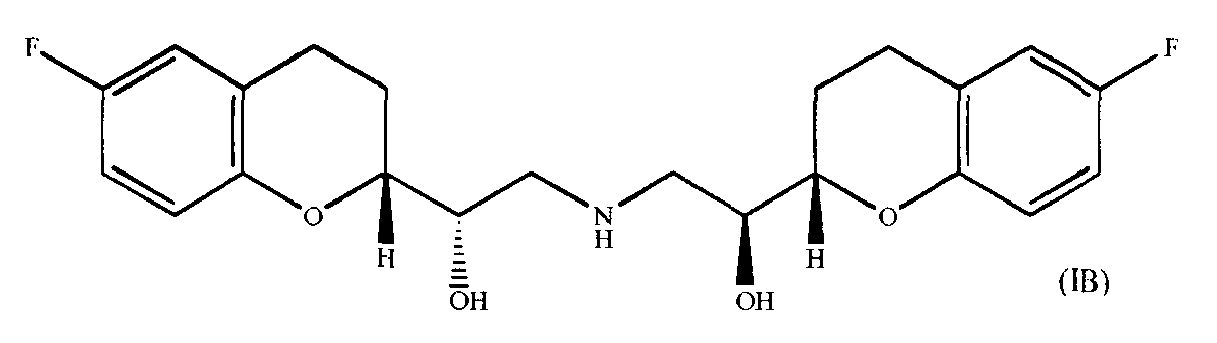
- the present invention relates to a process for preparing [2S [2R [R [R ]]]]] ⁇ , ⁇ '-[imino-bis (methylene)] bis [6-fluoro-chroman-2-methanol] (hereinafter also referred to as d -NBV) of formula (IA) and its [2R [2S [S [S ]]]]] enantiomer (hereinafter also referred to as l -NBV) of formula (IB) especially to the formate salts of these compounds useful as intermediates in the process.
- Nebivolol (hereinafter also referred to as NBV), a mixture of equal amounts of the two above enantiomers, is characterized by ⁇ -adrenergic blocking properties and is useful for the treatment of essential hypertension. Nebivolol has basic properties and may be converted into its pharmaceutically acceptable acid addition salt forms by treatment with appropriate acids. The hydrochloride acid addition salt is the marketed product.
- the European patent application EP 145067 describes methods for the preparation of substituted ⁇ , ⁇ '-[imino-bis (methylene)] bis [chroman-2-methanol] including the 6,6' bisfluoro derivatives, which comprises reducing chroman-2-carboxylic acid into the corresponding aldehyde and then transforming the aldehyde into the corresponding oxirane as a mixture of (R,S), (S,R), (RR) and (SS) stereoisomers.
- Oxirane stereoisomers separated with column chromatography into racemic (R,S) and (S,R) oxirane and racemic (R,R) and (S,S) oxirane, represent the key intermediates of the process.
- EP 334429 describes the same synthetic process reported in EP 145067 and is particularly directed to the preparation of the (R,S,S,S) isomer ( l -NBV).
- the process for preparing d -NBV of formula comprises:
- the process for preparing l -NBV of formula comprises:
- the compounds of formula Va and Vb in the form of diastereoisomeric mixture or single diastereoisomer, key intermediates in the synthesis of d -NBV and l -NBV may be obtained via an intermolecular Heck reaction between a compound of formula IIa or IIb and 2-bromo-4-fluorophenol or a derivative thereof followed by reduction to chroman nucleus.
- This process for preparing d -NBV of formula comprises:
- the process for preparing l -NBV of formula comprises:
- intermediates XIa and XIb themselves may be subjected to reaction steps from e to k or from l to v, respectively, in place of intermediates Va and Vb in order to obtain the end products.
- reduction from chromene to chroman nucleus may be carried out in final steps j/u by a hydrogenating reaction which allows a simultaneous deprotection/reduction of the so obtained compound [2S, ⁇ R,2'R, ⁇ 'R]- ⁇ - ⁇ '-[[(phenylmethyl)imino]bismethylene]bis[6-fluoro-2H-1-benzopyran-2-methanol] or [2R, ⁇ S,2'S, ⁇ 'S]- ⁇ - ⁇ '-[[(phenylmethyl)imino]bismethylene]bis[6-fluoro-2H-1-benzopyran-2-methanol] to give l- NBV or d -NBV.
- R and S show the absolute configuration at the asymmetric carbon atoms; a solid triangle represents a bond in the up configuration; a dashed triangle represents a bond in the down configuration; a wavy line denotes that the bond may be either in the up or in the down configuration and the asterisk means that the adjacent carbon atom is an asymmetric carbon atom.
- racemic mixture refers to a compound in the form of a mixture of stereoisomers which are enantiomers.
- diastereomeric mixture refers to a compound in the form of a mixture of stereoisomers which are not enantiomers.
- the abbreviation "Ph” as used herein represents the phenyl group.
- the abbreviation “Bn” as used herein represents the benzyl group.
- the abbreviation “Ts” as used herein represents the tosyl group.
- reaction of a compound of formula Ia or Ib to give a compound of formula IIa or IIb is carried out by adding a vinyl Grignard reagent such as vinyl magnesium bromide or vinyl magnesium chloride at a temperature ranging between -20 °C and 25 °C in the presence of organic solvent.
- a vinyl Grignard reagent such as vinyl magnesium bromide or vinyl magnesium chloride
- Preferred organic solvents are ethers or aprotic solvents such as toluene.
- a vinyl Grignard reagent is added dropwise in 5 min to 6 h to a solution of the compound of formula Ia or Ib at around 0°C.
- a solution of the compound of formula Ia or Ib is added dropwise in 5 min to 6 h to a vinyl magnesium bromide or chloride solution at around 0°C.
- the reaction may be then left to stir at temperatures ranging between -20 °C and 25 °C for 1-24 h before standard work-up.
- reaction is carried out in ether solvents such as THF or aprotic solvents such as toluene at a temperature ranging between -20 °C and 50 °C.
- ether solvents such as THF
- aprotic solvents such as toluene
- DIAD is added dropwise to a THF solution containing a compound of formula IIa or IIb, 2-bromo-4-fluoro-phenol and TPP at around 0 °C.
- the reaction is worked-up immediately or, preferably, it is stirred at a temperature ranging between 0°C and 80°C for 1-24 h to give a compound of formula IIIa or IIIb.
- reaction of a compound of formula IIIa or IIIb to give a compound of formula IVa or IVb is carried out by reacting with an organoborane compound of formula wherein Y is defined above;
- Reagents such as 9-BBN (9-borabicyclo[3.3.1]nonane), disiamylborane, di(isopropyl-prenyl)borane, dicyclohexylborane, diisopinocampheylborane and thexylborane or dialkoxyboranes or heterocyclic boranes such as 4,4,6-trimethyl-1,3,2-dioxaborinane, 1,3,2-benzodioxaborole (catecholborane), pinacolborane and 1,3,2-dithiaborolane, are used as hydroborating agent.
- 9-BBN 9-borabicyclo[3.3.1]nonane
- disiamylborane di(isopropyl-prenyl)borane
- dicyclohexylborane diisopinocampheylborane
- Preferred, hydroborating agent is 9-BBN.
- reaction is carried out in ether solvents such as THF or aprotic solvents such as toluene at a temperature ranging between -20 °C and 100 °C.
- ether solvents such as THF
- aprotic solvents such as toluene
- the hydroboration reaction can also be carried out by using, as hydroborating agent, stoichiometric amounts of alkoxyboranes such as catecholborane with catalytic amounts of boranes such as dicyclohexylborane at temperatures ranging between - 20 °C to 50 °C.
- the hydroboration is performed under rhodium catalyzed conditions for example by reacting a compound of formula IIIa or IIIb with stoichiometric catecholborane or pinacolborane in the presence of Wilkinson catalyst, [Rh(COD)Cl] 2 .
- reaction is carried out under basic conditions, in the presence of a palladium catalyst.
- a solution of a compound of formula IVa or IVb, prepared in situ as described above, is reacted with 1-3 equivalents of base, in the presence of 0.01 to 10 mol% of ligandless palladium or a palladium complex and optionally in the presence of additives such as silver oxide or phase transfer catalysts such as tetrabutyl ammonium chloride and tetrabutyl ammonium bromide; the reaction takes place in the presence of an organic solvent or water at a temperature ranging between 18°C to 200°C.
- additives such as silver oxide or phase transfer catalysts such as tetrabutyl ammonium chloride and tetrabutyl ammonium bromide
- Basic conditions are obtained by using a suitable amount of a base, preferably, a mineral base such as potassium carbonate, sodium carbonate, cesium carbonate, sodium hydrogen carbonate, potassium hydrogen carbonate lithium hydroxide, sodium hydroxide, potassium hydroxide, cesium hydroxide, tallium hydroxide, sodium acetate, potassium acetate, sodium phosphate and potassium phosphate or amines such as triethylamine and the like.
- a mineral base such as potassium carbonate, sodium carbonate, cesium carbonate, sodium hydrogen carbonate, potassium hydrogen carbonate lithium hydroxide, sodium hydroxide, potassium hydroxide, cesium hydroxide, tallium hydroxide, sodium acetate, potassium acetate, sodium phosphate and potassium phosphate or amines such as triethylamine and the like.
- Ligandless palladium such as palladium acetate, palladium chloride or palladium(0) on carbon are used optionally in the presence of 0.01 to 1 mol% of a phase transfer compound such as tetrabutyl ammonium chloride or tetrabutyl ammonium bromide.
- the palladium complex can be generated in situ, typically from a palladium source such as palladium acetate or palladium chloride, and a ligand such as triphenylphosphine, 1,1-bis-(di-t-butylphosphino)-ferrocene, o-tritolylphosphine, m-tritolylphosphine, tricyclohexylphosphine, diphenylphosphinoferrocene, 2,4,6 trioxy 1,3,5,7 tetramethyl-8-phosphaadamantane, dibenzylideneacetone (dba), tri-t-butylphosphine and tri-n-butylphosphine.
- a palladium source such as palladium acetate or palladium chloride
- a ligand such as triphenylphosphine, 1,1-bis-(di-t-butylphosphino)-ferrocene, o
- the palladium complex can be directly used as preformed catalyst in the form of Pd(0) and Pd(II) complexes such as palladium tetrakis, PdCl 2 (PPh 3 ) 2 , PdCl 2 (dppf), di-t-bpfPdCl 2 , Pd 2 dba 3 , Pd(t-Bu 3 P) 2 and the like.
- Pd(0) and Pd(II) complexes such as palladium tetrakis, PdCl 2 (PPh 3 ) 2 , PdCl 2 (dppf), di-t-bpfPdCl 2 , Pd 2 dba 3 , Pd(t-Bu 3 P) 2 and the like.
- Protic and aprotic solvents optionally in admixture are used in the C-C coupling reaction.
- DMF, DMA, DMSO, methanol, ethanol, i-propanol, water, toluene, acetonitrile, THF and the like are used.
- Suitable acids are organic or mineral acids.
- An acidic resin may also be used .
- the deprotection is carried out in the presence of an organic solvent; preferably, protic or aprotic solvents are used.
- a preferred embodiment provide dissolving a compound of formula Va or Vb in acetic acid and demi water and stirring the obtained mixture at a temperature ranging between 25°C to reflux for 1-24 h.
- Suitable reactants able to introduce a good leaving group are mesyl chloride or tosyl chloride.
- reaction is carried out in the presence of a tosylating agent such as tosylchloride and a mineral or organic base in protic or aprotic solvents optionally in admixtures.
- a tosylating agent such as tosylchloride and a mineral or organic base in protic or aprotic solvents optionally in admixtures.
- Suitable bases are mineral bases, such as potassium carbonate, sodium carbonate, sodium hydroxide, potassium hydroxide, or organic bases such as pyridine, triethylamine, DIPEA and DMAP.
- Suitable solvent are protic solvents, such as alcohols, water or organic aprotic solvents such as dichloromethane, chloroform, DCE, toluene, pyridine, DMF, DMA, DMSO and acetonitrile. Mixtures of solvents may be also used as suitable reaction media (e.g. water and toluene under phase transfer conditions).
- protic solvents such as alcohols, water or organic aprotic solvents such as dichloromethane, chloroform, DCE, toluene, pyridine, DMF, DMA, DMSO and acetonitrile.
- suitable reaction media e.g. water and toluene under phase transfer conditions.
- Steps g/r the reaction of a compound of formula VIIa or VIIb to give a compound of formula VIIIa or VIIIb is carried out by reacting with a base according to known techniques.
- a mineral or organic base such as potassium carbonate, sodium carbonate, potassium hydrogen carbonate, sodium hydrogen carbonate, potassium hydroxide, sodium hydroxide, triethylamine, pyridine and DIPEA
- a preferred embodiment provides reacting a compound of formula VIIa or VIIb with potassium carbonate in mixtures of dichloromethane and methanol at 25°C for 1 to 20 h.
- the tosylation reaction and the formation of the epoxide ring can also be performed in a one pot-procedure.
- a compound of formula VIa or VIb may be reacted with tosyl chloride, with a base such as sodium hydroxide in water solution, in the presence of a solvent such as dichloromethane or toluene and a phase transfer agent such as TBAC or TBAB or TEBA at 18-120 °C to give directly a compound of formula VIIIa or VIIIb.
- Suitable nitrogen protecting groups are benzyl, p-methoxy benzyl, trityl, cbz groups which are all readily cleaved via hydrogenation.
- Preferred protected H 2 N-P amine is benzyl amine.
- the reaction is performed in the presence of an organic solvent.
- Preferred solvents are protic or aprotic solvents.
- a preferred embodiment provides reacting a compound of formula VIIIa (S,R) or VIIIa (R,R) or VIIIb (R,S) or VIIIb (S,S) with benzyl amine in an alcoholic solvent such as methanol, ethanol, 2-propanol and the like at a temperature comprised between 18°C and reflux and separating the obtained products IXa (S,R) or IXa (R,R) or IXb (R,S) or IXb (S,S) by crystallization.
- an alcoholic solvent such as methanol, ethanol, 2-propanol and the like
- Reaction temperature is generally comprised between 18°C and reflux.
- compounds of formula Xa (S,R,R,R), Xa (R,R,R,S), Xb (R,S,S,S) and Xb (S,S,S,R) are obtained by stirring respective starting materials in ethanol at reflux temperature for 1 to 24 h. The products are separated by crystallization.
- deprotection of a compound of formula Xa to give d -NBV of formula IA as well as deprotection of a compound of formula Xb to give l -NBV of formula IB are carried out according to known techniques.
- N-benzyl derivatives of formula Xa or Xb are deprotected under hydrogenation conditions.
- deprotection is carried out by using Pd/C as catalyst in the presence of an organic solvent such as alcohols.
- the reaction may be carried out under neutral, acidic or basic conditions.
- Hydrogen may be also generated in situ by using a hydrogen source such as formic acid, ammonium formate, phosphoric acid, cyclohexene and cyclohexadiene, under catalytic hydrogen transfer reduction conditions.
- compounds of formula IA or IB are salified as salts of mineral or organic acids in accordance with known methods.
- compounds of formula IA or IB are salified as hydrochloride salts in the presence of alcoholic solvents.
- the procedure comprises a one pot Heck reaction and cyclization of a compound of formula IIa or IIb with 2-bromo-4-fluorophenyl acetate to give a compound of formula XIa or XIb.
- reaction is carried out in basic conditions, in the presence of a palladium catalyst under Heck C-C couplings in accordance with what is described in the above steps d/o.
- an unsaturated compound of formula XIa or XIb is reduced under hydrogenation conditions to give correspondent saturated compound of formula Va or Vb.
- the present invention refers to a compound of formula:
- a practical embodiment of the process comprises reacting a compound of formula Ia or Ib with a vinyl Grignard reagent at a temperature ranging between -20°C and 25°C in the presence of organic solvent; so obtained compounds of formula IIa or IIb are reacted with 2-bromo-4-fluoro-phenol under Mitsunobu conditions in the presence of a phosphine, an aza compound and an organic solvent to give a compound of formula IIIa or IIIb which is further reacted with an organoborane compound at a temperature ranging between -20°C and 100°C in the presence of an ether or an aprotic solvent; so obtained compounds of formula IVa or IVb are cyclized under basic conditions in the presence of a palladium catalyst and protic or aprotic solvents optionally in admixture to give a compound of formula Va or Vb in the form of diastereoisomeric mixture (S,R+R,R); said mixture is then separated into single diastereoisomer Va (S,
- a preferred practical embodiment of the process comprises reacting a compound of formula Ia or Ib with vinyl magnesium bromide at a temperature ranging between -20°C and 25°C in the presence of ethers, preferably THF, or aprotic solvents; so obtained compounds of formula IIa or IIb are reacted with 2-bromo-4-fluorophenol under Mitsunobu conditions in the presence of TPP, DIAD in THF to give a compound of formula IIIa or IIIb which is further reacted with 9-BBN at a temperature ranging between -20°C and 100°C in THF or toluene; so obtained compounds of formula IVa or IVb are cyclized under basic conditions, preferably potassium carbonate, in the presence of a palladium catalyst and a protic or aprotic solvent, preferably DMF, optionally in admixture to give a compound of formula Va or Vb in the form of diastereoisomeric mixture (S,R+R,R); said mixture is then separated into single diastere
- An alternative practical embodiment of the process comprises reacting a compound of formula Ia or Ib with a vinyl Grignard reagent at a temperature ranging between -20°C and 25°C in the presence of organic solvent; so obtained compounds of formula IIa or IIb are reacted with 2-bromo-4-fluoro-phenol or 2-bromo-4-fluorophenyl acetate under palladium catalysed mediated conditions by a one pot or a stepwise procedure, to give a compound of formula XIa or XIb which is further reduced under catalytic hydrogen transfer reduction conditions to give a compound of formula Va or Vb in the form of diastereoisomeric mixture (S,R+R,R); said mixture is then separated into single diastereoisomer Va (S,R) and Va (R,R) or Vb (S,R) and Vb (R,R) by chromatography according to known methods; the compounds of formula Va (S,R) and Va (R,R) or Vb (S,R)
- the aqueous phase was further extracted with heptane (2 x 5 ml) and the collected organic layers washed with demi water (10 ml). The separated organic phase was dried over anhydrous magnesium sulfate and then concentrated in vacuo to give the crude residue as a yellow oil.
- Diastereoisomeric mixture obtained in Example 3 was separated into the single diastereoisomers in accordance to known methods.
- Diastereoisomeric mixture obtained in Example 3 was separated into the single diastereoisomers in accordance to known methods.
- reaction mixture was stirred at 120°C for 19 h, cooled to 25°C and then diluted with ethyl acetate (20 ml) and demi water (20 ml). The phases were separated and the organic layer dried over anhydrous magnesium sulfate, filtered and concentrated under vacuum to dryness.
- the crude reaction mixture was then purified by flash chromatography on silica (heptane:ethyl acetate 9:1) and 6-fluoro-2-((R)-2,2-dimethyl-1,3-dioxolan-4-yl)-2H-chromene was isolated as a pale yiellow oil (60 mg, 19% yield).
- Part B 4-Fluoro-2-((E/Z)-3-hydroxy-3-((R)-2,2-dimethyl-1,3-dioxolan-4-yl)-prop-1-enyl)-phenol was submitted to the zinc chloride cyclization step.
- Zinc chloride (0.85 g, 6.21 mmol) and lithium chloride (0.37 g, 8.73 mmol), were suspended in toluene under nitrogen atmosphere. The vigorously stirred slurry was refluxed and water separated by azeotropic distillation. To the dry toluene mixture, catalytic tetrabutyl ammonium chloride was added, followed by a solution of 4-fluoro-2-((E/Z)-3-hydroxy-3-((R)-2,2-dimethyl-1,3-dioxolan-4-yl)-prop-1-enyl)-phenol (1.0 g, 3.73 mmol) in toluene (4.8 g).
- a 75:25 diastereoisomeric mixture of 6-fluoro-2-((R)-2,2-dimethyl-1,3-dioxolan-4-yl)-2H-chromene (50 mg, 0.18 mmol, 90.4%A) was dissolved in ethanol and stirred under nitrogen athmosphere at 25°C. Ammonium formiate (60.5 mg, 0.96 mmol) and 10% palladium on carbon (50 mg) were added to the stirred solution and the reaction mixture refluxed for 15 h. The reaction mixture was checked to show complete conversion of the starting material.
- 6-Fluoro-3,4-dihydro-2-((R)-2,2-dimethyl-1,3-dioxolan-4-yl)-2H-chromene (40 mg, 0.16 mmol, diastereomeric ratio 75:25) was dissolved in acetic acid (2 ml) and demi water (0.7 ml). The reaction mixture was stirred vigorously and heated to 65 °C. After 3 h at 65 °C the reaction mixture was cooled to 25 °C.
Landscapes
- Organic Chemistry (AREA)
- Chemical & Material Sciences (AREA)
- Health & Medical Sciences (AREA)
- Medicinal Chemistry (AREA)
- General Chemical & Material Sciences (AREA)
- Cardiology (AREA)
- Chemical Kinetics & Catalysis (AREA)
- Life Sciences & Earth Sciences (AREA)
- Pharmacology & Pharmacy (AREA)
- Nuclear Medicine, Radiotherapy & Molecular Imaging (AREA)
- Engineering & Computer Science (AREA)
- Bioinformatics & Cheminformatics (AREA)
- Heart & Thoracic Surgery (AREA)
- Animal Behavior & Ethology (AREA)
- General Health & Medical Sciences (AREA)
- Public Health (AREA)
- Veterinary Medicine (AREA)
- Organic Low-Molecular-Weight Compounds And Preparation Thereof (AREA)
- Pharmaceuticals Containing Other Organic And Inorganic Compounds (AREA)
- Steroid Compounds (AREA)
- Pyrane Compounds (AREA)
- Plural Heterocyclic Compounds (AREA)
- Polysaccharides And Polysaccharide Derivatives (AREA)
Abstract
Description
- The present invention relates to a process for preparing [2S [2R [R [R ]]]] α ,α'-[imino-bis (methylene)] bis [6-fluoro-chroman-2-methanol] (hereinafter also referred to as d-NBV) of formula (IA)


- Nebivolol (hereinafter also referred to as NBV), a mixture of equal amounts of the two above enantiomers, is characterized by β-adrenergic blocking properties and is useful for the treatment of essential hypertension. Nebivolol has basic properties and may be converted into its pharmaceutically acceptable acid addition salt forms by treatment with appropriate acids. The hydrochloride acid addition salt is the marketed product.
- It is well understood in the art that the synthesis of α,α'-[imino-bis (methylene)] bis [chroman-2-methanol] molecular structures is challenging for the skilled person, because of the 4 asymmetric carbon atoms producing a mixture of 16 stereoisomers (in case of asymmetrical substitution) or a mixture of 10 stereoisomers (in case of symmetrical substitution). As apparent from the presence of the topological symmetry in the structure of the α,α'-[imino-bis (methylene)] bis [6-fluoro-chroman-2-methanol], 10 stereoisomers can be generated.
- The European patent application
EP 145067 - The European patent application
EP 334429 EP 145067 - The existence of the 4 stereogenic centres moved the skilled person towards the exploration of stereoselective methods for preparing the l-NBV and the d-NBV. For example, Johannes C.W. et al. (J. Am. Chem. Soc., 120, 8340-8347, 1998) and Chandrasekhar S. et al. (Tetrahedron 56, 6339-6344, 2000) describe enantioselective total preparations of d-NBV; An-Guang Yu et al. (Synlett, 9, 1465-1467, 2005) illustrate a method for the construction of chiral chroman intermediates, and Yang Yun-Xu et al. (Chinese Journal of Organic Chemistry, 25(2), 201-203, 2005 and the Chinese patent application
CN 1629154 ) show the synthesis and resolution of (R) and (S) 6-fluorochroman carboxylic acids intermediates useful for the synthesis of d-NBV and l-NBV. - Additional alternative total synthetic approaches for the preparation of NBV can be found in the following international patent applications:
WO 2004/041805 ,WO 2006/016376 andWO 2006/025070 . - We have now found an efficient alternative synthesis of l-NBV and d-NBV starting from inexpensive commercially available or easily obtainable starting materials.
- The process for preparing d-NBV of formula

- a) reacting 2,2-dimethyl-1,3 dioxolane-4-carbaldehyde of formula


- b) reacting the above compound of formula IIa with 2-bromo-4-fluorophenol to obtain a compound of formula IIIa in the form of diastereomeric mixture (S,R+R,R)

- c) reacting the compound of the above formula IIIa with an organoborane compound of formula

or both Y taken together with the boron atom to which they are linked form a borabicyclo[3.3.1]non-9-yl group or a residue of formula:

- d) cyclizing the above compound of formula IVa to obtain a compound of formula Va in the form of diastereomeric mixture (S,R+R,R)
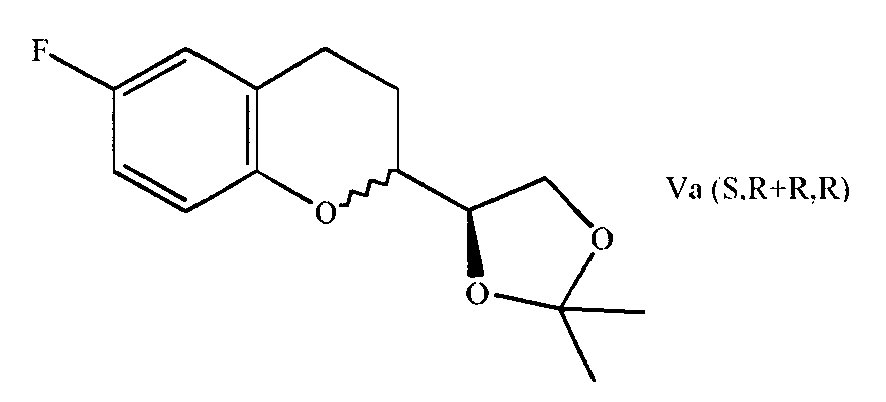
- e) hydrolysing the diastereomeric mixture of formula Va (S,R+R,R) or, alternatively, hydrolysing separately the diastereomer Va (S,R) and the diastereomer Va (RR), to obtain the corresponding diastereomeric mixture of formula VIa (S,R+R,R)


- f) reacting the diastereomeric mixture of formula VIa (S,R+R,R), or alternatively reacting separately the diastereomer VIa (S,R) and the diastereomer VIa (R,R) with a reactant able to introduce a good leaving group to obtain the corresponding diastereomeric mixture of formula VIIa (S,R+R,R)


wherein
- g) reacting the diastereomeric mixture of formula VIIa (S,R+R,R), or alternatively reacting separately the diastereomer VIIa (S,R) and the diastereomer VIIa (R,R) with a base to obtain the corresponding diastereomeric mixture of formula VIIIa (S,R+R,R)


- h) reacting separately the compound of formula VIIIa (S,R) or the compound of formula VIIIa (R,R) with a protected H2N-P amine wherein P is a nitrogen protecting group, to obtain a compound of formula IXa (S,R) or a compound of formula IXa (R,R)


- i) reacting the compound of formula IXa (S,R) or the compound of formula IXa (R,R) with a compound of formula VIIIa (R,R) or a compound VIIIa (S,R) respectively, to obtain a compound of formula Xa (S,R,R,R) or a compound Xa (R,R,R,S), being the compound of formula Xa (S,R,R,R) the same stereoisomer of the compound Xa (R,R,R,S), because of the presence in the structure of compound Xa of an axis of symmetry which contains the nitrogen atom i.e.


- j) deprotecting the compound of formula Xa to give d-NBV of the above formula IA;
- k) and, if desired, salifying the compound of formula IA.
- The process for preparing l-NBV of formula

- l) reacting 2,2-dimethyl-1,3 dioxolane-4-carbaldehyde of formula


- m) reacting the above compound of formula IIb with 2-bromo-4-fluorophenol to give a
compound of formula IIIb in the form of diastereomeric mixture (R,S+S,S)
- n) reacting the compound of the above formula IIIb with an organoborane compound of formula


- o) cyclizing the above compound of formula IVb to obtain a compound of formula Vb in the form of diastereomeric mixture (R,S+S,S)

- p) hydrolysing the diastereomeric mixture of formula Vb (R,S+S,S) or, alternatively, hydrolysing separately the diastereomer Vb (R,S), and the diastereomer Vb (S,S) to obtain the corresponding diastereomeric mixture of formula VIb (R,S+S,S)


- q) reacting the diastereomeric mixture of formula VIb (R,S+S,S) or, alternatively, reacting separately the diastereomer VIb (R,S) and the diastereomer VIb (S,S) with a reactant able to introduce a good leaving group, to obtain the corresponding diastereomeric mixture of formula VIIb (R,S+S,S)


- r) reacting the diastereomeric mixture of formula VIIb (R,S+S,S), or, alternatively, reacting separately the diastereomer VIIb (R,S) and the diastereomer VIIb (S,S) with a base to give the corresponding diastereomeric mixture of formula VIIIb (R,S+S,S)


- s) reacting separately the compound of formula VIIIb (R,S) or the compound of formula VIIIb (S,S) with a protected H2N-P amine wherein P is a nitrogen protecting group to give a compound of formula IXb (R,S) or a compound of formula IXb (S,S)


- t) reacting the compound of formula IXb (R,S) or the compound of formula IXb (S,S) with a compound of formula VIIIb (S,S) or a compound VIIIb (R,S) respectively, to obtain a compound of formula Xb (R,S,S,S) or a compound Xb (S,S,S,R), being the compound of formula Xb (R,S,S,S) the same stereoisomer of the compound Xb (S,S,S,R), because of the presence in the structure of compound Xb of an axis of symmetry which contains the nitrogen atom i.e.


- u) deprotecting the compound of formula Xb to give l-NBV of the above formula IB;
- v) and, if desired, salifying the compound of formula IB.
- Alternatively, the compounds of formula Va and Vb in the form of diastereoisomeric mixture or single diastereoisomer, key intermediates in the synthesis of d-NBV and l-NBV , may be obtained via an intermolecular Heck reaction between a compound of formula IIa or IIb and 2-bromo-4-fluorophenol or a derivative thereof followed by reduction to chroman nucleus.
- This process for preparing d-NBV of formula

- a) reacting 2,2-dimethyl-1,3 dioxolane-4-carbaldehyde of formula

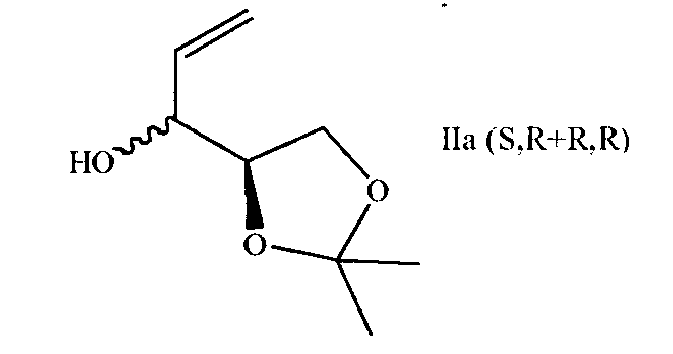
- w) reacting the above compound of formula IIa with 2-bromo-4-fluorophenol or 2-bromo-4-fluorophenyl acetate by means of a palladium catalysed C-C coupling reaction, to obtain a compound of formula XIa in the form of diastereoisomeric mixture (S,R+R,R)

- x) reducing the above compound of formula XIa to obtain a compound of formula Va in the form of diastereoisomeric mixture (S,R+R,R) and, if desired, separating the compound of formula Va (S,R+R,R) into the single diastereomer Va (S,R) and the single diastereomer Va (R,R).
- The process for preparing l-NBV of formula
- l) reacting 2,2-dimethyl-1,3 dioxolane-4-carbaldehyde of formula


- y) reacting the above compound of formula IIb with 2-bromo-4-fluorophenol or 2-bromo-4-fluorophenyl acetate by means of a palladium catalysed C-C coupling reaction, to obtain a compound of formula XIb in the form of diastereoisomeric mixture (R,S+S,S)

- z) reducing the above compound of formula XIb to obtain a compound of formula Vb in the form of diastereoisomeric mixture (R,S+S,S) and, if desired, separating the compound of formula Vb (R,S+S,S) into the single diastereomer Vb (R,S) and the single diastereomer Vb (S,S).
- It is evident to the skilled person that the intermediates XIa and XIb themselves may be subjected to reaction steps from e to k or from l to v, respectively, in place of intermediates Va and Vb in order to obtain the end products. Preferably, reduction from chromene to chroman nucleus may be carried out in final steps j/u by a hydrogenating reaction which allows a simultaneous deprotection/reduction of the so obtained compound [2S,αR,2'R,α'R]-α-α'-[[(phenylmethyl)imino]bismethylene]bis[6-fluoro-2H-1-benzopyran-2-methanol] or [2R,αS,2'S,α'S]-α-α'-[[(phenylmethyl)imino]bismethylene]bis[6-fluoro-2H-1-benzopyran-2-methanol] to give l-NBV or d-NBV.
- As used herein, the symbols R and S show the absolute configuration at the asymmetric carbon atoms; a solid triangle represents a bond in the up configuration; a dashed triangle represents a bond in the down configuration; a wavy line denotes that the bond may be either in the up or in the down configuration and the asterisk means that the adjacent carbon atom is an asymmetric carbon atom.
- The term "racemic mixture" refers to a compound in the form of a mixture of stereoisomers which are enantiomers. The term "diastereomeric mixture" refers to a compound in the form of a mixture of stereoisomers which are not enantiomers.
- The abbreviation "Ph" as used herein represents the phenyl group. The abbreviation "Bn" as used herein represents the benzyl group. The abbreviation "Ts" as used herein represents the tosyl group.
- the reaction of a compound of formula Ia or Ib to give a compound of formula IIa or IIb is carried out by adding a vinyl Grignard reagent such as vinyl magnesium bromide or vinyl magnesium chloride at a temperature ranging between -20 °C and 25 °C in the presence of organic solvent.
- Preferred organic solvents are ethers or aprotic solvents such as toluene.
- Preferably, a vinyl Grignard reagent is added dropwise in 5 min to 6 h to a solution of the compound of formula Ia or Ib at around 0°C.
- Alternatively, a solution of the compound of formula Ia or Ib is added dropwise in 5 min to 6 h to a vinyl magnesium bromide or chloride solution at around 0°C.
- The reaction may be then left to stir at temperatures ranging between -20 °C and 25 °C for 1-24 h before standard work-up.
- the reaction of a compound of formula IIa or IIb with 2-bromo-4-fluoro-phenol to give a compound of formula IIIa or IIIb is carried out under Mitsunobu conditions in the presence of a phosphine such as triphenylphosphine (TPP) or tri-n-butylphosphine (TBP) and an aza compound such as diisopropylazadicarboxylate (DIAD), diethylazadicarboxilate (DEAD) and 1,1'-(azodicarbonyl)-dipiperidine (ADDP).
- Generally, the reaction is carried out in ether solvents such as THF or aprotic solvents such as toluene at a temperature ranging between -20 °C and 50 °C.
- In a preferred embodiment, DIAD is added dropwise to a THF solution containing a compound of formula IIa or IIb, 2-bromo-4-fluoro-phenol and TPP at around 0 °C. At addition completed, the reaction is worked-up immediately or, preferably, it is stirred at a temperature ranging between 0°C and 80°C for 1-24 h to give a compound of formula IIIa or IIIb.
- the reaction of a compound of formula IIIa or IIIb to give a compound of formula IVa or IVb is carried out by reacting with an organoborane compound of formula

- Reagents such as 9-BBN (9-borabicyclo[3.3.1]nonane), disiamylborane, di(isopropyl-prenyl)borane, dicyclohexylborane, diisopinocampheylborane and thexylborane or dialkoxyboranes or heterocyclic boranes such as 4,4,6-trimethyl-1,3,2-dioxaborinane, 1,3,2-benzodioxaborole (catecholborane), pinacolborane and 1,3,2-dithiaborolane, are used as hydroborating agent.
- Preferred, hydroborating agent is 9-BBN.
- Generally, the reaction is carried out in ether solvents such as THF or aprotic solvents such as toluene at a temperature ranging between -20 °C and 100 °C.
- The hydroboration reaction can also be carried out by using, as hydroborating agent, stoichiometric amounts of alkoxyboranes such as catecholborane with catalytic amounts of boranes such as dicyclohexylborane at temperatures ranging between - 20 °C to 50 °C.
- Alternatively, the hydroboration is performed under rhodium catalyzed conditions for example by reacting a compound of formula IIIa or IIIb with stoichiometric catecholborane or pinacolborane in the presence of Wilkinson catalyst, [Rh(COD)Cl]2.
- the cyclization of a compound of formula IVa or IVb to give a compound of formula Va or Vb is carried out under B-alkyl Suzuki conditions.
- Generally, the reaction is carried out under basic conditions, in the presence of a palladium catalyst.
- In a preferred embodiment, a solution of a compound of formula IVa or IVb, prepared in situ as described above, is reacted with 1-3 equivalents of base, in the presence of 0.01 to 10 mol% of ligandless palladium or a palladium complex and optionally in the presence of additives such as silver oxide or phase transfer catalysts such as tetrabutyl ammonium chloride and tetrabutyl ammonium bromide; the reaction takes place in the presence of an organic solvent or water at a temperature ranging between 18°C to 200°C. Basic conditions are obtained by using a suitable amount of a base, preferably, a mineral base such as potassium carbonate, sodium carbonate, cesium carbonate, sodium hydrogen carbonate, potassium hydrogen carbonate lithium hydroxide, sodium hydroxide, potassium hydroxide, cesium hydroxide, tallium hydroxide, sodium acetate, potassium acetate, sodium phosphate and potassium phosphate or amines such as triethylamine and the like.
- Ligandless palladium such as palladium acetate, palladium chloride or palladium(0) on carbon are used optionally in the presence of 0.01 to 1 mol% of a phase transfer compound such as tetrabutyl ammonium chloride or tetrabutyl ammonium bromide.
- The palladium complex can be generated in situ, typically from a palladium source such as palladium acetate or palladium chloride, and a ligand such as triphenylphosphine, 1,1-bis-(di-t-butylphosphino)-ferrocene, o-tritolylphosphine, m-tritolylphosphine, tricyclohexylphosphine, diphenylphosphinoferrocene, 2,4,6 trioxy 1,3,5,7 tetramethyl-8-phosphaadamantane, dibenzylideneacetone (dba), tri-t-butylphosphine and tri-n-butylphosphine.
- The palladium complex can be directly used as preformed catalyst in the form of Pd(0) and Pd(II) complexes such as palladium tetrakis, PdCl2(PPh3)2, PdCl2(dppf), di-t-bpfPdCl2, Pd2dba3, Pd(t-Bu3P)2 and the like.
- Protic and aprotic solvents optionally in admixture are used in the C-C coupling reaction. Preferably, DMF, DMA, DMSO, methanol, ethanol, i-propanol, water, toluene, acetonitrile, THF and the like, are used.
- Product isolation and optional separation of single diastereoisomers are accomplished in accordance with known methods. Preferably said diastereoisomer separation is performed via chromatography.
- the deprotection of a compound of formula Va or Vb to give a compound of formula VIa or VIb is carried out under acidic conditions.
- Suitable acids are organic or mineral acids. An acidic resin may also be used .
- Generally, the deprotection is carried out in the presence of an organic solvent; preferably, protic or aprotic solvents are used.
- A preferred embodiment provide dissolving a compound of formula Va or Vb in acetic acid and demi water and stirring the obtained mixture at a temperature ranging between 25°C to reflux for 1-24 h.
- Product isolation and optional separation of single diastereoisomers are accomplished in accordance with known methods. Preferably said diastereoisomer separation is performed via chromatography or crystallization.
- the reaction of a compound of formula VIa or VIb with a reactant able to introduce a good leaving group to give a compound of formula VIIa or VIIb is carried out according to known techniques.
- Suitable reactants able to introduce a good leaving group are mesyl chloride or tosyl chloride.
- Generally, the reaction is carried out in the presence of a tosylating agent such as tosylchloride and a mineral or organic base in protic or aprotic solvents optionally in admixtures.
- Suitable bases are mineral bases, such as potassium carbonate, sodium carbonate, sodium hydroxide, potassium hydroxide, or organic bases such as pyridine, triethylamine, DIPEA and DMAP.
- Suitable solvent are protic solvents, such as alcohols, water or organic aprotic solvents such as dichloromethane, chloroform, DCE, toluene, pyridine, DMF, DMA, DMSO and acetonitrile. Mixtures of solvents may be also used as suitable reaction media (e.g. water and toluene under phase transfer conditions).
- The skilled person will realize that a compound of formula VIa or VIb may be subjected to alternative reactions able to introduce a good leaving group .
- Steps g/r: the reaction of a compound of formula VIIa or VIIb to give a compound of formula VIIIa or VIIIb is carried out by reacting with a base according to known techniques.
- A practical embodiment foresees reacting a compound of formula VIIa or VIIb with a mineral or organic base such as potassium carbonate, sodium carbonate, potassium hydrogen carbonate, sodium hydrogen carbonate, potassium hydroxide, sodium hydroxide, triethylamine, pyridine and DIPEA in the presence of protic or aprotic solvents for around 1 to 24 h at a temperature comprised between 0°C and 130°C.
- A preferred embodiment provides reacting a compound of formula VIIa or VIIb with potassium carbonate in mixtures of dichloromethane and methanol at 25°C for 1 to 20 h.
- Alternatively, the tosylation reaction and the formation of the epoxide ring can also be performed in a one pot-procedure.
- For example, a compound of formula VIa or VIb may be reacted with tosyl chloride, with a base such as sodium hydroxide in water solution, in the presence of a solvent such as dichloromethane or toluene and a phase transfer agent such as TBAC or TBAB or TEBA at 18-120 °C to give directly a compound of formula VIIIa or VIIIb.
- Product isolation and optional separation of single diastereoisomers are accomplished in accordance with known methods. Preferably said diastereoisomer separation is performed via chromatography.
- the reaction of a compound of formula VIIIa (S,R) or VIIIa (R,R) to give a compound of formula IXa (S,R) or IXa (R,R) as well as the reaction of a compound of formula VIIIb (R,S) or VIIIb (S,S) to give a compound of formula IXb (R,S) or IXb (S,S) are carried out by reacting with a protected H2N-P amine wherein P is a nitrogen protecting group according to known techniques.
- Suitable nitrogen protecting groups are benzyl, p-methoxy benzyl, trityl, cbz groups which are all readily cleaved via hydrogenation. Preferred protected H2N-P amine is benzyl amine. Generally, the reaction is performed in the presence of an organic solvent. Preferred solvents are protic or aprotic solvents.
- A preferred embodiment provides reacting a compound of formula VIIIa (S,R) or VIIIa (R,R) or VIIIb (R,S) or VIIIb (S,S) with benzyl amine in an alcoholic solvent such as methanol, ethanol, 2-propanol and the like at a temperature comprised between 18°C and reflux and separating the obtained products IXa (S,R) or IXa (R,R) or IXb (R,S) or IXb (S,S) by crystallization.
- the reaction of a compound of formula IXa (S,R) or IXa (R,R) with a compound of formula VIIIa (R,R) or VIIIa (S,R) respectively, to give a compound of formula Xa (S,R,R,R) or Xa (R,R,R,S) as well as the reaction of a compound of formula IXb (R,S) or IXb (S,S) with a compound of formula VIIIb (S,S) or VIIIb (R,S) respectively, to give a compound of formula Xb (R,S,S,S) or Xb (S,S,S,R), are carried out in the presence of an organic solvent. Preferred organic solvents are alcohols and, preferably, ethanol is used.
- Reaction temperature is generally comprised between 18°C and reflux.
- In a preferred embodiment compounds of formula Xa (S,R,R,R), Xa (R,R,R,S), Xb (R,S,S,S) and Xb (S,S,S,R) are obtained by stirring respective starting materials in ethanol at reflux temperature for 1 to 24 h. The products are separated by crystallization.
- deprotection of a compound of formula Xa to give d-NBV of formula IA as well as deprotection of a compound of formula Xb to give l-NBV of formula IB are carried out according to known techniques.
- In a preferred embodiment N-benzyl derivatives of formula Xa or Xb are deprotected under hydrogenation conditions. For example, deprotection is carried out by using Pd/C as catalyst in the presence of an organic solvent such as alcohols. The reaction may be carried out under neutral, acidic or basic conditions. Hydrogen may be also generated in situ by using a hydrogen source such as formic acid, ammonium formate, phosphoric acid, cyclohexene and cyclohexadiene, under catalytic hydrogen transfer reduction conditions.
- if desired compounds of formula IA or IB are salified as salts of mineral or organic acids in accordance with known methods. In a preferred embodiment compounds of formula IA or IB are salified as hydrochloride salts in the presence of alcoholic solvents.
- the reaction of a compound of formula IIa or IIb with 2-bromo-4-fluorophenol or 2-bromo-4-fluorophenyl acetate to give a compound of formula XIa or XIb is carried out by a one pot or, alternatively, a stepwise procedure.
- In one embodiment, the procedure comprises a one pot Heck reaction and cyclization of a compound of formula IIa or IIb with 2-bromo-4-fluorophenyl acetate to give a compound of formula XIa or XIb.
- Generally, the reaction is carried out in basic conditions, in the presence of a palladium catalyst under Heck C-C couplings in accordance with what is described in the above steps d/o.
- Product isolation and optional separation of single diastereoisomers are accomplished in accordance with known methods. Preferably said diastereoisomer separation is performed via chromatography.
- the reduction of a compound of formula XIa or XIb to give a compound of formula Va or Vb is carried out by known techniques.
- Generally, an unsaturated compound of formula XIa or XIb is reduced under hydrogenation conditions to give correspondent saturated compound of formula Va or Vb.
- For example, hydrogenation reaction is carried out in accordance with what is described in the above steps j/u.
- Product isolation and optional separation of single diastereoisomers are accomplished in accordance with known methods. Preferably said diastereoisomer separation is performed via chromatography.
- The present invention refers to a compound of formula:
- (±)[2R*,α S*,2'S*,α'S*]-α-α'-[iminobismethylene]bis[6-fluoro-3,4-dihydro-2H-1-benzopyran-2-methanol] formate;
- [2S,αR,2'R,α'R]-α-α'-[iminobismethylene]bis[6-fluoro-3,4-dihydro-2H-1-benzopyran-2-methanol] formate;
- [2R,αS,2'S,α'S]-α-α'-[iminobismethylene]bis[6-fluoro-3,4-dihydro-2H-1-benzopyran-2-methanol] formate;
- A practical embodiment of the process comprises reacting a compound of formula Ia or Ib with a vinyl Grignard reagent at a temperature ranging between -20°C and 25°C in the presence of organic solvent; so obtained compounds of formula IIa or IIb are reacted with 2-bromo-4-fluoro-phenol under Mitsunobu conditions in the presence of a phosphine, an aza compound and an organic solvent to give a compound of formula IIIa or IIIb which is further reacted with an organoborane compound at a temperature ranging between -20°C and 100°C in the presence of an ether or an aprotic solvent; so obtained compounds of formula IVa or IVb are cyclized under basic conditions in the presence of a palladium catalyst and protic or aprotic solvents optionally in admixture to give a compound of formula Va or Vb in the form of diastereoisomeric mixture (S,R+R,R); said mixture is then separated into single diastereoisomer Va (S,R) and Va (R,R) or Vb (S,R) and Vb (R,R) by chromatography according to known methods; the compounds of formula Va (S,R) and Va (R,R) or Vb (S,R) and Vb (R,R) are hydrolyzed in acidic conditions to the correspondent diols of formula VIa (S,R) and VIa (R,R) or VIb (S,R) and VIb (R,R) which are subjected to a tosylation reaction and transformed in the epoxide derivatives of formula VIIa (S,R) and VIIa (R,R) or VIIb (S,R) and VIIb (R,R) in the presence of a base; said compounds are then converted in d-NBV or l-NBV or salts thereof in accordance with known methods.
- A preferred practical embodiment of the process comprises reacting a compound of formula Ia or Ib with vinyl magnesium bromide at a temperature ranging between -20°C and 25°C in the presence of ethers, preferably THF, or aprotic solvents; so obtained compounds of formula IIa or IIb are reacted with 2-bromo-4-fluorophenol under Mitsunobu conditions in the presence of TPP, DIAD in THF to give a compound of formula IIIa or IIIb which is further reacted with 9-BBN at a temperature ranging between -20°C and 100°C in THF or toluene; so obtained compounds of formula IVa or IVb are cyclized under basic conditions, preferably potassium carbonate, in the presence of a palladium catalyst and a protic or aprotic solvent, preferably DMF, optionally in admixture to give a compound of formula Va or Vb in the form of diastereoisomeric mixture (S,R+R,R); said mixture is then separated into single diastereoisomers Va (S,R) and Va (R,R) or Vb (S,R) and Vb (R,R) by chromatography according to known methods; the compounds of formula Va (S,R) and Va (R,R) or Vb (S,R) and Vb (R,R) are hydrolyzed in acidic conditions to the correspondent diols of formula VIa (S,R) and VIa (R,R) or VIb (S,R) and VIb (R,R) which are subjected to a tosylation reaction and transformed in the epoxide derivatives of formula VIIa (S,R) and VIIa (R,R) or VIIb (S,R) and VIIb (R,R) in the presence of a base; said compounds are then converted in d-NBV or l-NBV or salts thereof in accordance with known methods.
- An alternative practical embodiment of the process comprises reacting a compound of formula Ia or Ib with a vinyl Grignard reagent at a temperature ranging between -20°C and 25°C in the presence of organic solvent; so obtained compounds of formula IIa or IIb are reacted with 2-bromo-4-fluoro-phenol or 2-bromo-4-fluorophenyl acetate under palladium catalysed mediated conditions by a one pot or a stepwise procedure, to give a compound of formula XIa or XIb which is further reduced under catalytic hydrogen transfer reduction conditions to give a compound of formula Va or Vb in the form of diastereoisomeric mixture (S,R+R,R); said mixture is then separated into single diastereoisomer Va (S,R) and Va (R,R) or Vb (S,R) and Vb (R,R) by chromatography according to known methods; the compounds of formula Va (S,R) and Va (R,R) or Vb (S,R) and Vb (R,R) are hydrolyzed in acidic conditions to the correspondent diols of formula VIa (S,R) and VIa (R,R) or VIb (S,R) and VIb (R,R) which are subjected to a tosylation reaction and transformed in the epoxide derivatives of formula VIIa (S,R) and VIIa (R,R) or VIIb (S,R) and VIIb (R,R) in the presence of a base; said compounds are then converted in d-NBV or l-NBV or salts thereof in accordance with known methods.
- For better illustrating the process the following examples are now given.
- On a stirred solution of (R)-2,2-dimethyl-1,3-dioxolane-4-carbaldehyde (11.0 g, 0.063 mol, 75% assay, 94% ee) in THF (40 g) at 0°C under nitrogen atmosphere, a vinyl magnesium bromide solution (1.0 M in THF, 88.7 ml, 0.0887 mol) was added over a period of 90 min. After 2 h stirring at 0°C, the temperature was raised to 10°C and a saturated ammonium chloride solution (60 ml) was added dropwise in 30 min. The quenched reaction mixture at 20°C was then diluted with ethyl acetate (100 ml) and demi water (50 ml) and the layers separated. The organic phase was further washed with demi water (50 ml). The organic phase was then dried over anhydrous magnesium sulfate, filtered and concentrated under reduced pressure to furnish 11.7 g of 1-((R)-2,2-dimethyl-1,3-dioxolan-4-yl)prop-2-en-1-ol as a light yellow oil. Spectroscopic data are conform to literature.
- On a stirred solution composed by 2-bromo-4-fluoro-phenol (12.07 g, 0.063 mol) and triphenylphosphine (16.18 g, 0.063 mol) in THF (85 ml) under nitrogen at 18°C, 1-((R)-2,2-dimethyl-1,3-dioxolan-4-yl)-prop-2-en-1-ol (10.0 g, 0.054 mol) was added as a crude product. The reaction miture was then cooled to 0°C and diisopropyl-aza-dicarboxylate (12.78 g, 0.063 mol) was added dropwise over a period of 30 min. At the end of the addition the temperature was raised gradually to 18°C and the mixture left to stir for further 1 h. The crude reaction was then concentrated under reduced pressure and then MTBE (31 g) added. After 15 min agitation, the slurry was filtered and the panel washed with MTBE (2 x 10 g). The mother liquors were then concentrated in vacuo and heptane (23 g) added. After 30 min stirring, the slurry was filtered and the cake washed with heptane (11 g). The mother liquors were then concentrated in vacuo and purified by column chomatography on silica using a mixture heptan : ethyl acetate : triethylamine 9.5 : 0.5 : 0.01, as eluent. 14.28 g of (R)-4-(1-(2-bromo-4-fluorophenoxy)allyl)-2,2-dimethyl-1,3-dioxolane were isolated as a mixture of diastereoisomers (80% yield).
- NMR: δH(400 MHz; CDCl3) 6.96-6.85 (6H, m), 5.97-5.82 (2H, m), 5.38-5.31 (4H, m), 4.70-4.65 (1H, m), 4.60-4.55 (1H, m), 4.43 (1H, dd, J 12, 6), 4.29 (1H, dd, J 12, 6), 4.19-4.07 (3H, m), 3.99-3.95 (1H, m), 1.47 (3H, s), 1.45 (3H, s), 1.40 (6H, s); m/z (EI) 330.0289 (M+. C14H16BrFO3 requires 330.0262).
- A solution of (R)-4-(1-(2-bromo-4-fluorophenoxy)-allyl)-2,2-dimethyl-1,3-dioxolane (1.00 g, 3.02 mmol) in THF (3 ml) was added over a period of 10 min to a stirred solution of 9-BBN (0.5 M in THF, 12.08 ml, 6.04 mmol) under nitrogen at 0°C. At the end of the addition the reaction mixture was heated to 25°C and left to stir for 6 h.
- A portion of the hydroboration solution (4 ml, 0.755 mmol) was added under nitrogen over a mixture composed by K2CO3 (0.337 g, 2.438 mmol), PdCl2(dppf) (31.2 mg, 0.038 mmol) in DMF (3 ml). At the end of the addition, the mixture was heated to 65°C and left to stir at this temperature for 17 h. The temperature was then raised to 75°C and the reaction mixture stirred for further 5 h. After checking the reaction outcome, heptane (5 ml) and demi water (5 ml) were added under stirring and the phases separated. The aqueous phase was further extracted with heptane (2 x 5 ml) and the collected organic layers washed with demi water (10 ml). The separated organic phase was dried over anhydrous magnesium sulfate and then concentrated in vacuo to give the crude residue as a yellow oil. Purification by column chomatography on silica, using as eluent heptane : ethyl acetate : triethylamine in the ratio 9 : 1 : 0.01, furnished 110 mg of 6-fluoro-3,4-dihydro-2-((R)-2,2-dimethyl-1,3-dioxolan-4-yl)-2H-chromene as a mixture of diastereoisomers (58% yield).
- NMR Diast. RR: δH(400 MHz; CDCl3) 6.81-6.72 (3H, m, Ar), 4.32-4.28 (1H, m), 4.10 (1H, dd, J 7, 7), 4.02 (1H, dddd, J 11, 6, 2), 3.91 (1H, dd, J 7, 7), 2.91-2.72 (2H, m), 1.96-1.74 (2H, m), 1.46 (3H, s), 1.41 3H, s);
- NMR Diast. SR: δH(400 MHz; CDCl3) 6.81-6.70 (3H, m, Ar), 4.19 (1H, dd, J 8, 6), 4.14-4.10 (1H, m), 4.06 (1H, dd, J 8, 5), 3.88 (1H, ddd, J 10, 7, 2.3), 2.88-2.72 (2H, m), 2.26-2.18 (1H, m), 1.83-1.73 (1H, m), 1.45 (3H, s), 1.39 (3H, s); m/z (EI) 252.1139 (M+. C14H17FO3 requires 252.1157).
- A solution of (R)-4-(1-(2-bromo-4-fluorophenoxy)allyl)-2,2-dimethyl-1,3-dioxolane (3.8 g, 11.47 mmol) in THF (2 ml) was added over a period of 1 h to a stirred solution of 9-BBN (0.5 M in THF, 25.2 ml, 12.6 mmol) under nitrogen at 25°C. At the end of the addition the reaction mixture was stirred at 25°C for 23 h.
- A portion of the hydroboration solution (16 ml, 5.74 mmol) was added under nitrogen over a mixture composed by K2CO3 (0.793 g, 5.74 mmol), 2,4,6 trioxy 1,3,5,7 tetramethyl-8-phosphaadamantane (94.8 mg, 0.324 mmol), palladium acetate (64.4 mg, 0.287 mmol) in demi water (7 ml). At the end of the addition, the mixture was heated to 65°C and left to stir at this temperature for 18 h. After checking the reaction outcome, heptane (20 ml) and demi water (20 ml) were added under stirring and the phases separated. The aqueous phase was further extracted with heptane (2 x 10 ml) and the collected organic layers washed with demi water (2 x 10 ml). The separated organic layer was dried over anhydrous magnesium sulfate and then concentrated in vacuo to give the crude residue as a yellow oil. Purification by column chomatography on silica, using as eluent heptane : ethyl acetate in the ratio 9.5 : 0.5, furnished 460 mg of 6-fluoro-3,4-dihydro-2-((R)-2,2-dimethyl-1,3-dioxolan-4-yl)-2H-chromene as a mixture of diastereoisomers (32% yield).
- NMR Diast. RR: δH(400 MHz; CDCl3) 6.81-6.72 (3H, m, Ar), 4.32-4.28 (1H, m), 4.10 (1H, dd, J 7, 7), 4.02 (1H, dddd, J 11, 6, 2), 3.91 (1H, dd, J 7, 7), 2.91-2.72 (2H, m), 1.96-1.74 (2H, m), 1.46 (3H, s), 1.41 3H, s);
- NMR Diast. SR: δH(400 MHz; CDCl3) 6.81-6.70 (3H, m, Ar), 4.19 (1H, dd, J 8, 6), 4.14-4.10 (1H, m), 4.06 (1H, dd, J 8, 5), 3.88 (1H, ddd, J 10, 7, 2.3), 2.88-2.72 (2H, m), 2.26-2.18 (1H, m), 1.83-1.73 (1H, m), 1.45 (3H, s), 1.39 (3H, s); m/z (EI) 252.1139 (M+. C14H17FO3 requires 252.1157).
- Diastereoisomeric mixture obtained in Example 3 was separated into the single diastereoisomers in accordance to known methods.
- (R)-6-fluoro-3,4-dihydro-2-((R)-2,2-dimethyl-1,3-dioxolan-4-yl)-2H-chromene (2.92 g, 11.6 mmol) was dissolved in acetic acid (24 ml) and demi water (9 ml). The reaction mixture was stirred vigorously and heated to 65°C. After 3 h at 65°C the reaction mixture was cooled to 25°C. The solution was then concentrated in vacuo to obtain a vetrous oil. Chromatographic separation on silica of the crude, using a mixture of heptane : ethyl acetate 1 : 1 as eluent, furnished 0.64 g of (R)-1-((R)-6-fluoro-3,4-dihydro-2H-chromen-2-yl)ethane-1,2-diol as a white solid (26% yield).
- NMR: δH(400 MHz; CDCl3) 6.82-6.73 (3H, m), 4.10-4.03 (1H, m), 3.89-3.75 (3H, m), 2.93-2.74 (2H, m), 2.65 (1H, b), 2.10 (1H, b), 2.04-1.90 (2H, m). Chiral HPLC: ee 94%.
- Diastereoisomeric mixture obtained in Example 3 was separated into the single diastereoisomers in accordance to known methods.
- (S)-6-fluoro-3,4-dihydro-2-((R)-2,2-dimethyl-1,3-dioxolan-4-yl)-2H-chromene (1.10 g, 4.4 mmol) was dissolved in acetic acid (9 ml) and demi water (3 ml). The reaction mixture was stirred vigorously and heated to 65°C. After 2.5 h at 60°C the reaction mixture was cooled to 25°C. The solution was then concentrated in vacuo to obtain a vetrous oil. Chromatographic separation on silica of the crude, using a mixture of heptane : ethyl acetate 1 : 1 as eluent, furnished 0.40 g of (R)-1-((S)-6-fluoro-3,4-dihydro-2H-chromen-2-yl)ethane-1,2-diol as a white solid (43% yield).
- NMR: δH(400 MHz; CDCl3) 6.83-6.69 (3H, m, Ar), 4.05-3.98 (1H, m), 3.90-3.80 (3H, m), 2.91-2.74 (2H, m), 2.18-2.11 (1H, m), 1.91-1.81 (1H, m). Chiral HPLC: ee 94%.
- (R)-1-((R)-6-fluoro-3,4-dihydro-2H-chromen-2-yl)ethane-1,2-diol (0.27 g, 1.27 mmol) was dissolved in dichloromethane (7 ml) under nitrogen atmosphere and pyridine (100 µl) added under stirring. The reaction mixture was then cooled to 0°C and tosyl chloride (0.24 g, 1.27 mmol) in dichloromethane (3 ml) was added over a period of 2 h.The temperature was then raised to 20°C and left under agitation for 15 h. The reaction was quenched with water (10 ml) and further diluted with dichloromethane (10 ml). The aqueous layer was separated and further extracted with dichloromethane (15 ml). The collected organic layers are dried over magnesium sulfate, filtered and concentrated in vacuo to furnish a colourless oil.
- Said oil was dissolved in methanol (3 ml) and dichloromethane (6 ml) under stirring in nitrogen atmosphere and potassium carbonate (0.32 g, 2.35 mmol) added. The reaction mixture was left to stir for 15 h at 25°C. The reaction was then diluted with water (10 ml) and dichloromethane (10 ml). The separated aqueous layer was then extracted with dichloromethane (20 ml). The collected organic layers were dried over magnesium sulfate and concentrated in vacuo to furnish crude (R)-6-fluoro-3,4-dihydro-2-((R)-oxiran-2-yl)-2H-chromene as a yellow oil. Separation via chomatography on silica, using heptane : ethyl acetate 9 : 1 as eluent, furnished 0.16 g of (R)-6-fluoro-3,4-dihydro-2-((R)-oxiran-2-yl)-2H-chromene as a colourless oil (66% yield).
- NMR: δH(400 MHz; CDCl3) 6.81-6.72 (3H, m), 3.88-3.82 (1H, m), 3.21-3.17 (1H, m), 2.89-2.76 (4H, m), 2.1-2.00 (1H, m), 1.97-1.87 (1H, m).
- (R)-1-((S)-6-fluoro-3,4-dihydro-2H-chromen-2-yl)ethane-1,2-diol (0.27 g, 1.27 mmol) was dissolved in dichloromethane (10 ml) under nitrogen atmosphere and pyridine (510 µl) added under stirring. The reaction mixture was then cooled to 1°C and tosyl chloride (0.24 g, 1.27 mmol) in dichloromethane (3 ml) was added over a period of 2.5 h. The reaction was quenched with saturated ammonium chloride (1 ml) and further diluted with dichloromethane (10 ml) and demi water (10 ml). The aqueous layer was separated and further extracted with dichloromethane (15 ml). The collected organic layers were dried over magnesium sulfate, filtered and concentrated in vacuo to furnish a colourless oil.
- Said oil was dissolved in methanol (3 ml) and dichloromethane (6 ml) under stirring in nitrogen atmosphere and potassium carbonate (0.32 g, 2.35 mmol) added. The reaction mixture was left to stir for 15 h at 25°C. The reaction was then diluted with water (10 ml) and dichloromethane (10 ml). The separated aqueous layer was further extracted with dichloromethane (20 ml). The collected organic layers were dried over magnesium sulfate and concentrated in vacuo to furnish crude (S)-6-fluoro-3,4-dihydro-2-((R)-oxiran-2-yl)-2H-chromene as a yiellow oil. Separation via chomatography on silica, using heptane : ethyl acetate 9 : 1 as eluent, furnished 30 mg of (S)-6-fluoro-3,4-dihydro-2-((R)-oxiran-2-yl)-2H-chromene as a colourless oil (12% yield).
- NMR: δH(400 MHz; CDCl3) 6.84-6.73 (3H, m), 3.87-3.81 (1H, m), 3.15-3.10 (1H, m), 2.91-2.78 (4H, m), 2.18-2.10 (1H, m), 1.96-1.84 (1H, m).
- (S)-6-fluoro-3,4-dihydro-2-((R)-oxiran-2-yl)-2H-chromene (30 mg, 0.154 mmol) was dissolved in methanol (2 ml) and kept under stirring. benzylamine (40 mg, 0.374 mmol) was added and the reaction mixture left to stir. After checking the reaction outcome, the solution was concentrated under reduced pressure and the crude residue further dried at 30°C in vacuo to furnish 30 mg of (R)-2-( phenylmethylimino)-1-((S)-6-fluoro-3,4-dihydro-2H-chromen-2-yl) ethanol as a white solid (64% yield).
- LC-MS: m/z (ESI) 302 (MH+, 100%);
- NMR: δH(400 MHz; CDCl3) 7.37-7.27 (5H, m, Ar), 6.82-6.67 (3H, m, Ar), 3.9-3.7 (4H, m), 3.0-2.95 (1H, dd), 2.88-2.71 (3H, m), 2,18-2,09 (1H, m), 1,9-1,75 (1H, m).
- (R)-2-(benzylamino)-1-((S)-6-fluoro-3,4-dihydro-2H-chromen-2-yl) ethanol (30 mg, 0.099 mmol) was dissolved in absolute ethanol (3 ml). Subsequently (R)-6-fluoro-3,4-dihydro-2-((R)-oxiran-2-yl)-2H-chromene (40 mg, 0.206 mmol) was added to the reaction mixture under stirring. The mixture was refluxed for 4 h and then the temperature decreased to 20°C. The crude mixture was then concentrated under reduced pressure and purified to furnish 46 mg of [2S,αR,2'R,α'R]-α-α'-[[(phenylmethyl)imino]bismethylene]bis[6-fluoro-3,4-dihydro-2H-1-benzopyran-2-methanol] (93% yield).
- LC-MS: m/z (ESI) 496 (MH+, 100%).
- [2S,αR,2'R,α'R]-α-α'-[[(phenylmethyl)imino]bismethylene]bis[6-fluoro-3,4-dihydro-2H-1-benzopyran-2-methanol] (46 mg, 0.093 mmol) was dissolved in methanol (4 ml). ammonium formate (44 mg, 0.698 mmol) was then added to the reaction mixture followed by catalytic palladium on carbon (10%). The reaction mixture was then refluxed for 11 h cooled to 25°C, filtered and concentrated in vacuo. The crude residue was then purified by inverse phase chromatography to obtain 22 mg of [2S,αR,2'R,α'R]-α-α'-[iminobismethylene]bis[6-fluoro-3,4-dihydro-2H-1-benzopyran-2-methanol] formate (52% yield).
- LC-MS: m/z (ESI) 406 (MH+, 100%). Chiral HPLC: 94% ee.
- NMR: δH(400 MHz; CD3OD) 8.52 (1H, s), 6.84-6.74 (6H, m), 4.12-3.89 (4H, m), 3.52-3.18 (4H, m), 2.96-2.77 (4H, m), 2.28-2.20 (1 H, m), 2.05-1.86 (2H, m), 1.83-1.72 (1H, m).
- The compound [2R,αS,2'S,α'S]-α-α'-[iminobismethylene]bis[6-fluoro-3,4-dihydro-2H-1-benzopyran-2-methanol] (l-NBV) was prepared in accordance to the procedures described in Examples 1 to 10 starting from (S)-2,2-dimethyl-1,3-dioxolane-4-carbaldehyde.
- 1-((R)-2,2-dimethyl-1,3-dioxolan-4-yl)-prop-2-en-1-ol (0.3 g, 1.90 mmol), sodium hydrogen carbonate (0.22 g, 2.58 mmol), 2-bromo-4-fluorophenyl acetate (0.3 g, 1.29 mmol), palladium acetate (14 mg, 0.06 mmol) and CYTOP 216, 2,4,6 trioxy 1,3,5,7 tetramethyl 8 phosphaadamantane (19 mg, 0.06 mmol) were suspended in DMF (5 ml) under nitrogen. The reaction mixture was stirred at 120°C for 19 h, cooled to 25°C and then diluted with ethyl acetate (20 ml) and demi water (20 ml). The phases were separated and the organic layer dried over anhydrous magnesium sulfate, filtered and concentrated under vacuum to dryness. The crude reaction mixture was then purified by flash chromatography on silica (heptane:ethyl acetate 9:1) and 6-fluoro-2-((R)-2,2-dimethyl-1,3-dioxolan-4-yl)-2H-chromene was isolated as a pale yiellow oil (60 mg, 19% yield).
- NMR Diast SR: δH(600 MHz; CDCl3) 6.76(1H,dt, Ar, JHF 8.9, J 8.9, J 3.1), 6.67(1H,dd, Ar, J 8.5, JHF 4.5), 6.66 (1H,dd, Ar, JHF 9.0, J 3.0), 6.40 (1H,dd, CH=, J 10.1, J 1.9), 5.91 (1H, dd, CH=, J 10.1, J 3.2, J 0.9), 4.72 (1H, m, OCH, J 7.5, J 3.2, J 1.8), 4.27 (1H, m, OCH, J 7.5, J 6.2, J 4.9), 4.12 (1H, dd, CH2O, J 8.8, J 6.2), 4.065 (1H, dd, CH2O, J 8.8, J 4.9), 1.44 (3H, s, CH3), 1.36 (3H, s, CH3). m/z (EI) 250.10037 (M+. C14H15FO3 requires 250.100525).
- NMR Diast RR: δH(400 MHz; CDCl3) 6.79(1H, dt, Ar, JHF 8.9, J 8.9, J 2.8), 6.76(1H, dd, Ar, J 8.8, JHF 4.8), 6.67(1H, dd, Ar, JHF 8.8, J 2.8), 6.46 (1H, dd, CH=, J 10.0, J 1.8), 5.72(1H, dd, CH=, J 10.0, J 3.6), 4.94(1H, m, OCH, J 5.4, J 3.6, J 1.8), 4.35(1H, m, OCH, J 6.5, J 5.4), 4.06 (1H, dd, CH2O, J 8.8, J 6.4), 3.97(1H, dd, CH2O, J 8.8, J 6.4), 1.40 (3H, s, CH3), 1.36 (3H, s, CH3). m/z (EI) 250.10076 (M+. C14H15FO3 requires 250.100525).
- Part A: 1-((R)-2,2-dimethyl-1,3-dioxolan-4-yl)-prop-2-en-1-ol (5.0 g, 0.0316 mol), 2-bromo-4-fluoro phenol (5.0 g, 0.0262 mol), potassium carbonate (9.0 g, 0.0652 mol), palladium acetate (290 mg, 0.0013 mol) and CYTOP 216, 2,4,6 trioxy 1,3,5,7 tetramethyl 8 phosphaadamantane (380 mg, 0.0013 mol) were added to a solvent mixture constituted by THF (10 ml) and demi water (10 ml) under nitrogen. The reaction mixture was stirred at 78°C for 14 h, cooled to 25°C and then diluted with ethyl acetate (50 ml) and demi water (40 ml). The organic layer was separated, dried over anhydrous magnesium sulfate, filtered and concentrated in vacuo to furnish 9.18 g of crude reaction mixture. Chromatographic purification on silica (heptane:ethyl acetate 4:1) gave a mixture of uncyclized diol XIIa 4-fluoro-2-((E/Z)-3-hydroxy-3-((R)-2,2-dimethyl-1,3-dioxolan-4-yl)-prop-1-enyl)-phenol
- (4.52 g, 64%yield, E/Z = 86/14, Diast A/Diast B = 60/40) and emiacetal XIIIa 6-fluoro-3,4-dihydro-2-((R)-2,2-dimethyl-1,3-dioxolan-4-yl)-2H-chromen-2-ol (1.60 g, 23%, Diast A/Diast B = 57/43).
- NMR Trans Diol XIIa (E): δH(400 MHz; CDCl3) 7.04-6.98 (2H, m), 6.93-6.76 (4H, m, Ar), 6.73-6.68 (2H, m, Ar), 6.21-6.09 (2H, m), 6.00-5.90 (2H, b), 4.48-4.42 (1H, b), 4.28-4.22 (1H, b), 4.25-4.18 (2H, m), 4.05-3.94 (3H, m), 3.88-3.83 (1H, m), 2.63 (1H, s), 2.05 (1H, s), 1.48 (3H, s), 1.47 (3H, s), 1.38 (6H, s); LC-MS: m/z (ESI) 291.1 (MNa+).
- NMR Emiacetal XIIIa: δH(400 MHz; CDCl3) 6.84-6.74 (6H, m, Ar), 4.29-4.25 (1H, m), 4.21-4.10 (4H, m), 3.9-3.85 (1H, m), 3.40 (1H, d, J 2), 3.16 (1H, d, J 2), 3.13-3.00 (2H, m), 2.73-2.65 (2H, m), 2.11-2.03 (1H, m), 1.89-1.83 (1H, m), 1.78-1.69 (2H, m), 1.55 (3H, s), 1.51 (3H, s), 1.47 (3H, s), 1.42 (3H, s); m/z (EI) 268.11135 (M+. C14H17FO4 requires 268.11109).
- Part B: 4-Fluoro-2-((E/Z)-3-hydroxy-3-((R)-2,2-dimethyl-1,3-dioxolan-4-yl)-prop-1-enyl)-phenol was submitted to the zinc chloride cyclization step.
- Zinc chloride (0.85 g, 6.21 mmol) and lithium chloride (0.37 g, 8.73 mmol), were suspended in toluene under nitrogen atmosphere. The vigorously stirred slurry was refluxed and water separated by azeotropic distillation. To the dry toluene mixture, catalytic tetrabutyl ammonium chloride was added, followed by a solution of 4-fluoro-2-((E/Z)-3-hydroxy-3-((R)-2,2-dimethyl-1,3-dioxolan-4-yl)-prop-1-enyl)-phenol (1.0 g, 3.73 mmol) in toluene (4.8 g). After 3 h heating, the heterogeneous reaction mixture was cooled to 25°C and the solid residue filtered and washed with toluene (5 ml). The organic phase was concentrated to dryness under reduced pressure at 45°C to give 6-fluoro-2-((R)-2,2-dimethyl-1,3-dioxolan-4-yl)-2H-chromene (0.16 g, 17%) as a 64:36 mixture of distereoisomers.
- NMR Diast SR: δH(600 MHz; CDCl3) 6.76(1H,dt, Ar, JHF 8.9, J 8.9, J 3.1), 6.67(1H,dd, Ar, J 8.5, JHF 4.5), 6.66 (1H,dd, Ar, JHF 9.0, J 3.0), 6.40 (1H,dd, CH=, J 10.1, J 1.9), 5.91 (1H, dd, CH=, J 10.1, J 3.2, J 0.9), 4.72 (1H, m, OCH, J 7.5, J 3.2, J 1.8), 4.27 (1H, m, OCH, J 7.5, J 6.2, J 4.9), 4.12 (1H, dd, CH2O, J 8.8, J 6.2), 4.065 (1H, dd, CH2O, J 8.8, J 4.9), 1.44 (3H, s, CH3), 1.36 (3H, s, CH3). m/z (EI) 250.10037 (M+. C14H15FO3 requires 250.100525).
- NMR Diast RR: δH(400 MHz; CDCl3) 6.79(1H, dt, Ar, JHF 8.9, J 8.9, J 2.8), 6.76(1H, dd, Ar, J 8.8, JHF 4.8), 6.67(1H, dd, Ar, JHF 8.8, J 2.8), 6.46 (1H, dd, CH=, J 10.0, J 1.8), 5.72(1H, dd, CH=, J 10.0, J 3.6), 4.94(1H, m, OCH, J 5.4, J 3.6, J 1.8), 4.35(1H, m, OCH, J 6.5, J 5.4), 4.06 (1H, dd, CH2O, J 8.8, J 6.4), 3.97(1H, dd, CH2O, J 8.8, J 6.4), 1.40 (3H, s, CH3), 1.36 (3H, s, CH3). m/z (EI) 250.10076 (M+. C14H15FO3 requires 250.100525).
- A 75:25 diastereoisomeric mixture of 6-fluoro-2-((R)-2,2-dimethyl-1,3-dioxolan-4-yl)-2H-chromene (50 mg, 0.18 mmol, 90.4%A) was dissolved in ethanol and stirred under nitrogen athmosphere at 25°C. Ammonium formiate (60.5 mg, 0.96 mmol) and 10% palladium on carbon (50 mg) were added to the stirred solution and the reaction mixture refluxed for 15 h. The reaction mixture was checked to show complete conversion of the starting material. The solids were removed by filtration and the filtrate was concentrated under reduced pressure to furnish 6-fluoro-3,4-dihydro-2-((R)-2,2-dimethyl-1,3-dioxolan-4-yl)-2H-chromene (40 mg, 0.115 mmol, 72.6%A, 64% yield) as a 75:25 mixture of diastereoisomers.
- NMR Diast. RR: δH(400 MHz; CDCl3) 6.81-6.72 (3H, m, Ar), 4.32-4.28 (1H, m), 4.10 (1H, dd, J 7, 7), 4.02 (1H, dddd, J 11, 6, 2), 3.91 (1H, dd, J 7, 7), 2.91-2.72 (2H, m), 1.96-1.74 (2H, m), 1.46 (3H, s), 1.41 3H, s).
- NMR Diast. SR: δH(400 MHz; CDCl3) 6.81-6.70 (3H, m, Ar), 4.19 (1H, dd, J 8, 6), 4.14-4.10 (1H, m), 4.06 (1H, dd, J 8, 5), 3.88 (1H, ddd, J 10, 7, 2.3), 2.88-2.72 (2H, m), 2.26-2.18 (1H, m), 1.83-1.73 (1H, m), 1.45 (3H, s), 1.39 (3H, s); m/z (EI) 252.1139 (M+. C14H17FO3 requires 252.1157).
- 6-Fluoro-3,4-dihydro-2-((R)-2,2-dimethyl-1,3-dioxolan-4-yl)-2H-chromene (40 mg, 0.16 mmol, diastereomeric ratio 75:25) was dissolved in acetic acid (2 ml) and demi water (0.7 ml). The reaction mixture was stirred vigorously and heated to 65 °C. After 3 h at 65 °C the reaction mixture was cooled to 25 °C. The solution was then concentrated in vacuo at 35 °C to obtain (R)-1-(6-fluoro-3,4-dihydro-2H-chromen-2-yl)-ethane-1,2-diol as a a vetrous oil (89% yield, diastereomeric ratio 73 : 27).
- NMR Diast RR: δH(400 MHz; CDCl3) 6.82-6.73 (3H, m), 4.10-4.03 (1H, m), 3.89-3.75 (3H, m), 2.93-2.74 (2H, m), 2.65 (1H, b), 2.10 (1H, b), 2.04-1.90 (2H, m).
- NMR Diast SR: δH(400 MHz; CDCl3) 6.83-6.69 (3H, m, Ar), 4.05-3.98 (1H, m), 3.90-3.80 (3H, m), 2.91-2.74 (2H, m), 2.18-2.11 (1H, m), 1.91-1.81 (1H, m). Chiral HPLC: ee 78%.
Claims (3)
- (±)[2R*,αS*,2'S*,α'S*]-α-α'-[iminobismethylene]bis[6-fluoro-3,4-dihydro-2H-1-benzopyran-2-methanol] formate;
- [2S,αR,2'R,α'R]-α-α'-[iminobismethylene]bis[6-fluoro-3,4-dihydro-2H-1-benzopyran-2-methanol] formate.
- [2R,αS,2'S,α'S]-α-α'-[iminobismethylene]bis[6-fluoro-3,4-dihydro-2H-1-benzopyran-2-methanol] formate.
Priority Applications (3)
| Application Number | Priority Date | Filing Date | Title |
|---|---|---|---|
| PL10162649T PL2228374T3 (en) | 2006-11-27 | 2007-11-23 | Nebivolol formate |
| SI200731290T SI2228374T1 (en) | 2006-11-27 | 2007-11-23 | Nebivolol formate |
| EP10162649.7A EP2228374B1 (en) | 2006-11-27 | 2007-11-23 | Nebivolol formate |
Applications Claiming Priority (3)
| Application Number | Priority Date | Filing Date | Title |
|---|---|---|---|
| EP06124837 | 2006-11-27 | ||
| EP07846785A EP2099790B1 (en) | 2006-11-27 | 2007-11-23 | Process for preparing nebivolol |
| EP10162649.7A EP2228374B1 (en) | 2006-11-27 | 2007-11-23 | Nebivolol formate |
Related Parent Applications (1)
| Application Number | Title | Priority Date | Filing Date |
|---|---|---|---|
| EP07846785.9 Division | 2007-11-23 |
Publications (2)
| Publication Number | Publication Date |
|---|---|
| EP2228374A1 EP2228374A1 (en) | 2010-09-15 |
| EP2228374B1 true EP2228374B1 (en) | 2013-06-05 |
Family
ID=39149443
Family Applications (2)
| Application Number | Title | Priority Date | Filing Date |
|---|---|---|---|
| EP07846785A Active EP2099790B1 (en) | 2006-11-27 | 2007-11-23 | Process for preparing nebivolol |
| EP10162649.7A Active EP2228374B1 (en) | 2006-11-27 | 2007-11-23 | Nebivolol formate |
Family Applications Before (1)
| Application Number | Title | Priority Date | Filing Date |
|---|---|---|---|
| EP07846785A Active EP2099790B1 (en) | 2006-11-27 | 2007-11-23 | Process for preparing nebivolol |
Country Status (16)
| Country | Link |
|---|---|
| US (2) | US7999124B2 (en) |
| EP (2) | EP2099790B1 (en) |
| JP (2) | JP5259612B2 (en) |
| CN (2) | CN101553485B (en) |
| AT (1) | ATE473224T1 (en) |
| AU (1) | AU2007324896B2 (en) |
| BR (1) | BRPI0719281B8 (en) |
| CA (2) | CA2835833C (en) |
| DE (1) | DE602007007666D1 (en) |
| ES (2) | ES2426399T3 (en) |
| HR (2) | HRP20100420T1 (en) |
| IL (2) | IL198555A (en) |
| PL (2) | PL2099790T3 (en) |
| PT (1) | PT2228374E (en) |
| SI (2) | SI2228374T1 (en) |
| WO (1) | WO2008064827A2 (en) |
Families Citing this family (20)
| Publication number | Priority date | Publication date | Assignee | Title |
|---|---|---|---|---|
| ATE533752T1 (en) | 2008-09-08 | 2011-12-15 | Cadila Pharmaceuticals Ltd | IMPROVED MANUFACTURING PROCESS FOR NEBIVOLOL HYDROCHOLORIDE |
| IT1392067B1 (en) * | 2008-10-31 | 2012-02-09 | Zach System Spa | NEBIVOLOL PREPARATION PROCESS |
| IT1395354B1 (en) * | 2009-07-23 | 2012-09-14 | Zach System Spa | NEBIVOLOL PREPARATION PROCESS |
| DE102010005953A1 (en) * | 2010-01-27 | 2011-07-28 | Corden PharmaChem GmbH, 68305 | Process for the preparation of nebivolol |
| IT1397962B1 (en) | 2010-02-11 | 2013-02-04 | Menarini Int Operations Lu Sa | PROCESS FOR NEBIVOLOL PREPARATION. |
| WO2011132140A2 (en) * | 2010-04-20 | 2011-10-27 | Cadila Pharmaceuticals Limited | Process for the conversion of (2r)-6-fluoro-2-[(2s)-oxiran-2-yl]-3,4-dihydro-2h-chromene to (2r)-6-fluoro-2-[(2r)-oxiran-2-yl]-3,4-dihydro-2h-chromene |
| CN102311417B (en) * | 2010-06-29 | 2013-09-18 | 成都弘达药业有限公司 | Method for preparing benzodihydropyran compound |
| CN102311418B (en) * | 2010-06-29 | 2013-12-25 | 成都康弘药业集团股份有限公司 | Preparation method for benzodihydropyran compound |
| CN102344431B (en) * | 2010-08-05 | 2014-03-26 | 成都康弘药业集团股份有限公司 | Method for preparing nebivolol hydrochloride |
| IT1402974B1 (en) | 2010-11-30 | 2013-09-27 | Menarini Int Operations Lu Sa | PROCESS FOR NEBIVOLOL PREPARATION. |
| CN102180855B (en) * | 2011-03-01 | 2015-11-25 | 浙江华海药业股份有限公司 | A kind of method of purification of Nebivolol Intermediates |
| ITRM20110418A1 (en) * | 2011-08-02 | 2013-02-03 | Menarini Int Operations Lu Sa | PROCESS FOR THE PREPARATION OF EPOXY WHICH INTERMEDIATES FOR THE SYNTHESIS OF NEBIVOLOL. |
| EP2907810A1 (en) | 2014-02-14 | 2015-08-19 | Corden Pharma International GmbH | A new method for producing nebivolol hydrochloride of high purity |
| EP2907809B1 (en) | 2014-02-14 | 2018-08-22 | Corden Pharma International GmbH | Base-free process for the preparation of ketone intermediates usable for manufacture of nebivolol |
| DE102014107132A1 (en) | 2014-05-20 | 2015-11-26 | Corden Pharma International Gmbh | Process for the preparation of epoxides which can be used in the preparation of nebivolol and its derivatives |
| GB201506691D0 (en) | 2015-04-20 | 2015-06-03 | Greif Int Holding Bv | Closure caps |
| CN107531662B (en) | 2015-05-19 | 2021-08-06 | 浙江奥翔药业股份有限公司 | Synthetic method of nebivolol and intermediate compound thereof |
| JP6921913B2 (en) * | 2015-05-19 | 2021-08-18 | チョーチアン オウスン ファーマシューティカル カンパニー リミテッド | Nebivolol synthesis method and its intermediate compounds |
| PH12022551057A1 (en) * | 2019-11-19 | 2023-09-18 | Lupin Ltd | Process for preparing chroman compounds |
| JP7302870B2 (en) | 2019-12-24 | 2023-07-04 | 株式会社サンセイアールアンドディ | game machine |
Family Cites Families (9)
| Publication number | Priority date | Publication date | Assignee | Title |
|---|---|---|---|---|
| CA1337429C (en) | 1983-12-05 | 1995-10-24 | Guy Rosalia Eugene Van Lommen | Derivatives of 2,2'-iminobisethanol |
| CA1337432C (en) * | 1988-03-23 | 1995-10-24 | Raymond M. Xhonneux | Method of lowering the blood pressure |
| US8225408B2 (en) * | 1997-11-06 | 2012-07-17 | Finjan, Inc. | Method and system for adaptive rule-based content scanners |
| HU227236B1 (en) * | 2002-11-06 | 2010-12-28 | Egis Gyogyszergyar Nyilvanosan Muekoedoe Reszvenytarsasag | New process for the production of racemic and the pure [2s[2r*[r[r*]]]]-and [2r[2s*[s[s*]]]]-enantiomers of nebivolol |
| WO2006025070A2 (en) * | 2004-07-30 | 2006-03-09 | Torrent Pharmaceuticals Limited | Nebivolol and its pharmaceutically acceptable salts, process for preparation and pharmaceutical compositions of nebivolol |
| ES2341250T3 (en) * | 2004-08-11 | 2010-06-17 | Hetero Drugs Limited | NEW PROCEDURE FOR PREPARATION OF NEBIVOLOL INTERMEDIARIES. |
| CN1279035C (en) | 2004-08-30 | 2006-10-11 | 中国科学院理化技术研究所 | Optical enantiomers 6-fluoro-3,4-dihydro-2H-1-benzopyran-2-carboxylic acid and 6-fluoro-3,4-dihydro-2H-1-benzopyran-2 -Synthesis method of carboxylic acid ester |
| NZ560386A (en) * | 2005-01-31 | 2009-12-24 | Mylan Lab Inc | Pharmaceutical composition comprising hydroxylated nebivolol |
| US7560575B2 (en) * | 2005-12-28 | 2009-07-14 | Acino Pharma Ag | Process for preparation of racemic Nebivolol |
-
2007
- 2007-11-23 PL PL07846785T patent/PL2099790T3/en unknown
- 2007-11-23 JP JP2009537552A patent/JP5259612B2/en active Active
- 2007-11-23 DE DE602007007666T patent/DE602007007666D1/en active Active
- 2007-11-23 PT PT101626497T patent/PT2228374E/en unknown
- 2007-11-23 CA CA2835833A patent/CA2835833C/en active Active
- 2007-11-23 CN CN2007800441591A patent/CN101553485B/en active Active
- 2007-11-23 AT AT07846785T patent/ATE473224T1/en not_active IP Right Cessation
- 2007-11-23 WO PCT/EP2007/010185 patent/WO2008064827A2/en not_active Ceased
- 2007-11-23 AU AU2007324896A patent/AU2007324896B2/en active Active
- 2007-11-23 HR HR20100420T patent/HRP20100420T1/en unknown
- 2007-11-23 BR BRPI0719281A patent/BRPI0719281B8/en active IP Right Grant
- 2007-11-23 ES ES10162649T patent/ES2426399T3/en active Active
- 2007-11-23 EP EP07846785A patent/EP2099790B1/en active Active
- 2007-11-23 SI SI200731290T patent/SI2228374T1/en unknown
- 2007-11-23 ES ES07846785T patent/ES2346371T3/en active Active
- 2007-11-23 CA CA2667919A patent/CA2667919C/en active Active
- 2007-11-23 EP EP10162649.7A patent/EP2228374B1/en active Active
- 2007-11-23 SI SI200730293T patent/SI2099790T1/en unknown
- 2007-11-23 PL PL10162649T patent/PL2228374T3/en unknown
- 2007-11-23 CN CN201210566913.0A patent/CN103087028B/en active Active
- 2007-11-23 US US12/515,375 patent/US7999124B2/en not_active Expired - Fee Related
-
2009
- 2009-05-04 IL IL198555A patent/IL198555A/en active IP Right Grant
-
2011
- 2011-04-29 US US13/097,453 patent/US8258323B2/en active Active
-
2012
- 2012-11-01 IL IL222787A patent/IL222787A/en active IP Right Grant
-
2013
- 2013-03-04 JP JP2013041640A patent/JP5735025B2/en active Active
- 2013-08-16 HR HRP20130774TT patent/HRP20130774T1/en unknown
Also Published As
Similar Documents
| Publication | Publication Date | Title |
|---|---|---|
| EP2099790B1 (en) | Process for preparing nebivolol | |
| EP2102196B1 (en) | Process for preparing nebivolol | |
| US7960572B2 (en) | Process for preparing nebivolol | |
| US6700001B2 (en) | Process for stereoselective synthesis of 2-hydroxymethyl chromans | |
| KR900000967B1 (en) | Benzylamine derivatives and their preparation | |
| EP1432694A1 (en) | Stereospecific process for the synthesis of 2-yl chroman derivatives | |
| AU2007324895B2 (en) | Process for preparing Nebivolol | |
| CN121591688A (en) | A method for preparing a 1,1a,2,7b-tetrahydrocyclopropane[c]chromene compound | |
| CN108658997A (en) | Method for producing lamellarin and derivative thereof |
Legal Events
| Date | Code | Title | Description |
|---|---|---|---|
| PUAI | Public reference made under article 153(3) epc to a published international application that has entered the european phase |
Free format text: ORIGINAL CODE: 0009012 |
|
| 17P | Request for examination filed |
Effective date: 20100521 |
|
| AC | Divisional application: reference to earlier application |
Ref document number: 2099790 Country of ref document: EP Kind code of ref document: P |
|
| AK | Designated contracting states |
Kind code of ref document: A1 Designated state(s): AT BE BG CH CY CZ DE DK EE ES FI FR GB GR HU IE IS IT LI LT LU LV MC MT NL PL PT RO SE SI SK TR |
|
| AX | Request for extension of the european patent |
Extension state: HR |
|
| RIC1 | Information provided on ipc code assigned before grant |
Ipc: C07D 407/12 20060101AFI20130129BHEP |
|
| GRAP | Despatch of communication of intention to grant a patent |
Free format text: ORIGINAL CODE: EPIDOSNIGR1 |
|
| GRAS | Grant fee paid |
Free format text: ORIGINAL CODE: EPIDOSNIGR3 |
|
| GRAA | (expected) grant |
Free format text: ORIGINAL CODE: 0009210 |
|
| AC | Divisional application: reference to earlier application |
Ref document number: 2099790 Country of ref document: EP Kind code of ref document: P |
|
| AK | Designated contracting states |
Kind code of ref document: B1 Designated state(s): AT BE BG CH CY CZ DE DK EE ES FI FR GB GR HU IE IS IT LI LT LU LV MC MT NL PL PT RO SE SI SK TR |
|
| AX | Request for extension of the european patent |
Extension state: HR |
|
| REG | Reference to a national code |
Ref country code: GB Ref legal event code: FG4D |
|
| REG | Reference to a national code |
Ref country code: CH Ref legal event code: EP |
|
| REG | Reference to a national code |
Ref country code: AT Ref legal event code: REF Ref document number: 615627 Country of ref document: AT Kind code of ref document: T Effective date: 20130615 |
|
| REG | Reference to a national code |
Ref country code: IE Ref legal event code: FG4D |
|
| REG | Reference to a national code |
Ref country code: DE Ref legal event code: R096 Ref document number: 602007030955 Country of ref document: DE Effective date: 20130801 |
|
| REG | Reference to a national code |
Ref country code: HR Ref legal event code: TUEP Ref document number: P20130774 Country of ref document: HR |
|
| REG | Reference to a national code |
Ref country code: RO Ref legal event code: EPE |
|
| REG | Reference to a national code |
Ref country code: PT Ref legal event code: SC4A Free format text: AVAILABILITY OF NATIONAL TRANSLATION Effective date: 20130829 |
|
| REG | Reference to a national code |
Ref country code: NL Ref legal event code: T3 |
|
| REG | Reference to a national code |
Ref country code: ES Ref legal event code: FG2A Ref document number: 2426399 Country of ref document: ES Kind code of ref document: T3 Effective date: 20131023 |
|
| PG25 | Lapsed in a contracting state [announced via postgrant information from national office to epo] |
Ref country code: LT Free format text: LAPSE BECAUSE OF FAILURE TO SUBMIT A TRANSLATION OF THE DESCRIPTION OR TO PAY THE FEE WITHIN THE PRESCRIBED TIME-LIMIT Effective date: 20130605 Ref country code: GR Free format text: LAPSE BECAUSE OF FAILURE TO SUBMIT A TRANSLATION OF THE DESCRIPTION OR TO PAY THE FEE WITHIN THE PRESCRIBED TIME-LIMIT Effective date: 20130906 Ref country code: SE Free format text: LAPSE BECAUSE OF FAILURE TO SUBMIT A TRANSLATION OF THE DESCRIPTION OR TO PAY THE FEE WITHIN THE PRESCRIBED TIME-LIMIT Effective date: 20130605 Ref country code: FI Free format text: LAPSE BECAUSE OF FAILURE TO SUBMIT A TRANSLATION OF THE DESCRIPTION OR TO PAY THE FEE WITHIN THE PRESCRIBED TIME-LIMIT Effective date: 20130605 |
|
| REG | Reference to a national code |
Ref country code: CH Ref legal event code: NV Representative=s name: FIAMMENGHI-FIAMMENGHI, CH |
|
| REG | Reference to a national code |
Ref country code: SK Ref legal event code: T3 Ref document number: E 14726 Country of ref document: SK |
|
| REG | Reference to a national code |
Ref country code: HR Ref legal event code: T1PR Ref document number: P20130774 Country of ref document: HR |
|
| REG | Reference to a national code |
Ref country code: LT Ref legal event code: MG4D |
|
| PG25 | Lapsed in a contracting state [announced via postgrant information from national office to epo] |
Ref country code: BG Free format text: LAPSE BECAUSE OF FAILURE TO SUBMIT A TRANSLATION OF THE DESCRIPTION OR TO PAY THE FEE WITHIN THE PRESCRIBED TIME-LIMIT Effective date: 20130905 |
|
| REG | Reference to a national code |
Ref country code: PL Ref legal event code: T3 |
|
| PG25 | Lapsed in a contracting state [announced via postgrant information from national office to epo] |
Ref country code: LV Free format text: LAPSE BECAUSE OF FAILURE TO SUBMIT A TRANSLATION OF THE DESCRIPTION OR TO PAY THE FEE WITHIN THE PRESCRIBED TIME-LIMIT Effective date: 20130605 |
|
| PG25 | Lapsed in a contracting state [announced via postgrant information from national office to epo] |
Ref country code: EE Free format text: LAPSE BECAUSE OF FAILURE TO SUBMIT A TRANSLATION OF THE DESCRIPTION OR TO PAY THE FEE WITHIN THE PRESCRIBED TIME-LIMIT Effective date: 20130605 Ref country code: IS Free format text: LAPSE BECAUSE OF FAILURE TO SUBMIT A TRANSLATION OF THE DESCRIPTION OR TO PAY THE FEE WITHIN THE PRESCRIBED TIME-LIMIT Effective date: 20131005 |
|
| PLBE | No opposition filed within time limit |
Free format text: ORIGINAL CODE: 0009261 |
|
| STAA | Information on the status of an ep patent application or granted ep patent |
Free format text: STATUS: NO OPPOSITION FILED WITHIN TIME LIMIT |
|
| PG25 | Lapsed in a contracting state [announced via postgrant information from national office to epo] |
Ref country code: DK Free format text: LAPSE BECAUSE OF FAILURE TO SUBMIT A TRANSLATION OF THE DESCRIPTION OR TO PAY THE FEE WITHIN THE PRESCRIBED TIME-LIMIT Effective date: 20130605 |
|
| 26N | No opposition filed |
Effective date: 20140306 |
|
| REG | Reference to a national code |
Ref country code: DE Ref legal event code: R097 Ref document number: 602007030955 Country of ref document: DE Effective date: 20140306 |
|
| REG | Reference to a national code |
Ref country code: HU Ref legal event code: AG4A Ref document number: E019568 Country of ref document: HU |
|
| PG25 | Lapsed in a contracting state [announced via postgrant information from national office to epo] |
Ref country code: MC Free format text: LAPSE BECAUSE OF FAILURE TO SUBMIT A TRANSLATION OF THE DESCRIPTION OR TO PAY THE FEE WITHIN THE PRESCRIBED TIME-LIMIT Effective date: 20130605 |
|
| PG25 | Lapsed in a contracting state [announced via postgrant information from national office to epo] |
Ref country code: CY Free format text: LAPSE BECAUSE OF FAILURE TO SUBMIT A TRANSLATION OF THE DESCRIPTION OR TO PAY THE FEE WITHIN THE PRESCRIBED TIME-LIMIT Effective date: 20130605 |
|
| PG25 | Lapsed in a contracting state [announced via postgrant information from national office to epo] |
Ref country code: LU Free format text: LAPSE BECAUSE OF NON-PAYMENT OF DUE FEES Effective date: 20131123 |
|
| REG | Reference to a national code |
Ref country code: FR Ref legal event code: PLFP Year of fee payment: 9 |
|
| REG | Reference to a national code |
Ref country code: HR Ref legal event code: ODRP Ref document number: P20130774 Country of ref document: HR Payment date: 20161115 Year of fee payment: 10 |
|
| REG | Reference to a national code |
Ref country code: FR Ref legal event code: PLFP Year of fee payment: 10 |
|
| PGFP | Annual fee paid to national office [announced via postgrant information from national office to epo] |
Ref country code: SK Payment date: 20161102 Year of fee payment: 10 Ref country code: CZ Payment date: 20161111 Year of fee payment: 10 Ref country code: HU Payment date: 20161109 Year of fee payment: 10 |
|
| PGFP | Annual fee paid to national office [announced via postgrant information from national office to epo] |
Ref country code: PT Payment date: 20161104 Year of fee payment: 10 Ref country code: RO Payment date: 20161107 Year of fee payment: 10 Ref country code: AT Payment date: 20161102 Year of fee payment: 10 Ref country code: PL Payment date: 20161108 Year of fee payment: 10 Ref country code: SI Payment date: 20161103 Year of fee payment: 10 |
|
| REG | Reference to a national code |
Ref country code: DE Ref legal event code: R081 Ref document number: 602007030955 Country of ref document: DE Owner name: F.I.S. - FABBRICA LTALIANA SINTETICI S.P.A., IT Free format text: FORMER OWNER: ZACH SYSTEM S.P.A., BRESSO, MILANO, IT Ref country code: DE Ref legal event code: R082 Ref document number: 602007030955 Country of ref document: DE Representative=s name: KADOR & PARTNER PARTG MBB, DE Ref country code: DE Ref legal event code: R082 Ref document number: 602007030955 Country of ref document: DE Representative=s name: KADOR & PARTNER PART MBB PATENTANWAELTE, DE Ref country code: DE Ref legal event code: R082 Ref document number: 602007030955 Country of ref document: DE Representative=s name: KADOR & PARTNER PARTG MBB PATENTANWAELTE, DE |
|
| REG | Reference to a national code |
Ref country code: DE Ref legal event code: R082 Ref document number: 602007030955 Country of ref document: DE Representative=s name: KADOR & PARTNER PARTG MBB, DE Ref country code: DE Ref legal event code: R082 Ref document number: 602007030955 Country of ref document: DE Representative=s name: KADOR & PARTNER PART MBB PATENTANWAELTE, DE Ref country code: DE Ref legal event code: R082 Ref document number: 602007030955 Country of ref document: DE Representative=s name: KADOR & PARTNER PARTG MBB PATENTANWAELTE, DE |
|
| REG | Reference to a national code |
Ref country code: GB Ref legal event code: 732E Free format text: REGISTERED BETWEEN 20170608 AND 20170614 |
|
| REG | Reference to a national code |
Ref country code: CH Ref legal event code: NV Representative=s name: PRONOVEM SWISS LTD., CH Ref country code: CH Ref legal event code: PUE Owner name: F.I.S.- FABBRICA ITALIANA SINTETICI S.P.A., IT Free format text: FORMER OWNER: ZACH SYSTEM S.P.A., IT |
|
| REG | Reference to a national code |
Ref country code: NL Ref legal event code: PD Owner name: F.I.S. - FABBRICA ITALIANA SINTETICI S.P.A; IT Free format text: DETAILS ASSIGNMENT: CHANGE OF OWNER(S), ASSIGNMENT; FORMER OWNER NAME: ZACH SYSTEM S.P.A. Effective date: 20170810 |
|
| REG | Reference to a national code |
Ref country code: FR Ref legal event code: PLFP Year of fee payment: 11 |
|
| REG | Reference to a national code |
Ref country code: FR Ref legal event code: TP Owner name: F.I.S. - FABBRICA ITALIANA SINTETICI S.P.A., IT Effective date: 20171123 |
|
| REG | Reference to a national code |
Ref country code: HR Ref legal event code: PBON Ref document number: P20130774 Country of ref document: HR Effective date: 20171123 |
|
| REG | Reference to a national code |
Ref country code: AT Ref legal event code: MM01 Ref document number: 615627 Country of ref document: AT Kind code of ref document: T Effective date: 20171123 |
|
| PG25 | Lapsed in a contracting state [announced via postgrant information from national office to epo] |
Ref country code: SK Free format text: LAPSE BECAUSE OF NON-PAYMENT OF DUE FEES Effective date: 20171123 Ref country code: PT Free format text: LAPSE BECAUSE OF NON-PAYMENT OF DUE FEES Effective date: 20180523 Ref country code: CZ Free format text: LAPSE BECAUSE OF NON-PAYMENT OF DUE FEES Effective date: 20171123 |
|
| REG | Reference to a national code |
Ref country code: SK Ref legal event code: MM4A Ref document number: E 14726 Country of ref document: SK Effective date: 20171123 |
|
| PG25 | Lapsed in a contracting state [announced via postgrant information from national office to epo] |
Ref country code: AT Free format text: LAPSE BECAUSE OF NON-PAYMENT OF DUE FEES Effective date: 20171123 Ref country code: SI Free format text: LAPSE BECAUSE OF NON-PAYMENT OF DUE FEES Effective date: 20171124 Ref country code: RO Free format text: LAPSE BECAUSE OF NON-PAYMENT OF DUE FEES Effective date: 20171123 Ref country code: HU Free format text: LAPSE BECAUSE OF NON-PAYMENT OF DUE FEES Effective date: 20171124 |
|
| REG | Reference to a national code |
Ref country code: SI Ref legal event code: KO00 Effective date: 20180710 |
|
| PG25 | Lapsed in a contracting state [announced via postgrant information from national office to epo] |
Ref country code: PL Free format text: LAPSE BECAUSE OF NON-PAYMENT OF DUE FEES Effective date: 20171123 |
|
| PGFP | Annual fee paid to national office [announced via postgrant information from national office to epo] |
Ref country code: IE Payment date: 20191127 Year of fee payment: 13 Ref country code: NL Payment date: 20191126 Year of fee payment: 13 |
|
| PGFP | Annual fee paid to national office [announced via postgrant information from national office to epo] |
Ref country code: BE Payment date: 20191127 Year of fee payment: 13 |
|
| PGFP | Annual fee paid to national office [announced via postgrant information from national office to epo] |
Ref country code: TR Payment date: 20191107 Year of fee payment: 13 |
|
| PGFP | Annual fee paid to national office [announced via postgrant information from national office to epo] |
Ref country code: DE Payment date: 20201127 Year of fee payment: 14 |
|
| REG | Reference to a national code |
Ref country code: NL Ref legal event code: MM Effective date: 20201201 |
|
| REG | Reference to a national code |
Ref country code: BE Ref legal event code: MM Effective date: 20201130 |
|
| PG25 | Lapsed in a contracting state [announced via postgrant information from national office to epo] |
Ref country code: NL Free format text: LAPSE BECAUSE OF NON-PAYMENT OF DUE FEES Effective date: 20201201 |
|
| PG25 | Lapsed in a contracting state [announced via postgrant information from national office to epo] |
Ref country code: IE Free format text: LAPSE BECAUSE OF NON-PAYMENT OF DUE FEES Effective date: 20201123 |
|
| REG | Reference to a national code |
Ref country code: DE Ref legal event code: R119 Ref document number: 602007030955 Country of ref document: DE |
|
| PG25 | Lapsed in a contracting state [announced via postgrant information from national office to epo] |
Ref country code: TR Free format text: LAPSE BECAUSE OF NON-PAYMENT OF DUE FEES Effective date: 20201123 |
|
| PG25 | Lapsed in a contracting state [announced via postgrant information from national office to epo] |
Ref country code: BE Free format text: LAPSE BECAUSE OF NON-PAYMENT OF DUE FEES Effective date: 20201130 |
|
| PG25 | Lapsed in a contracting state [announced via postgrant information from national office to epo] |
Ref country code: DE Free format text: LAPSE BECAUSE OF NON-PAYMENT OF DUE FEES Effective date: 20220601 |
|
| P01 | Opt-out of the competence of the unified patent court (upc) registered |
Effective date: 20230309 |
|
| REG | Reference to a national code |
Ref country code: CH Ref legal event code: U11 Free format text: ST27 STATUS EVENT CODE: U-0-0-U10-U11 (AS PROVIDED BY THE NATIONAL OFFICE) Effective date: 20251201 |
|
| PGFP | Annual fee paid to national office [announced via postgrant information from national office to epo] |
Ref country code: GB Payment date: 20251127 Year of fee payment: 19 |
|
| PGFP | Annual fee paid to national office [announced via postgrant information from national office to epo] |
Ref country code: IT Payment date: 20251119 Year of fee payment: 19 |
|
| PGFP | Annual fee paid to national office [announced via postgrant information from national office to epo] |
Ref country code: FR Payment date: 20251125 Year of fee payment: 19 |
|
| PGFP | Annual fee paid to national office [announced via postgrant information from national office to epo] |
Ref country code: CH Payment date: 20251201 Year of fee payment: 19 |
|
| PGFP | Annual fee paid to national office [announced via postgrant information from national office to epo] |
Ref country code: MT Payment date: 20251031 Year of fee payment: 19 |
|
| PGFP | Annual fee paid to national office [announced via postgrant information from national office to epo] |
Ref country code: ES Payment date: 20251201 Year of fee payment: 19 |