EP2227889B1 - Verfahren zur detektion von anomalien in einem kommunikationssystem, das symbolische paketmerkmale verwendet - Google Patents
Verfahren zur detektion von anomalien in einem kommunikationssystem, das symbolische paketmerkmale verwendet Download PDFInfo
- Publication number
- EP2227889B1 EP2227889B1 EP07857165A EP07857165A EP2227889B1 EP 2227889 B1 EP2227889 B1 EP 2227889B1 EP 07857165 A EP07857165 A EP 07857165A EP 07857165 A EP07857165 A EP 07857165A EP 2227889 B1 EP2227889 B1 EP 2227889B1
- Authority
- EP
- European Patent Office
- Prior art keywords
- concentration
- packet
- computing
- packet flow
- symbolic
- Prior art date
- Legal status (The legal status is an assumption and is not a legal conclusion. Google has not performed a legal analysis and makes no representation as to the accuracy of the status listed.)
- Not-in-force
Links
- 238000000034 method Methods 0.000 title claims abstract description 50
- 238000004891 communication Methods 0.000 title claims abstract description 31
- 230000008859 change Effects 0.000 claims abstract description 18
- 230000004044 response Effects 0.000 claims abstract description 4
- 238000001514 detection method Methods 0.000 claims description 60
- 238000009826 distribution Methods 0.000 claims description 27
- 238000004590 computer program Methods 0.000 claims description 2
- 230000014509 gene expression Effects 0.000 description 33
- 230000002547 anomalous effect Effects 0.000 description 26
- 239000013598 vector Substances 0.000 description 15
- 238000000682 scanning probe acoustic microscopy Methods 0.000 description 10
- 230000006399 behavior Effects 0.000 description 8
- 230000007423 decrease Effects 0.000 description 8
- 238000004422 calculation algorithm Methods 0.000 description 6
- 230000006870 function Effects 0.000 description 6
- 238000007619 statistical method Methods 0.000 description 5
- 238000013179 statistical model Methods 0.000 description 5
- 230000002776 aggregation Effects 0.000 description 4
- 238000004220 aggregation Methods 0.000 description 4
- 230000000694 effects Effects 0.000 description 4
- 238000012544 monitoring process Methods 0.000 description 4
- 230000002829 reductive effect Effects 0.000 description 4
- 230000003068 static effect Effects 0.000 description 4
- 241000700605 Viruses Species 0.000 description 3
- 230000005540 biological transmission Effects 0.000 description 3
- 230000001143 conditioned effect Effects 0.000 description 3
- 230000003111 delayed effect Effects 0.000 description 3
- 230000008685 targeting Effects 0.000 description 3
- 238000010420 art technique Methods 0.000 description 2
- 238000007906 compression Methods 0.000 description 2
- 230000006835 compression Effects 0.000 description 2
- 230000001010 compromised effect Effects 0.000 description 2
- 238000013480 data collection Methods 0.000 description 2
- 238000013144 data compression Methods 0.000 description 2
- 230000001419 dependent effect Effects 0.000 description 2
- 239000006185 dispersion Substances 0.000 description 2
- ZXQYGBMAQZUVMI-GCMPRSNUSA-N gamma-cyhalothrin Chemical compound CC1(C)[C@@H](\C=C(/Cl)C(F)(F)F)[C@H]1C(=O)O[C@H](C#N)C1=CC=CC(OC=2C=CC=CC=2)=C1 ZXQYGBMAQZUVMI-GCMPRSNUSA-N 0.000 description 2
- 230000000977 initiatory effect Effects 0.000 description 2
- 238000005065 mining Methods 0.000 description 2
- 238000010606 normalization Methods 0.000 description 2
- 238000000513 principal component analysis Methods 0.000 description 2
- 230000011664 signaling Effects 0.000 description 2
- NAWXUBYGYWOOIX-SFHVURJKSA-N (2s)-2-[[4-[2-(2,4-diaminoquinazolin-6-yl)ethyl]benzoyl]amino]-4-methylidenepentanedioic acid Chemical compound C1=CC2=NC(N)=NC(N)=C2C=C1CCC1=CC=C(C(=O)N[C@@H](CC(=C)C(O)=O)C(O)=O)C=C1 NAWXUBYGYWOOIX-SFHVURJKSA-N 0.000 description 1
- 230000009471 action Effects 0.000 description 1
- 230000004931 aggregating effect Effects 0.000 description 1
- 230000003321 amplification Effects 0.000 description 1
- 238000004458 analytical method Methods 0.000 description 1
- 238000013459 approach Methods 0.000 description 1
- 238000010276 construction Methods 0.000 description 1
- 230000003247 decreasing effect Effects 0.000 description 1
- 238000013461 design Methods 0.000 description 1
- 238000005516 engineering process Methods 0.000 description 1
- 239000000835 fiber Substances 0.000 description 1
- 238000007429 general method Methods 0.000 description 1
- 230000000670 limiting effect Effects 0.000 description 1
- 238000012886 linear function Methods 0.000 description 1
- 238000005259 measurement Methods 0.000 description 1
- 230000006855 networking Effects 0.000 description 1
- 238000003199 nucleic acid amplification method Methods 0.000 description 1
- 238000012545 processing Methods 0.000 description 1
- 230000000630 rising effect Effects 0.000 description 1
- 230000035945 sensitivity Effects 0.000 description 1
- 238000004088 simulation Methods 0.000 description 1
- 238000012549 training Methods 0.000 description 1
- 238000012546 transfer Methods 0.000 description 1
Images



Classifications
-
- H—ELECTRICITY
- H04—ELECTRIC COMMUNICATION TECHNIQUE
- H04L—TRANSMISSION OF DIGITAL INFORMATION, e.g. TELEGRAPHIC COMMUNICATION
- H04L63/00—Network architectures or network communication protocols for network security
- H04L63/14—Network architectures or network communication protocols for network security for detecting or protecting against malicious traffic
- H04L63/1408—Network architectures or network communication protocols for network security for detecting or protecting against malicious traffic by monitoring network traffic
- H04L63/1425—Traffic logging, e.g. anomaly detection
-
- H—ELECTRICITY
- H04—ELECTRIC COMMUNICATION TECHNIQUE
- H04L—TRANSMISSION OF DIGITAL INFORMATION, e.g. TELEGRAPHIC COMMUNICATION
- H04L43/00—Arrangements for monitoring or testing data switching networks
- H04L43/02—Capturing of monitoring data
- H04L43/022—Capturing of monitoring data by sampling
-
- H—ELECTRICITY
- H04—ELECTRIC COMMUNICATION TECHNIQUE
- H04L—TRANSMISSION OF DIGITAL INFORMATION, e.g. TELEGRAPHIC COMMUNICATION
- H04L2463/00—Additional details relating to network architectures or network communication protocols for network security covered by H04L63/00
- H04L2463/141—Denial of service attacks against endpoints in a network
-
- H—ELECTRICITY
- H04—ELECTRIC COMMUNICATION TECHNIQUE
- H04L—TRANSMISSION OF DIGITAL INFORMATION, e.g. TELEGRAPHIC COMMUNICATION
- H04L63/00—Network architectures or network communication protocols for network security
- H04L63/14—Network architectures or network communication protocols for network security for detecting or protecting against malicious traffic
- H04L63/1441—Countermeasures against malicious traffic
- H04L63/1458—Denial of Service
Definitions
- the present invention relates to anomaly detection on packet switched communication systems. Particularly, the present invention is related to statistical methods for detecting network traffic anomalies due to network attacks or to communication system failures.
- DoS attacks and, in particular, distributed DoS (DDoS) attacks are commonly regarded as a major threat to the Internet.
- a DoS attack is an attack on a computer system or network that causes a loss of service or network connectivity to legitimate users, that is, unavailability of services.
- Most common DoS attacks aim at exhausting the computational resources, such as connection bandwidth, memory space, or CPU time, for example, by flooding a target network node by valid or invalid requests and/or messages. They can also cause disruption of network components or disruption of configuration information, such as routing information, or can aim at disabling an application making it unusable.
- the network components e.g., servers, proxies, gateways, routers, switches, hubs, etc.
- a DDoS attack is a DoS attack that, instead of using a single computer as a base of attack, uses multiple compromised computers simultaneously, possibly a large or a very large number of them (e.g., millions), thus amplifying the effect. Altogether, they flood the network with an overwhelming number of packets which exhaust the network or application resources. In particular, the packets may be targeting one particular network node causing it to crash, reboot, or exhaust the computational resources.
- the compromised computers which are called zombies, are typically infected by malicious software (worm, virus, or Trojan) in a preliminary stage of the attack, which involves scanning a large number of computers searching for those vulnerable. The attack itself is then launched at a later time, either automatically or by a direct action of the attacker.
- DDoS attacks are especially dangerous for Voice over IP (VoIP) applications, e.g., based on the Session Initiation Protocol (SIP).
- VoIP Voice over IP
- SIP Session Initiation Protocol
- the underlying SIP network dealing only with SIP signaling packets is potentially vulnerable to request or message flooding attacks, spoofed SIP messages, malformed SIP messages, and reflection DDoS attacks.
- Reflection DDoS attacks work, as an example, by generating fake SIP requests with a spoofed (i.e.
- SPAM attacks consist in sending unsolicited electronic messages (e.g., through E-mail over the Internet), with commercial or other content, to numerous indiscriminate recipients.
- SPIT SPam over Internet Telephony
- Malicious software attacks consist in sending malicious software, such as viruses, worms, Trojan, or spyware, to numerous indiscriminate recipients, frequently in a covert manner.
- Scanning or probing attacks over the Internet consist in sending request messages in large quantities to numerous indiscriminate recipients and to collect the information from the provoked response messages, particularly, in order to detect vulnerabilities to be used in subsequent attacks. For example, in port scanning attacks, the collected information consists of the port numbers used by the recipients.
- Attack detection techniques which utilize a description (signature) of a particular attack (e.g., a virus, worm, or other malicious software) and decide if the observed traffic data is consistent with this description or not; the attack is declared in the case of detected consistency.
- a description signature
- a particular attack e.g., a virus, worm, or other malicious software
- anomaly detection techniques which utilize a description (profile) of normal/standard traffic, rather than anomalous attack traffic, and decide if the observed traffic data is consistent with this description or not; an attack or anomalous traffic is declared in the case of detected inconsistency.
- anomaly detection techniques do not require prior knowledge of particular attacks and as such are in principle capable of detecting previously unknown attacks. However, they typically have non-zero false-negative rates, in a sense that they can miss to declare an existing attack. They also typically have higher false-positive rates, in a sense that they can declare anomalous traffic in the case of absence of attacks.
- Anomaly detection techniques can essentially be classified into two categories: rule-based techniques and statistic-based or statistical techniques.
- Rule-based techniques describe the normal behavior in terms of certain static rules or certain logic and can essentially be stateless or stateful. In particular, such rules can be derived from protocol specifications.
- statistical anomaly detection techniques describe the normal behavior in terms of the probability distributions of certain variables, called statistics, depending on the chosen data features or parameters.
- US-A-2003/0200441 describes a method for detecting (D)DoS attacks based on randomly spoofed (i.e., simulated) IP addresses. To reduce the number of IP addresses, they are first hashed by a hash function. The method consists of counting the relative number of different values of hashed IP addresses among a number of packets, which are inspected successively in time, and of comparing this number with a predetermined threshold. A (D)DoS attack is declared if the threshold is exceeded. The number of inspected packets is iteratively increased if a (D)DoS attack is not detected.
- Paper “ Mining anomalies using traffic feature distributions", A. Lakhina, M. Crovella, and C. Diot, Proceedings of SIGCOMM '05, Philadelphia, PA, Aug. 22-26, 2005, pp. 217-228 discloses a method comprising a step of computing the "sample entropy" of discrete packet features such as IP addresses and port numbers, in non-overlapping, relatively short time intervals (e.g., 5 min), to statistically model the multidimensional entropy data collected on multiple links in a communications network by using the principal component analysis, and then to verify if the current data is inconsistent with the model determined by checking if the squared prediction error, resulting from the principal component analysis exceeds a threshold.
- sample entropy of discrete packet features such as IP addresses and port numbers
- the Applicant observes that the sample entropy used is based on the well-known Shannon entropy. It is expected that the frequency distribution of the IP addresses or port numbers reflected in the sample entropy should change in the case of an attack traffic. The Applicant observes that the same method is later proposed in WO-A-2007/002838 .
- the statistics examined by Haraldsson include the number of open or half-open (obtained from TCP flags) connections, the number of transmitted or received bytes per (grouped) IP address, the number of open ports per (grouped) IP address, and the histogram of the average packet sizes, while the statistics examined by Weisskopf include the histogram of the flow sizes in bytes over a time period and the activity of (grouped) IP addresses.
- the Applicant has noticed that there is a need in the field for achieving an anomaly detection method providing increased reliability and, preferably, reduced computational complexity and memory requirements.
- the Applicant has observed that advantages can be obtained by monitoring the statistical behavior of symbolic packet features associated with two packet flow portions lying in corresponding time windows that are moving in time.
- a symbolic packet feature is a discrete data that can be extracted from network packets and belongs to a symbolic data set.
- the distance or closeness between two data values cannot be defined or is not considered to be relevant or meaningful.
- the employable symbolic features can be, e.g., the source and destination IP addresses, the source and destination port numbers, the transport protocol used, the source and destination email addresses, the source and destination SIP URIs (Universal Resource Identifiers), or the HTTP (Hypertext Transfer Protocol used on the World Wide Web) URIs.
- An object of the present invention is a method of detecting anomalies as defined by the appended independent claim 1. Preferred embodiments of this method are defined in the dependent claims 2-21. According to another aspect, the present invention also relates to an apparatus for detecting anomalies in a packet switched communication system, such as defined in claim 22 and a preferred embodiment thereof defined in the dependent claim 23. A further object of the present invention is a packet switched communication system as defined by claim 24. In accordance with another aspect, the invention relates to a computer program product as defined by claim 25.
- the anomalous traffic to be detected can be due to (D)DoS attacks, SPAM and/or SPIT attacks, scanning attacks, as well as malicious software attacks. It should be noticed that the teachings of the present invention can also be applied to detect anomalous traffic due to failures in hardware apparatuses or in software modules operating in the communication system.
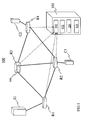
- FIG. 1 sows schematically an example of a communication system 100 in which a method for detecting anomalous traffic can be implemented.
- the communication system 100 is a packet switched network and, for example, is a conventional Internet type network employing the IP protocol.
- communication system 100 can be a SIP (Session Initiation Protocol) network for transmitting SIP signaling packets such as, according to an example, packets relating to VoIP (Voice over Internet Protocol) traffic.
- the communication system 100 comprises a first end system S1 (e.g., a server apparatus), a second end system C1 and a third end-system C2 which are client apparatuses.
- the exemplary communication system 100 is provided with a first router R1, a second router R2, a third router R3, and a fourth router R4, each of them suitable to extract the destination of a received packet, select the best path to that destination, and forward packets to the next device along this path.
- Routers R1-R4 and end systems S1, C1, and C2 are connected by channels of the guided type (such as fiber optic cables, coaxial cables, or other guided transmission means) or are connectable by radio signals.
- the teachings of the invention are applicable to a communication system having a different number of end systems and routers.
- the other apparatuses normally employed in a packet switched network and, particularly, the Internet, such as modems, switches, hubs, bridges, gateways, repeaters, and multiplexers, are not shown as they are evident to the skilled person.
- the particular communication system 100 illustrated in FIG. 1 includes a detection apparatus 101, such as a processor and, particularly, a host computer, which is suitable to implement the anomaly detection method to be described hereinafter.
- the detection apparatus 101 comprises a central processing unit, a work memory, a mass memory (such as a hard disk), user interfaces, as well as input and output ports allowing a communication with other devices (particularly, routers R1-R4) of the communication system 100. All these components are not shown in FIG. 1 . As indicated in FIG.
- the detection apparatus 101 comprises: a data collection module 102, as an example connected with at least one of the routers R1-R4, an optional flow aggregation module 103, a statistical analysis module 104, and an alarm generation module 105. Examples of functions performed by the modules 102-105 will be described in greater detail later. Modules 102-105 can be hardware and/or software components and the detection apparatus can be located remotely from each of the routers R1-R4 or can be located by one of such routers, as an example, integrated in one of the routers R1-R4. According to another embodiment, the functions performed by modules 102-105 can be distributed among different suitable devices belonging to the communication system 100 or connected to such a system.
- OSI Reference Model As known, the Open Systems Interconnection Basic Reference Model (OSI Reference Model or OSI Model for short) is a layered, abstract description for communications and computer network protocol design. It is also called the OSI seven layer model since it defines the following layers: application (7), presentation (6), session (5), transport (4), network (3), data link (2), and physical (1).
- Layers 3 and 4 include the following information of an IP packet: source IP address, TCP/UDP (Transmission Control Protocol/User Datagram Protocol) source port number, destination IP address, TCP/UDP destination port number, and transport protocol used (e.g., TCP or UDP).
- TCP/UDP Transmission Control Protocol/User Datagram Protocol
- destination IP address e.g., IP address
- TCP/UDP destination port number e.g., TCP or UDP
- transport protocol used e.g., TCP or UDP
- FIG. 2 shows by means of a flow chart an example of a method 200 employable for the detection of anomalies on the communication system 100, in accordance with the invention.
- this method can be implemented by the detection apparatus 101.
- the method 200 initially comprises a symbolic start step 201 (START) and an input step 202 (INPUT) wherein a first packet flow portion PFP1 and a second packet flow portion PFP2 are taken from the communication system 100, separated from each other, stored, and then provided as input to the subsequent steps of the method described.
- the first (PFP1) and the second (PFP2) packet flow portions are possibly defined (i.e. included) in elementary time intervals of length/duration ⁇ T.
- the two flow portions PFP1 and PFP2 belong to the same network flow, as defined above.
- a symbolic packet feature is a discrete data that can be extracted from network packets and belongs to a symbolic data set. In a symbolic data set, the distance or closeness between two data values cannot be defined or is not considered to be relevant or meaningful. Symbolic data are specified only by discrete values and not by the metric between the values. In particular, even if the data are expressed in terms of rational or integer numbers, but the underlying Euclidean metric is considered to be irrelevant, they can be treated as symbolic data.
- the employable symbolic features can be, e.g., the source and destination IP addresses, the source and destination port numbers, the transport protocol used, the source and destination email addresses, the source and destination SIP URIs or the HTTP URIs.
- the symbolic packet feature under consideration has a two-dimensional nature, i.e., its discrete values can be indexed by two indices.
- a symbolic packet feature can be a two-dimensional vector consisting of two discrete coordinates.
- the symbolic packet feature may be a pair of source and destination IP addresses, port numbers, email addresses, or SIP URIs, respectively.
- the samples of the symbolic feature x can be obtained by quantizing the samples of a "numerical packet feature" into a set of discrete values (e.g., smaller than the set of the numerical features) and are then treated as symbolic features.
- a numerical packet feature is any quantity extracted from network packets that can be expressed as numerical data by a real, rational, or integer number. According to this definition, it is meaningful to measure the distance or closeness between numerical feature values by the Euclidean metric.
- the packet numerical feature may relate to and provide an indication about the traffic volume, i.e., the data amount transported by a packet or a packet flow portion.
- the definitions of some specific numerical packet features which can be extracted from packets are the following:
- the length ⁇ T essentially specifies the time resolution with which the traffic is monitored and analyzed and can be static or dynamic.
- the starting and ending times of the first and the last packet in a flow, respectively, as well as the total number of monitored flows can also be extracted in step 203.
- the basic numerical features described above, which are based on the information contained in layers 3 and 4 of packet headers are already available in commercial products used in IP networks such as routers and switches (e.g., the well-known Netflow data).
- the values of the symbolic packet feature can be grouped or hashed into a smaller set of values. For example, only some bits of a 32-bit IP address can be chosen. More generally, only some linear functions of bits of a 32-bit IP address can be chosen.
- a (conventional) hash function is a reproducible method of turning original data, belonging to a symbolic data set, into hashed data belonging to a reduced symbolic data set, which contains a reduced number of discrete values.
- the hashed data is also called a digital "fingerprint" or digest of the original data.
- conventional hash functions can be used.
- cryptographic hash functions can be used even if cryptographic properties are not required by the described example of the detection method.
- the extracting step 203 can be performed by an hardware and/or software extractor module 106 included in each or only in some of the routers R1-R4 or in other network nodes that are arranged to extract and transmit the extracted symbolic or numerical features to the data collection module 102 of the detection apparatus 101 ( FIG. 1 ).
- a computing step 204 CONCENTRATION
- a first statistical concentration quantity or measure Cq 1 of the symbolic feature x associated with the first packet portion PFP1 is computed on the basis of the corresponding symbolic feature samples ( x i ) 1 .
- a second statistical concentration quantity or measure Cq 2 of the symbolic feature x associated with the second packet portion PFP2 is computed on the basis of the corresponding symbolic feature samples ( x i ) 2 .
- the first and second concentration quantities are associated to and describe the traffic status of the corresponding first and second packet flow portions.
- a statistical concentration quantity of a set of data is a measure of how the observed symbolic values are concentrated in a given symbolic data set.
- a statistical concentration quantity is a real number that achieves its maximum value if all the data values are identical, and generally decreases as the data values become dispersed among a larger subset of values.
- the first statistical concentration quantity Cq 1 and the second statistical concentration quantity Cq 2 are a first concentration measure C 1 of the sample probability distribution of the symbolic data feature and a second concentration measure C 2 of the sample probability distribution of the symbolic data feature, respectively.
- the computing 204 of the first and second statistical concentration quantities can be performed, according to the example, by the statistical analysis module 104. Several methods to compute the statistical concentration quantity will be described with reference to further embodiments of the example of FIG. 2 .
- a variation quantity ⁇ is computed from the first statistical concentration quantity Cq 1 and the second statistical concentration quantity Cq 2 .
- the variation quantity ⁇ measures a statistical variation or change between the first statistical concentration quantity Cq 1 associated with the first packet flow portion PFP1 and the second statistical concentration quantity Cq 2 associated with the second packet flow portion PFP2.
- the expected value of the variation quantity ⁇ should be relatively small if the first packet flow portion PFP1 and the second packet flow portion PFP2 are both drawn from a same probability distribution.
- the variation quantity ⁇ can be related to a difference between the first statistical concentration quantity Cq 1 and the second statistical concentration quantity Cq 2 .
- the variation quantity ⁇ is obtained from said first C 1 and second C 2 concentration measures of the probability distribution.
- the computation of the variation quantity ⁇ can also be carried out by the statistical analysis module 104.
- the variation quantity ⁇ is compared, in a comparison step 206 (COMPARE), with a comparison value, such as a threshold Thr.
- a comparison value such as a threshold Thr.
- a comparison value such as a threshold Thr.
- an anomaly is detected (branch Yes) and an alarm signal ALARM is generated in an alarm issuing step 207.
- the threshold value Thr is not exceeded, then an anomaly is not detected (branch No) and an alarm signal ALARM is not generated.
- the comparison and the alarm generation step 207 can be performed by the above mentioned alarm generation module 105.
- the threshold can be static or dynamic and can be determined on the basis of historical data. In particular, a dynamic threshold can change adaptively.
- the detection method 200 can be repeated in connection with further packet flow portions.
- the further packet flow portions can lie in time intervals whose end points are delayed with respect to the ones in which the first (PFP1) and second (PFP2) packet flow portions were included.
- the further packet flow portions can lie in time intervals whose both start and end points are delayed with respect to the ones in which the first (PFP1) and second (PFP2) packet flow portions were included.
- the average packet size N size is preferable for detecting anomalous traffic comprising repeated transmission of essentially the same or similar packets (e.g., packets with the same payload), because in this case N size changes its probability distribution over time with respect to normal traffic, e.g., its concentration measure over time may increase.
- N size changes its probability distribution over time with respect to normal traffic, e.g., its concentration measure over time may increase.
- DDoS attack if a message flooding (D)DoS attack is in progress on a SIP network, then it may be likely that a particular type of SIP messages/packets (e.g., INVITE, RE-INVITE, BYE, or REGISTER) is (much) more frequent than the others.
- the packet rate R packet is monitored and involved into the anomaly detection method 200.
- the traffic volume is increased and this is reflected in an increased value of R packet .
- An increased R packet can also be caused by normal traffic such as flash crowds.
- the traffic volume is high near the target, but may be low near the distributed sources of the attack. Therefore, it is preferable to employ both N size and R packet for statistical anomaly detection.
- the features N size and R packet can be traced in time at the chosen network node (i.e. a router) or a set of nodes, for each individual flow or for certain selected flows, e.g., according to the packet rate.
- the numerical feature values for individual flows can be aggregated in groups according to selected packet parameters such as the source or destination IP addresses or the source or destination port numbers.
- the flows can be grouped for the same source IP address or the same destination IP address.
- the flow statistics correspond to the outbound traffic from a particular network node, and in the latter, they correspond to the inbound traffic to a particular network node.
- the number of simultaneously monitored flows with the same IP address as the source/destination address indicates the activity of a node with that IP address as the source/destination node in the observed time interval, respectively.
- the detection method 200 can be applied to any group of aggregated packet numerical features values converted into symbolic features.
- the features grouping step can be performed by the flow aggregation module 103 ( FIG. 1 ).
- the features for all the flows monitored can be grouped together, in particular, by distinguishing the direction of flows, regardless of the particular source/destination IP addresses. This type of grouping is interesting for a high level analysis which does not pay attention to particular nodes or users, but rather to the network traffic as a whole. Instead of the IP addresses, the features grouping can be made according to the port numbers, which are indicative of the applications of the packets transmitted.
- other symbolic packet features of interest include the source and destination IP addresses and the source and destination port numbers. They are especially interesting for detecting DDoS attacks using randomly spoofed source IP addresses or port scanning attacks using randomly generated destination port numbers. They are also useful for detecting other attacks such as massive malicious software attacks targeting random destination IP addresses.
- two-dimensional symbolic data features and the average conditional concentration measure of destination IP addresses can be considered in order to detect SPAM or SPIT attacks or massive malicious software attacks and the average conditional concentration measure of source IP addresses can be considered in order to detect DDoS attacks.
- the application layer layer 7
- the application layer layer 7
- the type of packet being transmitted or a source or destination SIP URI can be extracted.
- this information along with the basic flow features related to layers 3 and 4 can be used either directly or for aggregating the packet data R packet , R byte , and N size .
- Symbolic feature x is one of the above identified symbolic features extracted from flows of network packets, at a chosen network node, in (elementary) short time intervals of length ⁇ T, in some time units (e.g., ⁇ T is comprised 1 s -5 min), where ⁇ T can vary in time.
- x can be the packet rate R packet , the average packet size N size , or the byte rate R byte suitably grouped, quantized, or hashed into a smaller set of symbolic values.
- method 200 is based on sliding windows, i.e. time intervals which are sliding in time.
- a time interval of a length T (greater than ⁇ T ) that is sliding in time, is defined.
- the time interval of length T starting from an initial position, each time advancing of ⁇ units of time (delay), where is a given parameter. If ⁇ T is static, i.e., fixed, then T and ⁇ can be defined as fixed integer multiples of ⁇ T . If ⁇ T is dynamic, i.e., variable in time, then it is assumed that each sliding window contains an integer number of short time intervals and approximately has the same length T.
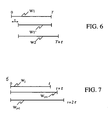
- FIG. 4 schematically illustrates two time intervals corresponding to two exemplary sliding windows: the first window W1 extends from time 0 to T and the second window W2 extends from time r to T+r.
- the indexes in expression (1) represent the following:
- F k,j denotes the number of times a value a k is achieved, i.e., the absolute frequency of a value a k .
- the summation of formula (4) is computed for m addends.
- the summation of formula (5) is computed for m j eff addends.
- Expression (5) represents a quadratic concentration measure for the computed non-zero relative frequencies. If the number of samples n j is not sufficiently large to cover the whole range of m values (e.g., if n j ⁇ m or n j ⁇ m ), then m j eff ⁇ m.
- This concentration measure is particularly interesting if the number of samples n j is much smaller than m, i.e., if n j ⁇ m, in which case most of relative frequencies are relatively small. Note that if the samples are generated randomly according to the uniform probability distribution and if n j ⁇ m , then the expected number of repetitions is approximately n j 2 / 2 ⁇ m . . More precisely, the expected number of repetitions is approximately n j -m (1- e -n j / m ) .
- the concentration measure can be based on a conditional probability, i.e., the probability of a value of one of the two indexes given a value of the other index.
- expression (11) defines the average conditional quadratic concentration measure conditioned on the index
- the average conditional quadratic concentration measure conditioned on the index k 2 is computed in accordance with the following expression, which is analogous to formula (11):
- f k 1 , k 2 , j / f k 1 ,j and f k 1 , k 2 , j / f k 2 , j represent the conditional relative frequencies of the discrete values conditioned on k 1 and k 2 , respectively.
- the sums extend only over the values of k 1 and k 2 such that the involved relative frequencies f k 1, j and f k 2 , j are different from zero, respectively.
- a second concentration measure C j +1 associated with the second sliding window of the second packet flow portion PFP2 is computed applying one of the expressions described above with reference to the first concentration measure C j .
- the variation quantity ⁇ is computed from said first C j and second C j +1 concentration measures.
- a comparison step 306 the difference ⁇ j +1 or ⁇ j +1 is then compared with a fixed or dynamic threshold ⁇ j +1 , where generally the threshold increases as T / ⁇ decreases. If the threshold is exceeded once or repeatedly a specified number of times in successive computations, where this number may increase as the ratio T / ⁇ decreases, then an alarm ALARM for anomalous traffic is generated in an alarm step 307.
- FIG. 5 illustrates an example of a resulting curve of (relative) squared differences of concentration measures, obtained with time resolution ⁇ . It should be noticed that an alert is issued at the rising edge of this curve.
- the threshold ⁇ may be a fixed value.
- the threshold ⁇ could be determined possibly from historical data for normal traffic, at a considered network node, in order to keep the false positive rate reasonably low.
- the threshold ⁇ may depend on the time of the day.
- the concrete relative squared difference to be used among the ones above defined can be chosen so as to minimize its variation on historical data for the normal traffic.
- the threshold can be chosen irrespectively of statistical model estimating the traffic behavior.
- the threshold ⁇ Given an appropriate value of the threshold ⁇ , it is then expected that the probability that the threshold is exceeded, i.e., the false-positive rate is low for normal traffic, whereas at times where there is a change from normal traffic to anomalous traffic, it is expected that the threshold is not exceeded with a low probability, i.e., with a low false-negative rate.
- the method 300 is robust as the changes are related to concentration measures of probability distributions, and not to probability distributions, which may change rapidly for the normal traffic conditions.
- the concentration measure of formula (8) is more robust than the one of formulas (4) and (5), because it relates to a subset of the highest relative frequencies only.
- the concentration measure of formula (10) is more robust than the one of formulas (4) and (5) or (8), because it depends only on the total number of values achieved and, as such, is less sensitive to the probability distribution itself.
- the concentration measure according to expression (10) is sensitive to changes in the number of samples n j from one sliding window to another. Accordingly, the sliding windows for the concentration measure (10) can be defined in terms of a fixed number of samples instead of a fixed time duration and mutually shifted with respect to each other by a fixed number of samples instead of a fixed number of units of time. This also simplifies the computation of the concentration measures (4), (5) and (8). Alternatively, if the number of samples is expected to vary considerably from one window to another, one can perform a normalization of expression (10) by dividing by an appropriate normalization factor, e.g., by n j 2 / 2 ⁇ m .
- the value of the delay or shift ⁇ determines the resolution of the above proposed statistical anomaly detection method 300, because it takes ⁇ units of time, or a small multiple of ⁇ units of time, in order to detect a change from normal to anomalous traffic.
- the value of T should be large enough in order to obtain relatively stable estimates of the chosen concentration measure so that for normal traffic the relative changes of the concentration measure are not too large.
- the ratio T / ⁇ should not be too large so that the change of traffic from normal to anomalous does not require a very small threshold ⁇ to be detected.
- the ratio T / ⁇ may be chosen so as to satisfy the following expression: 1 ⁇ T / ⁇ ⁇ 10.
- the two successive windows are defined in a different way with respect to the first embodiment.
- FIG.6 shows schematically two successive sliding windows W1 and W2, as in FIG. 4 , with a difference that the first packet flow portion PFP1 is now associated with a shortened window W1', extending from ⁇ to T , whereas the second packet flow portion PFP2 is associated with W2 as in FIG. 4 .
- the second concentration measure C j +1 corresponding to the segment (23) is then compared with the first concentration measure ⁇ j corresponding to the shorter first segment (22) by using one of the expressions for the squared difference ⁇ j +1 or ⁇ j +1 of concentration measures defined with reference to the first embodiment 300.
- the squared difference ⁇ j +1 or ⁇ j +1 is then compared with a threshold.
- This threshold may be somewhat reduced in comparison with the threshold of the first embodiment 300, because, for normal traffic, the concentration measures for the two segments are then expected to be less mutually different.
- the method of the second embodiment may be more suitable than the one of the first embodiment 300 for detecting anomalous traffic of duration shorter than the window size T .
- a considerable change in concentration measure due to the beginning of anomalous traffic, would be detected not only by the ending point of the sliding window (such as the window W2 in FIG. 4 ), when it enters the segment of anomalous traffic, but also by the initial part of the sliding window (such as the window W2 in FIG. 4 ), when it leaves the segment of normal traffic and enters the segment of anomalous traffic.
- a change of concentration measure will then be detected only by the ending point of the sliding window (such as the window W2 in FIG. 6 ).
- a moving window of increasing length is defined. Such moving window extends from a chosen initial time up to the current time, and each time, the ending point of the moving window advances ⁇ units of time, where ⁇ determines the resolution in time for detecting the anomalous changes in traffic.
- FIG. 7 shows schematically three exemplary successive windows W j , W j+1 , and W j+2 drawn in accordance with this third embodiment of the detection method 200.
- t denotes a generic time.
- the concentration measure is based on the relative frequencies of individual discrete values which are computed by selected exponentially weighted sums so that the influence of the past data on the concentration measure decreases as the time decreases, in order to ensure the sensitivity to anomalous behavior of the current data.
- the third embodiment is based on a novel Exponential Weighted Moving Average (EWMA) technique applied to relative frequencies of discrete values of symbolic variables. This method is described hereinafter in greater detail and in terms of mathematical equations.
- EWMA Exponential Weighted Moving Average
- a vector ⁇ i at time i, is an m-dimensional binary vector associated with the sample x i whose coordinates correspond to different discrete values, with only one coordinate equal to 1, namely, the coordinate corresponding to the discrete value assumed by the sample x i , and all the remaining coordinates equal to zero.
- the concentration measures can be computed by applying any of the corresponding expressions (4), (5), (8), (11), or (12) to the iteratively computed relative frequencies. It is observed that the concentration measure defined by expression (10) is excluded from the third embodiment, because it is not specifically related to relative frequencies.
- the value of the constant ⁇ determines the effective number of past samples influencing the current relative frequency vector and the resulting concentration measure estimates. More precisely, this number increases as the constant decreases. In particular, smaller values of ⁇ are preferred in order to obtain relatively stable relative frequency estimates.
- ⁇ should be chosen in accordance with the statistical properties of the normal traffic. In general, the faster the concentration measure variations in normal traffic one may expect, the bigger the constant ⁇ one should choose.
- a number of symbolic packet features are employed simultaneously.
- the relative squared differences of concentration measures C 1 ,..., C N are combined to obtain a total variation quantity ⁇ tot .
- the combination step is a summation of said relative squared differences of concentration measures C 1 ,...,C N .
- the total variation quantity ⁇ tot is then compared (step 402) with a threshold value Thr in order to detect an anomalous condition which can cause the generation of an alarm signal or message ALARM (branch Yes).
- the comparison of the total variation quantity ⁇ tot with the threshold value Thr could detect a normal traffic condition (branch No) and, in this case, no alarm signals or messages are generated.
- the combination step 401 may be performed by different types of combination algorithms. According to another particular example, prior to performing the summation, the relative squared differences of concentration measures C 1 ,..., C N are multiplied with different weights that may be associated with individual symbolic packet features.
- a total variation quantity ⁇ tot is not computed and comparisons of each of the relative squared differences of concentration measures C 1 ,..., C N with a respective threshold are performed. An alarm signal is then generated if at least a specified number of said comparisons detect an anomalous traffic condition.
- variation quantity criterion aiming at detecting sudden changes of concentration measure, one may also take into account other criteria, e.g., for message flooding (D)DoS attacks, one may require that there is also a significant change of the packet rate R packet or the byte rate R byte . For N size , apart from looking for a considerable (relative) change in concentration measure, one may also specifically require that the concentration measure increases.
- the detection of anomalies in the communication system 100 can be performed by a combination of the above indicated criteria based on symbolic packet features and other criteria based on monitoring of statistical behavior of numeric packet features associated with the first and second packet flow portions.
- the criteria described in the pending PCT application in the name of the same applicant of the present patent application and having the following title "Method of detecting anomalies in a communication system using numerical packet features" can be employed in combination with the ones herein described.
- This further PCT application which refers to a method of monitoring a statistical dispersion quantity, is herein enclosed by reference.
- the result of the detection method 200 of the present patent invention based on symbolic packet features can be combined with the result of the detection method based on numerical packet features in accordance with a combination algorithm comprising, as an example, logical operations, e.g., OR and AND.
- logical operations e.g., OR and AND.
- each elementary time interval ⁇ T can contain a number of aggregated discrete values of the symbolic feature chosen, instead of only one discrete value.
- the data aggregation can be performed by the aggregation module 103. It is observed that, in this case, timings of individual discrete values within ⁇ T can be regarded as irrelevant. Since all the above described concentration measures depend only on the numbers of occurrences of discrete values in the moving windows considered, and not on their order, the proposed methods in the first and second embodiments, using sliding windows can be easily applied to aggregated data, whereas the method of the third embodiment, using moving windows and exponentially weighted averages, can be adapted to deal with the aggregated data.
- the average value-indicator vector is computed, as the arithmetic mean of all the binary value-indicators in this interval, and then further processed in the same way as above.
- This average value-indicator vector equivalently represents a relative frequency vector corresponding to the elementary time interval considered, as in the sliding window methods described with reference to the first and second embodiments.
- a fifth embodiment refers to the same definition of sliding windows as described in relation to the first embodiment 300 ( FIG. 4 ), but employs computation algorithms different from the ones described with reference to the first embodiment 300. It is observed that according to the first embodiment 300 the relative frequencies f k,j and the chosen concentration quantities C j are repeatedly computed for overlapping segments that may have a lot of data samples in common.
- the relative frequencies f k,j and the concentration quantities C j already computed for the preceding segment are being updated so as to save in computations.
- all the data samples belonging to a preceding sliding window for which the concentration measure was previously computed need to be stored.
- the quadratic concentration measures (4), (5), (8), or (10) can be directly updated.
- a sixth embodiment refers to sliding windows of the type described for the second embodiment ( FIG. 6 ), but employs computation algorithms different from the ones of the second embodiment.
- a first situation is a DDoS attack with randomly spoofed source IP addresses, when the concentration measure of these addresses tends to decrease considerably.
- a second situation is a DDoS attack that utilizes randomly spoofed source email addresses or SIP URIs.
- a third situation is a port scanning attack, when the concentration measure of the destination port numbers may decrease significantly.
- a fourth situation is a SPAM or SPIT attack using random destination email addresses or SIP URIs, respectively.
- a fifth situation is a massive malicious software attack targeting random destination IP addresses.
- a sixth situation is a message or request flooding DDoS attack, when the concentration measure of (possibly quantized) packet sizes tends to increase considerably, due to repeatedly sending essentially the same or similar packets.
- concentration measure of (possibly quantized) packet sizes tends to increase considerably, due to repeatedly sending essentially the same or similar packets.
- one may consider two-dimensional symbolic data features and the average conditional concentration measure of destination email addresses or SIP URIs in order to detect SPAM or SPIT attacks, respectively, or the average conditional concentration measure of source email addresses or SIP URIs in order to detect DDoS attacks.
- FIG. 2 and the other described embodiments can be implemented by avoiding a comparison of the current traffic with a corresponding statistical model based on historical data, which is typical of prior art methods. It has to be noticed that if the estimated statistical model of the traffic does not reflect the normal traffic behavior sufficiently accurately, then it is difficult to achieve a satisfactory tradeoff between the false-positive and false-negative rates. Therefore, the possibility of performing a detection irrespective of statistical models, improves the reliability of the described detection methods in comparison with prior art techniques related to numerical or symbolic packet features.
- Some prior art techniques propose the usage of certain entropy measures related to certain symbolic packet features such as the IP addresses (e.g., the Shannon entropy or the compression ratio of data compression), but fail short in providing a simple, general, and reliable method for detecting anomalous changes in these entropy measures (for example, see the above mentioned articles "Mining anomalies using traffic feature distributions", A. Lakhina, M. Crovella, and C. Diot, and "Entropy based worm and anomaly detection in fast IP networks", A. Wagner and B. Plattner).
- the above described two overlapping sliding window techniques and the exponentially weighted moving average technique appear to be particularly advantageous.
- the methods described above are mathematically relatively simple, sufficiently robust to changes inherent to normal traffic, and yet capable of detecting anomalous traffic due to attacks such as (D)DoS attacks, SPAM and SPIT attacks, and scanning attacks, as well as massive malicious software attacks.
- the quadratic and other concentration measures together with the corresponding variation quantities according to the present invention do not require complex computations in contrast with the articles mentioned above.
- the proposed detection method appears to be very suitable for high-speed and high-volume communications networks.
- the proposed average conditional concentration measures for two-dimensional symbolic features offer particular advantages for detecting anomalous traffic due to various network attacks.
Landscapes
- Engineering & Computer Science (AREA)
- Computer Security & Cryptography (AREA)
- Computer Networks & Wireless Communication (AREA)
- Signal Processing (AREA)
- Computer Hardware Design (AREA)
- Computing Systems (AREA)
- General Engineering & Computer Science (AREA)
- Data Exchanges In Wide-Area Networks (AREA)
Claims (16)
- Ein Verfahren (200; 300; 400) zum Detektieren von Anomalien in einem Kommunikationssystem (100), wobei das Verfahren das Folgende umfasst:Bereitstellen (202; 2021) eines ersten Paketflussanteiles (PFP1) und eines zweiten Paketflussanteils (PFP2);Extrahieren (203; 303; 2031) von Samples eines symbolischen Paketmerkmales (x), das mit einem Traffikstatus des ersten und zweiten Paketflussanteils verbunden ist;
Dadurch gekennzeichnetBerechnen (204; 304; 2041) aus den extrahierten Samples eine erste statistische Dichtegröße (Cq1) und eine zweite statistische Dichtegröße (Cl2) des symbolischen Merkmales, die mit dem ersten und dem zweiten Paketflussanteil entsprechend verbunden sind;Berechnen (205; 305; 2051, 401) aus den Dichtegrößen eine Variationsgröße (Δ), die einen Dichtewechsel von dem ersten Paketflussanteil zu dem zweiten Paketflussanteil darstellt;Vergleichen (206; 306; 402) der Variationsgröße (Δ) mit einem Vergleichswert (Thr);Detektieren (207, 307, 402) einer Anomalie in dem System in Antwort auf den Vergleich. - Detektionsverfahren (200) nach Anspruch 1, wobei:die erste statistische Dichtegröße ein erstes Dichtemaß einer geschätzten Wahrscheinlichkeitsverteilung der extrahierten Samples, die mit dem ersten Paketflussanteil verbunden sind, ist; unddie zweite statistische Dichtegröße ein zweites Dichtemaß einer geschätzten Wahrscheinlichkeitsverteilung der extrahierten Samples, die mit dem zweiten Paketflussanteil verbunden sind, ist.
- Detektionsverfahren (300) nach Anspruch 2, wobei das symbolische Paketmerkmal Werte annimmt, die in einem Satz von Werten enthalten sind und wobei das Berechnen sowohl der ersten als auch der zweiten Dichtegröße Folgendes umfasst:Berechnen einer Sampleanzahl, die der Anzahl der Samples entspricht, die mit einem der ersten und zweiten Flussanteile verbunden sind;Berechnen eines absoluten Häufigkeitswertes, der einer Anzahl entspricht, wie oft erreicht wird, dass ein Wert zu dem Satz gehört;Berechnen von relativen Häufigkeiten aller Werte, die zu dem Satz von Werten gehören.
- Detektionsverfahren (300) nach Anspruch 3, wobei das Berechnen sowohl der ersten als auch der zweiten Dichtegröße Folgendes umfasst:Berechnen aus den relativen Häufigkeiten jeweils die erste und zweite Dichtegröße als ein quadratisches Dichtemaß.
- Detektionsverfahren (300) nach Anspruch 4, wobei das Berechnen des quadratischen Dichtemaßes Folgendes umfasst:Berechnen quadratischer Werte der relativen Häufigkeiten;Berechnen einer Summe der quadratischen Werte.
- Detektionsverfahren (300) nach Anspruch 2, wobei das symbolische Paketmerkmal Werte annimmt, die in einem Satz von Werten enthalten sind, und das Berechnen sowohl des ersten als auch des zweiten Dichtemaßes Folgendes umfasst:Berechnen einer Sampleanzahl, die einer Anzahl von Samples entspricht, die mit einem der ersten und zweiten Flussanteile verbunden sind;Berechnen einer effektiven Anzahl, die einer Gesamtzahl von Werten entspricht, die in diesem Satz angenommen werden;Berechnen einer Differenzgröße, die einer Differenz zwischen der Sampleanzahl und der effektiven Zahl entspricht.
- Detektionsverfahren (300) nach Anspruch 1, wobei die Variationsgröße zu einer Differenz zwischen der ersten statistischen Dichtegröße und der zweiten statistischen Dichtegröße in Bezug steht.
- Detektionsverfahren (200; 300) nach Anspruch 1, wobei der Schritt (202) des Bereitstellens des ersten und zweiten Pakettlussanteils Folgendes umfasst:Definieren eines ersten Zeitfensters, welches den ersten Paketflussanteil und ein verbundenes erstes Samplesegment des symbolischen Merkmals umfasst;Definieren eines zweiten Zeitfensters, welches den zweiten Flussanteil und ein verbundenes zweites Samplesegment des symbolischen Merkmals umfasst;wobei die erste statistische Dichtegröße (Cq1) und die zweite statistische Dichtegröße (Cq2) von dem ersten und zweiten Samplesegmenten entsprechend berechnet werden.
- Detektionsverfahren (200) nach Anspruch 8, wobei das erste und zweite Fenster eine gleiche Länge aufweisen.
- Detektionsverfahren nach Anspruch 8, das nach einem Zeitintervall, welches gleich einer Verzögerung ist, weiter Folgendes umfasst:- Definieren weiterer erster und zweiter Fenster durch ein Verschieben des ersten und zweiten Fensters um die Verzögerung;- Wiederholen des Verfahrens zum Detektieren einer Anomalie durch ein Anwenden des Verfahrens auf weitere erste und zweite Paketflussanteile entsprechend zu den weiteren ersten und zweiten Fenstern.
- Detektionsverfahren nach Anspruch 8, wobei das erste Samplesegment (W1') einen Anfangsteil des zweiten Samplesegmentes (W2) umfasst; und das zweite Samplesegment (W2) einen Endteil, welcher von dem ersten Segment getrennt ist, umfasst.
- Detektionsverfahren nach Anspruch 11, das nach einem Zeitintervall, welches gleich der Verzögerung ist, weiter Folgendes umfasst:Definieren weiterer erster und zweiter Samplesegmente, durch ein Verschieben des ersten und zweiten Samplesegments durch die VerzögerungWiederholen des Verfahrens zum Detektieren einer Anomalie durch Anwenden des Verfahrens auf das weitere erste und zweite Samplesegment.
- Detektionsverfahren (400) nach Anspruch 1, das weiter Folgendes umfasst:Extrahieren (203j) weiterer Samples eines weiteren symbolischen Paketmerkmales, welches mit dem ersten und dem zweiten Paketflussanteil verknüpft ist;Berechnen (204j) aus den weiteren Samples zusätzliche statistische Dichtegrößen des weiteren symbolischen Merkmals;Berechnen (205j) einer weiteren Variationsgröße, die einen weiteren Dichtewechsel von dem ersten Paketflussanteil zu dem zweiten Paketflussanteil darstellt.
- Detektionsverfahren (400) nach Anspruch 13, wobei das Berechnen einer Variationsgröße (Δtot), die einen Dichtewechsel von dem ersten Paketflussanteil zu dem zweiten Paketflussanteil darstellt, aus den Dichtegrößen Folgendes umfasst:Berechnen einer ersten Variationsgröße aus den Dichtegrößen;Kombinieren (401) der ersten Variationsgröße und der weiteren Variationsgröße, um die Variationsgröße (Δtot) zu erhalten.
- Vorrichtung (101) zum Detektieren von Anomalien in einem Paketorientierten Kommunikationssystem, wobei die Vorrichtung Folgendes umfasst:ein Erfassungsmodul (102) zum Speichern von Samples eines symbolischen Merkmals (x), welches mit einem Traffikstatus eines ersten Paketflussanteils (PFP1) und eines zweiten Paketflussanteils (PFP2) verknüpft ist;
Dadurch gekennzeichnet:ein Berechnungsmodul (104), welches ausgebildet ist, um:von den Samples eine erste statistische Dichtegröße (Cl1) und eine zweite statistische Dichtegröße (Cq2) von dem symbolischen Merkmal, welches mit dem ersten und zweiten Paketflussanteil verknüpft ist, entsprechend zu berechnen,von den Dichtegrößen eine Variationsgröße (Δ), die einen Dichtewechsel von dem ersten Paketflussanteil zu dem zweiten Paketflussanteil darstellt, zu berechnen;ein Detektionsmodul (105), welches ausgebildet ist, um:die Variationsgröße (Δ) mit einem Vergleichswert (Thr) zu vergleichen;eine Anomalie in dem System als Antwort auf den Vergleich zu detektieren; - Computerprogrammprodukt mit Computerprogrammcode, der ausgebildet ist, um das Detektionsverfahren nach zumindest einem der Ansprüche 1-14 auszuführen.
Applications Claiming Priority (1)
| Application Number | Priority Date | Filing Date | Title |
|---|---|---|---|
| PCT/EP2007/011474 WO2009086843A1 (en) | 2007-12-31 | 2007-12-31 | Method of detecting anomalies in a communication system using symbolic packet features |
Publications (2)
| Publication Number | Publication Date |
|---|---|
| EP2227889A1 EP2227889A1 (de) | 2010-09-15 |
| EP2227889B1 true EP2227889B1 (de) | 2011-07-13 |
Family
ID=39721948
Family Applications (1)
| Application Number | Title | Priority Date | Filing Date |
|---|---|---|---|
| EP07857165A Not-in-force EP2227889B1 (de) | 2007-12-31 | 2007-12-31 | Verfahren zur detektion von anomalien in einem kommunikationssystem, das symbolische paketmerkmale verwendet |
Country Status (4)
| Country | Link |
|---|---|
| US (1) | US8611219B2 (de) |
| EP (1) | EP2227889B1 (de) |
| AT (1) | ATE516655T1 (de) |
| WO (1) | WO2009086843A1 (de) |
Families Citing this family (111)
| Publication number | Priority date | Publication date | Assignee | Title |
|---|---|---|---|---|
| US8095983B2 (en) | 2005-03-15 | 2012-01-10 | Mu Dynamics, Inc. | Platform for analyzing the security of communication protocols and channels |
| US8095982B1 (en) | 2005-03-15 | 2012-01-10 | Mu Dynamics, Inc. | Analyzing the security of communication protocols and channels for a pass-through device |
| US7958230B2 (en) | 2008-09-19 | 2011-06-07 | Mu Dynamics, Inc. | Test driven deployment and monitoring of heterogeneous network systems |
| US9172611B2 (en) * | 2006-09-01 | 2015-10-27 | Spirent Communications, Inc. | System and method for discovering assets and functional relationships in a network |
| US8316447B2 (en) | 2006-09-01 | 2012-11-20 | Mu Dynamics, Inc. | Reconfigurable message-delivery preconditions for delivering attacks to analyze the security of networked systems |
| US7774637B1 (en) | 2007-09-05 | 2010-08-10 | Mu Dynamics, Inc. | Meta-instrumentation for security analysis |
| US9100417B2 (en) * | 2007-09-12 | 2015-08-04 | Avaya Inc. | Multi-node and multi-call state machine profiling for detecting SPIT |
| US9736172B2 (en) | 2007-09-12 | 2017-08-15 | Avaya Inc. | Signature-free intrusion detection |
| US9438641B2 (en) * | 2007-09-12 | 2016-09-06 | Avaya Inc. | State machine profiling for voice over IP calls |
| US8266693B1 (en) | 2008-03-25 | 2012-09-11 | Mcafee, Inc. | System, method, and computer program product for identifying unwanted data communicated via a session initiation protocol |
| KR101161345B1 (ko) * | 2009-09-09 | 2012-06-29 | 한국인터넷진흥원 | VoIP트래픽 분석 및 공격성 비정상 VoIP탐지를 위한 통계정보 생성기 및 그 생성 방법 |
| US20110138463A1 (en) * | 2009-12-07 | 2011-06-09 | Electronics And Telecommunications Research Institute | Method and system for ddos traffic detection and traffic mitigation using flow statistics |
| KR20110067264A (ko) * | 2009-12-14 | 2011-06-22 | 성균관대학교산학협력단 | 네트워크 이상징후 탐지장치 및 방법 |
| US8654655B2 (en) * | 2009-12-17 | 2014-02-18 | Thomson Licensing | Detecting and classifying anomalies in communication networks |
| US8547974B1 (en) | 2010-05-05 | 2013-10-01 | Mu Dynamics | Generating communication protocol test cases based on network traffic |
| US8463860B1 (en) | 2010-05-05 | 2013-06-11 | Spirent Communications, Inc. | Scenario based scale testing |
| US9106514B1 (en) | 2010-12-30 | 2015-08-11 | Spirent Communications, Inc. | Hybrid network software provision |
| US8719926B2 (en) * | 2011-02-11 | 2014-05-06 | Verizon Patent And Licensing Inc. | Denial of service detection and prevention using dialog level filtering |
| US8464219B1 (en) | 2011-04-27 | 2013-06-11 | Spirent Communications, Inc. | Scalable control system for test execution and monitoring utilizing multiple processors |
| US9501640B2 (en) | 2011-09-14 | 2016-11-22 | Mcafee, Inc. | System and method for statistical analysis of comparative entropy |
| US9843488B2 (en) | 2011-11-07 | 2017-12-12 | Netflow Logic Corporation | Method and system for confident anomaly detection in computer network traffic |
| US20140075557A1 (en) * | 2012-09-11 | 2014-03-13 | Netflow Logic Corporation | Streaming Method and System for Processing Network Metadata |
| US8972543B1 (en) | 2012-04-11 | 2015-03-03 | Spirent Communications, Inc. | Managing clients utilizing reverse transactions |
| US9412067B2 (en) | 2012-09-05 | 2016-08-09 | Numenta, Inc. | Anomaly detection in spatial and temporal memory system |
| US9197657B2 (en) | 2012-09-27 | 2015-11-24 | Hewlett-Packard Development Company, L.P. | Internet protocol address distribution summary |
| US9857825B1 (en) * | 2012-10-29 | 2018-01-02 | Washington State University | Rate based failure detection |
| US20140122550A1 (en) * | 2012-11-01 | 2014-05-01 | Zhiyi Zhang | System for nonparametric entropy estimation |
| US9477464B2 (en) * | 2012-11-20 | 2016-10-25 | Genesys Telecommunications Laboratories, Inc. | Distributed aggregation for contact center agent-groups on sliding interval |
| US10412121B2 (en) | 2012-11-20 | 2019-09-10 | Genesys Telecommunications Laboratories, Inc. | Distributed aggregation for contact center agent-groups on growing interval |
| WO2014111863A1 (en) | 2013-01-16 | 2014-07-24 | Light Cyber Ltd. | Automated forensics of computer systems using behavioral intelligence |
| US20150127595A1 (en) * | 2013-11-01 | 2015-05-07 | Numenta, Inc. | Modeling and detection of anomaly based on prediction |
| US9674207B2 (en) * | 2014-07-23 | 2017-06-06 | Cisco Technology, Inc. | Hierarchical attack detection in a network |
| US10728040B1 (en) * | 2014-08-08 | 2020-07-28 | Tai Seibert | Connection-based network behavioral anomaly detection system and method |
| US10103890B2 (en) * | 2014-08-08 | 2018-10-16 | Haw-Minn Lu | Membership query method |
| US9571519B2 (en) * | 2014-09-29 | 2017-02-14 | Juniper Networks, Inc. | Targeted attack discovery |
| US9954754B2 (en) * | 2014-10-31 | 2018-04-24 | Electronics And Telecommunications Research Institute | Random access method and terminal supporting the same |
| KR102324607B1 (ko) * | 2014-10-31 | 2021-11-10 | 한국전자통신연구원 | 랜덤 액세스 방법 및 이를 지원 하는 단말 |
| US9774604B2 (en) | 2015-01-16 | 2017-09-26 | Zingbox, Ltd. | Private cloud control |
| US10476947B1 (en) | 2015-03-02 | 2019-11-12 | F5 Networks, Inc | Methods for managing web applications and devices thereof |
| US10212178B2 (en) | 2015-04-07 | 2019-02-19 | Zingbox, Ltd. | Packet analysis based IoT management |
| US11616806B1 (en) | 2015-05-08 | 2023-03-28 | F5, Inc. | Methods for protecting web based resources from D/DoS attacks and devices thereof |
| US10148537B2 (en) * | 2015-09-16 | 2018-12-04 | Cisco Technology, Inc. | Detecting oscillation anomalies in a mesh network using machine learning |
| US10541903B2 (en) | 2015-10-02 | 2020-01-21 | Futurewei Technologies, Inc. | Methodology to improve the anomaly detection rate |
| US10192050B2 (en) * | 2015-10-30 | 2019-01-29 | General Electric Company | Methods, systems, apparatus, and storage media for use in detecting anomalous behavior and/or in preventing data loss |
| WO2017095374A1 (en) * | 2015-11-30 | 2017-06-08 | Hewlett Packard Enterprise Development Lp | Alignment and deduplication of time-series datasets |
| US10581902B1 (en) * | 2015-11-30 | 2020-03-03 | F5 Networks, Inc. | Methods for mitigating distributed denial of service attacks and devices thereof |
| US9967275B1 (en) * | 2015-12-17 | 2018-05-08 | EMC IP Holding Company LLC | Efficient detection of network anomalies |
| US10834110B1 (en) | 2015-12-18 | 2020-11-10 | F5 Networks, Inc. | Methods for preventing DDoS attack based on adaptive self learning of session and transport layers and devices thereof |
| US10397250B1 (en) | 2016-01-21 | 2019-08-27 | F5 Networks, Inc. | Methods for detecting remote access trojan malware and devices thereof |
| US11140167B1 (en) | 2016-03-01 | 2021-10-05 | Exabeam, Inc. | System, method, and computer program for automatically classifying user accounts in a computer network using keys from an identity management system |
| CN107196891B (zh) * | 2016-03-15 | 2020-02-14 | 华为技术有限公司 | 数据流转发异常检测方法、控制器和系统 |
| US10432650B2 (en) | 2016-03-31 | 2019-10-01 | Stuart Staniford | System and method to protect a webserver against application exploits and attacks |
| US10425443B2 (en) | 2016-06-14 | 2019-09-24 | Microsoft Technology Licensing, Llc | Detecting volumetric attacks |
| US10055336B1 (en) * | 2016-06-23 | 2018-08-21 | VCE IP Holding Company LLC | Computer implemented system and method and computer program product for testing a software component by simulating an interface to a computing component using randomized network packet information |
| US10432652B1 (en) | 2016-09-20 | 2019-10-01 | F5 Networks, Inc. | Methods for detecting and mitigating malicious network behavior and devices thereof |
| US10380348B2 (en) | 2016-11-21 | 2019-08-13 | ZingBox, Inc. | IoT device risk assessment |
| US10440037B2 (en) * | 2017-03-31 | 2019-10-08 | Mcafee, Llc | Identifying malware-suspect end points through entropy changes in consolidated logs |
| WO2018186242A1 (ja) | 2017-04-04 | 2018-10-11 | 日本電信電話株式会社 | 監視装置、監視方法および監視プログラム |
| US11038869B1 (en) | 2017-05-12 | 2021-06-15 | F5 Networks, Inc. | Methods for managing a federated identity environment based on application availability and devices thereof |
| US11070568B2 (en) | 2017-09-27 | 2021-07-20 | Palo Alto Networks, Inc. | IoT device management visualization |
| US11082296B2 (en) | 2017-10-27 | 2021-08-03 | Palo Alto Networks, Inc. | IoT device grouping and labeling |
| US11423143B1 (en) | 2017-12-21 | 2022-08-23 | Exabeam, Inc. | Anomaly detection based on processes executed within a network |
| CN110110160B (zh) * | 2017-12-29 | 2020-04-14 | 阿里巴巴集团控股有限公司 | 确定数据异常的方法及装置 |
| KR101918441B1 (ko) * | 2018-01-16 | 2018-11-13 | 전남대학교산학협력단 | 의심 트래픽 능동형 임계값 기반 DRDoS 요청 탐지 방법 및 시스템 |
| US11539740B1 (en) | 2018-02-02 | 2022-12-27 | F5, Inc. | Methods for protecting CPU during DDoS attack and devices thereof |
| US11411850B2 (en) * | 2018-03-14 | 2022-08-09 | Nec Corporation | Traffic analysis apparatus, method, and program |
| US10999304B2 (en) * | 2018-04-11 | 2021-05-04 | Palo Alto Networks (Israel Analytics) Ltd. | Bind shell attack detection |
| US11431741B1 (en) * | 2018-05-16 | 2022-08-30 | Exabeam, Inc. | Detecting unmanaged and unauthorized assets in an information technology network with a recurrent neural network that identifies anomalously-named assets |
| JP7098000B2 (ja) | 2018-06-18 | 2022-07-08 | パロ アルト ネットワークス,インコーポレイテッド | IoTセキュリティにおけるパターンマッチングベースの検出 |
| US10817604B1 (en) | 2018-06-19 | 2020-10-27 | Architecture Technology Corporation | Systems and methods for processing source codes to detect non-malicious faults |
| US10749890B1 (en) | 2018-06-19 | 2020-08-18 | Architecture Technology Corporation | Systems and methods for improving the ranking and prioritization of attack-related events |
| CN110661763B (zh) * | 2018-06-29 | 2021-11-19 | 阿里巴巴集团控股有限公司 | 一种DDoS反射攻击防御方法、装置及其设备 |
| US12028231B2 (en) * | 2018-07-18 | 2024-07-02 | Telecom Italia S.P.A. | Performance measurement in a packet-switched communication network |
| US12294482B2 (en) | 2018-09-04 | 2025-05-06 | Palo Alto Networks, Inc. | IoT application learning |
| US12289328B2 (en) | 2018-10-15 | 2025-04-29 | Palo Alto Networks, Inc. | Multi-dimensional periodicity detection of IOT device behavior |
| US11102126B2 (en) * | 2018-10-22 | 2021-08-24 | Centurylink Intellectual Property Llc | Method, apparatus, and system for adjusting routing of network traffic or utilization of network nodes |
| US11451571B2 (en) | 2018-12-12 | 2022-09-20 | Palo Alto Networks, Inc. | IoT device risk assessment and scoring |
| US11689573B2 (en) | 2018-12-31 | 2023-06-27 | Palo Alto Networks, Inc. | Multi-layered policy management |
| US11429713B1 (en) * | 2019-01-24 | 2022-08-30 | Architecture Technology Corporation | Artificial intelligence modeling for cyber-attack simulation protocols |
| US11184378B2 (en) | 2019-01-30 | 2021-11-23 | Palo Alto Networks (Israel Analytics) Ltd. | Scanner probe detection |
| US11184376B2 (en) | 2019-01-30 | 2021-11-23 | Palo Alto Networks (Israel Analytics) Ltd. | Port scan detection using destination profiles |
| US11316872B2 (en) | 2019-01-30 | 2022-04-26 | Palo Alto Networks (Israel Analytics) Ltd. | Malicious port scan detection using port profiles |
| US11184377B2 (en) | 2019-01-30 | 2021-11-23 | Palo Alto Networks (Israel Analytics) Ltd. | Malicious port scan detection using source profiles |
| US11070569B2 (en) | 2019-01-30 | 2021-07-20 | Palo Alto Networks (Israel Analytics) Ltd. | Detecting outlier pairs of scanned ports |
| US11128654B1 (en) | 2019-02-04 | 2021-09-21 | Architecture Technology Corporation | Systems and methods for unified hierarchical cybersecurity |
| US11625366B1 (en) | 2019-06-04 | 2023-04-11 | Exabeam, Inc. | System, method, and computer program for automatic parser creation |
| US11403405B1 (en) | 2019-06-27 | 2022-08-02 | Architecture Technology Corporation | Portable vulnerability identification tool for embedded non-IP devices |
| US11444974B1 (en) | 2019-10-23 | 2022-09-13 | Architecture Technology Corporation | Systems and methods for cyber-physical threat modeling |
| US11349981B1 (en) | 2019-10-30 | 2022-05-31 | F5, Inc. | Methods for optimizing multimedia communication and devices thereof |
| CN110825924B (zh) * | 2019-11-01 | 2022-12-06 | 深圳市卡牛科技有限公司 | 一种数据检测方法、装置及存储介质 |
| US10911471B1 (en) * | 2019-11-27 | 2021-02-02 | The Florida International University Board Of Trustees | Systems and methods for network-based intrusion detection |
| US11503075B1 (en) | 2020-01-14 | 2022-11-15 | Architecture Technology Corporation | Systems and methods for continuous compliance of nodes |
| US11115799B1 (en) | 2020-06-01 | 2021-09-07 | Palo Alto Networks, Inc. | IoT device discovery and identification |
| US12302451B2 (en) | 2020-06-01 | 2025-05-13 | Palo Alto Networks, Inc. | IoT security policy on a firewall |
| US11956253B1 (en) | 2020-06-15 | 2024-04-09 | Exabeam, Inc. | Ranking cybersecurity alerts from multiple sources using machine learning |
| US12395418B2 (en) | 2020-07-23 | 2025-08-19 | Microsoft Technology Licensing, Llc | Network verification systems and methods |
| US12063226B1 (en) | 2020-09-29 | 2024-08-13 | Exabeam, Inc. | Graph-based multi-staged attack detection in the context of an attack framework |
| US11509680B2 (en) | 2020-09-30 | 2022-11-22 | Palo Alto Networks (Israel Analytics) Ltd. | Classification of cyber-alerts into security incidents |
| EP4009160B1 (de) | 2020-12-07 | 2025-02-05 | F5, Inc. | Verfahren zum einsatz einer anwendung über mehrere rechnerdomänen und vorrichtungen dafür |
| US12401685B2 (en) | 2021-10-14 | 2025-08-26 | F5, Inc. | Methods for mitigating DDoS attack using hardware device and devices thereof |
| US12039017B2 (en) | 2021-10-20 | 2024-07-16 | Palo Alto Networks (Israel Analytics) Ltd. | User entity normalization and association |
| US11552975B1 (en) | 2021-10-26 | 2023-01-10 | Palo Alto Networks, Inc. | IoT device identification with packet flow behavior machine learning model |
| KR102783148B1 (ko) | 2021-12-29 | 2025-03-19 | 한국전자통신연구원 | 심볼릭 공간에서의 네트워킹 행위 이상도 측정 기반 공격 탐지 장치 및 방법 |
| US11799880B2 (en) | 2022-01-10 | 2023-10-24 | Palo Alto Networks (Israel Analytics) Ltd. | Network adaptive alert prioritization system |
| US12301600B2 (en) | 2022-01-18 | 2025-05-13 | Palo Alto Networks, Inc. | IoT device identification by machine learning with time series behavioral and statistical features |
| EP4483532B1 (de) * | 2022-02-22 | 2025-04-09 | Telefonaktiebolaget LM Ericsson (publ) | Verfahren und vorrichtungen zur bestimmung von sicherheitsangriffen in softwaredefinierten netzwerken |
| FR3138220B1 (fr) * | 2022-07-22 | 2025-01-10 | Stmicroelectronics Grand Ouest | Procédé de détection d'anomalies réseau |
| US12519827B2 (en) | 2022-12-30 | 2026-01-06 | F5, Inc. | Methods for detecting ICMP flood attacks |
| US12506763B1 (en) | 2023-04-28 | 2025-12-23 | Exabeam, Inc. | System, method, and computer program for scoring and organizing evidence of cybersecurity threats from multiple data sources |
| US12399984B1 (en) | 2023-06-13 | 2025-08-26 | Exabeam, Inc. | System, method, and computer program for predictive autoscaling for faster searches of event logs in a cybersecurity system |
| US20250220032A1 (en) * | 2024-01-01 | 2025-07-03 | A10 Networks, Inc. | Network traffic behavioral histogram analysis and attack detection |
Family Cites Families (7)
| Publication number | Priority date | Publication date | Assignee | Title |
|---|---|---|---|---|
| US6601014B1 (en) | 1999-11-30 | 2003-07-29 | Cerebrus Solutions Ltd. | Dynamic deviation |
| US20030200441A1 (en) | 2002-04-19 | 2003-10-23 | International Business Machines Corporation | Detecting randomness in computer network traffic |
| US8191136B2 (en) | 2002-11-04 | 2012-05-29 | Riverbed Technology, Inc. | Connection based denial of service detection |
| US7272853B2 (en) | 2003-06-04 | 2007-09-18 | Microsoft Corporation | Origination/destination features and lists for spam prevention |
| KR20080066653A (ko) | 2005-06-29 | 2008-07-16 | 트러스티스 오브 보스턴 유니버시티 | 완전한 네트워크 변칙 진단을 위한 방법 및 장치와 트래픽피쳐 분포를 사용하여 네트워크 변칙들을 검출하고분류하기 위한 방법 |
| US8069182B2 (en) | 2006-04-24 | 2011-11-29 | Working Research, Inc. | Relevancy-based domain classification |
| US8248946B2 (en) | 2006-06-06 | 2012-08-21 | Polytechnic Institute of New York Unversity | Providing a high-speed defense against distributed denial of service (DDoS) attacks |
-
2007
- 2007-12-31 EP EP07857165A patent/EP2227889B1/de not_active Not-in-force
- 2007-12-31 AT AT07857165T patent/ATE516655T1/de not_active IP Right Cessation
- 2007-12-31 WO PCT/EP2007/011474 patent/WO2009086843A1/en not_active Ceased
- 2007-12-31 US US12/811,202 patent/US8611219B2/en active Active
Also Published As
| Publication number | Publication date |
|---|---|
| US8611219B2 (en) | 2013-12-17 |
| EP2227889A1 (de) | 2010-09-15 |
| ATE516655T1 (de) | 2011-07-15 |
| US20100284282A1 (en) | 2010-11-11 |
| WO2009086843A1 (en) | 2009-07-16 |
Similar Documents
| Publication | Publication Date | Title |
|---|---|---|
| EP2227889B1 (de) | Verfahren zur detektion von anomalien in einem kommunikationssystem, das symbolische paketmerkmale verwendet | |
| EP2241072B1 (de) | Verfahren zum detektieren von anomalien in einem kommunikationssystem, das numerische paketmerkmale verwendet | |
| US8483056B2 (en) | Analysis apparatus and method for abnormal network traffic | |
| Idhammad et al. | Detection system of HTTP DDoS attacks in a cloud environment based on information theoretic entropy and random forest | |
| US20200358792A1 (en) | Artificial intelligence (ai) based cyber threat analyst to support a cyber security appliance | |
| Zhou et al. | Low‐rate DDoS attack detection using expectation of packet size | |
| US7712134B1 (en) | Method and apparatus for worm detection and containment in the internet core | |
| WO2022150622A1 (en) | User agent inference and active endpoint fingerprinting for encrypted connections | |
| US8621638B2 (en) | Systems and methods for classification of messaging entities | |
| Acarali et al. | Survey of approaches and features for the identification of HTTP-based botnet traffic | |
| US20160359870A1 (en) | Method and apparatus for detecting malware infection | |
| Cabana et al. | Threat intelligence generation using network telescope data for industrial control systems | |
| US11050771B2 (en) | Information processing apparatus, communication inspecting method and medium | |
| KR100950079B1 (ko) | 은닉마코프 모델을 이용한 확률적인 네트워크 이상징후탐지 장치 및 그 방법 | |
| Özçelik et al. | Cusum-entropy: an efficient method for DDoS attack detection | |
| Dalvi et al. | DDoS attack detection using artificial neural network | |
| Hinojosa et al. | Edge computing network intrusion detection system in iot using deep learning | |
| EP3918762B1 (de) | Detektion von port-scans | |
| Zhu et al. | Using failure information analysis to detect enterprise zombies | |
| Majed et al. | Efficient and Secure Statistical DDoS Detection Scheme. | |
| Li et al. | Detecting saturation attacks in software-defined networks | |
| Kim et al. | Ddos analysis using correlation coefficient based on kolmogorov complexity | |
| Callegari et al. | On the combined use of sketches and CUSUM for Anomaly Detection | |
| Kondakci | Intelligent network security assessment with modeling and analysis of attack patterns | |
| Kumar et al. | Botnet Detection using Obscured Substantial Stochastic Modeling |
Legal Events
| Date | Code | Title | Description |
|---|---|---|---|
| PUAI | Public reference made under article 153(3) epc to a published international application that has entered the european phase |
Free format text: ORIGINAL CODE: 0009012 |
|
| 17P | Request for examination filed |
Effective date: 20100708 |
|
| AK | Designated contracting states |
Kind code of ref document: A1 Designated state(s): AT BE BG CH CY CZ DE DK EE ES FI FR GB GR HU IE IS IT LI LT LU LV MC MT NL PL PT RO SE SI SK TR |
|
| AX | Request for extension of the european patent |
Extension state: AL BA HR MK RS |
|
| GRAP | Despatch of communication of intention to grant a patent |
Free format text: ORIGINAL CODE: EPIDOSNIGR1 |
|
| DAX | Request for extension of the european patent (deleted) | ||
| GRAS | Grant fee paid |
Free format text: ORIGINAL CODE: EPIDOSNIGR3 |
|
| GRAA | (expected) grant |
Free format text: ORIGINAL CODE: 0009210 |
|
| AK | Designated contracting states |
Kind code of ref document: B1 Designated state(s): AT BE BG CH CY CZ DE DK EE ES FI FR GB GR HU IE IS IT LI LT LU LV MC MT NL PL PT RO SE SI SK TR |
|
| REG | Reference to a national code |
Ref country code: GB Ref legal event code: FG4D |
|
| REG | Reference to a national code |
Ref country code: CH Ref legal event code: EP |
|
| REG | Reference to a national code |
Ref country code: IE Ref legal event code: FG4D |
|
| REG | Reference to a national code |
Ref country code: DE Ref legal event code: R096 Ref document number: 602007015842 Country of ref document: DE Effective date: 20110901 |
|
| REG | Reference to a national code |
Ref country code: NL Ref legal event code: VDEP Effective date: 20110713 |
|
| REG | Reference to a national code |
Ref country code: AT Ref legal event code: MK05 Ref document number: 516655 Country of ref document: AT Kind code of ref document: T Effective date: 20110713 |
|
| PG25 | Lapsed in a contracting state [announced via postgrant information from national office to epo] |
Ref country code: PT Free format text: LAPSE BECAUSE OF FAILURE TO SUBMIT A TRANSLATION OF THE DESCRIPTION OR TO PAY THE FEE WITHIN THE PRESCRIBED TIME-LIMIT Effective date: 20111114 Ref country code: IS Free format text: LAPSE BECAUSE OF FAILURE TO SUBMIT A TRANSLATION OF THE DESCRIPTION OR TO PAY THE FEE WITHIN THE PRESCRIBED TIME-LIMIT Effective date: 20111113 Ref country code: SE Free format text: LAPSE BECAUSE OF FAILURE TO SUBMIT A TRANSLATION OF THE DESCRIPTION OR TO PAY THE FEE WITHIN THE PRESCRIBED TIME-LIMIT Effective date: 20110713 Ref country code: LT Free format text: LAPSE BECAUSE OF FAILURE TO SUBMIT A TRANSLATION OF THE DESCRIPTION OR TO PAY THE FEE WITHIN THE PRESCRIBED TIME-LIMIT Effective date: 20110713 Ref country code: BE Free format text: LAPSE BECAUSE OF FAILURE TO SUBMIT A TRANSLATION OF THE DESCRIPTION OR TO PAY THE FEE WITHIN THE PRESCRIBED TIME-LIMIT Effective date: 20110713 Ref country code: NL Free format text: LAPSE BECAUSE OF FAILURE TO SUBMIT A TRANSLATION OF THE DESCRIPTION OR TO PAY THE FEE WITHIN THE PRESCRIBED TIME-LIMIT Effective date: 20110713 Ref country code: FI Free format text: LAPSE BECAUSE OF FAILURE TO SUBMIT A TRANSLATION OF THE DESCRIPTION OR TO PAY THE FEE WITHIN THE PRESCRIBED TIME-LIMIT Effective date: 20110713 |
|
| PG25 | Lapsed in a contracting state [announced via postgrant information from national office to epo] |
Ref country code: AT Free format text: LAPSE BECAUSE OF FAILURE TO SUBMIT A TRANSLATION OF THE DESCRIPTION OR TO PAY THE FEE WITHIN THE PRESCRIBED TIME-LIMIT Effective date: 20110713 Ref country code: CY Free format text: LAPSE BECAUSE OF FAILURE TO SUBMIT A TRANSLATION OF THE DESCRIPTION OR TO PAY THE FEE WITHIN THE PRESCRIBED TIME-LIMIT Effective date: 20110713 Ref country code: LV Free format text: LAPSE BECAUSE OF FAILURE TO SUBMIT A TRANSLATION OF THE DESCRIPTION OR TO PAY THE FEE WITHIN THE PRESCRIBED TIME-LIMIT Effective date: 20110713 Ref country code: GR Free format text: LAPSE BECAUSE OF FAILURE TO SUBMIT A TRANSLATION OF THE DESCRIPTION OR TO PAY THE FEE WITHIN THE PRESCRIBED TIME-LIMIT Effective date: 20111014 Ref country code: PL Free format text: LAPSE BECAUSE OF FAILURE TO SUBMIT A TRANSLATION OF THE DESCRIPTION OR TO PAY THE FEE WITHIN THE PRESCRIBED TIME-LIMIT Effective date: 20110713 Ref country code: SI Free format text: LAPSE BECAUSE OF FAILURE TO SUBMIT A TRANSLATION OF THE DESCRIPTION OR TO PAY THE FEE WITHIN THE PRESCRIBED TIME-LIMIT Effective date: 20110713 |
|
| PG25 | Lapsed in a contracting state [announced via postgrant information from national office to epo] |
Ref country code: SK Free format text: LAPSE BECAUSE OF FAILURE TO SUBMIT A TRANSLATION OF THE DESCRIPTION OR TO PAY THE FEE WITHIN THE PRESCRIBED TIME-LIMIT Effective date: 20110713 Ref country code: CZ Free format text: LAPSE BECAUSE OF FAILURE TO SUBMIT A TRANSLATION OF THE DESCRIPTION OR TO PAY THE FEE WITHIN THE PRESCRIBED TIME-LIMIT Effective date: 20110713 |
|
| PLBE | No opposition filed within time limit |
Free format text: ORIGINAL CODE: 0009261 |
|
| STAA | Information on the status of an ep patent application or granted ep patent |
Free format text: STATUS: NO OPPOSITION FILED WITHIN TIME LIMIT |
|
| PG25 | Lapsed in a contracting state [announced via postgrant information from national office to epo] |
Ref country code: EE Free format text: LAPSE BECAUSE OF FAILURE TO SUBMIT A TRANSLATION OF THE DESCRIPTION OR TO PAY THE FEE WITHIN THE PRESCRIBED TIME-LIMIT Effective date: 20110713 Ref country code: RO Free format text: LAPSE BECAUSE OF FAILURE TO SUBMIT A TRANSLATION OF THE DESCRIPTION OR TO PAY THE FEE WITHIN THE PRESCRIBED TIME-LIMIT Effective date: 20110713 |
|
| 26N | No opposition filed |
Effective date: 20120416 |
|
| PG25 | Lapsed in a contracting state [announced via postgrant information from national office to epo] |
Ref country code: DK Free format text: LAPSE BECAUSE OF FAILURE TO SUBMIT A TRANSLATION OF THE DESCRIPTION OR TO PAY THE FEE WITHIN THE PRESCRIBED TIME-LIMIT Effective date: 20110713 |
|
| PG25 | Lapsed in a contracting state [announced via postgrant information from national office to epo] |
Ref country code: MC Free format text: LAPSE BECAUSE OF NON-PAYMENT OF DUE FEES Effective date: 20111231 |
|
| REG | Reference to a national code |
Ref country code: CH Ref legal event code: PL |
|
| REG | Reference to a national code |
Ref country code: DE Ref legal event code: R097 Ref document number: 602007015842 Country of ref document: DE Effective date: 20120416 |
|
| REG | Reference to a national code |
Ref country code: IE Ref legal event code: MM4A |
|
| PG25 | Lapsed in a contracting state [announced via postgrant information from national office to epo] |
Ref country code: CH Free format text: LAPSE BECAUSE OF NON-PAYMENT OF DUE FEES Effective date: 20111231 Ref country code: LI Free format text: LAPSE BECAUSE OF NON-PAYMENT OF DUE FEES Effective date: 20111231 Ref country code: IE Free format text: LAPSE BECAUSE OF NON-PAYMENT OF DUE FEES Effective date: 20111231 |
|
| PG25 | Lapsed in a contracting state [announced via postgrant information from national office to epo] |
Ref country code: MT Free format text: LAPSE BECAUSE OF FAILURE TO SUBMIT A TRANSLATION OF THE DESCRIPTION OR TO PAY THE FEE WITHIN THE PRESCRIBED TIME-LIMIT Effective date: 20110713 |
|
| PG25 | Lapsed in a contracting state [announced via postgrant information from national office to epo] |
Ref country code: ES Free format text: LAPSE BECAUSE OF FAILURE TO SUBMIT A TRANSLATION OF THE DESCRIPTION OR TO PAY THE FEE WITHIN THE PRESCRIBED TIME-LIMIT Effective date: 20111024 |
|
| PG25 | Lapsed in a contracting state [announced via postgrant information from national office to epo] |
Ref country code: LU Free format text: LAPSE BECAUSE OF NON-PAYMENT OF DUE FEES Effective date: 20111231 |
|
| PG25 | Lapsed in a contracting state [announced via postgrant information from national office to epo] |
Ref country code: BG Free format text: LAPSE BECAUSE OF FAILURE TO SUBMIT A TRANSLATION OF THE DESCRIPTION OR TO PAY THE FEE WITHIN THE PRESCRIBED TIME-LIMIT Effective date: 20111013 |
|
| PG25 | Lapsed in a contracting state [announced via postgrant information from national office to epo] |
Ref country code: TR Free format text: LAPSE BECAUSE OF FAILURE TO SUBMIT A TRANSLATION OF THE DESCRIPTION OR TO PAY THE FEE WITHIN THE PRESCRIBED TIME-LIMIT Effective date: 20110713 |
|
| PG25 | Lapsed in a contracting state [announced via postgrant information from national office to epo] |
Ref country code: HU Free format text: LAPSE BECAUSE OF FAILURE TO SUBMIT A TRANSLATION OF THE DESCRIPTION OR TO PAY THE FEE WITHIN THE PRESCRIBED TIME-LIMIT Effective date: 20110713 |
|
| REG | Reference to a national code |
Ref country code: FR Ref legal event code: PLFP Year of fee payment: 9 |
|
| REG | Reference to a national code |
Ref country code: FR Ref legal event code: PLFP Year of fee payment: 10 |
|
| PG25 | Lapsed in a contracting state [announced via postgrant information from national office to epo] |
Ref country code: IT Free format text: LAPSE BECAUSE OF NON-PAYMENT OF DUE FEES Effective date: 20151231 |
|
| PG25 | Lapsed in a contracting state [announced via postgrant information from national office to epo] |
Ref country code: IT Free format text: LAPSE BECAUSE OF NON-PAYMENT OF DUE FEES Effective date: 20151231 |
|
| PGRI | Patent reinstated in contracting state [announced from national office to epo] |
Ref country code: IT Effective date: 20170710 |
|
| REG | Reference to a national code |
Ref country code: FR Ref legal event code: PLFP Year of fee payment: 11 |
|
| PGFP | Annual fee paid to national office [announced via postgrant information from national office to epo] |
Ref country code: FR Payment date: 20201227 Year of fee payment: 14 Ref country code: GB Payment date: 20201228 Year of fee payment: 14 |
|
| PGFP | Annual fee paid to national office [announced via postgrant information from national office to epo] |
Ref country code: IT Payment date: 20201221 Year of fee payment: 14 |
|
| PGFP | Annual fee paid to national office [announced via postgrant information from national office to epo] |
Ref country code: DE Payment date: 20201229 Year of fee payment: 14 |
|
| REG | Reference to a national code |
Ref country code: DE Ref legal event code: R079 Ref document number: 602007015842 Country of ref document: DE Free format text: PREVIOUS MAIN CLASS: H04L0029060000 Ipc: H04L0065000000 |
|
| REG | Reference to a national code |
Ref country code: DE Ref legal event code: R119 Ref document number: 602007015842 Country of ref document: DE |
|
| GBPC | Gb: european patent ceased through non-payment of renewal fee |
Effective date: 20211231 |
|
| PG25 | Lapsed in a contracting state [announced via postgrant information from national office to epo] |
Ref country code: GB Free format text: LAPSE BECAUSE OF NON-PAYMENT OF DUE FEES Effective date: 20211231 Ref country code: DE Free format text: LAPSE BECAUSE OF NON-PAYMENT OF DUE FEES Effective date: 20220701 |
|
| PG25 | Lapsed in a contracting state [announced via postgrant information from national office to epo] |
Ref country code: FR Free format text: LAPSE BECAUSE OF NON-PAYMENT OF DUE FEES Effective date: 20211231 |
|
| PG25 | Lapsed in a contracting state [announced via postgrant information from national office to epo] |
Ref country code: IT Free format text: LAPSE BECAUSE OF NON-PAYMENT OF DUE FEES Effective date: 20211231 |