EP2224352A1 - Verfahren, Vorrichtung und System zum Optimieren der Bildaufbereitung in einem elektronischen Gerät - Google Patents
Verfahren, Vorrichtung und System zum Optimieren der Bildaufbereitung in einem elektronischen Gerät Download PDFInfo
- Publication number
- EP2224352A1 EP2224352A1 EP09153833A EP09153833A EP2224352A1 EP 2224352 A1 EP2224352 A1 EP 2224352A1 EP 09153833 A EP09153833 A EP 09153833A EP 09153833 A EP09153833 A EP 09153833A EP 2224352 A1 EP2224352 A1 EP 2224352A1
- Authority
- EP
- European Patent Office
- Prior art keywords
- image
- electronic device
- content
- display
- portable electronic
- Prior art date
- Legal status (The legal status is an assumption and is not a legal conclusion. Google has not performed a legal analysis and makes no representation as to the accuracy of the status listed.)
- Ceased
Links
Images



Classifications
-
- G—PHYSICS
- G06—COMPUTING OR CALCULATING; COUNTING
- G06F—ELECTRIC DIGITAL DATA PROCESSING
- G06F16/00—Information retrieval; Database structures therefor; File system structures therefor
- G06F16/90—Details of database functions independent of the retrieved data types
- G06F16/95—Retrieval from the web
- G06F16/957—Browsing optimisation, e.g. caching or content distillation
- G06F16/9577—Optimising the visualization of content, e.g. distillation of HTML documents
Definitions
- the present specification relates generally to telecommunications and more specifically relates to a method, apparatus and system for optimizing image rendering on an electronic device.
- a common problem with providing web-browsing on portable electronic devices is that the computing and network resources for portable electronic devices are constrained, at least relative to desktop electronic devices, and typically web-pages are optimized for desktop electronic devices. Generation of such desktop optimized web-pages on portable electronic devices is therefore often slow, at best, to the point where such generation is impractical.
- Hypertext markup language HTML syntax provides a way to specify the location, width, height, source, and alignment of a particular image via the IMG tag. This information, along with other tags, can be used when rendering a webpage to ensure the pictures are in the intended position. During the rendering process a webpage may change drastically when an image is inserted based on its properties as it can require a complete shift of all the text on the screen.
- a mobile device attempts to render a webpage with images can run into a few problems.
- the low power processor can take a long time render a page upon receipt of an image.
- a website displayed on a mobile may change a lot with each new image downloaded as it attempts to "fit" the image into the correct position on the page.
- each image loaded on a device can cause the users currently location to shift such that the browser is unusable until the page is fully loaded.
- This specification relates to reducing the amount of hyper text markup language (HTML) rendering that a mobile device has to perform by provision of an image place holder.
- HTML hyper text markup language
- a portable electronic device is provided that communicates with an intermediation server where the device is requesting index.html.
- the portable electronic device will send off the initial request for index.html without any changes to the initial request.
- the intermediation server will fetch the requested index.html and also attempt to optimize the HTML by removing unnecessary information to minimize the data sent to the portable electronic device.
- the intermediation server will scan for all IMG tags in an attempt to determine the location of all images needed in the index.html page. Once this scan is completed the intermediation server will then proceed to fetch these images from the web server, regardless if the device requests it or not, and continue to process each image.
- the intermediation server will then modify each IMG tags in the index.html with the information generated from the compression. Some images may not have sizes associated with it and some may have new sizes that have to be adjusted post-transcoding. All this data will then be sent to the portable electronic device in the initial response so the device can properly render the page on its first pass. Further enhancements can be provided to increase the speed or performance of the intermediate server by taking advantage of caching technologies such as a local file cache to speed up the rate at which the index.html is returned. This cache can keep track of a plurality of resolution and transcoding options which generated the original index.html with the original IMG tags and modified index.html with the modified IMG tags. For example, five separate devices with different screen characteristics can generate five separate index.html files for the exact same webpage depending on resolution and size.
- the portable electronic device Since the portable electronic device has been provided with exact location and size of each image, thanks to the intermediation server, the portable electronic device can generate the page as if the images were actually loaded after the initial response.
- the portable electronic device can then display the images by fetching the actual content via a HTTP GET request but the portable electronic device will not have to generate the page again, just insert the newly retrieved images over the place holder. This will reduce the effects that these images have on generation and also will allow interaction with page after the first request, instead of having to wait for images to shift when they are finally loaded.
- An aspect of the specification provides a method for optimizing image rendering on a portable electronic device having a display, the method comprising:
- the method can further comprise generating modified images at the intermediation server from the images according to image tags; and sending the modified images to the portable electronic device from the intermediation server; the modified images for rendering within the image place holders on the display.
- the method can further comprise receiving at the intermediation server unmodified image tags when accessing the content; and generating the image tags at the intermediation server based on the unmodified image tags.
- the method can further comprise sending non-image content to the portable electronic device from the intermediation server for generation on the display in relation to the image place holders.
- the method can further comprise generating modified images at the intermediation server from the images according to image tags, and sending the modified images to the portable electronic device from the intermediation server.
- the modified images are for rendering within the image place holders on the display and without moving the non-image content generated on the display.
- the analyzing of the images can be part of analyzing the content and the method can further comprise rendering the modified images at the intermediation server for validation that the image tags are generated according to target specifications for the electronic device.
- the method can further comprise caching the image tags for subsequent sending to other portable electronic devices having substantially the same hardware characteristics as each other.
- Another aspect of the specification provides a method for optimizing image rendering on a portable electronic device having a display, the method comprising:
- This method can further comprise:
- This method can also further comprise receiving non-image content at the portable electronic device from the intermediation server; the non-image content for generation on the display in relation to the image place holders, and can further comprise receiving modified images at the portable electronic device from the intermediation server; the modified images generated by the intermediation server based on the image tags; receiving the modified images at the portable electronic device from the intermediation server; generating the modified images within the image place holders on the display without moving the non-image content generated on the display.
- Another aspect of the specification provides an intermediation server for optimizing image rendering on a portable electronic device having a display comprising at least one network interface for receiving a request for content from the portable electronic device.
- the at least one network interface is further configured to access the content from a content server.
- the server further comprises a processor connected to the network interface and is configured to analyze images within the content.
- the processor is further configured to generate image tags associated with the images.
- the image tags correspond to display characteristics of the display.
- the processor further is configured to send the image tags to the portable electronic device via the network interface.
- the image tags are for generating image place holders on the display.
- the processor can be further configured to generate modified images from the images according to the image tags.
- the processor further can be further configured to send the modified images to the portable electronic device.
- the modified images are for rendering within the image place holders on the display.
- the network interface of the intermediation server can be further configured to receive unmodified image tags when accessing the content, and the processor can be further configured to generate the image tags based on the unmodified image tags.
- the network interface can be further configured to send non-image content to the portable electronic device; the non-image content for generation on the display in relation to the image place holders.
- the processor can be further configured to generate modified images from the images according to image tags, and to send the modified images to the portable electronic device via the network interface.
- the modified images are for rendering within the image place holders on the display and without moving the non-image content generated on the display.
- the processor can be further configured to analyze the images as part of analyzing the content and the processor is further configured to render the modified images at the intermediation server for validation that the image tags are generated according to target specifications for the electronic device.
- the intermediation server can further comprise caching the image tags for subsequent sending to other portable electronic devices having substantially the same hardware characteristics as each other.
- Another aspect of the specification provides a system for optimizing image rendering comprising a portable electronic device having a display and an intermediation server according to the foregoing.
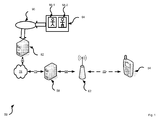
- Figure 1 shows a schematic representation of a system for optimized image rendering.
- Figure 2 shows a schematic representation of the electronic device shown in the system of Figure 1 .
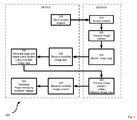
- Figure 3 shows a flow-chart depicting a method for image rendering.
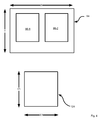
- Figure 4 shows the web-page of Figure 1 and the display of Figure 2 in relation to each other.
- Figure 5 shows exemplary generation of modified image place holders on the display of Figure 2 .
- Figure 6 shows exemplary generation of modified images on the place holders generated in Figure 5 .
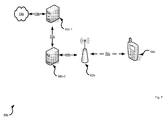
- Figure 7 shows a modified version of the system of Figure 1 .
- system 50 comprises a plurality of a portable electronic device 54 and at least one intermediation server 58.
- a wireless base station 62 interconnects electronic device 54 and intermediation server 58.
- a backhaul link 66 interconnects base station 62 with server 58.
- At least one bearer path 70 typically wireless, can be used to interconnect base station 62 with electronic device 54.
- bearer path 70 can be based on Global System for Mobile communications (GSM), General Packet Radio Service (GPRS), Enhanced Data Rates for GSM Evolution (EDGE), and the Third-generation mobile communication system (3G), Institute of Electrical and Electronic Engineers (IEEE) 802.11 (WiFi) or other wireless protocols.
- GSM Global System for Mobile communications
- GPRS General Packet Radio Service
- EDGE Enhanced Data Rates for GSM Evolution
- 3G Third-generation mobile communication system
- IEEE Institute of Electrical and Electronic Engineers 802.11
- WiFi Worldwide Interoperability for Microwave Access
- Intermediation server 58 is also connected to a network 74 via another backhaul link 78.
- Network 74 can be any type of network that can host content that is accessible to device 54.
- network 74 in the Internet and connects to a web server 82 which connects to network 74 by another backhaul link 86.
- Web server 82 is, in turn, configured to host a web-site 90 that comprises a web-page 94.
- Web-page 94 itself is comprised of a first image 98-1 and a second image 98-2 (collectively, images 98 and generically, image 98), each of which are oriented and sized on web-page 94 in a manner that is optimized for a desktop computing browsing environment.
- electronic device 54 can be any type of computing device that can be used in a self-contained manner and to interact with content available over network 74. Interaction includes displaying of information on electronic device 54 as well as to receive input at electronic device 54 that can in turn be sent back over network 74.
- electronic device 54 is a portable electronic device with the combined functionality of a personal digital assistant, a cell phone, and an email paging device.
- device 54 can include a palm top computer or laptop computer with a reduced screen such as an ASUS EEE from ASUSTek Computer Inc. of Taiwan).
- Many well known cellular telephone models, or variants thereof, are suitable for the present embodiment.
- Device 54 thus includes a plurality of input devices which in a present embodiment includes a keyboard 100, a pointing device 102, and a microphone 104.
- Pointing device 102 can be implemented as a track wheel, trackball or the like. Other input devices, such as a touch screen are also contemplated.
- Input from keyboard 100, pointing device 102 and microphone 104 is received at a processor 108.
- Processor 108 is configured to communicate with a non-volatile storage unit 112 (e.g. Erasable Electronic Programmable Read Only Memory (“EEPROM”), Flash Memory) and a volatile storage unit 116 (e.g. random access memory (“RAM”)).
- EEPROM Erasable Electronic Programmable Read Only Memory
- RAM random access memory
- Programming instructions that implement the functional teachings of device 54 as described herein are typically maintained, persistently, in non-volatile storage unit 112 and used by processor 108 which makes appropriate utilization of volatile storage 116 during the execution of such programming instructions.
- Processor 108 in turn is also configured to control a speaker 120 and a display 124.
- Processor 108 also contains at least one network interface 128, which are implemented in a present embodiment as radios configured to communicate over bearer path 70.
- interface(s) 128 is (are) configured to correspond with the network architecture that defines a particular bearer path 70. It should be understood that in general a wide variety of configurations for device 54 are contemplated.
- device 54 is also configured to maintain a web-browser application 136.
- Web-browser application 136 is maintained within non-volatile storage 112.
- Processor 108 is configured to execute web-browser application 136, receive input from keyboard 100 relative to web-browser application 136, and to generate graphical interfaces on display.
- Processor 108 is further configured to request content from network 74 via a bearer path 70, as will be discussed further below.
- Device 54 also includes a battery 144 or other power supply. Battery 144 provides power to components within device 54.
- Server 58 can be based on any well-known server environment including a module that houses one or more central processing units, volatile memory (e.g. random access memory), persistent memory (e.g. hard disk devices) and network interfaces to allow server 58 to communicate over network 74 and with base station 62.
- server 58 can be a Sun Fire V480 running a UNIX operating system, from Sun Microsystems, Inc. of Palo Alto Calif., and having four central processing units each operating at about nine-hundred megahertz and having about sixteen gigabytes of random access memory.
- this particular server is merely exemplary, and a vast array of other types of computing environments for server 58 is contemplated.
- Server 82 can be based on the same or different computing environment as server 58.
- Block 305 comprises sending a content request from a wireless electronic device, which in turn is received at an intermediation server.
- the request is sent from device 54 to server 58 via bearer path 70, using any appropriate channel on that bearer path 70 that is active at the time the time the request is generated.
- the content request is generated by web-browser application 136 on device 54, which is selecting web-page 94 hosted on web-server 82 connected to network 74.
- server 58 has received the content request from block 305 and accesses the requested content.
- server 58 will access the web-server 82 on network 74 in order to fulfill block 310.
- the content accessed at block 310 is analyzed.
- Such an analysis can include, in the case of web-page 94 includes, for example analyzing location and sizes of images 98 on web-page 94.
- the analysis can include an analysis of IMG tags associated with images 98. Of note is that at block 310, only the IMG tags associated with images 98 need be downloaded to server 58, and images 98 themselves do not need to be downloaded.
- Block 325 comprises adjusting image tags associated with the content accessed at block 310.
- the image tags are adjusted according to the hardware characteristics of device 54.
- Server 58 is thus configured to maintain a data record that includes the hardware characteristics of device 54.
- Such hardware characteristics can be pre-programmed in server 58, or alternatively, device 54 can send such characteristics as part of the content request from block 305.
- Such hardware characteristics can thus include the size of display 124, as well as any other information about device 54 that can be used as part of the teachings herein.
- Figure 4 shows an example of web-page 94 and display 124.
- Web-page 94 includes IMG tags associated with images 98 that specify locations and sizes of each image on the X vs. Y grid of web-page 94.
- Web-page 94 in Figure 4 shows web-page 94 with has having been created for a display having a horizontal dimension of "X" units, and a vertical dimension of "Y” units, while display 124 has a horizontal dimension of "X1" units, which is less than "X", and a vertical dimension of "Y1" units, which is less than "Y”.
- the ratio of X:Y is larger than the ratio of X1:Y1.
- Web-page 94 includes IMG tags associated with images 98 that specify locations and sizes of each image 98 on the X vs. Y grid of web-page 94. It can be seen, however, that display 124 cannot accommodate images 98 in their current dimensions and location.
- server 58 analyzes web-page 94 to determine how generate the dimensions and locations for images 98 in a manner that produces a reasonable facsimile of the original layout of web-page 94 when those images 98 are finally generated on display 124.
- the methodology by which such a determination is made is not particularly limited. Such a methodology can include, by way of non-limiting example, by having server 58 render the page fully by emulating device 54 to determine what layout device 54 would actually require. That is, server 58 can be configured to have the same code as web browser application 136 and other code modules of device 54 so the output on server 58 is substantially the same as on device 54.
- device 54 receives the modified image tags generated at block 325, and at block 335, processor 108, executing browser application 136 begins generating web-page 94 on display 124 using the modified version of the IMG tags received at block 330.
- method 300 is directed to the processing of images 98, but in parallel with method 300, browser application 136 can continue to generate aspects of web-page 94 on display 124 that do not involve images 98 in the usual manner.
- Figure 5 shows exemplary performance of block 330, as place holders for images 98 are shown generated on display 124, but such place holders are generated using the modified version of the IMG tags received at block 330, and therefore the place holders for images 98 are generated on display 124 in locations that differ from web-page 94 as originally stored on server 82.
- web-page 94 can include content other than images 98, (such as text, fillable forms) and such non-image content can also be generated on display 124 in relation to the image place holders.
- Block 340 comprises processing the requested image content using the modified image tags.
- Server 58 can thus transcode images 98 into a format (e.g. size) that conforms with the modified image tags generated at block 325 and ready-for-placement into the image place holders generated at block 335 and shown in Figure 5 .
- Block 345 comprises receiving the modified image content at device 54, and at block 350, processor 108, executing browser application 136 renders the version of images 98 on display 124 using the modified version of images generated at block 340.
- FIG. 7 shows system 50b which is a variation on system 50 and like elements in system 50b include like references to their counterparts in system 50, except followed by the suffix "b".
- server 50 is implemented as a first server 58b-1 and a second server 58b-2, and a link 79b is provided between server 58b-1 and server 58b-2.
- server 58b-1 can be implemented, in a non-limiting example, as an enterprise server, such as a Blackberry Enterprise Server that is hosted and maintained by an enterprise that is associated with device 54b whereas server 58b-2 can be implemented as a relay server such as a Relay Server that is hosted and maintained by a carrier, or a carrier partner such as Research In Motion Inc.
- server 58b-1 can be referred to as a content intermediation server 58-1
- server 58b-2 can be referred to as a transport intermediation server.
- method 300 can be performed by server 58-1 but passing the various communications between device 54b and server 58b-1.
- Such communications can be passed in encrypted form, if desired, by providing a key pair or other encrypting means at server 58b-1 and device 54b, such that communications carried through server 58b-2 are secure.
- type of content need not be limited to web-pages, and can include emails, media, applications, application data, or any other type of content that device 54b can be configured to access from network 74b and which can include pictures with IMG tags.
Landscapes
- Engineering & Computer Science (AREA)
- Databases & Information Systems (AREA)
- Theoretical Computer Science (AREA)
- Data Mining & Analysis (AREA)
- Physics & Mathematics (AREA)
- General Engineering & Computer Science (AREA)
- General Physics & Mathematics (AREA)
- Information Transfer Between Computers (AREA)
Priority Applications (2)
| Application Number | Priority Date | Filing Date | Title |
|---|---|---|---|
| EP09153833A EP2224352A1 (de) | 2009-02-26 | 2009-02-26 | Verfahren, Vorrichtung und System zum Optimieren der Bildaufbereitung in einem elektronischen Gerät |
| CA2693701A CA2693701C (en) | 2009-02-26 | 2010-02-18 | Method, apparatus and system for optimizing image rendering on an electronic device |
Applications Claiming Priority (1)
| Application Number | Priority Date | Filing Date | Title |
|---|---|---|---|
| EP09153833A EP2224352A1 (de) | 2009-02-26 | 2009-02-26 | Verfahren, Vorrichtung und System zum Optimieren der Bildaufbereitung in einem elektronischen Gerät |
Publications (1)
| Publication Number | Publication Date |
|---|---|
| EP2224352A1 true EP2224352A1 (de) | 2010-09-01 |
Family
ID=40888085
Family Applications (1)
| Application Number | Title | Priority Date | Filing Date |
|---|---|---|---|
| EP09153833A Ceased EP2224352A1 (de) | 2009-02-26 | 2009-02-26 | Verfahren, Vorrichtung und System zum Optimieren der Bildaufbereitung in einem elektronischen Gerät |
Country Status (2)
| Country | Link |
|---|---|
| EP (1) | EP2224352A1 (de) |
| CA (1) | CA2693701C (de) |
Cited By (1)
| Publication number | Priority date | Publication date | Assignee | Title |
|---|---|---|---|---|
| EP4471571A4 (de) * | 2022-03-31 | 2025-06-11 | Huawei Technologies Co., Ltd. | Verfahren und system zur verarbeitung von rich-media-informationen und zugehörige vorrichtung |
Citations (2)
| Publication number | Priority date | Publication date | Assignee | Title |
|---|---|---|---|---|
| US5845084A (en) * | 1996-04-18 | 1998-12-01 | Microsoft Corporation | Automatic data display formatting with a networking application |
| EP1122654A2 (de) * | 2000-01-14 | 2001-08-08 | Web TV Networks Inc. | Umformatieren mit Hilfe von modularen Proxy-Servern |
-
2009
- 2009-02-26 EP EP09153833A patent/EP2224352A1/de not_active Ceased
-
2010
- 2010-02-18 CA CA2693701A patent/CA2693701C/en active Active
Patent Citations (2)
| Publication number | Priority date | Publication date | Assignee | Title |
|---|---|---|---|---|
| US5845084A (en) * | 1996-04-18 | 1998-12-01 | Microsoft Corporation | Automatic data display formatting with a networking application |
| EP1122654A2 (de) * | 2000-01-14 | 2001-08-08 | Web TV Networks Inc. | Umformatieren mit Hilfe von modularen Proxy-Servern |
Cited By (1)
| Publication number | Priority date | Publication date | Assignee | Title |
|---|---|---|---|---|
| EP4471571A4 (de) * | 2022-03-31 | 2025-06-11 | Huawei Technologies Co., Ltd. | Verfahren und system zur verarbeitung von rich-media-informationen und zugehörige vorrichtung |
Also Published As
| Publication number | Publication date |
|---|---|
| CA2693701C (en) | 2014-07-22 |
| CA2693701A1 (en) | 2010-08-26 |
Similar Documents
| Publication | Publication Date | Title |
|---|---|---|
| TWI695261B (zh) | 頁面存取的資料處理方法、裝置及電子設備 | |
| US8966177B2 (en) | Method, apparatus and system for optimizing image rendering on an electronic device | |
| CN102438045B (zh) | Web页面的预取方法、系统以及访问web页面的方法 | |
| CN101957842B (zh) | 一种基于WebKit浏览器的网页缓存控制方法、装置及系统 | |
| CN104965848B (zh) | 一种前端资源加载方法及装置 | |
| US10200386B2 (en) | Intelligent web page content blocking | |
| US9906626B2 (en) | Resource demand-based network page generation | |
| JP2019513260A (ja) | サービス実行方法及びデバイス | |
| KR20140096063A (ko) | 브라우저 커널 조정 방법 및 이를 위한 브라우저 | |
| US20220237042A1 (en) | Resource pre-fetch using age threshold | |
| US20130036197A1 (en) | Method and system for a mobile local server | |
| CN112202598A (zh) | 一种日志记录方法及装置 | |
| CN107330087A (zh) | 页面文件生成方法和装置 | |
| CN110209964A (zh) | 一种页面显示方法、装置及设备 | |
| CN111783010A (zh) | 网页空白页面监测方法、装置、终端及存储介质 | |
| CN117349288A (zh) | 基于联机分析处理的数据查询方法、装置和电子设备 | |
| CN112507259A (zh) | 网页加载方法及装置、电子设备、存储介质 | |
| CA2693701C (en) | Method, apparatus and system for optimizing image rendering on an electronic device | |
| US20100153533A1 (en) | Rss channel information provision method and system and portable device using the same | |
| CN115131103A (zh) | 数据处理方法、终端、服务器、电子设备及存储介质 | |
| US20070259676A1 (en) | Method and system for bridging communications between mobile devices and application modules | |
| US11379653B2 (en) | Rendering method for on-demand loading of PDF file on network | |
| KR100749845B1 (ko) | 모바일 액티브 페이지 기능을 제공하는 이동 단말 및 그의무선 인터넷 서비스 제공 방법 | |
| KR101498920B1 (ko) | 오프라인 실행을 위한 웹 페이지 사전 캐싱 시스템 및 방법 | |
| KR101906170B1 (ko) | 클라우드 기반 대용량 데이터 상태 관리를 이용한 그리드 처리 서비스 제공 방법 |
Legal Events
| Date | Code | Title | Description |
|---|---|---|---|
| PUAI | Public reference made under article 153(3) epc to a published international application that has entered the european phase |
Free format text: ORIGINAL CODE: 0009012 |
|
| 17P | Request for examination filed |
Effective date: 20090226 |
|
| AK | Designated contracting states |
Kind code of ref document: A1 Designated state(s): AT BE BG CH CY CZ DE DK EE ES FI FR GB GR HR HU IE IS IT LI LT LU LV MC MK MT NL NO PL PT RO SE SI SK TR |
|
| AX | Request for extension of the european patent |
Extension state: AL BA RS |
|
| 17Q | First examination report despatched |
Effective date: 20101008 |
|
| AKX | Designation fees paid |
Designated state(s): AT BE BG CH CY CZ DE DK EE ES FI FR GB GR HR HU IE IS IT LI LT LU LV MC MK MT NL NO PL PT RO SE SI SK TR |
|
| STAA | Information on the status of an ep patent application or granted ep patent |
Free format text: STATUS: THE APPLICATION HAS BEEN REFUSED |
|
| 18R | Application refused |
Effective date: 20110621 |