EP2223916A1 - Morpholine derivatives as norepinephrine reuptake inhibitors - Google Patents
Morpholine derivatives as norepinephrine reuptake inhibitors Download PDFInfo
- Publication number
- EP2223916A1 EP2223916A1 EP10162865A EP10162865A EP2223916A1 EP 2223916 A1 EP2223916 A1 EP 2223916A1 EP 10162865 A EP10162865 A EP 10162865A EP 10162865 A EP10162865 A EP 10162865A EP 2223916 A1 EP2223916 A1 EP 2223916A1
- Authority
- EP
- European Patent Office
- Prior art keywords
- optionally substituted
- halogen atoms
- alkyl
- mmol
- compound
- Prior art date
- Legal status (The legal status is an assumption and is not a legal conclusion. Google has not performed a legal analysis and makes no representation as to the accuracy of the status listed.)
- Withdrawn
Links
- 150000002780 morpholines Chemical class 0.000 title description 3
- 239000002767 noradrenalin uptake inhibitor Substances 0.000 title description 3
- 229940127221 norepinephrine reuptake inhibitor Drugs 0.000 title description 2
- 150000001875 compounds Chemical class 0.000 claims abstract description 164
- 239000003112 inhibitor Substances 0.000 claims abstract description 22
- SFLSHLFXELFNJZ-QMMMGPOBSA-N (-)-norepinephrine Chemical compound NC[C@H](O)C1=CC=C(O)C(O)=C1 SFLSHLFXELFNJZ-QMMMGPOBSA-N 0.000 claims abstract description 21
- 229960002748 norepinephrine Drugs 0.000 claims abstract description 21
- SFLSHLFXELFNJZ-UHFFFAOYSA-N norepinephrine Natural products NCC(O)C1=CC=C(O)C(O)=C1 SFLSHLFXELFNJZ-UHFFFAOYSA-N 0.000 claims abstract description 21
- 238000000034 method Methods 0.000 claims description 229
- 125000005843 halogen group Chemical group 0.000 claims description 136
- -1 nitro, hydroxy Chemical group 0.000 claims description 98
- 125000000229 (C1-C4)alkoxy group Chemical group 0.000 claims description 65
- 125000004178 (C1-C4) alkyl group Chemical group 0.000 claims description 62
- 238000002360 preparation method Methods 0.000 claims description 57
- 125000001424 substituent group Chemical group 0.000 claims description 56
- 150000003839 salts Chemical class 0.000 claims description 46
- 125000001997 phenyl group Chemical group [H]C1=C([H])C([H])=C(*)C([H])=C1[H] 0.000 claims description 44
- 229910052799 carbon Inorganic materials 0.000 claims description 35
- 125000001153 fluoro group Chemical group F* 0.000 claims description 32
- 125000004414 alkyl thio group Chemical group 0.000 claims description 26
- 125000000753 cycloalkyl group Chemical group 0.000 claims description 23
- 125000004093 cyano group Chemical group *C#N 0.000 claims description 21
- 125000005913 (C3-C6) cycloalkyl group Chemical group 0.000 claims description 20
- 125000004169 (C1-C6) alkyl group Chemical group 0.000 claims description 15
- 125000001797 benzyl group Chemical group [H]C1=C([H])C([H])=C(C([H])=C1[H])C([H])([H])* 0.000 claims description 15
- 125000000217 alkyl group Chemical group 0.000 claims description 13
- 241000124008 Mammalia Species 0.000 claims description 11
- 238000006467 substitution reaction Methods 0.000 claims description 11
- 230000004064 dysfunction Effects 0.000 claims description 10
- 125000001544 thienyl group Chemical group 0.000 claims description 10
- 229910052736 halogen Inorganic materials 0.000 claims description 9
- 150000002367 halogens Chemical class 0.000 claims description 9
- 125000000951 phenoxy group Chemical group [H]C1=C([H])C([H])=C(O*)C([H])=C1[H] 0.000 claims description 9
- 125000004076 pyridyl group Chemical group 0.000 claims description 8
- 125000004769 (C1-C4) alkylsulfonyl group Chemical group 0.000 claims description 7
- 125000001316 cycloalkyl alkyl group Chemical group 0.000 claims description 7
- 125000000000 cycloalkoxy group Chemical group 0.000 claims description 6
- 229910052731 fluorine Inorganic materials 0.000 claims description 6
- 229910052739 hydrogen Inorganic materials 0.000 claims description 6
- 239000008194 pharmaceutical composition Substances 0.000 claims description 6
- 125000006570 (C5-C6) heteroaryl group Chemical group 0.000 claims description 5
- 125000004105 2-pyridyl group Chemical group N1=C([*])C([H])=C([H])C([H])=C1[H] 0.000 claims description 5
- 125000003178 carboxy group Chemical group [H]OC(*)=O 0.000 claims description 5
- 230000008569 process Effects 0.000 claims description 5
- 125000000882 C2-C6 alkenyl group Chemical group 0.000 claims description 4
- 239000003085 diluting agent Substances 0.000 claims description 4
- 239000000546 pharmaceutical excipient Substances 0.000 claims description 4
- 238000002560 therapeutic procedure Methods 0.000 claims description 3
- 125000002887 hydroxy group Chemical group [H]O* 0.000 claims 13
- 238000011282 treatment Methods 0.000 abstract description 40
- 208000037265 diseases, disorders, signs and symptoms Diseases 0.000 abstract description 38
- 208000035475 disorder Diseases 0.000 abstract description 32
- 210000003169 central nervous system Anatomy 0.000 abstract description 5
- 210000001428 peripheral nervous system Anatomy 0.000 abstract description 3
- WYURNTSHIVDZCO-UHFFFAOYSA-N Tetrahydrofuran Chemical compound C1CCOC1 WYURNTSHIVDZCO-UHFFFAOYSA-N 0.000 description 160
- YMWUJEATGCHHMB-UHFFFAOYSA-N Dichloromethane Chemical compound ClCCl YMWUJEATGCHHMB-UHFFFAOYSA-N 0.000 description 143
- 239000000243 solution Substances 0.000 description 119
- 238000004895 liquid chromatography mass spectrometry Methods 0.000 description 115
- RTZKZFJDLAIYFH-UHFFFAOYSA-N Diethyl ether Chemical compound CCOCC RTZKZFJDLAIYFH-UHFFFAOYSA-N 0.000 description 92
- XEKOWRVHYACXOJ-UHFFFAOYSA-N Ethyl acetate Chemical compound CCOC(C)=O XEKOWRVHYACXOJ-UHFFFAOYSA-N 0.000 description 90
- 238000000746 purification Methods 0.000 description 87
- YXFVVABEGXRONW-UHFFFAOYSA-N Toluene Chemical compound CC1=CC=CC=C1 YXFVVABEGXRONW-UHFFFAOYSA-N 0.000 description 84
- OKKJLVBELUTLKV-UHFFFAOYSA-N Methanol Chemical compound OC OKKJLVBELUTLKV-UHFFFAOYSA-N 0.000 description 78
- IMNFDUFMRHMDMM-UHFFFAOYSA-N N-Heptane Chemical compound CCCCCCC IMNFDUFMRHMDMM-UHFFFAOYSA-N 0.000 description 71
- 239000000203 mixture Substances 0.000 description 71
- OKKJLVBELUTLKV-MZCSYVLQSA-N Deuterated methanol Chemical compound [2H]OC([2H])([2H])[2H] OKKJLVBELUTLKV-MZCSYVLQSA-N 0.000 description 68
- 238000004255 ion exchange chromatography Methods 0.000 description 63
- VEXZGXHMUGYJMC-UHFFFAOYSA-N Hydrochloric acid Chemical compound Cl VEXZGXHMUGYJMC-UHFFFAOYSA-N 0.000 description 59
- 238000006243 chemical reaction Methods 0.000 description 58
- 239000003921 oil Substances 0.000 description 46
- 235000019198 oils Nutrition 0.000 description 46
- XLYOFNOQVPJJNP-UHFFFAOYSA-N water Chemical compound O XLYOFNOQVPJJNP-UHFFFAOYSA-N 0.000 description 45
- 229910001868 water Inorganic materials 0.000 description 45
- 238000005160 1H NMR spectroscopy Methods 0.000 description 44
- CSNNHWWHGAXBCP-UHFFFAOYSA-L Magnesium sulfate Chemical compound [Mg+2].[O-][S+2]([O-])([O-])[O-] CSNNHWWHGAXBCP-UHFFFAOYSA-L 0.000 description 44
- 239000002585 base Substances 0.000 description 43
- 206010012289 Dementia Diseases 0.000 description 39
- QOPVNWQGBQYBBP-UHFFFAOYSA-N chloroethyl chloroformate Chemical compound CC(Cl)OC(Cl)=O QOPVNWQGBQYBBP-UHFFFAOYSA-N 0.000 description 38
- 235000019439 ethyl acetate Nutrition 0.000 description 38
- LFQSCWFLJHTTHZ-UHFFFAOYSA-N Ethanol Chemical compound CCO LFQSCWFLJHTTHZ-UHFFFAOYSA-N 0.000 description 37
- 238000003756 stirring Methods 0.000 description 35
- 239000007787 solid Substances 0.000 description 34
- 239000012458 free base Substances 0.000 description 33
- QCQCHGYLTSGIGX-GHXANHINSA-N 4-[[(3ar,5ar,5br,7ar,9s,11ar,11br,13as)-5a,5b,8,8,11a-pentamethyl-3a-[(5-methylpyridine-3-carbonyl)amino]-2-oxo-1-propan-2-yl-4,5,6,7,7a,9,10,11,11b,12,13,13a-dodecahydro-3h-cyclopenta[a]chrysen-9-yl]oxy]-2,2-dimethyl-4-oxobutanoic acid Chemical compound N([C@@]12CC[C@@]3(C)[C@]4(C)CC[C@H]5C(C)(C)[C@@H](OC(=O)CC(C)(C)C(O)=O)CC[C@]5(C)[C@H]4CC[C@@H]3C1=C(C(C2)=O)C(C)C)C(=O)C1=CN=CC(C)=C1 QCQCHGYLTSGIGX-GHXANHINSA-N 0.000 description 32
- 238000004440 column chromatography Methods 0.000 description 31
- 239000002904 solvent Substances 0.000 description 31
- 229960004132 diethyl ether Drugs 0.000 description 30
- 239000003480 eluent Substances 0.000 description 30
- 208000010877 cognitive disease Diseases 0.000 description 29
- BMCDAFXLJLQKMT-UHFFFAOYSA-M Br[Mg]Cc1ccccc1-c1ccccc1 Chemical compound Br[Mg]Cc1ccccc1-c1ccccc1 BMCDAFXLJLQKMT-UHFFFAOYSA-M 0.000 description 28
- 239000012044 organic layer Substances 0.000 description 28
- KFZMGEQAYNKOFK-UHFFFAOYSA-N Isopropanol Chemical compound CC(C)O KFZMGEQAYNKOFK-UHFFFAOYSA-N 0.000 description 27
- 125000004356 hydroxy functional group Chemical group O* 0.000 description 27
- WEVYAHXRMPXWCK-UHFFFAOYSA-N Acetonitrile Chemical compound CC#N WEVYAHXRMPXWCK-UHFFFAOYSA-N 0.000 description 24
- 229940127285 new chemical entity Drugs 0.000 description 24
- 108010001237 Cytochrome P-450 CYP2D6 Proteins 0.000 description 23
- 239000010410 layer Substances 0.000 description 23
- 239000011541 reaction mixture Substances 0.000 description 23
- 230000002829 reductive effect Effects 0.000 description 23
- 102100021704 Cytochrome P450 2D6 Human genes 0.000 description 22
- 206010012218 Delirium Diseases 0.000 description 22
- 229910052943 magnesium sulfate Inorganic materials 0.000 description 22
- MSJYCMSHXTZKQC-UHFFFAOYSA-N (4-benzylmorpholin-2-yl)-(oxan-4-yl)methanone Chemical compound C1N(CC=2C=CC=CC=2)CCOC1C(=O)C1CCOCC1 MSJYCMSHXTZKQC-UHFFFAOYSA-N 0.000 description 20
- PCIVLXNALOYUCZ-UHFFFAOYSA-N 4-benzyl-n-methoxy-n-methylmorpholine-2-carboxamide Chemical compound C1COC(C(=O)N(C)OC)CN1CC1=CC=CC=C1 PCIVLXNALOYUCZ-UHFFFAOYSA-N 0.000 description 20
- IJGRMHOSHXDMSA-UHFFFAOYSA-N Atomic nitrogen Chemical compound N#N IJGRMHOSHXDMSA-UHFFFAOYSA-N 0.000 description 18
- HEDRZPFGACZZDS-MICDWDOJSA-N Trichloro(2H)methane Chemical compound [2H]C(Cl)(Cl)Cl HEDRZPFGACZZDS-MICDWDOJSA-N 0.000 description 18
- 150000001408 amides Chemical class 0.000 description 17
- 125000002496 methyl group Chemical group [H]C([H])([H])* 0.000 description 17
- 239000000126 substance Substances 0.000 description 17
- ZUOUZKKEUPVFJK-UHFFFAOYSA-N diphenyl Chemical group C1=CC=CC=C1C1=CC=CC=C1 ZUOUZKKEUPVFJK-UHFFFAOYSA-N 0.000 description 16
- 235000019341 magnesium sulphate Nutrition 0.000 description 16
- 239000012528 membrane Substances 0.000 description 16
- QTBSBXVTEAMEQO-UHFFFAOYSA-N Acetic acid Chemical compound CC(O)=O QTBSBXVTEAMEQO-UHFFFAOYSA-N 0.000 description 15
- 239000007818 Grignard reagent Substances 0.000 description 15
- QSRRZKPKHJHIRB-UHFFFAOYSA-N methyl 4-[(2,5-dichloro-4-methylthiophen-3-yl)sulfonylamino]-2-hydroxybenzoate Chemical compound C1=C(O)C(C(=O)OC)=CC=C1NS(=O)(=O)C1=C(Cl)SC(Cl)=C1C QSRRZKPKHJHIRB-UHFFFAOYSA-N 0.000 description 15
- 201000000980 schizophrenia Diseases 0.000 description 15
- 125000004432 carbon atom Chemical group C* 0.000 description 14
- 239000003814 drug Substances 0.000 description 14
- JDVADOGJQJZIOJ-UHFFFAOYSA-N ethyl 4-benzylmorpholine-2-carboxylate Chemical compound C1COC(C(=O)OCC)CN1CC1=CC=CC=C1 JDVADOGJQJZIOJ-UHFFFAOYSA-N 0.000 description 14
- 150000004795 grignard reagents Chemical class 0.000 description 14
- 230000005764 inhibitory process Effects 0.000 description 14
- 102000008092 Norepinephrine Plasma Membrane Transport Proteins Human genes 0.000 description 13
- 108010049586 Norepinephrine Plasma Membrane Transport Proteins Proteins 0.000 description 13
- AULUXPOSRBZFMU-UHFFFAOYSA-N 1-(4-benzylmorpholin-2-yl)-2-methylpropan-1-one Chemical compound C1COC(C(=O)C(C)C)CN1CC1=CC=CC=C1 AULUXPOSRBZFMU-UHFFFAOYSA-N 0.000 description 12
- IGQQKWYRVCOMLF-UHFFFAOYSA-N 1-(4-benzylmorpholin-2-yl)-3-methylbutan-1-one Chemical compound C1COC(C(=O)CC(C)C)CN1CC1=CC=CC=C1 IGQQKWYRVCOMLF-UHFFFAOYSA-N 0.000 description 12
- WJDKGRLMNSHPON-UHFFFAOYSA-N 2-(5-fluoro-2-methoxyphenyl)-1-morpholin-2-yl-1-(oxan-4-yl)ethanol;hydrochloride Chemical compound Cl.COC1=CC=C(F)C=C1CC(O)(C1OCCNC1)C1CCOCC1 WJDKGRLMNSHPON-UHFFFAOYSA-N 0.000 description 12
- 208000031091 Amnestic disease Diseases 0.000 description 12
- YWGQTZRPLDPUBG-UHFFFAOYSA-M COc1ccc(F)cc1C[Mg]Br Chemical compound COc1ccc(F)cc1C[Mg]Br YWGQTZRPLDPUBG-UHFFFAOYSA-M 0.000 description 12
- VYPSYNLAJGMNEJ-UHFFFAOYSA-N Silicium dioxide Chemical compound O=[Si]=O VYPSYNLAJGMNEJ-UHFFFAOYSA-N 0.000 description 12
- 239000003153 chemical reaction reagent Substances 0.000 description 12
- 230000004060 metabolic process Effects 0.000 description 12
- 125000000956 methoxy group Chemical group [H]C([H])([H])O* 0.000 description 12
- 239000000725 suspension Substances 0.000 description 12
- YLQBMQCUIZJEEH-UHFFFAOYSA-N tetrahydrofuran Natural products C=1C=COC=1 YLQBMQCUIZJEEH-UHFFFAOYSA-N 0.000 description 12
- YCLHDDDXRIURSR-UHFFFAOYSA-N 1-(4-benzylmorpholin-2-yl)propan-1-one Chemical compound C1COC(C(=O)CC)CN1CC1=CC=CC=C1 YCLHDDDXRIURSR-UHFFFAOYSA-N 0.000 description 11
- 208000006096 Attention Deficit Disorder with Hyperactivity Diseases 0.000 description 11
- CDNHDLHVDILTQE-UHFFFAOYSA-M FC(F)(F)Oc1ccccc1C[Mg]Br Chemical compound FC(F)(F)Oc1ccccc1C[Mg]Br CDNHDLHVDILTQE-UHFFFAOYSA-M 0.000 description 11
- 208000030990 Impulse-control disease Diseases 0.000 description 11
- 239000012074 organic phase Substances 0.000 description 11
- 238000010992 reflux Methods 0.000 description 11
- 208000028017 Psychotic disease Diseases 0.000 description 10
- FAPWRFPIFSIZLT-UHFFFAOYSA-M Sodium chloride Chemical compound [Na+].[Cl-] FAPWRFPIFSIZLT-UHFFFAOYSA-M 0.000 description 10
- 125000000959 isobutyl group Chemical group [H]C([H])([H])C([H])(C([H])([H])[H])C([H])([H])* 0.000 description 10
- 150000002576 ketones Chemical class 0.000 description 10
- 229910052757 nitrogen Inorganic materials 0.000 description 10
- ZTQRHEZGNASFLL-UHFFFAOYSA-N 1-(4-benzylmorpholin-2-yl)-1-cyclopentyl-2-(5-fluoro-2-methoxyphenyl)ethanol Chemical compound COC1=CC=C(F)C=C1CC(O)(C1OCCN(CC=2C=CC=CC=2)C1)C1CCCC1 ZTQRHEZGNASFLL-UHFFFAOYSA-N 0.000 description 9
- VEFUFHUXFCSTLG-UHFFFAOYSA-N 1-(4-benzylmorpholin-2-yl)-5,5,5-trifluoropentan-1-one Chemical compound C1COC(C(=O)CCCC(F)(F)F)CN1CC1=CC=CC=C1 VEFUFHUXFCSTLG-UHFFFAOYSA-N 0.000 description 9
- HYFNBIVNYJGFJD-UHFFFAOYSA-N 1-(4-benzylmorpholin-2-yl)ethanone Chemical compound C1COC(C(=O)C)CN1CC1=CC=CC=C1 HYFNBIVNYJGFJD-UHFFFAOYSA-N 0.000 description 9
- SEXZHJJUKFXNDY-UHFFFAOYSA-N 1-(bromomethyl)-2-phenylbenzene Chemical compound BrCC1=CC=CC=C1C1=CC=CC=C1 SEXZHJJUKFXNDY-UHFFFAOYSA-N 0.000 description 9
- HBAQYPYDRFILMT-UHFFFAOYSA-N 8-[3-(1-cyclopropylpyrazol-4-yl)-1H-pyrazolo[4,3-d]pyrimidin-5-yl]-3-methyl-3,8-diazabicyclo[3.2.1]octan-2-one Chemical class C1(CC1)N1N=CC(=C1)C1=NNC2=C1N=C(N=C2)N1C2C(N(CC1CC2)C)=O HBAQYPYDRFILMT-UHFFFAOYSA-N 0.000 description 9
- 208000036864 Attention deficit/hyperactivity disease Diseases 0.000 description 9
- MFGWOPXJGOCRQC-UHFFFAOYSA-M Fc1ccc(c(C[Mg]Br)c1)-c1ccccc1 Chemical compound Fc1ccc(c(C[Mg]Br)c1)-c1ccccc1 MFGWOPXJGOCRQC-UHFFFAOYSA-M 0.000 description 9
- UIIMBOGNXHQVGW-UHFFFAOYSA-M Sodium bicarbonate Chemical class [Na+].OC([O-])=O UIIMBOGNXHQVGW-UHFFFAOYSA-M 0.000 description 9
- HEMHJVSKTPXQMS-UHFFFAOYSA-M Sodium hydroxide Chemical compound [OH-].[Na+] HEMHJVSKTPXQMS-UHFFFAOYSA-M 0.000 description 9
- 238000003556 assay Methods 0.000 description 9
- 208000015802 attention deficit-hyperactivity disease Diseases 0.000 description 9
- 230000015572 biosynthetic process Effects 0.000 description 9
- 239000012267 brine Substances 0.000 description 9
- PCDHSSHKDZYLLI-UHFFFAOYSA-N butan-1-one Chemical compound CCC[C]=O PCDHSSHKDZYLLI-UHFFFAOYSA-N 0.000 description 9
- 125000001511 cyclopentyl group Chemical group [H]C1([H])C([H])([H])C([H])([H])C([H])(*)C1([H])[H] 0.000 description 9
- 229940079593 drug Drugs 0.000 description 9
- 230000000694 effects Effects 0.000 description 9
- 229940093499 ethyl acetate Drugs 0.000 description 9
- 238000005342 ion exchange Methods 0.000 description 9
- 125000001449 isopropyl group Chemical group [H]C([H])([H])C([H])(*)C([H])([H])[H] 0.000 description 9
- 239000000463 material Substances 0.000 description 9
- 239000000047 product Substances 0.000 description 9
- 108090000623 proteins and genes Proteins 0.000 description 9
- 102000004169 proteins and genes Human genes 0.000 description 9
- 230000004044 response Effects 0.000 description 9
- 229920006395 saturated elastomer Polymers 0.000 description 9
- 238000002821 scintillation proximity assay Methods 0.000 description 9
- HPALAKNZSZLMCH-UHFFFAOYSA-M sodium;chloride;hydrate Chemical compound O.[Na+].[Cl-] HPALAKNZSZLMCH-UHFFFAOYSA-M 0.000 description 9
- 238000012360 testing method Methods 0.000 description 9
- XNYKVMCFIXERIQ-UHFFFAOYSA-N (4-benzylmorpholin-2-yl)-cyclopentylmethanone Chemical compound C1N(CC=2C=CC=CC=2)CCOC1C(=O)C1CCCC1 XNYKVMCFIXERIQ-UHFFFAOYSA-N 0.000 description 8
- 0 *C(*)C(*)(*)C(*)(C1(*)*)OC(*)(*)C(*)(*)*1=C Chemical compound *C(*)C(*)(*)C(*)(C1(*)*)OC(*)(*)C(*)(*)*1=C 0.000 description 8
- PQGXHFXIVPXXTL-UHFFFAOYSA-N 1-(2-ethoxyphenyl)-4-methyl-2-morpholin-2-ylpentan-2-ol Chemical compound CCOC1=CC=CC=C1CC(O)(CC(C)C)C1OCCNC1 PQGXHFXIVPXXTL-UHFFFAOYSA-N 0.000 description 8
- UZKLZXSRFSTCHI-UHFFFAOYSA-N 1-(4-benzylmorpholin-2-yl)pentan-1-one Chemical compound C1COC(C(=O)CCCC)CN1CC1=CC=CC=C1 UZKLZXSRFSTCHI-UHFFFAOYSA-N 0.000 description 8
- HABODMZHBOJJPZ-UHFFFAOYSA-N 1-morpholin-2-yl-1-(oxan-4-yl)-2-(2-phenylphenyl)ethanol;hydrochloride Chemical compound Cl.C1COCCC1C(C1OCCNC1)(O)CC1=CC=CC=C1C1=CC=CC=C1 HABODMZHBOJJPZ-UHFFFAOYSA-N 0.000 description 8
- MLVYOEQOAKQEOY-UHFFFAOYSA-N 4-methyl-2-morpholin-2-yl-1-(2-phenylphenyl)pentan-2-ol;hydrochloride Chemical compound Cl.C1NCCOC1C(O)(CC(C)C)CC1=CC=CC=C1C1=CC=CC=C1 MLVYOEQOAKQEOY-UHFFFAOYSA-N 0.000 description 8
- NLXLAEXVIDQMFP-UHFFFAOYSA-N Ammonia chloride Chemical class [NH4+].[Cl-] NLXLAEXVIDQMFP-UHFFFAOYSA-N 0.000 description 8
- 102000019208 Serotonin Plasma Membrane Transport Proteins Human genes 0.000 description 8
- 108010012996 Serotonin Plasma Membrane Transport Proteins Proteins 0.000 description 8
- 239000002253 acid Substances 0.000 description 8
- 230000000561 anti-psychotic effect Effects 0.000 description 8
- 235000010290 biphenyl Nutrition 0.000 description 8
- 125000001495 ethyl group Chemical group [H]C([H])([H])C([H])([H])* 0.000 description 8
- 125000005842 heteroatom Chemical group 0.000 description 8
- 238000011534 incubation Methods 0.000 description 8
- 239000000543 intermediate Substances 0.000 description 8
- 229910052751 metal Inorganic materials 0.000 description 8
- 239000002184 metal Substances 0.000 description 8
- BDAGIHXWWSANSR-UHFFFAOYSA-N methanoic acid Natural products OC=O BDAGIHXWWSANSR-UHFFFAOYSA-N 0.000 description 8
- KVWDHTXUZHCGIO-UHFFFAOYSA-N olanzapine Chemical compound C1CN(C)CCN1C1=NC2=CC=CC=C2NC2=C1C=C(C)S2 KVWDHTXUZHCGIO-UHFFFAOYSA-N 0.000 description 8
- CTSLXHKWHWQRSH-UHFFFAOYSA-N oxalyl chloride Chemical compound ClC(=O)C(Cl)=O CTSLXHKWHWQRSH-UHFFFAOYSA-N 0.000 description 8
- LOUPRKONTZGTKE-LHHVKLHASA-N quinidine Chemical compound C([C@H]([C@H](C1)C=C)C2)C[N@@]1[C@H]2[C@@H](O)C1=CC=NC2=CC=C(OC)C=C21 LOUPRKONTZGTKE-LHHVKLHASA-N 0.000 description 8
- VJUGODGMYBBPDL-UHFFFAOYSA-N (4-benzylmorpholin-2-yl)-cyclopropylmethanone Chemical compound C1N(CC=2C=CC=CC=2)CCOC1C(=O)C1CC1 VJUGODGMYBBPDL-UHFFFAOYSA-N 0.000 description 7
- WLBUIDLMUDJHES-UHFFFAOYSA-N 1-(5-fluoro-2-methoxyphenyl)-2-morpholin-2-ylbutan-2-ol;hydrochloride Chemical compound Cl.C1NCCOC1C(O)(CC)CC1=CC(F)=CC=C1OC WLBUIDLMUDJHES-UHFFFAOYSA-N 0.000 description 7
- VURGKMHXPJKVAR-UHFFFAOYSA-N 1-(5-fluoro-2-methoxyphenyl)-3-methyl-2-morpholin-2-ylbutan-2-ol;hydrochloride Chemical compound Cl.COC1=CC=C(F)C=C1CC(O)(C(C)C)C1OCCNC1 VURGKMHXPJKVAR-UHFFFAOYSA-N 0.000 description 7
- MAMFEROAGBGGHL-UHFFFAOYSA-N 1-(5-fluoro-2-methoxyphenyl)-4-methyl-2-morpholin-2-ylpentan-2-ol;hydrochloride Chemical compound Cl.COC1=CC=C(F)C=C1CC(O)(CC(C)C)C1OCCNC1 MAMFEROAGBGGHL-UHFFFAOYSA-N 0.000 description 7
- XFHZCCGTBATORJ-UHFFFAOYSA-N 1-(5-fluoro-2-phenylphenyl)-3-methyl-2-morpholin-2-ylbutan-2-ol;hydrochloride Chemical compound Cl.C1NCCOC1C(O)(C(C)C)CC1=CC(F)=CC=C1C1=CC=CC=C1 XFHZCCGTBATORJ-UHFFFAOYSA-N 0.000 description 7
- XNJUOYVJPBCSLZ-UHFFFAOYSA-N 1-(5-fluoro-2-phenylphenyl)-4-methyl-2-morpholin-2-ylpentan-2-ol;hydrochloride Chemical compound Cl.C1NCCOC1C(O)(CC(C)C)CC1=CC(F)=CC=C1C1=CC=CC=C1 XNJUOYVJPBCSLZ-UHFFFAOYSA-N 0.000 description 7
- SYHHFPGENHYARA-UHFFFAOYSA-N 1-cyclopropyl-2-(2-methoxyphenyl)-1-morpholin-2-ylethanol;hydrochloride Chemical compound Cl.COC1=CC=CC=C1CC(O)(C1OCCNC1)C1CC1 SYHHFPGENHYARA-UHFFFAOYSA-N 0.000 description 7
- RNUGVXXASRZIOG-UHFFFAOYSA-N 2-[2-(3-fluorophenyl)phenyl]-1-morpholin-2-yl-1-(oxan-4-yl)ethanol Chemical compound C1COCCC1C(C1OCCNC1)(O)CC1=CC=CC=C1C1=CC=CC(F)=C1 RNUGVXXASRZIOG-UHFFFAOYSA-N 0.000 description 7
- ZWMACCHEPJFGBX-UHFFFAOYSA-N 2-morpholin-2-yl-1-(2-phenylphenyl)butan-2-ol;hydrochloride Chemical compound Cl.C1NCCOC1C(O)(CC)CC1=CC=CC=C1C1=CC=CC=C1 ZWMACCHEPJFGBX-UHFFFAOYSA-N 0.000 description 7
- HQINDAKLOZNDHP-UHFFFAOYSA-N 2-morpholin-2-yl-1-(2-phenylphenyl)propan-2-ol;hydrochloride Chemical compound Cl.C1NCCOC1C(O)(C)CC1=CC=CC=C1C1=CC=CC=C1 HQINDAKLOZNDHP-UHFFFAOYSA-N 0.000 description 7
- SNYGHSBIIGKRLN-UHFFFAOYSA-N 2-morpholin-2-yl-1-[2-(trifluoromethoxy)phenyl]butan-2-ol;hydrochloride Chemical compound Cl.C1NCCOC1C(O)(CC)CC1=CC=CC=C1OC(F)(F)F SNYGHSBIIGKRLN-UHFFFAOYSA-N 0.000 description 7
- VGBUCNKABWIUFC-UHFFFAOYSA-N 3-methyl-2-morpholin-2-yl-1-(2-phenylphenyl)butan-2-ol;hydrochloride Chemical compound Cl.C1NCCOC1C(O)(C(C)C)CC1=CC=CC=C1C1=CC=CC=C1 VGBUCNKABWIUFC-UHFFFAOYSA-N 0.000 description 7
- FTNZCZCDMOQSMD-UHFFFAOYSA-N 3-methyl-2-morpholin-2-yl-1-[2-(trifluoromethoxy)phenyl]butan-2-ol;hydrochloride Chemical compound Cl.C1NCCOC1C(O)(C(C)C)CC1=CC=CC=C1OC(F)(F)F FTNZCZCDMOQSMD-UHFFFAOYSA-N 0.000 description 7
- 239000004215 Carbon black (E152) Substances 0.000 description 7
- 208000028698 Cognitive impairment Diseases 0.000 description 7
- YNAVUWVOSKDBBP-UHFFFAOYSA-N Morpholine Chemical group C1COCCN1 YNAVUWVOSKDBBP-UHFFFAOYSA-N 0.000 description 7
- ZMXDDKWLCZADIW-UHFFFAOYSA-N N,N-Dimethylformamide Chemical compound CN(C)C=O ZMXDDKWLCZADIW-UHFFFAOYSA-N 0.000 description 7
- 238000004296 chiral HPLC Methods 0.000 description 7
- 230000001149 cognitive effect Effects 0.000 description 7
- 125000001559 cyclopropyl group Chemical group [H]C1([H])C([H])([H])C1([H])* 0.000 description 7
- VYFYYTLLBUKUHU-UHFFFAOYSA-N dopamine Chemical compound NCCC1=CC=C(O)C(O)=C1 VYFYYTLLBUKUHU-UHFFFAOYSA-N 0.000 description 7
- 150000002148 esters Chemical class 0.000 description 7
- UOPCLXMXVWVQEL-UHFFFAOYSA-N hexan-2-ol hydrochloride Chemical compound CCCCC(C)O.Cl UOPCLXMXVWVQEL-UHFFFAOYSA-N 0.000 description 7
- 229930195733 hydrocarbon Natural products 0.000 description 7
- VLKZOEOYAKHREP-UHFFFAOYSA-N n-Hexane Chemical compound CCCCCC VLKZOEOYAKHREP-UHFFFAOYSA-N 0.000 description 7
- 229960005017 olanzapine Drugs 0.000 description 7
- 230000002085 persistent effect Effects 0.000 description 7
- 238000010791 quenching Methods 0.000 description 7
- 125000001412 tetrahydropyranyl group Chemical group 0.000 description 7
- ZUKNFPKHGRUQHF-UHFFFAOYSA-N (4-benzylmorpholin-2-yl)-morpholin-4-ylmethanone;hydrochloride Chemical compound Cl.C1COCCN1C(=O)C(OCC1)CN1CC1=CC=CC=C1 ZUKNFPKHGRUQHF-UHFFFAOYSA-N 0.000 description 6
- JZEUGRURZZECAL-UHFFFAOYSA-N 1-(2-chloro-6-fluorophenyl)-4-methyl-2-morpholin-2-ylpentan-2-ol;hydrochloride Chemical compound Cl.C1NCCOC1C(O)(CC(C)C)CC1=C(F)C=CC=C1Cl JZEUGRURZZECAL-UHFFFAOYSA-N 0.000 description 6
- RCUPCTCOJZMFRH-UHFFFAOYSA-N 1-(2-chlorophenyl)-4-methyl-2-morpholin-2-ylpentan-2-ol;hydrochloride Chemical compound Cl.C1NCCOC1C(O)(CC(C)C)CC1=CC=CC=C1Cl RCUPCTCOJZMFRH-UHFFFAOYSA-N 0.000 description 6
- OUWTVXLCWAQEBI-UHFFFAOYSA-N 1-(4-benzylmorpholin-2-yl)-2-[2-(3-fluorophenyl)phenyl]-1-(oxan-4-yl)ethanol Chemical compound C1COCCC1C(C1OCCN(CC=2C=CC=CC=2)C1)(O)CC1=CC=CC=C1C1=CC=CC(F)=C1 OUWTVXLCWAQEBI-UHFFFAOYSA-N 0.000 description 6
- ATULQRLIZPNOAB-UHFFFAOYSA-N 1-cyclopentyl-1-morpholin-2-yl-2-(2-phenylphenyl)ethanol;hydrochloride Chemical compound Cl.C1CCCC1C(C1OCCNC1)(O)CC1=CC=CC=C1C1=CC=CC=C1 ATULQRLIZPNOAB-UHFFFAOYSA-N 0.000 description 6
- VXQPVLQECIVHIQ-UHFFFAOYSA-N 1-cyclopentyl-1-morpholin-2-yl-2-[2-(trifluoromethoxy)phenyl]ethanol;hydrochloride Chemical compound Cl.C1CCCC1C(C1OCCNC1)(O)CC1=CC=CC=C1OC(F)(F)F VXQPVLQECIVHIQ-UHFFFAOYSA-N 0.000 description 6
- BEJQSVLQPLANQB-UHFFFAOYSA-N 1-cyclopentyl-2-(2-ethoxyphenyl)-1-morpholin-2-ylethanol;hydrochloride Chemical compound Cl.CCOC1=CC=CC=C1CC(O)(C1OCCNC1)C1CCCC1 BEJQSVLQPLANQB-UHFFFAOYSA-N 0.000 description 6
- WSSSOSOSQVWKOX-UHFFFAOYSA-N 1-cyclopentyl-2-(5-fluoro-2-methoxyphenyl)-1-morpholin-2-ylethanol;hydrochloride Chemical compound Cl.COC1=CC=C(F)C=C1CC(O)(C1OCCNC1)C1CCCC1 WSSSOSOSQVWKOX-UHFFFAOYSA-N 0.000 description 6
- CKYUTQPQYSFETG-UHFFFAOYSA-N 1-cyclopentyl-2-(5-fluoro-2-phenylphenyl)-1-morpholin-2-ylethanol;hydrochloride Chemical compound Cl.C1CCCC1C(C1OCCNC1)(O)CC1=CC(F)=CC=C1C1=CC=CC=C1 CKYUTQPQYSFETG-UHFFFAOYSA-N 0.000 description 6
- PEQMAERPUOBHNP-UHFFFAOYSA-N 1-cyclopropyl-1-morpholin-2-yl-2-(2-phenylphenyl)ethanol;hydrochloride Chemical compound Cl.C1CC1C(C1OCCNC1)(O)CC1=CC=CC=C1C1=CC=CC=C1 PEQMAERPUOBHNP-UHFFFAOYSA-N 0.000 description 6
- PHDSLGRYQQJDGA-UHFFFAOYSA-N 1-cyclopropyl-2-(2-ethoxyphenyl)-1-morpholin-2-ylethanol;hydrochloride Chemical compound Cl.CCOC1=CC=CC=C1CC(O)(C1OCCNC1)C1CC1 PHDSLGRYQQJDGA-UHFFFAOYSA-N 0.000 description 6
- QEGAEIJJNROSPD-UHFFFAOYSA-N 1-morpholin-2-yl-1-(oxan-4-yl)-2-[2-(trifluoromethoxy)phenyl]ethanol;hydrochloride Chemical compound Cl.C1COCCC1C(C1OCCNC1)(O)CC1=CC=CC=C1OC(F)(F)F QEGAEIJJNROSPD-UHFFFAOYSA-N 0.000 description 6
- FGAPPBHYCMIOAT-UHFFFAOYSA-N 2-(4-benzylmorpholin-2-yl)-1-(2-chlorophenyl)-4-methylpentan-2-ol Chemical compound C1N(CC=2C=CC=CC=2)CCOC1C(O)(CC(C)C)CC1=CC=CC=C1Cl FGAPPBHYCMIOAT-UHFFFAOYSA-N 0.000 description 6
- QFYJYWIJJNXAQV-UHFFFAOYSA-N 2-(4-benzylmorpholin-2-yl)-1-(5-fluoro-2-methoxyphenyl)-3-methylbutan-2-ol Chemical compound COC1=CC=C(F)C=C1CC(O)(C(C)C)C1OCCN(CC=2C=CC=CC=2)C1 QFYJYWIJJNXAQV-UHFFFAOYSA-N 0.000 description 6
- SGJRPAQJRUHXDO-UHFFFAOYSA-N 2-(4-benzylmorpholin-2-yl)-3-methyl-1-[2-(trifluoromethoxy)phenyl]butan-2-ol Chemical compound C1N(CC=2C=CC=CC=2)CCOC1C(O)(C(C)C)CC1=CC=CC=C1OC(F)(F)F SGJRPAQJRUHXDO-UHFFFAOYSA-N 0.000 description 6
- GTYMTYBCXVOBBB-UHFFFAOYSA-N 2-(tert-butylamino)-1-[7-(1-hydroxyethyl)-1-benzofuran-2-yl]ethanol Chemical compound CC(O)C1=CC=CC2=C1OC(C(O)CNC(C)(C)C)=C2 GTYMTYBCXVOBBB-UHFFFAOYSA-N 0.000 description 6
- QKNYBSVHEMOAJP-UHFFFAOYSA-N 2-amino-2-(hydroxymethyl)propane-1,3-diol;hydron;chloride Chemical compound Cl.OCC(N)(CO)CO QKNYBSVHEMOAJP-UHFFFAOYSA-N 0.000 description 6
- HZQFXEUHQBSSBD-UHFFFAOYSA-N 2-morpholin-4-yl-1-(2-phenylphenyl)hexan-2-ol;hydrochloride Chemical compound Cl.C1COCCN1C(O)(CCCC)CC1=CC=CC=C1C1=CC=CC=C1 HZQFXEUHQBSSBD-UHFFFAOYSA-N 0.000 description 6
- PXAJALSKRUHGJR-UHFFFAOYSA-N 4-benzylmorpholin-3-one Chemical compound O=C1COCCN1CC1=CC=CC=C1 PXAJALSKRUHGJR-UHFFFAOYSA-N 0.000 description 6
- AJJCCIIUHBZKMF-UHFFFAOYSA-N 5,5,5-trifluoro-1-(5-fluoro-2-methoxyphenyl)-2-morpholin-2-ylpentan-2-ol Chemical compound COC1=CC=C(F)C=C1CC(O)(CCC(F)(F)F)C1OCCNC1 AJJCCIIUHBZKMF-UHFFFAOYSA-N 0.000 description 6
- 201000004810 Vascular dementia Diseases 0.000 description 6
- 239000012131 assay buffer Substances 0.000 description 6
- 230000003542 behavioural effect Effects 0.000 description 6
- 230000027455 binding Effects 0.000 description 6
- 239000003795 chemical substances by application Substances 0.000 description 6
- HPNMFZURTQLUMO-UHFFFAOYSA-N diethylamine Chemical compound CCNCC HPNMFZURTQLUMO-UHFFFAOYSA-N 0.000 description 6
- 201000010099 disease Diseases 0.000 description 6
- 150000003840 hydrochlorides Chemical class 0.000 description 6
- ZCSHNCUQKCANBX-UHFFFAOYSA-N lithium diisopropylamide Chemical compound [Li+].CC(C)[N-]C(C)C ZCSHNCUQKCANBX-UHFFFAOYSA-N 0.000 description 6
- 150000002739 metals Chemical class 0.000 description 6
- 230000000171 quenching effect Effects 0.000 description 6
- 238000000926 separation method Methods 0.000 description 6
- QZAYGJVTTNCVMB-UHFFFAOYSA-N serotonin Chemical group C1=C(O)C=C2C(CCN)=CNC2=C1 QZAYGJVTTNCVMB-UHFFFAOYSA-N 0.000 description 6
- 241000894007 species Species 0.000 description 6
- 239000000758 substrate Substances 0.000 description 6
- 125000000876 trifluoromethoxy group Chemical group FC(F)(F)O* 0.000 description 6
- UOTHLBFLCFJIHK-UHFFFAOYSA-N 1-(2-methoxyphenyl)-2-morpholin-2-ylhexan-2-ol;hydrochloride Chemical compound Cl.C1NCCOC1C(O)(CCCC)CC1=CC=CC=C1OC UOTHLBFLCFJIHK-UHFFFAOYSA-N 0.000 description 5
- JQRAFSRZJYEWDA-UHFFFAOYSA-N 1-(4-benzylmorpholin-2-yl)-1-(oxan-4-yl)-2-[2-(trifluoromethoxy)phenyl]ethanol Chemical compound C1COCCC1C(C1OCCN(CC=2C=CC=CC=2)C1)(O)CC1=CC=CC=C1OC(F)(F)F JQRAFSRZJYEWDA-UHFFFAOYSA-N 0.000 description 5
- UCJVDRJJVIMFEU-UHFFFAOYSA-N 1-(4-benzylmorpholin-2-yl)-1-cyclopentyl-2-(2-ethoxyphenyl)ethanol Chemical compound CCOC1=CC=CC=C1CC(O)(C1OCCN(CC=2C=CC=CC=2)C1)C1CCCC1 UCJVDRJJVIMFEU-UHFFFAOYSA-N 0.000 description 5
- ZODCHZKREDSMMJ-UHFFFAOYSA-N 1-(4-benzylmorpholin-2-yl)-1-cyclopentyl-2-(2-phenylphenyl)ethanol Chemical compound C1CCCC1C(C1OCCN(CC=2C=CC=CC=2)C1)(O)CC1=CC=CC=C1C1=CC=CC=C1 ZODCHZKREDSMMJ-UHFFFAOYSA-N 0.000 description 5
- RVEZKBGHHPGZMS-UHFFFAOYSA-N 1-(4-benzylmorpholin-2-yl)-1-cyclopropyl-2-(2-methoxyphenyl)ethanol Chemical compound COC1=CC=CC=C1CC(O)(C1OCCN(CC=2C=CC=CC=2)C1)C1CC1 RVEZKBGHHPGZMS-UHFFFAOYSA-N 0.000 description 5
- BUOGWYDBOHFTAG-UHFFFAOYSA-N 1-(4-benzylmorpholin-2-yl)-2-(5-fluoro-2-methoxyphenyl)-1-(oxan-4-yl)ethanol;hydrochloride Chemical compound Cl.COC1=CC=C(F)C=C1CC(O)(C1OCCN(CC=2C=CC=CC=2)C1)C1CCOCC1 BUOGWYDBOHFTAG-UHFFFAOYSA-N 0.000 description 5
- UNEKQDSMKFLNOG-UHFFFAOYSA-N 2-(4-benzylmorpholin-2-yl)-1-(2-methoxyphenyl)-3-methylbutan-2-ol Chemical compound COC1=CC=CC=C1CC(O)(C(C)C)C1OCCN(CC=2C=CC=CC=2)C1 UNEKQDSMKFLNOG-UHFFFAOYSA-N 0.000 description 5
- DWXCHNYUPAYYOX-UHFFFAOYSA-N 2-(4-benzylmorpholin-2-yl)-1-(2-methoxyphenyl)hexan-2-ol Chemical compound C1N(CC=2C=CC=CC=2)CCOC1C(O)(CCCC)CC1=CC=CC=C1OC DWXCHNYUPAYYOX-UHFFFAOYSA-N 0.000 description 5
- OBJORGFJMXTTDV-UHFFFAOYSA-N 2-(4-benzylmorpholin-2-yl)-1-(2-phenylphenyl)hexan-2-ol Chemical compound C1N(CC=2C=CC=CC=2)CCOC1C(O)(CCCC)CC1=CC=CC=C1C1=CC=CC=C1 OBJORGFJMXTTDV-UHFFFAOYSA-N 0.000 description 5
- ADYSLMOSOZVNKT-UHFFFAOYSA-N 2-(4-benzylmorpholin-2-yl)-1-(5-fluoro-2-methoxyphenyl)-4-methylpentan-2-ol Chemical compound COC1=CC=C(F)C=C1CC(O)(CC(C)C)C1OCCN(CC=2C=CC=CC=2)C1 ADYSLMOSOZVNKT-UHFFFAOYSA-N 0.000 description 5
- PLYZMTOTOIEMMP-UHFFFAOYSA-N 2-(4-benzylmorpholin-2-yl)-1-(5-fluoro-2-methoxyphenyl)butan-2-ol Chemical compound C1N(CC=2C=CC=CC=2)CCOC1C(O)(CC)CC1=CC(F)=CC=C1OC PLYZMTOTOIEMMP-UHFFFAOYSA-N 0.000 description 5
- VVZUPZIAACYYKJ-UHFFFAOYSA-N 2-(4-benzylmorpholin-2-yl)-4-methyl-1-(2-phenylphenyl)pentan-2-ol Chemical compound C1N(CC=2C=CC=CC=2)CCOC1C(O)(CC(C)C)CC1=CC=CC=C1C1=CC=CC=C1 VVZUPZIAACYYKJ-UHFFFAOYSA-N 0.000 description 5
- IRMSYEUIRRDSBR-UHFFFAOYSA-N 2-(4-benzylmorpholin-2-yl)-5,5,5-trifluoro-1-[2-(trifluoromethoxy)phenyl]pentan-2-ol Chemical compound C1N(CC=2C=CC=CC=2)CCOC1C(CCC(F)(F)F)(O)CC1=CC=CC=C1OC(F)(F)F IRMSYEUIRRDSBR-UHFFFAOYSA-N 0.000 description 5
- LSQDANIHAOQDHS-UHFFFAOYSA-N 4-methyl-2-morpholin-2-yl-1-[2-(trifluoromethoxy)phenyl]pentan-2-ol;hydrochloride Chemical compound Cl.C1NCCOC1C(O)(CC(C)C)CC1=CC=CC=C1OC(F)(F)F LSQDANIHAOQDHS-UHFFFAOYSA-N 0.000 description 5
- QJNNUNXWAJGWLI-UHFFFAOYSA-N 5,5,5-trifluoro-2-morpholin-2-yl-1-[2-(trifluoromethoxy)phenyl]pentan-2-ol;hydrochloride Chemical compound Cl.C1NCCOC1C(CCC(F)(F)F)(O)CC1=CC=CC=C1OC(F)(F)F QJNNUNXWAJGWLI-UHFFFAOYSA-N 0.000 description 5
- 208000024827 Alzheimer disease Diseases 0.000 description 5
- 208000020925 Bipolar disease Diseases 0.000 description 5
- 108010044266 Dopamine Plasma Membrane Transport Proteins Chemical group 0.000 description 5
- 102000006441 Dopamine Plasma Membrane Transport Proteins Human genes 0.000 description 5
- FYYHWMGAXLPEAU-UHFFFAOYSA-N Magnesium Chemical compound [Mg] FYYHWMGAXLPEAU-UHFFFAOYSA-N 0.000 description 5
- KDLHZDBZIXYQEI-UHFFFAOYSA-N Palladium Chemical compound [Pd] KDLHZDBZIXYQEI-UHFFFAOYSA-N 0.000 description 5
- CDBYLPFSWZWCQE-UHFFFAOYSA-L Sodium Carbonate Chemical compound [Na+].[Na+].[O-]C([O-])=O CDBYLPFSWZWCQE-UHFFFAOYSA-L 0.000 description 5
- 208000027520 Somatoform disease Diseases 0.000 description 5
- 150000001412 amines Chemical class 0.000 description 5
- 239000000872 buffer Substances 0.000 description 5
- 210000004027 cell Anatomy 0.000 description 5
- 230000007278 cognition impairment Effects 0.000 description 5
- JWHHRCRQHDEWSU-UHFFFAOYSA-N hexan-2-ol Chemical compound [CH2]CCCC(C)O JWHHRCRQHDEWSU-UHFFFAOYSA-N 0.000 description 5
- 239000005457 ice water Substances 0.000 description 5
- 125000004312 morpholin-2-yl group Chemical group [H]N1C([H])([H])C([H])([H])OC([H])(*)C1([H])[H] 0.000 description 5
- 125000004108 n-butyl group Chemical group [H]C([H])([H])C([H])([H])C([H])([H])C([H])([H])* 0.000 description 5
- 239000002858 neurotransmitter agent Substances 0.000 description 5
- 239000012299 nitrogen atmosphere Substances 0.000 description 5
- 230000000966 norepinephrine reuptake Effects 0.000 description 5
- 239000012071 phase Substances 0.000 description 5
- LPNYRYFBWFDTMA-UHFFFAOYSA-N potassium tert-butoxide Chemical compound [K+].CC(C)(C)[O-] LPNYRYFBWFDTMA-UHFFFAOYSA-N 0.000 description 5
- 238000004237 preparative chromatography Methods 0.000 description 5
- 238000000159 protein binding assay Methods 0.000 description 5
- 150000003254 radicals Chemical class 0.000 description 5
- MEZLKOACVSPNER-GFCCVEGCSA-N selegiline Chemical compound C#CCN(C)[C@H](C)CC1=CC=CC=C1 MEZLKOACVSPNER-GFCCVEGCSA-N 0.000 description 5
- 239000011780 sodium chloride Substances 0.000 description 5
- 230000000946 synaptic effect Effects 0.000 description 5
- 238000003786 synthesis reaction Methods 0.000 description 5
- 125000000999 tert-butyl group Chemical group [H]C([H])([H])C(*)(C([H])([H])[H])C([H])([H])[H] 0.000 description 5
- MIXKOCBGTXYXIY-UHFFFAOYSA-N (4-benzylmorpholin-2-yl)-cyclopropylmethanol Chemical compound C1N(CC=2C=CC=CC=2)CCOC1C(O)C1CC1 MIXKOCBGTXYXIY-UHFFFAOYSA-N 0.000 description 4
- QLAZYIBQKNYPQW-UHFFFAOYSA-N 1,3-bis(2-methoxyphenyl)-2-morpholin-2-ylpropan-2-ol;hydrochloride Chemical compound Cl.COC1=CC=CC=C1CC(O)(C1OCCNC1)CC1=CC=CC=C1OC QLAZYIBQKNYPQW-UHFFFAOYSA-N 0.000 description 4
- AXTUOBRWMIVISN-UHFFFAOYSA-N 1-(2-ethoxyphenyl)-3-methyl-2-morpholin-2-ylbutan-2-ol;hydrochloride Chemical compound Cl.CCOC1=CC=CC=C1CC(O)(C(C)C)C1OCCNC1 AXTUOBRWMIVISN-UHFFFAOYSA-N 0.000 description 4
- QOLYQHKFAOHDCV-UHFFFAOYSA-N 1-(4-benzylmorpholin-2-yl)-1-cyclopropyl-2-(2-phenylphenyl)ethanol Chemical compound C1CC1C(C1OCCN(CC=2C=CC=CC=2)C1)(O)CC1=CC=CC=C1C1=CC=CC=C1 QOLYQHKFAOHDCV-UHFFFAOYSA-N 0.000 description 4
- PVHVTWWUJFDJQR-UHFFFAOYSA-N 2-(4-benzylmorpholin-2-yl)-1-(2-chloro-6-fluorophenyl)-4-methylpentan-2-ol Chemical compound C1N(CC=2C=CC=CC=2)CCOC1C(O)(CC(C)C)CC1=C(F)C=CC=C1Cl PVHVTWWUJFDJQR-UHFFFAOYSA-N 0.000 description 4
- RNOASGTXOSGNAX-UHFFFAOYSA-N 2-(4-benzylmorpholin-2-yl)-5,5,5-trifluoro-1-(2-phenylphenyl)pentan-2-ol Chemical compound C1N(CC=2C=CC=CC=2)CCOC1C(CCC(F)(F)F)(O)CC1=CC=CC=C1C1=CC=CC=C1 RNOASGTXOSGNAX-UHFFFAOYSA-N 0.000 description 4
- CHTPFNAXWUWZRY-UHFFFAOYSA-N 2-(4-benzylmorpholin-2-yl)-5,5,5-trifluoro-1-(5-fluoro-2-methoxyphenyl)pentan-2-ol Chemical compound COC1=CC=C(F)C=C1CC(O)(CCC(F)(F)F)C1OCCN(CC=2C=CC=CC=2)C1 CHTPFNAXWUWZRY-UHFFFAOYSA-N 0.000 description 4
- CRMWSVLMHDMHPR-UHFFFAOYSA-N 2-(bromomethyl)-4-fluoro-1-phenylbenzene Chemical compound BrCC1=CC(F)=CC=C1C1=CC=CC=C1 CRMWSVLMHDMHPR-UHFFFAOYSA-N 0.000 description 4
- OYUNTGBISCIYPW-UHFFFAOYSA-N 2-chloroprop-2-enenitrile Chemical compound ClC(=C)C#N OYUNTGBISCIYPW-UHFFFAOYSA-N 0.000 description 4
- OSWFIVFLDKOXQC-UHFFFAOYSA-N 4-(3-methoxyphenyl)aniline Chemical compound COC1=CC=CC(C=2C=CC(N)=CC=2)=C1 OSWFIVFLDKOXQC-UHFFFAOYSA-N 0.000 description 4
- FFNLJMQZQVJRDG-UHFFFAOYSA-N 4-benzyl-2-[cyclopropyl(hydroxy)methyl]morpholin-3-one Chemical compound O1CCN(CC=2C=CC=CC=2)C(=O)C1C(O)C1CC1 FFNLJMQZQVJRDG-UHFFFAOYSA-N 0.000 description 4
- NAWYNSSXFPEQKE-UHFFFAOYSA-N 4-benzylmorpholine-2-carbonitrile Chemical compound C1COC(C#N)CN1CC1=CC=CC=C1 NAWYNSSXFPEQKE-UHFFFAOYSA-N 0.000 description 4
- CEDXMALCJZSQHA-UHFFFAOYSA-N 4-benzylmorpholine-2-carboxylic acid;hydrochloride Chemical compound Cl.C1COC(C(=O)O)CN1CC1=CC=CC=C1 CEDXMALCJZSQHA-UHFFFAOYSA-N 0.000 description 4
- DHRSKOBIDIDMJZ-UHFFFAOYSA-N 4-chlorooxane Chemical compound ClC1CCOCC1 DHRSKOBIDIDMJZ-UHFFFAOYSA-N 0.000 description 4
- PSFBOVLTEYEYOR-UHFFFAOYSA-N 5,5,5-trifluoro-2-morpholin-2-yl-1-(2-phenylphenyl)pentan-2-ol;hydrochloride Chemical compound Cl.C1NCCOC1C(CCC(F)(F)F)(O)CC1=CC=CC=C1C1=CC=CC=C1 PSFBOVLTEYEYOR-UHFFFAOYSA-N 0.000 description 4
- SCDAVFRHPWXLDP-UHFFFAOYSA-N 6,6,6-trifluoro-1-(5-fluoro-2-methoxyphenyl)-2-morpholin-2-ylhexan-2-ol;hydrochloride Chemical compound Cl.COC1=CC=C(F)C=C1CC(O)(CCCC(F)(F)F)C1OCCNC1 SCDAVFRHPWXLDP-UHFFFAOYSA-N 0.000 description 4
- 208000019901 Anxiety disease Diseases 0.000 description 4
- 108010078791 Carrier Proteins Proteins 0.000 description 4
- HEDRZPFGACZZDS-UHFFFAOYSA-N Chloroform Chemical compound ClC(Cl)Cl HEDRZPFGACZZDS-UHFFFAOYSA-N 0.000 description 4
- XDTMQSROBMDMFD-UHFFFAOYSA-N Cyclohexane Chemical compound C1CCCCC1 XDTMQSROBMDMFD-UHFFFAOYSA-N 0.000 description 4
- 208000026331 Disruptive, Impulse Control, and Conduct disease Diseases 0.000 description 4
- 102000004190 Enzymes Human genes 0.000 description 4
- 108090000790 Enzymes Proteins 0.000 description 4
- 206010026749 Mania Diseases 0.000 description 4
- 206010028980 Neoplasm Diseases 0.000 description 4
- 208000018737 Parkinson disease Diseases 0.000 description 4
- DKGAVHZHDRPRBM-UHFFFAOYSA-N Tert-Butanol Chemical compound CC(C)(C)O DKGAVHZHDRPRBM-UHFFFAOYSA-N 0.000 description 4
- 239000004480 active ingredient Substances 0.000 description 4
- 238000013019 agitation Methods 0.000 description 4
- VZTDIZULWFCMLS-UHFFFAOYSA-N ammonium formate Chemical compound [NH4+].[O-]C=O VZTDIZULWFCMLS-UHFFFAOYSA-N 0.000 description 4
- 238000004458 analytical method Methods 0.000 description 4
- 239000002249 anxiolytic agent Substances 0.000 description 4
- 230000000949 anxiolytic effect Effects 0.000 description 4
- 239000003693 atypical antipsychotic agent Substances 0.000 description 4
- 229940127236 atypical antipsychotics Drugs 0.000 description 4
- 238000004587 chromatography analysis Methods 0.000 description 4
- LOUPRKONTZGTKE-UHFFFAOYSA-N cinchonine Natural products C1C(C(C2)C=C)CCN2C1C(O)C1=CC=NC2=CC=C(OC)C=C21 LOUPRKONTZGTKE-UHFFFAOYSA-N 0.000 description 4
- ZPUCINDJVBIVPJ-LJISPDSOSA-N cocaine Chemical compound O([C@H]1C[C@@H]2CC[C@@H](N2C)[C@H]1C(=O)OC)C(=O)C1=CC=CC=C1 ZPUCINDJVBIVPJ-LJISPDSOSA-N 0.000 description 4
- 238000002425 crystallisation Methods 0.000 description 4
- 230000008025 crystallization Effects 0.000 description 4
- 230000006735 deficit Effects 0.000 description 4
- 238000001514 detection method Methods 0.000 description 4
- ADEBPBSSDYVVLD-UHFFFAOYSA-N donepezil Chemical compound O=C1C=2C=C(OC)C(OC)=CC=2CC1CC(CC1)CCN1CC1=CC=CC=C1 ADEBPBSSDYVVLD-UHFFFAOYSA-N 0.000 description 4
- 229940088598 enzyme Drugs 0.000 description 4
- 239000000706 filtrate Substances 0.000 description 4
- 239000006260 foam Substances 0.000 description 4
- 235000019253 formic acid Nutrition 0.000 description 4
- 230000000147 hypnotic effect Effects 0.000 description 4
- 201000003723 learning disability Diseases 0.000 description 4
- 238000004811 liquid chromatography Methods 0.000 description 4
- 239000011777 magnesium Substances 0.000 description 4
- 238000004519 manufacturing process Methods 0.000 description 4
- 238000004949 mass spectrometry Methods 0.000 description 4
- 230000003228 microsomal effect Effects 0.000 description 4
- 229910000069 nitrogen hydride Inorganic materials 0.000 description 4
- YBYRMVIVWMBXKQ-UHFFFAOYSA-N phenylmethanesulfonyl fluoride Chemical compound FS(=O)(=O)CC1=CC=CC=C1 YBYRMVIVWMBXKQ-UHFFFAOYSA-N 0.000 description 4
- 238000003752 polymerase chain reaction Methods 0.000 description 4
- BWHMMNNQKKPAPP-UHFFFAOYSA-L potassium carbonate Chemical compound [K+].[K+].[O-]C([O-])=O BWHMMNNQKKPAPP-UHFFFAOYSA-L 0.000 description 4
- 239000002244 precipitate Substances 0.000 description 4
- 208000020016 psychiatric disease Diseases 0.000 description 4
- 229960001404 quinidine Drugs 0.000 description 4
- 230000009467 reduction Effects 0.000 description 4
- 239000000932 sedative agent Substances 0.000 description 4
- 230000001624 sedative effect Effects 0.000 description 4
- 208000011580 syndromic disease Diseases 0.000 description 4
- FYSNRJHAOHDILO-UHFFFAOYSA-N thionyl chloride Chemical compound ClS(Cl)=O FYSNRJHAOHDILO-UHFFFAOYSA-N 0.000 description 4
- 125000002023 trifluoromethyl group Chemical group FC(F)(F)* 0.000 description 4
- 125000002221 trityl group Chemical group [H]C1=C([H])C([H])=C([H])C([H])=C1C([*])(C1=C(C(=C(C(=C1[H])[H])[H])[H])[H])C1=C([H])C([H])=C([H])C([H])=C1[H] 0.000 description 4
- SSEBTPPFLLCUMN-CYBMUJFWSA-N (1r)-2-(tert-butylamino)-1-(7-ethyl-1-benzofuran-2-yl)ethanol Chemical compound CCC1=CC=CC2=C1OC([C@H](O)CNC(C)(C)C)=C2 SSEBTPPFLLCUMN-CYBMUJFWSA-N 0.000 description 3
- IWYDHOAUDWTVEP-SSDOTTSWSA-N (R)-mandelic acid Chemical compound OC(=O)[C@H](O)C1=CC=CC=C1 IWYDHOAUDWTVEP-SSDOTTSWSA-N 0.000 description 3
- KWTSXDURSIMDCE-QMMMGPOBSA-N (S)-amphetamine Chemical compound C[C@H](N)CC1=CC=CC=C1 KWTSXDURSIMDCE-QMMMGPOBSA-N 0.000 description 3
- JBKRJPBHSKJXQP-UHFFFAOYSA-N 1,3-bis(2-methoxyphenyl)-2-morpholin-2-ylpropan-2-amine;dihydrochloride Chemical compound Cl.Cl.COC1=CC=CC=C1CC(N)(C1OCCNC1)CC1=CC=CC=C1OC JBKRJPBHSKJXQP-UHFFFAOYSA-N 0.000 description 3
- LGBSJOCSLOUQLO-UHFFFAOYSA-N 1-(4-benzylmorpholin-2-yl)-1-(oxan-4-yl)-2-(2-phenylphenyl)ethanol Chemical compound C1COCCC1C(C1OCCN(CC=2C=CC=CC=2)C1)(O)CC1=CC=CC=C1C1=CC=CC=C1 LGBSJOCSLOUQLO-UHFFFAOYSA-N 0.000 description 3
- POUGTHCSDLFEHP-UHFFFAOYSA-N 1-(4-benzylmorpholin-2-yl)-1-cyclopropyl-2-(2-ethoxyphenyl)ethanol Chemical compound CCOC1=CC=CC=C1CC(O)(C1OCCN(CC=2C=CC=CC=2)C1)C1CC1 POUGTHCSDLFEHP-UHFFFAOYSA-N 0.000 description 3
- WSEQXVZVJXJVFP-UHFFFAOYSA-N 1-[3-(dimethylamino)propyl]-1-(4-fluorophenyl)-1,3-dihydro-2-benzofuran-5-carbonitrile Chemical compound O1CC2=CC(C#N)=CC=C2C1(CCCN(C)C)C1=CC=C(F)C=C1 WSEQXVZVJXJVFP-UHFFFAOYSA-N 0.000 description 3
- ZEQFEUPWNFRING-UHFFFAOYSA-N 2-(4-benzylmorpholin-2-yl)-1,3-bis(2-methoxyphenyl)propan-2-ol Chemical compound COC1=CC=CC=C1CC(O)(C1OCCN(CC=2C=CC=CC=2)C1)CC1=CC=CC=C1OC ZEQFEUPWNFRING-UHFFFAOYSA-N 0.000 description 3
- QRSYQEYRUMGSCX-UHFFFAOYSA-N 2-(4-benzylmorpholin-2-yl)-6,6,6-trifluoro-1-(2-phenylphenyl)hexan-2-ol Chemical compound C1N(CC=2C=CC=CC=2)CCOC1C(CCCC(F)(F)F)(O)CC1=CC=CC=C1C1=CC=CC=C1 QRSYQEYRUMGSCX-UHFFFAOYSA-N 0.000 description 3
- XNIOWJUQPMKCIJ-UHFFFAOYSA-N 2-(benzylamino)ethanol Chemical compound OCCNCC1=CC=CC=C1 XNIOWJUQPMKCIJ-UHFFFAOYSA-N 0.000 description 3
- FOTSHPRQKUKARE-UHFFFAOYSA-N 2-(chloromethyl)-4-fluoro-1-methoxybenzene Chemical compound COC1=CC=C(F)C=C1CCl FOTSHPRQKUKARE-UHFFFAOYSA-N 0.000 description 3
- JWUJQDFVADABEY-UHFFFAOYSA-N 2-methyltetrahydrofuran Chemical compound CC1CCCO1 JWUJQDFVADABEY-UHFFFAOYSA-N 0.000 description 3
- CECJZCIBAVDJJE-UHFFFAOYSA-N 2-nitro-4-pentyl-1-(4-pentylphenyl)benzene Chemical compound C1=CC(CCCCC)=CC=C1C1=CC=C(CCCCC)C=C1[N+]([O-])=O CECJZCIBAVDJJE-UHFFFAOYSA-N 0.000 description 3
- 125000003903 2-propenyl group Chemical group [H]C([*])([H])C([H])=C([H])[H] 0.000 description 3
- BJYNNUWWRUIWHZ-UHFFFAOYSA-N 5,5,5-trifluoro-2-morpholin-2-yl-1-[2-(trifluoromethoxy)phenyl]pentan-2-ol Chemical compound C1NCCOC1C(CCC(F)(F)F)(O)CC1=CC=CC=C1OC(F)(F)F BJYNNUWWRUIWHZ-UHFFFAOYSA-N 0.000 description 3
- CEUORZQYGODEFX-UHFFFAOYSA-N Aripirazole Chemical compound ClC1=CC=CC(N2CCN(CCCCOC=3C=C4NC(=O)CCC4=CC=3)CC2)=C1Cl CEUORZQYGODEFX-UHFFFAOYSA-N 0.000 description 3
- 208000007220 Cytochrome P-450 CYP2D6 Inhibitors Diseases 0.000 description 3
- 108010015742 Cytochrome P-450 Enzyme System Proteins 0.000 description 3
- 206010012374 Depressed mood Diseases 0.000 description 3
- IAZDPXIOMUYVGZ-UHFFFAOYSA-N Dimethylsulphoxide Chemical compound CS(C)=O IAZDPXIOMUYVGZ-UHFFFAOYSA-N 0.000 description 3
- 206010019196 Head injury Diseases 0.000 description 3
- 101000639975 Homo sapiens Sodium-dependent noradrenaline transporter Proteins 0.000 description 3
- 241000725303 Human immunodeficiency virus Species 0.000 description 3
- 208000020358 Learning disease Diseases 0.000 description 3
- UEEJHVSXFDXPFK-UHFFFAOYSA-N N-dimethylaminoethanol Chemical compound CN(C)CCO UEEJHVSXFDXPFK-UHFFFAOYSA-N 0.000 description 3
- 208000002193 Pain Diseases 0.000 description 3
- RWRDLPDLKQPQOW-UHFFFAOYSA-N Pyrrolidine Chemical group C1CCNC1 RWRDLPDLKQPQOW-UHFFFAOYSA-N 0.000 description 3
- 208000020186 Schizophreniform disease Diseases 0.000 description 3
- 208000007271 Substance Withdrawal Syndrome Diseases 0.000 description 3
- QAOWNCQODCNURD-UHFFFAOYSA-N Sulfuric acid Chemical compound OS(O)(=O)=O QAOWNCQODCNURD-UHFFFAOYSA-N 0.000 description 3
- ZMANZCXQSJIPKH-UHFFFAOYSA-N Triethylamine Chemical compound CCN(CC)CC ZMANZCXQSJIPKH-UHFFFAOYSA-N 0.000 description 3
- 150000007513 acids Chemical class 0.000 description 3
- 230000036506 anxiety Effects 0.000 description 3
- 239000008346 aqueous phase Substances 0.000 description 3
- 239000007864 aqueous solution Substances 0.000 description 3
- 125000003118 aryl group Chemical group 0.000 description 3
- 239000011324 bead Substances 0.000 description 3
- AGEZXYOZHKGVCM-UHFFFAOYSA-N benzyl bromide Chemical compound BrCC1=CC=CC=C1 AGEZXYOZHKGVCM-UHFFFAOYSA-N 0.000 description 3
- 125000001584 benzyloxycarbonyl group Chemical group C(=O)(OCC1=CC=CC=C1)* 0.000 description 3
- UWTDFICHZKXYAC-UHFFFAOYSA-N boron;oxolane Chemical compound [B].C1CCOC1 UWTDFICHZKXYAC-UHFFFAOYSA-N 0.000 description 3
- 229950006886 bufuralol Drugs 0.000 description 3
- 201000011510 cancer Diseases 0.000 description 3
- 230000008859 change Effects 0.000 description 3
- QZUDBNBUXVUHMW-UHFFFAOYSA-N clozapine Chemical compound C1CN(C)CCN1C1=NC2=CC(Cl)=CC=C2NC2=CC=CC=C12 QZUDBNBUXVUHMW-UHFFFAOYSA-N 0.000 description 3
- 229910052681 coesite Inorganic materials 0.000 description 3
- 229910052906 cristobalite Inorganic materials 0.000 description 3
- 229960003638 dopamine Drugs 0.000 description 3
- 238000003821 enantio-separation Methods 0.000 description 3
- 125000001301 ethoxy group Chemical group [H]C([H])([H])C([H])([H])O* 0.000 description 3
- ASUTZQLVASHGKV-JDFRZJQESA-N galanthamine Chemical compound O1C(=C23)C(OC)=CC=C2CN(C)CC[C@]23[C@@H]1C[C@@H](O)C=C2 ASUTZQLVASHGKV-JDFRZJQESA-N 0.000 description 3
- LNEPOXFFQSENCJ-UHFFFAOYSA-N haloperidol Chemical compound C1CC(O)(C=2C=CC(Cl)=CC=2)CCN1CCCC(=O)C1=CC=C(F)C=C1 LNEPOXFFQSENCJ-UHFFFAOYSA-N 0.000 description 3
- 102000055827 human SLC6A2 Human genes 0.000 description 3
- 208000015181 infectious disease Diseases 0.000 description 3
- 230000002401 inhibitory effect Effects 0.000 description 3
- 238000002347 injection Methods 0.000 description 3
- 239000007924 injection Substances 0.000 description 3
- 230000035987 intoxication Effects 0.000 description 3
- 231100000566 intoxication Toxicity 0.000 description 3
- 229910052740 iodine Inorganic materials 0.000 description 3
- INQOMBQAUSQDDS-UHFFFAOYSA-N iodomethane Chemical compound IC INQOMBQAUSQDDS-UHFFFAOYSA-N 0.000 description 3
- 239000007788 liquid Substances 0.000 description 3
- 210000001853 liver microsome Anatomy 0.000 description 3
- 229910052749 magnesium Inorganic materials 0.000 description 3
- YBNCBDCZZOSJCI-UHFFFAOYSA-M magnesium;1,1,1-trifluorobutane;bromide Chemical compound [Mg+2].[Br-].[CH2-]CCC(F)(F)F YBNCBDCZZOSJCI-UHFFFAOYSA-M 0.000 description 3
- SHLAJHWWYBMSDH-UHFFFAOYSA-M magnesium;1-ethoxy-2-methanidylbenzene;chloride Chemical compound [Mg+2].[Cl-].CCOC1=CC=CC=C1[CH2-] SHLAJHWWYBMSDH-UHFFFAOYSA-M 0.000 description 3
- HPVUPDHDWNUWAU-UHFFFAOYSA-M magnesium;1-methanidyl-2-methoxybenzene;bromide Chemical compound [Mg+2].[Br-].COC1=CC=CC=C1[CH2-] HPVUPDHDWNUWAU-UHFFFAOYSA-M 0.000 description 3
- 206010027175 memory impairment Diseases 0.000 description 3
- 125000004433 nitrogen atom Chemical group N* 0.000 description 3
- 230000009871 nonspecific binding Effects 0.000 description 3
- 229910052760 oxygen Inorganic materials 0.000 description 3
- 125000006239 protecting group Chemical group 0.000 description 3
- 229960004431 quetiapine Drugs 0.000 description 3
- URKOMYMAXPYINW-UHFFFAOYSA-N quetiapine Chemical compound C1CN(CCOCCO)CCN1C1=NC2=CC=CC=C2SC2=CC=CC=C12 URKOMYMAXPYINW-UHFFFAOYSA-N 0.000 description 3
- RAPZEAPATHNIPO-UHFFFAOYSA-N risperidone Chemical compound FC1=CC=C2C(C3CCN(CC3)CCC=3C(=O)N4CCCCC4=NC=3C)=NOC2=C1 RAPZEAPATHNIPO-UHFFFAOYSA-N 0.000 description 3
- UHSKFQJFRQCDBE-UHFFFAOYSA-N ropinirole Chemical compound CCCN(CCC)CCC1=CC=CC2=C1CC(=O)N2 UHSKFQJFRQCDBE-UHFFFAOYSA-N 0.000 description 3
- 239000000523 sample Substances 0.000 description 3
- 229940076279 serotonin Drugs 0.000 description 3
- GZKLJWGUPQBVJQ-UHFFFAOYSA-N sertindole Chemical compound C1=CC(F)=CC=C1N1C2=CC=C(Cl)C=C2C(C2CCN(CCN3C(NCC3)=O)CC2)=C1 GZKLJWGUPQBVJQ-UHFFFAOYSA-N 0.000 description 3
- 239000000377 silicon dioxide Substances 0.000 description 3
- 229910000030 sodium bicarbonate Inorganic materials 0.000 description 3
- 229910000029 sodium carbonate Inorganic materials 0.000 description 3
- 229910052682 stishovite Inorganic materials 0.000 description 3
- 208000011117 substance-related disease Diseases 0.000 description 3
- 239000006228 supernatant Substances 0.000 description 3
- 230000001225 therapeutic effect Effects 0.000 description 3
- 239000003053 toxin Substances 0.000 description 3
- 231100000765 toxin Toxicity 0.000 description 3
- 108700012359 toxins Proteins 0.000 description 3
- 229910052905 tridymite Inorganic materials 0.000 description 3
- QUSLQENMLDRCTO-YJNKXOJESA-N win 35428 Chemical compound C1([C@H]2C[C@@H]3CC[C@@H](N3C)[C@H]2C(=O)OC)=CC=C(F)C=C1 QUSLQENMLDRCTO-YJNKXOJESA-N 0.000 description 3
- MVWVFYHBGMAFLY-UHFFFAOYSA-N ziprasidone Chemical compound C1=CC=C2C(N3CCN(CC3)CCC3=CC=4CC(=O)NC=4C=C3Cl)=NSC2=C1 MVWVFYHBGMAFLY-UHFFFAOYSA-N 0.000 description 3
- KNXQDJCZSVHEIW-UHFFFAOYSA-N (3-fluorophenyl)boronic acid Chemical compound OB(O)C1=CC=CC(F)=C1 KNXQDJCZSVHEIW-UHFFFAOYSA-N 0.000 description 2
- FRJJJAKBRKABFA-TYFAACHXSA-N (4r,6s)-6-[(e)-2-[6-chloro-4-(4-fluorophenyl)-2-propan-2-ylquinolin-3-yl]ethenyl]-4-hydroxyoxan-2-one Chemical compound C(\[C@H]1OC(=O)C[C@H](O)C1)=C/C=1C(C(C)C)=NC2=CC=C(Cl)C=C2C=1C1=CC=C(F)C=C1 FRJJJAKBRKABFA-TYFAACHXSA-N 0.000 description 2
- NJDNHGOIOZXFCB-UHFFFAOYSA-N (5-fluoro-2-methoxyphenyl)methanol Chemical compound COC1=CC=C(F)C=C1CO NJDNHGOIOZXFCB-UHFFFAOYSA-N 0.000 description 2
- SCYULBFZEHDVBN-UHFFFAOYSA-N 1,1-Dichloroethane Chemical compound CC(Cl)Cl SCYULBFZEHDVBN-UHFFFAOYSA-N 0.000 description 2
- RKSAEPSMCMRCOK-UHFFFAOYSA-N 1-cyclopentyl-2-(5-fluoro-2-methoxyphenyl)-1-morpholin-2-ylethanol Chemical compound COC1=CC=C(F)C=C1CC(O)(C1OCCNC1)C1CCCC1 RKSAEPSMCMRCOK-UHFFFAOYSA-N 0.000 description 2
- GFRRYUUTFCETEO-UHFFFAOYSA-N 1-cyclopropyl-1-morpholin-2-yl-2-(2-phenylphenyl)ethanol Chemical compound C1CC1C(C1OCCNC1)(O)CC1=CC=CC=C1C1=CC=CC=C1 GFRRYUUTFCETEO-UHFFFAOYSA-N 0.000 description 2
- YFGHCGITMMYXAQ-UHFFFAOYSA-N 2-[(diphenylmethyl)sulfinyl]acetamide Chemical compound C=1C=CC=CC=1C(S(=O)CC(=O)N)C1=CC=CC=C1 YFGHCGITMMYXAQ-UHFFFAOYSA-N 0.000 description 2
- WYFCZWSWFGJODV-MIANJLSGSA-N 4-[[(1s)-2-[(e)-3-[3-chloro-2-fluoro-6-(tetrazol-1-yl)phenyl]prop-2-enoyl]-5-(4-methyl-2-oxopiperazin-1-yl)-3,4-dihydro-1h-isoquinoline-1-carbonyl]amino]benzoic acid Chemical compound O=C1CN(C)CCN1C1=CC=CC2=C1CCN(C(=O)\C=C\C=1C(=CC=C(Cl)C=1F)N1N=NN=C1)[C@@H]2C(=O)NC1=CC=C(C(O)=O)C=C1 WYFCZWSWFGJODV-MIANJLSGSA-N 0.000 description 2
- 125000004217 4-methoxybenzyl group Chemical group [H]C1=C([H])C(=C([H])C([H])=C1OC([H])([H])[H])C([H])([H])* 0.000 description 2
- NJOHEOIFWNZZLO-UHFFFAOYSA-N 4-methyl-2-morpholin-2-yl-1-(2-phenylphenyl)pentan-2-ol Chemical compound C1NCCOC1C(O)(CC(C)C)CC1=CC=CC=C1C1=CC=CC=C1 NJOHEOIFWNZZLO-UHFFFAOYSA-N 0.000 description 2
- QHDWTGAHDGOVPV-UHFFFAOYSA-N 4-methyl-2-morpholin-2-yl-1-[2-(trifluoromethoxy)phenyl]pentan-2-ol Chemical compound C1NCCOC1C(O)(CC(C)C)CC1=CC=CC=C1OC(F)(F)F QHDWTGAHDGOVPV-UHFFFAOYSA-N 0.000 description 2
- ZCYVEMRRCGMTRW-UHFFFAOYSA-N 7553-56-2 Chemical compound [I] ZCYVEMRRCGMTRW-UHFFFAOYSA-N 0.000 description 2
- 208000020406 Creutzfeldt Jacob disease Diseases 0.000 description 2
- 208000003407 Creutzfeldt-Jakob Syndrome Diseases 0.000 description 2
- 208000010859 Creutzfeldt-Jakob disease Diseases 0.000 description 2
- 102000003849 Cytochrome P450 Human genes 0.000 description 2
- 206010012239 Delusion Diseases 0.000 description 2
- 208000020401 Depressive disease Diseases 0.000 description 2
- IAZDPXIOMUYVGZ-WFGJKAKNSA-N Dimethyl sulfoxide Chemical compound [2H]C([2H])([2H])S(=O)C([2H])([2H])[2H] IAZDPXIOMUYVGZ-WFGJKAKNSA-N 0.000 description 2
- ROSDSFDQCJNGOL-UHFFFAOYSA-N Dimethylamine Chemical compound CNC ROSDSFDQCJNGOL-UHFFFAOYSA-N 0.000 description 2
- 201000010374 Down Syndrome Diseases 0.000 description 2
- 206010014612 Encephalitis viral Diseases 0.000 description 2
- 208000021584 Expressive language disease Diseases 0.000 description 2
- 201000011240 Frontotemporal dementia Diseases 0.000 description 2
- 108010010803 Gelatin Proteins 0.000 description 2
- 208000023105 Huntington disease Diseases 0.000 description 2
- 206010021143 Hypoxia Diseases 0.000 description 2
- 208000009829 Lewy Body Disease Diseases 0.000 description 2
- 208000019022 Mood disease Diseases 0.000 description 2
- 208000019896 Motor Skills disease Diseases 0.000 description 2
- JGFZNNIVVJXRND-UHFFFAOYSA-N N,N-Diisopropylethylamine (DIPEA) Chemical compound CCN(C(C)C)C(C)C JGFZNNIVVJXRND-UHFFFAOYSA-N 0.000 description 2
- 238000005481 NMR spectroscopy Methods 0.000 description 2
- 208000032128 Phonological disease Diseases 0.000 description 2
- NQRYJNQNLNOLGT-UHFFFAOYSA-N Piperidine Chemical group C1CCNCC1 NQRYJNQNLNOLGT-UHFFFAOYSA-N 0.000 description 2
- 208000006289 Rett Syndrome Diseases 0.000 description 2
- XSVMFMHYUFZWBK-NSHDSACASA-N Rivastigmine Chemical compound CCN(C)C(=O)OC1=CC=CC([C@H](C)N(C)C)=C1 XSVMFMHYUFZWBK-NSHDSACASA-N 0.000 description 2
- 229910006124 SOCl2 Inorganic materials 0.000 description 2
- BTANRVKWQNVYAZ-UHFFFAOYSA-N Sec-butyl alcohol Natural products CCC(C)O BTANRVKWQNVYAZ-UHFFFAOYSA-N 0.000 description 2
- 229940124639 Selective inhibitor Drugs 0.000 description 2
- 206010041250 Social phobia Diseases 0.000 description 2
- 229920002472 Starch Polymers 0.000 description 2
- 206010066218 Stress Urinary Incontinence Diseases 0.000 description 2
- 208000006011 Stroke Diseases 0.000 description 2
- 229930006000 Sucrose Natural products 0.000 description 2
- CZMRCDWAGMRECN-UGDNZRGBSA-N Sucrose Chemical compound O[C@H]1[C@H](O)[C@@H](CO)O[C@@]1(CO)O[C@@H]1[C@H](O)[C@@H](O)[C@H](O)[C@@H](CO)O1 CZMRCDWAGMRECN-UGDNZRGBSA-N 0.000 description 2
- 208000030886 Traumatic Brain injury Diseases 0.000 description 2
- 206010044688 Trisomy 21 Diseases 0.000 description 2
- PAVBFVDIWOBMCX-UHFFFAOYSA-M [Br-].FC(F)(F)CC[Mg+] Chemical compound [Br-].FC(F)(F)CC[Mg+] PAVBFVDIWOBMCX-UHFFFAOYSA-M 0.000 description 2
- LPDJYCINJQIYEP-UHFFFAOYSA-M [Br-].FC1=CC=CC(Cl)=C1C[Mg+] Chemical compound [Br-].FC1=CC=CC(Cl)=C1C[Mg+] LPDJYCINJQIYEP-UHFFFAOYSA-M 0.000 description 2
- JBPZPLGWRAXUGH-UHFFFAOYSA-M [Br-].[Mg+]CC1=CC=CC=C1Cl Chemical compound [Br-].[Mg+]CC1=CC=CC=C1Cl JBPZPLGWRAXUGH-UHFFFAOYSA-M 0.000 description 2
- UGMQDBIXYCXBMI-UHFFFAOYSA-M [Cl-].[Mg+]C1CCOCC1 Chemical compound [Cl-].[Mg+]C1CCOCC1 UGMQDBIXYCXBMI-UHFFFAOYSA-M 0.000 description 2
- 230000001154 acute effect Effects 0.000 description 2
- 150000003973 alkyl amines Chemical group 0.000 description 2
- 239000002168 alkylating agent Substances 0.000 description 2
- 229940100198 alkylating agent Drugs 0.000 description 2
- 235000019270 ammonium chloride Nutrition 0.000 description 2
- 229940025084 amphetamine Drugs 0.000 description 2
- 239000000164 antipsychotic agent Substances 0.000 description 2
- 229940005529 antipsychotics Drugs 0.000 description 2
- 229960004372 aripiprazole Drugs 0.000 description 2
- 208000030137 articulation disease Diseases 0.000 description 2
- 208000029560 autism spectrum disease Diseases 0.000 description 2
- AFYNADDZULBEJA-UHFFFAOYSA-N bicinchoninic acid Chemical compound C1=CC=CC2=NC(C=3C=C(C4=CC=CC=C4N=3)C(=O)O)=CC(C(O)=O)=C21 AFYNADDZULBEJA-UHFFFAOYSA-N 0.000 description 2
- 230000000035 biogenic effect Effects 0.000 description 2
- 229960000074 biopharmaceutical Drugs 0.000 description 2
- 239000012455 biphasic mixture Substances 0.000 description 2
- 150000001721 carbon Chemical group 0.000 description 2
- 238000005119 centrifugation Methods 0.000 description 2
- 238000001311 chemical methods and process Methods 0.000 description 2
- 238000002512 chemotherapy Methods 0.000 description 2
- ZPEIMTDSQAKGNT-UHFFFAOYSA-N chlorpromazine Chemical compound C1=C(Cl)C=C2N(CCCN(C)C)C3=CC=CC=C3SC2=C1 ZPEIMTDSQAKGNT-UHFFFAOYSA-N 0.000 description 2
- 239000000544 cholinesterase inhibitor Substances 0.000 description 2
- 230000001684 chronic effect Effects 0.000 description 2
- 229960004170 clozapine Drugs 0.000 description 2
- 229960003920 cocaine Drugs 0.000 description 2
- 230000003920 cognitive function Effects 0.000 description 2
- 208000030251 communication disease Diseases 0.000 description 2
- 239000002299 complementary DNA Substances 0.000 description 2
- 229940125904 compound 1 Drugs 0.000 description 2
- 229940125782 compound 2 Drugs 0.000 description 2
- 239000012141 concentrate Substances 0.000 description 2
- 235000008504 concentrate Nutrition 0.000 description 2
- 208000004209 confusion Diseases 0.000 description 2
- 208000012839 conversion disease Diseases 0.000 description 2
- 229920001577 copolymer Chemical group 0.000 description 2
- 239000010779 crude oil Substances 0.000 description 2
- 239000012043 crude product Substances 0.000 description 2
- 239000013078 crystal Substances 0.000 description 2
- QOEWNHGVAYPWGL-UHFFFAOYSA-M ctk3e6109 Chemical compound [Mg+2].[Br-].CCOC1=CC=CC=C1[CH2-] QOEWNHGVAYPWGL-UHFFFAOYSA-M 0.000 description 2
- 238000006264 debenzylation reaction Methods 0.000 description 2
- 231100000868 delusion Toxicity 0.000 description 2
- 238000010511 deprotection reaction Methods 0.000 description 2
- 229960001760 dimethyl sulfoxide Drugs 0.000 description 2
- 239000012972 dimethylethanolamine Substances 0.000 description 2
- 125000005982 diphenylmethyl group Chemical group [H]C1=C([H])C([H])=C(C([H])=C1[H])C([H])(*)C1=C([H])C([H])=C([H])C([H])=C1[H] 0.000 description 2
- BNIILDVGGAEEIG-UHFFFAOYSA-L disodium hydrogen phosphate Chemical compound [Na+].[Na+].OP([O-])([O-])=O BNIILDVGGAEEIG-UHFFFAOYSA-L 0.000 description 2
- RMEDXOLNCUSCGS-UHFFFAOYSA-N droperidol Chemical compound C1=CC(F)=CC=C1C(=O)CCCN1CC=C(N2C(NC3=CC=CC=C32)=O)CC1 RMEDXOLNCUSCGS-UHFFFAOYSA-N 0.000 description 2
- 229940084238 eldepryl Drugs 0.000 description 2
- 230000010483 emotional dysregulation Effects 0.000 description 2
- 206010015037 epilepsy Diseases 0.000 description 2
- 238000000605 extraction Methods 0.000 description 2
- 238000003818 flash chromatography Methods 0.000 description 2
- 235000019256 formaldehyde Nutrition 0.000 description 2
- 230000006870 function Effects 0.000 description 2
- 125000002541 furyl group Chemical group 0.000 description 2
- 239000008273 gelatin Substances 0.000 description 2
- 229920000159 gelatin Polymers 0.000 description 2
- 235000019322 gelatine Nutrition 0.000 description 2
- 235000011852 gelatine desserts Nutrition 0.000 description 2
- 230000014509 gene expression Effects 0.000 description 2
- 150000004820 halides Chemical class 0.000 description 2
- 229910001385 heavy metal Inorganic materials 0.000 description 2
- 239000008241 heterogeneous mixture Substances 0.000 description 2
- 238000004128 high performance liquid chromatography Methods 0.000 description 2
- 239000012456 homogeneous solution Substances 0.000 description 2
- 125000002883 imidazolyl group Chemical group 0.000 description 2
- 239000012535 impurity Substances 0.000 description 2
- 208000035231 inattentive type attention deficit hyperactivity disease Diseases 0.000 description 2
- 230000000977 initiatory effect Effects 0.000 description 2
- 230000003993 interaction Effects 0.000 description 2
- 208000015046 intermittent explosive disease Diseases 0.000 description 2
- 239000011630 iodine Substances 0.000 description 2
- 125000001786 isothiazolyl group Chemical group 0.000 description 2
- 125000000842 isoxazolyl group Chemical group 0.000 description 2
- 208000011977 language disease Diseases 0.000 description 2
- 239000003446 ligand Substances 0.000 description 2
- 210000004185 liver Anatomy 0.000 description 2
- HQKMJHAJHXVSDF-UHFFFAOYSA-L magnesium stearate Chemical compound [Mg+2].CCCCCCCCCCCCCCCCCC([O-])=O.CCCCCCCCCCCCCCCCCC([O-])=O HQKMJHAJHXVSDF-UHFFFAOYSA-L 0.000 description 2
- CCNUBJUSQCADGU-UHFFFAOYSA-M magnesium;1-methanidyl-2-methoxybenzene;chloride Chemical compound [Mg+2].[Cl-].COC1=CC=CC=C1[CH2-] CCNUBJUSQCADGU-UHFFFAOYSA-M 0.000 description 2
- LWLPYZUDBNFNAH-UHFFFAOYSA-M magnesium;butane;bromide Chemical compound [Mg+2].[Br-].CCC[CH2-] LWLPYZUDBNFNAH-UHFFFAOYSA-M 0.000 description 2
- IUYHWZFSGMZEOG-UHFFFAOYSA-M magnesium;propane;chloride Chemical compound [Mg+2].[Cl-].C[CH-]C IUYHWZFSGMZEOG-UHFFFAOYSA-M 0.000 description 2
- 230000014759 maintenance of location Effects 0.000 description 2
- 210000004962 mammalian cell Anatomy 0.000 description 2
- 238000005259 measurement Methods 0.000 description 2
- 238000010907 mechanical stirring Methods 0.000 description 2
- 239000002609 medium Substances 0.000 description 2
- BUGYDGFZZOZRHP-UHFFFAOYSA-N memantine Chemical compound C1C(C2)CC3(C)CC1(C)CC2(N)C3 BUGYDGFZZOZRHP-UHFFFAOYSA-N 0.000 description 2
- 210000001589 microsome Anatomy 0.000 description 2
- 208000027061 mild cognitive impairment Diseases 0.000 description 2
- 238000010369 molecular cloning Methods 0.000 description 2
- FHBLOJNNNGOMKZ-UHFFFAOYSA-N n-[(3,4-dimethoxyphenyl)methyl]-2-[4-(4-fluorophenyl)-2,2-dimethyloxan-4-yl]ethanamine Chemical compound C1=C(OC)C(OC)=CC=C1CNCCC1(C=2C=CC(F)=CC=2)CC(C)(C)OCC1 FHBLOJNNNGOMKZ-UHFFFAOYSA-N 0.000 description 2
- 208000004296 neuralgia Diseases 0.000 description 2
- 208000021722 neuropathic pain Diseases 0.000 description 2
- 238000011275 oncology therapy Methods 0.000 description 2
- 125000002524 organometallic group Chemical group 0.000 description 2
- 125000001715 oxadiazolyl group Chemical group 0.000 description 2
- 125000002971 oxazolyl group Chemical group 0.000 description 2
- 230000004783 oxidative metabolism Effects 0.000 description 2
- 230000036407 pain Effects 0.000 description 2
- YJVFFLUZDVXJQI-UHFFFAOYSA-L palladium(ii) acetate Chemical compound [Pd+2].CC([O-])=O.CC([O-])=O YJVFFLUZDVXJQI-UHFFFAOYSA-L 0.000 description 2
- 230000037361 pathway Effects 0.000 description 2
- 239000008188 pellet Substances 0.000 description 2
- YEHCICAEULNIGD-MZMPZRCHSA-N pergolide Chemical compound C1=CC([C@H]2C[C@@H](CSC)CN([C@@H]2C2)CCC)=C3C2=CNC3=C1 YEHCICAEULNIGD-MZMPZRCHSA-N 0.000 description 2
- 230000000144 pharmacologic effect Effects 0.000 description 2
- HXITXNWTGFUOAU-UHFFFAOYSA-N phenylboronic acid Chemical compound OB(O)C1=CC=CC=C1 HXITXNWTGFUOAU-UHFFFAOYSA-N 0.000 description 2
- 239000008363 phosphate buffer Substances 0.000 description 2
- 229910000027 potassium carbonate Inorganic materials 0.000 description 2
- 239000000843 powder Substances 0.000 description 2
- FASDKYOPVNHBLU-ZETCQYMHSA-N pramipexole Chemical compound C1[C@@H](NCCC)CCC2=C1SC(N)=N2 FASDKYOPVNHBLU-ZETCQYMHSA-N 0.000 description 2
- 238000002953 preparative HPLC Methods 0.000 description 2
- 230000002265 prevention Effects 0.000 description 2
- AQHHHDLHHXJYJD-UHFFFAOYSA-N propranolol Chemical compound C1=CC=C2C(OCC(O)CNC(C)C)=CC=CC2=C1 AQHHHDLHHXJYJD-UHFFFAOYSA-N 0.000 description 2
- 125000003373 pyrazinyl group Chemical group 0.000 description 2
- 125000002098 pyridazinyl group Chemical group 0.000 description 2
- 125000000714 pyrimidinyl group Chemical group 0.000 description 2
- 125000000168 pyrrolyl group Chemical group 0.000 description 2
- CBQGYUDMJHNJBX-RTBURBONSA-N reboxetine Chemical compound CCOC1=CC=CC=C1O[C@H](C=1C=CC=CC=1)[C@@H]1OCCNC1 CBQGYUDMJHNJBX-RTBURBONSA-N 0.000 description 2
- 229960003770 reboxetine Drugs 0.000 description 2
- 229960001534 risperidone Drugs 0.000 description 2
- 208000022610 schizoaffective disease Diseases 0.000 description 2
- 229960003946 selegiline Drugs 0.000 description 2
- 229960000652 sertindole Drugs 0.000 description 2
- 239000011734 sodium Substances 0.000 description 2
- 239000012064 sodium phosphate buffer Substances 0.000 description 2
- 235000019698 starch Nutrition 0.000 description 2
- 239000011550 stock solution Substances 0.000 description 2
- 208000022170 stress incontinence Diseases 0.000 description 2
- 230000002739 subcortical effect Effects 0.000 description 2
- 239000005720 sucrose Substances 0.000 description 2
- 229910052717 sulfur Inorganic materials 0.000 description 2
- 235000011149 sulphuric acid Nutrition 0.000 description 2
- 238000001356 surgical procedure Methods 0.000 description 2
- 208000024891 symptom Diseases 0.000 description 2
- 235000020357 syrup Nutrition 0.000 description 2
- 239000006188 syrup Substances 0.000 description 2
- 229960001685 tacrine Drugs 0.000 description 2
- 125000001113 thiadiazolyl group Chemical group 0.000 description 2
- 125000000335 thiazolyl group Chemical group 0.000 description 2
- VXUYXOFXAQZZMF-UHFFFAOYSA-N titanium(IV) isopropoxide Chemical compound CC(C)O[Ti](OC(C)C)(OC(C)C)OC(C)C VXUYXOFXAQZZMF-UHFFFAOYSA-N 0.000 description 2
- URAYPUMNDPQOKB-UHFFFAOYSA-N triacetin Chemical compound CC(=O)OCC(OC(C)=O)COC(C)=O URAYPUMNDPQOKB-UHFFFAOYSA-N 0.000 description 2
- 125000004306 triazinyl group Chemical group 0.000 description 2
- 125000001425 triazolyl group Chemical group 0.000 description 2
- JLTRXTDYQLMHGR-UHFFFAOYSA-N trimethylaluminium Chemical compound C[Al](C)C JLTRXTDYQLMHGR-UHFFFAOYSA-N 0.000 description 2
- RIOQSEWOXXDEQQ-UHFFFAOYSA-N triphenylphosphine Chemical compound C1=CC=CC=C1P(C=1C=CC=CC=1)C1=CC=CC=C1 RIOQSEWOXXDEQQ-UHFFFAOYSA-N 0.000 description 2
- 208000019553 vascular disease Diseases 0.000 description 2
- 201000002498 viral encephalitis Diseases 0.000 description 2
- 239000003643 water by type Substances 0.000 description 2
- 229960000607 ziprasidone Drugs 0.000 description 2
- SNICXCGAKADSCV-JTQLQIEISA-N (-)-Nicotine Chemical compound CN1CCC[C@H]1C1=CC=CN=C1 SNICXCGAKADSCV-JTQLQIEISA-N 0.000 description 1
- ASGMFNBUXDJWJJ-JLCFBVMHSA-N (1R,3R)-3-[[3-bromo-1-[4-(5-methyl-1,3,4-thiadiazol-2-yl)phenyl]pyrazolo[3,4-d]pyrimidin-6-yl]amino]-N,1-dimethylcyclopentane-1-carboxamide Chemical compound BrC1=NN(C2=NC(=NC=C21)N[C@H]1C[C@@](CC1)(C(=O)NC)C)C1=CC=C(C=C1)C=1SC(=NN=1)C ASGMFNBUXDJWJJ-JLCFBVMHSA-N 0.000 description 1
- AOSZTAHDEDLTLQ-AZKQZHLXSA-N (1S,2S,4R,8S,9S,11S,12R,13S,19S)-6-[(3-chlorophenyl)methyl]-12,19-difluoro-11-hydroxy-8-(2-hydroxyacetyl)-9,13-dimethyl-6-azapentacyclo[10.8.0.02,9.04,8.013,18]icosa-14,17-dien-16-one Chemical compound C([C@@H]1C[C@H]2[C@H]3[C@]([C@]4(C=CC(=O)C=C4[C@@H](F)C3)C)(F)[C@@H](O)C[C@@]2([C@@]1(C1)C(=O)CO)C)N1CC1=CC=CC(Cl)=C1 AOSZTAHDEDLTLQ-AZKQZHLXSA-N 0.000 description 1
- HBENZIXOGRCSQN-VQWWACLZSA-N (1S,2S,6R,14R,15R,16R)-5-(cyclopropylmethyl)-16-[(2S)-2-hydroxy-3,3-dimethylpentan-2-yl]-15-methoxy-13-oxa-5-azahexacyclo[13.2.2.12,8.01,6.02,14.012,20]icosa-8(20),9,11-trien-11-ol Chemical compound N1([C@@H]2CC=3C4=C(C(=CC=3)O)O[C@H]3[C@@]5(OC)CC[C@@]2([C@@]43CC1)C[C@@H]5[C@](C)(O)C(C)(C)CC)CC1CC1 HBENZIXOGRCSQN-VQWWACLZSA-N 0.000 description 1
- ABJSOROVZZKJGI-OCYUSGCXSA-N (1r,2r,4r)-2-(4-bromophenyl)-n-[(4-chlorophenyl)-(2-fluoropyridin-4-yl)methyl]-4-morpholin-4-ylcyclohexane-1-carboxamide Chemical compound C1=NC(F)=CC(C(NC(=O)[C@H]2[C@@H](C[C@@H](CC2)N2CCOCC2)C=2C=CC(Br)=CC=2)C=2C=CC(Cl)=CC=2)=C1 ABJSOROVZZKJGI-OCYUSGCXSA-N 0.000 description 1
- GLGNXYJARSMNGJ-VKTIVEEGSA-N (1s,2s,3r,4r)-3-[[5-chloro-2-[(1-ethyl-6-methoxy-2-oxo-4,5-dihydro-3h-1-benzazepin-7-yl)amino]pyrimidin-4-yl]amino]bicyclo[2.2.1]hept-5-ene-2-carboxamide Chemical compound CCN1C(=O)CCCC2=C(OC)C(NC=3N=C(C(=CN=3)Cl)N[C@H]3[C@H]([C@@]4([H])C[C@@]3(C=C4)[H])C(N)=O)=CC=C21 GLGNXYJARSMNGJ-VKTIVEEGSA-N 0.000 description 1
- CBQGYUDMJHNJBX-OALUTQOASA-N (2S)-2-[(S)-(2-ethoxyphenoxy)-phenylmethyl]morpholine Chemical compound CCOC1=CC=CC=C1O[C@@H](C=1C=CC=CC=1)[C@H]1OCCNC1 CBQGYUDMJHNJBX-OALUTQOASA-N 0.000 description 1
- GCTFTMWXZFLTRR-GFCCVEGCSA-N (2r)-2-amino-n-[3-(difluoromethoxy)-4-(1,3-oxazol-5-yl)phenyl]-4-methylpentanamide Chemical compound FC(F)OC1=CC(NC(=O)[C@H](N)CC(C)C)=CC=C1C1=CN=CO1 GCTFTMWXZFLTRR-GFCCVEGCSA-N 0.000 description 1
- IUSARDYWEPUTPN-OZBXUNDUSA-N (2r)-n-[(2s,3r)-4-[[(4s)-6-(2,2-dimethylpropyl)spiro[3,4-dihydropyrano[2,3-b]pyridine-2,1'-cyclobutane]-4-yl]amino]-3-hydroxy-1-[3-(1,3-thiazol-2-yl)phenyl]butan-2-yl]-2-methoxypropanamide Chemical compound C([C@H](NC(=O)[C@@H](C)OC)[C@H](O)CN[C@@H]1C2=CC(CC(C)(C)C)=CN=C2OC2(CCC2)C1)C(C=1)=CC=CC=1C1=NC=CS1 IUSARDYWEPUTPN-OZBXUNDUSA-N 0.000 description 1
- VIJSPAIQWVPKQZ-BLECARSGSA-N (2s)-2-[[(2s)-2-[[(2s)-2-[[(2s)-2-[[(2s)-2-[[(2s)-2-acetamido-5-(diaminomethylideneamino)pentanoyl]amino]-4-methylpentanoyl]amino]-4,4-dimethylpentanoyl]amino]-4-methylpentanoyl]amino]propanoyl]amino]-5-(diaminomethylideneamino)pentanoic acid Chemical compound NC(=N)NCCC[C@@H](C(O)=O)NC(=O)[C@H](C)NC(=O)[C@H](CC(C)C)NC(=O)[C@H](CC(C)(C)C)NC(=O)[C@H](CC(C)C)NC(=O)[C@H](CCCNC(N)=N)NC(C)=O VIJSPAIQWVPKQZ-BLECARSGSA-N 0.000 description 1
- IVTMXOXVAHXCHI-YXLMWLKOSA-N (2s)-2-amino-3-(3,4-dihydroxyphenyl)propanoic acid;(2s)-3-(3,4-dihydroxyphenyl)-2-hydrazinyl-2-methylpropanoic acid Chemical compound OC(=O)[C@@H](N)CC1=CC=C(O)C(O)=C1.NN[C@@](C(O)=O)(C)CC1=CC=C(O)C(O)=C1 IVTMXOXVAHXCHI-YXLMWLKOSA-N 0.000 description 1
- OTVUCEMFRGJEMR-FTXVUGNJSA-N (2s)-2-amino-3-(3,4-dihydroxyphenyl)propanoic acid;(e)-2-cyano-3-(3,4-dihydroxy-5-nitrophenyl)-n,n-diethylprop-2-enamide;(2s)-3-(3,4-dihydroxyphenyl)-2-hydrazinyl-2-methylpropanoic acid Chemical compound OC(=O)[C@@H](N)CC1=CC=C(O)C(O)=C1.NN[C@@](C(O)=O)(C)CC1=CC=C(O)C(O)=C1.CCN(CC)C(=O)C(\C#N)=C\C1=CC(O)=C(O)C([N+]([O-])=O)=C1 OTVUCEMFRGJEMR-FTXVUGNJSA-N 0.000 description 1
- QFLWZFQWSBQYPS-AWRAUJHKSA-N (3S)-3-[[(2S)-2-[[(2S)-2-[5-[(3aS,6aR)-2-oxo-1,3,3a,4,6,6a-hexahydrothieno[3,4-d]imidazol-4-yl]pentanoylamino]-3-methylbutanoyl]amino]-3-(4-hydroxyphenyl)propanoyl]amino]-4-[1-bis(4-chlorophenoxy)phosphorylbutylamino]-4-oxobutanoic acid Chemical compound CCCC(NC(=O)[C@H](CC(O)=O)NC(=O)[C@H](Cc1ccc(O)cc1)NC(=O)[C@@H](NC(=O)CCCCC1SC[C@@H]2NC(=O)N[C@H]12)C(C)C)P(=O)(Oc1ccc(Cl)cc1)Oc1ccc(Cl)cc1 QFLWZFQWSBQYPS-AWRAUJHKSA-N 0.000 description 1
- FNHHVPPSBFQMEL-KQHDFZBMSA-N (3S)-5-N-[(1S,5R)-3-hydroxy-6-bicyclo[3.1.0]hexanyl]-7-N,3-dimethyl-3-phenyl-2H-1-benzofuran-5,7-dicarboxamide Chemical compound CNC(=O)c1cc(cc2c1OC[C@@]2(C)c1ccccc1)C(=O)NC1[C@H]2CC(O)C[C@@H]12 FNHHVPPSBFQMEL-KQHDFZBMSA-N 0.000 description 1
- IWZSHWBGHQBIML-ZGGLMWTQSA-N (3S,8S,10R,13S,14S,17S)-17-isoquinolin-7-yl-N,N,10,13-tetramethyl-2,3,4,7,8,9,11,12,14,15,16,17-dodecahydro-1H-cyclopenta[a]phenanthren-3-amine Chemical compound CN(C)[C@H]1CC[C@]2(C)C3CC[C@@]4(C)[C@@H](CC[C@@H]4c4ccc5ccncc5c4)[C@@H]3CC=C2C1 IWZSHWBGHQBIML-ZGGLMWTQSA-N 0.000 description 1
- OOKAZRDERJMRCJ-KOUAFAAESA-N (3r)-7-[(1s,2s,4ar,6s,8s)-2,6-dimethyl-8-[(2s)-2-methylbutanoyl]oxy-1,2,4a,5,6,7,8,8a-octahydronaphthalen-1-yl]-3-hydroxy-5-oxoheptanoic acid Chemical compound C1=C[C@H](C)[C@H](CCC(=O)C[C@@H](O)CC(O)=O)C2[C@@H](OC(=O)[C@@H](C)CC)C[C@@H](C)C[C@@H]21 OOKAZRDERJMRCJ-KOUAFAAESA-N 0.000 description 1
- OMBVEVHRIQULKW-DNQXCXABSA-M (3r,5r)-7-[3-(4-fluorophenyl)-8-oxo-7-phenyl-1-propan-2-yl-5,6-dihydro-4h-pyrrolo[2,3-c]azepin-2-yl]-3,5-dihydroxyheptanoate Chemical compound O=C1C=2N(C(C)C)C(CC[C@@H](O)C[C@@H](O)CC([O-])=O)=C(C=3C=CC(F)=CC=3)C=2CCCN1C1=CC=CC=C1 OMBVEVHRIQULKW-DNQXCXABSA-M 0.000 description 1
- RTHCYVBBDHJXIQ-MRXNPFEDSA-N (R)-fluoxetine Chemical compound O([C@H](CCNC)C=1C=CC=CC=1)C1=CC=C(C(F)(F)F)C=C1 RTHCYVBBDHJXIQ-MRXNPFEDSA-N 0.000 description 1
- 125000003088 (fluoren-9-ylmethoxy)carbonyl group Chemical group 0.000 description 1
- NWUYHJFMYQTDRP-UHFFFAOYSA-N 1,2-bis(ethenyl)benzene;1-ethenyl-2-ethylbenzene;styrene Chemical compound C=CC1=CC=CC=C1.CCC1=CC=CC=C1C=C.C=CC1=CC=CC=C1C=C NWUYHJFMYQTDRP-UHFFFAOYSA-N 0.000 description 1
- OYOCQAROFODPAX-UHFFFAOYSA-N 1,3-bis(2-methoxyphenyl)-2-morpholin-2-ylpropan-2-amine Chemical compound COC1=CC=CC=C1CC(N)(C1OCCNC1)CC1=CC=CC=C1OC OYOCQAROFODPAX-UHFFFAOYSA-N 0.000 description 1
- HUMMWXKWUGEMDT-UHFFFAOYSA-N 1,3-bis(2-methoxyphenyl)-2-morpholin-2-ylpropan-2-ol Chemical compound COC1=CC=CC=C1CC(O)(C1OCCNC1)CC1=CC=CC=C1OC HUMMWXKWUGEMDT-UHFFFAOYSA-N 0.000 description 1
- DJMOXMNDXFFONV-UHFFFAOYSA-N 1,3-dimethyl-7-[2-(n-methylanilino)ethyl]purine-2,6-dione Chemical compound C1=NC=2N(C)C(=O)N(C)C(=O)C=2N1CCN(C)C1=CC=CC=C1 DJMOXMNDXFFONV-UHFFFAOYSA-N 0.000 description 1
- OMDQPYBTSZTNHO-UHFFFAOYSA-N 1-(2-chloro-6-fluorophenyl)-4-methyl-2-morpholin-2-ylpentan-2-ol Chemical compound C1NCCOC1C(O)(CC(C)C)CC1=C(F)C=CC=C1Cl OMDQPYBTSZTNHO-UHFFFAOYSA-N 0.000 description 1
- YXGXMPQPHVUPEA-UHFFFAOYSA-N 1-(2-chlorophenyl)-4-methyl-2-morpholin-2-ylpentan-2-ol Chemical compound C1NCCOC1C(O)(CC(C)C)CC1=CC=CC=C1Cl YXGXMPQPHVUPEA-UHFFFAOYSA-N 0.000 description 1
- OPXVHIDDPSKKKJ-UHFFFAOYSA-N 1-(2-ethoxyphenyl)-3-methyl-2-morpholin-2-ylbutan-2-ol Chemical compound CCOC1=CC=CC=C1CC(O)(C(C)C)C1OCCNC1 OPXVHIDDPSKKKJ-UHFFFAOYSA-N 0.000 description 1
- ARGKWAAOJZXWPL-UHFFFAOYSA-N 1-(2-methoxyphenyl)-2-morpholin-2-ylhexan-2-ol Chemical compound C1NCCOC1C(O)(CCCC)CC1=CC=CC=C1OC ARGKWAAOJZXWPL-UHFFFAOYSA-N 0.000 description 1
- PLEWTAYAUAZGTO-UHFFFAOYSA-N 1-(4-benzylmorpholin-2-yl)-2-(2-bromophenyl)-1-(oxan-4-yl)ethanol Chemical compound C1COCCC1C(C1OCCN(CC=2C=CC=CC=2)C1)(O)CC1=CC=CC=C1Br PLEWTAYAUAZGTO-UHFFFAOYSA-N 0.000 description 1
- KESJGYNUAWROPH-UHFFFAOYSA-N 1-(5-fluoro-2-methoxyphenyl)-2-morpholin-2-ylbutan-2-ol Chemical compound C1NCCOC1C(O)(CC)CC1=CC(F)=CC=C1OC KESJGYNUAWROPH-UHFFFAOYSA-N 0.000 description 1
- LTHZLEPDHVADMS-UHFFFAOYSA-N 1-(5-fluoro-2-methoxyphenyl)-3-methyl-2-morpholin-2-ylbutan-2-ol Chemical compound COC1=CC=C(F)C=C1CC(O)(C(C)C)C1OCCNC1 LTHZLEPDHVADMS-UHFFFAOYSA-N 0.000 description 1
- ONDXEPZYPACWHJ-UHFFFAOYSA-N 1-(5-fluoro-2-methoxyphenyl)-4-methyl-2-morpholin-2-ylpentan-2-ol Chemical compound COC1=CC=C(F)C=C1CC(O)(CC(C)C)C1OCCNC1 ONDXEPZYPACWHJ-UHFFFAOYSA-N 0.000 description 1
- LPJIGASYYIUXGO-UHFFFAOYSA-N 1-(5-fluoro-2-phenylphenyl)-3-methyl-2-morpholin-2-ylbutan-2-ol Chemical compound C1NCCOC1C(O)(C(C)C)CC1=CC(F)=CC=C1C1=CC=CC=C1 LPJIGASYYIUXGO-UHFFFAOYSA-N 0.000 description 1
- AGPLSGKLJMJQKC-UHFFFAOYSA-N 1-(5-fluoro-2-phenylphenyl)-4-methyl-2-morpholin-2-ylpentan-2-ol Chemical compound C1NCCOC1C(O)(CC(C)C)CC1=CC(F)=CC=C1C1=CC=CC=C1 AGPLSGKLJMJQKC-UHFFFAOYSA-N 0.000 description 1
- KQZLRWGGWXJPOS-NLFPWZOASA-N 1-[(1R)-1-(2,4-dichlorophenyl)ethyl]-6-[(4S,5R)-4-[(2S)-2-(hydroxymethyl)pyrrolidin-1-yl]-5-methylcyclohexen-1-yl]pyrazolo[3,4-b]pyrazine-3-carbonitrile Chemical compound ClC1=C(C=CC(=C1)Cl)[C@@H](C)N1N=C(C=2C1=NC(=CN=2)C1=CC[C@@H]([C@@H](C1)C)N1[C@@H](CCC1)CO)C#N KQZLRWGGWXJPOS-NLFPWZOASA-N 0.000 description 1
- FEQJQIGKALOPCV-UHFFFAOYSA-N 1-cyclopentyl-1-morpholin-2-yl-2-(2-phenylphenyl)ethanol Chemical compound C1CCCC1C(C1OCCNC1)(O)CC1=CC=CC=C1C1=CC=CC=C1 FEQJQIGKALOPCV-UHFFFAOYSA-N 0.000 description 1
- XSRYGPIOGJJDJA-UHFFFAOYSA-N 1-cyclopentyl-1-morpholin-2-yl-2-[2-(trifluoromethoxy)phenyl]ethanol Chemical compound C1CCCC1C(C1OCCNC1)(O)CC1=CC=CC=C1OC(F)(F)F XSRYGPIOGJJDJA-UHFFFAOYSA-N 0.000 description 1
- ALYZKTFPMBBVBC-UHFFFAOYSA-N 1-cyclopentyl-2-(2-ethoxyphenyl)-1-morpholin-2-ylethanol Chemical compound CCOC1=CC=CC=C1CC(O)(C1OCCNC1)C1CCCC1 ALYZKTFPMBBVBC-UHFFFAOYSA-N 0.000 description 1
- JONWGOITMLTATP-UHFFFAOYSA-N 1-cyclopentyl-2-(5-fluoro-2-phenylphenyl)-1-morpholin-2-ylethanol Chemical compound C1CCCC1C(C1OCCNC1)(O)CC1=CC(F)=CC=C1C1=CC=CC=C1 JONWGOITMLTATP-UHFFFAOYSA-N 0.000 description 1
- TXRMPNBEVJASJK-UHFFFAOYSA-N 1-cyclopropyl-2-(2-ethoxyphenyl)-1-morpholin-2-ylethanol Chemical compound CCOC1=CC=CC=C1CC(O)(C1OCCNC1)C1CC1 TXRMPNBEVJASJK-UHFFFAOYSA-N 0.000 description 1
- UJYNOWAOLFGING-UHFFFAOYSA-N 1-cyclopropyl-2-(2-methoxyphenyl)-1-morpholin-2-ylethanol Chemical compound COC1=CC=CC=C1CC(O)(C1OCCNC1)C1CC1 UJYNOWAOLFGING-UHFFFAOYSA-N 0.000 description 1
- GWPZPXHGDMURAI-UHFFFAOYSA-N 1-morpholin-2-yl-1-(oxan-4-yl)-2-[2-(trifluoromethoxy)phenyl]ethanol Chemical compound C1COCCC1C(C1OCCNC1)(O)CC1=CC=CC=C1OC(F)(F)F GWPZPXHGDMURAI-UHFFFAOYSA-N 0.000 description 1
- FDXDXBVFMINNEL-UHFFFAOYSA-N 10-[2-(1-methyl-2h-pyridin-2-yl)ethyl]-2-methylsulfanylphenothiazin-1-ol;hydrochloride Chemical compound Cl.C12=C(O)C(SC)=CC=C2SC2=CC=CC=C2N1CCC1C=CC=CN1C FDXDXBVFMINNEL-UHFFFAOYSA-N 0.000 description 1
- 238000004293 19F NMR spectroscopy Methods 0.000 description 1
- LJCZNYWLQZZIOS-UHFFFAOYSA-N 2,2,2-trichlorethoxycarbonyl chloride Chemical compound ClC(=O)OCC(Cl)(Cl)Cl LJCZNYWLQZZIOS-UHFFFAOYSA-N 0.000 description 1
- 125000000453 2,2,2-trichloroethyl group Chemical group [H]C([H])(*)C(Cl)(Cl)Cl 0.000 description 1
- FQMZXMVHHKXGTM-UHFFFAOYSA-N 2-(1-adamantyl)-n-[2-[2-(2-hydroxyethylamino)ethylamino]quinolin-5-yl]acetamide Chemical compound C1C(C2)CC(C3)CC2CC13CC(=O)NC1=CC=CC2=NC(NCCNCCO)=CC=C21 FQMZXMVHHKXGTM-UHFFFAOYSA-N 0.000 description 1
- QEBYEVQKHRUYPE-UHFFFAOYSA-N 2-(2-chlorophenyl)-5-[(1-methylpyrazol-3-yl)methyl]-4-[[methyl(pyridin-3-ylmethyl)amino]methyl]-1h-pyrazolo[4,3-c]pyridine-3,6-dione Chemical compound C1=CN(C)N=C1CN1C(=O)C=C2NN(C=3C(=CC=CC=3)Cl)C(=O)C2=C1CN(C)CC1=CC=CN=C1 QEBYEVQKHRUYPE-UHFFFAOYSA-N 0.000 description 1
- CPBHSHYQQLFAPW-UHFFFAOYSA-N 2-(5-fluoro-2-methoxyphenyl)-1-morpholin-2-yl-1-(oxan-4-yl)ethanol Chemical compound COC1=CC=C(F)C=C1CC(O)(C1OCCNC1)C1CCOCC1 CPBHSHYQQLFAPW-UHFFFAOYSA-N 0.000 description 1
- LXUGHXUXEMUEKR-UHFFFAOYSA-N 2-(bromomethyl)-4-fluoro-1-methoxybenzene Chemical compound COC1=CC=C(F)C=C1CBr LXUGHXUXEMUEKR-UHFFFAOYSA-N 0.000 description 1
- RHCPJGMOPIMKFS-UHFFFAOYSA-N 2-[2-(4-fluorophenoxy)ethoxy]-n-(oxolan-2-ylmethyl)ethanamine Chemical compound C1=CC(F)=CC=C1OCCOCCNCC1OCCC1 RHCPJGMOPIMKFS-UHFFFAOYSA-N 0.000 description 1
- VVCMGAUPZIKYTH-VGHSCWAPSA-N 2-acetyloxybenzoic acid;[(2s,3r)-4-(dimethylamino)-3-methyl-1,2-diphenylbutan-2-yl] propanoate;1,3,7-trimethylpurine-2,6-dione Chemical compound CC(=O)OC1=CC=CC=C1C(O)=O.CN1C(=O)N(C)C(=O)C2=C1N=CN2C.C([C@](OC(=O)CC)([C@H](C)CN(C)C)C=1C=CC=CC=1)C1=CC=CC=C1 VVCMGAUPZIKYTH-VGHSCWAPSA-N 0.000 description 1
- TVTJUIAKQFIXCE-HUKYDQBMSA-N 2-amino-9-[(2R,3S,4S,5R)-4-fluoro-3-hydroxy-5-(hydroxymethyl)oxolan-2-yl]-7-prop-2-ynyl-1H-purine-6,8-dione Chemical compound NC=1NC(C=2N(C(N(C=2N=1)[C@@H]1O[C@@H]([C@H]([C@H]1O)F)CO)=O)CC#C)=O TVTJUIAKQFIXCE-HUKYDQBMSA-N 0.000 description 1
- 125000004182 2-chlorophenyl group Chemical group [H]C1=C([H])C(Cl)=C(*)C([H])=C1[H] 0.000 description 1
- 125000002941 2-furyl group Chemical group O1C([*])=C([H])C([H])=C1[H] 0.000 description 1
- 125000004204 2-methoxyphenyl group Chemical group [H]C1=C([H])C(*)=C(OC([H])([H])[H])C([H])=C1[H] 0.000 description 1
- 125000006022 2-methyl-2-propenyl group Chemical group 0.000 description 1
- 125000004493 2-methylbut-1-yl group Chemical group CC(C*)CC 0.000 description 1
- IAHOGENNSHAMND-UHFFFAOYSA-N 2-morpholin-2-yl-1,3-diphenylpropan-2-ol Chemical compound C=1C=CC=CC=1CC(C1OCCNC1)(O)CC1=CC=CC=C1 IAHOGENNSHAMND-UHFFFAOYSA-N 0.000 description 1
- FDUJVHYICJIMHD-UHFFFAOYSA-N 2-morpholin-2-yl-1-(2-phenylphenyl)butan-2-ol Chemical compound C1NCCOC1C(O)(CC)CC1=CC=CC=C1C1=CC=CC=C1 FDUJVHYICJIMHD-UHFFFAOYSA-N 0.000 description 1
- VQIFMGMFJYALEM-UHFFFAOYSA-N 2-morpholin-2-yl-1-(2-phenylphenyl)propan-2-ol Chemical compound C1NCCOC1C(O)(C)CC1=CC=CC=C1C1=CC=CC=C1 VQIFMGMFJYALEM-UHFFFAOYSA-N 0.000 description 1
- FGOSKAGJDCTFPJ-UHFFFAOYSA-N 2-morpholin-2-yl-1-[2-(trifluoromethoxy)phenyl]butan-2-ol Chemical compound C1NCCOC1C(O)(CC)CC1=CC=CC=C1OC(F)(F)F FGOSKAGJDCTFPJ-UHFFFAOYSA-N 0.000 description 1
- MLGPWEOIBDXBSM-UHFFFAOYSA-N 2-morpholin-4-yl-1-(2-phenylphenyl)hexan-2-ol Chemical compound C1COCCN1C(O)(CCCC)CC1=CC=CC=C1C1=CC=CC=C1 MLGPWEOIBDXBSM-UHFFFAOYSA-N 0.000 description 1
- JYVLIDXNZAXMDK-UHFFFAOYSA-N 2-pentanol Substances CCCC(C)O JYVLIDXNZAXMDK-UHFFFAOYSA-N 0.000 description 1
- 125000000389 2-pyrrolyl group Chemical group [H]N1C([*])=C([H])C([H])=C1[H] 0.000 description 1
- ITJNARMNRKSWTA-RLXJOQACSA-N 3-(2-methoxyphenoxy)-3-phenyl-n-(tritritiomethyl)propan-1-amine Chemical compound C=1C=CC=CC=1C(CCNC([3H])([3H])[3H])OC1=CC=CC=C1OC ITJNARMNRKSWTA-RLXJOQACSA-N 0.000 description 1
- HLBOAQSKBNNHMW-UHFFFAOYSA-N 3-(3-methoxyphenyl)pyridine Chemical compound COC1=CC=CC(C=2C=NC=CC=2)=C1 HLBOAQSKBNNHMW-UHFFFAOYSA-N 0.000 description 1
- QBWKPGNFQQJGFY-QLFBSQMISA-N 3-[(1r)-1-[(2r,6s)-2,6-dimethylmorpholin-4-yl]ethyl]-n-[6-methyl-3-(1h-pyrazol-4-yl)imidazo[1,2-a]pyrazin-8-yl]-1,2-thiazol-5-amine Chemical compound N1([C@H](C)C2=NSC(NC=3C4=NC=C(N4C=C(C)N=3)C3=CNN=C3)=C2)C[C@H](C)O[C@H](C)C1 QBWKPGNFQQJGFY-QLFBSQMISA-N 0.000 description 1
- SAUGMJLWYLQPEM-UHFFFAOYSA-N 3-bromo-1,1,1-trifluoropropane Chemical compound FC(F)(F)CCBr SAUGMJLWYLQPEM-UHFFFAOYSA-N 0.000 description 1
- 125000003682 3-furyl group Chemical group O1C([H])=C([*])C([H])=C1[H] 0.000 description 1
- IDNYGFKWFSVQRR-UHFFFAOYSA-N 3-methyl-2-morpholin-2-yl-1-(2-phenylphenyl)butan-2-ol Chemical compound C1NCCOC1C(O)(C(C)C)CC1=CC=CC=C1C1=CC=CC=C1 IDNYGFKWFSVQRR-UHFFFAOYSA-N 0.000 description 1
- 125000005917 3-methylpentyl group Chemical group 0.000 description 1
- 125000003349 3-pyridyl group Chemical group N1=C([H])C([*])=C([H])C([H])=C1[H] 0.000 description 1
- 125000001397 3-pyrrolyl group Chemical group [H]N1C([H])=C([*])C([H])=C1[H] 0.000 description 1
- FSIVJDQJCGNKQS-UHFFFAOYSA-N 4-[4-(10-hydroxydecoxy)phenyl]benzonitrile Chemical compound C1=CC(OCCCCCCCCCCO)=CC=C1C1=CC=C(C#N)C=C1 FSIVJDQJCGNKQS-UHFFFAOYSA-N 0.000 description 1
- UDZMENXOYXYYMN-UHFFFAOYSA-N 4-[4-(8-hydroxyoctoxy)phenyl]benzonitrile Chemical compound C1=CC(OCCCCCCCCO)=CC=C1C1=CC=C(C#N)C=C1 UDZMENXOYXYYMN-UHFFFAOYSA-N 0.000 description 1
- DBCAQXHNJOFNGC-UHFFFAOYSA-N 4-bromo-1,1,1-trifluorobutane Chemical compound FC(F)(F)CCCBr DBCAQXHNJOFNGC-UHFFFAOYSA-N 0.000 description 1
- FEWJPZIEWOKRBE-DYCDLGHISA-N 4-deuteriooxy-2,3-dihydroxy-4-oxobutanoic acid Chemical compound C(C(O)C(O)C(=O)O[2H])(=O)O FEWJPZIEWOKRBE-DYCDLGHISA-N 0.000 description 1
- 125000000339 4-pyridyl group Chemical group N1=C([H])C([H])=C([*])C([H])=C1[H] 0.000 description 1
- KDDQRKBRJSGMQE-UHFFFAOYSA-N 4-thiazolyl Chemical group [C]1=CSC=N1 KDDQRKBRJSGMQE-UHFFFAOYSA-N 0.000 description 1
- CCNZRLPCNKAVOA-UHFFFAOYSA-N 5,5,5-trifluoro-2-morpholin-2-yl-1-(2-phenylphenyl)pentan-2-ol Chemical compound C1NCCOC1C(CCC(F)(F)F)(O)CC1=CC=CC=C1C1=CC=CC=C1 CCNZRLPCNKAVOA-UHFFFAOYSA-N 0.000 description 1
- XFJBGINZIMNZBW-CRAIPNDOSA-N 5-chloro-2-[4-[(1r,2s)-2-[2-(5-methylsulfonylpyridin-2-yl)oxyethyl]cyclopropyl]piperidin-1-yl]pyrimidine Chemical compound N1=CC(S(=O)(=O)C)=CC=C1OCC[C@H]1[C@@H](C2CCN(CC2)C=2N=CC(Cl)=CN=2)C1 XFJBGINZIMNZBW-CRAIPNDOSA-N 0.000 description 1
- JWPRICQKUNODPZ-UHFFFAOYSA-N 5-fluoro-2-hydroxybenzoic acid Chemical compound OC(=O)C1=CC(F)=CC=C1O JWPRICQKUNODPZ-UHFFFAOYSA-N 0.000 description 1
- CRLDWFVRQNUUSZ-UHFFFAOYSA-N 5-fluoro-2-methoxybenzaldehyde Chemical compound COC1=CC=C(F)C=C1C=O CRLDWFVRQNUUSZ-UHFFFAOYSA-N 0.000 description 1
- 125000006163 5-membered heteroaryl group Chemical group 0.000 description 1
- CWDWFSXUQODZGW-UHFFFAOYSA-N 5-thiazolyl Chemical group [C]1=CN=CS1 CWDWFSXUQODZGW-UHFFFAOYSA-N 0.000 description 1
- UMPVYZXXFMKVGT-UHFFFAOYSA-N 6,6,6-trifluoro-1-(5-fluoro-2-methoxyphenyl)-2-morpholin-2-ylhexan-2-ol Chemical compound COC1=CC=C(F)C=C1CC(O)(CCCC(F)(F)F)C1OCCNC1 UMPVYZXXFMKVGT-UHFFFAOYSA-N 0.000 description 1
- RSIWALKZYXPAGW-NSHDSACASA-N 6-(3-fluorophenyl)-3-methyl-7-[(1s)-1-(7h-purin-6-ylamino)ethyl]-[1,3]thiazolo[3,2-a]pyrimidin-5-one Chemical compound C=1([C@@H](NC=2C=3N=CNC=3N=CN=2)C)N=C2SC=C(C)N2C(=O)C=1C1=CC=CC(F)=C1 RSIWALKZYXPAGW-NSHDSACASA-N 0.000 description 1
- GDUANFXPOZTYKS-UHFFFAOYSA-N 6-bromo-8-[(2,6-difluoro-4-methoxybenzoyl)amino]-4-oxochromene-2-carboxylic acid Chemical compound FC1=CC(OC)=CC(F)=C1C(=O)NC1=CC(Br)=CC2=C1OC(C(O)=O)=CC2=O GDUANFXPOZTYKS-UHFFFAOYSA-N 0.000 description 1
- 208000030507 AIDS Diseases 0.000 description 1
- 206010065040 AIDS dementia complex Diseases 0.000 description 1
- 244000215068 Acacia senegal Species 0.000 description 1
- 235000006491 Acacia senegal Nutrition 0.000 description 1
- 208000007848 Alcoholism Diseases 0.000 description 1
- GUBGYTABKSRVRQ-XLOQQCSPSA-N Alpha-Lactose Chemical compound O[C@@H]1[C@@H](O)[C@@H](O)[C@@H](CO)O[C@H]1O[C@@H]1[C@@H](CO)O[C@H](O)[C@H](O)[C@H]1O GUBGYTABKSRVRQ-XLOQQCSPSA-N 0.000 description 1
- VHUUQVKOLVNVRT-UHFFFAOYSA-N Ammonium hydroxide Chemical compound [NH4+].[OH-] VHUUQVKOLVNVRT-UHFFFAOYSA-N 0.000 description 1
- 206010002091 Anaesthesia Diseases 0.000 description 1
- 208000000103 Anorexia Nervosa Diseases 0.000 description 1
- 206010002660 Anoxia Diseases 0.000 description 1
- 241000976983 Anoxia Species 0.000 description 1
- 206010002942 Apathy Diseases 0.000 description 1
- 208000036640 Asperger disease Diseases 0.000 description 1
- 201000006062 Asperger syndrome Diseases 0.000 description 1
- 241000416162 Astragalus gummifer Species 0.000 description 1
- 208000027448 Attention Deficit and Disruptive Behavior disease Diseases 0.000 description 1
- 208000020706 Autistic disease Diseases 0.000 description 1
- 208000000412 Avitaminosis Diseases 0.000 description 1
- 238000000035 BCA protein assay Methods 0.000 description 1
- 208000002381 Brain Hypoxia Diseases 0.000 description 1
- 208000003174 Brain Neoplasms Diseases 0.000 description 1
- 208000014644 Brain disease Diseases 0.000 description 1
- 206010006550 Bulimia nervosa Diseases 0.000 description 1
- ISMDILRWKSYCOD-GNKBHMEESA-N C(C1=CC=CC=C1)[C@@H]1NC(OCCCCCCCCCCCNC([C@@H](NC(C[C@@H]1O)=O)C(C)C)=O)=O Chemical compound C(C1=CC=CC=C1)[C@@H]1NC(OCCCCCCCCCCCNC([C@@H](NC(C[C@@H]1O)=O)C(C)C)=O)=O ISMDILRWKSYCOD-GNKBHMEESA-N 0.000 description 1
- 125000004399 C1-C4 alkenyl group Chemical group 0.000 description 1
- UGNGRYROTWJZEG-UIDBIOKJSA-N CCC(CN1C[C@@H](COCC)OCC1)C(C1)[C@H]1C=C Chemical compound CCC(CN1C[C@@H](COCC)OCC1)C(C1)[C@H]1C=C UGNGRYROTWJZEG-UIDBIOKJSA-N 0.000 description 1
- PKVMTPRIHMCMNQ-UHFFFAOYSA-N CCC(Cc(cccc1)c1OC(F)(F)F)(C1OCCN(Cc2ccccc2)C1)O Chemical compound CCC(Cc(cccc1)c1OC(F)(F)F)(C1OCCN(Cc2ccccc2)C1)O PKVMTPRIHMCMNQ-UHFFFAOYSA-N 0.000 description 1
- BNFYHQSDXNQCRD-UHFFFAOYSA-M COc1ccc(F)cc1C[Mg]Cl Chemical compound COc1ccc(F)cc1C[Mg]Cl BNFYHQSDXNQCRD-UHFFFAOYSA-M 0.000 description 1
- 241000218236 Cannabis Species 0.000 description 1
- 206010051290 Central nervous system lesion Diseases 0.000 description 1
- 102000003914 Cholinesterases Human genes 0.000 description 1
- 108090000322 Cholinesterases Proteins 0.000 description 1
- 206010008748 Chorea Diseases 0.000 description 1
- 208000017667 Chronic Disease Diseases 0.000 description 1
- 206010008874 Chronic Fatigue Syndrome Diseases 0.000 description 1
- 208000000094 Chronic Pain Diseases 0.000 description 1
- 208000018652 Closed Head injury Diseases 0.000 description 1
- 108020004635 Complementary DNA Proteins 0.000 description 1
- 229940126657 Compound 17 Drugs 0.000 description 1
- 229940126639 Compound 33 Drugs 0.000 description 1
- 229940127007 Compound 39 Drugs 0.000 description 1
- 208000027691 Conduct disease Diseases 0.000 description 1
- 208000011990 Corticobasal Degeneration Diseases 0.000 description 1
- FBPFZTCFMRRESA-FSIIMWSLSA-N D-Glucitol Natural products OC[C@H](O)[C@H](O)[C@@H](O)[C@H](O)CO FBPFZTCFMRRESA-FSIIMWSLSA-N 0.000 description 1
- FBPFZTCFMRRESA-KVTDHHQDSA-N D-Mannitol Chemical compound OC[C@@H](O)[C@@H](O)[C@H](O)[C@H](O)CO FBPFZTCFMRRESA-KVTDHHQDSA-N 0.000 description 1
- FBPFZTCFMRRESA-JGWLITMVSA-N D-glucitol Chemical compound OC[C@H](O)[C@@H](O)[C@H](O)[C@H](O)CO FBPFZTCFMRRESA-JGWLITMVSA-N 0.000 description 1
- 108020004414 DNA Proteins 0.000 description 1
- 206010012225 Delirium tremens Diseases 0.000 description 1
- 206010067889 Dementia with Lewy bodies Diseases 0.000 description 1
- 206010012335 Dependence Diseases 0.000 description 1
- HCYAFALTSJYZDH-UHFFFAOYSA-N Desimpramine Chemical compound C1CC2=CC=CC=C2N(CCCNC)C2=CC=CC=C21 HCYAFALTSJYZDH-UHFFFAOYSA-N 0.000 description 1
- 208000019246 Developmental coordination disease Diseases 0.000 description 1
- 240000001879 Digitalis lutea Species 0.000 description 1
- 206010013654 Drug abuse Diseases 0.000 description 1
- 206010049669 Dyscalculia Diseases 0.000 description 1
- 208000012661 Dyskinesia Diseases 0.000 description 1
- 208000008967 Enuresis Diseases 0.000 description 1
- MNYARIILPGRTQL-WPRPVWTQSA-N Ephedroxane Chemical compound O1C(=O)N(C)[C@@H](C)[C@H]1C1=CC=CC=C1 MNYARIILPGRTQL-WPRPVWTQSA-N 0.000 description 1
- 244000166102 Eucalyptus leucoxylon Species 0.000 description 1
- 235000004694 Eucalyptus leucoxylon Nutrition 0.000 description 1
- 206010070246 Executive dysfunction Diseases 0.000 description 1
- 208000026097 Factitious disease Diseases 0.000 description 1
- RRSNDVCODIMOFX-MPKOGUQCSA-N Fc1c(Cl)cccc1[C@H]1[C@@H](NC2(CCCCC2)[C@@]11C(=O)Nc2cc(Cl)ccc12)C(=O)Nc1ccc(cc1)C(=O)NCCCCCc1cccc2C(=O)N(Cc12)C1CCC(=O)NC1=O Chemical compound Fc1c(Cl)cccc1[C@H]1[C@@H](NC2(CCCCC2)[C@@]11C(=O)Nc2cc(Cl)ccc12)C(=O)Nc1ccc(cc1)C(=O)NCCCCCc1cccc2C(=O)N(Cc12)C1CCC(=O)NC1=O RRSNDVCODIMOFX-MPKOGUQCSA-N 0.000 description 1
- 208000001640 Fibromyalgia Diseases 0.000 description 1
- 208000001836 Firesetting Behavior Diseases 0.000 description 1
- 206010016845 Foetal alcohol syndrome Diseases 0.000 description 1
- VZCYOOQTPOCHFL-OWOJBTEDSA-N Fumaric acid Chemical compound OC(=O)\C=C\C(O)=O VZCYOOQTPOCHFL-OWOJBTEDSA-N 0.000 description 1
- 208000001613 Gambling Diseases 0.000 description 1
- 208000011688 Generalised anxiety disease Diseases 0.000 description 1
- 206010071602 Genetic polymorphism Diseases 0.000 description 1
- WQZGKKKJIJFFOK-GASJEMHNSA-N Glucose Natural products OC[C@H]1OC(O)[C@H](O)[C@@H](O)[C@@H]1O WQZGKKKJIJFFOK-GASJEMHNSA-N 0.000 description 1
- 238000003747 Grignard reaction Methods 0.000 description 1
- 229920000084 Gum arabic Polymers 0.000 description 1
- 208000002972 Hepatolenticular Degeneration Diseases 0.000 description 1
- GVGLGOZIDCSQPN-PVHGPHFFSA-N Heroin Chemical compound O([C@H]1[C@H](C=C[C@H]23)OC(C)=O)C4=C5[C@@]12CCN(C)[C@@H]3CC5=CC=C4OC(C)=O GVGLGOZIDCSQPN-PVHGPHFFSA-N 0.000 description 1
- 241000282412 Homo Species 0.000 description 1
- 101100298362 Homo sapiens PPIG gene Proteins 0.000 description 1
- 208000033830 Hot Flashes Diseases 0.000 description 1
- 206010060800 Hot flush Diseases 0.000 description 1
- UFHFLCQGNIYNRP-UHFFFAOYSA-N Hydrogen Chemical compound [H][H] UFHFLCQGNIYNRP-UHFFFAOYSA-N 0.000 description 1
- LHFKHAVGGJJQFF-UEOYEZOQSA-N Hydroxy-alpha-sanshool Chemical compound C\C=C\C=C\C=C/CC\C=C\C(=O)NCC(C)(C)O LHFKHAVGGJJQFF-UEOYEZOQSA-N 0.000 description 1
- 206010020751 Hypersensitivity Diseases 0.000 description 1
- 201000001916 Hypochondriasis Diseases 0.000 description 1
- 208000001953 Hypotension Diseases 0.000 description 1
- 206010070511 Hypoxic-ischaemic encephalopathy Diseases 0.000 description 1
- 208000001019 Inborn Errors Metabolism Diseases 0.000 description 1
- 206010021639 Incontinence Diseases 0.000 description 1
- WTDRDQBEARUVNC-LURJTMIESA-N L-DOPA Chemical compound OC(=O)[C@@H](N)CC1=CC=C(O)C(O)=C1 WTDRDQBEARUVNC-LURJTMIESA-N 0.000 description 1
- WTDRDQBEARUVNC-UHFFFAOYSA-N L-Dopa Natural products OC(=O)C(N)CC1=CC=C(O)C(O)=C1 WTDRDQBEARUVNC-UHFFFAOYSA-N 0.000 description 1
- GUBGYTABKSRVRQ-QKKXKWKRSA-N Lactose Natural products OC[C@H]1O[C@@H](O[C@H]2[C@H](O)[C@@H](O)C(O)O[C@@H]2CO)[C@H](O)[C@@H](O)[C@H]1O GUBGYTABKSRVRQ-QKKXKWKRSA-N 0.000 description 1
- 239000002841 Lewis acid Substances 0.000 description 1
- 201000002832 Lewy body dementia Diseases 0.000 description 1
- 229930195725 Mannitol Natural products 0.000 description 1
- 206010027202 Meningitis bacterial Diseases 0.000 description 1
- DUGOZIWVEXMGBE-UHFFFAOYSA-N Methylphenidate Chemical compound C=1C=CC=CC=1C(C(=O)OC)C1CCCCN1 DUGOZIWVEXMGBE-UHFFFAOYSA-N 0.000 description 1
- 208000019695 Migraine disease Diseases 0.000 description 1
- 206010027603 Migraine headaches Diseases 0.000 description 1
- 206010053236 Mixed incontinence Diseases 0.000 description 1
- 208000030912 Mixed receptive-expressive language disease Diseases 0.000 description 1
- 229940123685 Monoamine oxidase inhibitor Drugs 0.000 description 1
- 208000005314 Multi-Infarct Dementia Diseases 0.000 description 1
- 208000001089 Multiple system atrophy Diseases 0.000 description 1
- AVYVHIKSFXVDBG-UHFFFAOYSA-N N-benzyl-N-hydroxy-2,2-dimethylbutanamide Chemical compound C(C1=CC=CC=C1)N(C(C(CC)(C)C)=O)O AVYVHIKSFXVDBG-UHFFFAOYSA-N 0.000 description 1
- OPFJDXRVMFKJJO-ZHHKINOHSA-N N-{[3-(2-benzamido-4-methyl-1,3-thiazol-5-yl)-pyrazol-5-yl]carbonyl}-G-dR-G-dD-dD-dD-NH2 Chemical compound S1C(C=2NN=C(C=2)C(=O)NCC(=O)N[C@H](CCCN=C(N)N)C(=O)NCC(=O)N[C@H](CC(O)=O)C(=O)N[C@H](CC(O)=O)C(=O)N[C@H](CC(O)=O)C(N)=O)=C(C)N=C1NC(=O)C1=CC=CC=C1 OPFJDXRVMFKJJO-ZHHKINOHSA-N 0.000 description 1
- XJLXINKUBYWONI-NNYOXOHSSA-N NADP zwitterion Chemical compound NC(=O)C1=CC=C[N+]([C@H]2[C@@H]([C@H](O)[C@@H](COP([O-])(=O)OP(O)(=O)OC[C@@H]3[C@H]([C@@H](OP(O)(O)=O)[C@@H](O3)N3C4=NC=NC(N)=C4N=C3)O)O2)O)=C1 XJLXINKUBYWONI-NNYOXOHSSA-N 0.000 description 1
- 229940099433 NMDA receptor antagonist Drugs 0.000 description 1
- QOVYHDHLFPKQQG-NDEPHWFRSA-N N[C@@H](CCC(=O)N1CCC(CC1)NC1=C2C=CC=CC2=NC(NCC2=CN(CCCNCCCNC3CCCCC3)N=N2)=N1)C(O)=O Chemical compound N[C@@H](CCC(=O)N1CCC(CC1)NC1=C2C=CC=CC2=NC(NCC2=CN(CCCNCCCNC3CCCCC3)N=N2)=N1)C(O)=O QOVYHDHLFPKQQG-NDEPHWFRSA-N 0.000 description 1
- 208000009905 Neurofibromatoses Diseases 0.000 description 1
- 244000061176 Nicotiana tabacum Species 0.000 description 1
- 235000002637 Nicotiana tabacum Nutrition 0.000 description 1
- 206010057852 Nicotine dependence Diseases 0.000 description 1
- 208000008589 Obesity Diseases 0.000 description 1
- 208000021384 Obsessive-Compulsive disease Diseases 0.000 description 1
- 206010031127 Orthostatic hypotension Diseases 0.000 description 1
- 206010033307 Overweight Diseases 0.000 description 1
- 206010034158 Pathological gambling Diseases 0.000 description 1
- 206010034720 Personality change due to a general medical condition Diseases 0.000 description 1
- 208000012202 Pervasive developmental disease Diseases 0.000 description 1
- 208000000609 Pick Disease of the Brain Diseases 0.000 description 1
- ZLMJMSJWJFRBEC-UHFFFAOYSA-N Potassium Chemical compound [K] ZLMJMSJWJFRBEC-UHFFFAOYSA-N 0.000 description 1
- 208000005107 Premature Birth Diseases 0.000 description 1
- 206010036590 Premature baby Diseases 0.000 description 1
- 208000027030 Premenstrual dysphoric disease Diseases 0.000 description 1
- 206010036618 Premenstrual syndrome Diseases 0.000 description 1
- 201000004681 Psoriasis Diseases 0.000 description 1
- IWYDHOAUDWTVEP-UHFFFAOYSA-N R-2-phenyl-2-hydroxyacetic acid Natural products OC(=O)C(O)C1=CC=CC=C1 IWYDHOAUDWTVEP-UHFFFAOYSA-N 0.000 description 1
- 208000022372 Reading disease Diseases 0.000 description 1
- 208000036353 Rett disease Diseases 0.000 description 1
- 206010039085 Rhinitis allergic Diseases 0.000 description 1
- 208000020190 Schizoaffective and schizophreniform disease Diseases 0.000 description 1
- 208000036754 Schizophrenia, catatonic type Diseases 0.000 description 1
- 208000036753 Schizophrenia, disorganised type Diseases 0.000 description 1
- 208000036752 Schizophrenia, paranoid type Diseases 0.000 description 1
- KEAYESYHFKHZAL-UHFFFAOYSA-N Sodium Chemical compound [Na] KEAYESYHFKHZAL-UHFFFAOYSA-N 0.000 description 1
- 208000033039 Somatisation disease Diseases 0.000 description 1
- 208000028790 Speech Sound disease Diseases 0.000 description 1
- 208000009415 Spinocerebellar Ataxias Diseases 0.000 description 1
- 208000003028 Stuttering Diseases 0.000 description 1
- 208000002667 Subdural Hematoma Diseases 0.000 description 1
- 231100000643 Substance intoxication Toxicity 0.000 description 1
- NINIDFKCEFEMDL-UHFFFAOYSA-N Sulfur Chemical group [S] NINIDFKCEFEMDL-UHFFFAOYSA-N 0.000 description 1
- 238000006859 Swern oxidation reaction Methods 0.000 description 1
- KLBQZWRITKRQQV-UHFFFAOYSA-N Thioridazine Chemical compound C12=CC(SC)=CC=C2SC2=CC=CC=C2N1CCC1CCCCN1C KLBQZWRITKRQQV-UHFFFAOYSA-N 0.000 description 1
- 208000025569 Tobacco Use disease Diseases 0.000 description 1
- 208000000323 Tourette Syndrome Diseases 0.000 description 1
- 229920001615 Tragacanth Polymers 0.000 description 1
- 208000026911 Tuberous sclerosis complex Diseases 0.000 description 1
- 206010047627 Vitamin deficiencies Diseases 0.000 description 1
- 208000010045 Wernicke encephalopathy Diseases 0.000 description 1
- 108010046516 Wheat Germ Agglutinins Proteins 0.000 description 1
- 208000018839 Wilson disease Diseases 0.000 description 1
- 206010048010 Withdrawal syndrome Diseases 0.000 description 1
- DSOITGJEUKHAJN-UHFFFAOYSA-N Zinnimidine Chemical compound CC(C)=CCOC1=C(C)C(OC)=C2CNC(=O)C2=C1 DSOITGJEUKHAJN-UHFFFAOYSA-N 0.000 description 1
- LJOOWESTVASNOG-UFJKPHDISA-N [(1s,3r,4ar,7s,8s,8as)-3-hydroxy-8-[2-[(4r)-4-hydroxy-6-oxooxan-2-yl]ethyl]-7-methyl-1,2,3,4,4a,7,8,8a-octahydronaphthalen-1-yl] (2s)-2-methylbutanoate Chemical compound C([C@H]1[C@@H](C)C=C[C@H]2C[C@@H](O)C[C@@H]([C@H]12)OC(=O)[C@@H](C)CC)CC1C[C@@H](O)CC(=O)O1 LJOOWESTVASNOG-UFJKPHDISA-N 0.000 description 1
- SPXSEZMVRJLHQG-XMMPIXPASA-N [(2R)-1-[[4-[(3-phenylmethoxyphenoxy)methyl]phenyl]methyl]pyrrolidin-2-yl]methanol Chemical compound C(C1=CC=CC=C1)OC=1C=C(OCC2=CC=C(CN3[C@H](CCC3)CO)C=C2)C=CC=1 SPXSEZMVRJLHQG-XMMPIXPASA-N 0.000 description 1
- PSLUFJFHTBIXMW-WYEYVKMPSA-N [(3r,4ar,5s,6s,6as,10s,10ar,10bs)-3-ethenyl-10,10b-dihydroxy-3,4a,7,7,10a-pentamethyl-1-oxo-6-(2-pyridin-2-ylethylcarbamoyloxy)-5,6,6a,8,9,10-hexahydro-2h-benzo[f]chromen-5-yl] acetate Chemical compound O([C@@H]1[C@@H]([C@]2(O[C@](C)(CC(=O)[C@]2(O)[C@@]2(C)[C@@H](O)CCC(C)(C)[C@@H]21)C=C)C)OC(=O)C)C(=O)NCCC1=CC=CC=N1 PSLUFJFHTBIXMW-WYEYVKMPSA-N 0.000 description 1
- CQNALDRWTFFOCW-UHFFFAOYSA-M [Br-].CCOC1=CC=CC=C1C[Mg+] Chemical compound [Br-].CCOC1=CC=CC=C1C[Mg+] CQNALDRWTFFOCW-UHFFFAOYSA-M 0.000 description 1
- CIUQDSCDWFSTQR-UHFFFAOYSA-N [C]1=CC=CC=C1 Chemical class [C]1=CC=CC=C1 CIUQDSCDWFSTQR-UHFFFAOYSA-N 0.000 description 1
- 235000010489 acacia gum Nutrition 0.000 description 1
- OIPILFWXSMYKGL-UHFFFAOYSA-N acetylcholine Chemical compound CC(=O)OCC[N+](C)(C)C OIPILFWXSMYKGL-UHFFFAOYSA-N 0.000 description 1
- 229960004373 acetylcholine Drugs 0.000 description 1
- 230000002378 acidificating effect Effects 0.000 description 1
- 230000009471 action Effects 0.000 description 1
- 239000011149 active material Substances 0.000 description 1
- 230000037328 acute stress Effects 0.000 description 1
- 150000001263 acyl chlorides Chemical class 0.000 description 1
- 238000011360 adjunctive therapy Methods 0.000 description 1
- 208000012826 adjustment disease Diseases 0.000 description 1
- 239000000443 aerosol Substances 0.000 description 1
- TXUZVZSFRXZGTL-QPLCGJKRSA-N afimoxifene Chemical compound C=1C=CC=CC=1C(/CC)=C(C=1C=CC(OCCN(C)C)=CC=1)/C1=CC=C(O)C=C1 TXUZVZSFRXZGTL-QPLCGJKRSA-N 0.000 description 1
- 230000007000 age related cognitive decline Effects 0.000 description 1
- 230000032683 aging Effects 0.000 description 1
- 208000006246 alcohol withdrawal delirium Diseases 0.000 description 1
- 230000001476 alcoholic effect Effects 0.000 description 1
- 150000001299 aldehydes Chemical class 0.000 description 1
- 235000010443 alginic acid Nutrition 0.000 description 1
- 229920000615 alginic acid Polymers 0.000 description 1
- 230000002152 alkylating effect Effects 0.000 description 1
- 230000029936 alkylation Effects 0.000 description 1
- 238000005804 alkylation reaction Methods 0.000 description 1
- 201000010105 allergic rhinitis Diseases 0.000 description 1
- 230000007815 allergy Effects 0.000 description 1
- SRVFFFJZQVENJC-IHRRRGAJSA-N aloxistatin Chemical compound CCOC(=O)[C@H]1O[C@@H]1C(=O)N[C@@H](CC(C)C)C(=O)NCCC(C)C SRVFFFJZQVENJC-IHRRRGAJSA-N 0.000 description 1
- DKNWSYNQZKUICI-UHFFFAOYSA-N amantadine Chemical compound C1C(C2)CC3CC2CC1(N)C3 DKNWSYNQZKUICI-UHFFFAOYSA-N 0.000 description 1
- 229960003805 amantadine Drugs 0.000 description 1
- 230000001668 ameliorated effect Effects 0.000 description 1
- QGZKDVFQNNGYKY-UHFFFAOYSA-N ammonia Natural products N QGZKDVFQNNGYKY-UHFFFAOYSA-N 0.000 description 1
- 238000001949 anaesthesia Methods 0.000 description 1
- 230000037005 anaesthesia Effects 0.000 description 1
- 230000007953 anoxia Effects 0.000 description 1
- 230000001430 anti-depressive effect Effects 0.000 description 1
- 230000003502 anti-nociceptive effect Effects 0.000 description 1
- 229940124604 anti-psychotic medication Drugs 0.000 description 1
- 229940065524 anticholinergics inhalants for obstructive airway diseases Drugs 0.000 description 1
- 239000000935 antidepressant agent Substances 0.000 description 1
- 229940005513 antidepressants Drugs 0.000 description 1
- 229940039856 aricept Drugs 0.000 description 1
- 208000006673 asthma Diseases 0.000 description 1
- 239000012298 atmosphere Substances 0.000 description 1
- QVGXLLKOCUKJST-UHFFFAOYSA-N atomic oxygen Chemical compound [O] QVGXLLKOCUKJST-UHFFFAOYSA-N 0.000 description 1
- 229960002828 atomoxetine hydrochloride Drugs 0.000 description 1
- LUCXVPAZUDVVBT-UNTBIKODSA-N atomoxetine hydrochloride Chemical compound Cl.O([C@H](CCNC)C=1C=CC=CC=1)C1=CC=CC=C1C LUCXVPAZUDVVBT-UNTBIKODSA-N 0.000 description 1
- 201000009904 bacterial meningitis Diseases 0.000 description 1
- 230000006399 behavior Effects 0.000 description 1
- GIJXKZJWITVLHI-PMOLBWCYSA-N benzatropine Chemical compound O([C@H]1C[C@H]2CC[C@@H](C1)N2C)C(C=1C=CC=CC=1)C1=CC=CC=C1 GIJXKZJWITVLHI-PMOLBWCYSA-N 0.000 description 1
- 229960001081 benzatropine Drugs 0.000 description 1
- CPFJLLXFNPCTDW-BWSPSPBFSA-N benzatropine mesylate Chemical compound CS([O-])(=O)=O.O([C@H]1C[C@H]2CC[C@@H](C1)[NH+]2C)C(C=1C=CC=CC=1)C1=CC=CC=C1 CPFJLLXFNPCTDW-BWSPSPBFSA-N 0.000 description 1
- 235000019445 benzyl alcohol Nutrition 0.000 description 1
- 150000003938 benzyl alcohols Chemical class 0.000 description 1
- HSDAJNMJOMSNEV-UHFFFAOYSA-N benzyl chloroformate Chemical compound ClC(=O)OCC1=CC=CC=C1 HSDAJNMJOMSNEV-UHFFFAOYSA-N 0.000 description 1
- KGNDCEVUMONOKF-UGPLYTSKSA-N benzyl n-[(2r)-1-[(2s,4r)-2-[[(2s)-6-amino-1-(1,3-benzoxazol-2-yl)-1,1-dihydroxyhexan-2-yl]carbamoyl]-4-[(4-methylphenyl)methoxy]pyrrolidin-1-yl]-1-oxo-4-phenylbutan-2-yl]carbamate Chemical compound C1=CC(C)=CC=C1CO[C@H]1CN(C(=O)[C@@H](CCC=2C=CC=CC=2)NC(=O)OCC=2C=CC=CC=2)[C@H](C(=O)N[C@@H](CCCCN)C(O)(O)C=2OC3=CC=CC=C3N=2)C1 KGNDCEVUMONOKF-UGPLYTSKSA-N 0.000 description 1
- WQZGKKKJIJFFOK-VFUOTHLCSA-N beta-D-glucose Chemical compound OC[C@H]1O[C@@H](O)[C@H](O)[C@@H](O)[C@@H]1O WQZGKKKJIJFFOK-VFUOTHLCSA-N 0.000 description 1
- 239000003124 biologic agent Substances 0.000 description 1
- 230000008033 biological extinction Effects 0.000 description 1
- 229960003003 biperiden Drugs 0.000 description 1
- RDNLAULGBSQZMP-UHFFFAOYSA-N biperiden hydrochloride Chemical compound [Cl-].C1C(C=C2)CC2C1C(C=1C=CC=CC=1)(O)CC[NH+]1CCCCC1 RDNLAULGBSQZMP-UHFFFAOYSA-N 0.000 description 1
- 230000002051 biphasic effect Effects 0.000 description 1
- 208000022266 body dysmorphic disease Diseases 0.000 description 1
- 210000001185 bone marrow Anatomy 0.000 description 1
- 208000030963 borderline personality disease Diseases 0.000 description 1
- 210000004556 brain Anatomy 0.000 description 1
- 208000012851 brain cyst Diseases 0.000 description 1
- 229910052794 bromium Inorganic materials 0.000 description 1
- 229960002802 bromocriptine Drugs 0.000 description 1
- OZVBMTJYIDMWIL-AYFBDAFISA-N bromocriptine Chemical compound C1=CC(C=2[C@H](N(C)C[C@@H](C=2)C(=O)N[C@]2(C(=O)N3[C@H](C(N4CCC[C@H]4[C@]3(O)O2)=O)CC(C)C)C(C)C)C2)=C3C2=C(Br)NC3=C1 OZVBMTJYIDMWIL-AYFBDAFISA-N 0.000 description 1
- 108010015412 bufuralol 1'-hydroxylase Proteins 0.000 description 1
- 244000309464 bull Species 0.000 description 1
- YXXPNGIZHZHBTQ-UHFFFAOYSA-N butan-2-ol Chemical compound CC[C](C)O YXXPNGIZHZHBTQ-UHFFFAOYSA-N 0.000 description 1
- 125000004369 butenyl group Chemical group C(=CCC)* 0.000 description 1
- 125000004744 butyloxycarbonyl group Chemical group 0.000 description 1
- 239000001506 calcium phosphate Substances 0.000 description 1
- 229910000389 calcium phosphate Inorganic materials 0.000 description 1
- 235000011010 calcium phosphates Nutrition 0.000 description 1
- 238000005251 capillar electrophoresis Methods 0.000 description 1
- 239000002775 capsule Substances 0.000 description 1
- 150000001720 carbohydrates Chemical class 0.000 description 1
- 235000014633 carbohydrates Nutrition 0.000 description 1
- 239000011203 carbon fibre reinforced carbon Substances 0.000 description 1
- 150000003857 carboxamides Chemical class 0.000 description 1
- 239000000969 carrier Substances 0.000 description 1
- 230000015556 catabolic process Effects 0.000 description 1
- 239000003054 catalyst Substances 0.000 description 1
- 239000003543 catechol methyltransferase inhibitor Substances 0.000 description 1
- 150000001793 charged compounds Chemical class 0.000 description 1
- 239000013000 chemical inhibitor Substances 0.000 description 1
- 239000007810 chemical reaction solvent Substances 0.000 description 1
- 208000024825 childhood disintegrative disease Diseases 0.000 description 1
- 229910052801 chlorine Inorganic materials 0.000 description 1
- 229960001076 chlorpromazine Drugs 0.000 description 1
- 239000000812 cholinergic antagonist Substances 0.000 description 1
- 229940048961 cholinesterase Drugs 0.000 description 1
- 208000012601 choreatic disease Diseases 0.000 description 1
- 230000014107 chromosome localization Effects 0.000 description 1
- 230000037326 chronic stress Effects 0.000 description 1
- CCGSUNCLSOWKJO-UHFFFAOYSA-N cimetidine Chemical compound N#CNC(=N/C)\NCCSCC1=NC=N[C]1C CCGSUNCLSOWKJO-UHFFFAOYSA-N 0.000 description 1
- 229960001380 cimetidine Drugs 0.000 description 1
- 229940097480 cogentin Drugs 0.000 description 1
- 230000019771 cognition Effects 0.000 description 1
- 238000002648 combination therapy Methods 0.000 description 1
- 238000011284 combination treatment Methods 0.000 description 1
- 230000006957 competitive inhibition Effects 0.000 description 1
- 229940125773 compound 10 Drugs 0.000 description 1
- 229940125758 compound 15 Drugs 0.000 description 1
- 229940126086 compound 21 Drugs 0.000 description 1
- 229940125833 compound 23 Drugs 0.000 description 1
- 229940125846 compound 25 Drugs 0.000 description 1
- 229940125851 compound 27 Drugs 0.000 description 1
- 229940127204 compound 29 Drugs 0.000 description 1
- 229940126214 compound 3 Drugs 0.000 description 1
- 229940125877 compound 31 Drugs 0.000 description 1
- 229940125807 compound 37 Drugs 0.000 description 1
- 229940127573 compound 38 Drugs 0.000 description 1
- 229940126540 compound 41 Drugs 0.000 description 1
- 229940127271 compound 49 Drugs 0.000 description 1
- 229940125898 compound 5 Drugs 0.000 description 1
- 229940126545 compound 53 Drugs 0.000 description 1
- 229940125900 compound 59 Drugs 0.000 description 1
- 238000001816 cooling Methods 0.000 description 1
- 210000004351 coronary vessel Anatomy 0.000 description 1
- 230000001054 cortical effect Effects 0.000 description 1
- 230000008878 coupling Effects 0.000 description 1
- 238000010168 coupling process Methods 0.000 description 1
- 238000005859 coupling reaction Methods 0.000 description 1
- 239000013058 crude material Substances 0.000 description 1
- 238000009109 curative therapy Methods 0.000 description 1
- 125000001995 cyclobutyl group Chemical group [H]C1([H])C([H])([H])C([H])(*)C1([H])[H] 0.000 description 1
- 125000004850 cyclobutylmethyl group Chemical group C1(CCC1)C* 0.000 description 1
- 125000000113 cyclohexyl group Chemical group [H]C1([H])C([H])([H])C([H])([H])C([H])(*)C([H])([H])C1([H])[H] 0.000 description 1
- 125000004210 cyclohexylmethyl group Chemical group [H]C([H])(*)C1([H])C([H])([H])C([H])([H])C([H])([H])C([H])([H])C1([H])[H] 0.000 description 1
- 125000004851 cyclopentylmethyl group Chemical group C1(CCCC1)C* 0.000 description 1
- 125000004186 cyclopropylmethyl group Chemical group [H]C([H])(*)C1([H])C([H])([H])C1([H])[H] 0.000 description 1
- 125000000131 cyclopropyloxy group Chemical group C1(CC1)O* 0.000 description 1
- 208000026725 cyclothymic disease Diseases 0.000 description 1
- 230000003412 degenerative effect Effects 0.000 description 1
- 238000006731 degradation reaction Methods 0.000 description 1
- 230000003111 delayed effect Effects 0.000 description 1
- 208000017004 dementia pugilistica Diseases 0.000 description 1
- 229960003914 desipramine Drugs 0.000 description 1
- 230000006866 deterioration Effects 0.000 description 1
- 229960000632 dexamfetamine Drugs 0.000 description 1
- 239000008121 dextrose Substances 0.000 description 1
- 229960002069 diamorphine Drugs 0.000 description 1
- IJKVHSBPTUYDLN-UHFFFAOYSA-N dihydroxy(oxo)silane Chemical compound O[Si](O)=O IJKVHSBPTUYDLN-UHFFFAOYSA-N 0.000 description 1
- SIPUZPBQZHNSDW-UHFFFAOYSA-N diisobutylaluminium hydride Substances CC(C)C[Al]CC(C)C SIPUZPBQZHNSDW-UHFFFAOYSA-N 0.000 description 1
- 239000012470 diluted sample Substances 0.000 description 1
- 238000010790 dilution Methods 0.000 description 1
- 239000012895 dilution Substances 0.000 description 1
- 229960003530 donepezil Drugs 0.000 description 1
- 229940052760 dopamine agonists Drugs 0.000 description 1
- 239000003136 dopamine receptor stimulating agent Substances 0.000 description 1
- 230000028436 dopamine uptake Effects 0.000 description 1
- 229960000394 droperidol Drugs 0.000 description 1
- 239000003937 drug carrier Substances 0.000 description 1
- 206010013663 drug dependence Diseases 0.000 description 1
- 230000008406 drug-drug interaction Effects 0.000 description 1
- 206010058319 dysgraphia Diseases 0.000 description 1
- 206010013932 dyslexia Diseases 0.000 description 1
- 230000001544 dysphoric effect Effects 0.000 description 1
- 208000024732 dysthymic disease Diseases 0.000 description 1
- 238000000132 electrospray ionisation Methods 0.000 description 1
- 230000008030 elimination Effects 0.000 description 1
- 238000003379 elimination reaction Methods 0.000 description 1
- 239000003995 emulsifying agent Substances 0.000 description 1
- 208000030172 endocrine system disease Diseases 0.000 description 1
- 230000002708 enhancing effect Effects 0.000 description 1
- BJXYHBKEQFQVES-NWDGAFQWSA-N enpatoran Chemical compound N[C@H]1CN(C[C@H](C1)C(F)(F)F)C1=C2C=CC=NC2=C(C=C1)C#N BJXYHBKEQFQVES-NWDGAFQWSA-N 0.000 description 1
- JRURYQJSLYLRLN-BJMVGYQFSA-N entacapone Chemical compound CCN(CC)C(=O)C(\C#N)=C\C1=CC(O)=C(O)C([N+]([O-])=O)=C1 JRURYQJSLYLRLN-BJMVGYQFSA-N 0.000 description 1
- 229960003337 entacapone Drugs 0.000 description 1
- 230000010326 executive functioning Effects 0.000 description 1
- 229940108366 exelon Drugs 0.000 description 1
- 230000001747 exhibiting effect Effects 0.000 description 1
- 238000002474 experimental method Methods 0.000 description 1
- 238000001400 expression cloning Methods 0.000 description 1
- 239000013604 expression vector Substances 0.000 description 1
- 206010016256 fatigue Diseases 0.000 description 1
- 208000026934 fetal alcohol spectrum disease Diseases 0.000 description 1
- 201000007794 fetal alcohol syndrome Diseases 0.000 description 1
- 238000001914 filtration Methods 0.000 description 1
- 239000000796 flavoring agent Substances 0.000 description 1
- 229960002464 fluoxetine Drugs 0.000 description 1
- 238000009472 formulation Methods 0.000 description 1
- 238000001640 fractional crystallisation Methods 0.000 description 1
- 210000001652 frontal lobe Anatomy 0.000 description 1
- 125000000524 functional group Chemical group 0.000 description 1
- 229960003980 galantamine Drugs 0.000 description 1
- ASUTZQLVASHGKV-UHFFFAOYSA-N galanthamine hydrochloride Natural products O1C(=C23)C(OC)=CC=C2CN(C)CCC23C1CC(O)C=C2 ASUTZQLVASHGKV-UHFFFAOYSA-N 0.000 description 1
- 239000007789 gas Substances 0.000 description 1
- 239000007903 gelatin capsule Substances 0.000 description 1
- 208000029364 generalized anxiety disease Diseases 0.000 description 1
- 235000013773 glyceryl triacetate Nutrition 0.000 description 1
- 230000013595 glycosylation Effects 0.000 description 1
- 238000006206 glycosylation reaction Methods 0.000 description 1
- 230000003394 haemopoietic effect Effects 0.000 description 1
- 239000000380 hallucinogen Substances 0.000 description 1
- 229960003878 haloperidol Drugs 0.000 description 1
- 230000002440 hepatic effect Effects 0.000 description 1
- 125000001072 heteroaryl group Chemical group 0.000 description 1
- 238000002657 hormone replacement therapy Methods 0.000 description 1
- 102000056262 human PPIG Human genes 0.000 description 1
- 210000005260 human cell Anatomy 0.000 description 1
- DKAGJZJALZXOOV-UHFFFAOYSA-N hydrate;hydrochloride Chemical compound O.Cl DKAGJZJALZXOOV-UHFFFAOYSA-N 0.000 description 1
- 239000001257 hydrogen Substances 0.000 description 1
- 125000004435 hydrogen atom Chemical group [H]* 0.000 description 1
- ZUFVXZVXEJHHBN-UHFFFAOYSA-N hydron;1,2,3,4-tetrahydroacridin-9-amine;chloride Chemical compound [Cl-].C1=CC=C2C([NH3+])=C(CCCC3)C3=NC2=C1 ZUFVXZVXEJHHBN-UHFFFAOYSA-N 0.000 description 1
- 238000005805 hydroxylation reaction Methods 0.000 description 1
- UWYVPFMHMJIBHE-OWOJBTEDSA-N hydroxymaleic acid group Chemical group O/C(/C(=O)O)=C/C(=O)O UWYVPFMHMJIBHE-OWOJBTEDSA-N 0.000 description 1
- 208000021822 hypotensive Diseases 0.000 description 1
- 230000001077 hypotensive effect Effects 0.000 description 1
- 230000007954 hypoxia Effects 0.000 description 1
- 238000000338 in vitro Methods 0.000 description 1
- 238000000099 in vitro assay Methods 0.000 description 1
- 238000011065 in-situ storage Methods 0.000 description 1
- 208000016245 inborn errors of metabolism Diseases 0.000 description 1
- 230000004968 inflammatory condition Effects 0.000 description 1
- 230000002757 inflammatory effect Effects 0.000 description 1
- 208000015978 inherited metabolic disease Diseases 0.000 description 1
- 208000014674 injury Diseases 0.000 description 1
- PNDPGZBMCMUPRI-UHFFFAOYSA-N iodine Chemical class II PNDPGZBMCMUPRI-UHFFFAOYSA-N 0.000 description 1
- 239000003456 ion exchange resin Substances 0.000 description 1
- 229920003303 ion-exchange polymer Polymers 0.000 description 1
- 125000004491 isohexyl group Chemical group C(CCC(C)C)* 0.000 description 1
- 125000001972 isopentyl group Chemical group [H]C([H])([H])C([H])(C([H])([H])[H])C([H])([H])C([H])([H])* 0.000 description 1
- ZLVXBBHTMQJRSX-VMGNSXQWSA-N jdtic Chemical compound C1([C@]2(C)CCN(C[C@@H]2C)C[C@H](C(C)C)NC(=O)[C@@H]2NCC3=CC(O)=CC=C3C2)=CC=CC(O)=C1 ZLVXBBHTMQJRSX-VMGNSXQWSA-N 0.000 description 1
- 206010023461 kleptomania Diseases 0.000 description 1
- 239000008101 lactose Substances 0.000 description 1
- 238000011031 large-scale manufacturing process Methods 0.000 description 1
- 230000003902 lesion Effects 0.000 description 1
- 229960004502 levodopa Drugs 0.000 description 1
- 150000007517 lewis acids Chemical class 0.000 description 1
- 238000001638 lipofection Methods 0.000 description 1
- 239000011344 liquid material Substances 0.000 description 1
- 239000007937 lozenge Substances 0.000 description 1
- 239000000314 lubricant Substances 0.000 description 1
- 230000029849 luteinization Effects 0.000 description 1
- 235000019359 magnesium stearate Nutrition 0.000 description 1
- XGAWDDBPRRNVDO-UHFFFAOYSA-M magnesium;1-bromo-2-methanidylbenzene;bromide Chemical compound [Mg+2].[Br-].[CH2-]C1=CC=CC=C1Br XGAWDDBPRRNVDO-UHFFFAOYSA-M 0.000 description 1
- DQDWATOXYCARFV-UHFFFAOYSA-M magnesium;2-methanidylpropane;bromide Chemical compound [Mg+2].[Br-].CC(C)[CH2-] DQDWATOXYCARFV-UHFFFAOYSA-M 0.000 description 1
- NXPHGHWWQRMDIA-UHFFFAOYSA-M magnesium;carbanide;bromide Chemical compound [CH3-].[Mg+2].[Br-] NXPHGHWWQRMDIA-UHFFFAOYSA-M 0.000 description 1
- FRIJBUGBVQZNTB-UHFFFAOYSA-M magnesium;ethane;bromide Chemical compound [Mg+2].[Br-].[CH2-]C FRIJBUGBVQZNTB-UHFFFAOYSA-M 0.000 description 1
- 208000024714 major depressive disease Diseases 0.000 description 1
- 239000000594 mannitol Substances 0.000 description 1
- 235000010355 mannitol Nutrition 0.000 description 1
- 229960004640 memantine Drugs 0.000 description 1
- 208000030159 metabolic disease Diseases 0.000 description 1
- 230000002503 metabolic effect Effects 0.000 description 1
- 238000006241 metabolic reaction Methods 0.000 description 1
- 229960001252 methamphetamine Drugs 0.000 description 1
- MYWUZJCMWCOHBA-VIFPVBQESA-N methamphetamine Chemical compound CN[C@@H](C)CC1=CC=CC=C1 MYWUZJCMWCOHBA-VIFPVBQESA-N 0.000 description 1
- 229920000609 methyl cellulose Polymers 0.000 description 1
- 239000001923 methylcellulose Substances 0.000 description 1
- 235000010981 methylcellulose Nutrition 0.000 description 1
- 229960001344 methylphenidate Drugs 0.000 description 1
- 125000004170 methylsulfonyl group Chemical group [H]C([H])([H])S(*)(=O)=O 0.000 description 1
- VKHAHZOOUSRJNA-GCNJZUOMSA-N mifepristone Chemical compound C1([C@@H]2C3=C4CCC(=O)C=C4CC[C@H]3[C@@H]3CC[C@@]([C@]3(C2)C)(O)C#CC)=CC=C(N(C)C)C=C1 VKHAHZOOUSRJNA-GCNJZUOMSA-N 0.000 description 1
- 239000002480 mineral oil Substances 0.000 description 1
- 235000010446 mineral oil Nutrition 0.000 description 1
- 150000007522 mineralic acids Chemical class 0.000 description 1
- 229940101972 mirapex Drugs 0.000 description 1
- 239000011259 mixed solution Substances 0.000 description 1
- 229960001165 modafinil Drugs 0.000 description 1
- 230000004048 modification Effects 0.000 description 1
- 238000012986 modification Methods 0.000 description 1
- 238000012544 monitoring process Methods 0.000 description 1
- 239000002899 monoamine oxidase inhibitor Substances 0.000 description 1
- 150000004682 monohydrates Chemical class 0.000 description 1
- 230000036651 mood Effects 0.000 description 1
- VSEAAEQOQBMPQF-UHFFFAOYSA-N morpholin-3-one Chemical compound O=C1COCCN1 VSEAAEQOQBMPQF-UHFFFAOYSA-N 0.000 description 1
- STUHQDIOZQUPGP-UHFFFAOYSA-N morpholin-4-ium-4-carboxylate Chemical compound OC(=O)N1CCOCC1 STUHQDIOZQUPGP-UHFFFAOYSA-N 0.000 description 1
- 230000008450 motivation Effects 0.000 description 1
- 201000006417 multiple sclerosis Diseases 0.000 description 1
- 208000029766 myalgic encephalomeyelitis/chronic fatigue syndrome Diseases 0.000 description 1
- 239000003703 n methyl dextro aspartic acid receptor blocking agent Substances 0.000 description 1
- VMESOKCXSYNAKD-UHFFFAOYSA-N n,n-dimethylhydroxylamine Chemical compound CN(C)O VMESOKCXSYNAKD-UHFFFAOYSA-N 0.000 description 1
- VGBUXZADYBIEFU-UHFFFAOYSA-N n-(2,2-dimethyloxan-4-yl)-n-[(4-fluorophenyl)methyl]-4-[(2-methylpropan-2-yl)oxy]benzamide Chemical compound C1=CC(OC(C)(C)C)=CC=C1C(=O)N(C1CC(C)(C)OCC1)CC1=CC=C(F)C=C1 VGBUXZADYBIEFU-UHFFFAOYSA-N 0.000 description 1
- YCJZWBZJSYLMPB-UHFFFAOYSA-N n-(2-chloropyrimidin-4-yl)-2,5-dimethyl-1-phenylimidazole-4-carboxamide Chemical compound CC=1N(C=2C=CC=CC=2)C(C)=NC=1C(=O)NC1=CC=NC(Cl)=N1 YCJZWBZJSYLMPB-UHFFFAOYSA-N 0.000 description 1
- YGBMCLDVRUGXOV-UHFFFAOYSA-N n-[6-[6-chloro-5-[(4-fluorophenyl)sulfonylamino]pyridin-3-yl]-1,3-benzothiazol-2-yl]acetamide Chemical compound C1=C2SC(NC(=O)C)=NC2=CC=C1C(C=1)=CN=C(Cl)C=1NS(=O)(=O)C1=CC=C(F)C=C1 YGBMCLDVRUGXOV-UHFFFAOYSA-N 0.000 description 1
- JYUWNFAYERZSNN-UHFFFAOYSA-N n-benzyl-2-chloro-n-(2-hydroxyethyl)acetamide Chemical compound OCCN(C(=O)CCl)CC1=CC=CC=C1 JYUWNFAYERZSNN-UHFFFAOYSA-N 0.000 description 1
- 125000001280 n-hexyl group Chemical group C(CCCCC)* 0.000 description 1
- 125000000740 n-pentyl group Chemical group [H]C([H])([H])C([H])([H])C([H])([H])C([H])([H])C([H])([H])* 0.000 description 1
- 125000004123 n-propyl group Chemical group [H]C([H])([H])C([H])([H])C([H])([H])* 0.000 description 1
- 229940033872 namenda Drugs 0.000 description 1
- 201000003631 narcolepsy Diseases 0.000 description 1
- IOMMMLWIABWRKL-WUTDNEBXSA-N nazartinib Chemical compound C1N(C(=O)/C=C/CN(C)C)CCCC[C@H]1N1C2=C(Cl)C=CC=C2N=C1NC(=O)C1=CC=NC(C)=C1 IOMMMLWIABWRKL-WUTDNEBXSA-N 0.000 description 1
- 125000001971 neopentyl group Chemical group [H]C([*])([H])C(C([H])([H])[H])(C([H])([H])[H])C([H])([H])[H] 0.000 description 1
- 230000001613 neoplastic effect Effects 0.000 description 1
- 210000000653 nervous system Anatomy 0.000 description 1
- 208000007431 neuroacanthocytosis Diseases 0.000 description 1
- 201000004931 neurofibromatosis Diseases 0.000 description 1
- 208000002040 neurosyphilis Diseases 0.000 description 1
- 238000006386 neutralization reaction Methods 0.000 description 1
- 229960002715 nicotine Drugs 0.000 description 1
- SNICXCGAKADSCV-UHFFFAOYSA-N nicotine Natural products CN1CCCC1C1=CC=CN=C1 SNICXCGAKADSCV-UHFFFAOYSA-N 0.000 description 1
- 229950004211 nisoxetine Drugs 0.000 description 1
- 125000000449 nitro group Chemical group [O-][N+](*)=O 0.000 description 1
- 208000005346 nocturnal enuresis Diseases 0.000 description 1
- XXPANQJNYNUNES-UHFFFAOYSA-N nomifensine Chemical compound C12=CC=CC(N)=C2CN(C)CC1C1=CC=CC=C1 XXPANQJNYNUNES-UHFFFAOYSA-N 0.000 description 1
- 229960001073 nomifensine Drugs 0.000 description 1
- 201000003077 normal pressure hydrocephalus Diseases 0.000 description 1
- 239000012038 nucleophile Substances 0.000 description 1
- 230000000474 nursing effect Effects 0.000 description 1
- 235000020824 obesity Nutrition 0.000 description 1
- 239000002674 ointment Substances 0.000 description 1
- PIDFDZJZLOTZTM-KHVQSSSXSA-N ombitasvir Chemical compound COC(=O)N[C@@H](C(C)C)C(=O)N1CCC[C@H]1C(=O)NC1=CC=C([C@H]2N([C@@H](CC2)C=2C=CC(NC(=O)[C@H]3N(CCC3)C(=O)[C@@H](NC(=O)OC)C(C)C)=CC=2)C=2C=CC(=CC=2)C(C)(C)C)C=C1 PIDFDZJZLOTZTM-KHVQSSSXSA-N 0.000 description 1
- 208000024196 oppositional defiant disease Diseases 0.000 description 1
- 239000010502 orange oil Substances 0.000 description 1
- 150000007524 organic acids Chemical class 0.000 description 1
- 235000005985 organic acids Nutrition 0.000 description 1
- 229960003941 orphenadrine Drugs 0.000 description 1
- UQZKYYIKWZOKKD-UHFFFAOYSA-N orphenadrine hydrochloride Chemical compound [Cl-].C=1C=CC=C(C)C=1C(OCC[NH+](C)C)C1=CC=CC=C1 UQZKYYIKWZOKKD-UHFFFAOYSA-N 0.000 description 1
- 230000003204 osmotic effect Effects 0.000 description 1
- AICOOMRHRUFYCM-ZRRPKQBOSA-N oxazine, 1 Chemical compound C([C@@H]1[C@H](C(C[C@]2(C)[C@@H]([C@H](C)N(C)C)[C@H](O)C[C@]21C)=O)CC1=CC2)C[C@H]1[C@@]1(C)[C@H]2N=C(C(C)C)OC1 AICOOMRHRUFYCM-ZRRPKQBOSA-N 0.000 description 1
- 230000003647 oxidation Effects 0.000 description 1
- 238000007254 oxidation reaction Methods 0.000 description 1
- 239000001301 oxygen Substances 0.000 description 1
- 238000010979 pH adjustment Methods 0.000 description 1
- 208000027753 pain disease Diseases 0.000 description 1
- IPCSVZSSVZVIGE-UHFFFAOYSA-N palmitic acid group Chemical group C(CCCCCCCCCCCCCCC)(=O)O IPCSVZSSVZVIGE-UHFFFAOYSA-N 0.000 description 1
- 208000019906 panic disease Diseases 0.000 description 1
- 208000002593 pantothenate kinase-associated neurodegeneration Diseases 0.000 description 1
- 208000002851 paranoid schizophrenia Diseases 0.000 description 1
- 230000007170 pathology Effects 0.000 description 1
- GLHAQXRXEUWAPG-UHFFFAOYSA-N pentan-2-ol hydrochloride Chemical compound Cl.CC(CCC)O GLHAQXRXEUWAPG-UHFFFAOYSA-N 0.000 description 1
- 238000005325 percolation Methods 0.000 description 1
- 229960004851 pergolide Drugs 0.000 description 1
- 208000033808 peripheral neuropathy Diseases 0.000 description 1
- 229940088507 permax Drugs 0.000 description 1
- 235000019271 petrolatum Nutrition 0.000 description 1
- JTJMJGYZQZDUJJ-UHFFFAOYSA-N phencyclidine Chemical compound C1CCCCN1C1(C=2C=CC=CC=2)CCCCC1 JTJMJGYZQZDUJJ-UHFFFAOYSA-N 0.000 description 1
- 229950010883 phencyclidine Drugs 0.000 description 1
- WLJVXDMOQOGPHL-UHFFFAOYSA-N phenylacetic acid Chemical compound OC(=O)CC1=CC=CC=C1 WLJVXDMOQOGPHL-UHFFFAOYSA-N 0.000 description 1
- 235000011007 phosphoric acid Nutrition 0.000 description 1
- 150000003016 phosphoric acids Chemical class 0.000 description 1
- 229920001223 polyethylene glycol Polymers 0.000 description 1
- 208000028173 post-traumatic stress disease Diseases 0.000 description 1
- 239000011591 potassium Substances 0.000 description 1
- 229910052700 potassium Inorganic materials 0.000 description 1
- 229960003089 pramipexole Drugs 0.000 description 1
- 230000002360 prefrontal effect Effects 0.000 description 1
- 239000003755 preservative agent Substances 0.000 description 1
- DQMZLTXERSFNPB-UHFFFAOYSA-N primidone Chemical compound C=1C=CC=CC=1C1(CC)C(=O)NCNC1=O DQMZLTXERSFNPB-UHFFFAOYSA-N 0.000 description 1
- 229960002393 primidone Drugs 0.000 description 1
- WYDUSKDSKCASEF-UHFFFAOYSA-N procyclidine Chemical compound C1CCCCC1C(C=1C=CC=CC=1)(O)CCN1CCCC1 WYDUSKDSKCASEF-UHFFFAOYSA-N 0.000 description 1
- 201000002212 progressive supranuclear palsy Diseases 0.000 description 1
- HJWLCRVIBGQPNF-UHFFFAOYSA-N prop-2-enylbenzene Chemical compound C=CCC1=CC=CC=C1 HJWLCRVIBGQPNF-UHFFFAOYSA-N 0.000 description 1
- 125000004368 propenyl group Chemical group C(=CC)* 0.000 description 1
- 230000000069 prophylactic effect Effects 0.000 description 1
- 238000011321 prophylaxis Methods 0.000 description 1
- 229960003712 propranolol Drugs 0.000 description 1
- 238000002731 protein assay Methods 0.000 description 1
- 229940117394 provigil Drugs 0.000 description 1
- 238000010926 purge Methods 0.000 description 1
- 125000004307 pyrazin-2-yl group Chemical group [H]C1=C([H])N=C(*)C([H])=N1 0.000 description 1
- 125000004944 pyrazin-3-yl group Chemical group [H]C1=C([H])N=C(*)C([H])=N1 0.000 description 1
- 125000002206 pyridazin-3-yl group Chemical group [H]C1=C([H])C([H])=C(*)N=N1 0.000 description 1
- 125000004940 pyridazin-4-yl group Chemical group N1=NC=C(C=C1)* 0.000 description 1
- 201000004645 pyromania Diseases 0.000 description 1
- 230000005855 radiation Effects 0.000 description 1
- 238000011084 recovery Methods 0.000 description 1
- 230000003252 repetitive effect Effects 0.000 description 1
- 229940113775 requip Drugs 0.000 description 1
- 238000011160 research Methods 0.000 description 1
- 239000011347 resin Substances 0.000 description 1
- 229920005989 resin Polymers 0.000 description 1
- 238000007894 restriction fragment length polymorphism technique Methods 0.000 description 1
- 230000000717 retained effect Effects 0.000 description 1
- 229960004136 rivastigmine Drugs 0.000 description 1
- 229960001879 ropinirole Drugs 0.000 description 1
- 229930195734 saturated hydrocarbon Natural products 0.000 description 1
- 208000012672 seasonal affective disease Diseases 0.000 description 1
- 125000002914 sec-butyl group Chemical group [H]C([H])([H])C([H])([H])C([H])(*)C([H])([H])[H] 0.000 description 1
- 125000003548 sec-pentyl group Chemical group [H]C([H])([H])C([H])([H])C([H])([H])C([H])(*)C([H])([H])[H] 0.000 description 1
- 239000012056 semi-solid material Substances 0.000 description 1
- 230000000697 serotonin reuptake Effects 0.000 description 1
- 230000013275 serotonin uptake Effects 0.000 description 1
- 238000002633 shock therapy Methods 0.000 description 1
- 238000010898 silica gel chromatography Methods 0.000 description 1
- 229940001089 sinemet Drugs 0.000 description 1
- 208000019116 sleep disease Diseases 0.000 description 1
- 208000020685 sleep-wake disease Diseases 0.000 description 1
- 235000017557 sodium bicarbonate Nutrition 0.000 description 1
- 239000012279 sodium borohydride Substances 0.000 description 1
- 229910000033 sodium borohydride Inorganic materials 0.000 description 1
- 239000012312 sodium hydride Substances 0.000 description 1
- 229910000104 sodium hydride Inorganic materials 0.000 description 1
- 239000011343 solid material Substances 0.000 description 1
- 239000012453 solvate Substances 0.000 description 1
- 208000016994 somatization disease Diseases 0.000 description 1
- 239000000600 sorbitol Substances 0.000 description 1
- 235000010356 sorbitol Nutrition 0.000 description 1
- 208000012217 specific developmental disease Diseases 0.000 description 1
- 238000001228 spectrum Methods 0.000 description 1
- 239000003381 stabilizer Substances 0.000 description 1
- 229940103422 stalevo Drugs 0.000 description 1
- 239000008107 starch Substances 0.000 description 1
- 239000007858 starting material Substances 0.000 description 1
- 230000000707 stereoselective effect Effects 0.000 description 1
- 239000012058 sterile packaged powder Substances 0.000 description 1
- 239000000021 stimulant Substances 0.000 description 1
- 125000000565 sulfonamide group Chemical group 0.000 description 1
- 239000001117 sulphuric acid Substances 0.000 description 1
- 239000000829 suppository Substances 0.000 description 1
- 230000002459 sustained effect Effects 0.000 description 1
- 210000000225 synapse Anatomy 0.000 description 1
- 208000006379 syphilis Diseases 0.000 description 1
- 201000000596 systemic lupus erythematosus Diseases 0.000 description 1
- 239000003826 tablet Substances 0.000 description 1
- YLJREFDVOIBQDA-UHFFFAOYSA-N tacrine Chemical compound C1=CC=C2C(N)=C(CCCC3)C3=NC2=C1 YLJREFDVOIBQDA-UHFFFAOYSA-N 0.000 description 1
- 239000000454 talc Substances 0.000 description 1
- 229910052623 talc Inorganic materials 0.000 description 1
- 235000012222 talc Nutrition 0.000 description 1
- 125000004213 tert-butoxy group Chemical group [H]C([H])([H])C(O*)(C([H])([H])[H])C([H])([H])[H] 0.000 description 1
- 150000003509 tertiary alcohols Chemical class 0.000 description 1
- 229960002784 thioridazine Drugs 0.000 description 1
- 208000016686 tic disease Diseases 0.000 description 1
- 229960004603 tolcapone Drugs 0.000 description 1
- MIQPIUSUKVNLNT-UHFFFAOYSA-N tolcapone Chemical compound C1=CC(C)=CC=C1C(=O)C1=CC(O)=C(O)C([N+]([O-])=O)=C1 MIQPIUSUKVNLNT-UHFFFAOYSA-N 0.000 description 1
- 231100000331 toxic Toxicity 0.000 description 1
- 230000002588 toxic effect Effects 0.000 description 1
- 239000000196 tragacanth Substances 0.000 description 1
- 235000010487 tragacanth Nutrition 0.000 description 1
- 229940116362 tragacanth Drugs 0.000 description 1
- 230000001052 transient effect Effects 0.000 description 1
- 238000002054 transplantation Methods 0.000 description 1
- 230000008733 trauma Effects 0.000 description 1
- 230000009529 traumatic brain injury Effects 0.000 description 1
- 230000000472 traumatic effect Effects 0.000 description 1
- 208000018726 traumatic encephalopathy Diseases 0.000 description 1
- 229960002622 triacetin Drugs 0.000 description 1
- QORWJWZARLRLPR-UHFFFAOYSA-H tricalcium bis(phosphate) Chemical compound [Ca+2].[Ca+2].[Ca+2].[O-]P([O-])([O-])=O.[O-]P([O-])([O-])=O QORWJWZARLRLPR-UHFFFAOYSA-H 0.000 description 1
- 208000002271 trichotillomania Diseases 0.000 description 1
- ZEWQUBUPAILYHI-UHFFFAOYSA-N trifluoperazine Chemical compound C1CN(C)CCN1CCCN1C2=CC(C(F)(F)F)=CC=C2SC2=CC=CC=C21 ZEWQUBUPAILYHI-UHFFFAOYSA-N 0.000 description 1
- 229960002324 trifluoperazine Drugs 0.000 description 1
- QDWJJTJNXAKQKD-UHFFFAOYSA-N trihexyphenidyl hydrochloride Chemical compound Cl.C1CCCCC1C(C=1C=CC=CC=1)(O)CCN1CCCCC1 QDWJJTJNXAKQKD-UHFFFAOYSA-N 0.000 description 1
- 201000008827 tuberculosis Diseases 0.000 description 1
- 208000009999 tuberous sclerosis Diseases 0.000 description 1
- 238000007514 turning Methods 0.000 description 1
- 230000002792 vascular Effects 0.000 description 1
- 230000001457 vasomotor Effects 0.000 description 1
- 235000015112 vegetable and seed oil Nutrition 0.000 description 1
- 239000008158 vegetable oil Substances 0.000 description 1
- 239000003981 vehicle Substances 0.000 description 1
- 125000000391 vinyl group Chemical group [H]C([*])=C([H])[H] 0.000 description 1
- 239000011782 vitamin Substances 0.000 description 1
- 229940088594 vitamin Drugs 0.000 description 1
- 235000013343 vitamin Nutrition 0.000 description 1
- 229930003231 vitamin Natural products 0.000 description 1
- WAEXFXRVDQXREF-UHFFFAOYSA-N vorinostat Chemical compound ONC(=O)CCCCCCC(=O)NC1=CC=CC=C1 WAEXFXRVDQXREF-UHFFFAOYSA-N 0.000 description 1
- 238000010792 warming Methods 0.000 description 1
- 239000000080 wetting agent Substances 0.000 description 1
- 238000010626 work up procedure Methods 0.000 description 1
Classifications
-
- C—CHEMISTRY; METALLURGY
- C07—ORGANIC CHEMISTRY
- C07D—HETEROCYCLIC COMPOUNDS
- C07D265/00—Heterocyclic compounds containing six-membered rings having one nitrogen atom and one oxygen atom as the only ring hetero atoms
- C07D265/28—1,4-Oxazines; Hydrogenated 1,4-oxazines
- C07D265/30—1,4-Oxazines; Hydrogenated 1,4-oxazines not condensed with other rings
-
- A—HUMAN NECESSITIES
- A61—MEDICAL OR VETERINARY SCIENCE; HYGIENE
- A61P—SPECIFIC THERAPEUTIC ACTIVITY OF CHEMICAL COMPOUNDS OR MEDICINAL PREPARATIONS
- A61P1/00—Drugs for disorders of the alimentary tract or the digestive system
- A61P1/14—Prodigestives, e.g. acids, enzymes, appetite stimulants, antidyspeptics, tonics, antiflatulents
-
- A—HUMAN NECESSITIES
- A61—MEDICAL OR VETERINARY SCIENCE; HYGIENE
- A61P—SPECIFIC THERAPEUTIC ACTIVITY OF CHEMICAL COMPOUNDS OR MEDICINAL PREPARATIONS
- A61P11/00—Drugs for disorders of the respiratory system
- A61P11/06—Antiasthmatics
-
- A—HUMAN NECESSITIES
- A61—MEDICAL OR VETERINARY SCIENCE; HYGIENE
- A61P—SPECIFIC THERAPEUTIC ACTIVITY OF CHEMICAL COMPOUNDS OR MEDICINAL PREPARATIONS
- A61P13/00—Drugs for disorders of the urinary system
- A61P13/10—Drugs for disorders of the urinary system of the bladder
-
- A—HUMAN NECESSITIES
- A61—MEDICAL OR VETERINARY SCIENCE; HYGIENE
- A61P—SPECIFIC THERAPEUTIC ACTIVITY OF CHEMICAL COMPOUNDS OR MEDICINAL PREPARATIONS
- A61P17/00—Drugs for dermatological disorders
- A61P17/06—Antipsoriatics
-
- A—HUMAN NECESSITIES
- A61—MEDICAL OR VETERINARY SCIENCE; HYGIENE
- A61P—SPECIFIC THERAPEUTIC ACTIVITY OF CHEMICAL COMPOUNDS OR MEDICINAL PREPARATIONS
- A61P25/00—Drugs for disorders of the nervous system
-
- A—HUMAN NECESSITIES
- A61—MEDICAL OR VETERINARY SCIENCE; HYGIENE
- A61P—SPECIFIC THERAPEUTIC ACTIVITY OF CHEMICAL COMPOUNDS OR MEDICINAL PREPARATIONS
- A61P25/00—Drugs for disorders of the nervous system
- A61P25/02—Drugs for disorders of the nervous system for peripheral neuropathies
-
- A—HUMAN NECESSITIES
- A61—MEDICAL OR VETERINARY SCIENCE; HYGIENE
- A61P—SPECIFIC THERAPEUTIC ACTIVITY OF CHEMICAL COMPOUNDS OR MEDICINAL PREPARATIONS
- A61P25/00—Drugs for disorders of the nervous system
- A61P25/06—Antimigraine agents
-
- A—HUMAN NECESSITIES
- A61—MEDICAL OR VETERINARY SCIENCE; HYGIENE
- A61P—SPECIFIC THERAPEUTIC ACTIVITY OF CHEMICAL COMPOUNDS OR MEDICINAL PREPARATIONS
- A61P25/00—Drugs for disorders of the nervous system
- A61P25/14—Drugs for disorders of the nervous system for treating abnormal movements, e.g. chorea, dyskinesia
- A61P25/16—Anti-Parkinson drugs
-
- A—HUMAN NECESSITIES
- A61—MEDICAL OR VETERINARY SCIENCE; HYGIENE
- A61P—SPECIFIC THERAPEUTIC ACTIVITY OF CHEMICAL COMPOUNDS OR MEDICINAL PREPARATIONS
- A61P25/00—Drugs for disorders of the nervous system
- A61P25/18—Antipsychotics, i.e. neuroleptics; Drugs for mania or schizophrenia
-
- A—HUMAN NECESSITIES
- A61—MEDICAL OR VETERINARY SCIENCE; HYGIENE
- A61P—SPECIFIC THERAPEUTIC ACTIVITY OF CHEMICAL COMPOUNDS OR MEDICINAL PREPARATIONS
- A61P25/00—Drugs for disorders of the nervous system
- A61P25/20—Hypnotics; Sedatives
-
- A—HUMAN NECESSITIES
- A61—MEDICAL OR VETERINARY SCIENCE; HYGIENE
- A61P—SPECIFIC THERAPEUTIC ACTIVITY OF CHEMICAL COMPOUNDS OR MEDICINAL PREPARATIONS
- A61P25/00—Drugs for disorders of the nervous system
- A61P25/22—Anxiolytics
-
- A—HUMAN NECESSITIES
- A61—MEDICAL OR VETERINARY SCIENCE; HYGIENE
- A61P—SPECIFIC THERAPEUTIC ACTIVITY OF CHEMICAL COMPOUNDS OR MEDICINAL PREPARATIONS
- A61P25/00—Drugs for disorders of the nervous system
- A61P25/24—Antidepressants
-
- A—HUMAN NECESSITIES
- A61—MEDICAL OR VETERINARY SCIENCE; HYGIENE
- A61P—SPECIFIC THERAPEUTIC ACTIVITY OF CHEMICAL COMPOUNDS OR MEDICINAL PREPARATIONS
- A61P25/00—Drugs for disorders of the nervous system
- A61P25/28—Drugs for disorders of the nervous system for treating neurodegenerative disorders of the central nervous system, e.g. nootropic agents, cognition enhancers, drugs for treating Alzheimer's disease or other forms of dementia
-
- A—HUMAN NECESSITIES
- A61—MEDICAL OR VETERINARY SCIENCE; HYGIENE
- A61P—SPECIFIC THERAPEUTIC ACTIVITY OF CHEMICAL COMPOUNDS OR MEDICINAL PREPARATIONS
- A61P25/00—Drugs for disorders of the nervous system
- A61P25/30—Drugs for disorders of the nervous system for treating abuse or dependence
- A61P25/32—Alcohol-abuse
-
- A—HUMAN NECESSITIES
- A61—MEDICAL OR VETERINARY SCIENCE; HYGIENE
- A61P—SPECIFIC THERAPEUTIC ACTIVITY OF CHEMICAL COMPOUNDS OR MEDICINAL PREPARATIONS
- A61P25/00—Drugs for disorders of the nervous system
- A61P25/30—Drugs for disorders of the nervous system for treating abuse or dependence
- A61P25/34—Tobacco-abuse
-
- A—HUMAN NECESSITIES
- A61—MEDICAL OR VETERINARY SCIENCE; HYGIENE
- A61P—SPECIFIC THERAPEUTIC ACTIVITY OF CHEMICAL COMPOUNDS OR MEDICINAL PREPARATIONS
- A61P27/00—Drugs for disorders of the senses
- A61P27/16—Otologicals
-
- A—HUMAN NECESSITIES
- A61—MEDICAL OR VETERINARY SCIENCE; HYGIENE
- A61P—SPECIFIC THERAPEUTIC ACTIVITY OF CHEMICAL COMPOUNDS OR MEDICINAL PREPARATIONS
- A61P3/00—Drugs for disorders of the metabolism
- A61P3/04—Anorexiants; Antiobesity agents
-
- A—HUMAN NECESSITIES
- A61—MEDICAL OR VETERINARY SCIENCE; HYGIENE
- A61P—SPECIFIC THERAPEUTIC ACTIVITY OF CHEMICAL COMPOUNDS OR MEDICINAL PREPARATIONS
- A61P37/00—Drugs for immunological or allergic disorders
- A61P37/08—Antiallergic agents
-
- A—HUMAN NECESSITIES
- A61—MEDICAL OR VETERINARY SCIENCE; HYGIENE
- A61P—SPECIFIC THERAPEUTIC ACTIVITY OF CHEMICAL COMPOUNDS OR MEDICINAL PREPARATIONS
- A61P43/00—Drugs for specific purposes, not provided for in groups A61P1/00-A61P41/00
-
- A—HUMAN NECESSITIES
- A61—MEDICAL OR VETERINARY SCIENCE; HYGIENE
- A61P—SPECIFIC THERAPEUTIC ACTIVITY OF CHEMICAL COMPOUNDS OR MEDICINAL PREPARATIONS
- A61P9/00—Drugs for disorders of the cardiovascular system
- A61P9/02—Non-specific cardiovascular stimulants, e.g. drugs for syncope, antihypotensives
-
- C—CHEMISTRY; METALLURGY
- C07—ORGANIC CHEMISTRY
- C07D—HETEROCYCLIC COMPOUNDS
- C07D413/00—Heterocyclic compounds containing two or more hetero rings, at least one ring having nitrogen and oxygen atoms as the only ring hetero atoms
- C07D413/02—Heterocyclic compounds containing two or more hetero rings, at least one ring having nitrogen and oxygen atoms as the only ring hetero atoms containing two hetero rings
- C07D413/06—Heterocyclic compounds containing two or more hetero rings, at least one ring having nitrogen and oxygen atoms as the only ring hetero atoms containing two hetero rings linked by a carbon chain containing only aliphatic carbon atoms
Definitions
- This invention relates to novel morpholine compounds, and to their use in selectively inhibiting norepinephrine reuptake.
- Norepinephrine appears to play an important role in the disturbances of vegetative function associated with affective, anxiety and cognitive disorders.
- Atomoxetine hydrochloride is a selective inhibitor of norepinephrine reuptake, and is marketed for the treatment of attention deficit hyperactivity disorder (ADHD).
- Reboxetine is also a selective norepinephrine reuptake inhibitor, and is marketed for the treatment of depression.
- WO99/15177 discloses the use of reboxetine to treat ADHD and WO01/01973 discloses the use of S,S-reboxetine to treat inter alia ADHD.
- W02004/018441 discloses certain morpholine derivatives as selective inhibitors of the reuptake of norepinephrine.
- C 1 -C 4 alkyl means a monovalent unsubstituted saturated straight-chain or branched-chain hydrocarbon radical having from 1 to 4 carbon atoms.
- C 1 -C 4 alkyl includes, for example, methyl, ethyl, n-propyl, isopropyl, n-butyl, isobutyl, sec-butyl and tert-butyl.
- C 1 -C 4 alkoxy means a monovalent unsubstituted saturated straight-chain or branched-chain hydrocarbon radical having from 1 to 4 carbon atoms linked to the point of substitution by a divalent O radical.
- C 1 -C 4 alkoxy includes, for example, methoxy, ethoxy, n-propoxy, isopropoxy, n-butoxy, isobutoxy, sec-butoxy and tert-butoxy.
- C 1 -C 4 alkylthio means a monovalent unsubstituted saturated straight-chain or branched-chain hydrocarbon radical having from 1 to 4 carbon atoms linked to the point of substitution by a divalent S radical.
- C 1 -C 4 alkylthio includes, for example, methylthio, ethylthio, n-propylthio, isopropylthio, n-butylthio, isobutylthio, sec-butylthio and tert-butylthio.
- C 3 -C 6 cycloalkyl means a monovalent unsubstituted saturated cyclic hydrocarbon radical having from 3 to 6 carbon atoms.
- C 3 -C 6 cycloalkyl includes, for example, cyclopropyl, cyclobutyl, cyclopentyl and cyclohexyl.
- C 4 -C 7 cycloalkylalkyl means a monovalent unsubstituted saturated cyclic hydrocarbon radical having from 3 to 6 carbon atoms linked to the point of substitution by a divalent unsubstituted saturated straight-chain or branched-chain hydrocarbon radical having at least 1 carbon atom.
- C 4 -C 7 cycloalkyl includes, for example, cyclopropylmethyl, cyclopropylethyl, cyclobutylmethyl, cyclopentylmethyl and cyclohexylmethyl.
- groups encompassed by this phrase when used in conjunction with the term C 3 -C 6 cycloalkyl include, for example:
- C 4 -C 7 cycloalkylalkyl examples include, for example:
- C 2 -C 6 alkenyl means a monovalent unsubstituted unsaturated straight-chain or branched-chain hydrocarbon radical having from 2 to 6 carbon atoms and containing at least one carbon-carbon double bond.
- C 1 -C 4 alkenyl includes, for example, ethenyl, propenyl, 2-methyl-2-propenyl and butenyl.
- C 3 -C 6 cycloalkoxy means a monovalent unsubstituted saturated cyclic hydrocarbon radical having from 3 to 6 carbon atoms in the ring linked to the point of substitution by a divalent O radical.
- C 3 -C 6 cycloalkoxyl includes, for example, cyclopropoxy.
- C 1 -C 4 alkylsulfonyl means a monovalent unsubstituted saturated straight-chain or branched-chain hydrocarbon radical having from 1 to 4 carbon atoms linked to the point of substitution by a divalent SO 2 radical.
- C 1 -C 4 alkylsulfonyl includes, for example, methylsulfonyl.
- C 1 -C 6 alkyl means a monovalent unsubstituted saturated straight-chain or branched-chain hydrocarbon radical having from 1 to 6 carbon atoms.
- C 1 -C 6 alkyl represents a larger set of compounds that encompasses the subset “C 1 -C 4 alkyl” but also includes, for example, n-pentyl, 3-methyl-butyl, 2-methyl-butyl, 1-methyl-butyl, 2,2-dimethyl-propyl, n-hexyl, 4-methyl-pentyl and 3-methyl-pentyl.
- C 1 -C 2 alkyl means a monovalent unsubstituted saturated hydrocarbon radical having 1 or 2 carbon atoms.
- C 1 -C 2 alkyl represents a subset of compounds within the term “C 1 -C 4 alkyl” and includes methyl and ethyl.
- halo or halogen means F, Cl, Br or I.
- phenoxy means a monovalent unsubstituted phenyl radical linked to the point of substitution by a divalent O radical.
- 5-membered heteroaryl ring means a 5-membered aromatic ring including one or more heteroatoms each independently selected from N, O and S. Preferably there are not more than three heteroatoms in total in the ring. More preferably there are not more than two heteroatoms in total in the ring. More preferably there is not more than one heteroatom in total in the ring.
- the term includes, for example, the groups thiazolyl, isothiazolyl, oxazolyl, isoxazolyl, thiophenyl, furanyl, pyrrolyl, imidazolyl, triazolyl, oxadiazolyl and thiadiazolyl.
- “Thiazolyl” as used herein includes 2-thiazolyl, 4-thiazolyl and 5-thiazolyl.
- “Isothiazolyl” as used herein includes 3-isothiazolyl, 4-isothiazolyl, and 5-isothiazolyl.
- “Oxazolyl” as used herein includes 2-oxazolyl, 4-oxazolyl and 5-oxazolyl.
- “Isoxazolyl” as used herein includes 3-isoxazolyl, 4-isoxazolyl, and 5-isoxazolyl.
- “Thiophenyl” as used herein includes 2-thiophenyl and 3-thiophenyl.
- “Furanyl” as used herein includes 2-furanyl and 3-furanyl.
- “Pyrrolyl” as used herein includes 2-pyrrolyl and 3-pyrrolyl.
- “Imidazolyl” as used herein includes 2-imidazolyl and 4-imidazolyl.
- “Triazolyl” as used herein includes 1-triazolyl, 4-triazolyl and 5-triazolyl.
- “Oxadiazolyl” as used herein includes 4- and 5-(1,2,3-oxadiazolyl), 3- and 5-(1,2,4-oxadiazolyl), 3-(1,2,5-oxadiazolyl), 2-(1,3,4-oxadiazolyl).
- Thiadiazolyl as used herein includes 4- and 5-(1,2,3-thiadiazolyl), 3- and 5-(1,2,4-thiadiazolyl), 3-(1,2,5-thiadiazolyl), 2-(1,3,4-thiadiazolyl).
- 6-membered heteroaryl ring means a 6-membered aromatic ring including one or more heteroatoms each independently selected from N, O and S. Preferably there are not more than three heteroatoms in total in the ring. More preferably there are not more than two heteroatoms in total in the ring. More preferably there is not more than one heteroatom in total in the ring.
- the term includes, for example, the groups pyridyl, pyrimidyl, pyrazinyl, pyridazinyl and triazinyl.
- “Pyridyl” as used herein includes 2-pyridyl, 3-pyridyl and 4-pyridyl.
- Pyrimidyl as used herein includes 2-pyrimidyl, 4-pyrimidyl and 5-pyrimidyl.
- Pyrazinyl as used herein includes 2-pyrazinyl and 3-pyrazinyl.
- Pyridazinyl as used herein includes 3-pyridazinyl and 4-pyridazinyl.
- Triazinyl as used herein includes 2-(1,3,5-triazinyl), 3-, 5- and 6-(1,2,4-triazinyl) and 4- and 5-(1,2,3-triazinyl).
- ortho refers to a position on the Ar 1 aromatic ring which is adjacent to the position from which Ar 1 links to the rest of the compound of formula (I).
- N-protecting group means a functional group which renders the N atom to which it is attached unreactive under the reaction conditions to which the N-protected compound is subsequently exposed, except where said protected N atom is also bonded to an H atom and except where such conditions are specifically chosen to remove the N-protecting group.
- the choice of N-protecting group will depend upon the subsequent reaction conditions and suitable N-protecting groups for given situations will be known to the person skilled in the art. Further information on suitable N-protecting groups, including methods for their addition and removal, is contained in the well known text " Protective Groups in Organic Synthesis", Theodora W. Greene and Peter G.M.
- N-protecting groups include carbamate protecting groups -CO-OR A wherein R A is, for example, methyl, ethyl, 9-fluorenylmethyl (Fmoc), 2,2,2-trichloroethyl (Troc), 2-trimethylsilylethyl (Teoc), t-butyl (Boc), allyl (Alloc), benzyl (Cbz) or p-methoxybenzyl (Moz); amide protecting groups -CO-R B wherein R B is, for example, H, methyl, benzyl or phenyl; alkylamine protecting groups -R C wherein R C is, for example, methyl, t-butyl, allyl, [2-(trimethylsilyl))ethoxy]methyl, benzyl, 4-methoxybenzyl, 2,4-dimethoxy
- the reaction conditions employed mean that N-protecting groups which are stable under strongly basic conditions and/or in the presence of strong nucleophiles (such as organometallic reagents) are generally preferred.
- N-protecting groups include alkylamine protecting groups -R C wherein R C is, for example, methyl, t-butyl, allyl, [2-(trimethylsilyl))ethoxy]methyl, benzyl, 4-methoxybenzyl, 2,4-dimethoxybenzyl, diphenylmethyl or triphenylmethyl (trityl).
- Benzyl is an especially preferred N-protecting group.
- X is OH, C 1 -C 4 alkoxy, or NH 2 . More preferably, X is OH or NH 2 . Most preferably X is OH.
- Rx is H or methyl. Most preferably Rx is H.
- Ry is H or methyl. Most preferably Ry is H.
- each Rz group is independently H or methyl, with the proviso that not more than 3 Rz groups may be methyl. Most preferably, each Rz is H.
- R 1 is C 1 -C 6 alkyl (optionally substituted with 1, 2 or 3 halogen atoms and/or with 1 substituent selected from C 1 -C 4 alkylthio (optionally substituted with 1, 2 or 3 fluorine atoms), C 1 -C 4 alkoxy (optionally substituted with 1, 2 or 3 fluorine atoms), C 3 -C 6 cycloalkoxy, C 1 -C 4 alkylsulfonyl, cyano, -CO-O(C 1 -C 2 alkyl), -O-CO-(C 1 -C 2 alkyl) and hydroxy).
- R 1 is C 1 -C 6 alkyl (optionally substituted with 1, 2 or 3 halogen atoms and/or with 1 substituent selected from C 1 -C 4 alkoxy (optionally substituted with 1, 2 or 3 fluorine atoms), cyano and hydroxy). More preferably, R 1 is C 1 -C 6 alkyl (optionally substituted with 1, 2 or 3 halogen atoms). More preferably, R 1 is C 1 -C 6 alkyl (optionally substituted with 1, 2 or 3 fluorine atoms).
- R 1 examples include methyl, ethyl, iso-propyl, iso-butyl, n-butyl, 3,3,3-trifluoropropyl and 4,4,4-trifluorobutyl.
- R 1 is C 2 -C 6 alkenyl (optionally substituted with 1, 2 or 3 halogen atoms).
- R 1 is C 3 -C 6 cycloalkyl wherein one C-C bond within the cycloalkyl moiety is optionally substituted by an O-C bond.
- Examples of specific identities for R 1 within this embodiment include cyclopropyl, cyclopentyl and tetrahydropyranyl (in particular tetrahydro-2H-pyran-4-yl).
- R 1 is C 3 -C 6 cycloalkyl (optionally substituted with 1, 2 or 3 halogen atoms and/or with 1 substituent selected from C 1 -C 4 alkoxy and hydroxy). More preferably, R 1 is C 3 -C 6 cycloalkyl. Examples of specific identities for R 1 within this embodiment include cyclopropyl and cyclopentyl.
- R 1 is C 3 -C 6 cycloalkyl wherein one C-C bond within the cycloalkyl moiety is substituted by an O-C bond.
- An example of a specific identity for R 1 within this embodiment is tetrahydropyranyl (in particular tetrahydro-2H-pyran-4-yl).
- R 1 is C 4 -C 7 cycloalkylalkyl (optionally substituted with 1, 2 or 3 halogen atoms and/or with 1 substituent selected from C 1 -C 4 alkoxy and hydroxy).
- R 1 is CH 2 Ar 2 wherein Ar 2 is as defined above. More preferably, R 1 is CH 2 Ar 2 wherein Ar 2 is a phenyl ring or a pyridyl (preferably 2-pyridyl) ring each of which may be substituted with 1, 2 or 3 substituents each independently selected from C 1 -C 4 alkyl (optionally substituted with 1, 2 or 3 halogen atoms), C 1 -C 4 alkoxy (optionally substituted with 1, 2 or 3 halogen atoms), C 1 -C 4 alkylthio (optionally substituted with 1, 2 or 3 halogen atoms), halo and hydroxy.
- Ar 2 is a phenyl ring or a pyridyl (preferably 2-pyridyl) ring each of which may be substituted with 1, 2 or 3 substituents each independently selected from C 1 -C 4 alkyl (optionally substituted with 1, 2 or 3 halogen atoms), C 1 -C 4 alkoxy (
- R 1 is CH 2 Ar 2 wherein Ar 2 is a phenyl ring optionally substituted in the manner described in the preceding sentence. More preferably, R 1 is CH 2 Ar 2 wherein Ar 2 is a phenyl ring optionally substituted with 1 or 2 substituents each independently selected from C 1 -C 4 alkyl (optionally substituted with 1, 2 or 3 halogen atoms), C 1 -C 4 alkoxy (optionally substituted with 1, 2 or 3 halogen atoms), halo and hydroxy. Examples of specific identities for R 1 within this embodiment include phenylmethyl and (2-methoxy-phenyl)methyl.
- Ar 1 is a phenyl ring or a 5- or 6-membered heteroaryl ring; each of which is substituted in the ortho position with a substituent selected from C 1 -C 4 alkyl (optionally substituted with 1, 2 or 3 halogen atoms), C 1 -C 4 alkoxy (optionally substituted with 1, 2 or 3 halogen atoms), C 1 -C 4 alkylthio (optionally substituted with 1, 2 or 3 halogen atoms), -CO-O(C 1 -C 4 alkyl), cyano, -NRR, -CONRR, halo, hydroxy, pyridyl, thiophenyl, phenyl, benzyl and phenoxy, each of which ortho substituents is optionally ring-substituted (where a ring is present) with 1, 2 or 3 substituents each independently selected from halogen, C 1 -C 4 alkyl (optionally substituted
- Ar 1 is a phenyl ring or a pyridyl (preferably 2-pyridyl) ring each of which is substituted and optionally further substituted in the manner described in the preceding sentence. More preferably, Ar 1 is a group of the formula (a): wherein,
- a compound of formula (I) above will possess at least two asymmetric carbon atoms.
- a structural formula does not specify the stereochemistry at one or more chiral centres, it encompasses all possible stereoisomers and all possible mixtures of stereoisomers (including, but not limited to, racemic mixtures), which may result from stereoisomerism at each of the one or more chiral centers.
- compounds defined by formula (I) above include each of the individual stereoisomers and all possible mixtures thereof. While all stereoisomers and mixtures thereof, are contemplated by the present invention, preferred embodiments include enantiomerically and diastereomerically pure compounds of formula I.
- enantiomerically pure refers to an enantiomeric excess which is greater than 90%, preferably greater than 95%, more preferably greater than 99%.
- diastereomerically pure refers to a diastereomeric excess which is greater than 90%, preferably greater than 95%, more preferably greater than 99%.
- a compound of formula (II) wherein, X, Rx, Ry, Rz, R 1 and Ar 1 are as defined for formula (I) above; or a pharmaceutically acceptable salt thereof.
- said compound of formula (II) is both enantiomerically pure and diastereomerically pure.
- the compounds of the present invention are inhibitors of norepinephrine reuptake.
- Biogenic amine transporters control the amount of biogenic amine neurotransmitters in the synaptic cleft. Inhibition of the respective transporter leads to a rise in the concentration of that neurotransmitter within the synaptic cleft.
- Compounds of formula (I) and their pharmaceutically acceptable salts preferably exhibit a K i value less than 600nM at the norepinephrine transporter as determined using the scintillation proximity assay described below. More preferred compounds of formula (I) and their pharmaceutically acceptable salts exhibit a K i value less than 100nM at the norepinephrine transporter.
- Still more preferred compounds of formula (I) and their pharmaceutically acceptable salts exhibit a K i value less than 502nM at the norepinephrine transporter.
- Especially preferred compounds of formula (I) and their pharmaceutically acceptable salts exhibit a K i value less than 20nM at the norepinephrine transporter.
- compounds of the present invention selectively inhibit the norepinephrine transporter relative to the serotonin and dopamine transporters by a factor of at least five, more preferably by a factor of at least ten using the scintillation proximity assays described below.
- the compounds of the present invention are preferably acid stable.
- they have a reduced interaction (both as substrate and inhibitor) with the liver enzyme Cytochrome P450 (CYP2D6). That is to say, they preferably exhibit less than 75% metabolism via the CYP2D6 pathway according to the CYP2D6 substrate assay described below and they preferably exhibit an IC50 of >6 ⁇ M according to the CYP2D6 inhibitor assay described below.
- CYP2D6 Cytochrome P450
- the compounds of the present invention are indicated for the treatment of disorders of the central and/or peripheral nervous system, in particular, disorders associated with norepinephrine dysfunction in mammals, especially humans, including children, adolescents and adults.
- norepinephrine dysfunction refers to a reduction in the amount of norepinephrine neurotransmitter within the synaptic cleft below that which would be considered to be normal or desirable for a species, or an individual within that species.
- disorders associated with norepinephrine dysfunction in mammals refers to disorders which are associated with a reduction in the amount of norepinephrine neurotransmitter within the synaptic cleft below that which would be considered to be normal or desirable for the mammalian species, or an individual within the species, in question.
- Disorders associated with norepinephrine dysfunction in mammals include, for example, nervous system conditions selected from the group consisting of an addictive disorder and withdrawal syndrome, an adjustment disorder (including depressed mood, anxiety, mixed anxiety and depressed mood, disturbance of conduct, and mixed disturbance of conduct and mood), an age-associated learning and mental disorder (including Alzheimer's disease), alcohol addiction, allergies (in particular allergic rhinitis), anorexia nervosa, apathy, asthma, an attention-deficit disorder (ADD) due to general medical conditions, attention-deficit hyperactivity disorder (ADHD) including the predominantly inattentive type of ADHD and the predominantly hyperactive-impulsive type of ADHD (and optionally by way of combination therapy with one or more stimulants such as methylphenidate, amphetamine and dextroamphetamine), bipolar disorder, bulimia nervosa, chronic fatigue syndrome, chronic or acute stress, cognitive disorders (discussed in more detail below but including delusions, dementias, amnestic disorders, mild cognitive impairment (MCI), cognitive impairment
- an inhalation disorder an intoxication disorder
- learning disabilities including developmental speech and language disorders (such as developmental articulation disorder, developmental expressive language disorder and developmental receptive language disorder), learning disorders (such as reading disorder, mathematics disorder, disorder of written expression and learning disorder not otherwise specified) and motor skills disorders (such as developmental coordination disorder)
- mania migraine headaches, neuropathic pain, nicotine addiction, obesity (i.e., reducing the weight of obese or overweight patients), obsessive compulsive disorders and related spectrum disorders, oppositional defiant disorder, pain including chronic pain, neuropathic pain and antinociceptive pain, panic disorder, Parkinson's disease (in particular to improve dyskinesia, oscilations, balance, coordination, depression, and motivation), peripheral neuropathy, personality change due to a general medical condition (including labile type, disinhibited type, aggressive type, apathetic type, paranoid type, combined type and unspecified type), pervasive
- cognitive disorders also variously referred to as “cognitive failure,” “cognitive insufficiency,” “cognitive deficit,” “cognitive impairment,” “cognitive dysfunction,” and the like refers to the dysfunction, diminution, or loss of one or more cognitive functions, the processes by which knowledge is acquired, retained, and used.
- Cognitive dysfunction includes cognitive changes associated with ageing ("age-associated memory impairment"), as well as changes due to other causes. Cognitive impairment is most commonly due to a delirium or dementia, but can also occur in association with a number of other medical or neuropsychiatric disorders.
- More focal cognitive deficits are diagnosed using the criteria disclosed in the Diagnostic and Statistical Manual of Mental Disorders, Fourth Edition, Text Revision (DSM-IV-TRTM, 2000), American Psychiatric Association, Washington, D.C ., as either amnestic disorders (affecting memory) or cognitive disorder not otherwise specified (NOS), which includes executive dysfunction, visuospatial/visuocontructional impairment, attentional deficits, disorientation, etc.
- DSM-IV-TRTM Diagnostic and Statistical Manual of Mental Disorders, Fourth Edition, Text Revision (DSM-IV-TRTM, 2000), American Psychiatric Association, Washington, D.C .
- amnestic disorders affecting memory
- cognitive disorder not otherwise specified which includes executive dysfunction, visuospatial/visuocontructional impairment, attentional deficits, disorientation, etc.
- a delerium is characterized by a disturbance of consciousness with a reduced ability to focus, sustain, or shift attention and a change in cognition that develops over a short period of time. Delirium is very common, and occurs on average in about a fifth of general hospital inpatients, and is even more common in nursing home patients and those with terminal illnesses.
- the disorders included in the "Delirium" section of the DSM-IV-TRTM are listed according to presumed etiology: Delirium Due to a General Medical Condition, Substance-Induced Delirium (i.e., due to a drug of abuse, a medication, or toxin exposure), Delirium Due to Multiple Etiologies, or Delirium Not Otherwise Specified (if the etiology is indeterminate).
- exemplary etiological bases of delirium include, but are not limited to, infection, withdrawal from alcohol and drugs, acute metabolic conditions, trauma of various types, CNS pathologies, hypoxia, vitamin deficiencies, endocrinopathies, acute vascular conditions, toxins or drugs, and heavy metals.
- a dementia is a chronic condition, usually with a more gradual deterioration of memory and other intellectual functioning and other cognitive skills severe enough to interfere with the ability to perform activities of daily living. Although dementia may occur at any age, it primarily affects the elderly, presenting in more than 15% of persons over 65 years of age and in as many as 40% of persons over 80 years old. Dementia due to Alzheimer's disease is particularly common.
- Non-Alzheimer's cognitive impairments and/or dementias include, for example, those caused by or associated with: vascular diseases; Parkinson's disease; Lewy body disease (diffuse Lewy body disease); HIV/AIDS; mild cognitive impairments; mild neurocognitive disorders; age-associated memory impairments; neurologic and/or psychiatric conditions including epilepsy and epilepsy treatments; brain tumors, cysts, lesions, or other inflammatory brain diseases; multiple sclerosis; Down's syndrome; Rett's syndrome; progressive supranuclear palsy; frontal lobe dementia syndromes; schizophrenia and related psychiatric disorders; antipsychotic medications; traumatic brain injury (closed head injury), dementia pugilistica, and other head traumas; normal-pressure hydrocephalus; surgery (including coronary artery by-pass graft surgery) and anaesthesia, electroconvulsive shock therapy, and cancer and cancer therapies.
- vascular diseases vascular diseases
- Parkinson's disease Lewy body disease (diffuse Le
- the dementias are also listed in the "Dementia" section of the DSM-IV-TRTM according to presumed etiology: Dementia of the Alzheimer's Type, Vascular Dementia, Dementia Due to Other General Medical Conditions (e.g., human immunodeficiency virus [HIV] disease, head trauma, Parkinson's disease, Huntington's disease), Substance-Induced Persisting Dementia (i.e., due to a drug of abuse, a medication, or toxin exposure), Dementia Due to Multiple Etiologies, or Dementia Not Otherwise Specified (if the etiology is indeterminate).
- HCV human immunodeficiency virus
- exemplary etiological bases of principal dementia syndromes include, but are not limited to, degenerative disorders (cortical and subcortical), vascular disorders, myelinoclastic disorders, traumatic conditions, neoplastic disorders, hydrocephalic disorders, inflammatory conditions, infections, toxic conditions, metabolic disorders, and psychiatric disorders.
- amnestic disorder is characterized by memory impairment in the absence of other significant accompanying cognitive impairments.
- the disorders in the "Amnestic Disorders" section of the DSM-IV-TRTM are also listed according to presumed etiology: Amnestic Disorder Due to a General Medical Condition, Substance-Induced Persisting Amnestic Disorder, or Amnestic Disorder Not Otherwise Specified.
- DSM-IV-TRTM Cognitive Disorder Not Otherwise Specified in the DSM-IV-TRTM covers presentations that are characterized by cognitive dysfunction presumed to be due to either a general medical condition or substance use that do not meet criteria for any of the disorders listed elsewhere in the section of the DSM-IV-TRTM entitled "Delirium, Dementia, and Amnestic and Other Cognitive Disorders.”
- Dementia, amnestic disorders, and cognitive disorders NOS occur in patients with a wide variety of other disorders including, but not limited to, Huntington's disease (chorea); Pick's disease; spinocerebellar ataxias (types 1-11); corticobasalganglionic degeneration; neuroacanthocytosis; dentatorubropallidoluysian atropy (DRPLA); systemic lupus erythematosus; heavy metal intoxication; alcoholic dementia (Wernicke's encephalopathy); fetal alcohol syndrome; single or multiples strokes, including small vessels (Binswanger's dementia: subcortical arteriosclerotic encephalopathy) and large vessels (multi-infarct dementia); anoxic encephalopathy; tumors; birth anoxia; premature birth; inborn errors of metabolism; neurofibromatosis (Type I); tuberous sclerosis; Hallervorden Spatz disease; Wilson's disease; post-infectious sequelae
- cognitive failure may present in patients suffering from a number of disorders, including dementia or delirium, or due to a wide variety of other causes.
- the compounds of the present invention are useful for the treatment or prevention of cognitive failure associated with, or due to, the disorders or etiologies discussed above, including disorders formally classified in the DSM-IV-TRTM.
- DSM-IV-TRTM code numbers or descriptions are supplied below.
- ICD-9-CM codes refers to codes for, e.g., selected general medical conditions and medication-induced disorders contained in the International Classification of Diseases, 9 th Revision, Clinical Modification.
- Substance-Induced Delirium including: Substance Intoxication Delirium: Code [Specific Substance] Intoxication Delirium: (291.0 Alcohol; 292.81 Amphetamine [or Amphetamine-Like Substance]; 292.81 Cannabis; 292.81 Cocaine; 292.81 Hallucinogen; 292.81 Inhalant; 292.81 Opioid; 292.81 Phencyclidine [or Phencyclidine-Like Substance]; 292.81 Sedative, Hypnotic, or Anxiolytic; 292.81 Other [or Unknown] Substance [e.g., cimetidine, digitalis, benztropine]) Substance Withdrawal Delirium: Code [Specific Substance] Withdrawal Delirium: (291.0 Alcohol; 292.81 Sedative, Hypnotic, or Anxiolytic; 292.81 Other [or Unknown] Substance) Delirium Due to Multiple Etiologies: Multiple codes are used
- Examples of cognitive disorders due to various etiologies, or associated with various disorders, of particular interest that can be prevented or treated using the compounds of the present invention include: enhancing cognitive functions and executive functioning (ability to plan, initiate, organize, carry out, monitor, and correct one's own behavior) in normal subjects or in subjects exhibiting cognitive dysfunction; treatment of cognitive and attentional deficits associated with prenatal exposure to substances of abuse including, but not limited to, nicotine, alcohol, methamphetamine, cocaine, and heroin; treatment of cognitive impairment caused by chronic alcohol and drug abuse (substance-induced persisting dementia), medicament side effects, and treatment of drug craving and withdrawal; treatment of cognitive deficits in Down's Syndrome patients; treatment of deficits in normal memory functioning comorbid with major depressive and bipolar disorders; treatment of cognitive impairment associated with depression, mental retardation, bipolar disorder, or schizophrenia; treatment of dementia syndromes associated with mania, conversion disorder, and malingering; treatment of problems of attention, prefrontal executive function, or memory due to head trauma or stroke; treatment of cognitive dysfunction in menopausal and post-
- Compounds of the present invention are also useful in a method for treating a patient suffering from or susceptible to psychosis, comprising administering to said patient an effective amount of a first component which is an antipsychotic, in combination with an effective amount of a second component which is a compound of formula (I).
- the invention also provides a pharmaceutical composition which comprises a first component that is an antipsychotic, and a second component that is a compound of formula (I).
- the first component is a compound that acts as an antipsychotic.
- the antipsychotic may be either a typical antipsychotic or an atypical antipsychotic. Although both typical and atypical antipsychotics are useful for these methods and formulations of the present invention, it is preferred that the first component compound is an atypical antipsychotic.
- Typical antipsychotics include, but are not limited to: Chlorpromazine, 2-chloro-10-(3-dimethylaminoprop-yl)phenothiazine, is described in U.S. Patent 2,645,640 . Its pharmacology has been reviewed ( Crismon, Psychopharma-col. Bul., 4, 151 (October 1967 ); Droperidol, 1-(1-[3-(p-fluorobenzoyl)propyl]-1,2,3,6-tetrahydro-4-pyridyl)-2-benzimidazolinone, is described in U.S.
- Patent 3,141,823 Haloperidol, 4-[4-(4-chlorophenyl)-4-hydroxy-1-piperidinyl]-1-(4-fluorophenyl)-1-butanone, is described in U.S. Patent 3,438,991 . Its therapeutic efficacy in psychosis has been reported (Beresford and Ward, Drugs , 33 , 31-49 (1987); Thioridazine, 1-hydroxy-10-[2-(1-methyl-2-pyridinyl)ethyl]-2-(methylthio)phenothiazine hydrochloride, was described by Bourquin, et al.(Helv. Chim. Acta, 41, 1072 (1958 )).
- Atypical antipsychotics include, but are not limited to: Olanzapine, 2-methyl-4-(4-methyl-1-piperazinyl)-10H-thieno[2,3-b][1,5]benzodiazepine, is a known compound and is described in U.S. Patent No. 5,229,382 as being useful for the treatment of schizophrenia, schizophreniform disorder, acute mania, mild anxiety states, and psychosis; Clozapine, 8-chloro-11-(4-methyl-1-piperazinyl)-5H-dibenzo[b,e][1,4]diazepine, is described in U.S. Patent No. 3,539,573 .
- Sertindole 1-[2-[4-[5-chloro-1-(4-fluorophenyl)-1H-indol-3-yl]-1-piperidinyl]ethyl]imidazolidin-2-one, is described in U.S. Patent No. 4,710,500 . Its use in the treatment of schizophrenia is described in U.S. Patent Nos. 5,112,838 and 5,238,945 ; Quetiapine, 5-[2-(4-dibenzo[b,f][1,4]thiazepin-11-yl-1-piperazinyl)ethoxy]ethanol, and its activity in assays which demonstrate utility in the treatment of schizophrenia are described in U.S.
- Patent No. 4,879,288 Quetiapine is typically administered as its (E)-2-butenedioate (2:1) salt; Ziprasidone, 5-[2-[4-(1,2-benzoisothiazol-3-yl)-1-piperazinyl]ethyl]-6-chloro-1,3-dihydro-2H-indol-2-one, is typically administered as the hydrochloride monohydrate.
- the compound is described in U.S. Patent Nos. 4,831,031 and 5,312,925 . Its activity in assays which demonstrate utility in the treatment of schizophrenia are described in U.S. Patent No.
- first and second component compounds While all combinations of first and second component compounds are useful and valuable, certain combinations are particularly valued and are preferred, as follows:
- olanzapine in general, combinations and methods of treatment using olanzapine as the first component are preferred. It is especially preferred that when the first component is olanzapine, it will be the Form II olanzapine as described in U.S. Patent 5,736,541 . Although Form II olanzapine is preferred it will be understood that as used herein, the term “olanzapine" embraces all solvate and polymorphic forms unless specifically indicated.
- Conditions that can be treated by the adjunctive therapy aspect of the present invention include schizophrenia, schizophreniform diseases, bipolar disorder, acute mania, and schizoaffective disorders.
- the titles given these conditions represent multiple disease states. The following list illustrates a number of these disease states, many of which are classified in the DSM-IV-TRTM.
- the DSM-IV-TRTM code numbers for these disease states are supplied below, when available, for the convenience of the reader.
- the present invention also encompasses the use of one or more compounds of formula (I) in combination with one or more conventional Alzheimer's agents for the prevention or treatment of cognitive dysfunction in patients suffering from Alzheimer's disease.
- the invention also provides a pharmaceutical composition which comprises a first component that is a conventional Alzheimer's agent and a second component that is a compound of formula (I).
- Alzheimer's agents include inhibitors of acetylcholine degradation (i.e., cholinesterase or acetylcholinesterase inhibitors) within synapses, e.g., donepezil (Aricept®), rivastigmine (Exelon®), galantamine (Reminyl®), and tacrine (Cognex®); the selective monoamine oxidase inhibitor selegiline (Eldepryl®); and memantine (Namenda TM), a newly FDA-approved NMDA receptor antagonist for the treatment of moderate to severe Alzheimer's disease. Modafinil (Provigil®) is also used in the treatment of Alzheimer's disease.
- acetylcholine degradation i.e., cholinesterase or acetylcholinesterase inhibitors
- synapses e.g., donepezil (Aricept®), rivastigmine (Exelon®), galantamine (Reminyl®), and tacrine (Cogne
- the present invention also encompasses the use of one or more compounds of formula (I) in combination with one or more conventional Parkinson's agents for the treatment of cognitive dysfunction in Parkinson's disease.
- the invention also provides a pharmaceutical composition which comprises a first component that is a conventional Parkinson's agent and a second component that is a compound of formula (I).
- Parkinson's agents include levodopa; levodopa/carbidopa (Sinemet®); Stalevo (carbidopa/levodopa/entacapone); dopamine agonists, e.g., bromocriptine; Mirapex® (pramipexole), Permax® (pergolide), and Requip® (ropinirole); COMT inhibitors, e.g., tolcapone, and entacapone; Selegiline (Deprenyl®; Eldepryl®); propranolol; primidone; anticholinergics, e.g., Cogentin®, Artane®, Akineton®, Disipal®, and Kemadrin®; and amantadine.
- dopamine agonists e.g., bromocriptine
- Mirapex® pramipexole
- Permax® pergolide
- Requip® ropinirole
- said first and second components may be administered simultaneously, separately or sequentially.
- said compositions encompass combined preparations for simultaneous, separate or sequential use.
- treatment refers to both curative and prophylactic treatment of disorders associated with norepinephrine dysfunction.
- treatment is intended to refer to all processes wherein there may be a slowing, interrupting, arresting, controlling, or stopping of the progression of the disorders described herein, but does not necessarily indicate a total elimination of all symptoms, and is intended to include prophylactic and therapeutic treatment of such disorders.
- the compounds of the present invention are also indicated for the treatment of disorders which are ameliorated by an increase in the amount of norepinephrine neurotransmitter within the synaptic cleft of a mammal above that which would be considered to be normal or desirable for the mammalian species, or an individual within the species, in question.
- a pharmaceutical composition comprising a compound of formula (I) or a pharmaceutically acceptable salt thereof together with a pharmaceutically acceptable diluent, excipient or carrier.
- a compound of formula (I) or a pharmaceutically acceptable salt thereof for use as an inhibitor of the reuptake of norepinephrine.
- a compound of formula (I) or a pharmaceutically acceptable salt thereof for use as an inhibitor of the reuptake of norepinephrine.
- such inhibition occurs within mammalian cells (including mammalian cell membrane preparations), especially those found within the central and/or peripheral nervous system. More preferably such inhibition occurs within the cells of the central nervous system of a mammal, especially a human, in need thereof.
- a method for inhibiting the reuptake of norepinephrine in mammals comprising administering to a patient in need thereof an effective amount of a compound of formula (I) or a pharmaceutically acceptable salt thereof.
- a method for treating disorders associated with norepinephrine dysfunction in mammals comprising administering to a patient in need thereof an effective amount of a compound of formula (I) or a pharmaceutically acceptable salt thereof.
- the present invention includes the pharmaceutically acceptable salts of the compounds of formula (I).
- Suitable salts include acid addition salts, including salts formed with inorganic acids, for example hydrochloric, hydrobromic, nitric, sulphuric or phosphoric acids, or with organic acids, such as organic carboxylic or organic sulphonic acids, for example, acetoxybenzoic, citric, glycolic, mandelic-1, mandelic-dl, mandelic-d, maleic, mesotartaric monohydrate, hydroxymaleic, fumaric, lactobionic, malic, methanesulphonic, napsylic, naphthalenedisulfonic, naphtoic, oxalic, palmitic, phenylacetic, propionic, pyridyl hydroxy pyruvic, salicylic, stearic, succinic, sulfanilic, tartaric-1, tartaric-dl, tartaric-d, 2-hydroxyethane
- the compounds of the present invention may be used as medicaments in human or veterinary medicine.
- the compounds may be administered by various routes, for example, by oral or rectal routes, topically or parenterally, for example by injection, and are usually employed in the form of a pharmaceutical composition.
- compositions may be prepared by methods well known in the pharmaceutical art and normally comprise at least one active compound in association with a pharmaceutically acceptable diluent, excipient or carrier.
- the active ingredient will usually be mixed with a carrier or diluted by a carrier, and/or enclosed within a carrier which may, for example, be in the form of a capsule, sachet, paper or other container.
- a carrier which may, for example, be in the form of a capsule, sachet, paper or other container.
- the carrier serves as a diluent, it may be solid, semi-solid, or liquid material which acts as a vehicle, excipient or medium for the active ingredient.
- the composition may be in the form of tablets, lozenges, sachets, cachets, elixirs, suspensions, solutions, syrups, aerosols (as a solid or in a liquid medium), ointments containing, for example, up to 10% by weight of the active compound, soft and hard gelatin capsules, suppositories, injection solutions and suspensions and sterile packaged powders.
- suitable carriers are lactose, dextrose, vegetable oils, benzyl alcohols, alkylene glycols, polyethylene glycols, glycerol triacetate, gelatin, carbohydrates such as starch and petroleum jelly, sucrose sorbitol, mannitol, starches, gum acacia, calcium phosphate, alginates, tragacanth, gelatin, syrup, methyl cellulose, methyl- and propyl- hydrobenzoate, talc, magnesium stearate and mineral oil.
- the compounds of formula (I) can also be lyophilized and the lyophilizates obtained used, for example, for the production of injection preparations.
- compositions of the invention may be formulated so as to provide, quick, sustained or delayed release of the active ingredient after administration to the patient by employing procedures well known in the art.
- compositions are preferably formulated in a dosage unit form, each dosage unit containing from about 5 to about 500 mg, more usually about 25 to about 300 mg, of the active ingredient.
- dosage unit form refers to physically discrete units suitable as unitary doses for human subjects and other mammals, each unit containing a predetermined quantity of active material calculated to produce the desired therapeutic effect, in association with a suitable pharmaceutical carrier.
- the intermediates of formulae (X), (XI), (XII), (XV) and (XVI) may be prepared as shown below (where P represents a N-protecting group and R 7 and R 8 , which may be the same or different, each represent C 1 -C 4 alkyl (optionally substituted with one OMe group), or, taken together with the N atom to which they are attached, form a pyrrolidine, piperidine or morpholine ring): N-protected ethanolamine is reacted with 2-chloroacrylonitrile to give a Michael adduct which is then treated in situ with a base, such as potassium t-butoxide, to give a compound of formula (X).
- a base such as potassium t-butoxide
- the compound of formula (X) may then be hydrolysed in H 2 SO 4 /ethanol to give the ester of formula (XI). This in turn may be converted into the Weinreb amide of formula (XII) by adding a solution of (XI) to a premixed solution of N , N '-dimethylhydroxylamine and trimethylaluminium. Alternatively, the compound of formula (X) may be hydrolysed in H 2 O/HCl to give the acid of formula (XV).
- amide of formula (XVI) This in turn may be converted into the amide of formula (XVI) by reacting a solution of (XV) with oxalyl chloride or SOCl 2 to provide an acyl chloride which is then reacted with an amine of the formula R 7 R 8 NH such as dimethylamine or morpholine.
- the preferred enantiomers of the amides (XII) and (XVI) shown below may be obtained by chiral chromatography.
- Suitable N-protecting groups will be known to the person skilled in the art. Further information on suitable N-protecting groups is contained in the well known text " Protective Groups in Organic Synthesis", Theodora W. Greene and Peter G.M. Wuts, John Wiley & Sons, Inc., New York, 1999, pp.494-653 .
- Benzyl is an especially preferred N-protecting group.
- N-protected compounds of formula (I) wherein X is NH 2 may be prepared from compounds of formula (X) as shown below:
- route B the intermediate (X) is treated with one equivalent of the Grignard reagent R 1 MgBr followed by one equivalent of the Grignard reagent Ar 1 CH 2 MgBr to provide an N-protected compound of formula (I) wherein X is NH 2 .
- the Grignard reagent Ar 1 CH 2 MgBr may be added first followed by R 1 MgBr.
- a Lewis acid such as titanium isopropoxide is added to the reaction mixture in between addition of the Grignard reagents (see Charette, A.B.; Gagnon, A; Janes, M; Mellon, C; Tetrahedron Lett, 1998, 39(29), 5147-5150 and Charette, A.B.; Gagnon, A; Tetrahedron: Asymmetry, 1999, 10(10), 1961-1968 ).
- N-protected compounds of formula (I) wherein X is OH may be prepared from the Weinreb amide of formula (XII) or the amide of formula (XVI) as shown below: To a solution of (XII) or (XVI) is added a solution of the requisite Grignard reagent R 1 MgBr to provide, on work up, a compound of formula (XIII). When the reaction is conducted using the preferred enantiomers (XII)b or (XVI)b it proceeds with retention of stereochemistry to provide (XIII)b.
- ketones of formula (XIII) may also be obtained via a different route as shown below:
- a solution ofN-protected morpholinone is treated with a strong base such as lithium diisopropylamide.
- a strong base such as lithium diisopropylamide.
- an aldehyde R 1 CHO Reduction of the morpholine carbonyl group using, for example, borane-THF complex followed by oxidation of the alcohol using, for example, Swern oxidation conditions, provides a compound of formula (XIII) which can be reacted onward as described in the previous scheme to provide a N-protected compound of formula (I) wherein X is OH.
- Suitable strong bases will be known to the person skilled in the art and include, for example, sodium hydride.
- suitable alkylating agents will be known to the person skilled in the art and include, for example, C 1 -C 4 alkyl halides such as methyl iodide.
- N-protected compounds of the present invention may be elaborated upon using standard organic chemistry to provide further N-protected compounds of the present invention.
- organometallic type couplings between an Ar 1 -Br derivative and a phenylboronic acid as shown below can provide Ar 1 -phenyl derivatives.
- Examples of compounds of the present invention may be prepared by conventional organic chemistry techniques from N -benzyl-morpholine-2-carboxylic acid ethyl ester 1 or N -benzylmorpholinone as outlined in Schemes 1-4.
- Table 1 R 1 Compound# (Ketone) methyl 3 ethyl 4 isopropyl 5 isobutyl 6 cyclopentyl 7 tetrahydropyranyl 8 3,3,3-trifluoropropyl 9 4,4,4-trifluorobutyl 10 cyclopropyl 77 n-butyl 82
- Cyclopropyl-substituted ketone 77 may alternatively be obtained from N-benzyl morpholinone as outlined in Scheme 2.
- the compounds of Examples 1 to 32 and 35 to 38 can be obtained in enantiomerically pure form via this route using chirally pure ester 1. Resolution of 1 into its enantiomers can be achieved through chiral HPLC. Conversion of the ester to the Weinreb amide does not disturb the chiral center thus providing chirally pure amide 2. Conversion of the Weinreb amide to the ketone also does not disturb the chiral center thus providing chirally pure ketones 3 to 10, 77 and 82. Alternatively, chiral separation may conducted on the amide 2 through chiral HPLC to provide its enantiomers. Alternatively, chiral separation may conducted on the ketones 3 to 10, 77 and 82 through chiral HPLC to provide their enantiomers.
- Chiral separation of the ester, amide or ketones may also be achieved by other techniques known to those skilled in the art, such as fractional crystallization of diasteromeric salts formed with chiral acids.
- Addition of the benzyl Grignard reagent (Scheme 3) is a stereoselective process and gives predominantly one diastereomer with only small amounts of the second diastereomer. No epimerisation is observed during removal of the benzyl group.
- enantiomerically pure products are obtained through conversion to an N-protected analogue such as butyloxycarbonyl or carbobenzyloxy followed by separation by chiral HPLC. Removal of the N-protecting group leads to enantiomerically highly enriched products.
- hydrochloric acid 1.2 eq, 1M solution in diethyl ether
- Ether is blown off with a stream of nitrogen or removed in vacuo and the samples were either dried under high vacuum for several hours or freeze-dried (acetonitrile/water 1/1 [v/v]) to give the hydrochloride salts in near quantitative yield.
- Such reagents were prepared from the requisite halide or benzyl halide using methods known to those skilled in the art (see for example Fieser, L.F. and Fieser, M.F. "Reagents for Organic Synthesis", John Wiley and Sons Inc., Vol. 1, pp. 415-424 or March, J. "Advanced Organic Chemistry", John Wiley and Sons Inc., 3rd Ed., pp. 558-561 ).
- the requisite halides or benzyl halides were either commercially available or prepared using previously published literature methods.
- Potassium tert -butoxide (148 g; 1.1 equiv.) is added by portions over 1 hour, keeping the reaction temperature at 0 ⁇ 2 °C. After 1 hour post-stirring at 0 °C, the mixture is quenched with saturated NaHCO 3 (500 mL). The aqueous layer is extracted with diethyl ether (500 mL). Organic layers are dried over MgSO 4 and evaporated to dryness.
- the title compound (149.8 g; 65%) is obtained after percolation of the 250 g dry residue on 1 kg of SiO 2 , eluting with the following gradient: 5% AcOEt - 95% n-heptane 2.5 L 10% AcOEt - 90% n-heptane 2 L 15% AcOEt - 85% n-heptane 2 L 20% AcOEt - 80% n-heptane 5 L
- this intermediate may be prepared as follows:
- a 500 mL reactor under N 2 is successively loaded with toluene (36.72 mL) and 2-chloroacrylonitrile (10.7 g, 122.23 mmol) at room temperature. Then, N-benzyl ethanolamine (18.36 g, 121.14 mmol) is added over 5 min and the reaction mixture is post-agitated at room temperature for 16h. Then, the mixture is diluted with toluene (110.16 mL), cooled to - 5°C and 2M potassium tert -butoxide solution in THF (121.14 mmol) is slowly added over 30 min, maintaining the temperature at - 5 °C to 0 °C.
- the mixture is post-agitated at about -5°C to 0°C for 1h, then quenched by adding water (45.9 mL).
- the aqueous layer is separated and the toluene layer is washed with water (45.9 mL) and then the mixture is allowed to warm to room temperature.
- the organic layer is then concentrated under reduced pressure at 40°C.
- a 250 mL reactor under N 2 is successively loaded with 91 (5 g, 19.41 mmol), dichloroethane (50 mL), DMF (0.014 mL, 1% mol) and oxalyl chloride (1.86 mL, 21.35 mmol).
- the mixture is heated up to 60-65°C for 2h, before being cooled to 0°C.
- morpholine (6.93 g, 79.60 mmol) in dichloroethane (20 mL) is added over 15 min keeping the temperature below 10°C.
- the heterogeneous solution is post-agitated for 1h30min at room temperature and quenched with water (30 mL).
- the biphasic mixture is filtered on a Hyflo Super Cel® (10 g), then after separation, the organic layer is concentrated under reduce pressure.
- the mixture is taken up with isopropanol (80 mL) and 12N HClaq (1.61 mL, 19.41 mmol), stirred for 10min and concentrated under reduce pressure.
- the mixture is taken up with isopropanol (13 mL), heated to reflux until a homogeneous solution is formed, then it is cooled to room temperature.
- the precipitate is filtered, rinsed with isopropanol (10 mL) and dried under vacuum at 40°C overnight to obtain 92 as an off-white powder with 79 % overall yield.
- compound 1 may be synthesised as follows:
- Compound 1 may be separated into its enantiomers by chiral HPLC under the following conditions: Daicel Chiralpak OJ 20 ⁇ m; 25cm; 100 % EtOH + 0.3 % DMEA; 0.4 mL/min; detection at 260 nm.
- N N -dimethylhydroxylamine (6.6 g, 67.6 mmol) in anhydrous DCM (200 mL) under nitrogen at 0°C is added dropwise a solution of trimethylaluminium (2M solution in hexane, 34 mL, 67.6 mmol) over 30 minutes.
- 2M solution in hexane 34 mL, 67.6 mmol
- the reaction mixture is allowed to warm up to room temperature and left stirring for 1 hour.
- a solution of the ester 1 (6.74 g, 27 mmol) in anhydrous DCM (100 mL) is then added dropwise over 30 minutes and the reaction mixture is left stirring overnight before quenching by cautious addition of phosphate buffer (disodium hydrogen phosphate, pH 8) solution.
- phosphate buffer sodium hydrogen phosphate, pH 8
- reaction could be worked up as follows: upon addition of a solution of the ester 1 (1 eq) the reaction mixture is left stirring for 1 hour before quenching by addition of phosphate buffer (disodium hydrogen phosphate, pH 8) solution, followed by addition of water.
- phosphate buffer sodium hydrogen phosphate
- Compound 2 may be separated into its enantiomers by chiral HPLC under the following conditions: Daicel Chiralpak OJ 20 ⁇ m; 25cm; n-heptane/isopropanol 80:20 v:v; 0.4 mL/min; detection at 220 nm.
- compound 2b may be synthesized substantially as described above for compound 2 using compound 1b in place of compound 1.
- Neat (5-Fluoro-2-methoxy-phenyl)-methanol (19.587g, 1 equiv.) is added to neat SOCl 2 (42.2 mL, 4.6 equiv.) at -78°C under a nitrogen atmosphere and the solution is then allowed to warm to room temperature and stirred until evolution of gas ceases.
- An equivalent volume of anhydrous toluene is added to the flask and the solution heated to 60°C. On cooling, the reaction solution is poured onto ice water. The toluene layer is separated and dried (MgSO 4 ) and the solvent removed under reduced pressure.
- Compound 3 is obtained from 2 (0.730 g, 2.8 mmol) and commercially available (Aldrich) methyl magnesium bromide (1M solution in THF, 3 mL, 3 mmol, 1.1 eq) in anhydrous THF (25 mL) following General Procedure 1 after purification by automated column chromatography (eluent EtOAc/n-heptane 14/86 -100/0 [v/v]) (0.3 g, 49%). MW 235.33; C 14 H 21 NO 2 . LCMS (6 minute method) m/z 220.1 [M+H] + , R T 1.55 min.
- Compound 5 is obtained from 2 (3.018 g, 11.4 mmol) and commercially available (Aldrich) isopropyl magnesium chloride (2M solution in THF, 17.1 mL, 34.3 mmol, 3 eq) in THF (100 mL), following General Procedure 1 as a yellow oil (2.68 g, 89%); MW 263.38; C 16 H 25 NO 2 ; LCMS (6 minute method): m/z 248.2 [M+H] + , R T 2.41 min.
- Compound 6 is prepared from 2 (10 g, 37 mmol) in anhydrous tetrahydrofuran (50 mL) and commercially available (Aldrich) isobutyl magnesium bromide (2M solution in diethyl ether, 56 mmol, 28 mL, 1.5 eq) following General Procedure 1. After stirring for 1 hour the reaction is quenched by addition of aqueous hydrochloric acid (150 mL). THF is removed in vacuo and diethyl ether is added after pH adjustment by addition of a saturated sodium bicarbonate solution. The organic phases are combined, dried over magnesium sulphate and the solvent is removed in vacuo. 6 is isolated in 80% purity (8.7 g, 67 % with respect to pure product). MW 261.37; C 16 H 23 NO 2 ; LCMS: (6 min method) m/z 262.2 [M+H] + , R T 2.753 min.
- Compound 7 is prepared from 2 (3.36 g, 12.7 mmol) in anhydrous tetrahydrofuran (120 mL) and commercially available (Aldrich) cyclopentyl magnesium bromide (2M solution in diethyl ether, 19.1 mL, 38.2 mmol, 3 eq) following General Procedure 1 in quantitative yield as yellow oil. MW 273.38; C 17 H 23 NO 2 ; LCMS (6 min method) m/z 274 [M+H] + , R T 2.24 min.
- Compound 8 is obtained from 2 (2.84 g, 10.74 mmol) in anhydrous tetrahydrofuran (30 mL) and 4-tetrahydropyranyl magnesium chloride (Chem. Ber. 98, 1965, 3757) (2M solution in tetrahydrofuran, 6.5 mL, 13 mmol, 1.2 eq) following General Procedure 1. After 30 minutes further 4-tetrahydropyranyl magnesium chloride is added (2M solution in diethyl ether, 6.5 mL, 13 mmol, 1 eq.). After stirring for 2 hours the reaction mixture is quenched by addition of ammonium chloride solution (30 mL) and ethyl acetate (30 mL).
- compound 8 may be prepared as follows:
- the Weinreb amide 2b (370 g, 1400 mmol) diluted in THF (2777 mL) is added over 180 mins between 0-4°C and the mixture is stirred for a further 60 mins.
- acetic acid 48 mL, 0.83 mmol is added to the mixture followed by a 55/45: v/v: saturated NH 4 Cl/H 2 O mixture (2590 mL) keeping the temperature below 9°C.
- the organic layer is washed with a 60/40: v/v: saturated NH 4 Cl/H 2 O mixture (500 mL) and, after separation, toluene (1800 mL) and water (1800 mL) is added to the organic solution.
- compound 8b may be prepared as follows:
- Compound 10 is prepared from a solution of 2 (0.717 g, 2.71 mmol) in anhydrous tetrahydrofuran (20 mL) and 4,4,4-trifluorobutyl magnesium bromide (0.5M solution in diethyl ether, 6.5 mL, 3.25 mmol, 1.2eq).
- 4,4,4-Trifluorobutyl magnesium bromide is obtained from commercially available (Aldrich) 4,4,4-trifluorobutyl bromide following General Procedure 5. After 30 minutes another 0.3 eq of 4,4,4-trifluorobutyl magnesium bromide are added (0.5M solution in diethyl ether, 2.5 mL).
- N -benzyl- N -(2-hydroxyethyl) chloroacetamide (627.7 g, 2.76 mol) in tert- butanol (0.9 L) is stirred under nitrogen while warming to 25-30°C.
- Potassium tert-butoxide (2.897 L of a 1M solution in tert -butanol, 2.90 mol, 1.05 eq) is added over 2 hours.
- the reaction mixture is then stirred at room temperature for 90 minutes. Ice-cold water (6 L) is added and the resultant cloudy solution extracted with ethyl acetate.
- Compound 82 is prepared from 2 (0.87 g, 3.28 mmol) in anhydrous tetrahydrofuran (30 mL) and commercially available (Aldrich) n-butyl magnesium bromide (2M solution in THF, 5 mmol, 2.5 mL, 1.5 eq) following General Procedure 1. After stirring for 1 hour further n-butyl magnesium bromide (2M solution in THF, 1.6 mmol, 0.8 mL) is added and stirring continued for 30 minutes. The reaction is quenched by addition of ammonium chloride solution (30 mL) followed by EtOAc. The organic phases are combined, dried over magnesium sulphate and the solvent is removed in vacuo to give 82 (0.82 g, 96%). MW 261.37; C 16 H 23 NO 2 ; LCMS (6 minute method): m/z 262.4 [M+H] + , R T 2.34 min.
- Compound 11 is prepared from 2-phenylbenzyl magnesium bromide (0.25M solution in diethyl ether, 5.5 mL, 1.38 mmol) and 3 (275 mg, 1.25 mmol) in anhydrous THF (7 mL) following General Procedure 2.
- 2-Phenylbenzyl magnesium bromide is obtained from commercially available (Aldrich) 2-phenylbenzyl bromide following General Procedure 5. Further equivalents of 2-phenylbenzyl magnesium bromide (10 mL, 2.5 mmol) are added before quenching the reaction with ice water (7 mL).
- 12 is obtained from 11 (204 mg, 0.53 mmol), ⁇ -chloroethyl chloroformate (0.23 mL, 2.11 mmol) and polymer-supported Hünig's base (296 mg, 1.05 mmol) in DCM (5 mL) following General Procedure 3. Purification using ion exchange chromatography, followed by preparative LCMS and conversion into the hydrochloride salt following General Procedure 4 gives 12 as a foam (102 mg, 65%).
- 16 is obtained from 15 (1.88 g, 4.59 mmol), ⁇ -chloroethyl chloroformate (1.98 mL L, 18.4 mmol) and polymer-supported Hünig's base (2.58 g, 9.18 mmol) in DCM (40 mL) following General Procedure 3. Purification using ion exchange chromatography followed by automated column chromatography ( eluent, MeOH/DCM 0/100 to 20/80 [v/v]) and conversion to the hydrochloride salt following General Procedure 4 gives 16 (258.5 mg, 17%) as a white solid.
- Compound 21 is obtained from 5 (1.5 g, 6.06 mmol) and 2-methoxy benzyl magnesium bromide (available from Rieke-Metals) (0.25M solution in THF, 33.9 mL, 8.49 mmol) in anhydrous THF (30 mL) following General Procedure 1. Purification by column chromatography (eluent, EtOAc/n-heptane 0/100 to 40/60 [v/v]) gives 21 as colourless oil (1.45 g, 84%). MW 369.51; C 23 H 31 NO 3 .HCl; LCMS (6 minute method): m/z 370.2 [M-HCl+H] + , R T 2.77 min.
- Compound 23 is obtained from 5 (1.5 g, 6.06 mmol) and 2-ethoxybenzyl magnesium chloride (available from Rieke-Metals) (0.25M solution in THF, 34 mL, 8.49 mmol) in anhydrous THF (30 mL) following General Procedure 2. After repeated purification by automated column chromatography (leluent MeOH/ DCM 0/100 to 10/90 [v/v] followed by EtOAc/DCM 0/100 to 50/50 [v/v]) 23 is obtained as colourless oil (0.8 g, 35%). MW 383.54, C 24 H 33 NO 3; LCMS (6 minute method): m/z 384.4 [M+H] + , R T 3.04 min.
- 26 is obtained from 25 (1.53 g, 3.61 mmol), ⁇ -chloroethyl chloroformate (1.55 mL, 14.5 mmol, 4 equiv.) and polymer-supported Hünig's base (2.03 g, 7.23 mmol, 2 eq) in DCM (30 mL) following General Procedure 3. Purification by ion exchange chromatography, followed by automated column chromatography eluent, MeOH/DCM 0/100 to 20/80 [v/v]) and conversion to its hydrochloride salt following General Procedure 4 gives 26 as a yellow solid (0.4 g, 29%).
- 28 is obtained from 27 (405 mg, 0.976 mmol), ⁇ -chloroethyl chloroformate (0.42 mL, 3.9 mmol) and polymer-supported Hünig's base (0.55 g, 1.95 mmol) in DCM (7 mL) following General Procedure 3.
- the crude product is purified using ion exchange chromatography, and then converted to its hydrochloride salt following General Procedure 4 to give 28 as a white solid (0.23 g, 71%).
- Compound 29 is obtained from 5 (1.13 g, 4.57 mmol) and 2-phenyl-5-fluorobenzyl magnesium bromide (0.5M in THF, 10.5 mL, 5.03 mmol) in anhydrous THF (30 mL) following General Procedure 2 (further 2-phenyl-5-fluorobenzyl magnesium bromide (0.33 eq, 3 mL, 1.51 mmol) is added after 30 min).
- 2-Phenyl-5-fluorobenzyl magnesium bromide is obtained from 2-phenyl-5-fluorobenzyl bromide following General Procedure 5.
- 32 is obtained from 31 (448 mg, 1.12 mmol), ⁇ -chloroethyl chloroformate (0.48 m L, 4.47 mmol, 4eq) and polymer-supported Hünig's base (628 g, 2.23 mmol, 2eq) in DCM (10 mL) following General Procedure 3. Purification by ion exchange chromatography followed by preparative LCMS and conversion to its hydrochloride salt following General Procedure 4 gives 32 as a white solid (0.11 g, 32%). MW 347.72; C 17 H 26 FNO 3 .
- 34 is obtained from 33 (3.20 mg, 8.06 mmol), ⁇ -chloroethyl chloroformate (3.48 mL, 32.2 mmol) and polymer-supported Hünig's base (4.53 g, 16.1 mmol) in DCM (100 mL) following General Procedure 3. Purification by ion exchange chromatography followed by automated column chromatography (eluent, MeOH/ DCM 5/95 to 40/60 [v/v]), and preparative LCMS gives 34.
- Compound 35 is prepared from 6 (0.83 g, 3.19 mmol) and commercially available (Fluorochem) 2-trifluoromethoxy benzyl magnesium bromide (0.5M solution in THF, 7.02 mL, 3.51 mmol, 1.1 eq) in anhydrous THF (21 mL) following General Procedure 2. Further equivalents (3.19 mL, 1.60 mmol) of 2-trifluoromethoxy benzyl magnesium bromide are added after 30 min. Purification by ion exchange chromatography gives 35 as yellow oil (1.39 g, 99.5%). MW 437.51; C 24 H 30 F 3 NO 3 ; LCMS (6 minute method): m/z 438.1 [M+H] + , R T 3.70 min.
- 36 is obtained from 35 (1.39 g, 3.18 mmol), ⁇ -chloroethyl chloroformate (1.37 mL, 12.7 mmol, 4 eq), and polymer-supported Hünig's base (1.79 g, 6.36 mmol, 2eq) in DCM (25 mL) following General Procedure 3. Purification by ion exchange chromatography followed by preparative LCMS and conversion into the hydrochloride salt following General Procedure 4 gives 36 (0.16 g, 14%) as foam.
- Compound 37 is prepared from 6 (2.5 g, 9.56 mmol) and 2-phenylbenzyl magnesium bromide (0.25M sol., 42.1 mL, 10.5 mmol, 1.1 eq) in anhydrous THF (21 mL) following General Procedure 2.
- 2-Phenylbenzyl magnesium bromide is prepared from commercially available (Aldrich) 2-phenylbenzyl bromide following General Procedure 5. Another 3 equivalents of 2-phenylbenzyl magnesium bromide are added to drive the reaction to completion.
- Compound 38 is obtained from 37 (2.07 g, 4.81 mmol), ⁇ -chloroethyl chloroformate (2.08 mL, 19.3 mmol) and polymer-supported Hünig's base (2.7 g, 9.6 mmol) in DCM (60 mL) following General Procedure 3. Purification by ion exchange chromatography, crystallization from MeOH/diethyl ether gives 38 as a white solid (738 mg, 45%).
- Benzyl chloroformate (0.37 mL, 2.61 mmol) is added to a stirring mixture of 38 (738 mg, 2.17 mmol) with NaHCO 3 (0.41 g) in a suspension of diethylether and water (24 mL) under N 2 at room temperature. After 1hour the reaction is quenched with ice water (15 mL) and diluted with DCM. The two phases are separated, the aqueous phase is further extracted DCM, the combined organic fractions are dried over magnesium sulphate, filtered and evaporated in vacuo.
- the isolated oil is purified using automated column chromatography (eluent, EtOAc/n-heptane 0/100 to 30/70[v/v]) followed by chiral preparative chromatography (Heptane:EtOH:DEA 35:65:0.2 gradient, chiracel AD-H) to give the first eluting enantiomer, cbz-38a (R T 2.61 min), and the second eluting enantiomer, cbz-38b (R T 2.99 min), both as a colourless oil.
- the free base of 42 is obtained from 41 (0.84 g, 2.04 mmol), ⁇ -chloroethyl chloroformate (0.88 mL, 8.16 mmol, 4 eq) and polymer-supported Hünig's base (1.15 g, 4.08 mmol, 2eq) in DCM (15 mL) following General Procedure 3. Purification by ion exchange chromatography, followed by automated chromatography (DCM/MeOH 95/5 to 80/20 [v/v]) and preparative LCMS and conversion into the hydrochloride salt following General Procedure 4 gives 42 as a colourless gum (0.18 g, 14.1%).
- Compound 43 is obtained from 7 (2.09 g, 7.68 mmol) and 2-ethyloxy benzyl magnesium bromide (available from Rieke Metals) (0.25M solution in diethyl ether, 1.1 eq) following General Procedure 2. Purification by preparative LCMS gives 43 as viscous oil (0.691 g, 22 %). MW 409.57; C 26 H 35 NO 3 ; LCMS: (6 minute method) m/z 410 [M+H] + , R T 3.8min.
- the free base of 44 is obtained from 43 (0.691 g, 1.69 mmol), ⁇ -chloroethyl chloroformate (0.80 mL) and solid supported Hünig's base (0.95 g) in anhydrous DCM following General Procedure 3.
- the free base of 46 is obtained from 45 (886 mg, 1.97 mmol), ⁇ -chloroethyl chloroformate (0.85 mL, 7.9 mmol, 4eq) and polymer-supported Hünig's base (1.11 g, 3.94 mmol, 2eq) in DCM (15 mL) following General Procedure 3. Purification by ion exchange chromatography followed by preparative LCMS and conversion to its hydrochloride salt following General Procedure 4 gives 46 as a gum (140 mg, 20%).
- the free base of 48 is prepared from 47 (1.75 g, 3.95 mmol), solid supported Hünig's base (2.22 g) and ⁇ -chloroethyl chloroformate (1.62 mL) in anhydrous DCM (30 mL) following General Procedure 3. Purification by ion exchange chromatography followed by flash column chromatography (eluent, MeOH/DCM 1/99 to 20/80 [v/v]) gives the free base as a viscous oil (805 mg, 58%) which is converted into 48 following General Procedure 4.
- Compound 49 is obtained from 7 (0.9 g, 3.29 mmol) and 2-phenyl-5-fluorobenzyl magnesium bromide (0.5M solution in THF, 7.24 mL, 3.62 mmol) in anhydrous THF (20 mL) following General Procedure 2.
- 2-Phenyl-5-fluorobenzyl magnesium bromide is prepared from 2-phenyl-5-fluorobenzyl bromide following General Procedure 5. Further 2-phenyl-5-fluorobenzyl magnesium bromide is added after 30 min (0.3 eq, 2 mL, 0.99 mmol).
- the free base of 50 is obtained from 49 (1.26 mg, 2.73 mmol), ⁇ -chloroethyl chloroformate (1.18 mL, 10.9 mmol) and polymer-supported Hünig's base (1.54 g, 5.47 mmol) in DCM (25 mL) following General Procedure 3. Purification by ion exchange chromatography followed by automated column chromatography eluent, MeOH/ DCM 100 to 20/80 [v/v]) and conversion to its hydrochloride salt gives 50 as a yellow solid (0.23 g, 23%).
- the free base of 52 is obtained from 51 (0.31 g, 0.73 mmol), ⁇ -chloroethyl chloroformate (0.31 mL, 2.9 mmol) and polymer-supported Hünig's base (0.41 g, 1.45 mmol) in DCM (7 mL) following General Procedure 3. Purification by ion exchange chromatography and conversion to the hydrochloride salt following General Procedure 4 gives 52 as a white solid (0.19 g, 77%).
- 2-Methoxy-5-fluoro-benzylbromide (455.6 g, 2.079 mol) is dissolved in toluene (1592 mL). 8b (400.8 g, 1386 mmol) is dissolved in toluene (400 mL).
- An inerted 20 L vessel is charged with 2-MeTHF (1202 mL), magnesium (50.59 g, 2.079 mol) and 1.5M DIBALH (16 mL).
- the benzyl bromide solution is charged in a funnel flask then an initial charge of 5% of the total amount of benzyl bromide is added to the magnesium mixture at 22°C. After 15 mins, the remainder of the benzyl bromide solution is added over 160 mins at room temperature.
- the 8b solution is slowly added to the mixture over 140 mins at -15°C. After a further 30 mins, the quench is performed by addition of acetic acid (124 mL) keeping the temperature below -5°C, then a 10/1 v/v water/acetic acid mixture (2200 mL) is added keeping the temperature below 10°C.
- the organic layer is extracted at room temperature, filtered to remove Mg turnings and left overnight. The organic layer is washed with water (500 mL), then basification is performed by addition of water (1600 mL) and NH 3 aq (311.8 mL). The organic layer is concentrated and i -propanol (2000 mL) is added.
- the azeotrope toluene/ i -propanol is stripped off under reduced pressure, then i -propanol is removed.
- the brown-orange oil is dissolved in i -propanol (2380 mL) then 12N HClaq (138.6 mL) and water (2380 mL) are added.
- the apolar impurities are removed with a cyclohexane wash (4760 mL). Then, the aqueous layer is basified with NH 3 aq and extracted with toluene (4 L).
- the organic layer is washed with water (500 mL), then the combined aqueous layers are extracted with toluene (4 L) and then this new toluene solution is washed with water (500 mL).
- the combined organic layers are concentrated under reduced pressure, then i -propanol (2 L) is added and the solution is concentrated again to provide a crude oil of 51b (550 g, 91% yeild; 94% ee) and 100 g of i-propanol.
- This crude oil is diluted with THF (2000 mL) and 8.76M HBraq (153.9 mL) is added. This mixture is allowed to stir overnight and a thin suspension is observed.
- the precipitate is filtered and washed with THF (150 mL) to give 34 g of racemic 51 as the HBr salt.
- the mother liquors are concentrated then toluene (1500 mL), water (500 mL) and NH 3 aq (103.58 mL, 1.386 mol) are added.
- the organic layer is extracted and washed with water (250 mL).
- the combined aqueous layers are extracted with toluene (500 mL).
- the combined organic layers are dried over MgSO 4 and concentrated under reduced pressure, then i -propanol (2 L) is added and stripped off again.
- a 6 L Parr bottle is loaded with 51b (1021 g), i -propanol (3630 mL) and water (639 mL). After purging with N 2 , 5% Pd-C 52% wet is added (105.6 g) and the mixture is then pressurized with hydrogen (50 psi). The reaction mixture is shaken for 9h30mins, then the mixture is filtered on a Hyflo Super Cel® pad (100 g) pre-imbibed with 80/20 i-propanol/water (500 mL). The catalyst is rinsed with a 80:20: i -propanol:water mixture (500 mL).
- i -propanol is added (2000 mL) to be partially removed again. Then i -propanol is re-added (1400 mL) and the heterogeneous mixture is concentrated to provide an off-white solid.
- i -propanol 4474 mL
- the mixture is heated to reflux until a homogeneous solution is formed. Then, the mixture is cooled slowly and the crystallization starts at 60°C.
- the powder is filtered at room temperature, rinsed with i -propanol (2x350 mL) and dried under reduced pressure at 40°C to give highly pure compound 52b with 80% recovery yield (98.4% de, 99.2% ee).
- Compound 53 is obtained from 8 (0.61 g, 2.11 mmol) and commercially available (Fluorochem) 2-trifluoromethoxy benzyl magnesium bromide (4.6 mL, 2.32 mmol, 1.1eq) in anhydrous THF (15 mL) following General Procedure 2 . Further 2-trifluoromethoxy benzyl magnesium bromide (4.22 mL, 2.11 mmol) is added. Purification by ion exchange chromatography gives 53 as an oil of 88% purity (1.39 g isolated material, ca 88% purtiy) which is directly used in the next step. MW 465.52; C 25 H 30 F 3 NO 4 ; LCMS (6 minute method): m/z 466.2 [M+H] + , R T 3.67 min.
- the free base of 54 is obtained from 53 (0.27 g, 0.57 mmol), ⁇ -chloroethyl chloroformate (0.25 mL, 2.30 mmol, 4 eq) and polymer-supported Hünig's base (0.32 g, 1.15 mmol, 2eq) in DCM (5 mL) following General Procedure 3 .
- Purification by ion exchange chromatography followed by preparative LCMS (gradient) and conversion to the hydrochloride salt following General Procedure 4 gives 54 as white solid (82 mg, 17%). MW 411.85; C 18 H 24 F 3 NO 4 .HCl.
- Compound 55 is prepared from 8 (0.56 g, 1.94 mmol) and 2-phenyl benzyl magnesium bromide solution (0.25 M solution in diethyl ether, 9.31 mL, 2,33 mmol, 1.2 eq) following General Procedure 2 .
- 2-Phenylbenzyl magnesium bromide is prepared from commercially available (Aldrich) 2-phenylbenzyl bromide following General Procedure 5 . Further 2-phenyl benzyl magnesium bromide solution (1 mL) is added and the reaction left under stirring overnight. Purification by ion exchange chromatography gives 55 as an off-white foam-like solid (0.37 g, 68%). MW 457.62; C 30 H 35 NO 3 ; LCMS. (6 minute method): m/z 458 [M+H] + , R T 3.58 min.
- the free base of 56 is obtained from 55 (0.588 g, 1.28 mmol), solid supported Hünig's base (0.72 g) and ⁇ -chloroethyl chloroformate (0.53 mL) in anhydrous DCM (20 mL) following General Procedure 3. Purification by ion exchange chromatography gives the free base of 56 as viscous oil (0.483 g), contaminated with a small amount of the N-protected compound 55.
- Compound 58 is obtained from 57 (0.213 g, 0.45 mmol), solid supported Hünig's base (0.25 g, 7.12 mmol, 4 eq) and ⁇ -chloroethyl chloroformate (0.19 mL, 1.79 mmol, 4 eq) in anhydrous DCM (7 mL) following General Procedure 3. Purification by ion exchange chromatography gives the free base of 58 as a white foam (125 mg) which is further purified by preparative LCMS. Conversion to its hydrochloride salt following General Procedure 4 gives 58 as a yellow gum (96.5 g, 56 %).
- the free base of 60 is obtained from 59 (0.9 g, 2.04 mmol), ⁇ -chloroethyl chloroformate (0.88 mL, 8.15 mmol, 4 eq) and polymer-supported Hünig's base (1.15 g, 4.08 mmol, 2eq) in DCM (25 mL) following General Procedure 3. Purification by ion exchange chromatography followed by preparative LCMS and conversion to the hydrochloride salt following General Procedure 4 gives 60 as a yellow solid (0.133 g, 17%). MW 387.80; C 16 H 21 F 4 NO 3 .HCl.
- the free base of 62 is obtained from 61 (0.25 g, 0.53 mmol), ⁇ -chloroethyl chloroformate (0.23 mL, 2.12 mmol, 4eq) and polymer-supported Hünig's base (0.30 g, 1.06 mmol, 2eq) in DCM (5 mL) following General Procedure 3 . Purification by ion exchange chromatography followed by preparative LCMS and conversion to its hydrochloride salt gives 62 as a yellow solid (0.051 g, 23%).
- the free base of 64 is obtained from 63 (0.6 g, 1.29 mmol), ⁇ -chloroethyl chloroformate (0.56 mL, 5.15 mmol, 4eq) and polymer-supported Hünig's base (0.72 g, 2.58 mmol, 2eq) in DCM (12 mL) following General Procedure 3 . Purification by ion exchange followed by preparative LCMS and conversion to the hydrochloride salt following Gener al Procedure 4 gives 64 as a yellow solid (0.16 g, 30%). MW 415.89; C 21 H 24 F 3 NO 2 .
- the free base of 66 is obtained from 65 (0.7 g, 1.53 mmol), ⁇ -chloroethyl chloroformate (0.66 mL, 6.1 mmol, 4eq) and polymer-supported Hünig's base (0.86 g, 3.05 mmol, 2eq) in DCM (13 mL) following General Procedure 3 . Purification by ion exchange chromatography followed by automated column chromatography (eMeOH/ DCM 0/100 to 20/80 [v/v]) and conversion to the hydrochloride salt gives 66 (0.19 g, 40%) as a white solid.
- Compound 67 is prepared from 10 (0.853 g, 2.71 mmol) and 2-phenyl benzyl magnesium bromide (0.25 M solution in diethyl ether, 1.2 eq) following General Procedure 2.
- 2-Phenylbenzyl magnesium bromide is prepared from commercially available (Aldrich) 2-phenylbenzyl bromide following General Procedure 5 . Further 2-phenyl benzyl magnesium bromide is added later (19.2 mL, 4.8 mmol). Purification by automated column chromatography (eluent, EtOAc/cyclohexane 20/80 to 40/60 [v/v]), followed by ion exchange chromatography gives 67 as a viscous oil (369 mg, 28%). MW 483.58; C 29 H 32 F 3 NO 2; LCMS: (6 min method) m/z 484 [M+H] + , R T 4.26 min.
- the free base of 68 is obtained from 10 (0.369 g, 0.76 mmol), solid supported Hünig's base (0.43 g) and ⁇ -chloroethyl chloroformate (0.32 mL) in anhydrous DCM (10 mL) following General Procedure 3. Purification by ion exchange chromatography gives the free base of 68 as a viscous oil (0.143 g, 48 %) which is converted into the hydrochloride salt 68 following General Procedure 4.
- the free base of 70 is obtained from 69 (0.706 g, 1.92 mmol), ⁇ -chloroethyl chloroformate (0.83 mL, 7.69 mmol, 4 eq) and polymer-supported Hünig's base (1.08 g, 3.85 mmol, 2 eq) in DCM (25 mL) following General Procedure 3. Purification by ion exchange ion exchange chromatography followed by automated column chromatography (eluent, DCM/MeOH, 90/10 to 50/-50 [v/v]) gives the free base of 70 (0.29 g, 55%). A sample (0.06 g, 0.22 mmol) is converted into the hydrochloride salt 70 following General Procedure 4 (63 mg, 99%).
- the free base of 72 is obtained from 71 (0.62 g, 1.62 mmol), ⁇ -chloroethyl chloroformate (0.93 g, 0.7 mL, 6.49 mmol, 4 eq) and polymer-supported Hünig's base (0.91 g, 3.24 mmol, 2 eq) in DCM (20 mL) following General Procedure 3. Purification by ion exchange chromatography followed by automated column chromatography (eluent, DCM/MeOH 90/10 to 50/-50 [v/v]) gives the free base of 72 as an oil (0.32 g, 68%) in 89% purity. Conversion into the hydrochloride salt following General Procedure 4 gives 72.
- the free base of 74 is obtained from 73 (1.06 g, 2.57 mmol), ⁇ -chloroethyl chloroformate (1.11 mL, 10.3 mmol, 4 eq) and polymer-supported Hünig's base (1.44 g, 5.13 mmol, 2 eq) in DCM (30 mL) following General Procedure 3 . Purification by ion exchange chromatography followed by automated column chromatography gives the free base of 74 (0.54 g, 65%) which is converted into the hydrochloride salt 74 following General Procedure 4. MW 323.44; C 21 H 25 NO 2 .
- reaction is then cooled to 0 °C and quenched by addition of hydrochloric acid (5N aqueous solution, 50 mL) and the resulting mixture is stirred for 10 minutes at 0 °C.
- hydrochloric acid 5N aqueous solution, 50 mL
- the solution is basified with sodium hydroxide (2N aqueous solution), filtered through Celite ® then extracted with diethyl ether, the organics collected, dried (MgSO 4 ) and the solvent removed under reduced pressure to give a residue which is taken up into methanol and purified by SCX-2 chromatography prior to silica gel chromatography (eluent, ethyl acetate/n-hexane, 0/100 to 40/60 [v/v]).
- Compound 83 is obtained from 82 (0.21 g, 0.81 mmol) and 2-phenyl-benzyl magnesium bromide (4.9 mL, 1.21 mmol, 1.5 eq) in anhydrous THF (10 mL) following General Procedure 2 and left stirring for 50 minutes. Purification by ion exchange chromatography gives 83 (0.16 g crude) which was directly used in the next step. MW 383.54; C 24 H 33 NO 3 ; LCMS (6 minute method): m/z 384.4 [M+H] + , R T 3.05 min.
- the free base of 84 is obtained from 83 (0.23 g, 0.61 mmol), ⁇ -chloroethyl chloroformate (0.17 mg, 1.21 mmol) and polymer-supported Hünig's base (0.47 g, 1.82 mmol, 3 eq) in DCM (10 mL) following General Procedure 3 . Purification by ion exchange followed by preparative LCMS and conversion to the hydrochloride salt following General Procedure 4 gives 84 as a yellow solid (0.1 g, 6%).
- the free base of 86 is obtained from 85 (0.16 g, crude), ⁇ -chloroethyl chloroformate (0.1 mL, 0.77 mmol, excess) and polymer-supported Hünig's base (1.15 mmol, excess) in DCM (12 mL) following General Procedure 3. Purification by ion exchange followed by preparative LCMS and conversion to the hydrochloride salt following General Procedure 4 gives 86 as a yellow solid (16 mg, 5% over steps).
- the free base of 88 is obtained from 87 (0.52g, 1.27 mmol), ⁇ -chloroethyl chloroformate (0.28 mL, 2.54 mmol, 2 eq) and polymer-supported Hünig's base (3.81 mmol, 0.98 g) in DCM (15 mL) following General Procedure 3 . Purification by ion exchange and UV-guided preparative and chiral chromatography followed by conversion of the major diastereomer to the hydrochloride salt following General Procedure 4 gives 88 (0.145 g, 32%).
- the free base of 90 is obtained from 89 (0.598 g, 1.27 mmol), ⁇ -chloroethyl chloroformate (0.31 mL, 2.82 mmol, 2.2 eq) and polymer-supported Hünig's base (4.23 mmol, 1.1 g) in DCM (15 mL) following General Procedure 3 . Purification by ion exchange and UV-guided preparative and chiral chromatography followed by conversion of the major diastereomer to the hydrochloride salt following General Procedure 4 gives 90 (0.083 g, 19% over two steps).
- the pharmacological profile of the present compounds may be demonstrated as follows. All of the exemplified compounds above have been found to exhibit a K i value less than 1 ⁇ m at the norepinephrine transporter as determined using the scintillation proximity assay described below. Furthermore, all of the exemplified compounds above have been found to inhibit the norepinephrine transporter to a greater extent than the serotonin and dopamine transporters using the scintillation proximity assays as described below.
- PCR polymerase chain reaction
- Human dopamine transporter GenBank M95167. Reference: Vandenbergh DJ, Persico AM and Uhl GR. A human dopamine transporter cDNA predicts reduced glycosylation, displays a novel repetitive element and provides racially-dimorphic TaqI RFLPs. Molecular Brain Research (1992) volume 15, pages 161-166 .
- Human norepinephrine transporter GenBank M65105. Reference: Pacholczyk T, Blakely, RD and Amara SG. Expression cloning of a cocaine- and antidepressant-sensitive human noradrenaline transporter. Nature (1991) volume 350, pages 350-354 .
- Human serotonin transporter GenBank L05568. Reference: Ramamoorthy S, Bauman AL, Moore KR, Han H, Yang-Feng T, Chang AS, Ganapathy V and Blakely RD. Antidepressant- and cocaine-sensitivehuman serotonin transporter: Molecular cloning, expression, and chromosomal localization. Proceedings of the National Academy of Sciences of the USA (1993) volume 90, pages 2542-2546 .
- PCR products are cloned into a mammalian expression vector (eg pcDNA3.1 (Invitrogen)) using standard ligation techniques.
- the constructs are then used to stably transfect HEK293 cells using a commercially available lipofection reagent (Lipofectamine TM - Invitrogen) following the manufacture's protocol.
- the compounds of the present invention are norepinephrine reuptake inhibitors, and possess excellent activity in, for example, a scintillation proximity assay (e.g. J. Gobel, D.L. Saussy and A. Goetz, J. Pharmacol. Toxicolo. (1999), 42, 237-244 ).
- a scintillation proximity assay e.g. J. Gobel, D.L. Saussy and A. Goetz, J. Pharmacol. Toxicolo. (1999), 42, 237-244 .
- 3 H-nisoxetine binding to norepinephrine re-uptake sites in a cell line transfected with DNA encoding human norepinephrine transporter binding protein is used to determine the affinity of ligands at the norepinephrine transporter.
- Cell pastes from large scale production of HEK-293 cells expressing cloned human norepinephrine transporters are homogenized in 4 volumes 50mM Tris-HCl containing 300mM NaCl and 5mM KCl, pH 7.4.
- the homogenate is centrifuged twice (40,000g, 10min, 4°C) with pellet re-suspension in 4 volumes of Tris-HCl buffer containing the above reagents after the first spin and 8 volumes after the second spin.
- the suspended homogenate is centrifuged (100g, 10min, 4°C) and the supernatant kept and recentrifuged (40,000g, 20min, 4°C).
- the pellet is resuspended in Tris-HCl buffer containing the above reagents along with 10%w/v sucrose and 0.1 mM phenylmethylsulfonyl fluoride (PMSF).
- the membrane preparation is stored in aliquots (1mL) at -80°C until required.
- the protein concentration of the membrane preparation is determined using a bicinchoninic acid (BCA) protein assay reagent kit (available from Pierce).
- BCA bicinchoninic acid
- Each well of a 96 well microtitre plate is set up to contain the following: 50 ⁇ l 2nM [N-methyl- 3 H]-Nisoxetine hydrochloride (70-87Ci/mmol, from NEN Life Science Products) 75 ⁇ l Assay buffer (50mM Tris-HCl pH 7.4 containing 300mM NaCl and 5mM KCl) 25 ⁇ l Test compound, assay buffer (total binding) or 10 ⁇ M Desipramine HCl (non-specific binding) 50 ⁇ l Wheatgerm agglutinin coated poly (vinyltoluene) (WGA PVT) SPA Beads (Amersham Biosciences RPNQ0001) (10mg/mL) 50 ⁇ l Membrane (0.2mg protein per mL)
- microtitre plates are incubated at room temperature for 10 hours prior to reading in a Trilux scintillation counter.
- the results are analysed using an automatic spline fitting programme (Multicalc, Packard, Milton Keynes, UK) to provide Ki values for each of the test compounds.
- test compound The ability of a test compound to compete with [ 3 H]-citalopram for its binding sites on cloned human serotonin transporter containing membranes is used as a measure of test compound ability to block serotonin uptake via its specific transporter ( Ramamoorthy, S., Giovanetti, E., Qian, Y., Blakely, R., (1998) J. Biol. Chem. 273, 2458 ).
- Membrane preparation is essentially similar to that for the norepinephrine transporter containing membranes as described above.
- the membrane preparation is stored in aliquots (1mL) at -70°C until required.
- the protein concentration of the membrane preparation is determined using a BCA protein assay reagent kit.
- Each well of a 96 well microtitre plate is set up to contain the following: 50 ⁇ l 2nM [ 3 H]-Citalopram (60-86Ci/mmol, Amersham Biosciences) 75 ⁇ l Assay buffer (50mM Tris-HCl pH 7.4 containing 150mM NaCl and 5mM KCl) 25 ⁇ l Diluted compound, assay buffer (total binding) or 100 ⁇ M Fluoxetine (non-specific binding) 50 ⁇ l WGA PVT SPA Beads (40mg/mL) 50 ⁇ l Membrane preparation (0.4mg protein per mL)
- microtitre plates are incubated at room temperature for 10 hours prior to reading in a Trilux scintillation counter.
- the results are analysed using an automatic spline fitting programme (Multicalc, Packard, Milton Keynes, UK) to provide Ki (nM) values for each of the test compounds.
- test compound The ability of a test compound to compete with [ 3 H]-WIN35,428 for its binding sites on human cell membranes containing cloned human dopamine transporter has been used as a measure of the ability of such test compounds to block dopamine uptake via its specific transporter (Ramamoorthy et al 1998 supra ).
- Each well of a 96well microtitre plate is set up to contain the following: 50 ⁇ l 4nM [ 3 H]-WIN35,428 (84-87Ci/mmol, from NEN Life Science Products) 75 ⁇ l Assay buffer (50mM Tris-HCl pH 7.4 containing 150mM NaCl and 5mM KCl) 25 ⁇ l Diluted compound, assay buffer (total binding) or 100 ⁇ M Nomifensine (non-specific binding) 50 ⁇ l WGA PVT SPA Beads (10mg/mL) 50 ⁇ l Membrane preparation (0.2mg protein per mL.)
- microtitre plates are incubated at room temperature for 120 minutes prior to reading in a Trilux scintillation counter.
- the results are analysed using an automatic spline fitting programme (Multicalc, Packard, Milton Keynes, UK) to provide Ki values for test compounds.
- the acid stability of a compound according to the present invention may be determined as a solution in buffer at 6 different pH values (HCl 0.1N, pH 2, pH 4, pH 6, pH 7, and pH 8) at 40°C over a time course of 72 hours. Samples may be taken at the beginning of the study and after 3, 6 and 24 hours and analysed by capillary electrophoresis. The original sample used in the study may contain 0.8% of the undesired epimer as internal standard. If the tested compound is chemically and configurationally stable under acidic conditions the samples taken at the different time points during the study should not show any significant change in the percentage of the undesired epimer.
- Cytochrome P450 2D6 (CYP2D6) is a mammalian enzyme which is commonly associated with the metabolism of around 30% of pharmaceutical compounds. Moreover, this enzyme exhibits genetic polymorphism, resulting in the presence of both normal and poor metabolizers in the population.
- a low involvement of CYP2D6 in the metabolism of compounds i.e. the compound being a poor substrate of CYP2D6 is desirable in order to reduce any variability from subject to subject in the pharmacokinetics of the compound.
- compounds with a low inhihibitor potential for CYP2D6 are desirable in order to avoid drug-drug interactions with co-administered drugs that are substrates of CYP2D6.
- Compounds may be tested both as substrates and as inhibitors of this enzyme by means of the following assays.
- This assay determines the extent of the CYP2D6 enzyme involvement in the total oxidative metabolism of a compound in microsomes.
- Preferred compounds of the present invention exhibit less than 75% total metabolism via the CYP2D6 pathway.
- HLM human liver microsomes
- Human liver microsomes (mixture of 20 different donors, mixed gender) are acquired from Human Biologics (Scottsdale, AZ, USA).
- Quinidine and ⁇ -NADPH ⁇ -Nicotinamide Adenine Dinucleotide Phosphate, reduced form, tetrasodium salt
- Sigma Sigma (St Louis, MO, USA). All the other reagents and solvents are of analytical grade.
- a stock solution of the new chemical entity (NCE) is prepared in a mixture of Acetonitrile/Water to reach a final concentration of acetonitrile in the incubation below 0.5%.
- the microsomal incubation mixture (total volume 0.1 mL) contains the NCE (4 ⁇ M), ⁇ -NADPH (1 mM), microsomal proteins (0.5 mg/mL), and Quinidine (0 or 2 ⁇ M) in 100 mM sodium phosphate buffer pH 7.4.
- the mixture is incubated for 30 minutes at 37 °C in a shaking waterbath.
- the reaction is terminated by the addition of acetonitrile (75 ⁇ L).
- the samples are vortexed and the denaturated proteins are removed by centrifugation.
- LC/MS liquid chromatography /mass spectrometry
- Solvent A and Solvent B are a mixture of ammonium formate 5.10 -3 M pH 4.5/ methanol in the proportions 95/5 (v/v) and 10/90 (v/v), for solvent A and solvent B, respectively.
- the NCE and the internal standard are quantified by monitoring their molecular ion using a mass spectrometer ZMD or ZQ (Waters-Micromass corp, Machester, UK) operated in a positive electrospray ionisation.
- the extent of CYP2D6 involvement (% of CYP2D6 involvement) is calculated comparing the extent of metabolism in absence and in presence of quinidine in the incubation.
- the extent of metabolism without inhibitor (%) is calculated as follows: NCE response in samples without inhibitor ⁇ time 0 - NCE response in samples without inhibitor ⁇ time 30 NCE response in samples without inhibitor ⁇ time 0 ⁇ 100
- the extent of metabolism with inhibitor (%) is calculated as follows: NCE response in samples without inhibitor ⁇ time 0 - NCE response in samples with inhibitor ⁇ time 30 NCE response in samples without inhibitor ⁇ time 0 ⁇ 100 where the NCE response is the area of the NCE divided by the area of the internal standard in the LC/MS analysis chromatogram, time0 and time30 correspond to the 0 and 30 minutes incubation time.
- the % of CYP2D6 involvement is calculated as follows : % extent of metabolism without inhibitor - % extent of metabolism with inhibitor % extent of metabolism without inhibitor ⁇ 100
- the CYP2D6 inhibitor assay evaluates the potential for a compound to inhibit CYP2D6. This is performed by the measurement of the inhibition of the bufuralol 1'-hydroxylase activity by the compound compared to a control.
- the 1'-hydroxylation of bufuralol is a metabolic reaction specific to CYP2D6.
- Preferred compounds of the present invention exhibit an IC 50 higher than 6 ⁇ M for CYP2D6 activity, the IC 50 being the concentration of the compound that gives 50 % of inhibition of the CYP2D6 activity.
- Human liver microsomes (mixture of 20 different donors, mixed gender) are acquired from Human Biologics (Scottsdale, AZ).
- ⁇ -NADPH is purchased from Sigma (St Louis, MO).
- Bufuralol is purchased from Ultrafine (Manchester, UK). All the other reagents and solvents are of analytical grade.
- Microsomal incubation mixture (total volume 0.1 mL) contains bufuralol 10 ⁇ M, ⁇ -NADPH (2 mM), microsomal proteins (0.5 mg/mL), and the new chemical entity (NCE) (0, 5, and 25 ⁇ M) in 100 mM sodium phosphate buffer pH 7.4.
- the mixture is incubated in a shaking waterbath at 37 °C for 5 minutes.
- the reaction is terminated by the addition of methanol (75 ⁇ L).
- the samples are vortexed and the denaturated proteins are removed by centrifugation.
- the supernatant is analyzed by liquid chromatography connected to a fluorescence detector.
- the formation of the 1'-hydroxybufuralol is monitored in control samples (0 ⁇ M NCE) and in the samples incubated in presence of the NCE.
- the stock solution of NCE is prepared in a mixture of Acetonitrile/Water to reach a final concentration of acetonitrile in the incubation below 1.0%.
- the determination of 1'hydroxybufuralol in the samples is performed by liquid chromatograhy with fluorimetric detection as described below. Twenty five ⁇ L samples are injected onto a Chromolith Performance RP-18e column (100 mm x 4.6 mm) (Merck KGAa, Darmstadt, Germany). The mobile phase, consisting of a mixture of solvent A and solvent B whose proportions change according the following linear gradient, is pumped through the column at a flow rate of 1 mL/min: Time (minutes) Solvent A (%) Solvent B (%) 0 65 35 2.0 65 35 2.5 0 100 5.5 0 100 6.0 65 35
- Solvent A and Solvent B consist of a mixture of 0.02 M potassium dihydrogenophosphate buffer pH3/ methanol in the proportion 90/10 (v/v) for solvent A and 10/90 (v/v) for solvent B.
- the run time is 7.5 minutes. Formation of 1'-hydroxybufuralol is monitored by fluorimetric detection with extinction at ⁇ 252 nm and emission at ⁇ 302 nm.
- the IC 50 of the NCE for CYP2D6 is calculated by the measurement of the percent of inhibition of the formation of the 1'-hydroxybufuralol in presence of the NCE compared to control samples (no NCE) at a known concentration of the NCE.
- the percent of inhibition of the formation of the 1'-hydroxybufuralol is calculated as follows: 1 ⁇ ⁇ - hydroxybufuralol formed without inhibitor - 1 ⁇ ⁇ - hydroxybufuralol formed with inhibitor 1 ⁇ ⁇ - hydroxybufuralol area formed without inhibitor ⁇ 100
- the IC 50 is calculated from the percent inhibition of the formation of the 1'-hydroxybufuralol as follows (assuming competitive inhibition): NCE Concentration ⁇ 100 - Percent of inhibition Percent of inhibition The IC 50 estimation is assumed valid if inhibition is between 20% and 80% ( Moody GC, Griffin SJ, Mather AN, McGinnity DF, Riley RJ. 1999. Fully automated analysis of activities catalyzed by the major human liver cytochrome P450 (CYP) enzymes: assessment of human CYP inhibition potential. Xenobiotica, 29(1): 53-75 ).
Landscapes
- Health & Medical Sciences (AREA)
- Organic Chemistry (AREA)
- Chemical & Material Sciences (AREA)
- Bioinformatics & Cheminformatics (AREA)
- Engineering & Computer Science (AREA)
- Chemical Kinetics & Catalysis (AREA)
- Medicinal Chemistry (AREA)
- Nuclear Medicine, Radiotherapy & Molecular Imaging (AREA)
- General Chemical & Material Sciences (AREA)
- Pharmacology & Pharmacy (AREA)
- Life Sciences & Earth Sciences (AREA)
- Animal Behavior & Ethology (AREA)
- General Health & Medical Sciences (AREA)
- Public Health (AREA)
- Veterinary Medicine (AREA)
- Neurosurgery (AREA)
- Neurology (AREA)
- Biomedical Technology (AREA)
- Psychiatry (AREA)
- Addiction (AREA)
- Pulmonology (AREA)
- Pain & Pain Management (AREA)
- Heart & Thoracic Surgery (AREA)
- Cardiology (AREA)
- Psychology (AREA)
- Nutrition Science (AREA)
- Diabetes (AREA)
- Hematology (AREA)
- Obesity (AREA)
- Immunology (AREA)
- Anesthesiology (AREA)
- Hospice & Palliative Care (AREA)
- Dermatology (AREA)
- Child & Adolescent Psychology (AREA)
- Urology & Nephrology (AREA)
- Pharmaceuticals Containing Other Organic And Inorganic Compounds (AREA)
- Acyclic And Carbocyclic Compounds In Medicinal Compositions (AREA)
- Heterocyclic Carbon Compounds Containing A Hetero Ring Having Nitrogen And Oxygen As The Only Ring Hetero Atoms (AREA)
- Organic Low-Molecular-Weight Compounds And Preparation Thereof (AREA)
- Plural Heterocyclic Compounds (AREA)
Abstract
Description
- This invention relates to novel morpholine compounds, and to their use in selectively inhibiting norepinephrine reuptake.
- Selective inhibition of norepinephrine reuptake is a relatively new mode of action for the treatment of affective disorders. Norepinephrine appears to play an important role in the disturbances of vegetative function associated with affective, anxiety and cognitive disorders. Atomoxetine hydrochloride is a selective inhibitor of norepinephrine reuptake, and is marketed for the treatment of attention deficit hyperactivity disorder (ADHD). Reboxetine is also a selective norepinephrine reuptake inhibitor, and is marketed for the treatment of depression.
WO99/15177 WO01/01973 W02004/018441 discloses certain morpholine derivatives as selective inhibitors of the reuptake of norepinephrine. - According to the present invention there is provided a compound of formula (I)

- X is OH, C1-C4 alkoxy, NH2 or NH(C1-C4 alkyl);
- Rx is H orC1-C4 alkyl;
- Ry is H or C1-C4 alkyl;
- each Rz group is independently H or C1-C4 alkyl, with the proviso that not more than 3 Rz groups may be C1-C4 alkyl;
- R1 is C1-C6 alkyl (optionally substituted with 1, 2 or 3 halogen atoms and/or with 1 substituent selected from C1-C4 alkylthio (optionally substituted with 1, 2 or 3 fluorine atoms), C1-C4 alkoxy (optionally substituted with 1, 2 or 3 fluorine atoms), C3-C6 cycloalkoxy, C1-C4 alkylsulfonyl, cyano, -CO-O(C1-C2 alkyl), -O-CO-(C1-C2 alkyl) and hydroxy); C2-C6 alkenyl (optionally substituted with 1, 2 or 3 halogen atoms); C3-C6 cycloalkyl (optionally substituted with 1, 2 or 3 halogen atoms and/or with 1 substituent selected from C1-C4 alkoxy and hydroxy) wherein one C-C bond within the cycloalkyl moiety is optionally substituted by an O-C, S-C or C=C bond; C4-C7 cycloalkylalkyl (optionally substituted with 1, 2 or 3 halogen atoms and/or with 1 substituent selected from C1-C4 alkoxy and hydroxy) wherein one C-C bond within the cycloalkyl moiety is optionally substituted by an O-C, S-C or C=C bond; or CH2Ar2; and Ar1 and Ar2 are each independently a phenyl ring or a 5- or 6-membered heteroaryl ring each of which is optionally substituted with 1, 2 or 3 substituents (depending upon the number of available substitution positions) each independently selected from C1-C4 alkyl (optionally substituted with 1, 2 or 3 halogen atoms), C1-C4 alkoxy (optionally substituted with 1, 2 or 3 halogen atoms), C1-C4 alkylthio (optionally substituted with 1, 2 or 3 halogen atoms), -CO-O(C1-C4 alkyl), cyano, -NRR, -CONRR, halo and hydroxy and/or with 1 substituent selected from pyridyl, thiophenyl, phenyl, benzyl and phenoxy each of which is optionally ring-substituted with 1, 2 or 3 substituents each independently selected from halogen, C1-C4 alkyl (optionally substituted with 1, 2 or 3 halogen atoms), C1-C4 alkoxy (optionally substituted with 1, 2 or 3 halogen atoms), carboxy, nitro, hydroxy, cyano, -NRR, -CONRR, SO2NRR and SO2R; and
- each R is independently H or C1-C4 alkyl;
- or a pharmaceutically acceptable salt thereof.
- In the present specification the term "C1-C4 alkyl" means a monovalent unsubstituted saturated straight-chain or branched-chain hydrocarbon radical having from 1 to 4 carbon atoms. Thus the term "C1-C4 alkyl" includes, for example, methyl, ethyl, n-propyl, isopropyl, n-butyl, isobutyl, sec-butyl and tert-butyl.
- In the present specification the term "C1-C4 alkoxy" means a monovalent unsubstituted saturated straight-chain or branched-chain hydrocarbon radical having from 1 to 4 carbon atoms linked to the point of substitution by a divalent O radical. Thus the term "C1-C4 alkoxy" includes, for example, methoxy, ethoxy, n-propoxy, isopropoxy, n-butoxy, isobutoxy, sec-butoxy and tert-butoxy.
- In the present specification the term "C1-C4 alkylthio" means a monovalent unsubstituted saturated straight-chain or branched-chain hydrocarbon radical having from 1 to 4 carbon atoms linked to the point of substitution by a divalent S radical. Thus the term "C1-C4 alkylthio" includes, for example, methylthio, ethylthio, n-propylthio, isopropylthio, n-butylthio, isobutylthio, sec-butylthio and tert-butylthio.
- In the present specification the term "C3-C6 cycloalkyl" means a monovalent unsubstituted saturated cyclic hydrocarbon radical having from 3 to 6 carbon atoms. Thus the term "C3-C6 cycloalkyl" includes, for example, cyclopropyl, cyclobutyl, cyclopentyl and cyclohexyl.
- In the present specification the term "C4-C7 cycloalkylalkyl" means a monovalent unsubstituted saturated cyclic hydrocarbon radical having from 3 to 6 carbon atoms linked to the point of substitution by a divalent unsubstituted saturated straight-chain or branched-chain hydrocarbon radical having at least 1 carbon atom. Thus the term"C4-C7 cycloalkyl" includes, for example, cyclopropylmethyl, cyclopropylethyl, cyclobutylmethyl, cyclopentylmethyl and cyclohexylmethyl.
- In the present specification the phrase "wherein one C-C bond within the cycloalkyl moiety is optionally substituted by an O-C, S-C or C=C bond" means that either (i) any two adjacent carbon atoms within a cycloalkyl ring may be linked by a double bond rather than a single bond (with the number of substituents on each carbon atom being reduced accordingly), or that (ii) one of any two adjacent C atoms within a cycloalkyl ring (and any substituents thereon) may be replaced by an oxygen or sulphur atom. Examples of groups encompassed by this phrase when used in conjunction with the term C3-C6 cycloalkyl include, for example:

- Examples of groups encompassed by this phrase when used in conjunction with the term C4-C7 cycloalkylalkyl include, for example:

- In the present specification the term "C2-C6 alkenyl" means a monovalent unsubstituted unsaturated straight-chain or branched-chain hydrocarbon radical having from 2 to 6 carbon atoms and containing at least one carbon-carbon double bond. Thus the term "C1-C4 alkenyl" includes, for example, ethenyl, propenyl, 2-methyl-2-propenyl and butenyl.
- In the present specification the term "C3-C6 cycloalkoxy" means a monovalent unsubstituted saturated cyclic hydrocarbon radical having from 3 to 6 carbon atoms in the ring linked to the point of substitution by a divalent O radical. Thus the term "C3-C6 cycloalkoxyl" includes, for example, cyclopropoxy.
- In the present specification the term "C1-C4 alkylsulfonyl" means a monovalent unsubstituted saturated straight-chain or branched-chain hydrocarbon radical having from 1 to 4 carbon atoms linked to the point of substitution by a divalent SO2 radical. Thus the term "C1-C4 alkylsulfonyl" includes, for example, methylsulfonyl.
- In the present specification terms similar to the above definitions specifying different numbers of C atoms take an analogous meaning. Specifically, "C1-C6 alkyl" means a monovalent unsubstituted saturated straight-chain or branched-chain hydrocarbon radical having from 1 to 6 carbon atoms. Thus the term "C1-C6 alkyl" represents a larger set of compounds that encompasses the subset "C1-C4 alkyl" but also includes, for example, n-pentyl, 3-methyl-butyl, 2-methyl-butyl, 1-methyl-butyl, 2,2-dimethyl-propyl, n-hexyl, 4-methyl-pentyl and 3-methyl-pentyl. Specifically, "C1-C2 alkyl" means a monovalent unsubstituted saturated hydrocarbon radical having 1 or 2 carbon atoms. Thus the term "C1-C2 alkyl" represents a subset of compounds within the term "C1-C4 alkyl" and includes methyl and ethyl.
- In the present specification the term "halo" or "halogen" means F, Cl, Br or I.
- In the present specification the term "phenoxy" means a monovalent unsubstituted phenyl radical linked to the point of substitution by a divalent O radical.
- In the present specification the term "5-membered heteroaryl ring" means a 5-membered aromatic ring including one or more heteroatoms each independently selected from N, O and S. Preferably there are not more than three heteroatoms in total in the ring. More preferably there are not more than two heteroatoms in total in the ring. More preferably there is not more than one heteroatom in total in the ring. The term includes, for example, the groups thiazolyl, isothiazolyl, oxazolyl, isoxazolyl, thiophenyl, furanyl, pyrrolyl, imidazolyl, triazolyl, oxadiazolyl and thiadiazolyl.
"Thiazolyl" as used herein includes 2-thiazolyl, 4-thiazolyl and 5-thiazolyl.
"Isothiazolyl" as used herein includes 3-isothiazolyl, 4-isothiazolyl, and 5-isothiazolyl.
"Oxazolyl" as used herein includes 2-oxazolyl, 4-oxazolyl and 5-oxazolyl.
"Isoxazolyl" as used herein includes 3-isoxazolyl, 4-isoxazolyl, and 5-isoxazolyl.
"Thiophenyl" as used herein includes 2-thiophenyl and 3-thiophenyl.
"Furanyl" as used herein includes 2-furanyl and 3-furanyl.
"Pyrrolyl" as used herein includes 2-pyrrolyl and 3-pyrrolyl.
"Imidazolyl" as used herein includes 2-imidazolyl and 4-imidazolyl.
"Triazolyl" as used herein includes 1-triazolyl, 4-triazolyl and 5-triazolyl.
"Oxadiazolyl" as used herein includes 4- and 5-(1,2,3-oxadiazolyl), 3- and 5-(1,2,4-oxadiazolyl), 3-(1,2,5-oxadiazolyl), 2-(1,3,4-oxadiazolyl).
"Thiadiazolyl" as used herein includes 4- and 5-(1,2,3-thiadiazolyl), 3- and 5-(1,2,4-thiadiazolyl), 3-(1,2,5-thiadiazolyl), 2-(1,3,4-thiadiazolyl). - In the present specification the term "6-membered heteroaryl ring" means a 6-membered aromatic ring including one or more heteroatoms each independently selected from N, O and S. Preferably there are not more than three heteroatoms in total in the ring. More preferably there are not more than two heteroatoms in total in the ring. More preferably there is not more than one heteroatom in total in the ring. The term includes, for example, the groups pyridyl, pyrimidyl, pyrazinyl, pyridazinyl and triazinyl.
"Pyridyl" as used herein includes 2-pyridyl, 3-pyridyl and 4-pyridyl.
"Pyrimidyl" as used herein includes 2-pyrimidyl, 4-pyrimidyl and 5-pyrimidyl.
"Pyrazinyl" as used herein includes 2-pyrazinyl and 3-pyrazinyl.
"Pyridazinyl" as used herein includes 3-pyridazinyl and 4-pyridazinyl.
"Triazinyl" as used herein includes 2-(1,3,5-triazinyl), 3-, 5- and 6-(1,2,4-triazinyl) and 4- and 5-(1,2,3-triazinyl). - In the present specification the term "ortho" refers to a position on the Ar1 aromatic ring which is adjacent to the position from which Ar1 links to the rest of the compound of formula (I).
- In the present specification the term "N-protecting group" means a functional group which renders the N atom to which it is attached unreactive under the reaction conditions to which the N-protected compound is subsequently exposed, except where said protected N atom is also bonded to an H atom and except where such conditions are specifically chosen to remove the N-protecting group. The choice of N-protecting group will depend upon the subsequent reaction conditions and suitable N-protecting groups for given situations will be known to the person skilled in the art. Further information on suitable N-protecting groups, including methods for their addition and removal, is contained in the well known text "Protective Groups in Organic Synthesis", Theodora W. Greene and Peter G.M. Wuts, John Wiley & Sons, Inc., New York, 1999, pp.494-653. Examples of N-protecting groups include carbamate protecting groups -CO-ORA wherein RA is, for example, methyl, ethyl, 9-fluorenylmethyl (Fmoc), 2,2,2-trichloroethyl (Troc), 2-trimethylsilylethyl (Teoc), t-butyl (Boc), allyl (Alloc), benzyl (Cbz) or p-methoxybenzyl (Moz); amide protecting groups -CO-RB wherein RB is, for example, H, methyl, benzyl or phenyl; alkylamine protecting groups -RC wherein RC is, for example, methyl, t-butyl, allyl, [2-(trimethylsilyl))ethoxy]methyl, benzyl, 4-methoxybenzyl, 2,4-dimethoxybenzyl, diphenylmethyl or triphenylmethyl (trityl); and sulfonamide protecting groups -SO2-RD wherein RD is, for example, methyl, benzyl, phenyl or phenyl substituted with from 1 to 5 substituents each independently selected from methyl, t-butyl, methoxy and nitro. In some instances, the reaction conditions employed mean that N-protecting groups which are stable under strongly basic conditions and/or in the presence of strong nucleophiles (such as organometallic reagents) are generally preferred. Examples of such preferred N-protecting groups include alkylamine protecting groups -RC wherein RC is, for example, methyl, t-butyl, allyl, [2-(trimethylsilyl))ethoxy]methyl, benzyl, 4-methoxybenzyl, 2,4-dimethoxybenzyl, diphenylmethyl or triphenylmethyl (trityl). Benzyl is an especially preferred N-protecting group.
- In a preferred embodiment of the present invention, X is OH, C1-C4 alkoxy, or NH2. More preferably, X is OH or NH2. Most preferably X is OH.
- In a preferred embodiment of the present invention, Rx is H or methyl. Most preferably Rx is H.
- In a preferred embodiment of the present invention, Ry is H or methyl. Most preferably Ry is H.
- In a preferred embodiment of the present invention, each Rz group is independently H or methyl, with the proviso that not more than 3 Rz groups may be methyl. Most preferably, each Rz is H.
- In a preferred embodiment of the present invention, R1 is C1-C6 alkyl (optionally substituted with 1, 2 or 3 halogen atoms and/or with 1 substituent selected from C1-C4 alkylthio (optionally substituted with 1, 2 or 3 fluorine atoms), C1-C4 alkoxy (optionally substituted with 1, 2 or 3 fluorine atoms), C3-C6 cycloalkoxy, C1-C4 alkylsulfonyl, cyano, -CO-O(C1-C2 alkyl), -O-CO-(C1-C2 alkyl) and hydroxy). More preferably, R1 is C1-C6 alkyl (optionally substituted with 1, 2 or 3 halogen atoms and/or with 1 substituent selected from C1-C4 alkoxy (optionally substituted with 1, 2 or 3 fluorine atoms), cyano and hydroxy). More preferably, R1 is C1-C6 alkyl (optionally substituted with 1, 2 or 3 halogen atoms). More preferably, R1 is C1-C6 alkyl (optionally substituted with 1, 2 or 3 fluorine atoms). Examples of specific identities for R1 within this embodiment include methyl, ethyl, iso-propyl, iso-butyl, n-butyl, 3,3,3-trifluoropropyl and 4,4,4-trifluorobutyl.
- In a preferred embodiment of the present invention, R1 is C2-C6 alkenyl (optionally substituted with 1, 2 or 3 halogen atoms).
- In a preferred embodiment of the present invention, R1 is C3-C6 cycloalkyl (optionally substituted with 1, 2 or 3 halogen atoms and/or with 1 substituent selected from C1-C4 alkoxy and hydroxy) wherein one C-C bond within the cycloalkyl moiety is optionally substituted by an O-C, S-C or C=C bond. More preferably, R1 is C3-C6 cycloalkyl (optionally substituted with 1, 2 or 3 halogen atoms and/or with 1 substituent selected from C1-C4 alkoxy and hydroxy) wherein one C-C bond within the cycloalkyl moiety is optionally substituted by an O-C bond. More preferably, R1 is C3-C6 cycloalkyl wherein one C-C bond within the cycloalkyl moiety is optionally substituted by an O-C bond. Examples of specific identities for R1 within this embodiment include cyclopropyl, cyclopentyl and tetrahydropyranyl (in particular tetrahydro-2H-pyran-4-yl).
- In a preferred embodiment of the present invention, R1 is C3-C6 cycloalkyl (optionally substituted with 1, 2 or 3 halogen atoms and/or with 1 substituent selected from C1-C4 alkoxy and hydroxy). More preferably, R1 is C3-C6 cycloalkyl. Examples of specific identities for R1 within this embodiment include cyclopropyl and cyclopentyl.
- In a preferred embodiment of the present invention, R1 is C3-C6 cycloalkyl (optionally substituted with 1, 2 or 3 halogen atoms and/or with 1 substituent selected from C1-C4 alkoxy and hydroxy) wherein one C-C bond within the cycloalkyl moiety is substituted by an O-C, S-C or C=C bond. More preferably, R1 is C3-C6 cycloalkyl (optionally substituted with 1, 2 or 3 halogen atoms and/or with 1 substituent selected from C1-C4 alkoxy and hydroxy) wherein one C-C bond within the cycloalkyl moiety is substituted by an O-C bond. More preferably, R1 is C3-C6 cycloalkyl wherein one C-C bond within the cycloalkyl moiety is substituted by an O-C bond. An example of a specific identity for R1 within this embodiment is tetrahydropyranyl (in particular tetrahydro-2H-pyran-4-yl).
- In a preferred embodiment of the present invention, R1 is C4-C7 cycloalkylalkyl (optionally substituted with 1, 2 or 3 halogen atoms and/or with 1 substituent selected from C1-C4 alkoxy and hydroxy) wherein one C-C bond within the cycloalkyl moiety is optionally substituted by an O-C, S-C or C=C bond.
- In a preferred embodiment of the present invention, R1 is C4-C7 cycloalkylalkyl (optionally substituted with 1, 2 or 3 halogen atoms and/or with 1 substituent selected from C1-C4 alkoxy and hydroxy).
- In a preferred embodiment of the present invention, R1 is C4-C7 cycloalkylalkyl (optionally substituted with 1, 2 or 3 halogen atoms and/or with 1 substituent selected from C1-C4 alkoxy and hydroxy) wherein one C-C bond within the cycloalkyl moiety is substituted by an O-C, S-C or C=C bond.
- In a preferred embodiment of the present invention, R1 is CH2Ar2 wherein Ar2 is as defined above. More preferably, R1 is CH2Ar2 wherein Ar2 is a phenyl ring or a pyridyl (preferably 2-pyridyl) ring each of which may be substituted with 1, 2 or 3 substituents each independently selected from C1-C4 alkyl (optionally substituted with 1, 2 or 3 halogen atoms), C1-C4 alkoxy (optionally substituted with 1, 2 or 3 halogen atoms), C1-C4 alkylthio (optionally substituted with 1, 2 or 3 halogen atoms), halo and hydroxy. More preferably, R1 is CH2Ar2 wherein Ar2 is a phenyl ring optionally substituted in the manner described in the preceding sentence. More preferably, R1 is CH2Ar2 wherein Ar2 is a phenyl ring optionally substituted with 1 or 2 substituents each independently selected from C1-C4 alkyl (optionally substituted with 1, 2 or 3 halogen atoms), C1-C4 alkoxy (optionally substituted with 1, 2 or 3 halogen atoms), halo and hydroxy. Examples of specific identities for R1 within this embodiment include phenylmethyl and (2-methoxy-phenyl)methyl.
- In a preferred embodiment of the present invention, Ar1 is a phenyl ring or a 5- or 6-membered heteroaryl ring; each of which is substituted in the ortho position with a substituent selected from C1-C4 alkyl (optionally substituted with 1, 2 or 3 halogen atoms), C1-C4 alkoxy (optionally substituted with 1, 2 or 3 halogen atoms), C1-C4 alkylthio (optionally substituted with 1, 2 or 3 halogen atoms), -CO-O(C1-C4 alkyl), cyano, -NRR, -CONRR, halo, hydroxy, pyridyl, thiophenyl, phenyl, benzyl and phenoxy, each of which ortho substituents is optionally ring-substituted (where a ring is present) with 1, 2 or 3 substituents each independently selected from halogen, C1-C4 alkyl (optionally substituted with 1, 2 or 3 halogen atoms), C1-C4 alkoxy (optionally substituted with 1, 2 or 3 halogen atoms), carboxy, nitro, hydroxy, cyano, -NRR, -CONRR, SO2NRR and SO2R; and each of which is (in addition to ortho substitution) optionally further substituted with 1 or 2 substituents each independently selected from C1-C4 alkyl (optionally substituted with 1, 2 or 3 halogen atoms), C1-C4 alkoxy (optionally substituted with 1, 2 or 3 halogen atoms), C1-C4 alkylthio (optionally substituted with 1, 2 or 3 halogen atoms), -CO-O(C1-C4 alkyl), cyano, -NRR, -CONRR, halo and hydroxy. More preferably, Ar1 is a phenyl ring or a pyridyl (preferably 2-pyridyl) ring each of which is substituted and optionally further substituted in the manner described in the preceding sentence. More preferably, Ar1 is a group of the formula (a):

- A is N or CR6 (preferably CR6); R2 is C1-C4 alkyl (optionally substituted with 1, 2 or 3 halogen atoms), C1-C4 alkoxy (optionally substituted with 1, 2 or 3 halogen atoms), C1-C4 alkylthio (optionally substituted with 1, 2 or 3 halogen atoms), halo, hydroxy, pyridyl, thiophenyl, phenyl (optionally substituted with 1, 2 or 3 substituents each independently selected from halogen, C1-C4 alkyl (optionally substituted with 1, 2 or 3 halogen atoms), or C1-C4 alkoxy (optionally substituted with 1, 2 or 3 halogen atoms)) or phenoxy (optionally substituted with 1, 2 or 3 halogen atoms); R3 is H; R4 is H; R5 is H, C1-C4 alkyl (optionally substituted with 1, 2 or 3 halogen atoms), C1-C4 alkoxy (optionally substituted with 1, 2 or 3 halogen atoms), C1-C4 alkylthio (optionally substituted with 1, 2 or 3 halogen atoms), halo or hydroxy; and R6 (if present) is H or halo (preferably H). More preferably, Ar1 is a group of the formula (a) wherein, A is CR6; R2 is C1-C4 alkyl (optionally substituted with 1, 2 or 3 fluorine atoms), C1-C4 alkoxy (optionally substituted with 1, 2 or 3 fluorine atoms), halo or phenyl (optionally substituted with 1, 2 or 3 fluorine atoms); R3 is H; R4 is H; R5 is H or F; and R6 is H or halo. More preferably, Ar1 is a group of the formula (a) wherein, A is CR6; R2 is C1-C4 alkyl (optionally substituted with 1, 2 or 3 fluorine atoms), C1-C4 alkoxy (optionally substituted with 1, 2 or 3 fluorine atoms) or phenyl (optionally substituted with 1, 2 or 3 fluorine atoms); R3 is H; R4 is H; R5 is H or F; and R6 is H. Examples of specific identities for Ar1 include 2-methoxyphenyl, 2-ethoxy-phenyl, 2-trifluoromethoxy-phenyl, 2-phenyl-phenyl, 2-(3-fluoro-phenyl)-phenyl, 2-chloro-phenyl, 2-methoxy-5-fluoro-phenyl, 2-chloro-6-fluoro-phenyl and 2-phenyl-5-fluoro-phenyl.
- It will be appreciated that a compound of formula (I) above will possess at least two asymmetric carbon atoms. In the present specification, where a structural formula does not specify the stereochemistry at one or more chiral centres, it encompasses all possible stereoisomers and all possible mixtures of stereoisomers (including, but not limited to, racemic mixtures), which may result from stereoisomerism at each of the one or more chiral centers.
- Thus, compounds defined by formula (I) above include each of the individual stereoisomers


- In a preferred embodiment of the present invention, there is provided a compound of formula (II)

- In a preferred embodiment of the present invention, there is provided a compound of formula (III)

- In a preferred embodiment of the present invention, there is provided a compound of formula (III) wherein X is OH or NH2;
- R1 is C1-C6 alkyl (optionally substituted with 1, 2 or 3 halogen atoms and/or with 1 substituent selected from C1-C4 alkylthio (optionally substituted with 1, 2 or 3 fluorine atoms), C1-C4 alkoxy (optionally substituted with 1, 2 or 3 fluorine atoms), C3-C6 cycloalkoxy, C1-C4 alkylsulfonyl, cyano, -CO-O(C1-C2 alkyl), -O-CO-(C1-C2 alkyl) and hydroxy); C3-C6 cycloalkyl (optionally substituted with 1, 2 or 3 halogen atoms and/or with 1 substituent selected from C1-C4 alkoxy and hydroxy) wherein one C-C bond within the cycloalkyl moiety is optionally substituted by an O-C, S-C or C=C bond; or CH2Ar2 wherein Ar2 is a phenyl ring or a pyridyl (preferably 2-pyridyl) ring each of which may be substituted with 1, 2 or 3 substituents each independently selected from C1-C4 alkyl (optionally substituted with 1, 2 or 3 halogen atoms), C1-C4 alkoxy (optionally substituted with 1, 2 or 3 halogen atoms), C1-C4 alkylthio (optionally substituted with 1, 2 or 3 halogen atoms), halo and hydroxy; and
- Ar1 is a phenyl ring or a 5- or 6-membered heteroaryl ring; each of which is substituted in the ortho position with a substituent selected from C1-C4 alkyl (optionally substituted with 1, 2 or 3 halogen atoms), C1-C4 alkoxy (optionally substituted with 1, 2 or 3 halogen atoms), C1-C4 alkylthio (optionally substituted with 1, 2 or 3 halogen atoms), -CO-O(C1-C4 alkyl), cyano, -NRR, -CONRR, halo, hydroxy, pyridyl, thiophenyl, phenyl, benzyl and phenoxy, each of which ortho substituents is optionally ring-substituted (where a ring is present) with 1, 2 or 3 substituents each independently selected from halogen, C1-C4 alkyl (optionally substituted with 1, 2 or 3 halogen atoms), C1-C4 alkoxy (optionally substituted with 1, 2 or 3 halogen atoms), carboxy, nitro, hydroxy, cyano, - NRR, -CONRR, SO2NRR and SO2R; and each of which is (in addition to ortho substitution) optionally further substituted with 1 or 2 substituents each independently selected from C1-C4 alkyl (optionally substituted with 1, 2 or 3 halogen atoms), C1-C4 alkoxy (optionally substituted with 1, 2 or 3 halogen atoms), C1-C4 alkylthio (optionally substituted with 1, 2 or 3 halogen atoms), -CO-O(C1-C4 alkyl), cyano, -NRR, -CONRR, halo and hydroxy; or a pharmaceutically acceptable salt thereof.
- In a preferred embodiment of the present invention, there is provided a compound of formula (IV)
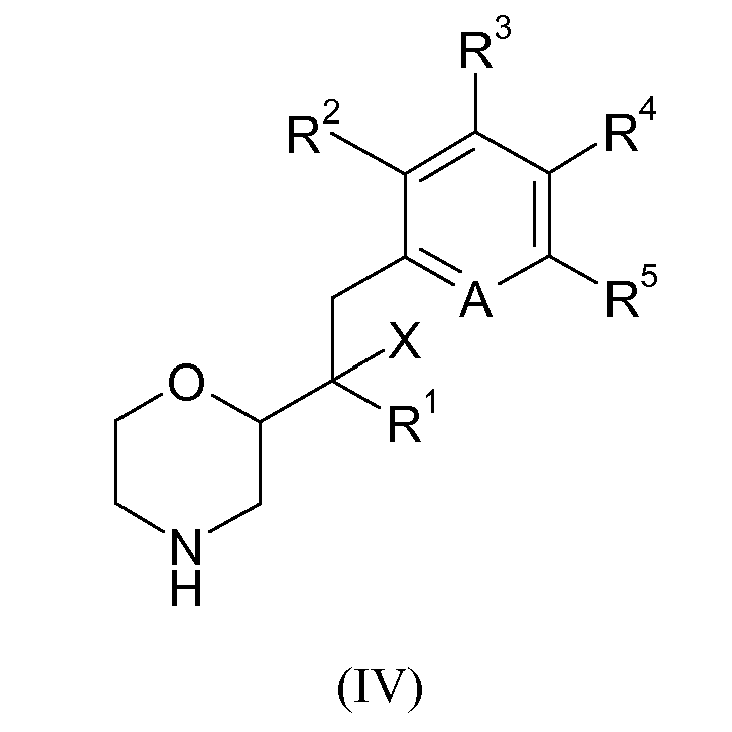
- X is OH or NH2;
- R1 is C1-C6 alkyl (optionally substituted with 1, 2 or 3 halogen atoms and/or with 1 substituent selected from C1-C4 alkoxy (optionally substituted with 1, 2 or 3 fluorine atoms), cyano, and hydroxy); C3-C6 cycloalkyl (optionally substituted with 1, 2 or 3 halogen atoms and/or with 1 substituent selected from C1-C4 alkoxy and hydroxy) wherein one C-C bond within the cycloalkyl moiety is optionally substituted by an O-C bond; or CH2Ar2 wherein Ar2 is a phenyl ring optionally substituted with 1, 2 or 3 substituents each independently selected from C1-C4 alkyl (optionally substituted with 1, 2 or 3 halogen atoms), C1-C4 alkoxy (optionally substituted with 1, 2 or 3 halogen atoms), C1-C4 alkylthio (optionally substituted with 1, 2 or 3 halogen atoms), halo and hydroxy; A is N or CR6 (preferably CR6); R2 is C1-C4 alkyl (optionally substituted with 1, 2 or 3 halogen atoms), C1-C4 alkoxy (optionally substituted with 1, 2 or 3 halogen atoms), C1-C4 alkylthio (optionally substituted with 1, 2 or 3 halogen atoms), halo, hydroxy, pyridyl, thiophenyl, phenyl (optionally substituted with 1, 2 or 3 substituents each independently selected from halogen, C1-C4 alkyl (optionally substituted with 1, 2 or 3 halogen atoms), or C1-C4 alkoxy (optionally substituted with 1, 2 or 3 halogen atoms)) or phenoxy (optionally substituted with 1, 2 or 3 halogen atoms); R3 is H; R4 is H; R5 is H, C1-C4 alkyl (optionally substituted with 1, 2 or 3 halogen atoms), C1-C4 alkoxy (optionally substituted with 1, 2 or 3 halogen atoms), C1-C4 alkylthio (optionally substituted with 1, 2 or 3 halogen atoms), halo or hydroxy; and R6 (if present) is H; or a pharmaceutically acceptable salt thereof.
- In a preferred embodiment of the present invention, there is provided a compound of formula (V)

- X is OH or NH2;
- R1 is C1-C6 alkyl (optionally substituted with 1, 2 or 3 fluorine atoms), C3-C6 cycloalkyl wherein one C-C bond within the cycloalkyl moiety is optionally substituted by an O-C bond or CH2Ar2 wherein Ar2 is a phenyl ring optionally substituted with 1 or 2 substituents each independently selected from C1-C4 alkyl (optionally substituted with 1, 2 or 3 halogen atoms), C1-C4 alkoxy (optionally substituted with 1, 2 or 3 halogen atoms), halo and hydroxy;
- R2 is C1-C4 alkyl (optionally substituted with 1, 2 or 3 fluorine atoms), C1-C4 alkoxy (optionally substituted with 1, 2 or 3 fluorine atoms) or phenyl (optionally substituted with 1, 2 or 3 fluorine atoms); and R5 is H or F; or a pharmaceutically acceptable salt thereof.
- In a preferred embodiment of the present invention, there is provided a compound of formula (VI)

- R1 is C1-C6 alkyl (optionally substituted with 1, 2 or 3 fluorine atoms) or C3-C6 cycloalkyl wherein one C-C bond within the cycloalkyl moiety is optionally substituted by an O-C bond;
- R2 is C1-C4 alkyl (optionally substituted with 1, 2 or 3 fluorine atoms), C1-C4 alkoxy (optionally substituted with 1, 2 or 3 fluorine atoms) or phenyl (optionally substituted with 1, 2 or 3 fluorine atoms); and R5 is H or F; or a pharmaceutically acceptable salt thereof.
- Specific embodiments of the present invention include the compounds
- 1-[1,1'-biphenyl]-2-yl-2-morpholin-2-ylpropan-2-ol,
- 1-[5-fluoro-2-(methyloxy)phenyl]-2-morpholin-2-ylbutan-2-ol,
- 2-morpholin-2-yl-1-{2-[(trifluoromethyl)oxy]phenyl}butan-2-ol,
- 1-[1,1'-biphenyl]-2-yl-2-morpholin-2-ylbutan-2-ol,
- 1-[5-fluoro-2-(methyloxy)phenyl]-3-methyl-2-morpholin-2-ylbutan-2-ol,
- 3-methyl-1-[(2-methyloxy)phenyl]-2-morpholin-2-ylbutan-2-ol,
- 1-[2-(ethyloxy)phenyl]-3-methyl-2-morpholin-2-ylbutan-2-ol,
- 3-methyl-2-morpholin-2-yl-1-{2-[(trifluoromethyl)oxy]butan-2-ol,
- 1-[1,1'-biphenyl]-2-yl-3-methyl-2-morpholin-2-ylbutan-2-ol,
- 1-(4-fluoro[1,1'-biphenyl]-2-yl)-3-methyl-2-morpholin-2-ylbutan-2-ol,
- 1-[5-fluoro-2-(methyloxy)phenyl]-4-methyl-2-morpholin-2-yl-pentan-2-ol,
- 1-[2-(ethyloxy)phenyl]-4-methyl-2-morpholin-2-ylpentan-2-ol,
- 4-methyl-2-morpholin-2-yl-1-{2-[(trifluoromethyl)oxy]phenyl}pentan-2-ol,
- 1-[1,1'-biphenyl]-2-yl-4-methyl-2-morpholin-2-ylpentan-2-ol,
- 1-(4-fluoro[1,1'-biphenyl]-2-yl)-4-methyl-2-morpholin-2-ylpentan-2-ol,
- 1-cyclopentyl-2-[5-fluoro-2-(methyloxy)phenyl]-1-morpholin-2-ylethanol,
- 1-cyclopentyl-2-[2-(ethyloxy)phenyl]-1-morpholin-2-ylethanol,
- 1-cyclopentyl-1-morpholin-2-yl-2-{2-[(trifluoromethyl)oxy]phenyl}ethanol,
- 2-[1,1'-biphenyl]-2-yl-1-cyclopentyl-1-morpholin-2-ylethanol,
- 1-cyclopentyl-2-(4-fluoro[1,1'-biphenyl]-2-yl)-1-morpholin-2-ylethanol,
- 2-[5-fluoro-2-(methyloxy)phenyl]-1-morpholin-2-yl-1-tetrahydro-2H-pyran-4-ylethanol,
- 1-morpholin-2-yl-1-tetrahydro-2H-pyran-4-yl-2- {2-[(trifluoromethyl)oxy] phenyl} ethanol,
- 2-1,1'-biphenyl]-2-yl-1-morpholin-2-yl-1-tetrahydro-2H-pyran-4-ylethanol,
- 2-(3'-fluoro-biphenyl-2-yl)-1-morpholin-2-yl-1-(tetrahydro-pyran-4-yl)-ethanol,
- 5,5,5-trifluoro-1-(5-fluoro-2-methoxy-phenyl)-2-morpholin-2-yl-pentan-2-ol,
- 5,5,5-trifluoro-2-morpholin-2-yl-1-(2-trifluoromethoxy-phenyl)-pentan-2-ol,
- 1-[1,1'-biphenyl]-2-yl-5,5,5-trifluoro-2-morpholin-2-ylpentan-2-ol,
- 6,6,6-trifluoro-1-[5-fluoro-2-(methyloxy)phenyl]-2-morpholin-2-ylhexan-2-ol,
- 1-[1,1'-biphenyl]-2-yl-6,6,6-trifluoro-2-morpholin-2-yl]hexan-2-ol,
- 1-cyclopropyl-2-[2-(methyloxy)phenyl]-1-morpholin-2-ylethanol,
- 1-cyclopropyl-2-[2-(ethyloxy)phenyl]-1-morpholin-2-ylethanol,
- 2-[1,1'-biphenyl]-2-yl-1-cyclopropyl-1-morpholin-2-ylethanol,
- 1,3-bis-(2-methoxy-phenyl)-2-morpholin-2-yl-propan-2-ol,
- 1-(2-methoxy-benzyl)-2-(2-methoxy-phenyl)-1-morpholin-2-yl-ethylamine,
- 2-morpholin-2-yl-1,3-diphenyl-propan-2-ol,
- 1-(2-methoxy-phenyl)-2-morpholin-2-yl-hexan-2-ol,
- 2-morpholinyl-1-biphenyl-2-yl-hexan-2-ol,
- 1-(2-chloro-6-fluoro-phenyl)-4-methyl-2-morpholin-2-yl-pentan-2-ol and
- 1-(2-chloro-phenyl)-4-methyl-2-morpholin-2-yl-pentan-2-ol
- The compounds of the present invention are inhibitors of norepinephrine reuptake. Biogenic amine transporters control the amount of biogenic amine neurotransmitters in the synaptic cleft. Inhibition of the respective transporter leads to a rise in the concentration of that neurotransmitter within the synaptic cleft. Compounds of formula (I) and their pharmaceutically acceptable salts preferably exhibit a Ki value less than 600nM at the norepinephrine transporter as determined using the scintillation proximity assay described below. More preferred compounds of formula (I) and their pharmaceutically acceptable salts exhibit a Ki value less than 100nM at the norepinephrine transporter. Still more preferred compounds of formula (I) and their pharmaceutically acceptable salts exhibit a Ki value less than 502nM at the norepinephrine transporter. Especially preferred compounds of formula (I) and their pharmaceutically acceptable salts exhibit a Ki value less than 20nM at the norepinephrine transporter. Preferably, compounds of the present invention selectively inhibit the norepinephrine transporter relative to the serotonin and dopamine transporters by a factor of at least five, more preferably by a factor of at least ten using the scintillation proximity assays described below.
- In addition, the compounds of the present invention are preferably acid stable. Advantageously, they have a reduced interaction (both as substrate and inhibitor) with the liver enzyme Cytochrome P450 (CYP2D6). That is to say, they preferably exhibit less than 75% metabolism via the CYP2D6 pathway according to the CYP2D6 substrate assay described below and they preferably exhibit an IC50 of >6µM according to the CYP2D6 inhibitor assay described below.
- In view of their pharmacological activity, the compounds of the present invention are indicated for the treatment of disorders of the central and/or peripheral nervous system, in particular, disorders associated with norepinephrine dysfunction in mammals, especially humans, including children, adolescents and adults.
- The term "norepinephrine dysfunction" as used herein refers to a reduction in the amount of norepinephrine neurotransmitter within the synaptic cleft below that which would be considered to be normal or desirable for a species, or an individual within that species. Thus the phrase "disorders associated with norepinephrine dysfunction in mammals" refers to disorders which are associated with a reduction in the amount of norepinephrine neurotransmitter within the synaptic cleft below that which would be considered to be normal or desirable for the mammalian species, or an individual within the species, in question. Disorders associated with norepinephrine dysfunction in mammals include, for example, nervous system conditions selected from the group consisting of an addictive disorder and withdrawal syndrome, an adjustment disorder (including depressed mood, anxiety, mixed anxiety and depressed mood, disturbance of conduct, and mixed disturbance of conduct and mood), an age-associated learning and mental disorder (including Alzheimer's disease), alcohol addiction, allergies (in particular allergic rhinitis), anorexia nervosa, apathy, asthma, an attention-deficit disorder (ADD) due to general medical conditions, attention-deficit hyperactivity disorder (ADHD) including the predominantly inattentive type of ADHD and the predominantly hyperactive-impulsive type of ADHD (and optionally by way of combination therapy with one or more stimulants such as methylphenidate, amphetamine and dextroamphetamine), bipolar disorder, bulimia nervosa, chronic fatigue syndrome, chronic or acute stress, cognitive disorders (discussed in more detail below but including delusions, dementias, amnestic disorders, mild cognitive impairment (MCI), cognitive impairment associated with schizophrenia (CIAS) and cognitive disorders not otherwise specified), communication disorders (including stuttering, expressive language disorder, mixed receptive-expressive language disorder, phonological disorder and communication disorder not otherwise specified), conduct disorder, cyclothymic disorder, dementia of the Alzheimers type (DAT), depression (including adolescent depression and minor depression), dysthymic disorder, emotional dysregulation (including emotional dysregulation associated with ADHD, borderline personality disorder, bipolar disorder, schizophrenia, schizoaffective disorder and intermittent explosive disorder), fibromyalgia and other somatoform disorders (including somatization disorder, conversion disorder, pain disorder, hypochondriasis, body dysmorphic disorder, undifferentiated somatoform disorder, and somatoform disorder NOS), generalized anxiety disorder, hot flashes or vasomotor symptoms, hypotensive states including orthostatic hypotension, impulse control disorders (including intermittent explosive disorder, kleptomania, pyromania, pathological gambling, trichotillomania and impulse-control disorder not otherwise specified), incontinence (i.e. bedwetting, stress incontinence, genuine stress incontinence, and mixed incontinence), an inhalation disorder, an intoxication disorder, learning disabilities (including developmental speech and language disorders (such as developmental articulation disorder, developmental expressive language disorder and developmental receptive language disorder), learning disorders (such as reading disorder, mathematics disorder, disorder of written expression and learning disorder not otherwise specified) and motor skills disorders (such as developmental coordination disorder)), mania, migraine headaches, neuropathic pain, nicotine addiction, obesity (i.e., reducing the weight of obese or overweight patients), obsessive compulsive disorders and related spectrum disorders, oppositional defiant disorder, pain including chronic pain, neuropathic pain and antinociceptive pain, panic disorder, Parkinson's disease (in particular to improve dyskinesia, oscilations, balance, coordination, depression, and motivation), peripheral neuropathy, personality change due to a general medical condition (including labile type, disinhibited type, aggressive type, apathetic type, paranoid type, combined type and unspecified type), pervasive developmental disorders (including autistic disorder, Asperger's disorder, Rett's disorder, childhood disintegrative disorder, and pervasive developmental disorder not otherwise specified), post-traumatic stress disorder, premenstrual dysphoric disorder (i.e., premenstrual syndrome and late luteal phase dysphoric disorder), psoriasis, psychoactive substance use disorders, a psychotic disorder (including schizophrenia, schizoaffective and schizophreniform disorders), seasonal affective disorder, a sleep disorder (such as narcolepsy and enuresis), social phobia (including social anxiety disorder), a specific developmental disorder, selective serotonin reuptake inhibition (SSRI) "poop out" syndrome (i.e., wherein a patient who fails to maintain a satisfactory response to SSRI therapy after an initial period of satisfactory response), TIC disorders (e.g., Tourette's Disease), tobacco addiction and vascular dementia. The compounds of the present invention are particularly suitable for the treatment of attention deficit hyperactivity disorder, ADHD. The compounds of the present invention are also particularly suitable for the treatment of schizophrenia.
- The term "cognitive disorders" (also variously referred to as "cognitive failure," "cognitive insufficiency," "cognitive deficit," "cognitive impairment," "cognitive dysfunction," and the like) refers to the dysfunction, diminution, or loss of one or more cognitive functions, the processes by which knowledge is acquired, retained, and used. Cognitive dysfunction includes cognitive changes associated with ageing ("age-associated memory impairment"), as well as changes due to other causes. Cognitive impairment is most commonly due to a delirium or dementia, but can also occur in association with a number of other medical or neuropsychiatric disorders. More focal cognitive deficits are diagnosed using the criteria disclosed in the Diagnostic and Statistical Manual of Mental Disorders, Fourth Edition, Text Revision (DSM-IV-TR™, 2000), American Psychiatric Association, Washington, D.C., as either amnestic disorders (affecting memory) or cognitive disorder not otherwise specified (NOS), which includes executive dysfunction, visuospatial/visuocontructional impairment, attentional deficits, disorientation, etc. These more focal cognitive disorders also have a wide variety of causes, some of which are of unknown etiology.
- A delerium is characterized by a disturbance of consciousness with a reduced ability to focus, sustain, or shift attention and a change in cognition that develops over a short period of time. Delirium is very common, and occurs on average in about a fifth of general hospital inpatients, and is even more common in nursing home patients and those with terminal illnesses. The disorders included in the "Delirium" section of the DSM-IV-TR™ are listed according to presumed etiology: Delirium Due to a General Medical Condition, Substance-Induced Delirium (i.e., due to a drug of abuse, a medication, or toxin exposure), Delirium Due to Multiple Etiologies, or Delirium Not Otherwise Specified (if the etiology is indeterminate). As disclosed by Wise et al. ((2002) Delirium (Confusional States), In Wise and Rundell, Eds., The American Psychiatric Publishing Textbook of Consultation-Liaison Psychiatry, Psychiatry in the Medically Ill, Second Edition, American Psychiatric Publishing, Inc., Washington, D.C., Chapter 15, pp. 257-272, Table 15-4), exemplary etiological bases of delirium include, but are not limited to, infection, withdrawal from alcohol and drugs, acute metabolic conditions, trauma of various types, CNS pathologies, hypoxia, vitamin deficiencies, endocrinopathies, acute vascular conditions, toxins or drugs, and heavy metals.
- A dementia is a chronic condition, usually with a more gradual deterioration of memory and other intellectual functioning and other cognitive skills severe enough to interfere with the ability to perform activities of daily living. Although dementia may occur at any age, it primarily affects the elderly, presenting in more than 15% of persons over 65 years of age and in as many as 40% of persons over 80 years old. Dementia due to Alzheimer's disease is particularly common. Non-Alzheimer's cognitive impairments and/or dementias include, for example, those caused by or associated with: vascular diseases; Parkinson's disease; Lewy body disease (diffuse Lewy body disease); HIV/AIDS; mild cognitive impairments; mild neurocognitive disorders; age-associated memory impairments; neurologic and/or psychiatric conditions including epilepsy and epilepsy treatments; brain tumors, cysts, lesions, or other inflammatory brain diseases; multiple sclerosis; Down's syndrome; Rett's syndrome; progressive supranuclear palsy; frontal lobe dementia syndromes; schizophrenia and related psychiatric disorders; antipsychotic medications; traumatic brain injury (closed head injury), dementia pugilistica, and other head traumas; normal-pressure hydrocephalus; surgery (including coronary artery by-pass graft surgery) and anaesthesia, electroconvulsive shock therapy, and cancer and cancer therapies.
- The dementias are also listed in the "Dementia" section of the DSM-IV-TR™ according to presumed etiology: Dementia of the Alzheimer's Type, Vascular Dementia, Dementia Due to Other General Medical Conditions (e.g., human immunodeficiency virus [HIV] disease, head trauma, Parkinson's disease, Huntington's disease), Substance-Induced Persisting Dementia (i.e., due to a drug of abuse, a medication, or toxin exposure), Dementia Due to Multiple Etiologies, or Dementia Not Otherwise Specified (if the etiology is indeterminate). As disclosed by Gray and Cummings ((2002) Dementia, In Wise and Rundell, Eds., The American Psychiatric Publishing Textbook of Consultation-Liaison Psychiatry, Psychiatry in the Medically Ill, Second Edition, American Psychiatric Publishing, Inc., Washington, D.C., Chapter 16, pp. 273-306, Table 16-1), exemplary etiological bases of principal dementia syndromes include, but are not limited to, degenerative disorders (cortical and subcortical), vascular disorders, myelinoclastic disorders, traumatic conditions, neoplastic disorders, hydrocephalic disorders, inflammatory conditions, infections, toxic conditions, metabolic disorders, and psychiatric disorders.
- An amnestic disorder is characterized by memory impairment in the absence of other significant accompanying cognitive impairments. The disorders in the "Amnestic Disorders" section of the DSM-IV-TR™ are also listed according to presumed etiology: Amnestic Disorder Due to a General Medical Condition, Substance-Induced Persisting Amnestic Disorder, or Amnestic Disorder Not Otherwise Specified.
- Cognitive Disorder Not Otherwise Specified in the DSM-IV-TR™ covers presentations that are characterized by cognitive dysfunction presumed to be due to either a general medical condition or substance use that do not meet criteria for any of the disorders listed elsewhere in the section of the DSM-IV-TR™ entitled "Delirium, Dementia, and Amnestic and Other Cognitive Disorders."
- Dementia, amnestic disorders, and cognitive disorders NOS occur in patients with a wide variety of other disorders including, but not limited to, Huntington's disease (chorea); Pick's disease; spinocerebellar ataxias (types 1-11); corticobasalganglionic degeneration; neuroacanthocytosis; dentatorubropallidoluysian atropy (DRPLA); systemic lupus erythematosus; heavy metal intoxication; alcoholic dementia (Wernicke's encephalopathy); fetal alcohol syndrome; single or multiples strokes, including small vessels (Binswanger's dementia: subcortical arteriosclerotic encephalopathy) and large vessels (multi-infarct dementia); anoxic encephalopathy; tumors; birth anoxia; premature birth; inborn errors of metabolism; neurofibromatosis (Type I); tuberous sclerosis; Hallervorden Spatz disease; Wilson's disease; post-infectious sequelae (e.g., tuberculosis, viral encephalitis, bacterial meningitis); subdural hematoma; subcortical dementia; Creutzfeldt-Jakob disease; Gerstmann-Sträussler-Scheinker disease; general paresis; and syphilis.
- As discussed in detail above, cognitive failure may present in patients suffering from a number of disorders, including dementia or delirium, or due to a wide variety of other causes. The compounds of the present invention are useful for the treatment or prevention of cognitive failure associated with, or due to, the disorders or etiologies discussed above, including disorders formally classified in the DSM-IV-TR™. For the convenience of the reader, the DSM-IV-TR™ code numbers or descriptions are supplied below. "ICD-9-CM codes" refers to codes for, e.g., selected general medical conditions and medication-induced disorders contained in the International Classification of Diseases, 9th Revision, Clinical Modification.
Delirium Due to a General Medical Condition 293.0 Substance-Induced Delirium, including: Substance Intoxication Delirium: Code [Specific Substance] Intoxication Delirium: (291.0 Alcohol; 292.81 Amphetamine [or Amphetamine-Like Substance]; 292.81 Cannabis; 292.81 Cocaine; 292.81 Hallucinogen; 292.81 Inhalant; 292.81 Opioid; 292.81 Phencyclidine [or Phencyclidine-Like Substance]; 292.81 Sedative, Hypnotic, or Anxiolytic; 292.81 Other [or Unknown] Substance [e.g., cimetidine, digitalis, benztropine]) Substance Withdrawal Delirium: Code [Specific Substance] Withdrawal Delirium: (291.0 Alcohol; 292.81 Sedative, Hypnotic, or Anxiolytic; 292.81 Other [or Unknown] Substance) Delirium Due to Multiple Etiologies: Multiple codes are used, reflecting the specific delirium and specific etiologies, e.g., 293.0 Delirium Due to Viral Encephalitis; 291.0 Alcohol Withdrawal Delirium Delirium Not Otherwise Specified 780.09 Dementia of the Alzheimer's Type 294.1x* (*ICD-9-CM code) Subtypes: With Early Onset (onset of the dementia is age 65 years or under) With Late Onset (onset of the dementia is after age 65 years) Without Behavioral Disturbance 294.10 With Behavorial Disturbance 294.11 Vascular Dementia 290.4x Subtypes: With Delirium 290.41 With Delusions 290.42 With Depressed Mood 290.43 With Behavioral Disturbance Uncoded Uncomplicated 290.40 Dementia Due to HIV Disease 294.1x* (*ICD-9-CM code) Dementia Due to Head Trauma 294.1x* (*ICD-9-CM code) Dementia Due to Parkinson's Disease 294.1x* (*ICD-9-CM code) Dementia Due to Huntington's Disease 294.1x* (*ICD-9-CM code) Dementia Due to Pick's Disease 290.1x* (*ICD-9-CM code) Dementia Due to Creutzfeldt-Jakob Disease 290.1x* (*ICD-9-CM code) Dementia Due to Other General Medical Conditions294.1x* (*ICD-9-CM code) Code based on presence or absence of a clinically significant behavioral disturbance: Without Behavioral Disturbance 294.10 With Behavioral Disturbance 294.11 Substance-Induced Persisting Dementia Code [Specific Substance]-Induced Persisting Dementia: (291.2 Alcohol; 292.82 Inhalant; 292.82 Sedative, Hypnotic, or Anxiolytic; 292.82 Other [or Unknown] Substance) Dementia Due to Multiple Etiologies Coding note: Use multiple codes based on specific dementias and specific etiologies, e.g., 294.10 Dementia of the Alzheimer's Type, With Late Onset, Without Behavioral Disturbance; 290.40 Vascular Dementia, Uncomplicated. Dementia Not Otherwise Specified 294.8 Amnestic Disorder Due to a General Medical Condition 294.0 Transient or Chronic Substance-Induced Persisting Amnestic Disorder Code [Specific Substance]-Induced Persisting Amnestic Disorder: 291.1 Alcohol; 292.83 Sedative, Hypnotic, or Anxiolytic; 292.83 Other [or Unknown] Substance Amnestic Disorder Not Otherwise Specified 294.8 Cognitive Disorder Not Otherwise Specified 294.9 Age-Related Cognitive Decline 780.9 - Examples of cognitive disorders due to various etiologies, or associated with various disorders, of particular interest that can be prevented or treated using the compounds of the present invention include: enhancing cognitive functions and executive functioning (ability to plan, initiate, organize, carry out, monitor, and correct one's own behavior) in normal subjects or in subjects exhibiting cognitive dysfunction; treatment of cognitive and attentional deficits associated with prenatal exposure to substances of abuse including, but not limited to, nicotine, alcohol, methamphetamine, cocaine, and heroin; treatment of cognitive impairment caused by chronic alcohol and drug abuse (substance-induced persisting dementia), medicament side effects, and treatment of drug craving and withdrawal; treatment of cognitive deficits in Down's Syndrome patients; treatment of deficits in normal memory functioning comorbid with major depressive and bipolar disorders; treatment of cognitive impairment associated with depression, mental retardation, bipolar disorder, or schizophrenia; treatment of dementia syndromes associated with mania, conversion disorder, and malingering; treatment of problems of attention, prefrontal executive function, or memory due to head trauma or stroke; treatment of cognitive dysfunction in menopausal and post-menopausal women and in women undergoing hormone replacement therapy; treatment of cognitive deficits and fatigue due to, or associated with, cancer and cancer therapies (cognitive deficits are associated with a variety of cancer treatments, including cranial radiation, conventional (standard-dose) chemotherapy, high-dose chemotherapy and hematopoietic (bone-marrow) transplantation, and biologic agents).
- Compounds of the present invention are also useful in a method for treating a patient suffering from or susceptible to psychosis, comprising administering to said patient an effective amount of a first component which is an antipsychotic, in combination with an effective amount of a second component which is a compound of formula (I). The invention also provides a pharmaceutical composition which comprises a first component that is an antipsychotic, and a second component that is a compound of formula (I). In the general expressions of this aspect of the present invention, the first component is a compound that acts as an antipsychotic. The antipsychotic may be either a typical antipsychotic or an atypical antipsychotic. Although both typical and atypical antipsychotics are useful for these methods and formulations of the present invention, it is preferred that the first component compound is an atypical antipsychotic.
- Typical antipsychotics include, but are not limited to: Chlorpromazine, 2-chloro-10-(3-dimethylaminoprop-yl)phenothiazine, is described in
U.S. Patent 2,645,640 . Its pharmacology has been reviewed (Crismon, Psychopharma-col. Bul., 4, 151 (October 1967 ); Droperidol, 1-(1-[3-(p-fluorobenzoyl)propyl]-1,2,3,6-tetrahydro-4-pyridyl)-2-benzimidazolinone, is described inU.S. Patent 3,141,823 ; Haloperidol, 4-[4-(4-chlorophenyl)-4-hydroxy-1-piperidinyl]-1-(4-fluorophenyl)-1-butanone, is described inU.S. Patent 3,438,991 . Its therapeutic efficacy in psychosis has been reported (Beresford and Ward, Drugs, 33, 31-49 (1987); Thioridazine, 1-hydroxy-10-[2-(1-methyl-2-pyridinyl)ethyl]-2-(methylthio)phenothiazine hydrochloride, was described by Bourquin, et al.(Helv. Chim. Acta, 41, 1072 (1958)). Its use as an antipsychotic has been reported (Axelsson, et al., Curr. Ther. Res., 21, 587 (1977)); and Trifluoperazine, 10-[3-(4-methyl-1-piperazinyl)-propyl]-2-trifluoromethylphenthiazine hydrochloride, is described inU.S. Patent 2,921,069 . - Atypical antipsychotics include, but are not limited to: Olanzapine, 2-methyl-4-(4-methyl-1-piperazinyl)-10H-thieno[2,3-b][1,5]benzodiazepine, is a known compound and is described in
U.S. Patent No. 5,229,382 as being useful for the treatment of schizophrenia, schizophreniform disorder, acute mania, mild anxiety states, and psychosis; Clozapine, 8-chloro-11-(4-methyl-1-piperazinyl)-5H-dibenzo[b,e][1,4]diazepine, is described inU.S. Patent No. 3,539,573 . Clinical efficacy in the treatment of schizophrenia is described (Hanes, et al., Psychopharmacol. Bull., 24, 62 (1988)); Risperidone, 3-[2-[4-(6-fluoro-1,2-benzisoxazol-3-yl)piperidino]ethyl]-2-methyl-6,7,8,9-tetrahydro-4H-pyrido[1,2-a]pyrimidin-4-one, and its use in the treatment of psychotic diseases are described inU.S. Patent No. 4,804,663 ; Sertindole, 1-[2-[4-[5-chloro-1-(4-fluorophenyl)-1H-indol-3-yl]-1-piperidinyl]ethyl]imidazolidin-2-one, is described inU.S. Patent No. 4,710,500 . Its use in the treatment of schizophrenia is described inU.S. Patent Nos. 5,112,838 and5,238,945 ; Quetiapine, 5-[2-(4-dibenzo[b,f][1,4]thiazepin-11-yl-1-piperazinyl)ethoxy]ethanol, and its activity in assays which demonstrate utility in the treatment of schizophrenia are described inU.S. Patent No. 4,879,288 . Quetiapine is typically administered as its (E)-2-butenedioate (2:1) salt; Ziprasidone, 5-[2-[4-(1,2-benzoisothiazol-3-yl)-1-piperazinyl]ethyl]-6-chloro-1,3-dihydro-2H-indol-2-one, is typically administered as the hydrochloride monohydrate. The compound is described inU.S. Patent Nos. 4,831,031 and5,312,925 . Its activity in assays which demonstrate utility in the treatment of schizophrenia are described inU.S. Patent No. 4,831,031 ; and Aripiprazole (Abilify™), 7-[4-[4-(2,3-dichlorophenyl)-1-piperazinyl]butoxy]-3,4-dihydrocarbostyril (U.S. Patents 4,734,416 and5,006,528 ) is a new antipsychotic indicated for the treatment of schizophrenia. - It will be understood that while the use of a single antipsychotic as a first component compound is preferred, combinations of two or more antipsychotics may be used as a first component if necessary or desired. Similarly, while the use of a single compound of formula (I) as a second component compound is preferred, combinations of two or more compounds of formula (I) may be used as a second component if necessary or desired.
- While all combinations of first and second component compounds are useful and valuable, certain combinations are particularly valued and are preferred, as follows:
- olanzapine/compound of formula (I)
- clozapine/compound of formula (I)
- risperidone/compound of formula (I)
- sertindole/compound of formula (I)
- quetiapine/compound of formula (I)
- ziprasidone/compound of formula (I)
- aripiprazole/compound of formula (I)
- In general, combinations and methods of treatment using olanzapine as the first component are preferred. It is especially preferred that when the first component is olanzapine, it will be the Form II olanzapine as described in
U.S. Patent 5,736,541 . Although Form II olanzapine is preferred it will be understood that as used herein, the term "olanzapine" embraces all solvate and polymorphic forms unless specifically indicated. - Conditions that can be treated by the adjunctive therapy aspect of the present invention include schizophrenia, schizophreniform diseases, bipolar disorder, acute mania, and schizoaffective disorders. The titles given these conditions represent multiple disease states. The following list illustrates a number of these disease states, many of which are classified in the DSM-IV-TR™. The DSM-IV-TR™ code numbers for these disease states are supplied below, when available, for the convenience of the reader.
Paranoid Type Schizophrenia 295.30 Disorganized Type Schizophrenia 295.10 Catatonic Type Schizophrenia 295.20 Undifferentiated Type Schizophrenia 295.90 Residual Type Schizophrenia 295.60 Schizophreniform Disorder 295.40 Schizoaffective Disorder 295.70 - The present invention also encompasses the use of one or more compounds of formula (I) in combination with one or more conventional Alzheimer's agents for the prevention or treatment of cognitive dysfunction in patients suffering from Alzheimer's disease. The invention also provides a pharmaceutical composition which comprises a first component that is a conventional Alzheimer's agent and a second component that is a compound of formula (I). Conventional Alzheimer's agents include inhibitors of acetylcholine degradation (i.e., cholinesterase or acetylcholinesterase inhibitors) within synapses, e.g., donepezil (Aricept®), rivastigmine (Exelon®), galantamine (Reminyl®), and tacrine (Cognex®); the selective monoamine oxidase inhibitor selegiline (Eldepryl®); and memantine (Namenda ™), a newly FDA-approved NMDA receptor antagonist for the treatment of moderate to severe Alzheimer's disease. Modafinil (Provigil®) is also used in the treatment of Alzheimer's disease.
- The present invention also encompasses the use of one or more compounds of formula (I) in combination with one or more conventional Parkinson's agents for the treatment of cognitive dysfunction in Parkinson's disease. The invention also provides a pharmaceutical composition which comprises a first component that is a conventional Parkinson's agent and a second component that is a compound of formula (I). Conventional Parkinson's agents include levodopa; levodopa/carbidopa (Sinemet®); Stalevo (carbidopa/levodopa/entacapone); dopamine agonists, e.g., bromocriptine; Mirapex® (pramipexole), Permax® (pergolide), and Requip® (ropinirole); COMT inhibitors, e.g., tolcapone, and entacapone; Selegiline (Deprenyl®; Eldepryl®); propranolol; primidone; anticholinergics, e.g., Cogentin®, Artane®, Akineton®, Disipal®, and Kemadrin®; and amantadine.
- In each of the combination treatments mentioned above, said first and second components may be administered simultaneously, separately or sequentially. Similarly, said compositions encompass combined preparations for simultaneous, separate or sequential use.
- The term "treatment" as used herein refers to both curative and prophylactic treatment of disorders associated with norepinephrine dysfunction. Thus, the term "treatment" is intended to refer to all processes wherein there may be a slowing, interrupting, arresting, controlling, or stopping of the progression of the disorders described herein, but does not necessarily indicate a total elimination of all symptoms, and is intended to include prophylactic and therapeutic treatment of such disorders.
- The compounds of the present invention are also indicated for the treatment of disorders which are ameliorated by an increase in the amount of norepinephrine neurotransmitter within the synaptic cleft of a mammal above that which would be considered to be normal or desirable for the mammalian species, or an individual within the species, in question.
- In another embodiment of the present invention, there is provided a pharmaceutical composition comprising a compound of formula (I) or a pharmaceutically acceptable salt thereof together with a pharmaceutically acceptable diluent, excipient or carrier.
- In another embodiment of the present invention, there is provided a compound of formula (I) or a pharmaceutically acceptable salt thereof for use in therapy.
- In another embodiment of the present invention, there is provided a compound of formula (I) or a pharmaceutically acceptable salt thereof for use as an inhibitor of the reuptake of norepinephrine. Preferably such inhibition occurs within mammalian cells (including mammalian cell membrane preparations), especially those found within the central and/or peripheral nervous system. More preferably such inhibition occurs within the cells of the central nervous system of a mammal, especially a human, in need thereof.
- In another embodiment of the present invention there is provided a compound of formula (I) or a pharmaceutically acceptable salt thereof for treating disorders associated with norepinephrine dysfunction in mammals.
- In another embodiment of the present invention, there is provided the use of a compound of formula (I) or a pharmaceutically acceptable salt thereof for the manufacture of a medicament for inhibiting the reuptake of norepinephrine.
- In another embodiment of the present invention, there is provided the use of a compound of formula (I) or a pharmaceutically acceptable salt thereof for the manufacture of a medicament for the treatment of disorders associated with norepinephrine dysfunction in mammals.
- In another embodiment of the present invention, there is provided a method for inhibiting the reuptake of norepinephrine in mammals comprising administering to a patient in need thereof an effective amount of a compound of formula (I) or a pharmaceutically acceptable salt thereof.
- In another embodiment of the present invention, there is provided a method for treating disorders associated with norepinephrine dysfunction in mammals comprising administering to a patient in need thereof an effective amount of a compound of formula (I) or a pharmaceutically acceptable salt thereof.
- The present invention includes the pharmaceutically acceptable salts of the compounds of formula (I). Suitable salts include acid addition salts, including salts formed with inorganic acids, for example hydrochloric, hydrobromic, nitric, sulphuric or phosphoric acids, or with organic acids, such as organic carboxylic or organic sulphonic acids, for example, acetoxybenzoic, citric, glycolic, mandelic-1, mandelic-dl, mandelic-d, maleic, mesotartaric monohydrate, hydroxymaleic, fumaric, lactobionic, malic, methanesulphonic, napsylic, naphthalenedisulfonic, naphtoic, oxalic, palmitic, phenylacetic, propionic, pyridyl hydroxy pyruvic, salicylic, stearic, succinic, sulfanilic, tartaric-1, tartaric-dl, tartaric-d, 2-hydroxyethane sulphonic, toluene-p-sulphonic, and xinafoic acids.
- The compounds of the present invention may be used as medicaments in human or veterinary medicine. The compounds may be administered by various routes, for example, by oral or rectal routes, topically or parenterally, for example by injection, and are usually employed in the form of a pharmaceutical composition.
- Such compositions may be prepared by methods well known in the pharmaceutical art and normally comprise at least one active compound in association with a pharmaceutically acceptable diluent, excipient or carrier. In making the compositions of the present invention, the active ingredient will usually be mixed with a carrier or diluted by a carrier, and/or enclosed within a carrier which may, for example, be in the form of a capsule, sachet, paper or other container. Where the carrier serves as a diluent, it may be solid, semi-solid, or liquid material which acts as a vehicle, excipient or medium for the active ingredient. Thus, the composition may be in the form of tablets, lozenges, sachets, cachets, elixirs, suspensions, solutions, syrups, aerosols (as a solid or in a liquid medium), ointments containing, for example, up to 10% by weight of the active compound, soft and hard gelatin capsules, suppositories, injection solutions and suspensions and sterile packaged powders.
- Some examples of suitable carriers are lactose, dextrose, vegetable oils, benzyl alcohols, alkylene glycols, polyethylene glycols, glycerol triacetate, gelatin, carbohydrates such as starch and petroleum jelly, sucrose sorbitol, mannitol, starches, gum acacia, calcium phosphate, alginates, tragacanth, gelatin, syrup, methyl cellulose, methyl- and propyl- hydrobenzoate, talc, magnesium stearate and mineral oil. The compounds of formula (I) can also be lyophilized and the lyophilizates obtained used, for example, for the production of injection preparations. The preparations indicated can be sterilized and/or can contain auxiliaries such as lubricants, preservatives, stabilizers and/or wetting agents, emulsifiers, salts for affecting the osmotic pressure, buffer substances, colourants, flavourings and/or one or more further active compounds, e.g. one or more vitamins. Compositions of the invention may be formulated so as to provide, quick, sustained or delayed release of the active ingredient after administration to the patient by employing procedures well known in the art.
- The compositions are preferably formulated in a dosage unit form, each dosage unit containing from about 5 to about 500 mg, more usually about 25 to about 300 mg, of the active ingredient. The term "dosage unit form" refers to physically discrete units suitable as unitary doses for human subjects and other mammals, each unit containing a predetermined quantity of active material calculated to produce the desired therapeutic effect, in association with a suitable pharmaceutical carrier.
- Compounds of the present invention may be prepared by conventional organic chemistry techniques. General schemes outlining the synthetic routes to compounds of the present invention are described below. For clarity, Rx, Ry and Rz are shown as H, however, it will be appreciated that analogous methods could be applied for other possible identities of Rx, Ry and Rz.
- The intermediates of formulae (X), (XI), (XII), (XV) and (XVI) may be prepared as shown below (where P represents a N-protecting group and R7 and R8, which may be the same or different, each represent C1-C4 alkyl (optionally substituted with one OMe group), or, taken together with the N atom to which they are attached, form a pyrrolidine, piperidine or morpholine ring):


- N-protected compounds of formula (I) wherein X is NH2 may be prepared from compounds of formula (X) as shown below:

- In route A the intermediate (X) is treated with an excess of the Grignard reagent Ar1CH2MgBr to provide an N-protected compound of formula (I) wherein X is NH2 and R1 is CH2Ar2 wherein Ar2 = Ar1. In route B the intermediate (X) is treated with one equivalent of the Grignard reagent R1MgBr followed by one equivalent of the Grignard reagent Ar1CH2MgBr to provide an N-protected compound of formula (I) wherein X is NH2. Alternatively, the Grignard reagent Ar1CH2MgBr may be added first followed by R1MgBr. Preferably, a Lewis acid such as titanium isopropoxide is added to the reaction mixture in between addition of the Grignard reagents (see Charette, A.B.; Gagnon, A; Janes, M; Mellon, C; Tetrahedron Lett, 1998, 39(29), 5147-5150 and Charette, A.B.; Gagnon, A; Tetrahedron: Asymmetry, 1999, 10(10), 1961-1968).
- N-protected compounds of formula (I) wherein X is OH and R1 is CH2Ar2 wherein Ar2 = Ar1 may be prepared from compounds of formula (XI) as shown below:

- N-protected compounds of formula (I) wherein X is OH may be prepared from the Weinreb amide of formula (XII) or the amide of formula (XVI) as shown below:


- To a solution of the ketone of formula (XIII) is added a solution of the Grignard reagent Ar1CH2MgBr to provide an N-protected compound of formula (I) wherein X is OH. When the reaction is conducted using the preferred enantiomer (XIII)b the reaction proceeds stereoselectively to provide an N-protected compound of formula (II) wherein X is OH.

- The ketones of formula (XIII) may also be obtained via a different route as shown below:

- A solution ofN-protected morpholinone is treated with a strong base such as lithium diisopropylamide. To this solution is added an aldehyde R1CHO. Reduction of the morpholine carbonyl group using, for example, borane-THF complex followed by oxidation of the alcohol using, for example, Swern oxidation conditions, provides a compound of formula (XIII) which can be reacted onward as described in the previous scheme to provide a N-protected compound of formula (I) wherein X is OH.
- N-protected compounds of the present invention wherein X is C1-C4 alkoxy, may be synthesized by standard alkylation of the N-protected compounds of formula (I) wherein X=OH as shown below:

- Suitable strong bases will be known to the person skilled in the art and include, for example, sodium hydride. Similarly, suitable alkylating agents will be known to the person skilled in the art and include, for example, C1-C4 alkyl halides such as methyl iodide.
- N-protected compounds of the present invention wherein X is NH(C1-C4 alkyl), may be synthesized by treatment of a compound of formula (I) wherein X = NH2 under reductive alkylating conditions or using suitable alkylating agents known to the person skilled in the art including, for example, C1-C4 alkyl halides such as methyl iodide.
- N-protected compounds of the present invention may be elaborated upon using standard organic chemistry to provide further N-protected compounds of the present invention. For example, organometallic type couplings between an Ar1-Br derivative and a phenylboronic acid as shown below can provide Ar1-phenyl derivatives.

- Compounds of formula (I) may be obtained by deprotection of the N-protected intermediates as shown below:

- Further information on suitable deprotection methods is contained in the well known text "Protective Groups in Organic Synthesis" referenced above.
- Thus, in another embodiment of the present invention there is provided a process for the preparation of compounds of formula (I) comprising the step of deprotecting a compound of the formula (XIV)
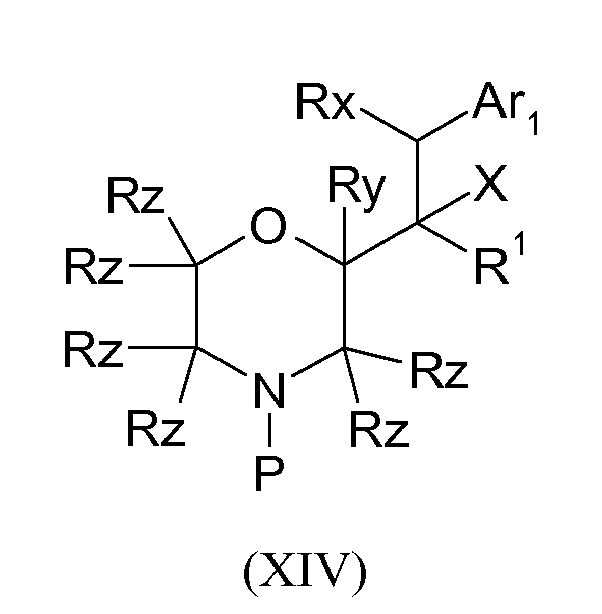
- Examples of compounds of the present invention may be prepared by conventional organic chemistry techniques from N-benzyl-morpholine-2-carboxylic acid ethyl ester 1 or N-benzylmorpholinone as outlined in Schemes 1-4.

- Conversion of 1 into Weinreb amide 2 followed by treatment with a suitable Grignard reagent leads to ketones of formula (XIII) wherein P is benzyl as listed in Table 1.
Table 1 R1 Compound#
(Ketone)methyl 3 ethyl 4 isopropyl 5 isobutyl 6 cyclopentyl 7 tetrahydropyranyl 8 3,3,3-trifluoropropyl 9 4,4,4-trifluorobutyl 10 cyclopropyl 77 n-butyl 82 - Cyclopropyl-substituted ketone 77 may alternatively be obtained from N-benzyl morpholinone as outlined in Scheme 2.

- Treatment of the N-benzyl-morpholinone with a strong base such as lithium diisopropylamide followed by addition of cyclopropyl methylaldehyde gives 75. Reduction of 75 with, for example, borane-THF complex gives 76. Addition of a solution of 76 to a pre-mixed solution of dimethylsulfoxide and oxalyl chloride provides 77.
- Reaction of ketones listed in Table 1 with a suitably substituted benzyl Grignard reagent gives N-benzyl substituted tertiary alcohols listed in Table 2 (wherein R2, R5 and R6 are H unless otherwise indicated) as outlined in Scheme 3.

- Debenzylation and salt formation as detailed in Scheme 4 leads to the tertiary alcohol salts listed in Table 2 (wherein R2, R5 and R6 are H unless otherwise indicated).


Table 2 Example R1 R2, R5, R6 Compound#
(N-Benzyl intermediate)Compound#
(HCl Salt)1 methyl 2-Ph 11 12 2 ethyl 2-OMe,5-F 13 14 3 ethyl 2-OCF3 15 16 4 ethyl 2-Ph 17 18 5 isopropyl 2-OMe, 5-F 19 20 6 isopropyl 2-OMe 21 22 7 isopropyl 2-OEt 23 24 8 isopropyl 2-OCF3 25 26 9 isopropyl 2-Ph 27 28 10 isopropyl 2-Ph, 5-F 29 30 11 isobutyl 2-OMe, 5-F 31 32 12 isobutyl 2-OEt 33 34 13 isobutyl 2-OCF3 35 36 14 isobutyl 2-Ph 37 38 15 isobutyl 2-Ph, 5-F 39 40 16 cyclopentyl 2-OMe, 5-F 41 42 17 cyclopentyl 2-OEt 43 44 18 cyclopentyl 2-OCF3 45 46 19 cyclopentyl 2-Ph 47 48 20 cyclopentyl 2-Ph, 5-F 49 50 21 tetrahydropyranyl 2-OMe, 5-F 51 52 22 tetrahydropyranyl 2-OCF3 53 54 23 tetrahydropyranyl 2-Ph 55 56 24 tetrahydropyranyl 2-(3-F-Ph) 57 58 25 3,3,3-trifluoropropyl 2-OMe, 5-F 59 60 26 3,3,3-trifluoropropyl 2-OCF3 61 62 27 3,3,3-trifluoropropyl 2-Ph 63 64 28 4,4,4-trifluorobutyl 2-OMe, 5-F 65 66 29 4,4,4-trifluorobutyl 2-Ph 67 68 30 cyclopropyl 2-OMe 69 70 31 cyclopropyl 2-OEt 71 72 32 cyclopropyl 2-Ph 73 74 35 n-butyl 2-OMe 83 84 36 n-butyl 2-Ph 85 86 37 isobutyl 2-Cl, 6-F 87 88 38 isobutyl 2-Cl 89 90 - The compounds of Examples 1 to 32 and 35 to 38 can be obtained in enantiomerically pure form via this route using chirally pure ester 1. Resolution of 1 into its enantiomers can be achieved through chiral HPLC. Conversion of the ester to the Weinreb amide does not disturb the chiral center thus providing chirally pure amide 2. Conversion of the Weinreb amide to the ketone also does not disturb the chiral center thus providing chirally pure ketones 3 to 10, 77 and 82. Alternatively, chiral separation may conducted on the amide 2 through chiral HPLC to provide its enantiomers. Alternatively, chiral separation may conducted on the ketones 3 to 10, 77 and 82 through chiral HPLC to provide their enantiomers. Chiral separation of the ester, amide or ketones may also be achieved by other techniques known to those skilled in the art, such as fractional crystallization of diasteromeric salts formed with chiral acids. Addition of the benzyl Grignard reagent (Scheme 3) is a stereoselective process and gives predominantly one diastereomer with only small amounts of the second diastereomer. No epimerisation is observed during removal of the benzyl group. Alternatively, enantiomerically pure products are obtained through conversion to an N-protected analogue such as butyloxycarbonyl or carbobenzyloxy followed by separation by chiral HPLC. Removal of the N-protecting group leads to enantiomerically highly enriched products.
- In the experimental procedures described below the following abbreviations are used:
- HPLC = high performance liquid chromatography
- THF = tetrahydrofuran
- 2-MeTHF = 2-methyltetrahydrofuran
- DIBALH = diisobutyl aluminium hydride
- DCM = dichloromethane
- FIA+ (or FIA-MS) = fast-ionisation-analysis mass spectrometry
- LCMS = liquid chromatography mass spectroscopy
- NMR = nuclear magnetic resonance
- MW = molecular weight
- MeOH = methanol
- EtOAc or AcOEt = ethyl acetate
- PS-DIEA = polymer-supported diisopropylethylamine
- DEA = diethylamine
- RT = retention time
- cbz = carbobenzyloxy
- h, hr or hrs = hour or hours
- min or mins = minute or minutes
- ee = enantiomeric excess
- de = diastereomeric excess
- eq or equiv. = equivalent
- ACN = acetonitrile
- DMF = dimethylformamide
- DMEA = N,N-dimethylethanolamine
- NH3aq = 25 wt% aqueous ammonia
- Tmass = temperature of the reaction mixture
- (i) a 6 minute run, performed on a column (C18 50x3 mm 5µm) using a gradient [90% H2O (+ 0.04% formic acid) to 90% ACN (+ 0.04% formic acid)] over 4 minutes and then hold for 2 minutes; or
- (ii) a 12 minute run, performed on a column (C18 100x3 mm 5µm) using a gradient [90% H2O(+ 0.04% formic acid) to 90% ACN (+ 0.04 % formic acid)] over 9 minutes and then hold for 3 minutes.
- To a solution of the carboxamide 2 in anhydrous THF at 0°C is added a solution of the requisite Grignard reagent (1.2-3 eq in one or two aliquots). The reaction mixture is allowed to warm up to room temperature and left stirring for 45 minutes to 2 hours before quenching either with 1M hydrochloric acid or saturated ammonium chloride solution and extracting either in DCM or ethyl acetate. The combined organic layers are dried over magnesium sulphate, filtered and concentrated in vacuo to give the corresponding alkyl ketones 3-10, 77 and 82.
- To a solution of the ketones 3-10, 77 and 82 in anhydrous THF at 0°C is added a solution of the requisite benzyl Grignard reagent (1.1-1.5 eq). The reaction mixture is allowed to warm up to room temperature and left stirring for 1-2 hours before quenching by addition of cold water. After extraction of the aqueous layer in DCM, the combined organic layers are washed with brine, dried over magnesium sulphate, filtered and concentrated in vacuo to give the title N-benzyl tertiary alcohols. Purification details are listed for individual compounds.
- To a solution of the requisite N-benzyl tertiary alcohol in anhydrous DCM is added solid supported Hünig's base (Argonaut, 3.56 mmol/g, 2-4 eq) and α-chloroethyl chloroformate (3 to 10 eq) at room temperature under nitrogen. The reaction mixture is heated to 40°C and the reaction is monitored by FIA+ and LCMS analysis. After completion the reaction mixture is filtered, and the resin washed with DCM. The combined organic phases are concentrated in vacuo. Methanol is added and the solution heated to 60°C for 1.5 to 8 hours. After complete consumption of starting material the methanol solution is evaporated to give a product, which is further purified as detailed for individual compounds.
- To a solution of the requisite amine in dry diethyl ether (5-10 mL) is added hydrochloric acid (1.2 eq, 1M solution in diethyl ether). Ether is blown off with a stream of nitrogen or removed in vacuo and the samples were either dried under high vacuum for several hours or freeze-dried (acetonitrile/water 1/1 [v/v]) to give the hydrochloride salts in near quantitative yield.
- Such reagents were prepared from the requisite halide or benzyl halide using methods known to those skilled in the art (see for example Fieser, L.F. and Fieser, M.F. "Reagents for Organic Synthesis", John Wiley and Sons Inc., Vol. 1, pp. 415-424 or March, J. "Advanced Organic Chemistry", John Wiley and Sons Inc., 3rd Ed., pp. 558-561). The requisite halides or benzyl halides were either commercially available or prepared using previously published literature methods.
-

- A one-litre reactor with mechanical stirring, cooled by an ice bath, is charged with N-benzylethanolamine (172.2 g; 1 equiv. available from Aldrich Chemical Company). 2-Chloroacrylonitrile (100 g; 1 equiv. available from Aldrich Chemical Company) is added dropwise over 2 minutes. The temperature is maintained between 23 °C and 29 °C by means of the ice bath and subsequently a water bath at 15 °C. After one night stirring at room temperature (water bath), the mixture is dissolved in tetrahydrofuran and transferred to a 2 L reactor which is cooled to -5 °C by ice/NaCl bath. The total volume of tetrahydrofuran is 1.35 L. Potassium tert-butoxide (148 g; 1.1 equiv.) is added by portions over 1 hour, keeping the reaction temperature at 0±2 °C. After 1 hour post-stirring at 0 °C, the mixture is quenched with saturated NaHCO3 (500 mL). The aqueous layer is extracted with diethyl ether (500 mL). Organic layers are dried over MgSO4 and evaporated to dryness. The title compound (149.8 g; 65%) is obtained after percolation of the 250 g dry residue on 1 kg of SiO2, eluting with the following gradient:
5% AcOEt - 95% n-heptane 2.5 L 10% AcOEt - 90% n-heptane 2 L 15% AcOEt - 85% n-heptane 2 L 20% AcOEt - 80% n-heptane 5 L - Alternatively, this intermediate may be prepared as follows:
- A 1600 L glass-lined reactor under N2 is successively loaded with 2-chloroacrylonitrile (33.2 kg, 379 moles) and toluene (114 L) at 21°C. Then, N-benzylethanolamine (57 kg, 377 moles) is added and the reaction mixture is post-agitated at room temperature for about 17 h. Then, the mixture is diluted with toluene (336 L), cooled down to about - 12 °C and potassium t-butoxide (42.3 kg, 377 moles) is added in portions (10) maintaining about - 13 °C ≤ Tmass ≤ about - 2 °C. The mixture is post-agitated at about 0°C for 2.5 h, then quenched by adding water (142.5 L) maintaining about 2 °C ≤ Tmass ≤ about 8 °C. The aqueous layer is separated after 35 minutes of post-stirring allowing the mixture to reach 15 °C and the toluene layer is washed with water (142.5 L) and the aqueous layer is separated. The organic layer is then concentrated under reduced pressure (150 mbars) maintaining Tmass ≤ 60 °C in order to distill 162 kg of toluene. The filtrates are then diluted with toluene (114 L) and treated with SiO2 (Merck silica gel 60, 0.063-0.1 mm, 74.1 kg) under agitation at room temperature for 1.25 h. SiO2 is filtered and rinsed with toluene (2x114 L). Then, the filtrates are concentrated under reduced pressure (150 mbars) maintaining Tmass ≤ 60 °C in order to distill 351.8 kg of toluene.
-

- A 500 mL reactor under N2 is successively loaded with toluene (36.72 mL) and 2-chloroacrylonitrile (10.7 g, 122.23 mmol) at room temperature. Then, N-benzyl ethanolamine (18.36 g, 121.14 mmol) is added over 5 min and the reaction mixture is post-agitated at room temperature for 16h. Then, the mixture is diluted with toluene (110.16 mL), cooled to - 5°C and 2M potassium tert-butoxide solution in THF (121.14 mmol) is slowly added over 30 min, maintaining the temperature at - 5 °C to 0 °C. The mixture is post-agitated at about -5°C to 0°C for 1h, then quenched by adding water (45.9 mL). The aqueous layer is separated and the toluene layer is washed with water (45.9 mL) and then the mixture is allowed to warm to room temperature. The organic layer is then concentrated under reduced pressure at 40°C. Then, the mixture is diluted with toluene (100 mL) and extracted with 6N HClaq (162 mL). This aqueous layer is heated up to the reflux for 1h30, then the mixture is allowed to stir at room temperature overnight. After crystallization of 91, the solid is filtered, rinsed with 6N HClaq (40 mL) and dried under reduce pressure at 40°C (19 g, yield = 61 %).
-

- A 250 mL reactor under N2 is successively loaded with 91 (5 g, 19.41 mmol), dichloroethane (50 mL), DMF (0.014 mL, 1% mol) and oxalyl chloride (1.86 mL, 21.35 mmol). The mixture is heated up to 60-65°C for 2h, before being cooled to 0°C. Then, morpholine (6.93 g, 79.60 mmol) in dichloroethane (20 mL) is added over 15 min keeping the temperature below 10°C. The heterogeneous solution is post-agitated for 1h30min at room temperature and quenched with water (30 mL). The biphasic mixture is filtered on a Hyflo Super Cel® (10 g), then after separation, the organic layer is concentrated under reduce pressure. The mixture is taken up with isopropanol (80 mL) and 12N HClaq (1.61 mL, 19.41 mmol), stirred for 10min and concentrated under reduce pressure. The mixture is taken up with isopropanol (13 mL), heated to reflux until a homogeneous solution is formed, then it is cooled to room temperature. The precipitate is filtered, rinsed with isopropanol (10 mL) and dried under vacuum at 40°C overnight to obtain 92 as an off-white powder with 79 % overall yield.
-
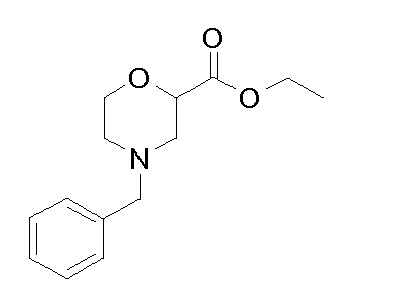
- A stirred solution of 4-benzyl-morpholine-2-carbonitrile (113.0 g, 0.56 mol) in ethanol (1030 mL) is treated with concentrated sulphuric acid (165 mL) added in portions. (exothermic, internal temperature rises from ambient to 65 °C). The mixture is then warmed under reflux for 66hrs. The solution is cooled and then concentrated in vacuo to half volume, basified with aqueous potassium carbonate (beware frothing) and the product extracted into diethyl ether. The organic phase is dried over magnesium sulphate, filtered and evaporated to dryness in vacuo to yield an oil. This material is evacuated further under high vacuum. Yield = 121.3g (87%).
- Alternatively, compound 1 may be synthesised as follows:
- A 100 L reactor attached to a scrubber filled with 1N NaOH (60 L) is charged under nitrogen atmosphere with 4-benzyl-morpholine-2-carbonitrile (1867 g, 9.23 mol) and ethanol (20 L). At Tmass = 15-20°C, concentrated sulfuric acid (2.76 L, 50 mol) is added to the solution over 20 min (highly exothermic). The solution is heated to reflux for 2.5 days. Then, 10 L of solvent is distilled off under vacuum and the reaction mixture is cooled to Tmass = 20-25°C. Water (40 L) is added over 25 min followed by Na2CO3 solution (1/2 saturated, 18 L) and NaHCO3 (1/2 saturated, 7 L) to reach a pH ∼ 7. Ethyl acetate is added (15 L) and the phases are mixed for 15 min. The organic phase is separated and the aqueous phase is extracted with ethyl acetate (2x10 L). The combined organic layers are evaporated to dryness under vacuum to give 1 as a yellow to brown oil (1992g, 87%)
-

- Compound 1 may be separated into its enantiomers by chiral HPLC under the following conditions: Daicel Chiralpak OJ 20µm; 25cm; 100 % EtOH + 0.3 % DMEA; 0.4 mL/min; detection at 260 nm. The desired enantiomer 1b is the peak eluting at RT = 20.25 min.
-

- To a stirred suspension of N,N-dimethylhydroxylamine (6.6 g, 67.6 mmol) in anhydrous DCM (200 mL) under nitrogen at 0°C is added dropwise a solution of trimethylaluminium (2M solution in hexane, 34 mL, 67.6 mmol) over 30 minutes. The reaction mixture is allowed to warm up to room temperature and left stirring for 1 hour. A solution of the ester 1 (6.74 g, 27 mmol) in anhydrous DCM (100 mL) is then added dropwise over 30 minutes and the reaction mixture is left stirring overnight before quenching by cautious addition of phosphate buffer (disodium hydrogen phosphate, pH 8) solution. The precipitate is removed by filtration through a celite pad and the residue washed with chloroform. The organic phase is then concentrated in vacuo and washed with water. The aqueous layer is re-extracted with chloroform and the organic phases are combined, washed with brine, dried over magnesium sulphate and the solvent evaporated in vacuo to give 2 as a yellow oil. Alternatively, the reaction could be worked up as follows: upon addition of a solution of the ester 1 (1 eq) the reaction mixture is left stirring for 1 hour before quenching by addition of phosphate buffer (disodium hydrogen phosphate, pH 8) solution, followed by addition of water. The aqueous layer is re-extracted with DCM and the organic phases are combined, dried over magnesium sulphate and the DCM evaporated in vacuo to give 2 as a yellow oil (3.36 g, 47 %). MW 264.33; C14H20N2O3; 1H NMR (CDCl3): 7.47-7.22 (5H, m), 4.55 (1H, d, 1.5 Hz), 4.00 (1H, dd, 11.5 Hz, 1.7 Hz), 3.75 (1H, dt, 11.5 Hz, 2.2 Hz), 3.65 (3H, s), 3.56 (2H, m), 3.17 (3H, s), 2.93 (1H, d, 11.3 Hz), 2.68 (1H, d, 11.3 Hz), 2.30 (2H, 11.3 Hz); LCMS: (6 min method) m/z 265 [M+H]+, RT 0.65 min.
-

- Compound 2 may be separated into its enantiomers by chiral HPLC under the following conditions: Daicel Chiralpak OJ 20µm; 25cm; n-heptane/isopropanol 80:20 v:v; 0.4 mL/min; detection at 220 nm. Alternatively, compound 2b may be synthesized substantially as described above for compound 2 using compound 1b in place of compound 1.
-

- The title compound is prepared in 5 steps from commercially available (Aldrich) 5-fluorosalicylic acid following literature procedures (JACS, 2000, 122, 4020-4028). MW 265.13; C13H10BrF; 1H NMR (CDCl3): 7.48-7.38 (5H, m), 7.26-7.19 (1H, m), 7.05 (1H, td, 8.3 Hz, 2.8 Hz), 4.39 (2H, s); 19F NMR (CDCl3): -114.72.
-

- To a solution of 2-methoxy-5-fluorobenzaldehyde (11.093g, 1 eq, available from Aldrich Chemical Company) in methanol at -10 °C under nitrogen atmosphere is added NaBH4 (7.515g, 2.7 equiv.) portionwise. The solution is allowed to warm to room temperature and after 30 minutes the reaction solvent is removed under reduced pressure and replaced with dichloromethane. This solution is poured onto ice water and further extracted with dichloromethane. The organic fractions are collected and dried (MgSO4) and the solvent removed under reduced pressure to give the title compound as an oil (9.794g, 87%). MW 156.16; C8H9FO2; 1H NMR (CDCl3): 2.58 (m, 1H), 3.81 (s, 3H), 4.63 (d, 2H, 6.3 Hz), 6.78 (dd, 1H, 8.9 Hz and 4.3 Hz), 6.94 (td, 1H, 8.5 Hz and 3.1 Hz), 7.04 (dd, 1H, 8.7 Hz and 3.1 Hz).
-

- Neat (5-Fluoro-2-methoxy-phenyl)-methanol (19.587g, 1 equiv.) is added to neat SOCl2 (42.2 mL, 4.6 equiv.) at -78°C under a nitrogen atmosphere and the solution is then allowed to warm to room temperature and stirred until evolution of gas ceases. An equivalent volume of anhydrous toluene is added to the flask and the solution heated to 60°C. On cooling, the reaction solution is poured onto ice water. The toluene layer is separated and dried (MgSO4) and the solvent removed under reduced pressure. The crude material is sublimed (60-80°C/0.05 mBarr) to give the title compound as a white solid (13.40 g, 61%). MW 174.60; C8H8ClFO; 1H NMR (CDCl3): 3.87 (s, 3H), 4.60 (s, 2H), 6.79-7.20 (m, 3H).
-

- Magnesium turnings (21.6 g, 0.888 mole, 2 eq.) and diethyl ether (300 mL) are loaded in a reactor under N2. A solution of 5-fluoro-2-methoxybenzyl chloride (116 g, 0.664 mol, 1.5 eq.) in diethyl ether (200 mL) is loaded in an addition funnel. Iodine crystals and a small amount of the 5-fluoro-2-methoxybenzyl chloride solution are added and the reaction mixture is stirred to initiate the reaction. The remainder of the 5-ftuoro-2 methoxybenzyl chloride solution is then added drop-wise maintaining the temperature of the reaction mixture below 28 °C. The mixture is stirred for another 5 minutes at 19 °C and after completion of the addition a white suspension is formed.
-

- Compound 3 is obtained from 2 (0.730 g, 2.8 mmol) and commercially available (Aldrich) methyl magnesium bromide (1M solution in THF, 3 mL, 3 mmol, 1.1 eq) in anhydrous THF (25 mL) following General Procedure 1 after purification by automated column chromatography (eluent EtOAc/n-heptane 14/86 -100/0 [v/v]) (0.3 g, 49%). MW 235.33; C14H21NO2. LCMS (6 minute method) m/z 220.1 [M+H]+, RT 1.55 min.
-

- Compound 4 is obtained from 2 (0.70 g, 2.65 mmol) and commercially available (Aldrich) ethyl magnesium bromide (2.65 mL, 7.94 mmol, 3 eq) in anhydrous THF (25 mL) following General Procedure 1 as a yellow oil (583 mg, 89%). MW 249.36; C15H23NO2. LCMS (6 minute method) m/z 234.4 [M+H]+, RT 1.78 min.
-

- Compound 5 is obtained from 2 (3.018 g, 11.4 mmol) and commercially available (Aldrich) isopropyl magnesium chloride (2M solution in THF, 17.1 mL, 34.3 mmol, 3 eq) in THF (100 mL), following General Procedure 1 as a yellow oil (2.68 g, 89%); MW 263.38; C16H25NO2; LCMS (6 minute method): m/z 248.2 [M+H]+, RT 2.41 min.
-

- Compound 6 is prepared from 2 (10 g, 37 mmol) in anhydrous tetrahydrofuran (50 mL) and commercially available (Aldrich) isobutyl magnesium bromide (2M solution in diethyl ether, 56 mmol, 28 mL, 1.5 eq) following General Procedure 1. After stirring for 1 hour the reaction is quenched by addition of aqueous hydrochloric acid (150 mL). THF is removed in vacuo and diethyl ether is added after pH adjustment by addition of a saturated sodium bicarbonate solution. The organic phases are combined, dried over magnesium sulphate and the solvent is removed in vacuo. 6 is isolated in 80% purity (8.7 g, 67 % with respect to pure product). MW 261.37; C16H23NO2; LCMS: (6 min method) m/z 262.2 [M+H]+, RT 2.753 min.
-

- Compound 7 is prepared from 2 (3.36 g, 12.7 mmol) in anhydrous tetrahydrofuran (120 mL) and commercially available (Aldrich) cyclopentyl magnesium bromide (2M solution in diethyl ether, 19.1 mL, 38.2 mmol, 3 eq) following General Procedure 1 in quantitative yield as yellow oil. MW 273.38; C17H23NO2; LCMS (6 min method) m/z 274 [M+H]+, RT 2.24 min.
-

- Compound 8 is obtained from 2 (2.84 g, 10.74 mmol) in anhydrous tetrahydrofuran (30 mL) and 4-tetrahydropyranyl magnesium chloride (Chem. Ber. 98, 1965, 3757) (2M solution in tetrahydrofuran, 6.5 mL, 13 mmol, 1.2 eq) following General Procedure 1. After 30 minutes further 4-tetrahydropyranyl magnesium chloride is added (2M solution in diethyl ether, 6.5 mL, 13 mmol, 1 eq.). After stirring for 2 hours the reaction mixture is quenched by addition of ammonium chloride solution (30 mL) and ethyl acetate (30 mL). The aqueous layer is re-extracted with ethylacetate (30 mL) and the organic phases are combined, dried over magnesium sulphate and the solvents are removed in vacuo. The resulting residue is purified by ion exchange chromatography to give 8 as a yellow oil (2.98 g, 96 %). MW 289.38; C17H23NO3; LCMS (6 min method) m/z 290 [M+H]+, RT 2.20 min.
- Alternatively compound 8 may be prepared as follows:
- a) Neutralization of 92
92 (97 g) is suspended in toluene (485 mL) under mechanical stirring and sodium carbonate (3.68 N, 97 mL, 1.2 equiv) is added. Then, the mixture is diluted with water (194 mL) and stirred for 45 mins at room temperature. Then, the biphasic mixture is filtered on Hyflo Super Cel® and transferred to a separatory funnel. The aqueous layer is discarded and the organic layer (594.3 g) is concentrated under reduced pressure at 40°C to a mass of 348 g. Toluene is added (150 mL) and the organic layer is concentrated under the same conditions to a mass of 347 g. The free base of compound 92 as a toluene solution is then diluted with anhydrous THF (300 g) and the solution is ready to be added to the Grignard reagent. - b) Formation of the Grignard reagent
An inerted 3 L 3-necked flask is charged with THF (50 mL) and magnesium turnings (9 g, 0.370 mol, 1.25 equiv.). The mixture is heated to Tmass = 60°C and iodine (0.150 g) and 4-chlorotetrahydropyran (1 mL) are added. Initiation is observed within 5 minutes. Then, the mixture is heated to Tmass = 63-68°C and addition of remaining 4-chlorotetrahydropyran (39.19 mL diluted with 188 mL of THF) is performed over 1 hour keeping T mass constant at about 68°C. After 40 minutes of post-agitation, the reaction mixture is allowed to cool to room temperature. - c) Grignard reaction
The toluene/THF solution of neutralized 92 is added to the Grignard reagent at 20-25°C over 45 min. The mixture is post-agitated at room temperature for 1h. Then, the reaction mixture is quenched by addition at 0-5°C to an acetic acid/H2O mixture (44.3 mL acetic acid and 245 mL H2O). The aqueous layer is separated and discarded and the organic layer is washed with H2O (60 mL). The aqueous layer is separated and discarded and the organic layer is washed with 2N NaOH (100 mL). The aqueous layer is separated and discarded and the organic layer is concentrated under reduced pressure at 40°C to 230 g. The residue is taken up with IPA (1 L) and concentrated as described above to yield 230 g of 8 as the free base. -

- An inerted 6L reactor is charged with THF (242.5 mL), magnesium (54.47 g, 2240mmol) and 5% of the total amount of 4-chlorotetrahydropyran (12.28 mL, 112 mmol). Then, a small amount of methyl iodide (0.5 mL) and one iodine crystal is added. The reaction mixture is stirred and heated up to 64-66°C. After initiation, the remaining 4-chlorotetrahydropyran (233.22 mL, 2127 mmol) diluted in THF (890 mL) is slowly added over 135 mins. The mixture is heated up for 30 additional minutes before being cooled to 0°C. Then, the Weinreb amide 2b (370 g, 1400 mmol) diluted in THF (2777 mL) is added over 180 mins between 0-4°C and the mixture is stirred for a further 60 mins. Then, acetic acid (48 mL, 0.83 mmol) is added to the mixture followed by a 55/45: v/v: saturated NH4Cl/H2O mixture (2590 mL) keeping the temperature below 9°C. The organic layer is washed with a 60/40: v/v: saturated NH4Cl/H2O mixture (500 mL) and, after separation, toluene (1800 mL) and water (1800 mL) is added to the organic solution. Then after extraction, water (1100 mL) is added to the toluene mixture which is basified with 3.68 M Na2CO3aq (148 mL). The organic layer is dried over MgSO4, filtered and concentrated under reduced pressure to dryness to yield compound 8b as the free base (400.8 g, 98.6% yield).
- Alternatively compound 8b may be prepared as follows:
- R-(-)-Mandelic acid (1.65 g, 10.8 mmol) is added to a solution of 8 (3.15 g, 10.8mmol) in isopropanol (20 mL). After 2 min of post-agitation, an homogenous solution is obtained at room temperature. Crystallization begins after 5 min of post-agitation to form an easily stirable suspension. This suspension is post-stirred for 21 hours at room temperature. The solid is filtered and washed with isopropanol (2 mL). The white crystals are dried under vacuum at 40°C over 5 hours to give 1.8g of 8b R-mandelate with 37.5% yield and 99.2% ee. 0.5N of K2CO3 (2.4 mL, 1.2 mmol) is added dropwise to a stirred suspension of 8b R-mandelate (500 mg, 1.13 mmol) in toluene (5 mL). A biphasic solution is obtained. The free base 8b is entirely present in the organic layer, which is separated, concentrated on a rotovap and dried under vacuum at 40°C affording 8b as an oil with 98% yield.
-

- Compound 9 is obtained from 2 (1.38 g, 5.23 mmol) and 3,3,3-trifluoropropyl magnesium bromide (20.9 mL, 10.50 mmol, 2 eq) in dry THF (45 mL) following General procedure 1. 3,3,3-Trifluoropropyl magnesium bromide is obtained from commercially available (Aldrich) 3,3,3-trifluoropropyl bromide following General Procedure 5. Purification by ion exchange chromatography gives 9 as an oil (1.24 g, 78.7%). MW 301.31; C15H18F3NO2; LCMS (6 minute method): m/z 302.4 [M+H]+, RT 2.66min.
-

- Compound 10 is prepared from a solution of 2 (0.717 g, 2.71 mmol) in anhydrous tetrahydrofuran (20 mL) and 4,4,4-trifluorobutyl magnesium bromide (0.5M solution in diethyl ether, 6.5 mL, 3.25 mmol, 1.2eq). 4,4,4-Trifluorobutyl magnesium bromide is obtained from commercially available (Aldrich) 4,4,4-trifluorobutyl bromide following General Procedure 5. After 30 minutes another 0.3 eq of 4,4,4-trifluorobutyl magnesium bromide are added (0.5M solution in diethyl ether, 2.5 mL). After stirring for 2 hours the solvents are removed in vacuo and water (20 mL) and ethyl acetate (30 mL) are added to the residue. The organic phase is washed with brine, dried over magnesium sulphate and the solvent is removed in vacuo to give 10 as clear oil (0.985 g). 10 is taken onto the next step without further purification. MW 315.34; C16H20NO2F3; LCMS: (6 min method) m/z 316 [M+H]+, RT 2.9min.
-

- A solution of N-benzyl-N-(2-hydroxyethyl) chloroacetamide (627.7 g, 2.76 mol) in tert-butanol (0.9 L) is stirred under nitrogen while warming to 25-30°C. Potassium tert-butoxide (2.897 L of a 1M solution in tert-butanol, 2.90 mol, 1.05 eq) is added over 2 hours. The reaction mixture is then stirred at room temperature for 90 minutes. Ice-cold water (6 L) is added and the resultant cloudy solution extracted with ethyl acetate. The combined organic layers are washed with brine, dried over magnesium sulphate and evaporated in vacuo to give a light brown oil (441 g, 84%), which is used in the next stage without further purification; MW 191.23; C11H13NO2; 1H NMR (CDCl3): 7.29-7.40 (5H, m), 4.67 (2H, s), 4.28 (2H, s), 3.87 (2H, t, 5 Hz), 3.31 (2H, t, 5 Hz); LCMS: (12 min method) m/z 192 [M+H]+ RT 1.00 min.
-

- To a solution of 4-benzyl-morpholin-3-one (9.5 g, 50 mmol) in THF (200 mL) is added lithium diisopropylamide (2M solution in THF, 27 mL, 54 mmol, 1.1 eq ) dropwise over 20 minutes at -78°C followed by slow addition of cyclopropyl methylaldehyde (3.85 mL, 55 mmol, 1.1 eq). After stirring at -78°C for one hour the reaction mixture is allowed to warm to room temperature and stirred for another 6 hours. The reaction is quenched by addition of EtOAc and brine. The aqueous layer is extracted with EtOAc, the combined organic layers are dried over magnesium sulphate and reduced in vacuo. Purification using automated column chromatography (DCM/MeOH, 100/0 to 85/15 [v/v]) gives 75 in 70% purity with 4-benzyl-morpholin-3-one as the major impurity. This product is directly used in the next step. MW 261.32; C15H19NO3; LCMS (6 min method) m/z 261.32 [M+H]+, RT 2.23
-

- Borane-THF complex (1M solution in THF, 30 mL, 30 mmol, 4.1 eq) is added slowly to a solution of 75 (1.9 g, 7.3 mmol) in THF (100 mL). The reaction is heated to 60°C. After 24 hours MeOH and hydrochloric acid (2M, excess) are added and the resulting mixture heated for one hour at the same temperature. After careful addition of saturated NaHCO3 solution and EtOAc the aqueous layer is extracted with EtOAc. The combined organic layers are washed with brine, dried over magnesium sulphate and the solvent is removed in vacuo. Purification by ion exchange chromatography gives 76 (1.1 g, 61%). MW 247.34; C15H21NO2; LCMS (6 min method) m/z 248 [M+H]+, RT 2.48 min.
-
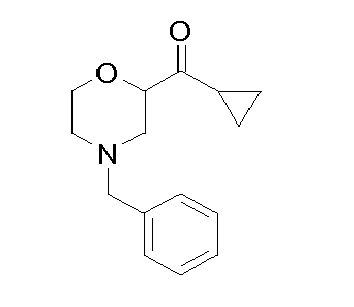
-

- Compound 82 is prepared from 2 (0.87 g, 3.28 mmol) in anhydrous tetrahydrofuran (30 mL) and commercially available (Aldrich) n-butyl magnesium bromide (2M solution in THF, 5 mmol, 2.5 mL, 1.5 eq) following General Procedure 1. After stirring for 1 hour further n-butyl magnesium bromide (2M solution in THF, 1.6 mmol, 0.8 mL) is added and stirring continued for 30 minutes. The reaction is quenched by addition of ammonium chloride solution (30 mL) followed by EtOAc. The organic phases are combined, dried over magnesium sulphate and the solvent is removed in vacuo to give 82 (0.82 g, 96%). MW 261.37; C16H23NO2; LCMS (6 minute method): m/z 262.4 [M+H]+, RT 2.34 min.
-
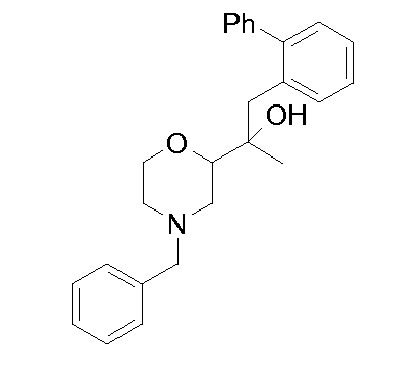
- Compound 11 is prepared from 2-phenylbenzyl magnesium bromide (0.25M solution in diethyl ether, 5.5 mL, 1.38 mmol) and 3 (275 mg, 1.25 mmol) in anhydrous THF (7 mL) following General Procedure 2. 2-Phenylbenzyl magnesium bromide is obtained from commercially available (Aldrich) 2-phenylbenzyl bromide following General Procedure 5. Further equivalents of 2-phenylbenzyl magnesium bromide (10 mL, 2.5 mmol) are added before quenching the reaction with ice water (7 mL). 11 is obtained as an oil in 75% purity after ion exchange (5 g column) chromatography and automated column chromatography (EtOAc/n-heptane 0/100 to 50/50 [v/v]) and taken onto the next step without further purification (0.23 g isolated material). MW 387.53; C26H29NO2; LCMS (6 minute method): m/z 388.2 [M+H]+, RT 3.37 min.
-

- 12 is obtained from 11 (204 mg, 0.53 mmol), α-chloroethyl chloroformate (0.23 mL, 2.11 mmol) and polymer-supported Hünig's base (296 mg, 1.05 mmol) in DCM (5 mL) following General Procedure 3. Purification using ion exchange chromatography, followed by preparative LCMS and conversion into the hydrochloride salt following General Procedure 4 gives 12 as a foam (102 mg, 65%). MW 297.36; C19H23NO2.HCl; 1H NMR (CD3OD) δ 7.15-7.39 (8H, m), 7.07-7.11 (1H, m), 3.97 (1H, dd, 3.0 Hz, 13.0 Hz), 3.56-3.65 (1H, m), 3.20-3.25 (1H, m), 3.08 (2H, t, 12.5 Hz), 2.82-2.99 (4H, m), 0.60 (3H, s); LCMS (12 minute method): m/z 298.2 [M-HCl+H]+, RT 4.38 min.
-

- Compound 13 is obtained from 4 (583 mg, 2.5 mmol) and 2-methoxy-5-fluorobenzyl magnesium bromide (5.5 mL, 2.75 mmol, 1.1 eq) in anhydrous THF (15 mL) following General Procedure 2. Further equivalents of 2-methoxy-5-fluorobenzyl magnesium bromide (2M solution in diethyl ether, 10 mL, 5.0 mmol) are added after 30 min and the mixture is warmed to room temperature and left to stir over night. After purification by ion exchange chromatography 13 is obtained as a yellow oil in 67% purity (702 mg). The compound is taken over to the next step without further purification. MW 373.47; C22H29FNO3; LCMS (6 minute method) m/z 374.2 [M+H]+, RT 3.17 min.
-

- 14 is obtained from 13 (717 mg, 1.92 mmol), α-chloroethyl chloroformate (0.83 mL, 3.84 mmol, 4 eq) and polymer-supported Hünig's base (1.08 g, 3.84 mmol, 2eq) in DCM (17 mL) following General Procedure 3. Purification by ion exchange chromatography followed by preparative LCMS and conversion into the hydrochloride salt following General Procedure 4 gives 14 as a solid (185 mg, 30%). MW 319.81; C15H22FNO3.HCl; 1H NMR (CD3OD) δ 6.94 (1H, dt, 1.5 Hz, 9 Hz), 6.81-6.84 (2H, m), 4.07 (1H, dd, 3.5, 13 Hz), 3.67-3.76 (4H, m), 3.56 (1H, dd, 2.5 Hz, 11 Hz), 3.33 (1H, m), 3.14-3.25 (1H, m), 3.00-3.08 (2H, m), 2.84 (2H,, 14 Hz), 1.37-1.51 (1H, m), 1.05-1.19 (1H, m), 0.82 (3H, t, 7.5 Hz); LCMS (12 minute method): m/z 284.1 [M-HCl+H]+, RT 3.76 min.
-

- Compound 15 is obtained from 4 (1.1 g, 4.71 mmol) and commercially available (Fluorochem) 2-trifluoromethoxy benzyl magnesium bromide (10.4 mL 1, 5.19 mmol, 1.1eq) in anhydrous THF (31 mL) following General Procedure 2. After 30 minutes further equivalents of 2-trifluoromethoxy benzyl magnesium bromide are added (0.5M solution in diethyl ether, 4.71 mL, 2.36 mmol). Purification by ion exchange chromatography gives 15 as an oil (1.88 g, 98%). MW 409.45; C22H26F3NO3; LCMS (6 minute method): m/z 410.4 [M+H]+, RT 3.28 min.
-

- 16 is obtained from 15 (1.88 g, 4.59 mmol), α-chloroethyl chloroformate (1.98 mL L, 18.4 mmol) and polymer-supported Hünig's base (2.58 g, 9.18 mmol) in DCM (40 mL) following General Procedure 3. Purification using ion exchange chromatography followed by automated column chromatography ( eluent, MeOH/DCM 0/100 to 20/80 [v/v]) and conversion to the hydrochloride salt following General Procedure 4 gives 16 (258.5 mg, 17%) as a white solid. MW 319.33; C15H20F3NO3.HCl; 1H NMR (CD3OD) - δ 7.53 (1H, dd, 2 Hz, 7.5 Hz), 7.27-7.38 (3H, m), 4.20 (1H, dd, 3.5 Hz, 13 Hz), 3.85 (1H, td, 3 Hz, 13 Hz), 3.70 (1H, dd, 2 Hz, 11 Hz), 3.44 (1H, d, 13 Hz), 3.27-3.34 (1H, m), 3.12-3.22 (2H, m), 3.07 (1H, d, 14 Hz), 2.96 (1H, d, 14 Hz), 1.55 (1H, sextet, 7.5 Hz), 1.26 (1H, sextet, 7.5 Hz), 0.93 (3H, t, 7.5 Hz). LCMS (12 minute method): m/z 320.4 [M-HCl+H]+, RT 2.77 min.
-

- Compound 17 is obtained from 3 (601 mg, 2.58 mmol) and 2-phenylbenzyl magnesium bromide (0.25M solution in diethyl ether, 11.5 mL, 2.84 mmol) in anhydrous THF (15 mL) following General Procedure 2. 2-Phenylbenzyl magnesium bromide is prepared from commercially available (Aldrich) 2-phenylbenzyl bromide following General Procedure 5. Further equivalents of 2-phenylbenzyl magnesium bromide (10.32 mL, 2.58 mmol) are added. Purification by ion exchange chromatography followed by automated column chromatography (eluent, EtOAc/n-heptane 0/100 to 50/50 [v/v) gives 17 (705 mg, 68%) as a colourless oil in 91% purity which is directly used in the next step. MW 401.55; C27H31NO2; LCMS (6 minute method): m/z 402.2 [M+H]+, RT 3.56 min
-

- 18 is obtained from 17 (705 mg, 1.76 mmol), α-chloroethyl chloroformate (0.76 mL, 7.02 mmol) and polymer-supported Hünig's base (988 g, 3.52 mmol) in DCM (15 mL) following General Procedure 3. Purification by ion exchange chromatography followed by automated column chromatography (eluent, MeOH/DCM 5/95 to 20/80 [v/v]) and conversion into the hydrochloride salt following General Procedure 4 gives 18 (0.37 g, 62%) as a yellow foam. MW 347.82; C20H25NO2.HCl; 1H NMR (CD3OD) δ 7.43-7.46 (1H, m), 7.29-7.34 (3H, m), 7.14-7.25 (5H, m), 7.06-7.11 (1H, m), 3.94 (1H, dd, 3.5 Hz, 13 Hz), 3.55-3.64 (1H, m), 3.37 (1H, dd, 1.5 Hz, 11 Hz), 3.09 (2H, d, 12.5 Hz), 2.80-2.99 (4H, m), 1.11-1.23 (1H, m), 0.91 (1H, m), 0.38 (3H, t, 7.5 Hz). LCMS (12 minute method): m/z 312.1 [M-HCl+H]+, RT 4.67 min.
-

- Compound 19 is obtained from 5 (0.7 g, 2.83 mmol) and 2-methoxy-5-fluoro-benzyl magnesium bromide (6.2 mL, 3.11 mmol, 1.1eq) in anhydrous THF (15 mL 1) following General Procedure 2. Further equivalents of 2-methoxy-5-fluoro-benzyl magnesium bromide (8.49 mL, 4.25 mmol) are added and mixture is warmed to room temperature and left stirring overnight. Purification using automated column chromatography (eluent, n-heptane/EtOAc 100/0 to 75/25 [v/v]) gives 19 (0.53 g, 48%). MW 387.5; C23H30FNO3; LCMS (6 minute method): m/z 388.2 [M+H]+, RT 3.21 min.
-

- 20 is obtained from 19 (523 mg, 1.35 mmol), α-chloroethyl chloroformate (0.58 mL, 5.40 mmol, 4 eq) and PS-DIEA (0.76 g, 2.70 mmol, 2 eq) in DCM (10 mL) following General Procedure 4. Purification by ion exchange chromatography and conversion to the hydrochloride salt following General Procedure 4 gives 20 as an off-white solid (0.26g, 58%). MW 333.83; C16H24FNO3. HCl; 1H NMR (CD3OD) δ 7.10 (1H, d, 9.5 Hz), 6.94 (2H, d, 6 Hz), 4.07 (1H, dd, 3.5 Hz, 13 Hz), 3.71-3.88 (5H, m), 3.21-3.47 (2H, m), 2.99-3.11 (4H, m), 1.8 (1H, septet, 7 Hz), 1.04 (3H, d, 7 Hz), 0.94 (3H, d, 7.0 Hz); LCMS (12 minute method): m/z 298 [M-HCl+H]+, RT 4.29 min.
-

- Compound 21 is obtained from 5 (1.5 g, 6.06 mmol) and 2-methoxy benzyl magnesium bromide (available from Rieke-Metals) (0.25M solution in THF, 33.9 mL, 8.49 mmol) in anhydrous THF (30 mL) following General Procedure 1. Purification by column chromatography (eluent, EtOAc/n-heptane 0/100 to 40/60 [v/v]) gives 21 as colourless oil (1.45 g, 84%). MW 369.51; C23H31NO3.HCl; LCMS (6 minute method): m/z 370.2 [M-HCl+H]+, RT 2.77 min.
-

-

- Compound 23 is obtained from 5 (1.5 g, 6.06 mmol) and 2-ethoxybenzyl magnesium chloride (available from Rieke-Metals) (0.25M solution in THF, 34 mL, 8.49 mmol) in anhydrous THF (30 mL) following General Procedure 2. After repeated purification by automated column chromatography (leluent MeOH/ DCM 0/100 to 10/90 [v/v] followed by EtOAc/DCM 0/100 to 50/50 [v/v]) 23 is obtained as colourless oil (0.8 g, 35%). MW 383.54, C24H33NO3; LCMS (6 minute method): m/z 384.4 [M+H]+, RT 3.04 min.
-

- 24 is obtained from 23 (766 mg, 2.0 mmol), α-chloroethyl chloroformate (0.86 mL, 8.0 mmol) and polymer-supported Hünig's base (1.12 g, 4.0 mmol) in DCM (30 mL) following General Procedure 3. Purification using ion exchange chromatography followed by automated column chromatography (eluent, MeOH/ DCM 0/100 to 20/80 [v/v]) and chiral preparative chromatography (n-HeptaneEtOH:DEA 95:5:0.2 gradient, chiracel AD) gives the first eluting enantiomer (RT 13.40 min) and the second eluting enantiomer (RT 15.63 min). After conversion to their respective hydrochloride salts, 24a (85 mg) and 24b (79 mg) are obtained as brown solids (28% combined yield). MW 293.36; C17H27NO3.HCl; 1H NMR (CD3OD) δ 7.06-7.09 (1H, m), 6.95-7.01 (1H, m), 6.66-6.75 (2H, m), 3.80-3.92 (3H, m), 3.46-3.63 (2H, m), 2.96-3.15 (2H, m), 2.66-2.86 (4H, m), 1.54-1.63 (1H, m), 1.22 (3H, t, 7.0 Hz), 0.82 (3H, d, 7.0 Hz), 0.71 (3H, d, 7.0 Hz); LCMS (12 minute method): m/z 294.2 [M-HCl+H]+, RT 4.60 min.
-

- Compound 25 is obtained from 5 (953 mg, 3.85 mmol) and commercially available (Fluorochem) 2-trifluoromethoxy benzyl magnesium bromide (8.48 mL, 4.24 mmol, 1.1 eq) in anhydrous THF (25 mL) following General Procedure 3 and addition of further 2-trifluoromethoxy benzyl magnesium bromide (3.85 mL, 1.93 mmol). Purification by ion exchange chromatography gives 25 as a yellow oil in 86% purity which is used in the next step without further purification (1.53 g of isolated material). MW 423.38; C23H28F3NO3; LCMS (6 minute method) m/z 424.1 [M+H]+, RT 3.53 min.
-

- 26 is obtained from 25 (1.53 g, 3.61 mmol), α-chloroethyl chloroformate (1.55 mL, 14.5 mmol, 4 equiv.) and polymer-supported Hünig's base (2.03 g, 7.23 mmol, 2 eq) in DCM (30 mL) following General Procedure 3. Purification by ion exchange chromatography, followed by automated column chromatography eluent, MeOH/DCM 0/100 to 20/80 [v/v]) and conversion to its hydrochloride salt following General Procedure 4 gives 26 as a yellow solid (0.4 g, 29%). MW 379.82; C16H22F3NO3.HCl; 1H NMR (CD3OD) δ 7.46 (1H, dd, 1.5 Hz, 7.5 Hz), 7.14-7.24 (3H, m), 3.94 (1H, dd, 3.5 Hz, 13 Hz), 3.80 (1H, dd, 2.5 Hz, 11.5 Hz) 3.69 (1H, td, 2.5 Hz, 13 Hz), 3.27 (1H, d, 13 Hz), 3.13 (1H, d, 12.5 Hz), 2.72-3.02 (4H, m), 1.70 (1H, septet, 7 Hz), 0.94 (3H, d, 7 Hz), 0.84 (3H, d, 7.0 Hz). LCMS (12 minute method): m/z 334.4 [M-HCl+H]+, RT 2.94 min.
-

- Compound 27 is obtained from 5 (0.7 g, 2.83 mmol) and 2-phenylbenzyl magnesium bromide (12.5 mL, 3.11 mmol) in anhydrous THF (15 mL) following General Procedure 2 and further equivalents of 2-phenylbenzyl magnesium bromide reagent (11.3 mL, 5.66 mmol). 2-Phenylbenzyl magnesium bromide is prepared from commercially available (Aldrich) 2-phenylbenzyl bromide following General Procedure 5. Purification using ion exchange chromatography, followed by automated column chromatography (eluent, EtOAc/n-heptane 0/100 to 20/80 [v/v]) gives 27 as oil (0.46 g, 40%). MW 415.58; C28H33NO2; LCMS (6 minute method): m/z 416.2 [M+H]+, RT 3.45min.
-

- 28 is obtained from 27 (405 mg, 0.976 mmol), α-chloroethyl chloroformate (0.42 mL, 3.9 mmol) and polymer-supported Hünig's base (0.55 g, 1.95 mmol) in DCM (7 mL) following General Procedure 3. The crude product is purified using ion exchange chromatography, and then converted to its hydrochloride salt following General Procedure 4 to give 28 as a white solid (0.23 g, 71%). MW 361.91; C21H27NO2.HCl; 1H NMR (CD3OD) δ 7.61-7.64 (1H, m), 7.19-7.47 (8H, m), 3.95 (1H, dd, 4 Hz, 13 Hz), 3.61-3.71 (2H, m), 3.04- 3.19 (4H, m), 2.96 (1H, td, 4 Hz, 12.6 Hz), 2.70 (1H, dd, 13, 11.5 Hz), 1.67 (1H, septet, 7 Hz), 0.75 (3H, d, 7 Hz), 0.63 (3H, d, 7 Hz); LCMS (12 minute method): m/z 326.2 [M-HCl+H]+, RT 5.02 min.
-

- Compound 29 is obtained from 5 (1.13 g, 4.57 mmol) and 2-phenyl-5-fluorobenzyl magnesium bromide (0.5M in THF, 10.5 mL, 5.03 mmol) in anhydrous THF (30 mL) following General Procedure 2 (further 2-phenyl-5-fluorobenzyl magnesium bromide (0.33 eq, 3 mL, 1.51 mmol) is added after 30 min). 2-Phenyl-5-fluorobenzyl magnesium bromide is obtained from 2-phenyl-5-fluorobenzyl bromide following General Procedure 5. Purification by ion exchange chromatography followed by automated column chromatography (eluent, EtOAc/n-heptane 0/100 to 20/80 [v/v]) gives 29 as a yellow oil in 86% purity which is directly used in the next step (1.58 g recovered material). MW 415.58; C28H33NO2; LCMS (6 minute method): m/z 434.5 [M+H]+, RT 3.71 min.
-

- 30 is obtained from 29 (1.58 g, 3.63 mmol), α-chloroethyl chloroformate (1.57 mL, 3.63 mmol) and polymer-supported Hünig's base (2.04 g, 7.26 mmol) in DCM (30 mL) following General Procedure 3. The crude product is purified using ion exchange chromatography, automated column chromatography (eluent, MeOH/ DCM 0/100 to 20/80 [v/v]), and preparative LCMS. Conversion to the hydrochloride salt following General Procedure 4 gives 30 as a yellow solid (0.3 g, 22%). MW 379.91; C21H26FNO2.HCl; 1H NMR (CD3OD) δ 7.20-7.35 (6H, m), 7.07-7.14 (1H, m), 6.90 (1H, td, 2.5 Hz, 8.5 Hz), 3.83 (1H, d, br, 10 Hz), 3.56 (2H, t, 10 Hz), 3.03-3.12 (2H, m), 2.79-2.98 (3H, m), 2.63 (1H, t, 11.5 Hz), 1.55 (1H, quintet, 7 Hz), 0.64 (3H, d, 7 Hz), 0.51 (3H, d, 7 Hz); LCMS (12 minute method): m/z 344.1 [M-HCl+H]+, RT 5.14 min.
-
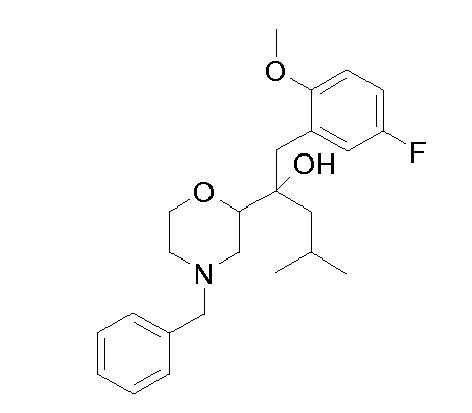
- Compound 31 is obtained from 6 (465 mg, 1.78 mmol) and 2-methoxy-5-fluorobenzyl magnesium bromide (3.92 mL, 1.96 mmol, 1.1 equiv.) in dry THF (10 mL) following General Procedure 2. Purification by ion exchange chromatography followed by automated column chromatography (eluent, EtOAc/n-heptane 0/100 to 40/60 [v/v]) gives 31 as an oil (448 mg, 83% purity). MW 401.53; C24H32FNO3; LCMS (6 minute method): m/z 402.2 [M+H]+, RT 3.40 min.
-

- 32 is obtained from 31 (448 mg, 1.12 mmol), α-chloroethyl chloroformate (0.48 m L, 4.47 mmol, 4eq) and polymer-supported Hünig's base (628 g, 2.23 mmol, 2eq) in DCM (10 mL) following General Procedure 3. Purification by ion exchange chromatography followed by preparative LCMS and conversion to its hydrochloride salt following General Procedure 4 gives 32 as a white solid (0.11 g, 32%). MW 347.72; C17H26FNO3. HCl; 1H NMR (CD3OD) δ 7.05-7.08 (1H, m), 6.95-6.98 (2H, m), 4.16 (1H, dd, 3 Hz, 12.5 Hz), 3.75- 3.86 (4H, m), 3.67 (1H, d, 10.5 Hz), 3.51 (1H, d, 12 Hz), 3.25-3.29 (1H, m), 3.07-3.20 (2H, m), 2.94 (2H, , 14 Hz), 1.86-1.9 (1H, m), 1.53 (1H, dd, 5.5 Hz, 14.5 Hz), 1.13 (1H, dd, 14.5 Hz, 5.5 Hz), 0.94 (3H, d, 2.5 Hz), 0.92 (3H, d, 2.5 Hz). LCMS (12 minute method): m/z 312.1 [M-HCl+H]+, RT 4.61 min.
-

- Compound 33 is obtained from 6 (3.0 g, 11.5 mmol) and 2-ethoxybenzyl magnesium chloride (available from Rieke Metals) (0.25M in diethyl ether, 50.5 mL, 12.6 mmol) in anhydrous THF (55 mL) following General Procedure 2. Another two equivalents of 2-ethoxybenzyl magnesium chloride (92 mL 1, 23 mmol) are added after 30 min. Purification by automated column chromatography (eluent, EtOAc/n-heptane 100 to 25/75 [v/v]) gives 33 (3.21 g) as a colourless oil in 86% purity as a mixture of diastereomers. MW 397.56; C25H35NO3. LCMS (6 minute method): m/z 398.3 [M+H]+, RT 3.42 & 3.60 min.
-

- 34 is obtained from 33 (3.20 mg, 8.06 mmol), α-chloroethyl chloroformate (3.48 mL, 32.2 mmol) and polymer-supported Hünig's base (4.53 g, 16.1 mmol) in DCM (100 mL) following General Procedure 3. Purification by ion exchange chromatography followed by automated column chromatography (eluent, MeOH/ DCM 5/95 to 40/60 [v/v]), and preparative LCMS gives 34. Chiral preparative chromatography (n-heptane:EtOH: DEA 60:40:0.2 gradient, chiralcel-OD) afforded the first eluting enantiomer 34a (13 mg) (RT 8.25 min), and the second eluting enantiomer 34b (RT 10.17 min) as colourless oils. MW 307.44; C18H29NO3; 1H NMR (CDCl3) δ 7.16-7.22 (2H, m), 6.84-6.93 (2H, m), 3.97-4.17 (2H, m), 3.90 (1H, dd, 3 Hz, 11 Hz), 3.53 (1H, td, 3 Hz, 11 Hz), 3.37 (1H, dd, 2 Hz, 10 Hz), 3.18 (1H, d, 12 Hz), 3.04 (1H, d, 14 Hz), 2.74-2.91 (4H, m), 1.89 (1H, septet, 6 Hz), 1.52 (1H, dd, 5.5 Hz, 14 Hz), 1.44 (3H, t, 7 Hz), 1.11 (1H, dd, 6 Hz, 14 Hz), 0.93 (3H, d, 7 Hz), 0.90 (3H, d, 7 Hz); LCMS (12 minute method): m/z 308.2 [M-HCl+H]+, RT 4.92 min.
-

- Compound 35 is prepared from 6 (0.83 g, 3.19 mmol) and commercially available (Fluorochem) 2-trifluoromethoxy benzyl magnesium bromide (0.5M solution in THF, 7.02 mL, 3.51 mmol, 1.1 eq) in anhydrous THF (21 mL) following General Procedure 2. Further equivalents (3.19 mL, 1.60 mmol) of 2-trifluoromethoxy benzyl magnesium bromide are added after 30 min. Purification by ion exchange chromatography gives 35 as yellow oil (1.39 g, 99.5%). MW 437.51; C24H30F3NO3; LCMS (6 minute method): m/z 438.1 [M+H]+, RT 3.70 min.
-

- 36 is obtained from 35 (1.39 g, 3.18 mmol), α-chloroethyl chloroformate (1.37 mL, 12.7 mmol, 4 eq), and polymer-supported Hünig's base (1.79 g, 6.36 mmol, 2eq) in DCM (25 mL) following General Procedure 3. Purification by ion exchange chromatography followed by preparative LCMS and conversion into the hydrochloride salt following General Procedure 4 gives 36 (0.16 g, 14%) as foam. MW 383.82; C17H24F3NO3.HCl; 1H NMR (CD3OD) δ 7.43 (1H, d, 7 Hz), 7.16-7.27 (3H, m), 4.05 (1H, dd, 3 Hz, 13 Hz), 3.58-3.74 (2H, m), 3.35-3.40 (1H, m), 3.23- 3.14 (1H, m), 2.97-3.10 (3H, m), 2.76 (1H, d, 14 Hz), 1.75 (1H, septet, 6.5 Hz), 1.42 (1H, dd, 6 Hz, 14.5 Hz), 0.98-1.11 (1H, m) 0.83 (3H, d, 6 Hz), 0.81 (3H, d, 6 Hz); LCMS (12 minute method): m/z 348.4 [M-HCl+H]+, RT 3.15 min.
-

- Compound 37 is prepared from 6 (2.5 g, 9.56 mmol) and 2-phenylbenzyl magnesium bromide (0.25M sol., 42.1 mL, 10.5 mmol, 1.1 eq) in anhydrous THF (21 mL) following General Procedure 2. 2-Phenylbenzyl magnesium bromide is prepared from commercially available (Aldrich) 2-phenylbenzyl bromide following General Procedure 5. Another 3 equivalents of 2-phenylbenzyl magnesium bromide are added to drive the reaction to completion. Purification by automated column chromatography eluent, EtOAc/n-heptane 0/100 to 25/75 [v/v],) gives 37 (2.07g, 50%), which is used in the next step without further purification. MW 429.61; C29H35NO2; FIA+: m/z 430 [M+H]+.
-

- Compound 38 is obtained from 37 (2.07 g, 4.81 mmol), α-chloroethyl chloroformate (2.08 mL, 19.3 mmol) and polymer-supported Hünig's base (2.7 g, 9.6 mmol) in DCM (60 mL) following General Procedure 3. Purification by ion exchange chromatography, crystallization from MeOH/diethyl ether gives 38 as a white solid (738 mg, 45%). MW 339.48; C22H29NO2; 1H NMR (CDCl3) δ 7.29-7.46 (8H, m), 7.23-7.28 (1H, m), 3.79-3.91 (2H, m), 3.66 (1H, dd, 10.9 Hz, 1.7 Hz), 3.18 (2H, dd, 12.8 Hz, 25.8 Hz), 2.84-3.04 (3H, m),2.75(1H,t, 11.5 Hz), 1.56-1.68 (1H, m), 1.22 (1H, dd, 5.65 Hz, 14.7 Hz), 0.98 (1H, dd, 5.65 Hz, 14.7 Hz), 0.81 (3H, d, 3.2 Hz), 0.78 (3H, d, 3.0 Hz). LCMS (12 minute method): m/z 340.3 [M+H]+, RT 5.62min.
-

- Benzyl chloroformate (0.37 mL, 2.61 mmol) is added to a stirring mixture of 38 (738 mg, 2.17 mmol) with NaHCO3 (0.41 g) in a suspension of diethylether and water (24 mL) under N2 at room temperature. After 1hour the reaction is quenched with ice water (15 mL) and diluted with DCM. The two phases are separated, the aqueous phase is further extracted DCM, the combined organic fractions are dried over magnesium sulphate, filtered and evaporated in vacuo. The isolated oil is purified using automated column chromatography (eluent, EtOAc/n-heptane 0/100 to 30/70[v/v]) followed by chiral preparative chromatography (Heptane:EtOH:DEA 35:65:0.2 gradient, chiracel AD-H) to give the first eluting enantiomer, cbz-38a (RT 2.61 min), and the second eluting enantiomer, cbz-38b (RT 2.99 min), both as a colourless oil. MW 473.62; C30H35NO4: LCMS (6 minute method): m/z 456.3 [M-H2O+H]+ and 496.2 [M+Na]+; RT 5.34 min.
-

- Palladium on carbon (10% weight) (0.4 g) is added to a stirring solution of cbz-38a (0.39 g, 0.84 mmol) with ammonium formate (0.53 g, 8.4 mmol) in ethanol (10 mL) at room temperature under nitrogen. The heterogeneous mixture is heated to reflux for 30 minutes, allowed to cool to room temperature and then filtered through a Celite pad. The filtrate is concentrated in vacuo, purified by ion exchange chromatography and then converted to the hydrochloride salt following General Procedure 4 to give 38a (0.25 g, 79%) as a yellow solid. MW 375.94; C22H29NO2.HCl: 1H NMR (CD3OD) δ 7.48 (1H, bs), 7.11-7.33 (8H, m), 3.87(1H, bs), 3.37-3.57 (2H, m), 3.25 (1H, s), 2.77-3.10 (5H, m), 1.54 (1H, s, br), 1.07-1.19 (1H, m), 0.93-1.00 (1H, m), 0.72 (3H, d, 6 Hz), 0.69 (3H, d, 6 Hz): LCMS (12 minute method): m/z 340.2 [M-HCl+H]+, RT 5.30 min.
-

- Compound 39 is prepared from 6 (0.95 g, 3.65 mmol) and 2-phenyl-5-fluoro benzyl magnesium bromide (0.5M solution in diethyl ether, 1.2 eq) following General Procedure 2. 2-Phenyl-5-fluorobenzyl magnesium bromide is obtained from 2-phenyl-5-fluorobenzyl bromide following General Procedure 5. Excess 2-phenyl-5-fluoro benzyl magnesium bromide is subsequently added at room temperature and the reaction left stirring for 1 hour. Purification by column chromatography (eluent, EtOAc/cyclohexane 50/50 [v/v]) gives 39 as a viscous oil (1.31 g, 80%). MW 447.60; C29H34FNO2: LCMS: (6 minute method) m/z 448 [M+H]+, RT 3.88 min.
-

- 40 is prepared from 39 (1.31 g, 2.92 mmol), α-chloroethyl chloroformate (0.9 mL) and solid supported Hünig's base (1.64 g) in anhydrous DCM (30 mL) following General Procedure 3. Purification by ion exchange ion exchange chromatography gives the free base of 40 as a viscous oil (0.71 g, 62%). After further purification using UV-guided preparative LCMS, the hydrochloride salt 40 (0.451 g, 39 %) is obtained following General Procedure 4. MW 393.95; C22H28FNO2. HCl; 1H NMR (DMSO-d6): δ 9.16 (1H, s), 8.98 (1H, s), 7.44-7.32 (4H, m), 7.23-7.06 (4H, m), 3.83 (1H, dd, 12 Hz, 3 Hz), 3.59-3.50 (3H, m), 3.18 (1H, d, 12.5 Hz), 3.08 (1H, d, 12.5 Hz), 2.92-2.67 (4H, m), 1.54-1.40 (1H, m), 1.03 (1H, dd, 14.5 Hz, 5 Hz), 0.88 (1H, dd, 14.5 Hz, 6.5 Hz), 0.74 (3H, d, 6.5 Hz), 0.67 (3H, d, 6.5 Hz); LCMS: (12 minute method) m/z 358 [M-HCl+H]+ RT 5.47 min.
-

- Compound 41 is obtained from 7 (0.7 g, 2.56 mmol) and 2-methoxy-5-fluorobenzyl magnesium bromide (5.63 mL, 2.82 mmol 1.1eq) in anhydrous THF (15 mL) following General Procedure 2. Further equivalents of 2-methoxy-5-fluorobenzyl magnesium bromide (8.49 mL, 4.25 mmol) are added. Purification by ion exchange chromatography gives 41 as a yellow oil (843 mg, 62% purity). MW 413.54; C25H32FNO3; LCMS (6 minute method): m/z 414.2 [M+H]+ RT 4.11 min.
-

- The free base of 42 is obtained from 41 (0.84 g, 2.04 mmol), α-chloroethyl chloroformate (0.88 mL, 8.16 mmol, 4 eq) and polymer-supported Hünig's base (1.15 g, 4.08 mmol, 2eq) in DCM (15 mL) following General Procedure 3. Purification by ion exchange chromatography, followed by automated chromatography (DCM/MeOH 95/5 to 80/20 [v/v]) and preparative LCMS and conversion into the hydrochloride salt following General Procedure 4 gives 42 as a colourless gum (0.18 g, 14.1%). MW 359.82; C18H26FNO3.HCl; 1H NMR (CD3OD) δ 7.11-7.14 (1H, m), 6.95-6.97 (2H, m), 4.07-4.15 (1H, m), 3.67-3.75 (2H, m), 3.43 (1H, d, 12 Hz), 3.23 (3H, s), 3.22 (1H, d, 12 Hz), 2.92-3.10 (4H, m), 2.13-2.19 (1H, m), 1.42-1.73 (8H, m); LCMS (12 minute method): m/z 324.1 [M-HCl+H]+, RT 4.83min.
-

- Compound 43 is obtained from 7 (2.09 g, 7.68 mmol) and 2-ethyloxy benzyl magnesium bromide (available from Rieke Metals) (0.25M solution in diethyl ether, 1.1 eq) following General Procedure 2. Purification by preparative LCMS gives 43 as viscous oil (0.691 g, 22 %). MW 409.57; C26H35NO3; LCMS: (6 minute method) m/z 410 [M+H]+, RT 3.8min.
-

- The free base of 44 is obtained from 43 (0.691 g, 1.69 mmol), α-chloroethyl chloroformate (0.80 mL) and solid supported Hünig's base (0.95 g) in anhydrous DCM following General Procedure 3. Purification by ion exchange and conversion into its hydrochloride salt following General Procedure 4 gives 44 (0.39 g, 65%) MW 355.91; C19H29NO3.HCl; 1H NMR (CD3OD): δ 7.12-7.22 (2H, m), 6.82-6.88 (2H, m), 4.09-4.16 (3H, m), 3.69-3.80 (2H, m), 2.80-3.29 (6H, m), 2.04-2.10 (1H, m), 1.53-1.73 (11H, m); LCMS: (12 minute method) m/z 320 [M-HCl+H]+, RT 5.03 min.
-

- Compound 45 is obtained from 7 (0.6 g, 2.19 mmol) and commercially available (Fluorochem) 2-trifluoromethoxy-benzyl magnesium bromide (0.5M solution in diethylether, 4.8 mL, 2.41, mmol, 1.1 eq) in anhydrous THF (15 mL) following General Procedure 2. After addition of another 2 equivalents of 2-trifluoromethoxy-benzyl magnesium bromide and stirring for 2 hours at 0°C purification by ion exchange chromatography gives 45 (0.89g, 90%). MW 449.52; C25H30F3NO3. LCMS (6 minute method): m/z 450.2 [M+H]+, RT 4.084 min.
-

- The free base of 46 is obtained from 45 (886 mg, 1.97 mmol), α-chloroethyl chloroformate (0.85 mL, 7.9 mmol, 4eq) and polymer-supported Hünig's base (1.11 g, 3.94 mmol, 2eq) in DCM (15 mL) following General Procedure 3. Purification by ion exchange chromatography followed by preparative LCMS and conversion to its hydrochloride salt following General Procedure 4 gives 46 as a gum (140 mg, 20%). MW 395.85; C18H24F3NO3.HCl; 1H NMR (CD3OD) δ 7.48-7.50 (1H, m), 7.14-7.25 (3H, m), 3.97 (1H, dd, 2.3 Hz, 12.5 Hz), 3.60-3.68 (2H, m), 3.27-3.31 (1H, m), 3.03 (2H, , 12.5 Hz), 2.73-2.97 (3H, m), 2.00-2.11 (1H, m), 1.30-1.63 (8H, m); LCMS (12 minute method): m/z 360.14 [M-HCl+H]+, RT 5.14 min.
-

- Compound 47 is prepared from 7 (1.27 g, 4.65 mmol) and 2-phenylbenzyl magnesium bromide (0.25 M solution in diethyl ether, 1.1 eq) following General Procedure 2. 2-Phenylbenzyl magnesium bromide is prepared from commercially available (Aldrich) 2-phenylbenzyl bromide following General Procedure 5. Purification by flash column chromatography (eluent, cyclohexane/EtOAc 90/10 [v/v]) gives 47 as viscous oil (1.75 g). 47 is taken onto the next step without further purification. MW 441.62; C30H35NO2; LCMS: (6 minute method) m/z 442 [M+H]+, RT 3.51 min.
-

- The free base of 48 is prepared from 47 (1.75 g, 3.95 mmol), solid supported Hünig's base (2.22 g) and α-chloroethyl chloroformate (1.62 mL) in anhydrous DCM (30 mL) following General Procedure 3. Purification by ion exchange chromatography followed by flash column chromatography (eluent, MeOH/DCM 1/99 to 20/80 [v/v]) gives the free base as a viscous oil (805 mg, 58%) which is converted into 48 following General Procedure 4. MW 387.95; C23H29NO2.HCl; 1H NMR (CD3OD): δ 7.66-7.40 (1H, m) 7.19-7.47 (8H, m), 3.92 (1H, dd, 13 Hz, 3.5 Hz), 3.59-3.67 (2H, m), 3.05-3.16 (4H, m), 2.93 (1H, td, 13 Hz, 3.5 Hz,), 2.59 (1H, t, 12 Hz), 1.98-1.88 (1H, m), 1.55-1.19 (8H, m); LCMS: (12 minute method) m/z 351 [M-HCl+H]+, RT 5.68 min.
-

- Compound 49 is obtained from 7 (0.9 g, 3.29 mmol) and 2-phenyl-5-fluorobenzyl magnesium bromide (0.5M solution in THF, 7.24 mL, 3.62 mmol) in anhydrous THF (20 mL) following General Procedure 2. 2-Phenyl-5-fluorobenzyl magnesium bromide is prepared from 2-phenyl-5-fluorobenzyl bromide following General Procedure 5. Further 2-phenyl-5-fluorobenzyl magnesium bromide is added after 30 min (0.3 eq, 2 mL, 0.99 mmol). Purification by ion exchange chromatography followed by automated column chromatography eluent, EtOAc/n-heptane 0/100 to 20/80 [v/v]) gives 49 (1.26 g, 83%) as a colourless liquid. MW 459.61; C30H34FNO2; LCMS (6 minute method): m/z 460.5 [M+H]+, RT 3.98min.
-
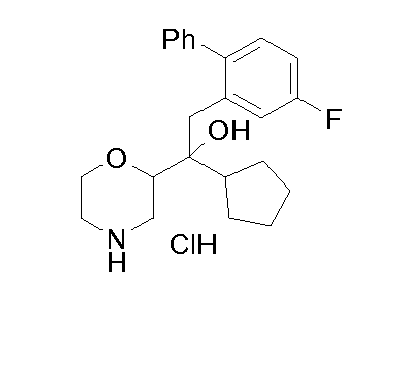
- The free base of 50 is obtained from 49 (1.26 mg, 2.73 mmol), α-chloroethyl chloroformate (1.18 mL, 10.9 mmol) and polymer-supported Hünig's base (1.54 g, 5.47 mmol) in DCM (25 mL) following General Procedure 3. Purification by ion exchange chromatography followed by automated column chromatography eluent, MeOH/ DCM 100 to 20/80 [v/v]) and conversion to its hydrochloride salt gives 50 as a yellow solid (0.23 g, 23%). MW 405.94; C23H28FNO2.HCl; 1H NMR (CD3OD) δ 7.20-7.37 (6H, m), 7.08-7.13 (1H, m), 6.91 (1H, td, 3.5 Hz, 8.5 Hz), 3.80 (1H, dd, 3.5 Hz, 13.0 Hz), 3.42-3.54 (2H, m), 2.99-3.06 (2H, m), 2.93 (2H, s), 2.83 (1H, td, 4.0 Hz, 12.5 Hz), 2.53 (1H, t, 12.0 Hz), 1.73-1.85 (1H, m), 1.12-1.44 (8H, m). LCMS (12 minute method): m/z 370.2 [M-HCl+H]+, RT 5.46min.
-

- Compound 51 is obtained from 8 (0.6 g, 2.07 mmol) and 2-methoxy-5-fluorobenzyl magnesium bromide (4.6 mL, 2.28 mmol, 1.1eq) in anhydrous THF (15 mL) following General Procedure 2. Further equivalents of 2-methoxy-5-fluorobenzyl magnesium bromide (8.28 mL, 4.14 mmol) are added and the mixture is warmed to room temperature and left stirring over night. Purification by ion exchange chromatography followed by automated chromatography (eluent, n-heptane/EtOAc 90/10 to 30/70 [v/v]) gives 51 as a colourless oil (375 mg, 42%). MW 429.54; C25H32FNO4; LCMS (6 minute method): m/z 430.2 [M+H]+, RT 3.12 min.
-

- The free base of 52 is obtained from 51 (0.31 g, 0.73 mmol), α-chloroethyl chloroformate (0.31 mL, 2.9 mmol) and polymer-supported Hünig's base (0.41 g, 1.45 mmol) in DCM (7 mL) following General Procedure 3. Purification by ion exchange chromatography and conversion to the hydrochloride salt following General Procedure 4 gives 52 as a white solid (0.19 g, 77%). MW 375.82; C18H26FNO4.HCl; 1H NMR (CD3OD): δ 6.98-7.01 (1H, m), 6.83-6.86 (2H, m), 3.99 (1H,dd, 3.5 Hz, 13 Hz), 3.82-3.87 (2H, m), 3.63-3.73 (5H, m), 3.12-3.33 (4H, m), 2.91-3.02 (2H, m), 2.81 (2H, , 14 Hz), 1.31-1.73 (5H, m); LCMS (12 minute method): m/z 340.2 [M-HCl+H]+, RT 3.78 min.
-

- 2-Methoxy-5-fluoro-benzylbromide (455.6 g, 2.079 mol) is dissolved in toluene (1592 mL). 8b (400.8 g, 1386 mmol) is dissolved in toluene (400 mL). An inerted 20 L vessel is charged with 2-MeTHF (1202 mL), magnesium (50.59 g, 2.079 mol) and 1.5M DIBALH (16 mL). The benzyl bromide solution is charged in a funnel flask then an initial charge of 5% of the total amount of benzyl bromide is added to the magnesium mixture at 22°C. After 15 mins, the remainder of the benzyl bromide solution is added over 160 mins at room temperature. After an additional 1h stirring, the 8b solution is slowly added to the mixture over 140 mins at -15°C. After a further 30 mins, the quench is performed by addition of acetic acid (124 mL) keeping the temperature below -5°C, then a 10/1 v/v water/acetic acid mixture (2200 mL) is added keeping the temperature below 10°C. The organic layer is extracted at room temperature, filtered to remove Mg turnings and left overnight. The organic layer is washed with water (500 mL), then basification is performed by addition of water (1600 mL) and NH3aq (311.8 mL). The organic layer is concentrated and i-propanol (2000 mL) is added. The azeotrope toluene/i-propanol is stripped off under reduced pressure, then i-propanol is removed. The brown-orange oil is dissolved in i-propanol (2380 mL) then 12N HClaq (138.6 mL) and water (2380 mL) are added. The apolar impurities are removed with a cyclohexane wash (4760 mL). Then, the aqueous layer is basified with NH3aq and extracted with toluene (4 L). The organic layer is washed with water (500 mL), then the combined aqueous layers are extracted with toluene (4 L) and then this new toluene solution is washed with water (500 mL). The combined organic layers are concentrated under reduced pressure, then i-propanol (2 L) is added and the solution is concentrated again to provide a crude oil of 51b (550 g, 91% yeild; 94% ee) and 100 g of i-propanol. This crude oil is diluted with THF (2000 mL) and 8.76M HBraq (153.9 mL) is added. This mixture is allowed to stir overnight and a thin suspension is observed. The precipitate is filtered and washed with THF (150 mL) to give 34 g of racemic 51 as the HBr salt. The mother liquors are concentrated then toluene (1500 mL), water (500 mL) and NH3aq (103.58 mL, 1.386 mol) are added. The organic layer is extracted and washed with water (250 mL). The combined aqueous layers are extracted with toluene (500 mL). The combined organic layers are dried over MgSO4 and concentrated under reduced pressure, then i-propanol (2 L) is added and stripped off again. Then, the oil is dissolved in i-propanol (1 L), 12N HCl (121.3 mL) is added and the mixture is allowed to stir for 15 mins, then the solvent is partially stripped off to provide 51b as the desired diastereoisomer (1021 g; 98.4% ee)
-

- A 6 L Parr bottle is loaded with 51b (1021 g), i-propanol (3630 mL) and water (639 mL). After purging with N2, 5% Pd-C 52% wet is added (105.6 g) and the mixture is then pressurized with hydrogen (50 psi). The reaction mixture is shaken for 9h30mins, then the mixture is filtered on a Hyflo Super Cel® pad (100 g) pre-imbibed with 80/20 i-propanol/water (500 mL). The catalyst is rinsed with a 80:20: i-propanol:water mixture (500 mL). The solvents are stripped off then i-propanol is added (2000 mL) to be partially removed again. Then i-propanol is re-added (1400 mL) and the heterogeneous mixture is concentrated to provide an off-white solid. To this crude alcohol 52b is added i-propanol (4474 mL) and the mixture is heated to reflux until a homogeneous solution is formed. Then, the mixture is cooled slowly and the crystallization starts at 60°C. The powder is filtered at room temperature, rinsed with i-propanol (2x350 mL) and dried under reduced pressure at 40°C to give highly pure compound 52b with 80% recovery yield (98.4% de, 99.2% ee).
-

- Compound 53 is obtained from 8 (0.61 g, 2.11 mmol) and commercially available (Fluorochem) 2-trifluoromethoxy benzyl magnesium bromide (4.6 mL, 2.32 mmol, 1.1eq) in anhydrous THF (15 mL) following General Procedure 2. Further 2-trifluoromethoxy benzyl magnesium bromide (4.22 mL, 2.11 mmol) is added. Purification by ion exchange chromatography gives 53 as an oil of 88% purity (1.39 g isolated material, ca 88% purtiy) which is directly used in the next step. MW 465.52; C25H30F3NO4; LCMS (6 minute method): m/z 466.2 [M+H]+, RT 3.67 min.
-

- The free base of 54 is obtained from 53 (0.27 g, 0.57 mmol), α-chloroethyl chloroformate (0.25 mL, 2.30 mmol, 4 eq) and polymer-supported Hünig's base (0.32 g, 1.15 mmol, 2eq) in DCM (5 mL) following General Procedure 3. Purification by ion exchange chromatography followed by preparative LCMS (gradient) and conversion to the hydrochloride salt following General Procedure 4 gives 54 as white solid (82 mg, 17%). MW 411.85; C18H24F3NO4.HCl. 1H NMR (CD3OD) δ 7.45-7.48 (1H, m), 7.16-7.27 (3H, m), 3.98 (1H, dd, 4.0 Hz, 13 Hz), 3.65-3.88 (4H, m), 3.12-3.31 (4H, m), 2.87-3.01 (4H, m), 1.30-1.68 (5H, m); LCMS (12 minute method): m/z 376.1 [M-HCl+H]+, RT 4.28 min.
-

- Compound 55 is prepared from 8 (0.56 g, 1.94 mmol) and 2-phenyl benzyl magnesium bromide solution (0.25 M solution in diethyl ether, 9.31 mL, 2,33 mmol, 1.2 eq) following General Procedure 2. 2-Phenylbenzyl magnesium bromide is prepared from commercially available (Aldrich) 2-phenylbenzyl bromide following General Procedure 5. Further 2-phenyl benzyl magnesium bromide solution (1 mL) is added and the reaction left under stirring overnight. Purification by ion exchange chromatography gives 55 as an off-white foam-like solid (0.37 g, 68%). MW 457.62; C30H35NO3; LCMS. (6 minute method): m/z 458 [M+H]+, RT 3.58 min.
-

- The free base of 56 is obtained from 55 (0.588 g, 1.28 mmol), solid supported Hünig's base (0.72 g) and α-chloroethyl chloroformate (0.53 mL) in anhydrous DCM (20 mL) following General Procedure 3. Purification by ion exchange chromatography gives the free base of 56 as viscous oil (0.483 g), contaminated with a small amount of the N-protected compound 55. The residue is treated with an excess of reagents (1 eq), solid supported Hünig's base (0.36 g) and α-chloroethyl chloroformate (0.26 mL) in anhydrous DCM (20 mL) and methanol (20 mL) and purified by ion exchange chromatography to give the free base of 56 (0.432 g). Purification by preparative LCMS followed by conversion to its hydrochloride salt following General Procedure 4 gives 56 (0.280 g, 54 %). MW 403.95; C23H29NO3.HCl; 1H NMR (CD3OD): δ 7.45-7.59 (1H, m), 7.10-7.35 (8H, m), 3.85 (1H, dd, 13 Hz, 3.5 Hz), 3.75 (1H, dd, 11.5 Hz, 3.5 Hz), 3.51-3.59 (3H, m), 2.83-3.12 (7H, m), 2.64 (1H, t, 12 Hz), 1.36-1.52 (2H, m), 1.02-1.21 (2H, m), 0.90-0.94 (1H, m); LCMS: (12 min method) m/z 368 [M-HCl +H]+, RT 4.6 min.
-

- Commercially available (Aldrich) 2-bromobenzyl magnesium bromide (0.25M solution in diethylether, 48.9 mL, 12.18 mmol, 2.6 eq) is added in three portions over 90 minutes to a solution of 8 (1.35 g, 4.7 mmol) in dry THF (30 mL) at 0°C. After quenching with ice water, saturated ammonium chloride solution is added and the aqueous phase washed with EtOAc. The combined organic phases are washed with brine and water, dried over magnesium sulphate and solvents removed in vacuo. Purification by ion exchange chromatography followed by purification using automated column chromatography (eluent, EtOAc/n-heptane 10/90 to 50/50 [v/v]) gives 57 (0.56 g, 26%). MW 460.42; C24H30BrNO3; LCMS (6 minute method): m/z 462.4 [M+H]+, RT 3.11 min.
-

- To a suspension of Pd(OAc)2 (2.44 mg, 0.011 mmol, 0.02 eq) in acetonitrile (1.5 mL) is added triphenyl phosphine (11.4 mg, 0.043 mmol, 0.08 eq) under nitrogen at room temperature leading to the formation of a white precipitate. Addition of water (0.5 mL), 3-fluoro-phenyl boronic acid (91.2 mg, 0.65 mmol, 1.2 eq) and 57 (0.25 mg, 0.54 mmol) gives a dark grey solution after 10-20 minutes which is heated to reflux and left stirring at reflux overnight. Further 3-fluoro-phenyl boronic acid (70 mg, 0.55 mmol, 1 eq) and Pd(OAc)2 (2-3 mg) are added and the mixture is left stirring at reflux for another 24 hours. Purification by ion exchange chromatography gives 57 (0.21 g, 83%) MW 475.61; C30H34FNO3; LCMS (6 minute method): m/z 476.4 [M+H]+, RT 3.41min.
-

- Compound 58 is obtained from 57 (0.213 g, 0.45 mmol), solid supported Hünig's base (0.25 g, 7.12 mmol, 4 eq) and α-chloroethyl chloroformate (0.19 mL, 1.79 mmol, 4 eq) in anhydrous DCM (7 mL) following General Procedure 3. Purification by ion exchange chromatography gives the free base of 58 as a white foam (125 mg) which is further purified by preparative LCMS. Conversion to its hydrochloride salt following General Procedure 4 gives 58 as a yellow gum (96.5 g, 56 %). MW 421.94; C23H28FNO3.HCl; 1H NMR (CD3OD): δ 7.60-7.45 (1H, m), 6.90-7.45 (6H, m), 3.55-3.95 (5H, m), 2.85-3.30 (10H, m), 2.64 (1H, t, 12.0 Hz), 0.95-1.45 (5H, m); LCMS. (12 minute method): m/z 386 [M-HCl+H]+, RT 4.64 min.
-

- Compound 59 is obtained from 9 (0.7 g, 2.32 mmol) and 2-methoxy-5-fluorobenzyl magnesium bromide (5.11 mL, 2.55 mmol, 1.1eq) in dry THF (15 mL) following General Procedure 2. Purification by ion exchange chromatography gives 59 as an oil of 80% purity which is directly used in the next step (0.9 g recovered material). MW 441.47; C23H27F4NO4; LCMS (6 minute method): m/z 442.4 [M+H]+, RT 3.36 min.
-

- The free base of 60 is obtained from 59 (0.9 g, 2.04 mmol), α-chloroethyl chloroformate (0.88 mL, 8.15 mmol, 4 eq) and polymer-supported Hünig's base (1.15 g, 4.08 mmol, 2eq) in DCM (25 mL) following General Procedure 3. Purification by ion exchange chromatography followed by preparative LCMS and conversion to the hydrochloride salt following General Procedure 4 gives 60 as a yellow solid (0.133 g, 17%). MW 387.80; C16H21F4NO3.HCl. 1H NMR (CD3OD): δ 6.93-6.96 (1H, m), 6.86-6.87 (2H, m), 4.09-4.13 (1H, m), 3.68-3.75 (4H, m), 3.42-3.47 (1H, m), 3.34-3.40 (1H, m), 3.16-3.25 (1H, m), 3.03-3.11 (2H, m), 2.83 (2H, , 14 Hz), 2.12-2.29 (2H, m), 1.58-1.68 (1H, m), 1.29-1.39 (1H, m). LCMS (12 minute method): m/z 352.1 [M-HCl+H]+, RT 4.54 and 4.66 min.
-

- Compound 61 is obtained from 9 (0.7 g, 2.32 mmol) and commercially available (Fluorochem) 2-trifluoromethoxy benzyl magnesium bromide (5.12 mL, 2.56 mmol, 1.1eq) in dry THF (15 mL) following General Procedure 2. Purification by ion exchange chromatography followed by automated column chromatography eluent, n-heptane/EtOAc 100/0 to 50/50 [v/v]) gives 61 as an oil (0.27 g, 25%). MW 477.45; C23H25F6NO3; LCMS (6 minute method): m/z 478.4 [M+H]+, RT 3.63 min.
-

- The free base of 62 is obtained from 61 (0.25 g, 0.53 mmol), α-chloroethyl chloroformate (0.23 mL, 2.12 mmol, 4eq) and polymer-supported Hünig's base (0.30 g, 1.06 mmol, 2eq) in DCM (5 mL) following General Procedure 3. Purification by ion exchange chromatography followed by preparative LCMS and conversion to its hydrochloride salt gives 62 as a yellow solid (0.051 g, 23%). MW 423.78; C16H19F6NO3.HCl; 1H NMR (CD3OD): δ 7.40-7.42 (1H, m), 7.19-7.30 (3H, m), 4.09-4.13 (1H, m), 3.71- 3.78 (1H, m), 3.50-3.53 (1H, m), 3.36-3.40 (1H, m), 3.08-3.22 (3H, m), 2.89 (2H, , 14 Hz), 2.09-2.17 (2H, m), 1.65-1.75 (1H, m), 1.30-1.40 (1H, m); LCMS (12 minute method): m/z 388.1 [M-HCl+H]+, RT 4.99 min.
-

- Compound 63 is obtained from 9 (0.7 g, 2.32 mmol) and 2-phenylbenzyl magnesium bromide (10.2 mL, 2.55 mmol, 1.1 eq) in dry THF (15 mL) following General Procedure

-

- The free base of 64 is obtained from 63 (0.6 g, 1.29 mmol), α-chloroethyl chloroformate (0.56 mL, 5.15 mmol, 4eq) and polymer-supported Hünig's base (0.72 g, 2.58 mmol, 2eq) in DCM (12 mL) following General Procedure 3. Purification by ion exchange followed by preparative LCMS and conversion to the hydrochloride salt following General Procedure 4 gives 64 as a yellow solid (0.16 g, 30%). MW 415.89; C21H24F3NO2. HCl; 1H NMR (CD3OD) δ 7.43-7.46 (1H, m), 7.18-7.35 (7H, m), 7.10-7.13 (1H, m), 3.90- 3.95 (1H, m), 3.57-3.65 (1H, m), 3.34-3.38 (1H, m), 2.92 (2H, , 14.5 Hz), 2.88-3.13 (4H, m), 1.59-1.85 (2H, m), 1.15-1.39 (2H, m); LCMS (12 minute method): m/z 380.1 [M-HCl+H]+, RT 5.22 min.
-

- Compound 65 is obtained from 10 (0.6 g, 1.90 mmol) and 2-methoxy-5-fluorobenzyl magnesium bromide (4.2 mL, 2.09 mmol, 1.1 eq) in anhydrous THF (15 mL) following General Procedure 2 (further 2-methoxy-5-fluorobenzyl magnesium bromide is added (3.8 mL, 1.90 mmol)). Purification by ion exchange chromatography gives 65 in 87% purity as an oil which is directly used in the next step (0.7 g of recovered material). MW 455.50; C24H32FNO3; LCMS (6 minute method) m/z 456.2 [M+H]+, RT 3.5 6min.
-

- The free base of 66 is obtained from 65 (0.7 g, 1.53 mmol), α-chloroethyl chloroformate (0.66 mL, 6.1 mmol, 4eq) and polymer-supported Hünig's base (0.86 g, 3.05 mmol, 2eq) in DCM (13 mL) following General Procedure 3. Purification by ion exchange chromatography followed by automated column chromatography (eMeOH/ DCM 0/100 to 20/80 [v/v]) and conversion to the hydrochloride salt gives 66 (0.19 g, 40%) as a white solid. MW 401.83; C17H23F4NO3.HCl; 1H NMR (CD3OD) δ 7.04-7.08 (1H, m), 6.95-6.97 (2H, m), 4.21 (1H, dd, 3.0 Hz, 13.0 Hz), 3.78- 3.87 (4H, m), 3.63 (1H, dd, 2.0 Hz, 11.0 Hz), 3.45-3.49 (1H, m), 3.27-3.33 (1H, m), 3.12-3.21 (2H, m), 2.97 (2H, , 14.0 Hz), 1.97-2.13 (2H,m), 1.61- 1.76 (2H, m), 1.48-1.58 (1H, m), 1.17-1.31 (1H, m); LCMS (12 minute method): m/z 366.1 [M-HCl+H]+, RT 4.72 min.
-

- Compound 67 is prepared from 10 (0.853 g, 2.71 mmol) and 2-phenyl benzyl magnesium bromide (0.25 M solution in diethyl ether, 1.2 eq) following General Procedure 2. 2-Phenylbenzyl magnesium bromide is prepared from commercially available (Aldrich) 2-phenylbenzyl bromide following General Procedure 5. Further 2-phenyl benzyl magnesium bromide is added later (19.2 mL, 4.8 mmol). Purification by automated column chromatography (eluent, EtOAc/cyclohexane 20/80 to 40/60 [v/v]), followed by ion exchange chromatography gives 67 as a viscous oil (369 mg, 28%). MW 483.58; C29H32 F3NO2; LCMS: (6 min method) m/z 484 [M+H]+, RT 4.26 min.
-

- The free base of 68 is obtained from 10 (0.369 g, 0.76 mmol), solid supported Hünig's base (0.43 g) and α-chloroethyl chloroformate (0.32 mL) in anhydrous DCM (10 mL) following General Procedure 3. Purification by ion exchange chromatography gives the free base of 68 as a viscous oil (0.143 g, 48 %) which is converted into the hydrochloride salt 68 following General Procedure 4. MW 429.91; C22H26NO2F3 HCl; 1H NMR (CD3OD): 7.44-7.47 (1H, m), δ 7.16-7.35 (7H, m), 7.08-7.11 (1H, m), 3.94 (1H, dd, 12.5 Hz, 3.5 Hz,), 3.57 (1H, t, 12.5 Hz), 3.34-3.38 (1H, m), 2.80-3.11 (6H, m), 1.65-3.90 (2H, m), 1.02-1.24 (4H, m). LCMS: (12 minute method) m/z 394 [M-HCl+H]+, RT 5.42 min.
-

- Compound 69 is obtained from 77 (0.5 g, 2.04 mmol) and 2-methoxybenzyl magnesium bromide (available from Rieke Metals) (0.25M solution in THF, 9.0 mL, 2.24 mmol, 1.1 eq.) in anhydrous THF (11 mL) following General Procedure 1. Further 2-methoxybenzyl magnesium bromide (0.25M solution in THF, 4.08 mL, 1.04 mmol, 0.5 eq) is added after 10 minutes. Purification by ion exchange chromatography gives 69 which is directly used in the next step (0.706g, 94%, >90% purity). MW 367.49; C23H29NO3; LCMS (6 minute method): m/z 368 [M+H]+, RT 2.52 min.
-

- The free base of 70 is obtained from 69 (0.706 g, 1.92 mmol), α-chloroethyl chloroformate (0.83 mL, 7.69 mmol, 4 eq) and polymer-supported Hünig's base (1.08 g, 3.85 mmol, 2 eq) in DCM (25 mL) following General Procedure 3. Purification by ion exchange ion exchange chromatography followed by automated column chromatography (eluent, DCM/MeOH, 90/10 to 50/-50 [v/v]) gives the free base of 70 (0.29 g, 55%). A sample (0.06 g, 0.22 mmol) is converted into the hydrochloride salt 70 following General Procedure 4 (63 mg, 99%). MW 313.83; C16H23NO3.HCl. 1H NMR (CD3OD): δ 6.95-7.15 (2H, m), 6.60-6.85 (2H, m), 3.95 (1H, dd, 2 Hz, 10 Hz), 3.55-3.7 (2H, m), 3.15-3.4 (2H, m), 3.05 (3H, s), 2.7-3.95 (5H, m), 0.4-0.55 (1H, m), 0.15-0.3 (1H, m), -0.1-0.1 (3H, m); LCMS (12 minute method): m/z 278.1 [M-HCl+H]+, RT 3.81 min.
-

- Compound 71 is obtained from 77 (0.36 g, 1.47 mmol) and 2-ethoxybenzyl magnesium bromide (available from Rieke Metals) (0.25M solution in THF, 6.47 mL, 1.61 mmol, 1.1 eq) in anhydrous THF (8 mL) following General Procedure 1. Further 2-ethoxybenzyl magnesium bromide (0.25M solution in THF, 3.23 mL, 0.8 mmol, 0.5 eq) is added after 30 minutes. Purification by ion exchange chromatography (eluent, EtOAc/n-heptane 0/100 to 40/60 [v/v]) gives 71. MW 381.52; C24H31NO3; LCMS (6 minute method): m/z 382.4 [M+H]+, RT 2.83 min.
-

- The free base of 72 is obtained from 71 (0.62 g, 1.62 mmol), α-chloroethyl chloroformate (0.93 g, 0.7 mL, 6.49 mmol, 4 eq) and polymer-supported Hünig's base (0.91 g, 3.24 mmol, 2 eq) in DCM (20 mL) following General Procedure 3. Purification by ion exchange chromatography followed by automated column chromatography (eluent, DCM/MeOH 90/10 to 50/-50 [v/v]) gives the free base of 72 as an oil (0.32 g, 68%) in 89% purity. Conversion into the hydrochloride salt following General Procedure 4 gives 72. MW 327.85; C17H25NO3 .HCl; 1H NMR (CD3OD); δ 6.9-7.05 (2H, m), 6.60-6.8 (2H, m), 4.05 (1H, dd, 2 Hz, 10 Hz), 3.7-3.85 (2H, m), 3.6 (1H, dt, 2 Hz , 7 Hz), 3.15-3.45 (2H, m), 2.8-2.95 (5H, m), 1.15 (3H, t, 7 Hz), 0.4-0.55 (1H, m), 0.15-0.3 (1H, m), - 0.1-0.1 (3H, m). LCMS (12 minute method): m/z 292.1 [M-HCl+H]+, RT 4.44 min.
-

- Compound 73 is obtained from 77 (0.7 g, 2.86 mmol) and 2-phenylbenzyl magnesium bromide (0.25M solution in THF, 12.58 mL, 3.15 mmol, 1.1 eq) in anhydrous THF (15 mL) following General Procedure 1. 2-Phenylbenzyl magnesium bromide is prepared from commercially available (Aldrich) 2-phenylbenzyl bromide following General Procedure 5. Further 2-phenylbenzyl magnesium bromide (0.25M solution in THF, 6.3 mL, 1.65 mmol, 0.5 eq.) is added after 30 minutes. Purification by ion exchange chromatography gives 73 as a gum (1.07 g, 91%). MW 413.56; C28H31NO2; LCMS (6 minute method): m/z 414.4 [M+H]+, RT 3.11 min.
-

- The free base of 74 is obtained from 73 (1.06 g, 2.57 mmol), α-chloroethyl chloroformate (1.11 mL, 10.3 mmol, 4 eq) and polymer-supported Hünig's base (1.44 g, 5.13 mmol, 2 eq) in DCM (30 mL) following General Procedure 3. Purification by ion exchange chromatography followed by automated column chromatography gives the free base of 74 (0.54 g, 65%) which is converted into the hydrochloride salt 74 following General Procedure 4. MW 323.44; C21H25NO2. 1H NMR (CDCl3) δH 7.46-7.53 (1H, m), 7.30-7.44 (5H, m), 7.18-7.30 (3H, m), 3.72-7.82 (1H, m), 3.33-3.51 (2H,m), 3.07-3.20 (3H,m), 2.56-2.80 (4H, m), 0.25-0.39 (2H, m), 0.07-0.19 (1H, m), -0.09-0.03 (1H,m), - 0.28- -0.16 (1H, m). LCMS (12 minute method): m/z 324.2 [M+H]+, RT 4.96 min. Example 33: Preparation of 1,3-Bis-(2-methoxy-phenyl)-2-morpholin-2-yl-propan-2-ol hydrochloride (79).
-

- Add a solution of 4-benzyl-morpholine-2-carboxylic acid ethyl ester (1.12 g, 4.49 mmol) in tetrahydrofuran (5 mL) to a stirred solution of 2-methoxybenzylmagnesium chloride (54 mL, 0.25M solution in tetrahydrofuran, commercially available from Rieke Metals) at -10°C under nitrogen atmosphere. After 1 hour, add a saturated aqueous solution of sodium bicarbonate and extract with diethyl ether. Combine the organic layers and extract with brine, dry over magnesium sulfate, filter, and concentrate under reduced pressure to give a residue to be taken forward without further purification. MW 447.58; C28H33NO4; LCMS (12 minute method): m/z) =448.2 [M+H]+) RT 4.8 min. 1,3-Bis-(2-methoxy-phenyl)-2-morpholin-2-yl-propan-2-ol hydrochloride (79)

- To a solution of 78 (2.2 g, 5 mmol) in EtOH (30 mL) under nitrogen atmosphere add ammonium formate (3.1 g, 50 mmol) followed by palladium on charcoal (10 %, 2.2 g). Stir and heat at reflux the resulting suspension for an hour. Allow the reaction mixture to cool to room temperature and then filter it through Celite ®. Wash the Celite ® with copious amounts of ethanol, combine the organic layers and concentrate under reduced pressure to obtain a residue. Purify and resolve the residue by Chiral HPLC to give 79; MW 393.91; C21H27NO4.HCl;1H NMR (DMSO- D6): δ 2.41-2.52 (m, 1H), 2.61-2.78 (m, 1H), 2.85-3.44 (m, 8H), 3.50-3.65 (m, 1H), 3.7 (s, 3H), 3.79 (s, 3H), 4.00-4.12 (m, 1H), 6.79-7.01 (m, 4H), 7.07-7.25 (m, 3H), 7.26-7.35 (m, 1H); LCMS (12 minute method): m/z 358.1 [M-HCl+H]) RT 4.6 min single major peak;
-

- To a solution of 4-benzyl-morpholine-2-carbonitrile (10g, 49.5 mmol) in dry diethyl ether (100 mL) at -10 °C under an atmosphere of nitrogen is added a solution of 2-methoxybenzylmagnesium chloride (0.25M solution in tetrahydrofuran, 218 mL, 54.5 mmol) available from Aldrich Chemical Company or Rieke Metals) and the reaction mixture is further stirred at -10 °C for 30 minutes. Then the reaction is allowed to warm to room temperature and stirred overnight. The reaction is then cooled to 0 °C and quenched by addition of hydrochloric acid (5N aqueous solution, 50 mL) and the resulting mixture is stirred for 10 minutes at 0 °C. Next the solution is basified with sodium hydroxide (2N aqueous solution), filtered through Celite ® then extracted with diethyl ether, the organics collected, dried (MgSO4) and the solvent removed under reduced pressure to give a residue which is taken up into methanol and purified by SCX-2 chromatography prior to silica gel chromatography (eluent, ethyl acetate/n-hexane, 0/100 to 40/60 [v/v]). The fractions containing the correct mass (FIA+ [M+H]+=447) are collected and purified via preparative HPLC to give 80 (72 mg). MW 566.69; C28H34N2O3.C4H8O4; LCMS (12 minutes method): m/z)= 447.2 [M-C4H8O4+H]+ RT 4.60 min.
-

- To a methanolic solution of 80 (70 mg, 0.13 mmol) is added ammonium formate (100mg, 1.6 mmol) and 10% Pd-C (150 mg). The reaction is stirred under nitrogen and heated at reflux for 30 minutes then cooled and filtered through Celite ®. The filtrate is concentrated in vacuo and the residue is taken up in methanol and purified by SCX-2 ® ion exchange resin and the resulting residue redissolved in a 2M hydrochloric acid in diethyl ether solution and then concentrated in vacuo to give 81 (1.7 mg, 0.3%). MW 429.39; C21H28N2O3.2HCl;1H NMR (CD3OD): δ 2.65-3.02 (m, 6H), 3.05-3.16 (m, 1H), 3.24-3.41 (m, 2H), 3.52-3.65 (m, 1H), 3.70 (s, 3H), 3.80 (s, 3H), 3.91-4.05 (m, 1H), 6.84-7.08 (m, 4H), 7.12-7.32 (m, 4H). LCMS (12 minute method) m/z 357.2 [M-2xHCl+H+]+RT 2.07 min.
-

- Compound 83 is obtained from 82 (0.21 g, 0.81 mmol) and 2-phenyl-benzyl magnesium bromide (4.9 mL, 1.21 mmol, 1.5 eq) in anhydrous THF (10 mL) following General Procedure 2 and left stirring for 50 minutes. Purification by ion exchange chromatography gives 83 (0.16 g crude) which was directly used in the next step. MW 383.54; C24H33NO3; LCMS (6 minute method): m/z 384.4 [M+H]+, RT 3.05 min.
-

- The free base of 84 is obtained from 83 (0.23 g, 0.61 mmol), α-chloroethyl chloroformate (0.17 mg, 1.21 mmol) and polymer-supported Hünig's base (0.47 g, 1.82 mmol, 3 eq) in DCM (10 mL) following General Procedure 3. Purification by ion exchange followed by preparative LCMS and conversion to the hydrochloride salt following General Procedure 4 gives 84 as a yellow solid (0.1 g, 6%). MW 329.87; C17H27NO3.HCl; 1H NMR (CD3OD): δ 6.74-6.66 (m, 2H), 6.46-6.33 (m, 2H), 3.69-3.61 (m, 1H), 3.32-3.24 (m, 2H), 3.14-3.07 (m, 1H), 2.92-2.84 (m, 1H), 2.83-2.69 (m, 3H), 2.67-2.56 (m, 2H), 2.50-2.39 (m, 2H), 1.00-0.58 (m, 6H), 0.41-0.32 (m, 3H); LCMS (12 minute method): m/z 294.2 [M-HCl+H]+ and 316.2 [M-HCl+Na]+, RT 4.158 min.
-

- Compound 85 is obtained from 82 (0.21 g, 0.81 mmol) and 2-phenyl-benzyl magnesium bromide (4.9 mL, 1.225 mmol, 1.5 eq) in anhydrous THF (10 mL) following General Procedure 2. Further equivalents of 2-phenyl-benzyl magnesium bromide (20 mL, 5.0 mmol) are added and the mixture is left stirring for two hours. Purification by ion exchange chromatography gives 85 (0.16 g crude) which was directly used in the next step. MW 429.61; C25H35NO2; LCMS (6 minute method): m/z 430, [M+H]+, RT 3.46 min.
-
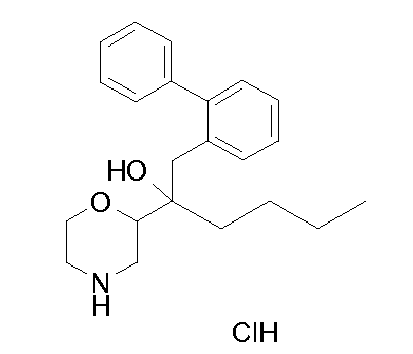
- The free base of 86 is obtained from 85 (0.16 g, crude), α-chloroethyl chloroformate (0.1 mL, 0.77 mmol, excess) and polymer-supported Hünig's base (1.15 mmol, excess) in DCM (12 mL) following General Procedure 3. Purification by ion exchange followed by preparative LCMS and conversion to the hydrochloride salt following General Procedure 4 gives 86 as a yellow solid (16 mg, 5% over steps). MW 375.94; C22H29NO2 HCl; 1H NMR (CD3OD): δ 7.90-7.35 (m, 9H), 4.30 (d, 1H, 10.5 Hz), 4.00-3.90 (t, 1H, 12 Hz), 3.72 (d, 1H, 10.5 Hz), 3.55 (bs, 2H), 3.44 (d, 2H, 11.5 Hz), 3.35-3.15 (m, 4H), 1.50-0.9 (m, 9H); LCMS (12 minute method): m/z 340.3 [M-HCl+H]+, RT 5.1 min.
-

- Compound 87 is obtained from 6 (0.33 g, 1.28 mmol) and 2-chloro-6-fluoro-benzyl magnesium bromide (8 mL, 1.92 mmol, 1.5 eq) in anhydrous THF (15 mL) following General Procedure 2. Further equivalents of 2-chloro-6-fluoro-benzyl magnesium bromide (20 mL, 3.75 eq) are added and the mixture is left stirring over night. Purification by ion exchange chromatography gives 87 (0.52 g, 99%) as a mixture of two diastereomers (approximately 6:1 ratio). MW 405.94; C23H29ClFNO2; LCMS (6 minute method): m/z 406.2 [M+H]+, RT 3.31 and 3.39 min.
-

- The free base of 88 is obtained from 87 (0.52g, 1.27 mmol), α-chloroethyl chloroformate (0.28 mL, 2.54 mmol, 2 eq) and polymer-supported Hünig's base (3.81 mmol, 0.98 g) in DCM (15 mL) following General Procedure 3. Purification by ion exchange and UV-guided preparative and chiral chromatography followed by conversion of the major diastereomer to the hydrochloride salt following General Procedure 4 gives 88 (0.145 g, 32%). MW 352.27; C16H23ClFNO2.HCl; 1H NMR (CD3OD): δ 7.27-7.18 (m, 2H), 7.09-6.99 (m, 1H), 4.15-4.04 (m, 1H), 3.89-3.73 (m, 2H), 3.60-3.50 (m, 1H), 3.35-3.00 (m, 5H), 1.88-1.69 (m, 2H), 1.32-1.15 (m, 1H), 0.97-0.86 (m, 6H); LCMS (12 minute method): m/z 298.1 [M-HCl-H2O+H]+ and 316.2 [M-HCl+H]+, RT 4.328 min.
-

- Compound 89 is obtained from 6 (0.33 g, 1.28 mmol) and 2-chloro-benzyl magnesium bromide (8 mL, 1.92 mmol, 1.5 eq) in anhydrous THF (15 mL) following General Procedure 2. Further equivalents of 2-chloro-benzyl magnesium bromide (20 mL, 3.75 eq) are added and the mixture is left stirring over night. Purification by ion exchange chromatography gives 89 (0.598 g crude) which was directly used in the next step. MW 387.95; C23H30ClNO2; LCMS (6 minute method): m/z 388.2 [M+H]+, RT 3.13 min.
-

- The free base of 90 is obtained from 89 (0.598 g, 1.27 mmol), α-chloroethyl chloroformate (0.31 mL, 2.82 mmol, 2.2 eq) and polymer-supported Hünig's base (4.23 mmol, 1.1 g) in DCM (15 mL) following General Procedure 3. Purification by ion exchange and UV-guided preparative and chiral chromatography followed by conversion of the major diastereomer to the hydrochloride salt following General Procedure 4 gives 90 (0.083 g, 19% over two steps). MW 334.29; C16H24ClNO2.HCl; 1H NMR (CD3OD): δ 7.51-7.44 (m, 1H), 7.39-7.31 (m, 1H), 7.26-7.14 (m, 2H) 4.13 (d, 1H, 9 Hz), 3.87-3.69 (m, 2H), 3.47 (d, 1H, 9 Hz), 3.38-3.03 (m, 4H), 2.99-2.88 (m, 1H), 1.87-1.74 (m, 1H), 1.67-1.57 (m, 1H), 1.20-1.09 (m, 1H), 0.95-0.83 (m, 6H); LCMS (12 minute method): m/z 280.2 [M-HCl-H2O+H]+ and 298.2 [M-HCl+H], RT 4.314 min.
- The pharmacological profile of the present compounds may be demonstrated as follows. All of the exemplified compounds above have been found to exhibit a Ki value less than 1µm at the norepinephrine transporter as determined using the scintillation proximity assay described below. Furthermore, all of the exemplified compounds above have been found to inhibit the norepinephrine transporter to a greater extent than the serotonin and dopamine transporters using the scintillation proximity assays as described below.
- Standard molecular cloning techniques are used to generate stable cell-lines expressing the human dopamine, norepinephrine and serotonin transporters. The polymerase chain reaction (PCR) is used in order to isolate and amplify each of the three full-length cDNAs from an appropriate cDNA library. Primers for PCR are designed using the following published sequence data:
- Human dopamine transporter: GenBank M95167. Reference: Vandenbergh DJ, Persico AM and Uhl GR. A human dopamine transporter cDNA predicts reduced glycosylation, displays a novel repetitive element and provides racially-dimorphic TaqI RFLPs. Molecular Brain Research (1992) volume 15, pages 161-166.
- Human norepinephrine transporter: GenBank M65105. Reference: Pacholczyk T, Blakely, RD and Amara SG. Expression cloning of a cocaine- and antidepressant-sensitive human noradrenaline transporter. Nature (1991) volume 350, pages 350-354.
- Human serotonin transporter: GenBank L05568. Reference: Ramamoorthy S, Bauman AL, Moore KR, Han H, Yang-Feng T, Chang AS, Ganapathy V and Blakely RD. Antidepressant- and cocaine-sensitivehuman serotonin transporter: Molecular cloning, expression, and chromosomal localization. Proceedings of the National Academy of Sciences of the USA (1993) volume 90, pages 2542-2546.
- The PCR products are cloned into a mammalian expression vector (eg pcDNA3.1 (Invitrogen)) using standard ligation techniques. The constructs are then used to stably transfect HEK293 cells using a commercially available lipofection reagent (Lipofectamine™ - Invitrogen) following the manufacture's protocol.
- The compounds of the present invention are norepinephrine reuptake inhibitors, and possess excellent activity in, for example, a scintillation proximity assay (e.g. J. Gobel, D.L. Saussy and A. Goetz, J. Pharmacol. Toxicolo. (1999), 42, 237-244). Thus 3H-nisoxetine binding to norepinephrine re-uptake sites in a cell line transfected with DNA encoding human norepinephrine transporter binding protein is used to determine the affinity of ligands at the norepinephrine transporter.
- Cell pastes from large scale production of HEK-293 cells expressing cloned human norepinephrine transporters are homogenized in 4 volumes 50mM Tris-HCl containing 300mM NaCl and 5mM KCl, pH 7.4. The homogenate is centrifuged twice (40,000g, 10min, 4°C) with pellet re-suspension in 4 volumes of Tris-HCl buffer containing the above reagents after the first spin and 8 volumes after the second spin. The suspended homogenate is centrifuged (100g, 10min, 4°C) and the supernatant kept and recentrifuged (40,000g, 20min, 4°C). The pellet is resuspended in Tris-HCl buffer containing the above reagents along with 10%w/v sucrose and 0.1 mM phenylmethylsulfonyl fluoride (PMSF). The membrane preparation is stored in aliquots (1mL) at -80°C until required. The protein concentration of the membrane preparation is determined using a bicinchoninic acid (BCA) protein assay reagent kit (available from Pierce).
- Each well of a 96 well microtitre plate is set up to contain the following:
50µl 2nM [N-methyl-3H]-Nisoxetine hydrochloride (70-87Ci/mmol, from NEN Life Science Products) 75µl Assay buffer (50mM Tris-HCl pH 7.4 containing 300mM NaCl and 5mM KCl) 25µl Test compound, assay buffer (total binding) or 10µM Desipramine HCl (non-specific binding) 50µl Wheatgerm agglutinin coated poly (vinyltoluene) (WGA PVT) SPA Beads (Amersham Biosciences RPNQ0001) (10mg/mL) 50µl Membrane (0.2mg protein per mL) - The microtitre plates are incubated at room temperature for 10 hours prior to reading in a Trilux scintillation counter. The results are analysed using an automatic spline fitting programme (Multicalc, Packard, Milton Keynes, UK) to provide Ki values for each of the test compounds.
- The ability of a test compound to compete with [3H]-citalopram for its binding sites on cloned human serotonin transporter containing membranes is used as a measure of test compound ability to block serotonin uptake via its specific transporter (Ramamoorthy, S., Giovanetti, E., Qian, Y., Blakely, R., (1998) J. Biol. Chem. 273, 2458).
- Membrane preparation is essentially similar to that for the norepinephrine transporter containing membranes as described above. The membrane preparation is stored in aliquots (1mL) at -70°C until required. The protein concentration of the membrane preparation is determined using a BCA protein assay reagent kit.
- Each well of a 96 well microtitre plate is set up to contain the following:
50µl 2nM [3H]-Citalopram (60-86Ci/mmol, Amersham Biosciences) 75µl Assay buffer (50mM Tris-HCl pH 7.4 containing 150mM NaCl and 5mM KCl) 25µl Diluted compound, assay buffer (total binding) or 100µM Fluoxetine (non-specific binding) 50µl WGA PVT SPA Beads (40mg/mL) 50µl Membrane preparation (0.4mg protein per mL) - The microtitre plates are incubated at room temperature for 10 hours prior to reading in a Trilux scintillation counter. The results are analysed using an automatic spline fitting programme (Multicalc, Packard, Milton Keynes, UK) to provide Ki (nM) values for each of the test compounds.
- The ability of a test compound to compete with [3H]-WIN35,428 for its binding sites on human cell membranes containing cloned human dopamine transporter has been used as a measure of the ability of such test compounds to block dopamine uptake via its specific transporter (Ramamoorthy et al 1998 supra).
- Is essentially the same as for membranes containing cloned human serotonin transporter as described above.
- Each well of a 96well microtitre plate is set up to contain the following:
50µl 4nM [3H]-WIN35,428 (84-87Ci/mmol, from NEN Life Science Products) 75µl Assay buffer (50mM Tris-HCl pH 7.4 containing 150mM NaCl and 5mM KCl) 25µl Diluted compound, assay buffer (total binding) or 100µM Nomifensine (non-specific binding) 50µl WGA PVT SPA Beads (10mg/mL) 50µl Membrane preparation (0.2mg protein per mL.) - The microtitre plates are incubated at room temperature for 120 minutes prior to reading in a Trilux scintillation counter. The results are analysed using an automatic spline fitting programme (Multicalc, Packard, Milton Keynes, UK) to provide Ki values for test compounds.
- The acid stability of a compound according to the present invention may be determined as a solution in buffer at 6 different pH values (HCl 0.1N, pH 2, pH 4, pH 6, pH 7, and pH 8) at 40°C over a time course of 72 hours. Samples may be taken at the beginning of the study and after 3, 6 and 24 hours and analysed by capillary electrophoresis. The original sample used in the study may contain 0.8% of the undesired epimer as internal standard. If the tested compound is chemically and configurationally stable under acidic conditions the samples taken at the different time points during the study should not show any significant change in the percentage of the undesired epimer.
- Cytochrome P450 2D6 (CYP2D6) is a mammalian enzyme which is commonly associated with the metabolism of around 30% of pharmaceutical compounds. Moreover, this enzyme exhibits genetic polymorphism, resulting in the presence of both normal and poor metabolizers in the population. A low involvement of CYP2D6 in the metabolism of compounds (i.e. the compound being a poor substrate of CYP2D6) is desirable in order to reduce any variability from subject to subject in the pharmacokinetics of the compound. Also, compounds with a low inhihibitor potential for CYP2D6 are desirable in order to avoid drug-drug interactions with co-administered drugs that are substrates of CYP2D6. Compounds may be tested both as substrates and as inhibitors of this enzyme by means of the following assays.
- This assay determines the extent of the CYP2D6 enzyme involvement in the total oxidative metabolism of a compound in microsomes. Preferred compounds of the present invention exhibit less than 75% total metabolism via the CYP2D6 pathway.
- For this in vitro assay, the extent of oxidative metabolism in human liver microsomes (HLM) is determined after a 30 minute incubation in the absence and presence of Quinidine, a specific chemical inhibitor of CYP2D6. The difference in the extent of metabolism in absence and presence of the inhibitor indicates the involvement of CYP2D6 in the metabolism of the compound.
- Human liver microsomes (mixture of 20 different donors, mixed gender) are acquired from Human Biologics (Scottsdale, AZ, USA). Quinidine and β-NADPH (β-Nicotinamide Adenine Dinucleotide Phosphate, reduced form, tetrasodium salt) are purchased from Sigma (St Louis, MO, USA). All the other reagents and solvents are of analytical grade. A stock solution of the new chemical entity (NCE) is prepared in a mixture of Acetonitrile/Water to reach a final concentration of acetonitrile in the incubation below 0.5%.
- The microsomal incubation mixture (total volume 0.1 mL) contains the NCE (4 µM), β-NADPH (1 mM), microsomal proteins (0.5 mg/mL), and Quinidine (0 or 2 µM) in 100 mM sodium phosphate buffer pH 7.4. The mixture is incubated for 30 minutes at 37 °C in a shaking waterbath. The reaction is terminated by the addition of acetonitrile (75 µL). The samples are vortexed and the denaturated proteins are removed by centrifugation. The amount of NCE in the supernatant is analyzed by liquid chromatography /mass spectrometry (LC/MS) after addition of an internal standard. A sample is also taken at the start of the incubation (t=0), and analysed similarly.
- Analysis of the NCE is performed by liquid chromatography /mass spectrometry. Ten µL of diluted samples (20 fold dilution in the mobile phase) are injected onto a Spherisorb CN Column, 5 µM and 2.1 mm x 100 mm (Waters corp. Milford, MA, USA). The mobile phase consisting of a mixture of Solvent A/Solvent B, 30/70 (v/v) is pumped (Alliance 2795, Waters corp. Milford, MA, USA) through the column at a flow rate of 0.2 mL/minute. Solvent A and Solvent B are a mixture of ammonium formate 5.10-3 M pH 4.5/ methanol in the proportions 95/5 (v/v) and 10/90 (v/v), for solvent A and solvent B, respectively. The NCE and the internal standard are quantified by monitoring their molecular ion using a mass spectrometer ZMD or ZQ (Waters-Micromass corp, Machester, UK) operated in a positive electrospray ionisation.
- The extent of CYP2D6 involvement (% of CYP2D6 involvement) is calculated comparing the extent of metabolism in absence and in presence of quinidine in the incubation.
The extent of metabolism without inhibitor (%) is calculated as follows:

The % of CYP2D6 involvement is calculated as follows :
- The CYP2D6 inhibitor assay evaluates the potential for a compound to inhibit CYP2D6. This is performed by the measurement of the inhibition of the bufuralol 1'-hydroxylase activity by the compound compared to a control. The 1'-hydroxylation of bufuralol is a metabolic reaction specific to CYP2D6. Preferred compounds of the present invention exhibit an IC50 higher than 6 µM for CYP2D6 activity, the IC50 being the concentration of the compound that gives 50 % of inhibition of the CYP2D6 activity.
- Human liver microsomes (mixture of 20 different donors, mixed gender) are acquired from Human Biologics (Scottsdale, AZ). β-NADPH is purchased from Sigma (St Louis, MO). Bufuralol is purchased from Ultrafine (Manchester, UK). All the other reagents and solvents are of analytical grade.
- Microsomal incubation mixture (total volume 0.1 mL) contains bufuralol 10 µM, β-NADPH (2 mM), microsomal proteins (0.5 mg/mL), and the new chemical entity (NCE) (0, 5, and 25 µM) in 100 mM sodium phosphate buffer pH 7.4. The mixture is incubated in a shaking waterbath at 37 °C for 5 minutes. The reaction is terminated by the addition of methanol (75 µL). The samples are vortexed and the denaturated proteins are removed by centrifugation. The supernatant is analyzed by liquid chromatography connected to a fluorescence detector. The formation of the 1'-hydroxybufuralol is monitored in control samples (0 µM NCE) and in the samples incubated in presence of the NCE. The stock solution of NCE is prepared in a mixture of Acetonitrile/Water to reach a final concentration of acetonitrile in the incubation below 1.0%.
- The determination of 1'hydroxybufuralol in the samples is performed by liquid chromatograhy with fluorimetric detection as described below. Twenty five µL samples are injected onto a Chromolith Performance RP-18e column (100 mm x 4.6 mm) (Merck KGAa, Darmstadt, Germany). The mobile phase, consisting of a mixture of solvent A and solvent B whose proportions change according the following linear gradient, is pumped through the column at a flow rate of 1 mL/min:
Time (minutes) Solvent A (%) Solvent B (%) 0 65 35 2.0 65 35 2.5 0 100 5.5 0 100 6.0 65 35 - Solvent A and Solvent B consist of a mixture of 0.02 M potassium dihydrogenophosphate buffer pH3/ methanol in the proportion 90/10 (v/v) for solvent A and 10/90 (v/v) for solvent B. The run time is 7.5 minutes. Formation of 1'-hydroxybufuralol is monitored by fluorimetric detection with extinction at λ 252 nm and emission at λ 302 nm.
- The IC50 of the NCE for CYP2D6 is calculated by the measurement of the percent of inhibition of the formation of the 1'-hydroxybufuralol in presence of the NCE compared to control samples (no NCE) at a known concentration of the NCE.
The percent of inhibition of the formation of the 1'-hydroxybufuralol is calculated as follows:
The IC50 is calculated from the percent inhibition of the formation of the 1'-hydroxybufuralol as follows (assuming competitive inhibition):
Claims (15)
- A compound of formula (I)
 X is OH, C1-C4 alkoxy, NH2 or NH(C1-C4 alkyl);Rx is H or C1-C4 alkyl;Ry is H or C1-C4 alkyl;each Rz group is independently H or C1-C4 alkyl, with the proviso that not more than 3 Rz groups may be C1-C4 alkyl;R1 is C1-C6 alkyl (optionally substituted with 1, 2 or 3 halogen atoms and/or with 1 substituent selected from C1-C4 alkylthio (optionally substituted with 1, 2 or 3 fluorine atoms), C1-C4 alkoxy (optionally substituted with 1, 2 or 3 fluorine atoms), C3-C6 cycloalkoxy, C1-C4 alkylsulfonyl, cyano, -CO-O(C1-C2 alkyl), -O-CO-(C1-C2 alkyl) and hydroxy); C2-C6 alkenyl (optionally substituted with 1, 2 or 3 halogen atoms); C3-C6 cycloalkyl (optionally substituted with 1, 2 or 3 halogen atoms and/or with 1 substituent selected from C1-C4 alkoxy and hydroxy) wherein one C-C bond within the cycloalkyl moiety is optionally substituted by an O-C, S-C or C=C bond; C4-C7 cycloalkylalkyl (optionally substituted with 1, 2 or 3 halogen atoms and/or with 1 substituent selected from C1-C4 alkoxy and hydroxy) wherein one C-C bond within the cycloalkyl moiety is optionally substituted by an O-C, S-C or C=C bond; or CH2Ar2; andAr1 and Ar2 are each independently a phenyl ring or a 5- or 6-membered heteroaryl ring each of which is optionally substituted with 1, 2 or 3 substituents (depending upon the number of available substitution positions) each independently selected from C1-C4 alkyl (optionally substituted with 1, 2 or 3 halogen atoms), C1-C4 alkoxy (optionally substituted with 1, 2 or 3 halogen atoms), C1-C4 alkylthio (optionally substituted with 1, 2 or 3 halogen atoms), -CO-O(C1-C4 alkyl), cyano, -NRR, -CONRR, halo and hydroxy and/or with 1 substituent selected from pyridyl, thiophenyl, phenyl, benzyl and phenoxy each of which is optionally ring-substituted with 1, 2 or 3 substituents each independently selected from halogen, C1-C4 alkyl (optionally substituted with 1, 2 or 3 halogen atoms), C1-C4 alkoxy (optionally substituted with 1, 2 or 3 halogen atoms), carboxy, nitro, hydroxy, cyano, -NRR, -CONRR, SO2NRR and SO2R; andeach R is independently H or C1-C4 alkyl;or a pharmaceutically acceptable salt thereof.
 - A compound of formula (II)

- A compound of formula (III)

whereinX is OH or NH2;R1 is C1-C6 alkyl (optionally substituted with 1, 2 or 3 halogen atoms and/or with 1 substituent selected from C1-C4 alkylthio (optionally substituted with 1, 2 or 3 fluorine atoms), C1-C4 alkoxy (optionally substituted with 1, 2 or 3 fluorine atoms), C3-C6 cycloalkoxy, C1-C4 alkylsulfonyl, cyano, -CO-O(C1-C2 alkyl), -O-CO-(C1-C2 alkyl) and hydroxy); C3-C6 cycloalkyl (optionally substituted with 1, 2 or 3 halogen atoms and/or with 1 substituent selected from C1-C4 alkoxy and hydroxy) wherein one C-C bond within the cycloalkyl moiety is optionally substituted by an O-C, S-C or C=C bond; or CH2Ar2 wherein Ar2 is a phenyl ring or a pyridyl (preferably 2-pyridyl) ring each of which may be substituted with 1, 2 or 3 substituents each independently selected from C1-C4 alkyl (optionally substituted with 1, 2 or 3 halogen atoms), C1-C4 alkoxy (optionally substituted with 1, 2 or 3 halogen atoms), C1-C4 alkylthio (optionally substituted with 1, 2 or 3 halogen atoms), halo and hydroxy; andAr1 is a phenyl ring or a 5- or 6-membered heteroaryl ring; each of which is substituted in the ortho position with a substituent selected from C1-C4 alkyl (optionally substituted with 1, 2 or 3 halogen atoms), C1-C4 alkoxy (optionally substituted with 1, 2 or 3 halogen atoms), C1-C4 alkylthio (optionally substituted with 1, 2 or 3 halogen atoms), -CO-O(C1-C4 alkyl), cyano, -NRR, -CONRR, halo, hydroxy, pyridyl, thiophenyl, phenyl, benzyl and phenoxy, each of which ortho substituents is optionally ring-substituted (where a ring is present) with 1, 2 or 3 substituents each independently selected from halogen, C1-C4 alkyl (optionally substituted with 1, 2 or 3 halogen atoms), C1-C4 alkoxy (optionally substituted with 1, 2 or 3 halogen atoms), carboxy, nitro, hydroxy, cyano, -NRR, -CONRR, SO2NRR and SO2R; and each of which is (in addition to ortho substitution) optionally further substituted with 1 or 2 substituents each independently selected from C1-C4 alkyl (optionally substituted with 1, 2 or 3 halogen atoms), C1-C4 alkoxy (optionally substituted with 1, 2 or 3 halogen atoms), C1-C4 alkylthio (optionally substituted with 1, 2 or 3 halogen atoms), -CO-O(C1-C4 alkyl), cyano, -NRR, -CONRR, halo and hydroxy; or a pharmaceutically acceptable salt thereof. - A compound of formula (IV)
 X is OH or NH2;R1 is C1-C6 alkyl (optionally substituted with 1, 2 or 3 halogen atoms and/or with 1 substituent selected from C1-C4 alkoxy (optionally substituted with 1, 2 or 3 fluorine atoms), cyano, and hydroxy); C3-C6 cycloalkyl (optionally substituted with 1, 2 or 3 halogen atoms and/or with 1 substituent selected from C1-C4 alkoxy and hydroxy) wherein one C-C bond within the cycloalkyl moiety is optionally substituted by an O-C bond; or CH2Ar2 wherein Ar2 is a phenyl ring optionally substituted with 1, 2 or 3 substituents each independently selected from C1-C4 alkyl (optionally substituted with 1, 2 or 3 halogen atoms), C1-C4 alkoxy (optionally substituted with 1, 2 or 3 halogen atoms), C1-C4 alkylthio (optionally substituted with 1, 2 or 3 halogen atoms), halo and hydroxy;A is N or CR6 (preferably CR6); R2 is C1-C4 alkyl (optionally substituted with 1, 2 or 3 halogen atoms), C1-C4 alkoxy (optionally substituted with 1, 2 or 3 halogen atoms), C1-C4 alkylthio (optionally substituted with 1, 2 or 3 halogen atoms), halo, hydroxy, pyridyl, thiophenyl, phenyl (optionally substituted with 1, 2 or 3 substituents each independently selected from halogen, C1-C4 alkyl (optionally substituted with 1, 2 or 3 halogen atoms), or C1-C4 alkoxy (optionally substituted with 1, 2 or 3 halogen atoms)) or phenoxy (optionally substituted with 1, 2 or 3 halogen atoms); R3 is H; R4 is H; R5 is H, C1-C4 alkyl (optionally substituted with 1, 2 or 3 halogen atoms), C1-C4 alkoxy (optionally substituted with 1, 2 or 3 halogen atoms), C1-C4 alkylthio (optionally substituted with 1, 2 or 3 halogen atoms), halo or hydroxy; and R6 (if present) is H; or a pharmaceutically acceptable salt thereof.
 - A compound of formula (V)
 X is OH or NH2;R1 is C1-C6 alkyl (optionally substituted with 1, 2 or 3 fluorine atoms), C3-C6 cycloalkyl wherein one C-C bond within the cycloalkyl moiety is optionally substituted by an O-C bond or CH2Ar2 wherein Ar2 is a phenyl ring optionally substituted with 1 or 2 substituents each independently selected from C1-C4 alkyl (optionally substituted with 1, 2 or 3 halogen atoms), C1-C4 alkoxy (optionally substituted with 1, 2 or 3 halogen atoms), halo and hydroxy;R2 is C1-C4 alkyl (optionally substituted with 1, 2 or 3 fluorine atoms), C1-C4 alkoxy (optionally substituted with 1, 2 or 3 fluorine atoms) or phenyl (optionally substituted with 1, 2 or 3 fluorine atoms); and R5 is H or F; or a pharmaceutically acceptable salt thereof.
 - A pharmaceutical composition comprising a compound as claimed in any one of claims 1 to 5, or a pharmaceutically acceptable salt thereof, together with a pharmaceutically acceptable diluent, excipient or carrier.
- A compound as claimed in any one of claims 1 to 5, or a pharmaceutically acceptable salt thereof, for use in therapy.
- A compound as claimed in any one of claims 1 to 5, or a pharmaceutically acceptable salt thereof, for use as an inhibitor of the reuptake of norepinephrine.
- A compound as claimed in any one of claims 1 to 5, or a pharmaceutically acceptable salt thereof, for treating disorders associated with norepinephrine dysfunction in mammals.
- A process for the preparation of a compound of formula (I) comprising the step of deprotecting a compound of the formula (XIV)

- A compound of the formula (XIV)

- A compound of the formula (XIII)

- A compound of the formula (XIII)b

- A compound according to any one of claims 11 to 13, or a salt thereof, wherein R1 is a tetrahydro-2H-pyran-4-yl group.
- A compound according to any one of claims 11 to 14, or a salt thereof, wherein P is a benzyl group.
Applications Claiming Priority (3)
| Application Number | Priority Date | Filing Date | Title |
|---|---|---|---|
| GBGB0326148.4A GB0326148D0 (en) | 2003-11-10 | 2003-11-10 | Morpholine derivatives |
| US53545904P | 2004-01-09 | 2004-01-09 | |
| EP04794209A EP1682523B1 (en) | 2003-11-10 | 2004-10-28 | Morpholine derivatives as norepinephrine reuptake inhibitors |
Related Parent Applications (1)
| Application Number | Title | Priority Date | Filing Date |
|---|---|---|---|
| EP04794209.9 Division | 2004-10-28 |
Publications (1)
| Publication Number | Publication Date |
|---|---|
| EP2223916A1 true EP2223916A1 (en) | 2010-09-01 |
Family
ID=29726235
Family Applications (2)
| Application Number | Title | Priority Date | Filing Date |
|---|---|---|---|
| EP10162865A Withdrawn EP2223916A1 (en) | 2003-11-10 | 2004-10-28 | Morpholine derivatives as norepinephrine reuptake inhibitors |
| EP04794209A Expired - Lifetime EP1682523B1 (en) | 2003-11-10 | 2004-10-28 | Morpholine derivatives as norepinephrine reuptake inhibitors |
Family Applications After (1)
| Application Number | Title | Priority Date | Filing Date |
|---|---|---|---|
| EP04794209A Expired - Lifetime EP1682523B1 (en) | 2003-11-10 | 2004-10-28 | Morpholine derivatives as norepinephrine reuptake inhibitors |
Country Status (33)
| Country | Link |
|---|---|
| US (1) | US7423037B2 (en) |
| EP (2) | EP2223916A1 (en) |
| JP (1) | JP4850068B2 (en) |
| KR (1) | KR100783855B1 (en) |
| CN (1) | CN1878762B (en) |
| AR (1) | AR046927A1 (en) |
| AT (1) | ATE478057T1 (en) |
| AU (1) | AU2004289616B2 (en) |
| BR (1) | BRPI0415273B8 (en) |
| CA (1) | CA2544649C (en) |
| CR (1) | CR8390A (en) |
| CY (1) | CY1110796T1 (en) |
| DE (1) | DE602004028750D1 (en) |
| DK (1) | DK1682523T3 (en) |
| EA (1) | EA009960B1 (en) |
| EC (1) | ECSP066555A (en) |
| ES (1) | ES2348872T3 (en) |
| GB (1) | GB0326148D0 (en) |
| HR (1) | HRP20100476T1 (en) |
| IL (1) | IL175365A (en) |
| MA (1) | MA28330A1 (en) |
| MY (1) | MY141048A (en) |
| NO (1) | NO336268B1 (en) |
| NZ (1) | NZ546067A (en) |
| PE (1) | PE20050491A1 (en) |
| PL (1) | PL1682523T3 (en) |
| PT (1) | PT1682523E (en) |
| SI (1) | SI1682523T1 (en) |
| SV (1) | SV2006001934A (en) |
| TW (1) | TWI339658B (en) |
| UA (1) | UA85198C2 (en) |
| WO (1) | WO2005047272A1 (en) |
| ZA (1) | ZA200603680B (en) |
Families Citing this family (4)
| Publication number | Priority date | Publication date | Assignee | Title |
|---|---|---|---|---|
| CN1889940A (en) * | 2003-12-12 | 2007-01-03 | 伊莱利利公司 | Treatment of personality changes due to hot flashes, impulse control disorders, and systemic medical conditions |
| US8580776B2 (en) * | 2007-07-10 | 2013-11-12 | The Board Of Trustees Of The University Of Illinois | Compositions and methods for treating neurodegenerating diseases |
| RU2613633C1 (en) * | 2016-03-09 | 2017-03-21 | федеральное государственное бюджетное образовательное учреждение высшего образования "Санкт-Петербургская государственная химико-фармацевтическая академия" Министерства здравоохранения Российской Федерации (ФГБОУ ВО СПХФА Минздрава России) | Chloride 4-[(1e)-1-(6-chloro-4-oxo-4n-chromen-3-yl)-4-methylpent-1-en-3-yl]morpholine-4-yl, method of producing thereof and its antituberculosis effect |
| GB201915753D0 (en) * | 2019-10-30 | 2019-12-11 | Univ Warwick | Alzheimer's disease |
Citations (24)
| Publication number | Priority date | Publication date | Assignee | Title |
|---|---|---|---|---|
| US2645640A (en) | 1953-07-14 | Phenthiazine derivatives | ||
| US2921069A (en) | 1956-04-09 | 1960-01-12 | Smith Kline French Lab | Substituted trifluroromethylpheno-thiazine derivatives |
| US3141823A (en) | 1962-09-04 | 1964-07-21 | Res Lab Dr C Janssen N V | Method for producing analgesia |
| US3438991A (en) | 1959-11-18 | 1969-04-15 | Res Lab Dr C Janssen Nv | 1-aroylalkyl derivatives of arylhydroxypyrrolidines and arylhydroxy-piperidines |
| US3539573A (en) | 1967-03-22 | 1970-11-10 | Jean Schmutz | 11-basic substituted dibenzodiazepines and dibenzothiazepines |
| US4710500A (en) | 1985-04-10 | 1987-12-01 | H. Lundbeck A/S | 1-(4'-fluorophenyl)-3,5-substituted indoles useful in the treatment of psychic disorders and pharmaceutical compositions thereof |
| US4734416A (en) | 1978-03-30 | 1988-03-29 | Otsuka Pharmaceutical Co., Ltd. | Pharmaceutically useful carbostyril derivatives |
| US4804663A (en) | 1985-03-27 | 1989-02-14 | Janssen Pharmaceutica N.V. | 3-piperidinyl-substituted 1,2-benzisoxazoles and 1,2-benzisothiazoles |
| US4831031A (en) | 1988-01-22 | 1989-05-16 | Pfizer Inc. | Aryl piperazinyl-(C2 or C4) alkylene heterocyclic compounds having neuroleptic activity |
| US4879288A (en) | 1986-03-27 | 1989-11-07 | Ici Americas Inc. | Novel dibenzothiazepine antipsychotic |
| US5006528A (en) | 1988-10-31 | 1991-04-09 | Otsuka Pharmaceutical Co., Ltd. | Carbostyril derivatives |
| US5112838A (en) | 1989-04-11 | 1992-05-12 | H. Lundbeck A/S | Method of treating psychoses in human beings with the atypical neuroleptic 5-chloro-1-(4-fluorophenyl)-3-(1-(2-(2-imidazolidinon-1-yl)ethyl-4-piperidyl)1h-indole |
| US5229382A (en) | 1990-04-25 | 1993-07-20 | Lilly Industries Limited | 2-methyl-thieno-benzodiazepine |
| US5238945A (en) | 1989-04-11 | 1993-08-24 | H. Lundbeck A/S | Method of treating psychoses |
| US5312925A (en) | 1992-09-01 | 1994-05-17 | Pfizer Inc. | Monohydrate of 5-(2-(4-(1,2-benzisothiazol-3-yl)-1-piperazinyl)-ethyl)-6-chloro-1,3-dihydro-2H-indol-2-one-hydrochloride |
| US5736541A (en) | 1995-03-24 | 1998-04-07 | Eli Lilly And Company | Olanzapine polymorph crystal form |
| WO1999015177A1 (en) | 1997-09-23 | 1999-04-01 | Eli Lilly And Company | Treatment of attention-deficit/hyperactivity disorder |
| WO1999037305A1 (en) * | 1998-01-21 | 1999-07-29 | Glaxo Group Limited | Pharmaceutically active morpholinol |
| WO2001000214A1 (en) * | 1999-06-30 | 2001-01-04 | Merck & Co., Inc. | Src kinase inhibitor compounds |
| WO2001001973A2 (en) | 1999-07-01 | 2001-01-11 | Pharmacia & Upjohn Company | Highly selective norepinephrine reuptake inhibitors and methods of using the same |
| WO2003018576A1 (en) * | 2001-08-22 | 2003-03-06 | Astrazeneca Ab | New piperidinyl-morpholinyl derivatives as modulators of chemokine receptor activity |
| WO2004018441A1 (en) | 2002-08-23 | 2004-03-04 | Eli Lilly And Company | Aryl and heteroaryl morpholine derivatives |
| JP2004277318A (en) * | 2003-03-14 | 2004-10-07 | Dainippon Pharmaceut Co Ltd | 1- (1-substituted carbonyl-4-piperidinylmethyl) piperidine derivatives and pharmaceutical compositions containing the same |
| WO2004087647A2 (en) * | 2003-03-28 | 2004-10-14 | Aventis Pharma S.A. | 4-substituted quinolein derivatives with antimicrobial activity |
-
2003
- 2003-11-10 GB GBGB0326148.4A patent/GB0326148D0/en not_active Ceased
-
2004
- 2004-10-22 TW TW093132096A patent/TWI339658B/en not_active IP Right Cessation
- 2004-10-28 DE DE602004028750T patent/DE602004028750D1/en not_active Expired - Lifetime
- 2004-10-28 KR KR1020067008999A patent/KR100783855B1/en not_active Expired - Lifetime
- 2004-10-28 JP JP2006539492A patent/JP4850068B2/en not_active Expired - Lifetime
- 2004-10-28 EA EA200600945A patent/EA009960B1/en unknown
- 2004-10-28 UA UAA200604519A patent/UA85198C2/en unknown
- 2004-10-28 AT AT04794209T patent/ATE478057T1/en active
- 2004-10-28 CN CN2004800331155A patent/CN1878762B/en not_active Expired - Lifetime
- 2004-10-28 DK DK04794209.9T patent/DK1682523T3/en active
- 2004-10-28 NZ NZ546067A patent/NZ546067A/en not_active IP Right Cessation
- 2004-10-28 EP EP10162865A patent/EP2223916A1/en not_active Withdrawn
- 2004-10-28 PL PL04794209T patent/PL1682523T3/en unknown
- 2004-10-28 CA CA2544649A patent/CA2544649C/en not_active Expired - Lifetime
- 2004-10-28 EP EP04794209A patent/EP1682523B1/en not_active Expired - Lifetime
- 2004-10-28 HR HR20100476T patent/HRP20100476T1/en unknown
- 2004-10-28 ES ES04794209T patent/ES2348872T3/en not_active Expired - Lifetime
- 2004-10-28 PT PT04794209T patent/PT1682523E/en unknown
- 2004-10-28 US US10/577,841 patent/US7423037B2/en not_active Expired - Lifetime
- 2004-10-28 BR BRPI0415273A patent/BRPI0415273B8/en not_active IP Right Cessation
- 2004-10-28 SI SI200431540T patent/SI1682523T1/en unknown
- 2004-10-28 WO PCT/US2004/032771 patent/WO2005047272A1/en not_active Ceased
- 2004-10-28 AU AU2004289616A patent/AU2004289616B2/en not_active Expired
- 2004-11-08 MY MYPI20044640A patent/MY141048A/en unknown
- 2004-11-09 AR ARP040104126A patent/AR046927A1/en active IP Right Grant
- 2004-11-09 PE PE2004001093A patent/PE20050491A1/en active IP Right Grant
- 2004-11-10 SV SV2004001934A patent/SV2006001934A/en unknown
-
2006
- 2006-05-01 IL IL175365A patent/IL175365A/en active IP Right Grant
- 2006-05-09 ZA ZA200603680A patent/ZA200603680B/en unknown
- 2006-05-09 EC EC2006006555A patent/ECSP066555A/en unknown
- 2006-05-10 CR CR8390A patent/CR8390A/en unknown
- 2006-06-02 MA MA29074A patent/MA28330A1/en unknown
- 2006-06-12 NO NO20062700A patent/NO336268B1/en unknown
-
2010
- 2010-09-23 CY CY20101100858T patent/CY1110796T1/en unknown
Patent Citations (24)
| Publication number | Priority date | Publication date | Assignee | Title |
|---|---|---|---|---|
| US2645640A (en) | 1953-07-14 | Phenthiazine derivatives | ||
| US2921069A (en) | 1956-04-09 | 1960-01-12 | Smith Kline French Lab | Substituted trifluroromethylpheno-thiazine derivatives |
| US3438991A (en) | 1959-11-18 | 1969-04-15 | Res Lab Dr C Janssen Nv | 1-aroylalkyl derivatives of arylhydroxypyrrolidines and arylhydroxy-piperidines |
| US3141823A (en) | 1962-09-04 | 1964-07-21 | Res Lab Dr C Janssen N V | Method for producing analgesia |
| US3539573A (en) | 1967-03-22 | 1970-11-10 | Jean Schmutz | 11-basic substituted dibenzodiazepines and dibenzothiazepines |
| US4734416A (en) | 1978-03-30 | 1988-03-29 | Otsuka Pharmaceutical Co., Ltd. | Pharmaceutically useful carbostyril derivatives |
| US4804663A (en) | 1985-03-27 | 1989-02-14 | Janssen Pharmaceutica N.V. | 3-piperidinyl-substituted 1,2-benzisoxazoles and 1,2-benzisothiazoles |
| US4710500A (en) | 1985-04-10 | 1987-12-01 | H. Lundbeck A/S | 1-(4'-fluorophenyl)-3,5-substituted indoles useful in the treatment of psychic disorders and pharmaceutical compositions thereof |
| US4879288A (en) | 1986-03-27 | 1989-11-07 | Ici Americas Inc. | Novel dibenzothiazepine antipsychotic |
| US4831031A (en) | 1988-01-22 | 1989-05-16 | Pfizer Inc. | Aryl piperazinyl-(C2 or C4) alkylene heterocyclic compounds having neuroleptic activity |
| US5006528A (en) | 1988-10-31 | 1991-04-09 | Otsuka Pharmaceutical Co., Ltd. | Carbostyril derivatives |
| US5238945A (en) | 1989-04-11 | 1993-08-24 | H. Lundbeck A/S | Method of treating psychoses |
| US5112838A (en) | 1989-04-11 | 1992-05-12 | H. Lundbeck A/S | Method of treating psychoses in human beings with the atypical neuroleptic 5-chloro-1-(4-fluorophenyl)-3-(1-(2-(2-imidazolidinon-1-yl)ethyl-4-piperidyl)1h-indole |
| US5229382A (en) | 1990-04-25 | 1993-07-20 | Lilly Industries Limited | 2-methyl-thieno-benzodiazepine |
| US5312925A (en) | 1992-09-01 | 1994-05-17 | Pfizer Inc. | Monohydrate of 5-(2-(4-(1,2-benzisothiazol-3-yl)-1-piperazinyl)-ethyl)-6-chloro-1,3-dihydro-2H-indol-2-one-hydrochloride |
| US5736541A (en) | 1995-03-24 | 1998-04-07 | Eli Lilly And Company | Olanzapine polymorph crystal form |
| WO1999015177A1 (en) | 1997-09-23 | 1999-04-01 | Eli Lilly And Company | Treatment of attention-deficit/hyperactivity disorder |
| WO1999037305A1 (en) * | 1998-01-21 | 1999-07-29 | Glaxo Group Limited | Pharmaceutically active morpholinol |
| WO2001000214A1 (en) * | 1999-06-30 | 2001-01-04 | Merck & Co., Inc. | Src kinase inhibitor compounds |
| WO2001001973A2 (en) | 1999-07-01 | 2001-01-11 | Pharmacia & Upjohn Company | Highly selective norepinephrine reuptake inhibitors and methods of using the same |
| WO2003018576A1 (en) * | 2001-08-22 | 2003-03-06 | Astrazeneca Ab | New piperidinyl-morpholinyl derivatives as modulators of chemokine receptor activity |
| WO2004018441A1 (en) | 2002-08-23 | 2004-03-04 | Eli Lilly And Company | Aryl and heteroaryl morpholine derivatives |
| JP2004277318A (en) * | 2003-03-14 | 2004-10-07 | Dainippon Pharmaceut Co Ltd | 1- (1-substituted carbonyl-4-piperidinylmethyl) piperidine derivatives and pharmaceutical compositions containing the same |
| WO2004087647A2 (en) * | 2003-03-28 | 2004-10-14 | Aventis Pharma S.A. | 4-substituted quinolein derivatives with antimicrobial activity |
Non-Patent Citations (15)
| Title |
|---|
| AXELSSON ET AL., CURR. THER. RES., vol. 21, 1977, pages 587 |
| BERESFORD AND WARD, DRUGS, vol. 33, 1987, pages 31 - 49 |
| BOURQUIN ET AL., HELV. CHIM. ACTA, vol. 41, 1958, pages 1072 |
| CHARETTE, A.B.; GAGNON, A, TETRAHEDRON: ASYMMETRY, vol. 10, no. 10, 1999, pages 1961 - 1968 |
| CHARETTE, A.B.; GAGNON, A; JANES, M; MELLON, C, TETRAHEDRON LETT, vol. 39, no. 29, 1998, pages 5147 - 5150 |
| DATABASE CA [online] CHEMICAL ABSTRACTS SERVICE, COLUMBUS, OHIO, US; 2004, KATO, SHIRO ET AL: "1-(1-Substituted-4-piperidinylmethyl)piperidine derivatives as 5-TH4 receptor agonists, pharmaceutical compositions containing them, and their use", XP002317575, retrieved from STN Database accession no. 2004:819908 * |
| GRAY; CUMMINGS, DEMENTIA, IN WISE, 2002 |
| J. GOBEL; D.L. SAUSSY; A. GOETZ, J. PHARMACOL. TOXICOLO., vol. 42, 1999, pages 237 - 244 |
| JACS, vol. 122, 2000, pages 4020 - 4028 |
| KING, FRANK D. ET AL: "The synthesis of 2-morpholinecarboxylic acid derivatives and their elaboration to 1-aza-4-oxabicyclo[3.3.1]nonan-6-one", TETRAHEDRON LETTERS , 32(20), 2281-4 CODEN: TELEAY; ISSN: 0040-4039, 1991, XP002311432 * |
| MOODY GC; GRIFFIN SJ; MATHER AN; MCGINNITY DF; RILEY RJ: "Fully automated analysis of activities catalyzed by the major human liver cytochrome P450 (CYP) enzymes: assessment of human CYP inhibition potential", XENOBIOTICA, vol. 29, no. 1, 1999, pages 53 - 75 |
| PACHOLCZYK T; BLAKELY, RD; AMARA SG: "Expression cloning of a cocaine- and antidepressant- sensitive human noradrenaline transporter", NATURE, vol. 350, 1991, pages 350 - 354 |
| RAMAMOORTHY S; BAUMAN AL; MOORE KR; HAN H; YANG-FENG T; CHANG AS; GANAPATHY V; BLAKELY RD: "Antidepressant- and cocaine-sensitivehuman serotonin transporter: Molecular cloning, expression, and chromosomal localization", PROCEEDINGS OF THE NATIONAL ACADEMY OF SCIENCES OF THE USA, vol. 90, 1993, pages 2542 - 2546 |
| VANDENBERGH DJ; PERSICO AM; UHL GR: "A human dopamine transporter cDNA predicts reduced glycosylation, displays a novel repetitive element and provides racially-dimorphic TaqI RFLPs", MOLECULAR BRAIN RESEARCH, vol. 15, 1992, pages 161 - 166 |
| WISE ET AL., DELIRIUM (CONFUSIONAL STATES, 2002 |
Also Published As
Similar Documents
| Publication | Publication Date | Title |
|---|---|---|
| AU2018223192A1 (en) | [1,2,4]-triazolo [1,5-a]-pyrimidinyl derivatives substituted with piperidine, morpholine or piperazine as OGA inhibitors | |
| EP3544972B1 (en) | Heteroarylphenoxy benzamide kappa opioid ligands | |
| US20100137316A1 (en) | Morpholine Compounds, Pharmaceutically Acceptable Salts Thereof, Pharmaceutical Compositions, and Methods Of Use Thereof | |
| EP1534291B1 (en) | 2-(phenylthiomethyl)- morpholine derivatives for use as selective norepinephrine reuptake inhibitors | |
| JP2010509280A (en) | 1,2,4-triazole derivatives as sigma receptor inhibitors | |
| EP1682523B1 (en) | Morpholine derivatives as norepinephrine reuptake inhibitors | |
| EP1716126B1 (en) | Morpholine derivatives as norepinephrine reuptake inhibitors | |
| US7488728B2 (en) | Pyridinylmorpholine derivatives | |
| US7354920B2 (en) | Aryl and heteroaryl morpholine derivatives | |
| HK1095135B (en) | Morpholine derivatives as norepinephrine reuptake inhibitors | |
| MXPA06005226A (en) | Morpholine derivatives as norepinephrine reuptake inhibitors | |
| DE60305717T2 (en) | BENZYLMORPHOLINDERIVATE | |
| CA3045242C (en) | Heteroarylphenoxy benzamide kappa opioid ligands |
Legal Events
| Date | Code | Title | Description |
|---|---|---|---|
| PUAI | Public reference made under article 153(3) epc to a published international application that has entered the european phase |
Free format text: ORIGINAL CODE: 0009012 |
|
| AC | Divisional application: reference to earlier application |
Ref document number: 1682523 Country of ref document: EP Kind code of ref document: P |
|
| AK | Designated contracting states |
Kind code of ref document: A1 Designated state(s): AT BE BG CH CY CZ DE DK EE ES FI FR GB GR HU IE IT LI LU MC NL PL PT RO SE SI SK TR |
|
| AX | Request for extension of the european patent |
Extension state: AL HR LT LV MK |
|
| 17P | Request for examination filed |
Effective date: 20110301 |
|
| 17Q | First examination report despatched |
Effective date: 20120912 |
|
| STAA | Information on the status of an ep patent application or granted ep patent |
Free format text: STATUS: THE APPLICATION IS DEEMED TO BE WITHDRAWN |
|
| 18D | Application deemed to be withdrawn |
Effective date: 20130123 |