EP2223445B1 - Network communication method and network device using preamble - Google Patents
Network communication method and network device using preamble Download PDFInfo
- Publication number
- EP2223445B1 EP2223445B1 EP08859078.1A EP08859078A EP2223445B1 EP 2223445 B1 EP2223445 B1 EP 2223445B1 EP 08859078 A EP08859078 A EP 08859078A EP 2223445 B1 EP2223445 B1 EP 2223445B1
- Authority
- EP
- European Patent Office
- Prior art keywords
- network
- preamble
- identification information
- channel
- terminal
- Prior art date
- Legal status (The legal status is an assumption and is not a legal conclusion. Google has not performed a legal analysis and makes no representation as to the accuracy of the status listed.)
- Not-in-force
Links
Images

Classifications
-
- H—ELECTRICITY
- H04—ELECTRIC COMMUNICATION TECHNIQUE
- H04W—WIRELESS COMMUNICATION NETWORKS
- H04W52/00—Power management, e.g. Transmission Power Control [TPC] or power classes
- H04W52/04—Transmission power control [TPC]
- H04W52/18—TPC being performed according to specific parameters
- H04W52/28—TPC being performed according to specific parameters using user profile, e.g. mobile speed, priority or network state, e.g. standby, idle or non-transmission
- H04W52/283—Power depending on the position of the mobile
-
- H—ELECTRICITY
- H04—ELECTRIC COMMUNICATION TECHNIQUE
- H04L—TRANSMISSION OF DIGITAL INFORMATION, e.g. TELEGRAPHIC COMMUNICATION
- H04L27/00—Modulated-carrier systems
- H04L27/26—Systems using multi-frequency codes
- H04L27/2601—Multicarrier modulation systems
- H04L27/2647—Arrangements specific to the receiver only
- H04L27/2655—Synchronisation arrangements
- H04L27/2668—Details of algorithms
- H04L27/2673—Details of algorithms characterised by synchronisation parameters
-
- H—ELECTRICITY
- H04—ELECTRIC COMMUNICATION TECHNIQUE
- H04L—TRANSMISSION OF DIGITAL INFORMATION, e.g. TELEGRAPHIC COMMUNICATION
- H04L27/00—Modulated-carrier systems
- H04L27/26—Systems using multi-frequency codes
- H04L27/2601—Multicarrier modulation systems
- H04L27/2647—Arrangements specific to the receiver only
- H04L27/2655—Synchronisation arrangements
- H04L27/2689—Link with other circuits, i.e. special connections between synchronisation arrangements and other circuits for achieving synchronisation
- H04L27/2692—Link with other circuits, i.e. special connections between synchronisation arrangements and other circuits for achieving synchronisation with preamble design, i.e. with negotiation of the synchronisation sequence with transmitter or sequence linked to the algorithm used at the receiver
-
- H—ELECTRICITY
- H04—ELECTRIC COMMUNICATION TECHNIQUE
- H04L—TRANSMISSION OF DIGITAL INFORMATION, e.g. TELEGRAPHIC COMMUNICATION
- H04L7/00—Arrangements for synchronising receiver with transmitter
- H04L7/04—Speed or phase control by synchronisation signals
- H04L7/041—Speed or phase control by synchronisation signals using special codes as synchronising signal
-
- H—ELECTRICITY
- H04—ELECTRIC COMMUNICATION TECHNIQUE
- H04W—WIRELESS COMMUNICATION NETWORKS
- H04W16/00—Network planning, e.g. coverage or traffic planning tools; Network deployment, e.g. resource partitioning or cells structures
- H04W16/14—Spectrum sharing arrangements between different networks
-
- H—ELECTRICITY
- H04—ELECTRIC COMMUNICATION TECHNIQUE
- H04W—WIRELESS COMMUNICATION NETWORKS
- H04W48/00—Access restriction; Network selection; Access point selection
- H04W48/16—Discovering, processing access restriction or access information
-
- H—ELECTRICITY
- H04—ELECTRIC COMMUNICATION TECHNIQUE
- H04W—WIRELESS COMMUNICATION NETWORKS
- H04W72/00—Local resource management
- H04W72/50—Allocation or scheduling criteria for wireless resources
- H04W72/54—Allocation or scheduling criteria for wireless resources based on quality criteria
- H04W72/541—Allocation or scheduling criteria for wireless resources based on quality criteria using the level of interference
Definitions
- the present invention relates to a network communication method and a network device using a preamble, and more particularly, to a network coexistence method and a network connection method, which transmit a preamble by inserting network identification information into the preamble and use the detected network identification information, and a network device performing the network coexistence method and the network connection method.
- the present invention is supported by the Information Technology (IT) Research & Development (R&D) program of the Ministry of Information and Communication (MIC) and the Institute for Information Technology Advancement (IITA) [2005-S-002-04, Development of Cognitive Radio Technology for Spectrum Utility Improvement].
- IT Information Technology
- R&D Research & Development
- IITA Institute for Information Technology Advancement
- Network coexistence is achieved relatively easily when networks communicate with each other, but when the networks do not communicate with each other, network coexistence is restricted since there is no information about an adjacent network. Specifically, since there is no information about a channel that is used by the adjacent network, transmission power is minimized so as to reduce interference. However, in this case, terminals at the edge of a cell may fail to communicate. Also, for a terminal having a low reception signal to noise ratio (SNR) to communicate, the terminal must move to within a communicatable range and then turn on again, since another terminal in an existing network cannot increase transmission power because the existence of a predetermined terminal is not known.
- SNR reception signal to noise ratio
- the networks must communicate with each other for network coexistence, but in a home network, due to security, the network coexistence must be possible without communication between the networks. Also, a terminal which is turned on in a low reception SNR area is unable to receive a header or a beacon from an existing network, and thus is unable to connect to the existing network.
- Document US 2007/036065 A1 discloses a method for determining network identifiers in a communication system in a transceiver.
- the method includes processing a first received symbol configured to communicate first timing information to the transceiver.
- the method further includes processing a second received symbol configured to communicate first information including network identification information concerning a first network.
- the method includes selectively processing a third received symbol configured to communicate second information including network identification information concerning a second network, where the network identification information concerning the second network includes at least a portion of the network identification information concerning the first network when the transceiver is selectively configured to receive data from the second network.
- Document US 2007/191005 A1 discloses an apparatus and method that allow a wireless communication device to intelligently search for and select a communication cell based on a system identifier (SID) and network identifier (NID) order of preference rather than just pilot signal strength.
- SID system identifier
- NID network identifier
- a mobile device scans a frequency channel associated with the highest preferred SID/NID for pilot signals at different PN offsets. The cell associated with the strongest pilot signal detected is queried to determine whether it belongs to the SID/NID sought. If the selected PN offset belongs to a cell associated with the SID/NID sought then it is used for communications. Otherwise, the SID/NID identification process is repeated for the next strongest PN offset detected on the same frequency channel. If no pilot signals meeting these criteria are found in the frequency channel, the next highest preferred SID/NID is selected and the process is repeated.
- Document US 2007/191006 A1 discloses methods and apparatus for automatically selecting a wireless communication network by user equipment using a "steered" PLMN.
- a scanning operation is performed to receive one or more network identifications corresponding to one or more available wireless communication networks in a coverage area.
- the user equipment attempts to select a wireless communication network in the coverage area by comparing the received network identifications from the scanning operation with the steered network identification. Accordingly, a home network operator may "steer" user equipment to any desired network immediately and efficiently.
- the present invention provides a method which enables network coexistence without communication between networks, and enables a terminal having a low reception signal to noise ratio (SNR) to connect to a network.
- SNR reception signal to noise ratio
- the present invention is related to a network connection method using a preamble.
- the present invention is defined in the independent claims.
- the dependent claims define advantageous embodiments thereof.
- network coexistence is easily achieved in an ad-hoc network, such as a home network, by using network identification (ID) carried in a preamble, and an unknown terminal, which has a low reception signal to noise ratio (SNR) and has not yet been connected to an existing network, can be easily connected to the existing network.
- ID network identification
- SNR reception signal to noise ratio
- the present invention operates in a physical (PHY) layer, processing latency can be reduced compared to a method operated in a media access control (MAC) layer, and power consumption is reduced since power of function blocks after Viterbi decoder can be blocked.
- PHY physical
- MAC media access control
- the present invention operates during an idle time instead of a communication activation time, and thus a separate overhead (a quiet period of time in the case of a cognitive radio) is not required, and security is high since the present invention operates without exchanging or adjusting information with an adjacent network.
- a network communication method of a device including: detecting a preamble; and extracting network identification information from the detected preamble.
- a network coexistence method of a device including: detecting a preamble transmitted by a device of a second network using the same channel as a device of a first network, wherein the detecting is performed by the device of the first network; and extracting network identification information of the second network from the detected preamble.
- a network connection method of a device including: detecting a preamble in a reference frame, wherein the detecting is performed by a device connected to an existing used channel in a low data reception signal to noise ratio (SNR) area; and extracting network identification information from the detected preamble.
- SNR signal to noise ratio
- a network communication method of a device including: generating a preamble; and inserting network identification information into the generated preamble.
- a network device including: a preamble detector which detects a preamble; and an identification information extractor which extracts network identification information from the detected preamble.
- a network device including: a preamble generator which generates a preamble; and an identification information inserter which inserts network identification information into the generated preamble.
- the present invention is about a method of connecting to a network by using a preamble, and is called a preamble aided link adaptation technology.
- a preamble has a different pattern according to network identification (ID).
- ID is a unique ID of a cell or a network
- a base station ID in cellular communication may be the network ID.
- the network ID is a term used as an identical and unique ID shared by all terminals in a network. Accordingly, even when the same channel is used, a pattern of the preamble differs according to a network.
- a structure of the preamble may be different according to a system to which it is applied.
- the preamble is basically used for synchronization and channel estimation.
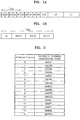
- FIG. 1A is a diagram illustrating a preamble structure used in a wireless local area network (WLAN) or high performance radio LAN 2 (HiperLAN2) of IEEE 801.11 a.
- WLAN wireless local area network
- HiperLAN2 high performance radio LAN 2
- OFDM orthogonal frequency division multiplexing
- FIG. 1B is a diagram illustrating a preamble structure used in worldwide interoperability for microwave access (WiMAX) of IEEE 802.16e. Referring to FIG. 1B , one OFDM symbol is used for synchronization and channel estimation.
- WiMAX worldwide interoperability for microwave access
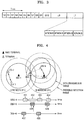
- FIGS. 2 and 3 are diagrams for describing a method of transmitting network identification (ID) in a preamble, according to an embodiment of the present invention.
- FIG. 2 is in regard to a method of generating different patterns of a preamble according to a network ID.
- 16 different patterns of a preamble may be formed in a network ID of 4 bits.
- a preamble may be generated by forming a pattern of the preamble by using a part of the number of bits, for example, 8 bits out of 16 bits.
- the preamble is detected first, and then the channel is estimated by using the detected preamble.
- the preamble may have a pattern satisfying a low peak to average power ratio (PAPR).
- PAPR peak to average power ratio
- FIG. 3 is in regard to a method of, when a preamble for channel estimation is repeated twice, using a first preamble by transmitting a fixed pattern in the first preamble, and transmitting a network ID in a second preamble.
- a network ID of 4 bits may be repeatedly transmitted 4 times by using a binary phase shift key (BPSK).
- BPSK binary phase shift key
- the method of transmitting a network ID in a preamble may be variously designed according to a structure of the preamble, aside from the above described embodiment.
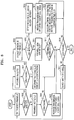
- FIG. 4 is a diagram for describing a method of coexisting with an adjacent network, wherein the method is performed by a terminal existing in an existing network, according to an embodiment of the present invention.
- a black triangle is a terminal having a network management system (NMS) function, for example, an access point in a WLAN or a base station in cellular communication
- a white triangle is a terminal without an NMS function.
- NMS network management system
- FIG. 4 illustrates an example of self-coexistence between networks, which is achieved by using a preamble when adjacent networks use the same channel.
- a frequency reuse factor of a network A and a network B is 1, and the networks A and B use the same frequency channel (F1).
- a terminal DEV4 located on a cell boundary of the network A is located in an area that is unable to receive data from any of terminals of the network B.
- the network A and the network B do not communicate with each other, there is no information to perform any function for network coexistence.
- the terminal DEV4 in the network is able to receive preambles from a terminal DEV5 and a terminal DEV6, the terminal DEV4 may detect network ID from the preambles and use the network ID in the network coexistence.
- the terminal DEV4 transmits packets 401, 403, and 404, the terminal DEV5 transmits packets 405 and 406, and the terminal DEV6 transmits packets 407 and 408.
- the terminal DEV4 since the terminal DEV4 is able to detect the preamble of the network B during an idle period of the network A, the terminal DEV4 detects a preamble of the packet 405 of the network B during an idle period 402.
- the method of coexisting with an adjacent network may also be applied to a network system using different frequency channels, in which a frequency reuse factor is not 1.
- the terminal DEV4 receives data and detects a preamble by using a separate means, the terminal DEV4 is able to always detect preambles from the packets 405 and 406 of the terminal DEV5 or the packets 407 and 408 of the terminal DEV6.
- network coexistence of a terminal is possible via a detected network ID without communicating with an adjacent network, and a separate overhead, such as a quiet period (QP), is not required.
- QP quiet period
- FIG. 5 is a diagram for describing a method of connecting to an existing network, wherein the method is performed by a terminal in a low data reception signal to noise ratio (SNR) area, according to an embodiment of the present invention.
- SNR signal to noise ratio
- areas within solid lines are data transmittable areas, and areas within dotted lines are preamble detectable areas.
- a black triangle is a terminal having an NMS function, for example, an access point in a WLAN or a base station in cellular communication
- a white triangle is an operating terminal without an NMS function
- a triangle filled with diagonal lines is an unknown terminal without an NMS function.
- the preamble aided link adaptation technology of the present invention may be used to connect to the existing network.
- reception SNRs of an unknown terminal, the terminal DEV7, and the terminal DEV8 may be too low to receive a header or a beacon from the existing network.
- the terminal DEV7 or the terminal DEV8 is in the preamble detectable area of another terminal in the existing network, such as a terminal DEV1 or a terminal DEV2, the terminal DEV7 or the terminal DEV8 may successfully receive a preamble from the other terminal and detect network ID from the preamble.
- the terminal DEV7 or the terminal DEV8 may transmit a message requesting other terminals in the existing network to increase data transmission power in a contention time slot.
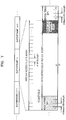
- FIG. 6 is a flowchart describing controlling of transmission power and cell design by applying a preamble aided link adaption technology, according to an embodiment of the present invention.
- a terminal which is a device that belongs to a certain network, tries to detect a preamble by using a unique pattern used in the preamble in a searched channel.
- the terminal determines whether the preamble is detected in operation S602.
- the terminal determines whether the searched channel is a channel used by a network that the terminal belongs to (hereinafter, referred to as its own network) in operation S604.
- the terminal When the searched channel is the channel used by the terminal's own network, the terminal increases transmission power or suitably adjusts a cell design in operation S605.
- the terminal shares a result of increasing the transmission power or adjusting the cell design with other terminals.
- the terminal may feed back a result of detecting the preamble to a master terminal so that the transmission power or the cell design is controlled by the master terminal.
- the terminal determines whether the searched channel is the last channel in operation S616, and when the searched channel is not the last channel, a following channel is searched in operation S617.
- the terminal checks whether the searched channel is used by the terminal's own network in operation S607.
- the terminal determines that the searched channel is used by an adjacent network in operation S608, checks whether the searched channel is the last channel in operation S616, and when the searched channel is not the last channel, continuously searches a following channel in operation S617.
- the terminal When a channel from which the preamble is detected is used by the terminal's own network, the terminal extracts network ID from the preamble in operation S609. Then, the terminal checks whether the extracted network ID is ID of its own network in operation S610.
- the terminal determines that the detected preamble is from its own network in operation S611, and determines whether the preamble is a preamble of a reference frame in operation S612.
- a control message requesting to increase transmission power is transmitted in a contention time slot in operation S613.
- the terminal determines whether the searched channel is the last channel in operation S616, and when the searched channel is not the last channel, a following channel is continuously searched in operation S617.
- the terminal determines that the channel is used by an adjacent network in operation S614, and reduces transmission power or suitably adjusts a cell design in operation S615. Then, the terminal checks whether the channel is the last channel in operation S616, and when the channel is not the last channel, continuously searches a following channel in operation S617.
- FIG. 7 is a diagram illustrating a media access control (MAC) frame structure usable in a home network or in a wireless personal area network (WPAN), according to an embodiment of the present invention.
- MAC media access control
- time is divided into time slots called medium access slots (MASs), and a superframe may be divided into a beacon period for transmitting a beacon, a data/sense/sleep period (DSSP) including a data transmission period, a sensing period, and a sleep period, and a signaling window (SW) period for transmitting a control message.
- MASs medium access slots
- DSSP data/sense/sleep period
- SW signaling window
- An unknown terminal detects a preamble from a reference frame, for example, a beacon frame, related to channel scheduling, identifies the SW period, and transmits a control message requesting to increase transmission power during the SW period.
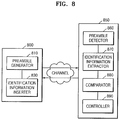
- FIG. 8 is a schematic block diagram illustrating a network communication system using a preamble, according to an embodiment of the present invention.
- the network communication system includes a transmission device 800 and a reception device 850.
- the transmission device 800 generates a preamble and inserts network identification information into the generated preamble, and includes a preamble generator 810 and an identification information inserter 830.
- the preamble generator 810 generates the preamble
- the identification information inserter 830 inserts the network identification information (network ID) into the generated preamble.
- a pattern of a preamble defined to correspond to the network identification information may be applied to a preamble for channel estimation, or the network identification information may be repeatedly inserted into surplus preambles following the preamble for channel estimation.
- a method of inserting the network identification information into the preamble is not limited to the above, and may vary according to network and communication types.
- the preamble into which the network identification information is inserted is transmitted to the reception device 850 via a channel.
- the reception device 850 includes a preamble detector 860, an identification information extractor 870, a comparator 880, and a controller 890.
- the reception device 850 searches and determines a channel to detect a preamble.
- the preamble detector 860 detects a preamble in a predetermined channel. At least one candidate channel for detecting a preamble may be determined according to a result of searching for channels by a channel detector (not shown).
- the reception device 850 is able to detect the preamble only during an idle period of a network to which the reception device 850 belongs.
- a data receiver (not shown) is installed separately from the preamble detector 860, the reception device 850 detects the preamble from an adjacent network of the same channel only during the idle period of the network to which the reception device 850 belongs, and detects the preamble all the time from the adjacent network of different channel regardless of data transmission.
- the preamble detector 860 connects a following candidate channel to detect a preamble.
- the identification information extractor 870 extracts network identification information from the detected preamble.
- the comparator 880 checks a network corresponding to the extracted network identification information, and compares the network with a network to which the reception device 850 belongs.
- the controller 890 decreases transmission power or adjusts a cell design so that the networks adjacently operate without interference.
- the controller 890 transmits a control message requesting other devices in the network to increase transmission power, so that the reception device 850 located in a low data reception SNR area easily connects to the network.
- the control message is transmitted after a reference frame is received and a location of a contention time slot is determined.
- the controller 890 controls the reception device 850 to detect the preamble in a following channel, and when the preamble is not detected in a channel used by the reception device 850, controls the reception device 850 to increase transmission power or adjust a cell design.
- a result of changing the transmission power or cell design is shared with other terminals. Alternatively, the transmission power or the cell design may be changed by a master terminal that received a result of detecting the preamble from the terminal.
- the network ID (or base station ID) extracted from the preamble is used for effective network coexistence, and is used to enable an unknown terminal, which has a low reception SNR and has not yet been connected to an existing network, to easily connect to the existing network.
- the network ID extracted for the network coexistence is used to control the cell design and transmission power.
- hard-wired circuitry may be used in place of or in combination with processor/controller programmed with computer software instructions to implement the invention.
- embodiments of the invention are not limited to any specific combination of hardware circuitry and software.
- the invention can also be embodied as computer readable codes on a computer readable recording medium.
- the computer readable recording medium is any data storage device that can store data which can be thereafter read by a computer system. Examples of the computer readable recording medium include read-only memory (ROM), random-access memory (RAM), CD-ROMs, magnetic tapes, floppy disks, optical data storage devices, and carrier waves (such as data transmission through the Internet).
- ROM read-only memory
- RAM random-access memory
- CD-ROMs compact discs
- magnetic tapes magnetic tapes
- floppy disks optical data storage devices
- carrier waves such as data transmission through the Internet
Landscapes
- Engineering & Computer Science (AREA)
- Computer Networks & Wireless Communication (AREA)
- Signal Processing (AREA)
- Computer Security & Cryptography (AREA)
- Quality & Reliability (AREA)
- Mobile Radio Communication Systems (AREA)
Description
- The present invention relates to a network communication method and a network device using a preamble, and more particularly, to a network coexistence method and a network connection method, which transmit a preamble by inserting network identification information into the preamble and use the detected network identification information, and a network device performing the network coexistence method and the network connection method.
- The present invention is supported by the Information Technology (IT) Research & Development (R&D) program of the Ministry of Information and Communication (MIC) and the Institute for Information Technology Advancement (IITA) [2005-S-002-04, Development of Cognitive Radio Technology for Spectrum Utility Improvement].
- Network coexistence is achieved relatively easily when networks communicate with each other, but when the networks do not communicate with each other, network coexistence is restricted since there is no information about an adjacent network. Specifically, since there is no information about a channel that is used by the adjacent network, transmission power is minimized so as to reduce interference. However, in this case, terminals at the edge of a cell may fail to communicate. Also, for a terminal having a low reception signal to noise ratio (SNR) to communicate, the terminal must move to within a communicatable range and then turn on again, since another terminal in an existing network cannot increase transmission power because the existence of a predetermined terminal is not known.
- The networks must communicate with each other for network coexistence, but in a home network, due to security, the network coexistence must be possible without communication between the networks. Also, a terminal which is turned on in a low reception SNR area is unable to receive a header or a beacon from an existing network, and thus is unable to connect to the existing network.
- Document
US 2007/036065 A1 discloses a method for determining network identifiers in a communication system in a transceiver. The method includes processing a first received symbol configured to communicate first timing information to the transceiver. The method further includes processing a second received symbol configured to communicate first information including network identification information concerning a first network. Finally, the method includes selectively processing a third received symbol configured to communicate second information including network identification information concerning a second network, where the network identification information concerning the second network includes at least a portion of the network identification information concerning the first network when the transceiver is selectively configured to receive data from the second network. - Document
US 2007/191005 A1 discloses an apparatus and method that allow a wireless communication device to intelligently search for and select a communication cell based on a system identifier (SID) and network identifier (NID) order of preference rather than just pilot signal strength. Generally, a mobile device scans a frequency channel associated with the highest preferred SID/NID for pilot signals at different PN offsets. The cell associated with the strongest pilot signal detected is queried to determine whether it belongs to the SID/NID sought. If the selected PN offset belongs to a cell associated with the SID/NID sought then it is used for communications. Otherwise, the SID/NID identification process is repeated for the next strongest PN offset detected on the same frequency channel. If no pilot signals meeting these criteria are found in the frequency channel, the next highest preferred SID/NID is selected and the process is repeated. - Document
US 2007/191006 A1 discloses methods and apparatus for automatically selecting a wireless communication network by user equipment using a "steered" PLMN. In an automatic network selection procedure, a scanning operation is performed to receive one or more network identifications corresponding to one or more available wireless communication networks in a coverage area. The user equipment attempts to select a wireless communication network in the coverage area by comparing the received network identifications from the scanning operation with the steered network identification. Accordingly, a home network operator may "steer" user equipment to any desired network immediately and efficiently. - The present invention provides a method which enables network coexistence without communication between networks, and enables a terminal having a low reception signal to noise ratio (SNR) to connect to a network.
- Other objectives and merits of the present invention may be understood from the following descriptions, and clarified from the embodiments of the present invention. Also, it is easily known that the objectives and merits of the present invention are realized by means shown in the claims and by combining the means.
- The present invention is related to a network connection method using a preamble. The present invention is defined in the independent claims. The dependent claims define advantageous embodiments thereof.
- According to the present invention, network coexistence is easily achieved in an ad-hoc network, such as a home network, by using network identification (ID) carried in a preamble, and an unknown terminal, which has a low reception signal to noise ratio (SNR) and has not yet been connected to an existing network, can be easily connected to the existing network.
- Also, since the present invention operates in a physical (PHY) layer, processing latency can be reduced compared to a method operated in a media access control (MAC) layer, and power consumption is reduced since power of function blocks after Viterbi decoder can be blocked.
- Also in an adjacent cell environment using the same channel (frequency reuse factor=1), the present invention operates during an idle time instead of a communication activation time, and thus a separate overhead (a quiet period of time in the case of a cognitive radio) is not required, and security is high since the present invention operates without exchanging or adjusting information with an adjacent network.
-
-
FIG. 1A is a diagram illustrating a preamble structure used in a wireless local area network (WLAN) or high performance radio LAN 2 (HiperLAN2) of IEEE 801.11a; -
FIG. 1B is a diagram illustrating a preamble structure used in worldwide interoperability for microwave access (WiMAX) of IEEE 802.16e; -
FIGS. 2 and3 are diagrams for describing a method of transmitting network identification (ID) in a preamble, according to an embodiment of the present invention; -
FIG. 4 is a diagram for describing a method of coexisting with an adjacent network, wherein the method is performed by a terminal existing in an existing network, according to an embodiment of the present invention; -
FIG. 5 is a diagram for describing a method of connecting to an existing network, wherein the method is performed by a terminal in a low data reception signal to noise ratio (SNR) area, according to an embodiment of the present invention; -
FIG. 6 is a flowchart describing controlling of transmission power and cell design by applying a preamble aided link adaption technology, according to an embodiment of the present invention; -
FIG. 7 is a diagram illustrating a media access control (MAC) frame structure usable in a home network or in a wireless personal area network (WPAN), according to an embodiment of the present invention; and -
FIG. 8 is a schematic block diagram illustrating a network communication system using a preamble, according to an embodiment of the present invention. - According to an aspect of the present invention, there is provided a network communication method of a device, the network communication method including: detecting a preamble; and extracting network identification information from the detected preamble.
- According to another aspect of the present invention, there is provided a network coexistence method of a device, the network coexistence method including: detecting a preamble transmitted by a device of a second network using the same channel as a device of a first network, wherein the detecting is performed by the device of the first network; and extracting network identification information of the second network from the detected preamble.
- According to another aspect of the present invention, there is provided a network connection method of a device, the network connection method including: detecting a preamble in a reference frame, wherein the detecting is performed by a device connected to an existing used channel in a low data reception signal to noise ratio (SNR) area; and extracting network identification information from the detected preamble.
- According to another aspect of the present invention, there is provided a network communication method of a device, the network communication method including: generating a preamble; and inserting network identification information into the generated preamble.
- According to another aspect of the present invention, there is provided a network device including: a preamble detector which detects a preamble; and an identification information extractor which extracts network identification information from the detected preamble.
- According to another aspect of the present invention, there is provided a network device including: a preamble generator which generates a preamble; and an identification information inserter which inserts network identification information into the generated preamble.
- Hereinafter, the present invention will be described more fully with reference to the accompanying drawings, in which exemplary embodiments of the invention are shown. In the drawings, like reference numerals denote like elements. Also, while describing the present invention, detailed descriptions about related well-known functions or configurations, which may diminish the clarity of the points of the present invention, are omitted.
- It will be understood that when a part "includes" an element, the part does not exclude other elements, but may further include the other elements unless otherwise stated. Also, terms such as "unit" and "block" denote a unit that performs at least one function or operation, which may be realized in hardware, software, or in combination of hardware and software.
- The present invention is about a method of connecting to a network by using a preamble, and is called a preamble aided link adaptation technology. In the present invention, a preamble has a different pattern according to network identification (ID). Here, the network ID is a unique ID of a cell or a network, and a base station ID in cellular communication may be the network ID. In other words, the network ID is a term used as an identical and unique ID shared by all terminals in a network. Accordingly, even when the same channel is used, a pattern of the preamble differs according to a network.
- A structure of the preamble may be different according to a system to which it is applied. The preamble is basically used for synchronization and channel estimation.
-
FIG. 1A is a diagram illustrating a preamble structure used in a wireless local area network (WLAN) or high performance radio LAN 2 (HiperLAN2) of IEEE 801.11 a. Referring toFIG. 1A , two orthogonal frequency division multiplexing (OFDM) symbols are used for initial synchronization and two OFDM symbols are used for channel estimation. -
FIG. 1B is a diagram illustrating a preamble structure used in worldwide interoperability for microwave access (WiMAX) of IEEE 802.16e. Referring toFIG. 1B , one OFDM symbol is used for synchronization and channel estimation. -
FIGS. 2 and3 are diagrams for describing a method of transmitting network identification (ID) in a preamble, according to an embodiment of the present invention. -
FIG. 2 is in regard to a method of generating different patterns of a preamble according to a network ID. For example, 16 different patterns of a preamble may be formed in a network ID of 4 bits. When the number of bits in the network ID is high, a preamble may be generated by forming a pattern of the preamble by using a part of the number of bits, for example, 8 bits out of 16 bits. According to such a method, when a channel needs to be estimated by using the preamble, the preamble is detected first, and then the channel is estimated by using the detected preamble. Here, the preamble may have a pattern satisfying a low peak to average power ratio (PAPR). -
FIG. 3 is in regard to a method of, when a preamble for channel estimation is repeated twice, using a first preamble by transmitting a fixed pattern in the first preamble, and transmitting a network ID in a second preamble. For example, when a number of subcarriers of the second preamble is 16, a network ID of 4 bits may be repeatedly transmitted 4 times by using a binary phase shift key (BPSK). When the number of subcarriers of the preamble is bigger than the number of bits of the network ID, a gain according to repetitive transmission may be obtained. - The method of transmitting a network ID in a preamble may be variously designed according to a structure of the preamble, aside from the above described embodiment.
-
FIG. 4 is a diagram for describing a method of coexisting with an adjacent network, wherein the method is performed by a terminal existing in an existing network, according to an embodiment of the present invention. - In
FIG. 4 , areas within solid lines are data transmittable areas, and areas within dotted lines are preamble detectable areas. Generally, the preamble detectable area is larger than the data transmittable area due to a correlation gain used while detecting a preamble. Also, a black triangle is a terminal having a network management system (NMS) function, for example, an access point in a WLAN or a base station in cellular communication, and a white triangle is a terminal without an NMS function. -
FIG. 4 illustrates an example of self-coexistence between networks, which is achieved by using a preamble when adjacent networks use the same channel. Here, a frequency reuse factor of a network A and a network B is 1, and the networks A and B use the same frequency channel (F1). - A terminal DEV4 located on a cell boundary of the network A is located in an area that is unable to receive data from any of terminals of the network B. When the network A and the network B do not communicate with each other, there is no information to perform any function for network coexistence. Here, when the terminal DEV4 in the network is able to receive preambles from a terminal DEV5 and a terminal DEV6, the terminal DEV4 may detect network ID from the preambles and use the network ID in the network coexistence.
- The terminal DEV4 transmits
packets packets 405 and 406, and the terminal DEV6 transmitspackets idle period 402. - The method of coexisting with an adjacent network according to the current embodiment of the present invention may also be applied to a network system using different frequency channels, in which a frequency reuse factor is not 1. When the terminal DEV4 receives data and detects a preamble by using a separate means, the terminal DEV4 is able to always detect preambles from the
packets 405 and 406 of the terminal DEV5 or thepackets - According to the current embodiment of the present invention, network coexistence of a terminal is possible via a detected network ID without communicating with an adjacent network, and a separate overhead, such as a quiet period (QP), is not required. Moreover, since the network ID is detected in a PHY layer, process latency and power consumption are minimized.
-
FIG. 5 is a diagram for describing a method of connecting to an existing network, wherein the method is performed by a terminal in a low data reception signal to noise ratio (SNR) area, according to an embodiment of the present invention. - In
FIG. 5 , areas within solid lines are data transmittable areas, and areas within dotted lines are preamble detectable areas. Also, a black triangle is a terminal having an NMS function, for example, an access point in a WLAN or a base station in cellular communication, a white triangle is an operating terminal without an NMS function, and a triangle filled with diagonal lines is an unknown terminal without an NMS function. - When a terminal that is turned on in a low reception SNR area is unable to receive a header or a beacon of a frame from an existing network, the preamble aided link adaptation technology of the present invention may be used to connect to the existing network.
- When a user turns a terminal DEV8 on in a patio or a terrace or turns a terminal DEV7 on in a corner of a room where a signal of the existing network cannot be received, reception SNRs of an unknown terminal, the terminal DEV7, and the terminal DEV8 may be too low to receive a header or a beacon from the existing network. However, when the terminal DEV7 or the terminal DEV8 is in the preamble detectable area of another terminal in the existing network, such as a terminal DEV1 or a terminal DEV2, the terminal DEV7 or the terminal DEV8 may successfully receive a preamble from the other terminal and detect network ID from the preamble. When the network ID detected by the terminal DEV7 or the terminal DEV8 is an ID of a network that a user belongs to, the terminal DEV7 or the terminal DEV8 may transmit a message requesting other terminals in the existing network to increase data transmission power in a contention time slot.
-
FIG. 6 is a flowchart describing controlling of transmission power and cell design by applying a preamble aided link adaption technology, according to an embodiment of the present invention. - In operation S601, a terminal, which is a device that belongs to a certain network, tries to detect a preamble by using a unique pattern used in the preamble in a searched channel.
- The terminal determines whether the preamble is detected in operation S602.
- When the preamble is not detected in operation S603, the terminal determines whether the searched channel is a channel used by a network that the terminal belongs to (hereinafter, referred to as its own network) in operation S604.
- When the searched channel is the channel used by the terminal's own network, the terminal increases transmission power or suitably adjusts a cell design in operation S605. The terminal shares a result of increasing the transmission power or adjusting the cell design with other terminals. Alternatively, the terminal may feed back a result of detecting the preamble to a master terminal so that the transmission power or the cell design is controlled by the master terminal.
- When the searched channel is not the channel used by the terminal's own network, the terminal determines whether the searched channel is the last channel in operation S616, and when the searched channel is not the last channel, a following channel is searched in operation S617.
- When the preamble is detected in the searched channel in operation S606, the terminal checks whether the searched channel is used by the terminal's own network in operation S607.
- When the searched channel is not the channel used by the terminal's own network, the terminal determines that the searched channel is used by an adjacent network in operation S608, checks whether the searched channel is the last channel in operation S616, and when the searched channel is not the last channel, continuously searches a following channel in operation S617.
- When a channel from which the preamble is detected is used by the terminal's own network, the terminal extracts network ID from the preamble in operation S609. Then, the terminal checks whether the extracted network ID is ID of its own network in operation S610.
- When the extracted network ID is the ID of the terminal's own network, the terminal determines that the detected preamble is from its own network in operation S611, and determines whether the preamble is a preamble of a reference frame in operation S612.
- When the preamble is the preamble of the reference frame and the terminal is an unknown terminal, a control message requesting to increase transmission power is transmitted in a contention time slot in operation S613. When the preamble is not the preamble of the reference frame, the terminal determines whether the searched channel is the last channel in operation S616, and when the searched channel is not the last channel, a following channel is continuously searched in operation S617.
- When the channel from which the preamble is detected is identical to the channel used by the terminal's own network but the extracted ID is not the ID of its own network, the terminal determines that the channel is used by an adjacent network in operation S614, and reduces transmission power or suitably adjusts a cell design in operation S615. Then, the terminal checks whether the channel is the last channel in operation S616, and when the channel is not the last channel, continuously searches a following channel in operation S617.
-
FIG. 7 is a diagram illustrating a media access control (MAC) frame structure usable in a home network or in a wireless personal area network (WPAN), according to an embodiment of the present invention. - Referring to
FIG. 7 , time is divided into time slots called medium access slots (MASs), and a superframe may be divided into a beacon period for transmitting a beacon, a data/sense/sleep period (DSSP) including a data transmission period, a sensing period, and a sleep period, and a signaling window (SW) period for transmitting a control message. An unknown terminal detects a preamble from a reference frame, for example, a beacon frame, related to channel scheduling, identifies the SW period, and transmits a control message requesting to increase transmission power during the SW period. -
FIG. 8 is a schematic block diagram illustrating a network communication system using a preamble, according to an embodiment of the present invention. - Referring to
FIG. 8 , the network communication system includes atransmission device 800 and areception device 850. - The
transmission device 800 generates a preamble and inserts network identification information into the generated preamble, and includes apreamble generator 810 and anidentification information inserter 830. Thepreamble generator 810 generates the preamble, and theidentification information inserter 830 inserts the network identification information (network ID) into the generated preamble. A pattern of a preamble defined to correspond to the network identification information may be applied to a preamble for channel estimation, or the network identification information may be repeatedly inserted into surplus preambles following the preamble for channel estimation. However, a method of inserting the network identification information into the preamble is not limited to the above, and may vary according to network and communication types. The preamble into which the network identification information is inserted is transmitted to thereception device 850 via a channel. - The
reception device 850 includes apreamble detector 860, anidentification information extractor 870, acomparator 880, and acontroller 890. - The
reception device 850 searches and determines a channel to detect a preamble. - The
preamble detector 860 detects a preamble in a predetermined channel. At least one candidate channel for detecting a preamble may be determined according to a result of searching for channels by a channel detector (not shown). When thepreamble detector 860 has a data receiving function, thereception device 850 is able to detect the preamble only during an idle period of a network to which thereception device 850 belongs. When a data receiver (not shown) is installed separately from thepreamble detector 860, thereception device 850 detects the preamble from an adjacent network of the same channel only during the idle period of the network to which thereception device 850 belongs, and detects the preamble all the time from the adjacent network of different channel regardless of data transmission. When the preamble is not detected from a candidate channel which is not a channel used by thepreamble detector 860, thepreamble detector 860 connects a following candidate channel to detect a preamble. - The
identification information extractor 870 extracts network identification information from the detected preamble. Thecomparator 880 checks a network corresponding to the extracted network identification information, and compares the network with a network to which thereception device 850 belongs. When the network corresponding to the network identification information and the network to which thereception device 850 belongs are different but use the same channel, thecontroller 890 decreases transmission power or adjusts a cell design so that the networks adjacently operate without interference. Alternatively, when the networks are identical and use the same channel, thecontroller 890 transmits a control message requesting other devices in the network to increase transmission power, so that thereception device 850 located in a low data reception SNR area easily connects to the network. The control message is transmitted after a reference frame is received and a location of a contention time slot is determined. When the preamble is not detected, thecontroller 890 controls thereception device 850 to detect the preamble in a following channel, and when the preamble is not detected in a channel used by thereception device 850, controls thereception device 850 to increase transmission power or adjust a cell design. A result of changing the transmission power or cell design is shared with other terminals. Alternatively, the transmission power or the cell design may be changed by a master terminal that received a result of detecting the preamble from the terminal. - The network ID (or base station ID) extracted from the preamble is used for effective network coexistence, and is used to enable an unknown terminal, which has a low reception SNR and has not yet been connected to an existing network, to easily connect to the existing network. The network ID extracted for the network coexistence is used to control the cell design and transmission power.
- In alternative embodiments, hard-wired circuitry may be used in place of or in combination with processor/controller programmed with computer software instructions to implement the invention. Thus, embodiments of the invention are not limited to any specific combination of hardware circuitry and software.
- The present invention claims the benefit of
US Provisional Application No. 61/012,519, filed on December 10, 2007 - The invention can also be embodied as computer readable codes on a computer readable recording medium. The computer readable recording medium is any data storage device that can store data which can be thereafter read by a computer system. Examples of the computer readable recording medium include read-only memory (ROM), random-access memory (RAM), CD-ROMs, magnetic tapes, floppy disks, optical data storage devices, and carrier waves (such as data transmission through the Internet). The computer readable recording medium can also be distributed over network coupled computer systems so that the computer readable code is stored and executed in a distributed fashion.
Claims (9)
- A network communication method of a device, the network communication method comprising:detecting a preamble (S601);extracting network identification information from the detected preamble (S609); in response to a determination that a detected channel of the preamble is identical to a used channel of the device (S607), determining whether a network corresponding to the extracted network identification information and a network to which the device belongs are the same or different (S610);reducing transmission power in response to a determination that the extracted network identification information and the network to which the device belongs are different (S615); andrequesting other devices in the network to increase transmission power in response to a determination that the extracted network identification information and the network to which the device belongs are the same and that the preamble is in a reference frame (S613).
- The network communication method of claim 1, wherein the detecting of the preamble comprises detecting the preamble during an idle period of a network to which the device belongs in the same channel as a used frequency channel of the device.
- The network communication method of claims 1 or 2, wherein the device detecting the preamble is connected to an existing used frequency channel in a low data reception signal to noise ratio (SNR) area.
- The network communication method of claim 3, wherein the requesting comprises requesting to increase the data transmission power in a control message transmission period after receiving the reference frame and checking a location of a contention time slot.
- The network communication method of any of claims 1 to 4, further comprising: generating a preamble by a second device; and inserting network identification information into the generated preamble.
- The network communication method of claim 5, wherein the network identification information is a certain pattern applied to a preamble for channel estimation.
- The network communication method of claim 5, wherein the network identification information is repeatedly inserted into surplus preambles following a preamble for channel estimation.
- A network device (850) comprising:a preamble detector (860) which is adapted to detect a preamble;an identification information extractor (870) which is adapted to extract network identification information from the detected preamble, anda controller (890) which, in response to a determination that a detected channel of the preamble is identical to a used channel of the device, is adapted to determine whether a network corresponding to the extracted network identification information and a network to which the device belongs are the same or different;wherein the controller is further adapted to reduce transmission power in response to a determination that the extracted network identification information and the network to which the device belongs are different; andwherein the controller is further adapted to request other devices in the network to increase transmission power in response to a determination that the extracted network identification information and the network to which the device belongs are the same and that the preamble is in a reference frame.
- A network communication system comprising a network device (850) according claim 8 further comprises a network device (800) comprising: a preamble generator (810) which is configured to generate a preamble; and an identification information inserter (830) which is configured to insert network identification information into the generated preamble.
Applications Claiming Priority (2)
| Application Number | Priority Date | Filing Date | Title |
|---|---|---|---|
| US1251907P | 2007-12-10 | 2007-12-10 | |
| PCT/KR2008/007298 WO2009075519A1 (en) | 2007-12-10 | 2008-12-10 | Network communication method and network device using preamble |
Publications (3)
| Publication Number | Publication Date |
|---|---|
| EP2223445A1 EP2223445A1 (en) | 2010-09-01 |
| EP2223445A4 EP2223445A4 (en) | 2016-05-11 |
| EP2223445B1 true EP2223445B1 (en) | 2017-08-16 |
Family
ID=40755692
Family Applications (1)
| Application Number | Title | Priority Date | Filing Date |
|---|---|---|---|
| EP08859078.1A Not-in-force EP2223445B1 (en) | 2007-12-10 | 2008-12-10 | Network communication method and network device using preamble |
Country Status (4)
| Country | Link |
|---|---|
| US (1) | US8488526B2 (en) |
| EP (1) | EP2223445B1 (en) |
| KR (1) | KR20090060956A (en) |
| WO (1) | WO2009075519A1 (en) |
Families Citing this family (6)
| Publication number | Priority date | Publication date | Assignee | Title |
|---|---|---|---|---|
| KR101778304B1 (en) * | 2010-08-23 | 2017-09-13 | 한국전자통신연구원 | Communication method of sharing characteristic information of communication system using preamble, method of generating the preamble and communication system of enalbling the methods |
| US9401832B2 (en) | 2011-05-20 | 2016-07-26 | Microsoft Technology Licensing, Llc | Long-range nodes with adaptive preambles for coexistence |
| US9385848B2 (en) | 2011-05-20 | 2016-07-05 | Microsoft Technology Licensing, Llc | Short-range nodes with adaptive preambles for coexistence |
| CN106612536A (en) * | 2015-10-21 | 2017-05-03 | 中国科学院沈阳自动化研究所 | Media access control method for cognitive sensor network based on lead sensing |
| EP3375108A4 (en) * | 2015-11-11 | 2019-10-23 | Ruckus Wireless, Inc. | DEWLAN TREATMENT |
| CN111343725A (en) * | 2018-12-19 | 2020-06-26 | 中兴通讯股份有限公司 | Signal transmission method and device and wireless transceiver chip |
Family Cites Families (10)
| Publication number | Priority date | Publication date | Assignee | Title |
|---|---|---|---|---|
| KR0143120B1 (en) * | 1995-06-28 | 1998-08-01 | 김광호 | Power saving method of radio call receiver |
| KR100946913B1 (en) * | 2003-11-21 | 2010-03-09 | 삼성전자주식회사 | Apparatus and method for generating preamble signal for cell identification in orthogonal frequency division multiplexing system |
| KR100603561B1 (en) * | 2004-04-16 | 2006-07-24 | 삼성전자주식회사 | Wireless LAN system based on transmission power control and transmission power control method thereof |
| US7539260B2 (en) * | 2004-05-27 | 2009-05-26 | Qualcomm Incorporated | Detecting the number of transmit antennas in wireless communication systems |
| JP4591973B2 (en) * | 2004-07-27 | 2010-12-01 | ゼットティーイー(ユーエスエー)インコーポレーテッド | Transmission and reception of reference preamble signal in OFDMA or OFDM communication system |
| JP4590969B2 (en) * | 2004-07-28 | 2010-12-01 | ソニー株式会社 | Wireless communication system, wireless communication apparatus, wireless communication method, and computer program |
| US9042212B2 (en) * | 2005-07-29 | 2015-05-26 | Qualcomm Incorporated | Method and apparatus for communicating network identifiers in a communication system |
| EP1804424A1 (en) * | 2005-12-27 | 2007-07-04 | THOMSON Licensing | Method for dynamically selecting a channel in a wireless local area network |
| US7657261B2 (en) * | 2006-02-10 | 2010-02-02 | Qualcomm Incorporated | Technique for using the same wireless frequency channel in overlapping or adjacent coverage areas |
| US8027677B2 (en) * | 2006-02-13 | 2011-09-27 | Research In Motion Limited | Automatic network selection methods and apparatus using a steered PLMN |
-
2008
- 2008-12-10 EP EP08859078.1A patent/EP2223445B1/en not_active Not-in-force
- 2008-12-10 KR KR1020080125125A patent/KR20090060956A/en not_active Ceased
- 2008-12-10 US US12/747,299 patent/US8488526B2/en not_active Expired - Fee Related
- 2008-12-10 WO PCT/KR2008/007298 patent/WO2009075519A1/en not_active Ceased
Non-Patent Citations (1)
| Title |
|---|
| None * |
Also Published As
| Publication number | Publication date |
|---|---|
| WO2009075519A1 (en) | 2009-06-18 |
| US20100260106A1 (en) | 2010-10-14 |
| EP2223445A4 (en) | 2016-05-11 |
| US8488526B2 (en) | 2013-07-16 |
| KR20090060956A (en) | 2009-06-15 |
| EP2223445A1 (en) | 2010-09-01 |
Similar Documents
| Publication | Publication Date | Title |
|---|---|---|
| US20220239538A1 (en) | Device beacon for communication management for peer to peer communications | |
| EP1668808B1 (en) | Method and apparatus for cell identification in wireless data networks | |
| CN101843164B (en) | Method and apparatus for improved data demodulation in a wireless communication network | |
| US8223662B2 (en) | Concurrent operation in multiple wireless local area networks | |
| US8233875B2 (en) | Device beacon for handoff management of handoffs to access nodes | |
| US8363590B2 (en) | Physical layer repeater with roaming support based on multiple identifiers | |
| JP5424899B2 (en) | Coordination in wireless networks with devices of different physical layer transmission schemes | |
| EP2090133B1 (en) | Apparatus, system and method for managing wireless local area network service based on a location of a multi-mode portable communication device | |
| FI120478B (en) | Method and apparatus for connecting to a telecommunications network | |
| JP5384637B2 (en) | Ultra wideband assisted initial acquisition | |
| EP2629569B1 (en) | Base station and communication method | |
| JP5456847B2 (en) | Frame structure for wireless communication system | |
| US8897277B2 (en) | Device beacon for handoff management of handoffs to base stations | |
| US20190253972A1 (en) | Method for managing power in wireless lan system and wireless terminal using same | |
| US8488526B2 (en) | Network communication method and network device using preamble | |
| CN102792757A (en) | Method and apparatus of requesting channel access in wireless local area network | |
| EP1856923A2 (en) | Method and system for control channel beamforming | |
| EP2220821B1 (en) | Beacon re-broadcasting apparatus and method in wireless network | |
| WO2016021792A1 (en) | Power save mode-based operating method and apparatus in wireless lan | |
| CN100544373C (en) | Multi-network coverage cell detection | |
| EP1983676A1 (en) | Method and apparatus for dynamically configuring a modulation and coding scheme(MCS) used in a wireless network | |
| WO2015186889A1 (en) | Method and device for operation based on power save mode in wlan | |
| EP2009826B1 (en) | Communication apparatus, transmission system setting method, program, and radio communication system |
Legal Events
| Date | Code | Title | Description |
|---|---|---|---|
| PUAI | Public reference made under article 153(3) epc to a published international application that has entered the european phase |
Free format text: ORIGINAL CODE: 0009012 |
|
| 17P | Request for examination filed |
Effective date: 20100712 |
|
| AK | Designated contracting states |
Kind code of ref document: A1 Designated state(s): AT BE BG CH CY CZ DE DK EE ES FI FR GB GR HR HU IE IS IT LI LT LU LV MC MT NL NO PL PT RO SE SI SK TR |
|
| AX | Request for extension of the european patent |
Extension state: AL BA MK RS |
|
| DAX | Request for extension of the european patent (deleted) | ||
| RA4 | Supplementary search report drawn up and despatched (corrected) |
Effective date: 20160408 |
|
| RIC1 | Information provided on ipc code assigned before grant |
Ipc: H04B 7/26 20060101AFI20160404BHEP Ipc: H04W 52/28 20090101ALI20160404BHEP Ipc: H04L 7/04 20060101ALI20160404BHEP Ipc: H04W 48/16 20090101ALI20160404BHEP Ipc: H04W 72/08 20090101ALI20160404BHEP |
|
| 17Q | First examination report despatched |
Effective date: 20161115 |
|
| GRAP | Despatch of communication of intention to grant a patent |
Free format text: ORIGINAL CODE: EPIDOSNIGR1 |
|
| INTG | Intention to grant announced |
Effective date: 20170508 |
|
| GRAS | Grant fee paid |
Free format text: ORIGINAL CODE: EPIDOSNIGR3 |
|
| GRAA | (expected) grant |
Free format text: ORIGINAL CODE: 0009210 |
|
| AK | Designated contracting states |
Kind code of ref document: B1 Designated state(s): AT BE BG CH CY CZ DE DK EE ES FI FR GB GR HR HU IE IS IT LI LT LU LV MC MT NL NO PL PT RO SE SI SK TR |
|
| REG | Reference to a national code |
Ref country code: GB Ref legal event code: FG4D |
|
| REG | Reference to a national code |
Ref country code: CH Ref legal event code: EP |
|
| REG | Reference to a national code |
Ref country code: IE Ref legal event code: FG4D |
|
| REG | Reference to a national code |
Ref country code: AT Ref legal event code: REF Ref document number: 920030 Country of ref document: AT Kind code of ref document: T Effective date: 20170915 |
|
| REG | Reference to a national code |
Ref country code: DE Ref legal event code: R096 Ref document number: 602008051682 Country of ref document: DE |
|
| REG | Reference to a national code |
Ref country code: NL Ref legal event code: MP Effective date: 20170816 |
|
| REG | Reference to a national code |
Ref country code: LT Ref legal event code: MG4D |
|
| REG | Reference to a national code |
Ref country code: AT Ref legal event code: MK05 Ref document number: 920030 Country of ref document: AT Kind code of ref document: T Effective date: 20170816 |
|
| PG25 | Lapsed in a contracting state [announced via postgrant information from national office to epo] |
Ref country code: SE Free format text: LAPSE BECAUSE OF FAILURE TO SUBMIT A TRANSLATION OF THE DESCRIPTION OR TO PAY THE FEE WITHIN THE PRESCRIBED TIME-LIMIT Effective date: 20170816 Ref country code: FI Free format text: LAPSE BECAUSE OF FAILURE TO SUBMIT A TRANSLATION OF THE DESCRIPTION OR TO PAY THE FEE WITHIN THE PRESCRIBED TIME-LIMIT Effective date: 20170816 Ref country code: AT Free format text: LAPSE BECAUSE OF FAILURE TO SUBMIT A TRANSLATION OF THE DESCRIPTION OR TO PAY THE FEE WITHIN THE PRESCRIBED TIME-LIMIT Effective date: 20170816 Ref country code: NL Free format text: LAPSE BECAUSE OF FAILURE TO SUBMIT A TRANSLATION OF THE DESCRIPTION OR TO PAY THE FEE WITHIN THE PRESCRIBED TIME-LIMIT Effective date: 20170816 Ref country code: NO Free format text: LAPSE BECAUSE OF FAILURE TO SUBMIT A TRANSLATION OF THE DESCRIPTION OR TO PAY THE FEE WITHIN THE PRESCRIBED TIME-LIMIT Effective date: 20171116 Ref country code: LT Free format text: LAPSE BECAUSE OF FAILURE TO SUBMIT A TRANSLATION OF THE DESCRIPTION OR TO PAY THE FEE WITHIN THE PRESCRIBED TIME-LIMIT Effective date: 20170816 |
|
| PG25 | Lapsed in a contracting state [announced via postgrant information from national office to epo] |
Ref country code: BG Free format text: LAPSE BECAUSE OF FAILURE TO SUBMIT A TRANSLATION OF THE DESCRIPTION OR TO PAY THE FEE WITHIN THE PRESCRIBED TIME-LIMIT Effective date: 20171116 Ref country code: ES Free format text: LAPSE BECAUSE OF FAILURE TO SUBMIT A TRANSLATION OF THE DESCRIPTION OR TO PAY THE FEE WITHIN THE PRESCRIBED TIME-LIMIT Effective date: 20170816 Ref country code: LV Free format text: LAPSE BECAUSE OF FAILURE TO SUBMIT A TRANSLATION OF THE DESCRIPTION OR TO PAY THE FEE WITHIN THE PRESCRIBED TIME-LIMIT Effective date: 20170816 Ref country code: GR Free format text: LAPSE BECAUSE OF FAILURE TO SUBMIT A TRANSLATION OF THE DESCRIPTION OR TO PAY THE FEE WITHIN THE PRESCRIBED TIME-LIMIT Effective date: 20171117 Ref country code: IS Free format text: LAPSE BECAUSE OF FAILURE TO SUBMIT A TRANSLATION OF THE DESCRIPTION OR TO PAY THE FEE WITHIN THE PRESCRIBED TIME-LIMIT Effective date: 20171216 Ref country code: PL Free format text: LAPSE BECAUSE OF FAILURE TO SUBMIT A TRANSLATION OF THE DESCRIPTION OR TO PAY THE FEE WITHIN THE PRESCRIBED TIME-LIMIT Effective date: 20170816 |
|
| PG25 | Lapsed in a contracting state [announced via postgrant information from national office to epo] |
Ref country code: RO Free format text: LAPSE BECAUSE OF FAILURE TO SUBMIT A TRANSLATION OF THE DESCRIPTION OR TO PAY THE FEE WITHIN THE PRESCRIBED TIME-LIMIT Effective date: 20170816 Ref country code: CZ Free format text: LAPSE BECAUSE OF FAILURE TO SUBMIT A TRANSLATION OF THE DESCRIPTION OR TO PAY THE FEE WITHIN THE PRESCRIBED TIME-LIMIT Effective date: 20170816 Ref country code: DK Free format text: LAPSE BECAUSE OF FAILURE TO SUBMIT A TRANSLATION OF THE DESCRIPTION OR TO PAY THE FEE WITHIN THE PRESCRIBED TIME-LIMIT Effective date: 20170816 |
|
| REG | Reference to a national code |
Ref country code: DE Ref legal event code: R097 Ref document number: 602008051682 Country of ref document: DE |
|
| PG25 | Lapsed in a contracting state [announced via postgrant information from national office to epo] |
Ref country code: SK Free format text: LAPSE BECAUSE OF FAILURE TO SUBMIT A TRANSLATION OF THE DESCRIPTION OR TO PAY THE FEE WITHIN THE PRESCRIBED TIME-LIMIT Effective date: 20170816 Ref country code: EE Free format text: LAPSE BECAUSE OF FAILURE TO SUBMIT A TRANSLATION OF THE DESCRIPTION OR TO PAY THE FEE WITHIN THE PRESCRIBED TIME-LIMIT Effective date: 20170816 Ref country code: IT Free format text: LAPSE BECAUSE OF FAILURE TO SUBMIT A TRANSLATION OF THE DESCRIPTION OR TO PAY THE FEE WITHIN THE PRESCRIBED TIME-LIMIT Effective date: 20170816 |
|
| PLBE | No opposition filed within time limit |
Free format text: ORIGINAL CODE: 0009261 |
|
| STAA | Information on the status of an ep patent application or granted ep patent |
Free format text: STATUS: NO OPPOSITION FILED WITHIN TIME LIMIT |
|
| 26N | No opposition filed |
Effective date: 20180517 |
|
| REG | Reference to a national code |
Ref country code: CH Ref legal event code: PL |
|
| GBPC | Gb: european patent ceased through non-payment of renewal fee |
Effective date: 20171210 |
|
| PG25 | Lapsed in a contracting state [announced via postgrant information from national office to epo] |
Ref country code: SI Free format text: LAPSE BECAUSE OF FAILURE TO SUBMIT A TRANSLATION OF THE DESCRIPTION OR TO PAY THE FEE WITHIN THE PRESCRIBED TIME-LIMIT Effective date: 20170816 |
|
| REG | Reference to a national code |
Ref country code: IE Ref legal event code: MM4A |
|
| PG25 | Lapsed in a contracting state [announced via postgrant information from national office to epo] |
Ref country code: LU Free format text: LAPSE BECAUSE OF NON-PAYMENT OF DUE FEES Effective date: 20171210 Ref country code: MT Free format text: LAPSE BECAUSE OF NON-PAYMENT OF DUE FEES Effective date: 20171210 |
|
| REG | Reference to a national code |
Ref country code: FR Ref legal event code: ST Effective date: 20180831 |
|
| REG | Reference to a national code |
Ref country code: BE Ref legal event code: MM Effective date: 20171231 |
|
| PG25 | Lapsed in a contracting state [announced via postgrant information from national office to epo] |
Ref country code: IE Free format text: LAPSE BECAUSE OF NON-PAYMENT OF DUE FEES Effective date: 20171210 Ref country code: FR Free format text: LAPSE BECAUSE OF NON-PAYMENT OF DUE FEES Effective date: 20180102 |
|
| PG25 | Lapsed in a contracting state [announced via postgrant information from national office to epo] |
Ref country code: GB Free format text: LAPSE BECAUSE OF NON-PAYMENT OF DUE FEES Effective date: 20171210 Ref country code: BE Free format text: LAPSE BECAUSE OF NON-PAYMENT OF DUE FEES Effective date: 20171231 Ref country code: LI Free format text: LAPSE BECAUSE OF NON-PAYMENT OF DUE FEES Effective date: 20171231 Ref country code: CH Free format text: LAPSE BECAUSE OF NON-PAYMENT OF DUE FEES Effective date: 20171231 |
|
| PGFP | Annual fee paid to national office [announced via postgrant information from national office to epo] |
Ref country code: DE Payment date: 20181022 Year of fee payment: 11 |
|
| PG25 | Lapsed in a contracting state [announced via postgrant information from national office to epo] |
Ref country code: MC Free format text: LAPSE BECAUSE OF FAILURE TO SUBMIT A TRANSLATION OF THE DESCRIPTION OR TO PAY THE FEE WITHIN THE PRESCRIBED TIME-LIMIT Effective date: 20170816 Ref country code: HU Free format text: LAPSE BECAUSE OF FAILURE TO SUBMIT A TRANSLATION OF THE DESCRIPTION OR TO PAY THE FEE WITHIN THE PRESCRIBED TIME-LIMIT; INVALID AB INITIO Effective date: 20081210 |
|
| PG25 | Lapsed in a contracting state [announced via postgrant information from national office to epo] |
Ref country code: CY Free format text: LAPSE BECAUSE OF NON-PAYMENT OF DUE FEES Effective date: 20170816 |
|
| PG25 | Lapsed in a contracting state [announced via postgrant information from national office to epo] |
Ref country code: TR Free format text: LAPSE BECAUSE OF FAILURE TO SUBMIT A TRANSLATION OF THE DESCRIPTION OR TO PAY THE FEE WITHIN THE PRESCRIBED TIME-LIMIT Effective date: 20170816 |
|
| PG25 | Lapsed in a contracting state [announced via postgrant information from national office to epo] |
Ref country code: PT Free format text: LAPSE BECAUSE OF FAILURE TO SUBMIT A TRANSLATION OF THE DESCRIPTION OR TO PAY THE FEE WITHIN THE PRESCRIBED TIME-LIMIT Effective date: 20170816 |
|
| PG25 | Lapsed in a contracting state [announced via postgrant information from national office to epo] |
Ref country code: HR Free format text: LAPSE BECAUSE OF FAILURE TO SUBMIT A TRANSLATION OF THE DESCRIPTION OR TO PAY THE FEE WITHIN THE PRESCRIBED TIME-LIMIT Effective date: 20170816 |
|
| REG | Reference to a national code |
Ref country code: DE Ref legal event code: R119 Ref document number: 602008051682 Country of ref document: DE |
|
| PG25 | Lapsed in a contracting state [announced via postgrant information from national office to epo] |
Ref country code: DE Free format text: LAPSE BECAUSE OF NON-PAYMENT OF DUE FEES Effective date: 20200701 |