EP2222646B1 - Uracil or thymine derivative for treating hepatitis c - Google Patents
Uracil or thymine derivative for treating hepatitis c Download PDFInfo
- Publication number
- EP2222646B1 EP2222646B1 EP08831873.8A EP08831873A EP2222646B1 EP 2222646 B1 EP2222646 B1 EP 2222646B1 EP 08831873 A EP08831873 A EP 08831873A EP 2222646 B1 EP2222646 B1 EP 2222646B1
- Authority
- EP
- European Patent Office
- Prior art keywords
- group
- independently selected
- substituted
- alkyl
- optionally
- Prior art date
- Legal status (The legal status is an assumption and is not a legal conclusion. Google has not performed a legal analysis and makes no representation as to the accuracy of the status listed.)
- Not-in-force
Links
- ISAKRJDGNUQOIC-UHFFFAOYSA-N Uracil Chemical compound O=C1C=CNC(=O)N1 ISAKRJDGNUQOIC-UHFFFAOYSA-N 0.000 title description 18
- 229940035893 uracil Drugs 0.000 title description 8
- 208000006454 hepatitis Diseases 0.000 title description 4
- 231100000283 hepatitis Toxicity 0.000 title description 2
- RWQNBRDOKXIBIV-UHFFFAOYSA-N thymine Chemical class CC1=CNC(=O)NC1=O RWQNBRDOKXIBIV-UHFFFAOYSA-N 0.000 title 1
- 150000001875 compounds Chemical class 0.000 claims description 388
- 125000001424 substituent group Chemical group 0.000 claims description 378
- -1 hydroxy, methyl Chemical group 0.000 claims description 357
- 125000000217 alkyl group Chemical group 0.000 claims description 227
- 125000000623 heterocyclic group Chemical group 0.000 claims description 225
- 125000005843 halogen group Chemical group 0.000 claims description 167
- 125000002924 primary amino group Chemical group [H]N([H])* 0.000 claims description 150
- 125000003545 alkoxy group Chemical group 0.000 claims description 143
- 125000004452 carbocyclyl group Chemical group 0.000 claims description 128
- 125000000304 alkynyl group Chemical group 0.000 claims description 125
- 125000003342 alkenyl group Chemical group 0.000 claims description 123
- 239000001257 hydrogen Substances 0.000 claims description 111
- 229910052739 hydrogen Inorganic materials 0.000 claims description 111
- 125000004043 oxo group Chemical group O=* 0.000 claims description 102
- 125000004390 alkyl sulfonyl group Chemical group 0.000 claims description 96
- 125000004093 cyano group Chemical group *C#N 0.000 claims description 84
- 125000004453 alkoxycarbonyl group Chemical group 0.000 claims description 78
- 150000003839 salts Chemical class 0.000 claims description 78
- 125000001997 phenyl group Chemical group [H]C1=C([H])C([H])=C(*)C([H])=C1[H] 0.000 claims description 76
- 125000000449 nitro group Chemical group [O-][N+](*)=O 0.000 claims description 75
- 125000003917 carbamoyl group Chemical group [H]N([H])C(*)=O 0.000 claims description 72
- 125000004397 aminosulfonyl group Chemical group NS(=O)(=O)* 0.000 claims description 64
- 125000005196 alkyl carbonyloxy group Chemical group 0.000 claims description 62
- 125000004656 alkyl sulfonylamino group Chemical group 0.000 claims description 57
- 150000002431 hydrogen Chemical class 0.000 claims description 57
- 125000000956 methoxy group Chemical group [H]C([H])([H])O* 0.000 claims description 57
- 125000003302 alkenyloxy group Chemical group 0.000 claims description 54
- 125000005133 alkynyloxy group Chemical group 0.000 claims description 54
- 125000002496 methyl group Chemical group [H]C([H])([H])* 0.000 claims description 53
- 125000001309 chloro group Chemical group Cl* 0.000 claims description 52
- 125000004448 alkyl carbonyl group Chemical group 0.000 claims description 47
- UFHFLCQGNIYNRP-UHFFFAOYSA-N Hydrogen Chemical compound [H][H] UFHFLCQGNIYNRP-UHFFFAOYSA-N 0.000 claims description 46
- 125000000852 azido group Chemical group *N=[N+]=[N-] 0.000 claims description 44
- 125000005884 carbocyclylalkyl group Chemical group 0.000 claims description 38
- 125000004415 heterocyclylalkyl group Chemical group 0.000 claims description 38
- 125000004178 (C1-C4) alkyl group Chemical group 0.000 claims description 28
- 125000005097 aminocarbonylalkyl group Chemical group 0.000 claims description 28
- 229910052731 fluorine Inorganic materials 0.000 claims description 27
- 125000000999 tert-butyl group Chemical group [H]C([H])([H])C(*)(C([H])([H])[H])C([H])([H])[H] 0.000 claims description 22
- 125000003178 carboxy group Chemical group [H]OC(*)=O 0.000 claims description 20
- 125000005193 alkenylcarbonyloxy group Chemical group 0.000 claims description 19
- 125000005092 alkenyloxycarbonyl group Chemical group 0.000 claims description 19
- 125000005198 alkynylcarbonyloxy group Chemical group 0.000 claims description 19
- 125000005225 alkynyloxycarbonyl group Chemical group 0.000 claims description 19
- 125000001153 fluoro group Chemical group F* 0.000 claims description 18
- OAKJQQAXSVQMHS-UHFFFAOYSA-N Hydrazine Chemical compound NN OAKJQQAXSVQMHS-UHFFFAOYSA-N 0.000 claims description 17
- 125000005137 alkenylsulfonyl group Chemical group 0.000 claims description 17
- 125000005139 alkynylsulfonyl group Chemical group 0.000 claims description 17
- 125000000026 trimethylsilyl group Chemical group [H]C([H])([H])[Si]([*])(C([H])([H])[H])C([H])([H])[H] 0.000 claims description 17
- 125000005197 alkyl carbonyloxy alkyl group Chemical group 0.000 claims description 15
- 125000005090 alkenylcarbonyl group Chemical group 0.000 claims description 14
- 125000005087 alkynylcarbonyl group Chemical group 0.000 claims description 14
- 239000011203 carbon fibre reinforced carbon Substances 0.000 claims description 12
- 125000005278 alkyl sulfonyloxy group Chemical group 0.000 claims description 11
- 125000002023 trifluoromethyl group Chemical group FC(F)(F)* 0.000 claims description 10
- 125000004183 alkoxy alkyl group Chemical group 0.000 claims description 8
- 125000004466 alkoxycarbonylamino group Chemical group 0.000 claims description 7
- 125000003806 alkyl carbonyl amino group Chemical group 0.000 claims description 7
- 125000001559 cyclopropyl group Chemical group [H]C1([H])C([H])([H])C1([H])* 0.000 claims description 7
- 125000004105 2-pyridyl group Chemical group N1=C([*])C([H])=C([H])C([H])=C1[H] 0.000 claims description 6
- 125000006598 aminocarbonylamino group Chemical group 0.000 claims description 6
- 125000001995 cyclobutyl group Chemical group [H]C1([H])C([H])([H])C([H])(*)C1([H])[H] 0.000 claims description 6
- 125000006517 heterocyclyl carbonyl group Chemical group 0.000 claims description 6
- 125000005091 alkenylcarbonylamino group Chemical group 0.000 claims description 5
- 125000005088 alkynylcarbonylamino group Chemical group 0.000 claims description 5
- 125000003349 3-pyridyl group Chemical group N1=C([H])C([*])=C([H])C([H])=C1[H] 0.000 claims description 4
- 125000003282 alkyl amino group Chemical group 0.000 claims description 3
- 125000005280 halo alkyl sulfonyloxy group Chemical group 0.000 claims description 3
- JJOQBONMMNFIBP-UHFFFAOYSA-N n-[4-[2-[3-tert-butyl-5-(2,4-dioxo-1,3-diazinan-1-yl)-2-methoxyphenyl]ethynyl]-3-methylphenyl]methanesulfonamide Chemical compound C1=C(C(C)(C)C)C(OC)=C(C#CC=2C(=CC(NS(C)(=O)=O)=CC=2)C)C=C1N1CCC(=O)NC1=O JJOQBONMMNFIBP-UHFFFAOYSA-N 0.000 claims description 3
- MQYIPJLZVCEUNC-UHFFFAOYSA-N n-[4-[2-[3-tert-butyl-5-(2,4-dioxo-1,3-diazinan-1-yl)phenyl]ethynyl]-3-chlorophenyl]methanesulfonamide Chemical compound C=1C(C(C)(C)C)=CC(C#CC=2C(=CC(NS(C)(=O)=O)=CC=2)Cl)=CC=1N1CCC(=O)NC1=O MQYIPJLZVCEUNC-UHFFFAOYSA-N 0.000 claims description 3
- FFJDYHJZZBMVIM-UHFFFAOYSA-N n-[6-[2-[3-tert-butyl-5-(2,4-dioxo-1,3-diazinan-1-yl)-2-methoxyphenyl]ethynyl]pyridin-3-yl]methanesulfonamide Chemical compound C1=C(C(C)(C)C)C(OC)=C(C#CC=2N=CC(NS(C)(=O)=O)=CC=2)C=C1N1CCC(=O)NC1=O FFJDYHJZZBMVIM-UHFFFAOYSA-N 0.000 claims description 3
- 125000002777 acetyl group Chemical group [H]C([H])([H])C(*)=O 0.000 claims description 2
- RLLFSFIWQNEYIL-UHFFFAOYSA-N n-[4-[2-[3-tert-butyl-5-(2,4-dioxo-1,3-diazinan-1-yl)-2-methoxyphenyl]ethynyl]-3-(trifluoromethyl)phenyl]methanesulfonamide Chemical compound C1=C(C(C)(C)C)C(OC)=C(C#CC=2C(=CC(NS(C)(=O)=O)=CC=2)C(F)(F)F)C=C1N1CCC(=O)NC1=O RLLFSFIWQNEYIL-UHFFFAOYSA-N 0.000 claims description 2
- CHWMJTMBVMPENO-UHFFFAOYSA-N n-[4-[2-[3-tert-butyl-5-(2,4-dioxopyrimidin-1-yl)-2-methoxyphenyl]ethynyl]-3-methylphenyl]methanesulfonamide Chemical compound C1=C(C(C)(C)C)C(OC)=C(C#CC=2C(=CC(NS(C)(=O)=O)=CC=2)C)C=C1N1C=CC(=O)NC1=O CHWMJTMBVMPENO-UHFFFAOYSA-N 0.000 claims description 2
- LHIQDTJNTVZGGE-UHFFFAOYSA-N n-[6-[2-[3-tert-butyl-5-(2,4-dioxopyrimidin-1-yl)-2-methoxyphenyl]ethynyl]pyridin-3-yl]methanesulfonamide Chemical compound C1=C(C(C)(C)C)C(OC)=C(C#CC=2N=CC(NS(C)(=O)=O)=CC=2)C=C1N1C=CC(=O)NC1=O LHIQDTJNTVZGGE-UHFFFAOYSA-N 0.000 claims description 2
- 125000004307 pyrazin-2-yl group Chemical group [H]C1=C([H])N=C(*)C([H])=N1 0.000 claims description 2
- 125000000876 trifluoromethoxy group Chemical group FC(F)(F)O* 0.000 claims description 2
- 125000002887 hydroxy group Chemical group [H]O* 0.000 claims 8
- AMWGUROGSNBGMR-UHFFFAOYSA-N n-[4-[2-[3-cyclopropyl-5-(2,4-dioxo-1,3-diazinan-1-yl)-2-methoxyphenyl]ethynyl]phenyl]methanesulfonamide Chemical compound COC1=C(C#CC=2C=CC(NS(C)(=O)=O)=CC=2)C=C(N2C(NC(=O)CC2)=O)C=C1C1CC1 AMWGUROGSNBGMR-UHFFFAOYSA-N 0.000 claims 1
- HQSZSVGTDMXZNU-UHFFFAOYSA-N n-[4-[2-[3-cyclopropyl-5-(2,4-dioxopyrimidin-1-yl)-2-methoxyphenyl]ethynyl]phenyl]methanesulfonamide Chemical compound COC1=C(C#CC=2C=CC(NS(C)(=O)=O)=CC=2)C=C(N2C(NC(=O)C=C2)=O)C=C1C1CC1 HQSZSVGTDMXZNU-UHFFFAOYSA-N 0.000 claims 1
- JXAZRWXUXDUQGZ-UHFFFAOYSA-N n-[4-[2-[3-tert-butyl-5-(2,4-dioxopyrimidin-1-yl)-2-methoxyphenyl]ethynyl]-3-(trifluoromethyl)phenyl]methanesulfonamide Chemical compound C1=C(C(C)(C)C)C(OC)=C(C#CC=2C(=CC(NS(C)(=O)=O)=CC=2)C(F)(F)F)C=C1N1C=CC(=O)NC1=O JXAZRWXUXDUQGZ-UHFFFAOYSA-N 0.000 claims 1
- ZTRPQRNGMGNOMB-UHFFFAOYSA-N n-[4-[2-[3-tert-butyl-5-(2,4-dioxopyrimidin-1-yl)-2-methoxyphenyl]ethynyl]phenyl]methanesulfonamide Chemical compound C1=C(C(C)(C)C)C(OC)=C(C#CC=2C=CC(NS(C)(=O)=O)=CC=2)C=C1N1C=CC(=O)NC1=O ZTRPQRNGMGNOMB-UHFFFAOYSA-N 0.000 claims 1
- ZEEDHMLCVRZTLZ-UHFFFAOYSA-N n-[4-[2-[3-tert-butyl-5-(2,4-dioxopyrimidin-1-yl)phenyl]ethynyl]-3-chlorophenyl]methanesulfonamide Chemical compound C=1C(C(C)(C)C)=CC(C#CC=2C(=CC(NS(C)(=O)=O)=CC=2)Cl)=CC=1N1C=CC(=O)NC1=O ZEEDHMLCVRZTLZ-UHFFFAOYSA-N 0.000 claims 1
- XEKOWRVHYACXOJ-UHFFFAOYSA-N Ethyl acetate Chemical compound CCOC(C)=O XEKOWRVHYACXOJ-UHFFFAOYSA-N 0.000 description 115
- OKKJLVBELUTLKV-UHFFFAOYSA-N Methanol Chemical compound OC OKKJLVBELUTLKV-UHFFFAOYSA-N 0.000 description 114
- WYURNTSHIVDZCO-UHFFFAOYSA-N Tetrahydrofuran Chemical compound C1CCOC1 WYURNTSHIVDZCO-UHFFFAOYSA-N 0.000 description 96
- YMWUJEATGCHHMB-UHFFFAOYSA-N Dichloromethane Chemical compound ClCCl YMWUJEATGCHHMB-UHFFFAOYSA-N 0.000 description 83
- XLYOFNOQVPJJNP-UHFFFAOYSA-N water Substances O XLYOFNOQVPJJNP-UHFFFAOYSA-N 0.000 description 78
- 239000000203 mixture Substances 0.000 description 75
- 239000002904 solvent Substances 0.000 description 71
- 235000002639 sodium chloride Nutrition 0.000 description 67
- IAZDPXIOMUYVGZ-WFGJKAKNSA-N Dimethyl sulfoxide Chemical compound [2H]C([2H])([2H])S(=O)C([2H])([2H])[2H] IAZDPXIOMUYVGZ-WFGJKAKNSA-N 0.000 description 65
- ZMXDDKWLCZADIW-UHFFFAOYSA-N N,N-Dimethylformamide Chemical compound CN(C)C=O ZMXDDKWLCZADIW-UHFFFAOYSA-N 0.000 description 63
- 238000002360 preparation method Methods 0.000 description 63
- IJGRMHOSHXDMSA-UHFFFAOYSA-N Atomic nitrogen Chemical compound N#N IJGRMHOSHXDMSA-UHFFFAOYSA-N 0.000 description 62
- 125000004356 hydroxy functional group Chemical group O* 0.000 description 61
- YXFVVABEGXRONW-UHFFFAOYSA-N Toluene Chemical compound CC1=CC=CC=C1 YXFVVABEGXRONW-UHFFFAOYSA-N 0.000 description 60
- 239000007787 solid Substances 0.000 description 60
- 239000000243 solution Substances 0.000 description 58
- 239000000047 product Substances 0.000 description 52
- 235000019439 ethyl acetate Nutrition 0.000 description 49
- YLQBMQCUIZJEEH-UHFFFAOYSA-N tetrahydrofuran Natural products C=1C=COC=1 YLQBMQCUIZJEEH-UHFFFAOYSA-N 0.000 description 48
- ZMANZCXQSJIPKH-UHFFFAOYSA-N Triethylamine Chemical compound CCN(CC)CC ZMANZCXQSJIPKH-UHFFFAOYSA-N 0.000 description 45
- 241000711549 Hepacivirus C Species 0.000 description 42
- WEVYAHXRMPXWCK-UHFFFAOYSA-N Acetonitrile Chemical compound CC#N WEVYAHXRMPXWCK-UHFFFAOYSA-N 0.000 description 41
- LFQSCWFLJHTTHZ-UHFFFAOYSA-N Ethanol Chemical compound CCO LFQSCWFLJHTTHZ-UHFFFAOYSA-N 0.000 description 41
- HEMHJVSKTPXQMS-UHFFFAOYSA-M Sodium hydroxide Chemical compound [OH-].[Na+] HEMHJVSKTPXQMS-UHFFFAOYSA-M 0.000 description 39
- 125000001246 bromo group Chemical group Br* 0.000 description 38
- VLKZOEOYAKHREP-UHFFFAOYSA-N n-Hexane Chemical compound CCCCCC VLKZOEOYAKHREP-UHFFFAOYSA-N 0.000 description 38
- 238000005160 1H NMR spectroscopy Methods 0.000 description 37
- QTBSBXVTEAMEQO-UHFFFAOYSA-N Acetic acid Chemical compound CC(O)=O QTBSBXVTEAMEQO-UHFFFAOYSA-N 0.000 description 37
- 239000002585 base Substances 0.000 description 37
- 238000011282 treatment Methods 0.000 description 37
- 229910052757 nitrogen Inorganic materials 0.000 description 34
- VYPSYNLAJGMNEJ-UHFFFAOYSA-N Silicium dioxide Chemical compound O=[Si]=O VYPSYNLAJGMNEJ-UHFFFAOYSA-N 0.000 description 33
- 125000002346 iodo group Chemical group I* 0.000 description 33
- 238000000034 method Methods 0.000 description 31
- VEXZGXHMUGYJMC-UHFFFAOYSA-N Hydrochloric acid Chemical compound Cl VEXZGXHMUGYJMC-UHFFFAOYSA-N 0.000 description 30
- IMNFDUFMRHMDMM-UHFFFAOYSA-N N-Heptane Chemical compound CCCCCCC IMNFDUFMRHMDMM-UHFFFAOYSA-N 0.000 description 26
- 238000006243 chemical reaction Methods 0.000 description 26
- 238000010992 reflux Methods 0.000 description 26
- FYSNRJHAOHDILO-UHFFFAOYSA-N thionyl chloride Chemical compound ClS(Cl)=O FYSNRJHAOHDILO-UHFFFAOYSA-N 0.000 description 25
- BWHMMNNQKKPAPP-UHFFFAOYSA-L potassium carbonate Chemical compound [K+].[K+].[O-]C([O-])=O BWHMMNNQKKPAPP-UHFFFAOYSA-L 0.000 description 22
- NGNBDVOYPDDBFK-UHFFFAOYSA-N 2-[2,4-di(pentan-2-yl)phenoxy]acetyl chloride Chemical compound CCCC(C)C1=CC=C(OCC(Cl)=O)C(C(C)CCC)=C1 NGNBDVOYPDDBFK-UHFFFAOYSA-N 0.000 description 21
- CSCPPACGZOOCGX-UHFFFAOYSA-N Acetone Chemical compound CC(C)=O CSCPPACGZOOCGX-UHFFFAOYSA-N 0.000 description 21
- 239000003054 catalyst Substances 0.000 description 20
- 239000011541 reaction mixture Substances 0.000 description 19
- NLXLAEXVIDQMFP-UHFFFAOYSA-N Ammonia chloride Chemical compound [NH4+].[Cl-] NLXLAEXVIDQMFP-UHFFFAOYSA-N 0.000 description 18
- IAZDPXIOMUYVGZ-UHFFFAOYSA-N Dimethylsulphoxide Chemical compound CS(C)=O IAZDPXIOMUYVGZ-UHFFFAOYSA-N 0.000 description 18
- FAPWRFPIFSIZLT-UHFFFAOYSA-M Sodium chloride Chemical compound [Na+].[Cl-] FAPWRFPIFSIZLT-UHFFFAOYSA-M 0.000 description 18
- 238000001914 filtration Methods 0.000 description 18
- 230000009467 reduction Effects 0.000 description 18
- 229910021595 Copper(I) iodide Inorganic materials 0.000 description 17
- UIIMBOGNXHQVGW-UHFFFAOYSA-M Sodium bicarbonate Chemical compound [Na+].OC([O-])=O UIIMBOGNXHQVGW-UHFFFAOYSA-M 0.000 description 17
- 229940093499 ethyl acetate Drugs 0.000 description 17
- 239000003921 oil Substances 0.000 description 17
- PAYRUJLWNCNPSJ-UHFFFAOYSA-N Aniline Chemical compound NC1=CC=CC=C1 PAYRUJLWNCNPSJ-UHFFFAOYSA-N 0.000 description 16
- PMZURENOXWZQFD-UHFFFAOYSA-L Sodium Sulfate Chemical compound [Na+].[Na+].[O-]S([O-])(=O)=O PMZURENOXWZQFD-UHFFFAOYSA-L 0.000 description 16
- 235000019198 oils Nutrition 0.000 description 16
- KDLHZDBZIXYQEI-UHFFFAOYSA-N palladium Substances [Pd] KDLHZDBZIXYQEI-UHFFFAOYSA-N 0.000 description 16
- 229910052938 sodium sulfate Inorganic materials 0.000 description 16
- RIOQSEWOXXDEQQ-UHFFFAOYSA-N triphenylphosphine Chemical compound C1=CC=CC=C1P(C=1C=CC=CC=1)C1=CC=CC=C1 RIOQSEWOXXDEQQ-UHFFFAOYSA-N 0.000 description 16
- YNHIGQDRGKUECZ-UHFFFAOYSA-L bis(triphenylphosphine)palladium(ii) dichloride Chemical compound [Cl-].[Cl-].[Pd+2].C1=CC=CC=C1P(C=1C=CC=CC=1)C1=CC=CC=C1.C1=CC=CC=C1P(C=1C=CC=CC=1)C1=CC=CC=C1 YNHIGQDRGKUECZ-UHFFFAOYSA-L 0.000 description 15
- 235000019441 ethanol Nutrition 0.000 description 15
- 239000000543 intermediate Substances 0.000 description 15
- 239000010410 layer Substances 0.000 description 15
- 239000000741 silica gel Substances 0.000 description 15
- 229910002027 silica gel Inorganic materials 0.000 description 15
- 238000003756 stirring Methods 0.000 description 15
- LWIHDJKSTIGBAC-UHFFFAOYSA-K tripotassium phosphate Chemical compound [K+].[K+].[K+].[O-]P([O-])([O-])=O LWIHDJKSTIGBAC-UHFFFAOYSA-K 0.000 description 15
- OKTJSMMVPCPJKN-UHFFFAOYSA-N Carbon Chemical group [C] OKTJSMMVPCPJKN-UHFFFAOYSA-N 0.000 description 14
- 239000012044 organic layer Substances 0.000 description 14
- XEEYBQQBJWHFJM-UHFFFAOYSA-N Iron Chemical compound [Fe] XEEYBQQBJWHFJM-UHFFFAOYSA-N 0.000 description 13
- YZCKVEUIGOORGS-IGMARMGPSA-N Protium Chemical compound [1H] YZCKVEUIGOORGS-IGMARMGPSA-N 0.000 description 13
- 229960000583 acetic acid Drugs 0.000 description 13
- 125000004432 carbon atom Chemical group C* 0.000 description 13
- 239000000706 filtrate Substances 0.000 description 13
- 229910052736 halogen Inorganic materials 0.000 description 13
- ISWSIDIOOBJBQZ-UHFFFAOYSA-N phenol group Chemical group C1(=CC=CC=C1)O ISWSIDIOOBJBQZ-UHFFFAOYSA-N 0.000 description 13
- HEDRZPFGACZZDS-UHFFFAOYSA-N Chloroform Chemical compound ClC(Cl)Cl HEDRZPFGACZZDS-UHFFFAOYSA-N 0.000 description 12
- JGFZNNIVVJXRND-UHFFFAOYSA-N N,N-Diisopropylethylamine (DIPEA) Chemical compound CCN(C(C)C)C(C)C JGFZNNIVVJXRND-UHFFFAOYSA-N 0.000 description 12
- 239000002253 acid Substances 0.000 description 12
- WPYMKLBDIGXBTP-UHFFFAOYSA-N benzoic acid Chemical compound OC(=O)C1=CC=CC=C1 WPYMKLBDIGXBTP-UHFFFAOYSA-N 0.000 description 12
- LSXDOTMGLUJQCM-UHFFFAOYSA-M copper(i) iodide Chemical compound I[Cu] LSXDOTMGLUJQCM-UHFFFAOYSA-M 0.000 description 12
- 239000003814 drug Substances 0.000 description 12
- FVAUCKIRQBBSSJ-UHFFFAOYSA-M sodium iodide Chemical compound [Na+].[I-] FVAUCKIRQBBSSJ-UHFFFAOYSA-M 0.000 description 12
- HPALAKNZSZLMCH-UHFFFAOYSA-M sodium;chloride;hydrate Chemical class O.[Na+].[Cl-] HPALAKNZSZLMCH-UHFFFAOYSA-M 0.000 description 12
- 239000007832 Na2SO4 Substances 0.000 description 11
- XSQUKJJJFZCRTK-UHFFFAOYSA-N Urea Chemical compound NC(N)=O XSQUKJJJFZCRTK-UHFFFAOYSA-N 0.000 description 11
- 239000003112 inhibitor Substances 0.000 description 11
- 239000003446 ligand Substances 0.000 description 11
- 229910000027 potassium carbonate Inorganic materials 0.000 description 11
- 125000006656 (C2-C4) alkenyl group Chemical group 0.000 description 10
- 125000006650 (C2-C4) alkynyl group Chemical group 0.000 description 10
- 0 CI(*)c1cc(N(C(*)C(*)C(N2*)=O)C2=O)cc(*)c1* Chemical compound CI(*)c1cc(N(C(*)C(*)C(N2*)=O)C2=O)cc(*)c1* 0.000 description 10
- 102000014150 Interferons Human genes 0.000 description 10
- 108010050904 Interferons Proteins 0.000 description 10
- JUJWROOIHBZHMG-UHFFFAOYSA-N Pyridine Chemical compound C1=CC=NC=C1 JUJWROOIHBZHMG-UHFFFAOYSA-N 0.000 description 10
- IWUCXVSUMQZMFG-AFCXAGJDSA-N Ribavirin Chemical compound N1=C(C(=O)N)N=CN1[C@H]1[C@H](O)[C@H](O)[C@@H](CO)O1 IWUCXVSUMQZMFG-AFCXAGJDSA-N 0.000 description 10
- 229940079322 interferon Drugs 0.000 description 10
- 229960000329 ribavirin Drugs 0.000 description 10
- HZCAHMRRMINHDJ-DBRKOABJSA-N ribavirin Natural products O[C@@H]1[C@H](O)[C@@H](CO)O[C@H]1N1N=CN=C1 HZCAHMRRMINHDJ-DBRKOABJSA-N 0.000 description 10
- 208000005176 Hepatitis C Diseases 0.000 description 9
- 239000012359 Methanesulfonyl chloride Substances 0.000 description 9
- GDTBXPJZTBHREO-UHFFFAOYSA-N bromine Substances BrBr GDTBXPJZTBHREO-UHFFFAOYSA-N 0.000 description 9
- 229910052794 bromium Inorganic materials 0.000 description 9
- 229910052740 iodine Inorganic materials 0.000 description 9
- QARBMVPHQWIHKH-UHFFFAOYSA-N methanesulfonyl chloride Chemical compound CS(Cl)(=O)=O QARBMVPHQWIHKH-UHFFFAOYSA-N 0.000 description 9
- 239000000843 powder Substances 0.000 description 9
- 230000008569 process Effects 0.000 description 9
- 125000006413 ring segment Chemical group 0.000 description 9
- 125000004769 (C1-C4) alkylsulfonyl group Chemical group 0.000 description 8
- RYHBNJHYFVUHQT-UHFFFAOYSA-N 1,4-Dioxane Chemical compound C1COCCO1 RYHBNJHYFVUHQT-UHFFFAOYSA-N 0.000 description 8
- WKBOTKDWSSQWDR-UHFFFAOYSA-N Bromine atom Chemical compound [Br] WKBOTKDWSSQWDR-UHFFFAOYSA-N 0.000 description 8
- VMQMZMRVKUZKQL-UHFFFAOYSA-N Cu+ Chemical class [Cu+] VMQMZMRVKUZKQL-UHFFFAOYSA-N 0.000 description 8
- 150000001299 aldehydes Chemical class 0.000 description 8
- 235000019270 ammonium chloride Nutrition 0.000 description 8
- 239000012298 atmosphere Substances 0.000 description 8
- 150000001732 carboxylic acid derivatives Chemical class 0.000 description 8
- 125000000753 cycloalkyl group Chemical group 0.000 description 8
- 230000000694 effects Effects 0.000 description 8
- OAYLNYINCPYISS-UHFFFAOYSA-N ethyl acetate;hexane Chemical class CCCCCC.CCOC(C)=O OAYLNYINCPYISS-UHFFFAOYSA-N 0.000 description 8
- 238000010438 heat treatment Methods 0.000 description 8
- YJVFFLUZDVXJQI-UHFFFAOYSA-L palladium(ii) acetate Chemical compound [Pd+2].CC([O-])=O.CC([O-])=O YJVFFLUZDVXJQI-UHFFFAOYSA-L 0.000 description 8
- 229910000030 sodium bicarbonate Inorganic materials 0.000 description 8
- ONDSBJMLAHVLMI-UHFFFAOYSA-N trimethylsilyldiazomethane Chemical compound C[Si](C)(C)[CH-][N+]#N ONDSBJMLAHVLMI-UHFFFAOYSA-N 0.000 description 8
- 125000006570 (C5-C6) heteroaryl group Chemical group 0.000 description 7
- XVMSFILGAMDHEY-UHFFFAOYSA-N 6-(4-aminophenyl)sulfonylpyridin-3-amine Chemical compound C1=CC(N)=CC=C1S(=O)(=O)C1=CC=C(N)C=N1 XVMSFILGAMDHEY-UHFFFAOYSA-N 0.000 description 7
- 150000001412 amines Chemical class 0.000 description 7
- FJDQFPXHSGXQBY-UHFFFAOYSA-L caesium carbonate Chemical compound [Cs+].[Cs+].[O-]C([O-])=O FJDQFPXHSGXQBY-UHFFFAOYSA-L 0.000 description 7
- 239000012043 crude product Substances 0.000 description 7
- INQOMBQAUSQDDS-UHFFFAOYSA-N iodomethane Chemical compound IC INQOMBQAUSQDDS-UHFFFAOYSA-N 0.000 description 7
- 229910052763 palladium Inorganic materials 0.000 description 7
- 230000002829 reductive effect Effects 0.000 description 7
- 239000000126 substance Substances 0.000 description 7
- SMZOUWXMTYCWNB-UHFFFAOYSA-N 2-(2-methoxy-5-methylphenyl)ethanamine Chemical compound COC1=CC=C(C)C=C1CCN SMZOUWXMTYCWNB-UHFFFAOYSA-N 0.000 description 6
- NIXOWILDQLNWCW-UHFFFAOYSA-N 2-Propenoic acid Natural products OC(=O)C=C NIXOWILDQLNWCW-UHFFFAOYSA-N 0.000 description 6
- WJQOZHYUIDYNHM-UHFFFAOYSA-N 2-tert-Butylphenol Chemical compound CC(C)(C)C1=CC=CC=C1O WJQOZHYUIDYNHM-UHFFFAOYSA-N 0.000 description 6
- UHOVQNZJYSORNB-UHFFFAOYSA-N Benzene Chemical compound C1=CC=CC=C1 UHOVQNZJYSORNB-UHFFFAOYSA-N 0.000 description 6
- 108091003079 Bovine Serum Albumin Proteins 0.000 description 6
- XUJNEKJLAYXESH-REOHCLBHSA-N L-Cysteine Chemical compound SC[C@H](N)C(O)=O XUJNEKJLAYXESH-REOHCLBHSA-N 0.000 description 6
- WMFOQBRAJBCJND-UHFFFAOYSA-M Lithium hydroxide Chemical compound [Li+].[OH-] WMFOQBRAJBCJND-UHFFFAOYSA-M 0.000 description 6
- CSNNHWWHGAXBCP-UHFFFAOYSA-L Magnesium sulfate Chemical compound [Mg+2].[O-][S+2]([O-])([O-])[O-] CSNNHWWHGAXBCP-UHFFFAOYSA-L 0.000 description 6
- FXHOOIRPVKKKFG-UHFFFAOYSA-N N,N-Dimethylacetamide Chemical compound CN(C)C(C)=O FXHOOIRPVKKKFG-UHFFFAOYSA-N 0.000 description 6
- GRYLNZFGIOXLOG-UHFFFAOYSA-N Nitric acid Chemical compound O[N+]([O-])=O GRYLNZFGIOXLOG-UHFFFAOYSA-N 0.000 description 6
- KWYUFKZDYYNOTN-UHFFFAOYSA-M Potassium hydroxide Chemical compound [OH-].[K+] KWYUFKZDYYNOTN-UHFFFAOYSA-M 0.000 description 6
- PXIPVTKHYLBLMZ-UHFFFAOYSA-N Sodium azide Chemical compound [Na+].[N-]=[N+]=[N-] PXIPVTKHYLBLMZ-UHFFFAOYSA-N 0.000 description 6
- QAOWNCQODCNURD-UHFFFAOYSA-N Sulfuric acid Chemical compound OS(O)(=O)=O QAOWNCQODCNURD-UHFFFAOYSA-N 0.000 description 6
- 238000003556 assay Methods 0.000 description 6
- 239000012267 brine Substances 0.000 description 6
- 239000012091 fetal bovine serum Substances 0.000 description 6
- 125000001072 heteroaryl group Chemical group 0.000 description 6
- NFHFRUOZVGFOOS-UHFFFAOYSA-N palladium;triphenylphosphane Chemical compound [Pd].C1=CC=CC=C1P(C=1C=CC=CC=1)C1=CC=CC=C1.C1=CC=CC=C1P(C=1C=CC=CC=1)C1=CC=CC=C1.C1=CC=CC=C1P(C=1C=CC=CC=1)C1=CC=CC=C1.C1=CC=CC=C1P(C=1C=CC=CC=1)C1=CC=CC=C1 NFHFRUOZVGFOOS-UHFFFAOYSA-N 0.000 description 6
- 239000000546 pharmaceutical excipient Substances 0.000 description 6
- 230000010076 replication Effects 0.000 description 6
- 229920002477 rna polymer Polymers 0.000 description 6
- 239000007858 starting material Substances 0.000 description 6
- 239000000725 suspension Substances 0.000 description 6
- 238000002560 therapeutic procedure Methods 0.000 description 6
- CWMFRHBXRUITQE-UHFFFAOYSA-N trimethylsilylacetylene Chemical group C[Si](C)(C)C#C CWMFRHBXRUITQE-UHFFFAOYSA-N 0.000 description 6
- 230000005587 bubbling Effects 0.000 description 5
- 239000004202 carbamide Substances 0.000 description 5
- 229910052799 carbon Inorganic materials 0.000 description 5
- 230000003197 catalytic effect Effects 0.000 description 5
- 238000004587 chromatography analysis Methods 0.000 description 5
- 229940113088 dimethylacetamide Drugs 0.000 description 5
- 125000002541 furyl group Chemical group 0.000 description 5
- 230000005764 inhibitory process Effects 0.000 description 5
- PNDPGZBMCMUPRI-UHFFFAOYSA-N iodine Chemical compound II PNDPGZBMCMUPRI-UHFFFAOYSA-N 0.000 description 5
- 229910017604 nitric acid Inorganic materials 0.000 description 5
- 239000012074 organic phase Substances 0.000 description 5
- BASFCYQUMIYNBI-UHFFFAOYSA-N platinum Chemical compound [Pt] BASFCYQUMIYNBI-UHFFFAOYSA-N 0.000 description 5
- XAEFZNCEHLXOMS-UHFFFAOYSA-M potassium benzoate Chemical compound [K+].[O-]C(=O)C1=CC=CC=C1 XAEFZNCEHLXOMS-UHFFFAOYSA-M 0.000 description 5
- 229910000160 potassium phosphate Inorganic materials 0.000 description 5
- 235000011009 potassium phosphates Nutrition 0.000 description 5
- LPNYRYFBWFDTMA-UHFFFAOYSA-N potassium tert-butoxide Chemical compound [K+].CC(C)(C)[O-] LPNYRYFBWFDTMA-UHFFFAOYSA-N 0.000 description 5
- UMJSCPRVCHMLSP-UHFFFAOYSA-N pyridine Natural products COC1=CC=CN=C1 UMJSCPRVCHMLSP-UHFFFAOYSA-N 0.000 description 5
- 125000004076 pyridyl group Chemical group 0.000 description 5
- 238000010898 silica gel chromatography Methods 0.000 description 5
- 239000000377 silicon dioxide Substances 0.000 description 5
- 235000011152 sodium sulphate Nutrition 0.000 description 5
- 229910052717 sulfur Inorganic materials 0.000 description 5
- 229940124597 therapeutic agent Drugs 0.000 description 5
- 125000001544 thienyl group Chemical group 0.000 description 5
- RFAABRLZVLYULW-UHFFFAOYSA-N 1-(3-tert-butyl-5-iodo-4-methoxyphenyl)pyrimidine-2,4-dione Chemical compound C1=C(C(C)(C)C)C(OC)=C(I)C=C1N1C(=O)NC(=O)C=C1 RFAABRLZVLYULW-UHFFFAOYSA-N 0.000 description 4
- PBISNKVQOXSGFO-UHFFFAOYSA-N 1-tert-butyl-3,5-diiodo-2-methoxybenzene Chemical compound COC1=C(I)C=C(I)C=C1C(C)(C)C PBISNKVQOXSGFO-UHFFFAOYSA-N 0.000 description 4
- QPWFFORDEDWHPL-UHFFFAOYSA-N 2-tert-butyl-4,6-diiodophenol Chemical compound CC(C)(C)C1=CC(I)=CC(I)=C1O QPWFFORDEDWHPL-UHFFFAOYSA-N 0.000 description 4
- ZCYVEMRRCGMTRW-UHFFFAOYSA-N 7553-56-2 Chemical compound [I] ZCYVEMRRCGMTRW-UHFFFAOYSA-N 0.000 description 4
- XKRFYHLGVUSROY-UHFFFAOYSA-N Argon Chemical compound [Ar] XKRFYHLGVUSROY-UHFFFAOYSA-N 0.000 description 4
- DRSHXJFUUPIBHX-UHFFFAOYSA-N COc1ccc(cc1)N1N=CC2C=NC(Nc3cc(OC)c(OC)c(OCCCN4CCN(C)CC4)c3)=NC12 Chemical compound COc1ccc(cc1)N1N=CC2C=NC(Nc3cc(OC)c(OC)c(OCCCN4CCN(C)CC4)c3)=NC12 DRSHXJFUUPIBHX-UHFFFAOYSA-N 0.000 description 4
- XTHFKEDIFFGKHM-UHFFFAOYSA-N Dimethoxyethane Chemical compound COCCOC XTHFKEDIFFGKHM-UHFFFAOYSA-N 0.000 description 4
- KCXVZYZYPLLWCC-UHFFFAOYSA-N EDTA Chemical compound OC(=O)CN(CC(O)=O)CCN(CC(O)=O)CC(O)=O KCXVZYZYPLLWCC-UHFFFAOYSA-N 0.000 description 4
- QZRGKCOWNLSUDK-UHFFFAOYSA-N Iodochlorine Chemical compound ICl QZRGKCOWNLSUDK-UHFFFAOYSA-N 0.000 description 4
- BZLVMXJERCGZMT-UHFFFAOYSA-N Methyl tert-butyl ether Chemical compound COC(C)(C)C BZLVMXJERCGZMT-UHFFFAOYSA-N 0.000 description 4
- CDBYLPFSWZWCQE-UHFFFAOYSA-L Sodium Carbonate Chemical compound [Na+].[Na+].[O-]C([O-])=O CDBYLPFSWZWCQE-UHFFFAOYSA-L 0.000 description 4
- 241000700605 Viruses Species 0.000 description 4
- 125000003118 aryl group Chemical group 0.000 description 4
- HUMNYLRZRPPJDN-UHFFFAOYSA-N benzaldehyde Chemical compound O=CC1=CC=CC=C1 HUMNYLRZRPPJDN-UHFFFAOYSA-N 0.000 description 4
- 229910000024 caesium carbonate Inorganic materials 0.000 description 4
- 238000004113 cell culture Methods 0.000 description 4
- 239000003795 chemical substances by application Substances 0.000 description 4
- 238000001816 cooling Methods 0.000 description 4
- 230000008878 coupling Effects 0.000 description 4
- 238000010168 coupling process Methods 0.000 description 4
- 238000005859 coupling reaction Methods 0.000 description 4
- 125000000113 cyclohexyl group Chemical group [H]C1([H])C([H])([H])C([H])([H])C([H])(*)C([H])([H])C1([H])[H] 0.000 description 4
- 125000001511 cyclopentyl group Chemical group [H]C1([H])C([H])([H])C([H])([H])C([H])(*)C1([H])[H] 0.000 description 4
- 238000010790 dilution Methods 0.000 description 4
- 239000012895 dilution Substances 0.000 description 4
- 229940079593 drug Drugs 0.000 description 4
- 238000001035 drying Methods 0.000 description 4
- 229960001484 edetic acid Drugs 0.000 description 4
- RTZKZFJDLAIYFH-UHFFFAOYSA-N ether Substances CCOCC RTZKZFJDLAIYFH-UHFFFAOYSA-N 0.000 description 4
- 238000009472 formulation Methods 0.000 description 4
- 150000002367 halogens Chemical class 0.000 description 4
- 125000001841 imino group Chemical group [H]N=* 0.000 description 4
- 208000015181 infectious disease Diseases 0.000 description 4
- 229910052742 iron Inorganic materials 0.000 description 4
- 125000001786 isothiazolyl group Chemical group 0.000 description 4
- 125000000842 isoxazolyl group Chemical group 0.000 description 4
- 229910052943 magnesium sulfate Inorganic materials 0.000 description 4
- HNQIVZYLYMDVSB-UHFFFAOYSA-N methanesulfonimidic acid Chemical compound CS(N)(=O)=O HNQIVZYLYMDVSB-UHFFFAOYSA-N 0.000 description 4
- GVOISEJVFFIGQE-YCZSINBZSA-N n-[(1r,2s,5r)-5-[methyl(propan-2-yl)amino]-2-[(3s)-2-oxo-3-[[6-(trifluoromethyl)quinazolin-4-yl]amino]pyrrolidin-1-yl]cyclohexyl]acetamide Chemical compound CC(=O)N[C@@H]1C[C@H](N(C)C(C)C)CC[C@@H]1N1C(=O)[C@@H](NC=2C3=CC(=CC=C3N=CN=2)C(F)(F)F)CC1 GVOISEJVFFIGQE-YCZSINBZSA-N 0.000 description 4
- 150000007524 organic acids Chemical class 0.000 description 4
- 125000002971 oxazolyl group Chemical group 0.000 description 4
- 238000000634 powder X-ray diffraction Methods 0.000 description 4
- 125000003226 pyrazolyl group Chemical group 0.000 description 4
- 229920006395 saturated elastomer Polymers 0.000 description 4
- 239000002002 slurry Substances 0.000 description 4
- 239000011734 sodium Substances 0.000 description 4
- 229910052708 sodium Inorganic materials 0.000 description 4
- 239000011780 sodium chloride Substances 0.000 description 4
- SUKJFIGYRHOWBL-UHFFFAOYSA-N sodium hypochlorite Chemical compound [Na+].Cl[O-] SUKJFIGYRHOWBL-UHFFFAOYSA-N 0.000 description 4
- 235000009518 sodium iodide Nutrition 0.000 description 4
- 238000006467 substitution reaction Methods 0.000 description 4
- 239000003826 tablet Substances 0.000 description 4
- 125000003831 tetrazolyl group Chemical group 0.000 description 4
- 125000000335 thiazolyl group Chemical group 0.000 description 4
- 229910000404 tripotassium phosphate Inorganic materials 0.000 description 4
- VUFVGYBIFMCJPB-UHFFFAOYSA-N 1-iodopyrimidine-2,4-dione Chemical compound IN1C=CC(=O)NC1=O VUFVGYBIFMCJPB-UHFFFAOYSA-N 0.000 description 3
- BVKZGUZCCUSVTD-UHFFFAOYSA-M Bicarbonate Chemical compound OC([O-])=O BVKZGUZCCUSVTD-UHFFFAOYSA-M 0.000 description 3
- CPELXLSAUQHCOX-UHFFFAOYSA-M Bromide Chemical compound [Br-] CPELXLSAUQHCOX-UHFFFAOYSA-M 0.000 description 3
- 108091026890 Coding region Proteins 0.000 description 3
- 229910021589 Copper(I) bromide Inorganic materials 0.000 description 3
- 238000006969 Curtius rearrangement reaction Methods 0.000 description 3
- YCKRFDGAMUMZLT-UHFFFAOYSA-N Fluorine atom Chemical compound [F] YCKRFDGAMUMZLT-UHFFFAOYSA-N 0.000 description 3
- 241000725303 Human immunodeficiency virus Species 0.000 description 3
- DGAQECJNVWCQMB-PUAWFVPOSA-M Ilexoside XXIX Chemical compound C[C@@H]1CC[C@@]2(CC[C@@]3(C(=CC[C@H]4[C@]3(CC[C@@H]5[C@@]4(CC[C@@H](C5(C)C)OS(=O)(=O)[O-])C)C)[C@@H]2[C@]1(C)O)C)C(=O)O[C@H]6[C@@H]([C@H]([C@@H]([C@H](O6)CO)O)O)O.[Na+] DGAQECJNVWCQMB-PUAWFVPOSA-M 0.000 description 3
- 239000004201 L-cysteine Substances 0.000 description 3
- 235000013878 L-cysteine Nutrition 0.000 description 3
- SJRJJKPEHAURKC-UHFFFAOYSA-N N-Methylmorpholine Chemical compound CN1CCOCC1 SJRJJKPEHAURKC-UHFFFAOYSA-N 0.000 description 3
- 238000005481 NMR spectroscopy Methods 0.000 description 3
- DNIAPMSPPWPWGF-UHFFFAOYSA-N Propylene glycol Chemical compound CC(O)CO DNIAPMSPPWPWGF-UHFFFAOYSA-N 0.000 description 3
- 239000005708 Sodium hypochlorite Substances 0.000 description 3
- 108091027544 Subgenomic mRNA Proteins 0.000 description 3
- NINIDFKCEFEMDL-UHFFFAOYSA-N Sulfur Chemical group [S] NINIDFKCEFEMDL-UHFFFAOYSA-N 0.000 description 3
- 239000007983 Tris buffer Substances 0.000 description 3
- 150000001345 alkine derivatives Chemical class 0.000 description 3
- HSFWRNGVRCDJHI-UHFFFAOYSA-N alpha-acetylene Natural products C#C HSFWRNGVRCDJHI-UHFFFAOYSA-N 0.000 description 3
- 238000004458 analytical method Methods 0.000 description 3
- 239000011260 aqueous acid Substances 0.000 description 3
- 239000007864 aqueous solution Substances 0.000 description 3
- 125000004619 benzopyranyl group Chemical group O1C(C=CC2=C1C=CC=C2)* 0.000 description 3
- 125000004622 benzoxazinyl group Chemical group O1NC(=CC2=C1C=CC=C2)* 0.000 description 3
- 230000015572 biosynthetic process Effects 0.000 description 3
- 239000008280 blood Substances 0.000 description 3
- 210000004369 blood Anatomy 0.000 description 3
- ZADPBFCGQRWHPN-UHFFFAOYSA-N boronic acid Chemical compound OBO ZADPBFCGQRWHPN-UHFFFAOYSA-N 0.000 description 3
- 239000002775 capsule Substances 0.000 description 3
- 239000003153 chemical reaction reagent Substances 0.000 description 3
- KRKNYBCHXYNGOX-UHFFFAOYSA-N citric acid Chemical compound OC(=O)CC(O)(C(O)=O)CC(O)=O KRKNYBCHXYNGOX-UHFFFAOYSA-N 0.000 description 3
- 125000003678 cyclohexadienyl group Chemical group C1(=CC=CCC1)* 0.000 description 3
- 125000000596 cyclohexenyl group Chemical group C1(=CCCCC1)* 0.000 description 3
- 125000000058 cyclopentadienyl group Chemical group C1(=CC=CC1)* 0.000 description 3
- 125000002433 cyclopentenyl group Chemical group C1(=CCCC1)* 0.000 description 3
- 125000005331 diazinyl group Chemical group N1=NC(=CC=C1)* 0.000 description 3
- HPNMFZURTQLUMO-UHFFFAOYSA-N diethylamine Chemical compound CCNCC HPNMFZURTQLUMO-UHFFFAOYSA-N 0.000 description 3
- CSJLBAMHHLJAAS-UHFFFAOYSA-N diethylaminosulfur trifluoride Chemical compound CCN(CC)S(F)(F)F CSJLBAMHHLJAAS-UHFFFAOYSA-N 0.000 description 3
- 125000004852 dihydrofuranyl group Chemical group O1C(CC=C1)* 0.000 description 3
- 125000005043 dihydropyranyl group Chemical group O1C(CCC=C1)* 0.000 description 3
- 125000005057 dihydrothienyl group Chemical group S1C(CC=C1)* 0.000 description 3
- 201000010099 disease Diseases 0.000 description 3
- 208000037265 diseases, disorders, signs and symptoms Diseases 0.000 description 3
- ZSWFCLXCOIISFI-UHFFFAOYSA-N endo-cyclopentadiene Natural products C1C=CC=C1 ZSWFCLXCOIISFI-UHFFFAOYSA-N 0.000 description 3
- 125000002534 ethynyl group Chemical group [H]C#C* 0.000 description 3
- 125000000524 functional group Chemical group 0.000 description 3
- 125000003838 furazanyl group Chemical group 0.000 description 3
- 229940093915 gynecological organic acid Drugs 0.000 description 3
- 150000004820 halides Chemical class 0.000 description 3
- 125000001188 haloalkyl group Chemical group 0.000 description 3
- 125000004435 hydrogen atom Chemical group [H]* 0.000 description 3
- RAXXELZNTBOGNW-UHFFFAOYSA-N imidazole Natural products C1=CNC=N1 RAXXELZNTBOGNW-UHFFFAOYSA-N 0.000 description 3
- 125000002632 imidazolidinyl group Chemical group 0.000 description 3
- 125000002883 imidazolyl group Chemical group 0.000 description 3
- 230000002401 inhibitory effect Effects 0.000 description 3
- 150000007529 inorganic bases Chemical class 0.000 description 3
- 239000011630 iodine Substances 0.000 description 3
- 239000012948 isocyanate Substances 0.000 description 3
- 150000002513 isocyanates Chemical class 0.000 description 3
- 125000004628 isothiazolidinyl group Chemical group S1N(CCC1)* 0.000 description 3
- 125000005969 isothiazolinyl group Chemical group 0.000 description 3
- 125000003965 isoxazolidinyl group Chemical group 0.000 description 3
- 235000019341 magnesium sulphate Nutrition 0.000 description 3
- 239000000463 material Substances 0.000 description 3
- 230000004048 modification Effects 0.000 description 3
- 238000012986 modification Methods 0.000 description 3
- 125000002757 morpholinyl group Chemical group 0.000 description 3
- CMOBXBANKIGTSJ-UHFFFAOYSA-N n-(2-cyanophenyl)pyridine-2-carboxamide Chemical compound C=1C=CC=NC=1C(=O)NC1=CC=CC=C1C#N CMOBXBANKIGTSJ-UHFFFAOYSA-N 0.000 description 3
- QJGQUHMNIGDVPM-UHFFFAOYSA-N nitrogen group Chemical group [N] QJGQUHMNIGDVPM-UHFFFAOYSA-N 0.000 description 3
- 235000005985 organic acids Nutrition 0.000 description 3
- 125000001715 oxadiazolyl group Chemical group 0.000 description 3
- 125000005880 oxathiolanyl group Chemical group 0.000 description 3
- 125000000160 oxazolidinyl group Chemical group 0.000 description 3
- 239000006187 pill Substances 0.000 description 3
- 125000004193 piperazinyl group Chemical group 0.000 description 3
- 229920001223 polyethylene glycol Polymers 0.000 description 3
- 238000000746 purification Methods 0.000 description 3
- 125000000561 purinyl group Chemical group N1=C(N=C2N=CNC2=C1)* 0.000 description 3
- 125000004309 pyranyl group Chemical group O1C(C=CC=C1)* 0.000 description 3
- 125000003072 pyrazolidinyl group Chemical group 0.000 description 3
- 125000002755 pyrazolinyl group Chemical group 0.000 description 3
- 125000002098 pyridazinyl group Chemical group 0.000 description 3
- 125000000714 pyrimidinyl group Chemical group 0.000 description 3
- 125000000719 pyrrolidinyl group Chemical group 0.000 description 3
- 125000001422 pyrrolinyl group Chemical group 0.000 description 3
- 125000000168 pyrrolyl group Chemical group 0.000 description 3
- 125000002294 quinazolinyl group Chemical group N1=C(N=CC2=CC=CC=C12)* 0.000 description 3
- 230000004044 response Effects 0.000 description 3
- 230000000717 retained effect Effects 0.000 description 3
- 235000017557 sodium bicarbonate Nutrition 0.000 description 3
- 239000011593 sulfur Substances 0.000 description 3
- 230000002459 sustained effect Effects 0.000 description 3
- 238000003786 synthesis reaction Methods 0.000 description 3
- 125000003718 tetrahydrofuranyl group Chemical group 0.000 description 3
- 125000003507 tetrahydrothiofenyl group Chemical group 0.000 description 3
- 125000004632 tetrahydrothiopyranyl group Chemical group S1C(CCCC1)* 0.000 description 3
- 125000001984 thiazolidinyl group Chemical group 0.000 description 3
- 125000002769 thiazolinyl group Chemical group 0.000 description 3
- 125000005032 thiofuranyl group Chemical group S1C(=CC=C1)* 0.000 description 3
- 230000036964 tight binding Effects 0.000 description 3
- JOXIMZWYDAKGHI-UHFFFAOYSA-N toluene-4-sulfonic acid Chemical compound CC1=CC=C(S(O)(=O)=O)C=C1 JOXIMZWYDAKGHI-UHFFFAOYSA-N 0.000 description 3
- 125000004306 triazinyl group Chemical group 0.000 description 3
- 125000001425 triazolyl group Chemical group 0.000 description 3
- 230000003612 virological effect Effects 0.000 description 3
- PUPZLCDOIYMWBV-UHFFFAOYSA-N (+/-)-1,3-Butanediol Chemical compound CC(O)CCO PUPZLCDOIYMWBV-UHFFFAOYSA-N 0.000 description 2
- SQHSJJGGWYIFCD-UHFFFAOYSA-N (e)-1-diazonio-1-dimethoxyphosphorylprop-1-en-2-olate Chemical compound COP(=O)(OC)C(\[N+]#N)=C(\C)[O-] SQHSJJGGWYIFCD-UHFFFAOYSA-N 0.000 description 2
- HAVVCBYMVOGGRT-NSCUHMNNSA-N (e)-3-methoxyprop-2-enoyl isocyanate Chemical compound CO\C=C\C(=O)N=C=O HAVVCBYMVOGGRT-NSCUHMNNSA-N 0.000 description 2
- 108091032973 (ribonucleotides)n+m Proteins 0.000 description 2
- 102000040650 (ribonucleotides)n+m Human genes 0.000 description 2
- 125000004529 1,2,3-triazinyl group Chemical group N1=NN=C(C=C1)* 0.000 description 2
- 125000001781 1,3,4-oxadiazolyl group Chemical group 0.000 description 2
- SKMUVBQJIOZVNK-UHFFFAOYSA-N 1-(3-tert-butyl-5-iodo-4-methoxyphenyl)-1,3-diazinane-2,4-dione Chemical compound C1=C(C(C)(C)C)C(OC)=C(I)C=C1N1C(=O)NC(=O)CC1 SKMUVBQJIOZVNK-UHFFFAOYSA-N 0.000 description 2
- FPIRBHDGWMWJEP-UHFFFAOYSA-N 1-hydroxy-7-azabenzotriazole Chemical compound C1=CN=C2N(O)N=NC2=C1 FPIRBHDGWMWJEP-UHFFFAOYSA-N 0.000 description 2
- PJUPKRYGDFTMTM-UHFFFAOYSA-N 1-hydroxybenzotriazole;hydrate Chemical compound O.C1=CC=C2N(O)N=NC2=C1 PJUPKRYGDFTMTM-UHFFFAOYSA-N 0.000 description 2
- XVQSIRRMTSFLTO-UHFFFAOYSA-N 1-tert-butyl-3-iodo-2-methoxy-5-nitrobenzene Chemical compound COC1=C(I)C=C([N+]([O-])=O)C=C1C(C)(C)C XVQSIRRMTSFLTO-UHFFFAOYSA-N 0.000 description 2
- YBYIRNPNPLQARY-UHFFFAOYSA-N 1H-indene Natural products C1=CC=C2CC=CC2=C1 YBYIRNPNPLQARY-UHFFFAOYSA-N 0.000 description 2
- KSURDFVRHGKTAA-UHFFFAOYSA-N 2,4-dibromo-6-tert-butylphenol Chemical compound CC(C)(C)C1=CC(Br)=CC(Br)=C1O KSURDFVRHGKTAA-UHFFFAOYSA-N 0.000 description 2
- YNFBMDWHEHETJW-UHFFFAOYSA-N 2-pyridin-2-yl-1h-benzimidazole Chemical compound N1=CC=CC=C1C1=NC2=CC=CC=C2N1 YNFBMDWHEHETJW-UHFFFAOYSA-N 0.000 description 2
- WPLSSAJHDAQNCO-UHFFFAOYSA-N 2-tert-butyl-4-nitrophenol Chemical compound CC(C)(C)C1=CC([N+]([O-])=O)=CC=C1O WPLSSAJHDAQNCO-UHFFFAOYSA-N 0.000 description 2
- FJDFQPILLLGWEK-UHFFFAOYSA-N 2-tert-butyl-6-iodo-4-nitrophenol Chemical compound CC(C)(C)C1=CC([N+]([O-])=O)=CC(I)=C1O FJDFQPILLLGWEK-UHFFFAOYSA-N 0.000 description 2
- KLDLRDSRCMJKGM-UHFFFAOYSA-N 3-[chloro-(2-oxo-1,3-oxazolidin-3-yl)phosphoryl]-1,3-oxazolidin-2-one Chemical compound C1COC(=O)N1P(=O)(Cl)N1CCOC1=O KLDLRDSRCMJKGM-UHFFFAOYSA-N 0.000 description 2
- WHBMMWSBFZVSSR-UHFFFAOYSA-N 3-hydroxybutyric acid Chemical compound CC(O)CC(O)=O WHBMMWSBFZVSSR-UHFFFAOYSA-N 0.000 description 2
- FKAZROUMOABXTJ-UHFFFAOYSA-N 3-tert-butyl-5-iodo-4-methoxyaniline Chemical compound COC1=C(I)C=C(N)C=C1C(C)(C)C FKAZROUMOABXTJ-UHFFFAOYSA-N 0.000 description 2
- UISBOJCPTKUBIC-UHFFFAOYSA-N 4-iodo-3-methylaniline Chemical compound CC1=CC(N)=CC=C1I UISBOJCPTKUBIC-UHFFFAOYSA-N 0.000 description 2
- UIKIQOAXFYAWPW-UHFFFAOYSA-N 5-phenyl-1h-pyrimidine-2,4-dione Chemical class O=C1NC(=O)NC=C1C1=CC=CC=C1 UIKIQOAXFYAWPW-UHFFFAOYSA-N 0.000 description 2
- 239000005725 8-Hydroxyquinoline Substances 0.000 description 2
- AVVSJWUWBATQBX-UHFFFAOYSA-N 97739-46-3 Chemical compound O1C(C)(O2)CC3(C)OC2(C)CC1(C)P3C1=CC=CC=C1 AVVSJWUWBATQBX-UHFFFAOYSA-N 0.000 description 2
- IKHGUXGNUITLKF-UHFFFAOYSA-N Acetaldehyde Chemical compound CC=O IKHGUXGNUITLKF-UHFFFAOYSA-N 0.000 description 2
- CIWBSHSKHKDKBQ-JLAZNSOCSA-N Ascorbic acid Chemical compound OC[C@H](O)[C@H]1OC(=O)C(O)=C1O CIWBSHSKHKDKBQ-JLAZNSOCSA-N 0.000 description 2
- KZMGYPLQYOPHEL-UHFFFAOYSA-N Boron trifluoride etherate Chemical compound FB(F)F.CCOCC KZMGYPLQYOPHEL-UHFFFAOYSA-N 0.000 description 2
- VTYYLEPIZMXCLO-UHFFFAOYSA-L Calcium carbonate Chemical compound [Ca+2].[O-]C([O-])=O VTYYLEPIZMXCLO-UHFFFAOYSA-L 0.000 description 2
- 102000004190 Enzymes Human genes 0.000 description 2
- 108090000790 Enzymes Proteins 0.000 description 2
- 102000006992 Interferon-alpha Human genes 0.000 description 2
- 108010047761 Interferon-alpha Proteins 0.000 description 2
- 108060001084 Luciferase Proteins 0.000 description 2
- 239000005089 Luciferase Substances 0.000 description 2
- FYYHWMGAXLPEAU-UHFFFAOYSA-N Magnesium Chemical compound [Mg] FYYHWMGAXLPEAU-UHFFFAOYSA-N 0.000 description 2
- PCLIMKBDDGJMGD-UHFFFAOYSA-N N-bromosuccinimide Chemical compound BrN1C(=O)CCC1=O PCLIMKBDDGJMGD-UHFFFAOYSA-N 0.000 description 2
- JRNVZBWKYDBUCA-UHFFFAOYSA-N N-chlorosuccinimide Chemical compound ClN1C(=O)CCC1=O JRNVZBWKYDBUCA-UHFFFAOYSA-N 0.000 description 2
- MBBZMMPHUWSWHV-BDVNFPICSA-N N-methylglucamine Chemical compound CNC[C@H](O)[C@@H](O)[C@H](O)[C@H](O)CO MBBZMMPHUWSWHV-BDVNFPICSA-N 0.000 description 2
- NBIIXXVUZAFLBC-UHFFFAOYSA-N Phosphoric acid Chemical compound OP(O)(O)=O NBIIXXVUZAFLBC-UHFFFAOYSA-N 0.000 description 2
- ZLMJMSJWJFRBEC-UHFFFAOYSA-N Potassium Chemical compound [K] ZLMJMSJWJFRBEC-UHFFFAOYSA-N 0.000 description 2
- 101800001554 RNA-directed RNA polymerase Proteins 0.000 description 2
- WQDUMFSSJAZKTM-UHFFFAOYSA-N Sodium methoxide Chemical compound [Na+].[O-]C WQDUMFSSJAZKTM-UHFFFAOYSA-N 0.000 description 2
- 238000006069 Suzuki reaction reaction Methods 0.000 description 2
- 244000299461 Theobroma cacao Species 0.000 description 2
- 235000009470 Theobroma cacao Nutrition 0.000 description 2
- 229910021626 Tin(II) chloride Inorganic materials 0.000 description 2
- 150000001241 acetals Chemical class 0.000 description 2
- 150000007513 acids Chemical class 0.000 description 2
- 230000003044 adaptive effect Effects 0.000 description 2
- 229910052783 alkali metal Inorganic materials 0.000 description 2
- 125000005119 alkyl cycloalkyl group Chemical group 0.000 description 2
- RWZYAGGXGHYGMB-UHFFFAOYSA-N anthranilic acid Chemical compound NC1=CC=CC=C1C(O)=O RWZYAGGXGHYGMB-UHFFFAOYSA-N 0.000 description 2
- 230000000840 anti-viral effect Effects 0.000 description 2
- 229910052786 argon Inorganic materials 0.000 description 2
- 125000004429 atom Chemical group 0.000 description 2
- QVGXLLKOCUKJST-UHFFFAOYSA-N atomic oxygen Chemical group [O] QVGXLLKOCUKJST-UHFFFAOYSA-N 0.000 description 2
- 125000004602 benzodiazinyl group Chemical group N1=NC(=CC2=C1C=CC=C2)* 0.000 description 2
- 125000004541 benzoxazolyl group Chemical group O1C(=NC2=C1C=CC=C2)* 0.000 description 2
- 239000007844 bleaching agent Substances 0.000 description 2
- ILAHWRKJUDSMFH-UHFFFAOYSA-N boron tribromide Chemical compound BrB(Br)Br ILAHWRKJUDSMFH-UHFFFAOYSA-N 0.000 description 2
- 150000001649 bromium compounds Chemical class 0.000 description 2
- 229940045348 brown mixture Drugs 0.000 description 2
- 239000000872 buffer Substances 0.000 description 2
- TVFDJXOCXUVLDH-UHFFFAOYSA-N caesium atom Chemical class [Cs] TVFDJXOCXUVLDH-UHFFFAOYSA-N 0.000 description 2
- XJHCXCQVJFPJIK-UHFFFAOYSA-M caesium fluoride Chemical compound [F-].[Cs+] XJHCXCQVJFPJIK-UHFFFAOYSA-M 0.000 description 2
- 125000002915 carbonyl group Chemical group [*:2]C([*:1])=O 0.000 description 2
- 229920002678 cellulose Polymers 0.000 description 2
- 125000000259 cinnolinyl group Chemical group N1=NC(=CC2=CC=CC=C12)* 0.000 description 2
- 239000013078 crystal Substances 0.000 description 2
- 125000004122 cyclic group Chemical group 0.000 description 2
- 125000004855 decalinyl group Chemical group C1(CCCC2CCCCC12)* 0.000 description 2
- 230000001419 dependent effect Effects 0.000 description 2
- 235000014113 dietary fatty acids Nutrition 0.000 description 2
- 125000005048 dihydroisoxazolyl group Chemical group O1N(CC=C1)* 0.000 description 2
- 125000005049 dihydrooxadiazolyl group Chemical group O1N(NC=C1)* 0.000 description 2
- 125000005050 dihydrooxazolyl group Chemical group O1C(NC=C1)* 0.000 description 2
- 125000005051 dihydropyrazinyl group Chemical group N1(CC=NC=C1)* 0.000 description 2
- 125000004655 dihydropyridinyl group Chemical group N1(CC=CC=C1)* 0.000 description 2
- 125000005072 dihydrothiopyranyl group Chemical group S1C(CCC=C1)* 0.000 description 2
- KPUWHANPEXNPJT-UHFFFAOYSA-N disiloxane Chemical compound [SiH3]O[SiH3] KPUWHANPEXNPJT-UHFFFAOYSA-N 0.000 description 2
- 239000002552 dosage form Substances 0.000 description 2
- 238000012377 drug delivery Methods 0.000 description 2
- 239000000839 emulsion Substances 0.000 description 2
- 125000001033 ether group Chemical group 0.000 description 2
- 125000001301 ethoxy group Chemical group [H]C([H])([H])C([H])([H])O* 0.000 description 2
- NLFBCYMMUAKCPC-KQQUZDAGSA-N ethyl (e)-3-[3-amino-2-cyano-1-[(e)-3-ethoxy-3-oxoprop-1-enyl]sulfanyl-3-oxoprop-1-enyl]sulfanylprop-2-enoate Chemical compound CCOC(=O)\C=C\SC(=C(C#N)C(N)=O)S\C=C\C(=O)OCC NLFBCYMMUAKCPC-KQQUZDAGSA-N 0.000 description 2
- 125000001495 ethyl group Chemical group [H]C([H])([H])C([H])([H])* 0.000 description 2
- 239000000194 fatty acid Substances 0.000 description 2
- 229930195729 fatty acid Natural products 0.000 description 2
- 150000004665 fatty acids Chemical class 0.000 description 2
- 239000012362 glacial acetic acid Substances 0.000 description 2
- 239000008187 granular material Substances 0.000 description 2
- 125000004994 halo alkoxy alkyl group Chemical group 0.000 description 2
- 238000004128 high performance liquid chromatography Methods 0.000 description 2
- NPZTUJOABDZTLV-UHFFFAOYSA-N hydroxybenzotriazole Substances O=C1C=CC=C2NNN=C12 NPZTUJOABDZTLV-UHFFFAOYSA-N 0.000 description 2
- 125000003454 indenyl group Chemical group C1(C=CC2=CC=CC=C12)* 0.000 description 2
- 125000003406 indolizinyl group Chemical group C=1(C=CN2C=CC=CC12)* 0.000 description 2
- 125000001041 indolyl group Chemical group 0.000 description 2
- 238000002347 injection Methods 0.000 description 2
- 239000007924 injection Substances 0.000 description 2
- 150000004694 iodide salts Chemical class 0.000 description 2
- 125000005438 isoindazolyl group Chemical group 0.000 description 2
- 125000000904 isoindolyl group Chemical group C=1(NC=C2C=CC=CC12)* 0.000 description 2
- JMMWKPVZQRWMSS-UHFFFAOYSA-N isopropyl acetate Chemical compound CC(C)OC(C)=O JMMWKPVZQRWMSS-UHFFFAOYSA-N 0.000 description 2
- 125000002183 isoquinolinyl group Chemical group C1(=NC=CC2=CC=CC=C12)* 0.000 description 2
- 210000004185 liver Anatomy 0.000 description 2
- HQKMJHAJHXVSDF-UHFFFAOYSA-L magnesium stearate Chemical compound [Mg+2].CCCCCCCCCCCCCCCCCC([O-])=O.CCCCCCCCCCCCCCCCCC([O-])=O HQKMJHAJHXVSDF-UHFFFAOYSA-L 0.000 description 2
- 238000004519 manufacturing process Methods 0.000 description 2
- JZMJDSHXVKJFKW-UHFFFAOYSA-M methyl sulfate(1-) Chemical compound COS([O-])(=O)=O JZMJDSHXVKJFKW-UHFFFAOYSA-M 0.000 description 2
- 150000007522 mineralic acids Chemical class 0.000 description 2
- 238000002156 mixing Methods 0.000 description 2
- NSBNSZAXNUGWDJ-UHFFFAOYSA-O monopyridin-1-ium tribromide Chemical compound Br[Br-]Br.C1=CC=[NH+]C=C1 NSBNSZAXNUGWDJ-UHFFFAOYSA-O 0.000 description 2
- 230000035772 mutation Effects 0.000 description 2
- XMZSTQYSBYEENY-RMKNXTFCSA-N n-[4-[(e)-2-[3-tert-butyl-5-(2,4-dioxopyrimidin-1-yl)-2-methoxyphenyl]ethenyl]phenyl]methanesulfonamide Chemical compound C1=C(N2C(NC(=O)C=C2)=O)C=C(C(C)(C)C)C(OC)=C1\C=C\C1=CC=C(NS(C)(=O)=O)C=C1 XMZSTQYSBYEENY-RMKNXTFCSA-N 0.000 description 2
- 125000001624 naphthyl group Chemical group 0.000 description 2
- 125000004593 naphthyridinyl group Chemical group N1=C(C=CC2=CC=CN=C12)* 0.000 description 2
- QIQXTHQIDYTFRH-UHFFFAOYSA-N octadecanoic acid Chemical compound CCCCCCCCCCCCCCCCCC(O)=O QIQXTHQIDYTFRH-UHFFFAOYSA-N 0.000 description 2
- CTSLXHKWHWQRSH-UHFFFAOYSA-N oxalyl chloride Chemical compound ClC(=O)C(Cl)=O CTSLXHKWHWQRSH-UHFFFAOYSA-N 0.000 description 2
- 229910052760 oxygen Inorganic materials 0.000 description 2
- 239000001301 oxygen Substances 0.000 description 2
- 229960003540 oxyquinoline Drugs 0.000 description 2
- LXNAVEXFUKBNMK-UHFFFAOYSA-N palladium(II) acetate Substances [Pd].CC(O)=O.CC(O)=O LXNAVEXFUKBNMK-UHFFFAOYSA-N 0.000 description 2
- 238000007911 parenteral administration Methods 0.000 description 2
- 230000001575 pathological effect Effects 0.000 description 2
- 239000008188 pellet Substances 0.000 description 2
- 239000008194 pharmaceutical composition Substances 0.000 description 2
- 239000000825 pharmaceutical preparation Substances 0.000 description 2
- 229940127557 pharmaceutical product Drugs 0.000 description 2
- 239000012071 phase Substances 0.000 description 2
- 125000004592 phthalazinyl group Chemical group C1(=NN=CC2=CC=CC=C12)* 0.000 description 2
- 125000003386 piperidinyl group Chemical group 0.000 description 2
- 239000011591 potassium Substances 0.000 description 2
- 229910052700 potassium Inorganic materials 0.000 description 2
- TYJJADVDDVDEDZ-UHFFFAOYSA-M potassium hydrogencarbonate Chemical class [K+].OC([O-])=O TYJJADVDDVDEDZ-UHFFFAOYSA-M 0.000 description 2
- 239000002244 precipitate Substances 0.000 description 2
- 238000000159 protein binding assay Methods 0.000 description 2
- 108090000623 proteins and genes Proteins 0.000 description 2
- 102000004169 proteins and genes Human genes 0.000 description 2
- 125000001042 pteridinyl group Chemical group N1=C(N=CC2=NC=CN=C12)* 0.000 description 2
- 125000003373 pyrazinyl group Chemical group 0.000 description 2
- MCJGNVYPOGVAJF-UHFFFAOYSA-N quinolin-8-ol Chemical compound C1=CN=C2C(O)=CC=CC2=C1 MCJGNVYPOGVAJF-UHFFFAOYSA-N 0.000 description 2
- 125000002943 quinolinyl group Chemical group N1=C(C=CC2=CC=CC=C12)* 0.000 description 2
- 125000001567 quinoxalinyl group Chemical group N1=C(C=NC2=CC=CC=C12)* 0.000 description 2
- 238000011160 research Methods 0.000 description 2
- 239000000523 sample Substances 0.000 description 2
- NDVLTYZPCACLMA-UHFFFAOYSA-N silver oxide Chemical compound [O-2].[Ag+].[Ag+] NDVLTYZPCACLMA-UHFFFAOYSA-N 0.000 description 2
- 229910000029 sodium carbonate Inorganic materials 0.000 description 2
- 239000007909 solid dosage form Substances 0.000 description 2
- 239000011343 solid material Substances 0.000 description 2
- PFNFFQXMRSDOHW-UHFFFAOYSA-N spermine Chemical compound NCCCNCCCCNCCCN PFNFFQXMRSDOHW-UHFFFAOYSA-N 0.000 description 2
- 235000011150 stannous chloride Nutrition 0.000 description 2
- UCSJYZPVAKXKNQ-HZYVHMACSA-N streptomycin Chemical compound CN[C@H]1[C@H](O)[C@@H](O)[C@H](CO)O[C@H]1O[C@@H]1[C@](C=O)(O)[C@H](C)O[C@H]1O[C@@H]1[C@@H](NC(N)=N)[C@H](O)[C@@H](NC(N)=N)[C@H](O)[C@H]1O UCSJYZPVAKXKNQ-HZYVHMACSA-N 0.000 description 2
- 125000004434 sulfur atom Chemical group 0.000 description 2
- DYHSDKLCOJIUFX-UHFFFAOYSA-N tert-butoxycarbonyl anhydride Chemical compound CC(C)(C)OC(=O)OC(=O)OC(C)(C)C DYHSDKLCOJIUFX-UHFFFAOYSA-N 0.000 description 2
- IOGXOCVLYRDXLW-UHFFFAOYSA-N tert-butyl nitrite Chemical compound CC(C)(C)ON=O IOGXOCVLYRDXLW-UHFFFAOYSA-N 0.000 description 2
- JRMUNVKIHCOMHV-UHFFFAOYSA-M tetrabutylammonium bromide Chemical compound [Br-].CCCC[N+](CCCC)(CCCC)CCCC JRMUNVKIHCOMHV-UHFFFAOYSA-M 0.000 description 2
- FPGGTKZVZWFYPV-UHFFFAOYSA-M tetrabutylammonium fluoride Chemical compound [F-].CCCC[N+](CCCC)(CCCC)CCCC FPGGTKZVZWFYPV-UHFFFAOYSA-M 0.000 description 2
- 125000001412 tetrahydropyranyl group Chemical group 0.000 description 2
- 125000004853 tetrahydropyridinyl group Chemical group N1(CCCC=C1)* 0.000 description 2
- 125000003396 thiol group Chemical group [H]S* 0.000 description 2
- UMGDCJDMYOKAJW-UHFFFAOYSA-N thiourea Chemical compound NC(N)=S UMGDCJDMYOKAJW-UHFFFAOYSA-N 0.000 description 2
- AXZWODMDQAVCJE-UHFFFAOYSA-L tin(II) chloride (anhydrous) Chemical compound [Cl-].[Cl-].[Sn+2] AXZWODMDQAVCJE-UHFFFAOYSA-L 0.000 description 2
- VZCYOOQTPOCHFL-UHFFFAOYSA-N trans-butenedioic acid Natural products OC(=O)C=CC(O)=O VZCYOOQTPOCHFL-UHFFFAOYSA-N 0.000 description 2
- 230000009466 transformation Effects 0.000 description 2
- 238000011269 treatment regimen Methods 0.000 description 2
- BDZBKCUKTQZUTL-UHFFFAOYSA-N triethyl phosphite Chemical compound CCOP(OCC)OCC BDZBKCUKTQZUTL-UHFFFAOYSA-N 0.000 description 2
- WJKHJLXJJJATHN-UHFFFAOYSA-N triflic anhydride Chemical compound FC(F)(F)S(=O)(=O)OS(=O)(=O)C(F)(F)F WJKHJLXJJJATHN-UHFFFAOYSA-N 0.000 description 2
- PYOKUURKVVELLB-UHFFFAOYSA-N trimethyl orthoformate Chemical compound COC(OC)OC PYOKUURKVVELLB-UHFFFAOYSA-N 0.000 description 2
- 239000003981 vehicle Substances 0.000 description 2
- 125000000391 vinyl group Chemical group [H]C([*])=C([H])[H] 0.000 description 2
- LSPHULWDVZXLIL-UHFFFAOYSA-N (+/-)-Camphoric acid Chemical compound CC1(C)C(C(O)=O)CCC1(C)C(O)=O LSPHULWDVZXLIL-UHFFFAOYSA-N 0.000 description 1
- CYPYTURSJDMMMP-WVCUSYJESA-N (1e,4e)-1,5-diphenylpenta-1,4-dien-3-one;palladium Chemical compound [Pd].[Pd].C=1C=CC=CC=1\C=C\C(=O)\C=C\C1=CC=CC=C1.C=1C=CC=CC=1\C=C\C(=O)\C=C\C1=CC=CC=C1.C=1C=CC=CC=1\C=C\C(=O)\C=C\C1=CC=CC=C1 CYPYTURSJDMMMP-WVCUSYJESA-N 0.000 description 1
- 125000004765 (C1-C4) haloalkyl group Chemical group 0.000 description 1
- 125000004169 (C1-C6) alkyl group Chemical group 0.000 description 1
- 125000005913 (C3-C6) cycloalkyl group Chemical group 0.000 description 1
- GHOKWGTUZJEAQD-ZETCQYMHSA-N (D)-(+)-Pantothenic acid Chemical compound OCC(C)(C)[C@@H](O)C(=O)NCCC(O)=O GHOKWGTUZJEAQD-ZETCQYMHSA-N 0.000 description 1
- WRIDQFICGBMAFQ-UHFFFAOYSA-N (E)-8-Octadecenoic acid Natural products CCCCCCCCCC=CCCCCCCC(O)=O WRIDQFICGBMAFQ-UHFFFAOYSA-N 0.000 description 1
- 125000004502 1,2,3-oxadiazolyl group Chemical group 0.000 description 1
- 125000004504 1,2,4-oxadiazolyl group Chemical group 0.000 description 1
- 125000004530 1,2,4-triazinyl group Chemical group N1=NC(=NC=C1)* 0.000 description 1
- 125000004506 1,2,5-oxadiazolyl group Chemical group 0.000 description 1
- 125000003363 1,3,5-triazinyl group Chemical group N1=C(N=CN=C1)* 0.000 description 1
- 125000000196 1,4-pentadienyl group Chemical group [H]C([*])=C([H])C([H])([H])C([H])=C([H])[H] 0.000 description 1
- ZTRFVAHXBMLDCG-UHFFFAOYSA-N 1,5-dibromo-3-tert-butyl-2-methoxybenzene Chemical compound COC1=C(Br)C=C(Br)C=C1C(C)(C)C ZTRFVAHXBMLDCG-UHFFFAOYSA-N 0.000 description 1
- XPBXBDKJPBBPBR-UHFFFAOYSA-N 1-(3-tert-butyl-5-ethynylphenyl)-1,3-diazinane-2,4-dione Chemical compound CC(C)(C)C1=CC(C#C)=CC(N2C(NC(=O)CC2)=O)=C1 XPBXBDKJPBBPBR-UHFFFAOYSA-N 0.000 description 1
- QSAUANYLRJBXBK-UHFFFAOYSA-N 1-[3-tert-butyl-4-methoxy-5-(2-phenylethynyl)phenyl]-1,3-diazinane-2,4-dione Chemical compound C1=C(C(C)(C)C)C(OC)=C(C#CC=2C=CC=CC=2)C=C1N1CCC(=O)NC1=O QSAUANYLRJBXBK-UHFFFAOYSA-N 0.000 description 1
- 125000006083 1-bromoethyl group Chemical group 0.000 description 1
- 125000004973 1-butenyl group Chemical group C(=CCC)* 0.000 description 1
- VFWCMGCRMGJXDK-UHFFFAOYSA-N 1-chlorobutane Chemical class CCCCCl VFWCMGCRMGJXDK-UHFFFAOYSA-N 0.000 description 1
- VUQPJRPDRDVQMN-UHFFFAOYSA-N 1-chlorooctadecane Chemical class CCCCCCCCCCCCCCCCCCCl VUQPJRPDRDVQMN-UHFFFAOYSA-N 0.000 description 1
- CXVZOHSHDIXMEN-UHFFFAOYSA-N 1-cyclopropyl-3-ethynyl-2-methoxy-5-nitrobenzene Chemical compound COC1=C(C#C)C=C([N+]([O-])=O)C=C1C1CC1 CXVZOHSHDIXMEN-UHFFFAOYSA-N 0.000 description 1
- IXPNQXFRVYWDDI-UHFFFAOYSA-N 1-methyl-2,4-dioxo-1,3-diazinane-5-carboximidamide Chemical compound CN1CC(C(N)=N)C(=O)NC1=O IXPNQXFRVYWDDI-UHFFFAOYSA-N 0.000 description 1
- 125000004974 2-butenyl group Chemical group C(C=CC)* 0.000 description 1
- 125000000069 2-butynyl group Chemical group [H]C([H])([H])C#CC([H])([H])* 0.000 description 1
- WMPPDTMATNBGJN-UHFFFAOYSA-N 2-phenylethylbromide Chemical class BrCCC1=CC=CC=C1 WMPPDTMATNBGJN-UHFFFAOYSA-N 0.000 description 1
- 125000003903 2-propenyl group Chemical group [H]C([*])([H])C([H])=C([H])[H] 0.000 description 1
- 125000001494 2-propynyl group Chemical group [H]C#CC([H])([H])* 0.000 description 1
- LQJBNNIYVWPHFW-UHFFFAOYSA-N 20:1omega9c fatty acid Natural products CCCCCCCCCCC=CCCCCCCCC(O)=O LQJBNNIYVWPHFW-UHFFFAOYSA-N 0.000 description 1
- BMYNFMYTOJXKLE-UHFFFAOYSA-N 3-azaniumyl-2-hydroxypropanoate Chemical compound NCC(O)C(O)=O BMYNFMYTOJXKLE-UHFFFAOYSA-N 0.000 description 1
- BESBCGANGAEHPM-UHFFFAOYSA-N 3-bromo-2-hydroxy-5-nitrobenzaldehyde Chemical compound OC1=C(Br)C=C([N+]([O-])=O)C=C1C=O BESBCGANGAEHPM-UHFFFAOYSA-N 0.000 description 1
- RXYQXSIFZHVFMS-UHFFFAOYSA-N 3-bromo-2-methoxy-5-nitrobenzaldehyde Chemical compound COC1=C(Br)C=C([N+]([O-])=O)C=C1C=O RXYQXSIFZHVFMS-UHFFFAOYSA-N 0.000 description 1
- 125000004975 3-butenyl group Chemical group C(CC=C)* 0.000 description 1
- 125000000474 3-butynyl group Chemical group [H]C#CC([H])([H])C([H])([H])* 0.000 description 1
- ONZHMGRKWJMTDE-UHFFFAOYSA-N 3-chloro-4-iodoaniline Chemical compound NC1=CC=C(I)C(Cl)=C1 ONZHMGRKWJMTDE-UHFFFAOYSA-N 0.000 description 1
- GPKDGVXBXQTHRY-UHFFFAOYSA-N 3-chloropropane-1-sulfonyl chloride Chemical compound ClCCCS(Cl)(=O)=O GPKDGVXBXQTHRY-UHFFFAOYSA-N 0.000 description 1
- ZRPLANDPDWYOMZ-UHFFFAOYSA-N 3-cyclopentylpropionic acid Chemical compound OC(=O)CCC1CCCC1 ZRPLANDPDWYOMZ-UHFFFAOYSA-N 0.000 description 1
- LQVJQAUWIXEYRS-UHFFFAOYSA-N 3-cyclopropyl-2-methoxy-5-nitrobenzaldehyde Chemical compound COC1=C(C=O)C=C([N+]([O-])=O)C=C1C1CC1 LQVJQAUWIXEYRS-UHFFFAOYSA-N 0.000 description 1
- XMIIGOLPHOKFCH-UHFFFAOYSA-M 3-phenylpropionate Chemical compound [O-]C(=O)CCC1=CC=CC=C1 XMIIGOLPHOKFCH-UHFFFAOYSA-M 0.000 description 1
- XHYYMSBARLXGTA-UHFFFAOYSA-N 3-tert-butyl-5-(2,4-dioxo-1,3-diazinan-1-yl)benzaldehyde Chemical compound CC(C)(C)C1=CC(C=O)=CC(N2C(NC(=O)CC2)=O)=C1 XHYYMSBARLXGTA-UHFFFAOYSA-N 0.000 description 1
- QTPOVKROYDLLKL-UHFFFAOYSA-N 3-tert-butyl-5-(2,4-dioxo-1,3-diazinan-1-yl)benzoic acid Chemical compound OC(=O)C1=CC(C(C)(C)C)=CC(N2C(NC(=O)CC2)=O)=C1 QTPOVKROYDLLKL-UHFFFAOYSA-N 0.000 description 1
- KUPYAQNSGMRTJB-UHFFFAOYSA-N 3-tert-butyl-5-methoxycarbonylbenzoic acid Chemical compound COC(=O)C1=CC(C(O)=O)=CC(C(C)(C)C)=C1 KUPYAQNSGMRTJB-UHFFFAOYSA-N 0.000 description 1
- KYIXYBJXDWILNH-UHFFFAOYSA-N 3-tert-butyl-n-diazonio-5-methoxycarbonylbenzenecarboximidate Chemical compound COC(=O)C1=CC(C(=O)N=[N+]=[N-])=CC(C(C)(C)C)=C1 KYIXYBJXDWILNH-UHFFFAOYSA-N 0.000 description 1
- HVBSAKJJOYLTQU-UHFFFAOYSA-M 4-aminobenzenesulfonate Chemical compound NC1=CC=C(S([O-])(=O)=O)C=C1 HVBSAKJJOYLTQU-UHFFFAOYSA-M 0.000 description 1
- YGNISOAUPSJDJE-UHFFFAOYSA-N 4-bromo-3-(trifluoromethyl)aniline Chemical compound NC1=CC=C(Br)C(C(F)(F)F)=C1 YGNISOAUPSJDJE-UHFFFAOYSA-N 0.000 description 1
- FJKROLUGYXJWQN-UHFFFAOYSA-M 4-hydroxybenzoate Chemical compound OC1=CC=C(C([O-])=O)C=C1 FJKROLUGYXJWQN-UHFFFAOYSA-M 0.000 description 1
- VLVCDUSVTXIWGW-UHFFFAOYSA-N 4-iodoaniline Chemical group NC1=CC=C(I)C=C1 VLVCDUSVTXIWGW-UHFFFAOYSA-N 0.000 description 1
- 125000002471 4H-quinolizinyl group Chemical group C=1(C=CCN2C=CC=CC12)* 0.000 description 1
- FHJURFWVUOSFQI-UHFFFAOYSA-N 6-iodopyridin-3-amine Chemical compound NC1=CC=C(I)N=C1 FHJURFWVUOSFQI-UHFFFAOYSA-N 0.000 description 1
- FHVDTGUDJYJELY-UHFFFAOYSA-N 6-{[2-carboxy-4,5-dihydroxy-6-(phosphanyloxy)oxan-3-yl]oxy}-4,5-dihydroxy-3-phosphanyloxane-2-carboxylic acid Chemical compound O1C(C(O)=O)C(P)C(O)C(O)C1OC1C(C(O)=O)OC(OP)C(O)C1O FHVDTGUDJYJELY-UHFFFAOYSA-N 0.000 description 1
- HBAQYPYDRFILMT-UHFFFAOYSA-N 8-[3-(1-cyclopropylpyrazol-4-yl)-1H-pyrazolo[4,3-d]pyrimidin-5-yl]-3-methyl-3,8-diazabicyclo[3.2.1]octan-2-one Chemical class C1(CC1)N1N=CC(=C1)C1=NNC2=C1N=C(N=C2)N1C2C(N(CC1CC2)C)=O HBAQYPYDRFILMT-UHFFFAOYSA-N 0.000 description 1
- QSBYPNXLFMSGKH-UHFFFAOYSA-N 9-Heptadecensaeure Natural products CCCCCCCC=CCCCCCCCC(O)=O QSBYPNXLFMSGKH-UHFFFAOYSA-N 0.000 description 1
- QTBSBXVTEAMEQO-UHFFFAOYSA-M Acetate Chemical compound CC([O-])=O QTBSBXVTEAMEQO-UHFFFAOYSA-M 0.000 description 1
- 208000007848 Alcoholism Diseases 0.000 description 1
- 201000004384 Alopecia Diseases 0.000 description 1
- GUBGYTABKSRVRQ-XLOQQCSPSA-N Alpha-Lactose Chemical compound O[C@@H]1[C@@H](O)[C@@H](O)[C@@H](CO)O[C@H]1O[C@@H]1[C@@H](CO)O[C@H](O)[C@H](O)[C@H]1O GUBGYTABKSRVRQ-XLOQQCSPSA-N 0.000 description 1
- 208000023275 Autoimmune disease Diseases 0.000 description 1
- 229910015845 BBr3 Inorganic materials 0.000 description 1
- FERIUCNNQQJTOY-UHFFFAOYSA-M Butyrate Chemical compound CCCC([O-])=O FERIUCNNQQJTOY-UHFFFAOYSA-M 0.000 description 1
- FERIUCNNQQJTOY-UHFFFAOYSA-N Butyric acid Natural products CCCC(O)=O FERIUCNNQQJTOY-UHFFFAOYSA-N 0.000 description 1
- OYPRJOBELJOOCE-UHFFFAOYSA-N Calcium Chemical compound [Ca] OYPRJOBELJOOCE-UHFFFAOYSA-N 0.000 description 1
- YZEXWGBZIZAHTL-UHFFFAOYSA-N Cc(cc(cc1)NS(C)(=O)=O)c1C#Cc(cc(cc1C)N(C=CC(N2)=O)C2=O)c1OC Chemical compound Cc(cc(cc1)NS(C)(=O)=O)c1C#Cc(cc(cc1C)N(C=CC(N2)=O)C2=O)c1OC YZEXWGBZIZAHTL-UHFFFAOYSA-N 0.000 description 1
- ZAMOUSCENKQFHK-UHFFFAOYSA-N Chlorine atom Chemical compound [Cl] ZAMOUSCENKQFHK-UHFFFAOYSA-N 0.000 description 1
- 206010008909 Chronic Hepatitis Diseases 0.000 description 1
- 208000006154 Chronic hepatitis C Diseases 0.000 description 1
- KRKNYBCHXYNGOX-UHFFFAOYSA-K Citrate Chemical compound [O-]C(=O)CC(O)(CC([O-])=O)C([O-])=O KRKNYBCHXYNGOX-UHFFFAOYSA-K 0.000 description 1
- 208000003322 Coinfection Diseases 0.000 description 1
- FKLJPTJMIBLJAV-UHFFFAOYSA-N Compound IV Chemical compound O1N=C(C)C=C1CCCCCCCOC1=CC=C(C=2OCCN=2)C=C1 FKLJPTJMIBLJAV-UHFFFAOYSA-N 0.000 description 1
- 208000032170 Congenital Abnormalities Diseases 0.000 description 1
- 206010010356 Congenital anomaly Diseases 0.000 description 1
- 229910021591 Copper(I) chloride Inorganic materials 0.000 description 1
- 206010011224 Cough Diseases 0.000 description 1
- IGXWBGJHJZYPQS-SSDOTTSWSA-N D-Luciferin Chemical compound OC(=O)[C@H]1CSC(C=2SC3=CC=C(O)C=C3N=2)=N1 IGXWBGJHJZYPQS-SSDOTTSWSA-N 0.000 description 1
- RGHNJXZEOKUKBD-SQOUGZDYSA-M D-gluconate Chemical compound OC[C@@H](O)[C@@H](O)[C@H](O)[C@@H](O)C([O-])=O RGHNJXZEOKUKBD-SQOUGZDYSA-M 0.000 description 1
- AEMOLEFTQBMNLQ-AQKNRBDQSA-N D-glucopyranuronic acid Chemical compound OC1O[C@H](C(O)=O)[C@@H](O)[C@H](O)[C@H]1O AEMOLEFTQBMNLQ-AQKNRBDQSA-N 0.000 description 1
- CYCGRDQQIOGCKX-UHFFFAOYSA-N Dehydro-luciferin Natural products OC(=O)C1=CSC(C=2SC3=CC(O)=CC=C3N=2)=N1 CYCGRDQQIOGCKX-UHFFFAOYSA-N 0.000 description 1
- FEWJPZIEWOKRBE-JCYAYHJZSA-N Dextrotartaric acid Chemical compound OC(=O)[C@H](O)[C@@H](O)C(O)=O FEWJPZIEWOKRBE-JCYAYHJZSA-N 0.000 description 1
- YXHKONLOYHBTNS-UHFFFAOYSA-N Diazomethane Chemical compound C=[N+]=[N-] YXHKONLOYHBTNS-UHFFFAOYSA-N 0.000 description 1
- LCGLNKUTAGEVQW-UHFFFAOYSA-N Dimethyl ether Chemical compound COC LCGLNKUTAGEVQW-UHFFFAOYSA-N 0.000 description 1
- 206010013654 Drug abuse Diseases 0.000 description 1
- PIICEJLVQHRZGT-UHFFFAOYSA-N Ethylenediamine Chemical compound NCCN PIICEJLVQHRZGT-UHFFFAOYSA-N 0.000 description 1
- 208000010201 Exanthema Diseases 0.000 description 1
- 206010016654 Fibrosis Diseases 0.000 description 1
- 108090000331 Firefly luciferases Proteins 0.000 description 1
- BJGNCJDXODQBOB-UHFFFAOYSA-N Fivefly Luciferin Natural products OC(=O)C1CSC(C=2SC3=CC(O)=CC=C3N=2)=N1 BJGNCJDXODQBOB-UHFFFAOYSA-N 0.000 description 1
- KRHYYFGTRYWZRS-UHFFFAOYSA-N Fluorane Chemical compound F KRHYYFGTRYWZRS-UHFFFAOYSA-N 0.000 description 1
- 241000710198 Foot-and-mouth disease virus Species 0.000 description 1
- BDAGIHXWWSANSR-UHFFFAOYSA-M Formate Chemical compound [O-]C=O BDAGIHXWWSANSR-UHFFFAOYSA-M 0.000 description 1
- VZCYOOQTPOCHFL-OWOJBTEDSA-N Fumaric acid Chemical compound OC(=O)\C=C\C(O)=O VZCYOOQTPOCHFL-OWOJBTEDSA-N 0.000 description 1
- 108010010803 Gelatin Proteins 0.000 description 1
- AEMRFAOFKBGASW-UHFFFAOYSA-M Glycolate Chemical compound OCC([O-])=O AEMRFAOFKBGASW-UHFFFAOYSA-M 0.000 description 1
- 229920000084 Gum arabic Polymers 0.000 description 1
- 239000007821 HATU Substances 0.000 description 1
- 238000010268 HPLC based assay Methods 0.000 description 1
- 206010019663 Hepatic failure Diseases 0.000 description 1
- 208000001953 Hypotension Diseases 0.000 description 1
- 206010022004 Influenza like illness Diseases 0.000 description 1
- 206010022998 Irritability Diseases 0.000 description 1
- 108010025815 Kanamycin Kinase Proteins 0.000 description 1
- 229930194542 Keto Natural products 0.000 description 1
- CKLJMWTZIZZHCS-REOHCLBHSA-N L-aspartic acid Chemical compound OC(=O)[C@@H](N)CC(O)=O CKLJMWTZIZZHCS-REOHCLBHSA-N 0.000 description 1
- WHUUTDBJXJRKMK-VKHMYHEASA-N L-glutamic acid Chemical compound OC(=O)[C@@H](N)CCC(O)=O WHUUTDBJXJRKMK-VKHMYHEASA-N 0.000 description 1
- JVTAAEKCZFNVCJ-UHFFFAOYSA-M Lactate Chemical compound CC(O)C([O-])=O JVTAAEKCZFNVCJ-UHFFFAOYSA-M 0.000 description 1
- GUBGYTABKSRVRQ-QKKXKWKRSA-N Lactose Natural products OC[C@H]1O[C@@H](O[C@H]2[C@H](O)[C@@H](O)C(O)O[C@@H]2CO)[C@H](O)[C@@H](O)[C@H]1O GUBGYTABKSRVRQ-QKKXKWKRSA-N 0.000 description 1
- WHXSMMKQMYFTQS-UHFFFAOYSA-N Lithium Chemical compound [Li] WHXSMMKQMYFTQS-UHFFFAOYSA-N 0.000 description 1
- DDWFXDSYGUXRAY-UHFFFAOYSA-N Luciferin Natural products CCc1c(C)c(CC2NC(=O)C(=C2C=C)C)[nH]c1Cc3[nH]c4C(=C5/NC(CC(=O)O)C(C)C5CC(=O)O)CC(=O)c4c3C DDWFXDSYGUXRAY-UHFFFAOYSA-N 0.000 description 1
- 229910021380 Manganese Chloride Inorganic materials 0.000 description 1
- GLFNIEUTAYBVOC-UHFFFAOYSA-L Manganese chloride Chemical compound Cl[Mn]Cl GLFNIEUTAYBVOC-UHFFFAOYSA-L 0.000 description 1
- AFVFQIVMOAPDHO-UHFFFAOYSA-N Methanesulfonic acid Chemical compound CS(O)(=O)=O AFVFQIVMOAPDHO-UHFFFAOYSA-N 0.000 description 1
- 108060004795 Methyltransferase Proteins 0.000 description 1
- 229910019093 NaOCl Inorganic materials 0.000 description 1
- ZAHXYMFVNNUHCP-UHFFFAOYSA-N Naphazoline nitrate Chemical group O[N+]([O-])=O.C=1C=CC2=CC=CC=C2C=1CC1=NCCN1 ZAHXYMFVNNUHCP-UHFFFAOYSA-N 0.000 description 1
- 206010028735 Nasal congestion Diseases 0.000 description 1
- 206010028813 Nausea Diseases 0.000 description 1
- PVNIIMVLHYAWGP-UHFFFAOYSA-N Niacin Chemical compound OC(=O)C1=CC=CN=C1 PVNIIMVLHYAWGP-UHFFFAOYSA-N 0.000 description 1
- 239000005642 Oleic acid Substances 0.000 description 1
- ZQPPMHVWECSIRJ-UHFFFAOYSA-N Oleic acid Natural products CCCCCCCCC=CCCCCCCCC(O)=O ZQPPMHVWECSIRJ-UHFFFAOYSA-N 0.000 description 1
- 108700026244 Open Reading Frames Proteins 0.000 description 1
- MUBZPKHOEPUJKR-UHFFFAOYSA-N Oxalic acid Chemical compound OC(=O)C(O)=O MUBZPKHOEPUJKR-UHFFFAOYSA-N 0.000 description 1
- 229910019142 PO4 Inorganic materials 0.000 description 1
- 235000019483 Peanut oil Nutrition 0.000 description 1
- 229930182555 Penicillin Natural products 0.000 description 1
- JGSARLDLIJGVTE-MBNYWOFBSA-N Penicillin G Chemical compound N([C@H]1[C@H]2SC([C@@H](N2C1=O)C(O)=O)(C)C)C(=O)CC1=CC=CC=C1 JGSARLDLIJGVTE-MBNYWOFBSA-N 0.000 description 1
- 108091005804 Peptidases Proteins 0.000 description 1
- 239000002202 Polyethylene glycol Substances 0.000 description 1
- 239000004372 Polyvinyl alcohol Substances 0.000 description 1
- XBDQKXXYIPTUBI-UHFFFAOYSA-M Propionate Chemical compound CCC([O-])=O XBDQKXXYIPTUBI-UHFFFAOYSA-M 0.000 description 1
- 239000004365 Protease Substances 0.000 description 1
- 208000028017 Psychotic disease Diseases 0.000 description 1
- LCTONWCANYUPML-UHFFFAOYSA-M Pyruvate Chemical compound CC(=O)C([O-])=O LCTONWCANYUPML-UHFFFAOYSA-M 0.000 description 1
- 238000002123 RNA extraction Methods 0.000 description 1
- 108700008625 Reporter Genes Proteins 0.000 description 1
- 102100037486 Reverse transcriptase/ribonuclease H Human genes 0.000 description 1
- 102000012479 Serine Proteases Human genes 0.000 description 1
- 108010022999 Serine Proteases Proteins 0.000 description 1
- 206010040914 Skin reaction Diseases 0.000 description 1
- KEAYESYHFKHZAL-UHFFFAOYSA-N Sodium Chemical compound [Na] KEAYESYHFKHZAL-UHFFFAOYSA-N 0.000 description 1
- 229920002472 Starch Polymers 0.000 description 1
- 235000021355 Stearic acid Nutrition 0.000 description 1
- CZMRCDWAGMRECN-UGDNZRGBSA-N Sucrose Chemical compound O[C@H]1[C@H](O)[C@@H](CO)O[C@@]1(CO)O[C@@H]1[C@H](O)[C@@H](O)[C@H](O)[C@@H](CO)O1 CZMRCDWAGMRECN-UGDNZRGBSA-N 0.000 description 1
- 229930006000 Sucrose Natural products 0.000 description 1
- 206010065604 Suicidal behaviour Diseases 0.000 description 1
- 239000012317 TBTU Substances 0.000 description 1
- FEWJPZIEWOKRBE-UHFFFAOYSA-N Tartaric acid Natural products [H+].[H+].[O-]C(=O)C(O)C(O)C([O-])=O FEWJPZIEWOKRBE-UHFFFAOYSA-N 0.000 description 1
- 244000269722 Thea sinensis Species 0.000 description 1
- 241000534944 Thia Species 0.000 description 1
- ZMZDMBWJUHKJPS-UHFFFAOYSA-M Thiocyanate anion Chemical compound [S-]C#N ZMZDMBWJUHKJPS-UHFFFAOYSA-M 0.000 description 1
- DTQVDTLACAAQTR-UHFFFAOYSA-M Trifluoroacetate Chemical compound [O-]C(=O)C(F)(F)F DTQVDTLACAAQTR-UHFFFAOYSA-M 0.000 description 1
- OKJPEAGHQZHRQV-UHFFFAOYSA-N Triiodomethane Natural products IC(I)I OKJPEAGHQZHRQV-UHFFFAOYSA-N 0.000 description 1
- HCHKCACWOHOZIP-UHFFFAOYSA-N Zinc Chemical compound [Zn] HCHKCACWOHOZIP-UHFFFAOYSA-N 0.000 description 1
- JCHBUEHTEKDKBI-UHFFFAOYSA-N [N+](=[N-])=C(C(C)=O)OP(O)=O Chemical compound [N+](=[N-])=C(C(C)=O)OP(O)=O JCHBUEHTEKDKBI-UHFFFAOYSA-N 0.000 description 1
- CLZISMQKJZCZDN-UHFFFAOYSA-N [benzotriazol-1-yloxy(dimethylamino)methylidene]-dimethylazanium Chemical compound C1=CC=C2N(OC(N(C)C)=[N+](C)C)N=NC2=C1 CLZISMQKJZCZDN-UHFFFAOYSA-N 0.000 description 1
- 230000002159 abnormal effect Effects 0.000 description 1
- 239000000205 acacia gum Substances 0.000 description 1
- 235000010489 acacia gum Nutrition 0.000 description 1
- DHKHKXVYLBGOIT-UHFFFAOYSA-N acetaldehyde Diethyl Acetal Natural products CCOC(C)OCC DHKHKXVYLBGOIT-UHFFFAOYSA-N 0.000 description 1
- IPBVNPXQWQGGJP-UHFFFAOYSA-N acetic acid phenyl ester Natural products CC(=O)OC1=CC=CC=C1 IPBVNPXQWQGGJP-UHFFFAOYSA-N 0.000 description 1
- 230000002378 acidificating effect Effects 0.000 description 1
- WNLRTRBMVRJNCN-UHFFFAOYSA-L adipate(2-) Chemical compound [O-]C(=O)CCCCC([O-])=O WNLRTRBMVRJNCN-UHFFFAOYSA-L 0.000 description 1
- 239000002671 adjuvant Substances 0.000 description 1
- 238000013019 agitation Methods 0.000 description 1
- 238000007605 air drying Methods 0.000 description 1
- 206010001584 alcohol abuse Diseases 0.000 description 1
- 208000025746 alcohol use disease Diseases 0.000 description 1
- 229940072056 alginate Drugs 0.000 description 1
- 235000010443 alginic acid Nutrition 0.000 description 1
- 229920000615 alginic acid Polymers 0.000 description 1
- 125000001931 aliphatic group Chemical group 0.000 description 1
- 150000001340 alkali metals Chemical class 0.000 description 1
- 229910052784 alkaline earth metal Inorganic materials 0.000 description 1
- 150000001342 alkaline earth metals Chemical class 0.000 description 1
- 125000005907 alkyl ester group Chemical group 0.000 description 1
- 150000005215 alkyl ethers Chemical group 0.000 description 1
- 150000001350 alkyl halides Chemical class 0.000 description 1
- 125000004686 alkyl sulfanyl alkyl group Chemical group 0.000 description 1
- 150000008051 alkyl sulfates Chemical class 0.000 description 1
- 125000006350 alkyl thio alkyl group Chemical group 0.000 description 1
- 239000002168 alkylating agent Substances 0.000 description 1
- 229940100198 alkylating agent Drugs 0.000 description 1
- 230000029936 alkylation Effects 0.000 description 1
- 238000005804 alkylation reaction Methods 0.000 description 1
- BHELZAPQIKSEDF-UHFFFAOYSA-N allyl bromide Chemical compound BrCC=C BHELZAPQIKSEDF-UHFFFAOYSA-N 0.000 description 1
- AEMOLEFTQBMNLQ-BKBMJHBISA-N alpha-D-galacturonic acid Chemical compound O[C@H]1O[C@H](C(O)=O)[C@H](O)[C@H](O)[C@H]1O AEMOLEFTQBMNLQ-BKBMJHBISA-N 0.000 description 1
- AWUCVROLDVIAJX-UHFFFAOYSA-N alpha-glycerophosphate Natural products OCC(O)COP(O)(O)=O AWUCVROLDVIAJX-UHFFFAOYSA-N 0.000 description 1
- 229910052782 aluminium Inorganic materials 0.000 description 1
- XAGFODPZIPBFFR-UHFFFAOYSA-N aluminium Chemical compound [Al] XAGFODPZIPBFFR-UHFFFAOYSA-N 0.000 description 1
- 229910000147 aluminium phosphate Inorganic materials 0.000 description 1
- 238000010976 amide bond formation reaction Methods 0.000 description 1
- 125000003277 amino group Chemical group 0.000 description 1
- 208000007502 anemia Diseases 0.000 description 1
- 125000002178 anthracenyl group Chemical group C1(=CC=CC2=CC3=CC=CC=C3C=C12)* 0.000 description 1
- 239000003443 antiviral agent Substances 0.000 description 1
- 229940121357 antivirals Drugs 0.000 description 1
- 230000004596 appetite loss Effects 0.000 description 1
- 238000013459 approach Methods 0.000 description 1
- 239000008346 aqueous phase Substances 0.000 description 1
- 239000007900 aqueous suspension Substances 0.000 description 1
- 229940072107 ascorbate Drugs 0.000 description 1
- 235000010323 ascorbic acid Nutrition 0.000 description 1
- 239000011668 ascorbic acid Substances 0.000 description 1
- 229940009098 aspartate Drugs 0.000 description 1
- 125000002785 azepinyl group Chemical group 0.000 description 1
- 230000008901 benefit Effects 0.000 description 1
- JUHORIMYRDESRB-UHFFFAOYSA-N benzathine Chemical compound C=1C=CC=CC=1CNCCNCC1=CC=CC=C1 JUHORIMYRDESRB-UHFFFAOYSA-N 0.000 description 1
- 229940077388 benzenesulfonate Drugs 0.000 description 1
- SRSXLGNVWSONIS-UHFFFAOYSA-M benzenesulfonate Chemical compound [O-]S(=O)(=O)C1=CC=CC=C1 SRSXLGNVWSONIS-UHFFFAOYSA-M 0.000 description 1
- CSKNSYBAZOQPLR-UHFFFAOYSA-N benzenesulfonyl chloride Chemical compound ClS(=O)(=O)C1=CC=CC=C1 CSKNSYBAZOQPLR-UHFFFAOYSA-N 0.000 description 1
- 125000003785 benzimidazolyl group Chemical group N1=C(NC2=C1C=CC=C2)* 0.000 description 1
- 125000004603 benzisoxazolyl group Chemical group O1N=C(C2=C1C=CC=C2)* 0.000 description 1
- 125000002047 benzodioxolyl group Chemical group O1OC(C2=C1C=CC=C2)* 0.000 description 1
- 125000000499 benzofuranyl group Chemical group O1C(=CC2=C1C=CC=C2)* 0.000 description 1
- 125000005874 benzothiadiazolyl group Chemical group 0.000 description 1
- 125000001164 benzothiazolyl group Chemical group S1C(=NC2=C1C=CC=C2)* 0.000 description 1
- 125000004600 benzothiopyranyl group Chemical group S1C(C=CC2=C1C=CC=C2)* 0.000 description 1
- 125000003354 benzotriazolyl group Chemical group N1N=NC2=C1C=CC=C2* 0.000 description 1
- 125000004599 benzpyrazolyl group Chemical group N1N=C(C2=C1C=CC=C2)* 0.000 description 1
- 125000001797 benzyl group Chemical group [H]C1=C([H])C([H])=C(C([H])=C1[H])C([H])([H])* 0.000 description 1
- XMIIGOLPHOKFCH-UHFFFAOYSA-N beta-phenylpropanoic acid Natural products OC(=O)CCC1=CC=CC=C1 XMIIGOLPHOKFCH-UHFFFAOYSA-N 0.000 description 1
- 230000007698 birth defect Effects 0.000 description 1
- 238000004820 blood count Methods 0.000 description 1
- 230000037396 body weight Effects 0.000 description 1
- MCQRPQCQMGVWIQ-UHFFFAOYSA-N boron;methylsulfanylmethane Chemical compound [B].CSC MCQRPQCQMGVWIQ-UHFFFAOYSA-N 0.000 description 1
- UWTDFICHZKXYAC-UHFFFAOYSA-N boron;oxolane Chemical compound [B].C1CCOC1 UWTDFICHZKXYAC-UHFFFAOYSA-N 0.000 description 1
- 239000006172 buffering agent Substances 0.000 description 1
- 239000011575 calcium Substances 0.000 description 1
- 229910052791 calcium Inorganic materials 0.000 description 1
- 229910000019 calcium carbonate Inorganic materials 0.000 description 1
- 159000000007 calcium salts Chemical class 0.000 description 1
- MIOPJNTWMNEORI-UHFFFAOYSA-N camphorsulfonic acid Chemical compound C1CC2(CS(O)(=O)=O)C(=O)CC1C2(C)C MIOPJNTWMNEORI-UHFFFAOYSA-N 0.000 description 1
- BVKZGUZCCUSVTD-UHFFFAOYSA-N carbonic acid Chemical compound OC(O)=O BVKZGUZCCUSVTD-UHFFFAOYSA-N 0.000 description 1
- 125000004181 carboxyalkyl group Chemical group 0.000 description 1
- 239000001913 cellulose Substances 0.000 description 1
- 159000000006 cesium salts Chemical class 0.000 description 1
- 238000012512 characterization method Methods 0.000 description 1
- 239000003638 chemical reducing agent Substances 0.000 description 1
- 125000004218 chloromethyl group Chemical group [H]C([H])(Cl)* 0.000 description 1
- VDANGULDQQJODZ-UHFFFAOYSA-N chloroprocaine Chemical compound CCN(CC)CCOC(=O)C1=CC=C(N)C=C1Cl VDANGULDQQJODZ-UHFFFAOYSA-N 0.000 description 1
- 229960002023 chloroprocaine Drugs 0.000 description 1
- KOPOQZFJUQMUML-UHFFFAOYSA-N chlorosilane Chemical compound Cl[SiH3] KOPOQZFJUQMUML-UHFFFAOYSA-N 0.000 description 1
- OEYIOHPDSNJKLS-UHFFFAOYSA-N choline Chemical compound C[N+](C)(C)CCO OEYIOHPDSNJKLS-UHFFFAOYSA-N 0.000 description 1
- 229960001231 choline Drugs 0.000 description 1
- 125000003016 chromanyl group Chemical group O1C(CCC2=CC=CC=C12)* 0.000 description 1
- 230000007882 cirrhosis Effects 0.000 description 1
- 208000019425 cirrhosis of liver Diseases 0.000 description 1
- 229940001468 citrate Drugs 0.000 description 1
- 229940110456 cocoa butter Drugs 0.000 description 1
- 235000019868 cocoa butter Nutrition 0.000 description 1
- 238000002648 combination therapy Methods 0.000 description 1
- 239000013068 control sample Substances 0.000 description 1
- 238000013270 controlled release Methods 0.000 description 1
- OXBLHERUFWYNTN-UHFFFAOYSA-M copper(I) chloride Chemical compound [Cu]Cl OXBLHERUFWYNTN-UHFFFAOYSA-M 0.000 description 1
- BERDEBHAJNAUOM-UHFFFAOYSA-N copper(I) oxide Inorganic materials [Cu]O[Cu] BERDEBHAJNAUOM-UHFFFAOYSA-N 0.000 description 1
- GBRBMTNGQBKBQE-UHFFFAOYSA-L copper;diiodide Chemical compound I[Cu]I GBRBMTNGQBKBQE-UHFFFAOYSA-L 0.000 description 1
- 239000002285 corn oil Substances 0.000 description 1
- 235000005687 corn oil Nutrition 0.000 description 1
- 235000012343 cottonseed oil Nutrition 0.000 description 1
- 239000002385 cottonseed oil Substances 0.000 description 1
- 239000013058 crude material Substances 0.000 description 1
- 238000002425 crystallisation Methods 0.000 description 1
- 230000008025 crystallization Effects 0.000 description 1
- KRFJLUBVMFXRPN-UHFFFAOYSA-N cuprous oxide Chemical compound [O-2].[Cu+].[Cu+] KRFJLUBVMFXRPN-UHFFFAOYSA-N 0.000 description 1
- 125000000392 cycloalkenyl group Chemical group 0.000 description 1
- MJWVCJUSRGLHFO-UHFFFAOYSA-N cyclohexanesulfonyl chloride Chemical compound ClS(=O)(=O)C1CCCCC1 MJWVCJUSRGLHFO-UHFFFAOYSA-N 0.000 description 1
- HCAJEUSONLESMK-UHFFFAOYSA-N cyclohexylsulfamic acid Chemical compound OS(=O)(=O)NC1CCCCC1 HCAJEUSONLESMK-UHFFFAOYSA-N 0.000 description 1
- USVZFSNDGFNNJT-UHFFFAOYSA-N cyclopenta-1,4-dien-1-yl(diphenyl)phosphane (2,3-dichlorocyclopenta-1,4-dien-1-yl)-diphenylphosphane iron(2+) Chemical compound [Fe++].c1cc[c-](c1)P(c1ccccc1)c1ccccc1.Clc1c(cc[c-]1Cl)P(c1ccccc1)c1ccccc1 USVZFSNDGFNNJT-UHFFFAOYSA-N 0.000 description 1
- WLVKDFJTYKELLQ-UHFFFAOYSA-N cyclopropylboronic acid Chemical compound OB(O)C1CC1 WLVKDFJTYKELLQ-UHFFFAOYSA-N 0.000 description 1
- NBRBXGKOEOGLOI-UHFFFAOYSA-N dasabuvir Chemical compound C1=C(C(C)(C)C)C(OC)=C(C=2C=C3C=CC(NS(C)(=O)=O)=CC3=CC=2)C=C1N1C=CC(=O)NC1=O NBRBXGKOEOGLOI-UHFFFAOYSA-N 0.000 description 1
- VRLDVERQJMEPIF-UHFFFAOYSA-N dbdmh Chemical compound CC1(C)N(Br)C(=O)N(Br)C1=O VRLDVERQJMEPIF-UHFFFAOYSA-N 0.000 description 1
- 125000002704 decyl group Chemical group [H]C([H])([H])C([H])([H])C([H])([H])C([H])([H])C([H])([H])C([H])([H])C([H])([H])C([H])([H])C([H])([H])C([H])([H])* 0.000 description 1
- 238000007872 degassing Methods 0.000 description 1
- 239000003599 detergent Substances 0.000 description 1
- 150000008050 dialkyl sulfates Chemical class 0.000 description 1
- 125000002576 diazepinyl group Chemical group N1N=C(C=CC=C1)* 0.000 description 1
- NPOMSUOUAZCMBL-UHFFFAOYSA-N dichloromethane;ethoxyethane Chemical compound ClCCl.CCOCC NPOMSUOUAZCMBL-UHFFFAOYSA-N 0.000 description 1
- WGLUMOCWFMKWIL-UHFFFAOYSA-N dichloromethane;methanol Chemical compound OC.ClCCl WGLUMOCWFMKWIL-UHFFFAOYSA-N 0.000 description 1
- BSHICDXRSZQYBP-UHFFFAOYSA-N dichloromethane;palladium(2+) Chemical compound [Pd+2].ClCCl BSHICDXRSZQYBP-UHFFFAOYSA-N 0.000 description 1
- 235000005911 diet Nutrition 0.000 description 1
- 230000037213 diet Effects 0.000 description 1
- ZBCBWPMODOFKDW-UHFFFAOYSA-N diethanolamine Chemical compound OCCNCCO ZBCBWPMODOFKDW-UHFFFAOYSA-N 0.000 description 1
- 229940043237 diethanolamine Drugs 0.000 description 1
- LXCYSACZTOKNNS-UHFFFAOYSA-N diethoxy(oxo)phosphanium Chemical compound CCO[P+](=O)OCC LXCYSACZTOKNNS-UHFFFAOYSA-N 0.000 description 1
- 125000004177 diethyl group Chemical group [H]C([H])([H])C([H])([H])* 0.000 description 1
- 238000000113 differential scanning calorimetry Methods 0.000 description 1
- 125000001028 difluoromethyl group Chemical group [H]C(F)(F)* 0.000 description 1
- 125000004639 dihydroindenyl group Chemical group C1(CCC2=CC=CC=C12)* 0.000 description 1
- 125000000118 dimethyl group Chemical group [H]C([H])([H])* 0.000 description 1
- GAFRWLVTHPVQGK-UHFFFAOYSA-N dipentyl sulfate Chemical class CCCCCOS(=O)(=O)OCCCCC GAFRWLVTHPVQGK-UHFFFAOYSA-N 0.000 description 1
- 239000006185 dispersion Substances 0.000 description 1
- LZWLLMFYVGUUAL-UHFFFAOYSA-L ditert-butyl(cyclopenta-1,3-dien-1-yl)phosphane;dichloropalladium;iron(2+) Chemical compound [Fe+2].Cl[Pd]Cl.CC(C)(C)P(C(C)(C)C)C1=CC=C[CH-]1.CC(C)(C)P(C(C)(C)C)C1=CC=C[CH-]1 LZWLLMFYVGUUAL-UHFFFAOYSA-L 0.000 description 1
- VHJLVAABSRFDPM-QWWZWVQMSA-N dithiothreitol Chemical compound SC[C@@H](O)[C@H](O)CS VHJLVAABSRFDPM-QWWZWVQMSA-N 0.000 description 1
- 125000003438 dodecyl group Chemical group [H]C([H])([H])C([H])([H])C([H])([H])C([H])([H])C([H])([H])C([H])([H])C([H])([H])C([H])([H])C([H])([H])C([H])([H])C([H])([H])C([H])([H])* 0.000 description 1
- MOTZDAYCYVMXPC-UHFFFAOYSA-N dodecyl hydrogen sulfate Chemical compound CCCCCCCCCCCCOS(O)(=O)=O MOTZDAYCYVMXPC-UHFFFAOYSA-N 0.000 description 1
- 229940043264 dodecyl sulfate Drugs 0.000 description 1
- 239000003937 drug carrier Substances 0.000 description 1
- 239000000890 drug combination Substances 0.000 description 1
- 241001493065 dsRNA viruses Species 0.000 description 1
- 229950005627 embonate Drugs 0.000 description 1
- 230000001804 emulsifying effect Effects 0.000 description 1
- 239000002702 enteric coating Substances 0.000 description 1
- 238000009505 enteric coating Methods 0.000 description 1
- 150000002148 esters Chemical class 0.000 description 1
- CCIVGXIOQKPBKL-UHFFFAOYSA-M ethanesulfonate Chemical compound CCS([O-])(=O)=O CCIVGXIOQKPBKL-UHFFFAOYSA-M 0.000 description 1
- YFXCNIVBAVFOBX-UHFFFAOYSA-N ethenylboronic acid Chemical compound OB(O)C=C YFXCNIVBAVFOBX-UHFFFAOYSA-N 0.000 description 1
- SRCZQMGIVIYBBJ-UHFFFAOYSA-N ethoxyethane;ethyl acetate Chemical compound CCOCC.CCOC(C)=O SRCZQMGIVIYBBJ-UHFFFAOYSA-N 0.000 description 1
- 229940012017 ethylenediamine Drugs 0.000 description 1
- 201000005884 exanthem Diseases 0.000 description 1
- 230000001747 exhibiting effect Effects 0.000 description 1
- 239000000284 extract Substances 0.000 description 1
- 208000028327 extreme fatigue Diseases 0.000 description 1
- 206010016256 fatigue Diseases 0.000 description 1
- 230000003176 fibrotic effect Effects 0.000 description 1
- 125000004216 fluoromethyl group Chemical group [H]C([H])(F)* 0.000 description 1
- DSLZVSRJTYRBFB-DUHBMQHGSA-N galactaric acid Chemical compound OC(=O)[C@H](O)[C@@H](O)[C@@H](O)[C@H](O)C(O)=O DSLZVSRJTYRBFB-DUHBMQHGSA-N 0.000 description 1
- 239000008273 gelatin Substances 0.000 description 1
- 229920000159 gelatin Polymers 0.000 description 1
- 235000019322 gelatine Nutrition 0.000 description 1
- 235000011852 gelatine desserts Nutrition 0.000 description 1
- 239000011521 glass Substances 0.000 description 1
- 229940050410 gluconate Drugs 0.000 description 1
- 229940097042 glucuronate Drugs 0.000 description 1
- 229930195712 glutamate Natural products 0.000 description 1
- 208000024963 hair loss Diseases 0.000 description 1
- 230000003676 hair loss Effects 0.000 description 1
- 125000004441 haloalkylsulfonyl group Chemical group 0.000 description 1
- 230000036541 health Effects 0.000 description 1
- 208000010710 hepatitis C virus infection Diseases 0.000 description 1
- 206010073071 hepatocellular carcinoma Diseases 0.000 description 1
- 230000001553 hepatotropic effect Effects 0.000 description 1
- MNWFXJYAOYHMED-UHFFFAOYSA-N heptanoic acid Chemical compound CCCCCCC(O)=O MNWFXJYAOYHMED-UHFFFAOYSA-N 0.000 description 1
- 125000005842 heteroatom Chemical group 0.000 description 1
- 125000004366 heterocycloalkenyl group Chemical group 0.000 description 1
- 125000000592 heterocycloalkyl group Chemical group 0.000 description 1
- FUZZWVXGSFPDMH-UHFFFAOYSA-N hexanoic acid Chemical compound CCCCCC(O)=O FUZZWVXGSFPDMH-UHFFFAOYSA-N 0.000 description 1
- 125000004051 hexyl group Chemical group [H]C([H])([H])C([H])([H])C([H])([H])C([H])([H])C([H])([H])C([H])([H])* 0.000 description 1
- 125000000716 hydrazinylidene group Chemical group [*]=NN([H])[H] 0.000 description 1
- 125000001183 hydrocarbyl group Chemical group 0.000 description 1
- XMBWDFGMSWQBCA-UHFFFAOYSA-N hydrogen iodide Chemical compound I XMBWDFGMSWQBCA-UHFFFAOYSA-N 0.000 description 1
- ZMZDMBWJUHKJPS-UHFFFAOYSA-N hydrogen thiocyanate Natural products SC#N ZMZDMBWJUHKJPS-UHFFFAOYSA-N 0.000 description 1
- 238000005984 hydrogenation reaction Methods 0.000 description 1
- QAOWNCQODCNURD-UHFFFAOYSA-M hydrogensulfate Chemical compound OS([O-])(=O)=O QAOWNCQODCNURD-UHFFFAOYSA-M 0.000 description 1
- 125000002768 hydroxyalkyl group Chemical group 0.000 description 1
- 239000001866 hydroxypropyl methyl cellulose Substances 0.000 description 1
- 235000010979 hydroxypropyl methyl cellulose Nutrition 0.000 description 1
- 229920003088 hydroxypropyl methyl cellulose Polymers 0.000 description 1
- UFVKGYZPFZQRLF-UHFFFAOYSA-N hydroxypropyl methyl cellulose Chemical compound OC1C(O)C(OC)OC(CO)C1OC1C(O)C(O)C(OC2C(C(O)C(OC3C(C(O)C(O)C(CO)O3)O)C(CO)O2)O)C(CO)O1 UFVKGYZPFZQRLF-UHFFFAOYSA-N 0.000 description 1
- 239000005457 ice water Substances 0.000 description 1
- 125000002636 imidazolinyl group Chemical group 0.000 description 1
- 230000028993 immune response Effects 0.000 description 1
- 238000011534 incubation Methods 0.000 description 1
- 125000003392 indanyl group Chemical group C1(CCC2=CC=CC=C12)* 0.000 description 1
- PSCMQHVBLHHWTO-UHFFFAOYSA-K indium(iii) chloride Chemical compound Cl[In](Cl)Cl PSCMQHVBLHHWTO-UHFFFAOYSA-K 0.000 description 1
- 239000003701 inert diluent Substances 0.000 description 1
- 230000002458 infectious effect Effects 0.000 description 1
- 238000001802 infusion Methods 0.000 description 1
- 239000007927 intramuscular injection Substances 0.000 description 1
- 238000010255 intramuscular injection Methods 0.000 description 1
- 238000010253 intravenous injection Methods 0.000 description 1
- 150000002500 ions Chemical class 0.000 description 1
- SUMDYPCJJOFFON-UHFFFAOYSA-N isethionic acid Chemical compound OCCS(O)(=O)=O SUMDYPCJJOFFON-UHFFFAOYSA-N 0.000 description 1
- 125000001977 isobenzofuranyl group Chemical group C=1(OC=C2C=CC=CC12)* 0.000 description 1
- 125000000959 isobutyl group Chemical group [H]C([H])([H])C([H])(C([H])([H])[H])C([H])([H])* 0.000 description 1
- 125000003384 isochromanyl group Chemical group C1(OCCC2=CC=CC=C12)* 0.000 description 1
- QXJSBBXBKPUZAA-UHFFFAOYSA-N isooleic acid Natural products CCCCCCCC=CCCCCCCCCC(O)=O QXJSBBXBKPUZAA-UHFFFAOYSA-N 0.000 description 1
- 125000001972 isopentyl group Chemical group [H]C([H])([H])C([H])(C([H])([H])[H])C([H])([H])C([H])([H])* 0.000 description 1
- 125000001449 isopropyl group Chemical group [H]C([H])([H])C([H])(*)C([H])([H])[H] 0.000 description 1
- 125000000468 ketone group Chemical group 0.000 description 1
- 229940001447 lactate Drugs 0.000 description 1
- 239000008101 lactose Substances 0.000 description 1
- 230000000670 limiting effect Effects 0.000 description 1
- 238000012417 linear regression Methods 0.000 description 1
- 239000007788 liquid Substances 0.000 description 1
- 238000004895 liquid chromatography mass spectrometry Methods 0.000 description 1
- 239000008297 liquid dosage form Substances 0.000 description 1
- 229910052744 lithium Inorganic materials 0.000 description 1
- 201000007270 liver cancer Diseases 0.000 description 1
- 231100000835 liver failure Toxicity 0.000 description 1
- 208000007903 liver failure Diseases 0.000 description 1
- 238000007449 liver function test Methods 0.000 description 1
- 208000018191 liver inflammation Diseases 0.000 description 1
- 208000014018 liver neoplasm Diseases 0.000 description 1
- 235000021266 loss of appetite Nutrition 0.000 description 1
- 208000019017 loss of appetite Diseases 0.000 description 1
- 208000012866 low blood pressure Diseases 0.000 description 1
- 238000003670 luciferase enzyme activity assay Methods 0.000 description 1
- 239000012139 lysis buffer Substances 0.000 description 1
- 239000011777 magnesium Substances 0.000 description 1
- 229910052749 magnesium Inorganic materials 0.000 description 1
- 239000001095 magnesium carbonate Substances 0.000 description 1
- 229910000021 magnesium carbonate Inorganic materials 0.000 description 1
- 239000000395 magnesium oxide Substances 0.000 description 1
- CPLXHLVBOLITMK-UHFFFAOYSA-N magnesium oxide Inorganic materials [Mg]=O CPLXHLVBOLITMK-UHFFFAOYSA-N 0.000 description 1
- 235000019359 magnesium stearate Nutrition 0.000 description 1
- AXZKOIWUVFPNLO-UHFFFAOYSA-N magnesium;oxygen(2-) Chemical compound [O-2].[Mg+2] AXZKOIWUVFPNLO-UHFFFAOYSA-N 0.000 description 1
- 229940049920 malate Drugs 0.000 description 1
- VZCYOOQTPOCHFL-UPHRSURJSA-N maleic acid Chemical compound OC(=O)\C=C/C(O)=O VZCYOOQTPOCHFL-UPHRSURJSA-N 0.000 description 1
- BJEPYKJPYRNKOW-UHFFFAOYSA-N malic acid Chemical compound OC(=O)C(O)CC(O)=O BJEPYKJPYRNKOW-UHFFFAOYSA-N 0.000 description 1
- IWYDHOAUDWTVEP-UHFFFAOYSA-M mandelate Chemical compound [O-]C(=O)C(O)C1=CC=CC=C1 IWYDHOAUDWTVEP-UHFFFAOYSA-M 0.000 description 1
- 239000011565 manganese chloride Substances 0.000 description 1
- 239000003550 marker Substances 0.000 description 1
- 229960003194 meglumine Drugs 0.000 description 1
- 229910052751 metal Inorganic materials 0.000 description 1
- 239000002184 metal Substances 0.000 description 1
- KGFLCDNXNCZQAL-UHFFFAOYSA-N methyl 2-[2-[3-tert-butyl-5-(2,4-dioxopyrimidin-1-yl)-2-methoxyphenyl]ethynyl]-5-(methanesulfonamido)benzoate Chemical compound COC(=O)C1=CC(NS(C)(=O)=O)=CC=C1C#CC1=CC(N2C(NC(=O)C=C2)=O)=CC(C(C)(C)C)=C1OC KGFLCDNXNCZQAL-UHFFFAOYSA-N 0.000 description 1
- ZJKQEDRNAHPWOJ-UHFFFAOYSA-N methyl 3-amino-5-tert-butylbenzoate Chemical compound COC(=O)C1=CC(N)=CC(C(C)(C)C)=C1 ZJKQEDRNAHPWOJ-UHFFFAOYSA-N 0.000 description 1
- HCJBTWQFYUHYKF-UHFFFAOYSA-N methyl 3-tert-butyl-5-(2,4-dioxo-1,3-diazinan-1-yl)-2-methoxybenzoate Chemical compound CC(C)(C)C1=C(OC)C(C(=O)OC)=CC(N2C(NC(=O)CC2)=O)=C1 HCJBTWQFYUHYKF-UHFFFAOYSA-N 0.000 description 1
- BFFUCJGBBFKUMT-UHFFFAOYSA-N methyl 3-tert-butyl-5-carbonochloridoylbenzoate Chemical compound COC(=O)C1=CC(C(Cl)=O)=CC(C(C)(C)C)=C1 BFFUCJGBBFKUMT-UHFFFAOYSA-N 0.000 description 1
- 208000010125 myocardial infarction Diseases 0.000 description 1
- 125000001421 myristyl group Chemical group [H]C([*])([H])C([H])([H])C([H])([H])C([H])([H])C([H])([H])C([H])([H])C([H])([H])C([H])([H])C([H])([H])C([H])([H])C([H])([H])C([H])([H])C([H])([H])C([H])([H])[H] 0.000 description 1
- HZWUBJBRRFUZMU-UHFFFAOYSA-N n-(3-chloro-4-iodophenyl)methanesulfonamide Chemical compound CS(=O)(=O)NC1=CC=C(I)C(Cl)=C1 HZWUBJBRRFUZMU-UHFFFAOYSA-N 0.000 description 1
- WUYINQBOZASLCM-UHFFFAOYSA-N n-(4-cyanophenyl)pyridine-2-carboxamide Chemical compound C=1C=CC=NC=1C(=O)NC1=CC=C(C#N)C=C1 WUYINQBOZASLCM-UHFFFAOYSA-N 0.000 description 1
- IDKAVDBCRAAECZ-UHFFFAOYSA-N n-(4-ethynyl-3-methylphenyl)methanesulfonamide Chemical compound CC1=CC(NS(C)(=O)=O)=CC=C1C#C IDKAVDBCRAAECZ-UHFFFAOYSA-N 0.000 description 1
- CQJCNHOIIPFTAI-UHFFFAOYSA-N n-(4-iodo-3-methylphenyl)methanesulfonamide Chemical compound CC1=CC(NS(C)(=O)=O)=CC=C1I CQJCNHOIIPFTAI-UHFFFAOYSA-N 0.000 description 1
- SREMDYGUGILBIV-UHFFFAOYSA-N n-(4-iodophenyl)methanesulfonamide Chemical compound CS(=O)(=O)NC1=CC=C(I)C=C1 SREMDYGUGILBIV-UHFFFAOYSA-N 0.000 description 1
- MJIBGKVIPNXPQX-UHFFFAOYSA-N n-(6-ethynylpyridin-3-yl)methanesulfonamide Chemical compound CS(=O)(=O)NC1=CC=C(C#C)N=C1 MJIBGKVIPNXPQX-UHFFFAOYSA-N 0.000 description 1
- TXKZUHJMROQGFK-UHFFFAOYSA-N n-(6-iodopyridin-3-yl)methanesulfonamide Chemical compound CS(=O)(=O)NC1=CC=C(I)N=C1 TXKZUHJMROQGFK-UHFFFAOYSA-N 0.000 description 1
- QKMWKJACODMBKT-UHFFFAOYSA-N n-[2-[2-[3-tert-butyl-5-(2,4-dioxopyrimidin-1-yl)-2-methoxyphenyl]ethynyl]-5-(methanesulfonamido)phenyl]acetamide Chemical compound C1=C(C(C)(C)C)C(OC)=C(C#CC=2C(=CC(NS(C)(=O)=O)=CC=2)NC(C)=O)C=C1N1C=CC(=O)NC1=O QKMWKJACODMBKT-UHFFFAOYSA-N 0.000 description 1
- ZCDVLSRSRXUYNQ-UHFFFAOYSA-N n-[3-(trifluoromethyl)-4-(2-trimethylsilylethynyl)phenyl]methanesulfonamide Chemical compound C[Si](C)(C)C#CC1=CC=C(NS(C)(=O)=O)C=C1C(F)(F)F ZCDVLSRSRXUYNQ-UHFFFAOYSA-N 0.000 description 1
- PSMDTFSBXYIDNX-UHFFFAOYSA-N n-[3-[2-[3-tert-butyl-5-(2,4-dioxo-1,3-diazinan-1-yl)-2-methoxyphenyl]ethynyl]phenyl]methanesulfonamide Chemical compound C1=C(C(C)(C)C)C(OC)=C(C#CC=2C=C(NS(C)(=O)=O)C=CC=2)C=C1N1CCC(=O)NC1=O PSMDTFSBXYIDNX-UHFFFAOYSA-N 0.000 description 1
- UWGLVNNZUIRWOR-UHFFFAOYSA-N n-[3-methyl-4-(2-trimethylsilylethynyl)phenyl]methanesulfonamide Chemical compound CC1=CC(NS(C)(=O)=O)=CC=C1C#C[Si](C)(C)C UWGLVNNZUIRWOR-UHFFFAOYSA-N 0.000 description 1
- YIIJPMPHIZYBNT-UHFFFAOYSA-N n-[3-tert-butyl-4-[2-[3-tert-butyl-5-(2,4-dioxopyrimidin-1-yl)-2-methoxyphenyl]ethynyl]phenyl]methanesulfonamide Chemical compound C1=C(C(C)(C)C)C(OC)=C(C#CC=2C(=CC(NS(C)(=O)=O)=CC=2)C(C)(C)C)C=C1N1C=CC(=O)NC1=O YIIJPMPHIZYBNT-UHFFFAOYSA-N 0.000 description 1
- BQKVWMIJRBAKSO-UHFFFAOYSA-N n-[4-[2-(3-cyclopropyl-2-methoxy-5-nitrophenyl)ethynyl]phenyl]methanesulfonamide Chemical compound COC1=C(C#CC=2C=CC(NS(C)(=O)=O)=CC=2)C=C([N+]([O-])=O)C=C1C1CC1 BQKVWMIJRBAKSO-UHFFFAOYSA-N 0.000 description 1
- LDFNTSVCGIBSMN-UHFFFAOYSA-N n-[4-[2-(5-amino-3-cyclopropyl-2-methoxyphenyl)ethynyl]phenyl]methanesulfonamide Chemical compound COC1=C(C#CC=2C=CC(NS(C)(=O)=O)=CC=2)C=C(N)C=C1C1CC1 LDFNTSVCGIBSMN-UHFFFAOYSA-N 0.000 description 1
- ZJPDRSFOLPHRFQ-UHFFFAOYSA-N n-[4-[2-[3-tert-butyl-5-(2,4-dioxo-1,3-diazinan-1-yl)-2-methoxyphenyl]ethynyl]-2-(trifluoromethoxy)phenyl]methanesulfonamide Chemical compound C1=C(C(C)(C)C)C(OC)=C(C#CC=2C=C(OC(F)(F)F)C(NS(C)(=O)=O)=CC=2)C=C1N1CCC(=O)NC1=O ZJPDRSFOLPHRFQ-UHFFFAOYSA-N 0.000 description 1
- CNAHOFJXLXVMDV-UHFFFAOYSA-N n-[4-[2-[3-tert-butyl-5-(2,4-dioxo-1,3-diazinan-1-yl)-2-methoxyphenyl]ethynyl]-2-(trifluoromethyl)phenyl]methanesulfonamide Chemical compound C1=C(C(C)(C)C)C(OC)=C(C#CC=2C=C(C(NS(C)(=O)=O)=CC=2)C(F)(F)F)C=C1N1CCC(=O)NC1=O CNAHOFJXLXVMDV-UHFFFAOYSA-N 0.000 description 1
- SMDCHTAGMJBQKF-UHFFFAOYSA-N n-[4-[2-[3-tert-butyl-5-(2,4-dioxo-1,3-diazinan-1-yl)-2-methoxyphenyl]ethynyl]-2-chlorophenyl]methanesulfonamide Chemical compound C1=C(C(C)(C)C)C(OC)=C(C#CC=2C=C(Cl)C(NS(C)(=O)=O)=CC=2)C=C1N1CCC(=O)NC1=O SMDCHTAGMJBQKF-UHFFFAOYSA-N 0.000 description 1
- IIXHKZFEGIRYSN-UHFFFAOYSA-N n-[4-[2-[3-tert-butyl-5-(2,4-dioxo-1,3-diazinan-1-yl)-2-methoxyphenyl]ethynyl]-2-fluoro-5-(trifluoromethyl)phenyl]methanesulfonamide Chemical compound C1=C(C(C)(C)C)C(OC)=C(C#CC=2C(=CC(NS(C)(=O)=O)=C(F)C=2)C(F)(F)F)C=C1N1CCC(=O)NC1=O IIXHKZFEGIRYSN-UHFFFAOYSA-N 0.000 description 1
- JSXPIJMQMBSCFL-UHFFFAOYSA-N n-[4-[2-[3-tert-butyl-5-(2,4-dioxo-1,3-diazinan-1-yl)-2-methoxyphenyl]ethynyl]-2-fluoro-5-methylphenyl]methanesulfonamide Chemical compound C1=C(C(C)(C)C)C(OC)=C(C#CC=2C(=CC(NS(C)(=O)=O)=C(F)C=2)C)C=C1N1CCC(=O)NC1=O JSXPIJMQMBSCFL-UHFFFAOYSA-N 0.000 description 1
- GVKRXTVOEJHDIU-UHFFFAOYSA-N n-[4-[2-[3-tert-butyl-5-(2,4-dioxo-1,3-diazinan-1-yl)-2-methoxyphenyl]ethynyl]-2-fluorophenyl]methanesulfonamide Chemical compound C1=C(C(C)(C)C)C(OC)=C(C#CC=2C=C(F)C(NS(C)(=O)=O)=CC=2)C=C1N1CCC(=O)NC1=O GVKRXTVOEJHDIU-UHFFFAOYSA-N 0.000 description 1
- WYISJUCYKKLCPW-UHFFFAOYSA-N n-[4-[2-[3-tert-butyl-5-(2,4-dioxo-1,3-diazinan-1-yl)-2-methoxyphenyl]ethynyl]-2-methylphenyl]methanesulfonamide Chemical compound C1=C(C(C)(C)C)C(OC)=C(C#CC=2C=C(C)C(NS(C)(=O)=O)=CC=2)C=C1N1CCC(=O)NC1=O WYISJUCYKKLCPW-UHFFFAOYSA-N 0.000 description 1
- XIIUKDCTENOMLR-UHFFFAOYSA-N n-[4-[2-[3-tert-butyl-5-(2,4-dioxo-1,3-diazinan-1-yl)-2-methoxyphenyl]ethynyl]-3-chloro-2-fluorophenyl]methanesulfonamide Chemical compound C1=C(C(C)(C)C)C(OC)=C(C#CC=2C(=C(F)C(NS(C)(=O)=O)=CC=2)Cl)C=C1N1CCC(=O)NC1=O XIIUKDCTENOMLR-UHFFFAOYSA-N 0.000 description 1
- SOGKDQKQDNAZEI-UHFFFAOYSA-N n-[4-[2-[3-tert-butyl-5-(2,4-dioxo-1,3-diazinan-1-yl)-2-methoxyphenyl]ethynyl]-3-chlorophenyl]methanesulfonamide Chemical compound C1=C(C(C)(C)C)C(OC)=C(C#CC=2C(=CC(NS(C)(=O)=O)=CC=2)Cl)C=C1N1CCC(=O)NC1=O SOGKDQKQDNAZEI-UHFFFAOYSA-N 0.000 description 1
- RAVIDFARPBNDJX-UHFFFAOYSA-N n-[4-[2-[3-tert-butyl-5-(2,4-dioxo-1,3-diazinan-1-yl)-2-methoxyphenyl]ethynyl]-3-ethylphenyl]methanesulfonamide Chemical compound CCC1=CC(NS(C)(=O)=O)=CC=C1C#CC1=CC(N2C(NC(=O)CC2)=O)=CC(C(C)(C)C)=C1OC RAVIDFARPBNDJX-UHFFFAOYSA-N 0.000 description 1
- KTAHVYZRBFLWED-UHFFFAOYSA-N n-[4-[2-[3-tert-butyl-5-(2,4-dioxo-1,3-diazinan-1-yl)-2-methoxyphenyl]ethynyl]-3-fluorophenyl]methanesulfonamide Chemical compound C1=C(C(C)(C)C)C(OC)=C(C#CC=2C(=CC(NS(C)(=O)=O)=CC=2)F)C=C1N1CCC(=O)NC1=O KTAHVYZRBFLWED-UHFFFAOYSA-N 0.000 description 1
- WIYFCKRPAWRQQK-UHFFFAOYSA-N n-[4-[2-[3-tert-butyl-5-(2,4-dioxo-1,3-diazinan-1-yl)-2-methoxyphenyl]ethynyl]-3-methoxyphenyl]methanesulfonamide Chemical compound COC1=CC(NS(C)(=O)=O)=CC=C1C#CC1=CC(N2C(NC(=O)CC2)=O)=CC(C(C)(C)C)=C1OC WIYFCKRPAWRQQK-UHFFFAOYSA-N 0.000 description 1
- DYIISISCSGYNNY-UHFFFAOYSA-N n-[4-[2-[3-tert-butyl-5-(2,4-dioxo-1,3-diazinan-1-yl)-2-methoxyphenyl]ethynyl]naphthalen-1-yl]methanesulfonamide Chemical compound C1=C(C(C)(C)C)C(OC)=C(C#CC=2C3=CC=CC=C3C(NS(C)(=O)=O)=CC=2)C=C1N1CCC(=O)NC1=O DYIISISCSGYNNY-UHFFFAOYSA-N 0.000 description 1
- SNFDKUMADRJBAK-UHFFFAOYSA-N n-[4-[2-[3-tert-butyl-5-(2,4-dioxo-1,3-diazinan-1-yl)-2-methoxyphenyl]ethynyl]phenyl]methanesulfonamide Chemical compound C1=C(C(C)(C)C)C(OC)=C(C#CC=2C=CC(NS(C)(=O)=O)=CC=2)C=C1N1CCC(=O)NC1=O SNFDKUMADRJBAK-UHFFFAOYSA-N 0.000 description 1
- NVXWFIFKTXJAPV-UHFFFAOYSA-N n-[4-[2-[3-tert-butyl-5-(2,4-dioxo-1,3-diazinan-1-yl)phenyl]ethynyl]phenyl]methanesulfonamide Chemical compound C=1C(C(C)(C)C)=CC(C#CC=2C=CC(NS(C)(=O)=O)=CC=2)=CC=1N1CCC(=O)NC1=O NVXWFIFKTXJAPV-UHFFFAOYSA-N 0.000 description 1
- IYOGEWFKJLZOCG-UHFFFAOYSA-N n-[4-[2-[3-tert-butyl-5-(2,4-dioxopyrimidin-1-yl)-2-methoxyphenyl]ethynyl]-2,6-difluorophenyl]methanesulfonamide Chemical compound C1=C(C(C)(C)C)C(OC)=C(C#CC=2C=C(F)C(NS(C)(=O)=O)=C(F)C=2)C=C1N1C=CC(=O)NC1=O IYOGEWFKJLZOCG-UHFFFAOYSA-N 0.000 description 1
- KQIUYTZAOXDRKN-UHFFFAOYSA-N n-[4-[2-[3-tert-butyl-5-(2,4-dioxopyrimidin-1-yl)-2-methoxyphenyl]ethynyl]-2-fluoro-5-(trifluoromethyl)phenyl]methanesulfonamide Chemical compound C1=C(C(C)(C)C)C(OC)=C(C#CC=2C(=CC(NS(C)(=O)=O)=C(F)C=2)C(F)(F)F)C=C1N1C=CC(=O)NC1=O KQIUYTZAOXDRKN-UHFFFAOYSA-N 0.000 description 1
- AUQDGXSYZZTQMF-UHFFFAOYSA-N n-[4-[2-[3-tert-butyl-5-(2,4-dioxopyrimidin-1-yl)-2-methoxyphenyl]ethynyl]-2-fluoro-5-methylphenyl]methanesulfonamide Chemical compound C1=C(C(C)(C)C)C(OC)=C(C#CC=2C(=CC(NS(C)(=O)=O)=C(F)C=2)C)C=C1N1C=CC(=O)NC1=O AUQDGXSYZZTQMF-UHFFFAOYSA-N 0.000 description 1
- SHKVFECJQCYNOB-UHFFFAOYSA-N n-[4-[2-[3-tert-butyl-5-(2,4-dioxopyrimidin-1-yl)-2-methoxyphenyl]ethynyl]-3-(morpholine-4-carbonyl)phenyl]methanesulfonamide Chemical compound C1=C(C(C)(C)C)C(OC)=C(C#CC=2C(=CC(NS(C)(=O)=O)=CC=2)C(=O)N2CCOCC2)C=C1N1C=CC(=O)NC1=O SHKVFECJQCYNOB-UHFFFAOYSA-N 0.000 description 1
- HBEIZPNDDGKMMU-UHFFFAOYSA-N n-[4-[2-[3-tert-butyl-5-(2,4-dioxopyrimidin-1-yl)-2-methoxyphenyl]ethynyl]-3-chlorophenyl]methanesulfonamide Chemical compound C1=C(C(C)(C)C)C(OC)=C(C#CC=2C(=CC(NS(C)(=O)=O)=CC=2)Cl)C=C1N1C=CC(=O)NC1=O HBEIZPNDDGKMMU-UHFFFAOYSA-N 0.000 description 1
- RXPICIYWAJWUAF-UHFFFAOYSA-N n-[4-[2-[3-tert-butyl-5-(2,4-dioxopyrimidin-1-yl)-2-methoxyphenyl]ethynyl]-3-hydroxyphenyl]methanesulfonamide Chemical compound C1=C(C(C)(C)C)C(OC)=C(C#CC=2C(=CC(NS(C)(=O)=O)=CC=2)O)C=C1N1C=CC(=O)NC1=O RXPICIYWAJWUAF-UHFFFAOYSA-N 0.000 description 1
- PSSAFLWPYVLVKP-UHFFFAOYSA-N n-[4-[2-[3-tert-butyl-5-(2,4-dioxopyrimidin-1-yl)-2-methoxyphenyl]ethynyl]naphthalen-1-yl]methanesulfonamide Chemical compound C1=C(C(C)(C)C)C(OC)=C(C#CC=2C3=CC=CC=C3C(NS(C)(=O)=O)=CC=2)C=C1N1C=CC(=O)NC1=O PSSAFLWPYVLVKP-UHFFFAOYSA-N 0.000 description 1
- XPESHBSWGBKZNM-UHFFFAOYSA-N n-[4-[2-[5-(2,4-dioxopyrimidin-1-yl)-3-iodo-2-methoxyphenyl]ethynyl]-3-methylphenyl]methanesulfonamide Chemical compound COC1=C(I)C=C(N2C(NC(=O)C=C2)=O)C=C1C#CC1=CC=C(NS(C)(=O)=O)C=C1C XPESHBSWGBKZNM-UHFFFAOYSA-N 0.000 description 1
- UJSPTOTYUBYUCN-UHFFFAOYSA-N n-[4-bromo-3-(trifluoromethyl)phenyl]methanesulfonamide Chemical compound CS(=O)(=O)NC1=CC=C(Br)C(C(F)(F)F)=C1 UJSPTOTYUBYUCN-UHFFFAOYSA-N 0.000 description 1
- SSAJCVQCZUCDOK-UHFFFAOYSA-N n-[4-ethynyl-3-(trifluoromethyl)phenyl]methanesulfonamide Chemical compound CS(=O)(=O)NC1=CC=C(C#C)C(C(F)(F)F)=C1 SSAJCVQCZUCDOK-UHFFFAOYSA-N 0.000 description 1
- CKYNMJULOJOHJZ-UHFFFAOYSA-N n-[5-[2-[3-tert-butyl-5-(2,4-dioxo-1,3-diazinan-1-yl)-2-methoxyphenyl]ethynyl]pyridin-2-yl]methanesulfonamide;2,2,2-trifluoroacetic acid Chemical compound OC(=O)C(F)(F)F.C1=C(C(C)(C)C)C(OC)=C(C#CC=2C=NC(NS(C)(=O)=O)=CC=2)C=C1N1CCC(=O)NC1=O CKYNMJULOJOHJZ-UHFFFAOYSA-N 0.000 description 1
- HFANERHPEQGLBX-UHFFFAOYSA-N n-[5-[2-[3-tert-butyl-5-(2,4-dioxopyrimidin-1-yl)-2-methoxyphenyl]ethynyl]pyrazin-2-yl]methanesulfonamide Chemical compound C1=C(C(C)(C)C)C(OC)=C(C#CC=2N=CC(NS(C)(=O)=O)=NC=2)C=C1N1C=CC(=O)NC1=O HFANERHPEQGLBX-UHFFFAOYSA-N 0.000 description 1
- NNCVINCKDMJQQH-UHFFFAOYSA-N n-[6-(2-trimethylsilylethynyl)pyridin-3-yl]methanesulfonamide Chemical compound C[Si](C)(C)C#CC1=CC=C(NS(C)(=O)=O)C=N1 NNCVINCKDMJQQH-UHFFFAOYSA-N 0.000 description 1
- PZNVTOFDKURNCF-UHFFFAOYSA-N n-[6-(4,4,5,5-tetramethyl-1,3,2-dioxaborolan-2-yl)naphthalen-2-yl]methanesulfonamide Chemical compound O1C(C)(C)C(C)(C)OB1C1=CC=C(C=C(NS(C)(=O)=O)C=C2)C2=C1 PZNVTOFDKURNCF-UHFFFAOYSA-N 0.000 description 1
- AHUXESKMYDJQKM-UHFFFAOYSA-N n-[6-[2-[3-tert-butyl-5-(2,4-dioxo-1,3-diazinan-1-yl)-2-methoxyphenyl]ethynyl]-5-methylpyridin-3-yl]methanesulfonamide Chemical compound C1=C(C(C)(C)C)C(OC)=C(C#CC=2C(=CC(NS(C)(=O)=O)=CN=2)C)C=C1N1CCC(=O)NC1=O AHUXESKMYDJQKM-UHFFFAOYSA-N 0.000 description 1
- 125000004108 n-butyl group Chemical group [H]C([H])([H])C([H])([H])C([H])([H])C([H])([H])* 0.000 description 1
- 125000004123 n-propyl group Chemical group [H]C([H])([H])C([H])([H])C([H])([H])* 0.000 description 1
- 230000008693 nausea Effects 0.000 description 1
- 230000007935 neutral effect Effects 0.000 description 1
- 235000001968 nicotinic acid Nutrition 0.000 description 1
- 239000011664 nicotinic acid Substances 0.000 description 1
- 238000006396 nitration reaction Methods 0.000 description 1
- 125000004433 nitrogen atom Chemical group N* 0.000 description 1
- 231100000344 non-irritating Toxicity 0.000 description 1
- 239000012457 nonaqueous media Substances 0.000 description 1
- 239000000346 nonvolatile oil Substances 0.000 description 1
- 239000002777 nucleoside Substances 0.000 description 1
- OQCDKBAXFALNLD-UHFFFAOYSA-N octadecanoic acid Natural products CCCCCCCC(C)CCCCCCCCC(O)=O OQCDKBAXFALNLD-UHFFFAOYSA-N 0.000 description 1
- ZQPPMHVWECSIRJ-KTKRTIGZSA-N oleic acid Chemical compound CCCCCCCC\C=C/CCCCCCCC(O)=O ZQPPMHVWECSIRJ-KTKRTIGZSA-N 0.000 description 1
- 230000008816 organ damage Effects 0.000 description 1
- 230000008520 organization Effects 0.000 description 1
- 125000003585 oxepinyl group Chemical group 0.000 description 1
- 125000004430 oxygen atom Chemical group O* 0.000 description 1
- 230000020477 pH reduction Effects 0.000 description 1
- 229940014662 pantothenate Drugs 0.000 description 1
- 235000019161 pantothenic acid Nutrition 0.000 description 1
- 239000011713 pantothenic acid Substances 0.000 description 1
- QNGNSVIICDLXHT-UHFFFAOYSA-N para-ethylbenzaldehyde Natural products CCC1=CC=C(C=O)C=C1 QNGNSVIICDLXHT-UHFFFAOYSA-N 0.000 description 1
- 230000036961 partial effect Effects 0.000 description 1
- 239000000312 peanut oil Substances 0.000 description 1
- 229940049954 penicillin Drugs 0.000 description 1
- 125000001147 pentyl group Chemical group C(CCCC)* 0.000 description 1
- 125000005010 perfluoroalkyl group Chemical group 0.000 description 1
- 239000002304 perfume Substances 0.000 description 1
- 230000002085 persistent effect Effects 0.000 description 1
- 230000000144 pharmacologic effect Effects 0.000 description 1
- 125000001792 phenanthrenyl group Chemical group C1(=CC=CC=2C3=CC=CC=C3C=CC12)* 0.000 description 1
- ISWSIDIOOBJBQZ-UHFFFAOYSA-M phenolate Chemical compound [O-]C1=CC=CC=C1 ISWSIDIOOBJBQZ-UHFFFAOYSA-M 0.000 description 1
- WVDDGKGOMKODPV-ZQBYOMGUSA-N phenyl(114C)methanol Chemical compound O[14CH2]C1=CC=CC=C1 WVDDGKGOMKODPV-ZQBYOMGUSA-N 0.000 description 1
- 229940049953 phenylacetate Drugs 0.000 description 1
- WLJVXDMOQOGPHL-UHFFFAOYSA-N phenylacetic acid Chemical compound OC(=O)CC1=CC=CC=C1 WLJVXDMOQOGPHL-UHFFFAOYSA-N 0.000 description 1
- 229940075930 picrate Drugs 0.000 description 1
- OXNIZHLAWKMVMX-UHFFFAOYSA-M picrate anion Chemical compound [O-]C1=C([N+]([O-])=O)C=C([N+]([O-])=O)C=C1[N+]([O-])=O OXNIZHLAWKMVMX-UHFFFAOYSA-M 0.000 description 1
- 229950010765 pivalate Drugs 0.000 description 1
- IUGYQRQAERSCNH-UHFFFAOYSA-N pivalic acid Chemical compound CC(C)(C)C(O)=O IUGYQRQAERSCNH-UHFFFAOYSA-N 0.000 description 1
- 229910052697 platinum Inorganic materials 0.000 description 1
- 229920002451 polyvinyl alcohol Polymers 0.000 description 1
- 239000001267 polyvinylpyrrolidone Substances 0.000 description 1
- 229920000036 polyvinylpyrrolidone Polymers 0.000 description 1
- 235000013855 polyvinylpyrrolidone Nutrition 0.000 description 1
- 230000035935 pregnancy Effects 0.000 description 1
- 230000002265 prevention Effects 0.000 description 1
- MFDFERRIHVXMIY-UHFFFAOYSA-N procaine Chemical compound CCN(CC)CCOC(=O)C1=CC=C(N)C=C1 MFDFERRIHVXMIY-UHFFFAOYSA-N 0.000 description 1
- 229960004919 procaine Drugs 0.000 description 1
- YORCIIVHUBAYBQ-UHFFFAOYSA-N propargyl bromide Chemical compound BrCC#C YORCIIVHUBAYBQ-UHFFFAOYSA-N 0.000 description 1
- 125000001436 propyl group Chemical group [H]C([*])([H])C([H])([H])C([H])([H])[H] 0.000 description 1
- 235000013772 propylene glycol Nutrition 0.000 description 1
- 125000005412 pyrazyl group Chemical group 0.000 description 1
- 230000005855 radiation Effects 0.000 description 1
- 150000003254 radicals Chemical class 0.000 description 1
- 206010037844 rash Diseases 0.000 description 1
- 210000000664 rectum Anatomy 0.000 description 1
- 239000013557 residual solvent Substances 0.000 description 1
- 238000012552 review Methods 0.000 description 1
- 206010039073 rheumatoid arthritis Diseases 0.000 description 1
- 239000003161 ribonuclease inhibitor Substances 0.000 description 1
- 238000007363 ring formation reaction Methods 0.000 description 1
- 230000000630 rising effect Effects 0.000 description 1
- YGSDEFSMJLZEOE-UHFFFAOYSA-M salicylate Chemical compound OC1=CC=CC=C1C([O-])=O YGSDEFSMJLZEOE-UHFFFAOYSA-M 0.000 description 1
- 229960001860 salicylate Drugs 0.000 description 1
- 239000004576 sand Substances 0.000 description 1
- 230000037390 scarring Effects 0.000 description 1
- 238000003345 scintillation counting Methods 0.000 description 1
- 125000002914 sec-butyl group Chemical group [H]C([H])([H])C([H])([H])C([H])(*)C([H])([H])[H] 0.000 description 1
- 125000000467 secondary amino group Chemical group [H]N([*:1])[*:2] 0.000 description 1
- 238000013207 serial dilution Methods 0.000 description 1
- 239000008159 sesame oil Substances 0.000 description 1
- 235000011803 sesame oil Nutrition 0.000 description 1
- 229910001923 silver oxide Inorganic materials 0.000 description 1
- 238000009097 single-agent therapy Methods 0.000 description 1
- 201000009890 sinusitis Diseases 0.000 description 1
- 231100000046 skin rash Toxicity 0.000 description 1
- 231100000430 skin reaction Toxicity 0.000 description 1
- 230000035483 skin reaction Effects 0.000 description 1
- AWUCVROLDVIAJX-GSVOUGTGSA-N sn-glycerol 3-phosphate Chemical compound OC[C@@H](O)COP(O)(O)=O AWUCVROLDVIAJX-GSVOUGTGSA-N 0.000 description 1
- 235000010413 sodium alginate Nutrition 0.000 description 1
- 239000000661 sodium alginate Substances 0.000 description 1
- 229940005550 sodium alginate Drugs 0.000 description 1
- 239000012279 sodium borohydride Substances 0.000 description 1
- 229910000033 sodium borohydride Inorganic materials 0.000 description 1
- 239000001509 sodium citrate Substances 0.000 description 1
- NLJMYIDDQXHKNR-UHFFFAOYSA-K sodium citrate Chemical compound O.O.[Na+].[Na+].[Na+].[O-]C(=O)CC(O)(CC([O-])=O)C([O-])=O NLJMYIDDQXHKNR-UHFFFAOYSA-K 0.000 description 1
- BEOOHQFXGBMRKU-UHFFFAOYSA-N sodium cyanoborohydride Chemical compound [Na+].[B-]C#N BEOOHQFXGBMRKU-UHFFFAOYSA-N 0.000 description 1
- 239000012312 sodium hydride Substances 0.000 description 1
- 229910000104 sodium hydride Inorganic materials 0.000 description 1
- AKHNMLFCWUSKQB-UHFFFAOYSA-L sodium thiosulfate Chemical compound [Na+].[Na+].[O-]S([O-])(=O)=S AKHNMLFCWUSKQB-UHFFFAOYSA-L 0.000 description 1
- PODWXQQNRWNDGD-UHFFFAOYSA-L sodium thiosulfate pentahydrate Chemical compound O.O.O.O.O.[Na+].[Na+].[O-]S([S-])(=O)=O PODWXQQNRWNDGD-UHFFFAOYSA-L 0.000 description 1
- 235000019345 sodium thiosulphate Nutrition 0.000 description 1
- 239000012321 sodium triacetoxyborohydride Substances 0.000 description 1
- 239000012453 solvate Substances 0.000 description 1
- 239000011877 solvent mixture Substances 0.000 description 1
- 229940063675 spermine Drugs 0.000 description 1
- 239000008107 starch Substances 0.000 description 1
- 235000019698 starch Nutrition 0.000 description 1
- 239000008117 stearic acid Substances 0.000 description 1
- 229960005322 streptomycin Drugs 0.000 description 1
- 239000007929 subcutaneous injection Substances 0.000 description 1
- 238000010254 subcutaneous injection Methods 0.000 description 1
- 208000011117 substance-related disease Diseases 0.000 description 1
- KDYFGRWQOYBRFD-UHFFFAOYSA-L succinate(2-) Chemical compound [O-]C(=O)CCC([O-])=O KDYFGRWQOYBRFD-UHFFFAOYSA-L 0.000 description 1
- 239000005720 sucrose Substances 0.000 description 1
- 125000000446 sulfanediyl group Chemical group *S* 0.000 description 1
- 125000000475 sulfinyl group Chemical group [*:2]S([*:1])=O 0.000 description 1
- 125000000472 sulfonyl group Chemical group *S(*)(=O)=O 0.000 description 1
- 230000006103 sulfonylation Effects 0.000 description 1
- 238000005694 sulfonylation reaction Methods 0.000 description 1
- 125000003375 sulfoxide group Chemical group 0.000 description 1
- YBBRCQOCSYXUOC-UHFFFAOYSA-N sulfuryl dichloride Chemical class ClS(Cl)(=O)=O YBBRCQOCSYXUOC-UHFFFAOYSA-N 0.000 description 1
- 239000000829 suppository Substances 0.000 description 1
- 239000004094 surface-active agent Substances 0.000 description 1
- 239000000375 suspending agent Substances 0.000 description 1
- 208000024891 symptom Diseases 0.000 description 1
- 235000020357 syrup Nutrition 0.000 description 1
- 239000006188 syrup Substances 0.000 description 1
- 239000000454 talc Substances 0.000 description 1
- 229910052623 talc Inorganic materials 0.000 description 1
- 235000002906 tartaric acid Nutrition 0.000 description 1
- 239000011975 tartaric acid Substances 0.000 description 1
- 229960001367 tartaric acid Drugs 0.000 description 1
- LMBFAGIMSUYTBN-MPZNNTNKSA-N teixobactin Chemical compound C([C@H](C(=O)N[C@@H]([C@@H](C)CC)C(=O)N[C@@H](CO)C(=O)N[C@H](CCC(N)=O)C(=O)N[C@H]([C@@H](C)CC)C(=O)N[C@@H]([C@@H](C)CC)C(=O)N[C@@H](CO)C(=O)N[C@H]1C(N[C@@H](C)C(=O)N[C@@H](C[C@@H]2NC(=N)NC2)C(=O)N[C@H](C(=O)O[C@H]1C)[C@@H](C)CC)=O)NC)C1=CC=CC=C1 LMBFAGIMSUYTBN-MPZNNTNKSA-N 0.000 description 1
- 125000004213 tert-butoxy group Chemical group [H]C([H])([H])C(O*)(C([H])([H])[H])C([H])([H])[H] 0.000 description 1
- FGTJJHCZWOVVNH-UHFFFAOYSA-N tert-butyl-[tert-butyl(dimethyl)silyl]oxy-dimethylsilane Chemical compound CC(C)(C)[Si](C)(C)O[Si](C)(C)C(C)(C)C FGTJJHCZWOVVNH-UHFFFAOYSA-N 0.000 description 1
- XBXCNNQPRYLIDE-UHFFFAOYSA-N tert-butylcarbamic acid Chemical compound CC(C)(C)NC(O)=O XBXCNNQPRYLIDE-UHFFFAOYSA-N 0.000 description 1
- BCNZYOJHNLTNEZ-UHFFFAOYSA-N tert-butyldimethylsilyl chloride Chemical compound CC(C)(C)[Si](C)(C)Cl BCNZYOJHNLTNEZ-UHFFFAOYSA-N 0.000 description 1
- 125000003039 tetrahydroisoquinolinyl group Chemical group C1(NCCC2=CC=CC=C12)* 0.000 description 1
- 125000005329 tetralinyl group Chemical group C1(CCCC2=CC=CC=C12)* 0.000 description 1
- 238000002411 thermogravimetry Methods 0.000 description 1
- 125000003777 thiepinyl group Chemical group 0.000 description 1
- 125000002813 thiocarbonyl group Chemical group *C(*)=S 0.000 description 1
- 150000003573 thiols Chemical class 0.000 description 1
- 210000001685 thyroid gland Anatomy 0.000 description 1
- CMQCNTNASCDNGR-UHFFFAOYSA-N toluene;hydrate Chemical compound O.CC1=CC=CC=C1 CMQCNTNASCDNGR-UHFFFAOYSA-N 0.000 description 1
- 238000011200 topical administration Methods 0.000 description 1
- 231100000027 toxicology Toxicity 0.000 description 1
- 238000000844 transformation Methods 0.000 description 1
- 230000017105 transposition Effects 0.000 description 1
- 150000003626 triacylglycerols Chemical class 0.000 description 1
- 229940062627 tribasic potassium phosphate Drugs 0.000 description 1
- DBGVGMSCBYYSLD-UHFFFAOYSA-N tributylstannane Chemical compound CCCC[SnH](CCCC)CCCC DBGVGMSCBYYSLD-UHFFFAOYSA-N 0.000 description 1
- WLPUWLXVBWGYMZ-UHFFFAOYSA-N tricyclohexylphosphine Chemical compound C1CCCCC1P(C1CCCCC1)C1CCCCC1 WLPUWLXVBWGYMZ-UHFFFAOYSA-N 0.000 description 1
- ITMCEJHCFYSIIV-UHFFFAOYSA-M triflate Chemical compound [O-]S(=O)(=O)C(F)(F)F ITMCEJHCFYSIIV-UHFFFAOYSA-M 0.000 description 1
- LENZDBCJOHFCAS-UHFFFAOYSA-N tris Chemical compound OCC(N)(CO)CO LENZDBCJOHFCAS-UHFFFAOYSA-N 0.000 description 1
- 238000001665 trituration Methods 0.000 description 1
- 229960000281 trometamol Drugs 0.000 description 1
- ZDPHROOEEOARMN-UHFFFAOYSA-N undecanoic acid Chemical compound CCCCCCCCCCC(O)=O ZDPHROOEEOARMN-UHFFFAOYSA-N 0.000 description 1
- 238000003828 vacuum filtration Methods 0.000 description 1
- 229920002554 vinyl polymer Polymers 0.000 description 1
- 210000001835 viscera Anatomy 0.000 description 1
- 239000003039 volatile agent Substances 0.000 description 1
- 238000010792 warming Methods 0.000 description 1
- 238000009736 wetting Methods 0.000 description 1
- 239000000080 wetting agent Substances 0.000 description 1
- 229910052725 zinc Inorganic materials 0.000 description 1
- 239000011701 zinc Substances 0.000 description 1
Classifications
-
- A—HUMAN NECESSITIES
- A61—MEDICAL OR VETERINARY SCIENCE; HYGIENE
- A61K—PREPARATIONS FOR MEDICAL, DENTAL OR TOILETRY PURPOSES
- A61K31/00—Medicinal preparations containing organic active ingredients
- A61K31/33—Heterocyclic compounds
- A61K31/395—Heterocyclic compounds having nitrogen as a ring hetero atom, e.g. guanethidine or rifamycins
- A61K31/495—Heterocyclic compounds having nitrogen as a ring hetero atom, e.g. guanethidine or rifamycins having six-membered rings with two or more nitrogen atoms as the only ring heteroatoms, e.g. piperazine or tetrazines
- A61K31/505—Pyrimidines; Hydrogenated pyrimidines, e.g. trimethoprim
- A61K31/513—Pyrimidines; Hydrogenated pyrimidines, e.g. trimethoprim having oxo groups directly attached to the heterocyclic ring, e.g. cytosine
-
- A—HUMAN NECESSITIES
- A61—MEDICAL OR VETERINARY SCIENCE; HYGIENE
- A61K—PREPARATIONS FOR MEDICAL, DENTAL OR TOILETRY PURPOSES
- A61K31/00—Medicinal preparations containing organic active ingredients
- A61K31/33—Heterocyclic compounds
- A61K31/395—Heterocyclic compounds having nitrogen as a ring hetero atom, e.g. guanethidine or rifamycins
- A61K31/535—Heterocyclic compounds having nitrogen as a ring hetero atom, e.g. guanethidine or rifamycins having six-membered rings with at least one nitrogen and one oxygen as the ring hetero atoms, e.g. 1,2-oxazines
- A61K31/5375—1,4-Oxazines, e.g. morpholine
- A61K31/5377—1,4-Oxazines, e.g. morpholine not condensed and containing further heterocyclic rings, e.g. timolol
-
- A—HUMAN NECESSITIES
- A61—MEDICAL OR VETERINARY SCIENCE; HYGIENE
- A61P—SPECIFIC THERAPEUTIC ACTIVITY OF CHEMICAL COMPOUNDS OR MEDICINAL PREPARATIONS
- A61P1/00—Drugs for disorders of the alimentary tract or the digestive system
- A61P1/16—Drugs for disorders of the alimentary tract or the digestive system for liver or gallbladder disorders, e.g. hepatoprotective agents, cholagogues, litholytics
-
- A—HUMAN NECESSITIES
- A61—MEDICAL OR VETERINARY SCIENCE; HYGIENE
- A61P—SPECIFIC THERAPEUTIC ACTIVITY OF CHEMICAL COMPOUNDS OR MEDICINAL PREPARATIONS
- A61P31/00—Antiinfectives, i.e. antibiotics, antiseptics, chemotherapeutics
- A61P31/12—Antivirals
-
- A—HUMAN NECESSITIES
- A61—MEDICAL OR VETERINARY SCIENCE; HYGIENE
- A61P—SPECIFIC THERAPEUTIC ACTIVITY OF CHEMICAL COMPOUNDS OR MEDICINAL PREPARATIONS
- A61P31/00—Antiinfectives, i.e. antibiotics, antiseptics, chemotherapeutics
- A61P31/12—Antivirals
- A61P31/14—Antivirals for RNA viruses
-
- A—HUMAN NECESSITIES
- A61—MEDICAL OR VETERINARY SCIENCE; HYGIENE
- A61P—SPECIFIC THERAPEUTIC ACTIVITY OF CHEMICAL COMPOUNDS OR MEDICINAL PREPARATIONS
- A61P43/00—Drugs for specific purposes, not provided for in groups A61P1/00-A61P41/00
-
- C—CHEMISTRY; METALLURGY
- C07—ORGANIC CHEMISTRY
- C07D—HETEROCYCLIC COMPOUNDS
- C07D239/00—Heterocyclic compounds containing 1,3-diazine or hydrogenated 1,3-diazine rings
- C07D239/02—Heterocyclic compounds containing 1,3-diazine or hydrogenated 1,3-diazine rings not condensed with other rings
- C07D239/20—Heterocyclic compounds containing 1,3-diazine or hydrogenated 1,3-diazine rings not condensed with other rings having two double bonds between ring members or between ring members and non-ring members
- C07D239/22—Heterocyclic compounds containing 1,3-diazine or hydrogenated 1,3-diazine rings not condensed with other rings having two double bonds between ring members or between ring members and non-ring members with hetero atoms directly attached to ring carbon atoms
-
- C—CHEMISTRY; METALLURGY
- C07—ORGANIC CHEMISTRY
- C07D—HETEROCYCLIC COMPOUNDS
- C07D239/00—Heterocyclic compounds containing 1,3-diazine or hydrogenated 1,3-diazine rings
- C07D239/02—Heterocyclic compounds containing 1,3-diazine or hydrogenated 1,3-diazine rings not condensed with other rings
- C07D239/24—Heterocyclic compounds containing 1,3-diazine or hydrogenated 1,3-diazine rings not condensed with other rings having three or more double bonds between ring members or between ring members and non-ring members
- C07D239/28—Heterocyclic compounds containing 1,3-diazine or hydrogenated 1,3-diazine rings not condensed with other rings having three or more double bonds between ring members or between ring members and non-ring members with hetero atoms or with carbon atoms having three bonds to hetero atoms with at the most one bond to halogen, directly attached to ring carbon atoms
- C07D239/46—Two or more oxygen, sulphur or nitrogen atoms
- C07D239/52—Two oxygen atoms
- C07D239/54—Two oxygen atoms as doubly bound oxygen atoms or as unsubstituted hydroxy radicals
-
- C—CHEMISTRY; METALLURGY
- C07—ORGANIC CHEMISTRY
- C07D—HETEROCYCLIC COMPOUNDS
- C07D401/00—Heterocyclic compounds containing two or more hetero rings, having nitrogen atoms as the only ring hetero atoms, at least one ring being a six-membered ring with only one nitrogen atom
- C07D401/02—Heterocyclic compounds containing two or more hetero rings, having nitrogen atoms as the only ring hetero atoms, at least one ring being a six-membered ring with only one nitrogen atom containing two hetero rings
- C07D401/10—Heterocyclic compounds containing two or more hetero rings, having nitrogen atoms as the only ring hetero atoms, at least one ring being a six-membered ring with only one nitrogen atom containing two hetero rings linked by a carbon chain containing aromatic rings
-
- C—CHEMISTRY; METALLURGY
- C07—ORGANIC CHEMISTRY
- C07D—HETEROCYCLIC COMPOUNDS
- C07D403/00—Heterocyclic compounds containing two or more hetero rings, having nitrogen atoms as the only ring hetero atoms, not provided for by group C07D401/00
- C07D403/02—Heterocyclic compounds containing two or more hetero rings, having nitrogen atoms as the only ring hetero atoms, not provided for by group C07D401/00 containing two hetero rings
- C07D403/10—Heterocyclic compounds containing two or more hetero rings, having nitrogen atoms as the only ring hetero atoms, not provided for by group C07D401/00 containing two hetero rings linked by a carbon chain containing aromatic rings
-
- C—CHEMISTRY; METALLURGY
- C07—ORGANIC CHEMISTRY
- C07D—HETEROCYCLIC COMPOUNDS
- C07D405/00—Heterocyclic compounds containing both one or more hetero rings having oxygen atoms as the only ring hetero atoms, and one or more rings having nitrogen as the only ring hetero atom
- C07D405/02—Heterocyclic compounds containing both one or more hetero rings having oxygen atoms as the only ring hetero atoms, and one or more rings having nitrogen as the only ring hetero atom containing two hetero rings
- C07D405/10—Heterocyclic compounds containing both one or more hetero rings having oxygen atoms as the only ring hetero atoms, and one or more rings having nitrogen as the only ring hetero atom containing two hetero rings linked by a carbon chain containing aromatic rings
-
- C—CHEMISTRY; METALLURGY
- C07—ORGANIC CHEMISTRY
- C07D—HETEROCYCLIC COMPOUNDS
- C07D409/00—Heterocyclic compounds containing two or more hetero rings, at least one ring having sulfur atoms as the only ring hetero atoms
- C07D409/02—Heterocyclic compounds containing two or more hetero rings, at least one ring having sulfur atoms as the only ring hetero atoms containing two hetero rings
- C07D409/10—Heterocyclic compounds containing two or more hetero rings, at least one ring having sulfur atoms as the only ring hetero atoms containing two hetero rings linked by a carbon chain containing aromatic rings
-
- C—CHEMISTRY; METALLURGY
- C07—ORGANIC CHEMISTRY
- C07D—HETEROCYCLIC COMPOUNDS
- C07D413/00—Heterocyclic compounds containing two or more hetero rings, at least one ring having nitrogen and oxygen atoms as the only ring hetero atoms
- C07D413/02—Heterocyclic compounds containing two or more hetero rings, at least one ring having nitrogen and oxygen atoms as the only ring hetero atoms containing two hetero rings
- C07D413/10—Heterocyclic compounds containing two or more hetero rings, at least one ring having nitrogen and oxygen atoms as the only ring hetero atoms containing two hetero rings linked by a carbon chain containing aromatic rings
-
- C—CHEMISTRY; METALLURGY
- C07—ORGANIC CHEMISTRY
- C07D—HETEROCYCLIC COMPOUNDS
- C07D417/00—Heterocyclic compounds containing two or more hetero rings, at least one ring having nitrogen and sulfur atoms as the only ring hetero atoms, not provided for by group C07D415/00
- C07D417/02—Heterocyclic compounds containing two or more hetero rings, at least one ring having nitrogen and sulfur atoms as the only ring hetero atoms, not provided for by group C07D415/00 containing two hetero rings
- C07D417/10—Heterocyclic compounds containing two or more hetero rings, at least one ring having nitrogen and sulfur atoms as the only ring hetero atoms, not provided for by group C07D415/00 containing two hetero rings linked by a carbon chain containing aromatic rings
-
- C—CHEMISTRY; METALLURGY
- C07—ORGANIC CHEMISTRY
- C07D—HETEROCYCLIC COMPOUNDS
- C07D417/00—Heterocyclic compounds containing two or more hetero rings, at least one ring having nitrogen and sulfur atoms as the only ring hetero atoms, not provided for by group C07D415/00
- C07D417/14—Heterocyclic compounds containing two or more hetero rings, at least one ring having nitrogen and sulfur atoms as the only ring hetero atoms, not provided for by group C07D415/00 containing three or more hetero rings
Definitions
- This invention is directed to: (a) compounds and salts thereof that, inter alia, are useful as hepatitis C virus (HCV) inhibitors; (b) intermediates useful for the preparation of such compounds and salts; (c) compositions comprising such compounds and salts; (d) methods for preparing such intermediates, compounds, salts, and compositions; (e) methods of use of such compounds, salts, and compositions; and (f) kits comprising such compounds, salts, and compositions.
- HCV hepatitis C virus
- Hepatitis C is a blood-borne, infectious, viral disease that is caused by a hepatotropic virus called HCV.
- HCV genotype 1a predominates, followed by HCV genotypes 1b, 2a, 2b, and 3a.
- HCV genotypes 1, 2, and 3 are the most common, with about 80% of the hepatitis C patients having HCV genotype 1.
- HCV genotype 1b is predominant, followed by HCV genotypes 2a, 2b, 2c, and 3a.
- HCV genotypes 4 and 5 are found almost exclusively in Africa.
- the patient's HCV genotype is clinically important in determining the patient's potential response to therapy and the required duration of such therapy.
- HCV infection can cause liver inflammation (hepatitis) that is often asymptomatic, but ensuing chronic hepatitis can result in cirrhosis of the liver (fibrotic scarring of the liver), liver cancer, and/or liver failure.
- the World Health Organization estimates that about 170 million persons worldwide are chronically infected with HCV, and from about three to about four million persons are newly infected globally each year. According to the Centers for Disease Control and Prevention, about four million people in the United States are infected with HCV. Co-infection with the human immunodeficiency virus (HIV) is common, and rates of HCV infection among HIV positive populations are higher.
- HCV human immunodeficiency virus
- ribavirin does not effectively suppress HCV levels, but an interferon/ribavirin combination is more effective than interferon alone.
- hepatitis C is treated with a combination of pegylated interferon alpha and ribavirin for a period of 24 or 48 weeks, depending on the HCV genotype.
- sustained viral response meaning that HCV is not measurable in the blood after therapy is completed.
- sustained cure rates sustained viral response of about 75% or better occur in people with HCV genotypes 2 and 3 in 24 weeks of treatment, about 50% in those with HCV genotype 1 with 48 weeks of treatment, and about 65% in those with HCV genotype 4 in 48 weeks of treatment.
- interferon and ribavirin have numerous side effects.
- Common interferon-associated side effects include flu-like symptoms, extreme fatigue, nausea, loss of appetite, thyroid problems, high blood sugar, hair loss, and skin reactions at the injection site.
- Possible serious interferon-associated side effects include psychoses (e.g., suicidal behavior), heart problems (e.g., heart attack, low blood pressure), other internal organ damage, blood problems ( e.g., blood counts falling dangerously low), and new or worsening autoimmune disease ( e . g., rheumatoid arthritis).
- Ribavirin-associated side effects include anemia, fatigue, irritability, skin rash, nasal stuffiness, sinusitis, and cough. Ribavirin can also cause birth defects, so pregnancy in female patients and female partners of male patients must be avoided during treatment and for six months afterward.
- This invention is directed to compounds that correspond in structure to formula I:
- This invention also is directed to the salts (including pharmaceutically acceptable salts) of the compounds of the invention.
- compositions including pharmaceutical compositions that comprise one or more compounds and/or salts of the invention, and, optionally, one or more additional therapeutic agents.
- kits that comprise one or more compounds and/or salts of the invention, and, optionally, one or more additional therapeutic agents.
- This invention also is directed to methods of use of the compounds, salts, compositions, and/or kits of the invention to, for example, inhibit replication of an RNA virus (including HCV), treat a disease treatable by inhibiting HCV ribonucleic acid (RNA) polymerase (including hepatitis C).
- RNA virus including HCV
- RNA polymerase including hepatitis C
- This invention also is directed to a use of one or more compounds and/or salts of the invention to prepare a medicament.
- the medicament optionally can comprise one or more additional therapeutic agents.
- the medicament is useful for treating hepatitis C.
- alkyl (alone or in combination with another term(s)) means a straight-or branched-chain saturated hydrocarbyl substituent typically containing from 1 to about 20 carbon atoms, more typically from 1 to about 8 carbon atoms, and even more typically from 1 to about 6 carbon atoms.
- substituents include methyl, ethyl, n-propyl, isopropyl, n-butyl, isobutyl, sec-butyl, tert-butyl, pentyl, iso-amyl, and hexyl.
- alkenyl (alone or in combination with another term(s)) means a straight- or branched-chain hydrocarbyl substituent containing one or more double bonds and typically from 2 to about 20 carbon atoms, more typically from about 2 to about 8 carbon atoms, and even more typically from about 2 to about 6 carbon atoms.
- substituents include ethenyl (vinyl), 2-propenyl, 3-propenyl, 1,4-pentadienyl, 1,4-butadienyl, 1-butenyl, 2-butenyl, and 3-butenyl.
- alkynyl (alone or in combination with another term(s)) means a straight- or branched-chain hydrocarbyl substituent containing one or more triple bonds and typically from 2 to about 20 carbon atoms, more typically from about 2 to about 8 carbon atoms, and even more typically from about 2 to about 6 carbon atoms.
- substituents include ethynyl, 2-propynyl, 3-propynyl, 2-butynyl, and 3-butynyl.
- carbocyclyl (alone or in combination with another term(s)) means a saturated cyclic ( i.e. , “cycloalkyl"), partially saturated cyclic ( i.e. , “cycloalkenyl”), or completely unsaturated ( i.e. , “aryl”) hydrocarbyl substituent containing from 3 to 14 carbon ring atoms ("ring atoms” are the atoms bound together to form the ring or rings of a cyclic substituent).
- a carbocyclyl may be a single ring, which typically contains from 3 to 6 ring atoms.
- Examples of such single-ring carbocyclyls include cyclopropyl (cyclopropanyl), cyclobutyl (cyclobutanyl), cyclopentyl (cyclopentanyl), cyclopentenyl, cyclopentadienyl, cyclohexyl (cyclohexanyl), cyclohexenyl, cyclohexadienyl, and phenyl.
- a carbocyclyl alternatively may be 2 or 3 rings fused together, such as naphthalenyl, tetrahydronaphthalenyl (tetralinyl), indenyl, indanyl (dihydroindenyl), anthracenyl, phenanthrenyl, and decalinyl.
- cycloalkyl (alone or in combination with another term(s)) means a saturated cyclic hydrocarbyl substituent containing from 3 to 14 carbon ring atoms.
- a cycloalkyl may be a single carbon ring, which typically contains from 3 to 6 carbon ring atoms. Examples of single-ring cycloalkyls include cyclopropyl, cyclobutyl, cyclopentyl, and cyclohexyl.
- a cycloalkyl alternatively may be 2 or 3 carbon rings fused together, such as, decalinyl.
- aryl (alone or in combination with another term(s)) means an aromatic carbocyclyl containing from 6 to 14 carbon ring atoms. Examples of aryls include phenyl, naphthalenyl, and indenyl.
- the number of carbon atoms in a hydrocarbyl substituent is indicated by the prefix "C x -C y -", wherein x is the minimum and y is the maximum number of carbon atoms in the substituent.
- C 1 -C 6 -alkyl refers to an alkyl substituent containing from 1 to 6 carbon atoms.
- C 3 -C 6 -cycloalkyl means a saturated hydrocarbyl ring containing from 3 to 6 carbon ring atoms.
- hydrogen (alone or in combination with another term(s)) means a hydrogen radical, and may be depicted as -H.
- hydroxy (alone or in combination with another term(s)) means -OH.
- nitro (alone or in combination with another term(s)) means -NO 2 .
- cyano (alone or in combination with another term(s)) means -CN, which also may be depicted as -C ⁇ N.
- carboxy (alone or in combination with another term(s)) means -C(O)-OH.
- amino (alone or in combination with another term(s)) means -NH 2 .
- halogen or "halo" (alone or in combination with another term(s)) means a fluorine radical (which may be depicted as -F), chlorine radical (which may be depicted as -Cl), bromine radical (which may be depicted as -Br), or iodine radical (which may be depicted as -I).
- a substituent is "substitutable" if it comprises at least one carbon or nitrogen atom that is bonded to one or more hydrogen atoms.
- hydrogen, halogen, and cyano do not fall within this definition.
- a sulfur atom in a heterocyclyl containing such atom is substitutable with one or two oxo substituents.
- a non-hydrogen radical is in the place of hydrogen radical on a carbon or nitrogen of the substituent.
- a substituted alkyl substituent is an alkyl substituent in which at least one non-hydrogen radical is in the place of a hydrogen radical on the alkyl substituent.
- monofluoroalkyl is alkyl substituted with a fluoro radical
- difluoroalkyl is alkyl substituted with two fluoro radicals. It should be recognized that if there are more than one substitution on a substituent, each non-hydrogen radical may be identical or different (unless otherwise stated).
- substituent may be either (1) not substituted or (2) substituted. If a substituent is described as being optionally substituted with up to a particular number of non-hydrogen radicals, that substituent may be either (1) not substituted; or (2) substituted by up to that particular number of non-hydrogen radicals or by up to the maximum number of substitutable positions on the substituent, whichever is less. Thus, for example, if a substituent is described as a heteroaryl optionally substituted with up to 3 non-hydrogen radicals, then any heteroaryl with less than 3 substitutable positions would be optionally substituted by up to only as many non-hydrogen radicals as the heteroaryl has substitutable positions.
- tetrazolyl (which has only one substitutable position) would be optionally substituted with up to one non-hydrogen radical.
- an amino nitrogen is described as being optionally substituted with up to 2 non-hydrogen radicals, then a primary amino nitrogen will be optionally substituted with up to 2 non-hydrogen radicals, whereas a secondary amino nitrogen will be optionally substituted with up to only 1 non-hydrogen radical.
- haloalkyl means an alkyl substituent in which at least one hydrogen radical is replaced with a halogen radical.
- haloalkyls include chloromethyl, 1-bromoethyl, fluoromethyl, difluoromethyl, trifluoromethyl, and 1,1,1-trifluoroethyl. It should be recognized that if a substituent is substituted by more than one halogen radical, those halogen radicals may be identical or different (unless otherwise stated).
- perhalo indicates that every hydrogen radical on the substituent to which the prefix is attached is replaced with independently selected halogen radicals, i.e., each hydrogen radical on the substituent is replaced with a halogen radical. If all the halogen radicals are identical, the prefix typically will identify the halogen radical. Thus, for example, the term “perfluoro” means that every hydrogen radical on the substituent to which the prefix is attached is substituted with a fluorine radical. To illustrate, the term “perfluoroalkyl” means an alkyl substituent wherein a fluorine radical is in the place of each hydrogen radical.
- carbonyl (alone or in combination with another term(s)) means -C(O)-.
- aminocarbonyl (alone or in combination with another term(s)) means -C(O)-NH 2 .
- oxy (alone or in combination with another term(s)) means an ether substituent, and may be depicted as -O-.
- alkoxy (alone or in combination with another term(s)) means an alkylether substituent, i.e., -O-alkyl.
- alkylether substituent i.e., -O-alkyl.
- substituents include methoxy (-O-CH 3 ), ethoxy, n-propoxy, isopropoxy, n-butoxy, iso-butoxy, sec-butoxy, and tert-butoxy.
- alkylcarbonyl (alone or in combination with another term(s)) means -C(O)-alkyl.
- aminoalkylcarbonyl (alone or in combination with another term(s)) means -C(O)-alkyl-NH 2 .
- alkoxycarbonyl (alone or in combination with another term(s)) means -C(O)-O-alkyl.
- carbocyclylcarbonyl (alone or in combination with another term(s)) means -C(O)-carbocyclyl.
- heterocyclylcarbonyl (alone or in combination with another term(s)) means -C(O)-heterocyclyl.
- carbocyclylalkylcarbonyl (alone or in combination with another term(s)) means -C(O)-alkyl-carbocyclyl.
- heterocyclylalkylcarbonyl (alone or in combination with another term(s)) means -C(O)-alkyl-heterocyclyl.
- carbocyclyloxycarbonyl (alone or in combination with another term(s)) means -C(O)-O-carbocyclyl.
- carbocyclylalkoxycarbonyl (alone or in combination with another term(s)) means -C(O)-O-alkyl-carbocyclyl.
- thio or "thia” (alone or in combination with another term(s)) means a thiaether substituent, i.e., an ether substituent wherein a divalent sulfur atom is in the place of the ether oxygen atom. Such a substituent may be depicted as -S-.
- alkyl-thio-alkyl means alkyl-S-alkyl (alkyl-sulfanyl-alkyl).
- thiol or "sulfhydryl” (alone or in combination with another term(s)) means a sulfhydryl substituent, and may be depicted as -SH.
- (thiocarbonyl) (alone or in combination with another term(s)) means a carbonyl wherein the oxygen atom has been replaced with a sulfur. Such a substituent may be depicted as -C(S)-.
- sulfonyl (alone or in combination with another term(s)) means -S(O) 2 -.
- aminosulfonyl (alone or in combination with another term(s)) means -S(O) 2 -NH 2 .
- sulfinyl or “sulfoxido” (alone or in combination with another term(s)) means -S(O)-.
- heterocyclyl (alone or in combination with another term(s)) means a saturated ( i.e. , “heterocycloalkyl"), partially saturated ( i.e., “heterocycloalkenyl”), or completely unsaturated ( i.e ., "heteroaryl”) ring structure containing a total of 3 to 14 ring atoms. At least one of the ring atoms is a heteroatom (i.e. , oxygen, nitrogen, or sulfur), with the remaining ring atoms being independently selected from the group consisting of carbon, oxygen, nitrogen, and sulfur.
- heteroatom i.e. , oxygen, nitrogen, or sulfur
- a heterocyclyl may be a single ring, which typically contains from 3 to 7 ring atoms, more typically from 3 to 6 ring atoms, and even more typically 5 to 6 ring atoms.
- single-ring heterocyclyls include furanyl, dihydrofuranyl, tetrahydrofuranyl, thiophenyl (thiofuranyl), dihydrothiophenyl, tetrahydrothiophenyl, pyrrolyl, pyrrolinyl, pyrrolidinyl, imidazolyl, imidazolinyl, imidazolidinyl, pyrazolyl, pyrazolinyl, pyrazolidinyl, triazolyl, tetrazolyl, oxazolyl, oxazolidinyl, isoxazolidinyl, isoxazolidinyl, isoxazolidinyl, isoxazolyl, thiazolyl, isothi
- a heterocyclyl alternatively may be 2 or 3 rings fused together, such as, for example, indolizinyl, pyranopyrrolyl, 4H-quinolizinyl, purinyl, naphthyridinyl, pyridopyridinyl (including pyrido[3,4-b]-pyridinyl, pyrido[3,2-b]-pyridinyl, or pyrido[4,3-b]-pyridinyl), and pteridinyl.
- indolizinyl pyranopyrrolyl
- 4H-quinolizinyl purinyl
- naphthyridinyl pyridopyridinyl (including pyrido[3,4-b]-pyridinyl, pyrido[3,2-b]-pyridinyl, or pyrido[4,3-b]-pyridinyl)
- fused-ring heterocyclyls include benzo-fused heterocyclyls, such as indolyl, isoindolyl (isobenzazolyl, pseudoisoindolyl), indoleninyl (pseudoindolyl), isoindazolyl (benzpyrazolyl), benzazinyl (including quinolinyl (1-benzazinyl) or isoquinolinyl (2-benzazinyl)), phthalazinyl, quinoxalinyl, quinazolinyl, benzodiazinyl (including cinnolinyl (1,2-benzodiazinyl) or quinazolinyl (1,3-benzodiazinyl)), benzopyranyl (including chromanyl or isochromanyl), benzoxazinyl (including 1,3,2-benzoxazinyl, 1,4,2-benzoxazinyl, 2,3,1-benzoxazinyl, or
- 2-fused ring heterocyclyl (alone or in combination with another term(s)) means a saturated, partially saturated, or aryl heterocyclyl containing 2 fused rings.
- 2-fused-ring heterocyclyls include indolizinyl, quinolizinyl, purinyl, naphthyridinyl, pteridinyl, indolyl, isoindolyl, indoleninyl, isoindazolyl, phthalazinyl, quinoxalinyl, quinazolinyl, benzodiazinyl, benzopyranyl, benzothiopyranyl, benzoxazolyl, anthranilyl, benzodioxolyl, benzodioxanyl, benzoxadiazolyl, benzofuranyl, isobenzofuranyl, benzothiazolyl, benzothiadiazolyl, benzimidazolyl, benzotriazolyl,
- heteroaryl (alone or in combination with another term(s)) means an aromatic heterocyclyl containing from 5 to 14 ring atoms.
- a heteroaryl may be a single ring or 2 or 3 fused rings.
- heteroaryl substituents include 6-membered ring substituents such as pyridyl, pyrazyl, pyrimidinyl, pyridazinyl, and 1,3,5-, 1,2,4- or 1,2,3-triazinyl; 5-membered ring substituents such as imidazyl, furanyl, thiophenyl, pyrazolyl, oxazolyl, isoxazolyl, thiazolyl, 1,2,3-, 1,2,4-, 1,2,5-, or 1,3,4-oxadiazolyl and isothiazolyl; 6/5-membered fused ring substituents such as benzothiofuranyl, benzisoxazolyl, benzoxazoly
- alkylcycloalkyl contains two components: alkyl and cycloalkyl.
- the C 1 -C 6 - prefix on C 1 -C 6 -alkylcycloalkyl means that the alkyl component of the alkylcycloalkyl contains from 1 to 6 carbon atoms; the C 1 -C 6 -prefix does not describe the cycloalkyl component.
- the prefix "halo" on haloalkoxyalkyl indicates that only the alkoxy component of the alkoxyalkyl substituent is substituted with one or more halogen radicals.
- halogen substitution may alternatively or additionally occur on the alkyl component, the substituent would instead be described as "halogen-substituted alkoxyalkyl” rather than “haloalkoxyalkyl.” And finally, if the halogen substitution may only occur on the alkyl component, the substituent would instead be described as "alkoxyhaloalkyl.”
- each substituent is selected independent of the other. Each substituent therefore may be identical to or different from the other substituent(s).
- the rightmost-described component of the substituent is the component that has the free valence.
- the leftmost dash of the substituent indicates the portion of the substituent that is bound to the left element in the depicted structure.
- the rightmost dash indicates the portion of the substituent that is bound to the right element in the depicted structure.
- the depicted chemical structure is X-L-Y and L is described as -C(O)-N(H)-, then the chemical would be X-C(O)-N(H)-Y.
- ChemDraw software has been used to generate the compound names in this patent application.
- amorphous refers to a solid-state in which the compound molecules are present in a disordered arrangement and do not form a distinguishable crystal lattice or unit cell. When subjected to X-ray powder diffraction, an amorphous compound does not produce any characteristic crystalline peaks.
- crystalline form refers to a solid-state in which the compound molecules are arranged to form a distinguishable crystal lattice (i) comprising distinguishable unit cells, and (ii) yielding diffraction pattern peaks when subjected to X-ray radiation.
- purity means the chemical purity of a compound according to conventional HPLC assay.
- phase purity means the solid-state purity of a compound with regard to a particular crystalline or amorphous form of the compound as determined by X-ray powder diffraction analytical methods.
- phase pure refers to purity with respect to other solid-state forms of the compound, and does not necessarily imply a high degree of chemical purity with respect to other compounds.
- PXRD means X-ray powder diffraction
- TGA thermogravimetric analysis
- DSC differential scanning calorimetry
- This invention is directed, in part, to compounds that are phenyl-uracil derivatives that correspond in structure to formula I:
- formula IA is a single carbon-carbon bond.
- formula IA is a single carbon-carbon bond.
- R 1 is selected from the group consisting of hydrogen and methyl.
- R 1 is hydrogen
- R 1 is methyl
- R 1 is a nitrogen-protecting group
- the compounds are useful as intermediates for the preparation of compounds of formula I.
- Nitrogen-protecting groups suitable for preparing compounds of formula I are known to those skilled in the art.
- R 2 is selected from the group consisting of hydrogen, halo, hydroxy, methyl, cyclopropyl, and cyclobutyl.
- R 2 is hydrogen
- R 2 is halo. In some such embodiments, R 2 is selected from the group consisting of fluoro and chloro. In other such embodiments, R 2 is fluoro. In yet other such embodiments, R 2 is chloro. In yet other such embodiments, R 2 is bromo. In further such embodiments, R 2 is iodo.
- R 2 is hydroxy
- R 2 is methyl
- R 2 is cyclopropyl
- R 2 is cyclobutyl
- R 2 is selected from the group consisting of hydrogen, methyl, hydroxy, and halo. In some such embodiments, R 2 is selected from the group consisting of hydrogen, methyl, hydroxy, fluoro, and chloro. In other such embodiments, R 2 is selected from the group consisting of hydrogen, methyl, hydroxy, and fluoro. In yet other such embodiments, R 2 is selected from the group consisting of hydrogen, methyl, hydroxy, and chloro. In yet other such embodiments, R 2 is selected from the group consisting of hydrogen, methyl, hydroxy, and bromo. In further such embodiments, R 2 is selected from the group consisting of hydrogen, methyl, hydroxy, and iodo.
- R 2 is selected from the group consisting of hydrogen, methyl, and halo. In some such embodiments, R 2 is selected from the group consisting of hydrogen, methyl, fluoro, and chloro. In other such embodiments, R 2 is selected from the group consisting of hydrogen, methyl, and fluoro. In yet other such embodiments, R 2 is selected from the group consisting of hydrogen, methyl, and chloro. In yet other such embodiments, R 2 is selected from the group consisting of hydrogen, methyl, and bromo. In further such embodiments, R 2 is selected from the group consisting of hydrogen, methyl, and iodo.
- R 2 is selected from the group consisting of hydrogen and halo. In some such embodiments, R 2 is selected from the group consisting of hydrogen, fluoro, and chloro. In other such embodiments, R 2 is selected from the group consisting of hydrogen and fluoro. In yet other such embodiments, R 2 is selected from the group consisting of hydrogen and chloro. In yet other such embodiments, R 2 is selected from the group consisting of hydrogen and bromo. In further such embodiments, R 2 is selected from the group consisting of hydrogen and iodo.
- R 3 is selected from the group consisting of hydrogen, halo, oxo, and methyl. In some such embodiments, R 3 is selected from the group consisting of hydrogen, fluoro, oxo, and methyl. In other such embodiments, R 3 is selected from the group consisting of hydrogen, chloro, oxo, and methyl. In yet other such embodiments, R 3 is selected from the group consisting of hydrogen, bromo, oxo, and methyl. In yet other such embodiments, R 3 is selected from the group consisting of hydrogen, iodo, oxo, and methyl.
- R 3 is selected from the group consisting of hydrogen, halo, and oxo. In some such embodiments, R 3 is selected from the group consisting of hydrogen, fluoro, and oxo. In other such embodiments, R 3 is selected from the group consisting of hydrogen, chloro, and oxo. In yet other such embodiments, R 3 is selected from the group consisting of hydrogen, bromo, and oxo. In yet other such embodiments, R 3 is selected from the group consisting of hydrogen, iodo, and oxo.
- R 3 is selected from the group consisting of hydrogen and methyl.
- R 3 is hydrogen
- R 3 is methyl
- R 3 is oxo
- R 3 is halo. In some such embodiments, R 3 is fluoro. In other such embodiments, R 3 is chloro. In yet other such embodiments, R 3 is bromo. In further such embodiments, R 3 is iodo.
- R 4 is selected from the group consisting of halo, alkyl, alkenyl, alkynyl, nitro, cyano, azido, alkyloxy, alkenyloxy, alkynyloxy, amino, aminocarbonyl, aminosulfonyl, alkylsulfonyl, carbocyclyl, and heterocyclyl, wherein:
- R 4 is selected from the group consisting of halo, alkyl, alkenyl, alkynyl, nitro, cyano, azido, alkyloxy, alkenyloxy, alkynyloxy, amino, aminocarbonyl, aminosulfonyl, alkylsulfonyl, carbocyclyl, and heterocyclyl, wherein:
- R 4 is selected from the group consisting of halo, alkyl, alkenyl, alkynyl, nitro, cyano, azido, alkyloxy, alkenyloxy, alkynyloxy, amino, aminocarbonyl, aminosulfonyl, alkylsulfonyl, carbocyclyl, and heterocyclyl, wherein:
- R 4 is selected from the group consisting of halo, alkyl, alkenyl, alkynyl, nitro, cyano, azido, alkyloxy, alkenyloxy, alkynyloxy, amino, aminocarbonyl, aminosulfonyl, alkylsulfonyl, carbocyclyl, and heterocyclyl, wherein:
- R 4 is selected from the group consisting of halo, alkyl, alkenyl, alkynyl, nitro, cyano, azido, alkyloxy, alkenyloxy, alkynyloxy, amino, aminocarbonyl, aminosulfonyl, alkylsulfonyl, carbocyclyl, and heterocyclyl, wherein:
- R 4 is selected from the group consisting of halo, alkyl, alkenyl, alkynyl, nitro, cyano, azido, alkyloxy, alkenyloxy, alkynyloxy, amino, aminocarbonyl, aminosulfonyl, alkylsulfonyl, carbocyclyl, and heterocyclyl, wherein:
- R 4 is selected from the group consisting of halo, alkyl, alkenyl, alkynyl, nitro, cyano, azido, alkyloxy, alkenyloxy, alkynyloxy, amino, aminocarbonyl, aminosulfonyl, alkylsulfonyl, carbocyclyl, and heterocyclyl, wherein:
- R 4 is selected from the group consisting of halo, C 1 -C 4 -alkyl, C 2 -C 4 -alkenyl, C 2 -C 4 -alkynyl, amino, C 1 -C 4 -alkylsulfonyl, C 3 -C 6 -carbocyclyl, and 5-6-membered heterocyclyl, wherein:
- R 4 is selected from the group consisting of C 1 -C 4 -alkyl, C 2 -C 4 -alkenyl, C 2 -C 4 -alkynyl, amino, C 1 -C 4 -alkylsulfonyl, C 3 -C 6 -carbocyclyl, and 5-6-membered heterocyclyl, wherein:
- R 4 is selected from the group consisting of halo, C 1 -C 4 -alkyl, C 3 -C 6 -carbocyclyl, and 5-6-membered heterocyclyl, wherein:
- R 4 is selected from the group consisting of halo, C 1 -C 4 -alkyl, C 3 -C 6 -carbocyclyl, and 5-6-membered heterocyclyl, wherein:
- R 4 is selected from the group consisting of C 1 -C 4 -alkyl, C 3 -C 6 -carbocyclyl, and 5-6-membered heterocyclyl, wherein:
- R 4 is selected from the group consisting of halo, tert-butyl, C 3 -C 6 -carbocyclyl, and 5-6-membered heterocyclyl, wherein:
- R 4 is selected from the group consisting of tert-butyl, C 3 -C 6 -carbocyclyl, and 5-6-membered heterocyclyl, wherein:
- R 4 is selected from the group consisting of halo, alkyl, haloalkyl, carboxyalkyl, hydroxyalkyl, alkyloxyalkyl, trimethylsilylalkynyl, alkylcarbocyclyl, carbocyclyl, alkylheterocyclyl, heterocyclyl, halocarbocyclyl, alkylsulfonylamino, and alkylsulfonyl.
- R 4 is selected from the group consisting of halo, alkyl, alkenyl, alkynyl, nitro, cyano, azido, alkyloxy, alkenyloxy, alkynyloxy, amino, aminocarbonyl, aminosulfonyl, alkylsulfonyl, carbocyclyl, and heterocyclyl.
- R 4 is selected from the group consisting of halo, C 1 -C 4 -alkyl, C 2 -C 4 -alkenyl, C 2 -C 4 -alkynyl, amino, C 1 -C 4 -alkylsulfonyl, C 3 -C 6 -carbocyclyl, and 5-6-membered heterocyclyl.
- R 4 is selected from the group consisting of halo, C 1 -C 4 -alkyl, C 2 -C 4 -alkenyl, C 2 -C 4 -alkynyl, amino, C 1 -C 4 -alkylsulfonyl, C 6 -carbocyclyl, and 5-6-membered heterocyclyl.
- R 4 is selected from the group consisting of halo, C 1 -C 4 -alkyl, C 2 -C 4 -alkenyl, C 2 -C 4 -alkynyl, amino, C 1 -C 4 -alkylsulfonyl, phenyl, and 5-6-membered heteroaryl.
- R 4 is selected from the group consisting of C 1 -C 4 -alkyl, C 2 -C 4 -alkenyl, C 2 -C 4 -alkynyl, amino, C 1 -C 4 -alkylsulfonyl, C 3 -C 6 -carbocyclyl, and 5-6-membered heterocyclyl.
- R 4 is selected from the group consisting of C 1 -C 4 -alkyl, C 2 -C 4 -alkenyl, C 2 -C 4 -alkynyl, amino, C 1 -C 4 -alkylsulfonyl, C 6 -carbocyclyl, and 5-6-membered heterocyclyl. In other such embodiment, R 4 is selected from the group consisting of C 1 -C 4 -alkyl, C 2 -C 4 -alkenyl, C 2 -C 4 -alkynyl, amino, C 1 -C 4 -alkylsulfonyl, phenyl, and 5-6-membered heteroaryl.
- R 4 is selected from the group consisting of halo, C 1 -C 4 -alkyl, C 3 -C 6 -carbocyclyl, and 5-6-membered heterocyclyl. In some such embodiments, R 4 is selected from the group consisting of halo, C 1 -C 4 -alkyl, C 6 -carbocyclyl, and 5-6-membered heterocyclyl. In other such embodiments, R 4 is selected from the group consisting of halo, C 1 -C 4 -alkyl, phenyl, and 5-6-membered heteroaryl.
- R 4 is selected from the group consisting of C 1 -C 4 -alkyl, C 3 -C 6 -carbocyclyl, and 5-6-membered heterocyclyl. In some such embodiments, R 4 is selected from the group consisting of C 1 -C 4 -alkyl, C 6 -carbocyclyl, and 5-6-membered heterocyclyl. In other such embodiments, R 4 is selected from the group consisting of C 1 -C 4 -alkyl, phenyl, and 5-6-membered heteroaryl.
- R 4 is selected from the group consisting of halo, tert-butyl, C 3 -C 6 -carbocyclyl, and 5-6-membered heterocyclyl. In some such embodiments, R 4 is selected from the group consisting of halo, tert-butyl, C 6 -carbocyclyl, and 5-6-membered heterocyclyl. In other such embodiments, R 4 is selected from the group consisting of halo, tert-butyl, phenyl, and 5-6-membered heteroaryl.
- R 4 is selected from the group consisting of tert-butyl, C 3 -C 6 -carbocyclyl, and 5-6-membered heterocyclyl. In some such embodiments, R 4 is selected from the group consisting of tert-butyl, C 6 -carbocyclyl, and 5-6-membered heterocyclyl. In other such embodiments, R 4 is selected from the group consisting of tert-butyl, phenyl, and 5-6-membered heteroaryl.
- R 4 is selected from the group consisting of C 3 -C 6 -carbocyclyl and 5-6-membered heterocyclyl. In some such embodiments, R 4 is selected from the group consisting of C 6 -carbocyclyl, and 5-6-membered heterocyclyl. In other such embodiments, R 4 is selected from the group consisting of phenyl and 5-6-membered heteroaryl.
- Suitable carbocyclyls for the above embodiments include, for example, cyclopropyl and phenyl.
- Suitable heterocyclyls for the above embodiments include, for example, furanyl, thienyl, and pyridinyl.
- R 4 is selected from the group consisting of halo, alkyl, and alkyloxy.
- R 4 is alkyl
- R 4 is tert-butyl
- R 5 is selected from the group consisting of hydrogen, hydroxy, alkyl, alkenyl, alkynyl, alkyloxy, alkenyloxy, alkynyloxy, alkylsulfonyloxy, carbocyclylsulfonyloxy, haloalkylsulfonyloxy, and halo.
- R 5 is selected from the group consisting of hydrogen, hydroxy, alkyloxy, and halo. In some such embodiments, R 5 is selected from the group consisting of hydrogen, hydroxy, alkyloxy, and fluoro. In other such embodiments, R 5 is selected from the group consisting of hydrogen, hydroxy, alkyloxy, and fluoro. In yet other such embodiments, R 5 is selected from the group consisting of hydrogen, hydroxy, alkyloxy, and chloro. In yet other such embodiments, R 5 is selected from the group consisting of hydrogen, hydroxy, alkyloxy, and bromo. In further such embodiments, R 5 is selected from the group consisting of hydrogen, hydroxy, alkyloxy, and iodo.
- R 5 is selected from the group consisting of hydrogen, hydroxy, methoxy, and halo. In some such embodiments, R 5 is selected from the group consisting of hydrogen, hydroxy, methoxy, and fluoro. In other such embodiments, R 5 is selected from the group consisting of hydrogen, hydroxy, methoxy, and chloro. In yet other such embodiments, R 5 is selected from the group consisting of hydrogen, hydroxy, methoxy, and bromo. In further such embodiments, R 5 is selected from the group consisting of hydrogen, hydroxy, methoxy, and iodo.
- R 5 is selected from the group consisting of hydrogen, hydroxy, and alkyloxy. In some such embodiments, R 5 is selected from the group consisting of hydrogen, hydroxy, methoxy, and ethoxy.
- R 5 is s hydrogen
- R 5 is hydroxy
- R 5 is alkyloxy
- R 5 is methoxy
- R 5 is ethoxy
- the compounds correspond in structure to IA-L2:
- the compounds correspond in structure to formula IB-L2:
- R 6 is selected from the group consisting of C 5 -C 6 -carbocyclyl, and 5-6-membered heterocyclyl, wherein each such substituent optionally is substituted with one or more substituents independently selected from the group consisting of R E , R F , R G , R H , R I , R J , and R K , wherein R E , R F , R G , R H , R I , R J , and R K are as described below.
- the C 5 -C 6 -carbocyclyl, and 5-6-membered heterocyclyl are not substituted.
- the C 5 -C 6 -carbocyclyl, and 5-6-membered heterocyclyl are substituted with a substituent selected from the group consisting of R E , R F , R G , R H , R I , R J , and R K .
- the C 5 -C 6 -carbocyclyl, and 5-6-membered heterocyclyl are substituted with a substituent selected from the group consisting of R E , R F , R I , R J , and R K .
- the C 5 -C 6 -carbocyclyl, and 5-6-membered heterocyclyl are substituted with a substituent selected from the group consisting of R E , R F , and R J .
- the C 5 -C 6 -carbocyclyl, and 5-6-membered heterocyclyl are substituted with a substituent selected from the group consisting of R F and R J .
- the C 5 -C 6 -carbocyclyl, and 5-6-membered heterocyclyl are substituted with R J .
- the C 5 -C 6 -carbocyclyl, and 5-6-membered heterocyclyl are substituted with two substituents independently selected from the group consisting of R E , R F , R G , R H , R I , R J , and R K .
- the C 5 -C 6 -carbocyclyl, and 5-6-membered heterocyclyl are substituted with two substituents independently selected from the group consisting of R E , R F , R I , R J , and R K .
- the C 5 -C 6 -carbocyclyl, and 5-6-membered heterocyclyl are substituted with two substituents independently selected from the group consisting of R E , R F , and R J .
- the C 5 -C 6 -carbocyclyl, and 5-6-membered heterocyclyl are substituted with two substituents independently selected from the group consisting of R F and R J .
- the C 5 -C 6 -carbocyclyl, and 5-6-membered heterocyclyl are substituted with three substituents independently selected from the group consisting of R E , R F , R G , R H , R I , R J , and R K .
- the C 5 -C 6 -carbocyclyl, and 5-6-membered heterocyclyl are substituted with three substituents independently selected from the group consisting of R E , R F , R I , R J , and R K .
- the C 5 -C 6 -carbocyclyl, and 5-6-membered heterocyclyl are substituted with three substituents independently selected from the group consisting of R E , R F , and R J .
- the C 5 -C 6 -carbocyclyl, and 5-6-membered heterocyclyl are substituted with three substituents independently selected from the group consisting of R F and R J .
- the C 5 -C 6 -carbocyclyl, and 5-6-membered heterocyclyl are substituted with one, two, or three substituents independently selected from the group consisting of R E , R F , R G , R H , R I , R J , and R K .
- the C 5 -C 6 -carbocyclyl, and 5-6-membered heterocyclyl are substituted with one, two, or three substituents independently selected from the group consisting of R E , R F , R I , R J , and R K .
- the C 5 -C 6 -carbocyclyl, and 5-6-membered heterocyclyl are substituted with one, two, or three substituents independently selected from the group consisting of R E , R F , and R J .
- the C 5 -C 6 -carbocyclyl and 5-6-membered heterocyclyl are substituted with one, two, or three substituents independently selected from the group consisting of R F and R J .
- R 6 is C 5 -C 6 -carbocyclyl optionally substituted with one or more substituents independently selected from the group consisting of R E , R F , R G , R H , R I , R J , and R K .
- the C 5 -C 6 -carbocyclyl is not substituted.
- the C 5 -C 6 -carbocyclyl is substituted with a substituent selected from the group consisting of R E , R F , R G , R H , R I , R J , and R K .
- the C 5 -C 6 -carbocyclyl is substituted with two substituents independently selected from the group consisting of R E ,R F , R G , R H , R I , R J , and R K .
- the C 5 -C 6 -carbocyclyl is substituted with three substituents independently selected from the group consisting of R E , R F , R G , R H , R I , R J , and R K .
- the C 5 -C 6 -carbocyclyl is substituted with one, two, or three substituents independently selected from the group consisting of R E , R F , R G , R H , R I , R J , and R K .
- R 6 is 5-6-membered heterocyclyl optionally substituted with one or more substituents independently selected from the group consisting of R E , R F , R G , R H , R I , R J , and R K .
- the 5-6-membered heterocyclyl is not substituted.
- the 5-6-membered heterocyclyl is substituted with a substituent selected from the group consisting of R E , R F , R G , R H , R I , R J , and R K .
- the 5-6-membered heterocyclyl is substituted with two substituents independently selected from the group consisting of R E , R F , R G , R H , R I , R J , and R K . In further such embodiments, the 5-6-membered heterocyclyl is substituted with three substituents independently selected from the group consisting of R E , R F , R G , R H , R I , R J , and R K . In further such embodiments, the 5-6-membered heterocyclyl is substituted with one, two, or three substituents independently selected from the group consisting of R E , R F , R G , R H , R I , R J , and R K .
- R 6 is selected from the group consisting of fused 2-ring carbocyclyl and fused 2-ring heterocyclyl, wherein each such substituent optionally is substituted with one or more substituents independently selected from the group consisting of R E , R F , R G , R H , R I , R J , and R K .
- the fused 2-ring carbocyclyl and fused 2-ring heterocyclyl are not substituted.
- the fused 2-ring carbocyclyl and fused 2-ring heterocyclyl are substituted with a substituent selected from the group consisting of R E , R F , R G , R H , R I , R J , and R K .
- the fused 2-ring carbocyclyl and fused 2-ring heterocyclyl are substituted with two substituents independently selected from the group consisting of R E , R F , R G , R H , R I , R J , and R K .
- the fused 2-ring carbocyclyl and fused 2-ring heterocyclyl are substituted with three substituents independently selected from the group consisting of R E , R F , R G , R H , R I , R J , and R K .
- the fused 2-ring carbocyclyl and fused 2-ring heterocyclyl are substituted with one, two, or three substituents independently selected from the group consisting of R E , R F , R G , R H , R I , R J , and R K .
- the optionally substituted C 5 -C 6 -carbocyclyl is selected from the group consisting of cyclopentyl, cyclopentenyl, cyclopentadienyl, cyclohexyl, cyclohexenyl, cyclohexadienyl, and phenyl.
- the optionally substituted C 5 -C 6 -carbocyclyl is phenyl.
- the optionally substituted C 5 -C 6 -carbocyclyl is C 5 -carbocyclyl.
- Examples of C 5 -carbocyclyls include cyclopentyl, cyclopentenyl, and cyclopentadienyl.
- the optionally substituted C 5 -C 6 -carbocyclyl is C 6 -carbocyclyl.
- C 6 -carbocyclyls include cyclohexyl, cyclohexenyl, cyclohexadienyl, and phenyl.
- the optionally substituted 5-6-membered-heterocyclyl is selected from the group consisting of furanyl, dihydrofuranyl, tetrahydrofuranyl, thiophenyl (thiofuranyl), dihydrothiophenyl, tetrahydrothiophenyl, pyrrolyl, pyrrolinyl, pyrrolidinyl, oxazolyl, dihydrooxazolyl, isoxazolyl, dihydroisoxazolyl, oxazolidinyl, isoxazolidinyl, thiazolyl, isothiazolyl, thiazolinyl, isothiazolinyl, thiazolidinyl, isothiazolidinyl, imidazolyl, imidazolidinyl, pyrazolyl, pyrazolinyl, pyrazolidinyl, oxathiolyl, oxathiolyl,
- the optionally substituted 5-6-membered-heterocyclyl is 5-membered heterocyclyl.
- 5-membered heterocyclyl examples include furanyl, dihydrofuranyl, tetrahydrofuranyl, thiophenyl (thiofuranyl), dihydrothiophenyl, tetrahydrothiophenyl, pyrrolyl, pyrrolinyl, pyrrolidinyl, oxazolyl, dihydrooxazolyl, isoxazolyl, dihydroisoxazolyl, oxazolidinyl, isoxazolidinyl, thiazolyl, isothiazolyl, thiazolinyl, isothiazolinyl, thiazolidinyl, isothiazolidinyl, imidazolyl, imidazolidinyl, pyrazolyl, pyrazolinyl, pyrazolidinyl, imidazoly
- the optionally substituted 5-6-membered-heterocyclyl is 6-membered heterocyclyl.
- 6-membered heterocyclyls include pyranyl, dihydropyranyl, tetrahydropyranyl, pyridinyl, dihydropyridinyl, tetrahydropyridinyl, piperidinyl, diazinyl, pyrazinyl, pyridazinyl, pyrimidinyl, dihydropyrazinyl, tetrahydropyrazinyl, piperazinyl, triazinyl, dihydrotriazinyl, tetrahydrotriazinyl, triazinanyl, oxazinyl, dihydrooxazinyl, morpholinyl, oxathiazinyl, dihydrooxathiazinyl, oxathiazinanyl, oxadiaziny
- Each R E is independently selected from the group consisting of halo, nitro, hydroxy, oxo, carboxy, cyano, amino, imino, azido, and aldehydo, wherein the amino optionally is substituted with one or two substituents independently selected from the group consisting of alkyl, alkenyl, and alkynyl.
- each R E is independently selected from the group consisting of halo, nitro, hydroxy, oxo, carboxy, amino, imino, and aldehydo, wherein the amino optionally is substituted with one or two independently selected alkyl.
- each R E is independently selected from the group consisting of halo, nitro, hydroxy, oxo, carboxy, amino, imino, aldehydo, and alkylamino.
- each R E is independently selected from the group consisting of chloro, fluoro, nitro, hydroxy, oxo, carboxy, amino, imino, aldehydo, and alkylamino.
- each R E is independently selected from the group consisting of halo, nitro, hydroxy, oxo, carboxy, cyano, amino, imino, and azido.
- each R E is halo.
- each R E is nitro.
- each R E is hydroxy.
- each R E is oxo.
- each R E is carboxy.
- each R E is cyano.
- each R E is amino.
- each R E is imino.
- each R E is and azido.
- each R E is independently selected from the group consisting of halo, nitro, hydroxy, oxo, carboxy, cyano, amino, and imino.
- Each R F is independently selected from the group consisting of alkyl, alkenyl, and alkynyl, wherein:
- each R F is independently selected from the group consisting of alkyl, alkenyl, and alkynyl, wherein:
- each R F is independently selected from the group consisting of the alkyl, alkynyl, and alkynyl, wherein such substituents are not substituted.
- each R F is independently selected from the group consisting of alkyl, alkenyl, and alkynyl, wherein:
- each R F is an independently selected alkyl optionally substituted with a substituent selected from the group consisting of carboxy, hydroxy, halo, amino, imino, nitro, oxo, aminosulfonyl, alkylsulfonyl, alkyloxycarbonyl, alkylcarbonyloxy, alkyloxy, carbocyclyl, heterocyclyl, cyano, and aminocarbonyl, wherein:
- each R F is an independently selected alkyl optionally substituted with a substituent selected from the group consisting of carboxy, halo, amino, imino, and aminosulfonyl, wherein:
- each R F is an independently selected alkyl optionally substituted with amino, wherein the amino optionally is substituted with alkylsulfonyl.
- each R F is an independently selected alkyl substituted with amino, wherein the amino is substituted with alkylsulfonyl. In some such embodiments, each R F is methylsulfonylaminomethyl.
- each R F is independently selected from the group consisting of alkyl, alkenyl, and alkynyl, wherein:
- each R F is independently selected alkyl substituted with one or more substituents independently selected from the group consisting of carboxy, hydroxy, halo, amino, imino, nitro, azido, oxo, aminosulfonyl, alkylsulfonyl, alkyloxycarbonyl, alkenyloxycarbonyl, alkynyloxycarbonyl, alkylcarbonyloxy, alkenylcarbonyloxy, alkynylcarbonyloxy, alkyloxy, alkenyloxy, alkynyloxy, carbocyclyl, heterocyclyl, cyano, and aminocarbonyl.
- Each R G is independently selected from the group consisting of carbocyclyl and heterocyclyl, wherein:
- each R G is independently selected from the group consisting of carbocyclyl and heterocyclyl, wherein such substituents are not substituted.
- each R G is independently selected from the group consisting of carbocyclyl and heterocyclyl, wherein:
- the carbocyclyl is C 3 -C 6 -carbocyclyl.
- the heterocyclyl is 5-6-membered heterocyclyl.
- Each R H is independently selected from the group consisting of alkyloxy, alkenyloxy, alkynyloxy, alkylsulfonyloxy, alkenylsulfonyloxy, and alkynylsulfonyloxy, wherein:
- each R H is independently selected from the group consisting of alkyloxy, alkenyloxy, alkynyloxy, alkylsulfonyloxy, alkenylsulfonyloxy, and alkynylsulfonyloxy, wherein such substituents are not substituted.
- each R H is independently selected from the group consisting of alkyloxy and alkylsulfonyloxy, wherein:
- each R H is independently selected from the group consisting of alkyloxy and alkylsulfonyloxy, wherein:
- each R H is independently selected from the group consisting of alkyloxy and alkylsulfonyloxy, wherein:
- each R H is independently selected alkyloxy.
- each R H is independently selected alkylsulfonyloxy.
- Each R I is independently selected from the group consisting of alkylcarbonyl, alkenylcarbonyl, alkynylcarbonyl, aminocarbonyl, alkyloxycarbonyl, carbocyclylcarbonyl, and heterocyclylcarbonyl, wherein:
- each R I is independently selected from the group consisting of alkylcarbonyl, alkenylcarbonyl, alkynylcarbonyl, aminocarbonyl, alkyloxycarbonyl, carbocyclylcarbonyl, and heterocyclylcarbonyl, wherein such substituents are not substituted.
- each R I is independently selected from the group consisting of alkylcarbonyl, aminocarbonyl, alkyloxycarbonyl, carbocyclylcarbonyl, and heterocyclylcarbonyl, wherein:
- each R I is independently selected from the group consisting of alkylcarbonyl and aminocarbonyl, wherein:
- each R I is independently selected from the group consisting of alkylcarbonyl, alkenylcarbonyl, alkynylcarbonyl, and aminocarbonyl, wherein:
- each R I is independently selected from the group consisting of alkylcarbonyl, alkenylcarbonyl, alkynylcarbonyl, and aminocarbonyl, wherein such substituents are not substituted.
- each R I is independently selected from the group consisting of alkylcarbonyl and aminocarbonyl, wherein:
- each R I is independently selected from the group consisting of alkylcarbonyl and aminocarbonyl, wherein:
- each R I is independently selected from the group consisting of alkylcarbonyl and aminocarbonyl, wherein:
- each R I is independently selected alkylcarbonyl.
- each R I is independently selected aminocarbonyl.
- Each R J is independently selected from the group consisting of carbocyclylsulfonylamino, heterocyclylsulfonylamino, alkylcarbonylamino, alkenylcarbonylamino, alkynylcarbonylamino, alkyloxycarbonylamino, alkenyloxycarbonylamino, alkynyloxycarbonylamino, alkylsulfonylamino, alkenylsulfonylamino, alkynylsulfonylamino, aminocarbonylamino, alkyloxycarbonylaminoimino, alkylsulfonylaminoimino, alkenylsulfonylaminoimino, and alkynylsulfonylaminoimino, wherein:
- each R J is independently selected from the group consisting of carbocyclylsulfonylamino, heterocyclylsulfonylamino, alkylcarbonylamino, alkenylcarbonylamino, alkynylcarbonylamino, alkyloxycarbonylamino, alkenyloxycarbonylamino, alkynyloxycarbonylamino, alkylsulfonylamino, alkenylsulfonylamino, alkynylsulfonylamino, aminocarbonylamino, alkylsulfonylaminoimino, alkenylsulfonylaminoimino, and alkynylsulfonylaminoimino, wherein:
- each R J is independently selected from the group consisting of carbocyclylsulfonylamino, heterocyclylsulfonylamino, alkylcarbonylamino, alkenylcarbonylamino, alkynylcarbonylamino, alkyloxycarbonylamino, alkenyloxycarbonylamino, alkynyloxycarbonylamino, alkylsulfonylamino, alkenylsulfonylamino, alkynylsulfonylamino, aminocarbonylamino, alkylsulfonylaminoimino, alkenylsulfonylaminoimino, and alkynylsulfonylaminoimino, wherein such substituents are not substituted.
- each R J is independently selected from the group consisting of carbocyclylsulfonylamino, heterocyclylsulfonylamino, alkylcarbonylamino, alkyloxycarbonylamino, alkylsulfonylamino, aminocarbonylamino, and alkylsulfonylaminoimino, wherein:
- each R J is independently selected from the group consisting of carbocyclylsulfonylamino, heterocyclylsulfonylamino, alkylsulfonylamino, and alkylsulfonylaminoimino, wherein:
- each R J is independently selected from the group consisting of carbocyclylsulfonylamino, heterocyclylsulfonylamino, alkylsulfonylamino, and alkylsulfonylaminoimino, wherein:
- each R J is independently selected from the group consisting of carbocyclylsulfonylamino, heterocyclylsulfonylamino, alkylsulfonylamino, and alkylsulfonylaminoimino, wherein:
- each R J is independently selected from the group consisting of carbocyclylsulfonylamino, heterocyclylsulfonylamino, alkylsulfonylamino, and alkylsulfonylaminoimino, wherein:
- each R J is independently selected from the group consisting of carbocyclylsulfonylamino and heterocyclylsulfonylamino, wherein:
- each R J is independently selected from the group consisting of alkylsulfonylamino, alkenylsulfonylamino, alkynylsulfonylamino, and alkylsulfonylaminoimino, wherein:
- each R J is an independently selected alkylsulfonylamino, wherein:
- each R J is an independently selected alkylsulfonylamino, wherein:
- each R J is an independently selected alkylsulfonylamino, wherein:
- each R J is an independently selected alkylsulfonylamino, wherein:
- each R J is an independently selected alkylsulfonylamino, wherein:
- each R J is an independently selected alkylsulfonylamino. In some such embodiments, each R J is methylsulfonylamino.
- each R J is an independently selected alkylsulfonylaminoimino, wherein:
- each R J is an independently selected alkylsulfonylaminoimino, wherein:
- each R J is an independently selected alkylsulfonylaminoimino, wherein:
- each R J is an independently selected alkylsulfonylaminoimino, wherein:
- each R J is an independently selected alkylsulfonylaminoimino, wherein:
- each R J is an independently selected alkylsulfonylaminoimino. In some such embodiments, each R J is methylsulfonylaminoimino.
- each R J is independently selected from the group consisting of alkylcarbonylamino and alkyloxycarbonylamino, wherein:
- Each R K is independently selected from the group consisting of aminosulfonyl, alkylsulfonyl, alkenylsulfonyl, and alkynylsulfonyl, wherein:
- each R K is independently selected from the group consisting of aminosulfonyl, alkylsulfonyl, alkenylsulfonyl, and alkynylsulfonyl, wherein such substituents are not substituted.
- each R K is independently selected from the group consisting of aminosulfonyl and alkylsulfonyl, wherein:
- each R K is independently selected from the group consisting of aminosulfonyl and alkylsulfonyl.
- Stereoisomers include E/Z isomers (i.e., isomers with regard to one or more double bonds), enantiomers ( i.e ., stereo- isomers that have opposite configurations at all stereogenic centers), and diastereoisomers ( i.e., stereo- isomers that have the same configuration at one or more stereogenic centers, but differ at other stereogenic centers).
- This invention also is directed, in part, to all salts of the compounds of formula I.
- a salt of a compound may be advantageous due to one or more of the salt's properties, such as, for example, enhanced pharmaceutical stability in differing temperatures and humidities, or a desirable solubility in water or other solvents.
- the salt preferably is pharmaceutically acceptable and/or physiologically compatible.
- pharmaceutically acceptable is used adjectivally in this patent application to mean that the modified noun is appropriate for use as a pharmaceutical product or as a part of a pharmaceutical product.
- salts include salts commonly used to form alkali metal salts and to form addition salts of free acids or free bases.
- these salts typically may be prepared by conventional means by reacting, for example, the appropriate acid or base with a compound of the invention.
- Pharmaceutically acceptable acid addition salts of the compounds of formula I can be prepared from an inorganic or organic acid.
- suitable inorganic acids include hydrochloric, hydrobromic, hydroiodic, nitric, carbonic, sulfuric, and phosphoric acid.
- Suitable organic acids generally include, for example, aliphatic, cycloaliphatic, aromatic, araliphatic, heterocyclic, carboxylic, and sulfonic classes of organic acids.
- organic acids include acetate, trifluoroacetate, formate, propionate, succinate, glycolate, gluconate, digluconate, lactate, malate, tartaric acid, citrate, ascorbate, glucuronate, maleate, fumarate, pyruvate, aspartate, glutamate, benzoate, anthranilic acid, mesylate, stearate, salicylate, p-hydroxybenzoate, phenylacetate, mandelate, embonate (pamoate), ethanesulfonate, benzenesulfonate, pantothenate, 2-hydroxyethanesulfonate, sulfanilate, cyclohexylaminosulfonate, algenic acid, beta-hydroxybutyric acid, galactarate, galacturonate, adipate, alginate, bisulfate, butyrate, camphorate, camphorsulfonate, cyclopent
- Pharmaceutically acceptable base addition salts of the compounds of formula I include, for example, metallic salts and organic salts.
- Preferred metallic salts include alkali metal (group Ia) salts, alkaline earth metal (group IIa) salts, and other physiologically acceptable metal salts. Such salts may be made from aluminum, calcium, lithium, magnesium, potassium, sodium, and zinc.
- Preferred organic salts can be made from amines, such as tromethamine, diethylamine, N,N'-dibenzylethylenediamine, chloroprocaine, choline, diethanolamine, ethylenediamine, meglumine (N-methylglucamine), and procaine.
- Basic nitrogen-containing groups can be quaternized with agents such as lower alkyl (C 1 -C 6 ) halides (e.g., methyl, ethyl, propyl, and butyl chlorides, bromides, and iodides), dialkyl sulfates (e.g., dimethyl, diethyl, dibutyl, and diamyl sulfates), long chain halides ( e.g., decyl, lauryl, myristyl, and stearyl chlorides, bromides, and iodides), arylalkyl halides (e.g., benzyl and phenethyl bromides), and others.
- C 1 -C 6 halides
- dialkyl sulfates e.g., dimethyl, diethyl, dibutyl, and diamyl sulfates
- long chain halides e.g., decyl, la
- substantially pure in reference to a compound/salt/isomer, means that the preparation/composition containing the compound/salt/isomer contains more than about 85% by weight of the compound/salt/isomer, preferably more than about 90% by weight of the compound/salt/isomer, preferably more than about 95% by weight of the compound/salt/isomer, preferably more than about 97% by weight of the compound/salt/isomer, and preferably more than about 99% by weight of the compound/salt/isomer.
- compositions comprising one or more compounds and/or salts of the invention.
- the compositions can be pharmaceutical compositions.
- compositions further comprise one or more additional therapeutic agents.
- additional therapeutic agents can, but need not be, additional HCV inhibitors.
- compositions depends on the method of administration, and typically comprises one or more conventional pharmaceutically acceptable carriers, adjuvants, and/or vehicles (together referred to as "excipients").
- excipients Conventional pharmaceutically acceptable carriers, adjuvants, and/or vehicles.
- formulation of drugs is generally discussed in, for example, Hoover, J., Remington's Pharmaceutical Sciences (Mack Publishing Co., 1975 ) and Ansel's Pharmaceutical Dosage Forms and Drug Delivery Systems (Lippincott Williams & Wilkins, 2005 ).
- Solid dosage forms for oral administration include, for example, capsules, tablets, pills, powders, and granules.
- the compounds or salts are ordinarily combined with one or more excipients.
- the compounds or salts can be mixed with, for example, lactose, sucrose, starch powder, cellulose esters of alkanoic acids, cellulose alkyl esters, talc, stearic acid, magnesium stearate, magnesium oxide, sodium and calcium salts of phosphoric and sulfuric acids, gelatin, acacia gum, sodium alginate, polyvinylpyrrolidone, and/or polyvinyl alcohol, and then tableted or encapsulated for convenient administration.
- Such capsules or tablets can contain a controlled-release formulation, as can be provided in, for example, a dispersion of the compound or salt in hydroxypropylmethyl cellulose.
- the dosage forms also can comprise buffering agents, such as sodium citrate, or magnesium or calcium carbonate or bicarbonate. Tablets and pills additionally can be prepared with enteric coatings.
- Liquid dosage forms for oral administration include, for example, pharmaceutically acceptable emulsions (including both oil-in-water and water-in-oil emulsions), solutions (including both aqueous and non-aqueous solutions), suspensions (including both aqueous and non-aqueous suspensions), syrups, and elixirs containing inert diluents commonly used in the art (e.g., water).
- Such compositions also can comprise, for example, wetting, emulsifying, suspending, flavoring ( e.g., sweetening), and/or perfuming agents.
- Parenteral administration includes subcutaneous injections, intravenous injections, intramuscular injections, intrasternal injections, and infusion.
- Injectable preparations e.g., sterile injectable aqueous or oleaginous suspensions
- suitable dispersing, wetting agents, and/or suspending agents can be formulated according to the known art using suitable dispersing, wetting agents, and/or suspending agents.
- Acceptable vehicles and solvents include, for example, water, 1,3-butanediol, Ringer's solution, isotonic sodium chloride solution, bland fixed oils ( e.g., synthetic mono- or diglycerides), fatty acids (e.g., oleic acid), dimethyl acetamide, surfactants (e.g., ionic and non-ionic detergents), and/or polyethylene glycols.
- Formulations for parenteral administration may, for example, be prepared from sterile powders or granules having one or more of the excipients mentioned for use in the formulations for oral administration.
- a compound or salt of the invention can be dissolved in water, polyethylene glycol, propylene glycol, ethanol, corn oil, cottonseed oil, peanut oil, sesame oil, benzyl alcohol, sodium chloride, and/or various buffers.
- the pH may be adjusted, if necessary, with a suitable acid, base, or buffer.
- Suppositories for rectal administration can be prepared by, for example, mixing a compound or salt of the invention with a suitable nonirritating excipient that is solid at ordinary temperatures, but liquid at the rectal temperature, and will therefore melt in the rectum to release the drug.
- suitable excipients include, for example, cocoa butter; synthetic mono-, di-, or triglycerides, fatty acids, and/or polyethylene glycols.
- Topical administration includes the use of transdermal administration, such as transdermal patches or iontophoresis devices.
- the preferred total daily dose of the compound or salt is typically from about 0.001 to about 100mg/kg, more preferably from about 0.001 to about 30mg/kg, and even more preferably from about 0.01 to about 10mg/kg ( i.e .,mg of the compound or salt per kg body weight).
- Dosage unit compositions can contain such amounts or submultiples thereof to make up the daily dose.
- the administration of the compound or salt will be repeated a plurality of times. Multiple doses per day typically may be used to increase the total daily dose, if desired.
- Factors affecting the preferred dosage regimen include the type, age, weight, sex, diet, and condition of the patient; the severity of the pathological condition; the severity of the pathological condition; the route of administration; pharmacological considerations, such as the activity, efficacy, pharmacokinetic, and toxicology profiles of the particular compound or salt used; whether a drug delivery system is utilized; and whether the compound or salt is administered as part of a drug combination.
- the dosage regimen actually employed can vary widely, and therefore, can derive from the preferred dosage regimen set forth above.
- This invention also is directed, in part, to a kit comprising one or more compounds and/or salts of the in invention.
- the kit can optionally contain one or more additional therapeutic agents and/or instructions for, for example, using the kit.
- This disclosure also is directed, in part, to intermediates that correspond in structure to formula II that can be used to prepare the compounds of formula I (and their salts)(although some intermediates can also be used, just like the compounds of formula I, as HCV inhibitors, and one skilled in the art can determine such ability of the compounds of formula II by utilizing, for example, the methods discussed below):
- X 2 is selected from the group consisting of chloro, bromo, and iodo. In other embodiments, X 2 is selected from the group consisting of chloro and bromo. In yet other embodiments, X 2 is selected from the group consisting of chloro and iodo. In yet other embodiments, X 2 is selected from the group consisting of iodo and bromo. In further embodiments, X 2 is fluoro. In yet further embodiments, X 2 is chloro. In yet further embodiments, X 2 is bromo. And in yet further embodiments, X 2 is iodo.
- R 1 , R 2 , R 3 , R 4 , R 5 , and X 2 discussed above can be combined to form various embodiments of compounds of formula II, and all embodiments of compounds of formula II so formed are within the scope of Applicants' invention. Some exemplary embodiments of the compounds (and salts thereof) of formula II are discussed below.
- the compounds of formula II correspond in structure to formula IIA:
- the compounds of formula II correspond in structure to formula IIB:
- the compound of formula II is selected from the group consisting of
- This disclosure also is directed, in part, to starting compounds that correspond in structure to formula III that can be used to prepare the compounds of formulas II and I (and their salts):
- R 1 , R 2 , and R 3 are as discussed above for the compounds of formula I and II.
- the various embodiments for , R 1 R 2 , and R 3 (as well as their combinations) discussed above apply to the compounds of formula III.
- the various embodiments for , R 1 , R 2 , and R 3 discussed above can be combined to form various embodiments of compounds of formula III, and all embodiments of compounds of formula III so formed are within the scope of Applicants' invention.
- Some exemplary embodiments of the compounds (and salts thereof) of formula III are discussed below.
- the compound of formula III is uracil.
- This invention also is directed, in part, to starting compounds that correspond in structure to formula IV that can be used to prepare the compounds of formulas II and I (and their salts):
- X 1 is selected from the group consisting of chloro, bromo, and iodo. In other embodiments, X 1 is selected from the group consisting of chloro and bromo. In yet other embodiments, X 1 is selected from the group consisting of chloro and iodo. In yet other embodiments, X 1 is selected from the group consisting of iodo and bromo. In further embodiments, X 1 is fluoro. In yet further embodiments, X 1 is chloro. In yet further embodiments, X 1 is bromo. And in yet further embodiments, X 1 is iodo. As to X 1 and X 2 , in some embodiments, X 1 and X 2 are identical.
- the compound of formula IV is selected from the group consisting of
- This disclosure also is directed, in part, to a process for preparing compounds of formula II.
- the process comprises reacting a compound of formula III with a compound of formula IV in the presence of (i) copper (1) salt catalyst and (ii) nitrogenous heteroaryl ligand:
- R 1 , R 2 , R 3 , R 4 , R 5 , X 1 , and X 2 are as discussed above.
- compound III is uracil
- compound IV corresponds in structure to a compound selected from the group consisting of compound IV-I, IV-Br, and IV-Cl, with compounds IV-I and IV-Br typically resulting in better yield than compound IV-Cl.
- Suitable Cu(I) catalysts include, for example, CuI, CuBr, CuCl, Cu 2 O, and CH 3 C(O)OCu.
- the catalyst is selected from the group consisting of CuI and CuBr.
- the catalyst is CuI.
- the catalyst is CuBr.
- the process is conducted in the presence of a base.
- the base is an inorganic base.
- Suitable inorganic bases include, for example, potassium, sodium, and cesium salts (e.g., K 2 CO 3 , K 3 PO 4 , Cs 2 CO 3 , Na 2 CO 3 ).
- the base is selected from the group consisting of potassium salt and cesium salt.
- the salt is selected from the group consisting of K 3 PO 4 and Cs 2 CO 3 .
- the base comprises a potassium salt.
- the potassium salt is K 2 CO 3 .
- the potassium salt is K 3 PO 4 .
- the base comprises a cesium salt.
- the potassium salt is Cs 2 CO 3 .
- Suitable solvents include, for example, dimethylsulfoxide (DMSO), dimethylformamide (DMF), and acetonitrile (MeCN).
- DMSO dimethylsulfoxide
- DMF dimethylformamide
- MeCN acetonitrile
- the solvent is DMSO.
- the process is conducted at a temperature of from about 40 to about 130°C.
- the nitrogenous heteroaryl ligand comprises 8-hydroxyquinoline.
- the ligand comprises 2-(2-pyridyl)-benzimidazole.
- the ligand comprises a picolinamide compound corresponding in structure to formula V:
- R 11 , R 12 , R 13 , R 14 , R 15 , R 16 , and R 17 are independently selected from the group consisting of hydrogen, C 1-4 -perfluoroalkyl, C 1- 4-alkyloxy, C 1-4 -haloalkyl, chloro, or cyano. In some embodiments R 11 , R 12 , R 13 , R 14 , R 15 , R 16 , and R 17 are independently selected from the group consisting of hydrogen, methyl, methoxy, trifluoromethyl, chloro, and cyano. In some embodiments, the ligand of formula V comprises N-(4-cyanophenyl)picolinamide. In other embodiments, the ligand of formula V comprises N-(2-cyanophenyl)picolinamide.
- the process comprises (a) preparing a compound of formula IV; and (b) reacting a compound of formula III with a compound of formula IV in the presense of (i) copper (I) salt catalyst and (ii) nitrogenous heteroaryl ligand, optionally in the presence of inorganic base.
- Compound of formula IV-I can be prepared by, for example, converting 2-tert-butylphenol into 2-tert-butyl-4,6-diiodophenol (by, for example, reacting it with NaI and NaOCl), and then converting the 2-tert-butyl-4,6-diiodophenol into 1-tert-butyl-3,5-diiodo-2-methoxybenzene (by, for example, treating it with CH 3 I in the presence of a base, such as, for example, NaOH).
- a base such as, for example, NaOH
- Compound of formula IV-Br can be prepared by, for example, converting 2-tert-butylphenol into 2,4-dibromo-6-tert-butylphenol (by, for example, reacting it with 1,3-dibromo-5,5-dimethylimidazo-lidine-2,4-dione), and then converting the 2,4-dibromo-6-tert-butylphenol into 1,5-dibromo-3-tert-butyl-2-methoxybenzene (by, for example, treating it with CH 3 I in the presence of KOtBu).
- R 1 R 2 , R 3 , R 4 , R 5 , L, R A , R B , R C , R D , R 6 , R E , R F , R G , R H , R I , R J , R K , X 1 and X 2 have the meaning discussed above unless otherwise stated.
- Compound (1-1), wherein R 7 is, for example, hydrogen or -CO 2 Me, and R 8 is, for example, hydrogen or t-butyl, may be treated with nitric acid in solvents such as, for example, acetic acid or water in a temperature range of about 0 to about 35°C over about 1 to about 5h to provide compound (1-2).
- solvents such as, for example, acetic acid or water in a temperature range of about 0 to about 35°C over about 1 to about 5h
- Compound (1-2) may then be reduced using conditions known to those skilled in the art to furnish the corresponding aniline (1-3).
- Typical conditions for this reduction include using hydrogen at a pressure of about 1 to about 5 atmospheres in the presence of a catalyst such as, for example, palladium or platinum on charcoal in a solvent such as, for example, tetrahydrofuran, ethyl acetate, ethanol, or hexane at or near ambient temperature over a period of about 1 to about 12h.
- a catalyst such as, for example, palladium or platinum on charcoal
- a solvent such as, for example, tetrahydrofuran, ethyl acetate, ethanol, or hexane at or near ambient temperature over a period of about 1 to about 12h.
- an alternative reduction procedure may be more appropriate such as, for example, using iron powder in the presence of a mild acid such as, for example, ammonium chloride or dilute hydrochloric acid at reflux temperatures in a mixture of solvents containing, for example, methanol, water, and/or tetrahydrofuran over about 1 to about 12h
- Another set of reduction conditions includes the use of sodium borohydride in a solvent mixture such as, for example, water and tetrahydrofuran.
- Yet another set of reduction conditions includes the use of tin(II) chloride in the presence of hydrochloric acid in such solvents as, for example, water and methanol or mixtures thereof.
- Compound (1-2) may be modified prior to reduction.
- treatment of compound (1-2), wherein R 7 is hydrogen, with iodine monochloride in a mixture of methanol and water at or near ambient temperature over a period of about 8 to about 24h supplies compound (1-4), wherein X 1 is iodine.
- compound (1-2) can be treated with pyridinium hydrobromide perbromide in a solvent such as, for example, acetic acid at or near ambient temperature over a period of about 2 to about 16h to provide compound (1-4), wherein X 1 is bromine. Modifications may be introduced at the phenol moiety in compound (1-4).
- the phenol may be alkylated with alkyl halides (e.g., methyl iodide), alkyl sulfates (e.g., methyl sulfate), alkenyl halides (e.g., allyl bromide), alkynyl halides (e.g., propargyl bromide) in the presence of a base such as, for example, potassium carbonate in acetone, sodium hydride in dimethylformamide, or potassium t-butoxide in tetrahydrofuran, at temperatures from about 0 to about 35°C over a period of about 1 to about 24h to provide compound (1-5), wherein R 9 is, for example, alkyl, alkenyl, or alkynyl.
- alkyl halides e.g., methyl iodide
- alkyl sulfates e.g., methyl sulfate
- alkenyl halides e.g.
- alkylation may be achieved by using a reagent such as (trimethylsilyl) diazomethane in solvents such as, for example, methanol or t-butyl methyl ether, or mixtures thereof in a sealed tube at or near room temperature over about 8 to about 24h.
- solvents such as, for example, methanol or t-butyl methyl ether, or mixtures thereof in a sealed tube at or near room temperature over about 8 to about 24h.
- Compound (1-5) may subsequently be reduced to compound (1-6) using the iron powder or tin(II) chloride conditions described above.
- An alternative reduction procedure employs hydrogenation at approximately 1 atmosphere pressure with a catalyst such as 5% platinum on sulfided carbon in a solvent such as methanol.
- Protection of the resultant aniline of compound (1-6) with, for example, a t-butyl carbamate can be achieved by treatment with di-tert-butyl dicarbonate in a solvent such as, for example, tetrahydrofuran or dioxane at a temperature of about 50 to about 65°C for about 1 to about 8h provides compound (1-7).
- Modifications may also occur at the phenol moiety in compound (1-2).
- One skilled in the art may alkylate the phenol of compound (1-2) using, for example, the conditions described above to obtain compound (1-8).
- Compound (1-8) is transformed into compound (1-9) using, for example, one or more of the appropriate reduction conditions described above.
- Such a compound may be prepared by exposing compound (1-2) to sulfonyl chlorides such as, for example, methanesulfonyl chloride, cyclohexanesulfonyl chloride, benzenesulfonyl chloride, or 3-chloropropane sulfonyl chloride in the presence of a base such as, for example, triethylamine, diisopropylethylamine, or pyridine in a solvent such as, for example, dichloromethane at or near ambient temperature for a period of about 1 to about 24h.
- a base such as, for example, triethylamine, diisopropylethylamine, or pyridine
- a solvent such as, for example, dichloromethane at or near ambient temperature for a period of about 1 to about 24h.
- One skilled in the art can then transform compound (1-8) into compound (1-9) with an appropriate set of reduction conditions.
- Aniline (2-4) can be prepared through use of the Curtius rearrangement.
- compound (2-1) wherein R 4 is not amino
- compound (2-2) can be treated in refluxing thionyl chloride with a catalytic amount of dimethylformamide for about 1 to about 4h to obtain acid chloride (2-2).
- Treatment with thionyl chloride at the reflux temperature in solvents such as, for example, chloroform or toluene also furnishes compound (2-2).
- Compound (2-2) can be reacted with an aqueous solution of sodium azide in a solvent such as, for example, acetone over about 1 to about 8h to provide acyl azide (2-3).
- Compound (2-3) can then undergo a Curtius rearrangement in refluxing solvents such as dioxane or toluene.
- the intermediate isocyanate is hydrolyzed with an aqueous acid such as dilute hydrochloric acid in a solvent such as dimethoxyethane to provide compound (2-4).
- Compound (3-1), wherein R 10 is, for example, hydrogen, bromine, iodine, or -CO 2 Me, can be treated with an acrylic acid either neat at or near ambient temperature in a solvent such as, for example, toluene and heated to reflux over a period of about 15 to about 48h to supply compound (3-2). When excess of an acrylic acid is used, compound (3-3) is produced.
- Compound (3-2) or (3-3) can be treated with urea in a solvent such as, for example, acetic acid at about 100 to about 120°C over about 2 to about 48h to supply compound (3-4).
- Compound (4-2) can be prepared from compound (3-1) dissolved in solvents such as, for example, dimethylformamide or dimethylacetamide by the addition of a benzene solution of (E)-3-methoxyacryloyl isocyanate (prepared as described by Santana, L.; et al. J. Heterocyclic Chem. 1999, 36, 293-295 .) at a temperature of about -40 to about -15°C under an inert atmosphere and then warming to ambient temperature for from about 30 min to about 4h.
- Compound (4-2) can be treated with an acid such as, for example, sulfuric acid in mixtures of water and ethanol in a temperature range of from about 90 to about 110°C for about 1 to about 8h to supply compound (4-3).
- compound (4-2) can be cyclized to uracil (4-3) under the basic conditions described by Ueno, Y.; et al. J. Org. Chem. 70:7925-7935 (2005 ).
- Compound (5-1) can be hydrolyzed with a base such as, for example, sodium hydroxide, lithium hydroxide, or potassium hydroxide in a solvent such as, for example, methanol, ethanol, or tetrahydrofuran, or mixtures thereof.
- a base such as, for example, sodium hydroxide, lithium hydroxide, or potassium hydroxide
- a solvent such as, for example, methanol, ethanol, or tetrahydrofuran, or mixtures thereof.
- the resultant reaction mixture can be stirred for a period of about 6 to about 48h at ambient temperature.
- Acidification with a dilute aqueous acid supplies compound (5-2) where the ester has been hydrolyzed and the tetrahyrdopyrimidine ring opened.
- Cyclization of compound (5-2) to compound (5-3) can be accomplished by treatment with a strong acid such as, for example, concentrated hydrochloric acid in a temperature range of about 90 to about 120 °C over a period of about 1 to about 3h.
- Compound (5-3) can be treated in refluxing thionyl chloride, with or without a catalytic amount of dimethylformamide, for about 1 to about 4h to deliver acid chloride (5-4).
- Treatment with thionyl chloride at the reflux temperature in solvents such as, for example, chloroform or toluene also furnishes compound (5-4).
- Compound (5-4) can be treated with an amine or the corresponding salt (5-5) in solvents such as, for example, dioxane, dimethylformamide, dimethylacetamide, or dichloromethane optionally in the presence of a base such as, for example, pyridine, triethylamine, or diisopropylethylamine at temperatures ranging from at or near ambient to about 100 °C for between about 1 and about 24h to provide compound (5-6).
- solvents such as, for example, dioxane, dimethylformamide, dimethylacetamide, or dichloromethane
- a base such as, for example, pyridine, triethylamine, or diisopropylethylamine at temperatures ranging from at or near ambient to about 100 °C for between about 1 and about 24h to provide compound (5-6).
- compound (5-3) can be converted directly to compound (5-6) by reacting with an equimolar amount of amine (5-5) with a coupling reagent such as, for example, bis(2-oxo-3-oxazolidinyl)phosphinic chloride (BOPCI), O-(7-azabenzotriazol-1-yl)-N,N,N',N'-tetramethyluronium hexafluorophosphate (HATU), or O-benzotriazol-1-yl-N,N,N',N'-tetramethyluronium tetrafluoroborate (TBTU) along with a coupling auxiliary such as, for example, 1-Hydroxy-7-azabenzotriazole (HOAT) or 1-hydroxybenzotriazole hydrate (HOBT) in the presence or absence of a base such as, for example, N-methyl morpholine, diisopropylethylamine in solvents such as, for example, tetra
- Compound (6-1) can be converted to compound (6-5) using the transformations described in Scheme 5 above.
- Compound (7-1) may be converted to acyl azide (7-2) in a two-step process.
- compound (7-1) can be treated in refluxing thionyl chloride with or without a catalytic amount of dimethyl-formamide for about 1 to about 4h to deliver the corresponding acid chloride.
- Treatment with thionyl chloride at the reflux temperature in solvents such as, for example, chloroform or toluene also furnishes the desired acid chloride.
- the acid chloride can be reacted with an aqueous solution of sodium azide in a solvent such as, for example, acetone over about 1 to about 8h to provide acyl azide (7-2).
- Compound (7-2) can then undergo a Curtius rearrangement in refluxing solvents such as, for example, dioxane or toluene.
- the intermediate isocyanate is hydrolyzed with an aqueous acid such as, for example, dilute hydrochloric acid in a solvent such as, for example, dimethoxyethane to provide compound (7-3).
- Compound (7-3) may be converted to compound (7-6) using either acid chloride (7-4) or carboxylic acid (7-5) and the amide bond forming conditions described in Schemes 5 and 6.
- Compound (8-1) can be activated for nitration by removal of the methyl group with BBr 3 initially added at about 0 °C and then refluxed for about 10 to about 24h in a solvent such as, for example, dichloromethane to provide compound (8-2).
- the phenol (8-2) can be treated with nitric acid in acetic acid over a period of about 1 to about 10h at or near ambient temperature to supply compound (8-3).
- Compound (8-3) is then converted to the corresponding methyl ether (8-4) by treatment with a solution of (trimethylsilyl)diazomethane in tetrahydrofuran in a solvent such as, for example, methanol or a mixture of methanol and tetrahydrofuran at or near ambient temperature over about 8 to about 24h.
- Compound (8-4) may be reduced to compound (8-5) using a set of reduction conditions described in Scheme 1 and suitable for the functional groups present.
- Compound (8-5) can be converted into compound (8-8) by coupling with acid chloride (7-4) or carboxylic acid (7-5) using conditions for amide bond formation described in Schemes 5 and 6.
- Compound (9-1) can be treated in refluxing thionyl chloride for about 1 to about 4h to obtain acid chloride (9-2).
- Treatment with thionyl chloride at the reflux temperature in solvents such as, for example, chloroform or toluene also furnishes compound (9-2).
- Compound (2) is converted to the corresponding aldehyde (9-3) by reduction with lithium tri- t -butoxyaluminum hydride in a solvent such as, for example, tetrahydrofuran at about -78 °C over from about 1 to about 8h.
- the reduction can also be achieved by treatment with indium chloride and tributyltin hydride in the presence of triphenylphosphine in a solvent such as tetrahydrofuran or toluene at temperatures from about -40 to about 0°C.
- Compound (9-3) can be treated with compound (9-4) in the presence of a base such as potassium t-butoxide in a solvent such as dichloromethane at or near room temperature over a period of about 1 to about 8h to provide compound (9-5).
- Compound (10-1), wherein X 1 is halo (e.g., bromine, iodine) can undergo a Suzuki reaction with vinyl boronic acid (10-2) to provide compound (10-3).
- the reaction typically requires the use of a base and a catalyst.
- bases include, for example, potassium carbonate, potassium phosphate, potassium t-butoxide, sodium carbonate, cesium carbonate, and cesium fluoride.
- catalysts include, for example, tris(dibenzylidineacetone)dipalladium (0), palladium acetate, bis(triphenyl phosphine)palladium (II) chloride, tetrakis(triphenylphosphine)palladium, dichloro[1,1'-bis(di-tert-butylphosphino)ferrocene] palladium (II), or dichloro[1,1'-bis(diphenylphosphino)ferrocene] palladium (II) dichloromethane adduct.
- the reaction may be conducted in a solvent such as, for example, water, dioxane, dimethoxyethane, dimethylformamide, toluene, ethanol, tetrahydrofuran and the like or mixtures thereof.
- a solvent such as, for example, water, dioxane, dimethoxyethane, dimethylformamide, toluene, ethanol, tetrahydrofuran and the like or mixtures thereof.
- the reaction may be conducted at ambient or elevated temperatures.
- Compound (11-1) can be converted to compound (11-2) by treatment with diazomethane in a solvent such as, for example, tetrahydrofuran in the presence of palladium acetate at or near room temperature over a period of about 30 min to about 4h.
- a solvent such as, for example, tetrahydrofuran
- Compound (9-3) can be treated with dimethyl 1-diazo-2-oxopropylphosphonate (prepared as described by Ohira, S., Syn. Comm. 19:561-564 (1989 )) in the presence of a base like potassium carbonate in a solvent such as, for example, methanol for about 8 to about 24h at or near room temperature to supply alkyne (12-2).
- Compound (12-2) is then treated with R 6 -X 2 , wherein X 2 is iodine, bromine, or -O-triflate, in the presence of copper (I) iodide, palladium catalyst, base, and optionally additional triphenylphosphine in an inert atmosphere to provide compound (12-3).
- Suitable palladium catalysts include, for example, tris(dibenzylidineacetone)palladium (0), palladium acetate, bis(triphenylphosphine)palladium (II) chloride, or tetrakis(triphenylphosphine)palladium.
- Bases which can be used, include, for example, triethylamine, diethylamine, diisopropylethylamine, potassium carbonate optionally in the presence of tetrabutylammonium bromide, and sodium bicarbonate.
- Solvents that may be used include, for example, acetonitrile, dimethylformamide, water, dioxane, and tetrahydrofuran, or mixtures thereof.
- the reaction can be conducted from room temperature to the reflux temperature of the solvents for about 1 to about 48h. Heating at about 50 to about 120°C in a microwave reactor from between about 5 and about 15 min also provides compound (12-3).
- Compound (13-1), wherein X 1 is bromine or iodine, can be reacted in an inert atmosphere with (trimethylsilyl)acetylene in the presence of a catalyst such as, for example, palladium acetate/triphenylphosphine or copper iodide/bis(triphenylphosphine)palladium (II) chloride and a base such as, for example, triethylamine in a solvent such as, for example, toluene or acetonitrile to furnish compound (13-2).
- a catalyst such as, for example, palladium acetate/triphenylphosphine or copper iodide/bis(triphenylphosphine)palladium (II) chloride
- a base such as, for example, triethylamine in a solvent such as, for example, toluene or acetonitrile
- Compound (13-2) are converted to compound (13-3) by treatment with a base such as, for example, potassium carbonate or sodium hydroxide in a solvent such as, for example, methanol at ambient temperature.
- a base such as, for example, potassium carbonate or sodium hydroxide
- a solvent such as, for example, methanol at ambient temperature.
- Compound (13-3) are reacted with compound (13-4), wherein X 2 is bromine or iodine, in the presence of copper (I) iodide, palladium catalyst, base, and optionally additional triphenylphosphine in an inert atmosphere to provide compound (13-5).
- Suitable palladium catalysts include, for example, tris(dibenzylidineacetone)dipalladium (0), palladium acetate, bis(triphenylphosphine)palladium (II) chloride, or tetrakis(triphenylphosphine)palladium.
- Bases which can be used, include, for example triethylamine, diethylamine, diisopropylethylamine, potassium carbonate optionally in the presence of tetrabutylammonium bromide, and sodium bicarbonate.
- Solvents that may be used include, for example, acetonitrile, dimethylformamide, water, dioxane, and tetrahydrofuran, or mixtures thereof.
- the reaction can be conducted from about 40°C to the reflux temperature of the solvents for about 15 min to about 48h. Microwave heating at about 50°C to about 120°C from between about 5 and about 15 min is an alternative heating process to provide compound (1
- Compound (11-1) is reduced to supply compound (14-2).
- Typical conditions for this reduction include using hydrogen at a pressure of about 1 to about 5 atmospheres in the presence of a catalyst such as, for example, palladium or platinum on charcoal in a solvent such as, for example, tetrahydrofuran, ethyl acetate, ethanol, or hexane at or near ambient temperature over a period of about 1 to about 12h.
- Compound (15-1) can be converted in a two-step sequence to compound (15-2).
- the initial step involves reduction of the aromatic nitro moiety with iron powder in the presence of a mild acid such as, for example, ammonium chloride or dilute hydrochloric acid at temperatures from about 60 to about 80°C in a mixture of solvents containing, for example, methanol, water, and tetrahydrofuran over about 1 to about 12h.
- the second step consists of exposure of the aniline, prepared in the first step, to methanesulfonyl chloride in the presence of a base such as pyridine in a solvent such as dichloromethane at or near ambient temperature.
- Aniline (16-1) and aromatic nitro compound (16-4), wherein X 2 is, for example, bromine, iodine, or triflate, can be converted to compound (16-3).
- Compound (16-1) can be transformed to compound (16- 2) by treatment with methanesulfonyl chloride in the presence of a base such as pyridine in a solvent such as dichloromethane.
- compound (16-2) is converted to compound (16-3) by treatment in an inert atmosphere with (trimethylsilyl)acetylene in the presence of a catalyst such as, for example, palladium acetate, bis(triphenylphosphine)palladium (II) chloride, bis(triphenylphosphine)palladium (II) chloride in combination with copper(I) iodide and, when X 2 is bromine, triphenylphosphine, and a base such as, for example, triethylamine in a solvent such as toluene or acetonitrile at approximately 80°C.
- a catalyst such as, for example, palladium acetate, bis(triphenylphosphine)palladium (II) chloride, bis(triphenylphosphine)palladium (II) chloride in combination with copper(I) iodide and, when X 2 is bromine, triphenylphosphine, and
- Compound of formula (16-4) can be reacted in an inert atmosphere with (trimethylsilyl) acetylene in the presence of a catalyst such as, for example, bis(triphenylphosphine)palladium (II) chloride/ copper(I) iodide and a base such as, for example, triethylamine in a solvent such as, for example, acetonitrile at approximately 80°C to give compound (16-5).
- a catalyst such as, for example, bis(triphenylphosphine)palladium (II) chloride/ copper(I) iodide
- a base such as, for example, triethylamine
- solvent such as, for example, acetonitrile
- the initial step involves reduction of the aromatic nitro moiety with iron powder in the presence of a mild acid such as, for example, ammonium chloride or dilute hydrochloric acid at temperatures from about 60 to about 80°C in a mixture of solvents containing, for example, methanol, water, and tetrahydrofuran over about I to about 12h.
- the second step consists of exposure of the aniline, prepared in the first step, to methanesulfonyl chloride in the presence of a base such as pyridine in a solvent such as dichloromethane at or near ambient temperature.
- Compound (17-1) can be mesylated to provide compound (17-2) by treatment with methanesulfonyl chloride in the presence of a base such as, for example, pyridine in a solvent such as, for example, dichloromethane.
- a base such as, for example, pyridine
- a solvent such as, for example, dichloromethane.
- Compound (17-3) can be exposed to borane dimethyl sulfide complex in a solvent such as, for example, tetrahydrofuran at approximately about 0 to about 10°C to supply compound (17-4).
- Compounds (17-2) and (17-4) can be combined with acetaldehyde in refluxing tetrahydrofuran. Subsequent treatment with water at room temperature yields compound (17-5).
- Carboxylic acid (18-1) can be reduced with boron tetrahydrofuran complex with heating to provide alcohol (18-2).
- Compound (18-2) is converted to the corresponding bromide (18-3) with N-bromosuccinimide and triphenylphosphine in solvents such as, for example, dichloromethane at room temperature in several hours.
- Treatment of compound (18-3) with triethyl phosphite at about 120°C for about 1 to about 3h supplies compound (18-4).
- Compound (18-4) can be used for example to make compound (9-5) as described in Scheme 9.
- Benzaldehyde (19-1) can be treated with diethyl phosphonate in the presence of a base such as, for example, sodium methoxide in a solvent such as, for example, methanol at room temperature to provide compound (19-2).
- a base such as, for example, sodium methoxide
- a solvent such as, for example, methanol at room temperature
- Compound (19-2) can be treated with N-chlorosuccinimide and triphenylphosphine in dichloromethane at room temperature to yield compound (19-3).
- Compound (19-2) can also be reacted with (diethylamino)sulfur trifluoride (DAST) to supply compound (19-4).
- DAST diethylamino)sulfur trifluoride
- Compound (19-1) can also be treated with p-toluenesulfonic acid and trimethyl orthoformate in methanol at about 50°C to provide acetal (19-5).
- Compound (19-5) can be converted to compound (19-6) by exposure to triethyl phosphite and boron trifluoride diethyl etherate at about -20°C to about ambient temperature.
- Phenol (20-1), wherein R 4 is other than amino, is treated with a source of electrophilic halide, such as, for example, iodine monochloride to provide dihalogenated compound (20-2), wherein X 1 and X 2 are independently bromine or iodine.
- Compound (20-2) is transformed to compound (20-3) by reaction of an alkylating agent such as, for example, methyl sulfate with a base such as, for example, potassium carbonate in refluxing acetone.
- a base such as, for example, potassium t -butoxide in a solvent such as, for example, tetrahydrofuran, or dimethylformamide
- a source of electrophilic halide such as, for example, iodine monochloride to provide dihalogenated compound (20-2), wherein X 1 and X 2 are independently bromine or iodine.
- Compound (20-2) is transformed to compound (20-3) by reaction of an alkylating agent
- compound (20-2) can be methylated with (trimethylsilyl)diazomethane in a solvent such as, for example, t-butyl methyl ether.
- Compound (20-3) can be reacted with uracil, ligand (20-4), copper (I) iodide, and potassium phosphate in dimethyl sulfoxide at about 40°C to about 100°C to supply compound (20-5).
- compound (20-3) when in compound (20-3), R 4 is tert-butyl, X 1 is iodo, and X 2 is iodo or bromo, compound (20-3) can be stirred with uracil and compound (20-4) in the presence of CuI and K 2 PO 4 in DMSO for about 15 to about 24h at about 60°C to supply compound (20-5).
- ligand (20-4) for making (20-5) are 8-hydroxyquinoline and 2-(2-pyridyl)-benzimidazole.
- Compound (21-1) can be nitrated with nitric acid in acetic acid in a temperature range of about 10 to about 15°C to give compound (21-2).
- the phenol moiety of compound (21-2) can be protected as a silyl ether, e.g. t-butyldimethylsilyl ether, by treatment with a silyl chloride such as, for example, t-butyl dimethylsilyl chloride and imidazole in a solvent such as, for example, dimethyl formamide at ambient temperature to furnish compound (21-3).
- Compound (21-3) may then be reduced using conditions known to those skilled in the art to furnish the corresponding aniline (21-4).
- Typical conditions for this reduction include using hydrogen at a pressure of about 1 to about 5 atmospheres in the presence of a catalyst such as, for example, palladium or platinum on charcoal in a solvent such as, for example, tetrahydrofuran, ethyl acetate, ethanol, methanol, or hexane at or near ambient temperature over a period of about 1 to about 12h.
- a catalyst such as, for example, palladium or platinum on charcoal
- a solvent such as, for example, tetrahydrofuran, ethyl acetate, ethanol, methanol, or hexane at or near ambient temperature over a period of about 1 to about 12h.
- an alternative reduction procedure may be more appropriate such as, for example, using iron powder in the presence of a mild acid such as, for example, ammonium chloride or dilute hydrochloric acid at reflux temperatures in a mixture of solvents containing, for example, methanol, water, and tetrahydrofuran over
- Aniline (21-4) can then by sulfonylated with methanesulfonyl chloride in the presence of pyridine in a solvent such as, for example, dichloromethane.
- the starting material and reagents are combined at about 0°C and then allowed to gradually warm to ambient temperature over the course of the reaction to supply compound (21-5).
- the silyl ether protecting group is removed under conditions familiar to one skilled in the art. For example, tetrabutylammonium fluoride in tetrahydrofuran at room temperature transforms compound (21-5) to compound (21-6).
- the phenol group of compound (21-6) may be sulfonylated with trifluoromethanesulfonic anhydride in the presence of a base such as, for example, pyridine in a solvent such as, for example, dichloromethane at room temperature to provide compound (21-7).
- a base such as, for example, pyridine
- a solvent such as, for example, dichloromethane at room temperature
- Compound (21-7) can be used as described in Scheme 12 to make compound (12-3).
- Compound (22-1) is converted to compound (22-2) in a two-step sequence.
- compound (22-1) can be hydrolyzed with a base such as, for example, sodium hydroxide, lithium hydroxide, or potassium hydroxide in a solvent such as, for example, methanol, ethanol, or tetrahydrofuran, or mixtures thereof.
- the resultant reaction mixture can be stirred for a period of about 6 to about 48h at ambient temperature.
- the intermediate carboxylic acid is treated in refluxing thionyl chloride with or without a catalytic amount of dimethylformamide for about I to about 4h to deliver acid chloride (22-2).
- Treatment with thionyl chloride at reflux temperature in solvents such as, for example, chloroform or toluene also furnishes compound (22-2).
- solvents such as, for example, chloroform or toluene
- Treatment of the carboxylic acid with oxalyl chloride in dichloromethane with a catalytic amount of dimethylformamide also furnishes compound (22-2).
- Compound (22-2) can be treated with an amine or the corresponding salt in a solvent such as, for example, dioxane, dimethylformamide, dimethylacetamide, or dichloromethane optionally in the presence of a base such as, for example, pyridine, triethylamine or diisopropylethylamine at temperatures ranging from at or near ambient to about 100°C for between about 1 and about 24h to provide compound (22-4) wherein R 11 and R 12 are independently hydrogen or R F , or taken together with the nitrogen to which they are attached form a 5-6-membered heterocyclyl or a fused 2-ring heterocyclyl.
- a solvent such as, for example, dioxane, dimethylformamide, dimethylacetamide, or dichloromethane
- a base such as, for example, pyridine, triethylamine or diisopropylethylamine at temperatures ranging from at or near ambient to about 100°C for between about 1 and about 24h to
- Compound (22-2) is converted to the corresponding aldehyde (22-3) by reduction with lithium tri-t-butoxyaluminum hydride in a solvent such as, for example, tetrahydrofuran at about -60°C to about - 78°C.
- a solvent such as, for example, tetrahydrofuran at about -60°C to about - 78°C.
- Compound (22-3) can be converted to compound (23-2) wherein R 11 and R 12 are independently hydrogen or R F , or taken together with the nitrogen to which they are attached form a 5-6-membered heterocyclyl or a fused 2-ring heterocyclyl by treatment with an amine, N(R 11 )(R 12 ), in the presence of a reductant such as, for example, sodium triacetoxyborohydride or sodium cyanoborohydride in a solvent such as, for example, methanol, ethanol, dichloromethane, dimethylacetamide, or dimethylformamide over a period of about 1 to about 24h.
- a reductant such as, for example, sodium triacetoxyborohydride or sodium cyanoborohydride
- a solvent such as, for example, methanol, ethanol, dichloromethane, dimethylacetamide, or dimethylformamide over a period of about 1 to about 24h.
- the reaction often proceeds best at an acidic pH that can be maintained by the addition of
- Compound (22-3) can also be converted to compound (23-3) by reduction with lithium tri- t- butoxyaluminum hydride in a solvent such as tetrahydrofuran at room temperature.
- Compound (23-3) can be converted to compound of formula (24-2) by treatment with thionyl chloride in dichloromethane at room temperature.
- Compound (24-2) can be treated with a sodium alkoxide, R 13 ONa, in a heated solution of the corresponding alcohol to provide compound (24-3), wherein R 13 is hydrogen or R F .
- Compound (25-1) can be brominated by treatment with, for example, pyridinium hydrobromide perbromide in a solvent such as, for example, acetic acid at or near ambient temperature over a period of about 1 to about 8h to give compound (25-2).
- the amino group of compound (25-2) can be removed by exposure to t-butyl nitrite in a solvent such as, for example, dimethylformamide at a temperature initially at ambient temperature and then increased to the range of about 50 to about 65 °C to give compound (25-3). Additional aliquots of t-butyl nitrite can be added at ambient temperature followed by heating until the transformation is complete.
- Compound (25-3) can be reduced to compound (25-4) by, for example, treatment with iron and ammonium chloride.
- Example B Preparation of 1-(3-tert-butyl-5-iodo-4-methoxyphenyl)dihydropyrimidine-2,4(1H,3H)-dione.
- Example A To a suspension of the product from Example A (2.46g, 5.69mmol) in ethanol (50ml) was added a solution of 5.5mL of H 2 SO 4 in 50mL water and the mixture was heated at 110°C for 2.5h to give a clear solution. The solution was cooled and diluted with 50mL of water while stirring to give an off-white solid that was collected by filtration, washed with water and dried (2.06g, 90%).
- the precipitate was collected by filtration and washed with >1 liter of water.
- the salmon-colored solid was sucked as dry as possible, and dried in a vacuum oven at 50°C for 18h. These procedures afforded the product (49.61 g, 93%) as a tan solid.
- a suspension of the product from Part B (12.04g, 28.9mmol), uracil (3.89g, 34.7mmol), N-(2-cyanophenyl)picolinamide (1.29g, 5.79mmol) and tribasic potassium phosphate (12.9g, 60.8mmol) in DMSO (181mL) was degassed by nitrogen sparge for 1 h.
- the mixture was then treated with copper (I) iodide (551mg, 2.89mmol) and degassing was continued for another 10min.
- the mixture was then warmed at 60°C for 18h.
- the mixture was then poured into water (600mL) and acidified to pH 3 by addition of 4N hydrochloric acid solution.
- the mixture was diluted with ethyl acetate, and the organic layer was extracted with water (3x), saturated ammonium chloride solution (1x) and saturated sodium chloride solution.
- the solution was dried and treated with (3-mercaptopropyl) silica gel, followed by stirring for 2h.
- the mixture was filtered and concentrated in vacuo.
- the solid obtained was triturated with ether-ethyl acetate (>10:1) and collected by filtration and washed with ether. After drying in a vacuum oven at 50°C for 2h, these procedures afforded the product (2.75 g) as a white solid.
- the mother liquors were concentrated in vacuo to afford an amber solid.
- Example D Preparation of 1-(3- tert -Butyl-5-iodo-4-methoxyphenyl)pyrimidine-2,4(1H,3H)-dione.
- Example E Preparation of N -(6-(3- tert -Butyl-5-(2,4-dioxo-3,4-dihydropyrimidin-1(2H)-yl)-2-methoxyphenyl)naphthalen-2-yl)methanesulfonamide.
- a solution of 100mL of water and 300mL of THF was sparged with nitrogen and then transferred via canula and nitrogen pressure to a flask containing 19.9965g (49.96mmol) of the product from Example D, 20.8234g (59.97mmol, 1.20equivalents) of N -(6-(4,4,5,5-tetramethyl-1,3,2-dioxaborolan-2-yl)naphthalen-2-yl)methanesulfonamide, and 21.8711g (103.03mmol, 2.06equivalents) of potassium phosphate which had been purged with nitrogen. The resulting solution was again sparged with nitrogen.
- THF (100mL) was sparged with nitrogen and then transferred via canula and nitrogen pressure to a flask containing 462.8mg (0.51mmol, 0.01 equivalents) of Pd 2 dba 3 and 735.8mg (2.52mmol, 0.05 equivalents) of 1,3,5,7-tetramethyl-6-phenyl-2,4,8-trioxa-6-phosphaadamantane, which had been purged with nitrogen. The resulting solution was again sparged with nitrogen.
- the initial THF/water solution was transferred via canula and nitrogen pressure to the flask containing the catalyst and ligand in THF.
- the reaction was warmed to 50°C and stirred overnight under positive nitrogen pressure.
- a sample of the reaction was taken the following morning. HPLC of the sample showed 0.28 PA% iodouracil starting material, 76.8 PA% product, and 5.2 PA% boronate.
- the reaction was cooled to room temperature and washed, in three portions, with a solution of 5.84g of L-cysteine and 81.4g of sodium chloride in 550mL of water which had been sparged with nitrogen.
- the THF solution was filtered through a celite pad. The pad was rinsed with 100mL of THF, which was combined with the original THF solution.
- the THF solution was concentrated on the rotary evaporator to 136g.
- To the white slurry was added 405mL of ethyl acetate with good agitation. The slurry was filtered after stirring overnight.
- the wet cake was washed with 2X50mL of ethyl acetate.
- the solid, an ethyl acetate solvate was dried in the vacuum oven at 50°C. It weighed 25.49g.
- Example F Preparation of (E)-N-(4-(3-tert-butyl-5-(2,4-dioxo-3,4-dihydropyrimidin-1(2H)-yl)-2-methoxystyryl)phenyl)methanesulfonamide.
- the boronic acid (96% potency) (3.75g, 15.6mmol, 1.2eq), product from Example D (5.0g, 12.5mmol), Cytec ligand (175mg, 5mol%), Pd2(dba)3 (46mg, 0.4mol%) and potassium phosphate (5.25g, 25.0mmol, 2eq.) were charged to a 3 neck RB flask.
- the solids were purged with nitrogen for 10min.
- 75mL 4:1 THF:water was sparged 10min and charged to the flask.
- the mixture was stirred to dissolve the solids followed by heating the mixture at 50°C in darkness overnight. HPLC showed the reaction was not complete after stirring overnight ( ⁇ 2% iodouracil remained).
- the reaction mixture was diluted with 375mL DCM and 250ml 10% citric acid. The mixture was shaken in a sep funnel and the layers were separated. The DCM layer was washed with a solution of 0.6g L-cysteine in 250ml 5% NaHCO 3 for 30min which changed the DCM layer color from orange to yellow. Repeated the 0.6g L-cysteine in 250ml 5% NaHCO 3 for 30min treatment followed by a 250ml 5% NaHCO 3 wash, and a 250ml 10% NaCl wash. The DCM layer was treated with 2gm thiourea silica for 30min. Added 1gm carbon to decolorize mixed 5min and filtered through hy-flo.
- the wet cake was washed with DCM.
- the DCM solution was then stripped to give 6.74g of a light yellow solid.
- the solids were ⁇ 92% pure.
- the solids were heated in a mixture of 192ml DCM and 9mlL MeOH. They never completely dissolved. Cooled to room temp with mixing. 80ml heptane was added and more product began to crystallize. The slurry stirred over the weekend. Added 50ml heptane in portions until a total of 230ml heptane was added. The product was filtered.
- Example I Preparation of N-(4-((3-tert-butyl-5-(2,4-dioxotetrahydropyrimidin-1(2H)-yl)-2-methoxyphenyl)ethynyl)-3-methylphenyl)methanesulfonamide (compound IA-L2-1.9).
- the EtOAc layer was washed sequentially with 10% aqueous NaHCO 3 , water, and saturated NaCl, dried over Na 2 SO 4 and filtered.
- the filtrate was treated with 2.0g of Silicycle Si-thiol silica gel, stirred for 2h and filtered though a 1 inch pad of silica gel.
- the filtrate was concentrated and the residue was flash chromatographed on silica eluting with 9:1 hexane/EtOAc --> 3:1 hexane/EtOAc to give the title compound as a beige solid (2.7g, 96%).
- the EtOAc layer was washed sequentially with 10% NaHCO 3 , water, and saturated NaCl.
- the organic layer was dried (Na 2 SO 4 ), and filtered.
- the filtrate was treated with 4.0g of Silicycle Si-thiol silica gel, heated at gentle reflux for 2h, cooled and filtered though a 1 inch pad of silica gel.
- the filtrate was concentrated to a yellow solid that was recrystallized by dissolving in hot EtOAc/MeOH (270mL/30mL), reducing the volume to 100mL and allowing to cool.
- the resulting precipitate was collected by filtration and recrystallized a second time to give the title compound as a white solid (760mg, 46%). m.p. >280° C.
- the mixture was heated by microwave at 70°C for 5min, cooled and concentrated.
- the crude material was purified on a 4g silica cartridge eluting with 99.5:0.5 CH 2 Cl 2 /MeOH --> 97:3 CH 2 Cl 2 /MeOH.
- the desired fractions were combined and concentrated.
- the material was triturated in a minimal amount of EtOAc and the white solid was collected by filtration and dried to give the title compound (28mg, 39%). m.p. 278-280°C.
- the filtrate was treated with a gram of Silicycle Sithiol silica gel and heated under nitrogen with stirring for 90min.
- the silica gel was removed by filtration and after concentration in vacuo the crude product isolated as a pale orange solid.
- the title compound (0.1315gm, 73.1%) was obtained as an off white solid by (flash) silica gel chromatography using a step gradient of ethyl acetate in hexanes followed by methanol in dichloromethane. m.p. 191-192.5°C (d).
- the title compound was prepared by the reaction of 4-bromo-3-(trifluoromethyl)aniline with methanesulfonyl chloride as described in Example 3, Part A.
- reaction mixture was heated under nitrogen in an oil bath at 80°C for 24h. Cool to room temperature and filter. The filtrate was concentrated in vacuo and the residue chromatographed on silica gel (ethyl acetate-hexanes) to give the title compound as a tan solid (1.4554gm, 69%).
- the reaction was initiated by the addition of 20 ⁇ M CTP, 20 ⁇ M ATP, 1 ⁇ M 3 H-UTP (10mCi/umol), 5nM template RNA and 0.1 U/ ⁇ l RNase inhibitor (RNasin, Promega), and allowed to proceed for 2 to 4h at room temperature. Reaction volume was 50 ⁇ l. The reaction was terminated by the addition of I volume of 4mM spennine in 10mM Tris-Cl pH 8.0, 1mM EDTA. After incubation for at least 15 min at room temperature, the precipitated RNA was captured by filtering through a GF/B filter (Millipore) in a 96 well format.
- a GF/B filter Millipore
- the filter plate was washed three times with 200 ⁇ l each of 2mM spermine, 10mM Tris-Cl pH 8.0, 1mM EDTA, and 2 times with ethanol. After air-drying, 30 ⁇ l of Microscint 20 scintillation cocktail (Packard) was added to each well, and the retained cpm were determined by scintillation counting.
- IC 50 values were calculated by a two-variable nonlinear regression equation using an uninhibited control and a fully inhibited control sample to determine the minimum and maximum for the curve. Tight-binding assays were performed on those compounds exhibiting IC 50 values less than 0.005 ⁇ M in the fractional inhibition assay in order to more precisely measure the IC 50 values.
- the sequence of the template RNA used was: 5'-GGGCGAAUUG GGCCCUCUAG AUGCAUGCUC GAGCGGCCGC CAGUGUGAUG GAUAUCUGCA GAAUUCGCCC UUGGUGGCUC CAUCUUAGCC CUAGUCACGG CUAGCUGUGA AAGGUCCGUG AGCCGCUUGA CUGCAGAGAG UGCUGAUACU GGCCUCUCUG CAGAUCAAGUC-3'
- the compounds of this invention inhibit HCV polymerase 1A and/or 1B.
- the legend in the table below is as follows: A -- IC 50 ⁇ 0.01uM; B -- 0.1uM ⁇ IC 50 > 0.01uM; C -- 1uM ⁇ IC 50 > 0.1uM; and D - IC 50 > 1uM; ND - not determined.
- Two stable subgenomic replicon cell lines were used for compound characterization in cell culture: one derived from genotype 1a-H77 and one derived from genotype 1b-Con1 (obtained from Apath, LLC, St. Louis, MO). All replicon constructs were bicistronic subgenomic replicons similar to those described by Bartenschlager and coworkers ( Lohmann et al., Replication of Subgenomic Hepatitis C Virus RNAs in a Hepatoma Cell Line, SCIENCE 285:110-3(1999 )).
- the genotype 1a replicon construct contains NS3-NS5B coding region derived from the H77 strain of HCV (1a-H77) ( Blight et al., Efficient Replication of Hepatitis C Virus Genotype 1a RNAs in Cell Culture, J. VIROL. 77:3181-90 (2003 )).
- the replicon also has a firefly luciferase reporter and a neomycin phosphotransferase (Neo) selectable marker.
- These two coding regions comprise the first cistron of the bicistronic replicon construct, with the second cistron containing the NS3-NS5B coding region with addition of adaptive mutations E1202G, K1691R, K2040R and S2204I.
- the 1b-Con replicon construct is identical to the 1a-H77 replicon, except that the NS3-NS5B coding region was derived from the 1b-Con1 strain, and the adaptive mutations are E1202G, T1280I and S2204I.
- Replicon cell lines were maintained in Dulbecco's modified Eagles medium (DMEM) containing 10% (v/v) fetal bovine serum (FBS), 100 IU/ml penicillin, 100mg/ml streptomycin (Invitrogen), and 200mg/ml G418 (Invitrogen).
- DMEM Dulbecco's modified Eagles medium
- FBS fetal bovine serum
- penicillin 100 IU/ml bovine serum
- streptomycin Invitrogen
- G418 200mg/ml G418
- the inhibitory effects of compounds on HCV replication were determined by measuring activity of the luciferase reporter gene. Briefly, replicon-containing cells were seeded into 96 well plates at a density of 5000 cells per well in 100ul DMEM containing 5% FBS. 16-24h later, the compounds were diluted in dimethyl sulfoxide (DMSO) to generate a 200x stock in a series of eight half-log dilutions. The dilution series was then further diluted 100-fold in the medium containing 5% FBS. Medium with the inhibitor was added to the overnight cell culture plates already containing 100ul of DMEM with 5% FBS.
- DMSO dimethyl sulfoxide
- the compounds of this invention inhibit HCV polymerase 1A and/or 1B.
- the legend in the table below is as follows: A -- EC 50 ⁇ 0.01uM; B -- 0.1uM ⁇ EC 50 > 0.01uM; C -- 1uM ⁇ EC 50 > 0.1uM; and D - EC 50 > 1uM; ND - not determined.
Landscapes
- Chemical & Material Sciences (AREA)
- Organic Chemistry (AREA)
- Health & Medical Sciences (AREA)
- Life Sciences & Earth Sciences (AREA)
- General Health & Medical Sciences (AREA)
- Medicinal Chemistry (AREA)
- Pharmacology & Pharmacy (AREA)
- Animal Behavior & Ethology (AREA)
- Public Health (AREA)
- Veterinary Medicine (AREA)
- Epidemiology (AREA)
- Nuclear Medicine, Radiotherapy & Molecular Imaging (AREA)
- Chemical Kinetics & Catalysis (AREA)
- General Chemical & Material Sciences (AREA)
- Virology (AREA)
- Bioinformatics & Cheminformatics (AREA)
- Communicable Diseases (AREA)
- Oncology (AREA)
- Engineering & Computer Science (AREA)
- Molecular Biology (AREA)
- Gastroenterology & Hepatology (AREA)
- Pharmaceuticals Containing Other Organic And Inorganic Compounds (AREA)
- Plural Heterocyclic Compounds (AREA)
- Medicines That Contain Protein Lipid Enzymes And Other Medicines (AREA)
- Steroid Compounds (AREA)
- Peptides Or Proteins (AREA)
- Low-Molecular Organic Synthesis Reactions Using Catalysts (AREA)
Description
- This invention is directed to: (a) compounds and salts thereof that, inter alia, are useful as hepatitis C virus (HCV) inhibitors; (b) intermediates useful for the preparation of such compounds and salts; (c) compositions comprising such compounds and salts; (d) methods for preparing such intermediates, compounds, salts, and compositions; (e) methods of use of such compounds, salts, and compositions; and (f) kits comprising such compounds, salts, and compositions.
- Hepatitis C is a blood-borne, infectious, viral disease that is caused by a hepatotropic virus called HCV. At least six different HCV genotypes (with several subtypes within each genotype) are known to date. In North America, HCV genotype 1a predominates, followed by HCV genotypes 1b, 2a, 2b, and 3a. In the United States, HCV genotypes 1, 2, and 3 are the most common, with about 80% of the hepatitis C patients having HCV genotype 1. In Europe, HCV genotype 1b is predominant, followed by HCV genotypes 2a, 2b, 2c, and 3a. HCV genotypes 4 and 5 are found almost exclusively in Africa. As discussed below, the patient's HCV genotype is clinically important in determining the patient's potential response to therapy and the required duration of such therapy.
- An HCV infection can cause liver inflammation (hepatitis) that is often asymptomatic, but ensuing chronic hepatitis can result in cirrhosis of the liver (fibrotic scarring of the liver), liver cancer, and/or liver failure. The World Health Organization estimates that about 170 million persons worldwide are chronically infected with HCV, and from about three to about four million persons are newly infected globally each year. According to the Centers for Disease Control and Prevention, about four million people in the United States are infected with HCV. Co-infection with the human immunodeficiency virus (HIV) is common, and rates of HCV infection among HIV positive populations are higher.
- There is a small chance of clearing the virus spontaneously, but the majority of patients with chronic hepatitis C will not clear it without treatment. Indications for treatment typically include proven HCV infection and persistent abnormal liver function tests. There are two treatment regimens that are primarily used to treat hepatitis C: monotherapy (using an interferon agent - either a "conventional" or longer-acting pegylated interferon) and combination therapy (using an interferon agent and ribavirin). Interferon, which is injected into the bloodstream, works by bolstering the immune response to HCV; and ribavirin, which is taken orally, is believed to work by preventing HCV replication. Taken alone, ribavirin does not effectively suppress HCV levels, but an interferon/ribavirin combination is more effective than interferon alone. Typically, hepatitis C is treated with a combination of pegylated interferon alpha and ribavirin for a period of 24 or 48 weeks, depending on the HCV genotype.
- The goal of treatment is sustained viral response -- meaning that HCV is not measurable in the blood after therapy is completed. Following treatment with a combination of pegylated interferon alpha and ribavirin, sustained cure rates (sustained viral response) of about 75% or better occur in people with HCV genotypes 2 and 3 in 24 weeks of treatment, about 50% in those with HCV genotype 1 with 48 weeks of treatment, and about 65% in those with HCV genotype 4 in 48 weeks of treatment.
- Treatment may be physically demanding, particularly for those with prior history of drug or alcohol abuse, because both interferon and ribavirin have numerous side effects. Common interferon-associated side effects include flu-like symptoms, extreme fatigue, nausea, loss of appetite, thyroid problems, high blood sugar, hair loss, and skin reactions at the injection site. Possible serious interferon-associated side effects include psychoses (e.g., suicidal behavior), heart problems (e.g., heart attack, low blood pressure), other internal organ damage, blood problems (e.g., blood counts falling dangerously low), and new or worsening autoimmune disease (e.g., rheumatoid arthritis). Ribavirin-associated side effects include anemia, fatigue, irritability, skin rash, nasal stuffiness, sinusitis, and cough. Ribavirin can also cause birth defects, so pregnancy in female patients and female partners of male patients must be avoided during treatment and for six months afterward.
- Some patients do not complete treatment because of the serious side effects discussed above; other patients (non-responders) continue to have measurable HCV levels despite treatment; and yet other patients (relapsers) "clear" the virus during therapy, but the virus returns sometime after completion of the treatment regimen. Thus, there continues to be a need for alternative compounds, compositions, and methods of treatment (used either in combination with or in lieu of an interferon agent and/or ribavirin) to alleviate the symptoms of hepatitis C, thereby providing partial or complete relief. This invention provides compounds (including salts thereof), compositions, and methods of treatment that generally address such a need. Compilation of the prior art relevant for the instant HCV inhibitors is given in the following literature:
- De Francesco Raffaele at al: "Challenges and successes in developing new therapies for hepatitis C." NATURE, vol. 436, no. 7053, 18 August 2005, pages 953-960; Francesco Raffaele at al "Approaching a new era for hepatitis C virus therapy: inhibitors of the NS3-4A serine protease and the NS5B RNA-dependent RNA polymerase" ANTIVIRAL RESEARCH, vol. 58, 1 January 2003, pages 1-16; Mathé Christophe et al: "L-nucleoside enantiomers as antivirals drugs: a mini-review." ANTIVIRAL RESEARCH, vol. 71, no. 2-3, September 2006, pages 276-281.
- This invention is directed to compounds that correspond in structure to formula I:

- In formula I:
- is selected from the group consisting of single carbon-carbon bond and double carbon-carbon bond;
- R1 is selected from the group consisting of hydrogen, and methyl;
- R2 is selected from the group consisting of hydrogen, halo, hydroxy, methyl, cyclopropyl, and cyclobutyl;
- R3 is selected from the group consisting of hydrogen, halo, oxo, and methyl;
- R4 is selected from the group consisting of halo, alkyl, alkenyl, alkynyl, nitro, cyano, azido, alkyloxy, alkenyloxy, alkynyloxy, amino, aminocarbonyl, aminosulfonyl, alkylsulfonyl, carbocyclyl, and heterocyclyl, wherein:
- (a) the amino, aminocarbonyl, and aminosulfonyl optionally are substituted with:
- (1) one or two substituents independently selected from the group consisting of alkyl, alkenyl, alkynyl, and alkylsulfonyl, or
- (2) two substituents that, together with the amino nitrogen, form a single-ring heterocyclyl, and
- (b) the alkyl, alkenyl, alkynyl, alkyloxy, alkenyloxy, alkynyloxy, and alkylsulfonyl, optionally are substituted with one or more substituents independently selected from the group consisting of halo, oxo, nitro, cyano, azido, hydroxy, amino, alkyloxy, trimethylsilyl, carbocyclyl, and heterocyclyl, wherein:
- the amino optionally is substituted with:
- (1) one or two substituents independently selected from the group consisting of alkyl, alkenyl, alkynyl, alkylcarbonyl, alkylsulfonyl, alkyloxycarbonyl, carbocyclyl, heterocyclyl, carbocyclylalkyl, and heterocyclylalkyl, or
- (2) two substituents that, together with the amino nitrogen, form a single-ring heterocyclyl, and
- the amino optionally is substituted with:
- (c) the carbocyclyl and heterocyclyl optionally are substituted with up to three substituents independently selected from the group consisting of alkyl, alkenyl, alkynyl, halo, oxo, nitro, cyano, azido, hydroxy, amino, alkyloxy, trimethylsilyl, carbocyclyl, and heterocyclyl, wherein:
- the amino optionally is substituted with:
- (1) one or two substituents independently selected from the group consisting of alkyl, alkenyl, alkynyl, alkylcarbonyl, alkylsulfonyl, alkyloxycarbonyl, carbocyclyl, heterocyclyl, carbocyclylalkyl, and heterocyclylalkyl, or
- (2) two substituents that, together with the amino nitrogen, form a single-ring heterocyclyl;
- the amino optionally is substituted with:
- (a) the amino, aminocarbonyl, and aminosulfonyl optionally are substituted with:
- R5 is selected from the group consisting of hydrogen, hydroxy, alkyl, alkenyl, alkynyl, alkyloxy, alkenyloxy, alkynyloxy, alkylsulfonyloxy, carbocyclylsulfonyloxy, haloalkylsulfonyloxy, and halo;
- L is CC≡C;
- R6 is selected from the group consisting of C5-C6-carbocyclyl, 5-6-membered heterocyclyl, fused 2-ring heterocyclyl, and fused 2-ring carbocyclyl, wherein each such substituent optionally is substituted with one or more substituents independently selected from the group consisting of R E, R F, R G, R H, R I, RJ and R K;
- each RE is independently selected from the group consisting of halo, nitro, hydroxy, oxo, carboxy, cyano, amino, imino, azido, and aldehydo, wherein:
- the amino optionally is substituted with one or two substituents independently selected from the group consisting of alkyl, alkenyl, and alkynyl;
- each RF is independently selected from the group consisting of alkyl, alkenyl, and alkynyl, wherein:
- each such substituent optionally is substituted with one or more substituents independently selected from the group consisting of carboxy, hydroxy, halo, amino, imino, nitro, azido, oxo, aminosulfonyl, alkylsulfonyl, alkyloxycarbonyl, alkenyloxycarbonyl, alkynyloxycarbonyl, alkylcarbonyloxy, alkenylcarbonyloxy, alkynylcarbonyloxy, alkyloxy, alkenyloxy, alkynyloxy, carbocyclyl, heterocyclyl, cyano, and aminocarbonyl, wherein:
- the amino, imino, aminosulfonyl, aminocarbonyl, carbocyclyl, and heterocyclyl optionally are substituted with one or two substituents independently selected from the group consisting of alkyl, alkenyl, alkynyl, alkylsulfonyl, alkenylsulfonyl, alkynylsulfonyl, alkylsulfonylamino, hydroxy, and alkyloxy,
wherein:- amino portion of the alkylsulfonylamino optionally is substituted with a
- substituent selected from the group consisting of alkyl, alkenyl, and alkynyl;
- the amino, imino, aminosulfonyl, aminocarbonyl, carbocyclyl, and heterocyclyl optionally are substituted with one or two substituents independently selected from the group consisting of alkyl, alkenyl, alkynyl, alkylsulfonyl, alkenylsulfonyl, alkynylsulfonyl, alkylsulfonylamino, hydroxy, and alkyloxy,
- each such substituent optionally is substituted with one or more substituents independently selected from the group consisting of carboxy, hydroxy, halo, amino, imino, nitro, azido, oxo, aminosulfonyl, alkylsulfonyl, alkyloxycarbonyl, alkenyloxycarbonyl, alkynyloxycarbonyl, alkylcarbonyloxy, alkenylcarbonyloxy, alkynylcarbonyloxy, alkyloxy, alkenyloxy, alkynyloxy, carbocyclyl, heterocyclyl, cyano, and aminocarbonyl, wherein:
- each RG is independently selected from the group consisting of carbocyclyl and heterocyclyl, wherein:
- each such substituent optionally is substituted with one or more substituents independently selected from the group consisting of alkyl, alkenyl, alkynyl, carboxy, hydroxy, halo, amino, nitro, azido, oxo, aminosulfonyl, alkyloxycarbonyl, alkenyloxycarbonyl, alkynyloxycarbonyl, alkylcarbonyloxy, alkenylcarbonyloxy, alkynylcarbonyloxy, alkyloxy, alkenyloxy, alkynyloxy, carbocyclyl, heterocyclyl, cyano, and aminocarbonyl, wherein:
- the amino, aminosulfonyl, and aminocarbonyl optionally are substituted with one or two substituents independently selected from the group consisting of alkyl, alkenyl, alkynyl, alkylsulfonyl, alkenylsulfonyl, and alkynylsulfonyl;
- each such substituent optionally is substituted with one or more substituents independently selected from the group consisting of alkyl, alkenyl, alkynyl, carboxy, hydroxy, halo, amino, nitro, azido, oxo, aminosulfonyl, alkyloxycarbonyl, alkenyloxycarbonyl, alkynyloxycarbonyl, alkylcarbonyloxy, alkenylcarbonyloxy, alkynylcarbonyloxy, alkyloxy, alkenyloxy, alkynyloxy, carbocyclyl, heterocyclyl, cyano, and aminocarbonyl, wherein:
- each R H is independently selected from the group consisting of alkyloxy, alkenyloxy, alkynyloxy, alkylsulfonyloxy, alkenylsulfonyloxy, and alkynylsulfonyloxy, wherein:
- each such substituent optionally is substituted with one or more substituents independently selected from the group consisting of carboxy, hydroxy, halo, amino, nitro, azido, oxo, aminosulfonyl, alkyloxycarbonyl, alkenyloxycarbonyl, alkynyloxycarbonyl, alkylcarbonyloxy, alkenylcarbonyloxy, alkynylcarbonyloxy, alkyloxy, alkenyloxy, alkynyloxy, carbocyclyl, heterocyclyl, cyano, and aminocarbonyl, wherein:
- the amino, aminosulfonyl, and aminocarbonyl optionally are substituted with one or two substituents independently selected from the group consisting of alkyl, alkenyl, alkynyl, alkylsulfonyl, alkenylsulfonyl, and alkynylsulfonyl;
- each such substituent optionally is substituted with one or more substituents independently selected from the group consisting of carboxy, hydroxy, halo, amino, nitro, azido, oxo, aminosulfonyl, alkyloxycarbonyl, alkenyloxycarbonyl, alkynyloxycarbonyl, alkylcarbonyloxy, alkenylcarbonyloxy, alkynylcarbonyloxy, alkyloxy, alkenyloxy, alkynyloxy, carbocyclyl, heterocyclyl, cyano, and aminocarbonyl, wherein:
- each R1 is independently selected from the group consisting of alkylcarbonyl, alkenylcarbonyl, alkynylcarbonyl, aminocarbonyl, alkyloxycarbonyl, carbocyclylcarbonyl, and heterocyclylcarbonyl,
wherein:- (a) the alkylcarbonyl, alkenylcarbonyl, and alkynylcarbonyl optionally are substituted with one or more substituents independently selected from the group consisting of carboxy, hydroxy, halo, amino, nitro, azido, oxo, aminosulfonyl, alkyloxycarbonyl, alkenyloxycarbonyl, alkynyloxycarbonyl, alkylcarbonyloxy, alkenylcarbonyloxy, alkynylcarbonyloxy, alkyloxy, alkenyloxy, alkynyloxy, carbocyclyl, heterocyclyl, cyano, and aminocarbonyl, and
- (b) the aminocarbonyl optionally is substituted with one or two substituents independently selected from the group consisting of alkyl, alkenyl, alkynyl, alkyloxyalkyl, carbocyclyl, heterocyclyl, alkylsulfonyl, and alkylsulfonylamino, wherein:
- the carbocyclyl and heterocyclyl optionally are substituted with one or two substituents independently selected from the group consisting of halo, alkyl, and oxo;
- each RJ is independently selected from the group consisting of carbocyclylsulfonylamino, heterocyclylsulfonylamino, alkylcarbonylamino, alkenylcarbonylamino, alkynylcarbonylamino, alkyloxycarbonylamino, alkenyloxycarbonylamino, alkynyloxycarbonylamino, alkylsulfonylamino, alkenylsulfonylamino, alkynylsulfonylamino, aminocarbonylamino, alkyloxycarbonylaminoimino, alkylsulfonylaminoimino, alkenylsulfonylaminoimino, and alkynylsulfonylaminoimino, wherein:
- (a) the amino portion of such substituents optionally is substituted with a substituent independently selected from the group consisting of carbocyclylalkyl, heterocyclylalkyl, alkylcarbonyloxy, aminocarbonylalkyl, alkyl, alkenyl, alkynyl, alkylcarbonyl, alkenylcarbonyl, alkynylcarbonyl, alkyloxycarbonyl, alkyloxyalkyloxycarbonyl, alkylcarbonyloxyalkyl, and alkylsulfonyl, wherein:
- (1) the carbocyclyl portion of the carbocyclylalkyl and the heterocyclyl portion of the heterocyclylalkyl optionally are substituted with one or more substituents independently selected from the group consisting of alkyl, alkenyl, alkynyl, carboxy, hydroxy, alkyloxy, alkenyloxy, alkynyloxy, halo, nitro, cyano, azido, oxo, and amino, and
- (2) the amino portion of the aminocarbonylalkyl optionally is substituted with one or two substituents independently selected from the group consisting of alkyl, alkenyl, and alkynyl,
- (b) the alkyl, alkenyl, and alkynyl portion of such substituents optionally is substituted with one or more substituents independently selected from the group consisting of carboxy, halo, oxo, amino, alkyloxycarbonyl, alkylcarbonyloxy, hydroxy, alkyloxy, carbocyclyl, heterocyclyl, and cyano, wherein:
- the amino optionally is substituted with one or two substituents independently selected from the group consisting of alkyl, alkenyl, alkynyl, alkyloxy, alkenyloxy, and alkynyloxy, wherein:
- the alkyl optionally is substituted with one or more hydroxy;
- the amino optionally is substituted with one or two substituents independently selected from the group consisting of alkyl, alkenyl, alkynyl, alkyloxy, alkenyloxy, and alkynyloxy, wherein:
- (c) the carbocyclyl and heterocyclyl portions of such substituents optionally are substituted with one or more substituents independently selected from the group consisting of alkyl, alkenyl, alkynyl, carboxy, hydroxy, alkyloxy, alkenyloxy, alkynyloxy, halo, nitro, cyano, azido, and amino, wherein:
- the amino optionally is substituted with one or two substituents independently selected from the group consisting of alkyl, alkenyl, and alkynyl; and
- (a) the amino portion of such substituents optionally is substituted with a substituent independently selected from the group consisting of carbocyclylalkyl, heterocyclylalkyl, alkylcarbonyloxy, aminocarbonylalkyl, alkyl, alkenyl, alkynyl, alkylcarbonyl, alkenylcarbonyl, alkynylcarbonyl, alkyloxycarbonyl, alkyloxyalkyloxycarbonyl, alkylcarbonyloxyalkyl, and alkylsulfonyl, wherein:
- each RK is independently selected from the group consisting of aminosulfonyl, alkylsulfonyl, alkenylsulfonyl, and alkynylsulfonyl, wherein:
- (a) the alkylsulfonyl, alkenylsulfonyl, and alkynylsulfonyl optionally are substituted with one or more substituents independently selected from the group consisting of carboxy, hydroxy, halo, amino, nitro, azido, oxo, aminosulfonyl, alkyloxycarbonyl, alkenyloxycarbonyl, alkynyloxycarbonyl, alkylcarbonyloxy, alkenylcarbonyloxy, alkynylcarbonyloxy, alkyloxy, alkenyloxy, alkynyloxy, carbocyclyl, heterocyclyl, cyano, and aminocarbonyl, wherein:
- the amino, aminosulfonyl, and aminocarbonyl optionally are substituted with one or two substituents independently selected from the group consisting of alkyl, alkenyl, and alkynyl; and
- (b) the aminosulfonyl optionally is substituted with one or two substituents independently selected from the group consisting of alkyl, alkenyl, and alkynyl.
- (a) the alkylsulfonyl, alkenylsulfonyl, and alkynylsulfonyl optionally are substituted with one or more substituents independently selected from the group consisting of carboxy, hydroxy, halo, amino, nitro, azido, oxo, aminosulfonyl, alkyloxycarbonyl, alkenyloxycarbonyl, alkynyloxycarbonyl, alkylcarbonyloxy, alkenylcarbonyloxy, alkynylcarbonyloxy, alkyloxy, alkenyloxy, alkynyloxy, carbocyclyl, heterocyclyl, cyano, and aminocarbonyl, wherein:
- This invention also is directed to the salts (including pharmaceutically acceptable salts) of the compounds of the invention.
- This invention also is directed to compositions (including pharmaceutical compositions) that comprise one or more compounds and/or salts of the invention, and, optionally, one or more additional therapeutic agents.
- This invention also is directed to kits that comprise one or more compounds and/or salts of the invention, and, optionally, one or more additional therapeutic agents.
- This invention also is directed to methods of use of the compounds, salts, compositions, and/or kits of the invention to, for example, inhibit replication of an RNA virus (including HCV), treat a disease treatable by inhibiting HCV ribonucleic acid (RNA) polymerase (including hepatitis C).
- This invention also is directed to a use of one or more compounds and/or salts of the invention to prepare a medicament. The medicament optionally can comprise one or more additional therapeutic agents. In some embodiments, the medicament is useful for treating hepatitis C.
- Further benefits of Applicants' invention will be apparent to one skilled in the art from reading this patent application.
- This detailed description is intended only to acquaint others skilled in the art with Applicants' invention, its principles, and its practical application so that others skilled in the art may adapt and apply the invention in its numerous forms, as they may be best suited to the requirements of a particular use. This description and its specific examples are intended for purposes of illustration only. This invention, therefore, is not limited to the embodiments described in this patent application, and may be variously modified.
- The term "alkyl" (alone or in combination with another term(s)) means a straight-or branched-chain saturated hydrocarbyl substituent typically containing from 1 to about 20 carbon atoms, more typically from 1 to about 8 carbon atoms, and even more typically from 1 to about 6 carbon atoms. Examples of such substituents include methyl, ethyl, n-propyl, isopropyl, n-butyl, isobutyl, sec-butyl, tert-butyl, pentyl, iso-amyl, and hexyl. As in this definition, throughout this detailed description Applicants have provided illustrative examples. The provision of such illustrative examples should not be interpreted as if the provided illustrative examples are the only options available to one skilled in the art.
- The term "alkenyl" (alone or in combination with another term(s)) means a straight- or branched-chain hydrocarbyl substituent containing one or more double bonds and typically from 2 to about 20 carbon atoms, more typically from about 2 to about 8 carbon atoms, and even more typically from about 2 to about 6 carbon atoms. Examples of such substituents include ethenyl (vinyl), 2-propenyl, 3-propenyl, 1,4-pentadienyl, 1,4-butadienyl, 1-butenyl, 2-butenyl, and 3-butenyl.
- The term "alkynyl" (alone or in combination with another term(s)) means a straight- or branched-chain hydrocarbyl substituent containing one or more triple bonds and typically from 2 to about 20 carbon atoms, more typically from about 2 to about 8 carbon atoms, and even more typically from about 2 to about 6 carbon atoms. Examples of such substituents include ethynyl, 2-propynyl, 3-propynyl, 2-butynyl, and 3-butynyl.
- The term "carbocyclyl" (alone or in combination with another term(s)) means a saturated cyclic (i.e., "cycloalkyl"), partially saturated cyclic (i.e., "cycloalkenyl"), or completely unsaturated (i.e., "aryl") hydrocarbyl substituent containing from 3 to 14 carbon ring atoms ("ring atoms" are the atoms bound together to form the ring or rings of a cyclic substituent). A carbocyclyl may be a single ring, which typically contains from 3 to 6 ring atoms. Examples of such single-ring carbocyclyls include cyclopropyl (cyclopropanyl), cyclobutyl (cyclobutanyl), cyclopentyl (cyclopentanyl), cyclopentenyl, cyclopentadienyl, cyclohexyl (cyclohexanyl), cyclohexenyl, cyclohexadienyl, and phenyl. A carbocyclyl alternatively may be 2 or 3 rings fused together, such as naphthalenyl, tetrahydronaphthalenyl (tetralinyl), indenyl, indanyl (dihydroindenyl), anthracenyl, phenanthrenyl, and decalinyl.
- The term "cycloalkyl" (alone or in combination with another term(s)) means a saturated cyclic hydrocarbyl substituent containing from 3 to 14 carbon ring atoms. A cycloalkyl may be a single carbon ring, which typically contains from 3 to 6 carbon ring atoms. Examples of single-ring cycloalkyls include cyclopropyl, cyclobutyl, cyclopentyl, and cyclohexyl. A cycloalkyl alternatively may be 2 or 3 carbon rings fused together, such as, decalinyl.
- The term "aryl" (alone or in combination with another term(s)) means an aromatic carbocyclyl containing from 6 to 14 carbon ring atoms. Examples of aryls include phenyl, naphthalenyl, and indenyl.
- In some instances, the number of carbon atoms in a hydrocarbyl substituent (e.g., alkyl, alkenyl, alkynyl, or cycloalkyl) is indicated by the prefix "Cx-Cy-", wherein x is the minimum and y is the maximum number of carbon atoms in the substituent. Thus, for example, "C1-C6-alkyl" refers to an alkyl substituent containing from 1 to 6 carbon atoms. Illustrating further, C3-C6-cycloalkyl means a saturated hydrocarbyl ring containing from 3 to 6 carbon ring atoms.
- The term "hydrogen" (alone or in combination with another term(s)) means a hydrogen radical, and may be depicted as -H.
- The term "hydroxy" (alone or in combination with another term(s)) means -OH.
- The term "nitro" (alone or in combination with another term(s)) means -NO2.
- The term "cyano" (alone or in combination with another term(s)) means -CN, which also may be depicted as -C≡N.
- The term "keto" (alone or in combination with another term(s)) means an oxo radical, and may be depicted as =O.
- The term "carboxy" (alone or in combination with another term(s)) means -C(O)-OH.
- The term "amino" (alone or in combination with another term(s)) means -NH2.
- The term "imino" (alone or in combination with another term(s)) means =NH.
- The term "aminoimino" (alone or in combination with another term(s)) means =NNH2.
- The term "halogen" or "halo" (alone or in combination with another term(s)) means a fluorine radical (which may be depicted as -F), chlorine radical (which may be depicted as -Cl), bromine radical (which may be depicted as -Br), or iodine radical (which may be depicted as -I).
- A substituent is "substitutable" if it comprises at least one carbon or nitrogen atom that is bonded to one or more hydrogen atoms. Thus, for example, hydrogen, halogen, and cyano do not fall within this definition. In addition, a sulfur atom in a heterocyclyl containing such atom is substitutable with one or two oxo substituents.
- If a substituent is described as being "substituted", a non-hydrogen radical is in the place of hydrogen radical on a carbon or nitrogen of the substituent. Thus, for example, a substituted alkyl substituent is an alkyl substituent in which at least one non-hydrogen radical is in the place of a hydrogen radical on the alkyl substituent. To illustrate, monofluoroalkyl is alkyl substituted with a fluoro radical, and difluoroalkyl is alkyl substituted with two fluoro radicals. It should be recognized that if there are more than one substitution on a substituent, each non-hydrogen radical may be identical or different (unless otherwise stated).
- If a substituent is described as being "optionally substituted", the substituent may be either (1) not substituted or (2) substituted. If a substituent is described as being optionally substituted with up to a particular number of non-hydrogen radicals, that substituent may be either (1) not substituted; or (2) substituted by up to that particular number of non-hydrogen radicals or by up to the maximum number of substitutable positions on the substituent, whichever is less. Thus, for example, if a substituent is described as a heteroaryl optionally substituted with up to 3 non-hydrogen radicals, then any heteroaryl with less than 3 substitutable positions would be optionally substituted by up to only as many non-hydrogen radicals as the heteroaryl has substitutable positions. To illustrate, tetrazolyl (which has only one substitutable position) would be optionally substituted with up to one non-hydrogen radical. To illustrate further, if an amino nitrogen is described as being optionally substituted with up to 2 non-hydrogen radicals, then a primary amino nitrogen will be optionally substituted with up to 2 non-hydrogen radicals, whereas a secondary amino nitrogen will be optionally substituted with up to only 1 non-hydrogen radical.
- This patent application uses the terms "substituent" and "radical" interchangeably.
- The prefix "halo" indicates that the substituent to which the prefix is attached is substituted with one or more independently selected halogen radicals. For example, haloalkyl means an alkyl substituent in which at least one hydrogen radical is replaced with a halogen radical. Examples of haloalkyls include chloromethyl, 1-bromoethyl, fluoromethyl, difluoromethyl, trifluoromethyl, and 1,1,1-trifluoroethyl. It should be recognized that if a substituent is substituted by more than one halogen radical, those halogen radicals may be identical or different (unless otherwise stated).
- The prefix "perhalo" indicates that every hydrogen radical on the substituent to which the prefix is attached is replaced with independently selected halogen radicals, i.e., each hydrogen radical on the substituent is replaced with a halogen radical. If all the halogen radicals are identical, the prefix typically will identify the halogen radical. Thus, for example, the term "perfluoro" means that every hydrogen radical on the substituent to which the prefix is attached is substituted with a fluorine radical. To illustrate, the term "perfluoroalkyl" means an alkyl substituent wherein a fluorine radical is in the place of each hydrogen radical.
- The term "carbonyl" (alone or in combination with another term(s)) means -C(O)-.
- The term "aminocarbonyl" (alone or in combination with another term(s)) means -C(O)-NH2.
- The term "oxy" (alone or in combination with another term(s)) means an ether substituent, and may be depicted as -O-.
- The term "alkoxy" (alone or in combination with another term(s)) means an alkylether substituent, i.e., -O-alkyl. Examples of such a substituent include methoxy (-O-CH3), ethoxy, n-propoxy, isopropoxy, n-butoxy, iso-butoxy, sec-butoxy, and tert-butoxy.
- The term "alkylcarbonyl" (alone or in combination with another term(s)) means -C(O)-alkyl.
- The term "aminoalkylcarbonyl" (alone or in combination with another term(s)) means -C(O)-alkyl-NH2.
- The term "alkoxycarbonyl" (alone or in combination with another term(s)) means -C(O)-O-alkyl.
- The term "carbocyclylcarbonyl" (alone or in combination with another term(s)) means -C(O)-carbocyclyl.
- Similarly, the term "heterocyclylcarbonyl" (alone or in combination with another term(s)) means -C(O)-heterocyclyl.
- The term "carbocyclylalkylcarbonyl" (alone or in combination with another term(s)) means -C(O)-alkyl-carbocyclyl.
- Similarly, the term "heterocyclylalkylcarbonyl" (alone or in combination with another term(s)) means -C(O)-alkyl-heterocyclyl.
- The term "carbocyclyloxycarbonyl" (alone or in combination with another term(s)) means -C(O)-O-carbocyclyl.
- The term "carbocyclylalkoxycarbonyl" (alone or in combination with another term(s)) means -C(O)-O-alkyl-carbocyclyl.
- The term "thio" or "thia" (alone or in combination with another term(s)) means a thiaether substituent, i.e., an ether substituent wherein a divalent sulfur atom is in the place of the ether oxygen atom. Such a substituent may be depicted as -S-. This, for example, "alkyl-thio-alkyl" means alkyl-S-alkyl (alkyl-sulfanyl-alkyl).
- The term "thiol" or "sulfhydryl" (alone or in combination with another term(s)) means a sulfhydryl substituent, and may be depicted as -SH.
- The term "(thiocarbonyl)" (alone or in combination with another term(s)) means a carbonyl wherein the oxygen atom has been replaced with a sulfur. Such a substituent may be depicted as -C(S)-.
- The term "sulfonyl" (alone or in combination with another term(s)) means -S(O)2-.
- The term "aminosulfonyl" (alone or in combination with another term(s)) means -S(O)2-NH2.
- The term "sulfinyl" or "sulfoxido" (alone or in combination with another term(s)) means -S(O)-.
- The term "heterocyclyl" (alone or in combination with another term(s)) means a saturated (i.e., "heterocycloalkyl"), partially saturated (i.e., "heterocycloalkenyl"), or completely unsaturated (i.e., "heteroaryl") ring structure containing a total of 3 to 14 ring atoms. At least one of the ring atoms is a heteroatom (i.e., oxygen, nitrogen, or sulfur), with the remaining ring atoms being independently selected from the group consisting of carbon, oxygen, nitrogen, and sulfur.
- A heterocyclyl may be a single ring, which typically contains from 3 to 7 ring atoms, more typically from 3 to 6 ring atoms, and even more typically 5 to 6 ring atoms. Examples of single-ring heterocyclyls include furanyl, dihydrofuranyl, tetrahydrofuranyl, thiophenyl (thiofuranyl), dihydrothiophenyl, tetrahydrothiophenyl, pyrrolyl, pyrrolinyl, pyrrolidinyl, imidazolyl, imidazolinyl, imidazolidinyl, pyrazolyl, pyrazolinyl, pyrazolidinyl, triazolyl, tetrazolyl, oxazolyl, oxazolidinyl, isoxazolidinyl, isoxazolyl, thiazolyl, isothiazolyl, thiazolinyl, isothiazolinyl, thiazolidinyl, isothiazolidinyl, thiodiazolyl, oxadiazolyl (including 1,2,3-oxadiazolyl, 1,2,4-oxadiazolyl, 1,2,5-oxadiazolyl (furazanyl), or 1,3,4-oxadiazolyl), oxatriazolyl (including 1,2,3,4-oxatriazolyl or 1,2,3,5-oxatriazolyl), dioxazolyl (including 1,2,3-dioxazolyl, 1,2,4-dioxazolyl, 1,3,2-dioxazolyl, or 1,3,4-dioxazolyl), oxathiazolyl, oxathiolyl, oxathiolanyl, pyranyl, dihydropyranyl, thiopyranyl, tetrahydrothiopyranyl, pyridinyl (azinyl), piperidinyl, diazinyl (including pyridazinyl (1,2-diazinyl), pyrimidinyl (1,3-diazinyl), or pyrazinyl (1,4-diazinyl)), piperazinyl, triazinyl (including 1,3,5-triazinyl, 1,2,4-triazinyl, and 1,2,3-triazinyl)), oxazinyl (including 1,2-oxazinyl, 1,3-oxazinyl, or 1,4-oxazinyl)), oxathiazinyl (including 1,2,3-oxathiazinyl, 1,2,4-oxathiazinyl, 1,2,5-oxathiazinyl, or 1,2,6-oxathiazinyl)), oxadiazinyl (including 1,2,3-oxadiazinyl, 1,2,4-oxadiazinyl, 1,4,2-oxadiazinyl, or 1,3,5-oxadiazinyl)), morpholinyl, azepinyl, oxepinyl, thiepinyl, and diazepinyl.
- A heterocyclyl alternatively may be 2 or 3 rings fused together, such as, for example, indolizinyl, pyranopyrrolyl, 4H-quinolizinyl, purinyl, naphthyridinyl, pyridopyridinyl (including pyrido[3,4-b]-pyridinyl, pyrido[3,2-b]-pyridinyl, or pyrido[4,3-b]-pyridinyl), and pteridinyl. Other examples of fused-ring heterocyclyls include benzo-fused heterocyclyls, such as indolyl, isoindolyl (isobenzazolyl, pseudoisoindolyl), indoleninyl (pseudoindolyl), isoindazolyl (benzpyrazolyl), benzazinyl (including quinolinyl (1-benzazinyl) or isoquinolinyl (2-benzazinyl)), phthalazinyl, quinoxalinyl, quinazolinyl, benzodiazinyl (including cinnolinyl (1,2-benzodiazinyl) or quinazolinyl (1,3-benzodiazinyl)), benzopyranyl (including chromanyl or isochromanyl), benzoxazinyl (including 1,3,2-benzoxazinyl, 1,4,2-benzoxazinyl, 2,3,1-benzoxazinyl, or 3,1,4-benzoxazinyl), and benzisoxazinyl (including 1,2-benzisoxazinyl or 1,4-benzisoxazinyl).
- The term "2-fused ring" heterocyclyl (alone or in combination with another term(s)) means a saturated, partially saturated, or aryl heterocyclyl containing 2 fused rings. Examples of 2-fused-ring heterocyclyls include indolizinyl, quinolizinyl, purinyl, naphthyridinyl, pteridinyl, indolyl, isoindolyl, indoleninyl, isoindazolyl, phthalazinyl, quinoxalinyl, quinazolinyl, benzodiazinyl, benzopyranyl, benzothiopyranyl, benzoxazolyl, anthranilyl, benzodioxolyl, benzodioxanyl, benzoxadiazolyl, benzofuranyl, isobenzofuranyl, benzothiazolyl, benzothiadiazolyl, benzimidazolyl, benzotriazolyl, benzoxazinyl, and tetrahydroisoquinolinyl.
- The term "heteroaryl" (alone or in combination with another term(s)) means an aromatic heterocyclyl containing from 5 to 14 ring atoms. A heteroaryl may be a single ring or 2 or 3 fused rings. Examples of heteroaryl substituents include 6-membered ring substituents such as pyridyl, pyrazyl, pyrimidinyl, pyridazinyl, and 1,3,5-, 1,2,4- or 1,2,3-triazinyl; 5-membered ring substituents such as imidazyl, furanyl, thiophenyl, pyrazolyl, oxazolyl, isoxazolyl, thiazolyl, 1,2,3-, 1,2,4-, 1,2,5-, or 1,3,4-oxadiazolyl and isothiazolyl; 6/5-membered fused ring substituents such as benzothiofuranyl, benzisoxazolyl, benzoxazolyl, purinyl, and anthranilyl; and 6/6-membered fused rings such as benzopyranyl, quinolinyl, isoquinolinyl, cinnolinyl, quinazolinyl, and benzoxazinyl.
- A prefix attached to a multi-component substituent only applies to the first component. To illustrate, the term "alkylcycloalkyl" contains two components: alkyl and cycloalkyl. Thus, the C1-C6- prefix on C1-C6-alkylcycloalkyl means that the alkyl component of the alkylcycloalkyl contains from 1 to 6 carbon atoms; the C1-C6-prefix does not describe the cycloalkyl component. To illustrate further, the prefix "halo" on haloalkoxyalkyl indicates that only the alkoxy component of the alkoxyalkyl substituent is substituted with one or more halogen radicals. If halogen substitution may alternatively or additionally occur on the alkyl component, the substituent would instead be described as "halogen-substituted alkoxyalkyl" rather than "haloalkoxyalkyl." And finally, if the halogen substitution may only occur on the alkyl component, the substituent would instead be described as "alkoxyhaloalkyl."
- If substituents are described as being "independently selected" from a group, each substituent is selected independent of the other. Each substituent therefore may be identical to or different from the other substituent(s).
- When words are used to describe a substituent, the rightmost-described component of the substituent is the component that has the free valence.
- When a chemical formula is used to describe a substituent, the dash on the left side of the formula indicates the portion of the substituent that has the free valence.
- When a chemical formula is used to describe a linking element between two other elements of a depicted chemical structure, the leftmost dash of the substituent indicates the portion of the substituent that is bound to the left element in the depicted structure. The rightmost dash, on the other hand, indicates the portion of the substituent that is bound to the right element in the depicted structure. To illustrate, if the depicted chemical structure is X-L-Y and L is described as -C(O)-N(H)-, then the chemical would be X-C(O)-N(H)-Y.
- With reference to the use of the words "comprise" or "comprises" or "comprising" in this patent application (including the claims), Applicants note that unless the context requires otherwise, those words are used on the basis and clear understanding that they are to be interpreted inclusively, rather than exclusively, and that Applicants intend each of those words to be so interpreted in construing this patent application, including the claims below.
- ChemDraw software has been used to generate the compound names in this patent application.
- The term "amorphous" as applied to a compound refers to a solid-state in which the compound molecules are present in a disordered arrangement and do not form a distinguishable crystal lattice or unit cell. When subjected to X-ray powder diffraction, an amorphous compound does not produce any characteristic crystalline peaks.
- The term "crystalline form" as applied to a compound refers to a solid-state in which the compound molecules are arranged to form a distinguishable crystal lattice (i) comprising distinguishable unit cells, and (ii) yielding diffraction pattern peaks when subjected to X-ray radiation.
- The term "purity", unless otherwise qualified, means the chemical purity of a compound according to conventional HPLC assay.
- The term "phase purity" means the solid-state purity of a compound with regard to a particular crystalline or amorphous form of the compound as determined by X-ray powder diffraction analytical methods.
- The term "phase pure" refers to purity with respect to other solid-state forms of the compound, and does not necessarily imply a high degree of chemical purity with respect to other compounds.
- The term "PXRD" means X-ray powder diffraction.
- The term "TGA" means thermogravimetric analysis.
- The term "DSC" means differential scanning calorimetry.
- This invention is directed, in part, to compounds that are phenyl-uracil derivatives that correspond in structure to formula I:

- In these compounds,is selected from the group consisting of single carbon-carbon bond and double carbon-carbon bond.
- In some embodiments,is a single carbon-carbon bond. In these embodiments, the compounds of formula I correspond in structure to the following formula (i.e., formula IA):

- In other embodiments,is a double carbon-carbon bond. In these embodiments, the compounds of formula I correspond in structure to the following formula (i.e., formula IB):

- R1 is selected from the group consisting of hydrogen and methyl.
- In some embodiments, R1 is hydrogen.
- In some embodiments, R1 is methyl.
- When R1 is a nitrogen-protecting group, the compounds are useful as intermediates for the preparation of compounds of formula I. Nitrogen-protecting groups suitable for preparing compounds of formula I are known to those skilled in the art.
- R2 is selected from the group consisting of hydrogen, halo, hydroxy, methyl, cyclopropyl, and cyclobutyl.
- In some embodiments, R2 is hydrogen.
- In some embodiments, R2 is halo. In some such embodiments, R2 is selected from the group consisting of fluoro and chloro. In other such embodiments, R2 is fluoro. In yet other such embodiments, R2 is chloro. In yet other such embodiments, R2 is bromo. In further such embodiments, R2 is iodo.
- In some embodiments, R2 is hydroxy.
- In some embodiments, R2 is methyl.
- In some embodiments, R2 is cyclopropyl.
- In some embodiments, R2 is cyclobutyl.
- In some embodiments, R2 is selected from the group consisting of hydrogen, methyl, hydroxy, and halo. In some such embodiments, R2 is selected from the group consisting of hydrogen, methyl, hydroxy, fluoro, and chloro. In other such embodiments, R2 is selected from the group consisting of hydrogen, methyl, hydroxy, and fluoro. In yet other such embodiments, R2 is selected from the group consisting of hydrogen, methyl, hydroxy, and chloro. In yet other such embodiments, R2 is selected from the group consisting of hydrogen, methyl, hydroxy, and bromo. In further such embodiments, R2 is selected from the group consisting of hydrogen, methyl, hydroxy, and iodo.
- In some embodiments, R2 is selected from the group consisting of hydrogen, methyl, and halo. In some such embodiments, R2 is selected from the group consisting of hydrogen, methyl, fluoro, and chloro. In other such embodiments, R2 is selected from the group consisting of hydrogen, methyl, and fluoro. In yet other such embodiments, R2 is selected from the group consisting of hydrogen, methyl, and chloro. In yet other such embodiments, R2 is selected from the group consisting of hydrogen, methyl, and bromo. In further such embodiments, R2 is selected from the group consisting of hydrogen, methyl, and iodo.
- In some embodiments, R2 is selected from the group consisting of hydrogen and halo. In some such embodiments, R2 is selected from the group consisting of hydrogen, fluoro, and chloro. In other such embodiments, R2 is selected from the group consisting of hydrogen and fluoro. In yet other such embodiments, R2 is selected from the group consisting of hydrogen and chloro. In yet other such embodiments, R2 is selected from the group consisting of hydrogen and bromo. In further such embodiments, R2 is selected from the group consisting of hydrogen and iodo.
- R3 is selected from the group consisting of hydrogen, halo, oxo, and methyl. In some such embodiments, R3 is selected from the group consisting of hydrogen, fluoro, oxo, and methyl. In other such embodiments, R3 is selected from the group consisting of hydrogen, chloro, oxo, and methyl. In yet other such embodiments, R3 is selected from the group consisting of hydrogen, bromo, oxo, and methyl. In yet other such embodiments, R3 is selected from the group consisting of hydrogen, iodo, oxo, and methyl.
- In some embodiments, R3 is selected from the group consisting of hydrogen, halo, and oxo. In some such embodiments, R3 is selected from the group consisting of hydrogen, fluoro, and oxo. In other such embodiments, R3 is selected from the group consisting of hydrogen, chloro, and oxo. In yet other such embodiments, R3 is selected from the group consisting of hydrogen, bromo, and oxo. In yet other such embodiments, R3 is selected from the group consisting of hydrogen, iodo, and oxo.
- In some embodiments, R3 is selected from the group consisting of hydrogen and methyl.
- In some embodiments, R3 is hydrogen.
- In some embodiments, R3 is methyl.
- ion some embodiments, R3 is oxo.
- In some embodiments, R3 is halo. In some such embodiments, R3 is fluoro. In other such embodiments, R3 is chloro. In yet other such embodiments, R3 is bromo. In further such embodiments, R3 is iodo.
- R4 is selected from the group consisting of halo, alkyl, alkenyl, alkynyl, nitro, cyano, azido, alkyloxy, alkenyloxy, alkynyloxy, amino, aminocarbonyl, aminosulfonyl, alkylsulfonyl, carbocyclyl, and heterocyclyl, wherein:
- (a) the amino, aminocarbonyl, and aminosulfonyl optionally are substituted with:
- (1) one or two substituents independently selected from the group consisting of alkyl, alkenyl, alkynyl, and alkylsulfonyl, or
- (2) two substituents that, together with the amino nitrogen, form a single-ring heterocyclyl,
- (b) the alkyl, alkenyl, alkynyl, alkyloxy, alkenyloxy, alkynyloxy, and alkylsulfonyl, optionally are substituted with one or more substituents independently selected from the group consisting of halo, oxo, nitro, cyano, azido, hydroxy, amino, alkyloxy, trimethylsilyl, carbocyclyl, and heterocyclyl, wherein:
- the amino optionally is substituted with:
- (1) one or two substituents independently selected from the group consisting of alkyl, alkenyl, alkynyl, alkylcarbonyl, alkylsulfonyl, alkyloxycarbonyl, carbocyclyl, heterocyclyl, carbocyclylalkyl, and heterocyclylalkyl, or
- (2) two substituents that, together with the amino nitrogen, form a single-ring heterocyclyl, and
- the amino optionally is substituted with:
- (c) the carbocyclyl and heterocyclyl optionally are substituted with up to three substituents independently selected from the group consisting of alkyl, alkenyl, alkynyl, halo, oxo, nitro, cyano, azido, hydroxy, amino, alkyloxy, trimethylsilyl, carbocyclyl, and heterocyclyl,
- the amino optionally is substituted with:
- (1) one or two substituents independently selected from the group consisting of alkyl, alkenyl, alkynyl, alkylcarbonyl, alkylsulfonyl, alkyloxycarbonyl, carbocyclyl, heterocyclyl, carbocyclylalkyl, and heterocyclylalkyl, or
- (2) two substituents that, together with the amino nitrogen, form a single-ring heterocyclyl.
- In some embodiments, R4 is selected from the group consisting of halo, alkyl, alkenyl, alkynyl, nitro, cyano, azido, alkyloxy, alkenyloxy, alkynyloxy, amino, aminocarbonyl, aminosulfonyl, alkylsulfonyl, carbocyclyl, and heterocyclyl, wherein:
- the amino, aminocarbonyl, and aminosulfonyl optionally are substituted with:
- (1) one or two substituents independently selected from the group consisting of alkyl, alkenyl, alkynyl, and alkylsulfonyl, or
- (2) two substituents that, together with the amino nitrogen, form a single-ring heterocyclyl.
- In some embodiments, R4 is selected from the group consisting of halo, alkyl, alkenyl, alkynyl, nitro, cyano, azido, alkyloxy, alkenyloxy, alkynyloxy, amino, aminocarbonyl, aminosulfonyl, alkylsulfonyl, carbocyclyl, and heterocyclyl, wherein:
- the alkyl, alkenyl, alkynyl, alkyloxy, alkenyloxy, alkynyloxy, and alkylsulfonyl, optionally are substituted with one or more substituents independently selected from the group consisting of halo, oxo, nitro, cyano, azido, hydroxy, amino, alkyloxy, trimethylsilyl, carbocyclyl, and heterocyclyl, wherein:
- the amino optionally is substituted with:
- (1) one or two substituents independently selected from the group consisting of alkyl, alkenyl, alkynyl, alkylcarbonyl, alkylsulfonyl, alkyloxycarbonyl, carbocyclyl, heterocyclyl, carbocyclylalkyl, and heterocyclylalkyl, or
- (2) two substituents that, together with the amino nitrogen, form a single-ring heterocyclyl.
- the amino optionally is substituted with:
- In some embodiments, R4 is selected from the group consisting of halo, alkyl, alkenyl, alkynyl, nitro, cyano, azido, alkyloxy, alkenyloxy, alkynyloxy, amino, aminocarbonyl, aminosulfonyl, alkylsulfonyl, carbocyclyl, and heterocyclyl, wherein:
- the carbocyclyl and heterocyclyl optionally are substituted with up to three substituents independently selected from the group consisting of alkyl, alkenyl, alkynyl, halo, oxo, nitro, cyano, azido, hydroxy, amino, alkyloxy, trimethylsilyl, carbocyclyl, and heterocyclyl, wherein:
- the amino optionally is substituted with:
- (1) one or two substituents independently selected from the group consisting of alkyl, alkenyl, alkynyl, alkylcarbonyl, alkylsulfonyl, alkyloxycarbonyl, carbocyclyl, heterocyclyl, carbocyclylalkyl, and heterocyclylalkyl, or
- (2) two substituents that, together with the amino nitrogen, form a single-ring heterocyclyl.
- the amino optionally is substituted with:
- In some embodiments, R4 is selected from the group consisting of halo, alkyl, alkenyl, alkynyl, nitro, cyano, azido, alkyloxy, alkenyloxy, alkynyloxy, amino, aminocarbonyl, aminosulfonyl, alkylsulfonyl, carbocyclyl, and heterocyclyl, wherein:
- (a) the amino, aminocarbonyl, and aminosulfonyl optionally are substituted with:
- (1) one or two substituents independently selected from the group consisting of alkyl, alkenyl, and alkynyl, or,
- (2) two substituents that, together with the amino nitrogen, form a single-ring heterocyclyl; and
- (b) the alkyl, alkenyl, alkynyl, alkyloxy, alkenyloxy, alkynyloxy, alkylsulfonyl, carbocyclyl, and heterocyclyl optionally are substituted with up to three substituents independently selected from the group consisting of halo, oxo, nitro, cyano, azido, hydroxy, amino, alkyloxy, carbocyclyl, and heterocyclyl, wherein the amino optionally is substituted with:
- (1) one or two substituents independently selected from the group consisting of alkyl, alkenyl, alkynyl, alkylcarbonyl, alkylsulfonyl, alkyloxycarbonyl, carbocyclyl, heterocyclyl, carbocyclylalkyl, and heterocyclylalkyl, or,
- (2) two substituents that, together with the amino nitrogen, form a single-ring heterocyclyl.
- In some embodiments, R4 is selected from the group consisting of halo, alkyl, alkenyl, alkynyl, nitro, cyano, azido, alkyloxy, alkenyloxy, alkynyloxy, amino, aminocarbonyl, aminosulfonyl, alkylsulfonyl, carbocyclyl, and heterocyclyl, wherein:
- the amino, aminocarbonyl, and aminosulfonyl optionally are substituted with:
- (1) one or two substituents independently selected from the group consisting of alkyl, alkenyl, and alkynyl, or,
- (2) two substituents that, together with the amino nitrogen, form a single-ring heterocyclyl.
- In some embodiments, R4 is selected from the group consisting of halo, alkyl, alkenyl, alkynyl, nitro, cyano, azido, alkyloxy, alkenyloxy, alkynyloxy, amino, aminocarbonyl, aminosulfonyl, alkylsulfonyl, carbocyclyl, and heterocyclyl, wherein:
- the alkyl, alkenyl, alkynyl, alkyloxy, alkenyloxy, alkynyloxy, alkylsulfonyl, carbocyclyl, and heterocyclyl optionally are substituted with up to three substituents independently selected from the group consisting of halo, oxo, nitro, cyano, azido, hydroxy, amino, alkyloxy, carbocyclyl, and heterocyclyl, wherein the amino optionally is substituted with:
- (1) one or two substituents independently selected from the group consisting of alkyl, alkenyl, alkynyl, alkylcarbonyl, alkylsulfonyl, alkyloxycarbonyl, carbocyclyl, heterocyclyl, carbocyclylalkyl, and heterocyclylalkyl, or,
- (2) two substituents that, together with the amino nitrogen, form a single-ring heterocyclyl.
- In some embodiments, R4 is selected from the group consisting of halo, C1-C4-alkyl, C2-C4-alkenyl, C2-C4-alkynyl, amino, C1-C4-alkylsulfonyl, C3-C6-carbocyclyl, and 5-6-membered heterocyclyl, wherein:
- (a) the amino optionally is substituted with one or two substituents independently selected from the group consisting of alkyl, alkenyl, alkynyl, and alkylsulfonyl,
- (b) the C1-C4-alkyl, C2-C4-alkenyl, and C2-C4-alkynyl optionally are substituted with one or more substituents independently selected from the group consisting of halo, oxo, hydroxy, alkyloxy, and trimethylsilyl, and
- (c) the C3-C6-carbocyclyl and 5-6-membered heterocyclyl optionally are substituted with up to three substituents independently selected from the group consisting of alkyl, alkenyl, alkynyl, halo, and amino, wherein:
- the amino optionally is substituted with one or two substituents independently selected from the group consisting of alkyl, alkenyl, alkynyl, and alkylsulfonyl.
- In some embodiments, R4 is selected from the group consisting of C1-C4-alkyl, C2-C4-alkenyl, C2-C4-alkynyl, amino, C1-C4-alkylsulfonyl, C3-C6-carbocyclyl, and 5-6-membered heterocyclyl, wherein:
- (a) the amino optionally is substituted with one or two substituents independently selected from the group consisting of alkyl, alkenyl, alkynyl, and alkylsulfonyl,
- (b) the C1-C4-alkyl, C2-C4-alkenyl, and C2-C4-alkynyl optionally are substituted with one or more substituents independently selected from the group consisting of halo, oxo, hydroxy, alkyloxy, and trimethylsilyl, and
- (c) the C3-C6-carbocyclyl and 5-6-membered heterocyclyl optionally are substituted with up to three substituents independently selected from the group consisting of alkyl, alkenyl, alkynyl, halo, and amino, wherein:
- In some embodiments, R4 is selected from the group consisting of halo, C1-C4-alkyl, C3-C6-carbocyclyl, and 5-6-membered heterocyclyl, wherein:
- (a) the C1-C4-alkyl optionally is substituted with up to three substituents independently selected from the group consisting of halo, oxo, hydroxy, alkyloxy, and trimethylsilyl, and
- (b) the C3-C6-carbocyclyl and 5-6-membered heterocyclyl optionally are substituted with one or two substituents independently selected from the group consisting of alkyl, halo, and alkylsulfonylamino.
- In some embodiments, R4 is selected from the group consisting of halo, C1-C4-alkyl, C3-C6-carbocyclyl, and 5-6-membered heterocyclyl, wherein:
- (a) the C1-C4-alkyl optionally is substituted with one or two substituents independently selected from the group consisting of halo, oxo, hydroxy, alkyloxy, and trimethylsilyl, and
- (b) the C3-C6-carbocyclyl and 5-6-membered heterocyclyl optionally are substituted with a substituent selected from the group consisting of alkyl, halo, and alkylsulfonylamino.
- In some embodiments, R4 is selected from the group consisting of C1-C4-alkyl, C3-C6-carbocyclyl, and 5-6-membered heterocyclyl, wherein:
- (a) the C1-C4-alkyl optionally is substituted with up to three substituents independently selected from the group consisting of halo, oxo, hydroxy, alkyloxy, and trimethylsilyl, and
- (b) the C3-C6-carbocyclyl and 5-6-membered heterocyclyl optionally are substituted with one or two substituents independently selected from the group consisting of alkyl, halo, and alkylsulfonylamino.
- In some embodiments, R4 is selected from the group consisting of halo, tert-butyl, C3-C6-carbocyclyl, and 5-6-membered heterocyclyl, wherein:
- the C3-C6-carbocyclyl and 5-6-membered heterocyclyl optionally are substituted with a substituent selected from the group consisting of alkyl, halo, and alkylsulfonylamino.
- In some embodiments, R4 is selected from the group consisting of tert-butyl, C3-C6-carbocyclyl, and 5-6-membered heterocyclyl, wherein:
- the C3-C6-carbocyclyl and 5-6-membered heterocyclyl optionally are substituted with a substituent selected from the group consisting of alkyl, halo, and alkylsulfonylamino.
- In some embodiments, R4 is selected from the group consisting of halo, alkyl, haloalkyl, carboxyalkyl, hydroxyalkyl, alkyloxyalkyl, trimethylsilylalkynyl, alkylcarbocyclyl, carbocyclyl, alkylheterocyclyl, heterocyclyl, halocarbocyclyl, alkylsulfonylamino, and alkylsulfonyl.
- In some embodiments, R4 is selected from the group consisting of halo, alkyl, alkenyl, alkynyl, nitro, cyano, azido, alkyloxy, alkenyloxy, alkynyloxy, amino, aminocarbonyl, aminosulfonyl, alkylsulfonyl, carbocyclyl, and heterocyclyl.
- In some embodiments, R4 is selected from the group consisting of halo, C1-C4-alkyl, C2-C4-alkenyl, C2-C4-alkynyl, amino, C1-C4-alkylsulfonyl, C3-C6-carbocyclyl, and 5-6-membered heterocyclyl. In some such embodiment, R4 is selected from the group consisting of halo, C1-C4-alkyl, C2-C4-alkenyl, C2-C4-alkynyl, amino, C1-C4-alkylsulfonyl, C6-carbocyclyl, and 5-6-membered heterocyclyl. In other such embodiment, R4 is selected from the group consisting of halo, C1-C4-alkyl, C2-C4-alkenyl, C2-C4-alkynyl, amino, C1-C4-alkylsulfonyl, phenyl, and 5-6-membered heteroaryl.
- In some embodiments, R4 is selected from the group consisting of C1-C4-alkyl, C2-C4-alkenyl, C2-C4-alkynyl, amino, C1-C4-alkylsulfonyl, C3-C6-carbocyclyl, and 5-6-membered heterocyclyl. In some such embodiment, R4 is selected from the group consisting of C1-C4-alkyl, C2-C4-alkenyl, C2-C4-alkynyl, amino, C1-C4-alkylsulfonyl, C6-carbocyclyl, and 5-6-membered heterocyclyl. In other such embodiment, R4 is selected from the group consisting of C1-C4-alkyl, C2-C4-alkenyl, C2-C4-alkynyl, amino, C1-C4-alkylsulfonyl, phenyl, and 5-6-membered heteroaryl.
- In some embodiments, R4 is selected from the group consisting of halo, C1-C4-alkyl, C3-C6-carbocyclyl, and 5-6-membered heterocyclyl. In some such embodiments, R4 is selected from the group consisting of halo, C1-C4-alkyl, C6-carbocyclyl, and 5-6-membered heterocyclyl. In other such embodiments, R4 is selected from the group consisting of halo, C1-C4-alkyl, phenyl, and 5-6-membered heteroaryl.
- In some embodiments, R4 is selected from the group consisting of C1-C4-alkyl, C3-C6-carbocyclyl, and 5-6-membered heterocyclyl. In some such embodiments, R4 is selected from the group consisting of C1-C4-alkyl, C6-carbocyclyl, and 5-6-membered heterocyclyl. In other such embodiments, R4 is selected from the group consisting of C1-C4-alkyl, phenyl, and 5-6-membered heteroaryl.
- In some embodiments, R4 is selected from the group consisting of halo, tert-butyl, C3-C6-carbocyclyl, and 5-6-membered heterocyclyl. In some such embodiments, R4 is selected from the group consisting of halo, tert-butyl, C6-carbocyclyl, and 5-6-membered heterocyclyl. In other such embodiments, R4 is selected from the group consisting of halo, tert-butyl, phenyl, and 5-6-membered heteroaryl.
- In some embodiments, R4 is selected from the group consisting of tert-butyl, C3-C6-carbocyclyl, and 5-6-membered heterocyclyl. In some such embodiments, R4 is selected from the group consisting of tert-butyl, C6-carbocyclyl, and 5-6-membered heterocyclyl. In other such embodiments, R4 is selected from the group consisting of tert-butyl, phenyl, and 5-6-membered heteroaryl.
- In some embodiments, R4 is selected from the group consisting of C3-C6-carbocyclyl and 5-6-membered heterocyclyl. In some such embodiments, R4 is selected from the group consisting of C6-carbocyclyl, and 5-6-membered heterocyclyl. In other such embodiments, R4 is selected from the group consisting of phenyl and 5-6-membered heteroaryl.
- Suitable carbocyclyls for the above embodiments include, for example, cyclopropyl and phenyl.
- Suitable heterocyclyls for the above embodiments include, for example, furanyl, thienyl, and pyridinyl.
- In some embodiments, R4 is selected from the group consisting of halo, alkyl, and alkyloxy.
- In some embodiments, R4 is alkyl.
- In some embodiments, R4 is tert-butyl.
- R5 is selected from the group consisting of hydrogen, hydroxy, alkyl, alkenyl, alkynyl, alkyloxy, alkenyloxy, alkynyloxy, alkylsulfonyloxy, carbocyclylsulfonyloxy, haloalkylsulfonyloxy, and halo.
- In some embodiments, R5 is selected from the group consisting of hydrogen, hydroxy, alkyloxy, and halo. In some such embodiments, R5 is selected from the group consisting of hydrogen, hydroxy, alkyloxy, and fluoro. In other such embodiments, R5 is selected from the group consisting of hydrogen, hydroxy, alkyloxy, and fluoro. In yet other such embodiments, R5 is selected from the group consisting of hydrogen, hydroxy, alkyloxy, and chloro. In yet other such embodiments, R5 is selected from the group consisting of hydrogen, hydroxy, alkyloxy, and bromo. In further such embodiments, R5 is selected from the group consisting of hydrogen, hydroxy, alkyloxy, and iodo.
- In some embodiments, R5 is selected from the group consisting of hydrogen, hydroxy, methoxy, and halo. In some such embodiments, R5 is selected from the group consisting of hydrogen, hydroxy, methoxy, and fluoro. In other such embodiments, R5 is selected from the group consisting of hydrogen, hydroxy, methoxy, and chloro. In yet other such embodiments, R5 is selected from the group consisting of hydrogen, hydroxy, methoxy, and bromo. In further such embodiments, R5 is selected from the group consisting of hydrogen, hydroxy, methoxy, and iodo.
- In some embodiments, R5 is selected from the group consisting of hydrogen, hydroxy, and alkyloxy. In some such embodiments, R5 is selected from the group consisting of hydrogen, hydroxy, methoxy, and ethoxy.
- In some embodiments, R5 is s hydrogen.
- In some embodiments, R5 is hydroxy.
- In some embodiments, R5 is alkyloxy.
- In some embodiments, R5 is methoxy.
- In some embodiments, R5 is ethoxy.
- L is C≡C. The compounds of formula I correspond in structure to formula I-L2:

- In some such embodiments, the compounds correspond in structure to IA-L2:
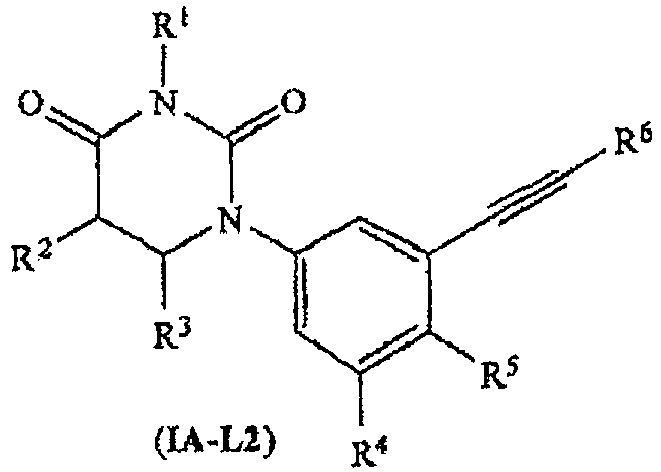
- In other such embodiments, the compounds correspond in structure to formula IB-L2:

- R6 is selected from the group consisting of C5-C6-carbocyclyl, and 5-6-membered heterocyclyl, wherein each such substituent optionally is substituted with one or more substituents independently selected from the group consisting of RE, RF, RG, RH, RI , RJ, and RK, wherein RE, RF, RG, RH, RI, RJ, and RK are as described below. In some such embodiments, the C5-C6-carbocyclyl, and 5-6-membered heterocyclyl are not substituted. In other such embodiments, the C5-C6-carbocyclyl, and 5-6-membered heterocyclyl are substituted with a substituent selected from the group consisting of RE, RF, RG, RH , RI , RJ, and RK . In other such embodiments, the C5-C6-carbocyclyl, and 5-6-membered heterocyclyl are substituted with a substituent selected from the group consisting of RE , RF , RI , RJ , and RK . In other such embodiments, the C5-C6-carbocyclyl, and 5-6-membered heterocyclyl are substituted with a substituent selected from the group consisting of RE , RF, and RJ . In other such embodiments, the C5-C6-carbocyclyl, and 5-6-membered heterocyclyl are substituted with a substituent selected from the group consisting of R F and RJ. In other such embodiments, the C5-C6-carbocyclyl, and 5-6-membered heterocyclyl, are substituted with RJ . In yet other such embodiments, the C5-C6-carbocyclyl, and 5-6-membered heterocyclyl are substituted with two substituents independently selected from the group consisting of RE , RF , RG , RH , RI, RJ , and RK . In yet other such embodiments, the C5-C6-carbocyclyl, and 5-6-membered heterocyclyl are substituted with two substituents independently selected from the group consisting of RE , RF , RI , RJ , and RK . In yet other such embodiments, the C5-C6-carbocyclyl, and 5-6-membered heterocyclyl are substituted with two substituents independently selected from the group consisting of RE , RF , and RJ . In yet other such embodiments, the C5-C6-carbocyclyl, and 5-6-membered heterocyclyl, are substituted with two substituents independently selected from the group consisting of RF and RJ . In further such embodiments, the C5-C6-carbocyclyl, and 5-6-membered heterocyclyl are substituted with three substituents independently selected from the group consisting of RE , RF , RG , RH , RI, RJ, and RK . In further such embodiments, the C5-C6-carbocyclyl, and 5-6-membered heterocyclyl are substituted with three substituents independently selected from the group consisting of RE , RF , RI, RJ, and RK . In further such embodiments, the C5-C6-carbocyclyl, and 5-6-membered heterocyclyl are substituted with three substituents independently selected from the group consisting of RE , RF, and RJ. In further such embodiments, the C5-C6-carbocyclyl, and 5-6-membered heterocyclyl are substituted with three substituents independently selected from the group consisting of RF and RJ . In further such embodiments, the C5-C6-carbocyclyl, and 5-6-membered heterocyclyl are substituted with one, two, or three substituents independently selected from the group consisting of RE , RF , RG , RH , RI , RJ , and RK . In further such embodiments, the C5-C6-carbocyclyl, and 5-6-membered heterocyclyl are substituted with one, two, or three substituents independently selected from the group consisting of RE , RF , RI , RJ , and RK . In further such embodiments, the C5-C6-carbocyclyl, and 5-6-membered heterocyclyl are substituted with one, two, or three substituents independently selected from the group consisting of RE, RF, and RJ. In further such embodiments, the C5-C6-carbocyclyl and 5-6-membered heterocyclyl are substituted with one, two, or three substituents independently selected from the group consisting of RF and RJ.
- In some embodiments, R6 is C5-C6-carbocyclyl optionally substituted with one or more substituents independently selected from the group consisting of RE, RF, RG, RH, RI, RJ, and RK. In some such embodiments, the C5-C6-carbocyclyl is not substituted. In other such embodiments, the C5-C6-carbocyclyl is substituted with a substituent selected from the group consisting of RE, RF, RG, RH, RI, RJ, and RK . In yet other such embodiments, the C5-C6-carbocyclyl is substituted with two substituents independently selected from the group consisting of RE,RF, RG, RH, RI, RJ, and RK. In further such embodiments, the C5-C6-carbocyclyl is substituted with three substituents independently selected from the group consisting of RE, RF, RG, RH, RI, RJ, and RK. In further such embodiments, the C5-C6-carbocyclyl is substituted with one, two, or three substituents independently selected from the group consisting of RE, RF, RG, RH, RI, RJ, and RK.
- In some embodiments, R6 is 5-6-membered heterocyclyl optionally substituted with one or more substituents independently selected from the group consisting of RE, RF, RG, RH, RI, RJ, and RK. In some such embodiments, the 5-6-membered heterocyclyl is not substituted. In other such embodiments, the 5-6-membered heterocyclyl is substituted with a substituent selected from the group consisting of RE, RF, RG, RH, RI, RJ, and RK. In yet other such embodiments, the 5-6-membered heterocyclyl is substituted with two substituents independently selected from the group consisting of RE, RF, RG, RH, RI, RJ, and RK. In further such embodiments, the 5-6-membered heterocyclyl is substituted with three substituents independently selected from the group consisting of RE, RF, RG, RH, RI, RJ, and RK. In further such embodiments, the 5-6-membered heterocyclyl is substituted with one, two, or three substituents independently selected from the group consisting of RE, RF, RG, RH, RI, RJ, and RK.
- In some embodiments, R6 is selected from the group consisting of fused 2-ring carbocyclyl and fused 2-ring heterocyclyl, wherein each such substituent optionally is substituted with one or more substituents independently selected from the group consisting of RE, RF, RG, RH, RI, RJ , and RK . In some such embodiments, the fused 2-ring carbocyclyl and fused 2-ring heterocyclyl are not substituted. In other such embodiments, the fused 2-ring carbocyclyl and fused 2-ring heterocyclyl are substituted with a substituent selected from the group consisting of RE, RF, RG, RH, RI, RJ, and RK. In yet other such embodiments, the fused 2-ring carbocyclyl and fused 2-ring heterocyclyl are substituted with two substituents independently selected from the group consisting of RE, RF, RG, RH, RI, RJ, and RK. In further such embodiments, the fused 2-ring carbocyclyl and fused 2-ring heterocyclyl are substituted with three substituents independently selected from the group consisting of RE, RF, RG, RH, RI, RJ, and RK. In further such embodiments, the fused 2-ring carbocyclyl and fused 2-ring heterocyclyl are substituted with one, two, or three substituents independently selected from the group consisting of RE, RF, RG, RH, RI, RJ, and RK.
- In some of the above embodiments, the optionally substituted C5-C6-carbocyclyl is selected from the group consisting of cyclopentyl, cyclopentenyl, cyclopentadienyl, cyclohexyl, cyclohexenyl, cyclohexadienyl, and phenyl. In some such embodiments, the optionally substituted C5-C6-carbocyclyl is phenyl.
- In some of the above embodiments, the optionally substituted C5-C6-carbocyclyl is C5-carbocyclyl. Examples of C5-carbocyclyls include cyclopentyl, cyclopentenyl, and cyclopentadienyl.
- In other of the above embodiments, the optionally substituted C5-C6-carbocyclyl is C6-carbocyclyl. Examples of C6-carbocyclyls include cyclohexyl, cyclohexenyl, cyclohexadienyl, and phenyl.
- In some of the above embodiments, the optionally substituted 5-6-membered-heterocyclyl is selected from the group consisting of furanyl, dihydrofuranyl, tetrahydrofuranyl, thiophenyl (thiofuranyl), dihydrothiophenyl, tetrahydrothiophenyl, pyrrolyl, pyrrolinyl, pyrrolidinyl, oxazolyl, dihydrooxazolyl, isoxazolyl, dihydroisoxazolyl, oxazolidinyl, isoxazolidinyl, thiazolyl, isothiazolyl, thiazolinyl, isothiazolinyl, thiazolidinyl, isothiazolidinyl, imidazolyl, imidazolidinyl, pyrazolyl, pyrazolinyl, pyrazolidinyl, oxathiolyl, oxathiolanyl, triazolyl, oxadiazolyl, furazanyl, tetrazolyl, oxatriazolyl, dioxazolyl, oxathiazolyl, oxathiazolidinyl, dihydrooxadiazolyl, dioxazolidinyl, pyranyl, dihydropyranyl, tetrahydropyranyl, pyridinyl, dihydropyridinyl, tetrahydropyridinyl, piperidinyt, diazinyl, pyrazinyl, pyridazinyl, pyrimidinyl, dihydropyrazinyl, tetrahydropyrazinyl, piperazinyl, triazinyl, dihydrotriazinyl, tetrahydrotriazinyl, triazinanyl, oxazinyl, dihydrooxazinyl, morpholinyl, oxathiazinyl, dihydrooxathiazinyl, oxathiazinanyl, oxadiazinyl, dihydrooxadiazinyl, oxadiazinanyl, thiopyranyl, dihydrothiopyranyl, and tetrahydrothiopyranyl.
- In some of the above embodiments, the optionally substituted 5-6-membered-heterocyclyl is 5-membered heterocyclyl. Examples of such 5-membered heterocyclyl include furanyl, dihydrofuranyl, tetrahydrofuranyl, thiophenyl (thiofuranyl), dihydrothiophenyl, tetrahydrothiophenyl, pyrrolyl, pyrrolinyl, pyrrolidinyl, oxazolyl, dihydrooxazolyl, isoxazolyl, dihydroisoxazolyl, oxazolidinyl, isoxazolidinyl, thiazolyl, isothiazolyl, thiazolinyl, isothiazolinyl, thiazolidinyl, isothiazolidinyl, imidazolyl, imidazolidinyl, pyrazolyl, pyrazolinyl, pyrazolidinyl, oxathiolyl, oxathiolanyl, triazolyl, oxadiazolyl, furazanyl, tetrazolyl, oxatriazolyl, dioxazolyl, oxathiazolyl, oxathiazolidinyl, dihydrooxadiazolyl, and dioxazolidinyl.
- In other of the above embodiments, the optionally substituted 5-6-membered-heterocyclyl is 6-membered heterocyclyl. Examples of 6-membered heterocyclyls include pyranyl, dihydropyranyl, tetrahydropyranyl, pyridinyl, dihydropyridinyl, tetrahydropyridinyl, piperidinyl, diazinyl, pyrazinyl, pyridazinyl, pyrimidinyl, dihydropyrazinyl, tetrahydropyrazinyl, piperazinyl, triazinyl, dihydrotriazinyl, tetrahydrotriazinyl, triazinanyl, oxazinyl, dihydrooxazinyl, morpholinyl, oxathiazinyl, dihydrooxathiazinyl, oxathiazinanyl, oxadiazinyl, dihydrooxadiazinyl, oxadiazinanyl, thiopyranyl, dihydrothiopyranyl, and tetrahydrothiopyranyl.
- Each RE is independently selected from the group consisting of halo, nitro, hydroxy, oxo, carboxy, cyano, amino, imino, azido, and aldehydo, wherein the amino optionally is substituted with one or two substituents independently selected from the group consisting of alkyl, alkenyl, and alkynyl.
- In some embodiment, each RE is independently selected from the group consisting of halo, nitro, hydroxy, oxo, carboxy, amino, imino, and aldehydo, wherein the amino optionally is substituted with one or two independently selected alkyl.
- In some embodiment, each RE is independently selected from the group consisting of halo, nitro, hydroxy, oxo, carboxy, amino, imino, aldehydo, and alkylamino.
- In some embodiment, each RE is independently selected from the group consisting of chloro, fluoro, nitro, hydroxy, oxo, carboxy, amino, imino, aldehydo, and alkylamino.
- In some embodiment, each RE is independently selected from the group consisting of halo, nitro, hydroxy, oxo, carboxy, cyano, amino, imino, and azido. In some such embodiments, each RE is halo. In other such embodiments, each RE is nitro. In yet other such embodiments, each RE is hydroxy. In yet other such embodiments, each RE is oxo. In yet other such embodiments, each RE is carboxy. In yet other such embodiments, each RE is cyano. In yet other such embodiments, each RE is amino. In further such embodiments, each RE is imino. In yet further such embodiments, each RE is and azido.
- In some embodiments, each RE is independently selected from the group consisting of halo, nitro, hydroxy, oxo, carboxy, cyano, amino, and imino.
- Each RF is independently selected from the group consisting of alkyl, alkenyl, and alkynyl, wherein:
- each such substituent optionally is substituted with one or more substituents independently selected from the group consisting of carboxy, hydroxy, halo, amino, imino, nitro, azido, oxo, aminosulfonyl, alkylsulfonyl, alkyloxycarbonyl, alkenyloxycarbonyl, alkynyloxycarbonyl, alkylcarbonyloxy, alkenylcarbonyloxy, alkynylcarbonyloxy, alkyloxy, alkenyloxy, alkynyloxy, carbocyclyl, heterocyclyl, cyano, and aminocarbonyl, wherein:
- the amino, imino, aminosulfonyl, aminocarbonyl, carbocyclyl, and heterocyclyl optionally are substituted with one or two substituents independently selected from the group consisting of alkyl, alkenyl, alkynyl, alkylsulfonyl, alkenylsulfonyl, alkynylsulfonyl, alkylsulfonylamino, hydroxy, and alkyloxy,
- wherein:
- amino portion of the alkylsulfonylamino optionally is substituted with a substituent selected from the group consisting of alkyl, alkenyl, and alkynyl.
- In some embodiment, each RF is independently selected from the group consisting of alkyl, alkenyl, and alkynyl, wherein:
- each such substituent optionally is substituted with one or more substituents independently selected from the group consisting of carboxy, hydroxy, halo, amino, imino, nitro, azido, oxo, aminosulfonyl, alkylsulfonyl, alkyloxycarbonyl, alkenyloxycarbonyl, alkynyloxycarbonyl, alkylcarbonyloxy, alkenylcarbonyloxy, alkynylcarbonyloxy, alkyloxy, alkenyloxy, alkynyloxy, carbocyclyl, heterocyclyl, cyano, and aminocarbonyl, wherein:
- the amino, imino, aminosulfonyl, and aminocarbonyl optionally are substituted with one or two substituents independently selected from the group consisting of alkyl, alkenyl, alkynyl, alkylsulfonyl, alkenylsulfonyl, alkynylsulfonyl, and alkylsulfonylamino, wherein:
- amino portion of the alkylsulfonylamino optionally is substituted with a substituent selected from the group consisting of alkyl, alkenyl, and alkynyl.
- the amino, imino, aminosulfonyl, and aminocarbonyl optionally are substituted with one or two substituents independently selected from the group consisting of alkyl, alkenyl, alkynyl, alkylsulfonyl, alkenylsulfonyl, alkynylsulfonyl, and alkylsulfonylamino, wherein:
- In some of the above embodiments, each RF is independently selected from the group consisting of the alkyl, alkynyl, and alkynyl, wherein such substituents are not substituted.
- In some embodiments, each RF is independently selected from the group consisting of alkyl, alkenyl, and alkynyl, wherein:
- each such substituent optionally is substituted with one or two substituents independently selected from the group consisting of carboxy, hydroxy, halo, amino, imino, nitro, oxo, aminosulfonyl, alkylsulfonyl, alkyloxycarbonyl, alkylcarbonyloxy, alkyloxy, carbocyclyl, heterocyclyl, cyano, and aminocarbonyl, wherein:
- the amino, imino, aminosulfonyl, and aminocarbonyl optionally are substituted with one or two substituents independently selected from the group consisting of alkyl, alkylsulfonyl, and alkylsulfonylamino,
- wherein:
- amino portion of the alkylsulfonylamino optionally is substituted with alkyl.
- In some embodiments, each RF is an independently selected alkyl optionally substituted with a substituent selected from the group consisting of carboxy, hydroxy, halo, amino, imino, nitro, oxo, aminosulfonyl, alkylsulfonyl, alkyloxycarbonyl, alkylcarbonyloxy, alkyloxy, carbocyclyl, heterocyclyl, cyano, and aminocarbonyl, wherein:
- the amino, imino, aminosulfonyl, and aminocarbonyl optionally are substituted with one or two substituents independently selected from the group consisting of alkyl, alkylsulfonyl, and alkylsulfonylamino, wherein:
- amino portion of the alkylsulfonylamino optionally is substituted with alkyl.
- In some embodiments, each RF is an independently selected alkyl optionally substituted with a substituent selected from the group consisting of carboxy, halo, amino, imino, and aminosulfonyl, wherein:
- the amino, imino, and aminosulfonyl optionally are substituted with one or two substituents independently selected from the group consisting of alkyl, alkylsulfonyl, and alkylsulfonylamino.
- In some embodiments, each RF is an independently selected alkyl optionally substituted with amino, wherein the amino optionally is substituted with alkylsulfonyl.
- In some embodiments, each RF is an independently selected alkyl substituted with amino, wherein the amino is substituted with alkylsulfonyl. In some such embodiments, each RF is methylsulfonylaminomethyl.
- In some embodiments, each RF is independently selected from the group consisting of alkyl, alkenyl, and alkynyl, wherein:
- each such substituent optionally is substituted with one, two, or three substituents independently selected from the group consisting of carboxy, hydroxy, halo, amino, imino, nitro, azido, oxo, aminosulfonyl, alkylsulfonyl, alkyloxycarbonyl, alkenyloxycarbonyl, alkynyloxycarbonyl, alkylcarbonyloxy, alkenylcarbonyloxy, alkynylcarbonyloxy, alkyloxy, alkenyloxy, alkynyloxy, carbocyclyl, heterocyclyl, cyano, and aminocarbonyl.
- In some embodiments, each RF is independently selected alkyl substituted with one or more substituents independently selected from the group consisting of carboxy, hydroxy, halo, amino, imino, nitro, azido, oxo, aminosulfonyl, alkylsulfonyl, alkyloxycarbonyl, alkenyloxycarbonyl, alkynyloxycarbonyl, alkylcarbonyloxy, alkenylcarbonyloxy, alkynylcarbonyloxy, alkyloxy, alkenyloxy, alkynyloxy, carbocyclyl, heterocyclyl, cyano, and aminocarbonyl.
- Each RG is independently selected from the group consisting of carbocyclyl and heterocyclyl, wherein:
- each such substituent optionally is substituted with one or more substituents independently selected from the group consisting of alkyl, alkenyl, alkynyl, carboxy, hydroxy, halo, amino, nitro, azido, oxo, aminosulfonyl, alkyloxycarbonyl, alkenyloxycarbonyl, alkynyloxycarbonyl, alkylcarbonyloxy, alkenylcarbonyloxy, alkynylcarbonyloxy, alkyloxy, alkenyloxy, alkynyloxy, carbocyclyl, heterocyclyl, cyano, and aminocarbonyl, wherein:
- the amino, aminosulfonyl, and aminocarbonyl optionally are substituted with one or two substituents independently selected from the group consisting of alkyl, alkenyl, alkynyl, alkylsulfonyl, alkenylsulfonyl, and alkynylsulfonyl.
- In some of the above embodiments, each RG is independently selected from the group consisting of carbocyclyl and heterocyclyl, wherein such substituents are not substituted.
- In some embodiments, each RG is independently selected from the group consisting of carbocyclyl and heterocyclyl, wherein:
- each such substituent optionally is substituted with one or two substituents independently selected from the group consisting of alkyl, carboxy, hydroxy, halo, amino, nitro, oxo, aminosulfonyl, alkyloxycarbonyl, alkylcarbonyloxy, alkyloxy, carbocyclyl, heterocyclyl, cyano, and aminocarbonyl, wherein:
- the amino, aminosulfonyl, and aminocarbonyl optionally are substituted with one or two substituents independently selected from the group consisting of alkyl and alkylsulfonyl.
- In some of the above embodiments, the carbocyclyl is C3-C6-carbocyclyl.
- In some of the above embodiments, the heterocyclyl is 5-6-membered heterocyclyl.
- Each RH is independently selected from the group consisting of alkyloxy, alkenyloxy, alkynyloxy, alkylsulfonyloxy, alkenylsulfonyloxy, and alkynylsulfonyloxy, wherein:
- each such substituent optionally is substituted with one or more substituents independently selected from the group consisting of carboxy, hydroxy, halo, amino, nitro, azido, oxo, aminosulfonyl, alkyloxycarbonyl, alkenyloxycarbonyl, alkynyloxycarbonyl, alkylcarbonyloxy, alkenylcarbonyloxy, alkynylcarbonyloxy, alkyloxy, alkenyloxy, alkynyloxy, carbocyclyl, heterocyclyl, cyano, and aminocarbonyl, wherein:
- the amino, aminosulfonyl, and aminocarbonyl optionally are substituted with one or two substituents independently selected from the group consisting of alkyl, alkenyl, alkynyl, alkylsulfonyl, alkenylsulfonyl, and alkynylsulfonyl.
- In some of the above embodiments, each RH is independently selected from the group consisting of alkyloxy, alkenyloxy, alkynyloxy, alkylsulfonyloxy, alkenylsulfonyloxy, and alkynylsulfonyloxy, wherein such substituents are not substituted.
- In some embodiments, each RH is independently selected from the group consisting of alkyloxy and alkylsulfonyloxy, wherein:
- each such substituent optionally is substituted with one or two substituents independently selected from the group consisting of carboxy, hydroxy, halo, amino, nitro, oxo, aminosulfonyl, alkyloxycarbonyl, alkylcarbonyloxy, alkyloxy, carbocyclyl, heterocyclyl, cyano, and aminocarbonyl, wherein:
- the amino, aminosulfonyl, and aminocarbonyl optionally are substituted with one or two substituents independently selected from the group consisting of alkyl and alkylsulfonyl.
- In some embodiments, each RH is independently selected from the group consisting of alkyloxy and alkylsulfonyloxy, wherein:
- each such substituent optionally is substituted with one or two substituents independently selected from the group consisting of carboxy, hydroxy, halo, amino, nitro, oxo, aminosulfonyl, alkyloxycarbonyl, alkylcarbonyloxy, alkyloxy, cyano, and aminocarbonyl, wherein:
- the amino, aminosulfonyl, and aminocarbonyl optionally are substituted with one or two substituents independently selected from the group consisting of alkyl and alkylsulfonyl.
- In some embodiments, each RH is independently selected from the group consisting of alkyloxy and alkylsulfonyloxy, wherein:
- each such substituent optionally is substituted with one or two substituents independently selected from the group consisting of carboxy, hydroxy, halo, amino, nitro, oxo, aminosulfonyl, alkyloxycarbonyl, alkylcarbonyloxy, alkyloxy, cyano, and aminocarbonyl.
- In some embodiments, each RH is independently selected alkyloxy.
- In some embodiments, each RH is independently selected alkylsulfonyloxy.
- Each RI is independently selected from the group consisting of alkylcarbonyl, alkenylcarbonyl, alkynylcarbonyl, aminocarbonyl, alkyloxycarbonyl, carbocyclylcarbonyl, and heterocyclylcarbonyl, wherein:
- (a) the alkylcarbonyl, alkenylcarbonyl, and alkynylcarbonyl optionally are substituted with one or more substituents independently selected from the group consisting of carboxy, hydroxy, halo, amino, nitro, azido, oxo, aminosulfonyl, alkyloxycarbonyl, alkenyloxycarbonyl, alkynyloxycarbonyl, alkylcarbonyloxy, alkenylcarbonyloxy, alkynylcarbonyloxy, alkyloxy, alkenyloxy, alkynyloxy, carbocyclyl, heterocyclyl, cyano, and aminocarbonyl, and
- (b) the aminocarbonyl optionally is substituted with one or two substituents independently selected from the group consisting of alkyl, alkenyl, alkynyl, alkyloxyalkyl, carbocyclyl, heterocyclyl, alkylsulfonyl, and alkylsulfonylamino, wherein:
- the carbocyclyl and heterocyclyl optionally are substituted with one or two substituents independently selected from the group consisting of halo, alkyl, and oxo.
- In some embodiments, each RI is independently selected from the group consisting of alkylcarbonyl, alkenylcarbonyl, alkynylcarbonyl, aminocarbonyl, alkyloxycarbonyl, carbocyclylcarbonyl, and heterocyclylcarbonyl, wherein such substituents are not substituted.
- In some embodiments, each RI is independently selected from the group consisting of alkylcarbonyl, aminocarbonyl, alkyloxycarbonyl, carbocyclylcarbonyl, and heterocyclylcarbonyl, wherein:
- (a) the alkylcarbonyl optionally is substituted with a substituent selected from the group consisting of carboxy, hydroxy, halo, amino, nitro, oxo, aminosulfonyl, alkyloxycarbonyl, alkylcarbonyloxy, alkyloxy, and aminocarbonyl, and
- (b) the aminocarbonyl optionally is substituted with a substituent selected from the group consisting of alkyl, alkyloxyalkyl, alkylsulfonyl, and alkylsulfonylamino.
- In some embodiments, each RI is independently selected from the group consisting of alkylcarbonyl and aminocarbonyl, wherein:
- the aminocarbonyl optionally is substituted with a substituent selected from the group consisting of alkyl, alkyloxyalkyl, alkylsulfonyl, and alkylsulfonylamino.
- In some embodiment, each RI is independently selected from the group consisting of alkylcarbonyl, alkenylcarbonyl, alkynylcarbonyl, and aminocarbonyl, wherein:
- (a) the alkylcarbonyl, alkenylcarbonyl, and alkynylcarbonyl optionally are substituted with one or more substituents independently selected from the group consisting of carboxy, hydroxy, halo, amino, nitro, azido, oxo, aminosulfonyl, alkyloxycarbonyl, alkenyloxycarbonyl, alkynyloxycarbonyl, alkylcarbonyloxy, alkenylcarbonyloxy, alkynylcarbonyloxy, alkyloxy, alkenyloxy, alkynyloxy, carbocyclyl, heterocyclyl, cyano, and aminocarbonyl, and
- (b) the aminocarbonyl optionally is substituted with one or two substituents independently selected from the group consisting of alkyl, alkenyl, alkynyl, and alkylsulfonylamino.
- In some of the above embodiments, each RI is independently selected from the group consisting of alkylcarbonyl, alkenylcarbonyl, alkynylcarbonyl, and aminocarbonyl, wherein such substituents are not substituted.
- In some embodiments, each RI is independently selected from the group consisting of alkylcarbonyl and aminocarbonyl, wherein:
- (a) the alkylcarbonyl optionally is substituted with one or two substituents independently selected from the group consisting of carboxy, hydroxy, halo, amino, nitro, azido, oxo, aminosulfonyl, alkyloxycarbonyl, alkylcarbonyloxy, alkyloxy, carbocyclyl, heterocyclyl, cyano, and aminocarbonyl, and
- (b) the aminocarbonyl optionally is substituted with one or two substituents independently selected from the group consisting of alkyl and alkylsulfonylamino.
- In some embodiments, each RI is independently selected from the group consisting of alkylcarbonyl and aminocarbonyl, wherein:
- (a) the alkylcarbonyl optionally is substituted with one or two substituents independently selected from the group consisting of carboxy, hydroxy, halo, amino, nitro, oxo, aminosulfonyl, alkyloxycarbonyl, alkylcarbonyloxy, alkyloxy, cyano, and aminocarbonyl, and
- (b) the aminocarbonyl optionally is substituted with one or two substituents independently selected from the group consisting of alkyl and alkylsulfonylamino.
- In some embodiments, each RI is independently selected from the group consisting of alkylcarbonyl and aminocarbonyl, wherein:
- the alkylcarbonyl optionally is substituted with one or two substituents independently selected from the group consisting of carboxy, hydroxy, halo, amino, nitro, azido, oxo, aminosulfonyl, alkyloxycarbonyl, alkylcarbonyloxy, alkyloxy, carbocyclyl, heterocyclyl, cyano, and aminocarbonyl.
- In some embodiments, each RI is independently selected alkylcarbonyl.
- In some embodiments, each RI is independently selected aminocarbonyl.
- Each RJ is independently selected from the group consisting of carbocyclylsulfonylamino, heterocyclylsulfonylamino, alkylcarbonylamino, alkenylcarbonylamino, alkynylcarbonylamino, alkyloxycarbonylamino, alkenyloxycarbonylamino, alkynyloxycarbonylamino, alkylsulfonylamino, alkenylsulfonylamino, alkynylsulfonylamino, aminocarbonylamino, alkyloxycarbonylaminoimino, alkylsulfonylaminoimino, alkenylsulfonylaminoimino, and alkynylsulfonylaminoimino, wherein:
- (a) the amino portion of such substituents optionally is substituted with a substituent independently selected from the group consisting of carbocyclylalkyl, heterocyclylalkyl, alkylcarbonyloxy, aminocarbonylalkyl, alkyl, alkenyl, alkynyl, alkylcarbonyl, alkenylcarbonyl, alkynylcarbonyl, alkyloxycarbonyl, alkyloxyalkyloxycarbonyl, alkylcarbonyloxyalkyl, and alkylsulfonyl, wherein:
- (1) the carbocyclyl portion of the carbocyclylalkyl and the heterocyclyl portion of the heterocyclylalkyl optionally are substituted with one or more substituents independently selected from the group consisting of alkyl, alkenyl, alkynyl, carboxy, hydroxy, alkyloxy, alkenyloxy, alkynyloxy, halo, nitro, cyano, azido, oxo, and amino, and
- (2) the amino portion of the aminocarbonylalkyl optionally is substituted with one or two substituents independently selected from the group consisting of alkyl, alkenyl, and alkynyl,
- (b) the alkyl, alkenyl, and alkynyl portion of such substituents optionally is substituted with one or more substituents independently selected from the group consisting of carboxy, halo, oxo, amino, alkyloxycarbonyl, alkylcarbonyloxy, hydroxy, alkyloxy, carbocyclyl, heterocyclyl, and cyano, wherein:
- the amino optionally is substituted with one or two substituents independently selected from the group consisting of alkyl, alkenyl, alkynyl, alkyloxy, alkenyloxy, and alkynyloxy, wherein:
- the alkyl optionally is substituted with one or more hydroxy;
- the amino optionally is substituted with one or two substituents independently selected from the group consisting of alkyl, alkenyl, alkynyl, alkyloxy, alkenyloxy, and alkynyloxy, wherein:
- (c) the carbocyclyl and heterocyclyl portions of such substituents optionally are substituted with one or more substituents independently selected from the group consisting of alkyl, alkenyl, alkynyl, carboxy, hydroxy, alkyloxy, alkenyloxy, alkynyloxy, halo, nitro, cyano, azido, and amino, wherein:
- the amino optionally is substituted with one or two substituents independently selected from the group consisting of alkyl, alkenyl, and alkynyl.
- In some embodiment, each RJ is independently selected from the group consisting of carbocyclylsulfonylamino, heterocyclylsulfonylamino, alkylcarbonylamino, alkenylcarbonylamino, alkynylcarbonylamino, alkyloxycarbonylamino, alkenyloxycarbonylamino, alkynyloxycarbonylamino, alkylsulfonylamino, alkenylsulfonylamino, alkynylsulfonylamino, aminocarbonylamino, alkylsulfonylaminoimino, alkenylsulfonylaminoimino, and alkynylsulfonylaminoimino, wherein:
- (a) the amino portion of such substituents optionally is substituted with a substituent independently selected from the group consisting of carbocyclylalkyl, heterocyclylalkyl, alkylcarbonyloxy, aminocarbonylalkyl, alkyl, alkenyl, alkynyl, alkylcarbonyl, alkenylcarbonyl, alkynylcarbonyl, alkyloxycarbonyl, alkyloxyalkyloxycarbonyl, alkylcarbonyloxyalkyl, and alkylsulfonyl, wherein:
- (1) the carbocyclyl portion of the carbocyclylalkyl and the heterocyclyl portion of the heterocyclylalkyl optionally are substituted with one or more substituents independently selected from the group consisting of alkyl, alkenyl, alkynyl, carboxy, hydroxy, alkyloxy, alkenyloxy, alkynyloxy, halo, nitro, cyano, azido, oxo, and amino, and
- (2) the amino portion of the aminocarbonylalkyl optionally is substituted with one or two substituents independently selected from the group consisting of alkyl, alkenyl, and alkynyl,
- (b) the alkyl, alkenyl, and alkynyl portion of such substituents optionally is substituted with one or more substituents independently selected from the group consisting of carboxy, halo, oxo, amino, alkyloxycarbonyl, alkylcarbonyloxy, hydroxy, alkyloxy, carbocyclyl, heterocyclyl, and cyano, wherein:
- the amino optionally is substituted with one or two substituents independently selected from the group consisting of alkyl, alkenyl, alkynyl, alkyloxy, alkenyloxy, and alkynyloxy, wherein:
- the alkyl optionally is substituted with one or more hydroxy;
- the amino optionally is substituted with one or two substituents independently selected from the group consisting of alkyl, alkenyl, alkynyl, alkyloxy, alkenyloxy, and alkynyloxy, wherein:
- (c) the carbocyclyl and heterocyclyl portions of such substituents optionally are substituted with one or more substituents independently selected from the group consisting of alkyl, alkenyl, alkynyl, carboxy, hydroxy, alkyloxy, alkenyloxy, alkynyloxy, halo, nitro, cyano, azido, and amino, wherein:
- the amino optionally is substituted with one or two substituents independently selected from the group consisting of alkyl, alkenyl, and alkynyl; and
- In some of the above embodiments, each RJ is independently selected from the group consisting of carbocyclylsulfonylamino, heterocyclylsulfonylamino, alkylcarbonylamino, alkenylcarbonylamino, alkynylcarbonylamino, alkyloxycarbonylamino, alkenyloxycarbonylamino, alkynyloxycarbonylamino, alkylsulfonylamino, alkenylsulfonylamino, alkynylsulfonylamino, aminocarbonylamino, alkylsulfonylaminoimino, alkenylsulfonylaminoimino, and alkynylsulfonylaminoimino, wherein such substituents are not substituted.
- In some embodiments, each RJ is independently selected from the group consisting of carbocyclylsulfonylamino, heterocyclylsulfonylamino, alkylcarbonylamino, alkyloxycarbonylamino, alkylsulfonylamino, aminocarbonylamino, and alkylsulfonylaminoimino, wherein:
- (a) the amino portion of such substituents optionally is substituted with a substituent independently selected from the group consisting of carbocyclylalkyl, heterocyclylalkyl, alkylcarbonyloxy, aminocarbonylalkyl, alkyl, alkylcarbonyl, alkyloxycarbonyl, alkyloxyalkyloxycarbonyl, alkylcarbonyloxyalkyl, and alkylsulfonyl, wherein:
- (1) the carbocyclyl portion of the carbocyclylalkyl and the heterocyclyl portion of the heterocyclylalkyl optionally are substituted with one or two substituents independently selected from the group consisting of alkyl, carboxy, hydroxy, alkyloxy, halo, nitro, cyano, oxo, and amino, and
- (2) the amino portion of the aminocarbonylalkyl optionally is substituted with one or two substituents independently selected from the group consisting of alkyl, alkenyl, and alkynyl,
- (b) the alkyl portion of such substituents optionally is substituted with one or two substituents independently selected from the group consisting of carboxy, halo, oxo, amino, alkyloxycarbonyl, alkylcarbonyloxy, hydroxy, alkyloxy, carbocyclyl, heterocyclyl, and cyano, wherein:
- the amino optionally is substituted with one or two substituents independently selected from the group consisting of alkyl and alkyloxy, wherein:
- the alkyl optionally is substituted with one or more hydroxy;
- the amino optionally is substituted with one or two substituents independently selected from the group consisting of alkyl and alkyloxy, wherein:
- (c) the carbocyclyl and heterocyclyl portions of such substituents optionally are substituted with one or two substituents independently selected from the group consisting of alkyl, carboxy, hydroxy, alkyloxy, halo, nitro, cyano, and amino, wherein:
- the amino optionally is substituted with one or two substituents independently selected alkyl.
- In some embodiments, each RJ is independently selected from the group consisting of carbocyclylsulfonylamino, heterocyclylsulfonylamino, alkylsulfonylamino, and alkylsulfonylaminoimino, wherein:
- (a) the amino portion of such substituents optionally is substituted with a substituent independently selected from the group consisting of carbocyclylalkyl, heterocyclylalkyl, alkylcarbonyloxy, aminocarbonylalkyl, alkyl, alkylcarbonyl, alkyloxycarbonyl, alkyloxyalkyloxycarbonyl, alkylcarbonyloxyalkyl, and alkylsulfonyl, wherein:
- (1) the carbocyclyl portion of the carbocyclylalkyl and the heterocyclyl portion of the heterocyclylalkyl optionally are substituted with one or two substituents independently selected from the group consisting of alkyl, carboxy, hydroxy, alkyloxy, halo, nitro, cyano, oxo, and amino, and
- (2) the amino portion of the aminocarbonylalkyl optionally is substituted with one or two substituents independently selected from the group consisting of alkyl, alkenyl, and alkynyl,
- (b) the alkyl portion of such substituents optionally is substituted with one or two substituents independently selected from the group consisting of carboxy, halo, oxo, amino, alkyloxycarbonyl, alkylcarbonyloxy, hydroxy, alkyloxy, carbocyclyl, heterocyclyl, and cyano, wherein:
- the amino optionally is substituted with one or two substituents independently selected from the group consisting of alkyl and alkyloxy, wherein:
- the alkyl optionally is substituted with one or more hydroxy;
- the amino optionally is substituted with one or two substituents independently selected from the group consisting of alkyl and alkyloxy, wherein:
- (c) the carbocyclyl and heterocyclyl portions of such substituents optionally are substituted with one or two substituents independently selected from the group consisting of alkyl, carboxy, hydroxy, alkyloxy, halo, nitro, cyano, and amino, wherein:
- the amino optionally is substituted with one or two substituents independently selected alkyl.
- In some embodiments, each RJ is independently selected from the group consisting of carbocyclylsulfonylamino, heterocyclylsulfonylamino, alkylsulfonylamino, and alkylsulfonylaminoimino, wherein:
- the amino portion of such substituents optionally is substituted with a substituent independently selected from the group consisting of carbocyclylalkyl, heterocyclylalkyl, alkylcarbonyloxy, aminocarbonylalkyl, alkyl, alkylcarbonyl, alkyloxycarbonyl, alkyloxyalkyloxycarbonyl, alkylcarbonyloxyalkyl, and alkylsulfonyl, wherein:
- (1) the carbocyclyl portion of the carbocyclylalkyl and the heterocyclyl portion of the heterocyclylalkyl optionally are substituted with one or two substituents independently selected from the group consisting of alkyl, carboxy, hydroxy, alkyloxy, halo, nitro, cyano, oxo, and amino, and
- (2) the amino portion of the aminocarbonylalkyl optionally is substituted with one or two substituents independently selected from the group consisting of alkyl, alkenyl, and alkynyl.
- In some embodiments, each RJ is independently selected from the group consisting of carbocyclylsulfonylamino, heterocyclylsulfonylamino, alkylsulfonylamino, and alkylsulfonylaminoimino, wherein:
- the alkyl portion of the alkylsulfonylamino and alkylsulfonylaminoimino optionally is substituted with one or two substituents independently selected from the group consisting of carboxy, halo, oxo, amino, alkyloxycarbonyl, alkylcarbonyloxy, hydroxy, alkyloxy, carbocyclyl, heterocyclyl, and cyano, wherein:
- the amino optionally is substituted with one or two substituents independently selected from the group consisting of alkyl and alkyloxy, wherein:
- the alkyl optionally is substituted with one or more hydroxy.
- the amino optionally is substituted with one or two substituents independently selected from the group consisting of alkyl and alkyloxy, wherein:
- In some embodiments, each RJ is independently selected from the group consisting of carbocyclylsulfonylamino, heterocyclylsulfonylamino, alkylsulfonylamino, and alkylsulfonylaminoimino, wherein:
- the carbocyclyl and heterocyclyl portions of such substituents optionally are substituted with one or two substituents independently selected from the group consisting of alkyl, carboxy, hydroxy, alkyloxy, halo, nitro, cyano, and amino.
- In some embodiments, each RJ is independently selected from the group consisting of carbocyclylsulfonylamino and heterocyclylsulfonylamino, wherein:
- the carbocyclyl and heterocyclyl portions of such substituents optionally are substituted with one or two substituents independently selected from the group consisting of alkyl, carboxy, hydroxy, alkyloxy, halo, nitro, cyano, and amino.
- In some embodiments, each RJ is independently selected from the group consisting of alkylsulfonylamino, alkenylsulfonylamino, alkynylsulfonylamino, and alkylsulfonylaminoimino, wherein:
- (a) the amino portion of such substituents optionally is substituted with a substituent independently selected from the group consisting of carbocyclylalkyl, heterocyclylalkyl, alkylcarbonyloxy, aminocarbonylalkyl, alkyl, alkylcarbonyl, alkyloxycarbonyl, alkyloxyalkyloxycarbonyl, alkylcarbonyloxyalkyl, and alkylsulfonyl, wherein:
- (1) the carbocyclyl portion of the carbocyclylalkyl and the heterocyclyl portion of the heterocyclylalkyl optionally are substituted with one or two substituents independently selected from the group consisting of alkyl, carboxy, hydroxy, alkyloxy, halo, nitro, cyano, oxo, and amino, and
- (2) the amino portion of the aminocarbonylalkyl optionally is substituted with one or two substituents independently selected from the group consisting of alkyl, alkenyl, and alkynyl,
- (b) the alkyl, alkenyl, and alkynyl portion of such substituents optionally is substituted with one or two substituents independently selected from the group consisting of carboxy, halo, oxo, amino, alkyloxycarbonyl, alkylcarbonyloxy, hydroxy, alkyloxy, carbocyclyl, heterocyclyl, and cyano, wherein:
- the amino optionally is substituted with one or two substituents independently selected from the group consisting of alkyl and alkyloxy, wherein:
- the alkyl optionally is substituted with one or more hydroxy.
- the amino optionally is substituted with one or two substituents independently selected from the group consisting of alkyl and alkyloxy, wherein:
- In some embodiments, each RJ is an independently selected alkylsulfonylamino, wherein:
- (a) the amino portion of the alkylsulfonylamino optionally is substituted with a substituent independently selected from the group consisting of carbocyclylalkyl, heterocyclylalkyl, alkylcarbonyloxy, aminocarbonylalkyl, alkyl, alkylcarbonyl, alkyloxycarbonyl, alkyloxyalkyloxycarbonyl, alkylcarbonyloxyalkyl, and alkylsulfonyl, wherein:
- (1) the carbocyclyl portion of the carbocyclylalkyl and the heterocyclyl portion of the heterocyclylalkyl optionally are substituted with one or two substituents independently selected from the group consisting of alkyl, carboxy, hydroxy, alkyloxy, halo, nitro, cyano, oxo, and amino, and
- (2) the amino portion of the aminocarbonylalkyl optionally is substituted with one or two substituents independently selected from the group consisting of alkyl, alkenyl, and alkynyl,
- (b) the alkyl portion of the alkylsulfonylamino optionally is substituted with one or two substituents independently selected from the group consisting of carboxy, halo, oxo, amino, alkyloxycarbonyl, alkylcarbonyloxy, hydroxy, alkyloxy, carbocyclyl, heterocyclyl, and cyano, wherein:
- the amino optionally is substituted with one or two substituents independently selected from the group consisting of alkyl and alkyloxy, wherein:
- the alkyl optionally is substituted with one or more hydroxy.
- the amino optionally is substituted with one or two substituents independently selected from the group consisting of alkyl and alkyloxy, wherein:
- In some embodiments, each RJ is an independently selected alkylsulfonylamino, wherein:
- the amino portion of the alkylsulfonylamino optionally is substituted with a substituent independently selected from the group consisting of carbocyclylalkyl, heterocyclylalkyl, alkylcarbonyloxy, aminocarbonylalkyl, alkyl, alkylcarbonyl, alkyloxycarbonyl, alkyloxyalkyloxycarbonyl, alkylcarbonyloxyalkyl, and alkylsulfonyl, wherein:
- (1) the carbocyclyl portion of the carbocyclylalkyl and the heterocyclyl portion of the heterocyclylalkyl optionally are substituted with one or two substituents independently selected from the group consisting of alkyl, carboxy, hydroxy, alkyloxy, halo, nitro, cyano, oxo, and amino, and
- (2) the amino portion of the aminocarbonylalkyl optionally is substituted with one or two substituents independently selected from the group consisting of alkyl, alkenyl, and alkynyl.
- In some embodiments, each RJ is an independently selected alkylsulfonylamino, wherein:
- the amino portion of the alkylsulfonylamino optionally is substituted with a substituent independently selected from the group consisting of carbocyclylalkyl, heterocyclylalkyl, alkylcarbonyloxy, aminocarbonylalkyl, alkyl, alkylcarbonyl, alkyloxycarbonyl, alkyloxyalkyloxycarbonyl, alkylcarbonyloxyalkyl, and alkylsulfonyl.
- In some embodiments, each RJ is an independently selected alkylsulfonylamino, wherein:
- the alkyl portion of the alkylsulfonylamino optionally is substituted with one or two substituents independently selected from the group consisting of carboxy, halo, oxo, amino, alkyloxycarbonyl, alkylcarbonyloxy, hydroxy, alkyloxy, carbocyclyl, heterocyclyl, and cyano, wherein:
- the amino optionally is substituted with one or two substituents independently selected from the group consisting of alkyl and alkyloxy, wherein:
- the alkyl optionally is substituted with one or more hydroxy.
- the amino optionally is substituted with one or two substituents independently selected from the group consisting of alkyl and alkyloxy, wherein:
- In some embodiments, each RJ is an independently selected alkylsulfonylamino, wherein:
- the alkyl portion of the alkylsulfonylamino optionally is substituted with one or two substituents independently selected from the group consisting of carboxy, halo, oxo, amino, alkyloxycarbonyl, alkylcarbonyloxy, hydroxy, alkyloxy, carbocyclyl, heterocyclyl, and cyano.
- In some embodiments, each RJ is an independently selected alkylsulfonylamino. In some such embodiments, each RJ is methylsulfonylamino.
- In some embodiments, each RJ is an independently selected alkylsulfonylaminoimino, wherein:
- (a) the amino portion of the alkylsulfonylaminoimino optionally is substituted with a substituent independently selected from the group consisting of carbocyclylalkyl, heterocyclylalkyl, alkylcarbonyloxy, aminocarbonylalkyl, alkyl, alkylcarbonyl, alkyloxycarbonyl, alkyloxyalkyloxycarbonyl, alkylcarbonyloxyalkyl, and alkylsulfonyl, wherein:
- (1) the carbocyclyl portion of the carbocyclylalkyl and the heterocyclyl portion of the heterocyclylalkyl optionally are substituted with one or two substituents independently selected from the group consisting of alkyl, carboxy, hydroxy, alkyloxy, halo, nitro, cyano, oxo, and amino, and
- (2) the amino portion of the aminocarbonylalkyl optionally is substituted with one or two substituents independently selected from the group consisting of alkyl, alkenyl, and alkynyl,
- (b) the alkyl portion of the alkylsulfonylaminoimino optionally is substituted with one or two substituents independently selected from the group consisting of carboxy, halo, oxo, amino, alkyloxycarbonyl, alkylcarbonyloxy, hydroxy, alkyloxy, carbocyclyl, heterocyclyl, and cyano, wherein:
- the amino optionally is substituted with one or two substituents independently selected from the group consisting of alkyl and alkyloxy, wherein:
- the alkyl optionally is substituted with one or more hydroxy.
- the amino optionally is substituted with one or two substituents independently selected from the group consisting of alkyl and alkyloxy, wherein:
- In some embodiments, each RJ is an independently selected alkylsulfonylaminoimino, wherein:
- the amino portion of the alkylsulfonylaminoimino optionally is substituted with a substituent independently selected from the group consisting of carbocyclylalkyl, heterocyclylalkyl, alkylcarbonyloxy, aminocarbonylalkyl, alkyl, alkylcarbonyl, alkyloxycarbonyl, alkyloxyalkyloxycarbonyl, alkylcarbonyloxyalkyl, and alkylsulfonyl, wherein:
- (1) the carbocyclyl portion of the carbocyclylalkyl and the heterocyclyl portion of the heterocyclylalkyl optionally are substituted with one or two substituents independently selected from the group consisting of alkyl, carboxy, hydroxy, alkyloxy, halo, nitro, cyano, oxo, and amino, and
- (2) the amino portion of the aminocarbonylalkyl optionally is substituted with one or two substituents independently selected from the group consisting of alkyl, alkenyl, and alkynyl.
- In some embodiments, each RJ is an independently selected alkylsulfonylaminoimino, wherein:
- the amino portion of the alkylsulfonylaminoimino optionally is substituted with a substituent independently selected from the group consisting of carbocyclylalkyl, heterocyclylalkyl, alkylcarbonyloxy, aminocarbonylalkyl, alkyl, alkylcarbonyl, alkyloxycarbonyl, alkyloxyalkyloxycarbonyl, alkylcarbonyloxyalkyl, and alkylsulfonyl.
- In some embodiments, each RJ is an independently selected alkylsulfonylaminoimino, wherein:
- the alkyl portion of the alkylsulfonylaminoimino optionally is substituted with one or two substituents independently selected from the group consisting of carboxy, halo, oxo, amino, alkyloxycarbonyl, alkylcarbonyloxy, hydroxy, alkyloxy, carbocyclyl, heterocyclyl, and cyano, wherein:
- the amino optionally is substituted with one or two substituents independently selected from the group consisting of alkyl and alkyloxy, wherein:
- the alkyl optionally is substituted with one or more hydroxy.
- the amino optionally is substituted with one or two substituents independently selected from the group consisting of alkyl and alkyloxy, wherein:
- In some embodiments, each RJ is an independently selected alkylsulfonylaminoimino, wherein:
- the alkyl portion of the alkylsulfonylaminoimino optionally is substituted with one or two substituents independently selected from the group consisting of carboxy, halo, oxo, amino, alkyloxycarbonyl, alkylcarbonyloxy, hydroxy, alkyloxy, carbocyclyl, heterocyclyl, and cyano.
- In some embodiments, each RJ is an independently selected alkylsulfonylaminoimino. In some such embodiments, each RJ is methylsulfonylaminoimino.
- In some embodiments, each RJ is independently selected from the group consisting of alkylcarbonylamino and alkyloxycarbonylamino, wherein:
- the alkyl portion of such substituents optionally is substituted with one or two substituents independently selected from the group consisting of carboxy, halo, oxo, amino, alkyloxycarbonyl, alkylcarbonyloxy, hydroxy, alkyloxy, carbocyclyl, heterocyclyl, and cyano.
- Each RK is independently selected from the group consisting of aminosulfonyl, alkylsulfonyl, alkenylsulfonyl, and alkynylsulfonyl, wherein:
- (a) the alkylsulfonyl, alkenylsulfonyl, and alkynylsulfonyl optionally are substituted with one or more substituents independently selected from the group consisting of carboxy, hydroxy, halo, amino, nitro, azido, oxo, aminosulfonyl, alkyloxycarbonyl, alkenyloxycarbonyl, alkynyloxycarbonyl, alkylcarbonyloxy, alkenylcarbonyloxy, alkynylcarbonyloxy, alkyloxy, alkenyloxy, alkynyloxy, carbocyclyl, heterocyclyl, cyano, and aminocarbonyl, wherein:
- the amino, aminosulfonyl, and aminocarbonyl optionally are substituted with one or two substituents independently selected from the group consisting of alkyl, alkenyl, and alkynyl; and
- (b) the aminosulfonyl optionally is substituted with one or two substituents independently selected from the group consisting of alkyl, alkenyl, and alkynyl.
- In some of the above embodiments, each RK is independently selected from the group consisting of aminosulfonyl, alkylsulfonyl, alkenylsulfonyl, and alkynylsulfonyl, wherein such substituents are not substituted.
- In some embodiments, each RK is independently selected from the group consisting of aminosulfonyl and alkylsulfonyl, wherein:
- (a) the alkylsulfonyl optionally is substituted with one or two substituents independently selected from the group consisting of carboxy, hydroxy, halo, amino, nitro, oxo, aminosulfonyl, alkyloxycarbonyl, alkylcarbonyloxy, alkyloxy, carbocyclyl, heterocyclyl, cyano, and aminocarbonyl; and
- (b) the aminosulfonyl optionally is substituted with one or two substituents independently selected alkyl.
- In some embodiments, each RK is independently selected from the group consisting of aminosulfonyl and alkylsulfonyl.
- Various embodiments of substituents R1, R2, R3, R4, R5, L, R6,RE, RF, RG, RH, RI, RJ, and RK have been discussed above. These substituent embodiments can be combined to form various embodiments of compounds of formula I, and some illustrative embodiments of the compounds of formula I are provided below.
- Examples of compounds of formula I (and salts thereof) are shown in Tables 17 through 20 below. The synthesis examples below provide step-by-step preparation instructions for some of these compounds. The remaining compounds were prepared utilizing the general method-of-preparation discussion, specific synthesis examples below, and/or the discussion throughout this application.
TABLE 17 
compound R5 R6 ring/ring structure substituent(s) IA-L2-1.1 -H phenyl -4-N(H)S(O)2CH3 IA-L2-1.2 -H phenyl -2-CH3 and -4-N(H)S(O)2CH3 IA-L2-1.3 -H phenyl -2-Cl and -4-N(H)S(O)2CH3 IA-L2-1.4 -OCH3 phenyl * None IA-L2-1.6 -OCH3 pyridin-3-yl -6-N(H)S(O)2CH3 IA-L2-1.7 -OCH3 phenyl -3-N(H)S(O)2CH3 IA-L2-1.8 -OCH3 phenyl -4-N(H)S(O)2CH3 IA-L2-1.9 -OCH3 phenyl -2-CH3 and -4-N(H)S(O)2CH3 IA-L2-1.10 -OCH3 phenyl -3-CH3 and -4-N(H)S(O)2CH3 IA-L2-1.11 -OCH3 phenyl 2-C(H)2C(H)3 and -4-N(H)S(O)2CH3 IA-L2-1.12 -OCH3 phenyl -2-F and -4-N(H)S(O)2CH3 IA-L2-1.13 -OCH3 phenyl -3-F and -4-N(H)S(O)2CH3 IA-L2-1.14 -OCH3 phenyl -2-Cl and -4-N(H)S(O)2CH3 IA-L2-1.15 -OCH3 phenyl -3-Cl and -4-N(H)S(O)2CH3 IA-L2-1.16 -OCH3 phenyl -2-OCH3 and -4-N(H)S(O)2CH3 IA-L2-1.17 -OCH3 phenyl -3-OCF3 and -4-N(H)S(O)2CH3 IA-L2-1.18 -OCH3 phenyl -2-CF3 and -4-N(H)S(O)2CH3 IA-L2-1.19 -OCH3 phenyl -3-CF3 and -4-N(H)S(O)2CH3 IA-L2-1.20 -OCH3 phenyl -2-CH3 and -4-N(H)S(O)2CH3 and -5-F IA-L2-1.21 -OCH3 phenyl -2-Cl and -3-F and -4-N(H)S(O)2CH3 IA-L2-1.22 -OCH3 phenyl -2-CF3 and -4-N(H)S(O)2CH3 and -5-F IA-L2-1.24 -OCH3 pyridin-2-yl -3-CH3 and -5-N(H)S(O)2CH3 IA-L2-1.25 -OCH3 pyridin-2-yl -5-N(H)S(O)2CH3 IA-L2-1.26 -OCH3 pyridin-3-yl -6-N(H)S(O)2CH3 [C(F)3C(O)OH salt] 
TABLE 19 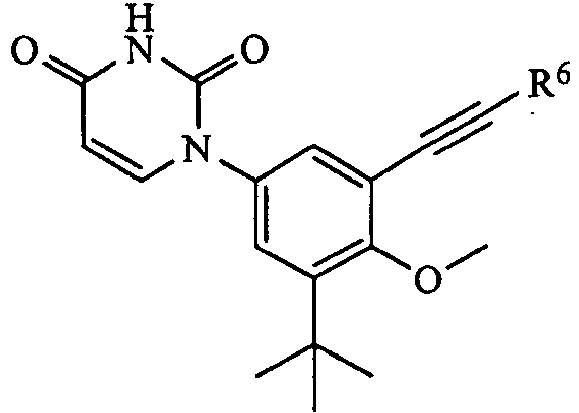
compound R6 ring/ring structure substituent(s) IB-L2-1.1 phenyl -2-CH3 and -4-N(H)S(O)2CH3 IB-L2-1.2 phenyl -2-Cl and -4-N(H)S(O)2CH3 IB-L2-1.3 phenyl -2-CH3 and -4-N(H)S(O)2CH3 and -5-F IB-L2-1.4 phenyl -3-F and -4-N(H)S(O)2CH3 and -5-F IB-L2-1.5 phenyl -2-CF3 and -4-N(H)S(O)2CH3 and -5-F IB-L2-1.6 phenyl -2-OH and -4-N(H)S(O)2CH3 IB-L2-1.7 phenyl -2-C(O)OCH3 and -4-N(H)S(O)2CH3 IB-L2-1.8 pyridin-2-yl -5-N(H)S(O)2CH3 IB-L2-1.9 pyrazin-2-yl -5-N(H)S(O)2CH3 IB-L2-1.10 phenyl -2-C(CH3)3 and -4-N(H)S(O)2CH3 IB-L2-1.11 phenyl 
and -4-N(H)S(O)2CH3 IB-L2-1.12 phenyl -2-N(H)C(O)CH3 and -4-N(H)S(O)2CH3 
- This invention also is directed, in part, to isomers of the compounds of formula I (and their salts) (i.e., stereoisomers). Stereoisomers include E/Z isomers (i.e., isomers with regard to one or more double bonds), enantiomers (i.e., stereo- isomers that have opposite configurations at all stereogenic centers), and diastereoisomers (i.e., stereo- isomers that have the same configuration at one or more stereogenic centers, but differ at other stereogenic centers).
- This invention also is directed, in part, to all salts of the compounds of formula I. A salt of a compound may be advantageous due to one or more of the salt's properties, such as, for example, enhanced pharmaceutical stability in differing temperatures and humidities, or a desirable solubility in water or other solvents. Where a salt is intended to be administered to a patient (as opposed to, for example, being in use in an in vitro context), the salt preferably is pharmaceutically acceptable and/or physiologically compatible. The term "pharmaceutically acceptable" is used adjectivally in this patent application to mean that the modified noun is appropriate for use as a pharmaceutical product or as a part of a pharmaceutical product. Pharmaceutically acceptable salts include salts commonly used to form alkali metal salts and to form addition salts of free acids or free bases. In general, these salts typically may be prepared by conventional means by reacting, for example, the appropriate acid or base with a compound of the invention.
- Pharmaceutically acceptable acid addition salts of the compounds of formula I can be prepared from an inorganic or organic acid. Examples of often suitable inorganic acids include hydrochloric, hydrobromic, hydroiodic, nitric, carbonic, sulfuric, and phosphoric acid. Suitable organic acids generally include, for example, aliphatic, cycloaliphatic, aromatic, araliphatic, heterocyclic, carboxylic, and sulfonic classes of organic acids. Specific examples of often suitable organic acids include acetate, trifluoroacetate, formate, propionate, succinate, glycolate, gluconate, digluconate, lactate, malate, tartaric acid, citrate, ascorbate, glucuronate, maleate, fumarate, pyruvate, aspartate, glutamate, benzoate, anthranilic acid, mesylate, stearate, salicylate, p-hydroxybenzoate, phenylacetate, mandelate, embonate (pamoate), ethanesulfonate, benzenesulfonate, pantothenate, 2-hydroxyethanesulfonate, sulfanilate, cyclohexylaminosulfonate, algenic acid, beta-hydroxybutyric acid, galactarate, galacturonate, adipate, alginate, bisulfate, butyrate, camphorate, camphorsulfonate, cyclopentanepropionate, dodecylsulfate, glycoheptanoate, glycerophosphate, heptanoate, hexanoate, nicotinate, oxalate, palmoate, pectinate, 2-naphthalesulfonate, 3-phenylpropionate, picrate, pivalate, thiocyanate, tosylate, and undecanoate.
- Pharmaceutically acceptable base addition salts of the compounds of formula I include, for example, metallic salts and organic salts. Preferred metallic salts include alkali metal (group Ia) salts, alkaline earth metal (group IIa) salts, and other physiologically acceptable metal salts. Such salts may be made from aluminum, calcium, lithium, magnesium, potassium, sodium, and zinc. Preferred organic salts can be made from amines, such as tromethamine, diethylamine, N,N'-dibenzylethylenediamine, chloroprocaine, choline, diethanolamine, ethylenediamine, meglumine (N-methylglucamine), and procaine. Basic nitrogen-containing groups can be quaternized with agents such as lower alkyl (C1-C6) halides (e.g., methyl, ethyl, propyl, and butyl chlorides, bromides, and iodides), dialkyl sulfates (e.g., dimethyl, diethyl, dibutyl, and diamyl sulfates), long chain halides (e.g., decyl, lauryl, myristyl, and stearyl chlorides, bromides, and iodides), arylalkyl halides (e.g., benzyl and phenethyl bromides), and others.
- Compounds of formula I (and salts thereof) with any level of purity (including pure and substantially pure) are within the scope of Applicants' invention. The term "substantially pure" in reference to a compound/salt/isomer, means that the preparation/composition containing the compound/salt/isomer contains more than about 85% by weight of the compound/salt/isomer, preferably more than about 90% by weight of the compound/salt/isomer, preferably more than about 95% by weight of the compound/salt/isomer, preferably more than about 97% by weight of the compound/salt/isomer, and preferably more than about 99% by weight of the compound/salt/isomer.
- This invention also is directed, in part, to compositions comprising one or more compounds and/or salts of the invention. The compositions can be pharmaceutical compositions.
- In some embodiments, the compositions further comprise one or more additional therapeutic agents. Such therapeutic agents can, but need not be, additional HCV inhibitors.
- The preferred composition depends on the method of administration, and typically comprises one or more conventional pharmaceutically acceptable carriers, adjuvants, and/or vehicles (together referred to as "excipients"). Formulation of drugs is generally discussed in, for example, Hoover, J., Remington's Pharmaceutical Sciences (Mack Publishing Co., 1975) and Ansel's Pharmaceutical Dosage Forms and Drug Delivery Systems (Lippincott Williams & Wilkins, 2005).
- Solid dosage forms for oral administration include, for example, capsules, tablets, pills, powders, and granules. In such solid dosage forms, the compounds or salts are ordinarily combined with one or more excipients. If administered per os, the compounds or salts can be mixed with, for example, lactose, sucrose, starch powder, cellulose esters of alkanoic acids, cellulose alkyl esters, talc, stearic acid, magnesium stearate, magnesium oxide, sodium and calcium salts of phosphoric and sulfuric acids, gelatin, acacia gum, sodium alginate, polyvinylpyrrolidone, and/or polyvinyl alcohol, and then tableted or encapsulated for convenient administration. Such capsules or tablets can contain a controlled-release formulation, as can be provided in, for example, a dispersion of the compound or salt in hydroxypropylmethyl cellulose. In the case of capsules, tablets, and pills, the dosage forms also can comprise buffering agents, such as sodium citrate, or magnesium or calcium carbonate or bicarbonate. Tablets and pills additionally can be prepared with enteric coatings.
- Liquid dosage forms for oral administration include, for example, pharmaceutically acceptable emulsions (including both oil-in-water and water-in-oil emulsions), solutions (including both aqueous and non-aqueous solutions), suspensions (including both aqueous and non-aqueous suspensions), syrups, and elixirs containing inert diluents commonly used in the art (e.g., water). Such compositions also can comprise, for example, wetting, emulsifying, suspending, flavoring (e.g., sweetening), and/or perfuming agents.
- Parenteral administration includes subcutaneous injections, intravenous injections, intramuscular injections, intrasternal injections, and infusion. Injectable preparations (e.g., sterile injectable aqueous or oleaginous suspensions) can be formulated according to the known art using suitable dispersing, wetting agents, and/or suspending agents. Acceptable vehicles and solvents include, for example, water, 1,3-butanediol, Ringer's solution, isotonic sodium chloride solution, bland fixed oils (e.g., synthetic mono- or diglycerides), fatty acids (e.g., oleic acid), dimethyl acetamide, surfactants (e.g., ionic and non-ionic detergents), and/or polyethylene glycols.
- Formulations for parenteral administration may, for example, be prepared from sterile powders or granules having one or more of the excipients mentioned for use in the formulations for oral administration. A compound or salt of the invention can be dissolved in water, polyethylene glycol, propylene glycol, ethanol, corn oil, cottonseed oil, peanut oil, sesame oil, benzyl alcohol, sodium chloride, and/or various buffers. The pH may be adjusted, if necessary, with a suitable acid, base, or buffer.
- Suppositories for rectal administration can be prepared by, for example, mixing a compound or salt of the invention with a suitable nonirritating excipient that is solid at ordinary temperatures, but liquid at the rectal temperature, and will therefore melt in the rectum to release the drug. Suitable excipients include, for example, cocoa butter; synthetic mono-, di-, or triglycerides, fatty acids, and/or polyethylene glycols.
- Topical administration includes the use of transdermal administration, such as transdermal patches or iontophoresis devices.
- Other excipients and modes of administration known in the pharmaceutical art also may be used.
- Applicants have discovered that some I-L1 compounds in which R6 and the phenyluracil are in trans-position relative to the double bond, when in solution, tend to convert into the corresponding cis-isomer upon exposure to light; thus, it may be desirable to store such solutions under conditions that reduce exposure to light (e.g., in an amber bottle or in a dark place).
- The preferred total daily dose of the compound or salt (administered in single or divided doses) is typically from about 0.001 to about 100mg/kg, more preferably from about 0.001 to about 30mg/kg, and even more preferably from about 0.01 to about 10mg/kg (i.e.,mg of the compound or salt per kg body weight). Dosage unit compositions can contain such amounts or submultiples thereof to make up the daily dose. In many instances, the administration of the compound or salt will be repeated a plurality of times. Multiple doses per day typically may be used to increase the total daily dose, if desired.
- Factors affecting the preferred dosage regimen include the type, age, weight, sex, diet, and condition of the patient; the severity of the pathological condition; the severity of the pathological condition; the route of administration; pharmacological considerations, such as the activity, efficacy, pharmacokinetic, and toxicology profiles of the particular compound or salt used; whether a drug delivery system is utilized; and whether the compound or salt is administered as part of a drug combination. Thus, the dosage regimen actually employed can vary widely, and therefore, can derive from the preferred dosage regimen set forth above.
- This invention also is directed, in part, to a kit comprising one or more compounds and/or salts of the in invention. The kit can optionally contain one or more additional therapeutic agents and/or instructions for, for example, using the kit.
- This disclosure also is directed, in part, to intermediates that correspond in structure to formula II that can be used to prepare the compounds of formula I (and their salts)(although some intermediates can also be used, just like the compounds of formula I, as HCV inhibitors, and one skilled in the art can determine such ability of the compounds of formula II by utilizing, for example, the methods discussed below):

- In formula II:
- , R1, R2, R3, R4, and R5 are as discussed above for the compounds of formula I; and
- X2 is halo.
- The various embodiments for, R1 , R2 , R3, R4, and R5 (as well as their combinations) discussed above apply to the compounds of formula II. As to X2, in some embodiments, X2 is selected from the group consisting of chloro, bromo, and iodo. In other embodiments, X2 is selected from the group consisting of chloro and bromo. In yet other embodiments, X2 is selected from the group consisting of chloro and iodo. In yet other embodiments, X2 is selected from the group consisting of iodo and bromo. In further embodiments, X2 is fluoro. In yet further embodiments, X2 is chloro. In yet further embodiments, X2 is bromo. And in yet further embodiments, X2 is iodo.
- The various embodiments forR1, R2 , R3, R4, R5 , and X2 discussed above can be combined to form various embodiments of compounds of formula II, and all embodiments of compounds of formula II so formed are within the scope of Applicants' invention. Some exemplary embodiments of the compounds (and salts thereof) of formula II are discussed below.
- In some embodiments, the compounds of formula II correspond in structure to formula IIA:

- In other embodiments, the compounds of formula II correspond in structure to formula IIB:

- In some embodiments of the compounds of formula II:
- R1 is selected from the group consisting of hydrogen, methyl, and nitrogen-protecting group;
- R2 is selected from the group consisting of hydrogen and halo;
- R3 is selected from the group consisting of hydrogen and halo;
- R4 is selected from the group consisting of C1-C4-alkyl, C3-C6-carbocyclyl, and 5-6-membered heterocyclyl, wherein:
- (a) the C1-C4-alkyl optionally is substituted with up to three substituents independently selected from the group consisting of halo, oxo, hydroxy, alkyloxy, and trimethylsilyl, and
- (b) the C3-C6-carbocyclyl and 5-6-membered heterocyclyl optionally are substituted with one or two substituents independently selected from the group consisting of alkyl, halo, and alkylsulfonylamino;
- R5 is selected from the group consisting of hydrogen, hydroxy, alkyloxy, and halo; and
- X2 is selected from the group consisting of chloro, bromo, and iodo.
- In some embodiments of the compounds of formula II:
- is a double carbon-carbon bond;
- R1 is hydrogen;
- R2 is selected from the group consisting of hydrogen and halo;
- R3 is hydrogen;
- R4 is tert-butyl;
- R5 is selected from the group consisting of hydrogen, hydroxy, and methoxy; and
- X2 is selected from the group consisting of bromo and iodo.
- In some embodiments of the compounds of formula II:
- R1 is selected from the group consisting of hydrogen and methyl;
- R2 is selected from the group consisting of hydrogen and methyl;
- R3 is selected from the group consisting of hydrogen and methyl;
- R4 is tert-butyl;
- R5 is selected from the group consisting of hydroxy and methoxy; and
- X2 is selected from the group consisting of chloro, bromo, and iodo.
- In some embodiments of the compounds of formula II:
- is a double carbon-carbon bond;
- R1 is hydrogen;
- R2 is hydrogen;
- R3 is hydrogen;
- R4 is tert-butyl;
- R5 is selected from the group consisting of hydroxy and methoxy; and
- X2 is selected from the group consisting of chloro, bromo, and iodo.
- In some embodiments, the compound of formula II is selected from the group consisting of

- The discussion below provides instructions for the preparation of intermediate compounds of formula II (and salts thereof).
- This disclosure also is directed, in part, to starting compounds that correspond in structure to formula III that can be used to prepare the compounds of formulas II and I (and their salts):

- In formula III,, R1, R2 , and R3 are as discussed above for the compounds of formula I and II. The various embodiments for, R1 R2 , and R3 (as well as their combinations) discussed above apply to the compounds of formula III. The various embodiments for,R1, R2 , and R3 discussed above can be combined to form various embodiments of compounds of formula III, and all embodiments of compounds of formula III so formed are within the scope of Applicants' invention. Some exemplary embodiments of the compounds (and salts thereof) of formula III are discussed below.
- In some embodiments of the compounds of formula III:
- R1 is selected from the group consisting of hydrogen, methyl, and nitrogen-protecting group;
- R2 is selected from the group consisting of hydrogen and halo; and
- R3 is selected from the group consisting of hydrogen and halo.
- In some embodiments of the compounds of formula III:
- is a double carbon-carbon bond;
- R1 is selected from the group consisting of hydrogen;
- R2 is selected from the group consisting of hydrogen and halo; and
- R3 is selected from the group consisting of hydrogen.
- In some embodiments of the compounds of formula III:
- R1 is selected from the group consisting of hydrogen and methyl;
- R2 is selected from the group consisting of hydrogen and methyl; and
- R3 is selected from the group consisting of hydrogen and methyl.
- In some embodiments, the compound of formula III is uracil.
- This invention also is directed, in part, to starting compounds that correspond in structure to formula IV that can be used to prepare the compounds of formulas II and I (and their salts):

- In formula IV:
- R4, R5, and X2 are as discussed above for the compounds of formula I and II; and
- X1 is halo.
- The various embodiments for R4, R5, and X2 (as well as their combinations) discussed above apply to the compounds of formula IV. As to X1, in some embodiments, X1 is selected from the group consisting of chloro, bromo, and iodo. In other embodiments, X1 is selected from the group consisting of chloro and bromo. In yet other embodiments, X1 is selected from the group consisting of chloro and iodo. In yet other embodiments, X1 is selected from the group consisting of iodo and bromo. In further embodiments, X1 is fluoro. In yet further embodiments, X1 is chloro. In yet further embodiments, X1 is bromo. And in yet further embodiments, X1 is iodo. As to X1 and X2, in some embodiments, X1 and X2 are identical.
- The various embodiments for R4, R5, X1, and X2 discussed above can be combined to form various embodiments of compounds of formula IV, and all embodiments of compounds of formula III so formed are within the scope of Applicants' invention. Some exemplary embodiments of the compounds (and salts thereof) of formula IV are discussed below.
- In some embodiments of the compounds of formula IV:
- R4 is selected from the group consisting of C1-C4-alkyl, C3-C6-carbocyclyl, and 5-6-membered heterocyclyl, wherein:
- (a) the C1-C4-alkyl optionally is substituted with up to three substituents independently selected from the group consisting of halo, oxo, hydroxy, alkyloxy, and trimethylsilyl, and
- (b) the C3-C6-carbocyclyl and 5-6-membered heterocyclyl optionally are substituted with one or two substituents independently selected from the group consisting of alkyl, halo, and alkylsulfonylamino;
- R5 is selected from the group consisting of hydrogen, hydroxy, and alkyloxy;
- X1 is selected from the group consisting of chloro, bromo, and iodo; and
- X2 is selected from the group consisting of chloro, bromo, and iodo.
- In some embodiments of the compounds of formula IV:
- R4 is selected from the group consisting of tert-butyl;
- R5 is selected from the group consisting of hydrogen, hydroxy, and methoxy;
- X1 is selected from the group consisting of bromo and iodo; and
- X2 is selected from the group consisting of bromo and iodo.
- In some embodiments of the compounds of formula IV:
- R4 is selected from the group consisting of tert-butyl;
- R5 is selected from the group consisting of hydroxy and methoxy;
- X1 is selected from the group consisting of chloro, bromo, and iodo; and
- X2 is selected from the group consisting of chloro, bromo, and iodo.
- In some embodiments of the compounds of formula IV:
- R4 is tert-butyl;
- R5 is selected from the group consisting of hydroxy and methoxy;
- X1 is selected from the group consisting of chloro, bromo, and iodo; and
- X2 is selected from the group consisting of chloro, bromo, and iodo.
- In some embodiments, the compound of formula IV is selected from the group consisting of

- The discussion below provides instructions for the preparation of starting compounds of formula IV (and salts thereof).
- This disclosure also is directed, in part, to a process for preparing compounds of formula II. The process comprises reacting a compound of formula III with a compound of formula IV in the presence of (i) copper (1) salt catalyst and (ii) nitrogenous heteroaryl ligand:

- In the above process, R1, R2, R3, R4, R5, X1, and X2 are as discussed above.
- Applicants have discovered that the process generally results in the substitution of the N1 hydrogen of uracil derivative compound III thus resulting in intermediate compound II. When X2 in intermediate compound II is chloro, bromo, or iodo, then compound II is is suitable for subsequent reaction (e.g., Suzuki coupling with an appropriate boronic acid or boronate ester) to provide compound of formula I. In other words, when X2 in intermediate compound II is chloro, bromo, or iodo, the above process is suitable for preparing compounds of formula I as well.
- In some embodiments, compound III is uracil, and compound IV corresponds in structure to a compound selected from the group consisting of compound IV-I, IV-Br, and IV-Cl, with compounds IV-I and IV-Br typically resulting in better yield than compound IV-Cl.
- Suitable Cu(I) catalysts include, for example, CuI, CuBr, CuCl, Cu2O, and CH3C(O)OCu. In some embodiments, the catalyst is selected from the group consisting of CuI and CuBr. In some such embodiments, the catalyst is CuI. In other such embodiments, the catalyst is CuBr.
- In some embodiments, the process is conducted in the presence of a base. In some such embodiments, the base is an inorganic base. Suitable inorganic bases include, for example, potassium, sodium, and cesium salts (e.g., K2CO3, K3PO4, Cs2CO3, Na2CO3). In some embodiments, the base is selected from the group consisting of potassium salt and cesium salt. In some such embodiments, the salt is selected from the group consisting of K3PO4 and Cs2CO3. In some embodiments, the base comprises a potassium salt. In some such embodiments, the potassium salt is K2CO3. In other such embodiments, the potassium salt is K3PO4. In some embodiments, the base comprises a cesium salt. In some such embodiments, the potassium salt is Cs2CO3.
- Typically, the process is conducted in the presence of a solvent. Suitable solvents include, for example, dimethylsulfoxide (DMSO), dimethylformamide (DMF), and acetonitrile (MeCN). In some embodiments, the solvent is DMSO.
- Typically, the process is conducted at a temperature of from about 40 to about 130°C.
- In some embodiments, the nitrogenous heteroaryl ligand comprises 8-hydroxyquinoline. In other embodiments, the ligand comprises 2-(2-pyridyl)-benzimidazole. In yet other embodiments, the ligand comprises a picolinamide compound corresponding in structure to formula V:

- In formula V, R11 , R12 , R13 , R14 , R15, R16, and R17 are independently selected from the group consisting of hydrogen, C1-4-perfluoroalkyl, C1-4-alkyloxy, C1-4-haloalkyl, chloro, or cyano. In some embodiments R11, R12, R13, R14, R15, R16, and R17 are independently selected from the group consisting of hydrogen, methyl, methoxy, trifluoromethyl, chloro, and cyano. In some embodiments, the ligand of formula V comprises N-(4-cyanophenyl)picolinamide. In other embodiments, the ligand of formula V comprises N-(2-cyanophenyl)picolinamide.
- In some embodiments, the process comprises (a) preparing a compound of formula IV; and (b) reacting a compound of formula III with a compound of formula IV in the presense of (i) copper (I) salt catalyst and (ii) nitrogenous heteroaryl ligand, optionally in the presence of inorganic base.
- Compound of formula IV-I can be prepared by, for example, converting 2-tert-butylphenol into 2-tert-butyl-4,6-diiodophenol (by, for example, reacting it with NaI and NaOCl), and then converting the 2-tert-butyl-4,6-diiodophenol into 1-tert-butyl-3,5-diiodo-2-methoxybenzene (by, for example, treating it with CH3I in the presence of a base, such as, for example, NaOH).


- Compound of formula IV-Br can be prepared by, for example, converting 2-tert-butylphenol into 2,4-dibromo-6-tert-butylphenol (by, for example, reacting it with 1,3-dibromo-5,5-dimethylimidazo-lidine-2,4-dione), and then converting the 2,4-dibromo-6-tert-butylphenol into 1,5-dibromo-3-tert-butyl-2-methoxybenzene (by, for example, treating it with CH3I in the presence of KOtBu).
- Additional information about the preparation of compounds of formulas I and II (and their salts) is provided in the general discussion and/or specific synthesis examples below. In the discussion below, R1 R2, R3, R4, R5, L, RA, RB, RC, RD, R6, RE, RF, RG, RH, RI, RJ, RK, X1 and X2 have the meaning discussed above unless otherwise stated.
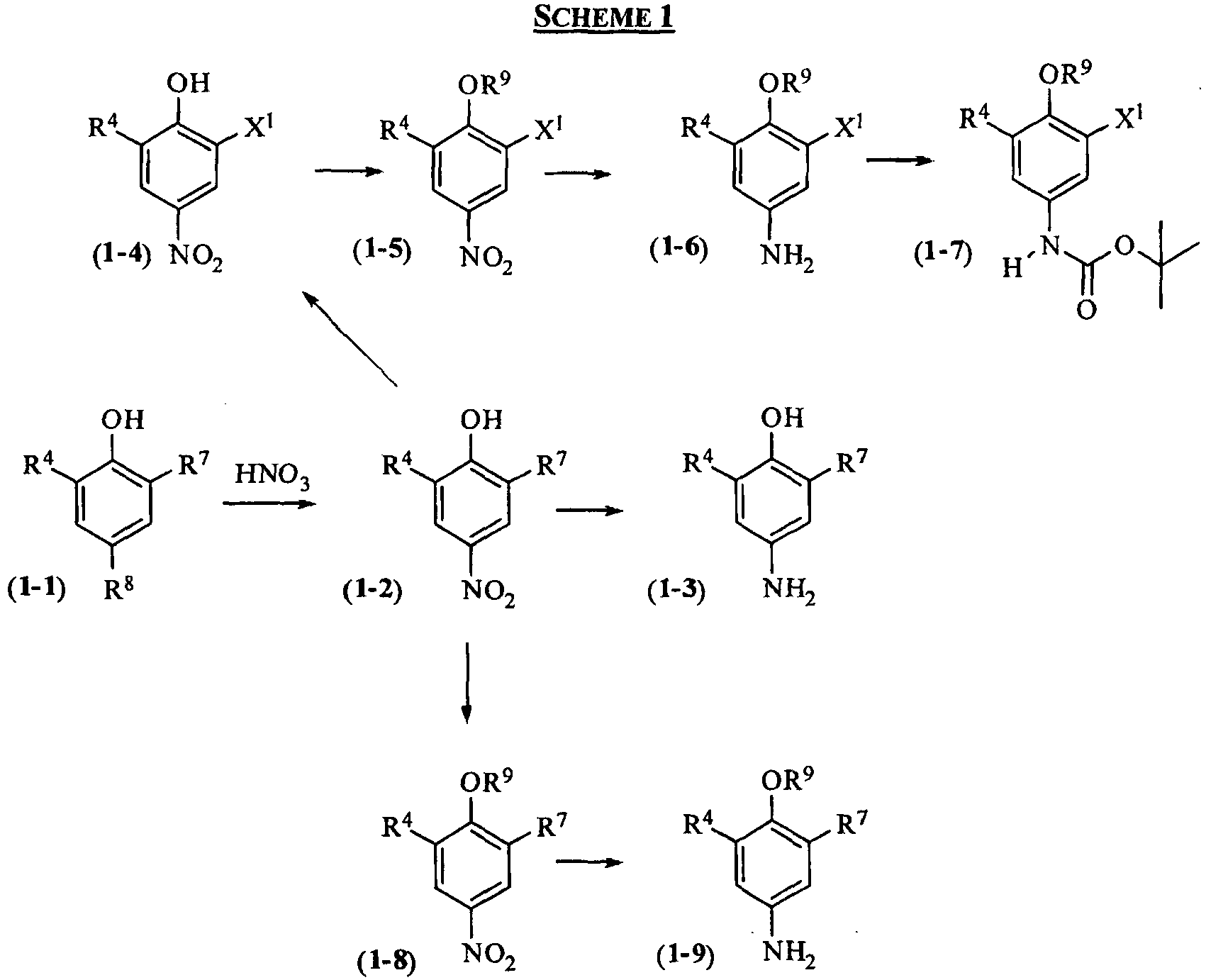
- Compound (1-1), wherein R7 is, for example, hydrogen or -CO2Me, and R8 is, for example, hydrogen or t-butyl, may be treated with nitric acid in solvents such as, for example, acetic acid or water in a temperature range of about 0 to about 35°C over about 1 to about 5h to provide compound (1-2). Compound (1-2) may then be reduced using conditions known to those skilled in the art to furnish the corresponding aniline (1-3). Typical conditions for this reduction include using hydrogen at a pressure of about 1 to about 5 atmospheres in the presence of a catalyst such as, for example, palladium or platinum on charcoal in a solvent such as, for example, tetrahydrofuran, ethyl acetate, ethanol, or hexane at or near ambient temperature over a period of about 1 to about 12h. Dependent on the functional groups present, an alternative reduction procedure may be more appropriate such as, for example, using iron powder in the presence of a mild acid such as, for example, ammonium chloride or dilute hydrochloric acid at reflux temperatures in a mixture of solvents containing, for example, methanol, water, and/or tetrahydrofuran over about 1 to about 12h. Another set of reduction conditions includes the use of sodium borohydride in a solvent mixture such as, for example, water and tetrahydrofuran. Yet another set of reduction conditions includes the use of tin(II) chloride in the presence of hydrochloric acid in such solvents as, for example, water and methanol or mixtures thereof.
- Compound (1-2) may be modified prior to reduction. For example, treatment of compound (1-2), wherein R7 is hydrogen, with iodine monochloride in a mixture of methanol and water at or near ambient temperature over a period of about 8 to about 24h supplies compound (1-4), wherein X1 is iodine. Alternatively, compound (1-2) can be treated with pyridinium hydrobromide perbromide in a solvent such as, for example, acetic acid at or near ambient temperature over a period of about 2 to about 16h to provide compound (1-4), wherein X1 is bromine. Modifications may be introduced at the phenol moiety in compound (1-4). For example, the phenol may be alkylated with alkyl halides (e.g., methyl iodide), alkyl sulfates (e.g., methyl sulfate), alkenyl halides (e.g., allyl bromide), alkynyl halides (e.g., propargyl bromide) in the presence of a base such as, for example, potassium carbonate in acetone, sodium hydride in dimethylformamide, or potassium t-butoxide in tetrahydrofuran, at temperatures from about 0 to about 35°C over a period of about 1 to about 24h to provide compound (1-5), wherein R9 is, for example, alkyl, alkenyl, or alkynyl. Alternatively, alkylation may be achieved by using a reagent such as (trimethylsilyl) diazomethane in solvents such as, for example, methanol or t-butyl methyl ether, or mixtures thereof in a sealed tube at or near room temperature over about 8 to about 24h. Compound (1-5) may subsequently be reduced to compound (1-6) using the iron powder or tin(II) chloride conditions described above. An alternative reduction procedure employs hydrogenation at approximately 1 atmosphere pressure with a catalyst such as 5% platinum on sulfided carbon in a solvent such as methanol. Protection of the resultant aniline of compound (1-6) with, for example, a t-butyl carbamate can be achieved by treatment with di-tert-butyl dicarbonate in a solvent such as, for example, tetrahydrofuran or dioxane at a temperature of about 50 to about 65°C for about 1 to about 8h provides compound (1-7).
- Modifications may also occur at the phenol moiety in compound (1-2). One skilled in the art may alkylate the phenol of compound (1-2) using, for example, the conditions described above to obtain compound (1-8). Compound (1-8) is transformed into compound (1-9) using, for example, one or more of the appropriate reduction conditions described above.
- Another modification of the phenol group in compound (1-2) is sulfonylation to furnish compound (1-8), wherein R9 is alkylsulfonyl, carbocyclylsulfonyl, or haloalkylsulfonyl. Such a compound may be prepared by exposing compound (1-2) to sulfonyl chlorides such as, for example, methanesulfonyl chloride, cyclohexanesulfonyl chloride, benzenesulfonyl chloride, or 3-chloropropane sulfonyl chloride in the presence of a base such as, for example, triethylamine, diisopropylethylamine, or pyridine in a solvent such as, for example, dichloromethane at or near ambient temperature for a period of about 1 to about 24h. One skilled in the art can then transform compound (1-8) into compound (1-9) with an appropriate set of reduction conditions.

- Aniline (2-4) can be prepared through use of the Curtius rearrangement. To this end, compound (2-1), wherein R4 is not amino, can be treated in refluxing thionyl chloride with a catalytic amount of dimethylformamide for about 1 to about 4h to obtain acid chloride (2-2). Treatment with thionyl chloride at the reflux temperature in solvents such as, for example, chloroform or toluene also furnishes compound (2-2). Compound (2-2) can be reacted with an aqueous solution of sodium azide in a solvent such as, for example, acetone over about 1 to about 8h to provide acyl azide (2-3). Compound (2-3) can then undergo a Curtius rearrangement in refluxing solvents such as dioxane or toluene. The intermediate isocyanate is hydrolyzed with an aqueous acid such as dilute hydrochloric acid in a solvent such as dimethoxyethane to provide compound (2-4).

- Compound (3-1), wherein R10 is, for example, hydrogen, bromine, iodine, or -CO2Me, can be treated with an acrylic acid either neat at or near ambient temperature in a solvent such as, for example, toluene and heated to reflux over a period of about 15 to about 48h to supply compound (3-2). When excess of an acrylic acid is used, compound (3-3) is produced. Compound (3-2) or (3-3) can be treated with urea in a solvent such as, for example, acetic acid at about 100 to about 120°C over about 2 to about 48h to supply compound (3-4).

- Compound (4-2) can be prepared from compound (3-1) dissolved in solvents such as, for example, dimethylformamide or dimethylacetamide by the addition of a benzene solution of (E)-3-methoxyacryloyl isocyanate (prepared as described by Santana, L.; et al. J. Heterocyclic Chem. 1999, 36, 293-295.) at a temperature of about -40 to about -15°C under an inert atmosphere and then warming to ambient temperature for from about 30 min to about 4h. Compound (4-2) can be treated with an acid such as, for example, sulfuric acid in mixtures of water and ethanol in a temperature range of from about 90 to about 110°C for about 1 to about 8h to supply compound (4-3). Alternatively, compound (4-2) can be cyclized to uracil (4-3) under the basic conditions described by Ueno, Y.; et al. J. Org. Chem. 70:7925-7935 (2005).

- Compound (5-1) can be hydrolyzed with a base such as, for example, sodium hydroxide, lithium hydroxide, or potassium hydroxide in a solvent such as, for example, methanol, ethanol, or tetrahydrofuran, or mixtures thereof. The resultant reaction mixture can be stirred for a period of about 6 to about 48h at ambient temperature. Acidification with a dilute aqueous acid supplies compound (5-2) where the ester has been hydrolyzed and the tetrahyrdopyrimidine ring opened.
- Cyclization of compound (5-2) to compound (5-3) can be accomplished by treatment with a strong acid such as, for example, concentrated hydrochloric acid in a temperature range of about 90 to about 120 °C over a period of about 1 to about 3h. Compound (5-3) can be treated in refluxing thionyl chloride, with or without a catalytic amount of dimethylformamide, for about 1 to about 4h to deliver acid chloride (5-4). Treatment with thionyl chloride at the reflux temperature in solvents such as, for example, chloroform or toluene also furnishes compound (5-4).
- Compound (5-4) can be treated with an amine or the corresponding salt (5-5) in solvents such as, for example, dioxane, dimethylformamide, dimethylacetamide, or dichloromethane optionally in the presence of a base such as, for example, pyridine, triethylamine, or diisopropylethylamine at temperatures ranging from at or near ambient to about 100 °C for between about 1 and about 24h to provide compound (5-6).
- Alternatively, compound (5-3) can be converted directly to compound (5-6) by reacting with an equimolar amount of amine (5-5) with a coupling reagent such as, for example, bis(2-oxo-3-oxazolidinyl)phosphinic chloride (BOPCI), O-(7-azabenzotriazol-1-yl)-N,N,N',N'-tetramethyluronium hexafluorophosphate (HATU), or O-benzotriazol-1-yl-N,N,N',N'-tetramethyluronium tetrafluoroborate (TBTU) along with a coupling auxiliary such as, for example, 1-Hydroxy-7-azabenzotriazole (HOAT) or 1-hydroxybenzotriazole hydrate (HOBT) in the presence or absence of a base such as, for example, N-methyl morpholine, diisopropylethylamine in solvents such as, for example, tetrahydrofuran, N,N-dimethylacetamide, N,N-dimethylformamide, pyridine, and chloroform. Typical reactions can be carried out at between about 0 to about 65°C or may be carried out in a microwave reactor to facilitate coupling.

- Compound (6-1) can be converted to compound (6-5) using the transformations described in Scheme 5 above.

- Compound (7-1) may be converted to acyl azide (7-2) in a two-step process. First, compound (7-1) can be treated in refluxing thionyl chloride with or without a catalytic amount of dimethyl-formamide for about 1 to about 4h to deliver the corresponding acid chloride. Treatment with thionyl chloride at the reflux temperature in solvents such as, for example, chloroform or toluene also furnishes the desired acid chloride. The acid chloride can be reacted with an aqueous solution of sodium azide in a solvent such as, for example, acetone over about 1 to about 8h to provide acyl azide (7-2). Compound (7-2) can then undergo a Curtius rearrangement in refluxing solvents such as, for example, dioxane or toluene. The intermediate isocyanate is hydrolyzed with an aqueous acid such as, for example, dilute hydrochloric acid in a solvent such as, for example, dimethoxyethane to provide compound (7-3). Compound (7-3) may be converted to compound (7-6) using either acid chloride (7-4) or carboxylic acid (7-5) and the amide bond forming conditions described in Schemes 5 and 6.

- Compound (8-1) can be activated for nitration by removal of the methyl group with BBr3 initially added at about 0 °C and then refluxed for about 10 to about 24h in a solvent such as, for example, dichloromethane to provide compound (8-2). The phenol (8-2) can be treated with nitric acid in acetic acid over a period of about 1 to about 10h at or near ambient temperature to supply compound (8-3). Compound (8-3) is then converted to the corresponding methyl ether (8-4) by treatment with a solution of (trimethylsilyl)diazomethane in tetrahydrofuran in a solvent such as, for example, methanol or a mixture of methanol and tetrahydrofuran at or near ambient temperature over about 8 to about 24h. Compound (8-4) may be reduced to compound (8-5) using a set of reduction conditions described in Scheme 1 and suitable for the functional groups present. Compound (8-5) can be converted into compound (8-8) by coupling with acid chloride (7-4) or carboxylic acid (7-5) using conditions for amide bond formation described in Schemes 5 and 6.

- Compound (9-1) can be treated in refluxing thionyl chloride for about 1 to about 4h to obtain acid chloride (9-2). Treatment with thionyl chloride at the reflux temperature in solvents such as, for example, chloroform or toluene also furnishes compound (9-2). Compound (2) is converted to the corresponding aldehyde (9-3) by reduction with lithium tri-t-butoxyaluminum hydride in a solvent such as, for example, tetrahydrofuran at about -78 °C over from about 1 to about 8h. The reduction can also be achieved by treatment with indium chloride and tributyltin hydride in the presence of triphenylphosphine in a solvent such as tetrahydrofuran or toluene at temperatures from about -40 to about 0°C. Compound (9-3) can be treated with compound (9-4) in the presence of a base such as potassium t-butoxide in a solvent such as dichloromethane at or near room temperature over a period of about 1 to about 8h to provide compound (9-5).

- Compound (10-1), wherein X1 is halo (e.g., bromine, iodine) can undergo a Suzuki reaction with vinyl boronic acid (10-2) to provide compound (10-3). The reaction typically requires the use of a base and a catalyst. Examples of bases include, for example, potassium carbonate, potassium phosphate, potassium t-butoxide, sodium carbonate, cesium carbonate, and cesium fluoride. Examples of catalysts include, for example, tris(dibenzylidineacetone)dipalladium (0), palladium acetate, bis(triphenyl phosphine)palladium (II) chloride, tetrakis(triphenylphosphine)palladium, dichloro[1,1'-bis(di-tert-butylphosphino)ferrocene] palladium (II), or dichloro[1,1'-bis(diphenylphosphino)ferrocene] palladium (II) dichloromethane adduct. The reaction may be conducted in a solvent such as, for example, water, dioxane, dimethoxyethane, dimethylformamide, toluene, ethanol, tetrahydrofuran and the like or mixtures thereof. The reaction may be conducted at ambient or elevated temperatures.

- Compound (11-1) can be converted to compound (11-2) by treatment with diazomethane in a solvent such as, for example, tetrahydrofuran in the presence of palladium acetate at or near room temperature over a period of about 30 min to about 4h.
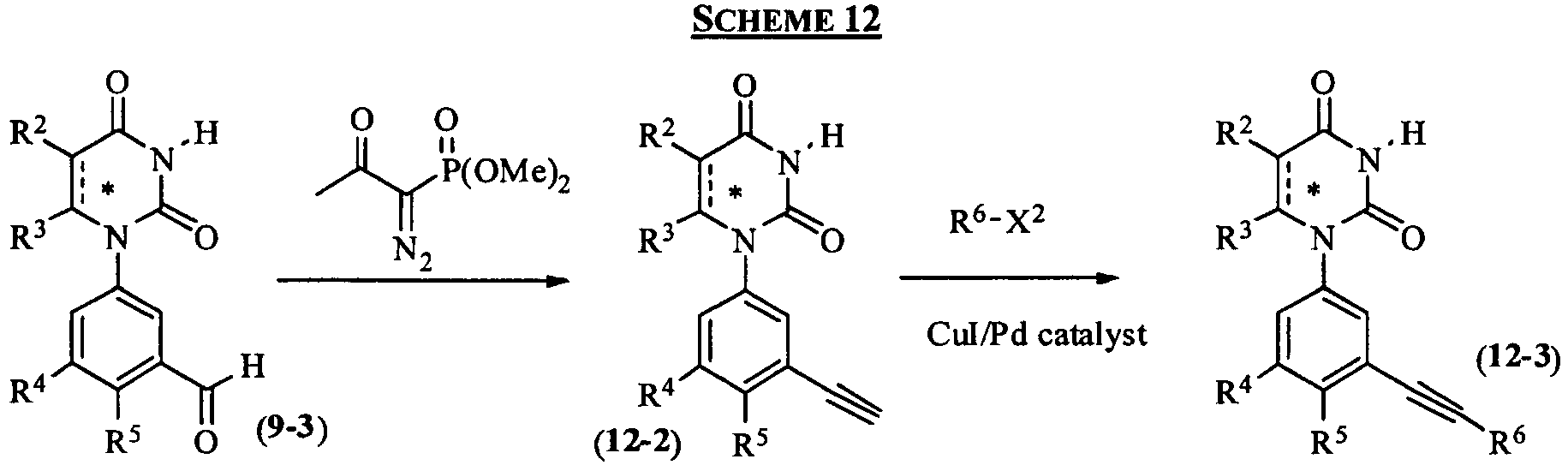
- Compound (9-3) can be treated with dimethyl 1-diazo-2-oxopropylphosphonate (prepared as described by Ohira, S., Syn. Comm. 19:561-564 (1989)) in the presence of a base like potassium carbonate in a solvent such as, for example, methanol for about 8 to about 24h at or near room temperature to supply alkyne (12-2). Compound (12-2) is then treated with R6-X2, wherein X2 is iodine, bromine, or -O-triflate, in the presence of copper (I) iodide, palladium catalyst, base, and optionally additional triphenylphosphine in an inert atmosphere to provide compound (12-3). Suitable palladium catalysts include, for example, tris(dibenzylidineacetone)palladium (0), palladium acetate, bis(triphenylphosphine)palladium (II) chloride, or tetrakis(triphenylphosphine)palladium. Bases, which can be used, include, for example, triethylamine, diethylamine, diisopropylethylamine, potassium carbonate optionally in the presence of tetrabutylammonium bromide, and sodium bicarbonate. Solvents that may be used include, for example, acetonitrile, dimethylformamide, water, dioxane, and tetrahydrofuran, or mixtures thereof. The reaction can be conducted from room temperature to the reflux temperature of the solvents for about 1 to about 48h. Heating at about 50 to about 120°C in a microwave reactor from between about 5 and about 15 min also provides compound (12-3).
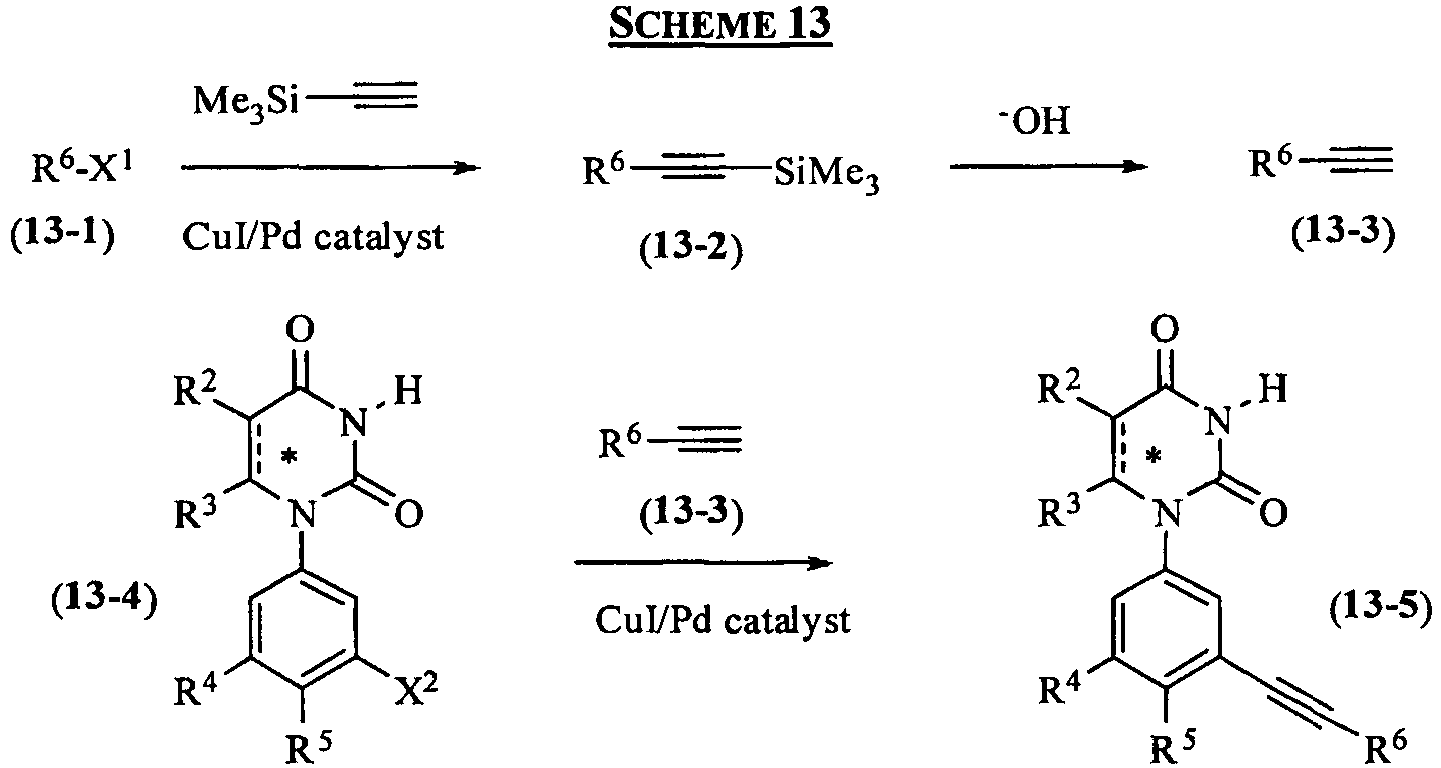
- Compound (13-1), wherein X1 is bromine or iodine, can be reacted in an inert atmosphere with (trimethylsilyl)acetylene in the presence of a catalyst such as, for example, palladium acetate/triphenylphosphine or copper iodide/bis(triphenylphosphine)palladium (II) chloride and a base such as, for example, triethylamine in a solvent such as, for example, toluene or acetonitrile to furnish compound (13-2). The reaction can be heated to about 70°C to about 100°C optionally in a sealed tube over a period of about 30 min to about 48h. Compound (13-2) are converted to compound (13-3) by treatment with a base such as, for example, potassium carbonate or sodium hydroxide in a solvent such as, for example, methanol at ambient temperature. Compound (13-3) are reacted with compound (13-4), wherein X2 is bromine or iodine, in the presence of copper (I) iodide, palladium catalyst, base, and optionally additional triphenylphosphine in an inert atmosphere to provide compound (13-5). Suitable palladium catalysts include, for example, tris(dibenzylidineacetone)dipalladium (0), palladium acetate, bis(triphenylphosphine)palladium (II) chloride, or tetrakis(triphenylphosphine)palladium. Bases, which can be used, include, for example triethylamine, diethylamine, diisopropylethylamine, potassium carbonate optionally in the presence of tetrabutylammonium bromide, and sodium bicarbonate. Solvents that may be used include, for example, acetonitrile, dimethylformamide, water, dioxane, and tetrahydrofuran, or mixtures thereof. The reaction can be conducted from about 40°C to the reflux temperature of the solvents for about 15 min to about 48h. Microwave heating at about 50°C to about 120°C from between about 5 and about 15 min is an alternative heating process to provide compound (13-5).

- Compound (11-1) is reduced to supply compound (14-2). Typical conditions for this reduction include using hydrogen at a pressure of about 1 to about 5 atmospheres in the presence of a catalyst such as, for example, palladium or platinum on charcoal in a solvent such as, for example, tetrahydrofuran, ethyl acetate, ethanol, or hexane at or near ambient temperature over a period of about 1 to about 12h.

- Compound (15-1) can be converted in a two-step sequence to compound (15-2). The initial step involves reduction of the aromatic nitro moiety with iron powder in the presence of a mild acid such as, for example, ammonium chloride or dilute hydrochloric acid at temperatures from about 60 to about 80°C in a mixture of solvents containing, for example, methanol, water, and tetrahydrofuran over about 1 to about 12h. The second step consists of exposure of the aniline, prepared in the first step, to methanesulfonyl chloride in the presence of a base such as pyridine in a solvent such as dichloromethane at or near ambient temperature.

- Aniline (16-1) and aromatic nitro compound (16-4), wherein X2 is, for example, bromine, iodine, or triflate, can be converted to compound (16-3). Compound (16-1) can be transformed to compound (16-2) by treatment with methanesulfonyl chloride in the presence of a base such as pyridine in a solvent such as dichloromethane. Then compound (16-2) is converted to compound (16-3) by treatment in an inert atmosphere with (trimethylsilyl)acetylene in the presence of a catalyst such as, for example, palladium acetate, bis(triphenylphosphine)palladium (II) chloride, bis(triphenylphosphine)palladium (II) chloride in combination with copper(I) iodide and, when X2 is bromine, triphenylphosphine, and a base such as, for example, triethylamine in a solvent such as toluene or acetonitrile at approximately 80°C.
- Compound of formula (16-4) can be reacted in an inert atmosphere with (trimethylsilyl) acetylene in the presence of a catalyst such as, for example, bis(triphenylphosphine)palladium (II) chloride/ copper(I) iodide and a base such as, for example, triethylamine in a solvent such as, for example, acetonitrile at approximately 80°C to give compound (16-5). Compound (16-5) can be converted to compound (16-3) in a two-step sequence. The initial step involves reduction of the aromatic nitro moiety with iron powder in the presence of a mild acid such as, for example, ammonium chloride or dilute hydrochloric acid at temperatures from about 60 to about 80°C in a mixture of solvents containing, for example, methanol, water, and tetrahydrofuran over about I to about 12h. The second step consists of exposure of the aniline, prepared in the first step, to methanesulfonyl chloride in the presence of a base such as pyridine in a solvent such as dichloromethane at or near ambient temperature.
- Removal of the trimethylsilyl group of compound (16-3) is accomplished as described for the production of compound (13-3) in Scheme 13 above.

- Compound (17-1) can be mesylated to provide compound (17-2) by treatment with methanesulfonyl chloride in the presence of a base such as, for example, pyridine in a solvent such as, for example, dichloromethane. Compound (17-3) can be exposed to borane dimethyl sulfide complex in a solvent such as, for example, tetrahydrofuran at approximately about 0 to about 10°C to supply compound (17-4). Compounds (17-2) and (17-4) can be combined with acetaldehyde in refluxing tetrahydrofuran. Subsequent treatment with water at room temperature yields compound (17-5).

- Carboxylic acid (18-1) can be reduced with boron tetrahydrofuran complex with heating to provide alcohol (18-2). Compound (18-2) is converted to the corresponding bromide (18-3) with N-bromosuccinimide and triphenylphosphine in solvents such as, for example, dichloromethane at room temperature in several hours. Treatment of compound (18-3) with triethyl phosphite at about 120°C for about 1 to about 3h supplies compound (18-4). Compound (18-4) can be used for example to make compound (9-5) as described in Scheme 9.

- Benzaldehyde (19-1) can be treated with diethyl phosphonate in the presence of a base such as, for example, sodium methoxide in a solvent such as, for example, methanol at room temperature to provide compound (19-2). Compound (19-2) can be treated with N-chlorosuccinimide and triphenylphosphine in dichloromethane at room temperature to yield compound (19-3). Compound (19-2) can also be reacted with (diethylamino)sulfur trifluoride (DAST) to supply compound (19-4).
- Compound (19-1) can also be treated with p-toluenesulfonic acid and trimethyl orthoformate in methanol at about 50°C to provide acetal (19-5). Compound (19-5) can be converted to compound (19-6) by exposure to triethyl phosphite and boron trifluoride diethyl etherate at about -20°C to about ambient temperature.
- Compounds (19-3), (19-4), and (19-6) can be used for example to make compound (9-5) as described in Scheme 9.

- Phenol (20-1), wherein R4 is other than amino, is treated with a source of electrophilic halide, such as, for example, iodine monochloride to provide dihalogenated compound (20-2), wherein X1 and X2 are independently bromine or iodine. Compound (20-2) is transformed to compound (20-3) by reaction of an alkylating agent such as, for example, methyl sulfate with a base such as, for example, potassium carbonate in refluxing acetone. Alternatively, methyl iodide in the presence of a base such as, for example, potassium t-butoxide in a solvent such as, for example, tetrahydrofuran, or dimethylformamide also furnish compound (20-3). In yet another alternative, compound (20-2) can be methylated with (trimethylsilyl)diazomethane in a solvent such as, for example, t-butyl methyl ether. Compound (20-3) can be reacted with uracil, ligand (20-4), copper (I) iodide, and potassium phosphate in dimethyl sulfoxide at about 40°C to about 100°C to supply compound (20-5).
- For example, when in compound (20-3), R4 is tert-butyl, X1 is iodo, and X2 is iodo or bromo, compound (20-3) can be stirred with uracil and compound (20-4) in the presence of CuI and K2PO4 in DMSO for about 15 to about 24h at about 60°C to supply compound (20-5). Alternatives to ligand (20-4) for making (20-5) are 8-hydroxyquinoline and 2-(2-pyridyl)-benzimidazole.

- Compound (21-1) can be nitrated with nitric acid in acetic acid in a temperature range of about 10 to about 15°C to give compound (21-2). The phenol moiety of compound (21-2) can be protected as a silyl ether, e.g. t-butyldimethylsilyl ether, by treatment with a silyl chloride such as, for example, t-butyl dimethylsilyl chloride and imidazole in a solvent such as, for example, dimethyl formamide at ambient temperature to furnish compound (21-3). Compound (21-3) may then be reduced using conditions known to those skilled in the art to furnish the corresponding aniline (21-4).
- Typical conditions for this reduction include using hydrogen at a pressure of about 1 to about 5 atmospheres in the presence of a catalyst such as, for example, palladium or platinum on charcoal in a solvent such as, for example, tetrahydrofuran, ethyl acetate, ethanol, methanol, or hexane at or near ambient temperature over a period of about 1 to about 12h. Dependent on the functional groups present, an alternative reduction procedure may be more appropriate such as, for example, using iron powder in the presence of a mild acid such as, for example, ammonium chloride or dilute hydrochloric acid at reflux temperatures in a mixture of solvents containing, for example, methanol, water, and tetrahydrofuran over about 1 to about 12h.
- Aniline (21-4) can then by sulfonylated with methanesulfonyl chloride in the presence of pyridine in a solvent such as, for example, dichloromethane. The starting material and reagents are combined at about 0°C and then allowed to gradually warm to ambient temperature over the course of the reaction to supply compound (21-5). The silyl ether protecting group is removed under conditions familiar to one skilled in the art. For example, tetrabutylammonium fluoride in tetrahydrofuran at room temperature transforms compound (21-5) to compound (21-6). The phenol group of compound (21-6) may be sulfonylated with trifluoromethanesulfonic anhydride in the presence of a base such as, for example, pyridine in a solvent such as, for example, dichloromethane at room temperature to provide compound (21-7). Compound (21-7) can be used as described in Scheme 12 to make compound (12-3).

- Compound (22-1) is converted to compound (22-2) in a two-step sequence. First, compound (22-1) can be hydrolyzed with a base such as, for example, sodium hydroxide, lithium hydroxide, or potassium hydroxide in a solvent such as, for example, methanol, ethanol, or tetrahydrofuran, or mixtures thereof. The resultant reaction mixture can be stirred for a period of about 6 to about 48h at ambient temperature. Second, the intermediate carboxylic acid is treated in refluxing thionyl chloride with or without a catalytic amount of dimethylformamide for about I to about 4h to deliver acid chloride (22-2). Treatment with thionyl chloride at reflux temperature in solvents such as, for example, chloroform or toluene also furnishes compound (22-2). Treatment of the carboxylic acid with oxalyl chloride in dichloromethane with a catalytic amount of dimethylformamide also furnishes compound (22-2).
- Compound (22-2) can be treated with an amine or the corresponding salt in a solvent such as, for example, dioxane, dimethylformamide, dimethylacetamide, or dichloromethane optionally in the presence of a base such as, for example, pyridine, triethylamine or diisopropylethylamine at temperatures ranging from at or near ambient to about 100°C for between about 1 and about 24h to provide compound (22-4) wherein R11 and R12 are independently hydrogen or RF, or taken together with the nitrogen to which they are attached form a 5-6-membered heterocyclyl or a fused 2-ring heterocyclyl.
- Compound (22-2) is converted to the corresponding aldehyde (22-3) by reduction with lithium tri-t-butoxyaluminum hydride in a solvent such as, for example, tetrahydrofuran at about -60°C to about - 78°C.

- Compound (22-3) can be converted to compound (23-2) wherein R11 and R12 are independently hydrogen or RF, or taken together with the nitrogen to which they are attached form a 5-6-membered heterocyclyl or a fused 2-ring heterocyclyl by treatment with an amine, N(R11)(R12), in the presence of a reductant such as, for example, sodium triacetoxyborohydride or sodium cyanoborohydride in a solvent such as, for example, methanol, ethanol, dichloromethane, dimethylacetamide, or dimethylformamide over a period of about 1 to about 24h. The reaction often proceeds best at an acidic pH that can be maintained by the addition of acetic acid or hydrochloric acid.
- Compound (22-3) can also be converted to compound (23-3) by reduction with lithium tri-t-butoxyaluminum hydride in a solvent such as tetrahydrofuran at room temperature.
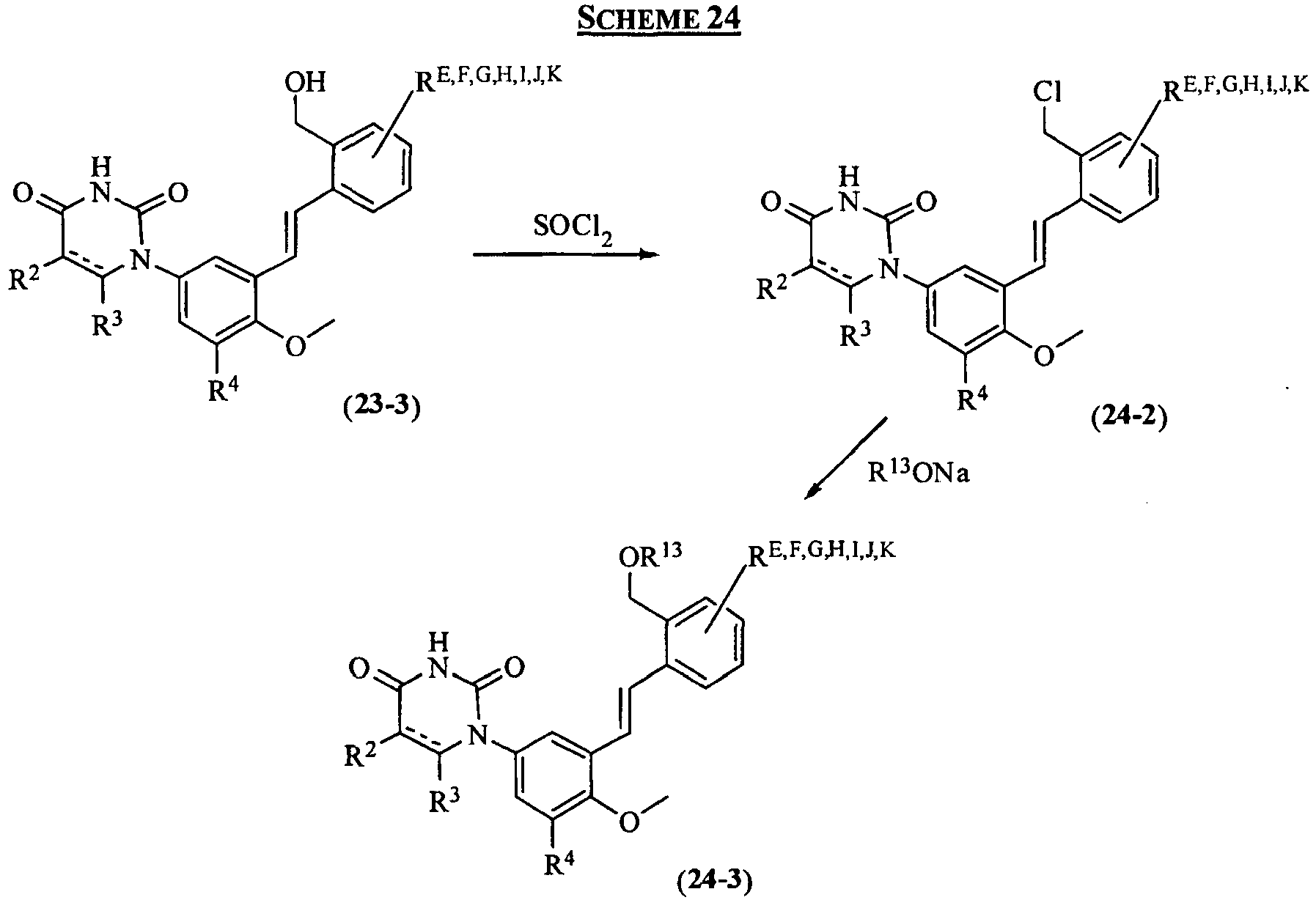
- Compound (23-3) can be converted to compound of formula (24-2) by treatment with thionyl chloride in dichloromethane at room temperature. Compound (24-2) can be treated with a sodium alkoxide, R13ONa, in a heated solution of the corresponding alcohol to provide compound (24-3), wherein R13 is hydrogen or RF.

- Compound (25-1) can be brominated by treatment with, for example, pyridinium hydrobromide perbromide in a solvent such as, for example, acetic acid at or near ambient temperature over a period of about 1 to about 8h to give compound (25-2). The amino group of compound (25-2) can be removed by exposure to t-butyl nitrite in a solvent such as, for example, dimethylformamide at a temperature initially at ambient temperature and then increased to the range of about 50 to about 65 °C to give compound (25-3). Additional aliquots of t-butyl nitrite can be added at ambient temperature followed by heating until the transformation is complete. Compound (25-3) can be reduced to compound (25-4) by, for example, treatment with iron and ammonium chloride.
- The following examples are merely illustrative, and not limiting to this disclosure in any way.
- Example A. Preparation of (E)-N-(3-tert-butyl-5-iodo-4-methoxyphenylcarbamoyl)-3-methoxy acrylamide.

- To a vigorously stirred solution of 2-tert-butylphenol (10g, 66.6mmol) in heptane (67ml) was added at a fast drip a solution of 70% nitric acid (4.25ml, 66.6mmol) diluted with water (4.25ml). The resulting dark red/brown mixture was stirred vigorously for 2h. The suspended solid was collected by filtration washed with hexane (300mL), water (200mL) and once again with hexane (200mL) to give a cocoa colored powder that was dried to constant mass (4.65g, 35.6%).
- To the product from Part A (4.5g, 23.05mmol) dissolved in MeOH (120ml) and water (30mL) was added iodine monochloride (1.155ml, 23.05mmol) drop wise over a period of 10min. The mixture was stirred for 2h and diluted into 1L of water and allowed to stand overnight. The solid material was collected by filtration and washed 3x50mL with water and dried under vacuum overnight to give a tan solid (7.14g, 96%).
- To an ice bath cooled solution of the product from Part B (5.5g, 17. 13mmol) in MTBE (15ml) in a 50mL pressure vessel was added 2.0M TMS diazomethane (12.85ml, 25.7mmol) followed by drop-wise addition of methanol (1.0mL) resulting in calm bubbling. The vessel was sealed and stirred at room temperature for 16h, cooled and the pressure was released. The solution was partitioned between EtOAc and water. The organic layer was washed with 1.0M HCl, saturated potassium carbonate solution, and saturated NaCl. The organic layer was dried over sodium sulfate, filtered and concentrated to give a red oil that was used without purification (5.4g, 84%).
- A mixture of the product from Part C (5.80g, 17.31mmol), ammonium chloride (1.389g, 26.0mmol), and iron (4.83g, 87mmol) in THF/MeOH/water (200mL total, 2/2/1) was refluxed for 2h, cooled and filtered through Celite. The filtrate was evaporated and the residue was partitioned between water and EtOAc. The organic layer was washed with saturated brine, dried with sodium sulfate, filtered and evaporated to give a brown oil (5.28g, 100% yield).
- To a solution of the product from Part E (3.05g, 10mmol) in DMF (50ml) at -20°C under N2 was added at a fast drip a 0.4M solution in benzene of (E)-3-methoxyacryloyl isocyanate (50.0ml, 20.00mmol, prepared by the method of Santana et al., J. Heterocyclic Chem. 36:293 (1999). The solution was stirred for 15min at -20°C, warmed to room temperature for 45min and diluted into EtOAc. The EtOAc layer was washed 4 x 300mL with water, 2 x 100mL with brine, dried (Na2SO4) and concentrated to a brown solid. The residue was triturated in Et2O/hexane to give a fine powder that was collected by filtration and dried to give a tan powder (2.46g, 57%).
-

- To a suspension of the product from Example A (2.46g, 5.69mmol) in ethanol (50ml) was added a solution of 5.5mL of H2SO4 in 50mL water and the mixture was heated at 110°C for 2.5h to give a clear solution. The solution was cooled and diluted with 50mL of water while stirring to give an off-white solid that was collected by filtration, washed with water and dried (2.06g, 90%).
-

- A solution of 2-tert-butylphenol (20.0g, 133mmol) in methanol (266mL) was treated with sodium hydroxide pellets (6.39g, 160mmol). The mixture was stirred until all the sodium hydroxide had dissolved and was then cooled in an ice-salt bath to -2°C. Sodium iodide (15.0g, 100mmol) was added and then 10 % sodium hypochlorite solution (45mL, 73.3mmol) was added drop wise at a rate such that the solution temperature rose no higher than 1.3°C. This sequence of events was repeated (3x) until a total of 60g (400mmol) of sodium iodide had been added and the sodium hypochlorite solution was added until the solution color changed from a light green-yellow color to the color of weak iced tea. This required all but 16mL of the 180mL total sodium hypochlorite solution measured out. With continued cooling at ca. 2°C, a solution of sodium thiosulfate pentahydrate (20g) in water (100mL) was added drop wise over 20min. After addition, the solution was acidified to pH 3 by drop wise addition of concentrated hydrochloric acid (ca. 35mL required of 40mL placed in the addition funnel). The precipitate was collected by filtration and washed with >1 liter of water. The salmon-colored solid was sucked as dry as possible, and dried in a vacuum oven at 50°C for 18h. These procedures afforded the product (49.61 g, 93%) as a tan solid.
- A solution of the product from Part A (20.0g, 49.7mmol) in acetone (140mL) was treated with methyl iodide (3.9mL, 8.83g, 62.2mmol) and 50 % (w/w) sodium hydroxide solution (3.02mL, 4.58g, 57.2mmol) followed by stirring at ambient temperature for 48h. The mixture was concentrated in vacuo to a volume of ca. 50-60mL, followed by dilution with heptane (80mL) and water (50mL). The layers were separated and the organic layer was extracted with saturated sodium chloride solution. Drying (Na2SO4) and concentration in vacuo afforded the product (20.59g, 99%) as a light yellow oil.
- A suspension of the product from Part B (12.04g, 28.9mmol), uracil (3.89g, 34.7mmol), N-(2-cyanophenyl)picolinamide (1.29g, 5.79mmol) and tribasic potassium phosphate (12.9g, 60.8mmol) in DMSO (181mL) was degassed by nitrogen sparge for 1 h. The mixture was then treated with copper (I) iodide (551mg, 2.89mmol) and degassing was continued for another 10min. The mixture was then warmed at 60°C for 18h. The mixture was then poured into water (600mL) and acidified to pH 3 by addition of 4N hydrochloric acid solution. The mixture was diluted with ethyl acetate, and the organic layer was extracted with water (3x), saturated ammonium chloride solution (1x) and saturated sodium chloride solution. The solution was dried and treated with (3-mercaptopropyl) silica gel, followed by stirring for 2h. The mixture was filtered and concentrated in vacuo. The solid obtained was triturated with ether-ethyl acetate (>10:1) and collected by filtration and washed with ether. After drying in a vacuum oven at 50°C for 2h, these procedures afforded the product (2.75 g) as a white solid. The mother liquors were concentrated in vacuo to afford an amber solid. This material was chromatographed over a Flash 65 silica gel cartridge, eluting with 20-100 % ethyl acetate in hexanes. These procedures afforded a nearly white solid, which was triturated with ether-hexanes and collected by filtration. After drying in a vacuum oven for 3h, these procedures afforded another 4.31 g of the product as a white solid. Total yield: 7.06g (61 %).
-

- 2-tert-Butylphenol (99.95g, 665.36mmol) was dissolved in 1250mL methanol and converted to the corresponding phenoxide with 31.96g (799.0mmol, 1.2equiv.) of sodium hydroxide by stirring the sodium hydroxide pellets at room temperature, and then cooling the reaction mixture in an ice/salt bath. Sodium iodide (299.34g, 1997.07mmol, 3.0equiv.) and 8.3% bleach (1265.83g, 1411.39mmol, 2.1equiv.) were added to the cold reaction solution in four equal portions, the bleach being added while keeping the reaction mixture at <0°C. 500mL of 20% (w/w) sodium thiosulfate solution was added over an 18-minute period, with the temperature rising from -0.6°C to 2.5°C. The pH of the reaction mixture was adjusted to approximately 3 by adding 197.5mL of conc. HCl over a period of 97min with the reaction temperature going from 1.2°C to 4.1°C. The resulting slurry was filtered, and the wet cake washed with ∼ 2L of water. The wet cake was left on the Buchner funnel under vacuum overnight (approximately 15h) to yield 289.33g (potency adjusted yield = 254.61g) of the title product.
- The product from Part A (93%assay, 21.6g, 50mmol) was dissolved in 140mL of acetone. Methyl iodide (4.2mL, 67.5mmol, 1.35equiv.) was added, followed by 50% aqueous sodium hydroxide (5.0g, 62.5mmol, 1.25equiv.). The reaction was stirred overnight, then concentrated to approximately 50-60mL. 80mL of heptanes was added followed by 50mL of water, and the layers were shaken and separated, and the aqueous layer was back extracted with 20mL of heptanes. The organic layers were combined and washed twice with 50mL each of 10% aqueous NaCl to afford 91.1 grams of a heptane solution, which assayed to 19.1 g of the title compound.
- Uracil (33.3g, 297mmol, 1.2equiv.), K3PO4 (106g, 500mmol, 2.1equiv.), CuI (4.6g, 24.2mmol, 0.1equiv.), and N-(2-cyanophenyl)picolinamide (6.4g , 28.7mmol, 0.12equiv.) were charged to a flask and inerted with argon. The 1-tert-butyl-3,5-diiodo-2-methoxybenzene was solvent switched into MeCN, dissolved in 1L DMSO and sparged with argon and added to the solids. The reaction was heated to 60°C for 16h. After cooling, the reaction was diluted with 2L EtOAc and washed with 2.6L water (back extracted with 3 x 1L EtOAc). The combined organic layers were washed with 2 x x 1L of 0.25M (CuOAc)2 then 2 x 830mL 15% NH4Cl then 800mL brine. The organic layer was then concentrated and chased with 1L heptane, then triturated with refluxing 85:15 (v/v) heptane:iPrOAc for 4h. After cooling, the product was collected by filtration and washed with an additional 330mL of 85:15 v/v heptanes:EtOAc to yield after drying 66.9g (70% yield) of the product as a white solid.
-

- A solution of 100mL of water and 300mL of THF was sparged with nitrogen and then transferred via canula and nitrogen pressure to a flask containing 19.9965g (49.96mmol) of the product from Example D, 20.8234g (59.97mmol, 1.20equivalents) of N-(6-(4,4,5,5-tetramethyl-1,3,2-dioxaborolan-2-yl)naphthalen-2-yl)methanesulfonamide, and 21.8711g (103.03mmol, 2.06equivalents) of potassium phosphate which had been purged with nitrogen. The resulting solution was again sparged with nitrogen.
- THF (100mL) was sparged with nitrogen and then transferred via canula and nitrogen pressure to a flask containing 462.8mg (0.51mmol, 0.01 equivalents) of Pd2dba3 and 735.8mg (2.52mmol, 0.05 equivalents) of 1,3,5,7-tetramethyl-6-phenyl-2,4,8-trioxa-6-phosphaadamantane, which had been purged with nitrogen. The resulting solution was again sparged with nitrogen.
- The initial THF/water solution was transferred via canula and nitrogen pressure to the flask containing the catalyst and ligand in THF. The reaction was warmed to 50°C and stirred overnight under positive nitrogen pressure. A sample of the reaction was taken the following morning. HPLC of the sample showed 0.28 PA% iodouracil starting material, 76.8 PA% product, and 5.2 PA% boronate.
- The reaction was cooled to room temperature and washed, in three portions, with a solution of 5.84g of L-cysteine and 81.4g of sodium chloride in 550mL of water which had been sparged with nitrogen. The THF solution was filtered through a celite pad. The pad was rinsed with 100mL of THF, which was combined with the original THF solution. The THF solution was concentrated on the rotary evaporator to 136g. To the white slurry was added 405mL of ethyl acetate with good agitation. The slurry was filtered after stirring overnight. The wet cake was washed with 2X50mL of ethyl acetate. The solid, an ethyl acetate solvate, was dried in the vacuum oven at 50°C. It weighed 25.49g.
- The solid and 8.7g of 3-mercaptopropyl derivatized silica gel was stirred in 500mL of THF then filtered through a celite pad. The filtrate was concentrated on the rotary evaporator to give 13.08g of white solid. The solid that had been filtered off on the celite pad was extracted with 500mL of THF at 60°C. The THF solution was concentrated to 66g and treated with 206mL of ethyl acetate. The solid which precipitated was filtered and dried, yielding 9.13g of product. This solid was combined with the original solid and slurried in 100mL of 200 proof 3A ethanol. It was filtered and dried in the vacuum oven at 50°C to give 20.74g of product.
-

- The boronic acid (96% potency) (3.75g, 15.6mmol, 1.2eq), product from Example D (5.0g, 12.5mmol), Cytec ligand (175mg, 5mol%), Pd2(dba)3 (46mg, 0.4mol%) and potassium phosphate (5.25g, 25.0mmol, 2eq.) were charged to a 3 neck RB flask. The solids were purged with nitrogen for 10min. 75mL 4:1 THF:water was sparged 10min and charged to the flask. The mixture was stirred to dissolve the solids followed by heating the mixture at 50°C in darkness overnight. HPLC showed the reaction was not complete after stirring overnight (∼ 2% iodouracil remained). The reaction mixture was diluted with 375mL DCM and 250ml 10% citric acid. The mixture was shaken in a sep funnel and the layers were separated. The DCM layer was washed with a solution of 0.6g L-cysteine in 250ml 5% NaHCO3 for 30min which changed the DCM layer color from orange to yellow. Repeated the 0.6g L-cysteine in 250ml 5% NaHCO3 for 30min treatment followed by a 250ml 5% NaHCO3 wash, and a 250ml 10% NaCl wash. The DCM layer was treated with 2gm thiourea silica for 30min. Added 1gm carbon to decolorize mixed 5min and filtered through hy-flo. The wet cake was washed with DCM. The DCM solution was then stripped to give 6.74g of a light yellow solid. The solids were ∼92% pure. The solids were heated in a mixture of 192ml DCM and 9mlL MeOH. They never completely dissolved. Cooled to room temp with mixing. 80ml heptane was added and more product began to crystallize. The slurry stirred over the weekend. Added 50ml heptane in portions until a total of 230ml heptane was added. The product was filtered. Filtrate was measured at 1.21mg/mL at 210nm and 1.35 at 220nm, which equals a 522-582mg loss in the liquors or 9-10% loss vs. theoretical. The wet cake was washed with 50ml of a 27ml Heptane:22ml DCM: 1ml MeOH mixture. The wash contained 0.5mg/mL product or 25mg (0.4% vs. theoretical). Product yield 5.22gm (88.9%), purity 99.2%PA. Iodouracil was removed in the crystallization. Samples were submitted to solid state for analysis and analytical for Pd determination. NMR did not show any residual solvent
-

- To a vigorously stirred solution of 2-tert-butylphenol (10g, 66.6mmol) in heptane (67ml) was added at a fast drip a solution of 70% nitric acid (4.25ml, 66.6mmol) diluted with water (4.25ml). The resulting dark red/brown mixture was stirred vigorously for 2h. The suspended solid was collected by filtration washed with hexane (300mL), water (200mL) and once again with hexane (200mL) to give the title compound as a cocoa colored powder that was dried to constant mass (4.65g, 35.6%).
- To the product from Part A (4.5g, 23.05mmol) dissolved in MeOH (120ml) and water (30mL) was added iodine monochloride (1.155ml, 23.05mmol) drop wise over a period of 10min. The mixture was stirred for 2h and diluted into 1L of water and allowed to stand overnight. The solid material was collected by filtration and washed 3 x 50mL with water and dried under vacuum overnight to give the title compound as a tan solid (7.14g, 96%).
- To an ice bath cooled solution of the product from Part B (5.5g, 17.13mmol) in MTBE (15ml) in a 50mL pressure vessel was added 2.0M TMS diazomethane (12.85ml, 25.7mmol) followed by drop-wise addition of methanol (1.0mL) resulting in calm bubbling. The vessel was sealed and stirred at room temperature for 16h, cooled and the pressure was released. The solution was partitioned between EtOAc and water. The organic layer was washed with 1.0M HCl, saturated potassium carbonate solution, and saturated NaCl. The organic layer was dried over sodium sulfate, filtered and concentrated to give the title compound as a red oil that was used without purification (5.4g, 84%).
- A mixture of the product from Part C (5.80g, 17.31mmol), ammonium chloride (1.389g, 26.0mmol), and iron (4.83g, 87mmol) in THF/MeOH/water (200mL total, 2/2/1) was refluxed for 2h, cooled and filtered through Celite. The filtrate was evaporated and the residue was partitioned between water and EtOAc. The organic layer was washed with saturated brine, dried with sodium sulfate, filtered and evaporated to give the title compound as a brown oil (5.28g, 100% yield).
- The product from Part D (8.2g, 26.9mmol) was treated with acrylic acid (5.53ml, 81mmol) and stirred overnight to give an extremely viscous mixture. The mixture was treated with acetic acid (60mL) and urea (7.3g 120mmol), heated at 120°C for 24h, cooled and concentrated. The residue was azeotroped 3 x 100mL with toluene to give a brown/tan solid. The solid was suspended in a mixture of 50mL EtOAc and 100mL of saturated NaHCO3 and stirred for 30min to neutralize any remaining acetic acid. The solid was collected by filtration and washed repeatedly with 50mL portions of water and finally with 3:1 hexane/EtOAc (50mL) to give the title compound as an off-white solid that was dried to constant mass (7.1g, 66%).
- A solution of 4-iodo-3-methylaniline (4.37g, 18.75mmol) in CH2Cl2 (25ml) was treated with pyridine (6.07ml, 75mmol) followed by drop wise addition of methanesulfonyl chloride (1.607ml, 20.63mmol) to give a reddish/orange mixture. The mixture was stirred for 2h, concentrated and diluted with EtOAc. The EtOAc layer was washed with 1M HCl, water, saturated NaCl, dried (Na2SO4) and filtered. The EtOAc filtrate was treated with activated charcoal for 30min at 50°C and filtered through a 10g silica plug and concentrated to give the title compound as a light yellow solid (5.5g, 94%).
- A mixture of the product from Part F (3.11g, 10mmol), copper(I) iodide (0.067g, 0.35mmol), dichlorobis(triphenylphosphine)palladium (II) (0.351g, 0.50mmol), triethylamine (6.97ml, 50.0mmol) and trimethylsilyl acetylene (1.684ml, 12.0mmol) in acetonitrile (50ml) was purged with bubbling N2 for 5min and heated under N2 at 80°C for 30min. The reaction mixture was poured into 200mL of EtOAc and partitioned with water adding enough 1M HCl to bring the pH to 1. The mixture was stirred vigorously for 15min and the layers were separated. The EtOAc layer was washed sequentially with 10% aqueous NaHCO3, water, and saturated NaCl, dried over Na2SO4 and filtered. The filtrate was treated with 2.0g of Silicycle Si-thiol silica gel, stirred for 2h and filtered though a 1 inch pad of silica gel. The filtrate was concentrated and the residue was flash chromatographed on silica eluting with 9:1 hexane/EtOAc --> 3:1 hexane/EtOAc to give the title compound as a beige solid (2.7g, 96%).
- The product from Part G (1.13g, 4.01mmol) in MeOH (20.07ml) was treated with 1M NaOH (8.43ml, 8.43mmol), stirred for 1h, partitioned into EtOAc/water and carefully acidified to pH 3 with 1M HCl. The EtOAc layer was washed with brine, dried (Na2SO4) and concentrated to give the title compound as a tan solid (820mg, 98%).
- A mixture of the products from Part E (1.38g, 3.43mmol), Part H (0.79g, 3.78mmol), copper(I) iodide (0.023g, 0.12mmol) dichlorobis(triphenylphosphine)palladium (II) (0.12g, 0.172mmol) and triethylamine (2.392ml, 17.16mmol) in acetonitrile (60ml) was purged with bubbling N2 for 5min and heated in an oil bath under N2 at 80°C for 20min. The reaction mixture was poured into 400mL of warm EtOAc and partitioned with water adding enough 1M HCl to bring the pH to 1. The mixture was stirred vigorously for 15min and the layers were separated. The EtOAc layer was washed sequentially with 10% NaHCO3, water, and saturated NaCl. The organic layer was dried (Na2SO4), and filtered. The filtrate was treated with 4.0g of Silicycle Si-thiol silica gel, heated at gentle reflux for 2h, cooled and filtered though a 1 inch pad of silica gel. The filtrate was concentrated to a yellow solid that was recrystallized by dissolving in hot EtOAc/MeOH (270mL/30mL), reducing the volume to 100mL and allowing to cool. The resulting precipitate was collected by filtration and recrystallized a second time to give the title compound as a white solid (760mg, 46%). m.p. >280° C. 1H NMR (300 MHz, DMSO-D6) δ ppm 1.35 (s, 9 H) 2.46 (s, 3 H) 2.70 (t, J=6.62 Hz, 2 H) 3.05 (s, 3 H) 3.77 (t, J=6.62 Hz, 2 H) 4.04 (s, 3 H) 7.08 (dd, J=8.46, 1.84 Hz, 1 H) 7.14 (s, 1 H) 7.25 (d, J=2.57 Hz, 1 H) 7.36 (d, J=2.57 Hz, 1 H) 7.50 (d, J=8.46 Hz, 1 H) 9.99 (s, 1H) 10.36 (s, 1H).
-

- A mixture of 3-tert-butyl-5-(methoxycarbonyl)benzoic acid (9.18g, 38.9mmol, prepared by the method of Carter et. al.,
WO2005021500A1 ), thionyl chloride (75mL) and 1 drop of DMF in toluene (200mL) was heated at reflux for 2h, cooled and concentrated. The residue was azeotroped with toluene (3 x 50mL) and dried under high vacuum to give the title compound as an off-white waxy solid (9.9g, quantitative yield). - To the product of Part A (9.9g, 38.9mmol) in acetone (200ml) was added at a fast drip a solution of sodium azide (10.12g, 156mmol) dissolved in water (20mL). The mixture was stirred for 2h and diluted with EtOAc. The organic layer was washed with H2O, saturated brine, dried (Na2SO4), filtered and concentrated to give the title compound as a white solid (9.9g, 97%).
- The product from Part B (9.9g, 37.9mmol) in toluene (100mL) was heated at reflux for 1h and concentrated to give the intermediate isocyanate which was dissolved in DME (60mL) treated with 8% HCl (150mL) and stirred for 16h. The mixture was concentrated and the residue was dissolved in water, neutralized with solid sodium bicarbonate and extracted 3 x 100mL with EtOAc. The organics were combined, washed with saturated NaCl, dried (Na2SO4), filtered and concentrated. The crude product was chromatographed on silica eluting with 2:1 hexane/EtOAc to give the title compound as an oil (2.7g, 35%).
- A mixture of the product of Part C (2.34g, 11.29mmol) and acrylic acid (2.32ml, 33.9mmol) in toluene (60ml) was heated at reflux under nitrogen for 24h, cooled and concentrated. The resulting residue was then treated with urea (2.03g, 33.9mmol) in acetic acid (35ml) and heated at 120°C for 24h, cooled and concentrated. The residue was azeotroped 3 x 50mL with toluene and dissolved in 100mL of EtOAc. The organic layer was washed with dilute bicarbonate, H2O, saturated brine, dried (Na2SO4), filtered and concentrated to give the title compound as a white solid (2.1g, 61%).
- A mixture of the product from Part D (1.8g, 5.91mmol) and 1M NaOH (29.6ml, 29.6mmol) in MeOH (15ml) and THF (15mL) was stirred for 24h and concentrated. The residue was treated with 50mL of 1M HCl and extracted into EtOAc. The EtOAc layer was washed with H2O, saturated brine, dried (Na2SO4), filtered and concentrated to give a white solid. This intermediate urea was combined with 20mL of concentrated HCl and heated at 100°C for 1h, cooled and diluted with 75mL of ice water to give a solid that was collected by filtration and dried to constant mass to give the title compound as a colorless powder (1.6g, 93%).
- A solution of the product of Part E (0.8g, 2.76mmol) in sulfurous dichloride (25mL) was heated at reflux for 1.5h, cooled and concentrated. The residue was azeotroped 3 x 25mL with toluene to give a white powder. This acid chloride was dissolved in anhydrous THF (25mL), cooled to -78°C under nitrogen and treated drop wise with 1M lithium tri-tert-butoxyaluminum hydride (3.03mL, 3.03mmol) in THF. The solution was stirred at -78°C for 3h and quenched cold with 1M HCl, warmed to ambient temperature and extracted 3 x 25mL with EtOAc. The organic extracts were combined, washed with water, 10% bicarbonate, saturated brine and dried with sodium sulfate. The EtOAc was filtered and concentrated to give the title compound as a white solid (0.77g, quantitative yield).
- A mixture of the product from Part G (913mg, 3mmol), dimethyl 1-diazo-2-oxopropyl phosphonate (749mg, 3.90mmol, prepared by the method of Ohira, Syn. Comm. 19 (3&4) 561-564 (1989), and potassium carbonate (829mg, 6.00mmol) in MeOH (20ml) was stirred for 16h and carefully acidified with 1M HCl. The mixture was extracted 2 x 50mL with CH2Cl2. The organics were combined, washed with water, saturated NaCl, dried (Na2SO4), filtered and concentrated. The crude product was purified via silica gel chromatography eluting with 20:1 (CH2Cl2/MeOH) to give the title compound as a white solid (415mg, 46%).
- A mixture of the product from Part G (40.5mg, 0.15mmol), copper(I) iodide (1.4mg, 7.5µmol), bis(triphenylphosphine)palladium(II) chloride (5.26mg, 7.50µmol), N-(3-chloro-4-iodophenyl) methanesulfonamide (52.2mg, 0.158mmol, prepared from 3-chloro-4-iodo aniline by the method of Example 43, Part F) and triethylamine (0.105ml, 0.750mmol) in acetonitrile (2mL) was combined in a sealed microwave 5mL tube and purged with N2 bubbling for 5min. The mixture was heated by microwave at 70°C for 5min, cooled and concentrated. The crude material was purified on a 4g silica cartridge eluting with 99.5:0.5 CH2Cl2/MeOH --> 97:3 CH2Cl2/MeOH. The desired fractions were combined and concentrated. The material was triturated in a minimal amount of EtOAc and the white solid was collected by filtration and dried to give the title compound (28mg, 39%). m.p. 278-280°C. 1H NMR (300 MHz, DMSO-D6) δ ppm 1.31 (s, 9 H) 2.72 (t, J=6.62 Hz, 2 H) 3.12 (s, 3 H) 3.82 (t, J=6.62 Hz, 2 H) 7.20 (dd, J=8.46, 2.21 Hz, 1 H) 7.35 (s, 2 H) 7.38 - 7.46 (m, 2 H) 7.66 (d, J=8.46 Hz, 1 H) 10.31 (s, 1 H) 10.41 (s, 1 H).
-

- To a solution of 6-iodopyridin-3-amine (1.077gm, 4.90mmole) in dichloromethane (40ml) and pyridine (1.98ml, 24.49mmole) at ice bath temperature was added methanesulfonyl chloride (0.401ml, 2.444mmole). The mixture was allowed to warm to room temperature and stir four days. The reaction mixture was treated with 5% acetic acid and allowed to stir 20min at room temperature. The organic phase was washed with water (2x50ml), dried (MgSO4) and concentrated in vacuo. The residue was slowly added in portions to rapidly stirred water (100ml) and the resulting solid collected by filtration, washed with water and dried in vacuo to give the title compound (0.7287g, 49.9%).
- The product from Part A (566mg, 1.899mmole) was combined with copper (I) iodide (17mg, 0.089mmole) and bis(triphenylphosphine) palladium (II) chloride (73mg, 0.104mmole) in a pressure tube. Anhydrous acetonitrile (17ml) added followed by triethylamine (1.323ml, 9.49mmole). Nitrogen was bubbled through the resulting yellow suspension with stirring for 5min then added trimethylsilyl acetylene (0.526ml, 3.80mmole). The vessel was immersed in a pre-heated oil bath at 80°C. The reaction mixture was allowed to stir with heating for 2h then cooled to room temperature and transferred to a round bottom flask. The volatiles were removed in vacuo and the brown residue fractionated by (flash)silica gel chromatography (ethyl acetate/hexanes) to give the title product (0.4539g, 89%) as a tan solid.
- The product from Part B (0.533gm, 1.984mmole) was dissolved in methanol (17ml) and a 2N sodium hydroxide (2ml, 4.17mmole) solution was added drop wise at room temperature. The mixture was allowed to stir 1h. The reaction mixture was concentrated in vacuo. The residue was partitioned between ethyl acetate and water and the pH adjusted to neutral with glacial acetic acid. The organic phase was diluted with additional ethyl acetate then washed several times with brine and concentrated in vacuo to give the title compound as a tan solid (0.3266g, 84%).
- The product from Part C (75mg, 0.382mmole) was combined with the product obtained as described in Example 1, Part E (146mg, 0.363mmole), copper (I) iodide (7.42mg, 0.039mmole) and bis(triphenylphosphine) palladium (II) chloride (18.24mg, 0.026mmole) in a heavy wall glass tube and the vessel sealed with a septum crimp cap. Under an atmosphere of nitrogen added anhydrous acetonitrile (10ml) followed by triethylamine (0.266ml, 1.911mmole). Nitrogen was bubbled through the resulting brown suspension for 5min and then the tube was immersed in a pre-heated 80°C oil bath. The reaction was monitored by LC/MS. Three additional aliquots of the alkyne (a total of 71mg, 0.362mmole) each in THF (1ml), were added via syringe over the course of 8h. The reaction mixture was subsequently poured into 150ml of warm (45°C) ethyl acetate, partitioned with brine (75ml) and allowed to stir 15min. The aqueous phase was extracted with ethyl acetate (2x25ml) and the combined organic phase dried (MgSO4) and filtered. The filtrate was treated with a gram of Silicycle Sithiol silica gel and heated under nitrogen with stirring for 90min. The silica gel was removed by filtration and after concentration in vacuo the crude product isolated as a pale orange solid. The title compound (0.1315gm, 73.1%) was obtained as an off white solid by (flash) silica gel chromatography using a step gradient of ethyl acetate in hexanes followed by methanol in dichloromethane. m.p. 191-192.5°C (d). 1H NMR (300 MHz, DMSO-D6) δ ppm 1.35 (s, 9 H) 2.70 (t, J=6.62 Hz, 2 H) 3.12 (s, 3 H) 3.78 (t, J=6.62 Hz, 2 H) 4.07 (s, 3 H) 7.30 (d, J=2.94 Hz, 1 H) 7.40 (d, J=2.57 Hz, 1 H) 7.65 (d, J=1.47 Hz, 2 H) 8.44 (s, 1 H) 10.29 - 10.34 (m, 1 H) 10.38 (s, 1 H).
-

- The title compound was prepared by the reaction of 4-bromo-3-(trifluoromethyl)aniline with methanesulfonyl chloride as described in Example 3, Part A.
- The product from Part A (2.00gm, 6.29mmole) was combined with triphenylphosphine (0.211 gm, 0.805mmole) and palladium (II) acetate(0.099gm, 0.440mmole) in a 250ml round bottom flask equipped with a condenser and the reaction was performed as described by W.B Austin et al, J. Org. Chem., 46 (11):2280 (1981). Toluene (40ml) was added followed by triethylamine (80ml) and trimethylsilylacetylene (4.41 ml, 31.4mmole). The resulting yellow solution was purged with nitrogen for 5min at room temperature. The reaction mixture was heated under nitrogen in an oil bath at 80°C for 24h. Cool to room temperature and filter. The filtrate was concentrated in vacuo and the residue chromatographed on silica gel (ethyl acetate-hexanes) to give the title compound as a tan solid (1.4554gm, 69%).
- The product from Part B (0.378gm, 1.126mmole) was dissolved in methanol (8ml) and treated with potassium carbonate (0.322gm, 2.331mmole) at room temperature. After 90min the reaction mixture was partitioned between ethyl acetate and dilute HCl. The organic phase was water washed then dried (MgSO4) and concentrated in vacuo. The residue was purified by silica gel chromatography (ethyl acetate-hexane) to give the title compound as a clear oil, which slowly crystallizes on standing (0.2502g, 84%).
- The product from Part C (0.2502gm, 0.950mmole) was treated with the product obtained as described in Example 1, Part E (0.364gm, 0.905mmole) as detailed in Example 3, Part D. The title compound (0.3195g, 65.7%) was obtained as a white solid by trituration of the crude product with ether-dichloromethane. m.p. 257.5-261°C (d). 1H NMR (300 MHz, DMSO-D6) δ ppm 1.35 (s, 9 H) 2.71 (t, J=6.62 Hz, 2 H) 3.14 (s, 3 H) 3.78 (t, J=6.43 Hz, 2 H) 4.03 (s, 3 H) 7.29 (d, J=2.57 Hz, 1 H) 7.34 (d, J=2.57 Hz, 1 H) 7.48 - 7.56 (m, 1 H) 7.60 (s, 1 H) 7.83 (d, J=8.09 Hz, 1 H) 10.37 (s, I H) 10.45 (s, 1 H).
-

- Into an appropriately sized pressure bottle was placed commercially available 3-bromo-2-hydroxy-5-nitrobenzaldehyde (2.46gm, 10.00mmol), iodomethane (6.23mL, 100mmol), silver oxide (2.317g, 10.00mmol) and acetonitrile (50mL). The bottle was sealed and heated with stirring at 50°C for 2h. The reaction mixture was filtered through celite and the filtrate concentrated to give a solid residue that was triturated with hexane, collected by filtration and dried. The resulting solid was purified by silica gel chromatography (hexane-ethylacetate) to give the title compound (1.2g, 46%).
- The product from Part A (0.65gm, 2.50mmol) was combined with cyclopropyl boronic acid (0.279g, 3.25mmol), potassium phosphate (1.85g, 8.75mmol), tricyclohexylphosphine teterafluoroborate (0.092gm, 0.250mmol), palladium (II) acetate (0.028gm, 0.125mmol) and toluene-water, 20:1 v/v (12L) in a microwave tube. The reaction mixture was purged with nitrogen for 5min then heated at 100°C in a microwave reactor for 20min. The mixture was subsequently partitioned with ethyl acetate and water. The organic phase was washed with brine and concentrated in vacuo to give a residue that was purified by chromatography on silica gel (hexane-ethylacetate) to afford the title compound as a white solid (0.47g, 85%).
- The product from Part B (0.20g, 0.904mmol) was reacted with 1-diazo-2-oxopropyl phosphonate (0.182g, 0.949mmol), prepared by the method of Ohira, Syn. Comm. 19 (3&4) 561-564 (1989), as described in Example 2 Part G. The crude product was purified by chromatography on silica gel (ethylacetate-hexanes) to give the title compound as a pale yellow oil which crystallizes in standing (0.155 g, 79%).
- The product from Part C (0.155g, 0.712mmol) was combined in a round bottom flask with N-(4-iodophenyl)methanesulfonamide (0.212gm, 0.712mmol), prepared as in Example 1, Part F substituting 4-iodoaniline for 4-iodo-3-methylaniline. To this mixture was added copper (I) iodide (10.31mg, 0.054mmol), bis(triphenylphosphine)palladium(II)chloride (0.034g, 0,048mmol), triethylamine (0.496mL, 3.56mmol) and anhydrous acetonitrile (14mL). A reflux condenser was attached and the mixture was purged with nitrogen for 5min and then heated under nitrogen in an oil bath at 80°C for 1h. The reaction mixture was concentrated in vacuo and the crude product was purified by chromatography on silica gel column eluting with ethylacetate-hexanes to give the title compound as a yellow solid (0.1887g, 68.6%).
- The product from Part D (0.184gm, 0.475mmol) was combined with iron (0.133gm, 2.38mmol) and ammonium chloride (0.050gm, 0.932mmol) in a round bottom flask. To this was added ethanol (1mL), tetrahydrofuran (THF) (2mL) and water (2mL), and the resulting mixture heated with vigorous stirring under nitrogen to 80°C in an oil bath a total of 4.5h. On completion of heating the reaction mixture was filtered through a pad of sand and celite. The filter pad was washed with THF and the combined filtrates concentrated in vacuo. The residue was partitioned between water and dichloromethane. The organics were washed with water and then dried (MgS04) and concentrated. The residue was purified by chromatography on silica gel eluting with ethylacetate-hexanes to give the title compound as an amber oil (0.1098g, 65%).
- The product from Part E (0.1098g, 0.308mmol) was reacted with acrylic acid (1.27mL, 18.48mmol) as described in Example 1 Part E. The crude product in acrylic acid was treated with urea (0.094g, 1.558mmol) and glacial acetic acid (1.3mL) then heated under nitrogen to 120°C in an oil bath for eleven hours. The reaction mixture was concentrated in vacuo and diluted with water. The resulting solid was collected by vacuum filtration, washed with water and dried in vacuo to give the title compound as a yellow solid (0.0877g, 63%). Purification by chromatography on silica gel using ethylacetate-hexane then dichloromethane-methanol gave analytical material. 1HNMR (300 MHz, DMSO-d6) δ 10.36 (s, 1 H) 10.08 (s, 1 H) 7.53 (d, J=8.82 Hz, 2 H) 7.26 (dd, J=5.52, 2.94 Hz, 3 H) 6.84 (d, J=2.57 Hz, I H) 3.94 (s, 3 H) 3.73 (t, J=6.62 Hz, 2 H) 3.06 (s, 3 H) 2.68 (t, J=6.62 Hz, 2 H) 2.16 (s, 1 H) 0.94 - 1.03 (m, 2 H) 0.63-0.74 (m, 2 H).
- The following compounds were prepared utilizing the above discussion:
- N-(4-((3-tert-butyl-5-(2,4-dioxotetrahydropyrimidin-1(2H)-yl)phenyl)ethynyl)phenyl)-methanesulfonamide (compound IA-L2-1.1). 1H NMR (300 MHz, DMSO-d6) δ ppm 1.30 (s, 9 H) 2.72 (t, J=6.43 Hz, 2 H) 3.06 (s, 3 H) 3.82 (t, J=6.62 Hz, 2 H) 7.24 (d, J=8.82 Hz, 2 H) 7.33 (s, 1 H) 7.39 (d, J=1.47 Hz, 2 H) 7.54 (d, J=8.82 Hz, 2 H) 10.08 (s, 1 H) 10.40 (s, 1 H)
- N-(4-((3-tert-butyl-5-(2,4-dioxotetrahydropyrimidin-1(2H)-yl)phenyl)ethynyl)-3-methy)-phenyl)methanesulfonamide (compound IA-L2-1.2). 1H NMR (300 MHz, DMSO-d6) δ ppm 1.30 (s, 9 H) 2.44 (s, 3 H) 2.72 (t, J=6.62 Hz, 2 H) 3.05 (s, 3 H) 3.82 (t, J=6.62 Hz, 2 H) 7.07 (dd, J=8.46, 1.47 Hz, 1 H) 7.13 (s, 1 H) 7.33 (s, 1 H) 7.39 (d, J=1.47 Hz, 2 H) 7.48 (d, J=8.09 Hz, 1 H) 9.98 (s, 1 H) 10.40 (s, 1 H)
- 1-(3-tert-butyl-4-methoxy-5-(phenylethynyl)phenyl)dihydropyrimidine-2,4(1H,3H)-dione (compound IA-L2-1.4). 1H NMR (300 MHz, DMSO-d6) δ ppm 1.36 (s, 9 H) 2.70 (t, J=6.62 Hz, 2 H) 3.78 (t, J=6.43 Hz, 2 H) 4.07 (s, 3 H) 7.27 (d, J=2.57 Hz, 1 H) 7.38 (d, J=2.57 Hz, 1 H) 7.41 - 7.49 (m, 3 H) 7.55 - 7.63 (m, 2 H) 10.37 (s, 1 H).
- N-(3-((3-tert-butyl-5-(2,4-dioxotetrahydropyrimidin-1(2H)-yl)-2-methoxyphenyl) ethynyl)phenyl)methanesulfonamide (compound IA-L2-1.7). 1H NMR (300 MHz, DMSO-d4) δ ppm 1.36 (s, 9 H) 2.70 (t, J=6.62 Hz, 2 H) 3.04 (s, 3 H) 3.78 (t, J=6.62 Hz, 2 H) 4.06 (s, 3 H) 7.23 - 7.35 (m, 3 H) 7.35 - 7.46 (m, 3 H) 9.94 (s, 1 H) 10.37 (s, 1 H).
- N-(4-((3-tert-butyl-5-(2,4-dioxotetrahydropyrimidin-1(2H)-yl)-2-methoxyphenyl) ethynyl)-phenyl)methanesulfonamide (compound IA-L2-1.8). 1H NMR (300 MHz, DMSO-d6) δ ppm 1.35 (s, 9 H) 2.70 (t, J=6.62 Hz, 2 H) 3.06 (s, 3 H) 3.77 (t, J=6.62 Hz, 2 H) 4.05 (s, 3 H) 7.25 (dd, J=5.52, 2.94 Hz, 3 H) 7.35 (d, J=2.57 Hz, 1 H) 7.55 (d, J=8.46 Hz, 2 H) 10.09 (s, 1 H) 10.37 (s, 1 H).
- N-(4-((3-tert-butyl-5-(2,4-dioxotetrahydropyrimidin-1(2H)-yl)-2-methoxyphenyl) ethynyl)-2-methylphenyl)methanesulfonamide (compound IA-L2-1.10). 1H NMR (300 MHz, DMSO-d6) δ 1.35 (s, 9 H) 2.32 (s, 3 H) 2.70 (t, J=6.62 Hz, 2 H) 3.03 (s, 3 H) 3.78 (t, J=6.62 Hz, 2 H) 4.06 (s, 3 H) 7.26 (d, J=2.57 Hz, 1 H) 7.32 - 7.44 (m, 3 H) 7.48 (s, 1 H) 9.23 (s, 1 H) 10.37 (s, I H)
- N-(4-((3-tert-butyl-5-(2,4-dioxotetrahydropyrimidin-1(2H)-yl)-2-methoxyphenyl) ethynyl)-3-ethylphenyl)methanesulfonamide (compound IA-L2-1.11). 1H NMR (300 MHz, DMSO-d6) δ ppm 1.15 - 1.28 (m, 3 H) 1.36 (s, 9 H) 2.70 (t, J=6.62 Hz, 2 H) 2.81 (q, J=7.72 Hz, 2 H) 3.05 (s, 3 H) 3.78 (t, J=6.62 Hz, 2 H) 4.04 (s, 3 H) 7.10 (dd, J=8.27, 2.02 Hz, 1 H) 7.14 (s, 1 H) 7.25 (d, J=2.57 Hz, 1 H) 7.35 (d, J=2.21 Hz, 1 H) 7.50 (d, J=8.09 Hz, 1 H) 10.01 (s, 1 H) 10.36 (s, 1 H).
- N-(4-((3-tert-butyl-5-(2,4-dioxotetrahydropyrimidin-1(2H)-yl)-2-methoxyphenyl) ethynyl)-3-fluorophenyl)methanesulfonamide (compound IA-L2-1.12). 1H NMR (300 MHz, DMSO-d6) δ ppm 1.35 (s, 9 H) 2.70 (t, J=6.62 Hz, 2 H) 3.13 (s, 3 H) 3.78 (t, J=6.62 Hz, 2 H) 4.05 (s, 3 H) 6.98 - 7.20 (m, 2 H) 7.28 (d, J=2.57 Hz, 1 H) 7.36 (d, J=2.57 Hz, 1 H) 7.61 (t, J=8.27 Hz, 1 H) 10.37 (s, 2 H).
- N-(4-((3-tert-butyl-5-(2,4-dioxotetrahydropyrimidin-1(2H)-yl)-2-methoxyphenyl) ethynyl)-2-fluorophenyl)methanesulfonamide (compound IA-L2-1.13). 1H NMR (300 MHz, DMSO-d6) δ ppm 1.35 (s, 9 H) 2.70 (t, J=6.62 Hz, 2 H) 3.10 (s, 3 H) 3.78 (t, J=6.62 Hz, 2 H) 4.05 (s, 3 H) 7.28 (d, J=2.57 Hz, H) 7.38 (d, J=2.57 Hz, 1 H) 7.42 - 7.61 (m, 3 H) 9.89 (s, 1 H) 10.38 (s, 1 H).
- N-(4-((3-tert-butyl-5-(2,4-dioxotetrahydropyrimidin-1(2H)-yl)-2-methoxyphenyl)ethynyl)-3-chlorophenyl)methanesulfonamide (compound IA-L2-1.14). 1H NMR (300 MHz, DMSO-d6) δ ppm 1.35 (s, 9 H) 2.70 (t, J=6.62 Hz, 2 H) 3.12 (s, 3 H) 3.78 (t, J=6.80 Hz, 2 H) 4.07 (s, 3 H) 7.21 (dd, J=8.46,2.21 Hz, 1 H) 7.28 (d, J=2.57 Hz, 1 H) 7.36 (dd, J=4.60, 2.39 Hz, 2 H) 7.67 (d, J=8.46 Hz, 1 H) 10.32 (s, 1 H) 10.37 (s, 1 H).
- N-(4-((3-tert-butyl-5-(2,4-dioxotetrahydropyrimidin-1(2H)-yl)-2-methoxyphenyl) ethynyl)-2-chlorophenyl)methanesulfonamide (compound IA-L2-1.15). 1H NMR (300 MHz, DMSO-d6) δ ppm 1.35 (s, 9 H) 2.70 (t, J=6.62 Hz, 2 H) 3.10 (s, 3 H) 3.78 (t, J=6.62 Hz, 2 H) 4.06 (s, 3 H) 7.29 (d, J=2.94 Hz, 1 H) 7.39 (d, J=2.57 Hz, 1 H) 7.48 - 7.59 (m, 2 H) 7.75 (s, 1 H) 9.65 (s, 1 H) 10.38 (s, 1 H)
- N-(4-((3-tert-butyl-5-(2,4-dioxotetrahydropyrimidin-1(2H)-yl)-2-methoxyphenyl) ethynyl)-3-methoxyphenyl)methanesulfonamide (compound IA-L2-1.16). 1H NMR (300 MHz, DMSO-d6) δ ppm 1.35 (s, 9 H) 2.63 - 2.76 (m, 2 H) 3.08 (s, 3 H) 3.77 (t, J=6.80 Hz, 2 H) 3.82 (s, 3 H) 4.08 (s, 3 H) 6.79-6.89 (m, 1 H) 6.91 (d, J=1.84 Hz, 1 H) 7.22 (d, J=2.57 Hz, 1 H) 7.30 (d, J=2.94 Hz, 1 H) 7.45 (d, J=8.46 Hz, 1 H) 10.06 (s, I H) 10.35 (s, 1 H).
- N-(4-((3-tert-butyl-5-(2,4-dioxotetrahydropyrimidin-1(2H)-yl)-2-methoxyphenyl) ethynyl)-2-(trifluoromethoxy)phenyl)methanesulfonamide (compound IA-L2-1.17). 1H NMR (300 MHz, DMSO-d6) δ ppm 1.35 (s, 9 H) 2.70 (t, J=6.62 Hz, 2 H) 3.13 (s, 3 H) 3.78 (t, J=6.62 Hz, 2 H) 4.05 (s, 3 H) 7.29 (d, J=2.57 Hz, 1 H) 7.40 (d, J=2.57 Hz, 1 H) 7.52 - 7.69 (m, 3 H) 10.06 (s, 1 H) 10.38 (s, 1 H).
- N-(4-((3-tert-butyl-5-(2,4-dioxotetrahydropyrimidin-1(2H)-yl)-2-methoxyphenyl) ethynyl)-2-(trifluoromethyl)phenyl)methanesulfonamide (compound IA-L2-1.19). 1H NMR (300 MHz, DMSO-d6) δ ppm 1.35 (s, 9 H) 2.72 (d, J=6.62 Hz, 2 H) 3.09 (s, 3 H) 3.78 (s, 2 H) 4.06 (s, 3 H) 7.29 (s, 1 H) 7.41 (s, I H) 7.57 - 7.73 (m, 1 H) 7.80 - 7.94 (m, 2 H) 9.62 (s, 1 H) 10.38 (s, 1 H).
- N-(4-((3-tert-butyl-5-(2,4-dioxotetrahydropyrimidin-1(2H)-yl)-2-methoxyphenyl) ethynyl)-2-fluoro-5-methylphenyl)methanesulfonamide (compound IA-L2-1.20). 1H NMR (300 MHz, DMSO-D6) δ ppm 1.36 (s, 9 H) 2.45 (s, 3 H) 2.71 (t, J=6.43 Hz, 2 H) 3.09 (s, 3 H) 3.78 (t, J=6.62 Hz, 2 H) 4.05 (s, 3 H) 7.28 (d, J=2.57 Hz, 1 H) 7.36 (d, J=8.09 Hz, 1 H) 7.39 (d, J=2.57 Hz, 1 H) 7.47 (d, J=11.03 Hz, 1 H) 9.80 (s, I H) 10.37 (s, 1 H)
- N-(4-((3-tert-butyl-5-(2,4-dioxotetrahydropyrimidin-1(2H)-yl)-2-methoxyphenyl) ethynyl)-3-chloro-2-fluorophenyl)methanesulfonamide (compound IA-L2-1.21). 1H NMR (300 MHz, DMSO-d6) δ ppm 1.36 (s, 9 H) 2.71 (t, J=6.43 Hz, 2 H) 3.14 (s, 3 H) 3.78 (t, J=6.62 Hz, 2 H) 4.08 (s, 3 H) 7.31 (d, J=2.94 Hz, 1 H) 7.39 - 7.46 (m, 1 H) 7.48 (d, J=7.72 Hz, 1 H) 7.51 - 7.61 (m, 1 H) 10.15 (s, 1 H) 10.38 (s, 1 H).
- N-(4-((3-tert-butyl-5-(2,4-dioxotetrahydropyrimidin-1(2H)-yl)-2-methoxyphenyl) ethynyl)-2-fluoro-5-(trifluoromethyl)phenyl)methanesulfonamide (compound IA-L2-1.22). 1H NMR (300 MHz, DMSO-D6) δ ppm 1.35 (s, 9 H) 2.71 (t, J=6.62 Hz, 2 H) 3.17 (s, 3 H) 3.78 (t, J=6.43 Hz, 2 H) 4.03 (s, 3 H) 7.32 (d, J=2.57 Hz, 1 H) 7.37 (d, J=2.21 Hz, 1 H) 7.83 (d, J=7.72 Hz, 1 H) 7.88 (d, J=10.66 Hz, 1 H) 10.27 (s, 1 H) 10.38 (s, 1 H)
- N-(6-((3-tert-butyl-5-(2,4-dioxotetrahydropyrimidin-1(2H)-yl)-2-methoxyphenyl) ethynyl)-5-methylpyridin-3-yl)methanesulfonamide (compound IA-L2-1.24). 1H NMR (300 MHz, DMSO-d6) δ ppm 1.36 (s, 9 H) 2.71 (t, J=6.62 Hz, 2 H) 3.13 (s, 3 H) 3.79 (t, J=6.80 Hz, 2 H) 4.07 (s, 3 H) 7.30 (d, J=2.57 Hz, 1 H) 7.41 (d, J=2.57 Hz, 1 H) 7.55 (s, 1 H) 8.29 (s, 1 H) 10.24 (s, 1 H) 10.38 (s, 1 H).
- N-(5-((3-tert-butyl-5-(2,4-dioxotetrahydropyrimidin-1(2H)-yl)-2-methoxyphenyl) ethynyl)-pyridin-2-yl)methanesulfonamide 2,2,2-trifluoroacetate (compound IA-L2-1.26). 1H NMR (300 MHz, DMSO-d6) δ ppm 1.35 (s, 9 H) 2.70 (t, J=6.62 Hz, 2 H) 3.78 (t, J=6.80 Hz, 2 H) 4.05 (s, 3 H) 7.01 (d, J=8.82 Hz, 1 H) 7.27 (d, J=2.57 Hz, 1 H) 7.37 (d, J=2.57 Hz, 1 H) 7.93 (dd, J=8.82, 2.21 Hz, 1 H) 8.50 (s, 1 H) 10.37 (s, 1 H) 10.93 (s, 1 H).
- N-(4-((3-tert-butyl-5-(2,4-dioxotetrahydropyrimidin-1(2H)-yl)-2-methoxyphenyl) ethynyl)-naphthalen-1-yl)methanesulfonamide (compound IA-L2-2.1). 1H NMR (300 MHz, DMSO-d6) δ ppm 1.39 (s, 9 H) 2.73 (t, J=6.62 Hz, 2 H) 3.08 (s, 3 H) 3.82 (t, J=6.62 Hz, 2 H) 4.13 (s, 3 H) 7.32 (d, J=2.57 Hz, 1 H) 7.55 (d, J=2.57 Hz, 1 H) 7.58 (d, J=7.72 Hz, 1 H) 7.72 (m, 2 H) 7.87 (d, J=7.72 Hz, 1 H) 8.35 (d, J=8.82 Hz, 1 H) 8.41 (d, J=8.09 Hz, 1 H) 9.99 (s, 1 H) 10.39 (s, 1 H).
- N-(4-((3-tert-butyl-5-(2,4-dioxo-3,4-dihydropyrimidin-1(2H)-yl)-2-methoxyphenyl) ethynyl)-3-methylphenyl)methanesulfonamide (compound IB-L2-1.1). 1H NMR (300 MHz, DMSO-D6) δ ppm 1.36 (s, 9 H) 2.46 (s, 3 H) 3.05 (s, 3 H) 4.09 (s, 3 H) 5.64 (d, J=7.72 Hz, 1 H) 7.09 (dd, J=8.27, 2.02 Hz, 1 H) 7.14 (s, 1 H) 7.31 (d, J=2.57 Hz, 1 H) 7.51 (m, 2 H) 7.73 (d, J=7.72 Hz, 1 H) 10.00 (s, 1 H) 11.42 (s, 1 H)
- N-(4-((3-tert-butyl-5-(2,4-dioxo-3,4-dihydropyrimidin-1(2H)-yl)-2-methoxyphenyl) ethynyl)-3-chlorophenyl)methanesulfonamide (compound IB-L2-1.2) 1H NMR (300 MHz, DMSO-D6) δ ppm 1.36 (s, 9 H) 3.12 (s, 3 H) 4.11 (s, 3 H) 5.65 (dd, J=7.91, 2.02 Hz, 1 H) 7.22 (dd, J=8.46, 2.21 Hz, 1 H) 7.34 (d, J=2.57 Hz, 1 H) 7.36 (d, J=2.21 Hz, 1 H) 7.50 (d, J=2.57 Hz, 1 H) 7.68 (d, J=8.82 Hz, 1 H) 7.74 (d, J=8.09 Hz, 1 H) 10.33 (s, 1 H) 11.42 (d, J=1.84 Hz, 1 H)
- N-(4-((3-tert-butyl-5-(2,4-dioxo-3,4-dihydropyrimidin-1(2H)-yl)-2-methoxyphenyl) ethynyl)-2-fluoro-5-methylphenyl)methanesulfonamide (compound IB-L2-1.3). 1H NMR (300 MHz, DMSO-D6) δ ppm 1.36 (s, 9 H) 2.45 (s, 3 H) 3.09 (s, 3 H) 4.09 (s, 3 H) 5.65 (dd, J=7.91, 2.02 Hz, 1 H) 7.36 (m, 2 H) 7.48 (d, J=10.66 Hz, 1 H) 7.53 (d, J=2.57 Hz, 1 H) 7.74 (d, J=7.72 Hz, 1 H) 9.81 (s, 1 H) 11.43 (d, J=1.84 Hz, 1 H)
- N-(4-((3-tert-butyl-5-(2,4-dioxo-3,4-dihydropyrimidin-1(2H)-yl)-2-methoxyphenyl) ethynyl)-2,6-difluorophenyl)methanesulfonamide (compound IB-L2-1.4). 1H NMR (300 MHz, DMSO-D6) δ ppm 1.36 (s, 9 H) 3.10 (s, 3 H) 4.10 (s, 3 H) 5.66 (dd, J=7.72, 2.21 Hz, 1 H) 7.37 (d, J=2.57 Hz, 1 H) 7.46-7.58 (m, 3 H) 7.74 (d, J=8.09 Hz, 1 H) 9.74 (s, 1 H) 11.44 (d, J=1.84 Hz, 1 H)
- N-(4-((3-tert-butyl-5-(2,4-dioxo-3,4-dihydropyrimidin-1(2H)-yl)-2-methoxyphenyl) ethynyl)-2-fluoro-5-(trifluoromethyl)phenyl)methanesulfonamide (compound IB-L2-1.5). 1H NMR (300 MHz, DMSO-D6) δ ppm 1.36 (s, 9 H) 3.17 (s, 3 H) 4.07 (s, 3 H) 5.66 (dd, J=7.91, 2.02 Hz, 1 H) 7.38 (d, J=2.57 Hz, 1 H) 7.50 (d, J=2.57 Hz, 1 H) 7.74 (d, J=8.09 Hz, 1 H) 7.83 (d, J=7.72 Hz, I H) 7.89 (d, J=10.66 Hz, 1 H) 10.28 (s, 1 H) 11.43 (d, J=1.84 Hz, 1 H)
- N-(4-((3-tert-butyl-5-(2,4-dioxo-3,4-dihydropyrimidin-1(2H)-yl)-2-methoxyphenyl) ethynyl)-3-hydroxyphenyl)methanesulfonamide (compound IB-L2-1.6). 1H NMR (300 MHz, DMSO-d6) δ ppm 1.36 (s, 9 H) 3.04 (s, 3 H) 4.12 (s, 3 H) 5.64 (dd, J=7.72, 2.21 Hz, I H) 6.68 (dd, J=8.46, 2.21 Hz, 1 H) 6.88 (d, J=1.84 Hz, 1 H) 7.26 (d, J=2.57 Hz, 1 H) 7.35 (d, J=8.46 Hz, 1 H) 7.41 (d, J=2.57 Hz, 1 H) 7.73 (d, J=7.72 Hz, 1 H) 9.97 (s, 1 H) 10.30 (s, 1 H) 11.41 (d, J=2.21 Hz, 1 H).
- methyl 2-((3-tert-butyl-5-(2,4-dioxo-3,4-dihydropyrimidin-1(2H)-yl)-2-methoxyphenyl)-ethynyl)-5-(methylsulfonamido)benzoate (compound IB-L2-1.7). 1H NMR (300 MHz, DMSO-d6) δ ppm 1.37 (s, 9 H) 3.09 (s, 3 H) 3.88 (s, 3 H) 4.11 (s, 3 H) 5.65 (dd, J=7.72, 2.21 Hz, 1 H) 7.32 (d, J=2.57 Hz, 1 H) 7.46 (m, 2 H) 7.74 (m, 3 H) 10.30 (s, 1 H) 11.42 (d, J=1.84 Hz, 1 H).
- N-(6-((3-tert-butyl-5-(2,4-dioxo-3,4-dihydropyrimidin-1(2H)-yl)-2-methoxyphenyl) ethynyl)-pyridin-3-yl)methanesulfonamide (compound IB-L2-1.8). 1H NMR (300 MHz, DMSO-d6) δ ppm 1.36 (s, 9 H) 3.13 (s, 3 H) 4.11 (s, 3 H) 5.65 (dd, J=7.91,2.02 Hz, I H) 7.35 (d, J=2.57 Hz, 1 H) 7.53 (d, J=2.57 Hz, 1 H) 7.66 (d, J=1.47 Hz, 2 H) 7.75 (d, J=7.72 Hz, 1 H) 8.45 (s, 1 H) 10.33 (s, 1 H) 11.43 (d, J=1.84 Hz, 1 H).
- N-(5-((3-tert-butyl-5-(2,4-dioxo-3,4-dihydropyrimidin-1(2H)-yl)-2-methoxyphenyl) ethynyl)-pyrazin-2-yl)methanesulfonamide (compound IB-L2-1.9). 1H NMR (300 MHz, DMSO-d6) δ ppm 1.37 (s, 9 H) 3.38 (s, 3 H) 4.12 (s, 3 H) 5.65 (dd, J=8.09, 2.21 Hz, 1 H) 7.38 (d, J=2.94 Hz, I H) 7.55 (d, J=2.57 Hz, 1 H) 7.75 (d, J=7.72 Hz, 1 H) 8.32 (s, 1 H) 8.62 (d, J=1.47 Hz, 1 H) 11.43 (s, 2 H).
- N-(3-tert-butyl-4-((3-tert-butyl-5-(2,4-dioxo-3,4-dihydropyrimidin-1(2H)-yl)-2-methoxyphenyl)ethynyl)phenyl)methanesulfonamide (compound IB-L2-1.10). 1H NMR (300 MHz, DMSO-d6) δ ppm 1.37 (s, 9 H) 1.49 (s, 9 H) 3.06 (s, 3 H) 4.08 (s, 3 H) 5.64 (d, J=7.72 Hz, 1 H) 7.13 (dd, J=8.27, 2.02 Hz, 1 H) 7.30 (dd, J=6.80, 2.39 Hz, 2 H) 7.43 (d, J=2.57 Hz, 1 H) 7.56 (d, J=8.09 Hz, 1 H) 7.74 (d, J=8.09 Hz, 1 H) 10.01 (s, 1 H) 11.41 (s, 1 H).
- N-(4-((3-tert-butyl-5-(2,4-dioxo-3,4-dihydropyrimidin-1(2H)-yl)-2-methoxyphenyl) ethynyl)-3-(morpholine-4-carbonyl)phenyl)methanesulfonamide (compound IB-L2-1.11). 1H NMR (300 MHz, DMSO-d6) δ ppm 1.36 (s, 9 H) 3.11 (s, 3 H) 3.19 (t, J=4.92 Hz, 2 H) 3.50 (t, J=4.95 Hz, 2 H) 3.65 (m, 4 H) 4.01 (s, 3 H) 5.65 (dd, J=7.91, 2.02 Hz, 1 H) 7.13 (d, J=1.84 Hz, 1 H) 7.29 (m, 2 H) 7.42 (d, J=2.57 Hz, 1 H) 7.62 (d, J=8.82 Hz, 1 H) 7.75 (d, J=8.09 Hz, 1 H) 10.28 (s, 1 H) 11.43 (d, J=1.56 Hz, 1 H).
- N-(2-((3-tert-butyl-5-(2,4-dioxo-3,4-dihydropyrimidin-1(2H)-yl)-2-methoxyphenyl) ethynyl)-5-(methylsulfonamido)phenyl)acetamide (compound IB-L2-1.12). 1 H NMR (300 MHz, DMSO-d6) δ ppm 1.36 (s, 9 H) 2.10 (s, 3 H) 3.07 (s, 3 H) 4.08 (s, 3 H) 5.66 (dd, J=7.72, 2.21 Hz, 1 H) 7.04 (dd, J=8.46, 2.21 Hz, 1 H) 7.31 (d, J=2.94 Hz, 1 H) 7.53 (m, 2 H) 7.67 (s, 1 H) 7.73 (d, J=8.09 Hz, 1 H) 9.50 (s, 1 H) 10.13 (s, 1 H) 11.44 (d, J=2.21 Hz, 1 H).
- N-(4-((5-(2,4-dioxo-3,4-dihydropyrimidin-1(2H)-yl)-3-iodo-2-methoxyphenyl)ethynyl)-3-methylphenyl)methanesulfonamide (compound IB-L2-1.15). 1H NMR (300 MHz, DMSO-d6) δ ppm 2.46 (s, 3 H) 3.06 (s, 3 H) 3.95 (s, 3 H) 5.65 (dd, J=8.09, 1.47 Hz, 1 H) 7.09 (dd, J=8.46, 2.19 Hz, 1 H)7.15 (d, J=1.84 Hz, 1 H) 7.49 (d, J=8.46 Hz, 1 H) 7.67 (d, J=2.57 Hz, 1 H) 7.73 (d, J=7.72 Hz, 1 H) 7.94 (d, J=2.57 Hz, 1 H) 10.04 (s, 1 H) 11.47 (d, J=1.26 Hz, I H).
- N-(4-((3-tert-butyl-5-(2,4-dioxo-3,4-dihydropyrimidin-1(2H)-yl)-2-methoxyphenyl) ethynyl)-naphthalen-1-yl)methanesulfonamide (compound IB-L2-2.1). 1 H NMR (300 MHz, DMSO-d6) δ ppm 1.40 (s, 9 H) 3.08 (s, 3 H) 4.17 (s, 3 H) 5.67 (dd, J=7.91, 2.02 Hz, 1 H) 7.37 (d, J=2.57 Hz, 1 H) 7.58 (d, J=7.72 Hz, 1 H) 7.71 (m, 3 H) 7.78 (d, J=8.09 Hz, I H) 7.88 (d, J=7.72 Hz, 1 H) 8.35 (d, J=8.46 Hz, 1 H) 8.42 (d, J=8.09 Hz, 1 H) 10.00 (s, 1 H) 11.45 (d, J=1.84 Hz, 1 H).


- Either two-fold serial dilutions (fractional inhibition assay) or a narrower range of dilutions spanning the IC50 of the inhibitor (tight binding assay) of the inhibitors were incubated with 20mM Tris-Cl pH 7.4, 2mM MnCl2, 1mM dithiothreitol, 1mM ethylene diamine tetraacetic acid (EDTA), 60 to 125µM GTP and 20 to 50nM Δ21 NS5B (HCV Strain 1B (BK, Genbank accession number M58335, or H77, Genbank accession number AF011751)) for 15min at room temperature. The reaction was initiated by the addition of 20µM CTP, 20µM ATP, 1µM 3H-UTP (10mCi/umol), 5nM template RNA and 0.1 U/µl RNase inhibitor (RNasin, Promega), and allowed to proceed for 2 to 4h at room temperature. Reaction volume was 50µl. The reaction was terminated by the addition of I volume of 4mM spennine in 10mM Tris-Cl pH 8.0, 1mM EDTA. After incubation for at least 15 min at room temperature, the precipitated RNA was captured by filtering through a GF/B filter (Millipore) in a 96 well format. The filter plate was washed three times with 200µl each of 2mM spermine, 10mM Tris-Cl pH 8.0, 1mM EDTA, and 2 times with ethanol. After air-drying, 30µl of Microscint 20 scintillation cocktail (Packard) was added to each well, and the retained cpm were determined by scintillation counting. IC50 values were calculated by a two-variable nonlinear regression equation using an uninhibited control and a fully inhibited control sample to determine the minimum and maximum for the curve. Tight-binding assays were performed on those compounds exhibiting IC50 values less than 0.005µM in the fractional inhibition assay in order to more precisely measure the IC50 values. Retained cpm were plotted vs. inhibitor concentration and fit to equation 1 using non-linear regression (ref. 1) to obtain the IC50 values:

- where A=Vmax[S]/2(Km+[S]); It=total inhibitor concentration and Et=total active concentration of enzyme.
- Ref. Morrison, J. F. and S. R. Stone. 1985. Approaches to the study and analysis of the inhibition of enzymes by slow- and tight-binding inhibitors. Comments Mol. Cell. Biophys. 2: 347-368.
- The sequence of the template RNA used was: 5'-GGGCGAAUUG GGCCCUCUAG AUGCAUGCUC GAGCGGCCGC CAGUGUGAUG GAUAUCUGCA GAAUUCGCCC UUGGUGGCUC CAUCUUAGCC CUAGUCACGG CUAGCUGUGA AAGGUCCGUG AGCCGCUUGA CUGCAGAGAG UGCUGAUACU GGCCUCUCUG CAGAUCAAGUC-3'
- When tested by the above method, the compounds of this invention inhibit HCV polymerase 1A and/or 1B. The legend in the table below is as follows: A -- IC50 ≤ 0.01uM; B -- 0.1uM ≥ IC50 > 0.01uM; C -- 1uM ≥ IC50 > 0.1uM; and D - IC50 > 1uM; ND - not determined.
Table IC 50 compound 1a 1b compound 1a 1b IA-L2-1.1 B A IA-L2-1.2 A A IA-L2-1.3 A A IA-L2-1.4 C C IA-L2-1.7 B B IA-L2-1.8 A A IA-L2-1.9 A A IA-L2-1.10 B B IA-L2-1.11 A B IA-L2-1.12 A A IA-L2-1.13 A A IA-L2-1.14 A A IA-L2-1.15 B B IA-L2-1.16 A B IA-L2-1.17 B B IA-L2-1.18 A A IA-L2-1.19 C B IA-L2-1.20 A B IA-L2-1.21 A B IA-L2-1.22 B B IA-L2-1.23 C C IA-L2-1.24 A B IA-L2-1.25 A B IA-L2-1.26 B B IB-L2-1.1 A B IB-L2-1.2 A B IB-L2-1-3 A B IB-L2-1.4 B B IB-L2-1.5 B B IB-L2-1.6 A B IB-L2-1.7 A B IB-L2-1.8 A B IB-L2-1.9 C B IB-L2-1.10 A B IB-L2-1.11 B B IB-L2-1.12 B B IB-L2-1.15 C C IA-L2-2.1 B B IB-L2-2.1 B B - Two stable subgenomic replicon cell lines were used for compound characterization in cell culture: one derived from genotype 1a-H77 and one derived from genotype 1b-Con1 (obtained from Apath, LLC, St. Louis, MO). All replicon constructs were bicistronic subgenomic replicons similar to those described by Bartenschlager and coworkers (Lohmann et al., Replication of Subgenomic Hepatitis C Virus RNAs in a Hepatoma Cell Line, SCIENCE 285:110-3(1999)). The genotype 1a replicon construct contains NS3-NS5B coding region derived from the H77 strain of HCV (1a-H77) (Blight et al., Efficient Replication of Hepatitis C Virus Genotype 1a RNAs in Cell Culture, J. VIROL. 77:3181-90 (2003)). The replicon also has a firefly luciferase reporter and a neomycin phosphotransferase (Neo) selectable marker. These two coding regions, separated by the FMDV 2a protease, comprise the first cistron of the bicistronic replicon construct, with the second cistron containing the NS3-NS5B coding region with addition of adaptive mutations E1202G, K1691R, K2040R and S2204I. The 1b-Con replicon construct is identical to the 1a-H77 replicon, except that the NS3-NS5B coding region was derived from the 1b-Con1 strain, and the adaptive mutations are E1202G, T1280I and S2204I. Replicon cell lines were maintained in Dulbecco's modified Eagles medium (DMEM) containing 10% (v/v) fetal bovine serum (FBS), 100 IU/ml penicillin, 100mg/ml streptomycin (Invitrogen), and 200mg/ml G418 (Invitrogen).
- The inhibitory effects of compounds on HCV replication were determined by measuring activity of the luciferase reporter gene. Briefly, replicon-containing cells were seeded into 96 well plates at a density of 5000 cells per well in 100ul DMEM containing 5% FBS. 16-24h later, the compounds were diluted in dimethyl sulfoxide (DMSO) to generate a 200x stock in a series of eight half-log dilutions. The dilution series was then further diluted 100-fold in the medium containing 5% FBS. Medium with the inhibitor was added to the overnight cell culture plates already containing 100ul of DMEM with 5% FBS. In assays measuring inhibitory activity in the presence of human plasma, the medium from the overnight cell culture plates was replaced with DMEM containing 40% human plasma and 5% FBS. The cells were incubated for three days in the tissue culture incubators and were then lysed for RNA extraction. For the luciferase assay, 30ul of Passive Lysis buffer (Promega) was added to each well, and then the plates were incubated for 15min with rocking to lyse the cells. Luciferin solution (50 to 100ul, Promega) was added to each well, and luciferase activity was measured with a Victor II luminometer (Perkin-Elmer). The percent inhibition of HCV RNA replication was calculated for each compound concentration and the EC50 value was calculated using nonlinear regression curve fitting to the 4-parameter logistic equation and GraphPad Prism 4 software.
- When tested by the above method, the compounds of this invention inhibit HCV polymerase 1A and/or 1B. The legend in the table below is as follows: A -- EC50 ≤ 0.01uM; B -- 0.1uM ≥ EC50 > 0.01uM; C -- 1uM ≥ EC50 > 0.1uM; and D - EC50 > 1uM; ND - not determined.
Table EC 50 compound 1a 1b compound 1a 1b IA-L2-1.1 C B IA-L2-1.2 B B IA-L2-1.3 B A IA-L2-1.4 C C IA-L2-1.7 D C IA-L2-1.8 B A IA-L2-1.9 A A IA-L2-1.10 C B IA-L2-1.11 A A IA-L2-1.12 B A IA-L2-1.13 C B IA-L2-1.14 A A IA-L2-1.15 C c IA-L2-1.16 B A IA-L2-1.17 C B IA-L2-1.18 B A IA-L2-1.19 D D IA-L2-1.20 B A IA-L2-1.21 B A IA-L2-1.22 C B IA-L2-1.23 D C IA-L2-1.24 C B IA-L2-1.25 C B IA-L2-1.26 B B IB-L2-1.1 A A IB-L2-1.2 ND A IB-L2-1.3 B A IB-L2-1.4 ND C IB-L2-1.5 C B IB-L2-1.6 B A IB-L2-1.7 ND A IB-L2-1.8 B A IB-L2-1.9 D ND IB-L2-1.10 ND B IB-L2-1.11 C B IB-L2-1.12 c B IB-L2-1.15 D C IA-L2-2.1 C C IB-L2-2.1 C C
Claims (15)
- A compound or salt thereof, wherein:the compound corresponds in structure to formula I:
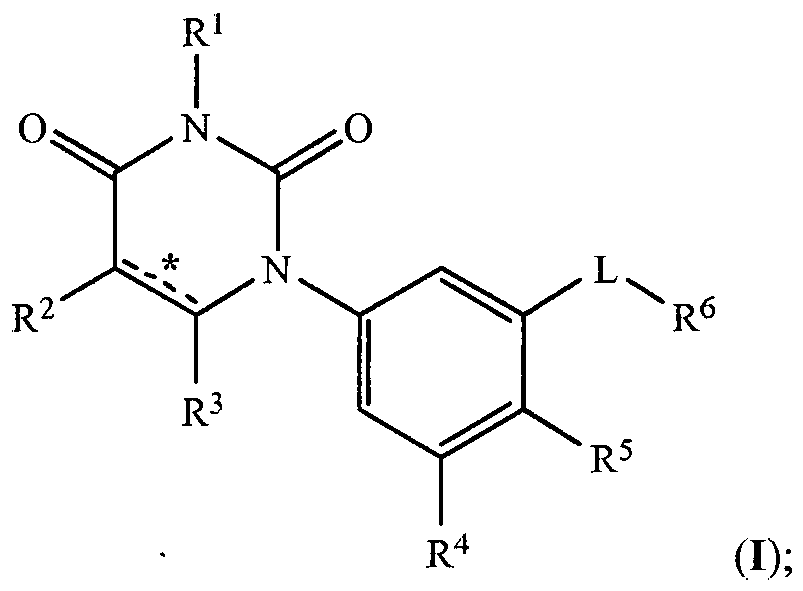 is selected from the group consisting of single carbon-carbon bond and double carbon- carbon bond;
 R1 is selected from the group consisting of hydrogen and methyl;R2 is selected from the group consisting of hydrogen, halo, hydroxy, methyl, cyclopropyl, and cyclobutyl;R3 is selected from the group consisting of hydrogen, halo, oxo, and methyl;R4 is selected from the group consisting of halo, alkyl, alkenyl, alkynyl, nitro, cyano, azido, alkyloxy, alkenyloxy, alkynyloxy, amino, aminocarbonyl, aminosulfonyl, alkylsulfonyl, carbocyclyl, and heterocyclyl, wherein:(a) the amino, aminocarbonyl, and aminosulfonyl optionally are substituted with:(1) one or two substituents independently selected from the group consisting of alkyl, alkenyl, alkynyl, and alkylsulfonyl, or(2) two substituents that, together with the amino nitrogen, form a single-ring heterocyclyl, and(b) the alkyl, alkenyl, alkynyl, alkyloxy, alkenyloxy, alkynyloxy, and alkylsulfonyl, optionally are substituted with one or more substituents independently selected from the group consisting of halo, oxo, nitro, cyano, azido, hydroxy, amino, alkyloxy, trimethylsilyl, carbocyclyl, and heterocyclyl, wherein:the amino optionally is substituted with:(1) one or two substituents independently selected from the group consisting of alkyl, alkenyl, alkynyl, alkylcarbonyl, alkylsulfonyl, alkyloxycarbonyl, carbocyclyl, heterocyclyl, carbocyclylalkyl, and heterocyclylalkyl, or(2) two substituents that, together with the amino nitrogen, form a single-ring heterocyclyl, and(c) the carbocyclyl and heterocyclyl optionally are substituted with up to three substituents independently selected from the group consisting of alkyl, alkenyl, alkynyl, halo, oxo, nitro, cyano, azido, hydroxy, amino, alkyloxy, trimethylsilyl, carbocyclyl, and heterocyclyl, wherein:the amino optionally is substituted with:(1) one or two substituents independently selected from the group consisting of alkyl, alkenyl, alkynyl, alkylcarbonyl, alkylsulfonyl, alkyloxycarbonyl, carbocyclyl, heterocyclyl, carbocyclylalkyl, and heterocyclylalkyl, or(2) two substituents that, together with the amino nitrogen, form a single-ring heterocyclyl;R5 is selected from the group consisting of hydrogen, hydroxy, alkyl, alkenyl, alkynyl, alkyloxy, alkenyloxy, alkynyloxy, alkylsulfonyloxy, carbocyclylsulfonyloxy, haloalkylsulfonyloxy, and halo;L is C=C;R6 is selected from the group consisting of C5-C6-carbocyclyl and 5-6-membered heterocyclyl, wherein each such substituent optionally is substituted with one or more substituents independently selected from the group consisting of RE, RF, RG, RH, RI, RJ, and RK;each RE is independently selected from the group consisting of halo, nitro, hydroxy, oxo, carboxy, cyano, amino, imino, azido, and aldehydo, wherein:the amino optionally is substituted with one or two substituents independently selected from the group consisting of alkyl, alkenyl, and alkynyl;each RF is independently selected from the group consisting of alkyl, alkenyl, and alkynyl, wherein:each such substituent optionally is substituted with one or more substituents independently selected from the group consisting of carboxy, hydroxy, halo, amino, imino, nitro, azido, oxo, aminosulfonyl, alkylsulfonyl, alkyloxycarbonyl, alkenyloxycarbonyl, alkynyloxycarbonyl, alkylcarbonyloxy, alkenylcarbonyloxy, alkynylcarbonyloxy, alkyloxy, alkenyloxy, alkynyloxy, carbocyclyl, heterocyclyl, cyano, and aminocarbonyl, wherein:the amino, imino, aminosulfonyl, aminocarbonyl, carbocyclyl, and heterocyclyl optionally are substituted with one or two substituents independently selected from the group consisting of alkyl, alkenyl, alkynyl, alkylsulfonyl, alkenylsulfonyl, alkynylsulfonyl, alkylsulfonylamino, hydroxy, and alkyloxy,wherein:amino portion of the alkylsulfonylamino optionally is substituted with a substituent selected from the group consisting of alkyl, alkenyl, and alkynyl;each RG is independently selected from the group consisting of carbocyclyl and heterocyclyl, wherein:each such substituent optionally is substituted with one or more substituents independently selected from the group consisting of alkyl, alkenyl, alkynyl, carboxy, hydroxy, halo, amino, nitro, azido, oxo, aminosulfonyl, alkyloxycarbonyl, alkenyloxycarbonyl, alkynyloxycarbonyl, alkylcarbonyloxy, alkenylcarbonyloxy, alkynylcarbonyloxy, alkyloxy, alkenyloxy, alkynyloxy, carbocyclyl, heterocyclyl, cyano, and aminocarbonyl, wherein:the amino, aminosulfonyl, and aminocarbonyl optionally are substituted with one or two substituents independently selected from the group consisting of alkyl, alkenyl, alkynyl, alkylsulfonyl, alkenylsulfonyl, and alkynylsulfonyl;each RH is independently selected from the group consisting of alkyloxy, alkenyloxy, alkynyloxy, alkylsulfonyloxy, alkenylsulfonyloxy, and alkynylsulfonyloxy, wherein:each such substituent optionally is substituted with one or more substituents independently selected from the group consisting of carboxy, hydroxy, halo, amino, nitro, azido, oxo, aminosulfonyl, alkyloxycarbonyl, alkenyloxycarbonyl, alkynyloxycarbonyl, alkylcarbonyloxy, alkenylcarbonyloxy, alkynylcarbonyloxy, alkyloxy, alkenyloxy, alkynyloxy, carbocyclyl, heterocyclyl, cyano, and aminocarbonyl, wherein:the amino, aminosulfonyl, and aminocarbonyl optionally are substituted with one or two substituents independently selected from the group consisting of alkyl, alkenyl, alkynyl, alkylsulfonyl, alkenylsulfonyl, and alkynylsulfonyl;each RI is independently selected from the group consisting of alkylcarbonyl, alkenylcarbonyl, alkynylcarbonyl, aminocarbonyl, alkyloxycarbonyl, carbocyclylcarbonyl, and heterocyclylcarbonyl, wherein:(a) the alkylcarbonyl, alkenylcarbonyl, and alkynylcarbonyl optionally are substituted with one or more substituents independently selected from the group consisting of carboxy, hydroxy, halo, amino, nitro, azido, oxo, aminosulfonyl, alkyloxycarbonyl, alkenyloxycarbonyl, alkynyloxycarbonyl, alkylcarbonyloxy, alkenylcarbonyloxy, alkynylcarbonyloxy, alkyloxy, alkenyloxy, alkynyloxy, carbocyclyl, heterocyclyl, cyano, and aminocarbonyl, and(b) the aminocarbonyl optionally is substituted with one or two substituents independently selected from the group consisting of alkyl, alkenyl, alkynyl, alkyloxyalkyl, carbocyclyl, heterocyclyl, alkylsulfonyl, and alkylsulfonylamino, wherein:the carbocyclyl and heterocyclyl optionally are substituted with one or two substituents independently selected from the group consisting of halo, alkyl, and oxo;each RJ is independently selected from the group consisting of carbocyclylsulfonylamino, heterocyclylsulfonylamino, alkylcarbonylamino, alkenylcarbonylamino, alkynylcarbonylamino, alkyloxycarbonylamino, alkenyloxycarbonylamino, alkynyloxycarbonylamino, alkylsulfonylamino, alkenylsulfonylamino, alkynylsulfonylamino, aminocarbonylamino, alkyloxycarbonylaminoimino, alkylsulfonylaminoimino, alkenylsulfonylaminoimino, and alkynylsulfonylaminoimino, wherein:(a) the amino portion of such substituents optionally is substituted with a substituent independently selected from the group consisting of carbocyclylalkyl, heterocyclylalkyl, alkylcarbonyloxy, aminocarbonylalkyl, alkyl, alkenyl, alkynyl, alkylcarbonyl, alkenylcarbonyl, alkynylcarbonyl, alkyloxycarbonyl, alkyloxyalkyloxycarbonyl, alkylcarbonyloxyalkyl, and alkylsulfonyl, wherein:(1) the carbocyclyl portion of the carbocyclylalkyl and the heterocyclyl portion of the heterocyclylalkyl optionally are substituted with one or more substituents independently selected from the group consisting of alkyl, alkenyl, alkynyl, carboxy, hydroxy, alkyloxy, alkenyloxy, alkynyloxy, halo, nitro, cyano, azido, oxo, and amino, and(2) the amino portion of the aminocarbonylalkyl optionally is substituted with one or two substituents independently selected from the group consisting of alkyl, alkenyl, and alkynyl,(b) the alkyl, alkenyl, and alkynyl portion of such substituents optionally is substituted with one or more substituents independently selected from the group consisting of carboxy, halo, oxo, amino, alkyloxycarbonyl, alkylcarbonyloxy, hydroxy, alkyloxy, carbocyclyl, heterocyclyl, and cyano, wherein:the amino optionally is substituted with one or two substituents independently selected from the group consisting of alkyl, alkenyl, alkynyl, alkyloxy, alkenyloxy, and alkynyloxy, wherein:the alkyl optionally is substituted with one or more hydroxy;(c) the carbocyclyl and heterocyclyl portions of such substituents optionally are substituted with one or more substituents independently selected from the group consisting of alkyl, alkenyl, alkynyl, carboxy, hydroxy, alkyloxy, alkenyloxy, alkynyloxy, halo, nitro, cyano, azido, and amino, wherein:the amino optionally is substituted with one or two substituents independently selected from the group consisting of alkyl, alkenyl, and alkynyl; andeach RK is independently selected from the group consisting of aminosulfonyl, alkylsulfonyl, alkenylsulfonyl, and alkynylsulfonyl, wherein:(a) the alkylsulfonyl, alkenylsulfonyl, and alkynylsulfonyl optionally are substituted with one or more substituents independently selected from the group consisting of carboxy, hydroxy, halo, amino, nitro, azido, oxo, aminosulfonyl, alkyloxycarbonyl, alkenyloxycarbonyl, alkynyloxycarbonyl, alkylcarbonyloxy, alkenylcarbonyloxy, alkynylcarbonyloxy, alkyloxy, alkenyloxy, alkynyloxy, carbocyclyl, heterocyclyl, cyano, and aminocarbonyl, wherein:the amino, aminosulfonyl, and aminocarbonyl optionally are substituted with one or two substituents independently selected from the group consisting of alkyl, alkenyl, and alkynyl; and(b) the aminosulfonyl optionally is substituted with one or two substituents independently selected from the group consisting of alkyl, alkenyl, and alkynyl.
 - The compound or salt of claim 1, wherein:R1 is selected from the group consisting of hydrogen and methyl;R2 is selected from the group consisting of hydrogen and halo;R3 is selected from the group consisting of hydrogen and halo;R4 is selected from the group consisting of C1-C4-alkyl, C3-C6-carbocyclyl, and 5-6-membered heterocyclyl, wherein:(a) the C1-C4-alkyl optionally is substituted with up to three substituents independently selected from the group consisting of halo, oxo, hydroxy, alkyloxy, and trimethylsilyl, and(b) the C3-C6-carbocyclyl and 5-6-membered heterocyclyl optionally are substituted with one or two substituents independently selected from the group consisting of alkyl, halo, and alkylsulfonylamino;R5 is selected from the group consisting of hydrogen, hydroxy, alkyloxy, and halo;R6 is selected from the group consisting of C5-C6-carbocyclyl and 5-6-membered heterocyclyl, wherein each such substituent is substituted with one, two, or three substituents independently selected from the group consisting of RE , RF, RG, RH, RI, RJ, and RK;each RE is independently selected from the group consisting of chloro, fluoro, nitro, hydroxy, oxo, carboxy, amino, imino, aldehydo, and alkylamino;each RF is an independently selected alkyl optionally substituted with a substituent selected from the group consisting of carboxy, halo, amino, imino, and aminosulfonyl, wherein:the amino, imino, and aminosulfonyl optionally are substituted with one or two substituents independently selected from the group consisting of alkyl, alkylsulfonyl, and alkylsulfonylamino;each RI is independently selected from the group consisting of alkylcarbonyl and aminocarbonyl, wherein:the aminocarbonyl optionally is substituted with a substituent selected from the group consisting of alkyl, alkyloxyalkyl, alkylsulfonyl, and alkylsulfonylamino;each RJ is independently selected from the group consisting of alkylsulfonylamino, alkenylsulfonylamino, alkynylsulfonylamino, and alkylsulfonylaminoimino, wherein:(a) the amino portion of such substituents optionally is substituted with a substituent independently selected from the group consisting of carbocyclylalkyl, heterocyclylalkyl, alkylcarbonyloxy, aminocarbonylalkyl, alkyl, alkylcarbonyl, alkyloxycarbonyl, alkyloxyalkyloxycarbonyl, alkylcarbonyloxyalkyl, and alkylsulfonyl, wherein:(1) the carbocyclyl portion of the carbocyclylalkyl and the heterocyclyl portion of the heterocyclylalkyl optionally are substituted with one or two substituents independently selected from the group consisting of alkyl, carboxy, hydroxy, alkyloxy, halo, nitro, cyano, oxo, and amino, and(2) the amino portion of the aminocarbonylalkyl optionally is substituted with one or two substituents independently selected from the group consisting of alkyl, alkenyl, and alkynyl,(b) the alkyl, alkenyl, and alkynyl portion of such substituents optionally is substituted with one or two substituents independently selected from the group consisting of carboxy, halo, oxo, amino, alkyloxycarbonyl, alkylcarbonyloxy, hydroxy, alkyloxy, carbocyclyl, heterocyclyl, and cyano, wherein:the amino optionally is substituted with one or two substituents independently selected from the group consisting of alkyl and alkyloxy, wherein:the alkyl optionally is substituted with one or more hydroxy; andeach RK is independently selected from the group consisting of aminosulfonyl and alkylsulfonyl, wherein:(a) the alkylsulfonyl optionally is substituted with one or two substituents independently selected from the group consisting of carboxy, hydroxy, halo, amino, nitro, oxo, aminosulfonyl, alkyloxycarbonyl, alkylcarbonyloxy, alkyloxy, carbocyclyl, heterocyclyl, cyano, and aminocarbonyl; and(b) the aminosulfonyl optionally is substituted with one or two substituents independently selected alkyl.
- The compound or salt of claim 1, whereinis a double carbon-carbon bond.
- The compound or salt of claim 1, wherein R1 is hydrogen.
- The compound or salt of claim 1, wherein R2 is hydrogen.
- The compound or salt of claim 1, wherein R3 is hydrogen.
- The compound or salt of claim 1, wherein R4 is selected from the group consisting of tert-butyl, C3-C6-carbocyclyl, and 5-6-membered heterocyclyl.
- The compound or salt of claim 1, wherein R4 is tert-butyl.
- The compound or salt of claim 1, wherein R5 is selected from the group consisting of hydrogen and methoxy.
- The compound or salt of claim 1, wherein R5 is methoxy.
- The compound or salt of claim 1, wherein R6 is selected from the group consisting of C5-C6-carbocyclyl and 5-6-membered heterocyclyl, wherein each such substituent is substituted with one, two, or three substituents independently selected from the group consisting of RE, RF, RG, RH, RI, RJ, and RK.
- The compound or salt of claim 1, wherein R6 is C5-C6-carbocyclyl substituted with one, two, or three substituents independently selected from the group consisting of RE, RF, RG, RH, RI, RJ, and RK.
- The compound or salt of claim 1, wherein each RJ is methylsulfonylamino.
- The compound or salt of claim 1, wherein the compound is selected from the group consisting of:N-(4-((3-tert-butyl-5-(2,4-dioxotetrahydropyrimidin-1(2H)-yl)-2-methoxyphenyl)ethynyl)-3-methylphenyl)methanesulfonamide;N-(4-((3-tert-butyl-5-(2,4-dioxotetrahydropyrimidin-1(2H)-yl) phenyl)ethynyl)-3-chloro- phenyl)methanesulfonamide;N-(6-((3-tert-butyl-5-(2,4-dioxotetrahydropyrimidin-1(2H)-yl)-2-methoxyphenyl)ethynyl) pyridin-3-yl)methanesulfonamide;N-(4-((3-tert-butyl-5-(2,4-dioxotetrahydropyrimidin-1(2H)-yl)-2-methoxyphenyl)ethynyl)-3-(trifluoromethyl)phenyl)methanesulfonamide;N-(4-((3-cyclopropyl-5-(2,4-dioxotetrahydropyrimidin-1(2H)-yl)-2-methoxyphenyl)ethynyl) phenyl)methanesulfonamide;N-(4-((3-tert-butyl-5-(2,4-dioxo-3,4-dihydropyrimidin-1(2H)-yl)-2-methoxyphenyl)ethynyl) phenyl)methanesulfonamide;N-(4-((3-tert-butyl-5-(2,4-dioxo-3,4-dihydropyrimidin-1(2H)-yl)-2-methoxyphenyl)ethynyl)-3-methylphenyl)methanesulfonamide;N-(4-((3-tert-butyl-5-(2,4-dioxo-3,4-dihydropyrimidin-1(2H)-yl) phenyl)ethynyl)-3-chloro- phenyl)methanesulfonamide;N-(6-((3-tert-butyl-5-(2,4-dioxo-3,4-dihydropyrimidin-1(2H)-yl)-2-methoxyphenyl)ethynyl) pyridin-3-yl)methanesulfonamide;N-(4-((3-tert-butyl-5-(2,4-dioxo-3,4-dihydropyrimidin-1(2H)-yl)-2-methoxyphenyl)ethynyl)-3-(trifluoromethyl)phenyl)methanesulfonamide; andN-(4-((3-cyclopropyl-5-(2,4-dioxo-3,4-dihydropyrimidin-1(2H)-yl)-2-methoxyphenyl)ethynyl) phenyl)methanesulfonamide.
- The compound or salt of claim 1, wherein the compound is selected from the group of compounds shown in Tables 17-20 below
TABLE 17 
compound R5 R6 ring/ring structure substituent(s) IA-L2-1.1 -H phenyl -4-N(H)S(O)2CH3 IA-L2-1.2 -H phenyl -2-CH3 and -4-N(H)S(O)2CH3 IA-L2-1.3 -H phenyl -2-Cl and -4-N(H)S(O)2CH3 IA-L2-1.4 -OCH3 phenyl None IA-L2-1.26 -OCH3 pyridin-3-yl -6-N(H)S(O)2CH3 IA-L2-1.7 -OCH3 phenyl -3-N(H)S(O)2CH3 IA-L2-1.8 -OCH3 phenyl -4-N(H)S(O)2CH3 ILA-L2-1.9 -OCH3 phenyl -2-CH3 and -4-N(H)S(O)2CH3 IA-L2-1.10 -OCH3 phenyl -3-CH3 and -4-N(H)S(O)2CH3 IA-L2-1.11 -OCH3 phenyl 2-C(H)2C(H)3 and -4-N(H)S(O)2CH3 IA-L2-1.12 -OCH3 phenyl -2-F and -4-N(H)S(O)2CH3 IA-L2-1.13 -OCH3 phenyl -3-F and -4-N(H)S(O)2CH3 IA-L2-1.14 -OCH3 phenyl -2-Cl and -4-N(H)S(O)2CH3 IA-L2-1.15 -OCH3 phenyl -3-Cl and -4-N(H)S(O)2CH3 IA-L2-1.16 -OCH3 phenyl -2-OCH3 and -4-N(H)S(O)2CH3 IA-L2-1.17 -OCH3 phenyl -3-OCF3 and -4-N(H)S(O)2CH3 IA-L2-1.18 -OCH3 phenyl -2-CF3 and -4-N(H)S(O)2CH3 IA-L2-1.19 -OCH3 phenyl -3-CF3 and -4-N(H)S(O)2CH3 IA-L2-1.20 -OCH3 phenyl -2-CH3 and -4-N(H)S(O)2CH3 and -5-F IA-L2-1.21 -OCH3 phenyl -2-Cl and -3-F and -4-N(H)S(O)2CH3 IA-L2-1.22 -OCH3 phenyl -2-CF3 and -4-N(H)S(O)2CH3 and -5-F IA-L2-1.24 -OCH3 pyridin-2-yl -3-CH3 and -5-N(H)S(O)2CH3 IA-L2-1.25 -OCH3 pyridin-2-yl -5-N(H)S(O)2CH3 IA-L2-1.26 -OCH3 pyridin-3-yl -6-N(H)S(O)2CH3 [C(F)3C(O)OH salt] 
TABLE 19 
compound R6 ring/ring structure substituent(s) IB-L2-1.1 phenyl -2-CH3 and -4-N(H)S(O)2CH3 IB-L2-1.2 phenyl -2-Cl and -4-N(H)S(O)2CH3 IB-L2-1.3 phenyl -2-CH3 and -4-N(H)S(O)2CH3 and -5-F IB-L2-1.4 phenyl -3-F and -4-N(H)S(O)2CH3 and -5-F IB-L2-1.5 phenyl -2-CF3 and -4-N(H)S(O)2CH3 and -5-F IB-L2-1.6 phenyl -2-OH and -4-N(H)S(O)2CH3 IB-L2-1.7 phenyl -2-C(O)OCH3 and -4-N(H)S(O)2CH3 IB-L2-1.8 pyridin-2-yl -5-N(H)S(O)2CH3 IB-L2-1.9 pyrazin-2-yl -5-N(H)S(O)2CH3 IB-L2-1.10 phenyl -2-C(CH3)3 and -4-N(H)S(O)2CH3 IB-L2-1.11 phenyl 
and -4-N(H)S(O)2CH3 IB-L2-1.12 phenyl -2-N(H)C(O)CH3 and -4-N(H)S(O)2CH3 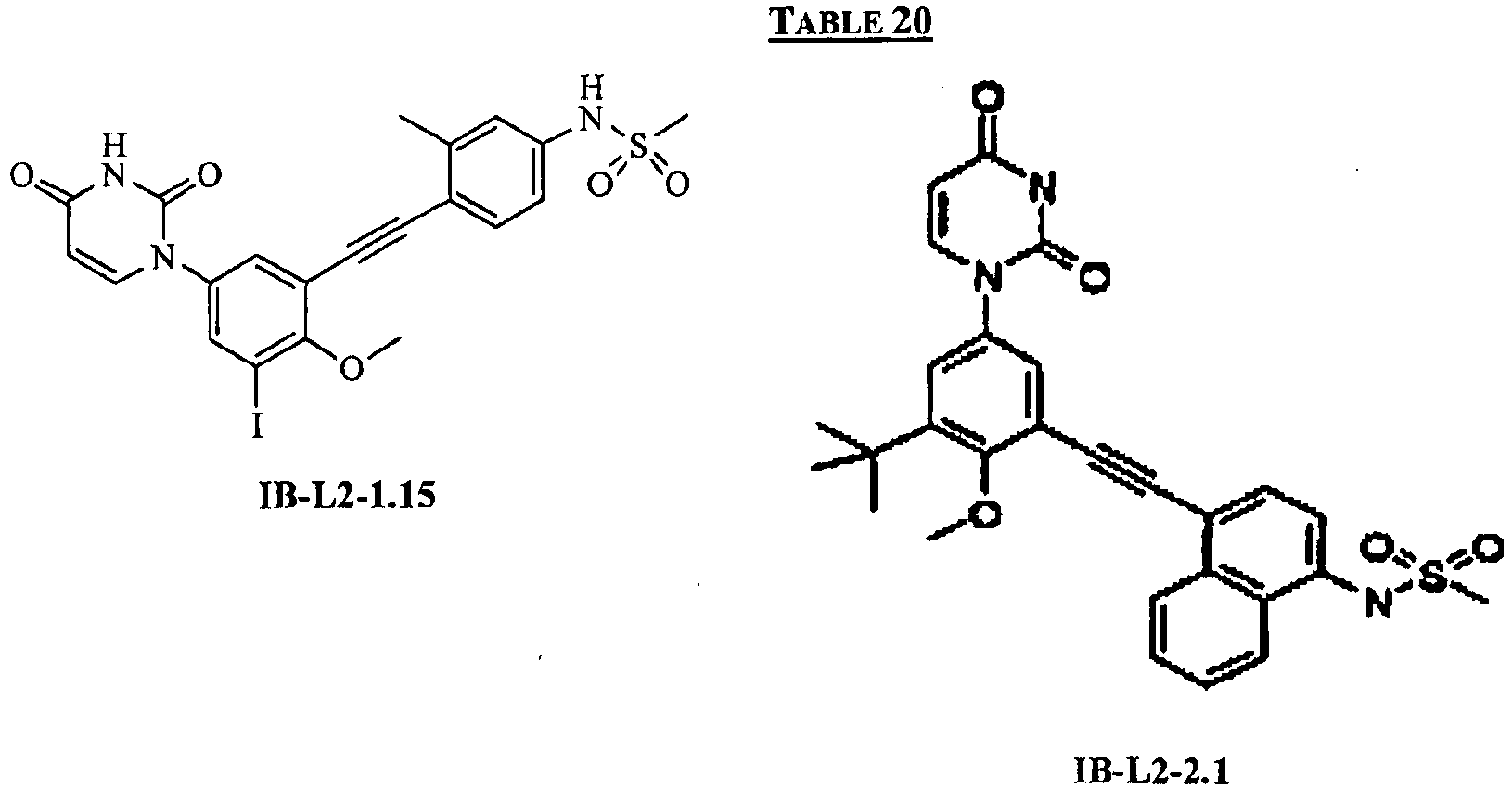
Priority Applications (1)
| Application Number | Priority Date | Filing Date | Title |
|---|---|---|---|
| EP13193524.9A EP2725015A1 (en) | 2007-09-17 | 2008-09-17 | Uracil or thymine derivative for treating hepatitis c |
Applications Claiming Priority (3)
| Application Number | Priority Date | Filing Date | Title |
|---|---|---|---|
| US97287707P | 2007-09-17 | 2007-09-17 | |
| US9679108P | 2008-09-13 | 2008-09-13 | |
| PCT/US2008/076576 WO2009039127A1 (en) | 2007-09-17 | 2008-09-17 | Uracil or thymine derivative for treating hepatitis c |
Related Child Applications (2)
| Application Number | Title | Priority Date | Filing Date |
|---|---|---|---|
| EP13193524.9A Division EP2725015A1 (en) | 2007-09-17 | 2008-09-17 | Uracil or thymine derivative for treating hepatitis c |
| EP13193524.9A Division-Into EP2725015A1 (en) | 2007-09-17 | 2008-09-17 | Uracil or thymine derivative for treating hepatitis c |
Publications (2)
| Publication Number | Publication Date |
|---|---|
| EP2222646A1 EP2222646A1 (en) | 2010-09-01 |
| EP2222646B1 true EP2222646B1 (en) | 2014-01-22 |
Family
ID=39948002
Family Applications (2)
| Application Number | Title | Priority Date | Filing Date |
|---|---|---|---|
| EP13193524.9A Withdrawn EP2725015A1 (en) | 2007-09-17 | 2008-09-17 | Uracil or thymine derivative for treating hepatitis c |
| EP08831873.8A Not-in-force EP2222646B1 (en) | 2007-09-17 | 2008-09-17 | Uracil or thymine derivative for treating hepatitis c |
Family Applications Before (1)
| Application Number | Title | Priority Date | Filing Date |
|---|---|---|---|
| EP13193524.9A Withdrawn EP2725015A1 (en) | 2007-09-17 | 2008-09-17 | Uracil or thymine derivative for treating hepatitis c |
Country Status (30)
| Country | Link |
|---|---|
| US (3) | US8415351B2 (en) |
| EP (2) | EP2725015A1 (en) |
| JP (2) | JP5734654B2 (en) |
| KR (2) | KR101660360B1 (en) |
| CN (2) | CN101801935B (en) |
| AR (2) | AR070027A1 (en) |
| AU (1) | AU2008302448B2 (en) |
| BR (1) | BRPI0816994B8 (en) |
| CA (2) | CA2976793A1 (en) |
| CL (2) | CL2008002794A1 (en) |
| CO (1) | CO6260076A2 (en) |
| CR (2) | CR11316A (en) |
| DO (2) | DOP2010000084A (en) |
| ES (1) | ES2453591T3 (en) |
| GT (1) | GT201000061A (en) |
| IL (1) | IL204547A (en) |
| IN (1) | IN2012DN05113A (en) |
| MX (2) | MX2010002905A (en) |
| MY (1) | MY162760A (en) |
| NZ (3) | NZ584720A (en) |
| PA (1) | PA8796201A1 (en) |
| PE (2) | PE20130209A1 (en) |
| PH (1) | PH12013500365A1 (en) |
| RU (2) | RU2543620C2 (en) |
| SG (1) | SG183733A1 (en) |
| TW (2) | TWI534137B (en) |
| UA (1) | UA117800C2 (en) |
| UY (1) | UY31344A1 (en) |
| WO (1) | WO2009039127A1 (en) |
| ZA (2) | ZA201204224B (en) |
Families Citing this family (76)
| Publication number | Priority date | Publication date | Assignee | Title |
|---|---|---|---|---|
| DK2203431T3 (en) * | 2007-09-17 | 2011-11-21 | Abbott Lab | Anti-infectious pyrimidines and their applications |
| WO2009039135A1 (en) * | 2007-09-17 | 2009-03-26 | Abbott Laboratories | N-phenyl-dioxo-hydropyrimidines useful as hepatitis c virus (hcv) inhibitors |
| TWI534137B (en) | 2007-09-17 | 2016-05-21 | 艾伯維巴哈馬有限公司 | Anti-infective agents and uses thereof |
| CA2705586A1 (en) * | 2007-11-16 | 2009-05-22 | Schering Corporation | 3-heterocyclic substituted indole derivatives and methods of use thereof |
| BRPI0916233A2 (en) | 2008-07-23 | 2018-03-13 | F.Hoffman-La Roche Ag | antiviral heterocyclic compounds |
| CA2736472A1 (en) | 2008-09-26 | 2010-04-01 | F. Hoffmann-La Roche Ag | Pyrine or pyrazine derivatives for treating hcv |
| MX2011010049A (en) * | 2009-03-24 | 2011-10-11 | Abbott Lab | Process for preparing antiviral compound. |
| JP5571167B2 (en) * | 2009-03-25 | 2014-08-13 | アッヴィ・インコーポレイテッド | Antiviral composition and use thereof |
| EP2411007A4 (en) * | 2009-03-27 | 2012-12-05 | Uab Research Foundation | MODULATION OF MEDIATION TRANSLATION BY IRES SEQUENCES |
| SG175774A1 (en) | 2009-04-25 | 2011-12-29 | Hoffmann La Roche | Heterocyclic antiviral compounds |
| TWI428332B (en) | 2009-06-09 | 2014-03-01 | Hoffmann La Roche | Heterocyclic antiviral compounds |
| EP2445875A2 (en) | 2009-06-24 | 2012-05-02 | F. Hoffmann-La Roche AG | Heterocyclic antiviral compound |
| JP2011057661A (en) * | 2009-08-14 | 2011-03-24 | Bayer Cropscience Ag | Pesticidal carboxamides |
| MX2012003170A (en) | 2009-09-21 | 2012-04-11 | Hoffmann La Roche | Heterocyclic antiviral compounds. |
| CN102639504A (en) * | 2009-11-21 | 2012-08-15 | 弗·哈夫曼-拉罗切有限公司 | Heterocyclic antiviral compounds |
| WO2011073114A1 (en) | 2009-12-14 | 2011-06-23 | F. Hoffmann-La Roche Ag | Heterocyclic antiviral compounds |
| US9216952B2 (en) | 2010-03-23 | 2015-12-22 | Abbvie Inc. | Process for preparing antiviral compound |
| MX2012014235A (en) | 2010-07-07 | 2013-01-28 | Hoffmann La Roche | Heterocyclic antiviral compounds. |
| BR112013001138A2 (en) | 2010-07-16 | 2016-07-05 | Abbvie Inc | phosphine binders for catalytic reactions |
| WO2012009699A2 (en) * | 2010-07-16 | 2012-01-19 | Abbott Laboratories | Process for preparing antiviral compounds |
| AU2015201698B2 (en) * | 2010-07-16 | 2017-02-02 | Abbvie Ireland Unlimited Company | Process for preparing antiviral compounds |
| US9255074B2 (en) | 2010-07-16 | 2016-02-09 | Abbvie Inc. | Process for preparing antiviral compounds |
| US8975443B2 (en) | 2010-07-16 | 2015-03-10 | Abbvie Inc. | Phosphine ligands for catalytic reactions |
| RU2436786C1 (en) * | 2010-07-23 | 2011-12-20 | Александр Васильевич Иващенко | Substituted indoles, antiviral active component, synthesis and application method |
| WO2012020725A1 (en) * | 2010-08-10 | 2012-02-16 | 塩野義製薬株式会社 | Heterocyclic derivative having npy y5 receptor antagonism |
| CA2806547A1 (en) | 2010-08-13 | 2012-02-16 | F. Hoffmann-La Roche Ag | Heterocyclic antiviral compounds |
| CN102675092B (en) * | 2011-03-14 | 2014-11-05 | 江苏中丹药物研究有限公司 | Method for preparing 2-aryl-2,2-dimethyl methyl acetate |
| EP2685964A1 (en) | 2011-03-18 | 2014-01-22 | AbbVie Inc. | Formulations of phenyl uracil compounds |
| AU2012234259A1 (en) * | 2011-03-31 | 2013-10-03 | Libera-Korner, Jeanette | Perfluorinated compounds for the non-viral transfer of nucleic acids |
| US10201584B1 (en) | 2011-05-17 | 2019-02-12 | Abbvie Inc. | Compositions and methods for treating HCV |
| JP5734124B2 (en) * | 2011-07-21 | 2015-06-10 | 株式会社 東邦アーステック | Process for producing 1,3-diiodohydantoins |
| US9040516B2 (en) | 2011-08-01 | 2015-05-26 | Sumitomo Dainippon Pharma Co., Ltd. | Uracil derivative and use thereof for medical purposes |
| US8492386B2 (en) | 2011-10-21 | 2013-07-23 | Abbvie Inc. | Methods for treating HCV |
| AU2015200715A1 (en) * | 2011-10-21 | 2015-03-05 | Abbvie Ireland Unlimited Company | Methods for treating HCV |
| US8466159B2 (en) | 2011-10-21 | 2013-06-18 | Abbvie Inc. | Methods for treating HCV |
| CN104023726A (en) | 2011-10-21 | 2014-09-03 | 艾伯维公司 | Combination therapy with one or more DAAs used to treat HCV (eg, with ABT-072 or ABT-333) |
| CA2811203C (en) | 2011-10-21 | 2015-05-05 | Abbvie Inc. | Methods for treating hcv |
| US9340537B2 (en) | 2012-05-15 | 2016-05-17 | Novatis Ag | Benzamide derivatives for inhibiting the activity of ABL1, ABL2 and BCR-ABL1 |
| JP6080947B2 (en) | 2012-05-15 | 2017-02-15 | ノバルティス アーゲー | Compounds and compositions for inhibiting the activity of ABL1, ABL2 and BCR-ABL1 |
| PT2861579T (en) | 2012-05-15 | 2018-04-27 | Novartis Ag | Benzamide derivatives for inhibiting the activity of abl1, abl2 and bcr-abl1 |
| US9278981B2 (en) | 2012-05-15 | 2016-03-08 | Novartis Ag | Compounds and compositions for inhibiting the activity of ABL1, ABL2 and BCR-ABL1 |
| WO2014004674A2 (en) | 2012-06-27 | 2014-01-03 | Abbvie Inc. | Methods for treating hcv |
| CN104884440A (en) * | 2012-08-21 | 2015-09-02 | 艾伯维公司 | Process for preparing antiviral compounds |
| BR112015008927A2 (en) * | 2012-10-18 | 2017-07-04 | Abbvie Inc | formulations of pyrimidinedione derivatives |
| JP2014101316A (en) * | 2012-11-20 | 2014-06-05 | Toyobo Co Ltd | METHOD OF MANUFACTURING BENZO[1,2-d;4,5-d']BISTHIAZOLE COMPOUND |
| WO2015002952A1 (en) | 2013-07-02 | 2015-01-08 | Abbvie Inc. | Methods for treating hcv |
| EP3019481B1 (en) | 2013-07-08 | 2019-03-06 | Bayer CropScience Aktiengesellschaft | Six-membered c-n linked arylsulfide and arylsulfoxide derivatives as pesticides |
| DK3043803T3 (en) | 2013-09-11 | 2022-08-01 | Univ Emory | Nucleotide and nucleoside compounds and their applications |
| WO2015103490A1 (en) | 2014-01-03 | 2015-07-09 | Abbvie, Inc. | Solid antiviral dosage forms |
| WO2015116594A1 (en) | 2014-01-28 | 2015-08-06 | Abbvie Inc. | Dose adjustment in combination therapy of hepatitis c |
| EP3527569B1 (en) | 2014-02-03 | 2021-08-25 | Vitae Pharmaceuticals, LLC | Dihydropyrrolopyridine inhibitors of ror-gamma for use in treating drye eye |
| WO2015197028A1 (en) * | 2014-06-28 | 2015-12-30 | Sunshine Lake Pharma Co., Ltd. | Compounds as hepatitis c virus (hcv) inhibitors and uses thereof in medicine |
| WO2016004513A1 (en) * | 2014-07-11 | 2016-01-14 | Simon Fraser University | Anti-bacterial pyruvate kinase modulator compounds, compositions, uses and methods |
| ES2896400T3 (en) | 2014-08-01 | 2022-02-24 | Nuevolution As | Active compounds against bromdomains |
| WO2016040588A1 (en) | 2014-09-11 | 2016-03-17 | Abbvie Inc. | Treatment of hcv by administering four different anti-hcv compounds with food |
| TWI675032B (en) | 2014-10-14 | 2019-10-21 | 美商維它藥物公司 | Dihydropyrrolopyridine inhibitors of ror-gamma |
| US9663515B2 (en) | 2014-11-05 | 2017-05-30 | Vitae Pharmaceuticals, Inc. | Dihydropyrrolopyridine inhibitors of ROR-gamma |
| US9845308B2 (en) | 2014-11-05 | 2017-12-19 | Vitae Pharmaceuticals, Inc. | Isoindoline inhibitors of ROR-gamma |
| WO2016105547A1 (en) | 2014-12-24 | 2016-06-30 | Concert Pharmaceuticals, Inc. | Deuterated dasabuvir |
| RU2590952C1 (en) * | 2015-05-26 | 2016-07-10 | Вячеслав Энгельсович Семёнов | Hepatoprotective action agent |
| WO2016196280A1 (en) | 2015-06-02 | 2016-12-08 | E I Du Pont De Nemours And Company | Heterocycle-substituted bicyclic pesticides |
| KR20180030913A (en) * | 2015-07-30 | 2018-03-26 | 브리스톨-마이어스 스큅 컴퍼니 | Aryl-substituted bicyclic heteroaryl compounds |
| ES2856931T3 (en) | 2015-08-05 | 2021-09-28 | Vitae Pharmaceuticals Llc | ROR-gamma modulators |
| EP3868750A1 (en) | 2015-11-20 | 2021-08-25 | Vitae Pharmaceuticals, LLC | Modulators of ror-gamma |
| TW202220968A (en) | 2016-01-29 | 2022-06-01 | 美商維它藥物有限責任公司 | Modulators of ror-gamma |
| JP7129703B2 (en) | 2016-04-28 | 2022-09-02 | エモリー ユニバーシティー | Alkyne-Containing Nucleotide and Nucleoside Therapeutic Compositions and Uses Associated Therewith |
| US9481674B1 (en) | 2016-06-10 | 2016-11-01 | Vitae Pharmaceuticals, Inc. | Dihydropyrrolopyridine inhibitors of ROR-gamma |
| MA49685A (en) | 2017-07-24 | 2021-04-14 | Vitae Pharmaceuticals Llc | MMR gamma INHIBITORS |
| WO2019018975A1 (en) | 2017-07-24 | 2019-01-31 | Vitae Pharmaceuticals, Inc. | Inhibitors of ror gamma |
| CN107266373A (en) * | 2017-08-01 | 2017-10-20 | 安徽拜善晟制药有限公司 | A kind of bulk drug Da Shabuwei preparation method |
| CN118754858A (en) | 2018-03-26 | 2024-10-11 | 诺华股份有限公司 | N-(3-(7H-pyrrolo[2,3-d]pyrimidin-4-yl)phenyl)benzamide derivatives |
| CN110483496B (en) * | 2019-07-17 | 2021-05-04 | 杭州市西溪医院 | A class of derivatives with uracil-benzothiazole structure, its preparation method and application of anti-HCV drugs |
| CN114521196A (en) * | 2019-09-16 | 2022-05-20 | 诺华股份有限公司 | Bifunctional group degradation agent and use method thereof |
| EP3819006A1 (en) | 2019-11-05 | 2021-05-12 | Technische Universität Dresden | Compounds with thymine skeleton for use in medicine |
| CN111518036A (en) * | 2020-04-29 | 2020-08-11 | 杭州勇诚睿生物科技有限公司 | A kind of preparation method of dasabuvir key intermediate |
| US12274700B1 (en) | 2020-10-30 | 2025-04-15 | Accencio LLC | Methods of treating symptoms of coronavirus infection with RNA polymerase inhibitors |
Family Cites Families (21)
| Publication number | Priority date | Publication date | Assignee | Title |
|---|---|---|---|---|
| US4239888A (en) * | 1974-11-04 | 1980-12-16 | Pfizer Inc. | 1-Phenyluracils |
| JPS60243017A (en) | 1984-05-16 | 1985-12-03 | Kyowa Hakko Kogyo Co Ltd | Antispasmodic composition |
| US5084084A (en) | 1989-07-14 | 1992-01-28 | Nissan Chemical Industries Ltd. | Uracil derivatives and herbicides containing the same as active ingredient |
| AU627906B2 (en) | 1989-07-14 | 1992-09-03 | Nissan Chemical Industries Ltd. | Uracil derivatives and herbicides containing the same as active ingredient |
| US5162326A (en) | 1990-02-15 | 1992-11-10 | Takeda Chemical Industries, Ltd. | Pyrimidinedione derivatives, their production and use |
| NL9001075A (en) | 1990-05-04 | 1991-12-02 | Duphar Int Res | |
| EP0489480A1 (en) * | 1990-12-05 | 1992-06-10 | Nissan Chemical Industries Ltd. | Uracil derivatives and herbicides containing the same as active ingredient |
| JPH05213755A (en) | 1992-02-07 | 1993-08-24 | Nikko Kyodo Co Ltd | Therapeutic agent for hepatopathy |
| DE19528305A1 (en) | 1995-08-02 | 1997-02-06 | Bayer Ag | Substituted phenyluracile |
| US6380387B1 (en) | 1999-12-06 | 2002-04-30 | Hoffmann-La Roche Inc. | 4-Pyrimidinyl-n-acyl-l phenylalanines |
| SI1237878T1 (en) | 1999-12-06 | 2007-08-31 | Hoffmann La Roche | 4-pyrimidinyl-n-acyl-l-phenylalanines |
| IL141034A0 (en) | 2000-02-04 | 2002-02-10 | Sumitomo Chemical Co | Uracil compounds and use thereof |
| RU2264395C2 (en) * | 2000-02-04 | 2005-11-20 | Сумитомо Кемикал Компани, Лимитед | Uracil derivatives, herbicide composition, method for control of weed and intermediate substances (variants) |
| PY0111577A (en) | 2000-05-23 | 2017-01-02 | Idenix Cayman Ltd | METHODS AND COMPOSITIONS FOR THE TREATMENT OF HEPATITIS C VIRUS |
| TW200505872A (en) * | 2003-06-13 | 2005-02-16 | Lg Life Science Ltd | Hepatitis C virus inhibitors |
| US7163937B2 (en) | 2003-08-21 | 2007-01-16 | Bristol-Myers Squibb Company | Cyclic derivatives as modulators of chemokine receptor activity |
| JO2934B1 (en) * | 2006-06-23 | 2015-09-15 | سميث كلاين بيتشام كوربوريشن | Prolyl Hydroxylase Inhibitors |
| DK2203431T3 (en) * | 2007-09-17 | 2011-11-21 | Abbott Lab | Anti-infectious pyrimidines and their applications |
| WO2009039135A1 (en) * | 2007-09-17 | 2009-03-26 | Abbott Laboratories | N-phenyl-dioxo-hydropyrimidines useful as hepatitis c virus (hcv) inhibitors |
| TWI534137B (en) * | 2007-09-17 | 2016-05-21 | 艾伯維巴哈馬有限公司 | Anti-infective agents and uses thereof |
| BRPI0916233A2 (en) | 2008-07-23 | 2018-03-13 | F.Hoffman-La Roche Ag | antiviral heterocyclic compounds |
-
2008
- 2008-09-17 TW TW103110394A patent/TWI534137B/en not_active IP Right Cessation
- 2008-09-17 KR KR1020157010052A patent/KR101660360B1/en not_active Expired - Fee Related
- 2008-09-17 EP EP13193524.9A patent/EP2725015A1/en not_active Withdrawn
- 2008-09-17 IN IN5113DEN2012 patent/IN2012DN05113A/en unknown
- 2008-09-17 JP JP2010525102A patent/JP5734654B2/en not_active Expired - Fee Related
- 2008-09-17 RU RU2010114828/04A patent/RU2543620C2/en not_active IP Right Cessation
- 2008-09-17 KR KR1020107008431A patent/KR101552474B1/en active Active
- 2008-09-17 WO PCT/US2008/076576 patent/WO2009039127A1/en not_active Ceased
- 2008-09-17 SG SG2012060521A patent/SG183733A1/en unknown
- 2008-09-17 NZ NZ584720A patent/NZ584720A/en not_active IP Right Cessation
- 2008-09-17 NZ NZ618277A patent/NZ618277A/en not_active IP Right Cessation
- 2008-09-17 CN CN200880107764.3A patent/CN101801935B/en not_active Expired - Fee Related
- 2008-09-17 BR BRPI0816994A patent/BRPI0816994B8/en active IP Right Grant
- 2008-09-17 CN CN201210157072.8A patent/CN102746239B/en not_active Expired - Fee Related
- 2008-09-17 AR ARP080104045A patent/AR070027A1/en active IP Right Grant
- 2008-09-17 MY MYPI2010001141A patent/MY162760A/en unknown
- 2008-09-17 PE PE2012002073A patent/PE20130209A1/en not_active Application Discontinuation
- 2008-09-17 PA PA20088796201A patent/PA8796201A1/en unknown
- 2008-09-17 CA CA2976793A patent/CA2976793A1/en not_active Abandoned
- 2008-09-17 NZ NZ600371A patent/NZ600371A/en not_active IP Right Cessation
- 2008-09-17 PE PE2008001621A patent/PE20090705A1/en active IP Right Grant
- 2008-09-17 EP EP08831873.8A patent/EP2222646B1/en not_active Not-in-force
- 2008-09-17 MX MX2010002905A patent/MX2010002905A/en active IP Right Grant
- 2008-09-17 CL CL2008002794A patent/CL2008002794A1/en unknown
- 2008-09-17 UY UY31344A patent/UY31344A1/en active IP Right Grant
- 2008-09-17 ES ES08831873.8T patent/ES2453591T3/en active Active
- 2008-09-17 CA CA2699981A patent/CA2699981C/en not_active Expired - Fee Related
- 2008-09-17 AU AU2008302448A patent/AU2008302448B2/en not_active Ceased
- 2008-09-17 TW TW097135721A patent/TWI437994B/en not_active IP Right Cessation
- 2008-09-17 UA UAA201302816A patent/UA117800C2/en unknown
-
2010
- 2010-03-15 GT GT201000061A patent/GT201000061A/en unknown
- 2010-03-16 CO CO10030957A patent/CO6260076A2/en active IP Right Grant
- 2010-03-16 DO DO2010000084A patent/DOP2010000084A/en unknown
- 2010-03-16 MX MX2012004779A patent/MX338555B/en unknown
- 2010-03-16 CR CR11316A patent/CR11316A/en unknown
- 2010-03-16 IL IL204547A patent/IL204547A/en active Protection Beyond IP Right Term
- 2010-03-17 US US12/725,689 patent/US8415351B2/en not_active Expired - Fee Related
- 2010-12-21 DO DO2010000396A patent/DOP2010000396A/en unknown
-
2012
- 2012-04-03 US US13/438,609 patent/US8685991B2/en not_active Expired - Fee Related
- 2012-06-08 ZA ZA2012/04224A patent/ZA201204224B/en unknown
- 2012-06-08 ZA ZA2012/04223A patent/ZA201204223B/en unknown
- 2012-08-06 AR ARP120102873A patent/AR087472A2/en unknown
- 2012-10-11 JP JP2012225875A patent/JP2013049681A/en active Pending
-
2013
- 2013-02-01 RU RU2013104270/04A patent/RU2599635C2/en not_active IP Right Cessation
- 2013-02-06 CL CL2013000372A patent/CL2013000372A1/en unknown
- 2013-02-25 PH PH12013500365A patent/PH12013500365A1/en unknown
-
2014
- 2014-03-31 US US14/230,965 patent/US9095590B2/en not_active Expired - Fee Related
-
2015
- 2015-05-08 CR CR20150238A patent/CR20150238A/en unknown
Also Published As
Similar Documents
| Publication | Publication Date | Title |
|---|---|---|
| EP2203430B1 (en) | N-phenyl-dioxo-hydropyrimidines useful as hepatitis c virus (hcv) inhibitors | |
| ES2453591T3 (en) | Uracil or thymine derivative for hepatitis C treatment | |
| EP2411352B1 (en) | Antiviral compounds and uses thereof | |
| EP2421845B1 (en) | Antiviral compounds and uses thereof | |
| HK1147256B (en) | Uracil or thymine derivative for treating hepatitis c | |
| HK1145839B (en) | N-phenyl-dioxo-hydropyrimidines useful as hepatitis c virus (hcv) inhibitors | |
| HK1182090A (en) | N-phenyl-dioxo-hydropyrimidines useful as hepatitis c virus (hcv) inhibitors | |
| ES2365650T3 (en) | N-PHENYL-DIOXO-HYDROXYPYRIMIDINES USEFUL AS INHIBITORS OF THE HEPATITIS C VIRUS (HCV). | |
| HK1167857B (en) | Antiviral compounds and uses thereof | |
| HK1166797B (en) | Antiviral compounds and uses thereof | |
| HK1166797A (en) | Antiviral compounds and uses thereof |
Legal Events
| Date | Code | Title | Description |
|---|---|---|---|
| PUAI | Public reference made under article 153(3) epc to a published international application that has entered the european phase |
Free format text: ORIGINAL CODE: 0009012 |
|
| 17P | Request for examination filed |
Effective date: 20100419 |
|
| AK | Designated contracting states |
Kind code of ref document: A1 Designated state(s): AT BE BG CH CY CZ DE DK EE ES FI FR GB GR HR HU IE IS IT LI LT LU LV MC MT NL NO PL PT RO SE SI SK TR |
|
| AX | Request for extension of the european patent |
Extension state: AL BA MK RS |
|
| 18D | Application deemed to be withdrawn |
Effective date: 20100804 |
|
| D18D | Application deemed to be withdrawn (deleted) | ||
| DAX | Request for extension of the european patent (deleted) | ||
| REG | Reference to a national code |
Ref country code: HK Ref legal event code: DE Ref document number: 1147256 Country of ref document: HK |
|
| 17Q | First examination report despatched |
Effective date: 20111109 |
|
| GRAP | Despatch of communication of intention to grant a patent |
Free format text: ORIGINAL CODE: EPIDOSNIGR1 |
|
| RIC1 | Information provided on ipc code assigned before grant |
Ipc: C07D 239/54 20060101ALI20130325BHEP Ipc: A61K 31/513 20060101ALI20130325BHEP Ipc: C07D 239/22 20060101AFI20130325BHEP Ipc: C07D 403/10 20060101ALI20130325BHEP Ipc: A61P 31/12 20060101ALI20130325BHEP Ipc: C07D 401/10 20060101ALI20130325BHEP |
|
| INTG | Intention to grant announced |
Effective date: 20130418 |
|
| GRAS | Grant fee paid |
Free format text: ORIGINAL CODE: EPIDOSNIGR3 |
|
| GRAA | (expected) grant |
Free format text: ORIGINAL CODE: 0009210 |
|
| RAP1 | Party data changed (applicant data changed or rights of an application transferred) |
Owner name: ABBVIE BAHAMAS LTD. |
|
| AK | Designated contracting states |
Kind code of ref document: B1 Designated state(s): AT BE BG CH CY CZ DE DK EE ES FI FR GB GR HR HU IE IS IT LI LT LU LV MC MT NL NO PL PT RO SE SI SK TR |
|
| REG | Reference to a national code |
Ref country code: CH Ref legal event code: EP |
|
| REG | Reference to a national code |
Ref country code: AT Ref legal event code: REF Ref document number: 650744 Country of ref document: AT Kind code of ref document: T Effective date: 20140215 |
|
| REG | Reference to a national code |
Ref country code: IE Ref legal event code: FG4D |
|
| REG | Reference to a national code |
Ref country code: DE Ref legal event code: R096 Ref document number: 602008030120 Country of ref document: DE Effective date: 20140306 |
|
| REG | Reference to a national code |
Ref country code: ES Ref legal event code: FG2A Ref document number: 2453591 Country of ref document: ES Kind code of ref document: T3 Effective date: 20140408 |
|
| REG | Reference to a national code |
Ref country code: NL Ref legal event code: VDEP Effective date: 20140122 |
|
| REG | Reference to a national code |
Ref country code: AT Ref legal event code: MK05 Ref document number: 650744 Country of ref document: AT Kind code of ref document: T Effective date: 20140122 |
|
| REG | Reference to a national code |
Ref country code: LT Ref legal event code: MG4D |
|
| PG25 | Lapsed in a contracting state [announced via postgrant information from national office to epo] |
Ref country code: IS Free format text: LAPSE BECAUSE OF FAILURE TO SUBMIT A TRANSLATION OF THE DESCRIPTION OR TO PAY THE FEE WITHIN THE PRESCRIBED TIME-LIMIT Effective date: 20140522 Ref country code: NO Free format text: LAPSE BECAUSE OF FAILURE TO SUBMIT A TRANSLATION OF THE DESCRIPTION OR TO PAY THE FEE WITHIN THE PRESCRIBED TIME-LIMIT Effective date: 20140422 Ref country code: LT Free format text: LAPSE BECAUSE OF FAILURE TO SUBMIT A TRANSLATION OF THE DESCRIPTION OR TO PAY THE FEE WITHIN THE PRESCRIBED TIME-LIMIT Effective date: 20140122 |
|
| PG25 | Lapsed in a contracting state [announced via postgrant information from national office to epo] |
Ref country code: AT Free format text: LAPSE BECAUSE OF FAILURE TO SUBMIT A TRANSLATION OF THE DESCRIPTION OR TO PAY THE FEE WITHIN THE PRESCRIBED TIME-LIMIT Effective date: 20140122 Ref country code: SE Free format text: LAPSE BECAUSE OF FAILURE TO SUBMIT A TRANSLATION OF THE DESCRIPTION OR TO PAY THE FEE WITHIN THE PRESCRIBED TIME-LIMIT Effective date: 20140122 Ref country code: FI Free format text: LAPSE BECAUSE OF FAILURE TO SUBMIT A TRANSLATION OF THE DESCRIPTION OR TO PAY THE FEE WITHIN THE PRESCRIBED TIME-LIMIT Effective date: 20140122 Ref country code: CY Free format text: LAPSE BECAUSE OF FAILURE TO SUBMIT A TRANSLATION OF THE DESCRIPTION OR TO PAY THE FEE WITHIN THE PRESCRIBED TIME-LIMIT Effective date: 20140122 Ref country code: NL Free format text: LAPSE BECAUSE OF FAILURE TO SUBMIT A TRANSLATION OF THE DESCRIPTION OR TO PAY THE FEE WITHIN THE PRESCRIBED TIME-LIMIT Effective date: 20140122 Ref country code: PT Free format text: LAPSE BECAUSE OF FAILURE TO SUBMIT A TRANSLATION OF THE DESCRIPTION OR TO PAY THE FEE WITHIN THE PRESCRIBED TIME-LIMIT Effective date: 20140522 |
|
| PG25 | Lapsed in a contracting state [announced via postgrant information from national office to epo] |
Ref country code: HR Free format text: LAPSE BECAUSE OF FAILURE TO SUBMIT A TRANSLATION OF THE DESCRIPTION OR TO PAY THE FEE WITHIN THE PRESCRIBED TIME-LIMIT Effective date: 20140122 Ref country code: BE Free format text: LAPSE BECAUSE OF FAILURE TO SUBMIT A TRANSLATION OF THE DESCRIPTION OR TO PAY THE FEE WITHIN THE PRESCRIBED TIME-LIMIT Effective date: 20140122 Ref country code: LV Free format text: LAPSE BECAUSE OF FAILURE TO SUBMIT A TRANSLATION OF THE DESCRIPTION OR TO PAY THE FEE WITHIN THE PRESCRIBED TIME-LIMIT Effective date: 20140122 |
|
| REG | Reference to a national code |
Ref country code: HK Ref legal event code: GR Ref document number: 1147256 Country of ref document: HK |
|
| REG | Reference to a national code |
Ref country code: DE Ref legal event code: R097 Ref document number: 602008030120 Country of ref document: DE |
|
| PG25 | Lapsed in a contracting state [announced via postgrant information from national office to epo] |
Ref country code: RO Free format text: LAPSE BECAUSE OF FAILURE TO SUBMIT A TRANSLATION OF THE DESCRIPTION OR TO PAY THE FEE WITHIN THE PRESCRIBED TIME-LIMIT Effective date: 20140122 Ref country code: CZ Free format text: LAPSE BECAUSE OF FAILURE TO SUBMIT A TRANSLATION OF THE DESCRIPTION OR TO PAY THE FEE WITHIN THE PRESCRIBED TIME-LIMIT Effective date: 20140122 Ref country code: EE Free format text: LAPSE BECAUSE OF FAILURE TO SUBMIT A TRANSLATION OF THE DESCRIPTION OR TO PAY THE FEE WITHIN THE PRESCRIBED TIME-LIMIT Effective date: 20140122 Ref country code: DK Free format text: LAPSE BECAUSE OF FAILURE TO SUBMIT A TRANSLATION OF THE DESCRIPTION OR TO PAY THE FEE WITHIN THE PRESCRIBED TIME-LIMIT Effective date: 20140122 |
|
| PG25 | Lapsed in a contracting state [announced via postgrant information from national office to epo] |
Ref country code: SK Free format text: LAPSE BECAUSE OF FAILURE TO SUBMIT A TRANSLATION OF THE DESCRIPTION OR TO PAY THE FEE WITHIN THE PRESCRIBED TIME-LIMIT Effective date: 20140122 Ref country code: PL Free format text: LAPSE BECAUSE OF FAILURE TO SUBMIT A TRANSLATION OF THE DESCRIPTION OR TO PAY THE FEE WITHIN THE PRESCRIBED TIME-LIMIT Effective date: 20140122 |
|
| PLBE | No opposition filed within time limit |
Free format text: ORIGINAL CODE: 0009261 |
|
| STAA | Information on the status of an ep patent application or granted ep patent |
Free format text: STATUS: NO OPPOSITION FILED WITHIN TIME LIMIT |
|
| 26N | No opposition filed |
Effective date: 20141023 |
|
| REG | Reference to a national code |
Ref country code: DE Ref legal event code: R097 Ref document number: 602008030120 Country of ref document: DE Effective date: 20141023 |
|
| PG25 | Lapsed in a contracting state [announced via postgrant information from national office to epo] |
Ref country code: LU Free format text: LAPSE BECAUSE OF FAILURE TO SUBMIT A TRANSLATION OF THE DESCRIPTION OR TO PAY THE FEE WITHIN THE PRESCRIBED TIME-LIMIT Effective date: 20140917 Ref country code: MC Free format text: LAPSE BECAUSE OF FAILURE TO SUBMIT A TRANSLATION OF THE DESCRIPTION OR TO PAY THE FEE WITHIN THE PRESCRIBED TIME-LIMIT Effective date: 20140122 |
|
| REG | Reference to a national code |
Ref country code: CH Ref legal event code: PL |
|
| PG25 | Lapsed in a contracting state [announced via postgrant information from national office to epo] |
Ref country code: SI Free format text: LAPSE BECAUSE OF FAILURE TO SUBMIT A TRANSLATION OF THE DESCRIPTION OR TO PAY THE FEE WITHIN THE PRESCRIBED TIME-LIMIT Effective date: 20140122 |
|
| REG | Reference to a national code |
Ref country code: IE Ref legal event code: MM4A |
|
| PG25 | Lapsed in a contracting state [announced via postgrant information from national office to epo] |
Ref country code: LI Free format text: LAPSE BECAUSE OF NON-PAYMENT OF DUE FEES Effective date: 20140930 Ref country code: CH Free format text: LAPSE BECAUSE OF NON-PAYMENT OF DUE FEES Effective date: 20140930 |
|
| PG25 | Lapsed in a contracting state [announced via postgrant information from national office to epo] |
Ref country code: IE Free format text: LAPSE BECAUSE OF NON-PAYMENT OF DUE FEES Effective date: 20140917 |
|
| PG25 | Lapsed in a contracting state [announced via postgrant information from national office to epo] |
Ref country code: BG Free format text: LAPSE BECAUSE OF FAILURE TO SUBMIT A TRANSLATION OF THE DESCRIPTION OR TO PAY THE FEE WITHIN THE PRESCRIBED TIME-LIMIT Effective date: 20140122 |
|
| PG25 | Lapsed in a contracting state [announced via postgrant information from national office to epo] |
Ref country code: MT Free format text: LAPSE BECAUSE OF FAILURE TO SUBMIT A TRANSLATION OF THE DESCRIPTION OR TO PAY THE FEE WITHIN THE PRESCRIBED TIME-LIMIT Effective date: 20140122 Ref country code: GR Free format text: LAPSE BECAUSE OF FAILURE TO SUBMIT A TRANSLATION OF THE DESCRIPTION OR TO PAY THE FEE WITHIN THE PRESCRIBED TIME-LIMIT Effective date: 20140423 |
|
| PG25 | Lapsed in a contracting state [announced via postgrant information from national office to epo] |
Ref country code: HU Free format text: LAPSE BECAUSE OF FAILURE TO SUBMIT A TRANSLATION OF THE DESCRIPTION OR TO PAY THE FEE WITHIN THE PRESCRIBED TIME-LIMIT; INVALID AB INITIO Effective date: 20080917 Ref country code: TR Free format text: LAPSE BECAUSE OF FAILURE TO SUBMIT A TRANSLATION OF THE DESCRIPTION OR TO PAY THE FEE WITHIN THE PRESCRIBED TIME-LIMIT Effective date: 20140122 |
|
| REG | Reference to a national code |
Ref country code: FR Ref legal event code: PLFP Year of fee payment: 9 |
|
| REG | Reference to a national code |
Ref country code: GB Ref legal event code: 732E Free format text: REGISTERED BETWEEN 20170518 AND 20170524 |
|
| REG | Reference to a national code |
Ref country code: FR Ref legal event code: PLFP Year of fee payment: 10 |
|
| REG | Reference to a national code |
Ref country code: DE Ref legal event code: R082 Ref document number: 602008030120 Country of ref document: DE Representative=s name: PATENTANWALTSKANZLEI MEYER, DE Ref country code: DE Ref legal event code: R081 Ref document number: 602008030120 Country of ref document: DE Owner name: ABBVIE IRELAND UNLIMITED COMPANY, BM Free format text: FORMER OWNER: ABBVIE BAHAMAS LTD., NASSAU, NEW PROVIDENCE, BS |
|
| REG | Reference to a national code |
Ref country code: FR Ref legal event code: TP Owner name: ABBVIE IRELAND UNLIMITED COMPANY, BM Effective date: 20170919 |
|
| REG | Reference to a national code |
Ref country code: FR Ref legal event code: PLFP Year of fee payment: 11 |
|
| PGFP | Annual fee paid to national office [announced via postgrant information from national office to epo] |
Ref country code: IT Payment date: 20190924 Year of fee payment: 12 Ref country code: FR Payment date: 20190819 Year of fee payment: 12 Ref country code: DE Payment date: 20190813 Year of fee payment: 12 |
|
| PGFP | Annual fee paid to national office [announced via postgrant information from national office to epo] |
Ref country code: GB Payment date: 20190827 Year of fee payment: 12 |
|
| PGFP | Annual fee paid to national office [announced via postgrant information from national office to epo] |
Ref country code: ES Payment date: 20191001 Year of fee payment: 12 |
|
| REG | Reference to a national code |
Ref country code: DE Ref legal event code: R119 Ref document number: 602008030120 Country of ref document: DE |
|
| GBPC | Gb: european patent ceased through non-payment of renewal fee |
Effective date: 20200917 |
|
| PG25 | Lapsed in a contracting state [announced via postgrant information from national office to epo] |
Ref country code: FR Free format text: LAPSE BECAUSE OF NON-PAYMENT OF DUE FEES Effective date: 20200930 Ref country code: DE Free format text: LAPSE BECAUSE OF NON-PAYMENT OF DUE FEES Effective date: 20210401 |
|
| PG25 | Lapsed in a contracting state [announced via postgrant information from national office to epo] |
Ref country code: GB Free format text: LAPSE BECAUSE OF NON-PAYMENT OF DUE FEES Effective date: 20200917 |
|
| PG25 | Lapsed in a contracting state [announced via postgrant information from national office to epo] |
Ref country code: IT Free format text: LAPSE BECAUSE OF NON-PAYMENT OF DUE FEES Effective date: 20200917 |
|
| REG | Reference to a national code |
Ref country code: ES Ref legal event code: FD2A Effective date: 20220118 |
|
| PG25 | Lapsed in a contracting state [announced via postgrant information from national office to epo] |
Ref country code: ES Free format text: LAPSE BECAUSE OF NON-PAYMENT OF DUE FEES Effective date: 20200918 |