EP2218566A1 - Procédé de fabrication par moulage sous pression d'une pièce composite à structure monolithique creuse - Google Patents
Procédé de fabrication par moulage sous pression d'une pièce composite à structure monolithique creuse Download PDFInfo
- Publication number
- EP2218566A1 EP2218566A1 EP09300006A EP09300006A EP2218566A1 EP 2218566 A1 EP2218566 A1 EP 2218566A1 EP 09300006 A EP09300006 A EP 09300006A EP 09300006 A EP09300006 A EP 09300006A EP 2218566 A1 EP2218566 A1 EP 2218566A1
- Authority
- EP
- European Patent Office
- Prior art keywords
- container
- composite material
- composite
- molding
- thermoplastic
- Prior art date
- Legal status (The legal status is an assumption and is not a legal conclusion. Google has not performed a legal analysis and makes no representation as to the accuracy of the status listed.)
- Granted
Links
Images

Classifications
-
- B—PERFORMING OPERATIONS; TRANSPORTING
- B29—WORKING OF PLASTICS; WORKING OF SUBSTANCES IN A PLASTIC STATE IN GENERAL
- B29C—SHAPING OR JOINING OF PLASTICS; SHAPING OF MATERIAL IN A PLASTIC STATE, NOT OTHERWISE PROVIDED FOR; AFTER-TREATMENT OF THE SHAPED PRODUCTS, e.g. REPAIRING
- B29C70/00—Shaping composites, i.e. plastics material comprising reinforcements, fillers or preformed parts, e.g. inserts
- B29C70/68—Shaping composites, i.e. plastics material comprising reinforcements, fillers or preformed parts, e.g. inserts by incorporating or moulding on preformed parts, e.g. inserts or layers, e.g. foam blocks
- B29C70/86—Incorporated in coherent impregnated reinforcing layers, e.g. by winding
- B29C70/865—Incorporated in coherent impregnated reinforcing layers, e.g. by winding completely encapsulated
-
- B—PERFORMING OPERATIONS; TRANSPORTING
- B29—WORKING OF PLASTICS; WORKING OF SUBSTANCES IN A PLASTIC STATE IN GENERAL
- B29C—SHAPING OR JOINING OF PLASTICS; SHAPING OF MATERIAL IN A PLASTIC STATE, NOT OTHERWISE PROVIDED FOR; AFTER-TREATMENT OF THE SHAPED PRODUCTS, e.g. REPAIRING
- B29C33/00—Moulds or cores; Details thereof or accessories therefor
- B29C33/44—Moulds or cores; Details thereof or accessories therefor with means for, or specially constructed to facilitate, the removal of articles, e.g. of undercut articles
- B29C33/48—Moulds or cores; Details thereof or accessories therefor with means for, or specially constructed to facilitate, the removal of articles, e.g. of undercut articles with means for collapsing or disassembling
- B29C33/485—Moulds or cores; Details thereof or accessories therefor with means for, or specially constructed to facilitate, the removal of articles, e.g. of undercut articles with means for collapsing or disassembling cores or mandrels
-
- B—PERFORMING OPERATIONS; TRANSPORTING
- B29—WORKING OF PLASTICS; WORKING OF SUBSTANCES IN A PLASTIC STATE IN GENERAL
- B29C—SHAPING OR JOINING OF PLASTICS; SHAPING OF MATERIAL IN A PLASTIC STATE, NOT OTHERWISE PROVIDED FOR; AFTER-TREATMENT OF THE SHAPED PRODUCTS, e.g. REPAIRING
- B29C70/00—Shaping composites, i.e. plastics material comprising reinforcements, fillers or preformed parts, e.g. inserts
- B29C70/04—Shaping composites, i.e. plastics material comprising reinforcements, fillers or preformed parts, e.g. inserts comprising reinforcements only, e.g. self-reinforcing plastics
- B29C70/28—Shaping operations therefor
- B29C70/40—Shaping or impregnating by compression not applied
- B29C70/42—Shaping or impregnating by compression not applied for producing articles of definite length, i.e. discrete articles
- B29C70/46—Shaping or impregnating by compression not applied for producing articles of definite length, i.e. discrete articles using matched moulds, e.g. for deforming sheet moulding compounds [SMC] or prepregs
- B29C70/462—Moulding structures having an axis of symmetry or at least one channel, e.g. tubular structures, frames
Definitions
- the present invention is in the field of the manufacture of composite material parts consisting of fibers embedded in a thermoplastic or thermosetting matrix.
- It relates to a method of manufacturing by die casting of a composite piece with a hollow monolithic structure, as well as the part obtained by this method.
- thermoplastic or thermosetting matrix composite material having a hollow structure one consists, on the one hand, in molding under pressure a part of the hollow part to be produced, using an inner shape and an outer shape and, on the other hand, to mold parallel the other part of said part, then to assemble the two parts by gluing or other securing methods, to reconstruct the desired part.
- a hollow part manufactured according to such a method does not guarantee, when necessary, continuity of reinforcing fibers at the junction of the two parts, which is detrimental to the mechanical performance of said part.
- Another known method is to mold the composite material under pressure on a fusible core, the latter being removed after molding, through an orifice in the room.
- these fusible cores do not make it possible to guarantee the internal shape of the part, which can, according to the nature of said core, collapse from a certain level of pressure.
- the current methods of molding under pressure can use very high pressures, up to 200 bars for example as described in the patent EP 1 382 436 in the name of the present inventor.
- the object of the present invention is to propose a method of manufacturing that makes it possible to remedy this deficiency, as well as the part obtained by this method.
- a composite material is used for the production of the composite, which has a resistance at a temperature greater than or equal to that of the composite material used for producing the part.
- thermosetting matrix Although this characteristic may seem obvious for composite materials with a thermosetting matrix, this is not the case for composite materials with thermoplastic matrices. However, it has been found that by using, for example, the same thermoplastic matrix composite material for producing the container and the part, that is to say having the same melting temperature, the melting temperature rise of the container during pressure molding of the final part had no effect on the final shape of said container, and more particularly on that of its internal cavity.
- the incompressible material in the form of a powder consists of glass powder of small particle size.
- the molding of the container is carried out on a metal core.
- more than one container is used in the production of a part in order to create more than one cavity therein.
- the first two steps of the manufacturing process consist in the manufacture of a container 1, comprising an open part 10 and a plug 11 adapted, in particular through a complementary shape, of in order to make it possible to close the open part 10 to form the container 1.
- the open portion 10 and the plug 11 are made of a composite material consisting of fibers embedded in a thermoplastic or thermosetting matrix, preferably they are made of the same composite material.
- the open portion 10 is obtained by molding on a core, preferably metal, to create an internal cavity 12, which may have different shapes, even complex.
- the plug 11 is also obtained by molding, it has a profile adapted to allow sealing of the open portion 10.
- the next step of the process according to the invention consists in filling the open part 10 with an incompressible material 2 in the form of a powder, and which has holding properties at temperatures higher than that of melting of the composite material of which the open part is made 10.
- this material 2 used consists of glass powder, so as to be able to treat all the known composite materials.
- the material 2 used preferably has a very small particle size, so as to ensure optimum filling of the open portion 10.
- the plug 11 is subjected to the open portion 10.
- the plug 11 can be glued, while in the case of a thermoplastic matrix, it can be provided an adjusted fitting associated with a specific tightening.
- container 1 represented on the figure 3 , and which consists of a closed envelope made of composite material, whose internal cavity 12, not visible, is filled with material 2.
- This container 1 is intended to constitute the core of the part 3 to be manufactured, represented on the figure 4 .
- the container 1 has thus been wrapped in a layer 30 of composite material consisting of reinforcing fibers and of a thermoplastic or thermosetting matrix, as can be seen in FIG. figure 5 to form a monolithic envelope that guarantees continuity of the reinforcing fibers.
- the assembly thus formed is then molded by being subjected to particular conditions of temperature and pressure, according to a pressure molding process such as, without limitation, that described in the patent. EP 1 382 436 .
- the container 1 retains its integrity and does not collapse due to its filling with the material 2.
- thermoplastic materials for the container 1 and the layer 30
- a complete melting operation can be obtained making it possible to obtain a part 3 whose hollow monolithic structure is composed of a single composite material, and which has a cavity 32 which is none other than the cavity 12, as shown in FIG. figure 7 .
- the method according to the invention makes it possible to manufacture composite parts with a hollow monolithic structure, without discontinuity of the reinforcing fibers.
- reinforcing fibers may be arranged, without limitation, in plies or else wound continuously in one or more chosen directions, also without discontinuity.
- the method according to the invention makes it possible to manufacture parts each comprising more than one cavity, where each of the cavities is obtained through a container 1.
- the various containers 1 each intended to create a cavity may be connected to each other by means of reinforcing fibers, in the form of braids for example, so as to enhance the cohesion of the part to be manufactured.
Landscapes
- Engineering & Computer Science (AREA)
- Mechanical Engineering (AREA)
- Chemical & Material Sciences (AREA)
- Composite Materials (AREA)
- Casting Or Compression Moulding Of Plastics Or The Like (AREA)
- Moulds For Moulding Plastics Or The Like (AREA)
- Laminated Bodies (AREA)
- Moulding By Coating Moulds (AREA)
Abstract
Description
- La présente invention entre dans le domaine de la fabrication de pièces en matériau composite constitué de fibres noyées dans une matrice thermoplastique ou thermodurcissable.
- Elle a pour objet un procédé de fabrication par moulage sous pression d'une pièce composite à structure monolithique creuse, ainsi que la pièce obtenue par ce procédé.
- Parmi les procédés connus de fabrication par moulage sous pression de pièces en matériau composite à matrice thermoplastique ou thermodurcissable présentant une structure creuse, l'un consiste, d'une part, à mouler sous pression une partie de la pièce creuse à réaliser, en utilisant une forme interne et une forme externe et, d'autre part, à mouler parallèlement l'autre partie de ladite pièce, puis à assembler les deux parties par collage ou par d'autre procédés de solidarisation, afin de reconstituer la pièce souhaitée. Une pièce creuse fabriquée selon un tel procédé ne permet pas de garantir, lorsque cela est nécessaire, une continuité des fibres de renforts au niveau de la jonction des deux parties, ce qui est préjudiciable aux performances mécaniques de ladite pièce.
- Un autre procédé connu consiste à mouler le matériau composite sous pression sur un noyau fusible, ce dernier étant évacué après moulage, au travers d'un orifice pratiqué dans la pièce. Ces procédés de fabrication sont généralement limités à une certaine classe de matériaux composites dont les températures de mise en oeuvre doivent impérativement être compatibles avec celles des noyaux fusibles utilisés.
- D'autre part, ces noyaux fusibles ne permettent pas de garantir la forme interne de la pièce, laquelle peut, selon la nature dudit noyau, s'effondrer à partir d'un certain niveau de pression. En effet, les procédés actuels de moulage sous pression peuvent faire appel à de très hautes pressions, allant jusqu'à 200 bars par exemple tel que décrit dans le brevet
EP 1 382 436 au nom du présent inventeur. - I1 n'existe pas actuellement de procédé de fabrication par moulage sous pression d'un matériau composite constitué de fibres noyées dans une matrice thermoplastique ou thermodurcissable, permettant d'obtenir une pièce à structure monolithique creuse.
- La présente invention a pour but de proposer un procédé de fabrication permettant de remédier à cette carence, ainsi que la pièce obtenue par ce procédé.
- Le procédé de fabrication par moulage sous pression d'une pièce composite à structure monolithique creuse dans le domaine de la fabrication de pièces en matériau composite constitué de fibres noyées dans une matrice thermoplastique ou thermodurcissable, se caractérise essentiellement en ce qu'il consiste à réaliser les étapes successives suivantes :
- moulage, dans un matériau composite, constitué de fibres et d'une matrice thermoplastique ou thermodurcissable, d'au moins un conteneur ouvert, ainsi que d'un bouchon de fermeture dudit conteneur ouvert,
- remplissage total dudit conteneur ouvert avec un matériau incompressible se présentant sous forme de poudre, et comportant des propriétés de tenue à des températures supérieures à la température de fusion du matériau composite dont est fait ledit conteneur ouvert,
- fermeture dudit conteneur avec ledit bouchon,
- enveloppement dudit conteneur fermé avec un matériau composite constitué de fibres et d'une matrice thermoplastique ou thermodurcissable,
- moulage de la pièce sous pression en utilisant comme noyau ledit conteneur fermé et chargé,
- après démoulage, perçage d'au moins trou dans la pièce, et extraction dudit matériau incompressible par ledit trou.
- Selon une caractéristique additionnelle du procédé selon l'invention, on utilise pour la réalisation du conteneur, un matériau composite qui présente une tenue à la température supérieure ou égale à celle du matériau composite utilisé pour la réalisation de la pièce.
- Si cette caractéristique peut paraître évidente pour des matériaux composites à matrice thermodurcissable, il n'en est pas de même pour les matériaux composites à matrices thermoplastiques. On a toutefois constaté qu'en utilisant, par exemple, le même matériau composite à matrice thermoplastique pour réaliser le conteneur et la pièce, c'est-à-dire ayant la même température de fusion, la montée à température de fusion du conteneur lors du moulage sous pression de la pièce finale, n'avait aucune incidence sur la forme finale dudit conteneur, et plus particulièrement sur celle de sa cavité interne.
- Selon une autre caractéristique additionnelle du procédé selon l'invention, le matériau incompressible se présentant sous forme de poudre consiste en de la poudre de verre de faible granulométrie.
- Selon une autre caractéristique additionnelle du procédé selon l'invention, on réalise le moulage du conteneur sur un noyau métallique.
- Selon une autre caractéristique additionnelle du procédé selon l'invention, on utilise plus d'un conteneur dans la réalisation d'une pièce afin de créer dans celle-ci plus d'une cavité.
- Selon une autre caractéristique additionnelle du procédé selon l'invention, avant l'enveloppement des conteneurs fermés avec un matériau composite constitué de fibres et d'une matrice thermoplastique ou thermodurcissable, on relie lesdits conteneurs entre eux au moyen de fibres de renfort.
- Les avantages et les caractéristiques du procédé selon l'invention, ressortiront plus clairement de la description qui suit et qui se rapporte au dessin annexé, lequel en représente un mode de réalisation non limitatif.
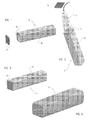
- Dans le dessin annexé :
- les
figures 1, 2, 3 et 4 représente des vues schématiques en perspective illustrant des étapes successives du procédé de fabrication d'une pièce en matériau composite selon l'invention. - la
figure 5 représente une vue schématique en coupe transversale la pièce à fabriquer au cours du procédé selon l'invention. - la
figure 6 représente une vue schématique en perspective illustrant une autre étape du même procédé. - la
figure 7 représente une vue schématique en perspective et en coupe longitudinale de la pièce obtenue par le procédé selon l'invention. - En référence à la
figure 1 , on peut voir que les deux premières étapes du procédé de fabrication consistent en la fabrication d'un conteneur 1, comprenant une partie ouverte 10 et un bouchon 11 adapté, notamment au travers d'une forme complémentaire, de manière à permettre de fermer la partie ouverte 10 pour former le conteneur 1. - La partie ouverte 10 et le bouchon 11 sont réalisés dans un matériau composite constitué de fibres noyées dans une matrice thermoplastique ou thermodurcissable, de préférence ils sont réalisés dans le même matériau composite.
- La partie ouverte 10 est obtenue par moulage sur un noyau, de préférence métallique, permettant de créer une cavité interne 12, laquelle peut présenter différentes formes, même complexes. Le bouchon 11 est également obtenu par moulage, il présente un profil adapté à permettre une fermeture étanche de la partie ouverte 10.
- En référence à la
figure 2 , on peut voir que l'étape suivante du procédé selon l'invention consiste à remplir la partie ouverte 10 avec un matériau incompressible 2 se présentant sous forme de poudre, et qui comporte des propriétés de tenue à des températures supérieures à celle de fusion du matériau composite dont est faite la partie ouverte 10. - De manière avantageuse ce matériau 2 utilisé consiste en de la poudre verre, en sorte de pouvoir traiter tous les matériaux composites connus.
- Par ailleurs, le matériau 2 utilisé présente de préférence une granulométrie très réduite, en sorte de garantir un remplissage optimal de la partie ouverte 10.
- Après remplissage total, le bouchon 11 est assujetti à la partie ouverte 10. Dans le cas de matériaux composites à matrice thermodurcissable, le bouchon 11 peut être collé, tandis que dans le cas d'une matrice thermoplastique, il peut être prévu un montage ajusté associé à un serrage spécifique.
- On obtient ainsi le conteneur 1 représenté sur la
figure 3 , et qui consiste en une enveloppe fermée réalisée en matériau composite, dont la cavité interne 12, non visible, est remplie de matériau 2. - Ce conteneur 1 est destiné à constituer le noyau de la pièce 3 à fabriquer, représentée sur la
figure 4 . Le conteneur 1 a ainsi été enveloppé d'une couche 30 de matériau composite constitué de fibres de renfort et d'une matrice thermoplastique ou thermodurcissable, comme cela est visible sur lafigure 5 , pour constituer une enveloppe monolithique qui garantit une continuité des fibres de renfort. - L'ensemble ainsi constitué est ensuite moulé en étant soumis à dans des conditions particulières de température et de pression, selon un procédé de moulage sous pression tel que, non limitativement, celui décrit dans le brevet
EP 1 382 436 . - Lors de cette opération de moulage sous haute pression, le conteneur 1 conserve toute son intégrité et ne s'effondre pas du fait de son remplissage avec le matériau 2.
- Après consolidation de la pièce 3, on y pratique un trou 31, comme cela est visible sur la
figure 6 , afin de permettre l'évacuation du matériau 2. - I1 y a lieu de remarquer qu'il est possible qu'il soit nécessaire, selon la nature et/ou la complexité de la forme de la pièce à fabriquer, d'avoir à pratiquer plusieurs trous. De même, il est possible après extraction du matériau 2, de boucher le ou les trous 31.
- Selon la nature du matériau ou des matériaux du conteneur 1 et de la couche 30, il peut y avoir fusion entre elles des différentes parties qui composent la pièce 3.
- Ainsi, dans le cas d'un conteneur 1 fait d'une matrice thermoplastique, il peut y avoir lors de l'opération de moulage, fusion du bouchon 11 avec la partie ouverte 10.
- Dans le cas d'utilisation des matériaux thermoplastiques identiques pour le conteneur 1 et la couche 30, il peut s'opérer une fusion complète permettant d'obtenir une pièce 3 dont la structure monolithique creuse composée d'un seul et même matériau composite, et qui comporte une cavité 32 qui n'est autre que la cavité 12, comme cela est représenté sur la
figure 7 . - Le procédé selon l'invention permet de fabriquer des pièces composites à structure monolithique creuse, sans discontinuité des fibres de renfort.
- On notera que les fibres de renfort peuvent être disposées, non limitativement, en nappes ou bien enroulées en continu selon une ou plusieurs directions choisies, également sans discontinuité.
- On notera également que le procédé selon l'invention permet de fabriquer des pièces comprenant chacune plus d'une cavité, où chacune des cavités est obtenue au travers d'un conteneur 1. De manière avantageuse, lors de la mise en place de la couche 30, les différents conteneurs 1 destinés à créer chacun une cavité, pourront être reliés les uns aux autres au moyen de fibres de renfort, se présentant sous forme de tresses par exemple, en sorte de renforcer la cohésion de la pièce à fabriquer.
Claims (7)
- Procédé de fabrication par moulage sous pression d'une pièce (3) composite à structure monolithique creuse dans le domaine de la fabrication de pièces en matériau composite constitué de fibres noyées dans une matrice thermoplastique ou thermodurcissable, caractérisé en ce qu'il consiste à réaliser les étapes successives suivantes :- moulage, dans un matériau composite constitué de fibres et d'une matrice thermoplastique ou thermodurcissable, d'au moins un conteneur ouvert (10) ainsi que d'un bouchon (11) de fermeture dudit conteneur ouvert (10),- remplissage total dudit conteneur ouvert (10) avec un matériau incompressible (2) se présentant sous forme de poudre, et comportant des propriétés de tenue à des températures supérieures à la température de fusion du matériau composite dont est fait ledit conteneur ouvert (10),- fermeture dudit conteneur (10) avec ledit bouchon (11),- enveloppement dudit conteneur fermé (1) avec un matériau composite (30) constitué de fibres et d'une matrice thermoplastique ou thermodurcissable,- moulage de la pièce (3) sous pression en utilisant comme noyau ledit conteneur fermé et chargé (1),- après démoulage, perçage d'au moins trou (31) dans ladite pièce (3), et extraction dudit matériau incompressible (2) par ledit trou (31).
- Procédé selon la revendication 1, caractérisé en ce qu'on utilise pour la réalisation du conteneur (1), un matériau composite qui présente une tenue à la température supérieure ou égale à celle du matériau composite utilisé pour la réalisation de la pièce (3).
- Procédé selon la revendication 1 ou la revendication 2, caractérisé en ce que le matériau incompressible (2) se présentant sous forme de poudre consiste en de la poudre de verre de faible granulométrie.
- Procédé selon l'une quelconque des revendications précédentes, caractérisé en ce qu'on réalise le moulage du conteneur (10) sur un noyau métallique.
- Procédé selon l'une quelconque des revendications précédentes, caractérisé en ce qu'on utilise plus d'un conteneur (10) dans la réalisation d'une pièce (3) afin de créer dans celle-ci plus d'une cavité (32).
- Procédé selon la revendication 5, caractérisé en ce que, avant l'enveloppement des conteneurs fermés (1) avec un matériau (30) composite constitué de fibres et d'une matrice thermoplastique ou thermodurcissable, on relie lesdits conteneurs (1) entre eux au moyen de fibres de renfort.
- Pièce composite à structure monolithique creuse, sans discontinuité des fibres de renfort caractérisé en ce qu'elle est obtenue par le procédé selon l'une quelconque des revendications précédentes.
Applications Claiming Priority (1)
| Application Number | Priority Date | Filing Date | Title |
|---|---|---|---|
| FR0950921A FR2942167B1 (fr) | 2009-02-13 | 2009-02-13 | Procede de fabrication par moulage sous pression d'une piece composite a structure monolithique creuse |
Publications (2)
| Publication Number | Publication Date |
|---|---|
| EP2218566A1 true EP2218566A1 (fr) | 2010-08-18 |
| EP2218566B1 EP2218566B1 (fr) | 2012-01-04 |
Family
ID=41136809
Family Applications (1)
| Application Number | Title | Priority Date | Filing Date |
|---|---|---|---|
| EP09300006A Active EP2218566B1 (fr) | 2009-02-13 | 2009-04-29 | Procédé de fabrication par moulage sous pression d'une pièce composite à structure monolithique creuse |
Country Status (4)
| Country | Link |
|---|---|
| EP (1) | EP2218566B1 (fr) |
| AT (1) | ATE539866T1 (fr) |
| ES (1) | ES2385012T3 (fr) |
| FR (1) | FR2942167B1 (fr) |
Citations (3)
| Publication number | Priority date | Publication date | Assignee | Title |
|---|---|---|---|---|
| GB587282A (en) * | 1943-08-11 | 1947-04-21 | Ford Motor Co | Improvements in the moulding of hollow bodies from plastic |
| US5262113A (en) * | 1992-08-06 | 1993-11-16 | Carmien Joseph A | Method of making a plastic encased tool component having a lightweight hollow core |
| EP1382436A1 (fr) | 2002-07-19 | 2004-01-21 | Vincent Duqueine | Procédé de moulage d'une pièce en materiau composite et dispositif permettant la mise en oeuvre dudit procédé |
-
2009
- 2009-02-13 FR FR0950921A patent/FR2942167B1/fr not_active Expired - Fee Related
- 2009-04-29 EP EP09300006A patent/EP2218566B1/fr active Active
- 2009-04-29 AT AT09300006T patent/ATE539866T1/de active
- 2009-04-29 ES ES09300006T patent/ES2385012T3/es active Active
Patent Citations (3)
| Publication number | Priority date | Publication date | Assignee | Title |
|---|---|---|---|---|
| GB587282A (en) * | 1943-08-11 | 1947-04-21 | Ford Motor Co | Improvements in the moulding of hollow bodies from plastic |
| US5262113A (en) * | 1992-08-06 | 1993-11-16 | Carmien Joseph A | Method of making a plastic encased tool component having a lightweight hollow core |
| EP1382436A1 (fr) | 2002-07-19 | 2004-01-21 | Vincent Duqueine | Procédé de moulage d'une pièce en materiau composite et dispositif permettant la mise en oeuvre dudit procédé |
Also Published As
| Publication number | Publication date |
|---|---|
| FR2942167B1 (fr) | 2012-09-28 |
| FR2942167A1 (fr) | 2010-08-20 |
| ES2385012T3 (es) | 2012-07-17 |
| EP2218566B1 (fr) | 2012-01-04 |
| ATE539866T1 (de) | 2012-01-15 |
Similar Documents
| Publication | Publication Date | Title |
|---|---|---|
| EP2640566B1 (fr) | Procede de fabrication d'un ressort en materiau composite, tel qu'un ressort de suspension notamment pour vehicule automobile | |
| EP2245204B1 (fr) | Procede de fabrication de pieces avec insert en materiau composite a matrice metallique | |
| EP0916477B1 (fr) | Procédé de moulage d'une pièce composite, et structure composite employée dans ce procédé | |
| EP1034395B1 (fr) | Conteneur, notamment pour reservoir de gaz liquefie sous pression, et son procede de fabrication | |
| WO2013160884A1 (fr) | Procédé d'enrobage d'un stator | |
| CA2397188C (fr) | Procede de moulage d'une piece en materiau composite et dispositif permettant la mise en oeuvre dudit procede | |
| EP1371478B1 (fr) | Noyau rigide en deux parties, pour la fabrication de pneumatiques | |
| EP0066261A1 (fr) | Procédé de fabrication d'un isolateur organique | |
| EP2703146A1 (fr) | Procédé de refroidissement d'un moule par circulation d'un fluide caloporteur au contact de sa face externe | |
| EP2218566B1 (fr) | Procédé de fabrication par moulage sous pression d'une pièce composite à structure monolithique creuse | |
| WO2016192888A1 (fr) | Profilé creux tel qu'un tube réalisé en matériaux composite thermodurcissable et son procédé | |
| EP0081834B1 (fr) | Ski du type à noyau à structure allégée et son procédé de fabrication | |
| EP0780213A1 (fr) | Procédé de fabrication d'une pièce en matériau composite par moulage par transfert de résine, et pièce obtenue par ce procédé | |
| EP3053734B1 (fr) | Procede de fabrication de pieces en materiau composite | |
| FR2593238A1 (fr) | Chambre de combustion de propulseur et son procede d'assemblage | |
| WO2023012420A1 (fr) | Procede de fabrication d'un porte-diaphragme pour amortisseur oleopneumatique | |
| WO2012007674A1 (fr) | Procede de fabrication d'une ame de bielle en materiau composite, et ame de bielle obtenue | |
| EP3172042B1 (fr) | Moule comportant des elements mobiles obtenus par frittage | |
| EP0693362B1 (fr) | Procédé pour réaliser des pièces en au moins deux matières thermoplastiques | |
| FR2763883A1 (fr) | Fabrication d'un pneu dans laquelle la bande de roulement est realisee a partir de plusieurs parties prevulcanisees | |
| EP2949409A1 (fr) | Procédé de réalisation d'un modèle perdu destiné à être utilisé en fonderie | |
| CA2764774C (fr) | Procede de fabrication d'une piece metallique incorporant un renfort annulaire fibreux | |
| FR2546041A1 (fr) | Procede d'injection d'une piece en matiere synthetique ainsi que moule pour la mise en oeuvre de ce procede et piece telle qu'article chaussant obtenu conformement a la mise en oeuvre de ce procede | |
| EP1657045A1 (fr) | Procédé pour réaliser une pièce en matière thermoplastique nervurée recouverte d'une feuille conductrice, pièce nervurée | |
| FR2517978A1 (fr) | Ski du type a noyau a structure allegee et son procede de fabrication |
Legal Events
| Date | Code | Title | Description |
|---|---|---|---|
| PUAI | Public reference made under article 153(3) epc to a published international application that has entered the european phase |
Free format text: ORIGINAL CODE: 0009012 |
|
| AK | Designated contracting states |
Kind code of ref document: A1 Designated state(s): AT BE BG CH CY CZ DE DK EE ES FI FR GB GR HR HU IE IS IT LI LT LU LV MC MK MT NL NO PL PT RO SE SI SK TR |
|
| AX | Request for extension of the european patent |
Extension state: AL BA RS |
|
| 17P | Request for examination filed |
Effective date: 20110202 |
|
| RIC1 | Information provided on ipc code assigned before grant |
Ipc: B29C 70/86 20060101ALI20110524BHEP Ipc: B29C 33/48 20060101AFI20110524BHEP |
|
| GRAP | Despatch of communication of intention to grant a patent |
Free format text: ORIGINAL CODE: EPIDOSNIGR1 |
|
| GRAS | Grant fee paid |
Free format text: ORIGINAL CODE: EPIDOSNIGR3 |
|
| GRAA | (expected) grant |
Free format text: ORIGINAL CODE: 0009210 |
|
| AK | Designated contracting states |
Kind code of ref document: B1 Designated state(s): AT BE BG CH CY CZ DE DK EE ES FI FR GB GR HR HU IE IS IT LI LT LU LV MC MK MT NL NO PL PT RO SE SI SK TR |
|
| REG | Reference to a national code |
Ref country code: GB Ref legal event code: FG4D Free format text: NOT ENGLISH |
|
| REG | Reference to a national code |
Ref country code: CH Ref legal event code: EP |
|
| REG | Reference to a national code |
Ref country code: AT Ref legal event code: REF Ref document number: 539866 Country of ref document: AT Kind code of ref document: T Effective date: 20120115 |
|
| REG | Reference to a national code |
Ref country code: IE Ref legal event code: FG4D |
|
| REG | Reference to a national code |
Ref country code: DE Ref legal event code: R096 Ref document number: 602009004516 Country of ref document: DE Effective date: 20120308 |
|
| REG | Reference to a national code |
Ref country code: NL Ref legal event code: VDEP Effective date: 20120104 |
|
| PG25 | Lapsed in a contracting state [announced via postgrant information from national office to epo] |
Ref country code: SI Free format text: LAPSE BECAUSE OF FAILURE TO SUBMIT A TRANSLATION OF THE DESCRIPTION OR TO PAY THE FEE WITHIN THE PRESCRIBED TIME-LIMIT Effective date: 20120104 |
|
| LTIE | Lt: invalidation of european patent or patent extension |
Effective date: 20120104 |
|
| REG | Reference to a national code |
Ref country code: ES Ref legal event code: FG2A Ref document number: 2385012 Country of ref document: ES Kind code of ref document: T3 Effective date: 20120717 |
|
| PG25 | Lapsed in a contracting state [announced via postgrant information from national office to epo] |
Ref country code: LT Free format text: LAPSE BECAUSE OF FAILURE TO SUBMIT A TRANSLATION OF THE DESCRIPTION OR TO PAY THE FEE WITHIN THE PRESCRIBED TIME-LIMIT Effective date: 20120104 Ref country code: HR Free format text: LAPSE BECAUSE OF FAILURE TO SUBMIT A TRANSLATION OF THE DESCRIPTION OR TO PAY THE FEE WITHIN THE PRESCRIBED TIME-LIMIT Effective date: 20120104 Ref country code: BG Free format text: LAPSE BECAUSE OF FAILURE TO SUBMIT A TRANSLATION OF THE DESCRIPTION OR TO PAY THE FEE WITHIN THE PRESCRIBED TIME-LIMIT Effective date: 20120404 Ref country code: IS Free format text: LAPSE BECAUSE OF FAILURE TO SUBMIT A TRANSLATION OF THE DESCRIPTION OR TO PAY THE FEE WITHIN THE PRESCRIBED TIME-LIMIT Effective date: 20120504 Ref country code: NL Free format text: LAPSE BECAUSE OF FAILURE TO SUBMIT A TRANSLATION OF THE DESCRIPTION OR TO PAY THE FEE WITHIN THE PRESCRIBED TIME-LIMIT Effective date: 20120104 Ref country code: NO Free format text: LAPSE BECAUSE OF FAILURE TO SUBMIT A TRANSLATION OF THE DESCRIPTION OR TO PAY THE FEE WITHIN THE PRESCRIBED TIME-LIMIT Effective date: 20120404 |
|
| REG | Reference to a national code |
Ref country code: IE Ref legal event code: FD4D |
|
| PG25 | Lapsed in a contracting state [announced via postgrant information from national office to epo] |
Ref country code: GR Free format text: LAPSE BECAUSE OF FAILURE TO SUBMIT A TRANSLATION OF THE DESCRIPTION OR TO PAY THE FEE WITHIN THE PRESCRIBED TIME-LIMIT Effective date: 20120405 Ref country code: PL Free format text: LAPSE BECAUSE OF FAILURE TO SUBMIT A TRANSLATION OF THE DESCRIPTION OR TO PAY THE FEE WITHIN THE PRESCRIBED TIME-LIMIT Effective date: 20120104 Ref country code: PT Free format text: LAPSE BECAUSE OF FAILURE TO SUBMIT A TRANSLATION OF THE DESCRIPTION OR TO PAY THE FEE WITHIN THE PRESCRIBED TIME-LIMIT Effective date: 20120504 Ref country code: LV Free format text: LAPSE BECAUSE OF FAILURE TO SUBMIT A TRANSLATION OF THE DESCRIPTION OR TO PAY THE FEE WITHIN THE PRESCRIBED TIME-LIMIT Effective date: 20120104 Ref country code: FI Free format text: LAPSE BECAUSE OF FAILURE TO SUBMIT A TRANSLATION OF THE DESCRIPTION OR TO PAY THE FEE WITHIN THE PRESCRIBED TIME-LIMIT Effective date: 20120104 |
|
| REG | Reference to a national code |
Ref country code: AT Ref legal event code: MK05 Ref document number: 539866 Country of ref document: AT Kind code of ref document: T Effective date: 20120104 |
|
| PG25 | Lapsed in a contracting state [announced via postgrant information from national office to epo] |
Ref country code: CY Free format text: LAPSE BECAUSE OF FAILURE TO SUBMIT A TRANSLATION OF THE DESCRIPTION OR TO PAY THE FEE WITHIN THE PRESCRIBED TIME-LIMIT Effective date: 20120104 |
|
| PG25 | Lapsed in a contracting state [announced via postgrant information from national office to epo] |
Ref country code: DK Free format text: LAPSE BECAUSE OF FAILURE TO SUBMIT A TRANSLATION OF THE DESCRIPTION OR TO PAY THE FEE WITHIN THE PRESCRIBED TIME-LIMIT Effective date: 20120104 Ref country code: CZ Free format text: LAPSE BECAUSE OF FAILURE TO SUBMIT A TRANSLATION OF THE DESCRIPTION OR TO PAY THE FEE WITHIN THE PRESCRIBED TIME-LIMIT Effective date: 20120104 Ref country code: IE Free format text: LAPSE BECAUSE OF FAILURE TO SUBMIT A TRANSLATION OF THE DESCRIPTION OR TO PAY THE FEE WITHIN THE PRESCRIBED TIME-LIMIT Effective date: 20120104 Ref country code: SE Free format text: LAPSE BECAUSE OF FAILURE TO SUBMIT A TRANSLATION OF THE DESCRIPTION OR TO PAY THE FEE WITHIN THE PRESCRIBED TIME-LIMIT Effective date: 20120104 Ref country code: RO Free format text: LAPSE BECAUSE OF FAILURE TO SUBMIT A TRANSLATION OF THE DESCRIPTION OR TO PAY THE FEE WITHIN THE PRESCRIBED TIME-LIMIT Effective date: 20120104 Ref country code: EE Free format text: LAPSE BECAUSE OF FAILURE TO SUBMIT A TRANSLATION OF THE DESCRIPTION OR TO PAY THE FEE WITHIN THE PRESCRIBED TIME-LIMIT Effective date: 20120104 |
|
| PLBE | No opposition filed within time limit |
Free format text: ORIGINAL CODE: 0009261 |
|
| STAA | Information on the status of an ep patent application or granted ep patent |
Free format text: STATUS: NO OPPOSITION FILED WITHIN TIME LIMIT |
|
| PG25 | Lapsed in a contracting state [announced via postgrant information from national office to epo] |
Ref country code: MC Free format text: LAPSE BECAUSE OF NON-PAYMENT OF DUE FEES Effective date: 20120430 Ref country code: SK Free format text: LAPSE BECAUSE OF FAILURE TO SUBMIT A TRANSLATION OF THE DESCRIPTION OR TO PAY THE FEE WITHIN THE PRESCRIBED TIME-LIMIT Effective date: 20120104 |
|
| 26N | No opposition filed |
Effective date: 20121005 |
|
| PG25 | Lapsed in a contracting state [announced via postgrant information from national office to epo] |
Ref country code: AT Free format text: LAPSE BECAUSE OF FAILURE TO SUBMIT A TRANSLATION OF THE DESCRIPTION OR TO PAY THE FEE WITHIN THE PRESCRIBED TIME-LIMIT Effective date: 20120104 |
|
| REG | Reference to a national code |
Ref country code: DE Ref legal event code: R097 Ref document number: 602009004516 Country of ref document: DE Effective date: 20121005 |
|
| PG25 | Lapsed in a contracting state [announced via postgrant information from national office to epo] |
Ref country code: MK Free format text: LAPSE BECAUSE OF FAILURE TO SUBMIT A TRANSLATION OF THE DESCRIPTION OR TO PAY THE FEE WITHIN THE PRESCRIBED TIME-LIMIT Effective date: 20120104 |
|
| PG25 | Lapsed in a contracting state [announced via postgrant information from national office to epo] |
Ref country code: MT Free format text: LAPSE BECAUSE OF FAILURE TO SUBMIT A TRANSLATION OF THE DESCRIPTION OR TO PAY THE FEE WITHIN THE PRESCRIBED TIME-LIMIT Effective date: 20120104 |
|
| PG25 | Lapsed in a contracting state [announced via postgrant information from national office to epo] |
Ref country code: TR Free format text: LAPSE BECAUSE OF FAILURE TO SUBMIT A TRANSLATION OF THE DESCRIPTION OR TO PAY THE FEE WITHIN THE PRESCRIBED TIME-LIMIT Effective date: 20120104 |
|
| PG25 | Lapsed in a contracting state [announced via postgrant information from national office to epo] |
Ref country code: HU Free format text: LAPSE BECAUSE OF FAILURE TO SUBMIT A TRANSLATION OF THE DESCRIPTION OR TO PAY THE FEE WITHIN THE PRESCRIBED TIME-LIMIT Effective date: 20090429 |
|
| REG | Reference to a national code |
Ref country code: FR Ref legal event code: PLFP Year of fee payment: 8 |
|
| REG | Reference to a national code |
Ref country code: FR Ref legal event code: PLFP Year of fee payment: 9 |
|
| REG | Reference to a national code |
Ref country code: FR Ref legal event code: PLFP Year of fee payment: 10 |
|
| PGFP | Annual fee paid to national office [announced via postgrant information from national office to epo] |
Ref country code: LU Payment date: 20190418 Year of fee payment: 11 |
|
| PGFP | Annual fee paid to national office [announced via postgrant information from national office to epo] |
Ref country code: CH Payment date: 20190418 Year of fee payment: 11 |
|
| REG | Reference to a national code |
Ref country code: CH Ref legal event code: PL |
|
| PG25 | Lapsed in a contracting state [announced via postgrant information from national office to epo] |
Ref country code: LU Free format text: LAPSE BECAUSE OF NON-PAYMENT OF DUE FEES Effective date: 20200429 Ref country code: LI Free format text: LAPSE BECAUSE OF NON-PAYMENT OF DUE FEES Effective date: 20200430 Ref country code: CH Free format text: LAPSE BECAUSE OF NON-PAYMENT OF DUE FEES Effective date: 20200430 |
|
| REG | Reference to a national code |
Ref country code: DE Ref legal event code: R081 Ref document number: 602009004516 Country of ref document: DE Owner name: TECALEMIT AEROSPACE COMPOSITES, FR Free format text: FORMER OWNER: CARBONE FORGE S.A.S., LENTILLY, FR |
|
| REG | Reference to a national code |
Ref country code: GB Ref legal event code: 732E Free format text: REGISTERED BETWEEN 20230518 AND 20230524 |
|
| REG | Reference to a national code |
Ref country code: GB Ref legal event code: 732E Free format text: REGISTERED BETWEEN 20230525 AND 20230601 |
|
| PGFP | Annual fee paid to national office [announced via postgrant information from national office to epo] |
Ref country code: FR Payment date: 20240312 Year of fee payment: 16 |
|
| PGFP | Annual fee paid to national office [announced via postgrant information from national office to epo] |
Ref country code: GB Payment date: 20240429 Year of fee payment: 16 |
|
| PGFP | Annual fee paid to national office [announced via postgrant information from national office to epo] |
Ref country code: DE Payment date: 20240530 Year of fee payment: 16 |
|
| REG | Reference to a national code |
Ref country code: ES Ref legal event code: PC2A Owner name: TECALEMIT AEROSPACE COMPOSITES, SAS Effective date: 20240715 |
|
| PGFP | Annual fee paid to national office [announced via postgrant information from national office to epo] |
Ref country code: ES Payment date: 20240617 Year of fee payment: 16 |
|
| PGFP | Annual fee paid to national office [announced via postgrant information from national office to epo] |
Ref country code: IT Payment date: 20240426 Year of fee payment: 16 |
|
| PGFP | Annual fee paid to national office [announced via postgrant information from national office to epo] |
Ref country code: BE Payment date: 20240429 Year of fee payment: 16 |
|
| REG | Reference to a national code |
Ref country code: DE Ref legal event code: R119 Ref document number: 602009004516 Country of ref document: DE |
|
| GBPC | Gb: european patent ceased through non-payment of renewal fee |
Effective date: 20250429 |
|
| REG | Reference to a national code |
Ref country code: BE Ref legal event code: MM Effective date: 20250430 |
|
| PG25 | Lapsed in a contracting state [announced via postgrant information from national office to epo] |
Ref country code: DE Free format text: LAPSE BECAUSE OF NON-PAYMENT OF DUE FEES Effective date: 20251104 |
|
| PG25 | Lapsed in a contracting state [announced via postgrant information from national office to epo] |
Ref country code: GB Free format text: LAPSE BECAUSE OF NON-PAYMENT OF DUE FEES Effective date: 20250429 |
|
| PG25 | Lapsed in a contracting state [announced via postgrant information from national office to epo] |
Ref country code: FR Free format text: LAPSE BECAUSE OF NON-PAYMENT OF DUE FEES Effective date: 20250430 |
|
| PG25 | Lapsed in a contracting state [announced via postgrant information from national office to epo] |
Ref country code: BE Free format text: LAPSE BECAUSE OF NON-PAYMENT OF DUE FEES Effective date: 20250430 |
|
| PG25 | Lapsed in a contracting state [announced via postgrant information from national office to epo] |
Ref country code: IT Free format text: LAPSE BECAUSE OF NON-PAYMENT OF DUE FEES Effective date: 20250429 |