EP2216265A1 - Containment for bottles, vials and like containers - Google Patents
Containment for bottles, vials and like containers Download PDFInfo
- Publication number
- EP2216265A1 EP2216265A1 EP09152414A EP09152414A EP2216265A1 EP 2216265 A1 EP2216265 A1 EP 2216265A1 EP 09152414 A EP09152414 A EP 09152414A EP 09152414 A EP09152414 A EP 09152414A EP 2216265 A1 EP2216265 A1 EP 2216265A1
- Authority
- EP
- European Patent Office
- Prior art keywords
- container
- containment
- bottle
- retaining insert
- vial
- Prior art date
- Legal status (The legal status is an assumption and is not a legal conclusion. Google has not performed a legal analysis and makes no representation as to the accuracy of the status listed.)
- Withdrawn
Links
- 231100000433 cytotoxic Toxicity 0.000 claims abstract description 19
- 230000001472 cytotoxic effect Effects 0.000 claims abstract description 19
- 231100000331 toxic Toxicity 0.000 claims abstract description 17
- 230000002588 toxic effect Effects 0.000 claims abstract description 17
- 125000006850 spacer group Chemical group 0.000 claims description 9
- 239000000463 material Substances 0.000 claims description 8
- 239000004033 plastic Substances 0.000 claims description 5
- 230000013011 mating Effects 0.000 claims description 4
- 238000000034 method Methods 0.000 claims description 4
- 230000004323 axial length Effects 0.000 claims description 3
- 229920000139 polyethylene terephthalate Polymers 0.000 claims description 3
- 239000005020 polyethylene terephthalate Substances 0.000 claims description 3
- 230000004308 accommodation Effects 0.000 claims description 2
- 238000000071 blow moulding Methods 0.000 claims description 2
- 238000001746 injection moulding Methods 0.000 claims description 2
- 229920000098 polyolefin Polymers 0.000 claims description 2
- 239000000126 substance Substances 0.000 description 8
- 238000011109 contamination Methods 0.000 description 7
- 239000003440 toxic substance Substances 0.000 description 7
- 239000007788 liquid Substances 0.000 description 5
- 231100001261 hazardous Toxicity 0.000 description 4
- 238000004519 manufacturing process Methods 0.000 description 3
- 238000004659 sterilization and disinfection Methods 0.000 description 3
- 230000000717 retained effect Effects 0.000 description 2
- 239000004743 Polypropylene Substances 0.000 description 1
- 238000010521 absorption reaction Methods 0.000 description 1
- 238000004140 cleaning Methods 0.000 description 1
- 230000001419 dependent effect Effects 0.000 description 1
- 238000001514 detection method Methods 0.000 description 1
- 230000002708 enhancing effect Effects 0.000 description 1
- 238000001125 extrusion Methods 0.000 description 1
- 239000011521 glass Substances 0.000 description 1
- 238000007373 indentation Methods 0.000 description 1
- 238000001802 infusion Methods 0.000 description 1
- 238000002347 injection Methods 0.000 description 1
- 239000007924 injection Substances 0.000 description 1
- 238000004806 packaging method and process Methods 0.000 description 1
- -1 polypropylene Polymers 0.000 description 1
- 229920001155 polypropylene Polymers 0.000 description 1
- 238000002360 preparation method Methods 0.000 description 1
- 238000003825 pressing Methods 0.000 description 1
- 239000000243 solution Substances 0.000 description 1
Images


Classifications
-
- B—PERFORMING OPERATIONS; TRANSPORTING
- B65—CONVEYING; PACKING; STORING; HANDLING THIN OR FILAMENTARY MATERIAL
- B65D—CONTAINERS FOR STORAGE OR TRANSPORT OF ARTICLES OR MATERIALS, e.g. BAGS, BARRELS, BOTTLES, BOXES, CANS, CARTONS, CRATES, DRUMS, JARS, TANKS, HOPPERS, FORWARDING CONTAINERS; ACCESSORIES, CLOSURES, OR FITTINGS THEREFOR; PACKAGING ELEMENTS; PACKAGES
- B65D77/00—Packages formed by enclosing articles or materials in preformed containers, e.g. boxes, cartons, sacks or bags
- B65D77/04—Articles or materials enclosed in two or more containers disposed one within another
- B65D77/048—Articles or materials enclosed in two or more containers disposed one within another the inner and outer containers being rigid and the outer container being of curved cross-section, e.g. cylindrical
- B65D77/0486—Articles or materials enclosed in two or more containers disposed one within another the inner and outer containers being rigid and the outer container being of curved cross-section, e.g. cylindrical the inner container being coaxially disposed within the outer container
- B65D77/0493—Articles or materials enclosed in two or more containers disposed one within another the inner and outer containers being rigid and the outer container being of curved cross-section, e.g. cylindrical the inner container being coaxially disposed within the outer container and retained at a distance of the inner side-wall of the outer container, e.g. within a bottle neck
Definitions
- the invention concerns a containment for bottles, vials and like containers in accordance with the pre-characterizing clause of claim 1.
- cyto-toxic substances In pharmaceutical and clinical applications very often toxic and cyto-toxic substances must be handled. Usually such substances are contained in bottles, vials and like containers made of glass. Bottles containing e.g. cyto-toxic substances usually in liquid form constitute a considerable risk for unprotected personnel and, therefore, in many countries there are very strict rules for the handling and/or transportation of such substances. Cyto-toxic substances usually are not administrated in their original concentrations in which they are provided in bottles or vials from the manufacturer. For administration to a patient they are typically diluted and/or combined with other substances. During handling of the substances, care must be taken to avoid that the handling personnel be contaminated with these substances.
- the equipment and the environment of the laboratory must be protected from getting contaminated with these substances, since otherwise the expense for carefully cleaning such equipment and environment is very high. Contamination may occur, for example, when these substances are spilled and/or when the exterior of the bottle or vial is soiled. Also, contamination may occur when a bottle or vial breaks allowing the toxic or cyto-toxic substance to escape from the bottle or vial.
- WO 02/46060 In order to avoid contamination of the handling personnel, in WO 02/46060 it has been suggested to accommodate a bottle containing a hazardous liquid - such as a toxic or cyto-toxic liquid - in an exterior container with a closure cap for tightly closing the container.
- the container and the closure cap are provided with spacer ribs distributed over their respective interior circumferences for supporting the body and the neck of the bottle.
- the spacer ribs in the container are supposed to clampingly seat the received bottle.
- the specific design of the container with closure cap is supposed to prohibit breakage of the bottle. Even in case the bottle breaks the contents thereof are collected in the closed container and thus do not contaminate the environment.
- the container of WO 02/46060 is also supposed to assist in preventing the handling personnel from coming into contact with the exterior of the bottle which during handling may have been soiled with the toxic or cyto-toxic substance contained in the bottle.
- the neck of the bottle projects above the upper rim of the container.
- a containment for such bottles, vials and like containers for hazardous contents, such as e.g. toxic or cyto-toxic liquids, which substantially eliminates the danger of contamination during transport and handling.
- a containment shall be provided which ensures safe transport and handling and which may be suitable for accommodating bottles or vials of different sizes.
- a containment for bottles, vials or the like with toxic, cyto-toxic contents or the like which comprises a container having an open end for receiving a bottle, vial or the like and a closure cap for tightly closing the container. Further, the containment comprises a separate retaining insert which can be securely attached to the container in the vicinity of the open end thereof and which has a central opening for a neck portion of the bottle, vial and the like.
- the separate retaining insert serves for securely retaining a bottle, vial or the like which is accommodated in the container.
- the central opening of the retaining insert is large enough to allow the neck of the bottle, vial or the like to protrude therethrough, but too small for the rest of the bottle, vial or the like to slip through.
- the containment consists of only three components, namely the container, the closure cap, and the retaining insert, which are easy and cheap to manufacture and can be easily assembled.
- the components may be mass-manufactured in the desired size without departing from the basic concept according to the invention.
- the sterile containment is placed in a glove-box the interior of which also contains a sterile environment, and the containment can then be opened with the gloves of the glove-box and its contents be accessed under sterile conditions. After that, the containment can be re-closed again under sterile conditions in the glove-box and the containment (closed under sterile conditions) can then be placed in the refrigerator.
- the retaining insert may be glued or welded to the container
- the container along an interior circumference thereof is provided with protrusions for securing the retaining insert in place.
- the container in close vicinity to the circumferentially arranged protrusions is provided with a circumferentially running shoulder such, that the attached retaining insert is secured in between that annular shoulder and the circumferentially arranged protrusions.
- the safety of the containment is even further improved.
- the retaining insert is mounted to the container only once. Thus, a wearing down of the locking protrusions, which might occur in a detachable assembly, is avoided.
- this embodiment of the invention in which the retaining insert may only be removed by destroying the assembly, allows an easy detection of any unauthorized manipulation, in which the bottle, vial or the like was removed from the container.
- the retaining insert may be provided with resilient radial flaps which are distributed about its circumference with the free ends thereof delimiting the central opening. In the assembled state the radial flaps press against the neck and shoulder of the bottle, vial or the like and enhance its secure retainment within the container.
- the resilient flaps also serve for a slight absorption and compensation of impacts which might occur during transport and handling, thus protecting the bottles, vials and the like from breaking.
- the container may be provided with spacer ribs which are distributed about its interior circumference.
- the spacer ribs enhance the rigidity and stability of the container and serve for better fixation of the bottle, vial and the like inside the container.
- the spacer ribs protect the bottle, vial and the like from the consequences of impacts, e.g. in case the containment accidentally falls down.
- the container is made of a transparent or translucent plastic material.
- the closure cap and/or the retaining insert are also made from a transparent or translucent plastic material.
- Preferred materials for the container and/or the closure cap and/or the retaining insert include polyolefines, e.g. polypropylene, laminates and co-extrusions of transparent and translucent plastic materials.
- An alternative preferred material is polyethyleneterephthalate (PET).
- PET polyethyleneterephthalate
- the container and the closure cap may be releasably attached to each other by various means.
- the container and closure cap are provided with mating threads or like fastening elements.
- the container has a greater axial length than the bottle, vial or the like to be accommodated therein.
- This embodiment provides for additional safety against breakage of the bottle, vial or the like in case that e.g. the opened container accidentally falls down, topples over, or in case an article is accidentially dropped upon the open container.
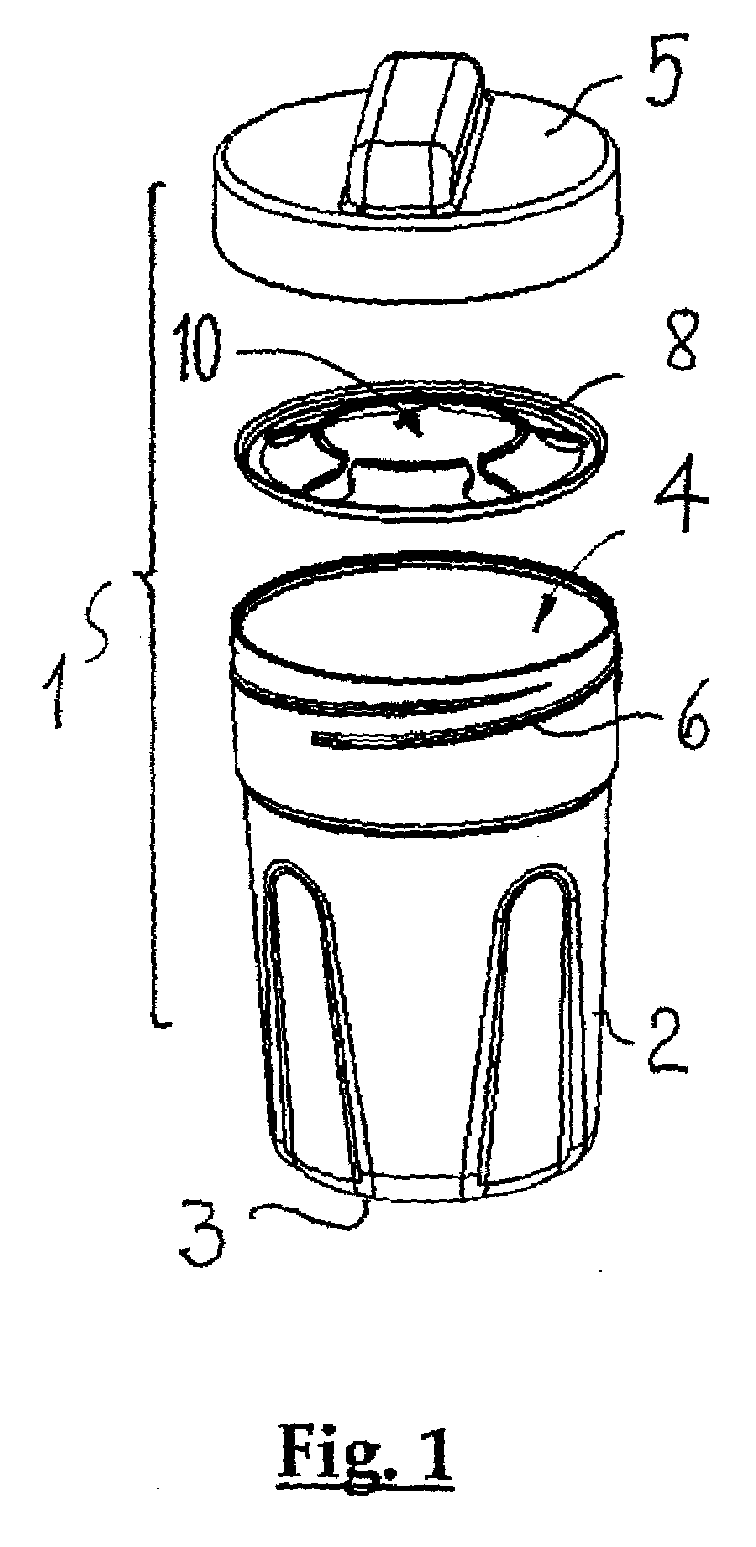
- FIG. 1 an embodiment of a containment for bottle, vials or the like with toxic, cyto-toxic contents or the like is generally designated with reference numeral 1.
- the transport containment comprises an elongated container 2 having a closed bottom 3 and an open end 4.
- a closure cap 5 is releasably attachable to the container 2 for tightly closing it.
- the container 2 in vicinity of its open end 4 and the closure cap 5 are provided with mating threads 6 or the like fastening elements.
- the closure cap 5 has a circumferential inwardly projecting rim 50 radially abutting against the inner wall of the container at the upper end of the container, and the rim at the open end of the container 2 abuts against the inner surface of the closure cap 5.
- the closure cap 5 is provided with a protruding bar-like rib 51 or the like to facilitate gripping thereof.
- An annular retaining insert 8 is provided, which is adapted to be attached securely inside the container for holding an inserted bottle, vial or the like safely in place.
- the retaining insert 8 is provided with a central opening 10 for the neck portion of a bottle, vial or the like.
- Fig. 2 shows the containment 1 of Fig. 1 in the assembled state, with the closure cap 5 screwed onto the open end of the container 2.
- the mating threads on the outside of the container 2 and on the inside of the closure cap 5 are designated with reference numerals 6 and 7, respectively.
- the retaining insert 8 is attached to the inside of the container 2 in the vicinity of the open end 4 thereof and is secured in place in between an annular shoulder 11 of the container 2 and protrusions 12 which are provided at an interior circumference of the container.
- the annular retaining insert 8 is formlockingly secured in place inside the container 2.
- Fig. 3 is a perspective sectional view of the containment 1, with the container 2 accommodating a bottle 20 which may contain a toxic, cyto-toxic or the like substance.
- the bottle 20 is secured in between the closed bottom 3 of the container 2 and the annular retaining insert 8 which is formlockingly attached to the interior circumference of the container 2.
- the annular retaining insert 8 is non-detachably secured inside the container 2.
- the retaining insert 8 is provided with resilient radial flaps 9 which are distributed about its circumference and which project essentially radially inwardly. The free ends of the flaps 9 delimit the central opening 10 and are pressing against the neck 21 of the bottle 20.
- the inserted bottle 20 is axially firmly secured.
- the radial flaps 9 are slightly curved towards the open end 4 of the container 2, thus enabling a better abutment against the neck 21 of the bottle 20. Due to the flexibility of the radial flaps 9 axial impacts are dampened and are mostly compensated.
- spacer ribs 13 are provided along the interior circumference of the container 2. As shown in Fig. 3 , the container 2 may have a greater axial length than the bottle 20 accommodated therein. This provides for additional safety against breakage of the bottle 20, in case that e.g. the opened container 2 accidentally falls down, topples over, or an article falls upon the open container 2 (closure cap 5 unscrewed).
- Fig. 4 shows a view from above into the opened container 2.
- the annular retaining insert 8 is firmly held in place by the protrusions 12 which are distributed about the interior circumference of the container 2.
- the resilient radial flaps 9 of the annular retaining insert 8 delimit the central opening 10 thereof.
- the annular retaining insert 8 (see Fig. 4 ) is not shown. This allows a better view of the annular shoulder 11 of the container 2 and of the protrusions 12, which are located along an interior circumference and close to the open end 4 of the container 2.
- the axial distance between the annular shoulder 11 and the protrusions 12 is such, that the outer rim of the annular retaining insert 8 is easily accommodated therebetween but is firmly secured.
- Reference numeral 13 designates the spacer ribs which are distributed along the interior circumference of the container 2. The spacer ribs 13 may extend across the closed bottom 3 of the container 2.
- the container 2 On the outer surface of its wall the container 2 is provided with indentations which simplifies gripping the container 2, for example if gloves are worn by the personnel when handling the containment.
- FIG. 6 the annular retaining insert 8 is depicted. From a circumferentially extending rim a number of resilient radial flaps 9 extend essentially radially inwardly towards the center of the retaining insert 8. The free ends of the radial flaps 9 delimit the central opening 10. The radial flaps 9 are separated from each other by radially extending slots which widen towards the circumferential rim, thus enhancing the flexibility of the radial flaps 8.
Landscapes
- Engineering & Computer Science (AREA)
- Mechanical Engineering (AREA)
- Details Of Rigid Or Semi-Rigid Containers (AREA)
- Medical Preparation Storing Or Oral Administration Devices (AREA)
Abstract
Description
- The invention concerns a containment for bottles, vials and like containers in accordance with the pre-characterizing clause of claim 1.
- In pharmaceutical and clinical applications very often toxic and cyto-toxic substances must be handled. Usually such substances are contained in bottles, vials and like containers made of glass. Bottles containing e.g. cyto-toxic substances usually in liquid form constitute a considerable risk for unprotected personnel and, therefore, in many countries there are very strict rules for the handling and/or transportation of such substances. Cyto-toxic substances usually are not administrated in their original concentrations in which they are provided in bottles or vials from the manufacturer. For administration to a patient they are typically diluted and/or combined with other substances. During handling of the substances, care must be taken to avoid that the handling personnel be contaminated with these substances. Also, the equipment and the environment of the laboratory must be protected from getting contaminated with these substances, since otherwise the expense for carefully cleaning such equipment and environment is very high. Contamination may occur, for example, when these substances are spilled and/or when the exterior of the bottle or vial is soiled. Also, contamination may occur when a bottle or vial breaks allowing the toxic or cyto-toxic substance to escape from the bottle or vial.
- In order to avoid contamination of the handling personnel, in
WO 02/46060 - As has already been mentioned above, during handling of the bottles in the preparation of toxic or cyto-toxic solutions for injections or infusions to be administered to patients it is vital that both the handling personnel as well as the laboratory equipment and environment are protected from being contaminated with the toxic or cyto-toxic substance. In this respect, the container of
WO 02/46060 - Hence there exists a need for an improved containment for such bottles, vials and like containers for hazardous contents, such as e.g. toxic or cyto-toxic liquids, which substantially eliminates the danger of contamination during transport and handling. In particular, a containment shall be provided which ensures safe transport and handling and which may be suitable for accommodating bottles or vials of different sizes.
- These objects are achieved by a containment for bottles, vials and like containers as it is specified by the features of independent claim 1. Further advantageous embodiments are the subject of the respective dependent claims.
- In accordance with the invention a containment for bottles, vials or the like with toxic, cyto-toxic contents or the like is provided which comprises a container having an open end for receiving a bottle, vial or the like and a closure cap for tightly closing the container. Further, the containment comprises a separate retaining insert which can be securely attached to the container in the vicinity of the open end thereof and which has a central opening for a neck portion of the bottle, vial and the like.
- The separate retaining insert serves for securely retaining a bottle, vial or the like which is accommodated in the container. The central opening of the retaining insert is large enough to allow the neck of the bottle, vial or the like to protrude therethrough, but too small for the rest of the bottle, vial or the like to slip through. Thus, once the bottle has been inserted into the container and acccomodated by the container, the retaining insert is securely attached thereto, and the closure cap is then mounted to the container, e.g. by screwing it onto the container. As the closure cap is later on removed the bottle, vial or the like cannot fall out of the container even if the latter is turned upside down. The bottle, vial or the like rests with its shoulder against the retaining insert, but is retained inside the container. Thus, handling of the containment and of the therein accommodated bottle, vial or the like is improved. The risk of the bottle, vial or the like falling out of the container, of breakage and of contamination of the environment is at least greatly reduced if not eliminated. The exterior of the bottle, vial and the like containing the hazardous contents, e.g. toxic, cyto-toxic substances is concealed inside the container underneath the retaining insert, and cannot be touched. Thus, the risk of a contamination of the personnel during handling is also considerably reduced. The containment protects the bottle, vial or the like accommodated therein during transport. In case a breakage occurs, the hazardous contents are retained inside the hermetically closed container/closure cap arrangement. The containment consists of only three components, namely the container, the closure cap, and the retaining insert, which are easy and cheap to manufacture and can be easily assembled. The components may be mass-manufactured in the desired size without departing from the basic concept according to the invention.
- Also, it is possible to automatically insert the bottles, vials or the like containing the toxic or cytotoxic contents under sterile conditions in the factory, so that the containment is packed under sterile conditions. For handling at the destination, for example in the laboratories or pharmacies of hospitals, the sterile containment is placed in a glove-box the interior of which also contains a sterile environment, and the containment can then be opened with the gloves of the glove-box and its contents be accessed under sterile conditions. After that, the containment can be re-closed again under sterile conditions in the glove-box and the containment (closed under sterile conditions) can then be placed in the refrigerator. An extra process step of sterilisation of the opened containment can be avoided, thus saving considerable time since such an extra step of sterilisation may take up to twenty extra minutes. Since the entire chain - i.e. the packaging step, the opening of the containment in the glove-box, the handling of the contents contained in the bottle, vial or the like, and the re-closing of the containment is performed in a sterile atmosphere, any extra sterilisation can be dispensed with.
- While various methods are generally conceivable for securely attaching the retaining insert to the container after the bottle, vial or the like has been inserted (for example the retaining insert may be glued or welded to the container), in one embodiment of the containment according to the invention which is preferred from an assembling point of view, the container along an interior circumference thereof is provided with protrusions for securing the retaining insert in place.
- In order to ascertain an easy placement and positioning of the retaining insert, in another embodiment of the containment according to the invention the container in close vicinity to the circumferentially arranged protrusions is provided with a circumferentially running shoulder such, that the attached retaining insert is secured in between that annular shoulder and the circumferentially arranged protrusions.
- By having the retaining insert non-detachably mounted to the container in the assembled state of the containment, the safety of the containment is even further improved. The retaining insert is mounted to the container only once. Thus, a wearing down of the locking protrusions, which might occur in a detachable assembly, is avoided. In addition, this embodiment of the invention in which the retaining insert may only be removed by destroying the assembly, allows an easy detection of any unauthorized manipulation, in which the bottle, vial or the like was removed from the container.
- In a still further embodiment of the containment according to the invention, the retaining insert may be provided with resilient radial flaps which are distributed about its circumference with the free ends thereof delimiting the central opening. In the assembled state the radial flaps press against the neck and shoulder of the bottle, vial or the like and enhance its secure retainment within the container. The resilient flaps also serve for a slight absorption and compensation of impacts which might occur during transport and handling, thus protecting the bottles, vials and the like from breaking.
- In a still further embodiment of the containment according to the invention, the container may be provided with spacer ribs which are distributed about its interior circumference. The spacer ribs enhance the rigidity and stability of the container and serve for better fixation of the bottle, vial and the like inside the container. In addition, the spacer ribs protect the bottle, vial and the like from the consequences of impacts, e.g. in case the containment accidentally falls down.
- In yet a further embodiment of the containment according to the invention, at least the container is made of a transparent or translucent plastic material. In this manner, the integrity of the bottle, vial and the like and its filling level may be easily inspected from the outside. In another embodiment of the containment according to the invention, the closure cap and/or the retaining insert are also made from a transparent or translucent plastic material. Preferred materials for the container and/or the closure cap and/or the retaining insert include polyolefines, e.g. polypropylene, laminates and co-extrusions of transparent and translucent plastic materials. An alternative preferred material is polyethyleneterephthalate (PET). The properties of these materials are well known and they have proved their suitability in mass manufacturing processes. Suitable manufacturing processes for the containment or the components thereof, respectively, include blow molding processes, injection molding processes, or a deep drawing processes.
- The container and the closure cap may be releasably attached to each other by various means. In one embodiment of the containment according to the invention the container and closure cap are provided with mating threads or like fastening elements.
- In a still further embodiment of the containment according to the invention the container has a greater axial length than the bottle, vial or the like to be accommodated therein. This embodiment provides for additional safety against breakage of the bottle, vial or the like in case that e.g. the opened container accidentally falls down, topples over, or in case an article is accidentially dropped upon the open container.
- As has already been mentioned, using a containment according to one of the embodiments described above for the accommodation of a bottle, vial or the like containing toxic, cyto-toxic contents or the like safety of the transport and of the handling are considerably improved.
- Further advantages will become apparent from the following detailed description of the containment according to the invention, reference being made to the schematic drawings, in which:
- Fig. 1
- shows an exploded view of an embodiment of the containment according to the invention;
- Fig. 2
- shows a sectional view of the assembled containment of
Fig. 1 ; - Fig. 3
- shows a sectional view of the assembled containment of
Fig. 2 with a bottle held in place; - Fig. 4
- is a perspective view from above showing the container of the containment of
Fig. 1 with a retaining insert in place; - Fig. 5
- is a perspective view from above into the container of the containment of
Fig. 1 without the retaining insert; and - Fig. 6
- is an enlarged view of the separate retaining insert of the embodiment of the containment of
Fig. 1 . - In the exploded view of
Fig. 1 an embodiment of a containment for bottle, vials or the like with toxic, cyto-toxic contents or the like is generally designated with reference numeral 1. The transport containment comprises anelongated container 2 having aclosed bottom 3 and anopen end 4. Aclosure cap 5 is releasably attachable to thecontainer 2 for tightly closing it. For that purpose thecontainer 2 in vicinity of itsopen end 4 and theclosure cap 5 are provided withmating threads 6 or the like fastening elements. In order to ensure tightness theclosure cap 5 has a circumferential inwardly projecting rim 50 radially abutting against the inner wall of the container at the upper end of the container, and the rim at the open end of thecontainer 2 abuts against the inner surface of theclosure cap 5. Theclosure cap 5 is provided with a protruding bar-like rib 51 or the like to facilitate gripping thereof. Anannular retaining insert 8 is provided, which is adapted to be attached securely inside the container for holding an inserted bottle, vial or the like safely in place. The retaininginsert 8 is provided with acentral opening 10 for the neck portion of a bottle, vial or the like. -
Fig. 2 shows the containment 1 ofFig. 1 in the assembled state, with theclosure cap 5 screwed onto the open end of thecontainer 2. The mating threads on the outside of thecontainer 2 and on the inside of theclosure cap 5 are designated withreference numerals 6 and 7, respectively. The retaininginsert 8 is attached to the inside of thecontainer 2 in the vicinity of theopen end 4 thereof and is secured in place in between anannular shoulder 11 of thecontainer 2 andprotrusions 12 which are provided at an interior circumference of the container. Thus, theannular retaining insert 8 is formlockingly secured in place inside thecontainer 2. -
Fig. 3 is a perspective sectional view of the containment 1, with thecontainer 2 accommodating abottle 20 which may contain a toxic, cyto-toxic or the like substance. Thebottle 20 is secured in between theclosed bottom 3 of thecontainer 2 and theannular retaining insert 8 which is formlockingly attached to the interior circumference of thecontainer 2. Preferably theannular retaining insert 8 is non-detachably secured inside thecontainer 2. Thus, the annular retaining insert can only be removed by breaking it.The retaininginsert 8 is provided with resilient radial flaps 9 which are distributed about its circumference and which project essentially radially inwardly. The free ends of theflaps 9 delimit thecentral opening 10 and are pressing against theneck 21 of thebottle 20. Thus, the insertedbottle 20 is axially firmly secured. The radial flaps 9 are slightly curved towards theopen end 4 of thecontainer 2, thus enabling a better abutment against theneck 21 of thebottle 20. Due to the flexibility of theradial flaps 9 axial impacts are dampened and are mostly compensated. In order to also radially secure thebottle 20spacer ribs 13 are provided along the interior circumference of thecontainer 2. As shown inFig. 3 , thecontainer 2 may have a greater axial length than thebottle 20 accommodated therein. This provides for additional safety against breakage of thebottle 20, in case that e.g. the openedcontainer 2 accidentally falls down, topples over, or an article falls upon the open container 2 (closure cap 5 unscrewed). -
Fig. 4 shows a view from above into the openedcontainer 2. Theannular retaining insert 8 is firmly held in place by theprotrusions 12 which are distributed about the interior circumference of thecontainer 2. The resilient radial flaps 9 of theannular retaining insert 8 delimit thecentral opening 10 thereof. - In the view from above of the
container 2 inFig. 5 the annular retaining insert 8 (seeFig. 4 ) is not shown. This allows a better view of theannular shoulder 11 of thecontainer 2 and of theprotrusions 12, which are located along an interior circumference and close to theopen end 4 of thecontainer 2. The axial distance between theannular shoulder 11 and theprotrusions 12 is such, that the outer rim of theannular retaining insert 8 is easily accommodated therebetween but is firmly secured.Reference numeral 13 designates the spacer ribs which are distributed along the interior circumference of thecontainer 2. Thespacer ribs 13 may extend across theclosed bottom 3 of thecontainer 2. On the outer surface of its wall thecontainer 2 is provided with indentations which simplifies gripping thecontainer 2, for example if gloves are worn by the personnel when handling the containment. - In
Fig. 6 theannular retaining insert 8 is depicted. From a circumferentially extending rim a number of resilient radial flaps 9 extend essentially radially inwardly towards the center of the retaininginsert 8. The free ends of theradial flaps 9 delimit thecentral opening 10. The radial flaps 9 are separated from each other by radially extending slots which widen towards the circumferential rim, thus enhancing the flexibility of the radial flaps 8.
Claims (13)
- Containment for bottles, vials or the like with toxic, cyto-toxic contents or the like, comprising a container (2) having an open end (4) for receiving a bottle (20), vial or the like and a closure cap (5) for tightly closing the container (2), characterized in that it comprises a separate retaining insert (8), which can be securely attached at the inside of the container (2) in the vicinity of the open end (4) thereof and which has a central opening (10) for a neck portion (21) of the bottle (20), vial or the like.
- Containment according to claim 1, wherein the container (2) along an interior circumference thereof is provided with protrusions (12) for securing the retaining insert (8) in place when attached to the container (2).
- Containment according to claim 2, wherein in close vicinity to the circumferentially arranged protrusions (12) the container (2) is provided with a circumferentially running shoulder (11) such, that the attached retaining insert (8) is secured in between the shoulder (11) and the circumferentially arranged protrusions (12).
- Containment according to any one of claims 1 to 3, wherein the retaining insert (8) is non-detachably mounted inside the container (2) in the assembled state of the containment.
- Containment according to any one of the preceding claims, wherein the retaining insert (8) is provided with resilient radial flaps (9) which are distributed about its circumference, and wherein the free ends thereof delimit the central opening (10).
- Containment according to any one of the preceding claims, wherein the container (2) is provided with spacer ribs (13) distributed about its interior circumference.
- Containment according to any one of the preceding claims, wherein at least the container (2) is made of a transparent or translucent plastic material.
- Containment according to any one of the preceding claims, wherein at least the container (2) is made of a polyolefine or of polyethyleneterephthalate.
- Containment according to claim 8, wherein the container (2) is made in one of a blow molding process, an injection molding process, or a deep drawing process.
- Containment according to any one of the preceding claims, wherein the retaining insert (8) is made of a plastic material.
- Containment according to any one of the preceding claims, wherein the container (2) and the closure cap (5) are provided with mating threads (6, 7) or like fastening elements.
- Containment according to any one of the preceding claims, wherein the container (2) has an axial length that is greater than that of a bottle (20), vial or the like to be accommodated therein.
- Use of a containment (1) according to any one of the preceding claims for the accommodation of a bottle (20), vial or the like containing toxic, cyto-toxic contents or the like.
Priority Applications (2)
| Application Number | Priority Date | Filing Date | Title |
|---|---|---|---|
| EP09152414A EP2216265A1 (en) | 2009-02-09 | 2009-02-09 | Containment for bottles, vials and like containers |
| PCT/EP2010/051485 WO2010089388A1 (en) | 2009-02-09 | 2010-02-08 | Containment for bottles, vials and like containers |
Applications Claiming Priority (1)
| Application Number | Priority Date | Filing Date | Title |
|---|---|---|---|
| EP09152414A EP2216265A1 (en) | 2009-02-09 | 2009-02-09 | Containment for bottles, vials and like containers |
Publications (1)
| Publication Number | Publication Date |
|---|---|
| EP2216265A1 true EP2216265A1 (en) | 2010-08-11 |
Family
ID=40456816
Family Applications (1)
| Application Number | Title | Priority Date | Filing Date |
|---|---|---|---|
| EP09152414A Withdrawn EP2216265A1 (en) | 2009-02-09 | 2009-02-09 | Containment for bottles, vials and like containers |
Country Status (2)
| Country | Link |
|---|---|
| EP (1) | EP2216265A1 (en) |
| WO (1) | WO2010089388A1 (en) |
Cited By (3)
| Publication number | Priority date | Publication date | Assignee | Title |
|---|---|---|---|---|
| WO2013049178A3 (en) * | 2011-09-27 | 2013-06-13 | The Board Of Regents Of The University Of Texas System | Robotic infusion mixer and transportable cartridge |
| WO2013084015A1 (en) * | 2011-12-09 | 2013-06-13 | Matyi Dezso | Container for bottles of drinks |
| US11462336B2 (en) | 2017-01-20 | 2022-10-04 | Robert Kamen | Biohazardous material transporting pig |
Families Citing this family (1)
| Publication number | Priority date | Publication date | Assignee | Title |
|---|---|---|---|---|
| CN103987356B (en) | 2011-12-15 | 2017-10-24 | 泰尔茂株式会社 | medical equipment |
Citations (4)
| Publication number | Priority date | Publication date | Assignee | Title |
|---|---|---|---|---|
| DE3246999A1 (en) * | 1982-11-10 | 1984-05-10 | Institut Virion AG, 8803 Rüschlikon | Package |
| WO2002046060A1 (en) | 2000-12-06 | 2002-06-13 | Ebewe Pharma Ges.M.B.H. Nfg.Kg | Transport packaging for bottles |
| US20070108205A1 (en) * | 2005-11-03 | 2007-05-17 | Bristol-Myers Squibb Company | Protective outer enclosure for pharmaceutical vial |
| DE102007029587A1 (en) * | 2007-06-27 | 2009-01-08 | Stada Arzneimittel Ag | Protective container for containers made of fragile material |
-
2009
- 2009-02-09 EP EP09152414A patent/EP2216265A1/en not_active Withdrawn
-
2010
- 2010-02-08 WO PCT/EP2010/051485 patent/WO2010089388A1/en not_active Ceased
Patent Citations (4)
| Publication number | Priority date | Publication date | Assignee | Title |
|---|---|---|---|---|
| DE3246999A1 (en) * | 1982-11-10 | 1984-05-10 | Institut Virion AG, 8803 Rüschlikon | Package |
| WO2002046060A1 (en) | 2000-12-06 | 2002-06-13 | Ebewe Pharma Ges.M.B.H. Nfg.Kg | Transport packaging for bottles |
| US20070108205A1 (en) * | 2005-11-03 | 2007-05-17 | Bristol-Myers Squibb Company | Protective outer enclosure for pharmaceutical vial |
| DE102007029587A1 (en) * | 2007-06-27 | 2009-01-08 | Stada Arzneimittel Ag | Protective container for containers made of fragile material |
Cited By (3)
| Publication number | Priority date | Publication date | Assignee | Title |
|---|---|---|---|---|
| WO2013049178A3 (en) * | 2011-09-27 | 2013-06-13 | The Board Of Regents Of The University Of Texas System | Robotic infusion mixer and transportable cartridge |
| WO2013084015A1 (en) * | 2011-12-09 | 2013-06-13 | Matyi Dezso | Container for bottles of drinks |
| US11462336B2 (en) | 2017-01-20 | 2022-10-04 | Robert Kamen | Biohazardous material transporting pig |
Also Published As
| Publication number | Publication date |
|---|---|
| WO2010089388A1 (en) | 2010-08-12 |
Similar Documents
| Publication | Publication Date | Title |
|---|---|---|
| US6793076B1 (en) | Glass bottle protective enclosure | |
| CA1303556C (en) | Safety container for glass vials | |
| US8251221B1 (en) | Reusable protective enclosure system for an open-ended tubular member | |
| US9598195B2 (en) | Packaging structure and method for sterile packaging containers for substances for medical, pharmaceutical or cosmetic applications and methods for further processing of containers using this packaging structure | |
| EP2934420B1 (en) | Primary packaging for storage and/or administration of medical or pharmaceutical compounds | |
| EP2731577B1 (en) | Liquid container | |
| JPH0449900B2 (en) | ||
| US9415899B2 (en) | Transparent silicone cover for the safeguarding of glass pharmaceutical vials | |
| EP2160340A1 (en) | Protective enclosure to protect fragile vessels | |
| EP2216265A1 (en) | Containment for bottles, vials and like containers | |
| US20070108205A1 (en) | Protective outer enclosure for pharmaceutical vial | |
| JP7520399B2 (en) | Shielding containers for radiopharmaceuticals | |
| JP4754070B2 (en) | package | |
| CZ297004B6 (en) | Transport packaging for bottles | |
| JP2021094464A (en) | Main container for at least one of storage and dosage of medical or pharmaceutical compound and method for assembling the main container | |
| EP2826458A1 (en) | Closure for a vial | |
| HK1193023B (en) | Liquid container | |
| NZ619040B2 (en) | Liquid container |
Legal Events
| Date | Code | Title | Description |
|---|---|---|---|
| PUAI | Public reference made under article 153(3) epc to a published international application that has entered the european phase |
Free format text: ORIGINAL CODE: 0009012 |
|
| AK | Designated contracting states |
Kind code of ref document: A1 Designated state(s): AT BE BG CH CY CZ DE DK EE ES FI FR GB GR HR HU IE IS IT LI LT LU LV MC MK MT NL NO PL PT RO SE SI SK TR |
|
| AX | Request for extension of the european patent |
Extension state: AL BA RS |
|
| AKY | No designation fees paid | ||
| REG | Reference to a national code |
Ref country code: DE Ref legal event code: R108 Effective date: 20110322 Ref country code: DE Ref legal event code: 8566 |
|
| STAA | Information on the status of an ep patent application or granted ep patent |
Free format text: STATUS: THE APPLICATION IS DEEMED TO BE WITHDRAWN |
|
| 18D | Application deemed to be withdrawn |
Effective date: 20110212 |