EP2214072A1 - Power supply system and voltage monitoring method - Google Patents
Power supply system and voltage monitoring method Download PDFInfo
- Publication number
- EP2214072A1 EP2214072A1 EP07830551A EP07830551A EP2214072A1 EP 2214072 A1 EP2214072 A1 EP 2214072A1 EP 07830551 A EP07830551 A EP 07830551A EP 07830551 A EP07830551 A EP 07830551A EP 2214072 A1 EP2214072 A1 EP 2214072A1
- Authority
- EP
- European Patent Office
- Prior art keywords
- voltage
- output voltage
- power supply
- gate
- output
- Prior art date
- Legal status (The legal status is an assumption and is not a legal conclusion. Google has not performed a legal analysis and makes no representation as to the accuracy of the status listed.)
- Granted
Links
Images






Classifications
-
- H—ELECTRICITY
- H02—GENERATION; CONVERSION OR DISTRIBUTION OF ELECTRIC POWER
- H02J—ELECTRIC POWER NETWORKS; CIRCUIT ARRANGEMENTS OR SYSTEMS FOR SUPPLYING OR DISTRIBUTING ELECTRIC POWER; SYSTEMS FOR STORING ELECTRIC ENERGY
- H02J1/00—Circuit arrangements for DC mains or DC distribution networks
- H02J1/08—Three-wire DC power distribution systems; Systems having more than three wires
-
- H—ELECTRICITY
- H02—GENERATION; CONVERSION OR DISTRIBUTION OF ELECTRIC POWER
- H02J—ELECTRIC POWER NETWORKS; CIRCUIT ARRANGEMENTS OR SYSTEMS FOR SUPPLYING OR DISTRIBUTING ELECTRIC POWER; SYSTEMS FOR STORING ELECTRIC ENERGY
- H02J1/00—Circuit arrangements for DC mains or DC distribution networks
- H02J1/10—Parallel operation of DC sources
-
- H—ELECTRICITY
- H02—GENERATION; CONVERSION OR DISTRIBUTION OF ELECTRIC POWER
- H02M—APPARATUS FOR CONVERSION BETWEEN AC AND AC, BETWEEN AC AND DC, OR BETWEEN DC AND DC, AND FOR USE WITH MAINS OR SIMILAR POWER SUPPLY SYSTEMS; CONVERSION OF DC OR AC INPUT POWER INTO SURGE OUTPUT POWER; CONTROL OR REGULATION THEREOF
- H02M1/00—Details of apparatus for conversion
- H02M1/0067—Converter structures employing plural converter units, other than for parallel operation of the units on a single load
- H02M1/008—Plural converter units for generating at two or more independent and non-parallel outputs, e.g. systems with plural point of load switching regulators
Definitions
- the present invention relates to a power supply apparatus and a voltage monitoring method that select one secondary power supply from a plurality of secondary power supplies receiving an output voltage from a primary power supply as input and monitor the selected output voltage.
- the present invention relates to voltage monitoring of a secondary power supply and to a power supply apparatus and a voltage monitoring method that are compatible with a power supply apparatus with a conventional configuration, even when the secondary power supply is replaced by a plurality of regulators.
- the integrated circuit of the DC-DC converter is often replaced by a plurality of regulators (constant direct current power supply circuits) to reduce costs.
- a plurality of regulators constant direct current power supply circuits
- power supply is realized by using regulators each of which is dedicated to a plurality of power supply areas (e.g., an LSI (Large Scale Integration) as a load device).
- regulators are inexpensive and provide a low failure rate, replacing a DC-DC converter with a plurality of regulators can reduce the production costs of a power supply apparatus.
- each output voltage of regulators needs to be regularly monitored because the output voltage is different for each regulator.
- Patent Document 1 discloses a power supply monitoring apparatus that reads output voltage of each regulator with an ADC (Analog Digital Converter) and gives out a warning when output voltage is below or above a reference value.
- ADC Analog Digital Converter
- Patent Document 2 discloses a power supply apparatus that monitors a plurality of power supplies and stops a power supply by outputting a signal to shut down the power supply where an error of output voltage is detected.
- Patent Document 1 Japanese Laid-open Patent Publication No. 08-005693
- the present invention which relates to voltage monitoring of a secondary power supply, is made in order to overcome the problem above, and an object of the present invention is to provide a power supply apparatus and a voltage monitoring method that maintain compatibility with a conventional power supply monitoring apparatus even when a secondary power supply is replaced by a plurality of regulators.
- a power supply apparatus includes a primary power supply that outputs direct current; a plurality of secondary power supplies to each of which the direct current is inputted and a load device is connected, respectively; a selector to which output voltages outputted from the secondary power supplies are inputted and selects one of the output voltages; and a converter that converts the output voltage selected by the selector into quantized voltage information.
- a voltage monitoring method of a power supply apparatus includes steps of: a primary power supply outputting direct current; a plurality of secondary power supplies, to each of which a load device is connected, inputting the direct current as input; a selector receiving output voltages of the secondary power supplies as input and selecting one of the output voltages of the secondary power supplies; and a converter converting the output voltage selected by the selector into quantized voltage information.
- one of the output voltages of the secondary power supplies is selected , whereby only the selected output voltage of the secondary power supply may be converted into quantized voltage information.
- the selector selects a lowest output voltage of all output voltages outputted from the secondary power supplies.
- the step of the selector selecting one of the output voltages of the secondary power supplies is to select a lowest output voltage of all output voltages outputted from the secondary power supplies.
- the lowest output voltage of all output voltages outputted from the secondary power supplies is selected , whereby only the selected output voltage of the secondary power supply may be converted into quantized voltage information.
- the selector selects the highest output voltage of all output voltages outputted from the secondary power supplies.
- the step of the selector selecting one of the output voltages of the secondary power supplies is to select the highest output voltage of all output voltages outputted from the secondary power supplies.
- the highest output voltage of all output voltages of the secondary power supplies is selected, whereby only the selected output voltage of the secondary power supply may be converted into quantized voltage information.
- the selector selects the lowest output voltage and the highest output voltage of all output voltages outputted from the secondary power supplies; the selector outputs the selected lowest output voltage, when the selected lowest output voltage is lower than a predetermined threshold voltage; and the selector outputs the selected highest output voltage, when the selected lowest output voltage is higher than the predetermined threshold voltage.
- the step of the selector selecting one of the output voltages of the secondary power supplies is to select the lowest output voltage and the highest output voltage of all output voltages outputted from the secondary power supplies, to output the selected lowest output voltage, when the selected lowest output voltage is lower than a predetermined threshold voltage, and to output the selected highest output voltage, when the selected lowest output voltage is higher than the predetermined threshold voltage.
- the lowest output voltage and the highest output voltage of all output voltages outputted from the secondary power supplies are selected, when the selected lowest output voltage is lower than a predetermined threshold voltage, the lowest output voltage outputted from the secondary power supply is selected, and when the selected lowest output voltage is higher than the predetermined threshold voltage, the highest output voltage outputted from the secondary power supply is selected, thereby selecting either of the selected lowest or highest output voltage outputted from the secondary power supply to convert the selected output voltage outputted from the secondary power supply into quantized voltage information when the secondary power supply outputs a very low output voltage.
- the selector selects the lowest output voltage and the highest output voltage of all output voltages outputted from the secondary power supplies, the selector outputs the selected lowest output voltage, when the selected highest output voltage is lower than a predetermined threshold voltage, and the selector selects the selected highest output voltage, when the selected highest output voltage is higher than the predetermined threshold voltage.
- the step of the selector selecting one of the output voltages of the secondary power supplies is to select the lowest output voltage and the highest output voltage of all output voltages outputted from the secondary power supplies, to output the selected lowest output voltage, when the selected highest output voltage is lower than a predetermined threshold voltage, and to output the selected highest output voltage, when the selected highest output voltage is higher than the predetermined threshold voltage.
- the lowest output voltage and the highest output voltage of all output voltages outputted from the secondary power supplies are selected, when the selected highest output voltage is lower than a predetermined threshold voltage, the selected lowest output voltage is outputted, and when the selected highest output voltage is higher than the predetermined threshold voltage, the selected highest output voltage is selected, thereby selecting either of the selected lowest or highest output voltage of the secondary power supply to convert the selected output voltage of the secondary power supply into quantized voltage information when the secondary power supply outputs a very high output voltage.
- a power supply apparatus includes a primary power supply that outputs direct current; a plurality of secondary power supplies to each of which the direct current is inputted and a load device is connected, respectively; a plurality of difference voltage detectors to which output voltages outputted from the secondary power supplies and reference voltages are inputted and that outputs absolute values of difference voltages between the output voltages outputted from the secondary power supplies and the reference voltages for each of the secondary power supplies; a plurality of comparators that compare the absolute values of the difference voltages outputted from the difference voltage detectors with each other; a selector that selects the output voltage outputted from the secondary power supply whose difference in the absolute value from the reference voltage is the highest of all output voltages of the secondary power supplies based on comparison results of the comparators; and a converter that converts the output voltage selected by the selector into quantized voltage information.
- a voltage monitoring method of a power supply apparatus includes a primary power supply outputting direct current; a plurality of secondary power supplies, to each of which a load device is connected, inputting the direct current as input; a plurality of difference voltage detectors, to which output voltages and reference voltages are inputted, outputting absolute values of difference voltages between the output voltages outputted from the secondary power supplies and the reference voltages for each of the secondary power supplies; a plurality of comparators comparing the absolute values of the difference voltages outputted from the difference voltage detectors with each other; a selector selecting the output voltage outputted from the secondary power supply whose difference in the absolute value from the reference voltage is the highest of all output voltages of the secondary power supplies based on comparison results of the comparators; and a converter converting the output voltage selected by the selector into quantized voltage information.
- the absolute values of the difference voltages between the output voltages outputted from the secondary power supplies and the reference voltages are outputted for each of the secondary power supplies, the absolute values of the difference voltages are compared by magnitude with each other, and the output voltage outputted from the secondary power supply whose difference in the absolute value from the reference voltage is the highest is selected, thereby converting only the selected output voltage of the secondary power supply into quantized voltage information.
- the power supply apparatus is connected to a monitoring control apparatus that monitors the quantized voltage information converted by the converter.
- the power supply apparatus is connected to a monitoring control apparatus that monitors the quantized voltage information converted by the converter.
- the power supply apparatus is connected to the monitoring control apparatus that monitors the quantized voltage information converted by the converter, thereby monitoring the quantized voltage information by the monitoring control apparatus.
- the power supply apparatus further includes a smoothing circuit that smoothes the output voltage selected by the selector and inputs the smoothed output voltage into the converter.
- the power supply apparatus further includes a smoothing circuit that smoothes the output voltage selected by the selector and inputs the smoothed output voltage into the converter.
- the smoothed output voltage is converted into the quantized voltage information, thereby obtaining precisely quantized voltage information.
- the secondary power supply includes a stabilizing power supply circuit.
- the secondary power supply includes a stabilizing power supply circuit.
- the secondary power supply includes a stabilizing power supply circuit, whereby the secondary power supplies may be configured for a low-cost.
- the selector and the converter are operated by the voltage supplied from power supplies other than the secondary power supplies.
- the selector and the converter are operated by the voltage supplied from power supplies other than the secondary power supplies.
- the selector and the converter are operated by the voltage supplied from the power supplies other than the secondary power supplies, whereby the selector and the converter may be stably operated.
- voltage monitoring of a secondary power supply may be made in order to maintain structural compatibility with a conventional power supply apparatus even when a secondary power supply is replaced by a plurality of regulators.
- this allows a conventional configuration which includes a single AD converter and a single system monitoring processor that are needed to quantize and monitor output voltages of regulators, thereby reducing burden of redesigning a configuration related to power-supply monitoring of a power supply monitoring apparatus and the involved production cost.
- FIG. 1 is a block diagram of a schematic configuration of a conventional power supply apparatus and a voltage monitoring circuit.
- FIG. 1 is a block diagram illustrating a schematic configuration of a conventional power supply apparatus and a voltage monitoring circuit.
- AC current Alternating Current
- DC current Direct Current
- the DC current after the conversion by the primary power supply, encounters voltage conversion by a secondary power supply including a DC-DC converter.
- the direct current of output voltage after the voltage conversion by the DC-DC converter, is supplied to a load device such as an LSI (Large Scale Integration) and also to a voltage monitoring circuit for voltage monitoring.
- FIG. 1 illustrates a case where a single load device is connected.
- the circuit for voltage monitoring includes a smoothing circuit that includes a resistor and a capacitor that are grounded and connected in parallel with an output and generates direct current (or smoothes current) where pulsating current included in rectified current is removed; an AD (Analog to Digital) converter that quantizes (digitalizes) the direct current that has been smoothed by the smoothing circuit; and a system monitoring processor that monitors the voltage value of the direct current that has been quantized by the AD converter.
- power to the AD converter and the system monitoring processor may be supplied from each dedicated resident power supply or from a single dedicated resident power supply.
- the resident power supply is a power supply that belongs to a different system from the primary power supply, so that the resident power supply can supply power regardless of the control of the primary power supply as long as the system is running.
- the system monitoring processor can monitor problems with voltage supplied to a load device.
- an appropriate measure can be taken.
- FIG. 2 is a block diagram illustrating a schematic configuration of a power supply apparatus and a voltage monitoring circuit where a secondary power supply is replaced by a plurality of regulators.
- FIG. 2 illustrates a case where three regulators, connected to the load device, are also connected to the primary power supply, where the number of regulators is not limited to three.
- a regulator A that supplies direct-current power supply to a load device A, a regulator B that supplies direct-current power supply to a load device B, and a regulator C that supplies direct-current power supply carries out voltage conversion for each on the direct current that has been converted into direct current by the primary power supply and supplies direct current to each load device.
- the regulators are connected straight with smoothing circuits that smoothes output voltage of the regulators and AD converters, respectively.
- the regulator A is connected to the AD converter A
- the regulator B is connected to the AD converter B
- the regulator C is connected straight with the AD converter C along with each smoothing circuit.
- the output voltage of the regulator A that has been quantized by the AD converter A, output voltage of the regulator B that has been quantized by the AD converter, and output voltage of the regulator A that has been quantized by the AD converter are input to a single system monitoring processor.
- a single system monitoring processor monitors the output voltage of all regulators.
- power to the AD converter A, the AD converter B, the AD converter C, and the system monitoring processor may be supplied from each dedicated resident power supply or from a single resident power supply.
- an AD converter needs to be prepared for each regulator.
- the circuit for voltage monitoring needs to be redesigned.
- the system monitoring processor firmware needs to be revised.
- the circuit for voltage monitoring becomes incompatible with the conventional configuration, which causes a problem in terms of production cost.
- FIG. 3 is a block diagram illustrating a schematic configuration of a power supply apparatus and a voltage monitoring circuit where a secondary power supply is replaced by a plurality of regulators.
- FIG. 3 illustrates a case where three regulators, connected to the load devices, are also connected to the primary power supply, where the number of regulators is not limited to three.
- output voltage of the regulator A, the regulator B, and the regulator C is supplied to the load devices, respectively, and to a representing-value decision logic circuit that is operated by a dedicated power supply.
- the representing-value decision logic circuit selects the output voltage that seems the most irregular of all the output voltages of the regulator A, the regulator B, and the regulator C and then sends a selection result to a selector.
- the selector selects only the output voltage from the regulator that outputs the output voltage that seems the most irregular of all and is selected by the representing-value decision logic circuit, and then the selector inputs the output voltage to the smoothing circuit.
- the direct current that has been smoothed by the smoothing circuit is quantized by the AD converter and then sent to the system monitoring processor.
- a single output voltage is input via the selector to the smoothing circuit.
- the direct current that has been smoothed by the smoothing circuit is quantized by the AD converter and then sent to the system monitoring processor.
- the circuit used for voltage monitoring that includes the smoothing circuit, the AD converter, and the system monitoring processor can be the same as that in the conventional configuration in FIG. 1 .
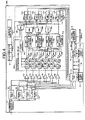
- FIG. 4 is a block diagram illustrating a detailed configuration of a power supply apparatus and a voltage monitoring circuit in accordance with an example of the first embodiment where a secondary power supply is replaced by a plurality of regulators.
- FIG. 4 illustrates a case where four regulators are connected, where the number of regulators is not limited to four. Further, in FIG. 4 , illustration of load devices connected to regulators is omitted.
- a secondary power supply which is a 2.5-v power supply, includes four regulators, and the four regulators output a 2.5 V voltage on the basis of an input voltage and a power-supply activation instruction signal (not illustrated).
- the values of voltages output from the four regulators are compared by a comparator circuit. Based on a comparison result, the representing-value decision logic circuit selects a regulator that outputs the lowest voltage value.
- a power supply apparatus 300a includes a primary power supply 10, a regulator A 11a, a regulator B 11b, a regulator C 11c, and a regulator D 11d, six comparators 12a to 12f, a representing-value decision logic circuit 100a, a selector 13, an AD converter 14, a general-purpose input/output interface 16, a smoothing circuit 20, a resident power supply 21a that supplies power to the selector 13, and a resident power supply 21b that supplies power to the AD converter 14.
- the resident power supply 21a and the resident power supply 21b may be integrated into one.
- the primary power supply 10 converts the AC current input into the DC current and then supplies the DC current to the regulator A 11a, the regulator B 11b, the regulator B 11b, the regulator C 11c, and the regulator D 11d.
- the regulator A 11a, the regulator B 11b, the regulator C 11c, and the regulator D 11d convert each voltage of DC current supplied from the primary power supply 10 into 2.5 V.
- the voltage of the DC current, which has been converted into 2.5 V, is referred to, hereinafter, as "output voltage".
- the output voltage of the regulator A 11a is input to the inverting input terminals of the comparators 12a to 12c. Further, the output voltage of the regulator B 11b is input to a non-inverting input terminal of the comparator 12a, a non-inverting input terminal of the comparator 12d, and a non-inverting input terminal of the comparator 12e.
- the output voltage of the regulator C 11c is input to a non-inverting terminal of the comparator 12b, a non-inverting terminal of the comparator 12d, and a non-inverting terminal of the comparator 12f. Further, the output voltage of the regulator D 11d is input to a non-inverting input terminal of the comparator 12c, a non-inverting input terminal of the comparator 12e, and a non-inverting input terminal of the comparator 12f.
- the regulator A 11a, the regulator B 11b, the regulator C 11c, and the regulator D 11d supply output voltages to the comparators 12a to 12f and also to the selector 13.
- the comparators 12a to 12f select higher one of input output voltages and input the selected one to the representing-value decision logic circuit 100a.
- the selector 13 selects the regulator that outputs the lowest or highest output voltage of all input from the representing-value decision logic circuit 100a.
- the selector 13 thus selects the output voltage from the regulator and sends the output voltage to the smoothing circuit 20.
- the selector 13 is an analogue multiplexer or an analogue switch.
- the output voltage that has been smoothed by the smoothing circuit 20 is converted by the AD converter 14 into quantized voltage information and sent to a system monitoring processor (SPV: Service Processor) 15. Based on the quantized voltage information, the system monitoring processor 15 can monitor output voltages of the regulator A 11a, the regulator B 11b, the regulator C 11c, and the regulator D 11d.
- SPV Service Processor
- the AD converter 14 and the system monitoring processor 15 have the same configuration as those conventional ones.
- the representing-value decision logic circuit 100a includes, for example, a clock oscillator 101 that oscillates 100 kHz clocks, a flip-flop (storage circuit) 102a and a flip-flop 102b, a flip-flop 102c and a flip-flop 102d, a flip-flop 102e and a flip-flop 102f, a flip-flop 102g and a flip-flop 102h, a flip-flop 102i and a flip-flop 102j, a flip-flop 102k and a flip-flop 1021, six inverters (logic inverting circuit) 103a to 103f, an AND gate (logical product circuit) 104a, an AND gate 105a, an AND gate 106a, and an AND gate 107a.
- a clock oscillator 101 that oscillates 100 kHz clocks
- a flip-flop (storage circuit) 102a and a flip-flop 102b includes, for example, a clock oscillator 101 that oscil
- the representing-value decision logic circuit 100a includes an AND gate 108a, an AND gate 108b, an AND gate 108c, a decoder 109, an AND gate 110a and an AND gate 110b, an AND gate 110c and an AND gate 110d, an AND gate 110e and an AND gate 110f, an AND gate 110g and an AND gate 110h, an OR gate (logical sum circuit) 111a that is connected with the AND gate 110c and the AND gate 110d, an OR gate 111b that is connected with the AND gate 110c and the AND gate 110d, an OR gate 111c that is connected with the AND gate 110e and the AND gate 110f, and an OR gate 111d that is connected with the AND gate 110g and the AND gate 110h.
- the twelve flip-flops 102a to 1021 are synchronized with clocks oscillated by the clock oscillator 101.
- the output voltage that is input from the comparator 12a to the representing-value decision logic circuit 100a is input, via the flip-flop 102a and the flip-flop 102b, to the AND gate 104a and the inverter 103a.
- the inverter 103a inverts the output voltage that has been input and inputs the output voltage to the AND gate 105a.
- the output voltage that is input from the comparator 12b to the representing-value decision logic circuit 100a is input, via the flip-flop 102c and the flip-flop 102d, to the AND gate 104a and the inverter 103b.
- the inverter 103b inverts the output voltage that has been input and inputs the output voltage to the AND gate 106a.
- the output voltage that is input from the comparator 12c to the representing-value decision logic circuit 100a is input, via the flip-flop 102e and the flip-flop 102f, to the AND gate 105a and the inverter 103c.
- the inverter 103c inverts the output voltage that has been input and inputs the output voltage to the AND gate 107a.
- the output voltage that is input from the comparator 12d to the representing-value decision logic circuit 100a is input, via the flip-flop 102g and the flip-flop 102h, to the AND gate 105a and the inverter 103d.
- the inverter 103d inverts the output voltage that has been input and inputs the output voltage to the AND gate 106a.
- the output voltage that is input from the comparator 12e to the representing-value decision logic circuit 100a is input, via the flip-flop 102i and the flip-flop 102j, to the AND gate 105a and the inverter 103e.
- the inverter 103e inverts the output voltage that has been input and inputs the output voltage to the AND gate 107a.
- the output voltage that is input from the comparator 12f to the representing-value decision logic circuit 100a is input, via the flip-flop 102k and the flip-flop 1021, to the AND gate 106a and the inverter 103f.
- the inverter 103f inverts the output voltage that has been input and inputs the output voltage to the AND gate 107a.
- the AND gate 104a calculates the logical product of the output voltages that have been input and outputs the lowest output voltage of the regulator A 11a.
- the lowest output voltage of the regulator A 11a is input to the AND gate 108a.
- the AND gate 105a calculates the logical product of the output voltages that have been input and outputs the lowest output voltage of the regulator B 11b.
- the lowest voltage of the regulator B 11b is input to the AND gate 108b and invertedly input to the AND gate 108a.
- the AND gate 106a calculates the logical product of the output voltages that have been input and outputs the lowest output voltage of the regulator C 11c.
- the lowest output voltage of the regulator C 11c is input to the AND gate 108c and invertedly input to the AND gate 108a.
- the AND gate 107a calculates the logical product of the output voltages that have been input and outputs the lowest output voltage of the regulator D 11d.
- the lowest output voltage of the regulator D 11d is invertedly input to the AND gate 108a and is input to the AND gate 110g.
- the AND gate 108a calculates the logical product of the output voltages that have been input and inputs the output voltage based on the logical product to the AND gate 110a. Further, the AND gate 108b calculates the logical product of the output voltages that have been input and inputs the output voltage based on the logical product to the AND gate 110c. The AND gate 108c calculates the logical product of the output voltages that have been input and inputs the output voltage based on the logical product to the AND gate 110e.
- the setting values of a one-bit register 0 and register 2 are input from the general-purpose input/output interface 16 to the decoder 109 of the representing-value decision logic circuit 100a.
- the decoder 109 inputs results of decoding of the setting values to the AND gate 110b, the AND gate 110d, the AND gate 110f, and the AND gate 110h. Further, an enabling input values that have been input from the general-purpose input/output interface 16 are invertedly input to the AND gate 110a, the AND gate 110c, the AND gate 110e, and the AND gate 110g, respectively.
- the AND gate 110a and the AND gate 110b calculate the logical products of inputs thereof and input the logical products to the OR gate 111a.
- the OR gate 111a calculates the logical sum of inputs from the AND gate 110a and the AND gate 110b and outputs the logical sum to the selector 13.
- the AND gate 110c and the AND gate 110d calculate the logical products of inputs thereof and input the logical products to the OR gate 111b.
- the OR gate 111b calculates the logical sum of inputs from the AND gate 110c and the AND gate 110d and then outputs the logical sum to the selector 13.
- the AND gate 110e and the AND gate 110f calculate the logical products of inputs thereof and input the logical products to the OR gate 111c.
- the OR gate 111c calculates the logical sum of inputs from the AND gate 110e and the AND gate 110f and outputs the logical sum to the selector 13.
- the AND gate 110g and the AND gate 110h calculate the logical products of inputs thereof and input the logical products to the OR gate 111d.
- the OR gate 111d calculates the logical sum of the AND gate 110g and the AND gate 110h and then outputs the logical sum to the selector 13.
- the representing-value decision logic circuit 100a can select and output only the lowest output voltage of all four output voltages that have been input, whereby only the output voltage of the regulator that outputs the selected output voltage can be monitored.
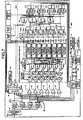
- FIG. 5 is a block diagram illustrating detailed configurations of a power supply apparatus and a voltage monitoring circuit in accordance with an example of a second embodiment where a secondary power supply is replaced by a plurality of regulators.
- FIG. 5 illustrates a case where four regulators are connected, where the number of regulators is not limited to four. Further, illustrations of load devices, each connected to regulators, are omitted.
- a secondary power supply which is a 2.5 V power supply, includes four regulators, and the four regulators output a 2.5 V voltage on the basis of an input voltage and a power-supply activation instruction signal (not illustrated).
- the values of voltages output from the four regulators are compared by a comparator circuit. Based on a comparison result, the representing-value decision logic circuit selects a regulator that outputs the highest voltage value.
- a representing-value decision logic circuit 100b of a power supply apparatus 300b in accordance with an example of a second embodiment includes an AND gate 104b, an AND gate 105b, an AND gate 106b, and an AND gate 107b, instead of the AND gate 104a, the AND gate 105a, the AND gate 106a, and the AND gate 107a.
- the representing-value decision logic circuit 100b has the same configuration as the representing-value decision logic circuit 100a of the power supply apparatus 300a in accordance with the first embodiment. Therefore, the power supply apparatus 300b has the same configuration as the power supply apparatus 300a except for the above-mentioned difference in the configuration of the representing-value decision logic circuit 100b.
- the output voltage that is input from the comparator 12a to the representing-value decision logic circuit 100b is input, via the flip-flop 102a and the flip-flop 102b, to the AND gate 105b and the inverter 103a.
- the inverter 103a inverts the output voltage that has been input and inputs the output voltage to the AND gate 104b.
- the output voltage that is input from the comparator 12b to the representing-value decision logic circuit 100b is input, via the flip-flop 102c and the flip-flop 102d, to the AND gate 106b and the inverter 103b.
- the inverter 103b inverts the output voltage that has been input and inputs the output voltage to the AND gate 104b.
- the output voltage that is input from the comparator 12c to the representing-value decision logic circuit 100b is input, via the flip-flop 102e and the flip-flop 102f, to the AND gate 107b and the inverter 103c.
- the inverter 103c inverts the output voltage that has been input and inputs the output voltage to the AND gate 104b.
- the output voltage that is input from the comparator 12d to the representing-value decision logic circuit 100b is input, via the flip-flop 102g and the flip-flop 102h, to the AND gate 106b and the inverter 103d.
- the inverter 103d inverts the output voltage that has been input and inputs the output voltage to the AND gate 105b.
- the output voltage that is input from the comparator 12e to the representing-value decision logic circuit 100b is input, via the flip-flop 102i and the flip-flop 102j, to the AND gate 107b and the inverter 103e.
- the inverter 103e inverts the output voltage that has been input and inputs the output voltage to the AND gate 105b.
- the output voltage that is input from the comparator 12f to the representing-value decision logic circuit 100b is input, via the flip-flop 102k and the flip-flop 102l, to the AND gate 107b and the inverter 103f.
- the inverter 103f inverts the output voltage that has been input and inputs the output voltage to the AND gate 106b.
- the AND gate 104b calculates the logical product of output voltages that have been input and outputs the highest output voltage of the regulator A 11a.
- the highest output voltage of the regulator A 11a is input to the AND gate 108a.
- the AND gate 105b calculates the logical product of output voltages that have been input and outputs the highest output voltage of the regulator B 11b.
- the highest output voltage of the regulator B 11b is input to the AND gate 108b and invertedly input to the AND gate 108a.
- the AND gate 106b calculates the logical product of the output voltages that have been input and outputs the highest voltage of the regulator C 11c.
- the highest output voltage of the regulator C 11c is input to the AND gate 108c and invertedly input to the AND gate 108a.
- the AND gate 107b calculates the logical product of the output voltages that have been input and outputs the highest voltage of the regulator D 11d.
- the highest output voltage of the regulator D 11d is invertedly input to the AND gate 108a and the AND gate 108c and is input to the AND gate 110g.
- the selector 13 selects the regulator that outputs the lowest or highest output voltage of all inputs from the representing-value decision logic circuit 100b and thus selects only the output voltage that is output from the regulator and sends the output voltage to the smoothing circuit 20.
- the selector 13 is an analogue multiplexer or an analogue switch.
- the representing-value decision logic circuit 100b can select and output only the highest output voltage of all four output voltages that have been input, whereby only the output voltage of the regulator that outputs the selected output voltage can be monitored.
- FIG. 6 is a block diagram illustrating detailed configurations of a power supply apparatus and a voltage monitoring circuit in accordance with an example of a third embodiment where a secondary power supply is replaced by a plurality of regulators.
- FIG. 6 illustrates a case where four regulators are connected, where the number of regulators is not limited to four.
- FIG. 6 illustrations of load devices, each connected to regulators, are omitted.
- a secondary power supply which is a 2.5 V power supply
- the four regulators output a 2.5 V voltage on the basis of an input voltage and a power-supply activation instruction signal (not illustrated).
- the values of voltages output from the four regulators are compared by a comparator circuit. Based on a comparison result, the representing-value decision logic circuit selects the highest voltage value or a regulator that outputs the highest voltage value.
- a regulator that outputs the lowest voltage value is selected.
- the lowest voltage value is equal to or higher than the predetermined threshold value
- a regulator that indicates the highest value is selected without any further consideration.
- the regulator with the lowest voltage is preferentially selected.
- the regulator with the highest voltage is selected.
- the power supply for operating each device other than the regulators is a resident power supply, which is different from the 2.5 V power supply.
- the power supply apparatus 300c further includes a reference voltage circuit 17a, a comparator 18, and a representing-value decision logic circuit 100c.
- the representing-value decision logic circuit 100c constitutes a configuration which is different from the representing-value decision logic circuits 100a and 100b.
- the regulator A 11a, the regulator B 11b, the regulator C 11c, and the regulator D 11d convert the voltages of the DC currents supplied from the primary power supply 10 into 2.5 V.
- the DC current, which has been converted into the 2.5 V, is referred to as "output voltage”.
- the output voltage of the regulator A 11a is input to the inverting input terminals of the comparators 12a to 12c and to a selector 19.
- the output voltage of the regulator B 11b is input to the non-inverting terminal of the comparator 12a, the inverting terminal of the comparator 12d, the inverting terminal of the comparator 12e, and the selector 19.
- the output voltage of the regulator C 11c is input to the non-inverting terminal of the comparator 12b, the non-inverting terminal of the comparator 12d, the inverting terminal of the comparator 12f, and the selector 19.
- the output voltage of the regulator D 11d is input to the non-inverting terminal of the comparator 12c, the non-inverting terminal of the comparator 12e, and the non-inverting terminal of the comparator 12f, and the selector 19.
- the selector 19 is an analogue multiplexer or an analogue switch.
- the regulator A 11a, the regulator B 11b, the regulator C 11c, and the regulator D 11d supply output voltages to the comparators 12a to 12f and the selector 13.
- the comparators 12a to 12f select the output voltage higher than the output voltages that have been input thereto and input the higher output voltage to the representing-value decision logic circuit 100c.
- the representing-value decision logic circuit 100c includes, for example, a clock oscillator 101 that oscillates 100 kHz clocks, a flip-flop 102a and a flip-flop 102b, a flip-flop 102c and a flip-flop 102d, a flip-flop 102e and a flip-flop 102f, a flip-flop 102g and a flip-flop 102h, a flip-flop 102i and a flip-flop 102j, a flip-flop 102k and a flip-flop 1021, a flip-flop 102m and a flip-flop 102n, six inverters 103a to 103f, an AND gate 104a and an AND gate 104b, an AND gate 105a and an AND gate 105b, an AND gate 106a and an AND gate 106b, and an AND gate 107a and an AND gate 107b.
- a clock oscillator 101 that oscillates 100 kHz clocks
- the representing-value decision logic circuit 100c includes an AND gate 108a, an AND gate 108b, an AND gate 108c, an AND gate 112a and an AND gate 112b, an AND gate 112c and an AND gate 112d, an AND gate 112e and an AND gate 112f, an AND gate 112g and an AND gate 112h, an OR gate 113a that is connected with the AND gate 112a and the AND gate 112b, an OR gate 113b that is connected with the AND gate 112c and the AND gate 112d, an OR gate 113c that is connected with the AND gate 112e and the AND gate 112f, and an OR gate 113d that is connected with the AND gate 112g and the AND gate 112h.
- the representing-value decision logic circuit 100c includes a decoder 109, an AND gate 110a and an AND gate 110b, an AND gate 110c and an AND gate 110d, an AND gate 110e and an AND gate 110f, an AND gate 110g and an AND gate 110h, an OR gate 111a that is connected with the AND gate 110a and the AND gate 110b, an OR gate 111b that is connected with the AND gate 110c and the AND gate 110d, an OR gate 111c that is connected with the AND gate 110e and the AND gate 110f, and an OR gate 111d that is connected with the AND gate 110g and the AND gate 110h.
- flip-flops 102a to 102n are synchronized by clocks oscillated from the clock oscillator 101.
- the output voltage that is input from the comparator 12a to the representing-value decision logic circuit 100c is input, via the flip-flop 102a and the flip-flop 102b, to the AND gate 104a, the AND gate 105b, and the inverter 103a.
- the inverter 103a inverts the output voltage that has been input and inputs the output voltage to the AND gate 104b, and also inverts the output voltage and inputs the output voltage to the AND gate 105a.
- the output voltage that is input from the comparator 12b to the representing-value decision logic circuit 100c is input, via the flip-flop 102c and the flip-flop 102d, to the AND gate 104a, the AND gate 106b, and the inverter 103b.
- the inverter 103b inverts the output voltage that has been input and inputs the output voltage to the AND gate 104b and the AND gate 106a.
- the output voltage that is input from the comparator 12c to the representing-value decision logic circuit 100c is input, via the flip-flop 102e and the flip-flop 102f, to the AND gate 104a, the AND gate 107b, and the inverter 103c.
- the inverter 103c inverts the output voltage that has been input and inputs the output voltage to the AND gate 104b and the AND gate 107a.
- the output voltage that is input from the comparator 12d to the representing-value decision logic circuit 100c is input, via the flip-flop 102g and the flip-flop 102h, to the AND gate 105a, the AND gate 106b, and the inverter 103d.
- the inverter 103d inputs the output voltage that has been input and inputs the output voltage to the AND gate 105b and the AND gate 106a.
- the output voltage that is input from the comparator 12e to the representing-value decision logic circuit 100c is input, via the flip-flop 102i and the flip-flop 102j, to the AND gate 105a, the AND gate 107b, and the inverter 103e.
- the inverter 103e inverts the output voltage that has been input and inputs the output voltage to the AND gate 105b and the AND gate 107a.
- the output voltage that is input from the comparator 12f to the representing-value decision logic circuit 100c is input, via the flip-flop 102k and the flip-flop 1021, to the AND gate 106a, the AND gate 107b, and the inverter 103f.
- the inverter 103f inverts the output voltage that has been input and inputs the output voltage to the AND gate 106b and the AND gate 107a.
- the AND gate 104a calculates the logical product of the output voltages that have been input and outputs the lowest output voltage of the regulator A 11a.
- the lowest output voltage of the regulator A 11a is input to the AND gate 112a and the selector 19.
- the AND gate 104b calculates the logical product of the output voltages that have been input and outputs the highest output voltage of the regulator A 11a.
- the highest output voltage of the regulator A 11a is input to the AND gate 112b.
- the AND gate 105a calculates the logical product of the output voltages that have been input and outputs the lowest output voltage of the regulator B 11b.
- the lowest output voltage of the regulator B 11b is input to the AND gate 112c and the selector 19.
- the AND gate 105b calculates the logical product of the output voltages that have been input and outputs the highest output voltage of the regulator B 11b.
- the highest output voltage of the regulator B 11b is input to the AND gate 112d.
- the AND gate 106a calculates the logical product of the output voltages that have been input and outputs the lowest output voltage of the regulator C 11c.
- the lowest output voltage of the regulator C 11c is input to the AND gate 112e and the selector 19.
- the AND gate 106b calculates the logical product of the output voltages that have been input and outputs the highest output voltage of the regulator C 11c.
- the highest output voltage of the regulator C 11c is input to the AND gate 112f.
- the AND gate 107a calculates the logical product of the output voltages that have been input and outputs the lowest output voltage of the regulator D 11d.
- the lowest output voltage of the regulator D 11d is input to the AND gate 112g and the selector 19.
- the AND gate 107b calculates the logical product of the output voltages that have been input and outputs the highest output voltage of the regulator D 11d.
- the highest output voltage of the regulator D 11d is input to the AND gate 112h.
- the selector 19 selects one of the output voltages on the basis of all inputs from the regulator A 11a, the regulator B 11b, the regulator C 11c, and the regulator D 11d and from the AND gate 104a, the AND gate 105a, the AND gate 106a, and the AND gate 107a, and then inputs the selected output voltage to the inverting terminal of the comparator 18. Further, the 2.3 V output voltage from the reference voltage circuit 17a is input to the non-inverting terminal of the comparator 18. The comparator 18 compares one of the single output voltage with the 2.3 V output voltage and then outputs the higher output voltage, which is input to the flip-flop 102m.
- the output voltage that has been output from the comparator 18 is input, via the flip-flop 102m to the flip-flop 102n, to the AND gate 112a, the AND gate 112c, the AND gate 112e, and the AND gate 112g, and invertedly input to the AND gate 112b, the AND gate 112d, the AND gate 112f, and the AND gate 112h.
- the AND gate 112a and the AND gate 112b calculate the logical products of inputs thereof and input the logical products to the OR gate 113a.
- the OR gate 113a calculates the logical sum of inputs from the AND gate 112a and the AND gate 112b and inputs the logical sum to the AND gate 108a.
- the AND gate 112c and the AND gate 112d calculate the logical products of inputs thereof and inputs the logical products to the OR gate 113b.
- the OR gate 113b calculates the logical sum of inputs from the AND gate 112c and the AND gate 112d. Then, the OR gate 113b inputs the logical sum invertedly to the AND gate 108a and inputs the logical sum to the AND gate 108b.
- the AND gate 112e and the AND gate 112f calculate the logical products of inputs thereof and input the logical products to the OR gate 113c.
- the OR gate 113c calculates the logical sum of the AND gate 112e and the AND gate 112f. Then, the OR gate 113c inputs the logical sum invertedly to the AND gate 108a and the AND gate 108b and inputs the logical sum to the AND gate 108c.
- the AND gate 112g and the AND gate 112h calculate the logical products of inputs thereof and input the logical products to the OR gate 113d.
- the OR gate 113d calculates the logical cum of the AND gate 112g and the AND gate 112h. Then, the OR gate 113d inputs the logical sum invertedly to the AND gate 108a, the AND gate 108b, and the AND gate 108c and inputs the logical sum to the AND gate 110g.
- the AND gate 108a calculates the logical product of output voltages that have been input and inputs the output voltage based on the logical product to the AND gate 110a. Further, the AND gate 108b calculates the logical product of output voltages that have been input and inputs the output voltage based on the logical product to the AND gate 110c. Further, the AND gate 108c calculates the logical product of output voltages that have been input and inputs the output voltage based on the logical product to the AND gate 110e.
- the setting values of the one-bit register 0 and register 2 are input from the general-purpose input/output interface 16 to the decoder 109 of the representing-value decision logic circuit 100c.
- the decoder 109 inputs results of decoding of the setting values to the AND gate 110b, the AND gate 110d, the AND gate 110f, and the AND gate 110h. Further, the enabling input value that is input from the general-purpose input/output interface 16 is invertedly input to the AND gate 110a, the AND gate 110c, the AND gate 110e, and the AND gate 110g.
- the AND gate 110a and the AND gate 110b calculate the logical products of inputs thereof and input the logical products to the OR gate 111a.
- the OR gate 111a calculates the logical sum of inputs from the AND gate 110a and the AND gate 110b and then outputs the logical sum to the selector 13.
- the AND gate 110c and the AND gate 110d calculate the logical products of inputs thereof and input the logical products to the OR gate 111b.
- the OR gate 111b calculates the logical sum of inputs from the AND gate 110c and the AND gate 110d and then outputs the logical sum to the selector 13.
- the AND gate 110e and the AND gate 110f calculate the logical products of inputs thereof and input the logical products to the OR gate 111c.
- the OR gate 111c calculates the logical sum of inputs from the AND gate 110e and the AND gate 110f and then outputs the logical sum to the selector 13.
- the AND gate 110g and the AND gate 110h calculate the logical products of inputs thereof and input the logical products to the OR gate 111d.
- the OR gate 111d calculates the logical sum of inputs from the AND gate 110g and the AND gate 110h and then outputs the logical sum to the selector 13.
- the representing-value decision logic circuit 100c can select and output only the lowest or highest voltage of four output voltages that have been input.
- the predetermined lowest threshold value e.g., 2.3 V
- the lowest output voltage can be selected and output.
- the lowest output voltage can be selected and output.
- FIG. 7 illustrates a block diagram of detailed configurations of the power supply apparatus and the voltage monitoring circuit in accordance with an example of the fourth embodiment where the secondary power supply is replaced by a plurality of regulators.
- FIG. 7 illustrates a case where four regulators are connected, where the number of regulators is not limited to four. Further, in FIG. 7 , illustrations of load devices, each connected with regulators, are omitted.
- a secondary power supply which is a 2.5 V power supply, includes four regulators, and the four regulators output a 2.5 V voltage on the basis of an input voltage and a power-supply activation instruction signal (not illustrated).
- the values of voltages output from the four regulators are compared by a comparator circuit. Based on a comparison result, a representing-value decision logic circuit selects the regulator that outputs the highest voltage value.
- the regulator that outputs the lowest voltage value is selected.
- the highest voltage value is higher than the predetermined threshold value, the regulator that outputs the highest voltage value is selected without any further consideration.
- the regulator with the highest voltage value is preferentially selected.
- the regulator with the lowest voltage value is selected.
- the power supply for operating each device other than the regulators is a resident power supply, which is different from the 2.5 V power supply.
- the configuration of a power supply apparatus 300d in accordance with an example of a fourth embodiment is like as a configuration of the power supply apparatus 300a in accordance with an example of the first embodiment; and therefore, the following describes only differences between these configurations.
- the power supply apparatus 300d is different from the power supply apparatus 300c because, in the power supply apparatus 300d, a signal indicating the regulator that outputs the highest voltage is input to the selector 19, and the voltage input to the non-inverting terminal of the comparator 18 is 2.7 V due to a reference voltage circuit 17b.
- a representing-value decision logic circuit 100d can select and output only the lowest or highest output voltage of four output voltages that have been input.
- the highest output voltage is higher than the predetermined lowest threshold value (e.g., 2.7 V) or not and the highest output voltage turns out to be equal to or lower than the highest threshold value
- the lowest output voltage can be selected and output.
- the highest output voltage is higher than the highest threshold value
- the highest output voltage can be selected and output.
- FIG. 8 illustrates a block diagram of detailed configurations of the power supply apparatus and the voltage monitoring apparatus in accordance with an example of the fifth embodiment where a secondary power supply is replaced by a plurality of regulators.
- FIG. 8 illustrates a case where four regulators are connected, where the number of regulators is not limited to four.
- FIG. 8 illustrations of load devices, each connected with regulators, are omitted.
- a secondary power supply which is a 2.5 V power supply, includes of four regulators, and the four regulators output a 2.5 V voltage on the basis of an input voltage and a power-supply activation instruction signal (not illustrated).
- the values of voltages output from the four regulators are compared by a comparator circuit. Based on a comparison result, the lowest voltage value of a difference between the output voltage and the predetermined reference voltage or a regulator that outputs the lowest voltage value is selected. Based on a comparison result, the representing-value decision logic circuit selects the highest voltage value of a difference between the output voltage and the predetermined reference voltage or a regulator that outputs the lowest voltage value.
- differences i.e., absolute values, between the output voltages of the regulators and the predetermined reference voltage are calculated, and the regulator that produces the highest absolute value is selected.
- a power supply apparatus 300e in accordance with an example of the fifth embodiment is different from the power supply apparatus 300b in accordance with an example of the second embodiment because the power supply apparatus 300e further includes a reference voltage circuit 17c and difference absolute-value detecting circuits 200a, 200b, 200c, and 200d.
- a representing-value decision logic circuit 100e of the power supply apparatus 300e has the same configuration as the representing-value decision logic circuit 100b of the power supply apparatus 300b in accordance with the second embodiment.
- the difference absolute-value detecting circuits 200a, 200b, 200c, and 200d are referred to collectively as "difference absolute-value detecting circuit 200".
- the regulator A 11a inputs direct current, which has been converted into 2.5 V, into the difference absolute-value detecting circuit 200a and the selector 13 as Vin_A.
- the regulator B 11b inputs direct current, which has been converted into 2.5 v, into the difference absolute-value detecting circuit 200b and the selector 13 as Vin_A.
- the regulator C 11c inputs direct current, which has been converted into 2.5 V, into the difference absolute-value detecting circuit 200c and the selector 13 as Vin_A.
- the regulator D 11d inputs direct current, which has been converted into 2.5 V, into the difference absolute-value detecting circuit 200d and the selector 13 as Vin_A.
- the reference voltage circuit 17c which provides 2.5 V, inputs the reference voltage into the difference absolute-value detecting circuits 200a, 200b, 200c, and 200d as Vin_B.
- the difference absolute-value detecting circuit 200a calculates the absolute value (Vout) of the difference between the output voltage of the regulator A 11a and the 2.5 V reference voltage. Then, the difference absolute-value detecting circuit 200a inputs the absolute value of the difference into the inverting terminals of the comparator 12a, the comparator 12b, and the comparator 12c.
- the difference absolute-value detecting circuit 200b calculates the absolute value (Vout) of the difference between the output voltage of the regulator B 11b and the 2.5 V reference voltage. Then, the difference absolute-value detecting circuit 200b inputs the absolute value of the difference into the non-inverting terminal of the comparator 12a and into the inverting terminals of the comparator 12d and the comparator 12e.
- the difference absolute-value detecting circuit 200c calculates the absolute value (Vout) of the difference between the output voltage of the regulator C 11c and the 2.5 V reference voltage. Then, the difference absolute-value detecting circuit 200c inputs the absolute value of the difference into the non-inverting terminals of the comparator 12b and the comparator 12d and the inverting terminal of the comparator 12f.
- the difference absolute-value detecting circuit 200d calculates the absolute value (Vout) of the difference between the output voltage of the regulator D 11d and the 2.5 V reference voltage. Then, the difference absolute-value detecting circuit 200d inputs the absolute value of the difference into the non-inverting terminals of the comparator 12c and the comparator 12e and the inverting terminal of the comparator 12f.
- the absolute values of differences that have been input to the comparators 12a to 12f as described above are input to the representing-value decision logic circuit 100e as an output voltage having a higher voltage value.
- the subsequent processes are performed in the same way as the representing-value decision logic circuit 100b in accordance with an example of the second embodiment.
- the representing-value decision logic circuit 100e can select and output only the highest absolute value of the difference of all between the four output voltages that have been input and 2.5 V. Thus, only the output voltage of the regulator that outputs the absolute value of the selected difference can be monitored.
- FIG. 9 is a block diagram illustrating detailed configurations of the difference absolute-value detecting circuit included in the power supply apparatus in accordance with an example of the fifth embodiment where a secondary power supply is replaced by a plurality of regulators.
- the difference absolute-value detecting circuit 200 is a circuit that receives Vin_A, which is DC current of the predetermined output voltage, and Vin_B, which is DC current of the reference voltage, as input and outputs Vout, which is direct current.
- the difference absolute-value detecting circuit 200 is thus a circuit that calculates and outputs an absolute value of a difference between the output voltage of a regulator and the predetermined reference voltage.
- the difference absolute-value detecting circuit 200 includes an R1 resistor 201a, an R2 resistor 201b, an R3 resistor 201c, an R4 resistor 201d, an R5 resistor 201e, an OP amp (Operational Amplifier) 202, a diode 203, a diode 204, and an OP amp 205.
- the resistance value of the R1 resistor 201a, the R2 resistor 201b, and the R3 resistor 201c is a predetermined resistance value R [ ⁇ ]
- the resistance value of the R4 resistor 201d and the R5 resistor 201e is 2R [ ⁇ ].
- the OR amp is an amplifier of DC current of an analogue signal.
- Vin_A that has been input to the difference absolute-value detecting circuit 200 is input to the R1 resistor 201a and the R4 resistor 201d.
- Vin_A that has passed through the R1 resistor 201a is input to the inverting terminal of the OP amp 202 and the R2 resistor 201b.
- Vin_B is input to the non-inverting terminal of the OP amp 202.
- the OP amp 202 amplifies the input DC current by the predetermined amount and inputs the amplified signal to the diode 203.
- the diode 203 compares the input DC current with the DC current that is output from the R1 resistor 201a. The compared DC current is input to the R2 resistor 201b.
- the DC current from the R2 resistor 201b is input to the R3 resistor 201c and the diode 204.
- the diode 204 compares the input DC current with the DC current from the OP amp 202 and inputs the input DC current to the diode 203.
- the R2 resistor 201b inputs the input DC current to the inverting terminal of the OP amp 205. Further, Vin_B is input to the non-inverting terminal of the OP amp 205. The OP amp 205 amplifies the input DC current by the predetermined amount and outputs the same.
- the DC current that has passed through the R4 resistor 201d and the R5 resistor 201e is compared with the output of the OP amp 205.
- the compared output is Vout, which is direct current.
- the circuit wire between the R4 resistor 201d and the R5 resistor 201e is connected, using the predetermined circuit wire, with the circuit wire between the R3 resistor 201c and the OP amp 205.
- the AD converter 14 and the system monitoring processor 15 can use conventional products, and it is not necessary to redesign the circuit for voltage monitoring. Therefore, it is not necessary to revise firmware of the system monitoring processor, whereby the circuit for voltage monitoring can maintain compatibility with the conventional configuration.
- the components of the apparatuses and devices illustrated are merely functional concepts, and the physical configurations of these components are not necessarily the same as those illustrated.
- specific embodiments of integration/disintegration of the apparatuses and devices are not limited to those illustrated.
- all or some of the apparatuses and devices may be functionally or physically integrated/disintegrated into an arbitrary unit.
- the present invention relates to voltage monitoring of a secondary power supply and is suitable for a case where a secondary power supply is replaced by a plurality of regulators to reduce burden of redesigning a configuration related to power-supply monitoring of a power supply monitoring apparatus and the involved production cost.
- the present invention is particularly suitable for a case where a configuration includes a single AD converter and a single system monitoring processor that are needed to quantize and monitor output voltages of regulators.
Landscapes
- Engineering & Computer Science (AREA)
- Power Engineering (AREA)
- Dc-Dc Converters (AREA)
- Control Of Voltage And Current In General (AREA)
- Direct Current Feeding And Distribution (AREA)
- Power Sources (AREA)
Abstract
Description
- The present invention relates to a power supply apparatus and a voltage monitoring method that select one secondary power supply from a plurality of secondary power supplies receiving an output voltage from a primary power supply as input and monitor the selected output voltage. In particular, the present invention relates to voltage monitoring of a secondary power supply and to a power supply apparatus and a voltage monitoring method that are compatible with a power supply apparatus with a conventional configuration, even when the secondary power supply is replaced by a plurality of regulators.
- Conventionally, in an electric apparatus that contains a secondary power supply using a DC-DC (Direct Current to Direct Current) converter, the integrated circuit of the DC-DC converter is often replaced by a plurality of regulators (constant direct current power supply circuits) to reduce costs. In this case, it is difficult to realize power supply by connecting to the output of a plurality of regulators for each one of them. Generally, power supply is realized by using regulators each of which is dedicated to a plurality of power supply areas (e.g., an LSI (Large Scale Integration) as a load device).
- Because regulators are inexpensive and provide a low failure rate, replacing a DC-DC converter with a plurality of regulators can reduce the production costs of a power supply apparatus. In contrast, when a plurality of regulators is used, each output voltage of regulators needs to be regularly monitored because the output voltage is different for each regulator.
- For example,
Patent Document 1 discloses a power supply monitoring apparatus that reads output voltage of each regulator with an ADC (Analog Digital Converter) and gives out a warning when output voltage is below or above a reference value. - Further, Patent Document 2 discloses a power supply apparatus that monitors a plurality of power supplies and stops a power supply by outputting a signal to shut down the power supply where an error of output voltage is detected.
- Patent Document 1: Japanese Laid-open Patent Publication No.
08-005693 - Patent Document 2:
US Patent Document No. 6289467 - When a conventional configuration of a power supply monitoring apparatus in which one system monitoring processor monitors output voltage by one ADC reading the output voltage of one DC-DC converter is changed into a configuration where one DC-DC converter is replaced by a plurality of regulators, the system-monitoring processor firmware needs to be substantially changed when the conventional technology notably disclosed in
Patent Documents 1 or 2 is used. Thus, a problem of incompatibility arises in that the power supply apparatus including a power supply monitoring apparatus ends up incurring rather higher production costs because there is no compatibility with the configuration of a conventional power supply monitoring apparatus. - The present invention, which relates to voltage monitoring of a secondary power supply, is made in order to overcome the problem above, and an object of the present invention is to provide a power supply apparatus and a voltage monitoring method that maintain compatibility with a conventional power supply monitoring apparatus even when a secondary power supply is replaced by a plurality of regulators.
- To solve the disadvantage described above and achieve the object, according to the present invention, a power supply apparatus, includes a primary power supply that outputs direct current; a plurality of secondary power supplies to each of which the direct current is inputted and a load device is connected, respectively; a selector to which output voltages outputted from the secondary power supplies are inputted and selects one of the output voltages; and a converter that converts the output voltage selected by the selector into quantized voltage information.
- Further, according to the invention, a voltage monitoring method of a power supply apparatus, includes steps of: a primary power supply outputting direct current; a plurality of secondary power supplies, to each of which a load device is connected, inputting the direct current as input; a selector receiving output voltages of the secondary power supplies as input and selecting one of the output voltages of the secondary power supplies; and a converter converting the output voltage selected by the selector into quantized voltage information.
- According to the invention described above, one of the output voltages of the secondary power supplies is selected , whereby only the selected output voltage of the secondary power supply may be converted into quantized voltage information.
- Further, according to the invention, in the above-described invention, the selector selects a lowest output voltage of all output voltages outputted from the secondary power supplies.
- Further, according to the invention, in the above-described invention, the step of the selector selecting one of the output voltages of the secondary power supplies is to select a lowest output voltage of all output voltages outputted from the secondary power supplies.
- According to the invention described above, the lowest output voltage of all output voltages outputted from the secondary power supplies is selected , whereby only the selected output voltage of the secondary power supply may be converted into quantized voltage information.
- Further, according to the invention, in the above-described invention, the selector selects the highest output voltage of all output voltages outputted from the secondary power supplies.
- Further, according to the invention, in the above-described invention, the step of the selector selecting one of the output voltages of the secondary power supplies is to select the highest output voltage of all output voltages outputted from the secondary power supplies.
- According to the invention described above, the highest output voltage of all output voltages of the secondary power supplies is selected, whereby only the selected output voltage of the secondary power supply may be converted into quantized voltage information.
- Further, according to the invention, in the above-described invention, the selector selects the lowest output voltage and the highest output voltage of all output voltages outputted from the secondary power supplies; the selector outputs the selected lowest output voltage, when the selected lowest output voltage is lower than a predetermined threshold voltage; and the selector outputs the selected highest output voltage, when the selected lowest output voltage is higher than the predetermined threshold voltage.
- Further, according to the invention, in the above-described invention, the step of the selector selecting one of the output voltages of the secondary power supplies is to select the lowest output voltage and the highest output voltage of all output voltages outputted from the secondary power supplies, to output the selected lowest output voltage, when the selected lowest output voltage is lower than a predetermined threshold voltage, and to output the selected highest output voltage, when the selected lowest output voltage is higher than the predetermined threshold voltage.
- According to the invention described above, the lowest output voltage and the highest output voltage of all output voltages outputted from the secondary power supplies are selected, when the selected lowest output voltage is lower than a predetermined threshold voltage, the lowest output voltage outputted from the secondary power supply is selected, and when the selected lowest output voltage is higher than the predetermined threshold voltage, the highest output voltage outputted from the secondary power supply is selected, thereby selecting either of the selected lowest or highest output voltage outputted from the secondary power supply to convert the selected output voltage outputted from the secondary power supply into quantized voltage information when the secondary power supply outputs a very low output voltage.
- Further, according to the invention, in the above-described invention, the selector selects the lowest output voltage and the highest output voltage of all output voltages outputted from the secondary power supplies, the selector outputs the selected lowest output voltage, when the selected highest output voltage is lower than a predetermined threshold voltage, and the selector selects the selected highest output voltage, when the selected highest output voltage is higher than the predetermined threshold voltage.
- Further, according to the invention, in the above-described invention, the step of the selector selecting one of the output voltages of the secondary power supplies is to select the lowest output voltage and the highest output voltage of all output voltages outputted from the secondary power supplies, to output the selected lowest output voltage, when the selected highest output voltage is lower than a predetermined threshold voltage, and to output the selected highest output voltage, when the selected highest output voltage is higher than the predetermined threshold voltage.
- According to the invention described above, the lowest output voltage and the highest output voltage of all output voltages outputted from the secondary power supplies are selected, when the selected highest output voltage is lower than a predetermined threshold voltage, the selected lowest output voltage is outputted, and when the selected highest output voltage is higher than the predetermined threshold voltage, the selected highest output voltage is selected, thereby selecting either of the selected lowest or highest output voltage of the secondary power supply to convert the selected output voltage of the secondary power supply into quantized voltage information when the secondary power supply outputs a very high output voltage.
- Further, according to the invention, a power supply apparatus, includes a primary power supply that outputs direct current; a plurality of secondary power supplies to each of which the direct current is inputted and a load device is connected, respectively; a plurality of difference voltage detectors to which output voltages outputted from the secondary power supplies and reference voltages are inputted and that outputs absolute values of difference voltages between the output voltages outputted from the secondary power supplies and the reference voltages for each of the secondary power supplies; a plurality of comparators that compare the absolute values of the difference voltages outputted from the difference voltage detectors with each other; a selector that selects the output voltage outputted from the secondary power supply whose difference in the absolute value from the reference voltage is the highest of all output voltages of the secondary power supplies based on comparison results of the comparators; and a converter that converts the output voltage selected by the selector into quantized voltage information.
- Further, according to the invention, a voltage monitoring method of a power supply apparatus, includes a primary power supply outputting direct current; a plurality of secondary power supplies, to each of which a load device is connected, inputting the direct current as input; a plurality of difference voltage detectors, to which output voltages and reference voltages are inputted, outputting absolute values of difference voltages between the output voltages outputted from the secondary power supplies and the reference voltages for each of the secondary power supplies; a plurality of comparators comparing the absolute values of the difference voltages outputted from the difference voltage detectors with each other; a selector selecting the output voltage outputted from the secondary power supply whose difference in the absolute value from the reference voltage is the highest of all output voltages of the secondary power supplies based on comparison results of the comparators; and a converter converting the output voltage selected by the selector into quantized voltage information.
- According to the invention described above, the absolute values of the difference voltages between the output voltages outputted from the secondary power supplies and the reference voltages are outputted for each of the secondary power supplies, the absolute values of the difference voltages are compared by magnitude with each other, and the output voltage outputted from the secondary power supply whose difference in the absolute value from the reference voltage is the highest is selected, thereby converting only the selected output voltage of the secondary power supply into quantized voltage information.
- Further, according to the invention, in the above-described invention, the power supply apparatus is connected to a monitoring control apparatus that monitors the quantized voltage information converted by the converter.
- Further, according to the invention, in the above-described invention, the power supply apparatus is connected to a monitoring control apparatus that monitors the quantized voltage information converted by the converter.
- According to the invention described above, the power supply apparatus is connected to the monitoring control apparatus that monitors the quantized voltage information converted by the converter, thereby monitoring the quantized voltage information by the monitoring control apparatus.
- Further, according to the invention, in the above-described invention, the power supply apparatus further includes a smoothing circuit that smoothes the output voltage selected by the selector and inputs the smoothed output voltage into the converter.
- Further, according to the invention, in the above-described invention, the power supply apparatus further includes a smoothing circuit that smoothes the output voltage selected by the selector and inputs the smoothed output voltage into the converter.
- According to the invention described above, the smoothed output voltage is converted into the quantized voltage information, thereby obtaining precisely quantized voltage information.
- Further, according to the invention, in the above-described invention, the secondary power supply includes a stabilizing power supply circuit.
- Further, according to the invention, in the above-described invention, the secondary power supply includes a stabilizing power supply circuit.
- According to the invention described above, the secondary power supply includes a stabilizing power supply circuit, whereby the secondary power supplies may be configured for a low-cost.
- Further, according to the invention, in the above-described invention, the selector and the converter are operated by the voltage supplied from power supplies other than the secondary power supplies.
- Further, according to the invention, in the above-described invention, the selector and the converter are operated by the voltage supplied from power supplies other than the secondary power supplies.
- According to the invention described above, the selector and the converter are operated by the voltage supplied from the power supplies other than the secondary power supplies, whereby the selector and the converter may be stably operated.
- According to the present invention, voltage monitoring of a secondary power supply may be made in order to maintain structural compatibility with a conventional power supply apparatus even when a secondary power supply is replaced by a plurality of regulators. Particularly, this allows a conventional configuration which includes a single AD converter and a single system monitoring processor that are needed to quantize and monitor output voltages of regulators, thereby reducing burden of redesigning a configuration related to power-supply monitoring of a power supply monitoring apparatus and the involved production cost.
-
FIG. 1 is a block diagram of a schematic configuration of a conventional power supply apparatus and a voltage monitoring circuit. -
FIG. 2 is a block diagram illustrating a schematic configuration of a power supply apparatus and a voltage monitoring circuit where a secondary power supply is replaced by a plurality of regulators. -
FIG. 3 is a block diagram illustrating a schematic configuration of a power supply apparatus and a voltage monitoring circuit in accordance with an example of an embodiment where a secondary power supply is replaced by a plurality of regulators. -
FIG. 4 is a block diagram illustrating a detailed configuration of a power supply apparatus and a voltage monitoring circuit in accordance with an example of a first embodiment where a secondary power supply is replaced by a plurality of regulators. -
FIG. 5 is a block diagram illustrating a detailed configuration of a power supply apparatus and a voltage monitoring circuit in accordance with an example of a second embodiment where a secondary power supply is replaced by a plurality of regulators. -
FIG. 6 is a block diagram illustrating a detailed configuration of a power supply apparatus and a voltage monitoring circuit in accordance with an example of a third embodiment where a secondary power supply is replaced by a plurality of regulators. -
FIG. 7 is a block diagram illustrating a detailed configuration of a power supply apparatus and a voltage monitoring circuit in accordance with an example of a fourth embodiment where a secondary power supply is replaced by a plurality of regulators. -
FIG. 8 is a block diagram illustrating a detailed configuration of a power supply apparatus and a voltage monitoring circuit in accordance with an example of a fifth embodiment where a secondary power supply is replaced by a plurality of regulators. -
FIG. 9 is a block diagram illustrating a detailed configuration of a difference absolute value detecting circuit that is included in a power supply apparatus in accordance with an example of a fifth embodiment where a secondary power supply is replaced by a plurality of regulators. -
- 10 Primary power supply
- 11a Regulator A
- 11b Regulator B
- 11c Regulator C
- 11d Regulator D
- 12a, 12b, 12c, 12d, 12e, 12f, 18 Comparator
- 13, 19 Selector
- 14 AD Converter
- 15 System monitoring processor
- 16 General-purpose input/output interface
- 17a, 17b, 17c Reference voltage circuit
- 20 Smoothing circuit
- 21a, 21b Resident power supply
- 100a, 100b, 100c, 100d, 100e Representing value decision logic circuit
- 101 Clock oscillator
- 102a, 102b, 102c, 102d, 102e, 102f, 102g, 102h, 102i, 102j, 102k, 1021, 102m, 102n Flip-flop
- 103a, 103b, 103c, 103d, 103e, 103f Inverter
- 104a, 104b AND gate
- 105a, 105b AND gate
- 106a, 106b AND gate
- 107a, 107b AND gate
- 108a, 108b, 108c AND gate
- 109 Decoder
- 110a, 110b, 110c, 110d, 110e, 110f, 110g, 110h AND gate
- 111a, 111b, 111c, 111d OR gate
- 112a, 112b, 112c, 112d, 112e, 112f, 112g, 112h AND gate
- 113a, 113b, 113c, 113d OR gate
- 200, 200a, 200b, 200c, 200d Difference absolute value detecting circuit
- 201a R1 resistor
- 201b R2 resistor
- 201c R3 resistor
- 201d R4 resistor
- 201e R5 resistor
- 202, 205 OP amp
- 203, 204 Diode
- 300a, 300b, 300c, 300d, 300e Power supply apparatus
- An embodiment of a power supply apparatus and a voltage monitoring method of the present invention is described in detail below with reference to the accompanying drawings.
- Firstly, a schematic configuration of a conventional power supply apparatus and a conventional voltage monitoring circuit is described.
FIG. 1 is a block diagram illustrating a schematic configuration of a conventional power supply apparatus and a voltage monitoring circuit. As illustrated inFIG. 1 , conventionally, AC current (Alternating Current) input is converted into DC current (Direct Current) by a primary power supply. The DC current, after the conversion by the primary power supply, encounters voltage conversion by a secondary power supply including a DC-DC converter. The direct current of output voltage, after the voltage conversion by the DC-DC converter, is supplied to a load device such as an LSI (Large Scale Integration) and also to a voltage monitoring circuit for voltage monitoring.FIG. 1 illustrates a case where a single load device is connected. - Specifically, the circuit for voltage monitoring includes a smoothing circuit that includes a resistor and a capacitor that are grounded and connected in parallel with an output and generates direct current (or smoothes current) where pulsating current included in rectified current is removed; an AD (Analog to Digital) converter that quantizes (digitalizes) the direct current that has been smoothed by the smoothing circuit; and a system monitoring processor that monitors the voltage value of the direct current that has been quantized by the AD converter. Further, power to the AD converter and the system monitoring processor may be supplied from each dedicated resident power supply or from a single dedicated resident power supply.
- The resident power supply is a power supply that belongs to a different system from the primary power supply, so that the resident power supply can supply power regardless of the control of the primary power supply as long as the system is running.
- With the configuration described above, the system monitoring processor can monitor problems with voltage supplied to a load device. When the system monitoring processor detects a problem with the voltage supplied to the load device, an appropriate measure can be taken.
- However, because a DC-DC converter including a converter (trans) and a switching circuit is expensive, a regulator (a low voltage direct current power supply circuit) is generally adopted instead of a DC-DC converter in order to reduce costs. A regulator is a voltage control device that can only lower voltage and is much more inexpensive than a DC-DC converter.
FIG. 2 is a block diagram illustrating a schematic configuration of a power supply apparatus and a voltage monitoring circuit where a secondary power supply is replaced by a plurality of regulators. AlthoughFIG. 2 illustrates a case where three regulators, connected to the load device, are also connected to the primary power supply, where the number of regulators is not limited to three. - As illustrated in
FIG. 2 , a regulator A that supplies direct-current power supply to a load device A, a regulator B that supplies direct-current power supply to a load device B, and a regulator C that supplies direct-current power supply carries out voltage conversion for each on the direct current that has been converted into direct current by the primary power supply and supplies direct current to each load device. - The regulators are connected straight with smoothing circuits that smoothes output voltage of the regulators and AD converters, respectively. Specifically, the regulator A is connected to the AD converter A, the regulator B is connected to the AD converter B, and the regulator C is connected straight with the AD converter C along with each smoothing circuit.
- The output voltage of the regulator A that has been quantized by the AD converter A, output voltage of the regulator B that has been quantized by the AD converter, and output voltage of the regulator A that has been quantized by the AD converter are input to a single system monitoring processor. Thus, a single system monitoring processor monitors the output voltage of all regulators. Further, power to the AD converter A, the AD converter B, the AD converter C, and the system monitoring processor may be supplied from each dedicated resident power supply or from a single resident power supply.
- With the configuration illustrated in
FIG. 2 , an AD converter needs to be prepared for each regulator. Thus, the circuit for voltage monitoring needs to be redesigned. However, when the circuit for voltage monitoring is redesigned, the system monitoring processor firmware needs to be revised. Thus, the circuit for voltage monitoring becomes incompatible with the conventional configuration, which causes a problem in terms of production cost. - The present embodiment provides a power supply apparatus with which it is not needed to change conventional configurations of the AD converter and the system monitoring processor nor revise the system monitoring processor firmware, and compatibility with the conventional configuration can still be maintained.
FIG. 3 is a block diagram illustrating a schematic configuration of a power supply apparatus and a voltage monitoring circuit where a secondary power supply is replaced by a plurality of regulators. AlthoughFIG. 3 illustrates a case where three regulators, connected to the load devices, are also connected to the primary power supply, where the number of regulators is not limited to three. - In
FIG. 3 , output voltage of the regulator A, the regulator B, and the regulator C is supplied to the load devices, respectively, and to a representing-value decision logic circuit that is operated by a dedicated power supply. The representing-value decision logic circuit selects the output voltage that seems the most irregular of all the output voltages of the regulator A, the regulator B, and the regulator C and then sends a selection result to a selector. - The selector selects only the output voltage from the regulator that outputs the output voltage that seems the most irregular of all and is selected by the representing-value decision logic circuit, and then the selector inputs the output voltage to the smoothing circuit. The direct current that has been smoothed by the smoothing circuit is quantized by the AD converter and then sent to the system monitoring processor.
- With the configuration in
FIG. 3 , a single output voltage is input via the selector to the smoothing circuit. The direct current that has been smoothed by the smoothing circuit is quantized by the AD converter and then sent to the system monitoring processor. The circuit used for voltage monitoring that includes the smoothing circuit, the AD converter, and the system monitoring processor can be the same as that in the conventional configuration inFIG. 1 . - With the configuration in
FIG. 3 , it is not needed to prepare an AD converter for each regulator nor redesign the circuit for voltage monitoring after the smoothing circuit. Thus, it is also not needed to revise the system monitoring processor firmware. The configuration inFIG. 3 is preferable because the circuit for voltage monitoring remains compatible with the conventional configuration. - A detailed configuration of a power supply apparatus and a voltage monitoring circuit in accordance with an example of the first embodiment where a secondary power supply is replaced by a plurality of regulators is described below.
FIG. 4 is a block diagram illustrating a detailed configuration of a power supply apparatus and a voltage monitoring circuit in accordance with an example of the first embodiment where a secondary power supply is replaced by a plurality of regulators. AlthoughFIG. 4 illustrates a case where four regulators are connected, where the number of regulators is not limited to four. Further, inFIG. 4 , illustration of load devices connected to regulators is omitted. - An outline of the first embodiment is described below. In the power supply apparatus, a secondary power supply, which is a 2.5-v power supply, includes four regulators, and the four regulators output a 2.5 V voltage on the basis of an input voltage and a power-supply activation instruction signal (not illustrated). The values of voltages output from the four regulators are compared by a comparator circuit. Based on a comparison result, the representing-value decision logic circuit selects a regulator that outputs the lowest voltage value.
- A
power supply apparatus 300a includes aprimary power supply 10, aregulator A 11a, aregulator B 11b, aregulator C 11c, and aregulator D 11d, sixcomparators 12a to 12f, a representing-valuedecision logic circuit 100a, aselector 13, anAD converter 14, a general-purpose input/output interface 16, a smoothingcircuit 20, aresident power supply 21a that supplies power to theselector 13, and aresident power supply 21b that supplies power to theAD converter 14. Theresident power supply 21a and theresident power supply 21b may be integrated into one. - The
primary power supply 10 converts the AC current input into the DC current and then supplies the DC current to theregulator A 11a, theregulator B 11b, theregulator B 11b, theregulator C 11c, and theregulator D 11d. Theregulator A 11a, theregulator B 11b, theregulator C 11c, and theregulator D 11d convert each voltage of DC current supplied from theprimary power supply 10 into 2.5 V. The voltage of the DC current, which has been converted into 2.5 V, is referred to, hereinafter, as "output voltage". - The output voltage of the
regulator A 11a is input to the inverting input terminals of thecomparators 12a to 12c. Further, the output voltage of theregulator B 11b is input to a non-inverting input terminal of thecomparator 12a, a non-inverting input terminal of thecomparator 12d, and a non-inverting input terminal of thecomparator 12e. - The output voltage of the
regulator C 11c is input to a non-inverting terminal of thecomparator 12b, a non-inverting terminal of thecomparator 12d, and a non-inverting terminal of the comparator 12f. Further, the output voltage of theregulator D 11d is input to a non-inverting input terminal of the comparator 12c, a non-inverting input terminal of thecomparator 12e, and a non-inverting input terminal of the comparator 12f. - The
regulator A 11a, theregulator B 11b, theregulator C 11c, and theregulator D 11d supply output voltages to thecomparators 12a to 12f and also to theselector 13. - The
comparators 12a to 12f select higher one of input output voltages and input the selected one to the representing-valuedecision logic circuit 100a. - The
selector 13 selects the regulator that outputs the lowest or highest output voltage of all input from the representing-valuedecision logic circuit 100a. Theselector 13 thus selects the output voltage from the regulator and sends the output voltage to the smoothingcircuit 20. Theselector 13 is an analogue multiplexer or an analogue switch. - The output voltage that has been smoothed by the smoothing
circuit 20 is converted by theAD converter 14 into quantized voltage information and sent to a system monitoring processor (SPV: Service Processor) 15. Based on the quantized voltage information, thesystem monitoring processor 15 can monitor output voltages of theregulator A 11a, theregulator B 11b, theregulator C 11c, and theregulator D 11d. TheAD converter 14 and thesystem monitoring processor 15 have the same configuration as those conventional ones. - The representing-value
decision logic circuit 100a includes, for example, aclock oscillator 101 that oscillates 100 kHz clocks, a flip-flop (storage circuit) 102a and a flip-flop 102b, a flip-flop 102c and a flip-flop 102d, a flip-flop 102e and a flip-flop 102f, a flip-flop 102g and a flip-flop 102h, a flip-flop 102i and a flip-flop 102j, a flip-flop 102k and a flip-flop 1021, six inverters (logic inverting circuit) 103a to 103f, an AND gate (logical product circuit) 104a, an ANDgate 105a, an ANDgate 106a, and an ANDgate 107a. - Further, the representing-value
decision logic circuit 100a includes an ANDgate 108a, an ANDgate 108b, an ANDgate 108c, adecoder 109, an ANDgate 110a and an ANDgate 110b, an ANDgate 110c and an ANDgate 110d, an ANDgate 110e and an ANDgate 110f, an ANDgate 110g and anAND gate 110h, an OR gate (logical sum circuit) 111a that is connected with the ANDgate 110c and the ANDgate 110d, an ORgate 111b that is connected with the ANDgate 110c and the ANDgate 110d, an ORgate 111c that is connected with the ANDgate 110e and the ANDgate 110f, and anOR gate 111d that is connected with the ANDgate 110g and theAND gate 110h. - The twelve flip-flops 102a to 1021 are synchronized with clocks oscillated by the
clock oscillator 101. - The output voltage that is input from the
comparator 12a to the representing-valuedecision logic circuit 100a is input, via the flip-flop 102a and the flip-flop 102b, to the ANDgate 104a and theinverter 103a. Theinverter 103a inverts the output voltage that has been input and inputs the output voltage to the ANDgate 105a. - The output voltage that is input from the
comparator 12b to the representing-valuedecision logic circuit 100a is input, via the flip-flop 102c and the flip-flop 102d, to the ANDgate 104a and theinverter 103b. Theinverter 103b inverts the output voltage that has been input and inputs the output voltage to the ANDgate 106a. - The output voltage that is input from the comparator 12c to the representing-value
decision logic circuit 100a is input, via the flip-flop 102e and the flip-flop 102f, to the ANDgate 105a and theinverter 103c. Theinverter 103c inverts the output voltage that has been input and inputs the output voltage to the ANDgate 107a. - The output voltage that is input from the
comparator 12d to the representing-valuedecision logic circuit 100a is input, via the flip-flop 102g and the flip-flop 102h, to the ANDgate 105a and theinverter 103d. Theinverter 103d inverts the output voltage that has been input and inputs the output voltage to the ANDgate 106a. - The output voltage that is input from the
comparator 12e to the representing-valuedecision logic circuit 100a is input, via the flip-flop 102i and the flip-flop 102j, to the ANDgate 105a and theinverter 103e. Theinverter 103e inverts the output voltage that has been input and inputs the output voltage to the ANDgate 107a. - The output voltage that is input from the comparator 12f to the representing-value
decision logic circuit 100a is input, via the flip-flop 102k and the flip-flop 1021, to the ANDgate 106a and the inverter 103f. The inverter 103f inverts the output voltage that has been input and inputs the output voltage to the ANDgate 107a. - The AND
gate 104a calculates the logical product of the output voltages that have been input and outputs the lowest output voltage of theregulator A 11a. The lowest output voltage of theregulator A 11a is input to the ANDgate 108a. - Further, the AND
gate 105a calculates the logical product of the output voltages that have been input and outputs the lowest output voltage of theregulator B 11b. The lowest voltage of theregulator B 11b is input to the ANDgate 108b and invertedly input to the ANDgate 108a. - Further, the AND
gate 106a calculates the logical product of the output voltages that have been input and outputs the lowest output voltage of theregulator C 11c. The lowest output voltage of theregulator C 11c is input to the ANDgate 108c and invertedly input to the ANDgate 108a. - Further, the AND
gate 107a calculates the logical product of the output voltages that have been input and outputs the lowest output voltage of theregulator D 11d. The lowest output voltage of theregulator D 11d is invertedly input to the ANDgate 108a and is input to the ANDgate 110g. - The AND
gate 108a calculates the logical product of the output voltages that have been input and inputs the output voltage based on the logical product to the ANDgate 110a. Further, the ANDgate 108b calculates the logical product of the output voltages that have been input and inputs the output voltage based on the logical product to the ANDgate 110c. The ANDgate 108c calculates the logical product of the output voltages that have been input and inputs the output voltage based on the logical product to the ANDgate 110e. - The setting values of a one-
bit register 0 and register 2 are input from the general-purpose input/output interface 16 to thedecoder 109 of the representing-valuedecision logic circuit 100a. Thedecoder 109 inputs results of decoding of the setting values to the ANDgate 110b, the ANDgate 110d, the ANDgate 110f, and theAND gate 110h. Further, an enabling input values that have been input from the general-purpose input/output interface 16 are invertedly input to the ANDgate 110a, the ANDgate 110c, the ANDgate 110e, and the ANDgate 110g, respectively. - The AND
gate 110a and the ANDgate 110b calculate the logical products of inputs thereof and input the logical products to theOR gate 111a. TheOR gate 111a calculates the logical sum of inputs from the ANDgate 110a and the ANDgate 110b and outputs the logical sum to theselector 13. - Further, the AND
gate 110c and the ANDgate 110d calculate the logical products of inputs thereof and input the logical products to theOR gate 111b. The ORgate 111b calculates the logical sum of inputs from the ANDgate 110c and the ANDgate 110d and then outputs the logical sum to theselector 13. - Further, the AND
gate 110e and the ANDgate 110f calculate the logical products of inputs thereof and input the logical products to theOR gate 111c. The ORgate 111c calculates the logical sum of inputs from the ANDgate 110e and the ANDgate 110f and outputs the logical sum to theselector 13. - Further, the AND
gate 110g and theAND gate 110h calculate the logical products of inputs thereof and input the logical products to theOR gate 111d. TheOR gate 111d calculates the logical sum of the ANDgate 110g and theAND gate 110h and then outputs the logical sum to theselector 13. - With the configuration described above, the representing-value
decision logic circuit 100a can select and output only the lowest output voltage of all four output voltages that have been input, whereby only the output voltage of the regulator that outputs the selected output voltage can be monitored. - The following describes detailed configurations of a power supply apparatus and a voltage monitoring circuit in accordance with an example of a second embodiment where a secondary power supply is replaced by a plurality of regulators.
FIG. 5 is a block diagram illustrating detailed configurations of a power supply apparatus and a voltage monitoring circuit in accordance with an example of a second embodiment where a secondary power supply is replaced by a plurality of regulators. AlthoughFIG. 5 illustrates a case where four regulators are connected, where the number of regulators is not limited to four. Further, illustrations of load devices, each connected to regulators, are omitted. - An outline of a second embodiment is described below. In the power supply apparatus, a secondary power supply, which is a 2.5 V power supply, includes four regulators, and the four regulators output a 2.5 V voltage on the basis of an input voltage and a power-supply activation instruction signal (not illustrated). The values of voltages output from the four regulators are compared by a comparator circuit. Based on a comparison result, the representing-value decision logic circuit selects a regulator that outputs the highest voltage value.
- A representing-value
decision logic circuit 100b of apower supply apparatus 300b in accordance with an example of a second embodiment includes an ANDgate 104b, an ANDgate 105b, an ANDgate 106b, and an ANDgate 107b, instead of the ANDgate 104a, the ANDgate 105a, the ANDgate 106a, and the ANDgate 107a. Other than those components, the representing-valuedecision logic circuit 100b has the same configuration as the representing-valuedecision logic circuit 100a of thepower supply apparatus 300a in accordance with the first embodiment. Therefore, thepower supply apparatus 300b has the same configuration as thepower supply apparatus 300a except for the above-mentioned difference in the configuration of the representing-valuedecision logic circuit 100b. - The output voltage that is input from the
comparator 12a to the representing-valuedecision logic circuit 100b is input, via the flip-flop 102a and the flip-flop 102b, to the ANDgate 105b and theinverter 103a. Theinverter 103a inverts the output voltage that has been input and inputs the output voltage to the ANDgate 104b. - The output voltage that is input from the
comparator 12b to the representing-valuedecision logic circuit 100b is input, via the flip-flop 102c and the flip-flop 102d, to the ANDgate 106b and theinverter 103b. Theinverter 103b inverts the output voltage that has been input and inputs the output voltage to the ANDgate 104b. - The output voltage that is input from the comparator 12c to the representing-value
decision logic circuit 100b is input, via the flip-flop 102e and the flip-flop 102f, to the ANDgate 107b and theinverter 103c. Theinverter 103c inverts the output voltage that has been input and inputs the output voltage to the ANDgate 104b. - The output voltage that is input from the
comparator 12d to the representing-valuedecision logic circuit 100b is input, via the flip-flop 102g and the flip-flop 102h, to the ANDgate 106b and theinverter 103d. Theinverter 103d inverts the output voltage that has been input and inputs the output voltage to the ANDgate 105b. - The output voltage that is input from the
comparator 12e to the representing-valuedecision logic circuit 100b is input, via the flip-flop 102i and the flip-flop 102j, to the ANDgate 107b and theinverter 103e. Theinverter 103e inverts the output voltage that has been input and inputs the output voltage to the ANDgate 105b. - The output voltage that is input from the comparator 12f to the representing-value
decision logic circuit 100b is input, via the flip-flop 102k and the flip-flop 102l, to the ANDgate 107b and the inverter 103f. The inverter 103f inverts the output voltage that has been input and inputs the output voltage to the ANDgate 106b. - The AND
gate 104b calculates the logical product of output voltages that have been input and outputs the highest output voltage of theregulator A 11a. The highest output voltage of theregulator A 11a is input to the ANDgate 108a. - Further, the AND
gate 105b calculates the logical product of output voltages that have been input and outputs the highest output voltage of theregulator B 11b. The highest output voltage of theregulator B 11b is input to the ANDgate 108b and invertedly input to the ANDgate 108a. - Further, the AND
gate 106b calculates the logical product of the output voltages that have been input and outputs the highest voltage of theregulator C 11c. The highest output voltage of theregulator C 11c is input to the ANDgate 108c and invertedly input to the ANDgate 108a. - Further, the AND
gate 107b calculates the logical product of the output voltages that have been input and outputs the highest voltage of theregulator D 11d. The highest output voltage of theregulator D 11d is invertedly input to the ANDgate 108a and the ANDgate 108c and is input to the ANDgate 110g. - The
selector 13 selects the regulator that outputs the lowest or highest output voltage of all inputs from the representing-valuedecision logic circuit 100b and thus selects only the output voltage that is output from the regulator and sends the output voltage to the smoothingcircuit 20. Theselector 13 is an analogue multiplexer or an analogue switch. - With the configuration described above, the representing-value
decision logic circuit 100b can select and output only the highest output voltage of all four output voltages that have been input, whereby only the output voltage of the regulator that outputs the selected output voltage can be monitored. - The following describes detailed configurations of a power supply apparatus and a voltage monitoring circuit in accordance with an example of a third embodiment where a secondary power supply is replaced by a plurality of regulators.
FIG. 6 is a block diagram illustrating detailed configurations of a power supply apparatus and a voltage monitoring circuit in accordance with an example of a third embodiment where a secondary power supply is replaced by a plurality of regulators. AlthoughFIG. 6 illustrates a case where four regulators are connected, where the number of regulators is not limited to four. InFIG. 6 , illustrations of load devices, each connected to regulators, are omitted. - An outline of an example of a third embodiment is described below. In the power supply apparatus, a secondary power supply, which is a 2.5 V power supply, includes four regulators, and the four regulators output a 2.5 V voltage on the basis of an input voltage and a power-supply activation instruction signal (not illustrated). The values of voltages output from the four regulators are compared by a comparator circuit. Based on a comparison result, the representing-value decision logic circuit selects the highest voltage value or a regulator that outputs the highest voltage value.
- Further, for example, when whether the lowest voltage value is lower than the determined minimum threshold value (e.g., 2.3 V) or not is determined and the lowest voltage value turns out to be lower than the predetermined threshold value, a regulator that outputs the lowest voltage value is selected. When the lowest voltage value is equal to or higher than the predetermined threshold value, a regulator that indicates the highest value is selected without any further consideration. Thus, the regulator with the lowest voltage is preferentially selected. When the voltage is within the range of the predetermined voltage, the regulator with the highest voltage is selected. The power supply for operating each device other than the regulators is a resident power supply, which is different from the 2.5 V power supply.
- The following describes only differences between a configuration of a
power supply apparatus 300c in accordance with an example of the third embodiment and a configuration of thepower supply apparatus 300a in accordance with an example of the first embodiment. Compared with thepower supply apparatus 300a, thepower supply apparatus 300c further includes areference voltage circuit 17a, acomparator 18, and a representing-valuedecision logic circuit 100c. The representing-valuedecision logic circuit 100c constitutes a configuration which is different from the representing-valuedecision logic circuits - The
regulator A 11a, theregulator B 11b, theregulator C 11c, and theregulator D 11d convert the voltages of the DC currents supplied from theprimary power supply 10 into 2.5 V. The DC current, which has been converted into the 2.5 V, is referred to as "output voltage". - The output voltage of the
regulator A 11a is input to the inverting input terminals of thecomparators 12a to 12c and to aselector 19. The output voltage of theregulator B 11b is input to the non-inverting terminal of thecomparator 12a, the inverting terminal of thecomparator 12d, the inverting terminal of thecomparator 12e, and theselector 19. - The output voltage of the
regulator C 11c is input to the non-inverting terminal of thecomparator 12b, the non-inverting terminal of thecomparator 12d, the inverting terminal of the comparator 12f, and theselector 19. The output voltage of theregulator D 11d is input to the non-inverting terminal of the comparator 12c, the non-inverting terminal of thecomparator 12e, and the non-inverting terminal of the comparator 12f, and theselector 19. Theselector 19 is an analogue multiplexer or an analogue switch. - Further, the
regulator A 11a, theregulator B 11b, theregulator C 11c, and theregulator D 11d supply output voltages to thecomparators 12a to 12f and theselector 13. - The
comparators 12a to 12f select the output voltage higher than the output voltages that have been input thereto and input the higher output voltage to the representing-valuedecision logic circuit 100c. - The representing-value
decision logic circuit 100c includes, for example, aclock oscillator 101 that oscillates 100 kHz clocks, a flip-flop 102a and a flip-flop 102b, a flip-flop 102c and a flip-flop 102d, a flip-flop 102e and a flip-flop 102f, a flip-flop 102g and a flip-flop 102h, a flip-flop 102i and a flip-flop 102j, a flip-flop 102k and a flip-flop 1021, a flip-flop 102m and a flip-flop 102n, sixinverters 103a to 103f, an ANDgate 104a and an ANDgate 104b, an ANDgate 105a and an ANDgate 105b, an ANDgate 106a and an ANDgate 106b, and an ANDgate 107a and an ANDgate 107b. - The representing-value
decision logic circuit 100c includes an ANDgate 108a, an ANDgate 108b, an ANDgate 108c, an ANDgate 112a and an ANDgate 112b, an AND gate 112c and an ANDgate 112d, an ANDgate 112e and an AND gate 112f, an ANDgate 112g and anAND gate 112h, anOR gate 113a that is connected with the ANDgate 112a and the ANDgate 112b, an ORgate 113b that is connected with the AND gate 112c and the ANDgate 112d, an ORgate 113c that is connected with the ANDgate 112e and the AND gate 112f, and anOR gate 113d that is connected with the ANDgate 112g and theAND gate 112h. - Further, the representing-value
decision logic circuit 100c includes adecoder 109, an ANDgate 110a and an ANDgate 110b, an ANDgate 110c and an ANDgate 110d, an ANDgate 110e and an ANDgate 110f, an ANDgate 110g and anAND gate 110h, anOR gate 111a that is connected with the ANDgate 110a and the ANDgate 110b, an ORgate 111b that is connected with the ANDgate 110c and the ANDgate 110d, an ORgate 111c that is connected with the ANDgate 110e and the ANDgate 110f, and anOR gate 111d that is connected with the ANDgate 110g and theAND gate 110h. - Fourteen flip-flops 102a to 102n are synchronized by clocks oscillated from the
clock oscillator 101. - The output voltage that is input from the
comparator 12a to the representing-valuedecision logic circuit 100c is input, via the flip-flop 102a and the flip-flop 102b, to the ANDgate 104a, the ANDgate 105b, and theinverter 103a. Theinverter 103a inverts the output voltage that has been input and inputs the output voltage to the ANDgate 104b, and also inverts the output voltage and inputs the output voltage to the ANDgate 105a. - The output voltage that is input from the
comparator 12b to the representing-valuedecision logic circuit 100c is input, via the flip-flop 102c and the flip-flop 102d, to the ANDgate 104a, the ANDgate 106b, and theinverter 103b. Theinverter 103b inverts the output voltage that has been input and inputs the output voltage to the ANDgate 104b and the ANDgate 106a. - The output voltage that is input from the comparator 12c to the representing-value
decision logic circuit 100c is input, via the flip-flop 102e and the flip-flop 102f, to the ANDgate 104a, the ANDgate 107b, and theinverter 103c. Theinverter 103c inverts the output voltage that has been input and inputs the output voltage to the ANDgate 104b and the ANDgate 107a. - The output voltage that is input from the
comparator 12d to the representing-valuedecision logic circuit 100c is input, via the flip-flop 102g and the flip-flop 102h, to the ANDgate 105a, the ANDgate 106b, and theinverter 103d. Theinverter 103d inputs the output voltage that has been input and inputs the output voltage to the ANDgate 105b and the ANDgate 106a. - The output voltage that is input from the
comparator 12e to the representing-valuedecision logic circuit 100c is input, via the flip-flop 102i and the flip-flop 102j, to the ANDgate 105a, the ANDgate 107b, and theinverter 103e. Theinverter 103e inverts the output voltage that has been input and inputs the output voltage to the ANDgate 105b and the ANDgate 107a. - The output voltage that is input from the comparator 12f to the representing-value
decision logic circuit 100c is input, via the flip-flop 102k and the flip-flop 1021, to the ANDgate 106a, the ANDgate 107b, and the inverter 103f. The inverter 103f inverts the output voltage that has been input and inputs the output voltage to the ANDgate 106b and the ANDgate 107a. - The AND
gate 104a calculates the logical product of the output voltages that have been input and outputs the lowest output voltage of theregulator A 11a. The lowest output voltage of theregulator A 11a is input to the ANDgate 112a and theselector 19. - The AND
gate 104b calculates the logical product of the output voltages that have been input and outputs the highest output voltage of theregulator A 11a. The highest output voltage of theregulator A 11a is input to the ANDgate 112b. - Further, the AND
gate 105a calculates the logical product of the output voltages that have been input and outputs the lowest output voltage of theregulator B 11b. The lowest output voltage of theregulator B 11b is input to the AND gate 112c and theselector 19. - Further, the AND
gate 105b calculates the logical product of the output voltages that have been input and outputs the highest output voltage of theregulator B 11b. The highest output voltage of theregulator B 11b is input to the ANDgate 112d. - Further, the AND
gate 106a calculates the logical product of the output voltages that have been input and outputs the lowest output voltage of theregulator C 11c. The lowest output voltage of theregulator C 11c is input to the ANDgate 112e and theselector 19. - Further, the AND
gate 106b calculates the logical product of the output voltages that have been input and outputs the highest output voltage of theregulator C 11c. The highest output voltage of theregulator C 11c is input to the AND gate 112f. - Further, the AND
gate 107a calculates the logical product of the output voltages that have been input and outputs the lowest output voltage of theregulator D 11d. The lowest output voltage of theregulator D 11d is input to the ANDgate 112g and theselector 19. - Further, the AND
gate 107b calculates the logical product of the output voltages that have been input and outputs the highest output voltage of theregulator D 11d. The highest output voltage of theregulator D 11d is input to theAND gate 112h. - The
selector 19 selects one of the output voltages on the basis of all inputs from theregulator A 11a, theregulator B 11b, theregulator C 11c, and theregulator D 11d and from the ANDgate 104a, the ANDgate 105a, the ANDgate 106a, and the ANDgate 107a, and then inputs the selected output voltage to the inverting terminal of thecomparator 18. Further, the 2.3 V output voltage from thereference voltage circuit 17a is input to the non-inverting terminal of thecomparator 18. Thecomparator 18 compares one of the single output voltage with the 2.3 V output voltage and then outputs the higher output voltage, which is input to the flip-flop 102m. The output voltage that has been output from thecomparator 18 is input, via the flip-flop 102m to the flip-flop 102n, to the ANDgate 112a, the AND gate 112c, the ANDgate 112e, and the ANDgate 112g, and invertedly input to the ANDgate 112b, the ANDgate 112d, the AND gate 112f, and theAND gate 112h. - The AND
gate 112a and the ANDgate 112b calculate the logical products of inputs thereof and input the logical products to theOR gate 113a. TheOR gate 113a calculates the logical sum of inputs from the ANDgate 112a and the ANDgate 112b and inputs the logical sum to the ANDgate 108a. - Further, the AND gate 112c and the AND
gate 112d calculate the logical products of inputs thereof and inputs the logical products to theOR gate 113b. The ORgate 113b calculates the logical sum of inputs from the AND gate 112c and the ANDgate 112d. Then, theOR gate 113b inputs the logical sum invertedly to the ANDgate 108a and inputs the logical sum to the ANDgate 108b. - Further, the AND
gate 112e and the AND gate 112f calculate the logical products of inputs thereof and input the logical products to theOR gate 113c. The ORgate 113c calculates the logical sum of the ANDgate 112e and the AND gate 112f. Then, theOR gate 113c inputs the logical sum invertedly to the ANDgate 108a and the ANDgate 108b and inputs the logical sum to the ANDgate 108c. - Further, the AND
gate 112g and theAND gate 112h calculate the logical products of inputs thereof and input the logical products to theOR gate 113d. TheOR gate 113d calculates the logical cum of the ANDgate 112g and theAND gate 112h. Then, theOR gate 113d inputs the logical sum invertedly to the ANDgate 108a, the ANDgate 108b, and the ANDgate 108c and inputs the logical sum to the ANDgate 110g. - The AND
gate 108a calculates the logical product of output voltages that have been input and inputs the output voltage based on the logical product to the ANDgate 110a. Further, the ANDgate 108b calculates the logical product of output voltages that have been input and inputs the output voltage based on the logical product to the ANDgate 110c. Further, the ANDgate 108c calculates the logical product of output voltages that have been input and inputs the output voltage based on the logical product to the ANDgate 110e. - The setting values of the one-
bit register 0 and register 2 are input from the general-purpose input/output interface 16 to thedecoder 109 of the representing-valuedecision logic circuit 100c. Thedecoder 109 inputs results of decoding of the setting values to the ANDgate 110b, the ANDgate 110d, the ANDgate 110f, and theAND gate 110h. Further, the enabling input value that is input from the general-purpose input/output interface 16 is invertedly input to the ANDgate 110a, the ANDgate 110c, the ANDgate 110e, and the ANDgate 110g. - The AND
gate 110a and the ANDgate 110b calculate the logical products of inputs thereof and input the logical products to theOR gate 111a. TheOR gate 111a calculates the logical sum of inputs from the ANDgate 110a and the ANDgate 110b and then outputs the logical sum to theselector 13. - Further, the AND
gate 110c and the ANDgate 110d calculate the logical products of inputs thereof and input the logical products to theOR gate 111b. The ORgate 111b calculates the logical sum of inputs from the ANDgate 110c and the ANDgate 110d and then outputs the logical sum to theselector 13. - Further, the AND
gate 110e and the ANDgate 110f calculate the logical products of inputs thereof and input the logical products to theOR gate 111c. The ORgate 111c calculates the logical sum of inputs from the ANDgate 110e and the ANDgate 110f and then outputs the logical sum to theselector 13. - Further, the AND
gate 110g and theAND gate 110h calculate the logical products of inputs thereof and input the logical products to theOR gate 111d. TheOR gate 111d calculates the logical sum of inputs from the ANDgate 110g and theAND gate 110h and then outputs the logical sum to theselector 13. - With the configuration above, the representing-value
decision logic circuit 100c can select and output only the lowest or highest voltage of four output voltages that have been input. When it is determined whether the lowest output voltage is lower than the predetermined lowest threshold value (e.g., 2.3 V) or not and the lowest output voltage turns out to be equal to or higher than the lowest threshold value, the highest output voltage can be selected and output. When the lowest output voltage is lower than the lowest threshold value, the lowest output voltage can be selected and output. Thus, only the output voltage of a regulator that output the selected output voltage can be monitored. - Detailed configurations of a power supply apparatus and a voltage monitoring circuit in accordance with an example of a fourth embodiment where a secondary power supply is replaced by a plurality of regulators are described below.
FIG. 7 illustrates a block diagram of detailed configurations of the power supply apparatus and the voltage monitoring circuit in accordance with an example of the fourth embodiment where the secondary power supply is replaced by a plurality of regulators. AlthoughFIG. 7 illustrates a case where four regulators are connected, where the number of regulators is not limited to four. Further, inFIG. 7 , illustrations of load devices, each connected with regulators, are omitted. - An outline of an example of the fourth embodiment is described below. In the power supply apparatus, a secondary power supply, which is a 2.5 V power supply, includes four regulators, and the four regulators output a 2.5 V voltage on the basis of an input voltage and a power-supply activation instruction signal (not illustrated). The values of voltages output from the four regulators are compared by a comparator circuit. Based on a comparison result, a representing-value decision logic circuit selects the regulator that outputs the highest voltage value.
- when it is determined that the highest voltage is higher than the highest threshold value (e.g., 2.7 V) and the highest voltage turns out to be equal to or lower than the predetermined highest threshold value, the regulator that outputs the lowest voltage value is selected. When the highest voltage value is higher than the predetermined threshold value, the regulator that outputs the highest voltage value is selected without any further consideration. Thus, the regulator with the highest voltage value is preferentially selected. When the voltage is within the range of the predetermined voltage, the regulator with the lowest voltage value is selected. The power supply for operating each device other than the regulators is a resident power supply, which is different from the 2.5 V power supply.
- The configuration of a
power supply apparatus 300d in accordance with an example of a fourth embodiment is like as a configuration of thepower supply apparatus 300a in accordance with an example of the first embodiment; and therefore, the following describes only differences between these configurations. Thepower supply apparatus 300d is different from thepower supply apparatus 300c because, in thepower supply apparatus 300d, a signal indicating the regulator that outputs the highest voltage is input to theselector 19, and the voltage input to the non-inverting terminal of thecomparator 18 is 2.7 V due to a reference voltage circuit 17b. - With the configuration above, a representing-value
decision logic circuit 100d can select and output only the lowest or highest output voltage of four output voltages that have been input. When it is determined whether the highest output voltage is higher than the predetermined lowest threshold value (e.g., 2.7 V) or not and the highest output voltage turns out to be equal to or lower than the highest threshold value, the lowest output voltage can be selected and output. When the highest output voltage is higher than the highest threshold value, the highest output voltage can be selected and output. Thus, only the output voltage of a regulator that outputs the selected output voltage can be monitored. - Detailed configurations of a power supply apparatus and a voltage monitoring circuit in accordance with an example of a fifth embodiment where a secondary power supply is replaced by a plurality of regulators are described below.
FIG. 8 illustrates a block diagram of detailed configurations of the power supply apparatus and the voltage monitoring apparatus in accordance with an example of the fifth embodiment where a secondary power supply is replaced by a plurality of regulators. AlthoughFIG. 8 illustrates a case where four regulators are connected, where the number of regulators is not limited to four. InFIG. 8 , illustrations of load devices, each connected with regulators, are omitted. - An outline of an example of the fifth embodiment is described below. In the power supply apparatus, a secondary power supply, which is a 2.5 V power supply, includes of four regulators, and the four regulators output a 2.5 V voltage on the basis of an input voltage and a power-supply activation instruction signal (not illustrated). The values of voltages output from the four regulators are compared by a comparator circuit. Based on a comparison result, the lowest voltage value of a difference between the output voltage and the predetermined reference voltage or a regulator that outputs the lowest voltage value is selected. Based on a comparison result, the representing-value decision logic circuit selects the highest voltage value of a difference between the output voltage and the predetermined reference voltage or a regulator that outputs the lowest voltage value.
- In this embodiment, differences, i.e., absolute values, between the output voltages of the regulators and the predetermined reference voltage are calculated, and the regulator that produces the highest absolute value is selected.
- A
power supply apparatus 300e in accordance with an example of the fifth embodiment is different from thepower supply apparatus 300b in accordance with an example of the second embodiment because thepower supply apparatus 300e further includes areference voltage circuit 17c and difference absolute-value detecting circuits decision logic circuit 100e of thepower supply apparatus 300e has the same configuration as the representing-valuedecision logic circuit 100b of thepower supply apparatus 300b in accordance with the second embodiment. The difference absolute-value detecting circuits value detecting circuit 200". - The
regulator A 11a inputs direct current, which has been converted into 2.5 V, into the difference absolute-value detecting circuit 200a and theselector 13 as Vin_A. Theregulator B 11b inputs direct current, which has been converted into 2.5 v, into the difference absolute-value detecting circuit 200b and theselector 13 as Vin_A. Theregulator C 11c inputs direct current, which has been converted into 2.5 V, into the difference absolute-value detecting circuit 200c and theselector 13 as Vin_A. Theregulator D 11d inputs direct current, which has been converted into 2.5 V, into the difference absolute-value detecting circuit 200d and theselector 13 as Vin_A. Thereference voltage circuit 17c, which provides 2.5 V, inputs the reference voltage into the difference absolute-value detecting circuits - The difference absolute-
value detecting circuit 200a calculates the absolute value (Vout) of the difference between the output voltage of theregulator A 11a and the 2.5 V reference voltage. Then, the difference absolute-value detecting circuit 200a inputs the absolute value of the difference into the inverting terminals of thecomparator 12a, thecomparator 12b, and the comparator 12c. - The difference absolute-
value detecting circuit 200b calculates the absolute value (Vout) of the difference between the output voltage of theregulator B 11b and the 2.5 V reference voltage. Then, the difference absolute-value detecting circuit 200b inputs the absolute value of the difference into the non-inverting terminal of thecomparator 12a and into the inverting terminals of thecomparator 12d and thecomparator 12e. - The difference absolute-
value detecting circuit 200c calculates the absolute value (Vout) of the difference between the output voltage of theregulator C 11c and the 2.5 V reference voltage. Then, the difference absolute-value detecting circuit 200c inputs the absolute value of the difference into the non-inverting terminals of thecomparator 12b and thecomparator 12d and the inverting terminal of the comparator 12f. - The difference absolute-
value detecting circuit 200d calculates the absolute value (Vout) of the difference between the output voltage of theregulator D 11d and the 2.5 V reference voltage. Then, the difference absolute-value detecting circuit 200d inputs the absolute value of the difference into the non-inverting terminals of the comparator 12c and thecomparator 12e and the inverting terminal of the comparator 12f. - The absolute values of differences that have been input to the
comparators 12a to 12f as described above are input to the representing-valuedecision logic circuit 100e as an output voltage having a higher voltage value. The subsequent processes are performed in the same way as the representing-valuedecision logic circuit 100b in accordance with an example of the second embodiment. - With the configuration above, the representing-value
decision logic circuit 100e can select and output only the highest absolute value of the difference of all between the four output voltages that have been input and 2.5 V. Thus, only the output voltage of the regulator that outputs the absolute value of the selected difference can be monitored. - Detailed configurations of the difference absolute-value detecting circuit included in the power supply apparatus in accordance with an example of the fifth embodiment where a secondary power supply is replaced by a plurality of regulators are described below.
FIG. 9 is a block diagram illustrating detailed configurations of the difference absolute-value detecting circuit included in the power supply apparatus in accordance with an example of the fifth embodiment where a secondary power supply is replaced by a plurality of regulators. - The difference absolute-
value detecting circuit 200 is a circuit that receives Vin_A, which is DC current of the predetermined output voltage, and Vin_B, which is DC current of the reference voltage, as input and outputs Vout, which is direct current. The difference absolute-value detecting circuit 200 is thus a circuit that calculates and outputs an absolute value of a difference between the output voltage of a regulator and the predetermined reference voltage. - The difference absolute-
value detecting circuit 200 includes anR1 resistor 201a, anR2 resistor 201b, anR3 resistor 201c, anR4 resistor 201d, anR5 resistor 201e, an OP amp (Operational Amplifier) 202, adiode 203, adiode 204, and anOP amp 205. When the resistance value of theR1 resistor 201a, theR2 resistor 201b, and theR3 resistor 201c is a predetermined resistance value R [Ω], the resistance value of theR4 resistor 201d and theR5 resistor 201e is 2R [Ω]. The OR amp is an amplifier of DC current of an analogue signal. - Vin_A that has been input to the difference absolute-
value detecting circuit 200 is input to theR1 resistor 201a and theR4 resistor 201d. Vin_A that has passed through theR1 resistor 201a is input to the inverting terminal of theOP amp 202 and theR2 resistor 201b. Vin_B is input to the non-inverting terminal of theOP amp 202. - The
OP amp 202 amplifies the input DC current by the predetermined amount and inputs the amplified signal to thediode 203. Thediode 203 compares the input DC current with the DC current that is output from theR1 resistor 201a. The compared DC current is input to theR2 resistor 201b. - The DC current from the
R2 resistor 201b is input to theR3 resistor 201c and thediode 204. Thediode 204 compares the input DC current with the DC current from theOP amp 202 and inputs the input DC current to thediode 203. - The
R2 resistor 201b inputs the input DC current to the inverting terminal of theOP amp 205. Further, Vin_B is input to the non-inverting terminal of theOP amp 205. TheOP amp 205 amplifies the input DC current by the predetermined amount and outputs the same. - The DC current that has passed through the
R4 resistor 201d and theR5 resistor 201e is compared with the output of theOP amp 205. The compared output is Vout, which is direct current. The circuit wire between theR4 resistor 201d and theR5 resistor 201e is connected, using the predetermined circuit wire, with the circuit wire between theR3 resistor 201c and theOP amp 205. - According to examples of the first to fifth embodiments, only the output voltage of the regulator that outputs the lowest or highest output voltage is monitored, which still results in the same effect of voltage monitoring of the secondary power supply as the effect by monitoring output voltages of all regulators.
- Further, it is not necessary to prepare the AD converter for each regulator, the
AD converter 14 and thesystem monitoring processor 15 can use conventional products, and it is not necessary to redesign the circuit for voltage monitoring. Therefore, it is not necessary to revise firmware of the system monitoring processor, whereby the circuit for voltage monitoring can maintain compatibility with the conventional configuration. - Although examples of embodiments are described above, where the present invention is not limited to these embodiments. The present invention can be applied in various embodiments that are different from those described above within the scope of the technical spirit in claims. Further, the effects described in the embodiments are not limited to those described.
- Although the embodiments above illustrate a case where regulators are used as a secondary power supply, where the alternative of the regulator is not limited to this, and any convertible generic device may be used.
- Further, all or some of the processes described in the embodiments above as being automatically performed may be performed manually, and all or some of the processes described as being manually performed may be performed automatically with a conventional method. Other than that, processes, control procedures, specific names, and information including various data and parameters, may be arbitrarily modified except as otherwise provided.
- Further, the components of the apparatuses and devices illustrated are merely functional concepts, and the physical configurations of these components are not necessarily the same as those illustrated. Thus, specific embodiments of integration/disintegration of the apparatuses and devices are not limited to those illustrated. Depending on various kinds of load and operations statuses, all or some of the apparatuses and devices may be functionally or physically integrated/disintegrated into an arbitrary unit.
- The present invention relates to voltage monitoring of a secondary power supply and is suitable for a case where a secondary power supply is replaced by a plurality of regulators to reduce burden of redesigning a configuration related to power-supply monitoring of a power supply monitoring apparatus and the involved production cost. The present invention is particularly suitable for a case where a configuration includes a single AD converter and a single system monitoring processor that are needed to quantize and monitor output voltages of regulators.
Claims (20)
- A power supply apparatus, comprising:a primary power supply that outputs direct current;a plurality of secondary power supplies to each of which the direct current is inputted and a load device is connected, respectively;a selector to which output voltages outputted from the secondary power supplies are inputted and selects one of the output voltages; anda converter that converts the output voltage selected by the selector into quantized voltage information.
- The power supply apparatus according to claim 1, wherein
the selector selects a lowest output voltage of all output voltages outputted from the secondary power supplies. - The power supply apparatus according to claim 1, wherein
the selector selects the highest output voltage of all output voltages outputted from the secondary power supplies. - The power supply apparatus according to claim 1, wherein
the selector selects the lowest output voltage and the highest output voltage of all output voltages outputted from the secondary power supplies;
the selector outputs the selected lowest output voltage, when the selected lowest output voltage is lower than a predetermined threshold voltage; and
the selector outputs the selected highest output voltage, when the selected lowest output voltage is higher than the predetermined threshold voltage. - The power supply apparatus according to claim 1, wherein
the selector selects the lowest output voltage and the highest output voltage of all output voltages outputted from the secondary power supplies;
the selector outputs the selected lowest output voltage, when the selected highest output voltage is lower than a predetermined threshold voltage; and
the selector selects the selected highest output voltage, when the selected highest output voltage is higher than the predetermined threshold voltage. - A power supply apparatus, comprising:a primary power supply that outputs direct current;a plurality of secondary power supplies to each of which the direct current is inputted and a load device is connected, respectively;a plurality of difference voltage detectors to which output voltages outputted from the secondary power supplies and reference voltages are inputted and that outputs absolute values of difference voltages between the output voltages outputted from the secondary power supplies and the reference voltages for each of the secondary power supplies;a plurality of comparators that compare the absolute values of the difference voltages outputted from the difference voltage detectors with each other;a selector that selects the output voltage outputted from the secondary power supply whose difference in the absolute value from the reference voltage is the highest of all output voltages of the secondary power supplies based on comparison results of the comparators; anda converter that converts the output voltage selected by the selector into quantized voltage information.
- The power supply apparatus according to claim 1, wherein
the power supply apparatus is connected to a monitoring apparatus that monitors the quantized voltage information converted by the converter. - The power supply apparatus according to claim 1, further comprising a smoothing circuit that smoothes the output voltage selected by the selector and inputs the smoothed output voltage into the converter.
- The power supply apparatus according to claim 1, wherein
each of the secondary power supply comprises a stabilizing power supply circuit that stabilizes the output voltage outputted from the secondary power supply. - The power supply apparatus according to claim 1, wherein
the selector and the converter are operated by the voltage supplied from power supplies other than the secondary power supplies. - A voltage monitoring method of a power supply apparatus, the voltage monitoring method comprising steps of:a primary power supply outputting direct current;a plurality of secondary power supplies, to each of which a load device is connected, inputting the direct current as input;a selector receiving output voltages of the secondary power supplies as input and selecting one of the output voltages of the secondary power supplies; anda converter converting the output voltage selected by the selector into quantized voltage information.
- The voltage monitoring method according to claim 11, wherein
the step of the selector selecting one of the output voltages of the secondary power supplies is to select a lowest output voltage of all output voltages outputted from the secondary power supplies. - The voltage monitoring method according to claim 11, wherein
the step of the selector selecting one the output voltages of the secondary power supplies is to select the highest output voltage of all output voltages outputted from the secondary power supplies. - The voltage monitoring method according to claim 11, wherein
the step of the selector selecting one of the output voltages of the secondary power supplies is to select the lowest output voltage and the highest output voltage of all output voltages outputted from the secondary power supplies, to output the selected lowest output voltage, when the selected lowest output voltage is lower than a predetermined threshold voltage, and to output the selected highest output voltage, when the selected lowest output voltage is higher than the predetermined threshold voltage. - The voltage monitoring method according to claim 11, wherein
the step of the selector selecting one of the output voltage of the secondary power supplies is to select the lowest output voltage and the highest output voltage of all output voltages outputted from the secondary power supplies, to output the selected lowest output voltage, when the selected highest output voltage is lower than a predetermined threshold voltage, and to output the selected highest output voltage, when the selected highest output voltage is higher than the predetermined threshold voltage. - A voltage monitoring method of a power supply apparatus, the voltage monitoring method comprising steps of:a primary power supply outputting direct current;a plurality of secondary power supplies, to each of which a load device is connected, inputting the direct current as input;a plurality of difference voltage detectors, to which output voltages and reference voltages are inputted, outputting absolute values of difference voltages between the output voltages outputted from the secondary power supplies and the reference voltages for each of the secondary power supplies;a plurality of comparators comparing the absolute values of the difference voltages outputted from the difference voltage detectors with each other;a selector selecting the output voltage outputted from the secondary power supply whose difference in the absolute value from the reference voltage is the highest of all output voltages of the secondary power supplies based on comparison results of the comparators; anda converter converting the output voltage selected by the selector into quantized voltage information.
- The voltage monitoring method according to claim 11, wherein
the power supply apparatus is connected to a monitoring apparatus that monitors the quantized voltage information converted by the converter. - The voltage monitoring method according to claim 11, wherein
the power supply apparatus further comprises a smoothing circuit that smoothes the output voltage selected by the selector and inputs the smoothed output voltage into the converter. - The voltage monitoring method according to claim 11, wherein
each of the secondary power supply comprises a stabilizing power supply circuit that stabilizes the output voltage outputted from the secondary power supply. - The voltage monitoring method according to claim 11, wherein
the selector and the converter are operated by the voltage supplied from power supplies other than the secondary power supplies.
Applications Claiming Priority (1)
| Application Number | Priority Date | Filing Date | Title |
|---|---|---|---|
| PCT/JP2007/070817 WO2009054059A1 (en) | 2007-10-25 | 2007-10-25 | Power supply system and voltage monitoring method |
Publications (3)
| Publication Number | Publication Date |
|---|---|
| EP2214072A1 true EP2214072A1 (en) | 2010-08-04 |
| EP2214072A4 EP2214072A4 (en) | 2013-02-13 |
| EP2214072B1 EP2214072B1 (en) | 2014-04-02 |
Family
ID=40579169
Family Applications (1)
| Application Number | Title | Priority Date | Filing Date |
|---|---|---|---|
| EP20070830551 Not-in-force EP2214072B1 (en) | 2007-10-25 | 2007-10-25 | Power supply system and voltage monitoring method |
Country Status (6)
| Country | Link |
|---|---|
| US (1) | US8072097B2 (en) |
| EP (1) | EP2214072B1 (en) |
| JP (1) | JP5206685B2 (en) |
| KR (1) | KR101116787B1 (en) |
| CN (1) | CN101836174B (en) |
| WO (1) | WO2009054059A1 (en) |
Families Citing this family (7)
| Publication number | Priority date | Publication date | Assignee | Title |
|---|---|---|---|---|
| US10044402B2 (en) | 2010-06-25 | 2018-08-07 | Enmodus Limited | Timing synchronization for wired communications |
| GB2481579B (en) | 2010-06-25 | 2014-11-26 | Enmodus Ltd | Monitoring of power-consumption |
| US8489909B2 (en) * | 2010-09-24 | 2013-07-16 | International Business Machines Corporation | Displaying the operating efficiency of a processor |
| CN107436615B (en) * | 2016-05-26 | 2019-01-22 | 中芯国际集成电路制造(上海)有限公司 | System for detecting supply voltage |
| KR102695929B1 (en) | 2016-07-27 | 2024-08-16 | 삼성전자주식회사 | Power management device and electronic device including the same |
| JP7487653B2 (en) * | 2020-12-09 | 2024-05-21 | 富士通株式会社 | Information processing device and control method |
| CN112835407B (en) * | 2021-04-22 | 2021-07-20 | 浙江地芯引力科技有限公司 | Multi-voltage-domain generating circuit based on single power supply |
Family Cites Families (16)
| Publication number | Priority date | Publication date | Assignee | Title |
|---|---|---|---|---|
| JPS58116067A (en) * | 1981-12-28 | 1983-07-11 | Fujitsu Ltd | Switching power source |
| FR2634899B1 (en) * | 1988-07-28 | 1990-11-30 | Merlin Gerin | INPUT CIRCUIT, OF THE ALL OR NOTHING TYPE, OF A PROGRAMMABLE CONTROLLER |
| JPH085693A (en) | 1994-06-17 | 1996-01-12 | Nippon Steel Corp | Power supply monitoring device |
| JPH08328673A (en) * | 1995-03-30 | 1996-12-13 | Sharp Corp | Multi output power supply |
| JP3618472B2 (en) * | 1996-07-01 | 2005-02-09 | 富士通株式会社 | Battery unit and device using battery unit |
| JP3398304B2 (en) * | 1997-07-31 | 2003-04-21 | 東芝電池株式会社 | Voltage measurement circuit for secondary battery and protection circuit using the same |
| US6289467B1 (en) * | 1998-05-08 | 2001-09-11 | Sun Microsystems, Inc. | Installation of processor and power supply modules in a multiprocessor system |
| US6031362A (en) * | 1999-05-13 | 2000-02-29 | Bradley; Larry D. | Method and apparatus for feedback control of switch mode power supply output to linear regulators |
| JP4135366B2 (en) * | 2002-01-25 | 2008-08-20 | 三菱マテリアル株式会社 | Secondary battery |
| US7394445B2 (en) * | 2002-11-12 | 2008-07-01 | Power-One, Inc. | Digital power manager for controlling and monitoring an array of point-of-load regulators |
| KR100459440B1 (en) * | 2002-11-29 | 2004-12-03 | 엘지전자 주식회사 | Battery and charging and power supply method thereof |
| US7836322B2 (en) * | 2002-12-21 | 2010-11-16 | Power-One, Inc. | System for controlling an array of point-of-load regulators and auxiliary devices |
| WO2004066050A1 (en) * | 2003-01-17 | 2004-08-05 | Freescale Semiconductor, Inc. | Power management system |
| US7466038B2 (en) * | 2004-02-18 | 2008-12-16 | Diversified Technologies, Inc. | More compact and higher reliability power supply module |
| US7498693B2 (en) * | 2004-02-18 | 2009-03-03 | Diversified Technologies, Inc. | More compact and higher reliability power source system |
| JP4072775B2 (en) * | 2005-01-28 | 2008-04-09 | 横河電機株式会社 | Power supply voltage monitoring system |
-
2007
- 2007-10-25 CN CN2007801012447A patent/CN101836174B/en not_active Expired - Fee Related
- 2007-10-25 JP JP2009537863A patent/JP5206685B2/en not_active Expired - Fee Related
- 2007-10-25 KR KR1020107008437A patent/KR101116787B1/en not_active Expired - Fee Related
- 2007-10-25 EP EP20070830551 patent/EP2214072B1/en not_active Not-in-force
- 2007-10-25 WO PCT/JP2007/070817 patent/WO2009054059A1/en not_active Ceased
-
2010
- 2010-04-21 US US12/662,531 patent/US8072097B2/en not_active Expired - Fee Related
Also Published As
| Publication number | Publication date |
|---|---|
| JPWO2009054059A1 (en) | 2011-03-03 |
| WO2009054059A1 (en) | 2009-04-30 |
| US20100201193A1 (en) | 2010-08-12 |
| EP2214072B1 (en) | 2014-04-02 |
| CN101836174B (en) | 2012-11-14 |
| CN101836174A (en) | 2010-09-15 |
| US8072097B2 (en) | 2011-12-06 |
| EP2214072A4 (en) | 2013-02-13 |
| KR20100059988A (en) | 2010-06-04 |
| JP5206685B2 (en) | 2013-06-12 |
| KR101116787B1 (en) | 2012-04-16 |
Similar Documents
| Publication | Publication Date | Title |
|---|---|---|
| EP2214072B1 (en) | Power supply system and voltage monitoring method | |
| US8384373B2 (en) | AC line signal detection device and method and power supply device | |
| US8391036B2 (en) | Selective enablement of power supply sections for improving efficiency | |
| US10908662B2 (en) | Power receiving apparatus, method of controlling power receiving apparatus, and storage medium | |
| CN104216499B (en) | Rack and its power control method | |
| US8729733B2 (en) | Power control apparatus, image forming apparatus, and power control program product | |
| US10942555B2 (en) | Power supplying method for computer system | |
| US20170117715A1 (en) | Controlling redundant power supplies in an information handling system | |
| EP2448122B1 (en) | Electronic control device | |
| JPH0816260A (en) | Power supply voltage adjusting method and device | |
| JP5113107B2 (en) | Power supply | |
| JP5445392B2 (en) | Control device for power converter | |
| JP6761651B2 (en) | Power supply and power system | |
| JP2019103160A (en) | Power conversion system | |
| JP5557681B2 (en) | Power measuring device | |
| EP3226409A1 (en) | Power converting device and air conditioner | |
| JPWO2013051100A1 (en) | Elevator control device | |
| CN114175485B (en) | Electronic equipment | |
| JP2010285269A (en) | Elevator control system | |
| US20250110727A1 (en) | Uninterruptible power supply firmware upgrade with accurate progress indication | |
| CN114625050B (en) | Electronic device and voltage data transmission method | |
| CN116722615A (en) | Low power consumption control method, equipment and storage medium for battery management system | |
| JP2000193686A (en) | Voltage detection method detecting abnormality of ac voltage | |
| JP2025043136A (en) | Information processing device | |
| JP2007282384A (en) | Regenerative reactor evaluation apparatus |
Legal Events
| Date | Code | Title | Description |
|---|---|---|---|
| PUAI | Public reference made under article 153(3) epc to a published international application that has entered the european phase |
Free format text: ORIGINAL CODE: 0009012 |
|
| 17P | Request for examination filed |
Effective date: 20100517 |
|
| AK | Designated contracting states |
Kind code of ref document: A1 Designated state(s): AT BE BG CH CY CZ DE DK EE ES FI FR GB GR HU IE IS IT LI LT LU LV MC MT NL PL PT RO SE SI SK TR |
|
| AX | Request for extension of the european patent |
Extension state: AL BA HR MK RS |
|
| DAX | Request for extension of the european patent (deleted) | ||
| A4 | Supplementary search report drawn up and despatched |
Effective date: 20130111 |
|
| RIC1 | Information provided on ipc code assigned before grant |
Ipc: H02J 1/08 20060101ALI20130107BHEP Ipc: H02M 3/28 20060101ALI20130107BHEP Ipc: G05F 1/56 20060101ALI20130107BHEP Ipc: G05F 1/10 20060101AFI20130107BHEP Ipc: H02J 1/10 20060101ALI20130107BHEP |
|
| REG | Reference to a national code |
Ref country code: DE Ref legal event code: R079 Ref document number: 602007035934 Country of ref document: DE Free format text: PREVIOUS MAIN CLASS: G05F0001100000 Ipc: H02M0001000000 |
|
| RIC1 | Information provided on ipc code assigned before grant |
Ipc: H02J 1/08 20060101ALI20130910BHEP Ipc: H02M 1/00 20070101AFI20130910BHEP Ipc: H02J 1/10 20060101ALI20130910BHEP |
|
| GRAP | Despatch of communication of intention to grant a patent |
Free format text: ORIGINAL CODE: EPIDOSNIGR1 |
|
| INTG | Intention to grant announced |
Effective date: 20131021 |
|
| GRAS | Grant fee paid |
Free format text: ORIGINAL CODE: EPIDOSNIGR3 |
|
| GRAA | (expected) grant |
Free format text: ORIGINAL CODE: 0009210 |
|
| AK | Designated contracting states |
Kind code of ref document: B1 Designated state(s): AT BE BG CH CY CZ DE DK EE ES FI FR GB GR HU IE IS IT LI LT LU LV MC MT NL PL PT RO SE SI SK TR |
|
| REG | Reference to a national code |
Ref country code: GB Ref legal event code: FG4D |
|
| REG | Reference to a national code |
Ref country code: AT Ref legal event code: REF Ref document number: 660651 Country of ref document: AT Kind code of ref document: T Effective date: 20140415 Ref country code: CH Ref legal event code: EP |
|
| REG | Reference to a national code |
Ref country code: IE Ref legal event code: FG4D |
|
| REG | Reference to a national code |
Ref country code: DE Ref legal event code: R096 Ref document number: 602007035934 Country of ref document: DE Effective date: 20140515 |
|
| REG | Reference to a national code |
Ref country code: AT Ref legal event code: MK05 Ref document number: 660651 Country of ref document: AT Kind code of ref document: T Effective date: 20140402 |
|
| REG | Reference to a national code |
Ref country code: NL Ref legal event code: VDEP Effective date: 20140402 |
|
| REG | Reference to a national code |
Ref country code: LT Ref legal event code: MG4D |
|
| PG25 | Lapsed in a contracting state [announced via postgrant information from national office to epo] |
Ref country code: LT Free format text: LAPSE BECAUSE OF FAILURE TO SUBMIT A TRANSLATION OF THE DESCRIPTION OR TO PAY THE FEE WITHIN THE PRESCRIBED TIME-LIMIT Effective date: 20140402 Ref country code: IS Free format text: LAPSE BECAUSE OF FAILURE TO SUBMIT A TRANSLATION OF THE DESCRIPTION OR TO PAY THE FEE WITHIN THE PRESCRIBED TIME-LIMIT Effective date: 20140802 Ref country code: GR Free format text: LAPSE BECAUSE OF FAILURE TO SUBMIT A TRANSLATION OF THE DESCRIPTION OR TO PAY THE FEE WITHIN THE PRESCRIBED TIME-LIMIT Effective date: 20140703 Ref country code: CY Free format text: LAPSE BECAUSE OF FAILURE TO SUBMIT A TRANSLATION OF THE DESCRIPTION OR TO PAY THE FEE WITHIN THE PRESCRIBED TIME-LIMIT Effective date: 20140402 Ref country code: NL Free format text: LAPSE BECAUSE OF FAILURE TO SUBMIT A TRANSLATION OF THE DESCRIPTION OR TO PAY THE FEE WITHIN THE PRESCRIBED TIME-LIMIT Effective date: 20140402 Ref country code: FI Free format text: LAPSE BECAUSE OF FAILURE TO SUBMIT A TRANSLATION OF THE DESCRIPTION OR TO PAY THE FEE WITHIN THE PRESCRIBED TIME-LIMIT Effective date: 20140402 Ref country code: BG Free format text: LAPSE BECAUSE OF FAILURE TO SUBMIT A TRANSLATION OF THE DESCRIPTION OR TO PAY THE FEE WITHIN THE PRESCRIBED TIME-LIMIT Effective date: 20140702 Ref country code: CZ Free format text: LAPSE BECAUSE OF FAILURE TO SUBMIT A TRANSLATION OF THE DESCRIPTION OR TO PAY THE FEE WITHIN THE PRESCRIBED TIME-LIMIT Effective date: 20140402 |
|
| PG25 | Lapsed in a contracting state [announced via postgrant information from national office to epo] |
Ref country code: AT Free format text: LAPSE BECAUSE OF FAILURE TO SUBMIT A TRANSLATION OF THE DESCRIPTION OR TO PAY THE FEE WITHIN THE PRESCRIBED TIME-LIMIT Effective date: 20140402 Ref country code: PL Free format text: LAPSE BECAUSE OF FAILURE TO SUBMIT A TRANSLATION OF THE DESCRIPTION OR TO PAY THE FEE WITHIN THE PRESCRIBED TIME-LIMIT Effective date: 20140402 Ref country code: ES Free format text: LAPSE BECAUSE OF FAILURE TO SUBMIT A TRANSLATION OF THE DESCRIPTION OR TO PAY THE FEE WITHIN THE PRESCRIBED TIME-LIMIT Effective date: 20140402 Ref country code: SE Free format text: LAPSE BECAUSE OF FAILURE TO SUBMIT A TRANSLATION OF THE DESCRIPTION OR TO PAY THE FEE WITHIN THE PRESCRIBED TIME-LIMIT Effective date: 20140402 Ref country code: LV Free format text: LAPSE BECAUSE OF FAILURE TO SUBMIT A TRANSLATION OF THE DESCRIPTION OR TO PAY THE FEE WITHIN THE PRESCRIBED TIME-LIMIT Effective date: 20140402 |
|
| PG25 | Lapsed in a contracting state [announced via postgrant information from national office to epo] |
Ref country code: PT Free format text: LAPSE BECAUSE OF FAILURE TO SUBMIT A TRANSLATION OF THE DESCRIPTION OR TO PAY THE FEE WITHIN THE PRESCRIBED TIME-LIMIT Effective date: 20140804 |
|
| REG | Reference to a national code |
Ref country code: DE Ref legal event code: R097 Ref document number: 602007035934 Country of ref document: DE |
|
| PG25 | Lapsed in a contracting state [announced via postgrant information from national office to epo] |
Ref country code: BE Free format text: LAPSE BECAUSE OF FAILURE TO SUBMIT A TRANSLATION OF THE DESCRIPTION OR TO PAY THE FEE WITHIN THE PRESCRIBED TIME-LIMIT Effective date: 20140402 Ref country code: DK Free format text: LAPSE BECAUSE OF FAILURE TO SUBMIT A TRANSLATION OF THE DESCRIPTION OR TO PAY THE FEE WITHIN THE PRESCRIBED TIME-LIMIT Effective date: 20140402 Ref country code: EE Free format text: LAPSE BECAUSE OF FAILURE TO SUBMIT A TRANSLATION OF THE DESCRIPTION OR TO PAY THE FEE WITHIN THE PRESCRIBED TIME-LIMIT Effective date: 20140402 Ref country code: SK Free format text: LAPSE BECAUSE OF FAILURE TO SUBMIT A TRANSLATION OF THE DESCRIPTION OR TO PAY THE FEE WITHIN THE PRESCRIBED TIME-LIMIT Effective date: 20140402 Ref country code: RO Free format text: LAPSE BECAUSE OF FAILURE TO SUBMIT A TRANSLATION OF THE DESCRIPTION OR TO PAY THE FEE WITHIN THE PRESCRIBED TIME-LIMIT Effective date: 20140402 |
|
| PLBE | No opposition filed within time limit |
Free format text: ORIGINAL CODE: 0009261 |
|
| STAA | Information on the status of an ep patent application or granted ep patent |
Free format text: STATUS: NO OPPOSITION FILED WITHIN TIME LIMIT |
|
| 26N | No opposition filed |
Effective date: 20150106 |
|
| PG25 | Lapsed in a contracting state [announced via postgrant information from national office to epo] |
Ref country code: IT Free format text: LAPSE BECAUSE OF FAILURE TO SUBMIT A TRANSLATION OF THE DESCRIPTION OR TO PAY THE FEE WITHIN THE PRESCRIBED TIME-LIMIT Effective date: 20140402 |
|
| REG | Reference to a national code |
Ref country code: DE Ref legal event code: R097 Ref document number: 602007035934 Country of ref document: DE Effective date: 20150106 |
|
| PG25 | Lapsed in a contracting state [announced via postgrant information from national office to epo] |
Ref country code: LU Free format text: LAPSE BECAUSE OF FAILURE TO SUBMIT A TRANSLATION OF THE DESCRIPTION OR TO PAY THE FEE WITHIN THE PRESCRIBED TIME-LIMIT Effective date: 20141025 Ref country code: MC Free format text: LAPSE BECAUSE OF FAILURE TO SUBMIT A TRANSLATION OF THE DESCRIPTION OR TO PAY THE FEE WITHIN THE PRESCRIBED TIME-LIMIT Effective date: 20140402 |
|
| REG | Reference to a national code |
Ref country code: CH Ref legal event code: PL |
|
| REG | Reference to a national code |
Ref country code: IE Ref legal event code: MM4A |
|
| PG25 | Lapsed in a contracting state [announced via postgrant information from national office to epo] |
Ref country code: SI Free format text: LAPSE BECAUSE OF FAILURE TO SUBMIT A TRANSLATION OF THE DESCRIPTION OR TO PAY THE FEE WITHIN THE PRESCRIBED TIME-LIMIT Effective date: 20140402 Ref country code: CH Free format text: LAPSE BECAUSE OF NON-PAYMENT OF DUE FEES Effective date: 20141031 Ref country code: LI Free format text: LAPSE BECAUSE OF NON-PAYMENT OF DUE FEES Effective date: 20141031 |
|
| PG25 | Lapsed in a contracting state [announced via postgrant information from national office to epo] |
Ref country code: IE Free format text: LAPSE BECAUSE OF NON-PAYMENT OF DUE FEES Effective date: 20141025 |
|
| PG25 | Lapsed in a contracting state [announced via postgrant information from national office to epo] |
Ref country code: HU Free format text: LAPSE BECAUSE OF FAILURE TO SUBMIT A TRANSLATION OF THE DESCRIPTION OR TO PAY THE FEE WITHIN THE PRESCRIBED TIME-LIMIT; INVALID AB INITIO Effective date: 20071025 Ref country code: MT Free format text: LAPSE BECAUSE OF FAILURE TO SUBMIT A TRANSLATION OF THE DESCRIPTION OR TO PAY THE FEE WITHIN THE PRESCRIBED TIME-LIMIT Effective date: 20140402 Ref country code: TR Free format text: LAPSE BECAUSE OF FAILURE TO SUBMIT A TRANSLATION OF THE DESCRIPTION OR TO PAY THE FEE WITHIN THE PRESCRIBED TIME-LIMIT Effective date: 20140402 |
|
| REG | Reference to a national code |
Ref country code: FR Ref legal event code: PLFP Year of fee payment: 10 |
|
| REG | Reference to a national code |
Ref country code: FR Ref legal event code: PLFP Year of fee payment: 11 |
|
| REG | Reference to a national code |
Ref country code: FR Ref legal event code: PLFP Year of fee payment: 12 |
|
| PGFP | Annual fee paid to national office [announced via postgrant information from national office to epo] |
Ref country code: FR Payment date: 20180913 Year of fee payment: 12 |
|
| PGFP | Annual fee paid to national office [announced via postgrant information from national office to epo] |
Ref country code: DE Payment date: 20181009 Year of fee payment: 12 |
|
| PGFP | Annual fee paid to national office [announced via postgrant information from national office to epo] |
Ref country code: GB Payment date: 20181024 Year of fee payment: 12 |
|
| REG | Reference to a national code |
Ref country code: DE Ref legal event code: R119 Ref document number: 602007035934 Country of ref document: DE |
|
| PG25 | Lapsed in a contracting state [announced via postgrant information from national office to epo] |
Ref country code: DE Free format text: LAPSE BECAUSE OF NON-PAYMENT OF DUE FEES Effective date: 20200501 |
|
| GBPC | Gb: european patent ceased through non-payment of renewal fee |
Effective date: 20191025 |
|
| PG25 | Lapsed in a contracting state [announced via postgrant information from national office to epo] |
Ref country code: GB Free format text: LAPSE BECAUSE OF NON-PAYMENT OF DUE FEES Effective date: 20191025 Ref country code: FR Free format text: LAPSE BECAUSE OF NON-PAYMENT OF DUE FEES Effective date: 20191031 |