EP2213741A2 - Compositions and methods of using a synthetic DNAse I - Google Patents
Compositions and methods of using a synthetic DNAse I Download PDFInfo
- Publication number
- EP2213741A2 EP2213741A2 EP10153371A EP10153371A EP2213741A2 EP 2213741 A2 EP2213741 A2 EP 2213741A2 EP 10153371 A EP10153371 A EP 10153371A EP 10153371 A EP10153371 A EP 10153371A EP 2213741 A2 EP2213741 A2 EP 2213741A2
- Authority
- EP
- European Patent Office
- Prior art keywords
- dnase
- dna
- sbdnase
- seq
- synthetic
- Prior art date
- Legal status (The legal status is an assumption and is not a legal conclusion. Google has not performed a legal analysis and makes no representation as to the accuracy of the status listed.)
- Withdrawn
Links
- 238000000034 method Methods 0.000 title claims abstract description 125
- 239000000203 mixture Substances 0.000 title abstract description 38
- 108010008532 Deoxyribonuclease I Proteins 0.000 claims abstract description 188
- 102000007260 Deoxyribonuclease I Human genes 0.000 claims abstract description 188
- 238000006243 chemical reaction Methods 0.000 claims abstract description 89
- 108090000623 proteins and genes Proteins 0.000 claims abstract description 88
- 102000004169 proteins and genes Human genes 0.000 claims abstract description 71
- 102000016911 Deoxyribonucleases Human genes 0.000 claims abstract description 57
- 108010053770 Deoxyribonucleases Proteins 0.000 claims abstract description 57
- 238000000338 in vitro Methods 0.000 claims abstract description 20
- 125000003729 nucleotide group Chemical group 0.000 claims abstract description 18
- 238000002123 RNA extraction Methods 0.000 claims abstract description 10
- 108020004414 DNA Proteins 0.000 claims description 175
- 102000053602 DNA Human genes 0.000 claims description 171
- 230000000694 effects Effects 0.000 claims description 125
- 239000000872 buffer Substances 0.000 claims description 93
- 150000007523 nucleic acids Chemical class 0.000 claims description 93
- 101000863717 Bos taurus Deoxyribonuclease-1 Proteins 0.000 claims description 79
- 102000039446 nucleic acids Human genes 0.000 claims description 75
- 108020004707 nucleic acids Proteins 0.000 claims description 75
- 235000018102 proteins Nutrition 0.000 claims description 61
- 239000011347 resin Substances 0.000 claims description 55
- 229920005989 resin Polymers 0.000 claims description 55
- 102100034343 Integrase Human genes 0.000 claims description 48
- 108010092799 RNA-directed DNA polymerase Proteins 0.000 claims description 47
- 150000001413 amino acids Chemical group 0.000 claims description 40
- 230000008569 process Effects 0.000 claims description 39
- 241000235058 Komagataella pastoris Species 0.000 claims description 24
- -1 sulfopropyl Chemical group 0.000 claims description 20
- 239000002773 nucleotide Substances 0.000 claims description 17
- 239000002736 nonionic surfactant Substances 0.000 claims description 16
- 210000005253 yeast cell Anatomy 0.000 claims description 15
- 210000003527 eukaryotic cell Anatomy 0.000 claims description 13
- 231100000331 toxic Toxicity 0.000 claims description 13
- 230000002588 toxic effect Effects 0.000 claims description 13
- 230000001580 bacterial effect Effects 0.000 claims description 12
- 238000012258 culturing Methods 0.000 claims description 8
- 239000007787 solid Substances 0.000 claims description 8
- 230000001131 transforming effect Effects 0.000 claims description 8
- DCXYFEDJOCDNAF-UHFFFAOYSA-N Asparagine Natural products OC(=O)C(N)CC(N)=O DCXYFEDJOCDNAF-UHFFFAOYSA-N 0.000 claims description 7
- WHUUTDBJXJRKMK-UHFFFAOYSA-N Glutamic acid Natural products OC(=O)C(N)CCC(O)=O WHUUTDBJXJRKMK-UHFFFAOYSA-N 0.000 claims description 7
- DCXYFEDJOCDNAF-REOHCLBHSA-N L-asparagine Chemical compound OC(=O)[C@@H](N)CC(N)=O DCXYFEDJOCDNAF-REOHCLBHSA-N 0.000 claims description 7
- 235000009582 asparagine Nutrition 0.000 claims description 7
- 229960001230 asparagine Drugs 0.000 claims description 7
- 235000013922 glutamic acid Nutrition 0.000 claims description 7
- 239000004220 glutamic acid Substances 0.000 claims description 7
- 239000004475 Arginine Substances 0.000 claims description 6
- ODKSFYDXXFIFQN-UHFFFAOYSA-N arginine Natural products OC(=O)C(N)CCCNC(N)=N ODKSFYDXXFIFQN-UHFFFAOYSA-N 0.000 claims description 6
- 239000004472 Lysine Substances 0.000 claims description 5
- KDXKERNSBIXSRK-UHFFFAOYSA-N Lysine Natural products NCCCCC(N)C(O)=O KDXKERNSBIXSRK-UHFFFAOYSA-N 0.000 claims description 5
- FWMNVWWHGCHHJJ-SKKKGAJSSA-N 4-amino-1-[(2r)-6-amino-2-[[(2r)-2-[[(2r)-2-[[(2r)-2-amino-3-phenylpropanoyl]amino]-3-phenylpropanoyl]amino]-4-methylpentanoyl]amino]hexanoyl]piperidine-4-carboxylic acid Chemical compound C([C@H](C(=O)N[C@H](CC(C)C)C(=O)N[C@H](CCCCN)C(=O)N1CCC(N)(CC1)C(O)=O)NC(=O)[C@H](N)CC=1C=CC=CC=1)C1=CC=CC=C1 FWMNVWWHGCHHJJ-SKKKGAJSSA-N 0.000 claims 1
- 102000004190 Enzymes Human genes 0.000 abstract description 47
- 108090000790 Enzymes Proteins 0.000 abstract description 47
- 238000003757 reverse transcription PCR Methods 0.000 abstract description 30
- 230000027455 binding Effects 0.000 abstract description 16
- 238000013518 transcription Methods 0.000 abstract description 16
- 230000035897 transcription Effects 0.000 abstract description 16
- 230000015556 catabolic process Effects 0.000 abstract description 12
- 238000006731 degradation reaction Methods 0.000 abstract description 12
- 241000283690 Bos taurus Species 0.000 abstract description 10
- 230000006798 recombination Effects 0.000 abstract description 4
- 238000005215 recombination Methods 0.000 abstract description 4
- 238000010494 dissociation reaction Methods 0.000 abstract description 2
- 230000005593 dissociations Effects 0.000 abstract description 2
- 230000002265 prevention Effects 0.000 abstract description 2
- 102220518153 DNA-directed RNA polymerases I and III subunit RPAC1_E13R_mutation Human genes 0.000 description 121
- 102220092172 rs753180642 Human genes 0.000 description 118
- 210000004027 cell Anatomy 0.000 description 88
- 108091032973 (ribonucleotides)n+m Proteins 0.000 description 85
- 239000000243 solution Substances 0.000 description 73
- FAPWRFPIFSIZLT-UHFFFAOYSA-M Sodium chloride Chemical compound [Na+].[Cl-] FAPWRFPIFSIZLT-UHFFFAOYSA-M 0.000 description 66
- 239000013615 primer Substances 0.000 description 63
- 230000014509 gene expression Effects 0.000 description 48
- 238000003752 polymerase chain reaction Methods 0.000 description 48
- 229940088598 enzyme Drugs 0.000 description 47
- 239000000523 sample Substances 0.000 description 47
- 239000013504 Triton X-100 Substances 0.000 description 46
- 229920004890 Triton X-100 Polymers 0.000 description 46
- GPRLSGONYQIRFK-MNYXATJNSA-N triton Chemical compound [3H+] GPRLSGONYQIRFK-MNYXATJNSA-N 0.000 description 38
- 239000011780 sodium chloride Substances 0.000 description 33
- TWRXJAOTZQYOKJ-UHFFFAOYSA-L Magnesium chloride Chemical compound [Mg+2].[Cl-].[Cl-] TWRXJAOTZQYOKJ-UHFFFAOYSA-L 0.000 description 32
- 150000003839 salts Chemical class 0.000 description 29
- 241000588724 Escherichia coli Species 0.000 description 28
- 238000010804 cDNA synthesis Methods 0.000 description 27
- 238000006467 substitution reaction Methods 0.000 description 27
- 108020004635 Complementary DNA Proteins 0.000 description 26
- 239000002299 complementary DNA Substances 0.000 description 26
- 239000000047 product Substances 0.000 description 26
- 238000007792 addition Methods 0.000 description 24
- UXVMQQNJUSDDNG-UHFFFAOYSA-L Calcium chloride Chemical compound [Cl-].[Cl-].[Ca+2] UXVMQQNJUSDDNG-UHFFFAOYSA-L 0.000 description 23
- 239000001110 calcium chloride Substances 0.000 description 23
- 229910001628 calcium chloride Inorganic materials 0.000 description 23
- 238000003556 assay Methods 0.000 description 22
- OYPRJOBELJOOCE-UHFFFAOYSA-N Calcium Chemical compound [Ca] OYPRJOBELJOOCE-UHFFFAOYSA-N 0.000 description 20
- 230000003321 amplification Effects 0.000 description 20
- 239000011575 calcium Substances 0.000 description 20
- 229910052791 calcium Inorganic materials 0.000 description 20
- 238000003199 nucleic acid amplification method Methods 0.000 description 20
- 239000013598 vector Substances 0.000 description 20
- 108091028043 Nucleic acid sequence Proteins 0.000 description 19
- 229940024606 amino acid Drugs 0.000 description 19
- 235000001014 amino acid Nutrition 0.000 description 19
- 239000012531 culture fluid Substances 0.000 description 19
- 230000029087 digestion Effects 0.000 description 17
- 238000009396 hybridization Methods 0.000 description 17
- 230000000295 complement effect Effects 0.000 description 16
- 229910001629 magnesium chloride Inorganic materials 0.000 description 16
- PEDCQBHIVMGVHV-UHFFFAOYSA-N Glycerine Chemical compound OCC(O)CO PEDCQBHIVMGVHV-UHFFFAOYSA-N 0.000 description 15
- 230000035772 mutation Effects 0.000 description 15
- 238000000746 purification Methods 0.000 description 15
- 238000010839 reverse transcription Methods 0.000 description 15
- 101800004807 Gonadotropin-releasing hormone-associated peptide Proteins 0.000 description 14
- 230000001965 increasing effect Effects 0.000 description 14
- 239000013612 plasmid Substances 0.000 description 14
- 150000001768 cations Chemical class 0.000 description 13
- 239000003599 detergent Substances 0.000 description 13
- 108020004999 messenger RNA Proteins 0.000 description 13
- OKKJLVBELUTLKV-UHFFFAOYSA-N Methanol Chemical compound OC OKKJLVBELUTLKV-UHFFFAOYSA-N 0.000 description 12
- 108091034117 Oligonucleotide Proteins 0.000 description 12
- 108090000765 processed proteins & peptides Proteins 0.000 description 12
- 239000006228 supernatant Substances 0.000 description 12
- 101000863721 Homo sapiens Deoxyribonuclease-1 Proteins 0.000 description 11
- 240000004808 Saccharomyces cerevisiae Species 0.000 description 11
- 230000015572 biosynthetic process Effects 0.000 description 11
- 239000013604 expression vector Substances 0.000 description 11
- 239000012634 fragment Substances 0.000 description 11
- 238000004519 manufacturing process Methods 0.000 description 11
- 230000035945 sensitivity Effects 0.000 description 11
- 239000000758 substrate Substances 0.000 description 11
- 108091026890 Coding region Proteins 0.000 description 10
- 101150017040 I gene Proteins 0.000 description 10
- 238000011109 contamination Methods 0.000 description 10
- 230000006698 induction Effects 0.000 description 10
- 150000002500 ions Chemical class 0.000 description 10
- 229920001184 polypeptide Polymers 0.000 description 10
- 102000004196 processed proteins & peptides Human genes 0.000 description 10
- 238000003753 real-time PCR Methods 0.000 description 10
- 238000012360 testing method Methods 0.000 description 10
- 108020002230 Pancreatic Ribonuclease Proteins 0.000 description 9
- 102000005891 Pancreatic ribonuclease Human genes 0.000 description 9
- 238000004925 denaturation Methods 0.000 description 9
- 230000036425 denaturation Effects 0.000 description 9
- DEFVIWRASFVYLL-UHFFFAOYSA-N ethylene glycol bis(2-aminoethyl)tetraacetic acid Chemical compound OC(=O)CN(CC(O)=O)CCOCCOCCN(CC(O)=O)CC(O)=O DEFVIWRASFVYLL-UHFFFAOYSA-N 0.000 description 9
- 230000004048 modification Effects 0.000 description 9
- 238000012986 modification Methods 0.000 description 9
- 238000003786 synthesis reaction Methods 0.000 description 9
- BHPQYMZQTOCNFJ-UHFFFAOYSA-N Calcium cation Chemical compound [Ca+2] BHPQYMZQTOCNFJ-UHFFFAOYSA-N 0.000 description 8
- AGPKZVBTJJNPAG-WHFBIAKZSA-N L-isoleucine Chemical compound CC[C@H](C)[C@H](N)C(O)=O AGPKZVBTJJNPAG-WHFBIAKZSA-N 0.000 description 8
- KZSNJWFQEVHDMF-BYPYZUCNSA-N L-valine Chemical compound CC(C)[C@H](N)C(O)=O KZSNJWFQEVHDMF-BYPYZUCNSA-N 0.000 description 8
- KZSNJWFQEVHDMF-UHFFFAOYSA-N Valine Natural products CC(C)C(N)C(O)=O KZSNJWFQEVHDMF-UHFFFAOYSA-N 0.000 description 8
- 238000013459 approach Methods 0.000 description 8
- 229910001424 calcium ion Inorganic materials 0.000 description 8
- 230000008859 change Effects 0.000 description 8
- 108010067396 dornase alfa Proteins 0.000 description 8
- 230000028327 secretion Effects 0.000 description 8
- 238000002415 sodium dodecyl sulfate polyacrylamide gel electrophoresis Methods 0.000 description 8
- 210000000952 spleen Anatomy 0.000 description 8
- 239000004474 valine Substances 0.000 description 8
- 108010014303 DNA-directed DNA polymerase Proteins 0.000 description 7
- 102000016928 DNA-directed DNA polymerase Human genes 0.000 description 7
- 238000004458 analytical method Methods 0.000 description 7
- 238000001514 detection method Methods 0.000 description 7
- 230000002255 enzymatic effect Effects 0.000 description 7
- 108020001507 fusion proteins Proteins 0.000 description 7
- 235000010482 polyoxyethylene sorbitan monooleate Nutrition 0.000 description 7
- 229920000053 polysorbate 80 Polymers 0.000 description 7
- 230000002829 reductive effect Effects 0.000 description 7
- 210000001519 tissue Anatomy 0.000 description 7
- QKNYBSVHEMOAJP-UHFFFAOYSA-N 2-amino-2-(hydroxymethyl)propane-1,3-diol;hydron;chloride Chemical compound Cl.OCC(N)(CO)CO QKNYBSVHEMOAJP-UHFFFAOYSA-N 0.000 description 6
- ROHFNLRQFUQHCH-YFKPBYRVSA-N L-leucine Chemical compound CC(C)C[C@H](N)C(O)=O ROHFNLRQFUQHCH-YFKPBYRVSA-N 0.000 description 6
- ROHFNLRQFUQHCH-UHFFFAOYSA-N Leucine Natural products CC(C)CC(N)C(O)=O ROHFNLRQFUQHCH-UHFFFAOYSA-N 0.000 description 6
- 229920001213 Polysorbate 20 Polymers 0.000 description 6
- 108010008281 Recombinant Fusion Proteins Proteins 0.000 description 6
- 102000007056 Recombinant Fusion Proteins Human genes 0.000 description 6
- 102000006382 Ribonucleases Human genes 0.000 description 6
- 108010083644 Ribonucleases Proteins 0.000 description 6
- AOBORMOPSGHCAX-UHFFFAOYSA-N Tocophersolan Chemical compound OCCOC(=O)CCC(=O)OC1=C(C)C(C)=C2OC(CCCC(C)CCCC(C)CCCC(C)C)(C)CCC2=C1C AOBORMOPSGHCAX-UHFFFAOYSA-N 0.000 description 6
- 239000007983 Tris buffer Substances 0.000 description 6
- 230000003197 catalytic effect Effects 0.000 description 6
- KRKNYBCHXYNGOX-UHFFFAOYSA-N citric acid Chemical compound OC(=O)CC(O)(C(O)=O)CC(O)=O KRKNYBCHXYNGOX-UHFFFAOYSA-N 0.000 description 6
- 230000001351 cycling effect Effects 0.000 description 6
- 230000004927 fusion Effects 0.000 description 6
- 102000037865 fusion proteins Human genes 0.000 description 6
- 230000003301 hydrolyzing effect Effects 0.000 description 6
- 230000015784 hyperosmotic salinity response Effects 0.000 description 6
- 229960000310 isoleucine Drugs 0.000 description 6
- AGPKZVBTJJNPAG-UHFFFAOYSA-N isoleucine Natural products CCC(C)C(N)C(O)=O AGPKZVBTJJNPAG-UHFFFAOYSA-N 0.000 description 6
- 210000001322 periplasm Anatomy 0.000 description 6
- 229920001992 poloxamer 407 Polymers 0.000 description 6
- 239000000256 polyoxyethylene sorbitan monolaurate Substances 0.000 description 6
- 235000010486 polyoxyethylene sorbitan monolaurate Nutrition 0.000 description 6
- 238000001556 precipitation Methods 0.000 description 6
- 230000002441 reversible effect Effects 0.000 description 6
- LENZDBCJOHFCAS-UHFFFAOYSA-N tris Chemical compound OCC(N)(CO)CO LENZDBCJOHFCAS-UHFFFAOYSA-N 0.000 description 6
- SBKVPJHMSUXZTA-MEJXFZFPSA-N (2S)-2-[[(2S)-2-[[(2S)-1-[(2S)-5-amino-2-[[2-[[(2S)-1-[(2S)-6-amino-2-[[(2S)-2-[[(2S)-5-amino-2-[[(2S)-2-[[(2S)-2-[[(2S)-2-[[(2S)-2-amino-3-(1H-indol-3-yl)propanoyl]amino]-3-(1H-imidazol-4-yl)propanoyl]amino]-3-(1H-indol-3-yl)propanoyl]amino]-4-methylpentanoyl]amino]-5-oxopentanoyl]amino]-4-methylpentanoyl]amino]hexanoyl]pyrrolidine-2-carbonyl]amino]acetyl]amino]-5-oxopentanoyl]pyrrolidine-2-carbonyl]amino]-4-methylsulfanylbutanoyl]amino]-3-(4-hydroxyphenyl)propanoic acid Chemical compound C([C@@H](C(=O)N[C@@H](CC=1C2=CC=CC=C2NC=1)C(=O)N[C@@H](CC(C)C)C(=O)N[C@@H](CCC(N)=O)C(=O)N[C@@H](CC(C)C)C(=O)N[C@@H](CCCCN)C(=O)N1CCC[C@H]1C(=O)NCC(=O)N[C@@H](CCC(N)=O)C(=O)N1CCC[C@H]1C(=O)N[C@@H](CCSC)C(=O)N[C@@H](CC=1C=CC(O)=CC=1)C(O)=O)NC(=O)[C@@H](N)CC=1C2=CC=CC=C2NC=1)C1=CNC=N1 SBKVPJHMSUXZTA-MEJXFZFPSA-N 0.000 description 5
- QYOVMAREBTZLBT-KTKRTIGZSA-N CCCCCCCC\C=C/CCCCCCCCOCCOCCOCCOCCOCCOCCOCCOCCOCCOCCO Chemical compound CCCCCCCC\C=C/CCCCCCCCOCCOCCOCCOCCOCCOCCOCCOCCOCCOCCO QYOVMAREBTZLBT-KTKRTIGZSA-N 0.000 description 5
- QRLVDLBMBULFAL-UHFFFAOYSA-N Digitonin Natural products CC1CCC2(OC1)OC3C(O)C4C5CCC6CC(OC7OC(CO)C(OC8OC(CO)C(O)C(OC9OCC(O)C(O)C9OC%10OC(CO)C(O)C(OC%11OC(CO)C(O)C(O)C%11O)C%10O)C8O)C(O)C7O)C(O)CC6(C)C5CCC4(C)C3C2C QRLVDLBMBULFAL-UHFFFAOYSA-N 0.000 description 5
- KCXVZYZYPLLWCC-UHFFFAOYSA-N EDTA Chemical compound OC(=O)CN(CC(O)=O)CCN(CC(O)=O)CC(O)=O KCXVZYZYPLLWCC-UHFFFAOYSA-N 0.000 description 5
- ODKSFYDXXFIFQN-BYPYZUCNSA-P L-argininium(2+) Chemical compound NC(=[NH2+])NCCC[C@H]([NH3+])C(O)=O ODKSFYDXXFIFQN-BYPYZUCNSA-P 0.000 description 5
- 108010038049 Mating Factor Proteins 0.000 description 5
- 101000819572 Mus musculus Glyceraldehyde-3-phosphate dehydrogenase Proteins 0.000 description 5
- 241000235648 Pichia Species 0.000 description 5
- 108010084455 Zeocin Proteins 0.000 description 5
- 239000002253 acid Substances 0.000 description 5
- BFNBIHQBYMNNAN-UHFFFAOYSA-N ammonium sulfate Chemical compound N.N.OS(O)(=O)=O BFNBIHQBYMNNAN-UHFFFAOYSA-N 0.000 description 5
- 229910052921 ammonium sulfate Inorganic materials 0.000 description 5
- 235000011130 ammonium sulphate Nutrition 0.000 description 5
- 230000008901 benefit Effects 0.000 description 5
- 239000002738 chelating agent Substances 0.000 description 5
- 239000003795 chemical substances by application Substances 0.000 description 5
- UVYVLBIGDKGWPX-KUAJCENISA-N digitonin Chemical compound O([C@@H]1[C@@H]([C@]2(CC[C@@H]3[C@@]4(C)C[C@@H](O)[C@H](O[C@H]5[C@@H]([C@@H](O)[C@@H](O[C@H]6[C@@H]([C@@H](O[C@H]7[C@@H]([C@@H](O)[C@H](O)CO7)O)[C@H](O)[C@@H](CO)O6)O[C@H]6[C@@H]([C@@H](O[C@H]7[C@@H]([C@@H](O)[C@H](O)[C@@H](CO)O7)O)[C@@H](O)[C@@H](CO)O6)O)[C@@H](CO)O5)O)C[C@@H]4CC[C@H]3[C@@H]2[C@@H]1O)C)[C@@H]1C)[C@]11CC[C@@H](C)CO1 UVYVLBIGDKGWPX-KUAJCENISA-N 0.000 description 5
- UVYVLBIGDKGWPX-UHFFFAOYSA-N digitonine Natural products CC1C(C2(CCC3C4(C)CC(O)C(OC5C(C(O)C(OC6C(C(OC7C(C(O)C(O)CO7)O)C(O)C(CO)O6)OC6C(C(OC7C(C(O)C(O)C(CO)O7)O)C(O)C(CO)O6)O)C(CO)O5)O)CC4CCC3C2C2O)C)C2OC11CCC(C)CO1 UVYVLBIGDKGWPX-UHFFFAOYSA-N 0.000 description 5
- 239000000499 gel Substances 0.000 description 5
- 230000012010 growth Effects 0.000 description 5
- 230000001976 improved effect Effects 0.000 description 5
- 230000002779 inactivation Effects 0.000 description 5
- BPHPUYQFMNQIOC-NXRLNHOXSA-N isopropyl beta-D-thiogalactopyranoside Chemical compound CC(C)S[C@@H]1O[C@H](CO)[C@H](O)[C@H](O)[C@H]1O BPHPUYQFMNQIOC-NXRLNHOXSA-N 0.000 description 5
- 238000011068 loading method Methods 0.000 description 5
- 229910001425 magnesium ion Inorganic materials 0.000 description 5
- 239000002609 medium Substances 0.000 description 5
- HEGSGKPQLMEBJL-RKQHYHRCSA-N octyl beta-D-glucopyranoside Chemical compound CCCCCCCCO[C@@H]1O[C@H](CO)[C@@H](O)[C@H](O)[C@H]1O HEGSGKPQLMEBJL-RKQHYHRCSA-N 0.000 description 5
- CWCMIVBLVUHDHK-ZSNHEYEWSA-N phleomycin D1 Chemical compound N([C@H](C(=O)N[C@H](C)[C@@H](O)[C@H](C)C(=O)N[C@@H]([C@H](O)C)C(=O)NCCC=1SC[C@@H](N=1)C=1SC=C(N=1)C(=O)NCCCCNC(N)=N)[C@@H](O[C@H]1[C@H]([C@@H](O)[C@H](O)[C@H](CO)O1)O[C@@H]1[C@H]([C@@H](OC(N)=O)[C@H](O)[C@@H](CO)O1)O)C=1N=CNC=1)C(=O)C1=NC([C@H](CC(N)=O)NC[C@H](N)C(N)=O)=NC(N)=C1C CWCMIVBLVUHDHK-ZSNHEYEWSA-N 0.000 description 5
- 238000002360 preparation method Methods 0.000 description 5
- JKMHFZQWWAIEOD-UHFFFAOYSA-N 2-[4-(2-hydroxyethyl)piperazin-1-yl]ethanesulfonic acid Chemical compound OCC[NH+]1CCN(CCS([O-])(=O)=O)CC1 JKMHFZQWWAIEOD-UHFFFAOYSA-N 0.000 description 4
- 102000007469 Actins Human genes 0.000 description 4
- 108010085238 Actins Proteins 0.000 description 4
- 108020004705 Codon Proteins 0.000 description 4
- ZHNUHDYFZUAESO-UHFFFAOYSA-N Formamide Chemical compound NC=O ZHNUHDYFZUAESO-UHFFFAOYSA-N 0.000 description 4
- 239000007995 HEPES buffer Substances 0.000 description 4
- JLVVSXFLKOJNIY-UHFFFAOYSA-N Magnesium ion Chemical compound [Mg+2] JLVVSXFLKOJNIY-UHFFFAOYSA-N 0.000 description 4
- ISWSIDIOOBJBQZ-UHFFFAOYSA-N Phenol Chemical compound OC1=CC=CC=C1 ISWSIDIOOBJBQZ-UHFFFAOYSA-N 0.000 description 4
- 239000013614 RNA sample Substances 0.000 description 4
- MTCFGRXMJLQNBG-UHFFFAOYSA-N Serine Natural products OCC(N)C(O)=O MTCFGRXMJLQNBG-UHFFFAOYSA-N 0.000 description 4
- AYFVYJQAPQTCCC-UHFFFAOYSA-N Threonine Natural products CC(O)C(N)C(O)=O AYFVYJQAPQTCCC-UHFFFAOYSA-N 0.000 description 4
- 239000004473 Threonine Substances 0.000 description 4
- JLCPHMBAVCMARE-UHFFFAOYSA-N [3-[[3-[[3-[[3-[[3-[[3-[[3-[[3-[[3-[[3-[[3-[[5-(2-amino-6-oxo-1H-purin-9-yl)-3-[[3-[[3-[[3-[[3-[[3-[[5-(2-amino-6-oxo-1H-purin-9-yl)-3-[[5-(2-amino-6-oxo-1H-purin-9-yl)-3-hydroxyoxolan-2-yl]methoxy-hydroxyphosphoryl]oxyoxolan-2-yl]methoxy-hydroxyphosphoryl]oxy-5-(5-methyl-2,4-dioxopyrimidin-1-yl)oxolan-2-yl]methoxy-hydroxyphosphoryl]oxy-5-(6-aminopurin-9-yl)oxolan-2-yl]methoxy-hydroxyphosphoryl]oxy-5-(6-aminopurin-9-yl)oxolan-2-yl]methoxy-hydroxyphosphoryl]oxy-5-(6-aminopurin-9-yl)oxolan-2-yl]methoxy-hydroxyphosphoryl]oxy-5-(6-aminopurin-9-yl)oxolan-2-yl]methoxy-hydroxyphosphoryl]oxyoxolan-2-yl]methoxy-hydroxyphosphoryl]oxy-5-(5-methyl-2,4-dioxopyrimidin-1-yl)oxolan-2-yl]methoxy-hydroxyphosphoryl]oxy-5-(4-amino-2-oxopyrimidin-1-yl)oxolan-2-yl]methoxy-hydroxyphosphoryl]oxy-5-(5-methyl-2,4-dioxopyrimidin-1-yl)oxolan-2-yl]methoxy-hydroxyphosphoryl]oxy-5-(5-methyl-2,4-dioxopyrimidin-1-yl)oxolan-2-yl]methoxy-hydroxyphosphoryl]oxy-5-(6-aminopurin-9-yl)oxolan-2-yl]methoxy-hydroxyphosphoryl]oxy-5-(6-aminopurin-9-yl)oxolan-2-yl]methoxy-hydroxyphosphoryl]oxy-5-(4-amino-2-oxopyrimidin-1-yl)oxolan-2-yl]methoxy-hydroxyphosphoryl]oxy-5-(4-amino-2-oxopyrimidin-1-yl)oxolan-2-yl]methoxy-hydroxyphosphoryl]oxy-5-(4-amino-2-oxopyrimidin-1-yl)oxolan-2-yl]methoxy-hydroxyphosphoryl]oxy-5-(6-aminopurin-9-yl)oxolan-2-yl]methoxy-hydroxyphosphoryl]oxy-5-(4-amino-2-oxopyrimidin-1-yl)oxolan-2-yl]methyl [5-(6-aminopurin-9-yl)-2-(hydroxymethyl)oxolan-3-yl] hydrogen phosphate Polymers Cc1cn(C2CC(OP(O)(=O)OCC3OC(CC3OP(O)(=O)OCC3OC(CC3O)n3cnc4c3nc(N)[nH]c4=O)n3cnc4c3nc(N)[nH]c4=O)C(COP(O)(=O)OC3CC(OC3COP(O)(=O)OC3CC(OC3COP(O)(=O)OC3CC(OC3COP(O)(=O)OC3CC(OC3COP(O)(=O)OC3CC(OC3COP(O)(=O)OC3CC(OC3COP(O)(=O)OC3CC(OC3COP(O)(=O)OC3CC(OC3COP(O)(=O)OC3CC(OC3COP(O)(=O)OC3CC(OC3COP(O)(=O)OC3CC(OC3COP(O)(=O)OC3CC(OC3COP(O)(=O)OC3CC(OC3COP(O)(=O)OC3CC(OC3COP(O)(=O)OC3CC(OC3COP(O)(=O)OC3CC(OC3COP(O)(=O)OC3CC(OC3CO)n3cnc4c(N)ncnc34)n3ccc(N)nc3=O)n3cnc4c(N)ncnc34)n3ccc(N)nc3=O)n3ccc(N)nc3=O)n3ccc(N)nc3=O)n3cnc4c(N)ncnc34)n3cnc4c(N)ncnc34)n3cc(C)c(=O)[nH]c3=O)n3cc(C)c(=O)[nH]c3=O)n3ccc(N)nc3=O)n3cc(C)c(=O)[nH]c3=O)n3cnc4c3nc(N)[nH]c4=O)n3cnc4c(N)ncnc34)n3cnc4c(N)ncnc34)n3cnc4c(N)ncnc34)n3cnc4c(N)ncnc34)O2)c(=O)[nH]c1=O JLCPHMBAVCMARE-UHFFFAOYSA-N 0.000 description 4
- 235000004279 alanine Nutrition 0.000 description 4
- 230000004075 alteration Effects 0.000 description 4
- 238000012870 ammonium sulfate precipitation Methods 0.000 description 4
- 239000007864 aqueous solution Substances 0.000 description 4
- 235000003704 aspartic acid Nutrition 0.000 description 4
- CKLJMWTZIZZHCS-REOHCLBHSA-N aspartic acid group Chemical class N[C@@H](CC(=O)O)C(=O)O CKLJMWTZIZZHCS-REOHCLBHSA-N 0.000 description 4
- OQFSQFPPLPISGP-UHFFFAOYSA-N beta-carboxyaspartic acid Natural products OC(=O)C(N)C(C(O)=O)C(O)=O OQFSQFPPLPISGP-UHFFFAOYSA-N 0.000 description 4
- 239000006172 buffering agent Substances 0.000 description 4
- 210000000349 chromosome Anatomy 0.000 description 4
- 238000010367 cloning Methods 0.000 description 4
- 210000000805 cytoplasm Anatomy 0.000 description 4
- 235000014113 dietary fatty acids Nutrition 0.000 description 4
- 239000000194 fatty acid Substances 0.000 description 4
- 229930195729 fatty acid Natural products 0.000 description 4
- 238000009472 formulation Methods 0.000 description 4
- ZDXPYRJPNDTMRX-UHFFFAOYSA-N glutamine Natural products OC(=O)C(N)CCC(N)=O ZDXPYRJPNDTMRX-UHFFFAOYSA-N 0.000 description 4
- 150000002308 glutamine derivatives Chemical class 0.000 description 4
- 230000007062 hydrolysis Effects 0.000 description 4
- 238000006460 hydrolysis reaction Methods 0.000 description 4
- 230000006872 improvement Effects 0.000 description 4
- 210000003000 inclusion body Anatomy 0.000 description 4
- 238000011534 incubation Methods 0.000 description 4
- 238000003780 insertion Methods 0.000 description 4
- 230000037431 insertion Effects 0.000 description 4
- 239000003550 marker Substances 0.000 description 4
- 210000000056 organ Anatomy 0.000 description 4
- 230000003389 potentiating effect Effects 0.000 description 4
- 230000002685 pulmonary effect Effects 0.000 description 4
- 238000011084 recovery Methods 0.000 description 4
- 150000003354 serine derivatives Chemical class 0.000 description 4
- 238000001890 transfection Methods 0.000 description 4
- 238000013519 translation Methods 0.000 description 4
- 239000001226 triphosphate Substances 0.000 description 4
- 235000011178 triphosphate Nutrition 0.000 description 4
- YBJHBAHKTGYVGT-ZKWXMUAHSA-N (+)-Biotin Chemical compound N1C(=O)N[C@@H]2[C@H](CCCCC(=O)O)SC[C@@H]21 YBJHBAHKTGYVGT-ZKWXMUAHSA-N 0.000 description 3
- 101100136076 Aspergillus oryzae (strain ATCC 42149 / RIB 40) pel1 gene Proteins 0.000 description 3
- 101150039990 B13R gene Proteins 0.000 description 3
- 230000006820 DNA synthesis Effects 0.000 description 3
- 101710163270 Nuclease Proteins 0.000 description 3
- 238000012408 PCR amplification Methods 0.000 description 3
- 101150071286 SPI-2 gene Proteins 0.000 description 3
- 229920002684 Sepharose Polymers 0.000 description 3
- HEMHJVSKTPXQMS-UHFFFAOYSA-M Sodium hydroxide Chemical compound [OH-].[Na+] HEMHJVSKTPXQMS-UHFFFAOYSA-M 0.000 description 3
- 150000001298 alcohols Chemical class 0.000 description 3
- 238000000137 annealing Methods 0.000 description 3
- 210000004748 cultured cell Anatomy 0.000 description 3
- 230000003247 decreasing effect Effects 0.000 description 3
- 238000012217 deletion Methods 0.000 description 3
- 230000037430 deletion Effects 0.000 description 3
- 238000010790 dilution Methods 0.000 description 3
- 239000012895 dilution Substances 0.000 description 3
- 238000004520 electroporation Methods 0.000 description 3
- 238000010828 elution Methods 0.000 description 3
- 230000002708 enhancing effect Effects 0.000 description 3
- 150000004665 fatty acids Chemical class 0.000 description 3
- 238000002866 fluorescence resonance energy transfer Methods 0.000 description 3
- 239000003112 inhibitor Substances 0.000 description 3
- 230000002401 inhibitory effect Effects 0.000 description 3
- 239000000463 material Substances 0.000 description 3
- 230000001404 mediated effect Effects 0.000 description 3
- 238000002156 mixing Methods 0.000 description 3
- 239000002777 nucleoside Substances 0.000 description 3
- 101150040383 pel2 gene Proteins 0.000 description 3
- 101150050446 pelB gene Proteins 0.000 description 3
- 238000006116 polymerization reaction Methods 0.000 description 3
- 239000011535 reaction buffer Substances 0.000 description 3
- 239000011541 reaction mixture Substances 0.000 description 3
- 238000011160 research Methods 0.000 description 3
- 230000003248 secreting effect Effects 0.000 description 3
- 230000037432 silent mutation Effects 0.000 description 3
- 231100000419 toxicity Toxicity 0.000 description 3
- 230000001988 toxicity Effects 0.000 description 3
- 238000012546 transfer Methods 0.000 description 3
- 230000009466 transformation Effects 0.000 description 3
- NWUYHJFMYQTDRP-UHFFFAOYSA-N 1,2-bis(ethenyl)benzene;1-ethenyl-2-ethylbenzene;styrene Chemical compound C=CC1=CC=CC=C1.CCC1=CC=CC=C1C=C.C=CC1=CC=CC=C1C=C NWUYHJFMYQTDRP-UHFFFAOYSA-N 0.000 description 2
- 101001107784 Caenorhabditis elegans Deoxyribonuclease-2 Proteins 0.000 description 2
- 102000005701 Calcium-Binding Proteins Human genes 0.000 description 2
- 108010045403 Calcium-Binding Proteins Proteins 0.000 description 2
- HEDRZPFGACZZDS-UHFFFAOYSA-N Chloroform Chemical compound ClC(Cl)Cl HEDRZPFGACZZDS-UHFFFAOYSA-N 0.000 description 2
- 201000003883 Cystic fibrosis Diseases 0.000 description 2
- 239000003155 DNA primer Substances 0.000 description 2
- 230000004568 DNA-binding Effects 0.000 description 2
- LFQSCWFLJHTTHZ-UHFFFAOYSA-N Ethanol Chemical compound CCO LFQSCWFLJHTTHZ-UHFFFAOYSA-N 0.000 description 2
- 102100031181 Glyceraldehyde-3-phosphate dehydrogenase Human genes 0.000 description 2
- DHMQDGOQFOQNFH-UHFFFAOYSA-N Glycine Natural products NCC(O)=O DHMQDGOQFOQNFH-UHFFFAOYSA-N 0.000 description 2
- 239000004471 Glycine Substances 0.000 description 2
- 101000882584 Homo sapiens Estrogen receptor Proteins 0.000 description 2
- 101001066129 Homo sapiens Glyceraldehyde-3-phosphate dehydrogenase Proteins 0.000 description 2
- 102000004157 Hydrolases Human genes 0.000 description 2
- 108090000604 Hydrolases Proteins 0.000 description 2
- QNAYBMKLOCPYGJ-REOHCLBHSA-N L-alanine Chemical compound C[C@H](N)C(O)=O QNAYBMKLOCPYGJ-REOHCLBHSA-N 0.000 description 2
- 108090000364 Ligases Proteins 0.000 description 2
- FYYHWMGAXLPEAU-UHFFFAOYSA-N Magnesium Chemical compound [Mg] FYYHWMGAXLPEAU-UHFFFAOYSA-N 0.000 description 2
- CSNNHWWHGAXBCP-UHFFFAOYSA-L Magnesium sulfate Chemical compound [Mg+2].[O-][S+2]([O-])([O-])[O-] CSNNHWWHGAXBCP-UHFFFAOYSA-L 0.000 description 2
- 241000713869 Moloney murine leukemia virus Species 0.000 description 2
- 108091005461 Nucleic proteins Proteins 0.000 description 2
- 229910019142 PO4 Inorganic materials 0.000 description 2
- 238000011529 RT qPCR Methods 0.000 description 2
- 108020004511 Recombinant DNA Proteins 0.000 description 2
- 108020004682 Single-Stranded DNA Proteins 0.000 description 2
- 208000037065 Subacute sclerosing leukoencephalitis Diseases 0.000 description 2
- 206010042297 Subacute sclerosing panencephalitis Diseases 0.000 description 2
- 101710137500 T7 RNA polymerase Proteins 0.000 description 2
- 108010006785 Taq Polymerase Proteins 0.000 description 2
- 108091023045 Untranslated Region Proteins 0.000 description 2
- 150000001294 alanine derivatives Chemical class 0.000 description 2
- 150000001412 amines Chemical class 0.000 description 2
- 238000005349 anion exchange Methods 0.000 description 2
- 150000001450 anions Chemical class 0.000 description 2
- 239000012062 aqueous buffer Substances 0.000 description 2
- 230000003115 biocidal effect Effects 0.000 description 2
- 239000012472 biological sample Substances 0.000 description 2
- 239000007853 buffer solution Substances 0.000 description 2
- 239000008366 buffered solution Substances 0.000 description 2
- FPPNZSSZRUTDAP-UWFZAAFLSA-N carbenicillin Chemical compound N([C@H]1[C@H]2SC([C@@H](N2C1=O)C(O)=O)(C)C)C(=O)C(C(O)=O)C1=CC=CC=C1 FPPNZSSZRUTDAP-UWFZAAFLSA-N 0.000 description 2
- 229960003669 carbenicillin Drugs 0.000 description 2
- 150000001720 carbohydrates Chemical class 0.000 description 2
- 235000014633 carbohydrates Nutrition 0.000 description 2
- 238000005341 cation exchange Methods 0.000 description 2
- 239000003729 cation exchange resin Substances 0.000 description 2
- 238000012512 characterization method Methods 0.000 description 2
- 239000003153 chemical reaction reagent Substances 0.000 description 2
- 230000001010 compromised effect Effects 0.000 description 2
- 230000000593 degrading effect Effects 0.000 description 2
- 239000005547 deoxyribonucleotide Substances 0.000 description 2
- 125000002637 deoxyribonucleotide group Chemical group 0.000 description 2
- 230000001419 dependent effect Effects 0.000 description 2
- 238000000502 dialysis Methods 0.000 description 2
- 201000010099 disease Diseases 0.000 description 2
- 208000037265 diseases, disorders, signs and symptoms Diseases 0.000 description 2
- 239000003814 drug Substances 0.000 description 2
- 239000003623 enhancer Substances 0.000 description 2
- 150000002148 esters Chemical class 0.000 description 2
- 238000000605 extraction Methods 0.000 description 2
- 239000012530 fluid Substances 0.000 description 2
- 108020004445 glyceraldehyde-3-phosphate dehydrogenase Proteins 0.000 description 2
- 150000002332 glycine derivatives Chemical class 0.000 description 2
- 230000013595 glycosylation Effects 0.000 description 2
- 238000006206 glycosylation reaction Methods 0.000 description 2
- 238000010438 heat treatment Methods 0.000 description 2
- 102000047486 human GAPDH Human genes 0.000 description 2
- 102000011941 human estrogen receptor alpha Human genes 0.000 description 2
- 230000002209 hydrophobic effect Effects 0.000 description 2
- 238000010348 incorporation Methods 0.000 description 2
- 230000001939 inductive effect Effects 0.000 description 2
- 208000015181 infectious disease Diseases 0.000 description 2
- 230000005764 inhibitory process Effects 0.000 description 2
- 230000000977 initiatory effect Effects 0.000 description 2
- 238000002955 isolation Methods 0.000 description 2
- 150000002632 lipids Chemical class 0.000 description 2
- 238000001638 lipofection Methods 0.000 description 2
- 125000003588 lysine group Chemical class [H]N([H])C([H])([H])C([H])([H])C([H])([H])C([H])([H])C([H])(N([H])[H])C(*)=O 0.000 description 2
- 239000011777 magnesium Substances 0.000 description 2
- 238000005374 membrane filtration Methods 0.000 description 2
- 229910052751 metal Inorganic materials 0.000 description 2
- 239000002184 metal Substances 0.000 description 2
- 229930182817 methionine Natural products 0.000 description 2
- 230000000813 microbial effect Effects 0.000 description 2
- 239000006151 minimal media Substances 0.000 description 2
- 238000010369 molecular cloning Methods 0.000 description 2
- 231100000350 mutagenesis Toxicity 0.000 description 2
- 238000002703 mutagenesis Methods 0.000 description 2
- 230000007935 neutral effect Effects 0.000 description 2
- 229940046166 oligodeoxynucleotide Drugs 0.000 description 2
- 230000002018 overexpression Effects 0.000 description 2
- 230000001590 oxidative effect Effects 0.000 description 2
- 230000036961 partial effect Effects 0.000 description 2
- 239000008188 pellet Substances 0.000 description 2
- 239000008194 pharmaceutical composition Substances 0.000 description 2
- 239000010452 phosphate Substances 0.000 description 2
- 108700028325 pokeweed antiviral Proteins 0.000 description 2
- 238000002264 polyacrylamide gel electrophoresis Methods 0.000 description 2
- 230000008488 polyadenylation Effects 0.000 description 2
- 102000040430 polynucleotide Human genes 0.000 description 2
- 108091033319 polynucleotide Proteins 0.000 description 2
- 239000002157 polynucleotide Substances 0.000 description 2
- 230000004481 post-translational protein modification Effects 0.000 description 2
- SCVFZCLFOSHCOH-UHFFFAOYSA-M potassium acetate Chemical compound [K+].CC([O-])=O SCVFZCLFOSHCOH-UHFFFAOYSA-M 0.000 description 2
- 239000002244 precipitate Substances 0.000 description 2
- 230000010076 replication Effects 0.000 description 2
- 108091008146 restriction endonucleases Proteins 0.000 description 2
- 210000003705 ribosome Anatomy 0.000 description 2
- 102220167149 rs886051034 Human genes 0.000 description 2
- 238000000926 separation method Methods 0.000 description 2
- 239000002002 slurry Substances 0.000 description 2
- 238000010561 standard procedure Methods 0.000 description 2
- 239000012536 storage buffer Substances 0.000 description 2
- 239000000126 substance Substances 0.000 description 2
- 239000004094 surface-active agent Substances 0.000 description 2
- 230000001225 therapeutic effect Effects 0.000 description 2
- LWIHDJKSTIGBAC-UHFFFAOYSA-K tripotassium phosphate Chemical compound [K+].[K+].[K+].[O-]P([O-])([O-])=O LWIHDJKSTIGBAC-UHFFFAOYSA-K 0.000 description 2
- 238000012795 verification Methods 0.000 description 2
- 238000005406 washing Methods 0.000 description 2
- XLYOFNOQVPJJNP-UHFFFAOYSA-N water Substances O XLYOFNOQVPJJNP-UHFFFAOYSA-N 0.000 description 2
- SGWFGVQCRDTUQN-UHFFFAOYSA-N (2-prop-2-ynoyloxy-3-prop-2-ynoylsulfanylpropyl) prop-2-ynoate Chemical compound C#CC(=O)OCC(OC(=O)C#C)CSC(=O)C#C SGWFGVQCRDTUQN-UHFFFAOYSA-N 0.000 description 1
- FFJCNSLCJOQHKM-CLFAGFIQSA-N (z)-1-[(z)-octadec-9-enoxy]octadec-9-ene Chemical compound CCCCCCCC\C=C/CCCCCCCCOCCCCCCCC\C=C/CCCCCCCC FFJCNSLCJOQHKM-CLFAGFIQSA-N 0.000 description 1
- OWEGMIWEEQEYGQ-UHFFFAOYSA-N 100676-05-9 Natural products OC1C(O)C(O)C(CO)OC1OCC1C(O)C(O)C(O)C(OC2C(OC(O)C(O)C2O)CO)O1 OWEGMIWEEQEYGQ-UHFFFAOYSA-N 0.000 description 1
- 102100027962 2-5A-dependent ribonuclease Human genes 0.000 description 1
- 108010000834 2-5A-dependent ribonuclease Proteins 0.000 description 1
- HBUBKKRHXORPQB-UUOKFMHZSA-N 2-fluoroadenosine Chemical compound C1=NC=2C(N)=NC(F)=NC=2N1[C@@H]1O[C@H](CO)[C@@H](O)[C@H]1O HBUBKKRHXORPQB-UUOKFMHZSA-N 0.000 description 1
- NKDFYOWSKOHCCO-YPVLXUMRSA-N 20-hydroxyecdysone Chemical compound C1[C@@H](O)[C@@H](O)C[C@]2(C)[C@@H](CC[C@@]3([C@@H]([C@@](C)(O)[C@H](O)CCC(C)(O)C)CC[C@]33O)C)C3=CC(=O)[C@@H]21 NKDFYOWSKOHCCO-YPVLXUMRSA-N 0.000 description 1
- 101710159080 Aconitate hydratase A Proteins 0.000 description 1
- 101710159078 Aconitate hydratase B Proteins 0.000 description 1
- 108091093088 Amplicon Proteins 0.000 description 1
- 108700042778 Antimicrobial Peptides Proteins 0.000 description 1
- 102000044503 Antimicrobial Peptides Human genes 0.000 description 1
- 241000256844 Apis mellifera Species 0.000 description 1
- 241000972773 Aulopiformes Species 0.000 description 1
- FTEDXVNDVHYDQW-UHFFFAOYSA-N BAPTA Chemical compound OC(=O)CN(CC(O)=O)C1=CC=CC=C1OCCOC1=CC=CC=C1N(CC(O)=O)CC(O)=O FTEDXVNDVHYDQW-UHFFFAOYSA-N 0.000 description 1
- 241000894006 Bacteria Species 0.000 description 1
- 241000606123 Bacteroides thetaiotaomicron Species 0.000 description 1
- 101100224212 Bos taurus DNASE1 gene Proteins 0.000 description 1
- 102000011683 Centromere Protein B Human genes 0.000 description 1
- 108010076305 Centromere Protein B Proteins 0.000 description 1
- 108010061982 DNA Ligases Proteins 0.000 description 1
- 102000012410 DNA Ligases Human genes 0.000 description 1
- 108010071146 DNA Polymerase III Proteins 0.000 description 1
- 102000007528 DNA Polymerase III Human genes 0.000 description 1
- 230000004544 DNA amplification Effects 0.000 description 1
- 230000007064 DNA hydrolysis Effects 0.000 description 1
- 102000015813 DNA repair protein Rad4 Human genes 0.000 description 1
- 108050004001 DNA repair protein Rad4 Proteins 0.000 description 1
- 230000007018 DNA scission Effects 0.000 description 1
- 238000001712 DNA sequencing Methods 0.000 description 1
- 101710091417 DNA-binding protein TubR Proteins 0.000 description 1
- 108090000626 DNA-directed RNA polymerases Proteins 0.000 description 1
- 102000004163 DNA-directed RNA polymerases Human genes 0.000 description 1
- 241000196324 Embryophyta Species 0.000 description 1
- 241000701832 Enterobacteria phage T3 Species 0.000 description 1
- 241000991587 Enterovirus C Species 0.000 description 1
- 101001065501 Escherichia phage MS2 Lysis protein Proteins 0.000 description 1
- 241000701533 Escherichia virus T4 Species 0.000 description 1
- 108091029865 Exogenous DNA Proteins 0.000 description 1
- 101150064015 FAS gene Proteins 0.000 description 1
- 241000282324 Felis Species 0.000 description 1
- 101710145505 Fiber protein Proteins 0.000 description 1
- 229920001917 Ficoll Polymers 0.000 description 1
- 108010024636 Glutathione Proteins 0.000 description 1
- 108010053070 Glutathione Disulfide Proteins 0.000 description 1
- 108090000288 Glycoproteins Proteins 0.000 description 1
- 102000003886 Glycoproteins Human genes 0.000 description 1
- 229920002683 Glycosaminoglycan Polymers 0.000 description 1
- 101150009006 HIS3 gene Proteins 0.000 description 1
- 108010010369 HIV Protease Proteins 0.000 description 1
- 229920000209 Hexadimethrine bromide Polymers 0.000 description 1
- 108010033040 Histones Proteins 0.000 description 1
- 102000006947 Histones Human genes 0.000 description 1
- 108010001336 Horseradish Peroxidase Proteins 0.000 description 1
- 241000701109 Human adenovirus 2 Species 0.000 description 1
- YYWGABLTRMRUIT-XHBSWPGZSA-N Huperzine B Natural products N1CCC[C@@H]2[C@@H]3C=C(C)C[C@]21C(C=CC(=O)N1)=C1C3 YYWGABLTRMRUIT-XHBSWPGZSA-N 0.000 description 1
- 150000008575 L-amino acids Chemical class 0.000 description 1
- FFEARJCKVFRZRR-BYPYZUCNSA-N L-methionine Chemical compound CSCC[C@H](N)C(O)=O FFEARJCKVFRZRR-BYPYZUCNSA-N 0.000 description 1
- 241000589929 Leptospira interrogans Species 0.000 description 1
- 102000003960 Ligases Human genes 0.000 description 1
- 108090001060 Lipase Proteins 0.000 description 1
- 102000004882 Lipase Human genes 0.000 description 1
- 239000004367 Lipase Substances 0.000 description 1
- 239000006142 Luria-Bertani Agar Substances 0.000 description 1
- 239000006137 Luria-Bertani broth Substances 0.000 description 1
- GUBGYTABKSRVRQ-PICCSMPSSA-N Maltose Natural products O[C@@H]1[C@@H](O)[C@H](O)[C@@H](CO)O[C@@H]1O[C@@H]1[C@@H](CO)OC(O)[C@H](O)[C@H]1O GUBGYTABKSRVRQ-PICCSMPSSA-N 0.000 description 1
- LSDPWZHWYPCBBB-UHFFFAOYSA-N Methanethiol Chemical class SC LSDPWZHWYPCBBB-UHFFFAOYSA-N 0.000 description 1
- 108060004795 Methyltransferase Proteins 0.000 description 1
- 101710154541 Modulator protein Proteins 0.000 description 1
- 101100440286 Mus musculus Cntrl gene Proteins 0.000 description 1
- 101800000135 N-terminal protein Proteins 0.000 description 1
- 108700018753 Neisseria porin Proteins 0.000 description 1
- 108700026244 Open Reading Frames Proteins 0.000 description 1
- 241000283973 Oryctolagus cuniculus Species 0.000 description 1
- 101800001452 P1 proteinase Proteins 0.000 description 1
- 238000002944 PCR assay Methods 0.000 description 1
- 108091005804 Peptidases Proteins 0.000 description 1
- 102000035195 Peptidases Human genes 0.000 description 1
- 102000004861 Phosphoric Diester Hydrolases Human genes 0.000 description 1
- 108090001050 Phosphoric Diester Hydrolases Proteins 0.000 description 1
- 101710118447 Plasma membrane ATPase Proteins 0.000 description 1
- 206010035664 Pneumonia Diseases 0.000 description 1
- 101710124239 Poly(A) polymerase Proteins 0.000 description 1
- 239000002202 Polyethylene glycol Substances 0.000 description 1
- 241000219000 Populus Species 0.000 description 1
- 239000004365 Protease Substances 0.000 description 1
- 229940124158 Protease/peptidase inhibitor Drugs 0.000 description 1
- 101800001523 Protein 3AB Proteins 0.000 description 1
- 102000006010 Protein Disulfide-Isomerase Human genes 0.000 description 1
- 102220619190 Protein RD3-like_H74K_mutation Human genes 0.000 description 1
- 108010076504 Protein Sorting Signals Proteins 0.000 description 1
- 101900232935 Pyrococcus furiosus DNA polymerase Proteins 0.000 description 1
- 108020004518 RNA Probes Proteins 0.000 description 1
- 239000013616 RNA primer Substances 0.000 description 1
- 239000003391 RNA probe Substances 0.000 description 1
- 238000013381 RNA quantification Methods 0.000 description 1
- 230000007022 RNA scission Effects 0.000 description 1
- 102000044126 RNA-Binding Proteins Human genes 0.000 description 1
- 101710105008 RNA-binding protein Proteins 0.000 description 1
- 206010038997 Retroviral infections Diseases 0.000 description 1
- 241000303962 Rhizopus delemar Species 0.000 description 1
- 108010046983 Ribonuclease T1 Proteins 0.000 description 1
- 101500003796 Semliki forest virus 6K protein Proteins 0.000 description 1
- 244000061456 Solanum tuberosum Species 0.000 description 1
- 235000002595 Solanum tuberosum Nutrition 0.000 description 1
- 102100032506 Thioredoxin reductase 3 Human genes 0.000 description 1
- 102000013090 Thioredoxin-Disulfide Reductase Human genes 0.000 description 1
- 108010079911 Thioredoxin-disulfide reductase Proteins 0.000 description 1
- 102000040945 Transcription factor Human genes 0.000 description 1
- 108091023040 Transcription factor Proteins 0.000 description 1
- 108060008682 Tumor Necrosis Factor Proteins 0.000 description 1
- 208000036142 Viral infection Diseases 0.000 description 1
- 235000009754 Vitis X bourquina Nutrition 0.000 description 1
- 235000012333 Vitis X labruscana Nutrition 0.000 description 1
- 240000006365 Vitis vinifera Species 0.000 description 1
- 235000014787 Vitis vinifera Nutrition 0.000 description 1
- SIIZPVYVXNXXQG-KGXOGWRBSA-N [(2r,3r,4r,5r)-5-(6-aminopurin-9-yl)-4-[[(3s,4r)-5-(6-aminopurin-9-yl)-3,4-dihydroxyoxolan-2-yl]methoxy-hydroxyphosphoryl]oxy-3-hydroxyoxolan-2-yl]methyl [(2r,4r,5r)-2-(6-aminopurin-9-yl)-4-hydroxy-5-(phosphonooxymethyl)oxolan-3-yl] hydrogen phosphate Polymers C1=NC2=C(N)N=CN=C2N1[C@@H]1O[C@H](COP(O)(=O)OC2[C@@H](O[C@H](COP(O)(O)=O)[C@H]2O)N2C3=NC=NC(N)=C3N=C2)[C@@H](O)[C@H]1OP(O)(=O)OCC([C@@H](O)[C@H]1O)OC1N1C(N=CN=C2N)=C2N=C1 SIIZPVYVXNXXQG-KGXOGWRBSA-N 0.000 description 1
- ZAKOWWREFLAJOT-ADUHFSDSSA-N [2,5,7,8-tetramethyl-2-[(4R,8R)-4,8,12-trimethyltridecyl]-3,4-dihydrochromen-6-yl] acetate Chemical group CC(=O)OC1=C(C)C(C)=C2OC(CCC[C@H](C)CCC[C@H](C)CCCC(C)C)(C)CCC2=C1C ZAKOWWREFLAJOT-ADUHFSDSSA-N 0.000 description 1
- 230000009471 action Effects 0.000 description 1
- 239000012190 activator Substances 0.000 description 1
- 230000001154 acute effect Effects 0.000 description 1
- 238000005273 aeration Methods 0.000 description 1
- 239000011543 agarose gel Substances 0.000 description 1
- 238000000246 agarose gel electrophoresis Methods 0.000 description 1
- 125000001931 aliphatic group Chemical group 0.000 description 1
- 230000003281 allosteric effect Effects 0.000 description 1
- 125000003368 amide group Chemical group 0.000 description 1
- 150000001408 amides Chemical class 0.000 description 1
- 150000003862 amino acid derivatives Chemical class 0.000 description 1
- 125000000539 amino acid group Chemical group 0.000 description 1
- 210000004381 amniotic fluid Anatomy 0.000 description 1
- 230000003698 anagen phase Effects 0.000 description 1
- 239000003957 anion exchange resin Substances 0.000 description 1
- 239000003242 anti bacterial agent Substances 0.000 description 1
- 229940076005 apoptosis modulator Drugs 0.000 description 1
- 239000012736 aqueous medium Substances 0.000 description 1
- PYMYPHUHKUWMLA-WDCZJNDASA-N arabinose Chemical compound OC[C@@H](O)[C@@H](O)[C@H](O)C=O PYMYPHUHKUWMLA-WDCZJNDASA-N 0.000 description 1
- PYMYPHUHKUWMLA-UHFFFAOYSA-N arabinose Natural products OCC(O)C(O)C(O)C=O PYMYPHUHKUWMLA-UHFFFAOYSA-N 0.000 description 1
- 102000055102 bcl-2-Associated X Human genes 0.000 description 1
- 108700000707 bcl-2-Associated X Proteins 0.000 description 1
- SRBFZHDQGSBBOR-UHFFFAOYSA-N beta-D-Pyranose-Lyxose Natural products OC1COC(O)C(O)C1O SRBFZHDQGSBBOR-UHFFFAOYSA-N 0.000 description 1
- 230000004071 biological effect Effects 0.000 description 1
- 238000001574 biopsy Methods 0.000 description 1
- 229960002685 biotin Drugs 0.000 description 1
- 235000020958 biotin Nutrition 0.000 description 1
- 239000011616 biotin Substances 0.000 description 1
- 229920001400 block copolymer Polymers 0.000 description 1
- 210000004369 blood Anatomy 0.000 description 1
- 239000008280 blood Substances 0.000 description 1
- 230000003139 buffering effect Effects 0.000 description 1
- 239000001506 calcium phosphate Substances 0.000 description 1
- 229910000389 calcium phosphate Inorganic materials 0.000 description 1
- 235000011010 calcium phosphates Nutrition 0.000 description 1
- 125000003178 carboxy group Chemical group [H]OC(*)=O 0.000 description 1
- 238000005277 cation exchange chromatography Methods 0.000 description 1
- 238000004113 cell culture Methods 0.000 description 1
- 230000003833 cell viability Effects 0.000 description 1
- 108091092328 cellular RNA Proteins 0.000 description 1
- 230000001413 cellular effect Effects 0.000 description 1
- 238000005119 centrifugation Methods 0.000 description 1
- 210000001175 cerebrospinal fluid Anatomy 0.000 description 1
- 229920001429 chelating resin Polymers 0.000 description 1
- 230000009920 chelation Effects 0.000 description 1
- 239000007795 chemical reaction product Substances 0.000 description 1
- 238000004587 chromatography analysis Methods 0.000 description 1
- 239000013611 chromosomal DNA Substances 0.000 description 1
- 230000002759 chromosomal effect Effects 0.000 description 1
- 238000003776 cleavage reaction Methods 0.000 description 1
- 238000000975 co-precipitation Methods 0.000 description 1
- 238000004440 column chromatography Methods 0.000 description 1
- 230000002860 competitive effect Effects 0.000 description 1
- 239000011365 complex material Substances 0.000 description 1
- 238000003271 compound fluorescence assay Methods 0.000 description 1
- 150000001875 compounds Chemical class 0.000 description 1
- 238000004590 computer program Methods 0.000 description 1
- 239000012468 concentrated sample Substances 0.000 description 1
- 238000010276 construction Methods 0.000 description 1
- 239000013068 control sample Substances 0.000 description 1
- 150000004292 cyclic ethers Chemical class 0.000 description 1
- 230000009089 cytolysis Effects 0.000 description 1
- 230000001086 cytosolic effect Effects 0.000 description 1
- SUYVUBYJARFZHO-RRKCRQDMSA-N dATP Chemical compound C1=NC=2C(N)=NC=NC=2N1[C@H]1C[C@H](O)[C@@H](COP(O)(=O)OP(O)(=O)OP(O)(O)=O)O1 SUYVUBYJARFZHO-RRKCRQDMSA-N 0.000 description 1
- SUYVUBYJARFZHO-UHFFFAOYSA-N dATP Natural products C1=NC=2C(N)=NC=NC=2N1C1CC(O)C(COP(O)(=O)OP(O)(=O)OP(O)(O)=O)O1 SUYVUBYJARFZHO-UHFFFAOYSA-N 0.000 description 1
- RGWHQCVHVJXOKC-SHYZEUOFSA-J dCTP(4-) Chemical compound O=C1N=C(N)C=CN1[C@@H]1O[C@H](COP([O-])(=O)OP([O-])(=O)OP([O-])([O-])=O)[C@@H](O)C1 RGWHQCVHVJXOKC-SHYZEUOFSA-J 0.000 description 1
- DTPCFIHYWYONMD-UHFFFAOYSA-N decaethylene glycol Polymers OCCOCCOCCOCCOCCOCCOCCOCCOCCOCCO DTPCFIHYWYONMD-UHFFFAOYSA-N 0.000 description 1
- 239000003398 denaturant Substances 0.000 description 1
- 238000013461 design Methods 0.000 description 1
- 229960000633 dextran sulfate Drugs 0.000 description 1
- 238000003745 diagnosis Methods 0.000 description 1
- 230000009429 distress Effects 0.000 description 1
- 229960000533 dornase alfa Drugs 0.000 description 1
- 229940079593 drug Drugs 0.000 description 1
- 238000005516 engineering process Methods 0.000 description 1
- 235000020774 essential nutrients Nutrition 0.000 description 1
- 238000012869 ethanol precipitation Methods 0.000 description 1
- ZMMJGEGLRURXTF-UHFFFAOYSA-N ethidium bromide Chemical compound [Br-].C12=CC(N)=CC=C2C2=CC=C(N)C=C2[N+](CC)=C1C1=CC=CC=C1 ZMMJGEGLRURXTF-UHFFFAOYSA-N 0.000 description 1
- 229960005542 ethidium bromide Drugs 0.000 description 1
- 238000011156 evaluation Methods 0.000 description 1
- 238000002474 experimental method Methods 0.000 description 1
- 239000000284 extract Substances 0.000 description 1
- 150000002191 fatty alcohols Chemical class 0.000 description 1
- 230000005714 functional activity Effects 0.000 description 1
- 108010054561 gastric mucus glycoproteins Proteins 0.000 description 1
- 230000000762 glandular Effects 0.000 description 1
- 239000011521 glass Substances 0.000 description 1
- RWSXRVCMGQZWBV-WDSKDSINSA-N glutathione Chemical compound OC(=O)[C@@H](N)CCC(=O)N[C@@H](CS)C(=O)NCC(O)=O RWSXRVCMGQZWBV-WDSKDSINSA-N 0.000 description 1
- YPZRWBKMTBYPTK-BJDJZHNGSA-N glutathione disulfide Chemical compound OC(=O)[C@@H](N)CCC(=O)N[C@H](C(=O)NCC(O)=O)CSSC[C@@H](C(=O)NCC(O)=O)NC(=O)CC[C@H](N)C(O)=O YPZRWBKMTBYPTK-BJDJZHNGSA-N 0.000 description 1
- 125000005456 glyceride group Chemical group 0.000 description 1
- ZRALSGWEFCBTJO-UHFFFAOYSA-O guanidinium Chemical compound NC(N)=[NH2+] ZRALSGWEFCBTJO-UHFFFAOYSA-O 0.000 description 1
- 238000003306 harvesting Methods 0.000 description 1
- YYWGABLTRMRUIT-HWWQOWPSSA-N huperzine b Chemical compound N1CCC[C@@H]2[C@H]3C=C(C)C[C@]21C(C=CC(=O)N1)=C1C3 YYWGABLTRMRUIT-HWWQOWPSSA-N 0.000 description 1
- 125000002887 hydroxy group Chemical group [H]O* 0.000 description 1
- 150000002462 imidazolines Chemical class 0.000 description 1
- 238000000099 in vitro assay Methods 0.000 description 1
- 230000000415 inactivating effect Effects 0.000 description 1
- 229910052738 indium Inorganic materials 0.000 description 1
- 239000000411 inducer Substances 0.000 description 1
- 230000010354 integration Effects 0.000 description 1
- 230000003993 interaction Effects 0.000 description 1
- 239000002563 ionic surfactant Substances 0.000 description 1
- 230000000670 limiting effect Effects 0.000 description 1
- 235000019421 lipase Nutrition 0.000 description 1
- 239000002502 liposome Substances 0.000 description 1
- 210000004880 lymph fluid Anatomy 0.000 description 1
- 229910052749 magnesium Inorganic materials 0.000 description 1
- UEGPKNKPLBYCNK-UHFFFAOYSA-L magnesium acetate Chemical compound [Mg+2].CC([O-])=O.CC([O-])=O UEGPKNKPLBYCNK-UHFFFAOYSA-L 0.000 description 1
- 239000011654 magnesium acetate Substances 0.000 description 1
- 235000011285 magnesium acetate Nutrition 0.000 description 1
- 229940069446 magnesium acetate Drugs 0.000 description 1
- 229910052943 magnesium sulfate Inorganic materials 0.000 description 1
- 210000004962 mammalian cell Anatomy 0.000 description 1
- 239000011159 matrix material Substances 0.000 description 1
- 238000001840 matrix-assisted laser desorption--ionisation time-of-flight mass spectrometry Methods 0.000 description 1
- 238000005259 measurement Methods 0.000 description 1
- 239000012092 media component Substances 0.000 description 1
- 238000002844 melting Methods 0.000 description 1
- 230000008018 melting Effects 0.000 description 1
- 239000012528 membrane Substances 0.000 description 1
- 150000002741 methionine derivatives Chemical class 0.000 description 1
- 238000000520 microinjection Methods 0.000 description 1
- 235000013336 milk Nutrition 0.000 description 1
- 210000004080 milk Anatomy 0.000 description 1
- 239000008267 milk Substances 0.000 description 1
- 238000012544 monitoring process Methods 0.000 description 1
- 210000003097 mucus Anatomy 0.000 description 1
- 231100000219 mutagenic Toxicity 0.000 description 1
- 230000003505 mutagenic effect Effects 0.000 description 1
- 150000002829 nitrogen Chemical class 0.000 description 1
- 210000004940 nucleus Anatomy 0.000 description 1
- UYDLBVPAAFVANX-UHFFFAOYSA-N octylphenoxy polyethoxyethanol Chemical compound CC(C)(C)CC(C)(C)C1=CC=C(OCCOCCOCCOCCO)C=C1 UYDLBVPAAFVANX-UHFFFAOYSA-N 0.000 description 1
- 229940124276 oligodeoxyribonucleotide Drugs 0.000 description 1
- 238000005457 optimization Methods 0.000 description 1
- YPZRWBKMTBYPTK-UHFFFAOYSA-N oxidized gamma-L-glutamyl-L-cysteinylglycine Natural products OC(=O)C(N)CCC(=O)NC(C(=O)NCC(O)=O)CSSCC(C(=O)NCC(O)=O)NC(=O)CCC(N)C(O)=O YPZRWBKMTBYPTK-UHFFFAOYSA-N 0.000 description 1
- 125000004430 oxygen atom Chemical group O* 0.000 description 1
- 210000000496 pancreas Anatomy 0.000 description 1
- 239000002245 particle Substances 0.000 description 1
- 108010087558 pectate lyase Proteins 0.000 description 1
- 108020004410 pectinesterase Proteins 0.000 description 1
- 239000000137 peptide hydrolase inhibitor Substances 0.000 description 1
- 230000000737 periodic effect Effects 0.000 description 1
- 125000002467 phosphate group Chemical group [H]OP(=O)(O[H])O[*] 0.000 description 1
- UEZVMMHDMIWARA-UHFFFAOYSA-M phosphonate Chemical compound [O-]P(=O)=O UEZVMMHDMIWARA-UHFFFAOYSA-M 0.000 description 1
- 150000008300 phosphoramidites Chemical class 0.000 description 1
- 239000002504 physiological saline solution Substances 0.000 description 1
- 210000002381 plasma Anatomy 0.000 description 1
- 230000027086 plasmid maintenance Effects 0.000 description 1
- 239000013600 plasmid vector Substances 0.000 description 1
- 238000007747 plating Methods 0.000 description 1
- 229920002401 polyacrylamide Polymers 0.000 description 1
- 229920001223 polyethylene glycol Polymers 0.000 description 1
- 229940113116 polyethylene glycol 1000 Drugs 0.000 description 1
- 239000003910 polypeptide antibiotic agent Substances 0.000 description 1
- 229920001451 polypropylene glycol Polymers 0.000 description 1
- 229920001296 polysiloxane Polymers 0.000 description 1
- 235000011056 potassium acetate Nutrition 0.000 description 1
- 229910000160 potassium phosphate Inorganic materials 0.000 description 1
- 239000008057 potassium phosphate buffer Substances 0.000 description 1
- 235000011009 potassium phosphates Nutrition 0.000 description 1
- 239000000843 powder Substances 0.000 description 1
- 108010069903 prepromelittin Proteins 0.000 description 1
- 239000002987 primer (paints) Substances 0.000 description 1
- 238000004393 prognosis Methods 0.000 description 1
- 230000000135 prohibitive effect Effects 0.000 description 1
- 108020003519 protein disulfide isomerase Proteins 0.000 description 1
- 230000017854 proteolysis Effects 0.000 description 1
- 210000001938 protoplast Anatomy 0.000 description 1
- 229940107568 pulmozyme Drugs 0.000 description 1
- 238000011002 quantification Methods 0.000 description 1
- 238000009790 rate-determining step (RDS) Methods 0.000 description 1
- 230000008707 rearrangement Effects 0.000 description 1
- 238000010188 recombinant method Methods 0.000 description 1
- 230000001105 regulatory effect Effects 0.000 description 1
- 230000003362 replicative effect Effects 0.000 description 1
- 230000000241 respiratory effect Effects 0.000 description 1
- 238000012340 reverse transcriptase PCR Methods 0.000 description 1
- 238000012552 review Methods 0.000 description 1
- 102220248865 rs1556490053 Human genes 0.000 description 1
- 210000003296 saliva Anatomy 0.000 description 1
- 235000019515 salmon Nutrition 0.000 description 1
- 229920006395 saturated elastomer Polymers 0.000 description 1
- 230000007017 scission Effects 0.000 description 1
- 210000000582 semen Anatomy 0.000 description 1
- 238000002864 sequence alignment Methods 0.000 description 1
- 230000035939 shock Effects 0.000 description 1
- 239000013605 shuttle vector Substances 0.000 description 1
- AJPJDKMHJJGVTQ-UHFFFAOYSA-M sodium dihydrogen phosphate Chemical compound [Na+].OP(O)([O-])=O AJPJDKMHJJGVTQ-UHFFFAOYSA-M 0.000 description 1
- 229910000162 sodium phosphate Inorganic materials 0.000 description 1
- 239000002904 solvent Substances 0.000 description 1
- 229940035044 sorbitan monolaurate Drugs 0.000 description 1
- 241000894007 species Species 0.000 description 1
- 238000003153 stable transfection Methods 0.000 description 1
- 239000007858 starting material Substances 0.000 description 1
- 150000003431 steroids Chemical class 0.000 description 1
- 230000004936 stimulating effect Effects 0.000 description 1
- 150000005846 sugar alcohols Polymers 0.000 description 1
- 230000000153 supplemental effect Effects 0.000 description 1
- 230000009469 supplementation Effects 0.000 description 1
- 230000008685 targeting Effects 0.000 description 1
- 229940124597 therapeutic agent Drugs 0.000 description 1
- 238000005382 thermal cycling Methods 0.000 description 1
- 150000003573 thiols Chemical class 0.000 description 1
- 108010074309 thioredoxin glutathione reductase Proteins 0.000 description 1
- 230000001052 transient effect Effects 0.000 description 1
- 238000003146 transient transfection Methods 0.000 description 1
- QORWJWZARLRLPR-UHFFFAOYSA-H tricalcium bis(phosphate) Chemical compound [Ca+2].[Ca+2].[Ca+2].[O-]P([O-])([O-])=O.[O-]P([O-])([O-])=O QORWJWZARLRLPR-UHFFFAOYSA-H 0.000 description 1
- 230000001960 triggered effect Effects 0.000 description 1
- 125000002264 triphosphate group Chemical class [H]OP(=O)(O[H])OP(=O)(O[H])OP(=O)(O[H])O* 0.000 description 1
- PIEPQKCYPFFYMG-UHFFFAOYSA-N tris acetate Chemical compound CC(O)=O.OCC(N)(CO)CO PIEPQKCYPFFYMG-UHFFFAOYSA-N 0.000 description 1
- 102000003390 tumor necrosis factor Human genes 0.000 description 1
- 238000000108 ultra-filtration Methods 0.000 description 1
- 210000002700 urine Anatomy 0.000 description 1
- 230000035899 viability Effects 0.000 description 1
- 230000009385 viral infection Effects 0.000 description 1
- 238000001262 western blot Methods 0.000 description 1
- 238000007805 zymography Methods 0.000 description 1
Images


Classifications
-
- C—CHEMISTRY; METALLURGY
- C12—BIOCHEMISTRY; BEER; SPIRITS; WINE; VINEGAR; MICROBIOLOGY; ENZYMOLOGY; MUTATION OR GENETIC ENGINEERING
- C12N—MICROORGANISMS OR ENZYMES; COMPOSITIONS THEREOF; PROPAGATING, PRESERVING, OR MAINTAINING MICROORGANISMS; MUTATION OR GENETIC ENGINEERING; CULTURE MEDIA
- C12N9/00—Enzymes; Proenzymes; Compositions thereof; Processes for preparing, activating, inhibiting, separating or purifying enzymes
- C12N9/14—Hydrolases (3)
- C12N9/16—Hydrolases (3) acting on ester bonds (3.1)
- C12N9/22—Ribonucleases [RNase]; Deoxyribonucleases [DNase]
Definitions
- the present invention relates in general to the field of polydeoxyribonucleic acid hydrolases, and more particularly, to compositions and methods of using a synthetic bovine DNase I.
- DNase Deoxyribonuclease
- DNA deoxyribonucleic acid
- DNase proteins Based on their biochemical properties and enzymatic activities, DNase proteins have been classified as two types, DNase I and DNase II. DNase 1 proteins have a pH optimum near neutral and an obligatory requirement for divalent cations, and create 5'-phosphate deoxynucleotide products. DNase II has an acid pH optimum, can be activated by divalent cations, and produces 3'-phosphate deoxynucleotides on hydrolysis of DNA.
- the nucleic acid encoding a human DNase I has been isolated, sequenced and the protein expressed in recombinant host cells, thereby enabling the production of human DNase I in commercially useful quantities.
- the DNA encoding other polypeptides having homology to human DNase I have also been identified.
- Human DNase I has recently been used to reduce the viscoelasticity of pulmonary secretions (mucus) in such diseases as pneumonia and cystic fibrosis (CF), thereby aiding in the clearing of respiratory airways.
- pulmonary secretions such diseases as pneumonia and cystic fibrosis (CF)
- CF cystic fibrosis
- One such pharmaceutical composition is described by United States Patent No. 6,440,412, issued to Frenz, et al., for purified forms of DNase I in which the DNase is provided in a formulation for use in administering to patients suffering from pulmonary distress.
- Pulmozyme® (dornase alfa, Genentech, USA), in which the recombinant human deoxyribonuclease I (rhDNase) is provided to a patient in an inhaled solution that is sterile, clear, colorless, and contains a highly purified solution of rhDNase.
- the characteristics of the rhDNase were selected to attack pulmonary secretions of persons having such diseases are complex materials, which include mucus glycoproteins, mucopolysaccharides, proteases, actin and DNA.
- rhDNase I was found to be effective in reducing the viscoelasticity of pulmonary secretions by hydrolyzing, or degrading, high-molecular-weight DNA that is present in such secretions.
- a hyperactive rhDNase is described by United States Patent No. 6,391,607, issued to Lazarus, et al., for human DNase I hyperactive variants, in which amino acid sequence variants of human DNase I that have increased DNA-hydrolytic activity are disclosed.
- the patent disclosure describes nucleic acid sequences encoding such hyperactive variants, thereby enabling the production of these variants in quantities sufficient for clinical use.
- the invention also relates to pharmaceutical compositions and therapeutic uses of hyperactive variants of human DNase I.
- the present invention is based on the recognition that DNase I molecules of the prior art fail to have features that permit their expression at high levels and with biochemical characteristics that enhance their usefulness.
- the present inventors have developed a modified DNase I molecule that possesses heretofore unknown characteristics.
- wild-type DNase I has modest K m ( ⁇ 600 nM) for model dsDNA substrates, which makes it unsuitable at low concentrations of enzyme and substrate. Furthermore, wild-type DNase I is inhabited in solutions containing modest salt concentrations, and the ionic strength of typical molecular biology buffers profoundly inhibit enzyme activity. The modification of the DNase I of the present invention provides an improvement to one or more of these properties to provide an enzyme with greater effectiveness and range of use for molecular biology applications.
- the present inventions sought to develop a functionally superior DNase I.
- Amino acids in the DNA binding cleft of human DNase I could be mutated to basic residues to promote tighter binding by the enzyme.
- the major effect of this change is to lower the K m of the enzyme for dsDNA.
- some mutant human DNase I enzymes also exhibited higher V max values.
- Some human mutant enzymes are also highly resistant to relatively high concentrations of NaCl. For therapeutic uses these mutants have been shown to be active in physiological saline.
- the present invention includes a synthetic bovine DNase I (sbDNase I) mutant that was designed, developed and discovered to exhibit several desirable properties as compared to wild-type DNase I.
- sbDNase I synthetic bovine DNase I
- variants of sbDNase I described herein have an up to 20-fold lower K m than wild-type DNase I.
- the enzyme of the present invention is also salt-tolerant, that is, it maintains at least 30% of peak activity from 0-200 mM NaCl, whereas the wild-type enzyme does so only from 0 ⁇ 40 mM.
- sbDNase I is a versatile enzyme that can be added directly to most molecular biology buffers without a significant loss in activity.
- the salt tolerance of sbDNase I can be "ratcheted” up or down by altering the Ca 2+ concentration; thereby providing a molecular switch that can be used to turn the enzyme on and off by either adding a divalent cation (like calcium) or removing the cations using, e.g., EDTA, EGTA or other chelating agent.
- a divalent cation like calcium
- removing the cations using, e.g., EDTA, EGTA or other chelating agent.
- sbDNase I when manufactured in a non-mammalian expression system, sbDNase I is ⁇ 10 7 -fold less contaminated with RNase activity than bovine pancreas.
- the sbDNase I of the present invention is a versatile enzyme that cleaves DNA nonspecifically to release 5'-phosphorylated di- tri-, and oligonucleotide products.
- the sbDNase I may be used for a wide range of molecular biology applications, including; degradation of contaminating DNA after RNA isolation; "clean-up" of RNA prior to RT-PCR and after in vitro transcription; removal of DNA prior to protein sample loading on 2-D gels; identification of protein binding sequences on DNA (DNase I foolprinting); prevention of clumping when handling cultured cells; and creation of a fragmented library of DNA sequences for in vitro recombination reactions.
- the present invention includes an isolated, synthetic nucleic acid molecule that has an optimized nucleotide sequence having at least about an 85 to 95%, 90 to 95%, 95 to 100% or even about 100% identity with an nucleic acid sequence of SEQ ID NO.: 1, SEQ ID NO.: 3 or SEQ ID NO.: 19 for a recombinant bovine DNase I, that encodes an amino acid sequence of SEQ ID NO.: 2, SEQ ID NO.: 4 or SEQ ID NO.: 20 for a bovine DNase I.
- the synthetic DNase I may be a synthetic bovine DNase I that is optimized for microbial expression, e.g., in a bacterial, yeast, plant or other eukaryotic cell.
- the optimized sequence may also include an E13R mutation, an N74K mutation or both an E13R mutation and an N74K mutation, a leader sequence, a secretory leader sequence, a fusion protein partner, a pcIB leader sequence, a yeast alpha mating factor protein and the like.
- the present invention also includes an expression vector that includes a nucleotide sequence encoding the amino acid sequence for a synthetic bovine DNase I operably linked to a promoter recognized by a host cell transformed with the vector.
- the host cell may be a yeast cell, e.g., Pichia pastoris.
- the nucleic acid molecule includes a nucleotide sequence that encodes an nucleic acid sequence having at least about an 85 to 95%, 90 to 95%, 95 to 100% or even about 100% identity with an nucleic acid sequence of SEQ ID NO.: 1, SEQ ID NO.: 3 or SEQ ID NO.: 19 for a recombinant bovine DNase I as determined by sequence comparison or even using high stringency hybridization.
- the present invention also includes a process for making a bovine DNase I that includes the steps of; transforming a host cell with a nucleic acid molecule of SEQ ID NO.: 1, SEQ ID NO.: 3 or SEQ ID NO.: 19 that encode the bovine DNase I including an amino acid sequence of SEQ ID NO.: 2, SEQ ID NO.: 4 or SEQ ID NO.: 20, respectively, and culturing the host cell under conditions such that the bovine DNase I is produced in the host cell.
- the host cell may be a eukaryotic cell, e.g., a Pichia pastoris host cell, which may produce the DNase I protein of the present invention to a level of at least 1 mg/L bovine DNase I protein.
- the synthetic bovine DNase I may even be made by the process described hereinabove.
- Another embodiment of the present invention is a synthetic bovine DNase I enzyme prepared by a process that includes the steps of; expressing a synthetic bovine DNase I in a eukaryotic host cell transformed with an expression vector that includes a DNA sequence of SEQ ID NO.: 1, SEQ ID NO.: 3 or SEQ ID NO.: 19, encoding an amino acid sequence of SEQ ID NO.: 2, SEQ ID NO.: 4 or SEQ ID NO.: 20 for a synthetic bovine DNase I and purifying the synthetic, bovine DNase I from the cultured eukaryotic host cell.
- the present invention may be used for a number of life science applications that were heretofore not possible due to the limitations of wild-type, purified DNase I proteins available in the art.
- the present invention may be used in a method of in vitro DNA removal that includes the steps of: mixing a solution suspected of having DNA with a synthetic DNase I having a Km of less than 600 nM in a DNase I buffer.
- the present invention also includes a method for degrading contaminating DNA during or after RNA isolation (e.g., when the DNase is used for on-column DNA removal before elution of RNA from a solid support), hydrolyzing DNA after in vitro transcription, hydrolyzing DNA after in vitro transcription and prior to PCR, identifying protein binding sequences on DNA, for DNase I footprinting, to prevent clumping of cultured cells in vitro, for tissue dissociation, for creating a fragmented library of DNA sequences for in vitro recombination reactions and even to remove DNA from common solutions or even to remove DNA from a 2-D gel sample.
- RNA isolation e.g., when the DNase is used for on-column DNA removal before elution of RNA from a solid support
- hydrolyzing DNA after in vitro transcription hydrolyzing DNA after in vitro transcription and prior to PCR, identifying protein binding sequences on DNA, for DNase I footprinting, to prevent clumping of cultured cells in vitro,
- the sbDNase I of the present invention has significant activity in DNase I buffers with an ionic strength greater than 25 mM.
- the sbDNase I has over 50% of wild-type activity in such a buffer, e.g., a medium to high ionic strength, in a low concentration of calcium and/or in an RT-PCR buffer or combinations thereof.
- the recombinant DNase 1 of the present invention may be used for RNA isolation, e.g., before, during and/or after RNA isolation.
- the present invention also includes a DNase I and a method for purifying a synthetic DNase I that includes the steps of loading a concentrated, dialyzed cell supernatant that includes a synthetic DNase I onto an SP column, eluting and collecting fractions of the synthetic DNase I with a 0-1 M NaCl gradient, dialyzing one or more fractions that contain DNase I activity, loading the dialyzed one or more fractions onto a Q and eluting and collecting fractions of the synthetic DNase I with a 0-0.1 M CaCl 2 gradient.
- the present invention is also a kit for removing DNA from a solution, which includes in a suitable container, a synthetic DNase I and a reaction solution with an ionic strength greater than 25 mM.
- the kit may also include information for using the synthetic DNasa I, e.g., a leaflet, link to a website, a CD, a DVD or other instructional material,
- the reaction solution may be a concentrated solution, e.g., a 10X concentrated reaction solution, which may even include a buffer.
- the kit may also include a divalent cation chelator, a DNase removal agent, an RT buffer, a PCR bluffer, a single-step RT-PCR buffer and the like.
- kits for RNA isolation may include in a suitable container a DNase I; and a reaction solution having an ionic strength greater than 25 mM and between about 0.001 and 0.1 % of a non-ionic surfactant, wherein the synthetic DNAse I degrades DNA.
- the non-ionic surfactant is selected from the group consisting of PLURONIC F127, TWEEN 20, TWEEN 80, TRITON X-100, BRIJ 97, NONIDET P-40, TOMADOL 1-7, Vitamin E TPGS, OCTYLGLUCOSIDE, DIGITONIN, LUBROL, TWEEN 80, C12E8, and mixtures thereof,
- a DNase I buffer may be provided with a DNase I enzyme that includes a buffering agent and between about 0.00001 TO 2% Triton X-100.
- the non-ionic surfactant is selected from the group consisting of PLURONIC F127, TWEEN 20, TWEEN 80, TRITON X-100, BRIJ 97, NONIDET P-40, TOMADOL 1-7, Vitamin E TPGS, octylglucoside, digitonin, lubrol, TWEEN 80, C12E8, and mixtures thereof and is at a range percent of from about 0.0001, 0.0001, 0.001, 0.001, 0.01, 0.1, 1 or even 2%.
- the nonionic surfactant may be used in a method of removing DNA, e.g., to reduce contamination prior to making a cDNA that includes the steps of; incubating a sample suspected of having dsDNA and mRNA in the presence of at reverse transcriptase enzyme and a synthetic bovine DNase I in a buffer comprising an ionic strength of between about 25 mM to 300 mM, between about 0.001 and 0.1 % Triton X-100 and one or more primers.
- Another method of making a cDNA includes adding reverse transcribing to an mRNA template with a reverse transcriptase enzyme and a synthetic bovine DNase I in a buffer comprising an ionic strength of between about 25 mM to 300 mM, between about 0.001 and 0.1 % Triton X-100 and one or more primers to make a cDNA and adding a portion of the cDNA to a solution for further manipulation.
- Another aspect of the present invention is a composition and method of enhancing DNase I activity, by adding in a suitable container: a buffering agent; a reaction solution comprising an ionic strength greater than 25 mM, between about 0.001 and 0.1 % of a nonionic surfactant and a DNase I, e.g., an sbDNase I.
- TF transcription factor
- ORF open reading frame
- kb kilobase (pairs)
- UTR untranslated region
- kD kilodalton
- PCR polymerase chain reaction
- RT reverse transcriptase
- a wild type sequence is an allelic form of sequence that performs the natural or normal function for that sequence.
- the wild-type DNase I used as a source of a comparable enzyme is purified bovine pancreatic DNase I.
- siRNA I or "synthetic bovine DNase I” or grammatical equivalents herein is meant a polypeptide having a modified amino acid sequence of bovine mature DNase I as described herein, as well as amino acid sequence variants that are enzymatically active in hydrolyzing DNA with a catalytic profile that is distinct from that of wild type DNase I.
- specific amino acid point mutants are also described using well-established nomenclature, as will be known to the skilled artisan.
- An enzymatic profile that is distinct from wild type bovine DNase I may be determined as described herein and may include, e.g., a determination of km, Vmax, sensitivity to ionic, salts or salt concentration(s), ionic strength, availability of cations, temperature and combinations thereof.
- the terms herein denote a broad definition of those materials disclosed and prepared in the various examples provided herein. It will be understood that the terms include both purified mixtures of deamidated and non-deamidated bovine DNase as well as purified forms of each.
- a "synthetic" or “recombinant” nucleic acid and its underlying Sequence is defined herein as being any nucleic acid, native or otherwise, that is transferred by molecular biology methods, e.g., isolating a nucleic acid having a particular sequence, and transferring the nucleic acid to an alternative host for manipulation.
- An "optimized” sequence is one in which at least a portion of the sequence has been modified by directed sequence modification, for example, changes to the sequence in one or more underlying sequences that may or may not affect the amino acid sequence but that are use to, e.g., improve the expression of the protein by using codons that are more commonly used in a particular host organism.
- sequences may be the combination of sequences from different organisms for the same or closely related sequences to, e.g., modify the functionality of the final protein by directed modifications or even to permit specific recombinant modification or manipulation by the user.
- the G-D-F-N-A-x-C-S/A sequence is a DNase I motif that distinguishes this family of enzymes from others as described by, e.g., PROSITE.
- the DNase I of the present invention may be expressed in Pichia pastoris, and may include rat, rabbit, and other DNase I proteins using the present invention.
- the synthetic region or regions of modifications will generally affect, e.g., the Expression of an amino acid from the coding sequence in a host organism.
- a "mutation" in a synthetic sequence as used herein is any change in a nucleic acid sequence that may such as from a deletion, addition, substitution or rearrangement of the nucleic acid sequences.
- a change in a DNA sequence may lead to the synthesis of an altered protein, one that has a modified activity profile as compared to the wild-type sequence or to permit a host cell to be able to produce the protein.
- sequence essentially as set forth in SEQ ID NO. (#) refers to sequences that correspond substantially to any portion of the sequence identified herein under a SEQ ID NO.
- a like designation is used herein for amino acid sequences.
- These terms refer to synthetic molecules and include sequences that possess biologically, immunologically, experimentally, or otherwise functionally equivalent activity, for instance with respect to hybridization by nucleic acid segments to, e.g., SEQ ID NOS.: 1,3 and 19, or the ability to encode all or portions of the synthetic bovine DNase I, e,g., the amino acids of SEQ ID NOS.: 2, 4 and 20, or functional equivalents thereof.
- these terms are meant to include information in such a sequence as specified by its linear order.
- the term "homology” refers to the extent to which two nucleic acids are complementary. There may be partial or complete homology. A partially complementary sequence is one that at least partially inhibits a completely complementary sequence from hybridizing to a target nucleic acid and is referred to using the functional term "substantially homologous.” The degree or extent of hybridization may be examined using a hybridization or other assay (such as a competitive PCR assay) and is meant, as will be known to those of skill in the art, to include specific interaction even at low stringency.
- sample is one or more solutions or powders that may is, or may be dissolved in, an aqueous medium.
- a sample as described herein is used for in vitro assays, e.g., life science applications.
- Sample includes, but is not limited to, supernatants, isolated (fully or partially) nucleic acids, proteins, tissue supernatants, cell supernatants, cell extracts, and the like.
- Other sources of samples may include: blood, plasma, urine, semen, saliva, lymph fluid, meningeal fluid, amniotic fluid, glandular fluid, and cerebrospinal fluid. Samples also include fractions separated, solutions or mixtures containing known or unknown components and may be obtained at any point in time, including diagnosis, prognosis, and periodic monitoring. Specific examples of samples as described herein below for samples used in life sciences applications, e.g., removal of DNA from laboratory solutions, reverse transcription and the like.
- vector is used in reference to nucleic acid molecules used to transfer DNA segment(s) from one cell to another.
- a “vector” may also include expression vectors in reference to a recombinant DNA molecule containing a desired coding sequence and appropriate nucleic acid sequences necessary for the expression of the operably linked coding sequence in a particular host organism.
- Nucleic acid sequences necessary for expression in prokaryotes usually include: a promoter, an operator (optional), and a ribosome binding site and/or other sequences.
- Eukaryotic cell vectors will usually include: promoters, enhancers and/or other sequences, e.g., termination and polyadenylation signals.
- the vector may exist in a state independent of the host cell chromosome, or may be integrated into the host cell chromosome.
- host cell refers to cells that have been engineered to contain nucleic acid segments or altered segments, whether archael, prokaryotic or eukaryotic. Thus, engineered, or recombinant cells, are distinguishable from naturally occurring cells that do not contain genes introduced by recombinant methods though the hand of man.
- altered or “alterations” or “modified” with reference to nucleic acid or polypeptide sequences is meant to include changes such as insertions, deletions, substitutions, fusions with related or unrelated sequences, such as might occur by the hand of man. Examples of each of these modifications are shown in the examples herein. Alterations encompass genomic DNA and RNA sequences that may differ with respect to their hybridization properties using a given hybridization probe.
- a nucleic acid is "operably linked" when it is placed into a functional relationship with another nucleic acid sequence.
- DNA for a presequence or secretory leader is operably linked to DNA for a polypeptide if it is expressed as a fusion protein that participates in the secretion of the polypeptide
- a promoter or enhancer is operably linked to a coding sequence if it effects the transcription of the sequence
- a ribosome binding site is operably linked to the coding sequence if it is positioned so as to facilitate translation.
- operably linked means that the DNA sequences being linked are contiguous and, in the case of a secretory leader, contiguous and in same reading frame.
- the expressions "cell” and “cell culture” are used interchangeably and all such designations include progeny.
- the words “transformants” and “transformed cells” include the primary subject cell and cultures derived therefrom without regard for the number of generations or transfers, It is also understood that all progeny may not be precisely identical in DNA content, due to deliberate or inadvertent mutations. Mutant progeny that have the same function or biological activity as screened for in the originally transformed cell are included.
- the term “catalytic” or “catalytic activity” refers to the ability of the sbDNase I of the present invention to hydrolyze a polydeoxyribonucleic acid substrate under permissive conditions.
- the term “kinetic parameters” refers to, e.g., catalytic activity, in this case hydrolysis of a double-stranded DNA substrate. Changes in the kinetic parameters of a nuclease include changes to the catalytic activity of the nuclease such as a change in the rate of reaction or a change in substrate specificity. Changes may also include the allosteric effects of, e.g., salt concentration, presence or absence of cations and anions, pH, temperature, specificity and the like.
- DNA-hydrolytic activity refers to the enzymatic activity of a DNase I, a synthetic bovine DNase I or a variant of the synthetic DNase I that hydrolyzes a DNA substrate to yield 5'-phosphorylated oligonucleotide end products.
- DNA-hydrolytic activity is readily determined by any of several different methods known in the art, including analytical polyacrylamide and agarose gel electrophoresis, fluorescence resonance energy transfer (FRET) assay (DNaseAlertTM assay), hyperchromicity assay and other assays as disclosed herein.
- FRET fluorescence resonance energy transfer
- An sbDNase I variant having "modified DNA-hydrolytic activity” is one that hydrolyzes DNA to a greater or lesser extent than native DNase I, e.g., human or bovine DNase I as determined under comparable conditions.
- a buffer having a low concentration of calcium When referring to calcium, a buffer having a low concentration of calcium will have between about 0.05 to 1 mM.
- the term "common solution” refers to any of a number of aqueous solutions used for handling nucleic acids, proteins, carbohydrates, lipids, tissues, cells, etc., and may include salts, buffers, detergents, solvents and the like. In some situations, the common solution may also include hydrophobic solution, combinations of hydrophobic and aqueous solutions (e.g., buffered solutions equilibrating phenol) and the like.
- a synthetic bovine DNase I variant having increased DNA-hydrolytic active will be one having an activity greater than native bovine DNase I in the assay as determined under comparable conditions.
- the assay may require that the activity of the synthetic variant be decreased or eliminated as compared to the wild-type RNase I.
- a synthetic bovine DNase I will typically have at least 50% greater DNA-hydrolytic activity than native bovine DNase in solutions having an ionic strength of greater than 25 mM, however, some variants having upwards of 10-fold greater DNA-hydrolytic activity than native bovine DNase I also are readily produced, especially by altering multiple amino acid residues of the native bovine DNase I amino acid sequence (see e.g., FIGS. 1A, 1B, 2A and 2B and the examples herein).
- gene is used to refer to a functional protein, polypeptide or peptide-encoding unit. As will be understood by those in the art, this functional term includes both genomic sequences, cDNA sequences, or fragments or combinations thereof, as well as gene products, including those that may have been altered by the hand of man. Purified or isolated genes, nucleic acids, protein and the like are used to refer to these entities when identified and separated from at least one contaminating nucleic acid or protein with which it is ordinarily associated. The term “sequences” as used herein is used to refer to nucleotides or amino acids.
- telomere When describing "transcribed nucleic acids” those sequence regions located adjacent to the coding region on both the 5', and 3', ends such that the deoxyribonucleotide sequence corresponds to the length of the full-length mRNA for the protein are included.
- protein polypeptide
- peptide refer to compounds in which amino acids joined via peptide bonds and are used interchangeably.
- hybridize refers to any process by which a strand of nucleic acid binds with a complementary strand through base pairing.
- Hybridization and the strength of hybridization is impacted by such factors as the degree of complementary between the nucleic acids, stringency of the conditions involved, the melting temperature of the formed hybrid, and the G:C (or U:C for RNA) ratio within the nucleic acids.
- sequence information it is possible to determine, if a nucleic acid has 85,90,95 or even 100 % indentity by hybridization at high stringency.
- High stringency conditions include conditions equivalent to binding or hybridization at 65°C in a solution consisting of 5X SSPE (43.8 g/l NaCl, 6.9 g/l NaH 2 PO 4 ⁇ H 2 0 and 1.85 g/l EDTA, pH adjusted to 7.4 with NaOH), 0.1% SDS, 5X Denbardt's reagent (50X Denhardt's contains per 500 ml: 5 g Ficoll (Type 400, Pharmacia), 5 g BSA [Fraction V; Sigma]) and 100 ⁇ g/ml denatured salmon sperm DNA) followed by washing in a solution comprising 5X SSPE, 01% SDS at 65°C when a probe of about 500 nucleotides in length is employed.
- 5X SSPE 43.8 g/l NaCl, 6.9 g/l NaH 2 PO 4 ⁇ H 2 0 and 1.85 g/l EDTA, pH adjusted to 7.4 with NaOH
- Numerous equivalent conditions may be employed to vary stringency conditions; factors such as the length and nature (DNA, RNA, base composition) of the probe and nature of the target (DNA, RNA, base compositions, present in solution or immobilized, etc.) and the concentration of the salts and other components (e.g., the presence or absence of formamide, dextran sulfate, polyethylene glycol) are considered and the hybridization solution may be varied to generate conditions of low or high stringency hybridization different from, but equivalent to, the above listed conditions.
- the art knows conditions that promote hybridization under conditions of high stringency (e.g., increasing the temperature of the hybridization and/or wash steps, the use of formamide in the hybridization solution, etc.).
- complementarity refers to the natural binding of polynucleotides under permissive salt and temperature conditions by base-pairing. For example, for the sequence "A-G-T” binds to the complementary sequence “T-C-A.” The degree of complementarity is of particular importance in amplification reactions, which depend upon binding between nucleic acids strands.
- Percent similarity and percent identity may be determined, for example, by comparing sequences information using, e.g., CLUSTAL or GAP, computer programs available from the University of Wisconsin Genetics Computer Group (UWGCG). Such programs define similarity as the number of aligned symbols (i.e., nucleotides or amino acids) that are similar, divided by the total number of symbols in the shorter of the two sequences.
- similarity refers to the percentage of or nucleic or amino acids that are identical at a like position in a sequence alignment, i.e., complete homology.
- Transformation describes a process by which exogenous DNA enters and changes a recipient cell. It may occur under natural or artificial conditions using various methods well known in the art. Transformation may rely on any known method for the insertion of foreign nucleic acid sequences into a prokaryotic or eukaryotic host cell. The method is selected based on the host cell being transformed and may include, but is not limited to, viral infection, electroporation, lipofection and particle bombardment. Such transformed cells include cells transformed stably in which the inserted DNA is capable of replication either as an autonomously replicating plasmid or as part of the host chromosome.
- transfection refers to the introduction of foreign DNA into eukaryotic cells. Transfection may be accomplished by a variety of methods, e.g., calcium phosphate-DNA co-precipitation, DEAE-dentran-mediated transfection, polybrene-mediated transfection, electroporation, microinjection, liposome fusion, lipofection, protoplast fusion, retroviral infection, and biolistics.
- stable transfection or “stably transfected” refers to the introduction and integration of foreign DNA into the genome of the transfected cell.
- stable transfectant refers to a cell which has stably integrated foreign DNA into the genomic RNA.
- transient transfection or “transiently transfected” refers to the introduction of foreign DNA into a cell where the foreign DNA fails to migrate into the genome of the transfected cell.
- the foreign DNA persists in the nucleus of the transfected cell for several days. During this time the foreign DNA is subject to the regulatory controls that govern the expression of endogenous genes in the chromosomes.
- transient transfectant refers to cells which have taken up foreign DNA but have failed to integrate this DNA.
- selectable marker refers to the use of a gene that encodes an enzymatic activity and which confers the ability to grow in medium lacking what would otherwise be an essential nutrient (e.g., the HIS3 gene in yeast cells); in addition, a selectable marker may confer resistance to an antibiotic or drug upon the cell in which the selectable marker is expressed.
- the term "amplify”, when used in reference to nucleic acids refers to the production of a large number of copies of a nucleic acid sequence by any method known in the art. Amplification is a special case of nucleic acid replication involving template specificity. Template specificity is frequently described in terms of “target” specificity. Target sequences are “targets” in the sense that they are sought to be sorted out from other nucleic acid. Amplification techniques have been designed primarily for this sorting out.
- the term "primer” refers to an oligonucleotide, whether occurring naturally as in a purified restriction digest or produced synthetically, which is capable of acting as a point of initiation of synthesis when placed under conditions in which synthesis of a primer extension product which is complementary to a nucleic acid strand is inducted, ( i.e ., in the presence of nucleotides and an inducing agent such as DNA polymerase and at a suitable temperature and pH),
- the primer may be single stranded for maximum efficiency in amplification but may alternatively be double stranded. If double stranded, the primer is first treated to separate its strands before being used to prepare extension products. The primer must be sufficiently long to prime the synthesis of extension products in the presence of the inducing agent. The exact lengths of the primers will depend on many factors, including temperature, source of primer and the use of the method.
- probe refers to an oligonucleotide (i.e ., a sequence of nucleotides), whether occurring naturally as in a purified restriction digest or produced synthetically, recombinantly or by PCR amplification, which is capable of hybridizing to another oligonucleotide of interest.
- a probe may be single-stranded or double-stranded. Probes are useful in the detection, identification and isolation of particular gene sequences. It is not intended that the present invention be limited to my particular detection system or lapel.
- target when used in reference to the polymerase chain reaction, refers to the region of nucleic acid bounded by the primers used for polymerase chain reaction. Thus, the “target” is sought to be sorted out from other nucleic acid sequences.
- a “segment” is defined as a region of nucleic acid within the target sequence
- PCR polymerase chain reaction
- K.B. Mullis e.g., U.S. Patent Nos. 4,683,195, 4,683,202, and 4,965,188, hereby incorporated by reference, which describe a method for increasing the concentration of a segment of a target sequence in a mixture of genomic DNA without cloning or purification.
- This process for amplifying the target sequence consists of introducing a large excess of two oligonucleotide primers to the DNA mixture containing the desired target sequence, followed by a precise sequence of thermal cycling in the presence of a DNA polymerase.
- the two primers are complementary to their respective strands of the double stranded target sequence.
- the mixture is denatured and the primers then annealed to their complementary sequences within the target molecule.
- the primers are extended with a polymerase so as to form a new pair of complementary strands.
- the steps of denaturation, primer annealing and polymerase extension can be repeated many times (i.e., denaturation, annealing and extension constitute one "cycle”; there can be numerous "cycles") to obtain a high concentration of an amplified segment of the desired target sequence.
- the length of the amplified segment of the desired target sequence is determined by the relative positions of the primers with respect to each other, and therefore, this length is a controllable parameter.
- PCR polymerase chain reaction
- reverse transcription refers to a reaction in which an RNA template is reverse transcribed using any of the known reverse transcriptase enzymes into a complementary DNA (cDNA) chain.
- a reverse transcription reaction will include, generally: enzymes, aqueous buffers, salts, oligonucleotide primers, target nucleic acid and nucleoside triphosphates.
- the mixture can be either a complete or incomplete reverse transcription reaction mixture.
- amplification refers to any in vitro means for multiplying the copies of a target sequence of nucleic acid.
- methods include but are not limited to polymerase (PCR), DNA ligases, RNA replicase, and RNA transcription based (TAS and 3SR) amplification systems and the like.
- amplification refers to an aqueous solution that includes the various reagents used to amplify a target nucleic acid.
- An amplification reaction will include, generally: enzyme, aqueous buffers, salts, amplification primers, target nucleic acid and nucleoside triphosphates.
- the mixture can be either a complete or incomplete amplification reaction mixture.
- the amplification system is a PCR amplification system.
- non-ionic surfactants for use with the present invention are amphiphilic substances having poplar groups in their molecules that do not dissociate to ionic species in aqueous solution, Such groups are the ether-bonded oxygen atom, and the hydroxyl, thiol, amine, carboxyl, ester, and amide groups.
- Examples of noon-ionic surfactants for use with the present invention include esters of fatty acids and polyhydric alcohols, fatty acid alkanolamides, ethoxylated fatty acids, ethoxylated aliphatic acids, ethoxylated fatty alcohols, ethoxylated aliphatic alcohols, ethoxylated sorbitol fatty acid esters, ethoxylated glycerides, ethoxylated block copolymers with EDTA, ethoxylated cyclic ether adducts, ethoxylated amide and imidazoline adducts, ethoxylated amine adducts, ethoxylated mercaptan adducts, ethoxylated condensates with alkyl phenols, ethoxylated nitrogen-based hydrophobes, ethoxylated polyoxypropylenes, polymeric silicones, fluorinated surfactants
- Triton X-100 was selected as a nonionic surfactant.
- Other like nonionic surfactants for use with the invention include: PLURONIC F127, which is a modified oxyethylated alcohol (Sigma, St. Louis, Mo.); TWEEN 20 (Modified oxyethylated alcohol and/or oxypropylated straight chain alcohols sorbitan monolaurate (Sigma, St. Louis, Mo.); TRITON X-100, Octyl phenoxy polyethoxyethanol (Sigma, St.
- BRIJ 97 Polyoxyethylene (10) oleyl ether (Sigma St - Louis, Mo.); NONIDET P-40, Nonyl phenoxy poly (ethyleneoxy) ethanol (Sigma St. Louis, Mo.); TOMADOL 1-7, Ethoxylated alcohol (Tomah Products, Mitton, Wi.); Vitamin E TPGS, d-Alpha tocopheryl polyethylene glycol 1000 (Eastman Kingsport, Tn.).
- DNase I is an extremely toxic protein in E. coli . Inasmuch as this enzyme readily degrades dsDNA, active DNase I in the cytoplasm will cleave bacterial chromosomal RNA and kill the cell. In fact, an effective concentration of DNase I for clearing RNA contamination in advance of RT-PCR ( ⁇ 2.5 nM) is approximately the same as that of a single DNase I molecule in an E. coli cell (assuming a cell volume of ⁇ 1 fL). As a result, non-conventional strategies must be considered to successfully express this protein in reasonably high yield (>5 mg/L).
- the coding portion of the gene for the synthetic bovine DNase I was created by assembling oligodeoxynucleotides that were synthesized de novo ( Fig. 1 ).
- sbDNase I synthetic bovine DNase I
- Fig. 1 The steps for creation of the sbDNase I genes of the present invention where as follows: 1) Design. When appropriate, silent mutations in the gene that eliminated rare codons in E. coli were introduced in an attempt to optimize expression in E. coli ( Figs. 1, 2 , 3A and 4 ).
- the pZErO-2 vector served as the starting material for all downstream molecular biology manipulations.
- Two strategies were considered for expression in E. coli : 1) Compartmentalization, and 2) Inhibition or active DNase I.
- the DNase may be secretes to the periplasm after cellular translation and sequestered from chromosomal DNA.
- the enzyme may be expressed in an inactive form and activated after the host cells are harvested.
- the enzyme may be co-expressed with an inhibitor, such as actin, where the inhibitor is removed by a treatment that dissociates the inhibitor, or singularly expressed as inclusion bodies that can be refolded to active protein in a subsequent step.
- sbDNase I synthetic bovine DNase I gene
- PCR was performed using primers containing compatible restriction sites (AvaI and BamHI) to insert the sbDNase I gene into the vector pET-22b.
- This vector contains a pelB leader sequence that is known to trigger the secretion of some recombinant proteins into the periplasm following translation.
- this vector also contains a T7 lac promoter with adjacent lac operator sequence to provide tighter control over "leaky” expression. For toxic proteins such as DNase I, extremely tight control is essential to ensure the viability of the host cell.
- the coding sequence for the sbDNase I in this vector includes an additional 31 amino acids ( MKYLLPTAAAGLLLLAAQPAMA MDIGINSDP (amino acids 1-31 of SEQ ID NO.: 4)) in the N-terminus that also contains the pelB secretion sequence (underlined sequence).
- sbDNase I from pET-22b_sbDNase I was accomplished after transforming BL21(DE3), BL21(DE3)pLysS, or BL21(DE3)pLysE cells with vector and plating the transformed cells onto LB agar containing 50 ug/ml carbenicillin for growth at 37°C overnight. A single colony was selected and added to 5 ml of LB with carbenicillin and incubated at 37°C for 12-16 hrs, and 20-50 ul of the culture was used to seed 2 ml of LB media in a 15 ml test tube. Alternatively, one-quarter to one-half of the colonies were eluted from the plate directly into media to achieve an OD600 or -0.1.
- the cells were induced with 0.1-1 mM IPTG to activate expression from the T7 lac promoter sbDNase 1 was successfully expressed from this vector; however, 97-99% of the recombinant protein was present in insoluble inclusion bodies in the cytoplasm. No active sbDNase I could be detected in the periplasm.
- An alternative approach to targeting sbDNase I to the E. coli periplasm is to create a fusion protein with a host protein that localizes in the periplasm.
- the vector pET-40b presents an N-terminal protein sequence taken from the periplasmic E. coli protein DsbC. Fusions of sbDNase I and DsbC were created in plasmid maintenance E. coli strains such as DH5 ⁇ . However, this construct could not be successfully transformed into E. coli strains containing a DE3 lysogen, presumably due to the toxicity of the fusion protein product. Since DsbC is a disulfide isomerase, the production of DsbC in a fusion with DNase I may have also triggered a more active, and thus toxic, DNase I.
- sbDNase I containing the peIB leader sequence was also subcloned in pBAD, a plasmid that contains a tightly controlled arabinose-responsive promoter.
- the results using this vector were essentially the same as with pET-22b_sbDNasa I: the vast majority of the expressed protein accumulated as inclusion bodies.
- Fig. 5 is a graph that shows a >20-fold increase in DNA cleaving activity when E . coli culture fluid is compared before and after sbDNase I induction
- Roughly 1-3% of the RNase I expressed from pET-22b_sbDNase I was soluble. Although some soluble, active protein could be recovered from the cells themselves, most of the soluble enzyme was present in the culture fluid. It may be that when protein expression is induced, some fraction of the nascent enzyme is expressed in an active, soluble form. This fraction may trigger a "pseudo-apoptotic" state in the E. coli host, whereby the cell dies and ruptures. Following lysis, the contents of the cells are emptied into the culture fluid where it can be harvested for purification of active sbDNase I. Using this strategy, a maximum of ⁇ 1 mg/L of soluble, active sbDNase I could be expressed.
- pET-22b_sbDNase I could not be transformed into "Origami" strains of E. coli that contain a DE3 lysogen.
- Origami strains contain inactivating mutations in host redox proteins thioredoxin reductase and glutathione reductase. As a result of these mutations, the formally reducing environment of the cell cytoplasm is shifted to a more oxidizing state.
- DNase I contains 2 disulfide bonds, one of which (C173-C209) is known to be critical for activity, it may be that the more oxidizing environment of the Origami cells allows what little sbDNase I that may "leak" in the uninduced state to be much more active than that enzyme that may leak when the cytoplasm is highly reducing (as it is normally; i.e., in the case of expression of pET-22b_sbDNase I in BL21(DB3)).
- expression of DNase requires a delicate balance between minimally active leaky expression and maximal induced expression, where the former is necessary for cell viability, and the latter is required for optimal expression yields.
- JM109 ⁇ CE6 induction
- BL21(DE3) TPTG induction
- JM109 cells containing the expression vector were grown in LB supplemented with 0.2% maltose to an OD600 of 0.6-1.5.
- MgSO 4 was added to a final concentration of 10 mM and ⁇ CE6 to 2-4x10 9 pfu/ml.
- Cells were grown for 3-16 hrs, and the culture fluid harvested. Induction of BL21(DE3) was accomplished at an OD600 ⁇ -0.6-1.0 using 0.5 mM IPTG.
- Assays were performed by adding 5 ul of culture fluid to a reaction at 37°C containing 1xDNase I buffer and 200 nM DNaseAlertTM substrate. The fluorescent intensity, which increases as the substrate is cleaved, was monitored continuously using a SpectraMAXGeminiXS fluorescence microplate reader. In this assay, an initial velocity of 13.5 RFU/sec corresponds to 1 unit of activity. TABLE 2. Activity of sbDNase I Overexpressed in E.
- sbDNase I Purification of sbDNase I from E. coli .
- the chromatographic strategy used to purify sbDNase I was based in part by that described by Chen et al. (Protein Science 2002; 11:659.668). Binding of sbDNase I to an anion exchange resin is mediated by its calcium binding properties. In addition to having several weak calcium binding sites, sbDNase I has two strong binding sites that bind with a micromolar K d . A steric shift to binding free calcium and subsequent conformational change is likely to cause DNase to elute at low calcium concentrations (reportedly 7 mM), although the sbDNase I protein described herein elutes at a higher calcium concentration.
- Soluble sbDNase I collected from induced BL21(DE3) culture fluid was concentrated and dialyzed, in their case, by an ultrafiltration cell and purified by anion exchange.
- the sbDNase I activity was loaded onto the column in low ionic strength buffer (20 mM Tris pH 7.5), and eluted using a shallow CaCl 2 gradient (0-15 mM).
- the sbDNase I sequence in the pET-22b host plasmid containing the peIB leader sequence was transformed and expressed according to the method outlined above.
- a 2L batch of culture fluid was harvested after 8 hours of induction using 0.5 mM IPTG. Cells were pelleted at 3300xg and the supernatant was collected.
- a small precipitation study was done testing 40-80% ammonium sulfate precipitations to determine optimal precipitation of sbDNase I from the culture fluid, (>90% recovery at 60% ammonium sulfate).
- the culture fluid for example, 1L was precipitated using 60% ammonium sulfate (390 g), resuspended in 10 ml, and dialyzed against two changes of Q column buffer A (20 mM Tris pH 7.5). The ionic strength was confirmed to be roughly the same as buffer A and the sample loaded onto 5 ml prepacked HiTrap TM Q from Amersham Pharmacia equilibrated in buffer A. The column was eluted with a gradient of 0-100 mM CaCl 2 . Peak sbDNase I activity was detected by DNaseAlert TM after elution at 30-40 mM CaCl 2 .
- sbDNase I in P . pastoris .
- the sbDNase I gene was cloned into the pPICZ ⁇ A expression vector (Invitrogen), which is a shuttle vector containing the Zeocin resistance marker and yeast alpha-mating factor secretion signal sequence.
- the following primers were designed using NotI and XhoI restriction sites for insertion into the pPicZalpha plasmid:
- Fig. 3A and 3B show the nucleic and amino acid sequences, respectively, of the alpha mating factor fusion protein that contains a sequence optimized, recombinant sbDNase I gene of the present invention (SEQ ID NO.: 19 and SEQ ID NO.: 20, respectively).
- the sbDNase I gene (20 ng) and linearized vector (100 ng) were ligated using the Quick Ligation Kit (NEB).
- the ligated product (1 ul) was transformed into XL-1 Blue cells (Novagen) and plated out on Lennox L plates containing 30 ug/ml Zeocin antibiotic.
- Clones were prepared with the QIAprep Spin Miniprep Kit, screened by diagnostic restriction digests using Not I/Xho I and sequenced through the entire sbDNase I gene.
- sbDNase I_pPICZ ⁇ A plasmid (1.5 ug) was linearized with PME I and purified using a DNA Clean and Concentrator TM -5 kit (Zymo Research Products). The linearized plasmid (0.5 ug) was transformed into electrocompetent Pichia X-33 cells via electroporation. Cells were plated out on YPD/Zeocin plates (100-2000 mg/L).
- Clones were screened by test expression in BMGY (growth phase) then induced in BMMY (1% methanol) for 24-46 hours. Enzyme activity in the culture fluid was monitored using the DNaseAlert TM fluorescence assay. DNase I activity corresponded to yields ranging from 7.5 to 18 mg/L compared to essentially no DNase I activity in the uninduced strain or the non-transformed control. Verification of samples by SDS-PAGE revealed a prominent double band around 30-34 kD.
- sbDNase I expression conditions for growth in shake flasks were tested and scaled up for volumes 5 ml up to 1L. Scaling of growth conditions was not problematic, Several parameters were optimizes: 1) The rate of methanol addition during the induction phase was determined empirically to be optimal between 1-1.5% addition per 24 hours; 2) Increasing aeration of the culture by the use of baffled flasks with large head volume, and covering the top of the flask with cheesecloth improved yields from 7.5 mg/L to as much as 18mg/L; 3) Addition of supplemental glycerol (1%) and biotin (1X) after 20-24 hours growth after which, cultures were allowed to continue grow for an additional 20 hours; and 4) Growth of sbDNase I_pPicZ ⁇ A FM22 fermenter media was also tested and gave peak yields of 37 mg/L. This approach requires a significant hands-on attention when a digital controller unit is not used, as the pH needs frequent adjustment.
- the precipitate sbDNase I was pelleted resuspended, and dialyzed against Q column buffer A (10 mM Tris pH 7.5, 0.1mM CaCl 2 ) until equilibrated. Calcium was included at a concentration of 0.1 mM to stabilize the protein during dialysis.
- the dialyzed sample was loaded onto a 5 ml HiTrap TM Q column from Amersham Pharmacia. The column was eluted with a gradient of 0-100 mM CaCl 2 and peak sbDNase I activity detected by DNaseAlert TM was represented as a prominent shoulder at 25-30 mM on the UV trace. Yields from this procedure were about 60%. SDS-PAGE analysis revealed a double band around 32 kD that represented ⁇ 95% of the total protein in the fraction pool.
- the net surface charge of the sbDNase I molecule is -4 and -8 at pH 6 and 7, respectively, but there are pockets of positively-charged residues that bind well to cation exchange resin. These sites include the DNA binding pocket, which binds negative charges along the DNA phosphate backbone.
- fractions from the Q column were pooled and resolved on an HiTrap TM SP Sepharose (Amersham Pharmacia) cation exchange column. Peak fractions were dialyzed against SP column buffer A (20 mM HEPES pH 6.5, 1 mM CaCl 2 and loaded onto the SP column.
- the column was eluted with a 0-1 M NaCl gradient and maximal DNaseAlertTM activity eluted at ⁇ 300 mM NaCl.
- SDS-PAGE analysis revealed a doublet of ⁇ 32 kD bands with no other visible protein contamination.
- the sbDNase I was recovered in roughly 50% yield after column chromatography. Peak fractions from the SP column run were dialyzed against DNase I storage buffer (20 mM HEPES pH 7.2, 10 mM CaCl 2 , 10 mM MgCl 2, 1 mM DTT, 50% glycerol).
- sbDNase I Characterization of purified sbDNase I purified from P. pastoris .
- Purified sbDNase I appears as a doublet of 30 and 32 kDa bands after SDS-PAGE. These molecular weights were more precisely assessed by MALDI-TOF analysis, and found to be 30.5 and 32.5 kDa.
- P. pastoris is capable of adding post-translational modifications such as carbohydrate extensions to expressed proteins.
- the difference in molecular weight in the two polypeptides may be reasonably ascribed to differences in glycosylation.
- sbDNase I expressed in P . pastoris was characterized using the Gelcode Glycoprotein Stain Kit (Pierce).
- the present invention may be used to expressed proteins that have varying degrees of toxicity in bacterial hosts, e.g. E. coli, and that have enzymatic or other activities that affect bacterial reproduction, gene transcription, translation, the integrity of DNA, RNA, proteins and other structural components of the host.
- the system disclosed herein permits improved and/or increased expression of the proteins listed below. TABLE 3.
- Recombinant Proteins Toxic to E. coli expressable as recombinant proteins in P. pastoris DNase I Ambion, unpublished DNA Cell Biol, August 1, 1994; 13(8): 875-82.
- RNase A Ambion unpublished Honeybee Prepromelittin Infect.
- Rhizopus delemar lipase Lipids February 1, 1993; 28(2): 81-8, HIV protease PNAS, Jul 1990; 87(14): 5573-7. Biomed Biochim Asta, Jan 1991; 50(4-6); 643-6.
- Bacteriophage T4 nucleoid disruption Ndd Mol Microbiol, May 1, 1996; 20(3): 519-28, RNase T1 Eur. J. Biochem., May 1988; 173(3): 617-22. Human adenovirus type 2 fiber protein Gene, September 30, 1989; 81(2): 267-74.
- E13R DNase I mutant construction Clone E13R_sbDNase I_pPICZ ⁇ A was created using sbDNase I_pPICZ ⁇ A as a template for PCR using the Quick Change mutagenesis kit (Stratagene). The PCR product was transformed and plated onto Lennox I. plates containing Zeocin (30-100 ug/ml). Clones were prepared with the QIAprep Spin Miniprep Kit, screened by diagnostic restriction digest using Eag I/Xho I and sequenced through the entire sbDNase I gene. The sbDNase I mutants containing E13R and N74K were designed using the following sequence:
- Mutant E13R was transformed into Pichia X-33 competent cells. Plasmid (3 ug) was linearized with Pme I, purified using a DNA Clean and ConcentratorTM -5 kit (Zymo Research Products), electroporated into Pichia X-33 electrocompetent cells and plated as described previously for sbDNase I_ pPICZ ⁇ A. Clones were screened by test expression in BMGY/BMMY for 24-46 hours. Enzyme activity was measured in the culture fluid using DNaseAlertTM.
- E13R sbDNase I Enzymatic properties of E13R sbDNase I.
- the salt tolerance of E13R sbDNase I was analyzed using DNaseAlertTM. Upon addition of 150 mM NaCl, the mutant maintained 81% of its activity in low salt, whereas wild-type DNase I maintained only 6% activity. The E13R mutant still had 7% activity in 300 mM NaCl where wild-type DNase I was essentially inactive.
- K. measurements were performed using DNaseAlertTM. Since the sbDNase I protein completely dominates the small amount of background DNase activity in the culture fluid of P . pastori, rigorous kinetic assessments of the enzyme can be conducted using unpurified enzyme from the culture fluid.
- the K m of the E13R sbDNase I was less than 100 nM, or about 5- to 7-fold lower than the K m of native bovine DNase I or sbDNase I.
- the sbDNase I N74K mutant was expressed in P. pastoris according to the standard procedure. Characterization of the N74K sbDNase I mutant by DNascAlertTM failed to demonstrate improved active in higher salt compared to the wild-type DNase. In spite of this negative result, a double mutant of E13R;N74K sbDNase I was coated and tested. Clone E13R;N74K_sbDNase_I pPICZ ⁇ A was constructed using the N74K mutagenic primers, and E13R_ sbDNase I_pPICZ ⁇ A as a template for PCR using the Quick Change mutagenesis kit.
- the PCR product was transformed into XL-1 Blue cells and plated out on Lennox LB plates plus Zeocin (30-100 ⁇ g/ml). Clones were prepared with the QIAprep Spin Miniprep Kit, screened by diagnostic restriction digest using Eag I/Xho I and sequenced through the entire modified sbDNase I gene.
- the DNA was linearized with Pme I, purified using a DNA Clean and Concentrator TM -5 kit (Zymo Research Products), electroporated into Pichia X-33 electrocompetent cells and plated as described previously for sbDNase I_ pPICZ ⁇ A.
- Clones were screened by test expression in BMGY/BMMY for 19-46 hours. Enzyme activity was measured in the culture fluid using DNaseAlertTM, Glycerol stocks of were made by adding 20 % Glycerol to BMGY culture, Stocks were stored at-80°C.
- E13R;N74K DNase I Expression in P. pastoris Optimization of E13R;N74K DNase I Expression in P. pastoris. Expression of the double mutant was easily scaled to preparative quantities. Colonies from E13R;N74K_sbDNase I_pPICZ ⁇ A were picked and cultured in BMGY (5ml to 4L) for 40 hours. Next, the cells were pelleted and the media was exchanged to BMMY containing 1% methanol. The induction phase lasted 24-90 hours. Methanol was supplemented at a rate of 1-1.5% per 24 hours of induction.
- FM22 minimal media So-called minimal media, known as FM22 minimal media, was also evaluated in shake flasks.
- the FM22 media produced high yields of E13R;N14K sbDNase I.
- the pH was difficult to stabilize due to the lack of buffering capacity of this formulation.
- Expression temperature 25 or 30°C was also tested. These temperatures were equally effective in total yield, however, peak expression at 30°C occurred at 40 hours. For cultures expressed at 25°C, yields climbed steadily to a maximum at 64 hours.
- E13R;N74K sbDNase I Purification of E13R;N74K sbDNase I from P. pastoris.
- a two column strategy was used for purification of E13R;N74K DNase I. Purification was most effective when cation exchange chromatography (HiTrap SP column) was performed before anion exchange (HiTrap Q).
- Culture fluid containing expressed E13R;N74K sbDNase I was concentrated by either ammonium sulfate precipitation or membrane filtration. As stated previously, yields from ammonium sulfate precipitation were poor (20-30% even when saturated with 90% ammonium sulfate) while membrane concentration worked well (>99% recovery).
- the concentrated sample was dialyzed against 20 mM HEPES pH 6.5, 1 mM CaCl 2 (HiTrap SP column buffer A) and loaded onto the HiTrap SP column. This column was eluted with Buffer A containing a 0- 1M NaCl gradient and peak activity by DNaseAlert TM eluted at ⁇ 450 mM NaCl. E13R;N74K sbDNase I was recovered from the column in roughly 75% yield.
- Peak fractions were dialyzed against Q column buffer A (Tris pH 7.5, 0.1mM CaCl 2 ) and loaded onto a 5 ml HiTrap Q (Amersham Pharmacia). The column was eluted with buffer A plus a gradient of 0-100 mM CaCl 2 . Peak DNase activity detected by DNaseAlertTM was represented as a prominent shoulder at 25-30 mM on the UV trace. Samples from peak fractions nm on 4-15% SDS-PAGE showed a major double band between 30 and 32 kD.
- Peak fractions from the Q column run were dialyzed against DNase I storage buffer (20 mM HEPES pH 7.2, 10 mM CaCl 2 , 10 mM MgCl 2 , 1 mM DTT and 50% glycerol) and stored at -20°C.
- Enzymatic properties of E13R;H74K sbDNase I The specific activity of the purified E13R;N74K sbDNase I mutant was measured using the industry standard lambda genomic DNA digestion assay and determined to be 300,000 U/mg. One unit is defined as the amount of enzyme required to completely degrade 1 ug of ⁇ DNA in 10 min at 37°C in a buffer of 40 mM Tris-HCl, pH 7.9, 10 mM NaCl 6 mM MgCl 2 , 1 mM CaCl 2 . Testing for residual RNase activity was conducted by overnight incubation of the enzymes with a radiolabeled RNA probe. Concentrations as high as 20U/ul caused no significant degradation due to RNase contamination.
- E13R;N74K sbDNase I DNase activity of the E13R;N74K sbDNase I was tested with the DNaseAlert TM assay.
- the E13R;N74K sbDNase I manifested a pronounced tolerance to high salt concentration.
- the activity of E13R;N74K sbDNase I increased 3.6-fold in the presence of 150 mM NaCl compared to no added NaCl in a buffer containing 10 mM Tris (pH 7.5), 2.5 MgCl 2 , 0.5 mM CaCl 2 .
- the double mutant was still active at 12% of its activity in no NaCl.
- the K m of this enzyme was 26 nM. more than 20-fold lower than unmodified DNase I in the same buffer.
- the K m (and V max ) increased with increasing salt; in a buffer with an ionic strength of 140 mM, the K m was 126 nM.
- DNaseAlert TM was also used to compare the salt tolerance of E13R, N74K sbDNase I over a range of calcium concentrations. Tolerance for KCl was tested in parallel. Optimal NaCl and calcium concentration was determined to be 125 mM NaCl and 0.5 mM CaCl 2 . This result was confirmed using the Lambda genomic DNA digestion assay.
- RNA suitable for use in the system and method disclosed herein may be contained in a biological sample suspected of containing a specific target RNA.
- the biological sample may be a heterogenous sample in which BNA is a small portion of the sample, as in for example, a whole organ, a tissue from an organ or even a tissue biopsy.
- RNA is prepared by any number of methods; the choice may depend on the source of the sample and availability. Methods for preparing RNA are described in, e.g., Davis et al., 1986, Basic Methods in Molecular Biology, Elsevier, N.Y., Chapter 11; Ausubel et al., 1987, Current Protocols in Molecular Biology, Chapter 4, John Wiley and Sons, NY; Kawasaki and Wang, 1989, PCR Technology, ed. Erlich, Stockton Press NY; Kawasaki, 1990, PCR Protocol; A Guide to Methods and Applications, Innis et al. eds. Academic, Press, San Diego; and Wang and Mark, 1990, PCR Protocols: A Guide to Methods and Applications, Innis et al., eds. Academic Press, San Diego; relevant portions of which are incorporated herein by reference.
- the RNA is isolated from whole organ, e.g., spleen.
- the resulting RNA molecule referred to as total cellular RNA, may be purified to obtain mRNA using an oligo(dT) chromatography column (see e.g., U.S. Pat. No. 5,219,727, issued to Wang, et al., relevant portions incorporated herein by reference).
- the first step of the reverse-transcriptase-PCR method requires that the RNA template is combined with a suitable primer.
- oligonucleotide is added to the reaction that acts as a point of initiation of DNA synthesis when annealed to the RNA template under conditions in which synthesis of a primer extension product is initiated, i.e., in the presence of four different nucleoside triphosphates.
- the primer may be, e.g., an oligodeoxyribonucleotide such as oligo(dT) that will initiate a single stranded DNA from all mRNA templates, although oligonucleotides with specific primer sequences or pools of oligonucleotides may be used to prime the reaction
- a primer that includes a sequence sufficiently complementary to a specific DNA target molecule may used to prime synthesis of the first cDNA strand complementary to a specific target RNA segment if present
- the primer is generally of sufficient length to prime the synthesis of extension products in the presence of the reverse transcriptase enzyme.
- the primer When using oligo(dT), the primer hybridizes to the polyadenylation (polyA) sequence of mMAs and provides a primer for cDNA synthesis from a heterogeneous population of mRNAs. Because most eukaryotic RNA molecules contain a polyA sequence at the 3' end, an oligo(dT) primer has general utility in the present methods for example, in the preparation of a cDNA library.
- polyA polyadenylation
- the primer typically contains 10-35 nucleotides, although that exact number is not critical to the successful application, Short primer molecules generally require lower temperatures to form sufficiently stable hybrid complexes with the template.
- oligo(dT) a primer 16-21 nucleotide in length is suitable for high temperature cDNA, however, it may be preferable to provide an initial incubation at suboptimal temperature to elongate the oligo(dT) primer to provide enhanced stability of the primer-template duplex.
- Synthetic oligonucleotides may be prepared using, e.g., automated synthesis on a Biosearch 8700 DNA Synthesizer using phosphoramidite chemistry.
- the cDMA made in the RT reaction may then be stored or may be used in a polymerase chain reaction.
- the present invention finds particular utility when the RNA source may be contaminated with endogenous (or even exogenous) DNA that would cause a false positive in an amplification reaction.
- thermostable polymerase Thermostable polymerases are enzymes that are heat stable or heat resistant and catalyze polymerization of deoxyribonucleotides to form primer extension products that are complementary to a template nucleic acid strand.
- thermostable DNA polymerases are used for continued cycling without the need to add more polymerase after each cycling step.
- a thermostable RNA polymerase will not irreversibly denature at about 90° and 100° C under polymerization conditions.
- the heating conditions for the repeated cycles of the polymerase chain reaction will depend on the buffer, salt concentration, and nucleic acids being denatured. As the product of the reverse transcription of mRNA is generally single-stranded, a high temperature denaturation step is unnecessary. DNA that forms secondary structures, e.g., stem and loop structures, may require a denaturation step in order to provide a suitable template for the reverse transcription and amplification. Following an initial denaturation or strand-separation step a first cycle of primer elongation provides a double-stranded template suitable for denaturation and amplification as referred to above. Temperatures at which specific nucleic acid denaturation occurs ranges from about 90° to about 105°C. The time required for at least partial denaturation to occur depends on the nucleic acid length, base content, and complementarity between single-strand sequences present in the sample, but typically about 0.3 to 4 minutes.
- thermostable or thermoactive DNA polymerases generally have an optimum activity at a temperature higher than about 40 degrees and generally between about 60° and 80° C.
- AMV-RT has maximum activity at about 50° degrees C, but in order to maximize the efficiency and half-life of the enzyme, reactions using AMV-RT are generally, carried out at about 43°C.
- Hybridization of the primer and template also depend on salt concentration, sequence composition and length of primer.
- PCR requires two primers that hybridize with the double-stranded target nucleic acid sequence to be amplified.
- double-stranded target sequences are denatured and one primer is annealed to each strand of the denatured target.
- the primers that anneal to the target nucleic acid are orientated such that the extension product of one primer, when separated from its complement, can hybridize to the other primer, Once a given primer hybridizes to the target sequence, the primer is extended by the action of the DNA polymerase.
- the DNA polymerase extension product is then denatured from the target sequence, and the process is repeated.
- the extension products produced in earlier cycles serve as templates for subsequent DNA synthesis and using the appropriate amount of enzyme the rate-limiting step becomes the rate of polymerization.
- the product of amplification begins to accumulate at a logarithmic rate, thereby amplifying a large enough amount of the target sequence for cloning,
- Cloning of the amplified fragments may be achieved by blunt ending the PCR fragments, by incorporating restriction enzyme sequence(s) into the primers, using known restriction sites or by taking advantage of the addition of an extra dA at the ends of the PCR product
- the fragments may be sequence directly or cloned into DNA vectors that permit propagation of amplified fragment.
- DNase digestion was performed with 3.45 ug of nucleic acid in a volume of 60 ul containing either 2.4 U of wild-type DNase I in 1xDNase I buffer (10 mM TrisCl (pH 7.5), 2.5 mum MgCl 2 , 0.5 mM CaCl 2 ) or E13R;N74K sbDNase I in 1x E13R;N74K sbDNase I buffer (10 mM TrisCl (pH 7.5), 100 mM NaCl, 2.5 mM MgCl 2 , 0.5 mM CaCl 2 ) for 2-30 min. Aliquots (15 ul) were removed at each time point at heat treated at 95°C for 5 min to inactivate the DNase.
- the E13R;N74K sbDNase I clears DNA more efficiently than wild-type DNase I using RNA isolated from a mouse spleen, an organ that is a notoriously rich source of contaminating genomic DNA. It was found that after a 30 min incubation, the E13R;N74K sbDNase I-treated sample contains 5% residual contaminating DNA, whereas the wild-type DNase I-treated sample contains nearly 7 times as much. TABLE 4. presents the residual DNA contamination remaining as a function of time.
- Wild-type DNase I is limited by an absolute requirement for calcium ions and a pronounced sensitivity to modest to high salt concentrations. As a result, the wild-type DNase I enzyme requires a special buffer to effectively clear DNA.
- the E13R;N74K sbDNase I in contrast, is much more calcium-independent and demonstrates an increase in activity as the salt concentration is increased. As a result, the E13R;N74KsbDNase I can be used with great flexibility, as DNA digestion does not necessarily require a dedicated buffer.
- E13R;N74K sbDNase I was used in reactions (100 ul) containing 200 nM DNaseAlertTM substrate (Ambion) and 1xBuffer were preincubated at 37°C in a SpectraMAX GeminiXS fluorescence microplate reader. After collecting a stable baseline using ex/em 535/556 nm, reactions were initiated with 0.1 U of wild-type RNase I or E13R;N74K sbDNase I ( ⁇ 65 pM final). The initial slope (RFU/sec) was recorded as a measure of the velocity of the reaction.
- Table 5 shows the percent of activity that is maintained compared to activity in the standard [X DNase I buffer (10 mM Tris-HCl (pH 7.5), 2.5 MgCl 2 , 0.5 mM CaCl 2 ). TABLE 5. E13R;N74K sbDNase I Activity in Various Molecular Biology Buffers % Activity in Common Buffers Wild-type E13R;N74K 1:1 Blend of E13R;N74K DNase I sbDNase I sbDNase I and wild-type DNase I 1xDNase I Buffer 100 100 100 100 RT buffer 0.6 23(38)* 9(15) PCR buffer 0.8 114(143) 44(55) BufferA** 0.
- RNA from an in vitro Transcription Buffer Removal of RNA from an in vitro Transcription Buffer.
- IVTT in vitro transcription
- a plasmid DNA template This DNA template must be removed for many PCR-based applications.
- wild-type DNase I is used to digest the DNA.
- Mg 2+ in the transcription buffer is extremely inhibitory to DNase I.
- Table 6 and Fig. 8 it was found that the salt-tolerant properties of the E13R;N74K sbDNase I enabled excellent DNA cleaving activity in this buffer; also shown are the activities of other mutants of the present invention.
- this activity is nearly as potent as the activity of the wild-type RNase I in its optimal 1xDNase I buffer, Either wild-type DNase I or E13R;N74K sbDNase I (1 ul of 0.1U/ul) was added to a 9 ul reaction volume containing 1xIVT buffer and 1 ug of ⁇ genomic DNA. The reaction was incubated for 20 min at room temperature (23°C), and quenched with 10 mM EDTA. The RNA was resolved on a 1% agarose gel containing 1 ug/ml ethidium bromide. TABLE 6.
- RT-PCR is a common molecular biology procedure that typically requires DNA-free DNA.
- DNase I digestion of contaminating DNA is the method of choice for eradicating DNA in DNA preparations destined for reverse transcription and PCR.
- DNase treatment is performed in a step prior to RT-PCR, rather than in parallel with the reveree transcription step.
- wild-type DNase I has very little activity in RT buffer
- the presence of active DNase in the reverse transcription step is generally believed to reduce the cDNA yield significantly by cleaving the primers or the nascent cDNA.
- E13R;N74K sbDNase I The ability of the E13R;N74K sbDNase I to maintain activity in many molecular biology buffers provides a solution to the first problem.
- the second concern may be less significant as it is known that DNase I has ⁇ 1% activity against ssDNA, or DNA:RNA hybrids. It may be possible to use a modest concentration of the B13R;N74K sbDNase I to provide sufficient DNA cleaving activity to remove offending dsDNA during reverse transcription without unnecessarily digesting the primers, cDNA, or, in the case of one-step RT-PCR using TaqMan probe, fluorogenic probes,
- RNase If RT allows concurrent DNA digestion and reverse transcription, with a complete loss in DNA signal but a still significant RNA signal.
- the benefit of the RNase IT RT is thought to be due to the ability of non-degraded RNA template to hybridize to nascent cDNA and "lock" this cDNA into an RNA-DNA duplex. As such, formation of secondary structures in the cDNA that might be substrates for DNase I cleavage are avoided.
- Wild-type DNase I cannot remove DNA in reverse transcription at reasonable concentrations. Similar studies performed with the wild-type DNase I enzyme reveal that the addition of IU to an RT minus, one-step RT-PCR reaction containing significant amounts of contaminating DNA shifted the signal by 0.5-1.3 Ct's, or only 1.4 to 2.5-fold. By comparison, the E13R;N74K sbDNase I reduced the DNA contamination by at least 1000-fold under the same conditions.
- all ions are not equally potent in enhancing E13R;N74K DNase I activity (e.g., KCl is only ⁇ 50% as stimulatory as NaCl)
- MgCl 2 is a powerful activator on par with NaCl. Consequently, a 1xE13R;N74KDNase I reaction buffer was developer that contained 50 mM NaCl and 10 mM MgCl 2 .
- E13R;N74K DNase I activity in this buffer is comparable to that containing 100 mM. NaCl, even though the concentration of NaCl is reduced by one-halt Consequently, one-half as much NaCl is passed into the RT-PCX thereby allowing a greater fraction of the DNase-treated sample to be analyzed without inhibition of the PER step.
- the residual Mg 2+ can be removed by simple batch resin treatment, as described in Examples 17.
- DNase I Streamlined Inactivation of DNase I.
- Current protocols that use DNase I usually require that the enzyme be inactivated or removed prior to downstream reaction, Common approaches include phenol:chloroform extraction followed by ethanol precipitation, or thermal denaturation at 65-75°C for 10-20 min. Extraction, however, is tedious, requires extensive sample handling and can result in loss of RNA yield after precipitation. Heat inactivation, though simple to perform, can jeopardize the integrity of the RNA performed in the presence of divalent ions.
- Another approach is to use a chelator such as EDTA, EGTA, BAPTA, or a chelating resin such as Chelex or BioRex-70.
- EGTA can be used to effectively inactivate wild-type DNase I or E13R;N74K sbDNase I prior to reverse transcription.
- this inactivation is successful because the unmodified enzyme maintains very little activity in a typical RT buffer.
- E13R;N74K sbDNase I the absence of Ca 2+ after chelation causes the enzyme to become quite sensitive to salt, and thus poorly active in RT buffer.
- EGTA at a concentration below that of tree Mg 2+ can be included in the RT buffer itself to allow an aliquot of the DNase I reaction to be passed directly into RT, thereby permitting for rapid, single-step RT-PCR without the need to extract the enzyme from the template source.
- E13R;N74K sbDNase I (0.1-1 U) was added to a one-step real-time RT-PCR reaction containing 0.8 uM primers, 160 nM TaqMan probe, 50 nM TrisCl (pH 8.3), 3 mM MgCl 2 , 75 mM KCl, 0.4 mM dNTPs (each), 1xROX internal dye, 10 U MMLV RT RNase H + , and 1 U SuperTaq.
- DNA 100 ng of human genome DNA (ATCC) was used.
- RNA was added HeLa-S3 total RNA (Ambion) was used.
- EGTA was added at a final concentration of 1 mM, or ⁇ 1.8-fold excess above the concentration of added Ca 2+ . Cycling parameters were: 1) 42°C, 15 min; 2) 95°C, 5 min; 3) 40 cycles of 95°C, 15 sec; 60°C, 1 min. As shown in Table 8, the residual ⁇ 0.45 mM EGTA had no untoward effects on the efficiency of real-time RT-PCR, but completely inhibited E13R;N74K sbDNase I activity. TABLE 8.
- Streamlined Removal and/or Isolation of DNase I An alternative to inactivation of DNase is to physically remove the DNase I. Based on the chromatographic properties of sbDNass I (see above), a sulfopropyl (SP) resin was selected. This cation exchange resin binds sbDNase I protein nearly quantitatively at pH ⁇ 6, and can also remove divalent ions and partially desalt the sample. For maximal ease of use, the resin (1-15 ul of a 67 % slurry) is added in batch to solutions containing sbDNAse I at 1-5 U/50 ul for 1-2 min. The sample is then centrifuged at 10,000xg for 1 min, and the supernatant recovered for analysis.
- SP sulfopropyl
- E13R;N74K sbDNase I was isolated by Sulfopropyl (SP) resin (Amersham). E13R;N74K sbDNase I (2U) was added to 50 ul 1x E13R;N74K sbDNase I Buffer and treated with 5 ul of 67% SP Sepharose High Performance (HPSP) resin buffered in 50 mM Citric Acid pH 5.0. The samples were incubated for 5 min at room temperature with occasional mixing, and the resin pelleted at 10,000xg for 2 min.
- SP Sulfopropyl
- sbDNase I activity after divalent ion removal was evaluated.
- the SP resin removed >95% of the E13R;N74K. sbDNase I activity, and, separately, >99% of the divalent cations required for activity.
- E13R;N74K sbDNase I (2U) was added to 50 ul 1x E13R;N74K sbDNase I Buffer and treated with 5 ul of Ambion's DNA-free resin. This resin is known to remove divalent ions, but, under the conditions of this study, it only removed ⁇ 50% of the DNase I.
- This example demonstrates the necessary removal of divalents to prevent RNA degradation when heated.
- the 15 ul reaction included 5 ul from the HPSP resin treatment of sbDNase I (-0.012 U/ul final), and 6.5 ul from the DNA-free treated 1X sbDNase I Buffer.
- Table 9 is a summary of some of the constructs that were designed, built and used to test expression and activity of the recombinant sbDNasc I protein. TABLE 9. Summary of Expression of subDNase I in E. coli and Yeast Toxicity in E. coli Soluble Overexpression in E.
- the present invention also includes methods, compositions and kits that permit the enhancement of DNase I activity by adding a nonionic surfactant, e,g., Triton X-100.
- a nonionic surfactant e.g., Triton X-100.
- Triton X-100 the addition of between about 0.001 and 0.05 %, e.g, 0.005% Triton X-100 in the 1x.E13R;N74K sbDNase I buffer was found to potentiate a 100- to 1000-fold better DNA removal, as measured by real-time RT-PCR.
- the detergent may be any non-ionic detergent that is equivalent to Triton X-100 and may be provided at a 2X, 5X, 10X, 50X, 100K and the like concentration is a suitable buffered solution for dilution to provide the 1X buffer described herein.
- RNA samples were generated that were highly contaminated with DNA to challenge effectively the DNase, e.g., E13R;N74K sbDNase I, and to allow the quantification of a significant improvement. It was found that most RNAqueous purifications contain less than 10% genomic DNA (gDNA) contamination and were cleaned up easily by E13R;N74K sbDNase I/HPSP resin treatment. To create a very highly contaminated sample, purified total RNA from mouse spleen (known for high gDNA levels) was isolated in the following way.
- RNA was purified from mouse spleen with an RNAqueous Micro column using 50% EtOH in the binding solution. With no DNase treatment to the RNA sample, it is estimated that >50% of the total nucleic acid sample is gDNA. The estimated >50% contamination by DNA migrates as a large peak between the 28S and 18S peaks.
- the DNA removes the presence of Triton in RT-PCR was determined.
- E13R;N74K sbDNase I reactions with and without 0.005% Triton were evaluated using qRT-PCR with 4 different mouse targets to demonstrate the advantages of adding non-ionic detergent to the digest.
- 23 ug were digested from mouse spleen total RNA in 60-ul reactions using 4 U of E13R;N74K sbDNase I +/- 0.05% or 0.005% Triton in a 20 min digest at 37C.
- E13R;N74K sbDNase I was inactivated by addition of 6 ul (1/10 volume) of a 70% w/v HPSP resin followed by a 2 min spin at 10,000 x g to pellet the resin. Next, 2 ul were transferred to a 25-ul RT-PCR reaction +/- 10 U/rxn NMLV RT.
- Mouse amplicons tested include: 2 FAS targets (one designed to target the 5' end and the other to target the 3' region of the FAS gene), DDPK, and GAPDH. The results are shown for mouse GAPDH in Table 10. Using mouse GAPDH as a target, the addition of 0.005% Triton X-100 final to a E13R;N74K sbDNase I digest improves DNA removal by >600 fold as measured by real-time RT-PCR.
- Fig. 10 demonstrates the effectiveness of a B13R;N74K sbDNase I digestion with the addition of Triton X-100 to the reaction represented as copy number versus digestion time with Lambda gDNA as a substrate and assessed by teal-time PCR. Triton effects superior DNA removal by extending efficient DNA scission to much longer times.
- the graph in Fig. 10 shows the E13R;N74K sbDNase I Activity (copy number versus digestion time) from data collected from studies performed on different days.
- E13R;N74K sbDNase I is efficiently removed after HPSP resin treatment in the Presence of Triton X-100, and does not infere with RT-PCR sensitivity. It was next determined if the addition of Triton detergent to a E13R;N74K sbDNase I digest would interfere with subsequent HPSP resin clean up of the reaction such that RNA sensitivity would be compromised. To do this, 100-ul "mock" digests +/- 0.005% Triton (v/v final in digest) were prepared with 4 Units of E13R;N74K sbDNase I enzyme but no DNA. The reaction was incubated at 37C for 5 min, HPSP resin (1/10 Vol) was added and samples were centrifuged for 2 min at 10,000xg.
- Triton X-100 an amount of Triton X-100 that can dramatically improve DNase I digests of DNA does not reduce the sensitivity of detection of mRMA targets by quantitative RT-PCR.
- Triton X-100 Does Not Reduce the Sensitivity of RT-PCR.
- Human GAPSW Ct 10 pg RNA input 0% Triton hGAP 27.60 0.005% Triton hGAP 27.76 dH2O hGAP 27.72 NTC hGAP 40.00
- Treshold 0.05 Human CDC.2 Ct 1 ng RNA Input 0% Triton hGAP 24.81 0.005% Triton hGAP 24.34 dH2O HGAP 25.65 NTC hGAP 40.00
- Threshold 0.025 Human B-Actin Ct 1 ng RNA input 0% Triton hGAP 24.81 0.005% Triton hGAP 24.34 dH2O HGAP 25.65 NTC hGAP 40.00
- RNA integrity is maintained in the presence of Triton X-100.
- the purpose of this experiment was to test the RNA integrity after an HPSP resin treatment with the addition of 0.005% Triton X-100 (v/v final) in the IX E13R;N74K sbDNase I buffer and ensure the necessary divalent cations are effectively removed from solution.
- Table 12 presents data that represents the RNA integrity (by 28S/18S ratio of the rRNA bands) after HPSP resin treatment containing Triton X-100.
- the RNA profile is analyzed on the Agilent Bioanalyzer after treatment with HPSP resin in the presence of 0.005% Triton X-100, All reactions, excluding lane 10, were heated at 75C for 10 minutes to induce metal hydrolysis of the RNA. All Lanes 1-12 contain 100 ng HeLa-S3 total RNA.
- Triton X-100 Does Not Reduce RNA Intactness when Heated with Total RNA. # Conditions 26S/18Sratio of input DNA 1. 2U E13R;N74K sbDNase I 1.3 2. 2U E13R;N74K sbDNase I + 0.05% Triton X-100 1.2 3. 2U E13R;M74K sbDNase I + 0.005% triton X-100 1.2 4. 4U E13R;N74K sbDNase I 1.3 5. 4U E13R;N74K sbDNase I + 0.05% Triton X-100 1.2 7. 6U E13R;74K sbDNase I 1.3 8.
- Triton X-100 also potentiates DNA removal during digestion of the sample by non-mutant forms of bovine RNase I.
- Mouse spleen RNA (583 ng) containing approximately 50% RNA/50% DNA was digested with 1U wild-type bovine pancreatic DNase (Ambion, Inc.) in 15 ul reactions for 20 min with or without 0.005% Triton at 37C. After 20 minutes, the reaction was quenched by addition of 2 ul of HPSP resin and 2 ul was tranferred into a 25 ul real time PCR reaction using a mouse GAPDH primer/probe set.
- lambda genomic DNA (2 ug) was digested with 2U of wild-type bovine pancreatic RNase in 30 ul reactions with and without 1% Triton for 5 minutes at 37C. After 5 minutes of digestion, the reaction was quenched by addition of 3 ul of HPSP resin and 5 ul was transferred into a 25ul real time PCR reaction using a Lambda RNA primer/probe set.
- concentrations of Triton as high at 1% could enhance RNA removal, although lesser concentrations (e.g., 0.005%) were more effective.
- Triton X-100 Enhances the Removal of RNA by non-mutant forms of bovine DNase I. Fold DNA %Triton Ct Removal Condition A No Treatment 0% 17.01 0 wild-type DNase v 0% 25.71 398.93 wild-type DNase 0.005% 34.97 244589,00 Condition B No Treatment 0% 5.83 0 wild-type DNase 0% 14.36 369.65 wild-type DNase 1,00% 17.86 4182.07
- the HPSP resin efficiently removes E13R;N74K sbDNase I in the presence of Triton X-100 detergent.
- Triton X-100 detergent To test the ability of the resin to effectively remove E13R;N74K sbDNase I and divalent cations in the presence of 1X E13R;N74K sbDNase I buffer with 0.005% Triton X-100, the residual E13R;N74K sbDNase I activity was studied after a standard HPSP resin treatment via the Lambda Degradation Assay.
- the first step (1) is a HPSP resin treatment.
- the residual activity in the Lambda Degradation Assay was determined. After centrifugation to pellet the resin, add 5 ul of the supernatant into a Lambda Degradation Assay, which is buffered to increase the pH to 7.5 and contains the magnesium and calcium ions necessary for E13R;N74K sbDNase I activity. Also, 5 ul of the resin treated E13R;N74K sbDNase I was added to a tube containing IX Reverse Transcriptase buffer (50 mM Tris-HCl pH 8.3, 75 mM KCl, 30 mM MgCl2. 5 mM DTT) to measure, residual E13R;N74K sbDNase I activity in a typical downstream reaction such as RT-PCR for RNA analysis. These samples were incubated at 37C for 10 minutes.
- IX Reverse Transcriptase buffer 50 mM Tris-HCl pH 8.3, 75 mM KCl, 30 mM MgCl2. 5 m
- Table 14 presents the results from a gel analysis of the removal of E13R;N74K sbDNase I with the HPSP resin in the presence of 1X E13R;N74K sbDxAse I buffer with 0,005% Triton X-100 determined by Lambda Degradation Assay.
- Lambda DNA 50 kb is used as a template to measure residual E13R;N74K sbDNase I activity after removal with the resin.
- the resin effectively removes >90% of the E13R;N74K sbDNase activity with the addition of 0.805% Triton X-100 to the IX E13R;N74K sbDNase I buffer and 2U E13R;N74K sbDNase I from a standard 50 ul reaction treated with 1/10 volume of resin.
- Triton detergent to an HPSP resin treated sample still permits effective enzyme removal. Approximately 7% of E13R;N74K sbDNase I activity remains for a standard 1x resin treatment (10% of reaction volume as resin); however, all magnesium and calcium divalents are also removed, and the enzyme has minimal activity unless supplemented with additional divalents.
- RT-PCR can tolerate at least up to 0.1 Units E13R;N74K sbDNase I activity in one-step real-time RT-PCS (tested across 3 different mRNA targets). Note that for the recommended DNase reaction, 2U/50 ul are used, or 0.04U/ul.
- compositions and/or methods disclosed and claimed herein can be made and executed without undue experimentation in light of the present disclosure. While the compositions and methods of this invention have been described in terms of preferred embodiments, it will be apparent to those of skill in the art that variations may be applied to the compositions and/or methods and in the steps or in the sequence of steps of the method described herein without departing from the concept, spirit and scope of the invention. More specifically, it will be apparent that certain agents that are both chemically and physiologically related may be substituted for the agents described herein while the same or similar results would be achieved. All such similar substitutes and modifications apparent to those skilled in the art are deemed to be within the spirit, scope and concept of the invention as defined by the appended claims.
Landscapes
- Life Sciences & Earth Sciences (AREA)
- Health & Medical Sciences (AREA)
- Chemical & Material Sciences (AREA)
- Wood Science & Technology (AREA)
- Molecular Biology (AREA)
- Engineering & Computer Science (AREA)
- Bioinformatics & Cheminformatics (AREA)
- Organic Chemistry (AREA)
- Zoology (AREA)
- Genetics & Genomics (AREA)
- Medicinal Chemistry (AREA)
- Microbiology (AREA)
- Biotechnology (AREA)
- Biochemistry (AREA)
- General Engineering & Computer Science (AREA)
- General Health & Medical Sciences (AREA)
- Biomedical Technology (AREA)
- Enzymes And Modification Thereof (AREA)
- Micro-Organisms Or Cultivation Processes Thereof (AREA)
Abstract
Description
- The present invention relates in general to the field of polydeoxyribonucleic acid hydrolases, and more particularly, to compositions and methods of using a synthetic bovine DNase I.
- This invention was made with government support under R44CA69967 awarded by the National Cancer Institute. The government may own certain rights in the invention. Without limiting the scope of the invention, its background is described in connection with polydeoxyribonucleic acid hydrolases, as an example.
- Deoxyribonuclease (DNase) is a phosphodiesterase capable of hydrolyzing polydeoxyribonucleic acid into individual 3' or 5'-phosphate deoxynucleotides on hydrolysis of deoxyribonucleic acid (DNA). Based on their biochemical properties and enzymatic activities, DNase proteins have been classified as two types, DNase I and DNase II.
DNase 1 proteins have a pH optimum near neutral and an obligatory requirement for divalent cations, and create 5'-phosphate deoxynucleotide products. DNase II has an acid pH optimum, can be activated by divalent cations, and produces 3'-phosphate deoxynucleotides on hydrolysis of DNA. - The nucleic acid encoding a human DNase I has been isolated, sequenced and the protein expressed in recombinant host cells, thereby enabling the production of human DNase I in commercially useful quantities. The DNA encoding other polypeptides having homology to human DNase I have also been identified.
- Human DNase I has recently been used to reduce the viscoelasticity of pulmonary secretions (mucus) in such diseases as pneumonia and cystic fibrosis (CF), thereby aiding in the clearing of respiratory airways. One such pharmaceutical composition is described by United States Patent No. 6,440,412, issued to Frenz, et al., for purified forms of DNase I in which the DNase is provided in a formulation for use in administering to patients suffering from pulmonary distress.
- One such formulation is sold under the tradename Pulmozyme® (dornase alfa, Genentech, USA), in which the recombinant human deoxyribonuclease I (rhDNase) is provided to a patient in an inhaled solution that is sterile, clear, colorless, and contains a highly purified solution of rhDNase. The characteristics of the rhDNase were selected to attack pulmonary secretions of persons having such diseases are complex materials, which include mucus glycoproteins, mucopolysaccharides, proteases, actin and DNA. rhDNase I was found to be effective in reducing the viscoelasticity of pulmonary secretions by hydrolyzing, or degrading, high-molecular-weight DNA that is present in such secretions.
- A hyperactive rhDNase is described by United States Patent No. 6,391,607, issued to Lazarus, et al., for human DNase I hyperactive variants, in which amino acid sequence variants of human DNase I that have increased DNA-hydrolytic activity are disclosed. The patent disclosure describes nucleic acid sequences encoding such hyperactive variants, thereby enabling the production of these variants in quantities sufficient for clinical use. The invention also relates to pharmaceutical compositions and therapeutic uses of hyperactive variants of human DNase I.
- The present invention is based on the recognition that DNase I molecules of the prior art fail to have features that permit their expression at high levels and with biochemical characteristics that enhance their usefulness. The present inventors have developed a modified DNase I molecule that possesses heretofore unknown characteristics. These new and unexpected characteristics or properties are particularly useful as compared to the unmodified or wild-type enzyme and offers significant improvements to several very common molecular biology manipulations, While similar mutants have been made in human DNase I for use as a therapeutic agent, the modified or synthetic bovine DNase I mutant of the present invention was designed to overcome a number of problems in the art, namely, ease of expression and purification and scalability, Subsequent evaluation revealed that not only was the expression and availability enhanced, new features were discovered that permit the use of the DNase I of the present invention in a number of assays in which it was heretofore contraindicated.
- One problem with wild-type DNase I is its modest Km (~600 nM) for model dsDNA substrates, which makes it unsuitable at low concentrations of enzyme and substrate. Furthermore, wild-type DNase I is inhabited in solutions containing modest salt concentrations, and the ionic strength of typical molecular biology buffers profoundly inhibit enzyme activity. The modification of the DNase I of the present invention provides an improvement to one or more of these properties to provide an enzyme with greater effectiveness and range of use for molecular biology applications.
- As a result of this need, the present inventions sought to develop a functionally superior DNase I. Amino acids in the DNA binding cleft of human DNase I (hDNase I) could be mutated to basic residues to promote tighter binding by the enzyme. The major effect of this change is to lower the Km of the enzyme for dsDNA. Depending on the nature of the assay, some mutant human DNase I enzymes also exhibited higher Vmax values. Some human mutant enzymes are also highly resistant to relatively high concentrations of NaCl. For therapeutic uses these mutants have been shown to be active in physiological saline.
- The present invention includes a synthetic bovine DNase I (sbDNase I) mutant that was designed, developed and discovered to exhibit several desirable properties as compared to wild-type DNase I. For example variants of sbDNase I described herein have an up to 20-fold lower Km than wild-type DNase I. The enzyme of the present invention is also salt-tolerant, that is, it maintains at least 30% of peak activity from 0-200 mM NaCl, whereas the wild-type enzyme does so only from 0~40 mM. Thus, sbDNase I is a versatile enzyme that can be added directly to most molecular biology buffers without a significant loss in activity. Importantly, the salt tolerance of sbDNase I can be "ratcheted" up or down by altering the Ca2+ concentration; thereby providing a molecular switch that can be used to turn the enzyme on and off by either adding a divalent cation (like calcium) or removing the cations using, e.g., EDTA, EGTA or other chelating agent. Furthermore, when manufactured in a non-mammalian expression system, sbDNase I is ~107-fold less contaminated with RNase activity than bovine pancreas. For example, it has been found that ≥20U sbDNase I failed to degrade significantly a radiolabeled RNA transcript, whereas, the wild-type enzyme causes obvious degradation of said probe at above 10 U. When expressed in a non-mammalian expression system the ease of production is improved, costs are reduced and the need for mammalian tissue culture systems eliminated.
- The sbDNase I of the present invention is a versatile enzyme that cleaves DNA nonspecifically to release 5'-phosphorylated di- tri-, and oligonucleotide products. The sbDNase I may be used for a wide range of molecular biology applications, including; degradation of contaminating DNA after RNA isolation; "clean-up" of RNA prior to RT-PCR and after in vitro transcription; removal of DNA prior to protein sample loading on 2-D gels; identification of protein binding sequences on DNA (DNase I foolprinting); prevention of clumping when handling cultured cells; and creation of a fragmented library of DNA sequences for in vitro recombination reactions.
- More particularly, the present invention includes an isolated, synthetic nucleic acid molecule that has an optimized nucleotide sequence having at least about an 85 to 95%, 90 to 95%, 95 to 100% or even about 100% identity with an nucleic acid sequence of SEQ ID NO.: 1, SEQ ID NO.: 3 or SEQ ID NO.: 19 for a recombinant bovine DNase I, that encodes an amino acid sequence of SEQ ID NO.: 2, SEQ ID NO.: 4 or SEQ ID NO.: 20 for a bovine DNase I. For example, the synthetic DNase I may be a synthetic bovine DNase I that is optimized for microbial expression, e.g., in a bacterial, yeast, plant or other eukaryotic cell. The optimized sequence may also include an E13R mutation, an N74K mutation or both an E13R mutation and an N74K mutation, a leader sequence, a secretory leader sequence, a fusion protein partner, a pcIB leader sequence, a yeast alpha mating factor protein and the like.
- The present invention also includes an expression vector that includes a nucleotide sequence encoding the amino acid sequence for a synthetic bovine DNase I operably linked to a promoter recognized by a host cell transformed with the vector. The host cell may be a yeast cell, e.g., Pichia pastoris. In one embodiment the nucleic acid molecule includes a nucleotide sequence that encodes an nucleic acid sequence having at least about an 85 to 95%, 90 to 95%, 95 to 100% or even about 100% identity with an nucleic acid sequence of SEQ ID NO.: 1, SEQ ID NO.: 3 or SEQ ID NO.: 19 for a recombinant bovine DNase I as determined by sequence comparison or even using high stringency hybridization.
- The present invention also includes a process for making a bovine DNase I that includes the steps of; transforming a host cell with a nucleic acid molecule of SEQ ID NO.: 1, SEQ ID NO.: 3 or SEQ ID NO.: 19 that encode the bovine DNase I including an amino acid sequence of SEQ ID NO.: 2, SEQ ID NO.: 4 or SEQ ID NO.: 20, respectively, and culturing the host cell under conditions such that the bovine DNase I is produced in the host cell. The host cell may be a eukaryotic cell, e.g., a Pichia pastoris host cell, which may produce the DNase I protein of the present invention to a level of at least 1 mg/L bovine DNase I protein. The synthetic bovine DNase I may even be made by the process described hereinabove.
- Another embodiment of the present invention is a synthetic bovine DNase I enzyme prepared by a process that includes the steps of; expressing a synthetic bovine DNase I in a eukaryotic host cell transformed with an expression vector that includes a DNA sequence of SEQ ID NO.: 1, SEQ ID NO.: 3 or SEQ ID NO.: 19, encoding an amino acid sequence of SEQ ID NO.: 2, SEQ ID NO.: 4 or SEQ ID NO.: 20 for a synthetic bovine DNase I and purifying the synthetic, bovine DNase I from the cultured eukaryotic host cell.
- The present invention may be used for a number of life science applications that were heretofore not possible due to the limitations of wild-type, purified DNase I proteins available in the art. For example, the present invention may be used in a method of in vitro DNA removal that includes the steps of: mixing a solution suspected of having DNA with a synthetic DNase I having a Km of less than 600 nM in a DNase I buffer. The present invention also includes a method for degrading contaminating DNA during or after RNA isolation (e.g., when the DNase is used for on-column DNA removal before elution of RNA from a solid support), hydrolyzing DNA after in vitro transcription, hydrolyzing DNA after in vitro transcription and prior to PCR, identifying protein binding sequences on DNA, for DNase I footprinting, to prevent clumping of cultured cells in vitro, for tissue dissociation, for creating a fragmented library of DNA sequences for in vitro recombination reactions and even to remove DNA from common solutions or even to remove DNA from a 2-D gel sample.
- The sbDNase I of the present invention has significant activity in DNase I buffers with an ionic strength greater than 25 mM. The sbDNase I has over 50% of wild-type activity in such a buffer, e.g., a medium to high ionic strength, in a low concentration of calcium and/or in an RT-PCR buffer or combinations thereof. The
recombinant DNase 1 of the present invention may be used for RNA isolation, e.g., before, during and/or after RNA isolation. - The present invention also includes a DNase I and a method for purifying a synthetic DNase I that includes the steps of loading a concentrated, dialyzed cell supernatant that includes a synthetic DNase I onto an SP column, eluting and collecting fractions of the synthetic DNase I with a 0-1 M NaCl gradient, dialyzing one or more fractions that contain DNase I activity, loading the dialyzed one or more fractions onto a Q and eluting and collecting fractions of the synthetic DNase I with a 0-0.1 M CaCl2 gradient.
- The present invention is also a kit for removing DNA from a solution, which includes in a suitable container, a synthetic DNase I and a reaction solution with an ionic strength greater than 25 mM. The kit may also include information for using the synthetic DNasa I, e.g., a leaflet, link to a website, a CD, a DVD or other instructional material, In one embodiment the reaction solution may be a concentrated solution, e.g., a 10X concentrated reaction solution, which may even include a buffer. The kit may also include a divalent cation chelator, a DNase removal agent, an RT buffer, a PCR bluffer, a single-step RT-PCR buffer and the like.
- Furthermore, the present invention includes compositions and methods for potentiating the activity of DNase I enzymes by providing a non-ionic surfactant, e.g., Triton X-100®. For example, a kit for RNA isolation, may include in a suitable container a DNase I; and a reaction solution having an ionic strength greater than 25 mM and between about 0.001 and 0.1 % of a non-ionic surfactant, wherein the synthetic DNAse I degrades DNA. The non-ionic surfactant is selected from the group consisting of PLURONIC F127, TWEEN 20, TWEEN 80, TRITON X-100, BRIJ 97, NONIDET P-40, TOMADOL 1-7, Vitamin E TPGS, OCTYLGLUCOSIDE, DIGITONIN, LUBROL, TWEEN 80, C12E8, and mixtures thereof, A DNase I buffer, may be provided with a DNase I enzyme that includes a buffering agent and between about 0.00001 TO 2% Triton X-100. In one specific example, the non-ionic surfactant is selected from the group consisting of PLURONIC F127,
TWEEN 20,TWEEN 80, TRITON X-100, BRIJ 97, NONIDET P-40, TOMADOL 1-7, Vitamin E TPGS, octylglucoside, digitonin, lubrol,TWEEN 80, C12E8, and mixtures thereof and is at a range percent of from about 0.0001, 0.0001, 0.001, 0.001, 0.01, 0.1, 1 or even 2%. - The nonionic surfactant may be used in a method of removing DNA, e.g., to reduce contamination prior to making a cDNA that includes the steps of; incubating a sample suspected of having dsDNA and mRNA in the presence of at reverse transcriptase enzyme and a synthetic bovine DNase I in a buffer comprising an ionic strength of between about 25 mM to 300 mM, between about 0.001 and 0.1 % Triton X-100 and one or more primers. Another method of making a cDNA includes adding reverse transcribing to an mRNA template with a reverse transcriptase enzyme and a synthetic bovine DNase I in a buffer comprising an ionic strength of between about 25 mM to 300 mM, between about 0.001 and 0.1 % Triton X-100 and one or more primers to make a cDNA and adding a portion of the cDNA to a solution for further manipulation. Another aspect of the present invention is a composition and method of enhancing DNase I activity, by adding in a suitable container: a buffering agent; a reaction solution comprising an ionic strength greater than 25 mM, between about 0.001 and 0.1 % of a nonionic surfactant and a DNase I, e.g., an sbDNase I.
- Further aspects and preferred embodiments of the invention include:
- #1. An isolated and purified nucleic acid comprising SEQ ID NO.: 1, SEQ ID NO.: 3 or SEQ ID NO.: 19 for a DNase I.
- #2. The nucleic acid of #1, wherein the DNase I is defined further as comprising a synthetic DNase I optimized for microbial expression.
- #3. The nucleic acid of #1, wherein the DNase I comprises a synthetic bovine DNase I further comprising an E13R mutation.
- #4. The nucleic acid of #1, wherein the DNase I comprises a synthetic bovine DNase I further comprising an N74K mutation.
- #5. The nucleic acid of #1, wherein the DNase I comprises a synthetic bovine DNase I further comprising an E13R mutation and an N74K mutation.
- #6. The nucleic acid of #1, wherein the nucleic acid of SEQ ID NO.: 1 further comprises a nucleic acid segment encoding a leader sequence.
- #7. The nucleic acid of #1, wherein the nucleic acid of SEQ ID NO.: 1 wherein the DNase I comprises a nucleic acid segment encoding an alpha mating factor leader sequence.
- #8. The nucleic acid of #1, wherein the DNase I comprises a codon- optimized bovine DNase I nucleic acid comprising a sequence selected from the group consisting of SEQ ID NO.: 1, SEQ ID NO.: 3 and SEQ ID NO.: 19.
- #9. The nucleic acid of #1, wherein the DNase I comprises at least about 85 percent identity or higher with a codon-optimized bovine DNase I of SEQ ID NO.: 1, SEQ ID NO.: 3 and SEQ ID NO.: 19.
- #10. The nucleic acid of #1, wherein the DNase I comprises an about 95 percent identity or higher with a codon-optimized bovine DNase I of SEQ ID NO.: 1, SEQ ID NO.: 3 and SEQ ID NO.:19.
- #11. An expression vector comprising a nucleic acid selected from the group consisting of SEQ ID No.: 1, SEQ ID NO.: 3 and SEQ ID NO.: 19 for a DNase I operably linked to a promoter recognized by a host cell transformed with the vector.
- #12. The expression vector of #11, wherein the host cell is a yeast cell.
- #13. The expression vector of #11, wherein the host cell comprises Pichia pastoris.
- #14. An isolated and purified nucleic acid comprising at least about an 85% identity with a nucleic acid sequence of SEQ ID NO.: 1, SEQ ID NO.: 3 and SEQ ID NO.: 19 for a
DNase 1. - #15. An isolated and purified nucleic acid comprising a nucleotide sequence that encodes an amino acid sequence that differs from an amino acid sequence selected from the group consisting of SEQ ID NO.: 2, SEQ ID NO.: 4 and SEQ ID NO.: 20 for synthetic
bovine DNase 1. - #16. An isolated nucleic acid molecule comprising a nucleotide sequence that encodes an amino acid sequence that differs from an amino acid sequence selected from the group consisting of SEQ ID NO.: 2, SEQ ID NO.: 4 and SEQ ID NO.: 20 for synthetic bovine DNase I by the substitution of one amino acid for another at one or more positions.
- #17. A host cell transformed with an expression vector comprising a nucleic acid encoding an amino acid selected from the group consisting of SEQ ID NO.: 2, SEQ ID NO.: 4 and SEQ ID NO.: 20 for a synthetic bovine DNase I.
- #18. The host cell of #17, wherein the host cell comprises a yeast cell.
- #19. The host cell of #17, wherein the host cell comprises Pichia pastoris.
- #20. A process for making an isolated protein with DNase activity comprising the steps of: transforming a yeast cell with an isolated nucleic acid that encodes a recombinant DNase protein; and culturing the yeast cell under conditions such that the recombinant DNase protein is produced.
- #21. The process of #20, wherein the yeast cell is transformed with an isolated nucleic acid that encodes a DNase I protein sequence comprising the amino acid sequence G-D-F-N-A-x-C-S/A.
- #22. The process of #20, wherein the yeast cell comprises Pichia pastoris.
- #23. The process of #20, wherein the yeast cell produces at least 1 mg/L protein with DNase activity.
- #24. The process of #20, wherein the yeast cell produces at least 1 mg/L DNase I protein.
- #25. A protein with DNase activity made by the process of #20.
- #26. An isolated protein comprising SEQ ID NO.: 2, SEQ ID NO.: 4 and SEQ ID NO.: 20.
- #27. A process for making a protein with DNase activity comprising the steps of transforming a host cell with an isolated nucleic acid comprising a nucleotide sequence with at least about an 85% identity with SEQ ID NO.: 1, SEQ ID NO.: 3 and SEQ ID NO.: 19 for a DNase; and culturing the host cell under conditions such that the DNase protein is produced by the host cell.
- #28. A substantially isolated synthetic bovine DNase I comprising a protein having an amino acid sequence of SEQ ID NO.: 2, SEQ ID NO.: 4 and SEQ ID NO.: 20.
- #29. A recombinant DNase I enzyme prepared by a process comprising: expressing the recombinant DNase I in a eukaryotic host cell transformed with an expression vector comprising a DNA sequence encoding the recombinant DNase I; and purifying the recombinant DNase I from the cultured eukaryotic host cell.
- #30. A synthetic bovine DNase I produced by a process comprising: culturing a yeast host cell transformed with an expression vector comprising a DNA sequence comprising the nucleotide sequence of synthetic bovine DNase I as shown in
FIG. 1 (SEQ ID NO.: 1),FIG. 2 (SEQ ID NO.:3) orFig. 3A (SEQ ID NO.: 19); expressing the synthetic bovine DNase I in the cultured yeast host cell; and isolating the synthetic bovine DNase I. - #31. The synthetic bovine DNase I of #30, wherein the mature peptide comprises SEQ ID NO.: 3 without the leader sequence MKYLLPTAAAGLLLLAAQPAMA.
- #32. A synthetic DNase I mutant in which the mutation is replacement of at least one of the amino acids of SEQ ID NO.: 2, SEQ ID NO.: 4 or SEQ ID NO. : 20, with an alternative naturally occurring L- amino acid, the replacement being selected from the group consisting of: (1) a substitution of any of isoleucine, valine, and leucine for any other of these amino acids; (2) a substitution of aspartic acid for glutamic acid or vice versa; (3) a substitution of glutamine for asparagine or vice versa; (4) a substitution of serine for threonine or vice versa; (5) a substitution of glycine for alanine or vice versa; (6) a substitution of alanine for valine or vice versa; (7) a substitution of methionine for any of leucine, isoleucine, or valine and vice versa; and (8) a substitution of lysine for arginine or vice versa, the mutant having DNase I activity in a solution comprising an ionic strength greater that 25 mM.
- #33. The mutant of #32, wherein the replacement is selected from the group consisting of: (1) a substitution of any of isoleucine, valine, or leucine for any other of these amino acids; (2) a substitution of aspartic acid for glutamic acid or vice versa; (3) a substitution of glutamine for asparagine or vice versa; and (4) a substitution of serine for threonine or vice versa and wherein the DNase I comprises a bovine DNase I.
- #34. A mutant of a synthetic bovine DNase I whose nucleic acid sequence is shown in SEQ ID NO.: 1, SEQ ID NO.: 3 or SEQ ID NO.: 19 in which the mutant further comprises a leader sequence and the mutation is a replacement of one or more of the amino acids of
FIG. 1 (SEQ ID N0:2),FIG. 2 (SEQ ID NO.:3) orFig. 3A (SEQ ID NO.: 19), with an alternative naturally occurring L-amino acid, the replacement being selected from the group consisting of: (1) a substitution of any of isoleucine, valine, and leucine for any other of these amino acids; (2) a substitution of aspartic acid for glutamic acid or vice versa; (3) a substitution of glutamine for asparagine or vice versa; (4) a substitution of serine for threonine or vice versa; (5) a substitution of glycine for alanine or vice versa; (6) a substitution of alanine for valine or vice versa; (7) a substitution for methionine for any of leucine, isoleucine or valine, and vice versa; and (8) a substitution of lysine for arginine or vice versa, the mutant having DNase I activity in a solution comprising an ionic strength of greater than 25 mM. - #35. The mutant of #34, wherein the replacement is selected from the group consisting of: (1) a substitution of any of isoleucine, valine, or leucine for any other of these amino acids; (2) a substitution of aspartic acid for glutamic acid or vice versa; (3) a substitution of glutamine for asparagine or vice versa; and (4) a substitution of serine for threonine or vice versa.
- #36. The mutant of #34, wherein the residue at position 13 is mutated from a glutamic acid to an arginine.
- #37. The mutant of #34, wherein the residue at position 74 is mutated from an asparagine to a lysine.
- #38. The mutant of #34, wherein the residue at position 13 is mutated from a glutamic acid to an arginine and the residue at position 74 is mutated from an asparagine to a lysine.
- #39. A method of in vitro DNA removal comprising the step of: admixing a solution suspected of comprising DNA with a synthetic DNase I.
- #40. The method of #39, wherein the synthetic DNase I comprises a Km of less than about 600 nM in a DNase I buffer.
- #41. The method of #39, wherein the synthetic DNase I degrades contaminating DNA for RNA isolation.
- #42. The method of #39, wherein the synthetic DNase I hydrolyzes DNA after in vitro transcription.
- #43. The method of #39, wherein the synthetic DNase I hydrolyzes DNA after in vitro transcription and prior to PCR.
- #44. The method of #39, wherein the synthetic DNase I hydrolyzes DNA to identify protein binding sequences on DNA.
- #45. The method of #39, wherein the synthetic DNase I hydrolyzes DNA for DNase I footprinting.
- #46. The method of #39, wherein the synthetic DNase I prevents clumping of cultured cells in vitro.
- #47. The method of #39, wherein the synthetic DNase I dissociates tissue.
- #48. The method of #39, wherein the synthetic DNase I hydrolyzes DNA to create a fragmented library of DNA sequences for in vitro recombination reactions.
- #49. The method of #39, wherein the synthetic DNase I removes DNA from common solutions.
- #50. The method of #39, wherein the synthetic DNase I removes DNA and simultaneously with a reverse transcription reaction.
- #51. The method of #39, wherein the synthetic DNase I removes DNA from a 2-D gel sample.
- #52. The method of #39, wherein the DNase I buffer comprises an ionic strength greater than 25 mM or more and the synthetic DNase I has over 50% of wild-type activity.
- #53. The method of #39, wherein the DNase I buffer has a medium to high ionic strength.
- #54. The method of #39, wherein the DNase I buffer has a low concentration of calcium.
- #55. The method of #39, wherein the DNase I buffer comprises an RT- PCR buffer.
- #56. The method of #39, wherein the activity of the DNase I is decreased in high salt concentrations by chelating calcium in the solution.
- #57. The method of #39, wherein the solution is selected from the group consisting of an RT buffer, a PCR buffer, a restriction enzyme buffer, or mixtures thereof and the synthetic DNase I maintains an activity of more than ten-fold that of a wild-type bovine DNase I.
- #58. The method of #39, wherein the synthetic DNase I degrades DNA on a solid support before elution of an RNA.
- #59. A method for isolating a DNase I comprising the steps of: loading a concentrated, dialyzed cell supernatant comprising a synthetic DNase I onto an SP column; eluting and collecting fractions of the synthetic DNase I with a salt gradient; dialyzing one or more fractions that contain DNase I activity; loading the dialyzed one or more fractions onto a Q column; and eluting and collecting fractions of the synthetic DNase I with a CaCl2 gradient.
- #60. An isolated DNase I protein made in accordance with the method of #59.
- #61. The DNase I protein purified in accordance with the method of #60, wherein the synthetic DNase I has a Km of about 100 nM in a solution comprising an ionic strength of greater than 25 mM.
- #62. A solution that is substantially DNA-free made using the method of #39.
- #63. The solution of #62, wherein the solution comprises a reaction solution.
- #64. The solution of #62, wherein the solution comprises a buffered reaction solution.
- #65. The solution of #62, wherein the solution comprises an RT-PCR reaction solution.
- #66. A reverse transcriptase reaction comprising the steps of: incubating a sample suspected of comprising dsDNA with a synthetic bovine DNase I in a buffer comprising an ionic strength of between about 25 mM to 300 mM and a reverse transcriptase enzyme.
- #67. The reaction of #66, wherein the entire reaction occurs in a single vessel.
- #68. The reaction of #66, wherein the entire reaction occurs without the removal of the synthetic bovine DNase I from the reaction.
- #69. The reaction of #66, wherein the entire reaction occurs in the presence of a synthetic bovine DNase I comprising one or more mutations at the active site.
- #70. The reaction of #66, further comprising the step of performing a polymerase chain reaction on a portion of the reverse transcriptase incubation in a buffer compatible with a thermostable DNA polymerase.
- #71. A method of making a cDNA comprising the steps of: incubating a sample suspected of comprising dsDNA and mRNA in the presence of a reverse transcriptase enzyme and a synthetic bovine DNase I in a buffer comprising an ionic strength of between about 25 mM to 300 mM, and one or more primers.
- #72. A method of making a cDNA comprising the steps of: reverse transcribing an mRNA template with a reverse transcriptase enzyme and a synthetic bovine DNase I in a buffer comprising an ionic strength of between about 25 mM to 300 mM, and one or more primers to make a cDNA; and adding a portion of the cDNA to a solution for further manipulation.
- #73. A single-well RT-PCR method comprising the steps of: mixing an mRNA template with a reverse transcriptase enzyme and a synthetic bovine DNase I in a buffer comprising an ionic strength of between about 25 mM to 300 mM, two or more primers, and a thermostable polymerase; and following the reaction: adding a divalent cation chelator; and temperature cycling the mixture to produce DNA.
- #74. A method of making a solution free of DNA comprising the steps of: admixing a solution suspected of comprising DNA with a synthetic DNase I; removing the synthetic DNase I from the solution by passing the solution over a sulfopropyl (SP) resin at a pH of below 7.0.
- #75. A kit for removing DNA from a solution, comprising, in a suitable container: a synthetic DNase I; and a reaction solution comprising an ionic strength greater than 25 mM.
- #76. The kit of #75, further comprising an insert that comprises information for using the
synthetic DNase 1. - #77. The kit of #75, wherein the reaction solution comprises a 10X concentrated reaction buffer.
- #78. The kit of #75, wherein the synthetic DNase I comprises a bovine DNase I.
- #79. The kit of #75, further comprising a divalent cation chelator.
- #80. The kit of #75, wherein the reaction solution comprises an RT buffer.
- #81. The kit of #75, wherein the reaction solution comprises a PCR buffer.
- #82. The kit of #75, wherein the reaction solution comprises a single-well RT-PCR buffer.
- #83. The kit of #75, wherein the reaction solution comprises a buffer for in vitro transcription.
- #84. A process for making a protein toxic to a bacterial host comprising the steps of: transforming a eukaryotic cell with a nucleic acid molecule that encodes the protein toxic to a bacterial host; and culturing the eukaryotic cell under conditions such that the protein toxic to a bacterial host is produced in the eukaryotic cell.
- #85. The process of #84, wherein the eukaryotic cell comprises Pichia pastoris.
- #86. The process of #84, wherein the protein toxic to a bacterial host is selected from the list of Table 3.
- #87. The process of #84, wherein the eukaryotic cell produces at least 7.5 mg/L bovine DNase I protein.
- #88. A protein toxic to a bacterial host made by the process of #84.
- #89. A process for making a synthetic bovine DNase I comprising the steps of: transforming a host cell with a nucleic acid molecule that encodes the bovine DNase I comprising an amino acid sequence of SEQ ID NO. : 2, SEQ ID NO.: 4 or SEQ ID NO.: 20; and culturing the host cell under conditions in which the bovine DNase I is produced by the host cell.
- #90. The process of #89, wherein the host cell comprises Pichia pastoris.
- #91. The process of #89, wherein the host cell produces at least 1.0 mg/L bovine DNase I protein.
- #92. The process of #89, wherein the host cell produces at least 7.5 mg/L bovine DNase I protein.
- #93. A synthetic bovine DNase I made by the process of #89.
- #94. A kit of making a solution free of DNA comprising the steps of a vial comprising a synthetic DNase I; and a vial comprising a sulfopropyl (SP) resin at a pH of below 7.0, and instructions for using the DNase I and removal of the DNase I using the SP resin.
- #95. A kit for RNA isolation, comprising in a suitable container: a solid support that binds DNA and RNA; a synthetic DNase I; and a reaction solution comprising an ionic strength greater than 25 mM, wherein the synthetic DNase I degrades DNA attached to the solid support.
- #96. A kit for RNA isolation, comprising in a suitable container: a DNase I; and a reaction solution and between about 0.0001 and 2 % of a non-ionic surfactant, wherein the synthetic DNAse I degrades DNA.
- #97. The kit of #96, wherein the non-ionic surfactant is selected from the group consisting of PLURONIC F127,
TWEEN 20, TRITON X- 100, BRIM 97, NONIDET P-40, TOMADOL 1-7, Vitamin E TPGS, octylglucoside, digitonin, lubrol,TWEEN 80, C12E8 and mixtures thereof. - #98. A DNase I buffer, comprising: a common solution comprising a buffering agent, and between about 0.001 and 2 % Triton X-100.
- #99. A method of making a cDNA comprising the steps of: incubating a sample suspected of comprising dsDNA and mRNA in the presence of a reverse transcriptase enzyme and a synthetic bovine DNase I in a buffer comprising an ionic strength of between about 25 mM to 300 mM, between about 0.001 and 0.1 Triton X-100 and one or more primers.
- #100. A method of making a cDNA comprising the steps of: reverse transcribing an mRNA template with a reverse transcriptase enzyme and a synthetic bovine DNase I in a buffer comprising an ionic strength of between about 25 mM to 300 mM, between about 0.001 and 0.1 % Triton X-100 and one or more primers to make a cDNA; and adding a portion of the cDNA to a solution for further manipulation.
- #101. A method of enhancing DNase I activity, comprising: adding in a suitable container: a common solution comprising a buffering agent and between about 0.001 and 2 % of a nonionic surfactant and a DNase I.
- #102. The method of #101, wherein the non-ionic surfactant is selected from the group consisting of PLURONIC F127,
TWEEN 20, TRITON X- 100, BRIJ 97, NONIDET P-40, TOMADOL 1-7, Vitamin E TPGS, octylglucoside, digitonin, lubrol,TWEEN 80, C 12E8 and mixtures thereof. - #103. A method for removing DNA from a solution suspected of having DNA comprising the step of providing a DNase in a solution comprising between about 0.0001 to about 2% of a nonionic detergent.
- #104. The method of #103, wherein the DNA is attached to a solid support.
- #105. The method of #103, wherein the DNA is in solution.
- #106. The method of #103, wherein the nonionic detergent comprises PLURONIC F127,
TWEEN 20, TRITON X-100, BRIJ 97, NONIDET P-40, TOMADOL 1-7, Vitamin E TPGS, octylglucoside, digitonin, lubrol,TWEEN 80, C12E8 and mixtures thereof #107. The method of #103, wherein the DNase comprises an sbDNAse I. - For a more complete understanding of the features and advantages of the present invention, reference is now made to the detailed description of the invention along with the accompanying figures in which corresponding numerals in the different figures refer to corresponding parts and in which:
-
Fig. 1 shows the nucleotide coding sequence of the synthetic bovine DNase I gene of the present invention (SEQ ID NO.: 1); -
Fig. 2 shows another nucleotide coding sequence for a synthetic bovine DNase I gene of the present invention (SEQ ID NO.: 3); -
Fig. 3A is the sequence of the pPicZαA_sbDNase I. 4315 bp that includes the Xho I and Not I restriction sites that were used to insert the sbDNase I gene are shown underlined (SEQ ID NO.:19); -
Fig. 3B is the amino acid sequence for a recombinant DNase I, optimized for expression and including the alpha mating factor leader sequence and mature protein (SEQ ID NO.: 20); -
Fig. 4 is an alignment of the naturally-occurring bovine DNase I coding sequence (SEQ ID NO.: 21) with a codon-optimized synthetic bovine DNase, I gene sequence of the present invention (SEQ ID NO.: 1); -
Fig. 5 is a graph that shows a >20-fold increase in DNA cleaving activity when E.
coli culture fluid is compared before and after sbDNase I induction; -
Figs. 6A and 6B are graphs that compare the Km of E13R;N74K sbDNase I, against wild-type DNase I; -
Fig. 7 is a three dimensional graph that shows the interrelationship between Ca2+ and monovalent salt in modulating E13R;N74K sbDNase I activity; -
Fig. 8 is a graph that compares the salt tolerance of E13R, N74K, E13R;N74K, and wild-type RNase I in DNaseAlert Buffer; and -
Fig. 9 is a graph that demonstrates the residual DNA contamination remaining as a function of time using E13R;N74K DNase 1, a 1: 1 blend of E13R;N14K RNase I and wild-type DNase I alone. -
Fig. 10 is a grape that shows the increased activity over time of DNase in the presence of Triton X-100. - While the making and using of various embodiments of the present invention are discussed in detail below, it should be appreciated that the present invention provides many applicable inventive concepts that may be embodied in a wide variety of specific contexts. The specific embodiments discussed herein are merely illustrative of specific ways to make and use the invention and do not delimit the scope of the invention.
- To facilitate the understanding of this invention, a number of terms are defined below. Terms defined herein have meanings as commonly understood by a person of ordinary skill in the areas relevant to the present invention. Terms Such as "a", "an" and "the" are not intended to refer to only a singular entity, but include the general class of which a specific example may be used for illustration. The terminology herein is used to describe specific embodiments of the invention, but their usage does not limit the invention, except as outlined in the claims.
- As used throughout the present specification the following abbreviations are used: TF, transcription factor, ORF, open reading frame, kb, kilobase (pairs); UTR, untranslated region; kD, kilodalton; PCR, polymerase chain reaction; RT, reverse transcriptase.
- As defined herein, a "wild type" sequence, whether found in a coding, non-coding or interface sequence is an allelic form of sequence that performs the natural or normal function for that sequence. As used throughout the specification, the wild-type DNase I used as a source of a comparable enzyme is purified bovine pancreatic DNase I.
- By the term "sbDNase I" or "synthetic bovine DNase I" or grammatical equivalents herein is meant a polypeptide having a modified amino acid sequence of bovine mature DNase I as described herein, as well as amino acid sequence variants that are enzymatically active in hydrolyzing DNA with a catalytic profile that is distinct from that of wild type DNase I. In specific embodiments, specific amino acid point mutants are also described using well-established nomenclature, as will be known to the skilled artisan. An enzymatic profile that is distinct from wild type bovine DNase I may be determined as described herein and may include, e.g., a determination of km, Vmax, sensitivity to ionic, salts or salt concentration(s), ionic strength, availability of cations, temperature and combinations thereof. Thus, the terms herein denote a broad definition of those materials disclosed and prepared in the various examples provided herein. It will be understood that the terms include both purified mixtures of deamidated and non-deamidated bovine DNase as well as purified forms of each.
- A "synthetic" or "recombinant" nucleic acid and its underlying Sequence is defined herein as being any nucleic acid, native or otherwise, that is transferred by molecular biology methods, e.g., isolating a nucleic acid having a particular sequence, and transferring the nucleic acid to an alternative host for manipulation. An "optimized" sequence is one in which at least a portion of the sequence has been modified by directed sequence modification, for example, changes to the sequence in one or more underlying sequences that may or may not affect the amino acid sequence but that are use to, e.g., improve the expression of the protein by using codons that are more commonly used in a particular host organism. By the term "recombinant," "isolated," "cloned" DNase I or grammatical equivalents herein is meant a polypeptide having a modified nucleic or amino acid sequence of a mature DNase I (for example, from about 85 to 100% identical) as described herein, as well as amino acid sequence variants that are enzymatically active in hydrolyzing DNA with a catalytic profile that is distinct from that of wild type DNase I. In addition, sequences may be the combination of sequences from different organisms for the same or closely related sequences to, e.g., modify the functionality of the final protein by directed modifications or even to permit specific recombinant modification or manipulation by the user. The G-D-F-N-A-x-C-S/A sequence is a DNase I motif that distinguishes this family of enzymes from others as described by, e.g., PROSITE. The DNase I of the present invention may be expressed in Pichia pastoris, and may include rat, rabbit, and other DNase I proteins using the present invention.
- The synthetic region or regions of modifications will generally affect, e.g., the Expression of an amino acid from the coding sequence in a host organism. A "mutation" in a synthetic sequence as used herein is any change in a nucleic acid sequence that may such as from a deletion, addition, substitution or rearrangement of the nucleic acid sequences. For example, a change in a DNA sequence may lead to the synthesis of an altered protein, one that has a modified activity profile as compared to the wild-type sequence or to permit a host cell to be able to produce the protein.
- The terms "a sequence essentially as set forth in SEQ ID NO. (#)", "a sequence similar to", "a nucleic acid sequence" and similar terms, with respect to nucleotide sequences, refers to sequences that correspond substantially to any portion of the sequence identified herein under a SEQ ID NO. A like designation is used herein for amino acid sequences. These terms refer to synthetic molecules and include sequences that possess biologically, immunologically, experimentally, or otherwise functionally equivalent activity, for instance with respect to hybridization by nucleic acid segments to, e.g., SEQ ID NOS.: 1,3 and 19, or the ability to encode all or portions of the synthetic bovine DNase I, e,g., the amino acids of SEQ ID NOS.: 2, 4 and 20, or functional equivalents thereof. Naturally, these terms are meant to include information in such a sequence as specified by its linear order.
- The term "homology" refers to the extent to which two nucleic acids are complementary. There may be partial or complete homology. A partially complementary sequence is one that at least partially inhibits a completely complementary sequence from hybridizing to a target nucleic acid and is referred to using the functional term "substantially homologous." The degree or extent of hybridization may be examined using a hybridization or other assay (such as a competitive PCR assay) and is meant, as will be known to those of skill in the art, to include specific interaction even at low stringency.
- A "sample" is one or more solutions or powders that may is, or may be dissolved in, an aqueous medium. A sample as described herein is used for in vitro assays, e.g., life science applications. Sample includes, but is not limited to, supernatants, isolated (fully or partially) nucleic acids, proteins, tissue supernatants, cell supernatants, cell extracts, and the like. Other sources of samples may include: blood, plasma, urine, semen, saliva, lymph fluid, meningeal fluid, amniotic fluid, glandular fluid, and cerebrospinal fluid. Samples also include fractions separated, solutions or mixtures containing known or unknown components and may be obtained at any point in time, including diagnosis, prognosis, and periodic monitoring. Specific examples of samples as described herein below for samples used in life sciences applications, e.g., removal of DNA from laboratory solutions, reverse transcription and the like.
- As used herein, the term "vector" is used in reference to nucleic acid molecules used to transfer DNA segment(s) from one cell to another. A "vector" may also include expression vectors in reference to a recombinant DNA molecule containing a desired coding sequence and appropriate nucleic acid sequences necessary for the expression of the operably linked coding sequence in a particular host organism. Nucleic acid sequences necessary for expression in prokaryotes usually include: a promoter, an operator (optional), and a ribosome binding site and/or other sequences. Eukaryotic cell vectors will usually include: promoters, enhancers and/or other sequences, e.g., termination and polyadenylation signals. The vector may exist in a state independent of the host cell chromosome, or may be integrated into the host cell chromosome.
- The term "host cell" refers to cells that have been engineered to contain nucleic acid segments or altered segments, whether archael, prokaryotic or eukaryotic. Thus, engineered, or recombinant cells, are distinguishable from naturally occurring cells that do not contain genes introduced by recombinant methods though the hand of man.
- The term "altered", or "alterations" or "modified" with reference to nucleic acid or polypeptide sequences is meant to include changes such as insertions, deletions, substitutions, fusions with related or unrelated sequences, such as might occur by the hand of man. Examples of each of these modifications are shown in the examples herein. Alterations encompass genomic DNA and RNA sequences that may differ with respect to their hybridization properties using a given hybridization probe. Alterations to the polynucleotide sequences of bovine DNase I, or fragments thereof, include those that increase, decrease, or have no effect on expression, stability and/or functionality as disclosed herein, Alterations of polypeptides refer to those that have been changed by recombinant DNA engineering, although additional modifications such as chemical, or biochemical modifications, such as amino acid derivatives or conjugates, or post-translational modifications are also included.
- A nucleic acid is "operably linked" when it is placed into a functional relationship with another nucleic acid sequence. For example, DNA for a presequence or secretory leader is operably linked to DNA for a polypeptide if it is expressed as a fusion protein that participates in the secretion of the polypeptide, a promoter or enhancer is operably linked to a coding sequence if it effects the transcription of the sequence; or a ribosome binding site is operably linked to the coding sequence if it is positioned so as to facilitate translation. Generally, operably linked" means that the DNA sequences being linked are contiguous and, in the case of a secretory leader, contiguous and in same reading frame.
- As used herein, the expressions "cell" and "cell culture" are used interchangeably and all such designations include progeny. Thus, the words "transformants" and "transformed cells" include the primary subject cell and cultures derived therefrom without regard for the number of generations or transfers, It is also understood that all progeny may not be precisely identical in DNA content, due to deliberate or inadvertent mutations. Mutant progeny that have the same function or biological activity as screened for in the originally transformed cell are included.
- As used herein, the term "catalytic" or "catalytic activity" refers to the ability of the sbDNase I of the present invention to hydrolyze a polydeoxyribonucleic acid substrate under permissive conditions. As used herein, the term "kinetic parameters" refers to, e.g., catalytic activity, in this case hydrolysis of a double-stranded DNA substrate. Changes in the kinetic parameters of a nuclease include changes to the catalytic activity of the nuclease such as a change in the rate of reaction or a change in substrate specificity. Changes may also include the allosteric effects of, e.g., salt concentration, presence or absence of cations and anions, pH, temperature, specificity and the like.
- More particularly, "DNA-hydrolytic activity," "DNAse activity" or grammatically equivalents thereof, refers to the enzymatic activity of a DNase I, a synthetic bovine DNase I or a variant of the synthetic DNase I that hydrolyzes a DNA substrate to yield 5'-phosphorylated oligonucleotide end products. DNA-hydrolytic activity is readily determined by any of several different methods known in the art, including analytical polyacrylamide and agarose gel electrophoresis, fluorescence resonance energy transfer (FRET) assay (DNaseAlert™ assay), hyperchromicity assay and other assays as disclosed herein. An sbDNase I variant having "modified DNA-hydrolytic activity" is one that hydrolyzes DNA to a greater or lesser extent than native DNase I, e.g., human or bovine DNase I as determined under comparable conditions.
- The term "ionic strength" refers to the relationship between ion charge and concentration to provide the sum total of charge equivalents in solution. Ionic strength is defined according to: µ=1/2 ΣciZi 2, where µ is the ionic strength, ci is the concentration of the ith ion, and Zi is the net charge on the ith ion. In a broad sense, the ionic strength of the solution reflects the concentration of cations and anions. Generally, a buffers having a medium ionic strength will be between about 50 to 250 mM and a buffer with a high ionic strength is at between about 250 to 500 mM. When referring to calcium, a buffer having a low concentration of calcium will have between about 0.05 to 1 mM. As used herein, the term "common solution" refers to any of a number of aqueous solutions used for handling nucleic acids, proteins, carbohydrates, lipids, tissues, cells, etc., and may include salts, buffers, detergents, solvents and the like. In some situations, the common solution may also include hydrophobic solution, combinations of hydrophobic and aqueous solutions (e.g., buffered solutions equilibrating phenol) and the like.
- For example, if the DNaseAlert™ FRET assay described in the examples is used to determine DNA-hydrolytic activity, then a synthetic bovine DNase I variant having increased DNA-hydrolytic active will be one having an activity greater than native bovine DNase I in the assay as determined under comparable conditions. In some cases the assay may require that the activity of the synthetic variant be decreased or eliminated as compared to the wild-type RNase I. In any such assay, a synthetic bovine DNase I will typically have at least 50% greater DNA-hydrolytic activity than native bovine DNase in solutions having an ionic strength of greater than 25 mM, however, some variants having upwards of 10-fold greater DNA-hydrolytic activity than native bovine DNase I also are readily produced, especially by altering multiple amino acid residues of the native bovine DNase I amino acid sequence (see e.g., FIGS. 1A, 1B, 2A and 2B and the examples herein).
- The term "gene" is used to refer to a functional protein, polypeptide or peptide-encoding unit. As will be understood by those in the art, this functional term includes both genomic sequences, cDNA sequences, or fragments or combinations thereof, as well as gene products, including those that may have been altered by the hand of man. Purified or isolated genes, nucleic acids, protein and the like are used to refer to these entities when identified and separated from at least one contaminating nucleic acid or protein with which it is ordinarily associated. The term "sequences" as used herein is used to refer to nucleotides or amino acids. When describing "transcribed nucleic acids" those sequence regions located adjacent to the coding region on both the 5', and 3', ends such that the deoxyribonucleotide sequence corresponds to the length of the full-length mRNA for the protein are included. As used herein the terms "protein", "polypeptide" or "peptide" refer to compounds in which amino acids joined via peptide bonds and are used interchangeably.
- The term "hybridize"' as used herein, refers to any process by which a strand of nucleic acid binds with a complementary strand through base pairing. Hybridization and the strength of hybridization (i.e., the strength of the association between the nucleic acid strands) is impacted by such factors as the degree of complementary between the nucleic acids, stringency of the conditions involved, the melting temperature of the formed hybrid, and the G:C (or U:C for RNA) ratio within the nucleic acids. In addition to sequence information, it is possible to determine, if a nucleic acid has 85,90,95 or even 100 % indentity by hybridization at high stringency. High stringency conditions include conditions equivalent to binding or hybridization at 65°C in a solution consisting of 5X SSPE (43.8 g/l NaCl, 6.9 g/l NaH2PO4·
H 20 and 1.85 g/l EDTA, pH adjusted to 7.4 with NaOH), 0.1% SDS, 5X Denbardt's reagent (50X Denhardt's contains per 500 ml: 5 g Ficoll (Type 400, Pharmacia), 5 g BSA [Fraction V; Sigma]) and 100 µg/ml denatured salmon sperm DNA) followed by washing in a solution comprising 5X SSPE, 01% SDS at 65°C when a probe of about 500 nucleotides in length is employed. Numerous equivalent conditions may be employed to vary stringency conditions; factors such as the length and nature (DNA, RNA, base composition) of the probe and nature of the target (DNA, RNA, base compositions, present in solution or immobilized, etc.) and the concentration of the salts and other components (e.g., the presence or absence of formamide, dextran sulfate, polyethylene glycol) are considered and the hybridization solution may be varied to generate conditions of low or high stringency hybridization different from, but equivalent to, the above listed conditions. In addition, the art knows conditions that promote hybridization under conditions of high stringency (e.g., increasing the temperature of the hybridization and/or wash steps, the use of formamide in the hybridization solution, etc.). - The terms "complementary" or "complementarity" as used herein, refer to the natural binding of polynucleotides under permissive salt and temperature conditions by base-pairing. For example, for the sequence "A-G-T" binds to the complementary sequence "T-C-A." The degree of complementarity is of particular importance in amplification reactions, which depend upon binding between nucleic acids strands.
- Percent similarity and percent identity may be determined, for example, by comparing sequences information using, e.g., CLUSTAL or GAP, computer programs available from the University of Wisconsin Genetics Computer Group (UWGCG). Such programs define similarity as the number of aligned symbols (i.e., nucleotides or amino acids) that are similar, divided by the total number of symbols in the shorter of the two sequences. The term "identity," as used herein, refers to the percentage of or nucleic or amino acids that are identical at a like position in a sequence alignment, i.e., complete homology.
- "Transformation," as defined herein, describes a process by which exogenous DNA enters and changes a recipient cell. It may occur under natural or artificial conditions using various methods well known in the art. Transformation may rely on any known method for the insertion of foreign nucleic acid sequences into a prokaryotic or eukaryotic host cell. The method is selected based on the host cell being transformed and may include, but is not limited to, viral infection, electroporation, lipofection and particle bombardment. Such transformed cells include cells transformed stably in which the inserted DNA is capable of replication either as an autonomously replicating plasmid or as part of the host chromosome.
- The term "transfection" as used herein refers to the introduction of foreign DNA into eukaryotic cells. Transfection may be accomplished by a variety of methods, e.g., calcium phosphate-DNA co-precipitation, DEAE-dentran-mediated transfection, polybrene-mediated transfection, electroporation, microinjection, liposome fusion, lipofection, protoplast fusion, retroviral infection, and biolistics. Thus, the term "stable transfection" or "stably transfected" refers to the introduction and integration of foreign DNA into the genome of the transfected cell. The term "stable transfectant" refers to a cell which has stably integrated foreign DNA into the genomic RNA. The term also encompasses cells that express transiently the inserted DNA or RNA for limited periods of time. Thus, the term "transient transfection" or "transiently transfected" refers to the introduction of foreign DNA into a cell where the foreign DNA fails to migrate into the genome of the transfected cell. The foreign DNA persists in the nucleus of the transfected cell for several days. During this time the foreign DNA is subject to the regulatory controls that govern the expression of endogenous genes in the chromosomes. The term "transient transfectant" refers to cells which have taken up foreign DNA but have failed to integrate this DNA.
- As used herein, the term "selectable marker" refers to the use of a gene that encodes an enzymatic activity and which confers the ability to grow in medium lacking what would otherwise be an essential nutrient (e.g., the HIS3 gene in yeast cells); in addition, a selectable marker may confer resistance to an antibiotic or drug upon the cell in which the selectable marker is expressed. A review of the use of selectable markers in mammalian cell lines is provided in Sambrook, J., et al., MOLECULAR CLONING: A LABORATORY MANUAL, 2nd ed., Cold Spring Harbor Laboratory Press, New York (1989) pp.16.9-16.15.
- As used herein, the term "amplify", when used in reference to nucleic acids refers to the production of a large number of copies of a nucleic acid sequence by any method known in the art. Amplification is a special case of nucleic acid replication involving template specificity. Template specificity is frequently described in terms of "target" specificity. Target sequences are "targets" in the sense that they are sought to be sorted out from other nucleic acid. Amplification techniques have been designed primarily for this sorting out.
- As used herein, the term "primer" refers to an oligonucleotide, whether occurring naturally as in a purified restriction digest or produced synthetically, which is capable of acting as a point of initiation of synthesis when placed under conditions in which synthesis of a primer extension product which is complementary to a nucleic acid strand is inducted, (i.e., in the presence of nucleotides and an inducing agent such as DNA polymerase and at a suitable temperature and pH), The primer may be single stranded for maximum efficiency in amplification but may alternatively be double stranded. If double stranded, the primer is first treated to separate its strands before being used to prepare extension products. The primer must be sufficiently long to prime the synthesis of extension products in the presence of the inducing agent. The exact lengths of the primers will depend on many factors, including temperature, source of primer and the use of the method.
- As used herein, the term "probe" refers to an oligonucleotide (i.e., a sequence of nucleotides), whether occurring naturally as in a purified restriction digest or produced synthetically, recombinantly or by PCR amplification, which is capable of hybridizing to another oligonucleotide of interest. A probe may be single-stranded or double-stranded. Probes are useful in the detection, identification and isolation of particular gene sequences. It is not intended that the present invention be limited to my particular detection system or lapel.
- As used herein, the term "target" when used in reference to the polymerase chain reaction, refers to the region of nucleic acid bounded by the primers used for polymerase chain reaction. Thus, the "target" is sought to be sorted out from other nucleic acid sequences. A "segment" is defined as a region of nucleic acid within the target sequence
- As used herein, the term "polymerase chain reaction" ("PCR") refers to the method of K.B. Mullis, e.g., U.S. Patent Nos. 4,683,195, 4,683,202, and 4,965,188, hereby incorporated by reference, which describe a method for increasing the concentration of a segment of a target sequence in a mixture of genomic DNA without cloning or purification. This process for amplifying the target sequence consists of introducing a large excess of two oligonucleotide primers to the DNA mixture containing the desired target sequence, followed by a precise sequence of thermal cycling in the presence of a DNA polymerase. The two primers are complementary to their respective strands of the double stranded target sequence. To effect amplification, the mixture is denatured and the primers then annealed to their complementary sequences within the target molecule. Following annealing, the primers are extended with a polymerase so as to form a new pair of complementary strands. The steps of denaturation, primer annealing and polymerase extension can be repeated many times (i.e., denaturation, annealing and extension constitute one "cycle"; there can be numerous "cycles") to obtain a high concentration of an amplified segment of the desired target sequence. The length of the amplified segment of the desired target sequence is determined by the relative positions of the primers with respect to each other, and therefore, this length is a controllable parameter. By virtue of the repeating aspect of the process, the method is referred to as the "polymerase chain reaction" (hereinafter "PCR"). Because the desired amplified segments of the target sequence become the predominant sequences (in terms of concentration) in the mixture, they are said to be "FCR amplified" With PCR, it is possible to amplify a single copy of a specific target sequence in genomic DNA to a level detectable by several different methodologies (e.g., hybridization with a labelled probe; incorporation of biotinylated primers followed by avidin-enzyme conjugate detection; incorporation of 32P-laboted deoxynucleotide triphosphates, such as dCTP or dATP. into the amplified segment). In addition to genomic DNA, any oligonucleotide sequence can be amplified with the appropriate set of primer molecules. In particular the amplified segments created by the PCR process itself are, themselves, efficient template for subsequent PCR amplifications.
- The term "reverse transcription" refers to a reaction in which an RNA template is reverse transcribed using any of the known reverse transcriptase enzymes into a complementary DNA (cDNA) chain. A reverse transcription reaction will include, generally: enzymes, aqueous buffers, salts, oligonucleotide primers, target nucleic acid and nucleoside triphosphates. Depending upon the context, the mixture can be either a complete or incomplete reverse transcription reaction mixture.
- For amplification of the cDNA product a number of methods are available to one of ordinary skill in the art. As used herein the term "amplification" refers to any in vitro means for multiplying the copies of a target sequence of nucleic acid. Such methods include but are not limited to polymerase (PCR), DNA ligases, RNA replicase, and RNA transcription based (TAS and 3SR) amplification systems and the like.
- The term "amplification" refers to an aqueous solution that includes the various reagents used to amplify a target nucleic acid. An amplification reaction will include, generally: enzyme, aqueous buffers, salts, amplification primers, target nucleic acid and nucleoside triphosphates. Depending upon the context, the mixture can be either a complete or incomplete amplification reaction mixture. Generally, the amplification system is a PCR amplification system.
- Examples of "non-ionic surfactants" for use with the present invention are amphiphilic substances having poplar groups in their molecules that do not dissociate to ionic species in aqueous solution, Such groups are the ether-bonded oxygen atom, and the hydroxyl, thiol, amine, carboxyl, ester, and amide groups. Examples of noon-ionic surfactants for use with the present invention include esters of fatty acids and polyhydric alcohols, fatty acid alkanolamides, ethoxylated fatty acids, ethoxylated aliphatic acids, ethoxylated fatty alcohols, ethoxylated aliphatic alcohols, ethoxylated sorbitol fatty acid esters, ethoxylated glycerides, ethoxylated block copolymers with EDTA, ethoxylated cyclic ether adducts, ethoxylated amide and imidazoline adducts, ethoxylated amine adducts, ethoxylated mercaptan adducts, ethoxylated condensates with alkyl phenols, ethoxylated nitrogen-based hydrophobes, ethoxylated polyoxypropylenes, polymeric silicones, fluorinated surfactants, polymerizable surfactants, and mixtures thereof. For use in the examples disclosed herein, Triton X-100 was selected as a nonionic surfactant. Other like nonionic surfactants for use with the invention include: PLURONIC F127, which is a modified oxyethylated alcohol (Sigma, St. Louis, Mo.); TWEEN 20 (Modified oxyethylated alcohol and/or oxypropylated straight chain alcohols sorbitan monolaurate (Sigma, St. Louis, Mo.); TRITON X-100, Octyl phenoxy polyethoxyethanol (Sigma, St. Louis, Mo.); BRIJ 97, Polyoxyethylene (10) oleyl ether (Sigma St- Louis, Mo.); NONIDET P-40, Nonyl phenoxy poly (ethyleneoxy) ethanol (Sigma St. Louis, Mo.); TOMADOL 1-7, Ethoxylated alcohol (Tomah Products, Mitton, Wi.); Vitamin E TPGS, d-Alpha tocopheryl polyethylene glycol 1000 (Eastman Kingsport, Tn.).
- EXAMPLE 1
- Expression of a Synthetic Bovine DNase I in E. coli. DNase I is an extremely toxic protein in E. coli. Inasmuch as this enzyme readily degrades dsDNA, active DNase I in the cytoplasm will cleave bacterial chromosomal RNA and kill the cell. In fact, an effective concentration of DNase I for clearing RNA contamination in advance of RT-PCR (~2.5 nM) is approximately the same as that of a single DNase I molecule in an E. coli cell (assuming a cell volume of ∼1 fL). As a result, non-conventional strategies must be considered to successfully express this protein in reasonably high yield (>5 mg/L).
- The coding portion of the gene for the synthetic bovine DNase I (sbDNase I) was created by assembling oligodeoxynucleotides that were synthesized de novo (
Fig. 1 ). For common molecular biology and proteins expression manipulations, procedures were performed as described in Molecular Cloning: A Laboratory Manual (Cold Spring Harbor Press) or Current Protocols in Molecular Biology (J. Wiley and Sons). The steps for creation of the sbDNase I genes of the present invention where as follows: 1) Design. When appropriate, silent mutations in the gene that eliminated rare codons in E. coli were introduced in an attempt to optimize expression in E. coli (Figs. 1, 2 ,3A and4 ). For example, the third codon of the gene the naturally-occurring "ATA" codon that codes for Ile was changed to "ATC" (Ile) since the latter is roughly 6-fold more common in host genes. Altogether, seventy-eight such silent mutations were coated. 2) DNA synthesis. Oligodeoxynucleotides corresponding to 80-100 base regions in the sequence were synthesized and purified by polyacrylamide gel electrophoresis. 3) Assembly, Complementary oligonucleotides were annealed, ligated, and closed into a commercial plasmid vector, pZErO-2. 4) Sequence verification. Clones were sequenced to confirm the authenticity of the gene in the final construct. 5) Purification. Plasmid DNA was amplified in an E. coli host, and purified by standard methods.


- The pZErO-2 vector served as the starting material for all downstream molecular biology manipulations. Two strategies were considered for expression in E. coli: 1) Compartmentalization, and 2) Inhibition or active DNase I. In the former, the DNase may be secretes to the periplasm after cellular translation and sequestered from chromosomal DNA. In the latter, the enzyme may be expressed in an inactive form and activated after the host cells are harvested. For example, the enzyme may be co-expressed with an inhibitor, such as actin, where the inhibitor is removed by a treatment that dissociates the inhibitor, or singularly expressed as inclusion bodies that can be refolded to active protein in a subsequent step.
- Consequent the synthetic bovine DNase I gene (sbDNase I) was subcloned into a variety of alternative vectors for purposes of overexpressing the protein in an E. coli host. Initially, PCR was performed using primers containing compatible restriction sites (AvaI and BamHI) to insert the sbDNase I gene into the vector pET-22b. This vector contains a pelB leader sequence that is known to trigger the secretion of some recombinant proteins into the periplasm following translation. Moreover, this vector also contains a T7lac promoter with adjacent lac operator sequence to provide tighter control over "leaky" expression. For toxic proteins such as DNase I, extremely tight control is essential to ensure the viability of the host cell. Indeed, when cloning of the sbDNase I gene into a vector containing a standard T7 promoter (pET-23b) was attempted, all "positive" clones identified by restriction digestion contained insertions or deletions near the ribosomal binding site that abolished target protein Expression.
- Roughly 1 ug of the pET-22b plasmid and 500 ng of the PCR product were serially digested with AvaI and BamHI and the get-purified using a kit containing glass milk (Bio101). The linearized plasmid and PCR fragment were then ligated with T4 ligase using 70 ng of the plasmid and 35 ng of the PCR fragment. The ligation reaction (1 ul) was used to transform competent E. coli cells (TOP10 cells). Colonies were screened by both colony PCR and diagnostic restriction digests. Positive clones were confirmed by DNA sequencing to create pET-22b_sbDNase I. The coding sequence for the sbDNase I in this vector includes an additional 31 amino acids (MKYLLPTAAAGLLLLAAQPAMAMDIGINSDP (amino acids 1-31 of SEQ ID NO.: 4)) in the N-terminus that also contains the pelB secretion sequence (underlined sequence).
- Expression of sbDNase I from pET-22b_sbDNase I was accomplished after transforming BL21(DE3), BL21(DE3)pLysS, or BL21(DE3)pLysE cells with vector and plating the transformed cells onto LB agar containing 50 ug/ml carbenicillin for growth at 37°C overnight. A single colony was selected and added to 5 ml of LB with carbenicillin and incubated at 37°C for 12-16 hrs, and 20-50 ul of the culture was used to seed 2 ml of LB media in a 15 ml test tube. Alternatively, one-quarter to one-half of the colonies were eluted from the plate directly into media to achieve an OD600 or -0.1. Once the OD600 reached 0.5-1.0, the cells were induced with 0.1-1 mM IPTG to activate expression from the
T7lac promoter sbDNase 1 was successfully expressed from this vector; however, 97-99% of the recombinant protein was present in insoluble inclusion bodies in the cytoplasm. No active sbDNase I could be detected in the periplasm. - An alternative approach to targeting sbDNase I to the E. coli periplasm is to create a fusion protein with a host protein that localizes in the periplasm. The vector pET-40b presents an N-terminal protein sequence taken from the periplasmic E. coli protein DsbC. Fusions of sbDNase I and DsbC were created in plasmid maintenance E. coli strains such as DH5α. However, this construct could not be successfully transformed into E. coli strains containing a DE3 lysogen, presumably due to the toxicity of the fusion protein product. Since DsbC is a disulfide isomerase, the production of DsbC in a fusion with DNase I may have also triggered a more active, and thus toxic, DNase I.
- sbDNase I containing the peIB leader sequence was also subcloned in pBAD, a plasmid that contains a tightly controlled arabinose-responsive promoter. However, the results using this vector were essentially the same as with pET-22b_sbDNasa I: the vast majority of the expressed protein accumulated as inclusion bodies.
Fig. 5 is a graph that shows a >20-fold increase in DNA cleaving activity when E. coli culture fluid is compared before and after sbDNase I induction - Given the difficulty obtaining active, soluble sbDNase I, considerable effort was made to retold the cytoplasmic material expressed from pET-22b_sbDNase I. Strategies using gradual dialysis or shock dilution (10- to 100-fold dilution) into a variety of denaturants (guanidinium, arginine, sulfobetaines, etc., both with and without an active redox system, such as that which includes reduced and oxidized glutathione) were attempted. However, the protein is extremely susceptible to precipitation under these conditions, and enormous dilutive volumes were needed to counter this effect. Handling such large volumes is simply not practical. In general, only 1-5% of activity could be recovered in a best case.
- Attempts to refold the sbDNase I from inclusion bodies while the protein was bound to a solid support (e.g., His-tagged sbDNase I bound to Ni-NTA or Co resin) were also unsuccessful. One problem with this approach was that the affinity tag on sbDNase I did not appear to bind tightly to the column affinity matrix. Much of the protein dissociated from the support over the timescale of tHe study.
- Roughly 1-3% of the RNase I expressed from pET-22b_sbDNase I was soluble. Although some soluble, active protein could be recovered from the cells themselves, most of the soluble enzyme was present in the culture fluid. It may be that when protein expression is induced, some fraction of the nascent enzyme is expressed in an active, soluble form. This fraction may trigger a "pseudo-apoptotic" state in the E. coli host, whereby the cell dies and ruptures. Following lysis, the contents of the cells are emptied into the culture fluid where it can be harvested for purification of active sbDNase I. Using this strategy, a maximum of ∼1 mg/L of soluble, active sbDNase I could be expressed.
- Interestingly, pET-22b_sbDNase I could not be transformed into "Origami" strains of E. coli that contain a DE3 lysogen. Origami strains contain inactivating mutations in host redox proteins thioredoxin reductase and glutathione reductase. As a result of these mutations, the formally reducing environment of the cell cytoplasm is shifted to a more oxidizing state. Since DNase I contains 2 disulfide bonds, one of which (C173-C209) is known to be critical for activity, it may be that the more oxidizing environment of the Origami cells allows what little sbDNase I that may "leak" in the uninduced state to be much more active than that enzyme that may leak when the cytoplasm is highly reducing (as it is normally; i.e., in the case of expression of pET-22b_sbDNase I in BL21(DB3)). Thus, expression of DNase requires a delicate balance between minimally active leaky expression and maximal induced expression, where the former is necessary for cell viability, and the latter is required for optimal expression yields.
- An alternative strategy for expression of active recombinant DNase I was described by Worrall and Connolly (Gene (1993) 136:337.40). In this case, expression of recombinant DNase I was induced after the infection of E. coli with λCE6, a phage engineered to contain the gene for T7 RNA polymerase. After infection, the T7 RNA polymerase drives transcription of the target gene, and recombinant proteins is produced. This strategy was successful, but the yields wire poor: 0.25-0.5 mg/L recombinant DNase I/L. This method may be undesirable because a large amount of λCE6 phage must be procured for large scale expression. This phage is time-consuming and costly to grow, harvest, and purify.
- pET-22b_sbDNase I plasmid was transformed into either JM109 (λCE6 induction) or BL21(DE3) (TPTG induction) cells. When cells were induced with λCE6, JM109 cells containing the expression vector were grown in LB supplemented with 0.2% maltose to an OD600 of 0.6-1.5. MgSO4 was added to a final concentration of 10 mM and λCE6 to 2-4x10⁹ pfu/ml. Cells were grown for 3-16 hrs, and the culture fluid harvested. Induction of BL21(DE3) was accomplished at an OD600~-0.6-1.0 using 0.5 mM IPTG. Assays were performed by adding 5 ul of culture fluid to a reaction at 37°C containing 1xDNase I buffer and 200 nM DNaseAlert™ substrate. The fluorescent intensity, which increases as the substrate is cleaved, was monitored continuously using a SpectraMAXGeminiXS fluorescence microplate reader. In this assay, an initial velocity of 13.5 RFU/sec corresponds to 1 unit of activity.
TABLE 2. Activity of sbDNase I Overexpressed in E. coli Sample Inducer Induction Time Activity (units/ul culture fluid) sbDNase I λCE6 5 hrs 0.015-0.03 Units/ul SbDNase I λCE6 Overnight 0.03 Units/ul sbDNase I IPTG 4 bts 0.015-0.03 Units/ul sbDNase I IPTG 8 hrs 0.04-0.06 Units/ul - Purification of sbDNase I from E. coli. The chromatographic strategy used to purify sbDNase I was based in part by that described by Chen et al. (Protein Science 2002; 11:659.668). Binding of sbDNase I to an anion exchange resin is mediated by its calcium binding properties. In addition to having several weak calcium binding sites, sbDNase I has two strong binding sites that bind with a micromolar Kd. A steric shift to binding free calcium and subsequent conformational change is likely to cause DNase to elute at low calcium concentrations (reportedly 7 mM), although the sbDNase I protein described herein elutes at a higher calcium concentration. Soluble sbDNase I collected from induced BL21(DE3) culture fluid was concentrated and dialyzed, in their case, by an ultrafiltration cell and purified by anion exchange. The sbDNase I activity was loaded onto the column in low ionic strength buffer (20 mM Tris pH 7.5), and eluted using a shallow CaCl2 gradient (0-15 mM).
- The sbDNase I sequence in the pET-22b host plasmid containing the peIB leader sequence was transformed and expressed according to the method outlined above. A 2L batch of culture fluid was harvested after 8 hours of induction using 0.5 mM IPTG. Cells were pelleted at 3300xg and the supernatant was collected. A small precipitation study was done testing 40-80% ammonium sulfate precipitations to determine optimal precipitation of sbDNase I from the culture fluid, (>90% recovery at 60% ammonium sulfate).
- On the basis of these results, the culture fluid (for example, 1L) was precipitated using 60% ammonium sulfate (390 g), resuspended in 10 ml, and dialyzed against two changes of Q column buffer A (20 mM Tris pH 7.5). The ionic strength was confirmed to be roughly the same as buffer A and the sample loaded onto 5 ml prepacked HiTrap™ Q from Amersham Pharmacia equilibrated in buffer A. The column was eluted with a gradient of 0-100 mM CaCl2. Peak sbDNase I activity was detected by DNaseAlert™ after elution at 30-40 mM CaCl2. The purity of peak fractions was confirmed by SDS-PAGE and western blot revealed a major band around 30 kD that represents approximately 70 % of the total protein by SDS-PAGE (data not shown). Since starting yields of sbDNase I yields are low, subsequent loss during purification would make this method cost prohibitive. This method was abandoned and efforts turned to sbDNase I expression in the yeast Pichia pastoris.
- Expression of sbDNase I in P. pastoris. The sbDNase I gene was cloned into the pPICZαA expression vector (Invitrogen), which is a shuttle vector containing the Zeocin resistance marker and yeast alpha-mating factor secretion signal sequence. The following primers were designed using NotI and XhoI restriction sites for insertion into the pPicZalpha plasmid:
- sbDNase I sequence
pPICZsbDNase-Forward (SEQ ID NO.: 13)


- pPICZsbDNase-Reverse (SEQ ID NO.: 14)
- PAGE-purified primers were used to PCR amplify an ~800 bp fragment from pET-22b_sbDNase I. This ~800 bp fragment (~700 ng) was gel-purified, and digested with 50 U Not I and 20 U Xho I overnight. The pPicZαA vector (1.2 ug) was similarly digested. Both double-digested samples were then gel purified.
Fig. 3A and 3B show the nucleic and amino acid sequences, respectively, of the alpha mating factor fusion protein that contains a sequence optimized, recombinant sbDNase I gene of the present invention (SEQ ID NO.: 19 and SEQ ID NO.: 20, respectively). The sbDNase I gene (20 ng) and linearized vector (100 ng) were ligated using the Quick Ligation Kit (NEB). The ligated product (1 ul) was transformed into XL-1 Blue cells (Novagen) and plated out on Lennox L plates containing 30 ug/ml Zeocin antibiotic. Clones were prepared with the QIAprep Spin Miniprep Kit, screened by diagnostic restriction digests using Not I/Xho I and sequenced through the entire sbDNase I gene. - Expression of sbDNase I in P. pastoris was preformed using a method similar to that described in Pichia Protocols (Methods in Molecular Biology vol. 103, Humana Press). sbDNase I_pPICZαA plasmid (1.5 ug) was linearized with PME I and purified using a DNA Clean and Concentrator™ -5 kit (Zymo Research Products). The linearized plasmid (0.5 ug) was transformed into electrocompetent Pichia X-33 cells via electroporation. Cells were plated out on YPD/Zeocin plates (100-2000 mg/L). Clones were screened by test expression in BMGY (growth phase) then induced in BMMY (1% methanol) for 24-46 hours. Enzyme activity in the culture fluid was monitored using the DNaseAlert™ fluorescence assay. DNase I activity corresponded to yields ranging from 7.5 to 18 mg/L compared to essentially no DNase I activity in the uninduced strain or the non-transformed control. Verification of samples by SDS-PAGE revealed a prominent double band around 30-34 kD.
- sbDNase I expression conditions for growth in shake flasks were tested and scaled up for
volumes 5 ml up to 1L. Scaling of growth conditions was not problematic, Several parameters were optimizes: 1) The rate of methanol addition during the induction phase was determined empirically to be optimal between 1-1.5% addition per 24 hours; 2) Increasing aeration of the culture by the use of baffled flasks with large head volume, and covering the top of the flask with cheesecloth improved yields from 7.5 mg/L to as much as 18mg/L; 3) Addition of supplemental glycerol (1%) and biotin (1X) after 20-24 hours growth after which, cultures were allowed to continue grow for an additional 20 hours; and 4) Growth of sbDNase I_pPicZαA FM22 fermenter media was also tested and gave peak yields of 37 mg/L. This approach requires a significant hands-on attention when a digital controller unit is not used, as the pH needs frequent adjustment. - Purification of sbDNase expressed in P. pastoris. The purification protocol was easily scaled with one exception. Difficulty was encountered trying to precipitate expressed sbDNase I from BMMY culture fluid supernatant. Optimal precipitation yields were evaluated and, even at 70% ammonium sulfate, only 50% of the target protein was recovered from the precipitation. Thus, there can be variability in media formulations that can result in poor yields subsequent to ammonium sulfate precipitation. Membrane filtration and tangential flow concentration approaches enabled far better recovery of recombinant protein after concentration (>95%). A batch of 1860 ml of culture fluid was precipitated by slow addition of ammonium sulfate to 70% at 4°C. The precipitate sbDNase I was pelleted resuspended, and dialyzed against Q column buffer A (10 mM Tris pH 7.5, 0.1mM CaCl2) until equilibrated. Calcium was included at a concentration of 0.1 mM to stabilize the protein during dialysis. The dialyzed sample was loaded onto a 5 ml HiTrap™ Q column from Amersham Pharmacia. The column was eluted with a gradient of 0-100 mM CaCl2 and peak sbDNase I activity detected by DNaseAlert™ was represented as a prominent shoulder at 25-30 mM on the UV trace. Yields from this procedure were about 60%. SDS-PAGE analysis revealed a double band around 32 kD that represented ~95% of the total protein in the fraction pool.
- The net surface charge of the sbDNase I molecule is -4 and -8 at
pH mM MgCl 2, 1 mM DTT, 50% glycerol). An early study using this purification protocol was also tried using a different buffer system at pH 7.5 (10 mM Tris pH 7.5, 0.1 mM CaCl2). About 40% of the sbDNase I was detected in the flowthrough consistent with the protein having a greater negative surface charge and decreased binding to the cation exchange column. Therefore, it was found that purification using this protocol is more robust with a lower pH. - Characterization of purified sbDNase I purified from P. pastoris. Purified sbDNase I appears as a doublet of 30 and 32 kDa bands after SDS-PAGE. These molecular weights were more precisely assessed by MALDI-TOF analysis, and found to be 30.5 and 32.5 kDa. It is well known that P. pastoris is capable of adding post-translational modifications such as carbohydrate extensions to expressed proteins. Thus, the difference in molecular weight in the two polypeptides may be reasonably ascribed to differences in glycosylation. To test for this possibility, sbDNase I expressed in P. pastoris was characterized using the Gelcode Glycoprotein Stain Kit (Pierce). This analysis revealed that the upper (slower moving) sbDNase I band was significantly more glycosylated that the lower (faster moving) band. Glycosylation is consistent with the reduced mobility of the upper band. A control sample of purified bovine DNase I, known to be glycosylated, also stained positive. A non-glycosylated sbDNase I expressed in E. coli migrated with the lower band of the doublet from P. pastoris. Neither of these bands was stained. DNA zymography, which reports the activity of nucleases after separation by SDS-PAGE, revealed that both the 30.5 kD and 32.5 kD bands are capable of cleaving double-stranded DNA.
- Examples of other proteins that are toxic and that may be expressed using the present invention are listed in Table 3. The present invention may be used to expressed proteins that have varying degrees of toxicity in bacterial hosts, e.g. E. coli, and that have enzymatic or other activities that affect bacterial reproduction, gene transcription, translation, the integrity of DNA, RNA, proteins and other structural components of the host. The system disclosed herein permits improved and/or increased expression of the proteins listed below.
TABLE 3. Recombinant Proteins Toxic to E. coli expressable as recombinant proteins in P. pastoris DNase I Ambion, unpublished DNA Cell Biol, August 1, 1994; 13(8): 875-82. RNase A Ambion, unpublished Honeybee Prepromelittin Infect. Immun., Nov 2002; 70: 5924 - 5930. Leptospira interrogans Lig A Infect. Immun., Dec 1999; 67: 6510 - 6517. Histone H1 Homologue (HupB) EMBO J., Sep 1997; 16: 5235 - 5246. RNA-binding protein domain ( RBD 1+2)J. Biol. Chem, Aug 1992; 267: 15932 - 15937. Poliovirus nonstructural protein 3AB Biochem Biophys Res Commun, Nov 1992; 188(3): 972-81. Feline tumor necrosis factor Clin. Diagn. Lab. Immunol., Nov 1995; 2: 740-746. Centromere binding protein CENP-B Biotechniques, May 1, 1997; 22(5), 798-800, 802, Human apoptosis modulator protein Bax Protein Expr Purif, Aug 2001; 22(3): 422-9. TolAI-beta-lactamase fusion protein Gene, October 1, 1999; 238(2): 325-32. DsbA'-PhaA fusion protein J. Bacteriol., Feb 2001; 183: 1147 - 1158. Neutral horseradish peroxidase, HRP-n J Biotechnol, Sep 1994; 37(2): 133-42. pokeweed antiviral protein (PAP) Biochimie, December 1, 1998; 80(12): 1069-76. Yeast plasma membrane ATPase, PMA1 J. Biol. Chem, Aug 1989, 264: 14389-14395. E. coli poly(A) polymerase (PAPI) Mol Microbiol, Jun 2002; 44(5); 1287-98. F-ATPase J Mol Biol, July 19, 1996; 260(3): 289-98, Isolencyl-tRNA synthetase Gene, Apr 1994; 141(1): 103-8. Yeast DNA polymerase delta J. Biol. Chem, Jan 1993; 268:982 - 990. Human estrogen receptor alpha (hERalpha) J Steroid Biochem Mol Biol, Nov 2000; 74(4): 169-78.Bacteroides thetaiotaomicron pectin methylesterase and pectate lyase Microbios, Jan 1999; 97(386); 39-53. Yeast DNA repair protein Rad4 Mutat Res, May 1998; 400(1-2): 127-33, Antimicrobial peptide P2 Biotechnol Bioeng, Jan 1998; 51(1): 55-61. Pyrococcus furiosus DNA polymerase, Pfu Protein Expr Purif, November 1, 1997; 11(2): 179-84. Human 2',5'-linked oligoadenylate-dependent RNase L FEMS Microbiol Lett, Apr 1997; 149(1): 107-13. Potato protease inhibitor P12 Biochim Biophys Acta, June 20, 1995; 1267(2-3): 83-91. E. coli Ffh protein Biochim Biophys Acta, Jun 1995; 1267(2-3): 93-91. Semliki Forest virus 6K protein J. Biol. Chem, Apr 1994; 269(16): 12106-10. Neisseria porin protein Gotschlich et al., PNAS (1987) 8135-8139 Carbonetti and Sparling, PNAS 84 (1987) 9084-9088 Carbonetti et al., PNAS 85 (1988) 6841 - 6845 Bacteriophage T7 gene 1.2 and gene 10J. Bacteriol., February 1, 1991, 173(4): 1536-43. Rhizopus delemar lipase Lipids, February 1, 1993; 28(2): 81-8, HIV protease PNAS, Jul 1990; 87(14): 5573-7. Biomed Biochim Asta, Jan 1991; 50(4-6); 643-6. Bacteriophage T4 nucleoid disruption (Ndd) Mol Microbiol, May 1, 1996; 20(3): 519-28, RNase T1 Eur. J. Biochem., May 1988; 173(3): 617-22. Human adenovirus type 2 fiber proteinGene, September 30, 1989; 81(2): 267-74. - E13R DNase I mutant construction. Clone E13R_sbDNase I_pPICZαA was created using sbDNase I_pPICZαA as a template for PCR using the Quick Change mutagenesis kit (Stratagene). The PCR product was transformed and plated onto Lennox I. plates containing Zeocin (30-100 ug/ml). Clones were prepared with the QIAprep Spin Miniprep Kit, screened by diagnostic restriction digest using Eag I/Xho I and sequenced through the entire sbDNase I gene. The sbDNase I mutants containing E13R and N74K were designed using the following sequence:
- E13R Forward Primer containing Eag I silent mutation:

- EI3R Reverse Primer:
- GAGTAGCGITGGACATTTTGGTACGGCCGAAGGTGCGGATG
(SEQ ID NO.:16)
- GAGTAGCGITGGACATTTTGGTACGGCCGAAGGTGCGGATG
- Mutant E13R was transformed into Pichia X-33 competent cells. Plasmid (3 ug) was linearized with Pme I, purified using a DNA Clean and Concentrator™ -5 kit (Zymo Research Products), electroporated into Pichia X-33 electrocompetent cells and plated as described previously for sbDNase I_ pPICZαA. Clones were screened by test expression in BMGY/BMMY for 24-46 hours. Enzyme activity was measured in the culture fluid using DNaseAlert™.
- Enzymatic properties of E13R sbDNase I. The salt tolerance of E13R sbDNase I was analyzed using DNaseAlert™. Upon addition of 150 mM NaCl, the mutant maintained 81% of its activity in low salt, whereas wild-type DNase I maintained only 6% activity. The E13R mutant still had 7% activity in 300 mM NaCl where wild-type DNase I was essentially inactive.
- K. measurements were performed using DNaseAlert™. Since the sbDNase I protein completely dominates the small amount of background DNase activity in the culture fluid of P. pastori, rigorous kinetic assessments of the enzyme can be conducted using unpurified enzyme from the culture fluid. The Km of the E13R sbDNase I was less than 100 nM, or about 5- to 7-fold lower than the Km of native bovine DNase I or sbDNase I.
- Expression of E13R;N74K DNase I in P. pastoris. The hDNase I N74K mutant has been described as a more salt-tolerant, Vmax mutant N74K sbDNase I was created as described above using the following primers:
- N74K Forward Primer:

- N74K Reverse Primer:
- CTTTGTAGCTCTTGCGGCCGACGGCTCGC
(SEQ ID NO.: 18)
- CTTTGTAGCTCTTGCGGCCGACGGCTCGC
- The sbDNase I N74K mutant was expressed in P. pastoris according to the standard procedure. Characterization of the N74K sbDNase I mutant by DNascAlert™ failed to demonstrate improved active in higher salt compared to the wild-type DNase. In spite of this negative result, a double mutant of E13R;N74K sbDNase I was coated and tested. Clone E13R;N74K_sbDNase_I pPICZαA was constructed using the N74K mutagenic primers, and E13R_ sbDNase I_pPICZαA as a template for PCR using the Quick Change mutagenesis kit. The PCR product was transformed into XL-1 Blue cells and plated out on Lennox LB plates plus Zeocin (30-100 µg/ml). Clones were prepared with the QIAprep Spin Miniprep Kit, screened by diagnostic restriction digest using Eag I/Xho I and sequenced through the entire modified sbDNase I gene.
- For transformation of the E13R;N74K sbDNase I plasmid into P. pastoris, the DNA was linearized with Pme I, purified using a DNA Clean and Concentrator™ -5 kit (Zymo Research Products), electroporated into Pichia X-33 electrocompetent cells and plated as described previously for sbDNase I_ pPICZαA. Clones were screened by test expression in BMGY/BMMY for 19-46 hours. Enzyme activity was measured in the culture fluid using DNaseAlert™, Glycerol stocks of were made by adding 20 % Glycerol to BMGY culture, Stocks were stored at-80°C.
- Optimization of E13R;N74K DNase I Expression in P. pastoris. Expression of the double mutant was easily scaled to preparative quantities. Colonies from E13R;N74K_sbDNase I_pPICZαA were picked and cultured in BMGY (5ml to 4L) for 40 hours. Next, the cells were pelleted and the media was exchanged to BMMY containing 1% methanol. The induction phase lasted 24-90 hours. Methanol was supplemented at a rate of 1-1.5% per 24 hours of induction.
- Alternatives to the standard media components were evaluated to optimize the recovery of active enzyme. A MES-based buffer system (10 mM and 30 mM MES, pH 6.0) was tested to allow for free calcium ions on supplementation. Since CaCl2 is known to stabilize DNase I in solution, addition of calcium was thought to minimize proteolysis and increase the specific activity of the product. Calcium readily forms a calcium phosphate precipitate in the presence of potassium phosphate (Ksp~10-33). For this reason, potassium phosphate buffer may not be preferred. Expression in MES. however, was poor compared to the standard media.
- So-called minimal media, known as FM22 minimal media, was also evaluated in shake flasks. The FM22 media produced high yields of E13R;N14K sbDNase I. However, the pH was difficult to stabilize due to the lack of buffering capacity of this formulation. Expression temperature (25 or 30°C) was also tested. These temperatures were equally effective in total yield, however, peak expression at 30°C occurred at 40 hours. For cultures expressed at 25°C, yields climbed steadily to a maximum at 64 hours.
- EXAMPLE 10
- Purification of E13R;N74K sbDNase I from P. pastoris. A two column strategy was used for purification of E13R;N74K DNase I. Purification was most effective when cation exchange chromatography (HiTrap SP column) was performed before anion exchange (HiTrap Q). Culture fluid containing expressed E13R;N74K sbDNase I was concentrated by either ammonium sulfate precipitation or membrane filtration. As stated previously, yields from ammonium sulfate precipitation were poor (20-30% even when saturated with 90% ammonium sulfate) while membrane concentration worked well (>99% recovery). In each case, the concentrated sample, was dialyzed against 20 mM HEPES pH 6.5, 1 mM CaCl2 (HiTrap SP column buffer A) and loaded onto the HiTrap SP column. This column was eluted with Buffer A containing a 0- 1M NaCl gradient and peak activity by DNaseAlert™ eluted at ~450 mM NaCl. E13R;N74K sbDNase I was recovered from the column in roughly 75% yield.
- Peak fractions were dialyzed against Q column buffer A (Tris pH 7.5, 0.1mM CaCl2) and loaded onto a 5 ml HiTrap Q (Amersham Pharmacia). The column was eluted with buffer A plus a gradient of 0-100 mM CaCl2. Peak DNase activity detected by DNaseAlert™ was represented as a prominent shoulder at 25-30 mM on the UV trace. Samples from peak fractions nm on 4-15% SDS-PAGE showed a major double band between 30 and 32 kD. Peak fractions from the Q column run were dialyzed against DNase I storage buffer (20 mM HEPES pH 7.2, 10 mM CaCl2, 10 mM MgCl2, 1 mM DTT and 50% glycerol) and stored at -20°C.
- Enzymatic properties of E13R;H74K sbDNase I. The specific activity of the purified E13R;N74K sbDNase I mutant was measured using the industry standard lambda genomic DNA digestion assay and determined to be 300,000 U/mg. One unit is defined as the amount of enzyme required to completely degrade 1 ug of λ DNA in 10 min at 37°C in a buffer of 40 mM Tris-HCl, pH 7.9, 10
mM NaCl 6 mM MgCl2, 1 mM CaCl2. Testing for residual RNase activity was conducted by overnight incubation of the enzymes with a radiolabeled RNA probe. Concentrations as high as 20U/ul caused no significant degradation due to RNase contamination. - DNase activity of the E13R;N74K sbDNase I was tested with the DNaseAlert™ assay. The E13R;N74K sbDNase I manifested a pronounced tolerance to high salt concentration. The activity of E13R;N74K sbDNase I increased 3.6-fold in the presence of 150 mM NaCl compared to no added NaCl in a buffer containing 10 mM Tris (pH 7.5), 2.5 MgCl2, 0.5 mM CaCl2. At 300 mM NaCl, the double mutant was still active at 12% of its activity in no NaCl. As shown in
Fig. 6 , the Km of this enzyme was 26 nM. more than 20-fold lower than unmodified DNase I in the same buffer. The Km (and Vmax) increased with increasing salt; in a buffer with an ionic strength of 140 mM, the Km was 126 nM. - DNaseAlert™ was also used to compare the salt tolerance of E13R, N74K sbDNase I over a range of calcium concentrations. Tolerance for KCl was tested in parallel. Optimal NaCl and calcium concentration was determined to be 125 mM NaCl and 0.5 mM CaCl2. This result was confirmed using the Lambda genomic DNA digestion assay.
- These results reveal that salt tolerance can be "ratcheted" upwards by increasing the calcium concentration. As seen along the z-axis in
Fig. 7 , the activity of E13R;N74K sbDNase I in higher concentrations: of salt increases as the CaCl2 is increased to a level of 2 mM where 15% maximum activity is preserved in 250 mM NaCl. By comparison, wild-type DNase I is reduced to 15% activity in 75 mM NaCl. Thus, the increased sensitivity of the enzyme to high salt in low concentrations of calcium serves as a "switch" to turn the enzyme activity on or off. Although B13R;N74K sbDNase I was less active when KCl was used as the monovalent salt, the trend for calcium-dependent salt tolerance was identical, and may also be used with the present invention. - EXAMPLE 12
- Removal of DNA prior to RT-PCR. DNase I is the tool of choice for removing contaminating DNA from RNA preparations. The need to remove DNA is particularly acute for PCR-based applications that can detect nucleic acid at zeptomole levels. RNA suitable for use in the system and method disclosed herein may be contained in a biological sample suspected of containing a specific target RNA. The biological sample may be a heterogenous sample in which BNA is a small portion of the sample, as in for example, a whole organ, a tissue from an organ or even a tissue biopsy.
- RNA is prepared by any number of methods; the choice may depend on the source of the sample and availability. Methods for preparing RNA are described in, e.g., Davis et al., 1986, Basic Methods in Molecular Biology, Elsevier, N.Y., Chapter 11; Ausubel et al., 1987, Current Protocols in Molecular Biology, Chapter 4, John Wiley and Sons, NY; Kawasaki and Wang, 1989, PCR Technology, ed. Erlich, Stockton Press NY; Kawasaki, 1990, PCR Protocol; A Guide to Methods and Applications, Innis et al. eds. Academic, Press, San Diego; and Wang and Mark, 1990, PCR Protocols: A Guide to Methods and Applications, Innis et al., eds. Academic Press, San Diego; relevant portions of which are incorporated herein by reference.
- In operation, the RNA is isolated from whole organ, e.g., spleen. The resulting RNA molecule, referred to as total cellular RNA, may be purified to obtain mRNA using an oligo(dT) chromatography column (see e.g., U.S. Pat. No. 5,219,727, issued to Wang, et al., relevant portions incorporated herein by reference). The first step of the reverse-transcriptase-PCR method requires that the RNA template is combined with a suitable primer. An oligonucleotide is added to the reaction that acts as a point of initiation of DNA synthesis when annealed to the RNA template under conditions in which synthesis of a primer extension product is initiated, i.e., in the presence of four different nucleoside triphosphates. An appropriate buffer ("buffer" includes pH, ionic strength, cofactors, etc.) and at a suitable temperature are used to maximize the formation of single stranded cDNA, The primer may be, e.g., an oligodeoxyribonucleotide such as oligo(dT) that will initiate a single stranded DNA from all mRNA templates, although oligonucleotides with specific primer sequences or pools of oligonucleotides may be used to prime the reaction A primer that includes a sequence sufficiently complementary to a specific DNA target molecule may used to prime synthesis of the first cDNA strand complementary to a specific target RNA segment if present The primer is generally of sufficient length to prime the synthesis of extension products in the presence of the reverse transcriptase enzyme. When using oligo(dT), the primer hybridizes to the polyadenylation (polyA) sequence of mMAs and provides a primer for cDNA synthesis from a heterogeneous population of mRNAs. Because most eukaryotic RNA molecules contain a polyA sequence at the 3' end, an oligo(dT) primer has general utility in the present methods for example, in the preparation of a cDNA library.
- The primer typically contains 10-35 nucleotides, although that exact number is not critical to the successful application, Short primer molecules generally require lower temperatures to form sufficiently stable hybrid complexes with the template. For oligo(dT), a primer 16-21 nucleotide in length is suitable for high temperature cDNA, however, it may be preferable to provide an initial incubation at suboptimal temperature to elongate the oligo(dT) primer to provide enhanced stability of the primer-template duplex. Synthetic oligonucleotides may be prepared using, e.g., automated synthesis on a Biosearch 8700 DNA Synthesizer using phosphoramidite chemistry. The cDMA made in the RT reaction may then be stored or may be used in a polymerase chain reaction. The present invention finds particular utility when the RNA source may be contaminated with endogenous (or even exogenous) DNA that would cause a false positive in an amplification reaction.
- The amplification of the single stranded DNA template that is made by reverse transcriptase if then used in a polymerase chain reaction mixture using, e.g., a thermostable polymerase, Thermostable polymerases are enzymes that are heat stable or heat resistant and catalyze polymerization of deoxyribonucleotides to form primer extension products that are complementary to a template nucleic acid strand. For continued cycling without the need to add more polymerase after each cycling step, thermostable DNA polymerases are used. A thermostable RNA polymerase will not irreversibly denature at about 90° and 100° C under polymerization conditions.
- The heating conditions for the repeated cycles of the polymerase chain reaction will depend on the buffer, salt concentration, and nucleic acids being denatured. As the product of the reverse transcription of mRNA is generally single-stranded, a high temperature denaturation step is unnecessary. DNA that forms secondary structures, e.g., stem and loop structures, may require a denaturation step in order to provide a suitable template for the reverse transcription and amplification. Following an initial denaturation or strand-separation step a first cycle of primer elongation provides a double-stranded template suitable for denaturation and amplification as referred to above. Temperatures at which specific nucleic acid denaturation occurs ranges from about 90° to about 105°C. The time required for at least partial denaturation to occur depends on the nucleic acid length, base content, and complementarity between single-strand sequences present in the sample, but typically about 0.3 to 4 minutes.
- The thermostable or thermoactive DNA polymerases generally have an optimum activity at a temperature higher than about 40 degrees and generally between about 60° and 80° C. For example, AMV-RT has maximum activity at about 50° degrees C, but in order to maximize the efficiency and half-life of the enzyme, reactions using AMV-RT are generally, carried out at about 43°C. Hybridization of the primer and template also depend on salt concentration, sequence composition and length of primer.
- DNA amplification procedures by PCR are well known and are described in U.S. Pat. No. 4,683,202, relevant portions incorporated herein by reference. PCR requires two primers that hybridize with the double-stranded target nucleic acid sequence to be amplified, In PCR, double-stranded target sequences are denatured and one primer is annealed to each strand of the denatured target. The primers that anneal to the target nucleic acid are orientated such that the extension product of one primer, when separated from its complement, can hybridize to the other primer, Once a given primer hybridizes to the target sequence, the primer is extended by the action of the DNA polymerase. The DNA polymerase extension product is then denatured from the target sequence, and the process is repeated.
- In successive cycles of this process, the extension products produced in earlier cycles serve as templates for subsequent DNA synthesis and using the appropriate amount of enzyme the rate-limiting step becomes the rate of polymerization. In the second and subsequent cycles, the product of amplification begins to accumulate at a logarithmic rate, thereby amplifying a large enough amount of the target sequence for cloning,
- Cloning of the amplified fragments may be achieved by blunt ending the PCR fragments, by incorporating restriction enzyme sequence(s) into the primers, using known restriction sites or by taking advantage of the addition of an extra dA at the ends of the PCR product The fragments may be sequence directly or cloned into DNA vectors that permit propagation of amplified fragment.
- As demonstrated herein, the E13;N74K sbDNase I is more effective than wild-type DNase I in digesting DNA as measured by real-time PCR. RNA was isolated from three Mouse Spleens (Pel-Freez) using RNAqueous column purification following the manufacturer's instructions (Ambion). Briefly, a stock of 690 ng/ul total nucleic acid was obtained. DNase digestion was performed with 3.45 ug of nucleic acid in a volume of 60 ul containing either 2.4 U of wild-type DNase I in 1xDNase I buffer (10 mM TrisCl (pH 7.5), 2.5 mum MgCl2, 0.5 mM CaCl2) or E13R;N74K sbDNase I in 1x E13R;N74K sbDNase I buffer (10 mM TrisCl (pH 7.5), 100 mM NaCl, 2.5 mM MgCl2, 0.5 mM CaCl2) for 2-30 min. Aliquots (15 ul) were removed at each time point at heat treated at 95°C for 5 min to inactivate the DNase. A portion of this aliquot (5 ul) was added to a one-step real-time mock RT-PCR reaction containing 0.4 uM primers. 80 nM TaqMan probe, 50 mM TrisCl (pH 8.3), 3 mM MgCl2, 75 mM KCl, 0.4 mM dMTPs (each), 1xROX internal dye, and 1U SuperTaq. Cycling parameters were: 1) 42°C, 15 min, 2) 95°C, 5 min; 3) 40 cycles of 95°C, 15 sec; 60°C, 1 min. As summarized in Table 4 and shown in
Fig. 9 , the E13R;N74K sbDNase I clears DNA more efficiently than wild-type DNase I using RNA isolated from a mouse spleen, an organ that is a notoriously rich source of contaminating genomic DNA. It was found that after a 30 min incubation, the E13R;N74K sbDNase I-treated sample contains 5% residual contaminating DNA, whereas the wild-type DNase I-treated sample contains nearly 7 times as much.TABLE 4. presents the residual DNA contamination remaining as a function of time. Digestion Time 2 min 5 min 15min 30min E13R;N74KDNase1(0.04U/ul) 89.8 76.6 22.3 5.0 1:1 Blend of E13R; N7K DNase 1 (0.04U/ul) > 99.9 99.9 60.2 17.4 wild-type DNase I (0.04U/ul) >99.9 99.8 62.3 32.5 - Removal of DNA from Common Molecular Biology Buffers. Wild-type DNase I is limited by an absolute requirement for calcium ions and a pronounced sensitivity to modest to high salt concentrations. As a result, the wild-type DNase I enzyme requires a special buffer to effectively clear DNA. The E13R;N74K sbDNase I, in contrast, is much more calcium-independent and demonstrates an increase in activity as the salt concentration is increased. As a result, the E13R;N74KsbDNase I can be used with great flexibility, as DNA digestion does not necessarily require a dedicated buffer.
- To demonstrate the broad range of activity, E13R;N74K sbDNase I was used in reactions (100 ul) containing 200 nM DNaseAlert™ substrate (Ambion) and 1xBuffer were preincubated at 37°C in a SpectraMAX GeminiXS fluorescence microplate reader. After collecting a stable baseline using ex/em 535/556 nm, reactions were initiated with 0.1 U of wild-type RNase I or E13R;N74K sbDNase I (~65 pM final). The initial slope (RFU/sec) was recorded as a measure of the velocity of the reaction. Table 5 shows the percent of activity that is maintained compared to activity in the standard [X DNase I buffer (10 mM Tris-HCl (pH 7.5), 2.5 MgCl2, 0.5 mM CaCl2).
TABLE 5. E13R;N74K sbDNase I Activity in Various Molecular Biology Buffers % Activity in Common Buffers Wild-type E13R;N74K 1:1 Blend of E13R;N74K DNase I sbDNase I sbDNase I and wild-type DNase I 1xDNase I Buffer 100 100 100 RT buffer 0.6 23(38)* 9(15) PCR buffer 0.8 114(143) 44(55) BufferA** 0. 1 58(580) 27(270) Buffer B*** 1.4 205(146) 88(63) PBS (+5 mM MgCl2) 0.005 16,7 (>100) 7 (>100) *Values in parenthesis show the fold improvement in activity over wild-type bovine DNase I. Note that % activity levels of <1% are difficult to measure with great accuracy.
**Buffer A 1X concentration: 50 mM Tris-HCl, 10 mM MgCl2, 100 mM NaCl and 1 mM DTT(pH 7.9 at 25°C).
***Buffer B 1X concentration: 20 mM Tris-acetate, 10 mM magnesium acetate, 50 mM potassium acetate and 1 mM DTF (pH 7.9 at 25°C). - Removal of RNA from an in vitro Transcription Buffer. Synthesis of RNA by in vitro transcription (IVT) requires a plasmid DNA template. This DNA template must be removed for many PCR-based applications. Typically, wild-type DNase I is used to digest the DNA. However, the high concentration of Mg2+ in the transcription buffer is extremely inhibitory to DNase I. As summarized in Table 6 and
Fig. 8 , it was found that the salt-tolerant properties of the E13R;N74K sbDNase I enabled excellent DNA cleaving activity in this buffer; also shown are the activities of other mutants of the present invention. In fact, this activity is nearly as potent as the activity of the wild-type RNase I in its optimal 1xDNase I buffer, Either wild-type DNase I or E13R;N74K sbDNase I (1 ul of 0.1U/ul) was added to a 9 ul reaction volume containing 1xIVT buffer and 1 ug of λ genomic DNA. The reaction was incubated for 20 min at room temperature (23°C), and quenched with 10 mM EDTA. The RNA was resolved on a 1% agarose gel containing 1 ug/ml ethidium bromide.TABLE 6. The superior activity of E13R;N74K DNase I DNA digestion compared to wild-type DNase I in in vitro transcription buffer, Buffer % residual DNA Fragment size Undigested Lambda DNA 100 50 kb WT DNaseI 1 0.1 kb WT IVT 98 10 kb E13R; N74K IVT 1 0.1kb - Simultaneous RNA cleavage and Reverse Transcription. RT-PCR is a common molecular biology procedure that typically requires DNA-free DNA. DNase I digestion of contaminating DNA is the method of choice for eradicating DNA in DNA preparations destined for reverse transcription and PCR. Currently, DNase treatment is performed in a step prior to RT-PCR, rather than in parallel with the reveree transcription step. There are two major reasons for this serial procedure: 1) wild-type DNase I has very little activity in RT buffer, and 2) the presence of active DNase in the reverse transcription step is generally believed to reduce the cDNA yield significantly by cleaving the primers or the nascent cDNA. The ability of the E13R;N74K sbDNase I to maintain activity in many molecular biology buffers provides a solution to the first problem. The second concern may be less significant as it is known that DNase I has <1% activity against ssDNA, or DNA:RNA hybrids. It may be possible to use a modest concentration of the B13R;N74K sbDNase I to provide sufficient DNA cleaving activity to remove offending dsDNA during reverse transcription without unnecessarily digesting the primers, cDNA, or, in the case of one-step RT-PCR using TaqMan probe, fluorogenic probes,
- A simultaneous. DNase digestion and reverse transcriptase reaction was assembled as follows. E13R;N74K sbDNase 1 (0.2-1.0 U) was added to a one-step real-time RT-PCR reaction containing 0.8 uM primers, 160 nM TaqMan probe, 50 mM TrisCl (pH 8.3), 3 mM MgCl2, 75 mM KCl, 0.4 mM dNTPs (each), 1xROX internal dye, 10 U MMLV RT DNase H+ or 10 U of SuperScript II (SSII) RNase IT, and I U SuperTaq. When DNA was added, 100 ng of human genome DNA (ATCC) was used. When RNA was added, HeLa-S3 total RNA (Ambion) was used. Cycling parameters were: 1) 42°C, 15 min; 2) 95°C, 5 min; 3) 40 cycles of 95°C, 15 sec; 60°C, 1 min.
- As shown in Table 7, use of an RNase If RT allows concurrent DNA digestion and reverse transcription, with a complete loss in DNA signal but a still significant RNA signal. The benefit of the RNase IT RT is thought to be due to the ability of non-degraded RNA template to hybridize to nascent cDNA and "lock" this cDNA into an RNA-DNA duplex. As such, formation of secondary structures in the cDNA that might be substrates for DNase I cleavage are avoided.


- Wild-type DNase I cannot remove DNA in reverse transcription at reasonable concentrations. Similar studies performed with the wild-type DNase I enzyme reveal that the addition of IU to an RT minus, one-step RT-PCR reaction containing significant amounts of contaminating DNA shifted the signal by 0.5-1.3 Ct's, or only 1.4 to 2.5-fold. By comparison, the E13R;N74K sbDNase I reduced the DNA contamination by at least 1000-fold under the same conditions.
- Compatibility of DNase I digestion with downstream applications such as RT-PCR is essential for accurate and sensitive RNA quantification. In this aspect, the salt-stimulated properties of the E13R;N74K DNase I enzyme are problematic; optimal activity occurs in reaction buffers containing 100-150 mM NaCl. White passage of this salt into a reverse transcription is not inhibitory, salt carry-over to the PCR step is extremely inhibitory. As little as 30 mM additional NaCl to typical PCR buffers can reduce detection sensitivity in PCR by 5-10-fold when Taq polymerase is used. Addition of 40 mM NaCl completely eliminates activity. Moreover, even an extra 20 mM NaCl can scatter the data when detection is performed at or near the limit of detection. Since "one-step" RT-PCR reactions are by far the most popular RT-PCR format, an approach is required that limits the salt-inhibition of Taq polymerase in the PCR step.
- The present inventors recognized that the active of the sbDNase I enzymes of the present invention depended on total ionic strength of the solution, rather than the concentration of NaCl per se, which stimulates E13R;N74K DNase I activity provided a much-needed solution to this problem. Although all ions are not equally potent in enhancing E13R;N74K DNase I activity (e.g., KCl is only ~50% as stimulatory as NaCl), MgCl2 is a powerful activator on par with NaCl. Consequently, a 1xE13R;N74KDNase I reaction buffer was developer that contained 50 mM NaCl and 10 mM MgCl2. E13R;N74K DNase I activity in this buffer is comparable to that containing 100 mM. NaCl, even though the concentration of NaCl is reduced by one-halt Consequently, one-half as much NaCl is passed into the RT-PCX thereby allowing a greater fraction of the DNase-treated sample to be analyzed without inhibition of the PER step. Last, the residual Mg2+ can be removed by simple batch resin treatment, as described in Examples 17.
- Streamlined Inactivation of DNase I. Current protocols that use DNase I usually require that the enzyme be inactivated or removed prior to downstream reaction, Common approaches include phenol:chloroform extraction followed by ethanol precipitation, or thermal denaturation at 65-75°C for 10-20 min. Extraction, however, is tedious, requires extensive sample handling and can result in loss of RNA yield after precipitation. Heat inactivation, though simple to perform, can jeopardize the integrity of the RNA performed in the presence of divalent ions. Another approach is to use a chelator such as EDTA, EGTA, BAPTA, or a chelating resin such as Chelex or BioRex-70. This general approach has been documented in the literature (Price, et al.), however, this strategy has not been linked to efficient, downstream reverse transcriptase reactions. By way of example, EGTA can be used to effectively inactivate wild-type DNase I or E13R;N74K sbDNase I prior to reverse transcription. In the case of wild-type DNase I, this inactivation is successful because the unmodified enzyme maintains very little activity in a typical RT buffer. For E13R;N74K sbDNase I, the absence of Ca2+ after chelation causes the enzyme to become quite sensitive to salt, and thus poorly active in RT buffer. In addition, EGTA at a concentration below that of tree Mg2+ can be included in the RT buffer itself to allow an aliquot of the DNase I reaction to be passed directly into RT, thereby permitting for rapid, single-step RT-PCR without the need to extract the enzyme from the template source.
- Effects of EGTA on real-time RT-PCR were evaluated in the following way. E13R;N74K sbDNase I (0.1-1 U) was added to a one-step real-time RT-PCR reaction containing 0.8 uM primers, 160 nM TaqMan probe, 50 nM TrisCl (pH 8.3), 3 mM MgCl2, 75 mM KCl, 0.4 mM dNTPs (each), 1xROX internal dye, 10 U MMLV RT RNase H+, and 1 U SuperTaq. When DNA was added, 100 ng of human genome DNA (ATCC) was used. When RNA was added, HeLa-S3 total RNA (Ambion) was used. EGTA was added at a final concentration of 1 mM, or ∼1.8-fold excess above the concentration of added Ca2+. Cycling parameters were: 1) 42°C, 15 min; 2) 95°C, 5 min; 3) 40 cycles of 95°C, 15 sec; 60°C, 1 min. As shown in Table 8, the residual ∼0.45 mM EGTA had no untoward effects on the efficiency of real-time RT-PCR, but completely inhibited E13R;N74K sbDNase I activity.
TABLE 8. Solution inactivation of E13R;N74K sbDNase I prior to RT-PCR E13;N74K sbDNase I Condition (Units) C t100 ng hGenomic DNA 0U 21.6 0.1U 24.8 1U undet. 100 ng hGenomic DNA + 1 mM EGTA 1U 22.0 500 ng Hela S3 RNA 0U 13.5 500 ng Hela S3 RNA + 1 mM EGTA 1U 13.4 - Streamlined Removal and/or Isolation of DNase I. An alternative to inactivation of DNase is to physically remove the DNase I. Based on the chromatographic properties of sbDNass I (see above), a sulfopropyl (SP) resin was selected. This cation exchange resin binds sbDNase I protein nearly quantitatively at pH<6, and can also remove divalent ions and partially desalt the sample. For maximal ease of use, the resin (1-15 ul of a 67 % slurry) is added in batch to solutions containing sbDNAse I at 1-5 U/50 ul for 1-2 min. The sample is then centrifuged at 10,000xg for 1 min, and the supernatant recovered for analysis.
- The E13R;N74K sbDNase I was isolated by Sulfopropyl (SP) resin (Amersham). E13R;N74K sbDNase I (2U) was added to 50 ul 1x E13R;N74K sbDNase I Buffer and treated with 5 ul of 67% SP Sepharose High Performance (HPSP) resin buffered in 50 mM Citric Acid pH 5.0. The samples were incubated for 5 min at room temperature with occasional mixing, and the resin pelleted at 10,000xg for 2 min. An aliquot (10 ul) of the supernatant was removed and added to a 20 ul reactions containing 1 ug of λ DNA in 40 mM Tris-HCl,
pH - sbDNase I activity after divalent ion removal was evaluated. The SP resin removed >95% of the E13R;N74K. sbDNase I activity, and, separately, >99% of the divalent cations required for activity. In this case, E13R;N74K sbDNase I (2U) was added to 50 ul 1x E13R;N74K sbDNase I Buffer and treated with 5 ul of Ambion's DNA-free resin. This resin is known to remove divalent ions, but, under the conditions of this study, it only removed ∼50% of the DNase I. A 67% SP Sepharose High Performance (HPSP) resin buffered in 50 mM Citric Acid pH 5.0, 1 ug λ DNA, and 500 mM Tris-HCl pH 8.0 (to adjust pH to an optimum range for potential sbDNase I activity) was incubated at 37°C for 10 minutes. This example demonstrates the necessary removal of divalents to prevent RNA degradation when heated. The 15 ul reaction included 5 ul from the HPSP resin treatment of sbDNase I (-0.012 U/ul final), and 6.5 ul from the DNA-free treated 1X sbDNase I Buffer.
- While certain specific constructs have been characterized in detail herein above, all the constructs diseased herein may also be characterized to the same extent using the techniques disclosed herein without undue experimentation. Table 9 is a summary of some of the constructs that were designed, built and used to test expression and activity of the recombinant sbDNasc I protein.
TABLE 9. Summary of Expression of subDNase I in E. coli and Yeast Toxicity in E. coli Soluble Overexpression in E. coli Soluble Overexpression in Yeast Activity in Low Salt Activity High Salt pET-40b_sbDNase I* +++ NA NA NA NA pET-15b_sbDNase I +++ NA NA NA NA pET-23b_sbDNase I +++ NA NA NA NA pET-22b_sbDNase I** - + NA +++ + pBAD/gIII_sbDNase I*** - - NA NA NA pPicZaA_sbDNase I NA NA +++ +++ + pPicZαA_E13R_sbDNase I NA NA +++ ++ ++ pPicZαA_N74K_sbDNase I NA NA +++ +++ + pPicZαA_E13R;N74k_sbDNase I NA NA +++ ++ +++ where -=no potency; +=low potency; ++=medium potency; +++=high potency; NA=Not Applicable.
*Contains a DsbC fusion sequence for export to the periplasm
**Contains a pelB leader sequence
***Contains a gene III leader sequence - EXAMPLE 19
- Enhanced DNase I activity using a nonionic surfactants/detergents, and compatibility with molecular biology reactions and manipulations. The present invention also includes methods, compositions and kits that permit the enhancement of DNase I activity by adding a nonionic surfactant, e,g., Triton X-100. For example, the addition of between about 0.001 and 0.05 %, e.g, 0.005% Triton X-100 in the 1x.E13R;N74K sbDNase I buffer was found to potentiate a 100- to 1000-fold better DNA removal, as measured by real-time RT-PCR. It was further determined that the addition of Triton X-100 had not untoward effects on: 1) RT-PCR sensitivity or 2) the intactness of the RNA once treated. As will be apparent to the skilled artisan, the detergent may be any non-ionic detergent that is equivalent to Triton X-100 and may be provided at a 2X, 5X, 10X, 50X, 100K and the like concentration is a suitable buffered solution for dilution to provide the 1X buffer described herein.
- Preparation of a highly DNA-contaminated RNA sample. The addition of Triton X-100 added at low concentrations (0.001 to 0.01) to a DNase reaction can dramatically increase the efficiency of DNA digestion. To show this, RNA samples were generated that were highly contaminated with DNA to challenge effectively the DNase, e.g., E13R;N74K sbDNase I, and to allow the quantification of a significant improvement. It was found that most RNAqueous purifications contain less than 10% genomic DNA (gDNA) contamination and were cleaned up easily by E13R;N74K sbDNase I/HPSP resin treatment. To create a very highly contaminated sample, purified total RNA from mouse spleen (known for high gDNA levels) was isolated in the following way.
- Total RNA was purified from mouse spleen with an RNAqueous Micro column using 50% EtOH in the binding solution. With no DNase treatment to the RNA sample, it is estimated that >50% of the total nucleic acid sample is gDNA. The estimated >50% contamination by DNA migrates as a large peak between the 28S and 18S peaks.
- The DNA removes the presence of Triton in RT-PCR was determined. Using the highly DNA contaminated mouse spleen total RNA preparation described above, E13R;N74K sbDNase I reactions with and without 0.005% Triton were evaluated using qRT-PCR with 4 different mouse targets to demonstrate the advantages of adding non-ionic detergent to the digest. Next, 23 ug were digested from mouse spleen total RNA in 60-ul reactions using 4 U of E13R;N74K sbDNase I +/- 0.05% or 0.005% Triton in a 20 min digest at 37C. E13R;N74K sbDNase I was inactivated by addition of 6 ul (1/10 volume) of a 70% w/v HPSP resin followed by a 2 min spin at 10,000 x g to pellet the resin. Next, 2 ul were transferred to a 25-ul RT-PCR reaction +/- 10 U/rxn NMLV RT. Mouse amplicons tested include: 2 FAS targets (one designed to target the 5' end and the other to target the 3' region of the FAS gene), DDPK, and GAPDH. The results are shown for mouse GAPDH in Table 10. Using mouse GAPDH as a target, the addition of 0.005% Triton X-100 final to a E13R;N74K sbDNase I digest improves DNA removal by >600 fold as measured by real-time RT-PCR.
-
Table 10. Triton X-100 Detergent Potentiates Superior DNA Removal by E13R;N74K sbDNase I Mouse GAPDH AVG Ct Advantage Fold DNA removal 0%Triton Mouse GAP No RT 22.96 With Triton With Triton 0.005% Triton Mouse GAP No RT 32.22 9.26 614.11 No DNase (777 ng DNA/RNA) Mouse GAP No RT 14.14 GAPDH Nontemplate Cntrl (NTC) Mouse GAP No RT 40.00 0% Triton Mouse GAP RT 15.65 0.05%Triton Mouse GAP RT 15.19 0.005% Triton Mouse GAP RT 15.31 No DNase (777 ng DNA/RNA) Mouse GAP RT 14.04 Mouse GAPDH NTC +RT Mouse GAP RT 40.00 - For the four different mouse gene targets tested, the addition of Triton X-100 at 0.005% final improved DNA removal by an average of 7 Ct's or 128-fold over the current E13R;N74K sbDNase I condition. In each case, amplification of the RNA signal was unaffected by Triton in the reaction whether it was 0.005% or even 0.05%, In terms of total amount of DNA removed, E13R;N74K shDNaze I plus 0.005% Triton reduced DNA contamination by greater than 50,000 fold (>15 Ct average) while the standard condition only removed 300 fold (~8 Ct average) of the DNA.
-
Fig. 10 demonstrates the effectiveness of a B13R;N74K sbDNase I digestion with the addition of Triton X-100 to the reaction represented as copy number versus digestion time with Lambda gDNA as a substrate and assessed by teal-time PCR. Triton effects superior DNA removal by extending efficient DNA scission to much longer times. The graph inFig. 10 shows the E13R;N74K sbDNase I Activity (copy number versus digestion time) from data collected from studies performed on different days. - E13R;N74K sbDNase I is efficiently removed after HPSP resin treatment in the Presence of Triton X-100, and does not infere with RT-PCR sensitivity. It was next determined if the addition of Triton detergent to a E13R;N74K sbDNase I digest would interfere with subsequent HPSP resin clean up of the reaction such that RNA sensitivity would be compromised. To do this, 100-ul "mock" digests +/- 0.005% Triton (v/v final in digest) were prepared with 4 Units of E13R;N74K sbDNase I enzyme but no DNA. The reaction was incubated at 37C for 5 min, HPSP resin (1/10 Vol) was added and samples were centrifuged for 2 min at 10,000xg. An amount of 5 ul of the supernatant was transferred to a 25 ul one-step RT-PCR with Hela-S3 total RNA and 4 different real time primer-probe sets. Input total RNA varied for each probe set: Human GAPDH (10 pg), CDC-2 (1 ng), β-actin (1 ng), or p53 (100 ng/well). As a control for buffer effects, 5 ul of dH2O was also tested. Table 11 shows the results from a one-step real-time RT-PCR with RNA digested with E13R;N74K sbDNase I in the presence or absence of 0.005% Triton (v/v final in digest). Four different targets (human GAPDH, CDC-2, p53, and beta-actin) are shown with no significant variation between samples containing Triton X-100. Thus, an amount of Triton X-100 that can dramatically improve DNase I digests of DNA does not reduce the sensitivity of detection of mRMA targets by quantitative RT-PCR.
-
Table 11. 0.005% Triton X-100 Does Not Reduce the Sensitivity of RT-PCR. Human GAPSW Ct 10 pg RNA input 0% Triton hGAP 27.60 0.005% Triton hGAP 27.76 dH2O hGAP 27.72 NTC hGAP 40.00 - Treshold=0.05
Human CDC.2 Ct 1 ng RNA Input 0% Triton hGAP 24.81 0.005% Triton hGAP 24.34 dH2O HGAP 25.65 NTC hGAP 40.00 - threshold 0.05
Human p53 Ct 100 ng RNA input 0% Triton hGAP 19.56 0.005% Triton hGAP 19.24 dH2O hGAP 19.48 NTC hGAP 40.00 - Threshold=0.025
Human B- Actin Ct 1 ng RNA input 0% Triton hGAP 24.81 0.005% Triton hGAP 24.34 dH2O HGAP 25.65 NTC hGAP 40.00 - Thresoold=0.025
- In a similar study using mock E13R;N74K sbDNase I reactions in the presence of 0.05% and 0.005% Triton, as much as 6 Units/50 ul rxn of E13R;N74K sbDNase I (3X the recommended amount) did not interfere with RNA sensitivity in qRT-PCR (10 pg HeLa-S3 total RNA). As a result, RHA sensitivity downstream of an E13R;N74K sbDNase I HPSP resin treatment is not compromised by the presence of 0.005%Triton in the reaction and can be tolerated by HPSP resin such that even 3X the recommended amount can be added (that is, 30% of final reaction volume as a 70% resin slurry).
- RNA integrity is maintained in the presence of Triton X-100. The purpose of this experiment was to test the RNA integrity after an HPSP resin treatment with the addition of 0.005% Triton X-100 (v/v final) in the IX E13R;N74K sbDNase I buffer and ensure the necessary divalent cations are effectively removed from solution.
- The procedure is outlined as follows: to a standard 50-ul reaction: add IX E13R;N74K sbDNase I buffer, 0.005% Triton X-100 v/v final (Sigma Cat# T-9284, Lot# 120K0251), HeLa-S3
total RNA 100 ng/ul final (Ambion Cat# 7852), and 2U E13R;N74K sbDNase I. Mix and spin. Incubate tube at 37C for 30 minutes, place on ice. Then add 1/10 volumes (5 ul) of HPSP resin and mix at intervals (flick tube, do not vortex) for up to 3 minutes at room temperature. Centrifuge at 10,000 g for 1.5 min. Transfer supernatant to a new tube. Heat this sample at 75C for 10 minutes then place on ice. Analyze 1 ul of RNA sample on Bioanalyzer. - Table 12 presents data that represents the RNA integrity (by 28S/18S ratio of the rRNA bands) after HPSP resin treatment containing Triton X-100. The RNA profile is analyzed on the Agilent Bioanalyzer after treatment with HPSP resin in the presence of 0.005% Triton X-100, All reactions, excluding
lane 10, were heated at 75C for 10 minutes to induce metal hydrolysis of the RNA. All Lanes 1-12 contain 100 ng HeLa-S3 total RNA. - With the addition of either 0.05 or 0.005% Triton X-100 to the HPSP resin treatment of the RNA, there is no loss in RNA integrity observed given the conditions described above. The quality of the RNA is maintained within the current product specification with a 28S/18S ratio of ≥1.2. This can be seen in Table 12, where
sample # -
Table 12. Triton X-100 Does Not Reduce RNA Intactness when Heated with Total RNA. # Conditions 26S/18Sratio of input DNA 1. 2U E13R;N74K sbDNase I 1.3 2. 2U E13R;N74K sbDNase I + 0.05% Triton X-100 1.2 3. 2U E13R;M74K sbDNase I + 0.005% triton X-100 1.2 4. 4U E13R;N74K sbDNase I 1.3 5. 4U E13R;N74K sbDNase I + 0.05% Triton X-100 1.2 7. 6U E13R;74K sbDNase I 1.3 8. 6U E13R;N74K sbDNase I + 0,05% Triton X-100 1.2 9. 6U E13H;N74K sbDNase I + 0.005% Triton X-100 1.2 10. RNA in water. No Heat Control 1.5 11. RNA in water(no divalent ions), Heated 1.3 12. RNA in 1X E13R;N74K sbDNase I, untreated but heated DEGRADED, NO VISIBLE 28S BAND - Triton X-100 also potentiates DNA removal during digestion of the sample by non-mutant forms of bovine RNase I. Mouse spleen RNA (583 ng) containing approximately 50% RNA/50% DNA was digested with 1U wild-type bovine pancreatic DNase (Ambion, Inc.) in 15 ul reactions for 20 min with or without 0.005% Triton at 37C. After 20 minutes, the reaction was quenched by addition of 2 ul of HPSP resin and 2 ul was tranferred into a 25 ul real time PCR reaction using a mouse GAPDH primer/probe set. The results art shown as condition A in Table 13. In this case, 0,005% Triton detergent improves the removal of DNA by >600-fold.
- For condition B of Table 13, lambda genomic DNA (2 ug) was digested with 2U of wild-type bovine pancreatic RNase in 30 ul reactions with and without 1% Triton for 5 minutes at 37C. After 5 minutes of digestion, the reaction was quenched by addition of 3 ul of HPSP resin and 5 ul was transferred into a 25ul real time PCR reaction using a Lambda RNA primer/probe set. As a result, concentrations of Triton as high at 1% could enhance RNA removal, although lesser concentrations (e.g., 0.005%) were more effective.
-
Table 13. Triton X-100 Enhances the Removal of RNA by non-mutant forms of bovine DNase I. Fold DNA %Triton Ct Removal Condition A No Treatment 0% 17.01 0 wild- type DNase v 0% 25.71 398.93 wild-type DNase 0.005% 34.97 244589,00 Condition B No Treatment 0% 5.83 0 wild- type DNase 0% 14.36 369.65 wild- type DNase 1,00% 17.86 4182.07 - The HPSP resin efficiently removes E13R;N74K sbDNase I in the presence of Triton X-100 detergent. To test the ability of the resin to effectively remove E13R;N74K sbDNase I and divalent cations in the presence of 1X E13R;N74K sbDNase I buffer with 0.005% Triton X-100, the residual E13R;N74K sbDNase I activity was studied after a standard HPSP resin treatment via the Lambda Degradation Assay.
- Degradation was tested in a two-step procedure as follows. 1. HPSP resin treatment. 2. Assay residual activity in the Lambda Degradation Assay. The first step (1) is a HPSP resin treatment. To a 50-ul reaction: add 1X E13R;N74K sbDNase I buffer, 0.005% Triton X-100 (Sigma, St. Louis, Mo.), and 2U E13R;N74K sbDNase I, Mix and spin. Incubate tube at 37C for 30 minutes, place on ice. Then add 1/10 volumes (5 ul) of the HPSP resin and mix at intervals for up to 3 minutes at room temperature. Centrifuge at 10,000 g for 1.5 min. In the second step (2) the residual activity in the Lambda Degradation Assay was determined. After centrifugation to pellet the resin, add 5 ul of the supernatant into a Lambda Degradation Assay, which is buffered to increase the pH to 7.5 and contains the magnesium and calcium ions necessary for E13R;N74K sbDNase I activity. Also, 5 ul of the resin treated E13R;N74K sbDNase I was added to a tube containing IX Reverse Transcriptase buffer (50 mM Tris-HCl pH 8.3, 75 mM KCl, 30 mM MgCl2. 5 mM DTT) to measure, residual E13R;N74K sbDNase I activity in a typical downstream reaction such as RT-PCR for RNA analysis. These samples were incubated at 37C for 10 minutes.
- Table 14 presents the results from a gel analysis of the removal of E13R;N74K sbDNase I with the HPSP resin in the presence of 1X E13R;N74K sbDxAse I buffer with 0,005% Triton X-100 determined by Lambda Degradation Assay. Lambda DNA (50 kb) is used as a template to measure residual E13R;N74K sbDNase I activity after removal with the resin.
- As shown in Table 14, the resin effectively removes >90% of the E13R;N74K sbDNase activity with the addition of 0.805% Triton X-100 to the IX E13R;N74K sbDNase I buffer and 2U E13R;N74K sbDNase I from a standard 50 ul reaction treated with 1/10 volume of resin.
-
Table 14. Et4R; N74K sbDNase I is Efficiently Removed from a DNase Reaction with HPSP Resin in the Presence of Triton X-100. Resin Treatment Detergent % E13R:N74K sbDNase I Removed 1xHPSP Resin None >97.5 1xHPSP Resin 0.005% Triton X-100 93 1.5xHPSP Resin 0.005% Triton X-100 97.5 - The addition of Triton detergent to an HPSP resin treated sample still permits effective enzyme removal. Approximately 7% of E13R;N74K sbDNase I activity remains for a standard 1x resin treatment (10% of reaction volume as resin); however, all magnesium and calcium divalents are also removed, and the enzyme has minimal activity unless supplemented with additional divalents. RT-PCR can tolerate at least up to 0.1 Units E13R;N74K sbDNase I activity in one-step real-time RT-PCS (tested across 3 different mRNA targets). Note that for the recommended DNase reaction, 2U/50 ul are used, or 0.04U/ul. If 5 ul are passed into RT-PCR, then 0.2 U total E13R;N74K sbDNase I is carried over to the amplification reaction. Thus at least 50% of this amount can be tolerated in a typical RT-PCR reaction. By comparison, consider that >90% of the E13R;N74K sbDNase I is physically removed by resin treatment and the remaining <10% that is not removed will be much less active in RT buffer due to the removal of calcium ions by the HPSP resin.
- All publications and patent applications mentioned in the specification are indicative of the level of skill of those skilled in the art to which this invention pertains. All publications and patent applications are herein incorporated by reference to the same extent as if each individual publication or patent application was specifically and individually indicated to be incorporated by reference.
- All of the compositions and/or methods disclosed and claimed herein can be made and executed without undue experimentation in light of the present disclosure. While the compositions and methods of this invention have been described in terms of preferred embodiments, it will be apparent to those of skill in the art that variations may be applied to the compositions and/or methods and in the steps or in the sequence of steps of the method described herein without departing from the concept, spirit and scope of the invention. More specifically, it will be apparent that certain agents that are both chemically and physiologically related may be substituted for the agents described herein while the same or similar results would be achieved. All such similar substitutes and modifications apparent to those skilled in the art are deemed to be within the spirit, scope and concept of the invention as defined by the appended claims.
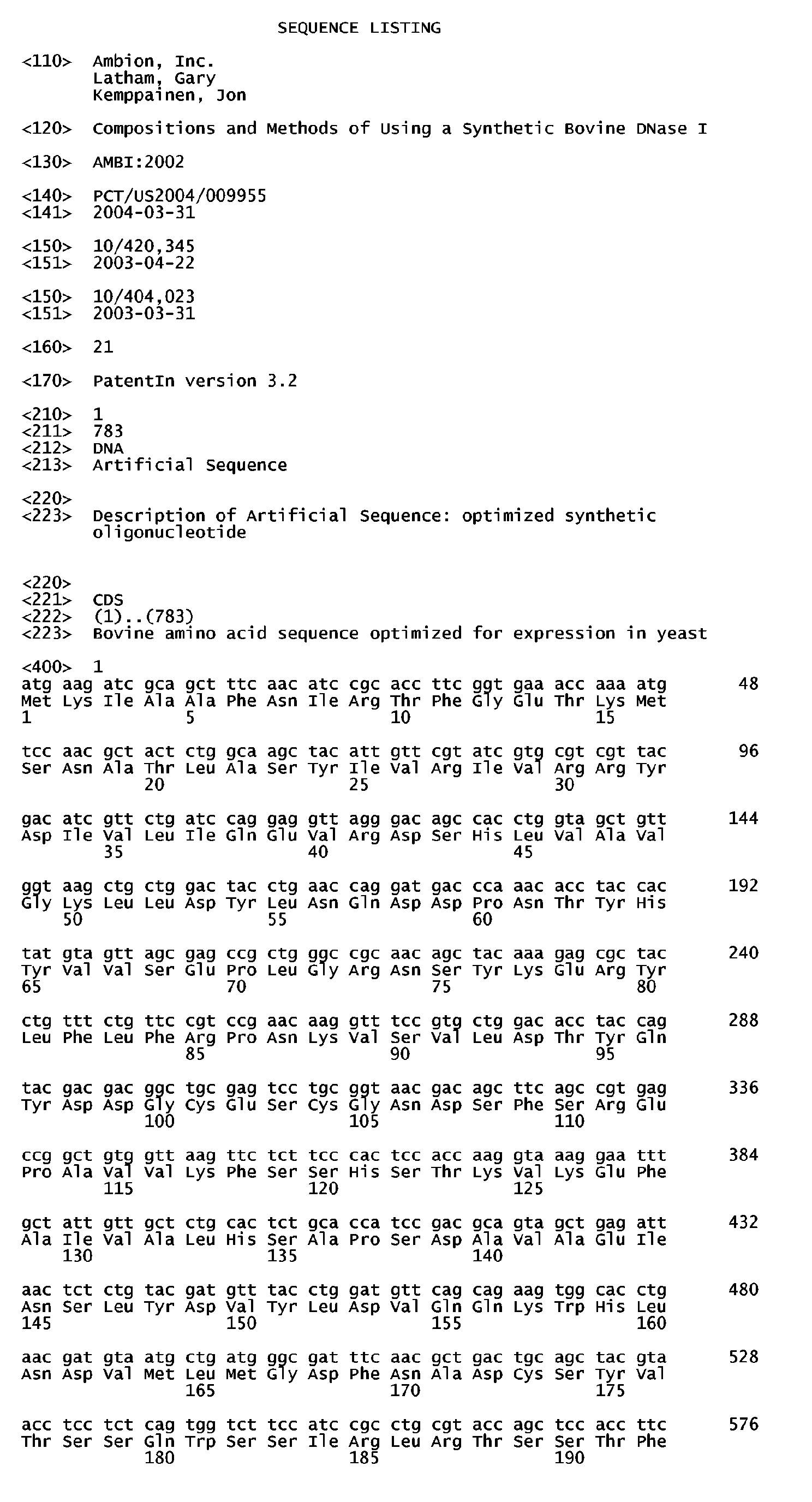


Claims (15)
- A process for making a protein toxic to a bacterial host comprising the steps of:transforming a eukaryotic cell with a nucleic acid molecule that encodes the protein toxic to a bacterial host; and culturing the eukaryotic cell under conditions such that the protein toxic to a bacterial host is produced in the eukaryotic cell.
- The process of Claim 1, wherein the process is a process for making a protein with DNase activity comprising the steps of: transforming a yeast cell with a nucleic acid that encodes a recombinant DNase protein; and culturing the yeast cell under conditions such that the recombinant DNase protein is produced.
- The process of claim 2, wherein the yeast cell is transformed with a nucleic acid that encodes a DNase I protein sequence comprising the amino acid sequence G-D-F-N-A-x-C-S/A.
- The process of Claim 2, wherein the yeast cell is transformed with a nucleic acid comprising a nucleotide sequence with at least about an 85% identity with SEQ ID NO.: 1, SEQ ID NO.: 3 and SEQ ID NO.: 19 for a DNase.
- The process of Claim 2, wherein the nucleic acid encodeing a DNase I protein has been constructed using primers SEQ ID NO.: 15, SEQ ID NO.: 16, SEQ ID NO.: 17 and SEQ ID NO.: 18.
- The process of any preceding claim, wherein the eukaryotic or yeast cell comprises Pichia pastoris.
- A synthetic bovine DNase I comprising:SEQ ID NO.: 2, or SEQ ID NO.: 4, or SEQ ID NO.: 20; orSEQ ID NO.: 4 without the leader sequence MKYLLPTAAAGLLLLAAQPAMA; orSEQ ID NO: 2 wherein the residue at position 13 is mutated from a glutamic acid to an arginine, or the residue at position 74 is mutated from an asparagine to a lysine, or both.
- The synthetic bovine DNase I of Claim 7, wherein the protein is made by the process of Claim 2.
- The synthetic bovine DNase I of Claim 7, wherein the protein is made by the process of Claim 4.
- A method of in vitro DNA removal comprising the step of: admixing a solution suspected of comprising DNA with the synthetic DNase I of Claim 7.
- The method of Claim 10, further comprising the step of: removing the synthetic DNase I from the solution by passing the solution over a sulfopropyl (SP) resin at a pH of below 7.0.
- A reverse transcriptase reaction comprising the steps of incubating a sample suspected of comprising dsDNA with a synthetic bovine DNase I in a buffer comprising an ionic strength of between about 25 mM to 300 mM and a reverse transcriptase enzyme.
- The reverse transcriptase reaction of Claim 12, wherein the synthetic bovine DNase I is the synthetic bovine DNase I of Claim 7.
- A kit for RNA isolation, comprising in a suitable container:(a) a solid support that binds DNA and RNA; a synthetic DNase I; and a reaction solution comprising an ionic strength greater than 25 mM, wherein the synthetic DNase I degrades DNA attached to the solid support; or(b) a DNase I; and a reaction solution and between about 0.0001 and 2 % of a non-ionic surfactant, wherein the synthetic DNAse I degrades DNA.
- The kit of Claim 14, wherein the synthetic DNase I is the synthetic DNase I of Claim 7.
Applications Claiming Priority (3)
| Application Number | Priority Date | Filing Date | Title |
|---|---|---|---|
| US40402303A | 2003-03-31 | 2003-03-31 | |
| US10/420,345 US7067298B2 (en) | 2003-03-31 | 2003-04-22 | Compositions and methods of using a synthetic Dnase I |
| EP04749602A EP1608732B1 (en) | 2003-03-31 | 2004-03-31 | Compositions and methods of using a synthetic dnase i |
Related Parent Applications (1)
| Application Number | Title | Priority Date | Filing Date |
|---|---|---|---|
| EP04749602.1 Division | 2004-03-31 |
Publications (2)
| Publication Number | Publication Date |
|---|---|
| EP2213741A2 true EP2213741A2 (en) | 2010-08-04 |
| EP2213741A3 EP2213741A3 (en) | 2010-11-17 |
Family
ID=33161958
Family Applications (2)
| Application Number | Title | Priority Date | Filing Date |
|---|---|---|---|
| EP10153371A Withdrawn EP2213741A3 (en) | 2003-03-31 | 2004-03-31 | Compositions and methods of using a synthetic DNAse I |
| EP04749602A Expired - Lifetime EP1608732B1 (en) | 2003-03-31 | 2004-03-31 | Compositions and methods of using a synthetic dnase i |
Family Applications After (1)
| Application Number | Title | Priority Date | Filing Date |
|---|---|---|---|
| EP04749602A Expired - Lifetime EP1608732B1 (en) | 2003-03-31 | 2004-03-31 | Compositions and methods of using a synthetic dnase i |
Country Status (5)
| Country | Link |
|---|---|
| US (3) | US7067298B2 (en) |
| EP (2) | EP2213741A3 (en) |
| AT (1) | ATE467681T1 (en) |
| DE (1) | DE602004027123D1 (en) |
| WO (1) | WO2004090114A2 (en) |
Cited By (1)
| Publication number | Priority date | Publication date | Assignee | Title |
|---|---|---|---|---|
| US11732252B2 (en) | 2015-10-14 | 2023-08-22 | Novozymes A/S | DNase variants |
Families Citing this family (37)
| Publication number | Priority date | Publication date | Assignee | Title |
|---|---|---|---|---|
| WO2003064605A2 (en) | 2002-01-28 | 2003-08-07 | Ambion, Inc. | Crude biological derivatives competent for nucleic acid detection |
| ATE387494T1 (en) * | 2002-12-20 | 2008-03-15 | Hoffmann La Roche | HEAT-LASABLE DESOXYRIBONUCLEASE I VARIANTS |
| WO2005093052A1 (en) * | 2004-03-26 | 2005-10-06 | Fuji Photo Film Co., Ltd. | Method for selectively separating and purifying rna and method for separating and purifying nucleic acid |
| US20060223072A1 (en) * | 2005-03-31 | 2006-10-05 | Boyes Barry E | Methods of using a DNase I-like enzyme |
| US20060223073A1 (en) * | 2005-03-31 | 2006-10-05 | Boyes Barry E | Methods of using a DNase I-like enzyme |
| US20070141584A1 (en) * | 2005-12-20 | 2007-06-21 | Roberts Douglas N | Methods for assessment of native chromatin on microarrays |
| US20080044851A1 (en) * | 2006-06-02 | 2008-02-21 | Epicentre Technologies | Compositions and methods for removal of DNA from a sample |
| US8725258B2 (en) * | 2006-08-25 | 2014-05-13 | Cardiac Pacemakers, Inc. | Method and apparatus for automated adjustment of arrhythmia detection duration |
| DK2086642T3 (en) | 2006-10-18 | 2014-09-29 | Periness Ltd | DNASE FOR TREATMENT OF SUBFERTILITY BY MEN |
| US11781127B2 (en) * | 2007-01-16 | 2023-10-10 | Alex Garvin | Homogeneous method to prepare sperm DNA from sexual assault cases |
| US7964350B1 (en) | 2007-05-18 | 2011-06-21 | Applied Biosystems, Llc | Sample preparation for in situ nucleic acid analysis |
| WO2009143500A2 (en) * | 2008-05-23 | 2009-11-26 | Life Technologies Corporation | Methods for removing nucleic acid contamination from reagents |
| EP2955233A1 (en) | 2008-12-19 | 2015-12-16 | Life Technologies Corporation | Proteinase K inhibitors, methods and compositions therefor |
| WO2010117901A1 (en) * | 2009-04-10 | 2010-10-14 | Bio-Rad Laboratories, Inc. | Modified dnase compositions and methods of use thereof |
| HUE041426T2 (en) | 2009-11-02 | 2019-05-28 | Univ Washington | Therapeutic nuclease preparations and methods |
| ES2719816T3 (en) | 2010-02-26 | 2019-07-16 | Decell Tech Inc | Tissue decellularization methods |
| GB201101794D0 (en) | 2011-02-02 | 2011-03-16 | Fermentas Uab | Protein production |
| CA2834626A1 (en) | 2011-04-29 | 2012-11-01 | University Of Washington | Therapeutic nuclease compositions and methods |
| RU2502803C2 (en) * | 2011-05-20 | 2013-12-27 | Общество с ограниченной ответственностью "Лаборатория медицинской биотехнологии" (ООО "ЛМБТ") | PLASMID FOR EXPRESSION IN CELLS OF BACTERIUM BELONGING TO Escherichia CLASS, NON-ACTIVE PREDECESSOR OF DNase I OF HUMAN OR ITS MUTEINS; BACTERIUM BELONGING TO Escherichia CLASS, - PRODUCER OF NON-ACTIVE PREDECESSOR OF RECOMBINANT DNase I OF HUMAN OR ITS MUTEIN; PREDECESSOR OF RECOMBINANT DNase I OF HUMAN OR ITS MUTEIN; METHOD FOR OBTAINING RECOMBINANT DNase I OF HUMAN OR ITS MUTEIN; METHOD FOR OBTAINING CONJUGATES OF POLYETHYLENE GLYCOL AND RECOMBINANT MUTEIN OF HUMAN DNase I, FERMENTATIVE ACTIVE CONJUGATE OF MUTEIN OF RECOMBINANT DNase I OF HUMAN |
| GB201217405D0 (en) | 2012-09-28 | 2012-11-14 | Fermentas Uab | Protein removal agent |
| SI3063275T1 (en) | 2013-10-31 | 2020-02-28 | Resolve Therapeutics, Llc | Therapeutic nuclease-albumin fusions and methods |
| ES2846758T3 (en) | 2013-11-04 | 2021-07-29 | Lifecell Corp | Methods to remove alpha-galactose |
| US9896682B2 (en) | 2015-03-06 | 2018-02-20 | Bio-Rad Laboratories, Inc. | Stabilized RNA solutions |
| US10329623B2 (en) * | 2015-08-28 | 2019-06-25 | Slmp, Llc | Synthetic tissue controls and synthetic tissue microarray controls |
| MA45554A (en) | 2016-07-01 | 2019-05-08 | Resolve Therapeutics Llc | OPTIMIZED BINUCLEASE FUSIONS. |
| CN111315767B (en) | 2017-08-22 | 2025-03-18 | 萨纳生物有限责任公司 | Soluble interferon receptor and its use |
| US11834715B2 (en) | 2019-01-28 | 2023-12-05 | Becton, Dickinson And Company | Oligonucleotide-comprising cellular component-binding reagents and methods of using the same |
| KR20210142670A (en) | 2019-03-19 | 2021-11-25 | 암젠 인크 | Alternative detergents for virus inactivation |
| EP4041880A4 (en) | 2019-10-07 | 2023-08-30 | Texas Tech University System | MUTANT DNASE1L3 WITH IMPROVED SERUM HALF-LIFE |
| CN110819622A (en) * | 2019-10-09 | 2020-02-21 | 广州达正生物科技有限公司 | Method for rapidly extracting RNA (ribonucleic acid) of paraffin tissue |
| WO2021089860A2 (en) * | 2019-11-08 | 2021-05-14 | Thermo Fisher Scientific Baltics Uab | Deoxyribonuclease variants and uses thereof |
| CA3181572A1 (en) * | 2020-06-08 | 2021-12-16 | Paul STABACH | Compositions and methods for treating and/or preventing coagulopathy and/or sepsis in patients suffering from bacterial and/or viral infections |
| WO2022250676A1 (en) * | 2021-05-27 | 2022-12-01 | New England Biolabs, Inc. | Dnase i variants, compositions, methods, and kits |
| US11993792B2 (en) | 2021-05-27 | 2024-05-28 | New England Biolabs, Inc. | DNase I variants, compositions, methods, and kits |
| CN114250208B (en) * | 2021-12-22 | 2023-07-25 | 武汉瀚海新酶生物科技有限公司 | Preparation and application of high-salt-resistant high-activity DNase I mutant |
| FR3159612A1 (en) * | 2024-02-23 | 2025-08-29 | Ingenierie Et Analyse En Genetique Environnementale | METHOD FOR GENETIC ANALYSIS OF A SAMPLE |
| CN120442597B (en) * | 2025-07-11 | 2025-09-02 | 江苏愚公生物科技有限公司 | Heat-sensitive double-strand specific nuclease mutant and application thereof |
Family Cites Families (10)
| Publication number | Priority date | Publication date | Assignee | Title |
|---|---|---|---|---|
| US4683195A (en) * | 1986-01-30 | 1987-07-28 | Cetus Corporation | Process for amplifying, detecting, and/or-cloning nucleic acid sequences |
| US4965188A (en) * | 1986-08-22 | 1990-10-23 | Cetus Corporation | Process for amplifying, detecting, and/or cloning nucleic acid sequences using a thermostable enzyme |
| US4683202A (en) * | 1985-03-28 | 1987-07-28 | Cetus Corporation | Process for amplifying nucleic acid sequences |
| US5219727A (en) * | 1989-08-21 | 1993-06-15 | Hoffmann-Laroche Inc. | Quantitation of nucleic acids using the polymerase chain reaction |
| US5279823A (en) | 1992-06-08 | 1994-01-18 | Genentech, Inc. | Purified forms of DNASE |
| GB9300686D0 (en) * | 1993-01-15 | 1993-03-03 | Imp Cancer Res Tech | Compounds for targeting |
| US6251648B1 (en) * | 1998-04-03 | 2001-06-26 | Human Genome Sciences, Inc. | Gene encoding human Dnase |
| US6391607B1 (en) | 1996-06-14 | 2002-05-21 | Genentech, Inc. | Human DNase I hyperactive variants |
| CN1152134C (en) * | 2001-01-19 | 2004-06-02 | 北京华大蛋白质研发中心有限公司 | Process for preparing recombinant deoxyribonuclease I |
| EP1433842B1 (en) * | 2002-12-18 | 2011-01-05 | Roche Diagnostics GmbH | Recombinant bovine pancreatic desoxyribonuclease I with high specific activity |
-
2003
- 2003-04-22 US US10/420,345 patent/US7067298B2/en not_active Expired - Lifetime
-
2004
- 2004-03-31 EP EP10153371A patent/EP2213741A3/en not_active Withdrawn
- 2004-03-31 DE DE602004027123T patent/DE602004027123D1/en not_active Expired - Lifetime
- 2004-03-31 WO PCT/US2004/009955 patent/WO2004090114A2/en not_active Ceased
- 2004-03-31 AT AT04749602T patent/ATE467681T1/en not_active IP Right Cessation
- 2004-03-31 EP EP04749602A patent/EP1608732B1/en not_active Expired - Lifetime
-
2006
- 2006-02-23 US US11/361,739 patent/US20060228731A1/en not_active Abandoned
-
2011
- 2011-05-09 US US13/103,798 patent/US20110318811A1/en not_active Abandoned
Cited By (2)
| Publication number | Priority date | Publication date | Assignee | Title |
|---|---|---|---|---|
| US11732252B2 (en) | 2015-10-14 | 2023-08-22 | Novozymes A/S | DNase variants |
| US12060589B2 (en) | 2015-10-14 | 2024-08-13 | Novozymes A/S | DNase variants |
Also Published As
| Publication number | Publication date |
|---|---|
| EP1608732B1 (en) | 2010-05-12 |
| EP2213741A3 (en) | 2010-11-17 |
| WO2004090114A3 (en) | 2006-03-30 |
| US7067298B2 (en) | 2006-06-27 |
| ATE467681T1 (en) | 2010-05-15 |
| US20110318811A1 (en) | 2011-12-29 |
| WO2004090114A2 (en) | 2004-10-21 |
| US20040219529A1 (en) | 2004-11-04 |
| DE602004027123D1 (en) | 2010-06-24 |
| EP1608732A4 (en) | 2007-09-26 |
| US20060228731A1 (en) | 2006-10-12 |
| EP1608732A2 (en) | 2005-12-28 |
Similar Documents
| Publication | Publication Date | Title |
|---|---|---|
| EP1608732B1 (en) | Compositions and methods of using a synthetic dnase i | |
| Ferrer et al. | Expression of a temperature-sensitive esterase in a novel chaperone-based Escherichia coli strain | |
| EP0757100B1 (en) | Over-expression and purification of a truncated thermostable DNA polymerase by protein fusion | |
| JP6579204B2 (en) | Modified thermostable DNA polymerase | |
| US7422882B2 (en) | Modified thermostable DNA polymerase | |
| Pellenz et al. | Characterization of the I-Spom I endonuclease from fission yeast: insights into the evolution of a group I intron-encoded homing endonuclease | |
| US9416352B2 (en) | Mutant Neq HS DNA polymerase derived from Nanoarchaeum equitans and its application to hot-start PCR | |
| JP4857260B2 (en) | Cryogenic microorganism-derived endonuclease | |
| JP4889647B2 (en) | Novel endoribonuclease | |
| WO2004020621A1 (en) | Thermostable ribonuclease h | |
| JP4974891B2 (en) | Novel endoribonuclease | |
| CN114045278B (en) | Chondroitin sulfate B, coding gene thereof and construction method thereof | |
| CN115011578B (en) | A kind of enhanced M-MLV reverse transcriptase mutant and its application | |
| CN120624388B (en) | Heat-resistant urate oxidase TC1-UOX2 and application thereof | |
| US20250019683A1 (en) | Tritirachium album proteinase k mutant and its zymogen, expression plasmid, recombinant pichia pastoris strain and method of producing the mature form of proteinase k mutant | |
| KR102678658B1 (en) | DNA polymerase variants that show high discrimination against genetic variation | |
| EP1326890B1 (en) | Shrimp alkaline phosphatase | |
| US8013137B2 (en) | Modified enteropeptidase protein | |
| JPWO2007013265A1 (en) | Novel endoribonuclease | |
| Vainauskas et al. | Partial characterization of the ribonuclease P from Tetrahymena pyriformis | |
| KR100774102B1 (en) | Heat-resistant DNA-linked Enzyme from Sippopococcus | |
| JPWO2007010740A1 (en) | Novel endoribonuclease | |
| JPWO2006123537A1 (en) | Novel endoribonuclease | |
| JP2006042642A (en) | New restriction enzyme PabI | |
| JP2006042643A (en) | Screening method of novel nuclease using cell-free protein synthesis method |
Legal Events
| Date | Code | Title | Description |
|---|---|---|---|
| PUAI | Public reference made under article 153(3) epc to a published international application that has entered the european phase |
Free format text: ORIGINAL CODE: 0009012 |
|
| AC | Divisional application: reference to earlier application |
Ref document number: 1608732 Country of ref document: EP Kind code of ref document: P |
|
| AK | Designated contracting states |
Kind code of ref document: A2 Designated state(s): AT BE BG CH CY CZ DE DK EE ES FI FR GB GR HU IE IT LI LU MC NL PL PT RO SE SI SK TR |
|
| AX | Request for extension of the european patent |
Extension state: LT LV MK |
|
| PUAL | Search report despatched |
Free format text: ORIGINAL CODE: 0009013 |
|
| AK | Designated contracting states |
Kind code of ref document: A3 Designated state(s): AT BE BG CH CY CZ DE DK EE ES FI FR GB GR HU IE IT LI LU MC NL PL PT RO SE SI SK TR |
|
| AX | Request for extension of the european patent |
Extension state: LT LV MK |
|
| 17P | Request for examination filed |
Effective date: 20110517 |
|
| 17Q | First examination report despatched |
Effective date: 20110706 |
|
| RAP1 | Party data changed (applicant data changed or rights of an application transferred) |
Owner name: LIFE TECHNOLOGIES CORPORATION |
|
| STAA | Information on the status of an ep patent application or granted ep patent |
Free format text: STATUS: THE APPLICATION IS DEEMED TO BE WITHDRAWN |
|
| 18D | Application deemed to be withdrawn |
Effective date: 20120117 |