EP2213499A2 - Fluid tank deairation - Google Patents
Fluid tank deairation Download PDFInfo
- Publication number
- EP2213499A2 EP2213499A2 EP10000853A EP10000853A EP2213499A2 EP 2213499 A2 EP2213499 A2 EP 2213499A2 EP 10000853 A EP10000853 A EP 10000853A EP 10000853 A EP10000853 A EP 10000853A EP 2213499 A2 EP2213499 A2 EP 2213499A2
- Authority
- EP
- European Patent Office
- Prior art keywords
- tank
- deairation
- fluid
- reservoir
- tractor
- Prior art date
- Legal status (The legal status is an assumption and is not a legal conclusion. Google has not performed a legal analysis and makes no representation as to the accuracy of the status listed.)
- Withdrawn
Links
- 239000012530 fluid Substances 0.000 title claims abstract description 32
- 238000007654 immersion Methods 0.000 claims abstract description 3
- 239000003921 oil Substances 0.000 description 41
- 230000005540 biological transmission Effects 0.000 description 5
- 239000010720 hydraulic oil Substances 0.000 description 3
- 238000009434 installation Methods 0.000 description 3
- 230000001174 ascending effect Effects 0.000 description 2
- 238000012423 maintenance Methods 0.000 description 2
- 239000000463 material Substances 0.000 description 2
- 238000004140 cleaning Methods 0.000 description 1
- 230000000694 effects Effects 0.000 description 1
- 230000002706 hydrostatic effect Effects 0.000 description 1
- 230000010354 integration Effects 0.000 description 1
- 238000005461 lubrication Methods 0.000 description 1
- 239000003595 mist Substances 0.000 description 1
- 239000011148 porous material Substances 0.000 description 1
- 238000005086 pumping Methods 0.000 description 1
- 238000007789 sealing Methods 0.000 description 1
- 238000005406 washing Methods 0.000 description 1
Images



Classifications
-
- F—MECHANICAL ENGINEERING; LIGHTING; HEATING; WEAPONS; BLASTING
- F16—ENGINEERING ELEMENTS AND UNITS; GENERAL MEASURES FOR PRODUCING AND MAINTAINING EFFECTIVE FUNCTIONING OF MACHINES OR INSTALLATIONS; THERMAL INSULATION IN GENERAL
- F16K—VALVES; TAPS; COCKS; ACTUATING-FLOATS; DEVICES FOR VENTING OR AERATING
- F16K24/00—Devices, e.g. valves, for venting or aerating enclosures
- F16K24/04—Devices, e.g. valves, for venting or aerating enclosures for venting only
-
- B—PERFORMING OPERATIONS; TRANSPORTING
- B60—VEHICLES IN GENERAL
- B60K—ARRANGEMENT OR MOUNTING OF PROPULSION UNITS OR OF TRANSMISSIONS IN VEHICLES; ARRANGEMENT OR MOUNTING OF PLURAL DIVERSE PRIME-MOVERS IN VEHICLES; AUXILIARY DRIVES FOR VEHICLES; INSTRUMENTATION OR DASHBOARDS FOR VEHICLES; ARRANGEMENTS IN CONNECTION WITH COOLING, AIR INTAKE, GAS EXHAUST OR FUEL SUPPLY OF PROPULSION UNITS IN VEHICLES
- B60K15/00—Arrangement in connection with fuel supply of combustion engines or other fuel consuming energy converters, e.g. fuel cells; Mounting or construction of fuel tanks
- B60K15/03—Fuel tanks
- B60K15/035—Fuel tanks characterised by venting means
- B60K15/03504—Fuel tanks characterised by venting means adapted to avoid loss of fuel or fuel vapour, e.g. with vapour recovery systems
-
- B—PERFORMING OPERATIONS; TRANSPORTING
- B60—VEHICLES IN GENERAL
- B60K—ARRANGEMENT OR MOUNTING OF PROPULSION UNITS OR OF TRANSMISSIONS IN VEHICLES; ARRANGEMENT OR MOUNTING OF PLURAL DIVERSE PRIME-MOVERS IN VEHICLES; AUXILIARY DRIVES FOR VEHICLES; INSTRUMENTATION OR DASHBOARDS FOR VEHICLES; ARRANGEMENTS IN CONNECTION WITH COOLING, AIR INTAKE, GAS EXHAUST OR FUEL SUPPLY OF PROPULSION UNITS IN VEHICLES
- B60K15/00—Arrangement in connection with fuel supply of combustion engines or other fuel consuming energy converters, e.g. fuel cells; Mounting or construction of fuel tanks
- B60K15/03—Fuel tanks
- B60K15/035—Fuel tanks characterised by venting means
-
- B—PERFORMING OPERATIONS; TRANSPORTING
- B60—VEHICLES IN GENERAL
- B60K—ARRANGEMENT OR MOUNTING OF PROPULSION UNITS OR OF TRANSMISSIONS IN VEHICLES; ARRANGEMENT OR MOUNTING OF PLURAL DIVERSE PRIME-MOVERS IN VEHICLES; AUXILIARY DRIVES FOR VEHICLES; INSTRUMENTATION OR DASHBOARDS FOR VEHICLES; ARRANGEMENTS IN CONNECTION WITH COOLING, AIR INTAKE, GAS EXHAUST OR FUEL SUPPLY OF PROPULSION UNITS IN VEHICLES
- B60K15/00—Arrangement in connection with fuel supply of combustion engines or other fuel consuming energy converters, e.g. fuel cells; Mounting or construction of fuel tanks
- B60K15/03—Fuel tanks
- B60K2015/03236—Fuel tanks characterised by special filters, the mounting thereof
-
- B—PERFORMING OPERATIONS; TRANSPORTING
- B60—VEHICLES IN GENERAL
- B60K—ARRANGEMENT OR MOUNTING OF PROPULSION UNITS OR OF TRANSMISSIONS IN VEHICLES; ARRANGEMENT OR MOUNTING OF PLURAL DIVERSE PRIME-MOVERS IN VEHICLES; AUXILIARY DRIVES FOR VEHICLES; INSTRUMENTATION OR DASHBOARDS FOR VEHICLES; ARRANGEMENTS IN CONNECTION WITH COOLING, AIR INTAKE, GAS EXHAUST OR FUEL SUPPLY OF PROPULSION UNITS IN VEHICLES
- B60K15/00—Arrangement in connection with fuel supply of combustion engines or other fuel consuming energy converters, e.g. fuel cells; Mounting or construction of fuel tanks
- B60K15/03—Fuel tanks
- B60K15/035—Fuel tanks characterised by venting means
- B60K2015/03523—Arrangements of the venting tube
- B60K2015/03528—Mounting of venting tubes
-
- B—PERFORMING OPERATIONS; TRANSPORTING
- B60—VEHICLES IN GENERAL
- B60Y—INDEXING SCHEME RELATING TO ASPECTS CROSS-CUTTING VEHICLE TECHNOLOGY
- B60Y2200/00—Type of vehicle
- B60Y2200/20—Off-Road Vehicles
- B60Y2200/22—Agricultural vehicles
- B60Y2200/221—Tractors
Definitions
- the invention relates to a fluid tank deairation for vehicles, especially tractors or small range tractors used in vineyards.
- Fluid tanks are used for many purposes in vehicles. It is the main task to store a maximum amount of fluid whilst requiring a minimum installation space. Thereby, fluid tanks are designed in a very complex shape to use the installation space available. These tanks are also used in the hydraulic circuit of a vehicle, e.g. in agricultural machinery like a tractor, which is supplying the required oil to tractor-related consumers e.g. the front and rear lifting unit or to consumers which relate to attachments e.g. hydraulic cylinders lifting a plough. The performance of this hydraulic circuit is mainly influenced by the oil capacity of the tank which is limiting the delivery capacity of the pump to consumers. As these circuits are closed circuits, fluid is returning into the tank after supplying the consumers.
- fluid tanks also serve to separate stored fluids, e.g. hydraulic or lubrication oil, from air which is brought into fluid systems during refilling or by consumers if the fluid is circulating inside a circuit.
- stored fluids e.g. hydraulic or lubrication oil
- a port is provided which connects the tank to the atmosphere.
- fluid separators are installed at these ports.
- These separators are equipped with porous filter elements, consisting of e.g. filter paper, non-woven material or wire mesh. All these materials have in common, that they are only capable of dealing with small amounts of fluid carried by the air known as fluid mist. If they are completely coated by the stored fluid, the pores of the filter element are blocked and the filter has to be changed. So it is also a requirement of a deairation system to avoid complete washing of the separator/filter element with the stored fluid. This is achieved by installing the separator above in a top wall of the tank. Even if the filters are not washed completely it is necessary to exchange them from time to time.
- Vehicles of the kind mentioned above e.g. small and vineyard tractors, are designed to have short overall dimensions to be used for special jobs in narrow environments or on extreme inclined fields. Especially if it is necessary to drive at inclined hills perpendicular or along to the direction of inclination, the oil level in fluid tanks vary very much during operation.
- chassis or housing parts of such tractors as a reservoir for several fluids. This is very common for vehicles using hydrostatic or hydrostatic-mechanical torque split transmissions. As these transmission do not need a clutch to disconnect the engine from the transmission, the free space is used to storage fluids.
- the fluid can be hydraulic fluid which is used for transmission and/or the hydraulic circuit of a agricultural working machinery.
- a fluid tank having at least two deairation ports provided in at least two upper regions of the tank, a first conduit connected at one end to one deairation port and connected at its other end to a compensating reservoir at a higher level, at least one additional conduit connected at one end another deairation port and also connected at its other end to the compensating reservoir, a filter connected with the upper part of the reservoir to allow air to escape from the reservoir, the height of the compensating reservoir above the tank ensuring that the filter is protected from immersion in tank fluid and deairation is ensured at normal working inclinations of the tank.
- the tank may be for use in a tractor and may be of a general U-shaped configuration with a deairation port provided in the upper region of each limb of the tank.
- the filter may be installed on the tractor at a location where it is readily accessible for checking or exchanging.
- the tank may be part of the chassis of the tractor which is located below a cab of the tractor
- FIG. 1 shows a tractor 1 comprising a chassis 2, wheels 3, an engine 4, a driver cab 5 and a bonnet 6.
- a chassis part 2 is used for fluid storage forming a an oil tank 20 for the hydraulic oil circuit of the tractor. Inside this chassis part 2, also main components of the hydrostatic-mechanical torque split transmission are installed (not shown). At the front end of this chassis part, the engine block 4a is installed. At the rear end of the chassis part 2, the rear axle housing 7 is placed.
- the oil tank 20 is connected via two pipes 30,40 to a compensating reservoir 50 which is again connected to a separator 60 installed in the rear of the driver cab 5 in a easily accessible position.
- the oil tank 20 is below the floor 10 of the cab 5. which is partly drawn in a section through the symmetric axis of the tractor 1.
- the floor 10 In the middle area of the cab, the floor 10 has a flat portion 10a on which the drivers feet (not shown) rest.
- driving direction DD the floor 10 is ascending forming a second portion 10b which is placed under the steering column.
- the floor 10 has a stepped portion 10c on which the seat 11 is mounted. This design is providing minimum cab dimension whilst meeting all comfort requirements relating to the drivers space.
- FIG. 2 to 4 shows the oil tank 20 having two covers 21 to provide access to components inside the oil tank 20, e.g. the drive shaft or the hydraulic oil pump (not shown).
- the oil tank 20 has various ports for connecting components which relate to the hydraulic circuit of the tractor.
- One port connects the pump (not shown) inside the oil tank 20 with different consumers installed on the tractor or on attachments via piping which is not shown for clarity reasons.
- return lines (not shown) are connected to ports in the oil tank 20.
- Pipe 30 of the deairation system is connected to a port 24 in the front area of the oil tank 20 whilst pipe 40 is connected to a port 25 in the rear area of the oil tank 20. Both pipes 30,40 are connected to a compensating reservoir 50 as previously stated.
- the compensating reservoir 50 is then connected to the oil separator 60 via piping 70.
- the separator 60 is equipped with a filter element 61 which can be detached by thread connection.
- FIG 3 the floor 10 of the cab 5 is shown diagrammatically as a dashed line X only for clarity reasons.
- the upper contour 26 of the oil tank 20 is following the floor contour X to achieve maximum storage volume.
- the oil tank 20 is basically U-shaped with a lower upper contour 26a in the middle beneath flat portion 10a of the cab floor 50. Towards its both longitudinal ends the oil tank has higher upper contour 26b, 26c. Front upper contour 26b is placed beneath the ascending second portion 10b of the cab floor 10 in the front area while rear upper contour 26c is placed beneath the stepped portion 10c of the cab floor.
- the oil tank 20 forms a generally U-shaped cavity 27 by the inner contour of the housing part 28 and two sealing covers 29 in the front and rear. Components inside the oil tank 20 are not shown.
- the front upper contour 26b is equipped with the port 24 by a bore 28a in the housing part 27. Port 25 is connected to the cavity 27 of the tank 20 as can be seen from Figure 6 .
- the lower upper contour 26a in the middle is provided with a larger wall thickness to improve longitudinal stiffness of the housing parts.
- Figure 7 shows a section through the compensating reservoir 50 which is formed by a hollow body 51 which is opened on one side. The open side is closed by a cover bracket 52 which also serves to fix the reservoir in position. Ports 53 are provided to connect pipes 30,40 and therefore cavity 27 of the oil tank 20 to the cavity 54 of the compensating reservoir 50. An additional port 55 is provided to connect pipe 70 to the separator 60.
- both ports are connected to the compensating reservoir 50 as shown in figure 3 , air can be discharged at every inclination. If the vehicle is going over changing ground and the inclination is changing, oil can rest inside the pipes caused by suction effects. This oil can be guided back to the cavity 27 through one of the ports 24 or 25. Even if, during maximum inclination, oil enters the pipes 30,40 caused by swash movement and even enters the compensating reservoir 50 this oil and any suspended oil droplets will rest in the bottom portion of the reservoir cavity 54 thus ensuring that air is discharged from the upper part of cavity 54 and that the level of oil in the reservoir 50 does not reach the filter element 61 of the separator 60 which only allows air to pass through into the atmosphere.
- the filter element 61 is installed in an easy accessible position in the rear of the cab for cleaning and maintenance.
- the above described embodiment includes a oil tank integrated in chassis parts and used to provide oil for the hydraulic circuit of a tractor, it is envisaged that the deairation system described above could be used for any other fluid or any other tank being installed elsewhere in a vehicle.
- the tank may have more than two limbs with the upper regions of each limb having a port and conduit according to the present invention.
Landscapes
- Engineering & Computer Science (AREA)
- Mechanical Engineering (AREA)
- Life Sciences & Earth Sciences (AREA)
- Sustainable Development (AREA)
- Sustainable Energy (AREA)
- Chemical & Material Sciences (AREA)
- Combustion & Propulsion (AREA)
- Transportation (AREA)
- General Engineering & Computer Science (AREA)
- Supply Devices, Intensifiers, Converters, And Telemotors (AREA)
- Lifting Devices For Agricultural Implements (AREA)
- Fertilizing (AREA)
Abstract
Description
- The invention relates to a fluid tank deairation for vehicles, especially tractors or small range tractors used in vineyards.
- Fluid tanks are used for many purposes in vehicles. It is the main task to store a maximum amount of fluid whilst requiring a minimum installation space. Thereby, fluid tanks are designed in a very complex shape to use the installation space available. These tanks are also used in the hydraulic circuit of a vehicle, e.g. in agricultural machinery like a tractor, which is supplying the required oil to tractor-related consumers e.g. the front and rear lifting unit or to consumers which relate to attachments e.g. hydraulic cylinders lifting a plough. The performance of this hydraulic circuit is mainly influenced by the oil capacity of the tank which is limiting the delivery capacity of the pump to consumers. As these circuits are closed circuits, fluid is returning into the tank after supplying the consumers.
- In addition to this, fluid tanks also serve to separate stored fluids, e.g. hydraulic or lubrication oil, from air which is brought into fluid systems during refilling or by consumers if the fluid is circulating inside a circuit. As air causes pump damage, e.g. cavitation, and reduce system performance this air has to be discharged to the atmosphere. Therefore, a port is provided which connects the tank to the atmosphere.
- To avoid the discharge of fluid carried by the air to the environment, fluid separators (filters) are installed at these ports. These separators are equipped with porous filter elements, consisting of e.g. filter paper, non-woven material or wire mesh. All these materials have in common, that they are only capable of dealing with small amounts of fluid carried by the air known as fluid mist. If they are completely coated by the stored fluid, the pores of the filter element are blocked and the filter has to be changed. So it is also a requirement of a deairation system to avoid complete washing of the separator/filter element with the stored fluid. This is achieved by installing the separator above in a top wall of the tank. Even if the filters are not washed completely it is necessary to exchange them from time to time.
- Vehicles of the kind mentioned above, e.g. small and vineyard tractors, are designed to have short overall dimensions to be used for special jobs in narrow environments or on extreme inclined fields. Especially if it is necessary to drive at inclined hills perpendicular or along to the direction of inclination, the oil level in fluid tanks vary very much during operation.
- It is also well known to use chassis or housing parts of such tractors as a reservoir for several fluids. This is very common for vehicles using hydrostatic or hydrostatic-mechanical torque split transmissions. As these transmission do not need a clutch to disconnect the engine from the transmission, the free space is used to storage fluids. The fluid can be hydraulic fluid which is used for transmission and/or the hydraulic circuit of a agricultural working machinery.
- This integration into the vehicle requires a very complex tank design which is typically of a generally U-shaped configuration which is very difficult for deairation systems.
- Installing a number of separators in different positions increases the costs and maintenance work.
- Thus according to the present invention there is provided a fluid tank having at least two deairation ports provided in at least two upper regions of the tank, a first conduit connected at one end to one deairation port and connected at its other end to a compensating reservoir at a higher level, at least one additional conduit connected at one end another deairation port and also connected at its other end to the compensating reservoir, a filter connected with the upper part of the reservoir to allow air to escape from the reservoir, the height of the compensating reservoir above the tank ensuring that the filter is protected from immersion in tank fluid and deairation is ensured at normal working inclinations of the tank.
- The tank may be for use in a tractor and may be of a general U-shaped configuration with a deairation port provided in the upper region of each limb of the tank.
- In such an arrangement the filter may be installed on the tractor at a location where it is readily accessible for checking or exchanging.
- The tank may be part of the chassis of the tractor which is located below a cab of the tractor
- Using a tank arrangement in accordance with the present invention installation space for deairation system is reduced in areas of limited space whilst maximum oil filling level and therefore oil capacity of the tank is increased. In addtion the separator (filter) can be installed installed at a high position where the space is available.
- The present invention will know be described, by way of example only, with reference to the accompanying drawing in which:
- Figure I
- shows an overall side view of a vehicle, especially a tractor
- Figure 2
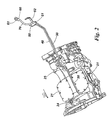
- shows a perspective view of the oil tank system according the present invention
- Figure 3
- shows a side view of the oil tank system according the present invention
- Figure 4
- shows a top view of the oil tank system according the present invention
- Figure 5
- shows section A-A of
figure 4 - Figure 6
- shows section B-B of
figure 3 andfigure 4 - Figure 7
- shows section C-C of
figure 3 -
Figure 1 shows atractor 1 comprising achassis 2, wheels 3, anengine 4, adriver cab 5 and a bonnet 6. Achassis part 2 is used for fluid storage forming a anoil tank 20 for the hydraulic oil circuit of the tractor. Inside thischassis part 2, also main components of the hydrostatic-mechanical torque split transmission are installed (not shown). At the front end of this chassis part, the engine block 4a is installed. At the rear end of thechassis part 2, the rear axle housing 7 is placed. - For deairation, in accordance with the present invention, the
oil tank 20 is connected via twopipes reservoir 50 which is again connected to aseparator 60 installed in the rear of thedriver cab 5 in a easily accessible position. Theoil tank 20 is below thefloor 10 of thecab 5. which is partly drawn in a section through the symmetric axis of thetractor 1. In the middle area of the cab, thefloor 10 has aflat portion 10a on which the drivers feet (not shown) rest. In driving direction DD thefloor 10 is ascending forming asecond portion 10b which is placed under the steering column. In the opposite direction, thefloor 10 has astepped portion 10c on which theseat 11 is mounted. This design is providing minimum cab dimension whilst meeting all comfort requirements relating to the drivers space. -
Figure 2 to 4 shows theoil tank 20 having twocovers 21 to provide access to components inside theoil tank 20, e.g. the drive shaft or the hydraulic oil pump (not shown). Theoil tank 20 has various ports for connecting components which relate to the hydraulic circuit of the tractor. One port connects the pump (not shown) inside theoil tank 20 with different consumers installed on the tractor or on attachments via piping which is not shown for clarity reasons. As the pump is constantly pumping oil through the closed circuit, return lines (not shown) are connected to ports in theoil tank 20. As these details are well known no further details are required concerning the hydraulic oil supply on vehicles. For clarity reasons these details are left out in the drawings. -
Pipe 30 of the deairation system is connected to aport 24 in the front area of theoil tank 20 whilstpipe 40 is connected to aport 25 in the rear area of theoil tank 20. Bothpipes reservoir 50 as previously stated. The compensatingreservoir 50 is then connected to theoil separator 60 viapiping 70. Theseparator 60 is equipped with afilter element 61 which can be detached by thread connection. - The type of ports and connectors used for connecting the pipes or components to each other are well known and therefore not described in detail.
- In
Figure 3 thefloor 10 of thecab 5 is shown diagrammatically as a dashed line X only for clarity reasons. Theupper contour 26 of theoil tank 20 is following the floor contour X to achieve maximum storage volume. Theoil tank 20 is basically U-shaped with a lowerupper contour 26a in the middle beneathflat portion 10a of thecab floor 50. Towards its both longitudinal ends the oil tank has higherupper contour upper contour 26b is placed beneath the ascendingsecond portion 10b of thecab floor 10 in the front area while rearupper contour 26c is placed beneath the steppedportion 10c of the cab floor. - The
oil tank 20 forms a generallyU-shaped cavity 27 by the inner contour of thehousing part 28 and two sealing covers 29 in the front and rear. Components inside theoil tank 20 are not shown. The frontupper contour 26b is equipped with theport 24 by abore 28a in thehousing part 27.Port 25 is connected to thecavity 27 of thetank 20 as can be seen fromFigure 6 . The lowerupper contour 26a in the middle is provided with a larger wall thickness to improve longitudinal stiffness of the housing parts. -
Figure 7 shows a section through the compensatingreservoir 50 which is formed by ahollow body 51 which is opened on one side. The open side is closed by acover bracket 52 which also serves to fix the reservoir in position.Ports 53 are provided to connectpipes cavity 27 of theoil tank 20 to thecavity 54 of the compensatingreservoir 50. An additional port 55 is provided to connectpipe 70 to theseparator 60. - Returning to
figures 3 and5 , the deairation is now explained. - If the vehicle is standing on plane ground without inclination, oil is at level L0. Both
ports - If the vehicle is going downhill at its maximum downhill capacity of about 30°, oil is at
level L1. Port 24 is under oil level whileport 25 is above for deairation. - If the vehicle is going uphill at its maximum uphill capacity of about 30°, oil is at
level L2. Port 25 is under oil level whileport 24 is above for deairation. - As both ports are connected to the compensating
reservoir 50 as shown infigure 3 , air can be discharged at every inclination. If the vehicle is going over changing ground and the inclination is changing, oil can rest inside the pipes caused by suction effects. This oil can be guided back to thecavity 27 through one of theports pipes reservoir 50 this oil and any suspended oil droplets will rest in the bottom portion of thereservoir cavity 54 thus ensuring that air is discharged from the upper part ofcavity 54 and that the level of oil in thereservoir 50 does not reach thefilter element 61 of theseparator 60 which only allows air to pass through into the atmosphere. - The
filter element 61 is installed in an easy accessible position in the rear of the cab for cleaning and maintenance. - Moreover, although the above described embodiment includes a oil tank integrated in chassis parts and used to provide oil for the hydraulic circuit of a tractor, it is envisaged that the deairation system described above could be used for any other fluid or any other tank being installed elsewhere in a vehicle.
- It is envisaged that the tank may have more than two limbs with the upper regions of each limb having a port and conduit according to the present invention.
Claims (4)
- A fluid tank having at least two deairation ports provided in at least two upper regions of the tank, a first conduit connected at one end to one deairation port and connected at its other end to a compensating reservoir at a higher level, at least one additional conduit connected at one end to an other deairation port and also connected at its other end to the compensating reservoir, a filter connected with the upper part of the reservoir to allow air to escape from the reservoir, the height of the compensating reservoir above the tank ensuring that the filter is protected from immersion in tank fluid and deairation is ensured at normal working inclinations of the tank.
- A fluid tank according to Claim 1 for use in a tractor in which tank is of a general U-shaped configuration with a deairation port provided in the upper region of each limb of the tank.
- A fluid tank according to Claim 2 in which the filter is installed on the tractor at a location where it is readily accessible for checking or exchanging.
- A fluid tank according to Claim 2 or 3 in which the tank is provided by part of the chassis of the tractor which is located below a cab of the tractor.
Applications Claiming Priority (1)
| Application Number | Priority Date | Filing Date | Title |
|---|---|---|---|
| GB0901441A GB2467519A (en) | 2009-01-29 | 2009-01-29 | Fluid tank with vents allowing tilting |
Publications (2)
| Publication Number | Publication Date |
|---|---|
| EP2213499A2 true EP2213499A2 (en) | 2010-08-04 |
| EP2213499A3 EP2213499A3 (en) | 2013-01-09 |
Family
ID=40469240
Family Applications (1)
| Application Number | Title | Priority Date | Filing Date |
|---|---|---|---|
| EP10000853A Withdrawn EP2213499A3 (en) | 2009-01-29 | 2010-01-28 | Fluid tank deairation |
Country Status (3)
| Country | Link |
|---|---|
| US (1) | US8287000B2 (en) |
| EP (1) | EP2213499A3 (en) |
| GB (1) | GB2467519A (en) |
Families Citing this family (2)
| Publication number | Priority date | Publication date | Assignee | Title |
|---|---|---|---|---|
| US7931301B2 (en) * | 2005-05-20 | 2011-04-26 | Yanmar Co., Ltd. | Traveling vehicle |
| US12129872B2 (en) | 2021-01-11 | 2024-10-29 | Deere & Company | Apparatuses and methods for de-aeration of a liquid |
Family Cites Families (12)
| Publication number | Priority date | Publication date | Assignee | Title |
|---|---|---|---|---|
| US2593394A (en) * | 1945-01-24 | 1952-04-15 | Edward A Rockwell | Power pressure intensifier |
| US3610220A (en) * | 1969-05-29 | 1971-10-05 | Toyota Motor Co Ltd | Fuel tank construction |
| US3693348A (en) * | 1970-10-16 | 1972-09-26 | Jacques H Mercier | Volume compensated housing |
| DE2607953A1 (en) * | 1976-02-27 | 1977-09-01 | Volkswagenwerk Ag | Motor vehicle fuel tank - has ventilating pipes entering side walls and roof of vehicle and connected by branch lines to atmosphere |
| US4052852A (en) * | 1976-11-22 | 1977-10-11 | Caterpillar Tractor Co. | Constant pressure sealed fluid storage tank for hydraulic systems |
| JPS604424A (en) * | 1983-06-22 | 1985-01-10 | Honda Motor Co Ltd | Air vent device for fuel tank in vehicle |
| FR2630686B1 (en) * | 1988-04-27 | 1991-07-12 | Peugeot | DEVICE FOR LIMITING THE FILLING OF A FUEL TANK AND MOTOR VEHICLE EQUIPPED WITH SUCH A DEVICE |
| JPH06156093A (en) * | 1992-11-24 | 1994-06-03 | Aisan Ind Co Ltd | Fuel cutoff valve with float |
| US5590697A (en) * | 1994-08-24 | 1997-01-07 | G. T. Products, Inc. | Onboard vapor recovery system with two-stage shutoff valve |
| US5687778A (en) * | 1995-05-01 | 1997-11-18 | Stant Manufacturing Inc. | Dual valve tank venting system |
| IT1308759B1 (en) * | 1999-06-25 | 2002-01-10 | Fiat Auto Spa | FUEL VAPOR RECOVERY AND CONTROL DEVICE IN A VEHICLE TANK. |
| JP4035022B2 (en) * | 2002-09-11 | 2008-01-16 | 本田技研工業株式会社 | Evaporative fuel processing equipment |
-
2009
- 2009-01-29 GB GB0901441A patent/GB2467519A/en not_active Withdrawn
-
2010
- 2010-01-26 US US12/693,659 patent/US8287000B2/en not_active Expired - Fee Related
- 2010-01-28 EP EP10000853A patent/EP2213499A3/en not_active Withdrawn
Non-Patent Citations (1)
| Title |
|---|
| None |
Also Published As
| Publication number | Publication date |
|---|---|
| GB2467519A (en) | 2010-08-04 |
| US20100187238A1 (en) | 2010-07-29 |
| GB0901441D0 (en) | 2009-03-11 |
| US8287000B2 (en) | 2012-10-16 |
| EP2213499A3 (en) | 2013-01-09 |
Similar Documents
| Publication | Publication Date | Title |
|---|---|---|
| EP1712399B1 (en) | Hydraulically driven working vehicle and hydraulic transaxle | |
| US6318485B1 (en) | Tractor | |
| EP1835182A2 (en) | Filter circuit for a vehicle hydraulic system | |
| EP1990508B1 (en) | Oil feeding system | |
| US20130284752A1 (en) | Fluid tank and mounting configuration | |
| CA1152908A (en) | Hydraulic oil reservoir vent | |
| EP2234834B1 (en) | Fuel tank system | |
| CN110549842B (en) | Work vehicles | |
| US8287000B2 (en) | Fluid tank deairation | |
| US20130284751A1 (en) | Fluid tank and mounting configuration | |
| US20100051123A1 (en) | System for supplying hydraulic fluid | |
| EP2462793B1 (en) | Linkage rocker arm on an agricultural vehicle | |
| US11421775B2 (en) | Pressurized aeration prevention reservoir | |
| EP4431764B1 (en) | Work vehicle | |
| US20150275925A1 (en) | Hydraulic circuit supply system | |
| US11506159B1 (en) | Dual fuel tank system with internally mounted fuel tanks in line with actuators | |
| JP4023965B2 (en) | Lubricating device for internal combustion engine | |
| WO2025248819A1 (en) | Work vehicle | |
| JP5875955B2 (en) | Charge oil supply structure for hydrostatic continuously variable transmission | |
| JP6541568B2 (en) | Work vehicle equipped with an engine | |
| EP4431762B1 (en) | Work vehicle | |
| EP4431763B1 (en) | Driveline assembly for a work vehicle and work vehicle comprising the same | |
| JP6218710B2 (en) | Work vehicle | |
| EP3360760A1 (en) | A vehicle chassis arrangement | |
| GB2573132A (en) | Traction motor apparatus |
Legal Events
| Date | Code | Title | Description |
|---|---|---|---|
| PUAI | Public reference made under article 153(3) epc to a published international application that has entered the european phase |
Free format text: ORIGINAL CODE: 0009012 |
|
| AK | Designated contracting states |
Kind code of ref document: A2 Designated state(s): AT BE BG CH CY CZ DE DK EE ES FI FR GB GR HR HU IE IS IT LI LT LU LV MC MK MT NL NO PL PT RO SE SI SK SM TR |
|
| AX | Request for extension of the european patent |
Extension state: AL BA RS |
|
| PUAL | Search report despatched |
Free format text: ORIGINAL CODE: 0009013 |
|
| AK | Designated contracting states |
Kind code of ref document: A3 Designated state(s): AT BE BG CH CY CZ DE DK EE ES FI FR GB GR HR HU IE IS IT LI LT LU LV MC MK MT NL NO PL PT RO SE SI SK SM TR |
|
| AX | Request for extension of the european patent |
Extension state: AL BA RS |
|
| RIC1 | Information provided on ipc code assigned before grant |
Ipc: B60K 15/035 20060101AFI20121203BHEP |
|
| STAA | Information on the status of an ep patent application or granted ep patent |
Free format text: STATUS: THE APPLICATION HAS BEEN WITHDRAWN |
|
| 18W | Application withdrawn |
Effective date: 20130709 |