EP2207770B1 - 1, 2, 3-triazole derivatives for use as stearoyl-coa desaturase inhibitors - Google Patents
1, 2, 3-triazole derivatives for use as stearoyl-coa desaturase inhibitors Download PDFInfo
- Publication number
- EP2207770B1 EP2207770B1 EP08846247A EP08846247A EP2207770B1 EP 2207770 B1 EP2207770 B1 EP 2207770B1 EP 08846247 A EP08846247 A EP 08846247A EP 08846247 A EP08846247 A EP 08846247A EP 2207770 B1 EP2207770 B1 EP 2207770B1
- Authority
- EP
- European Patent Office
- Prior art keywords
- compound according
- inhibitor
- diabetes
- compounds
- formula
- Prior art date
- Legal status (The legal status is an assumption and is not a legal conclusion. Google has not performed a legal analysis and makes no representation as to the accuracy of the status listed.)
- Active
Links
- 0 *Cc(cc1)cc(Cl)c1Cl Chemical compound *Cc(cc1)cc(Cl)c1Cl 0.000 description 1
Classifications
-
- C—CHEMISTRY; METALLURGY
- C07—ORGANIC CHEMISTRY
- C07D—HETEROCYCLIC COMPOUNDS
- C07D249/00—Heterocyclic compounds containing five-membered rings having three nitrogen atoms as the only ring hetero atoms
- C07D249/02—Heterocyclic compounds containing five-membered rings having three nitrogen atoms as the only ring hetero atoms not condensed with other rings
- C07D249/04—1,2,3-Triazoles; Hydrogenated 1,2,3-triazoles
-
- A—HUMAN NECESSITIES
- A61—MEDICAL OR VETERINARY SCIENCE; HYGIENE
- A61P—SPECIFIC THERAPEUTIC ACTIVITY OF CHEMICAL COMPOUNDS OR MEDICINAL PREPARATIONS
- A61P1/00—Drugs for disorders of the alimentary tract or the digestive system
- A61P1/16—Drugs for disorders of the alimentary tract or the digestive system for liver or gallbladder disorders, e.g. hepatoprotective agents, cholagogues, litholytics
-
- A—HUMAN NECESSITIES
- A61—MEDICAL OR VETERINARY SCIENCE; HYGIENE
- A61P—SPECIFIC THERAPEUTIC ACTIVITY OF CHEMICAL COMPOUNDS OR MEDICINAL PREPARATIONS
- A61P17/00—Drugs for dermatological disorders
-
- A—HUMAN NECESSITIES
- A61—MEDICAL OR VETERINARY SCIENCE; HYGIENE
- A61P—SPECIFIC THERAPEUTIC ACTIVITY OF CHEMICAL COMPOUNDS OR MEDICINAL PREPARATIONS
- A61P17/00—Drugs for dermatological disorders
- A61P17/02—Drugs for dermatological disorders for treating wounds, ulcers, burns, scars, keloids, or the like
-
- A—HUMAN NECESSITIES
- A61—MEDICAL OR VETERINARY SCIENCE; HYGIENE
- A61P—SPECIFIC THERAPEUTIC ACTIVITY OF CHEMICAL COMPOUNDS OR MEDICINAL PREPARATIONS
- A61P17/00—Drugs for dermatological disorders
- A61P17/04—Antipruritics
-
- A—HUMAN NECESSITIES
- A61—MEDICAL OR VETERINARY SCIENCE; HYGIENE
- A61P—SPECIFIC THERAPEUTIC ACTIVITY OF CHEMICAL COMPOUNDS OR MEDICINAL PREPARATIONS
- A61P17/00—Drugs for dermatological disorders
- A61P17/06—Antipsoriatics
-
- A—HUMAN NECESSITIES
- A61—MEDICAL OR VETERINARY SCIENCE; HYGIENE
- A61P—SPECIFIC THERAPEUTIC ACTIVITY OF CHEMICAL COMPOUNDS OR MEDICINAL PREPARATIONS
- A61P17/00—Drugs for dermatological disorders
- A61P17/10—Anti-acne agents
-
- A—HUMAN NECESSITIES
- A61—MEDICAL OR VETERINARY SCIENCE; HYGIENE
- A61P—SPECIFIC THERAPEUTIC ACTIVITY OF CHEMICAL COMPOUNDS OR MEDICINAL PREPARATIONS
- A61P25/00—Drugs for disorders of the nervous system
-
- A—HUMAN NECESSITIES
- A61—MEDICAL OR VETERINARY SCIENCE; HYGIENE
- A61P—SPECIFIC THERAPEUTIC ACTIVITY OF CHEMICAL COMPOUNDS OR MEDICINAL PREPARATIONS
- A61P25/00—Drugs for disorders of the nervous system
- A61P25/28—Drugs for disorders of the nervous system for treating neurodegenerative disorders of the central nervous system, e.g. nootropic agents, cognition enhancers, drugs for treating Alzheimer's disease or other forms of dementia
-
- A—HUMAN NECESSITIES
- A61—MEDICAL OR VETERINARY SCIENCE; HYGIENE
- A61P—SPECIFIC THERAPEUTIC ACTIVITY OF CHEMICAL COMPOUNDS OR MEDICINAL PREPARATIONS
- A61P3/00—Drugs for disorders of the metabolism
-
- A—HUMAN NECESSITIES
- A61—MEDICAL OR VETERINARY SCIENCE; HYGIENE
- A61P—SPECIFIC THERAPEUTIC ACTIVITY OF CHEMICAL COMPOUNDS OR MEDICINAL PREPARATIONS
- A61P3/00—Drugs for disorders of the metabolism
- A61P3/04—Anorexiants; Antiobesity agents
-
- A—HUMAN NECESSITIES
- A61—MEDICAL OR VETERINARY SCIENCE; HYGIENE
- A61P—SPECIFIC THERAPEUTIC ACTIVITY OF CHEMICAL COMPOUNDS OR MEDICINAL PREPARATIONS
- A61P3/00—Drugs for disorders of the metabolism
- A61P3/06—Antihyperlipidemics
-
- A—HUMAN NECESSITIES
- A61—MEDICAL OR VETERINARY SCIENCE; HYGIENE
- A61P—SPECIFIC THERAPEUTIC ACTIVITY OF CHEMICAL COMPOUNDS OR MEDICINAL PREPARATIONS
- A61P3/00—Drugs for disorders of the metabolism
- A61P3/08—Drugs for disorders of the metabolism for glucose homeostasis
- A61P3/10—Drugs for disorders of the metabolism for glucose homeostasis for hyperglycaemia, e.g. antidiabetics
-
- A—HUMAN NECESSITIES
- A61—MEDICAL OR VETERINARY SCIENCE; HYGIENE
- A61P—SPECIFIC THERAPEUTIC ACTIVITY OF CHEMICAL COMPOUNDS OR MEDICINAL PREPARATIONS
- A61P35/00—Antineoplastic agents
-
- A—HUMAN NECESSITIES
- A61—MEDICAL OR VETERINARY SCIENCE; HYGIENE
- A61P—SPECIFIC THERAPEUTIC ACTIVITY OF CHEMICAL COMPOUNDS OR MEDICINAL PREPARATIONS
- A61P35/00—Antineoplastic agents
- A61P35/04—Antineoplastic agents specific for metastasis
-
- A—HUMAN NECESSITIES
- A61—MEDICAL OR VETERINARY SCIENCE; HYGIENE
- A61P—SPECIFIC THERAPEUTIC ACTIVITY OF CHEMICAL COMPOUNDS OR MEDICINAL PREPARATIONS
- A61P43/00—Drugs for specific purposes, not provided for in groups A61P1/00-A61P41/00
-
- A—HUMAN NECESSITIES
- A61—MEDICAL OR VETERINARY SCIENCE; HYGIENE
- A61P—SPECIFIC THERAPEUTIC ACTIVITY OF CHEMICAL COMPOUNDS OR MEDICINAL PREPARATIONS
- A61P9/00—Drugs for disorders of the cardiovascular system
-
- A—HUMAN NECESSITIES
- A61—MEDICAL OR VETERINARY SCIENCE; HYGIENE
- A61P—SPECIFIC THERAPEUTIC ACTIVITY OF CHEMICAL COMPOUNDS OR MEDICINAL PREPARATIONS
- A61P9/00—Drugs for disorders of the cardiovascular system
- A61P9/10—Drugs for disorders of the cardiovascular system for treating ischaemic or atherosclerotic diseases, e.g. antianginal drugs, coronary vasodilators, drugs for myocardial infarction, retinopathy, cerebrovascula insufficiency, renal arteriosclerosis
-
- A—HUMAN NECESSITIES
- A61—MEDICAL OR VETERINARY SCIENCE; HYGIENE
- A61P—SPECIFIC THERAPEUTIC ACTIVITY OF CHEMICAL COMPOUNDS OR MEDICINAL PREPARATIONS
- A61P9/00—Drugs for disorders of the cardiovascular system
- A61P9/12—Antihypertensives
-
- C—CHEMISTRY; METALLURGY
- C07—ORGANIC CHEMISTRY
- C07D—HETEROCYCLIC COMPOUNDS
- C07D413/00—Heterocyclic compounds containing two or more hetero rings, at least one ring having nitrogen and oxygen atoms as the only ring hetero atoms
- C07D413/02—Heterocyclic compounds containing two or more hetero rings, at least one ring having nitrogen and oxygen atoms as the only ring hetero atoms containing two hetero rings
- C07D413/12—Heterocyclic compounds containing two or more hetero rings, at least one ring having nitrogen and oxygen atoms as the only ring hetero atoms containing two hetero rings linked by a chain containing hetero atoms as chain links
Definitions
- the present invention relates to a novel class of compounds believed to be inhibitors of stearoyl-CoA desaturase (SCD), compositions comprising said compounds, methods of synthesis and uses for such compounds in treating and/or preventing various diseases, including those mediated by SCD enzyme, such as diseases related to elevated lipid levels, cardiovascular disease, diabetes, obesity, metabolic syndrome, skin disorders such as acne, diseases or conditions related to cancer and the treatment of symptoms linked to the production of the amyloid plaque-forming A ⁇ 42 peptide such as Alzheimer's disease and the like.
- SCD stearoyl-CoA desaturase
- Acyl desaturase enzymes catalyze the formation of double bonds in fatty acids derived from either dietary sources or de novo synthesis in the liver. Mammals synthesise at least three fatty acid desaturases of differing chain length that specifically catalyze the addition of double bonds at the delta-9, delta-6, and delta-5 positions.
- Stearoyl-CoA desaturases introduce a double bond in the C9-C10 position of saturated fatty acids.
- the preferred substrates for the enzymes are palmitoyl-CoA (16:0) and stearoyl-CoA (18:0), which are converted to palmitoleoyl-CoA (16:1) and oleoyl-CoA (18:1), respectively.
- the resulting mono-unsaturated fatty acids may then be employed in the preparation of phospholipids, triglycerides, and cholesteryl esters, in vivo.
- SCD1 A number of mammalian SCD genes have been cloned. For example, two genes have been cloned from rats (SCD1, SCD2) and four SCD genes have been isolated from mice (SCD1, 2, 3 and 4). While the basic biochemical roles of SCD has been known in rats and mice since the 1970's ( Jeffcoat, R et al., Elsevier Science (1984), Vol 4, pp. 85-112 ; de Antueno, RJ, Lipids (1993), Vol. 28, No. 4, pp. 285-290 ), it has only recently been directly implicated in human diseases processes.
- SCD1 A single SCD gene, SCD1 has been characterized in humans. SCD1 is described in Brownlie et al, WO 01/62954 . A second human SCD isoform has been identified, and because it bears little sequence homology to known mouse or rat isoforms it has been named human SCD5 or hSCD5 ( WO 02/26944 ).
- inhibition of the activity of SCD in vivo can be used to ameliorate and/or treat one or more diseases such as dyslipidemia, hypoalphalipoproteinemia, hyperbetalipoproteinemia, hypercholesterolemia, hypertriglyceridemia, familial hypercholesterolemia, angina, ischemia, cardiac ischemia, stroke, myocardial infarction, atherosclerosis, obesity, Type I diabetes, Type II diabetes, insulin resistance, hyperinsulinaemia, metabolic syndrome; other cardiovascular diseases e.g.
- diseases such as dyslipidemia, hypoalphalipoproteinemia, hyperbetalipoproteinemia, hypercholesterolemia, hypertriglyceridemia, familial hypercholesterolemia, angina, ischemia, cardiac ischemia, stroke, myocardial infarction, atherosclerosis, obesity, Type I diabetes, Type II diabetes, insulin resistance, hyperinsulinaemia, metabolic syndrome; other cardiovascular diseases e.g.
- peripheral vascular disease reperfusion injury, angioplastic restenosis, hypertension, vascular complications of diabetes, thrombosis; hepatic steatosis, non-alcoholic steatohepatitis (NASH) and other diseases related to accumulation of lipids in the liver.
- NASH non-alcoholic steatohepatitis
- An SCD-mediated disease or condition also includes a disorder of polyunsaturated fatty acid (PUFA) disorder, or a skin disorder, including but not limited to eczema, acne, psoriasis, keloid scar formation or prevention, diseases related to production or secretions from mucous membranes, such as monounsaturated fatty acids, wax esters, and the like ( US2006/0205713A1 , WO2007/046868 , WO2007/046867 ).
- PUFA polyunsaturated fatty acid
- SCD has been shown to play a physiological role in cholesterol homeostasis and the de novo biosynthesis of cholesterol esters, triglycerides and wax esters required for normal skin and eyelid function and therefore may be useful in the treatment of acne and other skin conditions ( Makoto et al. J of Nutrition (2001), 131 (9), 2260-2268 , Harrison et al. J of Investigative Dermatology (2007) 127(6), 1309-1317 ).
- An SCD-mediated disease or condition also includes but is not limited to a disease or condition which is, or is related to cancer, neoplasia, malignancy, metastases, tumours (benign or malignant), carcinogenesis, hepatomas and the like ( US2006/0205713A1 , WO2007/046868 , WO2007/046867 ).
- SCD-1 has been identified as playing a role in human tumor cell survival and therefore has potential as an anticancer target ( Morgan-Lappe et al. 2007 Cancer Res. 67(9) 4390-4398 ).
- SCD inhibitors may also be useful for treating, delaying the onset of symptoms, or slowing the progression of symptoms of mild cognitive impairment (MCI), Alzheimer's Disease (AD), cerebral amyloid angiopathy (CAA) or dementia associated with Down Syndrome (DS) and other neurodegenerative diseases characterized by the formation or accumulation of amyloid plaques comprising A ⁇ 42 ( US2007/0087363A1 ; Myriad Genetics).
- MCI mild cognitive impairment
- AD Alzheimer's Disease
- CAA cerebral amyloid angiopathy
- DS Down Syndrome
- WO2005/011657 describes certain piperazine derivatives useful for inhibiting SCD activity.
- the present invention provides a compound of formula (I) for inhibiting SCD activity: or a pharmaceutically acceptable salt thereof.
- the said compounds have been found to inhibit SCD activity and may therefore be useful in the treatment of SCD-mediated diseases such as diseases or conditions caused by or associated with an abnormal plasma lipid profile including dyslipidemia, hypoalphalipoproteinemia, hyperbetalipoproteinemia, hypercholesterolemia, hypertriglyceridemia, familial hypercholesterolemia, angina, ischemia, cardiac ischemia, stroke, myocardial infarction, atherosclerosis, obesity, Type I diabetes, Type II diabetes, insulin resistance, hyperinsulinaemia and metabolic syndrome; other cardiovascular diseases e.g.
- peripheral vascular disease e.g., peripheral vascular disease, reperfusion injury, angioplastic restenosis, hypertension, vascular complications of diabetes, thrombosis, hepatic steatosis, non-alcoholic steatohepatitis (NASH) and other diseases related to accumulation of lipids in the liver; skin disorders e.g.
- eczema eczema, acne, psoriasis, skin ageing, keloid scar formation or prevention, and diseases related to production or secretions from mucous membranes; cancer, neoplasia, malignancy, metastases, tumours (benign or malignant), carcinogenesis, hepatomas and the like; mild cognitive impairment (MCI), Alzheimer's Disease (AD), cerebral amyloid angiopathy (CAA) or dementia associated with Down Syndrome (DS) and other neurodegenerative diseases characterized by the formation or accumulation of amyloid plaques comprising A ⁇ 42.
- MCI mild cognitive impairment
- AD Alzheimer's Disease
- CAA cerebral amyloid angiopathy
- DS Down Syndrome
- Certain compounds of formula (I) may exist in stereoisomeric forms (e.g. they may contain one or more asymmetric carbon atoms). The individual stereoisomers (enantiomers and diastereomers) and mixtures of these are included within the scope of the present invention.
- the invention also extends to conformational isomers of compounds of formula (I) and any geometric (cis and/or trans ) isomers of said compounds.
- compounds of formula (I) may exist in tautomeric forms other than that shown in the formula and these are also included within the scope of the present invention.
- racemic compounds of formula (I) may be optionally resolved into their individual enantiomers. Such resolutions may conveniently be accomplished by standard methods known in the art. For example, a racemic compound of formula (I) may be resolved by chiral preparative HPLC.
- pharmaceutically acceptable means a compound which is suitable for pharmaceutical use.
- Salts of compounds of formula (I) which are suitable for use in medicine are those wherein the counterion is pharmaceutically acceptable.
- salts having non-pharmaceutically acceptable counterions are within the scope of the present invention, for example, for use as intermediates in the preparation of other compounds of formula (I) and their pharmaceutically acceptable salts.
- Suitable pharmaceutically acceptable salts will be apparent to those skilled in the art and include for example acid addition salts formed with inorganic acids e.g. hydrochloric, hydrobromic, sulfuric, nitric or phosphoric acid; and organic acids e.g. succinic, maleic, malic, mandelic, acetic, fumaric, glutamic, lactic, citric, tartaric, benzoic, benzenesulfonic, p-toluenesulfonic, methanesulfonic, ethanesulfonic or naphthalenesulfonic acid.
- Other non-pharmaceutically acceptable salts e.g. oxalates, may be used, for example in the isolation of compounds of formula (I) and are included within the scope of this invention. Reference is made to Berge et al. J. Pharm. Sci., 1977, 66, 1-19 .
- Certain of the compounds of formula (I) may form acid addition salts with one or more equivalents of the acid.
- the present invention includes within its scope all possible stoichiometric and non-stoichiometric forms thereof.
- solvate refers to a complex of variable stoichiometry formed by a solute (in this invention, a compound of formula (I) or a salt thereof) and a solvent.
- solvents for the purpose of the invention may not interfere with the biological activity of the solute.
- suitable solvents include, but are not limited to, water, methanol, ethanol and acetic acid.
- the solvent used is a pharmaceutically acceptable solvent.
- the solvent used is water and the solvate may also be referred to as a hydrate.
- Solvates of compounds of formula (I) which are suitable for use in medicine are those wherein the solvent is pharmaceutically acceptable.
- solvates having non-pharmaceutically acceptable solvents are within the scope of the present invention, for example, for use as intermediates in the preparation of other compounds of formula (I) and their pharmaceutically acceptable salts.
- the compounds of the invention have been found to inhibit SCD activity and may therefore be useful in regulating lipid levels, e.g. plasma lipid levels.
- Diseases or conditions caused by or associated with an abnormal plasma lipid profile and for the treatment of which the compounds of the invention may be useful include; dyslipidemia, hypoalphalipoproteinemia, hyperbetalipoproteinemia, hypercholesterolemia, hypertriglyceridemia, familial hypercholesterolemia, angina, ischemia, cardiac ischemia, stroke, myocardial infarction, atherosclerosis, obesity, Type I diabetes, Type II diabetes, insulin resistance, hyperinsulinaemia and metabolic syndrome.
- cardiovascular diseases for which the compounds of the present invention are useful include peripheral vascular disease, reperfusion injury, angioplastic restenosis, hypertension, vascular complications of diabetes and thrombosis.
- Other diseases or conditions include hepatic steatosis, non-alcoholic steatohepatitis (NASH) and other diseases related to accumulation of lipids in the liver.
- NASH non-alcoholic steatohepatitis
- the compounds of the invention may also be useful in the treatment of skin disorders e.g. eczema, acne, psoriasis, skin ageing, keloid scar formation or prevention, and diseases related to production or secretions from mucous membranes.
- skin disorders e.g. eczema, acne, psoriasis, skin ageing, keloid scar formation or prevention, and diseases related to production or secretions from mucous membranes.
- the compounds of the invention may also be useful in the treatment of cancer, neoplasia, malignancy, metastases, tumours (benign or malignant), carcinogenesis, hepatomas and the like.
- the compounds of the invention may also be useful in the treatment of mild cognitive impairment (MCI), Alzheimer's disease (AD), cerebral amyloid angiopathy (CAA) or dementia associated with Down Syndrome (DS) and other neurodegenerative diseases characterized by the formation or accumulation of amyloid plaques comprising A ⁇ 42.
- MCI mild cognitive impairment
- AD Alzheimer's disease
- CAA cerebral amyloid angiopathy
- DS dementia associated with Down Syndrome
- other neurodegenerative diseases characterized by the formation or accumulation of amyloid plaques comprising A ⁇ 42.
- the terms describing the indications used herein are classified in the Merck Manual of Diagnosis and Therapy, 17th Editi on and/or the International Classification of Diseases 10th Editi on (ICD-10).
- the various subtypes of the disorders mentioned herein are contemplated as part of the present invention.
- the invention provides a compound of formula (I) or a pharmaceutically acceptable salt thereof for use in medical therapy.
- the invention provides the use of a compound of formula (I) or a pharmaceutically acceptable salt thereof for the manufacture of a medicament for treating and/or preventing a disease or a condition susceptible to amelioration by an SCD inhibitor.
- the invention provides the use of a compound of formula (I) or a pharmaceutically acceptable salt thereof for the manufacture of a medicament for treating and/or preventing acne, psoriasis, skin ageing, cancer, dyslipidemia, hypertriglyceridemia, atherosclerosis, obesity, Type II diabetes, insulin resistance, hyperinsulinaemia, hepatic steatosis and/or non-alcoholic steatohepatitis (NASH).
- NASH non-alcoholic steatohepatitis
- the invention provides the use of a compound of formula (I) or a pharmaceutically acceptable salt thereof for the manufacture of a medicament for treating and/or preventing acne, psoriasis, skin ageing, cancer, dyslipidemia, atherosclerosis, insulin resistance, hyperinsulinaemia, Type diabetes, and/or hepatic steatosis.
- the invention provides the use of a compound of formula (I) or a pharmaceutically acceptable salt thereof for the manufacture of a medicament for treating and/or preventing acne.
- the invention provides a compound of formula (I) or a pharmaceutically acceptable salt thereof for use in treating and/or preventing a disease or a condition susceptible to amelioration by an SCD inhibitor in a mammal, including human.
- the invention provides a compound of formula (I) or a pharmaceutically acceptable salt thereof for use in treating and/or preventing acne, psoriasis, skin ageing, cancer, dyslipidemia, hypertriglyceridemia, atherosclerosis, obesity, Type II diabetes, insulin resistance, hyperinsulinaemia, hepatic steatosis and/or non-alcoholic steatohepatitis (NASH).
- a compound of formula (I) or a pharmaceutically acceptable salt thereof for use in treating and/or preventing acne, psoriasis, skin ageing, cancer, dyslipidemia, hypertriglyceridemia, atherosclerosis, obesity, Type II diabetes, insulin resistance, hyperinsulinaemia, hepatic steatosis and/or non-alcoholic steatohepatitis (NASH).
- NASH non-alcoholic steatohepatitis
- the invention provides a compound of formula (I) or a pharmaceutically acceptable salt thereof for use in treating and/or preventing acne, psoriasis, skin ageing, cancer, dyslipidemia, atherosclerosis, insulin resistance, hyperinsulinaemia, Type II diabetes and/or hepatic steatosis.
- the invention provides a compound of formula (I) or a pharmaceutically acceptable salt thereof for use in treating and/or preventing acne.
- treatment includes acute treatment or prophylaxis as well as the alleviation of established symptoms.
- the compounds of the invention are intended for use in pharmaceutical compositions it will readily be understood that they are each preferably provided in substantially pure form, for example at least 60% pure, more suitably at least 75% pure and preferably at least 85%, especially at least 98% pure (% are on a weight for weight basis). Impure preparations of the compounds may be used for preparing the more pure forms used in the pharmaceutical compositions; these less pure preparations of the compounds should contain at least 1%, more suitably at least 5% and preferably from 10 to 59% of a compound of the invention.
- the compound of formula (I) may be prepared according to reaction scheme 1 by reacting compounds of formula (II) and compounds of formula (III), wherein R 1 is , R 2 is methyl and .
- the reaction is suitably carried out in the presence of a coupling reagent such as HATU or EDCI and HOBt and base such as DIPEA or NEt 3 in a suitable solvent such as DMF (suitably at room temperature to 40°C).
- Compounds of formula (II) may be prepared according to reaction scheme 2 by reacting compounds of formula (lVa) and compounds of formula (IVb).
- the reaction is suitably carried out in the presence of base such as potassium carbonate in a suitable solvent such as DMF or DMSO (suitably at 40-80°C), and is followed by saponification of compounds of formula (IV) in basic conditions such as sodium hydroxide in a suitable solvent, such as ethanol or methanol (to reflux).
- Compounds of formula (IVa) may be prepared according to reaction scheme 3 by the reaction of benzyl halide chlorine or bromine (VI) with sodium azide in a suitable solvent such as DMSO or DMF (suitably at room temperature to 80°C).
- a suitable solvent such as DMSO or DMF (suitably at room temperature to 80°C).
- the reaction is suitably carried out in a suitable solvent such as THF at room temperature.
- the compounds of the invention may be prepared singly or as compound libraries comprising at least 2, for example 5 to 1,000 compounds, and more preferably 10 to 100 compounds.
- Libraries of compounds of the invention may be prepared by a combinatorial 'split and mix' approach or by multiple parallel syntheses using either solution phase or solid phase chemistry, by procedures known to those skilled in the art.
- a compound library comprising at least 2 compounds of the invention.
- Suitable protecting groups for use according to the present invention are well known to those skilled in the art and may be used in a conventional manner. See, for example, " Protective groups in organic synthesis” by T.W. Greene and P.G.M. Wuts (John Wiley & sons 1991 ) or " Protecting Groups” by P.J. Kocienski (Georg Thieme Verlag 1994 ).
- suitable amino protecting groups include acyl type protecting groups (e.g.
- aromatic urethane type protecting groups e.g. benzyloxycarbonyl (Cbz) and substituted Cbz
- aliphatic urethane protecting groups e.g. 9-fluorenylmethoxycarbonyl (Fmoc), t-butyloxycarbonyl (Boc), isopropyloxycarbonyl, cyclohexyloxycarbonyl) and alkyl or aralkyl type protecting groups (e.g. benzyl, trityl, chlorotrityl).
- the compounds of formula (I) or pharmaceutically acceptable salt(s) thereof may also be used in combination with other therapeutic agents.
- the invention thus provides, in a further aspect, a combination comprising a compound of formula (I) or pharmaceutically acceptable salts thereof together with one or more further therapeutic agent(s).
- Compounds of the invention may be administered in combination with other therapeutic agents.
- Preferred therapeutic agents are selected from the list: an inhibitor of cholesteryl ester transferase (CETP inhibitors), a HMG-CoA reductase inhibitor, a microsomal triglyceride transfer protein, a peroxisome proliferator-activated receptor activator (PPAR), a bile acid reuptake inhibitor, a cholesterol absorption inhibitor, a cholesterol synthesis inhibitor, a fibrate, niacin, an ion-exchange resin, an antioxidant, an inhibitor of AcylCoA: cholesterol acyltransferase (ACAT inhibitor), a cannabinoid 1 antagonist a bile acid sequestrant.
- CETP inhibitors cholesteryl ester transferase
- HMG-CoA reductase inhibitor HMG-CoA reductase inhibitor
- PPAR peroxisome proliferator-activated receptor activator
- a corticosteroid selected from the list: a corticosteroid, a vitamin D3 derivative, a retinoid, an immunomodulator, an anti androgen, a keratolytic agent, an anti-microbial, a platinum chemotherapeutic, an antimetabolite, hydroxyurea, a taxane, a mitotic disrupter, an anthracycline, dactinomycin, an alkylating agent and a cholinesterase inhibitor.
- a corticosteroid selected from the list: a corticosteroid, a vitamin D3 derivative, a retinoid, an immunomodulator, an anti androgen, a keratolytic agent, an anti-microbial, a platinum chemotherapeutic, an antimetabolite, hydroxyurea, a taxane, a mitotic disrupter, an anthracycline, dactinomycin, an alkylating agent and a cholinesterase inhibitor.
- each compound may differ from that when the compound is used alone.
- Appropriate doses will be readily appreciated by those skilled in the art. It will be appreciated that the amount of a compound of the invention required for use in treatment will vary with the nature of the condition being treated and the age and the condition of the patient and will be ultimately at the discretion of the attendant physician or veterinarian.
- compositions comprising a combination as defined above together with at least one pharmaceutically acceptable carrier and/or excipient comprise a further aspect of the invention.
- the individual components of such combinations may be administered either sequentially or simultaneously in separate or combined pharmaceutical formulations by any convenient route.
- either the SCD inhibitor or the second therapeutic agent may be administered first.
- the combination may be administered either in the same or different pharmaceutical composition.
- the two compounds When combined in the same formulation it will be appreciated that the two compounds must be stable and compatible with each other and the other components of the formulation. When formulated separately they may be provided in any convenient formulation, conveniently in such manner as are known for such compounds in the art.
- the invention also includes a pharmaceutical composition comprising one or more compounds of formula (I) or pharmaceutically acceptable salt (s) in combination with one or more excipients.
- the compounds of the invention may be administered in conventional dosage forms prepared by combining a compound of the invention with standard pharmaceutical carriers or diluents according to conventional procedures well known in the art. These procedures may involve mixing, granulating and compressing or dissolving the ingredients as appropriate to the desired preparation.
- compositions of the invention may be formulated for administration by any route, and include those in a form adapted for oral, topical or parenteral administration to mammals including humans.
- compositions may be in the form of tablets, capsules, powders, granules, lozenges, creams or liquid preparations, such as oral or sterile parenteral solutions or suspensions.
- topical formulations of the present invention may be presented as, for instance, ointments, creams or lotions, eye ointments and eye or ear drops, impregnated dressings and aerosols, and may contain appropriate conventional additives such as preservatives, solvents to assist drug penetration and emollients in ointments and creams.
- Creams, lotions, or ointments may be prepared as rinse-off or leave-on products, as well as two stage treatment products for use with other skin cleansing or managing compositions.
- the compositions can be administered as a rinse-off product in a higher concentration form, such as a gel, and then a leave-on product in a lower concentration to avoid irritation of the skin.
- a rinse-off product in a higher concentration form, such as a gel
- a leave-on product in a lower concentration to avoid irritation of the skin.
- Ointments are hydrocarbon-based semisolid formulations containing dissolved or suspended drugs.
- Creams and lotions are semi-solid emulsion systems and the term is applied both to water/oil or oil/water.
- Gel formulations are semi-solid systems in which a liquid phase is trapped in a polymeric matrix.
- the ointments may contain one or more hydrophobic carriers selected from, for example, white soft paraffin or other mineral waxes, liquid paraffin, non-mineral waxes, long chain alcohols, long chain acids and silicones.
- the ointment may contain in addition to the hydrophobic carriers some hydrophillic carriers selected from, for example, propylene glycol and polyethylene glycol in combination with an appropriate surfactant/co-surfactant system.
- the carrier compositions of the creams or lotions are typically based on water, white soft paraffin and an appropriate surfactant/cosurfactant system, in combination with other carriers/components selected from, for example, propylene glycol, butylene glycol glycerinemonostearate, PEG-glycerinemonostearate, esters such as C 12-15 alkyl benzoate, liquid paraffin, non-mineral waxes, long chain alcohols, long chain acids silicones, non-silicone polymers.
- an appropriate surfactant/cosurfactant system selected from, for example, propylene glycol, butylene glycol glycerinemonostearate, PEG-glycerinemonostearate, esters such as C 12-15 alkyl benzoate, liquid paraffin, non-mineral waxes, long chain alcohols, long chain acids silicones, non-silicone polymers.
- the gels may by way of example be formulated using isopropyl alcohol or ethyl alcohol, propylene glycol and water with a gelling agent such as hydroxyethyl cellulose, suitably in combination with minor components, for example one or more of butylene glycol and a wetting agent such as a poloxamer.
- a gelling agent such as hydroxyethyl cellulose
- An ointment, cream, lotion, gel, and the like can further comprise a moisturizing agent.
- the moisturizing agent can be a hydrophobic moisturizing agent such as ceramide, borage oil, tocopherol, tocopherol linoleate, dimethicone or a mixture thereof or a hydrophilic moisturizing agent such as glycerine, hyaluronic acid, sodium peroxylinecarbolic acid, wheat protein, hair keratin amino acids, or a mixture thereof.
- compositions according to the invention may also comprise conventional additives and adjuvants for dermatological applications, such as preservatives, acids or bases used as pH buffer excipients and antioxidants.
- the present invention encompasses administration via a transdermal patch or other forms of transdermal administration.
- Suitable formulations for transdermal administration are known in the art, and may be employed in the methods of the present invention.
- suitable transdermal patch formulations for the administration of a pharmaceutical compound are described in, for example, U.S. Pat. No. 4, 460,372 to Campbell et al. , U.S. Pat. No. 4,573,996 to Kwiatek et al ., U. S. Pat. No. 4,624,665 to Nuwayser , U.S. Pat. No. 4,722,941 to Eckert et al. , and U.S. Pat. No. 5, 223,261 to Nelson et al .
- a suitable transdermal patch for use in the methods of the present invention encompasses a suitable transdermal patch includes a backing layer which is non-permeable, a permeable surface layer, an adhesive layer substantially continuously coating the permeable surface layer, and a reservoir located or sandwiched between the backing layer and the permeable surface layer such that the backing layer extends around the sides of the reservoir and is joined to the permeable surface layer at the edges of the permeable surface layer.
- the reservoir contains a compound of formula (I) or pharmaceutically acceptable salt thereof, alone or in combination, and is in fluid contact with the permeable surface layer.
- the transdermal patch is adhered to the skin by the adhesive layer on the permeable surface layer, such that the permeable surface layer is in substantially continuous contact with the skin when the transdermal patch is adhered to the skin. While the transdermal patch is adhered to the skin of the subject, the compound of formula (I) or pharmaceutically acceptable salt thereof contained in the reservoir of the transdermal patch is transferred via the permeable surface layer, from the reservoir, through the adhesive layer, and to the skin of the patient.
- the transdermal patch may optionally also include one or more penetration-enhancing agents in the reservoir that enhance the penetration of the compound of formula (I) or pharmaceutically acceptable salt thereof through the skin.
- suitable materials which may comprise the backing layer are well known in the art of transdermal patch delivery, and any conventional backing layer material may be employed in the transdermal patch of the instant invention.
- Suitable penetration-enhancing agents are well known in the art as well.
- conventional penetration-enhancing agents include alkanols such as ethanol, hexanol, cyclohexanol, and the like, hydrocarbons such as hexane, cyclohexaue, isopropylbenzene; aldebydes and ketones such as cyclohexanone, acetamide, N,N-di(lower alkyl)acetamides such as N,N-diethylacetamide, N,N-dimethyl acetamide, N-(2-hydroxyethyl) acetamide, esters such as N,N-di-lower alkyl sulfoxides; essential oils such as propylene glycol, glycerine, glycerol monolaurate, isopropyl myristate, and ethyl oleate, salicylates, and mixtures of any of the above.
- Tablets and capsules for oral administration may be in unit dose presentation form, and may contain conventional excipients such as binding agents, for example syrup, acacia, gelatin, sorbitol, tragacanth, or polyvinylpyrrolidone; fillers, for example lactose, sugar, maize-starch, calcium phosphate, sorbitol or glycine; tabletting lubricants, for example magnesium stearate, talc, polyethylene glycol or silica; disintegrants, for example potato starch; or acceptable wetting agents such as sodium lauryl sulphate.
- the tablets may be coated according to methods well known in normal pharmaceutical practice.
- Oral liquid preparations may be in the form of, for example, aqueous or oily suspensions, solutions, emulsions, syrups or elixirs, or may be presented as a dry product for reconstitution with water or other suitable vehicle before use.
- Such liquid preparations may contain conventional additives, such as suspending agents, for example sorbitol, methyl cellulose, glucose syrup, gelatin, hydroxyethyl cellulose, carboxymethyl cellulose, aluminium stearate gel or hydrogenated edible fats, emulsifying agents, for example lecithin, sorbitan monooleate, or acacia; non-aqueous vehicles (which may include edible oils), for example almond oil, oily esters such as glycerine, propylene glycol, or ethyl alcohol; preservatives, for example methyl or propyl p-hydroxybenzoate or sorbic acid, and, if desired, conventional flavouring or colouring agents.
- suspending agents for example sorbitol, methyl cellulose, glucose syrup, gelatin, hydroxyethyl cellulose, carboxymethyl cellulose, aluminium stearate gel or hydrogenated edible fats, emulsifying agents, for example lecithin, sorbitan monooleate, or
- Preparations for oral administration may be suitably formulated to give controlled/extended release of the active compound.
- Suppositories will contain conventional suppository bases, e.g. cocoa-butter or other glyceride.
- fluid unit dosage forms are prepared utilising the compound and a sterile vehicle, water being preferred.
- the compound depending on the vehicle and concentration used, can be either suspended or dissolved in the vehicle.
- the compound can be dissolved in water for injection and filter sterilised before filling into a suitable vial or ampoule and sealing.
- agents such as a local anaesthetic, preservative and buffering agents can be dissolved in the vehicle.
- the composition can be frozen after filling into the vial and the water removed under vacuum.
- the dry lyophilised powder is then sealed in the vial and an accompanying vial of water for injection may be supplied to reconstitute the liquid prior to use.
- Parenteral suspensions are prepared in substantially the same manner except that the compound is suspended in the vehicle instead of being dissolved and sterilisation cannot be accomplished by filtration.
- the compound can be sterilised by exposure to ethylene oxide before suspending in the sterile vehicle.
- a surfactant or wetting agent is included in the composition to facilitate uniform distribution of the compound.
- compositions may contain from 0.1% by weight, preferably from 10-60% by weight, of the active ingredient, depending on the method of administration. Where the compositions comprise dosage units, each unit will preferably contain from 50-500 mg of the active ingredient.
- the dosage as employed for adult human treatment will preferably range from 100 to 3000 mg per day, for instance 1500 mg per day depending on the route and frequency of administration. Such a dosage corresponds to 1.5 to 50 mg/kg per day. Suitably the dosage is from 5 to 20 mg/kg per day.
- the optimal quantity and spacing of individual dosages of a compound of the invention will be determined by the nature and extent of the condition being treated, the form, route and site of administration, and the particular mammal being treated, and that such optimums can be determined by conventional techniques. It will also be appreciated by one of skill in the art that the optimal course of treatment, i.e., the number of doses of a compound of the invention given per day for a defined number of days, can be ascertained by those skilled in the art using conventional course of treatment determination tests.
- Analytical HPLC was conducted on a X-terra MS C18 column (2,5 ⁇ m 3 * 30 mm id) eluting with 0,01 M ammonium acetate in water (solvent A) and 100% acetonitrile using the following elution gradient: 0 to 4 minutes, 5 to 100%B; 4 to 5 minutes, 100%B at a flowrate of 1,1 mL/min with a temperature of 40°C.
- MS mass spectra
- Analytical HPLC was conducted on an Uptisphere-hsc column (3 ⁇ m 30 * 3 mm id) eluting with 0,01 M ammonium acetate in water (solvent A) and 100% acetonitrile (solvent B) using the following elution gradient: 0 to 0,5 minutes, 5%B; 0,5 to 3,5 minutes, 5 to 100%B; 3,5 to 4 minutes, 100%B; 4 to 4,5 minutes, 100 to 5%B; 4,5 to 5,5 minutes, 5%B at a flowrate of 1,3 mL/min with a temperature of 40°C.
- MS mass spectra
- Analytical GC was conducted on a DB-1ms column (Agilent Technologies), 0.1 ⁇ m 10m * 0.1 mm id) eluting with an Helium flow of 0.5ml/min and pressure at 3.4 bar and with a gradient temperature: 0 to 0.35 min, 100°C; 0.35min to 6min, 100°C to 250°C (ramp of 80°C/min).
- MS mass spectra
- the compounds of the present invention may be analysed in vitro for SCD activity using an assay based on the production of [ 3 H]H 2 O, which is released during the enzyme-catalyzed generation of the monounsaturated fatty acyl CoA product.
- the assay is performed in a 96-well filtration plates.
- the titrated substrate used in the assay is the [9,10 -3 H] stearoyl Coenzyme A.
- SCD-containing rat microsomes (2 ⁇ g protein) and substrate (1 ⁇ M) After incubation for 6 minutes of SCD-containing rat microsomes (2 ⁇ g protein) and substrate (1 ⁇ M), the labelled fatty acid acyl-CoA species and microsomes are absorbed with charcoal and separated from [ 3 H]H 2 O by centrifugation.
- [ 3 H]H 2 O is used as a measure of SCD activity.
- Compounds at concentrations starting at 10 ⁇ M to 0.1 nM or vehicle (DMSO) are preincubated for 5 minutes with the microsomes before addition of the substrate.
- the concentration-responses are fitted with sigmoidal curves to obtain IC 50 values.
Landscapes
- Health & Medical Sciences (AREA)
- Organic Chemistry (AREA)
- Chemical & Material Sciences (AREA)
- Medicinal Chemistry (AREA)
- Engineering & Computer Science (AREA)
- Bioinformatics & Cheminformatics (AREA)
- Chemical Kinetics & Catalysis (AREA)
- General Chemical & Material Sciences (AREA)
- Veterinary Medicine (AREA)
- Nuclear Medicine, Radiotherapy & Molecular Imaging (AREA)
- Public Health (AREA)
- Pharmacology & Pharmacy (AREA)
- Life Sciences & Earth Sciences (AREA)
- Animal Behavior & Ethology (AREA)
- General Health & Medical Sciences (AREA)
- Diabetes (AREA)
- Dermatology (AREA)
- Hematology (AREA)
- Obesity (AREA)
- Neurology (AREA)
- Biomedical Technology (AREA)
- Cardiology (AREA)
- Neurosurgery (AREA)
- Heart & Thoracic Surgery (AREA)
- Vascular Medicine (AREA)
- Emergency Medicine (AREA)
- Hospice & Palliative Care (AREA)
- Urology & Nephrology (AREA)
- Oncology (AREA)
- Psychiatry (AREA)
- Child & Adolescent Psychology (AREA)
- Endocrinology (AREA)
- Gastroenterology & Hepatology (AREA)
- Pharmaceuticals Containing Other Organic And Inorganic Compounds (AREA)
- Enzymes And Modification Thereof (AREA)
- Plural Heterocyclic Compounds (AREA)
- Polysaccharides And Polysaccharide Derivatives (AREA)
- Immobilizing And Processing Of Enzymes And Microorganisms (AREA)
Abstract
Description
- The present invention relates to a novel class of compounds believed to be inhibitors of stearoyl-CoA desaturase (SCD), compositions comprising said compounds, methods of synthesis and uses for such compounds in treating and/or preventing various diseases, including those mediated by SCD enzyme, such as diseases related to elevated lipid levels, cardiovascular disease, diabetes, obesity, metabolic syndrome, skin disorders such as acne, diseases or conditions related to cancer and the treatment of symptoms linked to the production of the amyloid plaque-forming Aβ42 peptide such as Alzheimer's disease and the like.
- Acyl desaturase enzymes catalyze the formation of double bonds in fatty acids derived from either dietary sources or de novo synthesis in the liver. Mammals synthesise at least three fatty acid desaturases of differing chain length that specifically catalyze the addition of double bonds at the delta-9, delta-6, and delta-5 positions. Stearoyl-CoA desaturases (SCDs) introduce a double bond in the C9-C10 position of saturated fatty acids. The preferred substrates for the enzymes are palmitoyl-CoA (16:0) and stearoyl-CoA (18:0), which are converted to palmitoleoyl-CoA (16:1) and oleoyl-CoA (18:1), respectively. The resulting mono-unsaturated fatty acids may then be employed in the preparation of phospholipids, triglycerides, and cholesteryl esters, in vivo.
- A number of mammalian SCD genes have been cloned. For example, two genes have been cloned from rats (SCD1, SCD2) and four SCD genes have been isolated from mice (SCD1, 2, 3 and 4). While the basic biochemical roles of SCD has been known in rats and mice since the 1970's (Jeffcoat, R et al., Elsevier Science (1984), Vol 4, pp. 85-112; de Antueno, RJ, Lipids (1993), Vol. 28, No. 4, pp. 285-290), it has only recently been directly implicated in human diseases processes.
- A single SCD gene, SCD1, has been characterized in humans. SCD1 is described in
Brownlie et al, WO 01/62954 WO 02/26944 - Whilst not wishing to be bound by theory, it is thought that inhibition of the activity of SCD in vivo can be used to ameliorate and/or treat one or more diseases such as dyslipidemia, hypoalphalipoproteinemia, hyperbetalipoproteinemia, hypercholesterolemia, hypertriglyceridemia, familial hypercholesterolemia, angina, ischemia, cardiac ischemia, stroke, myocardial infarction, atherosclerosis, obesity, Type I diabetes, Type II diabetes, insulin resistance, hyperinsulinaemia, metabolic syndrome; other cardiovascular diseases e.g. peripheral vascular disease, reperfusion injury, angioplastic restenosis, hypertension, vascular complications of diabetes, thrombosis; hepatic steatosis, non-alcoholic steatohepatitis (NASH) and other diseases related to accumulation of lipids in the liver.
- An SCD-mediated disease or condition also includes a disorder of polyunsaturated fatty acid (PUFA) disorder, or a skin disorder, including but not limited to eczema, acne, psoriasis, keloid scar formation or prevention, diseases related to production or secretions from mucous membranes, such as monounsaturated fatty acids, wax esters, and the like (
US2006/0205713A1 ,WO2007/046868 ,WO2007/046867 ). SCD has been shown to play a physiological role in cholesterol homeostasis and the de novo biosynthesis of cholesterol esters, triglycerides and wax esters required for normal skin and eyelid function and therefore may be useful in the treatment of acne and other skin conditions (Makoto et al. J of Nutrition (2001), 131 (9), 2260-2268, Harrison et al. J of Investigative Dermatology (2007) 127(6), 1309-1317). - An SCD-mediated disease or condition also includes but is not limited to a disease or condition which is, or is related to cancer, neoplasia, malignancy, metastases, tumours (benign or malignant), carcinogenesis, hepatomas and the like (
US2006/0205713A1 ,WO2007/046868 ,WO2007/046867 ). Recently, SCD-1 has been identified as playing a role in human tumor cell survival and therefore has potential as an anticancer target (Morgan-Lappe et al. 2007 Cancer Res. 67(9) 4390-4398). - It has been shown that overexpression of Stearoyl-CoA desaturase (SCD) in human cells in culture leads to a specific increase in the production of the amyloid plaque-forming Aβ42 peptide, and conversely, that reductions in SCD activity in human cells in culture leads to a specific decrease in the production of Aβ42. Therefore, SCD inhibitors may also be useful for treating, delaying the onset of symptoms, or slowing the progression of symptoms of mild cognitive impairment (MCI), Alzheimer's Disease (AD), cerebral amyloid angiopathy (CAA) or dementia associated with Down Syndrome (DS) and other neurodegenerative diseases characterized by the formation or accumulation of amyloid plaques comprising Aβ42 (
US2007/0087363A1 ; Myriad Genetics). -
WO2005/011657 describes certain piperazine derivatives useful for inhibiting SCD activity. - The present invention provides a compound of formula (I) for inhibiting SCD activity:

- The said compounds have been found to inhibit SCD activity and may therefore be useful in the treatment of SCD-mediated diseases such as diseases or conditions caused by or associated with an abnormal plasma lipid profile including dyslipidemia, hypoalphalipoproteinemia, hyperbetalipoproteinemia, hypercholesterolemia, hypertriglyceridemia, familial hypercholesterolemia, angina, ischemia, cardiac ischemia, stroke, myocardial infarction, atherosclerosis, obesity, Type I diabetes, Type II diabetes, insulin resistance, hyperinsulinaemia and metabolic syndrome; other cardiovascular diseases e.g. peripheral vascular disease, reperfusion injury, angioplastic restenosis, hypertension, vascular complications of diabetes, thrombosis, hepatic steatosis, non-alcoholic steatohepatitis (NASH) and other diseases related to accumulation of lipids in the liver; skin disorders e.g. eczema, acne, psoriasis, skin ageing, keloid scar formation or prevention, and diseases related to production or secretions from mucous membranes; cancer, neoplasia, malignancy, metastases, tumours (benign or malignant), carcinogenesis, hepatomas and the like; mild cognitive impairment (MCI), Alzheimer's Disease (AD), cerebral amyloid angiopathy (CAA) or dementia associated with Down Syndrome (DS) and other neurodegenerative diseases characterized by the formation or accumulation of amyloid plaques comprising Aβ42.
- Certain compounds of formula (I) may exist in stereoisomeric forms (e.g. they may contain one or more asymmetric carbon atoms). The individual stereoisomers (enantiomers and diastereomers) and mixtures of these are included within the scope of the present invention. The invention also extends to conformational isomers of compounds of formula (I) and any geometric (cis and/or trans) isomers of said compounds. Likewise, it is understood that compounds of formula (I) may exist in tautomeric forms other than that shown in the formula and these are also included within the scope of the present invention.
- It will be appreciated that racemic compounds of formula (I) may be optionally resolved into their individual enantiomers. Such resolutions may conveniently be accomplished by standard methods known in the art. For example, a racemic compound of formula (I) may be resolved by chiral preparative HPLC.
- It will also be appreciated that compounds of the invention which exist as polymorphs, and mixtures thereof, are within the scope of the present invention.
- As used herein, the term "pharmaceutically acceptable" means a compound which is suitable for pharmaceutical use.
- Salts of compounds of formula (I) which are suitable for use in medicine are those wherein the counterion is pharmaceutically acceptable. However, salts having non-pharmaceutically acceptable counterions are within the scope of the present invention, for example, for use as intermediates in the preparation of other compounds of formula (I) and their pharmaceutically acceptable salts.
- Suitable pharmaceutically acceptable salts will be apparent to those skilled in the art and include for example acid addition salts formed with inorganic acids e.g. hydrochloric, hydrobromic, sulfuric, nitric or phosphoric acid; and organic acids e.g. succinic, maleic, malic, mandelic, acetic, fumaric, glutamic, lactic, citric, tartaric, benzoic, benzenesulfonic, p-toluenesulfonic, methanesulfonic, ethanesulfonic or naphthalenesulfonic acid. Other non-pharmaceutically acceptable salts e.g. oxalates, may be used, for example in the isolation of compounds of formula (I) and are included within the scope of this invention. Reference is made to Berge et al. J. Pharm. Sci., 1977, 66, 1-19.
- Certain of the compounds of formula (I) may form acid addition salts with one or more equivalents of the acid. The present invention includes within its scope all possible stoichiometric and non-stoichiometric forms thereof.
- Solvates of the compounds of formula (I) and solvates of the salts of the compounds of formula (I) are included within the scope of the present invention.
- As used herein, the term "solvate" refers to a complex of variable stoichiometry formed by a solute (in this invention, a compound of formula (I) or a salt thereof) and a solvent. Such solvents for the purpose of the invention may not interfere with the biological activity of the solute. Examples of suitable solvents include, but are not limited to, water, methanol, ethanol and acetic acid. In one aspect of the invention, the solvent used is a pharmaceutically acceptable solvent. In another aspect of the invention, the solvent used is water and the solvate may also be referred to as a hydrate.
- Solvates of compounds of formula (I) which are suitable for use in medicine are those wherein the solvent is pharmaceutically acceptable. However, solvates having non-pharmaceutically acceptable solvents are within the scope of the present invention, for example, for use as intermediates in the preparation of other compounds of formula (I) and their pharmaceutically acceptable salts.
- The compounds of the invention have been found to inhibit SCD activity and may therefore be useful in regulating lipid levels, e.g. plasma lipid levels. Diseases or conditions caused by or associated with an abnormal plasma lipid profile and for the treatment of which the compounds of the invention may be useful include; dyslipidemia, hypoalphalipoproteinemia, hyperbetalipoproteinemia, hypercholesterolemia, hypertriglyceridemia, familial hypercholesterolemia, angina, ischemia, cardiac ischemia, stroke, myocardial infarction, atherosclerosis, obesity, Type I diabetes, Type II diabetes, insulin resistance, hyperinsulinaemia and metabolic syndrome. Other cardiovascular diseases for which the compounds of the present invention are useful include peripheral vascular disease, reperfusion injury, angioplastic restenosis, hypertension, vascular complications of diabetes and thrombosis. Other diseases or conditions include hepatic steatosis, non-alcoholic steatohepatitis (NASH) and other diseases related to accumulation of lipids in the liver.
- The compounds of the invention may also be useful in the treatment of skin disorders e.g. eczema, acne, psoriasis, skin ageing, keloid scar formation or prevention, and diseases related to production or secretions from mucous membranes.
- The compounds of the invention may also be useful in the treatment of cancer, neoplasia, malignancy, metastases, tumours (benign or malignant), carcinogenesis, hepatomas and the like.
- The compounds of the invention may also be useful in the treatment of mild cognitive impairment (MCI), Alzheimer's disease (AD), cerebral amyloid angiopathy (CAA) or dementia associated with Down Syndrome (DS) and other neurodegenerative diseases characterized by the formation or accumulation of amyloid plaques comprising Aβ42.
- Within the context of the present invention, the terms describing the indications used herein are classified in the Merck Manual of Diagnosis and Therapy, 17th Edition and/or the International Classification of Diseases 10th Edition (ICD-10). The various subtypes of the disorders mentioned herein are contemplated as part of the present invention.
- In one aspect, the invention provides a compound of formula (I) or a pharmaceutically acceptable salt thereof for use in medical therapy.
- In one aspect, the invention provides the use of a compound of formula (I) or a pharmaceutically acceptable salt thereof for the manufacture of a medicament for treating and/or preventing a disease or a condition susceptible to amelioration by an SCD inhibitor.
- In another aspect, the invention provides the use of a compound of formula (I) or a pharmaceutically acceptable salt thereof for the manufacture of a medicament for treating and/or preventing acne, psoriasis, skin ageing, cancer, dyslipidemia, hypertriglyceridemia, atherosclerosis, obesity, Type II diabetes, insulin resistance, hyperinsulinaemia, hepatic steatosis and/or non-alcoholic steatohepatitis (NASH).
- In another aspect, the invention provides the use of a compound of formula (I) or a pharmaceutically acceptable salt thereof for the manufacture of a medicament for treating and/or preventing acne, psoriasis, skin ageing, cancer, dyslipidemia, atherosclerosis, insulin resistance, hyperinsulinaemia, Type diabetes, and/or hepatic steatosis.
- In another aspect, the invention provides the use of a compound of formula (I) or a pharmaceutically acceptable salt thereof for the manufacture of a medicament for treating and/or preventing acne.
- In one aspect, the invention provides a compound of formula (I) or a pharmaceutically acceptable salt thereof for use in treating and/or preventing a disease or a condition susceptible to amelioration by an SCD inhibitor in a mammal, including human.
- In another aspect, the invention provides a compound of formula (I) or a pharmaceutically acceptable salt thereof for use in treating and/or preventing acne, psoriasis, skin ageing, cancer, dyslipidemia, hypertriglyceridemia, atherosclerosis, obesity, Type II diabetes, insulin resistance, hyperinsulinaemia, hepatic steatosis and/or non-alcoholic steatohepatitis (NASH).
- In another aspect, the invention provides a compound of formula (I) or a pharmaceutically acceptable salt thereof for use in treating and/or preventing acne, psoriasis, skin ageing, cancer, dyslipidemia, atherosclerosis, insulin resistance, hyperinsulinaemia, Type II diabetes and/or hepatic steatosis.
- In another aspect, the invention provides a compound of formula (I) or a pharmaceutically acceptable salt thereof for use in treating and/or preventing acne.
- It will be appreciated that reference to "treatment" and "therapy" includes acute treatment or prophylaxis as well as the alleviation of established symptoms.
- Since the compounds of the invention are intended for use in pharmaceutical compositions it will readily be understood that they are each preferably provided in substantially pure form, for example at least 60% pure, more suitably at least 75% pure and preferably at least 85%, especially at least 98% pure (% are on a weight for weight basis). Impure preparations of the compounds may be used for preparing the more pure forms used in the pharmaceutical compositions; these less pure preparations of the compounds should contain at least 1%, more suitably at least 5% and preferably from 10 to 59% of a compound of the invention.
- Processes for the preparation of the compounds of formula (I) are also disclosed.
- In a general process, the compound of formula (I), may be prepared according to reaction scheme 1 by reacting compounds of formula (II) and compounds of formula (III), wherein R1 is

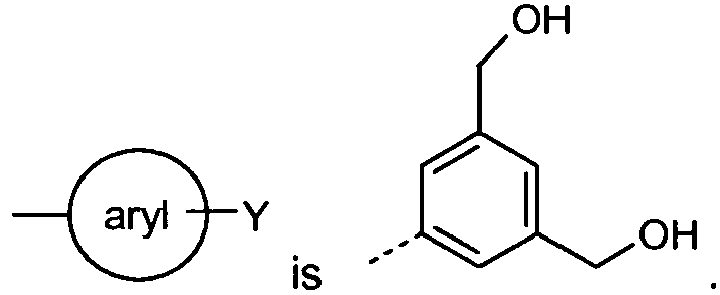

- Accordingly, a process is disclosed for the preparation of compounds of the formula (Ia) by reacting a compound of formula (II), wherein R1 and R2 are defined above, with a compound of formula (III) wherein Y and

- Compounds of formula (II) may be prepared according to reaction scheme 2 by reacting compounds of formula (lVa) and compounds of formula (IVb). The reaction is suitably carried out in the presence of base such as potassium carbonate in a suitable solvent such as DMF or DMSO (suitably at 40-80°C), and is followed by saponification of compounds of formula (IV) in basic conditions such as sodium hydroxide in a suitable solvent, such as ethanol or methanol (to reflux).

- Compounds of formula (IVa) may be prepared according to reaction scheme 3 by the reaction of benzyl halide chlorine or bromine (VI) with sodium azide in a suitable solvent such as DMSO or DMF (suitably at room temperature to 80°C).

- The compound of formula (I), wherein R1, Y and R2 are as defined above, n is 1 and R5 is H may also be prepared according to reaction scheme 4 by reduction of the ester function (Y = -(CH2)nCOOR5) of compounds of formula (VII) in the presence of DIBAL-H in solution of toluene. The reaction is suitably carried out in a suitable solvent such as THF at room temperature.

- Accordingly, in another aspect the invention provides a process for the preparation of compounds of the formula (Ib) by reduction of the ester function (Y = -(CH2)nCOOR5) of compounds of the formula (VII), wherein R1, R2 and

- Compounds of the formula (III), (IVb) and (VI) are commercially available compounds or may be prepared by methods known in the literature or processes known to those skilled in the art. Compounds of the formula (VII) may be prepared according to the general reaction scheme 1, wherein Y = -(CH2)nCOOR5.
- Further details for the preparation of compounds of formula (I) are found in the examples section hereinafter.
- The compounds of the invention may be prepared singly or as compound libraries comprising at least 2, for example 5 to 1,000 compounds, and more preferably 10 to 100 compounds. Libraries of compounds of the invention may be prepared by a combinatorial 'split and mix' approach or by multiple parallel syntheses using either solution phase or solid phase chemistry, by procedures known to those skilled in the art. Thus according to a further aspect there is provided a compound library comprising at least 2 compounds of the invention.
- Those skilled in the art will appreciate that in the preparation of compounds of formula (I) and/or solvates thereof it may be necessary and/or desirable to protect one or more sensitive groups in the molecule or the appropriate intermediate to prevent undesirable side reactions. Suitable protecting groups for use according to the present invention are well known to those skilled in the art and may be used in a conventional manner. See, for example, "Protective groups in organic synthesis" by T.W. Greene and P.G.M. Wuts (John Wiley & sons 1991) or "Protecting Groups" by P.J. Kocienski (Georg Thieme Verlag 1994). Examples of suitable amino protecting groups include acyl type protecting groups (e.g. formyl, trifluoroacetyl, acetyl), aromatic urethane type protecting groups (e.g. benzyloxycarbonyl (Cbz) and substituted Cbz), aliphatic urethane protecting groups (e.g. 9-fluorenylmethoxycarbonyl (Fmoc), t-butyloxycarbonyl (Boc), isopropyloxycarbonyl, cyclohexyloxycarbonyl) and alkyl or aralkyl type protecting groups (e.g. benzyl, trityl, chlorotrityl).
- Various intermediate compounds used in the above-mentioned process, including but not limited to certain compounds of formulae (IV) are also disclosed.
- The compounds of formula (I) or pharmaceutically acceptable salt(s) thereof may also be used in combination with other therapeutic agents. The invention thus provides, in a further aspect, a combination comprising a compound of formula (I) or pharmaceutically acceptable salts thereof together with one or more further therapeutic agent(s).
- Compounds of the invention may be administered in combination with other therapeutic agents. Preferred therapeutic agents are selected from the list: an inhibitor of cholesteryl ester transferase (CETP inhibitors), a HMG-CoA reductase inhibitor, a microsomal triglyceride transfer protein, a peroxisome proliferator-activated receptor activator (PPAR), a bile acid reuptake inhibitor, a cholesterol absorption inhibitor, a cholesterol synthesis inhibitor, a fibrate, niacin, an ion-exchange resin, an antioxidant, an inhibitor of AcylCoA: cholesterol acyltransferase (ACAT inhibitor), a cannabinoid 1 antagonist a bile acid sequestrant. Other preferred therapeutic agents are selected from the list: a corticosteroid, a vitamin D3 derivative, a retinoid, an immunomodulator, an anti androgen, a keratolytic agent, an anti-microbial, a platinum chemotherapeutic, an antimetabolite, hydroxyurea, a taxane, a mitotic disrupter, an anthracycline, dactinomycin, an alkylating agent and a cholinesterase inhibitor.
- When the compound of formula (I) or pharmaceutically acceptable salt thereof is used in combination with a second therapeutic agent the dose of each compound may differ from that when the compound is used alone. Appropriate doses will be readily appreciated by those skilled in the art. It will be appreciated that the amount of a compound of the invention required for use in treatment will vary with the nature of the condition being treated and the age and the condition of the patient and will be ultimately at the discretion of the attendant physician or veterinarian.
- The combinations referred to above may conveniently be presented for use in the form of a pharmaceutical formulation and thus pharmaceutical formulations comprising a combination as defined above together with at least one pharmaceutically acceptable carrier and/or excipient comprise a further aspect of the invention. The individual components of such combinations may be administered either sequentially or simultaneously in separate or combined pharmaceutical formulations by any convenient route.
- When administration is sequential, either the SCD inhibitor or the second therapeutic agent may be administered first. When administration is simultaneous, the combination may be administered either in the same or different pharmaceutical composition.
- When combined in the same formulation it will be appreciated that the two compounds must be stable and compatible with each other and the other components of the formulation. When formulated separately they may be provided in any convenient formulation, conveniently in such manner as are known for such compounds in the art.
- The invention also includes a pharmaceutical composition comprising one or more compounds of formula (I) or pharmaceutically acceptable salt (s) in combination with one or more excipients.
- The compounds of the invention may be administered in conventional dosage forms prepared by combining a compound of the invention with standard pharmaceutical carriers or diluents according to conventional procedures well known in the art. These procedures may involve mixing, granulating and compressing or dissolving the ingredients as appropriate to the desired preparation.
- The pharmaceutical compositions of the invention may be formulated for administration by any route, and include those in a form adapted for oral, topical or parenteral administration to mammals including humans.
- The compositions may be in the form of tablets, capsules, powders, granules, lozenges, creams or liquid preparations, such as oral or sterile parenteral solutions or suspensions.
- The topical formulations of the present invention may be presented as, for instance, ointments, creams or lotions, eye ointments and eye or ear drops, impregnated dressings and aerosols, and may contain appropriate conventional additives such as preservatives, solvents to assist drug penetration and emollients in ointments and creams.
- Creams, lotions, or ointments, may be prepared as rinse-off or leave-on products, as well as two stage treatment products for use with other skin cleansing or managing compositions. The compositions can be administered as a rinse-off product in a higher concentration form, such as a gel, and then a leave-on product in a lower concentration to avoid irritation of the skin. Each of these forms is well understood by those of ordinary skill in the art, such that dosages may be easily prepared to incorporate the pharmaceutical composition of the invention.
- Ointments are hydrocarbon-based semisolid formulations containing dissolved or suspended drugs. Creams and lotions are semi-solid emulsion systems and the term is applied both to water/oil or oil/water. Gel formulations are semi-solid systems in which a liquid phase is trapped in a polymeric matrix.
- By way of non-limiting example, the ointments may contain one or more hydrophobic carriers selected from, for example, white soft paraffin or other mineral waxes, liquid paraffin, non-mineral waxes, long chain alcohols, long chain acids and silicones. The ointment may contain in addition to the hydrophobic carriers some hydrophillic carriers selected from, for example, propylene glycol and polyethylene glycol in combination with an appropriate surfactant/co-surfactant system. The carrier compositions of the creams or lotions are typically based on water, white soft paraffin and an appropriate surfactant/cosurfactant system, in combination with other carriers/components selected from, for example, propylene glycol, butylene glycol glycerinemonostearate, PEG-glycerinemonostearate, esters such as C12-15 alkyl benzoate, liquid paraffin, non-mineral waxes, long chain alcohols, long chain acids silicones, non-silicone polymers. The gels may by way of example be formulated using isopropyl alcohol or ethyl alcohol, propylene glycol and water with a gelling agent such as hydroxyethyl cellulose, suitably in combination with minor components, for example one or more of butylene glycol and a wetting agent such as a poloxamer.
- An ointment, cream, lotion, gel, and the like, can further comprise a moisturizing agent. The moisturizing agent can be a hydrophobic moisturizing agent such as ceramide, borage oil, tocopherol, tocopherol linoleate, dimethicone or a mixture thereof or a hydrophilic moisturizing agent such as glycerine, hyaluronic acid, sodium peroxylinecarbolic acid, wheat protein, hair keratin amino acids, or a mixture thereof.
- The compositions according to the invention may also comprise conventional additives and adjuvants for dermatological applications, such as preservatives, acids or bases used as pH buffer excipients and antioxidants.
- The present invention encompasses administration via a transdermal patch or other forms of transdermal administration. Suitable formulations for transdermal administration are known in the art, and may be employed in the methods of the present invention. For example, suitable transdermal patch formulations for the administration of a pharmaceutical compound are described in, for example,
U.S. Pat. No. 4, 460,372 to Campbell et al. ,U.S. Pat. No. 4,573,996 to Kwiatek et al .,U. S. Pat. No. 4,624,665 to Nuwayser ,U.S. Pat. No. 4,722,941 to Eckert et al. , andU.S. Pat. No. 5, 223,261 to Nelson et al . - One suitable type of transdermal patch for use in the methods of the present invention encompasses a suitable transdermal patch includes a backing layer which is non-permeable, a permeable surface layer, an adhesive layer substantially continuously coating the permeable surface layer, and a reservoir located or sandwiched between the backing layer and the permeable surface layer such that the backing layer extends around the sides of the reservoir and is joined to the permeable surface layer at the edges of the permeable surface layer. The reservoir contains a compound of formula (I) or pharmaceutically acceptable salt thereof, alone or in combination, and is in fluid contact with the permeable surface layer. The transdermal patch is adhered to the skin by the adhesive layer on the permeable surface layer, such that the permeable surface layer is in substantially continuous contact with the skin when the transdermal patch is adhered to the skin. While the transdermal patch is adhered to the skin of the subject, the compound of formula (I) or pharmaceutically acceptable salt thereof contained in the reservoir of the transdermal patch is transferred via the permeable surface layer, from the reservoir, through the adhesive layer, and to the skin of the patient. The transdermal patch may optionally also include one or more penetration-enhancing agents in the reservoir that enhance the penetration of the compound of formula (I) or pharmaceutically acceptable salt thereof through the skin.
- Examples of suitable materials which may comprise the backing layer are well known in the art of transdermal patch delivery, and any conventional backing layer material may be employed in the transdermal patch of the instant invention.
- Suitable penetration-enhancing agents are well known in the art as well. Examples of conventional penetration-enhancing agents include alkanols such as ethanol, hexanol, cyclohexanol, and the like, hydrocarbons such as hexane, cyclohexaue, isopropylbenzene; aldebydes and ketones such as cyclohexanone, acetamide, N,N-di(lower alkyl)acetamides such as N,N-diethylacetamide, N,N-dimethyl acetamide, N-(2-hydroxyethyl) acetamide, esters such as N,N-di-lower alkyl sulfoxides; essential oils such as propylene glycol, glycerine, glycerol monolaurate, isopropyl myristate, and ethyl oleate, salicylates, and mixtures of any of the above.
- Tablets and capsules for oral administration may be in unit dose presentation form, and may contain conventional excipients such as binding agents, for example syrup, acacia, gelatin, sorbitol, tragacanth, or polyvinylpyrrolidone; fillers, for example lactose, sugar, maize-starch, calcium phosphate, sorbitol or glycine; tabletting lubricants, for example magnesium stearate, talc, polyethylene glycol or silica; disintegrants, for example potato starch; or acceptable wetting agents such as sodium lauryl sulphate. The tablets may be coated according to methods well known in normal pharmaceutical practice. Oral liquid preparations may be in the form of, for example, aqueous or oily suspensions, solutions, emulsions, syrups or elixirs, or may be presented as a dry product for reconstitution with water or other suitable vehicle before use. Such liquid preparations may contain conventional additives, such as suspending agents, for example sorbitol, methyl cellulose, glucose syrup, gelatin, hydroxyethyl cellulose, carboxymethyl cellulose, aluminium stearate gel or hydrogenated edible fats, emulsifying agents, for example lecithin, sorbitan monooleate, or acacia; non-aqueous vehicles (which may include edible oils), for example almond oil, oily esters such as glycerine, propylene glycol, or ethyl alcohol; preservatives, for example methyl or propyl p-hydroxybenzoate or sorbic acid, and, if desired, conventional flavouring or colouring agents.
- Preparations for oral administration may be suitably formulated to give controlled/extended release of the active compound.
- Suppositories will contain conventional suppository bases, e.g. cocoa-butter or other glyceride.
- For parenteral administration, fluid unit dosage forms are prepared utilising the compound and a sterile vehicle, water being preferred. The compound, depending on the vehicle and concentration used, can be either suspended or dissolved in the vehicle. In preparing solutions the compound can be dissolved in water for injection and filter sterilised before filling into a suitable vial or ampoule and sealing.
- Advantageously, agents such as a local anaesthetic, preservative and buffering agents can be dissolved in the vehicle. To enhance the stability, the composition can be frozen after filling into the vial and the water removed under vacuum. The dry lyophilised powder is then sealed in the vial and an accompanying vial of water for injection may be supplied to reconstitute the liquid prior to use. Parenteral suspensions are prepared in substantially the same manner except that the compound is suspended in the vehicle instead of being dissolved and sterilisation cannot be accomplished by filtration. The compound can be sterilised by exposure to ethylene oxide before suspending in the sterile vehicle. Advantageously, a surfactant or wetting agent is included in the composition to facilitate uniform distribution of the compound.
- The compositions may contain from 0.1% by weight, preferably from 10-60% by weight, of the active ingredient, depending on the method of administration. Where the compositions comprise dosage units, each unit will preferably contain from 50-500 mg of the active ingredient. The dosage as employed for adult human treatment will preferably range from 100 to 3000 mg per day, for instance 1500 mg per day depending on the route and frequency of administration. Such a dosage corresponds to 1.5 to 50 mg/kg per day. Suitably the dosage is from 5 to 20 mg/kg per day.
- It will be recognised by one of skill in the art that the optimal quantity and spacing of individual dosages of a compound of the invention will be determined by the nature and extent of the condition being treated, the form, route and site of administration, and the particular mammal being treated, and that such optimums can be determined by conventional techniques. It will also be appreciated by one of skill in the art that the optimal course of treatment, i.e., the number of doses of a compound of the invention given per day for a defined number of days, can be ascertained by those skilled in the art using conventional course of treatment determination tests.
- The following is a list of the used definitions:
-
- AcOEt
- ethyl acetate
- DCM
- dichloromethane
- DIBAL-H
- diisobutylaluminium hydride solution
- DIPEA
- diisopropylethylamine
- DMF
- dimethylformamide
- DMSO
- dimethyl sulfoxyde
- HATU
- O-(7-Azabenzotriazol-1-yl)-1,1,3,3-tetramethyluronium hexafluorophosphate
- HCl
- hydrochloric acid
- NaOH
- sodium hydroxide
- NH4Cl
- ammonium chloride
- RT
- room temperature
- THF
- tetrahydrofuran
- Regardless of how the preparation of compounds are represented in the present specification no inference can be drawn that particular batches (or mixtures of two or more batches) of intermediates were used in the next stage of the preparation. The examples and intermediates are intended to illustrate the synthetic routes suitable for preparation of the same, to assist the skilled persons understanding of the present invention.
- Where reference is made to the use of a "similar' procedure, as will be appreciated by those skilled in the art, such a procedure may involve minor variation, for example reaction temperature, reagent/solvent amount, reaction time, work-up conditions or chromatographic purification conditions.
- Analytical HPLC was conducted on a X-terra MS C18 column (2,5 µm 3 * 30 mm id) eluting with 0,01 M ammonium acetate in water (solvent A) and 100% acetonitrile using the following elution gradient: 0 to 4 minutes, 5 to 100%B; 4 to 5 minutes, 100%B at a flowrate of 1,1 mL/min with a temperature of 40°C.
- The mass spectra (MS) were recorded on a micromass ZQ-LC mass spectrometer using electrospray positive ionisation [ES+ve to give MH+ molecular ion] or electrospray negative ionisation [ES-ve to give (M-H)- molecular ion] modes.
- Analytical HPLC was conducted on an Uptisphere-hsc column (3 µm 30 * 3 mm id) eluting with 0,01 M ammonium acetate in water (solvent A) and 100% acetonitrile (solvent B) using the following elution gradient: 0 to 0,5 minutes, 5%B; 0,5 to 3,5 minutes, 5 to 100%B; 3,5 to 4 minutes, 100%B; 4 to 4,5 minutes, 100 to 5%B; 4,5 to 5,5 minutes, 5%B at a flowrate of 1,3 mL/min with a temperature of 40°C.
- The mass spectra (MS) were recorded on a micromass LCT, mass spectrometer using electrospray positive ionisation [ES+ve to give MH+ molecular ion] or electrospray negative ionisation [ES-ve to give (M-H)- molecular ion] modes.
- Analytical GC was conducted on a DB-1ms column (Agilent Technologies), 0.1 µm 10m * 0.1 mm id) eluting with an Helium flow of 0.5ml/min and pressure at 3.4 bar and with a gradient temperature: 0 to 0.35 min, 100°C; 0.35min to 6min, 100°C to 250°C (ramp of 80°C/min).
- The mass spectra (MS) were recorded on a Agilent Technologies G5973 mass spectrometer using electronic impact ionisation.
- The invention is illustrated by the non-limiting Examples described below.
-
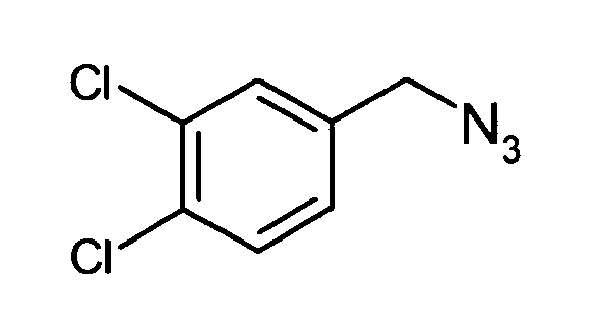
- A mixture of 3,4-dichlorobenzyl chloride (10 g, 0.05 mol), sodium azide (5 g, 0.08 mol) in DMSO (100 mL) was stirred at room temperature overnight. The mixture was poured into water (150 mL). The water layer was extracted with ethyl acetate (100 ml x 3). The combined organic phases were dried over sodium sulfate, filtered and concentrated in vacuo. The residue was purified by distillation to give the title compound as an oil (14 g, quantitative yield). LC/MS: m/z 203 (M+H)+, Rt: 2.26 min.
-

- To a suspension of milled potassium carbonate (38.7 g, 0.28 mol) in DMSO (100 mL) was added (3,4-dichlorophenyl)methyl azide (Intermediate 1) (14 g, 0.07 mol) and methyl acetoacetate (12.1 g, 0.1 mol). The mixture was stirred at 40°C for 48 hours. The mixture was poured into a mixture of ice and water (100 mL). The water was extracted with ethyl acetate (100 mL x 2). The combined organic phases were dried over sodium sulfate, filtered and concentrated. The residue was purified by distillation to give the title compound as white solid crystals (14 g, 67%). LC/MS: m/z 301 (M+H)+, Rt: 1.97 min.
-

- To a mixture of methyl 1-[(3,4-dichlorophenyl)methyl]-5-methyl-1H-1,2,3-triazole-4-carboxylate (Intermediate 2) (9 g, 0.03 mol) in methanol (200 mL) was added NaOH (2.4 g) and water. The mixture was stirred overnight. Water was added and the solvent was evaporated. The residue was extracted with DCM (twice). The aqueous phase was adjusted to pH=2 with a 2N HCl solution. The formed precipitate was filtered to give the title compound as a white solid (7.29 g, 84%). LC/MS: m/z 287 (M+H)+, Rt: 2.52 min.
-

- A mixture of 1-[(3,4-dichlorophenyl)methyl]-5-methyl-1H-1,2,3-triazole-4-carboxylic acid (Intermediate 3) (0.4 g, 1.3 mmol), dimethyl 5-amino-1,3-benzenedicarboxylate (0.29 g, 1 eq), HATU (0.69 g, 1.3 eq) and DIPEA (0.34 mL, 1.3 eq) in DMF (10 mL) was stirred at 45°C for 24 hours. The solvent was evaporated and the residue was washed with water and extracted with DCM. The organic phase was dried over sodium sulphate and concentrated. The title compound was obtained as a white solid (650 mg, 95%) after recrystallisation from acetonitrile. LC/MS: m/z 477 (M+H)+, Rt: 3.81 min.
-
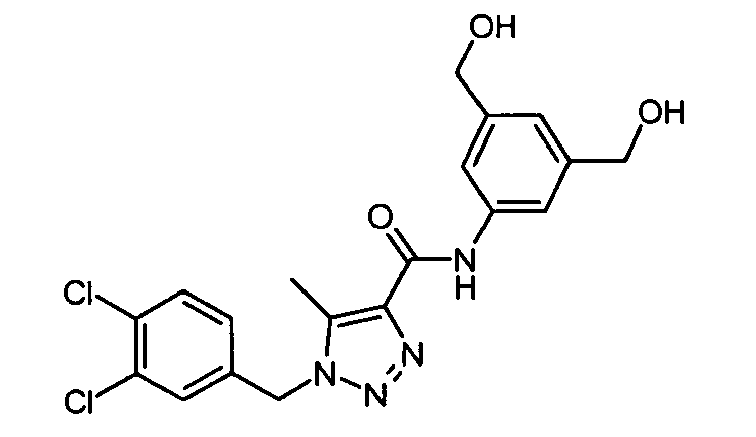
- To a solution of dimethyl 5-[({1-[(3,4-dichlorophenyl)methyl]-5-methyl-1H-1,2,3-triazol-4-yl}carbonyl)amino]-1,3-benzenedicarboxylate (Intermediate 14) (0.65 g, 1.3 mmol) in THF (40 mL), was added a 1 M solution of DIBAL-H in toluene (10 mL, 7 eq) and the reaction was stirred to room temperature for 2 hours. Solid NH4Cl was added and the reaction mixture was stirred at RT for 30 min. The aqueous phase was extracted with ether and AcOEt, dried over sodium sulphate and evaporated. After recrystallisation from acetonitrile, the title compound was obtained as a white solid (240 mg, 44%). HRMS calculated for C19H18Cl2N4O3 (M+H)+ 421.0834, found: 421.0833, Rt: 2.51 min. MP: 194.5°C.
- The compounds of the present invention may be analysed in vitro for SCD activity using an assay based on the production of [3H]H2O, which is released during the enzyme-catalyzed generation of the monounsaturated fatty acyl CoA product. The assay is performed in a 96-well filtration plates. The titrated substrate used in the assay is the [9,10-3H] stearoyl Coenzyme A. After incubation for 6 minutes of SCD-containing rat microsomes (2 µg protein) and substrate (1 µM), the labelled fatty acid acyl-CoA species and microsomes are absorbed with charcoal and separated from [3H]H2O by centrifugation. The formation of [3H]H2O is used as a measure of SCD activity. Compounds at concentrations starting at 10 µM to 0.1 nM or vehicle (DMSO) are preincubated for 5 minutes with the microsomes before addition of the substrate. The concentration-responses are fitted with sigmoidal curves to obtain IC50 values.
- All of the synthetic Example compounds tested by the above described in vitro assay for SCD activity were found to exhibit an average plC50 value of greater than 5.5.
Claims (12)
- A compound which is N-[3,5-bis(hydroxymethyl)phenyl]-1-[(3,4-dichlorophenyl)methyl]-5-methyl-1H-1,2,3-triazole-4-carboxamide

- A compound according to claim 1 which is N-[3,5-bis(hydroxymethyl)phenyl]-1-[(3,4-dichlorophenyl)methyl]-5-methyl-1H-1,2,3-triazole-4-carboxamide

- A pharmaceutical composition comprising a compound according to claim 1 or 2 together with at least one pharmaceutical carrier and/or excipient.
- A compound according to claim 1 or 2 for use in therapy.
- Use of a compound according to claim 1 or 2 for the manufacture of a medicament for treating and/or preventing diseases or conditions caused by or associated with an abnormal plasma lipid profile including dyslipidemia, hypoalphalipoproteinemia, hyperbetalipoproteinemia, hypercholesterolemia, hypertriglyceridemia, familial hypercholesterolemia, angina, ischemia, cardiac ischemia, stroke, myocardial infarction, atherosclerosis, obesity, Type I diabetes, Type II diabetes, insulin resistance, hyperinsulinaemia and metabolic syndrome; peripheral vascular disease, reperfusion injury, angioplastic restenosis, hypertension, vascular complications of diabetes, thrombosis, hepatic steatosis, non-alcoholic steatohepatitis (NASH) and other diseases related to accumulation of lipids in the liver; eczema, acne, psoriasis, skin ageing, keloid scar formation or prevention, and diseases related to production or secretions from mucous membranes; cancer, neoplasia, malignancy, metastases, tumours (benign or malignant), carcinogenesis, hepatomas and the like; mild cognitive impairment (MCI), Alzheimer's Disease (AD), cerebral amyloid angiopathy (CAA) or dementia associated with Down Syndrome (DS) and other neurodegenerative diseases characterized by the formation or accumulation of amyloid plaques comprising Aβ42.
- A compound according to claim 1 or 2 for use in treating and/or preventing a disease or a condition susceptible to amelioration by an SCD inhibitor.
- A compound according to claim 6 for use in treating and/or preventing diseases or conditions caused by or associated with an abnormal plasma lipid profile including dyslipidemia, hypoalphalipoproteinemia, hyperbetalipoproteinemia, hypercholesterolemia, hypertriglyceridemia, familial hypercholesterolemia, angina, ischemia, cardiac ischemia, stroke, myocardial infarction, atherosclerosis, obesity, Type I diabetes, Type II diabetes, insulin resistance, hyperinsulinaemia and metabolic syndrome; peripheral vascular disease, reperfusion injury, angioplastic restenosis, hypertension, vascular complications of diabetes, thrombosis, hepatic steatosis, non-alcoholic steatohepatitis (NASH) and other diseases related to accumulation of lipids in the liver; eczema, acne, psoriasis, skin ageing, keloid scar formation or prevention, and diseases related to production or secretions from mucous membranes; cancer, neoplasia, malignancy, metastases, tumours (benign or malignant), carcinogenesis, hepatomas and the like; mild cognitive impairment (MCI), Alzheimer's Disease (AD), cerebral amyloid angiopathy (CAA) or dementia associated with Down Syndrome (DS) and other neurodegenerative diseases characterized by the formation or accumulation of amyloid plaques comprising Aβ42.
- A compound according to claim 6 for use in treating and/or preventing acne, psoriasis, skin ageing, dyslipidemia, hypertriglyceridemia, atherosclerosis, obesity, Type II diabetes, insulin resistance, hyperinsulinaemia, hepatic steatosis and/or non-alcoholic steatohepatitis (NASH).
- A compound according to claim 6 for use in treating acne.
- A compound according to claim 6 for use in treating cancer.
- A compound according to claim 1 or 2 in combination with one or more active agent(s) selected from an inhibitor of cholesteryl ester transferase (CETP inhibitors), a HMG-CoA reductase inhibitor, a microsomal triglyceride transfer protein, a peroxisome proliferator-activated receptor activator (PPAR), a bile acid reuptake inhibitor, a cholesterol absorption inhibitor, a cholesterol synthesis inhibitor, a fibrate, niacin, an ion-exchange resin, an antioxidant, an inhibitor of AcylCoA: cholesterol acyltransferase (ACAT inhibitor), a cannabinoid 1 antagonist and a bile acid sequestrant.
- A compound according to claim 1 or 2 in combination with one or more active agent(s) selected from a corticosteroid, a vitamin D3 derivative, a retinoid, an immunomodulator, an anti androgen, a keratolytic agent, an anti-microbial, a platinum chemotherapeutic, an antimetabolite, hydroxyurea, a taxane, a mitotic disrupter, an anthracycline, dactinomycin, an alkylating agent and a cholinesterase inhibitor.
Priority Applications (6)
| Application Number | Priority Date | Filing Date | Title |
|---|---|---|---|
| PL08846247T PL2207770T3 (en) | 2007-11-09 | 2008-11-07 | 1, 2, 3-triazole derivatives for use as stearoyl-coa desaturase inhibitors |
| DK11168642.4T DK2368887T3 (en) | 2007-11-09 | 2008-11-07 | 1, 2, 3-TRIAZOLD DERIVATIVES FOR USE AS STEAROYL-COA DESATURASE INHIBITORS |
| SI200830349T SI2207770T1 (en) | 2007-11-09 | 2008-11-07 | 1, 2, 3-triazole derivatives for use as stearoyl-coa desaturase inhibitors |
| EP11168642.4A EP2368887B8 (en) | 2007-11-09 | 2008-11-07 | 1, 2, 3-triazole derivatives for use as stearoyl-coa desaturase inhibitors |
| PL11168642T PL2368887T3 (en) | 2007-11-09 | 2008-11-07 | 1, 2, 3-triazole derivatives for use as stearoyl-coa desaturase inhibitors |
| CY20111100816T CY1112233T1 (en) | 2007-11-09 | 2011-08-26 | 1,2,3-TRIAZOLIS PRODUCT FOR USE AS STEATOYLO-COA SUSPENSIONS |
Applications Claiming Priority (2)
| Application Number | Priority Date | Filing Date | Title |
|---|---|---|---|
| GBGB0722077.5A GB0722077D0 (en) | 2007-11-09 | 2007-11-09 | Compounds |
| PCT/EP2008/065104 WO2009060053A1 (en) | 2007-11-09 | 2008-11-07 | 1, 2, 3-triazole derivatives for use as stearoyl-coa desaturase inhibitors |
Related Child Applications (2)
| Application Number | Title | Priority Date | Filing Date |
|---|---|---|---|
| EP11168642.4A Division EP2368887B8 (en) | 2007-11-09 | 2008-11-07 | 1, 2, 3-triazole derivatives for use as stearoyl-coa desaturase inhibitors |
| EP11168642.4A Previously-Filed-Application EP2368887B8 (en) | 2007-11-09 | 2008-11-07 | 1, 2, 3-triazole derivatives for use as stearoyl-coa desaturase inhibitors |
Publications (2)
| Publication Number | Publication Date |
|---|---|
| EP2207770A1 EP2207770A1 (en) | 2010-07-21 |
| EP2207770B1 true EP2207770B1 (en) | 2011-06-08 |
Family
ID=38858481
Family Applications (2)
| Application Number | Title | Priority Date | Filing Date |
|---|---|---|---|
| EP11168642.4A Active EP2368887B8 (en) | 2007-11-09 | 2008-11-07 | 1, 2, 3-triazole derivatives for use as stearoyl-coa desaturase inhibitors |
| EP08846247A Active EP2207770B1 (en) | 2007-11-09 | 2008-11-07 | 1, 2, 3-triazole derivatives for use as stearoyl-coa desaturase inhibitors |
Family Applications Before (1)
| Application Number | Title | Priority Date | Filing Date |
|---|---|---|---|
| EP11168642.4A Active EP2368887B8 (en) | 2007-11-09 | 2008-11-07 | 1, 2, 3-triazole derivatives for use as stearoyl-coa desaturase inhibitors |
Country Status (31)
| Country | Link |
|---|---|
| US (2) | US8486977B2 (en) |
| EP (2) | EP2368887B8 (en) |
| JP (1) | JP5491407B2 (en) |
| KR (1) | KR101577080B1 (en) |
| CN (1) | CN101918376B (en) |
| AT (1) | ATE512140T1 (en) |
| AU (1) | AU2008324172B2 (en) |
| BR (1) | BRPI0820471A2 (en) |
| CA (1) | CA2705113C (en) |
| CO (1) | CO6270331A2 (en) |
| CR (1) | CR11482A (en) |
| CY (2) | CY1112233T1 (en) |
| DK (2) | DK2207770T3 (en) |
| DO (1) | DOP2010000137A (en) |
| EA (1) | EA016621B1 (en) |
| ES (2) | ES2366422T3 (en) |
| GB (1) | GB0722077D0 (en) |
| HR (2) | HRP20110552T1 (en) |
| IL (1) | IL205152A (en) |
| MA (1) | MA31801B1 (en) |
| ME (1) | ME01962B (en) |
| MX (1) | MX2010005187A (en) |
| MY (1) | MY163126A (en) |
| NZ (1) | NZ584725A (en) |
| PL (2) | PL2368887T3 (en) |
| PT (2) | PT2368887E (en) |
| RS (2) | RS53294B (en) |
| SI (2) | SI2207770T1 (en) |
| UA (1) | UA107324C2 (en) |
| WO (1) | WO2009060053A1 (en) |
| ZA (1) | ZA201002596B (en) |
Families Citing this family (21)
| Publication number | Priority date | Publication date | Assignee | Title |
|---|---|---|---|---|
| GB0722075D0 (en) | 2007-11-09 | 2007-12-19 | Smithkline Beecham Corp | Compounds |
| GB0722077D0 (en) * | 2007-11-09 | 2007-12-19 | Smithkline Beecham Corp | Compounds |
| JP5529121B2 (en) * | 2008-09-15 | 2014-06-25 | ダイキン工業株式会社 | Aqueous polymer dispersion composition and surface treatment agent |
| JP2012506386A (en) * | 2008-10-21 | 2012-03-15 | メタボレックス, インコーポレイテッド | Aryl GPR120 receptor agonist and uses thereof |
| FR2974089B1 (en) | 2011-04-18 | 2014-04-25 | Univ Nice Sophia Antipolis | ACADESINE DERIVATIVES, PRODUCTS AND COMPOSITIONS COMPRISING THEM, THEIR THERAPEUTIC USES AND METHODS OF SYNTHESIS. |
| US9233102B2 (en) | 2012-03-07 | 2016-01-12 | Mayo Foundation For Medical Education And Research | Methods and materials for treating cancer |
| HK1206714A1 (en) * | 2012-09-17 | 2016-01-15 | 霍夫曼-拉罗奇有限公司 | Triazole carboxamide derivatives |
| IL227890A0 (en) * | 2013-08-08 | 2014-01-30 | Galderm Therapeutics Ltd | Anti-aging compositions comprising bile acid and fatty acid conjugates |
| EP4180041A1 (en) | 2014-08-07 | 2023-05-17 | Mayo Foundation for Medical Education and Research | Compounds and methods for treating cancer |
| CN107406420B (en) * | 2015-01-30 | 2020-11-06 | 纽罗克里生物科学有限公司 | Substituted triazoles and methods related thereto |
| KR20180036318A (en) * | 2016-09-30 | 2018-04-09 | 경북대학교 산학협력단 | Composition for preventing or treating neurodegenerative disease comprising derivatives of 2-amino-2-(1-dodecyl-1H-1,2,3-triazol-4-yl)propane-1,3-diol |
| JP2019533022A (en) | 2016-10-24 | 2019-11-14 | ユマニティ セラピューティクス,インコーポレーテッド | Compounds and uses thereof |
| CA3049010A1 (en) * | 2017-01-06 | 2018-07-12 | Yumanity Therapeutics, Inc. | Methods for the treatment of neurological disorders |
| KR102292989B1 (en) | 2017-03-29 | 2021-08-26 | 재단법인 아산사회복지재단 | Composition for preventing and treating nonalcoholic steatohepatitis by targeting S1PR4 |
| CA3083000A1 (en) | 2017-10-24 | 2019-05-02 | Yumanity Therapeutics, Inc. | Compounds and uses thereof |
| CA3094527A1 (en) | 2018-03-23 | 2019-09-26 | Yumanity Therapeutics, Inc. | Compounds and uses thereof |
| WO2019209962A1 (en) * | 2018-04-25 | 2019-10-31 | Yumanity Therapeutics, Inc. | Compounds and uses thereof |
| KR102017324B1 (en) * | 2018-04-30 | 2019-09-02 | 경북대학교 산학협력단 | Novel ASM direct inhibition compound 2-amino-2-(1,2,3-triazol-4-yl)propane-1,3-diol derivatives and uses thereof |
| US12098146B2 (en) | 2019-01-24 | 2024-09-24 | Janssen Pharmaceutica Nv | Compounds and uses thereof |
| EA202192047A1 (en) | 2019-11-13 | 2021-12-08 | Юманити Терапьютикс, Инк. | COMPOUNDS AND THEIR APPLICATIONS |
| CN114656414B (en) * | 2022-05-24 | 2022-08-23 | 常熟华虞环境科技有限公司 | Triazole modified titanium dioxide photocatalyst and preparation method thereof |
Family Cites Families (26)
| Publication number | Priority date | Publication date | Assignee | Title |
|---|---|---|---|---|
| US4722941A (en) | 1978-06-07 | 1988-02-02 | Kali-Chemie Pharma Gmbh | Readily absorbable pharmaceutical compositions of per se poorly absorbable pharmacologically active agents and preparation thereof |
| US4460372A (en) | 1981-02-17 | 1984-07-17 | Alza Corporation | Percutaneous absorption enhancer dispenser for use in coadministering drug and percutaneous absorption enhancer |
| US4573996A (en) | 1984-01-03 | 1986-03-04 | Jonergin, Inc. | Device for the administration of an active agent to the skin or mucosa |
| US4624665A (en) | 1984-10-01 | 1986-11-25 | Biotek, Inc. | Method of transdermal drug delivery |
| US5223261A (en) | 1988-02-26 | 1993-06-29 | Riker Laboratories, Inc. | Transdermal estradiol delivery system |
| US20070087363A1 (en) | 1998-12-22 | 2007-04-19 | Myriad Genetics, Incorporated | Therapeutic methods, compounds and compositions |
| PT1315831E (en) | 2000-02-24 | 2010-11-04 | Xenon Pharmaceuticals Inc | Stearoyl-coa desaturase to identify triglyceride reducing therapeutic agents |
| DE60134995D1 (en) | 2000-09-26 | 2008-09-04 | Xenon Pharmaceuticals Inc | METHOD AND COMPOSITIONS USING A STEAROYL-COA DESUTURASE-HSCD5 |
| DK1501809T3 (en) * | 2002-04-26 | 2008-05-13 | Lilly Co Eli | Trizole derivatives as tachykinin receptor antagonists |
| US20060160794A1 (en) * | 2003-06-12 | 2006-07-20 | Amegadzie Albert K | Tachykinin receptor antagonists |
| AU2004261249B2 (en) | 2003-07-30 | 2008-09-04 | Xenon Pharmaceuticals Inc. | Pyridazine derivatives and their use as therapeutic agents |
| US7456180B2 (en) * | 2003-07-30 | 2008-11-25 | Xenon Pharmaceuticals Inc. | Piperazine derivatives and their use as therapeutic agents |
| WO2007046868A2 (en) | 2005-05-19 | 2007-04-26 | Xenon Pharmaceuticals Inc. | Thiazolidine derivatives and their uses as therapeutic agents |
| WO2007046867A2 (en) | 2005-05-19 | 2007-04-26 | Xenon Pharmaceuticals Inc. | Piperidine derivatives and their uses as therapeutic agents |
| WO2008073461A2 (en) * | 2006-12-11 | 2008-06-19 | Wyeth | Ion channel modulators |
| GB0625604D0 (en) | 2006-12-21 | 2007-01-31 | Smithkline Beecham Corp | Compounds |
| GB0625654D0 (en) | 2006-12-21 | 2007-01-31 | Smithkline Beecham Corp | Compounds |
| GB0625605D0 (en) | 2006-12-21 | 2007-01-31 | Smithkline Beecham Corp | Compounds |
| US20100120669A1 (en) | 2007-02-28 | 2010-05-13 | Anne Marie Jeanne Bouillot | Thiadiazole derivatives, inhibitors of stearoyl-coa desaturase |
| JP2010526850A (en) * | 2007-05-15 | 2010-08-05 | ノイロサーチ アクティーゼルスカブ | Novel aromatic heterocyclic carboxylic acid amide derivatives useful as potassium channel regulators |
| GB0714129D0 (en) | 2007-07-19 | 2007-08-29 | Smithkline Beecham Corp | compounds |
| GB0715055D0 (en) | 2007-08-02 | 2007-09-12 | Smithkline Beecham Corp | Compounds |
| GB0721419D0 (en) | 2007-10-31 | 2007-12-12 | Smithkline Beecham Corp | Compounds |
| GB0722075D0 (en) | 2007-11-09 | 2007-12-19 | Smithkline Beecham Corp | Compounds |
| GB0722077D0 (en) * | 2007-11-09 | 2007-12-19 | Smithkline Beecham Corp | Compounds |
| GB0810913D0 (en) | 2008-06-13 | 2008-07-23 | Smithkline Beecham Corp | Comppounds |
-
2007
- 2007-11-09 GB GBGB0722077.5A patent/GB0722077D0/en not_active Ceased
-
2008
- 2008-07-11 UA UAA201007152A patent/UA107324C2/en unknown
- 2008-11-07 EA EA201070588A patent/EA016621B1/en not_active IP Right Cessation
- 2008-11-07 BR BRPI0820471-3A patent/BRPI0820471A2/en not_active Application Discontinuation
- 2008-11-07 CN CN2008801245066A patent/CN101918376B/en not_active Expired - Fee Related
- 2008-11-07 RS RS20140219A patent/RS53294B/en unknown
- 2008-11-07 DK DK08846247.8T patent/DK2207770T3/en active
- 2008-11-07 SI SI200830349T patent/SI2207770T1/en unknown
- 2008-11-07 PL PL11168642T patent/PL2368887T3/en unknown
- 2008-11-07 PT PT111686424T patent/PT2368887E/en unknown
- 2008-11-07 WO PCT/EP2008/065104 patent/WO2009060053A1/en not_active Ceased
- 2008-11-07 ES ES08846247T patent/ES2366422T3/en active Active
- 2008-11-07 KR KR1020107012597A patent/KR101577080B1/en not_active Expired - Fee Related
- 2008-11-07 ES ES11168642.4T patent/ES2457521T3/en active Active
- 2008-11-07 AT AT08846247T patent/ATE512140T1/en active
- 2008-11-07 DK DK11168642.4T patent/DK2368887T3/en active
- 2008-11-07 SI SI200831183T patent/SI2368887T1/en unknown
- 2008-11-07 NZ NZ584725A patent/NZ584725A/en not_active IP Right Cessation
- 2008-11-07 MX MX2010005187A patent/MX2010005187A/en active IP Right Grant
- 2008-11-07 CA CA2705113A patent/CA2705113C/en not_active Expired - Fee Related
- 2008-11-07 US US12/741,637 patent/US8486977B2/en not_active Expired - Fee Related
- 2008-11-07 PT PT08846247T patent/PT2207770E/en unknown
- 2008-11-07 JP JP2010532598A patent/JP5491407B2/en not_active Expired - Fee Related
- 2008-11-07 HR HR20110552T patent/HRP20110552T1/en unknown
- 2008-11-07 ME MEP-2011-369A patent/ME01962B/en unknown
- 2008-11-07 EP EP11168642.4A patent/EP2368887B8/en active Active
- 2008-11-07 MY MYPI2010002145A patent/MY163126A/en unknown
- 2008-11-07 EP EP08846247A patent/EP2207770B1/en active Active
- 2008-11-07 PL PL08846247T patent/PL2207770T3/en unknown
- 2008-11-07 AU AU2008324172A patent/AU2008324172B2/en not_active Ceased
- 2008-11-07 RS RS20110369A patent/RS51918B/en unknown
-
2010
- 2010-04-14 ZA ZA2010/02596A patent/ZA201002596B/en unknown
- 2010-04-15 IL IL205152A patent/IL205152A/en active IP Right Grant
- 2010-04-30 MA MA32807A patent/MA31801B1/en unknown
- 2010-05-06 CO CO10054279A patent/CO6270331A2/en active IP Right Grant
- 2010-05-07 DO DO2010000137A patent/DOP2010000137A/en unknown
- 2010-06-09 CR CR11482A patent/CR11482A/en unknown
-
2011
- 2011-08-26 CY CY20111100816T patent/CY1112233T1/en unknown
-
2013
- 2013-06-21 US US13/923,420 patent/US9051281B2/en not_active Expired - Fee Related
-
2014
- 2014-04-11 HR HRP20140346AT patent/HRP20140346T1/en unknown
- 2014-05-09 CY CY20141100328T patent/CY1115058T1/en unknown
Also Published As
Similar Documents
| Publication | Publication Date | Title |
|---|---|---|
| EP2368887B1 (en) | 1, 2, 3-triazole derivatives for use as stearoyl-coa desaturase inhibitors | |
| EP2207774B1 (en) | Triazole derivatives as scd inhibitors | |
| US20100041590A1 (en) | Compounds | |
| US20100041696A1 (en) | Compounds | |
| WO2009010560A1 (en) | Pyrazole derivatives and use thereof as inhibitors of stearoyl-coa desaturase | |
| US20100022486A1 (en) | Compounds | |
| WO2009056556A1 (en) | Substitute 1, 6-naphthyridines for use as scd inhibitors | |
| WO2009016216A1 (en) | Triazole derivatives as scd inhibitors | |
| US20100048617A1 (en) | Compounds | |
| HK1141528B (en) | 1,2,3-triazole derivatives for use as stearoyl-coa desaturase inhibitors | |
| HK1160467B (en) | 1, 2, 3-triazole derivatives for use as stearoyl-coa desaturase inhibitors |
Legal Events
| Date | Code | Title | Description |
|---|---|---|---|
| PUAI | Public reference made under article 153(3) epc to a published international application that has entered the european phase |
Free format text: ORIGINAL CODE: 0009012 |
|
| 17P | Request for examination filed |
Effective date: 20100507 |
|
| AK | Designated contracting states |
Kind code of ref document: A1 Designated state(s): AT BE BG CH CY CZ DE DK EE ES FI FR GB GR HR HU IE IS IT LI LT LU LV MC MT NL NO PL PT RO SE SI SK TR |
|
| AX | Request for extension of the european patent |
Extension state: AL BA MK RS |
|
| GRAP | Despatch of communication of intention to grant a patent |
Free format text: ORIGINAL CODE: EPIDOSNIGR1 |
|
| REG | Reference to a national code |
Ref country code: HK Ref legal event code: DE Ref document number: 1141528 Country of ref document: HK |
|
| GRAS | Grant fee paid |
Free format text: ORIGINAL CODE: EPIDOSNIGR3 |
|
| GRAA | (expected) grant |
Free format text: ORIGINAL CODE: 0009210 |
|
| AK | Designated contracting states |
Kind code of ref document: B1 Designated state(s): AT BE BG CH CY CZ DE DK EE ES FI FR GB GR HR HU IE IS IT LI LT LU LV MC MT NL NO PL PT RO SE SI SK TR |
|
| AX | Request for extension of the european patent |
Extension state: AL BA MK RS |
|
| REG | Reference to a national code |
Ref country code: GB Ref legal event code: FG4D |
|
| REG | Reference to a national code |
Ref country code: CH Ref legal event code: EP |
|
| REG | Reference to a national code |
Ref country code: IE Ref legal event code: FG4D |
|
| REG | Reference to a national code |
Ref country code: DE Ref legal event code: R096 Ref document number: 602008007491 Country of ref document: DE Effective date: 20110721 |
|
| REG | Reference to a national code |
Ref country code: HR Ref legal event code: TUEP Ref document number: P20110552 Country of ref document: HR |
|
| REG | Reference to a national code |
Ref country code: CH Ref legal event code: NV Representative=s name: E. BLUM & CO. AG PATENT- UND MARKENANWAELTE VSP |
|
| REG | Reference to a national code |
Ref country code: RO Ref legal event code: EPE |
|
| REG | Reference to a national code |
Ref country code: PT Ref legal event code: SC4A Free format text: AVAILABILITY OF NATIONAL TRANSLATION Effective date: 20110823 |
|
| REG | Reference to a national code |
Ref country code: SE Ref legal event code: TRGR |
|
| REG | Reference to a national code |
Ref country code: NL Ref legal event code: T3 |
|
| REG | Reference to a national code |
Ref country code: DK Ref legal event code: T3 |
|
| REG | Reference to a national code |
Ref country code: HR Ref legal event code: T1PR Ref document number: P20110552 Country of ref document: HR |
|
| REG | Reference to a national code |
Ref country code: NO Ref legal event code: T2 Effective date: 20110608 |
|
| REG | Reference to a national code |
Ref country code: ES Ref legal event code: FG2A Ref document number: 2366422 Country of ref document: ES Kind code of ref document: T3 Effective date: 20111020 |
|
| REG | Reference to a national code |
Ref country code: GR Ref legal event code: EP Ref document number: 20110402009 Country of ref document: GR Effective date: 20110916 |
|
| REG | Reference to a national code |
Ref country code: PL Ref legal event code: T3 |
|
| REG | Reference to a national code |
Ref country code: SK Ref legal event code: T3 Ref document number: E 9873 Country of ref document: SK |
|
| REG | Reference to a national code |
Ref country code: HK Ref legal event code: GR Ref document number: 1141528 Country of ref document: HK |
|
| REG | Reference to a national code |
Ref country code: HU Ref legal event code: AG4A Ref document number: E012198 Country of ref document: HU |
|
| PLBE | No opposition filed within time limit |
Free format text: ORIGINAL CODE: 0009261 |
|
| STAA | Information on the status of an ep patent application or granted ep patent |
Free format text: STATUS: NO OPPOSITION FILED WITHIN TIME LIMIT |
|
| 26N | No opposition filed |
Effective date: 20120309 |
|
| REG | Reference to a national code |
Ref country code: DE Ref legal event code: R097 Ref document number: 602008007491 Country of ref document: DE Effective date: 20120309 |
|
| REG | Reference to a national code |
Ref country code: FR Ref legal event code: PLFP Year of fee payment: 8 |
|
| REG | Reference to a national code |
Ref country code: FR Ref legal event code: PLFP Year of fee payment: 9 |
|
| REG | Reference to a national code |
Ref country code: FR Ref legal event code: PLFP Year of fee payment: 10 |
|
| REG | Reference to a national code |
Ref country code: NO Ref legal event code: CHAD Owner name: GLAXOSMITHKLINE LLC, US |
|
| REG | Reference to a national code |
Ref country code: DE Ref legal event code: R082 Ref document number: 602008007491 Country of ref document: DE Representative=s name: VOSSIUS & PARTNER PATENTANWAELTE RECHTSANWAELT, DE Ref country code: DE Ref legal event code: R081 Ref document number: 602008007491 Country of ref document: DE Owner name: GLAXOSMITHKLINE LLC, WILMINGTON, US Free format text: FORMER OWNER: GLAXOSMITHKLINE LLC, 19102 PHILADELPHIA, PA., US |
|
| REG | Reference to a national code |
Ref country code: LU Ref legal event code: HC Owner name: GLAXOSMITHKLINE LLC; US Free format text: FORMER OWNER: GLAXOSMITHKLINE LLC Effective date: 20180110 |
|
| REG | Reference to a national code |
Ref country code: FR Ref legal event code: CA Effective date: 20180516 |
|
| REG | Reference to a national code |
Ref country code: FR Ref legal event code: PLFP Year of fee payment: 11 |
|
| REG | Reference to a national code |
Ref country code: HR Ref legal event code: ODRP Ref document number: P20110552 Country of ref document: HR Payment date: 20181030 Year of fee payment: 11 |
|
| PGFP | Annual fee paid to national office [announced via postgrant information from national office to epo] |
Ref country code: PL Payment date: 20180920 Year of fee payment: 11 |
|
| PGFP | Annual fee paid to national office [announced via postgrant information from national office to epo] |
Ref country code: LU Payment date: 20181105 Year of fee payment: 11 Ref country code: NL Payment date: 20181030 Year of fee payment: 11 |
|
| PGFP | Annual fee paid to national office [announced via postgrant information from national office to epo] |
Ref country code: FI Payment date: 20181026 Year of fee payment: 11 Ref country code: EE Payment date: 20181105 Year of fee payment: 11 Ref country code: SE Payment date: 20181108 Year of fee payment: 11 Ref country code: DE Payment date: 20181015 Year of fee payment: 11 Ref country code: AT Payment date: 20181029 Year of fee payment: 11 Ref country code: SK Payment date: 20181023 Year of fee payment: 11 Ref country code: MC Payment date: 20181031 Year of fee payment: 11 Ref country code: MT Payment date: 20180914 Year of fee payment: 11 Ref country code: CZ Payment date: 20181022 Year of fee payment: 11 Ref country code: GR Payment date: 20181026 Year of fee payment: 11 Ref country code: PT Payment date: 20181029 Year of fee payment: 11 Ref country code: HU Payment date: 20181025 Year of fee payment: 11 Ref country code: IS Payment date: 20181011 Year of fee payment: 11 Ref country code: LT Payment date: 20181105 Year of fee payment: 11 Ref country code: IE Payment date: 20181026 Year of fee payment: 11 Ref country code: NO Payment date: 20181026 Year of fee payment: 11 Ref country code: RO Payment date: 20181017 Year of fee payment: 11 Ref country code: DK Payment date: 20181025 Year of fee payment: 11 |
|
| PGFP | Annual fee paid to national office [announced via postgrant information from national office to epo] |
Ref country code: IT Payment date: 20181119 Year of fee payment: 11 Ref country code: CH Payment date: 20181030 Year of fee payment: 11 Ref country code: TR Payment date: 20181019 Year of fee payment: 11 Ref country code: LV Payment date: 20181121 Year of fee payment: 11 Ref country code: FR Payment date: 20181017 Year of fee payment: 11 Ref country code: GB Payment date: 20181025 Year of fee payment: 11 Ref country code: ES Payment date: 20181203 Year of fee payment: 11 Ref country code: HR Payment date: 20181030 Year of fee payment: 11 Ref country code: BG Payment date: 20181017 Year of fee payment: 11 Ref country code: BE Payment date: 20181119 Year of fee payment: 11 Ref country code: SI Payment date: 20181025 Year of fee payment: 11 |
|
| PGFP | Annual fee paid to national office [announced via postgrant information from national office to epo] |
Ref country code: CY Payment date: 20181024 Year of fee payment: 11 |
|
| REG | Reference to a national code |
Ref country code: HR Ref legal event code: PBON Ref document number: P20110552 Country of ref document: HR Effective date: 20191107 |
|
| REG | Reference to a national code |
Ref country code: DE Ref legal event code: R119 Ref document number: 602008007491 Country of ref document: DE |
|
| REG | Reference to a national code |
Ref country code: FI Ref legal event code: MAE |
|
| REG | Reference to a national code |
Ref country code: EE Ref legal event code: MM4A Ref document number: E005683 Country of ref document: EE Effective date: 20191130 |
|
| REG | Reference to a national code |
Ref country code: DK Ref legal event code: EBP Effective date: 20191130 Ref country code: NO Ref legal event code: MMEP |
|
| REG | Reference to a national code |
Ref country code: SE Ref legal event code: EUG Ref country code: CH Ref legal event code: PL |
|
| REG | Reference to a national code |
Ref country code: NL Ref legal event code: MM Effective date: 20191201 |
|
| PG25 | Lapsed in a contracting state [announced via postgrant information from national office to epo] |
Ref country code: RO Free format text: LAPSE BECAUSE OF NON-PAYMENT OF DUE FEES Effective date: 20191107 Ref country code: FI Free format text: LAPSE BECAUSE OF NON-PAYMENT OF DUE FEES Effective date: 20191107 Ref country code: CH Free format text: LAPSE BECAUSE OF NON-PAYMENT OF DUE FEES Effective date: 20191130 Ref country code: CZ Free format text: LAPSE BECAUSE OF NON-PAYMENT OF DUE FEES Effective date: 20191107 Ref country code: LU Free format text: LAPSE BECAUSE OF NON-PAYMENT OF DUE FEES Effective date: 20191107 Ref country code: PT Free format text: LAPSE BECAUSE OF NON-PAYMENT OF DUE FEES Effective date: 20200609 Ref country code: NO Free format text: LAPSE BECAUSE OF NON-PAYMENT OF DUE FEES Effective date: 20191130 Ref country code: CY Free format text: LAPSE BECAUSE OF NON-PAYMENT OF DUE FEES Effective date: 20191107 Ref country code: GR Free format text: LAPSE BECAUSE OF NON-PAYMENT OF DUE FEES Effective date: 20200609 Ref country code: EE Free format text: LAPSE BECAUSE OF NON-PAYMENT OF DUE FEES Effective date: 20191130 Ref country code: LI Free format text: LAPSE BECAUSE OF NON-PAYMENT OF DUE FEES Effective date: 20191130 Ref country code: MC Free format text: LAPSE BECAUSE OF NON-PAYMENT OF DUE FEES Effective date: 20191202 |
|
| REG | Reference to a national code |
Ref country code: SK Ref legal event code: MM4A Ref document number: E 9873 Country of ref document: SK Effective date: 20191107 |
|
| REG | Reference to a national code |
Ref country code: AT Ref legal event code: MM01 Ref document number: 512140 Country of ref document: AT Kind code of ref document: T Effective date: 20191107 |
|
| REG | Reference to a national code |
Ref country code: BE Ref legal event code: MM Effective date: 20191130 |
|
| REG | Reference to a national code |
Ref country code: LT Ref legal event code: MM4D Effective date: 20191107 |
|
| PG25 | Lapsed in a contracting state [announced via postgrant information from national office to epo] |
Ref country code: HU Free format text: LAPSE BECAUSE OF NON-PAYMENT OF DUE FEES Effective date: 20191108 Ref country code: LV Free format text: LAPSE BECAUSE OF NON-PAYMENT OF DUE FEES Effective date: 20191107 Ref country code: BG Free format text: LAPSE BECAUSE OF NON-PAYMENT OF DUE FEES Effective date: 20200531 Ref country code: HR Free format text: LAPSE BECAUSE OF NON-PAYMENT OF DUE FEES Effective date: 20191107 Ref country code: SE Free format text: LAPSE BECAUSE OF NON-PAYMENT OF DUE FEES Effective date: 20191108 Ref country code: SK Free format text: LAPSE BECAUSE OF NON-PAYMENT OF DUE FEES Effective date: 20191107 |
|
| GBPC | Gb: european patent ceased through non-payment of renewal fee |
Effective date: 20191107 |
|
| PG25 | Lapsed in a contracting state [announced via postgrant information from national office to epo] |
Ref country code: NL Free format text: LAPSE BECAUSE OF NON-PAYMENT OF DUE FEES Effective date: 20191201 |
|
| PG25 | Lapsed in a contracting state [announced via postgrant information from national office to epo] |
Ref country code: IE Free format text: LAPSE BECAUSE OF NON-PAYMENT OF DUE FEES Effective date: 20191107 Ref country code: LT Free format text: LAPSE BECAUSE OF NON-PAYMENT OF DUE FEES Effective date: 20191107 Ref country code: FR Free format text: LAPSE BECAUSE OF NON-PAYMENT OF DUE FEES Effective date: 20191130 Ref country code: IT Free format text: LAPSE BECAUSE OF NON-PAYMENT OF DUE FEES Effective date: 20191107 Ref country code: DK Free format text: LAPSE BECAUSE OF NON-PAYMENT OF DUE FEES Effective date: 20191130 Ref country code: GB Free format text: LAPSE BECAUSE OF NON-PAYMENT OF DUE FEES Effective date: 20191107 Ref country code: DE Free format text: LAPSE BECAUSE OF NON-PAYMENT OF DUE FEES Effective date: 20200603 |
|
| PG25 | Lapsed in a contracting state [announced via postgrant information from national office to epo] |
Ref country code: BE Free format text: LAPSE BECAUSE OF NON-PAYMENT OF DUE FEES Effective date: 20191130 Ref country code: SI Free format text: LAPSE BECAUSE OF NON-PAYMENT OF DUE FEES Effective date: 20191108 Ref country code: AT Free format text: LAPSE BECAUSE OF NON-PAYMENT OF DUE FEES Effective date: 20191107 |
|
| REG | Reference to a national code |
Ref country code: SI Ref legal event code: KO00 Effective date: 20201030 |
|
| REG | Reference to a national code |
Ref country code: ES Ref legal event code: FD2A Effective date: 20210528 |
|
| PG25 | Lapsed in a contracting state [announced via postgrant information from national office to epo] |
Ref country code: IS Free format text: LAPSE BECAUSE OF NON-PAYMENT OF DUE FEES Effective date: 20191201 |
|
| PG25 | Lapsed in a contracting state [announced via postgrant information from national office to epo] |
Ref country code: ES Free format text: LAPSE BECAUSE OF NON-PAYMENT OF DUE FEES Effective date: 20191108 |
|
| PG25 | Lapsed in a contracting state [announced via postgrant information from national office to epo] |
Ref country code: PL Free format text: LAPSE BECAUSE OF NON-PAYMENT OF DUE FEES Effective date: 20191107 |
|
| PG25 | Lapsed in a contracting state [announced via postgrant information from national office to epo] |
Ref country code: MT Free format text: LAPSE BECAUSE OF FAILURE TO SUBMIT A TRANSLATION OF THE DESCRIPTION OR TO PAY THE FEE WITHIN THE PRESCRIBED TIME-LIMIT Effective date: 20191107 |
|
| PG25 | Lapsed in a contracting state [announced via postgrant information from national office to epo] |
Ref country code: TR Free format text: LAPSE BECAUSE OF NON-PAYMENT OF DUE FEES Effective date: 20191107 |