EP2206769A1 - Dosage element - Google Patents
Dosage element Download PDFInfo
- Publication number
- EP2206769A1 EP2206769A1 EP10158824A EP10158824A EP2206769A1 EP 2206769 A1 EP2206769 A1 EP 2206769A1 EP 10158824 A EP10158824 A EP 10158824A EP 10158824 A EP10158824 A EP 10158824A EP 2206769 A1 EP2206769 A1 EP 2206769A1
- Authority
- EP
- European Patent Office
- Prior art keywords
- dosage element
- dosage
- length
- range
- cross
- Prior art date
- Legal status (The legal status is an assumption and is not a legal conclusion. Google has not performed a legal analysis and makes no representation as to the accuracy of the status listed.)
- Withdrawn
Links
- 238000004140 cleaning Methods 0.000 claims abstract description 18
- 238000005406 washing Methods 0.000 claims description 17
- XLYOFNOQVPJJNP-UHFFFAOYSA-N water Substances O XLYOFNOQVPJJNP-UHFFFAOYSA-N 0.000 claims description 16
- 239000000203 mixture Substances 0.000 claims description 15
- 238000000034 method Methods 0.000 claims description 3
- 239000003599 detergent Substances 0.000 abstract 1
- 239000007787 solid Substances 0.000 description 6
- 238000004090 dissolution Methods 0.000 description 3
- 229920003023 plastic Polymers 0.000 description 3
- 239000004033 plastic Substances 0.000 description 3
- 230000008901 benefit Effects 0.000 description 2
- 230000001427 coherent effect Effects 0.000 description 2
- 238000010276 construction Methods 0.000 description 2
- 238000004851 dishwashing Methods 0.000 description 2
- 238000001746 injection moulding Methods 0.000 description 2
- 238000004519 manufacturing process Methods 0.000 description 2
- 230000000717 retained effect Effects 0.000 description 2
- 238000000926 separation method Methods 0.000 description 2
- 239000000853 adhesive Substances 0.000 description 1
- 230000001070 adhesive effect Effects 0.000 description 1
- 239000002390 adhesive tape Substances 0.000 description 1
- 230000000712 assembly Effects 0.000 description 1
- 238000000429 assembly Methods 0.000 description 1
- 238000001125 extrusion Methods 0.000 description 1
- 239000004744 fabric Substances 0.000 description 1
- 239000000499 gel Substances 0.000 description 1
- 238000002347 injection Methods 0.000 description 1
- 239000007924 injection Substances 0.000 description 1
- 230000001788 irregular Effects 0.000 description 1
- 238000010412 laundry washing Methods 0.000 description 1
- 239000007788 liquid Substances 0.000 description 1
- 238000005259 measurement Methods 0.000 description 1
- 230000037361 pathway Effects 0.000 description 1
- 230000000704 physical effect Effects 0.000 description 1
- 239000000843 powder Substances 0.000 description 1
- 238000009517 secondary packaging Methods 0.000 description 1
- 238000002791 soaking Methods 0.000 description 1
- 238000003860 storage Methods 0.000 description 1
Images



Classifications
-
- D—TEXTILES; PAPER
- D06—TREATMENT OF TEXTILES OR THE LIKE; LAUNDERING; FLEXIBLE MATERIALS NOT OTHERWISE PROVIDED FOR
- D06F—LAUNDERING, DRYING, IRONING, PRESSING OR FOLDING TEXTILE ARTICLES
- D06F39/00—Details of washing machines not specific to a single type of machines covered by groups D06F9/00 - D06F27/00
- D06F39/02—Devices for adding soap or other washing agents
- D06F39/026—Devices for adding soap or other washing agents the powder or tablets being added directly, e.g. without the need of a flushing liquid
-
- A—HUMAN NECESSITIES
- A47—FURNITURE; DOMESTIC ARTICLES OR APPLIANCES; COFFEE MILLS; SPICE MILLS; SUCTION CLEANERS IN GENERAL
- A47L—DOMESTIC WASHING OR CLEANING; SUCTION CLEANERS IN GENERAL
- A47L15/00—Washing or rinsing machines for crockery or tableware
- A47L15/42—Details
- A47L15/44—Devices for adding cleaning agents; Devices for dispensing cleaning agents, rinsing aids or deodorants
- A47L15/4436—Devices for adding cleaning agents; Devices for dispensing cleaning agents, rinsing aids or deodorants in the form of a detergent solution made by gradually dissolving a powder detergent cake or a solid detergent block
-
- A—HUMAN NECESSITIES
- A47—FURNITURE; DOMESTIC ARTICLES OR APPLIANCES; COFFEE MILLS; SPICE MILLS; SUCTION CLEANERS IN GENERAL
- A47L—DOMESTIC WASHING OR CLEANING; SUCTION CLEANERS IN GENERAL
- A47L15/00—Washing or rinsing machines for crockery or tableware
- A47L15/42—Details
- A47L15/44—Devices for adding cleaning agents; Devices for dispensing cleaning agents, rinsing aids or deodorants
- A47L15/4445—Detachable devices
-
- A—HUMAN NECESSITIES
- A47—FURNITURE; DOMESTIC ARTICLES OR APPLIANCES; COFFEE MILLS; SPICE MILLS; SUCTION CLEANERS IN GENERAL
- A47L—DOMESTIC WASHING OR CLEANING; SUCTION CLEANERS IN GENERAL
- A47L15/00—Washing or rinsing machines for crockery or tableware
- A47L15/42—Details
- A47L15/44—Devices for adding cleaning agents; Devices for dispensing cleaning agents, rinsing aids or deodorants
- A47L15/4472—Blister packaging or refill cartridges
Definitions
- This invention relates to a dosage element of a cleaning composition.
- a “dosage element” as used herein is a body which dissolves in use in a ware washing machine, for example a dishwashing machine or a laundry washing machine.
- Cleaning composition can be supplied to ware washing machines as powders, liquids, gels or as solid bodies (by which we include, for example, blocks which have been compressed, or extruded).
- Such dosage elements in the form of solid bodies are conventionally generally cuboid, of size approximately 38mm by 27mm by 15mm, and of weight approximately 20g. They are typically loaded into the machine's dispensing compartment or drawer, in which they are dissolved by a flow of water, or from which they fall or are conveyed into the washing chamber of the machine, where they are dissolved by the water present.
- a dosage element of a cleaning composition having an elongate shape.
- the dosage element of the invention is in the form of a solid block.
- it is an extruded or compacted or injection moulded body.
- a dosage element of the invention is in the form of a rod or stick.
- a dosage element of the invention is preferably monolithic but in some embodiments the dosage element is constituted by two or more pieces set end-to-end, able to serve as a single charge of cleaning composition during a washing operation; for example such pieces may be held together end-to-end in a holder, which may be in the form of a pocket, pouch or sleeve.
- a dosage element....having an elongate shape we can refer to aspect ratio, by which is meant the ratio or length to width.
- width or thickness
- a dimension perpendicular for the length is meant a dimension perpendicular for the length.
- the dosage element of the invention may not be of regular shape. It could, for example, have one or two slanted ends so that "the length” needs further definition; and/or the cross-section may be irregular, so that "the width” needs further definition. It might be logical to define the length and width in terms of mean values but mean values may be difficult to determine and ultimately could be mathematical constructs rather than practical measures of value to the skilled person.
- a dosage element ....having an elongate shape
- minimum length minimum length
- maximum width maximum cross-sectional area (that is, largest area perpendicular to the length); total surface area; and volume.
- maximum cross-sectional area that is, largest area perpendicular to the length
- total surface area total surface area
- volume volume
- dosage elements of the invention apply both to dosage elements which are monolithic and to dosage elements constituted by two or more pieces set end-to-end.
- the following definitions treat such dosage elements as if they were monolithic; for example length denotes the consolidated length, and surface area denotes the surface area of the dosage elements set end-to-end, not the summated surface area of the separated pieces.
- the length (that is, the minimum length - see above) of a dosage element is at least 4cm, preferably at least 5cm, preferably at least 6cm.
- the length of a dosage element is up to 14cm, preferably up to 12cm, preferably up to 10cm.
- the thickness (that is, the maximum thickness - see above) of a dosage element is at least 0.8cm, preferably at least 1.4cm, preferably at least 1.8cm.
- the thickness of a dosage element is up to 5cm, more preferably up to 3.5cm, more preferably up to 2.5cm.
- the cross-sectional area (that is, the maximum cross-sectional area - see above) of a dosage element is at least 0.6 cm 2 preferably at least 1cm 2 preferably at least 1.5 cm 2 .
- the cross-sectional area of a dosage element is up to 5cm 2 , preferably up to 3.5cm 2 , more preferably up to 2.5cm 2 .
- the surface area of a dosage element is at least 30cm 2 , preferably at least 35cm 2 , preferably at least 40cm 2 .
- the surface area of a dosage element is up to 60cm 2 , preferably up to 55cm 2 , preferably up to 50cm 2 .
- the volume of a dosage element is at least 6ml, preferably at least 9ml, preferably at least 12ml.
- the volume of a dosage element is up to 25ml, preferably up to 20ml, preferably up to 16ml.
- the weight of a dosage element is at least 8g, preferably at least 12g, preferably at least 15g.
- the weight of a dosage element is up to 32g, preferably up to 26g, preferably up to 24g.
- a dosage element has an aspect ratio (that is, the ratio of minimum length to maximum thickness - see above) of at least 2:1, preferably at least 2.5:1, preferably at least 3:1.
- a dosage element has an aspect ratio of up to 12:1, preferably up to 8:1, preferably up to 6:1.
- a dosage element has a ratio of length to cross-sectional area of at least 2:1, preferably at least 2.5:1, preferably at least 3:1 (units of length -1 ).
- a dosage element has a ratio of length to cross-sectional area of up to 12:1, preferably up to 8:1, preferably up to 6:1 (units of length -1 ).
- a dosage element has a ratio of surface area to volume of at least 1.5:1, preferably at least 2:1, preferably at least 3:1 (units of length -1 ).
- a dosage element has a ratio of surface area to volume of up to 8:1, preferably up to 6:1, preferably up to 4:1 (units of length -1 ).
- a plurality of elongate dosage elements may be set into a parallel array, as a row or, preferably around an axis. They may be set in a holder, which may be flexible, for example constructed of plastics sheet or film. If the holder is flexible and the dosage elements are in a parallel array, the holder may be manufactured flat and then rolled into a cylindrical array, and placed in a container (such as a tub or pot) of a dispensing device. The container may be of substantial construction, and the holder of insubstantial construction. In this way an inexpensive and effective disposable refill may be provided.
- Embodiments employing a holder are useful particularly when dosage elements are constituted by two or more pieces set end-to-end.
- the pieces constituting a dosage element may be located in their position in the holder and functionally may then be no different from embodiments in which a monolithic dosage element is so located.
- An elongate dosage element may be dissolved by the passage of water from one end of the element to the other.
- a dispensing chamber may be provided with an inlet for water at one end and an outlet at or towards a lower end, within which chamber an elongate solid dosage element is located.
- the dosage element is of substantially the same cross-section along its length; in particular, it preferably does not taper. However embodiments which do taper or in which the cross-section varies in some other manner along the length of the dosage element are not excluded.
- the dosage element is generally trigonal. This shape lends itself to setting an array of dosage elements into an array which can be formed into a rolled or folded form.
- the dosage element is resistant to mechanical damage, for example as may occur in transit or by caused by mis-handling by a customer.
- the cleaning composition requires suitable physical properties. For example, in layman's terms it is preferably not brittle or crumbly (alternatively stated, it is preferably tough and coherent). The tougher and more coherent the cleaning composition is, the thinner the dosage element can be.
- a dispensing device comprising a body and a plurality of dosage elements of the first aspect, the elements being provided in a parallel array, and retained in the body.
- the body is generally cylindrical, and the array is also generally cylindrical, or configured to be generally cylindrical.
- a dispensing device of the second aspect contains at least 6 dosage elements, more preferably at least 8, and most preferably at least 10.
- a dispensing device of the second aspect contains up to 20 dosage elements, more preferably up to 18, and most preferably up to 16.
- the dosage elements of a dispensing device of the second aspect are identical to each other, but could in some embodiments differ from each other.
- a method of cleaning articles in a ware washing machine comprising providing a dosage element in accordance with the first aspect in a part of the ware washing machine where the dosage element is dissolved by water.
- a dispensing device which has a plurality of dosage elements, and a plurality of washing operations is carried out, until the dosage elements are used up, whereupon a replacement array of dosage elements is introduced into the body.
- one dosage element is dissolved per wash so that the plurality of washing operations is equal in number to the plurality of dosage elements provided.
- a dosage element may be monolithic or may be constituted by two or more pieces set end-to-end.
- the mechanism whereby the next dosage element is brought into operation may be manually or automatically operated.
- a ware washing machine as defined herein may be a laundry (fabric) washing machine but is preferably a dishwashing machine.
- the article of Fig. 1 is manufactured as a flat plastics tray of elongated blister pockets 2, shown in Fig. 3 , comprising a thermoformed plastics tray.
- the open end of each blister pocket 2 is formed all around its perimeter with an endless flange 4 (which can be seen in Fig. 2 ).
- Elongate dosage elements in the form of solid rods or sticks 5 of a cleaning composition 6 are introduced into the blister pockets.
- the cleaning composition can be injected or cast into the pockets.
- the rods or sticks are pre-formed by injection moulding or extrusion, then cut to length, then introduced into the pockets.
- each pocket is introduced into the pockets to fill each pocket to the bottom end 8, but to leave a space 10 at the top end.
- This space 10 is left so that water can enter the pocket, via opening 12 in the upper end wall of the pocket.
- each such opening 12 is circular, and 8mm in diameter.
- An identical opening is formed in the lower end wall of the article, to allow water and entrained or dissolved cleaning composition to exit the pocket.
- a backing sheet 14 is laid over the open ends, and secured to the flanges 4.
- the backing may be adhered thereto by any convenient means, for example by heat or adhesive.
- the flat article now in the form of a rack or linear array of rods or sticks, may be curled into its nested form shown in Fig. 1 .
- the nested form is a generally cylindrical array. It may be retained in its nested form by a piece of adhesive tape 16.
- each rod or stick - and correspondingly each blister has a flat base wall 18 abutting the backing sheet 14. From the base wall 18, each rod or stick, and each blister, generally tapers to a narrower distal end wall 20.
- the side walls initially taper gradually, as at 22, 24, then undergo a somewhat abrupt inward dislocation 26, then taper at an intermediate rate (between that of the side wall portion 22 and the dislocation 26) at 27, until the distal end wall 20 is reached.
- the rods or sticks may be regarded as having the general shape of a triangular prism (i.e. trigonal). To be more precise, as noted above the side walls taper in a discontinuous manner.
- rods or sticks are located on the backing sheet with a separation 28 between them, at their base walls 18.
- rods or sticks have a separation 30 between them, at their distal end region, when in their nested form.
- the backing sheet has, as a result of the mould into which it is thermoformed during manufacture, preferential fold lines 32. These fold lines 32 are aligned with the spacings 28 between the rods or sticks.
- Fig. 1 when the article is formed into its nested shape the backing sheet is displaced about its fold lines 22, in an articulated manner. This nesting or folding is permitted by the spacings 28 and 30; if the sticks or rods simply abutted against each other the operation would not be permitted, due to physical obstruction. As can be seen in Fig. 1 the spacings 30 in the distal end regions may remain even in the nested form (though obviously narrowed).
- the chamber 102 and elongate dosage element 104 are wedge-shaped or trigonal in cross-section, as shown in Fig. 7 . They are truncated, however, at the apex or central end 106, 108, leaving a substantial inner space, about 20 mm 2 in area. Each has an arcuate outside surface 109. However the position of the element 104 within the chamber 102 differs in different embodiments, as will be described.
- each chamber of the device constituting one of the segments.
- Each unit dose element 104 is a somewhat elongate body, formed by injection moulding.
- the composition is as described above.
- the unit dose element of Fig. 5 tapers slightly in the upwards direction.
- the chambers also taper slightly in the upwards direction, to match.
- a 3 mm gap A was left down the inside wall, at the apex of the wedge, and down the opposite, outside wall (see Fig. 7 ).
- Provided water was delivered to the central region 122 of the top wall of the unit dose element ("hereinafter "stsck") full dissolution was reliably achieved. It was observed that allowing some water to be collected in the chamber was of benefit in soaking then dissolving or dispersing any remaining small pieces of the composition.
- the gap B at the outside wall of the chamber is 1 mm and the gaps C, D at the side walls is 1 mm.
- Figs. 6 also have the variation from the embodiment of Fig. 5 , that a lift plate is provided, to raise the stick from the bottom of the chamber; but an additional variation is the design of the top of the chamber.
- the water inlet leads to a funnel 134.
- the funnel delivers water assuredly to the mid-region of the top face of the stick. It is found that complete dissolution occurs reliably.
- the dissolution of small residues such as 136 is aided by the fact that some water collects transiently in the chamber, as shown at 138. To facilitate this, the area of the outlet is 20 - 25 mm 2 and the area of the inlet is 8 - 11 mm 2 .
Landscapes
- Engineering & Computer Science (AREA)
- Textile Engineering (AREA)
- Detergent Compositions (AREA)
- Packages (AREA)
Abstract
Description
- This invention relates to a dosage element of a cleaning composition.
- A "dosage element" as used herein is a body which dissolves in use in a ware washing machine, for example a dishwashing machine or a laundry washing machine.
- Cleaning composition can be supplied to ware washing machines as powders, liquids, gels or as solid bodies (by which we include, for example, blocks which have been compressed, or extruded).
- Such dosage elements in the form of solid bodies are conventionally generally cuboid, of size approximately 38mm by 27mm by 15mm, and of weight approximately 20g. They are typically loaded into the machine's dispensing compartment or drawer, in which they are dissolved by a flow of water, or from which they fall or are conveyed into the washing chamber of the machine, where they are dissolved by the water present.
- We have undertaken work on new ways of dispensing cleaning composition into a ware washing machine and have come to appreciate that a cuboid solid body dosage element is a good form for handling by the consumer and conveying into the machine, one per wash, but is by no means optimal for potential new ways of dispensing cleaning composition.
- In accordance with a first aspect of the present invention there is provided a dosage element of a cleaning composition, having an elongate shape.
- Preferably the dosage element of the invention is in the form of a solid block. Preferably it is an extruded or compacted or injection moulded body.
- Suitably a dosage element of the invention is in the form of a rod or stick. A dosage element of the invention is preferably monolithic but in some embodiments the dosage element is constituted by two or more pieces set end-to-end, able to serve as a single charge of cleaning composition during a washing operation; for example such pieces may be held together end-to-end in a holder, which may be in the form of a pocket, pouch or sleeve.
- In further defining "a dosage element....having an elongate shape" we can refer to aspect ratio, by which is meant the ratio or length to width. By width (or thickness) is meant a dimension perpendicular for the length. However such definitions are made potentially complicated by the fact that the dosage element of the invention may not be of regular shape. It could, for example, have one or two slanted ends so that "the length" needs further definition; and/or the cross-section may be irregular, so that "the width" needs further definition. It might be logical to define the length and width in terms of mean values but mean values may be difficult to determine and ultimately could be mathematical constructs rather than practical measures of value to the skilled person.
- Having regard to the foregoing comments we have chosen to further define "a dosage element....having an elongate shape" using the following parameters: minimum length; maximum width; maximum cross-sectional area (that is, largest area perpendicular to the length); total surface area; and volume. Even if it may be thought that it would be more logical to use mean values, we prefer to use these maximum and minimum parameters, which do not require calculations, just measurement. We thereby ensure that we offer definitions which are practical and testable. All numerical definitions expressed herein are based on such parameters. Thus aspect ratio, for example, is the ratio of minimum length to maximum width.
- The following definitions of dosage elements of the invention apply both to dosage elements which are monolithic and to dosage elements constituted by two or more pieces set end-to-end. In the latter embodiments the following definitions treat such dosage elements as if they were monolithic; for example length denotes the consolidated length, and surface area denotes the surface area of the dosage elements set end-to-end, not the summated surface area of the separated pieces.
- Preferably the length (that is, the minimum length - see above) of a dosage element is at least 4cm, preferably at least 5cm, preferably at least 6cm.
- Preferably the length of a dosage element is up to 14cm, preferably up to 12cm, preferably up to 10cm.
- Preferably the thickness (that is, the maximum thickness - see above) of a dosage element is at least 0.8cm, preferably at least 1.4cm, preferably at least 1.8cm.
- Preferably the thickness of a dosage element is up to 5cm, more preferably up to 3.5cm, more preferably up to 2.5cm.
- Preferably the cross-sectional area (that is, the maximum cross-sectional area - see above) of a dosage element is at least 0.6 cm2 preferably at least 1cm2 preferably at least 1.5 cm2.
- Preferably the cross-sectional area of a dosage element is up to 5cm2, preferably up to 3.5cm2, more preferably up to 2.5cm2.
- Preferably the surface area of a dosage element is at least 30cm2, preferably at least 35cm2, preferably at least 40cm2.
- Preferably the surface area of a dosage element is up to 60cm2, preferably up to 55cm2, preferably up to 50cm2.
- Preferably the volume of a dosage element is at least 6ml, preferably at least 9ml, preferably at least 12ml.
- Preferably the volume of a dosage element is up to 25ml, preferably up to 20ml, preferably up to 16ml.
- Preferably the weight of a dosage element is at least 8g, preferably at least 12g, preferably at least 15g.
- Preferably the weight of a dosage element is up to 32g, preferably up to 26g, preferably up to 24g.
- Preferably a dosage element has an aspect ratio (that is, the ratio of minimum length to maximum thickness - see above) of at least 2:1, preferably at least 2.5:1, preferably at least 3:1.
- Preferably a dosage element has an aspect ratio of up to 12:1, preferably up to 8:1, preferably up to 6:1.
- Preferably a dosage element has a ratio of length to cross-sectional area of at least 2:1, preferably at least 2.5:1, preferably at least 3:1 (units of length-1).
- Preferably a dosage element has a ratio of length to cross-sectional area of up to 12:1, preferably up to 8:1, preferably up to 6:1 (units of length-1).
- Preferably a dosage element has a ratio of surface area to volume of at least 1.5:1, preferably at least 2:1, preferably at least 3:1 (units of length-1).
- Preferably a dosage element has a ratio of surface area to volume of up to 8:1, preferably up to 6:1, preferably up to 4:1 (units of length-1).
- The use of elongate dosage elements has a number of practical advantages. A plurality of elongate dosage elements, preferably identical but not necessarily so, may be set into a parallel array, as a row or, preferably around an axis. They may be set in a holder, which may be flexible, for example constructed of plastics sheet or film. If the holder is flexible and the dosage elements are in a parallel array, the holder may be manufactured flat and then rolled into a cylindrical array, and placed in a container (such as a tub or pot) of a dispensing device. The container may be of substantial construction, and the holder of insubstantial construction. In this way an inexpensive and effective disposable refill may be provided.
- Embodiments employing a holder are useful particularly when dosage elements are constituted by two or more pieces set end-to-end. The pieces constituting a dosage element may be located in their position in the holder and functionally may then be no different from embodiments in which a monolithic dosage element is so located.
- An elongate dosage element may be dissolved by the passage of water from one end of the element to the other. A dispensing chamber may be provided with an inlet for water at one end and an outlet at or towards a lower end, within which chamber an elongate solid dosage element is located.
- Preferably the dosage element is of substantially the same cross-section along its length; in particular, it preferably does not taper. However embodiments which do taper or in which the cross-section varies in some other manner along the length of the dosage element are not excluded.
- Preferably the dosage element is generally trigonal. This shape lends itself to setting an array of dosage elements into an array which can be formed into a rolled or folded form.
- Preferably the dosage element is resistant to mechanical damage, for example as may occur in transit or by caused by mis-handling by a customer. Thus the cleaning composition requires suitable physical properties. For example, in layman's terms it is preferably not brittle or crumbly (alternatively stated, it is preferably tough and coherent). The tougher and more coherent the cleaning composition is, the thinner the dosage element can be. However there are further, external, factors which in practice limit to how thin a dosage element can be. These may include, for example, the nature of any refill into which such dosage elements are packed, the secondary packaging, handling during manufacture, the mode of transportation, and the temperature during storage or transportation. The skilled person will not have difficulty in determining the lower limit of dosage element, and the figures given above for width and cross-sectional area provide guidance.
- Also provided is a dispensing device comprising a body and a plurality of dosage elements of the first aspect, the elements being provided in a parallel array, and retained in the body.
- Preferably the body is generally cylindrical, and the array is also generally cylindrical, or configured to be generally cylindrical.
- Preferably a dispensing device of the second aspect contains at least 6 dosage elements, more preferably at least 8, and most preferably at least 10.
- Preferably a dispensing device of the second aspect contains up to 20 dosage elements, more preferably up to 18, and most preferably up to 16.
- Preferably the dosage elements of a dispensing device of the second aspect are identical to each other, but could in some embodiments differ from each other.
- In accordance with a second aspect of the invention there is provided the use of a dosage element in accordance with the first aspect in carrying out washing in a ware washing machine.
- In accordance with a third aspect there is provided a method of cleaning articles in a ware washing machine, comprising providing a dosage element in accordance with the first aspect in a part of the ware washing machine where the dosage element is dissolved by water.
- Preferably a dispensing device is provided which has a plurality of dosage elements, and a plurality of washing operations is carried out, until the dosage elements are used up, whereupon a replacement array of dosage elements is introduced into the body.
- Preferably one dosage element is dissolved per wash so that the plurality of washing operations is equal in number to the plurality of dosage elements provided. However this is not a necessity in the present invention; one could envisage methods in which more than one dosage element is required, in order to achieve good cleaning. As noted above a dosage element may be monolithic or may be constituted by two or more pieces set end-to-end.
- The mechanism whereby the next dosage element is brought into operation (that is, exposed to water) may be manually or automatically operated.
- A ware washing machine as defined herein may be a laundry (fabric) washing machine but is preferably a dishwashing machine.
- The invention will now be further described, by way of example, with reference to the accompanying drawings, in which:
-
Fig. 1 shows an article of the present invention in nested form, in a perspective view, generally from above; -
Fig. 2 shows the article ofFig. 1 in nested form, in side view; -
Fig. 3 shows the article ofFig. 1 in flat form; -
Fig. 4 shows the dosage element ofFig. 3 in plan view; -
Fig. 5 shows a second embodiment, and is a schematic central vertical cross-sectional view of a second embodiment of unit dose element/chamber assembly in accordance with the invention, before wash-out; -
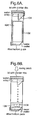
Figs. 6A and 6B are schematic central vertical cross-sectional views of a third embodiment of unit dose element/chamber assembly in accordance with the invention, before and after wash-out; and -
Fig. 7 is a plan view of the assemblies shown inFigs. 6A and 6B . - The article of
Fig. 1 is manufactured as a flat plastics tray of elongated blister pockets 2, shown inFig. 3 , comprising a thermoformed plastics tray. The open end of eachblister pocket 2 is formed all around its perimeter with an endless flange 4 (which can be seen inFig. 2 ). Elongate dosage elements in the form of solid rods or sticks 5 of a cleaning composition 6 (intended in this embodiment to be used for cleaning in an automatic dishwasher machine) are introduced into the blister pockets. This can be done in different ways. For example in one embodiment the cleaning composition can be injected or cast into the pockets. However in this embodiment the rods or sticks are pre-formed by injection moulding or extrusion, then cut to length, then introduced into the pockets. It may be noted that they are introduced into the pockets to fill each pocket to thebottom end 8, but to leave aspace 10 at the top end. Thisspace 10 is left so that water can enter the pocket, via opening 12 in the upper end wall of the pocket. In this embodiment eachsuch opening 12 is circular, and 8mm in diameter. An identical opening (not shown) is formed in the lower end wall of the article, to allow water and entrained or dissolved cleaning composition to exit the pocket. - Once all of the pockets have been provided with the rods or sticks of cleaning composition (by whatever means) a
backing sheet 14 is laid over the open ends, and secured to theflanges 4. The backing may be adhered thereto by any convenient means, for example by heat or adhesive. - Next, the flat article, now in the form of a rack or linear array of rods or sticks, may be curled into its nested form shown in
Fig. 1 . In this embodiment the nested form is a generally cylindrical array. It may be retained in its nested form by a piece ofadhesive tape 16. - As shown in
Fig. 4 , each rod or stick - and correspondingly each blister, has aflat base wall 18 abutting thebacking sheet 14. From thebase wall 18, each rod or stick, and each blister, generally tapers to a narrowerdistal end wall 20. The side walls initially taper gradually, as at 22, 24, then undergo a somewhat abruptinward dislocation 26, then taper at an intermediate rate (between that of theside wall portion 22 and the dislocation 26) at 27, until thedistal end wall 20 is reached. - The rods or sticks may be regarded as having the general shape of a triangular prism (i.e. trigonal). To be more precise, as noted above the side walls taper in a discontinuous manner.
- It will be noted that the rods or sticks are located on the backing sheet with a
separation 28 between them, at theirbase walls 18. - It may further be noted that the rods or sticks have a
separation 30 between them, at their distal end region, when in their nested form. - The physical parameters of each rod or stick are as follows:
- Length: 80mm
- Thickness (maximum value): 22mm
- Cross-sectional area: 2cm2
- Surface area: 40cm2
- Weight: 18.5g
- Volume: 14.8cm3.
- The backing sheet has, as a result of the mould into which it is thermoformed during manufacture, preferential fold lines 32. These fold lines 32 are aligned with the
spacings 28 between the rods or sticks. - The end result of these features is as follows, and can be clearly seen in
Fig. 1 : when the article is formed into its nested shape the backing sheet is displaced about itsfold lines 22, in an articulated manner. This nesting or folding is permitted by thespacings Fig. 1 thespacings 30 in the distal end regions may remain even in the nested form (though obviously narrowed). - The device and the second embodiment will now be described with reference to
Fig. 5 ,6A and 6B , in which the expected water flow pathway(s) is/are shown in dotted lines, and with reference toFig, 7 . - In the device and the second embodiment the
chamber 102 andelongate dosage element 104 are wedge-shaped or trigonal in cross-section, as shown inFig. 7 . They are truncated, however, at the apex orcentral end outside surface 109. However the position of theelement 104 within thechamber 102 differs in different embodiments, as will be described. - Although the figures show single generally trigonal chambers they are in fact part of a rotary refill device which is segmented, each chamber of the device constituting one of the segments.
- Each
unit dose element 104 is a somewhat elongate body, formed by injection moulding. The composition is as described above. The unit dose element ofFig. 5 tapers slightly in the upwards direction. The chambers also taper slightly in the upwards direction, to match. - The physical parameters of each elongate dosage element used in the second and third embodiments, shown in
Figs. 5-7 , are as follows: - Length: 72mm
- Thickness (maximum value): 18mm
- Cross-sectional area: 1.9cm2
- Surface area: 46cm2
- Weight: 17.8g
- Volume: 14.2cm3.
- Throughput of water in automatic dishwasher trials in each case was 200 ml/minute. The machine used was a Miele 651 SC, at the setting called "Normal 50°C".
- In
Fig. 5 , exemplifying the present invention, a 3 mm gap A was left down the inside wall, at the apex of the wedge, and down the opposite, outside wall (seeFig. 7 ). Provided water was delivered to thecentral region 122 of the top wall of the unit dose element ("hereinafter "stsck") full dissolution was reliably achieved. It was observed that allowing some water to be collected in the chamber was of benefit in soaking then dissolving or dispersing any remaining small pieces of the composition. In this embodiment the gap B at the outside wall of the chamber is 1 mm and the gaps C, D at the side walls is 1 mm. -
Figs. 6 also have the variation from the embodiment ofFig. 5 , that a lift plate is provided, to raise the stick from the bottom of the chamber; but an additional variation is the design of the top of the chamber. The water inlet leads to afunnel 134. The funnel delivers water assuredly to the mid-region of the top face of the stick. It is found that complete dissolution occurs reliably. The dissolution of small residues such as 136 is aided by the fact that some water collects transiently in the chamber, as shown at 138. To facilitate this, the area of the outlet is 20 - 25 mm2 and the area of the inlet is 8 - 11 mm2.
Claims (15)
- A dosage element of a cleaning composition, having an elongate shape.
- A dosage element as claimed in claim 1, of length in the range 4cm to 14cm.
- A dosage element as claimed in claim 1 or 2, of thickness in the range 0.8cm to 3.5cm.
- A dosage element as claimed in any preceding claim, of cross-sectional area in the range 0.6 cm2 to 5cm2.
- A dosage element as claimed in any preceding claim, of surface area in the range 20cm2 to 60cm2
- A dosage element as claimed in any preceding claim, of volume in the range 6ml to 25ml.
- A dosage element as claimed in any preceding claim, of weight in the range 8g to 32g.
- A dosage element as claimed in any preceding claim, of aspect ratio (minimum length to maximum thickness) in the range 2:1 to 12:1.
- A dosage element as claimed in any preceding claim, which has a ratio of length to cross-sectional area in the range 2:1 to 12:1 (units of length-1).
- A dosage element as claimed in any preceding claim, which has a ratio of surface area to volume in the range 1:1 to 8:1 (units of length-1).
- A dosage element as claimed in any preceding claim, which is monolithic but or constituted by two or more pieces set end-to-end.
- A dosage element as claimed in any preceding claim, which is generally trigonal.
- A dosage element as claimed in any preceding claim, which is an extruded or compacted body.
- The use of a dosage element in accordance with any of claims 1 to 13, in carrying out washing in a ware washing machine.
- A method of cleaning articles in a ware washing machine, comprising providing a dosage element in accordance with claims 1 to 13 in a part of the ware washing machine where the elongate dosage element is dissolved by water.
Applications Claiming Priority (3)
| Application Number | Priority Date | Filing Date | Title |
|---|---|---|---|
| GBGB0522660.0A GB0522660D0 (en) | 2005-11-07 | 2005-11-07 | Assembly and device |
| GBGB0601247.0A GB0601247D0 (en) | 2006-01-21 | 2006-01-21 | Article |
| EP06794927A EP1960507A1 (en) | 2005-11-07 | 2006-10-30 | Dosage element |
Related Parent Applications (1)
| Application Number | Title | Priority Date | Filing Date |
|---|---|---|---|
| EP06794927.1 Division | 2006-10-30 |
Publications (1)
| Publication Number | Publication Date |
|---|---|
| EP2206769A1 true EP2206769A1 (en) | 2010-07-14 |
Family
ID=37667609
Family Applications (2)
| Application Number | Title | Priority Date | Filing Date |
|---|---|---|---|
| EP06794927A Withdrawn EP1960507A1 (en) | 2005-11-07 | 2006-10-30 | Dosage element |
| EP10158824A Withdrawn EP2206769A1 (en) | 2005-11-07 | 2006-10-30 | Dosage element |
Family Applications Before (1)
| Application Number | Title | Priority Date | Filing Date |
|---|---|---|---|
| EP06794927A Withdrawn EP1960507A1 (en) | 2005-11-07 | 2006-10-30 | Dosage element |
Country Status (7)
| Country | Link |
|---|---|
| US (2) | US20080293604A1 (en) |
| EP (2) | EP1960507A1 (en) |
| JP (1) | JP2009519867A (en) |
| AU (1) | AU2006310374A1 (en) |
| BR (1) | BRPI0618262A2 (en) |
| CA (1) | CA2628400A1 (en) |
| WO (1) | WO2007051989A1 (en) |
Families Citing this family (49)
| Publication number | Priority date | Publication date | Assignee | Title |
|---|---|---|---|---|
| WO2006021761A1 (en) | 2004-08-23 | 2006-03-02 | Reckitt Benckiser N.V. | Detergent dispensing device |
| JP2009523668A (en) | 2006-01-21 | 2009-06-25 | レキット ベンキサー ナムローゼ フェンノートシャップ | Single dose element and chamber |
| BRPI0707880A2 (en) | 2006-01-21 | 2011-05-10 | Reckitt Benckiser Nv | article |
| GB0621576D0 (en) | 2006-10-30 | 2006-12-06 | Reckitt Benckiser Nv | Device status indicator |
| GB0621570D0 (en) | 2006-10-30 | 2006-12-06 | Reckitt Benckiser Nv | Multi-dosing detergent delivery device |
| AU2007315940A1 (en) * | 2006-10-30 | 2008-05-08 | Reckitt Benckiser Production (Poland) Sp. Z O.O. | Compressed detergent composition |
| GB0621572D0 (en) | 2006-10-30 | 2006-12-06 | Reckitt Benckiser Nv | Multi-dosing detergent delivery device |
| GB0710232D0 (en) * | 2007-05-30 | 2007-07-11 | Reckitt Benckiser Nv | Article |
| GB0710231D0 (en) * | 2007-05-30 | 2007-07-11 | Reckitt Benckiser Nv | Refill device for multi-dosing detergent delivery device |
| GB0710229D0 (en) | 2007-05-30 | 2007-07-11 | Reckitt Benckiser Nv | Detergent dosing device |
| DE102007058589A1 (en) * | 2007-12-04 | 2009-06-18 | Christine Schlund | Dosing system e.g. for purification system, has purification system having cleaner container in block or powder form, with cleaners |
| USD663911S1 (en) | 2009-07-22 | 2012-07-17 | Reckitt Benckiser N.V. | Detergent dispensing device lid |
| PL2361964T3 (en) | 2010-02-25 | 2013-05-31 | Procter & Gamble | Detergent composition |
| PL2380963T3 (en) | 2010-04-23 | 2016-07-29 | Procter & Gamble | Method of perfuming |
| ES2533368T3 (en) | 2010-04-23 | 2015-04-09 | The Procter & Gamble Company | Dishwasher product |
| EP2380478A1 (en) | 2010-04-23 | 2011-10-26 | The Procter & Gamble Company | Automatic dishwashing product |
| GB201014749D0 (en) * | 2010-09-06 | 2010-10-20 | Reckitt Benckiser Nv | Refill device for a detergent delivery device |
| EP2662436B1 (en) | 2012-05-11 | 2017-08-23 | The Procter & Gamble Company | Detergent composition |
| EP3034590A1 (en) | 2014-12-17 | 2016-06-22 | The Procter and Gamble Company | Method of automatic dishwashing |
| EP3034596B2 (en) | 2014-12-17 | 2021-11-10 | The Procter & Gamble Company | Detergent composition |
| EP3034592A1 (en) | 2014-12-17 | 2016-06-22 | The Procter and Gamble Company | Method of automatic dishwashing |
| EP3034589A1 (en) | 2014-12-17 | 2016-06-22 | The Procter and Gamble Company | Detergent composition |
| EP3034597A1 (en) | 2014-12-17 | 2016-06-22 | The Procter and Gamble Company | Detergent composition |
| EP3034588B1 (en) | 2014-12-17 | 2019-04-24 | The Procter and Gamble Company | Detergent composition |
| EP3034591A1 (en) | 2014-12-17 | 2016-06-22 | The Procter and Gamble Company | Method of automatic dishwashing |
| WO2017097861A1 (en) | 2015-12-07 | 2017-06-15 | Henkel Ag & Co. Kgaa | Dishwashing compositions comprising polypeptides having beta-glucanase activity and uses thereof |
| EP3181672A1 (en) | 2015-12-17 | 2017-06-21 | The Procter and Gamble Company | Automatic dishwashing detergent composition |
| EP3181676B1 (en) | 2015-12-17 | 2019-03-13 | The Procter and Gamble Company | Automatic dishwashing detergent composition |
| EP3181670B1 (en) | 2015-12-17 | 2019-01-30 | The Procter and Gamble Company | Automatic dishwashing detergent composition |
| EP3181671B1 (en) | 2015-12-17 | 2024-07-10 | The Procter & Gamble Company | Automatic dishwashing detergent composition |
| EP3181675B2 (en) | 2015-12-17 | 2022-12-07 | The Procter & Gamble Company | Automatic dishwashing detergent composition |
| EP3181679A1 (en) | 2015-12-17 | 2017-06-21 | The Procter and Gamble Company | Process for making an automatic dishwashing product |
| EP3184622A1 (en) | 2015-12-22 | 2017-06-28 | The Procter and Gamble Company | Automatic dishwashing composition |
| CA3007148A1 (en) | 2016-01-29 | 2017-08-03 | Novozymes A/S | Beta-glucanase variants and polynucleotides encoding same |
| EP3257929B1 (en) | 2016-06-17 | 2022-03-09 | The Procter & Gamble Company | Automatic dishwashing detergent composition |
| EP3257928B1 (en) | 2016-06-17 | 2019-12-11 | The Procter and Gamble Company | Automatic dishwashing detergent composition |
| EP3257923B1 (en) | 2016-06-17 | 2020-04-08 | The Procter and Gamble Company | Automatic dishwashing detergent composition |
| EP3257931A1 (en) | 2016-06-17 | 2017-12-20 | The Procter and Gamble Company | Detergent composition |
| WO2018224544A1 (en) | 2017-06-08 | 2018-12-13 | Novozymes A/S | Compositions comprising polypeptides having cellulase activity and amylase activity, and uses thereof in cleaning and detergent compositions |
| CN111417725A (en) | 2017-10-02 | 2020-07-14 | 诺维信公司 | Polypeptides having mannanase activity and polynucleotides encoding same |
| US11732221B2 (en) | 2017-10-02 | 2023-08-22 | Novozymes A/S | Polypeptides having mannanase activity and polynucleotides encoding same |
| US11866748B2 (en) | 2017-10-24 | 2024-01-09 | Novozymes A/S | Compositions comprising polypeptides having mannanase activity |
| US20220169953A1 (en) | 2019-04-03 | 2022-06-02 | Novozymes A/S | Polypeptides having beta-glucanase activity, polynucleotides encoding same and uses thereof in cleaning and detergent compositions |
| US11147431B2 (en) * | 2019-06-21 | 2021-10-19 | Midea Group Co., Ltd. | Detergent dispenser for a dishwasher |
| KR102056732B1 (en) * | 2019-07-10 | 2019-12-17 | (주)알메디카 | Disposable containers for containing patient-customized medicinal fluid, apparatus for manufacturing the same, method for manufacturing the same |
| EP4097227A1 (en) | 2020-01-31 | 2022-12-07 | Novozymes A/S | Mannanase variants and polynucleotides encoding same |
| US12497606B2 (en) | 2020-01-31 | 2025-12-16 | Novozymes A/S | Mannanase variants and polynucleotides encoding same |
| IT202000017143A1 (en) * | 2020-07-15 | 2022-01-15 | Chemicount Italiana S N C Di De Rocchi Cristiana E Monaldi Alain | GLASSWASHING MACHINE EQUIPPED WITH DISPENSER FOR SOLID DETERGENTS |
| US11717133B2 (en) | 2020-09-30 | 2023-08-08 | Midea Group Co., Ltd. | Dishwasher with rotary blister pack dispenser |
Citations (4)
| Publication number | Priority date | Publication date | Assignee | Title |
|---|---|---|---|---|
| US3272899A (en) * | 1960-12-06 | 1966-09-13 | Hagan Chemicals & Controls Inc | Process for producing a solid rinse block |
| DE19540608A1 (en) * | 1995-10-31 | 1997-05-07 | Bosch Siemens Hausgeraete | Device for delivering cleaning agent in dish-washing machine |
| DE19930771A1 (en) * | 1999-07-03 | 2001-01-04 | Henkel Kgaa | Process for the production of detergent tablets |
| WO2006021760A1 (en) * | 2004-08-23 | 2006-03-02 | Reckitt Benckiser N.V. | Detergent dispensing device |
Family Cites Families (88)
| Publication number | Priority date | Publication date | Assignee | Title |
|---|---|---|---|---|
| US2315890A (en) * | 1939-12-08 | 1943-04-06 | Glenn M Bader | Detergent dispensing device |
| US2370609A (en) * | 1941-04-28 | 1945-02-27 | Economics Lab | Concentration cell and temperature compensator |
| US2514000A (en) * | 1945-08-20 | 1950-07-04 | Sophia Tank | Dishwashing apparatus |
| US2777570A (en) * | 1954-08-03 | 1957-01-15 | Lee S Mytinger | Capsule and tablet pocket carrier |
| US2954145A (en) * | 1955-03-08 | 1960-09-27 | Raymond E Mccauley | Beverage making machine |
| US2880077A (en) * | 1955-12-08 | 1959-03-31 | James D Floria | Soap dissolving device |
| US3063459A (en) * | 1959-05-25 | 1962-11-13 | Gen Motors Corp | Dishwashing machine |
| US3091402A (en) * | 1962-04-17 | 1963-05-28 | Palmer Harold Vernon | Toiletries dispenser for shower |
| US3187767A (en) * | 1962-12-13 | 1965-06-08 | Calgon Corp | Detergent dispensing apparatus |
| US3411671A (en) * | 1967-09-13 | 1968-11-19 | Design & Mfg Corp | Dispensing mechanism for a liquid and a powder |
| US3482740A (en) * | 1968-01-08 | 1969-12-09 | Frank M Evans | Cleaning and waxing appliances |
| US3759284A (en) * | 1971-11-19 | 1973-09-18 | E Roberts | Fluid treating device |
| GB1391703A (en) * | 1972-04-14 | 1975-04-23 | Denco Miller Ltd | Self contained air cooling and heating unit |
| US4055278A (en) * | 1976-08-24 | 1977-10-25 | Lawrence Peska, Associates, Inc. | Dispensing shower head |
| US4416859A (en) * | 1981-02-17 | 1983-11-22 | Ga Technologies Inc. | Countercurrent solids-fluid contactor |
| USD269801S (en) * | 1981-04-24 | 1983-07-19 | Olin Corporation | Swimming pool chemical dispenser or the like |
| USD280757S (en) * | 1982-09-23 | 1985-09-24 | Airwick Industries, Inc. | Dispenser for solid material |
| USD273033S (en) * | 1983-04-11 | 1984-03-13 | Olin Corporation | Swimming pool chemical dispenser or the like |
| US4545917A (en) * | 1984-02-09 | 1985-10-08 | Creative Products Resource Associates Ltd. | Automatic dishwasher product in solid form |
| US5137694A (en) * | 1985-05-08 | 1992-08-11 | Ecolab Inc. | Industrial solid detergent dispenser and cleaning system |
| US4999124A (en) * | 1985-11-06 | 1991-03-12 | Ecolab Inc. | Solid block chemical dispenser for cleaning systems |
| CN1003659B (en) * | 1986-02-06 | 1989-03-22 | 株式会社东芝 | Detergent supply device for washing machine etc. |
| US4700554A (en) * | 1986-02-19 | 1987-10-20 | Whirlpool Corporation | Detergent dispenser with improved water distribution means |
| USD304102S (en) * | 1987-04-30 | 1989-10-17 | Ecolab Inc. | Solid detergent dispenser |
| USD308739S (en) * | 1987-07-27 | 1990-06-19 | Ecolab Inc. | Detergent dispenser |
| US4835804A (en) * | 1988-03-25 | 1989-06-06 | The Procter & Gamble Company | Multiple compartment container laundering method |
| DE3903793A1 (en) * | 1989-02-09 | 1990-08-23 | Finke Robert Kg | METHOD AND CONTAINER FOR DISPENSING A FILLING GOOD |
| USD328332S (en) * | 1990-04-04 | 1992-07-28 | Olin Corporation | Container for swimming pool chemical tablets |
| US5262132A (en) * | 1990-04-30 | 1993-11-16 | Diversey Corporation | Solid detergent dispensing system |
| USD346890S (en) * | 1990-07-25 | 1994-05-10 | Panesar Surinder S | Liquid dispenser for a washing machine |
| USD328333S (en) * | 1990-10-30 | 1992-07-28 | Olin Corporation | Container for swimming pool chemical tablets for use in skimmers, floaters or feeders |
| US5186912A (en) * | 1991-01-03 | 1993-02-16 | Ecolab, Inc. | Controlled release dishwasher detergent dispenser |
| US5310430A (en) * | 1991-05-31 | 1994-05-10 | Ecolab Inc. | Process of dispensing a solid cast block of water soluble detergent |
| US5681400A (en) * | 1992-03-12 | 1997-10-28 | Ecolab Inc. | Self-optimizing detergent controller for controlling variable additive concentration level in a warewashing machine |
| CA2135190A1 (en) * | 1993-03-23 | 1994-09-29 | Leendert Hellenberg | Improved dispensing apparatus |
| US5500050A (en) * | 1994-07-15 | 1996-03-19 | Diversey Corporation | Ratio feed detergent controller and method with automatic feed rate learning capability |
| USD381141S (en) * | 1994-10-31 | 1997-07-15 | Ecolab Inc. | Capsule for solid detergent |
| FR2731081B1 (en) * | 1995-02-27 | 1997-04-11 | Essilor Int | PROCESS FOR OBTAINING A TRANSPARENT ARTICLE WITH A REFRACTION INDEX |
| US5603233A (en) * | 1995-07-12 | 1997-02-18 | Honeywell Inc. | Apparatus for monitoring and controlling the operation of a machine for washing articles |
| US6048501A (en) * | 1995-10-05 | 2000-04-11 | The Procter & Gamble Company | Dispensing device for detergent tablet |
| US5679173A (en) * | 1996-02-23 | 1997-10-21 | Hartman; Jerry M. | Backup assembly and method for chemical sanitizing in a final rinse of a high temperature warewashing machine |
| US5870906A (en) * | 1996-04-03 | 1999-02-16 | Denisar; Richard A. | Automatic dispensing device |
| USD383264S (en) * | 1996-08-13 | 1997-09-02 | Ecolab Inc. | Capsule for solid detergent |
| DE69711805T2 (en) * | 1996-10-25 | 2002-11-14 | Unilever N.V., Rotterdam | dispenser |
| DE19652733C2 (en) * | 1996-12-18 | 2001-03-01 | Lang App Bau Gmbh | Dosing method for adding a detergent to a dishwasher |
| US5967158A (en) * | 1997-09-29 | 1999-10-19 | The Procter & Gamble Company | Dispensing device for tablets |
| AUPP144898A0 (en) * | 1998-01-23 | 1998-02-12 | Toren Consulting Pty. Limited | Improvements in dispensing containers |
| US6263708B1 (en) * | 1998-10-22 | 2001-07-24 | Steven E. Yarmosky | Pressure pretreating of stains on fabrics |
| DE19934592C2 (en) * | 1999-07-23 | 2003-10-23 | Benckiser Nv | Device for taking up and dispensing an active composition into a washing machine, a tumble dryer or a dishwasher |
| DE19934593C2 (en) * | 1999-07-23 | 2003-10-23 | Benckiser Nv | Device for taking up and dispensing at least one active composition into a washing machine, a tumble dryer or a dishwasher |
| US6178987B1 (en) * | 1999-11-10 | 2001-01-30 | Eco-Safe, L.L.C. | Autonomous cleaning mechanism |
| US6173743B1 (en) * | 2000-01-18 | 2001-01-16 | Valvules I Racords Canovelles, S.A. | Distributor for liquids |
| US6463766B2 (en) * | 2000-01-28 | 2002-10-15 | Kabushiki Kaisha Toshiba | Washing machine with means for preventing propagation of microorganism |
| US7125828B2 (en) * | 2000-11-27 | 2006-10-24 | The Procter & Gamble Company | Detergent products, methods and manufacture |
| USD456485S1 (en) * | 2001-01-05 | 2002-04-30 | Pall Corporation | Filter element |
| US6681963B2 (en) * | 2001-04-23 | 2004-01-27 | The Procter & Gamble Company | Apparatus for dispensing rinse water additive in an automatic washing machine |
| USD457596S1 (en) * | 2001-04-26 | 2002-05-21 | H2O International Inc. | Water filter |
| US6736294B2 (en) * | 2001-09-18 | 2004-05-18 | The Procter & Gamble Company | Apparatus for dispensing rinse water additive in an automatic washing machine |
| CA2475115A1 (en) * | 2002-02-09 | 2003-08-14 | Reckitt Benckiser N.V. | Glassware corrosion inhibitor |
| WO2003069043A1 (en) * | 2002-02-13 | 2003-08-21 | The Procter & Gamble Company | Sequential dispensing of laundry additives during automatic machine laundering of fabrics |
| US7168273B2 (en) * | 2002-11-07 | 2007-01-30 | The Procter & Gamble Company | Selective dispensing apparatus |
| CN1332711C (en) * | 2002-02-20 | 2007-08-22 | 埃米球科技有限公司 | Method for administering GLP-1 molecules |
| GB2386130A (en) * | 2002-03-06 | 2003-09-10 | Reckitt Benckiser Nv | Detergent dosing delay device for a dishwasher |
| US20030168085A1 (en) * | 2002-03-07 | 2003-09-11 | Sowle Eddie D. | Detergent dispenser |
| US6955067B2 (en) * | 2002-03-28 | 2005-10-18 | The Procter & Gamble Company | Smart dosing device |
| USD481844S1 (en) * | 2002-09-18 | 2003-11-04 | Matsushita Electric Corporation Of America | Filter canister for vacuum cleaner |
| US20050039781A1 (en) * | 2002-11-01 | 2005-02-24 | The Procter & Gamble Company | Dispensing device for liquid detergent compositions |
| US7089429B2 (en) * | 2002-11-25 | 2006-08-08 | Nokia Corporation | Creation of local usage rights voucher |
| ES2292692T3 (en) * | 2002-11-28 | 2008-03-16 | Whirlpool Corporation | DISHWASHER WITH FLAT FILTER THAT INCLUDES AREAS WITH DIFFERENT FLOW HOLE DIMENSIONS. |
| US6608022B1 (en) * | 2003-01-27 | 2003-08-19 | Colgate-Palmolive Company | Cleaning compositions in the form of a tablet |
| ITTO20030066A1 (en) * | 2003-02-04 | 2004-08-05 | Merloni Elettrodomestici Spa | WASHING MACHINE, IN PARTICULAR LOADING |
| DE10313172B4 (en) * | 2003-03-25 | 2007-08-09 | Henkel Kgaa | Shape-optimized detergent tablets |
| US20040206133A1 (en) * | 2003-04-19 | 2004-10-21 | Kyung-Chul Woo | Washing machine |
| US7007862B2 (en) * | 2003-11-07 | 2006-03-07 | The Clorox Co. | Rinse release dispensing device |
| US7250086B2 (en) * | 2003-12-08 | 2007-07-31 | Ecolab Inc. | Method of using a solid rinse additive dispenser for dispensing a use solution in a dishwashing machine |
| USD513928S1 (en) * | 2004-03-02 | 2006-01-31 | Kaz, Incorporated | Water dispenser universal filtration tank |
| KR101082563B1 (en) * | 2004-04-14 | 2011-11-10 | 엘지전자 주식회사 | Detergent box for drum washer |
| ITTO20040529A1 (en) * | 2004-07-29 | 2004-10-29 | Eltek Spa | WASHING AGENTS DISPENSER FOR DISHWASHER MACHINES. |
| USD547912S1 (en) * | 2005-02-11 | 2007-07-31 | Reckitt Benckiser N.V. | Dispensing Container |
| USD526043S1 (en) * | 2005-03-01 | 2006-08-01 | Sportsfloats, Inc. | Float for a chlorine dispenser |
| USD529128S1 (en) * | 2005-04-22 | 2006-09-26 | Tsung-Hui Lee | Water cleaner |
| US20070000068A1 (en) * | 2005-06-30 | 2007-01-04 | Gerard France Paul Amaat R | Fabric article treating device and system |
| DE102006041477A1 (en) * | 2006-09-05 | 2008-03-06 | Robert Bosch Gmbh | Method for dynamic diagnosis of an exhaust gas probe |
| USD564142S1 (en) * | 2006-10-24 | 2008-03-11 | Reckitt Benckiser N.V. | Dispensing device |
| CA120345S (en) * | 2006-10-24 | 2008-02-12 | Reckitt Benckiser Nv | Dispensing device for dishwashers |
| CA120346S (en) * | 2006-10-24 | 2008-02-12 | Reckitt Benckiser Nv | Dispensing device lid for dishwashers |
| USD564141S1 (en) * | 2006-10-24 | 2008-03-11 | Reckitt Benckiser N.V. | Dispensing device |
| USD604766S1 (en) * | 2008-06-02 | 2009-11-24 | Hannspree, Inc. | Pen |
-
2006
- 2006-10-30 EP EP06794927A patent/EP1960507A1/en not_active Withdrawn
- 2006-10-30 EP EP10158824A patent/EP2206769A1/en not_active Withdrawn
- 2006-10-30 WO PCT/GB2006/004021 patent/WO2007051989A1/en not_active Ceased
- 2006-10-30 BR BRPI0618262-3A patent/BRPI0618262A2/en not_active IP Right Cessation
- 2006-10-30 CA CA002628400A patent/CA2628400A1/en not_active Abandoned
- 2006-10-30 US US12/092,634 patent/US20080293604A1/en not_active Abandoned
- 2006-10-30 AU AU2006310374A patent/AU2006310374A1/en not_active Abandoned
- 2006-10-30 JP JP2008539484A patent/JP2009519867A/en not_active Abandoned
-
2010
- 2010-03-03 US US12/716,774 patent/US20100212695A1/en not_active Abandoned
Patent Citations (4)
| Publication number | Priority date | Publication date | Assignee | Title |
|---|---|---|---|---|
| US3272899A (en) * | 1960-12-06 | 1966-09-13 | Hagan Chemicals & Controls Inc | Process for producing a solid rinse block |
| DE19540608A1 (en) * | 1995-10-31 | 1997-05-07 | Bosch Siemens Hausgeraete | Device for delivering cleaning agent in dish-washing machine |
| DE19930771A1 (en) * | 1999-07-03 | 2001-01-04 | Henkel Kgaa | Process for the production of detergent tablets |
| WO2006021760A1 (en) * | 2004-08-23 | 2006-03-02 | Reckitt Benckiser N.V. | Detergent dispensing device |
Also Published As
| Publication number | Publication date |
|---|---|
| US20100212695A1 (en) | 2010-08-26 |
| EP1960507A1 (en) | 2008-08-27 |
| JP2009519867A (en) | 2009-05-21 |
| BRPI0618262A2 (en) | 2011-08-23 |
| WO2007051989A1 (en) | 2007-05-10 |
| AU2006310374A1 (en) | 2007-05-10 |
| US20080293604A1 (en) | 2008-11-27 |
| CA2628400A1 (en) | 2007-05-10 |
Similar Documents
| Publication | Publication Date | Title |
|---|---|---|
| WO2007051989A1 (en) | Dosage element | |
| US8338357B2 (en) | Multiple dosing ware washing article | |
| EP1976421B1 (en) | An article for use in a ware washing machine | |
| BRPI0707886A2 (en) | multi-dose detergent dispensing device | |
| CN101300336A (en) | dosage element | |
| JP2002528355A (en) | Liquid applicator dispenser | |
| BR112021010860A2 (en) | DEVICE FOR DOSING DETERGENT, CONTAINER FOR RECEIVING AND DOSING POWDER DETERGENT AND/OR LIQUID DETERGENT, AND CORRESPONDING SYSTEM | |
| US11122958B2 (en) | Domestic dishwasher having a metering device | |
| AU2008257200A1 (en) | Refill device for a multi-dosing detergent delivery device | |
| CN101370418A (en) | Dosing Elements and Chambers | |
| US2507792A (en) | Pill and capsule dispensing tray and method | |
| CN103080407A (en) | Dispensing device | |
| ITPN970047A1 (en) | DISHWASHER MACHINE WITH A DOSING DEVICE | |
| ITPN950031U1 (en) | CUTLERY BASKET FOR DISHWASHER | |
| EP4127300B1 (en) | Dosing unit and water-bearing household appliance | |
| AU717938B2 (en) | Parallelepiped-shaped supply container | |
| AU2008257197A1 (en) | Article | |
| JP5891020B2 (en) | Chopstick drying method, chopstick drying apparatus and chopstick storage | |
| CN101588749A (en) | Multi-dosing detergent delivery device | |
| CN217244244U (en) | Put in box and have its washing electrical apparatus |
Legal Events
| Date | Code | Title | Description |
|---|---|---|---|
| PUAI | Public reference made under article 153(3) epc to a published international application that has entered the european phase |
Free format text: ORIGINAL CODE: 0009012 |
|
| 17P | Request for examination filed |
Effective date: 20100331 |
|
| AC | Divisional application: reference to earlier application |
Ref document number: 1960507 Country of ref document: EP Kind code of ref document: P |
|
| AK | Designated contracting states |
Kind code of ref document: A1 Designated state(s): AT BE BG CH CY CZ DE DK EE ES FI FR GB GR HU IE IS IT LI LT LU LV MC NL PL PT RO SE SI SK TR |
|
| STAA | Information on the status of an ep patent application or granted ep patent |
Free format text: STATUS: THE APPLICATION IS DEEMED TO BE WITHDRAWN |
|
| 18D | Application deemed to be withdrawn |
Effective date: 20130503 |