EP2204793A1 - Displaying device, terminal of displaying device, and display method - Google Patents
Displaying device, terminal of displaying device, and display method Download PDFInfo
- Publication number
- EP2204793A1 EP2204793A1 EP09172448A EP09172448A EP2204793A1 EP 2204793 A1 EP2204793 A1 EP 2204793A1 EP 09172448 A EP09172448 A EP 09172448A EP 09172448 A EP09172448 A EP 09172448A EP 2204793 A1 EP2204793 A1 EP 2204793A1
- Authority
- EP
- European Patent Office
- Prior art keywords
- display area
- active display
- unit
- area
- displaying
- Prior art date
- Legal status (The legal status is an assumption and is not a legal conclusion. Google has not performed a legal analysis and makes no representation as to the accuracy of the status listed.)
- Ceased
Links
- 238000000034 method Methods 0.000 title claims abstract description 21
- 230000002452 interceptive effect Effects 0.000 claims description 16
- 239000004973 liquid crystal related substance Substances 0.000 claims description 6
- 230000008859 change Effects 0.000 description 3
- 230000001360 synchronised effect Effects 0.000 description 3
- 238000005516 engineering process Methods 0.000 description 2
- 230000008569 process Effects 0.000 description 2
- 230000009286 beneficial effect Effects 0.000 description 1
- 238000010586 diagram Methods 0.000 description 1
- 230000005611 electricity Effects 0.000 description 1
- 230000006872 improvement Effects 0.000 description 1
- 238000010295 mobile communication Methods 0.000 description 1
- 230000004048 modification Effects 0.000 description 1
- 238000012986 modification Methods 0.000 description 1
- 230000000630 rising effect Effects 0.000 description 1
- 238000006467 substitution reaction Methods 0.000 description 1
- 238000002834 transmittance Methods 0.000 description 1
- 239000002699 waste material Substances 0.000 description 1
Images


Classifications
-
- G—PHYSICS
- G09—EDUCATION; CRYPTOGRAPHY; DISPLAY; ADVERTISING; SEALS
- G09G—ARRANGEMENTS OR CIRCUITS FOR CONTROL OF INDICATING DEVICES USING STATIC MEANS TO PRESENT VARIABLE INFORMATION
- G09G3/00—Control arrangements or circuits, of interest only in connection with visual indicators other than cathode-ray tubes
- G09G3/20—Control arrangements or circuits, of interest only in connection with visual indicators other than cathode-ray tubes for presentation of an assembly of a number of characters, e.g. a page, by composing the assembly by combination of individual elements arranged in a matrix no fixed position being assigned to or needed to be assigned to the individual characters or partial characters
- G09G3/34—Control arrangements or circuits, of interest only in connection with visual indicators other than cathode-ray tubes for presentation of an assembly of a number of characters, e.g. a page, by composing the assembly by combination of individual elements arranged in a matrix no fixed position being assigned to or needed to be assigned to the individual characters or partial characters by control of light from an independent source
- G09G3/3406—Control of illumination source
- G09G3/342—Control of illumination source using several illumination sources separately controlled corresponding to different display panel areas, e.g. along one dimension such as lines
- G09G3/3426—Control of illumination source using several illumination sources separately controlled corresponding to different display panel areas, e.g. along one dimension such as lines the different display panel areas being distributed in two dimensions, e.g. matrix
-
- G—PHYSICS
- G02—OPTICS
- G02F—OPTICAL DEVICES OR ARRANGEMENTS FOR THE CONTROL OF LIGHT BY MODIFICATION OF THE OPTICAL PROPERTIES OF THE MEDIA OF THE ELEMENTS INVOLVED THEREIN; NON-LINEAR OPTICS; FREQUENCY-CHANGING OF LIGHT; OPTICAL LOGIC ELEMENTS; OPTICAL ANALOGUE/DIGITAL CONVERTERS
- G02F1/00—Devices or arrangements for the control of the intensity, colour, phase, polarisation or direction of light arriving from an independent light source, e.g. switching, gating or modulating; Non-linear optics
- G02F1/01—Devices or arrangements for the control of the intensity, colour, phase, polarisation or direction of light arriving from an independent light source, e.g. switching, gating or modulating; Non-linear optics for the control of the intensity, phase, polarisation or colour
- G02F1/13—Devices or arrangements for the control of the intensity, colour, phase, polarisation or direction of light arriving from an independent light source, e.g. switching, gating or modulating; Non-linear optics for the control of the intensity, phase, polarisation or colour based on liquid crystals, e.g. single liquid crystal display cells
- G02F1/133—Constructional arrangements; Operation of liquid crystal cells; Circuit arrangements
-
- G—PHYSICS
- G09—EDUCATION; CRYPTOGRAPHY; DISPLAY; ADVERTISING; SEALS
- G09G—ARRANGEMENTS OR CIRCUITS FOR CONTROL OF INDICATING DEVICES USING STATIC MEANS TO PRESENT VARIABLE INFORMATION
- G09G3/00—Control arrangements or circuits, of interest only in connection with visual indicators other than cathode-ray tubes
- G09G3/20—Control arrangements or circuits, of interest only in connection with visual indicators other than cathode-ray tubes for presentation of an assembly of a number of characters, e.g. a page, by composing the assembly by combination of individual elements arranged in a matrix no fixed position being assigned to or needed to be assigned to the individual characters or partial characters
- G09G3/34—Control arrangements or circuits, of interest only in connection with visual indicators other than cathode-ray tubes for presentation of an assembly of a number of characters, e.g. a page, by composing the assembly by combination of individual elements arranged in a matrix no fixed position being assigned to or needed to be assigned to the individual characters or partial characters by control of light from an independent source
- G09G3/36—Control arrangements or circuits, of interest only in connection with visual indicators other than cathode-ray tubes for presentation of an assembly of a number of characters, e.g. a page, by composing the assembly by combination of individual elements arranged in a matrix no fixed position being assigned to or needed to be assigned to the individual characters or partial characters by control of light from an independent source using liquid crystals
-
- G—PHYSICS
- G09—EDUCATION; CRYPTOGRAPHY; DISPLAY; ADVERTISING; SEALS
- G09G—ARRANGEMENTS OR CIRCUITS FOR CONTROL OF INDICATING DEVICES USING STATIC MEANS TO PRESENT VARIABLE INFORMATION
- G09G2320/00—Control of display operating conditions
- G09G2320/06—Adjustment of display parameters
- G09G2320/0626—Adjustment of display parameters for control of overall brightness
-
- G—PHYSICS
- G09—EDUCATION; CRYPTOGRAPHY; DISPLAY; ADVERTISING; SEALS
- G09G—ARRANGEMENTS OR CIRCUITS FOR CONTROL OF INDICATING DEVICES USING STATIC MEANS TO PRESENT VARIABLE INFORMATION
- G09G2320/00—Control of display operating conditions
- G09G2320/06—Adjustment of display parameters
- G09G2320/0686—Adjustment of display parameters with two or more screen areas displaying information with different brightness or colours
-
- G—PHYSICS
- G09—EDUCATION; CRYPTOGRAPHY; DISPLAY; ADVERTISING; SEALS
- G09G—ARRANGEMENTS OR CIRCUITS FOR CONTROL OF INDICATING DEVICES USING STATIC MEANS TO PRESENT VARIABLE INFORMATION
- G09G2330/00—Aspects of power supply; Aspects of display protection and defect management
- G09G2330/02—Details of power systems and of start or stop of display operation
- G09G2330/021—Power management, e.g. power saving
-
- G—PHYSICS
- G09—EDUCATION; CRYPTOGRAPHY; DISPLAY; ADVERTISING; SEALS
- G09G—ARRANGEMENTS OR CIRCUITS FOR CONTROL OF INDICATING DEVICES USING STATIC MEANS TO PRESENT VARIABLE INFORMATION
- G09G5/00—Control arrangements or circuits for visual indicators common to cathode-ray tube indicators and other visual indicators
- G09G5/14—Display of multiple viewports
Definitions
- the present invention mainly relates to the display area, especially to the displaying device that may control the power consumption, the terminal of the displaying device, and the display method.
- LCD liquid crystal display
- the LCD display module consists of an LCD and a light-emitting diode (LED).
- LCD itself is not luminous and it is provided light source by the LED.
- the control liquid crystal layer allows lights to transmit through or control the transmittance strength is determined by modulating the bias voltage of LCD liquid crystal layer and changing the arrangement of liquid crystal molecules.
- the LED provides the LCD with backlight of equal brightness through light guide plates. Considering the local brightness in the LCD, the current LCD manufacturers mostly arrange many LEDs equally for backlight.
- the display module consumes the major power for the terminal equipment.
- the power consumption is about 80 mA to 100 mA, about 1/3 to 1/2 the power consumption of Global System for Mobile Communications (GSM) 900 terminals. Therefore, if the power consumption of the LCD display module may be reduced, the whole consumption of the equipment will be greatly reduced accordingly. What consumes the power most in the LCD display module are the LED backlights.
- the LCD of a common 24-inch QVGA LCD screen consumes about a dozen mA and an LED consumes about 10 mA. As a result, several LEDs as backlights will consume the electricity of dozens or even hundreds of mA.
- the backlights are controlled uniformly that is they are switched on/off at the same time.
- the host writes display image data in the LCD, and the control module of backlights switches on all the backlights to display the full screen; when the equipment is in standby mode or turned off, the control module turns off all the backlights, and the host stops writing image data to the LCD.
- the terminal equipment does not require full display in most cases, that is, part of the screen is used to display the whole interface when only a little information is to be displayed.
- the prior art may not adjust the display area of the screen by the display content. Regardless of the content of the display content, the backlights of the whole display module are turned on to display the full screen. As a result, the display module operates with the most power consumption at any time causing a lot of waste.
- a displaying device, the terminal of the displaying device, and display method are provided in embodiments of the present invention.
- the displaying device may adjust the display area of the screen dynamically according to the display content to reduce the cost of displaying unit.
- a displaying device includes:
- a terminal includes a displaying device.
- the displaying device includes: a calculating unit, configured to calculate the active display area that shows the interface content and calculate the image area occupied by the display interface; a creating unit, configured to create an interface image data in the image area and write the image data in the displaying unit; and a displaying unit, configured to display the corresponding information based on the image data.
- a display method includes: calculating the active display area that shows the interface content and the image area occupied by the display interface; creating the interface image data in the image area and writing the interface image data to the displaying unit; and displaying the corresponding information according to the image data.
- the technical solution provided in embodiments of the present invention may adjust the display area of the screen dynamically according to the display content.
- the display area may be reduced so that only part of the screen is used for display.
- the power consumption of the displaying unit is lower.
- the backlights may be turned on/off to light the active display area only. When a little information is to be displayed, only the corresponding backlights are to be turned on. Therefore, the power consumption of the displaying unit may be greatly reduced.
- the display interface provided in an embodiment of the present invention does not need full display. Both the position and the size of the display area in the screen may be adjusted dynamically according to the display content, that is, using part of the screen to display the interface. If only part of the screen is used for displaying, the area of displaying interface is called the active display area, and the rest of the screen is called the inactive display area.
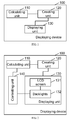
- FIG. 1 shows the component structure for embodiment 1 of the displaying device in the present invention.
- the displaying device 100 includes: the calculating unit 110, the creating unit 120, and the displaying unit 130.
- the calculating unit 110 is configured to calculate the active display area, and calculate the image area occupied by the display interface according to the active display area.
- the active display area shows the area of the interface content.
- the creating unit 120 is configured to create the interface image data in the image area and write the image data in the displaying unit 130.
- the displaying unit 130 is configured to display the corresponding information according to the image data. The working process and principle of the displaying device 100 are described in details below.
- the calculating unit 100 calculates the position and size of the active display area according to the interface content.
- ⁇ x,y,x',y'> in the active display area, "x,y” stands for the pixel coordinates values at the upper left corner of the active display and "x',y”' stands for the pixel coordinates values at the lower right corner of the active display.
- All of the interface content is configured within the area of ⁇ x,y,x',y'>.
- the creating unit 120 calculates the image area of the display interface, creates the interface image data in the image area but creates black or other single color image data outside the active display area, and writes the image data in the displaying unit 130.
- the displaying unit 130 displays part or full screen according to the image data.
- the technical solution provided in the embodiment of the present invention may adjust the display area of the screen dynamically according to the display content.
- the display area may be reduced so that only part of the screen is used for display. As a result, the power consumption of the displaying unit may be reduced.
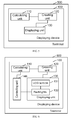
- FIG. 2 shows the component structure for embodiment 2 of the displaying device in the present invention.
- the displaying device 100 includes: a calculating unit 110, a creating unit 120, a displaying unit 130, and a controlling unit 140.
- the calculating unit 110 is configured to calculate the active display area, and calculate the image area occupied by the display interface according to the active display area.
- the creating unit 120 is configured to create the interface image data in the image area and write the image data in the displaying unit 130.
- the displaying unit 130 is configured to display the corresponding information according to the image data.
- the displaying unit 130 includes an LCD screen 131 and backlights 132.
- the controlling unit 140 is configured to control the backlights switch 132 of the displaying unit 130 according to the backlights control command that is generated according to the active display area.
- the difference between this embodiment and the first embodiment is that in the first embodiment, whether to display part or full screen, all the backlights 132 of the displaying unit 130 are turned on.
- the backlights 132 provided in the embodiment may be turned on/off according to the size of the display area.
- the controlling unit 140 When much information is to be displayed on full screen, the controlling unit 140 generates commands according to the active display area to turn on all the backlights 132.
- the controlling unit 140 When only a little information is to be displayed on part of the screen, the controlling unit 140 generates commands according to the active display area to turn on part of the backlights 132 only. The rest backlights 132 outside the active area are turned off.
- Backlights 132 may be controlled individually or by group. Independent control is for the controlling unit 140 to generate a command for each backlight 132. Group control is for the controlling unit 140 to control backlights 132 by group.
- Two solutions are provided to control backlights 132:
- the calculating unit 140 determines the backlights to be turned on/off according to the active display area ⁇ x,y,x',y'> and generates commands to control backlights 132 in the displaying unit 130.
- the controlling unit 140 generates and delivers backlights control commands with the marks of the active display area to the displaying unit 130.
- the displaying unit 130 determines the backlights 132 to be turned on/off and controls the backlights 132.
- the first control solution provided in an embodiment of the present invention is preferred.
- Control of backlights 132 need to be synchronized with the screen display.
- the controlling unit 140 needs to generate corresponding commands immediately to turn on/off backlights 132.
- the technical solution provided in the embodiment of the present invention may adjust the display area of the screen dynamically according to the display content.
- the display area may be reduced so that only part of the screen is used for display.
- the power consumption of the displaying unit may be reduced.
- the backlights switches may be controlled according to the active display area. When only a little information is to be displayed, only the corresponding backlights are to be turned on. Therefore, the power consumption of the displaying unit may be greatly reduced.
- FIG. 3 is the display diagram of the technical solution of embodiment 2 in the present invention.
- the active display area shows the interface content. According to the display content in application, the position and size of the active display area may be adjusted dynamically. If the content requires full display, the active display area occupies the whole screen.
- the inactive display area does not show the interface content.
- the whole inactive area displays black or other single color image to differ from the active display area for the user's convenience to look through the content of the active display area.
- the backlights L1 to L8 provide the LCD with light source of equal brightness. Most of the backlights of the terminal equipment are uniformly distributed on both sides of the LCD and some others are below the LCD.
- the standby interface displays a little information, so full screen display is unnecessary. Therefore, as shown in FIG. 3 , the upper half screen is the active display area that displays the whole standby information and the lower half gray screen is the inactive display area.
- the backlights that provide the light source for the active display area are mainly L1, L2, L5 and L6. Therefore, L1, L2, L5 and L6 are turned on to provide the light source and L3, L4, L7 and L8 are turned off to save the power.
- the light of L1, L2, L5 and L6 is distributed equally on the active display area by the light guide plates and the standby interface operates normally.
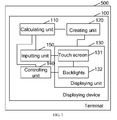
- FIG. 4 shows the component structure for embodiment 3 of the displaying device in the present invention.
- the difference between this embodiment and the first and the second embodiment is that the LCD screen 131 in the displaying unit 130 is an interactive LCD screen, especially an interactive touch screen.
- the displaying device 100 includes: an inputting unit 150, a calculating unit 110, a creating unit 120, a displaying unit 130 and a controlling unit 140.
- the inputting unit 150 is configured to receive user's operation in the interactive LCD screen and deliver the command generated by the operation to the calculating unit 110.
- the calculating unit 110 is configured to calculate the active display area according to the command, and calculate the image area occupied by the display interface, according to the active display area.
- the creating unit 120 is configured to create the interface image data in the image area and write the image data in the displaying unit 130.
- the displaying unit 130 is configured to display the corresponding information according to the image data.
- the displaying unit 130 includes the touch screen and backlights 132.
- the controlling unit 140 is configured to generate backlights control commands according to the active display area and control the switches of backlight 132s in the displaying unit 130.
- Users may click on the touch screen and in turn the users operation may change the screen display such as the active display area and the backlights control.
- the user may control the position of the active display area.
- the user may click on the screen to light it up and the selected active display area includes the best place for the user to click on.
- the position of the active display area may be changed by the user's dragging on the screen.
- the corresponding backlights need to be controlled at the same time.
- the size of the active display area may also be changed. The user may drag or drop the area by one angle or the diagonal of the active display area to zoom in and out.
- the size of the active display area is changed, the corresponding backlights need to be controlled at the same time.
- the position and the size of the active display area may be changed according to the user operation, which is called the interactive part screen. The screen is best applied in the touch screen.
- FIG. 5 shows the component structure for embodiment 1 of the terminal in the present invention.
- the terminal 500 includes the displaying device 100.
- the displaying device 100 includes: the calculating unit 110, the creating unit 120 and the displaying unit 130.
- the calculating unit 110 is configured to calculate the active display area, and calculate the image area occupied by the display interface, according to the active display area.
- the creating unit 120 is configured to create the interface image data in the image area and write the image data in the displaying unit 130.
- the displaying unit 130 is configured to display the corresponding information according to the image data.
- the working process and principle of the displaying device 100 have been described in details in the embodiment of FIG. 1 .
- the technical solution provided in the embodiment of the present invention may adjust the display area of the screen dynamically according to the display content.
- the display area may be reduced so that only part of the screen is used for display. As a result, the power consumption of the displaying unit may be reduced.
- FIG. 6 shows the component structure of a terminal provided in embodiment 2 of the present invention.
- the terminal 500 includes the displaying device 100.
- the displaying device 100 includes: the calculating unit 110, the creating unit 120, the displaying unit 130 and the controlling unit 140.
- the calculating unit 110 is configured to calculate the active display area, and calculate the image area occupied by the display interface, according to the active display area.
- the creating unit 120 is configured to create the interface image data in the image area and write the image data in the displaying unit 130.
- the displaying unit 130 is configured to display the corresponding information according to the image data.
- the displaying unit 130 includes an LCD screen 131 and backlights 132.
- the controlling unit 140 is configured to generate backlights control commands according to the active display area and control the switches of backlights 132 in the displaying unit 130.
- the difference between this embodiment and the first embodiment is that in the first embodiment, whether to display part of or full screen, all the backlights 132 of the displaying unit 130 are turned on.
- the backlights 132 provided in the embodiment may be turned on/off according to the size of the display area.
- the controlling unit 140 instructs all the backlights 132 to be turned on according to the control generated by the active display area.
- the controlling unit 140 turns on part of the backlights 132.
- the rest backlights 132 outside the active area are turned off.
- Backlights 132 may be controlled individually or by group. Independent control is for the controlling unit 140 to generate a command for each backlight 132. Group control is for the controlling unit to control backlights 132 by group.
- Two solutions are provided to control backlights 132.
- the calculating unit 140 determines the backlights to be turned on/off according to the active display area ⁇ x,y,x',y'> and generates commands to control backlights 132 in the displaying unit 130.
- the controlling unit 140 generates and delivers backlights control commands with the marks of the active display area to the displaying unit 130.
- the displaying unit 130 determines the backlights 132 to be turned on/off and controls the backlights 132.
- the first control solution provided in an embodiment of the present invention is preferred.
- Control of backlights 132 need to be synchronized with the screen display.
- the controlling unit 140 needs to generate commands immediately to turn on/off backlights 132.
- the technical solution provided in the embodiment of the present invention may adjust the display area of the screen dynamically according to the display content.
- the display area may be reduced so that only of the screen is used for display.
- the power consumption of the displaying unit may be reduced.
- the backlights switches may be controlled according to the active display area. When only a little information is to be displayed, only the corresponding backlights are to be turned on. Therefore, the power consumption of the displaying unit may be greatly reduced.
- FIG. 7 shows the component structure for embodiment 3 of the terminal in the present invention.
- the terminal 500 includes the displaying device 100.
- the displaying device 100 includes: the inputting unit 150, the calculating unit 110, the creating unit 120, the displaying unit 130 and the controlling unit 140.
- the difference between this embodiment and the first and the second embodiment is that the LCD screen 131 in the displaying unit 130 is an interactive LCD screen, especially an interactive touch screen.
- the inputting unit 150 is configured to receive user's operation in the interactive LCD screen and deliver the command generated by the operation to the calculating unit 110.
- the calculating unit 110 is configured to calculate the active display area according to the command, and calculate the image area occupied by the display interface, according to the active display area.
- the creating unit 120 is configured to create the interface image data in the image area and write the image data in the displaying unit 130.
- the displaying unit 130 is configured to display the corresponding information according to the image data.
- the displaying unit 130 includes the touch screen and backlights 132.
- the controlling unit 140 is configured to generate backlights control commands according to the active display area to turn on/off the backlights 132 in the displaying unit 130.
- Users may click on the touch screen and in turn the users operation may change the screen display such as the active display area and the backlights controls.
- the user may control the position of the active display area.
- the user may click on the screen to light up the screen and the selected active display area includes the best place for the user to click on.
- the position of the active display area may also be changed by the user dragging on the screen.
- the corresponding backlights need to be controlled at the same time.
- the size of the active display area may also be changed. The user may drag or drop the area by one angle or the diagonal of the active display area to zoom in and out.
- the size of the active display area changes, the corresponding backlights need to be turned on/off at the same time.
- the position and the size of the active display area may be changed according to the user operation, which is called the interactive part screen. The screen is best applied in the touch screen.
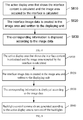
- FIG. 8 shows a flowchart for embodiment 1 of the display method in the present invention, including the following blocks:
- the position and the size of the active display area are calculated based on the interface content.
- x,y stands for the pixel coordinates values at the upper left corner of the active display
- x',y stands for the pixel coordinates values at the lower right corner of the active display.
- All of the interface content is configured within the area of ⁇ x,y,x',y'>.
- the active display area of ⁇ x,y,x' ,y'> calculates the image area of the display interface, creates the interface image data in the image area but creates black or other single color image data outside the active display area, and writes the image data in the displaying unit. Part or full screen is displayed according to the image data.
- the technical solution provided in the embodiment of the present invention may adjust the display area of the screen dynamically according to the display content.
- the display area may be reduced so that only part of the screen is used for display. As a result, the power consumption of the displaying unit may be reduced.
- FIG. 9 shows a flowchart for embodiment 2 of the display method in the present invention, including as follows:
- the difference between this embodiment and the firs embodiment is that in the first embodiment, whether to display part or full screen, all the backlights are turned on.
- the backlights in this embodiment may be turned on/off according to the size of the display area.
- the backlights may control independently or by zones.
- the independent control is to control the command generated by every single backlight.
- the zone control is to group the backlights and control the backlights by groups.
- Backlights may be controlled individually or by group.
- Independent control is to generate a command for each backlight.
- Group control is to control backlights by group.
- Control of the backlights need to be synchronized with the screen display.
- corresponding control commands need to be generated immediately to control the switches of the backlights.
- the technical solution provided in the embodiment of the present invention may adjust the display area of the screen dynamically according to the display content.
- the display area may be reduced so that only part of the screen is used for display.
- the power consumption of the displaying unit may be reduced.
- the backlights may be turned on/off according to the active display area. When only a little information is to be displayed, only the corresponding backlights are to be turned on. Therefore, the power consumption of the displaying unit may be greatly reduced.
- FIG. 10 shows a flowchart for embodiment 3 of the display method in the present invention, including as follows:
- This embodiment may also include S105, which generates backlights control command according to the active display area and controls the switches of the backlights in the displaying unit.
- Users may click on the touch screen and in turn the users operation may change the screen display such as the active display area and the backlights controls.
- the user may control the position of the active display area.
- the user may click on the screen to light up the screen and the selected active display area includes the best place for the user to click on.
- the position of the active display area may also be changed by the user dragging on the screen.
- the corresponding backlights need to be turned on/off at the same time.
- the size of the active display area may also be changed. The user may drag or drop the area by one angle or the diagonal of the active display area to zoom in and out.
- the size of the active display area changes, the corresponding backlights need to be turned on/off at the same time.
- the position and the size of the active display area may be changed according to the user operation, which is called the interactive part screen. The screen is best applied in the touch screen.
- the LCD screen in this displaying unit is an interactive LCD screen, especially an interactive touch screen.
- the embodiments of methods correspond to the embodiments of device. Those not described in the embodiments of methods may refer to the description of the corresponding embodiments of device.
Landscapes
- Physics & Mathematics (AREA)
- Engineering & Computer Science (AREA)
- General Physics & Mathematics (AREA)
- Computer Hardware Design (AREA)
- Theoretical Computer Science (AREA)
- Chemical & Material Sciences (AREA)
- Crystallography & Structural Chemistry (AREA)
- Nonlinear Science (AREA)
- Mathematical Physics (AREA)
- Optics & Photonics (AREA)
- Liquid Crystal Display Device Control (AREA)
- Control Of Indicators Other Than Cathode Ray Tubes (AREA)
- User Interface Of Digital Computer (AREA)
Abstract
Description
- The present invention mainly relates to the display area, especially to the displaying device that may control the power consumption, the terminal of the displaying device, and the display method.
- With the increasing development of science and technology, the functions of various hand-held terminal equipment become more and more powerful but the power consumption is rising accordingly. Because the prior art is unable to break through greatly in the battery capacity, various new technologies may not develop well in the terminal equipment by the constraint of the power consumption. The overall power consumption of the equipment is essential to measure the equipment performance. All top manufacturers of the terminal equipment try to reduce the power consumption.
- Currently, a liquid crystal display (LCD) is mostly used for the display module in the terminal equipment. The LCD display module consists of an LCD and a light-emitting diode (LED).LCD itself is not luminous and it is provided light source by the LED. Whether the control liquid crystal layer allows lights to transmit through or control the transmittance strength is determined by modulating the bias voltage of LCD liquid crystal layer and changing the arrangement of liquid crystal molecules. As the light source in the display module of the LCD, the LED provides the LCD with backlight of equal brightness through light guide plates. Considering the local brightness in the LCD, the current LCD manufacturers mostly arrange many LEDs equally for backlight. The display module consumes the major power for the terminal equipment. Take the 24-inch Quarter Video Graphics Array (QVGA, with resolution of 240 x 320) screen for example, the power consumption is about 80 mA to 100 mA, about 1/3 to 1/2 the power consumption of Global System for Mobile Communications (GSM) 900 terminals. Therefore, if the power consumption of the LCD display module may be reduced, the whole consumption of the equipment will be greatly reduced accordingly. What consumes the power most in the LCD display module are the LED backlights. The LCD of a common 24-inch QVGA LCD screen consumes about a dozen mA and an LED consumes about 10 mA. As a result, several LEDs as backlights will consume the electricity of dozens or even hundreds of mA.
- In the prior art regarding LCD display modules, the backlights are controlled uniformly that is they are switched on/off at the same time. When the display screen is required, the host writes display image data in the LCD, and the control module of backlights switches on all the backlights to display the full screen; when the equipment is in standby mode or turned off, the control module turns off all the backlights, and the host stops writing image data to the LCD.
- In implementing the present invention, inventors find that the following disadvantages at least occur in the prior art: The terminal equipment does not require full display in most cases, that is, part of the screen is used to display the whole interface when only a little information is to be displayed. The prior art may not adjust the display area of the screen by the display content. Regardless of the content of the display content, the backlights of the whole display module are turned on to display the full screen. As a result, the display module operates with the most power consumption at any time causing a lot of waste.
- A displaying device, the terminal of the displaying device, and display method are provided in embodiments of the present invention. The displaying device may adjust the display area of the screen dynamically according to the display content to reduce the cost of displaying unit.
- The technical solutions provided in various embodiments of the present invention are implemented as follows.
- A displaying device includes:
- a calculating unit, configured to calculate the active display area that shows the interface content and calculate the image area occupied by the display interface; a creating unit, configured to create an interface image data in the image area and write the image data in the displaying unit; and a displaying unit, configured to display the corresponding information based on the image data.
- A terminal includes a displaying device. The displaying device includes: a calculating unit, configured to calculate the active display area that shows the interface content and calculate the image area occupied by the display interface; a creating unit, configured to create an interface image data in the image area and write the image data in the displaying unit; and a displaying unit, configured to display the corresponding information based on the image data.
- A display method includes: calculating the active display area that shows the interface content and the image area occupied by the display interface; creating the interface image data in the image area and writing the interface image data to the displaying unit; and displaying the corresponding information according to the image data.
- The technical solution provided in embodiments of the present invention may adjust the display area of the screen dynamically according to the display content. When only a little information is to be displayed, the display area may be reduced so that only part of the screen is used for display. As a result, the power consumption of the displaying unit is lower. Furthermore, the backlights may be turned on/off to light the active display area only. When a little information is to be displayed, only the corresponding backlights are to be turned on. Therefore, the power consumption of the displaying unit may be greatly reduced.
- To clarify the technical solution in an embodiment of the present invention or the solution using prior art, the drawings used in this embodiment or the prior technical descriptions are described below. Obviously, the following drawings illustrate embodiments of the present invention, based on which other drawings may be obtained by those skilled in the art without innovations.
-
FIG. 1 shows the structure of the displaying device according to embodiment 1 of the present invention; -
FIG. 2 shows the structure of the displaying device according to embodiment 2 of the present invention; -
FIG. 3 shows the screen display of the technical solution inFIG. 2 ; -
FIG. 4 shows the structure of the displaying device according to embodiment 3 of the present invention; -
FIG. 5 shows the structure of the terminal according to embodiment 1 of the present invention; -
FIG. 6 shows the structure of the terminal according to embodiment 2 of the present invention; -
FIG. 7 shows the structure of the terminal according to embodiment 3 of the present invention; -
FIG. 8 is a flowchart of the display method according to embodiment 1 of the present invention; -
FIG. 9 is a flowchart of the display method according to embodiment 2 of the present invention; and -
FIG. 10 is a flowchart of the display method according to embodiment 3 of the present invention. - The following section clearly and fully describes the technical solution provided in the embodiments of the present invention. Obviously, only part of the embodiments of the present invention is involved herein. All the other embodiments obtained by those skilled in the art without innovations based on the embodiments of the present invention are covered by the present invention.
- The display interface provided in an embodiment of the present invention does not need full display. Both the position and the size of the display area in the screen may be adjusted dynamically according to the display content, that is, using part of the screen to display the interface. If only part of the screen is used for displaying, the area of displaying interface is called the active display area, and the rest of the screen is called the inactive display area.
-
FIG. 1 shows the component structure for embodiment 1 of the displaying device in the present invention. The displayingdevice 100 includes: the calculatingunit 110, the creatingunit 120, and the displayingunit 130.
The calculatingunit 110 is configured to calculate the active display area, and calculate the image area occupied by the display interface according to the active display area.
The active display area shows the area of the interface content.
The creatingunit 120 is configured to create the interface image data in the image area and write the image data in the displayingunit 130.
The displayingunit 130 is configured to display the corresponding information according to the image data. The working process and principle of the displayingdevice 100 are described in details below. - When the interface program constructs the interface, the calculating
unit 100 calculates the position and size of the active display area according to the interface content. In calculating the pixel coordinates values <x,y,x',y'> in the active display area, "x,y" stands for the pixel coordinates values at the upper left corner of the active display and "x',y"' stands for the pixel coordinates values at the lower right corner of the active display. Of course, those skilled in the art also know many other methods. All of the interface content is configured within the area of <x,y,x',y'>. During creating the displayed image, the creatingunit 120, according to the active display area of <x,y,x',y'>, calculates the image area of the display interface, creates the interface image data in the image area but creates black or other single color image data outside the active display area, and writes the image data in the displayingunit 130. The displayingunit 130 displays part or full screen according to the image data. - The technical solution provided in the embodiment of the present invention may adjust the display area of the screen dynamically according to the display content. When only a little information is to be displayed, the display area may be reduced so that only part of the screen is used for display. As a result, the power consumption of the displaying unit may be reduced.
-
FIG. 2 shows the component structure for embodiment 2 of the displaying device in the present invention. The displayingdevice 100 includes: a calculatingunit 110, a creatingunit 120, a displayingunit 130, and a controllingunit 140.
The calculatingunit 110 is configured to calculate the active display area, and calculate the image area occupied by the display interface according to the active display area.
The creatingunit 120 is configured to create the interface image data in the image area and write the image data in the displayingunit 130.
The displayingunit 130 is configured to display the corresponding information according to the image data. The displayingunit 130 includes anLCD screen 131 and backlights 132.
The controllingunit 140 is configured to control the backlights switch 132 of the displayingunit 130 according to the backlights control command that is generated according to the active display area. - The difference between this embodiment and the first embodiment is that in the first embodiment, whether to display part or full screen, all the
backlights 132 of the displayingunit 130 are turned on. Thebacklights 132 provided in the embodiment may be turned on/off according to the size of the display area. When much information is to be displayed on full screen, the controllingunit 140 generates commands according to the active display area to turn on all thebacklights 132. When only a little information is to be displayed on part of the screen, the controllingunit 140 generates commands according to the active display area to turn on part of thebacklights 132 only. The rest backlights 132 outside the active area are turned off. -
Backlights 132 may be controlled individually or by group. Independent control is for the controllingunit 140 to generate a command for eachbacklight 132. Group control is for the controllingunit 140 to controlbacklights 132 by group. - Two solutions are provided to control backlights 132: In the first solution, the calculating
unit 140 determines the backlights to be turned on/off according to the active display area <x,y,x',y'> and generates commands to controlbacklights 132 in the displayingunit 130. In the second solution, the controllingunit 140 generates and delivers backlights control commands with the marks of the active display area to the displayingunit 130. The displayingunit 130 determines thebacklights 132 to be turned on/off and controls thebacklights 132. The first control solution provided in an embodiment of the present invention is preferred. - Control of
backlights 132 need to be synchronized with the screen display. When the active display area is changed, the controllingunit 140 needs to generate corresponding commands immediately to turn on/offbacklights 132. - The technical solution provided in the embodiment of the present invention may adjust the display area of the screen dynamically according to the display content. When only a little information is to be displayed, the display area may be reduced so that only part of the screen is used for display. As a result, the power consumption of the displaying unit may be reduced. Furthermore, the backlights switches may be controlled according to the active display area. When only a little information is to be displayed, only the corresponding backlights are to be turned on. Therefore, the power consumption of the displaying unit may be greatly reduced.
- To clarify the technical solution and the beneficial effects in an embodiment of the present invention, a specific instance is taken below.
FIG. 3 is the display diagram of the technical solution of embodiment 2 in the present invention. - The active display area shows the interface content. According to the display content in application, the position and size of the active display area may be adjusted dynamically. If the content requires full display, the active display area occupies the whole screen.
- The inactive display area does not show the interface content. The whole inactive area displays black or other single color image to differ from the active display area for the user's convenience to look through the content of the active display area.
- The backlights L1 to L8 provide the LCD with light source of equal brightness. Most of the backlights of the terminal equipment are uniformly distributed on both sides of the LCD and some others are below the LCD.
- The standby interface displays a little information, so full screen display is unnecessary. Therefore, as shown in
FIG. 3 , the upper half screen is the active display area that displays the whole standby information and the lower half gray screen is the inactive display area. The backlights that provide the light source for the active display area are mainly L1, L2, L5 and L6. Therefore, L1, L2, L5 and L6 are turned on to provide the light source and L3, L4, L7 and L8 are turned off to save the power. The light of L1, L2, L5 and L6 is distributed equally on the active display area by the light guide plates and the standby interface operates normally. -
FIG. 4 shows the component structure for embodiment 3 of the displaying device in the present invention. The difference between this embodiment and the first and the second embodiment is that theLCD screen 131 in the displayingunit 130 is an interactive LCD screen, especially an interactive touch screen. The displayingdevice 100 includes: an inputtingunit 150, a calculatingunit 110, a creatingunit 120, a displayingunit 130 and a controllingunit 140.
The inputtingunit 150 is configured to receive user's operation in the interactive LCD screen and deliver the command generated by the operation to the calculatingunit 110.
The calculatingunit 110 is configured to calculate the active display area according to the command, and calculate the image area occupied by the display interface, according to the active display area.
The creatingunit 120 is configured to create the interface image data in the image area and write the image data in the displayingunit 130.
The displayingunit 130 is configured to display the corresponding information according to the image data. The displayingunit 130 includes the touch screen and backlights 132.
The controllingunit 140 is configured to generate backlights control commands according to the active display area and control the switches of backlight 132s in the displayingunit 130. - Users may click on the touch screen and in turn the users operation may change the screen display such as the active display area and the backlights control.
- When displaying part of the screen, the user may control the position of the active display area. In some occasions, the user may click on the screen to light it up and the selected active display area includes the best place for the user to click on. The position of the active display area may be changed by the user's dragging on the screen. When the position of the active display area is changed, the corresponding backlights need to be controlled at the same time. The size of the active display area may also be changed. The user may drag or drop the area by one angle or the diagonal of the active display area to zoom in and out. Likewise, when the size of the active display area is changed, the corresponding backlights need to be controlled at the same time. The position and the size of the active display area may be changed according to the user operation, which is called the interactive part screen. The screen is best applied in the touch screen.
- The backlights control of the touch screen is the same with the technical solutions in the foregoing embodiments.
-
FIG. 5 shows the component structure for embodiment 1 of the terminal in the present invention. The terminal 500 includes the displayingdevice 100. The displayingdevice 100 includes: the calculatingunit 110, the creatingunit 120 and the displayingunit 130. The calculatingunit 110 is configured to calculate the active display area, and calculate the image area occupied by the display interface, according to the active display area. The creatingunit 120 is configured to create the interface image data in the image area and write the image data in the displayingunit 130. The displayingunit 130 is configured to display the corresponding information according to the image data. The working process and principle of the displayingdevice 100 have been described in details in the embodiment ofFIG. 1 . - The technical solution provided in the embodiment of the present invention may adjust the display area of the screen dynamically according to the display content. When only a little information is to be displayed, the display area may be reduced so that only part of the screen is used for display. As a result, the power consumption of the displaying unit may be reduced.
-
FIG. 6 shows the component structure of a terminal provided in embodiment 2 of the present invention. The terminal 500 includes the displayingdevice 100. The displayingdevice 100 includes: the calculatingunit 110, the creatingunit 120, the displayingunit 130 and the controllingunit 140. The calculatingunit 110 is configured to calculate the active display area, and calculate the image area occupied by the display interface, according to the active display area. The creatingunit 120 is configured to create the interface image data in the image area and write the image data in the displaying unit 130.The displayingunit 130 is configured to display the corresponding information according to the image data. The displayingunit 130 includes anLCD screen 131 and backlights 132. The controllingunit 140 is configured to generate backlights control commands according to the active display area and control the switches ofbacklights 132 in the displayingunit 130. - The difference between this embodiment and the first embodiment is that in the first embodiment, whether to display part of or full screen, all the
backlights 132 of the displayingunit 130 are turned on. Thebacklights 132 provided in the embodiment may be turned on/off according to the size of the display area. When much content for full screen display is required, the controllingunit 140 instructs all thebacklights 132 to be turned on according to the control generated by the active display area. When only a little information is to be displayed on part of the screen, the controllingunit 140 turns on part of thebacklights 132. The rest backlights 132 outside the active area are turned off. -
Backlights 132 may be controlled individually or by group. Independent control is for the controllingunit 140 to generate a command for eachbacklight 132. Group control is for the controlling unit to controlbacklights 132 by group. - Two solutions are provided to control backlights 132.In the first solution, the calculating
unit 140 determines the backlights to be turned on/off according to the active display area <x,y,x',y'> and generates commands to controlbacklights 132 in the displayingunit 130. In the second solution, the controllingunit 140 generates and delivers backlights control commands with the marks of the active display area to the displayingunit 130. The displayingunit 130 determines thebacklights 132 to be turned on/off and controls thebacklights 132. The first control solution provided in an embodiment of the present invention is preferred. - Control of
backlights 132 need to be synchronized with the screen display. When the active display area is changed, the controllingunit 140 needs to generate commands immediately to turn on/offbacklights 132. - The technical solution provided in the embodiment of the present invention may adjust the display area of the screen dynamically according to the display content. When only a little information is to be displayed, the display area may be reduced so that only of the screen is used for display. As a result, the power consumption of the displaying unit may be reduced. Furthermore, the backlights switches may be controlled according to the active display area. When only a little information is to be displayed, only the corresponding backlights are to be turned on. Therefore, the power consumption of the displaying unit may be greatly reduced.
-
FIG. 7 shows the component structure for embodiment 3 of the terminal in the present invention. The terminal 500 includes the displayingdevice 100. The displayingdevice 100 includes: the inputtingunit 150, the calculatingunit 110, the creatingunit 120, the displayingunit 130 and the controllingunit 140. The difference between this embodiment and the first and the second embodiment is that theLCD screen 131 in the displayingunit 130 is an interactive LCD screen, especially an interactive touch screen.
The inputtingunit 150 is configured to receive user's operation in the interactive LCD screen and deliver the command generated by the operation to the calculatingunit 110.
The calculatingunit 110 is configured to calculate the active display area according to the command, and calculate the image area occupied by the display interface, according to the active display area.
The creatingunit 120 is configured to create the interface image data in the image area and write the image data in the displayingunit 130.
The displayingunit 130 is configured to display the corresponding information according to the image data. The displayingunit 130 includes the touch screen and backlights 132.
The controllingunit 140 is configured to generate backlights control commands according to the active display area to turn on/off thebacklights 132 in the displayingunit 130. - Users may click on the touch screen and in turn the users operation may change the screen display such as the active display area and the backlights controls.
- When displaying part of the screen, the user may control the position of the active display area. In some occasions, the user may click on the screen to light up the screen and the selected active display area includes the best place for the user to click on. The position of the active display area may also be changed by the user dragging on the screen. When the position of the active display area is changed, the corresponding backlights need to be controlled at the same time. The size of the active display area may also be changed. The user may drag or drop the area by one angle or the diagonal of the active display area to zoom in and out. Likewise, when the size of the active display area changes, the corresponding backlights need to be turned on/off at the same time. The position and the size of the active display area may be changed according to the user operation, which is called the interactive part screen. The screen is best applied in the touch screen.
- The backlights control of the touch screen is the same with the technical solutions in the foregoing embodiments.
-
FIG. 8 shows a flowchart for embodiment 1 of the display method in the present invention, including the following blocks: - S810: The active display area is calculated and the image area occupied by the display interface is calculated according to the active display area. The active display area is the area for displaying the interface content.
- S820: Interface image data is created in the image area and written to the displaying unit.
- S830: The image is displayed according to the data.
- When the interface program constructs the interface, the position and the size of the active display area are calculated based on the interface content. In calculating the pixel coordinates values <x,y,x',y'> in the active display area, "x,y" stands for the pixel coordinates values at the upper left corner of the active display and "x',y"' stands for the pixel coordinates values at the lower right corner of the active display. Of course, those skilled in the art also know many other methods. All of the interface content is configured within the area of <x,y,x',y'>. During creating the displayed image, the active display area of <x,y,x' ,y'> calculates the image area of the display interface, creates the interface image data in the image area but creates black or other single color image data outside the active display area, and writes the image data in the displaying unit. Part or full screen is displayed according to the image data.
- The technical solution provided in the embodiment of the present invention may adjust the display area of the screen dynamically according to the display content. When only a little information is to be displayed, the display area may be reduced so that only part of the screen is used for display. As a result, the power consumption of the displaying unit may be reduced.
-
FIG. 9 shows a flowchart for embodiment 2 of the display method in the present invention, including as follows: - S910: The active display area is calculated and the image area occupied by the display interface is calculated according to the active display area. The active display area is the area for displaying the interface content.
- S920: Interface image data is created in the image area and written to the displaying unit.
- S930: The image is displayed according to the data.
- S940: Backlights control commands are generated according to the active display area to turn on/off the backlights in the displaying unit.
- S940 is performed after the active display area is calculated in S910.
- The difference between this embodiment and the firs embodiment is that in the first embodiment, whether to display part or full screen, all the backlights are turned on. The backlights in this embodiment, however, may be turned on/off according to the size of the display area.
- The backlights may control independently or by zones. The independent control is to control the command generated by every single backlight. The zone control is to group the backlights and control the backlights by groups. Backlights may be controlled individually or by group. Independent control is to generate a command for each backlight. Group control is to control backlights by group.
- Control of the backlights need to be synchronized with the screen display. When the active display area is changed, corresponding control commands need to be generated immediately to control the switches of the backlights.
- The technical solution provided in the embodiment of the present invention may adjust the display area of the screen dynamically according to the display content. When only a little information is to be displayed, the display area may be reduced so that only part of the screen is used for display. As a result, the power consumption of the displaying unit may be reduced. Furthermore, the backlights may be turned on/off according to the active display area. When only a little information is to be displayed, only the corresponding backlights are to be turned on. Therefore, the power consumption of the displaying unit may be greatly reduced.
-
FIG. 10 shows a flowchart for embodiment 3 of the display method in the present invention, including as follows: - S101: User's operation in the interactive LCD screen is received and the corresponding commands are generated.
- S102: The active display area is calculated on basis of the commands and the image area occupied by the display interface is calculated according to the active display area.
- S103: Interface image data is created in the image area and written to the displaying unit.
- S104: The Image is displayed according to the data.
- This embodiment may also include S105, which generates backlights control command according to the active display area and controls the switches of the backlights in the displaying unit.
- Users may click on the touch screen and in turn the users operation may change the screen display such as the active display area and the backlights controls.
- When displaying part of the screen, the user may control the position of the active display area. In some occasions, the user may click on the screen to light up the screen and the selected active display area includes the best place for the user to click on. The position of the active display area may also be changed by the user dragging on the screen. When the position of the active display area changes, the corresponding backlights need to be turned on/off at the same time. The size of the active display area may also be changed. The user may drag or drop the area by one angle or the diagonal of the active display area to zoom in and out. Likewise, when the size of the active display area changes, the corresponding backlights need to be turned on/off at the same time. The position and the size of the active display area may be changed according to the user operation, which is called the interactive part screen. The screen is best applied in the touch screen.
- The difference between this embodiment and the first and the second embodiment is that the LCD screen in this displaying unit is an interactive LCD screen, especially an interactive touch screen.
- The embodiments of methods correspond to the embodiments of device. Those not described in the embodiments of methods may refer to the description of the corresponding embodiments of device.
- Only as some good examples of the present invention, the foregoing embodiments shall in no event be construed to limit the scope of the present invention. Any modification, equal substitution and improvement that are within the spirit and the principle are in the scope of protection of the present invention.
Claims (11)
- A displaying device, comprising:a calculating unit, configured to calculate an active display area and calculate an image area occupied by a display interface according to the active display area, wherein the active display area is an area that displays an interface content;a creating unit, configured to create image data in the image area and write the image data in a displaying unit; andthe displaying unit, configured to display corresponding information based on the image data.
- The displaying device according to claim 1, wherein the displaying unit comprises a liquid crystal display, LCD, screen and backlights, and the displaying device further comprises:a controlling unit, configured to control backlight switches of the displaying unit according to a backlight control command generated by the active display area.
- The displaying device according to claim 2, wherein the calculating unit is configured to calculate the active display area based on the interface content.
- The displaying device according to claim 3, wherein the LCD screen is an interactive LCD screen.
- The displaying device in claim 4, further comprising an inputting unit, configured to receive user's operation in the interactive LCD screen and deliver a command generated by the use's operation to the calculating unit; wherein
the calculating unit calculates the active display area according to the command, and calculates the image area occupied by the display interface according to the active display area. - The displaying device according to claim 5, wherein the interactive LCD screen is a touch screen.
- A terminal, comprising a displaying device in any one of claims 1-6.
- A display method, comprising:calculating an active display area, and calculating an image area occupied by a display interface according to the active display area, wherein the active display area is an area that displays an interface content;creating interface image data in the image area, and writing the created image data into a displaying unit; andperforming a display according to the image data.
- The display method according to claim 8, after calculating the active display area, further comprising:generating corresponding backlight control commands according to the active display area, and controlling corresponding backlight switches of the displaying unit.
- The display method according to claim 8 or claim 9, wherein the calculating of the active display area comprises:calculating the active display area according to the interface content.
- The display method according to claim 10, before calculating the active display area, further comprising: receiving user's operation in an interactive liquid crystal display, LCD, screen, and generating a command according to the operation;
wherein the calculating of the active display area and the calculating of the image area occupied by the display interface according to the active display area comprises:calculating the active display area according to the command, and calculating the image area occupied by the display interface according to the active display area.
Priority Applications (1)
| Application Number | Priority Date | Filing Date | Title |
|---|---|---|---|
| EP18208343.6A EP3493193B1 (en) | 2008-12-31 | 2009-10-07 | Displaying device, terminal of displaying device, and display method |
Applications Claiming Priority (1)
| Application Number | Priority Date | Filing Date | Title |
|---|---|---|---|
| CN2008102474929A CN101465107B (en) | 2008-12-31 | 2008-12-31 | Display device and terminal using the same, and display method |
Related Child Applications (1)
| Application Number | Title | Priority Date | Filing Date |
|---|---|---|---|
| EP18208343.6A Division EP3493193B1 (en) | 2008-12-31 | 2009-10-07 | Displaying device, terminal of displaying device, and display method |
Publications (1)
| Publication Number | Publication Date |
|---|---|
| EP2204793A1 true EP2204793A1 (en) | 2010-07-07 |
Family
ID=40805662
Family Applications (2)
| Application Number | Title | Priority Date | Filing Date |
|---|---|---|---|
| EP09172448A Ceased EP2204793A1 (en) | 2008-12-31 | 2009-10-07 | Displaying device, terminal of displaying device, and display method |
| EP18208343.6A Active EP3493193B1 (en) | 2008-12-31 | 2009-10-07 | Displaying device, terminal of displaying device, and display method |
Family Applications After (1)
| Application Number | Title | Priority Date | Filing Date |
|---|---|---|---|
| EP18208343.6A Active EP3493193B1 (en) | 2008-12-31 | 2009-10-07 | Displaying device, terminal of displaying device, and display method |
Country Status (4)
| Country | Link |
|---|---|
| US (1) | US20100164857A1 (en) |
| EP (2) | EP2204793A1 (en) |
| KR (1) | KR20100080340A (en) |
| CN (1) | CN101465107B (en) |
Cited By (4)
| Publication number | Priority date | Publication date | Assignee | Title |
|---|---|---|---|---|
| EP2444962A1 (en) * | 2010-10-19 | 2012-04-25 | Research in Motion Limited | Display screen having regions of differing pixel density |
| EP2551841A4 (en) * | 2010-03-26 | 2013-06-12 | Sharp Kk | Image-display device and control method of same |
| EP2787500A4 (en) * | 2011-11-29 | 2015-05-06 | Panasonic Ip Man Co Ltd | Display control device, display control method, and display control program |
| EP3121779A1 (en) * | 2015-07-21 | 2017-01-25 | LG Electronics Inc. | Mobile terminal and payment method using extended display and finger scan thereof |
Families Citing this family (95)
| Publication number | Priority date | Publication date | Assignee | Title |
|---|---|---|---|---|
| JP2011030081A (en) * | 2009-07-28 | 2011-02-10 | Sony Corp | Display device, display system, display method and program |
| CN102063868B (en) * | 2009-11-12 | 2013-08-07 | 鸿富锦精密工业(深圳)有限公司 | Electronic device with backlight control and control method thereof |
| CN102137241B (en) * | 2010-01-27 | 2014-03-12 | 联想(北京)有限公司 | Display device and display method thereof |
| EP2357220A1 (en) * | 2010-02-10 | 2011-08-17 | The Procter & Gamble Company | Cleaning composition comprising amylase variants with high stability in the presence of a chelating agent |
| CN102087836A (en) * | 2010-04-13 | 2011-06-08 | Tcl集团股份有限公司 | Liquid crystal display system and image display method thereof |
| CN102087818A (en) * | 2010-04-13 | 2011-06-08 | Tcl集团股份有限公司 | Liquid crystal display system |
| KR101329967B1 (en) * | 2010-05-11 | 2013-11-13 | 엘지디스플레이 주식회사 | Back light unit and liquid crystal display device using the same and driving method thereof |
| CN102298899A (en) * | 2010-06-22 | 2011-12-28 | 纬创资通股份有限公司 | Display power saving method and electronic system |
| CN102221873A (en) * | 2010-07-29 | 2011-10-19 | 宇龙计算机通信科技(深圳)有限公司 | Backlight control method and system and mobile terminal |
| CN101989147A (en) * | 2010-12-09 | 2011-03-23 | 华为终端有限公司 | Method and device for regulating touch screen parameter |
| US9201185B2 (en) | 2011-02-04 | 2015-12-01 | Microsoft Technology Licensing, Llc | Directional backlighting for display panels |
| US9052414B2 (en) | 2012-02-07 | 2015-06-09 | Microsoft Technology Licensing, Llc | Virtual image device |
| US9354748B2 (en) | 2012-02-13 | 2016-05-31 | Microsoft Technology Licensing, Llc | Optical stylus interaction |
| US8749529B2 (en) | 2012-03-01 | 2014-06-10 | Microsoft Corporation | Sensor-in-pixel display system with near infrared filter |
| US9064654B2 (en) | 2012-03-02 | 2015-06-23 | Microsoft Technology Licensing, Llc | Method of manufacturing an input device |
| US9426905B2 (en) | 2012-03-02 | 2016-08-23 | Microsoft Technology Licensing, Llc | Connection device for computing devices |
| US9298236B2 (en) | 2012-03-02 | 2016-03-29 | Microsoft Technology Licensing, Llc | Multi-stage power adapter configured to provide a first power level upon initial connection of the power adapter to the host device and a second power level thereafter upon notification from the host device to the power adapter |
| US9134807B2 (en) | 2012-03-02 | 2015-09-15 | Microsoft Technology Licensing, Llc | Pressure sensitive key normalization |
| US9870066B2 (en) | 2012-03-02 | 2018-01-16 | Microsoft Technology Licensing, Llc | Method of manufacturing an input device |
| US9360893B2 (en) | 2012-03-02 | 2016-06-07 | Microsoft Technology Licensing, Llc | Input device writing surface |
| US9075566B2 (en) | 2012-03-02 | 2015-07-07 | Microsoft Technoogy Licensing, LLC | Flexible hinge spine |
| US8873227B2 (en) | 2012-03-02 | 2014-10-28 | Microsoft Corporation | Flexible hinge support layer |
| USRE48963E1 (en) | 2012-03-02 | 2022-03-08 | Microsoft Technology Licensing, Llc | Connection device for computing devices |
| CN102622177A (en) * | 2012-03-07 | 2012-08-01 | 上海华勤通讯技术有限公司 | Mobile terminal and display screen region display method thereof |
| CN102662593A (en) * | 2012-04-16 | 2012-09-12 | 华为终端有限公司 | Multi-size display method and terminal |
| US20130300590A1 (en) | 2012-05-14 | 2013-11-14 | Paul Henry Dietz | Audio Feedback |
| CN103455128A (en) * | 2012-06-04 | 2013-12-18 | 联想(北京)有限公司 | Display method and electronic device |
| US10031556B2 (en) | 2012-06-08 | 2018-07-24 | Microsoft Technology Licensing, Llc | User experience adaptation |
| US8947353B2 (en) | 2012-06-12 | 2015-02-03 | Microsoft Corporation | Photosensor array gesture detection |
| US9019615B2 (en) | 2012-06-12 | 2015-04-28 | Microsoft Technology Licensing, Llc | Wide field-of-view virtual image projector |
| US9073123B2 (en) | 2012-06-13 | 2015-07-07 | Microsoft Technology Licensing, Llc | Housing vents |
| US9459160B2 (en) | 2012-06-13 | 2016-10-04 | Microsoft Technology Licensing, Llc | Input device sensor configuration |
| US9684382B2 (en) | 2012-06-13 | 2017-06-20 | Microsoft Technology Licensing, Llc | Input device configuration having capacitive and pressure sensors |
| US9256089B2 (en) | 2012-06-15 | 2016-02-09 | Microsoft Technology Licensing, Llc | Object-detecting backlight unit |
| US9355345B2 (en) | 2012-07-23 | 2016-05-31 | Microsoft Technology Licensing, Llc | Transparent tags with encoded data |
| US8964379B2 (en) | 2012-08-20 | 2015-02-24 | Microsoft Corporation | Switchable magnetic lock |
| CN102902407B (en) * | 2012-09-12 | 2015-08-05 | 青岛海信移动通信技术股份有限公司 | A kind of touch-screen output display touches the method and apparatus of person's handwriting |
| US9152173B2 (en) | 2012-10-09 | 2015-10-06 | Microsoft Technology Licensing, Llc | Transparent display device |
| US8654030B1 (en) | 2012-10-16 | 2014-02-18 | Microsoft Corporation | Antenna placement |
| WO2014059618A1 (en) | 2012-10-17 | 2014-04-24 | Microsoft Corporation | Graphic formation via material ablation |
| WO2014059625A1 (en) | 2012-10-17 | 2014-04-24 | Microsoft Corporation | Metal alloy injection molding overflows |
| CN104870123B (en) | 2012-10-17 | 2016-12-14 | 微软技术许可有限责任公司 | Metal alloy injection shaped projection |
| US8952892B2 (en) | 2012-11-01 | 2015-02-10 | Microsoft Corporation | Input location correction tables for input panels |
| US8786767B2 (en) | 2012-11-02 | 2014-07-22 | Microsoft Corporation | Rapid synchronized lighting and shuttering |
| CN103092322A (en) * | 2012-11-16 | 2013-05-08 | 阎跃鹏 | Area-controllable dual-display screen window, energy-saving display method and electronic equipment |
| CN102981713B (en) * | 2012-11-30 | 2016-04-06 | 北京奇虎科技有限公司 | For the desktop presentation device and method of file |
| US9513748B2 (en) | 2012-12-13 | 2016-12-06 | Microsoft Technology Licensing, Llc | Combined display panel circuit |
| CN102981596A (en) * | 2012-12-21 | 2013-03-20 | 东莞宇龙通信科技有限公司 | Terminal and screen interface display method |
| CN103035209B (en) * | 2012-12-24 | 2015-09-02 | 东莞宇龙通信科技有限公司 | Terminal and screen backlight control method |
| US9176538B2 (en) | 2013-02-05 | 2015-11-03 | Microsoft Technology Licensing, Llc | Input device configurations |
| US10578499B2 (en) | 2013-02-17 | 2020-03-03 | Microsoft Technology Licensing, Llc | Piezo-actuated virtual buttons for touch surfaces |
| CN103176589B (en) * | 2013-03-04 | 2016-02-10 | 东莞宇龙通信科技有限公司 | Screen display method and system for editing content |
| US9638835B2 (en) | 2013-03-05 | 2017-05-02 | Microsoft Technology Licensing, Llc | Asymmetric aberration correcting lens |
| KR102023067B1 (en) | 2013-03-15 | 2019-09-19 | 삼성전자주식회사 | System on chip and method of operating display system having the same |
| US9304549B2 (en) | 2013-03-28 | 2016-04-05 | Microsoft Technology Licensing, Llc | Hinge mechanism for rotatable component attachment |
| CN103345906B (en) * | 2013-03-29 | 2016-08-10 | 青岛海信电器股份有限公司 | Display device |
| US8593427B1 (en) * | 2013-05-10 | 2013-11-26 | Jinrong Yang | System and method for managing display power consumption |
| US20150220243A1 (en) * | 2013-05-10 | 2015-08-06 | Jinrong Yang | Spatially-enhanced accessibility aid for a display device |
| US9552777B2 (en) | 2013-05-10 | 2017-01-24 | Microsoft Technology Licensing, Llc | Phase control backlight |
| CN107092337B (en) * | 2013-05-16 | 2020-09-15 | 英特尔公司 | Automatically adjusting display area to reduce power consumption |
| CN104346049A (en) * | 2013-07-29 | 2015-02-11 | 联想(北京)有限公司 | Display control method and electronic equipment |
| US9448631B2 (en) | 2013-12-31 | 2016-09-20 | Microsoft Technology Licensing, Llc | Input device haptics and pressure sensing |
| WO2015100750A1 (en) * | 2014-01-06 | 2015-07-09 | 华为终端有限公司 | Display control method and device |
| US9317072B2 (en) | 2014-01-28 | 2016-04-19 | Microsoft Technology Licensing, Llc | Hinge mechanism with preset positions |
| US9759854B2 (en) | 2014-02-17 | 2017-09-12 | Microsoft Technology Licensing, Llc | Input device outer layer and backlighting |
| US10120420B2 (en) | 2014-03-21 | 2018-11-06 | Microsoft Technology Licensing, Llc | Lockable display and techniques enabling use of lockable displays |
| CN103915072B (en) * | 2014-03-24 | 2016-07-06 | 京东方科技集团股份有限公司 | A kind of display system and driving method thereof |
| CN104978933A (en) * | 2014-04-02 | 2015-10-14 | 中兴通讯股份有限公司 | Method and device for realizing regional display of screen |
| US10324733B2 (en) | 2014-07-30 | 2019-06-18 | Microsoft Technology Licensing, Llc | Shutdown notifications |
| US10593296B2 (en) | 2014-09-05 | 2020-03-17 | Royole Corporation | Electronic device and method for selectively illuminating regions of a display screen of the electronic device |
| US20160071466A1 (en) * | 2014-09-05 | 2016-03-10 | Royole Corporation | Method for controlling a display |
| US9424048B2 (en) | 2014-09-15 | 2016-08-23 | Microsoft Technology Licensing, Llc | Inductive peripheral retention device |
| US9447620B2 (en) | 2014-09-30 | 2016-09-20 | Microsoft Technology Licensing, Llc | Hinge mechanism with multiple preset positions |
| CN104714622A (en) * | 2015-03-03 | 2015-06-17 | 上海新岸线电子技术有限公司 | Energy-saving type display screen and mobile terminal |
| CN104795053B (en) * | 2015-04-27 | 2018-07-13 | 三星电子(中国)研发中心 | Method, apparatus and terminal for adjusting screen intensity |
| US10416799B2 (en) | 2015-06-03 | 2019-09-17 | Microsoft Technology Licensing, Llc | Force sensing and inadvertent input control of an input device |
| US10222889B2 (en) | 2015-06-03 | 2019-03-05 | Microsoft Technology Licensing, Llc | Force inputs and cursor control |
| KR20160144730A (en) * | 2015-06-09 | 2016-12-19 | 삼성전자주식회사 | Display panel and display apparatus |
| US9752361B2 (en) | 2015-06-18 | 2017-09-05 | Microsoft Technology Licensing, Llc | Multistage hinge |
| US9864415B2 (en) | 2015-06-30 | 2018-01-09 | Microsoft Technology Licensing, Llc | Multistage friction hinge |
| CN105390109A (en) * | 2015-12-07 | 2016-03-09 | 惠州Tcl移动通信有限公司 | Driving display method and liquid crystal display device |
| CN107124902B (en) * | 2015-12-31 | 2020-01-17 | 华为技术有限公司 | Display backlight control method, device and terminal |
| US10061385B2 (en) | 2016-01-22 | 2018-08-28 | Microsoft Technology Licensing, Llc | Haptic feedback for a touch input device |
| CN105845100B (en) * | 2016-03-21 | 2018-11-16 | 南京信息工程大学 | A kind of screen regional backlight dynamical adjusting method |
| US10344797B2 (en) | 2016-04-05 | 2019-07-09 | Microsoft Technology Licensing, Llc | Hinge with multiple preset positions |
| CN106250400B (en) * | 2016-07-19 | 2021-03-26 | 腾讯科技(深圳)有限公司 | Audio data processing method, device and system |
| US10037057B2 (en) | 2016-09-22 | 2018-07-31 | Microsoft Technology Licensing, Llc | Friction hinge |
| CN108345375A (en) * | 2017-01-25 | 2018-07-31 | 中兴通讯股份有限公司 | Screen display method and device, terminal |
| CN107452321A (en) * | 2017-09-28 | 2017-12-08 | 上海与德科技有限公司 | The Split-screen display system of electric advertisement screen |
| CN108052257A (en) * | 2017-12-11 | 2018-05-18 | 江苏铁锚玻璃股份有限公司 | Information displaying method, the terminal device and storage medium with transparent display |
| CN112074770B (en) * | 2018-05-04 | 2023-08-22 | 哈曼国际工业有限公司 | Adjustable three-dimensional augmented reality head-up display |
| CN108766369A (en) * | 2018-05-31 | 2018-11-06 | 联想(北京)有限公司 | A kind of display equipment and display control method |
| CN109283996B (en) * | 2018-10-24 | 2021-06-01 | Oppo(重庆)智能科技有限公司 | Display control method and related products |
| CN111208894A (en) * | 2018-11-01 | 2020-05-29 | 西安易朴通讯技术有限公司 | Screen display control method and system |
| CN112543495B (en) * | 2019-09-23 | 2022-09-02 | 华为技术有限公司 | Display control method and electronic equipment |
Citations (3)
| Publication number | Priority date | Publication date | Assignee | Title |
|---|---|---|---|---|
| US20030052903A1 (en) | 2001-09-20 | 2003-03-20 | Weast John C. | Method and apparatus for focus based lighting |
| US20030135288A1 (en) * | 2001-12-27 | 2003-07-17 | Compaq Information Technologies Group, L.P. | Software-directed, energy-aware control of display |
| US20030156074A1 (en) * | 2002-02-21 | 2003-08-21 | Compaq Information Technologies Group, L.P. | Energy-aware software-controlled plurality of displays |
Family Cites Families (9)
| Publication number | Priority date | Publication date | Assignee | Title |
|---|---|---|---|---|
| US5390295A (en) * | 1991-12-20 | 1995-02-14 | International Business Machines Corporation | Method and apparatus for proportionally displaying windows on a computer display screen |
| US5621429A (en) * | 1993-03-16 | 1997-04-15 | Hitachi, Ltd. | Video data display controlling method and video data display processing system |
| JP4355977B2 (en) * | 1999-11-12 | 2009-11-04 | ソニー株式会社 | Image display device and illumination control method in image display device |
| US7036025B2 (en) * | 2002-02-07 | 2006-04-25 | Intel Corporation | Method and apparatus to reduce power consumption of a computer system display screen |
| US20040032400A1 (en) * | 2002-08-14 | 2004-02-19 | Freeman Mark T. | Method and systems for managing the display of digital content |
| JP2004361618A (en) * | 2003-06-04 | 2004-12-24 | Hitachi Displays Ltd | Liquid crystal display |
| JP4628770B2 (en) * | 2004-02-09 | 2011-02-09 | 株式会社日立製作所 | Image display device having illumination device and image display method |
| EP1847984B1 (en) * | 2005-01-25 | 2011-11-02 | Sharp Kabushiki Kaisha | Display device, instrument panel, automatic vehicle, and method of driving display device |
| CN101256746A (en) * | 2007-07-11 | 2008-09-03 | 康佳集团股份有限公司 | Method for controlling mobile telephone LCD screen backlight |
-
2008
- 2008-12-31 CN CN2008102474929A patent/CN101465107B/en active Active
-
2009
- 2009-10-07 EP EP09172448A patent/EP2204793A1/en not_active Ceased
- 2009-10-07 EP EP18208343.6A patent/EP3493193B1/en active Active
- 2009-10-14 US US12/578,699 patent/US20100164857A1/en not_active Abandoned
- 2009-10-30 KR KR1020090104378A patent/KR20100080340A/en not_active Ceased
Patent Citations (3)
| Publication number | Priority date | Publication date | Assignee | Title |
|---|---|---|---|---|
| US20030052903A1 (en) | 2001-09-20 | 2003-03-20 | Weast John C. | Method and apparatus for focus based lighting |
| US20030135288A1 (en) * | 2001-12-27 | 2003-07-17 | Compaq Information Technologies Group, L.P. | Software-directed, energy-aware control of display |
| US20030156074A1 (en) * | 2002-02-21 | 2003-08-21 | Compaq Information Technologies Group, L.P. | Energy-aware software-controlled plurality of displays |
Cited By (8)
| Publication number | Priority date | Publication date | Assignee | Title |
|---|---|---|---|---|
| EP2551841A4 (en) * | 2010-03-26 | 2013-06-12 | Sharp Kk | Image-display device and control method of same |
| EP2444962A1 (en) * | 2010-10-19 | 2012-04-25 | Research in Motion Limited | Display screen having regions of differing pixel density |
| US8698859B2 (en) | 2010-10-19 | 2014-04-15 | Blackberry Limited | Display screen having regions of differing pixel density |
| US9129347B2 (en) | 2010-10-19 | 2015-09-08 | Blackberry Limited | Display screen having regions of differing pixel density |
| US9646577B2 (en) | 2010-10-19 | 2017-05-09 | Blackberry Limited | Display screen having regions of differing pixel density |
| EP2787500A4 (en) * | 2011-11-29 | 2015-05-06 | Panasonic Ip Man Co Ltd | Display control device, display control method, and display control program |
| US9823837B2 (en) | 2011-11-29 | 2017-11-21 | Panasonic Intellectual Property Management Co., Ltd. | Display control device, display control method, and display control program |
| EP3121779A1 (en) * | 2015-07-21 | 2017-01-25 | LG Electronics Inc. | Mobile terminal and payment method using extended display and finger scan thereof |
Also Published As
| Publication number | Publication date |
|---|---|
| KR20100080340A (en) | 2010-07-08 |
| CN101465107A (en) | 2009-06-24 |
| EP3493193B1 (en) | 2023-09-06 |
| CN101465107B (en) | 2010-12-08 |
| US20100164857A1 (en) | 2010-07-01 |
| EP3493193A1 (en) | 2019-06-05 |
Similar Documents
| Publication | Publication Date | Title |
|---|---|---|
| EP3493193B1 (en) | Displaying device, terminal of displaying device, and display method | |
| US9979922B2 (en) | Low power consumption display device | |
| CN108292491B (en) | Display device and control method thereof | |
| US8976322B2 (en) | Active matrix organic light-emitting diode display and method of controlling display thereof | |
| KR101958870B1 (en) | Display control method and apparatus for power saving | |
| CN108369793B (en) | Display module, display device, control method thereof, and recording medium | |
| US20100328363A1 (en) | Information processing apparatus and method for controlling luminance | |
| US20110261087A1 (en) | Display brightness control method | |
| CN102981596A (en) | Terminal and screen interface display method | |
| JP5423362B2 (en) | Information processing terminal and control method thereof | |
| CN101751864A (en) | Backlight control method, system and electronic display apparatus | |
| KR20180109626A (en) | Method and electronic device for driving a display at low power | |
| US20140198084A1 (en) | Method and system for display brightness and color optimization | |
| CN103971647A (en) | display driver | |
| US11705078B1 (en) | Systems and methods for selective disablement of backlights corresponding to identified non-utilized viewable areas of a display panel | |
| KR20150121783A (en) | Display device, method for driving the same and image display system including the same | |
| CN103631552B (en) | Method and device for realizing energy conservation and fine control of display module | |
| JP2007213068A (en) | Apparatus and method for displaying graphic objects with low power | |
| CN109545167A (en) | Electronic equipment screen brightness control method, device, electronic equipment and storage medium | |
| KR102516893B1 (en) | A control apparatus and method of a monitor for reducing the power consumption of a monitor | |
| CN101105921B (en) | Information processing device and control method | |
| KR20200056096A (en) | Liquid Crystal Display Device And Driving Method Thereof | |
| TWI420386B (en) | Display apparatus with dual screens and display method thereof | |
| KR20180079610A (en) | Display device and driving method using the same | |
| KR20090124089A (en) | Method and device for partially activating a display |
Legal Events
| Date | Code | Title | Description |
|---|---|---|---|
| PUAI | Public reference made under article 153(3) epc to a published international application that has entered the european phase |
Free format text: ORIGINAL CODE: 0009012 |
|
| 17P | Request for examination filed |
Effective date: 20091007 |
|
| AK | Designated contracting states |
Kind code of ref document: A1 Designated state(s): AT BE BG CH CY CZ DE DK EE ES FI FR GB GR HR HU IE IS IT LI LT LU LV MC MK MT NL NO PL PT RO SE SI SK SM TR |
|
| AX | Request for extension of the european patent |
Extension state: AL BA RS |
|
| 17Q | First examination report despatched |
Effective date: 20101004 |
|
| RAP1 | Party data changed (applicant data changed or rights of an application transferred) |
Owner name: HUAWEI DEVICE (DONGGUAN) CO., LTD. |
|
| STAA | Information on the status of an ep patent application or granted ep patent |
Free format text: STATUS: THE APPLICATION HAS BEEN REFUSED |
|
| 18R | Application refused |
Effective date: 20180912 |