EP2204355A1 - Processes for producing glass/resin composite - Google Patents
Processes for producing glass/resin composite Download PDFInfo
- Publication number
- EP2204355A1 EP2204355A1 EP08844710A EP08844710A EP2204355A1 EP 2204355 A1 EP2204355 A1 EP 2204355A1 EP 08844710 A EP08844710 A EP 08844710A EP 08844710 A EP08844710 A EP 08844710A EP 2204355 A1 EP2204355 A1 EP 2204355A1
- Authority
- EP
- European Patent Office
- Prior art keywords
- resin
- glass
- glass ribbon
- producing
- layer
- Prior art date
- Legal status (The legal status is an assumption and is not a legal conclusion. Google has not performed a legal analysis and makes no representation as to the accuracy of the status listed.)
- Withdrawn
Links
- QVIAMKXOQGCYCV-UHFFFAOYSA-N CC(C)CCCN Chemical compound CC(C)CCCN QVIAMKXOQGCYCV-UHFFFAOYSA-N 0.000 description 1
- 0 CCCCCC(C)C1C(C2)=C=CC2(*)CC1 Chemical compound CCCCCC(C)C1C(C2)=C=CC2(*)CC1 0.000 description 1
- GGZOFJVNPZIOCZ-IENPIDJESA-N C[C@@H]1CC(CCI)CCC1 Chemical compound C[C@@H]1CC(CCI)CCC1 GGZOFJVNPZIOCZ-IENPIDJESA-N 0.000 description 1
Images


Classifications
-
- C—CHEMISTRY; METALLURGY
- C03—GLASS; MINERAL OR SLAG WOOL
- C03B—MANUFACTURE, SHAPING, OR SUPPLEMENTARY PROCESSES
- C03B17/00—Forming molten glass by flowing-out, pushing-out, extruding or drawing downwardly or laterally from forming slits or by overflowing over lips
- C03B17/02—Forming molten glass coated with coloured layers; Forming molten glass of different compositions or layers; Forming molten glass comprising reinforcements or inserts
-
- B—PERFORMING OPERATIONS; TRANSPORTING
- B32—LAYERED PRODUCTS
- B32B—LAYERED PRODUCTS, i.e. PRODUCTS BUILT-UP OF STRATA OF FLAT OR NON-FLAT, e.g. CELLULAR OR HONEYCOMB, FORM
- B32B17/00—Layered products essentially comprising sheet glass, or glass, slag, or like fibres
- B32B17/06—Layered products essentially comprising sheet glass, or glass, slag, or like fibres comprising glass as the main or only constituent of a layer, next to another layer of a specific material
- B32B17/10—Layered products essentially comprising sheet glass, or glass, slag, or like fibres comprising glass as the main or only constituent of a layer, next to another layer of a specific material of synthetic resin
-
- B—PERFORMING OPERATIONS; TRANSPORTING
- B29—WORKING OF PLASTICS; WORKING OF SUBSTANCES IN A PLASTIC STATE IN GENERAL
- B29B—PREPARATION OR PRETREATMENT OF THE MATERIAL TO BE SHAPED; MAKING GRANULES OR PREFORMS; RECOVERY OF PLASTICS OR OTHER CONSTITUENTS OF WASTE MATERIAL CONTAINING PLASTICS
- B29B15/00—Pretreatment of the material to be shaped, not covered by groups B29B7/00 - B29B13/00
- B29B15/08—Pretreatment of the material to be shaped, not covered by groups B29B7/00 - B29B13/00 of reinforcements or fillers
- B29B15/10—Coating or impregnating independently of the moulding or shaping step
- B29B15/12—Coating or impregnating independently of the moulding or shaping step of reinforcements of indefinite length
-
- B—PERFORMING OPERATIONS; TRANSPORTING
- B29—WORKING OF PLASTICS; WORKING OF SUBSTANCES IN A PLASTIC STATE IN GENERAL
- B29C—SHAPING OR JOINING OF PLASTICS; SHAPING OF MATERIAL IN A PLASTIC STATE, NOT OTHERWISE PROVIDED FOR; AFTER-TREATMENT OF THE SHAPED PRODUCTS, e.g. REPAIRING
- B29C65/00—Joining or sealing of preformed parts, e.g. welding of plastics materials; Apparatus therefor
- B29C65/48—Joining or sealing of preformed parts, e.g. welding of plastics materials; Apparatus therefor using adhesives, i.e. using supplementary joining material; solvent bonding
-
- B—PERFORMING OPERATIONS; TRANSPORTING
- B29—WORKING OF PLASTICS; WORKING OF SUBSTANCES IN A PLASTIC STATE IN GENERAL
- B29C—SHAPING OR JOINING OF PLASTICS; SHAPING OF MATERIAL IN A PLASTIC STATE, NOT OTHERWISE PROVIDED FOR; AFTER-TREATMENT OF THE SHAPED PRODUCTS, e.g. REPAIRING
- B29C66/00—General aspects of processes or apparatus for joining preformed parts
- B29C66/01—General aspects dealing with the joint area or with the area to be joined
- B29C66/05—Particular design of joint configurations
- B29C66/10—Particular design of joint configurations particular design of the joint cross-sections
- B29C66/11—Joint cross-sections comprising a single joint-segment, i.e. one of the parts to be joined comprising a single joint-segment in the joint cross-section
- B29C66/112—Single lapped joints
- B29C66/1122—Single lap to lap joints, i.e. overlap joints
-
- B—PERFORMING OPERATIONS; TRANSPORTING
- B29—WORKING OF PLASTICS; WORKING OF SUBSTANCES IN A PLASTIC STATE IN GENERAL
- B29C—SHAPING OR JOINING OF PLASTICS; SHAPING OF MATERIAL IN A PLASTIC STATE, NOT OTHERWISE PROVIDED FOR; AFTER-TREATMENT OF THE SHAPED PRODUCTS, e.g. REPAIRING
- B29C66/00—General aspects of processes or apparatus for joining preformed parts
- B29C66/40—General aspects of joining substantially flat articles, e.g. plates, sheets or web-like materials; Making flat seams in tubular or hollow articles; Joining single elements to substantially flat surfaces
- B29C66/41—Joining substantially flat articles ; Making flat seams in tubular or hollow articles
- B29C66/45—Joining of substantially the whole surface of the articles
-
- B—PERFORMING OPERATIONS; TRANSPORTING
- B29—WORKING OF PLASTICS; WORKING OF SUBSTANCES IN A PLASTIC STATE IN GENERAL
- B29C—SHAPING OR JOINING OF PLASTICS; SHAPING OF MATERIAL IN A PLASTIC STATE, NOT OTHERWISE PROVIDED FOR; AFTER-TREATMENT OF THE SHAPED PRODUCTS, e.g. REPAIRING
- B29C66/00—General aspects of processes or apparatus for joining preformed parts
- B29C66/70—General aspects of processes or apparatus for joining preformed parts characterised by the composition, physical properties or the structure of the material of the parts to be joined; Joining with non-plastics material
- B29C66/73—General aspects of processes or apparatus for joining preformed parts characterised by the composition, physical properties or the structure of the material of the parts to be joined; Joining with non-plastics material characterised by the intensive physical properties of the material of the parts to be joined, by the optical properties of the material of the parts to be joined, by the extensive physical properties of the parts to be joined, by the state of the material of the parts to be joined or by the material of the parts to be joined being a thermoplastic or a thermoset
- B29C66/731—General aspects of processes or apparatus for joining preformed parts characterised by the composition, physical properties or the structure of the material of the parts to be joined; Joining with non-plastics material characterised by the intensive physical properties of the material of the parts to be joined, by the optical properties of the material of the parts to be joined, by the extensive physical properties of the parts to be joined, by the state of the material of the parts to be joined or by the material of the parts to be joined being a thermoplastic or a thermoset characterised by the intensive physical properties of the material of the parts to be joined
- B29C66/7311—Thermal properties
- B29C66/73117—Tg, i.e. glass transition temperature
-
- B—PERFORMING OPERATIONS; TRANSPORTING
- B29—WORKING OF PLASTICS; WORKING OF SUBSTANCES IN A PLASTIC STATE IN GENERAL
- B29C—SHAPING OR JOINING OF PLASTICS; SHAPING OF MATERIAL IN A PLASTIC STATE, NOT OTHERWISE PROVIDED FOR; AFTER-TREATMENT OF THE SHAPED PRODUCTS, e.g. REPAIRING
- B29C66/00—General aspects of processes or apparatus for joining preformed parts
- B29C66/70—General aspects of processes or apparatus for joining preformed parts characterised by the composition, physical properties or the structure of the material of the parts to be joined; Joining with non-plastics material
- B29C66/74—Joining plastics material to non-plastics material
- B29C66/746—Joining plastics material to non-plastics material to inorganic materials not provided for in groups B29C66/742 - B29C66/744
- B29C66/7465—Glass
-
- B—PERFORMING OPERATIONS; TRANSPORTING
- B29—WORKING OF PLASTICS; WORKING OF SUBSTANCES IN A PLASTIC STATE IN GENERAL
- B29C—SHAPING OR JOINING OF PLASTICS; SHAPING OF MATERIAL IN A PLASTIC STATE, NOT OTHERWISE PROVIDED FOR; AFTER-TREATMENT OF THE SHAPED PRODUCTS, e.g. REPAIRING
- B29C66/00—General aspects of processes or apparatus for joining preformed parts
- B29C66/80—General aspects of machine operations or constructions and parts thereof
- B29C66/83—General aspects of machine operations or constructions and parts thereof characterised by the movement of the joining or pressing tools
- B29C66/834—General aspects of machine operations or constructions and parts thereof characterised by the movement of the joining or pressing tools moving with the parts to be joined
- B29C66/8341—Roller, cylinder or drum types; Band or belt types; Ball types
- B29C66/83411—Roller, cylinder or drum types
-
- B—PERFORMING OPERATIONS; TRANSPORTING
- B29—WORKING OF PLASTICS; WORKING OF SUBSTANCES IN A PLASTIC STATE IN GENERAL
- B29C—SHAPING OR JOINING OF PLASTICS; SHAPING OF MATERIAL IN A PLASTIC STATE, NOT OTHERWISE PROVIDED FOR; AFTER-TREATMENT OF THE SHAPED PRODUCTS, e.g. REPAIRING
- B29C66/00—General aspects of processes or apparatus for joining preformed parts
- B29C66/80—General aspects of machine operations or constructions and parts thereof
- B29C66/83—General aspects of machine operations or constructions and parts thereof characterised by the movement of the joining or pressing tools
- B29C66/834—General aspects of machine operations or constructions and parts thereof characterised by the movement of the joining or pressing tools moving with the parts to be joined
- B29C66/8341—Roller, cylinder or drum types; Band or belt types; Ball types
- B29C66/83411—Roller, cylinder or drum types
- B29C66/83413—Roller, cylinder or drum types cooperating rollers, cylinders or drums
-
- B—PERFORMING OPERATIONS; TRANSPORTING
- B29—WORKING OF PLASTICS; WORKING OF SUBSTANCES IN A PLASTIC STATE IN GENERAL
- B29C—SHAPING OR JOINING OF PLASTICS; SHAPING OF MATERIAL IN A PLASTIC STATE, NOT OTHERWISE PROVIDED FOR; AFTER-TREATMENT OF THE SHAPED PRODUCTS, e.g. REPAIRING
- B29C66/00—General aspects of processes or apparatus for joining preformed parts
- B29C66/90—Measuring or controlling the joining process
- B29C66/91—Measuring or controlling the joining process by measuring or controlling the temperature, the heat or the thermal flux
- B29C66/914—Measuring or controlling the joining process by measuring or controlling the temperature, the heat or the thermal flux by controlling or regulating the temperature, the heat or the thermal flux
- B29C66/9141—Measuring or controlling the joining process by measuring or controlling the temperature, the heat or the thermal flux by controlling or regulating the temperature, the heat or the thermal flux by controlling or regulating the temperature
- B29C66/91411—Measuring or controlling the joining process by measuring or controlling the temperature, the heat or the thermal flux by controlling or regulating the temperature, the heat or the thermal flux by controlling or regulating the temperature of the parts to be joined, e.g. the joining process taking the temperature of the parts to be joined into account
-
- B—PERFORMING OPERATIONS; TRANSPORTING
- B29—WORKING OF PLASTICS; WORKING OF SUBSTANCES IN A PLASTIC STATE IN GENERAL
- B29C—SHAPING OR JOINING OF PLASTICS; SHAPING OF MATERIAL IN A PLASTIC STATE, NOT OTHERWISE PROVIDED FOR; AFTER-TREATMENT OF THE SHAPED PRODUCTS, e.g. REPAIRING
- B29C66/00—General aspects of processes or apparatus for joining preformed parts
- B29C66/90—Measuring or controlling the joining process
- B29C66/91—Measuring or controlling the joining process by measuring or controlling the temperature, the heat or the thermal flux
- B29C66/914—Measuring or controlling the joining process by measuring or controlling the temperature, the heat or the thermal flux by controlling or regulating the temperature, the heat or the thermal flux
- B29C66/9161—Measuring or controlling the joining process by measuring or controlling the temperature, the heat or the thermal flux by controlling or regulating the temperature, the heat or the thermal flux by controlling or regulating the heat or the thermal flux, i.e. the heat flux
- B29C66/91641—Measuring or controlling the joining process by measuring or controlling the temperature, the heat or the thermal flux by controlling or regulating the temperature, the heat or the thermal flux by controlling or regulating the heat or the thermal flux, i.e. the heat flux the heat or the thermal flux being non-constant over time
- B29C66/91643—Measuring or controlling the joining process by measuring or controlling the temperature, the heat or the thermal flux by controlling or regulating the temperature, the heat or the thermal flux by controlling or regulating the heat or the thermal flux, i.e. the heat flux the heat or the thermal flux being non-constant over time following a heat-time profile
- B29C66/91645—Measuring or controlling the joining process by measuring or controlling the temperature, the heat or the thermal flux by controlling or regulating the temperature, the heat or the thermal flux by controlling or regulating the heat or the thermal flux, i.e. the heat flux the heat or the thermal flux being non-constant over time following a heat-time profile by steps
-
- B—PERFORMING OPERATIONS; TRANSPORTING
- B29—WORKING OF PLASTICS; WORKING OF SUBSTANCES IN A PLASTIC STATE IN GENERAL
- B29C—SHAPING OR JOINING OF PLASTICS; SHAPING OF MATERIAL IN A PLASTIC STATE, NOT OTHERWISE PROVIDED FOR; AFTER-TREATMENT OF THE SHAPED PRODUCTS, e.g. REPAIRING
- B29C66/00—General aspects of processes or apparatus for joining preformed parts
- B29C66/90—Measuring or controlling the joining process
- B29C66/91—Measuring or controlling the joining process by measuring or controlling the temperature, the heat or the thermal flux
- B29C66/919—Measuring or controlling the joining process by measuring or controlling the temperature, the heat or the thermal flux characterised by specific temperature, heat or thermal flux values or ranges
- B29C66/9192—Measuring or controlling the joining process by measuring or controlling the temperature, the heat or the thermal flux characterised by specific temperature, heat or thermal flux values or ranges in explicit relation to another variable, e.g. temperature diagrams
- B29C66/91921—Measuring or controlling the joining process by measuring or controlling the temperature, the heat or the thermal flux characterised by specific temperature, heat or thermal flux values or ranges in explicit relation to another variable, e.g. temperature diagrams in explicit relation to another temperature, e.g. to the softening temperature or softening point, to the thermal degradation temperature or to the ambient temperature
- B29C66/91931—Measuring or controlling the joining process by measuring or controlling the temperature, the heat or the thermal flux characterised by specific temperature, heat or thermal flux values or ranges in explicit relation to another variable, e.g. temperature diagrams in explicit relation to another temperature, e.g. to the softening temperature or softening point, to the thermal degradation temperature or to the ambient temperature in explicit relation to the fusion temperature or melting point of the material of one of the parts to be joined
-
- B—PERFORMING OPERATIONS; TRANSPORTING
- B29—WORKING OF PLASTICS; WORKING OF SUBSTANCES IN A PLASTIC STATE IN GENERAL
- B29C—SHAPING OR JOINING OF PLASTICS; SHAPING OF MATERIAL IN A PLASTIC STATE, NOT OTHERWISE PROVIDED FOR; AFTER-TREATMENT OF THE SHAPED PRODUCTS, e.g. REPAIRING
- B29C66/00—General aspects of processes or apparatus for joining preformed parts
- B29C66/90—Measuring or controlling the joining process
- B29C66/91—Measuring or controlling the joining process by measuring or controlling the temperature, the heat or the thermal flux
- B29C66/919—Measuring or controlling the joining process by measuring or controlling the temperature, the heat or the thermal flux characterised by specific temperature, heat or thermal flux values or ranges
- B29C66/9192—Measuring or controlling the joining process by measuring or controlling the temperature, the heat or the thermal flux characterised by specific temperature, heat or thermal flux values or ranges in explicit relation to another variable, e.g. temperature diagrams
- B29C66/91921—Measuring or controlling the joining process by measuring or controlling the temperature, the heat or the thermal flux characterised by specific temperature, heat or thermal flux values or ranges in explicit relation to another variable, e.g. temperature diagrams in explicit relation to another temperature, e.g. to the softening temperature or softening point, to the thermal degradation temperature or to the ambient temperature
- B29C66/91931—Measuring or controlling the joining process by measuring or controlling the temperature, the heat or the thermal flux characterised by specific temperature, heat or thermal flux values or ranges in explicit relation to another variable, e.g. temperature diagrams in explicit relation to another temperature, e.g. to the softening temperature or softening point, to the thermal degradation temperature or to the ambient temperature in explicit relation to the fusion temperature or melting point of the material of one of the parts to be joined
- B29C66/91933—Measuring or controlling the joining process by measuring or controlling the temperature, the heat or the thermal flux characterised by specific temperature, heat or thermal flux values or ranges in explicit relation to another variable, e.g. temperature diagrams in explicit relation to another temperature, e.g. to the softening temperature or softening point, to the thermal degradation temperature or to the ambient temperature in explicit relation to the fusion temperature or melting point of the material of one of the parts to be joined higher than said fusion temperature
-
- B—PERFORMING OPERATIONS; TRANSPORTING
- B29—WORKING OF PLASTICS; WORKING OF SUBSTANCES IN A PLASTIC STATE IN GENERAL
- B29C—SHAPING OR JOINING OF PLASTICS; SHAPING OF MATERIAL IN A PLASTIC STATE, NOT OTHERWISE PROVIDED FOR; AFTER-TREATMENT OF THE SHAPED PRODUCTS, e.g. REPAIRING
- B29C66/00—General aspects of processes or apparatus for joining preformed parts
- B29C66/90—Measuring or controlling the joining process
- B29C66/91—Measuring or controlling the joining process by measuring or controlling the temperature, the heat or the thermal flux
- B29C66/919—Measuring or controlling the joining process by measuring or controlling the temperature, the heat or the thermal flux characterised by specific temperature, heat or thermal flux values or ranges
- B29C66/9192—Measuring or controlling the joining process by measuring or controlling the temperature, the heat or the thermal flux characterised by specific temperature, heat or thermal flux values or ranges in explicit relation to another variable, e.g. temperature diagrams
- B29C66/91921—Measuring or controlling the joining process by measuring or controlling the temperature, the heat or the thermal flux characterised by specific temperature, heat or thermal flux values or ranges in explicit relation to another variable, e.g. temperature diagrams in explicit relation to another temperature, e.g. to the softening temperature or softening point, to the thermal degradation temperature or to the ambient temperature
- B29C66/91931—Measuring or controlling the joining process by measuring or controlling the temperature, the heat or the thermal flux characterised by specific temperature, heat or thermal flux values or ranges in explicit relation to another variable, e.g. temperature diagrams in explicit relation to another temperature, e.g. to the softening temperature or softening point, to the thermal degradation temperature or to the ambient temperature in explicit relation to the fusion temperature or melting point of the material of one of the parts to be joined
- B29C66/91935—Measuring or controlling the joining process by measuring or controlling the temperature, the heat or the thermal flux characterised by specific temperature, heat or thermal flux values or ranges in explicit relation to another variable, e.g. temperature diagrams in explicit relation to another temperature, e.g. to the softening temperature or softening point, to the thermal degradation temperature or to the ambient temperature in explicit relation to the fusion temperature or melting point of the material of one of the parts to be joined lower than said fusion temperature
-
- B—PERFORMING OPERATIONS; TRANSPORTING
- B29—WORKING OF PLASTICS; WORKING OF SUBSTANCES IN A PLASTIC STATE IN GENERAL
- B29C—SHAPING OR JOINING OF PLASTICS; SHAPING OF MATERIAL IN A PLASTIC STATE, NOT OTHERWISE PROVIDED FOR; AFTER-TREATMENT OF THE SHAPED PRODUCTS, e.g. REPAIRING
- B29C66/00—General aspects of processes or apparatus for joining preformed parts
- B29C66/90—Measuring or controlling the joining process
- B29C66/91—Measuring or controlling the joining process by measuring or controlling the temperature, the heat or the thermal flux
- B29C66/919—Measuring or controlling the joining process by measuring or controlling the temperature, the heat or the thermal flux characterised by specific temperature, heat or thermal flux values or ranges
- B29C66/9192—Measuring or controlling the joining process by measuring or controlling the temperature, the heat or the thermal flux characterised by specific temperature, heat or thermal flux values or ranges in explicit relation to another variable, e.g. temperature diagrams
- B29C66/91921—Measuring or controlling the joining process by measuring or controlling the temperature, the heat or the thermal flux characterised by specific temperature, heat or thermal flux values or ranges in explicit relation to another variable, e.g. temperature diagrams in explicit relation to another temperature, e.g. to the softening temperature or softening point, to the thermal degradation temperature or to the ambient temperature
- B29C66/91941—Measuring or controlling the joining process by measuring or controlling the temperature, the heat or the thermal flux characterised by specific temperature, heat or thermal flux values or ranges in explicit relation to another variable, e.g. temperature diagrams in explicit relation to another temperature, e.g. to the softening temperature or softening point, to the thermal degradation temperature or to the ambient temperature in explicit relation to Tg, i.e. the glass transition temperature, of the material of one of the parts to be joined
-
- B—PERFORMING OPERATIONS; TRANSPORTING
- B29—WORKING OF PLASTICS; WORKING OF SUBSTANCES IN A PLASTIC STATE IN GENERAL
- B29C—SHAPING OR JOINING OF PLASTICS; SHAPING OF MATERIAL IN A PLASTIC STATE, NOT OTHERWISE PROVIDED FOR; AFTER-TREATMENT OF THE SHAPED PRODUCTS, e.g. REPAIRING
- B29C66/00—General aspects of processes or apparatus for joining preformed parts
- B29C66/90—Measuring or controlling the joining process
- B29C66/91—Measuring or controlling the joining process by measuring or controlling the temperature, the heat or the thermal flux
- B29C66/919—Measuring or controlling the joining process by measuring or controlling the temperature, the heat or the thermal flux characterised by specific temperature, heat or thermal flux values or ranges
- B29C66/9192—Measuring or controlling the joining process by measuring or controlling the temperature, the heat or the thermal flux characterised by specific temperature, heat or thermal flux values or ranges in explicit relation to another variable, e.g. temperature diagrams
- B29C66/91921—Measuring or controlling the joining process by measuring or controlling the temperature, the heat or the thermal flux characterised by specific temperature, heat or thermal flux values or ranges in explicit relation to another variable, e.g. temperature diagrams in explicit relation to another temperature, e.g. to the softening temperature or softening point, to the thermal degradation temperature or to the ambient temperature
- B29C66/91941—Measuring or controlling the joining process by measuring or controlling the temperature, the heat or the thermal flux characterised by specific temperature, heat or thermal flux values or ranges in explicit relation to another variable, e.g. temperature diagrams in explicit relation to another temperature, e.g. to the softening temperature or softening point, to the thermal degradation temperature or to the ambient temperature in explicit relation to Tg, i.e. the glass transition temperature, of the material of one of the parts to be joined
- B29C66/91943—Measuring or controlling the joining process by measuring or controlling the temperature, the heat or the thermal flux characterised by specific temperature, heat or thermal flux values or ranges in explicit relation to another variable, e.g. temperature diagrams in explicit relation to another temperature, e.g. to the softening temperature or softening point, to the thermal degradation temperature or to the ambient temperature in explicit relation to Tg, i.e. the glass transition temperature, of the material of one of the parts to be joined higher than said glass transition temperature
-
- B—PERFORMING OPERATIONS; TRANSPORTING
- B32—LAYERED PRODUCTS
- B32B—LAYERED PRODUCTS, i.e. PRODUCTS BUILT-UP OF STRATA OF FLAT OR NON-FLAT, e.g. CELLULAR OR HONEYCOMB, FORM
- B32B37/00—Methods or apparatus for laminating, e.g. by curing or by ultrasonic bonding
- B32B37/14—Methods or apparatus for laminating, e.g. by curing or by ultrasonic bonding characterised by the properties of the layers
- B32B37/16—Methods or apparatus for laminating, e.g. by curing or by ultrasonic bonding characterised by the properties of the layers with all layers existing as coherent layers before laminating
- B32B37/20—Methods or apparatus for laminating, e.g. by curing or by ultrasonic bonding characterised by the properties of the layers with all layers existing as coherent layers before laminating involving the assembly of continuous webs only
- B32B37/203—One or more of the layers being plastic
- B32B37/206—Laminating a continuous layer between two continuous plastic layers
-
- B—PERFORMING OPERATIONS; TRANSPORTING
- B29—WORKING OF PLASTICS; WORKING OF SUBSTANCES IN A PLASTIC STATE IN GENERAL
- B29B—PREPARATION OR PRETREATMENT OF THE MATERIAL TO BE SHAPED; MAKING GRANULES OR PREFORMS; RECOVERY OF PLASTICS OR OTHER CONSTITUENTS OF WASTE MATERIAL CONTAINING PLASTICS
- B29B15/00—Pretreatment of the material to be shaped, not covered by groups B29B7/00 - B29B13/00
- B29B15/08—Pretreatment of the material to be shaped, not covered by groups B29B7/00 - B29B13/00 of reinforcements or fillers
- B29B15/10—Coating or impregnating independently of the moulding or shaping step
- B29B15/12—Coating or impregnating independently of the moulding or shaping step of reinforcements of indefinite length
- B29B15/122—Coating or impregnating independently of the moulding or shaping step of reinforcements of indefinite length with a matrix in liquid form, e.g. as melt, solution or latex
- B29B15/125—Coating or impregnating independently of the moulding or shaping step of reinforcements of indefinite length with a matrix in liquid form, e.g. as melt, solution or latex by dipping
-
- B—PERFORMING OPERATIONS; TRANSPORTING
- B29—WORKING OF PLASTICS; WORKING OF SUBSTANCES IN A PLASTIC STATE IN GENERAL
- B29B—PREPARATION OR PRETREATMENT OF THE MATERIAL TO BE SHAPED; MAKING GRANULES OR PREFORMS; RECOVERY OF PLASTICS OR OTHER CONSTITUENTS OF WASTE MATERIAL CONTAINING PLASTICS
- B29B15/00—Pretreatment of the material to be shaped, not covered by groups B29B7/00 - B29B13/00
- B29B15/08—Pretreatment of the material to be shaped, not covered by groups B29B7/00 - B29B13/00 of reinforcements or fillers
- B29B15/10—Coating or impregnating independently of the moulding or shaping step
- B29B15/12—Coating or impregnating independently of the moulding or shaping step of reinforcements of indefinite length
- B29B15/122—Coating or impregnating independently of the moulding or shaping step of reinforcements of indefinite length with a matrix in liquid form, e.g. as melt, solution or latex
- B29B15/127—Coating or impregnating independently of the moulding or shaping step of reinforcements of indefinite length with a matrix in liquid form, e.g. as melt, solution or latex by spraying
-
- B—PERFORMING OPERATIONS; TRANSPORTING
- B29—WORKING OF PLASTICS; WORKING OF SUBSTANCES IN A PLASTIC STATE IN GENERAL
- B29C—SHAPING OR JOINING OF PLASTICS; SHAPING OF MATERIAL IN A PLASTIC STATE, NOT OTHERWISE PROVIDED FOR; AFTER-TREATMENT OF THE SHAPED PRODUCTS, e.g. REPAIRING
- B29C35/00—Heating, cooling or curing, e.g. crosslinking or vulcanising; Apparatus therefor
- B29C35/02—Heating or curing, e.g. crosslinking or vulcanizing during moulding, e.g. in a mould
- B29C35/08—Heating or curing, e.g. crosslinking or vulcanizing during moulding, e.g. in a mould by wave energy or particle radiation
- B29C35/0805—Heating or curing, e.g. crosslinking or vulcanizing during moulding, e.g. in a mould by wave energy or particle radiation using electromagnetic radiation
- B29C2035/0827—Heating or curing, e.g. crosslinking or vulcanizing during moulding, e.g. in a mould by wave energy or particle radiation using electromagnetic radiation using UV radiation
-
- B—PERFORMING OPERATIONS; TRANSPORTING
- B29—WORKING OF PLASTICS; WORKING OF SUBSTANCES IN A PLASTIC STATE IN GENERAL
- B29C—SHAPING OR JOINING OF PLASTICS; SHAPING OF MATERIAL IN A PLASTIC STATE, NOT OTHERWISE PROVIDED FOR; AFTER-TREATMENT OF THE SHAPED PRODUCTS, e.g. REPAIRING
- B29C65/00—Joining or sealing of preformed parts, e.g. welding of plastics materials; Apparatus therefor
- B29C65/48—Joining or sealing of preformed parts, e.g. welding of plastics materials; Apparatus therefor using adhesives, i.e. using supplementary joining material; solvent bonding
- B29C65/4805—Joining or sealing of preformed parts, e.g. welding of plastics materials; Apparatus therefor using adhesives, i.e. using supplementary joining material; solvent bonding characterised by the type of adhesives
- B29C65/481—Non-reactive adhesives, e.g. physically hardening adhesives
- B29C65/4815—Hot melt adhesives, e.g. thermoplastic adhesives
-
- B—PERFORMING OPERATIONS; TRANSPORTING
- B29—WORKING OF PLASTICS; WORKING OF SUBSTANCES IN A PLASTIC STATE IN GENERAL
- B29C—SHAPING OR JOINING OF PLASTICS; SHAPING OF MATERIAL IN A PLASTIC STATE, NOT OTHERWISE PROVIDED FOR; AFTER-TREATMENT OF THE SHAPED PRODUCTS, e.g. REPAIRING
- B29C65/00—Joining or sealing of preformed parts, e.g. welding of plastics materials; Apparatus therefor
- B29C65/48—Joining or sealing of preformed parts, e.g. welding of plastics materials; Apparatus therefor using adhesives, i.e. using supplementary joining material; solvent bonding
- B29C65/4805—Joining or sealing of preformed parts, e.g. welding of plastics materials; Apparatus therefor using adhesives, i.e. using supplementary joining material; solvent bonding characterised by the type of adhesives
- B29C65/483—Reactive adhesives, e.g. chemically curing adhesives
- B29C65/4835—Heat curing adhesives
-
- B—PERFORMING OPERATIONS; TRANSPORTING
- B29—WORKING OF PLASTICS; WORKING OF SUBSTANCES IN A PLASTIC STATE IN GENERAL
- B29C—SHAPING OR JOINING OF PLASTICS; SHAPING OF MATERIAL IN A PLASTIC STATE, NOT OTHERWISE PROVIDED FOR; AFTER-TREATMENT OF THE SHAPED PRODUCTS, e.g. REPAIRING
- B29C65/00—Joining or sealing of preformed parts, e.g. welding of plastics materials; Apparatus therefor
- B29C65/48—Joining or sealing of preformed parts, e.g. welding of plastics materials; Apparatus therefor using adhesives, i.e. using supplementary joining material; solvent bonding
- B29C65/4805—Joining or sealing of preformed parts, e.g. welding of plastics materials; Apparatus therefor using adhesives, i.e. using supplementary joining material; solvent bonding characterised by the type of adhesives
- B29C65/483—Reactive adhesives, e.g. chemically curing adhesives
- B29C65/484—Moisture curing adhesives
-
- B—PERFORMING OPERATIONS; TRANSPORTING
- B29—WORKING OF PLASTICS; WORKING OF SUBSTANCES IN A PLASTIC STATE IN GENERAL
- B29C—SHAPING OR JOINING OF PLASTICS; SHAPING OF MATERIAL IN A PLASTIC STATE, NOT OTHERWISE PROVIDED FOR; AFTER-TREATMENT OF THE SHAPED PRODUCTS, e.g. REPAIRING
- B29C65/00—Joining or sealing of preformed parts, e.g. welding of plastics materials; Apparatus therefor
- B29C65/48—Joining or sealing of preformed parts, e.g. welding of plastics materials; Apparatus therefor using adhesives, i.e. using supplementary joining material; solvent bonding
- B29C65/4805—Joining or sealing of preformed parts, e.g. welding of plastics materials; Apparatus therefor using adhesives, i.e. using supplementary joining material; solvent bonding characterised by the type of adhesives
- B29C65/483—Reactive adhesives, e.g. chemically curing adhesives
- B29C65/4845—Radiation curing adhesives, e.g. UV light curing adhesives
-
- B—PERFORMING OPERATIONS; TRANSPORTING
- B29—WORKING OF PLASTICS; WORKING OF SUBSTANCES IN A PLASTIC STATE IN GENERAL
- B29C—SHAPING OR JOINING OF PLASTICS; SHAPING OF MATERIAL IN A PLASTIC STATE, NOT OTHERWISE PROVIDED FOR; AFTER-TREATMENT OF THE SHAPED PRODUCTS, e.g. REPAIRING
- B29C66/00—General aspects of processes or apparatus for joining preformed parts
- B29C66/70—General aspects of processes or apparatus for joining preformed parts characterised by the composition, physical properties or the structure of the material of the parts to be joined; Joining with non-plastics material
- B29C66/71—General aspects of processes or apparatus for joining preformed parts characterised by the composition, physical properties or the structure of the material of the parts to be joined; Joining with non-plastics material characterised by the composition of the plastics material of the parts to be joined
-
- B—PERFORMING OPERATIONS; TRANSPORTING
- B29—WORKING OF PLASTICS; WORKING OF SUBSTANCES IN A PLASTIC STATE IN GENERAL
- B29C—SHAPING OR JOINING OF PLASTICS; SHAPING OF MATERIAL IN A PLASTIC STATE, NOT OTHERWISE PROVIDED FOR; AFTER-TREATMENT OF THE SHAPED PRODUCTS, e.g. REPAIRING
- B29C66/00—General aspects of processes or apparatus for joining preformed parts
- B29C66/70—General aspects of processes or apparatus for joining preformed parts characterised by the composition, physical properties or the structure of the material of the parts to be joined; Joining with non-plastics material
- B29C66/72—General aspects of processes or apparatus for joining preformed parts characterised by the composition, physical properties or the structure of the material of the parts to be joined; Joining with non-plastics material characterised by the structure of the material of the parts to be joined
- B29C66/721—Fibre-reinforced materials
- B29C66/7212—Fibre-reinforced materials characterised by the composition of the fibres
-
- B—PERFORMING OPERATIONS; TRANSPORTING
- B29—WORKING OF PLASTICS; WORKING OF SUBSTANCES IN A PLASTIC STATE IN GENERAL
- B29C—SHAPING OR JOINING OF PLASTICS; SHAPING OF MATERIAL IN A PLASTIC STATE, NOT OTHERWISE PROVIDED FOR; AFTER-TREATMENT OF THE SHAPED PRODUCTS, e.g. REPAIRING
- B29C66/00—General aspects of processes or apparatus for joining preformed parts
- B29C66/90—Measuring or controlling the joining process
- B29C66/91—Measuring or controlling the joining process by measuring or controlling the temperature, the heat or the thermal flux
- B29C66/914—Measuring or controlling the joining process by measuring or controlling the temperature, the heat or the thermal flux by controlling or regulating the temperature, the heat or the thermal flux
- B29C66/9141—Measuring or controlling the joining process by measuring or controlling the temperature, the heat or the thermal flux by controlling or regulating the temperature, the heat or the thermal flux by controlling or regulating the temperature
-
- B—PERFORMING OPERATIONS; TRANSPORTING
- B29—WORKING OF PLASTICS; WORKING OF SUBSTANCES IN A PLASTIC STATE IN GENERAL
- B29C—SHAPING OR JOINING OF PLASTICS; SHAPING OF MATERIAL IN A PLASTIC STATE, NOT OTHERWISE PROVIDED FOR; AFTER-TREATMENT OF THE SHAPED PRODUCTS, e.g. REPAIRING
- B29C66/00—General aspects of processes or apparatus for joining preformed parts
- B29C66/90—Measuring or controlling the joining process
- B29C66/91—Measuring or controlling the joining process by measuring or controlling the temperature, the heat or the thermal flux
- B29C66/919—Measuring or controlling the joining process by measuring or controlling the temperature, the heat or the thermal flux characterised by specific temperature, heat or thermal flux values or ranges
-
- B—PERFORMING OPERATIONS; TRANSPORTING
- B29—WORKING OF PLASTICS; WORKING OF SUBSTANCES IN A PLASTIC STATE IN GENERAL
- B29K—INDEXING SCHEME ASSOCIATED WITH SUBCLASSES B29B, B29C OR B29D, RELATING TO MOULDING MATERIALS OR TO MATERIALS FOR MOULDS, REINFORCEMENTS, FILLERS OR PREFORMED PARTS, e.g. INSERTS
- B29K2067/00—Use of polyesters or derivatives thereof, as moulding material
-
- B—PERFORMING OPERATIONS; TRANSPORTING
- B29—WORKING OF PLASTICS; WORKING OF SUBSTANCES IN A PLASTIC STATE IN GENERAL
- B29K—INDEXING SCHEME ASSOCIATED WITH SUBCLASSES B29B, B29C OR B29D, RELATING TO MOULDING MATERIALS OR TO MATERIALS FOR MOULDS, REINFORCEMENTS, FILLERS OR PREFORMED PARTS, e.g. INSERTS
- B29K2079/00—Use of polymers having nitrogen, with or without oxygen or carbon only, in the main chain, not provided for in groups B29K2061/00 - B29K2077/00, as moulding material
- B29K2079/08—PI, i.e. polyimides or derivatives thereof
-
- B—PERFORMING OPERATIONS; TRANSPORTING
- B29—WORKING OF PLASTICS; WORKING OF SUBSTANCES IN A PLASTIC STATE IN GENERAL
- B29K—INDEXING SCHEME ASSOCIATED WITH SUBCLASSES B29B, B29C OR B29D, RELATING TO MOULDING MATERIALS OR TO MATERIALS FOR MOULDS, REINFORCEMENTS, FILLERS OR PREFORMED PARTS, e.g. INSERTS
- B29K2309/00—Use of inorganic materials not provided for in groups B29K2303/00 - B29K2307/00, as reinforcement
- B29K2309/08—Glass
-
- B—PERFORMING OPERATIONS; TRANSPORTING
- B29—WORKING OF PLASTICS; WORKING OF SUBSTANCES IN A PLASTIC STATE IN GENERAL
- B29L—INDEXING SCHEME ASSOCIATED WITH SUBCLASS B29C, RELATING TO PARTICULAR ARTICLES
- B29L2009/00—Layered products
-
- B—PERFORMING OPERATIONS; TRANSPORTING
- B32—LAYERED PRODUCTS
- B32B—LAYERED PRODUCTS, i.e. PRODUCTS BUILT-UP OF STRATA OF FLAT OR NON-FLAT, e.g. CELLULAR OR HONEYCOMB, FORM
- B32B37/00—Methods or apparatus for laminating, e.g. by curing or by ultrasonic bonding
- B32B37/12—Methods or apparatus for laminating, e.g. by curing or by ultrasonic bonding characterised by using adhesives
- B32B37/1207—Heat-activated adhesive
- B32B2037/1215—Hot-melt adhesive
-
- B—PERFORMING OPERATIONS; TRANSPORTING
- B32—LAYERED PRODUCTS
- B32B—LAYERED PRODUCTS, i.e. PRODUCTS BUILT-UP OF STRATA OF FLAT OR NON-FLAT, e.g. CELLULAR OR HONEYCOMB, FORM
- B32B37/00—Methods or apparatus for laminating, e.g. by curing or by ultrasonic bonding
- B32B37/14—Methods or apparatus for laminating, e.g. by curing or by ultrasonic bonding characterised by the properties of the layers
- B32B37/24—Methods or apparatus for laminating, e.g. by curing or by ultrasonic bonding characterised by the properties of the layers with at least one layer not being coherent before laminating, e.g. made up from granular material sprinkled onto a substrate
- B32B2037/243—Coating
-
- B—PERFORMING OPERATIONS; TRANSPORTING
- B32—LAYERED PRODUCTS
- B32B—LAYERED PRODUCTS, i.e. PRODUCTS BUILT-UP OF STRATA OF FLAT OR NON-FLAT, e.g. CELLULAR OR HONEYCOMB, FORM
- B32B2309/00—Parameters for the laminating or treatment process; Apparatus details
- B32B2309/02—Temperature
-
- B—PERFORMING OPERATIONS; TRANSPORTING
- B32—LAYERED PRODUCTS
- B32B—LAYERED PRODUCTS, i.e. PRODUCTS BUILT-UP OF STRATA OF FLAT OR NON-FLAT, e.g. CELLULAR OR HONEYCOMB, FORM
- B32B2309/00—Parameters for the laminating or treatment process; Apparatus details
- B32B2309/08—Dimensions, e.g. volume
- B32B2309/10—Dimensions, e.g. volume linear, e.g. length, distance, width
- B32B2309/105—Thickness
-
- B—PERFORMING OPERATIONS; TRANSPORTING
- B32—LAYERED PRODUCTS
- B32B—LAYERED PRODUCTS, i.e. PRODUCTS BUILT-UP OF STRATA OF FLAT OR NON-FLAT, e.g. CELLULAR OR HONEYCOMB, FORM
- B32B2310/00—Treatment by energy or chemical effects
- B32B2310/08—Treatment by energy or chemical effects by wave energy or particle radiation
- B32B2310/0806—Treatment by energy or chemical effects by wave energy or particle radiation using electromagnetic radiation
- B32B2310/0831—Treatment by energy or chemical effects by wave energy or particle radiation using electromagnetic radiation using UV radiation
-
- B—PERFORMING OPERATIONS; TRANSPORTING
- B32—LAYERED PRODUCTS
- B32B—LAYERED PRODUCTS, i.e. PRODUCTS BUILT-UP OF STRATA OF FLAT OR NON-FLAT, e.g. CELLULAR OR HONEYCOMB, FORM
- B32B2315/00—Other materials containing non-metallic inorganic compounds not provided for in groups B32B2311/00 - B32B2313/04
- B32B2315/08—Glass
-
- B—PERFORMING OPERATIONS; TRANSPORTING
- B32—LAYERED PRODUCTS
- B32B—LAYERED PRODUCTS, i.e. PRODUCTS BUILT-UP OF STRATA OF FLAT OR NON-FLAT, e.g. CELLULAR OR HONEYCOMB, FORM
- B32B2367/00—Polyesters, e.g. PET, i.e. polyethylene terephthalate
-
- B—PERFORMING OPERATIONS; TRANSPORTING
- B32—LAYERED PRODUCTS
- B32B—LAYERED PRODUCTS, i.e. PRODUCTS BUILT-UP OF STRATA OF FLAT OR NON-FLAT, e.g. CELLULAR OR HONEYCOMB, FORM
- B32B2457/00—Electrical equipment
- B32B2457/20—Displays, e.g. liquid crystal displays, plasma displays
- B32B2457/202—LCD, i.e. liquid crystal displays
-
- B—PERFORMING OPERATIONS; TRANSPORTING
- B32—LAYERED PRODUCTS
- B32B—LAYERED PRODUCTS, i.e. PRODUCTS BUILT-UP OF STRATA OF FLAT OR NON-FLAT, e.g. CELLULAR OR HONEYCOMB, FORM
- B32B37/00—Methods or apparatus for laminating, e.g. by curing or by ultrasonic bonding
- B32B37/04—Methods or apparatus for laminating, e.g. by curing or by ultrasonic bonding characterised by the partial melting of at least one layer
-
- B—PERFORMING OPERATIONS; TRANSPORTING
- B32—LAYERED PRODUCTS
- B32B—LAYERED PRODUCTS, i.e. PRODUCTS BUILT-UP OF STRATA OF FLAT OR NON-FLAT, e.g. CELLULAR OR HONEYCOMB, FORM
- B32B37/00—Methods or apparatus for laminating, e.g. by curing or by ultrasonic bonding
- B32B37/12—Methods or apparatus for laminating, e.g. by curing or by ultrasonic bonding characterised by using adhesives
- B32B37/1207—Heat-activated adhesive
Definitions
- the present invention relates to a process for producing a glass/resin composite which is excellent in handling efficiency, transportability and processability, while maintaining glass properties.
- glass substrates to be used as substrates for displays, covers for sensors and devices, etc. tend to be thin.
- the thinner the thickness of glass substrates the more remarkable the drawback of glass being "fragile", and its handling becomes difficult at the time of its transportation or processing.
- Patent Documents 1 to 4 In order to solve such a problem, methods for laminating a resin film on glass have been proposed (for example, Patent Documents 1 to 4). However, there is a problem that due to physical damages to the glass surface caused at the time of cutting or transporting the glass before laminating a resin film thereon, sufficient mechanical strength cannot be secured.
- the present invention has been accomplished in order to solve the above problem, and it is an object of the present invention to provide a process for producing a glass/resin composite which has sufficient transportability, handling efficiency and processability, even though the glass is very thin.
- the present invention provides a process for producing a glass/resin composite, which comprises forming molten glass into a glass ribbon and forming a resin layer on at least one surface of the glass ribbon.
- the above method for forming glass is preferably a float method, a fusion method, a down draw method, a slot down method or a redrawing method, and the glass ribbon preferably has a thickness of from 10 to 300 ⁇ m.
- the resin film is preferably laminated on the glass ribbon directly or via an adhesive layer or a glue layer.
- the process wherein the resin film is laminated on the glass ribbon via a heat melt layer containing a heat meltable resin, and when the heat meltable resin has a melting point, and the melting point of the heat meltable resin is Tm, or when the heat meltable resin does not have a melting point, and the glass transition point of the heat meltable resin is Tg, the resin film is adhered on the glass ribbon via the heat melt layer at a temperature of the formed glass ribbon of from Tm-50°C to Tm+20°C (in the case where the heat meltable resin has a melting point) or at a temperature of the formed glass ribbon of from Tg to Tg+100°C (in the case where the heat meltable resin does not have a melting point).
- a film containing a heat meltable resin is laminated on the glass ribbon to form the resin layer, and when the melting point of the heat meltable resin is Tm, or when the heat meltable resin does not have a melting point, and the glass transition point of the heat meltable resin is Tg, the film is adhered on the glass ribbon at a temperature of the formed glass ribbon of from Tm-50°C to Tm+20°C (in the case where the heat meltable resin has a melting point) or at a temperature of the formed glass ribbon of from Tg to Tg+100°C (in the case where the heat meltable resin does not have a melting point).
- Tm and Tg are represented by "°C".
- the resin layer of the present invention is preferably formed by a method for laminating a film substantially made of a curable resin on the glass ribbon via an adhesive layer or a glue layer or a method for press-bonding a sheet of a partially cured curable resin on the glass ribbon, followed by curing the curable resin.
- the present invention provides a process for producing a glass/resin composite, which comprises coating a part of or the entire surface of a continuously supplied resin film with an adhesive or a glue, and then placing and bonding a glass substrate which is cut into a predetermined size on the adhesive- or glue-coated surface of the resin film.
- the present invention provides a process for producing a glass/resin composite, which comprises bonding a glass substrate which is cut into a predetermined size and of which one surface is coated with an adhesive or a glue to a continuously supplied resin film, wherein the adhesive- or glue- coated surface of the glass substrate faces the resin film.
- the glass substrate preferably has a thickness of from 10 to 300 ⁇ m.
- the present invention provides a process for producing a glass/resin composite, which comprises producing the composite by the above process, and winding it up into a roll shape.
- the resin layer is formed on a surface of the glass before a step of cutting or a step of transporting the formed glass ribbon.
- the possibility of physical damages on the glass surface is thereby low, and it is possible to obtain a glass/resin composite having a high mechanical strength.
- a resin layer is formed on its surface, and it is therefore possible to wind the glass resin composite up into a roll shape.
- the glass/resin composite obtained by this process has a part which is only the resin film between adjacent glass substrates, namely a part which is not a composite layer structure of the glass substrate and the resin film exists, and it is thereby possible to obtain an effect that the composite can be easily cut at such a part.
- the first embodiment of the present invention is a process for producing a glass/resin composite by forming a resin film on a surface of a glass ribbon which is continuously formed.
- Various materials such as soda lime glass, alkali free glass, etc. may be used for the glass ribbon, however, the alkali free glass is preferred from the viewpoint of strength and chemical resistance.
- Molten glass may be formed into the glass ribbon by a float process, fusion process, down draw process, slot down process or redraw process.
- the glass ribbon used in the present invention preferably has a thickness of from 10 ⁇ m to 300 ⁇ m, particularly preferably from 50 ⁇ m to 150 ⁇ m. If the thickness of the glass ribbon is less than 10 ⁇ m, it is difficult to form a resin layer thereon. On the other hand, if the thickness of the glass ribbon exceeds 300 ⁇ m, since the strength of the glass itself is secured, it is not necessary to form a resin layer, and since the flexibility of the glass itself is lost, it is difficult to obtain a glass/resin composite in the form of a roll shape.
- the type of the resin used for the resin layer is not particularly restricted, so long as the resin can impart the strength to glass, however, the type of the resin can be preferably selected depending on the heat resistance, chemical resistance, etc. required for the particular application of the glass/resin composite.
- the resin may, for example, be a polyester resin, a polycarbonate resin, a polyether sulfone resin, a polyolefin resin, a polyvinyl alcohol resin, a silicone resin, a polyamide resin, an acrylic resin, a polystyrene resin, a triacetylcellulose resin, a polyimide resin, a polyvinyl chloride resin or a fluorinated resin. Further, it may be a copolymer of such a resin or one containing an additive such as a filler.
- the glass/resin composite it is possible to construct the glass/resin composite to have a double layer structure of glass/resin layers or a triple layers structure of resin layer/glass/resin layers wherein both surfaces are resin layers.
- the double layer structure of glass/resin layer is preferred.
- the following methods are preferred.
- a resin film is preferably adhered on a glass ribbon via a heat melt layer at a temperature of the formed glass ribbon of from Tm-50°C to Tm+20°C (in the case where the heat meltable resin has a melting point) or at a temperature of from Tg to Tg+100°C (in the case where the heat meltable resin does not have a melting point).
- a resin film is preferably adhered on a glass ribbon via the heat melt layer at a temperature of the formed glass ribbon of from Tm-50°C to Tm+20°C (in the case where the heat meltable resin has a melting point) or at a temperature of from Tg to Tg+100 (in the case where the heat meltable resin does not have a melting point). If the temperature of the glass ribbon is less than Tm-50°C or Tg, the resin film cannot be adhered on the glass ribbon. If the temperature of the glass ribbon is higher than Tm+20°C or Tg+100°C, the heat melt layer flows out from an interface, and the resin film cannot be adhered on the glass ribbon.
- the temperature of the formed glass ribbon is particularly preferably from Tm-30°C to Tm+5°C (in the case where the heat meltable resin has a melting point) or particularly preferably from Tg to Tg+80°C (in the case where the heat meltable resin does not have a melting point).
- a method for forming a resin layer the following methods can be preferably used in addition to the above methods for forming a resin layer.
- a spray coating method, a die coating method, a float coating method, a dip coating method or the like may be employed.
- a method for curing the curable resin heat curing, UV curing, moist heat curing or the like may be employed.
- the resin layer may be formed after forming a glass ribbon and cooling the glass ribbon to around normal temperature via a slowly cooling step or may be formed before or during the slowly cooling step, when the glass ribbon is still hot. In a case where the resin layer is formed before or during the slow cooling step, heat energy of the glass ribbon can be utilized to melt the surface of the film state resin or improve adhesion.
- a glass/resin composite which is wound up into a roll shape can be obtained by forming a resin layer on a surface of a glass ribbon, followed by winding up it by an apparatus for winding.
- a glass resin composite wound up into the roll shape can be used in steps for producing display devices by a roll to roll method.
- a paper (inserting paper), a resin film or the like may be inserted between a composite and a composite as a case requires.
- the glass/resin composite is continuously supplied, and a thin film transistor (TFT) is formed on the glass by the photolithography step, followed by cutting the glass/resin composite into the desired length and peeling/removing the resin to obtain a glass substrate with TFT.
- TFT thin film transistor
- the second embodiment of the production process of the present invention is a process wherein a part of or the entire surface of a continuously supplied resin film is coated with an adhesive or a glue, and then a glass substrate which is cut into a predetermined size is placed and bonded on the adhesive or glue coating surface of the resin film.
- the third embodiment of the production process of the present invention is a process wherein a glass substrate which is cut into a predetermined size and on which one surface is coated with an adhesive or a glue is placed and bonded to a continuously supplied resin film.
- the adhesive or glue-coated surface of the glass substrate faces the resin film.
- the first embodiment is a process for producing a composite of a continuous resin film and continuous glass ribbon
- the second and third embodiments are processes for producing a composite of a continuous resin film and uncontinuous glass substrate.
- a die coater or a roll coater may be used in order to apply an adhesive or a glue on a resin film.
- a die coater, a roll coater, a screen printing or the like in order to apply an adhesive or a glue on a glass substrate, a die coater, a roll coater, a screen printing or the like may be used in order to apply an adhesive or a glue on a glass substrate.
- the adhesive or glue applied on the resin film or the glass substrate by the above method is appropriately cured by the method employing heat, UV or the like, to fix the resin film on the glass substrate firmly.
- the glass/resin composite obtained by such a production process can be wound up into a roll shape by using a winding apparatus after bonding the glass substrate on the resin film in the same manner as in the production process of the first embodiment.
- the roll of the glass/resin composite obtained by the production process of the second embodiment or the third embodiment can be used in the display device production steps by the roll to roll method in the same manner as in the first embodiment.
- the glass/resin composite when cut into a desired length after forming a thin film transistor (TFT) on the glass, it is preferred to cut a part between adjacent glass substrate (a part of only the resin film wherein the glass substrate is not bonded). Because it is easy to cut only the resin film, compared to a case where both the glass and the resin film are cut simultaneously.
- TFT thin film transistor
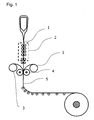
- a glass ribbon 1 (AN100, manufactured by Asahi Glass Company, Limited) having a linear expansion coefficient of 38 ⁇ 10 -7 /°C was formed into a thickness of 100 ⁇ m by a conventionally known fusion method, followed by cooling to around 120°C at a slowly cooling part 2. Then, resin films (polyethylene terephthalate film) 3 having a thickness of 50 ⁇ m were lamented on both surfaces of the glass ribbon 1 via a urethane hot melt adhesive layer (thickness: 30 ⁇ m, melting point: 120°C; not shown on drawings) by using a nip roller 4 adjusted to 120°C to obtain glass/resin composite 5.
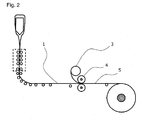
- a glass ribbon (AN100, manufactured by Asahi Glass Company, Limited) having a linear expansion coefficient of 38 ⁇ 10 -7 /°C was formed into a thickness of 100 ⁇ m by a conventionally known fusion method and temporary slowly cooled to room temperature. Then, it was tried to heat melt-fix a thermoplastic polyimide resin film (Aurum film, manufactured by Mitsui Chemicals, Inc., glass transition point: 250°C) having a thickness of 50 ⁇ m on one surface of the glass ribbon at 230°C (the maximum setting temperature of a resin roller).
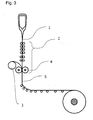
- a glass ribbon (AN100, manufactured by Asahi Glass Company, Limited) having a linear expansion coefficient of 38 ⁇ 10 -7 /°C was formed into a thickness of 100 ⁇ m by a conventionally known fusion method and slowly cooled to around 150°C, and polyethylene terephthalate films having a thickness of 50 ⁇ m were laminated on both surfaces of the glass ribbon via a urethane hot melt adhesive layer (thickness: 30 ⁇ m, melting potni:120°C) by using a nip roller adjusted to 150°C.
- a glass ribbon 1 (AN100, manufactured by Asahi Glass Company, Limited) having a linear expansion coefficient of 38 ⁇ 10 -7 /°C was formed into a thickness of 100 ⁇ m by a conventionally known fusion method and slowly cooled to around normal temperature (hereinafter, normal temperature means about 20°C).
- a glass ribbon 1 (AN100, manufactured by Asahi Glass Company, Limited) having a linear expansion coefficient of 38 ⁇ 10 -7 /°C was formed into a thickness of 100 ⁇ m by a conventionally known fusion method.
- a thermoplastic polyimide resin film 3 (Aurum film, manufactured by Mitsui Chemicals, Inc., glass transition point: 250°C) having a thickness of 50 ⁇ m was heat melt-fixed on one surface of the glass ribbon 1 by using a nip roller 4 to obtain a glass/resin composite.
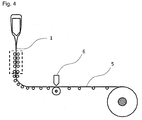
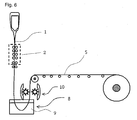
- a glass ribbon 1 (AN100, manufactured by Asahi Glass Company, Limited) having a linear expansion coefficient of 38 ⁇ 10 -7 °C was formed into a thickness of 100 ⁇ m by a conventionally known fusion method, followed by cooling to around normal temperature. Then, a molten thermoplastic acrylic resin (not shown) was applied on one surface of the glass ribbon 1 so as to be a thickness of 50 ⁇ m by using a die coater 6. Then, the thermoplastic acrylic resin was cooled so as to be solidified and to obtain a glass/resin composite 5.
- a glass ribbon 1 (AN100, manufactured by Asahi Glass Company, Limited) having a linear expansion coefficient of 38 ⁇ 10 -7 /°C was formed into a thickness of 100 ⁇ m by a conventionally known fusion method, followed by slowly cooling to around normal temperature. Then, a heat curable silicone resin (not shown) was applied on one surface of the glass ribbon 1 so as to be 20 ⁇ m by using a die coater 6. Then, the heat curable silicone resin was heat-cured at 100°C for 10 minutes in an oven 7 to obtain a glass/resin composite 5.
- a glass ribbon 1 (AN100, manufactured by Asahi Glass Company, Limited) having a linear expansion coefficient of 38 ⁇ 10 -7 /°C was formed into a thickness of 100 ⁇ m by a conventionally known fusion method, followed by slowing cooling to around normal temperature by making the formed glass ribbon 1 pass through a slowly cooling part 2.
- a curable resin (acrylic UV curing resin) 9 was applied on both surfaces of the glass ribbon 1 so as to be a thickness of 50 ⁇ m by using a dip coater 8.
- the acrylic UV curable resin was irradiated with UV rays so as to be cured by using a UV irradiation apparatus 10 to obtain a glass/resin composite 5.
- a glass film (AN1 00, manufactured by Asahi Glass Company, Limited) having a linear expansion coefficient of 38 ⁇ 10 -7 /°C was formed into a thickness of 100 ⁇ m by a conventionally known float method, followed by slowing cooling to around normal temperature, and then the glass film was cut into a predetermined size (730x920 mm) to obtain a flat glass substrate.
- the glass substrate was bonded to a continuously supplied polyethylene terephthalate film having a thickness of 50 ⁇ m to obtain a glass/resin composite.
- an acrylic adhesive layer was applied on a surface of the polyethylene terephthalate film.
- a glass film (AN100, manufactured by Asahi Glass Company, Limited) having a linear expansion coefficient of 38 ⁇ 10 -7 /°C was formed into a thickness of 100 ⁇ m by a conventionally known float method, followed by slowing cooling to around normal temperature, and then the glass film was cut into a predetermined size (730x920 mm) to obtain a flat glass substrate.
- the glass substrate was bonded to a continuously supplied polyethylene terephthalate film having a thickness of 50 ⁇ m to obtain a glass/resin composite.
- an acrylic adhesive layer was applied on a surface of the glass substrate.
- An example of the present invention is described with reference to Fig. 7 .
- An N-methylpyrrolidone solution (50 mass%) of polyamic acid was die coated on a continuously transported stainless steel sheet (its surface is mirror-finished, thickness: 300 ⁇ m) so as to be 80 ⁇ m. Then, the die coated stainless steel sheet was passed in a continuous oven set to be 230°C for 10 minutes, the concentration of the N-methylpyrrolidone solution of polyamic acid was increased to 85 mass%, a green sheet (a partially cured curable resin sheet) of the polyamic acid was peeled from the stainless steel sheet, and the green sheet was sandwiched with a polyethylene terephthalate film having a thickness of 30 ⁇ m. Thus, a polyamic acid green sheet provided with a polyethylene terephthalate (PET) coating film having a thickness of 50 ⁇ m was obtained.
- PET polyethylene terephthalate
- a glass ribbon 1 (AN100, manufactured by Asahi Glass Company, Limited) having a linear expansion coefficient of 38 ⁇ 10 -7 /°C was formed into a thickness of 100 ⁇ m by a conventionally known fusion method and passed through a slowly cooling part 2 so as to be cooled to around 150°C.
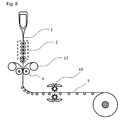
- a glass ribbon 1 (AN 100, manufactured by Asahi Glass Company, Limited) having a linear expansion coefficient of 38 ⁇ 10 -7 /°C was formed into a thickness of 100 ⁇ m by a conventionally known fusion method and passed through a slowly cooling part 2 so as to be cooled to around 50°C. Then, while peeling the PET coating film from one surface (inner side), a photocurable resin films 13 (photocurable dry film manufactured by DuPont MRC dry film, FX100, thickness: 50 ⁇ m) provided with a PET coating film was press-bonded on both surfaces of the glass ribbon 1 by using a nip roller 4. Then, the outermost layer of the PET coating film was irradiated with UV rays by a UV irradiation apparatus 10, and curing reaction of the photocurable resin film was terminated to obtain a glass/resin composite 5.
- AN 100 manufactured by Asahi Glass Company, Limited
- the glass/resin composites obtained by the Examples 1 to 10 are excellent in flexibility and can be wound up into a roll shape. Therefore, although such a glass is extremely thin, it is excellent in transportability, handling ability and processability.
- the thermoplastic polyimide resin film will not be soft sufficiently, and glass/resin composites cannot be obtained.
- the urethane hot melt adhesive flowed out from an adhesive interface, and glass/resin composites cannot be obtained.
- the glass/resin composite obtained by the production process of the present invention can be used as substrates for displays or covers for sensor or devices.
Landscapes
- Engineering & Computer Science (AREA)
- Mechanical Engineering (AREA)
- Physics & Mathematics (AREA)
- Thermal Sciences (AREA)
- High Energy & Nuclear Physics (AREA)
- Chemical & Material Sciences (AREA)
- Plasma & Fusion (AREA)
- Materials Engineering (AREA)
- Inorganic Chemistry (AREA)
- Organic Chemistry (AREA)
- Chemical Kinetics & Catalysis (AREA)
- General Chemical & Material Sciences (AREA)
- Laminated Bodies (AREA)
- Surface Treatment Of Glass (AREA)
- Joining Of Glass To Other Materials (AREA)
- Re-Forming, After-Treatment, Cutting And Transporting Of Glass Products (AREA)
Abstract
Description
- The present invention relates to a process for producing a glass/resin composite which is excellent in handling efficiency, transportability and processability, while maintaining glass properties.
- In recent years, glass substrates to be used as substrates for displays, covers for sensors and devices, etc. tend to be thin. However, the thinner the thickness of glass substrates, the more remarkable the drawback of glass being "fragile", and its handling becomes difficult at the time of its transportation or processing.
- In order to solve such a problem, methods for laminating a resin film on glass have been proposed (for example,
Patent Documents 1 to 4). However, there is a problem that due to physical damages to the glass surface caused at the time of cutting or transporting the glass before laminating a resin film thereon, sufficient mechanical strength cannot be secured. - Patent Document 1:
JP-A-2003-337549 - Patent Document 2:
JP-A-2002-534305 - Patent Document 3:
JP-A-2001-113631 - Patent Document 4:
JP-A-2001-097733 - The present invention has been accomplished in order to solve the above problem, and it is an object of the present invention to provide a process for producing a glass/resin composite which has sufficient transportability, handling efficiency and processability, even though the glass is very thin.
- The present invention provides a process for producing a glass/resin composite, which comprises forming molten glass into a glass ribbon and forming a resin layer on at least one surface of the glass ribbon.
- The above method for forming glass is preferably a float method, a fusion method, a down draw method, a slot down method or a redrawing method, and the glass ribbon preferably has a thickness of from 10 to 300 µm.
- The resin film is preferably laminated on the glass ribbon directly or via an adhesive layer or a glue layer.
- Preferred is the process, wherein the resin film is laminated on the glass ribbon via a heat melt layer containing a heat meltable resin, and when the heat meltable resin has a melting point, and the melting point of the heat meltable resin is Tm, or when the heat meltable resin does not have a melting point, and the glass transition point of the heat meltable resin is Tg, the resin film is adhered on the glass ribbon via the heat melt layer at a temperature of the formed glass ribbon of from Tm-50°C to Tm+20°C (in the case where the heat meltable resin has a melting point) or at a temperature of the formed glass ribbon of from Tg to Tg+100°C (in the case where the heat meltable resin does not have a melting point).
- Further, preferred is the process, wherein a film containing a heat meltable resin is laminated on the glass ribbon to form the resin layer, and when the melting point of the heat meltable resin is Tm, or when the heat meltable resin does not have a melting point, and the glass transition point of the heat meltable resin is Tg, the film is adhered on the glass ribbon at a temperature of the formed glass ribbon of from Tm-50°C to Tm+20°C (in the case where the heat meltable resin has a melting point) or at a temperature of the formed glass ribbon of from Tg to Tg+100°C (in the case where the heat meltable resin does not have a melting point). In the present invention, Tm and Tg are represented by "°C".
- Further, the resin layer of the present invention is preferably formed by a method for laminating a film substantially made of a curable resin on the glass ribbon via an adhesive layer or a glue layer or a method for press-bonding a sheet of a partially cured curable resin on the glass ribbon, followed by curing the curable resin.
- Further, the present invention provides a process for producing a glass/resin composite, which comprises coating a part of or the entire surface of a continuously supplied resin film with an adhesive or a glue, and then placing and bonding a glass substrate which is cut into a predetermined size on the adhesive- or glue-coated surface of the resin film.
- Further, the present invention provides a process for producing a glass/resin composite, which comprises bonding a glass substrate which is cut into a predetermined size and of which one surface is coated with an adhesive or a glue to a continuously supplied resin film, wherein the adhesive- or glue- coated surface of the glass substrate faces the resin film.
- In the present invention, the glass substrate preferably has a thickness of from 10 to 300 µm. Further, the present invention provides a process for producing a glass/resin composite, which comprises producing the composite by the above process, and winding it up into a roll shape.
- By the process of the present invention for forming a resin layer on a glass ribbon immediately after the formation of the glass ribbon, the resin layer is formed on a surface of the glass before a step of cutting or a step of transporting the formed glass ribbon. The possibility of physical damages on the glass surface is thereby low, and it is possible to obtain a glass/resin composite having a high mechanical strength. Depending on the step of forming a resin layer, it is possible to form the resin layer on a molten glass surface which has not been contacted to other members, and the physical damages on the glass surface can be remarkably reduced in principle.
- Further, before cutting the glass ribbon having a thickness of from 10 to 300 µm and flexibility, a resin layer is formed on its surface, and it is therefore possible to wind the glass resin composite up into a roll shape.
- Further, in the case of the process of the present invention wherein a cut glass substrate is bonded to a continuously supplied resin film, the glass/resin composite obtained by this process has a part which is only the resin film between adjacent glass substrates, namely a part which is not a composite layer structure of the glass substrate and the resin film exists, and it is thereby possible to obtain an effect that the composite can be easily cut at such a part.
-
-
Fig. 1 is a schematic view illustrating the process in Example 1 of the present invention. -
Fig. 2 is a schematic view illustrating the process in Example 2 of the present invention. -
Fig. 3 is a schematic view illustrating the process in Example 3 of the present invention. -
Fig. 4 is a schematic view illustrating the process in Example 4 of the present invention. -
Fig. 5 is a schematic view illustrating the process in Example 5 of the present invention. -
Fig. 6 is a schematic view illustrating the process in Example 6 of the present invention. -
Fig. 7 is a schematic view illustrating the process in Example 9 of the present invention. -
Fig. 8 is a schematic view illustrating the process in Example 10 of the present invention. -
- 1:
- glass ribbon
- 2:
- slowly cooling part
- 3:
- resin film
- 4:
- nip roller
- 5:
- glass/resin composite
- 6:
- die coater
- 7:
- oven
- 8:
- dip coater
- 9:
- curable resin
- 10:
- UV irradiation apparatus
- 11:
- polyamic acid green sheet provided with a PET coating film
- 12:
- PET coating film
- 13:
- photocurable resin film provided with a PET coating film
- Now, the process of the present invention for producing a glass/resin composite will be described.
- The first embodiment of the present invention is a process for producing a glass/resin composite by forming a resin film on a surface of a glass ribbon which is continuously formed. Various materials such as soda lime glass, alkali free glass, etc. may be used for the glass ribbon, however, the alkali free glass is preferred from the viewpoint of strength and chemical resistance. Molten glass may be formed into the glass ribbon by a float process, fusion process, down draw process, slot down process or redraw process.
- The glass ribbon used in the present invention preferably has a thickness of from 10 µm to 300 µm, particularly preferably from 50 µm to 150 µm. If the thickness of the glass ribbon is less than 10 µm, it is difficult to form a resin layer thereon. On the other hand, if the thickness of the glass ribbon exceeds 300 µm, since the strength of the glass itself is secured, it is not necessary to form a resin layer, and since the flexibility of the glass itself is lost, it is difficult to obtain a glass/resin composite in the form of a roll shape.
- The type of the resin used for the resin layer is not particularly restricted, so long as the resin can impart the strength to glass, however, the type of the resin can be preferably selected depending on the heat resistance, chemical resistance, etc. required for the particular application of the glass/resin composite.
- The resin may, for example, be a polyester resin, a polycarbonate resin, a polyether sulfone resin, a polyolefin resin, a polyvinyl alcohol resin, a silicone resin, a polyamide resin, an acrylic resin, a polystyrene resin, a triacetylcellulose resin, a polyimide resin, a polyvinyl chloride resin or a fluorinated resin. Further, it may be a copolymer of such a resin or one containing an additive such as a filler.
- It is possible to construct the glass/resin composite to have a double layer structure of glass/resin layers or a triple layers structure of resin layer/glass/resin layers wherein both surfaces are resin layers. In a case where the glass/resin composite is to be used as a display substrate, since high flatness is required at a display side surface, the double layer structure of glass/resin layer is preferred.
- As the method for forming a resin layer, the following methods are preferred.
- (1) A method for laminating a resin which is preliminarily formed into a film shape on a glass ribbon via a heat melt layer containing a heat meltable resin.
- (2) A method for directly laminating a film form resin containing a heat meltable resin on a glass ribbon.
- (3) A method for applying a heat melt resin on a glass ribbon directly or via an adhesive layer or a glue layer to form a resin layer.
- (4) A method for applying a curable resin on a glass ribbon directly or via an adhesive layer or a glue layer, followed by curing.
- Further, in a case where the heat meltable resin has a melting point, and the melting point is Tm, or in a case where the heat meltable resin does not have a melting point, and the glass transition point of the heat meltable resin is Tg, in the case of the method (1), a resin film is preferably adhered on a glass ribbon via a heat melt layer at a temperature of the formed glass ribbon of from Tm-50°C to Tm+20°C (in the case where the heat meltable resin has a melting point) or at a temperature of from Tg to Tg+100°C (in the case where the heat meltable resin does not have a melting point). In the case of the method (2), a resin film is preferably adhered on a glass ribbon via the heat melt layer at a temperature of the formed glass ribbon of from Tm-50°C to Tm+20°C (in the case where the heat meltable resin has a melting point) or at a temperature of from Tg to Tg+100 (in the case where the heat meltable resin does not have a melting point). If the temperature of the glass ribbon is less than Tm-50°C or Tg, the resin film cannot be adhered on the glass ribbon. If the temperature of the glass ribbon is higher than Tm+20°C or Tg+100°C, the heat melt layer flows out from an interface, and the resin film cannot be adhered on the glass ribbon. In the above, the temperature of the formed glass ribbon is particularly preferably from Tm-30°C to Tm+5°C (in the case where the heat meltable resin has a melting point) or particularly preferably from Tg to Tg+80°C (in the case where the heat meltable resin does not have a melting point).
- Further, as a method for forming a resin layer, the following methods can be preferably used in addition to the above methods for forming a resin layer.
- (5) A method for laminating a film substantially made of a curable resin on a glass ribbon via an adhesive layer or a glue layer.
- (6) A method for press-bonding a sheet of a curable resin which is partially cured, followed by curing the curable resin.
- As the method for applying a heat melt resin or a curable resin on a surface of a glass ribbon, a spray coating method, a die coating method, a float coating method, a dip coating method or the like may be employed. As the method for curing the curable resin, heat curing, UV curing, moist heat curing or the like may be employed.
- The resin layer may be formed after forming a glass ribbon and cooling the glass ribbon to around normal temperature via a slowly cooling step or may be formed before or during the slowly cooling step, when the glass ribbon is still hot. In a case where the resin layer is formed before or during the slow cooling step, heat energy of the glass ribbon can be utilized to melt the surface of the film state resin or improve adhesion.
- Further, according to the present invention, a glass/resin composite which is wound up into a roll shape can be obtained by forming a resin layer on a surface of a glass ribbon, followed by winding up it by an apparatus for winding. Such a glass resin composite wound up into the roll shape can be used in steps for producing display devices by a roll to roll method. When the glass/resin composite is wound up into the roll shape, a paper (inserting paper), a resin film or the like may be inserted between a composite and a composite as a case requires.
- For example, while releasing the roll obtained by the production process of the present invention, the glass/resin composite is continuously supplied, and a thin film transistor (TFT) is formed on the glass by the photolithography step, followed by cutting the glass/resin composite into the desired length and peeling/removing the resin to obtain a glass substrate with TFT.
- Further, other embodiments of the present invention will be described. The second embodiment of the production process of the present invention is a process wherein a part of or the entire surface of a continuously supplied resin film is coated with an adhesive or a glue, and then a glass substrate which is cut into a predetermined size is placed and bonded on the adhesive or glue coating surface of the resin film.
- Further, the third embodiment of the production process of the present invention is a process wherein a glass substrate which is cut into a predetermined size and on which one surface is coated with an adhesive or a glue is placed and bonded to a continuously supplied resin film. In the case of the third embodiment, the adhesive or glue-coated surface of the glass substrate faces the resin film.
- The first embodiment is a process for producing a composite of a continuous resin film and continuous glass ribbon, while the second and third embodiments are processes for producing a composite of a continuous resin film and uncontinuous glass substrate.
- In the same manner as in the first embodiment, as the resin film of the second or the third embodiment, a polyester resin, a polycarbonate resin, a polyether sulfone resin, a polyolefin resin, a polyvinyl alcohol resin, a silicone resin, a polyamide resin, an acrylic resin, a polystyrene resin, a triacetylcellulose resin, a polyimide resin, a polyvinyl chloride resin, a fluorinated resin, a copolymer of the above resins or one in which an additive such as a filler may be contained, may be used.
- In the production process of the second embodiment, in order to apply an adhesive or a glue on a resin film, a die coater or a roll coater may be used. In the production process of the third embodiment, in order to apply an adhesive or a glue on a glass substrate, a die coater, a roll coater, a screen printing or the like may be used.
- Then, the adhesive or glue applied on the resin film or the glass substrate by the above method is appropriately cured by the method employing heat, UV or the like, to fix the resin film on the glass substrate firmly.
- The glass/resin composite obtained by such a production process can be wound up into a roll shape by using a winding apparatus after bonding the glass substrate on the resin film in the same manner as in the production process of the first embodiment.
- The roll of the glass/resin composite obtained by the production process of the second embodiment or the third embodiment can be used in the display device production steps by the roll to roll method in the same manner as in the first embodiment.
- Here, when the glass/resin composite is cut into a desired length after forming a thin film transistor (TFT) on the glass, it is preferred to cut a part between adjacent glass substrate (a part of only the resin film wherein the glass substrate is not bonded). Because it is easy to cut only the resin film, compared to a case where both the glass and the resin film are cut simultaneously. Now, Examples of the present invention and Comparative Examples will be described with reference to figures. However, the present invention is not particularly restricted to the following Examples.
- An example of the present invention is described with reference to
Fig. 1 . - A glass ribbon 1 (AN100, manufactured by Asahi Glass Company, Limited) having a linear expansion coefficient of 38×10-7/°C was formed into a thickness of 100 µm by a conventionally known fusion method, followed by cooling to around 120°C at a slowly cooling
part 2. Then, resin films (polyethylene terephthalate film) 3 having a thickness of 50 µm were lamented on both surfaces of theglass ribbon 1 via a urethane hot melt adhesive layer (thickness: 30 µm, melting point: 120°C; not shown on drawings) by using anip roller 4 adjusted to 120°C to obtain glass/resin composite 5. - A glass ribbon (AN100, manufactured by Asahi Glass Company, Limited) having a linear expansion coefficient of 38×10-7/°C was formed into a thickness of 100 µm by a conventionally known fusion method and temporary slowly cooled to room temperature. Then, it was tried to heat melt-fix a thermoplastic polyimide resin film (Aurum film, manufactured by Mitsui Chemicals, Inc., glass transition point: 250°C) having a thickness of 50 µm on one surface of the glass ribbon at 230°C (the maximum setting temperature of a resin roller).
- A glass ribbon (AN100, manufactured by Asahi Glass Company, Limited) having a linear expansion coefficient of 38×10-7/°C was formed into a thickness of 100 µm by a conventionally known fusion method and slowly cooled to around 150°C, and polyethylene terephthalate films having a thickness of 50 µm were laminated on both surfaces of the glass ribbon via a urethane hot melt adhesive layer (thickness: 30 µm, melting potni:120°C) by using a nip roller adjusted to 150°C.
- An Example of the present invention is described with reference to
Fig. 2 . A glass ribbon 1 (AN100, manufactured by Asahi Glass Company, Limited) having a linear expansion coefficient of 38×10-7/°C was formed into a thickness of 100 µm by a conventionally known fusion method and slowly cooled to around normal temperature (hereinafter, normal temperature means about 20°C). A resin film (polyethylene terephthalate film) 3 having a thickness of 50 µm was laminated on one surface of theglass ribbon 1 via an acrylic adhesive layer (not shown on the figure) by using anip roller 4 to obtain a glass/resin composite 5. - An example of the present invention is described with reference to
Fig. 3 . A glass ribbon 1 (AN100, manufactured by Asahi Glass Company, Limited) having a linear expansion coefficient of 38×10-7/°C was formed into a thickness of 100 µm by a conventionally known fusion method. When the surface temperature of theglass ribbon 1 was 300°C in the slowly coolingpart 2, a thermoplastic polyimide resin film 3 (Aurum film, manufactured by Mitsui Chemicals, Inc., glass transition point: 250°C) having a thickness of 50 µm was heat melt-fixed on one surface of theglass ribbon 1 by using anip roller 4 to obtain a glass/resin composite. - An example of the present invention is described with reference to
Fig. 4 . A glass ribbon 1 (AN100, manufactured by Asahi Glass Company, Limited) having a linear expansion coefficient of 38×10-7°C was formed into a thickness of 100 µm by a conventionally known fusion method, followed by cooling to around normal temperature. Then, a molten thermoplastic acrylic resin (not shown) was applied on one surface of theglass ribbon 1 so as to be a thickness of 50 µm by using adie coater 6. Then, the thermoplastic acrylic resin was cooled so as to be solidified and to obtain a glass/resin composite 5. - An example of the present invention is described with reference to
Fig. 5 . A glass ribbon 1 (AN100, manufactured by Asahi Glass Company, Limited) having a linear expansion coefficient of 38×10-7/°C was formed into a thickness of 100 µm by a conventionally known fusion method, followed by slowly cooling to around normal temperature. Then, a heat curable silicone resin (not shown) was applied on one surface of theglass ribbon 1 so as to be 20 µm by using adie coater 6. Then, the heat curable silicone resin was heat-cured at 100°C for 10 minutes in anoven 7 to obtain a glass/resin composite 5. - An example of the present invention is described with reference to
Fig. 6 . A glass ribbon 1 (AN100, manufactured by Asahi Glass Company, Limited) having a linear expansion coefficient of 38×10-7/°C was formed into a thickness of 100 µm by a conventionally known fusion method, followed by slowing cooling to around normal temperature by making the formedglass ribbon 1 pass through a slowly coolingpart 2. Then, a curable resin (acrylic UV curing resin) 9 was applied on both surfaces of theglass ribbon 1 so as to be a thickness of 50 µm by using adip coater 8. Then, the acrylic UV curable resin was irradiated with UV rays so as to be cured by using aUV irradiation apparatus 10 to obtain a glass/resin composite 5. - A glass film (AN1 00, manufactured by Asahi Glass Company, Limited) having a linear expansion coefficient of 38×10-7/°C was formed into a thickness of 100 µm by a conventionally known float method, followed by slowing cooling to around normal temperature, and then the glass film was cut into a predetermined size (730x920 mm) to obtain a flat glass substrate. The glass substrate was bonded to a continuously supplied polyethylene terephthalate film having a thickness of 50 µm to obtain a glass/resin composite. At the time of bonding the glass to the resin film, an acrylic adhesive layer was applied on a surface of the polyethylene terephthalate film.
- A glass film (AN100, manufactured by Asahi Glass Company, Limited) having a linear expansion coefficient of 38×10-7/°C was formed into a thickness of 100 µm by a conventionally known float method, followed by slowing cooling to around normal temperature, and then the glass film was cut into a predetermined size (730x920 mm) to obtain a flat glass substrate. The glass substrate was bonded to a continuously supplied polyethylene terephthalate film having a thickness of 50 µm to obtain a glass/resin composite. At the time of bonding the glass to the resin film, an acrylic adhesive layer was applied on a surface of the glass substrate.
- An example of the present invention is described with reference to
Fig. 7 . An N-methylpyrrolidone solution (50 mass%) of polyamic acid was die coated on a continuously transported stainless steel sheet (its surface is mirror-finished, thickness: 300 µm) so as to be 80 µm. Then, the die coated stainless steel sheet was passed in a continuous oven set to be 230°C for 10 minutes, the concentration of the N-methylpyrrolidone solution of polyamic acid was increased to 85 mass%, a green sheet (a partially cured curable resin sheet) of the polyamic acid was peeled from the stainless steel sheet, and the green sheet was sandwiched with a polyethylene terephthalate film having a thickness of 30 µm. Thus, a polyamic acid green sheet provided with a polyethylene terephthalate (PET) coating film having a thickness of 50 µm was obtained. - Then, a glass ribbon 1 (AN100, manufactured by Asahi Glass Company, Limited) having a linear expansion coefficient of 38×10-7/°C was formed into a thickness of 100 µm by a conventionally known fusion method and passed through a slowly cooling
part 2 so as to be cooled to around 150°C. - Then, while peeling the PET coating film from one surface (which contacts to the glass ribbon 1) of the polyamic acid
green sheet 11 provided with the PET coating film, polyamic acidgreen sheets 11 provided with a PET coating film were press-bonded on both surfaces of theglass ribbon 1. Then, while peeling thePET coating film 12 on the outer side of the polyamic acidgreen sheet 11 provided with the PET coating film, the polyamic acidgreen sheet 11 was passed through acontinuous oven 7 set to be 300°C for 60 minutes, and the imidation reaction was terminated to obtain a glass/resin composite 5. - An example of the present invention is described with reference to
Fig. 8 . A glass ribbon 1 (AN 100, manufactured by Asahi Glass Company, Limited) having a linear expansion coefficient of 38×10-7/°C was formed into a thickness of 100 µm by a conventionally known fusion method and passed through a slowly coolingpart 2 so as to be cooled to around 50°C. Then, while peeling the PET coating film from one surface (inner side), a photocurable resin films 13 (photocurable dry film manufactured by DuPont MRC dry film, FX100, thickness: 50 µm) provided with a PET coating film was press-bonded on both surfaces of theglass ribbon 1 by using anip roller 4. Then, the outermost layer of the PET coating film was irradiated with UV rays by aUV irradiation apparatus 10, and curing reaction of the photocurable resin film was terminated to obtain a glass/resin composite 5. - The glass/resin composites obtained by the Examples 1 to 10 are excellent in flexibility and can be wound up into a roll shape. Therefore, although such a glass is extremely thin, it is excellent in transportability, handling ability and processability. On the other hand, by the method of Comparative Example 1, the thermoplastic polyimide resin film will not be soft sufficiently, and glass/resin composites cannot be obtained. Further, by the method of Comparative Example 2, the urethane hot melt adhesive flowed out from an adhesive interface, and glass/resin composites cannot be obtained.
- The glass/resin composite obtained by the production process of the present invention can be used as substrates for displays or covers for sensor or devices.
- The entire disclosure of Japanese Patent Application No.
2007-282293 filed on October 30, 2007
Claims (15)
- . A process for producing a glass/resin composite, which comprises forming molten glass into a glass ribbon and forming a resin layer on at least one surface of the glass ribbon.
- . The process for producing a glass/resin composite according to Claim 1, wherein the glass forming method is a float method, a fusion method, a down draw method, a slot down method or a redrawing method.
- . The process for producing a glass/resin composite according to Claim 1 or 2, wherein the glass ribbon has a thickness of from 10 to 300 µm.
- . The process for producing a glass/resin composite according to any one of Claims 1 to 3, wherein a resin film is laminated on the glass ribbon via a heat melt layer containing a heat melatable resin having a melting point to form the resin layer, and when the melting point of the heat meltable resin is Tm, the resin film is adhered on the glass ribbon via the heat melt layer at a temperature of the formed glass ribbon of from Tm-50°C to Tm+20°C.
- . The process for producing a glass/resin composite according to any one of Claims 1 to 3, wherein a resin film is laminated on the glass ribbon via a heat melt layer containing a heat melatable resin having no melting point to form the resin layer, and when the glass transition point of the heat meltable resin is Tg, the resin film is adhered on the glass ribbon via the heat melt layer at a temperature of the formed glass ribbon of from Tg to Tg+100°C.
- . The process for producing a glass/resin composite according to any one of Claims 1 to 3, wherein a film containing a heat melatable resin having a melting point is laminated on the glass ribbon to form the resin layer, and when the melting point of the heat meltable resin is Tm, the film is adhered on the glass ribbon at a temperature of the formed glass ribbon of from Tm-50°C to Tm+20°C.
- . The process for producing a glass/resin composite according to any one of Claims 1 to 3, wherein a film containing a heat melatable resin having no melting point is laminated on the glass ribbon to form the resin layer, and when the glass transition point of the heat meltable resin is Tg, the resin film is adhered on the glass ribbon at a temperature of the formed glass ribbon of from Tg to Tg+100°C.
- . The process for producing a glass/resin composite according to any one of Claims 1 to 3, wherein a heat meltable resin is applied directly or via an adhesive layer or a glue layer to the glass ribbon to form the resin layer.
- . The process for producing a glass/resin composite according to any one of Claims 1 to 3, wherein a curable resin is applied directly or via an adhesive layer or a glue layer to the glass ribbon, followed by curing the curable resin to form the resin layer.
- . The process for producing a glass/resin composite according to any one of Claims 1 to 3, wherein a film substantially made of a curable resin is laminated on the glass ribbon via an adhesive layer or a glue layer to form the resin layer.
- . The process for producing a glass/resin composite according to any one of Claims 1 to 3, wherein a sheet of a partially cured curable resin is press-bonded on the glass ribbon, followed by curing the curable resin.
- . A process for producing a glass/resin composite, which comprises coating a part of or the entire surface of a continuously supplied resin film with an adhesive or a glue, and then placing and bonding a glass substrate which is cut into a predetermined size on the adhesive- or glue-coated surface of the resin film.
- . A process for producing a glass/resin composite, which comprises bonding a glass substrate which is cut into a predetermined size and of which one surface is coated with an adhesive or a glue to a continuously supplied resin film, wherein the adhesive- or glue- coated surface of the glass substrate faces the resin film.
- . The process for producing a glass/resin composite according to Claim 12 or 13, wherein the glass substrate has a thickness of from 10 to 300 µm.
- . A process for producing a glass/resin composite, which comprises producing the composite by the process as defined in any one of Claims 1 to 14, and winding it up into a roll shape.
Applications Claiming Priority (2)
| Application Number | Priority Date | Filing Date | Title |
|---|---|---|---|
| JP2007282293 | 2007-10-30 | ||
| PCT/JP2008/068799 WO2009057460A1 (en) | 2007-10-30 | 2008-10-16 | Processes for producing glass/resin composite |
Publications (2)
| Publication Number | Publication Date |
|---|---|
| EP2204355A1 true EP2204355A1 (en) | 2010-07-07 |
| EP2204355A4 EP2204355A4 (en) | 2012-10-31 |
Family
ID=40590852
Family Applications (1)
| Application Number | Title | Priority Date | Filing Date |
|---|---|---|---|
| EP08844710A Withdrawn EP2204355A4 (en) | 2007-10-30 | 2008-10-16 | METHOD FOR PRODUCING A GLASS / RESIN COMPOSITE |
Country Status (7)
| Country | Link |
|---|---|
| US (1) | US20100192634A1 (en) |
| EP (1) | EP2204355A4 (en) |
| JP (2) | JP5509853B2 (en) |
| KR (1) | KR101484349B1 (en) |
| CN (1) | CN101815682B (en) |
| TW (1) | TWI477464B (en) |
| WO (1) | WO2009057460A1 (en) |
Cited By (11)
| Publication number | Priority date | Publication date | Assignee | Title |
|---|---|---|---|---|
| US20110177290A1 (en) * | 2008-10-01 | 2011-07-21 | Masahiro Tomamoto | Glass roll, device for producing glass roll, and process for producing glass roll |
| EP2505566A1 (en) * | 2011-03-30 | 2012-10-03 | Corning Incorporated | Methods of fabricating a glass ribbon |
| WO2014035942A1 (en) * | 2012-08-31 | 2014-03-06 | Corning Incorporated | Strengthened thin glass-polymer laminates |
| WO2014052548A1 (en) * | 2012-09-26 | 2014-04-03 | Corning Incorporated | Edge trim management for flexible glass ribbon |
| WO2014172237A3 (en) * | 2013-04-19 | 2014-12-24 | Corning Incorporated | Methods of forming laminated glass structures |
| WO2015162013A1 (en) | 2014-04-25 | 2015-10-29 | Tesa Se | Thin glass composite and method for storing a thin glass film |
| WO2015162012A1 (en) | 2014-04-25 | 2015-10-29 | Tesa Se | Thin sheet glass composite and method of storing thin sheet glass |
| US9278497B2 (en) | 2010-08-31 | 2016-03-08 | Nippon Electric Glass Co., Ltd. | Glass-resin laminate, glass roll produced by winding the same, and method of producing glass roll |
| WO2016149013A1 (en) * | 2015-03-13 | 2016-09-22 | Corning Incorporated | Methods and systems for processing glass ribbons and glass ribbons formed thereby |
| EP3173232A1 (en) * | 2015-11-30 | 2017-05-31 | KBA-NotaSys SA | Hot-stamping press |
| US12195965B2 (en) | 2021-02-19 | 2025-01-14 | University Of South Florida | Cost-effective bulk glass reinforced composite columns |
Families Citing this family (43)
| Publication number | Priority date | Publication date | Assignee | Title |
|---|---|---|---|---|
| WO2009093505A1 (en) * | 2008-01-25 | 2009-07-30 | Asahi Glass Company, Limited | Process for producing glass/resin composite |
| JP5709032B2 (en) * | 2010-02-12 | 2015-04-30 | 日本電気硝子株式会社 | Manufacturing method of glass film |
| KR101736262B1 (en) * | 2010-02-18 | 2017-05-16 | 니폰 덴키 가라스 가부시키가이샤 | Manufacturing method for glass film and manufacturing device therefor |
| US9656901B2 (en) * | 2010-03-03 | 2017-05-23 | Nippon Electric Glass Co., Ltd. | Method of manufacturing a glass roll |
| JP2011190132A (en) * | 2010-03-12 | 2011-09-29 | Nippon Electric Glass Co Ltd | Glass roll and method for producing the same |
| JP5704395B2 (en) * | 2010-03-29 | 2015-04-22 | 日本電気硝子株式会社 | Glass roll package |
| JP5669001B2 (en) * | 2010-07-22 | 2015-02-12 | 日本電気硝子株式会社 | Glass film cleaving method, glass roll manufacturing method, and glass film cleaving apparatus |
| US9199816B2 (en) | 2010-11-04 | 2015-12-01 | Corning Incorporated | Methods and apparatus for guiding flexible glass ribbons |
| JP5743182B2 (en) * | 2010-11-19 | 2015-07-01 | 日本電気硝子株式会社 | Manufacturing method of glass film |
| JP5617556B2 (en) * | 2010-11-22 | 2014-11-05 | 日本電気硝子株式会社 | Strip glass film cleaving apparatus and strip glass film cleaving method |
| TWI626223B (en) | 2010-11-30 | 2018-06-11 | 康寧公司 | Glass ribbons and methods of splicing first glass ribbon portion to second member |
| TWI542527B (en) | 2010-11-30 | 2016-07-21 | 康寧公司 | Winding glass ribbon by tensioning interleaving material |
| TWI547369B (en) | 2011-05-27 | 2016-09-01 | 康寧公司 | Glass-plastic laminate device, processing line and methods therefor |
| KR101800224B1 (en) * | 2011-06-08 | 2017-11-22 | 니폰 덴키 가라스 가부시키가이샤 | Method for cutting plate-like glass, and cutting device therefor |
| DE102011084131A1 (en) * | 2011-10-07 | 2013-04-11 | Schott Ag | Glass foil with specially designed edge |
| KR101557525B1 (en) * | 2012-05-11 | 2015-10-06 | 주식회사 엘지화학 | Apparatus for forming flatness of glass substrate using the same |
| KR101582004B1 (en) * | 2012-08-06 | 2015-12-31 | 아반스트레이트코리아 주식회사 | Method of manufacturing glass sheet for color filter, method of manufacturing color filter panel, and glass substrate for display |
| CN104520098A (en) * | 2012-08-09 | 2015-04-15 | 旭硝子株式会社 | Glass-sheet-fluorine-resin laminate |
| TWI591040B (en) | 2012-10-22 | 2017-07-11 | 康寧公司 | Glass webs and methods of splicing |
| US9216924B2 (en) * | 2012-11-09 | 2015-12-22 | Corning Incorporated | Methods of processing a glass ribbon |
| DE102013105734B4 (en) * | 2013-06-04 | 2024-08-22 | Schott Ag | Process for redrawing glass |
| WO2015037601A1 (en) * | 2013-09-12 | 2015-03-19 | 旭硝子株式会社 | Article bearing rugged mold pattern transferred thereto, process for producing article, and process for producing optical panel |
| TWI633073B (en) | 2013-10-14 | 2018-08-21 | 康寧公司 | Ion exchange method and chemically strengthened glass substrate from Peter |
| JP2015147376A (en) * | 2014-02-07 | 2015-08-20 | 旭硝子株式会社 | Glass composite |
| TW201604001A (en) | 2014-06-06 | 2016-02-01 | 康寧公司 | Flexible glass laminate structures for architectural design and other applications |
| JP6627317B2 (en) * | 2014-08-06 | 2020-01-08 | 三菱ケミカル株式会社 | Glass film laminate |
| JP6628788B2 (en) * | 2014-08-15 | 2020-01-15 | スリーエム イノベイティブ プロパティズ カンパニー | Glass and polymer film assembly and fabrication method |
| JP6337713B2 (en) * | 2014-09-18 | 2018-06-06 | 三菱ケミカル株式会社 | Manufacturing method of glass laminate |
| JP6520383B2 (en) * | 2014-10-27 | 2019-05-29 | 三菱ケミカル株式会社 | Glass laminate |
| EP3224209B1 (en) * | 2014-11-26 | 2021-12-15 | Corning Incorporated | Thin glass sheet and system and method for forming the same |
| CN104699300B (en) * | 2015-03-05 | 2018-07-06 | 业成光电(深圳)有限公司 | Board structure |
| JP6614834B2 (en) * | 2015-07-15 | 2019-12-04 | 日東電工株式会社 | Method for producing optical laminate |
| JP6614833B2 (en) * | 2015-07-15 | 2019-12-04 | 日東電工株式会社 | Method for producing optical laminate |
| JP6728982B2 (en) * | 2016-05-27 | 2020-07-22 | 三菱ケミカル株式会社 | Method for manufacturing glass laminate |
| JP2016184180A (en) * | 2016-06-30 | 2016-10-20 | 日東電工株式会社 | Protective substrate for display device |
| WO2018079546A1 (en) | 2016-10-26 | 2018-05-03 | 日東電工株式会社 | Glass roll with resin film |
| JP7112960B2 (en) | 2016-10-26 | 2022-08-04 | 日東電工株式会社 | METHOD FOR MANUFACTURING GLASS FILM WITH RESIN TAPE AND METHOD FOR MANUFACTURING GLASS FILM |
| WO2018079545A1 (en) | 2016-10-26 | 2018-05-03 | 日東電工株式会社 | Glass film-resin composite |
| JP6900767B2 (en) * | 2017-04-28 | 2021-07-07 | 日本電気硝子株式会社 | Glass roll manufacturing method |
| JP6715906B2 (en) * | 2018-11-01 | 2020-07-01 | 日東電工株式会社 | Laminate |
| WO2020153178A1 (en) * | 2019-01-23 | 2020-07-30 | 日東電工株式会社 | Method for producing thin glass resin laminate piece |
| JPWO2020203124A1 (en) * | 2019-03-29 | 2020-10-08 | ||
| JP7410948B2 (en) * | 2019-06-27 | 2024-01-10 | 日東電工株式会社 | Manufacturing method of laminated film |
Family Cites Families (13)
| Publication number | Priority date | Publication date | Assignee | Title |
|---|---|---|---|---|
| BE758410A (en) * | 1969-11-06 | 1971-05-03 | Kalle Ag | COMPLEX, COMPOSED OF GLASS AND PLASTIC MATERIAL |
| JPS6436443A (en) * | 1987-07-31 | 1989-02-07 | Sekisui Seikei Kogyo Kk | Manufacture of reinforced glass and reinforcement sheet |
| US5910854A (en) * | 1993-02-26 | 1999-06-08 | Donnelly Corporation | Electrochromic polymeric solid films, manufacturing electrochromic devices using such solid films, and processes for making such solid films and devices |
| WO1997003763A1 (en) * | 1995-07-24 | 1997-02-06 | Southwall Technologies Inc. | Improved laminate structure and process for its production |
| CN1166194C (en) | 1995-10-02 | 2004-09-08 | 星视电视广播股份有限公司 | System and method for providing television program preview information |
| JPH09274856A (en) * | 1996-04-08 | 1997-10-21 | Sony Corp | Manufacturing method of cathode ray tube |
| EP1048628A1 (en) * | 1999-04-30 | 2000-11-02 | Schott Glas | Polymer coated glassfoil substrate |
| DE50003524D1 (en) | 1999-01-11 | 2003-10-09 | Schott Displayglas Gmbh | POLYMER COATED THIN GLASS FILM SUBSTRATES |
| JP4326635B2 (en) * | 1999-09-29 | 2009-09-09 | 三菱樹脂株式会社 | Glass film handling method and glass laminate |
| JP4250276B2 (en) | 1999-10-20 | 2009-04-08 | 三菱樹脂株式会社 | Plastic film / glass film laminate and method for producing the same |
| DE10040640C2 (en) * | 2000-08-16 | 2002-11-21 | Schott Glas | Method and device for producing single glass panes |
| JP2003337549A (en) | 2002-05-17 | 2003-11-28 | Asahi Glass Co Ltd | Flat panel display substrate, display device, organic electroluminescence element and liquid crystal display element |
| FR2857614B1 (en) * | 2003-07-17 | 2005-08-19 | Saint Gobain | METHOD OF CUTTING A FUNCTIONAL FILM OF PLASTIC MATERIAL, APPLIED ON A SUBSTRATE, SUCH AS A GLASS PLATE |
-
2008
- 2008-10-16 CN CN2008801101835A patent/CN101815682B/en not_active Expired - Fee Related
- 2008-10-16 KR KR1020107003113A patent/KR101484349B1/en not_active Expired - Fee Related
- 2008-10-16 JP JP2009539005A patent/JP5509853B2/en not_active Expired - Fee Related
- 2008-10-16 WO PCT/JP2008/068799 patent/WO2009057460A1/en not_active Ceased
- 2008-10-16 EP EP08844710A patent/EP2204355A4/en not_active Withdrawn
- 2008-10-27 TW TW097141186A patent/TWI477464B/en not_active IP Right Cessation
-
2010
- 2010-04-07 US US12/755,709 patent/US20100192634A1/en not_active Abandoned
-
2014
- 2014-03-26 JP JP2014064403A patent/JP5754530B2/en not_active Expired - Fee Related
Cited By (24)
| Publication number | Priority date | Publication date | Assignee | Title |
|---|---|---|---|---|
| US8806894B2 (en) * | 2008-10-01 | 2014-08-19 | Nippon Electric Glass Co., Ltd. | Process for producing glass roll with a separable protective sheet |
| US10781036B2 (en) | 2008-10-01 | 2020-09-22 | Nippon Electric Glass Co., Ltd. | Glass roll with a separable protective sheet |
| US20110177290A1 (en) * | 2008-10-01 | 2011-07-21 | Masahiro Tomamoto | Glass roll, device for producing glass roll, and process for producing glass roll |
| US9278497B2 (en) | 2010-08-31 | 2016-03-08 | Nippon Electric Glass Co., Ltd. | Glass-resin laminate, glass roll produced by winding the same, and method of producing glass roll |
| EP2505566A1 (en) * | 2011-03-30 | 2012-10-03 | Corning Incorporated | Methods of fabricating a glass ribbon |
| EP3385232A1 (en) * | 2011-03-30 | 2018-10-10 | Corning Incorporated | Methods of fabricating a glass ribbon |
| WO2014035942A1 (en) * | 2012-08-31 | 2014-03-06 | Corning Incorporated | Strengthened thin glass-polymer laminates |
| US10953633B2 (en) | 2012-08-31 | 2021-03-23 | Corning Incorporated | Strengthened thin glass-polymer laminates |
| CN104768885A (en) * | 2012-09-26 | 2015-07-08 | 康宁股份有限公司 | Edge trim management for flexible glass ribbons |
| WO2014052548A1 (en) * | 2012-09-26 | 2014-04-03 | Corning Incorporated | Edge trim management for flexible glass ribbon |
| AU2014254225B2 (en) * | 2013-04-19 | 2018-03-08 | Corning Incorporated | Methods of forming laminated glass structures |
| WO2014172237A3 (en) * | 2013-04-19 | 2014-12-24 | Corning Incorporated | Methods of forming laminated glass structures |
| TWI631019B (en) * | 2013-04-19 | 2018-08-01 | 美商康寧公司 | Methods of forming laminated glass structures |
| US9963374B2 (en) | 2013-04-19 | 2018-05-08 | Corning Incorporated | Methods of forming laminated glass structures |
| WO2015162013A1 (en) | 2014-04-25 | 2015-10-29 | Tesa Se | Thin glass composite and method for storing a thin glass film |
| WO2015162012A1 (en) | 2014-04-25 | 2015-10-29 | Tesa Se | Thin sheet glass composite and method of storing thin sheet glass |
| US10618837B2 (en) | 2014-04-25 | 2020-04-14 | Tesa Se | Thin glass composite and method for storing a thin glass film |
| DE102014207792A1 (en) | 2014-04-25 | 2015-10-29 | Tesa Se | Thin glass composite and method for storing a thin glass sheet |
| DE102014207837A1 (en) | 2014-04-25 | 2015-10-29 | Tesa Se | Thin glass composite and method for storage of thin glass |
| WO2016149013A1 (en) * | 2015-03-13 | 2016-09-22 | Corning Incorporated | Methods and systems for processing glass ribbons and glass ribbons formed thereby |
| WO2017093894A1 (en) * | 2015-11-30 | 2017-06-08 | Kba-Notasys Sa | Hot-stamping press |
| EP3173232A1 (en) * | 2015-11-30 | 2017-05-31 | KBA-NotaSys SA | Hot-stamping press |
| US11697277B2 (en) | 2015-11-30 | 2023-07-11 | Kba-Notsys Sa | Hot-stamping press |
| US12195965B2 (en) | 2021-02-19 | 2025-01-14 | University Of South Florida | Cost-effective bulk glass reinforced composite columns |
Also Published As
| Publication number | Publication date |
|---|---|
| TW200936523A (en) | 2009-09-01 |
| CN101815682A (en) | 2010-08-25 |
| JPWO2009057460A1 (en) | 2011-03-10 |
| KR20100080590A (en) | 2010-07-09 |
| WO2009057460A1 (en) | 2009-05-07 |
| EP2204355A4 (en) | 2012-10-31 |
| US20100192634A1 (en) | 2010-08-05 |
| CN101815682B (en) | 2013-03-27 |
| JP5509853B2 (en) | 2014-06-04 |
| TWI477464B (en) | 2015-03-21 |
| JP5754530B2 (en) | 2015-07-29 |
| JP2014166952A (en) | 2014-09-11 |
| KR101484349B1 (en) | 2015-01-19 |
Similar Documents
| Publication | Publication Date | Title |
|---|---|---|
| US20100192634A1 (en) | Process for producing glass/resin composite | |
| JP5343862B2 (en) | Method for producing glass resin composite | |
| US8609229B2 (en) | Glass/resin laminate, and electronic device using same | |
| CN102905891B (en) | The manufacture method of glass resin duplexer and the glass roll reeled and glass roll | |
| CN102869632B (en) | Manufacturing method of transparent substrate | |
| HK1040388A1 (en) | Polymer-coated thin glass film substrates | |
| HK1042684B (en) | Polymer-coated thin-glass film substrates | |
| EP2809516A1 (en) | Composite glass laminate and web processing apparatus | |
| US11618241B2 (en) | Glass roll | |
| JP2004306586A (en) | Manufacturing process of plastic sheet for display panel | |
| EP3323608B1 (en) | Production method for optical laminate | |
| KR20180019167A (en) | Method for manufacturing optical laminate | |
| TWI816963B (en) | polycarbonate resin film | |
| JP2002273811A (en) | Optical polymer sheet | |
| KR20200058049A (en) | Adhesive tape and method for manufacturing method thereof same | |
| JP2004338190A (en) | Method for producing porous resin sheet laminate | |
| JP2002103449A (en) | Method for producing polymer sheet, and polymer sheet |
Legal Events
| Date | Code | Title | Description |
|---|---|---|---|
| PUAI | Public reference made under article 153(3) epc to a published international application that has entered the european phase |
Free format text: ORIGINAL CODE: 0009012 |
|
| 17P | Request for examination filed |
Effective date: 20100331 |
|
| AK | Designated contracting states |
Kind code of ref document: A1 Designated state(s): AT BE BG CH CY CZ DE DK EE ES FI FR GB GR HR HU IE IS IT LI LT LU LV MC MT NL NO PL PT RO SE SI SK TR |
|
| AX | Request for extension of the european patent |
Extension state: AL BA MK RS |
|
| DAX | Request for extension of the european patent (deleted) | ||
| RAP1 | Party data changed (applicant data changed or rights of an application transferred) |
Owner name: ASAHI GLASS COMPANY, LIMITED |
|
| A4 | Supplementary search report drawn up and despatched |
Effective date: 20121001 |
|
| RIC1 | Information provided on ipc code assigned before grant |
Ipc: B29C 63/00 20060101ALI20120925BHEP Ipc: B32B 17/10 20060101ALI20120925BHEP Ipc: B32B 37/00 20060101ALI20120925BHEP Ipc: B29C 65/48 20060101ALI20120925BHEP Ipc: C03C 17/32 20060101ALI20120925BHEP Ipc: B32B 37/20 20060101ALI20120925BHEP Ipc: B29C 70/00 20060101ALI20120925BHEP Ipc: B29B 15/12 20060101ALI20120925BHEP Ipc: B29L 9/00 20060101ALI20120925BHEP Ipc: B29B 15/10 20060101ALI20120925BHEP Ipc: B29C 41/24 20060101ALI20120925BHEP Ipc: C03B 17/02 20060101ALI20120925BHEP Ipc: C03B 40/033 20060101AFI20120925BHEP |
|
| 17Q | First examination report despatched |
Effective date: 20151021 |
|
| 18D | Application deemed to be withdrawn |
Effective date: 20160503 |
|
| STAA | Information on the status of an ep patent application or granted ep patent |
Free format text: STATUS: THE APPLICATION IS DEEMED TO BE WITHDRAWN |
|
| R18D | Application deemed to be withdrawn (corrected) |
Effective date: 20160301 |