EP2203505B1 - Method for altering the surface of a synthetic textile - Google Patents
Method for altering the surface of a synthetic textile Download PDFInfo
- Publication number
- EP2203505B1 EP2203505B1 EP08834230A EP08834230A EP2203505B1 EP 2203505 B1 EP2203505 B1 EP 2203505B1 EP 08834230 A EP08834230 A EP 08834230A EP 08834230 A EP08834230 A EP 08834230A EP 2203505 B1 EP2203505 B1 EP 2203505B1
- Authority
- EP
- European Patent Office
- Prior art keywords
- group
- carbon atoms
- groups
- polyester
- divalent
- Prior art date
- Legal status (The legal status is an assumption and is not a legal conclusion. Google has not performed a legal analysis and makes no representation as to the accuracy of the status listed.)
- Not-in-force
Links
- 238000000034 method Methods 0.000 title claims abstract description 45
- 229920002994 synthetic fiber Polymers 0.000 title claims abstract description 38
- 239000004758 synthetic textile Substances 0.000 title claims abstract description 29
- 229920001296 polysiloxane Polymers 0.000 claims abstract description 56
- 239000004744 fabric Substances 0.000 claims abstract description 45
- 239000000654 additive Substances 0.000 claims abstract description 29
- 230000000996 additive effect Effects 0.000 claims abstract description 25
- 239000007787 solid Substances 0.000 claims abstract description 13
- 239000011248 coating agent Substances 0.000 claims abstract description 8
- 238000000576 coating method Methods 0.000 claims abstract description 8
- 229920000728 polyester Polymers 0.000 claims description 81
- 239000004215 Carbon black (E152) Substances 0.000 claims description 42
- 229930195733 hydrocarbon Natural products 0.000 claims description 42
- 125000004432 carbon atom Chemical group C* 0.000 claims description 39
- 239000004677 Nylon Substances 0.000 claims description 37
- 229920001778 nylon Polymers 0.000 claims description 37
- 239000003599 detergent Substances 0.000 claims description 28
- 239000000203 mixture Substances 0.000 claims description 24
- 239000002979 fabric softener Substances 0.000 claims description 17
- 239000004094 surface-active agent Substances 0.000 claims description 16
- 125000003118 aryl group Chemical group 0.000 claims description 15
- 239000004753 textile Substances 0.000 claims description 15
- 229910020388 SiO1/2 Inorganic materials 0.000 claims description 14
- 229910052739 hydrogen Inorganic materials 0.000 claims description 12
- 229920000742 Cotton Polymers 0.000 claims description 11
- 125000000218 acetic acid group Chemical group C(C)(=O)* 0.000 claims description 9
- 125000002029 aromatic hydrocarbon group Chemical group 0.000 claims description 9
- 125000004122 cyclic group Chemical group 0.000 claims description 9
- 125000002887 hydroxy group Chemical group [H]O* 0.000 claims description 9
- 229920006395 saturated elastomer Polymers 0.000 claims description 9
- 229910052799 carbon Inorganic materials 0.000 claims description 6
- 125000002496 methyl group Chemical group [H]C([H])([H])* 0.000 claims description 6
- -1 polysiloxane moiety Polymers 0.000 claims description 6
- 239000004721 Polyphenylene oxide Substances 0.000 claims description 5
- 229920000570 polyether Polymers 0.000 claims description 5
- 125000000008 (C1-C10) alkyl group Chemical group 0.000 claims description 3
- 125000000041 C6-C10 aryl group Chemical group 0.000 claims description 3
- OKTJSMMVPCPJKN-UHFFFAOYSA-N Carbon Chemical compound [C] OKTJSMMVPCPJKN-UHFFFAOYSA-N 0.000 claims description 3
- 229910020447 SiO2/2 Inorganic materials 0.000 claims description 3
- 125000003282 alkyl amino group Chemical group 0.000 claims description 3
- QGZKDVFQNNGYKY-UHFFFAOYSA-O ammonium group Chemical group [NH4+] QGZKDVFQNNGYKY-UHFFFAOYSA-O 0.000 claims description 3
- 150000001721 carbon Chemical group 0.000 claims description 3
- 125000004663 dialkyl amino group Chemical group 0.000 claims description 3
- 125000001153 fluoro group Chemical group F* 0.000 claims description 3
- 125000000623 heterocyclic group Chemical group 0.000 claims description 3
- 239000001257 hydrogen Substances 0.000 claims description 3
- 125000004435 hydrogen atom Chemical group [H]* 0.000 claims description 3
- 125000004433 nitrogen atom Chemical group N* 0.000 claims description 3
- 150000007524 organic acids Chemical class 0.000 claims description 3
- 125000000962 organic group Chemical group 0.000 claims description 3
- 125000002924 primary amino group Chemical group [H]N([H])* 0.000 claims description 3
- 125000001453 quaternary ammonium group Chemical group 0.000 claims description 3
- 125000001424 substituent group Chemical group 0.000 claims description 3
- 210000002268 wool Anatomy 0.000 claims description 3
- 125000001183 hydrocarbyl group Chemical group 0.000 claims 3
- 229920002972 Acrylic fiber Polymers 0.000 claims 1
- 238000004140 cleaning Methods 0.000 claims 1
- 229920002334 Spandex Polymers 0.000 description 35
- 238000012360 testing method Methods 0.000 description 35
- 230000003068 static effect Effects 0.000 description 32
- 150000001875 compounds Chemical class 0.000 description 22
- 239000000463 material Substances 0.000 description 22
- 108010081873 Persil Proteins 0.000 description 19
- 230000002209 hydrophobic effect Effects 0.000 description 17
- 238000005259 measurement Methods 0.000 description 16
- 238000005406 washing Methods 0.000 description 11
- 101100065878 Caenorhabditis elegans sec-10 gene Proteins 0.000 description 9
- 239000012209 synthetic fiber Substances 0.000 description 9
- 239000000835 fiber Substances 0.000 description 8
- 230000000694 effects Effects 0.000 description 6
- 150000002430 hydrocarbons Chemical group 0.000 description 6
- 230000015556 catabolic process Effects 0.000 description 5
- 230000014759 maintenance of location Effects 0.000 description 5
- 238000002203 pretreatment Methods 0.000 description 4
- 239000000126 substance Substances 0.000 description 4
- XLYOFNOQVPJJNP-UHFFFAOYSA-N water Substances O XLYOFNOQVPJJNP-UHFFFAOYSA-N 0.000 description 4
- 238000006731 degradation reaction Methods 0.000 description 3
- 230000005611 electricity Effects 0.000 description 3
- 230000007062 hydrolysis Effects 0.000 description 3
- 238000006460 hydrolysis reaction Methods 0.000 description 3
- 230000005660 hydrophilic surface Effects 0.000 description 3
- 239000000843 powder Substances 0.000 description 3
- 230000008569 process Effects 0.000 description 3
- 229940024463 silicone emollient and protective product Drugs 0.000 description 3
- 229920001059 synthetic polymer Polymers 0.000 description 3
- 239000004952 Polyamide Substances 0.000 description 2
- 229920013822 aminosilicone Polymers 0.000 description 2
- 230000008859 change Effects 0.000 description 2
- 230000000052 comparative effect Effects 0.000 description 2
- 239000003989 dielectric material Substances 0.000 description 2
- 230000005686 electrostatic field Effects 0.000 description 2
- 239000012528 membrane Substances 0.000 description 2
- 229920002647 polyamide Polymers 0.000 description 2
- 229920000642 polymer Polymers 0.000 description 2
- 230000004044 response Effects 0.000 description 2
- 230000000717 retained effect Effects 0.000 description 2
- 238000011282 treatment Methods 0.000 description 2
- 238000010521 absorption reaction Methods 0.000 description 1
- NIXOWILDQLNWCW-UHFFFAOYSA-N acrylic acid group Chemical group C(C=C)(=O)O NIXOWILDQLNWCW-UHFFFAOYSA-N 0.000 description 1
- 229920006397 acrylic thermoplastic Polymers 0.000 description 1
- 230000004075 alteration Effects 0.000 description 1
- 230000008901 benefit Effects 0.000 description 1
- 239000003795 chemical substances by application Substances 0.000 description 1
- 230000003750 conditioning effect Effects 0.000 description 1
- 238000009945 crocheting Methods 0.000 description 1
- 230000001419 dependent effect Effects 0.000 description 1
- 230000008021 deposition Effects 0.000 description 1
- KPUWHANPEXNPJT-UHFFFAOYSA-N disiloxane Chemical class [SiH3]O[SiH3] KPUWHANPEXNPJT-UHFFFAOYSA-N 0.000 description 1
- 239000012153 distilled water Substances 0.000 description 1
- 230000002349 favourable effect Effects 0.000 description 1
- 238000009413 insulation Methods 0.000 description 1
- 238000009940 knitting Methods 0.000 description 1
- 238000004519 manufacturing process Methods 0.000 description 1
- 239000000615 nonconductor Substances 0.000 description 1
- 150000001282 organosilanes Chemical class 0.000 description 1
- 125000005375 organosiloxane group Chemical group 0.000 description 1
- 125000005702 oxyalkylene group Chemical group 0.000 description 1
- 230000000704 physical effect Effects 0.000 description 1
- 229920003229 poly(methyl methacrylate) Polymers 0.000 description 1
- 229920000098 polyolefin Polymers 0.000 description 1
- 238000009877 rendering Methods 0.000 description 1
- 230000007480 spreading Effects 0.000 description 1
- ISXSCDLOGDJUNJ-UHFFFAOYSA-N tert-butyl prop-2-enoate Chemical compound CC(C)(C)OC(=O)C=C ISXSCDLOGDJUNJ-UHFFFAOYSA-N 0.000 description 1
- 238000012956 testing procedure Methods 0.000 description 1
- 238000012546 transfer Methods 0.000 description 1
- 230000005068 transpiration Effects 0.000 description 1
- ZQTYRTSKQFQYPQ-UHFFFAOYSA-N trisiloxane Chemical class [SiH3]O[SiH2]O[SiH3] ZQTYRTSKQFQYPQ-UHFFFAOYSA-N 0.000 description 1
- 238000009941 weaving Methods 0.000 description 1
- 238000009736 wetting Methods 0.000 description 1
Classifications
-
- D—TEXTILES; PAPER
- D06—TREATMENT OF TEXTILES OR THE LIKE; LAUNDERING; FLEXIBLE MATERIALS NOT OTHERWISE PROVIDED FOR
- D06M—TREATMENT, NOT PROVIDED FOR ELSEWHERE IN CLASS D06, OF FIBRES, THREADS, YARNS, FABRICS, FEATHERS OR FIBROUS GOODS MADE FROM SUCH MATERIALS
- D06M11/00—Treating fibres, threads, yarns, fabrics or fibrous goods made from such materials, with inorganic substances or complexes thereof; Such treatment combined with mechanical treatment, e.g. mercerising
- D06M11/77—Treating fibres, threads, yarns, fabrics or fibrous goods made from such materials, with inorganic substances or complexes thereof; Such treatment combined with mechanical treatment, e.g. mercerising with silicon or compounds thereof
-
- D—TEXTILES; PAPER
- D06—TREATMENT OF TEXTILES OR THE LIKE; LAUNDERING; FLEXIBLE MATERIALS NOT OTHERWISE PROVIDED FOR
- D06M—TREATMENT, NOT PROVIDED FOR ELSEWHERE IN CLASS D06, OF FIBRES, THREADS, YARNS, FABRICS, FEATHERS OR FIBROUS GOODS MADE FROM SUCH MATERIALS
- D06M13/00—Treating fibres, threads, yarns, fabrics or fibrous goods made from such materials, with non-macromolecular organic compounds; Such treatment combined with mechanical treatment
- D06M13/50—Treating fibres, threads, yarns, fabrics or fibrous goods made from such materials, with non-macromolecular organic compounds; Such treatment combined with mechanical treatment with organometallic compounds; with organic compounds containing boron, silicon, selenium or tellurium atoms
- D06M13/51—Compounds with at least one carbon-metal or carbon-boron, carbon-silicon, carbon-selenium, or carbon-tellurium bond
- D06M13/513—Compounds with at least one carbon-metal or carbon-boron, carbon-silicon, carbon-selenium, or carbon-tellurium bond with at least one carbon-silicon bond
-
- C—CHEMISTRY; METALLURGY
- C08—ORGANIC MACROMOLECULAR COMPOUNDS; THEIR PREPARATION OR CHEMICAL WORKING-UP; COMPOSITIONS BASED THEREON
- C08G—MACROMOLECULAR COMPOUNDS OBTAINED OTHERWISE THAN BY REACTIONS ONLY INVOLVING UNSATURATED CARBON-TO-CARBON BONDS
- C08G65/00—Macromolecular compounds obtained by reactions forming an ether link in the main chain of the macromolecule
- C08G65/02—Macromolecular compounds obtained by reactions forming an ether link in the main chain of the macromolecule from cyclic ethers by opening of the heterocyclic ring
- C08G65/32—Polymers modified by chemical after-treatment
- C08G65/329—Polymers modified by chemical after-treatment with organic compounds
- C08G65/333—Polymers modified by chemical after-treatment with organic compounds containing nitrogen
- C08G65/33303—Polymers modified by chemical after-treatment with organic compounds containing nitrogen containing amino group
- C08G65/33306—Polymers modified by chemical after-treatment with organic compounds containing nitrogen containing amino group acyclic
-
- C—CHEMISTRY; METALLURGY
- C08—ORGANIC MACROMOLECULAR COMPOUNDS; THEIR PREPARATION OR CHEMICAL WORKING-UP; COMPOSITIONS BASED THEREON
- C08G—MACROMOLECULAR COMPOUNDS OBTAINED OTHERWISE THAN BY REACTIONS ONLY INVOLVING UNSATURATED CARBON-TO-CARBON BONDS
- C08G65/00—Macromolecular compounds obtained by reactions forming an ether link in the main chain of the macromolecule
- C08G65/02—Macromolecular compounds obtained by reactions forming an ether link in the main chain of the macromolecule from cyclic ethers by opening of the heterocyclic ring
- C08G65/32—Polymers modified by chemical after-treatment
- C08G65/329—Polymers modified by chemical after-treatment with organic compounds
- C08G65/336—Polymers modified by chemical after-treatment with organic compounds containing silicon
-
- C—CHEMISTRY; METALLURGY
- C11—ANIMAL OR VEGETABLE OILS, FATS, FATTY SUBSTANCES OR WAXES; FATTY ACIDS THEREFROM; DETERGENTS; CANDLES
- C11D—DETERGENT COMPOSITIONS; USE OF SINGLE SUBSTANCES AS DETERGENTS; SOAP OR SOAP-MAKING; RESIN SOAPS; RECOVERY OF GLYCEROL
- C11D1/00—Detergent compositions based essentially on surface-active compounds; Use of these compounds as a detergent
- C11D1/66—Non-ionic compounds
- C11D1/82—Compounds containing silicon
-
- C—CHEMISTRY; METALLURGY
- C11—ANIMAL OR VEGETABLE OILS, FATS, FATTY SUBSTANCES OR WAXES; FATTY ACIDS THEREFROM; DETERGENTS; CANDLES
- C11D—DETERGENT COMPOSITIONS; USE OF SINGLE SUBSTANCES AS DETERGENTS; SOAP OR SOAP-MAKING; RESIN SOAPS; RECOVERY OF GLYCEROL
- C11D3/00—Other compounding ingredients of detergent compositions covered in group C11D1/00
- C11D3/16—Organic compounds
- C11D3/162—Organic compounds containing Si
-
- C—CHEMISTRY; METALLURGY
- C11—ANIMAL OR VEGETABLE OILS, FATS, FATTY SUBSTANCES OR WAXES; FATTY ACIDS THEREFROM; DETERGENTS; CANDLES
- C11D—DETERGENT COMPOSITIONS; USE OF SINGLE SUBSTANCES AS DETERGENTS; SOAP OR SOAP-MAKING; RESIN SOAPS; RECOVERY OF GLYCEROL
- C11D3/00—Other compounding ingredients of detergent compositions covered in group C11D1/00
- C11D3/16—Organic compounds
- C11D3/37—Polymers
- C11D3/3703—Macromolecular compounds obtained otherwise than by reactions only involving carbon-to-carbon unsaturated bonds
- C11D3/373—Macromolecular compounds obtained otherwise than by reactions only involving carbon-to-carbon unsaturated bonds containing silicones
-
- D—TEXTILES; PAPER
- D06—TREATMENT OF TEXTILES OR THE LIKE; LAUNDERING; FLEXIBLE MATERIALS NOT OTHERWISE PROVIDED FOR
- D06M—TREATMENT, NOT PROVIDED FOR ELSEWHERE IN CLASS D06, OF FIBRES, THREADS, YARNS, FABRICS, FEATHERS OR FIBROUS GOODS MADE FROM SUCH MATERIALS
- D06M11/00—Treating fibres, threads, yarns, fabrics or fibrous goods made from such materials, with inorganic substances or complexes thereof; Such treatment combined with mechanical treatment, e.g. mercerising
- D06M11/73—Treating fibres, threads, yarns, fabrics or fibrous goods made from such materials, with inorganic substances or complexes thereof; Such treatment combined with mechanical treatment, e.g. mercerising with carbon or compounds thereof
- D06M11/74—Treating fibres, threads, yarns, fabrics or fibrous goods made from such materials, with inorganic substances or complexes thereof; Such treatment combined with mechanical treatment, e.g. mercerising with carbon or compounds thereof with carbon or graphite; with carbides; with graphitic acids or their salts
-
- D—TEXTILES; PAPER
- D06—TREATMENT OF TEXTILES OR THE LIKE; LAUNDERING; FLEXIBLE MATERIALS NOT OTHERWISE PROVIDED FOR
- D06M—TREATMENT, NOT PROVIDED FOR ELSEWHERE IN CLASS D06, OF FIBRES, THREADS, YARNS, FABRICS, FEATHERS OR FIBROUS GOODS MADE FROM SUCH MATERIALS
- D06M13/00—Treating fibres, threads, yarns, fabrics or fibrous goods made from such materials, with non-macromolecular organic compounds; Such treatment combined with mechanical treatment
- D06M13/10—Treating fibres, threads, yarns, fabrics or fibrous goods made from such materials, with non-macromolecular organic compounds; Such treatment combined with mechanical treatment with compounds containing oxygen
- D06M13/165—Ethers
- D06M13/17—Polyoxyalkyleneglycol ethers
-
- D—TEXTILES; PAPER
- D06—TREATMENT OF TEXTILES OR THE LIKE; LAUNDERING; FLEXIBLE MATERIALS NOT OTHERWISE PROVIDED FOR
- D06M—TREATMENT, NOT PROVIDED FOR ELSEWHERE IN CLASS D06, OF FIBRES, THREADS, YARNS, FABRICS, FEATHERS OR FIBROUS GOODS MADE FROM SUCH MATERIALS
- D06M15/00—Treating fibres, threads, yarns, fabrics, or fibrous goods made from such materials, with macromolecular compounds; Such treatment combined with mechanical treatment
- D06M15/19—Treating fibres, threads, yarns, fabrics, or fibrous goods made from such materials, with macromolecular compounds; Such treatment combined with mechanical treatment with synthetic macromolecular compounds
- D06M15/21—Macromolecular compounds obtained by reactions only involving carbon-to-carbon unsaturated bonds
- D06M15/347—Macromolecular compounds obtained by reactions only involving carbon-to-carbon unsaturated bonds of unsaturated ethers, acetals, hemiacetals, ketones or aldehydes
-
- D—TEXTILES; PAPER
- D06—TREATMENT OF TEXTILES OR THE LIKE; LAUNDERING; FLEXIBLE MATERIALS NOT OTHERWISE PROVIDED FOR
- D06M—TREATMENT, NOT PROVIDED FOR ELSEWHERE IN CLASS D06, OF FIBRES, THREADS, YARNS, FABRICS, FEATHERS OR FIBROUS GOODS MADE FROM SUCH MATERIALS
- D06M15/00—Treating fibres, threads, yarns, fabrics, or fibrous goods made from such materials, with macromolecular compounds; Such treatment combined with mechanical treatment
- D06M15/19—Treating fibres, threads, yarns, fabrics, or fibrous goods made from such materials, with macromolecular compounds; Such treatment combined with mechanical treatment with synthetic macromolecular compounds
- D06M15/37—Macromolecular compounds obtained otherwise than by reactions only involving carbon-to-carbon unsaturated bonds
- D06M15/643—Macromolecular compounds obtained otherwise than by reactions only involving carbon-to-carbon unsaturated bonds containing silicon in the main chain
-
- D—TEXTILES; PAPER
- D06—TREATMENT OF TEXTILES OR THE LIKE; LAUNDERING; FLEXIBLE MATERIALS NOT OTHERWISE PROVIDED FOR
- D06M—TREATMENT, NOT PROVIDED FOR ELSEWHERE IN CLASS D06, OF FIBRES, THREADS, YARNS, FABRICS, FEATHERS OR FIBROUS GOODS MADE FROM SUCH MATERIALS
- D06M15/00—Treating fibres, threads, yarns, fabrics, or fibrous goods made from such materials, with macromolecular compounds; Such treatment combined with mechanical treatment
- D06M15/19—Treating fibres, threads, yarns, fabrics, or fibrous goods made from such materials, with macromolecular compounds; Such treatment combined with mechanical treatment with synthetic macromolecular compounds
- D06M15/37—Macromolecular compounds obtained otherwise than by reactions only involving carbon-to-carbon unsaturated bonds
- D06M15/643—Macromolecular compounds obtained otherwise than by reactions only involving carbon-to-carbon unsaturated bonds containing silicon in the main chain
- D06M15/6436—Macromolecular compounds obtained otherwise than by reactions only involving carbon-to-carbon unsaturated bonds containing silicon in the main chain containing amino groups
-
- D—TEXTILES; PAPER
- D06—TREATMENT OF TEXTILES OR THE LIKE; LAUNDERING; FLEXIBLE MATERIALS NOT OTHERWISE PROVIDED FOR
- D06M—TREATMENT, NOT PROVIDED FOR ELSEWHERE IN CLASS D06, OF FIBRES, THREADS, YARNS, FABRICS, FEATHERS OR FIBROUS GOODS MADE FROM SUCH MATERIALS
- D06M2101/00—Chemical constitution of the fibres, threads, yarns, fabrics or fibrous goods made from such materials, to be treated
- D06M2101/16—Synthetic fibres, other than mineral fibres
- D06M2101/30—Synthetic polymers consisting of macromolecular compounds obtained otherwise than by reactions only involving carbon-to-carbon unsaturated bonds
- D06M2101/32—Polyesters
-
- D—TEXTILES; PAPER
- D06—TREATMENT OF TEXTILES OR THE LIKE; LAUNDERING; FLEXIBLE MATERIALS NOT OTHERWISE PROVIDED FOR
- D06M—TREATMENT, NOT PROVIDED FOR ELSEWHERE IN CLASS D06, OF FIBRES, THREADS, YARNS, FABRICS, FEATHERS OR FIBROUS GOODS MADE FROM SUCH MATERIALS
- D06M2101/00—Chemical constitution of the fibres, threads, yarns, fabrics or fibrous goods made from such materials, to be treated
- D06M2101/16—Synthetic fibres, other than mineral fibres
- D06M2101/30—Synthetic polymers consisting of macromolecular compounds obtained otherwise than by reactions only involving carbon-to-carbon unsaturated bonds
- D06M2101/34—Polyamides
-
- D—TEXTILES; PAPER
- D10—INDEXING SCHEME ASSOCIATED WITH SUBLASSES OF SECTION D, RELATING TO TEXTILES
- D10B—INDEXING SCHEME ASSOCIATED WITH SUBLASSES OF SECTION D, RELATING TO TEXTILES
- D10B2211/00—Protein-based fibres, e.g. animal fibres
- D10B2211/01—Natural animal fibres, e.g. keratin fibres
- D10B2211/02—Wool
-
- D—TEXTILES; PAPER
- D10—INDEXING SCHEME ASSOCIATED WITH SUBLASSES OF SECTION D, RELATING TO TEXTILES
- D10B—INDEXING SCHEME ASSOCIATED WITH SUBLASSES OF SECTION D, RELATING TO TEXTILES
- D10B2331/00—Fibres made from polymers obtained otherwise than by reactions only involving carbon-to-carbon unsaturated bonds, e.g. polycondensation products
- D10B2331/02—Fibres made from polymers obtained otherwise than by reactions only involving carbon-to-carbon unsaturated bonds, e.g. polycondensation products polyamides
-
- D—TEXTILES; PAPER
- D10—INDEXING SCHEME ASSOCIATED WITH SUBLASSES OF SECTION D, RELATING TO TEXTILES
- D10B—INDEXING SCHEME ASSOCIATED WITH SUBLASSES OF SECTION D, RELATING TO TEXTILES
- D10B2331/00—Fibres made from polymers obtained otherwise than by reactions only involving carbon-to-carbon unsaturated bonds, e.g. polycondensation products
- D10B2331/04—Fibres made from polymers obtained otherwise than by reactions only involving carbon-to-carbon unsaturated bonds, e.g. polycondensation products polyesters, e.g. polyethylene terephthalate [PET]
-
- D—TEXTILES; PAPER
- D10—INDEXING SCHEME ASSOCIATED WITH SUBLASSES OF SECTION D, RELATING TO TEXTILES
- D10B—INDEXING SCHEME ASSOCIATED WITH SUBLASSES OF SECTION D, RELATING TO TEXTILES
- D10B2401/00—Physical properties
- D10B2401/02—Moisture-responsive characteristics
- D10B2401/022—Moisture-responsive characteristics hydrophylic
-
- D—TEXTILES; PAPER
- D10—INDEXING SCHEME ASSOCIATED WITH SUBLASSES OF SECTION D, RELATING TO TEXTILES
- D10B—INDEXING SCHEME ASSOCIATED WITH SUBLASSES OF SECTION D, RELATING TO TEXTILES
- D10B2501/00—Wearing apparel
Definitions
- the present invention relates to the alteration of synthetic fabrics by contacting the polymers with at least one silicone additive that maintains the hydrophilic characteristics of the solid synthetic textile.
- the silicone additive used in the method is stable to pH change and reduces the level of residual moisture content (RMC) of a fabric placed in contact with the silicone additive in a wash and/or rinse cycle of a home laundry machine.
- the silicone additive can be added as part of a detergent and /or a fabric conditioner.
- a synthetic textile that is hydrophilic is favorable over a hydrophobic textile because the physical and chemical properties are much closer to those of natural fibers, like cotton. Since most synthetic fibers are naturally hydrophobic, in order to possess the positive characteristics associated with hydrophilicity, the synthetic fibers, like polyester, must be coated with compounds that make the textile hydrophilic. However, the compounds available on the market today used to treat synthetic fibers in order to make them hydrophilic usually wash out in the first or second wash. That is, the hydrophilic property disappears after the first few washes. Once the hydrophilic property is lost, the synthetic fabrics once again have higher static charge, reduced stain removal and exhibit other unfavorable characteristics normally associated with hydrophobic textiles.
- US 4,533,477 discloses a method for rendering hydrophobic synthetic textiles hydrophilic by treating the fibers with organopolysiloxanes having SiC-bonded oxyalkylene units.
- a particular group of polyammonium-polysiloxane copolymers are known from DE 10 2005 036 602 A1 as, inter alia, softeners in laundry detergent compositions.
- the US 2007/0131611 A1 discloses the utilization agents such as selected organosiloxanes and organosilanes to impart hydrophilicity to membrane-based articles such as telfon membranes.
- compositions that can be used to treat synthetic textiles so as to provide a more durable hydrophilic coating. What is also needed is an easy method to apply these compounds/compositions to materials so as to provide durable hydrophilicity to textiles containing at least some percentage of synthetic fibers.
- the present invention provides a method using compounds and compositions to treat synthetic textiles that overcomes the shortcomings of the prior art.
- the method of the present invention and the composition/compounds used in the method are further described in the sections that immediately follow.
- the present invention is directed to a method for altering the solid surface of a synthetic textile with an active silicone compound or a composition containing at least one active silicone compound.
- the method comprises washing and/or rinsing a synthetic textile with a composition containing at least one active silicone compound so as to produce a synthetic textile having a hydrophilic surface that is not sensitive to a wide range of pH fluctuations and does not wash off in one or two washes.
- the active silicone compounds used in the method of the present invention is/are selected from a group consisting of a surfactant having the general formula (I): (R 1 )(R 2 )(R 3 )Si -R 4 - Si(R 5 )(R 6 )(R 7 ) where R 1 , R 2 , R 3 , R 5 , and R 6 are each independently selected from the group consisting of 1 to 6 monovalent hydrocarbon radicals, aryl, and a hydrocarbon group of 7 to 10 carbons containing an aryl group; R 4 is a hydrocarbon group of 1 to 3 carbons; R 7 is an alkyleneoxide group of the general formula:
- the method of the present invention can be used with textiles comprising synthetic polymers so as to provide hydrophilic characteristics either in the wash or rinse cycle of a home laundry machine.
- the method can be used in an industrial setting before or after the textile is made into a garment.
- the active silicone compounds discussed above can be added to a laundry detergent composition or a fabric conditioning composition that can be applied to the textile in the wash or rinse cycle of a home laundry machine. The invention is described further in the Detailed Description section that directly follows.
- integer values of stoichiometric subscripts refer to molecular species and non-integer values of stoichiometric subscripts refer to a mixture of molecular species on a molecular eight average basis, a number average basis or a mole fraction basis.
- synthetic polymers of the present invention include polyester, acrylic, nylon and mixtures thereof. These synthetic polymers can also be blended with natural fibers such as cotton and/or wool to produce a synthetic/natural blend that can also be treated by the method of the present invention.
- textile refers to any material made of interlacing fibres including fabrics made through weaving, knitting, crocheting, or bonding and finished pieces of fabrics also referred to as cloth.
- the present invention provides for a method for altering the solid surface of a synthetic textile with a composition containing at least one active silicone compound.
- the present invention provides a method for altering the solid surface of a textile by providing a hydrophilic surface that is resistant to degradation over a wide pH range and therefore is more durable than existing treatments currently available.
- synthetic fibers that have been treated to have, or naturally have, a hydrophilic surface often loose their hydrophilicity after one wash.
- the method of the present invention uses active silicone compounds or compositions that resist pH degradation, reduce the surface tension of aqueous systems, and impart rapid spreading and wetting properties, and therefore provide a hydrophilic coating that is more durable than what is available on the market today.
- the hydrophilic treatment of the method of the present invention can be applied during a home laundry cycle or on an industrial level.
- a fabric having hydrophilic characteristics is more desirable than a hydrophobic fabric because it has retains less static charge after being tumble dried, has improved stain removal properties, has improved transpiration for all sport fabrics.
- Static charge is the result of an area or surface having too many electrons (negative charge), or too few electrons (positive charge) and the electrons are not moving ("static").
- static electricity suddenly moves, like in a spark (i.e., electrostatic discharge), it is no longer static.
- Materials that are non-conductors of electricity and have good electrical insulating properties are known as dielectric materials. A dielectric will not, in practical terms, permit the flow of electricity. If there is a large enough voltage across a dielectric, the insulation will breakdown, electrons will suddenly flow and a spark results. The voltage necessary for breakdown is dependent on both the material and the thickness of the material. Almost all of the fiber polymers can be classified as dielectric materials.
- the present invention is designed to reduce and/or alter the characteristics of the static charge by coating the fabric/material with at least one of the silicone containing compositions described herein.
- the active silicone compounds used in the method of the present invention is/are selected from a group consisting of a surfactant having the general formula (I): (R 1 )(R 2 )(R 3 )Si -R 4 - Si(R 5 )(R 6 )(R 7 ) where R 1 , R 2 , R 3 , R 5 , and R 6 are each independently selected from the group consisting of 1 to 6 monovalent hydrocarbon radicals, aryl, and a hydrocarbon group of 7 to 10 carbons containing an aryl group; R 4 is a hydrocarbon group of 1 to 3 carbons; R 7 is an alkyleneoxide group of the general formula: R 8 (C 2 H 4 O) a (C 3 H 6 O) b (C 4 H 8 O) c R 9 .
- a surfactant having the general formula (I): (R 1 )(R 2 )(R 3 )Si -R 4 - Si(R 5 )(R 6 )(R 7
- the active silicone compounds may include a polyammonium-polysiloxane copolymer surfactant comprising repeating units of the formula (IV): where R represents independent from each other organic groups, which contain moieties selected from quaternary ammonium groups or amineoxide groups, V is selected from the group V 1 or group V 2 , where V 2 is selected from divalent or trivalent, straight chained, cyclic or branched, saturated, unsaturated or aromatic hydrocarbon moieties with up to 1000 carbon atoms (the carbon atoms of the below defined polysiloxane moiety Z 2 are not counted here) optionally containing one or more groups selected from -O-, -NR 2 -, -N + R 2 2 -, where R 2 is hydrogen, a divalent or trivalent, straight chained, cyclic or branched, saturated, unsaturated or aromatic hydrocarbon moiety with up to 100 carbon atoms, optionally containing one or more groups selected from -O-, -
- silicone containing surfactants that resist degradation over a wide pH range, namely a pH of about 2 to about 12, that provides hydrophilic properties to a fabric when exposed thereto are also envisioned to be used as part of the method of the present invention.
- silicone compounds described in Formula (I) above are fully described in a co-pending application having the United States Serial No. 11/379592, which was filed on April 21, 2006 and is entitled, Hydrolysis Resistant Organo-Modified Silylated Surfactants.
- silicone compounds described in Formula (II) above are fully described in a co-pending application having the U.S. Publication Number: US 2007/0088091, which was filed on December 13, 2005 and is entitled, Hydrolysis Resistant Organo-Modified Disiloxane Surfactants.
- silicone compounds described in Formula (III) above are fully described in a co-pending application having the U.S. Publication Number: US 2007/0184005, which was filed on February 9, 2006 and is entitled, Hydrolysis Resistant Organo-Modified Trisiloxane Surfactants.
- the durability of the hydrophilic coating of the fabrics produced from the method of the present invention unexpectedly remains hydrophilic for many more wash and dry cycles than synthetic fabrics treated with other methods to provide hydrophilicity.
- the effectiveness and unexpected durability of the hydrophilic characteristics of fabrics produced using the method of the present invention is shown in the examples and further discussed below.
- polyester T-shirts were used in the examples as "fabric monitors" (or control) and were included into washing machine together with cotton T-shirts and cotton terry towels, as ballast. The entire wash load was washed with detergent and with or without fabric softener at the rinse cycle to which the silicone additive has been added. At the end of wash cycle, polyester T-shirts were dried in a tumble drier.
- Drop Test is designed to measure the time absorbency (sec.) of 20 microliters of distilled water through polyester textiles.
- hydrophilic polyester fabric was washed four times with laundry detergent and then rinsed with water until the polyester becomes hydrophobic.
- the polyester load was dried after each wash cycle and the drop test was carried out in order to check the hydrophilicity/hydrophobicity. The greater the number of wash/dry cycles necessary to reach 100% hydrophobicity indicates the greater durability of the hydrophilic coating provided to the fabric using the method of the present invention.
- test In order to test the amount of static charge and the duration in which the static charge is retained on a fabric subjected to the method of the present invention a static test was conducted.
- the test is designed not only to measure the quantity of the static charge on a fabric after it is subjected to the method of the present invention but also to determine the influence of duration of the retained charge of the treated fabric.
- wash load including 4 (40x60 cm) 100% cotton terry Towels, 2 (240 x 310 cm, 270 x 310 cm) 100% cotton sheets, 2- 100% polyester T-shirts were placed in a Indesit W63T, front load washing machine. The loads were then washed on a 40 degree Celsius cotton cycle using 50 grams of detergent (Persil Color- trade name) and were spun at 600rpm.
- Example A was carried out as described above and no fabric softener and no silicone additives were added to the rinse cycle in the washer.
- Example B was carried out as described above, and fabric softener was added to rinse cycle in the washer with no silicone additive.
- Example 1 was carried out as described Example A, except a silicone additive of general formula (II) above was added to the rinse cycle in the washer.
- Example 2 was carried out as described Example B except a silicone additive of general formula (III) was added to the fabric softener in the rinse cycle in the washer.
- Example 3 was carried out as Example A except a quaternary aminosilicone polyether copolymer of general formula (IV) was added to the rinse cycle in the washer.
- Example 4 was carried out as Example A except a second quaternary aminosilicone polyether copolymer of general formula (IV) was added to the rinse cycle in the washer.
- Example 4 never reached 100% hydrophilicity even after 16 repeated wash and dry cycles.
- the durability of the hydrophilic characteristics of fabrics washed with at least one of the above-described silicone compounds is evident from the sheer number wash and dry cycles that have to be completed in order to either reach 100% hydrophobicity.
- 100% hydrophobicity was never reached, as shown in the Durability graph above, but for purposes of this test it is listed in the table above as reaching 100% hydrophobicity in greater than 16 loads.
- Examples 5 and comparative Examples C and D are designed to measure the amount of / retention of static charge on a fabric subjected to the method of the present invention.
- the way to assess the charge retention performance of materials is to measure the "charge decay time": how quickly any charge put on the materials dissipates over and through the material and away to earth [1].
- the simplest way to test the charge retention capability of materials is to put some charge on the material and see how quickly this charge disappears.
- JCI 155v5 Charge Decay Test Unit is an instrument, which uses a high voltage corona discharge to deposit a patch of charge on the surface of material to be tested.
- a fast response electrostatic field meter observes the voltage generated by this charge on the material and measurement is made of how quickly this voltage falls as the charge migrates away.
- Corona charge deposition is a simple way to simulate practical charging events. It allows control of initial surface voltage and charge polarity and is applicable for all types of surfaces, whether uniform or with localized conducting features. Studies have shown that corona charge decay matches well the practical situation of the decay of charge generated by rubbing surfaces together and provides consistent, reproducible results that are not affected by corona exposure.
- Chart 1 provides the products used in the method of the present invention and the percentage dosed. These products have been added during the washing cycle and the quantity dosed is the minimum one to make the polyester hydrophilic. The only exception is for Sample E, which has been added during the softener cycle (without and with softener) to make polyester hydrophilic. Adding it during the washing cycle does not work, even increasing the dosage.
- Chart 1 Product Quantity dosed into the washing cycle, % Sample A 1 Sample B 3 Sample C 1 Sample D 3 Sample E 3.5 Sample F 4.5 Sample A is a silicone additive of general formula (I) above. Sample B is a second silicone additive of general formula (I) above. Sample C is a silicone additive of general formula (II) above. Sample D is a second silicone additive of general formula (II) above. Sample E is a silicone additive of general formula (IV) above. Sample F is a silicone additive of general formula (IV) above.
- wash load type has been used for testing: Five 100% polyester T-shirts, one Nylon/Elastane underwear and ballast.
- wash conditions with and without softener used in the present examples are as follows:
- JCI 155v5 Charge Decay Test Unit uses high voltage corona discharge to deposit a patch of charge on the surface of material to be tested and using a fast response electrostatic field meter observes the voltage generated by this charge on the material. The measurement is made based on how quickly this voltage falls as the charge migrates away.
- the JCI 155 test unit has a 45 X 54 mm test aperture in the instrument base plate, which can rest directly on the test surface. Contact with the surface around the test aperture provides a return route for outwardly migrating charge and high local capacitance to trap such a charge. Instrument software provides for automatic zero setting of the field meter just before each test.
- the JCI, 155 test unit measures the decay time in relation to the initial peak voltage and calculates two points (simple acceptance test criterion): voltage to 37% and 10% of the initial peak voltage. These two points are measured so as to have a quick comparison between materials. Charge decay characteristics are usually susceptible to absorption of surface moisture from the atmosphere, so measurements are very likely to depend on humidity. JCI 155v5 includes components designed to measure both temperature and humidity within the test region of the instrument. For this reason the fabrics have been stored in a closed carton box and the measurements have been made controlling the temperature and humidity in the laboratory. Results from the following test are reported in the graphs that directly following the build-up test.
- CONTROL 1 shows the charge decay behavior obtained for the Polyester T-shirt and Nylon/Elastane underwear pre-treated
- CONTROL 2 shows the charge decay behavior obtained for the Polyester T-shirt and Nylon/Elastane underwear washed with Persil Color.
- Control 3 represents Polyester T-shirts and Nylon/Elastane underwear washed with Persil Color detergent + Comfort fabric conditioner.
- Control 3 Polyester and nylon/elastane washed with Persil Color and Comfort.
- Control 3 Polyester, 1W Polyester 3W Polyester, 5W Nylon/Elastane Surface (Temp. °C) 25.93 25.98 25.92 25.8 Surface (% R.H.) 19.31 18.75 18.76 19.38 1/e reached after 17.275 sec 21.275 sec 7.6344 sec 12.431 sec 10% 60.275 sec 72.9 sec 27.337 sec 52.525 sec
- Capacitance loading 2.23833 2.01955 2.12808 2.56821
Landscapes
- Chemical & Material Sciences (AREA)
- Engineering & Computer Science (AREA)
- Chemical Kinetics & Catalysis (AREA)
- Organic Chemistry (AREA)
- Textile Engineering (AREA)
- Oil, Petroleum & Natural Gas (AREA)
- Wood Science & Technology (AREA)
- Life Sciences & Earth Sciences (AREA)
- General Chemical & Material Sciences (AREA)
- Health & Medical Sciences (AREA)
- Medicinal Chemistry (AREA)
- Polymers & Plastics (AREA)
- Inorganic Chemistry (AREA)
- Treatments For Attaching Organic Compounds To Fibrous Goods (AREA)
- Detergent Compositions (AREA)
Abstract
Description
- This application claims priority to
U.S. provisional application Serial No. 60/995,213, filed September 25. 2007 - The present invention relates to the alteration of synthetic fabrics by contacting the polymers with at least one silicone additive that maintains the hydrophilic characteristics of the solid synthetic textile. The silicone additive used in the method is stable to pH change and reduces the level of residual moisture content (RMC) of a fabric placed in contact with the silicone additive in a wash and/or rinse cycle of a home laundry machine. The silicone additive can be added as part of a detergent and /or a fabric conditioner.
- Today's textile industry is continuing to change from using natural fibers such, as wools and cotton, to one that uses synthetic textiles and/or blends of synthetic textiles and natural fibers. It is well known that natural fibers, such as cotton, are normally hydrophilic and maintain a certain level of hydrophilicity after being washed, a characteristic not necessarily shared with synthetic fibers. That is, synthetic fibers, unlike natural fibers, are mostly hydrophobic or quickly become hydrophobic after one or two washes. This is undesirable since hydrophobic textiles do not absorb water and tend to build up static charge when dried in a laundry dryer. In addition, many synthetic textiles do not wet easily and therefore oily stains are very difficult to remove. In fact, polyester, the most abundant synthetic fiber used in the garment industry today, is hydrophobic prior to being treated with hydrophilic additives.
- A synthetic textile that is hydrophilic is favorable over a hydrophobic textile because the physical and chemical properties are much closer to those of natural fibers, like cotton. Since most synthetic fibers are naturally hydrophobic, in order to possess the positive characteristics associated with hydrophilicity, the synthetic fibers, like polyester, must be coated with compounds that make the textile hydrophilic. However, the compounds available on the market today used to treat synthetic fibers in order to make them hydrophilic usually wash out in the first or second wash. That is, the hydrophilic property disappears after the first few washes. Once the hydrophilic property is lost, the synthetic fabrics once again have higher static charge, reduced stain removal and exhibit other unfavorable characteristics normally associated with hydrophobic textiles.
Related prior art includes theUS 4,533,477 , which discloses a method for rendering hydrophobic synthetic textiles hydrophilic by treating the fibers with organopolysiloxanes having SiC-bonded oxyalkylene units. A particular group of polyammonium-polysiloxane copolymers are known fromDE 10 2005 036 602 A1 as, inter alia, softeners in laundry detergent compositions. TheUS 2007/0131611 A1 discloses the utilization agents such as selected organosiloxanes and organosilanes to impart hydrophilicity to membrane-based articles such as telfon membranes. - What is needed are compounds and/or compositions that can be used to treat synthetic textiles so as to provide a more durable hydrophilic coating. What is also needed is an easy method to apply these compounds/compositions to materials so as to provide durable hydrophilicity to textiles containing at least some percentage of synthetic fibers.
- The present invention provides a method using compounds and compositions to treat synthetic textiles that overcomes the shortcomings of the prior art. The method of the present invention and the composition/compounds used in the method are further described in the sections that immediately follow.
- The present invention is directed to a method for altering the solid surface of a synthetic textile with an active silicone compound or a composition containing at least one active silicone compound. The method comprises washing and/or rinsing a synthetic textile with a composition containing at least one active silicone compound so as to produce a synthetic textile having a hydrophilic surface that is not sensitive to a wide range of pH fluctuations and does not wash off in one or two washes. The active silicone compounds used in the method of the present invention is/are selected from a group consisting of a surfactant having the general formula (I):
(R1)(R2)(R3)Si -R4 - Si(R5)(R6)(R7)
where R1, R2, R3, R5, and R6 are each independently selected from the group consisting of 1 to 6 monovalent hydrocarbon radicals, aryl, and a hydrocarbon group of 7 to 10 carbons containing an aryl group; R4 is a hydrocarbon group of 1 to 3 carbons; R7 is an alkyleneoxide group of the general formula: - R8(C2H4O)a(C3H6O)b(C4H8O)cR9, where R8 is a divalent linear or branched hydrocarbon radical having the structure: -CH2-CH(R10)(R11)dO-, where R10 is H or methyl; R11 is a divalent alkyl radical of 1 to 6 carbons where the subscript d may be 0 or 1; R9 is selected from the group consisting of H, monovalent hydrocarbon radicals of 1 to 6 carbon atoms and acetyl, subject to the limitation that the subscripts a, b and c are zero or positive and satisfy the following relationships: 2 ≤ a + b + c ≤ 20 with a ≥ 2;
- a surfactant having the general formula (II):
MM'
where M=R12 R13 R14 SiO1/2; M'=R15 R16 R17 SiO1/2; with R12 selected from the group consisting of branched monovalent hydrocarbon radical of from 3 to 6 carbon atoms and R18, where R18 is selected from the group consisting of R19 R20 R21 SiR22 and (R15 R16 R17)SiR22 (Si (R13 R14)SiO1/2) with R19, R20, and R21 each independently selected from the group of monovalent hydrocarbon radicals having from 1 to 6 carbon atoms and monovalent aryl or alkaryl hydrocarbon radicals having from 6 to 13 carbon atoms and R22 is a divalent hydrocarbon radical having from 1 to 3 carbon atoms, R13 and R14 are each independently selected from the group of from 1 to 6 carbon atom monovalent hydrocarbon radicals or R12, with R15 an alkylpolyalkyleneoxide of the general formula:
R23(C2H4O)e(C3H6O)f(C4H8O)gR24
where R23 is a divalent linear or branched hydrocarbon radical having the structure:
--CH2--CH(R25)(R26)hO-
where R25 is H or methyl; R26 is a divalent alkyl radical of 1 to 6 carbons where the subscript h may be 0 or 1; R24 is selected from the group consisting of H, monovalent hydrocarbon radicals of from 1 to 6 carbon atoms and acetyl where the subscripts e, f and g are zero or positive and satisfy the following relationships: 2 ≤ e + f + g ≤ 20 with e ≥ 2, and R16 and R17 are each independently selected from the group of monovalent hydrocarbon radicals having from 1 to 6 carbon atoms or R15; - a surfactant having the general formula (III):
M1D1M2
wherein M1=(R27)(R28)(R29)SiO1/2;
M2=(R30)(R31)(R32) SiO1/2; and
D1=(R33)(Z) SiO2/2
where R27, R28, R29, R30, R31, R32 and R33 are each independently selected from the group consisting of 1 to 4 carbon monovalent hydrocarbon radicals, aryl, and a hydrocarbon group of 4 to 9 carbons containing an aryl group; Z is an alkyleneoxide group of the general formula:
R34(C2H4O)i(C3H6O)j(C4H8O)kR35,
where R34 is a linear or branched divalent hydrocarbon radical of 2, 3, 5, 6, 7, 8, or 9 carbon atoms; R35 is selected from the group consisting of H, monovalent hydrocarbon radicals of from 1 to 6 carbon atoms and acetyl, and the subscripts i, j and k are zero or positive and satisfy the following relationships: 2 ≤ i + j + k ≤ 20 with i ≥ 2; and mixtures thereof; - or a polyammonium-polysiloxane copolymer surfactant comprising repeating units of the formula (IV):

- V is selected from the group V1 or group V2,
where - V2 is selected from divalent or trivalent, straight chained, cyclic or branched, saturated, unsaturated or aromatic hydrocarbon moieties with up to 1000 carbon atoms (the carbon atoms of the below defined polysiloxane moiety Z2 are not counted here) optionally containing one or more groups selected from
-O-,
-NR2-,
-N+R2 2-,
where R2 is hydrogen, a divalent or trivalent, straight chained, cyclic or branched, saturated, unsaturated or aromatic hydrocarbon moiety with up to 100 carbon atoms, optionally containing one or more groups selected from -O-, -NH-, - C(O)- and -C(S)-, and optionally substituted by one or more substituents, selected from the group consisting of hydroxyl, an optionally substituted , preferentially one or more N atoms containing heterocyclic group, amino, alkylamino, dialkylamino, polyether, polyetherester, under the proviso that if there are more than one -NR2- groups they can be identical or different,
-C(O)-,
-C(S)-,
- optionally, the moiety V2 can be substituted by one or more hydroxyl groups and the moiety V2 contains at least one group -Z2- of the formula

- R1 is identical or different, selected from the group consisting of: C1 to C22 alkyl, fluoro(C1-C10)alkyl and C6-C10 aryl, and
- with n1 = 20 to 1000,
- V1 is selected from divalent or trivalent, straight chained, cyclic or branched, saturated, unsaturated or aromatic hydrocarbon moieties with up to 1000 carbon atoms which can be substituted by one or more groups selected from
-O-,
-NR2-,
-N+R2 2-,
where R2 is as defined above and the gruops R2 in V1 and V2 can be identical or different,
-C(O)-,
-C(S)- and
-Z1-, where -Z1- is a moiety of the formula

- R1 is as defined above and the groups R1 in V1 and V2 can be identical or different, with
- n2 = 0 bis 19,
- The method of the present invention can be used with textiles comprising synthetic polymers so as to provide hydrophilic characteristics either in the wash or rinse cycle of a home laundry machine. In another embodiment of the present invention the method can be used in an industrial setting before or after the textile is made into a garment. In one embodiment of the present invention the active silicone compounds discussed above can be added to a laundry detergent composition or a fabric conditioning composition that can be applied to the textile in the wash or rinse cycle of a home laundry machine. The invention is described further in the Detailed Description section that directly follows.
- As used herein, integer values of stoichiometric subscripts refer to molecular species and non-integer values of stoichiometric subscripts refer to a mixture of molecular species on a molecular eight average basis, a number average basis or a mole fraction basis.
- As used herein, synthetic polymers of the present invention include polyester, acrylic, nylon and mixtures thereof. These synthetic polymers can also be blended with natural fibers such as cotton and/or wool to produce a synthetic/natural blend that can also be treated by the method of the present invention.
- As used herein, textile refers to any material made of interlacing fibres including fabrics made through weaving, knitting, crocheting, or bonding and finished pieces of fabrics also referred to as cloth.
- The present invention provides for a method for altering the solid surface of a synthetic textile with a composition containing at least one active silicone compound. In particular, the present invention provides a method for altering the solid surface of a textile by providing a hydrophilic surface that is resistant to degradation over a wide pH range and therefore is more durable than existing treatments currently available. As discussed above, synthetic fibers that have been treated to have, or naturally have, a hydrophilic surface often loose their hydrophilicity after one wash. The method of the present invention uses active silicone compounds or compositions that resist pH degradation, reduce the surface tension of aqueous systems, and impart rapid spreading and wetting properties, and therefore provide a hydrophilic coating that is more durable than what is available on the market today. The hydrophilic treatment of the method of the present invention can be applied during a home laundry cycle or on an industrial level.
- A fabric having hydrophilic characteristics is more desirable than a hydrophobic fabric because it has retains less static charge after being tumble dried, has improved stain removal properties, has improved transpiration for all sport fabrics.
- Of particular importance in the present invention is reducing static charge in garments. Static charge is the result of an area or surface having too many electrons (negative charge), or too few electrons (positive charge) and the electrons are not moving ("static"). When static electricity suddenly moves, like in a spark (i.e., electrostatic discharge), it is no longer static. Materials that are non-conductors of electricity and have good electrical insulating properties are known as dielectric materials. A dielectric will not, in practical terms, permit the flow of electricity. If there is a large enough voltage across a dielectric, the insulation will breakdown, electrons will suddenly flow and a spark results. The voltage necessary for breakdown is dependent on both the material and the thickness of the material. Almost all of the fiber polymers can be classified as dielectric materials. This is especially true for synthetic fibers, e.g. nylon, polyester, polyolefins, acrylics etc. These materials easily become electrostatically charged when rubbed against other materials. The present invention is designed to reduce and/or alter the characteristics of the static charge by coating the fabric/material with at least one of the silicone containing compositions described herein.
- The active silicone compounds used in the method of the present invention is/are selected from a group consisting of a surfactant having the general formula (I):
(R1)(R2)(R3)Si -R4 - Si(R5)(R6)(R7)
where R1, R2, R3, R5, and R6 are each independently selected from the group consisting of 1 to 6 monovalent hydrocarbon radicals, aryl, and a hydrocarbon group of 7 to 10 carbons containing an aryl group; R4 is a hydrocarbon group of 1 to 3 carbons; R7 is an alkyleneoxide group of the general formula: R8(C2H4O)a(C3H6O)b(C4H8O)cR9.
where R8 is a divalent linear or branched hydrocarbon radical having the structure: -CH2-CH(R10)(R11)dO-, where R10 is H or methyl; R11 is a divalent alkyl radical of 1 to 6 carbons where the subscript d may be 0 or 1; R9 is selected from the group consisting of H, monovalent hydrocarbon radicals of 1 to 6 carbon atoms and acetyl, subject to the limitation that the subscripts a, b and c are zero or positive and satisfy the following relationships: 2 ≤ a + b + c ≤ 20 with a ≥ 2;
a surfactant having the general formula (II):
MM'
where M=R12 R13 R14 SiO1/2; M'=R15R16 R17 SiO1/2; with R12 selected from the group consisting of branched monovalent hydrocarbon radical of from 3 to 6 carbon atoms and R18, where R18 is selected from the group consisting of R19 R20 R21 R22 and (R15 R16 R17)SiR22 (Si (R13 R14)SiO1/2) with R19, R20, and R21 each independently selected from the group of monovalent hydrocarbon radicals having from 1 to 6 carbon atoms and monovalent aryl or alkaryl hydrocarbon radicals having from 6 to 13 carbon atoms and R22 is a divalent hydrocarbon radical having from 1 to 3 carbon atoms, R13 and R14 are each independently selected from the group of from 1 to 6 carbon atom monovalent hydrocarbon radicals or R12, with R15 an alkylpolyalkyleneoxide of the general formula:
R23(C2H4O)e(C3H6O)f(C4H8O)gR24,
where R23 is a divalent linear or branched hydrocarbon radical having the structure:
--CH2--CH(R25)(R26)hO-
where R25 is H or methyl; R26 is a divalent alkyl radical of 1 to 6 carbons where the subscript h may be 0 or 1; R24 is selected from the group consisting of H, monovalent hydrocarbon radicals of from 1 to 6 carbon atoms and acetyl where the subscripts e, f and g are are zero or positive and satisfy the following relationships: 2 ≤ e + f + g ≤ 20 with e ≥ 2, and R16 and R17 are each independently selected from the group of monovalent hydrocarbon radicals having from 1 to 6 carbon atoms or R15;
a surfactant having the general formula (III):
M1D1M2
wherein M1=(R27)(R28)(R29)SiO1/2;
M2=(R30)(R31)(R32) SiO1/2; and
D1=(R33)(Z) SiO2/2
where R27, R28, R29, R30, R31, R32 and R33 are each independently selected from the group consisting of 1 to 4 carbon monovalent hydrocarbon radicals, aryl, and a hydrocarbon group of 4 to 9 carbons containing an aryl group; Z is an alkyleneoxide group of the general formula:
R34(C2H4O)i(C3H6O)j(C4H8O)kR35, where R34 is a linear or branched divalent hydrocarbon radical of 2, 3, 5, 6, 7, 8, or 9 carbon atoms; R35 is selected from the group consisting of H, monovalent hydrocarbon radicals of from 1 to 6 carbon atoms and acetyl, and the subscripts i, j and k are zero or positive and satisfy the following relationships: 2 ≤ i + j + k ≤ 20 with i ≥ 2 and mixtures thereof. - Additionally, the active silicone compounds may include a polyammonium-polysiloxane copolymer surfactant comprising repeating units of the formula (IV):

V is selected from the group V1 or group V2,
where
V2 is selected from divalent or trivalent, straight chained, cyclic or branched, saturated, unsaturated or aromatic hydrocarbon moieties with up to 1000 carbon atoms (the carbon atoms of the below defined polysiloxane moiety Z2 are not counted here) optionally containing one or more groups selected from
-O-,
-NR2-,
-N+R2 2-,
where R2 is hydrogen, a divalent or trivalent, straight chained, cyclic or branched, saturated, unsaturated or aromatic hydrocarbon moiety with up to 100 carbon atoms, optionally containing one or more groups selected from -O-, -NH-, - C(O)- and -C(S)-, and optionally substituted by one or more substituents, selected from the group consisting of hydroxyl, an optionally substituted , preferentially one or more N atoms containing heterocyclic group, amino, alkylamino, dialkylamino, polyether, polyetherester, under the proviso that if there are more than one -NR2- groups they can be identical or different,
-C(O)-,
-C(S)-,
optionally, the moiety V2 can be substituted by one or more hydroxyl groups and the moiety V2 contains at least one group -Z2- of the formula
R1 is identical or different, selected from the group consisting of: C1 to C22 alkyl, fluoro(C1-C10)alkyl and C6-C10 aryl, and
with n1 = 20 to 1000,
V1 is selected from divalent or trivalent, straight chained, cyclic or branched, saturated, unsaturated or aromatic hydrocarbon moieties with up to 1000 carbon atoms which can be substituted by one or more groups selected from
-O-,
-NR2-,
-N+R22-,
where R2 is as defined above and the groups R2 in V1 and V2 can be identical or different,
-C(O)-,
-C(S)-
and
-Z1-,
where -Z1- is a moiety of the formula
R1 is as defined above and the groups R1 in V1 and V2 can be identical or different, with
n2 = 0 bis 19,
and optionally, the moiety V1 can be substituted by one or more hydroxyl groups,
where the moieties V1 and V2 in the polyammonium-polysiloxane copolymers can be identical or different, under the proviso that at least one group Z1 or Z2 is present and
where the positive charges of the ammonium groups are neutralized by organic or inorganic acid anions. - Other silicone containing surfactants that resist degradation over a wide pH range, namely a pH of about 2 to about 12, that provides hydrophilic properties to a fabric when exposed thereto are also envisioned to be used as part of the method of the present invention.
- The silicone compounds described in Formula (I) above are fully described in a co-pending application having the United States Serial No.
11/379592, which was filed on April 21, 2006 US 2007/0088091, which was filed on December 13, 2005 and is entitled, Hydrolysis Resistant Organo-Modified Disiloxane Surfactants. Finally, the silicone compounds described in Formula (III) above are fully described in a co-pending application having the U.S. Publication Number:US 2007/0184005, which was filed on February 9, 2006 and is entitled, Hydrolysis Resistant Organo-Modified Trisiloxane Surfactants. - The production of the above-referenced silicone compounds used in the method of the present invention to provide a durable hydrophilic fabric upon washing the fabric with at least one of these compounds can be produced according the materials and methods described in the respective patent applications listed above. The information provided in these patent applications as well as the present application would allow one skilled in the art to produce the silicone compounds used in the method of the present invention and therefore enables the full scope of the claimed invention.
- The durability of the hydrophilic coating of the fabrics produced from the method of the present invention unexpectedly remains hydrophilic for many more wash and dry cycles than synthetic fabrics treated with other methods to provide hydrophilicity. The effectiveness and unexpected durability of the hydrophilic characteristics of fabrics produced using the method of the present invention is shown in the examples and further discussed below.
- To determine whether the effectiveness of process of the instant invention, the following non-limiting examples have been carried out. Two 100% polyester T-shirts were used in the examples as "fabric monitors" (or control) and were included into washing machine together with cotton T-shirts and cotton terry towels, as ballast. The entire wash load was washed with detergent and with or without fabric softener at the rinse cycle to which the silicone additive has been added. At the end of wash cycle, polyester T-shirts were dried in a tumble drier.
- The method used to measure the effectiveness of the instant invention in the examples was drop test. Drop Test is designed to measure the time absorbency (sec.) of 20 microliters of distilled water through polyester textiles.
- In order to test the durability of the hydrophilic characteristics of a fabric produced using the method of the present invention, a durable hydrophilicity test was conducted. In this test, hydrophilic polyester fabric was washed four times with laundry detergent and then rinsed with water until the polyester becomes hydrophobic. The polyester load was dried after each wash cycle and the drop test was carried out in order to check the hydrophilicity/hydrophobicity. The greater the number of wash/dry cycles necessary to reach 100% hydrophobicity indicates the greater durability of the hydrophilic coating provided to the fabric using the method of the present invention.
- In order to test the amount of static charge and the duration in which the static charge is retained on a fabric subjected to the method of the present invention a static test was conducted. The test is designed not only to measure the quantity of the static charge on a fabric after it is subjected to the method of the present invention but also to determine the influence of duration of the retained charge of the treated fabric.
- Examples 1 -4 and comparative Examples A and B are described below and the results provided in tables and graphs that immediately follow thereafter.
- For each of the examples 2.7 Kg of wash load including 4 (40x60 cm) 100% cotton terry Towels, 2 (240 x 310 cm, 270 x 310 cm) 100% cotton sheets, 2- 100% polyester T-shirts were placed in a Indesit W63T, front load washing machine. The loads were then washed on a 40 degree Celsius cotton cycle using 50 grams of detergent (Persil Color- trade name) and were spun at 600rpm.
- Example A was carried out as described above and no fabric softener and no silicone additives were added to the rinse cycle in the washer.
- Example B was carried out as described above, and fabric softener was added to rinse cycle in the washer with no silicone additive.
- Example 1 was carried out as described Example A, except a silicone additive of general formula (II) above was added to the rinse cycle in the washer.
- Example 2 was carried out as described Example B except a silicone additive of general formula (III) was added to the fabric softener in the rinse cycle in the washer.
- Example 3 was carried out as Example A except a quaternary aminosilicone polyether copolymer of general formula (IV) was added to the rinse cycle in the washer.
- Example 4 was carried out as Example A except a second quaternary aminosilicone polyether copolymer of general formula (IV) was added to the rinse cycle in the washer.
- The Hydrophilicity/Hydrophobicity Results using Drop Test of the Examples are as follows:
-
EXAMPLE A EXAMPLE B EXAMPLE 1 EXAMPLE 2 EXAMPLE 3 EXAMPLE 4 Drop Time, sec. >120 >120 0 0 0 0 - Drop Test results of the examples A and B show that polyester T-shirts washed with detergent (Example A) and with fabric softener at the rinse cycle (Example B) are hydrophobic, whereas the addition of the silicone additives of the present invention as rinse additives (Examples 1, 3 and 4) or with fabric softener (Example 2) make the polyester textiles hydrophilic.
- To measure the durable hydrophilicity of the polyester t-shirts, the shirts were placed in the Indesit W 63T, front load washing machine and washed at 40 degrees Celsius on the cotton cycle using 50 grams of Persil Color® detergent. The load was spun at 600 rpm for 4 times. The loads were then washed only with water until the polyester became hydrophobic. The loads were dried after each wash cycle and the drop test was carried out on the polyester t-shirts. Hydrophobicity at this stage was calculated using the following equation:

- t1 = drop time of polyester t-shirt measured after each wash and dry cycle.
- t0 = drop time of polyester t-shirt pre-treated.
- As shown in the three-dimensional graph entitled Hvdrophilicity Polyester Fabrics Durability Test set forth above, Example 4 never reached 100% hydrophilicity even after 16 repeated wash and dry cycles. Thus, the durability of the hydrophilic characteristics of fabrics washed with at least one of the above-described silicone compounds is evident from the sheer number wash and dry cycles that have to be completed in order to either reach 100% hydrophobicity. In the case of Example 3, 100% hydrophobicity was never reached, as shown in the Durability graph above, but for purposes of this test it is listed in the table above as reaching 100% hydrophobicity in greater than 16 loads.
- Examples 5 and comparative Examples C and D are designed to measure the amount of / retention of static charge on a fabric subjected to the method of the present invention. The way to assess the charge retention performance of materials is to measure the "charge decay time": how quickly any charge put on the materials dissipates over and through the material and away to earth [1]. The simplest way to test the charge retention capability of materials is to put some charge on the material and see how quickly this charge disappears.
- JCI 155v5 Charge Decay Test Unit is an instrument, which uses a high voltage corona discharge to deposit a patch of charge on the surface of material to be tested. A fast response electrostatic field meter observes the voltage generated by this charge on the material and measurement is made of how quickly this voltage falls as the charge migrates away. Corona charge deposition is a simple way to simulate practical charging events. It allows control of initial surface voltage and charge polarity and is applicable for all types of surfaces, whether uniform or with localized conducting features. Studies have shown that corona charge decay matches well the practical situation of the decay of charge generated by rubbing surfaces together and provides consistent, reproducible results that are not affected by corona exposure.
- The following examples describe the charge decay time measurements on polyester and on elastane/polyamide fabrics treated with and without silicones, after washing, to assess the charge retention capability. Normally, elastane/polyamide fabrics are extremely hydrophobic, whereas polyester is hydrophilic because it has a pre-treatment during the textile process. The compositions of the present invention used to treat the synthetic fabrics have been chosen since they make polyester fabrics hydrophilic.
- Chart 1 below provides the products used in the method of the present invention and the percentage dosed. These products have been added during the washing cycle and the quantity dosed is the minimum one to make the polyester hydrophilic. The only exception is for Sample E, which has been added during the softener cycle (without and with softener) to make polyester hydrophilic. Adding it during the washing cycle does not work, even increasing the dosage.
Chart 1 Product Quantity dosed into the washing cycle, % Sample A 1 Sample B 3 Sample C 1 Sample D 3 Sample E 3.5 Sample F 4.5
Sample B is a second silicone additive of general formula (I) above.
Sample C is a silicone additive of general formula (II) above.
Sample D is a second silicone additive of general formula (II) above.
Sample E is a silicone additive of general formula (IV) above.
Sample F is a silicone additive of general formula (IV) above. - The wash load type, wash conditions and physical/chemical measurements are described below.
- The following wash load type has been used for testing: Five 100% polyester T-shirts, one Nylon/Elastane underwear and ballast.
- Silicone products have been added during the wash cycle together with detergent (except for Sample E, as stated above) and during the softener cycle together with fabric conditioner. All the wash loads have been pre-washed following the ASTM Method for Fabric Pre-treatment. The entire wash load was treated as follows:
- 1. Washed four times adding 50 g of anionic detergent (i.e. Persil color Powder), T=40°C, spin = 600 rpm;
- 2. Washed three times with no detergent, at a temperature of 40°C, and a spin cycle at about 600 rpm; and
- 3. Dried fabrics.
- The wash conditions with and without softener used in the present examples are as follows:
- Washing Machine Used: MIELE NOVOTRONIC
- Wash load Type: 5 T-shirts 100% polyester, 1 Nylon/Elastane and ballast
- Detergent Dosage: 25 g anionic detergent (i. e. Persil Color as manufacturer's recommended);
- Temperature: 40°C, Spin = 600rpm
- Fabric Softener dosage: 20 ml Comfort (as manufacturer's recommended)
- Silicone Product Dosage: the minimum level to make polyester hydrophilic. The silicones were added in the washing cycle without softener. Whereas, when softener was added, the silicones were added together with the softener. The only exception was for Sample E, which was added, in both cases, at the softener cycle. The fabrics were washed five times to measure the build-up. Samples were taken after one, three and five washes, while for nylon/elastane fabric samples were taken only after five washes. After each wash the wash load was tumble-dried and all the samples were stored paper positioned between each sample to avoid the transfer of static charge from one sample to another by direct contact.
- Physical and chemical Measurements were conducted on each of the samples, namely static charge measurements and build-up studies.
- As described above, static charge retention was measured by placing some charge on the material and measuring decay over time using a JCI 155v5 Charge Decay Test Unit. This decay test unit uses high voltage corona discharge to deposit a patch of charge on the surface of material to be tested and using a fast response electrostatic field meter observes the voltage generated by this charge on the material. The measurement is made based on how quickly this voltage falls as the charge migrates away. The JCI 155 test unit has a 45 X 54 mm test aperture in the instrument base plate, which can rest directly on the test surface. Contact with the surface around the test aperture provides a return route for outwardly migrating charge and high local capacitance to trap such a charge. Instrument software provides for automatic zero setting of the field meter just before each test.
- The JCI, 155 test unit measures the decay time in relation to the initial peak voltage and calculates two points (simple acceptance test criterion): voltage to 37% and 10% of the initial peak voltage. These two points are measured so as to have a quick comparison between materials. Charge decay characteristics are usually susceptible to absorption of surface moisture from the atmosphere, so measurements are very likely to depend on humidity. JCI 155v5 includes components designed to measure both temperature and humidity within the test region of the instrument. For this reason the fabrics have been stored in a closed carton box and the measurements have been made controlling the temperature and humidity in the laboratory. Results from the following test are reported in the graphs that directly following the build-up test.
- Each fabric was washed five times and the fabrics were sampled at one, three and five washes. Several chemical/physical properties of the fabrics were sampled for build-up of the product.
- Three decay time measurements were obtained in testing the material under a set of test conditions. These measurements have been made at different positions on the fabrics. Several tests have been made with positive and negative corona polarity, to assure that any differences noted were not due to polarity. In addition, to the above data the following information was also recorded:
- a) Temperature and Relative humidity
- b) Test conditions of corona charging, duration, polarity
- c) Individual values of initial peak sample surface voltage and the time from peak voltage to 37% and 10% of this voltage
- d) Received Charge
- e) Capacitance loading: the quantity of charge per unit of initial peak surface voltage. The influence of electrostatic charge on materials depends both on how long it is there and to the associated surface voltage created.
- The first series of results regards all the polyester T-shirts and nylon/elastane underwear washed with laundry powder detergent (Persil Color) + silicone products without softener (Comfort).
- Two controls have been considered: CONTROL 1 shows the charge decay behavior obtained for the Polyester T-shirt and Nylon/Elastane underwear pre-treated and CONTROL 2 shows the charge decay behavior obtained for the Polyester T-shirt and Nylon/Elastane underwear washed with Persil Color.
Polyester, CONTROL 1 (only pre-treatment WL1) Nylon/Elastane, CONTROL 1 (only pre-treatment WL1) Surface (Temp. °C): 23.6 Surface (Temp. °C): 24.9 Surface (% R.H.): 16.96 Surface (% R.H.): 14.9 1/e not reached 1/e reached after 392.52 sec 10% not reached 10% not reached Received charge = 7.27479 nC Received charge = 14.7222 nC Capacitance loading = 1.87024 Capacitance loading = 3.44929 - Although both fabrics are hydrophobic, Nylon/Elastane dissipates static charge, while polyester tends not to dissipate the static at all. That is, more than 37% of the initial charge still remains after 900 seconds in the polyester fabrics tested while, nylon/elastane reaches 37% of initial voltage at 392 seconds. It is still too long as time, however the tendency to dissipate charge is higher.
Polyester, CONTROL 2, 1W Polyester CONTROL 2, 3W Polyester CONTROL 2, 5W Nylon/Elastane, CONTROL 2 Surface (Temp. °C): 25.6 Surface (Temp. °C): 26 Surface (Temp. °C): 26 Surface (Temp. °C): 26 Surface (% R.H.): 14.17 Surface (% R.H.): 13.61 Surface (% R.H.): 14.21 Surface (% R.H.): 14.54 1/e not reached 1/e not reached 1/e not reached 1/e reached after 22.837 sec 10% not reached 10% not reached 10% not reached 10% reached after 100.65 sec Received charge = 12.0402 nC Received charge = 6.49795 nC Received charge = 8.07609 nC Received charge = 6.19862 nC Capacitance loading = 3.29363 Capacitance loading = 1.70448 Capacitance loading = 2.13712 Capacitance loading = 1.61422 - As indicated by the results shown above, even if the polyester shirt is washed with detergent and starts to become hydrophilic, it is still not sufficient enough to dissipate the static charge. Conversely, the nylon/elastane fabric remains hydrophobic, however the charge dissipates quickly: 37% of initial charge is dissipated reached after about 23 sec. and 10% after about 100 sec.
- The next set of data show the comparison between the controls and the fabrics treated with silicones.
- The first results regard the following wash loads:
- a) CONTROL 2: Polyester T-shirt and Nylon/Elastane underwear washed with Persil Color
- b) Detergent+ Sample A: Polyester T-shirt and Nylon/Elastane underwear washed with Persil Color + Sample A
- c) Detergent + Sample B: Polyester T-shirt and Nylon/Elastane underwear washed with Persil Color + Sample B
- Charge decay data for polyester and nylon/elastane washed with Samples A and Sample B after one, three and five washes (1W, 3W, 5W)
Detergent+Sample A Polyester, 1W Polyester 3W Polyester, 5W Nylon/Elastane Surface (Temp. °C) 23.58 24.4 25.13 25.2 Surface (% R.H.) 18.9 17.87 17.65 18.1 1/e reached after 933.03 sec 699.03 sec 563.03 sec 17.837 sec 10% not reached not reached not reached not reached Received charge 12.1905 nC 15.7976 nC 8.29758 nC 6.12406 nC Capacitance loading 3.36031 4.20087 2.26227 1.52173 Detergent+Sample B Polyester, 1W Polyester 3W Polyester, 5W Nylon/Elastane Surface (Temp. °C) 25.55 25.6 26 26 Surface (% R.H.) 18.47 18.21 18.34 18.45 1/e reached after 741.03 sec 280.52 sec 87.15 sec 6.6969 sec 10% reached after not reached not reached 345.52 sec 41.525 sec Received charge 12.8349 nC 13.2109 nC 10.5362 nC 9.22788 nC Capacitance loading 3.4081 3.49092 2.84718 2.43159 - The tables above report the charge decay measurements. Inclusion of Sample A in the wash load causes an increase in the rate of static charge dissipation on polyester compared to the control without silicone additive. Inclusion of Sample B in the wash load causes an increase in the rate of static charge dissipation on polyester and nylonlelastane compared to the control without silicone additive. The data also indicate that there is a build-up effect of static charge dissipation, as the samples washed five times show faster rates of dissipation than those washed only one or three times.
- The following example shows the benefit of inclusion of Sample D in the wash load:
- d) CONTROL 2: Polyester T-shirt and Nylon/Elastane underwear washed with Persil Color
- e) Detergent+ Sample D: Polyester T-shirt and Nylon/Elastane underwear washed with Persil Color detergent and Sample D
- Charge decay data for polyester and nylon/elastane washed with Sample D after one, three and five washes (1W, 3W, 5W)
Pers.Color+Sample D Polyester, 1W Polyester 3W Polyester, 5W Nylon/Elastane Surface (Temp. °C) 25.51 24 24.8 25.18 Surface (% R.H.) 18.2 21.1 19.87 18.48 1/e reached after 158.77 sec 170.77 sec 122.4 sec 28.212 sec 10% not reached 625.03 sec 442.52 sec 137.77 sec Received charge 8.62541 nC 9.05355 nC 8.85408 nC 11.9414 nC Capacitance loading 2.36338 2.50315 2.414 2.10554 - The table above reports the charge decay measurements. Inclusion of Sample D in the wash load causes an increase in the rate of static charge dissipation on polyester compared to the control without silicone additive. The data also indicate that there is a build-up effect of static charge dissipation, as the samples washed five times show faster rates of dissipation than those washed only one or three times.
- The following example shows the performance of the silicone samples when added to polyester T-shirts and nylon/elastane underwear washed with laundry powder detergent (Persil Color) and fabric softener (Comfort). Control 3 represents Polyester T-shirts and Nylon/Elastane underwear washed with Persil Color detergent + Comfort fabric conditioner.
- Charge Decay Results of Control 3: Polyester and nylon/elastane washed with Persil Color and Comfort.
Control 3 Polyester, 1W Polyester 3W Polyester, 5W Nylon/Elastane Surface (Temp. °C) 25.93 25.98 25.92 25.8 Surface (% R.H.) 19.31 18.75 18.76 19.38 1/e reached after 17.275 sec 21.275 sec 7.6344 sec 12.431 sec 10% 60.275 sec 72.9 sec 27.337 sec 52.525 sec Received charge 8.11011 nC 7.45864 nC 7.65014 nC 11.0175 nC Capacitance loading 2.23833 2.01955 2.12808 2.56821 - It appears that the addition of softener helps to increase the rate of charge dissipation as expected since fabric softeners also a function as antistats. This is usually true with hydrophilic fabrics, however here both types of synthetic fabrics are hydrophobic.
- The next tables report the behavior of fabrics adding silicone products together with softener.
- f) CONTROL 3: Polyester T-shirt and Nylon/Elastane underwear washed with Persil Color+ Comfort
- g) Detergent + Comfort + Sample A: Polyester and Nylon/Elastane washed with Persil Color + Comfort + Sample A
- h) Detergent + Comfort + Sample B: Polyester and Nylon/Elastane washed with Persil Color + Comfort + Sample B
- The tables above report the charge decay measurements in the presence of fabric conditioner. Inclusion of Samples A or B in the wash load causes an increase in the rate of static charge dissipation on polyester compared to the control without silicone additive. This increase in static charge dissipation rate is additive to the effect noted previously with fabric conditioner alone. The data also indicate that there is a build-up effect of static charge dissipation, as the samples washed five times show faster rates of dissipation than those washed only one or three times.
- The following example reports the charge decay measurements of wash loads treated with sample C:
- i) CONTROL 3: Polyester T-shirt and Nylon/Elastane underwear washed with Persil Color+ Comfort
- j) Det.+ Comfort+ Sample C: Polyester and Nylon/Elastane washed with Persil Color + Comfort + Sample C
- The table above reports the charge decay measurements in the presence of fabric conditioner. Inclusion of Sample C in the wash load causes an increase in the rate of static charge dissipation on polyester compared to the control without silicone additive. This increase in static charge dissipation rate is additive to the effect noted previously with fabric conditioner alone. The data also indicate that there is a build-up effect of static charge dissipation, as the samples washed five times show faster rates of dissipation than those washed only one or three times.
where the moieties V1 and V2 in the polyammonium-polysiloxane copolymers can be identical or different, under the proviso that at least one group Z1 or Z2 is present and
where the positive charges of the ammonium groups are neutralized by organic or inorganic acid anions.
| EXAMPLE A | EXAMPLE B | EXAMPLE 1 | EXAMPLE 2 | EXAMPLE 3 | EXAMPLE 4 | |
| # of wash and dry cycles to become hydrophobic | ------- | ------- | 15 | 11 | 14 | 16 |

| Pers.Color+Sample A | Polyester, 1W | Polyester 3W | Polyester, 5W | Nylon/Elastane |
| Surface (Temp. °C) | 23.6 | 24 | 24.4 | 24.4 |
| Surface (% R.H.) | 21.35 | 20.5 | 20.27 | 19.73 |
| 1/e reached after | 3.7125 sec | 4.6031 sec | 1.4273 sec | 3.8531 sec |
| 10% | 12.4 sec | 15.837 sec | 4.3844 sec | 15.712 sec |
| Received charge | 8.86659 nC | nC | 8.35858 nC | 8.56662 nC |
| Capacitance loading | 2.55692 | 2.52078 | 2.4774 | 2.05796 |
| Pers.Color+Sample B | Polyester, 1W | Polyester 3W | Polyester, 5W | Nylon/Elastane |
| Surface (Temp. °C) | 25.2 | 25.46 | 25.27 | 25.47 |
| Surface (% R.H.) | 17.66 | 17.93 | 17.56 | 18.14 |
| 1/e reached after | 7.4938 sec | 1.9781 sec | 1.3687 sec | 7.15 sec |
| 10% | 26.275 sec | 6.525 sec | 4.4625 sec | 31.65 sec |
| Received charge | 8.09164 nC | 8.70131 nC | 10.2224 nC | 6.30221 nC |
| Capacitance loading | 2.29729 | 2.65998 | 3.01763 | 1.60518 |
| Pers.Color+Sample C | Polyester, 1W | Polyester 3W | Polyester, 5W | Nylon/Elastane |
| Surface (Temp. °C) | 25.2 | (25.36 | 25.55 | 25.6 |
| Surface (% R.H.) | 17.09 | 17.38 | 17.34 | 17.53 |
| 1/e reached after | 3.7203 sec | 2.2438 sec | 1.8102 sec | 4.5094 sec |
| 10% | 13.369 sec | 7.9625 sec | 6.0563 sec | 16.587 sec |
| Received charge | 9.03694 nC | 10.2879 nC | 8.37905 nC | 19.02485 nC |
| Capacitance loading | 2.61561 | 3.31071 | 2.43421 | 2.12543 |
Claims (8)
- A method of altering the solid surface of a synthetic textile comprising contacting said solid surface of a synthetic textile with a composition comprising at least one silicone additive during either a wash cycle or a rinse cycle of a laundry cycle to produce a solid synthetic textile having an altered surface, wherein said silicone additive is selected from the group consisting of
a surfactant having the general formula (I):
(R1)(R2)(R3)Si-R4-Si(R5)(R6)(R7)
where R1, R2, R3, R5, and R6 are each independently selected from the group consisting of 1 to 6 monovalent hydrocarbon radicals, aryl, and a hydrocarbon group of 7 to 10 carbons containing an aryl group;
R4 is a hydrocarbon group of 1 to 3 carbons; and
R7 is an alkyleneoxide group of the general formula R8(C2H4O)a(C3H6O)b(C4H8O)cR9, where R8 is a divalent linear or branched hydrocarbon radical having the structure -CH2-CH(R10)(R11)dO-, where R10 is H or methyl; R11 is a divalent alkyl radical of 1 to 6 carbons where the subscript d may be 0 or 1; R9 is selected from the group consisting of H, monovalent hydrocarbon radicals of 1 to 6 carbon atoms and acetyl, subject to the limitation that the subscripts a, b and c are zero or positive and satisfy the following relationships: 2 ≤ a + b + c ≤ 20 with a ≥ 2;
a surfactant having the general formula (II):
MM',
where M = R12R13R14SiO1/2 and M' = R15R16R17SiO1/2;
with R12 selected from the group consisting of branched monovalent hydrocarbon radical of from 3 to 6 carbon atoms and R18, where R18 is selected from the group consisting of R19R20R21SiR22 and (R15R16R17)SiR22(Si(R13R14)SiO1/2) with R19, R20, and R21 each independently selected from the group of monovalent hydrocarbon radicals having from 1 to 6 carbon atoms and monovalent aryl or alkaryl hydrocarbon radicals having from 6 to 13 carbon atoms and R22 is a divalent hydrocarbon radical having from 1 to 3 carbon atoms,
R13 and R14 are each independently selected from the group of from 1 to 6 carbon atom monovalent hydrocarbon radicals or R12,
with R15 an alkylpolyalkyleneoxide of the general formula:
R23(C2H4O)e(C3H6O)f(C4H8O)gR24, where R23 is a divalent linear or branched hydrocarbon radical having the structure: -CH2-CH(R25)(R26)hO- where R25 is H or methyl; R26 is a divalent alkyl radical of 1 to 6 carbons where the subscript h may be 0 or 1; R24 is selected from the group consisting of H, monovalent hydrocarbon radicals of from 1 to 6 carbon atoms and acetyl where the subscripts e, f and g are zero or positive and satisfy the following relationships: 2 ≤ e + f + g ≤ 20 with e ≥ 2, and
R16 and R17 are each independently selected from the group of monovalent hydrocarbon radicals having from 1 to 6 carbon atoms or R15;
a surfactant having the general formula (III):
M1D1M2
wherein M1 = (R27)(R28)(R29)SiO1/2; M2 = (R30)(R31)(R32)Si1/2; and D1 = (R33)(Z)SiO2/2
where R27, R28, R29, R30, R31, R32 and R33 are each independently selected from the group consisting of 1 to 4 carbon monovalent hydrocarbon radicals, aryl, and a hydrocarbon group of 4 to 9 carbons containing an aryl group; and
Z is an alkyleneoxide group of the general formula: R34(C2H4O)i(C3H6O)j(C4H8O)kR35, where R34 is a linear or branched divalent hydrocarbon radical of 2, 3, 5, 6, 7, 8, or 9 carbon atoms; R35 is selected from the group consisting of H, monovalent hydrocarbon radicals of from 1 to 6 carbon atoms and acetyl, and the subscripts i, j and k are zero or positive and satisfy the following relationships: 2 ≤ i + j + k ≤ 20 with i ≥ 2;
a polyammonium-polysiloxane copolymer surfactant comprising repeating units of the formula (IV):
V is selected from the group V1 or group V2, where
V2 is selected from divalent or trivalent, straight chained, cyclic or branched, saturated, unsaturated or aromatic hydrocarbon moieties with up to 1000 carbon atoms (the carbon atoms of the below defined polysiloxane moiety Z2 are not counted here) optionally containing one or more groups selected from -O-, -NR2-, where R2 is hydrogen, a divalent or trivalent, straight chained, cyclic or branched, saturated, unsaturated or aromatic hydrocarbon moiety with up to 100 carbon atoms, optionally containing one or more groups selected from -O-, -NH-, -C(O)- and -C(S)-, and optionally substituted by one or more substituents, selected from the group consisting of hydroxyl, an optionally substituted, preferentially one or more N atoms containing heterocyclic group, amino, alkylamino, dialkylamino, polyether, polyetherester, under the proviso that if there are more than one -NR2- groups they can be identical or different, -C(O)-, -C(S)-, optionally, the moiety V2 can be substituted by one or more hydroxyl groups and the moiety V2 contains at least one group -Z2- of the formula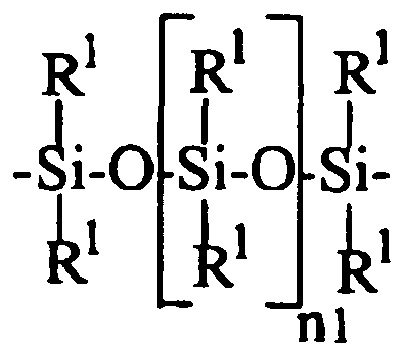
V1 is selected from divalent or trivalent, straight chained, cyclic or branched, saturated, unsaturated or aromatic hydrocarbon moieties with up to 1000 carbon atoms which can be substituted by one or more groups selected from -O-, -NR2-, -N+R2 2-, where R2 is as defined above and the groups R2 in V1 and V2 can be identical or different, -C(O)-, -C(S)- and -Z1-, where -Z1- is a moiety of the formula
where the positive charges of the ammonium groups are neutralized by organic or inorganic acid anions;
and, mixtures thereof. - The method of claim 1 wherein said solid synthetic textile is polyester.
- The method of claim 1 wherein said solid synthetic textile is nylon.
- The method of claim 1 wherein said solid synthetic textile is in the form of a finished garment.
- The method of claim 4 wherein said textile contains at least some polyester, nylon, or acrylic fibers, or mixtures thereof and/or mixtures of any of the foregoing with cotton and/or wool.
- The method of claim 1 wherein said composition comprising at least one silicone additive further comprises a laundry detergent or fabric conditioner used for cleaning and/or improving softness of said fabrics.
- The method of claim 1 wherein said altered surface of said solid synthetic textile has a hydrophilic coating that remains hydrophilic after multiple wash and dry cycles of a laundry machine.
- The method of claim 7 wherein said altered surface of said solid synthetic textile has a hydrophilic coating that remains hydrophilic after 3 or more wash and dry cycles of a laundry machine.
Applications Claiming Priority (2)
| Application Number | Priority Date | Filing Date | Title |
|---|---|---|---|
| US99521307P | 2007-09-25 | 2007-09-25 | |
| PCT/US2008/010942 WO2009042083A2 (en) | 2007-09-25 | 2008-09-18 | Method for altering the surface of a synthetic textile |
Publications (2)
| Publication Number | Publication Date |
|---|---|
| EP2203505A2 EP2203505A2 (en) | 2010-07-07 |
| EP2203505B1 true EP2203505B1 (en) | 2012-02-29 |
Family
ID=40394158
Family Applications (1)
| Application Number | Title | Priority Date | Filing Date |
|---|---|---|---|
| EP08834230A Not-in-force EP2203505B1 (en) | 2007-09-25 | 2008-09-18 | Method for altering the surface of a synthetic textile |
Country Status (8)
| Country | Link |
|---|---|
| US (1) | US20090178207A1 (en) |
| EP (1) | EP2203505B1 (en) |
| JP (1) | JP2010540789A (en) |
| KR (1) | KR20100061697A (en) |
| CN (1) | CN101874135A (en) |
| AT (1) | ATE547458T1 (en) |
| ES (1) | ES2379561T3 (en) |
| WO (1) | WO2009042083A2 (en) |
Families Citing this family (8)
| Publication number | Priority date | Publication date | Assignee | Title |
|---|---|---|---|---|
| US9534343B2 (en) | 2012-10-18 | 2017-01-03 | The Chemours Company Fc, Llc | Partially fluorinated copolymer emulsions containing fatty acids and esters |
| US11179312B2 (en) | 2017-06-05 | 2021-11-23 | Momentive Performance Materials Inc. | Aqueous compositions for the treatment of hair |
| US10982051B2 (en) | 2017-06-05 | 2021-04-20 | Momentive Performance Materials Inc. | Aqueous compositions for hair treatment comprising polyorganosiloxanes with polyhydroxyaromatic moieties |
| EP3501488B1 (en) | 2017-12-21 | 2021-04-14 | Momentive Performance Materials GmbH | Aqueous silicone polymer compositions |
| US20200163850A1 (en) | 2018-11-24 | 2020-05-28 | Momentive Performance Materials Gmbh | Use of polyhydroxyaromatic compounds for the treatment of fibrous amino acid based substrates |
| US11090255B2 (en) | 2018-12-04 | 2021-08-17 | Momentive Performance Materials Inc. | Use of polycarboxylic acid compounds for the treatment of fibrious amino acid based substrates, especially hair |
| US10617617B1 (en) | 2018-12-04 | 2020-04-14 | Momentive Performance Materials Inc. | Polycarboxylic acid compounds for the treatment of fibrious amino acid based substrates, especially hair |
| WO2023152299A1 (en) | 2022-02-14 | 2023-08-17 | Momentive Performance Materials Gmbh | Aspartic acid ester-functional polysiloxanes, their preparation and use thereof |
Family Cites Families (11)
| Publication number | Priority date | Publication date | Assignee | Title |
|---|---|---|---|---|
| JPS5854080A (en) * | 1981-09-28 | 1983-03-30 | 三菱レイヨン株式会社 | hydrophilic synthetic fiber |
| DE3247825A1 (en) * | 1982-12-23 | 1984-06-28 | Wacker-Chemie GmbH, 8000 München | ORGANOPOLYSILOXANS WITH SIC-BONDED OXYALKYLENE UNITS, METHOD FOR THE PRODUCTION THEREOF AND THE USE OF THESE ORGANOPOLYSILOXANS |
| JP2006505643A (en) * | 2002-11-04 | 2006-02-16 | ジーイー・バイエル・シリコーンズ・ゲゼルシヤフト・ミツト・ベシユレンクテル・ハフツング・ウント・コンパニー・コマンジツトゲゼルシヤフト | Linear polyamino and / or polyammonium polysiloxane copolymer II |
| DE10316662A1 (en) * | 2003-04-11 | 2004-11-11 | Ge Bayer Silicones Gmbh & Co. Kg | Reactive amino and / or ammonium polysiloxane compounds |
| DE102005014311A1 (en) * | 2005-03-30 | 2006-10-12 | Ge Bayer Silicones Gmbh & Co. Kg | Polyamino and / or polyammonium-polysiloxane-colpolymer compounds with comb-like arranged polyalkylenonide units |
| DE102005036602A1 (en) * | 2005-08-01 | 2007-02-08 | Ge Bayer Silicones Gmbh & Co. Kg | Polyammonium polysiloxane |
| US7652072B2 (en) * | 2005-10-13 | 2010-01-26 | Momentive Performance Materials Inc. | Hydrolysis resistant organomodified disiloxane surfactants |
| US7507775B2 (en) * | 2005-10-13 | 2009-03-24 | Momentive Performance Materials Inc. | Hydrolysis resistant organomodified disiloxane surfactants |
| US20070131611A1 (en) * | 2005-12-13 | 2007-06-14 | General Electric Company | Membrane-based article and associated method |
| US7935842B2 (en) * | 2006-02-09 | 2011-05-03 | Momentive Performance Materials Inc. | Hydrolysis resistant organomodified trisiloxane surfactants |
| US20070249560A1 (en) * | 2006-04-21 | 2007-10-25 | Leatherman Mark D | Hydrolysis resistant organomodified silyated surfactants |
-
2008
- 2008-09-18 JP JP2010526910A patent/JP2010540789A/en active Pending
- 2008-09-18 WO PCT/US2008/010942 patent/WO2009042083A2/en not_active Ceased
- 2008-09-18 KR KR1020107006464A patent/KR20100061697A/en not_active Ceased
- 2008-09-18 EP EP08834230A patent/EP2203505B1/en not_active Not-in-force
- 2008-09-18 US US12/284,050 patent/US20090178207A1/en not_active Abandoned
- 2008-09-18 AT AT08834230T patent/ATE547458T1/en active
- 2008-09-18 CN CN200880117574A patent/CN101874135A/en active Pending
- 2008-09-18 ES ES08834230T patent/ES2379561T3/en active Active
Also Published As
| Publication number | Publication date |
|---|---|
| WO2009042083A3 (en) | 2009-07-09 |
| KR20100061697A (en) | 2010-06-08 |
| JP2010540789A (en) | 2010-12-24 |
| US20090178207A1 (en) | 2009-07-16 |
| CN101874135A (en) | 2010-10-27 |
| WO2009042083A2 (en) | 2009-04-02 |
| EP2203505A2 (en) | 2010-07-07 |
| ATE547458T1 (en) | 2012-03-15 |
| ES2379561T3 (en) | 2012-04-27 |
Similar Documents
| Publication | Publication Date | Title |
|---|---|---|
| US20090178207A1 (en) | Method for altering the surface of a synthetic textile | |
| EP0255711B1 (en) | Article for conditioning fabrics in a laundry dryer | |
| US4207071A (en) | Durable modification of fibrous substrates using a polyoxyethylene-containing silane and articles therefrom | |
| EP0138077B1 (en) | Method and siloxane composition for treating fibers | |
| US20080005852A1 (en) | Durable multifunctional finishing of fabrics | |
| US4908140A (en) | Method of enhancing fabric rewettability with an aqueous emulsion of branched and cross-linked polydimethylsiloxane | |
| EP0422787A2 (en) | Liquid detergent fabric softening laundering composition | |
| CA2004622C (en) | Fiber treatment agent composition | |
| AU2012301742B2 (en) | Method for providing fast dry to fabric | |
| CN102791922B (en) | Process for treating cellulosic fibers or cellulosic fiber products | |
| US4902739A (en) | Fiber-treatment composition | |
| AU614175B2 (en) | Method of enhancing fabric rewettability | |
| Zięba et al. | Effects of chemical structure of silicone polyethers used as fabric softener additives on selected utility properties of cotton fabric | |
| KR20020038936A (en) | Fabric softener compositions | |
| KR100958605B1 (en) | Permeability imparting agent and the fiber to which the imparting agent is attached | |
| HK1149304A (en) | Method for altering the surface of a synthetic textile | |
| JP4198597B2 (en) | Permanent press processing of fabric | |
| WO2020223149A1 (en) | Formulation for durable wicking softening and anti-static textiles | |
| JP4342899B2 (en) | Wrinkle remover composition for textile products | |
| KR100834482B1 (en) | Fiber treatment composition | |
| KR20010050015A (en) | Wool treatment agent | |
| JP2004211232A (en) | Wrinkle remover composition for textile products | |
| JP2025177244A (en) | Antistatic finishing agent for fibers, antistatic treated fibers, and method for producing antistatic treated fibers | |
| CN117265870A (en) | Drying and soft fragrant tablets based on papermaking fibers and preparation method thereof | |
| HK40067624A (en) | Formulation for durable wicking softening and anti-static textiles |
Legal Events
| Date | Code | Title | Description |
|---|---|---|---|
| PUAI | Public reference made under article 153(3) epc to a published international application that has entered the european phase |
Free format text: ORIGINAL CODE: 0009012 |
|
| 17P | Request for examination filed |
Effective date: 20100426 |
|
| AK | Designated contracting states |
Kind code of ref document: A2 Designated state(s): AT BE BG CH CY CZ DE DK EE ES FI FR GB GR HR HU IE IS IT LI LT LU LV MC MT NL NO PL PT RO SE SI SK TR |
|
| AX | Request for extension of the european patent |
Extension state: AL BA MK RS |
|
| GRAP | Despatch of communication of intention to grant a patent |
Free format text: ORIGINAL CODE: EPIDOSNIGR1 |
|
| DAX | Request for extension of the european patent (deleted) | ||
| GRAS | Grant fee paid |
Free format text: ORIGINAL CODE: EPIDOSNIGR3 |
|
| GRAA | (expected) grant |
Free format text: ORIGINAL CODE: 0009210 |
|
| AK | Designated contracting states |
Kind code of ref document: B1 Designated state(s): AT BE BG CH CY CZ DE DK EE ES FI FR GB GR HR HU IE IS IT LI LT LU LV MC MT NL NO PL PT RO SE SI SK TR |
|
| REG | Reference to a national code |
Ref country code: GB Ref legal event code: FG4D Ref country code: CH Ref legal event code: EP |
|
| REG | Reference to a national code |
Ref country code: NL Ref legal event code: T3 |
|
| REG | Reference to a national code |
Ref country code: AT Ref legal event code: REF Ref document number: 547458 Country of ref document: AT Kind code of ref document: T Effective date: 20120315 |
|
| REG | Reference to a national code |
Ref country code: IE Ref legal event code: FG4D |
|
| REG | Reference to a national code |
Ref country code: DE Ref legal event code: R096 Ref document number: 602008013823 Country of ref document: DE Effective date: 20120426 |
|
| REG | Reference to a national code |
Ref country code: ES Ref legal event code: FG2A Ref document number: 2379561 Country of ref document: ES Kind code of ref document: T3 Effective date: 20120427 |
|
| LTIE | Lt: invalidation of european patent or patent extension |
Effective date: 20120229 |
|
| PG25 | Lapsed in a contracting state [announced via postgrant information from national office to epo] |
Ref country code: IS Free format text: LAPSE BECAUSE OF FAILURE TO SUBMIT A TRANSLATION OF THE DESCRIPTION OR TO PAY THE FEE WITHIN THE PRESCRIBED TIME-LIMIT Effective date: 20120629 Ref country code: LT Free format text: LAPSE BECAUSE OF FAILURE TO SUBMIT A TRANSLATION OF THE DESCRIPTION OR TO PAY THE FEE WITHIN THE PRESCRIBED TIME-LIMIT Effective date: 20120229 Ref country code: NO Free format text: LAPSE BECAUSE OF FAILURE TO SUBMIT A TRANSLATION OF THE DESCRIPTION OR TO PAY THE FEE WITHIN THE PRESCRIBED TIME-LIMIT Effective date: 20120529 Ref country code: HR Free format text: LAPSE BECAUSE OF FAILURE TO SUBMIT A TRANSLATION OF THE DESCRIPTION OR TO PAY THE FEE WITHIN THE PRESCRIBED TIME-LIMIT Effective date: 20120229 |
|
| PG25 | Lapsed in a contracting state [announced via postgrant information from national office to epo] |
Ref country code: BE Free format text: LAPSE BECAUSE OF FAILURE TO SUBMIT A TRANSLATION OF THE DESCRIPTION OR TO PAY THE FEE WITHIN THE PRESCRIBED TIME-LIMIT Effective date: 20120229 Ref country code: FI Free format text: LAPSE BECAUSE OF FAILURE TO SUBMIT A TRANSLATION OF THE DESCRIPTION OR TO PAY THE FEE WITHIN THE PRESCRIBED TIME-LIMIT Effective date: 20120229 Ref country code: GR Free format text: LAPSE BECAUSE OF FAILURE TO SUBMIT A TRANSLATION OF THE DESCRIPTION OR TO PAY THE FEE WITHIN THE PRESCRIBED TIME-LIMIT Effective date: 20120530 Ref country code: PT Free format text: LAPSE BECAUSE OF FAILURE TO SUBMIT A TRANSLATION OF THE DESCRIPTION OR TO PAY THE FEE WITHIN THE PRESCRIBED TIME-LIMIT Effective date: 20120629 Ref country code: LV Free format text: LAPSE BECAUSE OF FAILURE TO SUBMIT A TRANSLATION OF THE DESCRIPTION OR TO PAY THE FEE WITHIN THE PRESCRIBED TIME-LIMIT Effective date: 20120229 |
|
| REG | Reference to a national code |
Ref country code: AT Ref legal event code: MK05 Ref document number: 547458 Country of ref document: AT Kind code of ref document: T Effective date: 20120229 |
|
| PG25 | Lapsed in a contracting state [announced via postgrant information from national office to epo] |
Ref country code: CY Free format text: LAPSE BECAUSE OF FAILURE TO SUBMIT A TRANSLATION OF THE DESCRIPTION OR TO PAY THE FEE WITHIN THE PRESCRIBED TIME-LIMIT Effective date: 20120229 |
|
| PG25 | Lapsed in a contracting state [announced via postgrant information from national office to epo] |
Ref country code: DK Free format text: LAPSE BECAUSE OF FAILURE TO SUBMIT A TRANSLATION OF THE DESCRIPTION OR TO PAY THE FEE WITHIN THE PRESCRIBED TIME-LIMIT Effective date: 20120229 Ref country code: CZ Free format text: LAPSE BECAUSE OF FAILURE TO SUBMIT A TRANSLATION OF THE DESCRIPTION OR TO PAY THE FEE WITHIN THE PRESCRIBED TIME-LIMIT Effective date: 20120229 Ref country code: RO Free format text: LAPSE BECAUSE OF FAILURE TO SUBMIT A TRANSLATION OF THE DESCRIPTION OR TO PAY THE FEE WITHIN THE PRESCRIBED TIME-LIMIT Effective date: 20120229 Ref country code: SI Free format text: LAPSE BECAUSE OF FAILURE TO SUBMIT A TRANSLATION OF THE DESCRIPTION OR TO PAY THE FEE WITHIN THE PRESCRIBED TIME-LIMIT Effective date: 20120229 Ref country code: SE Free format text: LAPSE BECAUSE OF FAILURE TO SUBMIT A TRANSLATION OF THE DESCRIPTION OR TO PAY THE FEE WITHIN THE PRESCRIBED TIME-LIMIT Effective date: 20120229 Ref country code: EE Free format text: LAPSE BECAUSE OF FAILURE TO SUBMIT A TRANSLATION OF THE DESCRIPTION OR TO PAY THE FEE WITHIN THE PRESCRIBED TIME-LIMIT Effective date: 20120229 Ref country code: PL Free format text: LAPSE BECAUSE OF FAILURE TO SUBMIT A TRANSLATION OF THE DESCRIPTION OR TO PAY THE FEE WITHIN THE PRESCRIBED TIME-LIMIT Effective date: 20120229 |
|
| PG25 | Lapsed in a contracting state [announced via postgrant information from national office to epo] |
Ref country code: SK Free format text: LAPSE BECAUSE OF FAILURE TO SUBMIT A TRANSLATION OF THE DESCRIPTION OR TO PAY THE FEE WITHIN THE PRESCRIBED TIME-LIMIT Effective date: 20120229 |
|
| PLBE | No opposition filed within time limit |
Free format text: ORIGINAL CODE: 0009261 |
|
| STAA | Information on the status of an ep patent application or granted ep patent |
Free format text: STATUS: NO OPPOSITION FILED WITHIN TIME LIMIT |
|
| PG25 | Lapsed in a contracting state [announced via postgrant information from national office to epo] |
Ref country code: AT Free format text: LAPSE BECAUSE OF FAILURE TO SUBMIT A TRANSLATION OF THE DESCRIPTION OR TO PAY THE FEE WITHIN THE PRESCRIBED TIME-LIMIT Effective date: 20120229 |
|
| 26N | No opposition filed |
Effective date: 20121130 |
|
| REG | Reference to a national code |
Ref country code: DE Ref legal event code: R097 Ref document number: 602008013823 Country of ref document: DE Effective date: 20121130 |
|
| PG25 | Lapsed in a contracting state [announced via postgrant information from national office to epo] |
Ref country code: MC Free format text: LAPSE BECAUSE OF NON-PAYMENT OF DUE FEES Effective date: 20120930 |
|
| REG | Reference to a national code |
Ref country code: CH Ref legal event code: PL |
|
| REG | Reference to a national code |
Ref country code: IE Ref legal event code: MM4A |
|
| PG25 | Lapsed in a contracting state [announced via postgrant information from national office to epo] |
Ref country code: BG Free format text: LAPSE BECAUSE OF FAILURE TO SUBMIT A TRANSLATION OF THE DESCRIPTION OR TO PAY THE FEE WITHIN THE PRESCRIBED TIME-LIMIT Effective date: 20120529 Ref country code: CH Free format text: LAPSE BECAUSE OF NON-PAYMENT OF DUE FEES Effective date: 20120930 Ref country code: LI Free format text: LAPSE BECAUSE OF NON-PAYMENT OF DUE FEES Effective date: 20120930 Ref country code: IE Free format text: LAPSE BECAUSE OF NON-PAYMENT OF DUE FEES Effective date: 20120918 |
|
| PGFP | Annual fee paid to national office [announced via postgrant information from national office to epo] |
Ref country code: ES Payment date: 20130926 Year of fee payment: 6 Ref country code: NL Payment date: 20130926 Year of fee payment: 6 Ref country code: DE Payment date: 20130927 Year of fee payment: 6 |
|
| PG25 | Lapsed in a contracting state [announced via postgrant information from national office to epo] |
Ref country code: MT Free format text: LAPSE BECAUSE OF FAILURE TO SUBMIT A TRANSLATION OF THE DESCRIPTION OR TO PAY THE FEE WITHIN THE PRESCRIBED TIME-LIMIT Effective date: 20120229 |
|
| PGFP | Annual fee paid to national office [announced via postgrant information from national office to epo] |
Ref country code: FR Payment date: 20130919 Year of fee payment: 6 Ref country code: GB Payment date: 20130927 Year of fee payment: 6 |
|
| PGFP | Annual fee paid to national office [announced via postgrant information from national office to epo] |
Ref country code: IT Payment date: 20130923 Year of fee payment: 6 |
|
| PG25 | Lapsed in a contracting state [announced via postgrant information from national office to epo] |
Ref country code: TR Free format text: LAPSE BECAUSE OF FAILURE TO SUBMIT A TRANSLATION OF THE DESCRIPTION OR TO PAY THE FEE WITHIN THE PRESCRIBED TIME-LIMIT Effective date: 20120229 |
|
| PG25 | Lapsed in a contracting state [announced via postgrant information from national office to epo] |
Ref country code: LU Free format text: LAPSE BECAUSE OF NON-PAYMENT OF DUE FEES Effective date: 20120918 |
|
| PG25 | Lapsed in a contracting state [announced via postgrant information from national office to epo] |
Ref country code: HU Free format text: LAPSE BECAUSE OF FAILURE TO SUBMIT A TRANSLATION OF THE DESCRIPTION OR TO PAY THE FEE WITHIN THE PRESCRIBED TIME-LIMIT Effective date: 20080918 |
|
| REG | Reference to a national code |
Ref country code: DE Ref legal event code: R119 Ref document number: 602008013823 Country of ref document: DE |
|
| GBPC | Gb: european patent ceased through non-payment of renewal fee |
Effective date: 20140918 |
|
| REG | Reference to a national code |
Ref country code: DE Ref legal event code: R119 Ref document number: 602008013823 Country of ref document: DE Effective date: 20150401 |
|
| REG | Reference to a national code |
Ref country code: FR Ref legal event code: ST Effective date: 20150529 |
|
| PG25 | Lapsed in a contracting state [announced via postgrant information from national office to epo] |
Ref country code: NL Free format text: LAPSE BECAUSE OF NON-PAYMENT OF DUE FEES Effective date: 20150401 |
|
| PG25 | Lapsed in a contracting state [announced via postgrant information from national office to epo] |
Ref country code: DE Free format text: LAPSE BECAUSE OF NON-PAYMENT OF DUE FEES Effective date: 20150401 Ref country code: GB Free format text: LAPSE BECAUSE OF NON-PAYMENT OF DUE FEES Effective date: 20140918 |
|
| PG25 | Lapsed in a contracting state [announced via postgrant information from national office to epo] |
Ref country code: FR Free format text: LAPSE BECAUSE OF NON-PAYMENT OF DUE FEES Effective date: 20140930 Ref country code: IT Free format text: LAPSE BECAUSE OF NON-PAYMENT OF DUE FEES Effective date: 20140918 |
|
| REG | Reference to a national code |
Ref country code: ES Ref legal event code: FD2A Effective date: 20151029 |
|
| PG25 | Lapsed in a contracting state [announced via postgrant information from national office to epo] |
Ref country code: ES Free format text: LAPSE BECAUSE OF NON-PAYMENT OF DUE FEES Effective date: 20140919 |