EP2202831A1 - Supported catalyst for fuel cell and fuel cells - Google Patents
Supported catalyst for fuel cell and fuel cells Download PDFInfo
- Publication number
- EP2202831A1 EP2202831A1 EP08839988A EP08839988A EP2202831A1 EP 2202831 A1 EP2202831 A1 EP 2202831A1 EP 08839988 A EP08839988 A EP 08839988A EP 08839988 A EP08839988 A EP 08839988A EP 2202831 A1 EP2202831 A1 EP 2202831A1
- Authority
- EP
- European Patent Office
- Prior art keywords
- supported
- catalyst
- platinum
- powder
- particle diameter
- Prior art date
- Legal status (The legal status is an assumption and is not a legal conclusion. Google has not performed a legal analysis and makes no representation as to the accuracy of the status listed.)
- Withdrawn
Links
- 239000003054 catalyst Substances 0.000 title claims abstract description 134
- 239000000446 fuel Substances 0.000 title claims abstract description 30
- BASFCYQUMIYNBI-UHFFFAOYSA-N platinum Chemical compound [Pt] BASFCYQUMIYNBI-UHFFFAOYSA-N 0.000 claims abstract description 143
- 229910052697 platinum Inorganic materials 0.000 claims abstract description 65
- 239000002245 particle Substances 0.000 claims abstract description 64
- 230000001186 cumulative effect Effects 0.000 claims abstract description 8
- 238000000034 method Methods 0.000 claims abstract description 8
- 238000000149 argon plasma sintering Methods 0.000 claims abstract description 5
- 239000003575 carbonaceous material Substances 0.000 claims description 4
- 238000005516 engineering process Methods 0.000 abstract description 3
- 239000000843 powder Substances 0.000 description 63
- OKTJSMMVPCPJKN-UHFFFAOYSA-N Carbon Chemical compound [C] OKTJSMMVPCPJKN-UHFFFAOYSA-N 0.000 description 32
- 239000007784 solid electrolyte Substances 0.000 description 17
- XLYOFNOQVPJJNP-UHFFFAOYSA-N water Substances O XLYOFNOQVPJJNP-UHFFFAOYSA-N 0.000 description 9
- 229920000642 polymer Polymers 0.000 description 8
- 229910001260 Pt alloy Inorganic materials 0.000 description 7
- 239000006185 dispersion Substances 0.000 description 7
- UFHFLCQGNIYNRP-UHFFFAOYSA-N Hydrogen Chemical compound [H][H] UFHFLCQGNIYNRP-UHFFFAOYSA-N 0.000 description 6
- 229910052799 carbon Inorganic materials 0.000 description 6
- 229910052739 hydrogen Inorganic materials 0.000 description 6
- 239000001257 hydrogen Substances 0.000 description 6
- 239000000243 solution Substances 0.000 description 6
- 229910002651 NO3 Inorganic materials 0.000 description 5
- NHNBFGGVMKEFGY-UHFFFAOYSA-N Nitrate Chemical compound [O-][N+]([O-])=O NHNBFGGVMKEFGY-UHFFFAOYSA-N 0.000 description 5
- QVGXLLKOCUKJST-UHFFFAOYSA-N atomic oxygen Chemical compound [O] QVGXLLKOCUKJST-UHFFFAOYSA-N 0.000 description 5
- 229910052760 oxygen Inorganic materials 0.000 description 5
- 239000001301 oxygen Substances 0.000 description 5
- 238000005259 measurement Methods 0.000 description 4
- 239000007864 aqueous solution Substances 0.000 description 3
- 230000003197 catalytic effect Effects 0.000 description 3
- 230000000052 comparative effect Effects 0.000 description 3
- CIWBSHSKHKDKBQ-JLAZNSOCSA-N Ascorbic acid Chemical compound OC[C@H](O)[C@H]1OC(=O)C(O)=C1O CIWBSHSKHKDKBQ-JLAZNSOCSA-N 0.000 description 2
- XEEYBQQBJWHFJM-UHFFFAOYSA-N Iron Chemical compound [Fe] XEEYBQQBJWHFJM-UHFFFAOYSA-N 0.000 description 2
- 229920000557 Nafion® Polymers 0.000 description 2
- KDLHZDBZIXYQEI-UHFFFAOYSA-N Palladium Chemical compound [Pd] KDLHZDBZIXYQEI-UHFFFAOYSA-N 0.000 description 2
- 239000012298 atmosphere Substances 0.000 description 2
- 239000006229 carbon black Substances 0.000 description 2
- 238000006243 chemical reaction Methods 0.000 description 2
- 239000003638 chemical reducing agent Substances 0.000 description 2
- 239000004020 conductor Substances 0.000 description 2
- 238000001914 filtration Methods 0.000 description 2
- 230000007774 longterm Effects 0.000 description 2
- 238000012986 modification Methods 0.000 description 2
- 230000004048 modification Effects 0.000 description 2
- 230000008569 process Effects 0.000 description 2
- 230000001105 regulatory effect Effects 0.000 description 2
- 239000012279 sodium borohydride Substances 0.000 description 2
- 229910000033 sodium borohydride Inorganic materials 0.000 description 2
- VYZAMTAEIAYCRO-UHFFFAOYSA-N Chromium Chemical compound [Cr] VYZAMTAEIAYCRO-UHFFFAOYSA-N 0.000 description 1
- RYGMFSIKBFXOCR-UHFFFAOYSA-N Copper Chemical compound [Cu] RYGMFSIKBFXOCR-UHFFFAOYSA-N 0.000 description 1
- KJTLSVCANCCWHF-UHFFFAOYSA-N Ruthenium Chemical compound [Ru] KJTLSVCANCCWHF-UHFFFAOYSA-N 0.000 description 1
- 239000004809 Teflon Substances 0.000 description 1
- 229920006362 Teflon® Polymers 0.000 description 1
- 238000002441 X-ray diffraction Methods 0.000 description 1
- 230000002411 adverse Effects 0.000 description 1
- 230000002776 aggregation Effects 0.000 description 1
- 238000004220 aggregation Methods 0.000 description 1
- 229910052782 aluminium Inorganic materials 0.000 description 1
- XAGFODPZIPBFFR-UHFFFAOYSA-N aluminium Chemical compound [Al] XAGFODPZIPBFFR-UHFFFAOYSA-N 0.000 description 1
- 239000002041 carbon nanotube Substances 0.000 description 1
- 229910021393 carbon nanotube Inorganic materials 0.000 description 1
- 230000015556 catabolic process Effects 0.000 description 1
- 229910052804 chromium Inorganic materials 0.000 description 1
- 239000011651 chromium Substances 0.000 description 1
- 229910017052 cobalt Inorganic materials 0.000 description 1
- 239000010941 cobalt Substances 0.000 description 1
- GUTLYIVDDKVIGB-UHFFFAOYSA-N cobalt atom Chemical compound [Co] GUTLYIVDDKVIGB-UHFFFAOYSA-N 0.000 description 1
- 229910052802 copper Inorganic materials 0.000 description 1
- 239000010949 copper Substances 0.000 description 1
- 238000006731 degradation reaction Methods 0.000 description 1
- 238000009792 diffusion process Methods 0.000 description 1
- 238000001035 drying Methods 0.000 description 1
- 239000008151 electrolyte solution Substances 0.000 description 1
- 230000002708 enhancing effect Effects 0.000 description 1
- UQSQSQZYBQSBJZ-UHFFFAOYSA-N fluorosulfonic acid Chemical compound OS(F)(=O)=O UQSQSQZYBQSBJZ-UHFFFAOYSA-N 0.000 description 1
- PCHJSUWPFVWCPO-UHFFFAOYSA-N gold Chemical compound [Au] PCHJSUWPFVWCPO-UHFFFAOYSA-N 0.000 description 1
- 229910052737 gold Inorganic materials 0.000 description 1
- 239000010931 gold Substances 0.000 description 1
- 229910002804 graphite Inorganic materials 0.000 description 1
- 239000010439 graphite Substances 0.000 description 1
- 229920000554 ionomer Polymers 0.000 description 1
- 229910052741 iridium Inorganic materials 0.000 description 1
- GKOZUEZYRPOHIO-UHFFFAOYSA-N iridium atom Chemical compound [Ir] GKOZUEZYRPOHIO-UHFFFAOYSA-N 0.000 description 1
- 229910052742 iron Inorganic materials 0.000 description 1
- WPBNNNQJVZRUHP-UHFFFAOYSA-L manganese(2+);methyl n-[[2-(methoxycarbonylcarbamothioylamino)phenyl]carbamothioyl]carbamate;n-[2-(sulfidocarbothioylamino)ethyl]carbamodithioate Chemical compound [Mn+2].[S-]C(=S)NCCNC([S-])=S.COC(=O)NC(=S)NC1=CC=CC=C1NC(=S)NC(=O)OC WPBNNNQJVZRUHP-UHFFFAOYSA-L 0.000 description 1
- 229910052751 metal Inorganic materials 0.000 description 1
- 239000002184 metal Substances 0.000 description 1
- 239000000203 mixture Substances 0.000 description 1
- 239000003960 organic solvent Substances 0.000 description 1
- 238000007254 oxidation reaction Methods 0.000 description 1
- 229910052763 palladium Inorganic materials 0.000 description 1
- 150000003058 platinum compounds Chemical class 0.000 description 1
- 238000010248 power generation Methods 0.000 description 1
- 230000001376 precipitating effect Effects 0.000 description 1
- 238000006722 reduction reaction Methods 0.000 description 1
- 229910052703 rhodium Inorganic materials 0.000 description 1
- 239000010948 rhodium Substances 0.000 description 1
- MHOVAHRLVXNVSD-UHFFFAOYSA-N rhodium atom Chemical compound [Rh] MHOVAHRLVXNVSD-UHFFFAOYSA-N 0.000 description 1
- 229910052707 ruthenium Inorganic materials 0.000 description 1
- 150000003839 salts Chemical class 0.000 description 1
- 238000001228 spectrum Methods 0.000 description 1
- 239000000758 substrate Substances 0.000 description 1
- WFKWXMTUELFFGS-UHFFFAOYSA-N tungsten Chemical compound [W] WFKWXMTUELFFGS-UHFFFAOYSA-N 0.000 description 1
- 229910052721 tungsten Inorganic materials 0.000 description 1
- 239000010937 tungsten Substances 0.000 description 1
Images


Classifications
-
- H—ELECTRICITY
- H01—ELECTRIC ELEMENTS
- H01M—PROCESSES OR MEANS, e.g. BATTERIES, FOR THE DIRECT CONVERSION OF CHEMICAL ENERGY INTO ELECTRICAL ENERGY
- H01M4/00—Electrodes
- H01M4/86—Inert electrodes with catalytic activity, e.g. for fuel cells
- H01M4/90—Selection of catalytic material
- H01M4/92—Metals of platinum group
-
- H—ELECTRICITY
- H01—ELECTRIC ELEMENTS
- H01M—PROCESSES OR MEANS, e.g. BATTERIES, FOR THE DIRECT CONVERSION OF CHEMICAL ENERGY INTO ELECTRICAL ENERGY
- H01M4/00—Electrodes
- H01M4/86—Inert electrodes with catalytic activity, e.g. for fuel cells
- H01M4/90—Selection of catalytic material
- H01M4/92—Metals of platinum group
- H01M4/925—Metals of platinum group supported on carriers, e.g. powder carriers
- H01M4/926—Metals of platinum group supported on carriers, e.g. powder carriers on carbon or graphite
-
- H—ELECTRICITY
- H01—ELECTRIC ELEMENTS
- H01M—PROCESSES OR MEANS, e.g. BATTERIES, FOR THE DIRECT CONVERSION OF CHEMICAL ENERGY INTO ELECTRICAL ENERGY
- H01M8/00—Fuel cells; Manufacture thereof
- H01M8/10—Fuel cells with solid electrolytes
- H01M2008/1095—Fuel cells with polymeric electrolytes
-
- H—ELECTRICITY
- H01—ELECTRIC ELEMENTS
- H01M—PROCESSES OR MEANS, e.g. BATTERIES, FOR THE DIRECT CONVERSION OF CHEMICAL ENERGY INTO ELECTRICAL ENERGY
- H01M4/00—Electrodes
- H01M4/86—Inert electrodes with catalytic activity, e.g. for fuel cells
- H01M4/88—Processes of manufacture
- H01M4/8825—Methods for deposition of the catalytic active composition
- H01M4/8842—Coating using a catalyst salt precursor in solution followed by evaporation and reduction of the precursor
-
- Y—GENERAL TAGGING OF NEW TECHNOLOGICAL DEVELOPMENTS; GENERAL TAGGING OF CROSS-SECTIONAL TECHNOLOGIES SPANNING OVER SEVERAL SECTIONS OF THE IPC; TECHNICAL SUBJECTS COVERED BY FORMER USPC CROSS-REFERENCE ART COLLECTIONS [XRACs] AND DIGESTS
- Y02—TECHNOLOGIES OR APPLICATIONS FOR MITIGATION OR ADAPTATION AGAINST CLIMATE CHANGE
- Y02E—REDUCTION OF GREENHOUSE GAS [GHG] EMISSIONS, RELATED TO ENERGY GENERATION, TRANSMISSION OR DISTRIBUTION
- Y02E60/00—Enabling technologies; Technologies with a potential or indirect contribution to GHG emissions mitigation
- Y02E60/30—Hydrogen technology
- Y02E60/50—Fuel cells
Definitions
- the present invention relates to a supported catalyst for fuel cell and a fuel cell.
- Fuel cells are receiving wide attention as power sources that ensure high power generation efficiency and that can be easily miniaturized, and that have less adverse impact on the environment.
- solid-polymer fuel cells are being intensely studied as a form suitable for use in automobiles, etc., because they can operate at room temperature and can realize a high output density.
- the solid-polymer fuel cells generate an electromotive force by a combination of the oxidation reaction of hydrogen at their anode with the reduction reaction of oxygen at their cathode. Accordingly, for enhancing the performance of the solid-polymer fuel cells, it is necessary to efficiently accomplish the above reactions.
- an anode and/or cathode catalyst layer containing a catalyst metal, such as platinum, is used in the solid-polymer fuel cell so as to increase the efficiency of the above reactions and thus enhance the performance of the cell.
- a catalyst metal such as platinum
- JP 2002-15745 A describes a solid-polymer fuel cell comprising an anode and/or cathode catalyst layer containing a carbon carrier on which platinum or a platinum alloy is supported.
- the catalyst components, electrolytic solutions, and the like may suffer degradation by the long-term use of the cell.
- post-endurance performance it is desired to develop the technology for providing a fuel cell that excels in both the initial performance and the performance after long-term use (hereinafter referred to as post-endurance performance).
- an object of the present invention is to provide the technology useful for the realization of a fuel cell that excels in not only the initial performance but also the post-endurance performance.
- a supported catalyst for fuel cell comprising a conductive carrier and platinum supported on the conductive carrier, wherein a 90% particle diameter D 90 on a cumulative particle size curve obtained by determining a particle size distribution of the supported catalyst by a light scattering method is 28 ⁇ m or less.
- a fuel cell comprising a catalyst layer containing the catalyst according to the first aspect as an anode catalyst layer and/or a cathode catalyst layer.
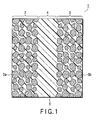
- FIG. 1 is a sectional view schematically showing a fuel cell according to one embodiment of the present invention.
- FIG. 1 shows a membrane-electrode assembly for solid-polymer fuel cell as an example.
- the membrane-electrode assembly 1 includes an anode catalyst layer 2, a cathode catalyst layer 3, and a proton-conducting solid electrolyte layer 4 interposed therebetween and containing a proton-conducting solid electrolyte.
- the anode catalyst layer 2 contains a supported catalyst 5a and a proton-conducting solid electrolyte 6.
- the cathode catalyst layer 3 contains a supported catalyst 5b and a proton-conducting solid electrolyte 6. Further, the proton-conducting solid electrolyte layer 4 contains a proton-conducting solid electrolyte 6.
- the membrane-electrode assembly 1 When gaseous hydrogen is fed from the side of the anode catalyst layer 2 and simultaneously oxygen or air is fed to the side of the cathode catalyst layer 3, the membrane-electrode assembly 1 generates an electromotive force between the anode catalyst layer 2 and the cathode catalyst layer 3. More specifically, on the anode catalyst layer 2, hydrogen molecules are oxidized by the catalytic action of platinum or a platinum alloy to thereby produce protons and electrons. The thus produced electrons move through a conductive carrier, such as a carbon carrier, as a conductor channel and are taken out from the anode catalyst layer 2 to an external circuit. The thus produced protons move from the anode catalyst layer 2 via the proton-conducting solid electrolyte layer 4 to the cathode catalyst layer 3.
- a conductive carrier such as a carbon carrier
- the protons having arrived at the cathode catalyst layer 3 react by the catalytic action of platinum or a platinum alloy with oxygen molecules and electrons fed from the external circuit via a carbon carrier or the like as a conductor channel to thereby produce water.
- This membrane-electrode assembly 1 generates an electrical energy from gaseous hydrogen and gaseous oxygen by utilization of such phenomena.
- the supported catalyst 5a contained in the anode catalyst layer 2 and/or the supported catalyst 5b contained in the cathode catalyst layer 3 are/is, for example, conductive carrier supporting platinum or a platinum alloy as a platinum catalyst.
- the platinum alloy may be composed of, for example, platinum and a member selected from among iron, manganese, cobalt, aluminum, copper, chromium, palladium, tungsten, iridium, gold, rhodium, ruthenium and the like.
- the conductive carrier use can be made of, for example, a carbon carrier being made of a carbonaceous material.
- the carbonaceous material use can be made of, for example, graphite, active carbon, carbon black, carbon nanotubes or a combination thereof. In particular, it is preferred to use carbon black as the carbonaceous material.
- a 90% particle diameter D 90 of at least one of the supported catalysts 5a and 5b is 28 ⁇ m or less.
- FIG. 2 is a graph showing an example of particle size distribution curve obtained by determining the particle size distribution of a supported catalyst by a light scattering method.
- FIG. 3 is a graph showing a cumulative particle size curve obtained from the particle size distribution curve of FIG. 2 .
- the abscissa is the particle diameter of the supported catalyst, and the ordinate is the relative frequency of each particle diameter.
- the abscissa is the particle diameter of the supported catalyst, and the ordinate is the cumulative frequency of each particle diameter.
- the "90% particle diameter D 90" means the particle diameter of supported catalyst at which the cumulative frequency is 90%.
- the greater the 90% particle diameter D 90 the less smooth the anode catalyst layer 2 and/or cathode catalyst layer 3 becomes. Accordingly, a local stress applies to the interface between the anode catalyst layer 2 and/or cathode catalyst layer 3 and the proton-conducting solid electrolyte layer 4, thereby causing the proton-conducting solid electrolyte layer 4 to sustain damage. That is, the post-endurance performance of the fuel cell may become poorer. Also, the greater the 90% particle diameter D 90 , the more likely the aggregation of supported catalyst particles occurs. Accordingly, the contact between the platinum or platinum alloy contained in the supported catalyst 5a and/or 5b and substrate molecules such as hydrogen or oxygen becomes more difficult, thereby causing the catalytic activity to become poorer.
- the 90% particle diameter D 90 is set to 28 ⁇ m or less.
- the 90% particle diameter D 90 is greater than 0 ⁇ m and is, for example, greater than 1 ⁇ m.
- the supported catalyst may be contained in either the anode catalyst layer 2 or the cathode catalyst layer 3 only, or may be contained in both of the anode catalyst layer 2 and the cathode catalyst layer 3.
- the supported catalyst use can be made of, for example, the one produced by the following method.
- a particulate conductive carrier is allowed to support platinum.
- an aqueous solution of a platinum compound such as a salt containing platinum
- a conductive carrier such as a carbon carrier in water.
- the resultant dispersion is filtered and washed, and the obtained filtration cake is re-dispersed in water.
- a solution of a reducing agent, such as sodium borohydride or the like, is dropped into the dispersion, thereby causing platinum to precipitate (metallize) on the conductive carrier. Thereafter, the mixture is filtered and washed.
- the thus obtained conductive carrier having platinum supported thereon is heated so as to dry the same.
- the powder obtained by the drying is comminuted in an inert atmosphere until the 90% particle diameter D 90 thereof reaches a desired value.
- the supported catalyst is obtained by the stated process.
- the amount of supported platinum in the supported catalysts 5a and 5b is preferred for the amount of supported platinum in the supported catalysts 5a and 5b to fall within the range of about 38 to about 90 mass%, especially about 45 to about 80 mass%.
- the initial performance (initial cell voltage) and/or post-endurance performance (post-endurance cell voltage) of the fuel cell can be further enhanced by causing the amount of supported platinum to fall within the above range.
- the proton-conducting solid electrolyte 6 contained in each of the anode catalyst layer 2, cathode catalyst layer 3 and proton-conducting solid electrolyte layer 4 contains, for example, water.
- the proton-conducting solid electrolyte 6 use can be made of, for example, a proton-conducting solid electrolyte having an -SO 3 - group.
- a proton-conducting solid electrolyte use can be made of, for example, perfluorosulfonic acid ionomers typified by Nafion (registered trademark).
- Nafion registered trademark
- a common proton-conducting solid electrolyte 6 may be used in the anode catalyst layer 2, cathode catalyst layer 3 and proton-conducting solid electrolyte layer 4.
- different types of proton-conducting solid electrolytes 6 may be used in each of these layers.
- the resultant dispersion was filtered and washed with pure water.
- the thus obtained powder was dried at 80°C for 48 hours.
- the dried powder was comminuted in an inert atmosphere until the 90% particle diameter D 90 thereof reached 10 ⁇ m.
- the 90% particle diameter D 90 was determined by measuring the particle size distribution by means of an analyzer LA-500 manufactured by Shimadzu Corporation.
- the carbon powder having platinum supported thereon is hereinafter referred to as "catalyst powder A.”
- the density of supported platinum of catalyst powder A was 65 mass%.
- the average particle diameter of catalyst powder A was found to be 2.8 nm from the half-value width of the peak corresponding to Pt (111) face on the X-ray diffraction (XRD) spectrum thereof.
- the amount of CO adsorbed and BET specific surface area of catalyst powder A were 25 mL/g-Pt and 250 m 2 /g, respectively.
- catalyst powder A Using catalyst powder A, a single cell for solid-polymer fuel cell was fabricated in the following manner. First, catalyst powder A was dispersed in an organic solvent, and the obtained dispersion was applied onto a sheet of Teflon (registered trademark) so as to obtain anode and cathode catalyst layers. The amount of platinum catalyst per square centimeter of electrode thereof was 0.4 mg. Subsequently, these electrodes were stuck to each other via Nafion (registered trademark) by means of a hot press. Further, diffusion zones were provided on both sides thereof. Thus, a single cell was obtained. Hereinafter, this single cell is referred to as "single cell A.”
- a carbon powder having platinum supported thereon was produced in the same manner as in Example 1 except that the dried powder was comminuted until the 90% particle diameter D 90 reached 15 ⁇ m in place of 10 ⁇ m.
- This carbon powder having platinum supported thereon is hereinafter referred to as "catalyst powder B.”
- the density of supported platinum was 65 mass%, the average particle diameter 2.8 nm, the amount of CO adsorbed 25 mL/g-Pt, and the BET specific surface area 250 m 2 /g.
- single cell B a single cell was fabricated in the same manner as in Example 1 except that catalyst powder B was used in place of catalyst powder A.
- this single cell is referred to as "single cell B.”
- a carbon powder having platinum supported thereon was produced in the same manner as in Example 1 except that the dried powder was comminuted until the 90% particle diameter D 90 reached 20 ⁇ m in place of 10 ⁇ m.
- This carbon powder having platinum supported thereon is hereinafter referred to as "catalyst powder C.”
- the density of supported platinum was 65 mass%, the average particle diameter 2.8 nm, the amount of CO adsorbed 25 mL/g-Pt, and the BET specific surface area 250 m 2 /g.
- single cell C a single cell was fabricated in the same manner as in Example 1 except that catalyst powder C was used in place of catalyst powder A.
- this single cell is referred to as "single cell C.”
- a carbon powder having platinum supported thereon was produced in the same manner as in Example 1 except that the dried powder was comminuted until the 90% particle diameter D 90 reached 25 ⁇ m in place of 10 ⁇ m.
- This carbon powder having platinum supported thereon is hereinafter referred to as "catalyst powder D.”
- the density of supported platinum was 65 mass%, the average particle diameter 2.8 nm, the amount of CO adsorbed 25 mL/g-Pt, and the BET specific surface area 250 m 2 /g.
- a carbon powder having platinum supported thereon was produced in the same manner as in Example 1 except that the dried powder was comminuted until the 90% particle diameter D 90 reached 30 ⁇ m in place of 10 ⁇ m.
- This carbon powder having platinum supported thereon is hereinafter referred to as "catalyst powder E.”
- the density of supported platinum was 65 mass%, the average particle diameter 2.8 nm, the amount of CO adsorbed 25 mL/g-Pt, and the BET specific surface area 250 m 2 /g.
- single cell E a single cell was fabricated in the same manner as in Example 1 except that catalyst powder E was used in place of catalyst powder A.
- this single cell is referred to as "single cell E.”
- a carbon powder having platinum supported thereon was produced in the same manner as in Example 2 except that 6.5 g of carbon powder and a solution of hexahydroxoplatinum nitrate containing 3.5 g of platinum was used.
- This carbon powder having platinum supported thereon is hereinafter referred to as "catalyst powder F.”
- the density of supported platinum was 35 mass%, the average particle diameter 1.8 nm, the amount of CO adsorbed 39 mL/g-Pt, and the BET specific surface area 320 m 2 /g.
- single cell F a single cell was fabricated in the same manner as in Example 1 except that catalyst powder F was used in place of catalyst powder A.
- this single cell is referred to as "single cell F.”
- a carbon powder having platinum supported thereon was produced in the same manner as in Example 2 except that 5.0 g of carbon powder and a solution of hexahydroxoplatinum nitrate containing 5.0 g of platinum was used.
- This carbon powder having platinum supported thereon is hereinafter referred to as "catalyst powder G.”
- the density of supported platinum was 45 mass%, the average particle diameter 2.7 nm, the amount of CO adsorbed 29 mL/g-Pt, and the BET specific surface area 290 m 2 /g.
- single cell G a single cell was fabricated in the same manner as in Example 1 except that catalyst powder G was used in place of catalyst powder A.
- this single cell is referred to as "single cell G.”
- a carbon powder having platinum supported thereon was produced in the same manner as in Example 2 except that 1.5 g of carbon powder and a solution of hexahydroxoplatinum nitrate containing 8.5 g of platinum was used.
- This carbon powder having platinum supported thereon is hereinafter referred to as "catalyst powder H.”
- the density of supported platinum was 85 mass%, the average particle diameter 3.1 nm, the amount of CO adsorbed 18 mL/g-Pt, and the BET specific surface area 190 m 2 /g.
- single cell H a single cell was fabricated in the same manner as in Example 1 except that catalyst powder H was used in place of catalyst powder A.
- this single cell is referred to as "single cell H.”
- a carbon powder having platinum supported thereon was produced in the same manner as in Example 2 except that 1.0 g of carbon powder and a solution of hexahydroxoplatinum nitrate containing 9.0 g of platinum was used.
- This carbon powder having platinum supported thereon is hereinafter referred to as "catalyst powder I.”
- the density of supported platinum was 90 mass%, the average particle diameter 3.5 nm, the amount of CO adsorbed 13 mL/g-Pt, and the BET specific surface area 160 m 2 /g.
- single cell I a single cell was fabricated in the same manner as in Example 1 except that catalyst powder I was used in place of catalyst powder A.
- this single cell is referred to as "single cell I.”
- a carbon powder having platinum supported thereon was produced in the same manner as in Example 1 except that the dried powder was comminuted until the 90% particle diameter D 90 reached 1 ⁇ m in place of 10 ⁇ m.
- This carbon powder having platinum supported thereon is hereinafter referred to as "catalyst powder J.”
- the density of supported platinum was 65 mass%, the average particle diameter 2.8 nm, the amount of CO adsorbed 25 mL/g-Pt, and the BET specific surface area 250 m 2 /g.
- single cell J a single cell was fabricated in the same manner as in Example 1 except that catalyst powder J was used in place of catalyst powder A.
- this single cell is referred to as "single cell J.”
- catalyst powders A to J exhibit an unvaried density of supported platinum of 65 mass% but exhibit different 90% particle diameters D 90 .
- catalyst powders B and F to I exhibit an unvaried 90% particle diameter D 90 of 15 ⁇ m but exhibit different supported platinum densities.
- I-V current-voltage
- the abscissa is the 90% particle diameter D 90 of the catalyst powder contained in each of the single cells, and the ordinate is the cell voltage at a current density of 1.0 A/cm 2 realized by the single cell at the initial stage of the use.
- single cells A to D and J exhibited initial cell voltages higher than that of single cell E. This attests to the enhancement of the initial performance of fuel cells by regulating the 90% particle diameter D 90 of supported catalyst powder to 28 ⁇ m or less.
- Constant-voltage continuous operation at 0.6 V of each of the single cells was performed for 1000 hours while feeding humidified hydrogen having passed through a bubbler heated at 85°C to the anode side of the single cell at a flow rate of 0.5 L/min and feeding humidified air having passed through a bubbler heated at 70°C to the cathode side of the single cell at a flow rate of 1 L/min.
- the abscissa is the 90% particle diameter D 90 of the catalyst powder contained in each of the single cells, and the ordinate is the cell voltage at a current density of 1.0 A/cm 2 realized by the single cell after the duration test thereof.
- single cells A to D and J exhibited post-endurance cell voltages higher than that of single cell E. This attests to the enhancement of the post-endurance performance of fuel cells by regulating the 90% particle diameter D 90 of supported catalyst powder to 28 ⁇ m or less.
- the abscissa is the density of supported platinum of the catalyst powder contained in each of the single cells, and the ordinate is the cell voltage at a current density of 1.0 A/cm 2 realized by the single cell at the initial stage of the use.
- single cells B and F to I exhibited initial cell voltages higher than that of single cell E. This attests to the enhancement of the initial performance of fuel cells by reducing the 90% particle diameter D 90 of supported catalyst powder.
- each of single cells F to I was investigated in the same manner as described above with respect to single cells A to E.
- the measurement results for the cell voltage at a current density of 1.0 A/cm 2 thereof together with those of single cells B and E are shown in FIG. 7 .
- the abscissa is the density of supported platinum of the catalyst powder contained in each of the single cells, and the ordinate is the cell voltage at a current density of 1.0 A/cm 2 realized by the single cell after the duration test.
- single cells B and F to I exhibited post-endurance cell voltages higher than that of single cell E. This attests to the enhancement of the post-endurance performance of fuel cells by reducing the 90% particle diameter D 90 of supported catalyst powder.
Landscapes
- Chemical & Material Sciences (AREA)
- Engineering & Computer Science (AREA)
- Materials Engineering (AREA)
- Chemical Kinetics & Catalysis (AREA)
- Electrochemistry (AREA)
- General Chemical & Material Sciences (AREA)
- Inert Electrodes (AREA)
- Catalysts (AREA)
- Fuel Cell (AREA)
Abstract
The technology useful for the realization of a fuel cell that excels in not only the initial performance but also the post-endurance performance is provided. A supported catalyst for fuel cell includes a conductive carrier and platinum supported on the conductive carrier. A 90% particle diameter D90 on a cumulative particle size curve obtained by determining a particle size distribution of the supported catalyst by a light scattering method is 28 µm or less.
Description
- The present invention relates to a supported catalyst for fuel cell and a fuel cell.
- Fuel cells are receiving wide attention as power sources that ensure high power generation efficiency and that can be easily miniaturized, and that have less adverse impact on the environment. In particular, solid-polymer fuel cells are being intensely studied as a form suitable for use in automobiles, etc., because they can operate at room temperature and can realize a high output density.
- The solid-polymer fuel cells generate an electromotive force by a combination of the oxidation reaction of hydrogen at their anode with the reduction reaction of oxygen at their cathode. Accordingly, for enhancing the performance of the solid-polymer fuel cells, it is necessary to efficiently accomplish the above reactions.
- From this viewpoint, an anode and/or cathode catalyst layer containing a catalyst metal, such as platinum, is used in the solid-polymer fuel cell so as to increase the efficiency of the above reactions and thus enhance the performance of the cell. For example,
JP 2002-15745 A - Meanwhile, in the solid-polymer fuel cell, the catalyst components, electrolytic solutions, and the like may suffer degradation by the long-term use of the cell.
- In this situation, it is desired to develop the technology for providing a fuel cell that excels in both the initial performance and the performance after long-term use (hereinafter referred to as post-endurance performance).
- Accordingly, an object of the present invention is to provide the technology useful for the realization of a fuel cell that excels in not only the initial performance but also the post-endurance performance.
- According to a first aspect of the present invention, there is provided a supported catalyst for fuel cell, comprising a conductive carrier and platinum supported on the conductive carrier, wherein a 90% particle diameter D90 on a cumulative particle size curve obtained by determining a particle size distribution of the supported catalyst by a light scattering method is 28 µm or less.
- According to a second aspect of the present invention, there is provided a fuel cell comprising a catalyst layer containing the catalyst according to the first aspect as an anode catalyst layer and/or a cathode catalyst layer.
-
-
FIG. 1 is a sectional view schematically showing a fuel cell according to one embodiment of the present invention. -
FIG. 2 is a graph showing an example of particle size distribution curve obtained by determining the particle size distribution of a supported catalyst by a light scattering method. -
FIG. 3 is a graph showing a cumulative particle size curve obtained from the particle size distribution curve ofFIG. 2 . -
FIG. 4 is a graph showing an example of the relationship between the 90% particle diameter D90 of supported catalysts and the cell voltage of single cells containing the supported catalysts at the initial stage of the use. -
FIG. 5 is a graph showing an example of the relationship between the 90% particle diameter D90 of supported catalysts and the cell voltage of single cells containing the supported catalysts after the duration test. -
FIG. 6 is a graph showing an example of the relationship between the density of supported platinum of supported catalysts and the cell voltage of single cells containing the supported catalysts at the initial stage of the use. -
FIG. 7 is a graph showing an example of the relationship between the density of supported platinum of supported catalysts and the cell voltage of single cells containing the supported catalysts after the duration test. - Best Mode for Carrying Out the Invention Referring to the drawings, embodiments of the present invention will be described in detail below.
-
FIG. 1 is a sectional view schematically showing a fuel cell according to one embodiment of the present invention.FIG. 1 shows a membrane-electrode assembly for solid-polymer fuel cell as an example. - The membrane-electrode assembly 1 includes an
anode catalyst layer 2, acathode catalyst layer 3, and a proton-conductingsolid electrolyte layer 4 interposed therebetween and containing a proton-conducting solid electrolyte. - The
anode catalyst layer 2 contains a supportedcatalyst 5a and a proton-conductingsolid electrolyte 6. Thecathode catalyst layer 3 contains a supportedcatalyst 5b and a proton-conductingsolid electrolyte 6. Further, the proton-conductingsolid electrolyte layer 4 contains a proton-conductingsolid electrolyte 6. - When gaseous hydrogen is fed from the side of the
anode catalyst layer 2 and simultaneously oxygen or air is fed to the side of thecathode catalyst layer 3, the membrane-electrode assembly 1 generates an electromotive force between theanode catalyst layer 2 and thecathode catalyst layer 3. More specifically, on theanode catalyst layer 2, hydrogen molecules are oxidized by the catalytic action of platinum or a platinum alloy to thereby produce protons and electrons. The thus produced electrons move through a conductive carrier, such as a carbon carrier, as a conductor channel and are taken out from theanode catalyst layer 2 to an external circuit. The thus produced protons move from theanode catalyst layer 2 via the proton-conductingsolid electrolyte layer 4 to thecathode catalyst layer 3. The protons having arrived at thecathode catalyst layer 3 react by the catalytic action of platinum or a platinum alloy with oxygen molecules and electrons fed from the external circuit via a carbon carrier or the like as a conductor channel to thereby produce water. This membrane-electrode assembly 1 generates an electrical energy from gaseous hydrogen and gaseous oxygen by utilization of such phenomena. - The supported
catalyst 5a contained in theanode catalyst layer 2 and/or the supportedcatalyst 5b contained in thecathode catalyst layer 3 are/is, for example, conductive carrier supporting platinum or a platinum alloy as a platinum catalyst. When a platinum alloy is used as the platinum catalyst, the platinum alloy may be composed of, for example, platinum and a member selected from among iron, manganese, cobalt, aluminum, copper, chromium, palladium, tungsten, iridium, gold, rhodium, ruthenium and the like. As the conductive carrier, use can be made of, for example, a carbon carrier being made of a carbonaceous material. As the carbonaceous material, use can be made of, for example, graphite, active carbon, carbon black, carbon nanotubes or a combination thereof. In particular, it is preferred to use carbon black as the carbonaceous material. - A 90% particle diameter D90 of at least one of the supported
catalysts - Now, explanations on the "90% particle diameter D90" will be described.
-
FIG. 2 is a graph showing an example of particle size distribution curve obtained by determining the particle size distribution of a supported catalyst by a light scattering method.FIG. 3 is a graph showing a cumulative particle size curve obtained from the particle size distribution curve ofFIG. 2 . InFIG. 2 , the abscissa is the particle diameter of the supported catalyst, and the ordinate is the relative frequency of each particle diameter. InFIG. 3 , the abscissa is the particle diameter of the supported catalyst, and the ordinate is the cumulative frequency of each particle diameter. - On the cumulative particle size curve of
FIG. 3 , the "90% particle diameter D90" means the particle diameter of supported catalyst at which the cumulative frequency is 90%. - The greater the 90% particle diameter D90, the less smooth the
anode catalyst layer 2 and/orcathode catalyst layer 3 becomes. Accordingly, a local stress applies to the interface between theanode catalyst layer 2 and/orcathode catalyst layer 3 and the proton-conductingsolid electrolyte layer 4, thereby causing the proton-conductingsolid electrolyte layer 4 to sustain damage. That is, the post-endurance performance of the fuel cell may become poorer. Also, the greater the 90% particle diameter D90, the more likely the aggregation of supported catalyst particles occurs. Accordingly, the contact between the platinum or platinum alloy contained in the supportedcatalyst 5a and/or 5b and substrate molecules such as hydrogen or oxygen becomes more difficult, thereby causing the catalytic activity to become poorer. That is, the initial performance and/or post-endurance performance of the fuel cell may become poorer. Therefore, the 90% particle diameter D90 is set to 28 µm or less. The 90% particle diameter D90 is greater than 0 µm and is, for example, greater than 1 µm. - The supported catalyst may be contained in either the
anode catalyst layer 2 or thecathode catalyst layer 3 only, or may be contained in both of theanode catalyst layer 2 and thecathode catalyst layer 3. - As the supported catalyst, use can be made of, for example, the one produced by the following method.
- First, by a wet process, a particulate conductive carrier is allowed to support platinum. Specifically, an aqueous solution of a platinum compound, such as a salt containing platinum, is dropped into a dispersion obtained by dispersing a conductive carrier such as a carbon carrier in water. The resultant dispersion is filtered and washed, and the obtained filtration cake is re-dispersed in water. A solution of a reducing agent, such as sodium borohydride or the like, is dropped into the dispersion, thereby causing platinum to precipitate (metallize) on the conductive carrier. Thereafter, the mixture is filtered and washed.
- The thus obtained conductive carrier having platinum supported thereon is heated so as to dry the same. The powder obtained by the drying is comminuted in an inert atmosphere until the 90% particle diameter D90 thereof reaches a desired value. The supported catalyst is obtained by the stated process.
- It is preferred for the amount of supported platinum in the supported
catalysts - The proton-conducting
solid electrolyte 6 contained in each of theanode catalyst layer 2,cathode catalyst layer 3 and proton-conductingsolid electrolyte layer 4 contains, for example, water. As the proton-conductingsolid electrolyte 6, use can be made of, for example, a proton-conducting solid electrolyte having an -SO3- group. As such a proton-conducting solid electrolyte, use can be made of, for example, perfluorosulfonic acid ionomers typified by Nafion (registered trademark). In the membrane-electrode assembly 1 shown inFIG. 1 , a common proton-conductingsolid electrolyte 6 may be used in theanode catalyst layer 2,cathode catalyst layer 3 and proton-conductingsolid electrolyte layer 4. Alternatively, different types of proton-conductingsolid electrolytes 6 may be used in each of these layers. - Examples of the present invention will be described below, which however in no way limit the scope of the present invention.
- Commercially available carbon powder of about 1000 m2/g specific surface area amounting to 3.5 g was dispersed in 0.2 L of pure water. Subsequently, an aqueous solution of hexahydroxoplatinum nitrate containing 6.5 g of platinum was dropped into the dispersion. The thus obtained solution was satisfactorily agitated, and 1 L of pure water was dropped thereinto and filtered. The thus obtained filtration cake was washed with pure water, and homogeneously re-dispersed in 1 L of pure water. An aqueous solution containing 4 g of sodium borohydride as a reducing agent was dropped into the dispersion, thereby precipitating platinum on carbon particles.
- The resultant dispersion was filtered and washed with pure water. The thus obtained powder was dried at 80°C for 48 hours. The dried powder was comminuted in an inert atmosphere until the 90% particle diameter D90 thereof reached 10 µm. The 90% particle diameter D90 was determined by measuring the particle size distribution by means of an analyzer LA-500 manufactured by Shimadzu Corporation. The carbon powder having platinum supported thereon is hereinafter referred to as "catalyst powder A."
- The density of supported platinum of catalyst powder A was 65 mass%. The average particle diameter of catalyst powder A was found to be 2.8 nm from the half-value width of the peak corresponding to Pt (111) face on the X-ray diffraction (XRD) spectrum thereof. The amount of CO adsorbed and BET specific surface area of catalyst powder A were 25 mL/g-Pt and 250 m2/g, respectively.
- Using catalyst powder A, a single cell for solid-polymer fuel cell was fabricated in the following manner. First, catalyst powder A was dispersed in an organic solvent, and the obtained dispersion was applied onto a sheet of Teflon (registered trademark) so as to obtain anode and cathode catalyst layers. The amount of platinum catalyst per square centimeter of electrode thereof was 0.4 mg. Subsequently, these electrodes were stuck to each other via Nafion (registered trademark) by means of a hot press. Further, diffusion zones were provided on both sides thereof. Thus, a single cell was obtained. Hereinafter, this single cell is referred to as "single cell A."
- A carbon powder having platinum supported thereon was produced in the same manner as in Example 1 except that the dried powder was comminuted until the 90% particle diameter D90 reached 15 µm in place of 10 µm. This carbon powder having platinum supported thereon is hereinafter referred to as "catalyst powder B."
- With respect to catalyst powder B, the density of supported platinum was 65 mass%, the average particle diameter 2.8 nm, the amount of CO adsorbed 25 mL/g-Pt, and the BET specific surface area 250 m2/g.
- Thereafter, a single cell was fabricated in the same manner as in Example 1 except that catalyst powder B was used in place of catalyst powder A. Hereinafter, this single cell is referred to as "single cell B."
- A carbon powder having platinum supported thereon was produced in the same manner as in Example 1 except that the dried powder was comminuted until the 90% particle diameter D90 reached 20 µm in place of 10 µm. This carbon powder having platinum supported thereon is hereinafter referred to as "catalyst powder C."
- With respect to catalyst powder C, the density of supported platinum was 65 mass%, the average particle diameter 2.8 nm, the amount of CO adsorbed 25 mL/g-Pt, and the BET specific surface area 250 m2/g.
- Thereafter, a single cell was fabricated in the same manner as in Example 1 except that catalyst powder C was used in place of catalyst powder A. Hereinafter, this single cell is referred to as "single cell C."
- A carbon powder having platinum supported thereon was produced in the same manner as in Example 1 except that the dried powder was comminuted until the 90% particle diameter D90 reached 25 µm in place of 10 µm. This carbon powder having platinum supported thereon is hereinafter referred to as "catalyst powder D."
- With respect to catalyst powder D, the density of supported platinum was 65 mass%, the average particle diameter 2.8 nm, the amount of CO adsorbed 25 mL/g-Pt, and the BET specific surface area 250 m2/g.
- Thereafter, a single cell was fabricated in the same manner as in Example 1 except that catalyst powder D was used in place of catalyst powder A. Hereinafter, this single cell is referred to as "single cell D."
- A carbon powder having platinum supported thereon was produced in the same manner as in Example 1 except that the dried powder was comminuted until the 90% particle diameter D90 reached 30 µm in place of 10 µm. This carbon powder having platinum supported thereon is hereinafter referred to as "catalyst powder E."
- With respect to catalyst powder E, the density of supported platinum was 65 mass%, the average particle diameter 2.8 nm, the amount of CO adsorbed 25 mL/g-Pt, and the BET specific surface area 250 m2/g.
- Thereafter, a single cell was fabricated in the same manner as in Example 1 except that catalyst powder E was used in place of catalyst powder A. Hereinafter, this single cell is referred to as "single cell E."
- A carbon powder having platinum supported thereon was produced in the same manner as in Example 2 except that 6.5 g of carbon powder and a solution of hexahydroxoplatinum nitrate containing 3.5 g of platinum was used. This carbon powder having platinum supported thereon is hereinafter referred to as "catalyst powder F."
- With respect to catalyst powder F, the density of supported platinum was 35 mass%, the average particle diameter 1.8 nm, the amount of CO adsorbed 39 mL/g-Pt, and the BET specific surface area 320 m2/g.
- Thereafter, a single cell was fabricated in the same manner as in Example 1 except that catalyst powder F was used in place of catalyst powder A. Hereinafter, this single cell is referred to as "single cell F."
- A carbon powder having platinum supported thereon was produced in the same manner as in Example 2 except that 5.0 g of carbon powder and a solution of hexahydroxoplatinum nitrate containing 5.0 g of platinum was used. This carbon powder having platinum supported thereon is hereinafter referred to as "catalyst powder G."
- With respect to catalyst powder G, the density of supported platinum was 45 mass%, the average particle diameter 2.7 nm, the amount of CO adsorbed 29 mL/g-Pt, and the BET specific surface area 290 m2/g.
- Thereafter, a single cell was fabricated in the same manner as in Example 1 except that catalyst powder G was used in place of catalyst powder A. Hereinafter, this single cell is referred to as "single cell G."
- A carbon powder having platinum supported thereon was produced in the same manner as in Example 2 except that 1.5 g of carbon powder and a solution of hexahydroxoplatinum nitrate containing 8.5 g of platinum was used. This carbon powder having platinum supported thereon is hereinafter referred to as "catalyst powder H."
- With respect to catalyst powder H, the density of supported platinum was 85 mass%, the average particle diameter 3.1 nm, the amount of CO adsorbed 18 mL/g-Pt, and the BET specific surface area 190 m2/g.
- Thereafter, a single cell was fabricated in the same manner as in Example 1 except that catalyst powder H was used in place of catalyst powder A. Hereinafter, this single cell is referred to as "single cell H."
- A carbon powder having platinum supported thereon was produced in the same manner as in Example 2 except that 1.0 g of carbon powder and a solution of hexahydroxoplatinum nitrate containing 9.0 g of platinum was used. This carbon powder having platinum supported thereon is hereinafter referred to as "catalyst powder I."
- With respect to catalyst powder I, the density of supported platinum was 90 mass%, the average particle diameter 3.5 nm, the amount of CO adsorbed 13 mL/g-Pt, and the BET specific surface area 160 m2/g.
- Thereafter, a single cell was fabricated in the same manner as in Example 1 except that catalyst powder I was used in place of catalyst powder A. Hereinafter, this single cell is referred to as "single cell I."
- A carbon powder having platinum supported thereon was produced in the same manner as in Example 1 except that the dried powder was comminuted until the 90% particle diameter D90 reached 1 µm in place of 10 µm. This carbon powder having platinum supported thereon is hereinafter referred to as "catalyst powder J."
- With respect to catalyst powder J, the density of supported platinum was 65 mass%, the average particle diameter 2.8 nm, the amount of CO adsorbed 25 mL/g-Pt, and the BET specific surface area 250 m2/g.
- Thereafter, a single cell was fabricated in the same manner as in Example 1 except that catalyst powder J was used in place of catalyst powder A. Hereinafter, this single cell is referred to as "single cell J."
- The properties of the above-mentioned catalyst powders A to J are summarized in Table 1 below. As is apparent from the table, catalyst powders A to E and J exhibit an unvaried density of supported platinum of 65 mass% but exhibit different 90% particle diameters D90. In contrast, catalyst powders B and F to I exhibit an unvaried 90% particle diameter D90 of 15 µm but exhibit different supported platinum densities.
Table 1 Density of supported platinum (mass %) Particle diameter (nm) The amount of CO adsorbed (mL/g-Pt) Specific surface area (m2/g) 90% particle diameter D90 (µm) Powder A 65 2.8 25 250 10 Powder B 65 2.8 25 250 15 Powder C 65 2.8 25 250 20 Powder D 65 2.8 25 250 25 Powder E: Comparative Example 65 2.8 25 250 30 Powder F 35 1.8 39 320 15 Powder G 45 2.7 29 290 15 Powder H 85 3.1 18 190 15 Powder I 90 3.5 13 160 15 Powder J 65 2.8 25 250 1 - With respect to single cells A to J, the initial performance and the post-endurance performance was investigated. The results are summarized in Table 2, and detailed description will be given below. The expression "voltage drop ratio" appearing in Table 2 means the value obtained by calculating the quotient of the difference between initial cell voltage and cell voltage after the duration test divided by the initial cell voltage and multiplying the quotient by 100.
Table 2 Initial cell voltage (V) Cell voltage after the duration test (V) Voltage drop ratio (%) Single cell A 0.666 0.613 8.0 Single cell B 0.670 0.615 8.2 Single cell C 0.662 0.606 8.5 Single cell D 0.636 0.580 8.8 Single cell E: Comparative Example 0.530 0.448 15.5 Single cell F 0.552 0.468 15.2 Single cell G 0.639 0.583 8.8 Single cell H 0.634 0.578 8.8 Single cell I 0.580 0.513 11.6 Single cell J 0.640 0.586 8.4 - First, with respect to single cells A to E and J, the current-voltage (hereinafter referred to as I-V) performance at the initial stage of the use was investigated. The results are shown in
FIG. 4 . - In
FIG. 4 , the abscissa is the 90% particle diameter D90 of the catalyst powder contained in each of the single cells, and the ordinate is the cell voltage at a current density of 1.0 A/cm2 realized by the single cell at the initial stage of the use. - As is apparent from
FIG. 4 , single cells A to D and J exhibited initial cell voltages higher than that of single cell E. This attests to the enhancement of the initial performance of fuel cells by regulating the 90% particle diameter D90 of supported catalyst powder to 28 µm or less. - The following duration test was performed in order to study the post-endurance performance of single cells A to E and J. Constant-voltage continuous operation at 0.6 V of each of the single cells was performed for 1000 hours while feeding humidified hydrogen having passed through a bubbler heated at 85°C to the anode side of the single cell at a flow rate of 0.5 L/min and feeding humidified air having passed through a bubbler heated at 70°C to the cathode side of the single cell at a flow rate of 1 L/min.
- Thereafter, the I-V performance of each of single cells A to E and J was determined again. The results are shown in
FIG. 5 . - In
FIG. 5 , the abscissa is the 90% particle diameter D90 of the catalyst powder contained in each of the single cells, and the ordinate is the cell voltage at a current density of 1.0 A/cm2 realized by the single cell after the duration test thereof. - As is apparent from
FIG. 5 , single cells A to D and J exhibited post-endurance cell voltages higher than that of single cell E. This attests to the enhancement of the post-endurance performance of fuel cells by regulating the 90% particle diameter D90 of supported catalyst powder to 28 µm or less. - Further, the I-V performance of each of single cells F to I at the initial stage of the use thereof was investigated. The measurement results for the cell voltage at a current density of 1.0 A/cm2 thereof together with those of single cells B and E are shown in
FIG. 6 . - In
FIG. 6 , the abscissa is the density of supported platinum of the catalyst powder contained in each of the single cells, and the ordinate is the cell voltage at a current density of 1.0 A/cm2 realized by the single cell at the initial stage of the use. - As is apparent from
FIG. 6 , single cells B and F to I exhibited initial cell voltages higher than that of single cell E. This attests to the enhancement of the initial performance of fuel cells by reducing the 90% particle diameter D90 of supported catalyst powder. - From the measurement results as for single cells B and F to I, it has been found that it is preferred for the density of supported platinum of the supported catalyst to fall within the range of about 38 to about 90 mass%, especially about 45 to about 80 mass%. Moreover, from a comparison between single cell E and single cell F, it has become apparent that an excellent initial performance can be realized even at a lower density of supported platinum by reducing the 90% particle diameter D90 of supported catalyst.
- Still further, the post-endurance performance of each of single cells F to I was investigated in the same manner as described above with respect to single cells A to E. The measurement results for the cell voltage at a current density of 1.0 A/cm2 thereof together with those of single cells B and E are shown in
FIG. 7 . - In
FIG. 7 , the abscissa is the density of supported platinum of the catalyst powder contained in each of the single cells, and the ordinate is the cell voltage at a current density of 1.0 A/cm2 realized by the single cell after the duration test. - As is apparent from
FIG. 7 , single cells B and F to I exhibited post-endurance cell voltages higher than that of single cell E. This attests to the enhancement of the post-endurance performance of fuel cells by reducing the 90% particle diameter D90 of supported catalyst powder. - From the measurement results as for single cells B and F to I, it has been found that it is preferred for the density of supported platinum of the supported catalyst to fall within the range of about 38 to about 90 mass%, especially about 45 to about 80 mass%. Moreover, from a comparison between single cell E and single cell F, it has become apparent that an excellent post-endurance performance can be realized even at a lower density of supported platinum by reducing the 90% particle diameter D90 of supported catalyst.
- Additional advantages and modifications will readily occur to those skilled in the art. Therefore, the invention in its broader aspects is not limited to the specific details and representative embodiments shown and described herein. Accordingly, various modifications may be made without departing from the spirit or scope of the general inventive concept as defined by the appended claims and their equivalents.
Claims (4)
- A supported catalyst for fuel cell, comprising:a conductive carrier; andplatinum supported on the conductive carrier,wherein a 90% particle diameter D90 on a cumulative particle size curve obtained by determining aparticle size distribution of the supported catalyst by a light scattering method is 28 µm or less.
- The catalyst according to claim 1, having a platinum within a range of 38 to 90 mass%.
- The catalyst according to claim 1 or 2, wherein the conductive carrier is made of a carbonaceous material.
- A fuel cell comprising a catalyst layer containing the catalyst according to any of claims 1 to 3 as an anode catalyst layer and/or a cathode catalyst layer.
Applications Claiming Priority (2)
| Application Number | Priority Date | Filing Date | Title |
|---|---|---|---|
| JP2007268158 | 2007-10-15 | ||
| PCT/JP2008/068593 WO2009051111A1 (en) | 2007-10-15 | 2008-10-14 | Supported catalyst for fuel cell and fuel cells |
Publications (1)
| Publication Number | Publication Date |
|---|---|
| EP2202831A1 true EP2202831A1 (en) | 2010-06-30 |
Family
ID=40567375
Family Applications (1)
| Application Number | Title | Priority Date | Filing Date |
|---|---|---|---|
| EP08839988A Withdrawn EP2202831A1 (en) | 2007-10-15 | 2008-10-14 | Supported catalyst for fuel cell and fuel cells |
Country Status (5)
| Country | Link |
|---|---|
| US (1) | US20100203428A1 (en) |
| EP (1) | EP2202831A1 (en) |
| JP (1) | JPWO2009051111A1 (en) |
| CN (1) | CN101821881A (en) |
| WO (1) | WO2009051111A1 (en) |
Families Citing this family (3)
| Publication number | Priority date | Publication date | Assignee | Title |
|---|---|---|---|---|
| WO2011110903A1 (en) | 2010-03-07 | 2011-09-15 | Onn Haran | System and method for improving communications in ad-hoc vehicular networks |
| RU2646761C2 (en) * | 2016-04-22 | 2018-03-07 | Общество с ограниченной ответственностью "Инэнерджи" (ООО "Инэнерджи") | Method for producing a platinum electric catalyst on carbon |
| JP2022138872A (en) * | 2021-03-11 | 2022-09-26 | トヨタ自動車株式会社 | Fuel cell electrode catalyst, method for selecting the same, and fuel cell including the same |
Family Cites Families (4)
| Publication number | Priority date | Publication date | Assignee | Title |
|---|---|---|---|---|
| JP2002015745A (en) | 2000-06-28 | 2002-01-18 | Asahi Glass Co Ltd | Polymer electrolyte fuel cell |
| JP2002184414A (en) * | 2000-12-15 | 2002-06-28 | Asahi Glass Co Ltd | Method for producing gas diffusion electrode and method for producing polymer electrolyte fuel cell |
| JP2004349076A (en) * | 2003-05-21 | 2004-12-09 | Matsushita Electric Ind Co Ltd | Electrode material for polymer electrolyte fuel cell and method for producing the same |
| JP4578941B2 (en) * | 2004-11-10 | 2010-11-10 | 本田技研工業株式会社 | Method for producing electrode structure of polymer electrolyte fuel cell |
-
2008
- 2008-10-14 WO PCT/JP2008/068593 patent/WO2009051111A1/en not_active Ceased
- 2008-10-14 JP JP2009538095A patent/JPWO2009051111A1/en active Pending
- 2008-10-14 CN CN200880111459A patent/CN101821881A/en active Pending
- 2008-10-14 EP EP08839988A patent/EP2202831A1/en not_active Withdrawn
-
2010
- 2010-04-15 US US12/761,303 patent/US20100203428A1/en not_active Abandoned
Also Published As
| Publication number | Publication date |
|---|---|
| CN101821881A (en) | 2010-09-01 |
| WO2009051111A1 (en) | 2009-04-23 |
| JPWO2009051111A1 (en) | 2011-03-03 |
| US20100203428A1 (en) | 2010-08-12 |
Similar Documents
| Publication | Publication Date | Title |
|---|---|---|
| JP4083721B2 (en) | High concentration carbon supported catalyst, method for producing the same, catalyst electrode using the catalyst, and fuel cell using the same | |
| KR100868756B1 (en) | Pt/Ru alloy supported catalyst, manufacturing method thereof, and fuel cell using the same | |
| EP3032624B1 (en) | Catalyst particles, and electrocatalyst, electrolyte membrane-electrode assembly, and fuel cell using such catalyst particles | |
| JP4571098B2 (en) | Supported catalyst, method for producing supported catalyst, electrode and fuel cell using supported catalyst | |
| EP3446781A1 (en) | Electrocatalyst, membrane electrode assembly using said electrocatalyst, and fuel cell | |
| EP3855542B1 (en) | Anode catalyst layer for fuel cell and fuel cell using same | |
| US20050282061A1 (en) | Catalyst support for an electrochemical fuel cell | |
| US11450861B2 (en) | Anode catalyst layer for fuel cell and fuel cell using same | |
| US20070161501A1 (en) | Method for making carbon nanotube-supported platinum alloy electrocatalysts | |
| EP3020475B1 (en) | Oxygen reducing catalyst, application thereof, and method for producing same | |
| EP3855545A1 (en) | Anode catalyst layer for fuel cell and fuel cell using same | |
| EP2202831A1 (en) | Supported catalyst for fuel cell and fuel cells | |
| CN112714972B (en) | Anode catalyst layer for fuel cell and fuel cell using the same | |
| JP2005141920A (en) | Catalyst supported electrode | |
| US20230420694A1 (en) | Composite particles of core-shell structure including metal oxide particle core and platinum-group transition metal shell, and electrochemical reaction electrode material including same | |
| CN103119765B (en) | Supported catalyst, its manufacture method and fuel cell for fuel cell | |
| KR100786579B1 (en) | Method for producing metal catalyst electrode using step potential method | |
| Buzzo et al. | On the proportion of Pb and Pt in carbon-supported electrocatalysts | |
| JPWO2006112368A1 (en) | Fuel cell electrode catalyst and method for producing the same |
Legal Events
| Date | Code | Title | Description |
|---|---|---|---|
| PUAI | Public reference made under article 153(3) epc to a published international application that has entered the european phase |
Free format text: ORIGINAL CODE: 0009012 |
|
| 17P | Request for examination filed |
Effective date: 20100330 |
|
| AK | Designated contracting states |
Kind code of ref document: A1 Designated state(s): AT BE BG CH CY CZ DE DK EE ES FI FR GB GR HR HU IE IS IT LI LT LU LV MC MT NL NO PL PT RO SE SI SK TR |
|
| AX | Request for extension of the european patent |
Extension state: AL BA MK RS |
|
| DAX | Request for extension of the european patent (deleted) | ||
| STAA | Information on the status of an ep patent application or granted ep patent |
Free format text: STATUS: THE APPLICATION HAS BEEN WITHDRAWN |
|
| 18W | Application withdrawn |
Effective date: 20120912 |