EP2202658A2 - Vorrichtung und Verfahren zur Verarbeitung von Anfragen mithilfe ausgerichteter Anfragenpfade - Google Patents
Vorrichtung und Verfahren zur Verarbeitung von Anfragen mithilfe ausgerichteter Anfragenpfade Download PDFInfo
- Publication number
- EP2202658A2 EP2202658A2 EP09175423A EP09175423A EP2202658A2 EP 2202658 A2 EP2202658 A2 EP 2202658A2 EP 09175423 A EP09175423 A EP 09175423A EP 09175423 A EP09175423 A EP 09175423A EP 2202658 A2 EP2202658 A2 EP 2202658A2
- Authority
- EP
- European Patent Office
- Prior art keywords
- query
- graph
- path
- executable instructions
- database
- Prior art date
- Legal status (The legal status is an assumption and is not a legal conclusion. Google has not performed a legal analysis and makes no representation as to the accuracy of the status listed.)
- Withdrawn
Links
Images



Classifications
-
- G—PHYSICS
- G06—COMPUTING OR CALCULATING; COUNTING
- G06F—ELECTRIC DIGITAL DATA PROCESSING
- G06F16/00—Information retrieval; Database structures therefor; File system structures therefor
- G06F16/20—Information retrieval; Database structures therefor; File system structures therefor of structured data, e.g. relational data
- G06F16/24—Querying
- G06F16/245—Query processing
- G06F16/2453—Query optimisation
- G06F16/24534—Query rewriting; Transformation
- G06F16/24542—Plan optimisation
- G06F16/24544—Join order optimisation
Definitions
- This invention relates generally to processing information in databases. More particularly, this invention relates to processing queries against databases using oriented query paths.
- U.S. Patent 5,555,403 which is incorporated by reference herein, discloses techniques for associating user-friendly business names called "business objects" to database entities.
- the user-friendly business names offer an abstraction of the underlying database schema.
- the business names are then used to create a symbolic query.
- the symbolic query is then converted to a database query, typically in Structured Query Language (SQL).
- SQL Structured Query Language
- a graph is a pair (N, A), where N is a set of vertices (e.g., tables, entities) and A is a set of edges (e.g., joins, relations).
- N is a set of vertices (e.g., tables, entities) and A is a set of edges (e.g., joins, relations).
- a tree is a graph without loops where exactly one list of joins relates any two tables.
- a loop is a non-empty minimal path relating a vertex to itself.
- the resultant set of trees is called a query path.
- the technique for finding such trees is sometimes referred to as "pathfinder”.
- the tables in this model are created beforehand and they may include logical entities that enrich the expressive power of queries (virtual tables) or remove possible ambiguities upfront (aliases). Likewise, joins are created across these tables either automatically through strategies or manually; they may include shortcut joins aimed at further optimizing query generation. Last, the user creates groups of joins called contexts that are aimed at resolving ambiguous queries. Thus, a context is a list of joins. By specifying a context, one specifies that all the joins used to relate the tables' underlying objects in a query must belong to this context.
- a path containing joins connecting all these tables is identified.
- a path is a collection of linked edges and vertices.
- the path determines a large part of the query semantics. Quite often this path is not unique and a user is solicited for input. The user can pick a context and exclude some joins, which will restrict the number of possible paths until only one is retained. This iterative process of generating paths and getting user input in case of ambiguity is referred to as pathfinder.
- the pathfinder technique relies on a higher-level abstraction than the entity relationship model itself; it sees tables as vertices and joins as edges in a graph, and relies on classical graph algorithms to generate candidate paths or detect ambiguities due to cycles in the graph.
- the invention includes a computer readable storage medium with executable instructions to specify a set of database tables defining vertices and database joins defining oriented edges to form a graph.
- the oriented edges specify directionality characterizing dependent relationships between database tables.
- a query path in the graph is identified.
- the graph is split into a set of directed acyclic graphs.
- Each directed acyclic graph has a single root vertex that does not form a path to itself through oriented edges.
- Selected oriented edges are removed from each directed acyclic graph to form a tree corresponding to each directed acyclic graph.
- the tree is a sub-graph of a directed acyclic graph without loops and one list of joins relates any two database tables in the tree.
- a database query is generated for each tree.
- the database query is applied to database tables to form query results.
- the query results are displayed.
- FIGURE 1 illustrates a database model represented as a directed acyclic graph.
- FIGURE 2 illustrates a query path within the directed acyclic graph of Figure 1 .
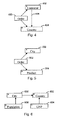
- FIGURE 3 illustrates a graph including a label table.
- FIGURE 4 illustrates an ambiguous graph
- FIGURE 5 illustrates an ambiguous graph
- FIGURE 6 illustrates a graph that is vulnerable to produce inflated results.
- FIGURE 7 illustrates a graph processed in accordance with an embodiment of the invention.
- FIGURE 8 illustrates a graph susceptible to ambiguous results.
- FIGURE 9 illustrates a graph processed in accordance with an embodiment of the invention.
- FIGURE 10 illustrates a graph that may be split in accordance with an embodiment of the invention.
- FIGURES 11 and 12 illustrate split graphs derived in accordance with an embodiment of the invention.
- FIGURE 13 illustrates a graph that may be split in accordance with an embodiment of the invention.
- FIGURES 14 and 15 illustrate split graphs derived in accordance with an embodiment of the invention.
- FIGURE 16 illustrates the derivation of a simple cycle from a complex graph in accordance with an embodiment of the invention.
- FIGURE 17 illustrates the result of the processing of Figure 16 .
- FIGURE 18 illustrates a query path processed in accordance with an embodiment of the invention.
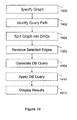
- FIGURE 19 illustrates processing operations performed in accordance with an embodiment of the invention.
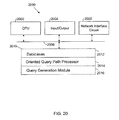
- FIGURE 20 illustrates a computer configured in accordance with an embodiment of the invention.
- the invention reduces the number of query paths considered during the analysis of a database query by leveraging the functional dependencies expressed by oriented joins.
- the invention focuses on the issue of determining more accurate query semantics that take oriented information into account when it is available and can be trusted. Instead of considering tables and joins as defining a non-directed graph, as is the case today, tables and joins are now abstracted into a directed graph, whose edges - that represent the joins - are oriented. An edge goes from table A to table B if a join between A and B has cardinality "many A to one B".
- Figure 1 represents a logical database model abstracted into a directed graph 100.
- the database model includes sales 102, city 104, product 106 and country 108 objects.
- the vertices represent tables (including aliases or virtual tables) from an entity relation model. Vertices 102 and 108 are involved in the query. Throughout this disclosure, vertices involved in a query are marked with a circle, as shown in blocks 102 and 108 of Figure 1 .
- edges or arrows 110 between the vertices are oriented. Recall that existing techniques ignore orientation. These edges represent oriented joins. More exactly, they represent joins with cardinality N ⁇ 0..1. In relational terms, the source table has a foreign key to the target table, and this key may be null. Heterogeneous joins between two data sources are represented by bi-directional arrows that can be navigated in both directions.
- a query path is a subset of edges that connects the vertices associated with a query and obeys certain conditions.
- Figure 2 represents a query path for the query represented in Figure 1 .
- the thick lines 200 represent the edges that are actually chosen to process a query. Given this notation, one can consider the problems associated with existing techniques.
- a label table contains descriptions for heterogeneous objects in a database.
- Figure 3 illustrates a label table 300 and associated objects city 302 and country 304.
- both city 302 and country 304 have a label, which may be a long description. So each table (city 302 and country 304) is joined with the (common) table of labels 300, even though each row in the label table will be dedicated to one specific object, e.g., a country or a city.
- FIG. 4 A similar situation occurs in Figure 4 .
- a fact table with orders 400 has two foreign keys to customer 402 and country 404. This expresses that an order is passed for a certain customer and delivered in a certain country. Separately, each customer has a country (e.g., the headquarter country).
- a related issue is known as "inflated results".
- GNP is not dependent (not functionally linked to) city.
- the current technology correctly splits the query into two different SQL queries to address this issue. The problem with this approach is that it creates multiple SQL queries per measure even in cases when this is not necessary.
- the invention leverages the orientation of joins during query processing. This reduces erroneous results and the number of SQL statements that need to be processed.
- any non-oriented tree that relates all tables in a query is an acceptable candidate.
- the invention automatically eliminates many potential paths. As a result, there are fewer user interactions required to eliminate paths. Nevertheless, at times, user input regarding candidate paths may be solicited.
- the invention utilizes a Directed Acyclic Graph (DAG).
- a DAG contains vertices that are related to each other by oriented edges. Vertex B is functionally dependant on vertex A if there exists an oriented path from A to B. One may also say that B depends on A and that A determines B. In a DAG, no vertex is functionally dependant on itself (the graph does not contain any circuit). A root only has outgoing edges. A leaf only has incoming edges.
- a path in the DAG is a sub-graph that contains a subset of vertices and edges from the DAG.
- a path is a connected component if any vertex can be linked to any other, ignoring the orientation of edges.
- a path contains a cycle if it is possible to navigate from a vertex to itself through at least one edge, ignoring edge orientation.
- a circuit is a sequence of one or more edges allowing one to navigate from a vertex to itself, following the orientation of edges.
- a DAG does not contain circuits but it may contain cycles.
- a query on a DAG is a subset of its vertices.
- a query path for a query is a sub-graph P of the DAG such that (1) P contains all vertices in the query, (2) for any two vertices A and B of the query, if A determines B (or B depends on A), then P contains a directed path that goes from A to B; and (3) P is minimal: it is not possible to obtain a valid query path by removing a set of edges from P.
- Figure 7 illustrates a set of entities: city 700, product 702, sales 704, time 706, country 708 and label 710.
- Bold arrows 712 define a query path. Observe that the query path includes a cycle. For example, one can navigate from the vertex city 700 back to city 700, through label 710 and country 708, if the orientation of the edges 712 are ignored. However, the query path does not include a circuit, because once edge orientation is observed, one cannot navigate from a vertex back to itself. Further observe that sales 704 is a root because it only has outgoing edges. Label 710 and product 702 are leaves since they only have incoming edges.
- Figure 8 illustrates the following entities: zip 800, city 802, country 804 and district 806. Arrows 808 illustrate a first possible query path, while arrows 810 illustrate a second possible query path. This is a case when user input (or the use of contexts-lists of joins between tables) will be necessary to disambiguate the query.
- One embodiment of the invention utilizes an adjacency matrix M for the transitive closure of the graph.
- the paths provided by this algorithm may contain cycles. It was actually purposely defined this way. Instead of eliminating cycles a priori by design (through contexts and aliases that are expensive to maintain), it is desirable to automatically eliminate those cycles that do not make sense at runtime and propose sensible choices to the user while minimizing the designer's work.
- the following example illustrates how to find a query path.
- the graph includes the following entities: inventory 900, sales 902, factory 904, product 906, city 908, product line 910 and country 912.
- the vertices of the query are inventory 900, product line 910 and country 912.
- the adjacency matrix M can be pre-computed for the graph (independently from any query). For this example, this renders: From...to Inventory Sales Factory Product City ProdLine Country Inventory ⁇ Factory ⁇ ⁇ Product ⁇ ⁇ Product ⁇ ⁇ Factory ⁇ Sales ⁇ Product ⁇ ⁇ City ⁇ ⁇ Product ⁇ ⁇ City ⁇ Factory ⁇ Country ⁇ Product ⁇ ProdLine ⁇ City ⁇ Country ⁇ ProdLine Country
- Step/remark L C S 1. Initialize L with the unique root vertex ⁇ Inventory ⁇ 2.a Inventory is the closest ancestor of the two other query objects.
- the query path is then split into one sub-graph per node. This step is fairly simple and fully automatic: for each vertex S in the set R of root vertices, select the graph formed by S and all its successors in the query path. For instance, the query path of Figure 10 can be split into two sub-graphs, as shown in Figure 11 and Figure 12
- each of the obtained sub-graphs is a tree, so there's nothing left to do.
- the query path contains multiple disconnected components, they will be spread into different DAGs, each with one root.
- an oriented tree is extracted. This is done by identifying cycles in the query path and by removing selected edges from these cycles.
- a "simple cycles” in the query path are identified. Each vertex in a cycle has two edges of the cycle pointing to it ("incoming edge") or from it ("outgoing edge”).
- a "fan trap” is a vertex that has two incoming edges in the cycle.
- a "source” is a vertex that has two outgoing edges in the cycle. In a cycle, two fan traps are always separated by two sources and vice-versa.
- a “simple cycle” is a cycle that contains only one fan trap and one source. It can be proven that if a query path with one root contains a cycle, then it always contains a simple cycle. By detecting and removing selected edges from each simple cycle, a DAG is transformed into a directed tree.
- One specific approach to finding simple cycles in a query path includes the following operations.
- a vertex that is not in the query cannot be a leaf or a root.
- the fan trap vertex either belongs to the query or has at least one descendant in the query. Among all descendants of the fan trap that are in the query, pick one that is a minimal distance from the fan trap. This object is called a "query fan trap".
- City 1802 has descendant Country 1804, which is in the query.
- the source of the cycle must be in the query, or it should have an ancestor that is.
- the vertex Sales 1806 itself is in the query and is referred to as a "query source”.
- query path One important property of the query path is the following: when there are multiple paths relating two vertices, then each of these paths contains a different set of vertices from the query. In this example, one can see that there are two ways of relating sales 1806 (the source query object) to country 1804 (the fan trap query vertex) in the query path:
- the following table exemplifies the options proposed to a user in the above example.
- User Option Business Question Action Only consider Sales to Country Sales per Product and Country (with each product's factory) Remove the edge between Factory and City Only consider Sales to Product to Factory to Country Sales per Product, with factory of the Product and Country of the Factory Remove the edge between Sales and City Use both local sales for each product in the country where it's manufactured Keep the cycle and apply all joins at once in the query
- Figure 19 illustrates an initial operation to specify a set of database tables and joins to form a graph 1900.
- a query path is then identified 1902.
- the graph is then split into a set of directed acyclic graphs 1904.
- Selected oriented edges are then removed from each directed acyclic graph 1906.
- a database query is then generated for each tree 1908.
- the database queries are then applied to the database tables to produce query results 1910.
- the query results are then displayed to the user 1912. Alternately, the query results may be further processed.
- Figure 20 illustrates a computer 2000 configured in accordance with an embodiment of the invention.
- the computer includes standard components, such as a central processing unit 2002 and input/output devices 2004 connected via a bus 2006.
- the input/output devices 2004 may include a keyboard, mouse, display, printer and the like.
- a network interface circuit (NIC) 2008 is also connected to the bus to provide connectivity to a network (not shown).
- NIC network interface circuit
- a memory 2010 is also connected to the bus 2006.
- the memory includes data and executable instructions to implement operations of the invention.
- the memory stores one or more databases 2012 that are processed in accordance with the invention.
- An oriented query path processor 2014 includes executable instructions to implement the operations 1900-1906 of Figure 19 .
- a query generation module 2016, which may be a prior art query generation system, such as the type disclosed in previously referenced U.S. Patent 5,555,403 , may be used to implement operations 1908-1912 of Figure 19 .
- the modules in memory 110 are exemplary. These modules may be combined or broken down into additional modules. Similarly, the databases and modules may be distributed across a network. It is the operations of the invention that are significant, not the particular location or manner in which those operations are executed.
- An embodiment of the present invention relates to a computer storage product with a computer-readable medium having computer code thereon for performing various computer-implemented operations.
- the media and computer code may be those specially designed and constructed for the purposes of the present invention, or they may be of the kind well known and available to those having skill in the computer software arts.
- Examples of computer-readable media include, but are not limited to: magnetic media such as hard disks, floppy disks, and magnetic tape; optical media such as CD-ROMs, DVDs and holographic devices; magneto-optical media; and hardware devices that are specially configured to store and execute program code, such as application-specific integrated circuits ("ASICs"), programmable logic devices ("PLDs”) and ROM and RAM devices.
- ASICs application-specific integrated circuits
- PLDs programmable logic devices
- Examples of computer code include machine code, such as produced by a compiler, and files containing higher-level code that are executed by a computer using an interpreter.
- machine code such as produced by a compiler
- files containing higher-level code that are executed by a computer using an interpreter.
- an embodiment of the invention may be implemented using Java, C++, or other object-oriented programming language and development tools.
- Another embodiment of the invention may be implemented in hardwired circuitry in place of, or in combination with, machine-executable software instructions.
Landscapes
- Engineering & Computer Science (AREA)
- Theoretical Computer Science (AREA)
- Operations Research (AREA)
- Computational Linguistics (AREA)
- Data Mining & Analysis (AREA)
- Databases & Information Systems (AREA)
- Physics & Mathematics (AREA)
- General Engineering & Computer Science (AREA)
- General Physics & Mathematics (AREA)
- Information Retrieval, Db Structures And Fs Structures Therefor (AREA)
Applications Claiming Priority (1)
| Application Number | Priority Date | Filing Date | Title |
|---|---|---|---|
| US12/343,371 US9229982B2 (en) | 2008-12-23 | 2008-12-23 | Processing queries using oriented query paths |
Publications (2)
| Publication Number | Publication Date |
|---|---|
| EP2202658A2 true EP2202658A2 (de) | 2010-06-30 |
| EP2202658A3 EP2202658A3 (de) | 2011-08-03 |
Family
ID=42084612
Family Applications (1)
| Application Number | Title | Priority Date | Filing Date |
|---|---|---|---|
| EP09175423A Withdrawn EP2202658A3 (de) | 2008-12-23 | 2009-11-09 | Vorrichtung und Verfahren zur Verarbeitung von Anfragen mithilfe ausgerichteter Anfragenpfade |
Country Status (2)
| Country | Link |
|---|---|
| US (1) | US9229982B2 (de) |
| EP (1) | EP2202658A3 (de) |
Cited By (18)
| Publication number | Priority date | Publication date | Assignee | Title |
|---|---|---|---|---|
| EP3550444A1 (de) * | 2018-04-02 | 2019-10-09 | Thoughtspot Inc. | Abfrageerzeugung auf basis eines logischen datenmodells |
| US10970319B2 (en) | 2019-07-29 | 2021-04-06 | Thoughtspot, Inc. | Phrase indexing |
| WO2021081802A1 (en) * | 2019-10-30 | 2021-05-06 | Paypal, Inc. | Electronic database search and storage efficiency improvement |
| US11017035B2 (en) | 2013-07-17 | 2021-05-25 | Thoughtspot, Inc. | Token based dynamic data indexing with integrated security |
| US11023486B2 (en) | 2018-11-13 | 2021-06-01 | Thoughtspot, Inc. | Low-latency predictive database analysis |
| US11157564B2 (en) | 2018-03-02 | 2021-10-26 | Thoughtspot, Inc. | Natural language question answering systems |
| US11200227B1 (en) | 2019-07-31 | 2021-12-14 | Thoughtspot, Inc. | Lossless switching between search grammars |
| US11334548B2 (en) | 2019-01-31 | 2022-05-17 | Thoughtspot, Inc. | Index sharding |
| US11354326B2 (en) | 2019-07-29 | 2022-06-07 | Thoughtspot, Inc. | Object indexing |
| US11409744B2 (en) | 2019-08-01 | 2022-08-09 | Thoughtspot, Inc. | Query generation based on merger of subqueries |
| US11416477B2 (en) | 2018-11-14 | 2022-08-16 | Thoughtspot, Inc. | Systems and methods for database analysis |
| US11442932B2 (en) | 2019-07-16 | 2022-09-13 | Thoughtspot, Inc. | Mapping natural language to queries using a query grammar |
| US11544272B2 (en) | 2020-04-09 | 2023-01-03 | Thoughtspot, Inc. | Phrase translation for a low-latency database analysis system |
| US11544239B2 (en) | 2018-11-13 | 2023-01-03 | Thoughtspot, Inc. | Low-latency database analysis using external data sources |
| US11580147B2 (en) | 2018-11-13 | 2023-02-14 | Thoughtspot, Inc. | Conversational database analysis |
| US11580111B2 (en) | 2021-04-06 | 2023-02-14 | Thoughtspot, Inc. | Distributed pseudo-random subset generation |
| US11734286B2 (en) | 2017-10-10 | 2023-08-22 | Thoughtspot, Inc. | Automatic database insight analysis |
| US11928114B2 (en) | 2019-04-23 | 2024-03-12 | Thoughtspot, Inc. | Query generation based on a logical data model with one-to-one joins |
Families Citing this family (28)
| Publication number | Priority date | Publication date | Assignee | Title |
|---|---|---|---|---|
| US8229952B2 (en) * | 2009-05-11 | 2012-07-24 | Business Objects Software Limited | Generation of logical database schema representation based on symbolic business intelligence query |
| US20110246550A1 (en) | 2010-04-02 | 2011-10-06 | Levari Doron | System and method for aggregation of data from a plurality of data sources |
| US20130144524A1 (en) * | 2011-03-31 | 2013-06-06 | Microsoft Corporation | Double-hub indexing in location services |
| US20120254153A1 (en) * | 2011-03-31 | 2012-10-04 | Microsoft Corporation | Shortest path determination in databases |
| US9213735B1 (en) | 2012-01-25 | 2015-12-15 | Google Inc. | Flow control in very large query result sets using a release message to confirm that a client computer is ready to receive the data associated with a data collection operation |
| US10430406B2 (en) * | 2012-08-13 | 2019-10-01 | Aria Solutions, Inc. | Enhanced high performance real-time relational database system and methods for using same |
| US20150120697A1 (en) | 2013-10-28 | 2015-04-30 | Scalebase Inc. | System and method for analysis of a database proxy |
| US10303702B2 (en) | 2014-02-07 | 2019-05-28 | Ignite Scalarc Solutions, Inc. | System and method for analysis and management of data distribution in a distributed database environment |
| US9921881B2 (en) * | 2014-05-27 | 2018-03-20 | Sybase, Inc. | Optimizing performance in CEP systems via CPU affinity |
| US10078684B2 (en) | 2014-09-26 | 2018-09-18 | Oracle International Corporation | System and method for query processing with table-level predicate pushdown in a massively parallel or distributed database environment |
| US10387421B2 (en) | 2014-09-26 | 2019-08-20 | Oracle International Corporation | System and method for generating size-based splits in a massively parallel or distributed database environment |
| US10180973B2 (en) | 2014-09-26 | 2019-01-15 | Oracle International Corporation | System and method for efficient connection management in a massively parallel or distributed database environment |
| US10380114B2 (en) | 2014-09-26 | 2019-08-13 | Oracle International Corporation | System and method for generating rowid range-based splits in a massively parallel or distributed database environment |
| US10394818B2 (en) | 2014-09-26 | 2019-08-27 | Oracle International Corporation | System and method for dynamic database split generation in a massively parallel or distributed database environment |
| US10528596B2 (en) | 2014-09-26 | 2020-01-07 | Oracle International Corporation | System and method for consistent reads between tasks in a massively parallel or distributed database environment |
| US10089377B2 (en) | 2014-09-26 | 2018-10-02 | Oracle International Corporation | System and method for data transfer from JDBC to a data warehouse layer in a massively parallel or distributed database environment |
| US10089357B2 (en) * | 2014-09-26 | 2018-10-02 | Oracle International Corporation | System and method for generating partition-based splits in a massively parallel or distributed database environment |
| US10387496B2 (en) * | 2015-05-21 | 2019-08-20 | International Business Machines Corporation | Storing graph data in a relational database |
| US10803121B2 (en) | 2015-05-28 | 2020-10-13 | GraphSQL, Inc. | System and method for real-time graph-based recommendations |
| CN107515886B (zh) * | 2016-06-17 | 2020-11-24 | 阿里巴巴集团控股有限公司 | 一种数据表的识别方法、装置和系统 |
| US11036797B2 (en) * | 2017-10-12 | 2021-06-15 | Adtran, Inc. | Efficient storage and utilization of a hierarchical data set |
| CN111538714B (zh) * | 2020-04-24 | 2023-10-17 | 咪咕文化科技有限公司 | 一种指令执行方法、装置、电子设备和存储介质 |
| CN112115171B (zh) * | 2020-09-28 | 2023-11-21 | 广州华多网络科技有限公司 | 数据聚合方法、装置、终端设备和计算机可读存储介质 |
| CN114511340B (zh) * | 2020-11-17 | 2025-03-11 | 腾讯科技(深圳)有限公司 | 识别作弊流量媒体的方法、装置、电子设备及存储介质 |
| US12118006B2 (en) | 2021-01-29 | 2024-10-15 | Microsoft Technology Licensing, Llc | Automated code generation for computer software |
| US11636111B1 (en) * | 2021-10-25 | 2023-04-25 | International Business Machines Corporation | Extraction of relationship graphs from relational databases |
| US12411891B2 (en) | 2023-11-22 | 2025-09-09 | Truist Bank | Systems and methods for data asset access governance |
| US12373468B2 (en) * | 2023-11-22 | 2025-07-29 | Truist Bank | Systems and methods for a data ecosystem |
Citations (1)
| Publication number | Priority date | Publication date | Assignee | Title |
|---|---|---|---|---|
| US5555403A (en) | 1991-11-27 | 1996-09-10 | Business Objects, S.A. | Relational database access system using semantically dynamic objects |
Family Cites Families (14)
| Publication number | Priority date | Publication date | Assignee | Title |
|---|---|---|---|---|
| US5287493A (en) * | 1990-08-31 | 1994-02-15 | International Business Machines Corporation | Database interactive prompted query system having named database tables linked together by a user through join statements |
| US5761654A (en) | 1996-06-05 | 1998-06-02 | Oracle Corporation | Memory structure and method for tuning a database statement using a join-tree data structure representation, including selectivity factors, of a master table and detail table |
| US6029162A (en) * | 1997-01-31 | 2000-02-22 | Lucent Technologies, Inc. | Graph path derivation using fourth generation structured query language |
| US6138111A (en) | 1997-05-02 | 2000-10-24 | Informix Software, Inc. | Cardinality-based join ordering |
| US6038538A (en) * | 1997-09-15 | 2000-03-14 | International Business Machines Corporation | Generating process models from workflow logs |
| US6108698A (en) * | 1998-07-29 | 2000-08-22 | Xerox Corporation | Node-link data defining a graph and a tree within the graph |
| US6496819B1 (en) * | 1998-12-28 | 2002-12-17 | Oracle Corporation | Rewriting a query in terms of a summary based on functional dependencies and join backs, and based on join derivability |
| EP1349081A1 (de) * | 2002-03-28 | 2003-10-01 | LION Bioscience AG | Methode und Gerät zum Befragen von relationalen Datenbanken |
| US7302447B2 (en) * | 2005-01-14 | 2007-11-27 | International Business Machines Corporation | Virtual columns |
| US7492727B2 (en) * | 2006-03-31 | 2009-02-17 | International Business Machines Corporation | Space and time efficient XML graph labeling |
| US8086598B1 (en) | 2006-08-02 | 2011-12-27 | Hewlett-Packard Development Company, L.P. | Query optimizer with schema conversion |
| FR2909199B1 (fr) * | 2006-11-23 | 2009-01-16 | Lascom Sa | Procede de recherche hierarchique sur un graphe conditionnel |
| US7610429B2 (en) * | 2007-01-30 | 2009-10-27 | Hewlett-Packard Development Company, L.P. | Method and system for determining device criticality in a computer configuration |
| US8214352B2 (en) * | 2008-11-26 | 2012-07-03 | Hewlett-Packard Development Company | Modular query optimizer |
-
2008
- 2008-12-23 US US12/343,371 patent/US9229982B2/en active Active
-
2009
- 2009-11-09 EP EP09175423A patent/EP2202658A3/de not_active Withdrawn
Patent Citations (1)
| Publication number | Priority date | Publication date | Assignee | Title |
|---|---|---|---|---|
| US5555403A (en) | 1991-11-27 | 1996-09-10 | Business Objects, S.A. | Relational database access system using semantically dynamic objects |
Cited By (40)
| Publication number | Priority date | Publication date | Assignee | Title |
|---|---|---|---|---|
| US11899638B2 (en) | 2013-07-17 | 2024-02-13 | Thoughtspot, Inc. | Token based dynamic data indexing with integrated security |
| US11017035B2 (en) | 2013-07-17 | 2021-05-25 | Thoughtspot, Inc. | Token based dynamic data indexing with integrated security |
| US12229096B2 (en) | 2013-07-17 | 2025-02-18 | Thoughtspot, Inc. | Token based dynamic data indexing with integrated security |
| US11599587B2 (en) | 2013-07-17 | 2023-03-07 | Thoughtspot, Inc. | Token based dynamic data indexing with integrated security |
| US11734286B2 (en) | 2017-10-10 | 2023-08-22 | Thoughtspot, Inc. | Automatic database insight analysis |
| US12189691B2 (en) | 2018-03-02 | 2025-01-07 | Thoughtspot, Inc. | Natural language question answering systems |
| US11157564B2 (en) | 2018-03-02 | 2021-10-26 | Thoughtspot, Inc. | Natural language question answering systems |
| US11790006B2 (en) | 2018-03-02 | 2023-10-17 | Thoughtspot, Inc. | Natural language question answering systems |
| EP3550444A1 (de) * | 2018-04-02 | 2019-10-09 | Thoughtspot Inc. | Abfrageerzeugung auf basis eines logischen datenmodells |
| US11176199B2 (en) | 2018-04-02 | 2021-11-16 | Thoughtspot, Inc. | Query generation based on a logical data model |
| US11544239B2 (en) | 2018-11-13 | 2023-01-03 | Thoughtspot, Inc. | Low-latency database analysis using external data sources |
| US12554740B2 (en) | 2018-11-13 | 2026-02-17 | Thoughtspot, Inc. | Low-latency predictive database analysis |
| US12038887B2 (en) | 2018-11-13 | 2024-07-16 | Thoughtspot, Inc. | Low-latency database analysis using external data sources |
| US11941034B2 (en) | 2018-11-13 | 2024-03-26 | Thoughtspot, Inc. | Conversational database analysis |
| US11023486B2 (en) | 2018-11-13 | 2021-06-01 | Thoughtspot, Inc. | Low-latency predictive database analysis |
| US11620306B2 (en) | 2018-11-13 | 2023-04-04 | Thoughtspot, Inc. | Low-latency predictive database analysis |
| US11580147B2 (en) | 2018-11-13 | 2023-02-14 | Thoughtspot, Inc. | Conversational database analysis |
| US11416477B2 (en) | 2018-11-14 | 2022-08-16 | Thoughtspot, Inc. | Systems and methods for database analysis |
| US11334548B2 (en) | 2019-01-31 | 2022-05-17 | Thoughtspot, Inc. | Index sharding |
| US12493601B2 (en) | 2019-01-31 | 2025-12-09 | Thoughtspot, Inc. | Index sharding |
| US12259889B2 (en) | 2019-04-23 | 2025-03-25 | Thoughtspot, Inc. | Query generation based on a logical data model with one-to-one joins |
| US11928114B2 (en) | 2019-04-23 | 2024-03-12 | Thoughtspot, Inc. | Query generation based on a logical data model with one-to-one joins |
| US11442932B2 (en) | 2019-07-16 | 2022-09-13 | Thoughtspot, Inc. | Mapping natural language to queries using a query grammar |
| US12259879B2 (en) | 2019-07-16 | 2025-03-25 | Thoughtspot, Inc. | Mapping natural language to queries using a query grammar |
| US11556571B2 (en) | 2019-07-29 | 2023-01-17 | Thoughtspot, Inc. | Phrase indexing |
| US11989196B2 (en) | 2019-07-29 | 2024-05-21 | Thoughtspot, Inc. | Object indexing |
| US11809468B2 (en) | 2019-07-29 | 2023-11-07 | Thoughtspot, Inc. | Phrase indexing |
| US10970319B2 (en) | 2019-07-29 | 2021-04-06 | Thoughtspot, Inc. | Phrase indexing |
| US11354326B2 (en) | 2019-07-29 | 2022-06-07 | Thoughtspot, Inc. | Object indexing |
| US11803543B2 (en) | 2019-07-31 | 2023-10-31 | Thoughtspot, Inc. | Lossless switching between search grammars |
| US11200227B1 (en) | 2019-07-31 | 2021-12-14 | Thoughtspot, Inc. | Lossless switching between search grammars |
| US11409744B2 (en) | 2019-08-01 | 2022-08-09 | Thoughtspot, Inc. | Query generation based on merger of subqueries |
| US11966395B2 (en) | 2019-08-01 | 2024-04-23 | Thoughtspot, Inc. | Query generation based on merger of subqueries |
| US11605086B2 (en) | 2019-10-30 | 2023-03-14 | Paypal, Inc. | Electronic database search and storage efficiency improvement |
| WO2021081802A1 (en) * | 2019-10-30 | 2021-05-06 | Paypal, Inc. | Electronic database search and storage efficiency improvement |
| US11874842B2 (en) | 2020-04-09 | 2024-01-16 | Thoughtspot, Inc. | Phrase translation for a low-latency database analysis system |
| US12242486B2 (en) | 2020-04-09 | 2025-03-04 | Thoughtspot, Inc. | Phrase translation for a low-latency database analysis system |
| US11544272B2 (en) | 2020-04-09 | 2023-01-03 | Thoughtspot, Inc. | Phrase translation for a low-latency database analysis system |
| US11836136B2 (en) | 2021-04-06 | 2023-12-05 | Thoughtspot, Inc. | Distributed pseudo-random subset generation |
| US11580111B2 (en) | 2021-04-06 | 2023-02-14 | Thoughtspot, Inc. | Distributed pseudo-random subset generation |
Also Published As
| Publication number | Publication date |
|---|---|
| US9229982B2 (en) | 2016-01-05 |
| EP2202658A3 (de) | 2011-08-03 |
| US20100161651A1 (en) | 2010-06-24 |
Similar Documents
| Publication | Publication Date | Title |
|---|---|---|
| US9229982B2 (en) | Processing queries using oriented query paths | |
| US12530403B2 (en) | Tool to build and store a data model and queries for a graph database | |
| US8244748B2 (en) | Including annotation data with disparate relational data | |
| US9244974B2 (en) | Optimization of database queries including grouped aggregation functions | |
| US9026901B2 (en) | Viewing annotations across multiple applications | |
| US9785725B2 (en) | Method and system for visualizing relational data as RDF graphs with interactive response time | |
| CN114616558B (zh) | 利用适当的度量聚合生成多事实数据集的数据可视化 | |
| US8452773B1 (en) | Mapping terms between multiple taxonomies | |
| CN111259627A (zh) | 文档分析方法、装置、计算机存储介质及设备 | |
| US20230281200A1 (en) | Method, apparatus, and computer-readable medium to extract a referentially intact subset from a database | |
| US8762411B2 (en) | Progressive exploration of data relationships | |
| JP4114653B2 (ja) | クエリ処理操作中に補助属性を用いてクエリをリライトするための方法および装置 | |
| EP2049984A2 (de) | Primenet-datenverwaltungssystem | |
| Agarwal et al. | Approximate incremental big-data harmonization | |
| US20030023591A1 (en) | Systems and methods for discovering mutual dependence patterns | |
| CN110990403A (zh) | 业务数据的存储方法、系统、计算机设备及存储介质 | |
| US11501112B1 (en) | Detecting, diagnosing, and directing solutions for source type mislabeling of machine data, including machine data that may contain PII, using machine learning | |
| US20210334281A1 (en) | Join pattern agnostic aggregate computation in database query operations | |
| CN112528327A (zh) | 数据脱敏方法及装置、数据还原方法及装置 | |
| US9767146B2 (en) | Use of generated SQL for evaluation of decision point rules in a workflow system | |
| CN111897837A (zh) | 数据查询方法、装置、设备和介质 | |
| US8818974B2 (en) | System and method for synchronously updating a hierarchy bridge table | |
| US8423523B2 (en) | Apparatus and method for utilizing context to resolve ambiguous queries | |
| CN112527813A (zh) | 业务系统的数据处理方法及装置、电子设备、存储介质 | |
| US20130218893A1 (en) | Executing in-database data mining processes |
Legal Events
| Date | Code | Title | Description |
|---|---|---|---|
| PUAI | Public reference made under article 153(3) epc to a published international application that has entered the european phase |
Free format text: ORIGINAL CODE: 0009012 |
|
| AK | Designated contracting states |
Kind code of ref document: A2 Designated state(s): AT BE BG CH CY CZ DE DK EE ES FI FR GB GR HR HU IE IS IT LI LT LU LV MC MK MT NL NO PL PT RO SE SI SK SM TR |
|
| AX | Request for extension of the european patent |
Extension state: AL BA RS |
|
| PUAL | Search report despatched |
Free format text: ORIGINAL CODE: 0009013 |
|
| AK | Designated contracting states |
Kind code of ref document: A3 Designated state(s): AT BE BG CH CY CZ DE DK EE ES FI FR GB GR HR HU IE IS IT LI LT LU LV MC MK MT NL NO PL PT RO SE SI SK SM TR |
|
| AX | Request for extension of the european patent |
Extension state: AL BA RS |
|
| RIC1 | Information provided on ipc code assigned before grant |
Ipc: G06F 17/30 20060101AFI20110629BHEP |
|
| 17P | Request for examination filed |
Effective date: 20120203 |
|
| 17Q | First examination report despatched |
Effective date: 20170220 |
|
| STAA | Information on the status of an ep patent application or granted ep patent |
Free format text: STATUS: THE APPLICATION HAS BEEN WITHDRAWN |
|
| 18W | Application withdrawn |
Effective date: 20170518 |